Challenges and Solutions in Green Innovation Practices: A Case Study of a Manufacturing Firm in Turkey




Abstract
1. Introduction
- RQ1—How do leadership and decision-making processes shape the adoption and implementation of green innovation practices within manufacturing firms?
- RQ2—What are the key barriers hindering the implementation of green innovation practices in manufacturing firms operating in Turkey?
- RQ3—Which basic solution areas are identified by senior managers in order to overcome barriers to green innovation practices?
- RQ4—Which improvement areas are perceived as critical for strengthening and sustaining green innovation practices in the long term?
2. Conceptual Framework
2.1. Green Innovation Practices and Sustainability
2.2. Leadership and Decision-Making in Green Innovation
2.3. Barriers to Green Innovation Practices
2.4. Solution Areas and Improvement Mechanisms for Green Innovation
2.5. Research Gap and Positioning of the Study
3. Materials and Methods
3.1. Sample
3.2. Validity and Reliability
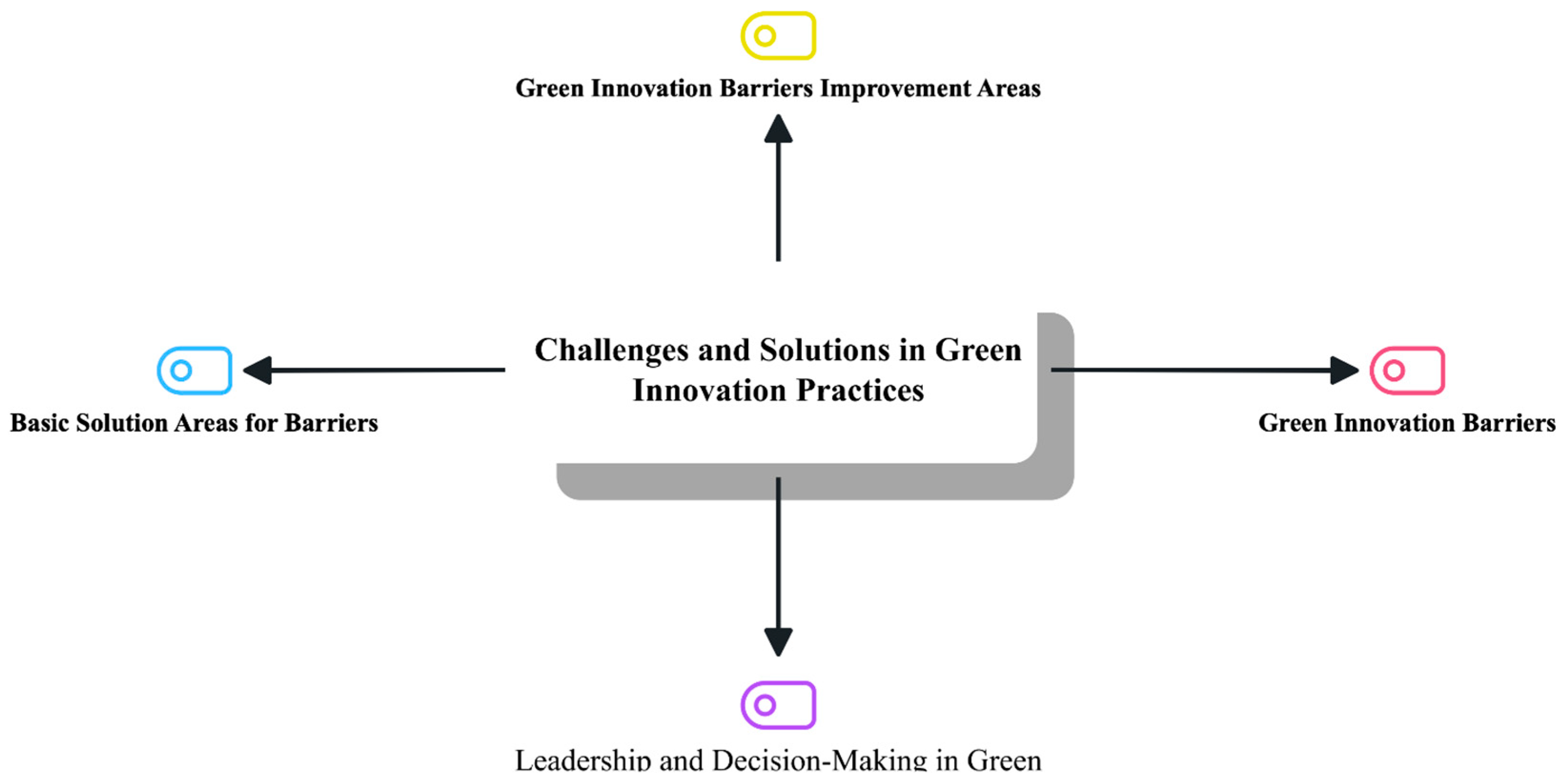
4. Results
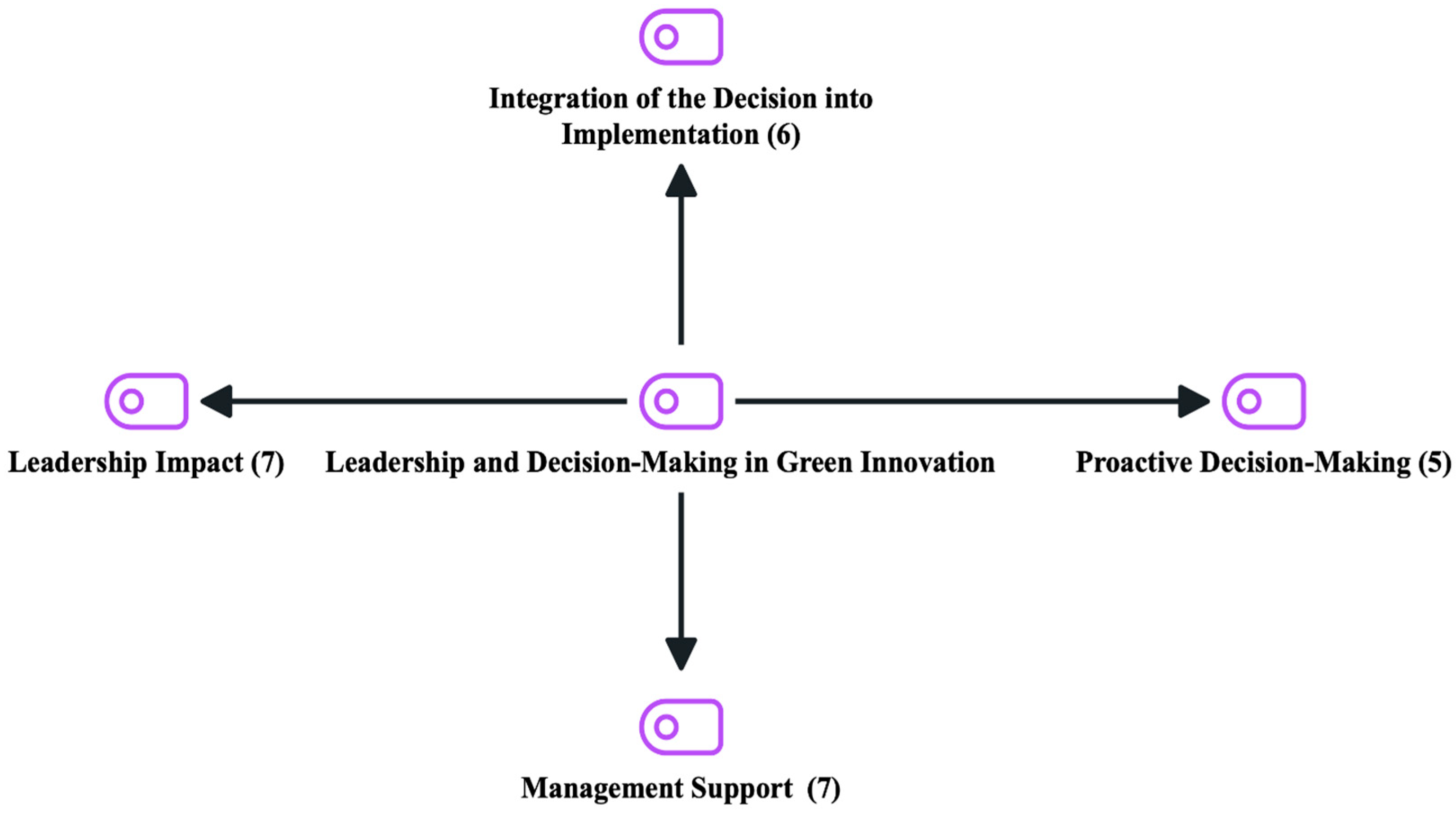
4.1. Leadership and Decision-Making in Green Innovation Theme
4.1.1. Management Support
“We have a sustainability committee chaired by our CEO that sets goals. This Sustainability Committee holds meetings at specific intervals. They set goals and communicate these goals to us through various notes and publications”.(K1)
“Our company has a sustainability committee chaired by our CEO, and we implement the decisions taken together with collective wisdom. There are monthly, quarterly, six-monthly, and weekly meetings if necessary. This process is carried out with consultants and company members chaired by the sustainability officer, Mr. R., who is based at our headquarters”.(K2)
4.1.2. Integration of the Decision into Implementation
“If you set it up correctly from the employee’s perspective, you don’t encounter resistance. I can say we are lucky in that regard. Employees adapted very quickly to the Promanage (Manufacturing Execution System) process. There isn’t a heavy workload on the operator. We don’t expect too much effort from the operator. We just need them to enter the expected downtime. Let’s say the machine stopped. The operator first provides this information. Then they write down the reason. For example, it stopped due to power consumption, the machine hose burst, the machine stopped. We want them to enter this as data. It’s not a very serious workload, but some factories are very successful, while others are not. I would like to point out that we are making very good progress in our plastic factories at the moment”.(K4)
4.1.3. Proactive Decision-Making
“We need proactive approaches rather than reactive ones. As a result, we have used energy and resources abundantly. Then let’s go collect the waste from the trash and reuse it. Yes, we will collect it, but this will remain a reactive approach. We cannot manage the crisis or take corrective action. We actually need to approach and think in terms of preventive action or risk management, even a proactive approach. I think pre-engineering studies can be extremely effective in this important area. One of the most important points when we make decisions is to guide our customers in the right direction. How can I reduce the weight of this product from 100 grams to 95 grams, 90 grams, or 80 grams while maintaining the same physical properties? This is our main goal. What does this achieve? It allows us to produce using less raw materials, less energy, and leaving a smaller carbon footprint. Today, at ÇEVKO (Environmental Protection and Packaging Waste Recycling Foundation) meetings at, many international companies leave no trace. They say they use recycled raw materials for their products. But the caps they produce are colored. There are many colors available, such as red, green, and purple. Water bottles are produced, but the caps are black or red. There is no need for such production. If you don’t produce them in colors, you will have taken a proactive approach to production. If you produce red caps, green caps, or colored products and put them on the market, the environment will suffer. Saying that you collected and reused them after this incident does not prove that you are environmentally conscious. You should not do it in the first place”.(K4)
“What is the purpose of a business? To make a profit. How can we reduce our costs and generate this profit? In the past, there was a selling price for a product. We call this the cost minus the remaining amount, which was our profit. Now there is a market price. You reduce your costs and the profit remains. The more you reduce your costs, the more profitable and competitive your company becomes. You can become more competitive by reducing your costs through both digital and sustainability practices. Continuing with the Promanage example, I would like to mention an incident that occurred yesterday evening. Two of our machines in Çerkezköy stopped at around 7 p.m. Under normal circumstances, it is not possible to monitor these by phone. But with an app on your cell phone, you can see which machine is down and why from your home. We intervened immediately. Despite being a major malfunction, it was back in operation within 7–8 hours. So how did this help? Everyone reduced each other’s costs. Because the operator comes to the factory to produce. If the operator waits at the malfunctioning machine, this becomes a labor cost. Similarly, a malfunctioning machine constantly causes waste and raw material loss. Thus, with quick control, the problem is solved quickly and the cost is also reduced. This makes us more competitive”.(K9)
4.1.4. Leadership Impact
“Here, awareness is of critical importance, and we help motivate people to increase their awareness. We hold meetings on this topic, led by factory managers. There are daily Asakaya meetings. There are Obeye meetings. Of course, we can ensure continuity with kaizens, A3s, and 5S meetings related to these. We can further increase employee motivation in this way. Information is provided through brochures, meetings, and training documents. The company allocates resources to us for such practices and projects. We also make preparations for the process together with the employees”.(K2)
“Leadership is a critical step for employee motivation. We try to support them with suggestion systems. We also expect support from them through this suggestion system. Small rewards are given here. We conduct three-month training, followed by monthly evaluations. We have one consultant. Not just for this issue. More of a consultant related to lean production. For example, if there was a study related to energy here, they are examined. We have a small formula here. We evaluate under certain headings. For example, there are specific questions such as quality authority, efficiency authority, environmentalism authority, and material consumption authority. So, is there quality authority? No, it gets zero points there. Is there OHS authority? Yes, it gets 10 points there. Does it ensure less material consumption? Yes, it gets 50 points. We have a multiplier at the bottom of our list; the multiplier determines the specific reward that will be given directly to us. So, some people get a thank you, while others might get 2000 lira, 3000 lira, or 4000 lira. They receive a reward based on that evaluation. Maybe they gain visibility. Maybe they win a pair of shoes. We have an automated system for this kind of evaluation”.(K5)
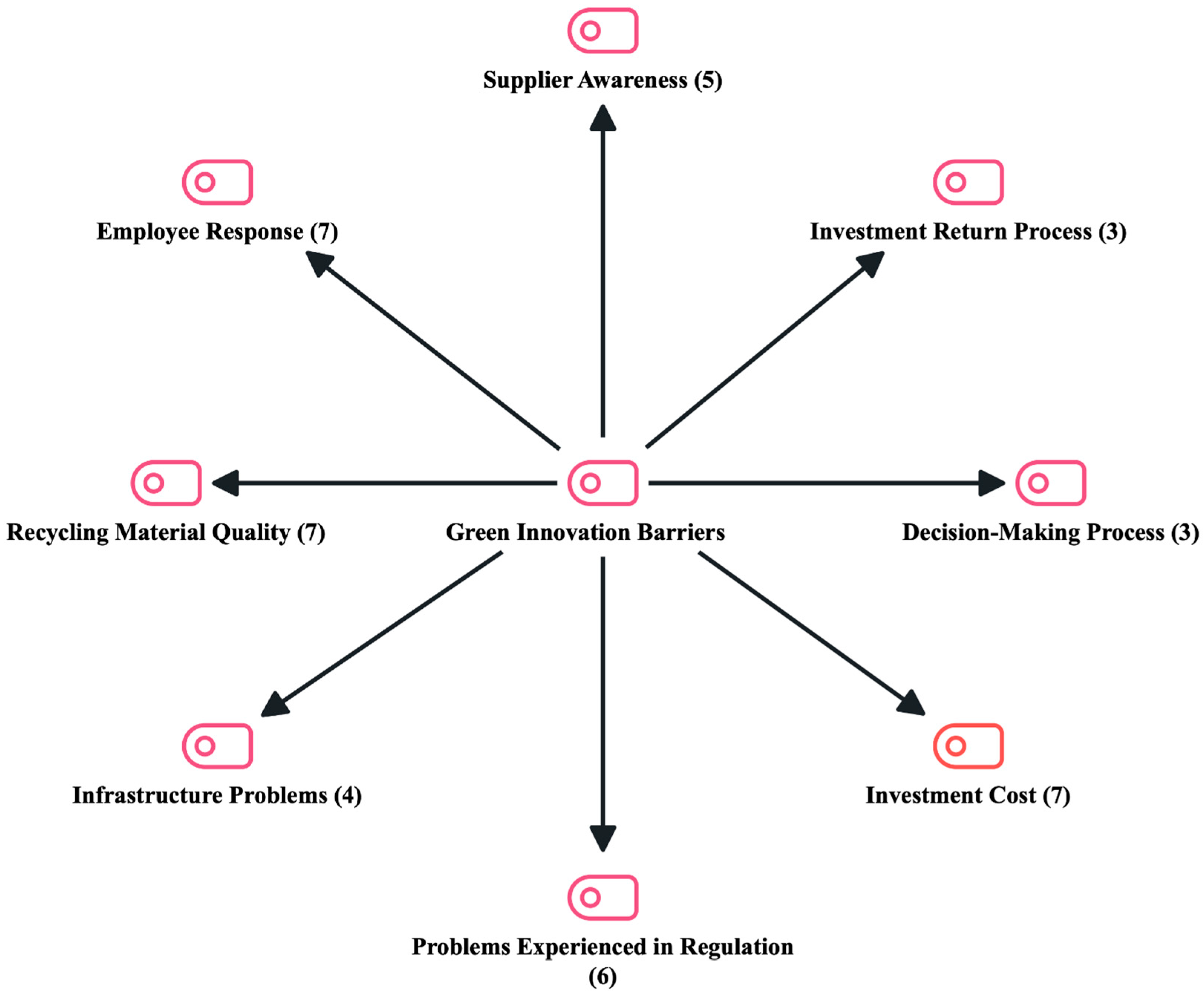
4.2. Green Innovation Barriers Theme
4.2.1. Infrastructure Problems
“There is no incentive for technological innovation. Certain criteria exist. There are rules regarding greenhouse gases, energy consumption, and waste, but they are not sufficient. The government sets the criteria, and waste is controlled for gas, paint, and production. These are the important issues in production. It is already impossible to give an award. We are experiencing difficulties even in what we want to do. For example, I want to talk about solar energy systems (GES). It is planned to be established in the Gebze campus as well. They have been established in the Adana-Manisa campuses. There is a technical aspect to this system. The reason it has not been established yet is that the transformer power here may or may not be sufficient, and there are also issues with obtaining permits. Even the lack of sufficient infrastructure for the GES project here changes the cost. These processes are constantly being discussed. Even if you want it, the process is difficult to move forward in this way. They said incentives would be provided, so we waited, and we also put our money on the line financially, but the lack of regular industrialization is breaking our backs. These difficult conditions affect us more than our cost problems; it is the failure of the state to create suitable conditions. We interpret this situation as perhaps there being a problem at the starting point”.(K6)
4.2.2. Problems Experienced in Regulation
“We act in accordance with Swiss and European standards as required by export regulations. Decisions are made in this direction. Europe’s stance is clear. If your carbon footprint is not at a certain level, if recycled products are not used, if renewable energy is not used in production, even the best product will remain unsold. Laws abroad are quite strict. Both suppliers and customers are aware of this. Therefore, it is an important responsibility for us to renew and monitor our resources in a controlled manner”.(K5)
4.2.3. Investment Return Process
“We developed our own R&D. We are converting the trial-and-error automation into investments using our own financial resources. For us, even the free air circulating in the factory is considered waste and is controlled. The cost of the automation required for this control system is quite high. The automation we have acquired will cover its own costs in at least 3 years and then work for us to generate profit. The environment is important to us. We have a structure that gains value as we value our employees, our suppliers, and our environment. This is what sets us apart from our competitors. However, in this process, just as the law supports us, the state must also contribute to us”.(K4)
4.2.4. Employee Response
“To overcome employee resistance, we visit them on-site. We visit employees on-site. Because some of our employees cannot use computers, especially older people. We are also working to digitize sustainability issues as much as we can. The SAP (Systems, Practices, and Products in Data Processing) program is an actively used software. Thanks to this program, we can access our historical data, and we want to support this infrastructure in the field of sustainability as well”.(K3)
“Prejudice is the biggest reaction. Employees who see these systems complain to us, saying things like, ‘Are you dissatisfied with our work? Is there a problem? Can’t we do our jobs?’ They say machines can’t save money better than us. When we set up these systems, their initial reaction was to not touch them at all. We couldn’t get them to accept it easily. We provided continuous training. We taught them how to use it at the device. We addressed their concerns. We tried to break down their prejudices, and we succeeded. Now we provide training to our employees when we hire them. We have created teams that will continuously support our colleagues and our teams. If a problem arises, they immediately connect to the relevant unit and solve the problem quickly”.(K11)
4.2.5. Supplier Awareness
“We have some problems with the customers we work with. As a plastic manufacturer, our main goal is to consume less plastic. We are looking for the answer to the question: How can we manage the current business by producing less plastic? In my opinion, there are shortcomings on the customer side. Because sometimes we go to our customers with very innovative projects. For example, we indicate that we can produce a plastic bottle weighing 100 grams under the same conditions down to 70 grams, but when the process takes longer, we cannot get support from suppliers. I think this is the biggest problem we face”.(K5)
4.2.6. Decision-Making Process
“In line with the institution’s main objectives, and also because I am a technical person, I always try to make decisions with careful consideration of the subject matter. For example, if we are going to order a machine, we try to choose one that is a new generation machine and uses scarce resources more appropriately, and also causes minimal damage to the environment. In line with those goals, the solution we want does not immediately present itself; we encounter many obstacles. We try to overcome them and manage the decision-making process accordingly”.(K4)
“I worked for many years in this field, even with this database, in my previous career. I think we have made very little progress in some areas. In others, we have made sudden progress. Wind energy took off when you least expected it. It is very important for the government to take consistent steps in this regard. Leadership and education are important”.(K10)
4.2.7. Recycling Material Quality
“Recycling is an area full of laws. In fact, many laws are one of the biggest obstacles to recycling. For example, today it is illegal to use recycled material in food packaging. It is prohibited according to the decisions of the Turkish Food Codex. You cannot use recycled packaging material. By recycling, I mean material that has been collected from the trash and processed. You cannot use this. I think this is a huge obstacle. Because technology has now developed to such an extent that there is a value called IV, which is a value that provides fluidity. You change the IV of these materials by passing them through X-rays at the facilities. With today’s technology, forget about food freedom; you are now altering the material itself. A long time ago, there was a notion that materials converted back to food freedom couldn’t be used. These existed in the years 2014–2015, as stated in the Turkish Food Codex. We need to move past these issues here, pave the way for producers, and support them. And as in the UK example, support should be provided to those who reach a certain level in this regard. The law also provides support. Perhaps there should be support such as tax breaks. Do you know why this support is important? It is important for this reason: today, you buy a material for $1000, and you don’t buy this material from Turkey; 99% of it comes from countries like Germany, Arab countries, Mexico, and South American countries. Let’s assume you buy it for $1000. Then you take this material, put it into a visual facility, separate it, process it, and it comes back to you. Currently, the separation cost is higher than the raw material cost. So, while you buy a raw material for $1000, you can buy recycled material for $1200. That’s why these supports are important. You can do this, yes, for certain customers. Without charging a price difference. But if the government doesn’t support these issues and doesn’t pave the way, this will never improve. As long as it doesn’t improve, no one will say, ‘I’ll pay more, but I’ll use 20% recycled material”.(K5)
“We have a customer in the UK. Tetroselit is a mineral oil company. They make vehicle maintenance products. Not just mineral oil, but car shampoo and vehicle interior cosmetic products. And we produce a very significant amount of these products each year, though I don’t have the exact figures in mind. Now, after this law came into effect, we wanted to produce packaging from 30% recyclable raw materials in the UK. However, every time we bought Recycle HDP or Recycle polypropylene from the market, we received materials of varying quality. So, the bags you buy in stores are also polyethylene. The 200-liter barrels are also polyethylene. The 1-ton tanks we call IVC are also polyethylene. But one is LDPE, Low Density Polyethylene. Another is HDPE, High Density Polyethylene. Those are the large 200-liter barrels we call big grams. They are High Molecular Weight HDPE. Now you can only produce from HDPE. When you try to produce bottles from LDPE, i.e., plastic bags, you cannot achieve good quality. When you try to produce from high molecular weight HDPE, you will again encounter problems during bottle production. For this reason, a company was established within S.Bünyesi. PetPak recycling. We processed our own scrap and went one step back in the chain to try to achieve more traceable production. We succeeded. That was the challenge for us. Now, it’s what we call battle-to-battle recycling. What was this recycled material in its previous life? Was it a bag, a barrel, or a bottle? It was a bottle, okay. We take bottle waste. We crush it ourselves, we wash it ourselves. Then we use it in bottle production and use recycled material with minimum quality acceptance. And we have started using it for other customers who request it. This was a challenge for us”.(K9)
4.2.8. Investment Cost
“Government support and policies are critically important in today’s competitive environment. I believe the government could pave the way a little more in terms of external competition. There are difficulties. It is definitely an important issue in economic terms, related to purchasing and finance. Because the processes are becoming more difficult every day. Some investments in solar energy are planned, while others are even delayed. Here, government decisions play a bigger role”.(K2)
“We have benefited from Ges, but not everywhere yet; we are striving for change, such as automation, which is costly, but I am not sure if the support is sufficient. Within energy management, we have placed more emphasis on automation systems in some areas, but we expect that climate control will also be a requirement. We are applying for as much as we can get”.(K10)
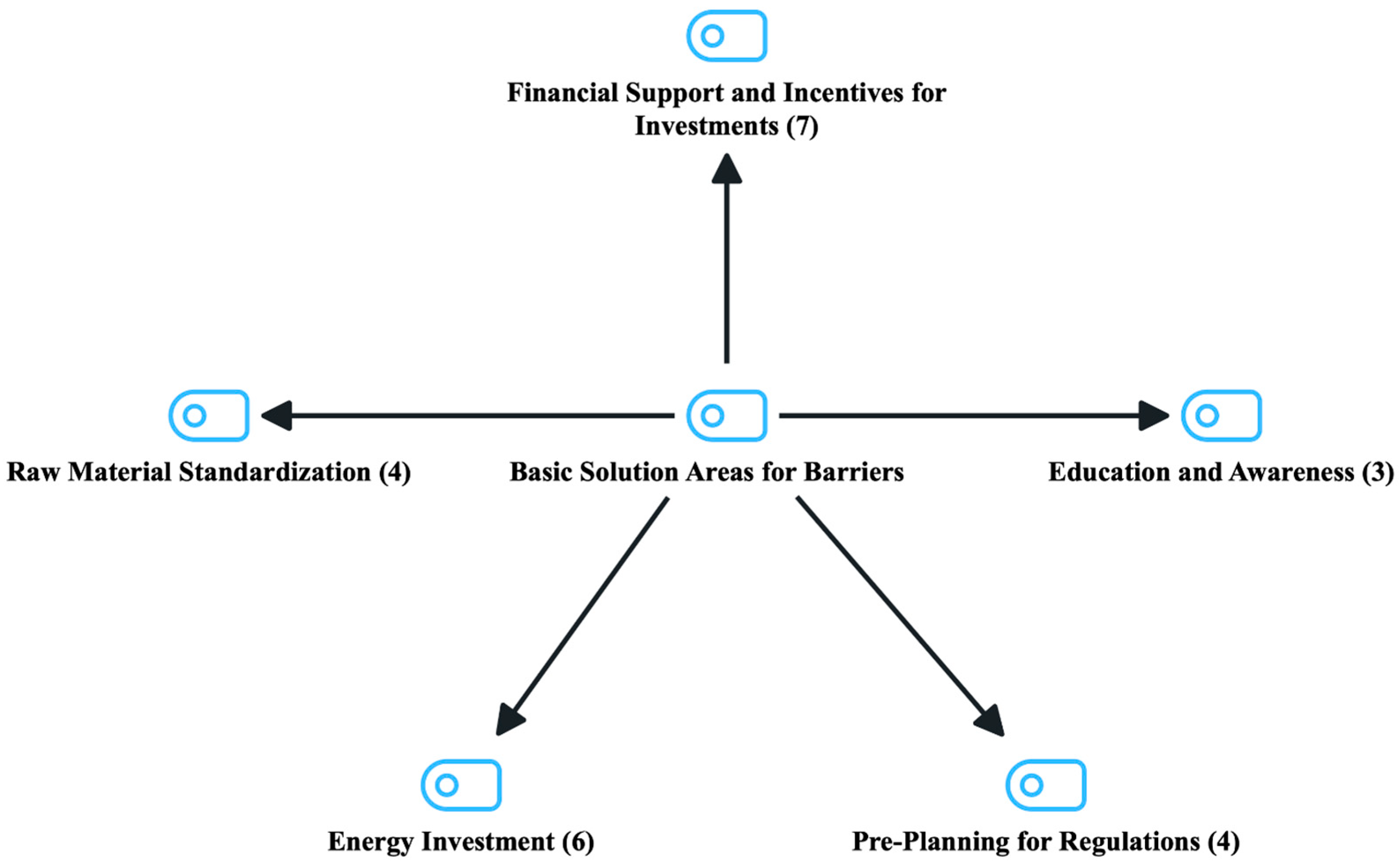
4.3. Basic Solution Areas for Barriers Theme
4.3.1. Education and Awareness
“A world without packaging is not possible. Because no food product should be unpackaged; we might consider it dangerous from a health perspective. Because packaged food products always have the producer’s name on them and indicate when they were produced. When you encounter a problem, you know what to do, but that’s not the case with no packaging. This packaging doesn’t mean that either. Packaging isn’t what pollutes the world. Actually, it’s about education because when you look at how high recycling is; recycling is higher in educated and more developed countries. Maybe in Japan this rate is 100%, but I don’t know about Africa. I don’t think this rate is the same in India either. That’s why education is important for all of us. Within equal innovation. The same applies to green innovation; we must be conscious first, then overcome these obstacles through education. It is very valuable to raise awareness among our employees by telling them that they are also saving their children’s future. We are succeeding in this. We put signs on toilets, for example, or hang posters saying not to leave the lights on and to save water. For example, we talk about green innovation, we talk about sustainability, there is definitely a topic every month, they look at that table and try to do what they can”.(K8)
4.3.2. Energy Investment
“Energy is everything in production. Using less energy is very valuable to us. We have 22 factories. There are many machines inside, and we would like them all to be energy efficient, but replacing all the motors and the entire system at the same time is a bit difficult. Sometimes we get stuck in such areas. Other than that, there are areas that are easy for us. We converted the interior of the factory to LED lights. We changed the drying systems for our printing machines. They used to be oven-based and natural gas-powered. Now we’ve switched to UV. They’ve been operating with UV since 2012. Now there are also LED conversions. We switched to LED at our Gebze factory. The products we use with LED don’t need to be on standby all the time. They operate with less energy”.(K7)
“We started using infrared dryers. We used to use gas. Gas has environmental emissions. Moreover, it is costly. But thanks to these dryers, infrared dryers, we no longer use gas to dry the boxes. We consume less energy. We also have a project called GES that has started in many of our factories. These are solar energy systems on top of our factories. For example, the Adana factory meets 37% of its energy needs from GES. Another detail is forklifts. We used to use diesel forklifts, and there was smoke everywhere. We switched to gas-powered ones, which are still costly, but they don’t emit smoke or gas. Most recently, we started switching to electric ones. Many of our factories have switched to using electric forklifts. These kinds of things, these steps towards greater innovation, are all for energy”.(K11)
4.3.3. Financial Support and Incentives for Investments
“The inks we use for printing in the factory are UV inks and dry under UV light. This is actually more efficient compared to conventional methods, which involve drying in a heated oven. There is a new transformation. It is starting from the G factory and the A factory. We are continuing with many factories that have printing presses. As I said, the excesses in the work processes also cause an increase in energy consumption. Considering the environmental support in this transformation, investment support is needed. We would like more support. Support is being received but in limited amounts, and as long as this support is not 100%, we have to use our own budget in some way. We are financing more of the transformation ourselves. Financially, the biggest challenge was the SAP HANA transition from our own budget. The same goes for Promanage. In fact, there is no support for automation in this area either”.(K8)
4.3.4. Raw Material Standardization
“We currently have to charge our customers who use recycled raw materials for this. This is entirely related to green innovation. It is an action taken for a green world. We have such demands from our major global customers. In particular, our UK customers, to whom we export, require the use of 30% recycled material. We use it there, but as you know, it is much more expensive than the original raw material. This is because there is collection, separation, and a whole series of processes involved. There is washing, re-granulation, re-energy consumption, and so on; it is a very serious issue. We only use it for customers who request it. We have a recycling facility, but since we have not yet standardized the raw material, there are also problems with collection and disposal. When our customers want recycled material rather than raw material, we often have to purchase it from outside sources. However, we believe that if this process were the same in our country as it is abroad, it would be much easier. After all, bags can be produced from raw material that was once bags, or pipes can be produced again from pipes that were once pipes. There is still no standardization”.(K6)
4.3.5. Pre-Planning for Regulations
“As you know, we have the European Green Deal here. SİBAM (Border Carbon Adjustment Mechanism) has regulations regarding packaging waste that can be reused or recycled by 2030, and we are working to reduce thickness in line with these regulations. With these thickness reduction efforts, we were producing aerosol cans with a thickness of 0.17 millimeters until 2–3 years ago. That’s 0.17 millimeters. Currently, we have production lines that manufacture cans with a thickness of 0.14 millimeters. This way, using thinner materials results in a lower carbon footprint in raw material usage. We pay attention to water. The decrease in rainfall and lack of snowfall in this region this year is already having an impact. In this context, we use treated water here. We pass it through the cooling systems. We collect the water from these systems, filter it again, and reuse it. Furthermore, after filtration and salt treatment, we may be able to transfer the effluent water from this area to another area for reuse. We achieved this with coolers. It was an important project we undertook in terms of sustainability”.(K7)
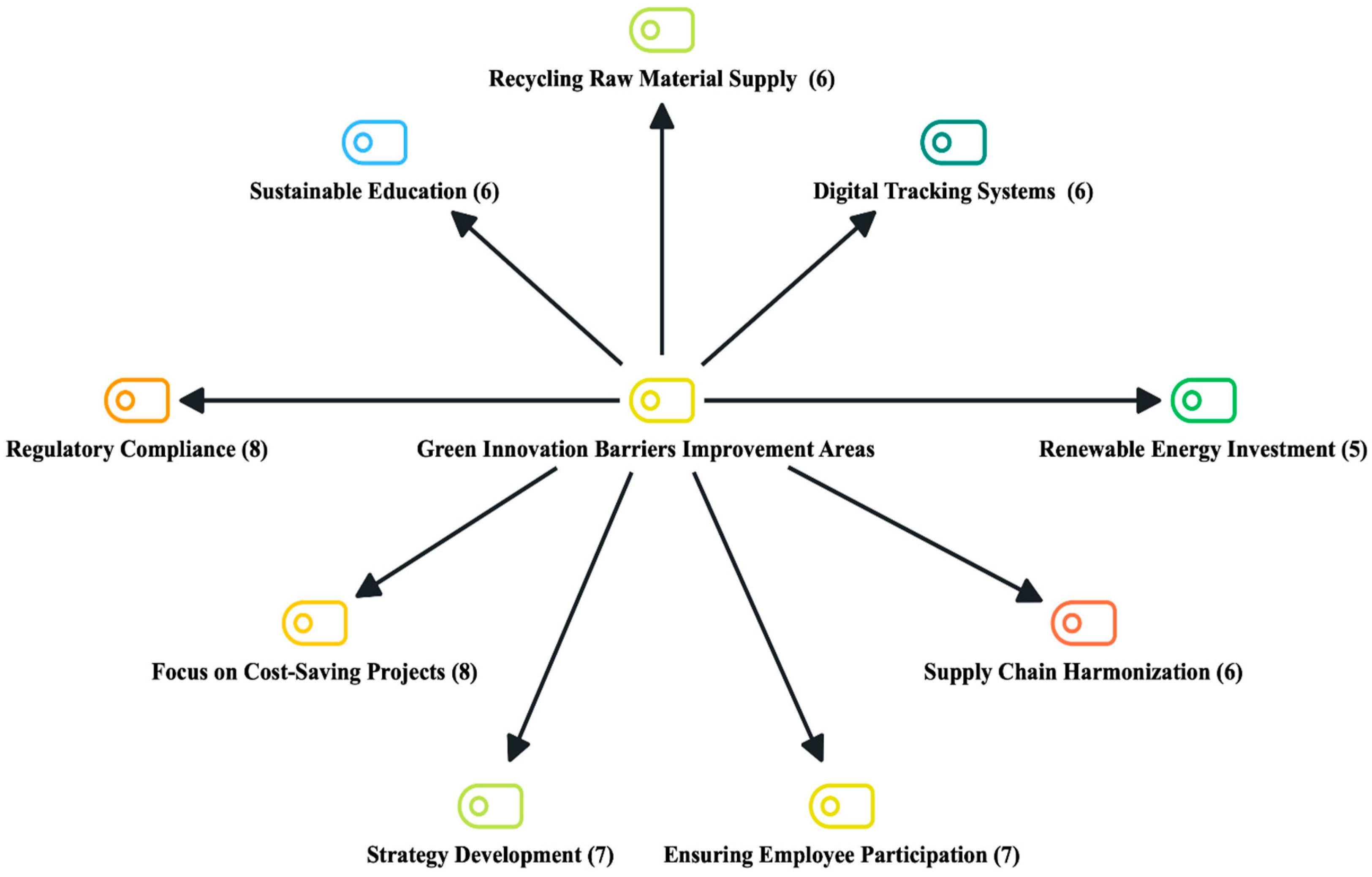
4.4. Green Innovation Barriers Improvement Areas Theme
4.4.1. Strategy Development
“Normally, our targets are generally set from the bottom up, but here the strategies are determined by the sustainability team and the CEO. We are developing our strategies. With the setting of climate targets, the processes operate on this science-based targeting principle. We look at the work related to the system and develop strategies linked to these targets. For example, the targets will be announced in 2025. We are working on scenarios related to these targets, looking at what to do and how to start in our factories. We are moving forward by consulting with industry representatives on this issue. Information is gathered from everywhere so that we can establish our targets and strategies. We have to keep up. If we export and import to Europe for leadership, we must comply”.(K10)
4.4.2. Supply Chain Harmonization
“First, when making agreements, we set certain criteria with our customers. Agreements are made annually. As a result of the agreement, we divide the desired number of boxes into specific terms within the year, either monthly or quarterly. We produce and ship these orders on time, ensuring they are high-quality, environmentally friendly, and affordable. Now, the promises we have made here bind us. How? At this stage, we are responsible for any energy problems, raw material problems, or processes related to environmental regulations that may arise. There are carbon-related aspects in the production stage. There are carbon regulations. If we do not pay attention to these, if we do not prioritize these projects, if we do not make the materials used recyclable, our commitment will be broken. Therefore, it is important to harmonize the entire process in order to keep our promise to our customers and to prepare our production and our company for the coming years, otherwise it will not be easy to quickly adapt to green production”.(K7)
4.4.3. Sustainable Education
“We provide training regularly and understand where and what is needed through audits. Especially since we sell abroad, the conditions are determined by European laws, and resources are documented to comply with these, or customers know what they want and request products according to the rules. Naturally, those who prepare these must always be trained and knowledgeable”.(K3)
4.4.4. Regulatory Compliance
“Each type of waste has a separate code and specific disposal procedures. We pay particular attention to this. We even have spill trays to prevent chemicals from spilling onto the ground. We don’t want them to spill onto the ground. We control all possible points to prevent anything else from mixing with the soil or our rainwater drains. We have systems in place to ensure that no chemicals mix with the rainwater channels. The government comes to us for this, checks us regularly every year, and supports us in this regard. I believe this is also positive in terms of protecting our seas and nature. When our inspectors visited us, they suggested a system specifically for collecting exhaust gases, the RTO system. (Regenerative Thermal Oxidizer (RTO) is an air pollution control system used in industry. It incinerates volatile organic compounds (VOCs), bad odors, and harmful gases emitted from production facilities at high temperatures, rendering them harmless.) The investment for the RTO system was made in 2015, and it is present here in this factory. This allows the exhaust gases to be collected and released into the environment with a 90% reduction in biological levels. Of course, I know this from when I acquired it in 2013 and 2014. At that time, there was a certain amount of support for this”.(K7)
4.4.5. Focus on Cost-Saving Projects
“We have air consumption in the factory. Free air is waste. Free natural gas is waste. We have a unit that controls these. They inspect the factories at certain intervals with advanced devices. They come approximately every three months. For example, a hose burst here. They guide us, point it out. We quickly resolve the issues. Let me give you another example. We recently purchased a box machine. It produces and assembles metal boxes. It has doubled our production. We saved 40% more energy. We don’t lubricate it, so we don’t harm the environment. Old-style motors use oil. New servo motors don’t”.(K1)
“We send our recyclables to licensed organizations. These licensed organizations examine the products to see if they are green or not. We also examine whether they send the products they receive to be incinerated or to a warehouse. It is important that they are green in these areas. This way, we start to move towards these cost-saving steps. In fact, if everyone directs their waste or trash in this way, they will realize the savings they can achieve”.(K3)
4.4.6. Ensuring Employee Participation
“We are focused on specific issues. But our priority is to explain our steps to our production workers. We want them to know what they are doing and why, so they can be conscious and aware. Frankly, I try to instill this in the areas where I have strategic authority. Employees are happy when they see our support for the environment. One day, one of our employees, who was quite old, mentioned a project about how he could save money in his field of work every day. This is very valuable. After we make a change or take a decision, we don’t just tell our employees, “This is how it will be”; we talk about how they can save money in their field of work every day. He mentioned a project about how he could save money in his work area every day. This is very valuable. After we make a change or a decision, we don’t just tell our employees that this is how it will be; we explain it, we train them, and we clarify it. During a meeting about an energy-saving measure, our employee said, “God bless us, we will bring home halal bread, thank God we are not harming anyone.” These things increase trust in the company and commitment to the job. We continue to instill these concepts. We do this not only with our employees, but also with our customers if necessary. Of course, the customers have the final say, but we also share these ideas with them and try to steer them in the right direction”.(K5)
4.4.7. Recycling Raw Material Supply
“We have a recycling facility at K. We established it about five years ago. We only work with it ourselves. It’s a very different thing; we’re in the early stages. Actually, the facility can process over 1000 tons of material per month. But we can only process about 3 to 5 tons per month. Why are we doing this? We made this investment after the law was passed in the UK. Because in 3 or 5 years, the same law will be implemented in Germany, and maybe in Turkey too. We need to be prepared for that day. Because sourcing recycled material is more expensive. It’s not just about paying for the machine. There are many different details. We discovered this situation here as we used 2 tons, 3 tons, 1 ton”.(K5)
4.4.8. Renewable Energy Investment
“We have a need for solar energy systems (GES), and we also have factories near the sea. Perhaps wind terminals could be established if supported; our country is in a fortunate position in this regard. I mention this with carbon emissions in mind, so as not to harm the environment further; we establish our factories in areas close to customers. Energy is more valuable to us; with support, we will progress more quickly. We are eager”.(K3)
4.4.9. Digital Tracking Systems
“Now automation improves the quality of the final product or the quality of the packaging time. Because, for example, you place the tin cans into the post machine. The operator could place them upside down in the wrong position. This was one of the most common complaints we received at the time. But now, with automation, when I put them in the robot, it doesn’t make any mistakes. It ensures that the incoming cans are fed into the machine in the same way. This also improves the quality of the product”.(K8)
5. Discussion
5.1. Theoretical Contribution
5.2. Contribution to Practice
5.3. Limitations of the Study and Recommendations for Future Research
6. Conclusions
6.1. RQ1-How Do Leadership and Decision-Making Processes Shape the Adoption and Implementation of Green Innovation Practices Within Manufacturing Firms?
6.2. RQ2-What Are the Key Barriers Hindering the Implementation of Green Innovation Practices in Manufacturing Firms Operating in Turkey?
6.3. RQ3-What Basic Solution Areas Are Identified by Senior Managers to Overcome Barriers to Green Innovation Practices?
6.4. RQ4-What Improvement Areas Are Perceived as Critical for Strengthening and Sustaining Green Innovation Practices in the Long Term?
Author Contributions
Funding
Institutional Review Board Statement
Informed Consent Statement
Data Availability Statement
Acknowledgments
Conflicts of Interest
Appendix A. Interview Questions
- What is sustainability and why is it important?
- Do you think sustainability strategies are effective and why?
- What are the challenges you face regarding sustainability and what methods do you apply to overcome these challenges?
- How do you determine your sustainability goals and what do you do to achieve these goals? What resources do you use to raise awareness?
- How would you define green innovation? How do you evaluate the benefits it provides to your business or organization and the challenges you encounter?
- What do you think is the contribution of green innovation to your sustainability goals and how does it affect your employees’ motivation, way of working, or skills?
- Can you share the resources or strategies you use to encourage or support green innovation?
- What are your thoughts on government incentives that encourage green innovation? If you have benefited from them, how do you evaluate the impact of these supports on your business or organization?
- What challenges have you encountered while utilizing government supports for green innovation? How do you evaluate the contribution of these supports to your sustainability and competitiveness?
- How do you evaluate the effects of green innovation practices on your business’s long-term competitive advantage and corporate reputation?
- How is the integration of digitalization (IoT, artificial intelligence, big data, etc.) with green innovation realized in your business? What are the effects of this integration on environmental and operational performance?
- What are the institutional, technical, or cultural obstacles encountered in disseminating green innovation practices in supply chain management?
- How do you evaluate the role of top management’s approach and leadership style to green innovation in the decision-making and implementation of green innovation initiatives in your business?
- What performance indicators do you use to measure green innovation activities? How do you evaluate the contribution of these indicators to sustainability reporting?
- What are your views on the effects of green innovation on your business’s corporate risk management, regulatory compliance, and reduction of environmental risks?
References
- Gupta, H.; Barua, M.K. Supplier selection among SMEs on the basis of their green innovation ability using BWM and fuzzy TOPSIS. J. Clean. Prod. 2017, 152, 242–258. [Google Scholar] [CrossRef] [Scilit]
- Zhao, S.; Teng, L.; Ji, J. Impact of environmental regulations on eco-innovation: The moderating role of top managers’ environmental awareness and commitment. J. Environ. Plan. Manag. 2024, 67, 2229–2256. [Google Scholar] [CrossRef] [Scilit]
- Chien, F.; Kamran, H.W.; Nawaz, M.A.; Thach, N.N.; Long, P.D.; Baloch, Z.A. Assessing the prioritization of barriers toward green innovation: Small and medium enterprises Nexus. Environ. Dev. Sustain. 2022, 24, 1897–1927. [Google Scholar] [CrossRef] [Scilit]
- Fahad, S.; Alnori, F.; Su, F.; Deng, J. Adoption of green innovation practices in SMEs sector: Evidence from an emerging economy. Econ. Res.-Ekon. Istraživanja 2022, 35, 5486–5501. [Google Scholar] [CrossRef] [Scilit]
- Gupta, H.; Barua, M.K. A framework to overcome barriers to green innovation in SMEs using BWM and Fuzzy TOPSIS. Sci. Total Environ. 2018, 633, 122–139. [Google Scholar] [CrossRef] [Scilit]
- Jayaraman, K.; Jayashree, S.; Dorasamy, M. The effects of green innovations in organizations: Influence of stakeholders. Sustainability 2023, 15, 1133. [Google Scholar] [CrossRef] [Scilit]
- Yu, W.; Ramanathan, R.; Nath, P. Environmental pressures and performance: An analysis of the roles of environmental innovation strategy and marketing capability. Technol. Forecast. Soc. Change 2017, 117, 160–169. [Google Scholar] [CrossRef] [Scilit]
- Porter, M.E.; Van der Linde, C. Green and competitive: Ending the stalemate. Harv. Bus. Rev. 1995, 73, 120–134. [Google Scholar]
- Gunday, G.; Ulusoy, G.; Kilic, K.; Alpkan, L. Effects of innovation types on firm performance. Int. J. Prod. Econ. 2011, 133, 662–676. [Google Scholar] [CrossRef] [Scilit]
- Yıldırım, U.; Göktürk, İ. Sustainable development. In Contemporary Approaches to Environmental Problems: Ecological, Economic, Political, and Managerial Perspectives; Marin, M.C., Yıldırım, U., Eds.; Beta Basın Yayım: Istanbul, Türkiye, 2004; pp. 449–488. [Google Scholar]
- OECD. Sustainable Manufacturing and Eco-Innovation: Towards a Green Economy; Policy Brief-OECD Observer: Paris, France, 2009. [Google Scholar]
- Chen, Y.S. The driver of green innovation and green image–green core competence. J. Bus. Ethics 2008, 81, 531–543. [Google Scholar] [CrossRef] [Scilit]
- Chen, Y.S.; Lai, S.B.; Wen, C.T. The influence of green innovation performance on corporate advantage in Taiwan. J. Bus. Ethics 2006, 67, 331–339. [Google Scholar] [CrossRef] [Scilit]
- Chiou, T.Y.; Chan, H.K.; Lettice, F.; Chung, S.H. The influence of greening the suppliers and green innovation on environmental performance and competitive advantage in Taiwan. Transp. Res. Part E Logist. Transp. Rev. 2011, 47, 822–836. [Google Scholar] [CrossRef] [Scilit]
- Tseng, M.L.; Wang, R.; Chiu, A.S.; Geng, Y.; Lin, Y.H. Improving performance of green innovation practices under uncertainty. J. Clean. Prod. 2013, 40, 71–82. [Google Scholar] [CrossRef] [Scilit]
- Oltra, V.; Saint Jean, M. Sectoral systems of environmental innovation: An application to the French automotive industry. Technol. Forecast. Soc. Change 2009, 76, 567–583. [Google Scholar] [CrossRef] [Scilit]
- Arfi, W.B.; Hikkerova, L.; Sahut, J.M. External knowledge sources, green innovation, and performance. Technol. Forecast. Soc. Change 2018, 129, 210–220. [Google Scholar] [CrossRef] [Scilit]
- Önel, B. İşletmelerin yeşil yönetim algıları ve sürdürülebilirlik bilinci. Uluslararası Afro-Avrasya Araştırmaları Derg. 2021, 6, 21–33. [Google Scholar]
- Mangla, S.K.; Pradeep, K.; Mukesh, K.B. Risk analysis in green supply chain using fuzzy AHP approach: A case study. Resour. Conserv. Recycl. 2015, 104, 375–390. [Google Scholar] [CrossRef] [Scilit]
- Muduli, K.; Govindan, K.; Barve, A.; Geng, Y. Barriers to green supply chain management in Indian mining industries: A graph theoretic approach. J. Clean. Prod. 2013, 47, 335–344. [Google Scholar] [CrossRef] [Scilit]
- Şenocak, B.; Mohan Bursalı, Y. The relationship between environmental sustainability awareness and green business practices and business success in businesses. Suleyman Demirel Univ. Fac. Fac. Econ. Adm. Sci. J. 2018, 161–183. [Google Scholar]
- Aftab, J.; Veneziani, M. How does green human resource management contribute to saving the environment? Evidence of emerging market manufacturing firms. Bus. Strategy Environ. 2024, 33, 529–545. [Google Scholar] [CrossRef] [Scilit]
- Ur Rehman, M.H.; Chang, V.; Batool, A.; Wah, T.Y. Big data reduction framework for value creation in sustainable enterprises. Int. J. Inf. Manag. 2016, 36, 917–928. [Google Scholar] [CrossRef] [Scilit]
- Saleem, M.; Qadeer, F.; Mahmood, F.; Han, H.; Giorgi, G.; Ariza-Montes, A. Inculcation of green behavior in employees: A multilevel moderated mediation approach. Int. J. Environ. Res. Public Health 2021, 18, 331. [Google Scholar] [CrossRef] [Scilit]
- Venus, L.Y.H. Green management practices and firm performance: A case of container terminal operations. Resour. Conserv. Recycl. 2011, 55, 559–566. [Google Scholar] [CrossRef] [Scilit]
- Yam, R.C.; Guan, J.C.; Pun, K.F.; Tang, E.P. An audit of technological innovation capabilities in Chinese firms: Some empirical findings in Beijing, China. Res. Policy 2004, 33, 1123–1140. [Google Scholar] [CrossRef] [Scilit]
- Raut, R.D.; Mangla, S.K.; Narwane, V.S.; Gardas, B.B.; Priyadarshinee, P.; Narkhede, B.E. Linking big data analytics and operational sustainability practices for sustainable business management. J. Clean. Prod. 2019, 224, 10–24. [Google Scholar] [CrossRef] [Scilit]
- Suzanne, B.; Edwards, M.; Angus-Leppan, T. Organizational learning and the sustainability community of practice: The role of boundary objects. Organ. Environ. 2013, 26, 184–202. [Google Scholar]
- Metcalf, L.; Benn, S. Leadership for sustainability: An evolution of leadership ability. J. Bus. Ethics 2013, 112, 369–384. [Google Scholar] [CrossRef] [Scilit]
- Molina-Azorín, J.F.; Claver-Cortés, E.; López-Gamero, M.D.; Tarí, J.J. Green management and financial performance: A literature review. Manag. Decis. 2009, 47, 1080–1100. [Google Scholar] [CrossRef] [Scilit]
- Paramanathan, S.; Farrukh, C.; Phaal, R.; Probert, D. Implementing industrial sustainability: The research issues in technology management. RD Manag. 2004, 34, 527–537. [Google Scholar] [CrossRef] [Scilit]
- Roome, N. Business strategy, R&D management and environmental imperatives. RD Manag. 1994, 24, 065–082. [Google Scholar]
- Sharma, S. Research in corporate sustainability: What really matters. In Research in Corporate Sustainability: The Evolving Theory and Practice of Organizations in the Natural Environment; Edward Elgar Publishing: Cheltenham, UK, 2002; pp. 1–29. [Google Scholar]
- Schaltegger, S. Sustainability as a driver for corporate economic success. Consequences for the development of sustainability management control. Soc. Econ. Cent. East. Eur. J. Corvinus Univ. Bp. 2011, 33, 15–28. [Google Scholar]
- Aragón-Correa, J.A.; Hurtado-Torres, N.; Sharma, S.; García-Morales, V.J. Environmental strategy and performance in small firms: A resource-based perspective. J. Environ. Manag. 2008, 86, 88–103. [Google Scholar] [CrossRef] [Scilit] [PubMed]
- Noci, G.; Roberto, V. Managing ‘green’ product innovation in small firms. RD Manag. 1999, 29, 3–15. [Google Scholar] [CrossRef] [Scilit]
- Roome, N.; Hinnells, M. Environmental factors in the management of new product development: Theoretical framework and some empirical evidence from the white goods industry. Bus. Strategy Environ. 1993, 2, 12–27. [Google Scholar] [CrossRef] [Scilit]
- Huber, J. Technological environmental innovations (TEIs) in a chain-analytical and life-cycle-analytical perspective. J. Clean. Prod. 2008, 16, 1980–1986. [Google Scholar] [CrossRef] [Scilit]
- Van Hemel, C.; Jacqueline, C. Barriers and stimuli for ecodesign in SMEs. J. Clean. Prod. 2002, 10, 439–453. [Google Scholar] [CrossRef] [Scilit]
- Christopher, S.; Trott, P.; van den Hende, E.; Hultink, E.J. Barriers to the adoption of waste-reducing eco-innovations in the packaged food sector: A study in the UK and the Netherlands. J. Clean. Prod. 2019, 244, 118792. [Google Scholar]
- Huang, Y.F.; Chen, A.P.S.; Do, M.H.; Chung, J.C. Assessing the barriers of green innovation implementation: Evidence from the Vietnamese manufacturing sector. Sustainability 2022, 14, 4662. [Google Scholar] [CrossRef] [Scilit]
- Lin, B.; Xie, Y. Driving green technology innovation in renewable energy: Does venture capital? IEEE Trans. Eng. Manag. 2024, 71, 6784–6795. [Google Scholar] [CrossRef] [Scilit]
- Padilla-Lozano, C.P.; Collazzo, P. Corporate social responsibility, green innovation and competitiveness—Causality in manufacturing. Compet. Rev. 2022, 32, 21–39. [Google Scholar] [CrossRef] [Scilit]
- Arsawan, I.; Koval, V.; Duginets, G.; Kalinin, O.; Korostova, I. Impact of green innovation on environmental performance of SMEs in an emerging economy. E3S Web Conf. 2021, 255, 01012. [Google Scholar] [CrossRef] [Scilit]
- Malk, M.S.; Al, K.; Kausar, N.; Chaudhry, M.A. Enhancing environmental performance through green HRM and green innovation: Examining the mediating role of green creativity and moderating role of green shared vision. Pak. J. Commer. Soc. Sci. 2021, 15, 265–285. Available online: https://hdl.handle.net/10419/237078 (accessed on 1 November 2025).
- Başköy, T.; Öztürk, D. The relationship between green supply chain management and environmental performance: The mediating effect of green innovation. J. Environ. Nat. Stud. 2024, 6, 300–315. [Google Scholar] [CrossRef] [Scilit]
- Niazi, U.I.; Nisar, Q.A.; Nasir, N.; Naz, S.; Haider, S.; Khan, W. Green HRM, green innovation and environmental performance: The role of green transformational leadership and green corporate social responsibility. Environ. Sci. Pollut. Res. 2023, 30, 45353–45368. [Google Scholar] [CrossRef] [Scilit]
- Le, T.T.; Chau, T.L.Q.; Ngoc, L.T.T.; Teu, T.T. How green transformational leadership drives environmental performance and firm performance? Empirical evidence from an emerging economy. Corp. Soc. Responsib. Environ. Manag. 2024, 31, 5504–5523. [Google Scholar] [CrossRef] [Scilit]
- Behzad, M.; Sahebi, I.G.; Kumar, A.; Ghobakhloo, M.; Iranmanesh, M. Industry 5.0 and Opportunities for Promoting Supply Chain Sustainability: A Study of the Renewable Energy Industry. Technol. Soc. 2025, 83, 103023. [Google Scholar] [CrossRef] [Scilit]
- Wang, T.; Cheng, P.; Zhen, L. Green development of the maritime industry: Overview, perspectives, and future research opportunities. Transp. Res. Part E Logist. Transp. Rev. 2023, 179, 103322. [Google Scholar] [CrossRef] [Scilit]
- Qiang, F.; Yang, X. Green innovation and firm performance: Review and prospects. Open J. Soc. Sci. 2023, 11, 161–176. [Google Scholar] [CrossRef]
- Qin, X.; Muskat, B.; Ambrosini, V.; Mair, J.; Chih, Y.Y. Green innovation implementation: A systematic review and research directions. J. Manag. 2025, 52, 255–282. [Google Scholar] [CrossRef] [Scilit]
- Arundel, A.V.; Kemp, R. Measuring Eco-Innovation; UNU-MERIT Working Papers; UNU-MERIT: Maastricht, The Netherlands, 2009; p. 017. [Google Scholar]
- Horbach, J. Determinants of environmental innovation—New evidence from German panel data sources. Res. Policy 2008, 37, 163–173. [Google Scholar] [CrossRef] [Scilit]
- Kemp, R. Eco-innovation and transitions. Econ. Fonti Energ. dell’ambiente 2009, 1, 1000–1022. [Google Scholar] [CrossRef] [Scilit]
- Wagner, M. The role of corporate sustainability performance for economic performance: A firm-level analysis of moderation effects. Ecol. Econ. 2010, 69, 1553–1560. [Google Scholar] [CrossRef] [Scilit]
- Brunnermeier, S.B.; Cohen, M.A. Determinants of environmental innovation in US manufacturing industries. J. Environ. Econ. Manag. 2003, 45, 278–293. [Google Scholar] [CrossRef] [Scilit]
- Cleff, T.; Rennings, K. Determinants of environmental product and process innovation. Eur. Environ. 1999, 9, 191–201. [Google Scholar] [CrossRef] [Scilit]
- Stern, N. Stern Review: The Economics of Climate Change; Cambridge University Press: Cambridge, UK, 2006. [Google Scholar]
- Alnaim, A.F.; Abdelwahed, N.A.A.; Soomro, B.A. Environmental challenges and green innovation strategy: A vigorous development of greener dynamics. Sustainability 2022, 14, 9709. [Google Scholar] [CrossRef] [Scilit]
- Wang, P.; Dong, C.; Chen, N.; Qi, M.; Yang, S.; Nnenna, A.B.; Li, W. Environmental regulation, government subsidies, and green technology innovation—A provincial panel data analysis from China. Int. J. Environ. Res. Public Health 2021, 18, 11991. [Google Scholar] [CrossRef] [Scilit] [PubMed]
- Zailani, S.; Govindan, K.; Iranmanesh, M.; Shaharudin, M.R.; Chong, Y.S. Green innovation adoption in automotive supply chain: The Malaysian case. J. Clean. Prod. 2015, 108, 1115–1122. [Google Scholar] [CrossRef] [Scilit]
- Lee, K.H. Why and how to adopt green management into business organizations? The case study of Korean SMEs in the manufacturing industry. Manag. Decis. 2009, 47, 1101–1121. [Google Scholar] [CrossRef] [Scilit]
- Doran, J.; Ryan, G. Regulation and firm perception, eco-innovation and firm performance. Eur. J. Innov. Manag. 2012, 15, 421–441. [Google Scholar] [CrossRef] [Scilit]
- Silvério, A.; Fernandes, C.I.; Maran, T.K. Do green innovation strategies exist? Past, present and future trends in literature. Eur. J. Innov. Manag. 2025, 28, 154–186. [Google Scholar] [CrossRef] [Scilit]
- Zhang, J.; Wang, M.; Liu, K.; Chen, S.; Zhao, Z.A. Social-ecological system sustainability in China from the perspective of supply-demand balance for ecosystem services. J. Clean. Prod. 2025, 497, 145039. [Google Scholar] [CrossRef] [Scilit]
- Gelmez, E.; Işiklar, Z.E. The effect of green innovation practices on business performance. Third Sect. Soc. Econ. J. 2025, 60, 2295–2309. [Google Scholar] [CrossRef] [Scilit]
- Jamal, A.F. Adaptability to change for sustainability. In Navigating Business Through Essential Sustainable Strategies; IGI Global: Hershey, PA, USA, 2025; pp. 61–80. [Google Scholar]
- Aulia, S.; Anisa, S.N.; Indah, A.; Dipa, M.A.K.; Panorama, M. Analysis of the role of infrastructure in economic growth and development in the city of palembang. J. Econ. Account. Publ. (JUPEA) 2024, 4. [Google Scholar]
- Kütahyalı, D.N.; Yıldız, B. Analysis of the effect of green marketing strategies on green supplier selection, green innovation, and performance using a structural equation model. J. Mark. Mark. Res. 2024, 17, 305–340. [Google Scholar]
- Kazdal, Ö.S.; Çelik, D.; Tenderis, A. The effect of green innovation and corporate sustainability on firm performance: The mediating role of openness to organizational change. Pamukkale Univ. J. Soc. Sci. Inst. 2025, 68, 351–380. [Google Scholar] [CrossRef] [Scilit]
- Moridu, I. The role corporate governance in managing financial risk: A qualitative study on listed companies. ES Account. Financ. 2023, 1, 176–183. [Google Scholar] [CrossRef] [Scilit]
- Musaad, O.A.S.; Zhuo, Z.; Musaad, O.A.O.; Ali Siyal, Z.; Hashmi, H.; Shah, S.A.A. A fuzzy multi-criteria analysis of barriers and policy strategies for small and medium enterprises to adopt green innovation. Symmetry 2020, 12, 116. [Google Scholar] [CrossRef] [Scilit]
- Dixon-Fowler, H.R.; Slater, D.J.; Johnson, J.L.; Ellstrand, A.E.; Romi, A.M. Beyond “does it pay to be green?” A meta-analysis of moderators of the CEP-CFP relationship. J. Bus. Ethics 2013, 112, 353–366. [Google Scholar] [CrossRef] [Scilit]
- Heras-Saizarbitoria, I.; Molina-Azorín, J.F.; Dick, G.P.M. ISO 14001 certification and financial performance: Selection-effect versus treatment-effect. J. Clean. Prod. 2011, 19, 1–12. [Google Scholar] [CrossRef] [Scilit]
- King, A.; Lenox, M. Does it really pay to be green? An empirical study of firm environmental and financial performance. J. Ind. Ecol. 2001, 5, 105–116. [Google Scholar] [CrossRef] [Scilit]
- Nawrocka, D.; Parker, T. Finding the connection: Environmental management systems and environmental performance. J. Clean. Prod. 2009, 17, 601–607. [Google Scholar] [CrossRef] [Scilit]
- Telle, K. It pays to be green—A premature conclusion? Environ. Resour. Econ. 2006, 35, 195–220. [Google Scholar] [CrossRef] [Scilit]
- Creswell, J.W. Educational Research: Planning, Conducting, and Evaluating Quantitative and Qualitative Research; Pearson: London, UK, 2015. [Google Scholar]
- Yin, R.K. Case Study Research: Design and Methods; Sage Publications: Thousand Oaks, CA, USA, 2009; Volume 5. [Google Scholar]
- Darlington, Y.; Scott, D. Qualitative Research in Practice: Stories from the Field; Routledge: Oxfordshire, UK, 2020. [Google Scholar]
- Woodside, A.G. Case Study Research: Theory, Methods and Practice; Emerald Group Publishing: Leeds, UK, 2010. [Google Scholar]
- Guest, G.; Bunce, A.; Johnson, L. How many interviews are enough? An experiment with data saturation and variability. Field Methods 2006, 18, 59–82. [Google Scholar] [CrossRef] [Scilit]
- Başkale, H. Nitel araştırmalarda geçerlik, güvenirlik ve örneklem büyüklüğünün belirlenmesi. Dokuz Eylül Üniversitesi Hemşirelik Fakültesi Elektron. Derg. 2016, 9, 23–28. [Google Scholar]
- Rennings, K. Redefining innovation eco innovation research and the contribution from ecological economics. Ecol. Econ. 2000, 32, 319–332. [Google Scholar] [CrossRef] [Scilit]
- Hambrick, D.C.; Mason, P.A. Upper echelons: The organization as a reflection of its top managers. Acad. Manag. Rev. 1984, 9, 193–206. [Google Scholar] [CrossRef] [Scilit]
- Orji, I.J.; Simonov Kusi, S.; Himanshu, G.; Modestus, O. Evaluating challenges to implementing eco-innovation for freight logistics sustainability in Nigeria. Transp. Res. Part A Policy Pract. 2019, 129, 288–305. [Google Scholar] [CrossRef] [Scilit]
- Urbaniec, M. Towards sustainable development through eco-innovations: Drivers and barriers in Poland. Econ. Sociol. 2015, 8, 179. [Google Scholar] [CrossRef] [Scilit]
- Zhu, Q.; Sarkis, J. Relationships between operational practices and performance among early adopters of green supply chain management practices in Chinese manufacturing enterprises. J. Oper. Manag. 2004, 22, 265–289. [Google Scholar] [CrossRef]
- Ghazilla, R.A.R.; Sakundarini, N.; Abdul-Rashid, S.H.; Ayub, N.S.; Olugu, E.U.; Musa, S.N. Drivers and barriers analysis for green manufacturing practices in Malaysian SMEs: A preliminary finding. Procedia CIRP 2015, 26, 658–663. [Google Scholar] [CrossRef] [Scilit]
- Chan, R.Y.K.; He, H.; Chan, H.K.; Wang, W.Y.C. Environmental orientation and corporate performance: The mediation mechanism of green supply chain management and moderating effect of competitive intensity. Ind. Mark. Manag. 2012, 41, 621–630. [Google Scholar] [CrossRef] [Scilit]
- Ar, I.M. The impact of green innovation on performance: A conceptual review. J. Soc. Sci. 2020, 14, 111–125. [Google Scholar]
- Oktaysoy, O. The relationship between green innovation and environmental leadership: A meta-analysis study. JENAS J. Environ. Nat. Stud. 2025, 7, 108–120. [Google Scholar] [CrossRef] [Scilit]
- Dangelico, R.M.; Pujari, D. Mainstreaming green product innovation: Why and how companies integrate environmental sustainability. J. Bus. Ethics 2010, 95, 471–486. [Google Scholar] [CrossRef] [Scilit]
- OECD. Towards Green Growth; OECD Publishing: Paris, France, 2011. [Google Scholar]
- Moshood, T.D.; Nawanir, G.; Mahmud, F.; Mohamad, F.; Ahmad, M.H.; AbdulGhani, A.; Kumar, S. Green product innovation: A means towards achieving global sustainable product within biodegradable plastic industry. J. Clean. Prod. 2022, 363, 132506. [Google Scholar] [CrossRef] [Scilit]



| Participant Code | Gender | Age | Professional Experience (Years) | Education | Positions Held |
|---|---|---|---|---|---|
| K1 | Male | 45 | 18 | Bachelor’s Degree | Senior Executive |
| K2 | Male | 40 | 15 | Master’s Degree | Senior Executive |
| K3 | Male | 43 | 13 | Bachelor’s Degree | Senior Executive |
| K4 | Male | 52 | 17 | Bachelor’s Degree | Senior Executive |
| K5 | Male | 46 | 13 | Bachelor’s Degree | Senior Executive |
| K6 | Male | 41 | 17 | Master’s Degree | Senior Executive |
| K7 | Male | 55 | 14 | Master’s Degree | Senior Executive |
| K8 | Male | 45 | 18 | Master’s Degree | Senior Executive |
| K9 | Male | 43 | 16 | Bachelor’s Degree | Senior Executive |
| K10 | Male | 67 | 16 | Master’s Degree | Senior Executive |
| K11 | Male | 45 | 18 | Bachelor’s Degree | Senior Executive |
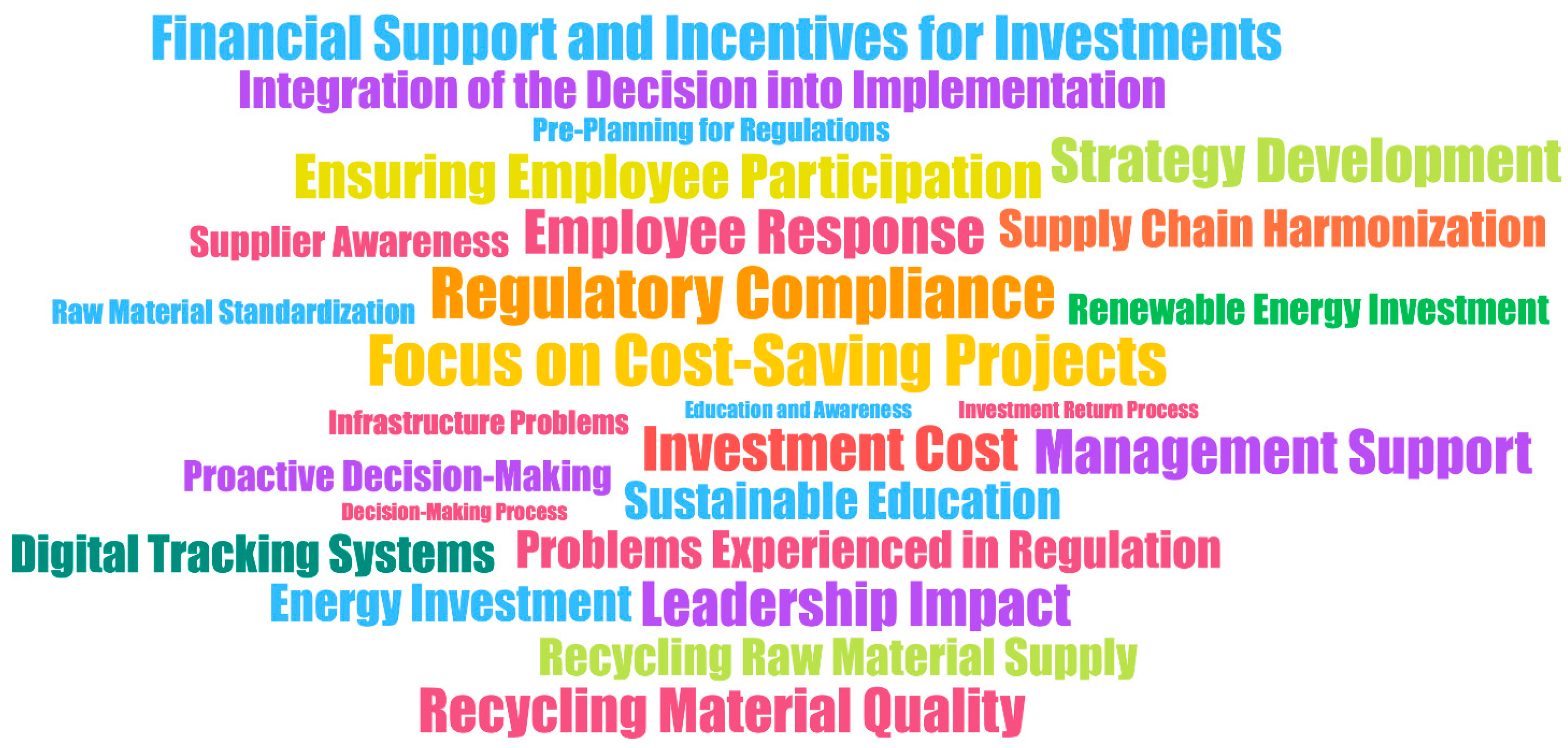
| Codes | Frequencies |
|---|---|
| 1. Leadership and Decision-Making in Green Innovation Theme | 0 |
| 1.1. Management Support | 7 |
| 1.2. Integration of the Decision into Implementation | 6 |
| 1.3. Proactive Decision-Making | 5 |
| 1.4. Leadership Impact | 7 |
| 2. Green Innovation Barriers Theme | 0 |
| 2.1. Infrastructure Problems | 4 |
| 2.2. Problems Experienced in Regulation | 6 |
| 2.3. Investment Return Process | 3 |
| 2.4. Employee Response | 7 |
| 2.5. Supplier Awareness | 5 |
| 2.6. Decision-Making Process | 3 |
| 2.7. Recycling Material Quality | 7 |
| 2.8. Investment Cost | 7 |
| 3. Basic Solution Areas for Barriers Theme | 0 |
| 3.1. Education and Awareness | 3 |
| 3.2. Energy Investment | 6 |
| 3.3. Financial Support and Incentives for Investments | 7 |
| 3.4. Raw Material Standardization | 4 |
| 3.5. Pre-Planning for Regulations | 4 |
| 4. Green Innovation Barriers Improvement Areas Theme | 0 |
| 4.1. Strategy Development | 7 |
| 4.2. Supply Chain Harmonization | 6 |
| 4.3. Sustainable Education | 6 |
| 4.4 Regulatory Compliance | 8 |
| 4.5. Focus on Cost-Saving Projects | 8 |
| 4.6. Ensuring Employee Participation | 7 |
| 4.7. Recycling Raw Material Supply | 6 |
| 4.8. Renewable Energy Investment | 5 |
| 4.9. Digital Tracking Systems | 6 |
| Main Theme | Sub-Themes/Codes | Total Frequency (f) | Interpretation |
|---|---|---|---|
| Green Innovation Barriers | Problems Experienced in Regulation (6); Employee Response (7); Investment Cost (7); Infrastructure Problems (4); Decision-Making Process (3); Supplier Awareness (5); Recycling Material Quality (7); Investment Return Process (3) | 42 | High |
| Leadership and Decision-Making in Green Innovation | Leadership Impact (7); Management Support (7); Proactive Decision-Making (5); Integration of the Decision into Implementation (6) | 25 | Medium–High |
| Basic Solution Areas for Barriers | Pre-Planning for Regulations (4); Education and Awareness (3); Financial Support and Incentives for Investments (7); Energy Investment (6) | 20 | Medium |
| Green Innovation Barrier Improvement Areas | Regulatory Compliance (8); Strategy Development (7); Focus on Cost-Saving Projects (8); Ensuring Employee Participation (7); Sustainable Education (6); Digital Tracking Systems (6); Recycling Raw Material Supply (6); Renewable Energy Investment (5); Supply Chain Harmonization (6); Raw Material Standardization (4) | 63 |
| RQ1 | Sustainability and Process Engineer | Sustainability Manager | Aerosol Manufacturing Plant Manager | Plastic Manufacturing Plant Manager | Metal Manufacturing Plant Manager | Total |
|---|---|---|---|---|---|---|
| Management Support | 1 | 1 | 2 | 2 | 6 | |
| Integration of the Decision into Implementation | 1 | 2 | 1 | 2 | 6 | |
| Proactive Decision-Making | 3 | 1 | 1 | 5 | ||
| Leadership Impact | 1 | 2 | 2 | 5 |
| RQ2 | Sustainability and Process Engineer | Sustainability Manager | Aerosol Manufacturing Plant Manager | Plastic Manufacturing Plant Manager | Metal Manufacturing Plant Manager | Total |
|---|---|---|---|---|---|---|
| Infrastructure Problems | 0 | 1 | 1 | 3 | 1 | 6 |
| Problems Experienced in Regulation | 0 | 1 | 2 | 1 | 1 | 5 |
| Investment Return Process | 0 | 0 | 2 | 0 | 0 | 2 |
| Employee Response | 1 | 0 | 3 | 1 | 0 | 5 |
| Supplier Awareness | 0 | 1 | 2 | 1 | 0 | 4 |
| Decision-Making Process | 0 | 1 | 1 | 1 | 1 | 4 |
| Recycling Material Quality | 0 | 0 | 1 | 2 | 2 | 5 |
| Investment Cost | 1 | 0 | 1 | 2 | 2 | 6 |
| RQ3 | Sustainability and Process Engineer | Sustainability Manager | Aerosol Manufacturing Plant Manager | Plastic Manufacturing Plant Manager | Metal Manufacturing Plant Manager | Total |
|---|---|---|---|---|---|---|
| Education and Awareness | 1 | 1 | 1 | 3 | ||
| Energy Investment | 1 | 1 | 2 | 4 | ||
| Financial Support and Incentives for Investments | 1 | 2 | 2 | 5 | ||
| Raw Material Standardization | 2 | 2 | 4 | |||
| Pre-Planning for Regulations | 1 | 2 | 3 |
| RQ4 | Sustainability and Process Engineer | Sustainability Manager | Aerosol Manufacturing Plant Manager | Plastic Manufacturing Plant Manager | Metal Manufacturing Plant Manager | Total |
|---|---|---|---|---|---|---|
| Strategy Development | 1 | 3 | 1 | 5 | ||
| Supply Chain Harmonization | 1 | 1 | 3 | 1 | 6 | |
| Sustainable Education | 1 | 2 | 1 | 1 | 5 | |
| Regulatory Compliance | 1 | 2 | 2 | 6 | ||
| Focus on Cost-Saving Projects | 1 | 2 | 2 | 2 | 7 | |
| Ensuring Employee Participation | 2 | 3 | 2 | 7 | ||
| Recycling Raw Material Supply | 1 | 1 | 3 | 5 | ||
| Renewable Energy Investment | 1 | 2 | 1 | 4 | ||
| Digital Tracking Systems | 2 | 2 | 1 | 5 |
Disclaimer/Publisher’s Note: The statements, opinions and data contained in all publications are solely those of the individual author(s) and contributor(s) and not of MDPI and/or the editor(s). MDPI and/or the editor(s) disclaim responsibility for any injury to people or property resulting from any ideas, methods, instructions or products referred to in the content. |
© 2026 by the authors. Licensee MDPI, Basel, Switzerland. This article is an open access article distributed under the terms and conditions of the Creative Commons Attribution (CC BY) license.
Share and Cite
Uru, F.O.; Pekşen, G.K.; Gozukara, E. Challenges and Solutions in Green Innovation Practices: A Case Study of a Manufacturing Firm in Turkey. Sustainability 2026, 18, 2043. https://doi.org/10.3390/su18042043
Uru FO, Pekşen GK, Gozukara E. Challenges and Solutions in Green Innovation Practices: A Case Study of a Manufacturing Firm in Turkey. Sustainability. 2026; 18(4):2043. https://doi.org/10.3390/su18042043
Chicago/Turabian StyleUru, Fahriye Oben, Gizem Kılıç Pekşen, and Ebru Gozukara. 2026. "Challenges and Solutions in Green Innovation Practices: A Case Study of a Manufacturing Firm in Turkey" Sustainability 18, no. 4: 2043. https://doi.org/10.3390/su18042043
APA StyleUru, F. O., Pekşen, G. K., & Gozukara, E. (2026). Challenges and Solutions in Green Innovation Practices: A Case Study of a Manufacturing Firm in Turkey. Sustainability, 18(4), 2043. https://doi.org/10.3390/su18042043