Article

Coupling Coordination and Projection of the Urban-Ecological Composite System Along the Beijing-Hangzhou Grand Canal

Social Development College, Yangzhou University, Yangzhou 225009, China
*
Author to whom correspondence should be addressed.
Sustainability 2026, 18(4), 2019; https://doi.org/10.3390/su18042019
Submission received: 15 January 2026 / Revised: 6 February 2026 / Accepted: 14 February 2026 / Published: 16 February 2026
(This article belongs to the Special Issue Urbanization and Environmental Sustainability—3rd Edition)

Abstract

Taking cities along the Beijing-Hangzhou Grand Canal as the research subject, this study constructs urbanization and ecological environment indices to examine changes in urbanization and ecological environment in these cities from 2008 to 2024. First, an urbanization index and an ecological environment index were constructed for cities along the Beijing-Hangzhou Grand Canal. The spatiotemporal trends of these indices were analyzed. Subsequently, a coupling coordination model was developed to examine how coupling coordination levels evolve. Finally, a GM(GM (1,1) model was used to forecast future trends in coupling coordination levels. The conclusions are as follows: (1) Urbanization along the canal advanced rapidly and consistently. In contrast, the ecological environment followed a slow recovery and eventual steady improvement. Although the coupling coordination status historically improved from “barely coordinated imbalance” to “primary coordination,” the ecological subsystem consistently lagged behind. (2) Spatially, coordination levels show clear “core-periphery” and “south-high, north-low” disparities. High-coordination clusters are centered in the Yangtze River Delta urban agglomeration, while low-coordination zones are concentrated in western Shandong and southeastern Hebei, with these spatial clustering effects growing stronger over time. (3) Projections from the GM (1,1) model suggest that, under a natural evolution scenario, the entire canal region will reach an “intermediate coordination” phase by 2030. However, significant internal disparities are expected to persist.

1. Introduction

In recent years, driven by government initiatives worldwide, global urbanization has accelerated rapidly. According to statistics, the global urbanization rate reached approximately 55.5% in 2019. The United Nations projects that by 2030, the world will continue to urbanize, with urban populations accounting for 60.4% of the global population. Every region will become more urbanized, but population growth will slow relatively in areas already highly urbanized. The vast majority of urban development will happen in Africa, South Asia, and East Asia. It is projected that China, Nigeria, and India account for around one-third of the global urban population growth [1]. According to projections, 68% of the world’s population will live in cities by 2050, marking an age of global urbanization [2]. Although our lives and societies have been enhanced by quick urbanization and accelerated socioeconomic growth, global difficulties from climate variation and its ecological influences to crises in food, water, energy supply, and air pollution have been produced. Therefore, our capacity to achieve sustainability in the future is ultimately threatened by global financial development and mounting stress. In the near future, as globalization deepens and industrialization and urbanization accelerate, the world’s urbanization rate and urban populations will continue to rise [3]. There will be more obvious accompanying resource and environmental difficulties, which potentially make the prospects for sustainability even harder. Against the backdrop of domestic economic transformation and increasing constraints on human production and living activities imposed by ecological and environmental factors, it is imperative to conduct in-depth research on how to continuously advance the coexistence of economic development quality and speed, and how to ensure that urbanization construction and ecological and environmental protection move toward coordination and sustainability in the course of economic development [4,5].
In July 2021, China issued the “Implementation Plan for the Protection, Inheritance, and Utilization of Grand Canal Culture,” which identifies strengthening ecosystem protection capacity as a key task in preserving and inheriting the Grand Canal. The coordinated advancement of cultural preservation, inheritance, utilization, and the enhancement of ecosystem services has become a core mission in the construction and protection of the Grand Canal National Cultural Park in the new era [6]. The Beijing-Hangzhou Grand Canal connects six provinces and municipalities—Beijing, Tianjin, Hebei, Shandong, Jiangsu, and Zhejiang—running from north to south and covering a wide area. Over recent decades, ecological and environmental issues in the canal basin have become increasingly prominent. Problems such as sedimentation, intermittent flow, channel diversion, pollution, reduced water volume, severely degraded water quality, deteriorating river ecosystems, bankside land occupation, changes in shipping functions, and highly homogenized landscapes have repeatedly sounded the alarm. Since the 1980s, accelerated urbanization has intensified a range of problems: desertification along waterways, increased soil erosion, sharp declines in biodiversity, shrinking lakes, wetland degradation, and reduced runoff [7]. These factors have severely degraded the ecological environment, drawing significant public concern.
Academic research has long explored the interaction between the complex, coupled system of “urbanization (or broader human activities)-ecological environment,” yielding a rich theoretical understanding focused mainly on identifying evolutionary patterns and applying predictive methods.
Regarding the identification of evolutionary patterns, numerous empirical studies have revealed diverse trajectories in the evolution of Coupling Coordination Degree (CCD), highlighting its spatiotemporal heterogeneity [8]. Major patterns include: (1) “U-shaped” or “inverted U-shaped” curves, where coordination first decreases (conflict phase) and then increases (coordination phase) with rising urbanization levels, suggesting the system may achieve a positive transition after surpassing a certain developmental threshold. This is partially consistent with the classical Environmental Kuznets Curve (EKC) hypothesis, which posits a nonlinear relationship between economic development and environmental quality [9]. However, subsequent research has also shown that the EKC relationship is complex and context-dependent, not a universal law [10], as corroborated by the diverse trajectories revealed in this study. (2) More complex “S-shaped” or fluctuating upward curves, where the evolution involves multiple phases of reversal and adjustment, reflecting the influence of policy interventions, technological innovations, or external shocks. This pattern has been observed in studies of highly urbanized regions such as the Beijing-Tianjin-Hebei area and Shanghai [11,12,13,14,15,16]. (3) “Irregular fluctuation” patterns strongly influenced by local specific factors, such as the “M-shaped” trajectory in Zhengzhou and the “N-shaped” trajectory in Anhui Province [17,18,19]. Collectively, these studies indicate that the coupling between urbanization and the ecological environment does not follow a single, linear Environmental Kuznets Curve but is deeply embedded in local development contexts, shaped by a complex interplay of factors, including resource endowment, industrial structure, the strength of environmental regulations, and governance efficacy. In applying predictive methods, scholars have introduced various forecasting models to anticipate future system states and support adaptive management [20,21,22,23,24].
Despite this solid theoretical foundation for understanding human-land system interactions, a significant research gap remains in focusing specifically on large-scale linear cultural heritage and ecological composite corridors such as the Beijing-Hangzhou Grand Canal. Currently, few studies systematically construct multidimensional indicator systems to quantitatively assess the long-term comprehensive development of urbanization and the ecological environment status of the canal region. Consequently, there is a lack of precise characterization of the spatiotemporal differentiation patterns of their coupling coordination degree. More critically, there is insufficient in-depth analysis of the underlying driving factors and key obstacles affecting this coordination relationship. This often results in policy recommendations remaining at a principled level, failing to provide precise, differentiated evidence for decision-making, and ultimately falling short of effectively supporting the “coordinated advancement” goal mandated by the Implementation Plan.
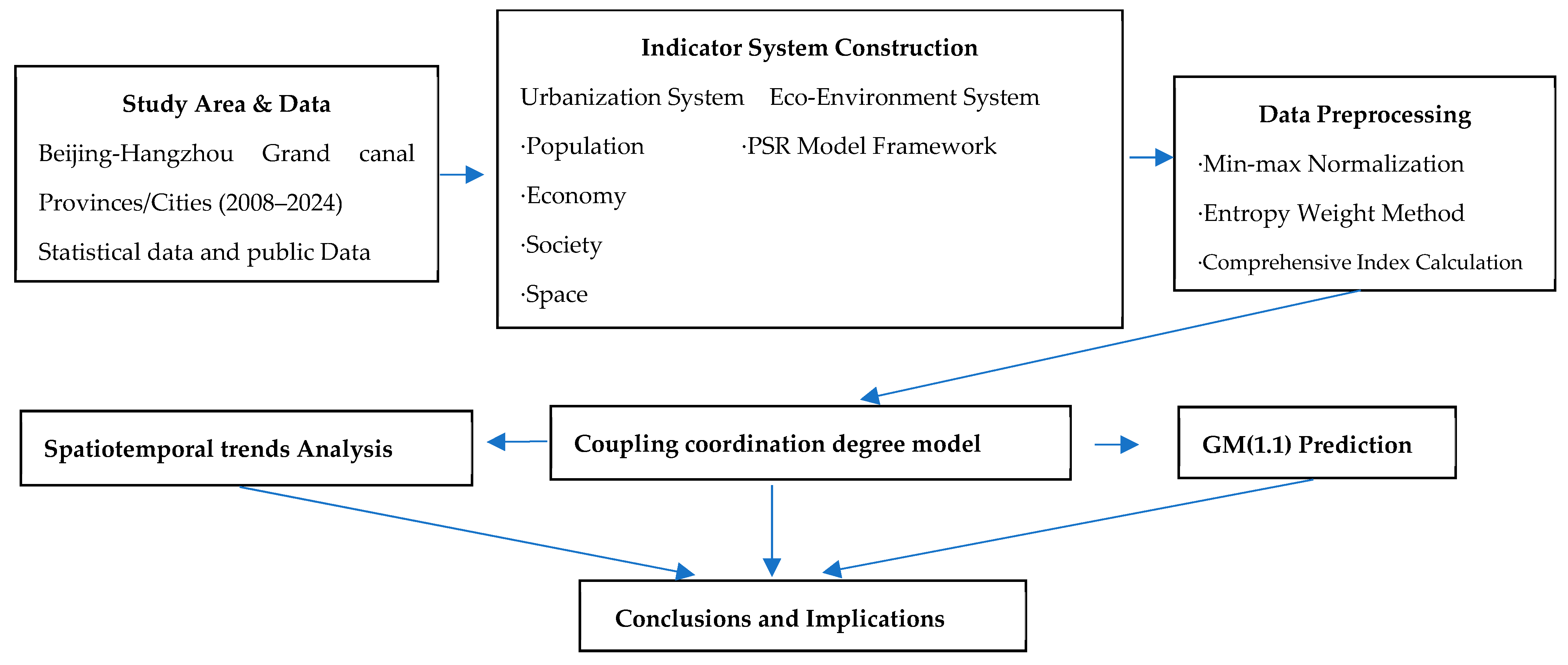
To address the aforementioned research gaps, this paper takes the core area along the Beijing-Hangzhou Grand Canal as an empirical case study, this study, through the organic integration of watershed-scale synthesis, long-term temporal insights, and policy relevance, not only reveals the complex dynamics of the human-environment relationship along the Beijing-Hangzhou Grand Canal but also achieves dual innovation at both methodological and practical levels: Methodologically, it provides a replicable analytical framework for assessing the sustainable development of cross-regional linear cultural heritage corridors or watersheds. In practice, the research outcomes can directly inform specialized plans, such as the Grand Canal Cultural Protection, Inheritance, and Utilization Planning Outline, providing decision-making support to promote high-quality development within the watershed and narrow regional disparities. This demonstrates a close alignment between academic research and national strategic needs. The study framework is shown in Figure 1.

2. Methodology

2.1. Construction of the Comprehensive Evaluation Indicator System and Weight Determination

This study adheres to the principles for selecting indicators, drawing upon the National New-Type Urbanization Plan (2014–2020) and the Pressure-State-Response (PSR) model. After reviewing prior scholarly literature, an evaluation indicator system was constructed based on regional characteristics. It primarily consists of two major components: the urbanization level evaluation system and the ecological environment level evaluation system, which respectively reflect the levels of urban development and ecological environmental development [25,26,27,28,29,30]. The construction of the indicator system is shown in Table 1.
To ensure that the selected indicators accurately capture the connotation of “new urbanization”, this paper conducts conceptual correlation verification for each indicator’s inclusion. The core of new urbanization lies in the urbanization of “people” and high-quality, sustainable development.
Regarding population urbanization, from a new urbanization perspective, it has shifted from a quantitative indicator to a process indicator for measuring “human urbanization” and “social equity”. Population density transforms from a morphological indicator to a structural indicator for measuring “development efficiency” and “sustainability”.
Regarding the dimension of “economic urbanization”, per capita GDP is a core aggregate indicator for measuring the economic foundation and development stage of urbanization. The share of the tertiary industry’s added value in GDP directly reflects the quality of the economic structure’s transformation towards a service-oriented, knowledge-based model during urbanization. Actual utilization of foreign capital is not only an investment but also a conduit for technology, management expertise, and international connections.
Regarding the dimension of “spatial urbanization,” the scale and trends of the built-up area provide a direct basis for analyzing urbanization, resource use, ecological impacts, and carbon-emission pressures. The proportion of built-up area to urban area directly echoes the intensive development requirements of “strictly controlling increment and activating stock” in new urbanization.
Regarding the “social urbanization” dimension, per capita road area supports commuting, logistics, and social interaction, directly impacting residents’ convenience, the efficiency of economic activities, and the rational expansion of urban space. The number of doctors per 10,000 people is related to the accessibility and fairness of public services during urbanization and is a core measure of social welfare. Total retail sales of consumer goods per capita are a direct manifestation of urbanization, driving domestic demand and promoting social prosperity.
The P-S-R framework for the “ecological environment system” itself constitutes a rigorous logical chain that clearly reveals the pressure exerted by urbanization on the ecological environment, the resulting state changes, and the regulatory response of the social system. The framework as a whole assesses the coupling relationship between urbanization and the ecological environment, namely the resource and environmental costs of urbanization, the current impacts, and the sustainable management capacity. This is a direct operational embodiment of the new urbanization’s emphasis on the concepts of “ecological civilization” and “green development”.
To avoid data incomparability within the indicator system due to differing units among indicators, this paper employs the range standardization method to process each indicator. The formula is as follows:
For positive indicators:
x i j = x i j m i n ( x j ) m a x ( x j ) m i n ( x j )
For negative indicators:
x i j = m a x ( x j ) x i j m a x ( x j ) m i n ( x j )
Then, the work uses the entropy method to determine each indicator’s weight. The specific calculation formula is as follows:
Calculate the proportion of the i-th sample value under the j-th indicator: p i j = x i j / i = 1 m   x i j .
Calculate the entropy value of the j-th indicator: e j = k i = 1 m   p i j l n ( p i j ) where k = 1 / l n ( m ) > 0 .
Calculate the coefficient of variation for the j-th indicator: g j = 1 e j .
Calculate weights: w j = g j / j = 1 n   g j .
Subsequently, the linear weighted-sum method was used to calculate the Urbanization Composite Index (U) and the Ecological Environment Composite Index (E).

2.2. Sensitivity Test

2.2.1. Weight Sensitivity Test Results

We compared the rankings of Coupling Coordination Degree (CCD) under three weight assignment schemes:
Benchmark Scheme (S1): Objective weights determined using the entropy weight method (i.e., the weights used in the main text).
Reference scheme A (S2): The equal-weight method is used, assuming that all indicators within the same system are equally important.
By calculating the Spearman rank correlation coefficient of the CCD values of 35 sample cities along the Beijing-Hangzhou Grand Canal under two schemes, the following Table 2 results were obtained.
The correlation coefficients of city CCD rankings between all pairs of schemes are all above 0.96 and statistically significant at the 0.1% level. This indicates that, regardless of the objective weighting method used, even under the simplest equal-weighting assumption, the relative rankings of cities’ coupling coordination degrees remain largely consistent. The weight sensitivity test confirms that the main conclusions of this study (i.e., differences and rankings in coordination degrees among cities) are not sensitive to specific weight calculation methods, supporting their reliability.

2.2.2. The Sensitivity Test Results of the Indicator System Structure

The “leave-one-out” method is used to conduct a sensitivity analysis on the criteria layer of the indicator system. Each criterion layer in the urbanization system (4 layers) and the ecological environment system (3 layers) is sequentially eliminated, and the remaining indicators are used to recalculate the CCD values for all cities, which are then compared with the benchmark CCD value sequence. The “Leave One Out” test results (Pearson correlation coefficient with the benchmark CCD) are shown in Table 3.
After removing any of these criteria layers, the correlation coefficient r between the new CCD sequence obtained and the benchmark CCD sequence remains above 0.98, and all are significant at the 0.1% level. This demonstrates that no single criteria layer (i.e., no set of indicators with specific dimensions) has a dominant impact on the final comprehensive evaluation result. The evaluation result reflects the combined effect of all dimensional indicators, indicating that the indicator system’s structure is robust and comprehensive.
Comprehensive Conclusion
Based on the results of the two sensitivity tests mentioned above, the following can be clearly concluded: First, the indicator weights determined in this study based on the entropy weight method are reasonable and reliable, and the evaluation results are not influenced by other common objective weighting methods or simple assumptions. Second, the comprehensive evaluation index system, encompassing multiple dimensions and criteria, is robust, and the evaluation results are not dominated by indicators from a single aspect.
Therefore, all subsequent analyses and conclusions based on the urbanization development level, ecological environment quality, and the coupling coordination degree calculated using this indicator system and entropy weight method have solid methodological robustness and can objectively and credibly reflect the true development status of the regions along the Beijing-Hangzhou Grand Canal.

2.3. Coupling Coordination Model

2.3.1. Coupling Degree

The coupling coordination degree (CCD) model effectively quantifies the interdependent and mutually constraining co-evolution between two systems. Compared with single-indicator assessments or simple correlation analyses, the CCD model integrates multi-dimensional indicators systematically and calculates coordination grades, making it more suitable for deciphering the holistic coordination state of such complex human-land systems. This approach provides directly comparable, graded benchmarks for coordinated governance across the entire river basin [31,32]. Therefore, constructing a coupling degree model for urbanization and ecological environment, coupling degree (C) reflects the intensity of interactions between systems, while coordination degree (D) measures the level of coordination.
C = 2 × U × E U E ) 2
Among these, C (0 ≤ C ≤ 1) represents the coupling degree between new urbanization and the ecological environment, where U denotes the comprehensive urbanization evaluation index, and E denotes the comprehensive ecological environment evaluation index. A higher C value indicates greater coupling between the two systems and a more harmonious developmental relationship, while a lower C value indicates less harmony. Based on relevant scholarly literature, the coupling levels are classified as shown in Table 4.

2.3.2. Coupling Coordination Degree Model Level

The coupling degree model struggles to elucidate the degree of coordination between the urbanization and ecological environment systems, failing to accurately assess it. The coupling coordination degree model can explain the relationships of interaction and influence between elements within and across systems [33,34]. Therefore, building upon its coupling degree model C, the coupling coordination degree D model is introduced as follows:
D = C × T , T = α U + β E
Here, T denotes the composite evaluation index for urbanization and the ecological environment; α and β are undetermined coefficients. Given that urbanization emphasizes the “four modernizations in tandem” alongside “ecological civilization,” this study treats urbanization and the ecological environment as equally important, setting α = β = 0.5. Drawing on existing research the coupling coordination degree (D) is categorized into four major types and ten levels (Table 5).

2.4. GM (1,1) Prediction Model

The selection of the grey GM (1,1) is primarily motivated by the practical constraints of relatively short time series and partially missing statistical data in some areas along the Grand Canal, especially at the county scale. The core advantage of this model lies in its ability to model and predict using “small samples” and “poor information.” It uncovers intrinsic data patterns through generation processing and imposes lower requirements on data distribution and sample size. This contrasts with many classical time-series models (such as ARIMA) and data-driven machine-learning prediction models, which typically require large samples and stable data distributions.
This approach not only aligns with the characteristics of the research subject but also provides an operational analytical framework for sustainability assessments of similar corridor-like, multi-node regional complex systems. GM (1,1) denotes a first-order, single-variable differential equation-type prediction model, representing the most commonly used variant within grey prediction models. Its modeling steps are as follows:
(1) Establish a time series for known data variables. Let the original sequence be:
x 0 = x 0 1 , x 0 2 , , x 0 n
Here, n denotes the number of sample observations. To ensure the feasibility of the GM(1,1) modeling method, it is necessary to perform and evaluate the order of magnitude of the sequence:
λ k = x 0 k 1 x 0 k , k = 2,3 , , n
If all ratios decline in the admissible coverage scope X = ( e 2 n + 1 , e 2 n + 1 ) , then a predictive model can be set up for grey prediction; otherwise, it is necessary to make further transformation processing.
(2) Produce a novel data sequence through the accumulation of the original sequence by applying the AGO approach. The randomness and fluctuations inherent in the original sequence are resolved by this accumulation process, which plays a key role in the grey system principle.
x 1 = x 1 1 , x 1 2 , , x 1 n
(3) Produce the sequence by applying the neighborhood mean after cumulative production. The neighborhood mean is a novel data point built by averaging adjacent data points.
z 1 k = 0.5 x 1 k + 0.5 x 1 k 1 , k = 2,3 , , n
(4) Build the data matrix B and the data vector Y.
B = 1 2 ( z 1 ( 1 ) + z 1 ( 2 ) 1 1 2 ( z 1 ( 2 ) + z 1 ( 3 ) 1 1 2 ( z 1 ( n 1 ) + z 1 ( n ) 1
Y = x 0 2 x 0 3 x 0 n
(5) Calculate the growth parameter a and the cement dosage u.
a u = ( B T × B ) 1 B T Y
(6) Establish a model to solve the time response function and perform a prediction. First, solve for coefficients a and u. Then substitute coefficients a and u into the following equation to solve this differential equation, obtaining the whitened form equation of the GM (1,1) prediction model, thereby deriving the GM (1,1) prediction model:
d x 1 d t + a x 1 = u
The time response function of the model is:
x ^ 1 k + 1 = x 1 1 u a e α k + u a , k = 1,2 , , n
(7) Model Validation. To assess the accuracy of predictions, residual tests and post-test error checks are typically employed:
I.
Residual Test Residual Series
M = K = x 0 k x ^ 0 k , k = 2,3 , , n
Relative error:
m k = x 0 k X 0 k x 0 k , k = 2,3 , , n
Average Relative Error:
φ = 1 n k = 1 n   m k
II.
Post hoc Difference Test
Calculate the mean and variance of the original data:
X ¯ 0 = 1 n i = 1 m   x 0 i S 1 = 1 n i = 1 m   [ x 0 ( i ) X 0 ] 2
Calculate the mean absolute error and mean square error of the absolute error sequence ∆(0):
Δ ¯ 0 = 1 n i = 1 m   Δ 0 i S 2 = 1 n i = 1 m   [ Δ 0 ( i ) Δ 0 ] 2
Calculate the posterior odds ratio C:
C = S 2 S 1
Small error probability P:
P = P Δ 0 i Δ 0 < 0.6745 S 1
The posterior odds ratio C should be as small as possible, while the probability of error P should be as large as possible. The grey prediction model’s accuracy is determined using the accuracy grading table shown in Table 6.
Using MATLAB 2017b software, the coupling coordination index from 2010 to 2024 was treated as the original time series. After a series of correlation tests and operations, the GM (1,1) model was finally established, as shown in Table 7. The fitting results were assessed using the residual and posterior error tests. The Beijing-Hangzhou Grand Canal Basin achieves Level 1 precision, indicating that the model is suitable for further extrapolation and prediction.

2.5. Data and Sources

The study area encompasses the major prefecture-level cities involved along the Beijing-Hangzhou Grand Canal. The temporal span of this study is 17 years, from 2008 to 2024. The data for this study are primarily sourced from officially published statistical materials, authoritative remote sensing data products, and environmental monitoring reports, ensuring the data’s authority and reliability. The main sources include national and provincial/municipal official statistical publications, such as the China City Statistical Yearbook (2009–2025 editions), the China Statistical Yearbook, the China Environmental Statistical Yearbook, and statistical communiqués on national economic and social development from the respective cities.

3. Results and Discussion

3.1. Spatiotemporal Evolution of the Urbanization and Ecological Environment Indices

3.1.1. Temporal Evolution Characteristics

Based on the index system’s calculation methodology explored earlier, the dynamic evolution tendencies at five distinct time points are analyzed using the calculated results. Choosing core milestones, the data from 2008, 2012, 2016, 2020, and 2020. Table 8 shows the outcomes. The outcomes show an upward trend in the U-index, suggesting more rapid urbanization along the canal recently. The pattern is characterized by rapid initial development followed by slower yet higher-quality development, indicating the state’s strong growth trajectory. On the contrary, the ecological environment index shows unique modes, displaying a V-shaped pattern from 2008 to 2024: the Beijing-Hangzhou Grand Canal is a linear cultural–ecological corridor spanning north and south, rather than a homogeneous urban agglomeration or province [35,36]. The development stages, resource endowments, and ecological baselines of cities along its route vary significantly (e.g., the Yangtze River Delta region in the southern section versus some northern cities in the northern section). This spatial heterogeneity may cause overall indices to exhibit more sensitive, pronounced “V-shaped” turns in response to macro-policy shocks than in homogeneous regions. Reaching its lowest point in 2012. This reduction may be caused by excessive energy consumption driven by rapid industrial growth, which is greatly affecting the ecological context. Therefore, the ecological environment was negatively influenced by the sudden acceleration of urbanization in 2012. Land growth and industrial expansion have increased pollution, degrading ecological quality—a mutually reinforcing relationship. Therefore, starting in 2016, ecological and environmental quality started to improve. This closely aligns in timing with high-intensity, high-frequency national-level targeted policies, such as the “13th Five-Year Plan for Ecological and Environmental Protection” and the “Grand Canal Cultural Belt” initiative. This indicates that in ecologically sensitive or key protection areas, strong external policy interventions can significantly compress the period of environmental degradation, swiftly drive the system toward coordination, and shape a “V-shaped” trajectory rather than a gradual “U-shaped” one.

3.1.2. Spatial Differentiation Patterns

From a spatial perspective, areas with higher urbanization indicators are concentrated in the Yangtze River Delta, with Shanghai, Suzhou, and Hangzhou ranking highest at 0.92, 0.87, and 0.84, respectively. These regions represent China’s relatively developed economic zones, which concentrate large human resources and an excellent industrial infrastructure. In the meantime, strong national policy has enabled their urbanization to outpace that of other regions in both pace and quality, corroborating the scientific validity of these research findings and offering a theoretical reference for regional policy preparation. Areas with intermediate urbanization indicators are mainly concentrated in central Jiangsu and the Shandong Peninsula. Central Jiangsu maintains a moderate level due to spillover effects from southern Jiangsu’s faster industrialization and urbanization. The Shandong Peninsula shows relatively balanced data across regions, though its indicator placement reflects reality: its population and financial strength contribute to a higher-than-average baseline. Areas with the lowest urbanization indicators are concentrated in Cangzhou, Hengshui, and Liaocheng, with values of 0.32, 0.31, and 0.38 because agriculture and resource-based sectors dominate their industrial frameworks, with restricted industrial growth, and their peripheral locations within economic zones make it hard to attract excellent resource aggregation, leading to low urbanization levels.
There are great spatial differences between the ecological environment indicator and the urbanization indicator. The outcomes show a misalignment between their values and regional financial growth levels. For example, regions with high values show low industrialization or a predominantly agricultural industrial framework, including Lishui (0.61) with low industrialization and Heze (0.58) with an agriculture-based economy. On the contrary, regions experiencing rapid urbanization, including the Beijing-Tianjin-Hebei area, show lower ecological indicators. This mainly stems from faster industrialization and urbanization, which boost resource extraction and energy consumption, leading to higher pollution levels. In the meantime, irreversible negative impacts on local ecosystems from urban expansion further corroborate the alignment between research findings and actual conditions. According to Table 9, by 2024, the ecological environment indicators for several cities in the Yangtze River Delta region had rebounded significantly due to the noticeable effects of a set of national green development policies. Nevertheless, areas dominated by the heavy sector remain low, with no significant improvement. Hence, a north-low, south-high distribution is evident in the spatial mode of China’s regional ecological index. This pattern suggests that within corridors marked by significant internal disparities, such as those along the canal, the path dependence effect of local leading industries is amplified [37]. The northern section (e.g., the Beijing-Tianjin-Hebei region and western Shandong) historically featured a dense concentration of heavy and chemical industries, leading to a lock-in of a high-energy-consumption and high-emission industrial structure. Even with a slowdown in economic growth, historical environmental deficits and transition costs make it difficult to improve the Environmental (E) Index [38]. In contrast, some cities in the southern region (e.g., Lishui), either due to geographical constraints on industrialization or to a proactive choice of ecological development pathways (such as Heze’s agricultural foundation), maintain a relatively “lighter” industrial structure. Consequently, they exhibit a “latecomer advantage” or an “inherent baseline advantage” in terms of their ecological environment index.
To sum up, the spatial modes of U-values and E-values differ significantly. Differentiated measures should be formulated by regional governments along the corridor, based on unique regional features, to coordinate the co-growth of both indices. This research also offers theoretical understandings for formulating differentiated policies.

3.1.3. Temporal Evolution and Typology

The tendency in coupling coordination levels is shown in Table 10, which displays an overall upward trend throughout the period. Regarding coordination intensity, the 2008 value was relatively low at 0.381, suggesting a mildly imbalanced phase. Nevertheless, by 2024, this figure had risen to 0.588, indicating a barely coordinated phase, reflecting a progression from incoordination to coordination. This tendency was boosted by two primary cycles: the first stage, 2008–2016, is characterized by a rapid numerical increase. This acceleration was mainly due to the government’s mandatory shutdown of high-pollution, high-emission, and energy-intensive companies, which significantly improved the ecological environment. The second stage spans 2016–2024. Although values continued to grow during this period, the pace of growth was much slower than in the first cycle. This change suggests a policy shift from mandatory shutdowns to in-depth industrial reconstruction, prioritizing quality.
Regionally, only parts of the Yangtze River Delta realized marginal coordination in the early stage. A staggering 86.4% of regions remained out of balance, indicating an excessive focus on rapid economic growth in the initial phase. Local ecological environments were sacrificed by excessive industrialization and urbanization, building this imbalance. Nevertheless, under national green growth policies and carbon-neutrality objectives, regions currently take precedence over ecological restoration and public health. By 2024, coordinated cities reached 62.5% of the total. Yet the intermediate coordination level remains at 0, suggesting a relatively low present coordination level with room for further enhancement. Accordingly, basic restoration and enhancement of the ecological environment are long-term processes that demand sustained investment and ongoing change, rather than something that can be achieved overnight.

3.2. Coupling Coordination Degree Prediction Based on Grey (1,1) Models

Based on the GM(1,1) model built earlier, which has been validated for high precision, further predictions can be made. Table 11 shows the prediction outcomes. Under natural evolution, it is projected that the coupling coordination level will reach primary coordination by 2025 and intermediate coordination by 2030. The previous spatial analysis indicated that the “higher in the south, lower in the north” pattern is likely to persist, but the southern regions have shown significant improvement. This forecast likely primarily reflects the rapid progress of high-coordination-potential areas in the south, such as the Yangtze River Delta, which elevates the overall average to a moderate level of coordination. This does not mean that northern heavy-industrial cities had achieved a high level of coordination by that time, but rather that the overall average rises amid regional disparities. This aligns with the logic of the spatial analysis judgment that, while the “catch-up effect” is not pronounced, overall improvement is evident.
To ensure the validity of the GM(1,1) forecasting model, this study not only performed a posterior error test but also conducted an in-depth statistical significance test of the model parameters. The specific test results are as follows:

3.2.1. Significance Test Results for the Development Coefficient (−a)

Based on the principles of the GM(1,1) model, a t-test was performed on the development coefficient a = −0.0201 to determine whether it differs significantly from zero. The test results are summarized in Table 12 below.
The t-statistic is −4.112, and its absolute value is significantly greater than the critical value of the t-distribution at the α = 0.05 level. The p-value is less than 0.001, which is well below the 0.05 significance level. The 95% confidence interval is [−0.0296, −0.0130] and does not include zero. This indicates that the development coefficient a is significantly different from zero at a 99.9% confidence level. Since a is negative, this indicates that the extracted exponential growth trend in the coupling coordination degree (D-value) is highly statistically significant and not due to random fluctuations. This provides a solid statistical foundation for subsequent predictions.

3.2.2. Construction and Test Results of Prediction Intervals

Based on point predictions, we further constructed confidence intervals for the predicted values. Based on grey system theory and residual analysis, 95% confidence intervals for D-value predictions for 2025 and 2030 were calculated. The results are as follows Table 13.
Prediction for 2025: The confidence interval is [0.589, 0.633], which falls entirely within the “Primary Coordination” level range (0.60–0.69). The lower bound (0.589) is close to but does not fall below the upper limit of the “Barely Coordinated” level (0.59), indicating a high degree of certainty that Primary Coordination will be achieved by 2025.
Prediction for 2030: The confidence interval is [0.702, 0.768], which falls entirely within the “Intermediate Coordination” level range (0.70–0.79). Notably, the lower bound (0.702) just exceeds the threshold for Intermediate Coordination (0.70), indicating that even under the most conservative scenario, this level will be reached. The upper bound (0.768) does not meet the “Good Coordination” threshold (0.80), suggesting a low probability of meeting it by 2030.
Analysis of Confidence Interval Width: The interval width is 0.044 for 2025 and 0.066 for 2030. The width increases moderately as the prediction horizon extends, consistent with the time-accumulation effect of prediction uncertainty. However, the magnitude of increase is within a reasonable range, indicating good model stability.

4. Discussion

The core finding of this study reveals the complex landscape of the coupled and coordinated relationship between urbanization and the ecological environment along the Beijing-Hangzhou Grand Canal. Overall, the degree of coupling coordination in the study area shows a steady upward trend. Consistent with findings from numerous studies on China’s regional development, this discovery aligns with certain predictions of the Environmental Kuznets Curve (EKC) theory [39,40]. The EKC theory posits that, in the early stages of economic development, environmental quality may deteriorate as economic growth proceeds. However, once economic development reaches a certain level, environmental quality can improve further with continued economic growth, forming an inverted-U-shaped curve. Unlike some studies suggesting that the EKC turning point has not been universally reached or exhibits regional heterogeneity, our research indicates that the Canal corridor region as a whole may have already crossed the EKC inflection point and is moving toward a win-win path of economic development and environmental improvement [41].
Behind this overall positive trend lie profound socio-economic driving forces. As China’s economy transitions from rapid growth to high-quality development, the development models of regions along the Canal are undergoing fundamental changes. The optimization and upgrading of industrial structure, the strengthening of environmental regulation, the promotion and application of green technologies, and the increasing public awareness of environmental protection collectively drive the improvement in the relationship between urbanization and the ecological environment. Particularly in economically developed areas like the Yangtze River Delta, relatively sound environmental governance systems and economic transition mechanisms have been established, providing strong support for coordinated development. This resonates with conclusions from various studies on the drivers of regional green transformation [42,43].
However, like all empirical research, this study has limitations that also point to directions for future research.
Firstly, regarding the construction of the indicator system, although economic, social, and environmental dimensions were comprehensively considered, the inclusion of “soft” indicators such as cultural heritage preservation and social equity remains insufficient. This reflects a common challenge faced by many current studies on sustainable development assessment [44]. As a living cultural heritage site, the protection and transmission of its culture are crucial to the sustainable development of the Beijing-Hangzhou Grand Canal. Future research needs to further incorporate cultural preservation indicators to better reflect the specificity and complexity of cultural heritage areas [45,46].
Secondly, this study mainly focused on the static distribution characteristics of spatial differences. The analysis of evolutionary dynamics and transmission mechanisms can be further deepened. In particular, issues such as interactions among regions and the transmission of influence require borrowing tools from spatial econometrics and network analysis to establish a more dynamic analytical framework. This would better reveal the temporal evolution process and spatial diffusion mechanisms of the coupling coordination relationship.

5. Conclusions and Implications

This study aims to systematically evaluate the spatiotemporal evolution characteristics of the coupled and coordinated relationship between urbanization and the ecological environment in urban agglomerations along the Beijing-Hangzhou Grand Canal from 2008 to 2024, and to predict its future trends. By constructing a comprehensive evaluation system, a coupling coordination degree model, and a GM(1,1) prediction model, the following core conclusions are drawn:
In terms of temporal evolution, the systemic relationship has shifted from conflict to coordination. During the study period, urbanization continued to rise rapidly, while ecological quality followed a “V-shaped” trajectory, declining initially and then recovering. This indicates that the early-stage extensive development model exerted pressure on the ecology. After 2016, driven by green development policies, the relationship between the two improved significantly. The degree of coupling coordination progressed from the “Slight Dysregulation” stage to the “Barely Coordinated” stage. However, the ecological environment subsystem consistently lagged.
In terms of spatial pattern, the coordination level exhibits a significant “higher in the south, lower in the north” differentiation and clustering characteristic. Areas with high coordination are highly concentrated in the Yangtze River Delta urban agglomeration, forming a distinct “core area”. In contrast, low coordination is continuously distributed across regions such as western Shandong and southeastern Hebei. This spatial differentiation pattern shows a trend of intensification over time.
Future predictions indicate that the region as a whole is expected to improve, but internal disparities will persist. Based on high-precision GM(1,1) model predictions, under a natural evolution scenario, the overall coupling coordination degree along the Canal is expected to enter the “Primary Coordination” stage by 2025 and advance to the “Intermediate Coordination” stage by 2030. However, the model also suggests the long-term persistence of uneven development within the region.
Research Implications: The above conclusions indicate that the sustainable development of regions along the Beijing-Hangzhou Grand Canal has entered a critical period, shifting from “scale expansion” to “quality improvement and systemic coordination”. To achieve the goal of the entire corridor entering the intermediate coordination stage by 2030 and to narrow internal disparities, management policies need to shift from a “one-size-fits-all” approach to a more precise, differentiated approach. On the one hand, it is essential to adhere to the ecological bottom line, continuously reduce emissions, and control pollution through technological innovation and strict regulation. On the other hand, it is necessary to adopt place-based strategies to guide the green transformation of lagging northern regions and to promote deep synergy between high-quality urbanization and ecological conservation in developed eastern areas. Future research could further integrate multi-scenario simulations and policy intervention analysis to optimize development pathways.


Author Contributions

Y.Z.: Data curation, Resources, Writing—original draft, Writing—review & editing; J.L.: Software, Supervision, Writing—review & editing. All authors have read and agreed to the published version of the manuscript.

Funding

This research received no external funding.

Institutional Review Board Statement

Not applicable.

Informed Consent Statement

Not applicable.

Data Availability Statement

The original contributions presented in the study are included in the article; further inquiries can be directed to the corresponding author.

Conflicts of Interest

The authors declare no conflict of interest.

References

  1. Amer, E.A.A.A.; Xiuwu, Z.; Meyad, E.M.A. Urbanization, growth, and carbon footprints: A GCC perspective on sustainable development. Sustain. Futures 2025, 9, 100631. [Google Scholar] [CrossRef]
  2. Wang, R. Fuzzy-based Multicriteria Analysis of the Driving Factors and Solution Strategies for Green Infrastructure Development in China. Sustain. Cities Soc. 2022, 82, 103898. [Google Scholar] [CrossRef]
  3. Abdulqadir, I.A. Urbanization, renewable energy, and carbon dioxide emissions: A pathway to achieving sustainable development goals in sub-Saharan Africa. Int. J. Energy Sect. Manag. 2024, 18, 248–270. [Google Scholar] [CrossRef]
  4. Yeyouomo, A.K.; Asongu, S.A. Sustainable urbanization and vulnerability to climate change in Africa: Accounting for digitalization and institutional quality. Sustain. Dev. 2024, 32, 1188–1216. [Google Scholar] [CrossRef]
  5. Khan, M.E. Sustainable urban development: A sustainability study of the Dhaka megacity. Int. J. Res. Sci. Innov. 2024, 11, 69–82. [Google Scholar] [CrossRef]
  6. Shi, X.L.; Zhu, X.N. Ecological management recommendations for the Jiaxing Canal New District Section of the Beijing-Hangzhou Grand Canal. South Agric. 2011, 5, 49–51. [Google Scholar]
  7. Meng, D.; Liu, L.T.; Gong, H.L. Research on the coupling and coordination relationship between urbanization and ecological environment in areas along the Beijing-Hangzhou Grand Canal. Remote Sens. Land Resour. 2021, 33, 162–172. [Google Scholar]
  8. Shah, S.A.R.; Naqvi, S.A.A.; Anwar, S. Exploring the linkage among energy intensity, carbon emission and urbanization in Pakistan: Fresh evidence from ecological modernization and environment transition theories. Environ. Sci. Pollut. Res. 2018, 25, 40907–40929. [Google Scholar] [CrossRef]
  9. Cumming, G.S.; Barnes, G.; Perz, S.; Schmink, M.; Sieving, K.E.; Southworth, J.; Van Holt, T. An exploratory framework for the empirical measurement of resilience. Ecosystems 2005, 8, 975–987. [Google Scholar] [CrossRef]
  10. Stern, D.I. The rise and fall of the environmental Kuznets curve. World Dev. 2004, 32, 1419–1439. [Google Scholar] [CrossRef]
  11. Wang, Z.H.; Liang, S. Research on the intercoupling measure of urbanization and ecological environment in China. Ecol. Econ. 2016, 32, 34–38. [Google Scholar]
  12. Wang, S.J.; Fang, C.L.; Wang, Y. Quantitative measurement of the interactive coupling relationship between urbanization and ecological environment in the Beijing-Tianjin-Hebei Region. Acta Ecol. Sin. 2015, 35, 2244–2254. [Google Scholar]
  13. He, J.; Wang, S.; Liu, Y. Examining the relationship between urbanization and the eco-environment using a coupling analysis: Case study of Shanghai, China. Ecol. Indic. 2017, 77, 185–193. [Google Scholar] [CrossRef]
  14. Ding, L.; Zhao, W.T.; Huang, Y.L.; Cheng, S.G.; Liu, C. Research on the coupling coordination relationship between urbanization and the air environment: A case study of the area of Wuhan. Atmosphere 2015, 6, 1539–1558. [Google Scholar] [CrossRef]
  15. Wu, Y.M.; Bai, L. Coupling and coordination measurement and interactive analysis of urbanization and environment system in Guangxi Province, China. Sci. Geogr. Sin. 2011, 31, 1474–1479. [Google Scholar]
  16. Wang, X.Y.; Wahap, H.; Wang, F. Research on the coupling coordination relationship among urbanization, resources, and environment in China. J. Nat. Sci. Hunan Norm. Univ. 2017, 40, 17–23. [Google Scholar]
  17. Han, D.K. Research on the Coupling Relationship Between Urbanization and Ecological Environment in Zhengzhou City. Master’s Thesis, Shanxi Normal University, Taiyuan, China, 2017. [Google Scholar]
  18. Zhang, L.Q. Analysis of environmental stress evolution patterns in Anhui Province’s urbanization process from an incremental perspective. J. Shanxi Norm. Univ. Nat. Sci. 2016, 30, 110–117. [Google Scholar]
  19. Liu, Y.B. Coupling patterns and empirical analysis of China’s urbanization and ecological environment. Ecol. Econ. 2007, 10, 122–126. [Google Scholar]
  20. Li, J.; Wang, C.S.; Wu, G.S.; Ni, J.; Liang, C.; Li, C.F.; Li, M.Y. Heavy metal content and spatial distribution characteristics in nearshore soils along the Zhenjiang Section of the Beijing-Hangzhou Grand Canal. Acta Geol. Sin. 2021, 45, 219–224. [Google Scholar]
  21. Ge, L.; Gao, Y.; Lu, C.F.; Wang, J.Z.; Wu, Y.Y.; Zhou, S.L. Ecological spatial differences and responses along the Jiangsu Section of the Beijing-Hangzhou Grand Canal. Res. Soil Water Conserv. 2019, 26, 330–337. [Google Scholar]
  22. Zhou, C.; Feng, X.G.; Tang, R. Analysis and prediction of coupled coordination development of regional economy, ecological environment, and tourism industry: A case study of provinces and cities along the Yangtze River Economic Belt. Econ. Geogr. 2016, 36, 186–193. [Google Scholar]
  23. Fábos, J.G. Greenway planning in the United States: Its origins and recent case studies. Landsc. Urban Plan. 2004, 68, 321–342. [Google Scholar] [CrossRef]
  24. Tengberg, A.; Fredholm, S.; Eliasson, I.; Knez, I.; Saltzman, K.; Wetterberg, O. Cultural ecosystem services provided by landscapes: Assessment of heritage values and identity. Ecosyst. Serv. 2012, 2, 14–26. [Google Scholar] [CrossRef]
  25. Degirmenci, T.; Erdem, A.; Aydin, M. The nexus of industrial employment, financial development, urbanization, and human capital in promoting environmental sustainability in E7 economies. Int. J. Sustain. Dev. World Ecol. 2025, 32, 242–258. [Google Scholar] [CrossRef]
  26. Kumari, D.; Shashwat, S.; Verma, P.K. Examining the nexus between carbon dioxide emissions, economic growth, fossil fuel energy use, urbanization and renewable energy towards achieving environmental sustainability in India. Int. J. Energy Sect. Manag. 2025, 19, 731–746. [Google Scholar] [CrossRef]
  27. Khezri-nejad-gharaei, M.; Garcia-López, M.À. Reverse causality between urbanization and climate change. Int. Econ. J. 2025, 39, 1–29. [Google Scholar] [CrossRef]
  28. Chen, X.H.; Wu, G.B.; Wan, L.H. Dynamic simulation of vulnerability and coordination of the coupling of urban and ecological environment based on BP: A case of the coal-electricity base in the Eastern Heilongjiang Province. Geogr. Sci. 2014, 34, 1337–1343. [Google Scholar]
  29. Jing, Z.; Jing, J.; Yiping, Z. The water resources development and utilization and evaluation of water ecological environment in the agro-pastoral ecotone. J. Resour. Ecol. 2025, 16, 368–375. [Google Scholar] [CrossRef]
  30. Fu, W.J.; Wu, Y.Q.; Luo, Z.X.; Yao, J.; Fu, L.J. Coupling coordination analysis of Mazu culture, socio-economy and ecological environment of Meizhou Island. Ecol. Econ. 2024, 20, 85–100. [Google Scholar]
  31. Qin, M.H.; Liu, X.L. Evaluation of water environment security and analysis of dynamic coupling coordination in the Haihe River Basin. J. Irrig. Drain. 2021, 42, 63–73. [Google Scholar]
  32. Zhou, Q.; Ding, N. Analysis of coupling coordination between socioeconomic development and carbon emissions in the Beijing-Tianjin-Hebei Region. J. North China Electr. Power Univ. Soc. Sci. 2025, 6, 55–69. [Google Scholar]
  33. Yang, Q.L.; Chen, H.Y.; Wen, Q. Coupling coordination degree and enhancement pathways of digital economy and green development in municipal areas of Upper Yellow River Region. Econ. Geogr. 2024, 44, 22–32. [Google Scholar]
  34. Liu, Z.M.A.; Wang, L.Y. Coupling coordination degree and spatial convergence characteristics of urban economic resilience and carbon emission reduction capacity. Stat. Decis. 2024, 40, 62–66. [Google Scholar]
  35. Bian, D.; Zhang, M.; Kong, L. Analysis of Regional Social–Economic Spatial Pattern and Evolution along the Beijing–Hangzhou Grand Canal. Sustainability 2024, 16, 1527. [Google Scholar] [CrossRef]
  36. Ge, S.; Feng, Z.; Zhang, J. An Analysis of the Spatiotemporal Distribution and Influencing Factors of National Intangible Cultural Heritage Along the Grand Canal of China. Sustainability 2024, 16, 9138. [Google Scholar] [CrossRef]
  37. Wang, B.; Zhang, J.; Kong, L. Research on Industrial Innovation Efficiency and the Influencing Factors of the Old Industrial Base Based on the Lock-In Effect, a Case Study of Jilin Province, China. Sustainability 2022, 14, 12739. [Google Scholar] [CrossRef]
  38. Liu, Y. The Effects of Environmental Regulation on Investment Efficiency—An Empirical Analysis of Manufacturing Firms in the Beijing–Tianjin–Hebei Region, China. Sustainability 2022, 14, 6371. [Google Scholar]
  39. Grossman, G.M.; Krueger, A.B. Economic growth and the environment. Q. J. Econ. 1995, 110, 353–377. [Google Scholar] [CrossRef]
  40. Bao, Q.; Peng, S.J.; Yang, X.X. Is there an inverted U-shaped Kuznets curve for the environment? An empirical study based on six types of pollution indicators. Shanghai Econ. Res. 2005, 12, 3–13. [Google Scholar]
  41. Liu, Y.B.; Li, R.D.; Song, X.F. Analysis of the Coupling Degree between Urbanization and Ecological Environment in China. J. Nat. Resour. 2005, 20, 105–112. [Google Scholar]
  42. Shen, K.R.; Jin, G.; Xun, F. Does environmental regulation lead to the nearby transfer of pollution? Econ. Res. 2017, 52, 44–59. [Google Scholar]
  43. Liu, Y.J.; Sun, D.; Li, C.G. Progress and Prospects in the Study of the Coupling Relationship between Regional Development and Ecological Environment. Adv. Geogr. Sci. 2016, 35, 1309–1320. [Google Scholar]
  44. Zhang, L.; Xu, Y.; Yeh, C.H.; Liu, Y.; Zhou, D. City sustainability evaluation using multi-criteria decision making with objective weights of interdependent criteria. J. Clean. Prod. 2016, 131, 491–499. [Google Scholar] [CrossRef]
  45. Li, Y.; Li, Y.; Zhou, Y.; Shi, Y.; Zhu, X. Investigation of a coupling model of coordination between urbanization and the environment. J. Environ. Manag. 2012, 98, 127–133. [Google Scholar] [CrossRef]
  46. Liu, Y.; Li, Y. Revitalize the world’s countryside. Nature 2017, 548, 275–277. [Google Scholar] [CrossRef]
Figure 1. The framework of the study.
Sustainability 18 02019 g001
Table 1. Evaluation indicator system.
System LayerGuideline LayerIndicator LayerUnitWeightAttribute
Urbanization System (U)Population UrbanizationUrban Population as a Percentage of Total Population%0.128+
Population DensityPeople/square kilometer0.096+
Economic UrbanizationGDP per CapitaYuan0.089+
Tertiary Industry Value Added as a Percentage of GDP%0.124+
Actual Utilized Foreign CapitalTen thousand yuan0.098+
Spatial UrbanizationBuilt-up AreaSquare kilometer0.112+
Built-up Area as a Percentage of Urban Area%0.070+
Social UrbanizationRoad Area per CapitaSquare meters0.091+
Doctors per 10,000 PopulationPeople0.097+
Retail Sales of Consumer Goods per CapitaYuan0.095+
Ecological Environment System (E)Environmental pressureEnergy consumption per unit of GDPTonnes of standard coal equivalent per 10,000 yuan0.126-
Water consumption per unit of GDPCubic meters per 10,000 yuan0.118-
Sulfur dioxide emissions per unit of GDPTonnes per 100 million yuan0.121-
Environmental StatusAnnual average PM2.5 concentrationμg/m30.115-
Proportion of water quality sections meeting Class III or higher standards%0.108+
Green coverage rate in built-up areas%0.102+
Ecological ResponseComprehensive utilization rate of industrial solid waste%0.095+
Environmental pollution control investment as a percentage of GDP%0.099+
Urban sewage treatment rate%0.116+
Note: “+” and “-” mean positive indicators and negative indicators.
Table 2. Weight sensitivity test results.
Scheme ComparisonSpearman Rank Correlation Coefficientp-Value
S1 (Entropy Weight Method) vs. S2 (Equal Weight Method)0.977<0.001
S1 (Entropy Weight Method) vs. S3 (PCA Method)0.993 <0.001
Table 3. “Leave One Out” test results.
Reveal the Following Criteria LayersPearson Correlation Coefficientp-Value
Population urbanization0.991<0.001
Economic urbanization0.995<0.001
Spatial urbanization0.994<0.001
Social urbanization0.991<0.001
Environmental pressure0.993<0.001
Environmental state0.989<0.001
Ecological response0.996<0.001
Table 4. Coupling Level Classification.
IntervalLevel
0 < C ≤ 0.3Low-level coupling stage
0.3 < C ≤ 0.5Antagonistic coupling stage
0.5 < C ≤ 0.8Break-in coupling stage
0.8 < C ≤ 0.9High-level coupling stage
0.9 < C ≤ 1Extremely high-level coupling stage
Table 5. Classification Criteria for Coupling Coordination Levels.
Coordinate Range (D)Coordination LevelCoordinate Range (D)Coordination Level
0.00–0.09Extreme imbalance0.50–0.59Barely coordinated
0.10–0.19Severe imbalance0.60–0.69primary coordination
0.20–0.29Moderate imbalance0.70–0.79Intermediate coordination
0.30–0.39Mild imbalance0.80–0.89Good coordination
0.40–0.49Borderline imbalance0.90–1.00Excellent coordination
Table 6. Precision Inspection Grade Reference Table.
Accuracy ClassStatusPC φ
Level 1Good P > 0.95 C 0.35 φ < 0.01
Level 2Pass 0.8 < P 0.95 0.35 < C 0.5 φ < 0.05
Level 3Barely Pass 0.7 < P 0.8 0.5 < C 0.65 φ 0.10
Level 4Fail P 0.7 C > 0.65 φ > 0.10
Table 7. Gray Prediction Model and Verification Results.
RegionFitting ModelCP φ
Beijing-Hangzhou Grand Canal Basin x ^ 1 ( k + 1 ) = 4.3421 e 0.01256 k 6.9157 0.21861.00000.0213
Table 8. Time-Series Evolution of Urbanization and Ecological Environment Composite Index Along the Beijing-Hangzhou Grand Canal (2008–2024).
YearUrbanization Composite Index (U)Ecological Environment Composite Index (E)
20080.2340.399
20120.4150.338
20160.5760.392
20200.6550.487
20240.7550.548
Table 9. Spatial Differentiation of U and E Values in 2024.
Zone TypeRepresentative CitiesU-ValueE-ValueU-E DifferenceDevelopment Type
High U ZoneShanghai0.920.630.29Synchronous Development Type
High U Low E ZoneTianjin0.730.410.32Ecological Environment Lagging Type
Low U High E ZoneLishui0.420.57−0.15Urbanization Lagging Type
Low U Low E ZoneCangzhou0.320.39−0.07Low-Level Balanced Type
Table 10. Distribution of Coupling Coordination Degree Types (Percentage of Cities).
Coordination Type200820162024
Dysfunctional Decline86.460.137.5
Darely Coordination13.632.441.1
Primary Coordination0.07.521.4
Intermediate Coordination0.00.00.0
Table 11. Coupling Coordination Index Forecast Results and Scenario Analysis (2025–2030).
Scenario Type2025 D-Value2030 D-ValueCoordinate Level Changes
Natural Evolution0.6110.735Beginner → Intermediate
Table 12. Significance Test Results for the Development Coefficient of the GM (1,1) Model.
ParameterEstimated ValueStandard Error (SE)t-Statisticp-Value95% Confidence Interval
development coefficient (a)−0.02010.0039−4.112<0.001[−0.0296, −0.0130]
Table 13. Predicted Values and Confidence Intervals for the Coupling Coordination Degree (2025–2030).
Forecast YearPoint Prediction Value (D)95% Lower Limit of Confidence Interval95% Upper Limit of Confidence IntervalCoordination Level Range
20250.6210.5890.633primary coordination (0.60–0.69)
2030 0.7440.7020.768Intermediate Coordination (0.70–0.79)
Disclaimer/Publisher’s Note: The statements, opinions and data contained in all publications are solely those of the individual author(s) and contributor(s) and not of MDPI and/or the editor(s). MDPI and/or the editor(s) disclaim responsibility for any injury to people or property resulting from any ideas, methods, instructions or products referred to in the content.