Article

Multi-Stakeholder Collaboration and Multi-Level Community Participation Centred on the Provision of Non-Material Ecological Products Can Effectively Reconcile Strict Protection in Protected Areas with Local Community Development


1
China Institute for Vitalizing Border Areas and Enriching the People, Minzu University of China, Beijing 100081, China
2
College of Forestry, Southwest Forestry University, Kunming 650224, China
3
Yunnan Digital Forestry Planning and Design Co., Ltd., Kunming 650032, China
4
College of Big Data and Intelligence Engineering, Southwest Forestry University, Kunming 650224, China
5
Yunnan International Joint R&D Center (China–Malaysia) for Digital Monitoring, Management and Applications of Nature Reserves, Kunming 650224, China
*
Author to whom correspondence should be addressed.
These authors contributed equally to this work.
Sustainability 2026, 18(4), 2021; https://doi.org/10.3390/su18042021
Submission received: 23 December 2025 / Revised: 7 February 2026 / Accepted: 12 February 2026 / Published: 16 February 2026

Abstract

The public-goods nature of ecological products and heterogeneous stakeholder interests mean that protected areas often face weak coordination, limited incentives, and uneven benefit distribution in the identification, transformation, and return of ecological value. Under increasingly strict conservation objectives, ecological product provision is shifting from direct resource use towards maintaining ecosystem functions and realising experiential value. This helps safeguard ecosystem integrity but raises demands on institutional pathways for value transformation and on the sustainability of community livelihoods. Using Pudacuo National Park in China as a case, this study develops an analytical framework linking supply–demand structures, value chains, and value co-creation, and applies policy document analysis, semi-structured interviews, field observation, and process tracing to examine mechanisms of ecological value realisation under strict conservation. The results show that: (1) a collaborative governance network integrating park authorities, local governments, and concession operators provides a stable organisational basis for ecological value identification and transformation; (2) strengthened provision of non-material ecological products reorients the supply system towards regulating and cultural services, driving a shift from material output to function- and experience-oriented provision; (3) a multi-level community participation model combines labour embedding, livelihood diversification, and institutionalised benefit return to form an ecological value return mechanism grounded in value co-creation. Together, these mechanisms support a relative balance between ecological protection and community development under strict protection and offer empirical insights into the institutional logic of ecological value realisation in strongly protected contexts.

1. Introduction

Against the global shift in protected-area governance from fragmented management towards integrated and systemic conservation, national parks have been assigned the strategic role of ensuring the stable provision of ecological products and realising their value [1]. For decades, however, protected-area systems in countries such as the United States [2,3], Canada [4], and Madagascar [5] have faced common challenges, including overlapping protection types, fragmented administrative authority, and weak governance coordination, which have constrained cross-scale ecosystem integrity and sustained provision [6,7]. Many protected-area systems continue to exhibit “multi-agency management” and spatial fragmentation, limiting the maintenance of ecosystem integrity and the efficiency of ecological product supply [8,9]. Institutional reforms based on unified regulation, integrated protection, and systemic restoration have therefore been promoted to establish territorial systems capable of stably delivering key ecological products, including biodiversity conservation, climate regulation, water retention, soil conservation, and nature-based experiences [10]. Owing to the pronounced public goods nature of ecological products, their value identification, accounting, distribution, and return are characterised by high institutional complexity worldwide, as illustrated by representative cases such as Pudacuo National Park, Yellowstone National Park [11], Rocky Mountain National Park [12], and the Annapurna Conservation Area [13,14].
The implementation of strict conservation regimes in national parks has profoundly reshaped the coupling between indigenous communities and ecosystems. In Pudacuo National Park, located in Diqing Zang Autonomous Prefecture, Yunnan Province, China, traditional livelihoods long dependent on grazing and resource collection have faced substantial adjustment pressures under grazing bans and harvesting restrictions, leading to significant changes in livelihood structures and ways of life [15]. This situation is not unique to China but reflects a widely observed structural tension arising from shifts in ecological product supply under strict protection. Under the dual objectives of stringent conservation and improved community well-being, a key challenge for long-term protected-area sustainability is how to facilitate the transition of communities from sole resource users to active participants in ecological product provision and management [16].
In recent years, the value co-creation framework has increasingly been applied to explain multi-stakeholder collaboration, value generation, and benefit sharing in conservation contexts [17]. This framework highlights interactions among governments, communities, enterprises, and visitors across stages of value production, experience, exchange, and return, offering an analytical perspective that extends beyond traditional compensation-based approaches. At the same time, research on ecosystem service supply–demand relationships has advanced, identifying spatial, stakeholder, and temporal mismatches as key mechanisms constraining ecological value realisation [18]. Building on these theoretical developments, ecological value realisation in protected areas requires an integrated perspective that links supply–demand structure, value chains, and value co-creation, rather than relying on single instruments such as ecological compensation or tourism alone [19]. In this study, value co-creation is employed as an analytical lens to interpret multi-stakeholder interactions and value return mechanisms, rather than as an operational quantitative model.
As one of the first pilot sites of China’s national park system reform, Pudacuo National Park provides a representative case for examining adjustments in ecological product supply–demand structures, the evolution of community participation, mechanisms of ecological value return, and multi-stakeholder collaborative governance [20,21]. Existing studies have addressed conservation outcomes, community adaptation, and tourism management in Pudacuo, but systematic analyses of ecological product supply–demand structures, value chain mechanisms, value co-creation processes, and integrated value return systems remain limited [20,22]. Accordingly, this study centres on ecological product supply–demand structure and value co-creation theory to develop an integrated “supply–demand structure–value chain–value co-creation” analytical framework. Using Pudacuo National Park as a case, it examines the institutional mechanisms and operational logic underlying ecological value generation, transformation, and return under strict conservation.
Rather than merely juxtaposing existing perspectives on supply–demand structure, value chains, and value co-creation, this study seeks to reveal their internal coupling mechanisms within contexts of strict protection. Specifically, it examines how strict conservation reshapes ecological product supply–demand structures, conditions the operation of value chains, and subsequently influences institutional pathways for multi-stakeholder participation in value co-creation and benefit return. By applying a mechanism-building case study approach within the proposed integrated framework, this research aims to address gaps in process-based explanations of ecological value realisation in protected areas and to offer new insights into the coordination of ecological value transformation and community development under high-intensity conservation.

2. Literature Review

To clarify the theoretical foundations and research gaps addressed in this paper, this section reviews three strands of literature that are directly related to ecological product value realisation in national parks: (i) the evolution of ecological product and ecosystem service theories towards supply–demand structures and value-chain mechanisms; (ii) institutional change and ecological governance in protected areas; (iii) community livelihood transitions and value co-creation. Together, these strands indicate what is already known about ecological product value and where important gaps remain, thereby providing the basis for defining the overall research objective and formulating this study’s specific research questions. In addition, to improve conceptual precision and analytical transparency, we clarify key terms—particularly cultural ecosystem services, ecological functions/ecological security, and the meaning of “value chain” in a conservation context—and summarise how participatory governance principles (including those developed in European protected-area frameworks) inform the identification of research gaps.

2.1. The Evolution of Ecological Product Value Realisation Theory: From Ecosystem Service Assessment to Supply–Demand Structures and Value-Chain Mechanisms

Research on ecological products originates from the ecosystem services (ES) framework. The Millennium Ecosystem Assessment (MEA), a landmark UN-led initiative that systematically assessed the state of global ecosystems and their services, and The Economics of Ecosystems and Biodiversity (TEEB), a global study that highlighted the economic importance of biodiversity and ecosystem services, provided a theoretical basis for classifying ecosystem functions, identifying ecological value, and conducting monetary valuation [23]. However, early ES studies focused mainly on the supply side and paid limited attention to variations in demand and to the institutional effects of supply–demand imbalance [24]. As a result, they were less able to explain why ecological value is unevenly distributed across stakeholders and why it is often difficult to realise. With further development, international research shifted towards the supply–demand structure of ecosystem services and their degree of matching [25]. Evidence suggests that spatial, temporal, and social stakeholder mismatches represent key bottlenecks that reduce service efficiency and constrain value realisation [26,27]. In parallel, advances in natural capital accounting, ecological asset management, and value-chain theory have clarified the pathway through which ecological value is transformed from “resources” to “assets” and then to “capital”. A value-chain perspective highlights how ecological value is generated, transmitted, and converted across different stages, and it helps to reveal how ecological products operate through institutional arrangements, stakeholder participation, and market mechanisms. Importantly, when applied to protected areas, the “value chain” should not be interpreted as a narrow, firm-centred production chain; rather, it refers to an institutional sequence of nodes through which ecosystem functions become (i) identifiable (e.g., through inventories, indicators, or productisation), (ii) convertible (e.g., through regulated concessions, stewardship-based services, and experience-oriented provision), (iii) transmissible (e.g., through visitor experiences, interpretive systems, and public narratives), and (iv) returnable (e.g., through benefit-sharing rules and community development investments) under strict conservation constraints.
Building on these developments, China introduced the concept of “ecological products” and promoted its application in policy systems. However, in the high-intensity conservation context of protected areas, several gaps remain: (i) limited attention to how ecological product supply–demand relationships change under strict protection; (ii) insufficient systematic explanation of the operational mechanisms across value-chain stages; and (iii) a lack of integrated frameworks that connect supply–demand structures, value chains, and multi-stakeholder interactions [28]. Moreover, although nature education and interpretation are frequently acknowledged as part of cultural services, they are rarely theorised as a governance-relevant function that links ecological value visibility, behavioural compliance, and long-term legitimacy under strict protection—an omission that weakens process-based explanations of value realisation. An integrated “supply–demand structure–value chain–multi-stakeholder collaboration” perspective is therefore needed to explain the generation, transformation, and return of ecological product value.
In summary, existing research has established that ecological product value realisation is not determined solely by the biophysical supply of ecosystem services, but also by how supply–demand structures are matched and how value-chain mechanisms convert ecological functions into identifiable and tradable value. However, most of this work remains conceptual or is framed at broader regional scales, and relatively few studies examine in detail how these supply–demand and value-chain mechanisms operate under the strict conservation regimes characteristic of national parks. This motivates the need for an explicitly mechanism-oriented perspective that specifies actor configurations, node-specific instruments, and the institutional conditions under which conversion and return can remain stable over time.

2.2. Ecological Governance in Protected Areas: From Protection-Oriented Management to an Institutional Shift Towards Ecological Product Provision and Value Realisation

In practice, protected-area governance is undergoing an institutional shift from a single conservation goal towards an orientation that emphasises ecological product provision and value realisation. Earlier studies mainly examined conservation outcomes, institutional reforms, and community participation, whereas recent international research increasingly highlights the functional role of national parks in supplying ecological products and enabling their value realisation [29,30,31]. Experience from countries such as the United States, Canada, and New Zealand shows that moving from exclusionary protection towards co-management, community-based natural resource management (CBNRM), and social–ecological system (SES) governance can improve the efficiency of ecological product provision and strengthen governance legitimacy [32,33]. Reforms in protected-area management systems—through integration of departmental functions, unified regulation, and holistic protection—have promoted a shift from conventional administrative control towards governance mechanisms that combine institutional coordination with social participation [34,35]. Nevertheless, important gaps remain in research on ecological product value realisation in national parks. First, many studies focus on single themes such as ecological compensation, ecotourism, or community conflict, with limited analysis of the full process across supply–demand structures and value chains. Second, although governance instruments such as concessions, ecological jobs, and benefit return play key roles in practice, their theoretical interpretation as critical value-chain nodes remains insufficient [36,37,38]. Third, mechanisms of ecological product value realisation in national parks have not yet been adequately linked to broader institutional frameworks, such as natural capital accounting and territorial spatial governance [39].
In addition, European protected-area governance has developed comparatively mature normative frameworks for participatory management and sustainable tourism (e.g., EU-level guidance and EUROPARC instruments), emphasising procedural principles such as transparency, inclusiveness, accountability, and benefit-sharing. Yet, these principles are still rarely connected to process-based explanations of how value realisation operates across institutional nodes under strict protection. Incorporating such governance principles can therefore sharpen the analytical focus on “how participation is institutionalised” rather than simply “whether participation exists”.
Taken together, the literature on protected-area governance clarifies that unified regulation, co-management arrangements, and collaborative governance can enhance conservation effectiveness and create enabling conditions for ecological product provision. However, what remains insufficiently understood is how these governance arrangements shape the concrete stages of ecological product value chains—such as value identification, value transformation, and benefit return—under strict protection, and how they interact with supply–demand structures in specific national park contexts. This gap is particularly salient where conservation costs are localised, but ecological security benefits spill over to broader publics, making institutional design for benefit return central to governance legitimacy.

2.3. Community Livelihood Transitions and Value Co-Creation in National Parks: From Compensation Logic to Value-Chain Logic

Community livelihood transition is a central issue in protected-area governance worldwide. Strict conservation measures often restrict community access to traditional natural resources, thereby reshaping livelihood structures that depend on resource use [40,41,42]. Accordingly, much of the literature has discussed alternative livelihoods and ecological compensation, but it largely follows a “loss compensation” logic and cannot fully explain how ecological product value is continuously generated and shared among multiple stakeholders [43,44,45]. Value co-creation theory offers a different lens by emphasising that value emerges through interactions among governments, communities, enterprises, and visitors, across stages of value production, value experience, value transmission, and value return [46,47]. Although this perspective has been widely applied to ecotourism, nature education, and cultural heritage, research on ecological product value realisation in national parks still lacks a systematic framework that links value co-creation with supply–demand structures and value-chain logic. In particular, there is limited empirical clarification of how participation is differentiated across levels (individual, household, collective), how such differentiation maps onto specific value-chain nodes, and how procedural fairness and capacity building condition the stability of value return under strict protection.
In the context of Pudacuo National Park, community livelihoods have been highly dependent on natural resources, and strict conservation policies have pushed communities to shift from resource users towards participants in ecological product provision and management. It is therefore necessary to adopt an integrated “supply–demand structure–value chain–value co-creation” perspective to examine the mechanisms and institutional conditions through which community participation shapes ecological product value realisation. Notably, education-oriented cultural services (e.g., interpretation and environmental education) can function as a co-creation arena: they not only shape visitor experience and willingness to pay, but also strengthen rule compliance and public recognition of conservation constraints, thereby indirectly supporting benefit-return legitimacy.
Existing studies on community livelihoods thus show that compensation-based approaches can alleviate short-term losses but often fail to create sustainable pathways for communities to participate in and benefit from ecological product value realisation. By contrast, value co-creation research demonstrates that when communities are embedded in multiple stages of value production, experience, transmission, and return, ecological and social outcomes can be jointly enhanced. Yet, there is still limited empirical knowledge about how such value co-creation processes are institutionally organised along ecological product value chains in strictly protected national parks, and how they reconfigure community livelihoods over time. Addressing this gap requires research that specifies (i) the institutional instruments that anchor participation, (ii) the distributional rules that operationalise return, and (iii) the mechanisms through which livelihood diversification becomes aligned with ecosystem stewardship.
Building on the above three strands of literature, this study has the overall objective of explaining how ecological product value is generated, transformed, and returned in a strictly protected national park through the interaction between supply–demand structures, value-chain mechanisms, and multi-level community participation. To achieve this objective, it addresses three interrelated research questions: (i) how strict conservation reshapes the ecological product supply–demand structure in Pudacuo National Park; (ii) through which value-chain mechanisms and governance instruments ecological product value is transformed and returned to different stakeholders; (iii) how multi-level community participation and value co-creation processes influence the realisation and distribution of ecological product value under strict protection.
These questions are directly derived from—and respond to—the identified gaps in existing research: the lack of integrated analysis linking ecosystem service supply–demand structures with value-chain operations, the limited understanding of how protected-area governance arrangements condition ecological product value realisation, and the insufficient theorisation of community participation beyond a loss-compensation logic. By explicitly situating the Pudacuo case within these gaps, the study justifies the need for an integrated “supply–demand structure–value chain–value co-creation” analytical framework and clarifies how the empirical analysis will contribute to what is already known about ecological product value realisation in strongly protected contexts. In doing so, it also prepares the ground for a structured stakeholder analysis and for a clearer mapping between evidence (methods) and validated mechanisms (findings), thereby strengthening the transparency and comparability of the qualitative explanation.

3. Materials and Methods

3.1. Research Design and Analytical Framework

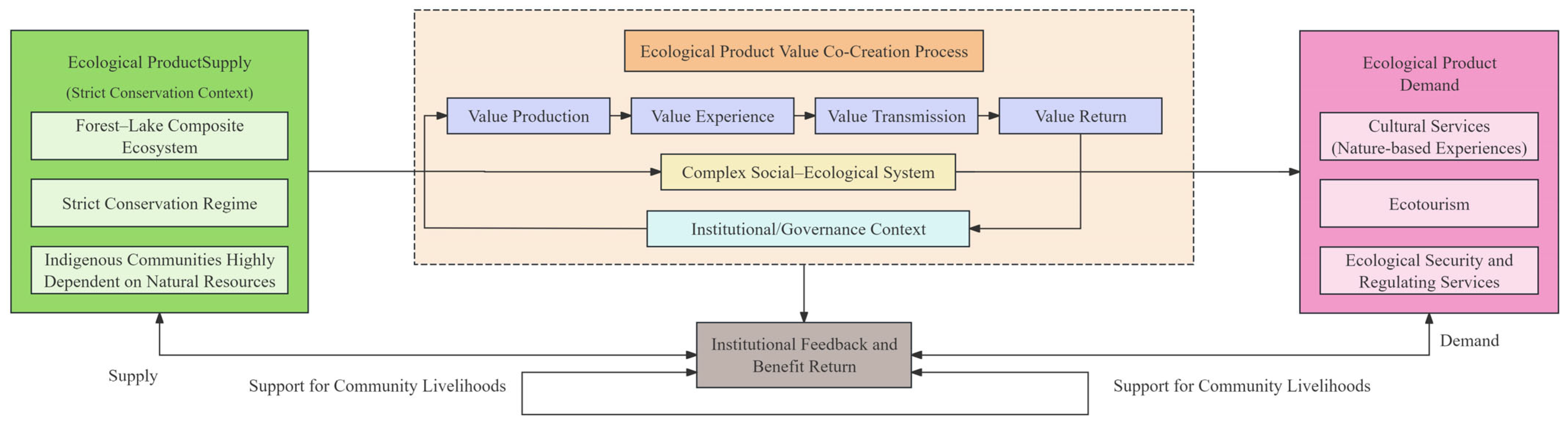
To systematically reveal the mechanisms through which ecological product value is generated, transformed, and returned under conditions of strict conservation, this study adopts a single-case, mechanism-building case study design. These aims are operationalised in three interrelated research questions (Section 2.3), which focus respectively on (i) changes in ecological product supply–demand structures, (ii) value-chain mechanisms and governance instruments, and (iii) multi-level community participation and value co-creation under strict conservation. Guided by the integrated analytical framework presented in Figure 1, the analysis links ecological product supply–demand structures, value-chain operation, and multi-stakeholder value co-creation within a complex social–ecological system (SES) context. Pudacuo National Park was selected through theoretical sampling because it provides a representative setting in which strict conservation reshapes ecological product supply, conditions value transformation processes, and enables institutionalised value return mechanisms. To improve analytical transparency, we further conducted a structured stakeholder analysis to specify key actor groups, their roles and influence in participatory management, and their relevance to distinct nodes of ecological value realisation. This actor mapping informs both purposive sampling and the interpretation of cross-actor mechanisms.
The analytical framework depicted in Figure 1 is primarily the authors’ integrated conceptualisation, constructed through a systematic synthesis of existing theoretical strands rather than by reproducing any single published model. Anchored in the SES perspective, it selectively incorporates insights from research on ecological product supply–demand structures, value-chain analysis, and value co-creation to organise the analysis around the production, experience, transmission, and return of ecological product value. Some analytical dimensions—particularly the simultaneous attention to ecological, social, economic, and governance aspects—are conceptually consistent with integrative sustainability frameworks such as the Prism of Sustainability; however, these elements are recombined and contextually adapted to the strict-conservation national park setting instead of being adopted in a one-to-one manner. In this sense, the framework extends existing approaches into a process-oriented model that explicitly links supply–demand restructuring, cross-actor interaction, and institutionalised benefit-return mechanisms under strict conservation. In this paper, “value chain” is operationalised as an institutional sequence of nodes—value identification, value transformation, value transmission, and value return—through which ecosystem functions are made identifiable, convertible, transmissible, and returnable under strict protection, rather than as a narrow firm-centred production chain. Correspondingly, key park functions (e.g., biodiversity/habitat maintenance, climate and water regulation, and cultural services) are treated as the functional basis of value identification and transformation, while environmental interpretation and education are explicitly incorporated as a governance-relevant cultural function that enhances value visibility, behavioural compliance, and the legitimacy of benefit-return arrangements.
This research design is well suited to addressing process- and mechanism-oriented questions, including how ecological product value is produced, experienced, transmitted, and returned, and under what institutional conditions multiple stakeholders—such as park authorities, local governments, enterprises, and indigenous communities—can participate in value co-creation. It also facilitates the identification of structural logics and causal chains of cross-actor interactions embedded within complex social–ecological systems. As one of China’s first pilots of the national park system, Pudacuo National Park is characterised by a strict conservation regime, a representative forest–lake composite ecosystem, and indigenous communities highly dependent on natural resources. These characteristics allow the case to clearly illustrate institutional processes of ecological product supply–demand restructuring, interest reconfiguration, and multi-stakeholder value co-creation under strict conservation, making it theoretically informative for mechanism analysis [48]. Methodologically, this study integrates multiple qualitative approaches, including literature review, policy document analysis, semi-structured interviews, field observation, process tracing, and cross-source triangulation [49]. Each method plays a distinct evidentiary role: documents specify formal rules and node-level instruments; interviews elicit actor incentives, expectations, and perceived distributional effects; observations capture implementation practices and behavioural interactions; and process tracing reconstructs the temporal sequence linking instruments, actor responses, and outcomes. Triangulation is then used to validate convergent findings and to identify and explain divergences across sources.
The analytical procedure followed a mechanism-identification logic of “theory guidance–data coding–process validation”, consistent with the framework shown in Figure 1. First, drawing on theories of ecological product supply–demand structures, value chains, and value co-creation, the study developed initial analytical dimensions corresponding to the three core components of the framework: ecological product supply, ecological product demand, and the value co-creation process operating within an SES context. These dimensions were further specified into node-related analytic categories (identification, transformation, transmission, and return) and actor-related categories (roles, influence, participation level, and benefit expectations), which together structured the coding scheme. Second, based on systematic analysis of policy documents, interview transcripts, and field notes, thematic coding was applied to identify key events and institutional nodes related to changes in supply structures, adjustments in governance and concession arrangements, and patterns of multi-stakeholder interaction. Third, within-case comparison and process tracing were used to reconstruct and cross-validate the sequential pathways through which policy instruments and governance mechanisms operated across stages of ecological value identification, value transformation, and institutionalised value return [50,51]. Where relevant, we also used within-actor and cross-actor comparisons (e.g., administrators vs. community households; participating vs. non-participating households) to examine how node-level instruments produced differentiated livelihood and distributional effects.
A mechanism was incorporated into the final explanatory framework only when it appeared consistently across multiple data sources and analytical dimensions and could be explicitly linked to concrete institutional arrangements within the national park. Specifically, we retained a mechanism only when (i) it was supported by at least two independent evidence types (e.g., documents plus interviews/observations), (ii) it could be located at identifiable value-chain nodes through explicit instruments (e.g., concession rules, ecological job arrangements, benefit-sharing agreements, or education/interpretation systems), and (iii) its causal plausibility could be substantiated through process-tracing sequences rather than asserted as correlation. Finally, the four-stage value co-creation model—value production, value experience, value transmission, and value return—was employed as an analytical lens to abstract and theorise the mechanisms of ecological product value realisation in the national park context, ensuring conceptual consistency between the empirical analysis and the integrated framework presented in Figure 1. This alignment also enables systematic dialogue with prior protected-area governance research by comparing how similar instruments and participation arrangements function across contexts characterised by strict conservation. To enhance methodological transparency, we also specify in Section 3.2 how interviewees were coded and anonymised (Appendix A.1) and how the semi-structured interview guides were mapped to the study variables and value-chain nodes (Appendix A.3).

3.2. Data Sources and Data Analysis

This study drew on policy documents, management records, interview data, field observation notes, and publicly available information, covering the period from June 2023 to December 2024 (Table 1). The configuration of these data sources was designed to address the three research questions in a complementary way: policy and management documents were used mainly to trace institutional arrangements and key nodes along the ecological product value chain; semi-structured interviews captured stakeholder perspectives on supply–demand restructuring, governance instruments, and livelihood adjustment; and non-participant field observations documented how “conservation–use–livelihood” interactions and value co-creation processes unfolded in everyday practice. Operationalising the analytical perspective and presenting results. To address concerns about how the analytical framework was applied and how findings were derived and displayed, we operationalised the framework (Figure 1) as a set of explicit analytic categories and reporting outputs. Specifically, all extracted evidence was coded and then mapped to (i) the three research questions, (ii) the value-chain nodes (value identification–transformation–transmission–return), and (iii) stakeholder positions (Table 2). On this basis, we produced a series of structured displays that make the derivation and presentation of results transparent: (1) a stakeholder matrix (Table 2) that links actor roles/influence to value-chain nodes; (2) a method-to-evidence mapping (Table 3) that specifies which data sources support which findings; and (3) theme–evidence summary tables (added as Appendix A, Table A1) that synthesise key themes/mechanisms and provide representative interview excerpts and observation-based indicators corresponding to Section 4.1, Section 4.2 and Section 4.3. These outputs enable readers to see not only “what was found” but also “where it came from” and “how it was organised under the analytical lens”. Interview sample and coding/anonymisation. During the study, we conducted 26 semi-structured interviews in total with a range of stakeholders, including mid-level and frontline staff from the Pudacuo National Park Administration, officials from the natural resources authorities of Diqing Prefecture, village cadres from surrounding communities, local Indigenous representatives, managers of ecotourism concession enterprises, and workers employed in ecological public-welfare posts. All interviewees were anonymised using a structured coding system to protect confidentiality while maintaining traceability of qualitative evidence (Appendix A.1). Each code includes (i) stakeholder category, (ii) respondent sequence number, and (iii) interview round (where applicable), formatted as [Category]-[ID]-[Round] (e.g., PA-F03-I1; HH05-I2). These codes are used consistently when attributing interview evidence in the Section 4. Given our focus on institutional mechanisms and multi-stakeholder interactions, the primary objective of the interview component was not statistical representativeness but analytical depth and coverage of key actor positions along the ecological product value chain. In terms of sample composition, we organised two small group interviews—one with 2 senior/middle-level administrators and 3 frontline staff from the Park Administration, and another with 6 community leaders and 3 managers from tourism and ecological conservation enterprises—and conducted repeated household interviews in six villages surrounding the park. Specifically, we selected 12 herder and local resident households (two households per village) and conducted two interviews with each household, resulting in 24 household interview sessions that typically involved 3–4 family members (for example, spouses and older household members) participating together. Rationale for interviewee selection and qualitative “representativeness”. Interviewees were identified through purposive sampling, based on their roles and experience in park management, community governance, or concession operations, and were further complemented through snowball sampling to capture additional key actors within each stakeholder group. This selection strategy is “representative” for qualitative mechanism analysis in the sense of theoretical and positional representativeness: it intentionally covers the principal actor categories that (i) bear conservation costs and livelihood constraints (households/residents), (ii) design and implement strict-conservation rules and enforcement instruments (park authority and relevant government departments), and (iii) operate regulated tourism and associated value-transmission arrangements (concession enterprises), as well as community leaders who mediate participation channels and benefit-return governance. By covering these key positions, the sample captures the core interaction structure required to identify cross-actor mechanisms at each node of the conservation-oriented ecological value chain (identification–transformation–transmission–return).
The interviews focused on ecological product supply structures, mechanisms of community participation, the operation of the concession system, the implementation of ecological compensation, pathways of livelihood transition, and the return of ecological product value. Each interview lasted approximately 45–120 min and was audio-recorded or documented in detail with informed consent. As the fieldwork progressed, newly conducted interviews no longer produced substantially new core themes, suggesting that theoretical saturation had been reached for the main stakeholder groups. In addition, the interview guides were tailored to stakeholder roles and explicitly mapped to the study variables and value-chain nodes (Appendix A.2 and Appendix A.3), which further supports the analytical adequacy of the interview sample for answering the three research questions.
For field observation, we carried out systematic non-participant observations of ecological patrol activities, visitor behaviour patterns, tourism operation chains, the placement of ecological monitoring sites, and everyday production and living scenes in local communities. These observations were conducted repeatedly in and around the six main villages, along major tourist routes, and at key ecological restoration sites, and were scheduled at different times of day and during both peak and off-peak tourism periods to capture variation in “conservation–use–livelihood” interactions. Most observation sessions were carried out by small research teams (typically 2–3 researchers) moving together along pre-defined routes, while a smaller number of sessions were conducted by a single researcher as follow-up visits to verify or deepen earlier findings in specific locations. This strategy ensured that each of the six villages was visited multiple times under different tourism conditions, and that observations covered not only residential spaces but also community gathering places, tourism facilities, and ecological monitoring sites. We recorded in particular how “conservation–use–livelihood” interactions operated in practice and how these interactions were expressed spatially. After each observation, we promptly compiled detailed field notes, which served as an important complement to the interview data. To make observation-based descriptive results more verifiable, we summarised key observed variables, settings, and indicators (e.g., compliance practices, patrol routines, visitor–community interactions, concession operation routines, and the functioning of ecological facilities) in an integrative observation summary table (Appendix A, Table A1), and we explicitly link these summaries to the descriptive statements reported in Section 4.1, Section 4.2 and Section 4.3. Secondary materials included institutional and planning documents such as the Master Plan of Shangri-La Pudacuo National Park, the Yunnan Provincial Regulation on National Park Management, the Implementation Plan for Tourism Benefit-Sharing to Support Community Development in Pudacuo National Park, the Tourism Benefit-Sharing Agreement for Communities in Shangri-La Pudacuo National Park, the Measures for the Administration of Concession Projects in Shangri-La Pudacuo National Park, and the Report of the First Comprehensive Scientific Expedition to Pudacuo National Park. We also consulted statistical yearbooks, media reports, and relevant academic studies.
To strengthen analytical rigour and credibility, we adopted three strategies. First, we applied data triangulation by cross-checking policy documents, interview evidence, and field observations. All interview transcripts and field-observation notes were imported into qualitative data analysis software (NVivo, Release 14) and subjected to thematic coding. We first developed an initial coding frame based on the research questions and the interview and observation guides, and then refined it iteratively through open coding to allow inductive themes to emerge from the data. Second, we used thematic coding and within-case comparison to identify how ecological product supply–demand structures and value return mechanisms varied across stakeholder groups, policy instruments, and spatial contexts. In this process, we compared narratives from different actor categories (administrators, officials, community leaders, households, and enterprises) and from different communities to identify convergences and divergences in their experiences and interests. Third, we applied process tracing to map the key causal pathways and institutional nodes through which governments, communities, enterprises, and visitors contributed to ecological product value production, transfer, and return. Importantly, the above analytic steps are reflected explicitly in how results are organised and displayed: Section 4.1, Section 4.2 and Section 4.3 correspond to the three research questions, and within each section, evidence is reported in a “theme → mechanism/instrument → supporting data” format, with representative interview excerpts (coded) and observation summaries cross-referenced to Table 2 and Table 3 and Appendix A, Table A1.
Structured stakeholder analysis. To enhance transparency and traceability in analysing participatory management, we conducted a structured stakeholder analysis using the triangulated evidence described above, including policy and planning documents, interview narratives, and field observations. We first identified the core stakeholder groups involved in ecological product provision and governance. We then assessed each group’s role in participatory management, relative influence/power (High/Medium/Low), main contributions, value-chain relevance (i.e., the stages in which an actor most directly shapes value identification, transformation, transmission, and/or return), and core expectations. Influence ratings were derived from cross-source evidence on decision-making authority and control over key governance instruments, rather than from formal administrative rank alone. The resulting stakeholder matrix (Table 2) operationalises the analytical framework and provides an explicit link between the empirical materials and the mechanisms reported in Section 4.1, Section 4.2 and Section 4.3. To further strengthen transparency, we also map each research method to the types of evidence it generated and the specific findings it supported (Table 3). Following triangulation, we situate the validated findings in dialogue with prior studies.

3.3. Study Area

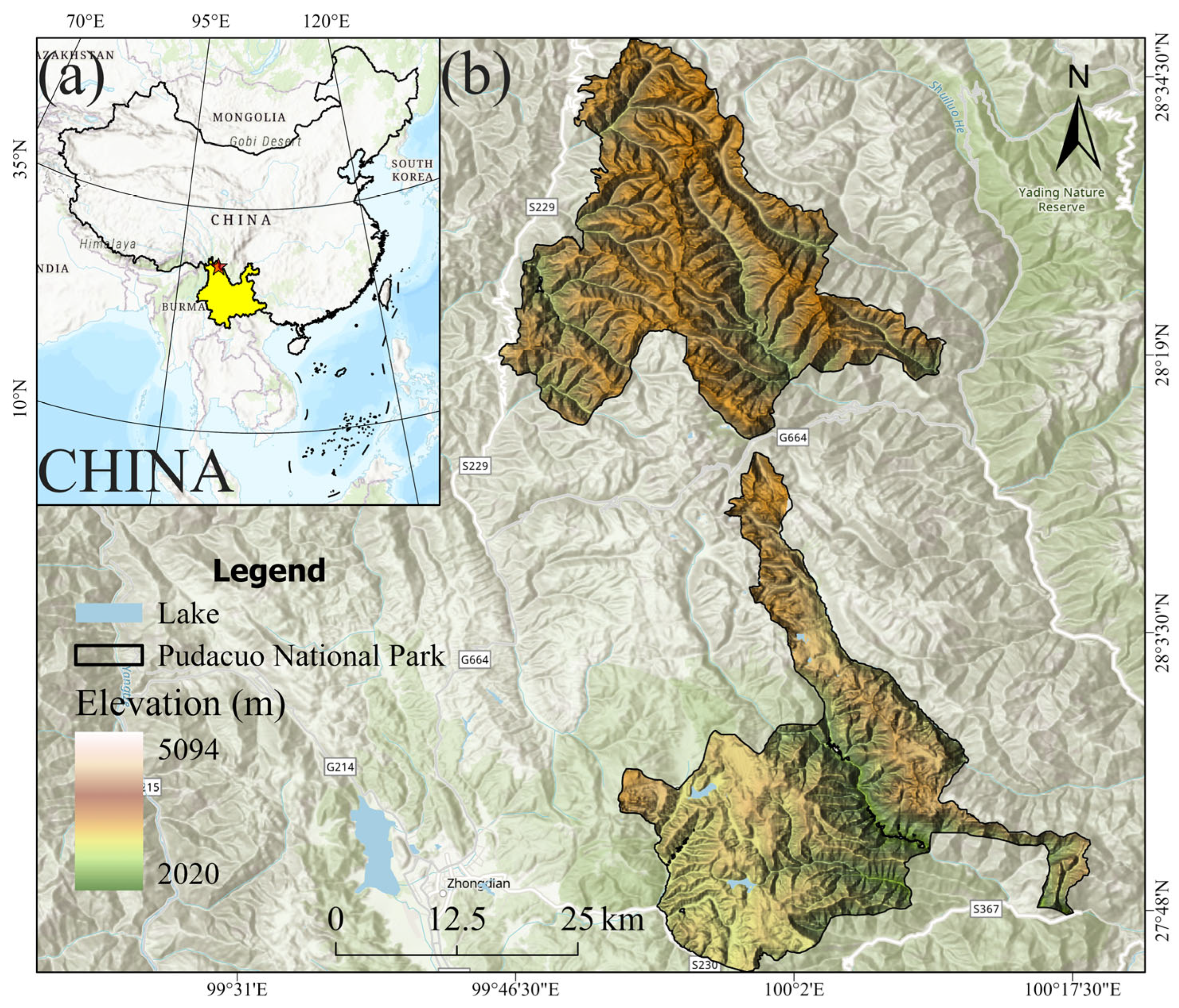
Pudacuo National Park is located in Shangri-La City, Diqing Zang Autonomous Prefecture, Yunnan Province, China (The geographic coordinates range from 99°45′35″ to 100°18′29″ E and 27°44′35″ to 28°36′36″ N.). It is one of the first pilot sites of China’s national park system and lies in the plateau–mountain ecotone on the eastern edge of the Qinghai–Tibet Plateau (Figure 2). The park covers approximately 147,713.37 hm2 and forms an important ecological barrier within the “Three Parallel Rivers” World Natural Heritage area [22]. The terrain is highly heterogeneous, with pronounced elevation gradients, and supports a range of ecosystems, including cold-temperate coniferous forests, alpine meadows, and lake–wetland systems. Together, these ecosystems constitute a forest–lake–wetland–meadow complex that provides a strong ecological foundation for regulating and cultural services such as water retention, climate regulation, habitat maintenance, and nature-based experiences.
The national park encompasses six administrative villages (natural villages), with relatively small populations that are predominantly Zang. Settlements display a typical dispersed pattern characteristic of plateau and mountainous regions. Surrounding the park are townships such as Jiantang, Gezan, and Jiulong, which have larger populations and more diverse ethnic compositions. While Zangs remain the majority, these communities also include Naxi, Han, Yi, and Lisu groups, forming a multi-ethnic settlement pattern shaped by plateau environments. Historically, local livelihoods have relied heavily on pastoralism, particularly the herding of yaks, horses, and sheep, supplemented by fuelwood collection and medicinal plant harvesting. As a result, livelihood structures have been strongly dependent on forests, grasslands, and wetlands, creating a tight coupling between community livelihoods and regional ecosystems. This resource-based livelihood system remained relatively stable over a long period but has been highly sensitive to changes in ecological policies and resource-use institutions.
Before the launch of the national park pilot, local economies were dominated by primary industries, with limited cash income sources and relatively concentrated employment opportunities. With the continued implementation of the national park system, ecological compensation schemes, ecological public-welfare jobs, and ecotourism-related services have gradually become important sources of household cash income. However, overall livelihood structures remain in transition from resource dependence towards diversification. Strict conservation measures, including grazing bans, logging bans, and harvesting restrictions, have substantially altered community access to natural resources and encouraged some households to shift towards alternative livelihoods such as ecological patrolling, tourism services, and handicraft production. In recent years, ecotourism has continued to expand around core scenic areas such as Shudu Lake and Bita Lake, creating new opportunities for community participation. At the same time, differences in tourism organisation, job structures, and benefit-sharing arrangements across communities and households have led to variations in participation depth and livelihood adjustment pathways.

4. Results

4.1. A Governance Network Oriented Towards Multi-Stakeholder Collaboration

During the pilot reform, Pudacuo National Park adopted the guiding principles of “government leadership, conservation priority, separation of management and operation, and community participation”, and gradually established a unified regulatory and collaborative governance network centred on the park authority. This arrangement directly addressed long-standing problems of fragmented authority and rule fragmentation in traditional protected-area systems. As one senior administrator described, “the most difficult part before the pilot was that rules belonged to different departments; now, zoning and enforcement come from one unified system, so responsibilities are clear” (PA-S01-I1). Building on the former Bita Lake Provincial Nature Reserve, the pilot expanded the governance scope to include forests, wetlands, meadows, wildlife habitats, and traditional ethnic villages within a single management space. Through integrated master planning, functional zoning, industrial access lists, and ecological restoration measures, the park formed a relatively complete institutional loop linking “conservation objectives–regulatory rules–industrial access–restoration actions”. A frontline ranger highlighted the practical effect of this loop: “our patrol routes, monitoring points, and restoration tasks are all tied to zoning—what can be used, where it is restricted, and what must be repaired are written into daily work” (PA-F03-I1). This loop provided a stable institutional foundation for the continuous supply of ecological products under strict protection.
At the level of institutional embedding, Pudacuo combined planning guidance with rule formalisation to institutionalise coordination between rigid conservation constraints and development and livelihood needs. On the one hand, ecological baselines were secured through zoning, access lists, and monitoring and patrol systems. On the other hand, resource use, benefit return, and community development were incorporated into enforceable and accountable institutional arrangements. A local government official framed this coordination as a cross-department governance task: “the park cannot do everything alone; fiscal support, tourism supervision, and community services must be aligned, otherwise conservation rules will not hold in practice” (LG02-I1). As a result, ecological product value realisation no longer depended on temporary projects or short-term negotiation, but became embedded in a long-term governance trajectory.
The governance network relies on collaboration among local governments, park authorities, tourism operators, and community organisations. As operationalised in the structured stakeholder analysis (Table 2) and the method-to-evidence mapping (Table 3), this network is organised around a functional division of regulatory, operational, and participatory roles that allocates authority, incentives, and accountability across the value-chain stages under strict protection. Specifically, the park authority anchors baseline protection and enforcement; local governments provide policy coordination and administrative support; concession operators organise regulated tourism operations as a key conversion interface; and the “community” component comprises both community organisations/leaders (representation, local coordination) and households/residents (stewardship labour and livelihood adaptation), whose influence differs as summarised in Table 2 while both bear direct conservation opportunity costs. From the enterprise perspective, concession operators emphasised rule predictability: “standards and capacity limits are strict, but once they are stable and transparent, operations and community employment can be planned” (CO02-I1). By clearly defining responsibilities and coordination procedures, the network transformed ecological product value realisation into a relatively stable institutional process across the operationalised value-chain nodes of “value identification–value transformation–value transmission–value return”.
Specifically, value identification is supported by planning, zoning, and monitoring systems; value transformation is channelled through regulated concession arrangements and controlled visitor use; value transmission refers to the institutionalised delivery and mediation of valued functions and experiences through standardised operations and interpretation systems, which make conservation-compatible use replicable and enforceable; and value return is institutionalised through benefit-sharing and community-development arrangements. These linkages follow the value-chain operationalisation specified in Section 3.1 and are supported by triangulated evidence summarised in Section 3.2 (Table 1, Table 2 and Table 3). In practice, this network exhibits four key features: enforceable control, constrained use, recoverable benefits, and participatory communities. This governance structure was also recognised by community representatives, who noted that “now we know which meetings to attend, who to report to, and how issues are escalated; participation is not only ‘being consulted’ but also ‘having procedures’” (CL03-I1). Institutional regulation of tourism activities and spatial use ensured that conservation objectives were implemented in daily operations, while also creating a stable institutional context for community development mechanisms based on concessions and benefit-sharing. Importantly, participatory mechanisms observed in the case are not limited to “consultation”, but include routinised coordination procedures and accountability arrangements that connect actor responsibilities to specific governance instruments. This arrangement enabled conservation, limited use, and value return to advance in a coordinated manner within a single governance framework.

4.2. The Transformation of the Ecological Product Supply System Towards a Function-Oriented Structure

The implementation of the national park system has driven a systemic shift in Pudacuo’s ecological product supply system from a resource-use orientation towards an ecological function orientation. Under strict conservation constraints, the supply of material products such as timber, fuelwood, and forage has been substantially reduced, while the focus has shifted towards non-material functions centred on regulating and cultural services. A household interviewee explained this shift in everyday terms: “before, we relied more on grazing and collecting; now those activities are restricted, and income comes more from park jobs and tourism-related work” (HH05-I1). This transformation does not simply reflect reduced use intensity. Instead, through spatial control, functional zoning, and long-term stewardship arrangements, ecosystem structural integrity and process continuity have become the foundation of ecological value realisation.
In terms of regulating services, Pudacuo restricted direct exploitation activities and locked core ecosystem functions of forests, meadows, and wetlands into key processes such as carbon sequestration, water retention, soil conservation, and habitat maintenance. Here, “ecological functions/ecological security” refer to the regulating and ecosystem-integrity processes that reduce environmental risks and sustain regional socio-economic systems (e.g., water regulation, hazard mitigation, and habitat maintenance), which constitute the legitimate basis for value identification under strict protection. Park managers repeatedly stressed that the “baseline” is non-negotiable: “tourism and community development can be discussed, but the ecological red lines and monitoring indicators cannot be loosened” (PA-S02-I1). Ecological product value therefore no longer depends on resource extraction, but is increasingly expressed through public ecological functions generated by the long-term stable operation of ecosystems. This supply mode—realising value through non-use—has strengthened the park’s role as an ecological security barrier at regional and even trans-regional scales, and has provided a practical basis for ecological compensation and value accounting. In this study, we treat these regulating functions as the functional basis of “value identification”, because they define what is protected and what can legitimately be valued and accounted for under strict conservation.
For cultural services, Pudacuo adopted ecological carrying capacity as a binding constraint and positioned landscape appreciation, nature-based experiences, and environmental education as the main pathways for value transformation. Through visitor capacity control, spatial restriction of activities, and the construction of interpretation systems, cultural service provision has been embedded within conservation objectives, forming a pathway in which high-quality experiences replace high-intensity use. A concession manager described capacity control as “the hard boundary for experience-based conversion”: “we can improve services, but we cannot exceed the daily limits; the whole product design is built around protection-first rules” (CO01-I1). Cultural services thus serve not only as a key vehicle for making ecological value visible, but also as an institutional safeguard against tourism-driven pressure on ecological functions.
Notably, environmental interpretation and education emerge as a distinct governance-relevant function: beyond “experience provision”, they operationally support compliance, shape visitor behaviour, and increase the social legibility of conservation constraints, thereby strengthening the institutional conditions for subsequent “value return”. Frontline staff gave concrete examples of this governance function: “after guided interpretation, visitors are less likely to step off trails or feed wildlife; education reduces enforcement conflicts” (PA-F02-I1). In this sense, education/interpretation operates as both a cultural-service output and a governance instrument that stabilises “value transmission” by shaping compliant visitor practices and reinforcing conservation norms. Consistent with Table 2, this transformation depends on coordinated roles across stakeholder groups, including regulated concession operations for experience-based conversion and community stewardship labour that maintains function-oriented supply under daily enforcement. Overall, the transformation of Pudacuo’s ecological product supply system shows that, in a national park context, ecological value realisation does not rely on continuous resource development, but on the mutual reinforcement of stable functional supply and experience-based value conversion. This function-oriented supply structure provides a critical basis for balancing strict protection with limited use.

4.3. A Community-Based, Multi-Level Value Co-Creation Mechanism

As the ecological product value chain has gradually taken shape, community participation around Pudacuo has shifted from passive adaptation to conservation constraints towards a multi-level, institutionalised process of value co-creation. This transition has not involved relaxing conservation requirements. Instead, institutional design has embedded community livelihoods within ecological protection and ecological product supply systems, enabling communities to become active agents in value realisation. In line with the structured stakeholder analysis (Table 2), “community participation” in this study is analytically disaggregated into household/resident participation (labour embedding and livelihood adjustment) and community organisation/leader participation (representation, coordination, and local mediation), rather than treated as a single undifferentiated category. A community leader summarised this shift as “participation with responsibilities”: “we are not only receiving compensation; we are asked to coordinate jobs, explain rules, and handle disputes locally” (CL01-I1).
At the individual level, participation is mainly reflected in the transformation of labour embedding. Livelihood activities that previously relied on direct resource extraction have been replaced by positions such as ecological patrolling, environmental maintenance, and tourism services. Through daily stewardship and service provision, community members directly link their labour input to ecosystem function maintenance. A household respondent working in an ecological public-welfare post explained the incentive logic: “patrolling is work with rules; if we do it well, the area is protected and our wage is stable—this ties our livelihood to protection” (HH03-I1). This job-based participation allows individuals to fulfil conservation responsibilities while securing relatively stable incomes, aligning livelihood security with conservation objectives. Empirically, these roles constitute a labour-based interface between function-oriented supply and day-to-day rule implementation, thereby contributing to both “value identification” (through stewardship) and “value transmission” (through routine practices that sustain regulated use).
At the household level, diversified livelihood structures have gradually emerged. Income portfolios combining wages, operating income, and institutional compensation have reduced household dependence on single resources or industries and enhanced resilience to conservation constraints and market fluctuations. Ecological product value is therefore no longer confined to abstract public benefits, but becomes embedded in household livelihood decisions and risk management through tangible income and welfare returns. This process strengthens community acceptance and recognition of national park conservation institutions. Importantly, households display heterogeneous capacities and access to participation opportunities, indicating that livelihood diversification is both a mechanism of resilience and a potential source of intra-community differentiation. This heterogeneity was repeatedly mentioned in interviews: “some families have better access to tourism jobs and information, while others rely mainly on fixed posts; distance and skills matter” (HH08-I1). As suggested by Table 2, such heterogeneity is associated with differential access to participation channels and varying mediation capacity of intermediary community organisations, which may influence the distributive outcomes of value return.
At the collective level, communities increasingly participate in public affairs and resource governance through institutionalised benefit-sharing and consultation mechanisms. Under dedicated arrangements for tourism revenue return, park operational income is allocated according to established rules to support community compensation, education, and public services, while also considering households not directly involved in park management or tourism operations. This creates a relatively stable redistribution channel linking those who bear conservation costs with those who share ecological benefits. A local government interviewee described the policy intent as “cost–benefit alignment”: “if communities bear opportunity costs, the return mechanism must be visible and rule-based; otherwise, governance legitimacy will weaken” (LG01-I1). While improving income stability and risk resistance, the mechanism also strengthens long-term human capital accumulation through education-oriented investments and capacity building, providing institutional support for sustained community development under strict protection. At the same time, community representation in decision-making and oversight enhances deliberation in public resource allocation and governance legitimacy, enabling communities to move from compensation recipients to co-participants in public governance. Community representatives linked this to perceived fairness: “what matters is transparency—who gets what, by which rule, and how we can appeal; this decides whether people accept restrictions” (CL04-I1).
Overall, labour embedding, livelihood diversification, and institutionalised benefit return jointly connect community participation to value identification (stewardship), transformation (service participation), transmission (routine compliant practices and interpretation), and return (formalised benefit sharing). These mechanism linkages are traceable to the triangulated qualitative evidence base summarised in Table 1 and the stakeholder matrix in Table 2, with method–finding linkages reported in Table 3. This multi-level participation mechanism provides a stable social foundation for the continuous return of ecological product value and illustrates a national park governance model capable of achieving a relative balance between ecological protection and community development.

5. Discussion

5.1. The Institutional Significance of Unified Regulation and Collaborative Governance

The findings indicate that a unified regulatory system centred on the national park authority is a key institutional precondition for the stable operation of ecological product value realisation in Pudacuo. By integrating previously fragmented mandates, clarifying boundaries of responsibility, and standardising rules for resource use, unified regulation provides a relatively stable governance framework for continuous ecological product supply, value transformation, and benefit return. This finding aligns with international evidence that higher governance integration is associated with stronger conservation performance: where unified authority and coherent rules are absent, competing objectives often weaken conservation outcomes and reduce social acceptance. Unlike a purely administrative control model, Pudacuo’s unified regulation does not exclude other actors. Instead, it enables value coordination through collaborative governance, in which local governments, operators, and communities form complementary roles across different stages. This arrangement embeds conservation objectives within fiscal support, market-based conversion, and community governance processes. Our results indicate that such a multi-stakeholder governance network can reduce institutional friction, strengthen rule enforcement, and enhance the social legitimacy of governance arrangements. However, unified regulation and collaboration do not eliminate all tensions. There remains scope to improve the depth of community participation, the transparency of consultation procedures, and mechanisms for conflict resolution. Similar challenges have been widely reported in co-management practices in international national parks, suggesting that effective plural governance depends less on the number of participants than on the degree of institutionalisation and the capacity for sustained operation of participation mechanisms.

5.2. Function-Oriented Supply and the Embedding of Supply–Demand Structures

From the supply side, this study identifies another key mechanism of ecological product value realisation: a systemic shift from resource-use-oriented provision to function-oriented provision. Under strict conservation constraints, Pudacuo restricts direct exploitation so that ecosystem structural integrity and process continuity become the basic conditions for the stable provision of regulating and cultural services. This result is consistent with international national park research showing that high-intensity protection can enhance the long-term stability of ecosystem service supply. It suggests that ecological value does not depend on continuous resource output, but rather on the sustained maintenance of ecological functions. For conceptual clarity, we define “ecosystem functions/ecological security” in this study as the capacity of the forest–wetland–meadow complex to maintain key biophysical processes (e.g., habitat maintenance, hydrological regulation, soil retention, and carbon sequestration) that underpin regional ecological stability and risk buffering; these functions constitute the functional basis of ecological products under strict protection. We define “cultural ecosystem services” as non-material benefits generated through human–nature interactions—particularly nature-based experience, recreation, environmental interpretation, and education—whose provision is institutionally bounded by ecological carrying capacity and conservation rules. However, changes in supply structure do not automatically resolve supply–demand mismatches. Our results show clear differentiation on the demand side: communities continue to face practical needs for traditional material resources but have constrained access, whereas tourists and downstream societies increasingly demand high-quality landscape experiences and ecological security. This divergence produces a structural mismatch characterised by spatial proximity to conservation costs but externalisation of benefits. Similar patterns have been repeatedly observed in national park systems in Latin America [51] and Africa [52], and are commonly linked to the public goods nature of ecological products and the absence of effective feedback mechanisms. The Pudacuo case indicates that mitigating such mismatches does not rely on a single compensation measure. Instead, it requires embedding the institutional logic of supply–demand relations within unified regulation, functional zoning, and value transformation mechanisms, so that dispersed demands can be connected to specific ecological product provision through clear institutional channels. In Pudacuo, this embedding occurs through a “constrained-use–regulated-conversion” pathway: zoning and access lists stabilise the supply of regulating functions by limiting extraction; regulated concessions and visitor-capacity controls organise demand into manageable experience flows; and interpretive/education systems translate ecological functions into socially legible value propositions while shaping visitor behaviour and compliance. In this sense, education is not merely an auxiliary tourism activity but a governance-relevant cultural function that strengthens the institutional conditions for value visibility and subsequent benefit return. This embedded restructuring strengthens the stability and sustainability of converting ecological product value from the ecosystem to the socio-economic system. Empirically, the mechanism is supported by convergent evidence from planning and regulatory documents (rules and instruments), interviews (actor perceptions of constrained use and experience provision), and field observations (visitor management and interpretation in practice), which together reduce the risk that the “function-oriented supply” claim remains a purely narrative statement.

5.3. A Mechanism Shift in Community Participation from Compensation to Value Co-Creation

This study further highlights the importance of community participation for sustaining ecological value return. In Pudacuo, community participation has moved beyond a conventional “loss compensation” logic. Through labour embedding, livelihood diversification, and institutionalised benefit return, it has gradually developed into a value co-creation model. At the individual level, residents link labour input directly to ecosystem function maintenance by engaging in ecological patrolling, environmental maintenance, and tourism services, aligning livelihood security with conservation objectives. At the household level, diversified income portfolios reduce dependence on single resource uses or industries and enhance resilience to conservation constraints and market volatility. At the collective level, institutionalised benefit return and consultation mechanisms embed ecological value into community development through public services and capacity building. To sharpen the mechanism logic, we interpret these three layers as node-specific contributions along the protected-area value chain: labour embedding supports function maintenance and day-to-day rule implementation (identification/transmission); livelihood diversification stabilises households’ capacity to remain compliant under strict constraints (transmission/return); and institutionalised benefit return translates externalised benefits into local public goods and human capital (return). Compared with the common “cash compensation–deepened dependence” pathway reported in international studies, this multi-level participation model can, to some extent, strengthen community recognition of conservation institutions and enhance governance legitimacy. At the same time, the results indicate that value co-creation depends strongly on institutional stability and community capacity building. If benefit-return rules lack transparency or participation opportunities are unevenly distributed, within-community disparities may widen and undermine the long-term effectiveness of co-creation. Our stakeholder analysis and interview evidence also suggest participation heterogeneity: households differ in access to jobs, proximity to tourism nodes, and capacity to engage, implying that co-creation can generate uneven benefits unless redistribution and procedural safeguards are robust. Value co-creation should therefore be understood not as a one-off institutional design, but as an ongoing governance process that requires continuous adjustment and sustained investment in capacity. Its performance depends on whether participation mechanisms can maintain a dynamic balance between fairness, incentive compatibility, and ecological constraints. In this regard, participation quality is as important as participation breadth, and strengthening transparent rules, grievance procedures, and representative accountability becomes central to sustaining legitimacy under strict protection.

5.4. Study Limitations and Future Directions

Although this study uses a mechanism-building case approach to clarify the operating logic of ecological product value realisation in a national park context, several limitations require careful consideration. First, the analysis is based on a single case. As one of China’s first national park pilots, Pudacuo is representative in terms of governance structure, policy support, and the foundations for community participation. However, national parks differ substantially in ecosystem structure, resource-use histories, and socio-institutional settings. A single-case design, therefore, limits the direct generalisability of the findings. We therefore position the contribution primarily as mechanism elucidation—i.e., identifying how specific instruments and actor interactions stabilise the “identification–transformation–return” sequence—rather than as a universally transferable policy template. Second, this study focuses on institutional mechanisms and governance processes and does not develop a detailed quantitative assessment of ecological product value realisation. While we identify key mechanisms across “value identification–value transformation–value return”, we do not construct a quantitative indicator system that enables cross-regional comparison. Future work could build on the mechanism framework proposed here and integrate natural capital accounting, ecosystem service assessment, or socio-economic statistics to quantify performance and improve comparability across cases. In particular, future studies could operationalise (i) regulating-function stability, (ii) cultural-service/education performance (e.g., participation intensity, behavioural compliance proxies), and (iii) distributional outcomes of benefit return (e.g., household resilience and intra-community inequality measures) to enable structured comparison across parks. Third, the transferability of the identified mechanisms is likely to vary. Mechanisms such as unified regulation, function-oriented supply transformation, and institutionalised benefit return may have broader explanatory relevance, whereas specific forms of value co-creation, participation depth, and benefit-sharing arrangements depend heavily on contextual factors such as local governance capacity, community organisation, and cultural settings. The proposed framework is therefore best applied as a tool for mechanism identification rather than a policy template, and its use should be adapted to the institutional conditions of specific national parks or protected areas.
Building on these limitations, future research could advance in three directions. First, comparative studies across regions and national park types are needed to test commonalities and differences in value realisation mechanisms under different governance contexts. Second, long-term longitudinal data could support analysis of the dynamic processes of value transformation and livelihood adjustment. Third, further work should explore how ecological product value realisation mechanisms can be institutionally aligned with natural capital accounting, territorial spatial governance, and regional development policies, thereby strengthening the explanatory power of research for macro-level governance practice. Additionally, systematic use of international participatory governance guidelines (e.g., EU/EUROPARC-related principles) can help develop an evaluative rubric for participation quality, procedural fairness, and accountability, improving both cross-case comparability and policy relevance.

6. Conclusions

Using Pudacuo National Park in China as a case, this study develops an integrated analytical framework that links ecological product supply–demand structures, value-chain mechanisms, and value co-creation processes, and applies it to reveal how ecological product value is generated, transformed, and returned under strict conservation. The findings show that ecological product value realisation does not arise from renewed resource exploitation, but from a process in which ecosystem integrity is maintained, institutional arrangements are embedded, and multiple stakeholders are coordinated across “value identification–value transformation–value transmission–value return” stages. Strict protection reduces the supply of material products while strengthening ecosystem structural integrity and shifting the supply system from a resource-use orientation towards a function-oriented structure in which regulating and cultural services become the primary carriers of ecological value; at the same time, it can intensify structural mismatches whereby local communities bear concentrated conservation costs while external stakeholders capture a larger share of benefits. In this context, a collaborative governance network centred on unified regulation provides a relatively stable institutional environment for value identification, conversion, and sustained return by clarifying authority–responsibility relations, formalising rules for constrained use and regulated concessions, and connecting dispersed instruments into an operational ecological product value chain. Community participation has correspondingly evolved from a passive, compensation-centred response into multi-level value co-creation: the combined effects of ecological public-welfare jobs, diversified livelihood portfolios, and institutionalised benefit-return mechanisms allow communities to move from compensation recipients to embedded co-producers and co-governors of ecological product value, thereby enhancing livelihood resilience and strengthening the legitimacy of national park conservation rules. Overall, the Pudacuo case suggests that, without relaxing strict conservation constraints, the key to ecological product value realisation lies in the coordinated operation of function-oriented supply–demand restructuring, unified regulation and multi-actor co-governance, and continuous institutional design along the value chain; together, these elements support a relatively balanced mechanism between ecological protection and community development. Theoretically, the study extends explanations of ecological product value realisation to contexts characterised by high-intensity protection and complex multi-stakeholder governance, while practically it offers transferable institutional insights for other national parks and protected areas seeking pathways to realise ecological product value under strict conservation.

Author Contributions

Conceptualization, W.K., H.Z. and Y.C.; methodology, H.Z. and Y.C.; software, H.Z.; validation, H.Z., Y.C. and K.Z.; formal analysis, H.Z. and Y.C.; investigation, H.Z. and Y.C.; resources, W.K.; data curation, H.Z.; writing—original draft preparation, H.Z. and Y.C.; writing—review and editing, Y.C., K.Z. and W.K.; visualisation, H.Z.; supervision, W.K.; project administration, W.K.; funding acquisition, W.K. All authors have read and agreed to the published version of the manuscript.

Funding

This research was funded by the Yunnan Province Xingdian Talent Support Program for Industrial Innovation Talents (Grant No. XDYC-CYCX-2024-0021), the Yunnan International Joint R&D Center (China–Malaysia) for Digital Monitoring, Management and Applications of Nature Reserves (Grant No. 202503AP140040), and the Land Acquisition and Natural Resource Asset Evaluation Project in Yunnan Province (Grant No. YNYX-2021-0504-G).

Data Availability Statement

The data supporting the findings of this study are not publicly available due to privacy and ethical restrictions. The study is based on policy documents, management records, semi-structured interviews, and field observations conducted within the context of Pudacuo National Park. Access to these materials is restricted to protect the confidentiality of interviewees and sensitive governance information. Aggregated or anonymised data may be made available from the corresponding author upon reasonable request.

Acknowledgments

The authors would like to thank the Pudacuo National Park Administration and relevant local authorities for their support during fieldwork and data collection. We are also grateful to community representatives and interview participants for sharing their time and insights.

Conflicts of Interest

Author Kaifu Zhao was employed by the company Yunnan Digital Forestry Planning and Design Co., Ltd. The remaining authors declare that the research was conducted in the absence of any commercial or financial relationships that could be construed as a potential conflict of interest.

Appendix A

Appendix A.1. Interview Sample Coding and Anonymisation

To protect confidentiality while maintaining traceability of qualitative evidence, all interviewees were anonymised using a structured coding system. Each code consists of (i) stakeholder category, (ii) respondent sequence number, and (iii) interview round (where applicable). The coding format is:
[Category]-[ID]-[Round]
Category = stakeholder group abbreviation (defined below)
ID = two-digit respondent number within the category (e.g., 01, 02…)
Round = interview round (e.g., I1 = first interview; I2 = follow-up interview)

Appendix A.1.1. Stakeholder Category Abbreviations

PA-S: Pudacuo National Park Administration—senior/middle-level administrators
PA-F: Pudacuo National Park Administration—frontline staff (e.g., rangers/monitoring/maintenance)
LG: Local government officials (e.g., prefecture/municipal departments relevant to protected-area governance)
CL: Community organisations and leaders (e.g., village cadres, community representatives)
HH: Households/residents (herder and local resident households)
CO: Concession operators and related enterprise managers (tourism/ecological conservation enterprises)

Appendix A.1.2. Examples

PA-S01-I1: first senior/middle-level administrator, first interview
PA-F03-I1: third frontline staff member, first interview
HH05-I2: fifth household, second interview (follow-up)
CO02-I1: second concession/enterprise manager, first interview
In the Section 4, verbatim quotations (or paraphrased interview evidence where necessary) are attributed using these codes (e.g., “PA-F03-I1”), enabling readers to interpret evidence in relation to stakeholder position without revealing personal identities.

Appendix A.2. Semi-Structured Interview Guides by Stakeholder Group

This study used semi-structured interview guides tailored to stakeholder roles along the conservation-oriented ecological value chain (value identification–value transformation–value transmission–value return) and the participatory management system. The guiding questions below were used flexibly, allowing probing and follow-up questions to clarify mechanisms, institutional instruments, and distributional effects.

Appendix A.2.1. Park Authority (PA-S/PA-F)

Module 1: Strict protection, core functions, and legitimacy (Value identification)
  • What are the park’s priority conservation targets and key ecological functions under strict protection?
  • How does the park define “ecological functions/ecological security” in management practice?
  • What instruments are used to identify and safeguard these functions (e.g., zoning, monitoring, patrols, restoration)?
Module 2: Governance instruments and regulated use (Transformation–Transmission)
  • How are tourism activities regulated (capacity control, spatial restrictions, access lists, operating standards)?
  • How does the park implement the “separation of management and operation” in practice?
  • What coordination mechanisms exist with concession operators and local governments (routine procedures, accountability, enforcement)?
Module 3: Education/interpretation as a governance-relevant function (Transmission)
  • How are interpretation and environmental education designed and delivered?
  • In what ways do education/interpretation influence visitor behaviour, compliance, and conservation norms?
Module 4: Benefit return and community participation (Value return; participation)
  • What benefit-sharing/return arrangements exist (rules, funding sources, allocation criteria, oversight)?
  • How are communities involved (consultation, co-management representation, ecological jobs, monitoring roles)?
  • What are the main challenges (conflicts, fairness concerns, enforcement constraints, tourism volatility)?

Appendix A.2.2. Local Governments (LG)

Module 1: Policy support and cross-department coordination (Transformation–Return)
  • What are local government responsibilities in the national park pilot and how are they operationalised?
  • What forms of fiscal support, policy coordination, or institutional integration have been provided?
Module 2: Supply–demand mismatch and public goods logic (Supply–demand; Return)
  • How do you perceive the distribution of conservation costs and ecological benefits (local vs. external beneficiaries)?
  • What mechanisms are used to legitimise and implement ecological compensation/benefit-return arrangements?
Module 3: Governance performance and stability
  • How is governance performance assessed (conservation outcomes, development goals, social stability)?
  • What constraints remain and what policy adjustments are needed?

Appendix A.2.3. Community Organisations and Leaders (CL)

Module 1: Participation channels and representation (Participation; Return)
  • What is the community’s role in participatory management (mobilisation, representation, mediation, oversight)?
  • What formal participation channels exist and which are most influential in practice?
Module 2: Benefit distribution and perceived fairness (Return)
  • How are benefit-return arrangements implemented locally (criteria, procedures, transparency, accountability)?
  • Are there perceived inequalities in access to opportunities (jobs, tourism-related participation, training)?
Module 3: Institutional nodes and process mechanisms (Mechanism tracing)
  • What key institutional events or agreements changed community–park relations (e.g., benefit-sharing agreements, concession rules, ecological job schemes)?
  • Where do conflicts emerge and how are they resolved?

Appendix A.2.4. Households/Residents (HH)

Module 1: Livelihood impacts under strict protection (Demand; constraints)
  • How have strict conservation measures affected household livelihoods and resource access (grazing/harvesting restrictions, etc.)?
  • What material needs remain and how are they currently met?
Module 2: Participation and livelihood transition (Participation; Production–Transmission)
  • Does your household participate in ecological jobs, tourism services, or other alternative livelihoods? Why/why not?
  • What barriers exist (skills, information, eligibility, networks, time, location)?
Module 3: Income structure, resilience, and distributional effects (Return)
  • How has household income composition changed (wages, business income, compensation/benefit return)?
  • Do you understand the benefit-sharing rules? Are they perceived as fair and transparent?
  • What improvements would you suggest?
Module 4: Acceptance, legitimacy, and future expectations
  • How do you evaluate park governance and tourism operations?
  • What are your main concerns and expectations for the future?

Appendix A.2.5. Concession Operators/Enterprise Managers (CO)

Module 1: Operational rules and compliance (Transformation–Transmission)
  • What are the key requirements in concession contracts/rules (capacity, spatial limits, service standards, environmental constraints)?
  • How are coordination and dispute resolution conducted with the park authority and communities?
Module 2: Experience provision and interpretation/education (Transformation–Transmission)
  • How are visitor experiences organised under strict protection?
  • How is interpretation/education delivered and how does it affect visitor behaviour and satisfaction?
Module 3: Community engagement and benefit return (Return; legitimacy)
  • What forms of cooperation with communities exist (employment, procurement, co-operation models, training)?
  • How do current benefit-return arrangements affect operational stability and rule predictability?

Appendix A.3. Mapping the Semi-Structured Interview Guide to Research Variables and Value-Chain Nodes

Table A1. Mapping the Semi-Structured Interview Guide to Research Variables and Value-Chain Nodes.
Interview ModuleKey Research VariablesValue-Chain Node(s)Main Interview Targets
A. Strict conservation objectives and key park functionsKey ecological functions; definition of ecological security; conservation baselines; legitimacy of protectionIdentificationPA-S, PA-F, LG, Research institutions/experts consulted
B. Functional zoning and rule systemZoning instruments; access/permit lists; monitoring & patrolling; enforcement mechanismsIdentification → TransmissionPA-S, PA-F, LG
C. Concession system and regulated tourism operationsConcession rules; operational standards; capacity control; compliance arrangementsTransformation → TransmissionPA-S, CO, LG
D. Environmental interpretation and education as a governance-relevant functionInterpretation/education system; visitor behaviour; norm reinforcement; value visibility and legibilityTransmission (also indirectly supports Identification/Return)PA-S, PA-F, CO, Tourists/Visitors (if applicable)
E. Supply-side change under strict protectionResource-use reduction; function-oriented supply; long-term stewardship arrangementsIdentification → TransformationPA-S, PA-F, LG, HH
F. Demand differentiation and supply–demand mismatchCommunity material needs; visitor experience demand; external beneficiaries; mismatch types and driversIdentification → ReturnHH, CL, LG, PA-S
G. Community participation channels and representationParticipation mechanisms; co-management representation; local coordination; voice and accountabilityTransmission → ReturnCL, HH, PA-S, LG
H. Labour embedding and ecological jobsEcological public-welfare posts; stewardship labour; incentives; compliance in daily practiceIdentification → TransmissionHH, PA-F, CL
I. Livelihood transition and diversificationIncome portfolios; resilience and risk management; access to opportunities; household heterogeneityTransformation → ReturnHH, CL, LG
J. Benefit-sharing and institutionalised value returnBenefit-return rules; transparency; fairness; community development investments; distributional effectsReturnPA-S, LG, CL, HH, CO
K. Conflict, mediation, and rule adjustmentConflict points; mediation mechanisms; adaptive governance; policy feedback loopsTransmission → ReturnCL, PA-S, LG, CO, HH
L. Process tracing of key institutional events/nodesCritical events; sequencing of instruments; actor responses; causal-chain evidenceAll nodes (Identification/Transformation/Transmission/Return)PA-S, LG, CL, CO (HH for lived impacts)

References

  1. Liu, J.; Su, X.; Liu, Y.; Shui, W. A Review of Research on Progress in the Theory and Practice of Eco-Product Value Realization. Land 2024, 13, 316. [Google Scholar] [CrossRef]
  2. Miller-Rushing, A.J.; Primack, R.B.; Ma, K.; Zhou, Z.-Q. A Chinese Approach to Protected Areas: A Case Study Comparison with the United States. Biol. Conserv. 2017, 210, 101–112. [Google Scholar] [CrossRef]
  3. Willis, K.S. Remote Sensing Change Detection for Ecological Monitoring in United States Protected Areas. Biol. Conserv. 2015, 182, 233–242. [Google Scholar] [CrossRef]
  4. Andrew, M.E.; Wulder, M.A.; Cardille, J.A. Protected Areas in Boreal Canada: A Baseline and Considerations for the Continued Development of a Representative and Effective Reserve Network. Environ. Rev. 2014, 22, 135–160. [Google Scholar] [CrossRef]
  5. Neugarten, R.A.; Rasolofoson, R.A.; Barrett, C.B.; Vieilledent, G.; Rodewald, A.D. The Effect of a Political Crisis on Performance of Community Forests and Protected Areas in Madagascar. Nat. Commun. 2024, 15, 2963. [Google Scholar] [CrossRef] [PubMed]
  6. Múnera-Roldán, C.; Colloff, M.J.; Pittock, J.; Van Kerkhoff, L. Aligning Adaptation and Sustainability Agendas: Lessons from Protected Areas. Mitig. Adapt. Strat. Glob. Change 2024, 29, 64. [Google Scholar] [CrossRef]
  7. Wijayanto, K. Bridging Organizational and Multilevel Networks in Adaptive Governance of the Preservation Area of Tanjung Binerean Wildlife Corridor, South Bolaang Mongondow Regency. KnE Soc. Sci. 2025, 10, 245–267. [Google Scholar] [CrossRef]
  8. Zhao, Y.; Qian, W.; Liu, X.; Wu, C. Assessing and Optimizing the Effectiveness of Protected Areas along China’s Coastal Region: A Social-Ecological Protected Area Network Study. J. Environ. Manag. 2024, 349, 119338. [Google Scholar] [CrossRef]
  9. Yuan, R.; Zhang, N.; Zhang, Q. The Impact of Habitat Loss and Fragmentation on Biodiversity in Global Protected Areas. Sci. Total Environ. 2024, 931, 173004. [Google Scholar] [CrossRef]
  10. Bai, Y.; Fang, Z.; Hughes, A.C.; Huang, Z.; Jiang, B.; Quan, R.; Ma, K. How to Go Forward and beyond: Future Tasks of China’s Protected Areas System. J. Clean. Prod. 2024, 443, 141132. [Google Scholar] [CrossRef]
  11. Kong, S.; Xie, M.; Zhang, W.; Xia, C.; Yi, X.; Solomon, T.; Yin, X.; Liu, H.; Wang, C. International Experience of Community Support for National Park Development and Its Implications. For. Econ. Rev. 2025, 7, 2–22. [Google Scholar] [CrossRef]
  12. Creany, N.; Monz, C.A.; Esser, S.M. Understanding Visitor Attitudes towards the Timed-Entry Reservation System in Rocky Mountain National Park: Contemporary Managed Access as a Social-Ecological System. J. Outdoor Recreat. Tour. 2024, 45, 100736. [Google Scholar] [CrossRef]
  13. Ghimirey, Y.; Acharya, R.; Mintz, J. Factors Affecting Mammalian Occupancy and Species Richness in Annapurna Conservation Area, Nepal. Ecol. Evol. 2024, 14, e70572. [Google Scholar] [CrossRef] [PubMed]
  14. Baral, N.; Heinen, J.T.; Stern, M.J. Empirical Test of the Participation Paradox in Conservation and Development. Conserv. Sci. Pract. 2025, 7, e13276. [Google Scholar] [CrossRef]
  15. Yang, Y.; Ye, W.; Sun, H. Experience in the Pudacuo National Park System Pilot in Shangri-La, Yunnan. Biodivers. Sci. 2021, 29, 325–327. [Google Scholar] [CrossRef]
  16. Zhang, Y.; Hu, Y.; Zhang, B.; Li, Y.; Zhang, X.; Xie, Y. Conflict between Nature Reserves and Surrounding Communities in China: An Empirical Study Based on a Social and Ecological System Framework. Glob. Ecol. Conserv. 2020, 21, e00804. [Google Scholar] [CrossRef]
  17. Singh, N. Promoting Multi-Stakeholder Collaboration for Nature-Based Sustainable Development. In Nature-Based Solutions in Achieving Sustainable Development Goals; Singh, P., Srivastava, P., Sorokin, A., Eds.; Springer Nature: Cham, Switzerland, 2025; pp. 289–316. [Google Scholar]
  18. Jamal, T.; Stronza, A. Collaboration Theory and Tourism Practice in Protected Areas: Stakeholders, Structuring and Sustainability. J. Sustain. Tour. 2009, 17, 169–189. [Google Scholar] [CrossRef]
  19. Wu, J.; Hu, Y.; Liu, T.; He, Q. Value Capture in Protected Areas from the Perspective of Common-Pool Resource Governance: A Case Study of Jiuzhai Valley National Park, China. Land Use Policy 2018, 79, 452–462. [Google Scholar] [CrossRef]
  20. Xie, C.; Zhao, M.; Li, Y.; Tang, T.; Meng, Z.; Ding, Y. Evaluating the Effectiveness of Environmental Interpretation in National Parks Based on Visitors’ Spatiotemporal Behavior and Emotional Experience: A Case Study of Pudacuo National Park, China. Sustainability 2023, 15, 8027. [Google Scholar] [CrossRef]
  21. Ma, Y. Environmental Reviews and Case Studies: Contextualization of National Parks in the Nature Conservation Scheme in China: A Case Study of Pudacuo National Park in Yunnan Province. Environ. Pract. 2013, 15, 293–312. [Google Scholar] [CrossRef]
  22. Chen, Y.; Kou, W.; Ma, X.; Wei, X.; Gong, M.; Yin, X.; Li, J.; Li, J. Estimation of the Value of Forest Ecosystem Services in Pudacuo National Park, China. Sustainability 2022, 14, 10550. [Google Scholar] [CrossRef]
  23. Tripathi, S.; Sharma, A.; Boral, D.; Ghosh, T. Understanding, Classifying, and Valuing Ecosystem Services. In Advances in Business Strategy and Competitive Advantage; Castanho, R.A., Ed.; IGI Global: Hershey, PA, USA, 2024; pp. 57–88. [Google Scholar]
  24. Xiao, L. Theoretical Comparison of Supply Side Economics and Demand Side Economics. In New Supply Side Economics; Springer: Singapore, 2017; pp. 1–29. [Google Scholar]
  25. Syrbe, R.-U.; Grunewald, K. Ecosystem Service Supply and Demand—The Challenge to Balance Spatial Mismatches. Int. J. Biodivers. Sci. Ecosyst. Serv. Manag. 2017, 13, 148–161. [Google Scholar] [CrossRef]
  26. Winkler, K.J.; Dade, M.C.; Rieb, J.T. Mismatches in the Ecosystem Services Literature—A Review of Spatial, Temporal, and Functional-Conceptual Mismatches. Curr. Landsc. Ecol. Rep. 2021, 6, 23–34. [Google Scholar] [CrossRef]
  27. Geijzendorffer, I.R.; Martín-López, B.; Roche, P.K. Improving the Identification of Mismatches in Ecosystem Services Assessments. Ecol. Indic. 2015, 52, 320–331. [Google Scholar] [CrossRef]
  28. Yang, M.; Zhang, X.; Guo, R.; Li, Y.; Zhong, F. Institutional Change in Realizing the Value of Ecological Products: Dynamic Evolution and Local Practice Based on Concept Movement Theory. Front. Environ. Econ. 2025, 4, 1644706. [Google Scholar] [CrossRef]
  29. Getzner, M.; Jungmeier, M.; Pfleger, B. Evaluating Management Effectiveness of National Parks as a Contribution to Good Governance and Social Learning. In Protected Area Management; Sladonja, B., Ed.; InTech: Rijeka, Croatia, 2012. [Google Scholar]
  30. Niedziałkowski, K.; Paavola, J.; Jędrzejewska, B. Participation and Protected Areas Governance: The Impact of Changing Influence of Local Authorities on the Conservation of the Białowieża Primeval Forest, Poland. Ecol. Soc. 2012, 17, 2. [Google Scholar] [CrossRef]
  31. Vimal, R.; Khalil-Lortie, M.; Gatiso, T. What Does Community Participation in Nature Protection Mean? The Case of Tropical National Parks in Africa. Environ. Conserv. 2018, 45, 333–341. [Google Scholar] [CrossRef]
  32. Cockerill, K. The Politics of Collaborative Governance: Community-Based Conservation in Northern Kenya. Master’s Thesis, University of British Columbia, Vancouver, BC, Canada, 2018. [Google Scholar] [CrossRef]
  33. Fuss, G.E.; Steenberg, J.W.N.; Weber, M.L.; Smith, M.A.; Creed, I.F. Governance as a Driver of Change in the Canadian Boreal Zone. Environ. Rev. 2019, 1, 318–332. [Google Scholar] [CrossRef]
  34. Wang, D.; Li, S. Social Conflicts and Their Resolution Paths in the Commercialized Renewal of Old Urban Communities in China under the Perspective of Public Value. J. Urban Manag. 2025, 14, 402–417. [Google Scholar] [CrossRef]
  35. Dong, Z.; Wang, B.; Shao, C. The Historical Evolution and Modernization Path of China’s Ecological and Environmental Governance. Energy Environ. Sustain. 2025, 1, 100014. [Google Scholar] [CrossRef]
  36. Li, J.; Hu, G.; Wang, F. Evaluating China’s National Park Pilots: Constructing an Indicator System for Performance Assessment. Land 2025, 14, 2077. [Google Scholar] [CrossRef]
  37. Yiwen, Z. Governance Structures, Resource Mobilization, and Organizational Performance of Community Forest Enterprises: Evidence from China. For. Policy Econ. 2024, 163, 103229. [Google Scholar] [CrossRef]
  38. Zhou, R.; Du, Y.; Gao, Y.; Xie, Y. Strategies for Coordinated Development Between Local Communities and the Northeast China Tiger and Leopard National Park: Case Study of the Hunchun Area. Diversity 2025, 17, 336. [Google Scholar] [CrossRef]
  39. Luo, H.; Sun, G.; Zhou, W.; Lian, J.; Sun, Y.; Hu, Y. Promoting Rural Revitalization via Natural Resource Value Realization in National Parks: A Case Study of Baishanzu National Park. Land 2025, 14, 298. [Google Scholar] [CrossRef]
  40. Patil, P.G.; Virdin, J.; Colgan, C.S.; Hussain, M.G.; Failler, P.; Vegh, T. Toward a Blue Economy: A Pathway for Bangladesh’s Sustainable Growth; World Bank: Washington, DC, USA, 2018. [Google Scholar]
  41. Martin, A.; Gomez-Baggethun, E.; Quaas, M.; Rozzi, R.; Tauro, A.; Faith, D.P.; Kumar, R.; O’Farrell, P.; Pascual, U. Plural Values of Nature Help to Understand Contested Pathways to Sustainability. One Earth 2024, 7, 806–819. [Google Scholar] [CrossRef]
  42. Allan, J.I.; Auld, G.; Cadman, T.; Stevenson, H. Comparative Fortunes of Ecosystem Services as an International Governance Concept. Glob. Policy 2022, 13, 62–75. [Google Scholar] [CrossRef]
  43. Wen, Q.; Fang, J.; Li, X.; Su, F. Impact of Ecological Compensation on Farmers’ Livelihood Strategies in Energy Development Regions in China: A Case Study of Yulin City. Land 2022, 11, 965. [Google Scholar] [CrossRef]
  44. Diao, Y.; Shao, J.; Wang, J.; Zhang, Q. Enhancing Livelihood Resilience through Hybrid Ecological Compensation: Evidence from Potatso National Park, China. Environ. Res. Lett. 2024, 20, 014010. [Google Scholar] [CrossRef]
  45. Liu, M.; Rao, D.; Yang, L.; Min, Q. Subsidy, Training or Material Supply? The Impact Path of Eco-Compensation Method on Farmers’ Livelihood Assets. J. Environ. Manag. 2021, 287, 112339. [Google Scholar] [CrossRef]
  46. Albaladejo-García, J.A.; Martínez-Carrasco Pleite, F.; Martínez-Paz, J.M. Co-Creation of Economic Value in Peri-Urban Protected Areas: Insights from Nature Conservation and Nature-Based Recreation. Habitat. Int. 2025, 163, 103462. [Google Scholar] [CrossRef]
  47. Autio, E.; Thomas, L.D.W. Value Co-Creation in Ecosystems: Insights and Research Promise from Three Disciplinary Perspectives. In Handbook of Digital Innovation; Edward Elgar Publishing: Cheltenham, UK, 2020; pp. 107–132. [Google Scholar]
  48. Wang, T.; Li, H.; Accatino, F. A Theoretical Framework for Value Co-Creation Analysis in Carbon Sink Projects. J. Clean. Prod. 2024, 477, 143854. [Google Scholar] [CrossRef]
  49. Lukman, K.M.; Uchiyama, Y.; Quevedo, J.M.D.; Harding, D.; Kohsaka, R. Land Use Changes Assessment Using a Triangulated Framework: Perception Interviews, Land-Use/Land Cover Observation, and Spatial Planning Analysis in Tanjung Batu and Derawan Island, Indonesia. Hum. Ecol. 2021, 49, 551–564. [Google Scholar] [CrossRef]
  50. Kruger, C.; Caiado, R.G.G.; França, S.L.B.; Quelhas, O.L.G. A Holistic Model Integrating Value Co-Creation Methodologies towards the Sustainable Development. J. Clean. Prod. 2018, 191, 400–416. [Google Scholar] [CrossRef]
  51. Ferenhof, H.A.; Bonamigo, A.; Rosa, L.G.; Vieira, T.C. Theoretical B2B Knowledge Management Framework Focused on Value Co-Creation. VINE J. Inf. Knowl. Manag. Syst. 2024, 54, 424–451. [Google Scholar] [CrossRef]
  52. Mwangi, F.; Zhang, Q.; Wang, H. Development Challenges and Management Strategies on the Kenyan National Park System: A Case of Nairobi National Park. Int. J. Geoheritage Parks 2022, 10, 16–26. [Google Scholar] [CrossRef]
Figure 1. Integrated analytical framework for ecological product value co-creation under strict conservation.
Sustainability 18 02021 g001
Figure 2. Location and topography of Pudacuo National Park. (a) Location of Pudacuo National Park in China (red star); (b) boundary of Pudacuo National Park and its elevation distribution (m).
Sustainability 18 02021 g002
Table 1. Summary of data sources and collection methods used in this study.
Type of DataCollection MethodData SourceDescription
Primary DataSemi-structured in-depth interviewsPudacuo National Park Administration; Diqing Zang Autonomous Prefecture Natural Resources Bureau; community leaders; local Zang residents; representatives of tourism enterprises and ecological conservation enterprisesA total of 26 interviews were conducted, including 2 senior/middle-level administrators and 3 staff members from the Park Administration, 6 community leaders, 12 herder households and local residents, and 3 managers from tourism and ecological conservation enterprises.
Primary DataNon-participant field observationCommunities inside the park (Luorong, Shudu, Militang, etc.); tourist routes; ecological restoration sitesObservations covered daily community activities, alternative livelihood practices, implementation of grazing bans and ecological regulations, tourism operations, tourist–community interactions, and the functioning of ecological facilities. Field notes were recorded immediately after each observation.
Secondary DataInternal documentsNational Park Administration; Shangri-La Municipal Government; relevant departments of Diqing PrefectureIncludes management plans, community co-management agreements, eco-compensation documents, community resettlement and livelihood support policies, tourism concession contracts, ecological monitoring reports, and annual statistical documents.
Secondary DataPublicly available materialsGovernment websites; news media; academic publications; statistical yearbooksIncludes policy documents on ecological product value realisation, national park reform plans, environmental impact assessments, annual park reports, media coverage, and relevant academic studies.
Table 2. Structured stakeholder analysis for participatory management and ecological value realisation in Pudacuo National Park.
Stakeholder GroupRole in Participatory ManagementInfluence/PowerContributionValue-Chain RelevanceCore Expectations
Park authorityRegulator; coordinator; rule enforcerHighInstitutional design; monitoring; zoningIdentification–Transformation–Transmission–ReturnEcological integrity; governance legitimacy
Local governmentsPolicy support; fiscal and administrative coordinationHighFunding; cross-department coordination; public service supportTransformation–ReturnRegional development; social stability
Concession operatorsService organiser; experience providerMedium–HighTourism operations; service quality control; compliance implementationTransformation–TransmissionStable operation; predictable rules
Community organisations and leadersLocal coordination; representation; co-management interfaceMediumMobilisation; conflict mediation; information brokerageTransmission–Return–ParticipationFairness; voice in decisions
Households/residentsCo-producers; stewards; rule compliersLow–MediumLabour embedding; stewardship; local knowledge and practicesIdentification–Production–ReturnLivelihood security; accessible opportunities
Tourists/visitorsCo-creators of experiential value; demand signalersMediumDemand; feedback; consumption; word-of-mouth diffusionExperience–TransmissionHigh-quality experience; authenticity; safety
Research institutions/consulted expertsKnowledge provider; evaluation and learning supportLow–MediumMonitoring support; education/interpretation input; evaluation and recommendationsIdentification–EducationConservation outcomes; transparency; evidence-based governance
Downstream beneficiaries (external)Indirect beneficiaries; legitimacy providersMediumLegitimacy for compensation and public investment; broader supportReturn (public goods)Ecological security; risk reduction; stable services
Stakeholder groupRole in participatory managementInfluence/powerContributionValue-chain relevanceCore expectations
Park authorityRegulator; coordinator; rule enforcerHighInstitutional design; monitoring; zoningIdentification–Transformation–Transmission–ReturnEcological integrity; governance legitimacy
Local governmentsPolicy support; fiscal and administrative coordinationHighFunding; cross-department coordination; public service supportTransformation–ReturnRegional development; social stability
Table 3. Mapping methods to evidence and findings (triangulation logic).
MethodEvidence ProducedWhat it Specifically Revealed
Policy/document analysisRules, formal instruments, institutional nodesHow identification–transformation–return were formalised; how concessions/benefit-sharing were codified
Semi-structured interviewsActor perceptions, incentives, conflicts, lived experiencesHow stakeholders interpret rules; how livelihoods shifted; perceived fairness and participation depth
Field observationBehavioural practices, implementation gaps, interaction routinesHow conservation–use–livelihood interactions operate daily; how education/interpretation shapes behaviour
Process tracingSequential causal narratives linking events and outcomesWhich institutional nodes triggered which changes; how mechanisms stabilised over time
TriangulationCross-source validationWhich mechanisms persist across sources; how actor configurations explain outcomes
Disclaimer/Publisher’s Note: The statements, opinions and data contained in all publications are solely those of the individual author(s) and contributor(s) and not of MDPI and/or the editor(s). MDPI and/or the editor(s) disclaim responsibility for any injury to people or property resulting from any ideas, methods, instructions or products referred to in the content.