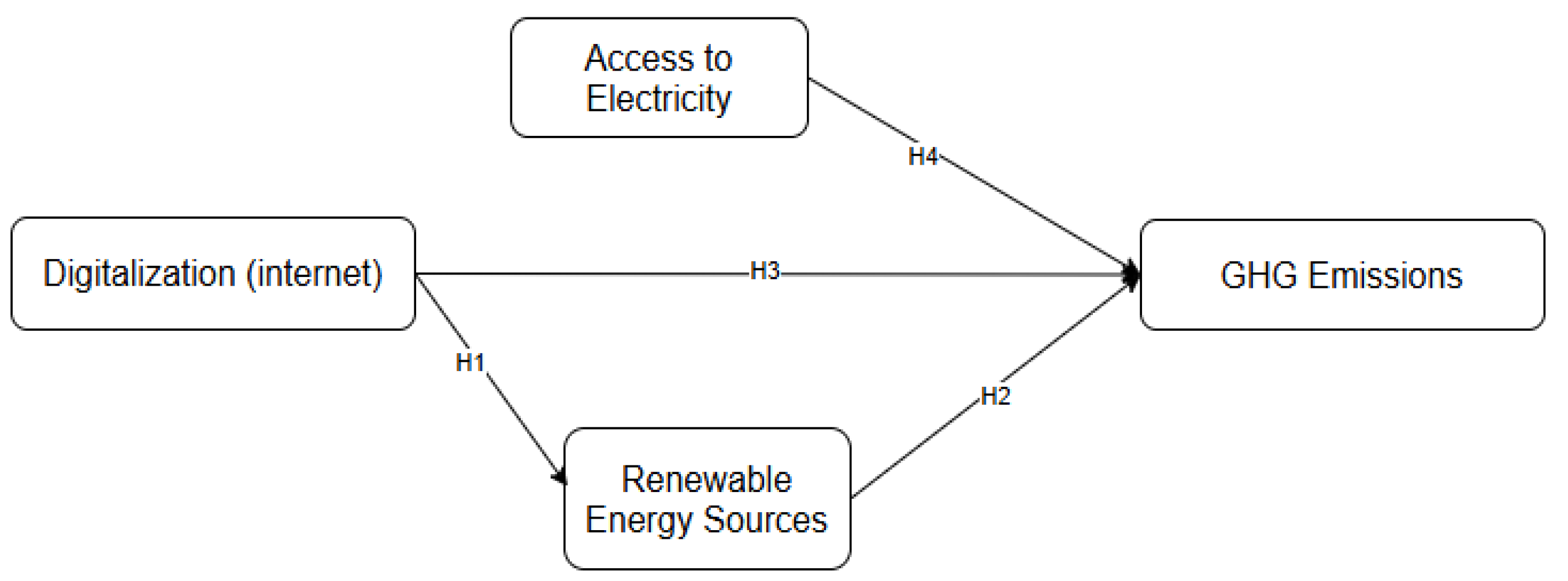
1. Introduction
The very processes of building, changing, and evolving toward low-carbon economies alongside the imminent threats of climate change are driving all countries today [
1]. So, at the level of technology, they have dual transformation in energy systems and the development of technology infrastructures. Digitalization is among the new words that are gaining entry regarding promising alternatives to fossil fuels, especially in the electricity sector that is not limited to hydropower uses. Thriving on renewable energy sources such as solar, wind, and biomass in delivering its services, it dominated the discussions during the year 2021 [
2]; in bringing this scenario into existence, the dual transformation force is the ability to change energy consumer patterns with increasing system efficacy [
3]. Dimian et al. [
4] and Jaroenwanit et al. [
5] established that internet connectivity, information technology, characteristics of information systems, and AI-supported changes contribute to the digitalization path.
Thailand leads Southeast Asia at the forefront of this development. The notable effort is the national ‘Thailand 4.0’ strategy. Officially implemented to help free the country from the trap of being labeled a middle-income country, Thailand 4.0 is an economic strategy designed to change the country’s focus from heavy industry (Thailand 3.0) to an economy based on value and innovation. It operates as the ‘National Digital Blueprint,’ whose goal is to advance the nation into a high-income, innovation-driven economy while being in sync with the United Nations Sustainable Development Goals (SDGs) [
6]. Digital technology capabilities are considered a component of this agenda, leveraging innovation, creativity, and technology as key drivers for economic prosperity, social well-being, and environmental sustainability. This agenda focuses on building strong digital infrastructure, creating digital IDs, and encouraging e-government solutions [
7]. The aspect of environmental sustainability in ‘Thailand 4.0’ is the focus of this study; it is a commitment that focuses on transitioning to cleaner energy through key strategies such as renewable energy, energy efficiency, reduced greenhouse gases, and smart grid technology [
8].
From the view of the Thailand 4.0 initiative, although digitalization and renewable energy are often studied separately, they are interrelated. Bartczak [
9] argues otherwise; rather, renewable energy resources may be used, incorporated, or otherwise optimized through digital technologies. Digital technologies enable real-time energy management, predictive analytics, distributed energy systems, and a smart grid infrastructure. On the other hand, according to Scharl and Praktiknjo [
10], the digital connections will elevate people’s awareness of environmental issues, likely to trigger behavior changes in energy consumption and, to a greater extent, policy changes. Digitization, as already discernible in developing economies like Thailand, offers the prospect of modernization of energy systems, integration of renewable energy sources, and an approach to a low-carbon economy in the future.
Introspectively, the last two decades have seen increased internet penetration in Thailand. This fact obviously makes the digital ecological transition grounded in Thailand [
11,
12]. Furthermore, very little empirical research examines digitalization with clean energy development, while most of it treats the whole environment in developing countries like Thailand. The majority of research either deals with impact analysis that relates digital transformation to productivity or only accounts for carbon emission rates, with very few political adoption levels characteristic of developing countries. The limits on studies in this field mean that they tend to assess whether and how the digital component interacts with renewable energy development; hence, the use of this technology affects emissions reductions by adoption. For instance, most recent studies show that digital investment and further diffusion of ICT could foster green energy consumption and enhance sustainable performance [
13,
14,
15]. However, most of these analyses have been conducted in advanced economies or G20 countries.
Regarding the numerous writings developed on this ongoing empirical literature, the majority centers on direct load impacts from renewables with respect to carbon emissions [
16] or economic issues concerning that technology [
17]. The role that digital infrastructure plays in facilitating green transitions is masked to some extent. Dimian et al. [
4] would argue that, in Europe and other OECD countries, carbon emissions through digitalization could be enhanced because of the effectiveness improvement or expansion of the reservation of energy from renewable sources. But findings like these cannot be as highly applicable to Thailand since differences will arise in technology maturity and policy framework [
18].
Theoretically, this creates a critical disconnect. Ecological modernization theory suggests digital change can help the environment by making things more efficient and using fewer materials. This concept is largely based on data from developed nations. It remains uncertain whether technology diffusion will show similar results in countries such as Thailand. Resource conflicts could also land on the con side of environmental gains in terms of new tech. These issues still need answers. While recent literature has profoundly explored techno-economic modeling for integrated energy systems and flexible operations [
19,
20,
21], macro-frameworks oftentimes fail to address the ‘developmental friction’ characteristics of emerging market frameworks. Specifically, how the dual transition competes for limited financial resources. Therefore, there is a lack of empirical evidence on whether the theoretical synergies proposed by engineering models actually materialize in the historical data of developing economies like Thailand.
The literature on Thailand has centered much on policy toward the promotion of renewable energy and energy security issues [
22]. Although it is critically assessed, there seems to be, unfortunately, insufficient quantitative evidence for internet penetration or digitalization to raise renewable electricity generation per head, yielding less greenhouse gases. This lends itself to the research, which investigates the nexus between digitalization and renewable energy transition in Thailand, coupled with GHG reductions. The study is guided by two objectives: (1) to investigate the relationship between internet usage and electricity produced from renewable sources; (2) to evaluate the direct and indirect impacts of digitalization on GHG emissions through electricity generated from renewable sources.
The huge relevance of the research to energy policies and policies relating to digital development in Thailand, considering the interrelationship of internet penetration with renewable energy and emissions reduction, will therefore require emphasis. The investments can also show if they match the country’s environmental sustainability plan. This is key since Thailand 4.0 is pushing for both cleaner energy and digital changes at the same time. Most places in South Asia are the final rungs on the global ladder of sustainability research, but this study crosses that barrier of regional legitimacy. Hence, research will now design a region-wide insight that will benchmark against neighboring countries engaged in similar development programs. In terms of academia, this would provide relevance to the study under the ecological modernization theory (EMT) and the technology diffusion theory adopted in the research. The study would elaborate on how a tech system could meet environment-oriented as well as economy-oriented ends.
After the Introduction, the remainder of the paper contains the following: a literature review introduces the principal theories of ecological modernization and technology diffusion that underpin the theoretical foundation of this study and reviews the empirical literature concerning digitalization, renewable energy, and emissions to identify the research gap. The Research Methodology section outlines the conceptual framework and hypotheses, details the secondary data sources and variable measurements, and explains the application of the autoregressive distributed lag (ARDL) model for analysis. The Results section presents the empirical findings, including descriptive statistics, correlation analysis, stationarity tests, and the outcomes of the ARDL model estimations for testing the study’s hypotheses. Thereafter, the Discussion interprets these findings against the prevailing literature in their specific short- and long-run dynamics and finishes with an exposition on the theoretical and managerial implications. Finally, the Conclusion wraps up with the important findings and states what the policy recommendations should be, with regard to a coordinated digital and energy strategy, plus some limitations of the study and directions for future research, including sector-specific and more regional comparative analyses.
Novelty and Scientific Contribution
This study has distinct contributions to knowledge; the first is the identification of a significant geographical gap. The article, therefore, adds to the debate concerning the applicability of the EMT in the Global South. This study contributes some findings from Thailand, while the majority of the digitalization environment nexus literature has revolved around advanced G20 economies with mature technological infrastructures. Also, this study represents the rapidly developing ASEAN economy of Thailand as one that is daringly balancing a transition on two fronts (digital and green) under the ‘Thailand 4.0’ initiative and, therefore, serves as a setting to experimentally validate ecological modernization theory (EMT) outside the Global North.
Second, this study, instead of cross-sectional studies that do not consider the time dimension, adopts the autoregressive distributed lag (ARDL) model, which is a preferred technique that allows one to differentiate the short-run and long-run dynamics. It shows that digital expansion does not transform itself into renewable energy growth instantly. Third, the study reveals a peculiar mechanism of ‘investment trade-off.’ The evidence suggests that, in economies under development, digitalization competes for limited financial resources with renewable energy projects, a subtle point often overlooked by studies that assume automaticity, not synergies, among ICT and green energy.
3. Results
The first analysis of the study was descriptive statistics. The results in
Table 3 of the descriptive statistics provide valuable insight into the distribution and variability of the key variables. Regarding the access to electricity as a % of the population, the mean access to electricity is 96.80%. This indicates widespread electrification across Thailand. Additionally, the minimum value is 82.10%, and the maximum is 100%, showing significant progress toward full coverage. The standard deviation is low at 4.65, with a negative skewness (−1.69), suggesting most values are concentrated near the upper end. Regarding the greenhouse gas emissions per capita (t CO2e/capita), the results showed that the mean is 5.34, with a relatively narrow range (4.23 to 5.82) and low variability (std = 0.46). Also, the coefficient of variation (CV) was found to be 8.69%, reflecting consistency in emissions trends per capita.
For electricity production from renewable sources (excluding hydroelectric), the results showed a mean of 9.03%. There is a broad range from 0.80% to 21.84%, which shows a clear, rapid development in renewable electricity. The standard deviation is 7.98, and the CV is quite high at 88.35%, indicating substantial variation over time. On the other hand, the average internet usage (% of population) showed a significant level of 36.14%. The trend indicates the gradual involvement of people in digital activities. Usage values were found within a minimum and maximum of 3.69% and 89.54%, respectively, with a very high standard deviation of 27.80-SD, CV = 76.93. The high variations can be interpreted to mean that there was a rapid expansion of these values in recent years. One could conclude from this statistical outcome that: (1) electricity access and greenhouse gas emissions have a realistic level of stability and approach saturation; (2) internet usage and renewable electricity production are changing dynamically. This indicates an evolutionary trend of digitalization and renewable energy efforts in the emerging environmental outcomes of Thailand.
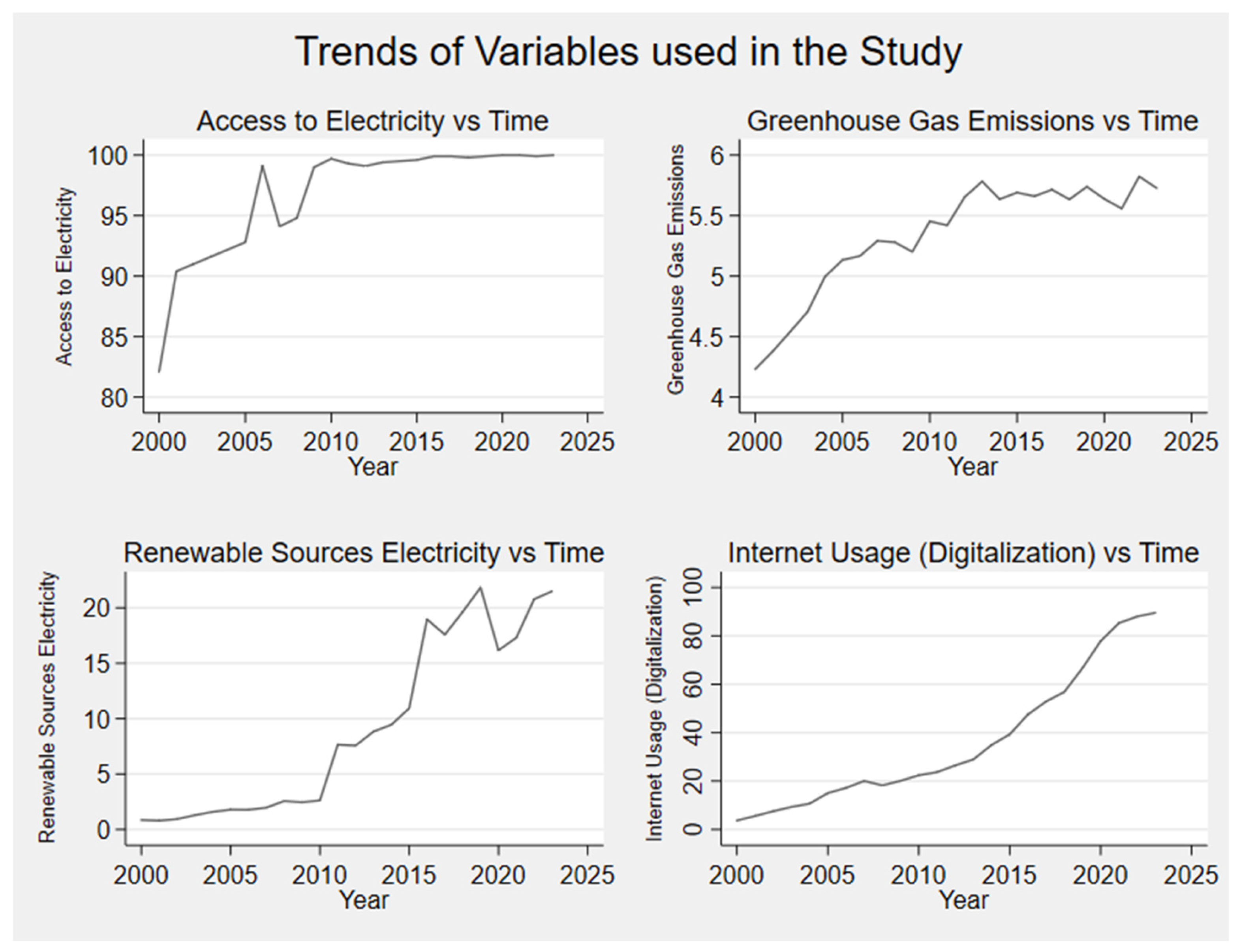
The graphical representation (
Figure 2) of the trend shows that access to electricity increased significantly between 2000 and 2010, reaching a level of around 98%. Then the trend remained significantly flat. The greenhouse gas emission (metric tons of CO
2 equivalent per capita) increased, displaying an increasing trend over time, particularly between 2000 and 2012. The trend reduced after 2013, depicting the country’s effort to reduce greenhouse gas emissions. The same trend was also observed regarding electricity access and internet usage/access. NB: Std. Dev = Standard Deviation; IQR = Interquartile Range.
3.1. Correlation Analysis
Digitization has an excellent relation to renewable electricity access (r = 0.9291,
p < 0.01). Increased consumption or production using renewable energy has to go along with improvement in internet usage through means of digitalization, which follows the very expectation that access and innovation in technology are likely to drive clean transitions, maybe through better monitoring of the grid, smart technologies, or monitoring systems of energy. Strong and positive was the relationship of greenhouse gas emissions with access to electricity (r = 0.912 **), while moderate with digitalization (internet usage) (r = 0.7247 ***). Thus, this would mean an increase in electricity- and digital-infrastructure-generated energy, historically known as the highest emitters due to their fossil fuel dependency. A contradictory urgency is forged, where, above all, clean energy access should accompany digital growth. Among the most interesting findings was that, while renewable electricity and greenhouse gas emissions had a moderately significant relationship (0.7495 ***), they were instead anticipated to follow a generally negative relationship. The renewable energy sector has thus been driven by existing levels of emissions, as is characteristic of any developing and transitioning economy. That said, one conclusion that can be drawn is that, just as digitalization and access to electricity are propelling development, they too are correlated with increased emission levels; hence the need to prop up clean energy transitions and promote green technology. These are summarized in
Table 4.
3.2. Empirical Tests
In this section, an analysis is conducted to evaluate the hypothesis of the study, following the objectives of the study. Before the analysis, the variables were transformed and linearized by taking their logs. The stationarity tests were conducted (
Table 5), considering that the data were time series. The results indicated that greenhouse gas emissions, access to electricity, and internet usage (digitalization) were stationary at a level. However, renewable electricity becomes stationary after first differencing. These results support further analysis using techniques appropriate for a mix of I(0) and I(1) variables, such as the ARDL model.
In addition to the stationarity tests, the optimal lag length was evaluated using all four criteria. For all variables, FPE, AIC, HQIC, and SBIC, the optimal lag length for all the variables is specified in
Table 6. The first objective of the study was to investigate the relationship between internet usage (as a proxy for digitalization) and electricity production from renewable sources. The short-run model first conducted was statistically significant, F(3, 19) = 141.70,
p < 0.001, accounting for approximately 95.72% of the variance in renewable electricity generation. It was observed that the lagged value of the past renewable electricity generation was a strong and positive predictor, B = 0.809,
p < 0.001. This meant high persistence over time. However, the short-term or immediate effect of internet usage (digitalization) on renewable energy production (electricity) was not significant (B = −0.409,
p = 0.623).
Additionally, the lagged effect of internet usage (digitalization) was negative and statistically significant (B = −0.593,
p = 0.042) (see
Table 7). This suggests that changes in internet usage in the prior year are associated with a subsequent decrease in renewable electricity generation. As a result, H1 was not supported. This could be explained by the possibility of infrastructural or resource allocation trade-offs over time, considering that Thailand is still a developing nation.
The study went ahead to conduct the bounds test to determine whether there was any long-run relationship between internet usage (as a proxy for digitalization) and electricity production from renewable sources. The results revealed that the F-statistic (F = 1.308) was below the lower bound of the critical values at all conventional significance levels, and the t-statistic (t = −1.055) is above the I(0) critical bounds (
Table 8). Hence, there was no long-run relationship between the two.
Model Diagnostics and Specification Note: Since the bounds test indicated no cointegration (no long-run equilibrium relationship), an error correction model (ECM) was not estimated. The definition is restricted to semi-dynamics and lagged distributed effects. Diagnostics upscale this specification into the short run: the Breusch–Godfrey LM test indicated a lack of serial correlation, while Breusch–Pagan showed no evidence of heteroskedasticity. This very much narrows the CUSUM plot into very critical bounds at a 5% level of significance, substantiating its parameter stability. The direct and indirect impacts of the processes from the digital sector on GHG emissions during renewable energy production were investigated in the next analysis under objective two and presented in
Table 9.
The results revealed that the current level of internet usage was positive and had a non-significant association with GHG emissions (β = 0.468, p < 0.018); this suggested that there is moderate short-run persistence in GHG levels and it is attributed to the persistence of past emissions (GHG L1). The effect of renewable energy on GHG emissions revealed that the immediate effect was negative and insignificant (β = −0.006, p < 0.731). It implied that a 1% increase in renewable electricity generation is associated with a 0.6% reduction in GHG emissions, which invalidates H2. However, the lagged effect of renewable energy was negligible and insignificant. It meant that increased renewable energy in the previous year was not associated with higher GHG emissions in the current year. Regarding the impact of digitalization, the results revealed that the current level of internet usage was positively associated with GHG emissions (β = 0.0631). This specific coefficient was statistically insignificant (p = 0.354); the direction of the relationship contradicts the expectations of immediate environmental benefits. It meant that a 1% increase in internet usage is associated with a 6.3% increase in GHG emissions in the short run, rather than a reduction, hence H3 was not supported. It implied that greater digital access may contribute to slight reductions in emissions in the short term. The lagged effect of digitalization (internet usage) (L1) was also negative but not statistically significant (β = −0.042, p < 0.460). This meant that a 1% increase in past internet usage leads to a 4.2% reduction in GHG emissions. This indicates that, while the sign turns negative over time, there is no statistical evidence that digitalization has yet led to a significant reduction in emissions. Lastly, the effect of access to electricity on GHG emissions revealed that the short-term current effect of access to electricity was a significant positive lagged effect (B = 0.050, p = 0.864). However, the effect of lagged access to electricity was positive and significant. It implied that a 1% increase in past access to electricity leads to a 0.54% increase in GHG emissions (B = 0.0544, p = 0.027); this supported H4, confirming that historical grid expansion in Thailand has been carbon-intensive.
4. Discussion
Considering the global and national transition toward renewable energy, environmental conservation, and technological advancement, this study sought to establish the role of digitalization in facilitating renewable energy transition and reducing greenhouse gas emissions in Thailand. The first objective was aimed at evaluating the relationship between digitalization, as measured via internet usage, and electricity production from renewable energy sources (excluding hydroelectric) in Thailand. The study found that the short-run effect of internet usage (digitalization) on renewable energy production was not statistically significant. This suggests that short-term increases in internet usage do not yield instant changes in renewable electricity output. Several factors could justify these observations; first is the infrastructure-intensive and delayed-return nature of renewable energy deployment.
Compelling results were observed for the lagged effect of digitalization (with internet usage) therein: negative and statistically significant (B = −0.593,
p = 0.042). The findings refuted the first hypothesis of the study (H1), which had posited a positive association between digitalization and renewable energy generation. The overriding reason for the observation could be trade-offs on a national investment priority scale. This is especially true for countries with emerging economies, such as Thailand, where these fields compete for limited public funding [
18]. There is a potential for increased demand for energy that could go hand in hand with digitalization. In the short run, as demand for electric energy increases, the share of renewable energy will decrease in proportion to such demand. The energy demand that would have been met through fossil-fueled grids in rapidly developing infrastructures like data centers and telecommunication networks increases. This difference grows and offers an economy for our energy needs and the speed at which renewable alternatives are emerging [
72]. According to Öztürk et al. [
36], a somewhat similar trend occurs in emerging economies, where the environmental benefits of ICTs depend on coinvestment in green energy infrastructure. Pan et al.’s [
29] Asian findings imply that the renewable systems will demonstrate efficiency improvement only with adequate regulatory framework directions, incentives included, for the adoption of clean energy technologies.
The second objective of this study was to assess how digitalization, specifically internet use, directly affects greenhouse gas emissions. It also looked at the indirect impact of digitalization through its influence on renewable electricity production. Contrary to the expectations of EMT—which suggests digitalization leads to dematerialization and efficiency—the results revealed a positive association between internet usage and GHG emissions. Specifically, a 1% increase in internet usage is associated with a 6.3% increase in GHG emissions in the short run. Hypothesis 3 thereby gets disconfirmed with this evidence, and evidently, Thailand’s present digitization ‘scale effect’ (additional energy input due to devices, servers, and networks) overwhelms the ‘technique effect’ (efficiency gains one could achieve from teleworking and smart logistics).
While earlier literature suggested that digitalization reduces emissions by favoring e-services and automation, these benefits are only realized if the underlying power grid is decarbonized. In Thailand, the grid is still relying on fossil fuel resources; thus, the digital expansion is merely increasing the carbon footprint of the energy mix and not eventually lowering it. It complements the already existing literature highlighting renewables as the means of environmental benefits in low- and middle-income countries [
18,
73]. But no lag effect was found, so such long-term emissions reductions could not be attributed to former renewable energy growth; perhaps because of delays in the project, grid integration restrictions, or fossil backup systems.
Furthermore, the study found that renewable energy production had a negligible and insignificant immediate effect on GHG emissions (β = −0.006). This suggests that the current scale of renewable integration is insufficient to offset the rising emissions driven by digital consumption. This reinforces the ‘developmental friction’ argument: the transition is not yet decoupled from carbon intensity. Thus, the above findings show that control variables past electricity access are strongly related to changing emissions (β = 0.544). Furthermore, it indicates that the emissions associated with electrification and digital access in Thailand are still linked to carbon-heavy generation, just as in other developing economies, where grid expansion follows emission peaks before mature renewable penetration.
Digitalization is theoretically enriching for future prospects of working from home, electronic services, and smart logistics that will reduce carbon intensity [
4,
14]. The context herein is essentially true with respect to the ecological modernization theory (EMT), wherein technology is supposed to manage resources towards environmental balance [
25]. The case in Thailand, however, is contrary to the expectations of the theory. Internet penetration has a positive correlation with GHG emissions, acting as an environmental lever. This situation is particularly true in most developing economies where fossil sources primarily support grid expansion, so that electrification and digitalization will increase emissions before renewable penetration matures [
19,
72].
The contribution made by this study is one of significant originality and novelty to the existing literature by focusing on a critical yet understudied nexus within the context of a specific developing economy. Although a number of studies exist on the digitalization–environment nexus, they mainly deal with advanced or G20 economies, which substantially differ in terms of technological maturity and policy frameworks. By focusing on Thailand, a fast-growing ASEAN economy undergoing active dual digital and green transitions under its Thailand 4.0 vision, this research attempts to fill the gap with a context-specific and empirical investigation.
This study is unique in its methodological approach by applying the ARDL model, which exclusively specifies the individual short-run and lagged dynamic relationships between the internet-induced digitalization, renewable electricity generation, and GHG emissions. However, normally this dimension of time is neglected in a cross-sectional analysis; the greatest originality stems from the finding of a possible short-run trade-off with implications for investment, such that expansion in the digital sphere may temporarily siphon off resources, thereby inhibiting renewable capacity: grassroots intelligence for policy guidance in developing countries hindered by resource scarcity. The current research suggests that expansion in digitalization is associated with increased pollution. As the demand for energy is outpacing the rate at which improvements in energy efficiency are being considered, there is a push for all kinds of sources of energy. It puts forward a theory about a bigger, often missed way that digital tech can cut carbon use, applying this specifically to ecological modernization theory. Overall, this study offers a unique evidence-based framework that transgresses simplistic presumptions of synergy that lead to empirically sound analysis of complex, often contradictory realities of orchestrating concurrent transitions toward digitalization and sustainable energy in an emerging economy.
4.1. Theoretical Implications
Theoretically, these findings challenge the universality of the ecological modernization theory (EMT) when applied to the Global South. According to EMT, innovative technology will automatically bring about ecological sustainability; the present study finds an obvious obstruction or hurdle within this path—the investment gap. The study upholds TDT regarding the diffusion of digital tools but reveals that this does not imply that the anticipated environmental safeguards will automatically engage as predicted by the EMT. The originality of this research is founded on the empirical identification of relevant short-run investment trade-off concepts. It differs from cross-sectional studies, assuming synergy because this time series indicates that investment in digital expansion may be potentially resource-siphoning in the short term, thus impairing capacity for renewables. New evidence is provided to open yet another empirical avenue that will not stop at the simplistic narrations; the complexities of trying to orchestrate concurrent transitions in an emerging economy are highlighted.
4.2. Policy and Managerial Implications
Classifying digital adoption based only on internet use, ignoring other aspects of digitalization, is a simple way to measure how advanced technology use is. To address the empirical ‘investment trade-off’ identified in this study, where digital and energy infrastructures compete for capital, the current policy approach must evolve. We propose three concrete policy levers for Thai institutions:
Integrated Incentive Structuring (Board of Investment—BOI): The BOI now has different tax breaks for digital improvements (A1/A2) and renewable energy projects. Our research shows that this split makes resource issues worse. We advise the BOI to create a ‘dual-transition’ incentive. The program entails granting larger tax benefits on corporate income tax for manufacturing companies investing in Industry-4.0-enabled digital enhancement, provided they implement local renewable energy resources, for example, rooftop solar facilities with Internet of Things monitoring.
Ring-Fencing Infrastructure Funds: To mitigate the negative lagged effect of digitalization on renewable capacity, the Ministry of Digital Economy and Society (MDES) and the Ministry of Energy must coordinate infrastructure budgeting. As an example, the ‘Digital Fund’ budget for smart city expansion should feature a specific section for ‘Green Power Provision.’ Renewable energy storage should be incorporated into new data centers and 5G base stations in addition to the proposal. This will lessen the burden of fossil-fuel-based energy generation on the national grid.
Demand Response Mechanisms: The results support the view that increased efficiency brought about by digitalization leads to further reductions in GHG emissions, yardstick implementations rather than the scaling up of renewable generation. It is assumed that the Energy Regulatory Commission requires demand response directly for that program to succeed. Rather than waiting for a new plant to come online, the ERC sandbox program should reward industries for their use of existing digital connections to automate load shedding during peak hours and cash in on the gains in efficiencies found in the model results from model 2.
5. Conclusions
The purpose of this research is to examine digitization and renewable energy in Thailand, especially with regard to mitigating greenhouse gas emissions. Empirical analysis comes up with a rather complicated reality: dual transition is currently an investment trade-off in place of quick synergy. Regarding lagged effects, digitalization exerted a significant adverse effect on the production of renewable energy. Simply put, ICT expansion in itself does not automatically drive green energy growth; instead, it appears to discourage energy investment by competing for limited financial resources in the developing context of Thailand.
Digitalization would not deliver on its promise of environmental benefits at all. Emissions were not reduced; rather, the internet appeared to show a positive association of a 6.3% increase in the levels of greenhouse gases, offering instead the insight that energy demand for digital infrastructure presently outweighs its efficiency gains. This leads to the argument that the addition of what may be considered a decoupling ‘milestone’ must still be achieved by the study. However, policy recommendations should shift attention toward energy synergies through the integration of incentive structures to optimize renewable energy installation with digital progress. Sustainable electrification requires a shift toward low-carbon generation systems to prevent digital access from driving up emissions. Development investment arrangements for digital infrastructure in the future shall be necessarily tied to energy transition targets (e.g., ring-fenced green funding). This study provides valuable information using the ARDL method, which works well with smaller datasets. Future research should focus on specific sectors like farming or transportation. Comparing different areas within Southeast Asia would show better practical ways to treat investment issues found in this study.
Limitations of the Study
The study has some strong points but also has some methodological limitations, one of which is that it relies on annual macro-level data for sample size (N = 23), which fits perfectly in ARDL bounds testing but does not apply very well in using other fine-grained machine learning validation techniques. Such restrictions have limited the analysis of shorter time frames pre- and post-COVID-19 or applications of machine learning that would need large validation sets. It was also confirmed from the test that parameters showed stability and consistency with several CUSUM tests, and such external forces as the 2011 floods or the 2020 pandemic did not create any structural break in the model. Also, using ‘internet usage’ as the sole proxy for digitalization may not fully capture the complexity of industrial Industry 4.0 adoption, such as specific AI or IoT investments in the energy grid. The findings about ‘investment trade-off’ might only be applicable to developing countries, like Thailand, that are constrained by resource limitations. It is possible they will not easily apply to developed nations that have well-established capital markets.