Article

Microgrid Planning by Stochastic Multi-Objective Multi-Year Optimization with Capacity Expansion and Non-Linear Asset Degradation


1
Department of Energy, Systems, Territory and Construction Engineering, University of Pisa, 56122 Pisa, Italy
2
Department of Energy, Politecnico di Milano, 20156 Milano, Italy
*
Author to whom correspondence should be addressed.
These authors contributed equally to this work.
Sustainability 2026, 18(8), 3785; https://doi.org/10.3390/su18083785
Submission received: 8 February 2026 / Revised: 31 March 2026 / Accepted: 2 April 2026 / Published: 10 April 2026

Abstract

Decentralized microgrids have been proven to enable socioeconomic growth in developing countries. However, they are long-lasting investments whose profitability is highly uncertain due to unstable local socioeconomic contexts, which may delay the breakeven point, if ever reachable. Over the long term, capacity expansion and non-linear degradation of components also arise. Moreover, policymakers and developers are increasingly focusing on environmental and social considerations, raising the complexity of project development. Accordingly, multi-year planning has been simplified by addressing single challenges independently. In this paper, we propose a comprehensive procedure to efficiently solve stochastic multi-year problems for off-grid microgrids in developing countries, including capacity expansion and the non-linear degradation of battery and renewable assets. The novel procedure combines the efficient A-AUGMECON2 methodology for multi-objective formulation, the iterative decomposition of the non-linearities of the battery, and the inclusion of a two-step capacity expansion. A case study developed for Soroti, Uganda shows that the proposed model is suitable for planning purposes, with savings even beyond 20%. The Pareto frontier highlights the trade-offs among the net present cost, total emissions, and land use, which can support policy and business decision-making under uncertainty. The methodology renders these complex modeling challenges solvable and is scalable to energy system applications.

1. Introduction

1.1. Motivation

Climate and sustainability concerns are motivating policymakers and citizens to address the energy transition challenge. However, while, in industrialized countries, this task usually entails the conversion of traditional fossil-based economies towards sustainable technologies and supply chains, in developing countries, economies and well-being are the first to improve. In the Global South, poverty is widespread, and about 600 million people are currently without electricity access [1]. Hence, their governments aim first at improving citizen well-being through economic growth, supported by electrification, while mitigating climate change effects.
Microgrids have been proven to be suitable technical options for rural electrification in remote areas compared to traditional grid extension options. However, their economic sustainability is challenged by the high socioeconomic and political risks [2,3,4]. Newly electrified communities experience differences in technology uptake, and the ability to pay is highly dependent on the local economic activity, which is usually poor and takes several years to grow [5,6]. Microgrids can result in ten-fold growth in energy consumption over a decade [7] in some sites, as well as no growth or failures in others [8]. These mid- and long-term uncertainties are a critical feature that cannot be disregarded in accurate system planning, yet they have rarely been addressed in the literature given the large computational requirements that they carry. In particular, developers and policymakers show rising interest in combining rural electrification [4] with social and environmental aspects, such as land limits, job creation opportunities, and emissions [9,10,11], yet only few research studies have considered this nexus.
For these reasons, we consider it timely and appropriate to develop a methodology to tackle the stochastic multi-year planning of microgrids in the Global South, including multi-objective analyses.

1.2. Literature Analysis and Contributions

In this section, the relevant literature on microgrid planning is analyzed, with a summary reported in Table 1, aimed at comparing existing planning models by grouping them into four main categories: (1) optimization models, (2) load forecasting and uncertainties, (3) long-term modeling characteristics, and (4) multi-objective considerations.

1.2.1. Microgrid Optimization

The literature is rich in planning studies for microgrids. Typical design problems are usually described and solved using mathematical programming techniques or meta-heuristic formulations. Meta-heuristic methodologies—for example, based on particle swarm optimization (PSO) [3,7,9]—perform iterative simulations of system operations, subject to different configurations of the system, up to convergence. This approach enables the simulation of complex operating strategies and can be easily scaled to non-linear and complex problems; however, convergence to a global optimum cannot be guaranteed. On the other hand, mathematical programming techniques, such as the well-known mixed-integer linear programming (MILP) [24], are proven to converge towards the global optimum, and recent developments have made it possible to solve large problems with standard computers. However, since the computational complexity grows exponentially with the size of the problem, approximations of the problem and novel decomposition approaches may be required [6], especially when multi-year planning or stochastic methodologies are considered. In this study, we focus on the MILP technique, which is proven to converge to the global optimum.

1.2.2. Load Estimation for Microgrids

Accurate demand forecasting is a critical component of robust microgrid planning, yet a standardized approach remains absent, contributing to uncertainty in system design and operation. Demand is typically estimated using either top-down econometric models or bottom-up end-use approaches. The former rely on readily available macroeconomic indicators but often fail to capture community-specific characteristics and demand heterogeneity. In contrast, bottom-up methods enable more detailed, appliance-level representations of consumption patterns, although their application is limited by scarce and difficult-to-obtain data [4]. To address these limitations, recent efforts have focused on collecting and classifying load profiles from existing remote microgrids, aiming to derive transferable usage patterns and support more reliable demand modeling for future projects [8].
Long-term load growth projections are often based on simplified or ad hoc assumptions, which can compromise the reliability of microgrid planning. Some studies adopt deterministic approaches with constant growth rates [5,6,19], while others employ scenario-based methods to represent a range of possible future demand trajectories. Additional projections have been derived from historical data on comparable projects [7], revealing significant variability, with growth rates reaching up to ± 500 % or approximately 50% per year. Alternative approaches estimate demand evolution based on assumptions regarding appliance penetration [23], macroeconomic drivers such as GDP and population [25], or combinations thereof. Such variability highlights the intrinsic uncertainty of long-term demand forecasting, which may lead to system misdimensioning and associated technical and financial risks. For this reason, explicitly accounting for long-term dynamics in energy planning is essential and is considered in this study.

1.2.3. Long-Term Planning and Uncertainties

Long-term dynamics have been increasingly considered in microgrid studies [7,23,24,26], sometimes including stochastic features to address uncertainties [7,23,26]. The overall optimization problem can become computationally intensive as its size grows with the length of the horizon and the number of scenarios to describe uncertainties. Some studies solve the problem as a whole, with limited simplifications [7,23]; nevertheless, decomposition techniques, including but not limited to iterative techniques, Benders decomposition, and Lagrangian relaxation, have been proven to reduce the computational requirements [6,24,26,27,28]. Several strategies have been proposed to address the temporal complexity of microgrid planning problems. One common approach consists of decomposing the problem into a sequence of deterministic single-year optimizations [6], thereby simplifying intertemporal dependencies. Alternatively, two-stage frameworks first determine annual capacity investments independently and subsequently evaluate system performance over the entire project horizon [19]. To explicitly account for uncertainty, the study in [26] models capacity expansion in remote microgrids as a series of stochastic yearly optimizations. More integrated approaches have also been explored: for instance, the approach in [22] combines a system dynamics model with the MILP-based DER-CAM tool [17], iteratively solving the two until convergence in order to capture feedback between socioeconomic drivers of demand growth and investment decisions.
The optimization problem increases in complexity when the system can be upgraded as demand grows; the computational time may exceed hours [7,23]. The authors in [7] prove that the initial installation costs may be halved when stochastic multi-year planning is employed, accounting for capacity expansion and degradation, such as battery degradation. The methodology in [23] yields similar findings, although it was developed with no unit commitment, as it is based on linear programming, and no asset degradation. The authors in [24] successfully developed an MILP-based approach that addresses unit commitment and battery degradation using an efficient MILP approach. A multi-objective optimization has also been considered in [11], but with no uncertainties, which are significant in rural microgrids but pose significant challenges due to the computational requirements.
In this study, in contrast to the literature, we aim at overcoming the described limitations and propose a comprehensive stochastic formulation including long-term dynamics and the optimization of the capacity expansion of the system over time with multi-objective considerations.

1.2.4. Multi-Objective Approaches

While economic goals represent the major concerns of developers and public institutions, social, environmental, and technical goals are becoming more and more important [3,10,29,30]. Environmental protection has often been considered as a limit [2,16,21], as a monetary cost [6], or as an additional objective function [9,15,17]. Nevertheless, life cycle assessment (LCA), which enables one to quantify the overall emissions over the entire life of a component, remains rarely adopted in the literature [9,10,16]. Indeed, most studies are limited to direct emissions [6,15,17,20,21], which can lead to incomplete and biased evaluations. Furthermore, the inclusion of social impact considerations in rural electrification planning is gaining increasing attention, and it is now regarded as a key component of decision support tools [31]. However, only a small number of multi-objective optimization frameworks explicitly integrate social dimensions [9,20]. The adoption of the Human Development Index (HDI), typically correlated with energy consumption, as an objective remains uncommon [9]. While the correlation between HDI and energy use is well documented [32], it offers a limited representation of local effects within electrified communities. Conversely, employment generation constitutes a more direct and quantifiable indicator and is therefore considered in this work [11].
When multiple objectives are considered, multi-objective meta-heuristic or MILP optimization methods are typically used. Their goal is to identify the so-called Pareto frontier, which is the set of non-dominated solutions, such that no objective function can be improved without compromising another. In the case of MILP approaches, the weighted sum method [33,34] and the ε -constraint method [35] can be used. This approach can capture non-linear Pareto frontiers [35] while avoiding normalization issues and generally offering improved computational efficiency [36]. Notably, the AUGMECON2 method [37] extends the classical ε -constraint formulation [38,39]. However, its performance deteriorates with more than two objectives. For this reason, the authors in [11] developed A-AUGMECON2 to generalize the approach and succeeded in reducing the computational burden by 50%. Accordingly, in this study, we employ A-AUGMECON2 to efficiently solve the proposed multi-objective problem.

1.3. Contributions and Organization of the Paper

This study proposes a comprehensive methodology to optimally size microgrid systems, including the multi-faceted long-term dynamics of typical off-grid investments. The major contributions with respect to the literature are detailed in the following:
1.
A comprehensive sizing methodology that accounts for (1) long-term system dynamics, (2) a multi-objective formulation, and (3) uncertainties in demand;
2.
A novel algorithm to handle the complexities of the problem and reduce the computational burden;
3.
The integration of multi-step planning; and
4.
The inclusion of degradation phenomena in multi-objective multi-year stochastic planning.
As noted in Table 1, no other paper has successfully tackled all these challenges as a whole, dealing with the corresponding modeling complexities and required reformulations.
The remainder of this paper is organized as follows. Section 2 details the proposed stochastic multi-objective multi-year model with non-linear battery degradation, and Section 3 describes its mathematical formulation. Section 4 and Section 5 detail the case study and the results, respectively. Finally, the conclusions are drawn.

2. Multi-Year Multi-Objective Stochastic Planning Model

2.1. Microgrid System

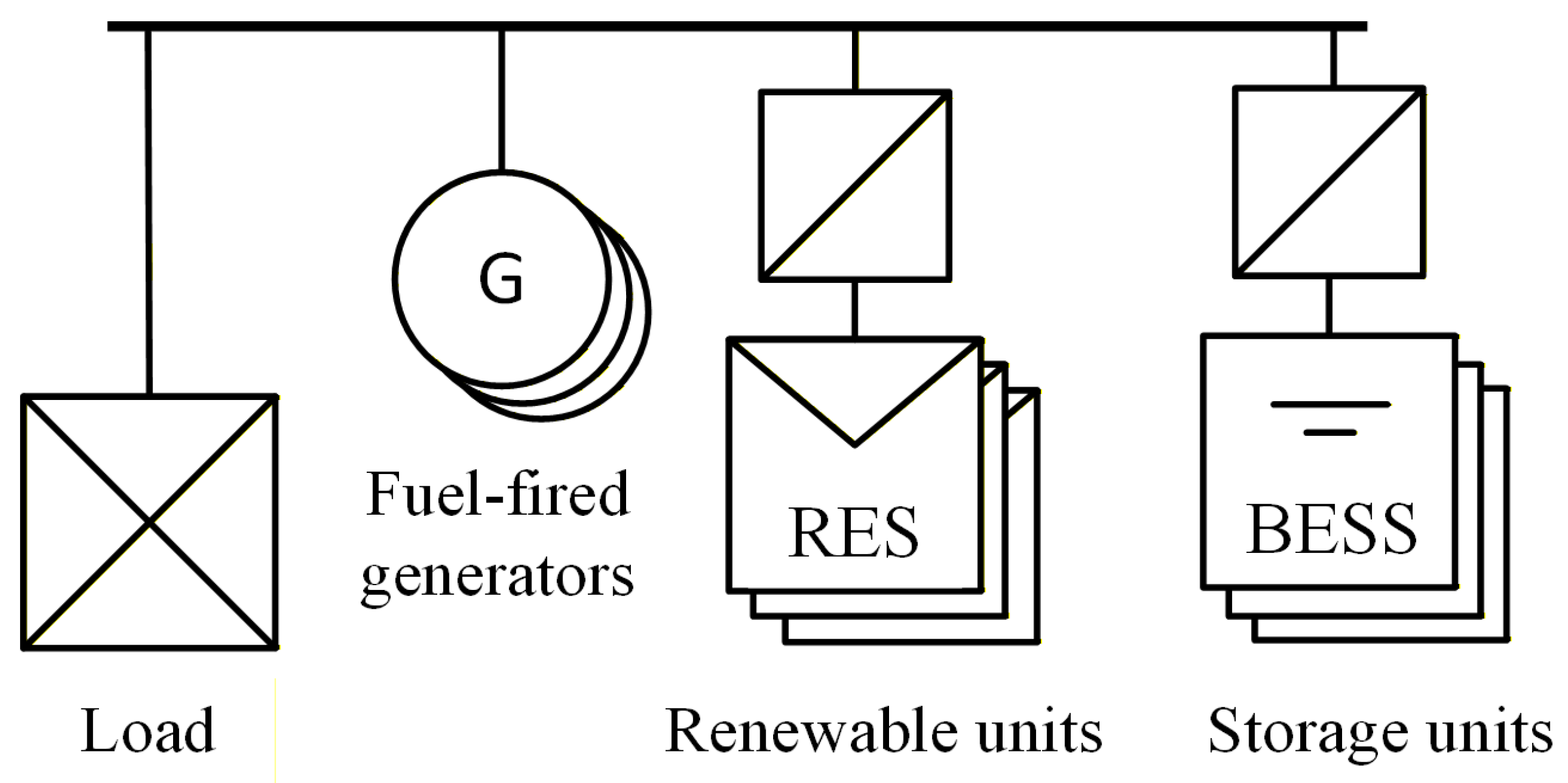
The microgrid model under consideration, depicted in Figure 1, is composed of renewable energy sources (RES), such as photovoltaic (PV) plants or wind turbines, fuel-fired generators, and battery energy storage systems (BESS) to meet the load; all assets are connected to an AC busbar. In contrast to standard modeling studies, the technologies are assumed to be installed in standard commercial sizes; hence, we consider how many units to install for each technology. The approach has been developed to be modular so as to easily account for additional generation and battery technologies.
An energy management system operates the microgrid to ensure the high reliability of the plant. The modeling will guarantee the satisfaction of a large fraction (90%) of the total demand, which is considered acceptable for microgrids in developing countries [11]. In fact, to lower the electricity cost, it is common practice to accept lower reliability of the system. In this study, we account for this modeling constraint with a parametric method.

2.2. Demand Uncertainties and Long-Term Dynamics

As discussed in Section 1, demand growth is a major challenge for developing countries, and uncertainties are significant. Accordingly, we propose to develop a stochastic multi-year methodology that (1) models demand growth using realistic appliance diffusion and (2) accounts for the stochastic growth rate based on experimental evidence. As multi-year characteristics are considered, not only are the demand dynamics taken into account but also the degradation of the generation capacity of renewable sources and the reduction in the available battery capacity, as later described. In the following subsections, we focus on the methodology used to represent the stochastic multi-year demand.

2.2.1. Long-Term Demand Dynamics

Long-term growth in demand is an open research problem. In this study, similarly to [11], we propose a two-step approach: (1) estimate the ownership of appliances for classes of households based on the appliance diffusion model studied in [22] and (2) calculate the expected profile for each class of users using the LoadProGen profile generator [40].
First, to estimate the ownership of appliances, we propose a linear relationship between the average number of appliances owned by households and the household income, as described in [22]. However, wealth distribution is not considered uniform across a community, as well as the total electrified population. Therefore, classes of households are constructed based on the percentile distribution of income [41]. Income growth is expected to grow linearly, as experienced in real case studies [41], and the expected growth in the number of people in the classes is tailored in agreement with expected growth rates in the literature [7]. Therefore, the overall appliance ownership can be calculated by using the projected income growth by class of households and realistic projections regarding the number of electrified households.
Secondly, the load profile for each class of users can be synthetically generated using LoadProGen. For every year under consideration and each class of users, the model is executed 20 times to generate several representative daily profiles, which are used to calibrate the expected demand growth.

2.2.2. Uncertainty Representation

The growth rate can be highly uncertain, and stochastic modeling is recommended to address this. To account for the uncertain evolution of the demand, we represent the probabilistic distribution of the growth rate using a number of scenarios, each having a given occurrence probability. Therefore, the overall representation of each scenario is given as a tree, where the master node coincides with the year of installation. In mathematical terms, in agreement with the sample average approximation method [13], the objective of the optimization problem is the optimization of the weighted average sum shown in (1), where f ( x s ) represents the value of the objective function for the scenario s over variables x having occurrence probability π s :
f S = s π s f ( x s )
In this study, we also consider that the system can be upgraded over time; hence, a capacity expansion is admitted and tailored to each scenario independently.

2.3. Multi-Objective Problem Formulation

Given the need for multi-disciplinary optimization techniques, in this study, we propose a multi-objective problem formulation considering the following goals: (a) the net present cost (NPC) of the system, (b) the total environmental CO2 emissions using an LCA approach, and (c) land use. The corresponding multi-objective problem can be formulated as in (2) [11], where f k denotes an objective function for decision variables x and constraints y l .
max f ( x ) = [ f 1 ( x ) , f 2 ( x ) , f 3 ( x ) ) ] T s . t . y l ( x ) 0 l 1 , , m x = [ x 1 , x 2 , . . . , x n ] T
To efficiently solve the proposed multi-objective function, we adopt A-AUGMECON2, which represents the state of the art for general multi-objective optimization [11], as an extension of the previous AUGMECON2 model [37]. The computational complexity of both algorithms is exponential to the number of objective functions; however, thanks to the online skimming procedure of A-AUGMECON2, several redundant optimizations are avoided, with a time reduction close to −50% with respect to AUGMECON2 [11]. For these reasons, we rely on the model in [11], which is expanded to include also stochastic uncertainties.
The A-AUGMECON2 algorithm identifies the optimal Pareto frontier by solving several single-objective problems, detailed in (3), where only the first objective f 1 is optimized and the other objectives are loosely constrained to values e k i t , which are iteratively updated [11]. The values e k i t are iteratively varied between the maximum e ¯ k and minimum e ̲ k values of each objective function, usually spaced at regular intervals, to map the entire range. Accordingly, the entire set of values e k i t across all iterations denotes a multi-dimensional matrix of points, hereinafter referred to as grid points. The sets of maximum e ¯ k and minimum e ̲ k values of the objective functions are precomputed and denoted as a payoff table. The key advantage of A-AUGMECON2 is that the iterative algorithm that varies e k i t progressively tightens the constraints on the objective function and enables one to filter redundant grid points for arbitrary multi-objective problems. ϵ is a small penalty that is applied when the constrained objective functions do not represent the desired value. It is worth noting that the computational requirements of A-AUGMECON2 scale proportionally to the number of grid points, which grows exponentially with the number of intervals of each objective function. Conversely, the higher the number of grid points, the higher the accuracy of the Pareto frontier. Therefore, a trade-off between computational requirements and accuracy is required.
max ( f 1 ( x ) + ϵ ( s 2 r 2 + 10 1 s 3 r 3 + + 10 ( p 2 ) s p r p ) ) s . t . f 2 ( x ) s 2 = e 2 i t f p ( x ) s p = e p i t y l ( x ) 0 l 1 , , m
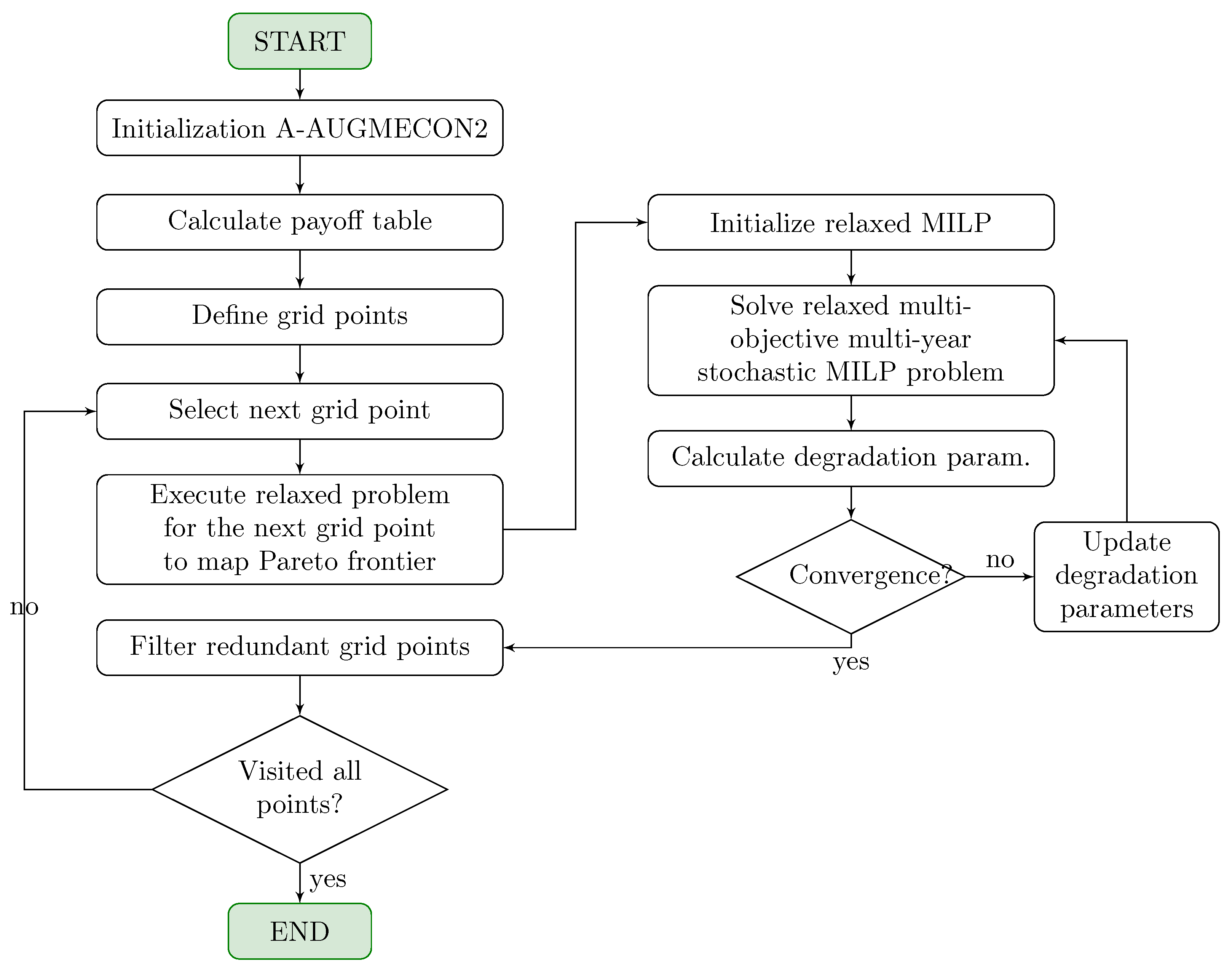
In short, the A-AUGMECON2 algorithm depicted in Figure 2 is composed of the following steps [11]:
1.
Initialize the problem;
2.
Obtain the payoff table by efficiently identifying the maximum e ¯ k and minimum e ̲ k values of the objective functions;
3.
Define the grid points by uniformly spacing the value range of each objective function in the payoff table;
4.
Iteratively identify the next grid point e k i t and solve the corresponding problem (3);
5.
Collect the results and filter possible redundant grid points;
6.
Return to point 4 and repeat until all grid points have been visited or denoted as redundant.

2.4. Iterative Stochastic Multi-Objective Planning Problem

The modeling of long-term multi-year dynamics is often highly non-linear, and its solving time is often prohibitive; hence, decomposition techniques are recommended. Moreover, since we aim at further including a multi-objective perspective and a stochastic problem formulation, efficient decomposition is needed. In this study, we first propose the iterative methodology shown on the right-hand side of Figure 2 to solve the comprehensive multi-objective multi-year stochastic planning of microgrids. Similarly to [11], the non-linearities due to asset degradation are approximated with fixed parameters in the MILP optimization model and iteratively updated till convergence. In this study, we further expand the model to incorporate the stochastic problem formulation and capacity expansion under uncertainties. The convergence of the algorithm is achieved when the variations in both the objective function and the degradation parameters fall below a small level of tolerance [11]. The following section describes the mathematical formulation of the objective functions, the constraints, and the iterative procedure adopted to address the non-linear formulation of asset degradation.

3. Mathematical Formulation

3.1. Methodology

In this section, the mathematical description of the stochastic multi-year model depicted in Figure 2 is reported, including (a) the multi-objective formulation, (b) the multi-year representation of microgrid planning, (c) capacity expansion features, (d) stochastic modeling based on scenarios, and (e) the iterative methodology to address battery degradation. To facilitate reading, the nomenclature is reported in Table 2.

3.2. Objectives

3.2.1. Economic

The NPC is represented in (4) and (5) as the sum of the initial investment costs C i I (6) for every component i and the expected cost of capacity expansion C s , i c e (7), the operation of general components C s , i o e m (8) and fuel-fired generators (9), the replacement costs C s , i r c for generators (10) and batteries (11), and the recovery value R s , i r v (12). The capacity expansion terms in (7) are discounted according to the value d h ( c ) of the first time step h ( c ) of the expansion period c.
min N P C
N P C = i A C i I + s S , i A π s ( C s , i c e + C s , i o e m + C s , i r c R s , i r v )
C i I = N i I c i i A
C s , i c e = c i c C d h ( c ) N s , c , i c e s S , i A
C s , i o e m = m i h H d h ( N i I + c C : h ( c ) h N s , c , i c e ) s S , i A A G
C s , g o e m = h H d h m g U s , h , g d g + f F s , h , g s S , g A G
C s , g r c = c g H g l i f e h H d h U s , h , g d g s S , g A G
C s , b r c = c b h H d h N b I Δ k s , h , b + c C : h ( c ) h N s , c , b c e Δ k s , c , h , b c e s S , b A B
R s , i r v = d | H | ρ | H | , i c i N i I Y i r l , I Y i l i f e + c C N s , c , i c e Y i r l , c e Y i l i f e s S , i A

3.2.2. Emissions

The global life cycle emissions of the microgrid, which are to be minimized, are modeled using (13) to account for the construction, installation, operation, and disposal of the assets. E i I & c e denotes the emissions associated with the initial installation, capacity expansion, and replacement of component i; this formulation is specifically applied to renewable assets in (14). The corresponding expressions for batteries and generators are provided in (15) and (16), respectively, both of which explicitly account for component replacement. E i o e m denotes the carbon emissions associated with the operational phase, which are non-zero only for fuel-based generators, as specified in (17). The parameter e i represents the specific emissions of each asset, while e g o p indicates the emission factor per unit of fuel consumption. F s , h , g is the fuel consumption of each generator g.
min E = i A E i I & c e + i A E i o e m
E i I & c e = N i I e i + s S , c C π s N s , c , i c e e i i A R
E b I & c e = s S , h H π s Δ k s , h , b N b I e b + s S , c C h H : h ( c ) h π s Δ k s , c , h , b c e N s , c , b c e e b b A B
E g I & c e = s S , h H π s U s , h , g I H g l i f e e g + s S , c C h H : h ( c ) h π s U s , c , h , g c e H g l i f e e g g A G
E g o e m = s S , h H π s F s , h , g e g o p g A G

3.2.3. Land Use

Local environmental impacts are considered by introducing the minimization of land requirements for the deployment of microgrid assets [20]. Land use ( L U ) is defined in (18) as proportional to the number of installed units and their specific land occupation l i .
min L U = i A N i I l i + s S , c C , i A π s N s , c , i c e l i

3.2.4. Job Creation

Despite not being optimized, the mathematical description of local job creation is also included in the model as a useful metric to monitor the local effects of microgrid investments [11,42], as discussed in Section 5. Its formulation ( J C ) is described in (19) as the sum related to the investment and capacity expansion ( J C i I & c e ) in (20) and to the operation and maintenance of assets ( J C i o e m ). The latter term is detailed in (21) for all assets but generators, whose formulation is detailed in (22). The parameter j c i I describes the specific jobs created due to the installation of each asset i, while j c i o e m details job creation for the maintenance of the assets. In the case of fuel-fired generation, j c g o e m , F denotes job creation proportional to energy production P s , h , g d g .
max J C = i A J C i I & c e + J C i o e m
J C i I & c e = N i I j c i I + s S , c C π s N s , c , i c e j c i I i A
J C i o e m = N i I j c i o e m + s S , c C π s N s , c , i c e j c i o e m i A A G
J C g o e m = s S , h H π s U s , h , g d g j c g o e m + P s , h , g d g j c g o e m , F g A G

3.3. Constraints

The major constraints of the model are reported in this section, including the stochastic capacity expansion formulation, based on [11]. Equations (23)–(27) detail the major electrical balance. Equation (23) describes the electrical balance at the node, where P s , h , b c h / d c h details the charging/discharging power of the battery with variable efficiency η s , h , b that changes over time. It is worth noting that η s , h , b is a parameter for each MILP optimization but is updated iteratively till convergence. P s , h r e n denotes the total renewable production, detailed in (26) as a function of technology r; p s , h , r r e n denotes the specific renewable production for every time step h, scenario s, and technology r; and ρ h , r denotes the linear capacity degradation rate for the renewable assets. P s , h , g d g describes the production by the fuel-fired generator unit g. D s , h represents the demand, and D s , h u denotes the curtailed demand, which is constrained by (24) and (25) to be no higher than the total energy demand.
b A B P s , h , b d c h η s , h , b P s , h , b c h η s , h , b + P s , h r e n + g A G P s , h , g d g + D s , h u = D s , h s S , h H
D s , h u D s , h s S , h H
h H D s , h u f u h H D s , h s S
P s , h r e n r A R N s , h , r p s , h , r r e n ρ h , r s S , h H
N s , h , i = N i I + c C : h ( c ) h N s , c , i c e s S , h H , i A
Equations (28)–(31) describe the constraints on the fuel consumption and power production of fuel-fired generators for every technology g taken into consideration, including a linear fuel consumption map, with slope b g and intercept a g , and reserve requirements R s , h , g d g . Parameters P ¯ g and P ̲ g denote the maximum and minimum operating points of technology g.
F s , h , g = a g U s , h , g d g + b g P s , h , g d g s S , h H , g A G
P s , h , g d g + R s , h , g d g P ¯ g U s , h , g d g s S , h H , g A G
P s , h , g d g P ̲ g U s , h , g d g s S , h H , g A G
U s , h , g d g N s , h , g s S , h H , g A G
Equations (32) to (39) denote the battery model by technology b with the multi-year stochastic formulation. The energy balance of the battery is guaranteed by (32), where Q s , h , b denotes the total energy stored in the battery. Q s , h , b is constrained to be between a maximum and minimum energy limit in (33) and (34), respectively. C s , h , b r e s models the total capacity of the battery, accounting for its degradation as stated in (35), where α s , h , b I / c e denotes the degraded capacity for installed battery technology b for scenario s, time step h, and technology b using the model described in the following subsection. The maximum depth of discharge D O D b is also considered. The power constraints for batteries are then detailed in (36)–(39), including their maximum C-rate P Q ¯ b and binary variables w d c h to avoid simultaneous charging and discharging using the Big-M formulation, selected to be sufficiently large and in agreement with the literature [11]. The equations include the modeling of the reserve requirements R s , h , b s b .
Q s , h , b = Q s , h 1 , b + P s , h , b c h P s , h , b d c h s S , h H , b A B
Q s , h , b C s , h , b r e s s S , h H , b A B
Q s , h , b N s , h , b C ¯ b ( 1 D O D b ) + R s , h , b s b s S , h H , b A B
C s , h , b r e s = N b I α s , h , b I + c C : h ( c ) h N s , c , b c e α s , c , h , b c e s S , h H , b A B
P s , h , b d c h + R s , h , b s b C s , h , b r e s P Q ¯ b s S , h H , b A B
P s , h , b c h C s , h , b r e s P Q ¯ b s S , h H , b A B
P s , h , b d c h w s , h , b d c h M s S , h H , b A B
P s , h , b c h ( 1 w s , h , b d c h ) M s S , h H , b A B
Finally, the reserve requirements R s , h to cover short-term variations in demand and renewable generation are detailed in (40). Coefficients γ i denote the reserve requirement for technology i and demand d. These will be covered by the reserve bands of the batteries and fuel-fired generators, modeled in (41).
R s , h = γ d D s , h + r A R γ r ρ h , r N s , h , r p s , h , r r e n s S , h H
R s , h g A G R s , h , g d g + b A B R s , h , b s b η s , h , b s S , h H

3.4. Non-Linear Battery Modeling

In this paper, we leverage the iterative model proposed in [11] and extend it to stochastic capacity expansion. In particular, the variable efficiency model is described by the non-linear formulation of (42) and (43); the efficiency depends on the step-wise function η ¨ , which depends on the power ratio P Q ^ s , h , b , which is calculated by post-processing the outputs of the previous MILP optimization, in accordance with Figure 2.
P Q ^ s , h , b = P ^ s , h , b c h + P ^ s , h , b d c h N ^ s , h , b C ¯ b s S , h H , b A B
η s , h , b = η ¨ b ( P Q ^ s , h , b ) s S , h H , b A B
On the other hand, the specific degradation of each battery α s , h , b I / c e in (35) non-linearly depends on the charging/discharging power and the C-rate of the battery, as described in (44). When the degraded capacity reaches the maximum degradation Δ ¯ b , the battery is replaced, and parameter Δ k s , h , b , used in (11) to capture when a replacement occurs, is updated accordingly; for capacity expansion assets, Δ k s , c , h , b c e is used. Function n ¨ describes the non-linearities with respect to the C-rate, similarly to [11]. To calculate α s , h , b I , or α s , c , h , b c e for capacity expansion, the results of the latest MILP optimization are used: the charging/discharging power of the battery ( P ^ s , h , b c h / d c h ) and the installed capacity of batteries ( N ^ s , b I and N ^ s , c , b c e ), in agreement with the procedure in Figure 2. The proposed iterative procedure to update the parameters is performed until the convergence of the objective function and the degradation parameters.
α s , c , h , b I / c e = α s , c , h 1 , b I / c e Δ ¯ b P ^ s , h , b d c h + P ^ s , h , b c h 2 n ¨ ( P Q ^ s , h , b ) D O D b α s , c , h , b I / c e Δ ¯ b C ¯ b α s , c , h , b I / c e < Δ ¯ b s S , c C , h H , b A B
The mathematical description in this section represents the main non-linearities, which, thanks to the proposed iterative model, can be easily and efficiently handled.

4. Case Study

4.1. Description

A numerical case study for the rural community of Soroti, Uganda is proposed to validate the stochastic multi-objective multi-year method presented in Section 2. The candidate technologies selected for this system are photovoltaic modules, diesel generators, and electrical storage.

4.2. Input Parameters

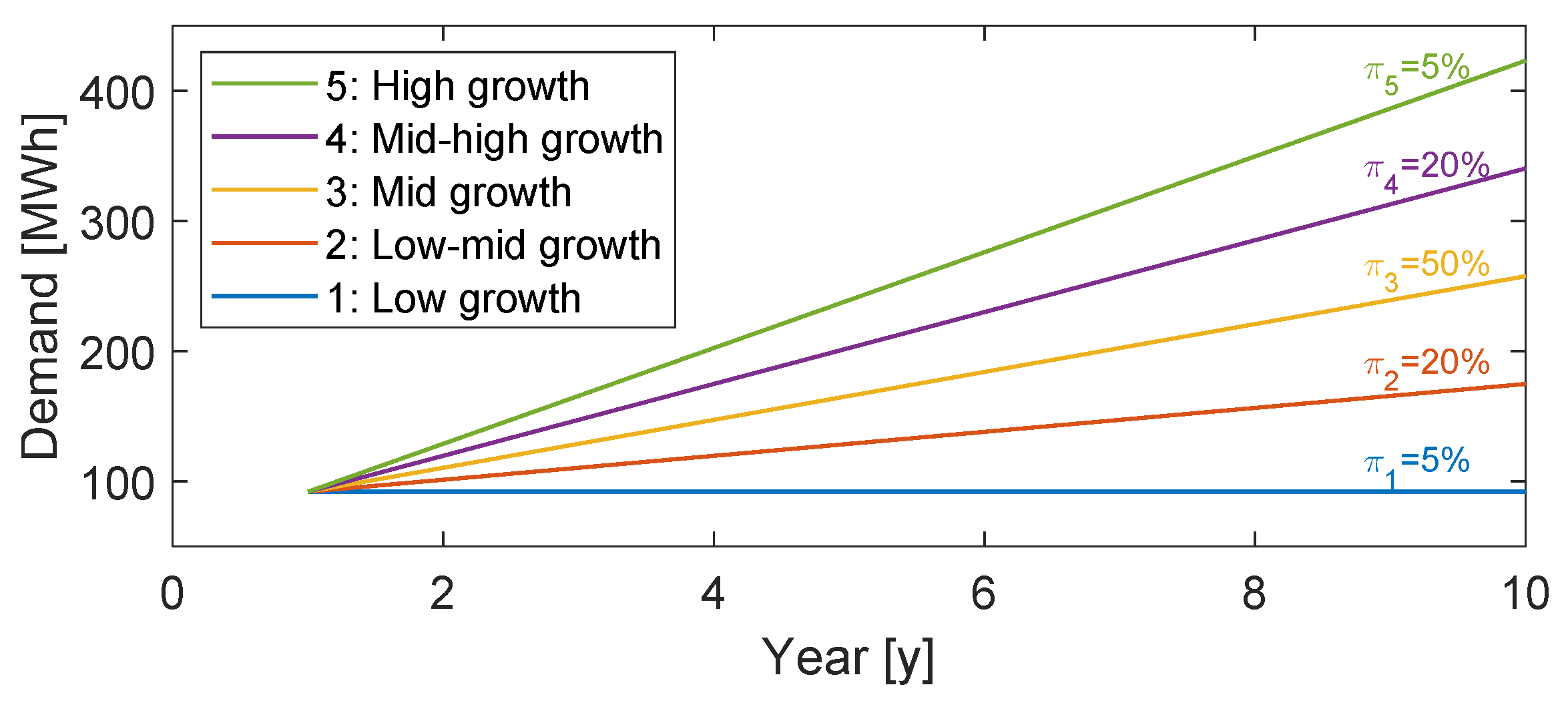
The per-unit power generation of photovoltaic systems has been derived from the Renewable.ninja platform [43]. The yearly long-term demand projections shown in Figure 3 are formulated based on the procedure developed in Section 2.2, supported by literature data [7,22]. The intermediate scenario (mid-growth in Figure 3) corresponds to the load profile adopted in [11], reproducing the social dynamics observed in [22]. As a trade-off between the accuracy of the results and the computational time, we choose five scenarios to represent the expected growth rate, in alignment with similar studies [7,23,44]. The scenarios have occurrence probabilities between 5% and 50% and growth rates from 0% (low growth) to 40% (high growth), as noted in Figure 3.
The other parameters related to the technoeconomic design and the multi-objective formulation are reported in Table 3, based on the relevant literature [6,11,23].

4.3. Test Procedure

In order to comprehensively evaluate the benefits of the proposed model, the following simulations have been performed:
  • Single-step: the approach in Section 2 is carried out with no capacity expansion ( C = );
  • Multi-step: capacity expansion is enabled at years 3 and 6 of the simulation ( | C | = 2 ).
To achieve a trade-off between the quality of the Pareto frontier and the computational time, each objective of the A-AUGMECON2 procedure has been described with 10 points. Moreover, 12 representative days for each year of simulation have been considered, in agreement with the literature [11,44], for a total of 120 days.
The problem has been formulated in GAMS 24.0.2 and solved with CPLEX, using a 6-core 3.20 GHz Intel Core i7 machine with 16 GB RAM.

5. Results

5.1. Pareto Frontier

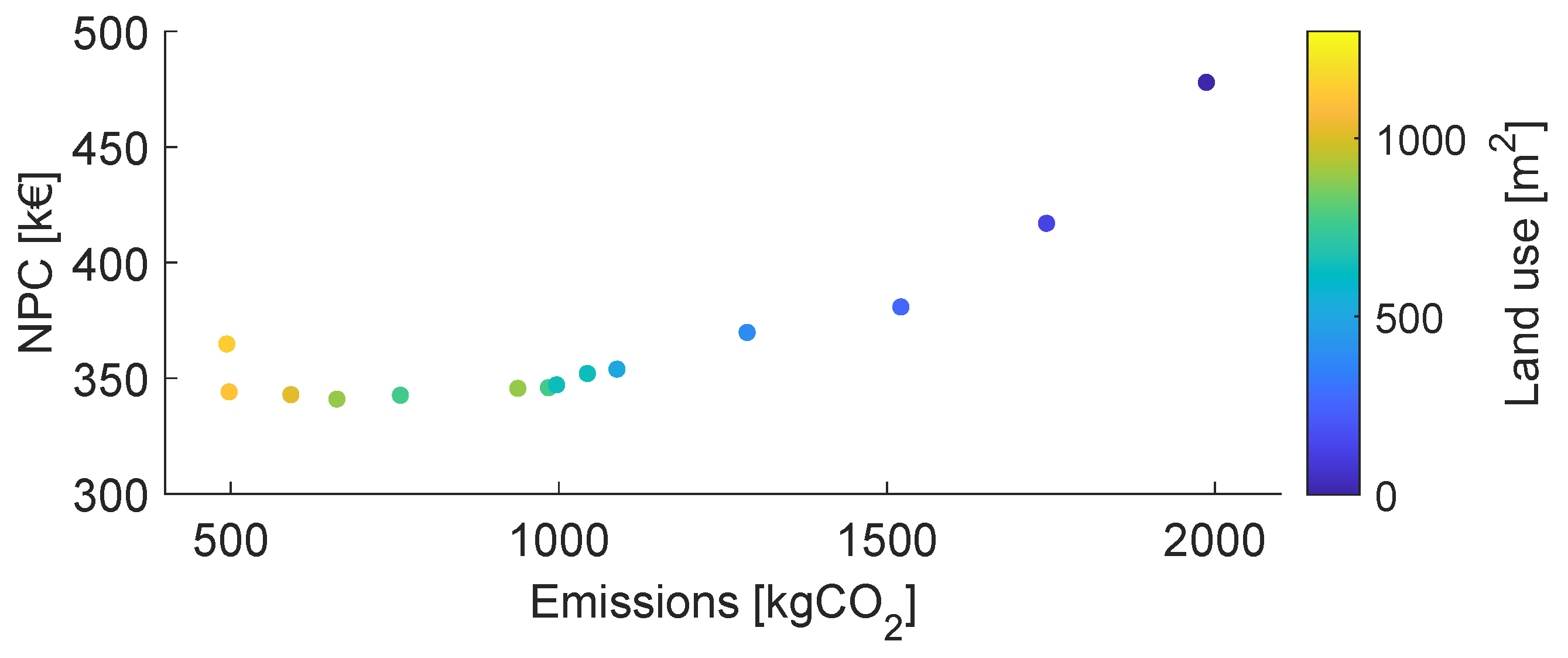
The methodology in Section 2 has successfully been applied to the case study in Section 4 and produced the Pareto frontier in Figure 4 within 52 h of computational time. This proves that, using the proposed approach, the stochastic multi-objective multi-year procedure including capacity expansion can be solved within an acceptable timeframe for planning purposes. In particular, the Pareto frontier involving economic (NPC), environmental (LCA emissions), and social (land use) objectives highlights that a lower NPC and emissions correspond to higher land use and vice versa. This suggests that economic goals tend to align with environmental goals, as points with low LCA emissions (<1000 kgCO2) are also cost-effective options (NPC < 365 k€). However, the two objectives do not match, as shown in Figure 4 and Table 4. At low emissions, however, the land use becomes significant as the renewable penetration increases at the expense of lower diesel consumption and hence emissions. These expected values are compatible with and significantly lower than those obtained with the deterministic approaches proposed and discussed in [11], hence confirming the novelty and suitability of the proposed method.
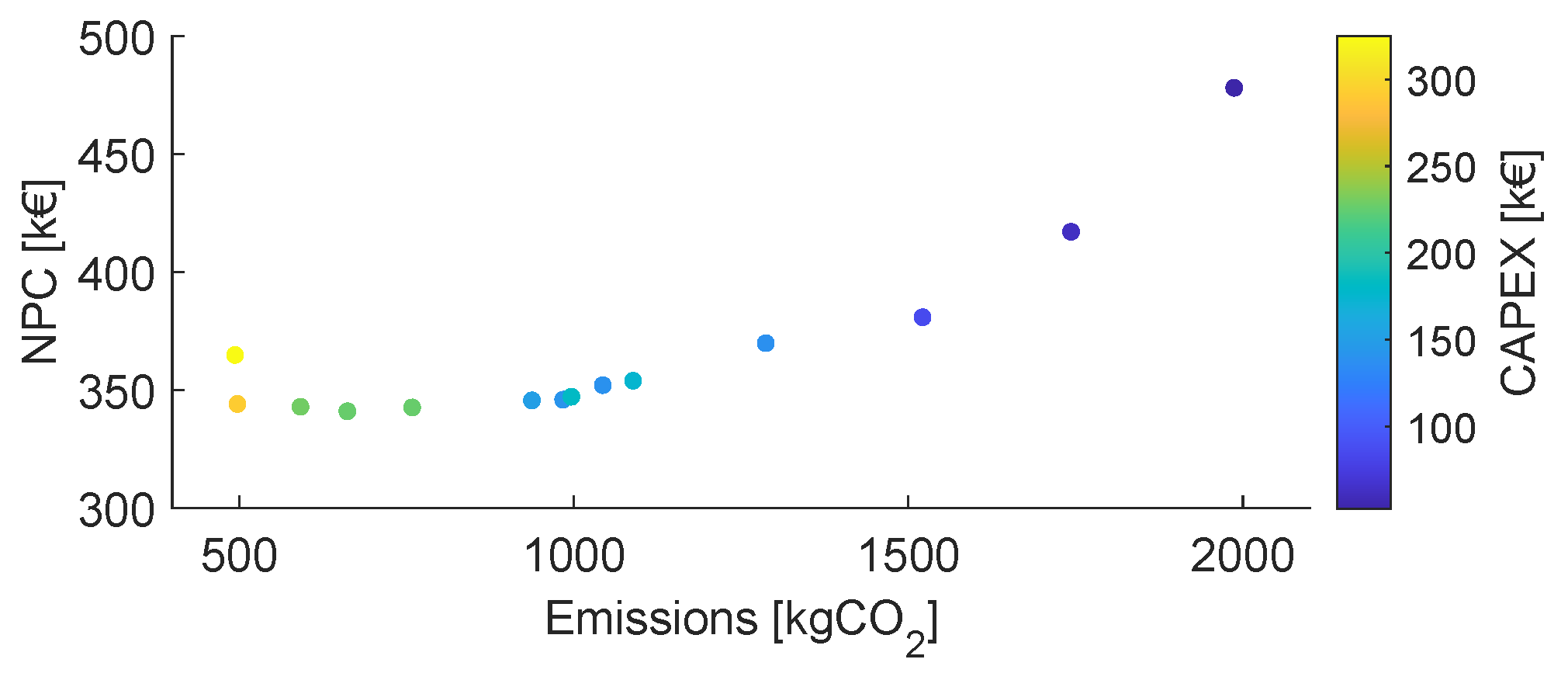
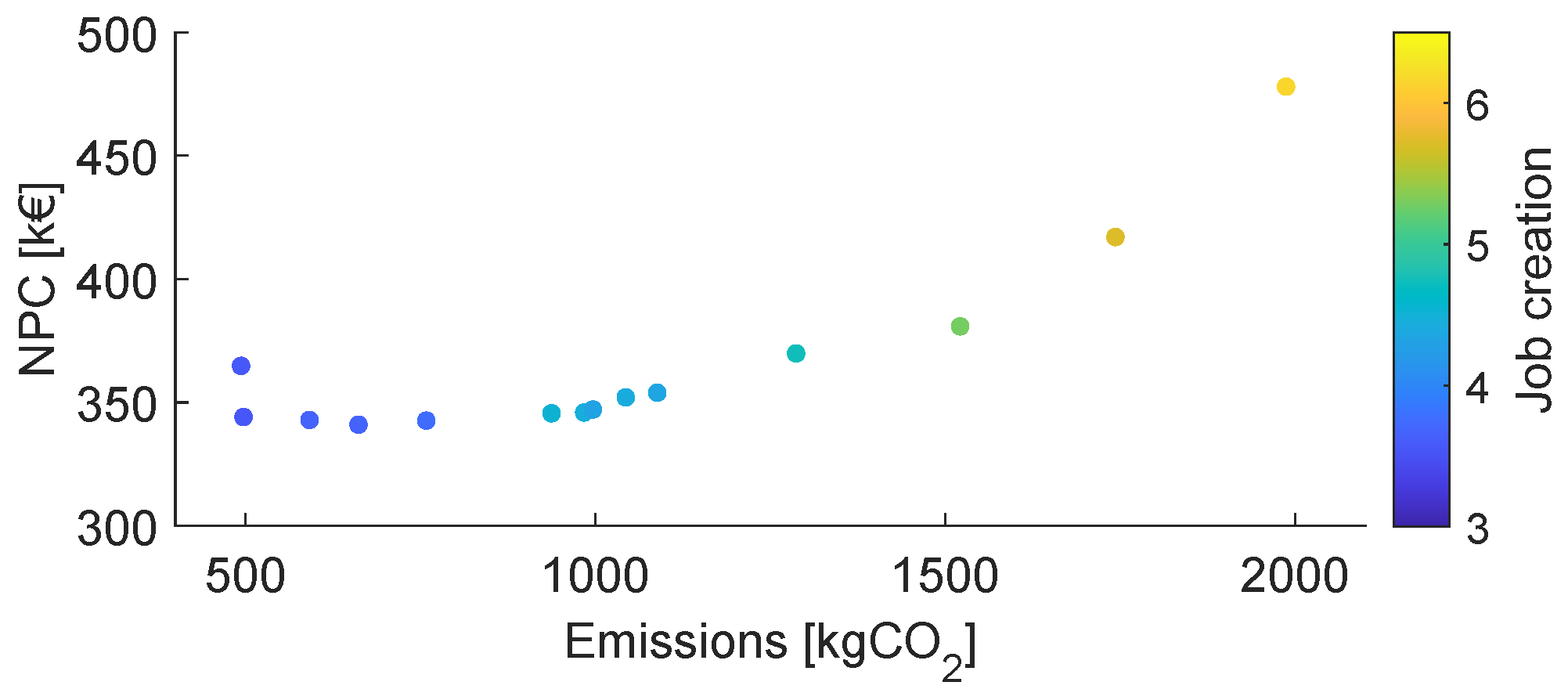
To further demonstrate the rationality of the Pareto frontier, Figure 5 and Figure 6 highlight the CAPEX and job creation values using color mapping, calculated as detailed in Section 3. The figures are comparable with Figure 4, as they share the same axes. It is found that a low environmental impact (<1000 kgCO2) corresponds to high CAPEX requirements, easily exceeding 200–300 k€ on average due to the high investments in batteries and renewable sources, which increase the risks for the developer. The multi-objective approach enables us to highlight that the region between 700 kgCO2 and 1000 kgCO2 tends to yield both good economic performance and an intermediate environmental impact. This region of the Pareto frontier enables also slightly higher local job creation, as shown in Figure 6, which is a major issue for rural areas in developing countries. This compromise can only be investigated using multi-objective procedures, and, thanks to the proposed stochastic multi-objective multi-year procedure, uncertainties are also effectively taken into consideration, contrary to traditional methods.

5.2. Capacity Expansion

To clarify the benefits of the proposed multi-step approach, we present in Table 4 the extreme solutions related to the search space obtained by A-AUGMECON2 in the problem formulation with (multi-step) and without (single-step) capacity expansion. It is found that the capacity expansions improve the quality of the results: comparing each row column-wise, the results of the multi-step approach are always better than those of the corresponding single-step case. In particular, the total system costs decrease by 10–23%. Similarly, the other objective functions decrease significantly, showing the benefits of the proposed methodology. These results are justified by the fact that, in the multi-step approach, the installation of CAPEX-intensive assets can be deferred according to the actual demand growth, depending on the actual scenario. This strengthens the robustness of the approach and enables the optimization model to better tackle the uncertain dynamics of the system. As a consequence, the initial investment in the multi-step approach is lower than in the single-step case, hence improving the financial sustainability of the project and lowering the risks for the developer. A quantitative analysis is detailed in Section 5.3.

5.3. Sizing Variables

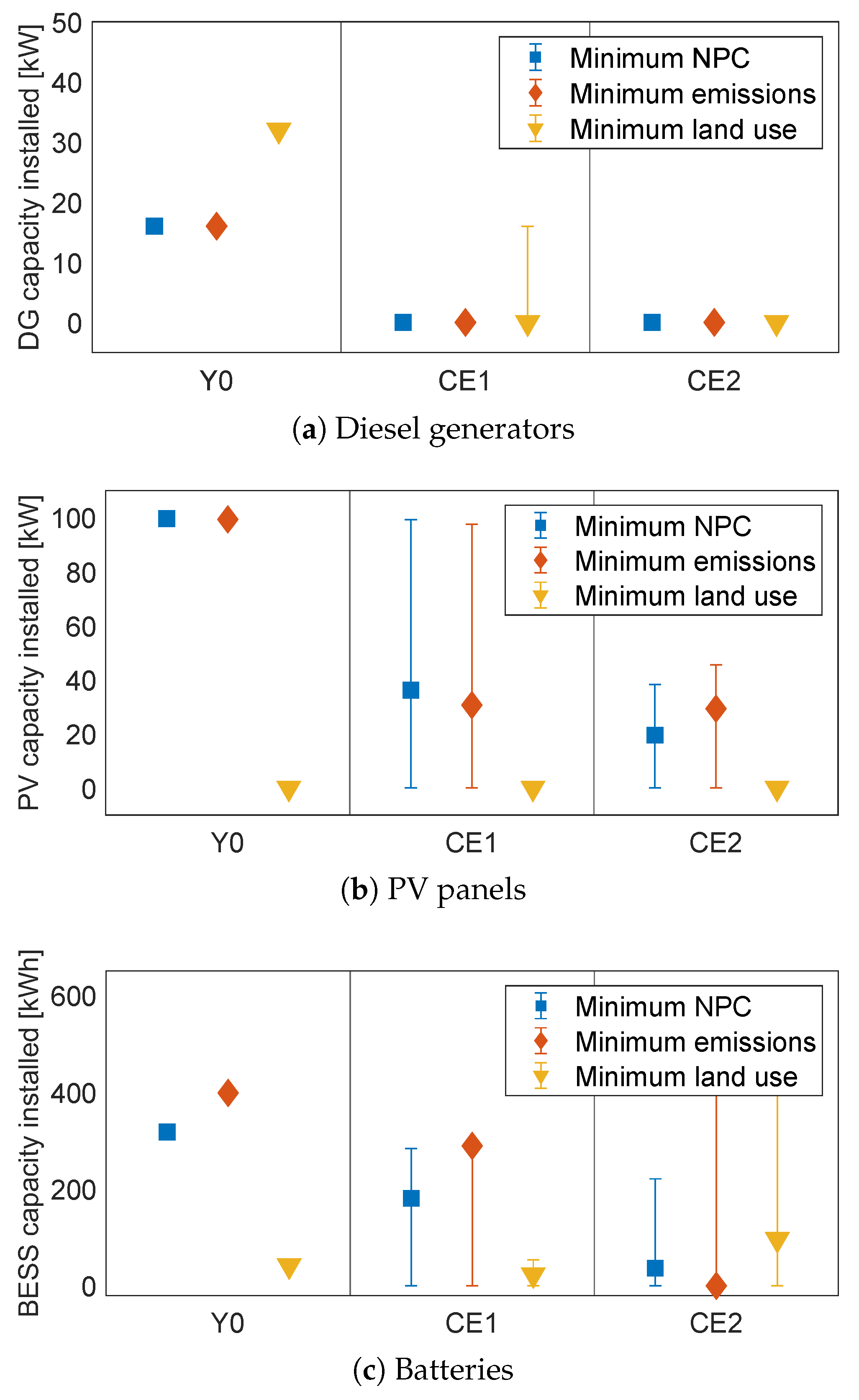
Finally, the capacities installed in the initial installation (Y0) and the capacity expansions (CE1 and CE2) of the solutions in Table 4 are reported in Figure 7. The central points denote the installation of the central scenario with 50% probability, whereas the error bars show the ranges (max–min) of capacity expansion across the five stochastic scenarios.
It is found that, in minNPC and minCO2, only one 16 kW fuel-fired unit is installed in Y0 and then all capacity expansions involve renewable energy and batteries (Figure 7a). The counterintuitive result of installing a diesel generator in minCO2 is justified by the LCA methodology, which accounts for the emissions for manufacturing: using diesel generators for a few hours is still preferable to installing a PV panel, whose generation would generally be curtailed except for a few hours. In the minLU scenario, land use is minimized; hence, no PV assets are installed (Figure 7b), and two diesel generators are needed in Y0 to meet the load; in the high-demand scenario, an additional fuel-fired unit in CE1 is also needed (Figure 7a).
Figure 7b shows the investments in photovoltaic plants. In both the minNPC and minCO2 scenarios, a 100kW PV plant is installed, yet the capacity expansion does not match, and, on average, the minCO2 investments are slightly higher to compensate for the reduced usage of the diesel generators. Interestingly, the initial investment in Y0 meets the demand for the lowest scenario, with flat behavior in minNPC and minCO2.
Finally, the investment in battery storage is shown in Figure 7c. In all scenarios, batteries play a significant role, especially in tackling uncertainties. In minNPC and minCO2, they are installed in the first year, and subsequent capacity expansion is applied to maximize the exploitation of renewable sources. In the minCO2 case, all capacity installations tend to be higher than the minNPC case to compensate for the reduced usage of diesel generators. In the minLU case, only 40 kWh is installed in Y0, solely to improve the operational flexibility of fuel-fired units. In this solution (minLU), substantial battery expansion is required to enable load shifting and fully meet the demand using the generation capacity installed in Y0.

6. Conclusions

This paper proposes a comprehensive methodology for the stochastic multi-objective multi-year planning of microgrids including dynamic capacity expansion and non-linear modeling of battery degradation. The innovative iterative methodology, nested within the A-AUGMECON2 algorithm, has been proven to efficiently handle highly complex long-term problems that could not be solved otherwise using mixed-integer linear programming. Uncertainties in demand growth are modeled using a tree-based approach and including scenario-dependent capacity expansions, which supports risk reduction for developers.
The results show that the proposed stochastic approach decreases the initial investment costs while reducing the risk of oversizing by using scenario-dependent capacity expansion. When two capacity expansions are considered, the NPC is reduced by 10 ÷ 23% as expenses are deferred.
The Pareto frontier, which typically involves several iterative optimizations, has been efficiently calculated for economic, environmental, and land use objective functions, proving the methodology’s suitability for planning and actual usage. The economic goal has been proven to be aligned with environmental goals, yet the two do not match due to the life cycle analysis methodology. Finally, when investment costs are a concern, a compromise in terms of environmental and economic goals is needed, as both goals would involve high CAPEX, which may exceed the risk faced by the developer.
This paper confirms that comprehensive energy modeling can jointly address long-term considerations, uncertainty modeling, multi-objective considerations, and capacity expansion, which is a novelty. The new methodology is confirmed to be applicable to complex problems and extendable to other case studies, and it can lay the foundation for further sector-coupled approaches and applications to large power systems, in alignment with energy transition goals.

Author Contributions

Conceptualization, D.F., M.P., A.B. and D.P.; methodology, D.F. and M.P.; software, M.P.; formal analysis, M.P.; investigation, M.P.; data curation, M.P.; writing—original draft preparation, M.P. and D.F.; writing—review and editing, D.F., M.P., A.B. and D.P.; visualization, M.P.; supervision, D.F., A.B. and D.P.; D.F and M.P. are joint first authors. All authors have read and agreed to the published version of the manuscript.

Funding

The University of Pisa has partially developed this work under the SETAsDiSMA project. The SETaDiSMA project is part of the LEAP-RE program. LEAP-RE has been funded by the European Union’s Horizon 2020 Research and Innovation program (Grant Agreement 963530).

Institutional Review Board Statement

Not applicable.

Informed Consent Statement

Not applicable.

Data Availability Statement

The original contributions presented in this study are included in the article. Further inquiries can be directed to the corresponding author.

Conflicts of Interest

The authors declare no conflicts of interest.

References

  1. IEA. World Energy Outlook 2025; Technical Report; IEA: Paris, France, 2025. [Google Scholar]
  2. Stevanato, N.; Pellecchia, G.; Sangiorgio, I.; Shendrikova, D.; Soares, C.A.; Mereu, R.; Colombo, E. Planning third generation minigrids: Multi-objective optimization and brownfield investment approaches in modelling village-scale on-grid and off-grid energy systems. Renew. Sustain. Energy Transit. 2023, 3, 100053. [Google Scholar] [CrossRef]
  3. Mehallou, A.; M’hamdi, B.; Amari, A.; Teguar, M.; Rabehi, A.; Guermoui, M.; Alharbi, A.H.; El-Kenawy, E.S.M.; Khafaga, D.S. Optimal multiobjective design of an autonomous hybrid renewable energy system in the Adrar Region, Algeria. Sci. Rep. 2025, 15, 4173. [Google Scholar] [CrossRef]
  4. Riva, F.; Tognollo, A.; Gardumi, F.; Colombo, E. Long-term energy planning and demand forecast in remote areas of developing countries: Classification of case studies and insights from a modelling perspective. Energy Strategy Rev. 2018, 20, 71–89. [Google Scholar] [CrossRef]
  5. Nguyen-Hong, N.; Nguyen-Duc, H.; Nakanishi, Y. Optimal Sizing of Energy Storage Devices in Isolated Wind-Diesel Systems Considering Load Growth Uncertainty. IEEE Trans. Ind. Appl. 2018, 54, 1983–1991. [Google Scholar] [CrossRef]
  6. Pecenak, Z.K.; Stadler, M.; Fahy, K. Efficient multi-year economic energy planning in microgrids. Appl. Energy 2019, 255, 113771. [Google Scholar] [CrossRef]
  7. Fioriti, D.; Poli, D.; Duenas-Martinez, P.; Perez-Arriaga, I. Multi-year stochastic planning of off-grid microgrids subject to significant load growth uncertainty: Overcoming single-year methodologies. Electr. Power Syst. Res. 2021, 194, 107053. [Google Scholar] [CrossRef]
  8. Lorenzoni, L.; Cherubini, P.; Fioriti, D.; Poli, D.; Micangeli, A.; Giglioli, R. Classification and modeling of load profiles of isolated mini-grids in developing countries: A data-driven approach. Energy Sustain. Dev. 2020, 59, 208–225. [Google Scholar] [CrossRef]
  9. Dufo-López, R. iHOGA 4.0 User’s Manual. 2026. Available online: https://ihoga.unizar.es/Desc/iHOGA_User_manual.pdf (accessed on 30 March 2026).
  10. Yang, X.; Yi, X.; Wang, H.; Li, L. Shared energy storage with multi-microgrids: Coordinated development and economic–social–environmental comprehensive assessment under supply–demand uncertainties. Renew. Energy 2025, 249, 123101. [Google Scholar] [CrossRef]
  11. Petrelli, M.; Fioriti, D.; Berizzi, A.; Bovo, C.; Poli, D. A novel multi-objective method with online Pareto pruning for multi-year optimization of rural microgrids. Appl. Energy 2021, 299, 117283. [Google Scholar] [CrossRef]
  12. Kamal, M.M.; Ashraf, I.; Fernandez, E. Planning and optimization of standalone microgrid with renewable resources and energy storage. Energy Storage 2023, 5, e395. [Google Scholar] [CrossRef]
  13. Fioriti, D.; Giglioli, R.; Poli, D.; Lutzemberger, G.; Micangeli, A.; Del Citto, R.; Perez-Arriaga, I.; Duenas-Martinez, P. Stochastic sizing of isolated rural mini-grids, including effects of fuel procurement and operational strategies. Electr. Power Syst. Res. 2018, 160, 419–428. [Google Scholar] [CrossRef]
  14. Balderrama, S.; Lombardi, F.; Riva, F.; Canedo, W.; Colombo, E.; Quoilin, S. A two-stage linear programming optimization framework for isolated hybrid microgrids in a rural context: The case study of the “El Espino” community. Energy 2019, 188, 116073. [Google Scholar] [CrossRef]
  15. Kharrich, M.; Mohammed, O.H.; Alshammari, N.; Akherraz, M. Multi-objective optimization and the effect of the economic factors on the design of the microgrid hybrid system. Sustain. Cities Soc. 2021, 65, 102646. [Google Scholar] [CrossRef]
  16. Koltsaklis, N.E.; Giannakakis, M.; Georgiadis, M.C. Optimal energy planning and scheduling of microgrids. Chem. Eng. Res. Des. 2018, 131, 318–332. [Google Scholar] [CrossRef]
  17. Mashayekh, S.; Stadler, M.; Cardoso, G.; Heleno, M.; Madathil, S.C.; Nagarajan, H.; Bent, R.; Mueller-Stoffels, M.; Lu, X.; Wang, J. Security-Constrained Design of Isolated Multi-Energy Microgrids. IEEE Trans. Power Syst. 2018, 33, 2452–2462. [Google Scholar] [CrossRef]
  18. Kassab, F.A.; Celik, B.; Locment, F.; Sechilariu, M.; Liaquat, S.; Hansen, T.M. Optimal sizing and energy management of a microgrid: A joint MILP approach for minimization of energy cost and carbon emission. Renew. Energy 2024, 224, 120186. [Google Scholar] [CrossRef]
  19. Zhang, Y.; Wang, J.; Berizzi, A.; Cao, X. Life cycle planning of battery energy storage system in off-grid wind-solar-diesel microgrid. IET Gener. Transm. Distrib. 2018, 12, 4451–4461. [Google Scholar] [CrossRef]
  20. Silva, D.; Nakata, T. Multi-objective assessment of rural electrification in remote areas with poverty considerations. Energy Policy 2009, 37, 3096–3108. [Google Scholar] [CrossRef]
  21. HOMER Pro. 2025. Available online: https://homerenergy.com/products/pro/docs/latest/index.html (accessed on 30 March 2026).
  22. Hartvigsson, E.; Stadler, M.; Cardoso, G. Rural electrification and capacity expansion with an integrated modeling approach. Renew. Energy 2018, 115, 509–520. [Google Scholar] [CrossRef]
  23. Stevanato, N.; Lombardi, F.; Guidicini, G.; Rinaldi, L.; Balderrama, S.L.; Pavičević, M.; Quoilin, S.; Colombo, E. Long-term sizing of rural microgrids: Accounting for load evolution through multi-step investment plan and stochastic optimization. Energy Sustain. Dev. 2020, 58, 16–29. [Google Scholar] [CrossRef]
  24. Petrelli, M.; Fioriti, D.; Berizzi, A.; Poli, D. Multi-year planning of a rural microgrid considering storage degradation. IEEE Trans. Power Syst. 2021, 36, 1459–1469. [Google Scholar] [CrossRef]
  25. Debnath, K.B.; Mourshed, M.; Chew, S.P.K. Modelling and Forecasting Energy Demand in Rural Households of Bangladesh. Energy Procedia 2015, 75, 2731–2737. [Google Scholar] [CrossRef]
  26. Hajipour, E.; Bozorg, M.; Fotuhi-Firuzabad, M. Stochastic Capacity Expansion Planning of Remote Microgrids with Wind Farms and Energy Storage. IEEE Trans. Sustain. Energy 2015, 6, 491–498. [Google Scholar] [CrossRef]
  27. Yang, J.; Su, C. Robust optimization of microgrid based on renewable distributed power generation and load demand uncertainty. Energy 2021, 223, 120043. [Google Scholar] [CrossRef]
  28. Gamarra, C.; Guerrero, J.M. Computational optimization techniques applied to microgrids planning: A review. Renew. Sustain. Energy Rev. 2015, 48, 413–424. [Google Scholar] [CrossRef]
  29. Roldán-Blay, C.; Escrivá-Escrivá, G.; Roldán-Porta, C.; Dasí-Crespo, D. Optimal sizing and design of renewable power plants in rural microgrids using multi-objective particle swarm optimization and branch and bound methods. Energy 2023, 284, 129318. [Google Scholar] [CrossRef]
  30. Fioriti, D.; Poli, D.; Duenas-Martinez, P.; Micangeli, A. Multiple design options for sizing off-grid microgrids: A novel single-objective approach to support multi-criteria decision making. Sustain. Energy Grids Netw. 2022, 30, 100644. [Google Scholar] [CrossRef]
  31. Cuesta, M.A.; Castillo-Calzadilla, T.; Borges, C.E. A critical analysis on hybrid renewable energy modeling tools: An emerging opportunity to include social indicators to optimise systems in small communities. Renew. Sustain. Energy Rev. 2020, 122, 109691. [Google Scholar] [CrossRef]
  32. World Resources Institute. Strategies for Expanding Universal Access to Electricity Services for Development; World Resources Institute: Washington, DC, USA, 2017. [Google Scholar]
  33. Li, L.; Mu, H.; Li, N.; Li, M. Economic and environmental optimization for distributed energy resource systems coupled with district energy networks. Energy 2016, 109, 947–960. [Google Scholar] [CrossRef]
  34. Martínez-Gomez, J.; Peña-Lamas, J.; Martín, M.; Ponce-Ortega, J.M. A multi-objective optimization approach for the selection of working fluids of geothermal facilities: Economic, environmental and social aspects. J. Environ. Manag. 2017, 203, 962–972. [Google Scholar] [CrossRef]
  35. Zhong, J.; Yu, T.E.; Clark, C.D.; English, B.C.; Larson, J.A.; Cheng, C.L. Effect of land use change for bioenergy production on feedstock cost and water quality. Appl. Energy 2018, 210, 580–590. [Google Scholar] [CrossRef]
  36. Chiandussi, G.; Codegone, M.; Ferrero, S.; Varesio, F.E. Comparison of multi-objective optimization methodologies for engineering applications. Comput. Math. Appl. 2012, 63, 912–942. [Google Scholar] [CrossRef]
  37. Jabbarzadeh, A.; Fahimnia, B.; Rastegar, S. Green and Resilient Design of Electricity Supply Chain Networks: A Multiobjective Robust Optimization Approach. IEEE Trans. Eng. Manag. 2019, 66, 52–72. [Google Scholar] [CrossRef]
  38. Mavrotas, G. Effective implementation of the ϵ-constraint method in Multi-Objective Mathematical Programming problems. Appl. Math. Comput. 2009, 213, 455–465. [Google Scholar] [CrossRef]
  39. Mavrotas, G.; Florios, K. An improved version of the augmented s-constraint method (AUGMECON2) for finding the exact pareto set in multi-objective integer programming problems. Appl. Math. Comput. 2013, 219, 9652–9669. [Google Scholar] [CrossRef]
  40. Mandelli, S.; Merlo, M.; Colombo, E. Novel procedure to formulate load profiles for off-grid rural areas. Energy Sustain. Dev. 2016, 31, 130–142. [Google Scholar] [CrossRef]
  41. Ssewanyana, S.; Kasirye, I. Poverty and Inequality Dynamics in Uganda: Insights from the Uganda National Panel Surveys 2005/6 and 2009/10; Research Series; Economic Policy Research Centre: Kampala, Uganda, 2012. [Google Scholar]
  42. Dufo-López, R.; Cristóbal-Monreal, I.R.; Yusta, J.M. Optimisation of PV-wind-diesel-battery stand-alone systems to minimise cost and maximise human development index and job creation. Renew. Energy 2016, 94, 280–293. [Google Scholar] [CrossRef]
  43. Pfenninger, S.; Staffell, I. Long-term patterns of European PV output using 30 years of validated hourly reanalysis and satellite data. Energy 2016, 114, 1251–1265. [Google Scholar] [CrossRef]
  44. Poncelet, K.; Hoschle, H.; Delarue, E.; Virag, A.; Drhaeseleer, W. Selecting representative days for capturing the implications of integrating intermittent renewables in generation expansion planning problems. IEEE Trans. Power Syst. 2017, 32, 1936–1948. [Google Scholar] [CrossRef]
Figure 1. Microgrid topology.
Sustainability 18 03785 g001
Figure 2. The proposed stochastic multi-objective multi-year optimization method via A-AUGMECON2.
Sustainability 18 03785 g002
Figure 3. Long-term demand scenarios with occurrence probability π s .
Sustainability 18 03785 g003
Figure 4. Pareto frontier of NPC (color map), emissions (x-axis), and land use (y-axis).
Sustainability 18 03785 g004
Figure 5. Investment costs of the Pareto points.
Sustainability 18 03785 g005
Figure 6. Job creation of the Pareto points.
Sustainability 18 03785 g006
Figure 7. Assets installed in the extreme configurations of Table 4 for the initial installation (Y0) and the two capacity expansions (CE1 and CE2).
Sustainability 18 03785 g007
Table 1. Comparison of modeling features in relevant microgrid planning studies; columns reflect methodological characteristics considered in each work (rows), with check marks indicating coverage.
MethodMulti-Year DynamicsMulti-Objective Optim.Long-Term Unc.
One-Shot MILP Load GrowthRES DegradationBESS Degradation EconomicEnvironmentalSocial Demand UncertaintiesCapacity Expansion
[12,13,14]
[15]
[16]
[17]
[18]
[19]
[20]
[10]
[21]
[5]
[2]
[6,22]
[23]
[24]
[9]
[7]
[11]
This paper
Table 2. Definitions of indices, parameters, and variables for the stochastic multi-year microgrid planning model.
SymbolDescriptionUnit
Indices
h H Time steps
s S Scenarios
i A Components
g A G Fuel-fired generators
b A B Battery storage technologies
r A R Renewable technologies
c C Capacity expansion periods
h ( c ) Time step when expansion c occurs
Parameters
π s Scenario probability[-]
MBig constantkW
c i Unit capital cost€/kW
m i Unit maintenance cost€/kW·yr
d h Annualization factor-
Y i l i f e Lifetime of component iy
Y i r l , I Residual lifetime of initial unitsy
Y i r l , c e Residual lifetime of expansion unitsy
ρ h , r Degradation status of renewable asset r-
ρ | H | , i Residual value factor at end of horizon-
e i Installation emissions per unitkgCO2
e g o p Emissions per unit of fuel consumptionkgCO2
l i Land occupation per unitm2
j c i I Jobs created per installationjobs
j c i o e m Jobs from O&Mjobs
j c g o e m , F Jobs per generator energy productionjobs/kWh
a g , b g Coefficients of fuel consumptionL/kW, L/kWh
fUnit fuel cost€/L
H g l i f e Generator lifetime operating hoursh
P ¯ g Maximum generator powerkW
P ̲ g Minimum generator powerkW
p s , h , r r e n Capacity factor of renewable generation-
f u Maximum unmet demand fraction-
γ d Reserve coefficient for demand-
γ r Reserve coefficient for renewables-
C ¯ b Nominal battery capacitykWh
D O D b Maximum depth of discharge-
P Q ¯ b Maximum battery C-ratekWh−1
Δ ¯ b Maximum battery degradation-
η s , h , b Battery efficiency parameter-
η ¨ b ( · ) Efficiency function of power ratio-
n ¨ ( · ) Non-linear degradation function-
ϵ Small penalty coefficient (AUGMECON2)-
D s , h Electricity demandkWh
Variables
N P C Net present cost
ETotal life cycle emissionskgCO2
L U Total land usem2
J C Total job creationjobs
C i I Initial investment cost
C s , i c e Capacity expansion cost
C s , i o e m Operation and maintenance cost
C s , i r c Replacement cost
R s , i r v Residual value
E i I & c e Emissions for installation and expansionkgCO2
E i o e m Operational emissionskgCO2
N i I Number of initially installed units-
N s , c , i c e Units installed in expansion stage-
N s , h , i Total installed units-
U s , h , g d g Active generator units-
P s , h , g d g Power produced by generatorskW
R s , h , g d g Reserve provided by generatorskW
F s , h , g Fuel consumptionL
P s , h r e n Total renewable generationkW
P s , h , b c h Battery charging powerkW
P s , h , b d c h Battery discharging powerkW
R s , h , b s b Reserve provided by batterieskW
Q s , h , b Energy stored in batterieskWh
C s , h , b r e s Aggregate battery capacitykWh
w s , h , b d c h Binary charging/discharging variable{1,0}
D s , h u Unmet demandkW
R s , h Total reserve requirementkW
α s , h , b I Factor of degraded battery capacity-
α s , h , b c e Factor of degraded capacity (expansion)-
Δ k s , h , b Battery replacement indicator-
Δ k s , c , h , b c e Replacement indicator (expansion)-
P Q ^ s , h , b Battery power ratio-
s i Slack variable for objective ivaries
e i i t Target value of objective ivaries
f i ( x ) Objective function ivaries
Table 3. Major technoeconomic parameters.
SymbolPV PanelFuel GensetBattery
Unit size 1 kW16 kW1 kWh
Invest. c i 1.1 k€11 k€0.4 k€
OEM m i 10 €/y0.21 €/h10 €/y
Lifetime Y i l i f e 20 y15 kh15 y
Emissions e i 2.47  kgCO 2 W 0.19  kgCO 2 W 56.5  kgCO 2 kWh
Fuel emiss. e g o p -3.15  kgCO 2 L -
Land use l i 7.1  m 2 kW  0.15 m 2 kW
Jobs CAPEX j c i I / c e 13.5 jobs MW 2.1 jobs MW -
Jobs OEM j c i o e m 7.3 jobs MW 2.0 jobs MW -
Jobs fuel j c i o e m , F -2.9 jobs GWh -
Table 4. Extreme configurations of the search space obtained in the case of single-step and multi-step investments using A-AUGMECON2; uncertainty bands in the design are shown in Figure 7.
Single-Step Multi-Step
NPCCO2LU NPCCO2LU
[k€][kgCO2][m2] [k€][kgCO2][m2]
minNPC382640932 3444971112
minCO24445541189 3654941143
minLU61720067 47819875
Disclaimer/Publisher’s Note: The statements, opinions and data contained in all publications are solely those of the individual author(s) and contributor(s) and not of MDPI and/or the editor(s). MDPI and/or the editor(s) disclaim responsibility for any injury to people or property resulting from any ideas, methods, instructions or products referred to in the content.