Article

Integrated Fuzzy AHP-Weighted Sum Model for Sustainable Wind Power Plant Site Selection in Bergama Region


by
Pinar Mizrak Ozfirat
1,*,
Kinga Stecuła
2,*,
A. Kemal Eyuboglu
3,
M. Kemal Ozfirat
4 and
Mustafa E. Yetkin
4
1
Industrial Engineering Department, Manisa Celal Bayar University, 45040 Manisa, Türkiye
2
Department of Production Engineering, Faculty of Organization and Management, Silesian University of Technology, Akademicka 2A, 44-100 Gliwice, Poland
3
Bergama Vocational School, Department of Alternative Energy Sources, Dokuz Eylül University, Bergama, 35700 İzmir, Türkiye
4
Department of Mining Engineering, Dokuz Eylul University, Buca, 35390 İzmir, Türkiye
*
Authors to whom correspondence should be addressed.
Sustainability 2026, 18(4), 1950; https://doi.org/10.3390/su18041950
Submission received: 8 January 2026 / Revised: 2 February 2026 / Accepted: 11 February 2026 / Published: 13 February 2026

Abstract

The growing global demand for energy, driven by population growth and industrial development, has increased the importance of renewable sources such as wind energy. In this context, Türkiye has made remarkable progress in expanding its wind energy capacity, particularly in the Aegean Region. The Bergama district, located in the northern part of İzmir, stands out as a promising area for sustainable wind power plant investments due to its favorable average wind speeds of 8–9 m/s measured at a hub height of 100 m. This study proposes an intelligent fuzzy multi criteria decision framework to determine the most suitable sites for wind power plant installation in the Bergama region. The evaluation process is structured around four main criteria, economic, technical, environmental, and social, each comprising five sub-criteria. Six alternative locations are comparatively assessed using an integrated Fuzzy Analytic Hierarchy Process and Fuzzy Weighted Sum Model approach. The combined model enabled effective handling of uncertainty in decision parameters and provided a consistent ranking of alternatives. Based on the results, Site 6 emerged as the most suitable location due to its superior wind resource characteristics, technical feasibility, and accessibility advantages, and the proposed approach offers a decision support framework for regional planners to guide strategic wind energy development.

1. Introduction

Türkiye possesses considerable advantages in wind energy potential, owing to its geographical position and climatic diversity. Surrounded by seas on three sides and characterized by varied topography and elevation differences, the country provides highly favorable conditions for wind power generation. In recent years, the wind energy sector in Türkiye has undergone significant expansion, driven by the global shift toward renewable energy and the nation’s strategic goal of reducing dependence on imported energy sources.
According to the latest statistics published by the Turkish Wind Energy Association, Türkiye’s technical wind energy potential is estimated at approximately 48,000 MW [1]. This potential, however, is not uniformly distributed across the country. The Aegean Region, particularly the provinces of Izmir, Balıkesir, and Canakkale, exhibits the highest wind energy potential. Several other regions, including parts of the Marmara, Mediterranean, and Central Anatolia regions, also demonstrate notable wind energy capacity, although to a comparatively lower extent.
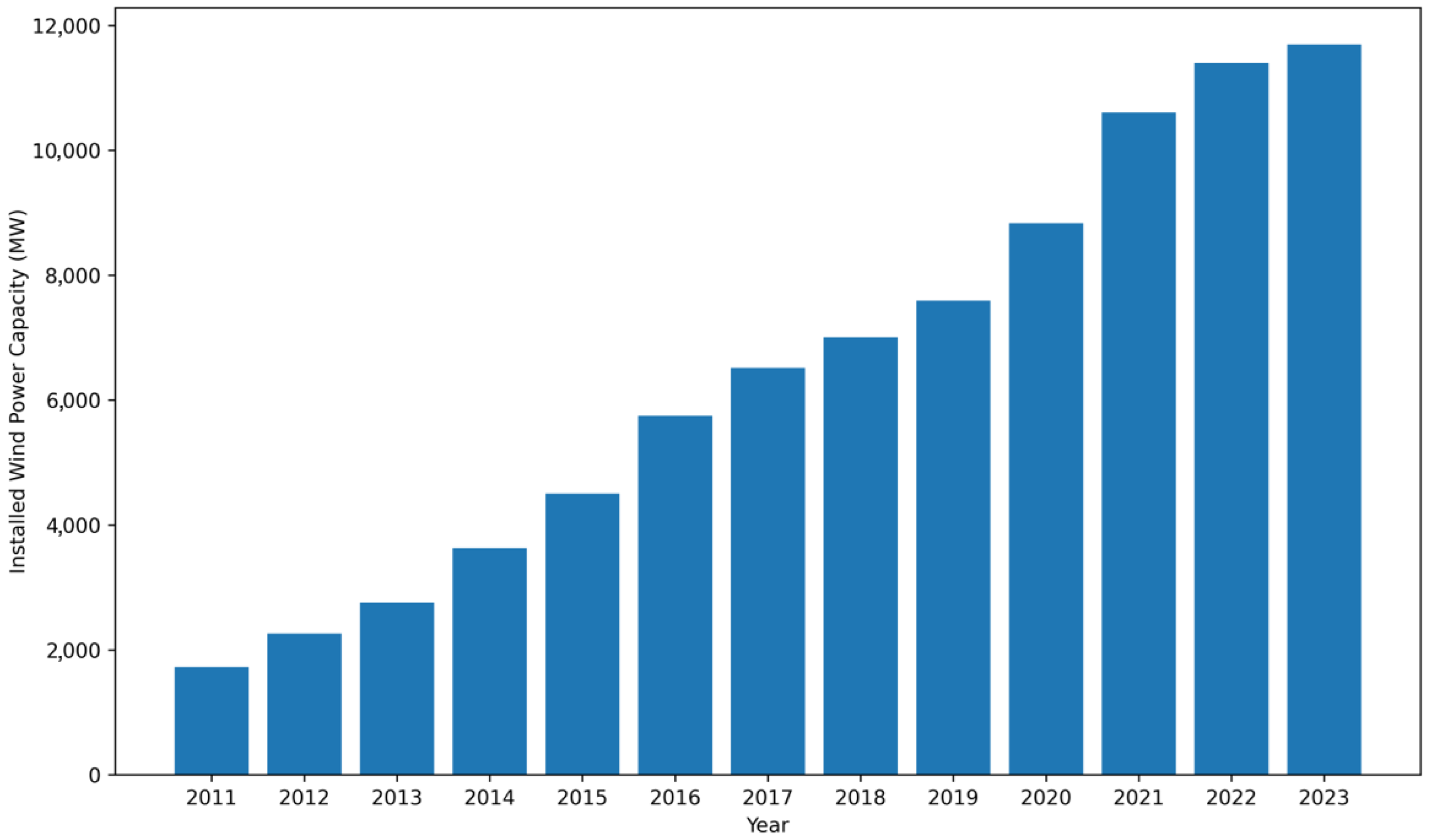
As of the end of 2023, Türkiye’s total installed wind energy capacity reached 11,654 MW, accounting for nearly 10% of the country’s total electricity generation [2]. Over the past 15 years, the wind energy sector in Türkiye has experienced a significant transformation driven by supportive energy policies and increasing investment in renewable technologies. Installed capacity increased from only 20 MW in 2005 to 1320 MW in 2010, followed by a rapid expansion to 4718 MW in 2015, 8832 MW in 2020, and finally 11,654 MW in 2023 [3]. This sustained growth trend highlights Türkiye’s commitment to expanding wind energy as a key component of its renewable energy strategy and reflects broader global shifts toward low carbon energy systems, as illustrated in Figure 1.
Most of the wind power plants in Türkiye currently consist of onshore turbines. In recent years, technological advances have facilitated the deployment of higher capacity and more efficient turbine systems [3]. The Ministry of Energy and Natural Resources is presently developing a 2 GW offshore wind power project in the Black Sea, as outlined in the TUBİTAK Wind Energy Technologies Roadmap [5]. At the same time, domestic production of wind turbine components has increased, contributing to industrial development and reducing external dependency.
Türkiye’s future wind energy development trajectory is closely aligned with global renewable energy targets. According to national planning documents, the country aims to reach an installed wind power capacity of 16,000 MW by 2027, 24,000 MW by 2030, and 29,000 MW by 2035 [3,6]. Also, a number of European Union member states stand out for generating high shares of electricity from renewable resources [7,8]. Therefore, Türkiye’s renewable energy policies increasingly reflect international sustainability objectives and climate neutrality targets.
The motivation of this study arises from the need to support regional wind energy planning through an effective decision support structure. Instead of relying on single factor assessments, the study adopts a multi criteria perspective that simultaneously considers economic, technical, environmental, and social dimensions of site suitability under uncertain conditions. Selecting an appropriate location for wind power plant installation is a critical task due to high initial investment costs and the need to ensure long term technical and economic feasibility. Wind energy projects require site conditions that support stable energy production while remaining compatible with environmental and social constraints. Consequently, site selection decisions must be based on systematic evaluation approaches capable of balancing multiple and often conflicting criteria. To address this requirement, an integrated fuzzy multi criteria decision support framework is employed. The Fuzzy Analytic Hierarchy Process (FAHP) is used to determine the relative importance of evaluation criteria based on expert judgments, while the Fuzzy Weighted Sum Model (FWSM) is applied to rank alternative locations according to their overall performance. This integrated structure enables consistent criteria and alternative site comparisons.
Despite the rapid expansion of wind energy capacity, the effective utilization of this potential strongly depends on appropriate site selection practices. In this context, the contribution of the present study lies in presenting a region specific and practically applicable framework for evaluating wind power plant locations. The proposed approach integrates economic, technical, environmental, and social criteria within a unified fuzzy multi criteria structure, in which environmental and social aspects operate as suitability constraints alongside technical feasibility. By focusing on the Bergama region, which already hosts active wind power installations, the study provides insights that may be beneficial for regional stakeholders involved in wind energy investment planning. Furthermore, by integrating fuzzy logic into the analytic hierarchy process (AHP) and weighted sum model (WSM), the methodology becomes more reliable and robust to human error. Though it can easily be adapted to other sites and applications.

2. Sustainability and Wind Power Studies

In today’s developed world, human development and technological progress have accompanied people throughout history. New eras bring new inventions, discoveries, and advances. We are currently living in the Fourth Industrial Revolution (Industry 4.0), which, like every revolution, is associated not only with rapid technological changes but also with social and economic ones. These changes also influence human lifestyles as well as digital and environmental awareness. The dynamic development of technology, engineering, automation, and industry have also impacted the natural environment. The impact of human activity, especially in energy production, has a huge impact on the entire ecosystem. Changes in the hydrosphere [9], atmosphere [10] and biosphere [11] can be observed, with also negative effects on human health. Many countries still rely a lot on non-renewable energy sources, such as hard coal, lignite, and crude oil. This further increases pressure on the environment. For this reason, it is crucial to look for alternative solutions for heat and electricity production through the development of renewable energy sources. These solutions minimize the negative impacts of human activity.
In terms of sustainable development, keeping the balance between three pillars is crucial: the economy, society, and the environment [12]. This means that economic growth, despite that it is essential, cannot be achieved with natural degradation at the same time. Actions undertaken in the industrial and energy sectors should take into account social needs and the need to protect the natural environment. Trying to achieve harmony between these three elements is important for responsible and sustainable development.
For this reason, a growing number of initiatives are being undertaken, aimed at both the development and efficient use of renewable energy sources. The most important renewable energy sources include solar energy, wind energy, hydropower (including river hydropower, tidal energy, and wave energy), geothermal energy, and energy obtained from biomass and biogas. These sources have a significantly lower environmental impact than fossil fuels. Renewable energy sources are playing an increasingly important role in energy transition, constituting a key element in achieving climate and sustainable development goals. This article focuses on wind energy, and therefore the following sections will address it.
It should be noted that a lot of research is being conducted in the field of wind energy, and these studies are published on popular scientific databases. The Scopus database includes many papers which deal with the topic of wind energy. To present the most important numbers in this term, we used the search engine in the Scopus database. The authors focused on articles that have keywords “wind power” or “wind energy”. The search formula is written as follows—Equation (1):
KEY (“wind power”) OR KEY (“wind energy”) AND PUBYEAR > 2005 AND PUBYEAR < 2026
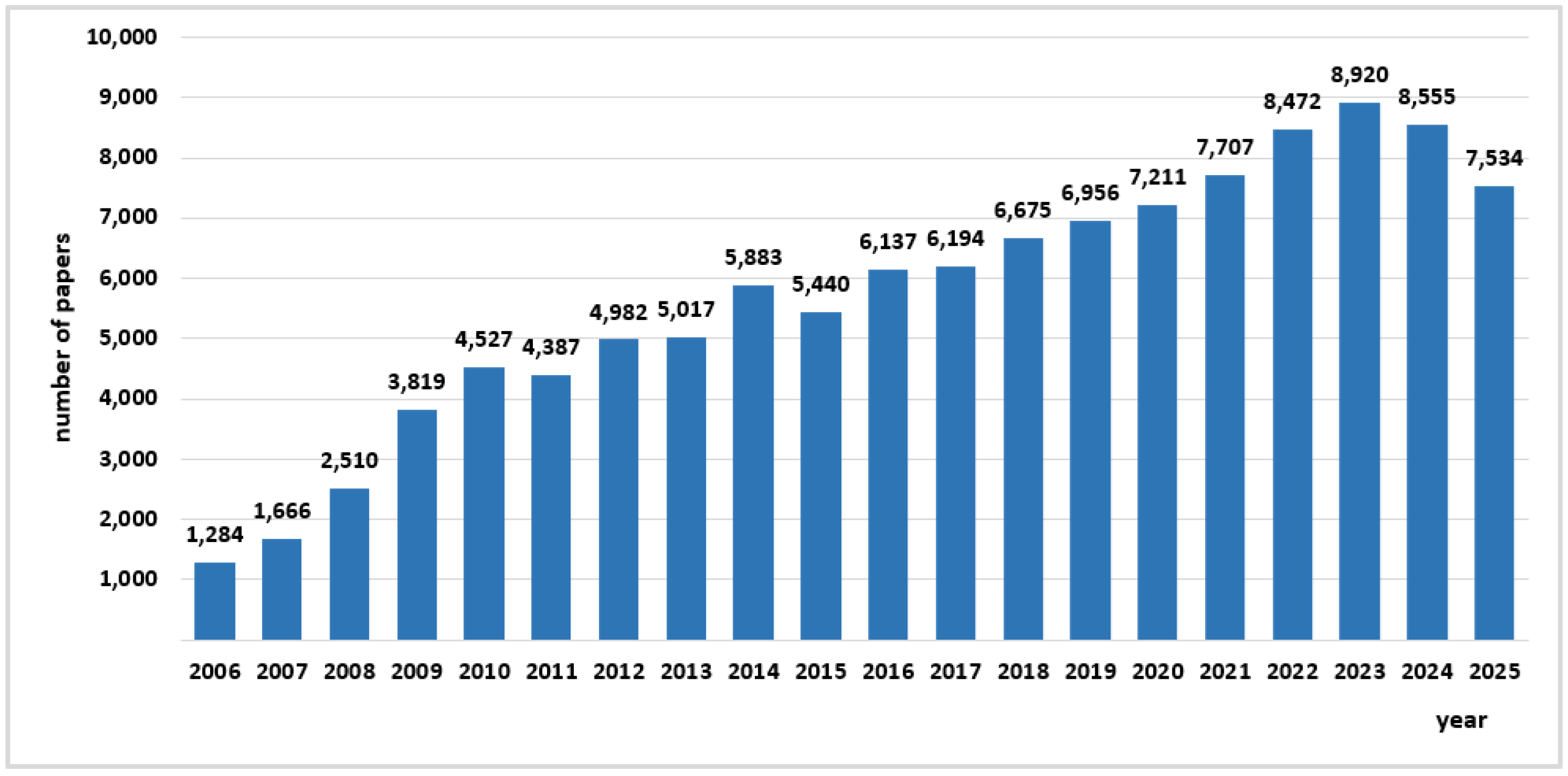
The search covered the last 20 years, but data for 2025 are incomplete because the analysis results were due on 13 December 2025. It should also be noted that publications are entered into the database with a delay, so all data for 2025 will be included in the database after some time. As of the day of analysis, 7534 articles with the mentioned keywords were indexed in the Scopus database. The total number of articles from 2006 to 2025 was 113,876. Over the last 20 years, the number of articles in the database has been on the rise. In 2006, there were 1284 articles. In subsequent years, the number of articles increased. In 2011, the number decreased slightly compared to 2010. A similar situation occurred in 2015 compared to 2014. However, between 2015 and 2023, the number of articles increased year by year. In 2023, the number reached 8920 articles on the researched topic. In 2024, the number is slightly lower at 8555. These data prove that over the last 20 years, awareness and scientific interest in the topic of wind energy have been growing, so it can be said that there has been development in the subject of this type of renewable energy source in the scientific context. Figure 2 shows the analyzed data.
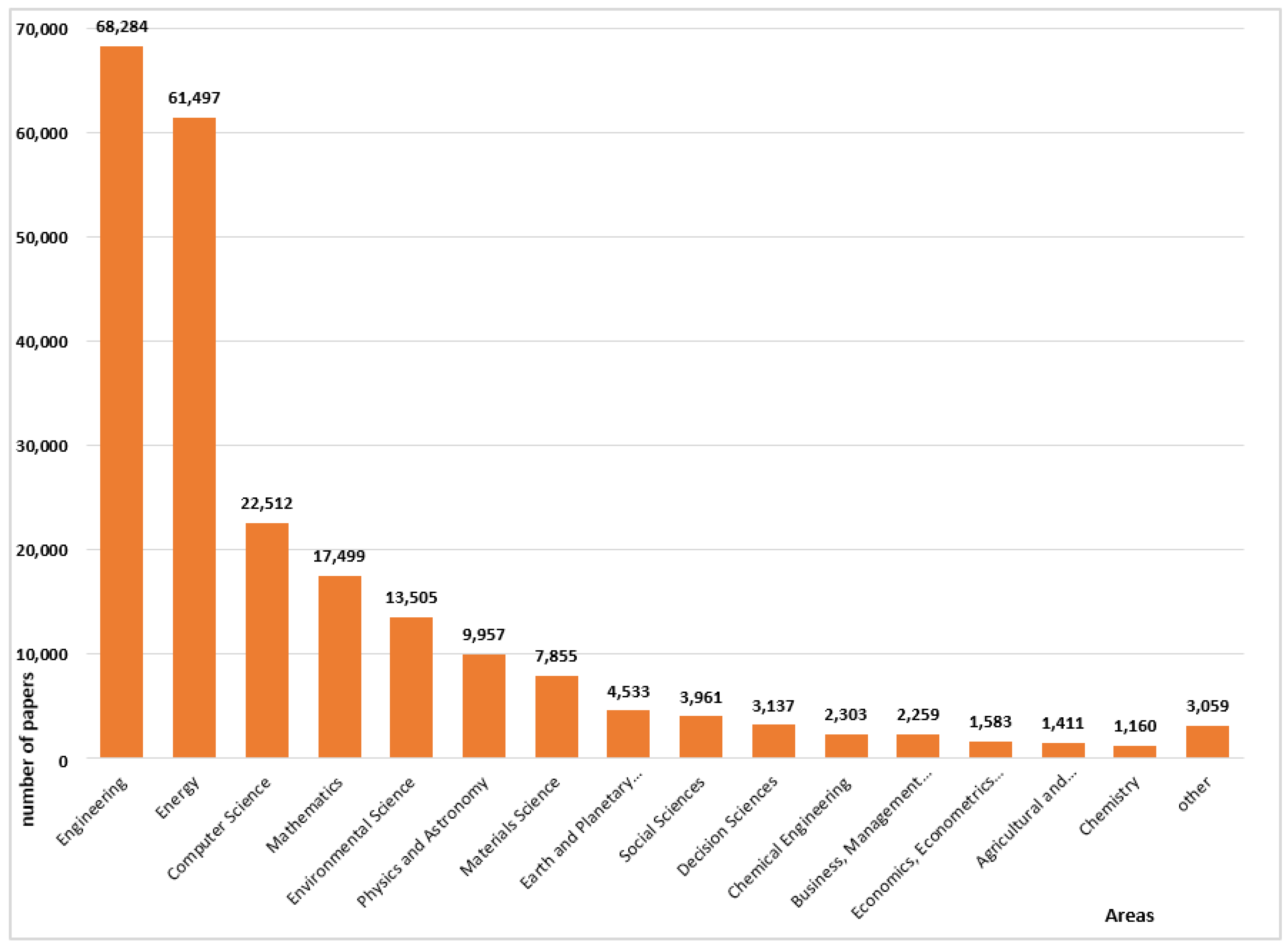
The Scopus database also allows for thematic segregation of analyzed articles. An analysis of the number of articles assigned to specific research areas indicates a clear dominance of Engineering sciences, which comprises 68,284 publications. Among these papers, there are papers published in 2025, for example, on wind energy harvesters’ technology [13,14], wind power monitoring [15] or fault diagnosis of wind turbines [16,17].
Energy science ranks second with 61,497 articles, underscoring the growing importance of energy-related research, including renewable energy sources, energy efficiency, and energy transition. Publications from 2025 in this field include for example the following topics: global power trade networks [18], usage of AI and special algorithms [19,20], wind power prediction [21], and optimizing off-grid wind systems with battery and water storage [22]. In addition, as renewable energy resources and especially wing energy is getting more into use, energy storage becomes also an important issue and receives more attention in research [23,24,25].
Computer Science (22,512 articles) and Mathematics (17,499 articles) also have a significant share in the publication structure, indicating a strong connection between the analyzed field and modeling, simulation, and computational methods. In 2025, there is for instance research on model for short-term wind speed prediction [26], wind power forecasting accuracy under extreme weather [27], improvement of fast simulation methods of the flow field in vertical-axis wind turbine wind farms [28], wind power prediction based on hybrid deep learning and Monte Carlo simulation [29], and more.
Environmental Science also has a significant share (13,505 articles), confirming the interdisciplinary nature of the research and its connection to environmental protection and sustainable development. Examples of publications in this area include: navigating towards environmental sustainability assessments of offshore wind farms at the end of life [30], high-value recycling strategies for retired wind turbine blades [31], and comparisons of renewable energy implementation in different regions [32].
Further areas, such as Physics and Astronomy (with 9957 publications, for example about a machine learning model for hub-height short-term wind speed prediction [33] and equilibrium optimizer-based double integral sliding mode maximum power point tracking for wind energy [34]), Materials Science (with 7855 papers, for instance, a paper from 2025 on aerogel-based evaporator prepared from waste wind turbine blades [35]), and Earth and Planetary Sciences (with 4533 articles, for example, a study on soil resistance during vibratory pile installation [36]) demonstrate a strong base of fundamental and material sciences, essential for the development of modern energy technologies.
A smaller but still significant share is held by the Social Sciences area (3961) and Decision Sciences area (3137). For example, there are papers presenting wind power development by regional newspapers in Northern Sweden and Finland [37] and the potential path disturbing effect induced by the offshore wind energy technology [38]. Then, there is the Chemical Engineering area (2303). Subsequently, there are fields such as Business, Management and Accounting (2259) and Economics, Econometrics, and Finance (1583), with examples of papers on topics such as financial product prioritization in the case of wind turbine projects [39] and empirical bidding curves in the electricity spot market [40]. This demonstrates the growing interest in analyzing the economic, organizational, and decision-making aspects of the issues under study.
Other fields, including Agricultural and Biological Sciences and Chemistry, complement the overall research picture, confirming its multidimensional and interdisciplinary nature. The “other” category (3059 articles) includes publications assigned to less numerous areas. Taken together, these data indicate that the analyzed topics are strongly rooted in technical and energy sciences, with a simultaneous growing importance of environmental, social and economic aspects. The chart in Figure 3 shows the most important areas to which the above-mentioned articles belong.
An analysis of publications indexed in the Scopus database indicates the dynamic and diverse development of wind energy research over the past two decades. The dominance of engineering and energy sciences confirms the technological nature of this field. However, the significant contribution of areas such as environmental sciences, computer science, mathematics, social sciences, and economics demonstrates its interdisciplinary nature. The growing number of publications in modeling, prediction, optimization, and environmental and economic analysis demonstrates that wind energy is perceived not only as a technical solution but also as a crucial element of energy transition, climate policy, and sustainable development. The collected data confirm that wind energy research is currently a key direction of contemporary scientific research, responding to global environmental, social, and economic challenges.
Wind farms are currently a key element of energy transition, enabling an increased share of renewable energy sources while simultaneously reducing negative environmental impacts. However, their effective planning and location require a consideration of numerous complex technical, economic, environmental, and social factors. Therefore, this article undertakes research on wind energy. The article presents a study on the selection of optimal wind farm locations in the Bergama region of Turkey, using intelligent multi criteria decision support methods.

3. Selection Problems in Energy Operations

The selection of wind power plant locations is a critical issue in energy operations, as it directly influences project efficiency, sustainability, and investment performance. To address the complexity of site selection decisions, numerous multi criteria decision-making (MCDM) techniques have been employed in the literature, particularly within the context of offshore wind power projects. These approaches aim to balance technical feasibility, economic performance, and environmental constraints within structured evaluation frameworks.
A substantial portion of existing research has focused on offshore wind farm site selection. In this context, Tasri and Susilawati [41] applied the FAHP to compare renewable energy alternatives, while Chaouachi et al. [42] conducted a multi criteria evaluation for offshore wind farm sites in the Baltic States. Similarly, Wu et al. [43] assessed multiple decision-making techniques and identified PROMETHEE as an effective method for offshore wind power station evaluation in China. Offshore-focused studies have also been carried out in different geographical settings, including Nigeria [44], Morocco [45], Egypt [46], and Brazil [47], frequently integrating MCDM methods with Geographic Information Systems to support spatial analysis.
Comparative reviews of decision-making methods applied in renewable energy planning indicate that AHP, the Analytic Network Process, ELECTRE, TOPSIS, and PROMETHEE are among the most commonly used techniques in this research domain [48,49]. Among these, the FAHP has received particular attention due to its ability to represent uncertainty and incorporate expert judgments, as demonstrated in GIS-based offshore wind farm studies conducted in Croatia [50]. These findings confirm the methodological maturity of MCDM approaches in offshore wind energy planning.
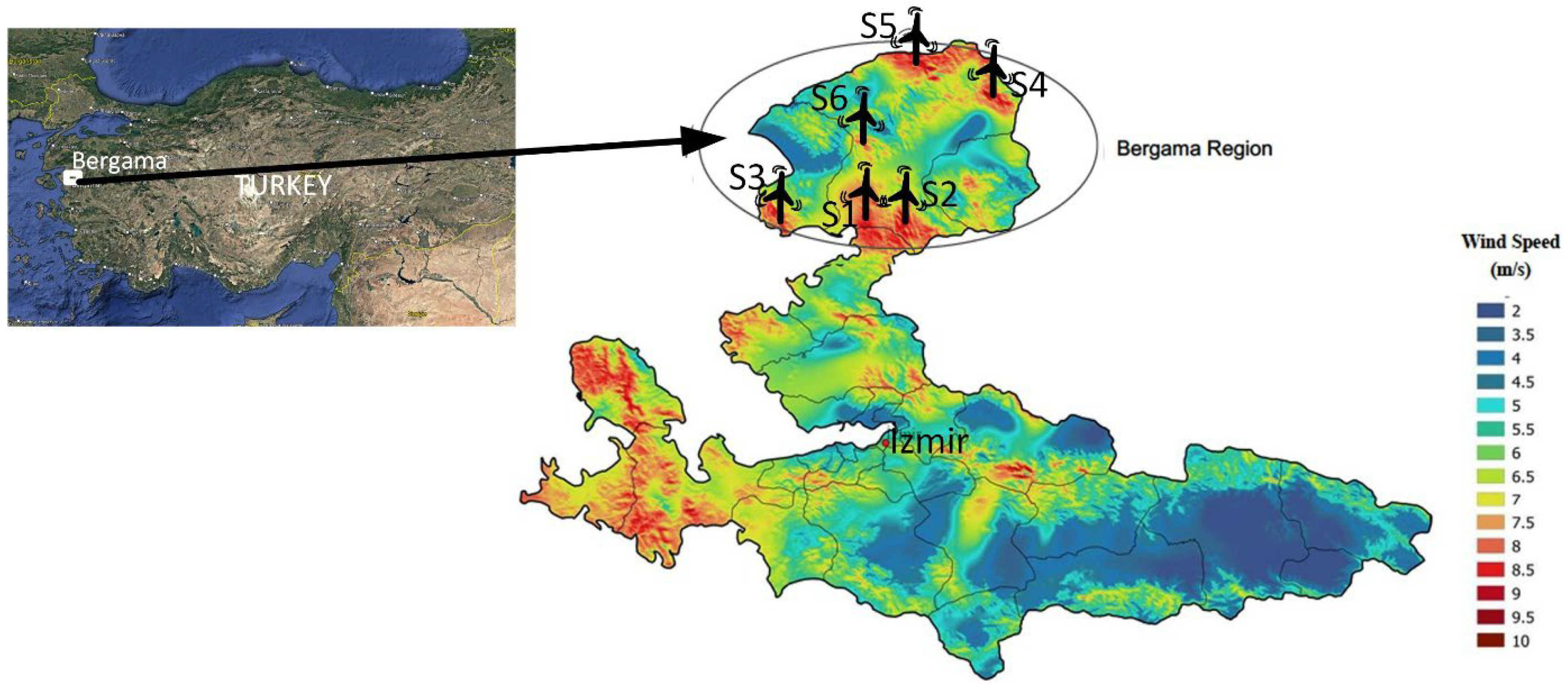
In contrast to the offshore-oriented literature, relatively few studies have addressed onshore wind power plant site selection using integrated multi criteria decision support frameworks, particularly in regions with active energy production. In this study, the proposed framework is applied to the Bergama region, where onshore wind power generation is already operational, and average wind speeds reach approximately 8–9 m/s in selected zones. As illustrated in Figure 4, six alternative onshore locations are evaluated under real operational conditions, enabling a systematic and quantitative comparison of candidate sites. By focusing on an actively producing region, the study contributes practical insights into the literature and supports transparent decision processes in sustainable wind energy planning.

4. Solution Methodology

In the present study, AHP and WSM are both fuzzified and integrated to determine the most appropriate wind power plant site. Rather than providing an extensive theoretical discussion, the methodology is presented in an application-oriented manner, focusing on how the selected techniques are implemented within the scope of the study. Initially, FAHP is employed to calculate the relative importance weights of the selection criteria, represented as fuzzy triangular numbers. Subsequently, FWSM is utilized to evaluate and rank the alternative site options based on these weighted criteria. This two-stage structure allows for a transparent and systematic comparison of candidate locations under uncertainty. The proposed hybrid decision-making approach and its implementation steps are presented in detail in Section 5.1 and Section 5.2.

4.1. Fuzzy Analytic Hierarchy Process to Compute Fuzzy Coefficients of Selection Criteria

In the first phase of the study, FAHP is applied to determine the fuzzy coefficients of the selection criteria. The emphasis in this phase is placed on the practical derivation of criteria weights rather than an extensive theoretical exposition of the FAHP method.
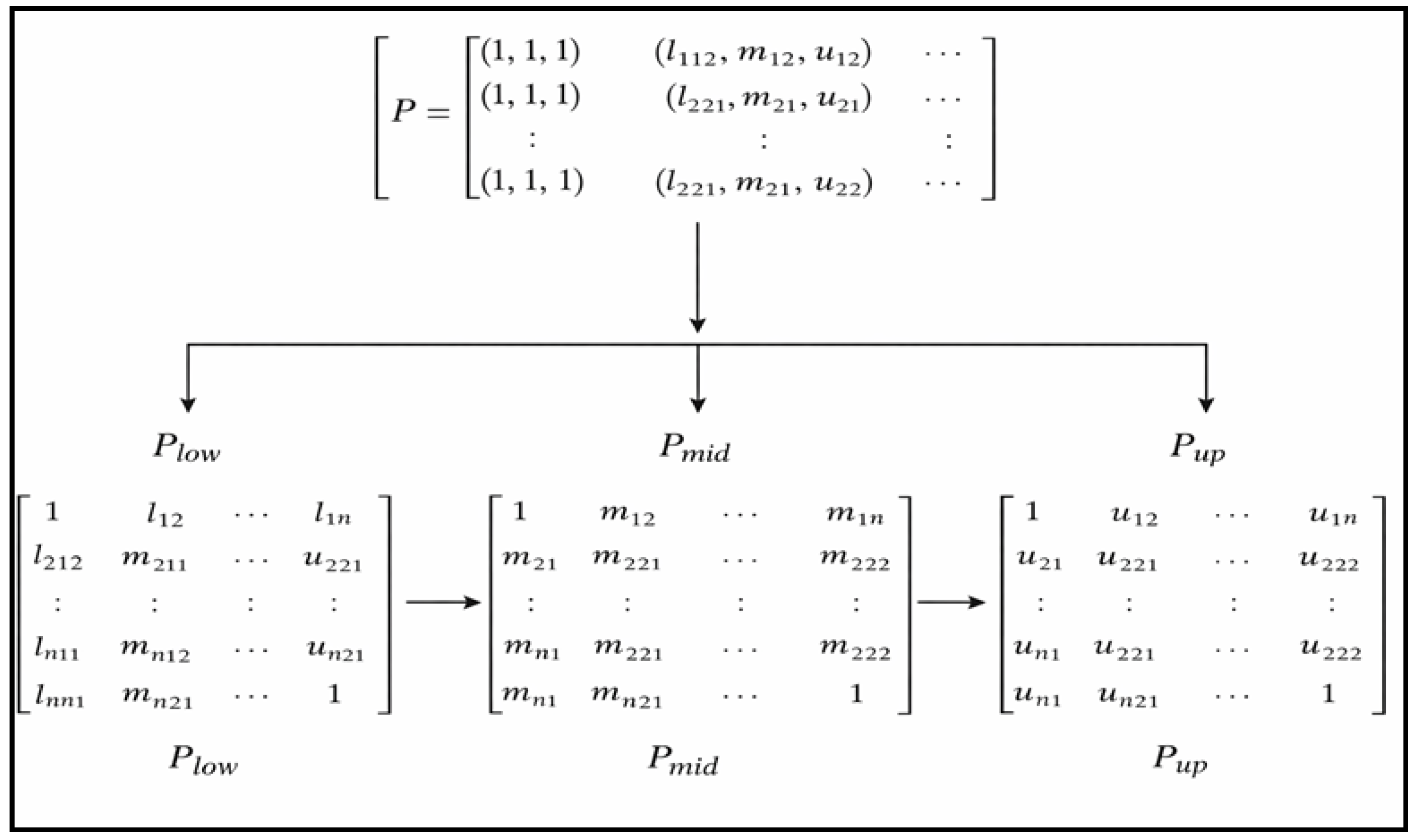
Assume there are n evaluation criteria, where each criterion is denoted as Cᵢ. Pairwise comparisons among these criteria are conducted using fuzzy triangular numbers, in which the lower, middle, and upper bounds correspond to values on the nine-point linguistic scale proposed for FAHP evaluations [52,53]. Based on expert judgments, a fuzzy pairwise comparison matrix (P) is constructed, reflecting the relative importance of each criterion. This matrix is then decomposed into three distinct matrices, namely PLOW, PMID, and PUP, representing the lower, modal, and upper bounds of the fuzzy comparisons, as illustrated in Figure 5.
AHP is applied separately to each of the three matrices, PLOW, PMID, and PUP, in order to obtain three corresponding weight vectors for each selection criterion. Through this procedure, three distinct importance coefficients are derived for each criterion, forming a triangular fuzzy weight. Table 1 summarizes the resulting fuzzy importance coefficients obtained from these computations. The consistency ratio (CR) for all pairwise comparison matrices are verified to remain below 0.1, ensuring the reliability and logical consistency of the expert judgments.
The resulting triangular fuzzy coefficients are subsequently adopted as direct input parameters for the second stage of the methodology, in which the FWSM is employed to rank the alternative wind power plant sites.

4.2. Fuzzy Weighted Sum Model to Rank Alternatives

FWSM is employed to compare and rank the alternative wind power plant sites. At the outset of this process, the set of alternative locations is defined. Assume that there are k alternatives, where each alternative is denoted as Sj. For each alternative site, Sj, a performance score expressed on a 100-point scale is assigned for every evaluation criterion. To account for uncertainty and subjectivity inherent in expert judgments, these performance scores are represented using fuzzy triangular numbers.
The notation adopted for the fuzzy triangular performance scores is summarized in Table 2. For each alternative (S1–S6) the lower bound represents the minimum expected performance level, the middle value corresponds to the most likely performance score, and the upper bound indicates the maximum plausible performance level. Similar fuzzy performance scores are determined for all alternatives and evaluation criteria based on expert assessments.
FWSM is subsequently applied to calculate the overall performance values corresponding to each alternative site. These aggregated performance values are also expressed as fuzzy triangular numbers and computed according to Equation (2) [54]. This aggregation process enables simultaneous consideration of all evaluation criteria by combining fuzzy performance scores with their corresponding fuzzy importance weights, thereby providing a comprehensive basis for comparing alternative wind power plant sites.
T o t a l   P e r f o r m a n c e j = [ C i L O W · S j L O W C i M I D · S j M I D C i U P · S j U P   ]   j = 1 . . k
The fuzzy membership function associated with the triangular total performance values obtained from Equation (2) is defined in Equation (3) [54]. In this formulation, the membership degree equals zero when the performance value lies outside the lower and upper bounds, reaches unity at the midpoint value, and varies linearly between zero and one within the defined bounds.
μ i x = 0           i f   x i C i L O W · S j L O W   o r   i C i U P · S j U P < x x i C i L O W · S j L O W i C i M I D · S j M I D i C i L O W · S j L O W   i f   i C i L O W · S j L O W < x i C i M I D · S j M I D i C i U P · S j U P x i C i U P · S j U P i C i M I D · S j M I D     i f   i C i M I D · S j M I D < x i C i U P · S j U P
After determining the total fuzzy performance values for all alternative sites, the alternatives are compared based on their corresponding membership functions. During the comparison of two alternatives, the intersection points of the membership functions μi and μj are calculated to evaluate their relative dominance. If the intersection point exceeded a predefined threshold level, the alternatives are considered to exhibit comparable performance; otherwise, the alternative with the higher upper bound value is regarded as dominant. The threshold level may be selected as 70%, 80%, or 90%, depending on the desired level of decision strictness and the specific requirements of the case study [54].

5. Application of Model Methodology

The Bergama region in İzmir has been identified as a strategic zone for wind energy utilization due to its favorable geographical and meteorological characteristics. The region exhibits an average wind speed of approximately 8.2–8.7 m/s and a wind continuity rate exceeding 85%, which together provide stable and reliable conditions for sustainable wind energy generation [55]. These characteristics contribute to extended turbine operating hours and improved capacity utilization, positioning Bergama among Türkiye’s most productive onshore wind energy regions.
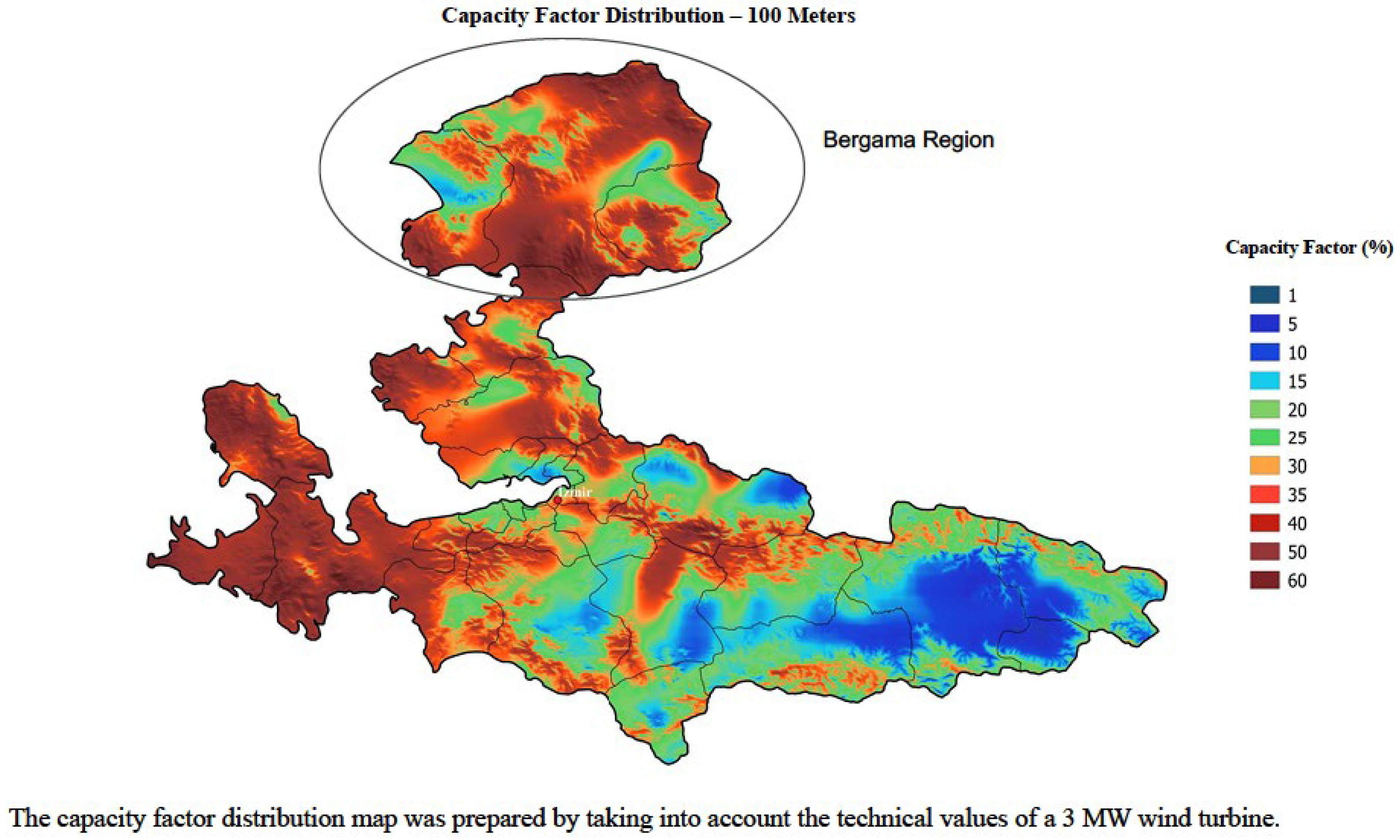
In terms of capacity factors, Bergama demonstrates values exceeding 50% at a hub height of 100 m, making the region highly attractive for large-scale wind power investments. According to the Wind Energy Potential Atlas (REPA) published by the Ministry of Energy and Natural Resources [56], these high capacity zones are primarily concentrated in the northern subregions of Bergama. Figure 6 illustrates the spatial distribution of capacity factors, where red-colored areas indicate locations with the highest wind energy potential. These zones offer advantages such as reduced levelized energy production costs and improved long-term operational efficiency, supporting both national and global renewable energy targets.
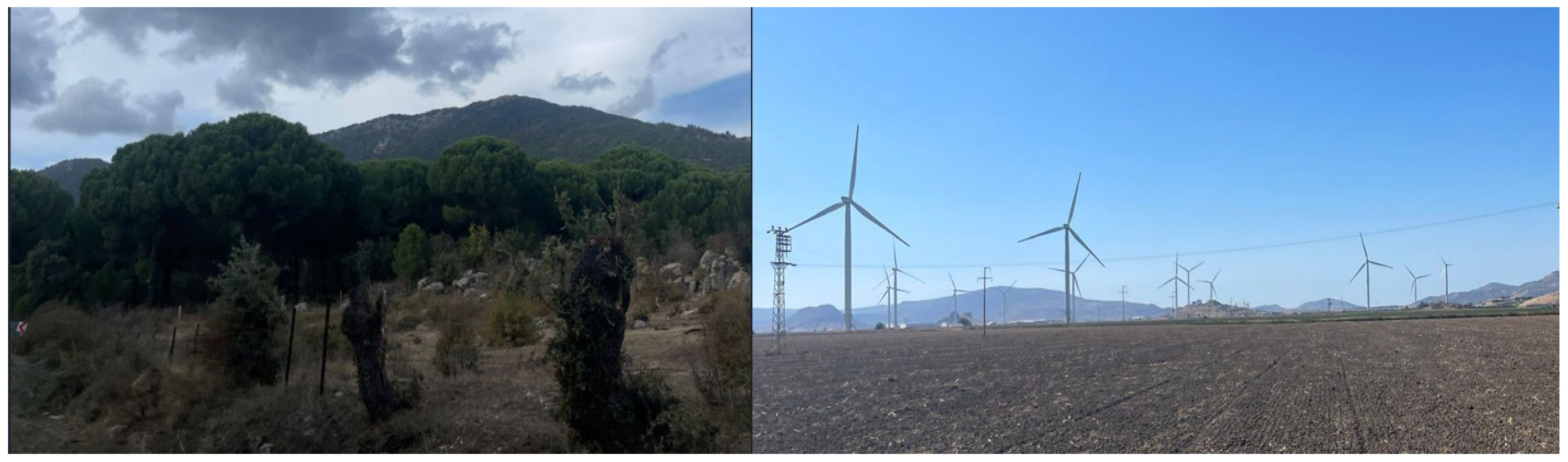
The physical and topographical characteristics of the Bergama region further support wind turbine deployment under favorable conditions [57]. Figure 7 presents the alternative onshore sites evaluated within the scope of this study. The predominantly open and moderately sloped terrain facilitates turbine installation and infrastructure development while minimizing construction-related constraints. Environmental screening analyses confirm that the selected alternative sites do not overlap with ecologically sensitive or legally protected areas, thereby reducing potential environmental impacts and permitting risks [58].
Existing wind power plants operating within the Bergama district provide empirical evidence of the technical feasibility and energy potential of the region. The currently installed wind power capacity in Bergama is approximately 396 MW, generating an annual electricity production of around 1,214,000 MWh, which corresponds to approximately 3.39% of Türkiye’s total installed wind capacity and about 0.65% of national electricity consumption [59,60]. These figures highlight Bergama’s tangible contribution to the national renewable energy portfolio.
The wind turbines installed in the region are designed to operate efficiently within the prevailing wind speed range of about 8.2–8.7 m/s and are equipped with advanced monitoring and control systems to optimize performance and minimize downtime [61]. Their structural design accounts for variable wind loads, ensuring operational reliability and long-term system stability. From an environmental sustainability perspective, the planning and operation of wind farms in Bergama have been conducted with particular attention to land-use compatibility and ecosystem protection, supporting low-impact renewable energy development.
As summarized in Table 3, Bergama’s wind regime, existing infrastructure, and installed capacity provide a strong foundation for future wind energy investments. The alignment of turbine technology with local wind characteristics enhances overall system efficiency, positioning the region as one of Türkiye’s leading contributors to renewable energy deployment and long-term energy transition goals.

5.1. Computing Fuzzy Coefficients of Selection Criteria Using FAHP

The objective of this study is to identify the most suitable wind power plant location in the Bergama region through the integration of the FAHP and FWSM. Within this hybrid framework, multiple site alternatives are evaluated under four primary decision dimensions: economic, technical, environmental, and social. Each main criterion includes sub-criteria that capture the multidimensional structure of wind farm site selection. The hierarchical structure of the decision criteria, including both the main criteria and sub-criteria, is presented in Table 4.
As listed in Table 4, the evaluation framework consists of four main criteria groups (C1–C4), each represented by five sub-criteria. In the following, the rationale for each group is briefly explained to clarify how the criteria reflect site feasibility and sustainability constraints.
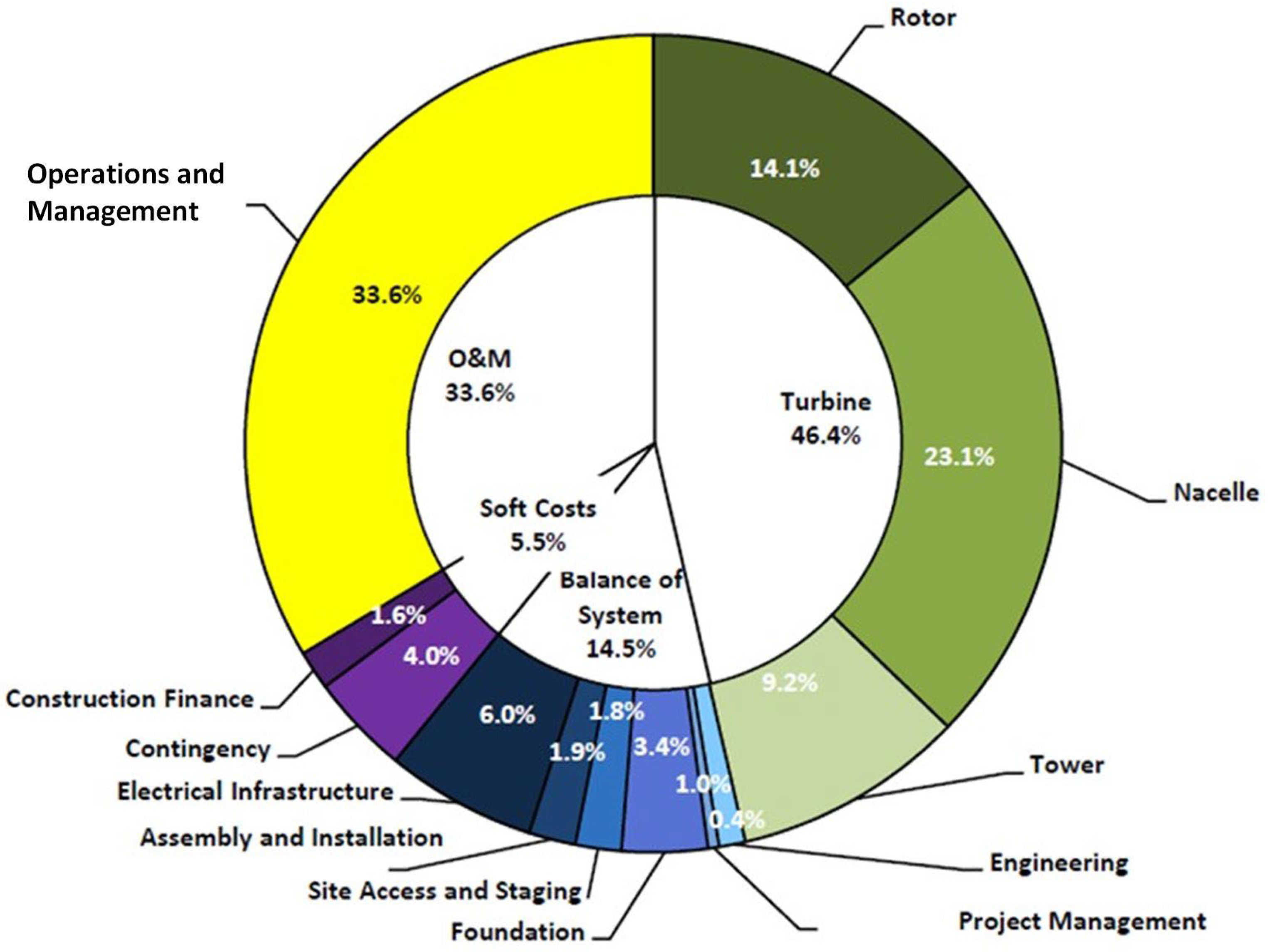
Economic analysis (C1): The economic criteria include economic lifetime (C11), actual operating time (C12), initial investment cost (C13), operational cost (C14), and depreciation (C15). In wind power projects, economic feasibility is commonly assessed through major cost categories, such as turbine capital cost, balance of system capital cost, financing costs, and operational and maintenance expenditures. Balance of system typically includes electrical infrastructure, grid connection, foundations, spare components, and other associated site costs. The economic structure varies depending on installation type. As shown in Figure 8, for land-based wind projects, the wind turbine system accounts for the largest share (46.4%) of total project costs, whereas for offshore installations, balance of system constitutes a relatively larger proportion, reaching approximately 31.5% for fixed-bottom and 43.8% for floating configurations [62,63,64,65,66,67]. For distributed wind projects, cost structures differ notably. In residential-scale systems, balance of system contributes to nearly 49.8% of total costs, whereas in commercial-scale systems, the turbine itself constitutes 51.6% of overall expenditures [67,68,69].
Technical analysis (C2): The technical criteria include wind speed (C21), energy production potential (C22), grid connection availability (C23), topography and accessibility (C24), and operational system and workplace safety (C25). Wind speed is one of the most decisive parameters for wind power plant performance. A stable wind speed between 5 and 25 m/s is generally considered appropriate for energy extraction [68], while various studies suggest minimum thresholds such as 6 m/s in conservative assessments [69,70,71] or lower values under favorable conditions [72,73]. To ensure consistency in the evaluation dataset, wind speed inputs in this study were obtained from the Global Wind Atlas (GWA 3.0) for the same reference height across alternatives [61]. Grid access supports system integration and reduces transmission constraints, while topography and accessibility directly affect transport, installation, and maintenance feasibility. In addition, workplace safety is an integral component of technical feasibility since turbine installation and operational phases require structured occupational risk management practices [74,75]. The methodology developed is open to be improved by changing or including more factors. There may be more technical criteria, such as seasonal effects, turbulence intensity, or wind direction distribution. However, in this study, a macro perspective is considered. These criteria may be included in cases where an exact specific area will be selected and also in the design phase of the wind power plant.
Environmental analysis (C3): The environmental criteria include land acquisition for the project (C31); water resource status (C32); wildlife, protected areas, and archaeological sites (C33); national aviation status and communication lines (C34); and contribution to environmental cleanliness (C35). These criteria ensure that site selection complies with environmental protection standards, land use regulations, and infrastructure constraints. In particular, regional regulations indicate that public interest areas cannot be allocated for energy production without formal amendments to the 1/25,000-scale Master Development Plan, and infrastructure-related developments must comply with relevant technical surveys and safety requirements [76]. Given the seismic characteristics of the İzmir region, geotechnical and seismic risk considerations are also relevant for ensuring long-term structural integrity and operational reliability during the project lifespan [76].
Social analysis (C4): The social criteria include regional workforce contribution (C41), development of local trade (C42), energy supply and infrastructure development (C43), impact of expropriation (C44), and social welfare improvement (C45). Previous studies emphasize that wind energy investments can create employment opportunities, support local economic activity through procurement and service demand, improve infrastructure, and influence local acceptance depending on expropriation impacts and perceived benefits [77,78,79]. These criteria are therefore included to ensure that candidate sites are evaluated not only by technical performance but also by their potential socioeconomic implications.
After defining the main and sub-criteria, the FAHP methodology is implemented to compute pairwise comparison matrices and obtain fuzzy importance coefficients. Pairwise comparisons for the main criteria groups are conducted using fuzzy triangular numbers as described in Section 4.1, and the AHP procedure is applied separately for the lower, middle, and upper matrices. The resulting fuzzy importance coefficients for the main groups are presented in Table 5.
According to Table 5, the technical analysis group (C2) is identified as the most influential factor, followed by environmental analysis (C3). The economic (C1) and social (C4) groups exhibit relatively lower weights. Following the main-group weighting, the FAHP procedure is applied to each sub-criterion, and the fuzzy importance coefficients for all criteria are summarized in Table 6.
Based on Table 6, wind speed (C21), energy production potential (C22), and land acquisition (C31) emerge among the most influential parameters in the selection process. The inconsistency ratio for all AHP computations is found to be less than 0.1, confirming that the pairwise comparisons are consistent and reliable.

5.2. Comparing Alternative Wind Power Plan Sites by FWSM

The Bergama region accounts for nearly 10% of Türkiye’s total installed wind power capacity, positioning it as a key area for future renewable energy development. Selecting new wind power plant locations in such a high-potential zone is therefore critical to ensure both energy efficiency and long-term sustainability. In this context, six alternative sites (S1–S6) are analyzed using a hybrid decision-making framework integrating FAHP and FWSM. The evaluation is conducted based on four main criteria groups (economic, technical, environmental, and social) and twenty sub-criteria, which were previously defined and weighted in Section 5.1.
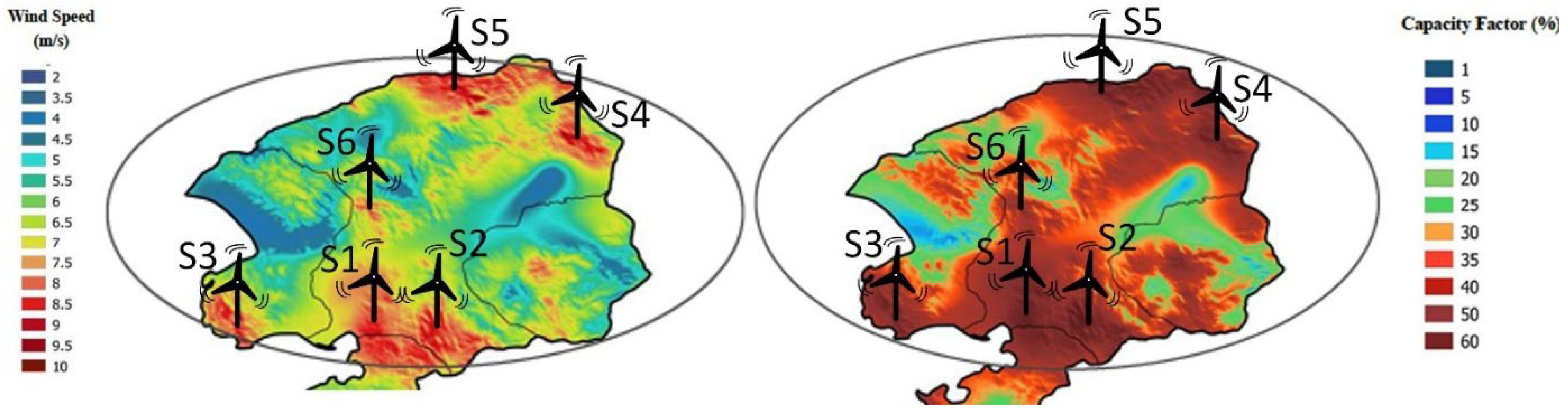
The site selection process is supported by region-specific wind speed and capacity factor maps, which provide spatial insight into the wind energy characteristics of the Bergama region (Figure 9). These maps are developed by combining the spatial data from Figure 4 and Figure 6 to present a detailed representation of local wind speed distributions and potential turbine zones. The spatial positions of the six alternative sites are overlaid on the maps to ensure consistency between the quantitative evaluation results and the physical wind conditions of the region. In addition, the characteristics of the sites are listed in Table 7. For consistency throughout the analysis, the alternative wind power plant locations are denoted as S1–S6, where the notation “S” refers to “Site”.
The performance scores for each alternative site, denoted as S1 through S6, are determined according to the predefined selection criteria. These scores, expressed as fuzzy triangular values, are presented in Table 8. Each potential wind power plant site received a normalized performance rating between 0 and 100 for every criterion. For example, the row corresponding to criterion C13 (initial investment cost) in Table 8 illustrates the comparative performance of all sites with respect to their investment requirements. Because initial investment is directly related to the installed capacity of a plant, locations with higher capacity factors also incur higher investment costs. Consequently, alternatives S3 and S6 show the highest capacity potential and therefore the greatest initial investment cost values.
The fuzzy performance scores are derived based on expert evaluations obtained during the assessment process. In total, five experts with backgrounds in wind energy systems, environmental planning, and regional development participated in the evaluation. To deal with potential subjectivity and individual bias of experts, judgments are aggregated using fuzzy triangular numbers, allowing uncertainty and variability in assessments to be systematically represented. By this way, evaluations become less prone to errors and robust to small variations in the evaluations.
Using the fuzzy performance values presented in Table 8 and the fuzzy importance coefficients of the decision criteria (Table 6), the overall performance of each alternative site is calculated using FWSM. The aggregation process yields fuzzy triangular total performance values for each site, which are summarized in Table 9.
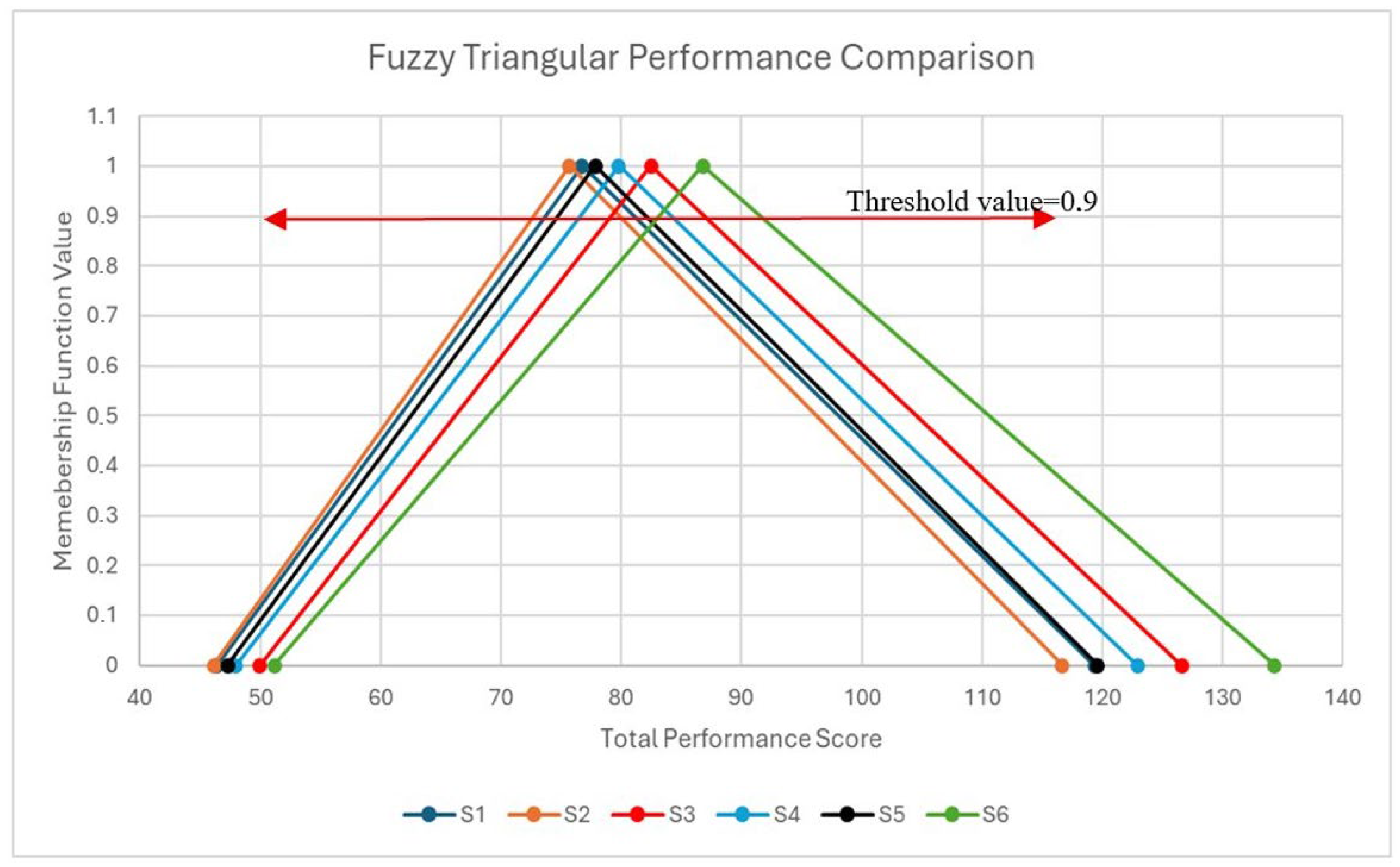
To facilitate comparisons among alternatives, the resulting fuzzy triangular total performance values are transformed into membership functions, illustrated graphically as in Figure 10.
For ranking the alternative sites, a threshold value of 0.9 (90%) is determined to ensure a high level of decision precision. The horizontal red line in Figure 10 explicitly represents this threshold value, and intersection points above this level indicate performance equivalence, while intersection points below this level indicate dominance relationships. The calculated intersection points between membership functions are listed in Table 10.
Based on the results presented in Table 10, alternatives S3, S4, and S6 exhibit comparable performance levels, as their mutual intersection values exceed the defined threshold of 0.9. Among these alternatives, S6 demonstrates consistent dominance over S1, S2, and S5, indicating superior overall performance across multiple criteria groups. This dominance is primarily attributed to its high wind speed, strong energy production potential, favorable land acquisition conditions, and positive local community response, which collectively enhance its aggregated FWSM score. Although S3 and S4 show comparable performance according to the applied threshold, S6 attains the highest overall fuzzy performance values across the lower, middle, and upper bounds. Therefore, S6 is identified as the most suitable wind power plant location among the evaluated alternatives.

6. Results and Discussion

In this study, four main criteria and twenty sub-criteria are defined to evaluate the suitability of six alternative wind power plant sites in the Bergama region. These alternatives are assessed using an integrated FAHP and FWSM framework. The results indicate that Sites 6, 3, and 4 achieve the highest overall suitability scores. Among these alternatives, Site 6 stands out as the most favorable option due to its strong wind potential in the range of 8 to 9 m per second, suitable topographical conditions, relatively high accessibility, and acceptable levels of local support. These characteristics directly enhance both the expected energy yield and the economic feasibility of wind power investments.
The predominance of technical criteria in the final ranking can be explained by the fundamental characteristics of wind energy systems. Technical parameters such as wind speed, terrain suitability, grid proximity, and constructability exert a direct influence on power generation efficiency, investment costs, and long-term operational reliability. Since the primary objective at the planning stage is to identify locations that can are economically viable and technically efficient sites, these criteria naturally receive higher importance in the decision-making process. On the other hand, environmental and social criteria, although assigned comparatively lower weights in the final results, remain essential components of the evaluation framework. Their relatively lower influence does not imply reduced importance but rather reflects their role as suitability and feasibility conditions at the regional planning level.
The results confirm that Sites 6, 3, and 4 represent the most suitable alternatives for future wind power plant development within the defined study area. The close ranking of Sites 3 and 4 highlights the sensitivity of the fuzzy decision model in distinguishing alternatives with similar technical characteristics. Both sites exhibit favorable wind conditions but are subject to moderate accessibility constraints. The consistency between the highest ranked sites and existing operational wind power plant locations in Bergama further confirms that the proposed model successfully reflects real technical and environmental conditions observed in practice.
The integration of FAHP and FWSM represents another significant contribution of this study. Combining these methods brings robustness to the decision-making process by reducing potential human error, bias and uncertainty. In this way, higher accuracy and consistency can be achieved by the hybrid fuzzy model. Previous research has examined various fuzzy approaches [80,81,82,83,84,85,86,87,88,89,90], but none have previously combined FAHP and FWSM within the application of the Bergama region.

7. Conclusions

Selection problems represent one of the most critical challenges in renewable and alternative energy projects, primarily due to the high capital costs required for equipment, infrastructure, and technological investments. Therefore, location selection decisions for energy investments must be evaluated carefully through systematic analytical methods, such as MCDM techniques. These approaches enable the simultaneous assessment of technical, economic, environmental, and social dimensions, thereby minimizing uncertainty and reducing the risk of suboptimal investment choices.
In this study, the wind power plant site selection problem in the Bergama region is addressed using an integrated FAHP and FWSM framework. Incorporating fuzzy logic enhances the model’s ability to manage uncertainty, resulting in more consistent and reliable evaluations. Six alternative sites are evaluated and ranked based on their overall fuzzy total performance scores.
The results indicate that Sites 6, 3, and 4 represent the most suitable alternatives for wind power plant development in the study area. Among these sites, Site 6 achieved the highest overall performance score due to its favorable wind potential, suitable topographical conditions, and accessibility advantages. The findings demonstrate that fuzzy logic-based MCDM techniques provide a robust, systematic, and transparent approach to wind power plant site selection, contributing to improved decision-making accuracy and long-term sustainability in renewable energy planning.
From an application perspective, this study should be regarded as a planning-oriented decision support framework rather than a micro-level turbine siting analysis. The proposed approach is intended to support policymakers, regional planners, and energy investors by identifying priority development zones before project-specific feasibility studies are conducted. In this respect, the study provides practical guidance for strategic renewable energy investment planning in Türkiye.
It is important to emphasize that this study is designed as a strategic planning tool rather than a micro-level turbine planning analysis. Although the framework is applied to Bergama, the methodological structure can be directly transferred to other onshore wind power plant problems by integrating and updating problem-specific selection criteria. The proposed framework does not aim to determine exact turbine locations or layout plans. Instead, it provides policymakers and energy planners with a transparent, systematic, and reproducible decision support structure to guide regional renewable energy investment strategies.

Author Contributions

Conceptualization, P.M.O., A.K.E., M.K.O. and M.E.Y.; methodology, P.M.O. and A.K.E.; software, A.K.E., M.K.O. and M.E.Y.; validation, P.M.O. and A.K.E.; formal analysis, P.M.O., A.K.E., M.K.O. and M.E.Y.; investigation, P.M.O., A.K.E., M.K.O. and M.E.Y.; resources, P.M.O., A.K.E., M.K.O. and M.E.Y.; data curation, P.M.O., A.K.E., M.K.O. and M.E.Y.; writing—original draft preparation, P.M.O. and K.S.; writing—review and editing, P.M.O. and K.S.; visualization, A.K.E., M.K.O. and M.E.Y. All authors have read and agreed to the published version of the manuscript.

Funding

Publication partially supported by the Rector’s pro-quality grant of the Silesian University of Technology—grant number: 13/030/RGJ25/0088.

Institutional Review Board Statement

Not applicable.

Informed Consent Statement

Not applicable.

Data Availability Statement

The original contributions presented in the study are included in the article; further inquiries can be directed to the corresponding authors. The data presented in this study are available on request from the corresponding authors.

Conflicts of Interest

The authors declare no conflicts of interest. The funders had no role in the design of the study; in the collection, analyses, or interpretation of data; in the writing of the manuscript; or in the decision to publish the results.

Correction Statement

This article has been republished with a minor correction to the Funding statement. This change does not affect the scientific content of the article.

References

  1. Turkish Wind Energy Association (TUREB). Türkiye Wind Energy Statistics Report; Turkish Wind Energy Association: Ankara, Turkey, 2023. [Google Scholar]
  2. Ministry of Energy and Natural Resources (MENR). Electricity Statistics; Republic of Türkiye Ministry of Energy and Natural Resources: Ankara, Turkey, 2023.
  3. Ministry of Energy and Natural Resources (MENR). Türkiye National Renewable Energy Action Plan; Republic of Türkiye Ministry of Energy and Natural Resources: Ankara, Turkey, 2023.
  4. Türkiye Electricity Transmission Corporation (TEİAŞ). Türkiye Electricity Statistics. 2024. Available online: https://www.teias.gov.tr/en-US/electricity-transmission-in-turkiye (accessed on 24 October 2025).
  5. The Scientific and Technological Research Council of Türkiye (TÜBİTAK). Wind Energy Technologies Roadmap; TÜBİTAK: Ankara, Turkey, 2022. [Google Scholar]
  6. SHURA Energy Transformation Center. Wind Energy Potential and Cost Analysis in Türkiye; SHURA: Istanbul, Turkey, 2023. [Google Scholar]
  7. Eurostat. Share of Renewable Energy More than Doubled Between 2004 and 2021; Statistical Office of the European Union: Luxembourg, 2021; Available online: https://ec.europa.eu/eurostat/statistics-explained/index.php?title=Renewable_energy_statistics (accessed on 24 October 2025).
  8. Eurostat. Wind and Water Provide Most Renewable Electricity; Statistical Office of the European Union: Luxembourg, 2021; Available online: https://commission.europa.eu/news-and-media/news/wind-and-water-provide-most-renewable-electricity-2021-01-11_en (accessed on 24 October 2025).
  9. Xiao, Y.; Wang, J.; Zhou, J. Hydrosphere Under the Driving of Human Activity and Climate Change: Status, Evolution, and Strategies. Sustainability 2025, 17, 3257. [Google Scholar] [CrossRef]
  10. Filonchyk, M.; Peterson, M.P.; Zhang, L.; Hurynovich, V.; He, Y. Greenhouse Gases Emissions and Global Climate Change: Examining the Influence of CO2, CH4, and N2O. Sci. Total Environ. 2024, 935, 173359. [Google Scholar] [CrossRef]
  11. Wang, L.; Wei, F.; Tagesson, T.; Fang, Z.; Svenning, J.-C. Transforming Forest Management through Rewilding: Enhancing Biodiversity, Resilience, and Biosphere Sustainability under Global Change. One Earth 2025, 8, 101195. [Google Scholar] [CrossRef]
  12. Schaltegger, S.; Wagner, M. Managing the Business Case for Sustainability: The Integration of Social, Environmental and Economic Performance; Routledge: London, UK, 2017. [Google Scholar]
  13. Lv, M.; Zhang, Z.; Fang, J.; Hu, B.; Li, C. Wind Energy Harvester for Sensors Based on Gravity-Driven Magnet Self-Resetting. Eng. Res. Express 2025, 7, 045504. [Google Scholar] [CrossRef]
  14. Ye, J.-C.; He, C.-S.; Li, M.-Y.; Xu, C.; Li, X. Dual Triboelectric Nanogenerators Based on Adaptive Switching Architecture Enable Broadband Wind Energy Harvesting in Smart Farms. Eng. Res. Express 2025, 7, 045559. [Google Scholar] [CrossRef]
  15. Xu, H.; Zhu, Z.; Liu, H.; Zio, E.; Qiu, X.; Lu, Y.; Qu, X. Spectral Dynamic Aggregation Transformer and Fitted Swing-Door Algorithm for Wind Power Monitoring. Energy 2025, 341, 139396. [Google Scholar] [CrossRef]
  16. Xin, H.; Zhang, Y.; Cheng, S.; Han, L.; Lv, X.; Wu, Y. A Deep Learning Model Integrating Vibration and Stator Current Signals for Fault Diagnosis of Wind Turbine Gearboxes. Eng. Res. Express 2025, 7, 045263. [Google Scholar] [CrossRef]
  17. Lu, S.; Gao, Z.; Zhang, P.; Xu, Q.; Xie, T.; Zhang, A. Event-Triggered Federated Learning for Fault Diagnosis of Offshore Wind Turbines With Decentralized Data. IEEE Trans. Autom. Sci. Eng. 2024, 21, 1271–1283. [Google Scholar] [CrossRef]
  18. Wang, L.; Chen, W. Resilience and Reconfiguration of Global Wind Power Trade Networks: Insights from an Industrial Chain Perspective. Energy 2025, 341, 139519. [Google Scholar] [CrossRef]
  19. Ouyang, C.; Khoshgoftar Manesh, M.H.; Mousavi Rabeti, S.A.; Ameryan, A.; Sayyar, R.; Jin, L.; Zhou, Y.; Yunxia, G. AI-Optimized Solar-Wind Polygeneration for Sustainable Power and Hydrogen: A Pathway to a Cleaner Future. Energy 2025, 341, 139458. [Google Scholar] [CrossRef]
  20. Zeng, H.; Shi, C.; Fang, H.; Wu, B. Interpretable Multivariate Wind Speed Forecasting Using Sliding Masked Window-Based Decomposition and Deep Autoregressive Networks. Energy 2025, 341, 139395. [Google Scholar] [CrossRef]
  21. Wei, J.; Zhang, W.; Zhang, W.; Ren, M.; Xu, X.; Cheng, L. DBSTN: A Dual-Branch Spatio-Temporal Network for Wind Power Prediction Using Multi-Modal Fusion. Energy 2025, 341, 139471. [Google Scholar] [CrossRef]
  22. Irandoostshahrestani, M.; Rousse, D.R. Optimizing Off-Grid PV/Wind Systems with Battery and Water Storage for Rural Energy and Water Access. J. Energy Storage 2025, 140, 119155. [Google Scholar] [CrossRef]
  23. Zarei, A.; Ghaffarzadeh, N.; Shahnia, F.; Shafie-khah, M.; Mirjalili, S. Optimal Seasonal Demand Response for AC-OPF with Precise and Innovative Modeling of Thermal Energy Storage and Optimal ESS Allocation. J. Energy Storage 2025, 140, 118682. [Google Scholar] [CrossRef]
  24. Zhou, J.; Ran, J.; Ren, J.; Zhao, R.; Wang, Y.; Wu, Y. Digital Intelligence-Driven Synergistic Optimization of Capacity Configuration for Wind-Solar-Hydrogen Multi-Energy Systems Integrated with Shared Energy Storage. Energy 2025, 341, 139497. [Google Scholar] [CrossRef]
  25. Zhu, Q.; Xiao, H.; Yang, Q.; Yang, P.; Dong, Y.; Zhang, L. General and Efficient Simulation Model for Energy Storage-Embedded MMC With Adaptability to Multiple Submodule Topologies. IEEE Trans. Ind. Appl. 2026, 62, 37–48. [Google Scholar] [CrossRef]
  26. Geng, D.; Cui, H.; Lv, L.; Guo, J. A Novel Decomposition-Prediction Hybrid Model Improved by Dual-Channel Cross-Attention Mechanism for Short-Term Wind Speed Prediction. Eng. Appl. Artif. Intell. 2025, 162, 112550. [Google Scholar] [CrossRef]
  27. Yuan, W.; Yang, H.; Han, Z.; Zhang, Y. Enhancing Wind Power Forecasting Accuracy under Extreme Weather: Leveraging a Dual-Model Approach with Condition-Based Classification. Eng. Appl. Artif. Intell. 2025, 162, 112656. [Google Scholar] [CrossRef]
  28. Moral, M.S.; Hara, Y.; Jodai, Y. Improvement of Fast Simulation Method of the Flow Field in Vertical-Axis Wind Turbine Wind Farms and Consideration of the Effects of Turbine Selection Order. Energies 2025, 18, 6294. [Google Scholar] [CrossRef]
  29. Guo, Z.; Han, Q.; Wei, F.; Qi, W. Wind Power Prediction Based on Hybrid Deep Learning and Monte Carlo Simulation. Eng. Appl. Artif. Intell. 2025, 161, 112082. [Google Scholar] [CrossRef]
  30. Demuytere, C.; Thomassen, G.; Dewulf, J. Navigating towards Environmental Sustainability Assessments of Offshore Wind Farms at the End-of-Life. Waste Manag. 2025, 205, 115016. [Google Scholar] [CrossRef]
  31. Zhang, W.; Duan, Z.; Wu, Y.; Nasr, A.; Wang, B.; Xia, H. High-Value Recycling Strategies for Retired Wind Turbine Blades in China: A Spatiotemporal Adaptability Framework. Waste Manag. 2025, 205, 115010. [Google Scholar] [CrossRef]
  32. Tausova, M.; Mykhei, M.; Culkova, K.; Taus, P. Comparison of Renewable Energy Implementation in Geographically and Climatically Diverse Regions. Sustainability 2025, 17, 3098. [Google Scholar] [CrossRef]
  33. Zhang, Z.; Lin, L.; Gao, S.; Wang, J.; Zhao, H.; Yu, H. A Machine Learning Model for Hub-Height Short-Term Wind Speed Prediction. Nat. Commun. 2025, 16, 3195. [Google Scholar] [CrossRef] [PubMed]
  34. Sahu, S.; Behera, S.; Giri, N.C.; Alaneme, G.U.; Syam, F.A.; Salem, F. Equilibrium Optimizer-Based Double Integral Sliding Mode Maximum Power Point Tracking for Wind Energy. Bull. Electr. Eng. Inform. 2025, 14, 4189–4197. [Google Scholar] [CrossRef]
  35. Niu, L.; Yang, L.; Zhang, Y.; Wang, Y.; Qu, Y.; Zhu, Z.; Liu, Y.; Dai, S.; Li, A. Aerogel Based Evaporator Prepared From Waste Wind Turbine Blades for Efficient Solar Steam Generation. J. Appl. Polym. Sci. 2025, 142, e57888. [Google Scholar] [CrossRef]
  36. Martinelli, M.; Tsetas, A.; Fărăgău, A.B.; Metrikine, A.; Tsouvalas, A. Soil Resistance during Vibratory Pile Installation: Experimental Findings from Lab-Scale Tests. Soil Dyn. Earthq. Eng. 2025, 199, 109692. [Google Scholar] [CrossRef]
  37. Bjärstig, T.; Lempinen, H. Navigating the Winds of Change: Presentation of Wind Power Development by Regional Newspapers in Northern Sweden and Finland. Energy Sustain. Soc. 2025, 15, 26. [Google Scholar] [CrossRef]
  38. Fontes, M.; Santos, H.; Torres, M. Winds of Change: The Potential Path Disturbing Effect Induced by the Offshore Wind Energy Technology. Rev. Reg. Res. 2025, 45, 609–638. [Google Scholar] [CrossRef]
  39. Yuksel, S.; Eti, S.; Dincer, H.; Gokalp, Y.; Uslu, Y. Financial Product Prioritization for Small-Scale Wind Turbine Projects: A Novel Fuzzy Hybrid Methodology. Financ. Innov. 2025, 11, 115. [Google Scholar] [CrossRef]
  40. De Blauwe, J.; Zhang, X.; Keles, D. Investigating Empirical Bidding Curves in the Electricity Spot Market: Expected Patterns vs Anomalies? Energy Econ. 2025, 152, 109002. [Google Scholar] [CrossRef]
  41. Tasri, A.; Susilawati, A. Selection among renewable energy alternatives based on a fuzzy analytic hierarchy process in Indonesia. Sustain. Energy Technol. Assess. 2014, 7, 34–44. [Google Scholar] [CrossRef]
  42. Chaouachi, A.; Covrig, C.F.; Ardelean, M. Multi criteria selection of offshore wind farms: Case study for the Baltic States. Energy Policy 2017, 103, 179–192. [Google Scholar] [CrossRef]
  43. Wu, Y.; Tao, Y.; Zhang, B.; Wang, S.; Xu, C.; Zhou, J. A decision framework of offshore wind power station site selection using a PROMETHEE method under intuitionistic fuzzy environment: A case in China. Ocean Coast. Manag. 2020, 184, 105016. [Google Scholar] [CrossRef]
  44. Mayaki, E.A.; Adedipe, O.; Lawal, S.A. Multi criteria evaluation of the appropriate offshore wind farm location in Nigeria. IOP Conf. Ser. Mater. Sci. Eng. 2018, 413, 012041. [Google Scholar] [CrossRef]
  45. Taoufik, M.; Fekri, A. GIS based multi criteria analysis of offshore wind farm development in Morocco. Energy Convers. Manag. X 2021, 11, 100103. [Google Scholar] [CrossRef]
  46. Mahdy, M.; Bahaj, A.S. Multi criteria decision analysis for offshore wind energy potential in Egypt. Renew. Energy 2018, 118, 278–289. [Google Scholar] [CrossRef]
  47. Azevedo, S.S.P.D.; Junior, A.O.P.; Silva, N.F.D.; Araujo, R.S.B.; Junior, A.A.C. Assessment of offshore wind power potential along the Brazilian coast. Energies 2020, 13, 2557. [Google Scholar] [CrossRef]
  48. Ilbahar, E.; Cebi, S.; Kahraman, C. A state of the art review on multi attribute renewable energy decision making. Energy Strateg. Rev. 2019, 25, 18–33. [Google Scholar] [CrossRef]
  49. Ziemba, P. Multi criteria fuzzy evaluation of the planned offshore wind farm investments in Poland. Energies 2021, 14, 978. [Google Scholar] [CrossRef]
  50. Racetin, I.; Ostojic Skomrlj, N.; Peko, M.; Zrinjski, M. Fuzzy multi criteria decision for geoinformation system based offshore wind farm positioning in Croatia. Energies 2023, 16, 4886. [Google Scholar] [CrossRef]
  51. Ozfirat, M.K.; Eyuboglu, A.K.; Tekir, U.; Yetkin, M.E. Contribution of Bergama wind power plants to Turkey’s general energy consumption. In Proceedings of the 2024 6th International Conference on Environmental Sciences and Renewable Energy, Frankfurt, Germany, 28–30 June 2024. [Google Scholar] [CrossRef]
  52. Ozfirat, M.K. Selection of tunneling machines in soft ground by fuzzy analytic hierarchy process. Acta Montan Slovaca 2015, 20, 120–128. [Google Scholar]
  53. Mizrak Ozfirat, P.; Ozfirat, M.K.; Malli, T.; Kahraman, B. Integration of fuzzy analytic hierarchy process and multi-objective fuzzy goal programming for selection problems: An application on roadheader selection. J. Intell. Fuzzy Syst. 2015, 29, 53–62. [Google Scholar] [CrossRef]
  54. Malli, T.; Mizrak Ozfirat, P.; Yetkin, M.E.; Ozfirat, M.K. Truck selection with the fuzzy-WSM method in transportation systems of open pit mines. Teh. Vjesn. 2021, 28, 58–64. [Google Scholar]
  55. Pinar, A.; Buldur, A.; Tuncer, T. Examining the distribution of wind power plants in Türkiye by means of geographic perspective. J. Geogr. Stud. 2020, 25, 167–182. [Google Scholar]
  56. Ministry of Energy and Natural Resources (MENR). Wind Energy Potential Atlas (REPA); MENR: Ankara, Turkey, 2024. Available online: https://www.enerji.gov.tr/ (accessed on 10 January 2025).
  57. Karamanlioglu, T. Designs for Different Wind Turbine Power Plant Site Selection and the Determination of Wind Energy Potential: Application of Artificial Intelligence. Master’s Thesis, University of Mersin, Mersin, Turkey, 2011. [Google Scholar]
  58. Senel, M.C.; Koc, E. The state of wind energy in the world and Türkiye: A general evaluation. Mühendis Ve Makine 2015, 56, 46–56. [Google Scholar]
  59. Enerji Piyasalari İsletme A.S. (EPIAS). Real-Time Electricity Generation and Consumption Data; EPİAŞ: Ankara, Turkey, 2025; Available online: https://seffaflik.epias.com.tr/electricity/electricity-generation/ex-post-generation/real-time-generation (accessed on 10 January 2025).
  60. Energy Institute. Statistical Review of World Energy; Energy Institute: London, UK, 2024. [Google Scholar]
  61. Global Wind Atlas (GWA). Global Wind Resource Data Portal. Available online: https://globalwindatlas.info/en (accessed on 3 March 2025).
  62. Eberle, A.; Roberts, J.O.; Key, A.; Bhaskar, P.; Dykes, K.L. NREL’s Balance-of-System Cost Model for Land-Based Wind; NREL/TP-6A20-72201; National Renewable Energy Laboratory (NREL): Golden, CO, USA, 2019. [Google Scholar]
  63. Stehly, T.; Beiter, P.; Duffy, P. 2019 Cost of Wind Energy Review; NREL/TP-5000-78471; National Renewable Energy Laboratory (NREL): Golden, CO, USA, 2020. [Google Scholar]
  64. Stehly, T.; Patrick, D. 2020 Cost of Wind Energy Review; National Renewable Energy Laboratory (NREL): Golden, CO, USA, 2021. [Google Scholar]
  65. Stehly, T.; Duffy, P.; Daniel, M.H. 2022 Cost of Wind Energy Review; National Renewable Energy Laboratory (NREL): Golden, CO, USA, 2023. [Google Scholar]
  66. Musial, W.; Spitsen, P.; Beiter, P.; Duffy, P.; Marquis, M.; Cooperman, A.; Hammond, R.; Shields, M. Offshore Wind Market Report: 2021 Edition; DOE/GO-102021-5614; U.S. Department of Energy: Washington, DC, USA, 2021.
  67. Orrell, A.C.; Sheridan, L.M.; Kazimierczuk, K.; Fensch, A.M. Distributed Wind Market Report: 2023 Edition; PNNL-34661; Pacific Northwest National Laboratory (PNNL): Richland, WA, USA, 2023. [Google Scholar]
  68. Liscic, B.; Senjanovic, I.; Coric, V.; Kozmar, H.; Tomic, M.; Hadzic, N. Offshore wind power plant in the Adriatic Sea: An opportunity for the Croatian economy. Trans. Marit. Sci. 2014, 3, 103–110. [Google Scholar] [CrossRef]
  69. Vagiona, D.G.; Kamilakis, M. Sustainable site selection for offshore wind farms in the South Aegean, Greece. Sustainability 2018, 10, 749. [Google Scholar] [CrossRef]
  70. Sourianos, E.; Kyriakou, K.; Hatiris, G.A. GIS-based spatial decision support system for the optimum siting of offshore wind farms. Eur. Water 2017, 58, 337–343. [Google Scholar]
  71. Schallenberg-Rodríguez, J.; Montesdeoca, N.G. Spatial planning to estimate offshore wind energy potential in coastal regions and islands: The Canary Islands case. Energy 2018, 143, 91–103. [Google Scholar] [CrossRef]
  72. Gaveriaux, L.; Laverriere, G.; Wang, T.; Maslov, N.; Claramunt, C. GIS-based multi-criteria analysis for offshore wind turbine deployment in Hong Kong. Ann. GIS 2019, 25, 207–218. [Google Scholar] [CrossRef]
  73. Diaz, H.; Fonseca, R.B.; Guedes Soares, C. Site Selection Process for Floating Offshore Wind Farms in Madeira Islands. In Advances in Renewable Energies Offshore; Taylor & Francis Group: London, UK, 2019; pp. 729–737. [Google Scholar]
  74. Li, H.; Guedes Soares, C. Assessment of failure rates and reliability of floating offshore wind turbines. Reliab. Eng. Syst. Saf. 2022, 228, 108777. [Google Scholar] [CrossRef]
  75. Eyuboglu, A.K.; Ozfirat, M.K. Assessment of major hazards in wind energy plants using FMEA risk analysis method. Van Yüzüncü Yıl Univ. Eng. Fac. J. 2023, 1, 1–11. [Google Scholar]
  76. Ari-es Energy. İzmir Province, Bergama District Akça Wind Power Plant 1/5000 Scale Additional Development Plan and Amendment Plan Research and Explanation Report; Ari-es Energy: Ankara, Turkey, 2019. [Google Scholar]
  77. Taskin, Z.E.; Yılmaz, M.; Kılıc, C. Economic effects of wind energy systems and social acceptance: Mucur case. Turk. J. Geogr. Sci. 2020, 18, 296–319. [Google Scholar] [CrossRef]
  78. Graziano, M.; Lecca, P.; Musso, M. Historic paths and future expectations: The macroeconomic impacts of offshore wind technologies in the UK. Energy Policy 2017, 108, 715–730. [Google Scholar] [CrossRef]
  79. Lecca, P.; McGregor, P.G.; Swales, K.J.; Tamba, M. The importance of learning for achieving the UK’s targets for offshore wind. Ecol. Econ. 2017, 135, 259–268. [Google Scholar] [CrossRef]
  80. Kahraman, C.; Kaya, I.; Cebi, S. A comparative analysis for multiattribute selection among renewable energy alternatives using fuzzy axiomatic design and fuzzy analytic hierarchy process. Energy 2009, 34, 1603–1616. [Google Scholar] [CrossRef]
  81. Kaya, T.; Kahraman, C. Multicriteria renewable energy planning using an integrated fuzzy VIKOR and AHP methodology: The case of Istanbul. Energy 2010, 35, 2517–2527. [Google Scholar] [CrossRef]
  82. Cai, Y.P.; Huang, G.H.; Tan, Q.; Liu, L. An integrated approach for climate-change impact analysis and adaptation planning under multi-level uncertainties. Renew. Sustain. Energy Rev. 2011, 15, 3051–3073. [Google Scholar] [CrossRef]
  83. Vahidinasab, V. Optimal distributed energy resources planning in a competitive electricity market: Multiobjective optimization and probabilistic design. Renew. Energy 2014, 66, 354–363. [Google Scholar] [CrossRef]
  84. Ren, J.; Sovacool, B.K. Enhancing China’s energy security: Determining influential factors and effective strategic measures. Energy Convers. Manag. 2014, 88, 589–597. [Google Scholar] [CrossRef]
  85. Rizwan, M.; Jamil, M.; Kirmani, S.; Kothari, D.P. Fuzzy logic based modeling and estimation of global solar energy using meteorological parameters. Energy 2014, 70, 685–691. [Google Scholar] [CrossRef]
  86. Sengul, U.; Eren, M.; Shiraz, S.E.; Gezder, V.; Sengul, A.B. Fuzzy TOPSIS method for ranking renewable energy supply systems in Türkiye. Renew. Energy 2015, 75, 617–625. [Google Scholar] [CrossRef]
  87. Ostergaard, P.A.; Duic, N.; Noorollahi, Y.; Mikulcic, H.; Kalogirou, S. Sustainable development using renewable energy technology. Renew. Energy 2020, 146, 2430–2437. [Google Scholar] [CrossRef]
  88. Yetkin, M.E.; Simsir, F.; Ozfirat, M.K.; Mizrak Ozfirat, P.; Yenice, H. A fuzzy approach to selecting roof supports in longwall mining. S. Afr. J. Ind. Eng. 2016, 27, 162–177. [Google Scholar] [CrossRef]
  89. Ullah, F.; Zhang, X.; Khan, M.; Mastoi, M.S.; Munir, H.M.; Flah, A.; Said, Y. A comprehensive review of wind power integration and energy storage technologies for modern grid frequency regulation. Heliyon 2024, 10, e30466. [Google Scholar] [CrossRef]
  90. Abdul, D.; Wenqi, J. Identifying and prioritization barriers to renewable energy diffusion in developing countries: A novel spherical fuzzy AHP approach and application. Energy Effic. 2024, 17, 40. [Google Scholar] [CrossRef]
Figure 1. Türkiye’s installed wind power capacity by year [4].
Sustainability 18 01950 g001
Figure 2. Number of papers in the Scopus database with the keywords “wind energy” and “wind power” published by year; n = 113,876 (data state on 13 December 2025).
Sustainability 18 01950 g002
Figure 3. Number of papers in the Scopus database with the keywords “wind energy” and “wind power” published by thematic area; n = 113,876 (data state on 13 December 2025).
Sustainability 18 01950 g003
Figure 4. Alternative wind turbine location selection in the Bergama region [51].
Sustainability 18 01950 g004
Figure 5. Fuzzy pairwise comparison matrix for selection criteria.
Sustainability 18 01950 g005
Figure 6. Capacity factor distribution for wind energy potential in the Bergama region. Adapted from [56].
Sustainability 18 01950 g006
Figure 7. Alternative wind turbine installation locations in the Bergama region.
Sustainability 18 01950 g007
Figure 8. Cost distribution for a land-based wind project established in 2020 with a 25-year operational period [62].
Sustainability 18 01950 g008
Figure 9. Wind speed and capacity maps of the region.
Sustainability 18 01950 g009
Figure 10. Membership functions corresponding to total performance scores of alternative plant sites.
Sustainability 18 01950 g010
Table 1. Fuzzy triangular importance coefficients for selection criteria.
Selection CriterionImportance Coefficient for Ci
Lower BoundMiddleUpper Bound
C1C1LowC1MIDC1UP
C2C2LowC2MIDC2UP
CnCnLowCnMIDCnUP
Table 2. Fuzzy triangular performance scores of alternative plant locations.
Plant LocationLower BoundMiddle ValueUpper Bound
S1S1(L)S1(M)S1(U)
S2S2(L)S2(M)S2(U)
S3S3(L)S3(M)S3(U)
S4S4(L)S4(M)S4(U)
S5S5(L)S5(M)S5(U)
S6S6(L)S6(M)S6(U)
Table 3. Technical values of wind power plants in the Bergama region.
ParameterValueSource
Total Annual Energy Production in Bergama1214 MWh/year[35]
Installed Total Energy Capacity in Bergama~396 MW
Average Wind Speed in Bergama8.2–8.7 m/s[37]
Contribution of Bergama to National Capacity~3.39%
Contribution of Bergama to National Consumption~0.65%
Total Installed Wind Capacity in Türkiye11,697 MW[36]
Total Energy Demand in Türkiye185,951,904.15 MWh/year[35]
Technical Wind Energy Potential in Türkiye48,000 MW[1]
Table 4. Main decision criteria and related sub-criteria for selection of wind power plant site.
Main CriteriaSub-Criteria
C1: Economic AnalysisC11: Economic lifetime
C12: Actual operating time
C13: Initial investment cost
C14: Operational cost
C15: Depreciation
C2: Technical Analysis C21: Wind speed
C22: Energy production potential
C23: Grid connection availability
C24: Topography and accessibility
C25: Operational system and workplace safety
C3: Environmental AnalysisC31: Land acquisition for the project
C32: Water resource status
C33: Wildlife, protected areas, and archaeological sites
C34: National aviation status and communication lines
C35: Contribution to environmental cleanliness
C4: Social AnalysisC41: Regional workforce contribution
C42: Development of local trade
C43: Energy supply and infrastructure development
C44: Expropriation impact
C45: Social welfare improvement
Table 5. Importance coefficients of main groups in the form of fuzzy triangular numbers.
Main GroupLOWMIDUP
C1: Economic Analysis0.1400.1560.233
C2: Technical Analysis0.3870.4400.467
C3: Environmental Analysis0.2130.2750.285
C4: Social Analysis0.0880.1190.198
Table 6. Importance coefficients for sub-criteria.
Main GroupSub-CriteriaLOWMIDUP
Economic Analysis (C1)C11: Economic lifetime0.0100.0140.038
C12: Actual operating time0.0310.0480.079
C13: Initial investment cost0.0380.0430.066
C14: Operational cost0.0160.0220.043
C15: Depreciation0.0150.0310.052
Technical Analysis (C2)C21: Wind speed0.1020.1600.196
C22: Energy production potential0.0730.1020.116
C23: Grid connection availability0.0700.0840.099
C24: Topography and accessibility0.0300.0400.058
C25: Operational system and workplace safety0.0290.0530.098
Environmental Analysis (C3)C31: Land acquisition for the project0.0600.1060.132
C32: Water resource status0.0250.0390.050
C33: Wildlife, protected areas, and archaeological sites0.0340.0500.058
C34: National aviation status and communication lines0.0290.0530.069
C35: Contribution to environmental cleanliness0.0140.0260.045
Social Analysis (C4)C41: Regional workforce contribution0.0060.0130.033
C42: Development of local trade0.0060.0080.016
C43: Energy supply and infrastructure development0.0280.0460.080
C44: Impact of expropriation0.0130.0200.037
C45: Social welfare improvement0.0180.0320.070
Table 7. Wind power plant location properties.
AlternativeProperties
S1Good wind speed (7–8 m/s), good accessibility, suitable location, and positive local community response
S2Good wind speed (7–8 m/s), poor accessibility, suitable location, and uncertain local community response
S3Very good wind speed (8–9 m/s), good accessibility, unsuitable location, and supportive local community
S4Very good wind speed (8–9 m/s), poor accessibility, suitable location, and uncertain local community response
S5Very good wind speed (8–9 m/s), poor accessibility, moderately suitable location, and opposition from local community
S6Very good wind speed (8–9 m/s), good accessibility, suitable location, and positive local community response
Table 8. Fuzzy performance scores of alternative locations.
CriteriaS1S2S3S4S5S6
C11: Economic lifetime(60,70,80)(50,60,70)(60,70,80)(70,80,90)(75,85,90)(80,90,95)
C12: Actual operating time(75,80,85)(75,80,85)(75,80,85)(70,80,85)(70,80,85)(80,90,95)
C13: Initial investment cost(75,80,85)(80,85,90)(80,90,95)(80,85,90)(75,80,85)(85,90,95)
C14: Operational cost(70,75,80)(75,80,85)(80,85,90)(80,85,90)(75,80,85)(85,90,95)
C15: Depreciation(60,70,80)(50,60,70)(60,70,80)(70,80,85)(80,85,90)(85,90,95)
C21: Wind speed(70,75,80)(75,80,85)(80,85,90)(70,80,85)(75,80,85)(80,90,95)
C22: Energy production potential(80,85,90)(80,85,90)(75,80,85)(70,75,80)(75,80,85)(70,80,90)
C23: Grid connection availability(60,70,80)(70,75,80)(80,85,90)(80,85,90)(80,85,90)(85,90,95)
C24: Topography and accessibility(75,80,85)(70,75,80)(75,85,90)(70,75,80)(65,70,75)(70,80,90)
C25: Operational system and workplace safety(75,80,85)(70,75,80)(75,80,85)(70,75,80)(65,70,75)(75,80,85)
C31: Land acquisition(65,70,75)(70,75,80)(75,85,90)(80,85,90)(75,80,85)(80,90,95)
C32: Water resource status(75,80,85)(60,70,80)(80,85,90)(70,80,85)(75,80,85)(85,90,95)
C33: Wildlife, protected areas, and archaeological sites(75,80,85)(70,75,80)(80,85,90)(70,75,80)(75,80,85)(75,85,95)
C34: National aviation status and communication lines(75,80,85)(70,75,80)(75,80,85)(75,80,85)(75,80,85)(80,90,95)
C35: Contribution to environmental cleanliness(75,80,85)(65,70,75)(80,85,90)(80,85,90)(75,80,85)(80,90,95)
C41: Regional workforce contribution(70,75,80)(60,70,80)(75,80,85)(75,80,85)(65,70,75)(70,80,90)
C42: Development of local trade(75,80,85)(65,70,75)(80,85,90)(80,85,90)(65,70,75)(85,90,95)
C43: Energy supply and infrastructure development(80,85,90)(70,75,80)(80,85,90)(80,85,90)(60,70,80)(80,90,95)
C44: Impact of expropriation(75,80,85)(70,75,80)(80,85,90)(75,80,85)(60,70,80)(85,90,95)
C45: Social welfare improvement(75,80,85)(65,70,75)(80,85,90)(75,80,85)(65,70,75)(75,85,95)
Table 9. Overall performances of alternative plant sites in fuzzy triangular numbers.
Plant SiteLOWMIDUP
S146.38676.757119.345
S246.14575.723116.664
S349.96682.497126.617
S447.94779.795122.935
S547.29577.870119.596
S651.17986.767134.325
Table 10. Intersection points for membership functions of alternative plant sites.
j/i123456
1-10.920.960.980.87
20.98-0.910.940.970.85
311-110.95
4110.96-10.91
5110.940.97-0.89
611111-
Disclaimer/Publisher’s Note: The statements, opinions and data contained in all publications are solely those of the individual author(s) and contributor(s) and not of MDPI and/or the editor(s). MDPI and/or the editor(s) disclaim responsibility for any injury to people or property resulting from any ideas, methods, instructions or products referred to in the content.