Rethinking Cost–Benefit Analysis for Infrastructure Projects: Insights from Japan’s Official Development Assistance Loan Projects
Abstract
1. Introduction
2. Literature Review
2.1. Overview of Cost–Benefit Analysis (CBA)
2.2. Application of CBA in Development Financial Institutions
2.3. Previous Research on CBA
3. Research Objectives
3.1. Research Questions and Hypotheses
3.2. Data and Research Methods
3.2.1. Data
3.2.2. Research Methods
4. Results
4.1. Analysis of EIRRs at the Ex Ante Appraisal
4.2. Analysis of Differences Between the Ex Ante and Ex Post EIRRs
4.3. Reasons Why Some Projects Were Financed Despite Having Low Ex Ante EIRRs
5. Discussion
5.1. How Should We Utilize the CBA in the Future?
- ∙
- Economic infrastructure projects tend to exhibit higher EIRRs than social infrastructure projects, and brownfield projects generally outperform greenfield projects.
- ∙
- EIRR estimates are subject to substantial uncertainty—primarily driven by changes in demand, project costs, and implementation periods—which calls for cautious interpretation of CBA results, even though their importance is well recognized.
- ∙
- Various non-economic factors—such as humanitarian needs, alignment with national development strategies, diplomatic and commercial considerations, and the need for continuity in contract management—may also play an important role in financing decisions in addition to the CBA.
5.2. Limitations of the Research and Direction for Future Studies
6. Conclusions
Author Contributions
Funding
Institutional Review Board Statement
Informed Consent Statement
Data Availability Statement
Acknowledgments
Conflicts of Interest
References
- Endo, K.; Edelenbos, J.; Gianoli, A. Sustainable Infrastructure: A Systematic Literature Review on Finance Arrangements and Governance Modes. Public Work. Manag. Policy 2023, 284, 443–475. [Google Scholar] [CrossRef]
- Inter-American Development Bank (IDB). What Is Sustainable Infrastructure? A Framework to Guide Sustainability Across the Project Cycle. 2018. Available online: https://publications.iadb.org/en/what-sustainable-infrastructure-framework-guide-sustainability-across-project-cycle (accessed on 4 February 2026).
- Kustova, I.; Hudenko, J.; Lace, N. A Systematic Review of Sustainability Criteria in Infrastructure Development. Sustainability 2024, 16, 4564. [Google Scholar] [CrossRef]
- Srivastava, S.; Iyer-Raniga, U.; Misra, S. Integrated approach for sustainability assessment and reporting for civil infrastructures projects: Delivering the UN SDGs. J. Clean. Prod. 2024, 459, 142400. [Google Scholar] [CrossRef]
- Andersson, H. Application of BCA in Europe: Experiences and Challenges. J. Benefit-Cost Anal. 2018, 9, 84–96. [Google Scholar] [CrossRef]
- Joseph, C.; Gunton, T.; Knowler, D.; Broadbent, S. The Role of Cost-Benefit Analysis and Economic Impact Analysis in Environmental Assessment: The Case for Reform. Impact Assess. Proj. Apprais. 2020, 38, 491–501. [Google Scholar] [CrossRef]
- Boardman, A.; Greenberg, D.; Vining, A.; Weimer, D. Cost-Benefit Analysis: Concepts and Practice; Cambridge University Press: Cambridge, UK, 2018. [Google Scholar]
- Vatn, A.; Bromley, D.W. Choices Without Prices Without Apologies. J. Environ. Econ. Manag. 1994, 26, 129–148. [Google Scholar] [CrossRef]
- Atkinson, G.; Mourato, S. Environmental Cost-Benefit Analysis. Annu. Rev. Environ. Resour. 2008, 33, 317–344. [Google Scholar] [CrossRef]
- Layard, R.; Glaister, S. Cost-Benefit Analysis; Cambridge University Press: Cambridge, UK, 1994. [Google Scholar]
- Marcelo, D.; Mandri-Perrott, C.; House, S.; Schwartz, J. An Alternative Approach to Project Selection: The Infrastructure Prioritization Framework. World Bank Working Paper. 2016. Available online: https://thedocs.worldbank.org/en/doc/844631461874662700-0100022016/original/160423InfrastructurePrioritizationFrameworkFinalVersion.pdf (accessed on 4 February 2026).
- De Montis, A.; De Toro, P.; Droste-Franke, B.; Omann, I.; Stagl, S. Assessing the Quality of Different MCDA Methods. In Alternatives for Environmental Valuation; Routledge: London, UK, 2004; pp. 99–184. [Google Scholar] [CrossRef]
- Tsamboulas, D. A Tool for Prioritizing Multinational Transport Infrastructure Investments. Transp. Policy 2007, 14, 11–26. [Google Scholar] [CrossRef]
- Hanley, N. Cost-benefit Analysis and Environmental Policymaking. Environ. Plan. C Gov. Policy 2001, 19, 103–118. [Google Scholar] [CrossRef]
- Browne, D.; Ryan, L. Comparative Analysis of Evaluation Techniques for Transport Policies. Environ. Impact Assess. Rev. 2011, 31, 226–233. [Google Scholar] [CrossRef]
- White, D.; VanLandingham, G. Benefit-Cost Analysis in the States: Status, Impact, and Challenges. J. Benefit-Cost Anal. 2015, 6, 369–399. [Google Scholar] [CrossRef]
- David, P.; Atkinson, G.; Mourato, S. Cost-Benefit Analysis and the Environment: Recent Developments; OECD Publishing: Paris, France, 2006. [Google Scholar]
- Anthony, B.; Greenberg, D.; Vining, A.; Weimer, D. Cost-Benefit Analysis; Pearson: London, UK, 2013. [Google Scholar]
- Peter, M. Cost-Benefit Analysis in Transport: A U.K. Perspective. In OECD; International Transport Forum (ITF): Paris, France, 2010. [Google Scholar]
- Turner, R.K. Limits to CBA in U.K. and European Environmental Policy: Retrospects and Future Prospects. Environ. Resour. Econ. 2007, 37, 253–269. [Google Scholar] [CrossRef]
- Pearce, D.W. Environmental Appraisal and Environmental Policy in the European Union. Environ. Resour. Econ. 1998, 11, 489–501. [Google Scholar] [CrossRef]
- Pearce, D.W. Does European Union Environmental Policy Pass a Cost-Benefit Test? World Econ. 2004, 5, 115–137. [Google Scholar]
- Flyvbjerg, B.; Bester, D.W. The Cost-benefit Fallacy: Why Cost-benefit Analysis is Broken and How to Fix It. J. Benefit-Cost Anal. 2021, 12, 395–419. [Google Scholar] [CrossRef]
- Flyvbjerg, B. Top Ten Behavioral Biases in Project Management: An Overview. Proj. Manag. J. 2021, 52, 531–546. [Google Scholar] [CrossRef]
- Nelson, R.H. Valuing Nature. Am. J. Econ. Sociol. 2006, 65, 525–557. [Google Scholar] [CrossRef]
- Gunton, T.I. Megaprojects and Regional Development: Pathologies in Project Planning. Reg. Stud. 2003, 37, 505–519. [Google Scholar] [CrossRef]
- Thomopoulos, N.; Grant-Muller, S.; Tight, M. Incorporating Equity Considerations in Transport Infrastructure Evaluation: Current Practice and a Proposed Methodology. Eval. Program Plan. 2009, 32, 351–359. [Google Scholar] [CrossRef]
- Iwasaki, Y.; Ejiri, R. Current Situation and Issues on Assessing Infrastructure Investments in Developing Countries: Research Perspective. Glob. Bus. J. 2020, 6, 43–54. [Google Scholar] [CrossRef]
- World Bank. Operations Policy and Country Services (OPCS). In Investment Project Financing Economic Analysis Guidance Note; World Bank: Washington, DC, USA, 2013. [Google Scholar]
- World Bank. Operations Policy and Country Services (OPCS). In Investment Lending Reform: Modernizing and Consolidating Operational Policies and Procedures; World Bank: Washington, DC, USA, 2012. [Google Scholar]
- Mandri-Perrott, C.; Marcelo, D.; Haddon, J. A Methodology to Prioritize and Select Infrastructure Investments. In Report to the Vietnam Ministry of Planning and Investment; World Bank: Washington, DC, USA, 2014. [Google Scholar]
- Marcelo, D.; Mandri-Perrott, C.; House, S. Prioritizing Infrastructure Investments in Panama: Pilot Application of the World Bank Infrastructure Prioritization Framework. In Report to the Panama Ministry of Economy and Finance; World Bank: Washington, DC, USA, 2015. [Google Scholar]
- Asian Development Bank (ADB). Guidelines for the Economic Analysis of Projects. 2017. Available online: https://www.adb.org/documents/guidelines-economic-analysis-projects (accessed on 4 February 2026).
- Del Bo, C.; Florio, M. Cost–Benefit Analysis and the Rates of Return of Infrastructure Projects: Evidence from International Organizations. Transit. Stud. Rev. 2010, 17, 587–610. [Google Scholar] [CrossRef]
- Tol, R.S. A Cost–benefit Analysis of the EU 20/20/2020 package. Energy Policy 2012, 49, 288–295. [Google Scholar] [CrossRef]
- Kennedy, D. New Nuclear Power Generation in the UK: Cost Benefit Analysis. Energy Policy 2007, 35, 3701–3716. [Google Scholar] [CrossRef]
- Liu, Y.; Guo, X.; Hu, F. Cost-Benefit Analysis on Green Building Energy Efficiency Technology Application: A Case in China. Energy Build. 2014, 82, 37–46. [Google Scholar] [CrossRef]
- Ackerman, F.; Heinzerling, L. Pricing the Priceless: Cost-Benefit Analysis of Environmental Protection. Univ. Pa. Law Rev. 2001, 150, 1553. [Google Scholar] [CrossRef]
- Kuosmanen, T.; Kortelainen, M. Valuing Environmental Factors in Cost–Benefit Analysis Using Data Envelopment Analysis. Ecol. Econ. 2007, 62, 56–65. [Google Scholar] [CrossRef]
- Azar, C. Weight Factors in Cost-benefit Analysis of Climate Change. Environ. Resour. Econ. 1999, 13, 249–268. [Google Scholar] [CrossRef]
- Hahn, R.W.; Dudley, P.M. How Well Does the Government Do Cost-Benefit Analysis? SSRN. 2004. Available online: https://papers.ssrn.com/sol3/papers.cfm?abstract_id=495462 (accessed on 4 February 2026).
- Mouter, N.; Annema, J.A.; van Wee, B. Attitudes Towards the Role of Cost–Benefit Analysis in the Decision-making Process for Spatial-Infrastructure Projects: A Dutch Case Study. Transp. Res. Part A Policy Pract. 2013, 58, 1–14. [Google Scholar] [CrossRef]
- Florio, M.; Morretta, V.; Willak, W. Cost-benefit Analysis and European Union Cohesion Policy: Economic Versus Financial Returns in Investment Project Appraisal. J. Benefit-Cost Anal. 2018, 9, 147–180. [Google Scholar] [CrossRef]
- Del Bo, C.; Florio, M. Infrastructure and Growth in a Spatial Framework: Evidence from the EU Regions. Eur. Plan. Stud. 2012, 20, 1393–1414. [Google Scholar] [CrossRef]
- Flyvbjerg, B.; Holm, M.K.S.; Buhl, S.L. How (In)accurate Are Demand Forecasts in Public Works Projects? The Case of Transportation. J. Am. Plan. Assoc. 2005, 71, 131–146. [Google Scholar] [CrossRef]
- Nicolaisen, M.S.; Driscoll, P.A. Ex-post Evaluations of Demand Forecast Accuracy: A Literature Review. Transp. Rev. 2014, 34, 540–557. [Google Scholar] [CrossRef]
- Independent Evaluation Group. Cost-Benefit Analysis in World Bank Projects; World Bank: Washington, DC, USA, 2010. [Google Scholar]
- OECD. Untying Aid to the Least Developed Countries; OECD Policy Brief: Paris, France, 2001. [Google Scholar]





| Qualitative Independent Variables | ||
|---|---|---|
| Factor | Level | Explanation |
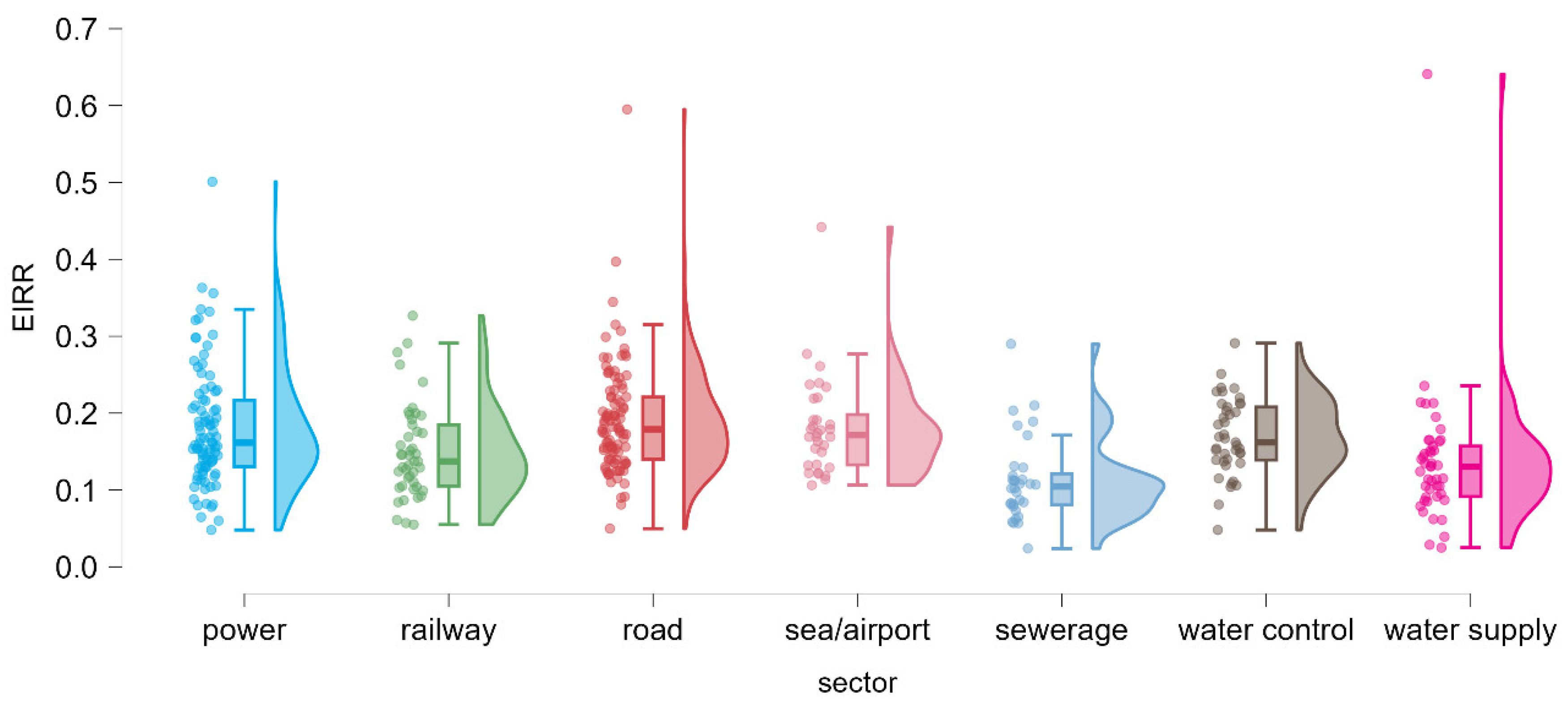
| Project sector | (1) Power sector (2) Railway sector (3) Road sector (4) Sea/airport sector (5) Sewerage sector (6) Water supply sector (7) Water control sector | According to Del Bo and Florio [34,44] and the ADB [33], project sector is one of the most influential factors for EIRRs. This research divides the projects into seven sectors. The sectors with only a few projects (e.g., education and ICT projects) are excluded from the dataset. |
| Project type | (1) Greenfield project (2) Brownfield project | EIRRs differ between “greenfield” projects involving land acquisition and full construction and “brownfield” projects involving only rehabilitation or upgrade works. The former needs more investment cost but may have bigger impact than the latter. |
| Tying status of the projects | (1) Tied project; project of which contracts are primarily tied to Japanese firms (2) Untied project | EIRRs may differ between tied projects and untied projects, since it is reported that tied aid raises the cost of many goods and services by 15–30% [48]. |
| Welch ANOVA with project sector as the factor | ||||||
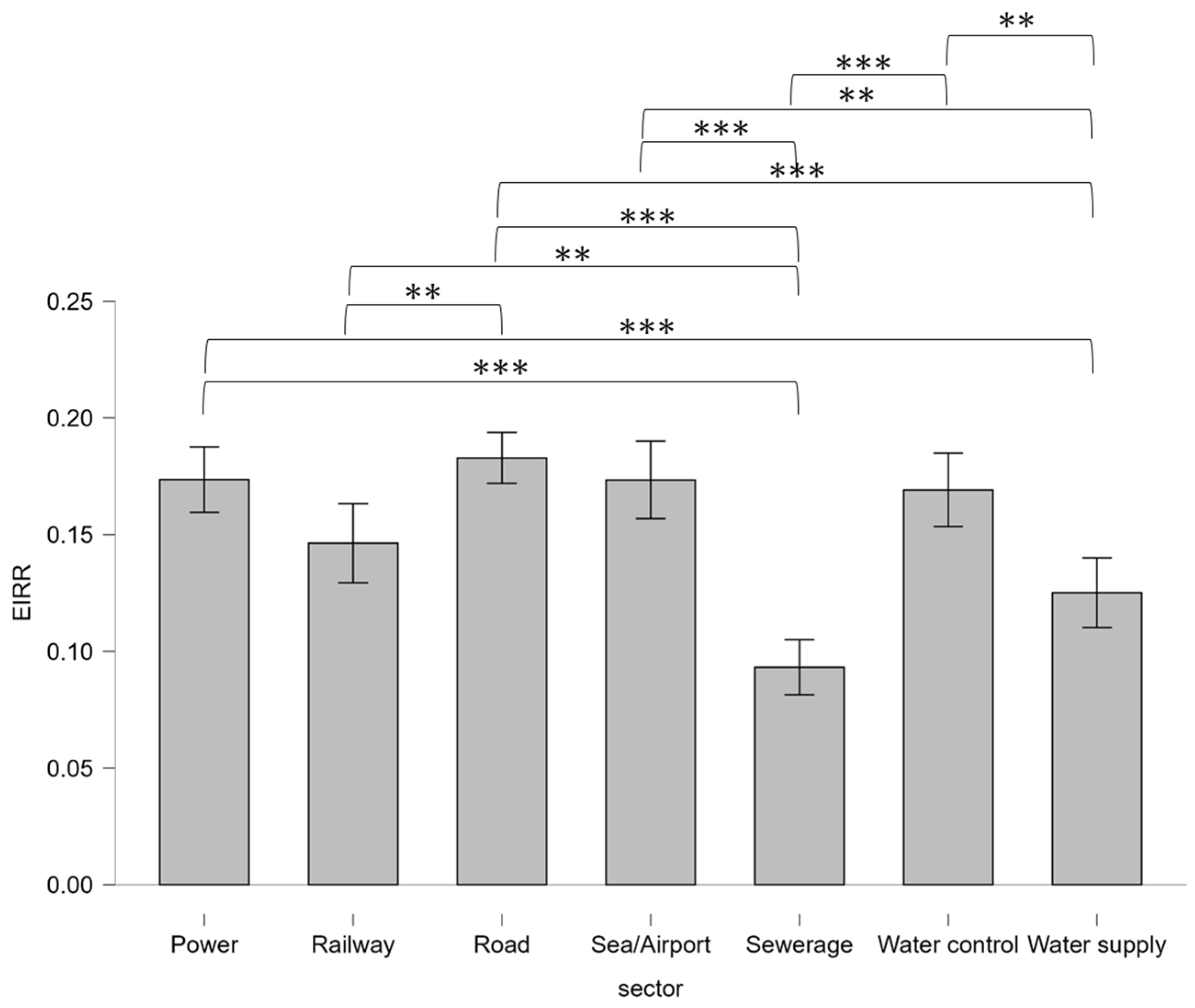
| Sector | N | Mean | SD | Partial η2 | F | p |
| Power | 88 | 0.174 | 0.066 | 0.192 | 27.625 | <0.001 |
| Railway | 44 | 0.146 | 0.056 | |||
| Road | 98 | 0.183 | 0.055 | |||
| Sea/Airport | 31 | 0.173 | 0.045 | |||
| Sewerage | 27 | 0.093 | 0.030 | |||
| Water control | 41 | 0.169 | 0.050 | |||
| Water supply | 44 | 0.125 | 0.049 | |||
| Welch t-test with project type as the factor | ||||||
| Type | N | Mean | SD | df | t | p |
| Greenfield | 287 | 0.154 | 0.058 | 135.938 | 4.254 | <0.001 |
| Brownfield | 86 | 0.185 | 0.060 | |||
| Welch t-test with the tied status of the projects as the factor | ||||||
| Tying status | N | Mean | SD | df | t | p |
| Tied | 59 | 0.167 | 0.062 | 80.008 | 0.833 | 0.407 |
| Untied | 314 | 0.160 | 0.060 | |||
| Power | Railway | Road | Sea/Airport | Water Control | Water Supply and Sewerage | Total | |
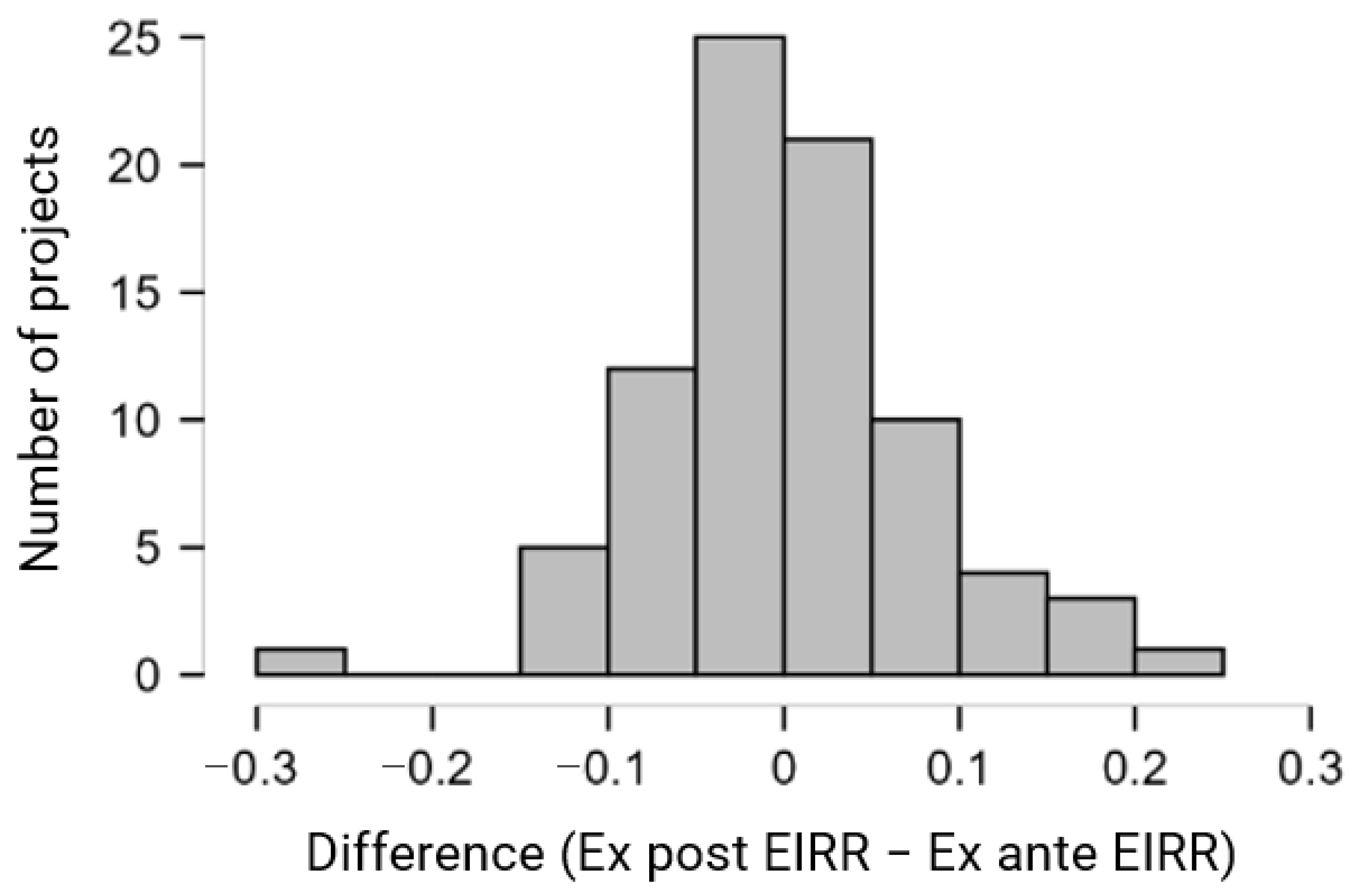
|---|---|---|---|---|---|---|---|
| Downward deviation (20% or more) | 9 | 2 | 8 | 3 | 2 | 5 | 29 |
| Downward deviation (less than 20%) | 3 | 2 | 5 | 1 | 2 | 3 | 16 |
| Upward deviation (less than 20%) | 2 | 0 | 5 | 0 | 3 | 3 | 13 |
| Upward deviation (20% or more) | 8 | 2 | 5 | 4 | 3 | 4 | 26 |
| Changes in Benefit | Change in Project Cost | Change in Project Period | ||||
|---|---|---|---|---|---|---|
| Change in Demand | Change in Unit Price for Benefit Calculation | Change in Project Scope | Change in Benefit Calculation Method | |||
| Power | 6 | 7 | 2 | 2 | 6 | 4 |
| (4) | (4) | (0) | (1) | (4) | (4) | |
| Railway | 4 | 2 | 0 | 1 | 1 | 3 |
| (3) | (1) | (0) | (0) | (1) | (2) | |
| Road | 15 | 1 | 3 | 2 | 8 | 3 |
| (10) | (1) | (3) | (0) | (6) | (3) | |
| Sea/Airport | 8 | 0 | 0 | 1 | 3 | 2 |
| (4) | (0) | (0) | (1) | (3) | (2) | |
| Water control | 5 | 2 | 1 | 0 | 1 | 0 |
| (3) | (0) | (0) | (0) | (1) | (0) | |
| Water supply and sewerage | 5 | 2 | 2 | 1 | 1 | 2 |
| (1) | (0) | (2) | (0) | (1) | (2) | |
| Total | 43 | 14 | 8 | 7 | 20 | 14 |
| (25) | (6) | (5) | (2) | (16) | (13) | |
Disclaimer/Publisher’s Note: The statements, opinions and data contained in all publications are solely those of the individual author(s) and contributor(s) and not of MDPI and/or the editor(s). MDPI and/or the editor(s) disclaim responsibility for any injury to people or property resulting from any ideas, methods, instructions or products referred to in the content. |
© 2026 by the authors. Licensee MDPI, Basel, Switzerland. This article is an open access article distributed under the terms and conditions of the Creative Commons Attribution (CC BY) license.
Share and Cite
Endo, K.; Hijikata, Y.; Miwa, Y.; Takayama, A.; Taira, Y. Rethinking Cost–Benefit Analysis for Infrastructure Projects: Insights from Japan’s Official Development Assistance Loan Projects. Sustainability 2026, 18, 1888. https://doi.org/10.3390/su18041888
Endo K, Hijikata Y, Miwa Y, Takayama A, Taira Y. Rethinking Cost–Benefit Analysis for Infrastructure Projects: Insights from Japan’s Official Development Assistance Loan Projects. Sustainability. 2026; 18(4):1888. https://doi.org/10.3390/su18041888
Chicago/Turabian StyleEndo, Kei, Yuji Hijikata, Yuto Miwa, Akihiro Takayama, and Yasushi Taira. 2026. "Rethinking Cost–Benefit Analysis for Infrastructure Projects: Insights from Japan’s Official Development Assistance Loan Projects" Sustainability 18, no. 4: 1888. https://doi.org/10.3390/su18041888
APA StyleEndo, K., Hijikata, Y., Miwa, Y., Takayama, A., & Taira, Y. (2026). Rethinking Cost–Benefit Analysis for Infrastructure Projects: Insights from Japan’s Official Development Assistance Loan Projects. Sustainability, 18(4), 1888. https://doi.org/10.3390/su18041888