Article

Enhanced Sustainability of Projects Based on Dynamic Time Management Using Petri Nets

by
Dimitrios Katsangelos
1 and
Kleopatra Petroutsatou
2,*
1
School of Science and Technology, Management and Construction of Technical Projects, Hellenic Open University, 26335 Patra, Greece
2
Faculty of Engineering, Department of Civil Engineering, Aristotle University of Thessaloniki, 54124 Thessaloniki, Greece
*
Author to whom correspondence should be addressed.
Sustainability 2026, 18(3), 1644; https://doi.org/10.3390/su18031644 (registering DOI)
Submission received: 29 November 2025 / Revised: 21 January 2026 / Accepted: 3 February 2026 / Published: 5 February 2026
(This article belongs to the Special Issue Construction Management and Sustainable Development)

Abstract

Construction management plays a fundamental role in the sustainability of construction projects, as its primary objective is to enhance cost-effectiveness and efficient resource utilization. One of the main challenges encountered at the early stages of a project’s lifecycle, particularly during the planning phase, is the development and agreement of construction schedules among the stakeholders involved. The tools employed for time planning and scheduling during both the planning and construction phases should therefore be capable of modeling complex environments and supporting dynamic updates in response to resource constraints. Petri nets are known for their capability of modeling complex systems, such as resource management. Their use in project management is essential for resource constraint problems. This paper investigates the use of Petri Nets as a tool for the time scheduling of engineering and construction projects. A case study is presented and modeled using Timed Petri nets, enabling dynamic adaptation under time and resource constraints. Through simulation performed with the ROMEO (v3.10.6) software, the study identifies the critical paths and determines the total project duration under various scenarios of sensitivity by adjusting specific project parameters. The results demonstrate the effectiveness of Petri nets in project management and the benefits they offer when used in modeling complex systems, identifying critical activities and calculating resource constraints and time deadlines.

1. Introduction

Project scheduling and management is a complex process, as planning, scheduling and management often require constraints on available resources, completion times and costs. Sustainability in the construction sector is inextricably combined with resource management and resource constraints. Consequently, activities and their sequence often require modifications to satisfy the constraints. The well-known project management methods, such as the critical path method, PERT [1] and its extensions (VERT, GERT), while being useful tools in the initial planning and scheduling of a project, have difficulty in dynamically monitoring and controlling the project during its execution as the project information is not linked [2]. Conventional project management tools suffer from inherent methodological limitations, including the absence of automated activity rescheduling mechanisms and their limited capability to resolve conflicts stemming from resource prioritization. Moreover, these tools are inadequate for explicitly modeling resource interdependencies and fail to provide sufficient diagnostic insight into the underlying causes of activity delays. They also lack appropriate support for the systematic analysis of partial resource allocation, mutual exclusivity, and resource substitution within complex project environments [2]. The primary limitation of these methods is the assumption of unlimited resource availability for each project activity [2]. Traditional scheduling approaches primarily focus on activity sequencing and project duration, often without explicitly accounting for resource availability. In contrast, Petri nets are well recognized for their ability to represent concurrent activities and to simulate the dynamic evolution of processes. A key advantage of Petri nets lies in their formal semantics, combined with intuitive graphical representations, in which system dynamics are captured by changes in markings. Moreover, Petri nets support a wide range of analytical techniques, including performance evaluation (e.g., waiting times and processing times) and property verification (e.g., safety and correctness). Building upon these capabilities, several studies have extended Petri net models to explicitly represent resource sharing and activity interdependencies in project environments [3]. According to Boushaala [4], conventional methods initially require determining the critical paths and project completion times under unlimited resources and then incorporating resource constraints into each activity to restructure the project design. In contrast to the two-step approach, Petri nets enable constraint calculation during the initial scheduling process, thereby providing a one-step approach.
The use of Petri nets in project management offers numerous advantages, as they enable the modeling of simultaneous activities and the simulation of their evolution. According to Chen et al., the advantage of PNs is their formal semantics, including algebraic properties, and their simultaneous graphical representation, in which the model’s evolution is presented as a change in the network marking [3]. Furthermore, it facilitates the solution of problems involving the shared use of resources across activities, whose analysis becomes particularly complicated as resources and constraints increase [5].
This paper aims to demonstrate the advantages of Petri nets in project scheduling and to highlight their capabilities. An analysis of various approaches across categories of Petri nets highlights the wide range of options available for projects of different natures.
Furthermore, this paper aims to analyze, design, and model a real project to demonstrate the practical application of Petri nets in the field of engineering, as well as ways to utilize them through the implementation of alternative project completion scenarios with different parameters, thereby illustrating the flexibility and speed of problem-solving that Petri nets offer.
This study addresses resource-constrained project scheduling using Timed Petri Nets, extending existing Petri-net-based approaches by integrating formal time semantics with tool-supported analysis and optimization. While previous studies have demonstrated the applicability of Petri nets to project scheduling, they often focus on theoretical formulations, small-scale examples, or simulation-oriented analyses, with limited emphasis on systematic optimization under explicit resource constraints. In contrast, the present work applies Timed Petri Nets to a realistic case study comprising more than thirty activities and employs the ROMEO software environment to analyze system behavior, resolve resource conflicts, and determine an optimal project schedule. By combining a formal modeling framework with practical tool-based analysis in a resource-constrained project context, this study contributes a structured and scalable approach that bridges the gap between Petri net theory and applied project scheduling.
The remainder of this paper is structured as follows. Section 2 introduces the theoretical background of Petri Nets, with particular emphasis on the subclass of Timed Petri Nets. Section 3 presents a comprehensive literature review of studies on project management and scheduling. In Section 4, the proposed methodology is demonstrated through a detailed case study. Section 5 addresses the resource constraints of the case study and presents their resolution using the ROMEO software tool. Finally, Section 6 presents the optimal solution and summarizes the study’s main findings.

2. Petri Nets

2.1. Definition of Petri Nets

Petri nets are bipartite, directed graphs consisting of two types of nodes: places and transitions. The nodes of the network are connected by directed arcs. An arc can connect two nodes of different types. Another element of Petri nets is the token. Places are represented as circles, and transitions as bars or rectangles. Arcs are represented by arrows and tokens by dots or numbers [6].
According to the above, a Petri net is a 5-tuple, PN = (P, T, W, F, Mo), where
P = {p1, p2, …, pn}, n > 0 is a finite set of places;
T = {t1, t2, …, tm}, m > 0 is a finite set of transitions;
F ⊆ (P x T) U (T P) is a set of arcs;
W: F → N+ is a weight function;
Mo: P → N is the initial marking [6,7,8,9].

2.2. Firing Rule

A transition is enabled when the number of tokens in each input place is at least as large as the weight of the arc from that input place to the transition. Considering this, the formal rule of an enabled transition is as follows:
M(p) ≥ I(p,t), ∀ p ∈ P, where M(p) is the marking of each place, and I(p,t) is the weight of each input arc [10,11].
An enabled transition may fire, removing tokens from all the input places and equal to the weight of their arcs and adding tokens to the output places, equal to the weight of the arcs connecting them. The firing rule of a transition as follows:
M′(p) = M(p) − I(p, t) + O(p, t,), ∀ p ∈ P, where M′(p) is the new marking of the system and O(p, t,), is the weight of the arc of each output place [8].
The mechanism of enabling and firing of transitions is called the token game.

2.3. Timed Petri Nets

Timed Petri nets, proposed by Rachmadani, are an extension of classical Petri nets that incorporate timing information. Timed Petri nets are formally defined as a sextuple PN = (P, T, F, W, D, M0), where (P, T, F, W, M0) represent the components of a conventional Petri net, and D: T → ℝ+ is a delay function that assigns positive real (or integer) values to transitions [12,13,14].
Accordingly, the firing rule is modified: a transition does not fire immediately but only after the specified delay time has elapsed. These networks are therefore characterized by the inclusion of a timer mechanism associated with each transition of the net [15].
Transitions can be either immediate or timed. Immediate transitions have zero delays and fire instantaneously, whereas timed transitions fire after a specified delay. In the event of a conflict between an immediate and a timed transition, the immediate transition takes precedence and fires first [10,12]. This property is particularly important in systems where ongoing actions may need to be interrupted, for example, in emergencies, when immediate transitions serve this role.
Timed Petri nets operate under the strong firing rule. According to the strong firing rule, a transition is required to fire exactly when its time delay elapses. In other words, its firing time is predetermined [16].

3. Literature Review on Petri Net-Based Project Management

Petri nets (PNs) have been widely applied in project management and construction scheduling due to their ability to explicitly model concurrency, precedence relationships, and resource interactions. Compared with traditional network-based techniques such as the Critical Path Method (CPM) and the Program Evaluation and Review Technique (PERT), Petri nets provide a formal and expressive framework for representing complex project execution logic, including synchronization, parallelism, and dynamic resource allocation. Table 1 summarizes representative Petri-net-based approaches in project scheduling, ordered from the most recent to the earliest contributions.
Early studies established the theoretical foundations for applying Petri nets to project modeling and task planning. Kim and Desrochers [17] and Wakefield and Sears [18] demonstrated that Petri nets can rigorously capture task dependencies and system dynamics, while Sawhney [19] showed that Petri-net-based simulation enables more realistic evaluation of construction schedules by incorporating stochastic behavior and activity interactions. Despite their significance, these early contributions primarily focused on conceptual validation and were illustrated using small-scale or simplified project networks.
Subsequent research extended Petri net applications to construction scheduling and process-level simulation. Sawhney and co-authors [20] applied Petri nets to construction operations such as structural steel erection and bridge construction, highlighting their flexibility in modeling sequencing logic and resource constraints. Additional studies addressed domain-specific applications, including earthmoving operations and repetitive construction tasks, thereby improving operational realism. Nevertheless, most reported case studies remained limited in scope and scale, constraining the generalizability of the results.
A significant body of literature has focused on scheduling using timed Petri nets, in which temporal delays are associated with either transitions or places. Cohen and Zwikael [21] proposed the Project Petri Net (PPN) model, in which an activity-on-arrow (AOA) network is transformed into a Petri net, with each activity represented as a timed transition. The basic PPN model further incorporates Gantt chart functionality by introducing a time axis and extending transitions to reflect their execution durations. While intuitive and compatible with traditional scheduling representations, this approach primarily supports simulation-based analysis.
Alternative formulations associate time delays with places rather than transitions. Boushaala [4] employed timed Petri nets in which activities are modeled as places, enabling an algebraic solution of project scheduling problems using Petri net theory. By constructing the incidence matrix and computing T-invariants and P-invariants, this approach verifies key project properties, including the feasibility of completion, identification of the critical path, the total project duration, and the absence of deadlocks. Although mathematically rigorous, such algebraic approaches are typically applied to relatively small project networks.
A similar algebraic perspective was adopted by Kumanan and Raja [2], who introduced the Precedence Priority Choice (PPC) matrix to model precedence, priority, and alternative execution constraints in Petri-net-based project schedules. In this framework, transition enabling and firing are determined through matrix updates that track token movements and constrain satisfaction. While expressive, the method increases modeling and computational complexity as project size and constraint interactions grow.
Several studies have extended timed Petri nets to explicitly incorporate resource constraints. Lin and Dai [5] transformed CPM diagrams into Petri nets with timed transitions and resource places, demonstrating that resource availability directly influences project duration and critical path structure. Chen et al. [3] proposed the Resource Assignment Petri Net (RAPN) model, which distinguishes between waiting places, active places, resource places, delay places, and a final place representing project completion. This structure enables explicit modeling of resource allocation and activity interdependence. Salimifard et al. [22] further applied the RAPN approach to a construction project case study, classifying resources as consumable or reusable and assigning them according to project-specific requirements.
Timed Colored Petri Nets (TCPNs) represent a further extension, combining color attributes with temporal information to model systems involving multiple interacting factors [23]. Bevilacqua et al. [24] employed colored Petri nets with temporal parameters to represent activity durations, resource requirements, availability constraints, and execution priorities, thereby enhancing modeling expressiveness for complex project environments.
Table 1. Summary of Petri-net-based approaches in project scheduling and management.
Authors (Year)TitleResearch Focus and Key Findings
Kumar & Kumar (2024) [25]A hybrid soft computing technique by using fuzzy Petri nets to optimize the critical path in management problemProposes a hybrid fuzzy Petri net approach to optimize the critical path under uncertainty, improving decision support in project management.
Huang et al. (2023) [26]Scheduling of resource allocation systems with timed Petri nets: A surveyProvides a comprehensive survey of timed Petri net approaches for scheduling and resource allocation, highlighting trends and limitations.
Azarnova et al. (2021) [27]Application of Bayesian networks and Petri nets apparatus for the study of projects implementation calendar plansCombines Bayesian networks and Petri nets to assess schedule risks and temporal uncertainty in project implementation plans.
Salimifard et al. (2019) [22]Managing time and resources of construction projects using colored Petri nets and a genetic algorithmCombines colored Petri nets with a genetic algorithm to optimize time and resource allocation in construction projects, demonstrating improved scheduling performance under complex constraints.
Mazzuto & Bevilacqua (2018) [28]A decision-making application for project management through timed coloured Petri netsDevelops a decision-support application using timed colored Petri nets to evaluate alternative project execution scenarios.
Bevilacqua et al. (2018) [24]Timed coloured Petri nets and project management applicationsDemonstrates applications of timed colored Petri nets for modeling temporal constraints in complex project environments.
Liu et al. (2016) [29]Time performance optimization and resource conflicts resolution for multiple project managementAddresses time optimization and resource conflict resolution in multi-project environments using Petri-net-based models.
Boushaala (2014) [4]An approach for project scheduling using PERT/CPM and Petri nets (PNs) toolsProposes an integrated PERT/CPM and Petri-net-based approach for project scheduling, using Petri net theory to verify project feasibility, identify the critical path, estimate total project duration, and ensure deadlock-free execution through algebraic analysis.
Li & Liu (2014) [30]Resource management modelling and simulating of a construction project based on Petri netPresents a Petri-net-based model for simulating and analyzing construction resource allocation strategies.
Lin & Dai (2014) [5]Applying Petri nets on project managementPresents a Petri-net-based modeling approach for project management in which CPM diagrams are transformed into Petri nets with timed transitions and resource places to analyze project duration and resource constraints.
Chen & Shan (2012) [31]The application of Petri nets to construction project managementShows that Petri nets effectively capture workflow logic and improve visualization and coordination in construction projects.
Zhang et al. (2012) [32]Risk management for construction projects with colored Petri netsIntroduces an agent-based risk management framework using colored Petri nets for construction projects.
Samkari et al. (2012) [33]Colored Petri-net and multi-agents: A combination for a time-efficient evaluation of a simulation study in construction managementCombines colored Petri nets and multi-agent systems to enhance computational efficiency in construction simulation studies.
Chung (2011) [34]Modeling of construction scheduling with coloured Petri netsDevelops a colored Petri net model integrating sequencing and resource attributes for construction scheduling analysis.
Cheng et al. (2011) [35]A Petri net simulation model for virtual construction of earthmoving operationsProposes a Petri-net-based simulation model to analyze productivity and process interactions in earthmoving operations.
Subulan et al. (2011) [36]Modeling and analyzing of a construction project considering resource allocation through a hybrid methodologyApplies a hybrid Petri net and fuzzy rule-based approach to improve modeling of resource allocation decisions.
Wu et al. (2009) [37]Solving resource-constrained multiple project scheduling problem using timed colored Petri netsUses timed colored Petri nets to explicitly model time and resource conflicts in multi-project scheduling.
Adida & Joshi (2009) [38]A robust optimisation approach to project scheduling and resource allocationPresents a robust optimization framework supported by formal modeling techniques for project scheduling under uncertainty.
Biruk & Jaśkowski (2008) [39]Simulation modelling construction project with repetitive tasks using Petri nets theoryDemonstrates the effectiveness of Petri nets in modeling repetitive construction tasks and evaluating time performance.
Chen et al. (2008) [3]A Petri net approach to support resource assignment in project managementIntroduces a Petri-net-based framework for resource assignment in project management, modeling resource availability and allocation through dedicated places and transitions to support conflict resolution and improved coordination.
Cohen & Zwikael (2008) [21]Modelling and scheduling projects using Petri netsShows that Petri nets support representation of parallelism and dependencies beyond traditional CPM techniques.
Kumanan & Raja (2008) [2]Modeling and simulation of projects with Petri netsProposes a Petri-net-based framework for modeling and simulating project schedules, transforming activity-on-arrow networks into Petri nets and demonstrating how precedence relations and execution logic can be analyzed through simulation and Petri net properties.
Nassar & Casavant (2008) [40]Analysis of timed Petri nets for reachability in construction applicationsApplies reachability analysis to verify feasible execution sequences in construction project models.
Salum (2008) [41]Petri nets and time modellingDiscusses time modeling concepts in Petri nets and their relevance for dynamic project systems.
Haji & Darabi (2007) [42]Petri net based supervisory control reconfiguration of project management systemsIntroduces a Petri-net-based supervisory control framework enabling dynamic reconfiguration of project execution.
Kao et al. (2006) [43]A Petri-net based approach for scheduling and rescheduling resource-constrained multiple projectsAddresses dynamic scheduling and rescheduling of resource-constrained multiple projects using Petri nets.
Chahrour & Franz (2006) [44]Seamless data model for a CAD-based simulation systemPresents a Petri-net-compatible data model enabling integration of CAD data with construction simulation systems.
Sawhney & Mund (2003) [45]Petri net-based scheduling of construction projectsIntroduces a Petri-net-based scheduling framework that explicitly models concurrency, sequencing, and resource interactions.
Reddy & Kumanan (2001) [46]Application of Petri nets and a genetic algorithm to multi-mode multi-resource constrained project schedulingIntegrates Petri nets with genetic algorithms to improve search for near-optimal schedules under complex constraints.
Sawhney & Vamadevan (2000) [47]Petri Net-Based Scheduling of a Bridge ProjectApplies Petri-net-based scheduling to a real bridge construction project, demonstrating improved modeling of activity interactions.
Jaworski & Biruk (2000) [48]A model of construction project based on Petri nets theoryProposes a conceptual Petri-net-based model providing a formal foundation for construction project representation.
Sawhney & Mund (1999) [20]Hierarchical and modular modeling of structural steel erection process using Petri netsDevelops a hierarchical and modular Petri net framework improving scalability for modeling steel erection processes.
Sawhney et al. (1999) [20]Simulation of the structural steel erection processUses Petri-net-based simulation to analyze sequencing, resource interactions, and productivity in steel erection.
Sawhney (1997) [19]Petri Net based simulation of construction schedulesDemonstrates that Petri-net-based simulation supports more realistic evaluation of construction schedules than deterministic methods.
Wakefield & Sears (1997) [18]Petri nets for simulation and modeling of construction systemsShows that Petri nets effectively capture system dynamics and interactions in construction process modeling.
Kim & Desrochers (1995) [17]Task planning and project management using Petri netsInvestigates early applications of Petri nets for representing task dependencies, concurrency, and control logic.
Although the literature demonstrates the extensive use of Petri-net-based approaches for modeling and analyzing project scheduling problems, a direct comparison with traditional network-based techniques is often presented only implicitly. To clarify the relative strengths and limitations of these approaches, Table 2 provides a structured comparison between CPM, PERT, and Timed Petri Nets with respect to key scheduling criteria, including modeling effort, ease of updating, ability to handle constraints, and computational efficiency. This comparison synthesizes insights from established studies and highlights the distinctive capabilities of Timed Petri Nets in addressing complex and resource-constrained project environments.
Overall, the existing literature confirms the effectiveness and versatility of Petri-net-based approaches for modeling and analyzing project scheduling problems, particularly in handling temporal constraints and resource interactions. However, prior studies have predominantly relied on simulation-based tools or algebraic analysis and have typically focused on small or illustrative project networks. Moreover, explicit and systematic formal verification of scheduling models is rarely addressed, and scalable applications to full-scale project networks remain limited. To the authors’ knowledge, no previous work has applied a formally verified timed Petri net model to a full-scale project with more than 30 explicitly defined activities using a model-checking tool such as ROMEO. This study addresses this gap by positioning Petri-net-based project scheduling within a formal verification framework, enabling rigorous and scalable analysis of complex project schedules.

4. Case Study

4.1. Project

The case study considered in this work is derived from an anonymized industrial project, ensuring realistic project durations, resource allocations, and precedence relationships. It comprises thirty-three activities with multiple interacting resource constraints, representing a typical medium- to large-scale project scenario. Including the number of activities ensures a sufficiently complex network to capture concurrency, precedence relationships, and resource interactions commonly encountered in real-world projects. This level of complexity provides a meaningful testbed for evaluating the proposed Timed Petri Net methodology while remaining manageable for systematic analysis and reproducibility. The selection of this case, therefore, provides a representative and challenging environment to demonstrate the applicability, scalability, and advantages of the proposed approach in resource-constrained project scheduling.
Building on this representative and complex case study framework, the present paper focuses on a technical project involving the anti-corrosion protection of two storage tanks under construction, along with the associated pipe rack located within the tank area.
The tanks are being built within refinery facilities, and the erection of the shell and bottom plates of both tanks has already been completed.
Tank D1 has a diameter of 26.5 m, a height of 14.5 m, and a theoretical fuel capacity of 7997 m3, while tank D2 has a diameter of 34.5 m, a height of 14.5 m, and a theoretical fuel capacity of 13,555 m3. Both tanks are fixed-roof.
The contractor’s scope of work includes: sandblasting and painting of pipelines in the form of “sticks” and spools; sandblasting and painting of the fixed-roof plates of both tanks; installation of the fixed roofs on the tank shells; and painting of the tank bottoms and shells. On the roofs, an anti-slip coating will be applied to ensure safe access for refinery personnel. Finally, the handrails on roofs and staircases, as well as the peripheral firefighting water and foam lines on tank roofs, will be painted.
For all works at height, the use of scaffolding is required and is the responsibility of the contractor. The installation of the scaffolding will be carried out by Subcontractor A, while the installation of the roofs will be performed by Subcontractor B, both of which are specialized in their respective areas of work.
The project activities, their durations and the precedence relationships are presented in Table 3.
The durations of the activities were determined through a structured expert elicitation process involving four key project participants: the project manager, the site foreman, and two technical staff members, all of whom were directly involved in the execution of the project. These structured technical interviews focused on estimating realistic activity durations based on professional experience and project-specific conditions.
In parallel, empirical data from previous comparable projects were retrieved from the contractor’s archives, including daily work logs and records of similar activities. Additionally, technical datasheets and material coating system specifications were reviewed to define coating layers and required recoat times, enabling the calculation of the corresponding work durations.
Given the substantial availability and consistency of duration data across sources, a single representative duration value was assigned to each activity. For clarity and traceability, all activities were coded to facilitate subsequent diagrammatic and analytical processing.

4.2. CPM

For the project scheduling, the Critical Path Method (CPM) is initially applied. A network diagram is constructed based on the data presented in the above table. The network, shown in the following table, facilitates the calculation of the following parameters for each activity:
  • Earliest Start (ES);
  • Latest Start (LS);
  • Earliest Finish (EF);
  • Latest Finish (LF);
  • Total Float (TF).
The red color is used to identify the critical path and the critical activities.
Initially, the earliest start and earliest finish times for each activity are calculated, proceeding from left to right (in the forward direction). The first activity, coded as 0—site installation—has an earliest start time equal to zero. The earliest finish time, according to the formula EF = ES + DURATION, is calculated to be two days.
For the calculation of the latest finish times, the computations are performed from the end toward the beginning (in the backward direction). The final activity, “Project Completion,” is assigned a latest finish time equal to the total project duration, LFcompletion = project duration. Subsequently, the latest finish time of each preceding activity is calculated, and the latest start time is determined using the formula LS = LF − Activity Duration.
The total float for each activity is calculated by subtracting the earliest finish time from the latest finish time, or equivalently, the earliest start time from the latest start time [49]. In Table 4, the activities with a total float of zero are marked.
Therefore, the critical path is the sequence 0–3.5–3.6–3.7–3.1–3.2–3.3–3.4–3.10–3.11–3.12–4. The total float of the remaining activities indicates the amount of time an activity can be delayed without affecting the overall project duration. The activity-on-node network diagram of the project is shown in Figure 1.

4.3. Project Management Using Petri Nets

Project modeling using Petri nets begins with the initial selection of the appropriate PN category. A key criterion in this selection is the ability to represent temporal duration. The present project will be modeled using Timed Petri Nets (TPNs). The time parameter in TPNs can be assigned either to places or to transitions in the network.
Timed transitions provide a more accurate representation of the execution duration of a task or of a delay before its initiation, whereas places are preferred for representing resource waiting (queuing). Therefore, in this study, time delays are assigned to transitions.
The network transitions are deterministic: they fire once enabled and the corresponding time delay has elapsed.
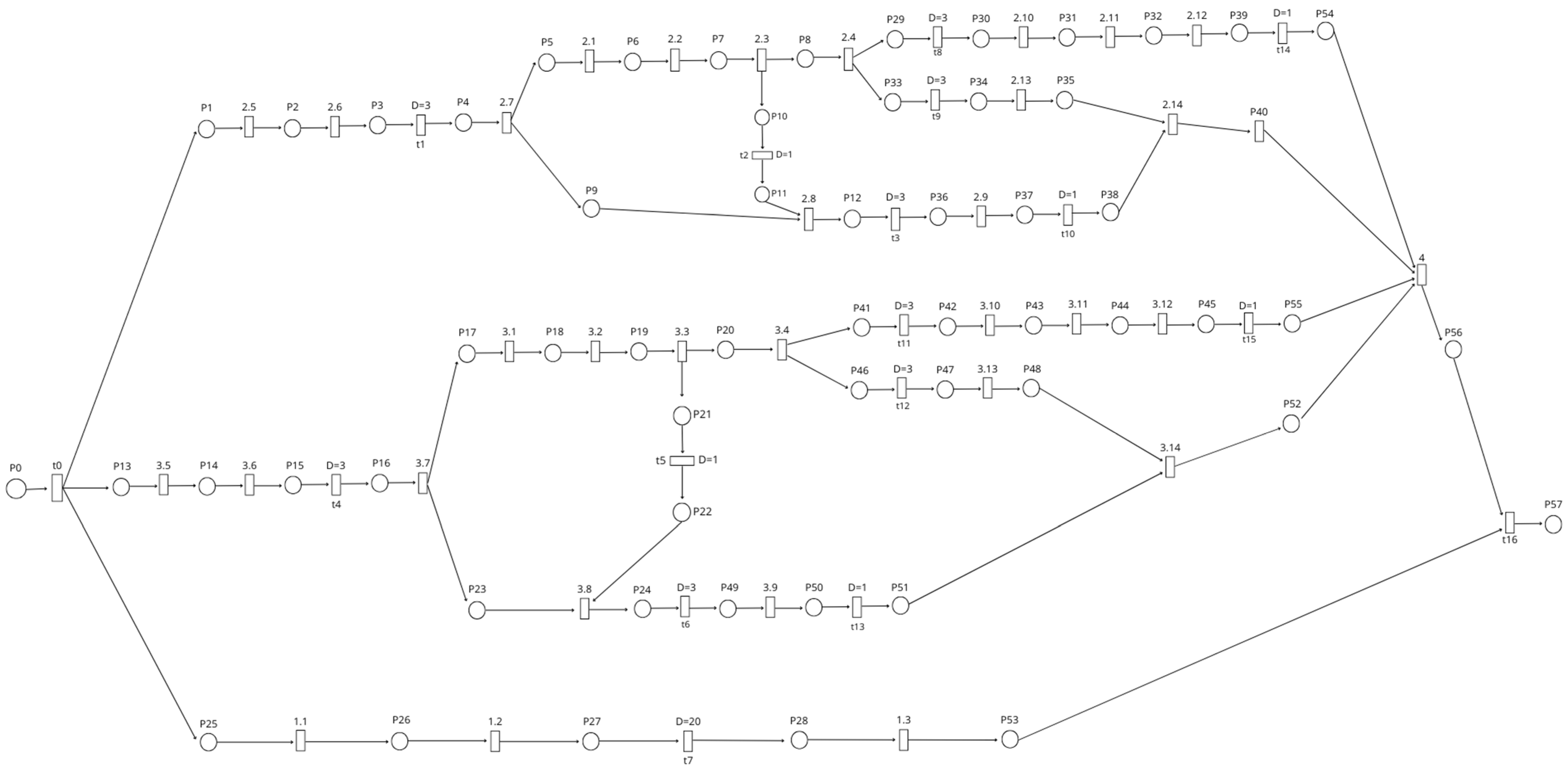
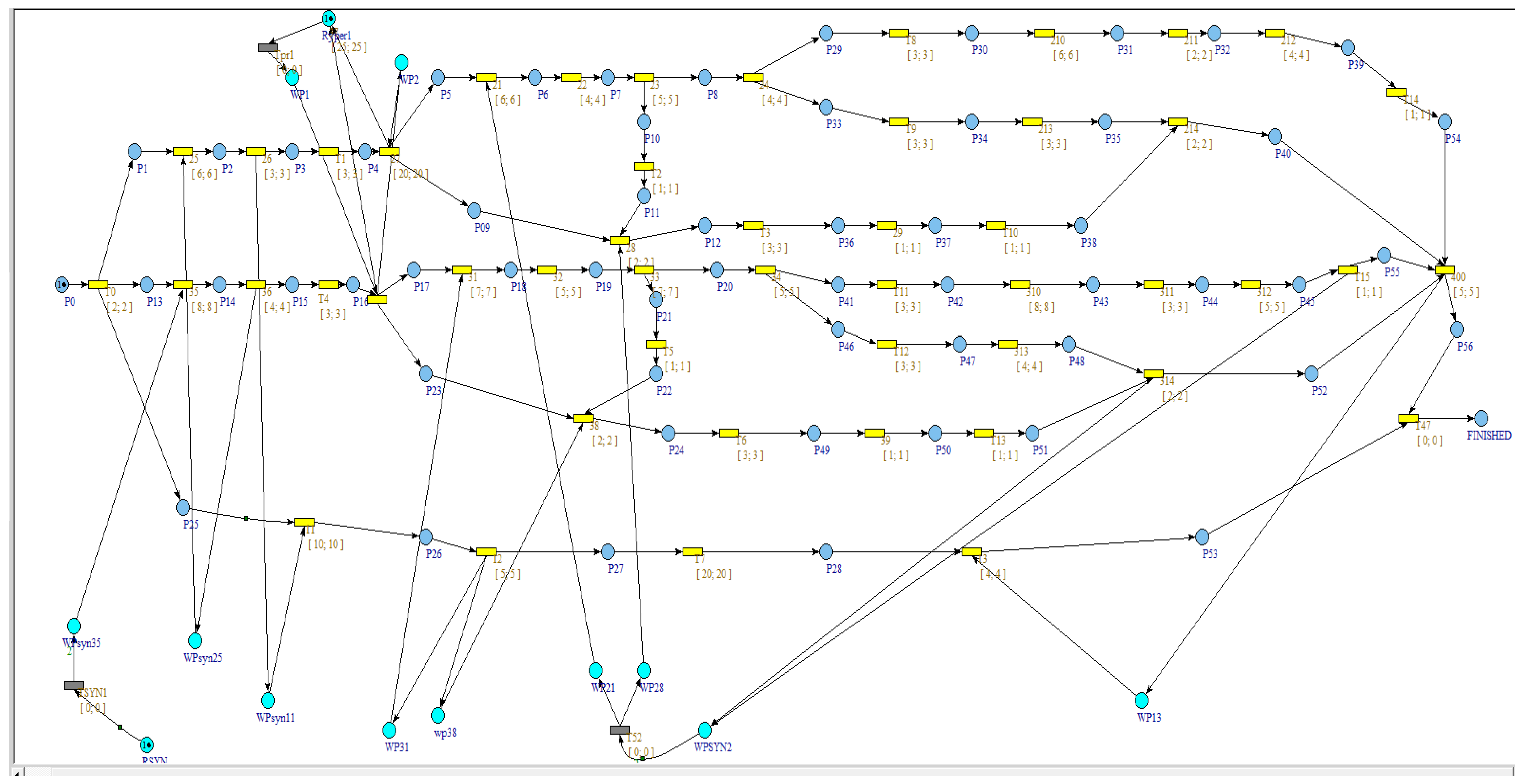
Subsequently, the Petri net representing the project is constructed from the node network presented in the previous section. In general, each activity is modeled as two places connected by a timed transition, whose duration corresponds to the time required to execute the activity. The timed Petri Net model of the project is shown in Figure 2.
It is observed that the Petri net consists of fifty-eight places and forty-nine transitions. The transitions representing activities are labeled with the corresponding activity names. For example, transition 2.5 corresponds to activity 2.5 in the activity table. The delays in the precedence relationships between activities (e.g., fs + 1, fs + 3) are represented by timed delay transitions, denoted as t1, t2, …, t15.
Thus, following the transition of an activity, there is an output place, followed by a delayed transition representing the waiting time before the next activity. This delay transition is connected to the input place of the subsequent activity. All arcs in the network have a weight of one (w = 1).
The network has an initial marking M0 = (1, 0, 0, …, 0) at place P0, where a single token is placed to initiate the simulation process. The token in place P0 represents the start of the project, while the token in place P55 indicates its completion. From the initial marking, the transition t0 corresponding to the first activity is enabled. Since each place has only one incoming arc, the maximum number of tokens per place is one.
The transition remains enabled for t = 2, corresponding to the duration of the activity, and once this time elapses, it fires—removing the token from its input place P0 and adding one token to its output places (P1, P13, P25). These output places are the input places for transitions t2.5, t3.5, and t1.1, representing the corresponding activities. These transitions are arranged in parallel, symbolizing the parallel execution of the respective activities. Essentially, activities that begin upon the completion of a previous one are represented by an arc from the corresponding transition to the input place of the subsequent transitions.
Activities that require the completion of more than one preceding activity to start are modeled in the Petri net through the enabling condition of transitions. Specifically, activity 2.8 has a finish-to-start relationship with the two preceding activities, 2.3 and 2.7, and includes a one-day delay after the completion of activity 2.3. In the Petri net, the firing of the transition corresponding to these activities places a token in the output place P9. This token arrives at its position at time t = 34, computed as the sum of the transition durations along that path.
However, for transition 2.8 to be enabled, all its input places must be marked in accordance with the enabling rule—that is, each input place must contain one token. Therefore, activity 2.8 becomes enabled only when place P11 is also marked. This occurs after activity 2.3 has been completed and a one-day delay has elapsed through delay transition t2, which happens at time t = 50. Consequently, the token in P9 waits from t = 34 to t = 50, at which point activity 2.8 is finally enabled. The same principle applies to all other activities within the project.
The final transition t16 is an immediate transition that fires upon activation, with no delay. This transition does not represent a specific activity; rather, its firing indicates the project’s completion. Its role is to remain inactive until both activity paths—the cleaning and painting of the tanks and the painting of the pipeline corridor—are completed. This transition is crucial, as it ensures the simultaneous completion of these processes. Without it, the Petri net would terminate upon the completion of the shorter-duration path.
The total project completion time represented by the Petri net is ninety-one days, identical to the duration calculated using the Critical Path Method (CPM). The critical path of the Petri net is
P0–t0–P13–3.5–P14–3.6–P15–t4–P16–3.7–P17–3.1–P18–3.2–P19–3.3–P20–3.4–P41–t11–P42–3.10–P43–3.11–P44–3.12–P45–t15–4–P56–t16–P57.

4.4. Simulation Using ROMEO Software

To simulate the project under study, the ROMEO tool was used. ROMEO is a free and open-source software developed in the early 2000s at the University of Nantes. It enables modeling and analysis of complex networks that incorporate time [50].
The simulation procedure implemented in the ROMEO software is founded on the formal modeling principles of Timed Petri Nets. Within this framework, the project scheduling problem is formulated as a time-bounded reachability task, in which the objective is to determine the minimum time required for the system to evolve from the initial marking to a designated final marking representing project completion. ROMEO systematically explores the state space by applying timed transition firing rules and enforcing clock and resource constraints, ensuring that all admissible execution sequences are examined. This analytical process provides a rigorous methodological foundation for evaluating schedule feasibility and project duration, extending beyond purely operational or descriptive simulation approaches.
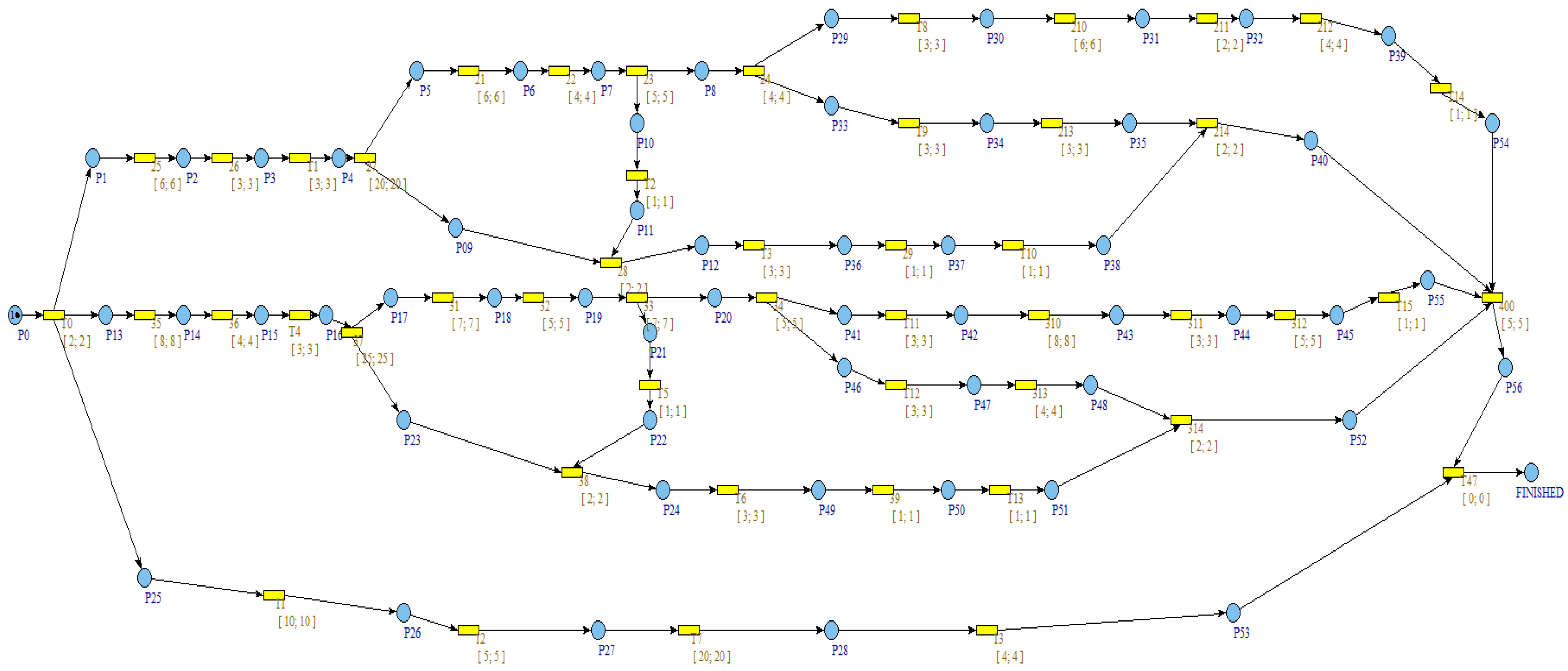
Initially, the project’s Petri net was constructed using the ROMEO editor, as shown in Figure 3. The software provides a toolbar for network design that includes places, transitions, markings, arcs, and their extensions. The modeling process begins with the placement of the places. By right-clicking each place, the Properties window opens, allowing the user to define the place’s name and initial marking.
Next, the network transitions are placed. By default, transitions are not time-defined. The timing parameters were assigned by right-clicking on each transition and editing its properties. In ROMEO, the firing time of a transition is defined stochastically by lower and upper bounds, consistent with the definition of firing in timed Petri nets. The upper firing time may be unbounded, indicating the system’s statistical behavior.
For deterministic transitions, as in the project under study, the lower and upper bounds must be equal. In the Petri net diagram, each transition is labeled with its name and a pair of numbers in parentheses representing the lower and upper firing times. For example, the first transition T0 has a firing time of (2, 2).
The final place in the simulation, P57, was named FINISHED. Finally, arcs were added to the model, connecting input places to their respective transitions and transitions to their output places, until the final network structure was completed.
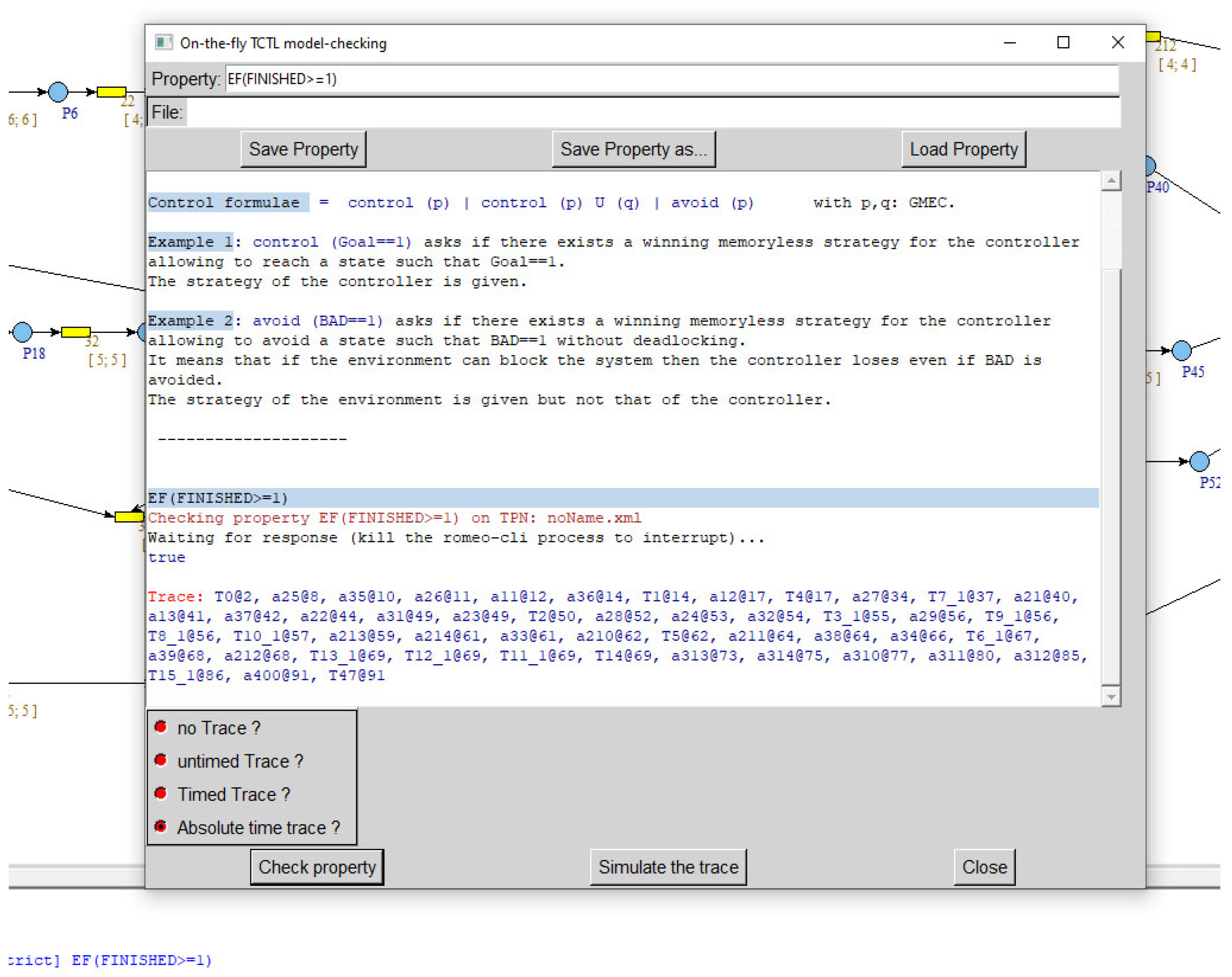
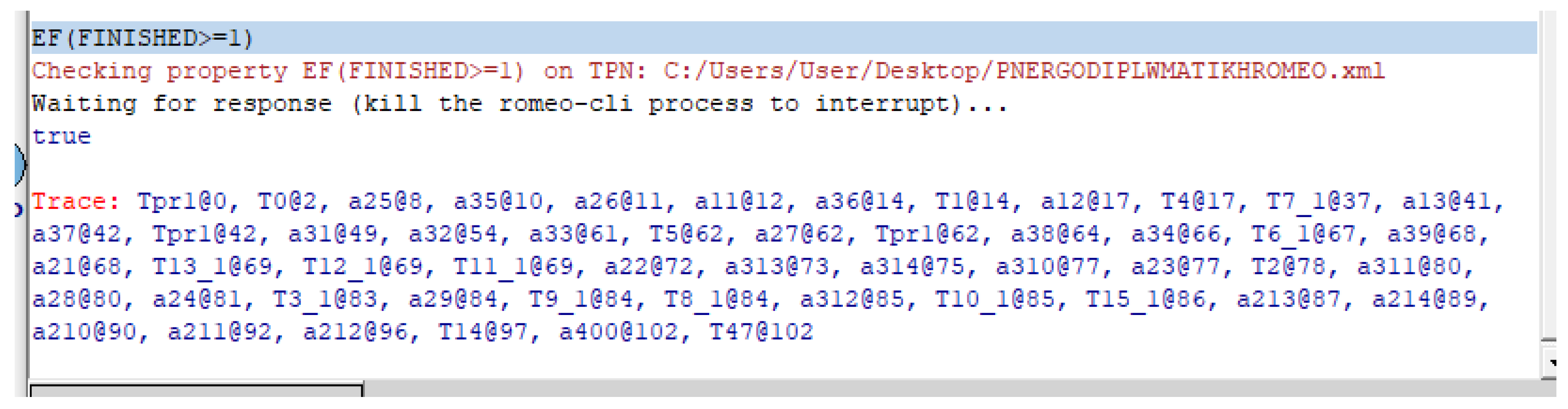
To verify the correctness of the Petri net design for the project under study, it is essential to confirm that the project completion time obtained from the simulation agrees with the result derived using the Critical Path Method (CPM), as presented in Section 4.2. The project duration is verified using the “Checker” tool. By right-clicking on the corresponding command, a dialog window opens, as illustrated in Figure 4.
In the Property bar, the command EF(FINISHED ≥ 1) is specified. Then, by selecting “absolute time trace” and clicking on “check property,” the tool is instructed to compute the time instant at which the FINISHED place contains at least one token. According to the Petri net structure representing the case study project, the project is considered complete when the token reaches the final place labeled “FINISHED.” The total time elapsed from the initiation of the token simulation to its arrival at the “FINISHED” place corresponds to the project completion time.
This command can be modified by replacing the FINISHED place with any other place in the network to determine the exact time at which that place acquires a token. The corresponding results are displayed in the Results window, below the trace section.

5. Resource Constraints

5.1. Resource Constraint on Subcontractor

During the project’s study and design phase, a resource constraint was identified regarding the availability of the subcontracted mechanical engineering firm responsible for installing and welding the roof plates on the two tanks. Specifically, the mechanical subcontractor informed us that it could allocate only one welding crew to this project, thereby limiting work to a single tank at a time. The crew must complete the installation on the first tank before commencing work on the second.
The comparative application of CPM and Timed Petri Nets in the present case study highlights a fundamental methodological advantage of the latter. The CPM analysis was initially performed under the assumption of unlimited resources, yielding a baseline project duration based solely on precedence relationships. However, once realistic resource constraints were introduced, the CPM framework proved incapable of modeling resource conflicts and their impact on activity execution without additional heuristics or external procedures. In contrast, the Timed Petri Net formulation explicitly incorporates both temporal constraints and resource availability within a unified modeling framework. This enabled the direct resolution of resource conflicts and the derivation of a feasible and optimized project schedule. The results demonstrate that Timed Petri Nets offer superior modeling and analytical capabilities for resource-constrained project scheduling compared to traditional CPM-based approaches.
This situation can be effectively modeled using Petri nets by incorporating the resource constraint into the existing network by adding appropriate places, arcs, and transitions. The total project duration varies depending on which tank is constructed first.
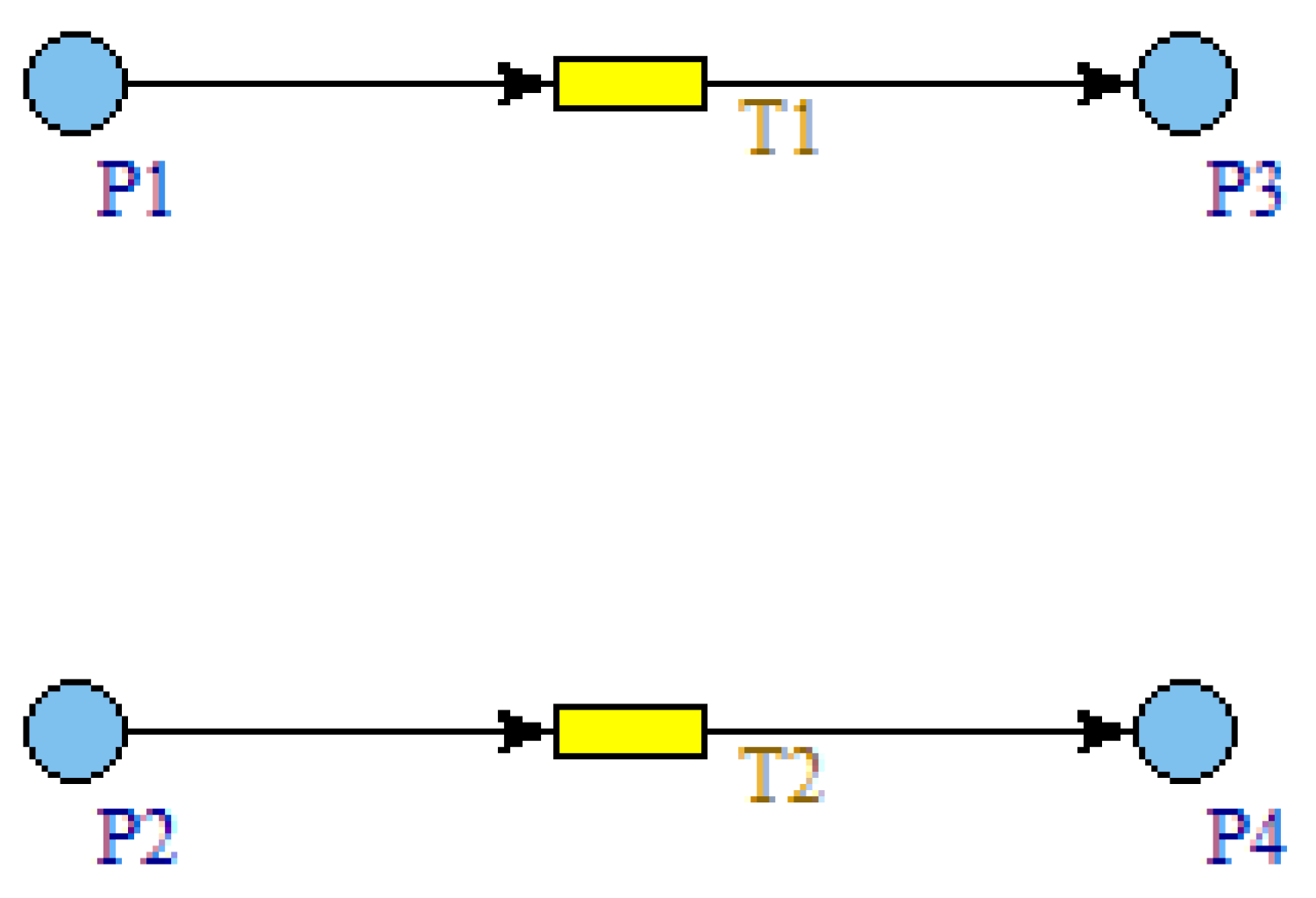
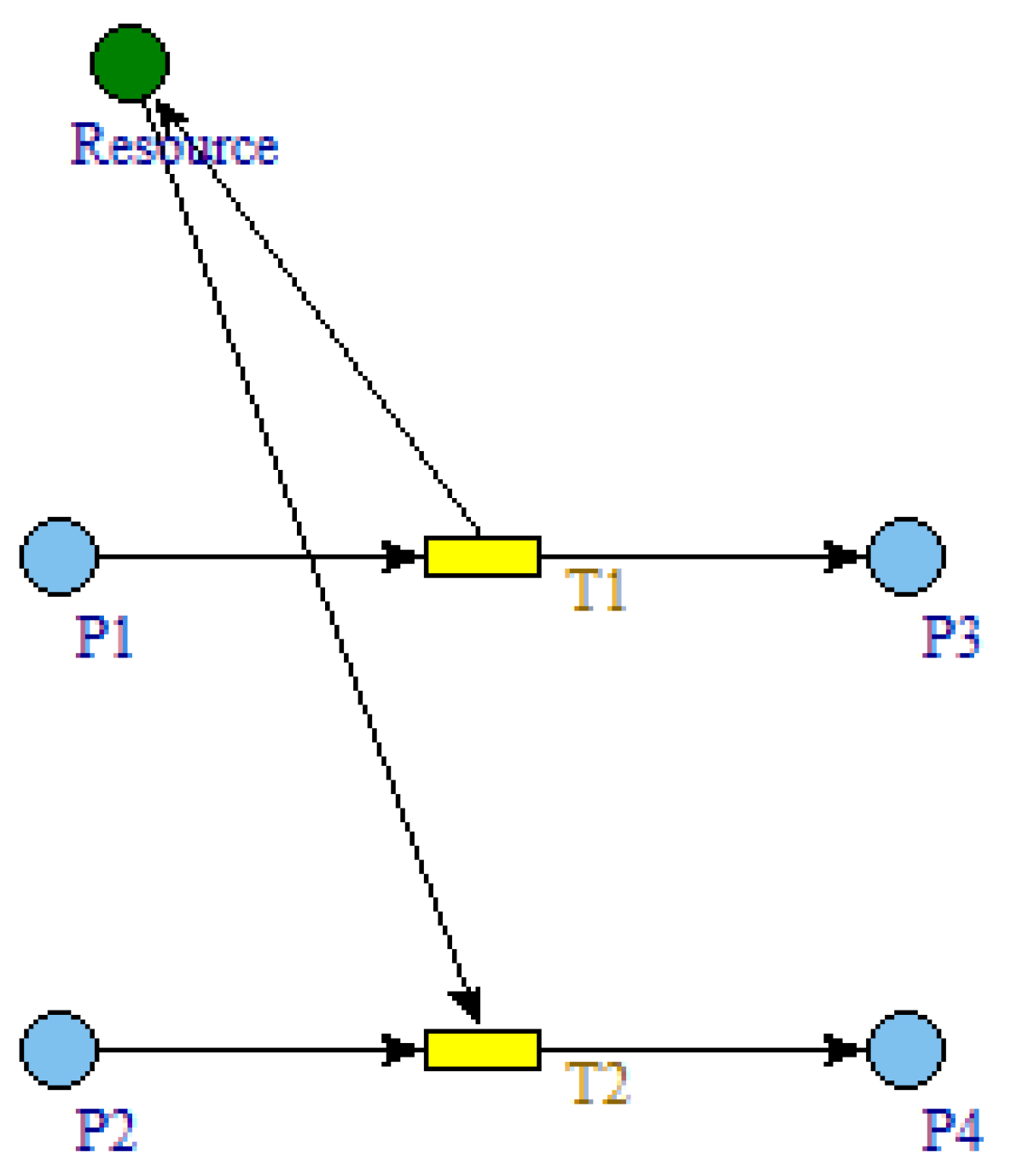
To formalize the modeling of subcontractor or shared resource constraints, we introduce a generic Petri Net pattern representing a single shared resource. This pattern ensures that competing activities cannot simultaneously utilize the resource and allows priority to be assigned to one activity over another. The pattern is shown in the following Figure 5 and Figure 6.
If the subcontractor begins with the first tank, the project completion time is estimated at 108 days. Conversely, if work starts with the second tank, the completion time is reduced to 102 days. Therefore, the second scenario is selected, and the subcontractor is accordingly instructed to first position the telescopic crane at the second tank.
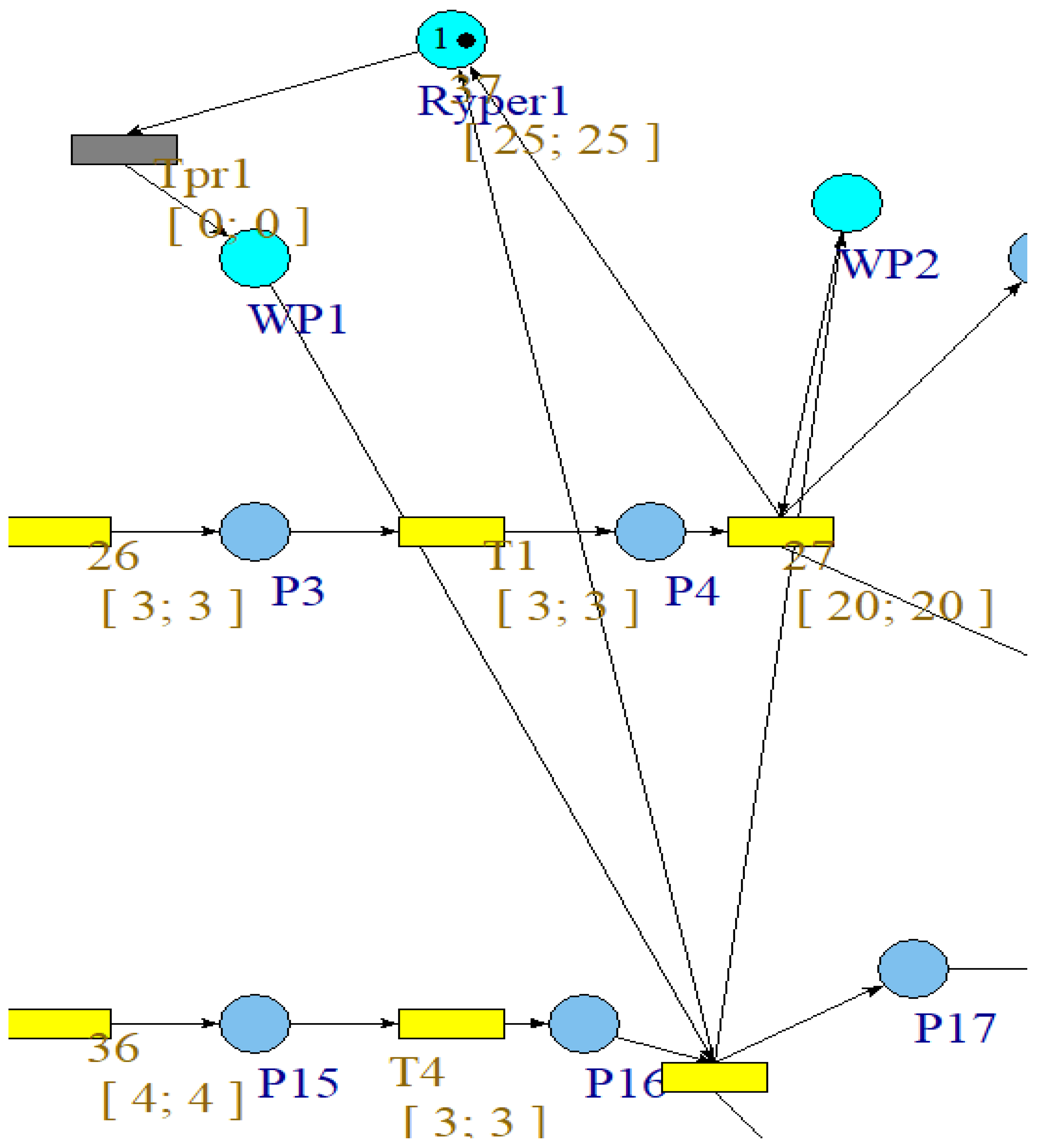
The construction of the constraint of the subcontractor with priority for activity 3.7 over 2.7 is shown in Figure 7.
In this process, transition 3.7 is prioritized over transition 2.7. For the opposite priority, the resource system can be constructed accordingly. The project completion times for both cases are shown in the following Figure 8. Based on these results, the most appropriate scenario can be selected initially. Furthermore, the subcontractor can be informed about the exact time period required for its involvement in the project. The additional project duration is also presented to ensure clear communication with the project owner and all other stakeholders, including management, the bidding and procurement departments, and suppliers, regarding the required delivery dates for materials (e.g., sandblasting materials, scaffolding, and paints). The timing data obtained from the Petri net analysis can also be used to revise the network diagrams and update the corresponding Gantt charts.

5.2. Resource Constraint on Coating Crew

The calculation performed using the Critical Path Method (CPM) assumed unlimited resource availability (equipment and crews); therefore, its results do not accurately reflect the actual project conditions. The resource requirements for performing the project activities are presented below.
Each crew consists of six members: three skilled technicians and three assistants. Among the technicians, two are sandblasters, and one is a painter. Of the three assistants, one is trained to operate and maintain machinery. The sandblasters can perform all tasks except paint spraying with the pump, which is the painter’s responsibility. Conversely, the painter is qualified to perform all activities except sandblasting. The assistants can undertake all supporting tasks except those assigned to the skilled technicians. During sandblasting or painting operations, the machinery operator is responsible for ensuring the equipment functions properly.
Accordingly, all activity durations presented in the table of Section 4.1 were calculated based on the work performance of a six-person crew as described above. For example, during sandblasting operations, the painter acts as an assistant, while during painting operations, the sandblasters assist by mixing the paint and supporting the painter in handling the spray hose. Similarly, during the seam paint repair phase, all six crew members work together to mechanically clean seams with grinding wheels and to paint them with brushes.
Each crew can also perform parallel activities, as indicated in the node network, but only within the same tank. This restriction arises because the equipment is spatially positioned adjacent to the active tank and cannot extend its operational range to the second tank. For instance, activities 2.2 (scaffold covering with fire-retardant material) and 2.8 (roof paint repair) can be performed in parallel by a single crew, within the durations presented in Section 4.1.
The equipment assigned to each crew includes one air compressor, two sandblasting pots, one generator, one breathing air compressor, one paint pump, and the corresponding accessories (connection hoses and extensions).
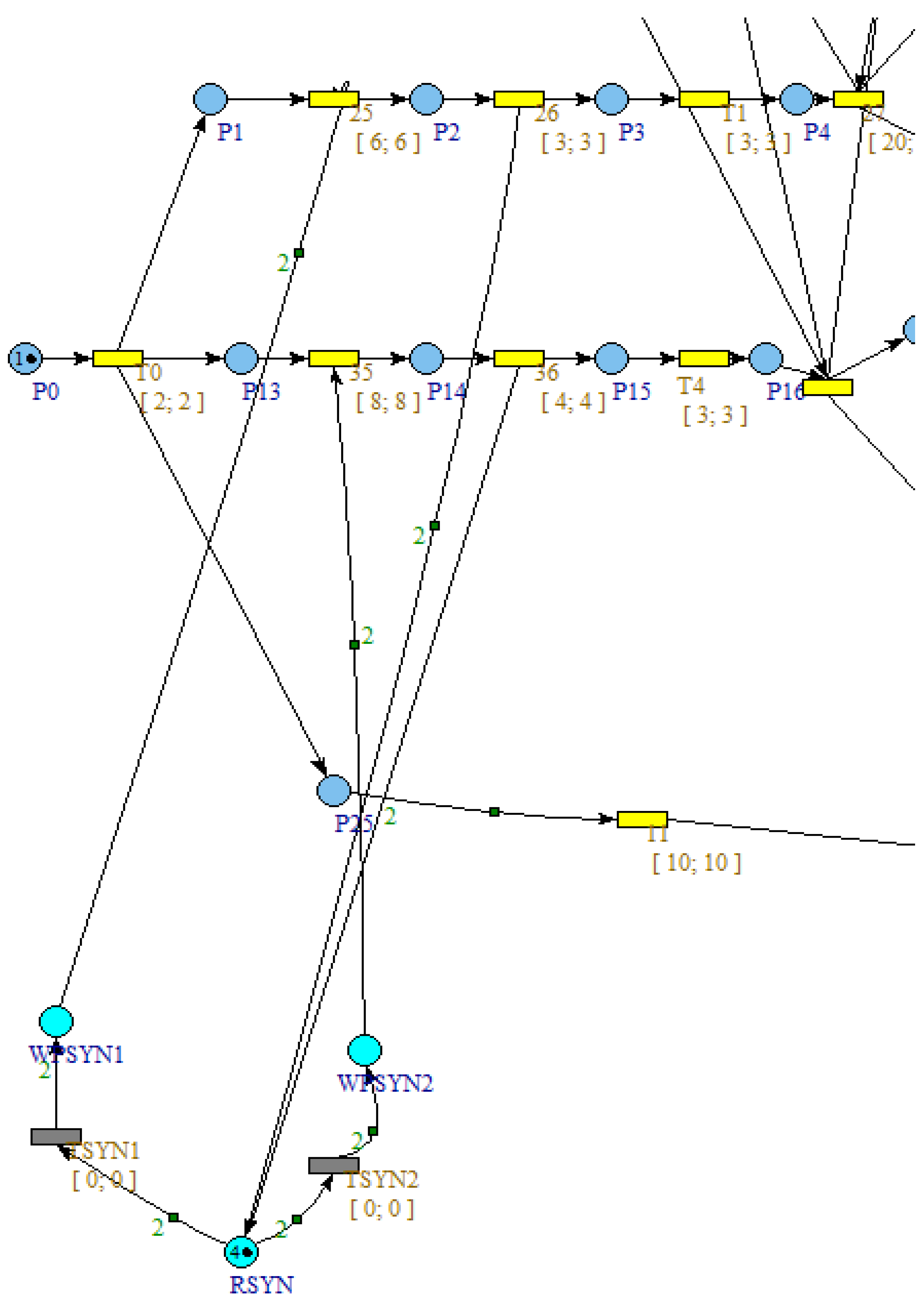
Initially, the company planned to use two crews to execute the work. In addition, the involvement of one subcontractor crew—with priority assigned to activity 3.7, as described in the previous section—is considered. Therefore, the Petri net must be modified to include the company’s crew resource constraint, following the same resource-restriction philosophy applied to the subcontractor, ensuring that each crew operates on only one work front at a time. The introduction of the crew resource place on the Petri net is illustrated in Figure 9.
Initially, a place named Rsyn is introduced, which contains an initial marking of four tokens. This place is connected via arcs and transitions to two waiting places, WPsyn1 and WPsyn2, which, in turn, are linked to activity transitions 2.5 and 3.5, respectively. All connecting arcs among these nodes weigh two tokens (w = 2). In this project, the two tokens represent a whole crew, while one token represents part of a crew.
When the plate painting activities are completed, the corresponding transitions (3.6 and 2.6) are triggered, returning the availability tokens to the crew resource place Rsyn. The concept is that once sandblasting and painting of the roof plates in the sandblasting area are completed, the company crews can proceed with the pipeline-related tasks. In contrast, the subcontractor’s crew can begin installing the tank roofs.
The new total project completion time is estimated at 106 working days, as calculated on the software. The firing times indicate that the available duration for two company crews remains unchanged, as there is sufficient time for them to perform different tasks during the idle periods when the subcontractor is engaged in roof installation. The only variation concerns activity 1.3, which must be performed after all other activities are completed, resulting in an additional four working days to the overall project duration.
Through this analysis, Petri nets demonstrate their capacity to support managerial decision-making by enabling the company to assess whether it is beneficial to reassign personnel to complete activity 1.3 earlier, thereby completing the project in 102 days—four days sooner.

5.3. Resource Constraint on the Availability of One Coating Crew

During the project planning phase, only a few days before work commenced, a malfunction occurred in one of the two air compressors available for the project. The use of a single air compressor consequently allows only one crew to operate. The company aims to assess project completion times under the one-crew scenario to compare them with those under the scenario involving the rental of a second air compressor, which would enable deployment of a second crew.
The project analyst performs the calculation using ROMEO by modifying the resource constraints and constructing a new Petri net model, as illustrated in Figure 10.
As shown, it is necessary to add a series of places that connect the transitions marking activity completion with those initiating subsequent activities, thereby creating new finish-to-start relationships. Some of these relationships include the start of activity 2.5 (sandblasting of tank 1 plates) following the completion of activity 3.6 (painting of tank 2 plates), and the start of activity 1.1 (sandblasting of pipes) after the completion of activity 2.6 (painting of tank 1 plates).
The total project completion time is recalculated using the same method, resulting in an overall duration of 130 working days. Since this duration is significantly longer than the original schedule, the company seeks to evaluate an alternative scenario in which, at an additional cost, a second subcontractor is engaged to perform the plate installation on both tanks simultaneously.
In this case, the project completion time can be readily recalculated by removing the resource constraints, specifically by deleting place Ryper1, along with its corresponding transitions and arcs, from the existing Petri net.

6. Determination of the Optimal Solution

In this section, the optimal project completion solution is determined. However, to calculate the optimal outcome, the project’s financial data must also be considered. The following Table 5 and Table 6 presents the alternative project scenarios and their respective completion times, as calculated by the simulation.
Regarding the financial parameters of the project, the following information is available:
  • The project owner has set a completion deadline of 100 working days. Each additional day beyond this deadline incurs a penalty of €1200 per day;
  • The cost of one crew amounts to €1000 per day, which includes crew wages, operational expenses such as fuel and consumables, as well as project insurance, administrative costs, and the remuneration of engineers and the safety technician;
  • The cost of the second crew is €600 per day, covering both crew wages and work execution expenses (fuel and oil);
  • The cost of deploying a third crew for four days is €550 per day;
  • The rental cost of an air compressor for the duration of the works is €50 per day;
  • The agreement with a single subcontractor for the installation of both tank roofs amounts to a lump sum cost of €30,000;
  • The agreement with two subcontractors, one for each roof, results in a total cost of €35,000.
More details about the financial parameters and resource capacities of the project are presented in Appendix A. All cost parameters were derived from actual project records and contractual data. Based on the financial data above, Table 6 presents the cost calculations for each project scenario.
The results indicate that the fifth scenario is the most cost-effective, followed by the fourth scenario. Note that this table can be updated if certain financial parameters change (e.g., securing a more favorable subcontractor agreement or a lower-cost air compressor rental) to determine a new optimal scenario.

7. Conclusions

Construction time management during the planning and construction phases of projects is inextricably linked to cost-effectiveness. Additionally, construction time management depends on resource management in planning and on the dynamic updating of plans during construction. This paper presented Petri nets and highlighted their usefulness in time scheduling and project and resource management, offering a powerful tool for the graphical representation, modeling, computation, and optimization of complex systems—from the preparation phase through project completion.
A distinguishing feature of the present study, compared with existing work, is its explicit use of the ROMEO software environment for project scheduling. While previous studies have predominantly focused on theoretical formulations or simulation-based Petri net models, this work demonstrates how a formal Time Petri Net analysis tool can be effectively employed to support resource-constrained project scheduling. Furthermore, the case study in this paper involves a large-scale project comprising numerous activities and multiple interacting resource constraints, in contrast to the simplified, small-scale examples commonly reported in the literature. Finally, the proposed methodology is presented in a detailed, step-by-step manner that does not require prior programming expertise or in-depth knowledge of Petri net theory. This explicit methodological exposition enhances accessibility and facilitates practical understanding, making the approach more readily applicable for industry practitioners, whereas many existing studies assume a strong academic or theoretical background.
The project under study focuses on the anticorrosion protection of two fuel storage tanks under construction at a fuel storage facility. Initially, the project activities were identified, and their durations and sequence relationships were defined. The project was then modeled using the Critical Path Method (CPM) and represented with a network of nodes, which was subsequently converted into a timed Petri net with timed transitions. The analysis was performed using ROMEO software, version 3.10.6, on Windows.
The project’s timed network was constructed, and its structure and properties were examined. Subsequently, the network was simulated to detect errors and deadlocks. Finally, the total project duration was calculated, and different implementation scenarios were tested under resource constraints for the painting and mechanical teams to determine the optimal solution in terms of time and cost.
The application of timed Petri nets to the engineering project under study demonstrated the ability to capture the project’s activities and their interdependencies accurately. The modeling process enabled simultaneous monitoring of parallel tasks, providing, through the properties of transitions, a better understanding of potential bottlenecks that are not apparent in traditional scheduling methods. The simulation enabled the identification of critical paths and provided deeper insight into the project’s progress, possible delays, and the evaluation of alternative task sequences.
The results for the duration of each activity and the total project time were obtained with speed and precision. Finally, the introduction of constraints and the concurrent use of shared resources provided flexibility and ease in analyzing the various scenarios, leading to the determination of the optimal solution, reliable results, and significant time savings for the project analyst.

Research Limitations and Future Developments

Despite the numerous advantages of Petri Nets, their application to project scheduling and management is accompanied by several significant challenges. First, understanding and correctly utilizing Petri Nets requires a high level of theoretical expertise. Modeling a real-world project using Petri Nets is often complex and time-consuming, with a high risk of modeling errors—especially when multiple resources, interdependencies, and parallel activities are involved. A deep understanding of their structural and behavioral properties, as well as their firing rules, is essential for reliable analysis. In addition, most available software tools for developing and analyzing Petri Nets are primarily designed for academic purposes and therefore offer limited user-friendliness and ergonomics. As a result, they do not adequately meet the needs of industry practitioners. In this paper, the case study is limited to a single project, which limits the generalizability of the findings. While the proposed method provides a structured approach for estimating project durations and costs, several limitations should be considered. Scalability may be an issue for larger projects with more complex resource allocations and hundreds of activities, as the data collection and computation effort increases substantially. Construction projects may vary in constraints, regulatory requirements, and contractor performance; thus, the conclusions drawn may not be representative of all project environments.
The validation of the proposed approach is supported by a baseline comparison with CPM-based scheduling results obtained under the assumption of unlimited resources. The introduction of resource constraints revealed limitations inherent to precedence-based scheduling methods, which are effectively addressed by the Timed Petri Net formulation. Although a direct comparison with commercial project management software, such as MS Project or Primavera, is beyond the scope of this study due to their reliance on proprietary resource-leveling heuristics, future research could extend the analysis to include cross-software validation using real-world project data.
The review of existing Petri Net software conducted in this study clearly highlights the absence of tools designed specifically for project management applications—tools that combine intuitive user interfaces with accessibility for non-expert users. Future research may therefore focus on developing a dedicated, practitioner-oriented software environment that supports Petri Net modeling while ensuring interoperability with industry-standard project management systems. Such integration would allow for automated diagram generation, data exchange, and real-time synchronization of project information. Another promising avenue for future work is the incorporation of artificial intelligence techniques into Petri Net analysis. AI-driven enhancements could facilitate the automatic identification of optimal execution paths, resource assignments, and scheduling scenarios, transforming Petri Nets from descriptive modeling frameworks into intelligent decision-support tools. Finally, the present study focused on the scheduling of a medium-scale technical project. Future research could explore the applicability and performance of Petri Nets in large-scale or highly complex projects, as well as in the simultaneous management of multiple interdependent projects. Examining these contexts would provide valuable insights into the scalability and robustness of Petri Net methodologies within modern project portfolio management.

Author Contributions

Conceptualization, D.K. and K.P.; methodology, D.K.; software, D.K.; validation, D.K. and K.P.; formal analysis, D.K. and K.P.; investigation, D.K.; data curation, D.K. and K.P.; writing-original draft preparation, D.K.; writing-review and editing, K.P.; visualization, D.K.; supervision, K.P.; project administration, K.P.; All authors have read and agreed to the published version of the manuscript.

Funding

This research received no external funding.

Institutional Review Board Statement

Ethical review and approval were waived for this study by Institution Committee due to Aristotle University of Thessaloniki Regulations.

Informed Consent Statement

Informed consent was obtained from all subjects involved in the study.

Data Availability Statement

The original contributions presented in this study are included in the article. Further inquiries can be directed to the corresponding author.

Conflicts of Interest

The authors declare no conflict of interest.

Appendix A

This appendix summarizes the resource capacities and cost parameters used in the case study to ensure the transparency and reproducibility of the proposed simulation model.

Appendix A.1. Resource Capacities

The following resource constraints were considered in the project:
  • Maximum number of coating crews available simultaneously: two.
  • An additional third crew could be deployed for a maximum duration of four working days.
Subcontractor configurations:
  • One subcontractor is responsible for the installation of both tank roofs.
  • Two subcontractors, each responsible for one tank roof.
Equipment availability:
  • One air compressor is available for rental during the execution of the works.

Appendix A.2. Financial Parameters

The financial parameters of the project are summarized as follows:
  • Contractual project deadline: 100 working days.
  • Penalty for delayed completion: €1200 per working day beyond the contractual deadline.
  • Daily cost of one coating crew: €1000, including wages, consumables, insurance, administrative fees, and engineering supervision.
  • Daily cost of the second coating crew: €600, including wages and execution-related expenses.
  • Daily cost of deploying a third crew (maximum four days): €550.
  • Air compressor rental cost: €50 per day.
Subcontractor costs:
  • Single subcontractor for both tank roofs: lump-sum cost of €30,000.
  • Two subcontractors (one per roof): total lump-sum cost of €35,000.

Appendix A.3. Cost Calculation Methodology

The total project cost for each scenario was calculated as the sum of crew costs, subcontractor costs, equipment rental, deployment of additional crews, and delay penalties. The formulas used are:
  • Crew costs = Crew costs = (daily rate1 × crew1 × days) + (daily rate2 × crew2 × days) + (daily rate3 × crew3 × days);
  • Subcontractor cost = lump sum per scenario;
  • Rental equipment = daily rate × number of days;
  • Penalty cost = max(0, project duration − contractual deadline) × daily penalty rate.

References

  1. Key Differences. Difference Between PERT and CPM (with Comparison Chart). Available online: https://keydifferences.com/difference-between-pert-and-cpm.html (accessed on 5 March 2025).
  2. Kumanan, S.; Raja, K. Modeling and simulation of projects with Petri nets. Am. J. Appl. Sci. 2008, 5, 1742–1749. [Google Scholar] [CrossRef]
  3. Chen, N.Y.; Hsu, N.P.; Chang, N.Y. A Petri net approach to support resource assignment in project management. IEEE Trans. Syst. Man Cybern. A Syst. Hum. 2008, 38, 564–574. [Google Scholar] [CrossRef]
  4. Boushaala, A. An approach for project scheduling using PERT/CPM and Petri nets (PNs) tools. In Proceedings of the 2014 International Conference on Industrial Engineering and Operations Management, Bali, Indonesia, 7–9 January 2014. [Google Scholar] [CrossRef]
  5. Lin, C.; Dai, H. Applying Petri nets on project management. Univ. J. Mech. Eng. 2014, 2, 249–255. [Google Scholar] [CrossRef]
  6. Peterson, J.L. Petri Net Theory and the Modeling of Systems; Prentice-Hall: Englewood Cliffs, NJ, USA, 1981. [Google Scholar]
  7. Shen, V.R.; Chung, Y.F.; Chen, S.; Guo, J. A novel reduction approach for Petri net systems based on matching theory. Expert Syst. Appl. 2013, 40, 4562–4576. [Google Scholar] [CrossRef]
  8. Murata, T. Petri nets: Properties, analysis and applications. Proc. IEEE 1989, 77, 541–580. [Google Scholar] [CrossRef]
  9. Mejía, G.; Niño, K.; Montoya, C.; Sánchez, M.A.; Palacios, J.; Amodeo, L. A Petri net-based framework for realistic project management and scheduling: An application in animation and videogames. Comput. Oper. Res. 2015, 66, 190–198. [Google Scholar] [CrossRef]
  10. Τσιναράκης, Γ. Modeling and Study of Random-Topology Production Systems Using Petri Nets: A Hierarchical Control Approach. Ph.D. Thesis, Technical University of Crete, Chania, Greece, 2007. (In Greek) [Google Scholar]
  11. Bergenthum, R. Firing Partial Orders in a Petri Net. In Proceedings of the PETRI NETS 2021 Application and Theory of Petri Nets and Concurrency, Online, 23–25, June 2021; Buchs, D., Carmona, J., Eds.; Lecture Notes in Computer Science; Springer: Cham, Switzerland, 2021; Volume 12734. [Google Scholar] [CrossRef]
  12. Tsinarakis, G.J. Modeling task dependencies in project management using Petri nets with arc extensions. In Proceedings of the 26th Mediterranean Conference on Control and Automation (MED), Zadar, Croatia, 19–22 June 2018; pp. 84–89. [Google Scholar] [CrossRef]
  13. Wang, J. Timed Petri Nets: Theory and Application; Springer Science+Business Media: New York, NY, USA, 1998. [Google Scholar] [CrossRef]
  14. Ramchandani, C. Analysis of Asynchronous Concurrent Systems by Timed Petri Nets. Master’s Thesis, Massachusetts Institute of Technology, Cambridge, MA, USA, 1974. Available online: http://hdl.handle.net/1721.1/13739 (accessed on 10 March 2025).
  15. Bowden, F.D.J. A brief survey and synthesis of the roles of time in Petri nets. Math. Comput. Model. 2000, 31, 55–68. [Google Scholar] [CrossRef]
  16. Reinaldo, J.; Del Foyo, P.M.G. Timed Petri nets. In Petri Nets—Manufacturing and Computer Science; InTech: London, UK, 2012. [Google Scholar] [CrossRef]
  17. Kim, J.; Desrochers, A.A. Task planning and project management using Petri nets. In Proceedings of the IEEE International Symposium on Assembly and Task Planning, Pittsburgh, PA, USA, 10–11 August 1995; IEEE: New York, NY, USA, 1995; pp. 265–271. [Google Scholar]
  18. Wakefield, R.R.; Sears, G.A. Petri nets for simulation and modeling of construction systems. J. Constr. Eng. Manag. 1997, 123, 105–112. [Google Scholar] [CrossRef]
  19. Sawhney, A. Petri Net based simulation of construction schedules. In Proceedings of the 1997 Winter Simulation Conference, Atlanta, GA, USA, 7–10 December 1997; IEEE: Piscataway, NJ, USA, 1997; pp. 1111–1118. [Google Scholar] [CrossRef]
  20. Sawhney, A.; Mund, A.; Marble, J. Simulation of the structural steel erection process. In Proceedings of the 1999 Winter Simulation Conference, Phoenix, AZ, USA, 5–8 December 1999; IEEE: Piscataway, NJ, USA, 1999; Volume 2, pp. 942–947. [Google Scholar] [CrossRef]
  21. Cohen, Y.; Zwikael, O. Modelling and scheduling projects using Petri nets. Int. J. Proj. Organ. Manag. 2008, 1, 221–233. [Google Scholar] [CrossRef]
  22. Salimifard, K.; Jamali, G.; Behbahaninezhad, S. Managing time and resources of construction projects using colored Petri nets and a genetic algorithm. In Proceedings of the 2019 International Conference on Automation, Computational and Technology Management (ICACTM), Chennai, India, 26–28 April 2019; IEEE: New York, NY, USA, 2019; pp. 6–12. [Google Scholar] [CrossRef]
  23. Jensen, K. Coloured Petri Nets: Basic Concepts, Analysis Methods and Practical Use; Springer: Berlin/Heidelberg, Germany, 1997; Volume 1–3. [Google Scholar]
  24. Bevilacqua, M.; Ciarapica, F.E.; Giovanni, M. Timed coloured Petri nets for modelling and managing processes and projects. Procedia CIRP 2018, 67, 58–62. [Google Scholar] [CrossRef]
  25. Kumar, A.; Kumar, H. A hybrid soft computing technique by using fuzzy Petri nets to optimise the critical path in management problem. Int. J. Appl. Manag. Sci. Eng. 2024, 11, 4. [Google Scholar] [CrossRef]
  26. Huang, B.; Zhou, M.; Lu, X.S.; Abusorrah, A. Scheduling of resource allocation systems with timed Petri nets: A survey. ACM Comput. Surv. 2023, 55, 230. [Google Scholar] [CrossRef]
  27. Azarnova, T.V.; Beloshitskiy, A.A.; Kashirina, I.L. Application of Bayesian networks and Petri nets apparatus for the study of projects implementation calendar plans. J. Phys. Conf. Ser. 2021, 1902, 012095. [Google Scholar] [CrossRef]
  28. Mazzuto, G.; Bevilacqua, M. A decision-making application for project management through timed coloured Petri nets. Int. J. Manag. Decis. Mak. 2018, 17, 447–466. [Google Scholar] [CrossRef]
  29. Liu, C.; Cheng, J.; Wang, Y.; Gao, S. Time performance optimization and resource conflicts resolution for multiple project management. IEICE Trans. Inf. Syst. 2016, E99-D, 650–660. [Google Scholar] [CrossRef]
  30. Li, H.; Liu, K. Resource management modelling and simulating of construction project based on Petri net. Comput. Model. New Technol. 2014, 18, 35–45. [Google Scholar]
  31. Chen, Z.; Shan, B. (Eds.) The application of Petri nets to construction project management. In Advances in Intelligent and Soft Computing; Springer: Berlin/Heidelberg, Germany, 2012; pp. 151–158. [Google Scholar]
  32. Zhang, Y.B.; Chen, Y.Q.; Zhu, X.Y. Risk management for construction projects with colored Petri nets: An agent-based modeling framework. In Proceedings of the 2012 IEEE International Conference on Industrial Engineering and Engineering Management (IEEM), Hong Kong, China, 10–13 December 2012; IEEE: New York, NY, USA, 2012; pp. 2008–2012. [Google Scholar] [CrossRef]
  33. Samkari, K.; Kugler, M.; Kordi, B.; Franz, V. Colored Petri-net and multi-agents: A combination for a time-efficient evaluation of a simulation study in construction management. In Proceedings of the 2012 ASCE International Conference on Computing in Civil Engineering, Clearwater Beach, FL, USA, 17–20 June 2012; Issa, R.R., Flood, I., Eds.; American Society of Civil Engineers: Reston, VA, USA, 2012; pp. 153–160. [Google Scholar]
  34. Chung, T.-H. Modeling of Construction Scheduling with Coloured Petri Nets. In Proceedings of the 2011 International Conference on Process Automation, Control and Computing, Coimbatore, India, 20–22 July 2011; IEEE: New York, NY, USA, 2011; pp. 1–6. [Google Scholar] [CrossRef]
  35. Cheng, F.F.; Wang, Y.W.; Ling, X.Z.; Bai, Y. A Petri net simulation model for virtual construction of earthmoving operations. Autom. Constr. 2011, 20, 181–188. [Google Scholar] [CrossRef]
  36. Subulan, K.; Saltabas, A.; Taşan, A.S.; Girgin, S.C. Modeling and analyzing of a construction project considering resource allocation through a hybrid methodology: Petri Nets and fuzzy rule-based systems. In Proceedings of the 41st International Conference on Computers and Industrial Engineering (CIE41), Los Angeles, CA, USA, 23–25 October 2011; Curran Associates: Red Hook, NY, USA, 2011; pp. 317–322. [Google Scholar]
  37. Wu, Y.; Zhuang, X.-C.; Song, G.-H.; Xu, X.-D.; Li, C.-X. Solving resource-constrained multiple project scheduling problem using timed colored Petri nets. J. Shanghai Jiaotong Univ. (Sci.) 2009, 14, 713–719. [Google Scholar] [CrossRef]
  38. Adida, E.; Joshi, P. A robust optimisation approach to project scheduling and resource allocation. Int. J. Serv. Oper. Informatics 2009, 4, 169–193. [Google Scholar] [CrossRef]
  39. Biruk, S.; Jaśkowski, P. Simulation modelling construction project with repetitive tasks using Petri nets theory. J. Bus. Econ. Manag. 2008, 9, 219–226. [Google Scholar] [CrossRef]
  40. Nassar, K.; Casavant, A. Analysis of timed Petri nets for reachability in construction applications. J. Civ. Eng. Manag. 2008, 14, 189–198. [Google Scholar] [CrossRef]
  41. Salum, L. Petri nets and time modelling. Int. J. Adv. Manuf. Technol. 2008, 38, 377–382. [Google Scholar] [CrossRef]
  42. Haji, M.; Darabi, H. Petri net based supervisory control reconfiguration of project management systems. In Proceedings of the 2007 IEEE International Conference on Automation Science and Engineering (CASE), Scottsdale, AZ, USA, 22–25 September 2007; IEEE: Piscataway, NJ, USA, 2007; pp. 460–465. [Google Scholar] [CrossRef]
  43. Kao, H.-P.; Hsieh, B.; Yeh, Y. A Petri-net based approach for scheduling and rescheduling resource-constrained multiple projects. J. Chin. Inst. Ind. Eng. 2006, 23, 468–477. [Google Scholar] [CrossRef]
  44. Chahrour, R.; Franz, V. Seamless Data Model for a CAD-Based Simulation System. In Proceedings of the Joint International Conference on Computing and Decision Making in Civil and Building Engineering, Montréal, QC, Canada, 14–16 June 2006; pp. 3958–3967. [Google Scholar]
  45. Sawhney, A.; Mund, A.; Chaitavatputtiporn, T. Petri net-based scheduling of construction projects. Civ. Eng. Environ. Syst. 2003, 20, 255–271. [Google Scholar] [CrossRef]
  46. Reddy, J.P.; Kumanan, S.; Krishnaiah Chetty, O.V. Application of Petri nets and a genetic algorithm to multi-mode multi-resource constrained project scheduling. Int. J. Adv. Manuf. Technol. 2001, 17, 305–314. [Google Scholar] [CrossRef]
  47. Sawhney, A.; Vamadevan, A. Petri Net-Based Scheduling of a Bridge Project. In Proceedings of Construction Congress VI: Building Together for a Better Tomorrow in an Increasingly Complex World, Orlando, FL, USA, 20–22 February 2000; American Society of Civil Engineers: Orlando, FL, USA, 2000; Volume 278. [Google Scholar] [CrossRef]
  48. Jaworski, K.M.; Biruk, S. A model of construction project based on Petri nets theory. Arch. Civ. Eng. 2000, 46, 71–82. [Google Scholar]
  49. Ukamaka, C.O. Implementation of project evaluation and review technique (PERT) and critical path method (CPM): A comparative study. Int. J. Ind. Oper. Res. 2020, 3. [Google Scholar] [CrossRef]
  50. ROMEO—Formal Verification and Synthesis for Parametric Timed Systems. Available online: https://romeo.ls2n.fr/ (accessed on 14 November 2025).
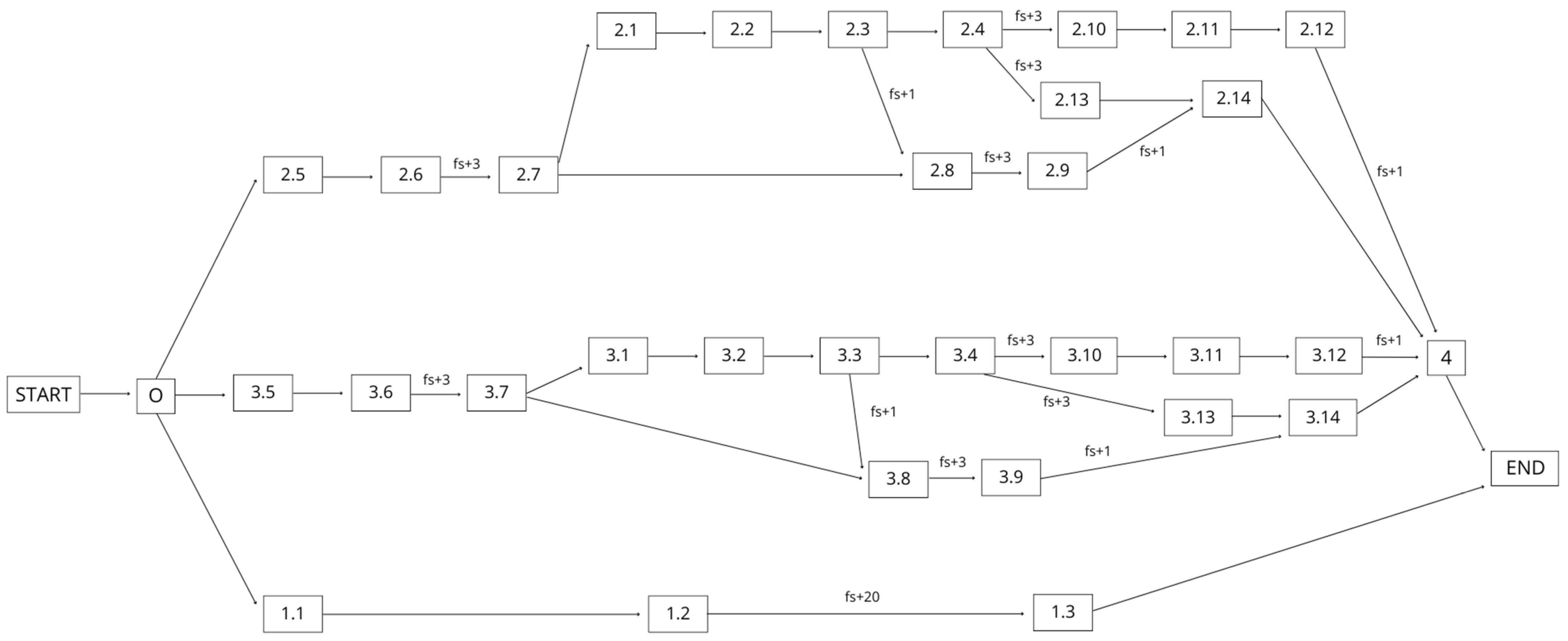
Figure 1. AON network diagram.
Sustainability 18 01644 g001
Figure 2. Timed Petri net model.
Sustainability 18 01644 g002
Figure 3. Petri Net model in the ROMEO software.
Sustainability 18 01644 g003
Figure 4. Time calculation of the project in ROMEO.
Sustainability 18 01644 g004
Figure 5. Concurrency on activities 1 and 2.
Sustainability 18 01644 g005
Figure 6. Priority of resource on activity 1.
Sustainability 18 01644 g006
Figure 7. Resource constraint of subcontractor.
Sustainability 18 01644 g007
Figure 8. Project completion time.
Sustainability 18 01644 g008
Figure 9. Coating crew resource constraint.
Sustainability 18 01644 g009
Figure 10. Petri Net with resource constraint on the availability of one Coating Crew.
Sustainability 18 01644 g010
Table 2. Comparative Evaluation of CPM, PERT, and Timed Petri Nets for Project Scheduling.
CriterionCPMPERTTimed Petri Nets
Modeling TimeRelatively low modeling effort due to simple activity–precedence representation and deterministic durations.Moderate modeling effort, as probabilistic duration estimates require additional assumptions and data.Higher initial modeling effort, as activities, resources, timing, and concurrency must be explicitly defined within a formal structure.
Ease of UpdatingLimited flexibility; changes in activity durations or logic often require partial or full network reconstruction.Updates are possible but recalculation of probabilistic estimates may be required, reducing responsiveness to dynamic changes.High flexibility; model updates can be incorporated locally, and dynamic behavior can be re-simulated without redesigning the entire structure.
Ability to Handle ConstraintsPrimarily precedence-based; resource constraints are not inherently supported and require external heuristics.Similar limitations to CPM, with no native mechanism for modeling resource interactions or complex constraints.Strong capability to explicitly represent resource constraints, synchronization, mutual exclusion, and concurrency within the modeling formalism.
Computational EfficiencyHigh computational efficiency for large-scale projects due to simple longest-path calculations.Moderate efficiency: probabilistic calculations increase computational complexity.Potentially lower efficiency for large models due to state-space growth, though suitable abstractions and tools can mitigate this issue.
Table 3. Activities of the project.
ActivityCodeDurationPredecessor
Site installation02
Sandblasting of pipelines in pipe rack1.1100
Painting of pipelines in pipe rack1.251.1
Touch-up painting on weld joints1.341.2 (fs* + 20)
Erection of scaffolding for tank T12.162.7
Erection of scaffolding for tank T23.173.7
Covering of scaffolding with material to prevent dust dispersion T12.242.1
Covering of scaffolding with material to prevent dust dispersion T23.253.1
Sandblasting of external shell T12.352.2
Painting of external shell T12.442.3
Sandblasting of roof sheets T12.560
Painting of roof sheets T12.632.5
Installation of roof sheets T12.7202.6 (fs + 3)
Touch-up painting on weld joints T12.822.7, 2.3 (fs + 1)
Application of anti-slip material on the roof T12.912.8 (fs + 3)
Sandblasting of bottom plates T12.1062.4 (fs + 3)
Cleaning of the bottom from sandblasting material T12.1122.10
Painting of the bottom T12.1242.11
Dismantling of scaffolding T12.1332.4 (fs + 3)
Painting of fire-fighting pipelines, marking and painting of handrails T12.1422.13, 2.9 (fs + 1)
Sandblasting of external shell T23.373.2
Painting of the external shell T23.453.3
Sandblasting of roof sheets T23.580
Painting of roof sheets T23.643.5
Installation of tank roof T23.7253.6 (fs + 3)
Repair/touch-up painting of weld joints on the roof T23.823.7, 3.3 (fs + 1)
Application of anti-slip material on the roof T23.913.8 (fs + 3)
Sandblasting of bottom plates T23.1083.4 (fs + 3)
Cleaning of the bottom from sandblasting material T23.1133.10
Painting of the bottom T23.1253.11
Dismantling of scaffolding T23.1343.4 (fs + 3)
Painting of fire-fighting pipelines, marking and painting of handrails T23.1423.13, 3.9 (fs + 1)
Cleaning of site from sandblasting material453.12 (fs + 1), 2.12 (fs + 1), 3.13, 2.13
Project Completion 04
* fs = Finish-to-start.
Table 4. ES, LS, EF and LF of each activity.
CodeDurationPrevious ActivityESEFLSLFTF
02 02020
1.1100212526250
1.251.11217626750
1.341.2 (fs + 20)3741879150
2.162.73440515717
3.173.7424942490
2.242.14044576117
3.253.1495449540
2.352.24449616617
2.442.34953667017
2.56028192517
2.632.5811252817
2.7202.6 (fs + 3)1434315117
2.822.7, 2.3 (fs + 1)5052777927
2.912.8 (fs + 3)5556828327
2.1062.4 (fs + 3)5662737917
2.1122.106264798117
2.1242.116468818517
2.1332.4 (fs + 3)5659818425
2.1422.13, 2.9 (fs + 1)5961848625
3.373.2546154610
3.453.3616661660
3.5802102100
3.643.5101410140
3.7253.6 (fs + 3)174217420
3.823.7, 3.3 (fs + 1)6264777915
3.913.8 (fs + 3)6768828315
3.1083.4 (fs + 3)697769770
3.1133.10778077800
3.1253.11808580850
3.1343.4 (fs + 3)6973808411
3.1423.13, 3.9 (fs + 1)7375848611
453.12 (fs + 1), 2.12 (fs + 1), 3.13, 2.13869186910
Table 5. Alternative project scenarios.
ScenarioCoating Crew (Qty)Subcontractor Crew (Qty)Air Compressor Rental (Qty)Deploying of 3rd Crew (Days)Duration of Project (Days)
11100130
22110106
32114102
4221095
5221491
Table 6. Cost of each scenario.
ScenarioCoating Crew CostSubcontractor Crew CostAir Compressor Rental CostDeploying the 3rd Crew CostPenalty CostTotal Project Cost
1€130.000€30.000€0€0€36.000€196.000
2€169.600€30.000€5.300€0€7.200€212.100
3€163.200€30.000€5.100€2.200€2.400€202.900
4€152.000€35.000€4.750€0€0€191.750
5€145.600€35.000€4.550€2.200€0€187.350
Disclaimer/Publisher’s Note: The statements, opinions and data contained in all publications are solely those of the individual author(s) and contributor(s) and not of MDPI and/or the editor(s). MDPI and/or the editor(s) disclaim responsibility for any injury to people or property resulting from any ideas, methods, instructions or products referred to in the content.