SDG-Driven Entrepreneurship Through Technology Solutions in Higher Education Enhanced by Problem-Based Learning: An Active Learning Approach in a Smart Classroom Environment

 ,
,  , ,
, ,
Abstract
1. Introduction
2. Background and Context of the Educational Experience
2.1. Sustainable Development Goals (SDGs)
2.2. Problem-Based Learning (PBL)
2.3. The Context of the Educational Experience
3. Materials and Methods
3.1. Participants
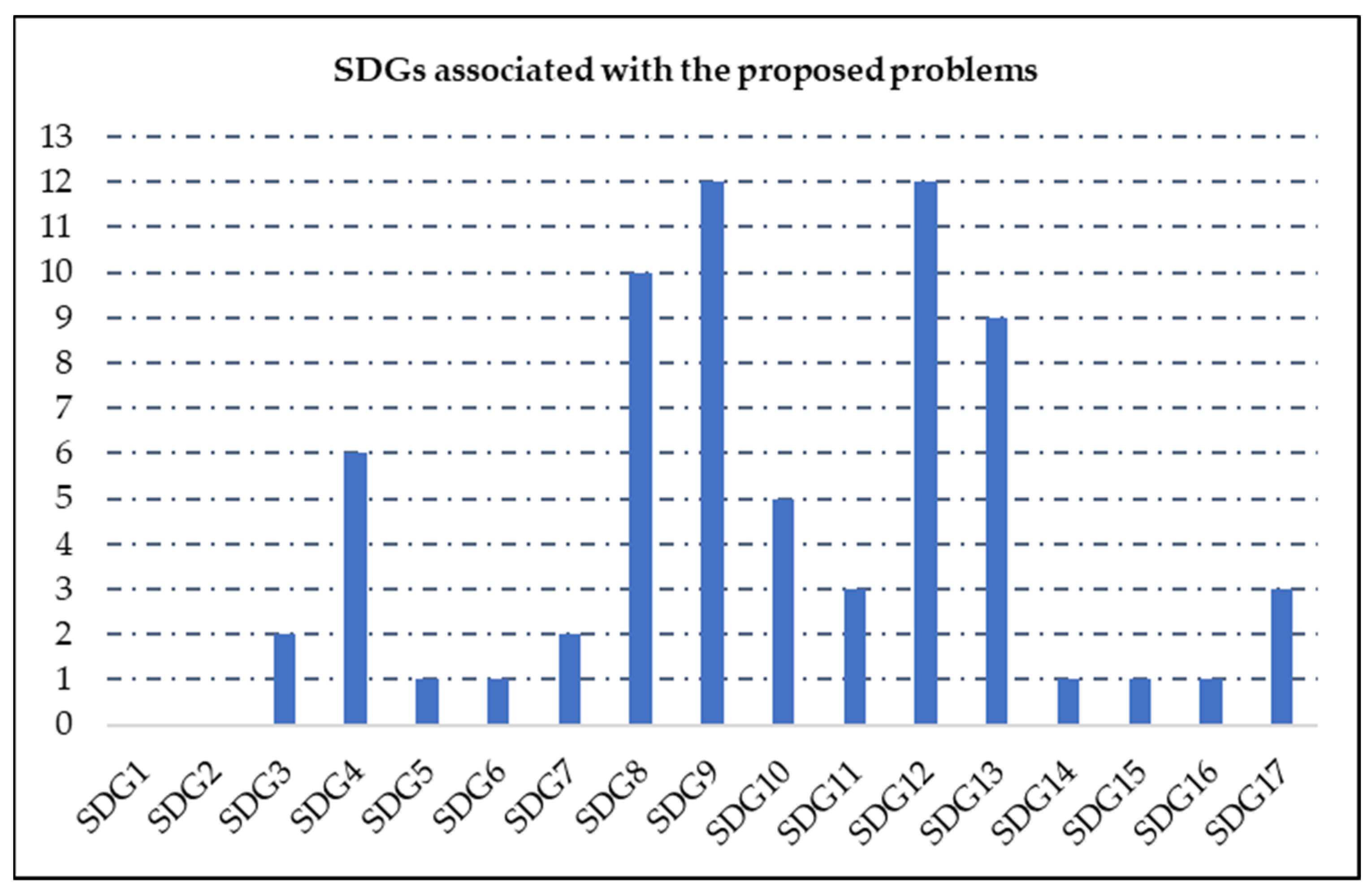
3.2. Proposals (Problems & SDGs) and Solutions (Value Propositions & MVPs)
3.3. The Bipolar Laddering Tool
4. Findings
5. Discussion
6. Conclusions
Author Contributions
Funding
Institutional Review Board Statement
Informed Consent Statement
Data Availability Statement
Conflicts of Interest
Abbreviations
| BLA | Bipolar Laddering |
| CSs | Class sessions |
| ICT | Information and Communication Technology |
| LMS | Learning Management System |
| MVP | Minimum Viable Product |
| NcE | Negative Common Element |
| NuE | Negative Unique Element |
| NGO | Non-Governmental Organization |
| P-ID | Problem-ID |
| PBL | Problem-Based Learning |
| PcE | Positive Common Element |
| PuE | Positive Unique Element |
| SDGs | Sustainable Development Goals |
| StTe | Student Team |
| UN | United Nations |
| URL | Universitat Ramon Llull |
Appendix A
Appendix A.1

| Session | Theme | Session Overview | Activities & Duration (in Minutes) |
|---|---|---|---|
| 1 | Introduction | Program team introduces the challenge and Candy Innovation Model: methodology, content, activities, rules and evaluation. | Students in classroom (20’); program presentation (10’); present last years’ winners—inspirational (10’); show how to formally enroll into the program through the LMS (5’); share interesting SDG data (40’); class mentor introduction (5’); mentor asks students to review companies and problems and think about questions for S2 (20’); closing and next steps (5’). |
| 2 | Framing the Challenge | Form multidisciplinary teams through team building. Conduct research to define a specific, real-world problem to solve. | Take attendance and check wi-fi connection (10’); companies connecting to Zoom (5’); company and problem presentations (30’); student Q&A (15’); teams choose their problems in LMS (10’); complete “What’s the problem?” form & group discussion (40’); homework reminder and closing (10’). |
| 3 | Ideation | Generate solution ideas through team ideation tools. Teams present ideas, reach consensus on final solution, and develop Business Model Canvas (Product Market Fit). | Take attendance and check wi-fi connection (10’); introduction to ideation, competitive benchmarking and value proposition (10’); explanation of the activity and group discussion (10’); ideation deliverable (20’); competitive benchmarking deliverable (20’); value proposition canvas deliverable (45’); upload deliverables to LMS and closing (5’). |
| 4 | Business Model and Interview Preparation | Develop Business Model Canvas and structure customer interviews. | Take attendance and check wi-fi connection (10’); teams start searching for the template in MIRO and share it with all the team members (15’); Business Model Canvas (BMC) introduction (4’); BMC steps: (1) value proposition, and (2) customer segments & teamwork (10’); BMC steps: (3) channels, and (4) customer relationships & teamwork (11’); BMC steps: (5) revenue streams & teamwork (20’); BMC steps: (6) key activities, (7) key resources and (8) key partners & teamwork (15’); BMC steps: (9) cost structure & teamwork (5’); introduction: customer discovery and interview structure & teamwork (20’); explanation role play & teamwork (2’); practice role playing (10’); remind students to do the customer interviews and prepare a summary for the next session (5’). |
| 5 | Prototype | Work on developing Minimum Viable Product (MVP). | Take attendance and check wi-fi connection (10’); session explanation (10’); peer evaluation (10’); teamwork interview conclusions (10’); teamwork BMC validation (10’); teamwork MVP (30’); team presentations and feedback on site, three minutes per team (20’); continue working on prototype (33’). |
| 6 | Prototype and Pitch | Work on developing Minimum Viable Product (MVP) and product video creation. | Take attendance and check wi-fi connection (10’); discuss solution evaluation and explain methodology (3’); preparation for prototype presentation (3’); prototype presentation and feedback by the mentor (15’); explain rules and tips to make the video, pitch and video recording (13’); teamwork (58’); closing and reminder of deliverables and deadlines (3’); deliveries and next session (3’). |
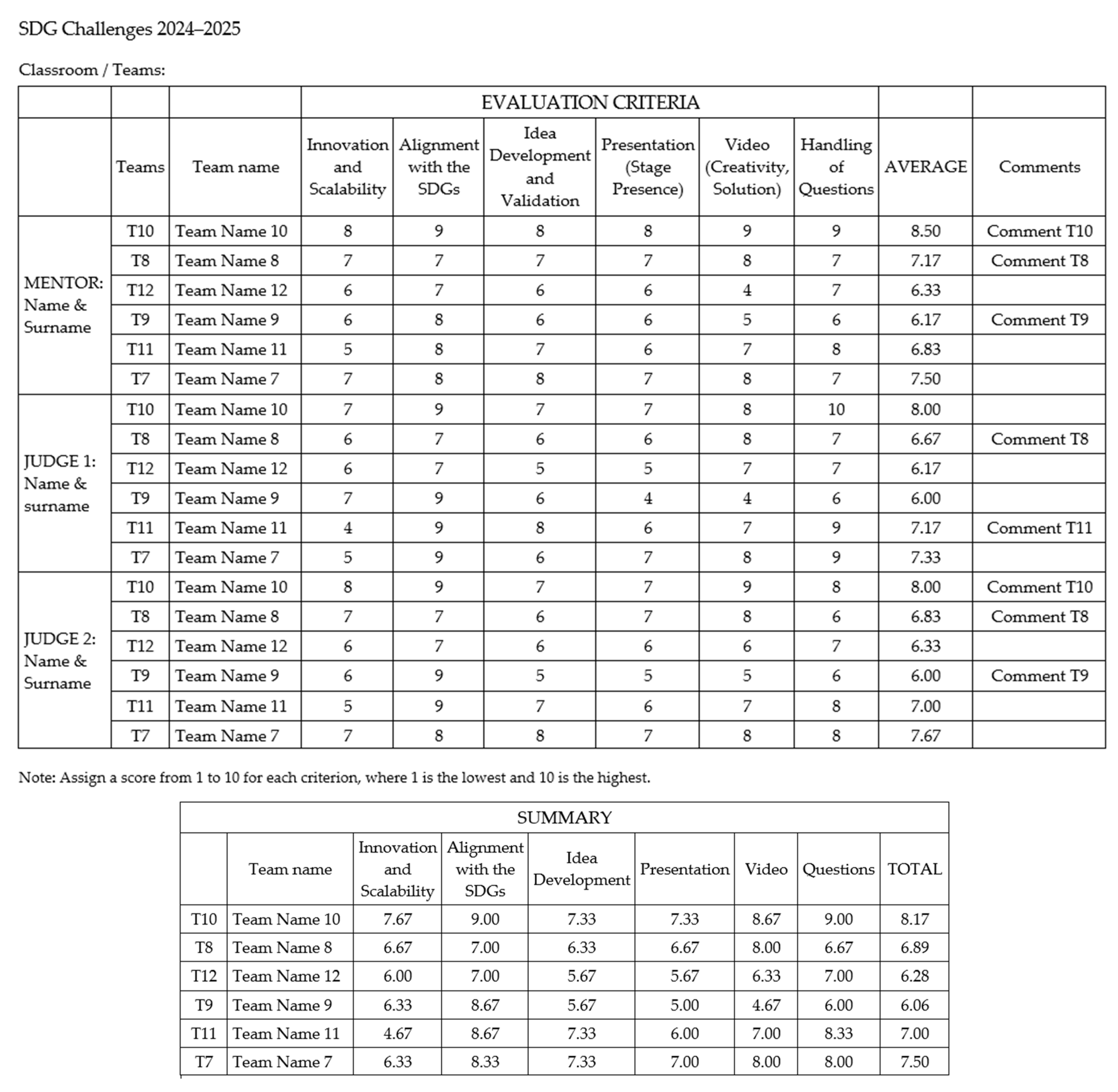
| 7 | Class Pitch | Class competition. | Take attendance and check wi-fi connection (10’); final presentation guidelines and preparation (20’); presentation rehearsal (40’); presentations (5 min each team) and Q&A (45’); jury deliberation (5’); award of SDG program certificate (7’). |
Appendix A.2
| Problem-ID | Problem Description | SDGs |
|---|---|---|
| P-01_Co1 | Integration of sustainable strategies in the decision-making of an engineering firm. | 8 |
| P-02_Co1 | Developing a responsible supply chain. | 8, 12 |
| P-03_Co1 | Electronic waste management. | 11, 12 |
| P-04_Co1 | The adoption of universal accessibility. | 10, 11 |
| P-05_Co1 | Transparency and impact reporting. | 12 |
| P-06_Co2 | How to make Barcelona 4.0 district (transformation of Zona Franca towards a new tech hub devoted to innovative industrial production) known among the new generations? | 4, 8, 9 |
| P-07_Co2 | How to make the 3DIncubator known among the new generations (the 3DIncubator is a public incubator of start-ups specialized in new additive impression business)? | 4, 8, 9 |
| P-08_Co2 | How to make the ‘Logistics 4.0 incubator’ known among the new generations (Logistics 4.0 incubator is a public incubator of start-ups specialized in new logistics business)? | 4, 8, 9 |
| P-09_Co3 | Organizations have made progress in reducing greenhouse gas emissions, but decarbonizing the supply chain (often, the main source of emissions) remains difficult. Limited transparency and data gaps, especially among smaller suppliers that lack the tools and resources to measure and manage emissions, make it hard to cut emissions without undermining competitiveness. | 13 |
| P-10_Co3 | Hiring people with disabilities, especially individuals with intellectual disabilities. | 8, 10 |
| P-11_Co3 | How can companies obtain useful and reliable supply chain data, going beyond their direct (tier-1) suppliers? | 3, 6, 8, 12, 13, 14, 15 |
| P-12_Co3 | How can we leverage the knowledge of our professionals to contribute to SDG 4? | 4 |
| P-13_Co4 | A lack of standardization is slowing progress toward more sustainable packaging printing. | 12, 13 |
| P-14-Co4 | How can organizations keep pace with the 200+ new environmental regulations introduced globally each year (17,700 tracked to date) and maintain compliance across such a broad set of requirements (e.g., energy, Co2, circularity, chemical, aging, accessibility, and more)? | 3, 12, 13 |
| P-15_Co4 | Recovering and recycling empty ink supplies from customers worldwide is expensive and carries a significant environmental footprint, largely driven by logistics. | 9, 11, 12 |
| P-16_Co5 | Implementing Circular Economy practices in customer hardware management. | 9, 12, 13, 17 |
| P-17_Co5 | Reducing CO2 emissions by optimizing software scheduling on data center servers. | 7, 9, 12, 13 |
| P-18_Co5 | Verifying the renewable origin of energy supplied at electric vehicle charging points. | 7, 12, 13, 17 |
| P-19_Co5 | Promoting digital inclusion for people at risk of exclusion. | 4, 8, 9, 10, 17 |
| P-20_Co6 | Reducing the gender gap in the ICT sector: limited gender diversity can hinder team innovation and productivity, weakening competitiveness, and the underrepresentation of women in technology can lead to substantial talent losses. | 5, 8, 9 |
| P-21_Co6 | Minimizing cybersecurity threats in the digital age: the rising volume of cyberattacks puts our systems and our customers’ confidential data at increasing risk. | 8, 9, 16 |
| P-22_Co6 | The massive and unregulated use of Artificial Intelligence to address sustainability problems can generate inequalities and an excessive increase in energy consumption, contradicting the goals of sustainability. | 9, 10, 12, 13 |
| P-23_Co6 | Promoting the circular economy in the technology sector: inadequate electronic waste management in the ICT industry harms the environment and wastes valuable resources. | 9, 12, 13 |
| P-24_Co6 | Improving technological accessibility for vulnerable populations: digital technologies remain out of reach for a sizable share of the population, creating barriers to essential services and employment opportunities. | 4, 9, 10 |
Appendix A.3

Appendix A.4
| Problem-ID | StTe | Students’ Value Proposition | SDG Alignment | Type of Solution |
|---|---|---|---|---|
| P-01 | StTe01 | App that offers detailed building maps and guided routes, showing key information for better space navigation. Designed to support people who benefit from extra guidance, helping them move confidently and independently. | High SDG 8 SDG 10 | SW |
| P-01 | StTe02 | An eco-trained LLM that reviews company’s project designs and recommends sustainable, practical improvements, serving as an online consultant. | High SDG 8 SDG 12 | SW |
| P-01 | StTe03 | A project design app that embeds sustainability from the start, estimating cost and the project environmental impact. | High SDG 8 SDG 12 | SW |
| P-01 | StTe04 | Anonymous, effective communication app between workers and companies, with skill-based training, forums, and AI-driven reports to resolve workplace issues. | High SDG 8 | SW |
| P-02 | StTe05 | Next-gen supply chain platform delivering end-to-end transparency, efficiency, and sustainability from production to distribution, including sustainable sourcing, carbon-footprint monitoring, waste reduction, and ESG reporting. | High SDG 12 SDG 13 | SW & Service |
| P-03 | StTe06 | App to track, collect and recycle company e-waste. | Medium-High SDG 12 | SW & Service |
| P-03 | StTe07 | Repair shop with an app that lets customers track the repair process and status of their repairs. | Medium-Low SDG 12 | SW & Service |
| P-03 | StTe08 | Sustainable Building Transformation Program: consultancy service for sustainable engineering and infrastructure modernization. | High SDG 9 SDG 11 | Service |
| P-04 | StTe09 | A mobile app offering real-time building navigation, help with mobility or communication needs, and live support to enhance independence and end-user experience. | High SDG 10 | SW |
| P-05 | StTe10 | Real-time digital dashboard to measure, visualize and communicate company’s social and environmental impact. | High SDG 9 SDG 12 | SW |
| P-06 | StTe11 | App connecting young residents to turn forgotten areas into places full of energy and community life. | Medium-High SDG 9 SDG 11 | SW |
| P-06 | StTe12 | Mobile-first platform where users create a profile via a brief survey, get matched with mentors (career-dating style), and connect via 1:1 chats or scheduled calls. Users can also post visual work-updates—no followers, just visibility. Each month, one project is featured in our digital magazine and funded through a share of subscriptions. | Medium-High SDG 8 SDG 10 | SW |
| P-06 | StTe13 | Promote Barcelona 4.0 to younger generations via social media & interactive experiences: bring Industry 4.0 opportunities to students. Make innovation engaging, accessible, and fun to explore. | Medium-Low SDG 4 SDG 9 | SW |
| P-06 | StTe14 | Event tackling limited access to cutting-edge technology, networking and innovation-driven education for students, startups, and industry professionals. The event provides a platform for collaboration, knowledge-sharing, and hands-on experiences with technologies like AI, VR, and blockchain. | Medium-High SDG 4 SDG 9 | Event |
| P-07 | StTe15 | Goody Basket: subscription box featuring products from small businesses in Zona Franca. | Medium-Low SDG 9 | SW |
| P-07 | StTe16 | Interactive online course teaching 3D printing to young people and adults through four learning stages, building practical & creative skills that impact innovation and education. | High SDG 4 SDG 9 | SW |
| P-07 | StTe17 | 3D printing enthusiasts who want to challenge themselves and fight for a future in the 3D printing world. | Medium-Low SDG 9 | SW & HW |
| P-08 | StTe18 | For young entrepreneurs and early-stage startup founders in Spain: Logi NextGen, a swipe-based mobile app matching startups with incubators and firms by profile, goals, and pitch. Unlike traditional app systems, this app is intuitive, fast, video-first and gamified. | Medium-High SDG 8 SDG 9 | SW |
| P-08 | StTe19 | Engage young people with the ‘Logistics 4.0 Incubator’ by turning logistics into a fun, interactive mobile game learning experience. | Medium-Low SDG 4 | SW |
| P-08 | StTe20 | Interactive, hands-on workshops tailored to young innovators. | Medium-Low SDG 4 | Service |
| P-08 | StTe21 | Organize dynamic startup fairs, strengthen financial education, and improve mentorship access. | Medium-High SDG 4 SDG 8 | Event |
| P-09 | StTe22 | Website where businesses publish and verify sustainability data on goods/services. Users can filter suppliers by name or sustainability, making sustainable sourcing faster, more reliable & affordable. | High SDG 12 | SW |
| P-09 | StTe23 | Digital platform for management of carbon emissions data. | High SDG 13 | SW |
| P-10 | StTe24 | Building systems that help people feel supported and seen from the start so this app can identify skilled, motivated candidates who lack the same opportunities due to their disabilities. | High SDG 8 SDG 10 | SW |
| P-10 | StTe25 | Exclusive online job platform for job candidates with intellectual disabilities. | High SDG 8 SDG 10 | SW |
| P-10 | StTe26 | Platform that matches company vacancies with profiles of people with disabilities. | High SDG 8 SDG 10 | SW |
| P-10 | StTe27 | Platform specifically designed to enable hiring of people with disabilities. | High SDG 8 SDG 10 | SW |
| P-11 | StTe28 | Enhance environmental impact tracking for small supply chain companies by offering an affordable solution that benefits both suppliers and large companies. | High SDG 12 SDG 17 | SW |
| P-11 | StTe29 | AI chatbot that helps companies get clear and reliable information from all parts of the supply chain—not just direct suppliers. | Medium-High SDG 12 | SW |
| P-11 | StTe30 | AI-based tool that analyzes and verifies the reliability of information before uploading it to a shared cloud that centralizes technical and labor-related data. | Medium-High SDG 8 SDG 16 | SW |
| P-12 | StTe31 | Platform for training professionals. | Medium-Low SDG 4 | SW |
| P-12 | StTe32 | Creating a meaningful learning experience that connects young people with role models in the world of work, generating a real and lasting impact. | Medium-High SDG 4 SDG 8 | SW & Service |
| P-13 | StTe33 | Sustainable ink solution for packaging manufacturers and printing companies that need eco-friendly options to reduce environmental impact. It offers compostable, petroleum-free formulas compatible with materials like paper, cardboard, and bioplastics. | High SDG 12 | Product |
| P-13 | StTe34 | QR-based digital item packaging for delivery standardization and simplification. | Medium-Low SDG 9 SDG 12 | SW |
| P-13 | StTe35 | App developed in collaboration with ‘Company Name’, provides a universal, easy-to-adopt labeling and certification system for sustainable packaging. | High SDG 12 | SW |
| P-13 | StTe36 | Biodegradable ink and recycled plastics used to create new cartridges. | High SDG 12 | Product |
| P-14 | StTe37 | Using AI to automate legal interpretation, tailor alerts by department, and help businesses stay compliant with less effort and risk. | Medium-High SDG 13 SDG 16 | SW |
| P-14 | StTe38 | Monthly subscription: procedurally scalable, always up to date, reliable legal advice—anywhere, anytime—cheaper than any lawyer. | Medium-High SDG 13 SDG 16 | SW |
| P-14 | StTe39 | The programmed system retrieves and condenses regulatory updates published in the Official State Bulletin (in Spanish, Boletín Oficial del Estado—BOE). | Medium-High SDG 13 SDG 16 | SW |
| P-14 | StTe40 | Provides real-time updates and automated compliance tailored to specific industries and regulatory needs. | Medium-High SDG 13 SDG 16 | SW |
| P-15 | StTe41 | Simple recycling system with drop-off points, return kits, and digital rewards. | Medium-High SDG 12 | Product |
| P-15 | StTe42 | Revolutionizing Cartridge Recycling: a mobile platform that helps users find nearby recycling points, track environmental impact, and earn incentives. | Medium-High SDG 12 | SW |
| P-15 | StTe43 | Give Your Ink Cartridges a Second Life. | Medium-High SDG 12 | SW |
| P-15 | StTe44 | Mobile app for recycling locations with return points worldwide (e.g., supermarkets and all kinds of shops). | Medium-Low SDG 12 | SW |
| P-16 | StTe45 | Offering high-quality second-hand hardware at competitive prices, enabling companies with fewer resources to access technology that would otherwise be costly, and supporting sustainability through the reuse of technological equipment. | High SDG 9 SDG 10 | HW |
| P-17 | StTe46 | User-friendly app that offers consulting and educational tools. It helps users understand their carbon footprint and provides practical advice on adopting greener habits and improving energy efficiency. | High SDG 13 | SW & Service |
| P-17 | StTe47 | Refresh is a digital platform that allows users to manage and control energy use within a business. | High SDG 7 SDG 13 | SW |
| P-17 | StTe48 | Certification program that creates a trusted ecosystem where energy-efficient innovation is rewarded, policy is supported, and consumers are empowered to make greener choices—one certified product at a time. | High SDG 7 SDG 12 | Program |
| P-17 | StTe49 | App created to remove unnecessary documents that consume device storage through different methods. | Medium-Low SDG 13 | SW |
| P-17 | StTe50 | Real-time monitoring of energy consumption per device. | Medium-High SDG 7 SDG 13 | SW |
| P-18 | StTe51 | App that provides EV users with information and support related to their energy consumption. | Medium-High SDG 7 SDG 13 | SW |
| P-18 | StTe52 | Blockchain-secured app that certifies the origin of electricity used at EV charging stations. | High SDG 7 SDG 13 | SW |
| P-18 | StTe53 | Hardware recycling service (recycling, restoring, and reusing). | Medium-High SDG 12 | Service |
| P-19 | StTe54 | Personalized learning tool on YouTube and website for marginalized groups. | Medium-High SDG 4 SDG 10 | SW |
| P-20 | StTe55 | A shift focused on building a more inclusive future in the IT sector—inspiring change, fostering innovation, and breaking down barriers to create a digital world that empowers everyone and ensures technology for all. | Medium-Low SDG 5 SDG 10 | SW & Service |
| P-20 | StTe56 | A comprehensive platform offering inclusive technology training, professional mentoring, visibility for female talent, and guidance for companies on gender equity practices. | High SDG 5 SDG 10 | SW & Service |
| P-20 | StTe57 | Platform offering ICT training, hands-on experience, community support and a direct connection between women and employers. | High SDG 5 SDG 8 | SW & Service |
| P-20 | StTe58 | An app for a fair and inclusive hiring platform that prioritizes candidates’ talent and abilities, without bias toward race, gender, or age. | High SDG 5 SDG 10 | SW |
| P-21 | StTe59 | Train company employees to be self-sufficient, not only online but also with their own company software. | Medium-High SDG 4 SDG 8 | Service |
| P-21 | StTe60 | App providing accessible, real-time and interactive technology education for marginalized communities, bridging the digital divide while creating employment opportunities. | High SDG 9 SDG 10 | SW |
| P-21 | StTe61 | A secure customizable password generator where users can create accounts to store encrypted notes and receive regular notifications to update passwords. | Medium-Low SDG 16 | SW |
| P-22 | StTe62 | Personalized AI to reduce consultations and environmental waste. | Medium-Low SDG 13 | SW |
| P-22 | StTe63 | App providing an integrated platform and real-time, automated ethical support in the workflow using AI, without affecting productivity. | Medium-High SDG 9 | SW |
| P-22 | StTe64 | AI education programs for universities, companies and government. | Medium-Low SDG 4 SDG 9 | SW |
| P-22 | StTe65 | A regulated-AI plugin that measures its energy consumption during use and warns users through trees that appear to burn as time passes. | Medium-High SDG 13 | SW |
| P-23 | StTe66 | Reconditioning electronic products, providing adequate electronic waste management while saving money at the same time. | High SDG 12 | SW & Service |
| P-24 | StTe67 | App designed to help older or vulnerable people to use technology and apps. | High SDG 10 | SW |
| P-24 | StTe68 | A smart pendant provides an easy-to-use, voice-controlled device offering communication, health monitoring, and emergency aid. | High SDG 3 SDG 10 | HW |
| P-24 | StTe69 | Smart wardrobe, smart mirror, and smart kitchen adaptations to increase accessibility and ease daily living. | High SDG 10 | SW & HW |
| P-24 | StTe70 | Promote the sale and/or exchange of second-hand technological devices. | Medium-High SDG 9 SDG 12 | SW |
| P-24 | StTe71 | An accessible and customizable technological solution, focused on user autonomy and easing their interaction with the digital environment. | Medium-High SDG 10 | SW |
References
- United Nations. The 17 Goals. Available online: https://sdgs.un.org/goals (accessed on 2 November 2025).
- United Nations, General Assembly. Resolution Adopted by the General Assembly—Transforming Our World: The 2030 Agenda for Sustainable Development. A/RES/70/1. 25 September 2015. Available online: https://www.refworld.org/legal/resolution/unga/2015/en/111816 (accessed on 2 November 2025).
- Bathla, A.; Aggarwal, P.; Manaswi, K. The Role of Digital Technology in Achieving Sustainable Development Goals (SDGs): A Systematic Literature Review, Bibliometric Analysis and Content Analysis. In Fostering Sustainable Development in the Age of Technologies; Sharma, R., Shishodia, A., Gupta, A., Eds.; Emerald Publishing Limited: Leeds, UK, 2023; pp. 1–22. [Google Scholar]
- Xanthopoulou, P.; Sahinidis, A. Mapping the Intersection of Entrepreneurship, Digitalization, and the SDGs: A Scopus-Based Literature Review. Sustainability 2025, 17, 8420. [Google Scholar] [CrossRef] [Scilit]
- Leal Filho, W.; Vidal, D.G.; Chen, C.; Petrova, M.; Pimienta, M.A.; Yang, P.; Rogers, S.; Álvarez-Castañón, L.; DjeKic, I.; Sharifi, A.; et al. An assessment of requirements in investments, new technologies, and infrastructures to achieve the SDGs. Environ. Sci. Eur. 2022, 34, 58. [Google Scholar] [CrossRef] [Scilit]
- United Nations, General Assembly. Progress Towards the Sustainable Development Goals. Report of the Secretary-General. A/80/81-E/2025/62. 29 April 2025. Available online: https://unstats.un.org/sdgs/files/report/2025/secretary-general-sdg-report-2025--EN.pdf (accessed on 2 November 2025).
- Jones, P.; Wynn, M.; Hillier, D.; Comfort, D. The Sustainable Development Goals and Information and Communication Technologies. Indones. J. Sustain. Account. Manag. 2017, 1, 1–15. [Google Scholar] [CrossRef] [Scilit]
- Ariansyah, A.; Prayogi, S.; Kurnia, N.; Bilad, M.R.; Sutarto, S. Digital Technology to Support Sustainable Development Goals (SDGs): Literature Review. Lensa J. Kependidikan Fis. 2024, 12, 315–358. [Google Scholar] [CrossRef] [Scilit]
- Hariyani, D.; Hariyani, P.; Mishra, S. Digital technologies for the Sustainable Development Goals. Green Technol. Sustain. 2025, 3, 100202. [Google Scholar] [CrossRef] [Scilit]
- Koebe, P. How digital technologies and AI contribute to achieving the health-related SDGs. Int. J. Inf. Manag. Data Insights 2025, 5, 100298. [Google Scholar] [CrossRef] [Scilit]
- Bocean, C.G. Sustainable Development in the Digital Age: Harnessing Emerging Digital Technologies to Catalyze Global SDG Achievement. Appl. Sci. 2025, 15, 816. [Google Scholar] [CrossRef] [Scilit]
- Varriale, V.; Cammarano, A.; Michelino, F.; Caputo, M. The role of digital technologies in production systems for achieving sustainable development goals. Sustain. Prod. Consum. 2024, 47, 87–104. [Google Scholar] [CrossRef] [Scilit]
- Raimundo, R.J.G.; Rosário, A.T. A Bibliometric Systematic Literature Review on the Relationship Between Problem-Based Learning Methodology and Entrepreneurship. Businesses 2024, 4, 765–790. [Google Scholar] [CrossRef] [Scilit]
- Hernández-Ramos, J.; Pernaa, J.; Cáceres-Jensen, L.; Rodríguez-Becerra, J. The Effects of Using Socio-Scientific Issues and Technology in Problem-Based Learning: A Systematic Review. Educ. Sci. 2021, 11, 640. [Google Scholar] [CrossRef] [Scilit]
- Doolittle, P.; Wojdak, K.; Walters, A. Defining active learning: A restricted systematic review. Teach. Learn. Inq. 2023, 11, 1–18. [Google Scholar] [CrossRef] [Scilit]
- Allsop, J.; Young, S.J.; Nelson, E.J.; Piatt, J.; Knapp, D. Examining the Benefits Associated with Implementing an Active Learning Classroom among Undergraduate Students. Int. J. Teach. Learn. High. Educ. 2020, 32, 418–426. [Google Scholar]
- Lombardi, D.; Shipley, T.F.; Astronomy Team; Biology Team; Chemistry Team; Engineering Team; Geography Team; Geoscience Team; Physics Team. The Curious Construct of Active Learning. Psychol. Sci. Public Interest 2021, 22, 8–43. [Google Scholar] [CrossRef] [Scilit]
- Park, E.S.; Harlow, A.; AghaKouchak, A.; Baldi, B.; Burley, N.; Buswell, N.; Crooks, R.; Denenberg, D.; Ditto, P.; Edwards, K.; et al. Instructor facilitation mediates students’ negative perceptions of active learning instruction. PLoS ONE 2021, 16, e0261706. [Google Scholar] [CrossRef] [Scilit]
- Shekhar, P.; Borrego, M.; DeMonbrun, M.; Finelli, C.; Crockett, C.; Nguyen, K. Negative Student Response to Active Learning in STEM Classrooms: A Systematic Review of Underlying Reasons. J. Coll. Sci. Teach. 2020, 49, 45–54. [Google Scholar] [CrossRef] [Scilit]
- Kalamas Hedden, M.; Worthy, R.; Akins, E.; Slinger-Friedman, V.; Paul, R. Teaching Sustainability Using an Active Learning Constructivist Approach: Discipline-Specific Case Studies in Higher Education. Sustainability 2017, 9, 1320. [Google Scholar] [CrossRef] [Scilit]
- Claro, P.B.; Esteves, N.R. Teaching sustainability-oriented capabilities using active learning approach. Int. J. Sustain. High. Educ. 2021, 22, 1246–1265. [Google Scholar] [CrossRef] [Scilit]
- Hallinger, P. Tracking the Evolution of the Knowledge Base on Problem-based Learning: A Bibliometric Review, 1972–2019. Interdiscip. J. Probl.-Based Learn. 2021, 15, 1–19. [Google Scholar] [CrossRef] [Scilit]
- Wijnia, L.; Noordzij, G.; Arends, L.R.; Rikers, R.M.J.P.; Loyens, S.M.M. The Effects of Problem-Based, Project-Based, and Case-Based Learning on Students’ Motivation: A Meta-Analysis. Educ. Psychol. Rev. 2024, 36, 29. [Google Scholar] [CrossRef] [Scilit]
- Chen, J.; Kolmos, A.; Du, X. Forms of implementation and challenges of PBL in engineering education: A review of literature. Eur. J. Eng. Educ. 2021, 46, 90–115. [Google Scholar] [CrossRef] [Scilit]
- Zhang, L.; Ma, Y. A study of the impact of project-based learning on student learning effects: A meta-analysis study. Front. Psychol. 2023, 14, 1202728. [Google Scholar] [CrossRef] [Scilit]
- Santoso, R.T.P.B.; Priyanto, S.H.; Junaedi, I.W.R.; Santoso, D.S.S.; Sunaryanto, L.T. Project-based entrepreneurial learning (PBEL): A blended model for startup creations at higher education institutions. J. Innov. Entrep. 2023, 12, 18. [Google Scholar] [CrossRef] [Scilit]
- Boelt, A.M.; Kolmos, A.; Holgaard, J.E. Literature review of students’ perceptions of generic competence development in problem-based learning in engineering education. Eur. J. Eng. Educ. 2022, 47, 1399–1420. [Google Scholar] [CrossRef] [Scilit]
- Doulougeri, K.; Vermunt, J.D.; Bombaerts, G.; Bots, M. Challenge-based learning implementation in engineering education: A systematic literature review. J. Eng. Educ. 2024, 113, 1076–1106. [Google Scholar] [CrossRef] [Scilit]
- Sari, Y.I.; Sumarmi, S.; Utomo, D.H.; Astina, I.K. The Effect of Problem Based Learning on Problem Solving and Scientific Writing Skills. Int. J. Instr. 2021, 14, 11–26. [Google Scholar] [CrossRef] [Scilit]
- Weng, X.; Chiu, T.K.F.; Tsang, C.C. Promoting student creativity and entrepreneurship through real-world problem-based maker education. Think. Ski. Creat. 2022, 45, 101046. [Google Scholar] [CrossRef] [Scilit]
- Amerstorfer, C.M.; Freiin von Münster-Kistner, C. Student Perceptions of Academic Engagement and Student-Teacher Relationships in Problem-Based Learning. Front. Psychol. 2021, 12, 713057. [Google Scholar] [CrossRef] [Scilit] [PubMed]
- Smith, K.; Maynard, N.; Berry, A.; Stephenson, T.; Spiteri, T.; Corrigan, D.; Mansfield, J.; Ellerton, P.; Smith, T. Principles of Problem-Based Learning (PBL) in STEM Education: Using Expert Wisdom and Research to Frame Educational Practice. Educ. Sci. 2022, 12, 728. [Google Scholar] [CrossRef] [Scilit]
- Anggraeni, D.M.; Prahani, B.K.; Suprapto, N.; Shofiyah, N.; Jatmiko, B. Systematic review of problem based learning research in fostering critical thinking skills. Think. Ski. Creat. 2023, 49, 101334. [Google Scholar] [CrossRef] [Scilit]
- Liu, Y.; Pásztor, A. Effects of problem-based learning instructional intervention on critical thinking in higher education: A meta-analysis. Think. Ski. Creat. 2022, 45, 101069. [Google Scholar] [CrossRef] [Scilit]
- Pitorini, D.E.; Suciati; Harlita. Students’ Critical Thinking Skills Using an E-Module Based on Problem-Based Learning Combined with Socratic Dialogue. J. Learn. Dev. 2024, 11, 52–65. [Google Scholar] [CrossRef] [Scilit]
- Savery, J.R. Overview of Problem-based Learning: Definitions and Distinctions. Interdiscip. J. Probl.-Based Learn. 2006, 1, 9–20. [Google Scholar] [CrossRef] [Scilit]
- Sousa, M.J.; Costa, J.M. Discovering Entrepreneurship Competencies through Problem-Based Learning in Higher Education Students. Educ. Sci. 2022, 12, 185. [Google Scholar] [CrossRef] [Scilit]
- Fassbender, U.; Papenbrock, J.; Pilz, M. Teaching entrepreneurship to life-science students through Problem Based Learning. Int. J. Manag. Educ. 2022, 20, 100685. [Google Scholar] [CrossRef] [Scilit]
- Carrió Llach, M.; Llerena Bastida, M. Exploring innovative strategies in problem based learning to contribute to sustainable development: A case study. Int. J. Sustain. High. Educ. 2023, 24, 159–177. [Google Scholar] [CrossRef] [Scilit]
- Lozano, R.; Merrill, M.Y.; Sammalisto, K.; Ceulemans, K.; Lozano, F.J. Connecting Competences and Pedagogical Approaches for Sustainable Development in Higher Education: A Literature Review and Framework Proposal. Sustainability 2017, 9, 1889. [Google Scholar] [CrossRef] [Scilit]
- Mann, L.; Chang, R.; Chandrasekaran, S.; Coddington, A.; Daniel, S.; Cook, E.; Crossin, E.; Cosson, B.; Turner, J.; Mazzurco, A.; et al. From problem-based learning to practice-based education: A framework for shaping future engineers. Eur. J. Eng. Educ. 2021, 46, 27–47. [Google Scholar] [CrossRef] [Scilit]
- Petchamé, J.; Iriondo, I.; Villegas, E.; Fonseca, D.; Yesa, S.R.; Aláez, M. A Qualitative Approach to Help Adjust the Design of Management Subjects in ICT Engineering Undergraduate Programs through User Experience in a Smart Classroom Context. Sensors 2021, 21, 4762. [Google Scholar] [CrossRef] [Scilit]
- Petchamé, J.; Iriondo, I.; Riu, D.; Masi, T.; Almajano, A.; Fonseca, D. Self and Peer to Peer Assessment: Evaluating Oral Presentations in a Final Year Engineering Subject. In Proceedings of the 8th International Conference on Technological Ecosystems for Enhancing Multiculturality (TEEM 2020), Salamanca, Spain, 21–23 October 2020; Association for Computing Machinery: New York, NY, USA, 2020; pp. 784–790. [Google Scholar]
- Zhan, Y.; Yan, Z.; Wan, Z.H.; Wang, X.; Zeng, Y.; Yang, M.; Yang, L. Effects of online peer assessment on higher-order thinking: A meta-analysis. Br. J. Educ. Technol. Technol. 2023, 54, 817–835. [Google Scholar] [CrossRef] [Scilit]
- Coleman, P. Validity and Reliability within Qualitative Research in the Caring Sciences. Int. J. Caring Sci. 2021, 14, 2041–2045. [Google Scholar]
- Donkoh, D.; Mensah, J. Application of triangulation in qualitative research. J. Appl. Biotechnol. Bioeng. 2023, 10, 6–9. [Google Scholar] [CrossRef] [Scilit]
- Pifarré, M.; Tomico, O. Bipolar laddering (BLA): A participatory subjective exploration method on user experience. In Proceedings of the 2007 Conference on Designing for User eXperiences, DUX’07, Chicago, IL, USA, 5–7 November 2007; pp. 2–13. [Google Scholar]
- Calvo, L.; Terrado, M.; Pérez-Montoro, M.; Vélez, D.F.; Cucchietti, F. Analysing environmental opinion using highly customisable visualisation tools to understand citizens’ attitudes and barriers. Sci. Rep. 2024, 14, 3939. [Google Scholar] [CrossRef] [Scilit]
- Viyanon, W.; Sasananan, S. Usability and performance of the leap motion controller and oculus rift for interior decoration. In Proceedings of the 2018 International Conference on Information and Computer Technologies, ICICT 2018, Dekalb, IL, USA, 23–25 March 2018; pp. 47–51. [Google Scholar]
- Vicente, D.; Schwarz, M.; Meixner, G. Improving Ergonomic Training Using Augmented Reality Feedback. In Digital Human Modeling and Applications in Health, Safety, Ergonomics and Risk Management; HCII 2023; Lecture Notes in Computer Science; Duffy, V.G., Ed.; Springer: Cham, Switzerland, 2023; Volume 14028. [Google Scholar]
- Novkovic, D.; Torres Kompen, R.; Petchamé, J. Active learning in higher engineering education: A decalogue for the design of post-lecture online quizzes. RIED-Rev. Iberoam. Educ. Distancia 2026, 29, 411–430. [Google Scholar] [CrossRef] [Scilit]
- Petchamé, J.; Iriondo, I.; Torné, O.; Solanellas, F. Student Perceptions of Project-Based Learning When Studying ‘Information Systems’ in an ICT Engineering Program: Taking Advantage of Active Learning. Educ. Sci. 2024, 14, 1148. [Google Scholar] [CrossRef] [Scilit]
- Llorca, J.; Redondo, E.; Vorländer, M. Learning room acoustics by design: A project-based experience. Int. J. Eng. Educ. 2019, 35, 417–423. [Google Scholar] [CrossRef]
- Vasileiou, K.; Barnett, J.; Thorpe, S.; Young, T. Characterising and justifying sample size sufficiency in interview-based studies: Systematic analysis of qualitative health research over a 15-year period. BMC Med. Res. 2018, 18, 148. [Google Scholar] [CrossRef] [Scilit]

| Number of Teams | Type of Solution |
|---|---|
| 48 | Software |
| 9 | Software & Service |
| 4 | Service |
| 3 | Product |
| 2 | Event |
| 2 | Hardware |
| 2 | Software & Hardware |
| 1 | Program |
| 71 | TOTAL |
| SDG Alignment | Number of Occurrences |
|---|---|
| High | 32 |
| Medium-High | 25 |
| Medium-Low | 14 |
| Low | 0 |
| TOTAL | 71 |
| Item | Positive Elements: Theme (Description) | Average | Variance | Mentions |
|---|---|---|---|---|
| PcE_01 | Interdisciplinary Collaboration & Diversity of Perspectives (Working with students from other programs and benefiting from their diverse perspectives and problem-solving approaches). | 8.26 | 1.22 | 46 |
| PcE_02 | Acquiring New Knowledge & Learning New Skills (Gaining competencies beyond one’s main degree, such as business, marketing, design thinking, or extra technical skills, plus soft skills like leadership and presenting). | 7.71 | 1.13 | 35 |
| PcE_03 | Teamwork (Developing collaboration skills: clear communication, coordination, fair task distribution, and working effectively toward shared goals). | 8.00 | 1.44 | 28 |
| PcE_04 | Engagement & Class Quality (Participating in dynamic, interactive, well-structured sessions with motivated instructors who act as guides or mentors). | 7.80 | 1.36 | 20 |
| PcE_05 | Real-World Problems (Solving real problems for actual companies or organizations, rather than only hypothetical cases). | 8.07 | 1.28 | 15 |
| PcE_06 | Career & Future Preparation (Building professional skills and experiences useful for future employment, including project management and understanding workplace dynamics). | 8.07 | 1.38 | 14 |
| PcE_07 | Sustainability & SDG Awareness (Deepening understanding of global challenges (e.g., SDGs) and strengthening social and environmental responsibility). | 9.10 | 1.29 | 10 |
| PcE_08 | Creativity & Innovation (Having space to generate original ideas, think beyond conventional solutions, and innovate without rigid constraints). | 7.40 | 1.43 | 10 |
| PcE_09 | Company & Business Engagement (Learning how companies operate in practice, how they identify problems and design solutions). | 7.30 | 1.16 | 10 |
| PcE_10 | Student Autonomy & Independence (Enjoying autonomy in how to tackle problems, make project decisions, and build independent problem-solving abilities). | 8.88 | 1.13 | 8 |
| PcE_11 | Manageable Workload (Having a manageable workload that fits largely into class time and does not heavily conflict with other courses). | 7.86 | 1.07 | 7 |
| PcE_12 | Incentives & Rewards (Being motivated by elements like prizes, competitions, recognition, or trips). | 8.50 | 0.71 | 2 |
| PuE_01 | Peer Evaluation (Being able to assess teammates’ contributions, promoting accountability and fairer grading within teams). | 7.00 | - | 1 |
| Item | Negative Elements: Theme (Description) | Average | Variance | Mentions |
|---|---|---|---|---|
| NcE_01 | Team Dynamics/Non-working Members (Issues with team members not working, unbalanced effort, people not participating, attendance issues). | 2.58 | 1.53 | 26 |
| NcE_02 | Workload/Time Pressure (Too much work, not enough time, homework outside class, tight deadlines, overlapping with other subjects). | 3.11 | 1.60 | 18 |
| NcE_03 | Team Composition/Selection (Cannot choose teams, unbalanced team sizes, random assignment issues). | 3.47 | 1.59 | 17 |
| NcE_04 | Unclear Instructions/Objectives (Confusing objectives, unclear expectations, poor explanations, lack of feedback, unclear grading criteria). | 2.73 | 1.16 | 15 |
| NcE_05 | Schedule/Timing (Problems with class timing, schedule, duration, inconvenient time slot, 2 h classes, after lunch). | 2.92 | 1.32 | 13 |
| NcE_06 | Problem Issues (Cannot choose challenges, problems too ambitious/complex, not interesting, unrealistic topics, not relevant). | 2.50 | 1.69 | 8 |
| NcE_07 | Grading/Evaluation (Unclear grading, unfair evaluation, peer evaluation issues, inconsistent criteria between classes). | 2.83 | 1.60 | 6 |
| NcE_08 | Autonomy/Flexibility (Lack of freedom in approach, rigid templates, predetermined problems, cannot choose format or topic). | 4.00 | 1.41 | 2 |
| NcE_09 | Company Interaction During the Activity (Lack of feedback from companies, insufficient engagement with external partners). | 4.50 | 0.71 | 2 |
| NuE_01 | Language Difficulties. | 5.00 | - | 1 |
Disclaimer/Publisher’s Note: The statements, opinions and data contained in all publications are solely those of the individual author(s) and contributor(s) and not of MDPI and/or the editor(s). MDPI and/or the editor(s) disclaim responsibility for any injury to people or property resulting from any ideas, methods, instructions or products referred to in the content. |
© 2026 by the authors. Licensee MDPI, Basel, Switzerland. This article is an open access article distributed under the terms and conditions of the Creative Commons Attribution (CC BY) license.
Share and Cite
Petchamé, J.; Novkovic, D.; Fox, P.; Kinnear, L.; Torres-Kompen, R. SDG-Driven Entrepreneurship Through Technology Solutions in Higher Education Enhanced by Problem-Based Learning: An Active Learning Approach in a Smart Classroom Environment. Sustainability 2026, 18, 1849. https://doi.org/10.3390/su18041849
Petchamé J, Novkovic D, Fox P, Kinnear L, Torres-Kompen R. SDG-Driven Entrepreneurship Through Technology Solutions in Higher Education Enhanced by Problem-Based Learning: An Active Learning Approach in a Smart Classroom Environment. Sustainability. 2026; 18(4):1849. https://doi.org/10.3390/su18041849
Chicago/Turabian StylePetchamé, Josep, Dubravka Novkovic, Paul Fox, Lisa Kinnear, and Ricardo Torres-Kompen. 2026. "SDG-Driven Entrepreneurship Through Technology Solutions in Higher Education Enhanced by Problem-Based Learning: An Active Learning Approach in a Smart Classroom Environment" Sustainability 18, no. 4: 1849. https://doi.org/10.3390/su18041849
APA StylePetchamé, J., Novkovic, D., Fox, P., Kinnear, L., & Torres-Kompen, R. (2026). SDG-Driven Entrepreneurship Through Technology Solutions in Higher Education Enhanced by Problem-Based Learning: An Active Learning Approach in a Smart Classroom Environment. Sustainability, 18(4), 1849. https://doi.org/10.3390/su18041849