Article

The PropTech Mismatch: Exploring the Demand–Supply Digital Gap in Italy’s Property Management Sector


1
Department of Architecture, Built Environment and Construction Engineering, Politecnico di Milano, 20133 Milano, Italy
2
Department of Construction Science, College of Architecture, Texas A&M University, College Station, TX 77840, USA
*
Author to whom correspondence should be addressed.
Sustainability 2026, 18(4), 1850; https://doi.org/10.3390/su18041850
Submission received: 20 November 2025 / Revised: 15 January 2026 / Accepted: 6 February 2026 / Published: 11 February 2026

Abstract

Traditionally focused on rent collection and facility upkeep, property management (PM) is evolving into a more strategic function that contributes to asset value and sustainability objectives. Digital tools and platforms, broadly referred to as Property Technology (“PropTech”), have emerged as key enablers to handle the growing scale and complexity of PM operations. However, despite the proliferation of PropTech solutions, concerns persist that the PropTech “supply” is not fully aligned with the “demand,” namely, the practical needs of PM professionals. Through a systematic search of the sector’s activities, an analysis of existing digital solutions for PM, an analysis of four PropTech solutions, and a survey among industry professionals, this paper aims to explore the mismatch between the demand and supply of digital tools for property management. The findings identify a divergence between the digital solutions developed by PropTech firms and the actual needs, practices, and levels of digital maturity within PM in three main areas of mismatch, namely: perception vs. engagement, tools offered vs. activities performed, and strategic vision vs. operational culture. This categorization highlights both the opportunities and challenges in the ongoing digital transformation of the real estate sector.

1. Introduction

The Property Management (PM) sector is undergoing significant change worldwide, driven by market dynamics and technological innovation. Traditionally focused on rent collection and facility upkeep, PM is evolving into a more strategic function that contributes to asset value and sustainability objectives [1,2]. Globally, trends such as the globalization of real estate investments and the rise in institutional ownership have increased the complexity of managing properties, often requiring collaboration between property managers and asset managers to meet investors’ goals [2]. In this context, digital tools and platforms—broadly referred to as Property Technology (“PropTech”)—have emerged as key enablers to handle the growing scale and complexity of real estate operations [3].
However, despite the proliferation of PropTech solutions, there are concerns that the PropTech “offer” is not fully aligned with the practical needs of PM professionals. Interest in PropTech has grown globally in recent years, but actual adoption of digital tools in day-to-day PM processes remains limited and poorly discussed in the literature. This study aims to analyze the existing gap between industry needs and existing PropTech solutions. Specifically, the study seeks to identify which PM activities are currently supported by digital solutions, and conversely, which are lacking digital technology, and how both PropTech developers and property managers can bridge these gaps.
To address these questions, a comprehensive approach was taken. First, the academic literature on the use of digital technologies in PM was reviewed to establish the current state of knowledge and to identify gaps in the digitalization of core PM activities. Next, a comprehensive analysis of PropTech solutions active in Italy was conducted to map the available tools and assess their match with PM activities. Following this, qualitative interviews were conducted with four PropTech companies, complemented by a survey among industry professionals to gather real-world insights into technology adoption, challenges, and future trends.

1.1. The Evolution of Property Management

PM is considered to provide value-adding services [2] and has therefore gained relevance among the management of real estate [4]. Research has shown that the quality and intensity of PM services affect market rental rates [5,6], property values [7,8], and the resident/tenant experience [9,10].
Several market dynamics, including globalization, demand for enhanced security, and urbanization, along with technological advancements, have significantly intensified the complexity of real estate operations [11]. Contextually, PM is asked to participate in an array of activities beyond maintaining buildings, collecting rents, and paying bills [12]. On the one hand, there is a financial function related to PM, namely covering budget preparation, analysis of financial reports, negotiation of contracts, evaluation of capital improvement projects, and more [13]. On the other hand, there is a need to assess the impact of real estate assets, which implies corporate social responsibility analysis and environmental sustainability evaluations [14]. As a result, PM operators are now responsible for several tasks that were previously outside their typical duties, while facing relatively new challenges in collaboration and division of roles with complementary real estate functions, such as asset and facility management.
Asset managers traditionally serve owners by designing and implementing investment strategies, analyzing market conditions, and identifying value-creation opportunities through acquisitions, disposals, and capital allocations [15,16]. Facility managers work mostly at the operational and tactical levels for users. With the objective of translating core business strategies into goals and directions to share among building users, they integrate people, process, and technology with an interdisciplinary focus for both tangible and intangible infrastructure [17]. Property managers, by contrast, operate at the tactical and strategic levels, ensuring the efficient operation of assets for tenants and occupiers, with particular focus on lease management. Over the past two decades, the real estate sector has shifted toward a service-oriented model emphasizing tenant experience [18,19]. Tenants now demand higher service quality, responsiveness, and transparency from property managers [20].
The activities of these three managerial areas often overlap, making it difficult to attribute responsibilities, manage information flow, and coordinate data sharing and monitoring. The relationship between asset, facility, and property management is shaped by both formal contracts and informal coordination [1]. Empirical research underscores that effective collaboration can directly enhance financial performance—by raising rental income, reducing operating costs, and improving portfolio returns [5,6,21,22]. Nonetheless, organizational tensions frequently arise within these partnerships. Asset managers often demand extensive operational data to inform strategic decision-making, which can burden property managers already focused on daily operations [15]. Such data-related frictions—exacerbated by reporting requirements—can deteriorate collaboration if not effectively managed [13,14]. These tensions also reflect broader differences in managerial philosophy: while property and facility managers prioritize tenant satisfaction, maintenance, and risk mitigation, asset managers are driven by financial optimization and return maximization [15,23]. Addressing these divergent perspectives remains essential for designing integrated and effective management strategies.
Beyond the relationship with other real estate management functions, the success of PM increasingly depends on effective communication and collaboration among stakeholders—especially owners and tenants. Empirical studies confirm a direct link between customer satisfaction and financial performance. For instance, Sanderson & Devaney [24] demonstrated that a one-unit increase in tenant satisfaction corresponds to a roughly two-percentage-point rise in annual total returns for UK commercial investors—a statistically and practically significant finding. Similarly, other studies highlight that superior tenant service reduces vacancy rates, enhances lease renewals, and enables premium rent levels [22,25]. However, alignment and agreement across these often distinct and separate functions remain challenging and deserve further attention.

1.2. The Evolution of Physical Assets Within the ‘Twin Transition’

Contemporary real estate management is affected by the growing complexity and diversification of portfolios across office, logistics, retail, and hospitality sectors [26,27]. A progressive shift in users’ habits and preferences has been modifying traditional asset classes (e.g., residential, commercial) and introducing new real estate functions (e.g., data centers, coworking, senior housing). Flexibility and adaptability are becoming essential requirements for space in order to facilitate mixed-use or “hybrid” approaches to space occupation and use. That is why single buildings are designed to accommodate multiple functions and possible alterations in future demand for space, which is meant to prevent obsolescence and maintain asset value [28].
Meanwhile, there is a global movement from “green” to “smart and sustainable buildings” [29]. The Architecture, Engineering, Construction and Operation (AECO) sector is encouraged to evolve into an environmentally sustainable and digitalized sector. The European Union’s twin transition toward sustainability and digitalization is expected to help upgrade 75% of Europe’s non-compliant building stock under the Green Deal, the Energy Performance of Buildings Directive (EPBD), and its Smart Readiness Indicators (SRI) legal framework. Regulatory and Environmental-Social-Governance (ESG)-related requirements further complicate the management of multifunctional assets [30], for which the potential of digital tools can be exploited. The integration of ESG metrics positions property managers as key enablers of sustainable value creation, aligning operations with investor expectations and environmental imperatives. Property managers are expected to draw on interdisciplinary expertise to aid ESG reporting and take advantage of digital tools in this scope [30]. Over the past decade, the number of companies offering digital solutions for AECO has risen by more than 300%, surpassing 9000 globally [31], among which are online real estate platforms, predictive maintenance tools, asset tokenization, digital twins, and remote construction management. This expanding field—commonly known as PropTech—was valued by Fortune Business Insights at USD 36.55 billion in 2024 and projected to reach USD 88.37 billion by 2032. Digitalization offers multiple advantages: it supports the generation, collection, analysis, and processing of data to optimize renovation costs, improves energy efficiency, increases well-being, enhances resilience, and meets evolving user needs. Digital tools can enhance interconnectivity, efficiency, and transparency across the property value chain, addressing the AECO sector’s persistent fragmentation [32]. Technological advances—particularly in Artificial Intelligence (AI), Internet of Things (IoT), and Building Information Modeling (BIM)—are enabling a shift from reactive to predictive management, improving forecasting accuracy, energy efficiency, and tenant engagement [32,33,34]. They contribute to environmental and social sustainability by enabling data-driven decision-making, circular-economy practices, and ESG reporting [35]. They enhance operational efficiency by minimizing manual tasks and decreasing human errors, which lowers costs and meets user expectations [36]. Yet, challenges of implementation, integration, and governance within PM remain underexplored.
Despite its promise, substantial initial expenditures and uncertainty in the return on investment (ROI) frequently dissuade enterprises from integrating digital solutions [36], showing that the AECO sector faces significant barriers to digital adoption. Research highlights obstacles such as uncertainty, fragmented supply chains, short project cycles, and cultural resistance to change [37]. Inconsistent standards, outdated education, and short-term business models constrain implementation [38,39]. The sector’s conservative nature, project-specific complexity, and resource shortages impede knowledge transfer, particularly between the design–construction and operation–maintenance phases. While larger firms adopt advanced PropTech solutions, small and medium-sized operators struggle with costs, integration, and cultural resistance [28]. The PropTech market is a key driver of digital and economic transformation and is part of a more complex digitalization process. Effective change management is essential, requiring a new understanding of technologies, their applications, and innovation dynamics [28].

2. Research Gaps and Objectives

Considering the increasing complexity of PM and the rapid proliferation of digital technologies, it is crucial to assess the potential of digitalization to support PM core activities and transition toward more integrated and efficient processes while collaborating with numerous stakeholders. Still, this potential remains largely untapped and underexplored. There is a need to further discuss this unexpressed potential with industry representatives. This research aims to investigate the extent to which PropTech solutions are effectively aligned with the operational and strategic needs of industry professionals. Previous studies [24,37,40] indicate that, despite the ongoing digital transformation of the real estate sector, most technological applications remain concentrated on operational and transactional activities. This focus often overlooks broader strategic dimensions such as ESG sustainability, stakeholder engagement, and the systematic use of data to support decision-making. Further research [30,41] emphasizes that the effectiveness of digital technologies in real estate management depends on their integration into organizational processes and on a corporate culture that fosters digital transformation. Building on this premise, the central research question guiding this study is as follows: How does the supply of digital solutions match the demand from property management?
Using a qualitative approach, this study seeks to identify current misalignments between market offerings and professional needs, and to outline potential evolutionary scenarios for more efficient, data-driven, and sustainable real estate management practices.
The paper is structured as follows. Section 3 presents the research methodology, including a systematic search of scientific documents, a review of digital solutions, and a survey to capture industry-wide perspectives. Section 4 discusses the findings with particular attention to the definition of PM activities and their alignment with existing PropTech solutions. Section 5 presents the implications of the findings for both practitioners and PropTech developers, while Section 6 concludes the paper by summarizing the main contributions and outlining directions for future studies.

3. Methodology

This study adopts a multi-method approach to explore the extent to which the supply of digital solutions matches PM’s demand. The methodological approach develops across four steps, as follows:
  • A number of activities and tasks characterizing current PM have been discussed with industry professionals in order to identify the value-adding areas where digital technologies are favorably applied;
  • A review has been performed of digital solutions operating in PM in order to recognize how available digital tools meet PM’s activities and tasks;
  • A set of selected PropTech solutions (i.e., the supply side) has been analyzed in-depth through interviews with their developers to better characterize how they serve PM’s activities and tasks;
  • A survey was administered to PM professionals (i.e., the demand side) to examine their level of familiarity with digital tools and to collect broader needs, requirements, and perceptions of introducing digital tools in their daily operations.
Italy’s PM industry was selected as the field of analysis. This was justified by the use of convenience sampling for the analysis of digital solutions. Italy’s PM market is an interesting focus as it is characterized by a relatively slow adoption of digital technologies [37] and it is still bound to traditional practices despite international companies leading the property market. The Italian PM sector mirrors broader European transformations but retains distinct structural characteristics. Historically operational, the profession is evolving toward a strategic, data-driven, and sustainability-oriented role [40]. The national market is characterized by strong geographic and organizational fragmentation: leading global firms such as CBRE, Cushman & Wakefield, Savills, and Colliers coexist with prominent domestic players including COIMA, Generali Real Estate, Covivio, and Svicom. According to the Italian PropTech Monitor 2024 [42], digitalization in Italy is progressing moderately, with innovation concentrated in northern regions—particularly Milan. Persistent challenges include heterogeneous professional practices, limited standardization, and uneven digital literacy, particularly among smaller operators [43].

3.1. Characterization of PM Activities and Tasks

Following the methodological framework proposed by Cholaraja and Vishal [44], a systematic search was conducted across the Scopus database, selected for its comprehensive coverage of peer-reviewed research in the field. This search targeted English-language publications up to 2024. The query design combined two sets of keywords using the logical operator “AND”. The first set targeted property management concepts: “property management”, “tenant management”, and “lease management”. The second set included digital innovation and technological transformation terms: “digital*”, “digital transformation”, “real estate platform*”, “real estate technolog*”, “smart real estate”, “information communication technolog*”, “ICT*”, and “digital innovation”.
This process generated 24 distinct queries, yielding 219 documents. After removing duplicates, a first screening was conducted based on title, abstracts, and keywords to exclude documents unrelated to real estate, reducing the dataset to 73 publications. A second-level screening, based on alignment with the research objectives, namely the analysis of digital technologies supporting PM activities, further narrowed the sample to 32 papers, which were reviewed in full. Following full-text analysis, twelve additional articles were excluded as they focused on unrelated topics (e.g., blockchain-based fraud prevention in property transactions, which are related to real estate finance rather than PM). The final dataset consisted of 20 peer-reviewed publications that served as the theoretical basis for this research (Table 1).
From this set of papers, a list of PM activities was extrapolated and discussed in a two-hour workshop with industry professionals to characterize and define them for further elaboration. The workshop was attended by six property management companies, represented in total by nine people, and four PropTech companies, represented by six people. In total, fifteen participants from ten different companies participated in this activity. All the operators are currently working in the Italian market.

3.2. Review of Digital Solutions for PM

The Italian PropTech Monitor 2024 was used as the primary data source to identify digital solutions active in the Italian market. It provided an extensive database of digital solutions available in Italy in 2024. This included a sample of 382 PropTech solutions, carefully screened to identify those related to PM per the previously defined characterization. The database provides short descriptions of the services offered by each solution and clusters the solutions into five functional segments: real estate fintech, smart real estate, sharing economy, professional services, and contech.
To identify digital solutions relevant to this study, a multi-stage screening process was conducted. First, a broad analysis by segment was conducted. Each segment includes multiple sub-segments, among which a selection was done to shortlist the solutions related to PM, including: Building Site and Project Management; Business Processes and Marketing; Co-living and Accommodation; Community Life; Contracts/Deals/Agreement; Data Insights, Location Intelligence and Advisory; Hospitality Management; Integrated Management and Operations; Property and Asset Management; Smart Sustainable Building; Space as a Service; and Supplier Marketplace. Second, the solutions in the previously mentioned sub-segments were screened one by one based on their primary value proposition to assess their functional scope and applicability to PM tasks. This was conducted by analyzing the description provided by the Monitor and the companies’ websites. Only digital solutions that explicitly supported one or more core PM activities were included. From this selection process, 29 solutions were extracted and critically reviewed to assess their capacity to support PM’s activities and tasks (Table 2). Five of these 29 solutions have been developed outside of the Italian market, whereas the other 24 are created by companies registered in Italy with few commercial applications outside of Italy.

3.3. PropTech Case Study Analysis

Based on the previous screening phase, a subset of the 29 selected solutions was considered for case study analysis. Four PropTech solutions were identified (i.e., Resys, Sigtree, Deepki, and PlanRadar) as particularly suitable for detailed investigation. The reduction to these four cases was driven by purposive sampling to provide evidence of diversity in functional coverage, business model orientation, and relevance to both well-covered and under-explored PM activities. This is why these four companies may not precisely reflect the general sample with respect to enterprise size and other traditional company characteristics. Two solutions were selected because they covered most of the PM’s activities (at least five of the previously identified activities), thereby providing opportunities for integration. Two solutions were selected, on the contrary, because they were vertically specialized in the activities considered the most relevant and relatively less digitalized from the previous workshop discussion, namely, sustainability assessment, and maintenance and operation management. Moreover, they cover diversification strategies, that well represent the Italian sample. They range from integrated end-to-end PM platforms (Resys), to vertically specialized data-driven solutions focused on tenant engagement and analytics (Sigtree) and ESG and sustainability performance (Deepki), as well as workflow-oriented collaboration platforms supporting construction and operational processes across the asset lifecycle (PlanRadar).
First, the four solutions were described through desktop research, and subsequently, one-to-one online interviews were organized with the developers (i.e., Chief Executive Officers or Chief Technology Officers of the proprietary startup companies). After collecting additional information on the services offered by each solution, the interviews were functional to addressing how the clients approach them, what PM activities are more successfully covered by the digital application and what prospective developments could be foreseen. The interviews included 15 questions, grouped into five thematic areas: Company profile and business model; User experience and digital adoption; Evolution of professional roles in real estate; Prioritization of PM activities and technological coverage; and Future trends and industry challenges. Each session followed a flexible semi-structured approach, allowing for organic discussion while ensuring coverage of all key themes.

3.4. Survey Among Industry Professionals

To capture industry-wide perspectives, an online anonymous survey was distributed via Microsoft Forms to major PM firms in Italy. Participants included representatives of the PM departments from leading companies (i.e., BNP Paribas Real Estate, COIMA, Colliers, Covivio, Cushman & Wakefield, Generali Real Estate, Savills, and Svicom). Focusing on these organizations ensured that respondents had sufficient strategic and operational awareness to assess both the relevance of PM activities and the maturity of digital solutions.
The survey comprised several thematic sections: Section 1—Professional Profile: Identification of respondents’ roles, specialization areas (e.g., Property, Facility, Asset Management), and organizational context. Section 2—Core Activities: Ranking of eight key PM activities by strategic importance and actual time allocation to detect operational misalignments. Section 3—Digital Adoption: Evaluation of the perceived importance and current level of digitalization using Likert scales. Participants indicated which activities were supported by software versus managed manually, specifying tools in use. Section 4—Innovation and Future Outlook: Assessment of organizational structures driving digital innovation, emerging priorities (e.g., AI, ESG, data integration), and the anticipated evolution of the property manager’s role. Section 5—Organizational Information: Type of managed assets (e.g., office, retail, logistics, residential), company characteristics, and respondent demographics (gender, years of experience).
Overall, 45 complete responses were collected and analyzed. Thirty-three respondents worked in property management, eight in facility management, #4in other management areas, and none in asset management. Twenty-seven of the 45 respondents were in a managerial role and had worked in the sector for more than 5 years. The questionnaire was completed by 30 males, 14 females, and 1 non-binary person. The collected data enabled an exploration of the digital maturity of PM organizations and their strategic readiness to embrace technological innovation. This approach does not aim for statistical generalization; rather, it proposes an initial exploration of the topic by collecting informed perspectives from organizations most exposed to PM activities and PropTech adoption pressures in the Italian market.

4. Results

An extensive list of PM activities, related tasks, and corresponding definitions was created based on the literature review. Discussion with interviewees confirmed the theoretically derived categorization to obtain a final list of eight core activities: (1) Administration of rental agreements and lease management; (2) Maintenance and Operations Management; (3) Financial Management and Budgeting; (4) Tenant Relations and Customer Service; (5) Management of Services and Suppliers; (6) Sustainability Assessments; (7) Legal and Tax Compliance; and (8) Owner Relationship Management (see Table 3). Each activity includes one to three tasks and was discussed for the contribution that digital solutions give to those tasks.
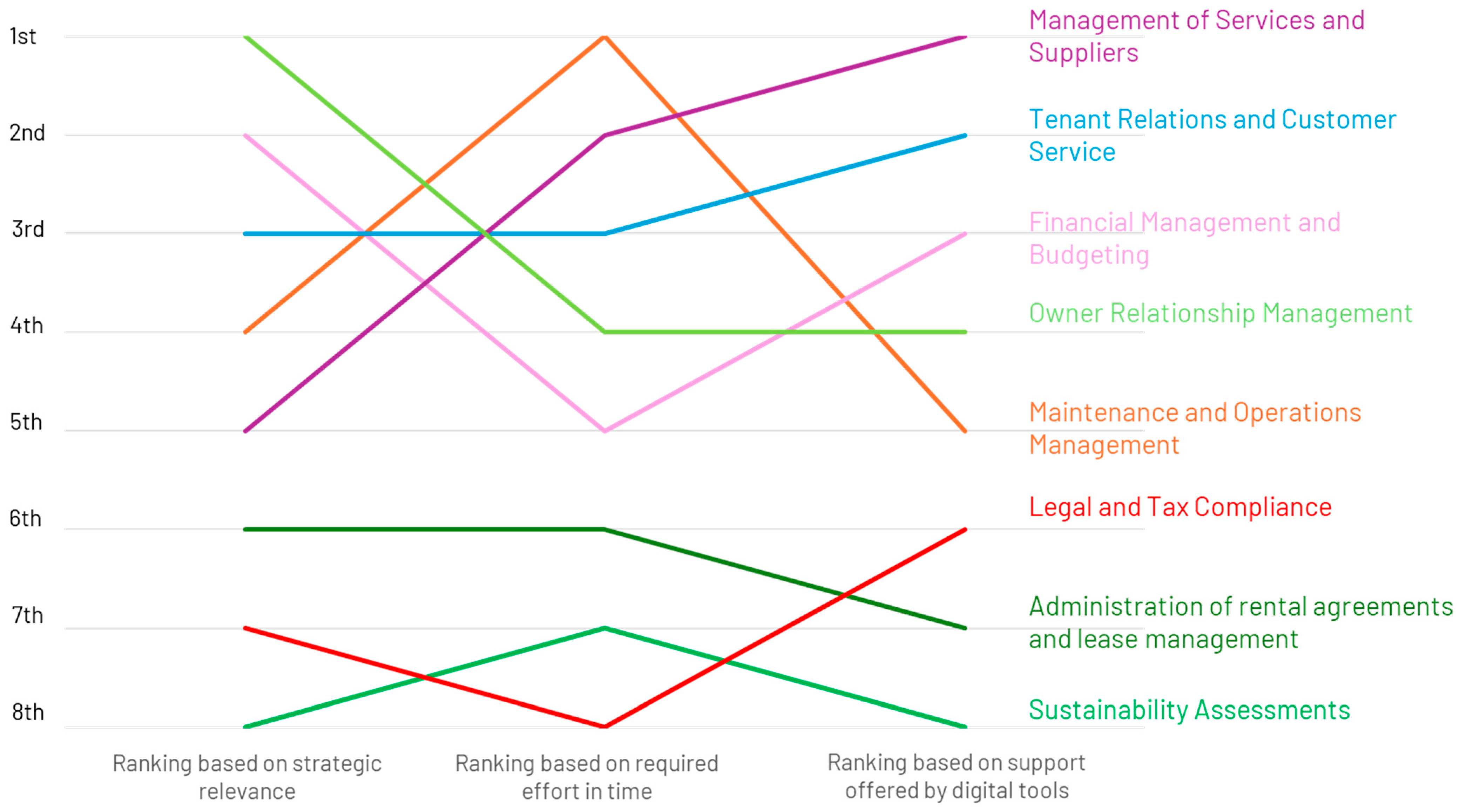
From the survey administered to PM professionals, the relevance of “Ownership Relationship Management” was ranked the highest among the eight activities (followed by “Financial management and budgeting”, “Tenant relationship”, “Customer service”, and “Maintenance and operation management”), meaning that this activity strongly characterizes PM and also covers strategic relevance (Figure 1). In particular, among the 27 respondents in managerial positions, 16 selected “Ownership Relationship Management”; among the non-managerial respondents, the most relevant activity was also “Ownership Relationship Management”. At the other end of the spectrum, “Legal and tax compliance” and “Sustainability assessment” ranked the lowest, meaning that they are somewhat deprioritized in daily practice, likely because they have not been directly tied to immediate performance metrics in traditional PM, or because they are not directly tied to the core mission of the organization. When cross-checking the relevance of activities against the time professionals spend on each, clear misalignments emerge. “Sustainability assessment” and “Legal and tax compliance” require the least time, whereas “Maintenance and operation management” requires the most time on average and is considered less strategic than the others.
The findings highlight areas where technology could help re-balance efforts. Ideally, property managers recognize the strategic value of digitalization. From the survey, the importance of adopting digital tools has been evaluated on average 4.3 on a scale from 1 to 5. At the managerial level, digital solutions are recognized to enhance operational efficiency, and improve data-driven decision-making and stronger user engagement, in line with evidence of the existing literature [38]. Digital tools should especially free time for the activities that PMs would like to spend more time on, including strategic planning with owners and financial optimization (areas they deem important). However, digital technology adoption remains limited. Survey results indicate persistent difficulties in integrating new digital systems into established organizational processes. Notably, perceptions of digital adoption differ across organizational roles. Professionals in operational positions rated the level of digital adoption lower (3.0 out of 5.0) than managerial respondents (4.0 out of 5.0), suggesting a gap between those promoting digital transformation and those directly engaged in day-to-day activities. This misalignment is particularly evident in Maintenance and Operations Management, where digitalization is expected to support repetitive firefighting and time-consuming tasks through predictive maintenance tools, automation, and outsourcing to PropTech platforms. Nevertheless, it remains among the least digitalized activities, ranking 5 out of 8 (Figure 1), despite being one of the most time-consuming in PM, both for managers (8 respondents over 27) and operational professionals (6 over 18). This outcome also confirms the literature, that reports evidence of a digital divide in the existence of digital solutions and their adoption for building operations [34].
If PropTech can reduce maintenance coordination time (through automation) and streamline supplier interactions, it could free up managers’ time to invest more effort into owner and tenant relations or portfolio strategy. Likewise, digitalizing Administration of rental agreements and lease management and Legal and Tax Compliance (two low-importance activities) could further free capacity.
To further dig into these preliminary results, considering the digital solutions currently available in the Italian market, desktop analysis was conducted on 29 PropTech solutions to evaluate how they would meet the primary PM activities and tasks (Table 4). A first group of platforms—such as Resys (#1), iNep (#4), Sugar (#17), and Nephos (#6)—offers integrated or modular Software-as-a-Service (SaaS) systems that centralize core PM functions, including lease administration, maintenance coordination, financial reporting, and document management. These tools target professional property owners, institutional investors, and facility managers, aiming to enhance operational efficiency and data standardization. A second cluster focuses on facility and maintenance management, including platforms such as PlanRadar (#28), Mainsim (#23), and Livemote (#27), which integrate ticketing systems, IoT-based monitoring, and workflow automation to support building operations and technical maintenance. Similarly, BrainBox AI (#19), Icnea (#7), and Spacewell (#25) leverage AI and sensor technologies to improve energy performance, HVAC optimization, and space utilization—reflecting the ongoing digitalization of building performance management. A third group addresses residential and hospitality management, particularly in the context of short- and medium-term rentals. Solutions such as Octorate (#11), Kross Booking (#15), CiaoBooking (#3), inReception (#22), HousingAnywhere (#14), and Greta (#21) provide Property Management Systems (PMSs) and channel managers that facilitate booking, check-in/out, and multi-platform integration. Complementary services such as CleanBnB (#9), Rentals United (#29), and Rent Your Nest (#16) extend automation to cleaning, hosting, and payment operations. Several platforms—Kipò (#5), Condowe (#12), Cora (#13), and Comunicasa (Casavi) (#10)—focus on condominium and community management, offering digital portals for communication, expense management, and administrative transparency. These tools contribute to the modernization of a traditionally manual and fragmented sector. An emerging subset of PropTech tools concentrate on sustainability and ESG reporting, with Deepki (#26) representing one of the most advanced cases, providing features for data collection, benchmarking, and compliance with frameworks such as SFDR and GRESB. Relatedly, Bluenest (#2) develops digital infrastructures for urban air mobility (eVTOL), promoting sustainable inter-modality, while Sicuro.it (#24) supports environmental and financial resilience through digital insurance comparison and management. Finally, Sigtree (#8) stands out for its tenant engagement and community-building features, offering communication tools, ticketing systems, and ESG dashboards to strengthen relationships between landlords and occupants. Other niche applications, such as Condeo (#20) and Badi (#18), address specific market needs, respectively, document management for property sales and digital matchmaking in the coliving sector.
Overall, the 29 analyzed PropTechs illustrate a multifaceted and rapidly evolving landscape, where digital solutions address complementary aspects of PM—from operational efficiency and sustainability compliance to user experience and community interaction. The eight identified activities served as a framework for assessing the degree of integration for each solution with PM activities and potential market gaps. The findings reveal that while some solutions, such as Resys (#1), demonstrate a high level of integration by addressing nearly all core activities, some others’ focus is narrower and thinner. This heterogeneity underscores both the maturity and fragmentation of the current market, highlighting opportunities for greater integration and interoperability among specialized tools. The most frequently covered areas include Maintenance and Operations Management and Tenant Relations, with 20 solutions (out of the 29 investigated) serving these activities. Conversely, Sustainability, Service and Supplier Management, and Legal and Tax Compliance remain significantly less integrated with digitalization, respectively with five to seven solutions serving each. It is worth noting that the same degree of engagement of these activities with digitalization resonates with the literature analysis.
Out of the 29 solutions being investigated, four were extrapolated for in-depth case study analysis. As represented in the methodology, these four companies have been selected because they exemplify the diversity of the digital technology adoption in PM activities, by illustrating how digital innovation can support different dimensions. To better reveal the gaps in market integration, the benefits of adopting digital technologies, and the opportunities for future implementation, four separate online interviews were conducted. The interviews especially focused on the following discussion points: (i) client typologies and market positioning; (ii) user experience; (iii) PM activities; and (iv) the future of the industry.
Resys (#1) offers a comprehensive and integrative solution, PlanRadar (#28) focuses on operation efficiency, Deepki (#26) leads in sustainability and ESG compliance, and Sigtree (#8) prioritizes tenant engagement and community building.
Resys (#1; INT-01), developed by the Italian company Softime, is a comprehensive cloud-based Property Management System (PMS) operating under a SaaS model. It integrates a wide range of modules covering data and portfolio management, lease administration, maintenance, taxation, tendering, and business intelligence. Dedicated portals for tenants, suppliers, and condominium associations enhance communication and transparency. Due to its modular and flexible architecture, Resys can adapt to complex environments, such as public housing, retail, and large property portfolios, making it one of the most functionally complete and integrative platforms in the Italian PropTech landscape.
PlanRadar (#28—INT-02) provides a digital project and construction management platform designed to increase operational efficiency and transparency. Through its SaaS model, it enables real-time collaboration, documentation control, and task tracking among stakeholders such as architects, contractors, and managers. It integrates with BIM and 2D layouts, and offers mobile accessibility, supporting users in over 75 countries. PlanRadar’s focus lies in document traceability, site monitoring, and quality assurance, making it an essential tool for large-scale and international construction and real estate operations.
Sigtree (#8—INT-03) is an innovative startup that focuses on tenant engagement and property manager communication through a cloud-based SaaS platform. It provides interactive tools such as newsletters, surveys, and collaborative spaces, promoting transparency and a sense of community. Additionally, its automated maintenance management system improves operational efficiency and responsiveness. Sigtree’s value proposition lies in enhancing tenant satisfaction, collaboration, and ESG-oriented practices, positioning it as a human-centered PropTech solution that complements more technically oriented platforms.
Deepki (#26—INT-04) is an ESG-focused PropTech company specializing in the decarbonization and sustainable management of real estate assets. Its SaaS platform combines data analytics, ESG reporting, benchmarking, and compliance tools to support clients in meeting European sustainability standards such as the SFDR, EU Taxonomy, and GRESB. Certified as a B-Corporation, Deepki couples its digital tools with consultancy services, helping property owners and investors enhance their portfolios’ environmental performance and resilience. Deepki’s specialization demonstrates how PropTech can drive environmental transition and regulatory compliance in real estate.
Considering client typologies and market positioning, an important element in understanding the influence of digital solutions within PM concerns the typology of clients engaging with PropTech firms. The interviews revealed a high degree of heterogeneity among client profiles in terms of both legal status and asset classes managed. Resys serves a wide range of clients—from family offices and industrial corporations to retail companies and public entities. Approximately 90% of its clients are also property owners, enabling a more direct and integrated asset management approach. The interviewee (INT-01) observed that “a certain number of managed Real Estate units actually requires the adoption of organized information systems,” underscoring the growing necessity of digital infrastructures in large portfolios. PlanRadar reported a cross-sectoral portfolio, including general contractors, private firms, and public administrations, reflecting the flexibility of its collaborative platform in adapting to diverse operational contexts. Sigtree, though a younger company, has attracted major international clients such as CBRE, Cushman & Wakefield, and GlobalWorld, in addition to local landlords. Its “white label” implementation allows full customization, ensuring platform neutrality and suitability for competing companies. While originally focused on office properties, INT-03 now manages over 25,000 residential units and derives increasing value from brokerage and leasing services. By contrast, Deepki is more sustainability- and governance-oriented, targeting SGRs, investment funds, and asset managers, with an expanding customer base that includes banks, consultants, and engineering firms. This diversification aligns with the growing institutionalization of ESG principles across the real estate value chain. The company’s portfolio spans traditional sectors (residential, office, retail, hospitality) as well as high-consumption assets such as data centers and spa facilities. Overall, a large variety of asset classes and stakeholders are targeted within the activities of the analyzed digital solutions, which confirms the flexibility offered by digital tools to adapt to different building types and needs in the fast-evolving context of both PM and AECO.
Across all interviews, user experience and KPI visibility emerged as key dimensions of digital PM. Despite varying market focuses, all companies emphasized the importance of data collection, integration, and interpretation as central to operational efficiency. For example, INT-01 says they adopt a modular approach emphasizing usability and scalability: “Customers choose our platform because it is comprehensive. They start off with the basics and often implement it over the years, which is a huge added value for us.” The company tracks usability (logins, platform engagement) and operational performance (ticket resolution, averaging 40,000 cases within 4–8 h), while supporting broader administrative processes such as document and tax management. INT-02 highlighted real-time data visualization and customizable dashboards that allow users to define relevant KPIs. Beyond internal performance metrics, it also collects feedback to assess time savings and guide continuous improvement. Sigtree focuses on service quality and accountability between landlords and facility managers. Its KPIs monitor both operational performance and tenant satisfaction, thereby enhancing retention and contract duration. INT-03 noted the advantage of a switch from analog to digital information recording: “When an employee leaves the company, it causes significant damage because they take information with them,” illustrating the platform’s role in mitigating data loss through centralized information systems. Deepki aggregates global data to assess environmental performance, offering clients advanced benchmarking tools. In sum, these digital solutions confirm their ability to collect data and make it available throughout multiple phases of a building’s lifecycle, therefore facilitating control, knowledge transfer and inter-stakeholder communication.
The interviews also explored which PM activities remain underserved by digital solutions. Interviewees emphasized deficiencies in data centralization, along with the automatic management of contractual deadlines, and the traceability of maintenance activities, noting that “the Real Estate industry is one of the least digitized industries in the world!” (INT-02). INT-01 summarized: “Two things that everyone wants are deadline management and data standardization on a single platform.” Sustainability and regulatory compliance are also areas with low digital adoption, often outsourced or managed through non-integrated systems, even if INT-04 reported increasing strategic importance. The need for greater traceability and transparency was highlighted, underscoring the lack of a unified global approach to sustainability. As stated, “Even if all buildings constructed from now on were 100% sustainable at the European level, we would not see much change in the data, because it should be a global vision.” (INT-03).
The interviews reveal that digital adoption in PM remains uneven. INT-01 observed that uptake correlates with company size and asset complexity, with public and institutional clients leading adoption, while smaller firms and family offices remain hesitant due to “a lack of digital culture.” INT-02 similarly identified entrenched habits as the main barrier: “Our competitors are Excel, WhatsApp, e-mail, paper, and phone calls.” The same interviewee added that “dealing with younger people is much easier… it is not an industry issue, but a perception of digital benefits.” INT-03 described a reactive rather than proactive adoption of innovation, remarking that “you can’t prepare for war while you’re at war, so you should do it beforehand, when things are calm.” INT-04, while acknowledging initial resistance, reported growing enthusiasm for technologies that save time and resources, though these require coordinated organizational change and clearly defined roles.
The interviews aligned with the literature [38] by consistently citing AI as a key driver of future transformation. AI is envisaged to automate back-office operations and supporting strategic decisions, foreseeing integration with digital twins not only for technical monitoring but also for financial and administrative scenario analysis: “We imagine virtual assistants directly integrated into the platform, capable of responding to complex issues, such as legal and tax matters.” (INT-01). INT-03 projected a more radical evolution, anticipating a transition to voice-driven AI interfaces that could replace repetitive tasks and even “erode the role of brokers.” INT-04 reported ongoing integration of deep-learning for energy management, thermal simulation, and climate resilience assessment.
Despite automation, all interviewees agreed that the property manager remains central, though the role is becoming more strategic and analytical. INT-04 emphasized the need for training to ensure adaptation to data-driven practices, while INT-03 reminded that “real estate still needs the human touch.” Meanwhile, INT-02 noted the growing potential for data-based automation by stating that: “Today, human intervention is still necessary, but if we are talking solely about data analysis, replacement may also be possible.

5. Discussion

This study highlights a current fragmentation in the PropTech market in Italy, and underscores the need for more comprehensive, modular, and collaborative solutions capable of supporting the full spectrum of PM activities and tasks.
The analysis pinpoints several recurring themes across the literature and interactions with stakeholders (see Table 5). The literature review provided a foundation for detecting imbalances in the research landscape and informing future investigations aimed at strengthening the theoretical and empirical understanding of underexplored dimensions in PM. Particularly, the most extensively covered topic in the scientific literature addressing property technology is Maintenance and Operations Management, whereas Lease Administration, Service and Supplier Management, Sustainability, Legal and Tax Compliance, and Owner Relationship Management remain comparatively underrepresented. At the same time, from stakeholders’ experience, Owner Relationship Management is the most relevant activity, whereas Maintenance and Operations Management is considered, on average, less strategic. However, for operators, Maintenance remains the activity that requires the most time. This may justify the strong interest that scientific studies have demonstrated in this matter.
By combining systematic research of scientific papers, a market analysis of digital solutions, and a stakeholder engagement of both the demand and supply sides of digital solutions, this study reveals structural misalignments between PropTech supply and PM demand that hinder an effective digital transformation of the real estate sector.
The discussion can be structured around the three interrelated mismatches identified in the analysis: (1) perception versus engagement; (2) tools offered versus activities performed; and, (3) strategic vision versus operational culture.

5.1. Perception Versus Engagement

The first mismatch underscores a clear discrepancy between the perceived importance of digital innovation and the extent of its actual integration in daily operations. Although the majority of surveyed professionals acknowledge the strategic relevance of digitalization, their effective involvement remains limited. This finding aligns with the existing literature on the diffusion of technological innovations in real estate, which identifies “symbolic adoption” as a recurring barrier, where digital transformation is conceptually endorsed but not operationally embedded [3]. The delegation of innovation to IT departments or external consultants, as revealed by interview data, reinforces this pattern, leading to limited feedback loops between tool developers and end users. Consequently, technologies often fail to address the specific pain points experienced by property managers in their day-to-day activities.

5.2. Tools Offered Versus Activities Performd

The second mismatch concerns the limited overlap between the functionalities of PropTech solutions and the concrete priorities expressed by professionals. The analysis of the four selected solutions—Resys, PlanRadar, Deepki, and Sigtree—shows that while most platforms emphasize operational automation (e.g., maintenance, ticketing, and reporting) or advanced analytics (e.g., ESG monitoring, predictive maintenance), users tend to prioritize relationship-driven and financial activities, such as tenant engagement, supplier coordination, and owner reporting. This confirms prior evidence that PropTech innovation often follows global technological trends rather than localized or user-driven needs [3,28]. Moreover, sustainability-oriented platforms, such as Deepki, demonstrate a forward-looking orientation that is not yet mirrored in market readiness: ESG is perceived as a long-term goal rather than an immediate operational priority. This perception persists in market’s operators despite recent regulatory frameworks, including EU Taxonomy and SFDR, increasingly requiring standardized, traceable, and data-driven ESG disclosures. Similarly, while PlanRadar’s strength lies in traceability and documentation efficiency, its adoption remains constrained by low satisfaction levels and fragmented use. This limits its ability to support broader governance and reporting requirements.
This functional misalignment suggests that PropTech development is evolving faster than the organizational capacity of PM to assimilate innovation. The mismatch highlights a strategic risk for organizations that fail to integrate digital solutions and meet regulatory and investors’ expectations, consequently reducing their competitiveness.

5.3. Strategic Vision Versus Operational Culture

The third mismatch exposes the deep-rooted cultural and organizational barriers impeding the transition toward a data-driven and digitally mature PM model. While PropTech firms increasingly invest in AI, predictive analytics, and platform interoperability, most property professionals operate within structures characterized by limited digital literacy, siloed decision-making, and insufficient training. These findings resonate with recent research emphasizing that digital transformation is primarily a cultural, rather than technological, process [28,37]. The persistence of analog workflows, limited use of dashboards or BIM integration, and resistance to organizational change collectively hinder the strategic uptake of technological innovation.
In this way, innovation in PM tends to be triggered by operational emergencies rather than guided by anticipation of future needs, reinforcing a reactive approach focused on short-term problem solving instead of long-term strategic planning. These dynamics reinforce the thesis that a forward-looking orientation is not yet recognized as a priority for PM operators. Those digital tools that support proactive decision-making and compliance readiness remain underutilized.

6. Conclusions

This paper explores prospective developments within the real estate sector, arguing that the evolution of the property manager’s role—progressively oriented towards strategic, digital, and sustainability-driven functions—will require adaptable and integrated technological solutions capable of supporting new operational priorities. This study advanced understanding of the digitalization process in PM. The literature review provided the theoretical foundation, highlighting dominant research trajectories, recurring concepts, and remaining knowledge gaps. While the in-depth analysis of four PropTech solutions (Resys, PlanRadar, Deepki, and Sigtree) enables a detailed understanding of different business models and functional approaches, the limited sample size may constrain the generalizability of the findings. However, this approach is appropriate for interpreting the findings as exploratory in nature and indicative of emerging patterns among advanced market players, providing a robust basis for future research using larger, more diverse samples. Finally, a survey of real estate professionals provided empirical validation, revealing convergences and misalignments between the perspectives of technology providers and end users and identifying directions for future research.
Collectively, the mismatches identified in this study indicate that the digital transformation of PM remains in a transitional stage, characterized by technological potential without organizational readiness. For PropTech developers, the findings suggest the need to move beyond technology-driven solutions toward modular, interoperable platforms developed through co-creation processes with end users, ensuring usability, contextual relevance, and scalability. For PM firms, priorities should include digital skills development, clearer data governance frameworks, and investment in change-management processes that embed digital tools into everyday workflows rather than treating them as peripheral add-ons. For policymakers and professional bodies, the results highlight the importance of targeted incentives, training programs, and certification schemes that support digital adoption, enhance professional competencies, and align regulatory requirements with practical implementation capabilities.
Bridging these gaps requires both PropTech developers and property operators to engage in more collaborative and iterative innovation processes. Co-design approaches, where end users are actively involved in defining requirements and testing prototypes, could improve usability and contextual relevance. Similarly, institutional efforts, such as targeted training programs, digital literacy initiatives, and incentive frameworks, may accelerate the sector’s digital maturity and facilitate alignment between supply and demand.
From a policy and research standpoint, these findings highlight the need to foster ecosystemic integration among technological innovation, regulation, and professional practice. The advancement of digital solutions should be accompanied by cultural transformation strategies that emphasize competence development, change management, and cross-functional collaboration. Only through such systemic alignment can PropTech realize its potential to transform PM from a reactive, operational activity into a strategic, data-informed discipline.

Author Contributions

Conceptualization, A.P.P. and C.T.; methodology, A.P.P. and C.T.; validation, S.L.; formal analysis, A.P.P. and C.T.; investigation, A.P.P. and C.T.; writing—original draft preparation, A.P.P. and C.T.; writing—review and editing, S.L. All authors have read and agreed to the published version of the manuscript.

Funding

This research received no external funding.

Institutional Review Board Statement

This study is waived for ethical review as the study did not collect any personal data, and the following documents, which were also cited at the beginning of the online form used to collect the responses. Operational instructions: https://www.normativa.polimi.it/fileadmin/user_upload/regolamenti/privacy_e_sicurezza/DD_Istruzioni_operative_istruzioni_operative_2025_7_7.pdf (accessed on 7 July 2025). Policy Model: https://www.normativa.polimi.it/fileadmin/user_upload/regolamenti/privacy_e_sicurezza/DD_Modello_organizzativo_privacy_-_MOP_2025_7_7.pdf (accessed on 31 March 2025). ICT security Regulation: https://www.normativa.polimi.it/fileadmin/user_upload/regolamenti/privacy_e_sicurezza/REGOLAMENTO_trattamento_dati_e_ICT__marzo2025.pdf (accessed on 31 March 2025).

Informed Consent Statement

Informed consent for participation was obtained from all subjects involved in the study.

Data Availability Statement

The data presented in this study are available on request from the corresponding author due to privacy and ethical reasons.

Acknowledgments

We acknowledge the support of Simone Di Chiazza, who participated in multiple phases of the research, including help in data curation and analysis, while developing his Master’s thesis. The authors have reviewed and edited the output and take full responsibility for the content of this publication.

Conflicts of Interest

The authors declare no conflicts of interest.

References

  1. Read, D.C.; Hopkins, E.; Goss, R.C. Working Effectively with Asset Managers and Institutional Groups. Prop. Manag. 2016, 34, 280–296. [Google Scholar] [CrossRef] [Scilit]
  2. Read, D.C.; Carswell, A. Is Property Management Viewed as a Value-Added Service? Prop. Manag. 2019, 37, 262–274. [Google Scholar] [CrossRef] [Scilit]
  3. Baum, A. Proptech 3.0: The Future of Real Estate; University of Oxford: Oxford, UK, 2017. [Google Scholar]
  4. Maria-Liliana, M. Enhancing the Efficiency of the Management of Real Estate Companies through Organizational Structures. Open J. Appl. Sci. 2022, 12, 1687–1697. [Google Scholar] [CrossRef]
  5. Sirmans, G.S.; Benjamin, J.D. Determinants of Market Rent. J. Real Estate Res. 1991, 6, 357–379. [Google Scholar] [CrossRef] [Scilit]
  6. Sirmans, G.S.; Sirmans, C.F. Property Manager Designations and Apartment Rent. J. Real Estate Res. 1991, 7, 91–98. [Google Scholar] [CrossRef] [Scilit]
  7. Chin, L.; Khee Poh, L. Implementing Quality in Property Management—The Case of Singapore. Prop. Manag. 1999, 17, 310–320. [Google Scholar] [CrossRef] [Scilit]
  8. Chi-Man Hui, E.; Ting Lau, H.; Hayat Khan, T. Effect of Property Management on Property Price: A Case Study in HK. Facilities 2011, 29, 459–471. [Google Scholar] [CrossRef] [Scilit]
  9. Carswell, A.T. Living Where You Work. Facilities 2018, 36, 258–271. [Google Scholar] [CrossRef] [Scilit]
  10. James, R.N.; Carswell, A.T. Home Sweet Apartment: A Text Analysis of Satisfaction and Dissatisfaction with Apartment Homes. Hous. Soc. 2008, 35, 91–111. [Google Scholar] [CrossRef] [Scilit]
  11. Alexander, A.; Muhlebach, R. Managing and Leasing Commercial Properties; Institute of Real Estate Management: Chicago, IL, USA, 2016; ISBN 978-1-57203-296-5. [Google Scholar]
  12. Kaganova, O.; Nayyar-Stone, R. Municipal Real Property Asset Management: An Overview of World Experience, Trends and Financial Implications. J. Real Estate Portf. Manag. 2000, 6, 307–326. [Google Scholar] [CrossRef] [Scilit]
  13. Glickman, I.H. The ABC’s of Asset Management. Real Estate Issues 2004, 29, 7–12. [Google Scholar]
  14. Read, D.C.; Sanderford, A.R. Sustaining Sustainability in Large Real Estate Investment Management Firms. J. Real Estate Portf. Manag. 2018, 24, 19–33. [Google Scholar] [CrossRef] [Scilit]
  15. Jackson, L.A. Towards an Understanding of Lodging Asset Management and Its Components. Hosp. Rev. 2013, 30, 92–110. [Google Scholar]
  16. Singh, A.J.; Kline, R.D.; Ma, Q.; Beals, P. Evolution of Hotel Asset Management. Cornell Hosp. Q. 2012, 53, 326–338. [Google Scholar] [CrossRef] [Scilit]
  17. Waheed, Z. Total Facilities Management. Facilities 2010, 28, 494–495. [Google Scholar] [CrossRef] [Scilit]
  18. Lindholm, A. A Constructive Study on Creating Core Business Relevant CREM Strategy and Performance Measures. Facilities 2008, 26, 343–358. [Google Scholar] [CrossRef] [Scilit]
  19. Palm, P. Measuring Customer Satisfaction: A Study of the Swedish Real Estate Industry. Prop. Manag. 2016, 34, 316–331. [Google Scholar] [CrossRef] [Scilit]
  20. Appel-Meulenbroek, R. Managing “Keep” Factors of Office Tenants to Raise Satisfaction and Loyalty. Prop. Manag. 2008, 26, 43–55. [Google Scholar] [CrossRef] [Scilit]
  21. Feng, T.; Geltner, D. Property-Level Performance Attribution: Investment Management Diagnostics and the Investment Importance of Property Management. J. Portf. Manag. 2011, 37, 110–124. [Google Scholar] [CrossRef] [Scilit]
  22. Li, J.; Monkkonen, P. The Value of Property Management Services: An Experiment. Prop. Manag. 2014, 32, 213–223. [Google Scholar] [CrossRef] [Scilit]
  23. Feldman, D. Asset Management. Cornell Hotel Restaur. Adm. Q. 1995, 36, 36–51. [Google Scholar] [CrossRef] [Scilit]
  24. Sanderson, D.C.; Devaney, S. Occupier Satisfaction and Its Impact on Investment Returns from UK Commercial Real Estate. J. Prop. Investig. Financ. 2017, 35, 135–159. [Google Scholar] [CrossRef] [Scilit]
  25. Oyedokun, T.B.; Oletubo, A.; Adewusi, A.O. Satisfaction of Occupiers with Management of Rented Commercial Properties in Nigeria. Prop. Manag. 2014, 32, 284–294. [Google Scholar] [CrossRef] [Scilit]
  26. Pwc. Emerging Trends in Real Estate. In the Eye of the Storm; Pwc: London, UK, 2023. [Google Scholar]
  27. McKinsey. Empty Spaces and Hybrid Places: The Pandemic’s Lasting Impact on Real Estate; McKinsey: Chicago, IL, USA, 2023. [Google Scholar]
  28. Tagliaro, C.; Pomè, A.P.; Ciaramella, A.; Bellintani, S. PROPerty TECHnology—Insights from the Joint Research Partnership on Digital Transformation in Real Estate and Construction; Springer: Cham, Switzerland, 2025; ISBN 978-3-031-87471-0. [Google Scholar]
  29. Tan, Z.; Miller, N.G. Connecting Digitalization and Sustainability: Proptech in the Real Estate Operations and Management. J. Sustain. Real Estate 2023, 15, 2203292. [Google Scholar] [CrossRef] [Scilit]
  30. van Duuren, E.; Plantinga, A.; Scholtens, B. ESG Integration and the Investment Management Process: Fundamental Investing Reinvented. J. Bus. Ethics 2016, 138, 525–533. [Google Scholar] [CrossRef] [Scilit]
  31. Azar, E.; Menassa, C.C. A Comprehensive Framework to Quantify Energy Savings Potential from Improved Operations of Commercial Building Stocks. Energy Policy 2014, 67, 459–472. [Google Scholar] [CrossRef] [Scilit]
  32. Signorini, M.; Pomè, A.P. Shaping the Future of Facility Management. Market and Literature Insights on Digital Twin Adoption. Facilities 2025, 43, 818–834. [Google Scholar] [CrossRef] [Scilit]
  33. Bolshakov, N.; Badenko, V.; Yadykin, V.; Celani, A. As-Built BIM in Real Estate Management: The Change of Paradigm in Digital Transformation of Economy. In IOP Conference Series: Materials Science and Engineering; IOP Publishing Ltd.: Bristol, UK, 2020. [Google Scholar]
  34. Švajlenka, J.; Packo, P.; Konovalov, D. Analysis of Digital Tool Implementation in Building Operations. Eng. Proc. 2025, 116, 7. [Google Scholar]
  35. Pfnür, A.; Wagner, B. Transformation of the Real Estate and Construction Industry: Empirical Findings from Germany. J. Bus. Econ. 2020, 90, 975–1019. [Google Scholar] [CrossRef] [Scilit]
  36. Yadykin, V.; Barykin, S.; Badenko, V.; Bolshakov, N.; de la Poza, E.; Fedotov, A. Global Challenges of Digital Transformation of Markets: Collaboration and Digital Assets. Sustainability 2021, 13, 10619. [Google Scholar] [CrossRef] [Scilit]
  37. Tagliaro, C.; Pomè, A.P.; Migliore, A.; Danivska, V. Technology “like a Fork”. How PropTech Shapes Real Estate Innovation. J. Eur. Real Estate Res. 2025, 18, 4–26. [Google Scholar] [CrossRef] [Scilit]
  38. Al-haimi, B.; Khalid, H.; Zakaria, N.H.; Jasimin, T.H. Digital Transformation in the Real Estate Industry: A Systematic Literature Review of Current Technologies, Benefits, and Challenges. Int. J. Inf. Manag. Data Insights 2025, 5, 100340. [Google Scholar] [CrossRef] [Scilit]
  39. Sáez, P.; Morales, J.; Silva-Aravena, F. Digital Transformation in Organizations: Implications for the Workforce. In 2023 IEEE CHILEAN Conference on Electrical, Electronics Engineering, Information and Communication Technologies (CHILECON); IEEE: Piscataway, NJ, USA, 2023; pp. 1–5. [Google Scholar]
  40. Tagliaro, C.; Bellintani, S.; Ciaramella, G.R.E. Property Meets Technology: Cross-Country Comparison and General Framework. J. Prop. Investig. Financ. 2021, 39, 125–143. [Google Scholar] [CrossRef] [Scilit]
  41. Becker, R.; Lublasser, E.; Martens, J.; Wollenberg, R.; Zhang, H.; Brell-Cokcan, S.; Blankenbach, J. Enabling BIM for Property Management of Existing Buildings Based on Automated As-Is Capturing. In ISARC. Proceedings of the International Symposium on Automation and Robotics in Construction; IAARC Publications: Krakow, Poland, 2019. [Google Scholar]
  42. Bellintani, S.; Ciaramella, A.; Leoncini, S.; Pomè, A.P.; Tagliaro, C. Italian PropTech Monitor 2024; Politecnico di Milano: Milano, Italy, 2025. [Google Scholar]
  43. Spante, M.; Hashemi, S.S.; Lundin, M.; Algers, A. Digital Competence and Digital Literacy in Higher Education Research: Systematic Review of Concept Use. Cogent Educ. 2018, 5, 1519143. [Google Scholar] [CrossRef] [Scilit]
  44. Tranfield, D.; Denyer, D.; Smart, P. Towards a Methodology for Developing Evidence-Informed Management Knowledge by Means of Systematic Review. Br. J. Manag. 2003, 14, 207–222. [Google Scholar] [CrossRef] [Scilit]
  45. Odebode, A.A.; Ogunbayo, O.T.; Obayomi, A.B. Adoption and Willingness to Use Property Management Software among Real Estate Tech Start-Ups in Lagos State, Nigeria. J. Eur. Real Estate Res. 2025, 18, 68–83. [Google Scholar] [CrossRef] [Scilit]
  46. Ding, H.; Sun, J. A Systematic Review of Technology Innovations in Housing Management in Scotland. Sage Open 2024, 14, 21582440241239179. [Google Scholar] [CrossRef] [Scilit]
  47. Cholaraja, K.; Vignesh, M.; Srinidhi, B. Justrent (A House Rental Management System). In 2024 10th International Conference on Advanced Computing and Communication Systems (ICACCS); IEEE: Piscataway, NJ, USA, 2024; pp. 2483–2487. [Google Scholar]
  48. Abdul Jalil, R.; Mohamed Razali, M.N.; Zainudin, A.Z.; Ahmad, F. Digitalization of sustainable integrated property management for affordable strata housing. Plan. Malays. 2023, 21, 22–35. [Google Scholar] [CrossRef] [Scilit]
  49. Basit, A.; Nizam, I.; Goh, R.; Sethumadhavan, S.; Hanif, N.R.; Hassan, Z.; Mohd Aini, A. Residents’ Satisfaction of Property Management Mobile Applications: A Study in the Context of Strata Property in Kuala Lumpur, Malaysia. Prop. Manag. 2023, 41, 766–782. [Google Scholar] [CrossRef] [Scilit]
  50. Saputra, P.C.; Prabowo, H.; Ramadhan, A.; Madyatmadja, E.D. Trends of Digital Transformation in the Property Management Industry: A Systematic Literature Review. In 2023 IEEE International Conference on Smart Information Systems and Technologies (SIST); IEEE: Piscataway, NJ, USA, 2023; pp. 552–557. [Google Scholar]
  51. Ifediora, C.O. Assessing the Use of Smart Phones-Based Apps, Software and Geographic Information System (GIS) in Real Estate Practice. Int. J. Dev. Econ. Sustain. 2022, 10, 26–40. [Google Scholar] [CrossRef] [Scilit]
  52. Shen, Q.; Hua, Y.; Huang, Y.; Ebstein, R.; Yu, X.; Wu, Z. Knowledge Management and Modern Digital Transformation of the Property Management Industry in China. J. Knowl. Manag. 2022, 26, 2133–2144. [Google Scholar] [CrossRef] [Scilit]
  53. Saputra, P.C. User Satisfaction Analysis of Mobile EProperty Management Application Using End-User Computing Satisfaction Method (Case Study: Apartments in Jakarta). In 2021 International Conference on Electrical and Information Technology (IEIT); IEEE: Piscataway, NJ, USA, 2021; pp. 281–285. [Google Scholar]
  54. Ma, M. Design and Realisation of Residential Property Management Information System Based on Browser/Server Mode. Appl. Math. Nonlinear Sci. 2021, 6, 239–248. [Google Scholar] [CrossRef] [Scilit]
  55. Zamyatina, N.A.; Solntseva, O.G. Hotel Tech Ecosystem: Adaptations to Online Distribution. In Scientific and Technical Revolution: Yesterday, Today and Tomorrow; Springer Nature: Berlin/Heidelberg, Germany, 2020; pp. 194–204. [Google Scholar]
  56. Gross, M.; Lin, C. Comparison of Real Estate Management System in China and Poland. Real Estate Manag. Valuat. 2020, 28, 13–27. [Google Scholar] [CrossRef] [Scilit]
  57. Lizam, M. Digital Technology And The Real Estate Industry. Sinergi Jurnal Ilmiah Ilmu Manajemen 2019, 9, 42–50. [Google Scholar] [CrossRef] [Scilit]
  58. Araszkiewicz, K. Digital Technologies in Facility Management—The State of Practice and Research Challenges. Procedia Eng. 2017, 196, 1034–1042. [Google Scholar] [CrossRef] [Scilit]
  59. Jiang, B. Application of Internet of Things Technology in the Property Management of Intelligent Residential District. Appl. Mech. Mater. 2013, 357–360, 2242–2245. [Google Scholar] [CrossRef] [Scilit]
  60. Zheng, G.X.; Han, S.S. The Application of Intelligent System in Residential Design. Adv. Mat. Res. 2011, 271–273, 464–468. [Google Scholar] [CrossRef] [Scilit]
  61. Razali, M.N.; Ramlan, R.; Manaf, Z. The Implementation of Knowledge Management System in Property Management-Study Case among Local Authorities in Malaysia. In Managing Information in the Digital Economy. Issues and Solutions—Proceedings of the 6th International Business Information Management Association Conference, IBIMA 2006; Western Sydney University: Bonn, Germany, 2006; pp. 615–621. [Google Scholar]
  62. Dixon, T. The Impact of Information and Communications Technology on Commercial Real Estate in the New Economy. J. Prop. Investig. Financ. 2005, 23, 480–493. [Google Scholar] [CrossRef] [Scilit]
Figure 1. Ranking of Property Management activities, based on strategic relevance, required effort in time spent on each activity, and support offered by digital tools.
Sustainability 18 01850 g001
Table 1. List of 20 peer-reviewed publications.
Ref. # 1AuthorsTitleJournalYear
[45]Odebode, A. et al.Adoption and willingness to use property management software among real estate tech start-ups in Lagos State, NigeriaEuropean Real Estate Research2024
[46]Ding, H. and Sun, J.A Systematic Review of Technology Innovations in Housing Management in ScotlandSage Open2024
[47]Cholaraja K. et al.Justrent (A House Rental Management System)ICACCS
Proceedings
2024
[48]Abdul, J. et al.Digitalization of Sustainable Integrated Property Management for Affordable Strata HousingPlanning Malaysia2023
[49]Basit, A. et al. Residents’ satisfaction of property management mobile applications: a study in the context of strata property in Kuala Lumpur, MalaysiaProperty Management2023
[50]Saputra, P. et al.Trends of Digital Transformation in the Property Management Industry: A Systematic Literature ReviewIEEE Proceedings2023
[51]Ifediori, C.Assessing the Use of Smart Phones-Based Apps, Software and Geographic Information System (GIS) in Real Estate PracticeDevelopment and Economic Sustainability2022
[52]Shen, Q. et al.Knowledge management and modern digital transformation of the property management industry in ChinaKnowledge Management2021
[53]Saputra, P.User Satisfaction Analysis of Mobile eProperty Management Application Using End-User Computing Satisfaction Method (Case Study: Apartments in Jakarta)IEEE Proceedings2021
[54]Ma, M.Design and realisation of residential property management information system based on browser/server modeApplied Mathematics and Nonlinear Sciences2021
[55]Zamyatina, N. and Solntseva, O.Hotel Tech Ecosystem: Adaptations to Online DistributionBook Chapter in Springer Nature2020
[56]Gross, M. and Lin, C.Comparison of Real Estate Management System in China and PolandReal Estate Management and Valuation2020
[57]Lizam, M.Digital Technology and the Real Estate IndustrySinergi2019
[33]Bolshakov, N. et al.As built BIM in real estate management—The change of paradigm in digital transformation of economyIOP Proceedings2020
[58]Araszkiewicz, K.Digital Technologies in Facility Management—The state of Practice and Research ChallengesProcedia Eng2017
[59]Jiang, B.Application of Internet of Things Technology in the Property Management of Intelligent Residential DistrictElectric Technology and Civil Engineering Proceedings2013
[60]Zheng, G. and Han, S.The application of intelligent system in residential designAdv Mat Res2011
[61] Razali, M. et al.The Implementation of Knowledge Management System in Property Management- Study Case among Local Authorities in MalaysiaManaging Information in the Digital Economy Proceedings2006
[62]Dixon, T.The impact of information and communications technology on commercial real estate in the new economyProperty Investment & Finance2005
[41]Becker, R. et al.Enabling BIM for Property Management of Existing Buildings Based on Automated As-is CapturingISARC
Proceedings
2005
1 In this manuscript, the symbol “#” is used to indicate the reference number of an item, including both scientific references and data.
Table 2. List of 29 PropTech solutions—Data accessed 1 December 2025 for all URL.
Ref. #NameSegments and Sub-SegmentsWebsite
1ResysProfessional services—Property and asset managementhttps://resys.it/
2BluenestProfessional services—Property and asset managementhttps://www.bluenesthome.it/
3CiaoBooking Professional services—Property and asset managementhttps://www.ciaobooking.com/it
4iNepProfessional services—Property and asset managementhttps://inep.eu/
5Kipò Professional services—Data insights, location intelligence and advisoryhttps://kipocondominio.it/
6NephosProfessional services—Data insights, location intelligence and advisoryhttp://www.nephos.net/
7IcneaSharing economy—Hospitality managementhttps://icnea.com/
8SigtreeProfessional services—Property and asset managementwww.sigtree.com
9CleanBnBSharing economy—Hospitality managementhttps://www.cleanbnb.net
10Comunicasa (Casavi)Professional services—Property and asset managementhttps://comunicasa.it/
11OctorateProfessional services—Property and asset managementhttps://octorate.com/it/
12CondoweProfessional services—Property and asset managementhttps://www.condowe.com/
13CoraProfessional services—Property and asset managementhttps://corahospitality.com/
14HousinganywhereSharing economy—Coliving and accommodationhttps://housinganywhere.com/
15Kross BookingSharing economy—Hospitality managementhttps://www.krossbooking.com/
16Rent Your NestSharing economy—Hospitality managementhttps://rentyournest.com/it/
17SugarSharing economy—Community lifehttps://www.sugarliving.com/
18BadiSharing economy—Coliving and accommodationhttps://badi.com/
19Brainbox AI (R2M)Smart real estate—Integrated management and operationshttps://www.brainboxai.com
20CondeoProfessional services—Property and asset managementhttps://www.condeo.com/
21Greta Professional services—Property and asset managementhttps://greta.agi-re.com/Public/Index.aspx
22inReceptionProfessional services—Property and asset managementhttp://www.inreception.it
23MainsimSmart real estate—Integrated management and operationshttps://www.mainsim.com/
24Sicuro.itProfessional services—Data insights, location intelligence and advisoryhttps://www.sicuro.it/
25SpacewellSmart real estate—Integrated management and operationshttps://spacewell.com/
26DeepkiProfessional services—Data insights, location intelligence and advisoryhttps://www.deepki.com/
27LivemoteSmart real estate—Integrated management and operationshttps://www.livemote.com/
28PlanradarContech—Building site and project managementhttps://www.planradar.com/it/
29Rentals UnitedProfessional services—Business processes and marketinghttps://rentalsunited.com/
“#” is used to indicate the reference number of an item, including both scientific references and data.
Table 3. Property Management activities, tasks and definitions. Elaboration of the authors based on [2].
ActivityTaskDefinition
Administration of rental agreements and lease
Management
[45,46,47]
Lease
administration
Negotiate and oversee lease agreements, defining both the financial and legal terms of contracts with tenants.
Rental collectionEnsure timely collection of rental payments and manage payment schedules. Address any instances of late or missed payments by implementing appropriate corrective measures.
Supervise the lease renewal process to ensure tenants are informed of current terms and that properties remain continuously occupied, avoiding any gaps in tenancy.
Maintenance and Operations
Management
[33,45,47,48,49,60,61]
Ordinary Maintenance Oversee daily maintenance activities, including cleaning, servicing electrical and plumbing systems, maintaining HVAC units, and managing shared spaces
Extraordinary MaintenanceCoordinate major works such as structural repairs, renovations, and facility upgrades.
Emergency Maintenance Respond promptly to urgent issues, including technical malfunctions and critical incidents (e.g., fire or flooding).
Financial
Management and Budgeting
[33,45,47,48,60]
Budget Formulation Develop annual budget plans, forecast operational costs, and plan investments to enhance the property and meet tenant needs.
Financial Tracking and ReportingMonitor revenues and expenses, prepare regular financial reports for the property owner, manage cost control, and identify opportunities for expense reduction.
Tenant Relations and Customer Service
[45,46,47,48,49,50,52,53,58]
Communication with TenantsMaintain open communication channels to address tenant needs and resolve issues promptly.
Service ExcellenceDeliver high-quality service, ensuring tenant satisfaction and promoting long-term retention.
Conflict ResolutionManage and resolve disputes between tenants or between tenants and landlords professionally and efficiently.
Management of Services and Suppliers
[45,48,49,58]
Procurement and contract oversightManage agreements with external service providers (e.g., cleaning, security, maintenance) to ensure contract compliance and service quality.
Quality controlEvaluate the performance of suppliers, maintain productive relationships, and implement corrective measures when necessary.
Sustainability Assessments
[33,41,47,58]
Management of sustainability performanceImplementing energy-saving measures and environmentally sustainable initiatives.
Installing solar panels, electric vehicle charging stations, and smart technologies to monitor and optimize resource use.
Legal and Tax Compliance
[45,46,47,48]
Regulatory OversightGuarantee compliance with safety, health, and environmental regulations, including fire safety, accessibility, and energy reporting requirements.
In jurisdictions such as Australia and the EU, legislation mandates sustainable management practices and disclosure of energy consumption.
InsuranceMaintain up-to-date insurance coverage, ensuring adequate protection against property and operational risks.
Owner Relationship Management
[33,46,47,52]
ReportingProvide regular updates on financial performance, building conditions, and tenant relations. Offer investment recommendations to enhance property value and efficiency.
Table 4. PM activities and PropTech solutions.
Activity1234567891011121314151617181920212223242526272829
Administration of rental agreements and lease
management
XXXX XX X XXXXX
Maintenance and Operations
Management
XXXXXX XXXXXX X XX XXX XX
Financial
Management and Budgeting
XXXXXXXX X X XX X X
Tenant Relations and Customer ServiceXXXXXXXXXXXXXX XX XXX X
Management of Services and SuppliersX XXX X X X
Sustainability Assessments X X X XX
Legal and Tax ComplianceXX XXX X X
Owner Relationship ManagementXXXXXXXX X X X X
TOTAL NUMBER OF ACTIVITIES76666655444333333222222221111
Table 5. The PM Mismatch. Alignment between PM activities and mismatch dimensions, i.e., Strategic Relevance, Time Allocation, Support from digital solutions, Availability of digital solutions, Scientific literature. The colors express the entity of the different dimensions’ coverage (green for high, yellow for medium, and red for low).
ActivityStrategic
Perception
Time SpentSupport from digital
Solutions
Availability of digital
solutions
Scientific
literature
Mismatch
Description
# Mismatch
Tenant Relations and Customer
Service
MediumMediumHighHighMediumGood supply–demand alignment, yet tools often underused or not integrated2
Maintenance and OperationsMediumHighMediumHighMediumTools available and used, but gaps in traceability and strategic alignment remain3
Management of Services and
Suppliers
MediumHighHighLowLowDemand for automation and tracking, but existing tools are partial or poorly integrated1, 3
Financial Management and
Budgeting
HighMediumMediumMediumLowFew tools available; professionals request more support in reporting and cost control1, 2
Owner
Relationship
Management
HighMediumMediumMediumLowKey mismatch: strategic activity with very poor digital support1, 2
Lease and
Contract
Administration
LowLowLowMediumLowCovered well by digital tools; uptake varies based on firm size and resources1, 3
Legal and Tax ComplianceLowLowLowLowLowMarket void: no PropTech priority, despite complexity and risks1, 2, 3
Sustainability/ESGLowLowLowLowLowHigh-tech supply, low demand awareness: need for education and alignment1, 3
“#” is used to indicate the reference number of an item, including both scientific references and data.
Disclaimer/Publisher’s Note: The statements, opinions and data contained in all publications are solely those of the individual author(s) and contributor(s) and not of MDPI and/or the editor(s). MDPI and/or the editor(s) disclaim responsibility for any injury to people or property resulting from any ideas, methods, instructions or products referred to in the content.