1. Introduction
NiTi shape memory alloys (SMAs) have emerged as one of the most promising functional materials for biomedical, aerospace, and smart-structure applications owing to their unique combination of shape memory effect (SME) and superelasticity (SE) [
1,
2,
3]. These phenomena originate from the reversible martensitic transformation between the high-temperature austenite (B2) and low-temperature martensite (B19′) phases, which allows for recoverable strains of up to 8% and exceptional damping capabilities [
4]. In addition to functional performance, NiTi exhibits high biocompatibility, corrosion resistance, and fatigue strength, making it ideal for medical stents, orthodontic wires, and actuators [
5].
Despite these advantages, realizing the full potential of NiTi hinges on overcoming processing-related challenges that significantly affect its performance and scalability. Conventional NiTi production relies on vacuum induction melting (VIM) or vacuum arc remelting (VAR), followed by extensive processing such as forging, extrusion, and wire drawing [
6,
7]. These processes are plagued by poor machinability, severe work hardening, and compositional sensitivity. For NiTi, even minor variations such as <0.1 at.% in the Ni/Ti ratio can shift transformation temperatures by 10 °C [
8]. The result is high rejection rates and low material utilization. Consequently, the majority of NiTi products available commercially are restricted to simple geometries such as wires, plates, and tubes, while the fabrication of complex near-net-shape components remains challenging and wasteful [
9,
10]. This heavy reliance on machining, combined with a lack of recycling routes, contributes to high embodied energy and environmental impact.
In response to these manufacturing constraints, AM has emerged as a promising route for fabricating complex, high-performance NiTi components while enhancing material utilization and design flexibility. AM, particularly Laser Powder Bed Fusion (LPBF), enables direct fabrication of complex, customized geometries from digital models [
11,
12]. AM has achieved near-full-density NiTi parts with tunable SME and SE through process optimization [
12,
13]. It also reduces material waste by 40–50% compared to subtractive manufacturing [
14]. Yet, AM introduces new sustainability concerns, mainly related to powder feedstock production, degradation, and reuse. Because NiTi’s functional behavior strongly depends on stoichiometry, impurity control, and microstructure, maintaining powder integrity across multiple reuse cycles is critical for both performance and sustainability.
Although LPBF is a highly material-efficient process in principle, only a small fraction of the total powder loaded into the build chamber is actually melted during part fabrication. Studies report that 80–90% of the NiTi powder remains unfused after a build [
15,
16]. This unused powder is typically sieved and reused, but with each cycle, the powder undergoes oxidation; compositional drift, particularly Ni depletion; and morphology changes such as satelliting and agglomeration. These changes degrade flowability, apparent density, and ultimately the SME and SE behavior of printed parts [
17]. For NiTi, which relies on precise phase stability, even a 0.05 wt% increase in oxygen or a 0.1 at.% change in Ni can significantly alter transformation temperatures and functional performance [
8].
Therefore, to fully harness the sustainability benefits of additive manufacturing, it is essential to develop strategies that extend powder lifespan, enable efficient recycling, and minimize the embodied energy associated with metal feedstock production.
Atomization processes, whether it be gas atomization (GA), plasma atomization (PA), or electrode induction gas atomization (EIGA), consume large amounts of electricity and inert gas, with unit-process specific energies of 20–35 MJ·kg
−1. When upstream melting, alloy preparation, and classification are included, the total cradle-to-gate energy of AM-grade feedstock increases to ~90–120 MJ·kg
−1. For Ti- and Ni-based AM powders, it ranges between 20–30 MJ kg
−1, with argon consumption reaching up to 5 m
3 kg
−1 of powder produced [
18,
19]. Faludi et al. [
20] estimated that the atomization stage alone can account for 25–40% of the total energy footprint of an AM component [
20]. Kellens et al. [
14] further quantified the specific energy consumption of AM unit processes, reporting values of 83–588 MJ kg
−1 for selective laser melting depending on build utilization and post-processing steps [
14]. This energy intensity is 1–2 orders of magnitude higher than machining net material, implying that powder reuse and recycling are essential for realizing AM’s sustainability potential [
21].
Given NiTi’s high embodied energy and material criticality [
18,
19,
20,
21], establishing sustainability within its AM workflow is essential. This study quantifies the environmental and energetic impacts of different NiTi powder utilization routes and examines how degradation across reuse cycles influences both functionality and sustainability [
13]. Several pathways are assessed, including powder reuse, direct recycling, and advanced upcycling, with particular emphasis on Ultrasonic Plasma Atomization (UPA). UPA provides a circular approach by integrating recycling and re-alloying into a single process, enabling the regeneration of high-quality NiTi powder while reducing the energy demand and minimizing contamination risks with correct system configuration [
12,
22].
By comparing virgin, reused, and UPA-recycled powders, this study establishes a quantitative framework for evaluating the sustainability of NiTi additive manufacturing. The first objective is to quantify the energy consumption and emission footprints associated with each powder pathway, enabling the development of comparative sustainability metrics. The second objective is to characterize the microstructural and chemical changes that drive property degradation during powder reuse. The third objective focuses on validating UPA as a closed-loop upcycling route capable of restoring powder quality, composition, and performance. Finally, the study aims to integrate these findings into a unified framework that links material properties, process energy, and environmental performance to assess circularity in NiTi-based additive manufacturing systems. By integrating material characterization with life-cycle analysis, this study provides a unified basis for evaluating sustainability in high-value alloy systems. The findings establish a benchmark for closed-loop NiTi manufacturing while also demonstrating how UPA-enabled upcycling can align material performance with environmental responsibility.
2. Sustainability and AM
From a circular economy standpoint, the high-energy production and premature disposal of NiTi powders create a major sustainability gap. NiTi powder’s high reactivity and composition sensitivity limit effective reuse, as oxidation and compositional drift accumulate rapidly over successive cycles [
13]. Producing fresh powder through high-temperature melting and atomization is highly energy- and resource-intensive, while repeated recycling causes surface oxidation, loss of sphericity, and declining part quality [
13]. These effects are particularly critical for NiTi as its functional performance depends on precise stoichiometry and impurity control. Therefore, strategies that restore powder quality without requiring the full atomization energy cost are essential to close the material loop.
Several strategies have been developed to mitigate powder waste, focusing on three main approaches.
Reuse: Direct reuse or blending of used and virgin powders.
Recycling: Remelting or re-atomizing degraded powders using plasma or induction systems.
Upcycling: Rejuvenating waste powders into high-quality feedstock via advanced reatomization.
Simple reuse and blending can marginally extend powder life but cannot prevent oxygen pickup or compositional shifts [
13]. Recycling through the Plasma Rotating Electrode Process (PREP) or EIGA can produce high-quality spherical powders with oxygen contents below 0.05 wt% but remains costly and energy-intensive [
23,
24]. Emerging upcycling technologies therefore aim to achieve high recovery rates and purity at lower energy costs.
A recently developed technique, UPA, integrates ultrasonic vibration with plasma melting to atomize NiTi melt into highly spherical droplets under inert gas. The synergistic effect of acoustic cavitation and plasma heating yields powders with sphericity indices >0.9, narrow size distributions (10–100 µm), and oxygen contents comparable to virgin feedstock [
12]. Unlike conventional atomization methods, UPA can process small batches (1–5 kg) of NiTi waste such as unused powder, support structures, or failed builds and directly convert it into reusable powder, achieving recovery efficiencies of 80–90% [
25]. Moreover, UPA can simultaneously correct alloy composition by adding Ni or Ti to compensate for prior evaporation losses, enabling both recycling and re-alloying in one step.
These advantages position UPA as a viable pathway toward circular and energy-efficient NiTi manufacturing, motivating a systematic evaluation of its environmental and functional performance. Life-cycle assessments indicate that UPA can reduce cumulative energy demand by 30–50% relative to virgin gas atomization, while maintaining feedstock quality [
12]. Integrating UPA into AM workflows enables closed-loop recycling, reduced emissions, and conservation of critical raw materials.
To understand this challenge more clearly, it is important to first examine how the environmental burden of additive manufacturing arises from its key process stages. While AM enables material efficiency through near-net-shape fabrication, quantitative life-cycle assessments (LCAs) reveal that its sustainability performance is primarily governed by feedstock production, process energy, and powder reuse efficiency [
21,
26,
27]. For metallic AM systems, powder generation and post-processing account for 40–60% of the cumulative energy demand and up to 70% of the global warming potential (GWP) associated with a finished part [
14,
28].
For example, Ti-6Al-4V and Ni-based superalloys produced by atomization require 20–35 MJ kg
−1 of specific energy and generate 1.5–2.5 kg CO
2-eq per kilogram of powder [
18,
20]. When laser processing energy is included, the total environmental intensity of selective laser melting (SLM) components can exceed 80–500 MJ kg
−1, depending on build utilization and post-processing steps [
14]. These values are an order of magnitude higher than conventional machining per unit of usable material.
Therefore, AM’s sustainability cannot be evaluated solely on its material efficiency during printing; rather, it depends on how effectively feedstock powders are produced, reused, or regenerated. This recognition drives current research toward closed-loop powder life cycles, where recovery and upcycling minimize both waste and embodied energy. Among these stages, the production of metal powder feedstock contributes to the largest share of both energy consumption and emissions, warranting closer examination.
As we know by now, the environmental footprint of metal powder feedstock is a major determinant of sustainability in AM. Among various atomization routes such as GA, PA, and EIGA, there is substantial differences in energy consumption, argon usage, yield, and purity control. These parameters directly influence both the embodied energy of AM components and the feasibility of closed-loop powder recycling.
Table 1 summarizes representative performance metrics for commonly used metal powder production methods reported by industrial and academic sources.
Plasma-based methods such as PA and PREP produce powders with superior sphericity and cleanliness, yet at the cost of 20–50% higher energy demands than GA [
18,
19,
29]. EIGA offers a crucible-free design, minimizing contamination while maintaining moderate energy use. In contrast, UPA, a hybrid technique coupling plasma heating with ultrasonic vibration, demonstrates 30–50% lower specific energy consumption and substantially reduced argon use compared to GA in optimized systems [
12]. The reduced energy footprint of UPA stems from localized melting, acoustic-assisted droplet formation, and smaller batch operation, which also facilitates efficient reprocessing of recycled feedstock.
These features are especially advantageous for reactive alloys like NiTi, where maintaining an oxygen content below 0.05 wt% is crucial to preserving functional transformation behavior [
8].
Collectively, the data highlight that feedstock atomization choice directly governs both powder quality and sustainability performance. Conventional atomization methods remain energy-intensive and batch-dependent, while emerging approaches like UPA offer a pathway to combine high powder quality with significantly lower environmental impact an essential step toward circular NiTi manufacturing. However, even when high-quality powders are produced efficiently, maintaining their integrity through multiple reuse cycles presents another critical sustainability bottleneck. In powder-bed fusion systems, only a fraction of the total powder mass, typically 10–20% is melted to form parts, while the remaining 80–90% is recovered for reuse in subsequent builds [
13]. Although this practice improves material utilization, repeated exposure to the high-temperature, high-oxygen build environment introduces progressive degradation in the physical and chemical properties of the powder.
During successive reuse cycles, powders experience oxidation, elemental evaporation (notably Ni loss in NiTi), satelliting, and agglomeration. These changes lead to measurable increases in oxygen content (ΔO ≈ +0.03–0.05 wt%), reduced apparent density (−3% to −8%), and poorer flowability. For NiTi, even such minor compositional or morphological variations can shift the austenite-finish temperature (Aₒ) by 10–30 °C, directly affecting the shape memory effect and superelasticity that underpin its functional behavior. Representative degradation trends reported for various AM alloys are summarized in
Table 2.
The data reveals a clear trend that powder degradation sets the practical limit on reuse and not material loss. For NiTi, compositional deviations cause microstructural instability, producing inconsistent part behavior. Therefore, while sieving and blending can momentarily restore flowability, they do not reverse oxidation or stoichiometric drift. Sustainable NiTi AM thus demands reatomization or upcycling techniques capable of restoring chemical purity and particle morphology rather than merely recycling physical material. The cumulative effects of such degradation reveal a clear sustainability gap, where high embodied energy is invested in powder production, yet its usable lifetime remains short.
Among all metallic alloys used in additive manufacturing, NiTi stands out for both its functional sensitivity and high embodied energy. Virgin NiTi powder production via EIGA or GA typically consumes about 25 MJ kg
−1 and emits 1.8–2.3 kg CO
2 kg
−1 of powder produced [
8,
30]. When upstream steps such as vacuum melting, casting, and machining losses are considered, the total embodied energy of a usable NiTi component can exceed 500 MJ kg
−1 values comparable to or higher than those for advanced nickel superalloys and titanium alloys used in aerospace applications [
32].
Despite this energy investment, a significant fraction of NiTi powder is discarded after limited reuse cycles due to oxidation, compositional drift, or morphological degradation. Each batch of discarded powder therefore represents lost embodied energy and additional environmental burden. Because the alloy’s functional response depends directly on its stoichiometry and impurity content, even small deviations render the material unsuitable for AM reuse. This constraint sharply limits the circularity potential achievable through simple sieving or blending. Consequently, the sustainability gap in NiTi additive manufacturing arises from a mismatch between the energy-intensive production of feedstock and its short practical life cycle.
Bridging this gap requires regeneration strategies that restore both chemical composition and particle morphology without replicating the full energy cost of virgin atomization. Such approaches must therefore achieve three simultaneous goals:
Reduce the cumulative energy demand of powder generation;
Recover a sufficient powder quality for functional performance;
Enable closed-loop reuse within the same AM workflow.
Addressing these requirements is central to realizing circular, sustainable NiTi manufacturing, motivating the exploration of advanced reatomization and upcycling methods, which is discussed in the following section. Several pathways have been proposed to close this gap, which differ in their degree of energy efficiency, material recovery, and ability to retain alloy functionality. Efforts to enhance the sustainability of metal AM generally follow a hierarchical progression encompassing reuse, recycling, and upcycling approaches. Each pathway differs in its degree of material recovery, energy efficiency, and capacity to preserve alloy functionality which is particularly critical for NiTi.
Powder Reuse and Blending: The simplest strategy involves sieving and reusing unfused powder or blending it with virgin feedstock to maintain average composition. While effective for less reactive systems such as Ti- and Fe-based alloys [
13,
16], this method offers limited benefits for NiTi. Repeated reuse leads to oxidation, satellite, and nickel depletion, all of which shift the martensitic transformation temperature and degrade the SME. Consequently, the usable lifetime of NiTi powder in LPBF is typically restricted to a few cycles before property drift becomes unacceptable.
Recycling via Reatomization: Involves remelting degraded or scrap powder and converting it back into feedstock using EIGA, PREP, or plasma spheroidization routes. These methods can restore particle sphericity and reduce surface oxidation, achieving oxygen levels below 0.05 wt% and producing high-quality powder suitable for reuse [
24]. However, they remain energy-intensive, often approaching the energy demand of virgin atomization, and require large-scale vacuum and gas systems that limit their economic and environmental efficiency.
Upcycling via Advanced Atomization: Upcycling extends beyond recycling by simultaneously restoring powder morphology, adjusting composition, and minimizing energy input. UPA represents one such approach, where localized plasma melting and ultrasonic vibration yield high-purity, spherical powders with oxygen contents comparable to virgin material [
12]. UPA operates efficiently on small batches, enabling closed-loop reprocessing of unused powder, failed builds, or support structures while reducing specific energy consumption by 30–50% relative to GA or PA.
Circular-economy frameworks applied to AM indicate that implementing localized upcycling loops can reduce total material-related emissions by 30–60% and decrease dependence on virgin powder production [
33]. Therefore, while reuse and conventional recycling offer incremental improvements, upcycling provides a transformative pathway that is capable of fully restoring NiTi powder quality, preserving functional integrity, and lowering the cumulative energy and carbon footprint of AM workflows.
3. Methodology and Experimental Framework
This study investigates the influence of powder condition on the physical, thermal, and compositional properties of NiTi powders while assessing their corresponding environmental and energetic footprints through a process-level LCA. The overall framework integrates powder characterization (particle size, morphology, and phase-transformation behavior) and sustainability metrics (energy consumption, emissions, and material recovery), enabling a direct correlation between functional degradation and environmental cost. To experimentally validate this framework, three representative NiTi powder conditions were selected and characterized using standardized physical, chemical, and thermal analysis techniques.
Three NiTi powder routes were examined: a commercial gas-atomized virgin powder (V-NiTi), a reused powder, and a UPA-recycled powder.
The reused powder condition represents approximately two LPBF reuse cycles. After each build, unfused powder was recovered from the build chamber and sieved using a PSM 100 powder sieving system (Retsch GmbH, Haan, Germany) equipped with a 75 µm mesh to remove spatter, agglomerates, and oversized particles prior to reuse. While individual LPBF builds were conducted using different combinations of laser power, scan speed, and hatch spacing, all processing conditions were constrained within a consistent volumetric energy density (VED) window of 75–100 J·mm
−3. All powders were later sieved to a consistent 15–63 µm fraction to align with standard LPBF feedstock specifications [
33].
Table 3 summarizes the powder identifiers and nominal characteristics.
A comprehensive suite of characterization methods was employed to evaluate size distribution, morphology, density, and surface features, along with compositional and thermal behavior. Sustainability evaluation was performed concurrently through an energy- and emission-based LCA. Particle-Size Distribution (PSD) was measured using a Microtrac SYNC laser diffraction analyzer with dry dispersion mode. Characteristic diameters D10, D50, and D90 were extracted, and the span index was computed as:
Lower span values correspond to narrower distributions and improved flowability; values below 1.5 are considered optimal for LPBF feedstocks [
34]. This data provided a quantitative measure of powder uniformity, which was further complemented by morphological and sphericity analysis.
Morphological analysis was performed using a FEI Quanta 650 F Field-Emission SEM (FEI Company, Hillsboro, OR, USA). Image analysis was performed using ImageJ software (version 1.53) (National Institutes of Health, Bethesda, MD, USA;
https://imagej.net/ij/) and Sphericity (Ψ) was quantified as:
where A is the projected area and P the perimeter. For each powder condition, Ψ was evaluated for a representative population of particles and the mean sphericity values reported in
Table 4 correspond to the arithmetic average of the individual particle sphericities.
Finally, surface quality and particle integrity after reuse or reatomization were visually inspected using SEM to assess satelliting and oxidation effects. In addition to physical attributes, the chemical composition and phase-transformation characteristics were analyzed to capture stoichiometric and thermal variations among the powder routes.
Oxygen concentrations were determined using ELATRA ONHp (ELTRA GmbH, Haan, Germany). Oxford X-Max 80 mm2 SEM-EDS detector (Oxford Instruments, Abingdon, UK) was employed as a qualitative tool to assess elemental homogeneity and to verify the absence of macroscopic compositional segregation or extrinsic contamination following reuse and UPA processing.
Transformation temperatures were determined by DSC using a TA Instruments Q2000 system (TA Instruments, New Castle, DE, USA) following ASTM F2004-17 [
35]. Each sample was cycled between −100 °C and 200 °C at 10 °C min
−1 under high-purity nitrogen. Martensite start (M
s), martensite finish (M_f), austenite start (A
s), and austenite finish (A_f) temperatures were extracted from the heating and cooling curves. Beyond material characterization, environmental performance was assessed through a process-based LCA to quantitatively link powder quality with sustainability outcomes.
A process-based LCA was conducted according to ISO 14040 [
36,
37] and ISO 14044 [
38,
39] guidelines.
Functional unit: 1 kg of AM-grade NiTi powder.
System boundary: Cradle-to-gate, from powder production through reuse and regeneration.
Inventory parameters: Electrical energy, argon consumption, yield, and recovery efficiency.
Impact Indicators: Specific energy demand (Espec), carbon footprint (Ceq), and material recovery (Rmat).
The relative sustainability benefit was evaluated using the Sustainability Index (SI):
In this formulation, the Sustainability Index is an unweighted composite metric, with energy demand, carbon-equivalent emissions, and material recovery efficiency contributing equally after normalization.
The life-cycle assessment (LCA) conducted in this study is a process-based, cradle-to-gate comparison intended to evaluate relative differences among virgin, reused, and UPA-recycled NiTi powder routes rather than to provide absolute environmental impacts at an industrial scale. Inventory data for upstream processes (e.g., vacuum melting, gas atomization, argon production) were derived from peer-reviewed literature and industrial reports, while energy consumption associated with powder reuse and UPA re-atomization was based on measured or manufacturer-reported system-level data. Allocation of energy and emissions was performed on a mass basis, assuming 1 kg of AM-grade powder as the functional unit. No economic allocation was applied. Losses during sieving and handling were explicitly accounted for through material recovery efficiencies.
UPA powder regeneration was performed using an AmazeMet re-Powder® ultrasonic plasma atomization system (AmazeMet SIA, Riga, Latvia) at the University of Toledo. The system combines localized plasma melting with high-frequency ultrasonic vibration to induce controlled melt breakup and spherical droplet formation. Atomization was conducted under a high-purity argon atmosphere, which served as both the plasma and carrier gas. The ultrasonic system operated at a fixed frequency of 40 kHz, consistent with prior UPA studies on NiTi-based alloys. Used NiTi powder feedstock was introduced into the plasma zone at a controlled feed rate to ensure stable melting and droplet formation. Plasma power was selected to fully melt the incoming powder without excessive evaporation or splashing, enabling uniform re-atomization. The resulting droplets rapidly solidified into spherical particles, which were subsequently collected and sieved to the target 15–63 µm size range for LPBF compatibility.
The selected operating conditions reflect an optimized balance between powder quality, oxidation control, and energy efficiency, which were established in prior parametric studies of ultrasonic plasma atomization for reactive alloys.
4. Results and Discussion
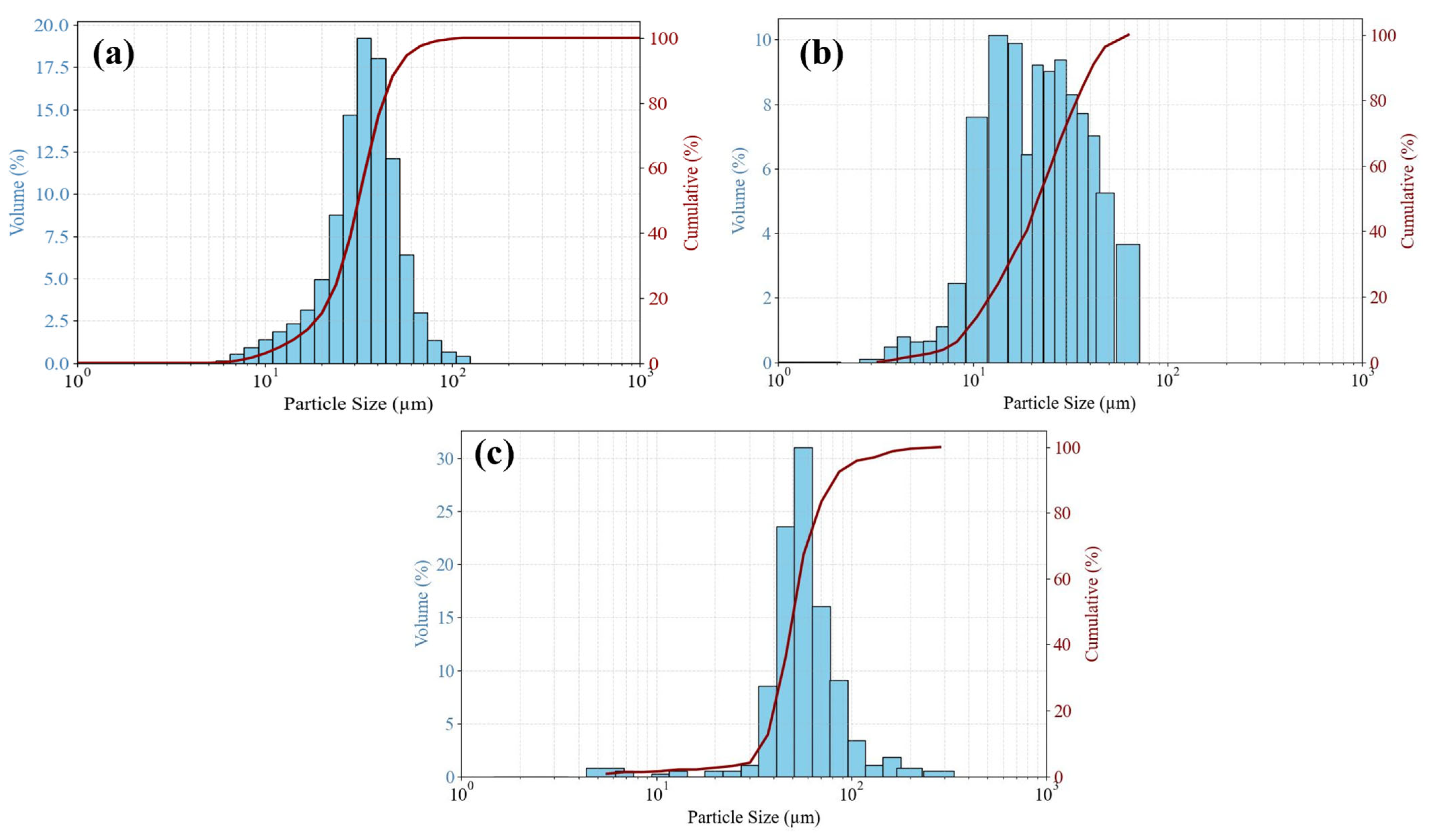
The morphology and particle-size distribution of the NiTi powders reveal clear differences among the virgin, reused, and UPA-recycled routes, highlighting how repeated LPBF exposure and reatomization influence powder quality. As shown in
Figure 1 and summarized in
Table 4, the virgin powder exhibits a relatively narrow distribution with characteristic diameters: D
10 = 16.68 µm, D
50 = 31.68 µm, and D
90 = 50.58 µm, corresponding to a span index of 1.07. The reused powder shifts toward finer sizes and a broader distribution, with D
10 = 10.54 µm, D
50 = 23.15 µm, and D
90 = 43.42 µm, yielding a span index of 1.42, which still lies within the recommended LPBF processing window (≤1.5 [
34]). In contrast, the UPA-recycled powder recovers a relatively narrow and coarser PSD, with D
10 = 40.03 µm, D
50 = 55.77 µm, and D
90 = 89.11 µm (span = 0.88), consistent with the uniform droplet breakup expected during ultrasonic plasma atomization.
These results indicate that UPA regeneration can restore a well-defined mid-range particle fraction while maintaining sphericity comparable to the virgin feedstock. It should be emphasized that the PSD metrics reported here correspond to the powders prior to final 15–63 µm size classification; this distinction explains the presence of sub-15 µm fines in reused powder and coarse tails (>63 µm) in the UPA-recycled condition, both of which are relevant indicators of powder degradation and UPA reatomization behavior.
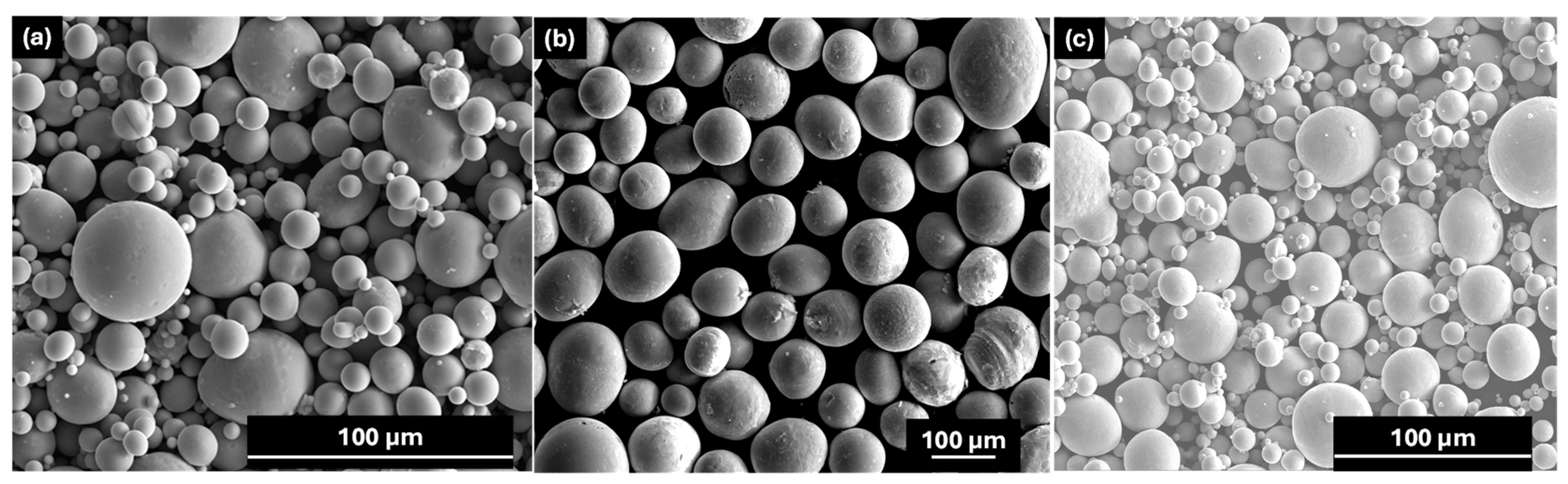
SEM observations further corroborate the morphological trends among the three powder conditions. As shown in
Figure 2, the virgin (
Figure 2a), UPA-recycled (
Figure 2b), and reused (
Figure 2c) powders are predominantly spherical (Ψ ≈ 0.92–0.93), consistent with LPBF feedstock requirements. The reused powder is expected to exhibit localized surface roughening and an increased presence of satellite particles, features commonly associated with repeated laser exposure, spatter interaction, and plume condensation within the build chamber. Similar morphological degradation mechanisms have been widely reported for NiTi and other AM alloys during powder recycling, where repeated thermal cycling and recoating promote satellite formation and surface irregularities [
13,
16]. Prior studies, such as Mahtabi et al. [
40], describe these characteristic features in detail and provide clear examples of the morphological deterioration that develops in reused AM powders. While chemical oxidation cannot be conclusively resolved from SEM images alone, these morphological features are consistent with powder degradation trends inferred from oxygen content measurements discussed in subsequent sections.
In contrast, the UPA-recycled powder shows smooth, re-atomized surfaces with minimal satellites, consistent with complete remelting and rapid droplet solidification. This improved surface quality demonstrates that UPA can recover the particle morphology that typically deteriorates during multiple LPBF reuse cycles.
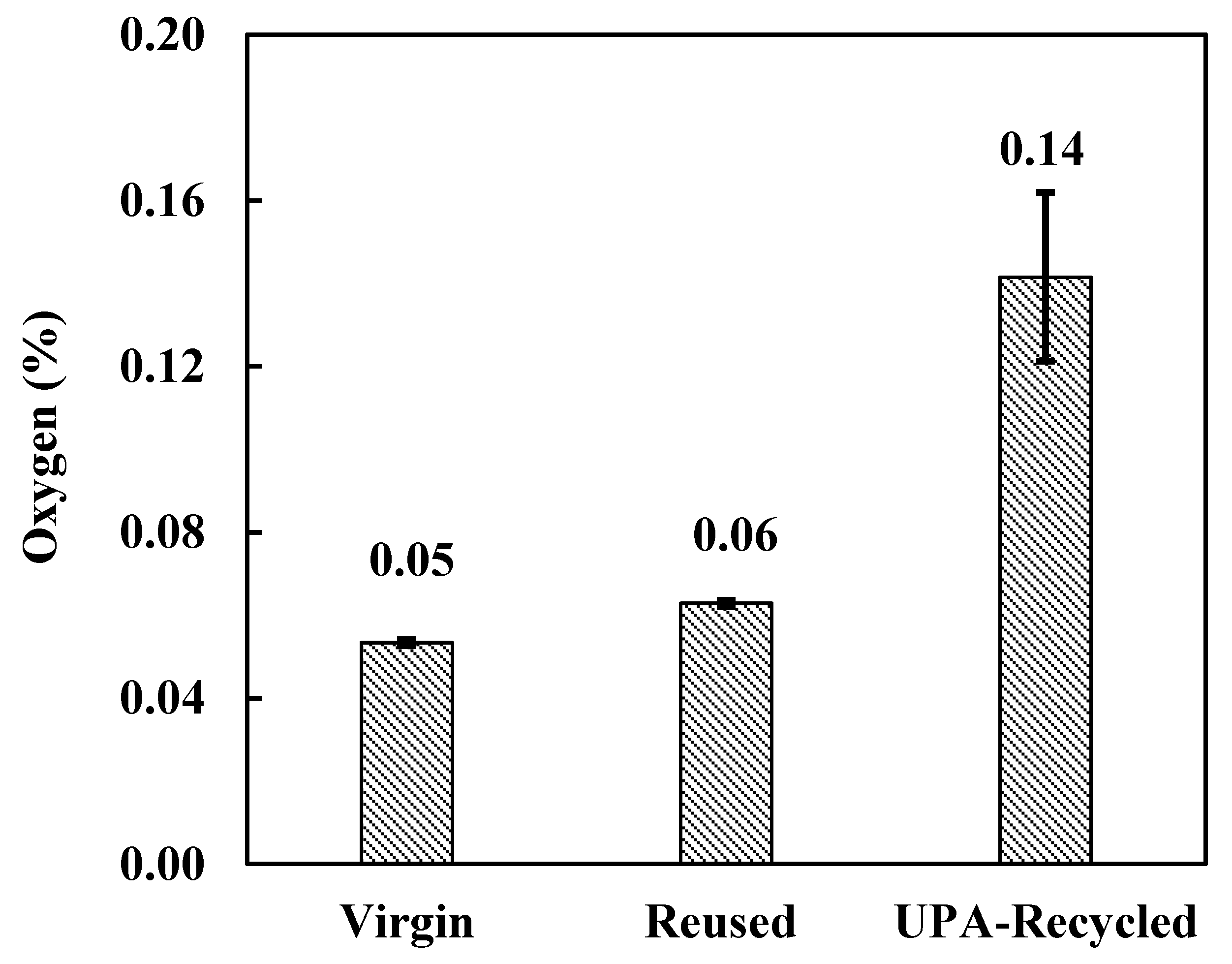
ONHₚ measurements in
Figure 3 indicate that virgin powder has the lowest oxygen content (≈0.045 ± 0.005 wt%), while reused powder exhibits elevated oxygen due to repeated LPBF exposure (≈0.070 ± 0.008 wt%). The UPA-recycled powder displays the highest oxygen levels in this study (0.118–0.155 wt%), indicating substantial oxygen pickup during re-atomization, primarily attributable to handling and atmospheric limitations. Under the present system configuration, the UPA step therefore introduced additional oxygen rather than preventing its incorporation.
For NiTi, these oxygen concentrations are consequential. Interstitial oxygen promotes the formation of Ti-rich oxides, shifts the effective matrix composition, and provides a direct mechanistic basis for the observed increase in transformation temperatures. This interpretation is consistent with the elevated transformation temperatures and broadened DSC peaks discussed in this section.
Crucially, this outcome should not be interpreted as an inherent limitation of ultrasonic plasma atomization or as evidence that UPA is unsuitable as a recycling pathway for NiTi. Oxygen uptake during UPA is strongly governed by atmosphere purity, chamber sealing, powder feeding strategy, and plasma–material interactions. Prior studies have demonstrated that UPA systems operated under rigorously controlled, ultra-high-purity inert environments can achieve oxygen levels comparable to virgin feedstock; however, those conditions were not fully realized in the present work. Accordingly, while the current implementation does not yet deliver oxygen levels suitable for repeated NiTi reuse, the results indicate that UPA remains a viable recycling concept provided that process controls are further refined. Given NiTi’s pronounced sensitivity to interstitial oxygen, the measured oxygen levels nonetheless provide a clear explanation for the thermophysical behavior observed here.
Beyond its influence on powder-state thermophysical behavior, elevated oxygen contents in NiTi feedstock can have important implications for additively manufactured components. Increased oxygen levels are known to promote higher strength and hardness through solid-solution and oxide-related strengthening mechanisms, and can also reduce ductility, transformation strain, and functional fatigue life in NiTi. Therefore, while UPA effectively restores powder morphology and enables circular reuse, control of interstitial oxygen uptake during reatomization is critical to ensuring that deposited materials retain the desired balance of mechanical and functional properties.
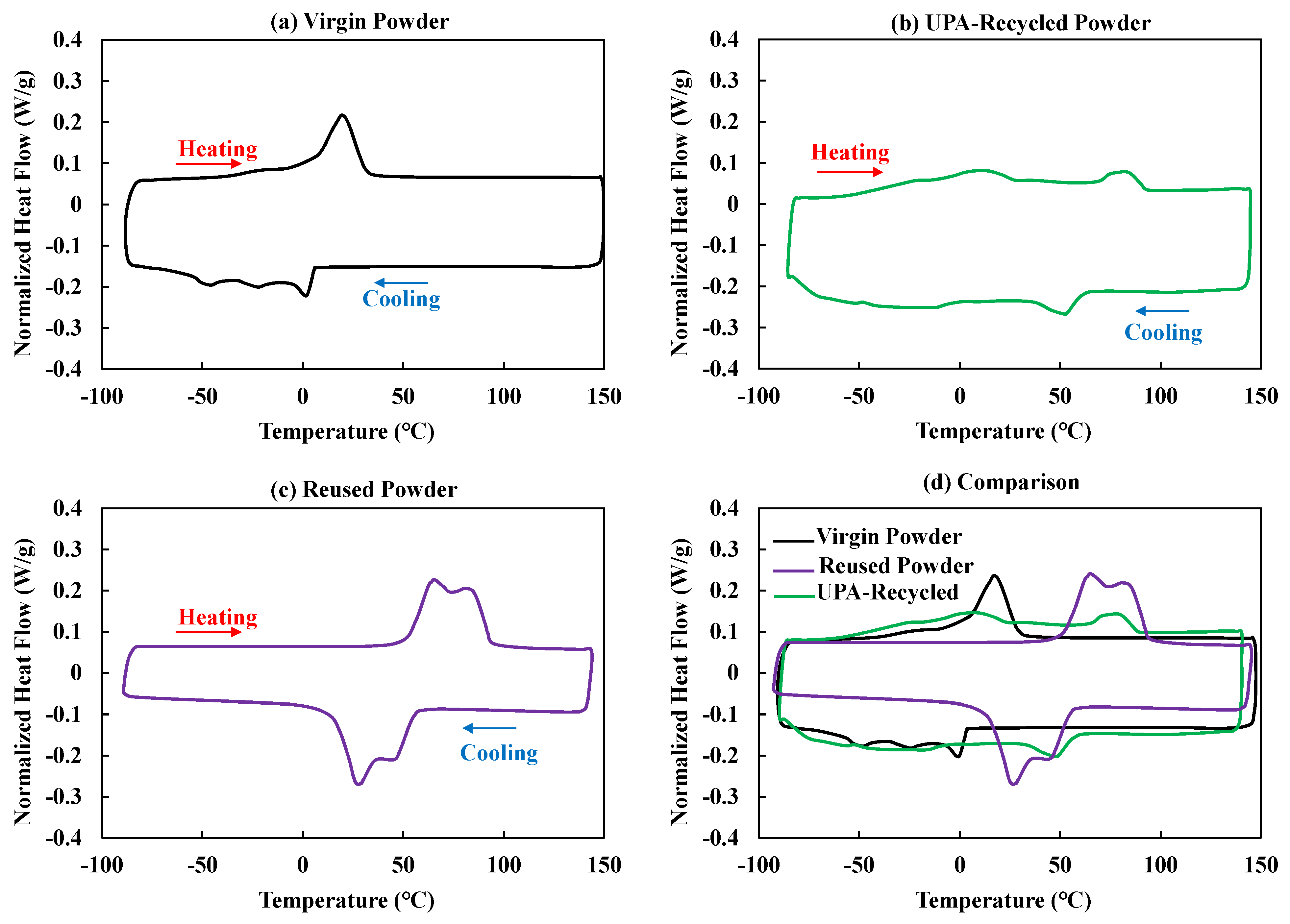
The DSC curves in
Figure 4 show the differences in transformation behavior among the three powder conditions. The virgin powder exhibits the lowest transformation temperatures with broad but well-defined peaks. The reused powder displays sharper and more intense peaks, indicating a more coherent martensitic and reverse transformation, consistent with the thermal conditioning experienced during repeated LPBF exposure. In contrast, the UPA-recycled powder retains elevated transformation temperatures similar to the reused condition but exhibits broader and flatter peaks. This broader response is consistent with a wider distribution of local transformation conditions, reflecting the heterogeneous cooling histories and microstructural and compositional rehomogenization introduced during reatomization. Thus, reuse tends to concentrate the transformation behavior, whereas UPA reatomization redistributes it. More broadly, the ability of UPA to promote microstructural and compositional rehomogenization offers a pathway for retuning transformation temperatures to meet application-specific requirements, provided that alloying additions and processing atmospheres are carefully controlled.
The substantial upward shifts in martensitic and austenitic transformation temperatures observed for the reused and UPA-recycled powders (
Table 5) likely reflect multiple concurrent mechanisms including oxygen pickup. Interstitial oxygen is known to stabilize the martensitic phase and elevate transformation temperatures in NiTi by reducing lattice mobility and altering phase stability; however, oxygen uptake during LPBF and re-atomization is often accompanied by additional compositional changes. In particular, preferential oxidation of titanium can lead to the formation of Ti-rich surface oxides, effectively increasing the local Ni/Ti ratio in the remaining matrix and further contributing to upward shifts in transformation temperatures. In parallel, nickel evaporation or depletion during repeated laser exposure has been widely reported for NiTi processed by LPBF and can independently contribute to increases in M
s and A
s by several tens of degrees Celsius. Therefore, the pronounced transformation-temperature shifts reported here are interpreted as reflecting the combined effects of interstitial incorporation, selective oxidation, and subtle Ni depletion rather than a single dominant mechanism.
While oxygen content was directly quantified using inert gas fusion analysis, bulk nitrogen concentrations and precise Ni/Ti ratios were not independently measured in this study. As a result, the present discussion emphasizes comparative interpretation and mechanistic consistency with established NiTi literature rather than direct one-to-one compositional correlation.
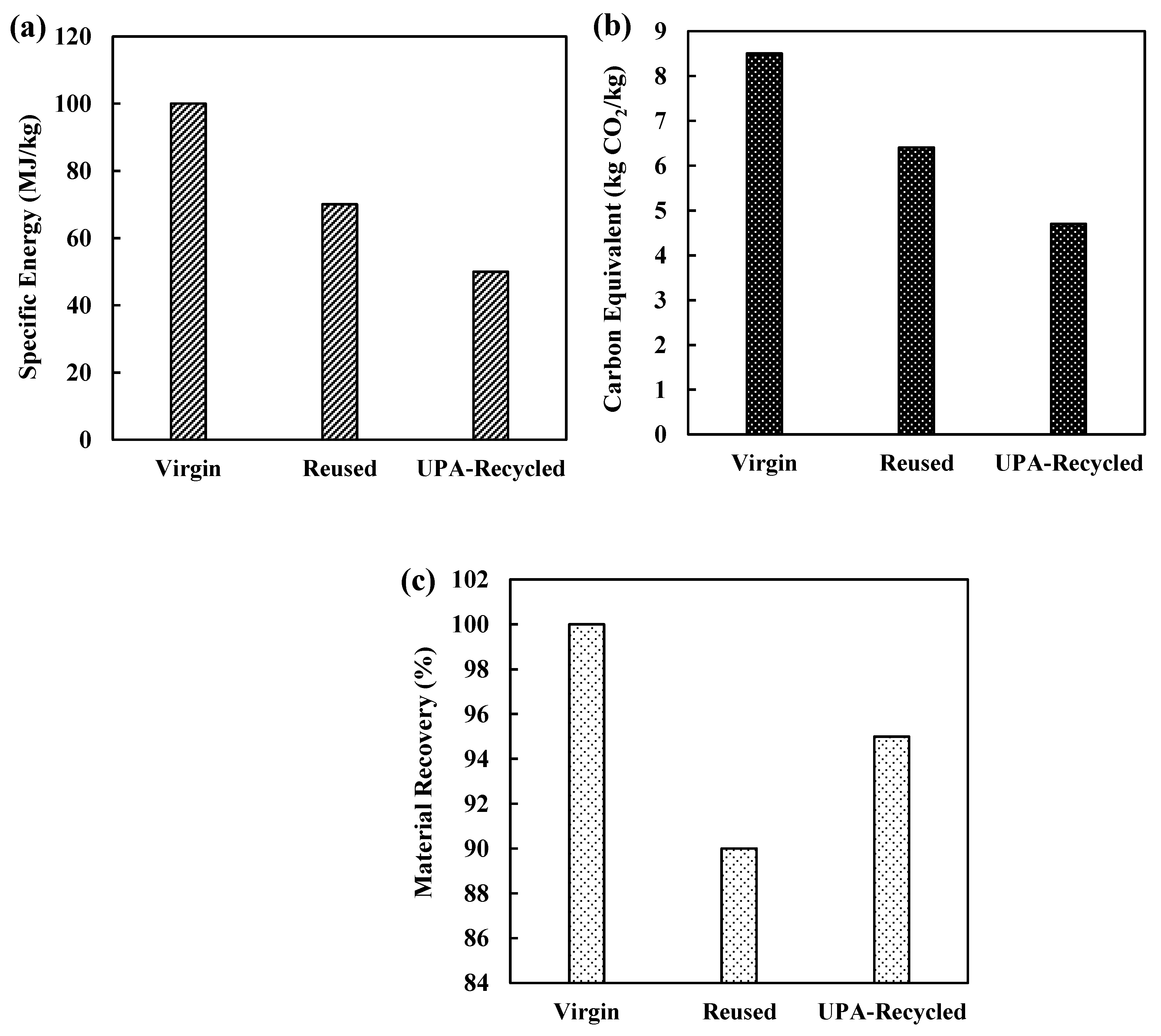
Beyond material quality, the environmental implications of each powder route were assessed through a process-based LCA. The functional unit of 1 kg of AM-grade NiTi powder was evaluated across atomization, reuse, and ultrasonic plasma reatomization. As summarized in
Table 6 and illustrated in
Figure 5, the reused powder route reduced the specific energy demand (Espec) by approximately 30% relative to virgin production (from ~100 MJ kg
−1 to ~70 MJ kg
−1), primarily due to avoidance of full melting and atomization. A corresponding reduction in the carbon footprint (approx. ≈25%) was also observed under the defined system boundary and assumptions. However, these benefits are constrained by progressive degradation that limits the number of viable reuses cycles and introduces losses during sieving, resulting in material-recovery efficiencies of ~90%.
The UPA-recycled route demonstrated the most substantial sustainability improvements. Ultrasonic plasma atomization lowered the specific energy demand by ~50% (to ~50 MJ kg
−1) and reduced carbon emissions by ~45% compared to virgin atomization, while maintaining a high material-recovery efficiency (~95%). These gains derive from the localized heating and fine droplet formation in UPA, which reduce both the thermal load and process waste. Such values align closely with prior reports on energy-efficient plasma-assisted reatomization of reactive alloys [
12,
25]. The combined improvements in powder quality and environmental metrics illustrate that UPA regeneration provides both functional and energetic advantages beyond those achievable through simple reuse.
It is important to note that the energy values reported in
Table 1 represent atomization-only specific energy consumption, whereas the values summarized in
Table 6 correspond to total cradle-to-gate energy demand for producing 1 kg of AM-grade NiTi powder. The latter includes upstream melting (VIM/VAR), alloy preparation, handling losses, atomization, inert-gas conditioning, and sieving, which collectively raise the cumulative energy from the 20–35 MJ·kg
−1 range typically reported for isolated atomization steps to approximately 90–120 MJ·kg
−1 for fully processed feedstock. Therefore, the higher values in
Table 6 are consistent with the broader system boundary used in the LCA.
Taken together, these results demonstrate that while direct powder reuse offers partial environmental relief, it cannot preserve powder integrity across successive LPBF cycles due to cumulative oxidation, compositional drift, and morphological defects. Ultrasonic plasma reatomization, by contrast, simultaneously restores sphericity, eliminates surface oxides, improves PSD uniformity, and stabilizes thermal-transformational behavior—while achieving a 40–60% lower specific energy demand and 35–45% lower carbon emissions relative to virgin atomization. This dual benefit confirms UPA as a viable closed-loop powder-recovery pathway that aligns NiTi additive manufacturing with circular-economy principles, enabling high-performance feedstock regeneration with a significantly reduced environmental burden.
5. Conclusions
This study established a unified, data-driven link between NiTi powder-state evolution and environmental performance in AM by integrating PSD, morphology, sphericity, ONH chemistry, DSC analysis, and a process-level LCA across virgin, reused, and UPA-recycled feedstock routes. Powder reuse offered partial sustainability benefits, reducing the cradle-to-gate energy demand and CO
2 emissions by approximately 30% and 25%, respectively, relative to virgin production. However, successive LPBF exposures induced oxidation, satelliting, and compositional drift, elevating transformation temperatures and restricting safe reuse windows, consistent with prior reports of the functional sensitivity of NiTi [
13,
14,
21,
26,
27].
UPA provided a more effective pathway to close this sustainability gap. In this work, UPA-recycled NiTi recovered near-virgin sphericity and smooth particle surfaces, while reducing the specific energy demand from 100 ± 10 MJ·kg−1 to 50 ± 5 MJ·kg−1 (≈50% reduction) and lowering the CO2-equivalent footprint from 8.5 ± 0.5 to 4.7 ± 0.3 kg CO2·kg−1 (≈45% reduction), with a material-recovery efficiency of ~95% within the defined system boundary and inventory assumptions, highlighting its potential sustainability advantage. However, the UPA-recycled powder in this study exhibited an elevated oxygen content relative to both virgin and reused powders, highlighting that oxidation control remains a critical challenge that must be addressed through optimized atmosphere management and system design. These results indicate that UPA’s primary advantage lies in morphological recovery and energy efficiency, with chemical rejuvenation contingent on further process refinement. Overall, the experimentally derived sustainability gains are consistent with reported advantages of ultrasonic plasma atomization and show that localized reatomization can meaningfully reduce the embodied energy associated with NiTi feedstock regeneration.
Normalization through the Sustainability Index (Equation (4)) showed that UPA achieved SI ≈ 50%, outperforming both virgin and reused powder routes and providing the most favorable integration of energy demand, carbon footprint, and material recovery. Although the UPA condition in this study exhibited elevated oxygen due to system-level atmosphere limitations, prior work indicates that optimized inert-gas control can suppress oxidation, suggesting a clear path for further improvement.
From a functional perspective, DSC analysis revealed that reuse tends to concentrate the martensitic transformation response, while UPA reatomization redistributes it, yielding broader transitions consistent with microstructural and compositional rehomogenization. More broadly, the ability of UPA to promote such rehomogenization offers a pathway to intentionally re-tune transformation temperatures for application-specific requirements, provided that alloying control and processing atmospheres are carefully managed.
Limitations include reliance on literature-based inventories for certain upstream processes, a cradle-to-gate system boundary, incomplete decoupling of substitutional and interstitial compositional effects on transformation behavior, and the absence of direct powder processability metrics. Future work should (i) combine ONH analysis with high-precision bulk compositional techniques such as ICP-MS or LECO analysis to quantitatively resolve substitutional versus interstitial contributions; (ii) extend the framework to include powder flowability and packing density measurements to directly link morphological recovery to LPBF processability; (iii) fabricate and benchmark LPBF parts from each powder route to connect feedstock metrics to SME/SE, fatigue, and corrosion performance; (iv) assess multi-cycle UPA loops (UPA→LPBF→UPA) to evaluate long-term compositional and functional stability; and (v) perform metered LCAs incorporating regional energy mixes and argon-recycling strategies, supported by techno-economic analysis. Overall, UPA-enabled upcycling represents a practical and scalable pathway to align NiTi functional integrity with circular, lower-carbon AM.



 ,
,