Article

An Environmental Equity Framework to Design Sustainable Air Quality Standards

by
Cristóbal De La Maza
1,2,3,*,
Francisco Fernández
2,4,*,
Matías Otth
1,
Nicolás Rojas
1,
Antonio Menchaca
5 and
Luis Abdón Cifuentes
3
1
Faculty of Economics, Business and Government, Center of Public Policy (CPP), Universidad San Sebastián, Santiago 8580704, Chile
2
Faculty of Economics, Business and Government, Center of Economics for Sustainable Development (CEDES), Universidad San Sebastián, Santiago 5110693, Chile
3
Department of Industrial & Systems Engineering, Pontificia Universidad Católica de Chile, Santiago 8331150, Chile
4
Center of Applied Ecology and Sustainability (CAPES), Santiago 8331150, Chile
5
Faculty of Biology, Universidad Veracruzana, Veracruz 91090, Mexico
*
Authors to whom correspondence should be addressed.
Sustainability 2026, 18(4), 1824; https://doi.org/10.3390/su18041824
Submission received: 1 November 2025 / Revised: 18 December 2025 / Accepted: 23 December 2025 / Published: 11 February 2026
(This article belongs to the Special Issue Air Pollution and Sustainability)

Abstract

Air pollution is a leading global environmental and health threat, imposing heavy economic and social burdens that are unevenly distributed across populations and pose major challenges for sustainable development. This study develops a novel environmental equity framework for designing sustainable air quality standards at the national level, covering all Chilean communes. The analysis integrates satellite-derived PM2.5 estimates calibrated with ground-based monitoring stations, administrative health records and national socio-economic surveys to estimate the costs, benefits, and distributional impacts of alternative air quality standards. The results show that current PM2.5 exposure contributes to more than 5750 premature deaths annually and increases income inequality by about 6%. Implementing stricter standards yields substantial net social benefits, with a maximum benefit at an annual average concentration of around 10 µg/m3, simultaneously improving social sustainability by reducing pollution-adjusted inequality. However, achieving the strictest WHO target (5 µg/m3) would entail disproportionately high costs. The proposed framework provides a decision support tool for sustainability-oriented regulations, enabling policymakers to balance environmental protection, economic efficiency and social equity in the design of air quality standards.

1. Introduction

Air pollution remains one of the most widespread environmental threats to human health and well-being worldwide. The World Health Organization reports that 6.7 million deaths each year are linked to exposure to both outdoor and household air pollution [1], making it the fourth leading risk factor for human mortality. Beyond its health impacts, air pollution causes significant economic and environmental harm, including biodiversity loss, reduced productivity, and atmospheric changes that pressure Earth’s safe operating space [2]. Even after decades of regulatory efforts, many countries still struggle with serious air quality risks that mainly affect vulnerable populations, highlighting ongoing conflicts among environmental goals, economic priorities, and social justice [3,4].
This paper addresses the following question: How can air quality standards be designed to reduce health risks while simultaneously maximizing social welfare, economic efficiency, and environmental equity? Air pollution control aligns with new trends in sustainability that advocate for meeting present needs without harming Earth’s life support systems for future generations [5]. A normative framework is developed that integrates these three dimensions into a unified cost–benefit and distributional-impact analysis, enabling policymakers to assess alternative regulatory standards in terms of both total welfare and inequality outcomes. Prior research has quantified health and economic costs of air pollution [6,7] and analyzed its policy implications [8,9]. A growing number of studies have also explored the links between air pollution and inequality [10,11,12,13]. Yet this research has remained fragmented: while it should be a must, traditional [14] cost–benefit analyses often neglect distributional impacts of pollution and abatement, and at the same time, environmental justice studies rarely integrate the economic valuation of these effects. As a result, regulators lack a coherent analytical framework that can reveal trade-offs between efficiency and equity when setting air quality standards.
Within a broader context, Chile offers a highly relevant empirical setting to operationalize such a framework. Although not unique in facing severe air pollution challenges, the country displays pronounced spatial and social disparities in PM2.5 exposure. Several Chilean cities (particularly in the central and southern regions) regularly exceed the national annual average standard of 20 µg/m3 [15]. According to the 2024 annual IQAir report, five of the ten most polluted cities in South America are in Chile [16]. During winter, PM2.5 levels rise sharply due to intensive residential firewood combustion and adverse meteorological conditions, such as thermal inversions, leading to recurrent respiratory emergency episodes [17,18,19]. Recent studies indicate that exposure to ambient PM2.5 in Chile could contribute at least 4000 premature deaths per year [20,21], alongside increased hospital admissions and restricted activity days. These impacts fall disproportionately on low-income households, which often rely on inefficient heating technologies and live in thermally deficient homes, thereby exacerbating existing social inequalities [22].
Chile has implemented extensive regulatory efforts through Air Pollution Prevention and Decontamination Plans (PPDA) [23], which cover nearly all major urban centers and focus primarily on reducing direct emissions of fine and coarse particulate matter (PM2.5 and PM10) and other secondary precursors such as Sulfur Dioxide (SO2), Nitrogen Oxide (NOX), and Ammonia (NH3). While these plans have contributed to gradual improvements in air quality, PM2.5 concentrations still frequently exceed safe thresholds [24]. Molina et al. [20] showed in 2017 that in numerous southern Chilean cities, WHO guideline for daily average PM2.5 concentration of 25 μg/m3 was exceeded on at least one-third of days (>120 days). This situation reveals the limits of existing regulatory instruments and the need for integrated approaches that jointly consider health risks, economic efficiency and social equity.
This combination of severe pollution, strong spatial disparities, and rich administrative datasets makes Chile an informative case study. However, the analytical framework developed in the present work is generalizable and can be applied in any context where the interplay between environmental risk, welfare impacts and inequality is relevant. By integrating satellite-derived PM2.5 estimates calibrated with ground-based monitoring, administrative health data, and national socio-economic surveys, the framework evaluates alternative air quality standards through a unified lens. This approach aims to support the design of regulatory policies that achieve meaningful environmental improvements while ensuring fair distribution of their costs and benefits.
This paper makes three main contributions. (1) It develops an environmental equity framework that explicitly integrates inequality metrics (via a pollution-adjusted Gini index) into conventional cost–benefit analysis, allowing for a welfare assessment beyond aggregate averages. (2) It operationalizes this framework for PM2.5 air quality annual standards, comparing scenarios based on WHO guidelines and its interim targets. (3) It provides empirical evidence for Chile, through the integration of satellite-based air pollution data, administrative health records, and national socio-economic surveys to quantify both the economic and equity effects of alternative standards.
The remainder of this paper is organized as follows. Section 2 presents the methodological framework, including data sources, and the analytical steps for estimating health, economic, and equity impacts. Section 3 reports the results and discusses the different findings and their policy implications. Section 4 concludes this paper.

2. Materials and Methods

2.1. Data Used

2.1.1. Air Quality Data

We collected information on PM2.5 concentrations from 2000 to 2022 from Chile’s official ground-based observations available on the National Air Quality Information System (SINCA) website, hosted by the Ministry for the Environment (MMA) (https://sinca.mma.gob.cl, accessed on 15 March 2025). SINCA provides information on concentrations of atmospheric criteria pollutants, including coarse particulate matter (PM10), fine particulate matter (PM2.5), ozone (O3), sulfur dioxide (SO2), nitrogen dioxide (NO2), and carbon monoxide (CO). An up-to-date and interactive map of the geographical distribution of monitoring stations is publicly available through the SINCA platform (https://sinca.mma.gob.cl/).
PM2.5 data collected from SINCA covered approximately 16% of the country’s communes for 2022, that is, 55 out of 344, equivalent to 50% of the population. SINCA provides validated environmental monitoring data, as well as “to-be-validated” observations. In this study, we excluded nine communes to calibrate satellite data exclusively with validated observations. Hence, to complete air quality data, PM2.5 global estimates from the Atmospheric Composition Analysis Group (ACAG) model were used [25]. ACAG is a global three-dimensional model that estimates surface concentrations by combining Aerosol Optical Depth (AOD) information, a chemical transport model, and ground-based measurements (The published correction to this dataset does not affect the methodological structure, exposure estimates, or calibration approach used in this study).
A multivariate linear regression was fitted between ground-based PM2.5 observations and ACAG mean estimates to test the accuracy of satellite data [26]. We controlled for the geographical latitude of each commune to capture different emission patterns, namely the effect of heating demand and wood burning as one moves further south. Air quality at the commune level was then determined by combining official ground-based measurements with statistical estimates for missing data.

2.1.2. Health Data

Health risks from air pollution vary depending on endpoint, age group, and incident rate. Accordingly, data were compiled to account for all these factors. Population exposure to atmospheric pollution was estimated using demographic forecasts from the National Institute of Statistics (INE) using the 2017 Census [27]. These data are estimated by age at a commune level, allowing us to group the population at four age cohorts: <18 years old, 18 to 29 years old, 30 to 64 years old, and >65 years old. On the other hand, health events to compute incidence rates (i.e., the number of effective cases of health effects per 100,000 inhabitants) were extracted from the Department of Statistics and Health Information (DEIS) of the Ministry of Health (MINSAL) (https://deis.minsal.cl, accessed on 3 December 2024) [28].
These include cardiorespiratory mortality and hospital admissions, differentiated by age cohorts at the commune level. Appendix A shows the details of the information used to calculate these incidence rates per 100,000 inhabitants, by effect and cause, at the national level for different cohorts. Additionally, unitary risk coefficients from national and international epidemiological studies and mean unitary monetary valuations for each event type by each group were collected.
It is important to note that, as premature mortality has the greatest impact of air pollution, and that the aftermath of the COVID-19 health emergency altered risk estimates, 2018 figures for all health events were conservatively selected. Table 1 shows descriptive statistics for incidence rates at each main age group. A relevant dispersion stands out at the commune level for those over 65 years of age.

2.1.3. Socio-Economic Data

Household income and demographic variables were obtained from the 2022 National Socio-Economic Characterization Survey (CASEN) delivered by the Ministry of Social Development and Family (https://observatorio.ministeriodesarrollosocial.gob.cl/encuesta-casen, accessed on 15 March 2025). These data allow for the estimation of total household income (THI) and the calculation of inequality metrics at the national and regional levels.

2.2. Methods Applied for Cost and Benefit Analysis

2.2.1. Estimation of Health Risks and Economic Impacts

To estimate health effects and policy outcomes from different air quality standards scenarios, the literature uses different approaches [29]. To determine the environmental, economic, and social impacts of air pollution, the method proposed by Rizzi & De la Maza [30] was used. Health effects associated with air pollution were estimated using dose–response functions that relate environmental concentration levels of the atmospheric pollutant PM2.5 to increases in health risks.
According to this approach, economic impacts are derived from health risks. These impacts are quantified through a nonlinear function, H j , p , m , k = H ( C p , k , P m , k ) , that maps the health impact for event j which results from exposure to pollutant p of population P m , k in age group m and commune k. The concentration C p , k refers to pollutant p in commune k.
Next, marginal benefits from a unitary improvement in air quality in USD per µg/m3 of PM2.5 reduced at each commune k were estimated. The method corresponds to a simplified version of the impact pathway approach [31] adapted by Rizzi & De la Maza [30]. Number of avoided health events H j , p , m , k are usually modeled through log-linear dose–response functions that relate health risks to environmental concentrations of different pollutants. Rizzi & De la Maza [30] linearized this relation and focused on reductions in premature mortality and morbidity risk. The linearized function used to compute health effects is as follows:
H j , p , m , k = Y j , k , m × β j , m × C p , k × P k , m
where Y j , k , m is the incidence rate of health effect j, β j , m is a unitary risk coefficient, Δ C p , k represents the change in pollutant p concentration, and P k , m is the exposed population.
Economic benefits from an improvement in air quality are computed multiplying the reduction in health events by their corresponding unitary monetary valuation, where V j represents the average social value for each event avoided:
E c o n o m i c   B e n e f i t = j , p , k , m H j , p , k , m × V j

2.2.2. Estimation of Pollution Abatement Costs

Cost data are derived from an updated version of an emission-control database originally compiled by CMM (2023) [32] that combines national and EPA CoST program information (https://www.epa.gov/economic-and-cost-analysis-air-pollution-regulations/cost-analysis-modelstools-air-pollution, accessed on 15 March 2025), providing abatement efficiency and cost per ton of pollutant [33]. We compiled additional cost measures for relevant measures such as woodstove change out programs from prior cost–benefits analysis performed by Chilean authorities to evaluate air quality and climate regulation.
The total cost of each control measure was estimated by source, multiplying the average cost per ton in USD by the tons of pollutant removed. Air quality improvements by each measure were calculated in µg/m3 of PM2.5 reduced applying emission-concentration factors θ r , k and removal efficiency for emissions of both primary and secondary pollutants r. Mitigation measures were ranked from lowest to highest cost-effectiveness. A similar approach has been used in Hartman et al. (1997) [34], Zhang et al. (2020) [35] and Loughlin et al. (2017) [36].
Conservatively, costs were truncated to zero for measures that generate net savings (costs < 0) [37]. To simplify computations total cost for achieving a given reduction PM2.5 in USD per µg/m3 is approximated using quadratic abatement cost curves for commune k forcing intercepts at zero:
T o t a l   C o s t = α k · P M 2.5 k 2

2.2.3. Equity and Welfare Integration

To incorporate equity considerations, total household income was adjusted by subtracting estimated pollution externalities per household derived from per capita economic impacts of air pollution. This yields a pollution-adjusted Gini coefficient, capturing how environmental risks amplify or mitigate income inequality. The change in Gini index across regulatory scenarios reflects distributional consequences of pollution abatement policies.
Finally, for each air quality scenario (corresponding to WHO guideline and interim targets of 5, 10, 15), total economic benefits, abatement costs, and net social welfare were estimated. The optimal standard from an economic standpoint is identified as the one that maximizes net benefits while improving environmental equity. This approach provides regulators with a transparent decision support tool for balancing health, economic, and fairness considerations in the design of air quality policy.

3. Results and Discussions

3.1. Overview of PM2.5 Exposure and Burden of Disease

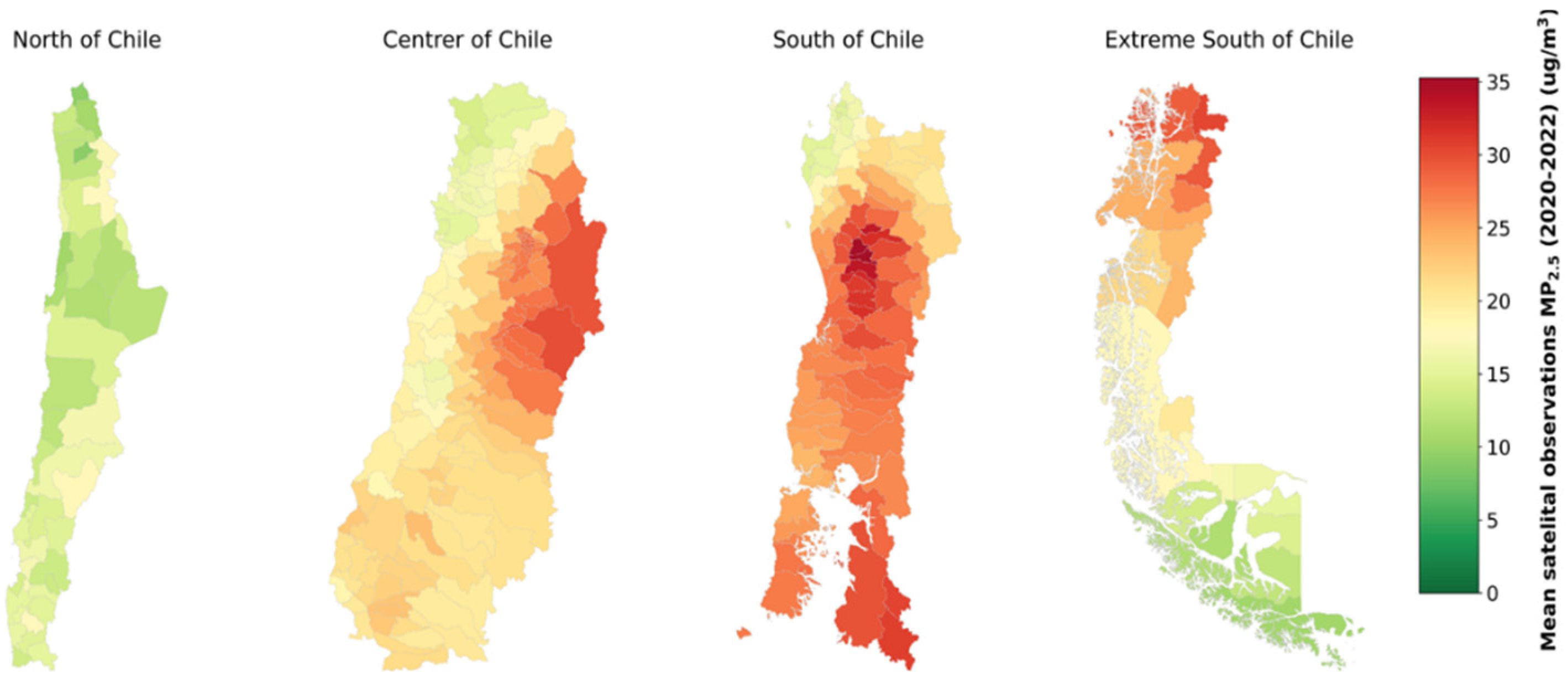
Figure 1 shows the three-year (2020–2022) geographic mean of the observations estimated by the AGAC model, by commune. These values, together with latitude, are used as inputs to the multivariate regression to fill in communes where there is no official air-quality monitoring. The multivariate regression produced a unique adjusted R2 of 0.707. The model includes three variables, an intercept α 0 = 6.94 (p < 0.1), a coefficient for AGAC estimates α 1 = 0.94 (p < 0.01), and a coefficient for latitude α 3 = 0.05 (p < 0.5) which is non-significantly distinct from zero.
South and central areas of Chile have the highest PM2.5 concentrations. This is consistent with the three-year mean from ground-based observations at the horizontal map at the bottom right of Figure 1. The primary source of PM2.5 emissions in central and southern Chile is residential use of firewood for heating and cooking, accounting for over 90% of national PM2.5 emissions [32]. This widespread use is linked to energy poverty, as firewood is often the cheapest energy source, and homes may lack proper thermal insulation [17]. In Santiago, the country’s main metropolitan city, PM2.5 concentrations stem from a combination of residential firewood use, transport, and industry emissions.
These findings position Chile among the most polluted countries in the OECD [38], revealing the persistent challenge of residential wood burning as both an energy poverty issue and a public health threat. The intersection of energy insecurity and air pollution underlines the need for policies that integrate environmental regulation with social housing and heating subsidies. Similar challenges have been documented in other international contexts. In the United Kingdom, for instance, Shwashreh et al. (2024) [39] emphasize the negative health impacts of inadequate heating and poor indoor air quality in fuel-poor social housing, particularly the increased incidence of respiratory illnesses among vulnerable populations. This aligns with the situation in southern Chile, where firewood is widely used for heating in thermally inefficient homes.
Likewise, Feng et al. (2025) [40] evaluate China’s clean heating policy (to replace coal with gas or electricity) as a large-scale intervention that simultaneously improved air quality and generated substantial public health benefits. Their study estimates the total environmental and health-related economic gains of the program at 109.85 billion yuan. These international experiences highlight the potential for integrated, equity-oriented policy frameworks to mitigate the dual burden of air pollution and energy poverty, reinforcing the urgency of adopting similar approaches in Chile.
Environmental burden translates directly into adverse health outcomes attributable to PM2.5 exposure in the country. Approximately 5750 premature deaths are attributed to PM2.5 exposure, alongside thousands of hospital admissions and restricted activity days (Table 2 and Table A1 for column labels). Elderly population is particularly vulnerable, with mortality rates several times higher than those of younger cohorts.
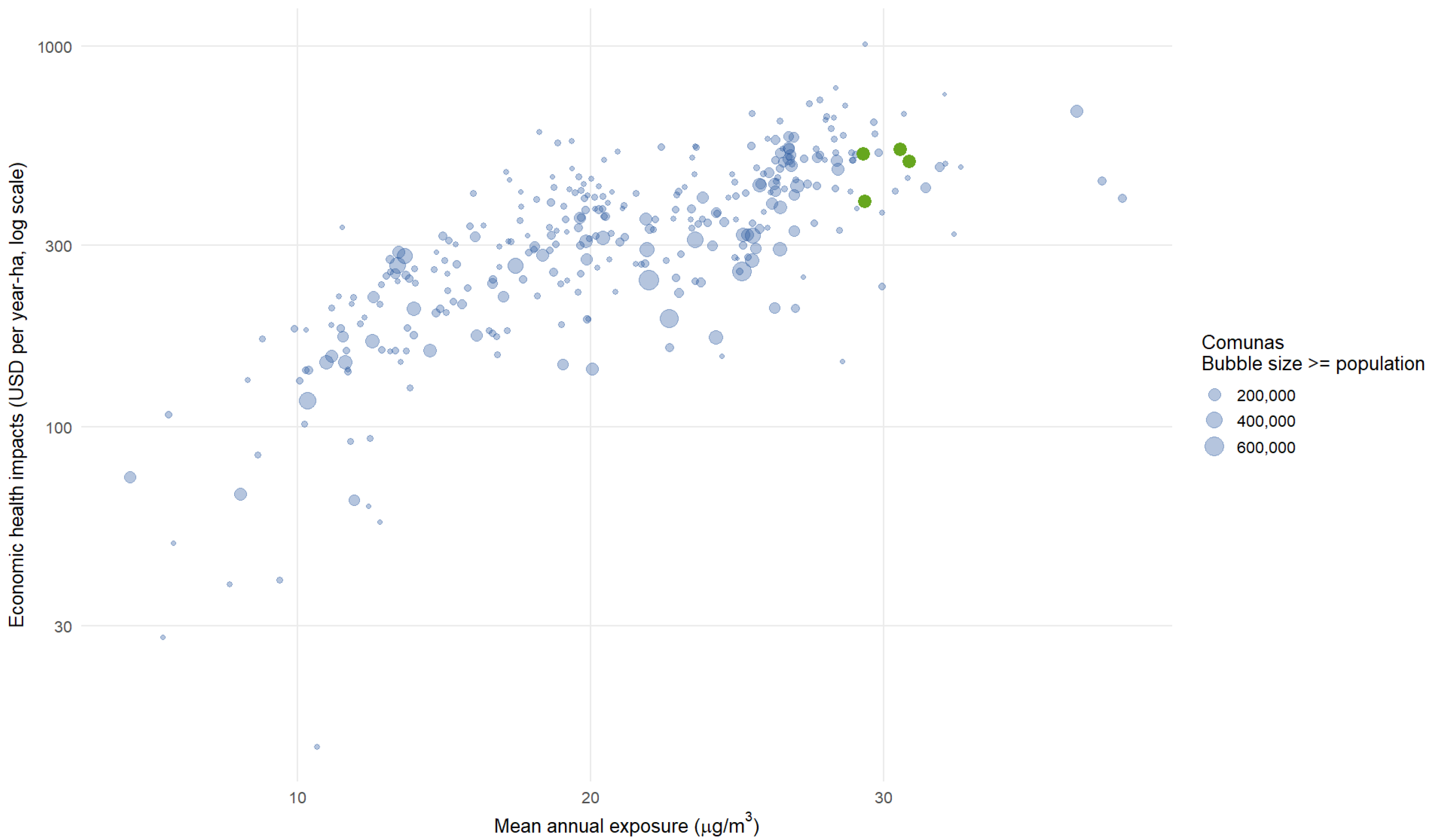
La Araucanía region exemplifies how spatial disparities in PM2.5 exposure and energy poverty converge to produce unequal burdens. In this region, one of the poorest in the country, the average exposures reach 25 µg/m3, and about 400 premature deaths occur each year (one of the highest per capita rates in the country). Figure 2 shows that highly polluted communes, clustered in southern Chile where residential wood combustion predominates, experience per capita economic impacts exceeding USD 400 annually. This spatial pattern aligns with evidence from eastern China, where Cui et al. (2024) [41] found that PM2.5 health impacts are amplified among low socio-economic groups and in poor, rural, high-density regions compared to wealthier urban areas.
Similarly, Tomar et al. (2023) [42] documented that Indian populations facing energy poverty bear disproportionate premature mortality from PM2.5 despite contributing less to emissions, with resulting disability-adjusted life years concentrated among daily wage workers who can least afford income losses. The economic dimension proves particularly severe in energy-poor contexts: Yang et al. (2019) [43] observed that rural households affected by PM2.5 from space heating face higher impoverishment rates from hospitalization costs than urban residents, while welfare losses remain highest in wealthier capital cities due to their elevated consumption levels. These findings collectively demonstrate that air pollution perpetuates inequality—energy poverty drives hazardous exposures that impose the greatest health and economic burdens on vulnerable populations, necessitating geographically differentiated mitigation strategies that address region-specific pollution sources and socio-economic vulnerabilities.

3.2. Economic Benefits of Air Quality Improvements

Cost–benefit analysis shows that achieving stricter PM2.5 standards yields substantial economic benefits. Using the proposed method, the total annual welfare gain from eliminating PM2.5 exposure is estimated at approximately USD 6 billion, equivalent to 1.7% of Chile’s GDP. This figure aligns with international evidence from OECD countries, where the economic burden of air pollution typically ranges between 2% and 4% of GDP [21]. Most benefits derive from reducing premature mortality risks, while additional gains stem from reduced hospital admissions and higher labor productivity (Table 3). Uncertainty was considered by computing a Montecarlo analysis assuming a normal distribution for risk coefficients with mean and standard deviation those from Table A2 and a triangular distribution for the Value of Statistical Life in Table A3.
These findings align with broader international evidence. Wang et al. (2024) [44] report that nearly 70% of global studies show that economic benefits of PM control strategies outweigh implementation costs, and the World Bank estimates the global health and welfare cost of air pollution at $8.1 trillion in 2019. Similarly, Hidalgo and Bedate (2022) [45] project that meeting EU PM2.5 targets would increase European GDP by 1.28%, while estimating annual pollution costs of $900 billion in China, $600 billion in the United States, and $150 billion in India. Xie and Feng (2023) [46] further confirm that welfare gains from health improvements under environmental regulation exceed welfare losses from reduced employment and income effects. Collectively, these studies reinforce that stricter air quality standards represent economically justified policy interventions where health-related benefits substantially outweigh both compliance costs and potential economic disruptions, supporting the case for ambitious PM2.5 reduction targets in Chile and globally. In the case study, only for the more stringent scenario of an annual average of 5 µg/m3, it is likely that costs outweigh benefits.

3.3. Pollution Abatement Costs

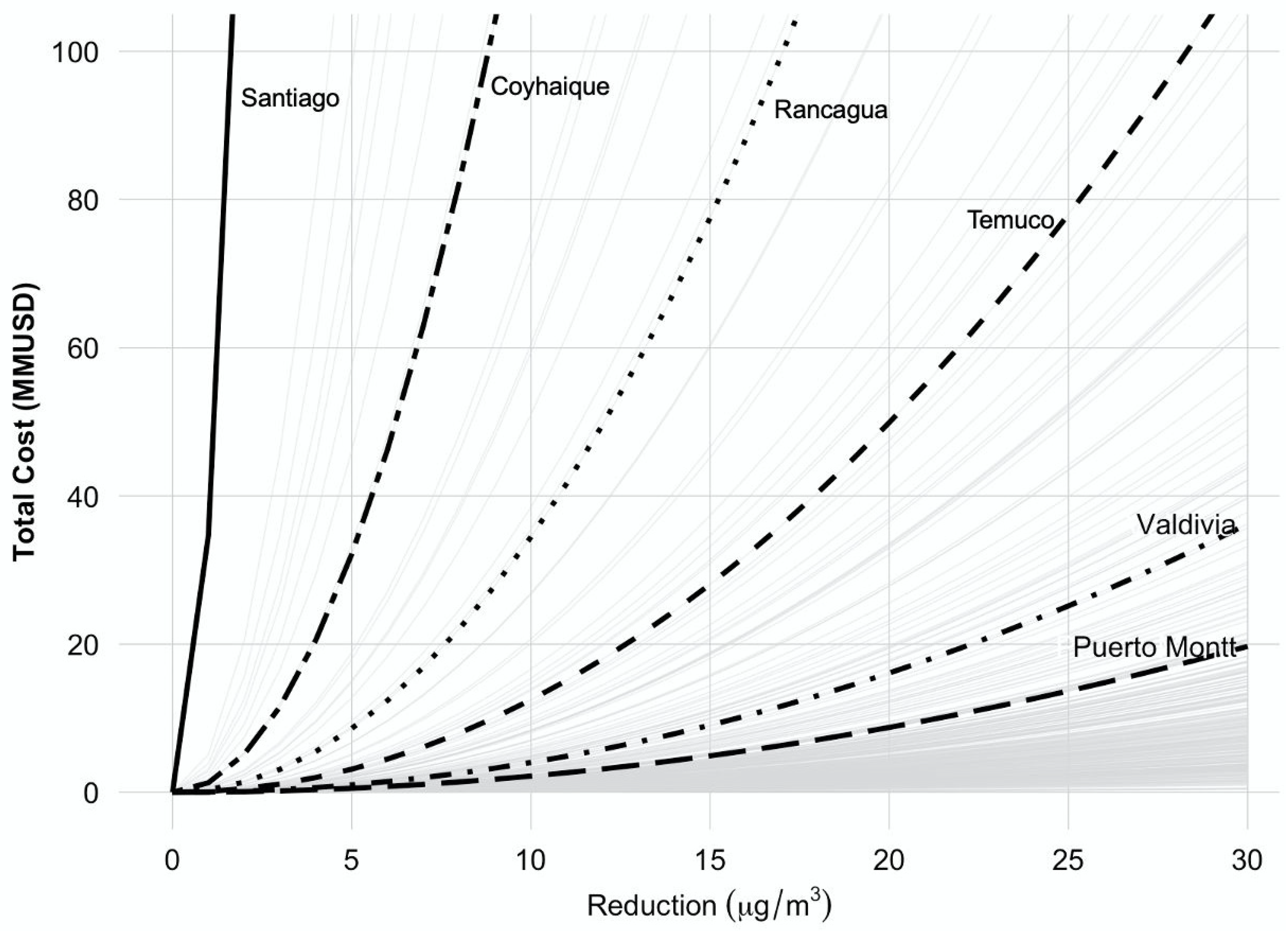
Abatement costs curves were calculated for each commune. Figure 3 shows the quadratic total abatement cost curves for all communes in the country. While the potential benefits of cleaner air are substantial, the costs associated with achieving stricter PM2.5 standards are significant and increase sharply with the level of ambition. Marginal costs rise exponentially as pollution levels approach WHO guidelines, with moderate reductions (from 20 µg/m3 to 15 µg/m3) costing approximately USD 0.5 billion annually, while achieving 10 µg/m3 could more than triple this figure. This reflects the technological, infrastructural, and behavioral transformations required to sustain such reductions.
Goodkind et al. (2025) [47] corroborate this exponential pattern in the United States, finding that aggregate marginal abatement costs, where costs per percentage-point reduction in damages increase by a factor of 17 from low to high abatement levels. The steepness stems from sector-specific constraints: residential heating transitions demand stove replacements, housing insulation improvements, and sustained behavioral change, vehicular emissions require transitioning from combustion engines towards electric mobility, along with a shift in transportation modes, whereas industry can rely on abatement pollution control technologies.
The steepness of abatement cost curves depends on both on control technologies and local atmospheric dispersion conditions. In cities such as Santiago and Coyhaique, where substantial abatement efforts have already been implemented and topographic constraints limit atmospheric ventilation, further air quality improvements are associated with high marginal abatement costs. In contrast, cities such as Valdivia and Puerto Montt, where few control measures have been adopted and dispersion conditions are more favorable, can achieve larger improvements at a lower cost. Finally, cities such as Rancagua and Temuco, where significant measures have already been applied, are likely to require additional efforts to attain further reductions.
Increasing costs also underscore practical and political challenges of achieving secure pollution levels in developing economies. In Chile, the main emission sources (household wood combustion, transportation, and industry) differ not only in their technological abatement potential, but also in their socio-economic context. Reducing emissions from residential heating, for instance, involves replacing inefficient stoves and improving housing insulation, both of which require large public subsidies. In contrast, reducing industrial and vehicular emissions can often be achieved through targeted regulations and technological retrofits with lower social resistance.

3.4. Distributional and Equity Effects

Per capita air pollution externalities from PM2.5, expressed in USD per household-month, are determined by accounting for the decrease in health effects from marginal changes in pollution levels. Table 4 demonstrates that incorporating per capita PM2.5 externalities into inequality assessments increases Chile’s national Gini coefficient from 47.9 to 50.7—a 6% rise reflecting disproportionate burdens on lower-income households. The Southern zone experiences the largest adjustment, with pollution externalities representing 8% of household income and driving Gini from 43.3 to 49.0 (13% increase). In comparison, South Austral shows minimal impact (1% of income, 2% Gini increase).
Das and Basu (2021) [48] corroborate this pattern across 129 countries, finding that pollution significantly increases inequality in low-income countries with high inequality, and in countries with low natural or human capital. Their analysis reveals pollution creates a vicious cycle: vulnerable groups face disproportionate health and livelihood threats, which perpetuate income inequality. Our results confirm this mechanism: South Central and Southern zones—with lower incomes (USD 1132 and 1117) and higher pollution externalities (USD 63 and 87)—experience the largest inequality adjustments, demonstrating that pollution-adjusted Gini metrics effectively capture how marginalized populations bear disproportionate environmental costs. Das and Basu [48] emphasize that sustainable environmental policies can break this cycle, contributing to a more just society, though success requires prioritizing the poorest and most vulnerable.

3.5. Integrated Welfare and Policy Scenarios

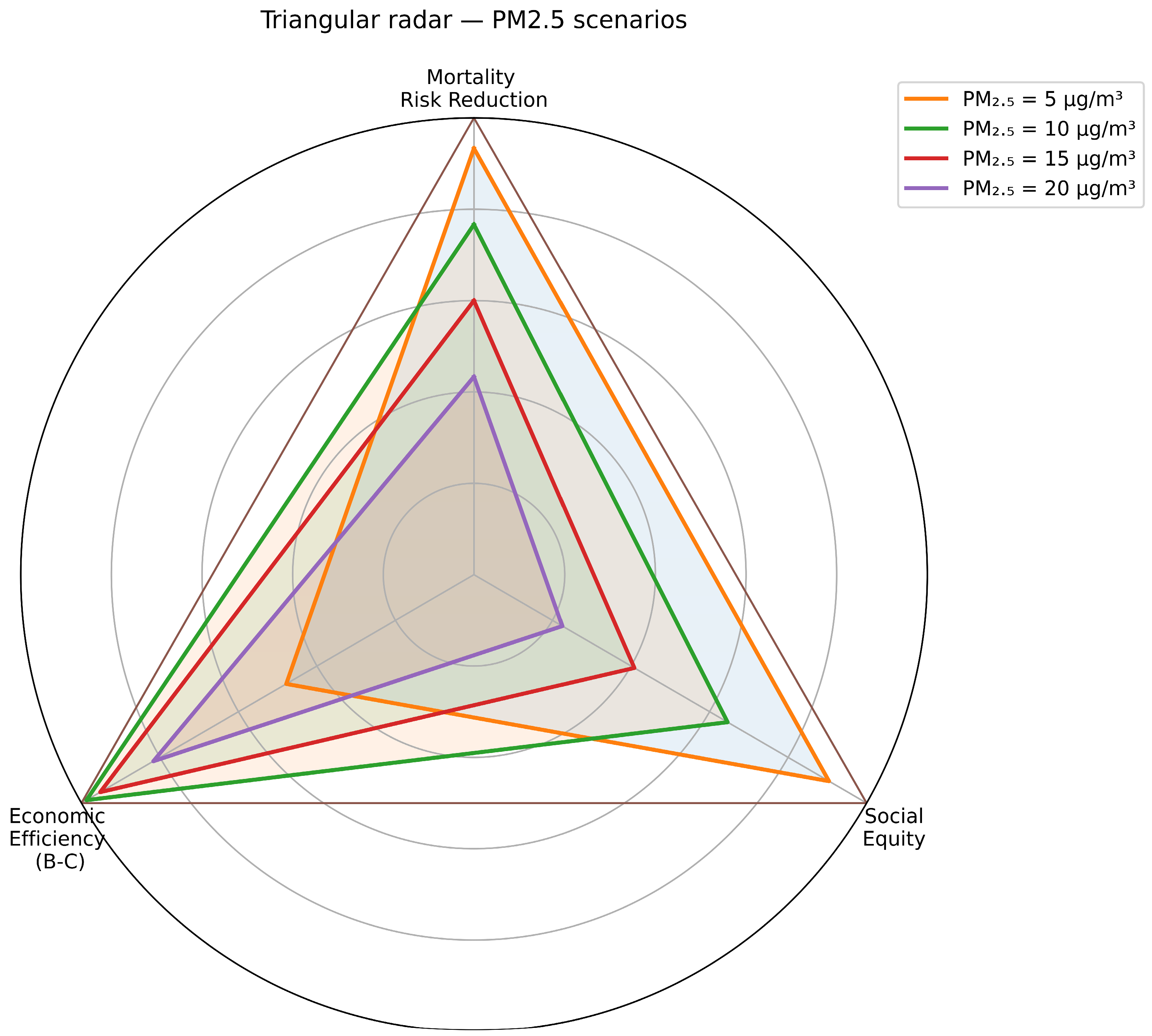
Figure 4 synthesizes the results of the previous sections by simultaneously representing environmental quality, economic efficiency (net benefits), and social equity across the four PM2.5 regulatory scenarios. The triangular radar reveals that while the strictest standard (5 µg/m3) maximizes environmental quality, its high abatement costs reduce overall economic efficiency. In contrast, the 10 µg/m3 scenario provides a more balanced outcome, delivering substantial health and equity improvements with higher net social benefits and social equity gains. This visualization highlights the trade-offs that policymakers must navigate when designing air quality standards.
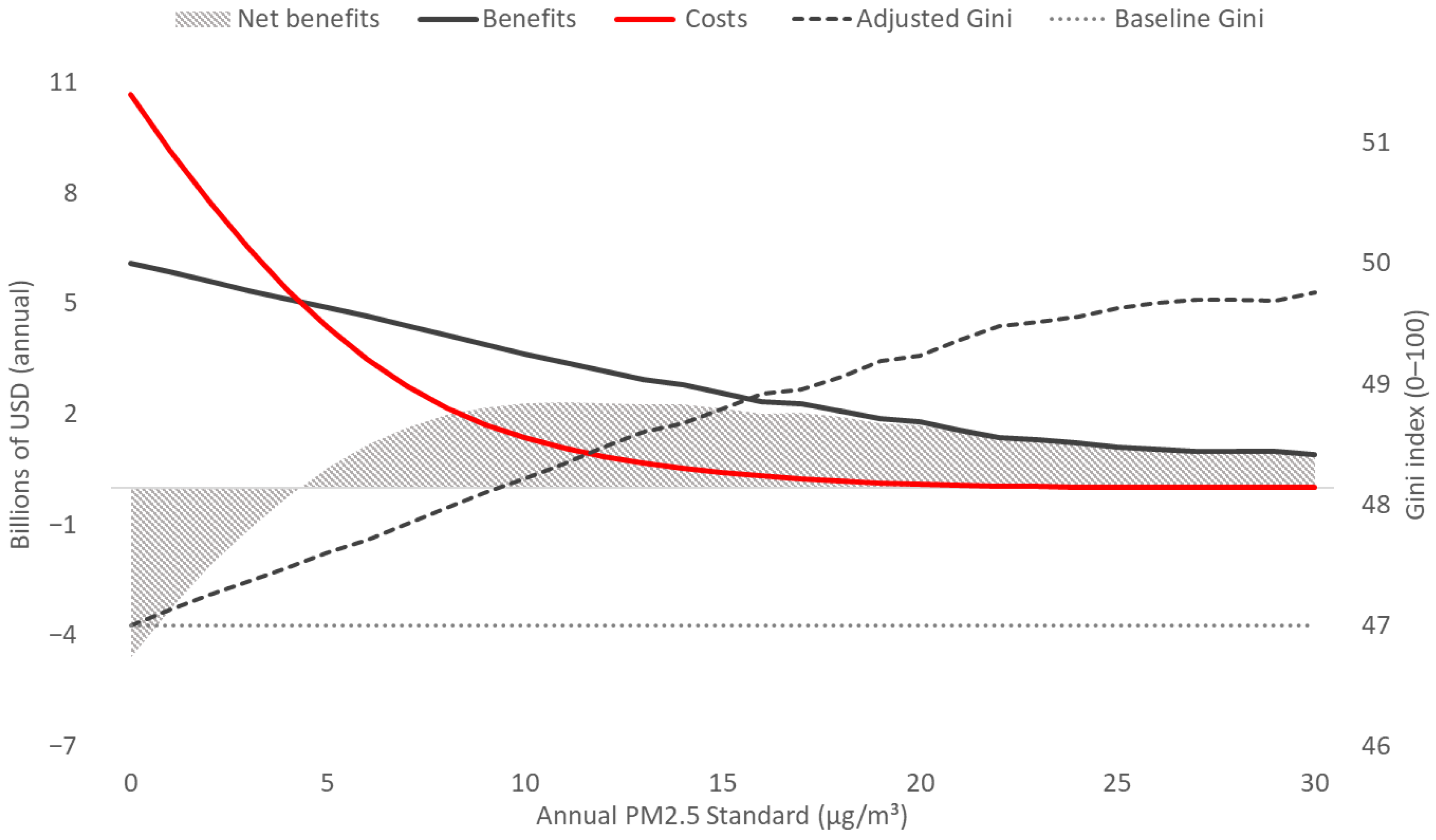
Furthermore, it is possible to support the identification of an optimal standard. Figure 5 illustrates the relationship between economic efficiency and social equity across alternative PM2.5 standards scenarios. The left axis represents annualized social benefits, abatement costs, and resulting net benefits, while the right axis represents changes in the pollution-adjusted Gini index. The intersection between benefit and cost curves identifies the welfare-maximizing standard, roughly around 10 µg/m3, where welfare and equity gains converge. Stricter standards continue to improve social equity, but at sharply increasing economic costs, while more lenient targets fail to deliver meaningful welfare or distributional gains. This figure underscores the central compromise that policymakers face: maximizing aggregate welfare while enhancing social justice.
From an economic perspective, these results illustrate the classic policy dilemma of balancing efficiency and feasibility [49,50,51]. While total net benefits of stricter standards remain positive up to around 5 µg/m3, the marginal cost of each additional unit of PM2.5 reduction beyond that point begins to outweigh marginal benefits. This finding supports adopting progressive air quality standards (such as WHO interim targets) rather than abrupt transitions to the strictest levels. Incremental targets allow time for technological diffusion, institutional capacity-building, and fiscal adaptation [52,53].
The evaluation covered standards from 0 to 30 µg/m3. The annual costs rise close to 11 billion USD, while the annual benefits can be over 6 billion USD when PM2.5 concentrations reaches the minimum level. The analysis can be understood as a grid search for the policy scenario that maximizes net benefits subject to achieving acceptable environmental risks and equity effects. Any further improvements can be justified on equity or health grounds. Therefore, the problem to be solved is whether one finds the optimal air quality standard, subject to a minimum fixed equity or health risk level.
Figure 5 justifies implementing stricter standards than the current annual average of 20 µg/m3. Considering economic efficiency to define the optimal air quality standards, either WHO interim targets of 15 µg/m3 or 10 µg/m3 are not significantly different from an economics perspective. Nonetheless, achieving 10 µg/m3 provides a slightly higher net benefit and a drastically lower mortality risk. On equity grounds is also the dominant alternative and therefore it corresponds to the preferred option. Furthermore, recognizing that WHO guideline of 5 µg/m3 is a laudable aspiration, it must be discarded as costs of pollution abatement are significantly higher and increase rapidly with a more demanding standard. In this regard, countries such as the United States have advanced systematically with more stringent standards from 15 µg/m3 in 1997, to 12 µg/m3 in 2012 and to 9 µg/m3 in 2024, in line with technological and economic progress.
It must be stressed that defining a safe operating space can be one of the most challenging tasks in environmental management as determining acceptable levels of risk can depend on individual and social preferences that equate environmental, economic and social objectives. To identify these preferences, different policy scenarios should be exposed to wide public debate, accompanied by their environmental, social and economic outcomes. Illustrating potential outcomes of available courses of action can assist informed decisions. Therefore, to ensure the legitimacy of the adoption of air quality standards, policy scenarios and their impacts must be subject to public consultation.

4. Conclusions

This study develops and applies an integrated environmental equity framework to guide the design of air quality standards that balance economic efficiency, environmental quality, and social justice. Using Chile as an empirical case, it was shown that current PM2.5 exposure levels impose severe health, economic, and distributive costs—causing over 5750 premature deaths annually and amplifying income inequality by about 6%. Our results reveal that tightening air quality standards generates substantial welfare gains, with the optimal balance between costs and benefits reached at approximately 10 µg/m3. At this level, total net benefits are maximized while inequality begins to decline, indicating that regulatory progress can simultaneously advance efficiency and fairness.
Currently, Chilean authorities are proposing to upgrade the national PM2.5 air quality standard from an annual average of 20 µg/m3 to 15 µg/m3. Given that Chilean Environmental Law requires 80% of this level as an extra safety protection (12 µg/m3), from an economic efficiency perspective, the proposal seems appropriate. Nonetheless, a more stringent standard is justifiable on health, economic and equity grounds.
The proposed framework offers a transparent tool for policy evaluation by integrating cost–benefit and distributional analyses into a single welfare outcome. This approach enables regulators to assess not only aggregate net benefits but also who gains and who bears the burden of pollution and its control. The results underscore that air quality improvements represent a high-return investment in both health and equity, especially when targeted toward vulnerable regions where energy poverty and exposure overlap.
The presented framework directly contributes to sustainable development by integrating its three core dimensions (i.e., environmental protection, economic efficiency, and social equity) into the design of air quality standards. By explicitly accounting for long-term health benefits, welfare impacts, and distributional effects, the proposed approach supports sustainability-oriented policymaking that seeks to reduce environmental risks while promoting an inclusive and economically viable development. In this sense, air quality regulation emerges as a key instrument for advancing social sustainability and long-term societal resilience.
Despite these contributions, this study is subject to several limitations that should be considered when interpreting the results. First, health impacts are estimated using a linearized dose–response function, which assumes constant marginal risk across exposure levels and does not capture potential nonlinearities or thresholds at low or high PM2.5 concentrations. This choice was made to ensure transparency, tractability, and consistency with policy-oriented cost–benefit analyses commonly used in regulatory settings.
While more detailed nonlinear models could produce more precise estimates, they would entail substantially higher computational costs, thereby limiting scenarios that can be evaluated. An integrated exposure–response function (e.g., GEMM or GBD) represents an important methodological advancement, but its implementation would require additional assumptions and data harmonization beyond the scope of this study. Furthermore, the cost analysis remains static and has an approximate quadratic functional form; future work should consider a more complex, dynamic approach.
Future research should refine the valuation of health impacts, expand equity metrics beyond income inequality, and explore the dynamic effects of technological transitions. Also, it should evaluate potential co-benefits from energy efficiency gains and greenhouse gas mitigation, as several of the technologies required to improve air quality will reduce reliance on fossil fuels [54]. Strengthening local monitoring systems and improving access to cleaner heating alternatives remain crucial to translating these analytical insights into effective and just environmental policy for all.

Author Contributions

C.D.L.M.: Conceptualization, Formal analysis, Investigation, Method, Project administration, Writing—original draft. F.F.: Supervision, Writing—review & editing, resources. M.O.: Data curation, Formal analysis, visualization. N.R.: Data curation, Formal analysis, Investigation, Methodology. A.M.: writing—review and editing. L.A.C.: method, analysis and resources—review and editing. All authors have read and agreed to the published version of the manuscript.

Funding

This work was supported by the Center of Applied Ecology and Sustainability (CAPES), the ANID PIA/BASAL AFB240003, and Fondecyt Iniciación 11230334.

Institutional Review Board Statement

Not applicable.

Informed Consent Statement

Not applicable.

Data Availability Statement

The data presented in this study are available on request from the corresponding author. The data are not publicly available due to institutional limitations, as the full dataset was managed by a former project collaborator who is no longer affiliated with the institution. Reasonable requests will be addressed to the extent that partial or reconstructed datasets can be retrieved.

Acknowledgments

Authors are grateful to the Center of Public Policies (CPP), Universidad San Sebastián, Santiago (Chile) for the opportunity to carry out this research. Moreover, authors acknowledge support from the Center of Applied Ecology and Sustainability (CAPES), the ANID PIA/BASAL AFB240003.

Conflicts of Interest

The authors declare no conflicts of interest.

Appendix A

Incidence rates correspond to the number of effective cases of health events per 100,000 inhabitants. Given their relevance in economic terms and impacts on people’s lives, these rates are available for each age groups at communal level in the Department of Statistics and Health Information (DEIS) from the Ministry of Health (MINSAL). Table A1 shows incident rates used in the present study organized depending on their severity in mortality, medical actions and activity restriction.
Table A1. Incidence rates per 100.000 inhabitants.
Type of Effect Effect Cause <1818–2930–6465+
Premature mortality MLT—Long Term MortalityCPM 24721556
Medical Actions HA—Hospital Admissions ASTH 64101961
CLD 1921971716
CVD 30625283510
PNEU 771611641811
ERV—Emergency Room VisitsBRO 51,262---
Activity restriction MRAD—Minor Restricted Active Days-772,496773,498772,670772,278
RAD—Restricted Active days--640,660639,975-
WLD—Work Loss Days--150,370146,695-
From: Department of Statistics and Health Information (DEIS) of the Health Ministry.
Table A2 presents selected unitary risk coefficients from national and international epidemiological studies.
Table A2. Concentration-Response risk coefficient for health effect of PM2.5.
Effect Cause MeanStandard DeviationReferences
<18 18–29 30–64 65+ <18 18–29 30–64 65+
MLT CPM --0.00950.0095--0.002150.00215[26]
HA COPD -0.00220.00220.001169-0.000730.000730.00206[27,28,29]
ASTH 0.0033240.0033240.003324-0.001040.001040.00104-[30]
CVD -0.00140.00140.00158-0.000340.000340.00034[27,28,29,30,31]
PNEU ---0.003979---0.00165[29]
ERV ASTH 0.016527---0.00413---[32]
BRO 0.0044---0.00215---[33]
RAD --0.00480.0048--0.000360.00036-[34]
WLD --0.00460.0046--0.000290.00029-[34]
Adapted From: Rizzi & de la Maza, 2017 [30].
Table A3 contains the mean unitary monetary valuation for each type of event by age group. These amounts are presented in (USD/case), updated to date, based on Rizzi & De La Maza [18]. Unit values represent the social value of reducing in one unit a health effect in a population subgroup or equivalently monetary savings from reducing health risks.
Table A3. Health endpoints—Mean Monetary values (USD/case).
Type of Effect EffectsCause<1818–2930–6465+
Premature mortality MLTCPMT (262,600; 413,000; 2,424,700)
Medical Actions HAASTH880880880964
COPD1131113111311131
CVD-188618861844
PNEU1216121612161216
RSP754100610061216
Activity restriction ERVASTH42424242
WLD--2929-
RAD--88-
Adapted From: Rizzi & de la Maza, 2017 [30].

References

  1. WHO. The Global Health Observatory—Air Pollution Data Portal 2024. Available online: https://www.who.int/data/gho/data/themes/air-pollution (accessed on 15 March 2025).
  2. Rockström, J.; Steffen, W.; Noone, K.; Persson, Å.; Chapin III, F.S.; Lambin, E.; Lenton, T.M.; Scheffer, M.; Folke, C.; Schellnhuber, H.J. Planetary Boundaries: Exploring the Safe Operating Space for Humanity. Ecol. Soc. 2009, 14, 32. [Google Scholar] [CrossRef]
  3. Hartinger, S.M.; Palmeiro-Silva, Y.K.; Llerena-Cayo, C.; Blanco-Villafuerte, L.; Escobar, L.E.; Diaz, A.; Sarmiento, J.H.; Lescano, A.G.; Melo, O.; Rojas-Rueda, D. The 2023 Latin America Report of the Lancet Countdown on Health and Climate Change: The Imperative for Health-Centred Climate-Resilient Development. Lancet Reg. Health–Am. 2024, 33, 100746. [Google Scholar] [CrossRef] [PubMed]
  4. Ali, S.M.; Appolloni, A.; Cavallaro, F.; D’Adamo, I.; Di Vaio, A.; Ferella, F.; Gastaldi, M.; Ikram, M.; Kumar, N.M.; Martin, M.A. Development Goals Towards Sustainability. Sustainability 2023, 15, 9443. [Google Scholar] [CrossRef]
  5. Griggs, D.; Stafford-Smith, M.; Gaffney, O.; Rockström, J.; Öhman, M.C.; Shyamsundar, P.; Steffen, W.; Glaser, G.; Kanie, N.; Noble, I. Sustainable Development Goals for People and Planet. Nature 2013, 495, 305–307. [Google Scholar] [CrossRef]
  6. Dechezleprêtre, A.; Rivers, N.; Stadler, B. The Economic Cost of Air Pollution: Evidence from Europe; OECD Development Centre: Paris, France, 2019. [Google Scholar]
  7. Roy, R. The Cost of Air Pollution in Africa; OECD Development Centre: Paris, France, 2016. [Google Scholar]
  8. Henneman, L.R.; Rafaj, P.; Annegarn, H.J.; Klausbruckner, C. Assessing Emissions Levels and Costs Associated with Climate and Air Pollution Policies in South Africa. Energy Policy 2016, 89, 160–170. [Google Scholar] [CrossRef]
  9. Seskin, E.P.; Anderson, R.J., Jr.; Reid, R.O. An Empirical Analysis of Economic Strategies for Controlling Air Pollution. J. Environ. Econ. Manag. 1983, 10, 112–124. [Google Scholar] [CrossRef]
  10. Brajer, V.; Mead, R.W.; Xiao, F. Adjusting Chinese Income Inequality for Environmental Equity. Environ. Dev. Econ. 2010, 15, 341–362. [Google Scholar] [CrossRef]
  11. Muller, N.Z.; Matthews, P.H.; Wiltshire-Gordon, V. The Distribution of Income Is Worse than You Think: Including Pollution Impacts into Measures of Income Inequality. PLoS ONE 2018, 13, e0192461. [Google Scholar] [CrossRef]
  12. Wu, J.; Pu, Y. Air Pollution, General Government Public-Health Expenditures and Income Inequality: Empirical Analysis Based on the Spatial Durbin Model. PLoS ONE 2020, 15, e0240053. [Google Scholar] [CrossRef]
  13. Tessum, C.W.; Apte, J.S.; Goodkind, A.L.; Muller, N.Z.; Mullins, K.A.; Paolella, D.A.; Polasky, S.; Springer, N.P.; Thakrar, S.K.; Marshall, J.D.; et al. Inequity in Consumption of Goods and Services Adds to Racial–Ethnic Disparities in Air Pollution Exposure. Proc. Natl. Acad. Sci. USA 2019, 116, 6001–6006. [Google Scholar] [CrossRef]
  14. Arrow, K.J.; Cropper, M.L.; Eads, G.C.; Hahn, R.W.; Lave, L.B.; Noll, R.G.; Portney, P.R.; Russell, M.; Schmalensee, R.; Smith, V.K.; et al. Is There a Role for Benefit-Cost Analysis in Environmental, Health, and Safety Regulation? Science 1996, 272, 221–222. [Google Scholar] [CrossRef]
  15. Busch, P.; Cifuentes, L.A.; Cabrera, C. Chronic Exposure to Fine Particles (PM2.5) and Mortality: Evidence from Chile. Environ. Epidemiol. 2023, 7, e253. [Google Scholar] [CrossRef]
  16. Basoa, K.; Fleming, Z.L.; Leiva, M.A.; Concha, C.; Menares, C. Current Status, Trends, and Future Directions in Chilean Air Quality: A Data-Driven Perspective. Atmosphere 2025, 16, 733. [Google Scholar] [CrossRef]
  17. Huneeus, N. El Aire Que Respiramos: Pasado, Presente y Futuro–Contaminación Atmosférica por MP2.5 en el Centro y sur de Chile; Ciencia del Clima y la Resiliencia: Santiago, Chile, 2020. [Google Scholar]
  18. Domínguez, P.; Hoffmann, B.; Medina, M.P. Inequality in Air Pollution Monitoring and Exposure: Evidence from Four Latin American Cities; Inter-American Development Bank: Washington, DC, USA, 2025. [Google Scholar]
  19. Rose-Perez, R. Environmental Justice and Air Quality in Santiago de Chile. Rev. Salud Pública 2015, 17, 337–350. [Google Scholar] [CrossRef]
  20. Molina, C.; Toro A, R.; Morales S, R.G.E.; Manzano, C.; Leiva-Guzmán, M.A. Particulate Matter in Urban Areas of South-Central Chile Exceeds Air Quality Standards. Air Qual. Atmos. Health 2017, 10, 653–667. [Google Scholar] [CrossRef]
  21. Baettig, R.; Ingram, B. A Baseline Assessment of Residential Wood Burning and Urban Air Quality in Climate-Vulnerable Chilean Cities. Urban Sci. 2025, 9, 426. [Google Scholar] [CrossRef]
  22. Clark, S.S.; Miles, M.L. Assessing the Integration of Environmental Justice and Sustainability in Practice: A Review of the Literature. Sustainability 2021, 13, 11238. [Google Scholar] [CrossRef]
  23. Jorquera, H. Air Quality Management in Chile: Effectiveness of PM2.5 Regulations. Urban Clim. 2021, 35, 100764. [Google Scholar] [CrossRef]
  24. Cortes, S. Air Pollution and Environmental Epidemiological Evidence in Chile: Alerts for Decision-Makers and Citizens. J. Epidemiol. Community Health 2024, 78, 199–202. [Google Scholar] [CrossRef]
  25. van Donkelaar, A.; Hammer, M.S.; Bindle, L.; Brauer, M.; Brook, J.R.; Garay, M.J.; Hsu, N.C.; Kalashnikova, O.V.; Kahn, R.A.; Lee, C.; et al. Monthly Global Estimates of Fine Particulate Matter and Their Uncertainty. Environ. Sci. Technol. 2021, 55, 15287–15300, Erratum in Environ. Sci. Technol. 2024, 58, 4463–4464. https://doi.org/10.1021/acs.est.4c01477. [Google Scholar] [CrossRef]
  26. Essamlali, I.; Nhaila, H.; El Khaili, M. Supervised Machine Learning Approaches for Predicting Key Pollutants and for the Sustainable Enhancement of Urban Air Quality: A Systematic Review. Sustainability 2024, 16, 976. [Google Scholar] [CrossRef]
  27. Instituo Nacional de Estadísticas (INE). Censo de Población y Vivienda; Instituo Nacional de Estadísticas: Madrid, Spain, 2017. [Google Scholar]
  28. MINSAL. Departamento de Estadísticas e Información de Salud. Available online: https://deis.minsal.cl/ (accessed on 3 December 2024).
  29. Pozzer, A.; Anenberg, S.C.; Dey, S.; Haines, A.; Lelieveld, J.; Chowdhury, S. Mortality Attributable to Ambient Air Pollution: A Review of Global Estimates. GeoHealth 2023, 7, e2022GH000711. [Google Scholar] [CrossRef] [PubMed]
  30. Rizzi, L.I.; De La Maza, C. The External Costs of Private versus Public Road Transport in the Metropolitan Area of Santiago, Chile. Transp. Res. Part A Policy Pract. 2017, 98, 123–140. [Google Scholar] [CrossRef]
  31. Environmental Protection Agency (EPA). Guidelines for Performing Regulatory Impact Analysis; Report Prepared Por Office of Policy Analysis, Division Economic Analysis and Innovations, Environmental Protection Agency; Environmental Protection Agency: Washington, DC, USA, 1983. [Google Scholar]
  32. CMM. Background Study for the Review of the Primary Environmental Quality Standard for Fine Respirable Particulate Matter (PM2.5); Report Commissioned by the Ministry of the Environment to the Mario Molina Center, Santiago, Chile; Ministerio del Medio Ambiente: Santiago, Chile, 2023. [Google Scholar]
  33. Environmental Protection Agency (EPA). Control Strategy Tool (COST); Office of Air Quality Planning and Standards U.S. Environmental Protection Agency (EPA): Washington, DC, USA, 2008. [Google Scholar]
  34. Hartman, R.S.; Wheeler, D.; Singh, M. The Cost of Air Pollution Abatement. Appl. Econ. 1997, 29, 759–774. [Google Scholar] [CrossRef]
  35. Zhang, F.; Xing, J.; Zhou, Y.; Wang, S.; Zhao, B.; Zheng, H.; Zhao, X.; Chang, H.; Jang, C.; Zhu, Y. Estimation of Abatement Potentials and Costs of Air Pollution Emissions in China. J. Environ. Manag. 2020, 260, 110069. [Google Scholar] [CrossRef]
  36. Loughlin, D.H.; Macpherson, A.J.; Kaufman, K.R.; Keaveny, B.N. Marginal Abatement Cost Curve for Nitrogen Oxides Incorporating Controls, Renewable Electricity, Energy Efficiency, and Fuel Switching. J. Air Waste Manag. Assoc. 2017, 67, 1115–1125. [Google Scholar] [CrossRef]
  37. Kesicki, F.; Ekins, P. Marginal Abatement Cost Curves: A Call for Caution. Clim. Policy 2012, 12, 219–236. [Google Scholar] [CrossRef]
  38. OECD. Environment at a Glance Indicators 2024. Available online: https://www.oecd.org/en/data/insights/data-explainers/2024/09/data-explainer-environment-at-a-glance.html (accessed on 3 July 2025).
  39. Shwashreh, L.; Taki, A.; Kagioglou, M. Retrofit Strategies for Alleviating Fuel Poverty and Improving Subjective Well-Being in the UK’s Social Housing. Buildings 2024, 14, 316. [Google Scholar] [CrossRef]
  40. Feng, T.; Ma, J.; Yang, Y.; Mi, Z. Synergistic Effects of Air Pollution Control Policies: Evidence from China. J. Environ. Manag. 2025, 373, 123581. [Google Scholar] [CrossRef]
  41. Cui, Z.; Yi, X.; Huang, Y.; Li, M.; Zhang, Z.; Kuang, L.; Song, R.; Liu, J.; Pan, R.; Yi, W.; et al. Effects of Socioeconomic Status and Regional Inequality on the Association between PM2.5 and Its Components and Cardiometabolic Multimorbidity: A Multicenter Population-Based Survey in Eastern China. Sci. Total Environ. 2024, 946, 174453. [Google Scholar] [CrossRef] [PubMed]
  42. Tomar, G.; Nagpure, A.S.; Jain, Y.; Kumar, V. High-Resolution PM2.5 Emissions and Associated Health Impact Inequalities in an Indian District. Environ. Sci. Technol. 2023, 57, 2310–2321. [Google Scholar] [CrossRef]
  43. Yang, S.; Fang, D.; Chen, B. Human Health Impact and Economic Effect for PM2.5 Exposure in Typical Cities. Appl. Energy 2019, 249, 316–325. [Google Scholar] [CrossRef]
  44. Wang, S.; Song, R.; Xu, Z.; Chen, M.; Di Tanna, G.L.; Downey, L.; Jan, S.; Si, L. The Costs, Health and Economic Impact of Air Pollution Control Strategies: A Systematic Review. Glob. Health Res. Policy 2024, 9, 30. [Google Scholar] [CrossRef]
  45. Hidalgo, D.; Bedate, S.S. Economic Valuation and Cost of Air Pollution. In Handbook of Research on Energy and Environmental Finance 4.0; IGI Global Scientific Publishing: Hershey, PA, USA, 2022; pp. 278–300. ISBN 978-1-7998-8210-7. [Google Scholar]
  46. Xie, Q.; Feng, J. The Health and Welfare Effects of Environmental Regulation. China Econ. Q. Int. 2023, 3, 195–212. [Google Scholar] [CrossRef]
  47. Goodkind, A.L.; Coggins, J.S.; Tessum, C.W.; Marshall, J.D. Optimal Point Source Abatement Technology Adoption: The Impact of Uncertainty in the Benefits of Abatement. Environ. Resour. Econ 2025, 88, 709–730. [Google Scholar] [CrossRef]
  48. Das, M.; Basu, S.R. Understanding the Relationship between Income Inequality and Pollution: A Fresh Perspective with Cross-Country Evidence. World Dev. Perspect. 2022, 26, 100410. [Google Scholar] [CrossRef]
  49. Cohen, D.K.; Moffitt, S.L.; Goldin, S. Policy and Practice: The Dilemma. Am. J. Educ. 2007, 113, 515–548. [Google Scholar] [CrossRef]
  50. Page, T. Balancing Efficiency and Equity in Long-Run Decision-Making. Int. J. Sustain. Dev. 2003, 6, 70. [Google Scholar] [CrossRef]
  51. Majone, G. The Feasibility of Social Policies. Policy Sci 1975, 6, 49–69. [Google Scholar] [CrossRef]
  52. Lindblom, C.E. Still Muddling, not yet Through. Public Adm. Rev. 1979, 39, 517–526. [Google Scholar] [CrossRef]
  53. Hayes, M. Incrementalism and Public Policy-Making. In Oxford Research Encyclopedia of Politics; Oxford University Press: Oxford, UK, 2017. [Google Scholar]
  54. Cifuentes, L.; Borja-Aburto, V.H.; Gouveia, N.; Thurston, G.; Davis, D.L. Hidden Health Benefits of Greenhouse Gas Mitigation. Science 2001, 293, 1257–1259. [Google Scholar] [CrossRef] [PubMed]
Figure 1. Geographical Satellite Communal Exposure observations of PM2.5 (µg/m3).
Sustainability 18 01824 g001
Figure 2. Relationship between mean annual PM2.5 exposure and per capita economic impacts of pollution across Chilean communes. Communes with high pollution levels in Araucanía region—such as Freire, Lautaro, Loncoche and Perquenco—are highlighted in green.
Sustainability 18 01824 g002
Figure 3. Abatement cost curves in USD per µg/m3 of PM2.5 reduced per commune. Gray lines represent individual cost curves for all Chilean communes, illustrating the overall distribution of abatement costs. Selected communes are highlighted with darker lines and labels to facilitate comparison across different local contexts.
Sustainability 18 01824 g003
Figure 4. Metrics for WHO policy scenarios. Each color represents a different PM2.5 standard (5, 10, 15, and 20 µg/m3), comparing mortality risk reduction, economic efficiency (benefit–cost ratio), and social equity across scenarios.
Sustainability 18 01824 g004
Figure 5. Cost and Benefit Analysis—National Level.
Sustainability 18 01824 g005
Table 1. Descriptive statistics of the Incidence rate of Cardiorespiratory Mortality Events (CPMs).
Metric <1818–2930–6465+
Mean 24711.445
Median --711.485
Min ----
Max 651103553.190
Standard deviation 71243462
N° of observations 344344344344
From: Department of Statistics and Health Information (DEIS), Ministry of Health.
Table 2. The change in the Number of events and total burden of disease from full exposure to PM2.5.
AgeMLT-CPMHA-ASTHHA-CVDHA-PNEURADWLDERV-BRO
<18 -201----210,943
18–29 -2363-2,228,415500,835-
30–64 8281201451-6,027,0891,320,634-
65+ 4924-29493920---
Events5752343446339208,255,5041,821,469210,943
Note: MLT-CPM: Long-term mortality from chronic pulmonary disease; HA-ASTH: hospital admissions for asthma; HA-CVD: hospital admissions for cardiovascular diseases; HA-PNEU: hospital admissions for pneumonia; ERV-BRO: Emergency room visits for bronchitis.; RAD: Restricted activity days; WLD: Work loss days.
Table 3. Mortality and annual benefits by air quality standard scenario.
Air Quality Standard ScenarioMortality
(Number of Events)
Annual Benefits
(Billions USD)
Annual Net Benefits (Billions USD)Annual Net Benefits
CI: 25–75%
(Billions USD)
5 13894.90.5[−1.7; 1.7]
1027013.62.3[0.5; 2.9]
1538612.62.2[0.8; 2.1]
2048831.81.7[0.5; 1.2]
Table 4. Air Pollution-adjusted GINI Index by area (Externality and Income in USD/Household-Month).
AreaIncomeGiniExt. Q1Q3% Inc.Adj. Gini% Inc.
Northern 144943.72614342%44.83%
Central Zone128644.04429583%46.15%
Metropolitan192347.97137944%50.76%
South Central113242.76333836%46.49%
Southern111743.387461168%49.013%
South Austral155342.4179231%43.22%
National 151047.06233834%50.76%
Note: Ext. = per capita PM2.5 externality (USD/household-month); Q1 = first income quintile; Q3 = third income quintile; Adj. Gini = Gini coefficient adjusted for air pollution externalities; % Inc. = percentage increase relative to baseline.
Disclaimer/Publisher’s Note: The statements, opinions and data contained in all publications are solely those of the individual author(s) and contributor(s) and not of MDPI and/or the editor(s). MDPI and/or the editor(s) disclaim responsibility for any injury to people or property resulting from any ideas, methods, instructions or products referred to in the content.