Methodological and Uncertainty-Focused Evaluation of Tiered Approaches for Maritime Black Carbon Inventories in the Philippines


Abstract
1. Introduction
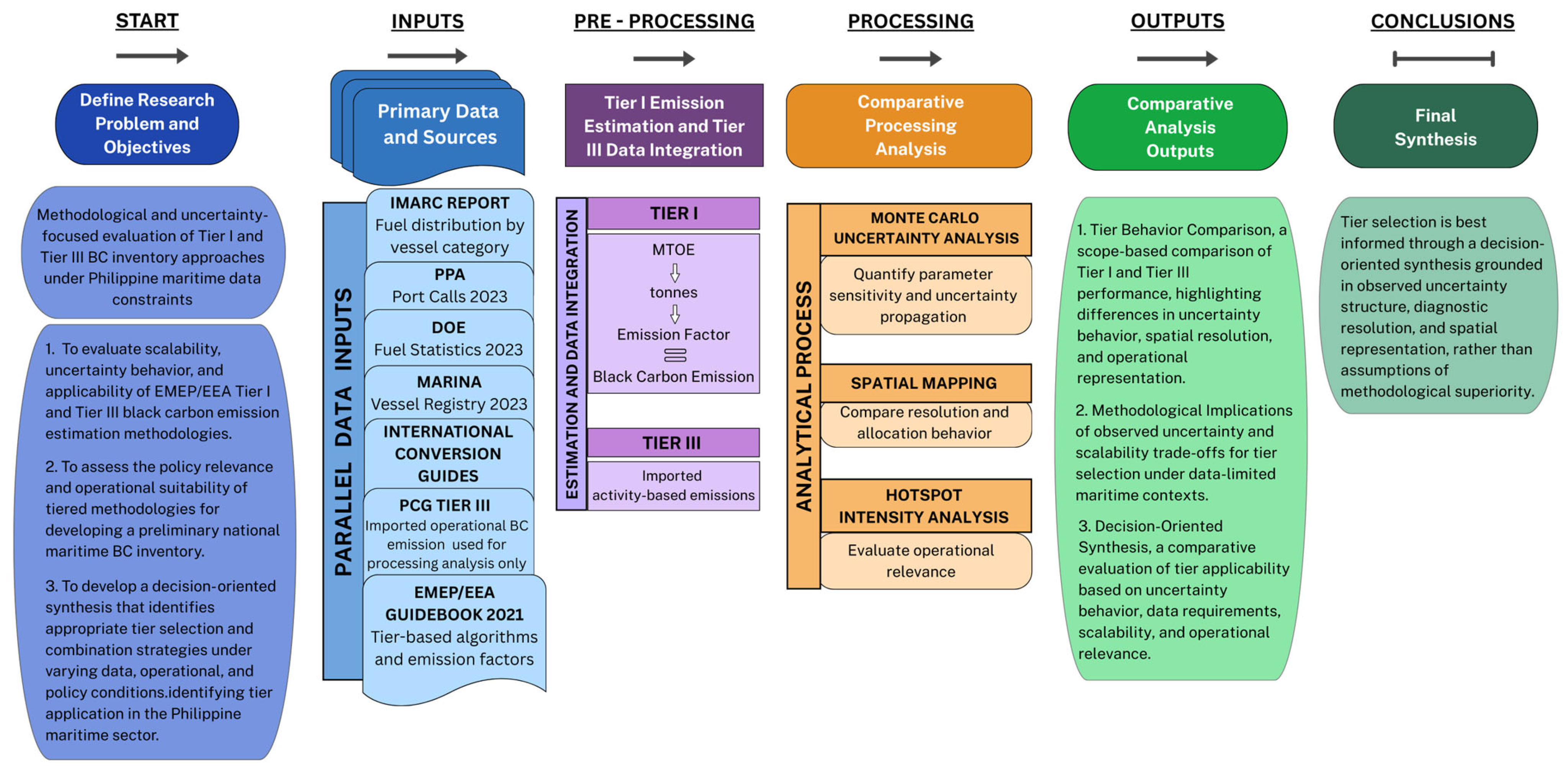
- To evaluate the scalability, uncertainty behavior, and applicability of EMEP/EEA’s Tier I and Tier III black carbon emission estimation methodologies under Philippine maritime data constraints.
- To assess the policy relevance and operational suitability of tiered methodologies for developing a preliminary national maritime BC inventory across domestic, government, and law enforcement fleets.
- To develop a decision-oriented synthesis that identifies appropriate tier selection and combination strategies under varying data, operational, and policy conditions.
2. Materials and Methods
2.1. Research and Analytical Process
2.2. Overview of Data Sources
2.3. Tiered Emission Estimation Methods
2.3.1. Tier I Fuel-Based Emission Estimation
2.3.2. Tier III Activity-Based Emission Estimation (Imported Dataset)
2.4. Uncertainty Analysis, Spatial Mapping, and Hotspot Identification
2.4.1. Monte Carlo Uncertainty Analysis
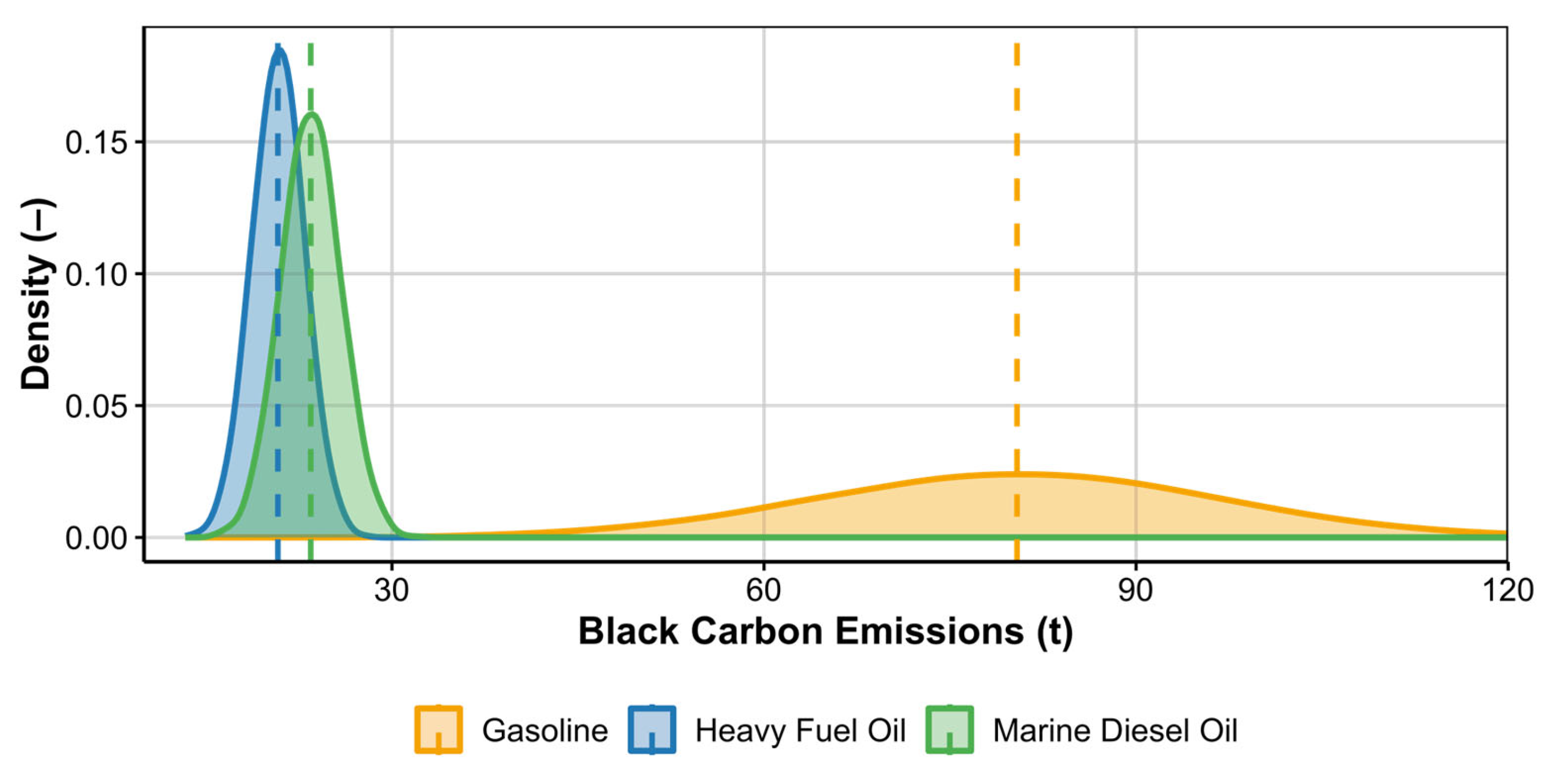
2.4.2. Probability Density Functions and Quantile-Based Uncertainty Metrics
2.4.3. Spatial Mapping Allocation of Emissions
2.4.4. Hotspot Identification Procedure
3. Results
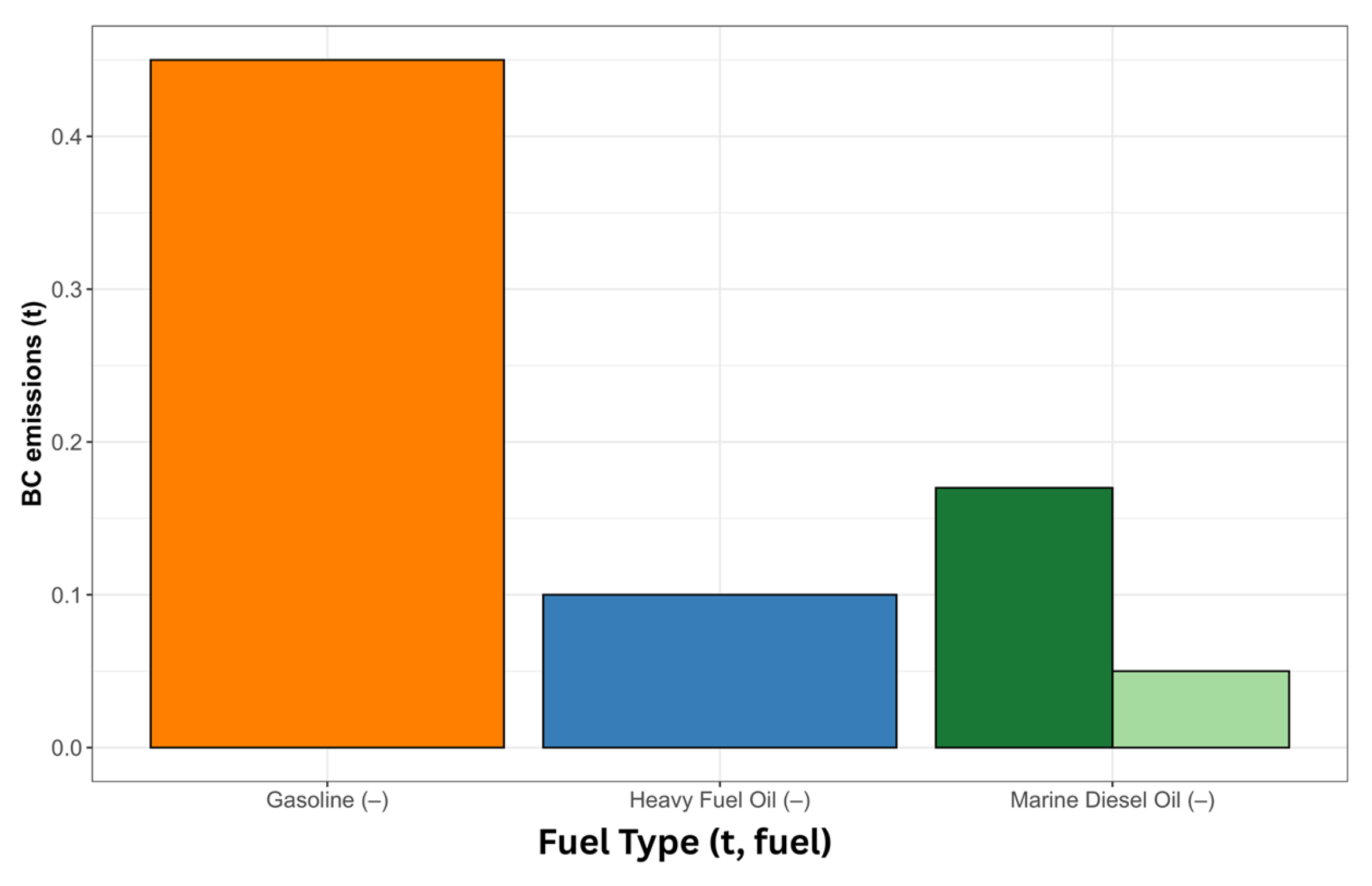
3.1. Fuel-Dependent Structure of Tier I Black Carbon Estimates
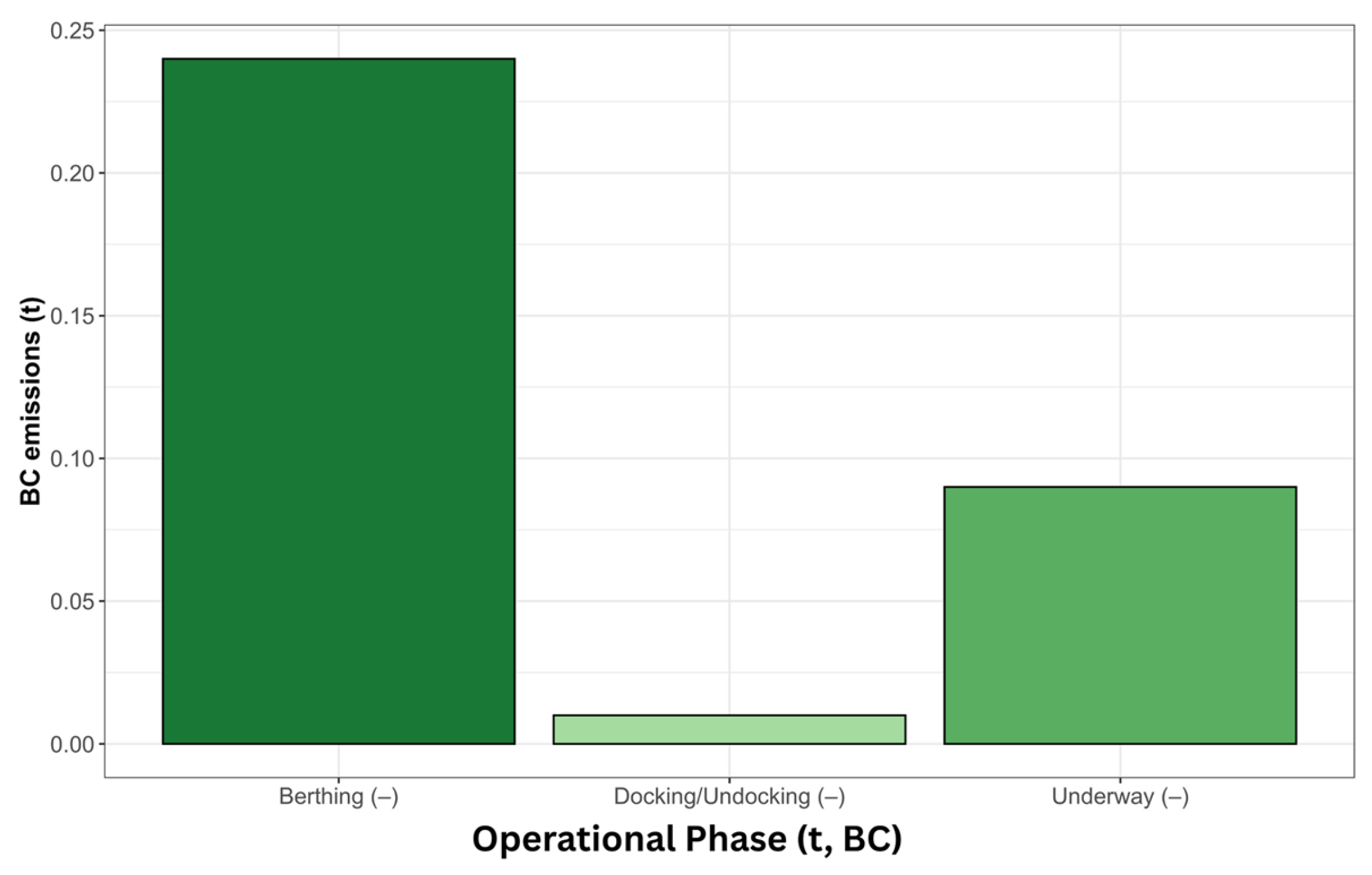
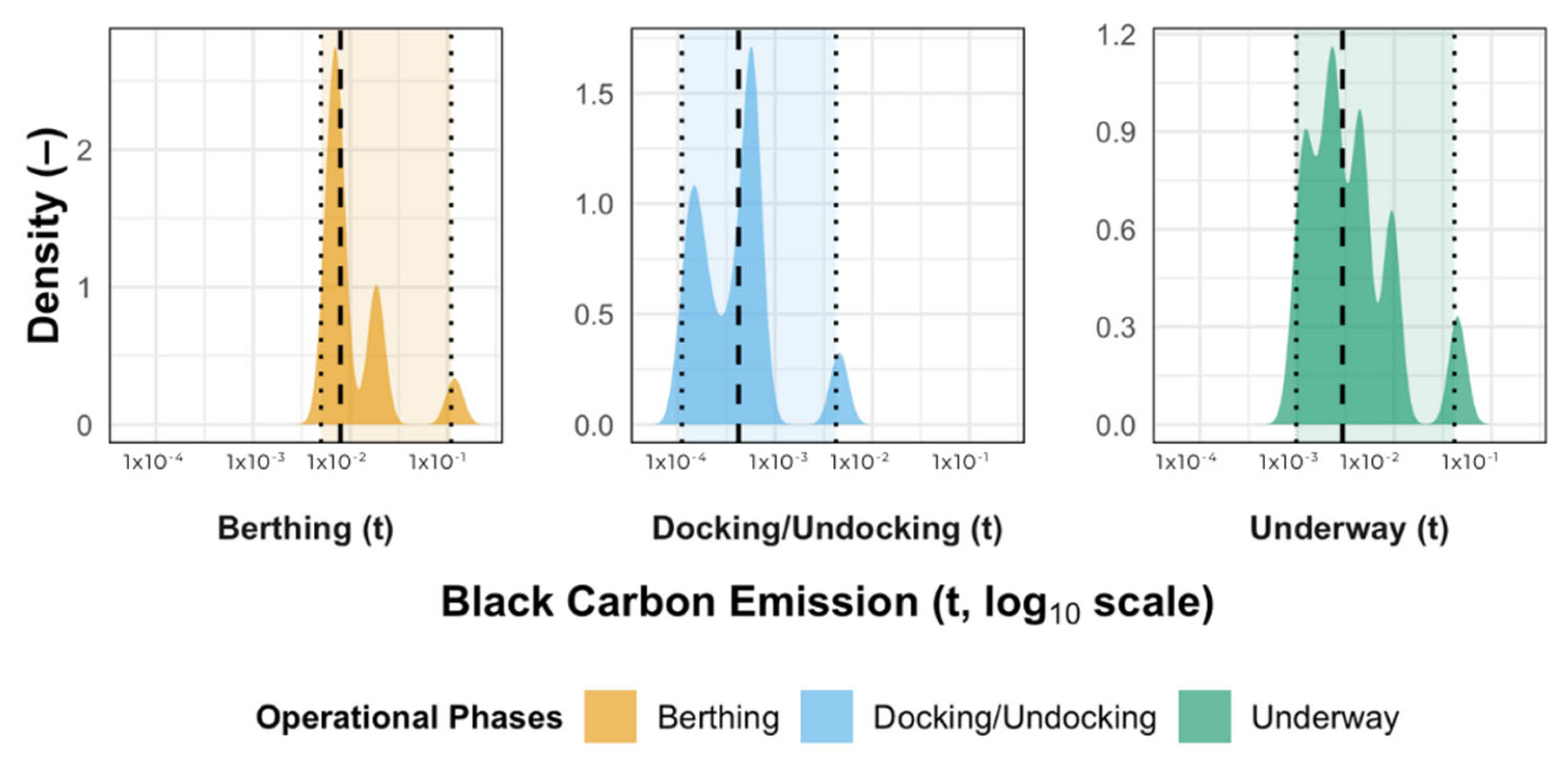
3.2. Operational Phase Differentiation in Tier III Emissions
3.3. Diagnostic Uncertainty Behavior in Tier I Estimates
3.4. Constrained Uncertainty Structure in Tier III Emissions
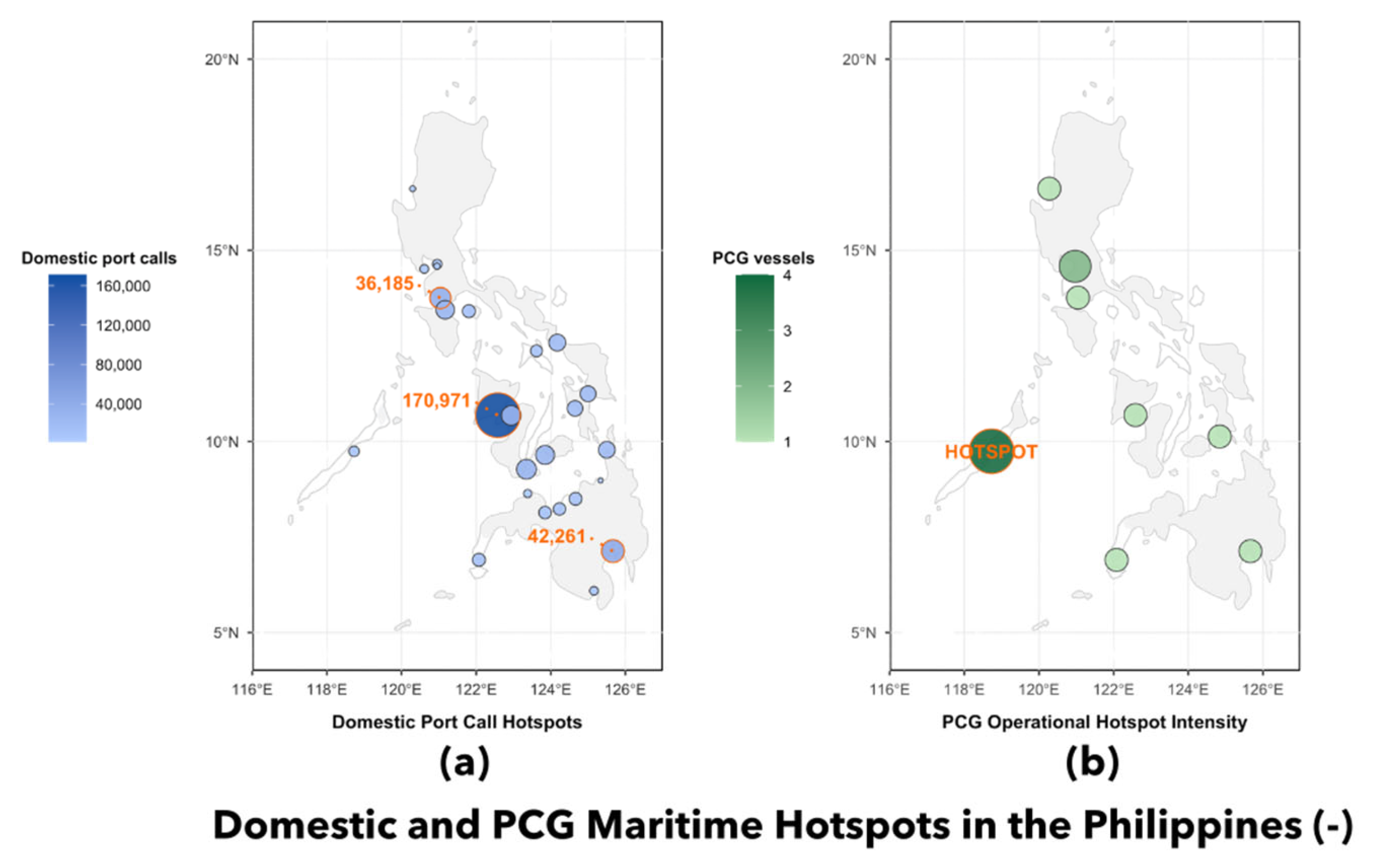
3.5. Spatial Divergence Between Fuel-Based and Activity-Based Representations
4. Discussion
4.1. Scope Comparison of the EMEP/EEA Tiered Approaches
4.2. Result-Derived Implications for Tier Selection Under Data Constraints
4.3. Implications Derived from the Observed Results
4.3.1. Fuel-Dependent Uncertainty Concentration
4.3.2. Operational-Phase Diagnostics in Tier III
4.3.3. Spatial Non-Equivalence of Proxy and Activity Representations
4.4. Limitations of This Study
4.5. Recommendations Anchored in Observed Results
4.5.1. Improve Vessel-Class Fuel Reporting
4.5.2. Expand Activity-Based Datasets for Government Fleets
4.5.3. Apply Tier II Selectively to Gasoline-Fueled Small Vessels
4.5.4. Integrate AIS Where Available
4.5.5. Develop Local Emission Factor Measurements
4.5.6. Institutionalize Tiered Inventory Practice
4.5.7. Target Mitigation Using Tier-Appropriate Spatial Signals
4.5.8. Prioritize Berthing-Related Controls Where Tier III Data Exist
5. Conclusions
Author Contributions
Funding
Institutional Review Board Statement
Informed Consent Statement
Data Availability Statement
Conflicts of Interest
References
- International Council on Clean Transportation (ICCT). Black Carbon Emissions and Fuel Quality in Marine Shipping; ICCT: Washington, DC, USA, 2020; Available online: https://theicct.org/publication/black-carbon-emissions-and-fuel-use-in-global-shipping-2015/ (accessed on 5 August 2025).
- Lack, D.A.; Corbett, J.J. Black carbon from ships: A review of the effects of ship speed, fuel quality, and exhaust gas scrubbing. Atmos. Chem. Phys. 2012, 12, 3985–4000. [Google Scholar] [CrossRef]
- Intergovernmental Panel on Climate Change (IPCC). Climate Change 2021: The Physical Science Basis; Contribution of Working Group I to the Sixth Assessment Report of the IPCC; Cambridge University Press: Cambridge, UK, 2021; Available online: https://www.ipcc.ch/report/ar6/wg1/ (accessed on 7 August 2025).
- Malley, C.S.; Lefèvre, E.N.; Kuylenstierna, J.C.; Haeussling, S.; Howard, I.C.; Borgford-Parnell, N. Integration of Short-Lived Climate Pollutant and air pollutant mitigation in nationally determined contributions. Clim. Policy 2023, 23, 1216–1228. [Google Scholar] [CrossRef]
- Aakko-Saksa, P.; Kuittinen, N.; Murtonen, T.; Koponen, P.; Aurela, M.; Järvinen, A.; Teinilä, K.; Saarikoski, S.; Barreira, L.M.F.; Salo, L.; et al. Suitability of Different Methods for Measuring Black Carbon Emissions from Marine Engines. Atmosphere 2022, 13, 31. [Google Scholar] [CrossRef]
- Nunes, R.A.O.; Alvim-Ferraz, M.C.M.; Martins, F.G.; Sousa, S.I.V. The activity-based methodology to assess ship emissions—A review. Environ. Pollut. 2017, 231, 87–103. [Google Scholar] [CrossRef] [PubMed]
- Johansson, L.; Jalkanen, J.P.; Kukkonen, J. Global assessment of shipping emissions in 2015 on a high spatial and temporal resolution. Atmos. Environ. 2017, 167, 403–415. [Google Scholar] [CrossRef]
- United Nations Environment Programme. Air Pollution and Climate Co-Benefit Assessment in Asia; UNEP: Nairobi, Kenya, 2023. [Google Scholar]
- European Environment Agency. EMEP/EEA Air Pollutant Emission Inventory Guidebook 2019: Update 2021; EEA: Copenhagen, Denmark, 2021. [Google Scholar]
- United Nations Environment Programme; Climate and Clean Air Coalition. Short-Lived Climate Pollutant Mitigation Pathways; UNEP: Paris, France, 2022. [Google Scholar]
- Organisation for Economic Co-operation and Development; International Energy Agency. Energy Statistics Manual; OECD Publishing: Paris, France, 2005. [Google Scholar] [CrossRef]
- Bond, T.C.; Doherty, S.J.; Fahey, D.W.; Forster, P.M.; Berntsen, T.; DeAngelo, B.J.; Flanner, M.G.; Ghan, S.; Kärcher, B.; Koch, D.; et al. Bounding the role of black carbon in the climate system: A scientific assessment. J. Geophys. Res. Atmos. 2013, 118, 5380–5552. [Google Scholar] [CrossRef]
- Guevarra, J.; Kim, K. Quantifying black carbon emissions using non-instrumental methods: A framework applied to Coast Guard fleet in the Philippines. In Proceedings of the 11th International Conference on Environmental Science and Technology, Sarajevo, Bosnia and Herzegovina, 22–26 October 2025. [Google Scholar]
- Philippine Ports Authority. 2023 Port Call Statistics; Philippine Ports Authority: Manila, Philippines, 2023; Available online: https://www.ppa.com.ph/content/statistics-1 (accessed on 11 August 2025).
- Lack, D.A.; Cappa, C.D.; Langridge, J.; Bahreini, R.; Buffaloe, G.; Brock, C.; Cerully, K.; Coffman, D.; Hayden, K.; Holloway, J.; et al. Impact of fuel quality regulation and speed reductions on shipping emissions. Environ. Sci. Technol. 2011, 45, 9052–9060. [Google Scholar] [CrossRef]
- Department of Energy. 2023 Philippine Energy Situationer; Department of Energy: Manila, Philippines, 2025. [Google Scholar]
- Maritime Industry Authority. 2023 MARINA Statistical Report; Maritime Industry Authority: Manila, Philippines, 2024. Available online: https://marina.gov.ph/wp-content/uploads/2024/11/2023-MARINA-Statistical-Report.pdf (accessed on 11 August 2025).
- IMARC Group. Bunker Fuel Market Size, Outlook Forecast 2033; IMARC Group: Brooklyn, NY, USA, 2024; Available online: https://www.imarcgroup.com/bunker-fuel-market (accessed on 15 August 2025).
- Winnes, H.; Styhre, L.; Fridell, E. Reducing maritime black carbon emissions: Implications for ports and coastal regions. J. Clean. Prod. 2020, 256, 120426. [Google Scholar]
- Miola, A.; Ciuffo, B. Policy Support for Reducing Ship Emissions: The Case of EU Ports. European Commission, Joint Research Centre. 2018. Available online: https://publications.jrc.ec.europa.eu/repository/handle/JRC60732 (accessed on 11 August 2025).
- Jalkanen, J.-P.; Johansson, L.; Kukkonen, J.; Brink, A.; Kalli, J.; Stipa, T. Extension of an assessment model of ship traffic exhaust emissions for particulate matter and carbon monoxide. Atmos. Chem. Phys. 2016, 12, 2641–2659. [Google Scholar] [CrossRef]
- Cooper, D.A. Exhaust emissions from ships at berth. Atmos. Environ. 2003, 37, 3817–3830. [Google Scholar] [CrossRef]
- Eyring, V.; Isaksen, I.S.A.; Berntsen, T.; Collins, W.J.; Corbett, J.J.; Endresen, Ø.; Grainger, R.G.; Moldanová, J.; Schlager, H.; Stevenson, D.S. Transport impacts on atmosphere and climate: Shipping. Atmos. Environ. 2010, 44, 4735–4771. [Google Scholar] [CrossRef]



| Data Sources | Data Type | Analytical Role in This Study | Tier Association |
|---|---|---|---|
| Department of Energy Energy Situationer * | Fuel Statistics | Fuel-based BC estimation and uncertainty analysis | Tier I |
| Philippine Ports Authority (PPA) Port Calls * | Activity proxy | Spatial allocation of fuel-based emissions | Tier I |
| Maritime Industry Authority (MARINA), MARINA Registry * | Fleet composition | Vessel category characterization | Tier I |
| IMARC Fuel Market Report * | Fuel distribution | Proxy allocation by vessel class | Tier I |
| PCG Tier III Dataset Imported activity-based emission estimates (not recomputed in this study) * | Operational Activity | Comparative uncertainty, spatial mapping, and hotspot intensity analysis | Tier III |
| EMEP/EEA Guidebook * | Methodological reference | Emission factors, BC fractions, uncertainty ranges | Tier I (applied) Tier II (contextual guidance) Tier III (methodological reference) |
| International Energy Agency (IEA); United Nations Statistics Division (UNSD); and Organization for Economic Co-operation and Development/International Energy Agency (OECD/IEA) | Conversion factors | Standardized unit conversion for fuel-based emission calculations | Tier I |
| Factor | Tier I | Tier II | Tier III |
|---|---|---|---|
| Fuel data basis | Aggregated national fuel consumption statistics | Vessel-class and engine technology specific fuel use | Vessel-specific fuel consumption resolved by operational phase |
| Activity representation | None; emissions scale with total fuel | Limited differentiation by technology class | Explicit resolution by operational mode (berthing, underway, and docking/undocking) |
| Spatial representation | Indirect, via proxy allocation | Indirect, via proxy allocation | Direct, based on reported vessel activity locations |
| Operational resolution | Not resolved | Partially resolved through technology differentiation | Fully resolved by activity phase |
| Uncertainty structure | Broad and fuel-dependent due to aggregation and proxy factors | Intermediate; reduced relative to Tier I when technology data are available | Constrained by vessel and phase-specific activity inputs |
| Primary analytical role | National-scale baseline emission | Targeted refinement for selected vessel classes | Activity-resolved diagnostic assessment |
| Criteria | Tier I (Fuel-Based) | Tier III (Activity-Based) | Result-Derived Implication |
|---|---|---|---|
| Uncertainty behavior | Fuel-selective and asymmetric, particularly for proxy-based fuels. | Narrower and phase-constrained across operational modes. | Uncertainty structure is governed by tier formulation rather than emission magnitude. |
| Primary sensitivity drivers | Emission factor formulation and fuel aggregation. | Operational duration and activity mode. | Activity resolution reveals emission-generating behavior obscured in Tier I. |
| Spatial meaning | Represents commercial traffic intensity via proxies. | Represents operational deployment patterns. | Spatial outputs encode different activity logics, not merely different in resolution. |
| Interpretability at sub-categories | Limited for fuel or phase-level diagnostics. | High for phase-specific diagnostics. | Tier III enables diagnostics interpretation beyond aggregate totals. |
| Data dependency | Operates with minimal input data accumulates structural uncertainty. | Requires detailed activity records to constrain estimates. | Tier selection reflects data availability rather than analytical preference. |
| Analytical use within this study | National-scale aggregation and comparative scaling | Diagnostic analysis of operational patterns | Approaches are complementary rather than interchangeable. |
Disclaimer/Publisher’s Note: The statements, opinions and data contained in all publications are solely those of the individual author(s) and contributor(s) and not of MDPI and/or the editor(s). MDPI and/or the editor(s) disclaim responsibility for any injury to people or property resulting from any ideas, methods, instructions or products referred to in the content. |
© 2026 by the authors. Licensee MDPI, Basel, Switzerland. This article is an open access article distributed under the terms and conditions of the Creative Commons Attribution (CC BY) license.
Share and Cite
Guevarra, J.T.; Kim, K. Methodological and Uncertainty-Focused Evaluation of Tiered Approaches for Maritime Black Carbon Inventories in the Philippines. Sustainability 2026, 18, 1549. https://doi.org/10.3390/su18031549
Guevarra JT, Kim K. Methodological and Uncertainty-Focused Evaluation of Tiered Approaches for Maritime Black Carbon Inventories in the Philippines. Sustainability. 2026; 18(3):1549. https://doi.org/10.3390/su18031549
Chicago/Turabian StyleGuevarra, Janine Tubera, and Kyoungrean Kim. 2026. "Methodological and Uncertainty-Focused Evaluation of Tiered Approaches for Maritime Black Carbon Inventories in the Philippines" Sustainability 18, no. 3: 1549. https://doi.org/10.3390/su18031549
APA StyleGuevarra, J. T., & Kim, K. (2026). Methodological and Uncertainty-Focused Evaluation of Tiered Approaches for Maritime Black Carbon Inventories in the Philippines. Sustainability, 18(3), 1549. https://doi.org/10.3390/su18031549