Systematic Review

Assessing Mining-Related Water Impacts: A Case Study-Based Systematic Review Supporting a More Comprehensive Approach

by
Frank Winde
1,2,† and
Antonio M. Newman-Portela
1,*,†
1
Wismut GmbH, Jagdschänkenstr 29, 09117 Chemnitz, Germany
2
Department of Geography and Environmental Studies, Faculty of Natural and Agricultural Sciences, North-West University, Vaal Campus, Hendrick Van Eck Boulevard 1174, Vanderbijlpark 1900, South Africa
*
Author to whom correspondence should be addressed.
These authors contributed equally to this work.
Sustainability 2026, 18(4), 1774; https://doi.org/10.3390/su18041774
Submission received: 12 December 2025 / Revised: 26 January 2026 / Accepted: 28 January 2026 / Published: 9 February 2026
(This article belongs to the Special Issue Sustainability in Hydrology and Water Resources Management)

Abstract

Mining-related impacts on water are often more persistent, costly, and extensive than suggested by standard reporting practice which frequently omits the indirect impacts on third parties associated with mining-induced alterations to water flow and quality and rarely covers the associated economic knock-on effects (costs). Based on a literature review, this paper aims to identify and categorise such underreported impacts using 15 international case studies from nine countries covering surface and underground operations and a wide range of commodities. For each of the seven proposed water impact categories such as discharge of mine effluents, mine waste-related pollution, de- and rewatering, hydrological alterations, etc., corresponding case studies and associated key impact parameters are compiled. Linking mining-induced pollution to water quantity and costs is proposed as a potential means to curb the externalisation of costs. In addition to the literature data, original calculations are provided on how the creation of vast “lakescapes” in former lignite districts exacerbates water stress in two of Germany’s driest regions. The main objective is to strengthen the future licencing decisions of authorities and better anticipate mining-induced water impacts at a time when rising demand for energy transition metals intensifies the competition for limited water resources in many already water-stressed mining regions.

1. Introduction

Mining is as essential for any modern society as agriculture is for feeding humankind. Mineral extraction has long been a key driver of economic and social development by providing the raw materials needed for infrastructure, industry, and everyday resources that sustain and improve human life [1,2]. Mining activities also generate incomes and foster business opportunities across primary, secondary, and tertiary sectors, supporting prosperity at local, regional, and national levels. Mining is expected to grow with the global energy transition, as demand rises for the critical minerals used in lithium batteries, electric vehicles, solar panels, and wind and hydropower technologies [1,2]. Between 1970 and 2022, raw metal extraction nearly quadrupled, increasing from 2.7 to 9.4 gigatons. However, the mining industry is also recognised as a major water user that impacts water resources directly (e.g., via discharging polluted effluents) as well as indirectly (e.g., via generating large volumes of contaminated mine waste, whose seepage can in turn pollute surface and groundwater) [1,3,4,5].
In this context, the often-invisible impacts of mining on water resources frequently remain underestimated, poorly characterised, and underreported in routine environmental documentation and corporate sustainability reporting, despite ongoing efforts to improve water reporting in the industry [6,7,8,9,10,11,12,13]. This is partly because current corporate and regulatory water reporting practices in the mining sector tend to focus on operational indicators, such as water withdrawals, recirculation, and discharges, without adequately accounting for the cumulative, indirect, or long-term effects [9,14]. In many cases, diffuse contamination, aquifer degradation, or the persistence of liabilities after mine closure are not included in environmental reports or corporate accounting [5,10,13], and are not adequately considered, if at all, when granting mining licences.
Furthermore, water-related effects are often dissociated from their social, ecological, and economic costs, making it difficult to understand the full scope of the problem. Health risks from chronic metal exposure and the loss of ecosystem services are rarely addressed in routine water reports or in dedicated sustainability disclosures [13,15]. Persistent impacts on groundwater, including reduced availability and prolonged metal contamination in Mexico, have been documented even years after mining operations have ceased [16]. Independent assessments have also identified critical gaps in current reporting systems, particularly concerning impacts beyond mine boundaries, post-closure effects, systemic risks, and unaccounted for externalities that affect communities and governments [9,10,11]. Likewise, agricultural losses due to the use of mining-polluted water, which may also cause costs to industrial users, lack of access to water for domestic or recreational uses, and the degradation of aquatic habitats are rarely considered part of the mining-related water impact within prevailing reporting practices (e.g., environmental compliance documentation and corporate sustainability reporting) [13,17]. Despite improvement efforts by the industry, this disconnection has led, and continues to lead, to planning decisions that underestimate the real extent of water use, shifting associated costs onto governments, local communities, and future generations [6,9,10,11,12,18,19].
In addition, water impacts through mining do not occur under static hydroclimatic conditions. Predicted changes in climate extremes and the hydrological variability associated with global warming may intensify some of the impacts discussed by reducing effluent dilution during prolonged droughts, or increasing contaminant dispersion during extreme rain events [20,21].
Having reviewed diverse mine types and regions across the globe, this paper identifies and categorises mining-related water impacts using a primarily qualitative approach. Analysed impacts include water pollution by acid mine drainage, mine waste and contaminated effluent discharges, dewatering-induced land degradation, hydrological alterations of surface and groundwater systems, changes to regional water balances, and long-term impacts associated with mine flooding (rewatering). While the synthesis is predominantly descriptive, quantitative data reported in the literature are extracted where available for selected key parameters, such as the river length affected by mines, pH ranges, contaminant concentrations, discharged effluent volumes, or area sizes impacted by groundwater drawdown. These parameters allow for limited comparison across case studies but do not constitute a consistent quantitative framework applicable across different impact categories.
The present review focuses on identifying and structuring water-related impacts that are not sufficiently captured by current reporting. A comprehensive aggregation of direct and indirect impacts into a unified quantitative mine water footprint is not attempted here and would require additional data beyond the scope of this study. Nevertheless, by compiling and categorising underreported or even ignored impact pathways, this work aims to raise awareness among regulators and decision-makers of potentially unforeseen water implications when granting mining licences, and to provide a basis for the future development of fully quantitative assessments.

2. Methodology

2.1. Literature Review and Definitions of Terms

A structured literature review was conducted and reported in accordance with the PRISMA 2020 guidelines [22] to identify documented mining-related impacts on surface water and groundwater resources. The completed PRISMA checklist is provided as Supplementary Table S1. Given the qualitative and case study-based nature of this work, the review was designed as a scoping review and was not prospectively registered. Searches were performed using Scopus, Web of Science, and Google Scholar, covering peer-reviewed journal articles, conference proceedings, book chapters, and selected grey literature, including governmental and company reports as well as post-disaster assessments.
The search strategy combined mining-related terms with water impact-related terms using Boolean operators. Core search strings included combinations such as “mining” AND “water impacts”, “acid mine drainage”, “tailings”, “dewatering”, “mine flooding”, “effluent discharge”, and “hydrological alteration”. Where database functionality allowed, searches were applied to titles, abstracts, and keywords. A comprehensive list of keywords, grouped by thematic category, is provided in Supplementary Table S2. The literature search covered publications from the early 20th century onwards and was last updated in November 2025. Publications in English were prioritised, while relevant documents in German and Spanish were also included due to the historical importance of covered mining activities.
After removal of duplicate records across databases, all remaining records were screened at title and abstract level. Records were excluded if they did not address mining-related impacts on water quantity or quality, focused exclusively on operational water efficiency without environmental relevance, or lacked a clear link between mining activities and hydrological or water quality effects. Full-text articles were subsequently assessed for eligibility, as summarised in the PRISMA 2020 flow diagram (Figure 1). While the key references indicated in Figure 1 can be regarded as characteristic of each selected case study, the selection process and subsequent characterisation of the 15 mining examples was naturally based on a much larger number of relevant references.
Identified case studies were included in the qualitative synthesis if they met the following criteria: (I) documented impacts on surface and/or groundwater quantity or quality; (II) impacts directly attributable to mining activities, including active, abandoned, or legacy sites; (III) availability of descriptive information on impact mechanisms and direct or indirect effects; and (IV) representation of diverse impact pathways across different geographical, climatic, and geological settings.
Several case studies draw on multiple publications describing the same mining system or hydrological setting. For the purpose of the qualitative synthesis and the PRISMA 2020 flow diagram, such systems were treated as single analytical case studies. Following this process, 15 case studies from 9 countries were retained for qualitative synthesis, as illustrated in Figure 1. A list of the selected case studies and their key reference is provided in Supplementary Table S3.
In the context of this paper, “direct impacts” refer to all consequences of all mining-related activities that alter the quality and/or flow of receiving water bodies on surface and underground without impacting on other environmental compartments first (i.e., the discharge of polluted mine effluents via pipes or canals into a stream). Direct impacts are confined to the affected water body.
In contrast, “indirect impacts” generally involve other environmental components/entities that are affected by the consequences of direct water impacts, i.e., the formation of sinkholes in karst areas after dewatering is an indirect impact of drawing down the groundwater table (direct impact). Similarly, the contamination of fluvial sediments is an indirect impact (consequence) following from stream pollution through the discharge of polluted mine effluents affected through dissolved contaminants becoming immobilised as solid phase to precipitation or sorption and accumulate in the sediment. Indirect impacts may also include more than one additionally impacted entity. For example, if a mine pollutes a stream (direct impact) whose water is then used for irrigation it results in (a) contamination of the soil in which the plants grow and (b) contaminating crops grown in the soil. Adverse health effects of people or animals consuming the contaminated crops constitute a third tier of indirect water impacts of mines.
Where indirect impacts result in quantifiable economic losses, the term “knock-on effect” is used to denote that these impacts may cause costs for third parties. Since some of these costs have been compensated by mines (e.g., gold mines in the Far West Rand buying up sinkhole-degraded agricultural land at pre-impact value) the term “externalised cost” could not be generally used.

2.2. Calculating Climatic Water Balances (CWBs) for Pit Lakes

In addition to reviewing secondary data, primary data were generated relating to quantifying changes in natural climatic water balances of lignite mining regions in Central and Eastern Germany. Based on reported data for the last climatic normal period (or longer), we calculated evaporation rates and annual climatic water balances using data for 15 m-deep reference lakes. As the deepest reference lake category for which long-term statistics are available, it also covers lakes deeper than 15 m (like most pit lakes) whose thermal properties are deemed to differ only marginally, if at all. For interim periods where lakes are not yet fully filled-up, data for 6 m-deep reference lakes were also used, displaying a slightly larger magnitude of seasonal temperature fluctuations (and thus evaporation rates) than deeper lakes with their greater thermal inertia.
For the Central German lignite region, the average annual precipitation figures (1971–2000) of stations falling into the mining area ranged from 441 mm/a (Salzmünde) to 606 mm/a (Leipzig-Holzhausen) mm/s (estimated regional average 500 mm/a) and for the Lusatian Region it ranged from 560 mm/a (Cottbus) to 640 mm/a (Hoyerswerda) with an estimated regional average of 600 mm/a [23,24,25,26].
Since rainfall over lakes is generally less than over rougher land surface, the rainfall figures for lakes in the two mining regions were adjusted downward by 18% based on the long-term difference between precipitation over German reference lakes (644 mm/a) and the average across the whole of Germany (789 mm/a).
For calculating the climatic water balance (CWB) of lakes, the mean annual evaporation rate (MAE) from lakes is subtracted from the mean annual precipitation rate (MAP) corrected for lakes (CWB [mm/a] = MAP [mm/a] − MAE [mm/a]). The corresponding volumes for CWB, MAP, and MAE are calculated by multiplying the respective rates with the size of the relevant area (CWB [l/a] = area size [m2] × CWB [l/m2 × a]). Results are subsequently converted into million cubic metres per annum [Mm3/a] (Table 1).
Table 1. Long-term average evaporation rates over different surfaces in Germany (1893–2014; data: [23,24,25,26]).
Surface Type/
Land Use
Actual Evaporation [mm/a]Precipitation
[mm/a]
Climatic Water Balance [mm/a]
Reference lakes in Germany (2/6/15 m av. depth) [27] (a)749/740/730644 (c)−105/−96/−86 *
Pit lakes (av. depth 15 m)
(Central Germany/Lusatia)
>730 (b) (718) (a) [28]410/492 (c)<−320/<−238 *
Unvegetated farmland
(av. Germany/CGCF/LCF)
360789/500/600+429/+140/+240 **
Grassland (over sand)
(av. Germany/CGCF/LCF)
435789/500/600+354/+65/+165 **
Sealed surfaces (towns, etc.)
(av. Germany/CGCF/LCF)
86789/500/600+703/+414/+514 **
(a) Water loss is highest over shallow lakes (2 m depth) as they warm up quicker during summer than deeper ones increasing evaporation rates. Deeper lakes with larger volumes of water to be heated generally display a greater thermal inertia with lower water surface temperatures and thus lesser evaporation. The effect is limited to a maximum depth of 16 m below which no further reduction in evaporation is observed. With average pit depths of 20–140 m, the evaporation values for 16 m-deep lakes are used for the pit lakes; (b) Evaporation rates from lakes in Germany generally increase from north (Schleswig-Holstein) to south reaching their maxima in southern Brandenburg and Saxony [23,24,25,26]. In the absence of site-specific data, the greater-than symbol (>) is used to denote this fact; (c) local precipitation corrected for lower values over open water (−18%); * = values with a minus denote a negative CWB; ** = values with a plus a positive one.

2.3. Defining Categories of Mining-Related Water Impacts

In this paper, seven main impact types are proposed, based on underlying mechanisms and observable effects: (I) acid mine drainage (AMD) cross-cutting through several other categories; (II) mine waste-related impacts (e.g., seepage, dam failure, slurry discharge); (III) dewatering-induced effects (e.g., aquifer drawdown, land subsidence); (IV) post-closure rewatering processes (e.g., mine flooding and subsequent pump-and-treat of emanating mine water); (V) point-source effluent discharges (e.g., contamination from process water and water pumped from underground); and (VI) alterations of the landscape hydrology (e.g., stream diversions, building of dams, cross catchment water transfer, changes in runoff coefficients, etc.). Each case was assigned to one or more of these categories according to the primary documented impact. The seventh category relating to consumptive water use is not explored in great detail, as this dimension is commonly well covered by standard reporting systems. The emphasis is therefore placed on commonly underreported categories occurring off-site and after mine closure often including indirect and cumulative impacts across the entire mine life cycle.
Where multiple impact pathways were reported for a given case study, a primary category was assigned based on the dominant hydrological mechanism described in the literature, while co-occurring impacts were also documented as qualitative description. The selected case studies are not intended to be exhaustive, but exemplary. Many sites exhibit overlapping and interrelated impacts, reflecting the interconnected nature of mining impacts on water resources. Special emphasis was placed on showcasing representative cases highlighting the chronic, cumulative, and often irreversible character of these impacts as well as potential knock-on effects and externalised costs for third parties, including the natural environment.

3. Mining Impacts on Water: Selected Case Studies

To enable comparison across different climatic, geological, and hydrological contexts, the wide range of mining impacts on water were organised into distinct categories. Although each site presents local particularities, the cases analysed show that certain types of impacts recur systematically across diverse mining contexts, regardless of the mineral extracted, the extraction technology used, or the phase of the mine life cycle.
For example, in the Far West Rand goldfield (South Africa), extensive groundwater dewatering was treated as the primary impact mechanism to highlight this impact type. Co-occurring impacts, including sinkhole formation, contamination of karst aquifers by tailings seepage, and long-term post-closure water quality degradation, were documented as secondary but interconnected effects within the qualitative case description.
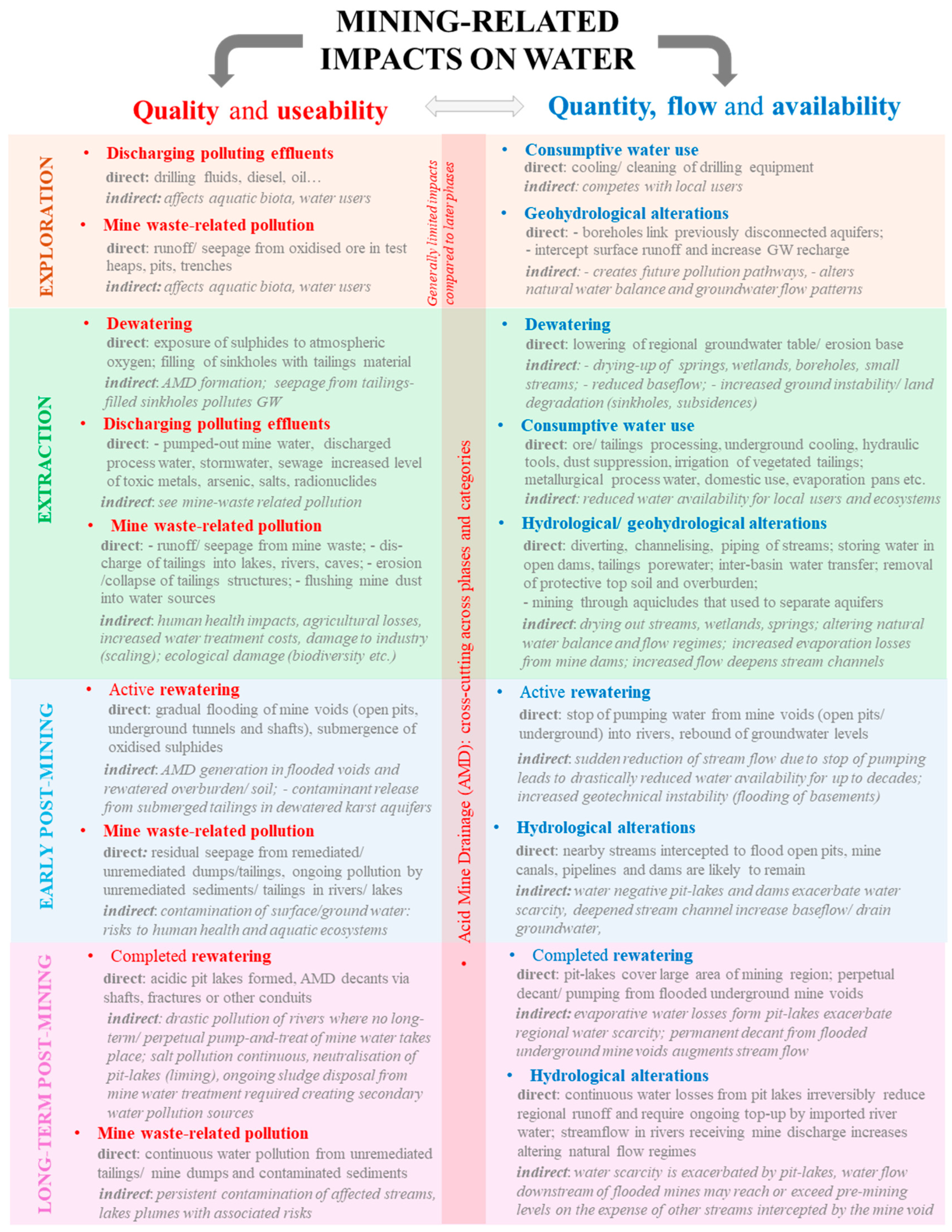
To provide an overview of these recurring processes, Figure 2 presents a schematic classification of mining-related water impacts across the mine life cycle. The diagram highlights both phase-specific mechanisms (e.g., dewatering during operations or rewatering after closure) and cross-cutting processes such as AMD, which connect multiple categories and timeframes. This framework serves as a conceptual map for the following subsections, where each impact category is examined in detail and illustrated with representative case studies.
Each subsection of this part presents one impact category, which is described in general terms and illustrated with one or more representative case studies. The categories are not mutually exclusive but display a degree of overlap (e.g., AMD which relates to pollution by mine waste as well as flooded mines). For each case, information is provided on the geographic context, mine type, affected water bodies, key contaminants, duration of impact, distinction between direct and indirect effects, and associated socio-economic effects when available.

3.1. Acid Mine Drainage

Acid mine drainage (AMD) is one of the most common and persistent forms of water pollution caused by mining. It occurs when sulphide-bearing materials, especially iron sulphides, are exposed to oxygen and water, triggering a series of oxidation reactions that acidify water leading to low pH values, high electric conductivity (EC) and elevated concentrations of toxic trace metals, metalloids, natural radionuclides, and sulphate (SO42−). Although AMD can occur naturally, mining activities greatly accelerate its rate of formation by exposing large volumes of rocks to the atmosphere and greatly expanding the reactive surface through crushing, grinding, and milling of the sulphide-containing ore [29]. Rates of AMD formation depend on local geology, the grade and type of sulphide minerals, and the availability of oxygen and water. Biological factors, such as the presence of microbes, can also accelerate the process [30].
AMD can severely degrade surface and groundwater quality, affect ecosystems, and pose health risks to humans and animals. The global variability in AMD generation makes it difficult to predict, assess, and remediate, contributing to an estimated worldwide liability of nearly USD 100 billion [31].

3.1.1. Centuries-Old Polymetallic Mines at Cerro Rico (Bolivia)

Cerro Rico, located in the highlands of southern Bolivia, lies at the headwaters of the Pilcomayo River, a transboundary watercourse shared by Bolivia, Paraguay, and Argentina. Mining and ore processing have historically been intensive in the region, particularly for silver, tin, lead, and zinc [32]. The site features an extensive network of underground workings and numerous active, informal, and abandoned mine entries [32,33]. Centuries of underground mining, lack of wastewater treatment, and ongoing local operations have led to continuous discharges of AMD, heavily contaminating surface waters and sediments throughout the Pilcomayo River system. These impacts extend well beyond the local area, affecting the entire basin [33,34].
The resulting increase in toxic metal levels affected streams are shown in Table 2 and Supplementary Tables S4–S6 [35,36,37,38,39,40,41,42,43]. The use of mining-contaminated water for irrigation has led to heavy metal accumulation in agricultural soils and crops exposing local populations through drinking polluted water and consuming contaminated food [34,44] (Table 2). Livestock and wildlife are also affected through bioaccumulation, impacting food security, local economies, and natural ecosystems, respectively [34]. While contaminant levels in streams generally decrease with distance from the mine, fluvial sediments may accumulate toxic metals well away from the actual source of pollution, creating long-term secondary sources of contamination [45].
In addition to the long-term water contamination, the physical stability of the Cerro Rico Mountain itself has become critically compromised after nearly five centuries of intensive underground extraction. Recent assessments report increasing cave-ins and widespread structural weakening of the upper slopes, driven by renewed informal mining and the removal of disseminated ore bodies. These collapses directly endanger local Quechua communities living and working on the mountain and further complicate environmental management efforts [46].
Table 2. Overview of AMD-related mining impacts on water resources. Abbreviations: ~: approximately; a: years; BCE: before common era.
Studied Mine(s)PeriodAffected Water Bodies and ExtentEnvironmental and Ecological ImpactsSocio-Economic ConsequencesReferences
Polymetallic mines at Cerro Rico (Bolivia)1545–present (~480 a)Pilcomayo River (main course + tributaries); ~200 km surface, ~560 km sedimentsAcidification; metal contamination (As, Pb, Zn, Cd); biodiversity loss; metal bioaccumulation in crops and livestockReduced agricultural productivity; livestock and fishery losses; health risks (neurotoxicity, renal and cardiovascular effects)[32,33,34,44,45,47,48]
Au and U mines in the Witwatersrand
(South Africa)
1886–present (~139 a)Klip, Rietspruit, and Wonderfonteinspruit rivers; wetlands and karst aquifers (>100 km)Surface and groundwater contamination; U and metal accumulation; loss of aquatic speciesCostly water pre-treatment; reduced land usability; long-term liability and exposure risks[49,50,51,52]
Polymetallic mines, Rio Tinto
(Spain)
Since ca. 3000 BCE; industrial mining since 1873 (~152 a)Río Tinto and Odiel rivers → Huelva estuary (~125 km total)Persistent acidification; transfer of metals to soils and sediments; loss of fish and aquatic macroinvertebratesRestricted agriculture and grazing; high remediation and treatment costs; enduring environmental liability[53,54,55,56,57,58]
Note: “→” indicates that both rivers flows into the Huelva estuary.

3.1.2. Gold and Uranium Mines in the Witwatersrand Basin (South Africa)

The Witwatersrand Basin, South Africa, is one of the world’s most important gold mining regions, with first mining activities dating back to 1886 [50]. In well over a century, industrial-scale deep-level mining created extensive underground networks of tunnels and voluminous tailings deposits on the surface now located within the densely populated towns and cities that grew around the mines [50,59,60,61].
After the mines closed and the associated pumping of ingress from underground mine workings ceased, the interconnected mine voids known as the Western, Central, and Eastern Basins gradually filled up with acidic water, eventually decanting via old shafts, boreholes, or fractures and polluting receiving streams, wetlands, and lakes with iron, zinc, copper, nickel, uranium, and other compounds [39,40,41,42,43] (Table 2 and Supplementary Tables S4–S6).
While the flooding of mine voids and the subsequent decant are important contributors, seepage from tailings deposits covering large proportions of small headwater catchment areas is another significant AMD source highlighting that surface legacies, not only underground flooding, are central to persistent post-closure contamination [49,50,52]. In addition, metals such as uranium, nickel, and zinc accumulate in river sediments that turn into potential secondary sources of pollution persisting for decades [49,62,63,64]. Bioaccumulation in aquatic species and human populations has been demonstrated; U concentrations in the hair of residents, especially children, are elevated near tailings sites, suggesting metabolic uptake of the radiotoxic heavy metal [64,65].
Following recommendations of a Governmental Task Team in 2011, pump-and-treat systems have been constructed in all three flooded basins at an “immediate short-term” costs of ZAR 10 billion (approximately EUR 500 million) to keep the mine water below what is termed environmental critical levels (ECLs) through ongoing pumping water out from the underlying mine voids, neutralising it through liming, and eventually discharging the neutralised mine water into nearby streams still containing the original salt load and much of the metal contents [66]. Owing to the exhausted storage capacity of adjacent tailings dams, the generated residual sludge is reinjected into the underground mine voids from which the water is pumped in the first place, increasing both the volumes and contaminant load of the pumped mine water. With no end in sight and running costs of several hundreds of millions of Rand per year, this places a significant burden on the South African taxpayer.

3.1.3. Millennia-Old Polymetallic Mines in the Iberian Pyrite Belt: Rio Tinto (Spain)

The Tinto and Odiel rivers, situated in southwestern Spain within the Iberian Pyrite Belt, belong to one of the world’s oldest mining regions, where mineral extraction has continued for over 5000 years, including Romans extensively mining silver to fund their imperial expansion [55]. Industrial-scale mining began in the 19th century, mainly through open-pit operations such as Corta Atalaya, although earlier phases relied on underground workings [53,54]. These operations targeted massive sulphide deposits rich in copper, zinc, lead, and iron [53,54].
Large volumes of waste rock and tailings were left exposed to the elements, and their prolonged oxidation produced extreme levels of AMD. In the 2017/18 hydrological year, the receiving river Río Tinto (“Red River”—named after the characteristically reddish colour from dissolved iron) carried 5000 t of iron, 2600 t of aluminium, and hundreds of tonnes of zinc, copper, and manganese displaying typical low pH values over its entire approximately 100 km-long course [54,56]. The 150 km-long Río Odiel carried approximately 2800 t of iron and 4600 t of aluminium per year injected by a multitude of mines, together with substantial loads of manganese and nickel [67] (Table 2 and Supplementary Tables S4–S6).
Both rivers convey this acidic, metal-rich water well beyond the mining districts into the Huelva estuary, where deposition and bioaccumulation contaminate sediments, soils, and aquatic biota. Metal(loid) levels in floodplain soils and forage frequently exceed agronomic and livestock safety thresholds [53,54,67,68]. The recent promulgation of the Critical Raw Materials Act (CRMA) by the European Union has revived mining interest in reactivating some of the above mentioned mines in the Iberian Pyrite Belt [69].

3.2. Mine Waste-Related Water Impacts

Mine residues, particularly waste rock dumps and tailings dams, are among the most persistent and widespread sources of mining-related water contamination. Global tailings production currently reaches 5–7 billion tonnes annually [70]. Tailings consist of finely ground ore from which target commodities (e.g., gold, copper) are extracted by physico-chemical processes. Unlike coarser wastes such as rock or slags, they are composed of sand-, silt-, and clay-sized particles and often retain residual reagents, unrecovered metals, and sulphides [71,72]. Tailings are typically transported and deposited as a water–tailings mix (slurry) to impoundments or tailings dams for long-term disposal [70,72]. Because of their fine-grained and waterborne nature, tailings (both subaquatic and dry deposits) retain significant volumes of porewater that are difficult to remove. In dry deposits such as the “slimes dams” of South African gold mines, this porewater sustains an elevated piezometric surface driving continuous seepage into subjacent aquifers and nearby streams [73]. The commonly used term “tailings storage facility” (TSF) is misleading, as deposition is generally final rather than temporary as the term “storage” suggests.
Due to their composition and reactivity, particularly when sulphides are present, tailings have a high potential to generate AMD [72]. Poor management of tailings dams can cause seepage, erosion, and the associated contamination of surface and groundwater as well as catastrophic collapse, with devastating, long-lasting ecological and human impacts [70,72,74].
Beyond seepage, tailings also affect surface waters through erosion, wind-blown dust, and polluted surface runoff during intense rainfall. Readily dissolvable efflorescent salt crusts forming on tailings during dry-weather periods add to contamination potential. In extreme cases, catastrophic dam failures can bury entire valleys and settlements under toxic sludge, while pipeline ruptures or deliberate discharges into rivers, caves, and lakes (like practised in the past in Canada, Papua New Guinea, and South Africa) have caused severe water, sediment, and land degradation.

3.2.1. Tailings Dam Failure at Los Frailes Sulphide Mine (Spain)

Los Frailes mine, located at Aznalcóllar in the Iberian Pyrite Belt, one of Europe’s main metallogenic provinces, has been exploited since Roman times, but modern operations intensified in 1987 with surface extraction [75,76]. The ore body consists of complex polymetallic sulphides dominated by pyrite, with significant amounts of sphalerite, galena, and chalcopyrite, as well as minor arsenopyrite [75,76,77]. Historically, these deposits were already exploited in Roman times mainly for copper and silver. In modern times, the focus was on the extraction of zinc, lead, and copper, whose concentrates were exported to smelters in Spain and abroad. Silver remained an important by-product.
In 1998, Los Frailes tailings dam failed, releasing some 4 million m3 of acidic water and ca. 2 million m3 of toxic sludge into the Agrio River. The plume rapidly travelled down to the Guadiamar River and partly impacted areas of Doñana’s National Parks, killing all the fish and shellfish in the affected watercourses [75]. Subsequently, dozens of tonnes of fish were removed. Analyses wells in the affected areas revealed trace metal concentrations above drinking water limits [75,78] (Table S7).
The subsequent large-scale remediation included sediment removal and a remediation project, which improved water and soil quality (Table S7). Currently, efforts are underway to reopen the site for underground mining and the old pit to be used for tailings disposal [76,77,79].

3.2.2. Tailings Dam Failures at Fundão and Brumadinho Iron Mines (Brazil)

The Fundão and Brumadinho tailings dams, both located in the state of Minas Gerais (Brazil), were associated with large-scale mining operations dedicated to iron extraction [80,81]. Tailings at both sites were stored in upstream-constructed dams built with iron ore waste and slimes, deposited hydraulically and compacted over time. These structures relied on the formation of stable beaches to prevent water from contacting the dam walls [82,83].
In 2015, Brazil experienced the largest environmental disaster in its history when the Fundão dam near Mariana collapsed, releasing millions of cubic metres of mining waste into the Doce River basin and contaminating approximately a large extension of waterways and confirmed fatalities [74,80,84] (Table S7). Just three years later, in 2019, another catastrophic failure occurred at Vale’s dam in Brumadinho, located at the Córrego do Feijão mine. This event is considered one of the worst tailings dam disasters in global mining history. Millions of cubic metres of tailings were released, burying mining infrastructure and surrounding areas, and rapidly contaminating the Paraopeba River. The disaster led to the deaths of numerous people [84] (Table S7). The contamination severely affected aquatic and riparian ecosystems and disrupted the lives of populations relying on these rivers for drinking water, fishing, and agriculture [80,84]. Additionally, the tourism sector was negatively affected in the impacted regions [84]. Ecologically, the tailings slurry smothered or buried entire aquatic communities (Table S7). Protected areas and Krenak indigenous lands were coated with tailings [74,85], and metal-laden fine particles were detected over 220 km offshore, where they suppressed coral growth and tripled skeletal iron loads on the Abrolhos Bank [86].
The socio-economic consequences were equally dramatic. The collapse of Fundão completely destroyed the historic village of Bento Rodrigues, displacing its entire population. The direct and indirect damages have been valued at over USD 20 billion, while chronic exposure to contaminated water and food continues to pose a threat to public health [84,85,87,88].

3.2.3. Uranium Tailings Disposal into Lakes at the Athabasca Basin (Canada)

U mining in Canada has left a notable environmental legacy, particularly in the northern regions where early operations lacked effective regulation. During the second half of the 20th century, Elliot Lake (Ontario) and Uranium City (Saskatchewan) became the main production centres, dominated by underground mines [89,90,91,92,93,94].
At Gunnar (1955–1964), Beaverlodge (1952–1982), and Lorado (1954–1960) in northern Saskatchewan, mine and mill waste was directly discharged into lakes and natural topographic depressions. Although this subaqueous disposal masked the waste, it failed to provide long-term containment, and its consequences became evident decades later [89,91,94,95]. At Gunnar, millions of tonnes of acidic tailings entered Mudford Lake, later overflowing into Langley Bay of Lake Athabasca [96,97]. At Beaverlodge, waste discharged into Fookes and Marie Lakes eventually contaminated Beaverlodge Lake [98]. Lorado generated less waste but, lacking a large lake, deposited tailings beside Nero Lake, from where runoff dispersed contaminants [95].
Environmental consequences were substantial, as reflected by U concentrations in Beaverlodge Lake reaching 125 µg/L in 1985, far above drinking water limits. Models predicted a decline to 10 µg/L by 2118, more than a century later [99]. In Langley Bay, radionuclide-rich sludge accumulated on the lakebed, invertebrate populations declined, and bioaccumulation in fish led to fishing restrictions. Nero Lake experienced acidification and widespread water quality degradation. Lack of radiological protection caused elevated lung cancer mortality among miners exposed to radon and dust [90,97,99,100,101]. Local communities also lost access to safe water for domestic and agricultural use, while tailings deposits still pose health risks.
Following extensive remediation, Gunnar is expected to reach final closure in 2025, Lorado was rehabilitated in 2016, and Beaverlodge, also closed in 2025, remains under monitoring [95,102,103,104] (Table S7).

3.3. Dewatering-Induced Impacts

Underground as well as open-pit mines frequently need to lower the local groundwater table to ensure safe and economic operations. By pumping out more water entering into the mine (“ingress”) than can be naturally replenished by rainfall, the water table in the overlying aquifer is gradually lowered. This draw-down typically extends well beyond the actual mining site and may affect several hundreds to thousands of square kilometres of the surroundings.
During active mining, large volumes of groundwater are pumped out to keep underground mine workings dry, in a process known as dewatering, which is typically implemented through a network of underground sumps, dams, and pumping stations [105]. Sustained dewatering over extended periods depletes aquifers, reduces surface water flows, and can induce land subsidence due to the progressive lowering of the water table as the erosion base [106,107]. Effects include the drying up of boreholes, springs, smaller rivers, and wetlands, while increasing flow in streams receiving the pumped-out water, where it may lead to the deepening and widening of stream channels through higher fluvial erosion. As mine water is often of lesser quality than the original groundwater, this frequently causes problems to farmers and other downstream users.

3.3.1. Dewatering-Induced Ground Instability and Long-Term Pollution in Karst Aquifers of the Far West Rand Goldfield (South Africa)

The Far West Rand region, located within South Africa’s Witwatersrand gold belt, represents a prime example for illustrating the hydrogeological and geotechnical consequences of extensive dewatering by deep mining operations [108,109,110,111].
Large-scale pumping systems were installed to extract millions of litres of water per day, completely draining several overlying dolomitic compartments, and lowered the groundwater table by up to 1000 metres in places [108,110,111,112] (Table 3). This draw-down of the groundwater table triggered an unexpected acceleration of ground instability in karstic terrains, manifested as sinkholes and subsidence, causing fatalities and damage to roads, railway lines, houses, and other infrastructure [108,109,110,111]. Over six decades after dewatering commenced, sinkholes are still actively forming. In 2016, the municipality of Merafong declared a state of disaster in Khutsong, Welverdiend, and Carletonville after the sudden appearance of at least ten open sinkholes into which water and sanitation networks collapsed, leaving thousands of residents without basic services [113]. This region hosts one of the highest concentrations of sinkholes induced by human activity in South Africa, with more than 1200 recorded events and at least 38 confirmed fatalities [114]. In areas such as Khutsong, the intensification of ground collapse has led to a social and structural crisis. Numerous residents have abandoned their homes out of fear of being swallowed by sinkholes, and at least one documented case reports a person falling into one while walking down the street [115,116]. In certain compartments of the Far West Rand, attempts were made to fill sinkholes with tailings as a cost-effective means to reduce the amount of surface water recharging the dewatered karst aquifer and entering the underlying mine void during and after rain events. However, in many cases, tailings in nearly filled sinkholes collapsed into underlying receptacles, injecting large amounts of toxic tailings directly into the karst aquifer. Sinkholes forming underneath tailings dams due to the large outflow of seepage had a similar effect. As tailings leach U and other toxic metals, they pose a long-term threat to water quality after mine closure, when the karst aquifer will be rewatered again [107] (Table 3).
Table 3. Overview of cases studies relating to dewatering of aquifers and rewatering of mine voids. Abbreviations: ~: approximately; →: flows into; a: years; c.: century; M: million; m3/d: cubic metres per day; ML/d: megalitres per day; Mm3: million cubic metres; n.a.: not available; est.: estimated.
Dewatering-Induced Impacts
Studied MinePeriodVoid VolumeExtent of DewateringPumping
Volumes
Water Bodies
Affected
Impacts/CostsReferences
Far West Rand (South Africa)1930s–present Total mine void ~600 Mm3Up to 1000 m drawdown of GW table>200 ML/dDolomitic karst aquifer (Venters-post, Bank, Oberholzer, W. Gemsbokfontein)>1200 sinkholes (≥38 fatalities); infrastructure collapse; tailings infill; persistent contamination after rewatering[107,108,109,110,111,112,114,117]
Ruhr coal mines (Germany)1800s–2018 Underground voids~4450 km2 affected by dewatering cone ~70 Mm3/a (~192 ML/d) in perpetuityRivers Emscher and Ruhr; regional aquifers≤25 m subsidence; reversal of direction of stream flow; inundation; 5.3 M residents reliant on perpetual pumping at costs of ~EUR 300 M/a).[118,119,120,121,122]
Post-Closure Mine Rewatering Impacts
Studied MinePeriodVoid Volume/AreaRewateringTreatment
Volumes
Water Bodies AffectedImpacts/CostsReference
Wheal Jane (Cornwall, UK)17th c.–1991
(>300 a)
n.a.1991–1992 (flooding and decant)1991 decant ~5000 m3/d (5 ML/d)
1992 spill ~50 ML/d
Carnon River → Restronguet Creek → Falmouth BayStream and estuary contamination; long-term cost of pump-and-treat: ~GBP 2 M/a[123,124,125,126,127,128,129]
Western Basin (West Rand, Krugersdorp/Mogale, SA)1887–
1998
~45 Mm31998–2002 (uncontrolled flooding, decant for next ten years)Est. ~30 ML/d (pumped and treated) Tweelopiespruit → Crocodile RiverDamage of aquatic habitats and downstream game reserve; ecosystem; threat of UNESCO world heritage site; perpetual pump-and-treat required[130,131,132,133,134]
Central Basin (Johannesburg, Central Rand SA)1886–
2008
n.a.Feb. 2008–2013 (uncontrolled flooding, decant avoided)Est. ~50 ML/d * (pumped and treated)Klip River → Vaal systemFlooding/corrosion threat to underground urban infrastructure; threat of flooding of touristic mine at Gold Reef City; sterilisation of gold reserves at old mines; salinisation of Vaal River (used for irrigation); backfilling of water treatment sludge into dewatered mine void; perpetual pump-and-treat required
Eastern Basin (East Rand, SA)1890s–2010n.a.2011–2014 (uncontrolled flooding, decant avoided)Est. ~80 ML/d * (pumped and treated)Blesbokspruit → Suikerbosrand → Vaal RiverDownstream Marievale wetland lost Ramsar status; salinisation of Vaal River used for irrigation; cost-intensive perpetual pump-and-treat required
U mine Schlema-Alberoda (Saxony, Germany)1946–1990~36.5 Mm3; 22 km21991–1997 (controlled flooding)4.3–9.5 Mm3/a treated (~12–26 ML/d)Zwickauer Mulde RiverLong-term pump-and-treat required and costly disposal of treatment sludge[135,136,137,138,139,140,141,142,143,144,145]
U mine Königstein (Saxony, Germany)1964–1990 (in situ leaching after 1984)~9 Mm3; 6 km2 1991–2001
(pump-and-treat)
2001–2013 (controlled stepwise flooding), 2013–2024: (steady level flushing)
2001–2017
~2.9 Mm3/a (~8 ML/d, mean est.) ** pumped + treated
Elbe River ~22 Mm3 of acid-contaminated sandstone ongoing flushing of mine void and water treatment and disposal of water treatment sludge, continued injection of NaOH to neutralise void water
U mines at Ronneburg (Thuringia, Germany)1950s–1990 (U underground and open-pit mining)~26.7 Mm3 (19.4 Mm3 flooded)1990s–2000s (controlled flooding)Acidic water treatment from dumps and underground galleries; variable flowsLocal tributaries → Weiße Elster systemContinued pump-and-treat and sludge disposal required
U coal mine Gittersee (Saxony, Germany)1964–1990 (U, in situ leaching after 1984~2.3 Mm3 (1.74 Mm3 flooded)1990–2016 (remediation)Decant via gravitational flow in adit to Elbe River Elbe RiverPeriodic removal of sludge deposits from decants adits required in perpetuity
* Pumping rates are frequently overreported since hourly rates are extrapolated to ML/d even though pumps run only for 19 h per day. The rate for the Central Basin has been adjusted accordingly based on the pumping rate measured at ERPM (55 ML/d; due to a less deep level of current pumping and the associated decrease in ingress, a slight reduction is assumed to 50 ML/d). ** Mean annual pumping volume estimated by the author from the cumulative discharge reported in Jenk and Paul (2018) [137].

3.3.2. Perpetual Dewatering at Former Hard Coal Mines in the Ruhr Area (Germany)

In Western Germany, the Ruhr area stands as one of the country’s most densely populated and historically industrialised regions, with a current population of over 5 million people [146,147]. During the 19th and 20th centuries, it emerged as a major centre for underground hard coal mining in Europe via extensive, deep-level operations of up to nearly 1000 m below surface that lasted for over 150 years [118,147] (Table 3). The extraction of large amounts of coal from shallow depths together with large-scale dewatering resulted in widespread land subsidence. Vertical displacements exceeding 25 m in several urbanised areas not only damaged existing infrastructure like houses, underground reticulation systems, and roads but also reversed the flow direction of rivers that no longer drained towards the main river and created inundated depressions, commonly referred to as polders, that lie below the natural elevation of river systems and depend on artificial drainage to prevent flooding. If underground pumping would be stopped and groundwater allowed to recover to natural levels, much of the densely populated Ruhr area (some 4450 km2) would be flooded [118,119,120,121,122,148,149,150,151].
According to RAG, around 70 Mm3/a (~192 ML/d) of mine water needs to be pumped out in perpetuity at a current cost of some EUR 300 million per year, which is set to rise in line with increasing electricity tariffs [14,119,150,151] (Table 3).

3.4. Post-Closure Impacts of Flooded Mine Voids (Rewatering)

The progressive flooding of mine voids after mine closure (rewatering) marks a key hydrogeological transition. Once pumping ceases, water levels begin to rise either passively through naturally infiltrating groundwater or actively through the injection of surface water [152,153]. Depending on the local climatic water balance and volume of the mine void, complete flooding may take years to decades. Where mines are simply abandoned, uncontrolled flooding eventually leads to contaminated mine water overflowing via shafts, boreholes, adits, or natural fractures into nearby streams and shallow aquifers [152,153].
The inflow of water into underground mine workings or open pits on the surface frequently triggers long-term geochemical reactions degrading water quality [154,155].
Rewatering also carries geotechnical risks. Flooded voids and increased groundwater levels can reactivate ground instability, compromising the stability of basement structures especially in low-lying areas [156,157,158]. In open-pit settings, pit lakes often form, typically acidic and metal-laden, that usually require active neutralisation through liming and long-term monitoring to reach acceptable ecological conditions [156,157,158,159].

3.4.1. AMD from Centuries-Old Wheal Jane Tin Mine (United Kingdom)

Wheal Jane, a tin mine in Cornwall, was intensively exploited from the seventeenth century and, during the twentieth century, became interconnected with adjacent workings, creating an extensive system of galleries several hundred metres deep [123]. The mine was characterised by exceptionally high groundwater inflows, requiring continuous pumping of up to 60,000 m3 of water per day (60 ML/d). This water was strongly acidic (pH of 2.8) and had elevated concentrations of iron, zinc, cadmium, and copper. Although partially treated, discharges had already degraded the Carnon River and the downstream Restronguet Creek estuary prior to closure [127,160,161].
Following mine abandonment in 1991, rising groundwater levels led to overflow via historic adits, as predicted by hydrogeological models [123,129] (Table 3). In 1992, the collapse of a blockage in the Nangiles adit triggered a sudden release of approximately 50 million litres of AMD. The resulting plume, dominated by Fe oxides and with high concentrations of cadmium, copper, zinc, and arsenic, rapidly spread through the Carnon River to Restronguet Creek and Falmouth Bay, causing severe ecological damage [124,126,127].
Emergency measures included re-pumping and the temporary storage of water in the Clemows Valley tailings dam, but these proved ineffective given the extreme contamination [124]. In 1994, a pilot programme tested passive systems such as lagoons and biogeochemical processes, but they were found unable to cope with flows exceeding 300 L/s [128]. Consequently, in 2000, a permanent active treatment plant was commissioned to precipitate metals and control acidity by liming. Each year, approximately 5.6 million m3 (15.3 ML/d) of mine water are treated, removing more than 429 tonnes of iron together with other metals [124,125].

3.4.2. AMD from Uncontrolled Flooded Gold Mines in the Western, Central, and Eastern Basins (South Africa)

After more than a century of deep-level gold mining in the Western Basin, dewatering stopped in 1998 when Randfontein Estate Gold Mine (REGM), as the last active mine in the basin, ceased operations. As a consequence, the underground system of hydraulically interconnected mine voids originally belonging to different owners began to refill with infiltrating groundwater that, in 2002, eventually overflowed via a borehole (and later an incline shaft) into the adjacent Tweelopiespruit [130,131,132] (Table 3). The decanting mine water consisted of undiluted AMD with extreme low pH (<2), high EC values, and elevated levels of sulphate, iron, manganese, and uranium, leading to fish kills and the bioaccumulation of metals in sediments and crops. Precipitating iron hydroxide (“yellow boy”) soon covered the entire bed of the Tweeloopiespruit as the receiving stream, extending up to and beyond the Krugersdorp Game Reserve, where several lions were reported dead under circumstances possibly linked to contaminated water [108,110,111]. These impacts also posed risks to local communities through irrigation and groundwater use as well as to tourism as the downstream UNESCO World Heritage site at the dolomitic Sterkfontein Caves (Cradle of Humankind) was reported in the media to be threatened as well [130,132,133] (Table 3).
In the Central Basin, beneath Greater Johannesburg, pumping stopped unplanned following an explosion of the last remaining pumping chamber at ERPM gold mine setting off the uncontrolled flooding of the mine void. Projections at the time indicated that AMD in the flooded underground mine void system would corrode deep-reaching concrete basements of high-rise buildings in the Central Business District (CBD) and eventually decant into densely populated urban areas, polluting shallow aquifers as well as streams in the process [133]. In response, to the recommendation of an appointed Government Task Team, a pumping and treatment plant was installed and operated by the Trans-Caledonian Tunnel Authority (TCTA) of the Department for Water Affairs and Forestry to keep the mine water table below the “environmental critical level” (ECL) [130]. An independent study commissioned by two major banks with headquarters in the CBD found that no risks exist for compromising the stability of high-rise buildings or for potential outflows into built-up areas. It also pointed out that streams or aquifers in the area would not deteriorate in quality as all potentially affected streams already displayed pollution levels for the past few decades that were even greater than those observed in the decanting AMD. This pollution was mainly caused by runoff and seepage from tailings dams covering large proportions of their relatively small headwater catchments. The report also found that decant-related ground instability in dolomitic areas proposed by the Government task team can be excluded as a potential risk (Table 3).
In the Eastern Basin, the Grootvlei mine was the last to maintain active dewatering until early 2011. Pumping stopped following the change in ownership of the mine and its subsequent (illegal) stripping by the new owners, who again had made no provision for a controlled flooding of the associated mine void [130]. In its final years, part of the pumped water was discharged untreated into the Blesbokspruit, contributing to the degradation of the Marivale wetland and loss of its Ramsar status. A TCTA-run pump-and-treat station was later commissioned here as well, operating in much the same way as in the other two basins. Ever since, contaminants continue to reach the Vaal River system, compromising the quality of stream water used for irrigation and drinking water supply [132] (Table 3).

3.4.3. Controlled Flooding of Uranium Mines in Southeast Germany

After World War II, East Germany became one of the world’s leading uranium producers under the Soviet company Soviet Joint Stock Company (SAG) Wismut, later operated as a Soviet–German joint state enterprise (SDAG Wismut). Mining was concentrated in southern Saxony and eastern Thuringia, across geologically diverse deposits that left a legacy of environmental contamination and land degradation [135,136,137,141,162,163,164]. Affected mining sites include Schlema-Alberoda, Königstein, Ronneburg, and Gittersee (Table 3). Operating from 1946 to 1991, Wismut produced well over 200,000 tonnes of uranium, making it the single largest uranium producer worldwide, ranking fourth in total output behind entire countries such as the Soviet Union, the United States, and Canada [143,165]. Since 1991, when SDAG Wismut was transformed into Wismut GmbH, a dedicated remediation company wholly owned by the German Federal Government, approximately EUR 7 billion has been spent to date on addressing the legacy of more than 40 years of Cold War uranium mining [138,139,140,143].
Water-relevant remediation activities include the controlled flooding of underground mine voids and the operation of associated pump-and-treat systems (e.g., Schlema-Alberoda and Königstein), the dewatering and capping of tailings ponds, as well as the reshaping and covering of numerous waste rock dumps [135,141,162,163]. Drainage systems installed at remediated tailings ponds and rock dumps ensure that most seepage and runoff are now captured and treated before being discharged into public streams. At nearly all sites, long-term water management (pump-and-treat) systems remain necessary as long as contaminant levels exceed regulatory thresholds [137,138]. In addition to the energy demand for pumping and treatment, this also entails costs for chemicals used in water purification and for managing the resulting sludge, which are placed in engineered containment cells within remediated mine waste facilities (Table 3).
The Schlema-Alberoda mine represents one of the most technically complex remediation projects of Wismut, involving controlled and stepwise underground flooding, treatment of contaminated mine and seepage water, and the long-term stabilisation of waste rock dumps [141,142].
In contrast to most other Wismut sites requiring continuous pumping and treating of water from flooded mine voids at the Gittersee mine, excess water from the flooded void requires neither pumping nor active treatment but flows gravitationally via two adits into the Elbe River. Although no energy is required for either pumping or treatment, ongoing monitoring and maintenance of the adits still result in substantial long-term costs. These include the periodic removal of precipitated iron hydroxide sludge accumulating at the bottom of the two adits as well as its disposal. Containing elevated concentrations of natural radionuclides and toxic metals, the sludge is partly dewatered and disposed of in specially designed containment cells at the nearby Königstein mine [139,143].

3.5. Impacts from Discharged Mine Effluents

Among the multiple pathways through which mining activities affect water resources, discharges of effluents represent a well-documented yet often underestimated mechanism of contamination. These can be broadly divided into controlled point-source discharges and (usually uncontrolled) diffuse outflows. Controlled discharges are regulated and monitored releases of effluents through engineered outlets such as canals and pipes, whereas uncontrolled diffuse outflows occur through seepage, stormwater runoff, or leaking infrastructure, typically without prior treatment [1,166].
While point discharges are commonly subjected to regulatory monitoring, discharges from older or abandoned mining sites often occur with little or no oversight [167].
The chemical composition of discharged effluents varies depending on ore type, processing technologies, and local geology, but often includes elevated concentrations of heavy metals (e.g., iron, copper, zinc, and lead), sulphates (from pyrite weathering), high acidity (ditto), and in some cases, naturally occurring radionuclides such as U or Ra [168,169]. Point discharges can cause severe impacts, particularly when they contaminate drinking water sources, agricultural lands, or sensitive aquatic ecosystems [169,170] not only locally but up to hundreds of kilometres downstream. Over time, significant contaminant reservoirs can build up in fluvial sediments especially in slow-moving water bodies such as dams, wetlands, or lakes. Their environmental and socio-economic consequences can be disproportionate, especially in cases of acute failures or in streams with limited dilution and attenuation capacity.

3.5.1. Ok Tedi Copper–Gold Mine (Papua New Guinea)

The Ok Tedi mine, an open-pit copper and gold operation in Papua New Guinea’s Western Province, exemplifies one of the most extreme cases of intentional, long-term point-source discharge of mining effluents into a natural water system. Initially approved under the condition that a tailings dam would be constructed, the project changed course after a 1984 earthquake-triggered landslide destroyed the tailings dam under construction. The company abandoned any further attempts of tailings containment and proceeded to discharge their tailings and process water directly into the Ok Tedi River [171,172] (Table S8).
Over more than three decades, tens of millions of tonnes were transported downstream into the Fly River system. The sediment load altered the river morphology and raised the floodplain, while seasonal floods deposited contaminated sediments over lowland agricultural areas leading to elevated concentrations of copper, zinc, and lead. This had cascading effects on crops and riparian forests [173], posing risks to aquatic ecosystems [174]. Consequently, indigenous riverine communities suffered the collapse of fisheries, crop failure, and limited access to clean water, compromising food security and public health [172]. Although the mine brought roads, health services, and employment, long-term benefits for local populations were limited, and many communities experienced net losses in autonomy and sustainability [175,176,177,178].

3.5.2. Nickel–Zinc Sulphide Mines at Talvivaara (Finland)

The Talvivaara deposit in Sotkamo (east-central Finland), now operated as the Terrafame Sotkamo mine, is a large low-grade nickel sulphide ore body that also contains zinc, copper, and cobalt [179,180,181]. Discovered in 1977, it remained undeveloped for decades due to technical and economic limitations. In the early 2000s, Talvivaara Mining Company acquired the rights from Outokumpu and, in 2008, began production using bio-heap-leaching, an uncommon approach in Europe for this type of deposit [179,180,181,182]. Acidic irrigation of crushed ore promotes the microbial dissolution of metals, producing solutions from which nickel–cobalt sulphide is precipitated and later refined into industrial-grade nickel–cobalt sulphate. The value chain has recently expanded to battery-precursor production and uranium recovery as a by-product [180,182].
The project was considered strategic for Finland due to the domestic production of critical metals and regional economic benefits. However, environmental management proved challenging, and several leaks occurred before a major accident in 2012 [179]. The failure originated in the gypsum pond, designed to contain semi-solid sludge from water treatment but increasingly used to also store large volumes of acidic process waters during wet periods. Elevated liquid levels and subsequent increases in hydrostatic pressure, combined with a defective basal sealing and internal erosion, caused the pond to fail [183].
Millions of cubic metres of contaminated water were released, with hundreds of thousands entering the environment (Table S8). The spill was highly acidic and contained elevated concentrations of sulphate, metals, and radionuclides such as U [181]. Estimated loads included ~150 tonnes of iron, 150 tonnes of manganese, 2 tonnes of nickel, 1 tonne of zinc, 70 kg of uranium, 60 kg of cobalt, and 2 kg cadmium [184]. The discharge spread through the Kalliojärvi and Kivijärvi Basins and downstream river systems, reaching concentrations capable of causing acute toxicity to aquatic organisms [183,184,185,186,187].

3.6. Hydrological Alterations

Mining not only leads to water pollution and reduced water availability for local communities but frequently also alters natural water balances as well as flow regimes in rivers and groundwater [188,189].
Generally, these transformations are not incidental but the result of strategic planning to meet the water needs of mines. Specifically, the construction of dams, dewatering of aquifers, inter-basin water transfers, and channel realignment are commonly implemented to secure water supply or facilitate the discharge and dilution of mine effluents [188]. Such interventions and their consequences often alter key processes such as infiltration, aquifer recharge, runoff, and hydrological connectivity between ecosystems [189,190]. In many instances this includes unforeseen consequences like the massive occurrence of dewatering-related sinkholes in the karst area of the Witwatersrand Basin that irreversibly changed the natural runoff–recharge ratio of an entire catchment resulting in reduced stream flow and changed spring yields. Many of these infrastructures outlast the mining operations and eventually are embedded into regional water management schemes [188,189,190].

3.6.1. Dewatering-Induced Alterations of Natural Water Balances: Far West Rand Goldfield (South Africa)

As described earlier, the large-scale dewatering of the dolomitic compartments in the Far West Rand had profound and lasting effects on the hydrology of the Wonderfonteinspruit catchment. The permanent loss of major karst springs eliminated the perennial baseflow that sustained local agriculture and livestock, dried-up high-yield boreholes, and reduced streamflow across the basin [62,191]. These changes propagated far beyond the mining area, reshaping catchment-scale water availability.
Dewatering also triggered the formation of more than 1200 sinkholes, which intercepted surface runoff and, in places, opened directly within the former streambed, diverting much of the remaining stream flow to the underlying karst aquifer [108,109]. This, in turn, increased inflow into the mine workings beneath the karst aquifer, undermining the initial dewatering efforts.
To reduce this unintended recharge, mining companies diverted the stream flow of the Wonderfonteinspruit into a 30 km-long pipeline of 1 m-diameter running across the three dewatered compartments. While effective in preventing losses to the subjacent karst aquifer, the diversion desiccated the original riverbed, destroyed wetlands, and exposed contaminated sediments that oxidised and released metals such as U and heavy metals [107,131,192]. Heavy rainfall repeatedly exceeded the pipeline’s capacity, causing floodwaters to re-enter the old channel and flushing out liberated contaminants from the oxidised sediments. Operators attempted to limit the resultant increase in ingress by filling sinkholes that had formed in the streambed with freshly produced tailings for weeks on end only to find that the tailings had finally collapsed into the underlying karst receptacles, creating potential sources of secondary water pollution once active dewatering ceases and groundwater levels rebound [107,131].
Mining also pierced through the dykes that used to separate the dolomitic compartments from each other, effectively merging them into a single “mega-compartment” and irreversibly altering regional groundwater flow and springs yields after mine closure [107,193].

3.6.2. Creating Water-Negative Post-Mining “Lakescapes” in Lignite Regions of Central and Eastern Germany

The onset of industrialisation transformed the landscapes of Central and Eastern Germany through the large-scale extraction of lignite, particularly in the Central German coal field (Halle–Leipzig–Bitterfeld region) and the Lusatian coal field (southern Brandenburg and northern Saxony). Both regions are located in two of Germany’s driest zones, with mean annual precipitation ranging between 441 and 606 mm in the Central German field (known as the “Mitteldeutsche Trockengebiet”) and 560 and 640 mm in Lusatia, both well below the national average [23].
Mining expanded rapidly during the 20th century, reaching 145 Mt/a in Central Germany by 1963 and 200 Mt/a in Lusatia in 1988, with cumulative outputs of 8.7 billion t and 8.4 billion t, respectively [194,195]. After German reunification in 1990, production in both regions declined sharply, and as part of the national decarbonisation plan, a complete lignite mining phase-out was set for 2038 [196].
Since 1992, more than EUR 12 billion has been invested in remediating closed lignite mines in Lusatia alone, covering roughly 1000 km2, with the state-owned remediation company LMBV projecting an additional EUR 4.8 billion over the next 25 years [197].
Open-pit mining required continuous dewatering of the pits from the early 1900s onward. As pits deepened, groundwater inflow intensified, forcing companies to install pumping wells around each mine. The extracted water was discharged into nearby rivers such as the Pleiße, Mulde, Spree, and Elster, where it increased streamflow, sometimes doubling pre-mining rates. At the same time, regional groundwater levels were lowered on a grand scale affecting a total surface area of some 3000 km2 [27,194].
Aquatic ecosystems such as the UNESCO biosphere reserve Spreewald, and even waterworks in Berlin (the German capital) grew dependent on this artificially elevated streamflow. With the cessation of mining and the associated stop of active dewatering, flow in affected rivers dropped drastically, prompting proposals such as intercepting water from the nearby Elbe River to sustain the Spree [195]. Increased flow velocities and the associated channel erosion during active lignite mining had further deepened stream beds, which during low flow now drew more baseflow from their alluvial aquifers, exacerbating the regional groundwater depletion. The extent of mining, dewatering, and related water impacts in the Central German and Lusatian coal fields are summarised in Table S9.
Once mining ceased, the vast open pits could not be backfilled, as the excavated lignite was burnt for energy generation leaving substantially lower volumes of ash behind. Instead, the open lignite pits were allowed to gradually fill up with naturally infiltrating groundwater and meteoric water, creating hundreds of pit lakes. As natural flooding is slow in these semi-arid regions and prolonged exposure to weathering is prone to destabilise the newly contoured slopes of the pits, flooding was accelerated by diverting water from nearby rivers into the pits particularly during flood events such as the one in 2013 in the Saale and Mulde catchments (Central German coal field) [194].
The large-scale formation of pit lakes and the associated rebound of regional groundwater levels have created new environmental challenges. The oxidation of pyrite-bearing sands exposed during dewatering now produces acid mine drainage (AMD) when re-submerged by rising groundwater. With such groundwater feeding into rivers and newly formed lakes, the pH values of some lakes dropped to 2–4 accompanied by rising sulphate and iron concentrations, with the latter causing a distinct brown discolouration of streams (“Braune Spree”; “Braune Pleiße”) [194]. To counteract acidification, lime is applied as a neutralising agent via specifically designed ships criss-crossing the lakes and is added in several water treatment plants neutralising water before it is released into rivers. Iron hydroxide sludge accumulating in stream beds requires regular dredging to prevent river channels from being clogged. The removed sludge is partly dewatered and deposited in dedicated disposal sites at additional costs. In order to reduce the latter, experiments are currently conducted to test the potential of such sludge to act as a soil improver [194,197].
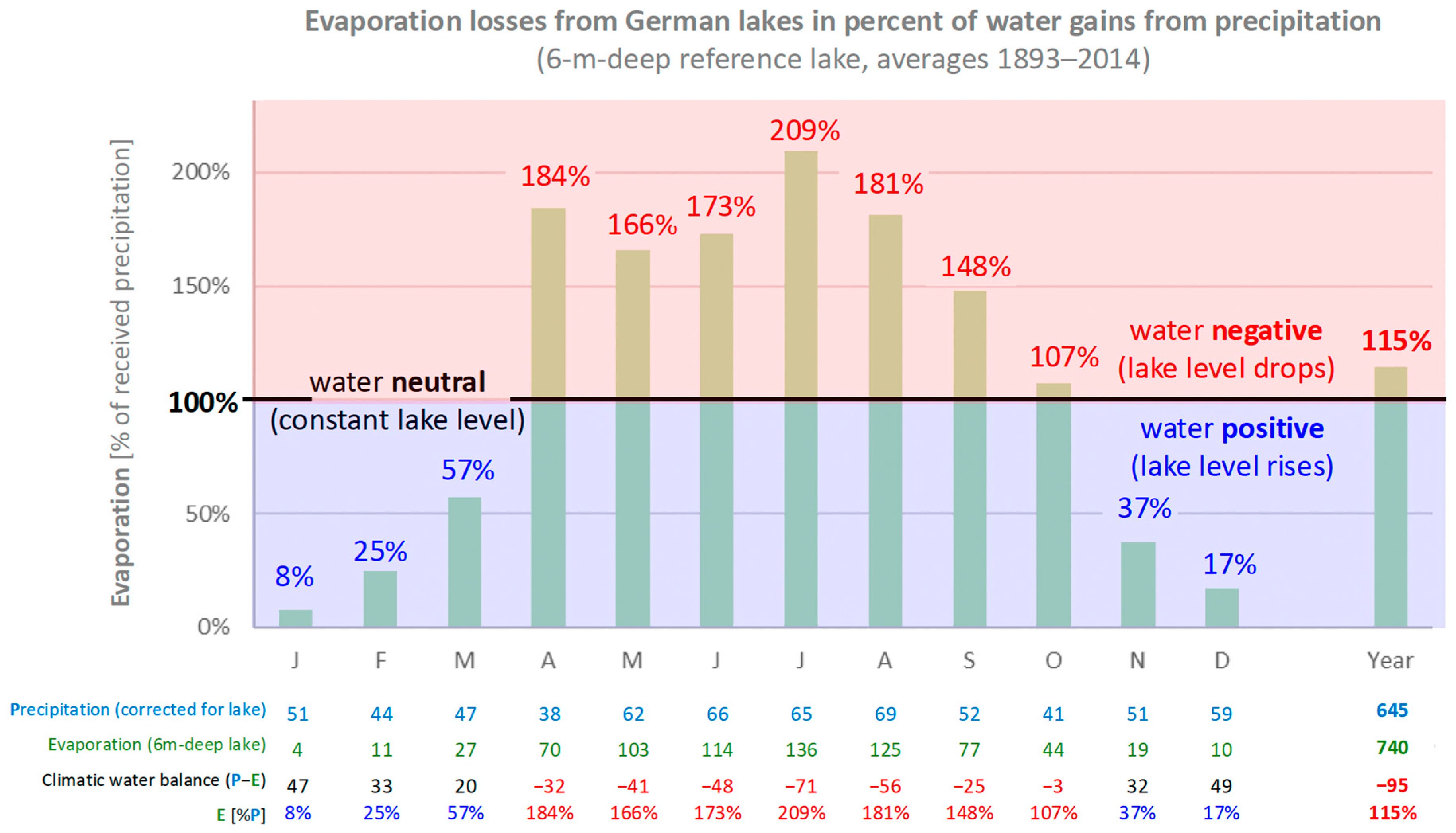
Once all pit lakes are fully flooded, the regional water balance will be significantly altered. By replacing vegetated land with an open water surface, mining has drastically increased evaporation losses in the region. Over lakes, where evaporation is unrestricted by protective cover layers, potential and actual evaporation are equal [23,24,25,26]. On average, German lakes lose 730–750 mm/a of water to the atmosphere, while receiving only ~640 mm/a of rainfall resulting in an annual deficit of 13–16% of received rainfall, which rises to nearly 100% during spring and summer [23,24,25,26] (Table 1; Figure 3).
In the two lignite coal fields, approximately 24% of the mined land, about 327 km2, will ultimately turn into open water. Our calculations indicate that this transformation of land use has rendered the Central German coal field fully water-negative by shifting the annual water balance from a pre-mining surplus (+32 Mm3/a) to an overall deficit (−44 Mm3/a) [27,194]. The Lusatian field fares slightly better, as the deficit calculated in this paper (−84 Mm3/a) still leaves the region water-positive despite losing nearly 60% of its pre-mining water balance [28]. Combined, the two regions are set to lose about 73% of the freshwater available before mining started (Table 4). Without continuous inflow from rivers draining catchments upstream of the Central German coal field, water levels in the newly formed pit lakes would gradually recede and draw in groundwater, thereby further lowering the regional water table. This, in turn, would eventually cut off baseflow to wetlands, small streams, and riparian ecosystems, and cause the wilting of shallow-rooted vegetation. While the new “lakescapes” with their beaches, marinas, and waterways project a newly created abundance of water to the general public, they are in fact, somewhat counterintuitively, contributing to drying out two of Germany’s driest regions even further and increasing their dependency on rivers importing water from elsewhere (Table 4).
Table 4. Climatic water balances in the Central German and Lusatian coal fields before and after the complete flooding of open pits (MAP—mean annual precipitation; MAE—mean annual evaporation; CWB—climatic water balance).
ParameterCentral German
Coal Field
Lusatian
Coal Field
Combined (a)
Total mine area [194]
(% of combined area)
485 km2
36%
875 km2
64%
1360 km2
100%
Projected pit lake area [27]
(% of total mine area)
119 km2
(24%)
208 km2
(24%)
327 km2
(24%)
Remaining land surface 366 km2667 km21033 km2
Regional MAP [24,25] MAE grass on sand ~500 mm/a
435 mm/a
~600 mm/a
435 mm/a
~565 (b) mm/a
435 mm/a
Pre-mining CWB (c)
(CWB [mm/a] × lake surface area)
65 mm/a
(32 Mm3/a)
165 mm/a
(144 Mm3/a)
129 mm/a (b)
(176 Mm3/a)
MAP over pit lakes (a)
(=82% of regional MAP)
408 mm/a
(=500 × 0.82)
492 mm/a
(=600 × 0.82)
463 (b) mm/a
MAE from pit lakes
(15 m-deep) [24,25]
>730 mm/a>730 mm/a>730 mm/a
CWB of pit lakes
(15 m-deep) (a)
−322 mm/a−238 mm/a−267 (b) mm/a
−36 Mm3/a−50 Mm3/a *−86 Mm3/a
Lost groundwater recharge (c)–8 Mm3/a
(=65 mm/a × 119 km2)
−34 Mm3/a
(=165 mm/a × 208 km2)
−42 Mm3/a
(sum)
Mining-induced water loss
(% of pre-mining balance)
−44 Mm3/a
(−138%)
−84 Mm3/a
(−58%)
−128 Mm3/a
(−73%)
(a) Own calculations, all values rounded to account for underlying uncertainties; (b) area-weighted average; (c) for simplicity reasons, pre-mining land use is assumed to consist exclusively of grassland over sand, somewhat overestimating the actual water loss as evaporation from unvegetated farmland and sealed areas in villages and towns as other pre-mining land uses are lower. * This estimate aligns well with the up to 60 Mm3/a needed by the River Spree according to the [198].
Future climatic changes due to the burning of coal and other fossil fuels are predicted to result in rising temperatures that, in turn, would increase water losses through evaporation worsening water scarcity in the dry lignite mining regions, and everywhere else where sufficient streamflow is needed to cope with discharged mine effluents. Long-term meteorological data of the German weather service (DWD) from 1893 to 2024 suggest that average annual evaporation from open water across Germany (6 m-deep reference lake) indeed increased by 55 mm/a (7.5%). Fortunately, this is more than off-set by a simultaneous 8.9% increase in rainfall (65 mm/a) over much of the same period (1881–2023) resulting in a net increase in available water across the entire country of 10 mm/a. This increase in precipitation is most pronounced in Eastern Germany where between 1991 and 2020, figures rose by 2.5–15% compared to the preceding climatic normal period (1961–1990) [26]. While this is not enough to compensate for the mining-induced evaporation losses in the two lignite regions, it is a mitigating factor.

4. Discussion

4.1. Type and Consequences of Impacts

The case studies reviewed indicate that mining-related impacts on water are often far more severe, longer-lasting, costly, and extensive than originally anticipated [10]. The impacts of mines frequently extend well beyond the actual mining sites, affecting users and aquatic ecosystems over hundreds of kilometres downstream and up to thousands of square kilometres around the mine [10,54,108,110,111]. Some effects diminish over time, but others, are irreversible and will persist in perpetuity [131,194]. Because many legacy sites require ongoing long-term post-closure water management at significant cost at times when they no longer generate revenue, private companies frequently default on their obligations, effectively transferring liabilities to government and civil society [199]. Mining, in many instances, reduces water availability and degrades quality to levels unsuitable for human or ecological use without being held responsible for the associated knock-on effects and costs imposed on third parties (externalised costs) [17]. While some mines have expanded local water supply, e.g., by installing desalination plants or by piping water from elsewhere, such examples remain rare and still need to prove how sustainable they are once mining ceases [6].
Mining-related water impacts observed in the reviewed case studies can broadly be grouped into two recurrent patterns: high-frequency, low-magnitude impacts, such as the continuous outflow of relatively low volumes of tailings seepage, and low-frequency, high-magnitude impacts, such as catastrophic failures of tailings storage facilities suddenly releasing large volumes of tailings into the environment. Some dewatering-related processes, such as progressive sinkhole formation, occupy an intermediate position by continuously unfolding over decades with limited damage while occasionally resulting in catastrophic consequences.

4.2. Patterns and Extent of Mining-Related Water Pollution

Across different pollution pathways (i.e., effluent discharges, mine waste-related contamination, and acid mine drainage), a consistent pattern emerges in which the primary metal mined represents the dominant contaminant in impacted waters. While this holds for the majority of metal mines analysed [3,14], it does not apply to gold mining where co-occurring elements (like uranium in the case of South Africa) are the main contaminants of concern. In coal mining, this often is mercury [52,133]. Despite the widespread occurrence of AMD, many impacted streams retain circum-neutral pH values, highlighting that severe contamination is not confined to acid conditions [49,50,51].
Measured maximum contaminant levels in impacted streams were about five times higher than the reported average concentrations, ranging from 1.5 to 33 times. The higher ratios (15–33) were only observed for two streams, while all others displayed maxima between 1.5 and 4 times the respective average concentrations.
To enable the comparison of different contaminants, enrichment factors (EFs) were used to normalise reported concentrations against global natural background levels [9,12,200]. EF values for the various case studies indicate that mean concentrations of primary contaminants in mining-affected streams exceed natural background levels by about two orders of magnitude (~240 times on average) rising to four orders of magnitude for the highest reported maximum (EF = 27,000; U in the Klip River near Johannesburg). For accompanying (secondary) contaminants, enrichment factors are generally significantly lower. At an average EF of 0.3, the analysed contaminants did not even reach their respective background levels, while the highest recorded maximum exceeded them by 5700 times.

4.3. Translating Water Quality Impacts into Water Quantities

While such water quality metrics allow intercomparisons between pollution levels at different mines, they do not facilitate comparisons with water quantity impacts. In order to achieve this, it is proposed to express water quality degradation in terms of the hypothetical volume of clean water required for diluting the mining contaminants back to pre-impact levels. For example, if a mine increases contaminant concentrations in a receiving stream say from 1 to 10 mg/L, it would need ten times the streamflow volume at the point of impact of clean water to dilute contaminant levels in the stream back to pre-impact conditions (for a stream with a flowrate of say 10 ML/d, this would translate into 100 ML/d of clean water that the mine would have to add). Applying the average EF for primary contaminants mentioned above, mines would need to augment flow in impacted water courses by 240 times. While this is hardly feasible in practice, it would help to visualise the often-invisible water quality changes across all types of contaminants. By using the EF for the main (primary) contaminant, all other accompanying pollutants (at lower concentrations in the receiving stream) are automatically addressed as well.

4.4. Monetisation of Water Quality Impacts: Internalising Externalised Cost

Since such volumes are rarely available to any mine, this dilution concept remains hypothetical. To make it applicable in practice, the calculated dilution volumes could be translated into monetary costs (i.e., pollution penalty fees). Using local water tariffs would reflect regional differences in water value. While the resulting fees may appear prohibitive at first, they are grounded in physico-chemical mass-balance considerations and are intended to fully internalise the costs of mining-related pollution. As such, they may be less arbitrary than many current penalty schemes, which often rely on less transparent criteria. Higher penalty fees could incentivise mines to invest in improved water treatment as a lower-cost alternative. At present, such investments are often not considered economically justified because many pollution-related costs are borne by third parties.
Using costs as a generic impact metric would also facilitate the inclusion of monetised indirect and knock-on effects, such as agricultural losses from using polluted water (crop failure, livestock losses), health impacts on exposed populations (increased disease burden, medical expenses, lost income, and costs of bottled water or household filtration), and ecological damage.

4.5. Synopsis

Preventing unaccounted for or underreported water impacts in future requires pre-mining assessments that move beyond conventional water reporting and incorporate processes commonly overlooked in current reporting systems [9,11,12]. While Environmental Impact Assessments (EIAs) are now widely required for mining projects, many of the impacts discussed here originate from operations approved before EIA legislation existed, or from assessments whose scope focused on operational phases and local compliance rather than long-term, off-site, or post-closure hydrological impacts [201]. The examples explored in this paper include decade-long or even perpetual pumping and treatment of mine water, stream diversions, drying up of springs and wetlands, contamination of irrigation water and municipal drinking water systems, drying out of entire regions, degradation of agricultural land and settlements through dewatering-induced ground instability, century-long discharge of excess water ecosystems and cities which grew dependent on that suddenly stop, and pollution of streams, floodplains, and fluvial sediments that through accumulating radioactive and toxic metals turn into long-term threats to water supply systems with associated risks for public health and food security.
Beyond formal regulatory frameworks, the effectiveness of water-related impact assessment and management in mining is strongly influenced by governance quality and institutional capacity. In several mining regions, limited technical resources, weak enforcement, fragmented responsibilities, or deficiencies in transparency and accountability can undermine monitoring, compliance, and long-term water management, even where regulations formally exist. Such governance constraints help explain why the cumulative, off-site, and post-closure water impacts documented in this review often persist despite established legal requirements. While a detailed governance analysis lies beyond the scope of this study, these factors represent an important contextual driver shaping the real-world performance of mining-related water management.
While some of the selected studies represent extreme cases in terms of magnitude, they all illustrate that water reporting should be significantly expanded to better reflect the full scale and variety of mining impacts. Externalised costs remain largely absent from formal assessments and seldom appear in standard evaluations, nor are the accumulated impacts of several mines on single water bodies captured adequately [32,33,118,119,146,202]. Further shortcomings relate to a lack of monitoring of withdrawals by source (local surface water or groundwater, imported or purchased water, water encountered underground, recycled water) as well as low levels of enforcement of now often adequately updated legislation due to capacity constraints or maladministration. Future reporting frameworks should incorporate basin-scale indicators, post-closure phases, and means to monetise externalities such as ecosystem service losses and social cost caused by pollution or depleting local water resources [11,199,203]. Examples are plentiful ranging from pollution-related agricultural losses and the resultant food insecurity, damage of industrial users who no longer can use water for cooling or other processes, need for additional treatment for water service providers, and citizens resorting to buying bottled water instead to actual health impacts on people and the associated suffering and financial burden (Table 5).

5. Conclusions

Using selected case studies from around the globe, this review illustrates how mining activities impact water resources at magnitudes and over time scales far exceeding what is typically considered by current permitting and reporting systems. Nearly all examined cases exhibit damage persisting over decades, centuries, or even millennia affecting whole rivers, entire catchments, and up to several thousands of square kilometres around dewatering mines. This relates to acid mine drainage, aquifer drawdown, toxic effluent release, and hydrological alteration at the local and regional scales. While mining itself at any given site is generally finite, its water legacy at many sites may not be. In fact, the most severe burdens arise often only after closure, yet post-mining phases remain frequently absent from current reporting systems or are only inadequately covered, frequently omitting processes that drive longer-term risks. These include multi-decade obligations to pump and treat water, diffuse contamination from weathered mine wastes, and permanent hydrological deficits. Given the globally increasing competition for water for food production, industry, and domestic needs, together with the projected expansion of mining to meet the soaring demand for minerals associated with the energy transition, a proactive approach to assessing and reporting mining-related water impacts is increasingly needed.
By identifying and categorising direct and indirect water impacts that are often omitted or insufficiently covered in standard water reports, this paper argues for a more comprehensive representation of mining-related water implications in future assessments.

Supplementary Materials

The following supporting information can be downloaded at https://www.mdpi.com/article/10.3390/su18041774/s1, Table S1: PRISMA 2020 checklist and location of reported items in the manuscript.; Table S2: Keywords used in the systematic literature review, grouped by thematic category. This list includes controlled vocabulary and free-text terms employed during the systematic search across databases such as Scopus, Web of Science, and Google Scholar; Table S3: Case studies listed in the table were selected based on several reviewed references of which only an indicative key reference is included here; Table S4: Contaminant concentrations and enrichment factors in waters affected by acid mine drainage (AMD). Max EF: maximum enrichment factor; Av EF: average enrichment factor; “-”: no analysis; NA: not applicable; Table S5: Contaminant concentrations and enrichment factors in sediments of water bodies affected by acid mine drainage (AMD). Max EF: maximum enrichment factor; Av EF: average enrichment factor; “-”: no analysis; NA: not applicable; Table S6: Contaminant concentrations and enrichment factors in tailings effluents associated with acid mine drainage (AMD). Max EF: maximum enrichment factor; Av EF: average enrichment factor; “-”: no analysis; NA: not applicable; Table S7: Comparative overview of large-scale mining waste discharges and their impacts on aquatic and terrestrial environments. Abbreviations: a: years; B: billion; ha: hectare(s); M: million; m3: cubic metre(s); Mt: million tonnes; U: uranium; Th: thorium; →: flows into; t: tonnes; Table S8: Major mining-related water contamination events and their environmental and socio-economic impacts. “Affected length” indicates the total extent of impacted surface water bodies or areas. Abbreviations: M, million; B, billion; m3, cubic metres; t, tonnes; ~, approximately; Mt, million tonnes; a, per year; ~, around/approximately; Table S9: Extent of mining and selected water impacts in the Central German and Lusatian coal fields. Abbreviations: a, year; c., century; t, tonnes; B, billion; Mm3, million cubic metres; Mm3/a, million cubic metres per year.

Author Contributions

Conceptualization: F.W.; Methodology: F.W.; Structuring: F.W.; Literature Review: A.M.N.-P.; Resources: F.W.; Writing—Original Draft: A.M.N.-P.; Writing—Review and Editing: F.W. and A.M.N.-P.; Visualisation: F.W.; Data Curation: F.W. and A.M.N.-P.; Data Generation: F.W.; Supervision: F.W.; Project Administration: F.W.; Funding Acquisition: F.W. All authors have read and agreed to the published version of the manuscript.

Funding

This paper results from research conducted within the Thuringian Water Innovation Cluster (ThWIC) as part of the WatAs project, which aims to develop indicators for assessing sustainable water management and is funded by the Federal Ministry of Education and Research (BMBF, Förderkennzeichen 03ZU1214PC). The open access publication fees were covered by the ThWIC/WatAs project.

Data Availability Statement

The calculations of water losses for the two lignite mining regions in Eastern Germany were developed specifically for this paper using present base data.

Conflicts of Interest

Authors Frank Winde and Antonio M. Newman-Portela are employed by the state-owned remediation company WISMUT GmbH. The authors declare that the research was conducted in the absence of any commercial or financial relationships that could be construed as a potential conflict of interest.

References

  1. Moghimi Dehkordi, M.; Pournuroz Nodeh, Z.; Soleimani Dehkordi, K.; Salmanvandi, H.; Rasouli Khorjestan, R.; Ghaffarzadeh, M. Soil, Air, and Water Pollution from Mining and Industrial Activities: Sources of Pollution, Environmental Impacts, and Prevention and Control Methods. Results Eng. 2024, 23, 102729. [Google Scholar] [CrossRef]
  2. Simpson, G.B.; Ferguson, K.; Slingerland, N.; Jewitt, G.P.W.; Alekseenko, A.V.; Simpson, Z.Z.; Ennis-John, J.; Hattingh, R.; Stock, K. Integrating the Sustainable Development Goals into Post-Mining Land Use Selection. Sci. Rep. 2025, 15, 31974. [Google Scholar] [CrossRef] [PubMed]
  3. Ochieng, G.M.; Seanego, E.S.; Nkwonta, O.I. Impacts of Mining on Water Resources in South Africa: A Review. Sci. Res. Essays 2010, 5, 3351–3357. Available online: https://www.researchgate.net/publication/228513226_Impacts_of_mining_on_water_resources_in_South_Africa_A_review (accessed on 1 October 2025).
  4. Radu, V.M.; Vîjdea, A.M.; Ivanov, A.A.; Alexe, V.E.; Dincă, G.; Cetean, V.M.; Filiuță, A.E. Research on the Closure and Remediation Processes of Mining Areas in Romania and Approaches to the Strategy for Heavy Metal Pollution Remediation. Sustainability 2023, 15, 15293. [Google Scholar] [CrossRef]
  5. Giljum, S.; Maus, V.; Sonter, L. Metal Mining Is a Global Driver of Environmental Change. Nat. Rev. Earth Environ. 2025, 6, 441–455. [Google Scholar] [CrossRef]
  6. International Council on Mining and Metals, (ICMM). Position Statement: Water Stewardship; International Council on Mining and Metals: London, UK, 2017; Available online: https://www.icmm.com/en-gb/our-principles/position-statements/water-stewardship (accessed on 1 October 2025).
  7. International Council on Mining and Metals, (ICMM). Water Reporting: Good Practice Guide, 2nd ed.; International Council on Mining and Metals: London, UK, 2021; Available online: https://www.icmm.com/en-gb/guidance/environmental-stewardship/2021/water-reporting (accessed on 1 October 2025).
  8. International Council on Mining and Metals, (ICMM). Water Stewardship Maturity Framework: Understanding and Advancing Water Stewardship Practices in the Mining and Metals Industry; International Council on Mining and Metals: London, UK, 2024; Available online: https://blueriskintel.com/wp-content/uploads/2024/07/guidance_water-maturity-framework.pdf (accessed on 1 October 2025).
  9. Northey, S.A.; Mudd, G.M.; Werner, T.T.; Haque, N.; Yellishetty, M. Sustainable Water Management and Improved Corporate Reporting in Mining. Water Resour. Ind. 2019, 21, 100104. [Google Scholar] [CrossRef]
  10. Mudd, A.G.M.; Northey, S.A.; Werner, D.T. Final Report: Water Use and Risks in Mining. Report to Columbia Water Center, Earth Institute, Columbia University. 2017. Available online: https://water.columbia.edu/sites/water.columbia.edu/files/content/publications/Water-Use-and-Risks-in-Mining.pdf (accessed on 1 October 2025).
  11. Northey, S.A.; Mudd, G.M.; Saarivuori, E.; Wessman-Jääskeläinen, H.; Haque, N. Water Footprinting and Mining: Where Are the Limitations and Opportunities? J. Clean. Prod. 2016, 135, 1098–1116. [Google Scholar] [CrossRef]
  12. Younger, P.L. The Water Footprint of Mining Operations in Space and Time—A New Paradigm for Sustainability Assessments? Australasian Institute of Mining and Metallurgy Publication Series 2006, 13–21. Available online: https://www.researchgate.net/publication/286716868_The_water_footprint_of_mining_operations_in_space_and_time_-_a_new_paradigm_for_sustainability_assessments (accessed on 1 October 2025).
  13. Talbot, D.; Barbat, G. Water Disclosure in the Mining Sector: An Assessment of the Credibility of Sustainability Reports. Corp. Soc. Responsib. Environ. 2020, 27, 1241–1251. [Google Scholar] [CrossRef]
  14. Wolkersdorfer, C.; Mugova, E. Effects of Mining on Surface Water. In Encyclopedia of Inland Waters, 2nd ed.; Elsevier: Amsterdam, The Netherlands, 2022; Volume 4, pp. 170–188. [Google Scholar] [CrossRef]
  15. Emmanuel, A.Y.; Jerry, C.S.; Dzigbodi, D.A. Review of Environmental and Health Impacts of Mining in Ghana. J. Health Pollut. 2018, 8, 43–52. [Google Scholar] [CrossRef]
  16. Pedrozo-Acuña, A.; Breña-Naranjo, J.A.; Ramírez-Salinas, N.; Bustos-Montes, J.C.; Soriano-Monzalvo, J.C.; Zetina-Robleda, E.F.; López-López, M.R. Environmental Impact of Mining Activities on Water Availability, Quality and Sediments in the Sonora River, Mexico. Water Air Soil Pollut. 2025, 236, 524. [Google Scholar] [CrossRef]
  17. Bainton, N.; Holcombe, S. A Critical Review of the Social Aspects of Mine Closure. Resour. Policy 2018, 59, 468–478. [Google Scholar] [CrossRef]
  18. BHP Group Limited, (BHP). Our Products Help Build a Better, Clearer Future. 2025. Available online: www.bhp.com (accessed on 1 October 2025).
  19. Carroll, K.C.; Jordan, F.L.; Glenn, E.P.; Jody Waugh, W.; Brusseau, M.L. Comparison of Nitrate Attenuation Characterization Methods at the Uranium Mill Tailing Site in Monument Valley, Arizona. J. Hydrol. 2009, 378, 72–81. [Google Scholar] [CrossRef]
  20. Intergovernmental Panel on Climate Change, (IPCC). Climate Change 2022: Impacts, Adaptation and Vulnerability; Contribution of Working Group II to the Sixth Assessment Report of the Intergovernmental Panel on Climate Change; Cambridge University Press: Cambridge, UK; New York, NY, USA, 2022; Available online: www.ipcc.ch/report/ar6/wg2/ (accessed on 15 January 2026).
  21. Intergovernmental Panel on Climate Change, (IPCC). Climate Change 2021: The Physical Science Basis; Contribution of Working Group I to the Sixth Assessment Report of the Intergovernmental Panel on Climate Change; Cambridge University Press: Cambridge, UK; New York, NY, USA, 2021; Available online: www.ipcc.ch/report/ar6/wg1/ (accessed on 15 January 2026).
  22. Page, M.J.; McKenzie, J.E.; Bossuyt, P.M.; Boutron, I.; Hoffmann, T.C.; Mulrow, C.D.; Shamseer, L.; Tetzlaff, J.M.; Akl, E.A.; Brennan, S.E.; et al. The PRISMA 2020 Statement: An Updated Guideline for Reporting Systematic Reviews. BMJ 2021, 372, n71. [Google Scholar] [CrossRef] [PubMed]
  23. Deutscher Wetterdienst, (DWD). Mittelwerte Niederschlag in Deutschland; Gewässerverdunstung—Verdunstung; Deutscher Wetterdienst: Offenbach am Main, Germany, 2025; Available online: https://www.dwd.de/DE/leistungen/verdunstung/verdunstung.html (accessed on 1 October 2025).
  24. Deutscher Wetterdienst, (DWD). Mittlere Monats-und Jahreswerte der Verdunstungshöhe Ausgewählter Flächennutzungen und der Korrigierten Niederschlagshöhe für Musterorte in Deutschland. Mittelwerte für die Jahre 1893–2014; Gewässerverdunstung—Verdunstung; Offenbach am Main, Germany, 2025. Available online: https://www.dwd.de/DE/Home/home_node.html (accessed on 1 October 2025).
  25. Deutscher Wetterdienst, (DWD). Jahreswerte der Verdunstung Freier Wasserflächen (See, Mittlere Tiefe 6 m) für Einen Musterort in Deutschland. Mittelwerte für die Jahre 1893–2014; Gewässerverdunstung—Verdunstung; Offenbach am Main, Germany, 2025. Available online: https://dwdbib.dwd.de/retrosammlung/content/pageview/971229 (accessed on 1 October 2025).
  26. Deutscher Wetterdienst, (DWD). Anomalie der Jährlichen Niederschlagssummen von 1991–2020 in % vom Mittel 1961–1990; Gewässerverdunstung—Verdunstung; Offenbach am Main, Germany, 2025. Available online: https://www.dwd.de/DE/leistungen/klimakartendeutschland/klimakartendeutschland_monatsbericht.html?cl2Categories_LeistungsId=klimakartendeutschland&lsId=376450&cl2Categories_Jahr=2016&cl2Categories_Monat=brdmap_07 (accessed on 1 October 2025).
  27. Nixdorf, B.; Hemm, M.; Schlundt, A.; Kapfer, M.; Krumbeck, H. Braunkohletagebauseen in Deutschland—Gegenwärtiger Kenntnisstand über Wasserwirtschaftliche Belange von Braunkohletagebaurestlöchern; Brandenburgische Technische Universität Cottbus, Lehrstuhl Gewässerschutz: Cottbus, Germany, 2000. [Google Scholar]
  28. Landesumweltamt Brandenburg. Wasserbeschaffenheit in Tagebaurestseen; Studien und Tagungsberichte, Band 6; Schriftenreihe des LAU Brandenburg: Potsdam, Germany, 1995; p. 89. Available online: https://opus4.kobv.de/opus4-slbp/frontdoor/deliver/index/docId/4871/file/luabd6_1.pdf (accessed on 1 October 2025).
  29. Akcil, A.; Koldas, S. Acid Mine Drainage (AMD): Causes, Treatment and Case Studies. J. Clean. Prod. 2006, 14, 1139–1145. [Google Scholar] [CrossRef]
  30. Chen, L.; Huang, L.; Méndez-García, C.; Kuang, J.; Hua, Z.; Liu, J.; Shu, W. Microbial Communities, Processes and Functions in Acid Mine Drainage Ecosystems. Curr. Opin. Biotechnol. 2016, 38, 150–158. [Google Scholar] [CrossRef]
  31. Lottermoser, B. Predicting Acid Mine Drainage: Past, Present, Future. Min. Rep. 2015, 151, 480–489. Available online: https://publications.rwth-aachen.de/record/565620 (accessed on 1 October 2025).
  32. Strosnider, W.H.J.; Llanos López, F.S.; Nairn, R.W. Acid Mine Drainage at Cerro Rico de Potosí I: Unabated High-Strength Discharges Reflect a Five Century Legacy of Mining. Environ. Earth Sci. 2011, 64, 899–910. [Google Scholar] [CrossRef]
  33. Strosnider, W.H.J.; Llanos López, F.S.; Nairn, R.W. Acid Mine Drainage at Cerro Rico de Potosí II: Severe Degradation of the Upper Rio Pilcomayo Watershed. Environ. Earth Sci. 2011, 64, 911–923. [Google Scholar] [CrossRef]
  34. Miller, J.R.; Hudson-Edwards, K.A.; Lechler, P.J.; Preston, D.; Macklin, M.G. Heavy Metal Contamination of Water, Soil and Produce within Riverine Communities of the Río Pilcomayo Basin, Bolivia. Sci. Total Environ. 2004, 320, 189–209. [Google Scholar] [CrossRef]
  35. World Health Organization, (WHO). Guidelines for Drinking-Water Quality: Fourth Edition Incorporating the First Addendum; World Health Organization: Geneva, Switzerland, 2022; Available online: https://www.who.int/publications/i/item/9789240045064 (accessed on 1 October 2025).
  36. Food and Agriculture Organization of the United Nations, (FAO). The State of Food Security and Nutrition in the World 2023: Urbanization, Agrifood Systems Transformation and Healthy Diets Across the Rural–Urban Continuum. Food and Agriculture Organization of the United Nations, (FAO): Rome, Italy, 2023. [Google Scholar] [CrossRef]
  37. World Health Organization, (WHO). Iron in Drinking-Water: Background Document for Development of WHO Guidelines for Drinking-Water Quality; World Health Organization: Geneva, Switzerland, 2003; Available online: https://cdn.who.int/media/docs/default-source/wash-documents/wash-chemicals/iron-bd.pdf?sfvrsn=8bde1f09_4 (accessed on 1 October 2025).
  38. Barceloux, D.G. Cobalt. Clin. Toxicol. 1999, 37, 201–216. [Google Scholar] [CrossRef]
  39. Botté, A.; Zaidi, M.; Guery, J.; Fichet, D.; Leignel, V. Aluminium in Aquatic Environments: Abundance and Ecotoxicological Impacts. Aquat. Ecol. 2022, 56, 751–773. [Google Scholar] [CrossRef]
  40. Department of Water Affairs and Forestry, (DWAF). South African Water Quality Guidelines; Department of Water Affairs and Forestry: Pretoria, South Africa, 1996; Volume 1: Domestic Use. Available online: https://www.dws.gov.za/Groundwater/documents/Pol_saWQguideFRESHDomesticusevol1.pdf (accessed on 1 October 2025).
  41. El-Naggar, A.; Ahmed, N.; Mosa, A.; Niazi, N.K.; Yousaf, B.; Sharma, A.; Sarkar, B.; Cai, Y.; Chang, S.X. Nickel in Soil and Water: Sources, Biogeochemistry, and Remediation Using Biochar. J. Hazard. Mater. 2021, 419, 126421. [Google Scholar] [CrossRef] [PubMed]
  42. Kumkrong, P.; LeBlanc, K.L.; Mercier, P.H.J.; Mester, Z. Selenium Analysis in Waters. Part 1: Regulations and Standard Methods. Sci. Total Environ. 2018, 640–641, 1611–1634. [Google Scholar] [CrossRef] [PubMed]
  43. Slack, J.F.; Kimball, B.E.; Shedd, K.B. Cobalt. In Critical Mineral Resources of the United States—Economic and Environmental Geology and Prospects for Future Supply; Schulz, K.J., DeYoung, J.H., Jr., Seal, R.R., II, Bradley, D.C., Eds.; Professional Paper 1802; U.S. Geological Survey: Reston, VA, USA, 2017; pp. F1–F40. [Google Scholar] [CrossRef]
  44. Strosnider, W.H.J.; Llanos López, F.S.; LaBar, J.A.; Palmer, K.J.; Nairn, R.W. Unabated Acid Mine Drainage from Cerro Rico de Potosí, Bolivia: Uncommon Constituents of Concern Impact the Rio Pilcomayo Headwaters. Environ. Earth Sci. 2014, 71, 3223–3234. [Google Scholar] [CrossRef]
  45. Avigliano, E.; Resongles, E.; Moreno, E.; Marie, M.; Jaldín, M.; Pouilly, M. Transboundary Mining Pollution? Metal(Oid) Concentrations in Water, Sediments, and Risk Assessment for Fish Consumption in a Lower Andean-to-Chaco Sediment-Choked Basin. Environ. Sci. Pollut. Res. 2025, 32, 15258–15273. [Google Scholar] [CrossRef]
  46. Swift, B. In the Heart of Bolivia, the Mountain That Financed an Empire Risks Collapsing. 2025. Available online: https://news.mongabay.com/2025/10/in-the-heart-of-bolivia-the-mountain-that-financed-an-empire-risks-collapsing/ (accessed on 1 October 2025).
  47. Sun, J.; Strosnider, W.H.J.; Nairn, R.W.; LaBar, J.A. Water Quality Impacts of In-Stream Mine Tailings on a Headwater Tributary of the Rio Pilcomayo, Potosí, Bolivia. Appl. Geochem. 2020, 113, 104464. [Google Scholar] [CrossRef]
  48. Smolders, A.J.P.; Lock, R.A.C.; Van Der Velde, G.; Medina Hoyos, R.I.; Roelofs, J.G.M. Effects of Mining Activities on Heavy Metal Concentrations in Water, Sediment, and Macroinvertebrates in Different Reaches of the Pilcomayo River, South America. Arch. Environ. Contam. Toxicol. 2003, 44, 314–323. [Google Scholar] [CrossRef]
  49. Humphries, M.S.; McCarthy, T.S.; Pillay, L. Attenuation of Pollution Arising from Acid Mine Drainage by a Natural Wetland on the Witwatersrand. S. Afr. J. Sci. 2017, 113, 9. [Google Scholar] [CrossRef]
  50. Naicker, K.; Cukrowska, E.; McCarthy, T.S. Acid Mine Drainage Arising from Gold Mining Activity in Johannesburg, South Africa and Environs. Environ. Pollut. 2003, 122, 29–40. [Google Scholar] [CrossRef]
  51. Tutu, H.; McCarthy, T.S.; Cukrowska, E. The Chemical Characteristics of Acid Mine Drainage with Particular Reference to Sources, Distribution and Remediation: The Witwatersrand Basin, South Africa as a Case Study. Appl. Geochem. 2008, 23, 3666–3684. [Google Scholar] [CrossRef]
  52. Winde, F.; Sandham, L.A. Uranium Pollution of South African Streams—An Overview of the Situation in Gold Mining Areas of the Witwatersrand. GeoJournal 2004, 61, 131–149. [Google Scholar] [CrossRef]
  53. Hudson-Edwards, K.A.; Schell, C.; Macklin, M.G. Mineralogy and Geochemistry of Alluvium Contaminated by Metal Mining in the Rio Tinto Area, Southwest Spain. Appl. Geochem. 1999, 14, 1015–1030. [Google Scholar] [CrossRef]
  54. Olías, M.; Cánovas, C.R.; Macías, F.; Basallote, M.D.; Nieto, J.M. The Evolution of Pollutant Concentrations in a River Severely Affected by Acid Mine Drainage: Río Tinto (SW Spain). Minerals 2020, 10, 598. [Google Scholar] [CrossRef]
  55. Olías, M.; Nieto, J. Background Conditions and Mining Pollution throughout History in the Río Tinto (SW Spain). Environments 2015, 2, 295–316. [Google Scholar] [CrossRef]
  56. Ruiz Cánovas, C.; Olías, M.; Nieto, J.M. Metal(Loid) Attenuation Processes in an Extremely Acidic River: The Rio Tinto (SW Spain). Water Air Soil Pollut. 2014, 225, 1795. [Google Scholar] [CrossRef]
  57. Nieto, J.M.; Sarmiento, A.M.; Olías, M.; Canovas, C.R.; Riba, I.; Kalman, J.; Delvalls, T.A. Acid Mine Drainage Pollution in the Tinto and Odiel Rivers (Iberian Pyrite Belt, SW Spain) and Bioavailability of the Transported Metals to the Huelva Estuary. Environ. Int. 2007, 33, 445–455. [Google Scholar] [CrossRef] [PubMed]
  58. González, I.; Galán, E.; Romero, A. Assessing Soil Quality in Areas Affected by Sulfide Mining. Application to Soils in the Iberian Pyrite Belt (SW Spain). Minerals 2011, 1, 73–108. [Google Scholar] [CrossRef]
  59. Hobbs, P.J.; Cobbing, J.E. A Hydrogeological Assessment of Acid Mine Drainage Impacts in the West Rand Basin, Gauteng Province. CSIRNREWRER20070097C Pretoria CSIR/THRIP. 2007. Available online: https://www.scirp.org/reference/referencespapers?referenceid=107907 (accessed on 1 October 2025).
  60. Chetty, S.; Pillay, L.; Humphries, M.S. Gold Mining’s Toxic Legacy: Pollutant Transport and Accumulation in the Klip River Catchment, Johannesburg. S. Afr. J. Sci. 2021, 117, 87–97. [Google Scholar] [CrossRef]
  61. Raji, I.B.; Hoffmann, E.; Ngie, A.; Winde, F. Assessing Uranium Pollution Levels in the Rietspruit River, Far West Rand Goldfield, South Africa. Int. J. Environ. Res. Public Health 2021, 18, 8466. [Google Scholar] [CrossRef] [PubMed]
  62. Coetzee, H. An Assessment of Sources, Pathways, Mechanisms and Risks of Current and Potential Future Pollution of Water and Sediments in Gold-Mining Areas of the Wonderfonteinspruit Catchment. Water Research Commission. 2006. Available online: https://www.researchgate.net/publication/263067189_An_assessment_of_sources_pathways_mechanisms_and_risks_of_current_and_future_pollution_of_water_and_sediments_in_the_Wonderfonteinspruit_Catchment (accessed on 1 October 2025).
  63. Du Preez, G.; Wepener, V. Influence of Mining Pollution on Metal Bioaccumulation and Biomarker Responses in Cave Dwelling Fish, Clarias Gariepinus. Bull. Environ. Contam. Toxicol. 2016, 97, 18–23. [Google Scholar] [CrossRef]
  64. Winde, F.; Geipel, G.; Espina, C.; Schüz, J. Human Exposure to Uranium in South African Gold Mining Areas Using Barber-Based Hair Sampling. PLoS ONE 2019, 14, e0219059. [Google Scholar] [CrossRef]
  65. Zupunski, L.; Street, R.; Ostroumova, E.; Winde, F.; Sachs, S.; Geipel, G.; Nkosi, V.; Bouaoun, L.; Haman, T.; Schüz, J.; et al. Environmental Exposure to Uranium in a Population Living in Close Proximity to Gold Mine Tailings in South Africa. J. Trace Elem. Med. Biol. 2023, 77, 127141. [Google Scholar] [CrossRef] [PubMed]
  66. Kolver, L. R10bn Set aside for Witwatersrand AMD Mitigation. Mining Weekly Engineering News, 28 November 2014. Available online: https://www.engineeringnews.co.za/article/r10bn-set-aside-for-witwatersrand-amd-mitigation-2014-11-28 (accessed on 1 October 2025).
  67. Sarmiento, A.M.; Nieto, J.M.; Olías, M.; Cánovas, C.R. Hydrochemical Characteristics and Seasonal Influence on the Pollution by Acid Mine Drainage in the Odiel River Basin (SW Spain). Appl. Geochem. 2009, 24, 697–714. [Google Scholar] [CrossRef]
  68. Sánchez España, J.; López Pamo, E.; Santofimia, E.; Aduvire, O.; Reyes, J.; Barettino, D. Acid Mine Drainage in the Iberian Pyrite Belt (Odiel River Watershed, Huelva, SW Spain): Geochemistry, Mineralogy and Environmental Implications. Appl. Geochem. 2005, 20, 1320–1356. [Google Scholar] [CrossRef]
  69. European Commission. European Critical Raw Materials Act. 2023. Available online: https://commission.europa.eu/topics/competitiveness/green-deal-industrial-plan/european-critical-raw-materials-act_en#:~:text=The%20European%20Critical%20Raw%20Materials%20Act%20aims%20to%20strengthen%20EU’s,supply%20chain%20sustainability%20and%20circularity (accessed on 1 October 2025).
  70. Edraki, M.; Baumgartl, T.; Manlapig, E.; Bradshaw, D.; Franks, D.M.; Moran, C.J. Designing Mine Tailings for Better Environmental, Social and Economic Outcomes: A Review of Alternative Approaches. J. Clean. Prod. 2014, 84, 411–420. [Google Scholar] [CrossRef]
  71. Cacciuttolo, C.; Cano, D.; Custodio, M. Socio-Environmental Risks Linked with Mine Tailings Chemical Composition: Promoting Responsible and Safe Mine Tailings Management Considering Copper and Gold Mining Experiences from Chile and Peru. Toxics 2023, 11, 462. [Google Scholar] [CrossRef]
  72. Kossoff, D.; Dubbin, W.E.; Alfredsson, M.; Edwards, S.J.; Macklin, M.G.; Hudson-Edwards, K.A. Mine Tailings Dams: Characteristics, Failure, Environmental Impacts, and Remediation. Appl. Geochem. 2014, 51, 229–245. [Google Scholar] [CrossRef]
  73. Winde, F.; Wade, P.; Van Der Walt, I.J. Gold Tailings as a Source of Waterborne Uranium Contamination of Streams—The Koekemoerspruit (Klerksdorp Goldfield, South Africa) as a Case Study—Part I of III: Uranium Migration along the Aqueous Pathway. Water SA 2004, 30, 219–225. [Google Scholar] [CrossRef]
  74. Hatje, V.; Pedreira, R.M.A.; De Rezende, C.E.; Schettini, C.A.F.; De Souza, G.C.; Marin, D.C.; Hackspacher, P.C. The Environmental Impacts of One of the Largest Tailing Dam Failures Worldwide. Sci. Rep. 2017, 7, 10706. [Google Scholar] [CrossRef] [PubMed]
  75. Grimalt, J.O.; Ferrer, M.; Macpherson, E. The Mine Tailing Accident in Aznalcollar. Sci. Total Environ. 1999, 242, 3–11. [Google Scholar] [CrossRef]
  76. Sanz-Ramos, M.; Vales-Bravo, J.J.; Bladé, E.; Sánchez-Juny, M. Reconstructing the Spill Propagation of the Aznalcóllar Mine Disaster. Mine Water Environ. 2024, 43, 491–510. [Google Scholar] [CrossRef]
  77. Olías, M.; Cánovas, C.R.; Basallote, M.D. Surface and Groundwater Quality Evolution in the Agrio and Guadiamar Rivers After the Aznalcóllar Mine Spill (SW Spain): Lessons Learned. Mine Water Environ. 2021, 40, 235–249. [Google Scholar] [CrossRef]
  78. Manzano, M.; Ayora, C.; Domenech, C.; Navarrete, P.; Garralon, A.; Turrero, M.J. The Impact of the Aznalcóllar Mine Tailing Spill on Groundwater. Sci. Total Environ. 1999, 242, 189–209. [Google Scholar] [CrossRef] [PubMed]
  79. Rojas, S. Boliden Cifra en 115 Millones de Euros sus Gastos y Pérdidas Derivados del Vertido Tóxico de la Mina de Aznalcóllar. Sevilla, 11 July 2023. Available online: https://www.eldiario.es/sevilla/boliden-cifra-115-millones-euros-gastos-perdidas-derivados-vertido-toxico-mina-aznalcollar_1_10367581.html (accessed on 1 October 2025).
  80. Kütter, V.T.; Martins, G.S.; Brandini, N.; Cordeiro, R.C.; Almeida, J.P.A.; Marques, E.D. Impacts of a Tailings Dam Failure on Water Quality in the Doce River: The Largest Environmental Disaster in Brazil. J. Trace Elem. Miner. 2023, 5, 100084. [Google Scholar] [CrossRef]
  81. Teramoto, E.H.; Gemeiner, H.; Zanatta, M.B.T.; Menegário, A.A.; Chang, H.K. Metal Speciation of the Paraopeba River after the Brumadinho Dam Failure. Sci. Total Environ. 2021, 757, 143917. [Google Scholar] [CrossRef]
  82. Carmo, F.F.D.; Kamino, L.H.Y.; Junior, R.T.; Campos, I.C.D.; Carmo, F.F.D.; Silvino, G.; Castro, K.J.D.S.X.D.; Mauro, M.L.; Rodrigues, N.U.A.; Miranda, M.P.D.S.; et al. Fundão Tailings Dam Failures: The Environment Tragedy of the Largest Technological Disaster of Brazilian Mining in Global Context. Perspect. Ecol. Conserv. 2017, 15, 145–151. [Google Scholar] [CrossRef]
  83. Zhu, F.; Zhang, W.; Puzrin, A.M. The Slip Surface Mechanism of Delayed Failure of the Brumadinho Tailings Dam in 2019. Commun. Earth Environ. 2024, 5, 33. [Google Scholar] [CrossRef]
  84. Vergilio, C.D.S.; Lacerda, D.; Oliveira, B.C.V.D.; Sartori, E.; Campos, G.M.; Pereira, A.L.D.S.; Aguiar, D.B.D.; Souza, T.D.S.; Almeida, M.G.D.; Thompson, F.; et al. Metal Concentrations and Biological Effects from One of the Largest Mining Disasters in the World (Brumadinho, Minas Gerais, Brazil). Sci. Rep. 2020, 10, 5936. [Google Scholar] [CrossRef]
  85. Fernandes, G.W.; Goulart, F.F.; Ranieri, B.D.; Coelho, M.S.; Dales, K.; Boesche, N.; Bustamante, M.; Carvalho, F.A.; Carvalho, D.C.; Dirzo, R.; et al. Deep into the Mud: Ecological and Socio-Economic Impacts of the Dam Breach in Mariana, Brazil. Nat. Conserv. 2016, 14, 35–45. [Google Scholar] [CrossRef]
  86. Cardoso, G.O.; Falsarella, L.N.; Chiroque-Solano, P.M.; Porcher, C.C.; Leitzke, F.P.; Wegner, A.C.; Carelli, T.; Salomon, P.S.; Bastos, A.C.; Sá, F.; et al. Coral Growth Bands Recorded Trace Elements Associated with the Fundão Dam Collapse. Sci. Total Environ. 2022, 807, 150880. [Google Scholar] [CrossRef]
  87. Nogueira, M.; Bautzer, T. Brazil’s Vale Agrees to $7 Billion Brumadinho Disaster Settlement. Reuters, 5 February 2021. Available online: https://www.reuters.com/article/business/environment/brazils-vale-agrees-to-7-billion-brumadinho-disaster-settlement-idUSKBN2A41V4/ (accessed on 1 October 2025).
  88. Paraguassu, L. Brazil Seals $30 Billion Compensation Deal with BHP, Vale over 2015 Dam Collapse. Reuters, 26 October 2024. Available online: https://www.reuters.com/business/energy/bhp-reaches-30-bln-settlement-reparation-brazil-dam-failure-2024-10-25/ (accessed on 1 October 2025).
  89. Bearman, P.J. A Review of the Environmental Problems Associated with the Disposal of Uranium Tailings. Miner. Environ. 1979, 1, 64–74. [Google Scholar] [CrossRef]
  90. Canadian Nuclear Safety Commission. History of Uranium Mining in the Elliot Lake Region of Ontario and Associated Effects on Water Quality and Fish Intended for Human Consumption; Canadian Nuclear Safety Commission: Ottawa, ON, Canada, 2015; Available online: https://voute.bape.gouv.qc.ca/dl/?id=00000644060 (accessed on 1 October 2025).
  91. Davis, J.B.; Knapp, R.A.; Sinclair, K.W. Control of Seepage from Uranium Mill Tailings Ponds in the Elliot Lake Area. In Proceedings of the Tailings and Waste Disposal—Seepage, Contamination, Regulations, and Control; Society of Mining Engineers of AIME: Toronto, ON, Canada, 1979; pp. 726–736. Available online: https://www.imwa.info/docs/imds_1979/IMDS1979_Davis_726.pdf (accessed on 1 October 2025).
  92. Environment Canada. Decommissioning of Uranium Mine Tailings Management Areas in the Elliot Lake Area; En105-52/1996E; Minister of Supply and Services Canada: Ottawa, ON, Canada, 1996. Available online: https://publications.gc.ca/site/eng/9.613051/publication.html (accessed on 1 October 2025).
  93. Nicholson, R.V.; Ludgate, I.; Clyde, E.; Venhuis, M. The Successful Reclamation of Acid Generating Tailings in the Elliot Lake Uranium District of Canada: A Good-News Case. 2012. Available online: https://www.researchgate.net/publication/282021636_The_Successful_Reclamation_of_Acid_Generating_Tailings_in_the_Elliot_Lake_Uranium_District_of_Canada (accessed on 1 October 2025).
  94. Swanson, S.; Abouguendia, Z. The Problem of Abandoned Uranium Tailings in Northern Saskatchewan: An Overview; SRC Publication No. C-80S-48-C-81; Saskatchewan Research Council (SRC): Saskatoon, SK, Canada, 1981. Available online: https://inis.iaea.org/records/vbcdt-nrp26 (accessed on 1 October 2025).
  95. Saskatchewan Research Council, (SRC). Project CLEANS (Cleanup of Abandoned Northern Sites). Available online: https://www.src.sk.ca/project-cleans (accessed on 1 October 2025).
  96. Waite, D.T.; Joshi, S.R.; Sommerstad, H. The Effect of Uranium Mine Tailings on Radionuclide Concentrations in Langley Bay, Saskatchewan, Canada. Arch. Environ. Contam. Toxicol. 1988, 17, 373–380. [Google Scholar] [CrossRef] [PubMed]
  97. Waite, D.T.; Joshi, S.R.; Sommerstad, H.; Wobeser, G.; Gajadhar, A.A. A Toxicological Examination of Whitefish (Coregonus clupeaformis) and Northern Pike (Esox lucius) Exposed to Uranium Mine Tailings. Arch. Environ. Contam. Toxicol. 1990, 19, 578–582. [Google Scholar] [CrossRef] [PubMed]
  98. Fillion, M.P. Decommissioning and Reclamation of Beaver Lodge Tailings: Environmental and Radiological Considerations; Colorado State University: Fort Collins, CO, USA, 1984; pp. 349–358. Available online: https://inis.iaea.org/records/vwfkd-nqk81 (accessed on 1 October 2025).
  99. Yao, H.; Kidd, R.; Hashino, M. Long-Term Trend of Uranium Concentrations in Beaverlodge Lake, Saskatchewan, Canada, under Mine Decommissioning. In Water Quality and Sediment Behaviour of the Future: Predictions for the 21st Century, Proceedings of Symposium HS2005 at IUGG2007, Perugia, Italy, 2–13 July 2007; International Association of Hydrological Sciences: Wallingford, UK, 2007. [Google Scholar]
  100. Joshi, S.R.; Hatlelid, D.T.; Platford, R.F. Vertical Distribution of Uranium Mill Tailings Contaminants in the Langley Bay, Lake Athabasca Sediments. Sci. Total Environ. 1989, 87–88, 85–104. [Google Scholar] [CrossRef]
  101. Rage, E.; Richardson, D.B.; Demers, P.A.; Do, M.; Fenske, N.; Kreuzer, M.; Samet, J.; Wiggins, C.; Schubauer-Berigan, M.K.; Kelly-Reif, K.; et al. PUMA—Pooled Uranium Miners Analysis: Cohort Profile. Occup. Environ. Med. 2020, 77, 194–200. [Google Scholar] [CrossRef]
  102. Government of Saskatchewan. Province Issues Statement of Claim Against the Federal Government to Honour Commitment to Clean up Uranium Mine in Northern Saskatchewan. 2018. Available online: https://www.saskatchewan.ca/government/news-and-media/2018/november/28/gunnar-mine-cleanup (accessed on 1 October 2025).
  103. Prebble, P.; Coxworth, A. The Government of Canada’s Legacy of Contamination in Northern Saskatchewan Watersheds; Canadian Centre for Policy Alternatives—Saskatchewan Office: Saskatoon, SK, Canada, 2013; Available online: https://www.policyalternatives.ca/wp-content/uploads/attachments/SKnotes_Govt_Legacy_Contamination_Watersheds.pdf (accessed on 1 October 2025).
  104. Environmental Science and Engineering Magazine, (ESEMAG). Saskatchewan Suing Ottawa for More Funding on Gunnar Mine Cleanup. 3 December 2018. Available online: https://esemag.com/hazmat-remediation/gunnar-mine-cleanup/ (accessed on 1 October 2025).
  105. Straskraba, V.; Effner, S. Water Control in Underground Mines—Grouting or Drainage? International Mine Water Association: Johannesburg, South Africa, 1998; Available online: https://www.imwa.info/docs/imwa_1998/IMWA1998_Straskraba_195.pdf (accessed on 1 October 2025).
  106. Guzy, A.; Malinowska, A.A. Assessment of the Impact of the Spatial Extent of Land Subsidence and Aquifer System Drainage Induced by Underground Mining. Sustainability 2020, 12, 7871. [Google Scholar] [CrossRef]
  107. Schrader, A.; Winde, F. Unearthing a Hidden Treasure: 60 Years of Karst Research in the Far West Rand, South Africa. S. Afr. J. Sci. 2015, 111, 1–7. [Google Scholar] [CrossRef]
  108. Stoch, E.J.; Winde, F. Threats and Opportunities for Post-Closure Development in Dolomitic Gold Mining Areas of the West Rand and Far West Rand (South Africa)—A Hydraulic View Part 3: Planning and Uncertainty—Lessons from History. Water SA 2010, 36, 83–88. [Google Scholar] [CrossRef]
  109. Swart, C.J.U.; James, A.R.; Kleywegt, R.J.; Stoch, E.J. The Future of the Dolomitic Springs after Mine Closure on the Far West Rand, Gauteng, RSA. Environ. Geol. 2003, 44, 751–770. [Google Scholar] [CrossRef]
  110. Winde, F.; Stoch, E.J. Threats and Opportunities for Post-Closure Development in Dolomitic Gold Mining Areas of the West Rand and Far West Rand (South Africa)—A Hydraulic View Part 1: Mining Legacy and Future Threats. Water SA 2010, 36. [Google Scholar] [CrossRef]
  111. Winde, F.; Stoch, E.J. Threats and Opportunities for Post-Closure Development in Dolomitic Gold-Mining Areas of the West Rand and Far West Rand (South Africa)—A Hydraulic View Part 2: Opportunities. Water SA 2010, 36. [Google Scholar] [CrossRef]
  112. Ngcobo, T.A. The Risks Associated with Mines in Dolomitic Compartments. J. S. Afr. Inst. Min. Metall. 2006, 106, 251–264. Available online: https://www.saimm.co.za/Journal/v106n04p251.pdf (accessed on 1 October 2025).
  113. Olalde, M. Sinkholes—A Most Significant Threat. Independent Online. 2016. Available online: https://iol.co.za/news/2016-12-01-sinkholes-a-most-significant-threat/ (accessed on 1 October 2025).
  114. Heath, G.J.; Oosthuizen, A.C. A Preliminary Overview of the Sinkhole Record of South Africa. 2008. Available online: https://www.researchgate.net/publication/289532686_A_preliminary_overview_of_the_sinkhole_record_of_South_Africa (accessed on 1 October 2025).
  115. Bega, S. Khutsong Residents ‘Living in a Danger Zone’ Amid Sinkholes and Sewage. Mail and Guardian, 21 January 2023. Available online: https://mg.co.za/the-green-guardian/2023-01-21-khutsong-residents-living-in-a-danger-zone-amid-sinkholes-and-sewage (accessed on 1 October 2025).
  116. Tau, S. Khutsong Sinkholes: Gravestones Littered Everywhere as Cemetery on Brink of Being Swallowed. The Citizen, 17 November 2022. Available online: https://www.citizen.co.za/news/south-africa/khutsong-graves-swallowed-sinkholes-17-november-2022/ (accessed on 1 October 2025).
  117. Durand, J.F. The Impact of Gold Mining on the Witwatersrand on the Rivers and Karst System of Gauteng and North West Province, South Africa. J. Afr. Earth Sci. 2012, 68, 24–43. [Google Scholar] [CrossRef]
  118. Harnischmacher, S.; Zepp, H. Mining and Its Impact on the Earth Surface in the Ruhr District (Germany). Z. Geomorphol. 2014, 58, 3–22. [Google Scholar] [CrossRef]
  119. Melchers, C.; Westermann, S.; Reker, B.; Coldewey, W.G. Technische Hochschule Georg Agricola Evaluation of Mine Water Rebound Processes in the German Coalfields of Ruhr, Saar, Ibbenbüren, and the Adjacent European Countries: Project Report; Selbstverlag des Deutschen Bergbau-Museums Bochum: Bochum, Germany, 2020; Available online: https://fzn.thga.de/wp-content/uploads/sites/4/2021/02/Berichte-zum-Nachbergbau_Heft1_Evaluation-Mine-Water-Rebound_encoded.pdf (accessed on 1 October 2025).
  120. Oppelt, L.; Grab, T.; Ebel, T.; Wunderlich, T.; Storch, T.; Fieback, T. Mine Water as an Energy Source: Overview of Technical Basics, Existing Plants, and Monitoring Results. Mine Water Environ. 2025, 44, 519–543. [Google Scholar] [CrossRef]
  121. Stemke, M.; Wieber, G. Closure of German Hard Coal Mines: Effects and Legal Aspects of Mine Flooding. Mine Water Environ. 2022, 41, 280–291. [Google Scholar] [CrossRef]
  122. Wolkersdorfer, C.; Neumann, C.; Hasche-Berger, A. Hydrodynamics of the Flooded Freiberg/Saxony Underground Mine. In Water in Mining Environments; Cidu, R., Frau, F., Eds.; International Mine Water Association: Cagliari, Italy, 2007; pp. 1–5. Available online: https://www.imwa.info/docs/imwa_2007/IMWA2007_Wolkersdorfer.pdf (accessed on 1 October 2025).
  123. Bowen, G.G.; Dussek, C.; Hamilton, R.M. Pollution Resulting from the Abandonment and Subsequent Flooding of Wheal Jane Mine in Cornwall, UK. Geol. Soc. Lond. Spec. Publ. 1998, 128, 93–99. [Google Scholar] [CrossRef]
  124. Coal Authority & Mining Remediation Authority. Wheal Jane Mine Water Treatment Scheme—Case Study; UK Government (Department for Environment, Food & Rural Affairs): London, UK, 2020. Available online: https://www.gov.uk/government/case-studies/wheal-jane-mine-water-treatment-scheme (accessed on 1 October 2025).
  125. Hamilton, R.; Bowen, G.; Postlethwaite, N.; Dussek, C. The Abandonment of Wheal Jane, a Tin Mine in South West England. 1994. Available online: https://www.imwa.info/docs/imwa_1994/IMWA1994_Hamilton_543.pdf (accessed on 1 October 2025).
  126. Mayes, W.M.; Jarvis, A.P. Mine Water Outbreak and Stability Risks: Examples and Challenges from England and Wales. 2016. Available online: http://www.imwa.de/docs/imwa_2016/IMWA2016_Mayes_165.pdf (accessed on 1 October 2025).
  127. Neal, C.; Whitehead, P.G.; Jeffery, H.; Neal, M. The Water Quality of the River Carnon, West Cornwall, November 1992 to March 1994: The Impacts of Wheal Jane Discharges. Sci. Total Environ. 2005, 338, 23–39. [Google Scholar] [CrossRef]
  128. UK Essays Soil & Water Contamination: Wheal Jane Incident 2017. Available online: https://www.ukessays.com/essays/environmental-studies/soil-water-contamination-wheal-jane-6120.php (accessed on 1 October 2025).
  129. Younger, P.L.; Robins, N.S. Challenges in the Characterization and Prediction of the Hydrogeology and Geochemistry of Mined Ground. Geol. Soc. Lond. Spec. Publ. 2002, 198, 1–16. [Google Scholar] [CrossRef]
  130. Baloyi, J.; Ramdhani, N.; Mbhele, R.; Ramutshatsha-Makhwedzha, D. Recent Progress on Acid Mine Drainage Technological Trends in South Africa: Prevention, Treatment, and Resource Recovery. Water 2023, 15, 3453. [Google Scholar] [CrossRef]
  131. Coetzee, H.; Cole, P.; Ramugondo, S. Estimation of Mine Water Ingress Volumes for the Witwatersrand Goldfields. 2022. Available online: https://www.imwa.info/docs/imwa_2022/IMWA2022_Coetzee_53.pdf (accessed on 1 October 2025).
  132. Inter-Ministerial Committee on Acid Mine Drainage. Mine Water Management in the Witwatersrand Gold Fields with Special Emphasis on Acid Mine Drainage; Department of Water Affairs, Republic of South Africa: Pretoria, South Africa, 2010. Available online: https://www.dmre.gov.za/Portals/0/Resource%20Center/Reports%20and%20Other%20Documents/2010_Report_Interministerial%20Committee_Acid%20Mine%20Drainage.pdf?ver=2018-03-13-020432-273 (accessed on 1 October 2025).
  133. McCarthy, T.S. The Impact of Acid Mine Drainage in South Africa. S. Afr. J. Sci. 2011, 107, 7. [Google Scholar] [CrossRef]
  134. Sheridan, C. Conceptual Project on Using the Pumping Scheme to Eliminate Acid Mine Drainage: Report to the Water Research Commission; Water Research Commission: Pretoria, South Africa, 2015; Available online: https://www.wrc.org.za/wp-content/uploads/mdocs/KV%20337.pdf (accessed on 1 October 2025).
  135. Eulenberger, S.; Jenk, U.; Paul, M. Flooding of the Uranium Mine at Königstein/Saxony—Current Status and Monitoring Conducted; International Mine Water Association (IMWA): Wendelstein, Germany, 2017; pp. 296–302. Available online: https://www.researchgate.net/publication/318351323_Flooding_of_the_uranium_mine_at_KonigsteinSaxony_-_current_status_and_monitoring_conducted (accessed on 1 October 2025).
  136. Jenk, U.; Frenzel, M.; Metschies, T.; Paul, M. Flooding of the Underground Uranium Leach Operation at Königstein (Germany)—A Multidisciplinary Report; International Mine Water Association: Wendelstein, Germany, 2014; pp. 715–719. Available online: https://www.researchgate.net/publication/284163107_Flooding_of_the_Underground_Uranium_Leach_Operation_at_Konigstein_Germany_-_A_Multidisciplinary_Report (accessed on 1 October 2025).
  137. Jenk, U.; Paul, M. Groundwater Remediation and Protection at an Underground Leach Operation at Königstein, Germany. April 2018. Available online: http://avestia.com/CSEE2018_Proceedings/files/paper/AWSPT/AWSPT_105.pdf (accessed on 1 October 2025).
  138. Meyer, J.; Jenk, U.; Göhrs, A.; Schuppan, W. Characterisation of Final Mine Flooding at the Schlema-Alberoda Site of WISMUT GmbH with Particular Emphasis on Flooding Water Quality Evolution. In Uranium in the Aquatic Environment; Merkel, B.J., Planer-Friedrich, B., Wolkersdorfer, C., Eds.; Springer: Berlin/Heidelberg, Germany, 2002; pp. 769–774. Available online: https://link.springer.com/chapter/10.1007/978-3-642-55668-5_90 (accessed on 1 October 2025).
  139. Sächsische Zeitung. 2016. Available online: https://www.saechsische.de/wirtschaft/regional/milliardenprojekt-wismut-sanierung-4KNOQJZANNGTTJQ7QEE6HFZ5L4.html (accessed on 1 October 2025).
  140. Schmidt, N.; Eulenberger, S.; Jenk, U. Final Flooding of the Königstein Uranium Mine—Supporting Activities and Implications for Monitoring; International Mine Water Association: Wendelstein, Germany, 2022; pp. 453–458. Available online: https://www.imwa.info/docs/imwa_2022/IMWA2022_Schmidt_453.pdf (accessed on 1 October 2025).
  141. Schramm, A.; Meyer, J.; Metschies, T.; Jenk, U. Challenges of Water Management at the Uranium Mining Site Schlema-Alberoda of Wismut (Germany); International Mine Water Association: Wendelstein, Germany, 2023; pp. 450–456. Available online: https://www.imwa.info/docs/imwa_2023/IMWA2023_Schramm_450.pdf (accessed on 1 October 2025).
  142. Schütz, H.; Konietzky, H. Evaluation of Flooding Induced Seismicity from the Mining Area Schlema/Alberoda (Germany). Rock Mech. Rock Eng. 2016, 49, 4125–4135. [Google Scholar] [CrossRef]
  143. Wismut GmbH Dialog: Mitarbeiterzeitschrift Der Wismut GmbH; Sonderausgabe—25 Jahre Wismut GmbH; Wismut GmbH: Chemnitz, Germany, 2016; Available online: https://www.atommuellreport.de/fileadmin/Dateien/pdf/Datenblaetter/Wismut/Dialog_25-jahre-wismut-sonderausgabe.pdf (accessed on 1 October 2025).
  144. Lersow, M.; Schmidt, P. The Wismut Remediation Project; Australian Centre for Geomechanics (ACG), University of Western Australia: Perth, Australia, 2006. [Google Scholar] [CrossRef]
  145. Paul, M.; Baacke, D.; Metschies, T.; Kuhn, W. Post-Flooding Water Management at the Ronneburg Uranium Mine: Lessons Learned and Remaining Challenges; International Mine Water Association: Wendelstein, Germany, 2009; pp. 952–956. Available online: https://www.imwa.info/docs/imwa_2009/IMWA2009_Paul.pdf (accessed on 1 October 2025).
  146. Drobniewski, M.; Balzer, I.; Frankenhoff, H.; Witthaus, D.H. Mine Water Management in the Ruhr Coalfield. 2017. Available online: https://imwa.info/docs/imwa_2017/IMWA2017_Witthaus_183.pdf (accessed on 1 October 2025).
  147. Mittelstädt, P.; Pollmann, N.; Karimzadeh, L.; Kories, H.; Klinger, C. Wastes in Underground Coal Mines and Their Behavior during Mine Water Level Rebound—A Review. Minerals 2023, 13, 1496. [Google Scholar] [CrossRef]
  148. Harnischmacher, S. Quantification of mining subsidence in the Ruhr District (Germany). Géomorphol. Relief Process. Environ. 2010, 16, 261–274. [Google Scholar] [CrossRef]
  149. Jasnowski-Peters, H.; Melchers, C. Mine Water Rebound in the Former Hard Coal Mining Area of the Ruhr District—Hydrogeochemical Monitoring for a Sustainable, Ecological and Economical Feasible Post-Mining Approach. Min. Rep. 2022, 158, 333–343. Available online: https://openurl.ebsco.com/EPDB%3Agcd%3A16%3A24872752/detailv2?sid=ebsco%3Aplink%3Ascholar&id=ebsco%3Agcd%3A159306158&crl=c&link_origin=www.google.com (accessed on 1 October 2025).
  150. RAG-Stiftung. Ruhr Region—Mine Water Management in the Ruhr District; RAG AG: Essen, Germany, 2018; Available online: https://www.rag-stiftung.de/en/perpetual-obligations/ruhr-region (accessed on 1 October 2025).
  151. RAG-Stiftung. Following the End of the German Hard Coal Mining Industry, the RAG-Stiftung Has Now Begun to Finance the Perpetual Obligations; RAG AG: Essen, Germany, 2019; Available online: https://www.rag-stiftung.de/en/press/press-releases/following-the-end-of-the-german-hard-coal-mining-industry-the-rag-stiftung-has-now-begun-to-finance-the-perpetual-obligations-1-245/ (accessed on 1 October 2025).
  152. Groudev, S.; Georgiev, P.; Spasova, I.; Nicolova, M. Bioremediation of Acid Mine Drainage in a Uranium Deposit. Hydrometallurgy 2008, 94, 93–99. [Google Scholar] [CrossRef]
  153. International Network for Acid Prevention, (INAP): Vancouver, Canada. 2017. Available online: https://www.gardguide.com/ (accessed on 1 October 2025).
  154. Johnson, D.B.; Hallberg, K.B. Acid Mine Drainage Remediation Options: A Review. Sci. Total Environ. 2005, 338, 3–14. [Google Scholar] [CrossRef] [PubMed]
  155. Younger, P.L.; Adams, R. Predicting Mine Water Rebound. 1999. Available online: https://www.researchgate.net/doi/10.13140/2.1.4805.5681 (accessed on 1 October 2025).
  156. Al Heib, M.; Varouchakis, E.A.; Galetakis, M.; Renaud, V.; Burda, J. A Framework for Assessing Hazards Related to Pit Lakes: Application on European Case Studies. Environ. Earth Sci. 2023, 82, 365. [Google Scholar] [CrossRef]
  157. Gao, Y.; Li, J.; Yang, T.; Meng, L.; Deng, W.; Zhang, P. Formation of Pit Lake and Slope Stability Following Mine Closure: A Case Study of Fushun West Open-Pit Mine. Geomat. Nat. Hazards Risk 2024, 15, 2340612. [Google Scholar] [CrossRef]
  158. Sakellari, C.; Roumpos, C.; Louloudis, G.; Vasileiou, E. A Review about the Sustainability of Pit Lakes as a Rehabilitation Factor after Mine Closure. Mater. Proc. 2021, 5, 52. [Google Scholar] [CrossRef]
  159. Castro, J.M.; Moore, J.N. Pit Lakes: Their Characteristics and the Potential for Their Remediation. Environ. Geol. 2000, 39, 1254–1260. [Google Scholar] [CrossRef]
  160. BBC News. Concern Contaminated Wheal Jane Water May Pollute River; BBC: London, UK, 2012; Available online: https://www.bbc.com/news/uk-england-cornwall-20531568 (accessed on 1 October 2025).
  161. Doward, J. Groundbreaking Biofuel Project Brings New Life to Cornish Mine. The Guardian, 27 December 2014. Available online: https://www.theguardian.com/environment/2014/dec/27/algae-biofuel-wheal-jane-mine-cornwall (accessed on 1 October 2025).
  162. Braun, L.; Märten, H.; Raschke, R.; Richter, A.; Sommer, K.; Zimmermann, U. Flood Water Treatment at the Former Uranium Mine Site Königstein—A Field Report. 2008. Available online: https://www.imwa.info/imwaconferencesandcongresses/proceedings/150-proceedings-2008.html (accessed on 1 October 2025).
  163. Märten, H.; Schreyer, J.; Seeliger, D.; Sommer, K. Uranium Removal from Flood Water at Königstein Mine. In Uranium in the Aquatic Environment; Merkel, B.J., Planer-Friedrich, B., Wolkersdorfer, C., Eds.; Springer: Berlin/Heidelberg, Germany, 2002; pp. 763–768. Available online: http://link.springer.com/10.1007/978-3-642-55668-5_89 (accessed on 1 October 2025).
  164. Newman-Portela, A.M.; Krawczyk-Bärsch, E.; Lopez-Fernandez, M.; Bok, F.; Kassahun, A.; Drobot, B.; Steudtner, R.; Stumpf, T.; Raff, J.; Merroun, M.L. Biostimulation of Indigenous Microbes for Uranium Bioremediation in Former U Mine Water: Multidisciplinary Approach Assessment. Environ. Sci. Pollut. Res. 2023, 31, 7227–7245. [Google Scholar] [CrossRef]
  165. Metschies, T. Flooding of The Königstein Underground Mine Hydraulic and Geochemical Modelling Approach. Geosci. Eng. 2010, 56, 19–26. Available online: https://gse.vsb.cz/2010/LVI-2010-3-19-26.pdf (accessed on 1 October 2025).
  166. Mansilha, C.; Melo, A.; Flores, D.; Ribeiro, J.; Rocha, J.R.; Martins, V.; Santos, P.; Espinha Marques, J. Irrigation with Coal Mining Effluents: Sustainability and Water Quality Considerations (São Pedro Da Cova, North Portugal). Water 2021, 13, 2157. [Google Scholar] [CrossRef]
  167. Zhu, M.; Li, B.; Liu, G. Groundwater Risk Assessment of Abandoned Mines Based on Pressure-State-Response—The Example of an Abandoned Mine in Southwest China. Energy Rep. 2022, 8, 10728–10740. [Google Scholar] [CrossRef]
  168. Jiao, Y.; Zhang, C.; Su, P.; Tang, Y.; Huang, Z.; Ma, T. A Review of Acid Mine Drainage: Formation Mechanism, Treatment Technology, Typical Engineering Cases and Resource Utilization. Process Saf. Environ. Prot. 2023, 170, 1240–1260. [Google Scholar] [CrossRef]
  169. Matebese, F.; Mosai, A.K.; Tutu, H.; Tshentu, Z.R. Mining Wastewater Treatment Technologies and Resource Recovery Techniques: A Review. Heliyon 2024, 10, e24730. [Google Scholar] [CrossRef]
  170. Ejiohuo, O.; Onyeaka, H.; Akinsemolu, A.; Nwabor, O.F.; Siyanbola, K.F.; Tamasiga, P.; Al-Sharify, Z.T. Ensuring Water Purity: Mitigating Environmental Risks and Safeguarding Human Health. Water Biol. Secur. 2025, 4, 100341. [Google Scholar] [CrossRef]
  171. Hettler, J.; Irion, G.; Lehmann, B. Environmental Impact of Mining Waste Disposal on a Tropical Lowland River System: A Case Study on the Ok Tedi Mine, Papua New Guinea. Miner. Depos. 1997, 32, 280–291. [Google Scholar] [CrossRef]
  172. Swales, S. Fish and Fisheries of the Fly River, Papua New Guinea: Population Changes Associated with Natural and Anthropogenic Factors and Lessons to Be Learned; Environment Agency: Bristol, UK, 1998. Available online: https://png-data.sprep.org/system/files/Fish%20and%20Fisheries%20of%20the%20Fly%20River%2C%20Papua%20New%20Guinea.pdf (accessed on 1 October 2025).
  173. International Institute for Environment and Development, (IIED); World Business Council for Sustainable Development, (WBCSD). Mining for the Future Appendix H: Ok Tedi Riverine Disposal Case Study; Earthscan Publications Ltd.: London, UK, 2002; Available online: https://www.iied.org/sites/default/files/pdfs/migrate/G00561.pdf (accessed on 1 October 2025).
  174. Spadaro, D.A.; King, J.; Angel, B.; McKnight, K.S.; Adams, M.S.; Binet, M.T.; Gadd, J.B.; Hickey, C.W.; Stauber, J.L. Probabilistic Risk Assessment of Mine-Derived Copper in the Ok Tedi/Fly River, Papua New Guinea. Sci. Total Environ. 2022, 810, 151219. [Google Scholar] [CrossRef]
  175. Garrett, J. PNG’s Ok Tedi: From Disaster to Dividends. ABC News Australia, 7 January 2013. Available online: https://www.abc.net.au/news/2013-01-07/an-radio-doco3a-ok-tedi/4455092 (accessed on 1 October 2025).
  176. Santow, S. Radio Current Affairs Documentary: Ok Tedi. ABC Radio National, 20 January 2013. Available online: https://www.abc.net.au/listen/radionational/archived/currentaffairsspecials/ok-tedi/4434570 (accessed on 1 October 2025).
  177. Hyndman, D. Shifting Ecological Imaginaries in the Ok Tedi Mining Crisis in Papua New Guinea. J. Soc. Ocean. 2005, 120–121, 76–93. [Google Scholar] [CrossRef]
  178. Storey, A.W.; Marshall, A.R.; Yarrao, M. Effects of Mine-Derived River Bed Aggradation on Fish Habitat of the Fly River, Papua New Guinea. In Developments in Earth and Environmental Sciences; Elsevier: Amsterdam, The Netherlands, 2008; Volume 9, pp. 463–490. [Google Scholar]
  179. Bedford, T. Talvivaara Mine Environmental Disaster; EJOLT Factsheet; Environmental Justice Organisations, Liabilities and Trade (EJOLT): Brussels, Belgium, 2015; p. 3. Available online: http://www.ejolt.org/wordpress/wp-content/uploads/2015/07/FS-37.pdf (accessed on 1 October 2025).
  180. Konnunaho, J.; Eilu, P.; Törmänen, T.; Karinen, T.; Ranta, J.-P.; Rasilainen, K.; Nykänen, V.; Pokki, J.; Dehaine, Q. A Mining Industry Overview of Cobalt in Finland: Exploration, Deposits and Utilization. Geoenergy 2023, 1, geoenergy2023-016. [Google Scholar] [CrossRef]
  181. Tuovinen, H.; Pelkonen, M.; Lempinen, J.; Pohjolainen, E.; Read, D.; Solatie, D.; Lehto, J. Behaviour of Metals during Bioheap Leaching at the Talvivaara Mine, Finland. Geosciences 2018, 8, 66. [Google Scholar] [CrossRef]
  182. Daynes, W. Business Excellence Magazine. 2012. Available online: https://www.bus-ex.com/sites/default/files/2019-09/Talvivaara-EMEA-Dec12-Bro-s.pdf (accessed on 1 October 2025).
  183. Onnettomuustutkintakeskus, (Safety Investigation Authority of Finland). Environmental Damage at the Talvivaara Mine in Sotkamo, Finland; Investigation Report Y2013-01; Onnettomuustutkintakeskus (Safety Investigation Authority of Finland): Helsinki, Finland, 2014; p. 68. Available online: https://www.turvallisuustutkinta.fi/material/attachments/otkes/tutkintaselostukset/fi/muutonnettomuudet/2012/k2wFN7MMJ/Y2012-03_Tutkintaselostus.pdf (accessed on 1 October 2025).
  184. Leppänen, J.J.; Weckström, J.; Korhola, A. Multiple Mining Impacts Induce Widespread Changes in Ecosystem Dynamics in a Boreal Lake. Sci. Rep. 2017, 7, 10581. [Google Scholar] [CrossRef]
  185. Government of Finland Government’s Goal Goal Remains a Commercially Viable Solution for the Talvivaara Mine. Ministry of Economic Affairs and Employment. 2015. Available online: https://valtioneuvosto.fi/en/-/government-s-goal-remains-a-commercially-viable-solution-for-the-talvivaara-mine (accessed on 1 October 2025).
  186. Talvivaara Mining Company Plc. Tilinpäätös—Financial Statements; Talvivaara Mining Company Plc: Sotkamo, Finland, 2013; Available online: https://www.globenewswire.com/news-release/2014/05/05/633012/0/fi/files/296863/0/Tilinpaat%C3%B6s%202013.pdf (accessed on 1 October 2025).
  187. Yleisradio Oy, (Yle). Talvivaara Waste Water Leaks into Environment. Yle News, 7 November 2012. Available online: https://yle.fi/a/3-6363459 (accessed on 1 October 2025).
  188. Ekka, A.; Pande, S.; Jiang, Y.; Der Zaag, P.V. Anthropogenic Modifications and River Ecosystem Services: A Landscape Perspective. Water 2020, 12, 2706. [Google Scholar] [CrossRef]
  189. Miller, A.; Zégre, N. Landscape-Scale Disturbance: Insights into the Complexity of Catchment Hydrology in the Mountaintop Removal Mining Region of the Eastern United States. Land 2016, 5, 22. [Google Scholar] [CrossRef]
  190. Gao, H.; Sabo, J.L.; Chen, X.; Liu, Z.; Yang, Z.; Ren, Z.; Liu, M. Landscape Heterogeneity and Hydrological Processes: A Review of Landscape-Based Hydrological Models. Landsc. Ecol. 2018, 33, 1461–1480. [Google Scholar] [CrossRef]
  191. Winde, F. Uranium Pollution of Water Resources in Mined-Out and Active Goldfields of South Africa—A Case Study in the Wonderfonteinspruit Catchment on Extent and Sources of U-Contamination and Associated Health Risks. 2009. Available online: https://www.researchgate.net/publication/238787616_Uranium_pollution_of_water_resources_in_mined-out_and_active_goldfields_of_South_Africa_a_case_study_in_the_Wonderfonteinspruit_catchment_on_extent_and_sources_of_U-contamination_and_associated_health (accessed on 1 October 2025).
  192. Winde, F.; Erasmus, E. Peatlands as Filters for Polluted Mine Water?—A Case Study from an Uranium-Contaminated Karst System in South Africa—Part I: Hydrogeological Setting and U Fluxes. Water 2011, 3, 291–322. [Google Scholar] [CrossRef]
  193. Jordaan, J.M.; Enslin, J.F.; Kriel, J.; Havemann, A.; Kent, L.E.; Cable, W.H. Final Report of the Interdepartmental Committee on Dolomitic Mine Water: FWR to Minister of Water Affairs by the Director of Water Affairs. 1960. Available online: https://scholar.google.com/scholar_lookup?title=+(11/1960)+Final+report+of+the+Interdepartmental+Committee+on+Dolomitic+Mine+Water:+FWR+to+Minister+of+Water+Affairs+by+the+Director+of+Water+Affairs+(unpublished)&author=Jordaan+JM&author=Enslin+JF&author=Kriel+J&author=Havemann+A&author=KENT+LE&author=Cable+WH&publication_year=1960 (accessed on 1 October 2025).
  194. Bergner, A. Auf Der Straße Der Braunkohle. Exkursionsführer; Pro Leipzig: Leipzig, Germany, 2016. [Google Scholar]
  195. Gerstenberg, F. Wegen Kohle-Aus Gerät Berlin Bald in Wasser-Not—Und Alle Sind Ratlos. Focus Online. 2025. Available online: https://www.focus.de/earth/wassersparen/wegen-kohle-aus-geraet-berlin-bald-in-wasser-not-und-alle-sind-ratlos_f09e5f0b-2986-4264-9ab6-9a64694aa142.html (accessed on 1 October 2025).
  196. Gerwin, W.; Raab, T.; Birkhofer, K.; Hinz, C.; Letmathe, P.; Leuchner, M.; Roß-Nickoll, M.; Rüde, T.; Trachte, K.; Wätzold, F.; et al. Perspectives of Lignite Post-Mining Landscapes under Changing Environmental Conditions: What Can We Learn from a Comparison between the Rhenish and Lusatian Region in Germany? Environ. Sci. Eur. 2023, 35, 36. [Google Scholar] [CrossRef]
  197. Lausitzer und Mitteldeutsche Bergbau-Verwaltungsgesellschaft mbH, (LMBV). Jahresbericht 2023: Sanierung des Mitteldeutschen und Lausitzer Braunkohlenbergbaus; LMBV mbH: Senftenberg, Germany, 2023; p. 116. Available online: https://www.lmbv.de/ (accessed on 1 October 2025).
  198. Menzel, B. Wassermangel Nach Kohleausstieg: Es Fließt Nicht Mehr. MDR AKTUELL. 2024. Available online: https://www.mdr.de/nachrichten/deutschland/gesellschaft/wassermangel-kohle-ausstieg-elbe-spree-100~amp.html (accessed on 1 October 2025).
  199. Bebbington, A.J.; Bury, J.T. Institutional Challenges for Mining and Sustainability in Peru. Proc. Natl. Acad. Sci. USA 2009, 106, 17296–17301. [Google Scholar] [CrossRef]
  200. Turekian, K.K.; Wedepohl, K.H. Distribution of the Elements in Some Major Units of the Earth’s Crust. Geol. Soc. Am. Bull. 1961, 72, 175–192. [Google Scholar] [CrossRef]
  201. Morgan, R.K. Environmental Impact Assessment: The State of the Art. Impact Assess. Proj. Apprais. 2012, 30, 5–14. [Google Scholar] [CrossRef]
  202. Hudson-Edwards, K.A.; Macklin, M.G.; Miller, J.R.; Lechler, P.J. Sources, Distribution and Storage of Heavy Metals in the Río Pilcomayo, Bolivia. 2001. Available online: https://ui.adsabs.harvard.edu/abs/2001JCExp..72..229H/abstract (accessed on 1 October 2025).
  203. Chenoweth, J.; Hadjikakou, M.; Zoumides, C. Quantifying the Human Impact on Water Resources: A Critical Review of the Water Footprint Concept. Hydrol. Earth Syst. Sci. 2014, 18, 2325–2342. [Google Scholar] [CrossRef]
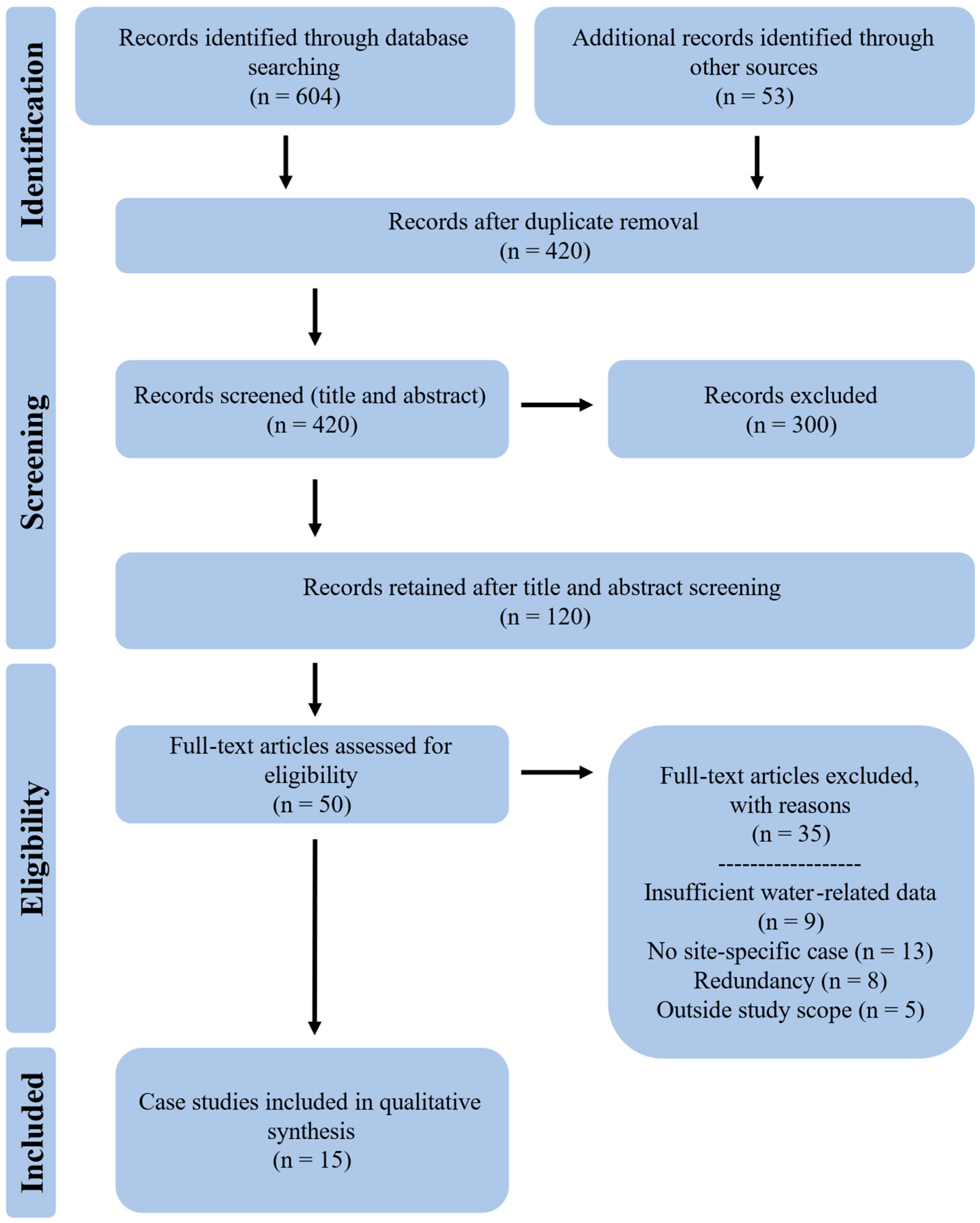
Figure 1. PRISMA-style flow diagram summarising the identification, screening, eligibility assessment, and inclusion of case studies for the qualitative synthesis. The diagram reports the number of records identified through database searches and other sources, records screened and excluded at each stage, and the main reasons for full-text exclusion. Fifteen case studies were ultimately included in the qualitative analysis.
Sustainability 18 01774 g001
Figure 2. Overview of mining-related impacts on water throughout the mine life cycle. Indirect impacts (italics) here also include “knock-on/negative external effects”, i.e., potentially quantifiable economic losses affecting third parties. The different phases of the mine cycle are depicted using shading colours corresponding to the colour of the respective life cycle phase indicated on the left-hand side (vertical format). All water quality-related impact categories are depicted in red (left column) while all water-quantity-related impact types are depicted blue font.
Sustainability 18 01774 g002
Figure 3. Average monthly evaporation rates for 6 m-deep reference lakes in Germany expressed in percent of received precipitation. Red values indicate a negative climatic water balance while blue values depict water-positive months. The light red-shaded background indicates the area where evaporation rates are higher than the received precipitation while light blue-shaded area denotes the opposite. Green values correspond to the green columns in the diagram both depicting evaporation rates. Diagram based on data of [24,25].
Sustainability 18 01774 g003
Table 5. Representative knock-on effects and externalised costs from the case studies analysed in this paper.
Case Study
(Direct Water Impacts)
Knock-On EffectsAssociated Externalised Costs
Polymetallic mines at Cerro Rico, Bolivia (transboundary AMD pollution)Long-distance metal transport (~200 km waterways; ~560 km sediments); bioaccumulation in crops, livestock, and wildlife; soil contamination; long-term health risks; structural instability of the mountain affecting local communitiesReduced agricultural productivity; food security losses; healthcare costs; loss of income for farmers; long-term sediment remediation costs borne by governments; cross-border environmental burden shared by downstream countries
Witwatersrand Au/U mines, South Africa (decanting AMD; tailings seepage)Persistent AMD discharge; contamination of rivers, wetlands, and groundwater; bioaccumulation of U and metals in food chain, human hair; loss of Ramsar status; fish kills; threat to UNESCO world heritage site and game reservesPerpetual pump-and-treat (~R400–600 M/a); public expenditure of ~ZAR10B for “short-term” solutions; medical costs linked to chronic exposure; loss of land usability; municipal water treatment costs; long-term ecological rehabilitation borne by the state
Polymetallic sulphide mines at Rio Tinto, Spain (stream pollution by AMD)Persistent AMD affecting ~125 km of rivers; metal transfer to estuary and soils; loss of fish and macroinvertebrates; degradation of riparian vegetation; contamination affecting grazing livestockReduced agricultural and grazing potential; long-term treatment and dredging costs; economic losses for fisheries and local communities; public remediation of historic liabilities
Far West Rand, South Africa (extensive dewatering of karst aquifers)>1200 sinkholes causing fatalities, damage to roads, railways, houses, water infrastructure; drying up of karst springs, drying out of wetlands; altered water balances; groundwater contamination by tailings injected into the karst aquiferLoss of life, infrastructure repairs; buy-out and relocation of households; agricultural losses from irrigation shortfalls and polluted water; bottled water replacement; loss of ecosystem services; rising pumping costs if sinkholes increase ingress
Ruhr coal field, Germany (deep coal mines; perpetual pumping)Land subsidence (up to 25 m vertical displacement); reversed drainage; creation of polders reliant on artificial pumping; inundation risk for urban areasPerpetual pumping of ~70 Mm3/a (~EUR 300 million per year); infrastructure maintenance; long-term public liability borne by RAG (initially supported by public levees on coal-generated electricity, “Kohlepfennig”); increased costs for water management in urban areas (polders)
Wheal Jane Sn mine, UK (decanting AMD, stream pollution)Sudden AMD release (50 ML/d); contamination from river to estuary and bay; destruction of aquatic habitat; metal-rich plumeLong-term active treatment (GBP 2 million per year); emergency pumping costs; sludge handling and disposal; public funding for environmental remediation
Ok Tedi Cu/Au mine, Papua New Guinea (tailings discharged into river)Chronic intentional discharge of tailings; raised floodplain; destruction of riparian forests; loss of fisheries; toxic sediment depositionCollapse of subsistence agriculture; loss of fisheries; community displacement; long-term health risks; government and community-led remediation with limited operator contribution
Ni/Zn sulphide mines at Talvivaara, Finland (collapse of tailings dam wall)Failure of tailings pond; release of millions of m3 of acidic/metalliferous water; lake and river contamination; toxic effects on biota; radionuclide mobilisationEmergency containment by company and state; long-term monitoring funded publicly; ecological losses; water treatment infrastructure; public capital injection after operator bankruptcy
Wismut U mines, Germany (controlled flooding of mine voids; tailings seepage)Acidic and metal-rich mine waters; long-term contaminant loads (U, Ra, As); temporary increase in contaminant load during early flooding; seepage from tailings and waste rock; sludge disposal in containment cells; water hardness limits industrial downstream useRemediation > EUR 7 billion to date, perpetual pump-and-treat at several sites; chemical inputs and sludge disposal costs; long-term monitoring; provision of alternative water supply to affected residents
Central German and Lusatian lignite mines (altered climatic water balance through pit lakes)Stop of dewatering and drying out of streams and wetlands; flow reduction in major rivers; creation of partly acidic pit lakes; large evaporation losses from pit lakes exacerbate existing regional water scarcityRemediation-induced regional water deficits; costly river diversions to maintain flows; liming of acidic lakes; dredging of iron hydroxide sludge from streambeds; threat to downstream UNESCO biosphere reserve, loos of agricultural land, damage to aquatic habitats
Disclaimer/Publisher’s Note: The statements, opinions and data contained in all publications are solely those of the individual author(s) and contributor(s) and not of MDPI and/or the editor(s). MDPI and/or the editor(s) disclaim responsibility for any injury to people or property resulting from any ideas, methods, instructions or products referred to in the content.