Article

When Generative Artificial Intelligence Becomes a Colleague: Dual Pathways of Empowerment and Depletion in University Design Teachers’ Work Behaviors


1
Department of Global Convergence, Kangwon National University, Chuncheon 24341, Republic of Korea
2
Department of Business Administration, Kangwon National University, Chuncheon 24341, Republic of Korea
*
Author to whom correspondence should be addressed.
Sustainability 2026, 18(4), 1775; https://doi.org/10.3390/su18041775
Submission received: 6 January 2026 / Revised: 1 February 2026 / Accepted: 6 February 2026 / Published: 9 February 2026
(This article belongs to the Special Issue Artificial Intelligence in Education and Sustainable Development)

Abstract

As generative AI (GAI) becomes increasingly embedded in higher education teaching, its influence on teachers’ instructional behaviors has shown complex and even contradictory patterns. Moving beyond the dominant single-path perspective that emphasizes technological empowerment, this study integrates Conservation of Resources theory and Social Exchange Theory to develop a dual-path framework explaining how GAI simultaneously enables and depletes teachers’ psychological resources. Using survey data from 436 university design teachers in mainland China, structural equation modeling and conditional process analysis were employed. The results indicate that GAI use enhances teaching self-efficacy and teaching-related well-being, thereby promoting innovative work behavior and reducing work withdrawal through a resource-enabling pathway. Conversely, GAI use also increases AI-related anxiety and teaching-related occupational stress, forming a resource-depleting pathway that suppresses innovation and intensifies withdrawal tendencies. Further analyses show that perceived organizational support strengthens the positive effects of GAI, whereas psychological contract breach amplifies its negative impacts. These findings extend research on teacher behavior in educational technology contexts and offer practical insights for fostering supportive environments and mitigating psychological costs during GAI integration.

1. Introduction

The rapid advancement of AI is bringing profound and systemic transformations across multiple sectors of Chinese society [1]. Within the context of Chinese higher education, the widespread adoption of AI tools is reshaping educational practices in diverse ways. Teaching activities are increasingly shifting from traditional classroom-based models toward AI-supported digital modalities, with the aim of enhancing educational efficiency, flexibility, and scalability, while also facilitating more effective communication and collaboration between teachers and students [2]. As a pivotal field within China’s higher education system that integrates design competence development with interdisciplinary collaboration, art and design education is currently situated at a critical juncture where educational reform intersects deeply with technological innovation [3]. With the continued embedding of AI technologies into higher education, art and design programs are facing an urgent need to restructure curricula, innovate pedagogical approaches, and improve instructional effectiveness [3]. In recent years, generative artificial intelligence (GAI) tools—including Disco Diffusion, Midjourney, Stable Diffusion, and DALL·E 2—which can automatically generate high-quality images based on users’ textual prompts, have been widely applied in educational contexts including instructional demonstrations, creative inspiration, and assisted design [4,5]. In this process, GAI is gradually evolving into an indispensable auxiliary force in Chinese higher design education and has exerted sustained and far-reaching influences on teaching content production, modes of creative support, and patterns of teacher–student interaction [6].
At present, design faculty in Chinese universities are undergoing a role transition from traditional knowledge transmitters to technology facilitators and interdisciplinary collaborators [7]. However, within contemporary design education practice, Chinese university teachers exhibit complex and multifaceted emotional responses toward AI technologies [5]. On the one hand, some instructors actively integrate AI tools into their teaching in order to enhance the temporal relevance of curricula and cultivate students’ critical competencies required in the rapidly evolving design industry, thereby demonstrating relatively high levels of proactive behavior [8]. On the other hand, other teachers remain cautious or even resistant toward GAI, expressing concerns that it may reconfigure the teacher’s role, undermine instructional authority, and interfere with evaluation mechanisms, thus giving rise to a range of professional challenges [9]. Moreover, constrained by the lack of a systematic AI education support infrastructure in Chinese higher education, delays in teacher training, and insufficient investment in foundational facilities [10], many instructors encounter pronounced shortages of resources and institutional support when undertaking AI-related teaching tasks, which in turn further elicit negative behavioral responses in their work. In light of these conditions, it is necessary to explore, from both theoretical and practical perspectives, the mechanisms underlying teachers’ behavioral responses to GAI technologies in Chinese university design classrooms, in order to tackle the systemic issues arising from their “double-edged sword” effects.
Current studies examining the application of GAI in higher education teaching practice have primarily focused on its effectiveness in instructional content generation [3], optimization of students’ learning experiences [11], and the expansion of access to educational resources [5]. In particular, existing studies have emphasized the positive pathways through which GAI enhances teaching efficiency [12], enriches instructional media formats [13], and promotes student engagement [14]. A growing number of studies have examined how individuals adapt to technological change in education [15,16]; however, the existing literature largely overlooks the psychological strain, perceived role threats, and negative behavioral reactions that GAI may provoke among teachers. The issue is especially pronounced in the Chinese higher education context, where a comprehensive theoretical framework addressing the coexisting “empowerment–depletion” duality—or the “double-edged sword” effect—of GAI is still lacking. Compared with other disciplines, university design teachers’ pedagogical activities rely heavily on creative ideation, visual expression, and individualized instruction [2]. Their professional authority and occupational identity are therefore more vulnerable to the disruptive impact of GAI’s image-generation capabilities, placing them under a sharper tension between technological empowerment and role marginalization. In order to fill these research gaps, this study utilizes a sample of 436 art and design teachers from universities across mainland China and combines conservation of resources theory with social exchange theory to develop a theoretical model. It introduces teaching self-efficacy, teaching well-being, AI anxiety, and teaching-related occupational stress as key mediating variables, while incorporating perceived organizational support and psychological contract breach as contextual moderators. The goal is to provide a comprehensive understanding of the bidirectional mechanisms by which GAI tool use affects university teachers’ innovative work behavior and work withdrawal behavior. In line with this objective, the study aims to investigate the following research questions:
RQ1: Does the use of GAI tools exert a “double-edged sword” effect on the work behaviors of design faculty in Chinese universities? If so, through what underlying mechanisms does this effect operate?
RQ2: Do differences in Chinese university design faculty’s perceptions of organizational support and psychological contract fulfillment moderate their behavioral responses to the use of GAI tools?
Empirical analysis further clarifies the dual-path influence of GAI tool usage on the teaching behaviors of Chinese university design faculty. It systematically uncovers the behavioral response patterns and psychological mediation processes that arise under the dual mechanisms of resource empowerment and resource depletion. At a theoretical level, this study addresses an important gap in the literature by examining how GAI tools affect faculty teaching behavior. Specifically, the dual-path theoretical model, developed by integrating COR theory and SET, enriches the theoretical understanding of educational technology acceptance while simultaneously broadening the scope of organizational behavior research in educational settings. This contributes to fostering an interdisciplinary dialogue between the two domains. From a practical perspective, these results offer both theoretical guidance and empirical support for design-focused Chinese higher education institutions aiming to foster supportive organizational climates, optimize faculty development resources, and improve educators’ adaptability amid the rapid integration of GAI into teaching practices. Furthermore, this study offers a meaningful point of departure for future investigations into the deeper interactive mechanisms between AI and education.

2. Literature Review

2.1. Conservation of Resources (COR) Theory

COR theory, introduced by psychologist Hobfoll in 1989, is a motivational framework positing that individuals tend to actively acquire, preserve, protect, and build upon the resources they possess [17]. Within COR theory, resources are conceptualized as objects (e.g., transportation, housing), personal traits (e.g., self-esteem, self-efficacy), conditions (e.g., tenure, stable marital relationships), or energies (e.g., money, insurance) that facilitate the acquisition and protection of other valued resources [17,18]. Individuals who possess resources are typically more motivated to invest in obtaining additional resources. Conversely, when faced with threats of resource loss, individuals tend to adopt defensive strategies to protect what they already have [19]. Notably, the significance of resources differs among individuals and is frequently influenced by personal experiences and contextual factors. For instance, while family time can serve as a significant resource for many, it might undermine self-esteem for those experiencing abusive relationships [20]. Furthermore, COR theory suggests that while everyone is motivated to obtain resources, their ability to do so depends on the resources they already possess. Individuals with ample resources tend to be less susceptible to resource depletion and better able to reinvest and expand their resources, thus initiating a resource gain cycle. In contrast, those with limited resources may struggle to invest effectively due to insufficient reserves, potentially leading to a downward spiral of resource loss [21]. Unlike other theories which emphasize only a single core resource or provide an ambiguous definition of resources, COR theory stands out for its capacity to produce concrete, testable hypotheses across various types of resources. This makes the theory especially relevant and capable of providing explanations across diverse contexts [19].
Over the past few years, COR theory has emerged as one of the most frequently cited frameworks in organizational psychology and organizational behavior [19]. Although initially formulated by Hobfoll [17] as a stress theory, the COR framework has since been expanded and utilized to examine diverse adverse environments and complex workplace challenges [22]. Building on this foundation, COR theory provides a useful framework to examine the psychological mechanisms by which university design educators, amid widespread GAI adoption, adjust their teaching behaviors based on perceived resource gains and losses. Despite a strong empirical foundation for COR theory in organizational management research [23,24], relatively few studies have investigated how faculty perceive shifting resources and adapt their teaching behaviors amid the deep integration of GAI into higher education. In response to this research gap, this study applies COR theory to art and design education in higher education to examine the psychological processes and mechanisms through which educators adjust their behaviors in reaction to perceived resource gains and threats arising from the advent of GAI technologies.

2.2. Social Exchange Theory (SET)

The conceptual origins of SET can be traced back to anthropological research in the 1920s [25]. Homans [26] initially proposed the core idea that “social behavior is an exchange” and later formalized it into a theoretical framework in 1961. At the same time, Kelley [27] proposed the concept of aggregated exchange within group social psychology. Building on these foundations, Blau [28] developed a theoretical perspective of “exchange and power,” which significantly advanced the application of SET within the field of sociology. As a framework for understanding how individuals and groups interact according to perceived costs and rewards, SET proposes that social behavior fundamentally involves the exchange of resources [28]. The theory identifies two basic forms of social exchange: negotiated exchange and reciprocal exchange [29]. Reciprocal exchange emphasizes that individuals, upon receiving resources or support, incur a normative obligation to reciprocate, thereby maintaining the dynamic balance of the exchange relationship [28]. In contrast, negotiated exchange refers to interactions in which individuals, guided by rational judgment, evaluate the costs and benefits of a relationship with the goal of minimizing costs and maximizing rewards [30]. Although there are academic debates surrounding the specific forms and mechanisms of social exchange, there is a general consensus that it is inherently a process marked by obligations [31]. A high level of interdependence is also present, where individuals’ behaviors are notably shaped by the actions and reactions of others [28]. Moreover, SET suggests that such interdependent exchange relationships can evolve into high-quality social relationships only under specific contextual and conditional factors [32].
As a foundational framework for understanding workplace behavior, SET has been widely employed within organizational behavior and management research [32]. Its wide applicability stems from the fact that social exchange, as a ubiquitous social phenomenon, is deeply embedded in everyday human interactions [33]. In recent years, SET has demonstrated increasing theoretical value in explaining a variety of relational dynamics. It has been employed not only to examine the mechanisms of interaction between customers and employees [34], but also widely utilized in studies exploring the employee–organization relationship [35,36]. Notably, with the rapid advancement of digital technologies, the application scope of SET has gradually expanded into the domain of human–machine interaction. For instance, Kim et al. [37], drawing on SET, found that users’ positive perceptions of service robots’ intelligence, social presence, and interactive capabilities significantly enhance trust, affinity, and intention to use, thereby facilitating reciprocal interactions between humans and robots. Similarly, Dutta and Mishra [38] applied SET to explore the influence mechanisms of AI virtual assistants within organizational contexts. Their findings reveal that when employees perceive fairness in the functioning of AI systems during interactions, it enhances their trust in the organization, fosters reciprocal relationships, and significantly strengthens organizational engagement. In summary, SET offers essential theoretical guidance for this study by framing the ways in which GAI tools affect interactions among university design educators, their organizational contexts, and technological systems.

2.3. The Impact of GAI Tool Usage on Innovative Work Behavior and Work Withdrawal Behavior

GAI refers to a class of software tools that utilize technologies such as machine learning and neural networks to identify and analyze patterns and structures within training data, thereby enabling the automated generation of new content [39]. In recent years, GAI technologies have advanced rapidly, allowing users to produce high-fidelity text, images, or other content within seconds using mainstream tools such as ChatGPT and Midjourney. These tools are often available at low cost or even free of charge, enabling the efficient execution of complex tasks that were traditionally performed by humans [14]. Among various application domains, the education system has been particularly affected by GAI tools, with their influence permeating nearly every stage and form of the instructional process [14]. Both academia and practice have engaged in active debates over the potential opportunities and challenges of using GAI in educational settings: on one hand, GAI offers numerous benefits for educational practice; on the other hand, its usage also raises a range of potential risks and ethical concerns [40].
Within higher education, growing scholarly attention has focused on how GAI shapes instructors’ teaching behavior patterns, particularly concerning innovative work behavior and work withdrawal behavior [41,42]. In this study, GAI usage is defined as the frequency and intensity with which university design instructors engage with text- or image-generating models capable of autonomous learning, reasoning, problem-solving, and content creation to achieve their teaching goals [43]. Innovative work behavior refers to a multifaceted and proactively driven set of actions in which individuals deliberately generate, introduce, and apply new ideas through critical thinking. This encompasses identifying current or potential challenges, exploring opportunities and solutions, recognizing gaps in performance, and attempting to implement novel workflows and methods to improve organizational outcomes, create value, gain competitive advantage, and support long-term sustainability [44]. By contrast, work withdrawal behavior describes a set of deliberate negative attitudes or actions that employees engage in when they perceive their work environment as threatening or unfavorable [45]. Such behavior involves a psychological or physical disengagement from job tasks or the work context [46]. Specific manifestations include extended break times, diverting work hours or organizational resources for personal matters, reduced task engagement, and displays of indifference toward organizational goals [47]. Additionally, withdrawal behavior may also be reflected in tardiness, absenteeism, procrastination, lack of participation, and diminished organizational commitment [48].
Building on the above behavioral typology, prior studies grounded in COR theory suggest that the use of GAI tools may influence teachers’ behaviors through two distinct mechanistic pathways [49]. Firstly, the use of GAI has the potential to improve teaching efficiency and task completion, allowing individuals to gain and allocate additional resources, which in turn stimulates positive work behaviors and forms a “resource empowerment pathway” [50]. On the other hand, GAI may also trigger perceived threats of role replacement or erosion of professional authority, leading individuals to worry about their occupational status and career prospects, which in turn reduces resource investment and elicits negative behavioral responses, forming a “resource depletion pathway” [51]. However, teachers’ behavioral responses to GAI are not determined solely by the technological attributes or usage modes of these tools; rather, they are profoundly shaped by teachers’ subjective perceptions of their organizational context. Differences in individuals’ subjective organizational sensemaking may thus lead to markedly divergent behavioral orientations in the use of GAI tools [15].
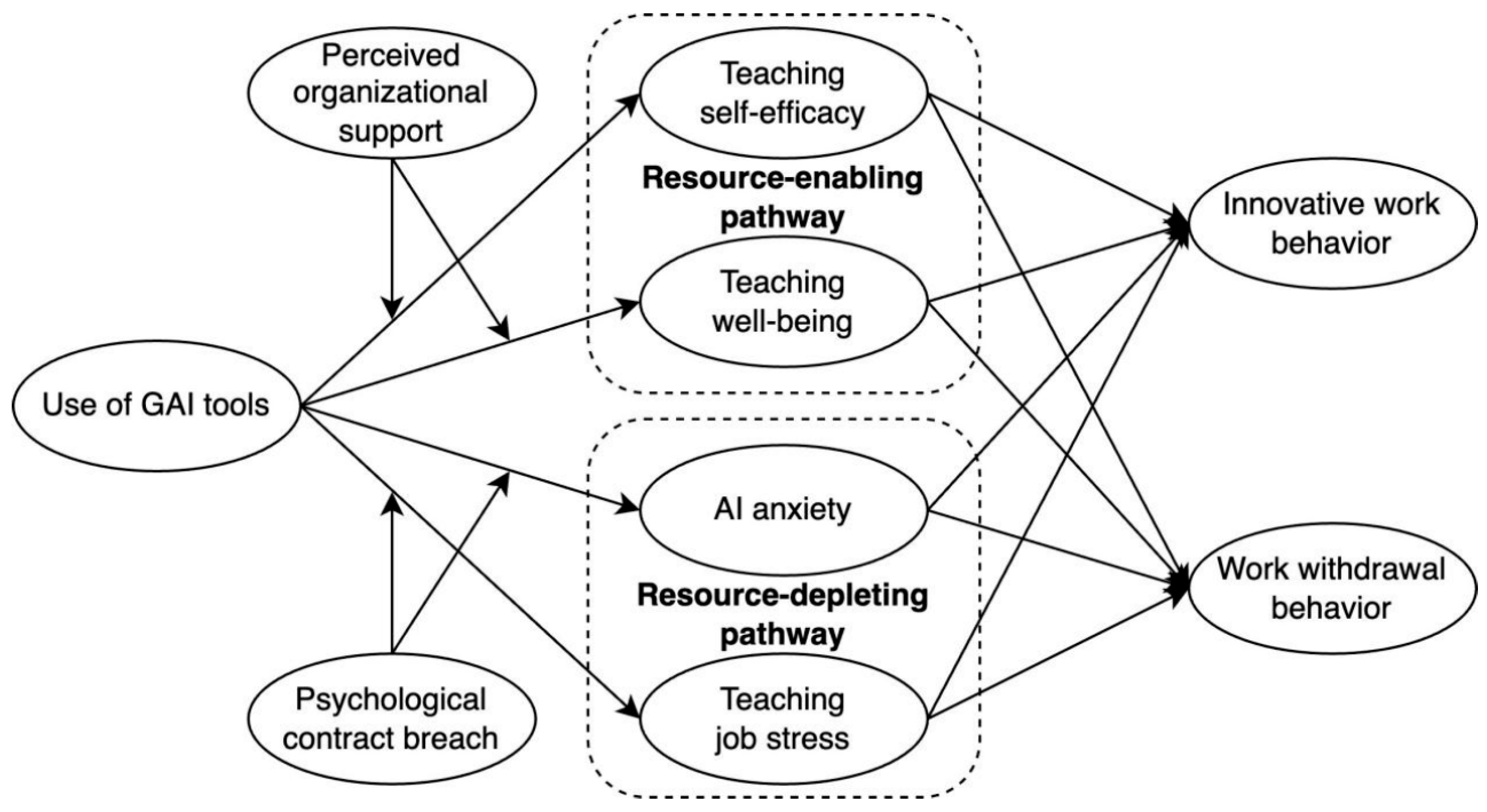
Against this backdrop, SET offers a critical complementary perspective for understanding the above differences. SET posits that individuals subjectively construct the meaning and consequences of external events based on their exchange relationships with the organization, among which perceived organizational support and psychological contract breach serve as core cognitive cues shaping resource appraisal [52,53]. Individuals typically first define the meaning of an event by judging whether organizational commitments have been fulfilled and, on this basis, generate corresponding emotional and stress responses [32]. In this study, perceived organizational support and psychological contract breach are conceptualized as upstream cognitive framing variables: when university design instructors perceive strong organizational support, they tend to interpret the adoption and use of GAI as evidence of the organization fulfilling its responsibilities and recognizing their professional value. This leads them to see GAI as an avenue for resource acquisition and career growth, increasing the likelihood of engaging in positive teaching and work behaviors along the “resource empowerment pathway.” Conversely, if instructors perceive a violation of the psychological contract, they may view GAI implementation as indicative of organizational negligence or a threat to job security, heightening perceived resource risks and eliciting negative behaviors along the “resource depletion pathway.” Building on this foundation, this research combines COR and SET to construct a dual-pathway model illustrating how GAI use influences university design teachers’ teaching behaviors (see Figure 1).
Within the integrative framework of this study, COR delineates the “objective motivational logic” of resource changes induced by GAI use, whereas SET enters into the process through which teachers engage in “subjective appraisal and meaning construction” of these changes. Specifically, at the instrumental level, GAI use may simultaneously generate efficiency gains (potential resource gains) and role uncertainty (potential resource threats); however, whether teachers further interpret these changes as opportunities for professional empowerment or as signals of managerial control is not determined by technological attributes per se, but is reshaped by the cues of trust, reciprocity, and contract fulfillment embedded in their exchange relationships with the organization.

3. Research Hypotheses

3.1. Resource Empowerment Pathway Through the Use of GAI Tools

Self-efficacy is defined as an individual’s confidence in their ability to plan and carry out the actions necessary for attaining particular goals. It is a key psychological mechanism underlying human agency [54]. Prior research indicates that self-efficacy significantly predicts the level of effort individuals exert when facing challenges, their self-motivation and regulatory abilities, behavioral persistence, and performance in goal attainment and decision-making [54]. While student self-efficacy has long been a central topic in educational research, recent studies increasingly highlight the importance of teacher self-efficacy in classroom instruction [55]. Teacher self-efficacy, alternatively termed instructional self-efficacy, encompasses teachers’ perceptions of their competence in managing instructional duties and attaining educational objectives [55,56]. This belief encompasses not only teachers’ evaluations of their own pedagogical knowledge and methods but also their judgments regarding student learning and behavioral outcomes [57]. Drawing on COR theory, this study suggests that the use of GAI tools acts as an external resource that boosts instructional self-efficacy among higher education design faculty, which in turn promotes innovative work behaviors and mitigates work withdrawal behaviors. Specifically, GAI tools offer immediate and diverse support in areas such as content generation, creative expression, image refinement, and instructional feedback. These tools not only enhance teachers’ instructional efficiency and classroom expressiveness but also help alleviate cognitive load caused by repetitive tasks [58]. By facilitating efficient information acquisition and task assistance, such tools enable teachers to conserve cognitive resources and strengthen their sense of control over teaching contexts. This process plays a key role in strengthening instructional self-efficacy and in building and maintaining psychological resources [59]. Teachers who possess high instructional self-efficacy typically exhibit strong confidence in managing teaching responsibilities and adapting to technological changes, fostering active engagement in instructional reforms and technology adoption while enhancing innovative work behaviors [60]. In contrast, teachers with low instructional self-efficacy often experience helplessness and role ambiguity, which can trigger avoidant coping strategies such as limiting instructional experimentation and refraining from using AI technologies, reflecting work withdrawal behaviors [61]. Therefore, this study predicts that the use of GAI tools will positively predict teachers’ instructional self-efficacy, which in turn will positively predict their innovative work behavior and negatively predict their work withdrawal behavior.
For university design educators, instructional activities are heavily dependent on complex tasks such as creative ideation, visual expression, and cross-media integration. These tasks are often accompanied by high-intensity information processing demands and sustained emotional engagement, posing considerable challenges to individuals’ cognitive and emotional resources [62]. Against this backdrop, the use of GAI tools can be conceptualized as a supplementary external resource that alleviates the resource strain associated with complex teaching tasks, thereby enhancing teachers’ instructional self-efficacy [59]. As a core cognitive resource, instructional self-efficacy not only fosters positive expectations regarding task success, thereby motivating greater resource investment and teaching creativity [63], but also mitigates feelings of helplessness and withdrawal reactions induced by resource depletion, thus reducing the likelihood of work withdrawal behaviors [64]. Existing research has further demonstrated that instructional self-efficacy serves as an intermediary between the use of GAI tools and outcomes such as learning performance and creativity [65,66]. Drawing on the preceding discussion, the following hypotheses are formulated:
H1a. 
Instructional self-efficacy mediates the relationship between the use of GAI tools and innovative work behavior.
H1b. 
Instructional self-efficacy mediates the relationship between the use of GAI tools and work withdrawal behavior.
Since the 1990s, teacher well-being has increasingly attracted attention from international organizations, national governments, and scholars worldwide. Several countries have introduced policies aimed at enhancing teachers’ well-being, and academic interest in this area has steadily increased [67]. As a form of positive emotional trait, well-being generally refers to the experience of enduring positive emotions including happiness, satisfaction, and joy in daily life [68]. Specifically, teacher occupational well-being refers to a subjective psychological state in which teachers, through autonomous teaching activities, achieve professional ideals, fulfill personal development needs, and realize self-worth, thereby continuously experiencing intrinsic pleasure and psychological satisfaction in their professional engagement [69]. Existing research indicates that teacher well-being is significantly influenced by work environment and conditions, particularly through the sense of satisfaction and enjoyment derived during the teaching process. A supportive organizational climate, positive teacher–student interactions, and adequate teaching resources all contribute to enhancing teachers’ subjective well-being and mental health [70]. Drawing on COR theory, this study proposes that the utilization of GAI tools can improve teaching-related well-being among higher education design faculty, thereby promoting innovative work behaviors and mitigating work withdrawal tendencies. Specifically, emotional resources are derived not only from the alleviation of external workload but also from the sense of value recognition and meaning acquired through social roles [71]. For design faculty in universities, the adoption of GAI tools serves not only as a pedagogical aid but also as a symbol of their professional identity’s integration and extension within future educational systems [72]. With the support of GAI tools, design educators can effectively reduce emotional labor during lesson preparation and classroom delivery, alleviating the psychological stress caused by high creative demands and multitasking [59]. Compared with traditional teaching contexts, the integration of GAI tools significantly enhances teachers’ enjoyment and perception of positive emotions during the teaching process, thereby making it easier for them to attain sustained psychological satisfaction and, ultimately, greater teaching well-being [73]. Prior studies have demonstrated that positive teaching well-being contributes to higher levels of professional commitment and work engagement, while reducing occupational burnout and fostering creative expression in teaching [74]. Therefore, this study predicts that the use of GAI tools will positively predict teachers’ teaching well-being, which in turn will positively predict their innovative work behavior and negatively predict their work withdrawal behavior.
Overall, GAI tools contribute to reducing emotional labor and enhancing a sense of teaching accomplishment, thereby facilitating the accumulation and conservation of personal resources, which in turn effectively improves teachers’ well-being. This positive psychological state not only strengthens teachers’ professional commitment but also helps to stimulate their innovative work behavior while suppressing work withdrawal tendencies. Previous research has suggested that well-being mediates the relationship between attitudes toward digital technologies and job performance [75]. Based on the above discussion, the following hypotheses are proposed:
H1c. 
Teaching well-being mediates the relationship between the use of GAI tools and innovative work behavior.
H1d. 
Teaching well-being mediates the relationship between the use of GAI tools and work withdrawal behavior.

3.2. The Resource-Depletion Pathway of GAI Tool Usage

AI anxiety can be understood as an extension of computer anxiety (also referred to as technophobia or computer phobia), essentially manifesting as a persistent sense of unease or fear triggered by anticipations surrounding AI development and its potential adverse consequences [76]. This anxiety stems from concerns over the multifaceted social impacts AI may exert in practical applications, such as the restructuring of employment, infringement of personal privacy, challenges to security, and the erosion of individual autonomy [77]. These concerns often lead individuals to adopt negative attitudes toward AI and its societal implications [78]. Thus, AI anxiety can be conceptualized as a multifaceted psychological response focused on the fear of AI becoming uncontrollable, manifesting through negative emotions including anxiety, fear, and irritability, which may subsequently reduce individuals’ inclination to interact with AI systems [79]. It is proposed that the use of GAI tools can provoke AI anxiety in design educators at the university level, leading to decreased innovative work behaviors and an increased tendency toward work withdrawal. Specifically, in design courses within universities, instructors typically guide students in the development of design thinking through methods such as hand-drawing demonstrations, compositional analysis, and creativity facilitation [80]. However, GAI tools are capable of generating complex images from simplified textual prompts, which can diminish the central role of instructors in technique demonstration and stylistic training within traditional pedagogy [81]. More critically, the widespread replacement of conventional assignments by students with outputs generated via GAI tools is progressively eroding the professional influence of instructors in areas such as aesthetic judgment, technical guidance, and personalized mentoring [82]. This functional “marginalization” prompts educators to question their irreplaceability in the teaching process, giving rise to a sense of anxiety over technological replacement [83]. Such anxiety, in turn, suppresses educators’ willingness to engage in innovative pedagogical practices and reduces their overall involvement in instructional activities [84]. Nguyen and Nguyen [85] further argue that the sense of resource threat and loss of security induced by AI anxiety undermines proactive professional behaviors among university instructors and can result in adverse outcomes such as technology resistance, role misalignment, and psychological withdrawal from work. Accordingly, this study predicts that the use of GAI tools positively predicts instructors’ AI anxiety, which in turn negatively predicts their innovative work behavior and positively predicts their work withdrawal behavior.
Drawing on COR theory, when individuals detect shifts in their work environment—such as the adoption of GAI tools—and feel uncertain about the security of their professional roles, their existing personal resources are at risk of being threatened [85]. When individuals anticipate a continuous depletion of resources without timely replenishment, emotional exhaustion is likely to occur [86]. The widespread adoption of GAI has exacerbated higher education design instructors’ concerns about job displacement, further intensifying their uncertainty and anxiety regarding future career prospects [16]. In this “implicit competition” with AI, educators often experience elevated psychological pressure, which accelerates the depletion of their psychological resources [51]. As resource loss continues, instructors may reduce their investment of knowledge, energy, and emotional engagement in both teaching and institutional activities. This decline in resource allocation can subsequently weaken their innovative work behaviors and increase the likelihood of work withdrawal tendencies [51]. Based on the above discussion, the following hypotheses are proposed:
H2a. 
AI anxiety mediates the relationship between the use of GAI tools and innovative work behavior.
H2b. 
AI anxiety mediates the relationship between the use of GAI tools and work withdrawal behavior.
Although teachers typically exhibit high levels of job satisfaction, the teaching profession is still widely considered a high-stress occupation relative to other professional groups [87]. In a widely cited definition, Kyriacou [88] describes teacher occupational stress as “the experience of negative emotions resulting from the perception that one’s work environment endangers self-esteem or well-being.” This definition has been broadly accepted in psychological research and is theoretically grounded in the stress-coping model proposed by Lazarus and Folkman [89]. According to this model, stress fundamentally arises from an imbalance between external demands and an individual’s available coping resources. Work-related stress, therefore, can be defined as “the emotional, cognitive, behavioral, and physiological responses an individual exhibits when exposed to adverse or harmful factors within the job itself, the working environment, or the organizational structure” [90]. In organizational contexts, employees encounter a wide range of stressors, including role conflict, interpersonal relationships, workload, organizational support, career development prospects, and external environmental factors [90]. Specifically in the education sector, Boyle et al. [91] identified common sources of occupational stress, such as individual teacher characteristics, student misbehavior, heavy workload, lack of social and organizational support, performance evaluation pressures, insufficient resources and leadership, and national-level mechanisms such as standardized testing and data monitoring. The present research proposes that the swift integration of GAI into contemporary higher education design programs may act as a novel source of occupational stress. On the one hand, teachers face increasing pressure to continuously learn and master GAI tools in order to stay at the forefront of pedagogical innovation. On the other hand, they are required to restructure course content and assignment design to prevent students’ reliance on GAI from undermining their original thinking [92]. Moreover, teachers need to balance the promotion of creativity with the effective use of technology, investigate equitable assessment strategies in AI-mediated learning environments, and manage the ongoing updates of AI tool functionalities within constrained timeframes. Teachers’ cognitive load is heightened and occupational burnout is exacerbated by these challenges, resulting in negative impacts on teaching behaviors and mental well-being [93]. In this highly technology-driven educational environment, the teacher’s role is gradually shifting from knowledge transmitter to technology integrator. Uncertainty in career development and role conflicts induced by pedagogical transformation often accompany this transition, potentially limiting engagement in innovative teaching and contributing to work withdrawal [94]. Therefore, this study predicts that the use of GAI tools will significantly and positively predict teachers’ occupational stress, which, in turn, will negatively predict their innovative work behavior and positively predict their work withdrawal behavior.
Teaching job stress is conceptualized, under COR theory, as resulting from the prolonged expenditure of essential resources at work without sufficient restoration [95]. As stress levels rise, teachers may become increasingly inclined to avoid challenging instructional tasks and reduce their engagement with new technologies, thereby exhibiting lower levels of innovative behavior and a greater tendency toward work withdrawal [61]. The introduction of GAI into higher education has not been shown to consistently alleviate teachers’ workload. On the contrary, due to the increasing complexity of instructional demands, GAI use has intensified the need for resource investment. In the absence of effective mechanisms for resource replenishment, teachers are likely to experience ongoing resource depletion [96]. To avoid further loss, they may adopt negative attitudes toward AI, engage in avoidance behaviors related to teaching tasks, reduce their participation in innovative teaching practices, and demonstrate an increased propensity for work withdrawal. Based on the above discussion, the following hypotheses are proposed:
H2c. 
Teaching job stress mediates the relationship between the use of GAI tools and teachers’ innovative work behavior.
H2d. 
Teaching job stress mediates the relationship between the use of GAI tools and teachers’ work withdrawal behavior.

3.3. The Moderating Role of Perceived Organizational Support and Psychological Contract Breach

During teachers’ adaptation to the restructuring of teaching roles and the reallocation of educational resources driven by GAI, organizational contextual variables exert a significant influence on teachers’ attitudes toward GAI tools, emotional experiences, and behavioral responses [2]. Perceived organizational support reflects employees’ overall belief that the organization appreciates their contributions and attends to their well-being, based on perceptions of performance rewards and the fulfillment of socio-emotional needs [97]. In contrast, psychological contract breach reflects employees’ perception that the organization did not meet its promised obligations—particularly unwritten commitments that employees expect to be honored [98]. Against the backdrop of rapid AI development and the ongoing exploration of its applications in teaching, the extent to which higher education institutions can provide adequate resource support, systematic technical training, and essential psychological assurance largely determines teachers’ confidence in and initiative toward using GAI tools [16].
Based on the SET, individuals’ perceptions of organizational support during their use of GAI tools directly influence their resource states and psychological responses [41]. When organizations provide strong support, teachers tend to gain positive psychological resources, reflected in increased teaching self-efficacy and improved teaching-related well-being [13]. Conversely, when teachers perceive that the organization has not honored its commitments regarding AI use, they may experience a psychological contract breach, viewing AI as a source of stress, which in turn elevates AI-related anxiety and teaching pressure [99]. Bower et al. [100] emphasized that when teachers perceive substantial institutional investment in resources, training, and emotional support, their confidence in coping with AI-driven pedagogical changes significantly increases. Such perceptions foster a more positive attitude toward technology adoption, encouraging teachers to engage with emerging technologies and derive positive experiences, ultimately enhancing their teaching self-efficacy and professional well-being [101]. In contrast, when teachers perceive that the institution has not met prior commitments—such as offering essential technical training or instructional support—they tend to experience dissatisfaction and concern [102], which may heighten anxiety and worsen teaching-related stress [99]. Accordingly, the following hypotheses are proposed:
H3a. 
Perceived organizational support positively moderates the relationship between the use of GAI tools and teaching self-efficacy. Specifically, this positive relationship is stronger when perceived organizational support is high.
H3b. 
Perceived organizational support positively moderates the relationship between the use of GAI tools and teaching-related well-being. Specifically, this positive relationship is stronger when perceived organizational support is high.
H3c. 
Psychological contract breach positively moderates the relationship between the use of GAI tools and AI anxiety. Specifically, this positive relationship is stronger when the level of psychological contract breach is high.
H3d. 
Psychological contract breach positively moderates the relationship between the use of GAI tools and teaching-related stress. Specifically, this positive relationship is stronger when the level of psychological contract breach is high.
Following the logic of the preceding hypotheses, it is anticipated that the indirect impacts of GAI tool usage on teachers’ innovative work behavior and work withdrawal behavior are contingent upon levels of perceived organizational support and psychological contract breach. Specifically, teachers with higher levels of perceived organizational support are more likely to perceive the use of GAI tools as a form of professional empowerment and an opportunity for career development, thereby enhancing their teaching self-efficacy and teaching-related well-being [103]. These enhanced psychological resources further contribute to the promotion of innovative work behavior and the reduction in work withdrawal behavior [104]. In contrast, teachers who perceive a high degree of psychological contract breach are more inclined to view GAI tools as a professional threat, which may trigger AI anxiety and teaching-related stress. These negative psychological reactions, in turn, increase the likelihood of work withdrawal behavior and hinder the emergence of innovative work behavior [105]. Accordingly, the following hypotheses are proposed:
H4a. 
Perceived organizational support moderates the positive indirect effect of GAI tool usage on innovative work behavior via teaching self-efficacy. That is, this indirect effect is stronger when perceived organizational support is high.
H4b. 
Perceived organizational support moderates the positive indirect effect of GAI tool usage on innovative work behavior via teaching-related well-being. That is, this indirect effect is stronger when perceived organizational support is high.
H4c. 
Perceived organizational support moderates the negative indirect effect of GAI tool usage on work withdrawal behavior via teaching self-efficacy. That is, this indirect effect is stronger when perceived organizational support is high.
H4d. 
Perceived organizational support moderates the negative indirect effect of GAI tool usage on work withdrawal behavior via teaching-related well-being. That is, this indirect effect is stronger when perceived organizational support is high.
H5a. 
Psychological contract breach moderates the negative indirect effect of GAI tool usage on innovative work behavior via AI anxiety. That is, this indirect effect is stronger when psychological contract breach is high.
H5b. 
Psychological contract breach moderates the negative indirect effect of GAI tool usage on innovative work behavior via teaching-related stress. That is, this indirect effect is stronger when psychological contract breach is high.
H5c. 
Psychological contract breach moderates the positive indirect effect of GAI tool usage on work withdrawal behavior via AI anxiety. That is, this indirect effect is stronger when psychological contract breach is high.
H5d. 
Psychological contract breach moderates the positive indirect effect of GAI tool usage on work withdrawal behavior via teaching-related stress. That is, this indirect effect is stronger when psychological contract breach is high.

4. Questionnaire Design and Data Collection

In order to further guarantee the cultural appropriateness and institutional consistency of the adapted measurement scales, more than half of the authors on the research team are residents of mainland China, and the first author has previously engaged in teaching and research at an art and design college in a Chinese university. The team therefore possesses long-term first-hand experience with the Chinese higher education system, the training framework of design disciplines, and normative expectations regarding the teacher role, which provided substantial practical support for the research design and the contextualized interpretation of the findings. In the present study, all constructs were measured using established and validated scales that were contextually adapted to ensure content validity and contextual applicability. In order to improve the precision and dependability of the measurement instruments, two organizational behavior experts and two artificial intelligence specialists were invited to review and revise each item of the preliminary questionnaire. Furthermore, linguistic equivalence and cultural appropriateness in mainland Chinese higher education were addressed through the adoption of a standard translation–back-translation procedure during scale development [106,107]. Specifically, two bilingual researchers with backgrounds in psychology and organizational behavior first translated the original English scales into Chinese; subsequently, another bilingual scholar who had not participated in the initial translation independently back-translated the Chinese version into English and compared it item by item with the original scales. Items exhibiting semantic deviation, pragmatic ambiguity, or cultural inappropriateness were systematically revised and reconstructed through joint discussions among the research team and the expert panel. The final instrument comprised nine dimensions and 32 measurement items (see Appendix A). It was unanimously concluded by the experts that the revised scale possessed robust structural integrity, thorough content representation, and reliable measurement properties, thus serving as a solid basis for further empirical investigation.
The formal questionnaire comprised four sections. At the outset of the survey, an introductory section was included to clarify the research objectives and explain the completion procedures. The second section included the informed consent procedure to ensure that respondents participated voluntarily and understood their rights. The third section collected basic demographic information of the respondents. The fourth section included measurement items corresponding to the study’s core variables. All measurement items were rated using a five-point Likert scale, ranging from 1 (strongly disagree) to 5 (strongly agree). Following the recommendation of Hair et al. [108], who indicate that the required sample size should be 10 to 15 times the number of measurement items, the theoretical sample size for this study was determined to range between 320 and 480. Considering that approximately 10% of responses may be deemed invalid because of incompleteness or low-quality answers, the target sample size was adjusted to fall within the range of 356 to 534.
The target population of this study comprised in-service university faculty members in Mainland China, aged 18 or older, who were currently teaching courses related to design disciplines. All participants needed to satisfy the eligibility criterion of having subscribed to and actively used at least one GAI tool. Recruitment information was disseminated through the Chinese social media platform Xiaohongshu (https://www.xiaohongshu.com). To ensure the accuracy and authenticity of the sample source, multiple screening procedures were implemented following the initial recruitment. Specifically, the research team sent two types of verification questions to potential participants via private messages on Xiaohongshu: (1) general knowledge judgment items concerning the formal classification of undergraduate design majors, and (2) institutional knowledge judgment items concerning the teacher certification system in Chinese higher education. In addition, participants were required to submit a gesture photograph with the subscription status interface of the GAI tool they were using displayed in the background. Only those respondents who answered all verification items correctly and whose submitted photographs met the requirements of authenticity and information consistency were allowed to proceed to the formal questionnaire stage.
Data were collected using the professional Chinese online survey platform Wenjuanxing, with the survey administered between 23 June and 31 July 2025. A total of 465 questionnaires were returned, all respondents provided informed consent. After excluding 29 responses due to incompleteness or suspected inauthenticity, 436 valid responses were retained, yielding a valid response rate of 93.76%. The demographic characteristics of the respondents are presented in Table 1.

5. Results

5.1. Measurement Model Assessment and Common Method Bias Test

The reliability of the measurement instruments was evaluated by calculating Cronbach’s alpha coefficients using SPSS 27.0. As shown in Table 2, the Cronbach’s alpha values for all constructs ranged from 0.826 to 0.914, all exceeding the recommended threshold of 0.70 [109], which demonstrates good internal consistency reliability of the measurement instruments.
This study further conducted CFA using Mplus 8.0. The model fit results indicate that the proposed nine-factor model demonstrates a superior fit compared with alternative competing models (see Table 2), thereby supporting the adequacy and robustness of the measurement model. Given that all data were collected through self-reported questionnaires, the possibility of common method bias cannot be completely eliminated [110]. To address this concern, a common latent method factor was introduced into the nine-factor CFA model, with all measurement indicators simultaneously loading on both their theoretical constructs and the common method factor [111], in order to conduct the unmeasured latent method factor (ULMF) test [112]. The results show that, after incorporating the common method factor, the overall model fit indices (see Table 2) did not differ substantially from those of the original model, suggesting that common method bias is unlikely to pose a serious threat to the validity of the present findings [112].
Table 3 further shows that all factor loadings exceeded the recommended threshold of 0.60, indicating strong loadings of each item on its corresponding latent construct [108]. Additionally, the composite reliability (CR) values ranged from 0.876 to 0.949, all above the critical value of 0.70. The average variance extracted (AVE) values ranged from 0.670 to 0.830, also exceeding the 0.50 benchmark, indicating strong convergent validity [113]. Discriminant validity was further assessed and presented in Table 4. The results showed that the square roots of the AVE for each construct were greater than the correlations between that construct and any other constructs, meeting the criteria for discriminant validity proposed by Fornell and Larcker [113]. These findings provide further support for the discriminant validity of the measurement model used in this research.

5.2. Structural Model Evaluation and Hypothesis Test

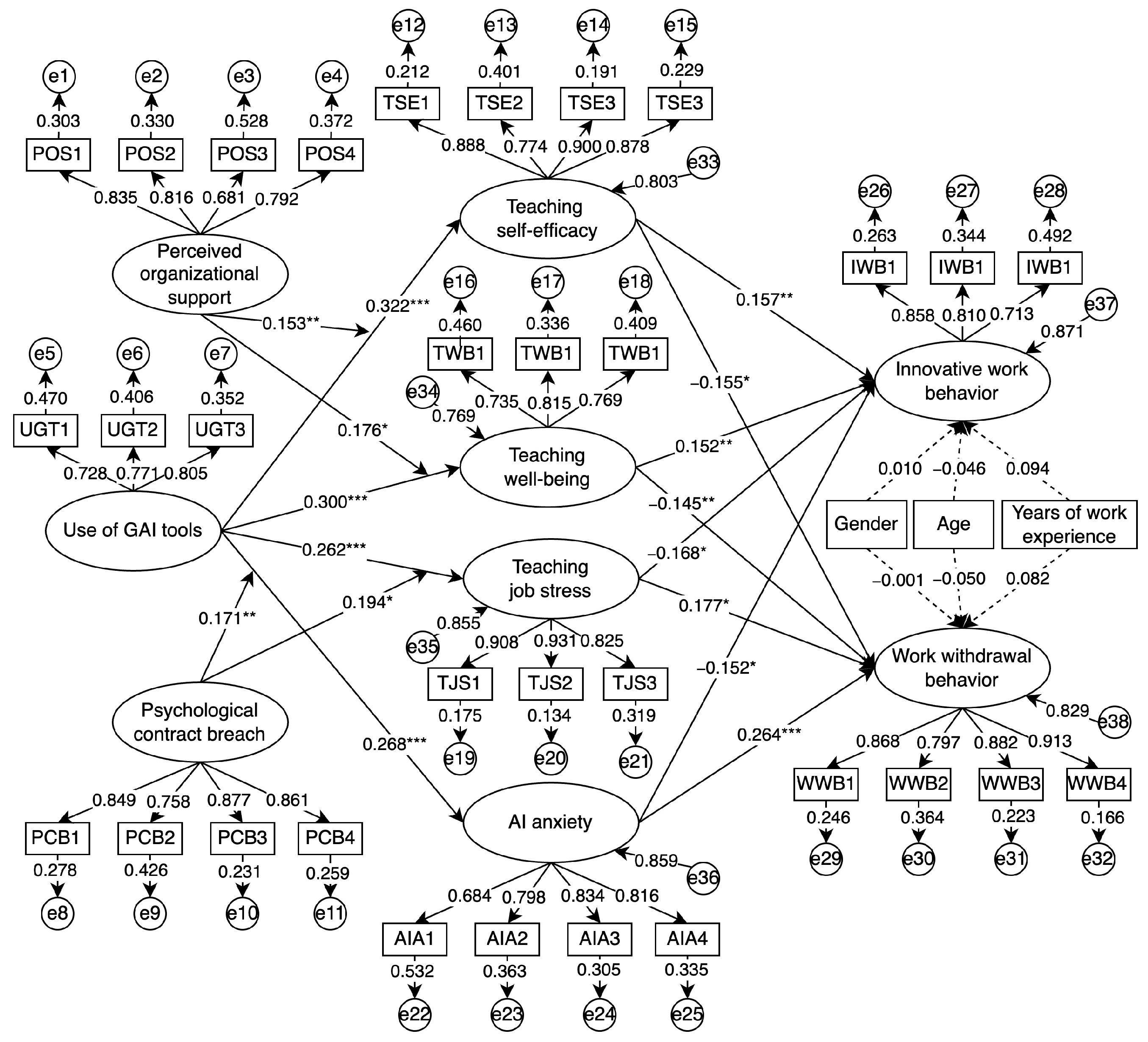
This study employed SEM using Mplus 8.0 to test the proposed hypotheses. In line with prior research indicating that gender, age, and tenure significantly influence individual work behaviors [13,49], these demographic variables were included as control variables in the model. The goodness-of-fit indices for the structural model indicated an acceptable fit (χ2/df = 2.658, p < 0.001; CFI = 0.808; TLI = 0.802; RMSEA = 0.062; SRMR = 0.058). Although the CFI and TLI did not reach the conventional recommended threshold of 0.90, prior methodological studies suggest that values above 0.80 may still be considered acceptable in applied research contexts [114,115]. Accordingly, the overall fit of the structural model was deemed acceptable in the present study.
Figure 2 presents the estimated path coefficients derived from the SEM analysis. The results show that UGT has a significant positive effect on TSE (β = 0.322, p < 0.001). TSE, in turn, positively predicts IWB (β = 0.157, p < 0.05) and negatively predicts WWB (β = −0.155, p < 0.01). The conditional indirect effect procedure proposed by Preacher et al. [116] was applied to explore the mediating role of TSE. The analysis showed a significant indirect effect of UGT on IWB through TSE (indirect effect = 0.051, 95% CI = [0.007, 0.094]), supporting Hypothesis H1a. Similarly, the indirect effect of UGT on WWB via TSE was also significant (indirect effect = −0.050, 95% CI = [−0.091, −0.009]), providing support for Hypothesis H1b. Moreover, UGT exhibited a significant positive effect on TWB (β = 0.300, p < 0.001). TWB exhibited a significant positive association with IWB (β = 0.152, p < 0.05) and a significant negative association with WWB (β = −0.145, p < 0.05). Further analysis showed that the indirect effect of UGT on IWB through TWB was significant (indirect effect = 0.045, 95% CI = [0.002, 0.089]), supporting Hypothesis H1c. The indirect effect of UGT on WWB via TWB was also significant (indirect effect = −0.043, 95% CI = [−0.085, −0.002]), supporting Hypothesis H1d.
UGT also demonstrated a significant positive effect on AIA (β = 0.268, p < 0.001). AIA was found to have a significant negative effect on IWB (β = −0.152, p < 0.01) and a significant positive effect on WWB (β = 0.264, p < 0.001). Mediation analysis indicated that the indirect effect of UGT on IWB through AIA was significant (indirect effect = −0.041, 95% CI = [−0.076, −0.006]), supporting Hypothesis H2a. Similarly, the indirect effect of UGT on WWB via AIA was significant (indirect effect = 0.071, 95% CI = [0.029, 0.113]), supporting Hypothesis H2b. In addition, UGT had a significant positive effect on TJS (β = 0.262, p < 0.001). TJS significantly predicted IWB negatively (β = −0.168, p < 0.01) and WWB positively (β = 0.177, p < 0.01). The mediation analysis further revealed a significant indirect effect of UGT on IWB through TJS (indirect effect = −0.044, 95% CI = [−0.079, −0.009]), supporting Hypothesis H2c. The indirect effect of UGT on WWB via TJS was also significant (indirect effect = 0.047, 95% CI = [0.011, 0.082]), supporting Hypothesis H2d. Full mediation findings are summarized in Table 5.
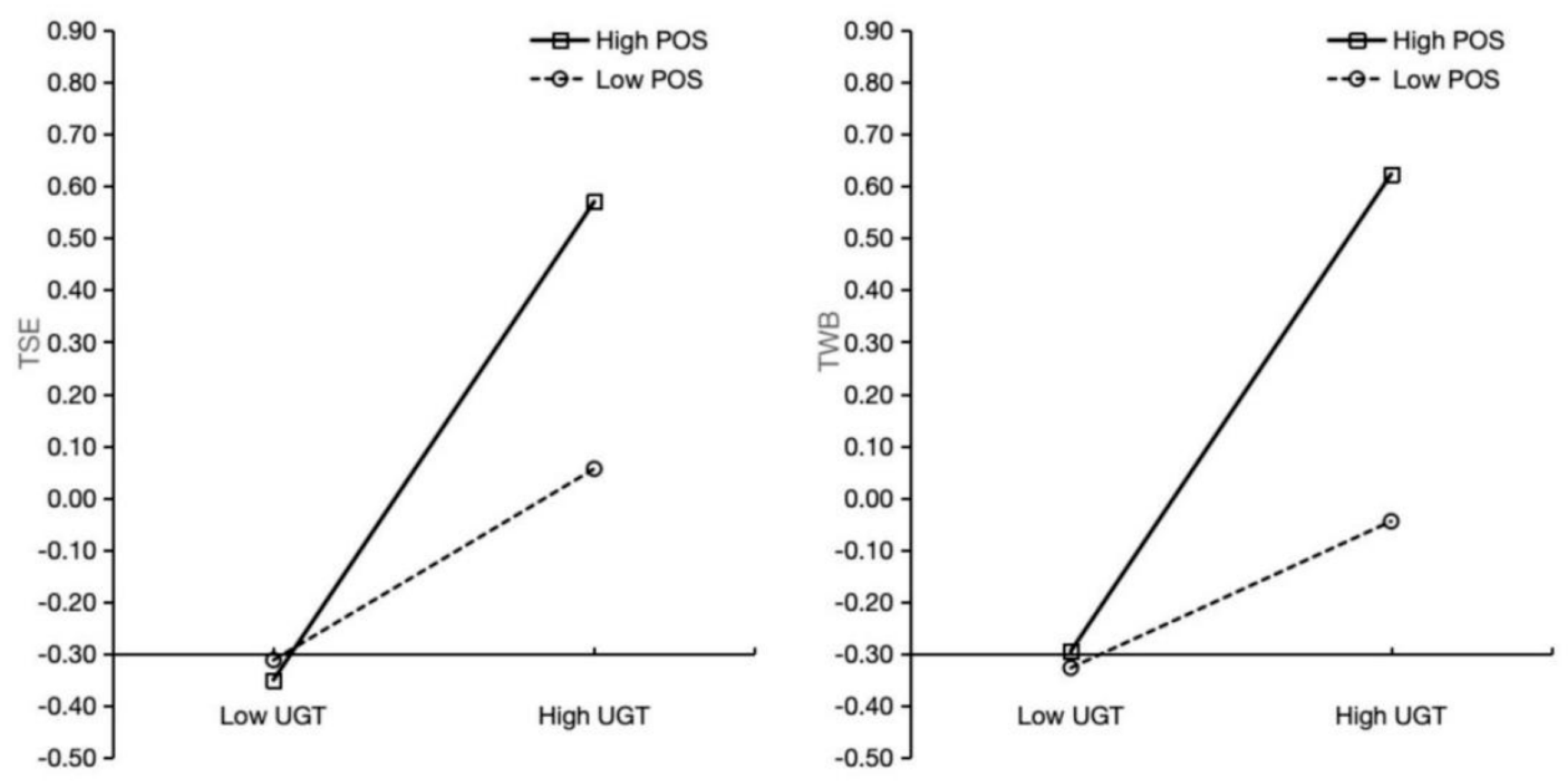
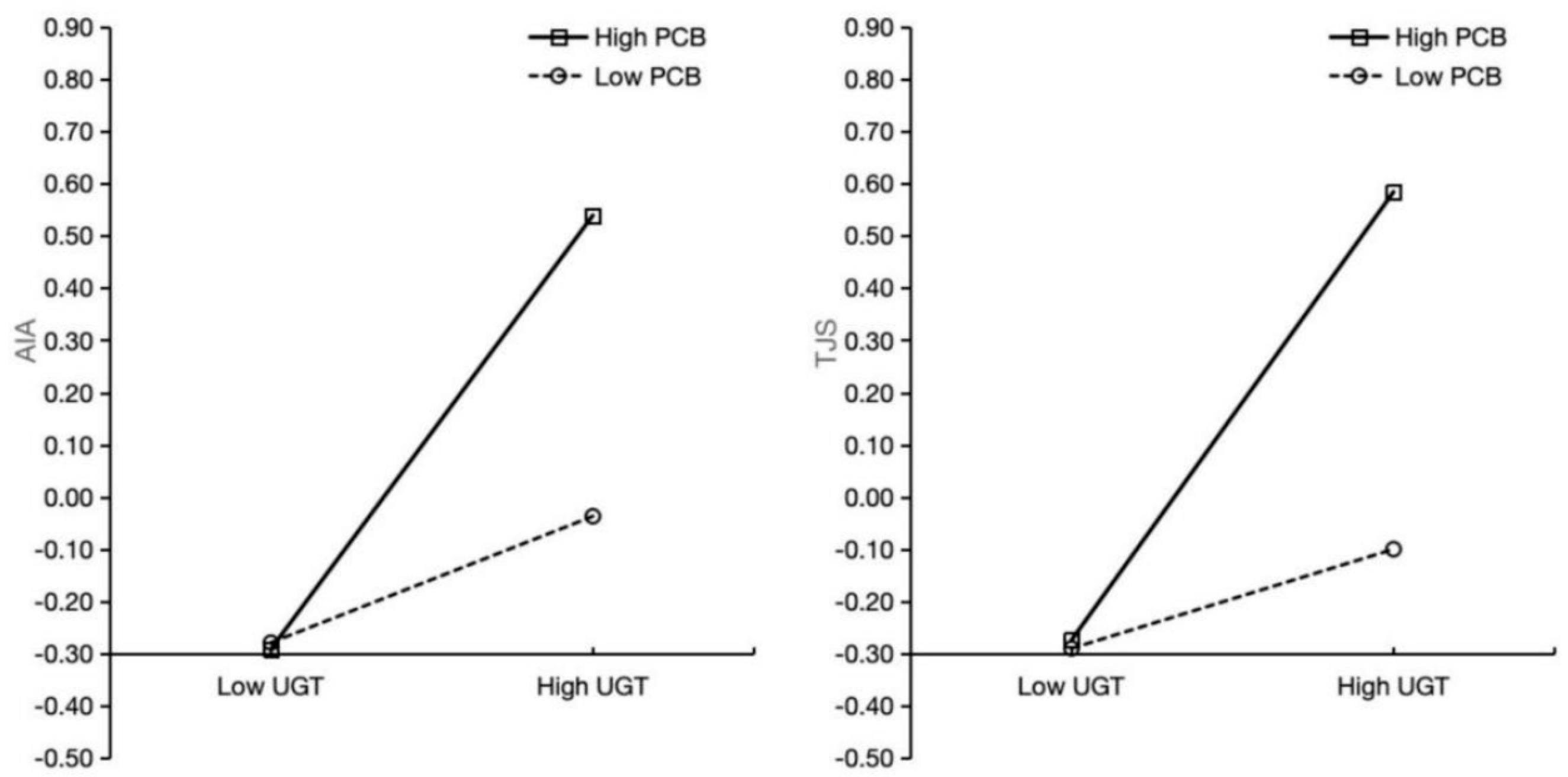
This study employed the bootstrap method to examine the proposed moderating effects. Table 6 illustrates that POS significantly moderated the relationship between UGT and TSE (b = 0.153, p < 0.05), as well as the relationship between UGT and TWB (b = 0.176, p < 0.05). In addition, PCB significantly moderated the relationship between UGT and AIA (b = 0.171, p < 0.05) as well as the relationship between UGT and TJS (b = 0.194, p < 0.01). Further simple slope analyses (see Figure 3 and Figure 4) indicated that when POS was high, the positive effects of UGT on TSE and TWB were more pronounced, whereas these effects were weaker when POS was low. Likewise, under conditions of high PCB, the positive effects of UGT on AIA and TJS were stronger, whereas these effects were attenuated when PCB was low. Accordingly, Hypotheses H3a–H3d were supported.
The moderated mediation effects were further examined using the bootstrap method. The results (Table 7) indicated that under high levels of POS, the indirect effect of UGT on IWB via TSE was significantly stronger (indirect effect = 0.071, p < 0.05, 95% CI = [0.009, 0.133]), whereas the effect was non-significant under low POS (indirect effect = 0.028, p = 0.123, 95% CI = [–0.057, 0.310]). Similarly, the indirect effect of UGT on WWB through TSE was stronger under high POS (indirect effect = –0.070, p < 0.05, 95% CI = [–0.125, –0.016]), but not significant when POS was low (indirect effect = –0.028, p = 0.129, 95% CI = [–0.064, 0.008]). In addition, the conditional indirect effect of UGT on IWB via TWB was more pronounced under high POS (indirect effect = 0.069, p < 0.05, 95% CI = [0.003, 0.134]), but was not significant under low POS (indirect effect = 0.021, p = 0.201, 95% CI = [–0.011, 0.053]). Similarly, the conditional indirect effect of UGT on WWB via TWB was stronger under high POS (indirect effect = –0.065, p < 0.05, 95% CI = [–0.127, –0.004]), while the effect was non-significant when POS was low (indirect effect = –0.020, p = 0.238, 95% CI = [–0.053, 0.013]). These findings provide support for Hypotheses H4a through H4d.
Furthermore, the conditional indirect effects of UGT through AIA and TJS were found to be significantly stronger under high levels of PCB. Specifically, when PCB was high, the indirect effect of UGT on IWB via AIA was significant (indirect effect = –0.062, p < 0.05, 95% CI = [–0.113, –0.011]), whereas it was non-significant under low PCB (indirect effect = –0.018, p = 0.244, 95% CI = [–0.048, 0.012]). The conditional indirect effect of UGT on WWB through AIA was also stronger when PCB was high (indirect effect = 0.108, p < 0.01, 95% CI = [0.042, 0.173]), but not significant when PCB was low (indirect effect = 0.031, p = 0.172, 95% CI = [–0.014, 0.076]). Similarly, under high levels of PCB, the indirect effect of UGT on IWB via TJS was significant (indirect effect = –0.071, p < 0.05, 95% CI = [–0.123, –0.019]), whereas it was non-significant under low PCB (indirect effect = –0.016, p = 0.374, 95% CI = [–0.051, 0.019]). The conditional indirect effect of UGT on WWB through TJS was also stronger under high PCB (indirect effect = 0.075, p < 0.01, 95% CI = [0.020, 0.130]), but not significant when PCB was low (indirect effect = 0.017, p = 0.363, 95% CI = [–0.019, 0.053]). The findings support Hypotheses H5a through H5d. Finally, the results indicated that none of the control variables exerted significant effects on either innovative work behavior or withdrawal work behavior, including gender (β = 0.010, p = 0.853; β = −0.001, p = 0.981), age (β = −0.046, p = 0.601; β = −0.050, p = 0.530), and tenure (β = 0.094, p = 0.225; β = 0.082, p = 0.331).

6. Discussion

Grounded in COR theory and SET, a dual-path structural model is developed to systematically reveal the bidirectional mechanisms through which GAI tool usage affects innovative work behavior and work withdrawal behavior among university design faculty. The findings indicate that while GAI tools provide cognitive and emotional resources to faculty members, they may also pose resource threats and psychological stress, thereby demonstrating a typical “double-edged sword effect.” This insight departs from the prevailing tendency in existing literature to focus predominantly on the enabling effects of GAI tools [12,13], and it broadens the systematic understanding of the consequences of technology use. Specifically, GAI usage enhances teaching self-efficacy and teaching well-being, significantly promoting innovative work behavior and suppressing work withdrawal behavior among design faculty. This positive pathway validates the empowering function of GAI tools as cognitive and emotional resources, consistent with the empirical conclusions of Bangun et al. [75] and Shahzad et al. [65], and further substantiates COR theory’s proposition that resource gain triggers a chain of positive behaviors [19]. Meanwhile, the results indicate that AI anxiety significantly mediates the link between GAI tool usage and work withdrawal behavior, forming a pathway of resource depletion. In contrast to the preliminary inference of Wang and Wang [76] regarding AI anxiety’s influence on users’ behavioral intentions, this study further identifies the suppressive effect of AI anxiety on innovative behavior and its critical role in eliciting work withdrawal. This finding aligns closely with Nguyen and Nguyen’s [85] argument that “AI anxiety induces perceived resource loss,” indicating that university design faculty facing technological uncertainty, role ambiguity, and disruptions to professional identity are likely to perceive psychological threats, which reduce their engagement in positive teaching behaviors. In addition, teaching job stress is also found to be a significant negative mediating pathway between GAI tool usage and faculty behavioral outcomes. This result aligns with Sadallah et al. [93], who contend that “technological complexity exacerbates teachers’ psychological burden,” supporting the central COR theory proposition of the “resource depletion–withdrawal behavior” mechanism [19]. It highlights that without adequate support, the integration of GAI technologies into teaching may instead become a new source of resource exhaustion.
Further analysis of the moderating effects reveals that perceived organizational support significantly enhances the positive predictive effects of GAI tool usage on teaching self-efficacy and teaching well-being. Moreover, through its moderating role, it amplifies the indirect positive effect of GAI usage on innovative behavior while weakening its negative influence on work withdrawal behavior. This finding corroborates SET’s theoretical propositions on reciprocal relationships and affective obligations [32], highlighting how a supportive organizational climate facilitates individual resource replenishment and the emergence of positive behaviors. In contrast, psychological contract breach significantly intensifies the anxiety and stress perceptions induced by the use of GAI tools and, through a negative moderation mechanism, further magnifies its inhibitory impact on innovative behavior while strengthening its promotive effect on work withdrawal behavior. This result echoes the view of Bordia et al. [53], which posits that psychological contract breach activates negative behavioral responses, and aligns closely with the “organizational context–cognitive appraisal–behavioral response” pathway proposed by Aselage and Eisenberger [52]. It indicates that when university design faculty perceive lapses in organizational commitment, they tend to undergo resource depletion and diminished trust, which in turn trigger negative coping strategies, lower innovation involvement, and greater behavioral disengagement. Notably, the analysis of control variables indicates that demographic factors including gender, age, and academic rank do not significantly predict faculty teaching behaviors. This finding implies that, within the context of technology-driven educational transformation, behavioral variations among university design faculty are more likely to stem from psychological mechanisms—such as individual resource states and perceptions of organizational environment—rather than from traditional surface-level demographic attributes.

6.1. Theoretical Implications

This research offers multiple contributions to theory. One important theoretical contribution lies in broadening the scope of educational technology acceptance research. Existing literature primarily focuses on the positive impacts of GAI tools, including enhancing student learning outcomes [11] and improving teaching efficiency [12]. However, there remains a lack of attention to the complex behavioral responses that may arise from the integration of GAI tools in teaching practices. This study is among the first to introduce a dual-pathway theoretical framework of “empowerment–depletion,” systematically revealing that GAI tools can both stimulate teachers’ innovative work behaviors and trigger their work withdrawal behaviors. In doing so, it deepens the theoretical understanding of the “double-edged sword effect” of educational technology. This perspective enriches the research dimensions of educational technology outcomes and facilitates the theoretical shift from a single-effect paradigm to a multi-mechanism approach.
Second, this study advances the cross-domain application of COR theory within educational contexts. Although COR has been widely employed in fields such as organizational management and occupational stress [23,24], its application in the context of higher education in the AI era—particularly in art and design education—remains limited. By introducing key mediating variables such as teaching self-efficacy, teaching well-being, AI anxiety, and teaching job stress, this study constructs a relatively comprehensive psychological resource transmission pathway. It empirically validates the mechanisms of resource gain and resource depletion in shaping teacher behaviors, thereby extending the applicability and explanatory power of COR theory in the domain of educational research.
Finally, this study deepens the theoretical development of SET in the context of educational organizational behavior. By introducing perceived organizational support and psychological contract breach as moderating variables, the study reveals how university design faculty members’ subjective perceptions of organizational context influence their behavioral responses to GAI tools. This underscores the importance of organizational support and psychological contracts in the process of technology adaptation. This finding expands the explanatory scope of SET in understanding educators’ behaviors under the influence of digital technologies and offers a novel theoretical perspective on the contextual characteristics of technology adoption behaviors.

6.2. Practical Implications

The present study carries substantial practical significance and real-world implications. First, it provides targeted strategic guidance for promoting pedagogical reforms in higher education design programs. With the rapid integration of GAI tools into university teaching, institutions face a range of challenges in reconstructing curricula, organizing instructional content, and redefining the roles of educators [3]. By identifying both the positive and negative pathways through which GAI tools influence the teaching behaviors of design faculty, this research provides administrators with a systematic perspective for intervention. The findings reveal that faculty behavioral responses to GAI tools are closely tied to their sense of teaching self-efficacy and professional well-being. Notably, teaching self-efficacy and teaching-related well-being serve as key mediators in the empowerment pathway of GAI, suggesting that universities should adopt a dual-pronged approach encompassing both “resource allocation” and “psychological support.” Furthermore, it is essential to strengthen the cultivation and evaluation mechanisms of AI literacy within faculty development systems [117], and by extending GAI skill training from the “tool operation level” to the “instructional task integration level” through contextualized training programs, case-based teaching workshops, and peer learning communities. Such initiatives can facilitate the role transition of design faculty from “technology users” to “technology integrators.” At the same time, universities may incorporate GAI-integrated instructional innovation into curriculum reform projects and teaching achievement evaluation systems, and reinforce teachers’ perceived control and willingness to invest in technology integration through incentive mechanisms such as dedicated funding schemes, teaching innovation awards, and promotion-related credits. By enhancing design faculty’s perceived control over technology application and their occupational satisfaction, universities can ultimately stimulate innovative teaching behaviors.
Secondly, empirical findings from this research inform the design of support mechanisms for university faculty. By incorporating two critical moderating variables—perceived organizational support and psychological contract breach—the study finds that the former significantly strengthens the positive behavioral impact of GAI tools on teachers, while the latter intensifies their negative behavioral responses. These findings indicate that faculty responses to GAI tools are not solely determined by the technological attributes of the tools themselves, but are also shaped by their subjective perceptions of organizational support and the fulfillment of psychological contracts [53]. This insight offers a clear direction for universities seeking to build a supportive organizational environment conducive to AI technology adaptation. Specifically, universities are encouraged to strengthen AI-related teaching and training mechanisms, establish faculty AI adaptation and development programs, and enhance their capacity for resource fulfillment, while institutionalizing support in ways that increase its “perceptibility.” For example, GAI-based teaching initiatives may be formally incorporated into institutional teaching reform agendas, long-term support commitments may be explicitly articulated in policy documents, and dedicated technical support positions or cross-departmental service teams may be established. Such measures can help reduce technology-related anxiety and occupational stress among design faculty, mitigate teaching withdrawal behaviors, and promote active engagement in technological change. At the same time, universities should avoid reform trajectories characterized by “initial promises followed by subsequent retrenchment,” and ensure consistency between training provision, financial investment, and institutional incentives and their earlier policy commitments, so as to prevent psychological contract breach from eroding teachers’ trust and willingness to innovate.
Finally, this study offers decision-relevant insights for the governance mechanisms and ethically prudent application of educational technologies. The findings indicate that if universities overlook teachers’ emotional costs and resource depletion during the promotion of GAI-based teaching applications, teachers’ occupational anxiety and burnout may be exacerbated, thereby undermining their willingness to engage in pedagogical change. Accordingly, when formulating technology implementation policies, universities should adhere to a “people-centered” principle, balance technological efficiency with teacher well-being [73], and promote the sustainable integration of GAI tools. More specifically, process-oriented indicators may be incorporated into performance evaluation systems to avoid equating the intensity of GAI use with teaching quality in a simplistic manner; meanwhile, additional teaching assistants or technical support resources may be allocated to teachers who make intensive use of GAI in order to buffer the cognitive and emotional burdens associated with technological adaptation. Simultaneously, an ethical evaluation mechanism for AI-assisted teaching needs implementation [65], aiming to define teachers’ responsibilities and norms for technology use, prevent “technology replacement” narratives from undermining professional identity, and, through explicit institutional statements emphasizing “AI as assistance rather than substitution,” reduce perceived threats of role marginalization and occupational insecurity.

6.3. Limitations and Future Research

A number of limitations warrant consideration. First, the sample consisted mainly of university design faculty in mainland China; therefore, the findings are most relevant to Chinese university design teachers who have already adopted and used GAI tools. The generalizability of the results is therefore constrained by both the institutional context and the sample composition. Subsequent studies could incorporate cross-cultural and cross-disciplinary samples to replicate and compare the proposed relationships. Second, participants were mainly recruited through the Chinese social media platform Xiaohongshu, whose user base tends to be younger, more urban, more female, and more consumption-oriented, which may limit the representativeness of the sample. In addition, platform-specific social norms, self-censorship mechanisms, and algorithmic visibility effects were not systematically examined; these factors may influence respondents’ participation motives and attitude expression. Subsequent research could examine the moderating effects of different platform environments and institutional contexts on the key relational pathways. Third, the use of a cross-sectional design precludes examination of the dynamic evolution of causal relationships among the focal variables. Longitudinal designs or experience-sampling methods are therefore recommended to capture teachers’ behavioral and psychological trajectories during sustained use of generative AI. Finally, this study did not systematically test group differences in the key dependent variables, nor did it distinguish the institutional sources of GAI use. Prior research suggests that the motivational context of technology adoption substantially shapes individuals’ meaning construction and behavioral consequences. Future research may incorporate multi-group structural equation modeling and contextual variables such as “institution-mandated use” versus “voluntary use” to more finely examine behavioral heterogeneity across different teacher groups.

Author Contributions

Writing—original draft, N.D.; conceptualization, N.D.; methodology, L.H.; validation, L.H.; formal analysis, N.D. and L.H.; investigation, N.D. and K.-T.K.; visualization, L.H. and K.-T.K.; writing—review & editing, N.D., L.H., M.C. and K.-T.K.; project administration, M.C.; supervision, M.C.; data curation, M.C. All authors have read and agreed to the published version of the manuscript.

Funding

This research received no external funding.

Institutional Review Board Statement

The study was conducted in accordance with the Declaration of Helsinki, and approved by the Institutional Review Board of Kangwon National University (Approval No. KWNUIRB-2025-05-008-001, approved on 11 June 2025).

Informed Consent Statement

Informed consent was obtained from all subjects involved in the study.

Data Availability Statement

The data presented in this study are available on request from the corresponding author.

Acknowledgments

The authors would like to express their sincere gratitude to all respondents who participated in the questionnaire survey for this study.

Conflicts of Interest

The authors declare no conflicts of interest.

Abbreviations

The following abbreviations are used in this manuscript:
GAIGenerative Artificial Intelligence
CORConservation of Resources
SETSocial Exchange theory
CMBCommon method bias
CFAConfirmatory factor analysis
CRComposite reliability
AVEAverage variance extracted
SEMStructural Equation Modeling
UGTUse of GAI tools
TSETeaching self-efficacy
TWBTeaching well-being
AIAAI anxiety
TJSTeaching job stress
POSPerceived organizational support
PCBPsychological contract breach
IWBInnovative work behavior
WWBWork withdrawal behavior

Appendix A

Table A1. Measurement constructs and items.
ConstructsMeasurement ItemsSources
Use of GAI tools
(UGT)
UGT1I use GAI tools to complete most of my teaching content.Man Tang et al. [43]
UGT2I spend most of my time collaborating with GAI tools in teaching activities.
UGT3I use GAI tools when making important teaching decisions.
Teaching self-efficacy
(TSE)
TSE1Even when teaching is disrupted, I am confident in staying calm and continuing to teach at a high standard.Orakcı et al. [117]
TSE2I know that I can carry out innovative projects even if others are skeptical.
TSE3As long as I work hard enough, I can facilitate students’ personal growth and academic progress.
TSE4Even on a bad day, I am confident in responding to students’ needs.
Teaching well-being
(TWB)
TWB1The process of using GAI tools in teaching makes me feel fulfilled and satisfied.Loureiro et al. [118]
TWB2Using GAI tools in teaching has significantly enhanced my sense of well-being at work.
TWB3I believe that applying GAI tools in instructional design is highly meaningful.
AI anxiety
(AIA)
AIA1I worry that GAI technology might replace some of my responsibilities in teaching design.Liu and Liu [119]
AIA2I am concerned about my career prospects in design education in the era of GAI.
AIA3I believe that GAI tools will impact my academic competitiveness in design research.
AIA4I worry that the development of GAI will render my current research methods in design obsolete.
Teaching job stress
(TJS)
TJS1I feel disheartened about working with GAI tools in design teaching.Zheng et al. [120]
TJS2Sometimes I think about giving up using GAI tools in design teaching.
TJS3I feel frustrated and dissatisfied with my work involving GAI tools in design education.
Perceived organizational support
(POS)
POS1The school values my contributions to teaching and educational development involving GAI tools.Xu et al. [86]
POS2The school values my goals and visions for using GAI tools in design teaching.
POS3When I encounter specific difficulties in teaching or research, the school is willing to offer support.
POS4The school is proud of my achievements in teaching with GAI tools.
Psychological contract breach
(PCB)
PCB1The school has failed to deliver on its promises to support my use of GAI tools in teaching.Kim and Kim [99]
PCB2I have not received the resources and rewards I deserve for promoting teaching with GAI tools.
PCB3I feel the school has violated the mutual understanding we had regarding teaching with GAI tools.
PCB4I feel betrayed by the school due to the lack of support for teaching with GAI tools.
Innovative work behavior
(IWB)
IWB1I often take the initiative to seek out new methods, technologies, or tools for work.Vuong et al. [121]
Ali et al. [122]
IWB2I often propose original solutions to problems.
IWB3I frequently demonstrate innovative and creative behavior.
Work withdrawal behavior
(WWB)
WWB1I often put less effort into work than I should.Teng et al. [51]
Zhu et al. [123]
WWB2I often handle personal matters during work hours.
WWB3I often leave my workplace without a valid reason.
WWB4I often have others complete my work on my behalf.

References

  1. Li, B.; Qi, P.; Liu, B.; Di, S.; Liu, J.; Pei, J.; Yi, J.; Zhou, B. Trustworthy AI: From principles to practices. ACM Comput. Surv. 2023, 55, 1–46. [Google Scholar] [CrossRef]
  2. Liu, M.; Ren, Y.; Nyagoga, L.M.; Stonier, F.; Wu, Z.; Yu, L. Future of education in the era of generative artificial intelligence: Consensus among Chinese scholars on applications of ChatGPT in schools. Future Educ. Res. 2023, 1, 72–101. [Google Scholar] [CrossRef]
  3. Xu, B.; Jiang, J. Exploitation for multimedia asian information processing and artificial intelligence-based art design and teaching in colleges. ACM Trans. Asian Low-Resour. Lang. Inf. Process. 2022, 21, 1–18. [Google Scholar] [CrossRef]
  4. Zhang, Y.; Liu, C. Unlocking the potential of artificial intelligence in fashion design and e-commerce applications: The case of Midjourney. J. Theor. Appl. Electron. Commer. Res. 2024, 19, 654–670. [Google Scholar] [CrossRef]
  5. Chiu, T.K. The impact of Generative AI (GenAI) on practices, policies and research direction in education: A case of ChatGPT and Midjourney. Interact. Learn. Environ. 2024, 32, 6187–6203. [Google Scholar] [CrossRef]
  6. Fan, P.; Jiang, Q. Exploring the factors influencing continuance intention to use AI drawing tools: Insights from designers. Systems 2024, 12, 68. [Google Scholar] [CrossRef]
  7. Feng, B.; Pang, W. Cultivation and Implementation Path of Core Quality of Art and Design Talents Under the Background of Artificial Intelligence. In The International Conference on Artificial Intelligence and Logistics Engineering; Springer Nature: Cham, Switzerland, 2023; pp. 886–898. [Google Scholar] [CrossRef]
  8. Chen, X.; Liao, Y.; Yu, W. Generative AI in higher art education. In 2024 6th International Conference on Computer Science and Technologies in Education; IEEE: Piscataway, NJ, USA, 2024; pp. 135–140. [Google Scholar] [CrossRef]
  9. Chan, C.K.Y.; Tsi, L.H. Will generative AI replace teachers in higher education? A study of teacher and student perceptions. Stud. Educ. Eval. 2024, 83, 101395. [Google Scholar] [CrossRef]
  10. Wang, X.; Zhao, S.; Xu, X.; Zhang, H.; Lei, V.N.L. AI adoption in Chinese universities: Insights, challenges, and opportunities from academic leaders. Acta Psychol. 2025, 258, 105160. [Google Scholar] [CrossRef]
  11. Kim, J.; Lee, H.; Cho, Y.H. Learning design to support student-AI collaboration: Perspectives of leading teachers for AI in education. Educ. Inf. Technol. 2022, 27, 6069–6104. [Google Scholar] [CrossRef]
  12. Mulyani, H.; Istiaq, M.A.; Shauki, E.R.; Kurniati, F.; Arlinda, H. Transforming education: Exploring the influence of generative AI on teaching performance. Cogent Educ. 2025, 12, 2448066. [Google Scholar] [CrossRef]
  13. Ding, L.J.; Li, J.M.; Hui, B.H. Will Teacher-AI Collaboration Enhance Teaching Engagement? Behav. Sci. 2025, 15, 866. [Google Scholar] [CrossRef]
  14. Reiter, L.; Jörling, M.; Fuchs, C.; Böhm, R. Student (Mis) Use of Generative AI Tools for University-Related Tasks. Int. J. Hum.-Comput. Int. 2025, 41, 12390–12403. [Google Scholar] [CrossRef]
  15. Hazzan-Bishara, A.; Kol, O.; Levy, S. The factors affecting teachers’ adoption of AI technologies: A unified model of external and internal determinants. Educ. Inf. Technol. 2025, 30, 15043–15069. [Google Scholar] [CrossRef]
  16. Verano-Tacoronte, D.; Bolívar-Cruz, A.; Sosa-Cabrera, S. Are university teachers ready for generative artificial intelligence? Unpacking faculty anxiety in the ChatGPT era. Educ. Inf. Technol. 2025, 30, 20495–20522. [Google Scholar] [CrossRef]
  17. Hobfoll, S.E. Conservation of resources: A new attempt at conceptualizing stress. Am. Psychol. 1989, 44, 513–524. [Google Scholar] [CrossRef]
  18. Hobfoll, S.E.; Lilly, R.S. Resource conservation as a strategy for community psychology. J. Community Psychol. 1993, 21, 128–148. [Google Scholar] [CrossRef]
  19. Hobfoll, S.E.; Halbesleben, J.; Neveu, J.P.; Westman, M. Conservation of resources in the organizational context: The reality of resources and their consequences. Annu. Rev. Organ. Psychol. 2018, 5, 103–128. [Google Scholar] [CrossRef]
  20. Halbesleben, J.R.; Neveu, J.P.; Paustian-Underdahl, S.C.; Westman, M. Getting to the “COR” understanding the role of resources in conservation of resources theory. J. Manag. 2014, 40, 1334–1364. [Google Scholar] [CrossRef]
  21. Zhang, J.; Chen, L.; Zheng, X. How and when employee mindfulness influences employees’ knowledge sharing behavior: A resource conservation perspective. Curr. Psychol. 2024, 43, 26874–26888. [Google Scholar] [CrossRef]
  22. Holmgreen, L.; Tirone, V.; Gerhart, J.; Hobfoll, S.E. Conservation of resources theory: Resource caravans and passageways in health contexts. In The handbook of Stress and Health: A Guide to Research and Practice; Cooper, C.L., Quick, J.C., Eds.; John Wiley & Sons: Chichester, UK, 2017; pp. 443–457. [Google Scholar] [CrossRef]
  23. Allen, J.A. Using the conservation of resources theory to understand volunteer adaptability: A personal resource for reducing burnout. Eur. J. Train. Dev. 2025, 49, 63–76. [Google Scholar] [CrossRef]
  24. Yang, S.; Yuan, Y.; Yang, F.; Yue, L.; Zhang, J.; Xu, T. Guanxi human resource management practices and psychological withdrawal behavior: A conservation of resources theory approach. Manag. Decis. 2025, 63, 3867–3889. [Google Scholar] [CrossRef]
  25. Mauss, M. The Gift—Forms and Function of Exchange in Archaic Societies; Cohen & West: London, UK, 1954. [Google Scholar]
  26. Homans, G.C. Social behavior as exchange. Am. J. Sociol. 1958, 63, 597–606. [Google Scholar] [CrossRef]
  27. Kelley, H.H. The Social Psychology of Groups; Transaction Publishers: Piscataway, NJ, USA, 1959. [Google Scholar]
  28. Blau, P.M. Exchange and Power in Social Life; John Wiley: New York, NY, USA, 1964. [Google Scholar]
  29. Degutis, M.; Urbonavičius, S.; Hollebeek, L.D.; Anselmsson, J. Consumers’ willingness to disclose their personal data in e-commerce: A reciprocity-based social exchange perspective. J. Retail. Consum. Serv. 2023, 74, 103385. [Google Scholar] [CrossRef]
  30. Molm, L.D.; Peterson, G.; Takahashi, N. Power in negotiated and reciprocal exchange. Am. Sociol. Rev. 1999, 64, 876–890. [Google Scholar] [CrossRef]
  31. Emerson, R.M. Social Exchange Theory. Annu. Rev. Sociol. 1976, 2, 335–362. [Google Scholar] [CrossRef]
  32. Cropanzano, R.; Mitchell, M.S. Social exchange theory: An interdisciplinary review. J. Manag. 2005, 31, 874–900. [Google Scholar] [CrossRef]
  33. Ahmad, R.; Nawaz, M.R.; Ishaq, M.I.; Khan, M.M.; Ashraf, H.A. Social exchange theory: Systematic review and future directions. Front. Psychol. 2023, 13, 1015921. [Google Scholar] [CrossRef] [PubMed]
  34. Kim, H.; Qu, H. The mediating roles of gratitude and obligation to link employees’ social exchange relationships and prosocial behavior. Int. J. Contemp. Hosp. Manag. 2020, 32, 644–664. [Google Scholar] [CrossRef]
  35. Meira, J.V.D.S.; Hancer, M. Using the social exchange theory to explore the employee-organization relationship in the hospitality industry. Int. J. Contemp. Hosp. Manag. 2021, 33, 670–692. [Google Scholar] [CrossRef]
  36. Farid, H.; Xiongying, N.I.U.; Raza, J.; Gul, H.; Hanif, N. How and when organizational justice impact extra-role customer service: A social exchange perspective of thriving at work. Curr. Psychol. 2023, 42, 9743–9758. [Google Scholar] [CrossRef]
  37. Kim, H.; So, K.K.F.; Wirtz, J. Service robots: Applying social exchange theory to better understand human–robot interactions. Tour. Manag. 2022, 92, 104537. [Google Scholar] [CrossRef]
  38. Dutta, D.; Mishra, S.K. Artificial intelligence-based virtual assistant and employee engagement: An empirical investigation. Pers. Rev. 2025, 54, 913–934. [Google Scholar] [CrossRef]
  39. Ooi, K.B.; Tan, G.W.H.; Al-Emran, M.; Al-Sharafi, M.A.; Capatina, A.; Chakraborty, A.; Dwivedi, Y.K.; Huang, T.L.; Kar, A.K.; Lee, V.H.; et al. The potential of generative artificial intelligence across disciplines: Perspectives and future directions. J. Comput. Inform. Syst. 2023, 65, 76–107. [Google Scholar] [CrossRef]
  40. Cotton, D.R.; Cotton, P.A.; Shipway, J.R. Chatting and cheating: Ensuring academic integrity in the era of ChatGPT. Innov. Educ. Teach. Int. 2024, 61, 228–239. [Google Scholar] [CrossRef]
  41. Dong, X.; Tian, Y.; He, M.; Wang, T. When knowledge workers meet AI? The double-edged sword effects of AI adoption on innovative work behavior. J. Knowl. Manag. 2025, 29, 113–147. [Google Scholar] [CrossRef]
  42. Mathur, G.; Gulati, C.; Sankpal, S.; Kee, D.M.H. Work-life balance and withdrawal behaviors among knowledge workforce: High performance work system comes into play for managing boundaries. Glob. Bus. Organ. Excell. 2024, 43, 24–40. [Google Scholar] [CrossRef]
  43. Man Tang, P.; Koopman, J.; McClean, S.T.; Zhang, J.H.; Li, C.H.; De Cremer, D.; Lu, Y.; Ng, C.T.S. When conscientious employees meet intelligent machines: An integrative approach inspired by complementarity theory and role theory. Acad. Manag. J. 2022, 65, 1019–1054. [Google Scholar] [CrossRef]
  44. AlEssa, H.S.; Durugbo, C.M. Systematic review of innovative work behavior concepts and contributions. Manag. Rev. Q. 2022, 72, 1171–1208. [Google Scholar] [CrossRef]
  45. Hanisch, K.A.; Hulin, C.L. Job attitudes and organizational withdrawal: An examination of retirement and other voluntary withdrawal behaviors. J. Vocat. Behav. 1990, 37, 60–78. [Google Scholar] [CrossRef]
  46. Rosse, J.G.; Hulin, C.L. Adaptation to work: An analysis of employee health, withdrawal, and change. Organ. Behav. Hum. Dec. 1985, 36, 324–347. [Google Scholar] [CrossRef]
  47. Lehman, W.E.; Simpson, D.D. Employee substance use and on-the-job behaviors. J. Appl. Psychol. 1992, 77, 309. [Google Scholar] [CrossRef]
  48. Blau, G. Developing and testing a taxonomy of lateness behavior. J. Appl. Psychol. 1994, 79, 959. [Google Scholar] [CrossRef]
  49. Mingjie, G.; Jun, M.; Huirong, T. The double-edged sword effect of generative artificial intelligence usage on employee creativity: A perspective of conservation of resources theory. Curr. Psychol. 2025, 44, 8485–8497. [Google Scholar] [CrossRef]
  50. Jin, H.; Su, Y.; Wang, Z.; Zhou, X. Cross-level influence mechanisms of digital transformation on employee innovation behaviour from a multidimensional capital perspective. Manag. Decis. 2025. ahead-of-print. [Google Scholar] [CrossRef]
  51. Teng, R.; Zhou, S.; Zheng, W.; Ma, C. Artificial intelligence (AI) awareness and work withdrawal: Evaluating chained mediation through negative work-related rumination and emotional exhaustion. Int. J. Contemp. Hosp. Manag. 2024, 36, 2311–2326. [Google Scholar] [CrossRef]
  52. Aselage, J.; Eisenberger, R. Perceived organizational support and psychological contracts: A theoretical integration. J. Organ. Behav. 2003, 24, 491–509. [Google Scholar] [CrossRef]
  53. Bordia, P.; Restubog, S.L.D.; Bordia, S.; Tang, R.L. Effects of resource availability on social exchange relationships: The case of employee psychological contract obligations. J. Manag. 2017, 43, 1447–1471. [Google Scholar] [CrossRef]
  54. Bandura, A. Self-Efficacy: The Exercise of Control; Macmillan: New York, NY, USA, 1997. [Google Scholar]
  55. Morris, D.B.; Usher, E.L.; Chen, J.A. Reconceptualizing the sources of teaching self-efficacy: A critical review of emerging literature. Educ. Psychol. Rev. 2017, 29, 795–833. [Google Scholar] [CrossRef]
  56. Gkontelos, A.; Vaiopoulou, J.; Stamovlasis, D. Teachers’ innovative work behavior as a function of self-efficacy, burnout, and irrational beliefs: A structural equation model. Eur. J. Investig. Health 2023, 13, 403–418. [Google Scholar] [CrossRef] [PubMed]
  57. Tschannen-Moran, M.; Hoy, A.W. Teacher efficacy: Capturing an elusive construct. Teach. Teach. Educ. 2001, 17, 783–805. [Google Scholar] [CrossRef]
  58. Mittal, U.; Sai, S.; Chamola, V. A comprehensive review on generative ai for education. IEEE Access 2024, 12, 142733–142759. [Google Scholar] [CrossRef]
  59. Collie, R.J.; Martin, A.J.; Gasevic, D. Teachers’ generative AI self-efficacy, valuing, and integration at work: Examining job resources and demands. Comput. Educ. Artif. Intell. 2024, 7, 100333. [Google Scholar] [CrossRef]
  60. Cai, Y.; Tang, R. School support for teacher innovation: Mediating effects of teacher self-efficacy and moderating effects of trust. Think. Ski. Creat. 2021, 41, 100854. [Google Scholar] [CrossRef]
  61. Jiang, D.; Ning, L.; Zhang, Y. Perceived overqualification as a double-edged sword for employee creativity: The mediating role of job crafting and work withdrawal behavior. PLoS ONE 2024, 19, e0304529. [Google Scholar] [CrossRef] [PubMed]
  62. Gao, T.; Kuang, L. Cognitive loading and knowledge hiding in art design education: Cognitive engagement as mediator and supervisor support as moderator. Front. Psychol. 2022, 13, 837374. [Google Scholar] [CrossRef] [PubMed]
  63. Hassan, R.S.; Amin, H.M.; Ghoneim, H. Decent work and innovative work behavior of academic staff in higher education institutions: The mediating role of work engagement and job self-efficacy. Hum. Soc. Sci. Commun. 2024, 11, 702. [Google Scholar] [CrossRef]
  64. Li, S. The effect of teacher self-efficacy, teacher resilience, and emotion regulation on teacher burnout: A mediation model. Front. Psychol. 2023, 14, 1185079. [Google Scholar] [CrossRef]
  65. Shahzad, M.F.; Xu, S.; Zahid, H. Exploring the impact of generative AI-based technologies on learning performance through self-efficacy, fairness & ethics, creativity, and trust in higher education. Educ. Inf. Technol. 2025, 30, 3691–3716. [Google Scholar] [CrossRef]
  66. Jeong, J.; Jeong, I. Driving creativity in the AI-enhanced workplace: Roles of self-efficacy and transformational leadership. Curr. Psychol. 2024, 44, 8001–8014. [Google Scholar] [CrossRef]
  67. Chen, B.; Ren, G.; Liu, Y. Assessing the determinants of teachers’ job happiness in the private universities. Front. Psychol. 2022, 13, 1018517. [Google Scholar] [CrossRef]
  68. Garg, P.; Rastogi, R. Effect of psychological wellbeing on organizational commitment of employees. J. Organ. Behav. 2009, 8, 42–51. [Google Scholar]
  69. Pei, S.; Chen, Z.; Zhang, X.; Guo, J. An empirical study on the influencing mechanism of Chinese university teachers’ wellbeing. Front. Psychol. 2022, 13, 970593. [Google Scholar] [CrossRef]
  70. Fan, J.; Wang, Y. English as a foreign language teachers’ professional success in the Chinese context: The effects of well-being and emotion regulation. Front. Psychol. 2022, 13, 952503. [Google Scholar] [CrossRef]
  71. Boccoli, G.; Gastaldi, L.; Corso, M. The evolution of employee engagement: Towards a social and contextual construct for balancing individual performance and wellbeing dynamically. Int. J. Manag. Rev. 2023, 25, 75–98. [Google Scholar] [CrossRef]
  72. Jin, Y.; Yan, L.; Echeverria, V.; Gašević, D.; Martinez-Maldonado, R. Generative AI in higher education: A global perspective of institutional adoption policies and guidelines. Comput. Educ. Artif. Intell. 2025, 8, 100348. [Google Scholar] [CrossRef]
  73. Yin, H.; Wang, C.; Liu, Z. Unleashing pre-service language teachers’ productivity with generative AI: Emotions, appraisal and coping strategies. Comput. Hum. Behav. 2024, 161, 108417. [Google Scholar] [CrossRef]
  74. Shu, K. Teachers’ commitment and self-efficacy as predictors of work engagement and well-being. Front. Psychol. 2022, 13, 850204. [Google Scholar] [CrossRef]
  75. Bangun, Y.R.; Pritasari, A.; Widjaja, F.B.; Wirawan, C.; Wisesa, A.; Ginting, H. Role of happiness: Mediating digital technology and job performance among lecturers. Front. Psychol. 2021, 12, 593155. [Google Scholar] [CrossRef] [PubMed]
  76. Wang, Y.Y.; Wang, Y.S. Development and validation of an artificial intelligence anxiety scale: An initial application in predicting motivated learning behavior. Interact. Learn. Environ. 2022, 30, 619–634. [Google Scholar] [CrossRef]
  77. Chen, C.; Hu, W.; Wei, X. From anxiety to action: Exploring the impact of artificial intelligence anxiety and artificial intelligence self-efficacy on motivated learning of undergraduate students. Interact. Learn. Environ. 2025, 33, 3162–3177. [Google Scholar] [CrossRef]
  78. Rosen, L.D.; Weil, M.M. Computers, classroom instruction, and the computerphobic university student. Coll. Microcomput. 1990, 8, 275–283. [Google Scholar]
  79. Johnson, D.G.; Verdicchio, M. AI anxiety. J. Assoc. Inf. Sci. Technol. 2017, 68, 2267–2270. [Google Scholar] [CrossRef]
  80. Baričević, M.; Luić, L. From active learning to innovative thinking: The influence of learning the design thinking process among students. Educ. Sci. 2023, 13, 455. [Google Scholar] [CrossRef]
  81. Ge, P. A systematic review of the role of artificial intelligence in design education. In DS 131: Proceedings of the International Conference on Engineering and Product Design Education; Aston University: Birmingham, UK, 2024; pp. 103–108. [Google Scholar] [CrossRef]
  82. Ansone, A.; Zālīte-Supe, Z.; Daniela, L. Generative Artificial Intelligence as a Catalyst for Change in Higher Education Art Study Programs. Computers 2025, 14, 154. [Google Scholar] [CrossRef]
  83. Schiff, D. Out of the laboratory and into the classroom: The future of artificial intelligence in education. AI Soc. 2021, 36, 331–348. [Google Scholar] [CrossRef]
  84. Liang, X.; Guo, G.; Shu, L.; Gong, Q.; Luo, P. Investigating the double-edged sword effect of AI awareness on employee’s service innovative behavior. Tour. Manag. 2022, 92, 104564. [Google Scholar] [CrossRef]
  85. Nguyen, T.P.L.; Nguyen, D.T. A moderated mediation model of relationship between artificial intelligence awareness and withdrawal behaviors. Int. J. Organ. Anal. 2025, 33, 3722–3746. [Google Scholar] [CrossRef]
  86. Xu, G.; Xue, M.; Zhao, J. The association between artificial intelligence awareness and employee depression: The mediating role of emotional exhaustion and the moderating role of perceived organizational support. Int. J. Environ. Res. Public Health 2023, 20, 5147. [Google Scholar] [CrossRef]
  87. Agyapong, B.; Obuobi-Donkor, G.; Burback, L.; Wei, Y. Stress, burnout, anxiety and depression among teachers: A scoping review. Int. J. Environ. Res. Public Health 2022, 19, 10706. [Google Scholar] [CrossRef] [PubMed]
  88. Kyriacou, C. Teacher stress: Directions for future research. Educ. Rev. 2001, 53, 27–35. [Google Scholar] [CrossRef]
  89. Lazarus, R.S.; Folkman, S. Stress, Appraisal, and Coping; Springer Publishing Company: Berlin/Heidelberg, Germany, 1984. [Google Scholar]
  90. Çobanoglu, F.; Yildirim, Ö.; Seven Sarkaya, S.; Sertel, G. The Mediating Effect of Work-Life Balance in the Relationship between Job Stress and Career Satisfaction. Eur. J. Educ. Manag. 2023, 6, 83–99. [Google Scholar] [CrossRef]
  91. Boyle, G.J.; Borg, M.G.; Falzon, J.M.; Baglioni, A.J., Jr. A structural model of the dimensions of teacher stress. Brit. J. Educ. Psychol. 1995, 65, 49–67. [Google Scholar] [CrossRef]
  92. Bozkurt, A.; Junhong, X.; Lambert, S.; Pazurek, A.; Crompton, H.; Koseoglu, S.; Farrow, R.; Bond, M.; Nerantzi, C.; Honeychurch, S.; et al. Speculative Futures on ChatGPT and Generative Artificial Intelligence (AI): A Collective Reflection from the Educational Landscape. Asian J. Distance Educ. 2023, 18, 53–130. [Google Scholar] [CrossRef]
  93. Sadallah, M.; Bin-Nashwan, S.A.; Benlahcene, A. ChatGPT: A transformative role in academia—Insights into academic staff performance since adoption. J. Inf. Commun. Ethics 2025, 23, 32–53. [Google Scholar] [CrossRef]
  94. Chen, H.; Song, W.; Xie, J.; Wang, H.; Zheng, F.; Wen, Y. The Impact of Chinese Teachers’ Career Calling on Job Burnout: A Dual Path Model of Career Adaptability and Work Engagement. Int. J. Ment. Health Promot. 2025, 27, 379–400. [Google Scholar] [CrossRef]
  95. Mvana, S.W. Constructing a psychosocial model for teacher retention: Insights from the conservation of resource theory. Soc. Sci. Educ. Res. Rev. 2024, 11, 79–87. [Google Scholar] [CrossRef]
  96. Lee, D.; Arnold, M.; Srivastava, A.; Plastow, K.; Strelan, P.; Ploeckl, F.; Lekkas, D.; Palmer, E. The impact of generative AI on higher education learning and teaching: A study of educators’ perspectives. Comput. Educ. Artif. Intell. 2024, 6, 100221. [Google Scholar] [CrossRef]
  97. Rhoades, L.; Eisenberger, R. Perceived organizational support: A review of the literature. J. Appl. Psychol. 2002, 87, 698–714. [Google Scholar] [CrossRef]
  98. Rousseau, D.M. Psychological and implied contracts in organizations. Empl. Responsib. Rights 1989, 2, 121–139. [Google Scholar] [CrossRef]
  99. Kim, B.J.; Kim, M.J. The influence of work overload on cybersecurity behavior: A moderated mediation model of psychological contract breach, burnout, and self-efficacy in AI learning such as ChatGPT. Technol. Soc. 2024, 77, 102543. [Google Scholar] [CrossRef]
  100. Bower, M.; Torrington, J.; Lai, J.W.; Petocz, P.; Alfano, M. How should we change teaching and assessment in response to increasingly powerful generative Artificial Intelligence? Outcomes of the ChatGPT teacher survey. Educ. Inf. Technol. 2024, 29, 15403–15439. [Google Scholar] [CrossRef]
  101. Lu, L.; Wang, C.; Wang, Y. The Contribution of Teacher Self-Efficacy, Resilience and Emotion Regulation to Teachers’ Well-Being: Technology-Enhanced Teaching Context. Eur. J. Educ. 2024, 59, e12755. [Google Scholar] [CrossRef]
  102. Amoah, V.S.; Annor, F.; Asumeng, M. Psychological contract breach and teachers’ organizational commitment: Mediating roles of job embeddedness and leader-member exchange. J. Educ. Admin. 2021, 59, 634–649. [Google Scholar] [CrossRef]
  103. Collie, R.J.; Martin, A.J. Teachers’ motivation and engagement to harness generative AI for teaching and learning: The role of contextual, occupational, and background factors. Comput. Educ. Artif. Intell. 2024, 6, 100224. [Google Scholar] [CrossRef]
  104. Choi, W.S.; Kang, S.W.; Choi, S.B. Innovative behavior in the workplace: An empirical study of moderated mediation model of self-efficacy, perceived organizational support, and leader–member exchange. Behav. Sci. 2021, 11, 182. [Google Scholar] [CrossRef]
  105. Bai, S.; Zhang, X.; Yu, D.; Yao, J. Assist me or replace me? Uncovering the influence of AI awareness on employees’ counterproductive work behaviors. Front. Public Health 2024, 12, 1449561. [Google Scholar] [CrossRef] [PubMed]
  106. Brislin, R.W. Back-translation for cross-cultural research. J. Cross Cult. Psychol. 1970, 1, 185–216. [Google Scholar] [CrossRef]
  107. Cha, E.S.; Kim, K.H.; Erlen, J.A. Translation of scales in cross-cultural research: Issues and techniques. J. Adv. Nurs. 2007, 58, 386–395. [Google Scholar] [CrossRef]
  108. Hair, J.F.; Black, W.C.; Babin, B.J.; Anderson, R.E.; Tatham, R.L. Multivariate Data Analysis: A Global Perspective, 7th ed.; Pearson Prentice Hall: Hoboken, NJ, USA, 2010. [Google Scholar]
  109. Spiliotopoulou, G. Reliability reconsidered: Cronbach’s alpha and paediatric assessment in occupational therapy. Aust. Occup. Ther. J. 2009, 56, 150–155. [Google Scholar] [CrossRef] [PubMed]
  110. Podsakoff, P.M.; MacKenzie, S.B.; Lee, J.Y.; Podsakoff, N.P. Common method biases in behavioral research: A critical review of the literature and recommended remedies. J. Appl. Psychol. 2003, 88, 879–895. [Google Scholar] [CrossRef]
  111. Lindell, M.K.; Whitney, D.J. Accounting for common method variance in cross-sectional research designs. J. Appl. Psychol. 2001, 86, 114–121. [Google Scholar] [CrossRef]
  112. Richardson, H.A.; Simmering, M.J.; Sturman, M.C. A tale of three perspectives: Examining post hoc statistical techniques for detection and correction of common method variance. Organ. Res. Methods 2009, 12, 762–800. [Google Scholar] [CrossRef]
  113. Fornell, C.; Larcker, D.F. Evaluating structural equation models with unobservable variables and measurement error. J. Mark. Res. 1981, 18, 39–50. [Google Scholar] [CrossRef]
  114. Wang, Y.; Zhang, W. Factors Influencing the Adoption of Generative AI for Art Designing among Chinese Generation Z: A structural equation modeling approach. IEEE Access 2023, 11, 143272–143284. [Google Scholar] [CrossRef]
  115. Zhou, C.; Liu, X.; Yu, C.; Tao, Y.; Shao, Y. Trust in AI-augmented design: Applying structural equation modeling to AI-augmented design acceptance. Heliyon 2024, 10, e23305. [Google Scholar] [CrossRef] [PubMed]
  116. Preacher, K.J.; Zyphur, M.J.; Zhang, Z. A general multilevel SEM framework for assessing multilevel mediation. Psychol. Methods 2010, 15, 209–233. [Google Scholar] [CrossRef] [PubMed]
  117. Orakcı, Ş.; Yüreğilli Göksu, D.; Karagöz, S. A mixed methods study of the teachers’ self-efficacy views and their ability to improve self-efficacy beliefs during teaching. Front. Psychol. 2023, 13, 1035829. [Google Scholar] [CrossRef]
  118. Loureiro, S.M.C.; Bilro, R.G.; Neto, D. Working with AI: Can stress bring happiness? Serv. Bus. 2023, 17, 233–255. [Google Scholar] [CrossRef]
  119. Liu, X.; Liu, Y. Developing and Validating a Scale of Artificial Intelligence Anxiety Among Chinese EFL Teachers. Eur. J. Educ. 2025, 60, e12902. [Google Scholar] [CrossRef]
  120. Zheng, S.; Guo, Z.; Liao, C.; Li, S.; Zhan, X.; Feng, X. Booster or stumbling block? Unpacking the ‘double-edged’ influence of artificial intelligence usage on employee innovative performance. Curr. Psychol. 2025, 44, 7800–7817. [Google Scholar] [CrossRef]
  121. Vuong, B.N.; Tushar, H.; Hossain, S.F.A. The effect of social support on job performance through organizational commitment and innovative work behavior: Does innovative climate matter? Asia-Pac. J. Bus. Adm. 2022, 15, 832–854. [Google Scholar] [CrossRef]
  122. Ali, H.; Li, M.; Qiu, X. Employee engagement and innovative work behavior among Chinese millennials: Mediating and moderating role of work-life balance and psychological empowerment. Front. Psychol. 2022, 13, 942580. [Google Scholar] [CrossRef] [PubMed]
  123. Zhu, L.; Cai, H.; Jin, X. Testing the Process of Coworker Incivility to Work Withdrawal Behavior: The Moderated Mediation Effects of Employee Resilience in Achieving Organizational Sustainability. Sustainability 2024, 16, 9018. [Google Scholar] [CrossRef]
Figure 1. Theoretical model.
Sustainability 18 01775 g001
Figure 2. SEM results (* p < 0.01, ** p < 0.05, *** p < 0.001).
Sustainability 18 01775 g002
Figure 3. The moderating role of POS in the relationship between UGT and TSE/TWB.
Sustainability 18 01775 g003
Figure 4. The moderating role of PCB in the relationship between UGT and AIA/TJS.
Sustainability 18 01775 g004
Table 1. Demographic characteristics of respondents (n = 436).
ItemsCategoriesFrequency%
GenderMale22050.5
Female21649.5
Age (years)18–30378.5
31–408319.0
41–5019645.0
Above 5012027.5
Academic titleTeaching assistant13230.3
Lecturer17439.9
Assistant professor214.8
Associate professor8820.2
Professor214.8
Main teaching field
(This semester, by maximum hours)
Visual communication design9922.7
Digital media design7216.5
Environmental design9120.9
Industrial design225.0
Landscape design255.7
Fashion design7918.1
Product design378.5
Others112.5
Table 2. Model fit indices comparison.
ModelFactorsχ2/dfCFITLISRMRRMSEA
Nine-factor modelUGT; TSE; TWB; AIA; TJS; POS; PCB; IWB; WWB1.0930.9950.9940.0290.015
Nine-Factor Model + Method FactorUGT; TSE; TWB; AIA; TJS; POS; PCB; IWB; WWB; Method Factor1.1360.9930.9920.0270.018
Eight-factor modelUGT + TSE; TWB; AIA; TJS; POS; PCB; IWB; WWB2.2070.9350.9260.0660.053
Seven-factor modelUGT + TSE + TWB; AIA; TJS; POS; PCB; IWB; WWB3.0960.8850.8710.0810.069
Six-factor modelUGT + TSE + TWB + AIA; TJS; POS; PCB; IWB; WWB4.9820.7790.7560.1130.096
Five-factor modelUGT + TSE + TWB + AIA + TJS; POS; PCB; IWB; WWB7.1690.6530.6210.1340.119
Four-factor modelUGT + TSE + TWB + AIA + TJS + POS; PCB; IWB; WWB8.7960.5580.5220.1480.134
Three-factor modelUGT + TSE + TWB + AIA + TJS + POS + PCB; IWB; WWB11.0980.4240.3800.1650.152
Two-factor modelUGT + TSE + TWB + AIA + TJS + POS + PCB + IWB; WWB12.1430.3620.3160.1710.160
One-factor modelUGT + TSE + TWB + AIA + TJS + POS + PCB + IWB + WWB14.9080.2020.1470.1860.179
Table 3. Reliability and convergent validity of measurement instruments.
ConstructsMeanSDFactor LoadingsαAVECR
UGTUGT13.451.0210.7210.8080.7120.881
UGT23.500.9770.774
UGT33.470.9790.805
TSETSE13.551.1670.8890.9170.7750.932
TSE23.421.2510.774
TSE33.531.1250.899
TSE43.511.1520.878
TWBTWB13.361.1630.7370.8150.7010.876
TWB23.351.1360.812
TWB33.431.1470.769
AIAAIA13.471.2750.6820.8620.6700.890
AIA23.531.2100.799
AIA33.541.2190.833
AIA43.471.2320.817
TJSTJS13.741.0890.9080.9170.8300.936
TJS23.651.1210.930
TJS33.641.1130.827
POSPOS13.601.1290.8360.8630.7090.906
POS23.551.1590.820
POS33.521.1210.687
POS43.561.1440.790
PCBPCB13.621.1030.8490.9020.7710.931
PCB23.531.1310.759
PCB33.631.0480.876
PCB43.611.0550.862
IWBIWB13.441.0410.8620.8390.7420.896
IWB23.381.0690.813
IWB33.401.0710.721
WWBWWB13.370.9690.8730.9230.8230.949
WWB23.271.0480.803
WWB33.300.9820.885
WWB43.280.9790.915
Table 4. Discriminant validity of the measurement instruments.
UGTTSETWBAIATJSPOSPCBIWBWWB
UGT0.844
TSE0.3920.880
TWB0.4120.3550.837
AIA0.3110.043−0.0600.819
TJS0.291−0.037−0.1510.1070.911
POS0.0960.1480.213−0.019−0.1470.842
PCB0.1360.103−0.0240.1830.198−0.0320.878
IWB0.1890.2210.275−0.186−0.2130.156−0.1160.861
WWB0.165−0.203−0.2580.3030.241−0.049−0.0050.1350.907
Note: Diagonal values in bold represent the square roots of the AVE.
Table 5. Results of mediation effect analyses.
PathEffectS.E.95% CIResults
LLCIULCI
H1a: UGT→TSE→IWB0.0510.0280.0070.094Supported
H1b: UGT→TSE→WWB−0.0500.025−0.091−0.009Supported
H1c: UGT→TWB→IWB0.0450.0340.0020.089Supported
H1d: UGT→TWB→WWB−0.0430.030−0.085−0.002Supported
H2a: UGT→AIA→IWB−0.0410.023−0.076−0.006Supported
H2b: UGT→AIA→WWB0.0710.0290.0290.113Supported
H2c: UGT→TJS→IWB−0.0440.021−0.079−0.009Supported
H2d: UGT→TJS→WWB0.0470.0210.0110.082Supported
Table 6. Significance tests of interaction effects.
Interaction TermbSE95%CIp
LLCIULCI
POS × UGT→TSE0.1530.0650.0220.2750.021
POS × UGT→TWB0.1760.0770.0330.3350.017
PCB × UGT→AIA0.1710.0770.0420.3450.012
PCB × UGT→TJS0.1940.0760.0840.3810.002
Table 7. Tests of the moderating effects of POS and PCB on the mediated paths.
ModeratorPathIndexSE95%CIp
LLCIULCI
POSHighUGT→TSE→IWB0.0710.0440.0090.1330.031
UGT→TSE→WWB−0.0700.035−0.125−0.0160.019
UGT→TWB→IWB0.0690.0550.0030.1340.029
UGT→TWB→WWB−0.0650.043−0.127−0.0040.033
LowUGT→TSE→IWB0.0280.029−0.0570.3100.123
UGT→TSE→WWB−0.0280.025−0.0640.0080.129
UGT→TWB→IWB0.0210.031−0.0110.0530.201
UGT→TWB→WWB−0.0200.028−0.0530.0130.238
PCBHighUGT→AIA→IWB−0.0620.037−0.113−0.0110.023
UGT→AIA→WWB0.1080.0450.0420.1730.002
UGT→TJS→IWB−0.0710.034−0.123−0.0190.018
UGT→TJS→WWB0.0750.0340.0200.1300.009
LowUGT→AIA→IWB−0.0180.023−0.0480.0120.244
UGT→AIA→WWB0.0310.031−0.0140.0760.172
UGT→TJS→IWB−0.0160.021−0.0510.0190.374
UGT→TJS→WWB0.0170.022−0.0190.0530.363
Disclaimer/Publisher’s Note: The statements, opinions and data contained in all publications are solely those of the individual author(s) and contributor(s) and not of MDPI and/or the editor(s). MDPI and/or the editor(s) disclaim responsibility for any injury to people or property resulting from any ideas, methods, instructions or products referred to in the content.