1. Introduction
The clothing and textile industry is both energy-intensive and waste-generating, accounting for approximately 3–10% of global CO
2 emissions [
1]. Simultaneously, it faces significant pressure to comply with European directives, including the revised Waste Framework Directive (Directive (EU) 2025/1892) [
2], which enters into force in October 2025. The latter mandates that EU Member States establish Extended Producer Responsibility (EPR) schemes by 2028. In Greece, policymakers have begun implementing the 2018 Waste Framework Directive (Directive 851/2018/EU) [
3], which requires separate textile collection by 2025 across all EU countries.
In 2020, the EU generated approximately 6.96 million tonnes (Mt) of textile waste, equivalent to 16 kg per person for that year. Of this, 4.4 kg per person was collected separately for reuse and recycling, while 11.6 kg per person was disposed of in mixed household waste. Notably, 82% of textile waste is post-consumer, while the remaining 18% originates from manufacturing processes or unsold products [
4]. The European Waste Catalogue distinguishes post-consumer waste as either waste clothing (20 01 10) or waste textiles (20 01 11), while post-industrial textile waste is categorized under 04 02 00, depending on fiber origin and manufacturing stage. According to McKinsey & Company [
1], textile waste in Europe is projected to rise to 8.5–9 Mt by 2030, driven by increased consumption, population growth, and GDP expansion.
As global attention toward textile sustainability grows, numerous studies have examined consumer behavior in clothing consumption and disposal. Gwozdz et al. [
5] conducted surveys in Germany, Poland, Sweden, and the United States to analyze consumption patterns from purchase to disposal, with all respondents tending to dispose of their clothes sustainably. Soyer and Dittrich [
6] explored how Dutch consumers can be encouraged to adopt sustainable practices across the garment lifecycle. Paço et al. [
7] conducted an international study on attitudes and behaviors related to sustainable consumption. According to their findings, respondents tend to evaluate the composition and the origin of material, while avoiding purchasing certain apparel products and preferring to follow fashion trends.
Most existing research focuses on clothing disposal, particularly the social dimensions of the practice. Bianchi and Birtwistle [
8] investigated motivations for donating garments in Australia and Chile. Fenitra et al. [
9] examined clothing donation behavior in Indonesia. Joung and Park-Poaps [
10] identified environmental and economic factors influencing disposal among college students. Lang et al. [
11] explored demographic and personal attributes affecting disposal frequency. Laitala [
12] synthesized decades of empirical literature on clothing disposal, and P & D [
13] provided a comprehensive review of current knowledge. Morell-Delgado et al. [
14] studied textile waste practices in Catalonia. They also reported that the most significant variables were age, concern about the environment, and the generation rates of textile waste. Also, they found that young respondents were not concerned about textile waste in general, leading to incorrect disposal pathways. Nencková et al. [
15] examined consumer behavior toward textile waste in the Czech Republic. They found that older people (>60 y) in the Czech Republic do not separate textile waste, while significantly fewer tended to dispose of it. Furthermore, this group tended to extend the product’s life through reuse.
Despite this growing body of research, the mechanisms and interactions behind textile use (consumption) and wasted clothing disposal practices remain unclear. Practice theory focuses on the interactions and dynamics among three elements. The first is materiality, including textiles and infrastructures. The second addresses the significances and ideas (i.e., meanings) of each practice by asking what and why. Finally, the third element refers to the skills involved in wise product consumption and disposal.
To date, no study has examined clothing consumption and textile waste disposal through the lens of practice theory. Through this sociological approach, it can be examined both what consumers do with their clothes, from buying them to their end of life, and why they do it. Therefore, this study, which was applied to Greece, addresses two research questions:
RQ1: What is the consumers’ behavior towards clothing purchase in Greece, and how is it influenced by age and sustainability awareness?
RQ2: What are the consumers’ textile waste disposal practices, and are they affected by clothing purchasing behavior and sustainability awareness?
By answering these questions, the study seeks to understand clothing consumption and disposal practices in Greece using practice theory as the analytical framework. It also explores how the adoption of separate textile collection in Greece may contribute to shifting consumer habits from (unsustainable) fast fashion towards more sustainable slow fashion.
Currently in Greece, the National Recycling Organization is developing a new system for recycling the textile waste stream under the National Action Plan on Circular Economy (NAPCE) [
16]. So far, several private entrepreneurs have established bins on curbsides (mostly purple) across the country with the municipalities’ collaboration. According to Product Environmental Footprint Category Rules for clothing and footwear [
17] the end-of-life (EoL) stage begins when the product in scope and its packaging is discarded by the user and ends when the product is returned to nature as a waste product or enters another product’s life cycle (i.e., as a recycled input). At the same time, the clothing and apparel industry is driven by ultra-fast fashion trends and the linear economy model (take-make-waste). More specifically, fast fashion is associated with frequent clothing disposal due to rapid trend cycles and low-cost production. In contrast, slow fashion promotes sustainability by encouraging durable design, ethical production, and mindful consumption throughout the garment lifecycle [
18].
4. Discussion
4.1. Implications for Practice Theory
The findings of this study highlight the complex and often contradictory nature of textile consumption and disposal practices in Greece. Nevertheless, when interpreted through the lens of practice theory, these behaviors emerge not only from isolated individual choices but from the dynamic interaction of materials, significancies and ideas (meanings), and competencies that shape everyday routines.
4.2. Clothing Purchase Practices and Influencing Factors (RQ1)
Age emerged as a relevant factor in shaping clothing-related behaviors, while the associations observed in the model point to generational differences in how consumers evaluate garments and engage with the market. The reduced influence of trend-driven preferences among older individuals, together with their greater attention to material composition, aligns with the findings of Morell-Delgado et al. [
14]. Those authors suggest a more stable and experience-based approach to clothing choices. In the Greek context, these patterns may reflect differences in economic stability, cultural expectations regarding appearance, or familiarity with traditional retail practices. Such generational dynamics offer insight into how sustainable and circular textile consumption can be achieved, providing retailers with clearer opportunities for targeted strategies within the green transition.
Purchase frequency showed meaningful associations with both expenditure patterns and material awareness. This finding indicates that frequent buyers engage with the market in ways that combine higher spending with some attention to garment quality. At the same time, its negative relationship with fashion-driven preferences, together with the link between higher expenditure and fast fashion orientation, echoes the dynamics identified by Lang et al. [
11]. Within the Greek context, these patterns reveal a misalignment between material infrastructure, cultural norms, trends, affordability or self-presentation, and competencies in material awareness. This misalignment suggests that frequent buyers may be willing to purchase higher-quality garments but lack accessible options, as these garments do not align with their budgets and style preferences. Retailers could address this gap by increasing the availability of higher-quality garments at affordable prices, thereby supporting more sustainable consumption pathways.
Material awareness was positively correlated with preferences for slow fashion and second-hand clothing. These consumers tend to buy fewer garments and prioritize durability, aligning with Soyer and Dittrich [
6], who found that purchasing quality clothing is a common sustainable practice. Moreover, Paço et al. [
7] observed that consumers evaluate material composition and origin, avoid certain clothing products, and selectively follow fashion trends. In terms of practice theory, these findings suggest that sustainability awareness strengthens competencies and reshapes the concepts of value, durability, and responsible consumption. In the Greek context, this emerging configuration of concepts and competencies indicates that a fraction of the Greek consumers are already practicing green transition actions in textile sustainability.
Interest in recycled materials was associated with the belief that reducing consumption and purchasing durable garments are effective strategies to minimize textile waste. Jalil and Shaharuddin [
23] also emphasized the role of behavioral intention and sustainable disposal practices in predicting eco-fashion consumption, including garments made from organic, recyclable, and renewable materials. Moreover, this finding shows that preferences for recycled textiles appear to influence not only the purchasing decisions but also the perceptions on appropriate disposal pathways (with regard to RQ2) which are all elements of sustainable textile waste management.
4.3. End of Life (EoL) Clothing Management Practices and Their Determinants (RQ2)
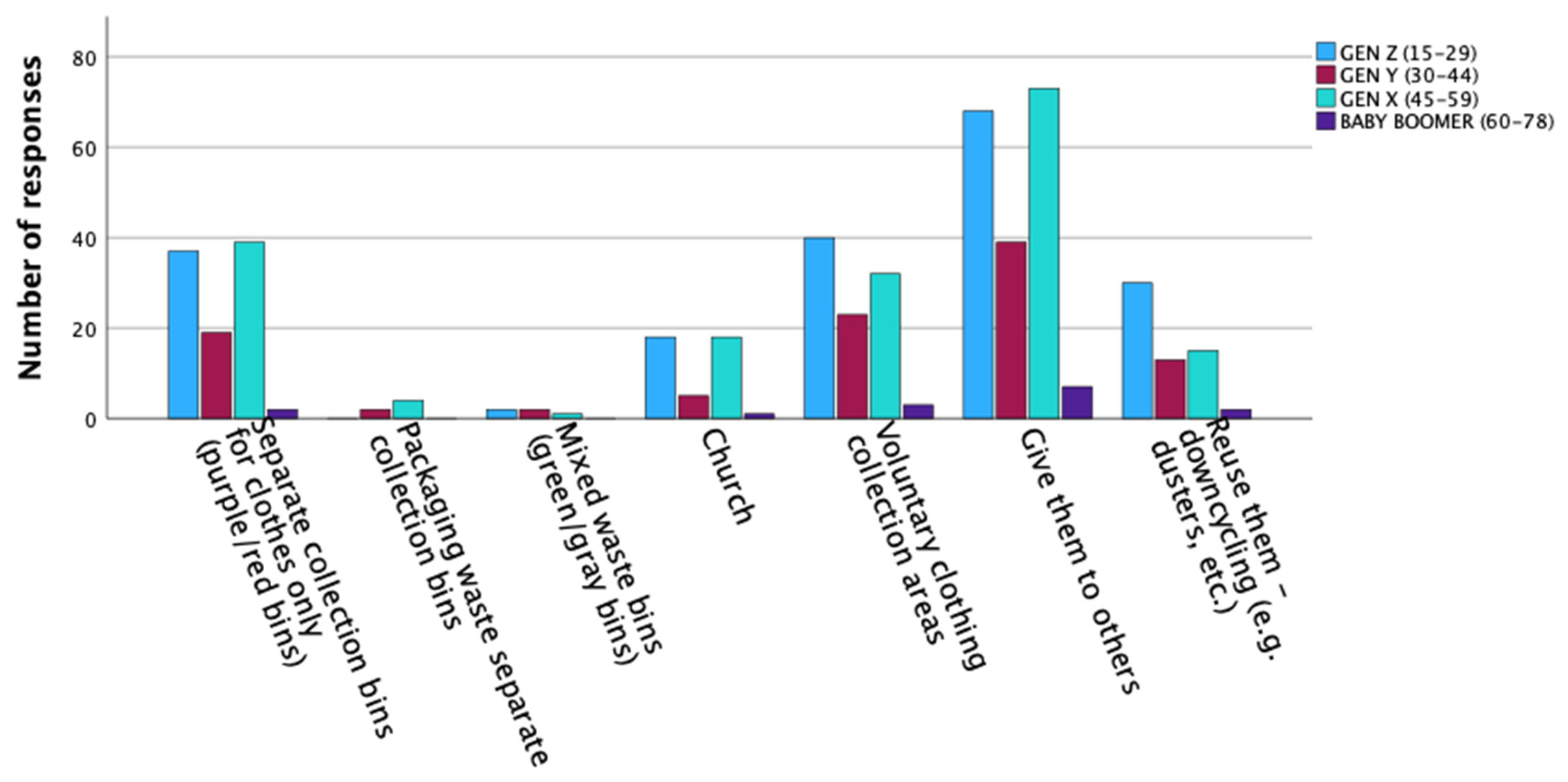
Descriptive analysis indicated that consumers across all age groups engage in sustainable disposal practices, adhering to the waste management hierarchy (Directive 2008/98/EC) [
24]. This was supported by multiple-response data on disposal methods. In the Czech Republic, older consumers (60+) were less likely to separate textile waste but more inclined to extend product life through reuse [
15]. In contrast, Gen Z respondents (18–35) frequently donated unwanted clothing to charity [
20], while younger consumers (18–30) also gave garments to family and friends [
13]. These findings are reinforced by Paço et al. [
7] and Gwozdz et al. [
5], who reported widespread sustainable disposal behavior among respondents.
Despite this, Soyer and Dittrich [
6] noted that sustainable disposal practices received the lowest mean score, with respondents showing limited interest in swapping or selling garments. Instead, they preferred donating or giving away redundant clothing.
In the Greek context, the prevalence of donation, reuse, and informal redistribution indicates that a fraction of Greek consumers are already engaging with elements of the green transition in textile sustainability. These practices also highlight an opportunity for retailers and policymakers to strengthen the green transition by expanding accessible infrastructure for second-hand collection, repair, and redistribution, building on behaviors that consumers are willing to adopt.
4.4. Practical Implications and Limitations
By applying practice theory, this study offers an innovative framework for analyzing clothing consumption and disposal behaviors. The Greek case study adds regional specificity to global research on garment life cycles, marking a first in the literature. These insights can inform policymakers and industry stakeholders in designing strategies to promote sustainability and circularity in the textile sector. More specifically, effective interventions must address the three elements of the practice theory. In terms of materials, interventions must ensure accessible and clearly marked textile collection systems, repair services, and slow fashion retail options. Concerning the meanings (significancies/ideas), interventions must address public narratives that normalize reuse, repair, and circular fashion. Finally, regarding competencies, a practical intervention could be to educate consumers on topics related to material quality, recycling pathways, and textile care.
Although consumers demonstrate awareness of the environmental impacts of the clothing industry, the limited explanatory power of the measured variables suggests that additional factors may influence purchasing behavior and sustainability perceptions. Future research should explore the determinants of actual disposal choices and assess the alignment between stated sustainability preferences and observed behaviors. Furthermore, investigating the volume and environmental impact of post-industrial textile waste would provide valuable data for sustainability planning for all countries.
5. Conclusions
The novelty of this study lies in examining textile consumption and disposal practices in Greece through the lens of practice theory that studies how materials, significancies, and competencies interact to jointly shape consumer behavior. By analyzing 250 survey responses, the findings demonstrate that textile-related purchase and waste disposal practices cannot be explained solely by behavioral attitudes. Instead, those practices are affected and shaped by an interaction of infrastructures (shops, bins, labels), cultural norms (trendiness, sustainability values), and individuals’ awareness (knowledge of materials and textile composition, awareness of recycling options).
Practice theory can explain why green transition may stall even when awareness is high; this is because sustainable changes require not awareness alone but also the alignment of materials, significancies, and competencies.
According to this study’s findings, senior age citizens, such as Gen X (45–59) and Baby boomers (60–78), tend to spend more money on clothing and demonstrate greater material awareness; yet, they still show a preference for fast fashion, even within the context of sustainable fashion. Frequent buyers are more inclined to invest in higher-quality garments while simultaneously exhibiting fast fashion tendencies. Those with higher annual clothing expenditures, i.e., >500 €/year, similarly lean toward fast fashion preferences. In terms of material awareness and waste reduction beliefs, the results indicate that greater understanding is associated with a preference for individual actions, such as purchasing fewer items or choosing longer-lasting garments. Respondents who expressed interest in recycled materials also tended to believe that reducing consumption and prioritizing durability are effective strategies to minimize textile waste. Finally, sustainable disposal practices were observed across almost all age groups, with Gen Z (15–29) and Gen X (45–59) demonstrating greater sustainability awareness and consciousness than Gen Y (30–44) and Baby boomers (60–78). Consequently, given the dynamics revealed in the practices of textile consumption and disposal in Greece, findings indicate that targeted interventions, such as awareness campaigns, workshops on sustainability in the textile sector covering the entire life cycle of a garment, and info days, are needed to address the challenges that arise.