Article

Climate Resilient Maritime Transport: Probabilistic Modeling of Operational Costs Under Increasing Weather Variability in the Baltic Sea


by
Magdalena Bogalecka
1,
Beata Magryta-Mut
2,* and
Mateusz Torbicki
2,*
1
Department of Industrial Products Quality and Chemistry, Gdynia Maritime University, Morska St. 81-87, 81-225 Gdynia, Poland
2
Department of Modelling and Mathematical Methods in Transport, Gdynia Maritime University, Morska St. 81-87, 81-225 Gdynia, Poland
*
Authors to whom correspondence should be addressed.
Sustainability 2026, 18(3), 1592; https://doi.org/10.3390/su18031592
Submission received: 31 December 2025 / Revised: 22 January 2026 / Accepted: 30 January 2026 / Published: 4 February 2026
(This article belongs to the Special Issue Sustainable Management of Shipping, Ports and Logistics)

Abstract

Maritime transport in semi-enclosed seas is increasingly exposed to short-term weather variability, a challenge expected to intensify under climate change and to affect the economic sustainability of shipping operations. This study proposes an integrated probabilistic framework to assess the impact of weather-induced uncertainty on operational costs, using a ferry service in the Baltic Sea as a case study. The approach combines a semi-Markov process, representing transitions between discrete weather hazard states derived from ERA5 reanalysis data (2010–2025), with a state-dependent cost model of key technical subsystems across the vessel’s operational cycle. The results show a strongly disproportionate cost structure, with most expenditures concentrated in open-sea navigation states. Although severe weather conditions occur infrequently, they generate a nonlinear amplification of operational costs, significantly reducing cost predictability and system resilience. The findings indicate that enhancing sustainability in maritime transport requires targeted, state-specific adaptation measures, such as weather-aware routing and condition-based maintenance. The proposed framework supports climate-adaptive decision-making and contributes to sustainability-oriented planning in maritime transport through improved operational robustness and cost resilience under weather uncertainty.

1. Introduction

Maritime transport is a critical backbone of global supply chains, whose stable and efficient operation is fundamentally dependent on environmental conditions. In recent decades, the sector has faced growing challenges associated with increasing weather volatility, a trend that is particularly pronounced in Northern European regions such as the Baltic Sea. Rising storm frequency, variable wave patterns, and intensified wind regimes directly affect operational safety, vessel reliability, and the economic predictability of shipping services. These climate-driven pressures not only undermine the resilience of transport infrastructure and logistics systems but also pose significant challenges to progress toward the United Nations Sustainable Development Goals (SDGs), particularly SDG 9 (Industry, Innovation and Infrastructure), SDG 12 (Responsible Consumption and Production), and SDG 13 (Climate Action), which emphasize resilient infrastructure, resource efficiency, and climate adaptation in transport systems [1,2,3]. In this context, traditional deterministic planning approaches become increasingly insufficient, highlighting the need for advanced analytical tools capable of quantifying the financial risks arising from meteorological uncertainty.
In response, this study develops and demonstrates an integrated probabilistic framework to assess the impact of increasing short-term weather variability on the operational costs of a ferry service operating in the Baltic Sea. The primary objectives are to: (1) integrate a semi-Markov process describing weather hazard dynamics with a state-dependent cost model representing key vessel subsystems; (2) apply the proposed framework to a real-world case study of the Gdynia–Karlskrona ferry route; and (3) quantify cost amplification under alternative weather scenarios while identifying strategic levers for enhancing economic resilience. By explicitly linking weather-induced uncertainty with operational cost structures, the proposed approach supports climate-resilient decision-making, contributes to resource-efficient transport operations, and provides a quantitative basis for investment planning aligned with the sustainability objectives embedded in the SDGs.
The proposed framework adopts an aggregated representation of key operational subsystems and links weather hazard categories to operating costs using expert-informed adjustment coefficients. This modeling choice prioritizes interpretability and practical relevance while deliberately abstracting from vessel-specific micro-level decision-making and adaptive operational strategies.
This manuscript is structured as follows. Section 2 (Literature Review) presents a structured review of the existing literature, supported by a bibliometric analysis, to identify the main research streams at the intersection of maritime transport, weather variability, probabilistic modeling, risk analysis, and operational costs. This section highlights the fragmentation of the current body of knowledge and demonstrates the lack of integrated approaches that jointly address weather-related uncertainty, operational risk, and economic consequences in maritime transport. Section 3 (Materials and Methods) describes the theoretical framework of the study, including the semi-Markov modeling of the operational process, the development of the state-dependent operational cost model, and the integration of weather-induced variability. Section 4 (Case Study: Application to the Gdynia–Karlskrona Ferry Route) introduces the study area, vessel and subsystem characteristics, and details the parameterization of the proposed model using real operational and meteorological data. Section 5 (Results and Discussion) presents the results of the cost simulations under baseline and weather-adjusted conditions and discusses their implications for ferry operations and climate-resilient decision-making. Finally, Section 6 (Conclusions, Limitations and Future Research Directions) summarizes the main findings, outlines the study’s contributions and limitations, and indicates directions for future research.

2. Literature Review

Variability in weather conditions over recent decades has become one of the key challenges affecting the functioning and safety of maritime transport. Weather conditions and their changes influence both navigational safety and operational efficiency [4], leading to increased uncertainty in route planning and fuel and vessel maintenance costs, as well as a higher risk of operational disruptions [5,6,7,8]. Consequently, there is a growing demand for advanced probabilistic analytical methods that enable risk modeling and the quantification of the impacts of extreme and variable environmental conditions, including weather-related factors, on transport processes and their associated costs [9,10,11,12].
The integration of these issues is crucial from the perspective of sustainability in the maritime sector. Variability in meteorological conditions affects not only the safety and reliability of transport operations but also the energy efficiency of vessels, pollution, the stability of supply chains, and both operational costs related to maintaining the continuity of navigation and the broader operating costs of vessels themselves [13,14,15,16]. These elements constitute fundamental pillars of sustainability [1,17]. The lack of tools enabling a probabilistic assessment of the economic consequences of weather-related disruptions limits the ability of maritime industry operators and decision-makers to adopt strategies that support risk reduction, cost minimization, and the simultaneous reduction in environmental footprints. Therefore, the development of models integrating weather variability, operational risk, and cost consequences is not only the scientific but also strategic importance, as it enables the design of more resilient, low-emission, and efficient maritime transport systems capable of operating under conditions of increasing climatic uncertainty and weather variability. In this way, the advancement of probabilistic decision-support tools represents an important contribution to strengthening the resilience of the maritime sector and its transformation towards sustainability.
The literature on maritime transport has predominantly evolved within the areas of safety, route optimization, risk assessment, and shipping economics. However, only in recent years have these topics begun to be combined with probabilistic modeling and uncertainty analysis in the context of increasing weather variability. Current research focuses, inter alia, on the assessment of operational risk in shipping [18,19,20], probabilistic modeling of the influence of meteorological conditions on vessel speed [21], the analysis of operating costs with respect to their sensitivity to environmental factors [22,23], and the integration of weather data with economic decision-making models [24,25].
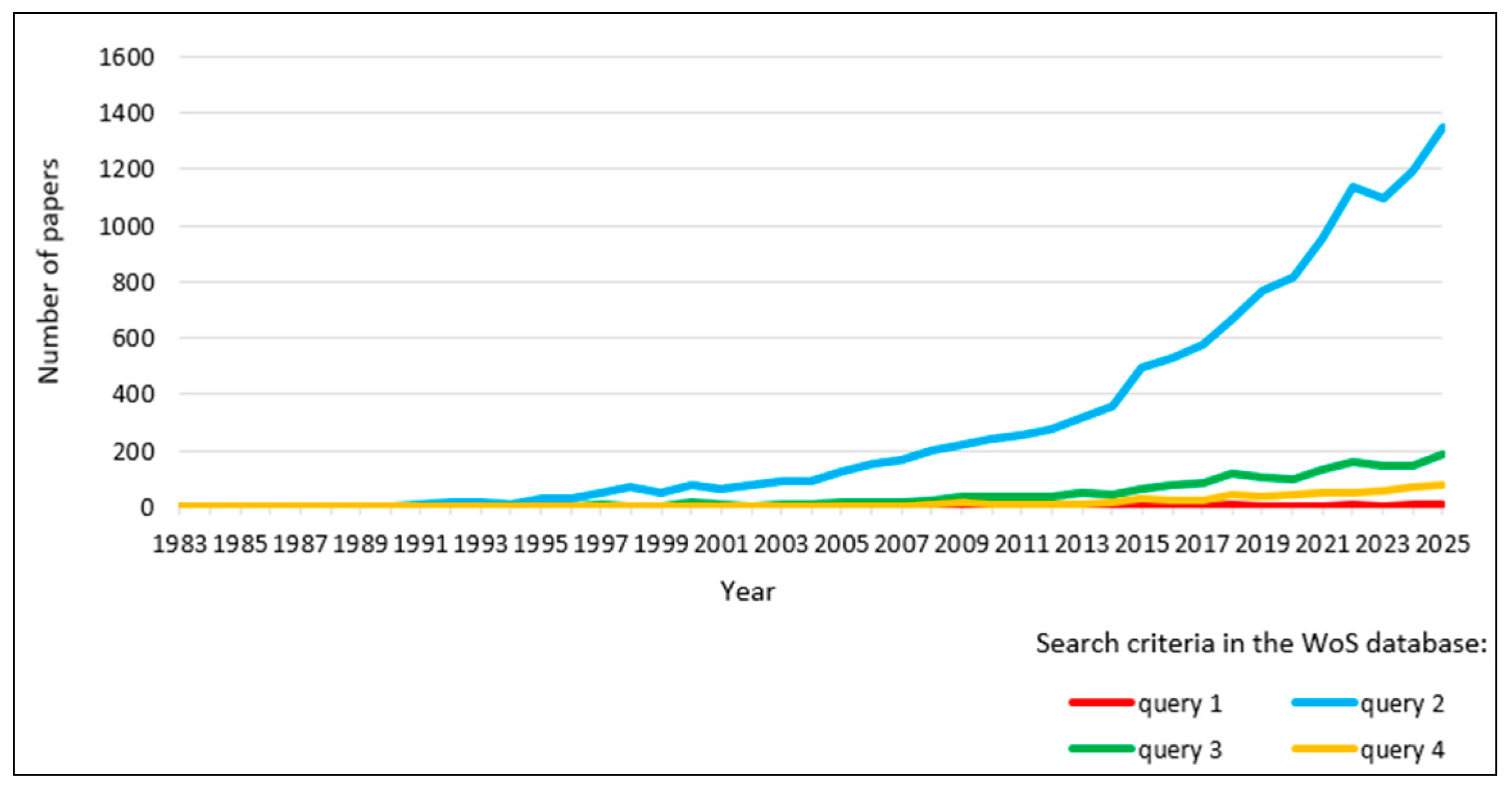
In the literature, the integration of these four aspects remains insufficiently explored, as evidenced by the search conducted in the Web of Science Core Collection database (WoS) on November 30th, 2025, which returned only 88 results for the following search criteria: “(weather) AND (mari* transpor* OR shipping OR sea transpor*) AND (probabilistic modeling OR uncertainty analysis OR risk assessment OR risk analysis) AND (operational cost OR maintenance cost OR shipping cost OR economic impact OR cost analysis OR cost assessment)” (query 1; Figure 1). Universal search terms “mari*” and “transpor*” were applied to increase the number of results and to capture a broader range of relevant literature, including, respectively, terms such as “maritime” and “marine” as well as “transport” and “transportation”, respectively. Within the collected dataset, the earliest article was published in 1998, while the most recent appeared in 2025. The highest number of publications was recorded in 2024, with 13 articles. The largest number of publications comes from the U.S.A. and China, with 21 and 19 articles, respectively. The same query extended by the term “Baltic” returned 0 results.
The analysis of the thematic distribution of articles retrieved using query 1, combining weather impacts, probabilistic modeling, risk analysis, and operational costs in maritime transport, based on the WoS subject category classification, reveals a strongly interdisciplinary of this research area. The largest number of publications (38) was assigned to the “engineering”, where issues related to vessel reliability, operational safety, and risk modeling under variable weather conditions clearly dominate. Other highly represented fields include “environmental sciences and ecology” (19) and “transportation” (15), highlighting the importance of weather impacts both on the marine environment and the functioning of transport systems, particularly with respect to costs arising from delays, failures, or route changes. A significant role is also played by “meteorology and atmospheric sciences” (13) and “oceanography” (12), which provide the foundations for modeling atmospheric and hydrodynamic phenomena essential for operational risk assessment. Other categories, such as “operations research and management science” (8) and “business and economics” (7), indicate a growing interest in the economic dimension of weather impacts on maritime transport, including decision optimization, cost management, and uncertainty analysis. The presence of individual publications in other domains (e.g., “water resources”—6, “computer science”—4, “energy and fuels”—3, “geology”—3, “geography”—2, “mathematics”—1) further demonstrates the strong thematic dispersion of the topic, confirming its highly interdisciplinary character and the need to integrate engineering, environmental, meteorological, and economic perspectives to achieve a comprehensive understanding.
Further bibliometric analysis focused on identifying the main research streams, research gaps, and directions for the development of the scientific literature in the area of maritime transport resilience to weather and climate change. In this context, the bibliometric approach was based on co-occurrence analysis of terms and graphical visualization of the results using the VOSviewer software (ver. 1.6.20), drawing on data obtained from the WoS. VOSviewer is a widely used tool in bibliographic data analysis, enabling the visualization of relationships between concepts and their grouping into thematic clusters (network visualization), which allows the structure and strength of interconnections within a given research field to be identified, with each cluster represented by a distinct color. Within VOSviewer, keyword co-occurrence maps were generated based on the analyzed publications. Each node corresponds to a single keyword, while the links between nodes reflect the frequency of their co-occurrence in the literature. The size of a node represents the weight of a given concept within the entire dataset, with larger nodes indicating more frequently used terms. In addition, a temporal analysis (overlay visualization) was conducted using VOSviewer by assigning colors to individual nodes corresponding to the average year of publication. This approach made it possible to capture temporal changes and identify emerging and developing research trends, thereby revealing not only the key research areas but also the dynamics of their evolution over time. However, it should be noted that the VOSviewer visualizations prepared for this manuscript were based only on data derived from the WoS database, omitting relevant publications indexed in other databases, such as Scopus or Google Scholar. Moreover, this approach is quantitative one and does not include a substantive or qualitative assessment of individual studies. Despite these limitations, the bibliometric concept maps generated using VOSviewer provide a valuable overview of dominant trends and thematic shifts within the analyzed research area.
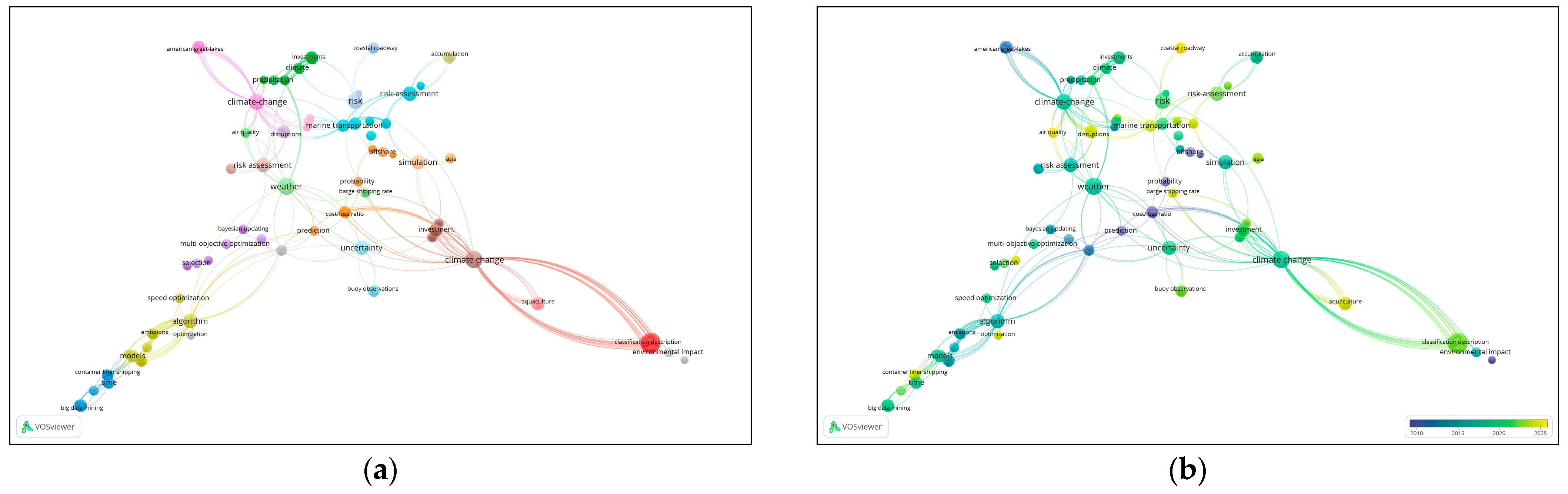
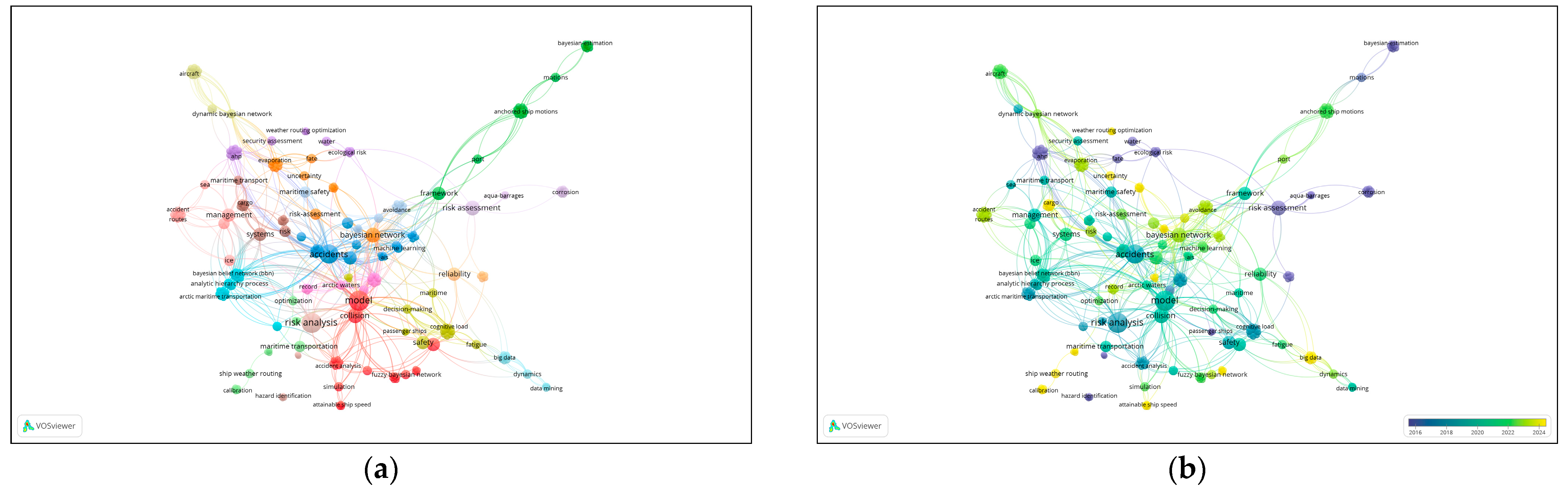
The network visualization, given in Figure 2a, presents several clearly separated thematic clusters, revealing a highly fragmented and weakly cohesive thematic structure, which results from the limited number of publications of the query 1 criteria. The strongest concentrations are observed around climate-related terms such as “climate change”, “precipitation”, and “air quality”, suggesting that most studies link weather impacts to generally climate change issues [26,27,28,29]. Central positions on the map are occupied by terms such as “risk”, “risk assessment”, “weather”, “probability”, “uncertainty”, and “prediction”, reflecting a strong research focus on probabilistic representations of atmospheric impacts and their influence on operational processes and the safety of navigation [30,31,32,33,34,35,36,37,38,39]. The proximity of these clusters indicates the effects of climatic phenomena on the reliability of maritime transport. In contrast, cost-related elements such as “investment” and “cost/loss ratio” form weaker and more isolated thematic nodes, pointing to the limited number of studies focused on the economic dimension of weather impacts on maritime transport [40,41,42,43,44,45,46]. On the right side of the visualization, a strongly separated red cluster centered on “environmental impact” is visible, suggesting the presence of publications focused on environmental effects [47,48,49,50,51,52] that are not directly linked to the operational costs of maritime transport. Within this visualization, the relationships between weather-related aspects and issues of risk and costs are observable but not expressed explicitly in terms of weather conditions directly generating higher operating costs. Instead, a more complex chain of dependencies is presented, in which weather acts as a risk factor influencing operational decisions, reliability models, and navigational safety, and only indirectly affects costs [53,54,55,56]. The relationship is therefore mediated: variable weather conditions increase operational risk, require more complex operational and safety strategies, affect system reliability, route choice decisions, and fuel consumption, and only subsequently convert into higher costs. The absence of a direct representation of this linkage reveals a significant research gap, namely the lack of coherent models in the literature that integrate the impact of meteorological conditions on operational and technical risk in maritime transport with a simultaneous consideration of costs, particularly within a probabilistic framework. This implies a lack of approaches capable of quantitatively assessing the extent to which adverse meteorological conditions lead to increased operating costs through the uncertainty and risk analysis.
The overlay visualization, given in Figure 2b, illustrates the temporal differentiation in the development of analyses connecting weather, risk, and costs in maritime transport. Blue nodes represent earlier research areas, focused on fundamental risk modeling issues, such as “models”, “algorithm”, “container liner shipping”, and “big data mining” [57,58,59,60,61]. These studies form the foundation for later research, in which weather-related aspects began to be linked with operational uncertainty. More recent research areas, represented by yellow and green colors, cluster around climate-related terms such as “climate change”, “precipitation”, and “investments”, suggesting a growing interest in the economic consequences of weather phenomena [62,63,64,65]. In recent years, there has also been an increasing prominence of topics related to “environmental impact” and “classification description”, indicating a shift in research attention towards the assessment of indirect and external costs associated with extreme atmospheric conditions [66,67,68,69]. The color distribution confirms that, despite the relatively small number of records, this research area is evolving dynamically. However, there remains a clear lack of studies that integrate weather-related aspects, risk, and costs in maritime transport within a coherent methodological framework.
The relatively small number of publications combining weather impacts, probabilistic modeling, risk analysis, and operational costs in maritime transport, as well as the weak interdisciplinary integration of this research field, justified extending the WoS database search by abandoning the requirement to link all of these aspects simultaneously. Consequently, additional searches were conducted using three sets of queries addressing the relationship between maritime transport and probabilistic modeling and risk analysis (query 2); an extension of query 2 by including operational costs (query 3); and the relationships between weather conditions and probabilistic modeling and risk analysis in shipping (query 4).
As a result, the number of retrieved publications increased as follows (Figure 1):
  • 12,670 records using query 2—“(mari* transpor* OR shipping OR sea transpor*) AND (probabilistic modeling OR uncertainty analysis OR risk assessment OR risk analysis)”,
  • 1712 records using query 3—“(mari * transpor* OR shipping OR sea transpor*) AND (probabilistic modeling OR uncertainty analysis OR risk assessment OR risk analysis) AND (operational cost OR maintenance cost OR shipping cost OR economic impact OR cost analysis OR cost assessment)”,
  • 621 records using query 4—“(weather) AND (mari* transpor* OR shipping OR sea transpor*) AND (probabilistic modeling OR uncertainty analysis OR risk assessment OR risk analysis)”.
The earliest publication dates come from 1983, 1991, and 1986 for queries 2, 3, and 4, respectively, while the most recent publications, although indexed in 2025, carry official publication dates of 2026 in all three queries. A significant increase in the number of publications has been observed since 2015 and continues to grow. In 2025, the numbers reached 1353, 187, and 77 publications for queries 2, 3, and 4, respectively (Figure 1). Most publications, using queries 2–4, come from China (3398; 349; and 142 publications, respectively), the U.S.A. (2267; 365; and 127 publications, respectively) and England (1046; 157; and 48 publications, respectively).
For the 2–4 query sets, bibliometric analyses were also conducted using the VOSviewer software.
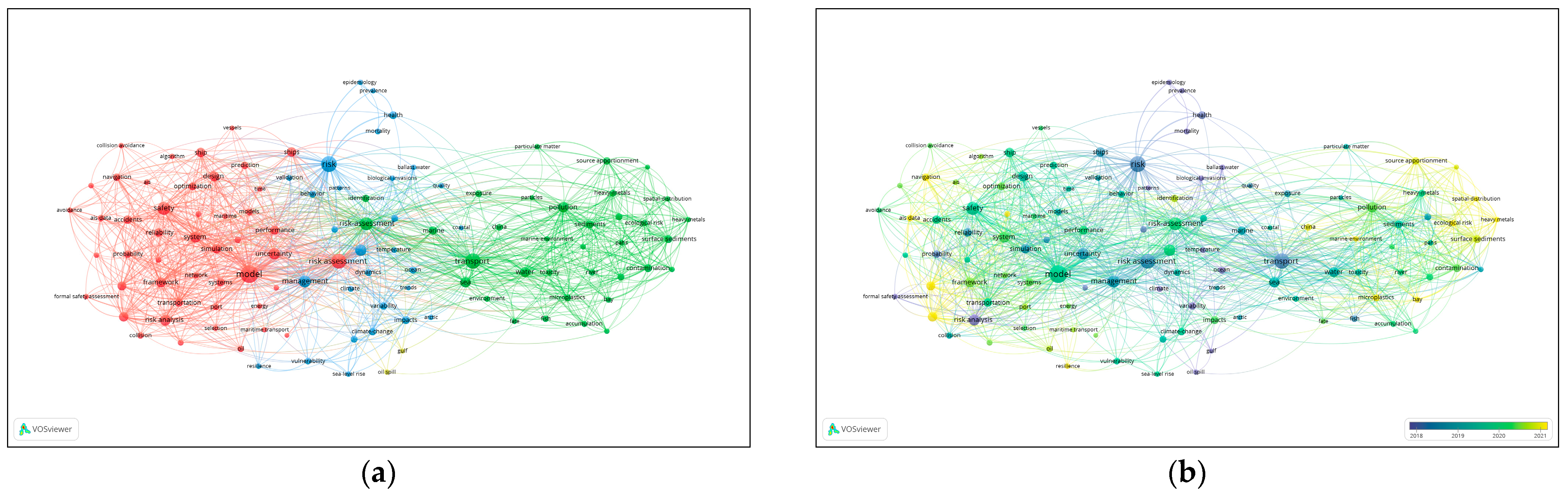
The network visualization, given in Figure 3a, was prepared based on the largest literature dataset, comprising 12,670 records identified using query 2: “(mari* transpor* OR shipping OR sea transpor*) AND (probabilistic modeling OR uncertainty analysis OR risk assessment OR risk analysis)”. The visualization shows that research in this field is, on the one hand, highly dispersed and, at the same time, concentrated around several major themes, including risk modeling, operational safety, environmental analysis, and the impacts of climate change. The network structure clearly reflects the multidisciplinary nature of contemporary research on the resilience of maritime transport. Despite the extensive body of scientific literature, relatively few publications link probabilistic risk models with the economic dimension of shipping activities [70,71,72]. Many studies rely on deterministic models or simplified approaches to assessing operational impacts, without integrating them into comprehensive uncertainty frameworks. The most central and largest nodes in the network include the terms “risk”, “risk assessment”, “safety”, “model”, “transport”, “management”, and “pollution”, indicating that the research domain is strongly oriented towards modeling risk processes and their influence on the functioning of maritime transport systems [73,74,75]. The term “uncertainty” also occupies a key position, suggesting that a substantial proportion of studies focus on variability in operational conditions and on methods for incorporating uncertainty into decision-making models, thereby demonstrating strong links with reliability engineering and technical system safety research [76]. This visualization allows the identification of three main thematic clusters: safety, navigational risk, and probabilistic modeling (red); environmental and ecological risk and marine pollution (green); and climate and environmental variability (blue). On the left side of the visualization, the largest and most cohesive red cluster is visible, indicating the dominance of research on safety and reliability of maritime systems within the entire analyzed dataset. This cluster represents the classical core of maritime transport safety science and the traditional literature focused on safety regulations and risk engineering approaches. It encompasses concepts such as “safety”, “reliability”, “accidents”, “navigation”, “ship”, “optimization”, and “simulation”. The combination of these terms points to a strong research stream addressing vessel safety analysis, collision avoidance, human error modeling, and the optimization of operational processes [77,78,79]. At the same time, it highlights the dynamic development of probabilistic methods applied to failure assessment, reliability analysis, navigation, and system design [80]. In the right area of the visualization, a clearly separated green cluster is observed, associated with the environmental impacts of maritime transport and ecological risk assessment. Nodes such as “pollution”, “sediments”, “contamination”, “water”, and “ecological risk” emphasize the interdisciplinary links between risk analysis and environmental research. This cluster represents a research area at the intersection of oceanography, toxicology, and maritime transport, in which risk modeling takes on an environmental dimension. It is a well-developed body of literature where probabilistic methods are used to assess ecological hazards, model pollution generated by maritime transport, and analyze the presence of toxic substances in the marine environment [81,82,83,84,85,86,87]. The visualization also reveals a blue cluster associated with climate change and environmental conditions, including terms such as “climate”, “climate change”, “variability”, “temperature”, “impacts”, and “sea level rise”. This cluster is less strongly interconnected than the two dominant areas mentioned above (risk and safety, and environmental issues). Its nodes are noticeably smaller, and its presence indicates a growing interest in the influence of environmental variability on maritime transport systems, as well as the initial integration of probabilistic modeling with global environmental changes, including climate impacts on maritime operations [88,89,90,91,92]. The issues related to operational costs, economic consequences of weather variability, and economic–probabilistic models of transport system resilience are virtually absent from this visualization. This finding confirms that the traditional literature focuses primarily on safety and risk analysis from technical and environmental perspectives, while a clear gap remains in the integrated modeling of risk and costs in shipping activities. This gap directly justifies the research direction undertaken in this manuscript.
The overlay visualization for query 2, given in Figure 3b, illustrates the thematic evolution of research related to maritime transport, probabilistic modeling, risk analysis, and environmental factors. The color gradient (from blue to yellow) reflects the chronology of publications, ranging from older studies (around 2018) to more recent ones (after 2021). Central positions in the network are occupied by terms such as “risk”, “risk assessment”, “model”, “transport”, and “sea”, which form the foundation of contemporary research on the safety and functioning of maritime systems. The dominance of green nodes suggests that studies on risk assessment and probabilistic modeling have maintained strong research activity in recent years, although they do not represent the most recent emerging trends. The most recent research topics, indicated by yellow and light-green nodes, are primarily concentrated around issues related to marine environmental pollution, including “pollution”, “sediments”, “heavy metals”, “surface sediments”, “contamination”, “ecological risk”, and “microplastics” [93,94,95,96,97,98,99,100,101]. The strong presence of these nodes indicates that environmentally oriented research has become one of the fastest-growing streams in the literature related to maritime transport. This trend shows a marked increase after 2020, which can be associated with a global rise in interest in the impacts of human activities on marine ecosystems. In contrast, darker nodes related to topics such as “health”, “epidemiology”, “prevalence”, and “biological invasions” represent an earlier stage in the development of this research area, referring to biological risk aspects and threats associated with ballast water that constituted an important research focus prior to 2019 [102,103,104,105,106,107]. Within the domain of navigational safety, the most recent publications focus on topics such as “collision avoidance”, “AIS data”, “navigation”, “accidents”, and “optimization”. This reflects a transition from classical risk models towards more advanced approaches based on empirical data and algorithms supporting automation and increased reliability of transport systems. In the context of probabilistic modeling and uncertainty, frequent co-occurrences of terms such as “uncertainty”, “simulation”, “reliability”, “framework”, “vulnerability”, and “climate change” are noteworthy [108,109,110]. These connections indicate that research is increasingly integrating risk analysis with dynamic changes in the marine environment, which is crucial in the context of transport resilience to weather variability. The overlay visualization reveals a clear evolution of research from classical issues of risk and safety towards more environmentally oriented and integrated approaches, in which the impacts of climate change, pollution, and ecological system dynamics on maritime transport are analyzed. These thematic shifts provide an important context for further investigation of maritime transport resilience under conditions of increasing weather variability.
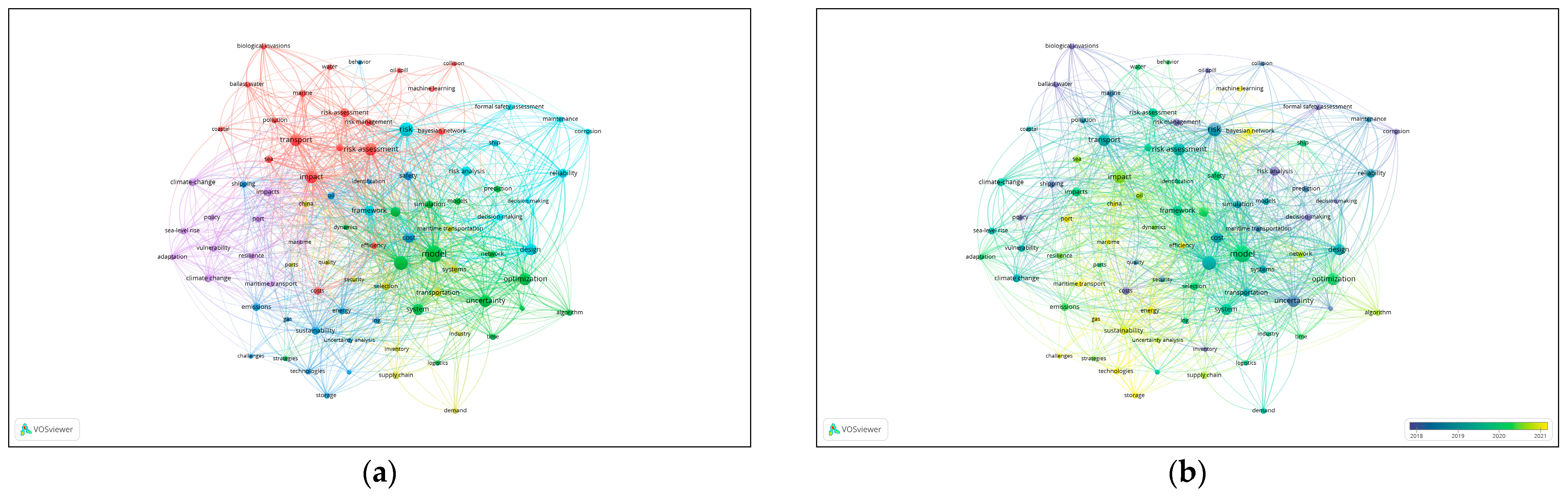
The network visualization, given in Figure 4a, prepared based on query 3, illustrates the spatial concentration of key terms in studies linking maritime transport, risk, and costs. It is based on 1712 records retrieved using the query “(mari* transpor* OR shipping OR sea transpor*) AND (probabilistic modeling OR uncertainty analysis OR risk assessment OR risk analysis) AND (operational cost OR maintenance cost OR shipping cost OR economic impact OR cost analysis OR cost assessment)”. At the center of the map, a green cluster is visible, dominated by the term “model”, surrounded by concepts related to systems, costs, efficiency, and uncertainty (“system”, “uncertainty”, and “optimization”). This configuration indicates the strong establishment of probabilistic modeling and its central role as a fundamental tool for cost and risk analysis in maritime transport [111,112,113,114]. On the left side of the visualization, purple and blue clusters are observed, encompassing issues related to climate, environmental policy, system resilience, and emissions [115]. This indicates a strong linkage between risk and cost analyses and challenges associated with sustainability and climate change adaptation. In close proximity, the visualization becomes denser around terms such as “transport”, “pollution” and “risk assessment”, suggesting a substantial body of research focused on environmental risk and the economic consequences of pollution, generated by maritime transport, as well as the broader environmental impacts of shipping activities [116,117,118,119,120,121]. Simultaneously, a tendency is evident to combine emission and pollution assessments with analyses of operational efficiency, pointing to a gradual shift towards a more holistic perspective on environmental costs [122,123,124,125]. This cluster configuration also suggests growing interest in tools that enable formal modeling of transport-related impacts on marine ecosystems, including probabilistic methods. As a result, this area increasingly serves as a bridge between classical risk analysis and contemporary sustainability-oriented research in the shipping sector. The red cluster represents a well-established and highly cohesive research area focused on the traditional understanding of risk analysis in maritime transport, primarily encompassing environmental hazards. It indicates a high level of co-occurrence of terms related to accidents, environmental contamination, and risk assessment associated with shipping activities. This cluster therefore includes studies centered on the identification and modeling of operational hazards, ranging from collisions and oil spills to pollution incidents, ballast water risks, and biological invasions [126,127,128,129,130]. The concept of “risk assessment” plays a particularly important role, acting as a central node linking safety, accident analysis, and environmental threats. This body of literature is mainly grounded in classical risk analysis methods, impact assessment of maritime incidents, and uncertainty analysis related to sudden events. Although this research area is well developed, it appears as a clearly separated group of terms such as “pollution”, “oil spill”, “collision”, “marine”, “biological invasions”, and “coastal”, with only limited connections to operational costs. This indicates that a significant proportion of studies addressing accidents and environmental risk are not integrated with economic analyses or cost modeling, thereby directly revealing the research gap identified earlier. On the right side of the visualization, within the turquoise cluster, terms related to technical safety, reliability, and formal risk assessment methods appear, indicating a research stream in which cost modeling is closely linked to vessel reliability and operation, strongly embedded in ship engineering and maintenance studies [131,132,133,134,135]. In the lower part of the visualization, a small yellow cluster is visible, focusing on logistics, demand, and supply chain issues. This suggests that analyses of maritime transport costs often also account for processes occurring within the broader maritime economy. The presence of terms related to demand, cargo, and logistics flows indicates that some studies focus on the economic efficiency of entire transport systems rather than solely on individual vessels or operations [136,137,138,139,140,141]. This configuration shows that, alongside technical approaches, there exists a parallel stream of economic and logistics-oriented analyses aiming to capture the impact of operational changes on costs at a macro scale. At the same time, the weak linkage between this cluster and areas related to weather uncertainty highlights the lack of studies integrating climatic variability with logistics and cost analyses [142,143,144,145,146]. The visualization demonstrates that research on costs in maritime transport does not function as a standalone theme but intersects with analyses of risk, environmental impact, reliability, and logistics processes, forming a complex, multi-layered research landscape. Some studies integrate economic models with risk analysis, such as probabilistic assessments of downtime costs, models of failure impacts on maintenance costs, or analyses of fuel costs under variable speed and resistance conditions [147,148,149,150]. However, a significant research gap becomes evident in the very weak integration of operational cost studies with risk analysis in the context of weather variability and extreme climatic events. Cost-related nodes (“cost”, “shipping cost”, “operational cost”, “economic impact”) are strongly connected to general models, uncertainty, and technical risk analysis, whereas weather- and climate-related nodes (“climate change”, “sea level rise”, “vulnerability”, “resilience”, “adaptation”) form a separate co-occurrence area and show only weak or no direct links to cost-related and probabilistic modeling terms associated with ship operations. This indicates that, while research exists on environmental risk and the economic aspects of maritime transport, primarily in the context of technical hazards, failures, system reliability, and the impact of extreme weather on navigational safety, there is very little literature that integrates these domains in an advanced manner, for example, through probabilistic models of ship operating costs under increasing meteorological variability and more frequent extreme events.
The overlay visualization for query 3, given in Figure 4b, shows how individual research themes have evolved over time. The yellow and green areas indicate more recent research directions, particularly visible in topics such as “uncertainty”, “optimization”, “sustainability”, and “energy”. This suggests that recent years have seen growing interest in uncertainty management methods and cost optimization in the context of sustainable maritime transport [151,152,153,154]. In contrast, more blue-colored nodes dominate around terms such as “risk assessment”, “pollution”, and “shipping”, indicating that classical risk assessment and environmental analyses constitute an earlier and steadily developed core of the literature [155,156,157,158]. The color distribution thus reveals a gradual shift in research emphasis from general risk analysis towards more advanced techniques for modeling costs, uncertainty, and operational efficiency.
The network visualization, given in Figure 5a, was generated based on 621 records retrieved from the WoS database using query 4: “(weather) AND (mari* transpor* OR shipping OR sea transpor*) AND (probabilistic modeling OR uncertainty analysis OR risk assessment OR risk analysis)”. The visualization reveals a clearly differentiated thematic structure of research addressing the interrelationships between weather, maritime transport, and risk and uncertainty assessment and analysis. At the center of the network, the most densely populated area is concentrated around the terms “risk analysis”, “accidents”, and “collision”, as well as shipping-related concepts such as “maritime”, “maritime transport”, and “maritime safety”, indicating a dominant research stream focused on fundamental risk models in maritime navigation [159,160]. Surrounding this core, additional clusters are formed, including a red cluster associated with collision modeling, accident analysis, and simulation [161,162,163,164]. On the left side of the network, a turquoise segment is visible, devoted to the assessment of navigational safety under severe weather conditions, with prominent terms such as “ice” and “Arctic maritime transportation” [165,166,167,168,169]. In contrast, more dispersed areas appearing on the right side encompass specialized topics that play a complementary role, such as the motions of moored vessels [170,171,172,173] and corrosion processes [174,175,176]. Across all of these areas, the application of Bayesian models is evident.
The overlay visualization for query 4, given in Figure 5b, allows the evolution of research within this field to be captured. Earlier studies, represented by dark blue and purple colors, focus on general issues such as “sea”, “management”, and “maritime safety”, as well as on the initial applications of Bayesian networks to the analysis of maritime incidents [177,178]. As the color transitions towards green and yellow, more recent topics emerge, including “big data”, “dynamics”, and “machine learning” [179,180,181], along with more advanced risk models that integrate weather conditions, vessel traffic, and decision-making processes [182,183,184]. These developments also encompass route optimization, particularly under challenging conditions in Arctic regions [185,186,187,188,189,190]. The map indicates that in recent years the research direction has shifted markedly towards computational techniques, dynamic modeling, and the integration of measurement data with weather forecasting.
The visualizations obtained using query 4 reveal a clear shift in research emphasis compared with queries 2 and 3. While the latter focus primarily on general aspects of safety, the reliability of maritime systems, and environmental hazards, query 4 shifts the analytical focus towards the relationship between weather conditions and probabilistic risk modeling in maritime navigation.
In contrast to query 2, which is dominated by the classical core of safety research (e.g., “safety”, “reliability”, “accidents”, “navigation”), query 4 reflects a more technical and dynamic character of analysis, strongly grounded in vessel motion modeling, weather-dependent route optimization, and the application of Bayesian networks and artificial intelligence methods. Terms referring explicitly to weather-related events and decision processes, such as “collision”, “accident”, “ship weather routing”, and “Bayesian network”, occupy a prominent position in the network, whereas they were only marginally present or entirely absent in the previous queries.
Compared with query 3, which emphasized the relationships between risk and costs and highlighted the environmental component, query 4 demonstrates that weather-related issues are far less connected to economic and ecological themes and are instead much more strongly associated with operational and navigational problems. In query 3, clusters related to pollution, ecological risk, and logistics were clearly visible, whereas in query 4 these themes become marginal, giving way to probabilistic models focused on decision-making processes, vessel dynamics, and the analysis of meteorological data. The studies primarily address how weather conditions affect vessel behavior and navigational safety, while the economic consequences of this variability are addressed far less frequently. This distinction clearly differentiates the publications retrieved under query 4 from those identified through queries 2 and 3. In query 2, the key clusters concerned safety, reliability, and the foundations of risk engineering, whereas query 3 introduced the dimension of operational costs, the economic consequences of failures, and the relationships between risk and the financial burden of maritime transport. Query 4, by contrast, shifts the emphasis towards weather-related issues and environmental uncertainty but generates virtually no links to cost-related topics, as key concepts such as “operational cost”, “economic impact”, and “cost analysis” are absent.
The search conducted using query 1, which combines weather, probabilistic approaches, and maritime transport costs, identifies the smallest yet most specialized segment of the literature. Both this subset and the combined analysis of queries 2–4 reveal a clear research gap: there is a lack of studies integrating probabilistic modeling of weather conditions with economic analyses of operational impacts in maritime transport, particularly in the context of increasing climate variability. The current state of knowledge typically addresses either (1) safety modeling, (2) the assessment of operational costs, or (3) the influence of weather on risk, but does not integrate these three dimensions into a coherent analytical framework. In other words, the literature is highly fragmented, and there is no unified approach that simultaneously combines maritime transport, weather, risk, and costs within a single decision-making model.
Operational and weather-related risk models exist; however, they are not coupled with cost models and therefore do not allow for an assessment of how meteorological variability translates into the actual expenditures of shipowners and maritime operators. The analysis indicates that substantial future research potential lies in the integration of probabilistic risk models with economic operational models, the development of climate-resilient maritime operation frameworks, the quantification of the impact of weather instability on the total life-cycle costs of vessels, and the construction of predictive models that link real-time weather data with cost functions.
To explicitly position the proposed framework within the fragmented literature, Table 1 contrasts representative classes of existing approaches with the present research along key modeling dimensions, including weather representation, treatment of uncertainty, temporal resolution, and cost propagation mechanisms. While many studies consider uncertainty in aggregate or average terms, relatively few explicitly examine how short-term weather variability and persistence lead to threshold-driven and disproportionate cost responses at the operational level.
The reviewed literature demonstrates substantial progress in modeling maritime risk, weather impacts, and operational costs; however, these dimensions are typically addressed in isolation or linked only implicitly. Probabilistic risk and safety models tend to abstract from cost propagation, weather-routing and optimization approaches focus on short-term operational efficiency under largely deterministic or forecast-based conditions, while economic cost models often aggregate weather effects into average operating regimes, thereby overlooking short-term variability and persistence.
As a result, existing approaches provide limited insight into how stochastic weather dynamics, temporal persistence of adverse conditions, and operational cost exposure interact over time. In contrast, the framework proposed in this study explicitly represents weather as a discrete stochastic process with duration-dependent transitions and links hazard categories directly to operational cost adjustments. Table 1 summarizes these structural and conceptual differences, clarifying how the proposed semi-Markov framework departs from existing modeling paradigms rather than merely integrating them.
This positioning motivates the research objectives and the methodological choices described in Section 3.

3. Materials and Methods

Motivated by the comparative gaps identified in Section 2 (Table 1), the proposed framework adopts a semi-Markov formulation to explicitly capture state persistence and duration effects in weather-driven cost dynamics.

3.1. Semi-Markov Model of the Operational Process

The operation of a complex technical system, such as a ferry, is modeled as a semi-Markov process Z ( t ) , t 0 , [191,192,193,194]. This process assumes a finite set of discrete states, A = { z 1 , z 2 , . . . , z ν } , where for the analyzed ferry case, ν = 18. Each state z b represents a distinct phase in the vessel’s operational cycle (e.g., loading, open-sea navigation, maneuvering). The semi-Markov process Z ( t ) is fully defined by the following components:
  • The initial probability vector:
[ p b ( 0 ) ] 1 × ν = [ p 1 ( 0 ) , p 2 ( 0 ) , , p ν ( 0 ) ] ;
where p b ( 0 ) = P ( Z ( 0 ) = z b ) for b = 1,2,…,ν.
The semi-Markov modeling framework adopted in this study follows the classical formulation of semi-Markov processes, in which system evolution is governed by an embedded Markov chain and state-dependent sojourn time distributions. The notation and probabilistic definitions used herein are consistent with standard treatments of semi-Markov theory (e.g., [191,192,193,195]).
  • The matrix of transition probabilities:
[ p b l ] v × v = [ p 11 p 12 p 21 p 22 p 1 v p 2 v p v 1 p v 2 p v v ] ,
where p b l is the probability that the next state will be z l given that the current state is z b ,   (bl). It is assumed that p b b = 0 for all b.
  • The matrix of conditional sojourn time distribution functions:
[ H b l ( t ) ] v × v = [ H 11 ( t ) H 12 ( t ) H 21 ( t ) H 22 ( t ) H 1 v ( t ) H 2 v ( t ) H v 1 ( t ) H v 2 ( t ) H v v ( t ) ] ,
where H b l ( t ) = P ( θ b l < t ) , t 0 , b, l = 1,2,…,ν, b l , is the conditional distribution function of the sojourn time in state z b before transitioning to state z l . The random variable θ b l represents this conditional sojourn time.
The mean conditional sojourn times are given by:
M b l = E [ θ b l ] 0 t d H b l ( t ) = 0 t h b l ( t ) d t ,
where h b l ( t ) is the probability density function corresponding to H b l ( t ) .
The expressions for the limiting (steady-state) probabilities of a semi-Markov process follow well-established results from renewal and semi-Markov theory and are commonly used in long-run performance and cost analyses (e.g., [191,192,193]).
For a semi-Markov process, the limiting (steady-state) probabilities of residing in states z b   are:
p b = l i m t p b ( t ) = π b M b l = 1 v π l M l , b = 1 , 2 , , ν ,
where
  • M b = l = 1 v p b l M b l   is the unconditional mean sojourn time in state z b ;
  • πb represents the stationary probabilities of the embedded Markov chain, satisfying the system of equations:
{ [ π b ] = [ π b ] [ p b l ] l = 1 v π l = 1 . .
Note on the Application. In the present case study, the ferry’s operational cycle follows a fixed, repeating sequence defined by the operator’s schedule. Therefore, the transition probabilities p b l are deterministic (either 0 or 1), and the model simplifies to a cyclic semi-Markov process. This adaptation allows us to utilize the semi-Markov framework— particularly the formulas for limiting state probabilities p b —to analyze time allocation and costs based on planned state durations, while retaining the capability to model random variations in state sojourn times due to external disruptions. The semi-Markov formulation is retained to explicitly model stochastic sojourn times and clustered weather effects.
Consequently, the expected total time the system spends in state z b over a fixed operational horizon [0, θ]
M ^ b = E [ θ ^ b ] = p b θ , b = 1 , 2 , , ν .
Equation (7) represents an asymptotic approximation that becomes increasingly accurate as the operational horizon exceeds the typical state sojourn times and the semi-Markov process approaches its stationary regime. In the case of the analyzed ferry service, characterized by intensive, high-frequency daily operation and year-round scheduling, the monthly planning horizon used in the cost analysis (θ ≈ 720 h) is long relative to the majority of state sojourn times. Under these conditions, the steady-state probabilities provide a reasonable and analytically tractable approximation of time allocation across operational states for cost forecasting purposes. This formulation provides the probabilistic foundation for analyzing the time allocation across operational states, which is directly linked to the cost structure described in the subsequent sections.

3.2. Baseline Operational Cost Model

In the considered approach, it is assumed that individual operational states of the system have a significant impact on its functional structure, safety configuration, and operational costs. This implies that as the system transitions between operational states, dynamic modifications may occur in how its components function, their mutual interactions, efficiency, and overall system reliability. The functional structure of the system is understood as the organization and interaction between its components, which cooperate to achieve the intended operational functions. As operating conditions change, this structure may be adaptively modified to maintain or improve parameters such as operational efficiency, safety, and availability.
Following classical stochastic cost and reward formulations used in Markov and semi-Markov processes (e.g., [192,193,196,197,198]), the instantaneous operational cost of the system at time t is introduced as a vector:
C ( t )   = [ [ C ( t ) ] ( 1 ) ,   [ C ( t ) ] ( 2 ) ,   , [ C ( t ) ] ( ν ) ] ,   t 0 ,
with components
[ C ( t ) ] ( b ) ,   t 0 ,   b = 1 , 2 , , ν ,
denoting the instantaneous operational cost of the system in operational state z b , provided that the system is indeed in that state. The index b = 1,2,…,ν refers to the number of distinguished operational states of the system.
Based on the instantaneous costs [C(t)](b), the total operational cost of the system over the time interval [0,θ] can be determined. It is assumed that this cost depends on the time spent by the system in individual states and on the conditional instantaneous costs. The total operational cost is expressed as:
C ^ ( θ ) = b = 1 ν p b [ C ^ ( θ ) ] ( b ) , θ > 0 ,
where
  • p b   is the limiting probability of the system residing in state z b ;
  • [ C ^ ( θ ) ] ( b ) is the total operational cost of the system in state z b over the interval [0,θ].
The total cost in state z b is calculated according to the formula:
[ C ^ ( θ ) ] ( b ) = 0 M ^ b [ C ( t ) ] ( b ) d t , θ > 0 , b = 1 , 2 , , ν ,
where M ^ b ,  b = 1,2,…,ν, is the time spent by the system in state z b , given by:
M ^ b = p b θ , b = 1 , 2 , , ν .
This formulation provides a direct link between the probabilistic model of system operation and the resulting economic performance, serving as the foundation for further integration of weather-induced variability in the operational cost structure.

3.3. Weather-Integrated Operational Cost Model

The financial performance of maritime operations is significantly influenced by meteorological conditions, which affect parameters such as fuel efficiency, subsystem wear, maintenance frequency, and overall voyage safety. To incorporate this source of uncertainty into the economic assessment, the baseline cost model defined in Section 3.2. is extended by introducing weather adjustment coefficients.
These coefficients scale the baseline cost associated with each operational state z b , b = 1,2, …, ν, according to the severity of the prevailing environmental conditions. The weather conditions are classified into w discrete hazard categories, denoted cβ, where β = 0, 1, …, w. Category c0 typically represents calm or favorable conditions, while higher indices correspond to progressively more severe meteorological states.
The use of discrete weather hazard categories and hazard-dependent cost adjustment coefficients is consistent with established approaches in maritime risk and weather impact modeling, where meteorological conditions are translated into operational or economic modifiers (e.g., [13,30,40]), with the Baltic Sea specific parameterization adopted from [4]. The integration of weather is formalized through a weather adjustment coefficient k β ( z b ) . This coefficient modifies the baseline cost rate of state z b when the system is exposed to hazard category cβ. This mechanism accounts for the varying sensitivity of different operational phases to environmental stressors. For example, navigation in open-sea operational states is generally more sensitive to adverse weather conditions, as increased resistance, reduced maneuverability, and higher auxiliary loads amplify fuel consumption and mechanical wear. In contrast, port-related operations such as loading, unloading, and mooring are partially sheltered, resulting in comparatively smaller weather-induced cost adjustments.
Formally, the adjusted instantaneous cost for the system being in operational state z b under weather hazard category cβ is defined as:
C b , β = C ( t ) ( b ) k β ( z b ) ,   t 0 ,   b = 1 , 2 , , ν ,   β = 0 ,   1 , , w ,
where
  • C ( t ) ( b ) is the baseline instantaneous cost rate in state zb [199];
  • k β ( z b ) is the weather adjustment coefficient for state zb, under hazard category cβ [4].
The total expected operational cost over a given time horizon, accounting for the stochastic nature of both the operational process and the weather, can therefore be expressed as:
C = b = 1 ν [ C ( t ) ( b ) β = 0 w ( k β ( z b ) p β ) ] ,   t 0 ,   b = 1 , 2 , , ν ,   β = 0 ,   1 ,   2 , , w ,
where
  • ν is the total number of operational states;
  • p β is the steady-state probability of the weather process residing in states within hazard category cβ.
This formulation captures not only the direct increase in subsystem expenditures but also indirect weather consequences, such as prolonged sojourn times in certain states, elevated fuel consumption, and accelerated aging of technical components. By embedding these state- and weather-specific coefficients within the stochastic cost model, the resulting forecasts remain sensitive to actual meteorological variability. This moves beyond reliance on static long-term averages, which often obscure the financial risks associated with short-term weather volatility.
In the present formulation, nonlinear cost amplification is represented through hazard- and state-dependent multipliers that aggregate the operational impact of adverse weather conditions (e.g., fuel consumption, motion-induced loads, subsystem wear, and maneuvering constraints). These multipliers do not decompose subsystem-level physical mechanisms and are intended to provide expected medium- to long-term cost exposure rather than engineering-level response modeling. As such, the formulation captures the economic consequences of weather persistence and intensity while abstracting from the physical pathways through which weather affects individual subsystems.
From an operational and strategic perspective, the model underscores the asymmetric impact of weather on cost structures. While the costs of port activities remain relatively stable across different weather scenarios, open-sea navigation states are expected to dominate both the baseline and the weather-amplified portions of total expenditures. This insight directs managerial attention and investment towards adaptive strategies that are most effective for mitigating weather-driven cost escalation, such as dynamic voyage routing, speed optimization, and condition-based maintenance protocols targeted specifically at navigation-related subsystems.
The proposed formulation provides expected cost impacts suitable for medium- to long-term planning. The explicit modeling of discrete operational disruptions caused by individual extreme events would require an event-based or real-time modeling approach as a complementary analytical tool.

4. Case Study: Application to the Gdynia–Karlskrona Ferry Route

4.1. Study Area

This study centers on the operational corridor of a passenger and cargo ferry service in the southern Baltic Sea, specifically the route linking Gdynia (Poland) and Karlskrona (Sweden). This corridor constitutes a critical transport link within the Baltic region, characterized by its moderate exposure to open-sea conditions, constrained port approaches, and significant short-term variability in hydro-meteorological parameters.
The Gdynia–Karlskrona route encompasses diverse navigational phases. A typical round-trip voyage progresses through port areas, confined coastal waterways, and exposed open-sea segments of the central Baltic. This progression is formally described by a sequence of 18 distinct operational states, which encompass the complete cycle from cargo handling and mooring operations in port, through undocking and maneuvering, to open-water transit, and finally arrival procedures at the destination port. Consequently, the vessel and its subsystems are subjected to a spectrum of environmental stressors along the route, including variable wind and wave regimes, seasonal sea-ice formation in severe winters, and spatial gradients in water salinity. These factors collectively influence key performance metrics, including the rate of technical system degradation, fuel efficiency, and overall operational reliability.
A principal advantage of this route for applied research is its high operational intensity, with the service typically maintaining multiple daily round trips throughout the year. This frequency generates a robust and continuous stream of real-world operational data, providing a substantial empirical foundation. The data extracted from this corridor enable the detailed modeling of subsystem performance, the analysis of component degradation patterns under varying environmental loads, and the consequent development of realistic, state-dependent operational cost structures used in this analysis.

4.2. Vessel and Subsystem Description

The object of this analysis is a complex, multi-state, and aging technical system—a ro-pax ferry operating on the daily Gdynia (Poland)–Karlskrona (Sweden) route [4,191,195,199]. The vessel’s operational cycle, which is quasi-deterministic and repetitive, comprises 18 discrete operational states, making it well-suited for probabilistic modeling.
The ferry is a large vessel designed for intensive daily transport of passengers and freight across the Baltic Sea. Its architecture can be decomposed into seven principal technical and functional subsystems (S1S7). However, to maintain focus on the technical domains most directly influencing operational performance and the associated cost structure, this study concentrates on the following five core technical subsystems:
S1: Navigation Subsystem—This critical subsystem includes equipment such as radar, GPS, electronic chart display and information systems (ECDIS), automatic identification systems (AIS), and gyrocompasses. It is in the working state throughout all voyage phases.
S2: Propulsion and Steering Subsystem—Comprising main engines, controllable pitch propellers, thrusters, and rudders, this subsystem governs all propulsion and maneuvering activities. Its operational intensity and associated costs vary significantly between open-sea transit and complex port maneuvers.
S3: Cargo Handling Subsystem—This subsystem includes vehicle decks, ramps, and related equipment. It is primarily in the working state during port states for loading and unloading operations.
S4: Stability Control Subsystem—Consisting of ballast systems, anti-heeling tanks, and associated sensors and controls, this subsystem manages vessel stability, particularly during cargo operations and in adverse sea conditions.
S5: Mooring and Anchoring Subsystem—This subsystem encompasses anchor winches, mooring winches, and related gear, and is utilized during berthing and unberthing operations.
The protection (S6) and rescue (S7) subsystems, while vital for overall safety, are omitted from this technical cost analysis. Each of the considered subsystems consists of components subject to independent aging processes, such as corrosion in the mooring subsystem due to high salinity or accelerated bearing wear in the propulsion subsystem during port maneuvers.
The 18 operational states (z1z18) correspond to the distinct, repeating phases defined in the ferry operator’s navigation and port procedures. This granularity captures: (1) geographically distinct route segments (port basins, coastal waters, open sea), (2) different vessel configurations (e.g., propulsion during maneuvering vs. open-sea transit), and (3) shifts in subsystem activity (e.g., cargo handling during loading/unloading versus standby during navigation). The state boundaries align with official logbook entries and operational checkpoints used by the crew, ensuring the model reflects actual on-board practice. The 18-state structure represents a pragmatic balance between capturing meaningful operational variability and maintaining model tractability for cost attribution.
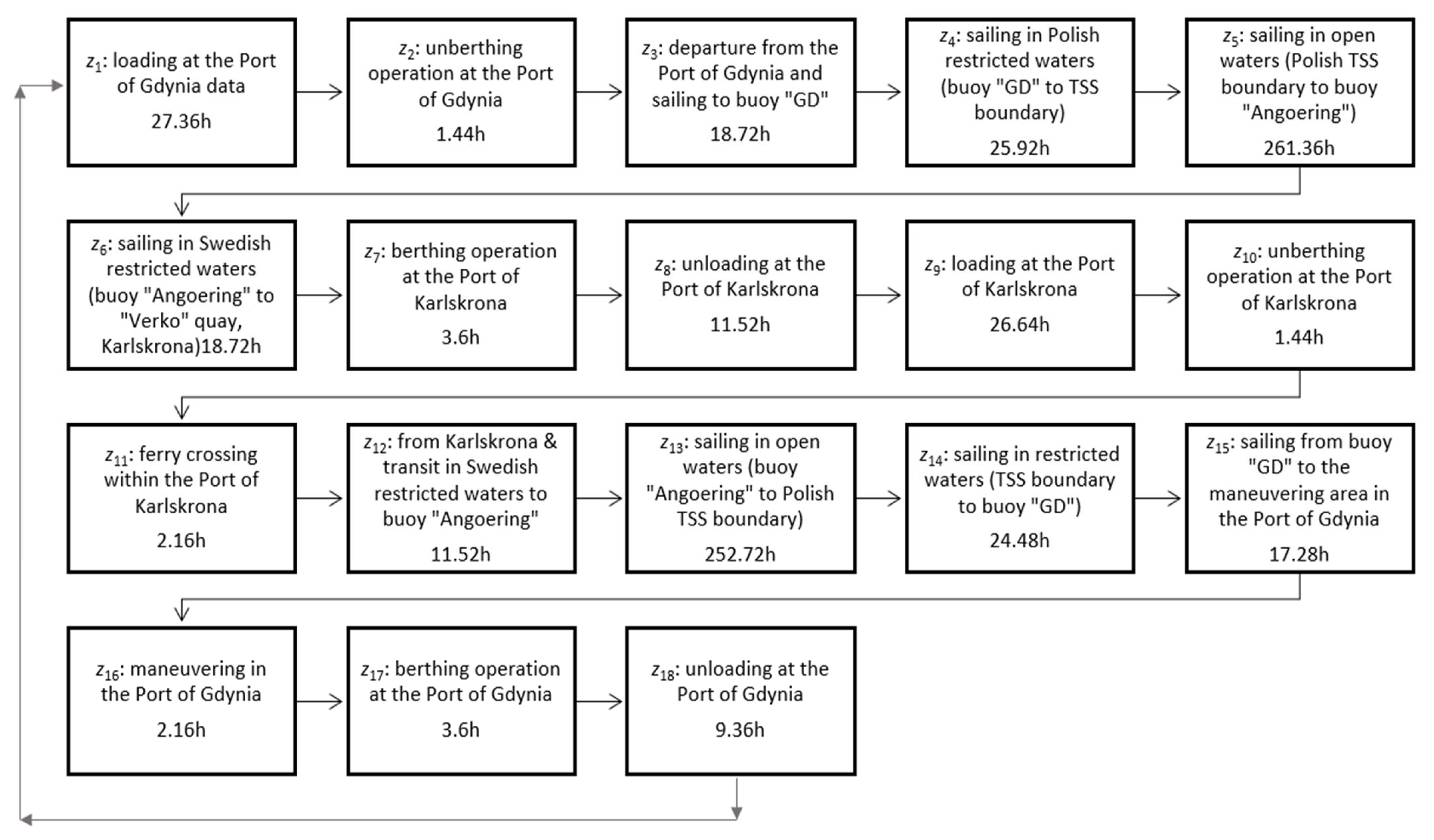
The complete operational framework is presented in Figure 6. This directed graph serves as the primary and consolidated source of information, visualizing the sequence of the 18 operational states (z1z18) and annotating each state node with its corresponding Average Monthly Duration [h]. These duration values, derived from the operator’s schedules, represent the planned time allocation and are a crucial input for the cost model. The graph illustrates the fixed, cyclic transition pattern between states (e.g., from loading, through departure, open-sea navigation, arrival maneuvers, to unloading and return) while conceptually allowing for random variations in sojourn times.
This directed graph serves as the primary and consolidated source of information, visualizing the sequence of the 18 operational states (z1z18) and annotating each state node with its corresponding Average Monthly Duration [h]. The graph thus represents the deterministic backbone of the operational cycle, defined by the operator’s schedule. The stochastic sojourn times modeled via the semi-Markov framework and parameterized by the matrix [Mbl] and the impact of variable weather are conceptualized as probabilistic layers applied to this fixed structure. This framework, based on the operator’s actual procedures, accurately reflects the vessel’s navigation patterns, port operations, and the specific geographical constraints of the route. The cycle is quasi-deterministic, meaning transitions between states follow a fixed sequence, while the sojourn times in each state are random variables described by probability distributions. The average monthly durations for each state derived from the operator’s schedules, are a crucial input for the subsequent cost calculations.

4.3. Parameterization of the Semi-Markov Model

The application of the semi-Markov framework (Section 3.1) to the ferry case study requires the specification of its core parameters: the transition probability matrix pbl and the matrix of mean conditional sojourn times [Mbl].
Given the repetitive, schedule-driven nature of the ferry’s operation, the transitions between the 18 states follow a fixed, deterministic sequence as illustrated in the operational graph (Figure 6). Consequently, the matrix of transition probabilities is deterministic. It has the following form, where a value of 1 indicates the certain transition to the next state in the cycle:
[ p b l ] 18 × 18 = [ 0 1 0 . . . 0 0 0 0 1 . . . 0 0 . . . 0 0 0 . . . 0 1 1 0 0 . . . 0 0 ]
with p b b = 0 for all b.
The matrix of mean conditional sojourn times [Mbl], where each element Mbl represents the average time [h] spent in state z b before transitioning to z l , was estimated based on historical operational data. The full 18 × 18 matrix is provided in Appendix A. Its structure reflects the deterministic transitions: the non-zero values Mbl correspond precisely to the single permitted transition from each state b to its subsequent state l in the cycle, while all other entries are zero. The quasi-deterministic transition structure (Equation (15)) follows the fixed sequence prescribed by the operator’s schedule, confirming that the 18-state cycle represents the planned, repeating pattern of voyages rather than an abstract aggregation.
The key outputs for the cost model are the limiting state probabilities p b . These were calculated from Equation (6). The computational procedure involved three steps:
  • Calculating the unconditional mean sojourn time in each state, M b = l = 1 v p b l M b l , using the data from Appendix A.
  • Solving the system of Equation (6) to obtain the stationary probabilities π b   of the embedded Markov chain.
  • Computing the final limiting probabilities p b via Equation (5).
All numerical computations and analytical verification were performed using the Mathematica computer algebra system. All numerical computations and analytical verification related to the semi-Markov modeling of the ferry’s operational states were performed using the Mathematica computer algebra system. The resulting stationary probabilities of the operational states were used as inputs to the cost model described in Section 3.2.

4.4. Parameterization of the Cost Model

The operational cost structure is fundamentally shaped by the specific characteristics of Baltic Sea navigation, which justifies the use of the semi-Markov framework. This model effectively captures two critical phenomena: (1) duration-dependent transition probabilities, reflecting the persistence of specific weather regimes where the likelihood of a change depends on how long the current state has been maintained, and (2) the clustered nature of operational and weather events, such as consecutive days of severe weather, which lead to cumulative, non-linear impacts on subsystem degradation and costs [192,200]. This is more realistic than models assuming memoryless or averaged independent events.
The mathematical model represents the total costs of maintaining and operating the technical system over a defined horizon. It incorporates direct costs, intrinsically linked to system upkeep (e.g., servicing, repairs, materials, crew training for technical operations), and indirect costs, arising as secondary consequences of operation (e.g., energy consumption, costs related to operational delays or performance disruptions) [201,202,203].
A core premise is that the operational state directly influences the system’s functional structure, safety configuration, and, consequently, its instantaneous cost rate. To translate this premise into quantifiable monetary values, the hourly cost coefficients for the ferry’s five technical subsystems (S1S5) across all 18 states were established through a structured expert elicitation process.
This process, conducted as a dedicated workshop, involved five senior system operators and marine engineers, each with over 15 years of experience on the Gdynia–Karlskrona route. Following a modified Delphi method to ensure robustness and consensus, the procedure consisted of three stages:
  • Independent Proposal: Experts independently proposed hourly cost coefficients based on detailed knowledge of subsystem-specific factors (energy use, component wear, maintenance intensity, required attention) in each operational state.
  • Facilitated Consensus Building: Initial anonymized proposals were discussed in a moderated plenary session. Divergences were reconciled by examining the underlying operational rationale (e.g., justifying different propulsion costs for maneuvering vs. open-sea navigation).
  • Final Consensus Values: The iterative discussion yielded a final set of consensus values, providing a defensible and experience-grounded parameter set [204].
The outcome of this structured process was a definitive set of hourly cost coefficients. However, a critical distinction must be made regarding the sources of uncertainty in the model’s inputs. The matrices of sojourn times [Mbl] and the weather state probabilities πβ are estimated from historical operational and meteorological data, representing aleatory uncertainty inherent in the stochastic processes themselves. Conversely, the hourly cost coefficients in Table 2 are derived from structured expert judgment, representing epistemic uncertainty due to limited granular data. In this proof-of-concept study, these expert-based values serve as a defensible, consensus-based scaffold to establish a realistic relative cost structure across states and subsystems. They enable the exploration of how a given cost profile interacts with stochastic weather dynamics. Their primary purpose is not to provide absolute monetary forecasts but to facilitate a consistent comparative analysis of cost impacts under different weather scenarios. For practical deployment, calibration of the scaling factor c against operator-specific accounting data is recommended to ground the relative structure in absolute terms.
The resulting cost matrix is presented in Table 2. It details, for each operational state z b , the activity status (working state/standby) and the corresponding hourly cost for each technical subsystem (S1S5). For illustrative scaling, assuming a coefficient c = 1 PLN, the total baseline monthly operational cost for the technical system amounts to 19,490.19 PLN. In practical application, this scaling coefficient c should be calibrated against an operator’s actual accounting data.

4.5. Weather Data and Hazard State Modeling

From an operational modeling perspective, short-term meteorological variability represents a dominant source of uncertainty in ferry operating costs, particularly in semi-enclosed maritime regions such as the Baltic Sea. Variations in wind intensity, wave conditions, and seasonal ice occurrence influence subsystem loading, modify the duration of operational states, and accelerate wear and maintenance requirements. Rather than treating weather observations as independent events, the present study adopts a process-oriented representation in which weather evolves dynamically over time.
To account explicitly for state persistence, the clustering of adverse conditions, and the dependence of operational impacts on exposure duration, weather along the ferry route is described using a semi-Markov framework with a finite number of discrete hazard categories. This formulation enables a probabilistic integration of meteorological uncertainty into the state-dependent operational cost model while preserving the temporal structure inherent to Baltic Sea weather patterns.
The procedures adopted for meteorological data collection, weather state definition, and the estimation of state residence probabilities are consistent with the general framework introduced in [4], while being adapted to the extended temporal scope of the present study. Within this framework, weather conditions are grouped into a small number of discrete hazard categories representing progressively increasing levels of operational impact.
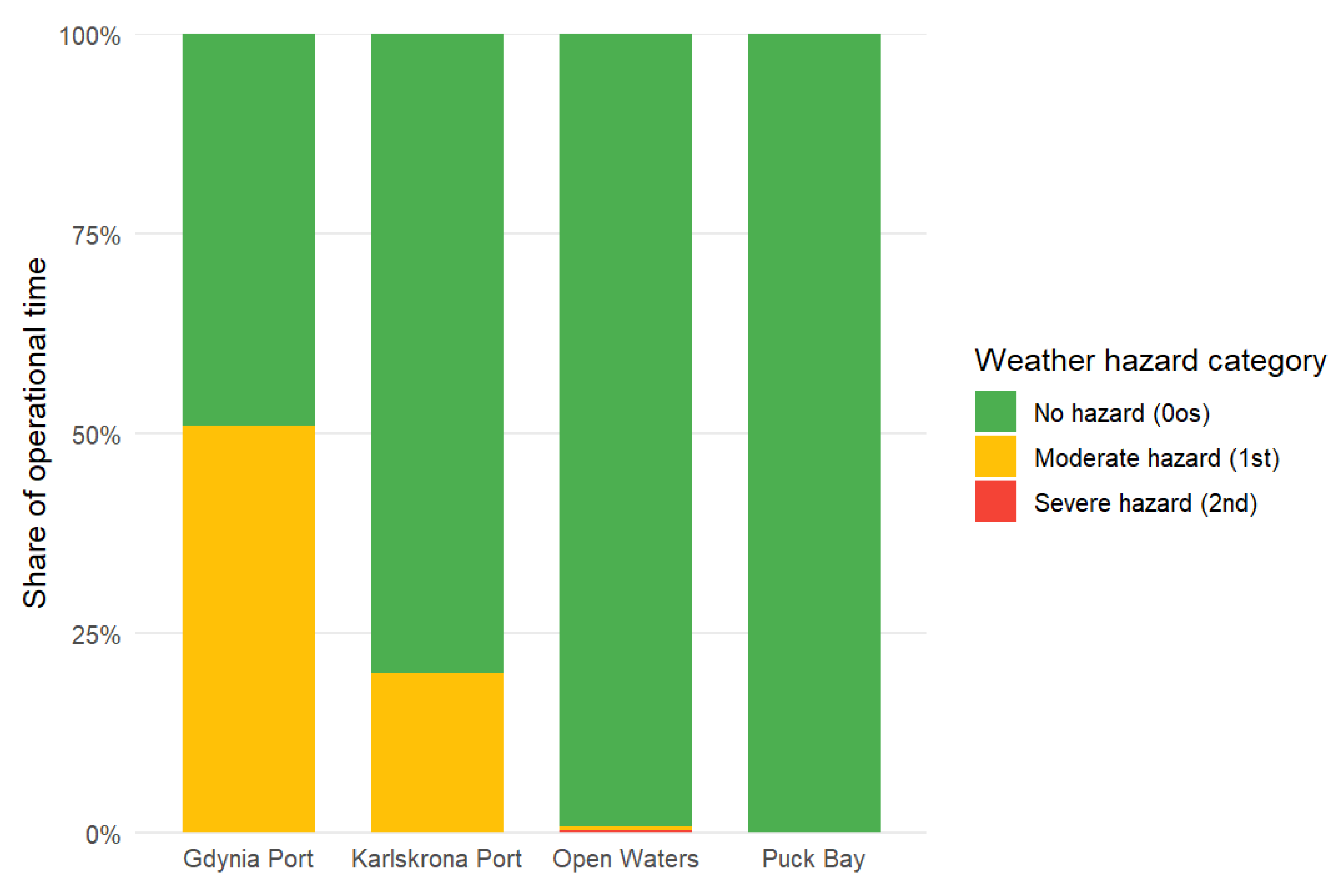
Specifically, three hazard categories are distinguished, ranging from conditions with negligible influence on ferry operations, through states associated with moderate operational stress, to rare but severe conditions that may lead to significant disruptions and elevated costs. This categorical representation provides a direct and interpretable link between observed meteorological variability and the cost-oriented performance measures considered in the subsequent analysis.
An important element of the adopted approach is the explicit spatial differentiation of weather conditions along the ferry route. Owing to substantial differences in local exposure, shielding effects, and operational constraints, meteorological conditions cannot be treated as spatially homogeneous over the entire voyage. For this reason, separate weather processes are defined for distinct segments of the route, each representing a different operational environment. In particular, individual weather processes are associated with port areas, coastal waters, and open-sea navigation zones. This separation allows the stochastic characteristics of weather—such as persistence, transition behavior, and hazard intensity—to be modeled in a manner that is consistent with the heterogeneous nature of the route and the corresponding operational states of the vessel.
Within the spatially differentiated framework, four separate weather processes are considered, each corresponding to a distinct operational environment encountered along the Gdynia–Karlskrona ferry route. The delineation of these processes reflects both physical differences in local meteorological exposure and the functional role of individual route segments in the vessel’s operational cycle. The first process represents the meteorological conditions affecting port operations in Gdynia, where wind-related effects dominate maneuvering and mooring activities. The second process corresponds to the coastal waters of Puck Bay, characterized by partially sheltered conditions and a combined influence of wind and wave action. The third process describes the open Baltic Sea segment, where fully developed sea states and sustained wind forcing govern the operational environment. The fourth process captures the weather conditions influencing port operations in Karlskrona, where local geometry and approach directions lead to a directional dependence of wind impact similar in nature, but not identical, to that observed in Gdynia. Each of these processes is treated independently in the subsequent analysis, allowing their stochastic properties to be estimated separately and later linked to the specific operational states and cost components associated with the corresponding route segments.
Meteorological input data were obtained from the ERA5 reanalysis produced by the European Centre for Medium-Range Weather Forecasts (ECMWF) and cover the period from 2010 to 2025. The dataset provides hourly estimates of key atmospheric and sea-state variables, enabling a high-resolution temporal representation of weather conditions along the ferry route. ERA5 is available at a spatial resolution of 0.25 ° × 0.25 ° ( 25 31 km over the Baltic Sea), which captures synoptic and mesoscale variability relevant for the   370 km route. However, this resolution does not resolve micro-scale port-basin dynamics; therefore, in-port conditions are interpreted as large-scale meteorological forcing rather than in situ measurements. The temporal completeness of the ERA5 record exceeds 99.5 % over 2010 2025 , with short data gaps ( < 0.5 % ) arising from two retrieval interruptions. For each operational area, time series of wind speed, wind direction, and significant wave height were extracted from fixed ERA5 grid points selected to represent the dominant meteorological exposure of the corresponding route segment. Due to variations in data availability and quality across space and time, the resulting series contain occasional temporal gaps. These gaps are not interpolated or artificially filled; instead, they are treated explicitly as discontinuities in the observation process and are handled through segment-based analysis in the subsequent stochastic modeling. This approach preserves the integrity of the empirical weather dynamics and avoids introducing synthetic persistence or transition patterns.
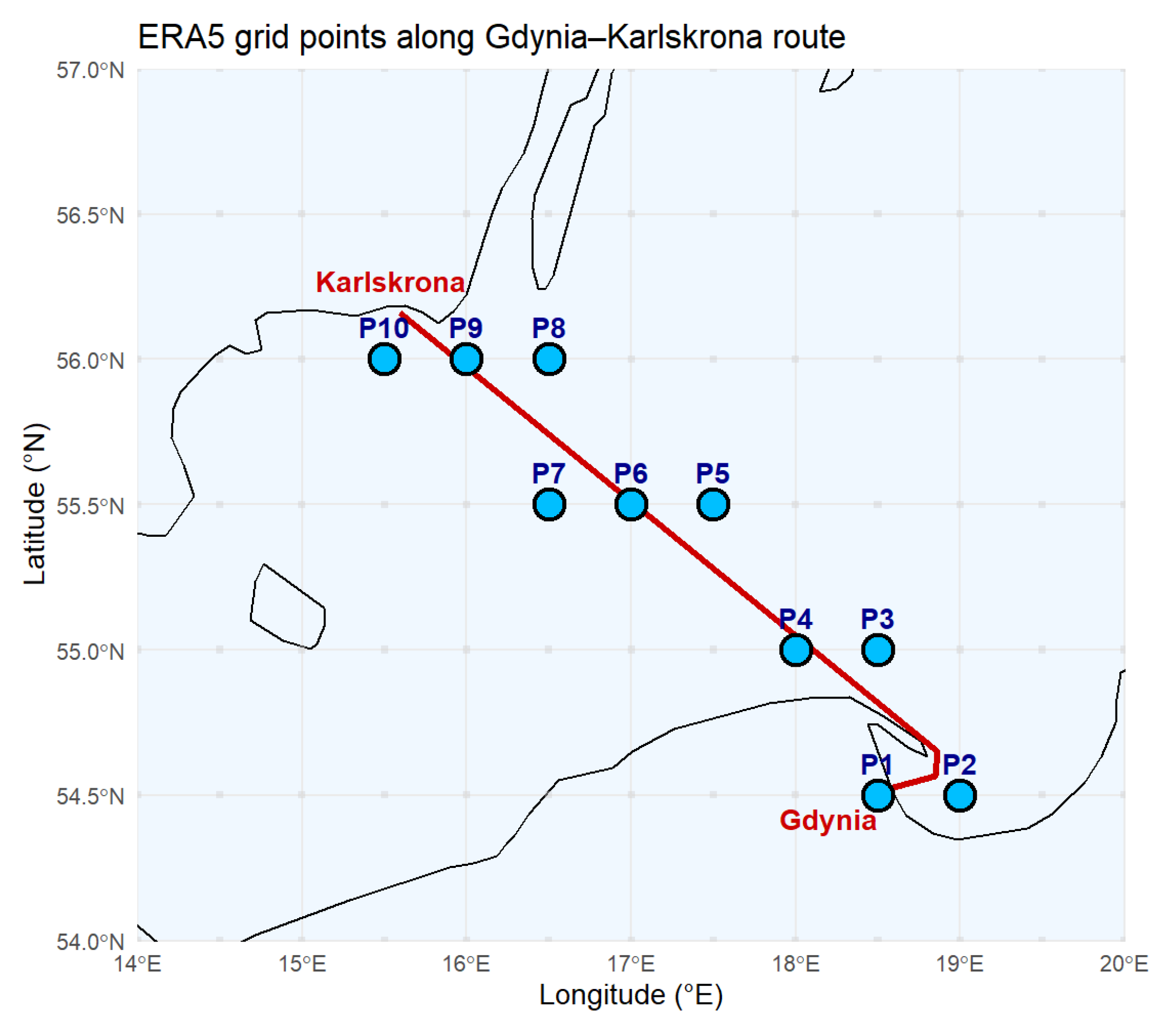
The spatial configuration of the Gdynia–Karlskrona ferry route and the locations of the selected ERA5 grid points used in the analysis are illustrated in Figure 7. The fixed grid points were chosen to represent the dominant meteorological exposure of the vessel along the main operational segments of the route, rather than the exact instantaneous position of the ferry at each time step. This static spatial representation is consistent with the resolution of the ERA5 dataset and supports a reproducible, process-oriented modeling framework.
The weather process associated with port operations in Gdynia is represented by a single grid point (P1), capturing wind conditions relevant to maneuvering and mooring activities within the harbor area. The coastal segment in Puck Bay is described using point P2, reflecting partially sheltered conditions where both wind and wave effects influence vessel operation. The open Baltic Sea weather process is represented by a set of six grid points (P3–P8), distributed along the central part of the route and collectively characterizing fully exposed offshore conditions. For the Karlskrona port area, two grid points (P9 and P10) are employed to account for local spatial variability in wind conditions near the harbor approaches.
Each grid point is fixed in space and contributes exclusively to a single weather process. This one-to-one assignment ensures a clear separation between the meteorological processes associated with different operational environments and prevents mixing of spatially heterogeneous conditions in the subsequent stochastic and cost-based analyses.
For each operational area, the representative meteorological variables were defined conservatively as the maximum values observed across the corresponding spatial points at each time step, reflecting the fact that operational costs are driven by the most adverse conditions encountered along the route. For the Karlskrona port area represented by points P9 and P10, wind direction was aggregated using a circular mean to ensure a physically consistent representation of directional variability.
Weather states were defined using a deterministic decision-grid approach, in which combinations of wind speed regimes and wind direction sectors partition the meteorological space into a finite number of disjoint states. Each state represents a distinct operational exposure level and is uniquely mapped to a corresponding hazard category.
The classification thresholds were defined in consultation with maritime operations experts from the ferry operator and port authorities, with the aim of capturing operationally meaningful (rather than regulatory) hazard levels. Wind speed ranges correspond approximately to transitions between moderate and gale-force conditions on the Beaufort scale, while wave height boundaries reflect typical operational thresholds for ro–pax vessels in the Baltic Sea. To the best of our knowledge, no unified regulatory threshold standard for cost-oriented hazard classification exists for short-sea ferry operations in the Baltic region, hence a route-specific, expert-based approach was adopted.
For port operating areas, the classification is based on a two-dimensional decision grid spanned by wind speed and wind direction. Wind speed is divided into two regimes, corresponding to moderate conditions [ 0,17 ) m / s   and high-wind conditions [ 17,33 ) m / s . Wind direction is partitioned into three sector groups reflecting the geometric exposure of the port infrastructure and typical maneuvering constraints.
The Cartesian product of wind speed regimes and directional sectors defines six mutually exclusive weather states. Each state is deterministically assigned to one of three hazard categories (no hazard, moderate hazard, severe hazard), reflecting increasing levels of operational difficulty and cost impact.
For coastal and open-sea operating areas, an analogous decision-grid formulation is applied using wind speed and significant wave height as the defining dimensions. Wind speed is classified into the same two regimes, while wave height is partitioned into three ranges corresponding to calm, moderate, and high sea states. The resulting combinations define a finite set of weather states that are subsequently mapped onto the same three hazard categories.
The steady-state probabilities of the weather processes residing in each hazard category were estimated using two complementary approaches: empirical time-based proportions, calculated directly from the classified hourly observations, and semi-Markov modeling, in which the limiting time-based probabilities were derived from the estimated transition structure and state sojourn times.
To assess the temporal stability of the estimated probabilities and to account for potential non-stationarity in the weather processes, the analysis was performed over overlapping multi-year time windows. For each window, both empirical and semi-Markov steady-state probabilities were computed independently. The resulting window-based estimates are summarized in Table 3 and illustrated in Figure 8.
The combined use of empirical time-based proportions and semi-Markov steady-state probabilities provides a consistent and internally validated characterization of weather hazard occurrence along the analyzed route. The close agreement observed between both estimation approaches across overlapping time windows confirms that the semi-Markov formulation adequately captures the persistence and temporal structure of weather conditions, while remaining anchored in the observed data. These results establish a robust probabilistic basis for the subsequent integration of weather variability into the operational cost model.
All computations related to the weather processes, including state classification, temporal segmentation, estimation of semi-Markov parameters, window-based analyses, and the aggregation of weather-adjusted operating costs, were performed using the R statistical computing environment.

5. Results

This section presents the results of the probabilistic weather analysis and its implications for ferry operating costs.

5.1. Long-Term Weather Hazard Structure (2010–2025)

This subsection summarizes the long-term structure of weather hazard conditions along the Gdynia–Karlskrona ferry route over the full observation period of 2010–2025. The analysis is conducted separately for the four route-specific weather processes (Gdynia Port, Puck Bay, Baltic Sea open waters, and Karlskrona Port) and focuses on the time-based steady-state probabilities of the three hazard categories (0os, 1st, 2nd), which quantify the long-run proportion of time spent in each category.
The steady-state probabilities reported in this subsection were estimated using the semi-Markov framework introduced in Section 3, which explicitly incorporates both transition dynamics between hazard categories and the empirical distributions of state sojourn times. In contrast to simple frequency-based statistics, the resulting probabilities describe the long-term temporal occupancy of each hazard category and therefore provide a consistent basis for linking meteorological conditions with time-dependent operating costs.
Table 4 and Figure 9 present the semi-Markov steady-state probabilities of the three hazard categories for each of the four weather processes, estimated over the entire 2010–2025 period. These probabilities constitute a long-term reference description of the meteorological exposure along the route and are subsequently used as the probabilistic input to the operating cost analysis.
The results indicate that offshore and coastal segments of the route are characterized by a highly stable long-term hazard structure. In both the open Baltic Sea and Puck Bay processes, the no-hazard category (0os) overwhelmingly dominates the temporal distribution, accounting for more than 99% of the total observation time. Moderate-hazard conditions occur only sporadically, while severe-hazard states are either extremely rare or entirely absent in these areas. This pattern reflects the generally stable meteorological regime prevailing over extended periods, punctuated by short-lived episodes of increased exposure.
In contrast to the offshore and coastal segments, the port-related weather processes exhibit a markedly different hazard composition. The Gdynia Port process is characterized by a near-balanced distribution between no-hazard (0os) and moderate-hazard (1st) categories, indicating frequent occurrences of wind conditions that increase operational stress without reaching extreme severity. Conversely, the Karlskrona Port process remains predominantly within the no-hazard regime, with moderate-hazard conditions occurring less frequently. In both ports, severe-hazard states (2nd) are virtually absent over the analyzed period, highlighting the strongly localized and episodic nature of extreme port-weather impacts.
The estimated steady-state distributions reveal a pronounced spatial heterogeneity in the long-term weather hazard structure along the Gdynia–Karlskrona route. Sheltered port environments are dominated by low- and moderate-hazard conditions, whereas offshore navigation is characterized by a broader, albeit still highly skewed, distribution that includes systematically recurring severe-hazard states. This differentiation is crucial from an operational perspective, as it directly links the probabilistic description of weather dynamics to the state-dependent cost coefficients introduced in the subsequent analysis. In particular, even rare high-hazard occurrences in open waters acquire disproportionate importance due to their interaction with the most cost-intensive operational states, motivating the detailed cost assessment presented in the following sections.

5.2. Weather-Adjusted Operating Costs Under Historical Conditions

The second stage of the results analysis quantifies the impact of weather variability on ferry operating costs under historical conditions. Building on the probabilistic description of weather hazard categories presented in Section 4.5, this subsection integrates the estimated steady-state probabilities with the state-dependent cost structure of the ferry’s operational cycle.
Table 5 summarizes the baseline monthly operating costs assigned to each operational state, together with the hazard-dependent cost adjustment coefficients. These coefficients reflect the relative increase in operating expenditures under moderate and severe weather conditions and were established independently of the present weather analysis. As such, Table 5 constitutes a fixed input to the cost model and provides a consistent reference framework for historical assessment.
Using the steady-state probabilities of weather hazard categories derived from the semi-Markov analysis, the expected monthly operating costs for each operational state were calculated as probability-weighted averages across hazard categories. The resulting weather-adjusted costs for the historical period are reported in Table 6. For clarity and to reduce dimensionality, operational states with similar cost characteristics and exposure to the same weather process were aggregated prior to cost evaluation.
The results clearly indicate that the overall weather-related cost burden is highly unevenly distributed across the operational cycle. Open-sea navigation states dominate the total operating costs, both in terms of baseline expenditures and weather-adjusted values. This dominance arises from the combination of long average durations, high baseline costs, and non-negligible probabilities of elevated hazard categories in open-water areas.
In contrast, port and maneuvering states contribute only marginally to the total weather-adjusted costs. Although moderate weather hazards occur relatively frequently in port areas, their financial impact remains limited due to the low baseline costs and comparatively small adjustment coefficients associated with these operational states. As a result, even substantial changes in hazard category probabilities translate into only minor absolute cost variations in port-related activities.
An important feature revealed by the results is the non-linear contribution of severe weather conditions (2nd-degree hazard) to operating costs. Despite their very low steady-state probabilities, severe weather events generate disproportionate cost increases in states associated with open-sea navigation. This effect highlights the sensitivity of total operating costs to rare but intense weather episodes and underscores the importance of correctly modeling both the frequency and duration of such events.
Taken together, the historical results demonstrate that while the majority of operational time is spent under low-hazard conditions, the economic consequences of weather variability are driven primarily by a small subset of states characterized by high baseline costs and elevated exposure to adverse weather. These findings provide a quantitative benchmark for evaluating temporal changes in weather-related cost impacts and serve as a reference point for the forward-looking analyses presented in the subsequent sections.
It is important to note that cost aggregation over monthly horizons, while appropriate for strategic planning and budgetary assessment, smooths out the transient impact of individual extreme weather events. In the present analysis, short-duration severe conditions contribute to expected cost increases through their associated hazard probabilities and cost multipliers, but their effects are distributed across the operational period. As a result, the framework captures the economic weight of such events within the long-term cost structure, rather than their operational salience as discrete disruptions leading to immediate schedule deviations, voyage cancelations, or ad hoc maintenance actions. This representation is consistent with the strategic focus of the model rather than real-time operational decision support.

5.3. Temporal Variability of Weather-Adjusted Operating Costs (2010–2025)

To evaluate the temporal stability of weather-related operating costs and to identify potential long-term variations, the weather-adjusted cost model was applied within overlapping multi-year time windows. For each window, steady-state hazard category probabilities were estimated independently and subsequently combined with the baseline cost structure to compute expected operating costs for individual operational states.
Figure 10, Figure 11 and Figure 12 illustrate the evolution of weather-adjusted operating costs across successive time windows for the main operational areas. The results indicate that, for most states, cost levels remain relatively stable over time, with only minor fluctuations around their long-term averages. This stability is particularly pronounced in port-related operating states, where the hazard structure is dominated by low- and moderate-impact conditions.
In the open-water navigation states (z5 and z13 combined), the cost structure presented in Figure 5 exhibits a fundamentally different pattern. Although the long-term probability of severe weather conditions (π2) remains low across all time windows, even small fluctuations in their occurrence translate into noticeable variations in expected costs. This effect is driven by the very high baseline cost of open-sea operations and the strongly nonlinear impact of hazard-dependent cost multipliers. As a result, the contributions of moderate (K1·π1) and severe (K2·π2) weather conditions, while infrequent, play a disproportionate role in shaping the total expected cost in these states.
In contrast, the remaining operating states, dominated by port and maneuvering activities, display a much more stable and predictable cost profile, as illustrated in Figure 6. In these states, the baseline component (K0·π0) accounts for the majority of total costs, while the contribution associated with moderate weather conditions (K1·π1) remains significant and persistent over time. The contribution of severe weather conditions (K2·π2), however, is genuinely marginal, remaining an order of magnitude smaller than the other components across all windows. This indicates that, for port-related operations, cost variability is driven primarily by frequent moderate weather conditions rather than by rare extreme events.
Together, these results highlight a clear structural asymmetry between open-sea and port operations: open-water navigation is sensitive to rare but costly weather events, whereas port operations are shaped mainly by the cumulative effect of moderate conditions. This distinction provides a critical foundation for the subsequent forward-looking cost projections and for the formulation of operational risk-management strategies.

5.4. Practical Implications for Ferry Operators

The results presented in Section 5.1, Section 5.2 and Section 5.3 provide several practical insights for ferry operators planning and managing operations along the Gdynia–Karlskrona route under variable weather conditions.
First, the long-term hazard structure indicates that normal-weather conditions dominate operational time across all route segments, particularly in port and coastal areas. This confirms that routine operational planning can be safely based on baseline cost assumptions for the majority of the operating cycle, without the need for continuous high-resolution weather adjustments.
Second, the analysis highlights a clear asymmetry between operational segments. Port and maneuvering states exhibit stable and predictable cost profiles, with weather-related cost increases driven primarily by moderate hazard conditions, while severe hazards contribute only marginally to total costs. This suggests that mitigation strategies in port areas should focus on operational efficiency under moderate adverse conditions, such as wind-induced maneuvering constraints, rather than on rare extreme events.
In contrast, open-water navigation states represent the primary source of weather-related cost sensitivity, despite the low long-term probability of severe weather conditions. Even small fluctuations in the occurrence of adverse weather translate into noticeable variations in expected costs due to the high baseline cost of open-sea operations and the nonlinear effect of hazard-related cost multipliers. From an operational perspective, this underscores the importance of robust weather monitoring and decision support during open-sea transit phases, where cost exposure is concentrated.
Importantly, the window-based analysis demonstrates that the historical cost structure is largely stable over time, with no evidence of abrupt shifts in weather-related cost contributions within the analyzed period. This temporal stability supports the use of probabilistic, long-term weather representations in strategic planning, budgeting, and comparative route assessments, rather than relying solely on short-term or event-based analyses.
The proposed framework enables operators to identify which operational phases are most sensitive to weather variability, quantify the expected cost impact in probabilistic terms, and prioritize mitigation efforts accordingly. While the present study focuses on historical conditions, the methodology is readily extendable to scenario-based or forward-looking analyses, should such assessments be required for future planning exercises.
From a practical perspective, the proposed framework provides decision-relevant information at the strategic and tactical planning levels. For ferry operators, the probabilistic cost distributions associated with different weather hazard categories can support schedule planning, budget forecasting, and the evaluation of cost resilience under alternative operating scenarios. The explicit representation of weather persistence allows operators to assess the likelihood of prolonged cost-intensive periods, which is relevant for maintenance planning and resource allocation. At a broader level, policymakers and port authorities may use aggregated outputs of the framework to evaluate the economic vulnerability of ferry services to increasing climate variability and to prioritize investments in resilient maritime infrastructure. Importantly, the framework is not intended for real-time routing decisions, but rather for medium- to long-term planning under stochastic weather conditions.

6. Conclusions, Limitations and Future Research Directions

6.1. Conclusions

This study developed and applied a probabilistic framework for quantifying the impact of weather variability on ferry operating costs along the Gdynia–Karlskrona route. By representing weather conditions as semi-Markov processes with discrete hazard categories, the proposed approach captures not only the frequency of adverse conditions but also their temporal persistence and clustering, which are critical for cost-oriented analyses. The framework explicitly distinguishes between the deterministic sequence of operational states (the ferry’s schedule) and the stochastic layer of weather-induced variability and sojourn time fluctuations. This separation allows us to isolate the financial impact of meteorological uncertainty on an otherwise fixed operational cycle. While the modeling framework is general in structure, the empirical results should be interpreted as route-specific and illustrative rather than representative of all maritime operations. Application of the framework to other maritime corridors, vessel classes, or climatic regimes requires appropriate adaptation of the weather classification scheme, model parameters, and cost representations, and the present case study is intended as a proof-of-concept demonstrating the internal consistency and applicability of the proposed framework rather than as a defining boundary of its potential use.
Across most operational segments, no-hazard conditions dominate the long-term weather structure, accounting for the majority of operational time. An important exception is the Port of Gdynia, where moderate-hazard conditions prevail, reflecting the frequent occurrence of wind directions and intensities that increase operational workload without constituting extreme weather. In all port and coastal areas, however, severe-hazard conditions remain rare and contribute marginally to overall exposure.
In contrast, open-water navigation states exhibit a higher sensitivity to weather variability in our model, which emerges directly from imposing stochastic weather processes onto the operational schedule. Despite the low probability of severe hazards, the combination of high baseline operating costs and nonlinear hazard-dependent cost multipliers means that even small changes in adverse weather occurrence lead to noticeable variations in expected costs. This result is not an inherent property of the schedule but a quantifiable financial risk exposed by the probabilistic analysis. These findings confirm that, under conditions of meteorological uncertainty, open sea operations constitute the primary channel through which weather related risk propagates into the overall cost structure. The window-based analysis further indicates that the historical weather-adjusted cost structure is largely stationary over the 2010–2025 period, with no evidence of systematic shifts in hazard dominance or abrupt changes in cost exposure. Localized temporal variations are observed, but they do not alter the overall balance between operational segments or hazard categories.
From a methodological perspective, the study demonstrates that combining empirical time-based statistics with semi-Markov modeling provides a robust and transparent means of estimating long-term weather impacts on operating costs. Crucially, the semi-Markov formulation allows us to attribute cost variability to specific sources: the persistence of weather states and their interaction with scheduled operational phases. The consistency between these approaches in dominant hazard categories supports the reliability of this structured stochastic representation and its suitability for integration into operational and strategic cost models.
The proposed framework offers a practical and interpretable tool for assessing weather-related cost exposure in ferry operations. It achieves this by superimposing a stochastic model of weather variability onto a deterministic operational backbone, thereby bridging detailed meteorological data with state-dependent cost structures in a manner that is both analytically rigorous and operationally meaningful.
Finally, the framework contributes to sustainability-oriented decision-making primarily through improved operational robustness and cost resilience under increasing weather variability. The proposed framework establishes a probabilistic, duration-aware cost exposure framework that explicitly quantifies how short-term weather variability and persistence translate into threshold-driven and disproportionate cost responses addressing a gap identified in the existing literature where these dimensions are typically treated separately or only implicitly.

6.2. Limitations

The results presented in this study are subject to several limitations that should be considered when interpreting the findings.
First, the cost model relies on expert-derived parameters. The model’s sensitivity to weather is channeled through cost coefficients obtained via expert elicitation. While the Delphi method promotes consensus, these parameters embody epistemic uncertainty and have not been validated against disaggregated operational cost data (e.g., maintenance records per subsystem per voyage phase). Consequently, the absolute cost values are illustrative, and the uncertainty surrounding these coefficients is not propagated quantitatively in the present analysis.
Second, the analysis relies on meteorological data derived from the ERA5 reanalysis dataset. Although ERA5 provides high-quality, spatially and temporally consistent atmospheric information and has been widely validated against in situ observations, it does not capture small-scale, short-lived extreme events with full fidelity. Consequently, the frequency and intensity of the most severe weather conditions may be slightly underestimated, particularly in coastal and port areas.
Third, due to data availability and quality constraints, the meteorological time series contain occasional temporal gaps. To preserve the integrity of the stochastic modeling framework, the analysis was conducted conditionally on data completeness, and segments separated by gaps were treated independently. While this approach avoids artificial interpolation and preserves physical realism, it reduces the effective sample size and may affect the statistical stability of estimates for rare hazard categories, especially the severe-hazard class.
Fourth, the weather classification scheme is based on deterministic threshold values for wind speed, wind direction, and wave height, established in consultation with maritime operations experts. While this ensures practical relevance and interpretability, it inevitably simplifies the continuous nature of meteorological processes and does not account for gradual transitions or compound effects beyond the defined thresholds.
Fifth, the semi-Markov modeling framework captures state persistence and duration effects but assumes stationarity within each analyzed time window. Although overlapping windows were used to assess temporal stability, potential long-term structural changes in weather patterns or operational practices beyond the analyzed period are not explicitly modeled.
Sixth, the aggregation of operating costs over extended horizons reduces the visibility of short-term operational dynamics. While extreme weather events are reflected in expected cost levels through their probability and impact multipliers, their representation as discrete, high-salience operational disruptions is not explicitly resolved in the current framework.
Seventh, the reliance on steady-state probabilities assumes that the operational process effectively reaches its stationary regime within the considered planning horizon. While this assumption is appropriate for intensive, year-round ferry operations, applications to seasonal, irregular, or low-frequency services would require explicit modeling of transient dynamics and time-dependent state probabilities.
Eighth, the cost coefficients are derived from a limited panel of five operational experts. While the structured Delphi process promotes consensus, the sample size is modest, and the coefficients have not been validated against high-resolution empirical cost data (e.g., maintenance records per subsystem per voyage phase) or subjected to formal statistical consistency tests. Consequently, the absolute cost values should be interpreted as illustrative, and the uncertainty associated with these parameters is not quantitatively propagated in the present analysis. Ninth, the model represents nonlinear cost amplification through hazard- and state-dependent multipliers rather than through a mechanistic decomposition of the underlying physical drivers. This provides an aggregate empirical approximation suitable for long-horizon expected cost assessment, but does not differentiate between individual operational pathways. The multipliers have not been calibrated against disaggregated cost or maintenance data nor subjected to formal sensitivity analysis, therefore the magnitude of nonlinear effects should be interpreted as indicative rather than as calibrated engineering response functions. Tenth, the meteorological input relies on ERA5 reanalysis at 0.25 ° × 0.25 ° spatial resolution, which adequately resolves synoptic and mesoscale variability along the route but cannot represent micro-scale port-basin phenomena. In this context, in-port conditions are interpreted as large-scale forcing rather than localized measurements. The ERA5 record contains minor temporal gaps ( < 0.5 % of the 2010 2025 horizon), which were handled through segment-based analysis to avoid artificial state persistence.
Finally, the cost model links weather hazard categories to operating costs through fixed, hazard-dependent adjustment coefficients. These coefficients reflect average operational responses and do not account for adaptive strategies, real-time decision-making, or vessel-specific responses that may mitigate or amplify weather impacts under particular conditions.
The quantitative results are therefore specific to the analyzed route and operational context and should not be directly extrapolated to other ferry services vessel types, or climatic regimes without context-specific calibration of meteorological classifications, operational parameters, and cost coefficients. Environmental and social metrics are not explicitly modeled but can be incorporated in future extensions.
Despite these limitations, the adopted modeling framework provides a transparent and internally consistent representation of weather-driven cost variability and offers a robust foundation for comparative analysis and scenario-based extensions.

6.3. Future Research Directions

Several extensions of the present study offer promising directions for future research.
A natural next step is the explicit incorporation of long-term projections of weather hazard probabilities into the cost modeling framework. While the current analysis focuses on historical variability and temporal stability, the semi-Markov representation developed herein is well suited for integration with trend-based or scenario-driven forecasts of hazard-category probabilities. Such extensions would enable forward-looking estimates of weather-adjusted operating costs under alternative climate or operational scenarios.
Future work may also explore more refined representations of non-stationarity in the weather processes, for example, through time-varying transition probabilities or regime-dependent semi-Markov models. Although the present window-based approach provides a robust and transparent assessment of temporal stability, more flexible formulations could offer additional insight into gradual structural changes in weather patterns.
Another promising avenue involves coupling the weather-driven cost model with adaptive operational strategies. Incorporating decision rules related to speed adjustment, route modification, or port operation policies could allow the evaluation of mitigation measures aimed at reducing exposure to adverse weather conditions.
Additionally, future work should aim to better integrate the different types of uncertainty inherent in the modeling framework. This could involve formal probabilistic elicitation of the expert-derived cost coefficients (e.g., obtaining confidence ranges or distributions from experts) and employing Monte Carlo or Bayesian methods to propagate both aleatory uncertainty (from weather and state duration processes) and epistemic uncertainty (from cost parameters) through the model. This approach would yield a comprehensive probability distribution of cost outcomes, providing decision-makers with a more robust characterization of financial risk under weather variability.
Future work should prioritize the collection and integration of high-resolution operational cost data (e.g., fuel and maintenance records tagged by voyage phase) to empirically calibrate or replace the expert-derived coefficients. Where such data remain unavailable, a formal probabilistic elicitation protocol obtaining confidence ranges or distributions from a larger and more diverse expert panel coupled with Monte Carlo uncertainty propagation would provide a more robust characterization of epistemic uncertainty in cost outcomes.
A valuable extension of the present approach would be the development of a complementary, high-resolution module linking specific extreme weather episodes to discrete operational consequences, such as voyage delays, cancelations, or emergency maintenance. Such an extension would enable a two-tiered analysis combining long-term expected cost assessment with event-driven operational risk evaluation.
Finally, extending the framework to include vessel-specific characteristics or multiple vessel classes would enhance its applicability to broader maritime networks and fleet-level cost assessments. The methodology developed in this study provides a modular and extensible foundation for both historical analysis and future-oriented cost modeling under weather uncertainty. Taken together, the proposed framework establishes a consistent baseline for quantifying weather-related cost exposure in ferry operations, while leaving scope for future extensions toward forward-looking and decision-support applications.

Author Contributions

Conceptualization, M.B., B.M.-M. and M.T.; methodology, M.B., B.M.-M. and M.T.; software, M.B., B.M.-M. and M.T.; validation, M.B., B.M.-M. and M.T.; formal analysis, M.B., B.M.-M. and M.T.; investigation, M.B., B.M.-M. and M.T.; resources, M.B., B.M.-M. and M.T.; data curation, M.B., B.M.-M. and M.T.; writing—original draft preparation, M.B., B.M.-M. and M.T.; writing—review and editing, M.B., B.M.-M. and M.T.; visualization, M.B., B.M.-M. and M.T.; supervision, M.B., B.M.-M. and M.T.; project administration, M.B., B.M.-M. and M.T.; funding acquisition, M.B., B.M.-M. and M.T. All authors have read and agreed to the published version of the manuscript.

Funding

This research was funded by the statutory activities of Gdynia Maritime University, grant numbers WZNJ/2026/PZ/02 and WN/PI/2026/05.

Institutional Review Board Statement

Not applicable.

Informed Consent Statement

Not applicable.

Data Availability Statement

The original contributions presented in this study are included in the article. Further inquiries can be directed to the corresponding authors.

Conflicts of Interest

The authors declare no conflicts of interest. The funders had no role in the design of the study; in the collection, analyses, or interpretation of data; in the writing of the manuscript; or in the decision to publish the results.

Appendix A

Matrix of Mean Sojourn Times Mbl [h] Between the Operational States of the Ferry
The 18 × 18 matrix of mean conditional sojourn times Mbl for the semi-Markov process modeling the operation of the ferry on the Gdynia–Karlskrona route. Values are given in hours, estimated on the basis of operational data.
[ M b l ] 18 × 18 = [ 0 0 0 0 0 0 0 0 0 0 0 0 0 0 0 0 0 18.74 54.67 0 0 0 0 0 0 0 0 0 0 0 0 0 0 0 0 0 0 2.6 0 0 0 0 0 0 0 0 0 0 0 0 0 0 0 0 0 0 37.33 0 0 0 0 0 0 0 0 0 0 0 0 0 0 0 0 0 0 52.27 0 0 0 0 0 0 0 0 0 0 0 0 0 0 0 0 0 0 526.43 0 0 0 0 0 0 0 0 0 0 0 0 0 0 0 0 0 0 37.16 0 0 0 0 0 0 0 0 0 0 0 0 0 0 0 0 0 0 7.02 0 0 0 0 0 0 0 0 0 0 0 0 0 0 0 0 0 0 23.26 0 0 0 0 0 0 0 0 0 0 0 0 0 0 0 0 0 0 53.69 0 0 0 0 0 0 0 0 0 0 0 0 0 0 0 0 0 0 2.86 0 0 0 0 0 0 0 0 0 0 0 0 0 0 0 0 0 0 4.38 0 0 0 0 0 0 0 0 0 0 0 0 0 0 0 0 0 0 24.12 0 0 0 0 0 0 0 0 0 0 0 0 0 0 0 0 0 0 508.6 0 0 0 0 0 0 0 0 0 0 0 0 0 0 0 0 0 0 50.14 0 0 0 0 0 0 0 0 0 0 0 0 0 0 0 0 0 0 34.43 0 0 0 0 0 0 0 0 0 0 0 0 0 0 0 0 0 0 4.59 0 0 0 0 0 0 0 0 0 0 0 0 0 0 0 0 0 0 7.92 0 ]
Remarks:
  • Entries on the main diagonal are 0, in accordance with the assumption p b b = 0 .
  • The structure of the matrix reflects the deterministic sequence of transitions between states.
  • Zeros outside the main sequence result from the quasi-deterministic nature of the operational process.

References

  1. United Nations. Transforming Our World: The 2030 Agenda for Sustainable Development; United Nations General Assembly: New York, NY, USA, 2015. [Google Scholar]
  2. IPCC. Climate Change 2022: Impacts, Adaptation and Vulnerability; Cambridge University Press: Cambridge, UK, 2022; Available online: https://www.ipcc.ch/report/ar6/wg2/ (accessed on 30 November 2025).
  3. International Maritime Organization. Initial IMO Strategy on Reduction of GHG Emissions from Ships; IMO: London, UK, 2018; Available online: https://www.imo.org/en/ourwork/environment/pages/imo-strategy-on-reduction-of-ghg-emissions-from-ships.aspx (accessed on 30 November 2025).
  4. Magryta-Mut, B.; Torbicki, M. Impact of weather variability on the operational costs of a maritime ferry. Water 2025, 17, 3146. [Google Scholar] [CrossRef]
  5. Kytariolou, A.; Themelis, N. Ship routing optimisation based on forecasted weather data and considering safety criteria. J. Navig. 2023, 76, 1310–1331. [Google Scholar] [CrossRef]
  6. Godet, A.; Michael, J.; Panagakos, G.; Barfod, M.B. Developing correction factors for weather’s influence on the energy efficiency indicators of container ships using model-based machine learning. Ocean Coast. Manag. 2024, 258, 107390. [Google Scholar] [CrossRef]
  7. Rahmi, P.A.; Hermawan, Y.A. Mitigating schedule delays in maritime operations through weather-based routing strategies. In BIO Web of Conferences; Kuo, C.-Y., Harun, Z., Eds.; EDP Sciences: Les Ulis, France, 2025; Volume 157, p. 11001. [Google Scholar] [CrossRef]
  8. Jawara, L.; Johansson, T.M. Climate emergency impacts and adaptations in shipping: Analogical policy formulation and recommendations. J. Int. Marit. Saf. Environ. Aff. Shipp. 2024, 9, 2428001. [Google Scholar] [CrossRef]
  9. Mahmoodi, K.; Böling, J.; Vettor, R. Evaluating the influence of marine weather parameters uncertainties on the ship fuel consumption with Monte Carlo analysis. Ocean Eng. 2025, 341, 122531. [Google Scholar] [CrossRef]
  10. Garcia-Alonso, L.; Moura, T.G.Z.; Roibas, D. The effect of weather conditions on port technical efficiency. Mar. Policy 2020, 113, 103816. [Google Scholar] [CrossRef]
  11. Liu, Q.; Wang, Y.; Zhang, R.; Yan, H.; Xu, J.; Guo, Y. Arctic weather routing: A review of ship performance models and ice routing algorithms. Front. Mar. Sci. 2023, 10, 1190164. [Google Scholar] [CrossRef]
  12. Bogalecka, M.; Kołowrocki, K. Prediction of critical infrastructure accident losses of chemical releases impacted by climate-weather change. In Proceedings of the 2018 IEEE International Conference on Industrial Engineering and Engineering Management (IEEM), Bangkok, Thailand, 16–19 December 2018; pp. 788–792. [Google Scholar] [CrossRef]
  13. Psaraftis, H.N.; Kontovas, C.A. Ship speed optimization: Concepts, models and combined speed-routing scenarios. Transp. Res. Part C Emerg. Technol. 2014, 44, 52–69. [Google Scholar] [CrossRef]
  14. Zis, T.P.V.; Psaraftis, H.N.; Ding, L. Ship weather routing: A taxonomy and survey. Ocean Eng. 2020, 213, 107697. [Google Scholar] [CrossRef]
  15. Çevik, V.A. Impacts of climate change on logistics and supply chains. J. Disaster Ris. 2024, 7, 368–391. [Google Scholar] [CrossRef]
  16. Chybowska, D.; Guze, S. A multiphase process approach to the analysis of the reliability and safety in maritime transport systems. TransNav Int. J. Mar. Navig. Saf. Sea Transp. 2020, 14, 985–990. [Google Scholar] [CrossRef]
  17. World Commission on Environment and Development (WCED). Our Common Future; Oxford University Press: Oxford, UK, 1987. [Google Scholar]
  18. Aven, T.; Vinnem, J. Risk Management: With Applications from the Offshore Petroleum Industry; Springer Series in Reliability Engineering; Springer: London, UK, 2007. [Google Scholar] [CrossRef]
  19. Goerlandt, F.; Kujala, P. On the reliability and validity of ship–ship collision risk analysis in light of different perspectives on risk. Saf. Sci. 2014, 62, 348–365. [Google Scholar] [CrossRef]
  20. Guze, S.; Smolarek, L. Semi-Markov approach to the shipping safety modelling. Arch. Transp. 2011, 23, 475–488. [Google Scholar] [CrossRef]
  21. Notteboom, T.E.; Vernimmen, B. The effect of high fuel costs on liner service configuration in container shipping. J. Transp. Geogr. 2009, 17, 325–337. [Google Scholar] [CrossRef]
  22. Cullinane, K.; Bergqvist, R. Emission control areas and their impact on maritime transport. Transp. Res. Part D Transp. Environ. 2014, 28, 1–5. [Google Scholar] [CrossRef]
  23. Acciaro, M.; Hoffmann, P.N.; Eide, M. The energy efficiency gap in maritime transport. J. Shipp. Ocean Eng. 2013, 3, 1–10. [Google Scholar]
  24. Psaraftis, H.N.; Kontovas, C.A. Speed models for energy-efficient maritime transportation: A taxonomy and survey. Transp. Res. Part C Emerg. Technol. 2013, 26, 331–351. [Google Scholar] [CrossRef]
  25. Chen, Y.; Zhang, C.; Guo, Y.; Wang, Y.; Lang, X.; Zhang, M.; Mao, W. State-of-the-art optimization algorithms in weather routing—Ship decision support systems: Challenge, taxonomy, and review. Ocean Eng. 2025, 331, 121198. [Google Scholar] [CrossRef]
  26. Zis, T.; Angeloudis, P.; Bell, M. Economic and environmental trade-offs in water transportation. In Transportation Systems; Fahimnia, B., Bell, M., Hensher, D., Sarkis, J., Eds.; Springer: Cham, Switzerland, 2015; pp. 191–212. [Google Scholar] [CrossRef]
  27. Russo, M.; Carvalho, D.; Jalkanen, J.-P.; Monteiro, A. The future impact of shipping emissions on air quality in Europe under climate change. Atmosphere 2023, 14, 1126. [Google Scholar] [CrossRef]
  28. Wang, X.; Liu, H.; Zhang, J.; Fu, X.; Chen, D.; Zhang, W.; Yi, W.; Lv, Z.; Zhang, Q.; He, K. Global shipping emissions from 1970 to 2021: Structural and spatial change driven by trade dynamics. One Earth 2025, 8, 101243. [Google Scholar] [CrossRef]
  29. Verschuur, J.; Koks, E.E.; Hall, J.W. Systemic risks from climate-related disruptions at ports. Nat. Clim. Change 2023, 13, 804–806. [Google Scholar] [CrossRef]
  30. Montewka, J.; Goerlandt, F.; Kujala, P. On a systematic perspective on risk for formal safety assessment (FSA). Reliab. Eng. Syst. Saf. 2014, 127, 77–85. [Google Scholar] [CrossRef]
  31. Chen, P.; Huang, Y.; Mou, J.; van Gelder, P.H.A.J.M. Probabilistic risk analysis for ship–ship collision: State-of-the-art. Saf. Sci. 2019, 117, 108–122. [Google Scholar] [CrossRef]
  32. Aven, T. Risk assessment and risk management: Review of recent advances on their foundation. Eur. J. Oper. Res. 2016, 253, 1–13. [Google Scholar] [CrossRef]
  33. Huang, X.; Wang, Q.; Li, X.; Wang, Y.; Yue, X.; Yue, Q.; Zhang, D. Navigation risk assessment of Arctic shipping routes based on Bayesian networks. J. Mar. Sci. Eng. 2025, 13, 2306. [Google Scholar] [CrossRef]
  34. Zhang, X.; Zhou, Y.; Lu, Y.; Liu, Y.; Xue, Y.; Yu, X. A risk assessment model for ships besetting in ice along the Arctic Northeast Passage. Ocean Eng. 2025, 333, 121434. [Google Scholar] [CrossRef]
  35. Zhang, M.; Montewka, J.; Manderbacka, T.; Kujala, P.; Hirdaris, S. A big data analytics method for the evaluation of ship–ship collision risk reflecting hydrometeorological conditions. Reliab. Eng. Syst. Saf. 2021, 213, 107674. [Google Scholar] [CrossRef]
  36. Eliopoulou, E.; Papanikolaou, A.; Voulgarellis, M. Statistical analysis of ship accidents and review of safety level. Saf. Sci. 2016, 85, 282–292. [Google Scholar] [CrossRef]
  37. Hänninen, M.; Kujala, P. Influences of variables on ship collision probability in a Bayesian belief network model. Reliab. Eng. Syst. Saf. 2012, 102, 27–40. [Google Scholar] [CrossRef]
  38. Zhou, Y.; Zhang, L.; Jia, S.; Dai, Z. Efficient Weather Routing Method in Coastal and Island-Rich Waters Guided by Ship Trajectory Big Data. J. Mar. Sci. Eng. 2025, 13, 1801. [Google Scholar] [CrossRef]
  39. Timas, A.; Mohammadi, M. Integrating weather-informed routing and energy optimization for sustainable maritime transportation. Ocean Eng. 2025, 333, 121463. [Google Scholar] [CrossRef]
  40. Psaraftis, H.N.; Kontovas, C.A. Balancing the economic and environmental performance of maritime transportation. Transp. Res. Part D Transp. Environ. 2010, 15, 458–462. [Google Scholar] [CrossRef]
  41. Lindstad, H.; Asbjørnslett, B.E.; Strømman, A.H. Reductions in greenhouse gas emissions and cost by shipping at lower speeds. Energy Policy 2011, 39, 3456–3464. [Google Scholar] [CrossRef]
  42. Zis, T.P.V.; Psaraftis, H.N. The implications of the new sulphur limits on the European Ro-Ro sector. Transp. Res. Part D Transp. Environ. 2017, 52, 185–201. [Google Scholar] [CrossRef]
  43. Acciaro, M.; Vanelslander, T.; Sys, C.; Ferrari, C.; Roumboutsos, A.; Giuliano, G.; Lam, J.S.L.; Kapros, S. Environmental sustainability in seaports: A framework for successful innovation. Marit. Policy Manag. 2014, 41, 480–500. [Google Scholar] [CrossRef]
  44. Halff, A.; Younes, L.; Boersma, T. The likely implications of the new IMO standards on the shipping industry. Energy Policy 2019, 126, 277–286. [Google Scholar] [CrossRef]
  45. Zanne, M.; Počuča, M.; Bajec, P. Environmental and economic benefits of slow steaming. Trans. Marit. Sci. 2013, 2, 123–127. [Google Scholar] [CrossRef][Green Version]
  46. Ng, A.K.Y.; Song, S. The environmental impacts of pollutants generated by routine shipping operations on ports. Ocean Coast. Manag. 2010, 53, 301–311. [Google Scholar] [CrossRef]
  47. Corbett, J.J.; Fischbeck, P. Emissions from ships. Science 1997, 278, 823–824. [Google Scholar] [CrossRef]
  48. Eyring, V.; Köhler, H.W.; van Aardenne, J.; Lauer, A. Emissions from international shipping: 1. The last 50 years. J. Geophys. Res. Atmos. 2005, 110, D17305. [Google Scholar] [CrossRef]
  49. Endresen, Ø.; Sørgård, E.; Sundet, J.K.; Dalsøren, S.; Isaksen, I.; Berglen, T.; Gravir, G. Emission from international sea transport and environmental impact. J. Geophys. Res. 2003, 108, 4650. [Google Scholar] [CrossRef]
  50. Viana, M.; Hammingh, P.; Colette, A.; Querol, X.; Degraeuwe, B.; de Vlieger, I.; van Aardenne, J. Impact of maritime transport emissions on coastal air quality in Europe. Atmos. Environ. 2014, 90, 96–105. [Google Scholar] [CrossRef]
  51. Jonson, J.E.; Gauss, M.; Schulz, M.; Jalkanen, J.-P.; Fagerli, H. Effects of global ship emissions on European air pollution levels. Atmos. Chem. Phys. 2020, 20, 11399–11422. [Google Scholar] [CrossRef]
  52. Kołakowski, P.; Gil, M.; Wróbel, K. Stakeholders’ view on selecting a prospective location for marine alternative fuels bunkering station. Mar. Policy 2024, 164, 106164. [Google Scholar] [CrossRef]
  53. Montewka, J.; Goerlandt, F.; Kujala, P. Determination of collision criteria and causation factors appropriate to a model for estimating the probability of maritime accidents. Ocean Eng. 2012, 40, 50–61. [Google Scholar] [CrossRef]
  54. Wang, J.; Fan, H.; Chang, Z.; Lyu, J. Unleashing data power: Driving maritime risk analysis with Bayesian networks. Reliab. Eng. Syst. Saf. 2025, 264, 111310. [Google Scholar] [CrossRef]
  55. Zio, E. The future of risk assessment. Reliab. Eng. Syst. Saf. 2018, 177, 176–190. [Google Scholar] [CrossRef]
  56. Ulusçu, Ö.S.; Özbaş, B.; Altıok, T.; Or, I. Risk analysis of the vessel traffic in the Strait of Istanbul. Risk Anal. 2009, 29, 1454–1472. [Google Scholar] [CrossRef]
  57. Christiansen, M.; Fagerholt, K.; Nygreen, B.; Ronen, D. Ship routing and scheduling in the new millennium. Eur. J. Oper. Res. 2013, 228, 467–483. [Google Scholar] [CrossRef]
  58. Meng, Q.; Wang, S.; Andersson, H.; Thun, K. Containership routing and scheduling in liner shipping: Overview and future research directions. Transp. Sci. 2014, 48, 265–280. [Google Scholar] [CrossRef]
  59. Chen, P.; Zhang, Z.; Huang, Y.; Dai, L.; Hu, H. Risk assessment of marine accidents with fuzzy Bayesian networks and causal analysis. Ocean Coast. Manag. 2022, 228, 106323. [Google Scholar] [CrossRef]
  60. Bui, V.D.; Nguyen, H.P. A comprehensive review on big data-based potential applications in marine shipping management. Int. J. Adv. Sci. Eng. Inf. Technol. 2021, 11, 1067–1077. [Google Scholar] [CrossRef]
  61. Fan, S.; Yang, Z. Towards objective human performance measurement for maritime safety: A new psychophysiological data-driven machine learning method. Reliab. Eng. Syst. Saf. 2023, 233, 109103. [Google Scholar] [CrossRef]
  62. Becker, A.; Ng, A.K.Y.; McEvoy, D.; Mullett, J. Implications of climate change for shipping: Ports and supply chains. WIREs Clim. Change 2018, 9, e508. [Google Scholar] [CrossRef]
  63. Becker, A.; Acciaro, M.; Asariotis, R.; Cabrera, E.; Cretegny, L.; Crist, P.; Esteban, M.; Mather, A.; Messner, S.; Naruse, S.; et al. A note on climate change adaptation for seaports: A challenge for global ports, a challenge for global society. Clim. Change 2013, 120, 683–695. [Google Scholar] [CrossRef]
  64. Santos, J.S.d.; Parise, C.K.; Duarte, L.; Teodoro, A.C. Bibliometric analysis of global research on port infrastructure vulnerability to climate change (2012–2023): Key indices, influential contributions, and future directions. Sustainability 2024, 16, 8622. [Google Scholar] [CrossRef]
  65. Lam, J.S.L.; Notteboom, T. The greening of ports: A comparison of port management tools used by leading ports in Asia and Europe. Transp. Rev. 2014, 34, 169–189. [Google Scholar] [CrossRef]
  66. Faber, J.; Behrends, B.; Nelissen, D. Analysis of GHG Marginal Abatement Cost Curves; CE Delft: Delft, The Netherlands, 2011; Available online: https://cedelft.eu/publications/analysis-of-ghg-marginal-abatement-cost-curves/ (accessed on 30 November 2025).
  67. Chang, C.-C.; Wang, C.-M. Evaluating the effects of green port policy: Case study of Kaohsiung Harbor in Taiwan. Transp. Res. Part D Transp. Environ. 2012, 17, 185–189. [Google Scholar] [CrossRef]
  68. Hallegatte, S.; Ranger, N.; Mestre, O.; Dumas, P.; Corfee-Morlot, J.; Herweijer, C.; Muir Wood, R. Assessing climate change impacts, sea level rise and storm surge risk in port cities: A case study on Copenhagen. Clim. Change 2011, 104, 113–137. [Google Scholar] [CrossRef]
  69. Monios, J.; Wilmsmeier, G.; Ng, A. Port system evolution—The emergence of second-tier hubs. Marit. Policy Manag. 2019, 46, 61–73. [Google Scholar] [CrossRef]
  70. Ozbas, B. Safety risk analysis of maritime transportation: Review of the literature. Transp. Res. Rec. 2013, 2326, 32–38. [Google Scholar] [CrossRef]
  71. Goerlandt, F.; Montewka, J. Maritime transportation risk analysis: Review and analysis in light of some foundational issues. Reliab. Eng. Syst. Saf. 2015, 138, 115–134. [Google Scholar] [CrossRef]
  72. Wróbel, K.; Formela, K.; Kołakowski, P.; Gil, M. Time budget for merchant ship control takeover—Preliminary results. TransNav Int. J. Mar. Navig. Saf. Sea Transp. 2025, 19, 781–786. [Google Scholar] [CrossRef]
  73. Trbojevic, V.M.; Carr, B.J. Risk based methodology for safety improvements in ports. J. Hazard. Mater. 2000, 71, 467–480. [Google Scholar] [CrossRef]
  74. Khan, F.I.; Amyotte, P.R. How to make inherent safety practice a reality. Can. J. Chem. Eng. 2003, 81, 2–16. [Google Scholar] [CrossRef]
  75. Bogalecka, M.; Dąbrowska, E. Monte Carlo simulation approach to shipping accidents consequences assessment. Water 2023, 15, 1824. [Google Scholar] [CrossRef]
  76. Ksciuk, J.; Kuhlemann, S.; Tierney, K.; Koberstein, A. Uncertainty in maritime ship routing and scheduling: A literature review. Eur. J. Oper. Res. 2023, 308, 499–524. [Google Scholar] [CrossRef]
  77. Soares, C.G.; Teixeira, A.P. Risk assessment in maritime transportation. Reliab. Eng. Syst. Saf. 2001, 74, 299–309. [Google Scholar] [CrossRef]
  78. Sánchez-Beaskoetxea, J.; Basterretxea-Iribar, I.; Sotés, I.; Machado, M.M.M. Human error in marine accidents: Is the crew normally to blame? Marit. Transp. Res. 2021, 2, 100016. [Google Scholar] [CrossRef]
  79. Strzelczyk, A.; Guze, S. An approach to the analysis of critical elements of transport and logistics networks using graph theory. TransNav Int. J. Mar. Navig. Saf. Sea Transp. 2024, 18, 535–544. [Google Scholar] [CrossRef]
  80. Martins, M.R.; Maturana, M.C. Human error contribution in collision and grounding of oil tankers. Risk Anal. 2010, 30, 674–698. [Google Scholar] [CrossRef]
  81. Liu, Z.; Han, Z.; Chen, Q.; Shi, X.; Ma, Q.; Cai, B.; Liu, Y. Risk assessment of marine oil spills using dynamic Bayesian network analyses. Environ. Pollut. 2023, 317, 120716. [Google Scholar] [CrossRef] [PubMed]
  82. Knights, A.M.; Piet, G.J.; Jongbloed, R.H.; Tamis, J.E.; White, L.; Akoglu, E.; Boicenco, L.; Churilova, T.; Kryvenko, O.; Fleming-Lehtinen, V.; et al. An exposure-effect approach for evaluating ecosystem-wide risks from human activities. ICES J. Mar. Sci. 2015, 72, 1105–1115. [Google Scholar] [CrossRef]
  83. Ceylan, B.O.; Akyar, D.A.; Celik, M.S. A novel FMEA approach for risk assessment of air pollution from ships. Mar. Policy 2023, 150, 105536. [Google Scholar] [CrossRef]
  84. Nicolet-Monnier, M.; Gheorghe, A.V. Quantitative Risk Assessment of Hazardous Materials Transport Systems: Rail, Road, Pipelines and Ship; Springer: Berlin/Heidelberg, Germany, 1996; Volume 5. [Google Scholar]
  85. Li, S.; Meng, Q.; Qu, X. An overview of maritime waterway quantitative risk assessment models. Risk Anal. 2012, 32, 496–512. [Google Scholar] [CrossRef]
  86. Dobrzycka-Krahel, A.; Bogalecka, M. The Baltic Sea under anthropopressure—The sea of paradoxes. Water 2022, 14, 3772. [Google Scholar] [CrossRef]
  87. Kołakowski, P.; Gil, M.; Wróbel, K.; Ho, Y.S. State of play in technology and legal framework of alternative marine fuels and renewable energy systems: A bibliometric analysis. Marit. Policy Manag. 2022, 49, 236–260. [Google Scholar] [CrossRef]
  88. Asariotis, R.; Benamara, H. (Eds.) Maritime Transport and the Climate Change Challenge; Routledge: New York, NY, USA, 2012. [Google Scholar]
  89. Neumann, B.; Vafeidis, A.T.; Zimmermann, J.; Nicholls, R.J. Future coastal population growth and exposure to sea-level rise and coastal flooding—A global assessment. PLoS ONE 2015, 10, e0118571. [Google Scholar] [CrossRef]
  90. Izaguirre, C.; Losada, I.J.; Camus, P.; Vigh, J.L.; Stenek, V. Climate change risk to global port operations. Nat. Clim. Change 2021, 11, 14–20. [Google Scholar] [CrossRef]
  91. Hanson, S.; Nicholls, R.; Ranger, N.; Hallegatte, S.; Corfee-Morlot, J.; Herweijer, C.; Chateau, J. A global ranking of port cities with high exposure to climate extremes. Clim. Change 2011, 104, 89–111. [Google Scholar] [CrossRef]
  92. Hallegatte, S.; Green, C.; Nicholls, R.J.; Corfee-Morlot, J. Future flood losses in major coastal cities. Nat. Clim. Change 2013, 3, 802–806. [Google Scholar] [CrossRef]
  93. Hakanson, L. An ecological risk index for aquatic pollution control: A sedimentological approach. Water Res. 1980, 14, 975–1001. [Google Scholar] [CrossRef]
  94. Zhang, J.; Liu, C.L. Riverine composition and estuarine geochemistry of particulate metals in China—Weathering features, anthropogenic impact and chemical fluxes. Estuar. Coast. Shelf Sci. 2002, 54, 1051–1070. [Google Scholar] [CrossRef]
  95. Birch, G.F. A review of chemical-based sediment quality assessment methodologies for the marine environment. Mar. Pollut. Bull. 2018, 133, 218–232. [Google Scholar] [CrossRef] [PubMed]
  96. Li, J.; Zhang, K.; Zhang, H. Adsorption of antibiotics on microplastics. Environ. Pollut. 2018, 237, 460–467. [Google Scholar] [CrossRef]
  97. Dereszewska, A.; Krasowska, K.; Popek, M. Microplastics in harbour seawaters: A case study in the Port of Gdynia, Baltic Sea. Sustainability 2023, 15, 6678. [Google Scholar] [CrossRef]
  98. Krasowska, K.; Heimowska, A. Degradability of polylactide in natural aqueous environments. Water 2023, 15, 198. [Google Scholar] [CrossRef]
  99. Barletta, M.; Lima, A.R.; Costa, M.F. Distribution, sources and consequences of nutrients, persistent organic pollutants, metals and microplastics in South American estuaries. Sci. Total Environ. 2019, 651, 1199–1218. [Google Scholar] [CrossRef]
  100. Inal, A.; Boulahdid, M.; Angelleti, B.; Radakovitch, O. Levels and ecological risk assessment of heavy metals in surface sediments of fishing grounds along Algerian coast. Mar. Pollut. Bull. 2018, 136, 322–333. [Google Scholar] [CrossRef]
  101. Everaert, G.; Van Cauwenberghe, L.; De Rijcke, M.; Koelmans, A.A.; Mees, J.; Vandegehuchte, M.; Janssen, C.R. Risk assessment of microplastics in the ocean: Modelling approach and first conclusions. Environ. Pollut. 2018, 242, 1930–1938. [Google Scholar] [CrossRef]
  102. Drake, J.M.; Lodge, D.M. Global hot spots of biological invasions: Evaluating options for ballast-water management. Proc. Biol. Sci. 2004, 271, 575–580. [Google Scholar] [CrossRef] [PubMed]
  103. Gollasch, S.; David, M.; Voigt, M.; Dragsund, E.; Hewitt, C.; Fukuyo, Y. Critical review of the IMO international convention on the management of ships’ ballast water and sediments. Harmful Algae 2007, 6, 585–600. [Google Scholar] [CrossRef]
  104. Dobrzycka-Krahel, A.; Skóra, M.E.; Pladzyk, A. Plastic debris in the stomach of the invasive signal crayfish Pacifastacus leniusculus from a Baltic coastal river. Water 2024, 16, 903. [Google Scholar] [CrossRef]
  105. Endresen, Ø.; Behrens, H.L.; Brynestad, S.; Andersen, A.B.; Skjong, R. Challenges in global ballast water management. Mar. Pollut. Bull. 2004, 48, 615–623. [Google Scholar] [CrossRef]
  106. Bailey, S.A. An overview of thirty years of research on ballast water as a vector for aquatic invasive species to freshwater and marine environments. Aquat. Ecosyst. Health Manag. 2015, 18, 261–268. [Google Scholar] [CrossRef]
  107. McCarthy, S.A.; Khambaty, F.M. International dissemination of epidemic Vibrio cholerae by cargo ship ballast and other nonpotable waters. Appl. Environ. Microbiol. 1994, 60, 2597–2601. [Google Scholar] [CrossRef]
  108. Mou, J.M.; Van der Tak, C.; Ligteringen, H. Study on collision avoidance in busy waterways by using AIS data. Ocean Eng. 2010, 37, 483–490. [Google Scholar] [CrossRef]
  109. Nguyen, M.; Zhang, S.; Wang, X. A novel method for risk assessment and simulation of collision avoidance for vessels based on AIS. Algorithms 2018, 11, 204. [Google Scholar] [CrossRef]
  110. Zhen, R.; Riveiro, M.; Jin, Y. A novel analytic framework of real-time multi-vessel collision risk assessment for maritime traffic surveillance. Ocean Eng. 2017, 145, 492–501. [Google Scholar] [CrossRef]
  111. Yoo, Y.; Lee, J.S. Evaluation of ship collision risk assessments using environmental stress and collision risk models. Ocean Eng. 2019, 191, 106527. [Google Scholar] [CrossRef]
  112. Fabbri, T.; Vicen-Bueno, R.; Hunter, A. Multi-criteria weather routing optimization based on ship navigation resistance, risk and travel time. In Proceedings of the International Conference on Computational Science and Computational Intelligence (CSCI), Las Vegas, NV, USA, 12–14 December 2018; IEEE: Piscataway, NJ, USA, 2018; pp. 135–140. [Google Scholar] [CrossRef]
  113. Simonsen, M.H.; Larsson, E.; Mao, W.; Ringsberg, J.W. State-of-the-art within ship weather routing. In Proceedings of the International Conference on Ocean, Offshore and Arctic Engineering; ASME: New York, NY, USA, 2015; Volume 3. [Google Scholar] [CrossRef]
  114. Garbatov, Y.; Sisci, F.; Ventura, M. Risk-based framework for ship and structural design accounting for maintenance planning. Ocean Eng. 2018, 166, 12–25. [Google Scholar] [CrossRef]
  115. Bouman, E.A.; Lindstad, E.; Rialland, A.I.; Strømman, A.H. State-of-the-art technologies, measures, and potential for reducing GHG emissions from shipping—A review. Transp. Res. Part D Transp. Environ. 2017, 52, 408–421. [Google Scholar] [CrossRef]
  116. Kontovas, C.A.; Psaraftis, H.N. Marine environment risk assessment: A survey on the disutility cost of oil spills. In Proceedings of the SNAME Greek Section 2nd International Symposium on Ship Operations, Management and Economics, Athens, Greece, 17–18 September 2008; pp. 1–13. Available online: http://martrans.org/docs/ws2009/Kontovas%20Psaraftis%20-%20Disutility%20Cost%20of%20oil%20spills.pdf (accessed on 30 November 2025).
  117. Lindstad, H.E.; Eskeland, G.S. Environmental regulations in shipping: Policies leaning towards globalization of scrubbers deserve scrutiny. Transp. Res. Part D Transp. Environ. 2016, 47, 67–76. [Google Scholar] [CrossRef]
  118. Walker, T.R.; Adebambo, O.; Feijoo, M.C.D.A.; Elhaimer, E.; Hossain, T.; Edwards, S.J.; Morrison, C.E.; Romo, J.; Sharma, N.; Taylor, S.; et al. Environmental effects of marine transportation. In World Seas: An Environmental Evaluation; Academic Press: Cambridge, MA, USA, 2019; pp. 505–530. [Google Scholar] [CrossRef]
  119. Hassellöv, I.M.; Turner, D.R.; Lauer, A.; Corbett, J.J. Shipping contributes to ocean acidification. Geophys. Res. Lett. 2013, 40, 2731–2736. [Google Scholar] [CrossRef]
  120. Lack, D.A.; Corbett, J.J.; Onasch, T.; Lerner, B.; Massoli, P.; Quinn, P.K.; Bates, T.S.; Covert, D.S.; Coffman, D.; Sierau, B.; et al. Particulate emissions from commercial shipping: Chemical, physical, and optical properties. J. Geophys. Res. Atmos. 2009, 114, D00F04. [Google Scholar] [CrossRef]
  121. Yu, H.; Fang, Z.; Fu, X.; Liu, J.; Chen, J. Literature review on emission control-based ship voyage optimization. Transp. Res. Part D 2021, 93, 102768. [Google Scholar] [CrossRef]
  122. Fagerholt, K.; Laporte, G.; Norstad, I. Reducing fuel emissions by optimizing speed on shipping routes. J. Oper. Res. Soc. 2010, 61, 523–529. [Google Scholar] [CrossRef]
  123. Corbett, J.J.; Wang, H.; Winebrake, J.J. The effectiveness and costs of speed reductions on emissions from international shipping. Transp. Res. Part D Transp. Environ. 2009, 14, 593–598. [Google Scholar] [CrossRef]
  124. Lindstad, H.; Asbjørnslett, B.E.; Strømman, A.H. The importance of economies of scale for reductions in greenhouse gas emissions from shipping. Energy Policy 2012, 46, 386–398. [Google Scholar] [CrossRef]
  125. Zis, T.; North, R.; Angeloudis, P.; Ochieng, W.; Bell, M. Evaluation of cold ironing and speed reduction policies to reduce ship emissions near and at ports. Marit. Econ. Logist. 2014, 16, 371–398. [Google Scholar] [CrossRef]
  126. Bogalecka, M. Consequences of Maritime Critical Infrastructure Accidents: Environmental Impacts—Modeling, Identification, Prediction, Optimization, Mitigation; Elsevier: Amsterdam, The Netherlands, 2020. [Google Scholar]
  127. Mansour, A.E.; Hovem, L. Probability-based ship structural safety analysis. J. Ship Res. 1994, 38, 329–339. [Google Scholar] [CrossRef]
  128. Fan, S.; Yang, Z.; Blanco-Davis, E.; Zhang, J.; Yan, X. Analysis of maritime transport accidents using Bayesian networks. Proc. Inst. Mech. Eng. Part O J. Risk Reliab. 2020, 234, 439–454. [Google Scholar] [CrossRef]
  129. Katsanevakis, S.; Wallentinus, I.; Zenetos, A.; Leppäkoski, E.; Çinar, M.E.; Ozturk, B.; Grabowski, M.; Golani, D.; Cardoso, A.C. MImpacts of invasive alien marine species on ecosystem services and biodiversity: A pan-European review. Aquat. Invasions 2014, 9, 391–423. [Google Scholar] [CrossRef]
  130. Abdulla, A.; Linden, O. (Eds.) Maritime Traffic Effects on Biodiversity in the Mediterranean Sea: Review of Impacts, Priority Areas and Mitigation Measures; IUCN Centre for Mediterranean Cooperation: Malaga, Spain, 2008. [Google Scholar]
  131. Wang, J. A subjective modelling tool applied to formal ship safety assessment. Ocean Eng. 2000, 27, 1019–1035. [Google Scholar] [CrossRef]
  132. Bhandari, J.; Arzaghi, E.; Abbassi, R.; Garaniya, V.; Khan, F. Dynamic risk-based maintenance for offshore processing facility. Process Saf. Prog. 2016, 35, 399–406. [Google Scholar] [CrossRef]
  133. Cepin, M.; Bris, R. (Eds.) Safety and Reliability: Theory and Applications; CRC Press: London, UK, 2017. [Google Scholar] [CrossRef]
  134. Karatuğ, Ç.; Arslanoğlu, Y.; Soares, C.G. Review of maintenance strategies for ship machinery systems. J. Mar. Eng. Technol. 2023, 22, 233–247. [Google Scholar] [CrossRef]
  135. Zio, E.; Baraldi, P.; Patelli, E. Assessment of the availability of an offshore installation by Monte Carlo simulation. Int. J. Press. Vessel. Pip. 2006, 4, 312–320. [Google Scholar] [CrossRef]
  136. Notteboom, T.E.; Rodrigue, J.-P. Port regionalization: Towards a new phase in port development. Marit. Policy Manag. 2007, 32, 297–313. [Google Scholar] [CrossRef]
  137. Cullinane, K.; Song, D.W.; Wang, T. The application of mathematical programming approaches to estimating container port production efficiency. J. Prod. Anal. 2005, 24, 73–92. [Google Scholar] [CrossRef]
  138. Stopford, M. Maritime Economics, 3rd ed.; Routledge: London, UK, 2009. [Google Scholar]
  139. Song, D.W.; Panayides, P. Maritime Logistics: A Complete Guide to Effective Shipping and Port Management; Kogan Page: London, UK, 2012. [Google Scholar]
  140. Talley, W. Maritime Safety, Security and Piracy; Informa Law from Routledge: London, UK, 2008. [Google Scholar] [CrossRef]
  141. Lun, Y.V.; Lai, K.H.; Cheng, T.E. (Eds.) Liner shipping network. In Shipping and Logistics Management; Springer: London, UK, 2010; pp. 101–118. [Google Scholar] [CrossRef]
  142. Zhang, D.; Tao, J.; Wan, C.; Huang, L.; Yang, M. Resilience analysis of maritime transportation networks: A systematic review. Transp. Saf. Environ. 2024, 6, tdae009. [Google Scholar] [CrossRef]
  143. Er Kara, M.; Ghadge, A.; Bititci, U.S. Modelling the impact of climate change risk on supply chain performance. Int. J. Prod. Res. 2021, 59, 7317–7335. [Google Scholar] [CrossRef]
  144. Pant, R.; Barker, K.; Ramirez-Marquez, J.E.; Rocco, C.M. Stochastic measures of resilience and their application to container terminals. Comput. Ind. Eng. 2014, 70, 183–194. [Google Scholar] [CrossRef]
  145. Bowyer, P.; Hänsel, S.; Smalley, E.; Velegrakis, A.; Dagan, M.; Wyrowski, L. Climate Change Impacts and Adaptation for Transport Networks and Nodes; United Nations: Geneva, Switzerland, 2020; Available online: https://unece.org/sites/default/files/2021-01/ECE-TRANS-283e_web.pdf (accessed on 30 November 2025).
  146. Guze, S. Business availability indicators of critical infrastructures related to climate-weather change. In Contemporary Complex Systems and Their Dependability; Zamojski, W., Mazurkiewicz, J., Sugier, J., Walkowiak, T., Kacprzyk, J., Eds.; Springer: Cham, Switzerland, 2019; Volume 761, pp. 248–257. [Google Scholar] [CrossRef]
  147. Faghih-Roohi, S.; Xie, M.; Ng, K.M.; Yam, R.C.M. Dynamic availability assessment and optimal component design of multi-state weighted k-out-of-n systems. Reliab. Eng. Syst. Saf. 2014, 123, 57–62. [Google Scholar] [CrossRef]
  148. Zhang, X.; Zhang, Q.; Yang, J.; Cong, Z.; Luo, J.; Chen, H. Safety risk analysis of unmanned ships in inland rivers based on a fuzzy Bayesian network. J. Adv. Transp. 2019, 2019, 4057195. [Google Scholar] [CrossRef]
  149. Ventikos, N.P.; Vergetis, E.; Psaraftis, H.N.; Triantafyllou, G. A high-level synthesis of oil spill response equipment and countermeasures. J. Hazard. Mater. 2004, 107, 51–58. [Google Scholar] [CrossRef]
  150. Zhang, D.; Yan, X.P.; Yang, Z.L.; Wall, A.; Wang, J. Incorporation of formal safety assessment and Bayesian network in navigational risk estimation of the Yangtze River. Reliab. Eng. Syst. Saf. 2013, 118, 93–105. [Google Scholar] [CrossRef]
  151. Psaraftis, H.N.; Kontovas, C.A. Green maritime transportation: Speed and route optimization. In Green Transportation Logistics; Psaraftis, H., Ed.; International Series in Operations Research & Management Science; Springer: Cham, Switzerland, 2016; Volume 226, pp. 299–349. [Google Scholar] [CrossRef]
  152. Fagerholt, K.; Gausel, N.T.; Rakke, J.G.; Psaraftis, H.N. Maritime routing and speed optimization with emission control areas. Transp. Res. Part C Emerg. Technol. 2015, 52, 57–73. [Google Scholar] [CrossRef]
  153. Tran, N.K.; Haasis, H.-D. Literature survey of network optimization in container liner shipping. Flex. Serv. Manuf. J. 2015, 27, 139–179. [Google Scholar] [CrossRef]
  154. Jimenez, V.J.; Kim, H.; Munim, Z.H. A review of ship energy efficiency research and directions towards emission reduction in the maritime industry. J. Clean. Prod. 2022, 366, 132888. [Google Scholar] [CrossRef]
  155. Yu, K.; Cadeaux, J.; Luo, N.; Qian, C.; Chen, Z. The role of the consistency between objective and perceived environmental uncertainty in supply chain risk management. Ind. Manag. Data Syst. 2018, 118, 1365–1387. [Google Scholar] [CrossRef]
  156. Kontovas, C.A.; Psaraftis, H.N. Formal safety assessment: A critical review. Mar. Technol. SNAME News 2009, 46, 45–59. [Google Scholar] [CrossRef]
  157. Hassel, M.; Asbjørnslett, B.E.; Hole, L.P. Underreporting of maritime accidents to vessel accident databases. Accid. Anal. Prev. 2011, 43, 2053–2063. [Google Scholar] [CrossRef] [PubMed]
  158. Ornitz, B.; Champ, M. (Eds.) Oil Spills: First Principles—Prevention and Best Response; Elsevier: Amsterdam, The Netherlands, 2002. [Google Scholar]
  159. Goerlandt, F.; Kujala, P. Traffic simulation based ship collision probability modeling. Reliab. Eng. Syst. Saf. 2011, 96, 91–107. [Google Scholar] [CrossRef]
  160. Schröder-Hinrichs, J.U.; Praetorius, G.; Graziano, A.; Kataria, A.; Baldauf, M. Introducing the concept of resilience into maritime safety. In Proceedings of the 6th Symposium on Resilience Engineering; Resilience Engineering Association: Lisbon, Portugal, 2016; pp. 176–182. Available online: https://www.resilience-engineering-association.org/download/resources/symposium/symposium_2015/Schroder-Hinrichs_J.U.-et-al-Introducing-the-concept-of-resilience-into-maritime-safety-Paper.pdf (accessed on 30 November 2025).
  161. Mazaheri, A.; Montewka, J.; Kujala, P. Towards an evidence-based probabilistic risk model for ship-grounding accidents. Saf. Sci. 2016, 86, 195–210. [Google Scholar] [CrossRef]
  162. Yu, H.; Meng, Q.; Fang, Z.; Liu, J.; Xu, L. A review of ship collision risk assessment, hotspot detection and path planning for maritime traffic control in restricted waters. J. Navig. 2022, 75, 1337–1363. [Google Scholar] [CrossRef]
  163. Fan, S.; Blanco-Davis, E.; Yang, Z.; Zhang, J.; Yan, X. Incorporation of human factors into maritime accident analysis using a data-driven Bayesian network. Reliab. Eng. Syst. Saf. 2020, 203, 107070. [Google Scholar] [CrossRef]
  164. Szlapczynski, R.; Szlapczynska, J. An analysis of domain-based ship collision risk parameters. Ocean Eng. 2016, 126, 47–56. [Google Scholar] [CrossRef]
  165. Marchenko, N.; Andreassen, N.; Borch, O.J.; Kuznetsova, S.; Ingimundarson, V.; Jakobsen, U. Arctic shipping and risks: Emergency categories and response capacities. TransNav Int. J. Mar. Navig. Saf. Sea Transp. 2018, 12, 107–114. [Google Scholar] [CrossRef]
  166. Kim, J.H.; Kim, Y.; Kim, H.S.; Jeong, S.Y. Numerical simulation of ice impacts on ship hulls in broken ice fields. Ocean Eng. 2019, 182, 211–221. [Google Scholar] [CrossRef]
  167. Fu, S.; Zhang, D.; Montewka, J.; Zio, E.; Yan, X. A quantitative approach for risk assessment of a ship stuck in ice in Arctic waters. Saf. Sci. 2018, 107, 145–154. [Google Scholar] [CrossRef]
  168. Afenyo, M.; Veitch, B.; Khan, F. A state-of-the-art review of fate and transport of oil spills in open and ice-covered water. Ocean Eng. 2016, 119, 233–248. [Google Scholar] [CrossRef]
  169. Fu, S.; Zhang, Y.; Zhang, M.; Han, B.; Wu, Z. An object-oriented Bayesian network model for the quantitative risk assessment of navigational accidents in ice-covered Arctic waters. Reliab. Eng. Syst. Saf. 2023, 238, 109459. [Google Scholar] [CrossRef]
  170. Sarpkaya, T. Wave Forces on Offshore Structures; Cambridge University Press: Cambridge, UK, 2010. [Google Scholar]
  171. Brown, D.T.; Mavrakos, S. Comparative study on mooring line dynamic loading. Mar. Struct. 1999, 12, 131–151. [Google Scholar] [CrossRef]
  172. Kołakowski, P.; Rutkowski, G.; Łebkowski, A. Ships-to-ship magnetic mooring systems—The new perspectives. TransNav Int. J. Mar. Navig. Saf. Sea Transp. 2023, 17, 841–851. [Google Scholar] [CrossRef]
  173. Bergdahl, L. Wave-Induced Loads and Ship Motions; Chalmers University of Technology: Göteborg, Sweden, 2009. [Google Scholar]
  174. Melchers, R.E. The effect of corrosion on the structural reliability of steel offshore structures. Corros. Sci. 2005, 47, 2391–2410. [Google Scholar] [CrossRef]
  175. Paik, J.K.; Melchers, R.E. (Eds.) Condition Assessment of Aged Structures; Elsevier: Oxford, UK, 2014. [Google Scholar]
  176. Garbatov, Y.; Guedes Soares, C. Reliability based maintenance of marine structures. Mar. Technol. Eng. 2011, 2, 1101–1120. [Google Scholar] [CrossRef]
  177. Liao, S.; Weng, J.; Zhang, Z.; Li, Z.; Li, F. Probabilistic modeling of maritime accident scenarios leveraging Bayesian network techniques. J. Mar. Sci. Eng. 2023, 11, 1513. [Google Scholar] [CrossRef]
  178. Trucco, P.; Cagno, E.; Ruggeri, F.; Grande, O. A Bayesian belief network modelling of organisational factors in risk analysis: A case study in maritime transportation. Reliab. Eng. Syst. Saf. 2008, 93, 845–856. [Google Scholar] [CrossRef]
  179. Zhu, M.; Han, P.; Wang, C.; Skulstad, R.; Zhang, H.; Li, G. An AIS data-driven hybrid approach to ship trajectory prediction. IEEE Trans. Syst. Man Cybern. Syst. 2025, 55, 96–109. [Google Scholar] [CrossRef]
  180. Chun, D.H.; Roh, M.I.; Lee, H.W.; Ha, J.; Yu, D. Deep reinforcement learning-based collision avoidance for an autonomous ship. Ocean Eng. 2021, 234, 109216. [Google Scholar] [CrossRef]
  181. Ahn, J.H.; Rhee, K.P.; You, Y.J. A study on the collision avoidance of a ship using neural networks and fuzzy logic. Appl. Ocean Res. 2012, 37, 162–173. [Google Scholar] [CrossRef]
  182. Du, W.; Li, Y.; Zhang, G.; Wang, C.; Zhu, B.; Qiao, J. Energy saving method for ship weather routing optimization. Ocean Eng. 2022, 258, 111771. [Google Scholar] [CrossRef]
  183. Montewka, J.; Hinz, T.; Kujala, P.; Matusiak, J. Probability modelling of vessel collisions. Reliab. Eng. Syst. Saf. 2010, 95, 573–589. [Google Scholar] [CrossRef]
  184. Wan, C.; Zhao, Y.; Zhang, D.; Fan, L. A system dynamics-based approach for risk analysis of waterway transportation in a mixed traffic environment. Marit. Policy Manag. 2024, 51, 1147–1169. [Google Scholar] [CrossRef]
  185. Aksenov, Y.; Popova, E.E.; Yool, A.; Nurser, A.G.; Williams, T.D.; Bertino, L.; Bergh, J. On the future navigability of Arctic sea routes: High-resolution projections of the Arctic Ocean and sea ice. Mar. Policy 2017, 75, 300–317. [Google Scholar] [CrossRef]
  186. Lehtola, V.; Montewka, J.; Goerlandt, F.; Guinness, R.; Lensu, M. Finding safe and efficient shipping routes in ice-covered waters: A framework and a model. Cold Reg. Sci. Technol. 2019, 165, 102795. [Google Scholar] [CrossRef]
  187. Ryan, C.; Huang, L.; Li, Z.; Ringsberg, J.W.; Thomas, G. An Arctic ship performance model for sea routes in ice-infested waters. Appl. Ocean Res. 2021, 117, 102950. [Google Scholar] [CrossRef]
  188. Christensen, M.; Georgati, M.; Arsanjani, J.J. A risk-based approach for determining the future potential of commercial shipping in the Arctic. J. Mar. Eng. Technol. 2022, 21, 82–99. [Google Scholar] [CrossRef]
  189. Melia, N.; Haines, K.; Hawkins, E. Sea ice decline and 21st century trans-Arctic shipping routes. Geophys. Res. Lett. 2016, 43, 9720–9728. [Google Scholar] [CrossRef]
  190. Xu, S.; Kim, E.; Haugen, S.; Zhang, M. A Bayesian network risk model for predicting ship besetting in ice during convoy operations along the Northern Sea Route. Reliab. Eng. Syst. Saf. 2022, 223, 108475. [Google Scholar] [CrossRef]
  191. Kołowrocki, K.; Soszyńska-Budny, J. Reliability and Safety of Complex Technical Systems and Processes: Modeling—Identification—Prediction—Optimization, 1st ed.; Springer: London, UK, 2011. [Google Scholar]
  192. Grabski, F. Semi-Markov Processes: Application in System Reliability and Maintenance; Elsevier: Amsterdam, The Netherlands, 2002. [Google Scholar]
  193. Limnios, N.; Oprisan, G. Semi-Markov Processes and Reliability; Birkhäuser: Boston, MA, USA, 2005. [Google Scholar]
  194. Magryta-Mut, B. Optimization of operation costs of a complex, multi-state, aging technical system within a defined time horizon. J. Konbin 2025, 55, 105–128. [Google Scholar] [CrossRef]
  195. Magryta-Mut, B. Modeling safety of port and maritime transportation systems. Sci. J. Marit. Univ. Szczec. 2023, 74, 65–74. [Google Scholar] [CrossRef]
  196. Puterman, M.L. Markov Decision Processes: Discrete Stochastic Dynamic Programming; Wiley-Interscience: Hoboken, NJ, USA, 2005. [Google Scholar]
  197. Magryta-Mut, B. Optimization of operation costs in complex, multi-state, aging technical systems. TransNav Int. J. Mar. Navig. Saf. Sea Transp. 2025, 19, 1401–1408. [Google Scholar] [CrossRef]
  198. Kołowrocki, K.; Magryta, B. Changing system operation states influence on its total operation cost. In Theory and Applications of Dependable Computer Systems; DepCoS-RELCOMEX 2020; Advances in Intelligent Systems and Computing; Zamojski, W., Mazurkiewicz, J., Sugier, J., Walkowiak, T., Kacprzyk, J., Eds.; Springer: Cham, Switzerland, 2020; Volume 1173, pp. 355–365. [Google Scholar] [CrossRef]
  199. Kuligowska, E.; Torbicki, M. Climate–weather change process realizations uniformity testing for maritime ferry operating area. In Proceedings of the 17th ASMDA Conference: Applied Stochastic Models and Data Analysis, London, UK, 6–9 June 2017; pp. 605–620. [Google Scholar]
  200. Dąbrowska, E.; Torbicki, M. Forecast of hydro–meteorological changes in the southern Baltic Sea. Water 2024, 16, 1151. [Google Scholar] [CrossRef]
  201. Gransberg, D.D.; O’Connor, E.P. Major Equipment Life-Cycle Cost Analysis; Minnesota Department of Transportation: St. Paul, MN, USA, 2015; Available online: http://www.lrrb.org/pdf/201516.pdf (accessed on 1 September 2025).
  202. Linstone, H.A.; Turoff, M. The Delphi Method: Techniques and Applications; Addison-Wesley: Reading, MA, USA, 1975. [Google Scholar]
  203. Jin, K.; Jin, W.; Liu, B.; Wu, K.; Wang, Z. Cost calculation model for engineering structures based on a life cycle perspective. Buildings 2025, 15, 2923. [Google Scholar] [CrossRef]
  204. Zeng, F.; Pang, C.; Tang, H. The impacts of natural marine disasters on the shipping industry in China: An event study. J. Sea Res. 2025, 204, 102569. [Google Scholar] [CrossRef]
Figure 1. The number of scientific publications from 1983 to 2025 indexed in the WoS database, retrieved using different search criteria. Source: own work based on data from the WoS database (as of 30 November 2025). Note: although the set of analyzed publications was retrieved on 30 November 2025, the WoS database already includes a small number of publications with an official publication year of 2026, which were deliberately excluded from the figure.
Sustainability 18 01592 g001
Figure 2. VOSviewer visualizations for query 1: “(weather) AND (mari* transpor* OR shipping OR sea transpor*) AND (probabilistic modeling OR uncertainty analysis OR risk assessment OR risk analysis) AND (operational cost OR maintenance cost OR shipping cost OR economic impact OR cost analysis OR cost assessment)” (a) network visualization, (b) overlay visualization. Source: own work based on the WoS database and the VOSviewer.
Sustainability 18 01592 g002
Figure 3. VOSviewer visualizations for query 2: “(mari* transpor* OR shipping OR sea transpor*) AND (probabilistic modeling OR uncertainty analysis OR risk assessment OR risk analysis)” (a) network visualization, (b) overlay visualization. Source: own work based on the WoS database and the VOSviewer.
Sustainability 18 01592 g003
Figure 4. VOSviewer visualizations for query 3: “(mari* transpor* OR shipping OR sea transpor*) AND (probabilistic modeling OR uncertainty analysis OR risk assessment OR risk analysis) AND (operational cost OR maintenance cost OR shipping cost OR economic impact OR cost analysis OR cost assessment)” (a) network visualization, (b) overlay visualization. Source: own work based on the WoS database and the VOSviewer.
Sustainability 18 01592 g004
Figure 5. VOSviewer visualizations for query 4: “(weather) AND (mari* transpor* OR shipping OR sea transpor*) AND (probabilistic modeling OR uncertainty analysis OR risk assessment OR risk analysis)” (a) network visualization, (b) overlay visualization. Source: own work based on the WoS database and the VOSviewer.
Sustainability 18 01592 g005
Figure 6. Directed graph of the 18-state operational model for the Gdynia–Karlskrona ferry. Nodes represent operational states with their average monthly durations [h] indicated. Arrows show the deterministic transition sequence of the quasi-deterministic voyage cycle.
Sustainability 18 01592 g006
Figure 7. Spatial configuration of the Gdynia–Karlskrona ferry route and the locations of the selected ERA5 grid points (P1–P10). Points P1 and P9–P10 represent the port weather processes (Gdynia and Karlskrona, respectively), point P2 represents the coastal weather process in Puck Bay, and points P3–P8 represent the open Baltic Sea weather process.
Sustainability 18 01592 g007
Figure 8. Comparison of empirical and semi-Markov steady-state probabilities of weather hazard categories estimated over overlapping time windows for all analyzed weather processes.
Sustainability 18 01592 g008
Figure 9. Long-term semi-Markov steady-state probabilities of weather hazard categories for the four operational weather processes along the Gdynia–Karlskrona ferry route over the 2010–2025 period.
Sustainability 18 01592 g009
Figure 10. Weather-adjusted monthly operating costs estimated over overlapping multi-year time windows. Panels show: the contribution of no-hazard conditions (K0·π0), the contribution of moderate-hazard conditions (K1·π1), the contribution of severe-hazard conditions (K2·π2), and the resulting total expected monthly operating cost (K).
Sustainability 18 01592 g010
Figure 11. Weather-adjusted monthly operating costs for open-water navigation states (z5 and z13) estimated over overlapping multi-year time windows. The panels show: (a) the contribution of no-hazard conditions (K0·π0), (b) the contribution of moderate-hazard conditions (K1·π1), (c) the contribution of severe-hazard conditions (K2·π2), and (d) the resulting total expected monthly operating cost (K), aggregated across the two open-sea operating states.
Sustainability 18 01592 g011
Figure 12. Weather-adjusted monthly operating costs for all remaining operating states (excluding z5 and z13) estimated over overlapping multi-year time windows. The panels show: (a) the contribution of no-hazard conditions (K0·π0), (b) the contribution of moderate-hazard conditions (K1·π1), (c) the contribution of severe-hazard conditions (K2·π2), and (d) the resulting total expected monthly operating cost (K), aggregated across non–open-sea operational phases.
Sustainability 18 01592 g012
Table 1. Comparative positioning of representative modeling approaches in maritime weather–risk–cost analysis.
Modeling
Approach
Weather
Representation
Treatment of
Uncertainty
Temporal
Resolution
Cost
Representation
Key
Limitations
Probabilistic risk and safety modelsWeather treated as external stochastic driver or scenario inputProbabilistic occurrence of hazardous events, often memorylessEvent-based or short time stepsCosts rarely modeled explicitly or treated as exogenousLimited linkage between weather persistence and operational costs
Weather-routing and optimization modelsDeterministic or forecast-based weather fieldsUncertainty often implicit or handled via scenario analysisVoyage-level or short-term horizonFuel or emission costs optimized directlyFocus on optimization rather than cost variability under uncertainty
Economic and cost-efficiency modelsWeather effects aggregated into average operating conditionsUncertainty largely abstracted or averagedAnnual or seasonal resolutionCosts scaled linearly or via fixed penaltiesLimited representation of short-term weather variability
This studyWeather modeled as a discrete stochastic process (hazard categories)Explicit probabilistic transitions with state-duration dependence (semi-Markov)Sub-daily resolution with persistence effectsCosts conditionally scaled by hazard categoryEnvironmental and social impacts not explicitly modeled
Table 2. Hourly operational costs of technical subsystems across ferry operational states. The activity status (working state/standby) and cost in units of a scaling coefficient c are specified for each subsystem (S1S5) and state (z1z18).
Operating StateS1
Navigation
S2
Propulsion
& Steering
S3
Loading
/Unloading
S4
Stability
Control
S5
Mooring
/Anchoring
z120c (working state)25c (standby)30c (loading
Gdynia)
13c (working state)5c (standby)
z220c (working state)75c (maneuvering)10c (standby)10c (standby)30c (working state)
z320c (working state)75c (maneuvering)10c (standby)10c (standby)5c (standby)
z420c (working state)55c (open water)10c (standby)13c (working state)5c (standby)
z520c (working state)55c (open water)10c (standby)13c (working state)5c (standby)
z620c (working state)75c (maneuvering)10c (standby)13c (working state)5c (standby)
z720c (working state)75c (maneuvering)10c (standby)10c (standby)30c (working state)
z820c (working state)25c (standby)20c (loading
Karlskrona)
13c (working state)5c (standby)
z920c (working state)25c (standby)20c (loading
Karlskrona)
13c (working state)5c (standby)
z1020c (working state)75c (maneuvering)10c (standby)10c (standby)30c (working state)
z1120c (working state)75c (maneuvering)10c (standby)10c (standby)5c (standby)
z1220c (working state)55c (open water)10c (standby)13c (working state)5c (standby)
z1320c (working state)55c (open water)10c (standby)13c (working state)5c (standby)
z1420c (working state)55c (open water)10c (standby)13c (working state)5c (standby)
z1520c (working state)75c (maneuvering)10c (standby)10c (standby)5c (standby)
z1620c (working state)75c (maneuvering)10c (standby)10c (standby)5c (standby)
z1720c (working state)75c (maneuvering)10c (standby)10c (standby)30c (working state)
z1820c (working state)25c (standby)30c (loading
Gdynia)
13c (working state)5c (standby)
Note: The model focuses exclusively on costs attributable to the operation of the technical subsystems themselves, deliberately excluding other major operational cost categories (e.g., fuel for main propulsion, crew salaries, insurance, port fees) to isolate and analyze the cost impact of the technical system’s operational profile. These cost coefficients, while based on consolidated expert judgment rather than direct empirical measurement, provide a credible and transparent basis for the stochastic modeling and scenario analysis that follows. For applied case studies, calibration of the coefficient c against real operator accounting data is recommended.
Table 3. Empirical and semi-Markov steady-state probabilities of weather hazard categories estimated over overlapping time windows.
ProcessTime Windowπ0 (emp)π1 (emp)π2 (emp)π0 (SM)π1 (SM)π2 (SM)
Gdynia Port2010–20150.501350.498630.000020.502310.497670.00002
Gdynia Port2012–20170.485390.514610.000000.485830.514170.00000
Gdynia Port2014–20190.489520.510480.000000.489140.510860.00000
Gdynia Port2016–20210.486150.513850.000000.485910.514090.00000
Gdynia Port2018–20230.494050.505950.000000.494240.505760.00000
Gdynia Port2020–20250.489320.510680.000000.489230.510770.00000
Puck Bay2010–20150.999660.000340.000000.999790.000210.00000
Puck Bay2012–20170.999800.000200.000000.999900.000100.00000
Puck Bay2014–20190.999650.000350.000000.999710.000290.00000
Puck Bay2016–20210.999540.000460.000000.999770.000230.00000
Puck Bay2018–20230.999440.000560.000000.999750.000250.00000
Puck Bay2020–20250.999930.000070.000000.999980.000020.00000
Baltic Sea Open Waters2010–20150.993120.003690.003200.993230.003630.00314
Baltic Sea Open Waters2012–20170.992520.003580.003900.992630.003530.00384
Baltic Sea Open Waters2014–20190.992740.003800.003460.992970.003680.00335
Baltic Sea Open Waters2016–20210.992860.004240.002890.993780.003700.00252
Baltic Sea Open Waters2018–20230.991750.005190.003060.992720.004580.00270
Baltic Sea Open Waters2020–20250.992270.004980.002750.993150.004410.00244
Karlskrona Port2010–20150.792160.207840.000000.792690.207310.00000
Karlskrona Port2012–20170.799380.200620.000000.799860.200140.00000
Karlskrona Port2014–20190.787600.212400.000000.788390.211610.00000
Karlskrona Port2016–20210.812180.187820.000000.812400.187600.00000
Karlskrona Port2018–20230.804500.195250.000250.804200.195550.00025
Karlskrona Port2020–20250.805740.194010.000250.805660.194090.00025
Table 4. Estimated semi-Markov steady-state time-based probabilities of weather hazard categories (0os, 1st, 2nd) for the port, coastal, and open-sea weather processes along the Gdynia–Karlskrona route (2010–2025).
Processπ0 (SM)π1 (SM)π2 (SM)
Gdynia Port0.490470.509520.00001
Puck Bay0.999710.000290
Open Waters0.992870.004170.00296
Karlskrona Port0.799480.200420.00009
Table 5. Baseline monthly operating costs by operational state and weather hazard category.
Operating StateRelevant Weather ProcessBaseline Monthly Operating Cost [PLN]Weather Impact Factor (0os)Weather Impact Factor (1st)Weather Impact Factor (2nd)Weather-Adjusted Monthly Cost (0os) [PLN]Weather-Adjusted Monthly Cost (1st) [PLN]Weather-Adjusted Monthly Cost (2nd) [PLN]
z1Gdynia Port96.6911.021.0596.6998.6238101.5245
z2Gdynia Port0.4211.041.10.420.43680.462
z3Gdynia Port/Puck Bay58.4111.041.158.4160.746464.251
z4Puck Bay96.1111.051.1296.11100.9155107.6432
z5Open Waters9771.9911.081.29771.9910,553.7511,726.388
z6Open Waters/Karlskrona Port59.8711.061.1559.8763.462268.8505
z7Karlskrona Port2.6111.041.12.612.71442.871
z8Karlskrona Port15.311.021.0515.315.60616.065
z9Karlskrona Port81.8111.021.0581.8183.446285.9005
z10Karlskrona Port0.4211.041.10.420.43680.462
z11Karlskrona Port0.7811.021.050.780.79560.819
z12Open Waters/Karlskrona Port18.9811.061.1518.9820.118821.827
z13Open Waters9136.5911.081.29136.599867.51710,963.908
z14Puck Bay85.7311.051.1285.7390.016596.0176
z15Gdynia Port/Puck Bay49.7711.041.149.7751.760854.747
z16Gdynia Port0.7811.021.050.780.79560.819
z17Gdynia Port2.6111.041.12.612.71442.871
z18Gdynia Port11.3211.021.0511.3211.546411.886
Total 19,490.1921,025.423,327.31
Table 6. Weather-adjusted expected monthly operating costs aggregated by operational state groups (2010–2025).
Operating StatesRelevant Weather ProcessK0 (0os) [PLN]K1 (1st) [PLN]K2 (2nd) [PLN]π0 (SM)π1 (SM)π2 (SM)Expected Monthly
Operating Cost
z1z2Gdynia Port97.1199.0606101.98650.490470.509520.0000198.10392
z3Gdynia Port/Puck Bay58.4160.746464.2510.745090.2549050.00000559.00559
z4Puck Bay96.11100.9155107.64320.999710.00029096.11139
z5Open Waters9771.9910,553.7511,726.390.992870.004170.002969781.035
z6Open Waters/Karlskrona Port59.8763.462268.85050.8961750.1022950.00152560.25086
z7z12Karlskrona Port100.92102.999106.11750.799480.200420.00009101.3361
z12Open Waters/Karlskrona Port18.9820.118821.8270.8961750.1022950.00152519.10074
z13Open Waters9136.599867.51710,963.910.992870.004170.002969145.047
z14Puck Bay85.7390.016596.01760.999710.00029085.73124
z15Gdynia Port/Puck Bay49.7751.760854.7470.745090.2549050.00000550.27749
z16z18Gdynia Port14.7115.056415.5760.490470.509520.0000114.88651
Total 19,510.89
Disclaimer/Publisher’s Note: The statements, opinions and data contained in all publications are solely those of the individual author(s) and contributor(s) and not of MDPI and/or the editor(s). MDPI and/or the editor(s) disclaim responsibility for any injury to people or property resulting from any ideas, methods, instructions or products referred to in the content.