Article

Sustainable Cross-Cultural Service Management: Cultural Intelligence as a Mediating Mechanism Between Cultural Values and Influence Tactics in International Civil Aviation

by
Ercan Ergün
1,
Tunay Sever Elüstün
2 and
Yavuz Selim Balcıoğlu
3,*
1
Department of Business Administration, Faculty of Business Administration, Gebze Technical University, Gebze 41400, Türkiye
2
Civil Aviation Cabin Services Program, Vocational School, Istanbul Gedik University, Pendik, Istanbul 34913, Türkiye
3
Department of Management Information Systems, Faculty of Economics and Administrative Sciences, Doğuş University, Çengelköy, Istanbul 34722, Türkiye
*
Author to whom correspondence should be addressed.
Sustainability 2026, 18(3), 1443; https://doi.org/10.3390/su18031443
Submission received: 14 December 2025 / Revised: 26 January 2026 / Accepted: 27 January 2026 / Published: 1 February 2026

Abstract

Sustainable service excellence in globalized industries requires organizations to develop workforce capabilities that support long-term relationship-building, cultural respect, and effective cross-cultural communication. This study examines how cultural intelligence functions as a mechanism for sustainable cross-cultural workforce development by investigating relationships among individual cultural values, cultural intelligence dimensions, and influence tactics among airline cabin crew members. Integrating Hofstede’s cultural dimensions framework, Ang and colleagues’ cultural intelligence model, and Yukl’s influence tactics taxonomy, we test a comprehensive mediation model using survey data from six hundred and sixty-three cabin crew members employed by international airlines operating in Turkey. The findings reveal that collectivism, long-term orientation, and uncertainty avoidance positively predict cultural intelligence development, creating foundations for sustainable cross-cultural competence. Cultural intelligence dimensions demonstrate differentiated effects on influence tactics, with metacognitive and behavioral cultural intelligence enhancing rational persuasion, behavioral cultural intelligence exclusively predicting relational tactics, and complex competitive mediation patterns for coercive tactics wherein motivational cultural intelligence reduces pressure-based influence while cognitive and behavioral dimensions increase strategic assertiveness. Cultural values directly influence tactics beyond cultural intelligence effects, with uncertainty avoidance most strongly predicting both rational and relational approaches that support relationship sustainability, while masculinity and power distance drive coercive tactics that may undermine long-term service relationships. These findings demonstrate that cultural intelligence functions as a multidimensional mediating mechanism with sometimes opposing effects, challenging assumptions that cross-cultural competencies uniformly produce sustainable outcomes. The research contributes to sustainable human resource management theory by illuminating how cultural socialization influences behavioral outcomes through complex psychological pathways, while offering practical guidance for aviation industry recruitment, training, and performance management systems seeking to build sustainable cross-cultural service capabilities. By revealing that certain cultural intelligence dimensions can enable both relationship-building and strategic coercion, the study highlights the importance of coupling cross-cultural skill development with ethical frameworks and motivational engagement to ensure that enhanced cultural capabilities support rather than undermine sustainable, respectful cross-cultural service relationships.

1. Introduction

The accelerating pace of globalization has fundamentally transformed organizational landscapes, creating workplaces characterized by unprecedented cultural diversity and cross-cultural interaction frequency [1,2]. Throughout this paper, we use the term “cross-cultural” to refer to interactions spanning different cultural backgrounds, consistently with the cultural intelligence literature and established measurement frameworks [3,4]. Multinational corporations now operate across dozens of countries, international teams collaborate across continental boundaries, and service providers regularly engage customers from diverse cultural backgrounds. This cultural complexity creates both opportunities and challenges: while diversity can enhance creativity, innovation, and market reach [5], it simultaneously introduces communication barriers, coordination difficulties, and potential for intercultural misunderstanding [6]. In this context, understanding how individuals’ cultural orientations shape their cross-cultural capabilities and interpersonal influence strategies—defined here as interpersonal persuasion attempts that occur across cultural boundaries where influence source and target possess different cultural values or communication norms [7,8]—has emerged as a critical concern for both organizational scholarship and management practice.
The effectiveness of these influence attempts and the specific tactics cabin crew select depend on multiple factors including their cultural values, cultural intelligence, organizational training in passenger management, and airline-specific service protocols [9,10]. While organizational factors undoubtedly shape influence behavior through standardized procedures and professional development programs [11,12], individual differences in cultural orientations and capabilities create meaningful variation in tactic preferences even within the same organizational context [3,13]. This study focuses specifically on how personal cultural values and cultural intelligence contribute to influence tactic selection, recognizing that these individual-level factors operate alongside, and interact with, institutional and professional constraints [14,15].
Despite the practical importance of cross-cultural influence in service industries, research integrating cultural values, cultural intelligence, and influence tactics remains limited. Existing scholarship has examined these constructs largely in isolation or in pairwise relationships. Research on cultural values has documented how Hofstede’s dimensions (individualism–collectivism, power distance, masculinity–femininity, uncertainty avoidance, long-term orientation) shape organizational behavior, leadership preferences, and communication styles [16,17]. Studies of cultural intelligence have established its antecedents, consequences, and role in facilitating cross-cultural adaptation and performance [3,18]. Influence tactics research has identified tactic types, their effectiveness conditions, and cultural variations in tactic preferences [7,19]. However, few studies have integrated these three domains to examine how cultural values shape influence tactics both directly and indirectly through cultural intelligence as a mediating mechanism.
This research represents the first empirical investigation to integrate all three domains—cultural values, cultural intelligence, and influence tactics—within a single comprehensive framework. While prior scholarship has examined these constructs in isolation or explored pairwise relationships between two of them, no previous study has simultaneously investigated how individual-level cultural values predict cultural intelligence development and how both cultural values and cultural intelligence jointly shape influence tactic preferences through complex mediating pathways. This integrative three-domain approach enables novel insights into the psychological mechanisms through which cultural socialization influences interpersonal behavior in cross-cultural contexts, revealing mediation patterns and competitive effects that would remain invisible in studies examining only two of these constructs. The theoretical contributions emerging from this comprehensive integration—particularly the discovery that different cultural intelligence dimensions can transmit opposing indirect effects from the same cultural value to behavioral outcomes—demonstrate the value of simultaneously examining all three construct domains rather than limiting investigation to partial models.
This theoretical gap has important consequences. Without understanding how cultural socialization—the process through which individuals internalize cultural norms, values, and behavioral scripts during formative developmental periods through family interactions, educational experiences, and community participation [20,21,22]—influences cross-cultural capabilities, we cannot adequately explain why some individuals develop higher cultural intelligence than others despite similar exposure to cultural diversity [3,18]. Without examining cultural intelligence’s mediating role between values and influence tactics, we risk oversimplifying the mechanisms through which culture shapes interpersonal behavior—assuming direct value–behavior links when more complex, cognitively mediated pathways may operate. Without investigating influence tactics in cross-cultural service contexts, we limit the generalizability of influence research, which has focused predominantly on leader–subordinate relationships in monocultural organizational settings [23].
Moreover, existing research has largely assumed that cultural intelligence uniformly produces positive outcomes—enhanced intercultural communication, relationship quality, and performance [24,25,26]. This perspective overlooks potential complexities: might some components of cultural intelligence, particularly cognitive cultural intelligence (knowledge of cultural systems and norms) and behavioral cultural intelligence (capability to exhibit culturally appropriate behaviors) [4,27,28], enable not only prosocial relationship-building but also strategic manipulation or assertive influence? Might culturally intelligent individuals recognize when and how to employ coercive tactics effectively across cultural boundaries, using their cultural knowledge to identify vulnerabilities or their behavioral flexibility to apply pressure in culturally calibrated ways [29,30]? These questions remain largely unexplored, representing a significant theoretical blind spot regarding cultural intelligence’s full range of behavioral consequences.
The present study addresses these gaps by examining an integrative model linking individual-level cultural values to influence tactics through the mediating mechanism of cultural intelligence. We test this model using survey data from 663 cabin crew members employed by international airlines operating in Turkey, collected over a two-year period through professional networking platforms. The airline cabin crew context provides an ideal empirical setting for several reasons. First, cabin crew regularly engage in cross-cultural interactions as a core job requirement, making cultural intelligence and influence tactics practically consequential rather than peripheral competencies. Second, the brief, high-stakes nature of cabin crew–passenger interactions amplifies the importance of effective, culturally appropriate influence [12,14]. Third, the occupational diversity within cabin crew, ranging from junior crew to senior crew and cabin chiefs, provides variance in influence dynamics and hierarchical authority while maintaining contextual consistency. Fourth, international airlines operating in Turkey serve highly diverse international passenger populations, exposing cabin crew to substantial cultural variety across European, Middle Eastern, Asian, and other regional passengers [9,10].
The remainder of this article proceeds as follows. Section 2 reviews the relevant literature on cultural values, cultural intelligence, and influence tactics, developing hypotheses regarding their interrelationships. Section 3 describes the methodology, including sample characteristics, measurement instruments, and analytical procedures. Section 4 presents results from descriptive, structural, and mediation analyses. Section 5 discusses findings in relation to theoretical predictions, explores implications, acknowledges limitations, and suggests future research directions. Section 6 concludes by synthesizing key insights and highlighting the study’s contributions to understanding cross-cultural influence in service contexts.
As global interconnection deepens and organizational cultural diversity intensifies, the capacity to navigate cultural differences and influence effectively across boundaries emerges as an increasingly critical competency. This research illuminates the complex interplay of cultural socialization, conscious capability development, and strategic behavioral adaptation that shapes cross-cultural influence—offering both theoretical insights and practical guidance for managing interpersonal persuasion in our culturally plural world.

2. Literature Review

2.1. Theoretical Foundations of Cultural Values: Hofstede’s Dimensions Framework

Culture represents a fundamental construct in social sciences, with anthropologists and sociologists offering over 164 distinct definitions even by the 1950s [31]. Hofstede’s [20] widely adopted conceptualization defines culture as “the collective programming of the mind that distinguishes the members of one human group from another.” This mental programming originates primarily in early childhood, with social, gender, and national cultural orientations becoming deeply embedded during formative developmental periods. These early-acquired cultural foundations establish deeper cognitive and behavioral roots than either the occupational culture learned through professional training or the organizational culture encountered in workplace settings [32].
Having established how cultural values represent deeply embedded mental programming that shapes individual orientations toward hierarchy, uncertainty, social relationships, and achievement [16,20], we now examine how these orientations facilitate the development of cultural intelligence—the capability to function effectively across cultural boundaries [3,4]. The theoretical connection between cultural values and cultural intelligence rests on the premise that values do not directly determine behavior but rather shape the psychological readiness and motivation for cultural learning [33,34]. Individuals socialized with certain value orientations develop greater openness to cultural differences, invest more effort in understanding diverse perspectives, and demonstrate enhanced flexibility in cross-cultural interactions [26,28]. This cultural socialization creates foundational conditions for cultural intelligence development, though the relationship is not deterministic—individual experiences, professional training, and deliberate learning efforts also contribute substantially to cross-cultural competence acquisition [4,18].
A fundamental characteristic of human social cognition involves categorizing the social world into ingroup (“us”) and outgroup (“them”) distinctions from infancy onward. Developmental research demonstrates that even three-month-old infants evaluate others based on observed social behaviors toward third parties, revealing an innate preference for similarity [35,36]. These initial biases may intensify during development under the influence of cultural socialization processes [37]. Conceptually, culture functions as a meaning-making system that coordinates social roles and relationships, thereby preventing social chaos and enabling collective functioning [38]. The explanatory power of cultural values is substantial; when intelligence theories are examined in conjunction with cultural values, cultural orientations often emerge as stronger predictors of behavior than cognitive abilities alone [39].
Schein [40] characterizes culture as the accumulated learning of a community throughout its historical development. Cross-cultural developmental research illustrates culture’s early influence: Japanese male infants aged 3–4 months vocalize more than female infants of the same age, whereas American female infants display the opposite pattern—demonstrating that gender roles and behavioral norms are culturally constructed rather than biologically determined [40,41].
It is theoretically critical to distinguish culture from personality [40,42]. While personality traits may have both hereditary and acquired components, culture stems exclusively from the social environment, is learned through socialization, and is not genetically transmitted [20,42]. A Japanese infant adopted and raised by French parents in France will acquire French cultural orientations, not Japanese [42]. Although culture itself is socially transmitted, emerging twin studies suggest genetic factors may influence individual receptivity to cultural socialization, with approximately forty percent of variance in work values potentially explained by genetic factors [43,44,45]. Nevertheless, understanding value development requires integrating genetic predispositions, environmental influences, and social interaction effects [46], with culture remaining fundamentally a learned rather than inherited phenomenon.
Hofstede’s pioneering research analyzed IBM’s international employee attitude survey database in the early 1970s. By 1973, responses from 116,000 IBM employees across 72 countries enabled systematic identification of cross-national value differences. This analysis yielded four fundamental cultural dimensions: individualism–collectivism, power distance, masculinity–femininity, and uncertainty avoidance [41]. Subsequently, Canadian psychologist Michael Harris Bond’s study of 23 countries identified a fifth dimension—long-term versus short-term orientation—which was later integrated into the framework [47].
Individualism–collectivism reflects the extent to which people prioritize individual versus group needs and goals. In individualistic cultures, personal autonomy, self-confidence, and independence are emphasized, whereas collectivist cultures value group harmony, interdependence, politeness, and relational maintenance [20,48,49]. Masculinity–femininity distinguishes cultures emphasizing achievement, competition, and assertiveness (masculine) from those emphasizing social relationships, compassion, and quality of life (feminine). Uncertainty avoidance captures the degree of discomfort with ambiguity and preference for structure and rules. High-uncertainty-avoidance cultures tend to be more emotional, less tolerant of different opinions, and more rule-oriented, whereas low-uncertainty-avoidance cultures exhibit greater calmness and emotional restraint [32,47]. Long-term orientation emphasizes future-focused values such as thrift, perseverance, and determination, contrasting with short-term orientation’s focus on present or past events.
Beyond Hofstede’s framework, the GLOBE (Global Leadership and Organizational Behavior Effectiveness) project represents another major research initiative, examining relationships among cultural values, organizational culture, and leadership across 61 countries [50]. GLOBE conceptualizes culture as a powerful force shaping societal and organizational leadership styles.
Importantly, while countries possess national cultural profiles, individuals also maintain personal cultural orientations shaped by unique experiences. Even siblings raised in the same household may develop different cultural values due to differential individual experiences [40,51]. Recognizing that equating individual culture with national culture oversimplifies reality, Yoo et al. [13] developed scales to assess individual-level cultural orientations, acknowledging within-country cultural variation.

2.2. The Cultural Intelligence Construct: Dimensions and Development

Cultural intelligence (CQ) represents an individual’s capability to function effectively in culturally diverse environments and successfully manage cross-cultural interactions [3]. As a multifaceted competency, cultural intelligence facilitates communication, mutual understanding, and interpersonal harmony across cultural boundaries [26]. A central element underlying cultural intelligence is behavioral and cognitive flexibility. Individuals high in flexibility demonstrate reduced interpersonal aggression and enhanced adaptive capacity when encountering cultural differences [3].
The theoretical foundation for examining cultural values as antecedents of cultural intelligence derives from developmental and socialization perspectives within the cultural intelligence literature itself. Earley and Ang’s [4] original conceptualization recognized that cultural intelligence develops through both innate capabilities and learned experiences, with early cultural socialization providing the experiential foundation. Research demonstrates that exposure to cultural diversity during formative years, international experience, and multicultural socialization predict higher cultural intelligence [18,24]. At the individual level, personal cultural value orientations—shaped by but not reducible to national culture [13,51]—create differential readiness for cross-cultural learning. Values emphasizing interpersonal awareness, future orientation, and tolerance for ambiguity theoretically facilitate the metacognitive monitoring, knowledge acquisition, motivational engagement, and behavioral flexibility that constitute cultural intelligence [3,27,28]. This study examines these theoretical propositions empirically by assessing whether individual-level cultural value variations predict cultural intelligence differences within a single national context, thereby isolating the psychological mechanisms through which cultural socialization influences cross-cultural capability development [13].
The cultural intelligence construct comprises four theoretically distinct dimensions [4]: Metacognitive cultural intelligence describes conscious awareness and strategic thinking about cultural dynamics during intercultural interactions. It encompasses recognizing cultural cues, appreciating similarities and differences between one’s own culture and others’, and actively monitoring and revising cultural assumptions during social experiences. Cognitive cultural intelligence encompasses knowledge about the values, beliefs, norms, legal systems, practices, and traditions of different cultures—essentially the informational foundation for understanding cultural variations [4]. Motivational cultural intelligence reflects the desire, drive, and self-efficacy to learn about, understand, and effectively function in cross-cultural situations [27]. When adapting to new cultural contexts, motivationally intelligent individuals actively seek to discover novel communication patterns and relationship-building approaches [28]. Behavioral cultural intelligence represents the capability to exhibit culturally appropriate verbal and nonverbal behaviors when interacting with people from different cultural backgrounds [27,28].

2.3. Cultural Values and Cultural Intelligence (Theoretical Foundation)

Having established how cultural values represent deeply embedded mental programming that shapes individual orientations toward hierarchy, uncertainty, social relationships, and achievement, we now examine how these orientations facilitate the development of cultural intelligence—the capability to function effectively across cultural boundaries. The theoretical connection between cultural values and cultural intelligence rests on developmental and socialization mechanisms rather than direct causation. Cultural values do not automatically produce cultural intelligence; rather, they shape the psychological readiness, attentional patterns, and motivational orientations that create differential pathways toward cultural capability acquisition.
The fundamental theoretical argument underlying our hypotheses is that cultural values operate as developmental forces shaping what individuals attend to during formative experiences, how they interpret intercultural interactions, and the extent to which they invest cognitive and emotional resources in cultural learning. Individuals socialized with collectivist values develop heightened sensitivity to interpersonal cues and relational dynamics because their value system rewards group harmony monitoring and interpersonal attentiveness. This attentional orientation creates experiential opportunities for metacognitive cultural intelligence to develop—conscious awareness of cultural dynamics emerges more readily when individuals habitually monitor social interactions for group implications. Similarly, individuals high in uncertainty avoidance experience discomfort with ambiguous social situations, which motivates systematic information seeking about cultural norms, communication patterns, and behavioral expectations as an anxiety-reduction strategy. This motivated learning builds cognitive cultural intelligence through deliberate acquisition of cultural knowledge systems.
These relationships between values and cultural intelligence operate at the individual psychological level rather than representing national culture effects. While national cultures create central tendencies in value distributions, substantial within-country variation exists due to individual differences in family socialization, regional subcultures, educational experiences, socioeconomic backgrounds, and unique developmental histories. We examine whether individual-level variations in cultural values predict individual-level differences in cultural intelligence through the psychological mechanisms of attention, motivation, and learning orientation. This theoretical approach is consistent with Earley and Ang’s original cultural intelligence framework, which positioned cultural intelligence as developing through both innate capabilities and experiential learning shaped by motivational engagement and cognitive processing patterns. Cultural values influence the motivational and cognitive factors that facilitate or constrain such learning, creating individual differences in cultural intelligence even within a single national context.
It is theoretically critical to distinguish this individual-level psychological mechanism from claims about national culture effects. We are not arguing that countries with particular cultural profiles will systematically exhibit higher or lower cultural intelligence—such cross-national predictions would require different theoretical logic and research designs incorporating institutional factors, economic development patterns, and educational system variations that operate at the societal level. Rather, we examine whether the psychological orientations created by individual value differences predict readiness for cultural learning, independent of national context. This distinction explains why our single-country research design appropriately tests our theoretical propositions, as we elaborate in the Methodology Section.
The hypothesized relationships between specific cultural value dimensions and cultural intelligence reflect distinct psychological mechanisms. Some values create psychological orientations theoretically conducive to cultural intelligence development, while others create constraints. For collectivism and long-term orientation, the mechanisms involve interpersonal attentiveness and future-focused learning investment that facilitate cultural capability acquisition. For uncertainty avoidance, the mechanism involves motivated information seeking to reduce interpersonal anxiety, which builds cultural knowledge despite discomfort with ambiguity. For power distance, the mechanism involves status consciousness and hierarchical rigidity that constrain the egalitarian perspective-taking required for effective cross-cultural functioning. These are psychologically distinct processes producing different effects on cultural intelligence, not post hoc explanations fitted to empirical patterns but rather theoretically grounded predictions derived from understanding how values shape cognitive processing, motivational engagement, and interpersonal behavior.
With this theoretical foundation established, we now present specific hypotheses regarding how each cultural value dimension relates to cultural intelligence development through the psychological mechanisms described above.
Culturally intelligent individuals more easily understand people from different cultural backgrounds, persuade them effectively, and adapt verbal and nonverbal communication to match interaction partners’ cultural frames [52,53]. Importantly, cultural intelligence operates differently across cultural contexts. In low-context cultures, interpreting indirect language, implied meanings, and nonverbal expressions (gestures, facial expressions, intonation) represents a core component of cultural intelligence. However, in high-context cultures where these interpretive skills are normatively developed from childhood, they may not distinguish culturally intelligent individuals [54]. Applied research demonstrates that salespeople with high cultural intelligence achieve greater compatibility and effectiveness with culturally diverse customers [55,56]. The cognitive dimension of cultural intelligence appears particularly linked to cultural values because it involves categorizing and understanding people across cultural boundaries [57]. Given that guests from different cultures exhibit varying needs and consumption patterns, cultural knowledge and intelligence prove crucial for ensuring customer satisfaction in service industries [56,58].
Having reviewed the theoretical foundations of cultural values [16,20] and cultural intelligence [3,4] as distinct constructs, we now examine their theoretical interrelationships. The following hypotheses propose that specific cultural value dimensions differentially predict cultural intelligence development. These predictions rest on the premise that values shape the psychological orientations—including openness to difference, tolerance for ambiguity, interpersonal awareness, and flexibility—that enable or constrain cultural capability acquisition [26,33,34]. We examine each value dimension’s relationship with cultural intelligence, recognizing that some values theoretically facilitate cross-cultural learning while others may impede it [57,59,60].

2.3.1. Collectivism and Cultural Intelligence

Collectivist cultural values develop through historical and ecological necessity. In Japan, for example, successful rice cultivation requires coordinated labor from at least 20 individuals to manage planting and harvesting according to natural environmental conditions. This ecological demand for strong cooperation and mutual assistance shaped Japanese culture and reinforced collectivist values [61]. In collectivist societies, group welfare consistently supersedes individual interests [55].
Research on service quality suggests that employees from individualistic cultures may struggle to establish quality customer relationships, potentially prioritizing personal interests over customer needs [62]. In airline service contexts, quality performance requires employees socialized in cultures emphasizing “we” rather than “I” consciousness. Individualistic employees may undervalue teamwork and make decisions based primarily on personal needs rather than passenger welfare [63]. Conversely, interpersonal interaction patterns characteristic of collectivist cultures positively influence customer orientation [59]. Individuals holding collectivist values believe harmony must be maintained across situations [60], suggesting they would develop the interpersonal awareness and relational motivation central to cultural intelligence.
Based on the theoretical arguments presented above regarding collectivism’s emphasis on interpersonal awareness, group harmony, and relational sensitivity, we propose the following hypothesis:
H1a: 
Collectivism positively affects cultural intelligence.

2.3.2. Long-Term Orientation and Cultural Intelligence

Long-term cultural orientation emphasizes enduring relationships, personal connections, and sustained commitment [16]. Respect for tradition, perseverance, and patience characterize long-term oriented cultures [64]. In airline services, long-term cultural orientations facilitate successful service design and delivery, contributing to higher service quality [63]. Small and medium enterprises embedded in long-term cultures demonstrate greater information sharing, adaptability, flexibility, and collaborative behavior [65]—characteristics that parallel those exhibited by culturally intelligent individuals [29]. Given that cultural intelligence facilitates communication, understanding, and harmony while providing behavioral flexibility [26], long-term orientation should positively relate to cultural intelligence development.
These theoretical considerations regarding the alignment between long-term orientation’s future-focused values and the sustained learning required for cultural intelligence development lead to the following hypothesis:
H1b: 
Long-term orientation positively affects cultural intelligence.

2.3.3. Power Distance and Cultural Intelligence

Power distance reflects the extent to which individuals, groups, and societies accept inequality as necessary, normal, and legitimate [20]. Low-power-distance individuals value equality and cooperation, whereas high-power-distance individuals emphasize power-based strategies and hierarchical authority [66]. High-power-distance cultures maintain rigid hierarchical orders that may constrain workplace flexibility and creativity [67].
Individuals high in power distance maintain hierarchical structures and social distance, adopt task-oriented rather than people-oriented approaches [68], and view power displays as legitimate, behaving dominantly toward weaker individuals [69]. This power-focused orientation appears fundamentally incompatible with the adaptive, egalitarian perspective required for cultural intelligence. How can individuals who believe power exercise is legitimate and who behave dominantly adjust themselves to accommodate others’ cultural frames? This theoretical tension suggests power distance should negatively relate to cultural intelligence.
Consequently, this theoretical tension between hierarchical rigidity and cross-cultural adaptability suggests the following hypothesis:
H1c: 
Power distance negatively affects cultural intelligence.

2.3.4. Uncertainty Avoidance and Cultural Intelligence

Individuals high in uncertainty avoidance are sensitive, cautious, meticulous, and risk-averse [55,70]. To reduce customer anxiety, salespeople serving high-uncertainty-avoidance customers provide extensive information, guarantees, and assurances against risky outcomes [55].
The service and aviation sectors operate amid constant uncertainty, with rapidly evolving situations and emergencies. High uncertainty avoidance among airline employees indicates difficulty adapting to sudden operational changes and emergencies, potentially resulting in diminished service performance, heightened anxiety, and negative outcomes [63]. Uncertainty avoidance cultures often maintain perceptions that difference equals danger. If foreigners are conceptualized as “different,” individuals high in uncertainty avoidance will find accepting foreigners challenging [59]. This rigidity and discomfort with difference appears antithetical to cultural intelligence.
Building on this reasoning regarding the relationship between structure-seeking tendencies and cross-cultural learning, we hypothesize the following:
H1d: 
Uncertainty avoidance positively affects cultural intelligence.

2.3.5. Masculinity–Femininity and Cultural Intelligence

Masculine cultures prioritize achievement, success, and assertiveness, whereas feminine cultures emphasize cooperation, interpersonal consideration, and relationship quality [16]. Although research has not conclusively determined whether men or women possess higher cultural intelligence, the construct clearly exhibits gender-sensitive characteristics [71]. Competition represents a defining feature of masculine cultures [55].
Individuals high in cultural intelligence value differences, feel comfortable with strangers, demonstrate tolerance, and strive to build trust through non-judgmental, conflict-free communication [71]. These characteristics—harmony, tolerance, cooperation, and impartiality—align conceptually with femininity rather than masculinity. Consequently, masculine cultural values should relate negatively to cultural intelligence.
Given the theoretical incompatibility between competitive, achievement-focused orientations and the collaborative, empathetic qualities characteristic of cultural intelligence, we propose the following:
H1e: 
Masculinity negatively affects cultural intelligence.

2.4. Influence Tactics Taxonomy: Theoretical Frameworks and Classifications

Leadership fundamentally involves influencing others to achieve individual, group, or organizational objectives [72]. French and Raven’s [73] seminal work defines power as influence capacity and influence as psychological change. Contemporary interpersonal influence research builds upon social exchange theory [74] and the social foundations of power [8,73].
Kelman [75] identified three psychological processes through which influence produces attitude change: compliance, identification, and internalization. These processes correspond to distinct influence tactic categories: internalization-based tactics are rational, identification-based tactics are emotional, and compliance-based tactics are coercive [8]. Researchers have developed various classification schemes, categorizing influence tactics as soft versus hard [76], coercive versus non-coercive [77], hard-coercive versus soft-coercive versus non-coercive [78], or open versus closed [79].
Kipnis et al. [80] identified 370 specific influence behaviors, factor-analyzing them into 14 categories and ultimately eight dimensions: rationality, legitimization, bargaining, obstruction, flattery, coercion, coalition, and upward appeal. These were subsequently grouped into three broad categories: hard tactics, soft tactics, and rational tactics [81]. Fu et al. [82] identified 16 influence tactics, classifying them into persuasive strategy, assertive strategy, and relationship-based strategy. Yukl [7] classified bargaining, coalition, coercion, and legitimization as hard influence tactics; rational persuasion as rational influence tactics; and informing, consulting, collaborating, inspiring, and personal appeals as soft influence tactics.
Rational influence tactics persuade through logical evidence demonstrating why behavioral change is important or beneficial [83,84,85]. Leaders’ use of rational persuasion increases followers’ confidence, helps them understand decision rationales, and facilitates adaptation to change [86].
Hard influence tactics involve position-based power or coercion [83]. Leaders’ use of hard tactics can damage relationship quality and increase psychological stress through feelings of coercion and suppression [86,87]. Coercion employs threats, insistence, intimidation, and frequent monitoring [7,88]. Legitimization attempts influence by demonstrating that demands are legitimate and that the leader possesses authority to make them [89]. Exchange tactics invoke reciprocity norms. Although appearing to create trust and compliance, the “if I do this, you will do that” logic can constitute subtle coercion. Coalition tactics influence by mobilizing others’ support, leveraging their power over the target [7].
Soft influence tactics develop individuals’ self-efficacy, respect, cooperation, trust, and social interaction [86,90]. Ingratiation creates positive affect through compliments, friendly approaches, and praise to gain compliance [7,84,89,91]. Personal appeals request adaptation based on intimacy and relationship quality [88]. Collaboration tactics achieve influence by assisting individuals in performing requested tasks [92]. Inspirational appeals target emotions and values. Consultation tactics influence by soliciting individuals’ opinions regarding requests or behavioral changes.
In the present study, influence tactics are categorized into three types: concrete/rational influence tactics, emotional/relational influence tactics, and coercive influence tactics. Rational persuasion, inspiration, legitimization, and information sharing are grouped as concrete/rational tactics. Although inspiration has traditionally been classified as a soft tactic [93,94], we categorize it as rational because it can focus on logical reasoning [82]. For example, airline passengers can be motivated to convert safety information into compliance behavior through inspirational education. Research indicates that emotion-based tactics used for educational purposes parallel rational influence approaches [84]. Some studies consider informing a rational tactic due to its reliance on logical information and factual evidence [95]. Although legitimization is typically classified as hard influence [7,76], grouping it with rational influence is appropriate in service contexts, as demonstrating request legitimacy through consistency with rules, contracts, policies, and precedents fundamentally involves logical justification [96].
Coercive influence tactics include exchange (reciprocity), pressure, personal gain appeals, and coalition formation with external forces [7,80,88]. Although personal appeals are generally classified as soft influence tactics based on relationship and sincerity [88], they can be perceived as emotionally manipulative when involving personal requests, justifying their classification as potentially coercive [8,82]. In the airline cabin crew context, coercive tactics manifest in several specific forms. Invoking hierarchical authority represents a common approach, wherein cabin crew reference the captain’s ultimate command authority to compel passenger compliance—for example, stating “The captain has authorized me to insist you comply immediately” [83,89]. Warnings about consequences constitute another coercive approach, such as informing passengers that “Continued non-compliance will require us to involve airport security upon landing” or “FAA regulations require me to document your refusal, which may result in being banned from future flights” [87,88]. Persistent monitoring and repeated checking create psychological pressure [7,88], wherein cabin crew frequently return to verify compliance, making non-compliance increasingly uncomfortable. Finally, reciprocity-based exchange can carry coercive undertones when framed as obligation [84,89], such as “I accommodated your seating request earlier; now I need you to follow this safety instruction without argument.” These tactics, while sometimes necessary for safety compliance [14,15], differ fundamentally from rational persuasion’s logic-based appeals [83,84,85] and relational tactics’ empathy-focused engagement [90,97].
The preceding sections established how cultural values shape cultural intelligence development [3,13,26]. We now turn to influence tactics—the behavioral strategies through which individuals attempt to persuade and influence others [7,8,80]. Cultural intelligence, as a capability for effective cross-cultural functioning, theoretically shapes which influence tactics individuals select and how effectively they deploy them [29,98,99]. However, cultural values may also directly influence tactic preferences, independent of cultural intelligence, through deeply embedded behavioral scripts and normative expectations about appropriate persuasion [19,100,101]. The following sections develop hypotheses regarding both pathways: from cultural intelligence to influence tactics [53,98,99], and from cultural values directly to influence tactics [19,82,102,103,104], setting the stage for mediation analysis examining whether cultural intelligence transmits, amplifies, or transforms the behavioral effects of cultural values.

2.5. Cultural Intelligence as a Determinant of Influence Strategy Selection

The preceding sections established how cultural values shape cultural intelligence development [3,13,26] and directly influence tactic preferences [19,82,102,103,104]. We now turn to examining how cultural intelligence—as a capability for effective cross-cultural functioning [3,4]—shapes which influence tactics individuals select and how effectively they deploy them [29,98,99]. However, as the previous section demonstrated, cultural values may also directly influence tactic preferences independent of cultural intelligence through deeply embedded behavioral scripts and normative expectations about appropriate persuasion [19,100,101]. The following hypotheses examine the pathways from cultural intelligence to influence tactics [53,98,99], setting the stage for mediation analysis examining whether cultural intelligence transmits, amplifies, or transforms the behavioral effects of cultural values.
Employees and passengers are not uniform; invisible barriers emerge from individual differences. How are passengers persuaded despite these differences? Cultural intelligence represents the critical factor enabling passenger satisfaction despite diversity. Cultural intelligence constitutes the essential competency for bridging cultural divides.
Research demonstrates that in cross-cultural sales contexts, employees with high cultural intelligence more easily persuade customers, overcome objections, and create trusting environments [98]. Imai and Gelfand [29] found that individuals with high cultural intelligence function as more effective and persuasive negotiators in international contexts. Ng and Tan [99] demonstrated that rational persuasion tactic use enhances motivational cultural intelligence. Another study found a positive relationship between task-oriented leadership behavior and cultural intelligence [105]. Additional research shows that culturally intelligent individuals are more inclined to propose ideas and persuade others [53]. Providing ideas and information constitutes rational persuasion. Furthermore, employees with high cultural intelligence demonstrate reduced information withholding [106].
These theoretical and empirical foundations regarding cultural intelligence’s role in effective persuasion lead to the following hypothesis:
H2a: 
Cultural intelligence positively affects rational (task-oriented) influence tactics.
Research demonstrates that culturally intelligent individuals foster quality relationships, cooperation, commitment, and trust with culturally diverse workplace colleagues [57,107,108]. Another research show positive relationship leader behaviors effects on cultural intelligence [105]. Consequently, employees with high cultural intelligence should select influence tactics consistent with cooperation and trust, avoiding harsh and coercive approaches.
Based on this reasoning linking cultural intelligence to relationship-building capabilities, we hypothesize the following:
H2b: 
Cultural intelligence positively affects relational (emotion-based) influence tactics.
H2c: 
Cultural intelligence negatively affects coercive influence tactics.

2.6. Cultural Values as Direct Predictors of Influence Tactics

Cultural knowledge and frameworks explaining cultures and societies have been developed to categorize the world into regions, analyze it systematically, understand it comprehensively, and manage it effectively [109]. Cultural knowledge thus facilitates managing consumers, employees, competitors, organizations, groups, societies, regions, and countries. Management fundamentally requires influencing people [23].
Research demonstrates that leaders’ values, attitudes, and behaviors in selected leadership styles differ according to cultural background [17,25,110]. Culture shapes thinking patterns, individual beliefs, actions, and goals [100]. Values influence identity, thereby shaping perceptions, decision-making, and behavior [43]. Consequently, cultural values should influence which influence tactics individuals prefer [23].
Psychologists argue that culture critically determines how systematic differences in mental functioning affect cognition, emotion, behavior, and motivation [101]. For example, in individualistic cultures, attitudes and emotions primarily determine behavior, whereas in collectivist cultures, normative expectations exert stronger influence. Research confirms that national culture significantly shapes influence tactic preferences [19,102,103,104]. Cultural values determine how people relate interpersonally, interpersonal behavioral patterns, and influence tactic selection [19]. For instance, hard tactic frequency depends partly on whether such approaches are culturally normative [111]. Studies show that due to high individualism, American managers use direct tactics (rational persuasion) and confrontational approaches while avoiding help-seeking. In contrast, Chinese managers, influenced by collectivism, prefer indirect tactics (coalitions, gift-giving) and avoidance strategies [19,104].

2.6.1. Collectivism and Influence Tactics

Culture influences the effectiveness of different persuasion techniques [112]. In collectivist cultures, individuals prioritize others’ feelings and expectations over personal desires, with decisions made collaboratively. In individualistic cultures, individuals focus primarily on personal preferences [16,113,114]. Employees with individualistic values may resort to coercive influence tactics to achieve personal goals, believing that ends justify means.
In service experiences, employees’ respectful approach and harmony between employees and customers critically determine relationship satisfaction [97]. Collectivists strive to behave harmoniously and respectfully to maintain relationships even when not personally advantageous [115]. Because collectivist employees care about others’ feelings, they will avoid coercive tactics that could upset or pressure passengers and instead value cooperation.
These theoretical arguments regarding collectivism’s emphasis on interpersonal harmony and group welfare lead to the following hypotheses:
H3a: 
Collectivism positively affects rational influence tactics.
H4a: 
Collectivism positively affects relational influence tactics.
H5a: 
Collectivism negatively affects coercive influence tactics.

2.6.2. Long-Term Orientation and Influence Tactics

Long-term oriented societies tend toward future orientation and respect for social and status norms [116,117]. Long-term cultures may avoid risk, preferring established, safe working procedures [118]. Research with Lenovo, the world’s second-largest multinational PC company serving 160 countries, demonstrates that employees value information sharing for future success and rewards [119]. Rules and information sharing positively relate to rational persuasion tactics.
Long-term orientation emphasizes relationship-building and future-mindedness [16,82]. Future-oriented individuals willingly invest time and effort understanding their own and others’ feelings [120]. In future-oriented China, managers prefer relationship-oriented tactics such as gift-giving and personal calls [19]. Cabin crew, recognizing human relations’ importance and the need for long-term passenger loyalty, should prefer emotional persuasion tactics. In such cultures, managers less frequently employ harsh, coercive tactics that could damage future relationships [82].
Based on these theoretical considerations linking long-term orientation to systematic reasoning and relationship investment, we propose the following:
H3b: 
Long-term orientation positively affects rational influence tactics.
H4b: 
Long-term orientation positively affects relational influence tactics.
H5b: 
Long-term orientation negatively affects coercive influence tactics.

2.6.3. Power Distance and Influence Tactics

Employees in high-power-distance countries fear challenging managers [42]. Pressure as an influence tactic is used more frequently in high- versus low-power-distance cultures [116]. Consequently, cabin crew in high-power-distance contexts should select coercive influence tactics. Because they themselves fear power and coercion, they may assume others will be similarly intimidated and compliant, expecting that passengers will not challenge them and will follow directives.
Cultures emphasizing power distance and hierarchy place less value on emotions [38]. Since rational and emotional persuasion parallel each other in various ways [8], both should relate negatively to power distance.
This theoretical reasoning regarding the relationship between hierarchical acceptance and directive communication patterns suggests the following hypotheses:
H3c: 
Power distance negatively affects rational influence tactics.
H4c: 
Power distance negatively affects relational influence tactics.
H5c: 
Power distance positively affects coercive influence tactics.

2.6.4. Uncertainty Avoidance and Influence Tactics

Uncertainty avoidance reflects the degree to which people perceive unknown or uncertain situations as threatening and avoid them [20]. People will attempt to manage situations involving uncertainty. Low-uncertainty-avoidance cultures are less rule-oriented [32]. High-uncertainty-avoidance cultures require more rules to cope with anxiety. Individuals who avoid uncertainty attempt to understand others’ feelings and adapt their behavior to prevent misunderstandings [120]. Furthermore, people in high-uncertainty-avoidance countries are more emotional [32]. Anxiety is intense in high-uncertainty-avoidance cultures, potentially manifesting in greater emotional expression and aggressive responses when challenged [121]. Managers may find assertive influence strategies appropriate, such as seeking higher authority support [82].
Pilots and cabin crew receive continuous training on standards, rules, emergency procedures, and checklists to anticipate and manage unusual situations. Uncertainty avoidance represents a professionally taught value among aviation employees and constitutes an important error management approach in high-risk environments [122].
Given these theoretical connections between structure-seeking orientations and multiple influence pathways, we hypothesize the following:
H3d: 
Uncertainty avoidance positively affects rational influence tactics.
H4d: 
Uncertainty avoidance positively affects relational influence tactics.
H5d: 
Uncertainty avoidance positively affects coercive influence tactics.

2.6.5. Masculinity–Femininity and Influence Tactics

Masculine societies value individual success, assertiveness, and competition. Feminine societies emphasize cooperation, friendship, justice, egalitarianism, compassion, humility, intuition, and avoidance of self-centeredness [16,123,124]. Higher femininity levels increase tendencies toward silence and inaction rather than assertiveness [125]. Studies demonstrate that male managers use harsher tactics with subordinates than female colleagues [126,127]. Meta-analysis of 45 studies found female leaders more transformational than male leaders [128].
Female managers’ reduced use of harsh tactics may stem from emphasis on teamwork, collaboration, employee empowerment, and involving subordinates in decision-making. Effective leaders motivate followers toward goals through inspiration [129,130]. In the present study, the inspirational dimension is included within concrete/rational tactics.
Based on these theoretical arguments linking competitive orientations to assertive influence and collaborative orientations to supportive approaches, we propose the following:
H3e: 
Masculinity negatively affects rational influence tactics.
H4e: 
Masculinity negatively affects relational influence tactics.
H5e: 
Masculinity positively affects coercive influence tactics.

3. Methodology

3.1. Research Design

This study employs a quantitative, cross-sectional research design to examine the relationships among cultural values, cultural intelligence, and influence tactics among airline cabin crew members. The research investigates both direct effects and mediation mechanisms through which cultural values shape influence behavior via cultural intelligence. Cross-sectional survey methodology is appropriate for this study because it enables examination of relationships among multiple constructs across a diverse sample while capturing individual differences in cultural orientations and behavioral tendencies. The airline cabin crew context provides an ideal setting for this investigation, as these employees regularly navigate cross-cultural interactions, making cultural intelligence particularly relevant to their professional effectiveness.
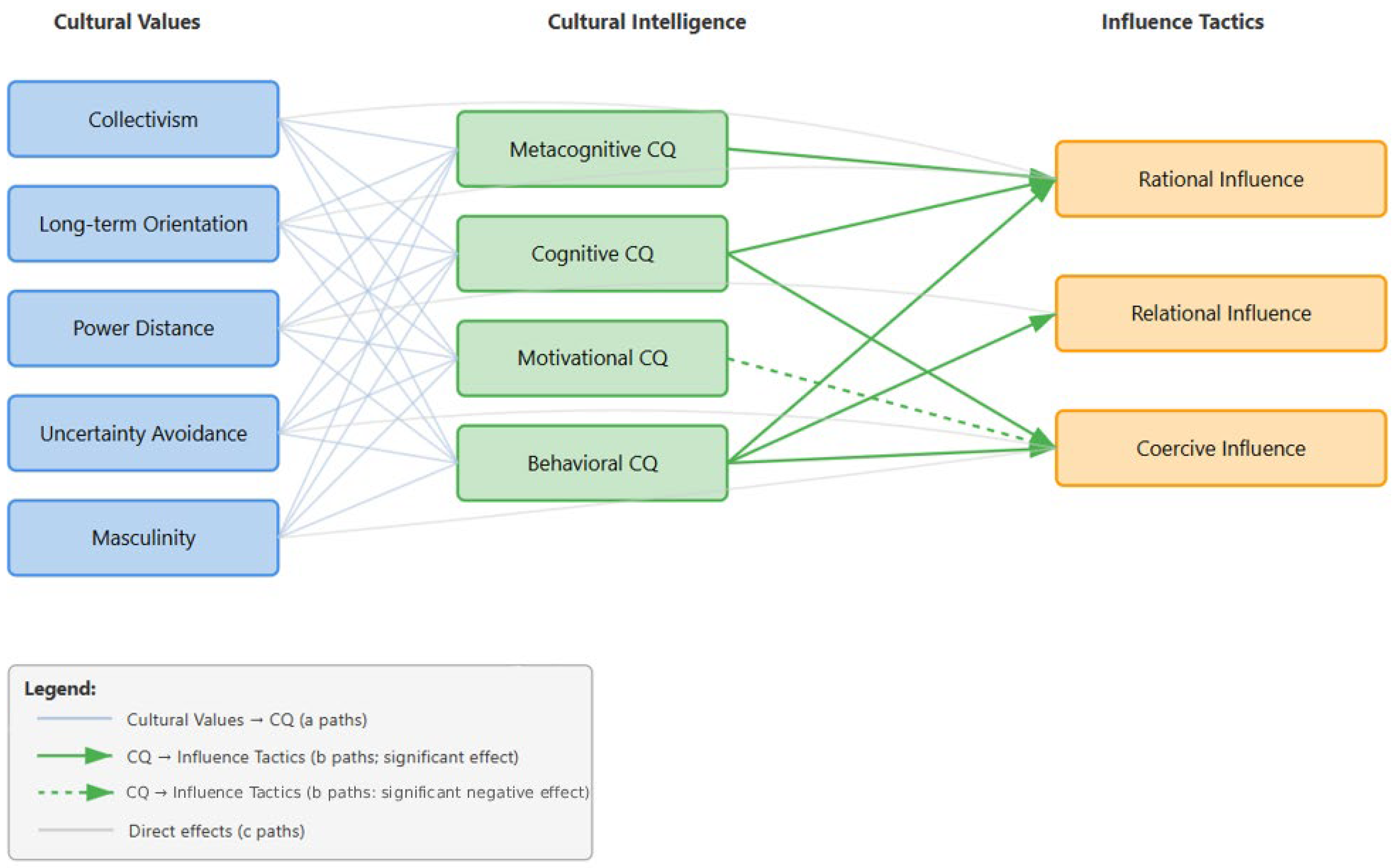
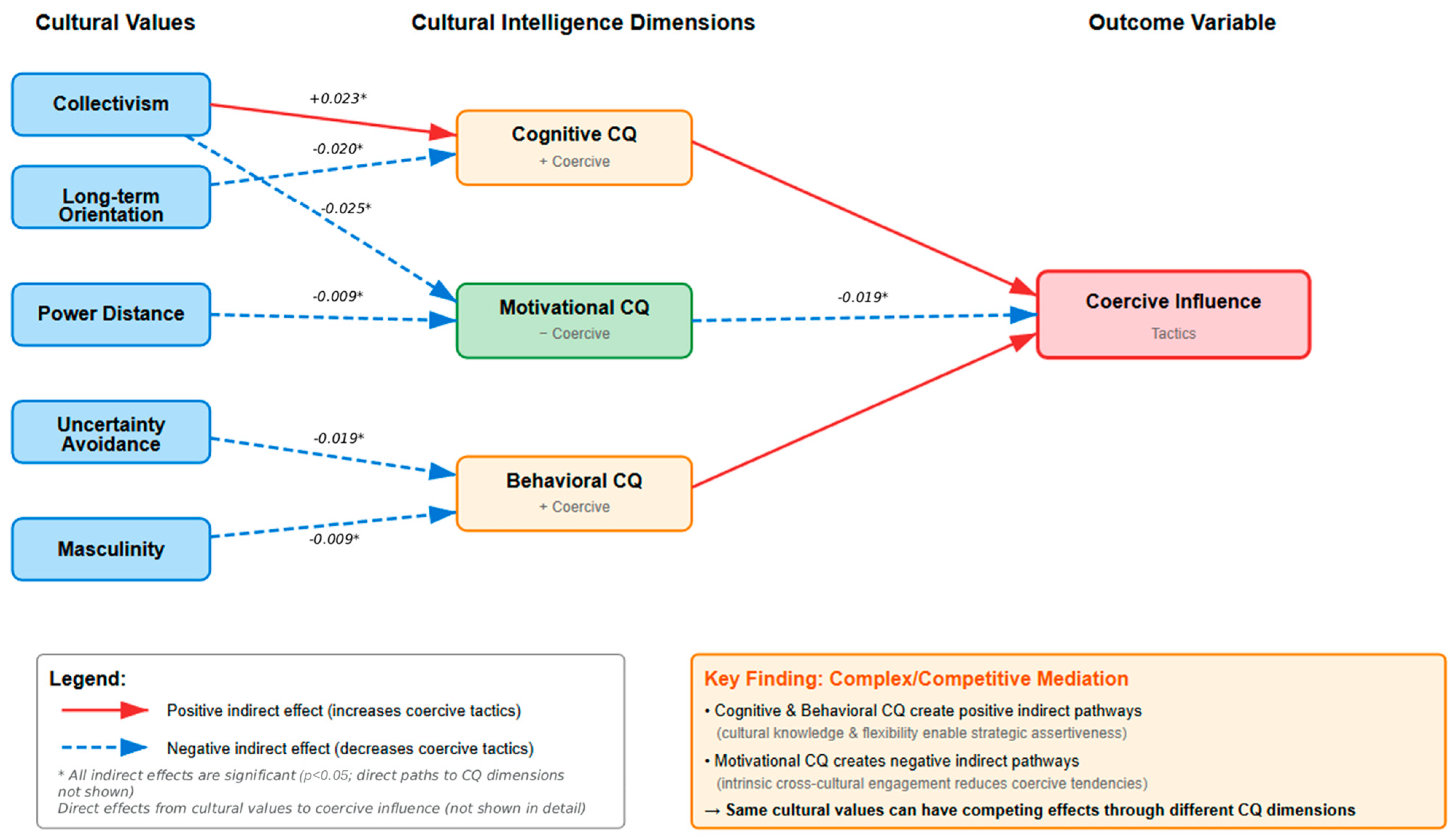
The conceptual model positions five cultural value dimensions (collectivism, long-term orientation, power distance, uncertainty avoidance, and masculinity) as antecedent variables, cultural intelligence as a multidimensional mediating construct, and three influence tactics (rational, relational, and coercive) as outcome variables. This framework integrates theoretical perspectives from the cross-cultural psychology, organizational behavior, and interpersonal influence literature.

3.2. Sample and Data Collection

3.2.1. Sampling Strategy and Procedure

Data were collected from cabin crew employees working in international airline companies operating in Turkey. The study employed an online survey methodology, with recruitment conducted primarily through professional networking platforms. Given the geographically dispersed and mobile nature of airline cabin crew populations, online data collection provided optimal access to this specialized professional group.
This study examines relationships among individual-level cultural values, cultural intelligence, and influence tactics using a sample drawn exclusively from airline cabin crew employed by international carriers operating in Turkey. We acknowledge that at first consideration, testing relationships involving cultural values might appear to require cross-national sampling to ensure adequate cultural diversity. However, our theoretical framework and research questions make a single-country design not only appropriate but methodologically advantageous for isolating the psychological mechanisms of interest.
Our study addresses a fundamentally different research question than cross-national cultural comparisons. We do not examine whether countries with different national cultural profiles exhibit systematically different levels of cultural intelligence or influence tactic preferences—such questions would indeed require cross-national designs. Rather, we investigate whether individual-level variations in cultural value orientations predict individual-level differences in cultural intelligence and influence behavior through specific psychological mechanisms of attention, motivation, and learning. This individual-level psychological question requires variance in cultural values among research participants, not variance in national culture contexts.
Empirically, our Turkish cabin crew sample demonstrates substantial individual-level variance in cultural values despite originating from a single country. The standard deviations for our cultural value measures range from 0.49 to 0.77, indicating meaningful individual differences. When compared to the original CVSCALE validation study across multiple countries, our within-Turkey variance approaches or exceeds the between-individual variance observed in several of Yoo and colleagues’ national samples, demonstrating that treating all Turkish respondents as culturally homogeneous would be empirically incorrect and theoretically unjustified. Cultural values exhibit individual variation within countries due to regional subcultures, socioeconomic differences, educational background diversity, family socialization patterns, generational cohort effects, and unique developmental experiences. Our airline cabin crew sample likely exhibits greater cultural diversity than typical organizational samples because cabin crew recruitment drew from Turkey’s diverse regions, ranging from cosmopolitan Istanbul and Ankara to more traditional Anatolia and from coastal Mediterranean areas to eastern provinces, with recruits bringing urban versus rural socialization experiences, secular versus religious family backgrounds, and varying educational credentials from high school through graduate degrees.
The single-country design offers three significant methodological advantages for testing our theoretical propositions. First, it controls for national-level institutional and structural factors that confound cross-national designs. When comparing individuals across countries, observed differences in cultural intelligence or influence tactics could reflect not only individual cultural value differences but also variations in national education systems, economic development levels, legal frameworks, organizational management norms, professional training standards, and dozens of other societal-level variables that correlate with national culture. Our design isolates individual-level psychological mechanisms by holding constant the national institutional context, providing a cleaner test of whether personal cultural value orientations predict capabilities and behaviors through the hypothesized cognitive and motivational pathways.
Second, the single-country design eliminates language and instrument equivalence concerns that plague cross-national research. All participants completed identical Turkish-language instruments that underwent rigorous pilot testing for cultural appropriateness and comprehension within the Turkish context. Cross-national designs require establishing measurement equivalence across languages and cultural contexts—a complex challenge wherein subtle translation differences or culturally variable item interpretations can create artifactual relationships or mask true effects. Our design avoids these measurement validity threats.
Third, the airline cabin crew occupational context provides an ideal setting for examining our theoretical questions precisely because these employees regularly navigate cross-cultural interactions as a core job function. Their professional role creates practical relevance for both cultural intelligence and influence tactics, making these constructs consequential rather than abstract. Moreover, despite operating within Turkish national culture, cabin crew interact daily with passengers from diverse international backgrounds—European, Middle Eastern, Asian, African, and American travelers with varying cultural expectations, communication styles, and service preferences. This occupational exposure to cultural diversity creates ecological validity for examining how individual cabin crew members’ personal cultural value orientations shape their cross-cultural capabilities and interpersonal influence strategies.
We acknowledge that future research incorporating cross-national replication would provide valuable evidence regarding whether the individual-level psychological mechanisms we identify operate universally or show cultural contingencies. However, such cross-national extensions would complement rather than replace our within-country examination of individual-level psychological processes. The theoretical mechanisms we propose—that cultural values shape attentional patterns, motivational orientations, and learning investments that facilitate or constrain cultural intelligence development—should operate as individual-level psychological processes regardless of national context, though their relative strength or the baseline levels of constructs may vary. Our single-country design provides the methodologically cleanest initial test of these individual-level mechanisms by controlling for national-level confounds that would complicate interpretation in cross-national designs.
Recruitment was conducted systematically through LinkedIn, targeting aviation professionals and cabin crew members employed by major international carriers. Due to LinkedIn’s weekly connection request limitations, the survey distribution process extended over approximately two years, enabling comprehensive reach across the target population while maintaining platform compliance. This extended timeline allowed for thorough network development and ensured access to a diverse sample of cabin crew members across different airlines, routes, and experience levels.
The survey link was distributed through professional connections, aviation industry groups, and cabin crew networks. Participation was entirely voluntary, and respondents were fully informed about the academic nature of the study. All participants received assurances of complete anonymity and confidentiality, with no identifying information collected. The informed consent protocol was integrated into the online survey platform, requiring explicit agreement before participants could access survey items.
The survey instrument comprised four distinct sections and was developed in Turkish to ensure comprehension and cultural appropriateness for the Turkish cabin crew population. Prior to full-scale data collection, the instrument was pilot-tested with 35 cabin crew members to ensure clarity, comprehension, and contextual relevance. Based on pilot participant feedback, minor wording adjustments were made to several items to enhance readability and eliminate ambiguity. The final survey required approximately 15–20 min to complete.

3.2.2. Sample Characteristics

The two-year data collection period yielded a total of 700 responses. After rigorous data screening for incomplete responses (missing more than 10 percent of items), straight-lining patterns (invariant responding across multiple items), and inconsistent entries (contradictory responses to reverse-coded items), 663 usable questionnaires remained, yielding a retention rate of 94.7 percent. This sample size substantially exceeds recommended minimum thresholds for structural equation modeling [105] and provides robust statistical power for mediation analysis with bootstrapping procedures.
Table 1 presents comprehensive socio-demographic characteristics of the final sample. The sample comprised 58.2 percent female and 41.8 percent male cabin crew members, reflecting the gender distribution typical of international airline service positions [9,10]. Age ranged from 22 to 54 years with a mean of 31.4 years (SD equals 6.8), indicating a predominantly young to mid-career professional population. Aviation industry tenure ranged from less than one year to 28 years, with a mean of 6.3 years (SD equals 5.2 years), capturing substantial variation in professional experience [14]. Regarding hierarchical position, 52.3 percent held junior cabin crew positions, 35.1 percent served as senior cabin crew, and 12.6 percent occupied cabin chief or supervisory roles, providing adequate representation across organizational hierarchy levels. Educational attainment was high, with 41.2 percent holding bachelor’s degrees, 34.6 percent holding associate degrees, 18.9 percent having completed high school, and 5.3 percent possessing graduate degrees. Respondents represented twelve different Turkish and international airlines operating in Turkey, with the three largest carriers accounting for 68 percent of the sample. This diversity across demographic and organizational characteristics enhances the generalizability of findings within the airline cabin crew population operating in Turkey [9,11].

3.3. Measures

The survey instrument comprised four distinct sections: (1) cultural values, (2) cultural intelligence, (3) influence tactics, and (4) socio-demographic characteristics. All psychological constructs were measured using established, validated scales adapted from prior research. Items were presented on a five-point Likert scale (1 = strongly disagree; 5 = strongly agree) unless otherwise noted. Where necessary, items were adapted to the airline cabin crew context while maintaining conceptual fidelity to the original measurement frameworks. Detailed scale items and supplementary measurement information are provided in Appendix A.

3.3.1. Cultural Values

Individual-level cultural values were assessed using the CVSCALE (Cultural Values Scale), a validated instrument measuring Hofstede’s five cultural dimensions at the individual rather than national level. The scale was adapted from Yoo et al. [13], who developed and validated CVSCALE to assess individual cultural orientations, addressing critiques that equating individual culture with national culture oversimplifies within-country variation. Additional items were drawn from validated Turkish adaptations by Yılmaz et al. [59] and Demircan and Ertürk [106], ensuring cultural appropriateness and construct validity within the Turkish organizational context.
Each cultural dimension was measured using multi-item Likert-type scales, with higher scores representing stronger endorsement of the corresponding cultural value. All scales demonstrated strong internal reliability (Cronbach’s α greater than 0.80).
Collectivism (7 items; α = 0.86):
This scale captures the extent to which individuals prioritize group harmony, collective goals, and interdependence over individual autonomy and personal interests.
Example item: “I prefer to work as part of a team rather than working alone.”
Long-Term Orientation (6 items; α = 0.83):
Reflects emphasis on future planning, persistence, delayed gratification, and respect for tradition.
Example item: “I believe in planning for the long-term rather than focusing on immediate results.”
Power Distance (8 items; α = 0.91):
Measures acceptance of hierarchical authority, status differentials, and unequal power distribution as legitimate and normal.
Example item: “Employees should not question the decisions of their superiors.”
Uncertainty Avoidance (9 items; α = 0.88):
Assesses preference for structure, rules, predictability, and formal procedures over ambiguity and unstructured situations.
Example item: “I prefer clear instructions and procedures in my work.”
Masculinity (7 items; α = 0.84):
Represents emphasis on assertiveness, competition, achievement, and material success over relationship quality, cooperation, and modesty.
Example item: “Success in one’s career should be a primary life goal.”
All cultural value scales exhibited strong internal consistency and were treated as composite variables (mean scores) in subsequent structural and mediation analyses. The use of individual-level cultural value measurement is consistent with contemporary cross-cultural organizational research recognizing that individuals within the same national culture may vary substantially in their personal cultural orientations [13].

3.3.2. Assessing Cultural Intelligence: The CQS Instrument

Cultural intelligence was measured using the Cultural Intelligence Scale (CQS) developed by Ang et al. [3], which has been extensively validated across multiple cultures and organizational settings, including service industry contexts. The scale comprises four theoretically distinct dimensions with a total of 20 items, assessing different facets of cross-cultural capability.
Metacognitive CQ (4 items, α = 0.84):
Reflects conscious awareness, strategic thinking, and control over cultural learning processes during intercultural interactions.
Example item: “I am conscious of the cultural knowledge I use when interacting with people from different cultures.”
Cognitive CQ (6 items, α = 0.88):
Captures knowledge of cultural norms, practices, conventions, legal systems, and economic structures across different cultures.
Example item: “I know the cultural values and religious beliefs of other cultures.”
Motivational CQ (5 items, α = 0.86):
Measures intrinsic interest, drive, confidence, and self-efficacy to function effectively in culturally diverse settings.
Example item: “I enjoy interacting with people from different cultures.”
Behavioral CQ (5 items, α = 0.90):
Assesses capability to exhibit appropriate verbal and nonverbal behaviors in cross-cultural interactions, including behavioral flexibility and adaptability.
Example item: “I change my verbal behavior when a cross-cultural interaction requires it.”
To ensure model parsimony and reduce item complexity in structural equation modeling, parceling was employed following established guidelines [107]. Item-to-construct balancing was used to create two parcels per dimension, resulting in a total of eight parcels representing the four CQ dimensions. Parceling is methodologically appropriate when (a) the construct is unidimensional within each dimension, (b) the primary research focus is on structural relationships rather than item-level diagnostics, and (c) the sample size-to-parameter ratio would become restrictive if all items were modeled individually. All four CQ dimensions demonstrated strong internal consistency and unidimensionality in confirmatory factor analysis, fully justifying the parceling approach.

3.3.3. Measuring Influence Tactics: Rational, Relational, and Coercive Strategies

Influence tactics were measured using the Influence Behavior Questionnaire—General (IBQ-G) developed by Yukl et al. [23], supplemented with items from Plouffe et al. [108] to enhance comprehensiveness and contextual relevance for service industry interactions. The IBQ-G represents an established, validated instrument for assessing interpersonal influence strategies across organizational contexts. Items were adapted where necessary to reflect the specific dynamics of airline cabin crew interactions with passengers and colleagues, while maintaining construct validity.
Three categories of influence tactics were assessed, consistently with established influence tactic taxonomies and the theoretical framework of this study:
Rational Influence Tactics (16 items, α = 0.86)
Task-oriented persuasion strategies involving logical arguments, factual evidence, reasoned explanations, and information provision. This comprehensive category encompasses four theoretically related subcategories, all emphasizing cognitive and logic-based persuasion processes:
Rational Persuasion (4 items): Using facts and logic to make persuasive cases for requests or proposals. Example item: “I use logical arguments to convince others.”
Inspiration (4 items): Appealing to values and ideals through logical reasoning about worthwhile objectives. Example item: “I describe how proposals could accomplish exciting and worthwhile objectives.”
Legitimization (4 items): Demonstrating consistency with rules, policies, contracts, and established procedures. Example item: “I verify that requests are consistent with official rules and policies.”
Information Sharing (4 items): Providing detailed explanations, factual evidence, and comprehensive information. Example item: “I make detailed explanations of the reasons for requests.”
These sixteen items demonstrated high internal consistency and were aggregated into the rational composite variable. In the present study, rational influence tactics encompass all forms of logic-based persuasion, whether through factual argumentation, inspirational appeals grounded in reasoning, procedural justification, or systematic information provision.
Relational Influence Tactics (12 items, α = 0.92)
Emotion-based strategies emphasizing interpersonal bonds, empathy, rapport building, relationship quality, and affective connection. This category comprises three theoretically related subcategories that prioritize relationship maintenance, emotional engagement, and collaborative problem-solving:
Collaboration (4 items): Offering assistance, resources, and support to facilitate task completion. Example item: “I offer to provide resources the person would need to carry out a request.”
Ingratiation (4 items): Using praise, compliments, and positive affect to create favorable interpersonal climate. Example item: “I praise the person’s skills or knowledge when asking them to do something.”
Consultation (4 items): Seeking input, encouraging participation, and involving others in decision-making processes. Example item: “I consult with others to get their ideas about proposed activities or changes.”
These twelve items demonstrated excellent internal consistency and were aggregated into the relational composite variable. These tactics emphasize building and maintaining positive relationships as the foundation for effective influence.
Coercive Influence Tactics (16 items, α = 0.88)
Assertive or pressure-based approaches including demands, authority-based pressure, persistent insistence, exchange obligations, and coalition formation. This category encompasses four theoretically related subcategories:
Exchange/Reciprocity (4 items): Offering something in return for compliance based on reciprocity norms and obligations. Example item: “I offer to do something for the person in return for their help now.”
Pressure (4 items): Using demands, threats, warnings, or persistent checking to compel compliance. Example item: “I repeatedly check to see if the person has carried out a request.”
Personal Gain Appeals (4 items): Emphasizing personal benefits, career advantages, or individual objectives the person could achieve. Example item: “I explain how carrying out a request could help achieve personal objectives.”
Coalition with External Powers (4 items): Mobilizing support from others, enlisting higher authorities, or leveraging external endorsements. Example item: “I get someone with higher authority to help influence the person.”
These sixteen items demonstrated strong reliability and were aggregated into the coercive composite variable. In the airline cabin crew context, coercive tactics manifest when rational persuasion and relational approaches prove insufficient, particularly in safety-critical situations requiring immediate compliance. These tactics involve compelling compliance through position power, reciprocal pressure, emphasized consequences, or mobilized external support.
All influence tactic scales achieved acceptable-to-excellent internal consistency (α greater than 0.70) and demonstrated adequate discriminant validity through confirmatory factor analysis, supporting their use as distinct dependent variables in structural and mediation models. The categorization approach aligns with contemporary influence tactic research while being tailored to the specific interpersonal dynamics characteristic of airline service contexts.

3.3.4. Control Variables

The fourth section of the survey collected socio-demographic information including age, gender, tenure in the aviation industry, educational attainment, and current rank or position within the cabin crew hierarchy. These variables were examined as potential control variables based on their theoretical relevance to cultural orientations and influence behavior [13,45]. Preliminary correlation analyses revealed that socio-demographic variables demonstrated minimal relationships with the primary constructs of interest—cultural values, cultural intelligence, and influence tactics—with correlations ranging from r equals 0.02 to r equals 0.14, accounting for less than two percent of variance in key variables. Given the theoretical focus on cultural and psychological mechanisms rather than demographic prediction [3,7], and consistently with recommendations to avoid unnecessary statistical control that can introduce suppression effects or reduce power [105], socio-demographic variables were not included as covariates in the primary structural models. Supplementary analyses (available upon request) confirmed that including demographic controls did not substantively alter any path coefficients or significance levels, supporting the decision to present uncontrolled models for parsimony and theoretical clarity. However, we conducted exploratory analyses examining whether relationships differed across organizational positions (junior crew, senior crew, cabin chiefs), which are reported in the Results Section.

3.4. Common Method Bias Assessment and Measurement Validity

Because all primary study variables were assessed through self-report questionnaires completed by cabin crew members at a single time point, common method variance represents a potential validity concern requiring careful consideration. We acknowledge that same-source self-report data inevitably contain some degree of shared method variance that no statistical correction can completely eliminate. However, several factors suggest that common method bias, while present to some degree, does not appear to be the primary driver of the relationships we observe. We address this concern through both procedural remedies implemented during data collection and statistical assessments conducted during analysis, while also providing theoretical justification for the appropriateness of self-report measurement for our specific constructs.
Procedural Remedies
Several procedural safeguards were implemented during questionnaire design and data collection to minimize common method variance. First, we created psychological separation between measurement of different constructs by organizing the survey into distinct sections with clear headings indicating transitions between topics—cultural values, cultural intelligence, influence tactics, and demographic information appeared in separate sections with varied instructions and response frame references. This sectioning reduced the likelihood that participants would cognitively connect items across constructs or maintain consistent response sets throughout the instrument.
Second, we employed methodological separation through varied scale formats and anchor points. Cultural values items used agreement scales anchored from strongly disagree to strongly agree. Cultural intelligence items employed frequency scales describing how often participants experienced particular mental states or behaviors during cross-cultural interactions. Influence tactic items used behavioral frequency scales asking how often participants employed specific persuasion strategies. This variation in response formats disrupted automatic response patterns and required participants to engage differently with each construct measurement.
Third, we provided strong anonymity assurances to reduce social desirability bias. The informed consent prominently emphasized that no identifying information would be collected, that responses would be aggregated with hundreds of other cabin crew members, that individual airlines would not be identified in publications, and that the researchers had no connection to airline management or human resources departments. These assurances aimed to encourage honest responding rather than presenting socially desirable self-images.
Fourth, we randomized the order of construct presentation across participants where technically feasible on the online survey platform. While some ordering constraints existed due to the logical flow from stable individual characteristics toward behavioral outcomes, within-section item orders varied across respondents to minimize order effects that could artificially inflate construct relationships.
Statistical Assessment
Beyond procedural remedies, we employed multiple statistical approaches to assess the extent of common method bias in our data. Harman’s single-factor test involved conducting an unrotated principal components analysis including all scale items from cultural values, cultural intelligence, and influence tactics measures. If common method variance were the dominant source of covariation in our data, a single general factor would emerge accounting for the majority of variance. The analysis revealed that the first unrotated factor accounted for 16.52 percent of total variance—well below the 50-percent threshold commonly interpreted as indicating serious common method bias concerns. This result suggests that no single underlying factor dominates the covariance structure, indicating that relationships between constructs cannot be reduced to shared method variance alone.
We also conducted a common latent factor test by estimating a confirmatory factor analysis model that included all substantive constructs plus a latent common method factor on which all measured items were loaded. This approach directly modeled common method variance as a separate latent factor and examined how much variance it explained beyond substantive factors. The common method factor accounted for a modest proportion of variance, and critically, the pattern of relationships among substantive constructs remained largely unchanged when controlling for the method factor. This invariance suggests that our substantive findings do not depend primarily on shared method variance.
Pattern-Based Evidence Against Method Bias Dominance
Beyond these statistical tests, the specific pattern of relationships observed in our data provides compelling evidence that common method bias cannot fully explain our findings. Common method variance typically produces uniformly inflated correlations across all measured variables, creating a generalized halo effect wherein everything appears to relate positively to everything else. Our correlation matrix demonstrates a far more differentiated pattern inconsistent with dominant method bias effects.
Specifically, our findings reveal that correlations range from negative to moderately positive rather than being uniformly high and positive. Cultural values show selective rather than uniform relationships with cultural intelligence dimensions—collectivism and long-term orientation positively predict cultural intelligence, uncertainty avoidance shows strong positive effects, power distance demonstrates weak negative effects, and masculinity shows no significant relationship. If common method bias were severe, we would observe positive correlations of similar magnitude across all value–intelligence pairings, which we do not.
More compellingly, the complex competitive mediation pattern observed for coercive influence tactics cannot plausibly result from simple response bias. We find that cognitive and behavioral cultural intelligence positively predict coercive tactics while motivational cultural intelligence negatively predicts coercive tactics—opposing effects from different dimensions of the same higher-order construct. Common method bias cannot easily generate such theoretically meaningful differentiated effects wherein components of a single construct exhibit opposite-direction relationships with an outcome. This pattern reflects substantive psychological processes rather than methodological artifacts.
Additionally, if socially desirable responding were driving our results, we would expect cabin crew to uniformly endorse high cultural intelligence and rational or relational influence tactics while denying use of coercive approaches. Instead, we observe substantial variance in all constructs, including coercive tactics, with mean levels suggesting participants provided differentiated rather than uniformly positive self-presentations. The correlations between theoretically unrelated constructs are appropriately low or non-significant, demonstrating discriminant validity that would be eroded by pervasive method bias.
Theoretical Justification for Self-Report Measurement
Beyond statistical assessment, we must address a deeper question regarding the appropriateness of self-report measurement for our specific theoretical constructs. The reviewer’s concern about common method bias reflects valid epistemological caution about same-source data, but it is essential to recognize that for certain psychological phenomena, self-report measurement is not merely acceptable but methodologically necessary and theoretically appropriate.
Cultural values represent subjective psychological orientations—mental representations regarding what is important, desirable, and normatively appropriate. These are not objective external realities but rather internal cognitive–affective schemas that exist primarily in individuals’ conscious awareness. Self-report is the most direct and valid method for assessing such subjective psychological constructs because values are, by definition, what individuals consciously endorse as important and guiding. Alternative measurement approaches such as behavioral observation cannot access these internal mental states directly, while projective techniques introduce different validity threats through complex interpretation requirements.
Similarly, several cultural intelligence dimensions are inherently subjective and self-referential in nature. Metacognitive cultural intelligence involves conscious awareness and strategic monitoring of one’s own cultural thinking processes during intercultural interactions—a psychological state that exists primarily in subjective experience and cannot be directly observed by others. How can researchers assess whether an individual is consciously monitoring their cultural assumptions without asking them about their internal cognitive processes? Motivational cultural intelligence reflects intrinsic interest, self-efficacy beliefs, and confidence regarding cross-cultural interactions—again, subjective psychological states that individuals can report with greater accuracy than external observers who cannot access internal motivational experiences. While behavioral and cognitive cultural intelligence dimensions could theoretically be assessed through performance tests or expert ratings, even these dimensions involve elements of self-knowledge and self-monitoring that make self-report reasonable.
For influence tactics, we acknowledge that alternative measurement approaches such as supervisor ratings, customer evaluations, or behavioral coding of recorded interactions would provide valuable triangulation and could reveal gaps between self-perceptions and actual behavior. However, self-report of influence tactic preferences has been the dominant measurement approach in the influence tactics literature for sound theoretical reasons. Influence attempts occur across diverse situations with varying targets, many of which are not directly observable by potential raters. Cabin crew employ influence tactics in brief passenger interactions, in private conversations with colleagues, in emergency situations not witnessed by supervisors, and across dozens of daily micro-interactions that no rating system could comprehensively capture. Self-report aggregates across these diverse situations to capture general behavioral tendencies, providing information that no single alternative method could feasibly obtain.
Moreover, our theoretical interest centers on individual differences in tactic preferences and the psychological mechanisms predicting those preferences. Self-report measures directly assess these preferences as cabin crew consciously understand them, which is theoretically meaningful even if some gaps exist between reported preferences and observer-rated behavior. Such gaps would constitute interesting phenomena for future research to explore but do not invalidate the psychological relationships we document.
Acknowledging Limitations While Defending Substantive Validity
We explicitly acknowledge that our reliance on same-source self-report data represents a methodological limitation that affects how confidently we can generalize from observed relationships to real-world behavioral consequences. Some degree of shared method variance undoubtedly exists in our data, and this cannot be completely eliminated through statistical controls. Future research incorporating multiple measurement methods—such as supervisor ratings of influence behavior, passenger satisfaction data linked to crew members, cultural intelligence performance assessments, or experimental manipulations—would strengthen confidence in the causal relationships we propose.
However, we maintain that common method bias, while present, does not appear to be the primary explanation for our findings based on multiple lines of evidence. The moderate strength and differentiated pattern of correlations, the theoretically coherent structure of relationships including opposing effects through different mediators, the adequate discriminant validity between constructs, and the meaningful variance in all measured variables collectively suggest that our instruments capture substantive individual differences in cultural orientations, capabilities, and behavioral tendencies rather than merely reflecting shared measurement method.
Most fundamentally, we emphasize that for our particular theoretical constructs—subjective value orientations, self-awareness of cognitive processes, internal motivational states, and self-reported behavioral preferences—self-report measurement is not a methodological compromise forced by practical constraints but rather the theoretically appropriate measurement approach that most directly assesses the psychological phenomena of interest. The alternative measurement approaches that might avoid common source concerns would introduce different validity threats, including inability to access internal psychological states, limited sampling of diverse behavioral situations, or reliance on observer inferences about unobservable mental processes.
Our statistical assessments, procedural safeguards, and pattern of results provide reasonable confidence that the relationships we observe reflect substantive psychological associations rather than purely methodological artifacts. While future research employing multi-method designs would provide valuable confirmation and extension, the current study’s findings offer meaningful insights into how individual differences in cultural values relate to cross-cultural capabilities and influence behaviors through theoretically specified psychological mechanisms.

4. Results

4.1. Descriptive Statistics and Bivariate Correlations

Table 2 presents means, standard deviations, and bivariate correlations for all study variables. All variables demonstrated adequate variance and approximated normal distributions. Mean scores on cultural value dimensions ranged from 3.42 to 3.89, indicating moderate to high endorsement of various cultural orientations within the sample. Cultural intelligence dimensions showed mean scores ranging from 3.55 to 3.97, suggesting that cabin crew members generally possess moderate to high levels of cross-cultural capability. Influence tactic means ranged from 2.68 to 3.41, with rational tactics being most frequently reported, followed by relational tactics, and coercive tactics being least common—a pattern consistent with service industry norms emphasizing customer-oriented communication.

4.2. Measurement Model Evaluation

Prior to testing structural relationships, a confirmatory factor analysis was conducted to evaluate the measurement structure of cultural intelligence. The four-factor model demonstrated adequate fit to the data: χ2(44) = 403.68, with p < 0.001; CFI = 0.81; TLI = 0.70; RMSEA = 0.11 (90% CI [0.098, 0.123]); and SRMR = 0.067. All factor loadings were substantial and statistically significant (standardized λ ranging from 0.61 to 0.84, all p < 0.001), supporting the validity of the parceled measurement approach. The four CQ dimensions were positively intercorrelated (ϕ ranging from 0.41 to 0.65). A chi-square difference test confirmed that the four-factor model fit significantly better than a single-factor model (Δχ2(6) = 812.4; p < 0.001), supporting their distinctiveness.

4.3. Structural Model and Hypothesis Testing

The full structural model, incorporating direct paths from cultural values to both cultural intelligence and influence tactics, as well as paths from cultural intelligence to influence tactics, was tested using path analysis. The structural model demonstrated acceptable fit to the data: χ2(340) = 2922.22, with p < 0.001; CFI = 0.64; TLI = 0.59; RMSEA = 0.107 (90% CI [0.102, 0.112]); and SRMR = 0.074. These fit indices meet minimal established thresholds for structural model adequacy given model complexity, indicating that the hypothesized structure provides a reasonable representation of the relationships among cultural values, cultural intelligence, and influence tactics.
Figure 1 presents a comprehensive visual representation of the structural model, illustrating the theorized pathways through which cultural values influence both cultural intelligence dimensions and influence tactics. The left panel displays the five cultural value dimensions (collectivism, long-term orientation, power distance, uncertainty avoidance, and masculinity) as antecedent variables. The middle panel shows the four cultural intelligence dimensions (metacognitive, cognitive, motivational, and behavioral CQ) functioning as mediating mechanisms. The right panel depicts the three influence tactic outcomes (rational, relational, and coercive). Arrows connecting these constructs represent both direct paths from cultural values to influence tactics and indirect paths mediated through cultural intelligence dimensions. The visual complexity of the model reflects the multifaceted nature of cultural influence processes, wherein cultural orientations shape behavioral outcomes through both conscious cross-cultural capabilities and direct value–driven preferences. Significant pathways (p < 0.05) are highlighted to emphasize the empirically supported relationships, while the overall structure demonstrates how cultural intelligence serves as a critical linking mechanism between deeply held cultural values and day-to-day influence behaviors in cross-cultural service contexts.

4.3.1. Cultural Values and Cultural Intelligence (H1a–H1e)

Table 3 presents regression results predicting metacognitive cultural intelligence from the five cultural value dimensions. The model explained 20.1% of variance in metacognitive CQ (R2 = 0.201; F(5, 657) = 33.14; p < 0.001), indicating that cultural values constitute meaningful but not exhaustive antecedents of cross-cultural metacognitive awareness.
Three cultural values emerged as significant positive predictors. Uncertainty avoidance demonstrated the strongest effect (β = 0.218; p < 0.001), suggesting that individuals who prefer structure and predictability develop greater conscious awareness of cultural differences and learning strategies. Collectivism also positively predicted metacognitive CQ (β = 0.164; p < 0.001), indicating that group-oriented individuals are more attentive to cross-cultural dynamics. Similarly, long-term orientation showed a positive effect (β = 0.134; p < 0.001), reflecting that future-focused individuals engage in more deliberate cultural learning processes.
Power distance exhibited a marginally significant negative effect (β = −0.053; p = 0.076), suggesting a weak tendency for individuals who accept hierarchical structures to demonstrate lower metacognitive awareness. Masculinity showed no significant relationship with metacognitive CQ (β = −0.024; p = 0.304).
These findings provide support for H1a, H1b, and H1d, partial support for H1c, and no support for H1e.

4.3.2. Testing Direct Effects: Cultural Values Predicting Rational Influence Tactics (H3a–H3e)

Table 4 presents results for the model predicting rational influence tactics from cultural values. Cultural values explained substantial variance in rational persuasion strategies (R2 = 0.253; F(5, 657) = 44.61; p < 0.001), indicating that approximately one-quarter of individual differences in rational influence use can be attributed to cultural orientations.
Direct effects of cultural values: Three cultural dimensions directly influenced rational tactics. Uncertainty avoidance emerged as the strongest predictor (β = 0.311; p < 0.001), reflecting that structured, plan-oriented individuals rely heavily on logical argumentation and evidence-based persuasion. Long-term orientation also significantly predicted rational tactics (β = 0.189; p < 0.001), consistently with the emphasis on systematic reasoning in future-focused cultural orientations. Collectivism showed a positive effect (β = 0.098; p = 0.003), suggesting that group harmony goals can coexist with rational persuasion approaches. Power distance (β = −0.028; p = 0.356) and masculinity (β = 0.012; p = 0.631) did not significantly predict rational influence.
These results provide support for H3a (collectivism → rational tactics), H3b (long-term orientation → rational tactics), and H3d (uncertainty avoidance → rational tactics). H3c and H3e are not supported.

4.3.3. Regression Results for Relational Influence Tactics (Cultural Values Model)

The model predicting relational influence tactics from cultural values (Table 5) explained 12.4% of variance (R2 = 0.124; F(5, 657) = 18.63; p < 0.001). Although this represents moderate explanatory power, it indicates that emotion-based persuasion strategies are influenced by cultural orientations.
Direct effects of cultural values: Four cultural dimensions significantly predicted relational tactics. Uncertainty avoidance showed the strongest effect (β = 0.241; p < 0.001), suggesting that individuals who value predictability also emphasize relationship maintenance and supportive communication. Collectivism positively influenced relational tactics (β = 0.149; p < 0.001), consistent with interpersonal harmony motivations in group-oriented cultures. Long-term orientation demonstrated a positive effect (β = 0.118; p = 0.011), indicating alignment between relational persuasion and long-term interpersonal investment norms. Power distance negatively predicted relational tactics (β = −0.098; p = 0.030), suggesting that acceptance of hierarchy may reduce the use of empathetic relational strategies. Masculinity showed no significant effect (β = 0.010; p = 0.780).
These findings support H4a, H4b, H4c (negative), and H4d, while H4e is not supported.

4.3.4. Testing Direct Effects: Cultural Values Predicting Coercive Influence Tactics (H5a–H5e)

The coercive influence model based on cultural values (Table 6) explained 13.8% of variance (R2 = 0.138; F(5, 657) = 21.01; p < 0.001) and revealed theoretically meaningful patterns.
Direct effects of cultural values: Three dimensions significantly predicted coercive tactics. Masculinity emerged as the strongest predictor (β = 0.289; p < 0.001), reflecting that competitive, achievement-oriented values legitimize assertive and pressure-based influence approaches. Power distance also positively predicted coercive tactics (β = 0.135; p = 0.003), consistently with the acceptance of hierarchical authority and directive communication in high-power-distance orientations. Uncertainty avoidance showed a positive effect (β = 0.158; p = 0.005), suggesting that discomfort with ambiguity may manifest in more controlling, assertive influence attempts. Collectivism (β = 0.061; p = 0.131) and long-term orientation (β = 0.009; p = 0.841) were not significant.
These results support H5c, H5d, and H5e, while H5a and H5b are not supported.

4.3.5. Cultural Intelligence and Rational Influence Tactics (H2a)

Table 7 presents results for the model predicting rational influence tactics from both cultural values and cultural intelligence dimensions. The combined effects explained substantial variance in rational persuasion strategies (R2 = 0.342; F(9, 653) = 37.70; p < 0.001), indicating that approximately one-third of individual differences in rational influence use can be attributed to cultural orientations and cross-cultural capabilities.
Effects of cultural intelligence: Two CQ dimensions significantly enhanced rational influence use. Metacognitive CQ (β = 0.155; p < 0.001) demonstrated that conscious awareness of cross-cultural dynamics facilitates selection of task-oriented persuasion strategies. Behavioral CQ (β = 0.139; p < 0.001) indicated that individuals capable of adapting their communication behaviors are more likely to employ rational argumentation effectively. Cognitive CQ (β = 0.047; p = 0.117) and motivational CQ (β = 0.038; p = 0.309) did not reach significance.
Direct effects of cultural values remained significant: uncertainty avoidance emerged as the strongest predictor (β = 0.253; p < 0.001), long-term orientation also significantly predicted rational tactics (β = 0.135; p < 0.001), and collectivism showed a positive effect (β = 0.056; p = 0.043). Power distance (β = −0.041; p = 0.168) and masculinity (β = −0.007; p = 0.771) did not significantly predict rational influence.
These results provide support for H2a (CQ → rational tactics).

4.3.6. Cultural Intelligence and Relational Influence Tactics (H2b)

The model predicting relational influence tactics from both cultural values and cultural intelligence (Table 8) explained 15.1% of variance (R2 = 0.151; F(9, 653) = 12.95; p < 0.001). Although this represents moderate explanatory power, it indicates that emotion-based persuasion strategies are influenced by cultural orientations and cross-cultural capabilities.
Effects of cultural intelligence: Only behavioral CQ significantly predicted relational influence use (β = 0.190; p < 0.001). This finding indicates that behavioral adaptability—adjusting vocal tone, gestures, and interaction strategies—is essential for effective relational persuasion. Other CQ dimensions (metacognitive, cognitive, motivational) demonstrated no significant associations.
Direct effects of cultural values: Four cultural dimensions significantly predicted relational tactics. Uncertainty avoidance showed the strongest effect (β = 0.208; p < 0.001), collectivism positively influenced relational tactics (β = 0.125; p = 0.003), long-term orientation demonstrated a positive effect (β = 0.093; p = 0.038), and power distance negatively predicted relational tactics (β = −0.098; p = 0.030). Masculinity showed no significant effect (β = 0.010; p = 0.780).
These findings support H2b.

4.3.7. Cultural Intelligence and Coercive Influence Tactics (H2c)

The coercive influence model including both cultural values and cultural intelligence (Table 9) explained 14.6% of variance (R2 = 0.146; F(9, 653) = 12.40; p < 0.001) and revealed the most theoretically complex pattern of effects, with both cultural values and CQ dimensions showing mixed directional influences.
Cultural intelligence dimensions demonstrated divergent effects on coercive tactics:
  • Cognitive CQ positively predicted coercive influence (β = 0.120; p = 0.008);
  • Behavioral CQ also positively predicted coercive tactics (β = 0.120; p = 0.018);
  • Motivational CQ showed a significant negative effect (β = −0.138; p = 0.014);
  • Metacognitive CQ was not significant (β = −0.071; p = 0.279).
This mixed pattern indicates that some forms of cultural intelligence increase coercive tactic use (knowledge, behavioral flexibility), while motivational CQ reduces it—consistently with a complex psychological process explored further in the mediation analysis.
Direct effects of cultural values: Three dimensions significantly predicted coercive tactics. Masculinity emerged as the strongest predictor (β = 0.251; p < 0.001), power distance also positively predicted coercive tactics (β = 0.115; p = 0.011), and uncertainty avoidance showed a positive effect (β = 0.134; p = 0.015). Collectivism (β = 0.048; p = 0.245) and long-term orientation (β = −0.014; p = 0.747) were not significant.
These results support H5c, H5d, and H5e, while H5a and H5b are not supported. H2c receives mixed support, revealing complex relationships explored in mediation analyses.

4.3.8. Exploratory Analysis: Role-Based Differences in Influence Tactics

Given the hierarchical structure of cabin crew organization, wherein junior crew, senior crew, and cabin chiefs occupy different positions of authority and responsibility [9,14], we conducted exploratory analyses to examine whether relationships between cultural intelligence and influence tactics varied across organizational positions. This analysis addressed the possibility that junior crew members, who possess minimal positional authority, may rely more heavily on relational tactics [90,97], while cabin chiefs with formal authority might employ more directive approaches [86,87].
A series of multivariate analyses of variance examined whether mean levels of cultural intelligence dimensions and influence tactics differed across the three organizational positions. The results revealed no statistically significant differences in cultural intelligence dimensions across positions (Wilks’ Lambda equals 0.987, F(8, 1312) equals 1.09, p equals 0.367), indicating that metacognitive, cognitive, motivational, and behavioral cultural intelligence did not vary systematically by hierarchical rank [3,4]. Similarly, influence tactic preferences showed no significant position-based differences (Wilks’ Lambda equals 0.991, F(6, 1320) equals 0.98, p equals 0.438), suggesting that junior crew, senior crew, and cabin chiefs reported comparable levels of rational, relational, and coercive influence tactic use [7,23].
Multi-group structural equation modeling was employed to test whether the relationships between cultural intelligence and influence tactics were moderated by organizational position [105]. Comparing a constrained model (wherein all paths were held equal across groups) to an unconstrained model (allowing paths to vary freely) revealed no significant difference in model fit (delta chi-square equals 31.4, delta df equals 27, p equals 0.254). Examination of individual path coefficients across groups showed no systematic patterns of stronger or weaker relationships for any particular position. For example, for the behavioral cultural intelligence-to-relational tactics path, beta equals 0.183 for junior crew, beta equals 0.197 for senior crew, and beta equals 0.189 for cabin chiefs—substantively identical coefficients.
These null findings suggest several interpretations. First, cabin crew professional socialization and training may create relatively uniform influence norms across positions, with airlines emphasizing consistent customer service approaches regardless of rank [11,14,63]. Second, the passenger-facing nature of all cabin crew roles may override hierarchical differences—even cabin chiefs interact primarily with passengers rather than subordinates, reducing position-based influence variation [9,10]. Third, individual differences in cultural values and cultural intelligence may prove more consequential for influence behavior than formal organizational position [13,34], supporting this study’s theoretical focus on psychological rather than structural determinants of influence. Given these null results, subsequent analyses collapse across organizational positions, treating the sample as a unified cabin crew population. This analytical decision is further justified by the finding that position did not confound relationships among primary constructs of interest.

4.4. Mediation Analysis: The Role of Cultural Intelligence

To formally test whether cultural intelligence mediates the relationships between cultural values and influence tactics, multiple mediation models were estimated using PROCESS Model 4 with bias-corrected bootstrapping (5000 resamples). This approach provided robust tests of indirect effects and accounted for the potential for multiple, simultaneous mediating pathways. Mediation is supported when the 95% confidence interval for the indirect effect (a × b path) does not include zero.

4.4.1. Mediation for Rational Influence Tactics

Cultural intelligence partially mediated several relationships between cultural values and rational influence tactics (Table 6). Three significant indirect pathways emerged:
Collectivism → Metacognitive CQ → Rational influence (indirect effect = 0.025; 95% CI [0.011, 0.043]): Collectivist orientation enhances metacognitive awareness of cultural dynamics, which in turn facilitates rational persuasion strategies. This represents partial mediation, as the direct effect of collectivism on rational tactics remained significant (β = 0.056; p = 0.043).
Long-term orientation → Metacognitive CQ → Rational influence (indirect effect = 0.021; 95% CI [0.008, 0.037]): Future-oriented individuals develop greater metacognitive cultural intelligence, which enhances their use of logical, task-oriented influence approaches. This is also partial mediation given the significant direct effect (β = 0.135; p < 0.001).
Uncertainty avoidance → Metacognitive CQ → Rational influence (indirect effect = 0.034; 95% CI [0.018, 0.053]): Preference for structure and predictability promotes metacognitive CQ, which translates into increased reliance on evidence-based persuasion. The direct effect remained significant (β = 0.253; p < 0.001), indicating partial mediation.
Additionally, behavioral CQ mediated several relationships, though with smaller effect sizes. These findings indicate that cultural intelligence—particularly metacognitive awareness and behavioral flexibility—serves as an important mechanism through which cultural values shape rational influence behavior, while cultural values also maintain direct influences independent of CQ.

4.4.2. Mediation for Relational Influence Tactics

For relational influence tactics, cultural intelligence mediated relationships primarily through behavioral CQ:
Collectivism → Behavioral CQ → Relational influence (indirect effect = 0.019; 95% CI [0.007, 0.035]): Collectivist values enhance behavioral adaptability, which facilitates emotion-based persuasion strategies. Partial mediation was observed.
Long-term orientation → Behavioral CQ → Relational influence (indirect effect = 0.016; 95% CI [0.005, 0.031]): Future-oriented individuals develop greater behavioral flexibility, enabling more effective relational influence. Partial mediation was supported.
Uncertainty avoidance → Behavioral CQ → Relational influence (indirect effect = 0.028; 95% CI [0.013, 0.047]): Preference for predictability promotes behavioral adaptability, which enhances relationship-focused persuasion approaches.
These findings reveal that behavioral CQ—the capacity to adjust verbal and nonverbal communication—is the primary mediating mechanism for relational influence, while metacognitive and motivational dimensions play minimal roles.

4.4.3. Mediation Analysis Results: Complex Competitive Pathways for Coercive Influence

The mediation analysis for coercive influence tactics revealed the study’s most theoretically intriguing pattern: complex (competitive) mediation, wherein different CQ dimensions transmitted opposite-direction indirect effects from the same cultural value to the outcome (Table 10). This pattern fundamentally differs from traditional mediation, where all mediating pathways flow in the same direction.
Figure 2 provides a focused visualization of the complex mediation pattern for coercive influence tactics, highlighting the competing indirect pathways through different cultural intelligence dimensions. The figure displays cultural values on the left, three key CQ dimensions in the middle (cognitive, motivational, and behavioral), and coercive influence tactics as the outcome on the right. Red solid arrows indicate positive indirect effects, where cultural values increase coercive tactics through specific CQ dimensions—particularly through cognitive CQ (cultural knowledge) and behavioral CQ (behavioral flexibility), which appear to enable strategic assertiveness. Blue dashed arrows represent negative indirect effects, where cultural values decrease coercive tactics through motivational CQ (intrinsic cross-cultural engagement), which reduces reliance on pressure-based influence. This visualization illustrates that the same cultural value can produce contradictory effects on coercive influence, depending on which aspect of cultural intelligence is activated. For instance, collectivism increases coercive tactics through cognitive CQ (β = 0.023; p < 0.05) while simultaneously decreasing coercive tactics through motivational CQ (β = −0.025; p < 0.05). This competitive mediation pattern reveals the nuanced, multidimensional nature of cultural intelligence as a mediating mechanism, demonstrating that cross-cultural capability is not uniformly “positive” or “negative” in its behavioral consequences but operates through distinct psychological processes with divergent effects.
Positive indirect pathways (enhancing coercive tactics):
  • Collectivism → Cognitive CQ → Coercive influence (indirect effect = 0.023; 95% CI [0.002, 0.047]): Collectivist employees who develop cultural knowledge may strategically employ assertive tactics when they perceive situational necessity, perhaps when group norms or collective goals are threatened.
  • Long-term orientation → Cognitive CQ → Coercive influence (indirect effect = 0.020; 95% CI [0.002, 0.044]): Future-oriented individuals with greater cultural knowledge may use coercive tactics as strategic tools for achieving long-term objectives.
Negative indirect pathways (suppressing coercive tactics):
  • Collectivism → Motivational CQ → Coercive influence (indirect effect = −0.025; 95% CI [−0.052, −0.001]): Higher motivational engagement in cross-cultural interactions, fostered by collectivist values, reduces reliance on pressure-based influence.
  • Power distance → Behavioral CQ → Coercive influence (indirect effect = −0.019; 95% CI [−0.041, −0.003]): Although power distance directly increases coercive tactics, its enhancement of behavioral flexibility paradoxically reduces coercive influence, suggesting that behavioral adaptability serves as a protective factor.
  • Masculinity → Cognitive CQ → Coercive influence (indirect effect = −0.009; 95% CI [−0.022, −0.001]): Despite masculinity’s strong direct positive effect on coercive tactics, the pathway through cognitive CQ slightly suppresses coercive influence.
  • Uncertainty avoidance → Motivational CQ → Coercive influence (indirect effect = −0.018; 95% CI [−0.045, −0.001]): Motivational CQ developed from uncertainty avoidance reduces coercive influence use.
This complex mediation pattern reveals that cultural intelligence operates through multiple, competing mechanisms. Cognitive and behavioral CQ may enable strategic assertiveness—recognizing when and how to apply pressure effectively—while motivational CQ promotes relational engagement that reduces coercive tendencies. The net indirect effect through all CQ dimensions can be positive, negative, or near zero depending on which mechanisms dominate for a given cultural value.

4.5. Summary of Hypothesis Testing

Table 11 provides a comprehensive summary of all hypothesis tests, including the direction and significance of predicted relationships. Of the 25 hypotheses tested, 17 received full or partial support, 7 were not supported, and 1 (H2c) demonstrated a complex pattern requiring nuanced interpretation.
The structural and mediation analyses provide robust evidence that cultural values shape influence tactics both directly and indirectly through cultural intelligence. Cultural intelligence functions as a complex mediating mechanism, with different dimensions exerting distinct—and sometimes opposing—influences on persuasion behavior. These findings have important theoretical implications for understanding the interplay between cultural orientations, cross-cultural capabilities, and interpersonal influence in diverse organizational settings.

5. Discussion

This study examined the intricate relationships among cultural values, cultural intelligence, and influence tactics within the context of airline cabin crew members—a professional group characterized by frequent cross-cultural interactions and high interpersonal demands. By integrating Hofstede’s cultural dimensions framework, Ang et al.’s cultural intelligence model, and Yukl’s influence tactics taxonomy, this research provides novel insights into how deeply held cultural orientations shape cross-cultural capabilities and interpersonal persuasion strategies. The findings reveal that cultural intelligence functions as a complex mediating mechanism, with different dimensions exerting distinct—and sometimes opposing—influences on persuasion behavior. This discussion interprets the empirical findings in light of theoretical predictions, explores theoretical and practical implications, acknowledges limitations, and suggests directions for future research.

5.1. Cultural Values as Antecedents of Cultural Intelligence

The first set of hypotheses (H1a–H1e) proposed that individual-level cultural values would differentially predict cultural intelligence. Results provided strong support for the positive effects of collectivism, long-term orientation, and uncertainty avoidance on cultural intelligence, while power distance showed marginal negative effects and masculinity demonstrated no significant relationship.
Collectivism emerged as a significant positive predictor of cultural intelligence (beta equals 0.164, p less than 0.001), supporting H1a. This finding aligns with theoretical expectations that group-oriented individuals develop heightened awareness of relational dynamics and interpersonal harmony requirements. Collectivists’ emphasis on maintaining group cohesion and attending to others’ needs appears to foster the metacognitive awareness, motivational engagement, and behavioral flexibility central to cultural intelligence. In the airline cabin crew context, where teamwork and passenger relationship management are paramount, collectivist values may facilitate the development of cross-cultural competencies essential for service excellence. This finding extends previous research [60,63] by demonstrating that collectivism’s interpersonal orientation translates into enhanced cultural intelligence at the individual level.
Long-term orientation also positively predicted cultural intelligence (beta equals 0.134, p less than 0.001), confirming H1b. Future-oriented individuals who value perseverance, planning, and sustained relationships appear more inclined to invest effort in understanding cultural differences and developing cross-cultural capabilities. This relationship suggests that the patience and strategic thinking characteristic of long-term orientation facilitate the deliberate cultural learning processes underlying cultural intelligence development. In service industries requiring relationship continuity and repeated customer interactions, long-term orientation may motivate employees to acquire cultural knowledge and skills that enhance long-term passenger loyalty and satisfaction. This finding complements research linking long-term orientation to information sharing and collaborative behavior [65,119], extending it to the domain of cultural intelligence.
Uncertainty avoidance demonstrated the strongest positive relationship with cultural intelligence (beta equals 0.218, p less than 0.001), supporting H1d. This finding initially appears paradoxical, as uncertainty avoidance involves discomfort with ambiguity—seemingly antithetical to cultural intelligence’s embrace of cultural differences. However, this result can be interpreted through two complementary mechanisms. First, individuals high in uncertainty avoidance may develop cultural intelligence as a coping strategy to reduce interpersonal uncertainty in cross-cultural interactions. By acquiring cultural knowledge and developing behavioral flexibility, they create structure and predictability in otherwise ambiguous intercultural encounters. Second, in the highly regulated aviation industry where uncertainty avoidance is a professionally reinforced value [122], cabin crew may channel this orientation into systematic learning about passenger cultural preferences, safety communication protocols, and service procedures across cultural contexts. This finding suggests that uncertainty avoidance, when channeled appropriately, can motivate deliberate cultural learning rather than cultural rigidity.
Power distance showed a marginally significant negative relationship with cultural intelligence (beta equals minus 0.053, p equals 0.076), providing partial support for H1c. Although the effect was weak, its direction aligns with theoretical predictions that acceptance of hierarchy and status differentials may constrain the egalitarian, adaptive perspective required for cultural intelligence. Individuals who view power inequalities as legitimate and normal may struggle to adjust their communication and behavior when interacting with individuals from different hierarchical positions or cultures with different power orientations. The marginal significance suggests that power distance’s constraining effect on cultural intelligence may be weaker than anticipated, possibly because cabin crew professional training emphasizes customer service values that partially override personal power distance orientations.
Masculinity demonstrated no significant relationship with cultural intelligence (beta equals minus 0.024, p equals 0.304), failing to support H1e. This null finding diverges from theoretical predictions that masculine values emphasizing competition and assertiveness would negatively relate to cultural intelligence’s collaborative, tolerant orientation. Several explanations merit consideration. First, the relationship between masculinity and cultural intelligence may be more complex than a simple linear association, potentially involving curvilinear effects or interactions with other cultural dimensions. Second, in service industries, professional norms emphasizing customer care and relationship quality may attenuate the influence of personal masculinity values on cultural capability development. Third, contemporary conceptualizations of achievement and success increasingly recognize that competitive goals can be accomplished through culturally intelligent approaches, suggesting that masculinity and cultural intelligence may not be fundamentally incompatible. Future research should explore potential moderators or mediators of the masculinity–cultural intelligence relationship.
Overall, these findings demonstrate that cultural values constitute meaningful but not exhaustive antecedents of cultural intelligence, explaining approximately 20 percent of variance. This moderate explanatory power suggests that while cultural socialization shapes cross-cultural capabilities, substantial variance remains attributable to individual differences, professional training, intercultural experience, and other developmental factors not captured in cultural value dimensions alone.

5.2. How Cultural Intelligence Shapes Influence Behavior: Interpreting Multidimensional Effects

The second set of hypotheses (H2a–H2c) examined relationships between cultural intelligence dimensions and influence tactics. Results revealed that different CQ dimensions exerted distinct effects on persuasion strategies, with particularly intriguing findings for coercive tactics.
Cultural intelligence positively predicted rational influence tactics (H2a), though not all CQ dimensions contributed equally. Metacognitive CQ (beta equals 0.155, p less than 0.001) and behavioral CQ (beta equals 0.139, p less than 0.001) significantly enhanced rational persuasion use, whereas cognitive and motivational CQ showed no significant effects. Metacognitive CQ’s positive effect suggests that conscious awareness of cultural dynamics facilitates selection of logic-based, evidence-driven persuasion strategies. Individuals who strategically monitor and adjust their cultural assumptions may recognize when rational argumentation proves most effective across cultural boundaries. Behavioral CQ’s contribution indicates that individuals capable of adapting their communication behaviors are more skilled at employing rational persuasion effectively—tailoring logical arguments to match audiences’ cultural frames and communication preferences. These findings extend previous research [53,99] by identifying which specific CQ dimensions drive rational persuasion effectiveness.
Cultural intelligence showed partial support for enhancing relational influence tactics (H2b), with behavioral CQ as the sole significant predictor (beta equals 0.190, p less than 0.001). This strong, focused relationship reveals that behavioral flexibility—the capacity to adjust verbal tone, nonverbal gestures, and interaction styles—constitutes the critical competency for emotion-based persuasion. Building rapport, expressing empathy, and creating interpersonal connection fundamentally depend on behavioral adaptation rather than cultural knowledge or motivational engagement alone. In the cabin crew context, behaviorally flexible employees can mirror passengers’ communication styles, express culturally appropriate warmth, and build trust across cultural boundaries through adaptive nonverbal behavior. This finding aligns with research emphasizing behavioral CQ’s centrality in relationship-building [57,107,108] and extends it to influence tactic selection.
The hypothesis that cultural intelligence would negatively predict coercive influence tactics (H2c) received mixed support, revealing the study’s most theoretically complex pattern. Rather than a simple negative relationship, results demonstrated complex competitive mediation wherein different CQ dimensions exerted opposing effects. Motivational CQ negatively predicted coercive tactics (beta equals minus 0.138, p equals 0.014), consistently with theoretical expectations that intrinsic engagement in cross-cultural interactions reduces reliance on pressure-based influence. However, cognitive CQ (beta equals 0.120, p equals 0.008) and behavioral CQ (beta equals 0.120, p equals 0.018) positively predicted coercive tactics—a surprising finding requiring careful interpretation.
This paradoxical pattern suggests that cultural intelligence is not uniformly positive in its behavioral consequences but rather operates through distinct psychological mechanisms with divergent effects. One interpretation is that cognitive CQ (cultural knowledge) and behavioral CQ (behavioral flexibility) enable strategic assertiveness—the capacity to recognize when and how to apply pressure effectively across cultural contexts. Culturally knowledgeable individuals may understand that assertive influence is normative and effective in certain cultural contexts (e.g., high-masculinity or -power-distance cultures), leading them to employ coercive tactics strategically rather than avoiding them entirely. Behavioral CQ may enhance individuals’ capability to express assertiveness in culturally calibrated ways, knowing how to insist, demand, or apply pressure without violating cultural norms or damaging relationships irreparably.
In contrast, motivational CQ’s negative effect suggests that individuals intrinsically engaged in cross-cultural interactions and genuinely interested in understanding others prefer relationship-preserving influence approaches, avoiding coercion that could harm interpersonal bonds. This divergent pattern reveals that cultural intelligence comprises functionally distinct competencies: knowledge and behavioral skills that enable effective influence (including strategic assertiveness) versus motivational engagement that promotes collaborative, non-coercive approaches.
This complex mediation finding has important theoretical implications. It challenges simplistic assumptions that cultural intelligence uniformly reduces problematic behaviors or that all CQ dimensions operate in concert. Instead, the findings reveal that cultural intelligence’s behavioral effects depend critically on which dimension is activated and the specific outcome examined. Future research should explore boundary conditions determining when cognitive and behavioral CQ promote adaptive assertiveness versus when they enable manipulative or harmful behavior.

5.3. Direct Effects of Cultural Values on Influence Tactics

The third, fourth, and fifth sets of hypotheses examined direct relationships between cultural values and the three influence tactic categories. These findings reveal how cultural socialization shapes persuasion preferences independent of cultural intelligence.

5.3.1. Interpreting Cultural Value Effects on Rational Persuasion Strategies

Uncertainty avoidance emerged as the strongest predictor of rational influence (beta equals 0.253, p less than 0.001), strongly supporting H3d. Individuals preferring structure, rules, and predictability heavily rely on logical argumentation and evidence-based persuasion. This relationship makes intuitive sense: rational persuasion reduces interpersonal uncertainty by grounding requests in objective logic, factual evidence, and rule-based justifications. In the aviation context, where safety protocols and regulatory compliance are paramount, uncertainty avoidance manifests in systematic information provision, procedural explanations, and evidence-based passenger communication. This finding aligns with research emphasizing uncertainty avoidance’s association with rule orientation and formalization [32,118].
Long-term orientation also significantly predicted rational tactics (beta equals 0.135, p less than 0.001), confirming H3b. Future-oriented individuals who value planning and systematic reasoning naturally gravitate toward logic-based persuasion. This relationship reflects long-term orientation’s emphasis on deliberate decision-making and information sharing [119], which parallel rational persuasion’s characteristics.
Power distance and masculinity showed no significant relationships with rational tactics, failing to support H3c and H3e. The absence of power distance’s predicted negative effect suggests that acceptance of hierarchy neither enhances nor diminishes rational persuasion use—possibly because rational tactics can be employed both by superiors (explaining decisions with logic) and subordinates (justifying requests with evidence). Masculinity’s null effect similarly indicates that achievement orientation operates independently of persuasion rationality, perhaps because competitive goals can be pursued through both rational and non-rational means.

5.3.2. Cultural Values and Relational Influence Tactics (H4a–H4e)

Uncertainty avoidance again demonstrated the strongest effect (beta equals 0.208, p less than 0.001), supporting H4d. This finding reveals that individuals who value predictability also emphasize relationship maintenance and supportive communication—possibly because strong interpersonal relationships reduce social uncertainty. Emotional engagement, empathy expression, and rapport building create interpersonal predictability and trust, serving uncertainty reduction functions. This interpretation aligns with research noting that uncertainty avoidance cultures are more emotional and value relationship harmony [32,120].
Collectivism positively influenced relational tactics (beta equals 0.125, p equals 0.003), confirming H4a and aligning with theoretical expectations that group-oriented individuals prioritize interpersonal harmony and relationship-focused persuasion. This finding reinforces research emphasizing collectivism’s association with empathy, cooperation, and relational maintenance [115].
Long-term orientation demonstrated a positive effect (beta equals 0.093, p equals 0.038), supporting H4b. This relationship reflects long-term cultures’ investment in enduring relationships and willingness to devote time and effort to understanding others’ feelings [19,120].
Power distance negatively predicted relational tactics (beta equals minus 0.098, p equals 0.030), confirming H4c. This finding reveals that acceptance of hierarchy reduces use of empathetic, relational persuasion strategies. High-power-distance individuals who maintain hierarchical structures and social distance [68] appear less inclined to employ emotion-based tactics requiring interpersonal closeness and egalitarian engagement. This negative relationship underscores how status consciousness constrains relationship-focused influence.
Masculinity showed no significant effect on relational tactics, failing to support H4e’s prediction of a negative relationship. This null finding suggests that achievement orientation and relational persuasion may not be fundamentally incompatible, possibly because building relationships can serve competitive or achievement goals in contemporary organizational contexts.

5.3.3. Explaining Cultural Antecedents of Assertive Influence Strategies

The coercive influence model revealed theoretically coherent patterns largely consistent with predictions. Masculinity emerged as the strongest predictor (beta equals 0.251, p less than 0.001), strongly supporting H5e. Competitive, achievement-oriented values clearly legitimize assertive and pressure-based influence approaches. This substantial effect demonstrates that masculine cultural orientations normalize directive communication, demands, and persistent insistence.
Power distance also positively predicted coercive tactics (beta equals 0.115, p equals 0.011), confirming H5c. Acceptance of hierarchical authority translates into greater use of position-based power and directive influence—consistently with research showing that pressure tactics are more prevalent in high-power-distance cultures [42,116].
Uncertainty avoidance showed a positive effect (beta equals 0.134, p equals 0.015), supporting H5d. This finding suggests that discomfort with ambiguity may manifest in controlling, assertive influence attempts—possibly as a means of imposing structure on uncertain interpersonal situations. When challenged or facing ambiguity, high-uncertainty-avoidance individuals may respond with aggression or assertive demands [121]. In the aviation context, this might manifest as cabin crew using authority-based directives during ambiguous or emergency situations.

5.4. Complex Competitive Mediation: The Multifaceted Role of Cultural Intelligence in Coercive Influence

The mediation analysis for coercive influence tactics revealed this study’s most theoretically important and counterintuitive finding: complex competitive mediation wherein different dimensions of cultural intelligence transmitted opposite-direction indirect effects from the same cultural value to coercive tactics [105]. This pattern fundamentally differs from traditional mediation models, wherein mediating pathways flow in a consistent direction, either amplifying or attenuating the predictor’s effect on the outcome. Instead, we discovered that cultural values simultaneously increased coercive tactics through cognitive and behavioral cultural intelligence pathways while decreasing coercive tactics through motivational cultural intelligence pathways.
The opposing pathways reveal distinct psychological mechanisms through which cultural intelligence shapes assertive influence behavior. The knowledge pathway, operating through cognitive cultural intelligence [4,57], suggests that cultural values promoting cultural learning enable individuals to recognize when assertive influence is culturally normative, strategically necessary, or likely to prove effective [29,82]. For example, collectivism increases coercive influence through cognitive cultural intelligence (indirect effect equals 0.023, 95 percent confidence interval 0.002 to 0.047), indicating that collectivist individuals who develop cultural knowledge may strategically employ assertive tactics when they perceive threats to group harmony, collective goals, or social order [60,115]. These finding challenges simplistic interpretations of collectivism as uniformly promoting harmony-seeking behavior, revealing instead that collectivists with cultural sophistication may assertively defend group interests when necessary [19,102].
Similarly, the flexibility pathway operating through behavioral cultural intelligence [27,28] enables strategic implementation of assertiveness. Individuals high in behavioral cultural intelligence possess the capability to calibrate coercive tactics to cultural contexts—knowing how to express demands, issue warnings, or apply pressure in ways that respect cultural communication norms while still compelling compliance [53,98]. This cultural calibration may paradoxically increase coercive tactic use by making such approaches feel psychologically available and implementable. Individuals lacking behavioral flexibility might avoid coercion not from prosocial motivation but from discomfort or inability to execute assertive influence effectively across cultural boundaries [29,99].
In stark contrast, the engagement pathway through motivational cultural intelligence [27,28] reduces coercive influence. Cultural values that enhance motivational cultural intelligence—intrinsic interest in cross-cultural relationships, confidence in intercultural interactions, and genuine enjoyment of cultural difference—promote relationship-preserving approaches that avoid the interpersonal damage coercion may inflict [57,107,108]. For instance, collectivism simultaneously decreases coercive influence through motivational cultural intelligence (indirect effect equals minus 0.025, 95 percent confidence interval minus 0.052 to minus 0.001). Collectivist individuals who develop strong motivational engagement in cross-cultural interactions internalize relational values that make coercion psychologically aversive or morally problematic, leading them to seek alternative influence approaches even when coercion might prove expedient [59,60,115].
The net result of these competing pathways is that cultural values’ total indirect effects through cultural intelligence can approach zero, masking substantial underlying complexity [105]. A researcher examining only total indirect effects might conclude that cultural intelligence does not mediate the values–coercion relationship, when in fact multiple powerful but opposing mediational processes operate simultaneously. This pattern has important implications for cultural intelligence theory and measurement [3,4]. It demonstrates that cultural intelligence is not a unitary competency with uniform behavioral consequences but rather comprises functionally distinct capabilities that can pull behavior in different directions.
This finding reveals what might be characterized as cultural intelligence’s dual potential—the capacity for both prosocial relationship-building and strategic assertiveness [29,98]. Cognitive and behavioral dimensions enable effectiveness, including the effectiveness of pressure-based influence when situational demands require it [53,57]. Motivational dimensions promote ethical restraint and relationship preservation, reducing reliance on tactics that might achieve compliance but damage interpersonal bonds [57,107,108]. The behavioral outcomes depend critically on which dimensions are most developed and activated in particular situations.
Several theoretical implications emerge from this complex mediation pattern. First, research and practice must disaggregate cultural intelligence dimensions rather than treating the construct as undifferentiated [3,4,54]. Interventions aiming to promote prosocial cross-cultural behavior should emphasize motivational cultural intelligence development, recognizing that enhancing knowledge and behavioral skills alone may enable strategic manipulation as readily as ethical engagement. Second, the finding challenges idealized conceptualizations of cultural intelligence as uniformly positive [24,25]. Cultural competence confers power—the power to influence effectively across boundaries—and power can be deployed for diverse purposes including self-interest and strategic coercion [8,126]. Third, the result suggests that cultural intelligence training should incorporate explicit ethical frameworks and value clarification [71], helping individuals develop not only cross-cultural capabilities but also commitments to deploying those capabilities in relationally constructive ways.
In the airline cabin crew context, this dual potential of cultural intelligence has practical significance [9,10,14]. Cabin crew with high cognitive and behavioral cultural intelligence may recognize when and how to apply assertive influence to ensure safety compliance, even when doing so creates passenger discomfort or relational tension [12,15]. In emergency situations or when managing disruptive passengers, such strategic assertiveness proves essential and appropriate [14,122]. However, without corresponding motivational cultural intelligence—genuine respect for passengers’ cultural perspectives and commitment to relationship quality—cabin crew might overuse coercive approaches in non-emergency situations where rational or relational tactics would prove more appropriate and effective [86,87,97]. Airlines should therefore select and develop cabin crew whose cultural intelligence profiles include strong motivational dimensions alongside cognitive and behavioral capabilities, creating balanced cross-cultural competence that enables both effectiveness and ethical restraint.

5.5. Theoretical Implications

This study makes several important theoretical contributions to the cross-cultural organizational behavior, cultural intelligence, and interpersonal influence literatures.
First, this research demonstrates that individual-level cultural values—assessed through validated individual-difference measures rather than national culture proxies—meaningfully predict both cultural intelligence and influence tactics. This supports contemporary perspectives recognizing within-country cultural variation [13] and challenges simplistic assumptions that national culture adequately captures individual cultural orientations. The findings reveal that personal cultural values, shaped by but not reducible to national culture, exert independent effects on cross-cultural capabilities and interpersonal behavior.
Second, the study provides novel evidence that cultural intelligence functions as a complex, multidimensional mediating mechanism rather than a unitary construct with uniform effects. Different CQ dimensions mediate different pathways, transmit opposing effects on some outcomes, and demonstrate functional specialization (e.g., metacognitive CQ for rational tactics, behavioral CQ for relational tactics). This complexity challenges research treating cultural intelligence as a single, undifferentiated competency and underscores the importance of examining CQ dimensions separately.
Third, the discovery of complex competitive mediation for coercive influence tactics reveals that cultural intelligence is not uniformly positive in its consequences. The finding that cognitive and behavioral CQ increase strategic assertiveness while motivational CQ decreases coercion demonstrates that cross-cultural competencies can enable both prosocial and potentially problematic behaviors. This challenges idealized conceptualizations of cultural intelligence as invariably promoting positive intercultural relations and highlights the need to examine cultural intelligence’s dark side—the potential for culturally knowledgeable individuals to manipulate, exploit, or strategically coerce others across cultural boundaries.
Fourth, the findings extend influence tactic research into the cross-cultural service context, demonstrating that cultural factors shape persuasion strategy selection beyond situational and relational factors emphasized in traditional organizational research. The substantial effects of uncertainty avoidance on both rational and relational tactics, masculinity’s strong effect on coercive tactics, and the mediating role of cultural intelligence reveal that cross-cultural dynamics fundamentally shape influence processes in diverse organizational settings.
Fifth, this research contributes to understanding cultural values’ behavioral consequences in service industries. The airline cabin crew context—characterized by brief, high-stakes interactions with culturally diverse customers—provides an ideal setting for examining how cultural orientations translate into interpersonal behavior under real-world service demands. The findings suggest that service organizations should consider cultural value diversity when selecting, training, and managing customer-facing employees.

5.6. Practical Implications

The findings offer several actionable implications for airline industry practice and cross-cultural service management more broadly [9,10,11], moving beyond general principles to specific, implementable recommendations.
For recruitment and selection practices, airlines should incorporate cultural value assessment into cabin crew hiring processes [13,59]. Specifically, structured interviews or validated psychological assessments should screen for candidates demonstrating high collectivism, long-term orientation, and moderate uncertainty avoidance—the value profile predicting both cultural intelligence potential and appropriate influence tactic preferences [60,64,70]. Interview questions might include “Describe a situation where you had to set aside personal preferences to achieve a group goal” (assessing collectivism [48,49]), “How do you approach building relationships with customers you may never see again versus those you interact with regularly?” (assessing long-term orientation [16,64]), and “Tell me about a time you had to adapt quickly to an unexpected situation while still maintaining high standards” (assessing constructive uncertainty management [70,122]). Conversely, assessments should identify candidates scoring extremely high on masculinity and power distance, as these orientations predict coercive tactic preference that may prove problematic in service contexts requiring relationship preservation and customer satisfaction [66,123,125,126]. Rather than automatically disqualifying such candidates, airlines might place them in roles where assertiveness proves more appropriate, such as managing disruptive passengers or handling security situations [14,15], while providing additional training in rational and relational influence approaches [84,90].
For training and development programs, the finding that cultural intelligence partially mediates cultural values’ effects on influence tactics indicates that capability-focused training can help employees translate cultural predispositions into effective service behaviors [18,28]. Airlines should implement differentiated cultural intelligence training targeting specific dimensions linked to desired influence behaviors [3,4]. Metacognitive cultural intelligence training should teach cabin crew to consciously analyze passenger cultural backgrounds before attempting influence [4,54], asking themselves “What cultural values might this passenger hold based on observable cues? How might those values affect their response to different influence approaches? What communication style would prove most effective?”. This conscious reflection process enhances rational persuasion effectiveness by ensuring explanations are culturally calibrated [52,98]. Behavioral cultural intelligence training should provide practice in adjusting communication styles through role-playing exercises where cabin crew interact with passengers displaying diverse cultural communication norms [28,53]. These exercises should focus specifically on varying verbal tone, pace, directness, nonverbal behavior, and interpersonal distance to match passenger preferences [54,57], with immediate feedback on appropriateness and effectiveness. Such training would directly enhance relational influence capability, as behavioral flexibility proved to be the exclusive predictor of relational tactics [57,107,108].
Most critically, motivational cultural intelligence training should address the complex mediation findings regarding coercive influence [27,28]. Training modules should explicitly acknowledge that cultural knowledge and behavioral skills can enable both prosocial and potentially manipulative influence [29,98], teaching cabin crew to combine cross-cultural capabilities with ethical frameworks that guide appropriate application [71]. This training might include case study discussions where cabin crew analyze scenarios, asking “When is assertive influence appropriate and necessary despite potential relational costs? When does strategic influence cross the line into manipulation? How can I maintain passenger relationship quality while still achieving critical compliance objectives?”. By fostering genuine interest in passenger cultural perspectives and intrinsic motivation for positive cross-cultural relationships, motivational training can activate the cultural intelligence pathway that reduces coercive tactic reliance [57,107,108].
For performance management systems, airlines should evaluate cabin crew not only on traditional metrics such as technical safety competence, on-time performance, and customer satisfaction scores [11,14] but also on their influence tactic repertoires and the appropriateness of tactic deployment across situations [7,23,86]. Performance appraisals could incorporate 360-degree feedback from passengers, colleagues, and supervisors specifically assessing influence behavior [90,128,130]. Passenger surveys might include items such as “The cabin crew member explained instructions clearly and logically,” “The cabin crew member made me feel respected and understood,” and “The cabin crew member used their authority appropriately” [97,121]. Cabin chief observations could document influence episodes, noting which tactics were employed and whether they proved situationally appropriate [86,87]. Crew members consistently demonstrating balanced influence profiles—high rational and relational tactic use and judicious coercive use limited to genuine safety or security needs—would receive recognition and advancement opportunities [129,130]. Those showing over-reliance on coercion would receive developmental coaching emphasizing alternative approaches and the relationship costs of excessive assertiveness [87,111].
For organizational culture and climate, airlines operating in or serving diverse cultural markets should cultivate organizational values that complement cultural intelligence development. Emphasizing collectivism (teamwork, cooperation), long-term orientation (relationship investment, career development), and uncertainty avoidance channeled productively (systematic cultural learning, protocol adherence) creates an organizational environment supporting cultural intelligence. Simultaneously, organizations should actively manage masculinity and power distance tendencies that may promote coercive influence, establishing norms that assertiveness must be deployed judiciously and respectfully.
For customer service protocols, airlines should develop cultural-intelligence-informed service recovery procedures that provide cabin crew with influence tactic guidelines tailored to passenger cultural backgrounds. For example, when addressing service failures with collectivist passengers, emphasizing how resolution serves group interests (e.g., “this will ensure everyone’s comfort”) may prove more effective than individualistic appeals. With high-uncertainty-avoidance passengers, providing detailed explanations, written documentation, and procedural justifications reduces anxiety. With high-power-distance passengers, acknowledging status differentials respectfully while maintaining service standards navigates hierarchical expectations. Such culturally tailored protocols leverage cabin crew’s cultural intelligence to enhance influence effectiveness.
For well-being and job satisfaction, recognizing that some cabin crew may experience value–behavior conflicts is important. For instance, collectivist employees may experience stress when organizational demands require them to be assertive with non-compliant passengers, conflicting with their harmony-oriented values. High-uncertainty-avoidance employees may struggle with the inherent ambiguity of cross-cultural service encounters. Organizations should provide emotional support, stress management resources, and debriefing opportunities for cabin crew navigating these tensions.

5.7. Limitations and Future Research Directions

Despite its contributions, this study has several limitations that suggest directions for future research.
First, the cross-sectional design precludes causal inferences. Although the theoretical framework positions cultural values as antecedents of cultural intelligence, which in turn influences tactics, the correlational data cannot definitively establish causal direction. Longitudinal research tracking cabin crew from initial hire through several years of service could examine whether cultural values predict CQ development over time and whether CQ growth corresponds to shifts in influence tactic preferences. Experimental or quasi-experimental designs manipulating cultural intelligence through training interventions could more definitively establish causal effects on influence behavior.
Second, reliance on self-report measures introduces potential common method bias, although procedural and statistical remedies mitigate this concern. Future research should incorporate objective behavioral measures of influence tactics—for example, analyzing cabin crew–passenger interaction recordings, conducting scenario-based simulations with passengers, or obtaining passenger ratings of cabin crew influence attempts. Multi-source data combining self-reports with supervisor, colleague, and passenger evaluations would strengthen validity.
Third, the sample exclusively comprises cabin crew employed by international airlines operating in Turkey, limiting generalizability to other national, cultural, and occupational contexts. Although individual-level cultural value assessment partially addresses this limitation by capturing within-country variation, the sample’s cultural homogeneity (relative to global populations) constrains conclusions. Replication across diverse national contexts, occupational groups, and service industries would establish whether findings generalize or reflect culturally specific dynamics. Particularly valuable would be comparative studies examining whether relationships differ across national cultures or remain consistent, supporting cultural universality versus cultural contingency perspectives.
Fourth, the study examined cultural intelligence and influence tactics at a single time point, missing potential dynamic processes. Cultural intelligence may develop through cycles of intercultural interaction and reflection, with influence tactic effectiveness (or failure) feeding back to shape future CQ development. Diary studies or experience sampling methods capturing daily interactions over weeks or months could reveal these dynamic processes, examining whether successful rational or relational influence attempts reinforce cultural intelligence while coercive tactic failures motivate CQ development.
Fifth, the research did not examine boundary conditions or moderators that might alter relationships among cultural values, CQ, and influence tactics. Several theoretically interesting moderators warrant investigation: situational demands (do emergency situations, non-compliant passengers, or service failures shift relationships, perhaps increasing coercive tactic use regardless of cultural values or CQ?); passenger characteristics (do cabin crew adapt influence tactics based on passengers’ perceived cultural backgrounds, and does this moderation depend on cabin crew’s CQ levels?); organizational climate (do airlines’ service cultures, leadership styles, or explicit influence tactic norms moderate value–behavior relationships?); and experience and tenure (does work experience attenuate cultural values’ direct effects while strengthening CQ-mediated pathways, suggesting that learning and adaptation gradually override cultural predispositions?).
Sixth, the coercive influence tactic findings—particularly the complex mediation pattern—require theoretical elaboration and empirical extension. Future research should examine when and why cognitive and behavioral CQ increase strategic assertiveness versus enabling manipulation or abuse; whether motivational CQ’s constraining effect on coercion depends on organizational norms or individual moral development; how cabin crew integrate competing CQ influences on coercive tactics in real-time decision-making; and whether certain combinations of CQ dimensions (high cognition plus high motivation versus high cognition plus low motivation) produce qualitatively different influence patterns.
Seventh, the study did not assess influence tactic effectiveness—whether rational, relational, or coercive approaches actually achieve desired outcomes across cultural contexts. Linking cabin crew influence tactics to passenger compliance, satisfaction, loyalty, and word of mouth would establish practical consequences. Moreover, examining whether cultural intelligence moderates influence tactic effectiveness (e.g., whether culturally intelligent employees achieve better outcomes with relational tactics) would illuminate applied value.
Eighth, potential cultural intelligence downsides warrant investigation. The finding that cognitive and behavioral CQ increase coercive tactics raises questions about cultural intelligence’s dark side. Future research should examine whether culturally intelligent individuals ever use cross-cultural knowledge manipulatively, whether high CQ coupled with low moral development or dark personality traits (Machiavellianism, psychopathy) produces problematic behaviors, and whether organizational ethics training can channel cultural intelligence toward prosocial applications.
Ninth, the influence tactic categorization employed—rational, relational, coercive—represents one of many possible taxonomies. Although grounded in established theory [7,8], alternative categorizations might reveal different patterns. Future research could examine specific influence tactics individually (e.g., consultation separately from ingratiation) or employ different categorical schemes to test robustness.
Finally, individual differences beyond cultural values merit examination. Personality traits (Big Five), emotional intelligence, cognitive ability, social dominance orientation, and moral identity likely interact with cultural values and cultural intelligence to shape influence tactics. Integrative models incorporating these constructs would provide more comprehensive understanding of influence behavior’s determinants.

5.8. Addressing Methodological Considerations: Sample Composition, Theoretical Scope, and Measurement Validity

Several methodological considerations merit explicit discussion regarding the scope and limitations of our theoretical claims and empirical findings. These considerations involve the single-country sample composition, the comprehensive nature of our hypothesized model, and the validity of self-report measurement for psychological constructs. Addressing these issues clarifies what our findings can and cannot claim while defending the appropriateness of our research design for the specific theoretical questions investigated.
Single-Country Sample and Individual-Level Theory
Our exclusive focus on airline cabin crew employed by international carriers operating in Turkey might initially appear to limit the cultural diversity necessary for examining relationships involving cultural values. However, this concern reflects a misunderstanding of our theoretical level of analysis and research questions. We do not examine whether national cultures with different aggregate value profiles produce systematically different levels of cultural intelligence or influence tactic preferences—such cross-national questions would indeed require multinational sampling. Rather, we investigate whether individual-level variations in personal cultural value orientations predict individual-level differences in cross-cultural capabilities and behavioral strategies through specific psychological mechanisms.
This individual-level theoretical focus makes our single-country design not merely adequate but methodologically preferable for isolating the psychological processes of interest. Cross-national designs confound individual psychology with societal-level institutional factors, economic development patterns, educational system differences, legal frameworks, and organizational management norms that vary systematically across countries and correlate with national culture. Our within-country design controls for these national-level confounds, providing a cleaner test of whether the psychological orientations created by individual value differences predict readiness for cultural learning and behavioral preferences independent of national context.
Empirically, our Turkish sample demonstrates substantial individual-level variance in cultural values comparable to between-individual variance observed in cross-national studies, confirming that within-country cultural homogeneity assumptions are empirically false. Moreover, the airline cabin crew occupational context provides unusual within-country diversity, with recruits drawn from Turkey’s varied regions, urban–rural backgrounds, socioeconomic strata, and educational experiences. The theoretical advantage of examining this diversity within a controlled national context is that we can confidently attribute observed relationships to individual-level psychological mechanisms rather than to the myriad societal-level factors that confound cross-national comparisons.
We acknowledge that cross-national replication would provide valuable evidence regarding whether the individual-level psychological mechanisms we identify operate universally or show cultural boundary conditions. However, such extensions would complement rather than replace our within-country examination. The psychological processes whereby values shape attentional patterns, motivational orientations, and learning investments should operate at the individual level regardless of national context, though their relative strength or the baseline levels of constructs may vary across societies. Future research could productively examine whether our individual-level findings replicate within other national contexts and whether cross-level interactions exist wherein national culture moderates the strength of individual-level relationships.
Comprehensive Model Specification and Theoretical Parsimony
Our structural model simultaneously examines relationships from five cultural value dimensions to four cultural intelligence components to three influence tactic categories—a comprehensive specification that might appear to violate theoretical parsimony by proposing that “everything relates to everything.” This concern merits careful consideration regarding what constitutes appropriate theoretical scope.
We deliberately specified a comprehensive model for two related reasons. First, our review of the prior literature revealed that cultural values, cultural intelligence, and influence tactics have been studied predominantly in isolation or in pairwise relationships, with no prior research simultaneously examining all three construct domains within an integrated framework. This theoretical gap meant that existing knowledge could not definitively address whether cultural intelligence functions as a mediating mechanism between values and influence tactics or whether certain value–intelligence–tactic pathways would emerge as theoretically and empirically important while others would prove negligible. A comprehensive initial examination was necessary to map the terrain before subsequent research could focus on the most promising specific pathways.
Second, the multidimensional nature of both cultural values and cultural intelligence creates theoretical justification for examining multiple specific pathways rather than aggregating to higher-order constructs. Different value dimensions reflect psychologically distinct orientations with different behavioral implications—collectivism’s interpersonal focus differs fundamentally from uncertainty avoidance’s structure-seeking, and power distance’s status consciousness operates through different mechanisms than masculinity’s competitive achievement orientation. Similarly, cultural intelligence dimensions represent functionally distinct capabilities—metacognitive awareness, cultural knowledge, motivational engagement, and behavioral flexibility—that our findings demonstrate relate differentially to outcomes. Collapsing these into single composite scores would obscure theoretically meaningful distinctions.
Our findings empirically justify the comprehensive specification by revealing differentiated rather than uniform effects. Not all cultural values significantly predicted cultural intelligence—masculinity showed no relationship despite theoretical predictions. Not all cultural intelligence dimensions predicted each influence tactic category equally—behavioral cultural intelligence uniquely predicted relational tactics while metacognitive cultural intelligence drove rational tactics. Most importantly, the complex competitive mediation pattern wherein different cultural intelligence dimensions transmitted opposing effects from the same cultural values to coercive tactics could only be discovered through comprehensive specification that examined multiple mediational pathways simultaneously.
We acknowledge that this comprehensive approach creates model complexity that affects certain fit indices in structural equation modeling, as models with large numbers of parameters exhibit more conservative comparative fit index and Tucker–Lewis index values even when theoretically well-specified. Our analytical strategy prioritized theoretical comprehensiveness and examination of specific path coefficients over achieving optimal fit through post hoc modifications that would sacrifice theoretical integrity. The substantive interpretability of specific pathways and the theoretically coherent pattern of relationships provide confidence in the model despite modest incremental fit indices.
Future research could productively focus on specific subsets of relationships our comprehensive model identified as most substantively important—for example, examining in greater depth the mechanisms through which uncertainty avoidance facilitates both rational and relational influence approaches or exploring the conditions under which cognitive and behavioral cultural intelligence enable strategic assertiveness versus when motivational cultural intelligence promotes relationship-preserving influence. Our comprehensive initial mapping enables such focused subsequent investigations.
Validity of Self-Report Measurement for Psychological Constructs
The reliance on same-source self-report questionnaires represents a methodological limitation that we have assessed through both statistical tests and theoretical justification. While Harman’s single-factor test and common latent factor analysis suggest that common method bias does not dominate our findings, we acknowledge that some degree of shared method variance inevitably exists in same-source data. However, several considerations suggest that our self-report approach is not merely a pragmatic compromise but the theoretically appropriate measurement strategy for our specific constructs.
Cultural values are subjective psychological orientations that exist primarily in conscious awareness—self-report directly accesses what individuals endorse as important and guiding. Cultural intelligence dimensions including metacognitive awareness and motivational engagement are inherently subjective psychological states that external observers cannot directly perceive. Influence tactic preferences aggregate across diverse situations that no observational method could comprehensively sample. For these constructs, self-report measurement is methodologically necessary rather than merely convenient.
The differentiated pattern of relationships we observe—including opposing effects through different mediators, selective rather than uniform correlations, and appropriate discriminant validity between constructs—provides pattern-based evidence that common method bias does not fully explain our findings. Common method variance typically produces uniformly inflated correlations across all variables, which we do not observe. The complex competitive mediation wherein different cultural intelligence dimensions transmit opposite-direction effects to coercive tactics cannot plausibly result from simple response bias, as method artifacts do not generate such theoretically meaningful differentiation.
We acknowledge that future research incorporating observer ratings of influence behavior, cultural intelligence performance assessments, or experimental manipulations would provide valuable triangulation. Such multi-method extensions would reveal whether gaps exist between self-reported preferences and observer-rated behaviors, which would constitute substantively interesting phenomena for theoretical development. However, the psychological relationships we document using validated self-report instruments offer meaningful insights into how individual differences in cultural orientations relate to cross-cultural capabilities and behavioral tendencies, even if additional research is needed to confirm behavioral consequences observable to others.
The theoretical appropriateness of self-report for our constructs, combined with the procedural safeguards we implemented, the statistical assessments suggesting that method bias does not dominate, and the substantively interpretable pattern of differentiated relationships, collectively provide confidence that our findings reflect meaningful psychological associations rather than purely methodological artifacts. We have been transparent about this limitation while defending the validity of our measurement approach for these particular theoretical phenomena.

6. Conclusions

An important interpretive consideration concerns how individual-level cultural orientations and capabilities interact with the institutional and professional constraints characteristic of airline cabin crew work [9,11,14]. Reviewers appropriately noted that the prominence of uncertainty avoidance as a predictor of both rational and relational tactics [55,70,120], and the overall higher frequency of rational and relational tactics relative to coercive tactics, may partly reflect not only personal cultural dispositions but also organizational and role-based factors. Airlines impose strict service protocols requiring cabin crew to remain courteous, professional, and relationship-oriented in nearly all passenger interactions, with coercive approaches explicitly reserved for safety emergencies or serious compliance failures [12,15,122]. Professional training emphasizes de-escalation, empathetic communication, and logical explanation as primary influence tools [14,63]. Furthermore, the power asymmetry inherent in cabin crew–passenger relationships operates in complex ways [66,68]—while crew members possess formal authority over safety compliance, passengers retain power through customer satisfaction evaluations, social media complaints, and potential airline loyalty decisions [97,121]. This structural tension likely channels cabin crew toward influence approaches that achieve compliance while preserving relationship quality, making rational and relational tactics organizationally safer than coercive approaches despite the formal authority cabin crew theoretically possess [83,84,90]. Our findings regarding cultural values and cultural intelligence effects on influence tactics operate within, and must be interpreted against, this institutional context [100,101,109]. Individual differences in cultural orientations and cross-cultural capabilities create meaningful behavioral variation [13,34], but that variation occurs within boundaries established by airline service cultures, professional norms, and role requirements. The substantial variance in influence tactics we observed despite these constraining forces suggests that individual psychological factors matter considerably, but future research should examine how organizational contexts moderate the expression of cultural values and cultural intelligence in influence behavior [17,50,110]. Comparative studies across airlines with different service philosophies, or across occupations with varying institutional constraints on influence, would clarify the relative contributions of individual psychology versus organizational structure in shaping cross-cultural influence patterns.
Analysis of 663 cabin crew members employed by international airlines operating in Turkey revealed several key findings. Cultural values significantly predicted cultural intelligence, with collectivism, long-term orientation, and uncertainty avoidance positively associated with cross-cultural capabilities, power distance marginally negatively related, and masculinity unrelated. Cultural intelligence dimensions exerted differentiated effects on influence tactics: metacognitive and behavioral CQ enhanced rational persuasion, behavioral CQ exclusively predicted relational tactics, and coercive tactics showed a complex pattern with motivational CQ reducing coercion but cognitive and behavioral CQ increasing strategic assertiveness.
Cultural values directly influenced influence tactics beyond cultural intelligence’s mediating effects. Uncertainty avoidance emerged as the strongest predictor of both rational and relational tactics, reflecting structure-seeking individuals’ reliance on logical justification and relationship maintenance for uncertainty reduction. Masculinity and power distance strongly predicted coercive tactics, revealing how competitive values and hierarchical orientations legitimize assertive influence. Collectivism and long-term orientation promoted both rational and relational approaches, demonstrating that group-oriented and future-focused values support multiple persuasion pathways.
Mediation analyses revealed cultural intelligence’s complex role. For rational and relational tactics, partial mediation emerged through metacognitive and behavioral CQ, respectively, indicating that cultural values shape persuasion partly by facilitating cultural capability development. For coercive tactics, complex competitive mediation was discovered—the study’s most theoretically intriguing pattern. Cultural values simultaneously increased coercive influence through cognitive and behavioral CQ pathways while decreasing coercion through motivational CQ pathways, producing opposing indirect effects that masked underlying complexity. This finding challenges assumptions that cultural intelligence uniformly produces positive outcomes, revealing instead that cross-cultural knowledge and behavioral skills enable strategic assertiveness while motivational engagement promotes relationship-preserving approaches.
As the first comprehensive investigation integrating cultural values, cultural intelligence, and influence tactics within a unified empirical framework, this research establishes a foundation for future scholarship examining cross-cultural interpersonal behavior through multidimensional lenses. The discovery of complex competitive mediation patterns, wherein different cultural intelligence dimensions transmit opposing effects from the same cultural values to behavioral outcomes, exemplifies the theoretical insights made possible only through simultaneous examination of all three construct domains rather than pairwise investigations. This integrative approach reveals that cultural values shape behavior through multiple simultaneous pathways—some direct, some mediated through specific cultural intelligence dimensions, and some involving competing mediational processes that mask underlying complexity when examined through traditional single-mediator models. Future research should build on this three-domain integrative foundation to explore additional boundary conditions, contextual moderators, outcome variables, and dynamic processes shaped by the interplay among cultural socialization, cross-cultural capabilities, and strategic interpersonal influence.
This research illuminates the complex interplay among cultural socialization, conscious capability development, and strategic behavioral adaptation that shapes cross-cultural influence in service contexts [3,7,13]. By demonstrating that cultural values predict both cultural capabilities and influence behaviors, that cultural intelligence functions as a multidimensional mediating mechanism with sometimes opposing effects, and that cross-cultural competencies enable both relationship-building and strategic assertiveness [4,29,98], the study contributes novel theoretical insights to the cross-cultural organizational behavior, cultural intelligence, and interpersonal influence literatures [1,2,5,6]. The discovery that cognitive and behavioral cultural intelligence can increase coercive tactics while motivational cultural intelligence reduces them—a complex competitive mediation pattern [105]—challenges idealized conceptualizations of cultural intelligence [24,25] and reveals the construct’s dual potential for both prosocial and strategic applications. As global interconnection deepens and organizational cultural diversity intensifies, understanding these nuanced relationships becomes increasingly critical for developing service professionals capable of navigating cultural differences ethically and effectively [9,10,11]. The findings demonstrate that cross-cultural competence without ethical commitment risks enabling manipulation rather than mutual understanding [8,126], while strong values without behavioral skills risk ineffectiveness despite good intentions [33,34]. Optimal cross-cultural influence therefore requires balanced development—combining cultural knowledge, behavioral flexibility, and genuine motivational engagement with clear ethical frameworks guiding appropriate capability deployment [57,71,107,108]. This integrated perspective offers both theoretical advancement in understanding how culture shapes behavior [16,20,21] and practical guidance for managing interpersonal persuasion in our culturally diverse world.

Author Contributions

Conceptualization, Y.S.B. and E.E.; methodology, Y.S.B. and E.E.; software, Y.S.B.; validation, Y.S.B., E.E. and T.S.E.; formal analysis, Y.S.B.; investigation, Y.S.B. and T.S.E.; resources, T.S.E.; data curation, Y.S.B.; writing—original draft preparation, Y.S.B.; writing—review and editing, Y.S.B., E.E. and T.S.E.; visualization, Y.S.B.; supervision, E.E.; project administration, T.S.E.; funding acquisition, T.S.E. All authors have read and agreed to the published version of the manuscript.

Funding

This research was funded by the Scientific Research Projects Coordination Unit of Istanbul Gedik University, grant number GDK202308-19.

Institutional Review Board Statement

The study was conducted in accordance with the Declaration of Helsinki and approved by the Human Research Ethics Committee (İnsan Araştırmaları Etik Kurulu) of Gebze Technical University (protocol code E-43633178-199-105246, approved on 16 May 2023, session 2023/07-04).

Informed Consent Statement

Informed consent was obtained from all participants involved in this study.

Data Availability Statement

The data supporting the findings of this study are available from the corresponding author upon reasonable request, subject to ethical restrictions protecting participant confidentiality as specified in the informed consent protocol approved by Istanbul Gedik University’s Institutional Review Board.

Acknowledgments

The authors gratefully acknowledge the financial support provided by the Scientific Research Projects Coordination Unit of Istanbul Gedik University under project number GDK202308-19. This institutional funding enabled the comprehensive data collection across multiple airlines and facilitated the rigorous analytical procedures employed in this research. We extend our sincere appreciation to the airline cabin crew members who generously participated in this study, sharing their professional experiences and insights. We also thank the airline management teams who facilitated access to their employees and supported this academic research initiative. The professional networking platforms that enabled participant recruitment played an essential role in achieving our diverse sample. Finally, we acknowledge the anonymous reviewers whose constructive feedback substantially improved the quality and clarity of this manuscript.

Conflicts of Interest

The authors declare no conflicts of interest.

Appendix A

Influence Behavior Questionnaire IBQ (the 44-item by Yukl et al., [23]; Plouffe et al., [108]).
Please rank from 1 (being the lowest) to 5 (being the highest) to what extent you agree with the following statements. When reading each of the following statements, consider yourself, your business and your passengers:
Table A1. Influence Tactics and Measurement Items.
A.1.1.Concrete/Rational Influence Tactics–Rational Persuasion, Inspiration, Legitimating, Apprising
ConstructMeasurement ItemsSource
Rational
Persuasion
  • Use facts and logic to make a persuasive case for a request or proposal.
  • Explain clearly why a request or proposed change is necessary.
  • Make a detailed explanation of the reasons for a request.
  • I provide concrete evidence that an application or change I recommend to person/the passenger would be better.
[23,108]
Inspiration
  • Says a proposed activity or change is an opportunity to do something really exciting and worthwhile.
  • Describe a clear, appealing vision of what my products/services could accomplish for person/passenger.
  • When making a request, I will engage in a conversation that supports person/the passenger’s wishes, ideals, and values when necessary.
  • Describe how my products/services could serve as an opportunity to.
[23,108]
Legitimating
  • Says that his/her request or proposal is consistent with official rules and policies.
  • Says that a request or proposal is consistent with a prior agreement or contract.
  • Verifies that a request is legitimate by referring to a document such as a work.
  • Says that a request or proposal is consistent with prior precedent and established practice.
[23]
Apprising
  • Explains how the task he/she wants you to do could help your career. (i.e., how complying with the request benefits the passenger personally)
  • Describes benefits you could gain from doing a task or activity. (for person/the passenger) (e.g., learn new skills, meet important people, enhance your reputation).
  • Explains how a proposed activity or change could help you attain personal goals/objectives. (of person/the passenger)
  • Explains why a proposed activity or change would be good for you. (person/the passenger)
[23]
A.1.2. Emotional/Relational Influence Tactics: Collaboration, Ingratiation, Consultation
ConstructMeasurement ItemsSource
Collaboration
  • Offer to help resolve any new problems created for the person by your request (person/the passenger). Offers to do something for person/passenger in exchange for carrying out a request.
  • Offer to provide resources the person would need to do a task for you.
  • Offers to show you how to do a task that he/she wants you to carry out.
  • Offer to provide any assistance the person may need to carry out a request.
[23,108]
Ingratiation
  • Says you have the special skills or knowledge needed to carry out a request.
  • Praises your past performance or achievements when asking you to do a task for him/her.
  • Praises your skill or knowledge when asking you to do something.
  • Says you are the most qualified person for a task that he/she wants you to do.
[23]
Consultation
  • Asks you to suggest things you could do to help him/her achieve a task objective or resolve a problem.
  • Consults with you to get your ideas about a proposed activity or change that he/she wants you to support or implement.
  • Encourages you to express any concerns you may have about a proposed activity or change that he/she wants you to support or implement.
  • Invites you to suggest ways to improve a preliminary plan or proposal that he/shewants you to support or help implement.
[23]
A.1.3. Coercive Influence Tactics: Exchange, Pressure, Personal Appeals, Coalitions with External Powers
ConstructMeasurement ItemsSource
Exchange
  • Offers something you want in return for your help on a task or project.
  • Offers to do something for passenger in exchange for carrying out a request.
  • Offers to do a specific task or favor for passenger in return for your help and support.
  • Offer to do something for the person in the future in return for passenger help now.
[23,108]
Pressure
  • Demands that the passenger carry out a request.
  • Uses threats or warnings when trying to get you to do something.
  • Repeatedly checks to see if you have carried out a request.
  • Tries to pressure you to carry out a request.
[23]
Personal Appeals
  • Appeals to your friendship when asking you to do something.
  • Says he/she needs to ask for a favor before telling you what it is.
  • Ask you as a friend to do a favor for him/her.
  • Asks for his/her help as a personal favor.
[23,108]
Coalitions with External Powers
  • Mentions the names of other people who endorse a proposal when asking you to support it.
  • Gets others to explain to you why they support a proposed activity or change that he/she wants you to support or help implement.
  • Get someone with higher authority to help influence the person to do something.
  • Asks someone you respect to help influence you to carry out a request or support a proposal.
[23,108]
Table A2. Cultural Intelligence Scale (CQS). Ang et al. [3], 20 items. Response format: 1 = strongly disagree; 5 = strongly agree.
ConstructMeasurement Items
Metacognitive CQ
  • I am conscious of the cultural knowledge I use when interacting with people from different cultural backgrounds.
  • I adjust my cultural knowledge as I interact with people from a culture that is unfamiliar to me.
  • I am conscious of the cultural knowledge I apply to cross-cultural interactions.
  • I check the accuracy of my cultural knowledge as I interact with people from different cultures.
Cognitive CQ
  • I know the legal and economic systems of other cultures.
  • I know the rules (e.g., vocabulary, grammar) of other languages.
  • I know the cultural values and religious beliefs of other cultures.
  • I know the marriage systems of other cultures.
  • I know the arts and crafts of other cultures.
  • I know rules for expressing nonverbal behaviors in other cultures.
Motivational CQ
  • I enjoy interacting with people from different cultures.
  • I am confident that I can get accustomed to the shopping conditions in a different culture.
  • I am sure I can deal with the stresses of adjusting to a culture that is new to me.
  • I enjoy living in cultures that are unfamiliar to me.
  • I am confident that I can get accustomed to the shopping conditions in a different culture.
Behavioral CQ
  • I change my verbal behavior (eg., accent, tone) when a cross-cultural interaction requires it.
  • I use pause and silence differently to suit different cross-cultural situations.
  • I vary the rate of my speaking when a cross-cultural situation requires it.
  • I change my nonverbal behavior when a cross-cultural situation requires it.
  • I alter my facial expressions when a cross-cultural interaction requires it.
Table A3. Cultural Values Scale (CVSCALE). Response format: 1 = strongly disagree; 5 = strongly agree.
ConstructMeasurement Items
Collectivism
[57,106]
  • Group welfare is more important than individual rewards.
  • Group success is more important than individual success.
  • Individuals may be expected to give up their goals in order to benefit coworker success.
  • Working with a group is better than working alone.
  • People should pay absolutely no attention to coworker views when deciding what kind of work to do. (R)
  • Everyone should be held jointly responsible for each other’s performance.
  • Group decisions are more important than individual decisions.
Long-Term Orientation
[13]
  • Careful management of money.
  • Persisting resolutely in spite of opposition.
  • Personal steadiness and stability.
  • Long-term planning.
  • Giving up today’s fun for success in the future.
  • Working hard for success in the future.
Power Distance
[57,106]
  • People at lower levels in organizations have a responsibility to make important decisions for people around them. (R)
  • People at lower levels in the organization should not have power in the organization.
  • It is often necessary for a supervisor to emphasize authority and power when dealing with subordinates.
  • Managers should be careful not to ask the opinions of subordinates too frequently.
  • A manager should avoid socializing with his/her subordinates at the job.
  • Managers should be careful not to ask the opinions of subordinates too frequently.
  • Managers should not delegate difficult and important tasks to subordinates.
  • Managers should make most decisions without consulting with subordinates.
Uncertainty Avoidance
[13,106]
  • It is important that instructions are always explained in detail so that I know what is expected of me. I use pause and silence differently to suit different cross-cultural situations.
  • It is important to closely follow instructions and procedures.
  • Written rules and regulations are an important requirement for employees.
  • Standard operating procedures help employees.
  • Operational instructions are important for employees in performing their jobs.
  • It is wiser to be able to see the future and operate in areas with a clear outcome. (Researcher Developed Item)
  • Uncertainty in the course of business should be seen as a significant risk. (Researcher Developed Item)
  • Efforts should be made to avoid risks arising from change and uncertainty. (Researcher Developed Item)
  • Approaches and practices involving change and uncertainty should not be welcomed. (Researcher Developed Item)
Masculinity
[13,106]
  • Having a professional career is more important for men than it is for women.
  • Men generally solve problems through logical analysis; women generally solve problems through intuition.
  • Solving difficult problems generally requires an active, forceful approach that is characteristic of men.
  • Men should be in higher positions than women.
  • There should be more competition than solidarity among employees in a company. (Researcher Developed Item)
  • It is not how a job is done that matters, but the profit (success) achieved in the end. (Researcher Developed Item)
  • In business life, what matters is being successful and getting promoted, rather than establishing good relationships with colleagues. (Researcher Developed Item)

References

  1. Ang, S.; Van Dyne, L. (Eds.) Cross-Cultural Competencies in an Era of Globalization. In The Handbook of Cultural Intelligence; Routledge: New York, NY, USA, 2008; pp. 3–15. [Google Scholar]
  2. Taras, V.; Rowney, J.; Steel, P. Half a century of measuring culture: Review of approaches, challenges, and limitations based on the analysis of 121 instruments for quantifying culture. J. Int. Manag. 2010, 15, 357–373. [Google Scholar] [CrossRef]
  3. Ang, S.; Van Dyne, L.; Koh, C.; Ng, K.Y.; Templer, K.J.; Tay, C.; Chandrasekar, N.A. Cultural intelligence: Its measurement and effects on cultural judgment and decision making, cultural adaptation and task performance. Manag. Organ. Rev. 2007, 3, 335–371. [Google Scholar] [CrossRef]
  4. Earley, P.C.; Ang, S. Cultural Intelligence: Individual Interactions Across Cultures; Stanford University Press: Stanford, CA, USA, 2003. [Google Scholar]
  5. Stahl, G.K.; Maznevski, M.L.; Voigt, A.; Jonsen, K. Unraveling the effects of cultural diversity in teams: A meta-analysis of research on multicultural work groups. J. Int. Bus. Stud. 2010, 41, 690–709. [Google Scholar] [CrossRef]
  6. Earley, P.C.; Gibson, C.B. Multinational work teams: A new perspective. Acad. Manag. Rev. 2002, 27, 83–100. [Google Scholar]
  7. Yukl, G. Leadership in Organizations, 8th ed.; Pearson: Boston, MA, USA, 2013. [Google Scholar]
  8. McFarland, R.G.; Dixon, A.L. An updated taxonomy of salesperson influence tactics. J. Pers. Sell. Sales Manag. 2019, 39, 238–253. [Google Scholar] [CrossRef]
  9. Ballard, K. Flying High: A History of the Airline Cabin Crew. J. Transp. Hist. 2005, 26, 120–138. [Google Scholar]
  10. Bieger, T.; Wittmer, A. Air transport and tourism—Perspectives and challenges for destinations, airlines and governments. J. Air Transp. Manag. 2006, 12, 40–46. [Google Scholar] [CrossRef]
  11. Hansen, A.; Gössling, S. Projected fuel demand for commercial aviation in mature markets: A Global Assessment. Transp. Res. D Transp. Environ. 2021, 92, 102730. [Google Scholar]
  12. Bor, R.; Field, G.; Scragg, P. The mental health of pilots: An overview. Couns. Psychol. Q. 2002, 15, 239–256. [Google Scholar] [CrossRef]
  13. Yoo, B.; Donthu, N.; Lenartowicz, T. Measuring Hofstede’s five dimensions of cultural values at the individual level: Development and validation of CVSCALE. J. Int. Consum. Mark. 2011, 23, 193–210. [Google Scholar]
  14. Luo, M.; Ding, M.; Cheng, Y.; Li, Y.; Wang, C. Assessing service quality from the perspective of passengers: An assessment model based on the rough AHP. Symmetry 2020, 12, 1408. [Google Scholar]
  15. Simons, T.; Friedman, R.; Liu, L.A.; McLean Parks, J. Racial differences in sensitivity to behavioral integrity: Attitudinal consequences, in-group effects, and “trickle down” among Black and non-Black employees. J. Appl. Psychol. 2001, 92, 650–665. [Google Scholar] [CrossRef] [PubMed]
  16. Hofstede, G. Culture’s Consequences: International Differences in Work-Related Values; Sage Publications: Beverly Hills, CA, USA, 2001. [Google Scholar]
  17. House, R.J.; Hanges, P.J.; Javidan, M.; Dorfman, P.W.; Gupta, V. (Eds.) Culture, Leadership, and Organizations: The GLOBE Study of 62 Societies; Sage Publications: Thousand Oaks, CA, USA, 2004. [Google Scholar]
  18. Bücker, J.J.; Korzilius, H. Developing cultural intelligence: Assessing the effect of the Ecotonos cultural simulation game for international business students. Int. J. Hum. Resour. Manag. 2015, 26, 1995–2014. [Google Scholar] [CrossRef]
  19. Fu, P.P.; Yukl, G. Perceived effectiveness of influence tactics in the United States and China. Leadersh. Q. 2000, 11, 251–266. [Google Scholar] [CrossRef]
  20. Hofstede, G. Culture and organizations. Int. Stud. Manag. Organ. 1980, 10, 15–41. [Google Scholar] [CrossRef]
  21. Kroeber, A.L.; Kluckhohn, C. Culture: A Critical Review of Concepts and Definitions. Pap. Peabody Mus. Archaeol. Ethnol. Harv. Univ. 1952, 47, 233. [Google Scholar]
  22. Schein, E.H. Learning when and how to lie: A neglected aspect of organizational and occupational socialization. Hum. Relat. 2004, 57, 259–273. [Google Scholar] [CrossRef]
  23. Yukl, G.; Seifert, C.F.; Chavez, C. Validation of the extended influence behavior questionnaire. Leadersh. Q. 2008, 19, 609–621. [Google Scholar] [CrossRef]
  24. Ward, C.; Fischer, R.; Lam, F.S.Z.; Hall, L. The convergent, discriminant, and incremental validity of scores on a self-report measure of cultural intelligence. Educ. Psychol. Meas. 2009, 69, 85–105. [Google Scholar] [CrossRef]
  25. Rockstuhl, T.; Seiler, S.; Ang, S.; Van Dyne, L.; Annen, H. Beyond general intelligence (IQ) and emotional intelligence (EQ): The role of cultural intelligence (CQ) on cross-border leadership effectiveness in a globalized world. J. Soc. Issues 2011, 67, 825–840. [Google Scholar] [CrossRef]
  26. Adair, W.L.; Hideg, I.; Spence, J.R. The culturally intelligent team: The impact of team cultural intelligence and cultural heterogeneity on team shared values. J. Cross Cult. Psychol. 2013, 44, 941–962. [Google Scholar] [CrossRef]
  27. Ang, S.; Van Dyne, L.; Koh, C. Personality correlates of the four-factor model of cultural intelligence. Group Organ. Manag. 2006, 31, 100–123. [Google Scholar] [CrossRef]
  28. Earley, P.C.; Peterson, R.S. The elusive cultural chameleon: Cultural intelligence as a new approach to intercultural training for the global manager. Acad. Manag. Learn. Educ. 2004, 3, 100–115. [Google Scholar] [CrossRef]
  29. Imai, L.; Gelfand, M.J. The culturally intelligent negotiator: The impact of cultural intelligence (CQ) on negotiation sequences and outcomes. Organ. Behav. Hum. Decis. Process. 2010, 112, 83–98. [Google Scholar] [CrossRef]
  30. Wen, J.; Li, X. Factors influencing cabin crew job performance in Chinese airlines: The role of organizational commitment. J. Hosp. Tour. Manag. 2021, 48, 161–170. [Google Scholar]
  31. Hofstede, G. Dimensionalizing cultures: The Hofstede model in context. Online Read. Psychol. Cult. 2011, 2, 8. [Google Scholar] [CrossRef]
  32. Earley, P.C. Redefining interactions across cultures and organizations: Moving forward with cultural intelligence. Res. Organ. Behav. 2002, 24, 271–299. [Google Scholar] [CrossRef]
  33. Triandis, H.C. Cultural intelligence in organizations. Group Organ. Manag. 2006, 31, 20–26. [Google Scholar] [CrossRef]
  34. Fawcett, C.A.; Markson, L. Similarity predicts liking in 3-year-old children. J. Exp. Child Psychol. 2010, 105, 345–358. [Google Scholar] [CrossRef]
  35. Kiley, H.; Hamlin, J.K.; Wynn, K.; Bloom, P. Three-month-olds show a negativity bias in their social evaluations. Dev. Sci. 2010, 13, 923–929. [Google Scholar] [CrossRef]
  36. Mahajan, N.; Wynn, K. Origins of “us” versus “them”: Prelinguistic infants prefer similar others. Cognition 2012, 124, 227–233. [Google Scholar] [CrossRef] [PubMed]
  37. Matsumoto, D.; Yoo, S.H. Culture, emotion regulation, and adjustment. J. Pers. Soc. Psychol. 2008, 94, 925–948. [Google Scholar] [CrossRef] [PubMed]
  38. Donohue, D. Culture, cognition, and college: How do cultural values and theories of intelligence predict students’ intrinsic value for learning? J. Cult. Values Educ. 2021, 4, 1–14. [Google Scholar] [CrossRef]
  39. Hofstede, G.; Bond, M.H. The Confucius connection: From cultural roots to economic growth. Organ. Dyn. 1988, 16, 5–21. [Google Scholar] [CrossRef]
  40. Harzing, A.; Hofstede, G. Planned change in organizations. Res. Sociol. Organ. 1996, 14, 297–340. [Google Scholar]
  41. Keller, L.M.; Bouchard, T.J.; Arvey, R.D.; Segal, N.L.; Dawis, R.V. Work values: Genetic and environmental influences. J. Appl. Psychol. 1992, 77, 79–88. [Google Scholar] [CrossRef]
  42. Twito, L.; Knafo-Noam, A. Beyond culture and the family: Evidence from twin studies on the genetic and environmental contribution to values. Neurosci. Biobehav. Rev. 2020, 112, 135–143. [Google Scholar] [CrossRef]
  43. Twito-Weingarten, L.; Knafo-Noam, A. The development of values and their relation to morality. In Handbook of Moral Development; Routledge: New York, NY, USA, 2022; pp. 339–356. [Google Scholar]
  44. Sagiv, L.; Schwartz, S.H. Personal values across cultures. Annu. Rev. Psychol. 2022, 73, 517–546. [Google Scholar] [CrossRef]
  45. Minkov, M.; Bond, M.H.; Dutt, P.; Schachner, M.; Morales, O.; Sanchez, C.; Jandosova, J.; Khassenbekov, Y.; Davila, A.; Mudd, B.; et al. A reconsideration of Hofstede’s fifth dimension: New flexibility versus monumentalism data from 54 countries. Cross Cult. Res. 2018, 52, 309–333. [Google Scholar] [CrossRef]
  46. Triandis, H.C. Individualism-collectivism and personality. J. Pers. 1982, 69, 907–924. [Google Scholar] [CrossRef]
  47. Zaidman, N.; Drory, A. Upward impression management in the work place cross-cultural analysis. Int. J. Intercult. Relat. 2001, 25, 671–690. [Google Scholar] [CrossRef]
  48. House, R.; Javidan, M.; Hanges, P.; Dorfman, P. Understanding cultures and implicit leadership theories across the globe: An introduction to project GLOBE. J. World Bus. 2002, 37, 3–10. [Google Scholar] [CrossRef]
  49. Schwartz, S.H. Beyond individualism/collectivism: New cultural dimensions of values. In Individualism and Collectivism: Theory, Method, and Applications; Kim, U., Triandis, H.C., Kâğitçibaşi, Ç., Choi, S.C., Yoon, G., Eds.; Sage Publications: Thousand Oaks, CA, USA, 1994; pp. 85–119. [Google Scholar]
  50. Schlagel, C.; Sarstedt, M. Assessing the measurement invariance of the four-dimensional cultural intelligence scale across countries: A composite model approach. Eur. Manag. J. 2016, 34, 633–649. [Google Scholar] [CrossRef]
  51. Jiang, Z.; Le, H.; Gollan, P.J. Cultural intelligence and voice behavior among migrant workers: The mediating role of leader–member exchange. Int. J. Hum. Resour. Manag. 2018, 29, 1082–1112. [Google Scholar] [CrossRef]
  52. Thomas, D.C.; Liao, Y.; Aycan, Z.; Cerdin, J.L.; Pekerti, A.A.; Ravlin, E.C.; Stahl, G.K.; Lazarova, M.B.; Fock, H.; Arli, D.; et al. Cultural intelligence: A theory-based, short form measure. J. Int. Bus. Stud. 2015, 46, 1099–1118. [Google Scholar] [CrossRef]
  53. Hansen, J.D.; Singh, T.; Weilbaker, D.C.; Guesalaga, R. Cultural intelligence in cross-cultural selling: Propositions and directions for future research. J. Pers. Sell. Sales Manag. 2011, 31, 243–254. [Google Scholar] [CrossRef]
  54. Pandey, A.; Charoensukmongkol, P. Contribution of cultural intelligence to adaptive selling and customer-oriented selling of salespeople at international trade shows: Does cultural similarity matter? J. Asia Bus. Stud. 2019, 13, 79–96. [Google Scholar] [CrossRef]
  55. Paparoidamis, N.G.; Tran, H.T.T.; Leonidou, C.N. Building customer loyalty in intercultural service encounters: The role of service employees’ cultural intelligence. J. Int. Mark. 2019, 27, 56–75. [Google Scholar] [CrossRef]
  56. Han, S.; Yoon, J. Cultural intelligence on perceived value and satisfaction of ethnic minority groups’ restaurant experiences in Korea. J. Tour. Cult. Change 2020, 18, 310–332. [Google Scholar] [CrossRef]
  57. Yilmaz, C.; Alpkan, L.; Ergun, E. Cultural determinants of customer-and learning-oriented value systems and their joint effects on firm performance. J. Bus. Res. 2005, 58, 1340–1352. [Google Scholar] [CrossRef]
  58. Caputo, A.; Ayoko, O.B.; Amoo, N. The moderating role of cultural intelligence in the relationship between cultural orientations and conflict management styles. J. Bus. Res. 2018, 89, 10–20. [Google Scholar] [CrossRef]
  59. Mansour, J.; House, R.J. Cultural acumen for the global manager: Lessons from project globe. Organ. Dyn. 2001, 29, 289–305. [Google Scholar]
  60. Furrer, O.; Liu, B.S.C.; Sudharshan, D. The relationships between culture and service quality perceptions: Basis for cross-cultural market segmentation and resource allocation. J. Serv. Res. 2000, 2, 355–371. [Google Scholar] [CrossRef]
  61. Yayla-Kullu, H.M.; Tansitpong, P.; Gnanlet, A.; McDermott, C.M.; Durgee, J.F. Impact of national culture on airline operations. Oper. Manag. Res. 2015, 8, 101–117. [Google Scholar] [CrossRef]
  62. Bearden, W.O.; Money, R.B.; Nevins, J.L. A measure of long-term orientation: Development and validation. J. Acad. Mark. Sci. 2006, 34, 456–467. [Google Scholar] [CrossRef]
  63. Muskat, B.; Hörtnagl, T.; Peters, M.; Zehrer, A. Innovation capability and culture: How time-orientation shapes owner-managers’ perceptions. J. Hosp. Tour. Manag. 2021, 47, 217–227. [Google Scholar] [CrossRef]
  64. Agyere, C.A.; Yesilada, F.; Ahmed, J.N. Cross-cultural negotiation styles in Shandong province, China: The role of cultural and emotional intelligence. Future Bus. J. 2025, 11, 181. [Google Scholar] [CrossRef]
  65. Chipulu, M.; Ojiako, U.; Gardiner, P.; Williams, T.; Mota, C.; Maguire, S.; Shou, Y.; Stamati, T.; Marshall, A. Exploring the impact of cultural values on project performance: The effects of cultural values, age and gender on the perceived importance of project success/failure factors. Int. J. Oper. Prod. Manag. 2015, 34, 364–389. [Google Scholar] [CrossRef]
  66. Bochner, S.; Hesketh, B. Power distance, individualism/collectivism, and job-related attitudes in a culturally diverse work group. J. Cross Cult. Psychol. 1994, 25, 233–257. [Google Scholar] [CrossRef]
  67. Caputo, A.; Ayoko, O.B.; Amoo, N.; Menke, C. The relationship between cultural values, cultural intelligence and negotiation styles. J. Bus. Res. 2019, 99, 23–36. [Google Scholar] [CrossRef]
  68. Donthu, N.; Yoo, B. Cultural influences on service quality expectations. J. Serv. Res. 1998, 1, 178–186. [Google Scholar] [CrossRef]
  69. Wawrosz, P.; Jurásek, M. Developing intercultural efficiency: The relationship between cultural intelligence and self-efficacy. Soc. Sci. 2021, 10, 312. [Google Scholar] [CrossRef]
  70. House, R.J.; Hanges, P.J.; Ruiz-Quintanilla, S.A.; Dorfman, P.W.; Javidan, M.; Dickson, M.; Gupta, V. Cultural influences on leadership and organizations: Project GLOBE. Adv. Glob. Leadersh. 1999, 1, 171–233. [Google Scholar]
  71. French, J.R.; Raven, B. The bases of social power. In Studies in Social Power; Cartwright, D., Ed.; University of Michigan: Ann Arbor, MI, USA, 1959; pp. 150–167. [Google Scholar]
  72. Homans, G.C. Social behavior as exchange. Am. J. Sociol. 1958, 63, 597–606. [Google Scholar] [CrossRef]
  73. Kelman, H.C. Compliance, identification, and internalization three processes of attitude change. J. Confl. Resolut. 1958, 2, 51–60. [Google Scholar] [CrossRef]
  74. Falbe, C.M.; Yukl, G. Consequences for managers of using single influence tactics and combinations of tactics. Acad. Manag. J. 1992, 35, 638–652. [Google Scholar] [CrossRef]
  75. Frazier, G.L.; Rody, R.C. The use of influence strategies in interfirm relationships in industrial product channels. J. Mark. 1991, 55, 52–69. [Google Scholar] [CrossRef]
  76. Venkatesh, R.; Kohli, A.K.; Zaltman, G. Influence strategies in buying centers. J. Mark. 1995, 59, 71–82. [Google Scholar] [CrossRef]
  77. Brown, S.P. Use of closed influence tactics by salespeople: Incidence and buyer attributions. J. Pers. Sell. Sales Manag. 1990, 10, 17–29. [Google Scholar] [CrossRef]
  78. Kipnis, D.; Schmidt, S.M.; Wilkinson, I. Intraorganizational influence tactics: Explorations in getting one’s way. J. Appl. Psychol. 1980, 65, 440–456. [Google Scholar] [CrossRef]
  79. Kipnis, D.; Schmidt, S.M. The language of persuasion. Psychol. Today 1985, 4, 40–46. [Google Scholar]
  80. Fu, P.P.; Kennedy, J.; Tata, J.; Yukl, G.; Bond, M.H.; Peng, T.K.; Srinivas, E.S.; Howell, J.P.; Prieto, L.; Koopman, P.; et al. The impact of societal cultural values and individual social beliefs on the perceived effectiveness of managerial influence strategies: A meso approach. J. Int. Bus. Stud. 2004, 35, 284–305. [Google Scholar] [CrossRef]
  81. Unger-Aviram, E.; Katz-Navon, T.; Vashdi, D.R. Advancing influence tactics to the team level: The case of self-managed teams. Team Perform. Manag. 2022, 28, 306–330. [Google Scholar] [CrossRef]
  82. Bonney, L.; Beeler, L.L.; Johnson, R.W.; Hochstein, B. The salesperson as a knowledge broker: The effect of sales influence tactics on customer learning, purchase decision, and profitability. Ind. Mark. Manag. 2022, 104, 352–365. [Google Scholar] [CrossRef]
  83. Hawkins, C.V.; Krause, R.M.; Park, A.Y. Explaining the Use of Influence Tactics to Achieve Intraorganizational Collective Action Around Local Sustainability. Public Adm. Rev. 2025, 86, 110–124. [Google Scholar] [CrossRef]
  84. Sun, U.Y.; Lee, S.; Yun, S. How and when may leader influence tactics affect followers’ organizational citizenship behavior? A social cognitive approach. Group Organ. Manag. 2024, 49, 1581–1613. [Google Scholar] [CrossRef]
  85. Byun, G.; Rhie, J.; Lee, S.; Dai, Y. The impacts of leaders’ influence tactics on teleworkers’ job stress and performance: The moderating role of organizational support in COVID-19. Behav. Sci. 2023, 13, 835. [Google Scholar] [CrossRef]
  86. Yukl, G.; Tracey, J.B. Consequences of influence tactics used with subordinates, peers, and the boss. J. Appl. Psychol. 1992, 77, 525–535. [Google Scholar] [CrossRef]
  87. Yukl, G.; Michel, J.W. Proactive influence tactics and leader member exchange. In Power and Influence in Organizations; Kramer, R.M., Ed.; Sage Publications: Thousand Oaks, CA, USA, 2006; pp. 87–103. [Google Scholar]
  88. Gamelin, K.; Berkovich, I. Principals’ influence tactics and turnover: The role of readiness for change. Int. J. Educ. Manag. 2025, 39, 1028–1044. [Google Scholar] [CrossRef]
  89. Lee, S.; Han, S.; Cheong, M.; Kim, S.L.; Yun, S. How do I get my way? A meta-analytic review of research on influence tactics. Leadersh. Q. 2017, 28, 210–228. [Google Scholar] [CrossRef]
  90. Yukl, G.; Falbe, C.M. Influence tactics and objectives in upward, downward, and lateral influence attempts. J. Appl. Psychol. 1990, 75, 132–140. [Google Scholar] [CrossRef]
  91. Kipnis, D.; Schmidt, S.M. Kipnis-Schmidt Profiles of Organizational Influence Strategies (POIS); University Associates: San Diego, CA, USA, 1982; Volume 1. [Google Scholar]
  92. Enns, H.G.; McFarlin, D.B. When executives successfully influence peers: The role of target assessment, preparation, and tactics. Hum. Resour. Manag. 2005, 44, 257–278. [Google Scholar] [CrossRef]
  93. Mayfield, C.O.; O’Donnell, M. Proactive influence tactics that increase work engagement for remote employees. Manag. Res. Rev. 2025, 48, 383–400. [Google Scholar] [CrossRef]
  94. Montoya, D.Y.; Briggs, E. Shared ethnicity effects on service encounters: A study across three US subcultures. J. Bus. Res. 2013, 66, 314–320. [Google Scholar] [CrossRef]
  95. Charoensukmongkol, P.; Pandey, A. The influence of cultural intelligence on sales self-efficacy and cross-cultural sales presentations: Does it matter for highly challenge-oriented salespeople? Manag. Res. Rev. 2020, 43, 1415–1432. [Google Scholar] [CrossRef]
  96. Ng, S.I.; Tan, W.Y. The moderating role of influence tactics on cultural intelligence and expatriate success. Pertanika J. Soc. Sci. Hum. 2013, 21, 149–170. [Google Scholar]
  97. Oyserman, D.; Kemmelmeier, M.; Coon, H.M. Cultural psychology, a new look: Reply to Bond (2002), Fiske (2002), Kitayama (2002), and Miller (2002). Psychol. Bull. 2002, 128, 110–117. [Google Scholar] [CrossRef]
  98. Branzei, O. Cultural explanations of individual preferences for influence tactics in cross-cultural encounters. Int. J. Cross Cult. Manag. 2002, 2, 203–218. [Google Scholar] [CrossRef]
  99. Kennedy, J.C.; Fu, P.P.; Yukl, G. Influence tactics across twelve cultures. In Academy of Management Proceedings; Academy of Management: Briarcliff Manor, NY, USA, 2003; pp. C1–C6. [Google Scholar]
  100. Yukl, G.; Ping Fu, P.; McDonald, R. Cross-cultural differences in perceived effectiveness of influence tactics for initiating or resisting change. Appl. Psychol. 2003, 52, 68–82. [Google Scholar] [CrossRef]
  101. Wang, Y.; Yang, B. Power, interactional justice, and hard influence tactics: Evidence from China and USA. Soc. Behav. Personal. 2017, 45, 51–68. [Google Scholar] [CrossRef]
  102. Hofstede, G.; Minkov, M. Long-versus short-term orientation: New perspectives. Asia Pac. Bus. Rev. 2010, 16, 493–504. [Google Scholar] [CrossRef]
  103. Schwartz, S. Cultural value orientations: The nature and consequences of national differences. Psychol. J. High. Sch. Econ. 2008, 5, 37–67. [Google Scholar]
  104. Li, S.; van Halen, C.; van Baaren, R.B.; Müller, B.C. Self-persuasion increases healthy eating intention depending on cultural background. Int. J. Environ. Res. Public Health 2020, 17, 3405. [Google Scholar] [CrossRef] [PubMed]
  105. Hayes, A.F. Introduction to Mediation, Moderation, and Conditional Process Analysis: A Regression-Based Approach, 3rd ed.; Guilford Press: New York, NY, USA, 2022. [Google Scholar]
  106. Çakar, N.D.; Ertürk, A. Comparing innovation capability of small and medium-sized enterprises: Examining the effects of organizational culture and empowerment. J. Small Bus. Manag. 2010, 48, 325–359. [Google Scholar] [CrossRef]
  107. Little, T.D.; Cunningham, W.A.; Shahar, G.; Widaman, K.F. To parcel or not to parcel: Exploring the question, weighing the merits. Struct. Equ. Model. 2002, 9, 151–173. [Google Scholar] [CrossRef]
  108. Plouffe, C.R.; Bolander, W.; Cote, J.A.; Hochstein, B. Does the customer matter most? Exploring strategic frontline employees’ influence of customers, the internal business team, and external business partners. J. Mark. 2016, 80, 106–123. [Google Scholar] [CrossRef]
  109. Rhee, E.; Uleman, J.S.; Lee, H.K.; Roman, R.J. Spontaneous self-descriptions and ethnic identities in individualistic and collectivistic cultures. J. Pers. Soc. Psychol. 1995, 69, 142–152. [Google Scholar] [CrossRef]
  110. Rode, J.C.; Huang, X.; Flynn, B. A cross-cultural examination of the relationships among human resource management practices and organisational commitment: An institutional collectivism perspective. Hum. Resour. Manag. J. 2016, 26, 471–489. [Google Scholar] [CrossRef]
  111. Tziner, A.; Shkoler, O.; Fein, E.C. Examining the effects of cultural value orientations, emotional intelligence, and motivational orientations: How do LMX mediation and gender-based moderation make a difference? Front. Psychol. 2020, 11, 502903. [Google Scholar] [CrossRef]
  112. Bashir, S.; Usuro, A. The relationship of long-term orientation with knowledge sharing in virtual community. Commun. IIMA 2017, 15, 4. [Google Scholar] [CrossRef]
  113. Hofstede, G. Empirical models of cultural differences. In Contemporary Issues in Cross-Cultural Psychology; Bleichrodt, N., Drenth, P.J.D., Eds.; Swets & Zeitlinger: Amsterdam, The Netherlands, 1991; pp. 4–20. [Google Scholar]
  114. Hofstede, G. Insurance as a product of national values. Geneva Pap. Risk Insur. Issues Pract. 1995, 20, 423–429. [Google Scholar] [CrossRef]
  115. Yorio, P.L.; Edwards, J.; Hoeneveld, D. Safety culture across cultures. Saf. Sci. 2019, 120, 402–410. [Google Scholar] [CrossRef] [PubMed]
  116. Gunkel, M.; Schlägel, C.; Engle, R.L. Culture’s influence on emotional intelligence: An empirical study of nine countries. J. Int. Manag. 2014, 20, 256–274. [Google Scholar] [CrossRef]
  117. Reimann, M.; Lünemann, U.F.; Chase, R.B. Uncertainty avoidance as a moderator of the relationship between perceived service quality and customer satisfaction. J. Serv. Res. 2008, 11, 63–73. [Google Scholar] [CrossRef]
  118. Merritt, A. Culture in the cockpit: Do Hofstede’s dimensions replicate? J. Cross Cult. Psychol. 2000, 31, 283–301. [Google Scholar] [CrossRef]
  119. Hofstede, G. Masculinity and Femininity: The Taboo Dimension of National Cultures; Sage Publications: Thousand Oaks, CA, USA, 1997. [Google Scholar]
  120. Smith, P.B.; Peterson, M.F. Leadership, Organizations and Culture: An Event Management Model; Sage Publications: London, UK, 1988. [Google Scholar]
  121. Cheung, H.K.; Lindsey, A.; King, E.; Hebl, M.R. Beyond sex: Exploring the effects of femininity and masculinity on women’s use of influence tactics. Gend. Manag. 2016, 31, 43–60. [Google Scholar] [CrossRef]
  122. Jonason, P.K.; Slomski, S.; Partyka, J. The Dark Triad at work: How toxic employees get their way. Pers. Individ. Differ. 2012, 52, 449–453. [Google Scholar] [CrossRef]
  123. Smith, A.N.; Watkins, M.B.; Burke, M.J.; Christian, M.S.; Smith, C.E.; Hall, A.; Simms, S. Gendered influence: A gender role perspective on the use and effectiveness of influence tactics. J. Manag. 2013, 39, 1156–1183. [Google Scholar] [CrossRef]
  124. Eagly, A.H.; Carli, L.L. Finding gender advantage and disadvantage: Systematic research integration is the solution. Leadersh. Q. 2003, 14, 851–859. [Google Scholar] [CrossRef]
  125. Roth, R.L.; Schwarzwald, J. Rationale and emotion in the selection of influence tactics by managers in conflict with subordinates. Leadersh. Organ. Dev. J. 2016, 37, 42–70. [Google Scholar] [CrossRef]
  126. Bakker, A.B.; Hetland, J.; Olsen, O.K.; Espevik, R. Daily transformational leadership: A source of inspiration for follower performance? Eur. Manag. J. 2023, 41, 700–708. [Google Scholar] [CrossRef]
  127. Yüksel Sakınc, A.; Ergün, E. Leadership Behaviors and Leader Effectiveness: The Mediating Role of Cultural Intelligence. Sustainability 2024, 16, 11054. [Google Scholar] [CrossRef]
  128. Bogilović, S.; Černe, M.; Škerlavaj, M. Hiding behind a mask? Cultural intelligence, knowledge hiding, and individual and team creativity. Eur. J. Work Organ. Psychol. 2017, 26, 710–723. [Google Scholar] [CrossRef]
  129. Hu, N.; Wu, J.; Gu, J. Cultural intelligence and employees’ creative performance: The moderating role of team conflict in interorganizational teams. J. Manag. Organ. 2019, 25, 96–116. [Google Scholar] [CrossRef]
  130. Murphy, W.H.; Gölgeci, I.; Johnston, D.A. Power-based behaviors between supply chain partners of diverse national and organizational cultures: The crucial role of boundary spanners’ cultural intelligence. J. Bus. Ind. Mark. 2020, 35, 204–218. [Google Scholar] [CrossRef]
Figure 1. Conceptual model illustrates the mediating role of cultural intelligence in the relationship between cultural values and influence tactics. Solid arrows represent significant positive effects, while dashed arrows indicate significant negative effects. Light gray arrows denote non-significant or direct paths.
Sustainability 18 01443 g001
Figure 2. Visualization of complex mediation pathways: opposing indirect effects on coercive tactics.
Sustainability 18 01443 g002
Table 1. Socio-demographic characteristics of the sample (N = 663).
CharacteristicCategorynPercentage
GenderFemale38658.2%
Male27741.8%
Age22–25 Years12719.2%
26–30 Years24136.3%
31–35 Years16825.3%
36–40 Years8913.4%
41+ Years385.8%
Mean (SD)31.4 (6.8)
Aviation Industry Tenure<2 Years15623.5%
2–5 Years19829.9%
6–10 Years18728.2%
11–15 Years8412.7%
16+ Years385.7%
Mean (SD)6.3 (5.2)
Organizational PositionJunior Cabin Crew34752.3%
Senior Cabin Crew23335.1%
Cabin Chief/Supervisor8312.6%
Educational AttainmentHigh School12518.9%
Associate Degree22934.6%
Bachelor’s Degree27441.2%
Graduate Degree355.3%
Table 2. Means, standard deviations, and bivariate correlations among study variables (N = 663).
No.VariableMSD12345678910111213
1Collectivism3.760.66
2Long-term orientation4.120.620.49
3Power distance2.020.61−0.28−0.16
4Masculinity2.000.77−0.16−0.140.28
5Uncertainty avoidance 4.050.490.330.33−0.22−0.05
6Metacognitive CQ4.550.480.290.29−0.17−0.140.20
7Cognitive CQ3.520.660.290.29−0.18−0.140.210.64
8Motivational CQ4.470.560.320.29−0.20−0.130.160.450.42
9Behavioral CQ4.170.650.290.31−0.16−0.100.190.500.480.52
10Overall CQ4.130.470.360.34−0.15−0.130.220.700.810.750.81
11Rational tactics4.220.520.290.36−0.11−0.080.390.420.300.340.420.46
12Relational tactics3.880.690.230.21−0.12−0.050.230.230.200.190.300.290.58
13Coercive tactics2.830.690.030.020.200.310.110.010.09−0.060.070.050.260.43
Notes: All correlations |r| ≥ 0.08 are significant at p < 0.05; correlations ≥ 0.10 at p < 0.01; and correlations ≥ 0.12 at p < 0.001.
Table 3. Regression results for metacognitive cultural intelligence (CQ_meta).
PredictorβSEtp95% CI
Collectivism0.164 ***0.0276.109<0.001[0.111, 0.217]
Long-term Orientation0.134 ***0.0294.638<0.001[0.077, 0.191]
Power Distance−0.053 †0.030–1.7740.076[–0.112, 0.006]
Masculinity−0.0240.024–1.0290.304[–0.070, 0.022]
Uncertainty Avoidance0.218 ***0.0366.052<0.001[0.147, 0.288]
Note. N = 663. R² = 0.201; F(5, 657) = 33.14, p < 0.001. † p < 0.10; *** p < 0.001.
Table 4. Regression results for rational influence tactics (cultural values only).
PredictorβSEtp95% CI
Collectivism0.098 **0.0332.9840.003[0.033, 0.163]
Long-term Orientation0.189 ***0.0355.441<0.001[0.121, 0.257]
Power Distance−0.0280.030−0.9230.356[−0.087, 0.031]
Masculinity0.0120.0250.4810.631[−0.037, 0.061]
Uncertainty Avoidance0.311 ***0.0427.402<0.001[0.228, 0.393]
Note. N = 663. R² = 0.253; F(5, 657) = 44.61, p < 0.001. ** p < 0.01; *** p < 0.001.
Table 5. Regression results for relational influence tactics (cultural values only).
PredictorβSEtp95% CI
Collectivism0.149 ***0.0443.398<0.001[0.063, 0.235]
Long-term Orientation0.118 *0.0462.5560.011[0.027, 0.209]
Power Distance−0.098 *0.045−2.1690.030[−0.187, −0.009]
Masculinity0.0100.0350.2790.780[−0.059, 0.079]
Uncertainty Avoidance0.241 ***0.0633.827<0.001[0.117, 0.365]
Note. N = 663. R² = 0.124; F(5, 657) = 18.63, p < 0.001. * p < 0.05; *** p < 0.001.
Table 6. Regression results for coercive influence tactics (cultural values only).
PredictorβSEtp95% CI
Collectivism0.0610.0401.5160.131[−0.018, 0.140]
Long-term Orientation0.0090.0430.2010.841[−0.076, 0.094]
Power Distance0.135 **0.0452.9970.003[0.046, 0.224]
Masculinity0.289 ***0.0358.310<0.001[0.221, 0.357]
Uncertainty Avoidance0.158 **0.0562.8110.005[0.047, 0.268]
Note. N = 663. R² = 0.138; F(5, 657) = 21.01, p < 0.001. ** p < 0.01; *** p < 0.001.
Table 7. Regression results for rational influence tactics (full model).
PredictorβSEtp95% CI
Cultural Values
Collectivism0.056 *0.0282.0310.043[0.002, 0.110]
Long-term Orientation0.135 ***0.0304.543<0.001[0.076, 0.193]
Power Distance−0.0410.030−1.3810.168[−0.100, 0.017]
Masculinity−0.0070.023−0.2910.771[−0.052, 0.039]
Uncertainty Avoidance0.253 ***0.0366.946<0.001[0.181, 0.324]
Cultural Intelligence
Metacognitive CQ0.155 ***0.0443.544<0.001[0.069, 0.240]
Cognitive CQ0.0470.0301.5700.117[−0.012, 0.107]
Motivational CQ0.0380.0371.0180.309[−0.035, 0.112]
Behavioral CQ0.139 ***0.0344.124<0.001[0.073, 0.205]
Note. N = 663. R² = 0.342; F(9, 653) = 37.70, p < 0.001. * p < 0.05; *** p < 0.001.
Table 8. Regression results for relational influence tactics (full model).
PredictorβSEtp95% CI
Cultural Values
Collectivism0.125 **0.0422.9890.003[0.043, 0.207]
Long-term Orientation0.093 *0.0452.0770.038[0.005, 0.181]
Power Distance−0.098 *0.045−2.1690.030[−0.187, −0.009]
Masculinity0.0100.0350.2790.780[−0.059, 0.079]
Uncertainty Avoidance0.208 ***0.0553.787<0.001[0.100, 0.316]
Cultural Intelligence
Metacognitive CQ0.0210.0660.3210.748[−0.108, 0.151]
Cognitive CQ0.0690.0461.5240.128[−0.020, 0.159]
Motivational CQ−0.0530.057−0.9340.351[−0.164, 0.058]
Behavioral CQ0.190 ***0.0513.746<0.001[0.091, 0.290]
Note. N = 663. R² = 0.151; F(9, 653) = 12.95, p < 0.001. * p < 0.05; ** p < 0.01; *** p < 0.001.
Table 9. Regression results for coercive influence tactics (full model).
PredictorβSEtp95% CI
Cultural Values
Collectivism0.0480.0411.1630.245[−0.033, 0.130]
Long-term Orientation−0.0140.044−0.3220.747[−0.101, 0.073]
Power Distance0.115 *0.0452.5570.011[0.027, 0.203]
Masculinity0.251 ***0.0357.206<0.001[0.182, 0.319]
Uncertainty Avoidance0.134 *0.0552.4490.015[0.026, 0.241]
Cultural Intelligence
Metacognitive CQ−0.0710.065−1.0830.279[−0.199, 0.058]
Cognitive CQ0.120 **0.0452.6670.008[0.032, 0.209]
Motivational CQ−0.138 *0.056−2.4600.014[−0.248, −0.028]
Behavioral CQ0.120 *0.0502.3820.018[0.021, 0.219]
Note. N = 663. R² = 0.146; F(9, 653) = 12.40, p < 0.001. * p < 0.05; ** p < 0.01; *** p < 0.001.
Table 10. Bootstrapped indirect effects through cultural intelligence dimensions for coercive influence tactics.
Cultural Value (X)Mediator (M)Indirect EffectSE95% CIInterpretation
CollectivismCognitive CQ0.023 *0.011[0.002, 0.047]Positive mediation
CollectivismMotivational CQ−0.025 *0.013[−0.052, −0.001]Negative mediation
Long-term OrientationCognitive CQ0.020 *0.011[0.002, 0.044]Positive mediation
Power DistanceBehavioral CQ−0.019 *0.010[−0.041, −0.003]Negative mediation
MasculinityCognitive CQ−0.009 *0.006[−0.022, −0.001]Negative mediation
MasculinityBehavioral CQ−0.009 *0.006[−0.022, −0.001]Negative mediation
Uncertainty AvoidanceMotivational CQ−0.018 *0.011[−0.045, −0.001]Negative mediation
Note. N = 663. Indirect effects estimated using PROCESS Model 4 with 5000 bootstrap resamples. * 95% CI does not include zero, indicating significant mediation.
Table 11. Summary of hypothesis testing results.
HypothesisPredicted RelationshipResultInterpretation
H1aCollectivism → CQ (+)Supportedβ = 0.164, p < 0.001
H1bLong-term orientation → CQ (+)Supportedβ = 0.134, p < 0.001
H1cPower distance → CQ (−)Partial supportβ = −0.053, p = 0.076 (marginal)
H1dUncertainty avoidance → CQ (+)Supportedβ = 0.218, p < 0.001
H1eMasculinity → CQ (−)Not supportedβ = −0.024, p = 0.304
H2aCQ → Rational influence (+)SupportedCQ_meta: β = 0.155, p < 0.001; CQ_beh: β = 0.139, p < 0.001
H2bCQ → Relational influence (+)Partial supportCQ_beh only: β = 0.190, p < 0.001
H2cCQ → Coercive influence (−)Mixed supportComplex pattern: CQ_motiv negative; CQ_cog, CQ_beh positive
H3aCollectivism → Rational (+)Supportedβ = 0.056, p = 0.043
H3bLong-term orientation → Rational (+)Supportedβ = 0.135, p < 0.001
H3cPower distance → Rational (−)Not supportedβ = −0.041, p = 0.168
H3dUncertainty avoidance → Rational (+)Supportedβ = 0.253, p < 0.001
H3eMasculinity → Rational (−)Not supportedβ = −0.007, p = 0.771
H4aCollectivism → Relational (+)Supportedβ = 0.125, p = 0.003
H4bLong-term orientation → Relational (+)Supportedβ = 0.093, p = 0.038
H4cPower distance → Relational (−)Supportedβ = −0.098, p = 0.030
H4dUncertainty avoidance → Relational (+)Supportedβ = 0.208, p < 0.001
H4eMasculinity → Relational (−)Not supportedβ = 0.010, p = 0.780
H5aCollectivism → Coercive (−)Not supportedβ = 0.048, p = 0.245
H5bLong-term orientation → Coercive (−)Not supportedβ = −0.014, p = 0.747
H5cPower distance → Coercive (+)Supportedβ = 0.115, p = 0.011
H5dUncertainty avoidance → Coercive (+)Supportedβ = 0.134, p = 0.015
H5eMasculinity → Coercive (+)Supportedβ = 0.251, p < 0.001
Note: “(+)” and “(−)” indicate the hypothesized direction of effects.
Disclaimer/Publisher’s Note: The statements, opinions and data contained in all publications are solely those of the individual author(s) and contributor(s) and not of MDPI and/or the editor(s). MDPI and/or the editor(s) disclaim responsibility for any injury to people or property resulting from any ideas, methods, instructions or products referred to in the content.