1. Introduction
The food industry is shifting towards sustainability and personalization, embracing alternative food production techniques, and promoting local food markets [
1]. Environmental concerns are prompting food producers to adopt more environmentally friendly practices and consumers to buy locally grown and produced foodstuffs [
2]. The disruptions in global food supply chains, exacerbated by the COVID-19 pandemic and the ongoing conflict in Ukraine, functioned as a catalyst for significant changes within the Polish local food sector [
3]. These challenges have spurred a rapid evolution and adoption of local food initiatives, igniting a wave of innovations in an ever-changing global market landscape. Consequently, the food industry, including agriculture, is experiencing a drive to increased efficiency, reduced supply chains, and a renewed focus on sustainability, all of which are essential for reshaping the future of food. These directions are consistent with the objectives contained in strategic documents regarding the development of rural areas and agriculture in Poland [
4]. The importance of innovation has increased since 2020, since the negotiations on the shape of European agriculture in the financial perspective 2021–2027 [
5].
The food sector presents notable challenges for innovation, primarily due to its traditional and low-tech focus [
6]. Nevertheless, innovation is essential for any business to thrive in a competitive landscape, and food enterprises must enhance their innovative capabilities to develop new products, reduce costs, and improve efficiency. The significance of innovation within the food sector extends beyond socio-economic considerations; it is equally vital for addressing environmental issues.
It is imperative to prioritize environmental innovation in the food sector, as broadly speaking, agricultural systems are among the primary contributors to greenhouse gas emissions and the depletion of natural resources, such as soil and water [
7,
8]. Moreover, there are adverse implications linked to rural community crises and labor exploitation [
9]. Benton et al. [
10] emphasize that agri-food systems play a crucial role in driving climate change, given their substantial scale and contribution to greenhouse gas emissions. This impact not only undermines ecosystems but also accelerates species loss, thereby further exacerbating biodiversity decline [
11].
Alternative agricultural and food production methods can be integrated with technological innovations and eco-friendly practices, such as short supply chains, to harmonize consumer demand with environmental concerns and sustainable development. These approaches can foster more sustainable and equitable food systems, aligning with the principles of a circular economy in agriculture that emphasize waste reduction and resource optimization. By incorporating these environmentally conscious practices, we can enhance quality of life and safeguard natural resources [
12].
The literature points to research gaps relating to both innovation in the food sector and traditional and regional foods. Above all, the need for further research in this area is emphasized [
13]. Rytkönen et al. [
14] call for more research on regional innovation systems in rural environments. Regarding innovation activity in the field of traditional and regional products, De Massis et al. [
15] point to the need to consider different sources of knowledge from the past and their impact on product innovation, and to explore the basis for innovation through tradition and the factors influencing innovation opportunities through traditional practices among different companies. According to Stranieri et al. [
16], it is worth further investigating how innovative solutions affect the competitiveness of the regional food industry. There is also a need to study sustainable innovation in food value chain management and development from an economic, environmental, social, technological, and political perspective [
17]. As Khairullina et al. [
18], a better understanding of the factors of rural innovation could help improve public policies for promoting innovation in rural areas.
Considering this context, this paper seeks to highlight innovation opportunities within Poland’s rural regional food sector, laying the groundwork for developing effective policy implications for both supporting rural sustainable development as well as sustainable entrepreneurial activity. The aim of the research is to determine the features of innovative producers and their implications for creating effective policies in the rural regional food sector in Poland. The following research questions were formulated for the purposes of the study:
Q1. What are the main differences between innovative and non-innovative producers of regional food?
Q2. What determines the propensity for innovation among regional food producers?
The article is organized as follows: after an introduction, the literature review provides the theoretical basis and research hypotheses formulated. The next section presents research methods. This is followed by the results of the research, which are discussed in the subsequent section along with a review of the research hypotheses. The article finishes with conclusions summarizing the research and policy implications for supporting innovation among regional food producers.
2. Theoretical Background and Hypotheses
Entrepreneurship is recognized as a key driver of economic development. It is particularly important in rural areas [
19,
20]. In recent decades, there has been a strong focus on understanding the relationships between individual actors and their local socio-economic contexts. This has led to the emergence of a new concept that serves as the foundation for a systemic view of entrepreneurship, known as the entrepreneurial ecosystem (EE). The term “entrepreneurial ecosystem” broadly encompasses all the economic, social, institutional, and other significant factors that interactively influence the creation, discovery, and exploitation of entrepreneurial opportunities [
21] (Qian, Acs, & Stough, 2013, p. 561). Research on entrepreneurial ecosystems recognizes that entrepreneurship can only be understood as a result of the dynamic interplay between individual factors and the local-global environmental context [
22].
Innovators in rural areas include both farmers (producers of agricultural raw materials) and entrepreneurs (processors, service providers, etc.). Agricultural activity is often combined with processing. The impact of innovators on rural development is undeniable [
23]. Although rural entrepreneurs make a huge contribution to development, they also face challenges that are often greater than those faced by entrepreneurs in cities [
24]. It is worth noting that, in this context, supporting rural innovation helps to reduce the divide between rural and urban areas and create a sustainable future for rural communities [
25]. The support of rural innovation is a crucial issue, particularly given the opportunities to harness the internal potential of rural areas and engage the local community. This also involves addressing the challenges present in food production, which requires a careful balance between traditional practices that are well-accepted and valued, and emerging trends that may meet future demands from customers. Innovations should correspond and respect local opportunities, ambitions, and levels of entrepreneurship [
26]. In the longer term, innovation can contribute to the sustainable transformation of rural areas [
27].
Duan et al. [
28] emphasize that the diffusion of innovation in regional food systems remains uneven. This can lead to the exclusion of smallholder farmers and small and medium-sized agricultural enterprises (SMEs) from scaling-up processes. Pressure points (e.g., public brokers and knowledge corridors) increase the absorption capacity of smallholder farmers and SMEs. There is a need to balance strong links in innovation networks (for deep technical exchange) with weak links in business networks (for diversified knowledge flows). There is no quick fix for changes in regional food systems. These changes should occur over the long term, through complex and numerous innovation processes. However, it should be possible to accelerate these processes in new directions, with the consent of all actors in the regional food system [
29]. Xie et al. [
30] identified four main factors that shape the spatial and organizational structure of agricultural innovation clusters and foster the learning and value creation cycle. These are natural resources, market demand, institutional support, and technological innovation. These factors dynamically interact with each other.
Traditionally, rural areas are associated with agriculture and food production, including regional food, which encompasses products linked to the culture and history of the region. Regional food production is based on traditional recipes and raw materials available in region [
31]. Regional food producers are primarily small enterprises representing the SME sector in rural areas [
13,
32]. As indicated by the results of studies presented in the literature on the innovativeness of SMEs, certain general business characteristics are decisive. Many authors emphasize that innovations are more often implemented in younger and larger enterprises [
33,
34,
35,
36,
37]. This provides opportunities to exploit internal potential in the form of ideas from younger combinations of human and social capital, as well as to exploit the potential resulting from greater access to resources. In addition, the size of a company usually determines its sales opportunities and geographical scope, with this relationship being positive [
33,
38]. Another factor of innovation indicated in the literature is the quality of human capital, including a well-educated chief manager who can appreciate the importance of innovation in the development of the company [
35,
36,
38,
39,
40]. Taking this context into account, the first research hypothesis was formulated as follows:
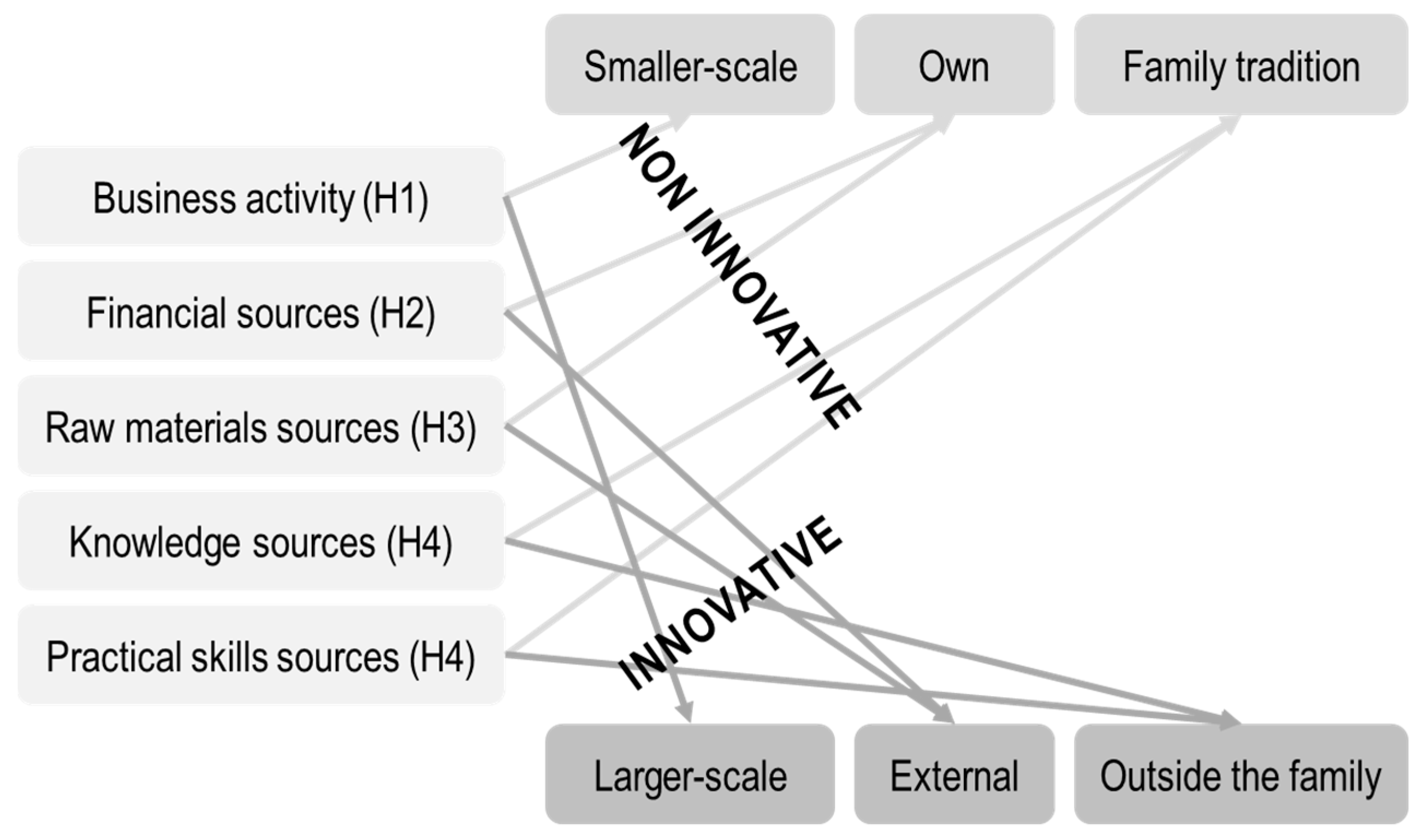
H1. Innovative regional food producers, compared to non-innovative ones, are younger companies (H1.1), run by better-educated managers (H1.2) and characterized by larger operations in terms of permanent employment (H1.3), seasonal employment (H1.4) and sales geographical scope (H1.5).
The main source of financing for SMEs is their own funds. External sources, such as loans and credits, are supplementary [
41,
42]. Another source of funding for the SME sector is support from public funds [
43]. It should be emphasized that innovation usually requires the involvement of financial capital. Small and medium-sized enterprises often do not have sufficient financial capital of their own. Therefore, regarding the innovativeness of SMEs, significant importance is attached to access to external sources of financing. These sources can significantly expand innovation opportunities, and this applies to both repayable and non-repayable sources [
35,
44]. Taking these views into account, the following research hypotheses were formulated:
H2. Non-innovative regional food producers use their own financial resources to a significantly greater extent than innovative ones (H2.1), while innovative ones use loans and credits (H2.2) and non-repayable funds (H2.3) to a significantly greater extent.
Regional food has specific characteristics. It is considered a crucial element of cultural identity, usually has a long production tradition, and is often linked to traditions passed down from generation to generation [
45,
46,
47]. In this context, regionality is strongly linked to place—both in terms of the origin of recipes and raw materials, as well as production and distribution [
48,
49,
50]. Therefore, in the field of regional food production, innovation is combined with tradition. This combination is currently seen as one of the ways to maintain a company’s market position, giving it a lasting competitive advantage [
51,
52]. In this sense, traditions become a driving force for innovation [
53,
54]. Creating innovation through tradition, understood as introducing innovation using old skills and resources, can bring many benefits [
50]. The concept of innovation through tradition (ITT) lists the following as key elements: sources of past knowledge (tradition), forms of future knowledge (raw materials, production processes, etc.), as well as skills enabling the implementation of strategies [
15]. Traditions are highly valued in relation to food products, as they are rich in cultural elements, local ingredients, traditional recipes, and social acts such as eating and sharing. As for innovation through tradition, there is a demand for products that are in line with modern trends while retaining their traditional identity and quality [
55]. The ITT concept challenges the view that tradition hinders innovation but rather considers it a potentially valuable resource that can offer a competitive edge. According to De Massis et al. [
15], tradition is seen as a stable foundation of meaning, while innovation creates new meaning. Thus, powerful innovations can be achieved by skillfully and creatively reinterpreting tradition. It is worth noting that innovation is associated with a desire for greater expansion and greater opportunities [
33,
38], which may also involve the need to expand the resource base—not only in terms of raw materials, but also knowledge and skills. Considering these factors, the following research hypotheses were formulated:
H3. Although both groups studied rely on their own raw materials, non-innovative regional food producers use their own sources to a significantly greater extent (H3.1), while innovative producers use local and regional sources of raw materials to a significantly greater extent (H3.2).
In the traditional and regional food sector, innovation is based on the specific dynamics between intangible resources and cultural heritage. A key element of this dynamic, according to the concept of ITT, is the distinction between theoretical knowledge (recipes) and practical skills (craftsmanship) [
15,
55]. In this context, knowledge is identified with a recipe database and heritage passed down from generation to generation, which constitutes a stable foundation for the significance of a regional product. However, modern consumer trends and market requirements force producers to creatively reinterpret it, which often requires reaching for sources of knowledge outside the traditional family network. Practical skills, on the other hand, refer to production techniques, executive experience, and the ability to implement new processes. Although traditional working methods are the foundation of authenticity, meeting the challenges of modern production (such as time optimization, energy saving, and digitization) requires skills often acquired through formal education and specialized workshops. Separating these two dimensions of intangible resources allows for precise identification of the mechanism of tradition professionalization. Innovators in this sector can remain faithful to the traditional recipe base while modernizing their practical skills to increase competitiveness and give products new functionality. Taking the above considerations into account, the following hypotheses were formulated:
H4.1. Innovative producers of regional food use external sources of knowledge (recipes from outside the family) to a much greater extent, while non-innovative producers rely more on family knowledge and recipes.
H4.2. Innovative producers of regional food use external sources of practical skills (education and workshops) to a much greater extent, while non-innovative producers rely more on family traditions.
Figure 1 presents the conceptual framework, including the tested hypotheses.
It should be emphasized that innovations in the field of regional food production can take various forms. The combination of tradition and innovation can result in new or improved products [
52]. These new or improved products should both retain their traditional identity and follow new consumer trends [
56]. Product innovations in the field of regional and traditional food may be giving them new functionalities and new meanings [
15]. Tradition can also play a role in influencing innovation in broadly defined marketing. Promoting regional and traditional products not only strengthens their market position but also brings them closer to sustainable development goals [
54]. Marketing innovations in the field of regional and traditional products may also include labeling, branding, new outlets, etc. [
56]. In regional food production, the production process plays a significant role—traditional but usually allowing for the introduction of novel solutions. Innovations introduced in the production process reduce waste, save energy, and shorten production time [
57]. By improving and renewing traditional processes, regional food producers can maintain or improve their market position [
51]. This also applies to organizational methods, including operating principles, workplace organization, and relationships with the environment [
54]. Collaboration and networking are also emphasized in such innovative activities [
58].
The specific nature of rural economies often leads governments to intervene through investment support policies. Public support is particularly important for farms in Central and Eastern European countries, which are experiencing capital shortages and structural problems [
59]. The Common Agricultural Policy (CAP) post-2020 outlines the importance of innovation in increasing agricultural productivity and the standard of living in rural areas, as well as improving the environment and climate. Linking research, innovation, and advisory services is one of the main priorities of the CAP post-2020. However, increased funding for research and innovation is not a priority for the EU-CEE countries. This is primarily due to their unfavorable research situation and the differences in agricultural structure between the EU-CEE and the EU-15 [
60]. CAP’s investment-supporting mechanisms are merely a complement to a comprehensive investment program and a component of the financing structure, not a substitute for other sources of financing [
59]. However, considering the extremely complex nature of the CAP and related programming at national and regional levels, it is important to highlight that some measures, such as the Agricultural Knowledge and Innovation Systems, can be seen as essential indirect support measures as they provide access to training, information and innovation support [
61].
3. Materials and Methods
The data was collected in July 2024 using a questionnaire survey. This is a quantitative method that allows opinions to be gathered from a sufficiently large representation of the target group to provide an objective picture of the phenomenon under study [
62,
63]. The CATI (Computer-Assisted Telephone Interviewing) technique was used, which enabled the correct completion of the questionnaire with the assistance of a qualified interviewer. The interviewer entered the answers into the database as they were being given by the respondent [
64]. This allowed for the correct completion of the questionnaires and eliminated errors resulting from misunderstandings of the questions by respondents. This method resulted in the study obtaining 400 valid questionnaires.
The respondents are regional food producers who were members of the European Culinary Heritage Network until 2022 (at the end of 2022, Polish regions withdrew from the association due to formal and legal changes in the Network). The selection of this specific group was deliberate because, as members of the only previously comprehensive association in Poland, they constitute a defined and important subgroup of regional food businesses. They are characterized by a high degree of commitment to traditional practices, making them the most appropriate group for examining innovation in the context of tradition. Traditionally, the literature often perceives tradition as a barrier to innovation. However, sources [
15] point to the mechanism of Innovation through Tradition, in which tradition serves as a stable foundation of meaning and innovation gives products new meaning. Adopting this perspective has allowed us to examine the mechanisms of innovation among producers whose activities are based on culinary heritage.
The study considered the structure of producers by voivodeships (until 2022 the Network included: dolnośląskie, kujawsko-pomorskie, małopolskie, mazowieckie, opolskie, pomorskie, świętokrzyskie, warmińskomazurskie, wielkopolskie, and zachodniopomorskie) through quota sampling [
65]. The logical basis for this method was to establish sample proportions that reflected the relative number of Culinary Heritage Network members in each region. This allowed for structural representativeness and highlighted the specificity of regional products in each voivodeship.
The research sample reflects the nature of the Polish food industry, which relies primarily on the processing of domestic agricultural raw materials and is highly fragmented. It is also important to emphasize that regional food in Poland does not require certification but can obtain EU protection through inclusion on the lists of protected designations of origin, geographical indications, or traditional specialties guaranteed.
Respondents were divided into two main groups: innovative regional food producers (who declared that they had introduced innovations during the last year of operation) and non-innovative regional food producers. This dichotomous classification based on self-declaration is a methodological simplification resulting from the need to use a quantitative method (CATI telephone survey) on a large sample, which enables an objective picture of the phenomenon with a large representation of the target group.
The division was made based on respondents’ declarations regarding the introduction of innovations during the last year. In addition, innovative producers were analyzed with respect to the type of innovation (a new or improved product, new marketing methods, a new or improved production process, a new or improved organizational method). The differences between the groups studied were examined based on statistical significance. The following characteristics were examined: basic characteristics of economic activity (length of operation, education of the general manager, employment, additional seasonal employment, and sales range), sources of raw materials (own farm crops and livestock, local, regional), sources of financing (own funds, loans and credits, non-repayable funds), sources of knowledge (family recipes and knowledge, recipes from outside the family, own knowledge), and sources of practical skills (family traditions, own experience, education, and workshops).
Table 1 contains measurement description of the research variables.
A series of Mann–Whitney tests with continuity correction were used to verify the statistical significance of differences between two distinct groups of regional food producers. A non-parametric test was chosen due to the selection of the sample, its specificity, size, and the occurrence of tied-in ranks [
66,
67,
68]. This test is considered robust. It is suitable for analyzing data measured using nominal and ordinal scales and does not require assumptions about the data distribution. Its robustness to various model violations, outliers, and pathological data is also emphasized [
69], which is crucial in specific nominal and ordinal tests. The
p-value was analyzed at various statistical levels, with
p < 0.10 considered marginally statistically significant,
p < 0.05 considered statistically significant, and
p < 0.01 considered highly statistically significant [
70].
4. Results
Starting with the characteristics of the research sample (
Table 2), it should be emphasized that the average business duration of the regional food producers surveyed is 25.52 years, which means that these are companies with an established market position and traditions related to running a business. The average general manager education level is secondary education. The average employment indicates the average size of the company (15 people on average). The average employment in the sample is consistent with the structure of the overall population of the Polish food sector, which consists of approximately 5000 enterprises, of which as many as 94% are small and medium-sized entities (only 6% are large entities). It is worth noting that the respondents use seasonal employment (4 people on average), which is related to the nature of the business and the intensity of work during the summer season (harvesting and processing crops). The average sales geographical scope does not exceed region, which is consistent with the definition of regional products and their sale near the place of production. The entrepreneurs surveyed are self-financed (88.69%) and, to a much lesser extent, use external funds such as loans and credits (7.75%) and non-returnable funds (3.38%). This is related to the small size of the business, which makes it difficult to obtain external funds. When it comes to raw materials for food production, most respondents use their own crops and livestock (53.20%). One-third of producers also use local raw materials (34.75%). Some respondents also use regional sources (10.47%). This raw material structure results from the definition of regional food, which should be produced from local resources. Due to the links between regional products and family businesses, recipes and family knowledge (71.01%) dominate the structure of knowledge sources, while family tradition (66.33%) dominates the structure of skill sources. In the structure of knowledge sources, recipes from outside the family accounted for 13.49%, and own knowledge for 6.15%. In terms of the structure of skills, own experiences accounted for 20.36%, and education and workshops accounted for 9.84%.
Respondents were divided into two main groups: innovative regional food producers and non-innovative regional food producers. The group of innovative producers’ accounts for 20% of the respondents, while the group of non-innovative producers’ accounts for 80%. Additionally, types of innovations were considered (
Table 3). The data show that product innovations dominated among the respondents, declared by 75% of innovative manufacturers (15% of the total). Interviews indicate that the products offered, although regional, require adaptation to the demands of modern consumers. Hence, for example, permitted changes to product composition are being introduced (e.g., reducing the amount of sugar compared to the original recipe or adding various flavorings). New or improved production processes were another important category of innovation, identified by 33.75% of innovative respondents (6.75% of the total). Respondents confirmed that innovations in this area contribute significantly to resources and time efficiency. Marketing innovations are also considered quite important by respondents, with 27.50% of innovative producers (5.50% of the total) declaring them important. According to respondents in this group, the most important innovations today are new distribution methods, which allow us to reach a wider customer base. The smallest share is attributed to new organizational methods in adopted operating principles, workplace organization, or relationships with the environment. These types of initiatives were indicated by 3.75% of innovative producers (0.75% of the total). Regional food producers are largely traditional family businesses, operating based on well-established principles.
Table 2 and
Table 4 contain a comparison of innovative and non-innovative regional food producers.
Table 2 compares the average values of the characteristics, while
Table 4 presents the statistical significance of differences between groups. The comparison shows that innovative and non-innovative producers differ significantly in terms of most of the characteristics studied.
In case of business basic characteristics, innovative and non-innovative manufacturers differ significantly in terms of business duration (p < 0.01). Innovative manufacturers are characterized by a shorter business duration (20.06 years) than non-innovative manufacturers (27.19 years). This means that Hypothesis H1.1 was positively verified. However, no significant difference was found for general manager’s education, which means that Hypothesis H1.2 was rejected. For both groups, the manager’s education level fluctuates around 3, which means secondary education. Hypothesis H1.3 was rejected. The differences proved to be statistically insignificant. Furthermore, in case of employment, non-innovative companies (17 people on average) proved to be larger than innovative ones (10 people on average). However, Hypothesis H1.4 was confirmed, according to which innovative companies seasonally employ significantly (p < 0.01) more employees than non-innovative ones. This was an average of 9 people in innovative companies and 3 people in non-innovative ones. The manufacturers surveyed differ significantly (p < 0.05) in terms of sales geographical scope. According to Hypothesis H1.5, innovative entrepreneurs (1.86) have a larger sales scope than non-innovative ones (1.64).
According to Hypothesis H2.1, non-innovative regional food producers (90.27%) finance themselves to a significantly greater extent (p < 0.01) than innovative ones (82.38%). On the other hand, innovative producers (8.00%) use non-repayable funds to a significantly greater extent (p < 0.01) than non-innovative producers (2.22%), which confirms Hypothesis H2.3. Hypothesis H2.2 was rejected due to the lack of statistically significant differences in the use of loans and credits.
For both groups studied, own sources of raw materials are the basis, but it is non-innovative regional food producers (55.88%) who use them to a significantly greater extent (p < 0.05) than innovative ones (42.50%), which means that Hypothesis H3.1 has been positively verified. Similarly to Hypothesis H3.2, according to which innovative producers use local and regional sources of resources to a significantly greater extent (p < 0.05) than non-innovative ones. In the structure of raw materials used by innovative producers, local resources cover 40.75% of demand, and regional resources cover 13.63%. Meanwhile, among non-innovative producers, local sources cover 33.25% of demand, and regional sources cover 9.68%.
Significant differences between the groups studied concern both the sources of knowledge (H4.1) and practical skills (H4.2) of regional food producers. With regard to Hypothesis H4.1, the results confirm that innovative producers make much greater use of external sources of knowledge, such as recipes from outside the family (21%), while for non-innovative producers this figure is 11.61%. At the same time, non-innovative producers rely on family recipes and knowledge to a statistically significant degree (p < 0.01) (74.72%), which is significantly higher than in the innovative group (56.19%). For innovators, who show weaker attachment to generational traditions, personal knowledge (9.75%) also proved to be significantly more important (p < 0.05) compared to non-innovative entities (5.25%). The above data allows for positive verification of Hypothesis H4.1. In terms of practical skills (Hypothesis H4.2), the study showed that innovators more often draw on external forms of improving their skills, such as education and workshops (22.06%), while non-innovative producers use them less often (6.78%). In turn, the non-innovative group relies on family tradition to a statistically significant degree (p < 0.01) (70.47%), which plays a lesser role among innovators (49.75%). Furthermore, personal experience (a significant difference at p < 0.10) is more important for innovative producers (24.25%) than for non-innovative ones (19.39%). These results provide a basis for positive verification of Hypothesis H4.2.
5. Discussion
The results of the conducted research indicate limited innovation activity among regional food producers in Poland. Over the last year, only 20% of the producers surveyed have implemented any form of innovation, while the rest limit themselves to traditional, non-innovative activities. In line with the main objective of the research, the characteristics of innovative and non-innovative regional food producers were examined.
The analyses show that innovative producers, compared to non-innovative ones, are younger companies (H1.1 confirmed). These findings confirm the results of other authors in this area. Younger companies are more innovative for various reasons, including the desire to develop their market position and creativity associated with new ideas [
33,
34,
35,
36,
37,
38]. However, in the specific sector of regional food, the age of a company has an additional strategic dimension. For younger companies, innovation becomes a mechanism for building a brand in the absence of a multigenerational reputation. These entities often encounter barriers to entry because they are not a priori perceived as traditional. To bridge this gap and meet the trends of modern consumers, they must reinterpret tradition (e.g., by reducing sugar content or digitizing distribution channels through e-commerce), which allows them to expand more quickly in the market despite their short history. The need for such adaptation, even in heritage-based industries, is also emphasized by Guine et al. [
55] and Raftowicz and Le Gallic [
56].
The results of the study confirm that in the regional food sector, the age of producers and their market experience are important determinants of their propensity to implement innovations. The observed pattern, indicating higher innovation activity among younger generations of producers, finds theoretical justification in the concept of Innovation through Tradition. In the approach studied, tradition is no longer perceived as a static barrier limiting development but becomes a stable foundation of meaning. Innovation, on the other hand, serves as a tool that gives products with a strong identity a new, contemporary meaning. An analysis of the mechanisms differentiating between the two research groups reveals fundamental differences in the perception of culinary heritage. Non-innovative producers display a conservative approach, treating tradition in a static manner, as an inviolable set of rules. This approach traps them in a museum-like environment, which is confirmed by the fact that this group relies almost exclusively on family knowledge (74.72%) and intergenerational transmission (70.47%). This phenomenon suggests that excessive attachment to historical patterns without adapting them to the changing environment can lead to market stagnation. On the other hand, the group of innovators, represented mainly by younger companies, rejects the perception of tradition as an “open-air museum”. Thanks to a creative reinterpretation of local resources, these producers effectively combine product authenticity with modern market trends. This is reflected, among other things, in the reformulation of product composition in line with health-conscious expectations (e.g., sugar reduction) and the digitization of distribution channels through the implementation of e-commerce solutions. It should be emphasized that the Innovation through Tradition mechanism proves to be particularly crucial for new entities which, lacking a multigenerational reputation, must build their competitive advantage in other ways. A skillful combination of local attributes with modern functionality allows them to overcome the barrier to market entry and compete effectively with more established entities. These results suggest that innovation does not have to be at odds with tradition; on the contrary, it is the synthesis of these two values that allows for effective market expansion and the building of a strong regional brand in a modern economy.
There is a clear gap in the literature on the impact of company size on innovation in the traditional food sector. Although many authors argue that larger entities are more inclined to innovate [
33,
34,
35,
36,
37], the results of this study lead to different conclusions. In the group of regional food producers surveyed, non-innovative companies were significantly larger in terms of permanent employment (an average of 17 people vs. 10 for innovators), which results in the rejection of Hypothesis H1.3. An analysis of the causes of this phenomenon allows us to identify the mechanism of prioritizing non-economic goals. In larger traditional entities, the overriding goal often becomes family security and the fulfillment of social functions (providing employment for relatives) rather than profit maximization. This approach leads to decision-making inertia and constitutes a significant barrier to modernization processes. As they argue Miller et al. [
71] and Rodni et al. [
72]. The issue of innovation in family businesses is complex, and the results of analyses often depend on the degree of focus on social and emotional goals. In contrast, smaller innovative companies operate in a business model based on rationalization of fixed costs and high flexibility, which is confirmed by their significantly higher seasonal employment (an average of 9 people vs. 3 in non-innovative companies). This confirms the thesis that smaller entities are characterized by higher innovation dynamics resulting from shorter decision-making processes and the ability to adapt production more quickly to market changes [
30]. In this respect, innovation, with relatively lower expenditure, allows for an effective change in the company’s profile in a short period of time. This gives them a competitive advantage over larger, but more formalized and family-structured competitors, for whom tradition is often a hindrance rather than a foundation for development, as it is for innovators.
It is worth noting that regional food production is a specific activity, associated with increased work during the summer season, when fruits and vegetables ripen and grains are harvested. For this reason, the companies surveyed are characterized by seasonal employment. At the same time, innovative companies employ more seasonal workers (H1.4 confirmed). This may result from a more rational approach to business, which is associated with less permanent employment and more seasonal employment when there is more work. In a sense, the larger scale of operations is also evidenced by the sales geographical scope, which turned out to be greater in innovative companies. This confirms the views of Lee and Lee [
33], as well as Saunila [
38]. Greater business expansion translates into higher sales. This, in turn, leads to higher profits that can be reinvested in the company’s innovative efforts. An interesting observation is the lack of differences in the level of education of management staff between the groups studied, which resulted in the rejection of Hypothesis H1.5. This phenomenon suggests that in specific sectors of traditional products, formal academic education is not the main determinant of innovation. Tacit knowledge, practical skills, and a deep understanding of traditional recipes play a much greater role here [
45,
46,
47].
A key finding is that innovative producers rely more on external resources—finance, raw materials, knowledge, and skills. The introduction of novel solutions requires financial support. The results of the study confirmed the importance of external sources of financing for innovation, which is consistent with the views of Oum et al. [
35], Saunila [
38], and Sadat and Nasrat [
44]. Non-innovative producers of traditional food products are more likely to use their own financial resources (H2.1 confirmed), while innovative producers are more likely to use non-repayable funds (Hypothesis H2.3 confirmed). The same applies to raw materials and sources of knowledge and skills—non-innovative producers make greater use of their own and family resources (H3.1 and H4.1; H4.2 confirmed). The weaker link between innovators and family knowledge points to a mechanism of consciously opening up the company’s borders to external knowledge resources, which is key to overcoming technological inertia in the sector. It can be argued that innovation in this sector is a mechanism for compensating for the lack of multigenerational internal capital through active exploitation of the entrepreneurial ecosystem.
An analysis of the mechanisms differentiating the groups studied indicates that the weaker connection between innovators and family knowledge (H4.1) and their high activity in acquiring new skills (H4.2) are two complementary processes that make up the mechanism of professionalization of tradition. The results suggest that contemporary innovation in the regional food sector requires not only a creative reinterpretation of recipes, but above all the acquisition of new, advanced competences, including digital, marketing, and technological ones, which hermetic and closed family networks are unable to provide on their own. In this approach, innovators do not reject heritage but consciously open the boundaries of the enterprise to the external knowledge ecosystem (e.g., through workshops and training), which allows them to overcome the technological inertia typical of entities based solely on static generational transmission. This strategy allows the product to retain its authenticity while giving it contemporary functionality and increasing its market resilience.
By actively exploiting the entrepreneurial ecosystem, younger or less traditionally rooted producers are able to compensate for deficits in culinary heritage, replacing them with modern expertise and external financing. In this sense, market success is not determined solely by the past (family resources), but by the ability to build relationships with the institutional and market environment.
The research results indicate an important pattern: innovative manufacturers, despite being strongly rooted in the local environment, show a significantly higher tendency to use external resources (confirmation of H3.1 and H3.2). These findings confirm the views of Lee and Lee [
33] and Saunila [
38] on expansion related to investment activity. Although the local resource base provides producers with operational autonomy, it proves insufficient in a dynamic market. Furthermore, regional food production is linked to agricultural activity and therefore sensitive to external conditions, both natural and economic. Although the study shows that innovators use local and regional raw materials to a greater extent than non-innovative producers (H3.2 confirmed), their key advantage is based on non-local resources (financing, expertise) and not solely on traditional rural networks. This may be due to the specific nature of the Polish food industry in rural areas, where (a) the requirements of the modern market (e.g., sugar reduction, e-commerce, intellectual property protection) exceed the capabilities of traditional rural networks, and (b) EU/CAP funds (non-repayable funds) become a key external resource, which is particularly important in EU countries experiencing capital shortages. Innovation in this sector requires a combination of local resources (raw materials) with external resources (finance and advanced knowledge), which is consistent with the concept of innovation through tradition, where tradition (local raw materials/recipes) is the basis, but innovation requires new, external meanings and resources [
15,
52].
Furthermore, it is worth noting that closed rural networks, although they are the foundation of authenticity, often lack the knowledge and skills necessary to implement advanced solutions such as intellectual property protection, digitization of sales processes (e-commerce), or technological modification of product composition. Faced with these limitations, innovators are implementing a hybrid model that allows them to preserve their regional identity while increasing competitiveness. This mechanism is based on resource dualism: producers rely on local and regional raw materials, which ensure their authenticity, but they import the necessary impetus for development from outside through non-repayable funds and specialist knowledge acquired at workshops and training courses. Research shows that it is access to external capital, and not just the entrepreneur’s intention alone, that is the main mechanism differentiating the two groups. This is confirmed by statistical results: innovators use non-repayable funds (e.g., from EU/CAP programs) almost four times more often than the non-innovative group (8% vs. 2.22%), which is a highly statistically significant difference (p < 0.01). In this context, innovation in the regional food sector in Poland is not a rejection of tradition, but a process of its professionalization using external financial and substantive leverage.
Introducing innovation plays a key role in both the growth and survival of modern enterprises. However, the approach to innovation varies across enterprises. Some enterprises treat innovation as a necessity, while others postpone or completely abandon it. The reasons for the lack of innovation activity may be diverse: hesitation to take risks, a lack of need to innovate, or a lack of sufficient resources [
73]. However, innovation potential is a key factor determining the results achieved by each enterprise. According to Kim et al. [
74], both internal and external conditions act as factors facilitating the introduction of innovation. According to Romijn et al. [
75], the ability to introduce product innovations, which were dominant for the surveyed group of respondents, is also influenced by both internal and external sources. In rural enterprises, innovation potential is shaped by many factors related to internal resources, external networks, as well as financial and infrastructural resources. However, there is no consensus in the literature on which key factor is the creation and implementation of innovations by enterprises. Although many studies indicate that internal capabilities and networks are the main driving factors for creating and implementing innovations [
76,
77,
78], on the other hand, limitations related to finance and human capital are indicated as the main barriers to innovation [
79,
80,
81,
82]. In Poland, the food sector is one of the most important and fastest-growing sectors of the economy [
83,
84]. The specificity of the Polish food industry is the processing of primarily domestic agricultural raw materials in the production process, which indicates that the supply links between the food industry and agriculture are very strong [
85]. Furthermore, the Polish food sector comprises approximately 5000 enterprises, of which only 6.0% are large entities. On the one hand, this sector is experiencing production concentration processes (decreasing the number of companies, increasing the share of larger entities), while on the other hand, there is high fragmentation (small entities play a significant role in local development and short food chains). Furthermore, enterprises in this sector are located mainly in smaller towns, thanks to which, under appropriate conditions, they can influence the development of rural areas [
86].
6. Conclusions and Policy Implications for Supporting Innovation Among Regional Food Producers
The results indicate that innovative regional food producers differ significantly from non-innovative producers in many characteristics. In case of resources, the biggest differences concern greater use of external sources and weaker links to family knowledge and skills than in the case of non-innovative producers. Innovative regional food producers in Poland, compared to non-innovative ones, are characterized by significantly shorter business duration, lower permanent employment but higher seasonal employment, and greater sales reach. Among innovative producers, the propensity to innovate is associated with external sources of financing.
However, the key conclusion from the study is that innovation in this sector does not mean abandoning heritage, with as many as 75% of innovators successfully implementing new products while maintaining a traditional flavor profile. This confirms the assumptions of Innovation through Tradition theory, in which tradition provides a stable foundation for identity, and innovation gives it contemporary functionality. The fundamental dichotomy between the groups studied does not therefore result from a rejection of the past, but from the ability to creatively reinterpret it. While innovators dynamically adapt local resources to the requirements of the modern market, non-innovative producers remain trapped in tradition. In their case, treating heritage as a static and inviolable construct leads to decision-making inertia, which significantly limits their development and adaptation potential in the face of contemporary competitive challenges. This leads to the conclusion that the survival of the regional food sector depends not on preserving the past, but on its creative adaptation.
Innovators are in the minority among regional food producers in Poland. Rural innovation, as one of the factors in rural development and increasing sustainability and resilience, requires broad support.
Undoubtedly, innovation in rural areas requires support from public authorities. This support should not be limited to the national level but should also be provided at the regional and local levels. Agreeing with the opinions of other researchers [
18,
20,
23], a number of implications can be presented regarding the promotion of innovative practices in rural areas by the authorities. First, innovation policy in rural areas should focus on building an appropriate surrounding that will create the necessary background. It is particularly important to eliminate or mitigate understood barriers and constraints to the development of rural entrepreneurship and innovation. These phenomena are diverse in nature—administrative, resource-related, and mental. Uncontrolled barriers and constraints can significantly slow down the development of entrepreneurship and innovation in rural areas. Rural innovators need support and incentives from public authorities. Both direct and indirect forms of support are needed. Direct, tangible, measurable support should include broader access to financing, credit, and loans. Research shows that regional food producers in Poland make only limited use of these forms of support. This group of support measures for innovators also includes tax relief and local tax exemptions, which are also within the remit of local authorities.
Direct support also includes non-financial forms, such as access to administrative services, business consulting, training, and workshops, including the sharing of good practices. Research shows that regional food producers in Poland make little use of workshops and training, but innovative producers do so more often than non-innovative ones. Therefore, this is a key factor for innovation. Such activities can be used to disseminate knowledge about production processes, sources of financing, and opportunities for using modern technologies. These forms of support can help to alleviate not only resource constraints, but also mental constraints, e.g., those related to the traditional approach to agriculture. Among the indirect measures supporting entrepreneurship and innovation among regional food producers in Poland, the promotion of this food is particularly important. This is high-quality food that fits in with the idea of slow food, sustainable food, and consumption. Its widespread adoption of consumption patterns will benefit both producers and consumers. In addition, indirect forms of support for rural entrepreneurship and innovation should also include macroeconomic measures, including crisis mitigation. Agriculture is particularly vulnerable to external factors, hence the need for support.
The conclusions from the analysis directly imply the need for differentiated policy support, in which it is crucial for innovative producers to facilitate access to external expertise and market expansion, while for non-innovative producers, it is crucial to create mechanisms that build readiness for innovation by integrating traditional knowledge with modern practices and providing initial financial support for research and consulting. This differentiated approach is based directly on the results of the study, which showed that innovation is closely related to the use of external resources (financial, raw materials, knowledge), and non-innovation to reliance on own and family resources.
Achieving these goals requires the adoption of specific, multi-level measures tailored to the specific nature of the Polish countryside and the diversity of food producers in terms of innovation.
Firstly, there is a need for greater financial support for innovators in the form of grants, favorable loans, and credits. In this regard, it is necessary to launch, for example, an Innovative Loan Fund by institutions designed to support the development of Polish economy like Bank Gospodarstwa Krajowego (Polish Development Bank) or the Agency for Restructuring and Modernization of Agriculture with low interest rates and extended grace periods, aimed at investments in new distribution methods (marketing innovations), improving production processes to reduce waste and save time/energy, and adapting regional products to modern consumer trends. Reducing waste and saving resources are key indicators of sustainable development. The fund will also enable a faster transformation of small businesses at lower costs. Non-innovative producers finance themselves largely with their own funds (90.27%), which hinders innovation (Hypothesis H2.1 confirmed). The scale of capital should be adapted to the documented difficulty small businesses face in obtaining external capital.
Secondly, priority points should be introduced in grant programs (e.g., under the EU common agricultural policy or other EU support funds): (a) for producers with a short track record (less than 5 years) to support their rapid development and stabilization, compensating for their shorter period of operation, and; (b) for applications concerning market expansion (e.g., export certificates, participation in international fairs), which will allow this group of producers to increase their sales reach. Since non-innovative producers rely heavily on their own resources and small companies often find it difficult to obtain external capital, consideration should be given to lowering own contribution requirement in grant programs for innovation in the regional food sector.
Thirdly, in order to remedy the problem of weaker links between innovators and their families’ knowledge and skills, and to help non-innovators integrate knowledge, the focus should be on creating regional knowledge exchange platforms (e.g., as part of the activities of Agricultural Advisory Centers) or virtual knowledge centers, in accordance with Agricultural Knowledge and Innovation Systems (AKIS). These platforms should serve as Innovative Matchmaking connecting producers with scientists and advisors, as well as experienced sales managers from other industries. Their goal should be to transfer the latest technologies and create a database of good practices in the field of innovation and building effective export strategies. The operational costs of implementing these activities can be reduced by leveraging existing infrastructure and resources, such as Agricultural Advisory Centers (AACs). AKIS is seen as an important indirect support measure, providing access to training and information.
Fourthly, we believe that among non-financial forms of support for food producers, there is potential in training courses and workshops conducted by advisors from Agricultural Advisory Centers and/or Local Action Groups, as they are closest to the producers. However, the content of these training courses and workshops should be varied. In the case of innovators, the focus should be on organizing advanced training courses and workshops on the digitization of sales processes (e-commerce) and intellectual property protection (trademarks). For non-innovative producers, consideration should be given to introducing workshops and training courses to help producers adopt a more rational approach to business, e.g., in identifying market opportunities for traditional products while respecting regional identity, as well as training courses and workshops aimed at overcoming mental barriers and education on external financing opportunities (loans, non-repayable funds).
In Poland, there is still a need to promote regional food as an element of sustainable development, which undoubtedly competes with mass production in terms of quality, but not necessarily in terms of price. Therefore, in order to meet the challenge of quality competition, but not price competition, and to promote regional food, it is necessary to use CAP instruments, such as quality schemes (e.g., Protected Designation of Origin, Traditional Specialty Guaranteed) as a promotional foundation. For innovators, promotional campaigns should target foreign markets, emphasizing the ecological and health benefits that justify a higher price. For non-innovative producers, it is important to support the organization of local markets (promoting and supporting short food supply chains) to minimize intermediary costs and improve price competitiveness. The above implications are consistent with the strategic objectives of the CAP Plan for 2023–2027, which in Poland focus on fair incomes, competitiveness (including digitization and technology), improving the position of farmers, a sustainable environment, rural development, and higher food quality and animal welfare, with key support for knowledge, innovation, and digitization as a cross-cutting objective for raising productivity and living standards.
The implementation of the presented policy recommendations will enable the achievement of multidimensional results that are crucial for the sustainable development of rural areas and the strengthening of the regional food sector. It is expected that facilitating access to external financing (through loan funds and grants) will accelerate the technological transformation of small enterprises, resulting in a measurable reduction in waste and savings in energy and time in production processes. Thanks to support focused on market expansion and digitization (e-commerce), producers will have the opportunity to significantly increase their sales reach while maintaining the unique identity of their products. In addition, the integration of traditional knowledge with modern practices within the AKIS system will break down mental barriers and professionalize the business model of previously non-innovative producers, increasing their readiness to take on new market challenges. In the long term, these measures will contribute to increasing the competitiveness and resilience of the Polish traditional food sector, stabilizing the market position of younger companies, and raising the standard of living of rural communities.
7. Limitations and Further Research
Despite providing statistically significant evidence of differences between innovative and non-innovative food producers, this study has limitations that require critical evaluation. First of all, the measurement of innovation was limited to the last year of activity, which is a methodological simplification. This method of measurement results, among other things, from the need to adapt the questionnaire to the specific nature of CATI survey, in which respondents are reluctant to answer overly complicated and detailed questions for a long period of time. The short time limit and dichotomous classification (division into innovators and non-innovators) based on the subjective declarations (self-assessment) of respondents may have influenced the identification of a limited group of innovative producers, which affects the possibility of drawing conclusions.
The study was conducted using a research methodology based on cross-sectional data and nonparametric Mann–Whitney tests, which prevents the potential problem of endogeneity, including reverse causality. Random errors and the influence of outliers in the present study were limited by the use of robust nonparametric Mann–Whitney tests, which do not require assumptions about the normality of distribution. The choice of nonparametric Mann–Whitney tests instead of regression models controlling for accompanying variables was a decision dictated by the nature of the collected data. This data, based on nominal and ordinal scales, is characterized by random errors and the influence of outliers, and the tests used are considered robust to such violations of methodological assumptions. Nevertheless, the lack of a multidimensional econometric model limits the possibility of precisely separating the impact of individual variables on innovation.
Another significant limitation is the issue of selection bias and the difficulty in generalizing the results to the entire rural population. The study focused on members of the European Culinary Heritage Network, a specific and formalized group of producers highly committed to traditional practices. Although the quota selection ensured structural representativeness in 10 provinces, limiting the study to a formalized network makes it difficult to generalize the results to the entire population. Since regional food in Poland is often not certified, limiting the sample to the affiliated network means that the conclusions mainly concern the analyzed group, rather than all producers in Poland. Furthermore, despite their effectiveness, surveys do not allow for obtaining individual details regarding the barriers and limitations experienced by particular entities. Nevertheless, the results obtained regarding the differences between innovative and non-innovative producers in terms of resources, financing and knowledge are highly statistically significant (verified by non-parametric tests) and offer valuable policy implications for supporting this segment, which is crucial for the sustainable development of rural areas.
Finally, the use of cross-sectional data means that the study only identifies differences in producer profiles but does not allow for a definitive conclusion to be drawn about the direction of cause-and-effect relationships (endogeneity). It cannot be clearly stated whether it is access to external resources that generates innovation, or whether the pro-innovation attitude of producers makes it easier for them to obtain financing and knowledge from outside the family.
In view of the above, future research directions should include:
Adopting a longer time horizon and linking self-assessment to objective economic indicators, such as growth in turnover from new products.
The use of advanced econometric methods, such as regression models with instrumental variables or panel data analysis, which would allow the direction of causality to be determined and the reliability of conclusions to be strengthened.
Extending the analysis to producers outside formalized networks and deepening research on the heterogeneity of innovation (separate models for product, process, and marketing innovations).
Author Contributions
Conceptualization, L.O., D.J., A.K.-K., B.W., G.K.; Methodology, L.O., D.J., A.K.-K., B.W., G.K.; Software, L.O., D.J., A.K.-K., B.W., G.K.; Validation, L.O., D.J., A.K.-K., B.W., G.K.; Formal Analysis, L.O., D.J., A.K.-K., B.W., G.K.; Investigation, L.O., D.J., A.K.-K., B.W., G.K.; Resources, L.O., D.J., A.K.-K., B.W., G.K.; Data Curation, L.O., D.J., A.K.-K., B.W., G.K.; Writing—Original Draft Preparation, L.O., D.J., A.K.-K., B.W., G.K.; Writing—Review and Editing, L.O., D.J., A.K.-K., B.W., G.K.; Visualization, L.O., D.J., A.K.-K., B.W., G.K.; Supervision, L.O., D.J., A.K.-K., B.W., G.K.; Project Administration, L.O., D.J., A.K.-K., B.W., G.K.; Funding Acquisition, L.O., D.J., A.K.-K., B.W., G.K. All authors have read and agreed to the published version of the manuscript.
Funding
This research received no external funding.
Institutional Review Board Statement
Ethical review and approval were waived for this study due to the fact that in Poland, economic survey research on entrepreneurs requires informed consent from participants and respect for the General Data Protection Regulation rather than the consent of the Ethics Committee.
Informed Consent Statement
Informed consent was obtained from all subjects involved in the study.
Data Availability Statement
The datasets used and/or analysed during the current study are available from the corresponding author on reasonable request.
Conflicts of Interest
The authors declare no conflicts of interest.
References
- Galanakis, C.M. The future of food. Foods 2024, 13, 506. [Google Scholar] [CrossRef] [Scilit] [PubMed]
- Sala, S.; McLaren, S.J.; Notarnicola, B.; Saouter, E.; Sonesson, U. In quest of reducing the environmental impacts of food production and consumption. J. Clean. Prod. 2017, 140, 387–398. [Google Scholar] [CrossRef] [Scilit]
- Weremczuk, A.S.; Malitka, G. Conflict in Ukraine and Polish Agriculture: Development Opportunity or Threat of Oversupply? Probl. Agric. Econ. 2024, 380, 1–23. (In Polish) [Google Scholar] [CrossRef] [Scilit]
- Ministry of Agricultural and Rural Development. Strategic Plan for the Common Agricultural Policy for 2023–2027. J. Laws 2023, 412. Available online: https://www.gov.pl/web/rolnictwo/dokumenty-ps-wpr (accessed on 10 October 2025). (In Polish)
- Niewiadomska, A. Innovation in the New Common Agricultural Policy. Stud. Iurid. 2022, 95, 375–387. (In Polish) [Google Scholar] [CrossRef] [Scilit]
- Łukiewska, K. Barriers to the innovation of the food industry in the European Union member countries. Sci. Pap. Univ. Nat. Sci. Humanit. Siedlce. Ser. Adm. Manag. 2019, 49, 23–33. [Google Scholar] [CrossRef] [Scilit]
- Bagagiolo, G.; Vigoroso, L.; Caffaro, F.; Cavallo, E. Determinants of eco-innovation in the agricultural machinery sector: The case of small and medium enterprises in the Piedmont region (Italy). Environ. Dev. Sustain. 2023, 26, 25849–25869. [Google Scholar] [CrossRef] [Scilit]
- Gołasa, P.; Wysokiński, M.; Bieńkowska-Gołasa, W.; Gradziuk, P.; Golonko, M.; Gradziuk, B.; Siedlecka, A.; Gromada, A. Sources of greenhouse gas emissions in agriculture, with particular emphasis on emissions from energy used. Energies 2021, 14, 3784. [Google Scholar] [CrossRef] [Scilit]
- Bonanno, A. The contradictions of the neoliberal global Agri-food system. Glob. Environ. Polit. 2017, 17, 147–152. [Google Scholar] [CrossRef] [Scilit]
- Benton, T.G.; Bieg, C.; Harwatt, H.; Pudasaini, R.; Wellesley, L. Three levers for food system transformation in support of nature. In Food System Impacts on Biodiversity Loss; Research Paper, Energy, Environment and Resources Programme; Chatham House: London, UK, 2021; p. 75. [Google Scholar]
- Chaparro-Banegas, N.; Mas-Tur, A.; Roig-Tierno, N. Driving research on eco-innovation systems: Crossing the boundaries of innovation systems. Int. J. Innov. Stud. 2023, 7, 218–229. [Google Scholar] [CrossRef] [Scilit]
- Ben Amara, D.; Chen, H. Driving factors for eco-innovation orientation: Meeting sustainable growth in Tunisian agribusiness. Int. Entrep. Manag. J. 2022, 18, 713–732. [Google Scholar] [CrossRef] [Scilit]
- Minarelli, F.; Raggi, M.; Viaggi, D. Innovation in European Food SMEs: Determinants and Links between Types. Bio-based Appl. Econ. 2015, 4, 33–53. [Google Scholar]
- Rytkönen, P.I.; Skoglund, W.; Oghazi, P.; Laven, D. Exploring the dynamics of innovation: Patterns of growth and contraction in the local food industry. Br. Food. J. 2024, 126, 1–17. [Google Scholar] [CrossRef] [Scilit]
- De Massis, A.; Frattini, F.; Kotlar, J.; Messeni-Petruzzelli, A.; Wright, M. Innovation through tradition: Lessons from innovative family businesses and directions for future research. Acad. Manag. Perspect. 2016, 30, 93–116. [Google Scholar] [CrossRef] [Scilit]
- Stranieri, S.; Orsi, L.; Zilia, F.; De Noni, I.; Olper, A. Terroir takes on technology: Geographical indications, agri-food innovation, and regional competitiveness in Europe. J. Rural Stud. 2024, 110, 103368. [Google Scholar] [CrossRef] [Scilit]
- Misra, A.; Mention, A.-L. Exploring the food value chain using open innovation: A bibliometric review of the literature. Br. Food. J. 2022, 124, 1810–1837. [Google Scholar] [CrossRef] [Scilit]
- Khairullina, E.; Pérez-Eguíluz, V.; Lalana Soto, J.L.; Navarro Martínez, D.; CastrilloRomón, M.A. Rural innovation, territorial enablers, and obstacles. Lessons from experiences in Castilla y León (Spain). J. Rural Stud. 2025, 119, 103716. [Google Scholar] [CrossRef] [Scilit]
- Asmit, B.; Simatupang, T.M.; Rudito, B.; Novani, S. Uncovering the building blocks of rural entrepreneurship: A comprehensive framework for mapping the components of rural entrepreneurial ecosystems. Heliyon 2024, 10, e24139. [Google Scholar] [CrossRef] [Scilit]
- del Olmo-García, F.; Domínguez-Fabián, I.; Crecente-Romero, F.J.; del Val-Núñez, M.T. Determinant factors for the development of rural entrepreneurship. Technol. Forecast. Soc. Change 2023, 191, 122487. [Google Scholar] [CrossRef] [Scilit]
- Qian, H.; Acs, Z.; Stough, R. Regional systems of entrepreneurship: The nexus of human capital, knowledge, and new firm formation. J. Econ. Geogr. 2013, 13, 559–587. [Google Scholar] [CrossRef] [Scilit]
- Aguilar, E.C. Rural entrepreneurial ecosystems: A systematic literature review for advancing conceptualisation. Entrepreneur. Bus. Econ. Rev. 2021, 9, 101–114. [Google Scholar] [CrossRef] [Scilit]
- Pan, Y.; Zhang, S.; Zhang, M. The impact of entrepreneurship of farmers on agriculture and rural economic growth: Innovation-driven perspective. Innov. Green Dev. 2024, 3, 100093. [Google Scholar] [CrossRef] [Scilit]
- Fanjul, A.P.; Herrera, L.; Munoz-Doyague, M.F. Fostering rural entrepreneurship: An ex-post analysis for Spanish municipalities. Technol. Forecast. Soc. Change 2023, 197, 122915. [Google Scholar] [CrossRef] [Scilit]
- Bravaglieri, S.; Åberg, H.E.; Bertuca, A.; de Luca, C. Multi-actor rural innovation ecosystems: Definition, dynamics, and spatial relations. J. Rural Stud. 2025, 114, 103492. [Google Scholar] [CrossRef] [Scilit]
- Brańka, P. Innovations in Rural Areas as exemplified by Initiatives Undertaken by Local Action Groups in the Małopolska Voivodeship. Stud. Comm. Spat. Dev. Ctry. Pol. Acad. Sci. 2016, 174, 125–135. (In Polish) [Google Scholar]
- Lidder, P.; Cattaneo, A.; Chaya, M. Innovation, and technology for achieving resilient and inclusive rural transformation. Glob. Food Secur. 2025, 44, 100827. [Google Scholar] [CrossRef] [Scilit]
- Duan, M.; Chen, L.; Sun, Y.; Tan, T.; Feng, S. Responsible scaling in regional agricultural innovation systems: A net-work-based analytical framework. Agric. Syst. 2026, 231, 104518. [Google Scholar] [CrossRef] [Scilit]
- Thornton, P.; D’Croz, D.M.; Kugler, C.; Remans, R.; Zornetzer, H.; Herrero, M. Enabling food system innovation: Ac-celerators for change. Glob. Food Secur. 2024, 40, 100738. [Google Scholar] [CrossRef] [Scilit] [PubMed]
- Xie, A.; Yang, Y.; Leh, F.C.; Rambeli, N.; Miao, Y. Exploring the driving mechanism behind the formation of agricultur-al sciences and technology innovation clusters: A case study of Lanling County, China. Front. Sustain. Food Syst. 2025, 9, 1607580. [Google Scholar] [CrossRef] [Scilit]
- Mazur, A.; Dominik, P. Using the potential of regional cuisine and traditional food in regional development. Entrep. Manag. 2017, XVIII 8, 61–72. (In Polish) [Google Scholar]
- Ortiz-Miranda, D.; Moreno-Pérez, O.; Arnalte-Mur, L.; Cerrada-Serra, P.; Martinez-Gomez, V.; Adolph, B.; Atela, J.; Ayambila, S.; Baptista, I.; Barbu, R.; et al. The future of small farms and small food businesses as actors in regional food security: A participatory scenario analysis from Europe and Africa. J. Rural Stud. 2022, 95, 326–335. [Google Scholar] [CrossRef] [Scilit]
- Lee, C.G.; Lee, C. SME Innovation in the Malaysian Manufacturing Sector. Econ. Bull. 2007, 12, 1–12. [Google Scholar]
- Capitanio, F.A.; Coppola, A.; Pascucci, S. Indications for Drivers of Innovation in the Food Sector. Br. Food. J. 2009, 111, 820–838. [Google Scholar] [CrossRef] [Scilit]
- Oum, S.; Narjoko, D.; Harvie, C. Constraints, Determinants of SME Innovation, and the Role of Government Support. ERIA Discuss. Pap. Ser. 2014, 10, 1–38. [Google Scholar]
- Martinez-Roman, J.A.; Romero, I. Determinants of Innovativeness in SMEs: Disentangling Core Innovation and Technology Adoption Capabilities. Rev. Manag. Sci. 2017, 11, 543–569. [Google Scholar] [CrossRef] [Scilit]
- Lee, C.; Pung, J.M.; Del Chiappa, G. Exploring the Nexus of Tradition, Modernity, and Innovation in Restaurant SMEs. Int. J. Hosp. Manag. 2022, 100, 103091. [Google Scholar] [CrossRef] [Scilit]
- Saunila, M. Innovation Capability in SMEs: A Systematic Review of the Literature. J. Innov. Knowl. 2020, 5, 260–265. [Google Scholar] [CrossRef] [Scilit]
- McAdam, R.; Reid, R.; Shevlin, M. Determinants for Innovation Implementation at SME and Inter SME Levels within Peripheral Regions. Int. J. Entrep. Behav. Res. 2014, 20, 66–90. [Google Scholar] [CrossRef] [Scilit]
- Suárez, C.; Almendros, C.; González, G.; Hernández, B. Family Ownership and Directors’ Attributes as Determinants of Innovation in SMES During the COVID-19 Pandemic. J. Technol. Manag. Innov. 2023, 18, 37–52. [Google Scholar] [CrossRef] [Scilit]
- Kobeszko, A. Access to finance as a factor in the development of small businesses in the euro area. Sci. Pap. State High. Vocat. Sch. Płock Econ. Sci. 2015, XXII, 393–401. (In Polish) [Google Scholar]
- Fila, J.; Grzegorczyk, E.; Paduszyńska, M. Selected Sources of Financing for Micro, Small and Medium-Sized Enterprises in Poland; University of Lodz Publishing House: Lodz, Poland, 2022; p. 26. (In Polish) [Google Scholar]
- Ding, H.; Vorobjovas-Pinta, O.; Grimmer, L. Identifying firm resources and capabilities for successful export: The case of regional SME premium food producers. J. Int. Food Agribus. Mark. 2021, 33, 374–397. [Google Scholar] [CrossRef] [Scilit]
- Sadat, S.H.; Nasrat, S. The Practice of Open Innovation by SMEs in the Food Industry. J. Innov. Manag. 2020, 8, 26–46. [Google Scholar] [CrossRef] [Scilit]
- Borowska, A. The Role of Traditional and Regional Food Products in Rural Development in Poland. Soc. Res. 2010, 1, 40–52. [Google Scholar]
- Jad’ud’ová, J.; Tomaškin, J.; Ševčíková, J.; Andráš, P.; Drimal, M. The Importance of Environmental Food Quality Labels for Regional Producers: A Slovak Case Study. Foods 2022, 11, 1013. [Google Scholar] [CrossRef] [Scilit]
- Sołdaczuk, K. Traditional and regional products as a method of cultivating tradition in the business aspect. Contemp. Econ. 2024, 18, 87–96. (In Polish) [Google Scholar]
- Zdon-Korzeniowska, M. Building a regional brand on selected examples of Polish voivodeships. Stud. Ind. Geogr. Comm. Pol. Geogr. Soc. 2012, 19, 130–141. (In Polish) [Google Scholar]
- Szczepaniak, I.; Tereszczuk, M. Regional and Traditional Products as a Way to Improve Competitiveness of Polish Food Producers in Foreign Markets. In Proceedings of the RSEP International Conferences on Social Issues and Economic Studies, 2nd Multidisciplinary Conference, Madrid, Spain, 2–4 November 2016; pp. 67–73. [Google Scholar]
- Bryła, P. Regional Ethnocentrism on the Food Market as a Pattern of Sustainable Consumption. Sustainability 2019, 11, 6408. [Google Scholar] [CrossRef] [Scilit]
- Mitchell, C.J. Creative destruction or creative enhancement? Understanding the transformation of rural spaces. J. Rural Stud. 2013, 32, 375–387. [Google Scholar] [CrossRef] [Scilit]
- Vrontis, D.; Bresciani, S.; Giacosa, E. Tradition and Innovation in Italian Wine Family Businesses. Br. Food J. 2016, 118, 1883–1897. [Google Scholar] [CrossRef] [Scilit]
- Magistretti, S.; Dell’Era, C.; Frattini, F.; Petruzzelli, A.M. Innovation through Tradition in Design-intensive Family Firms. J. Knowl. Manag. 2020, 24, 823–839. [Google Scholar] [CrossRef] [Scilit]
- Palmi, P.; Lezzi, G.E. How Authenticity and Tradition Shift into Sustainability and Innovation: Evidence from Italian Agritourism. Int. J. Environ. Res. Public Health 2020, 17, 5389. [Google Scholar] [CrossRef] [Scilit] [PubMed]
- Guine, R.P.F.; Florença, S.G.; Barroca, M.J.; Anjos, O. The Duality of Innovation and Food Development versus Purely Traditional Foods. Trends Food Sci. Technol. 2021, 109, 16–24. [Google Scholar] [CrossRef] [Scilit]
- Raftowicz, M.; Le Gallic, B. Inland Aquaculture of Carps in Poland: Between Tradition and Innovation. Aquaculture 2020, 518, 734665. [Google Scholar] [CrossRef] [Scilit]
- Leroy, F.; Scholliers, P.; Amilien, V. Elements of Innovation and Tradition in Meat Fermentation: Conflicts and Synergies. Int. J. Food Microbiol. 2015, 212, 2–8. [Google Scholar] [CrossRef] [Scilit]
- Rey, A.; Landi, G.C.; Agliata, F.; Cardi, M. Managing the Tradition and Innovation Paradox of the Agribusiness Industry: The Impact of the Network on Operating, Financial and Social Performance. J. Intellect. Cap. 2023, 24, 1447–1463. [Google Scholar] [CrossRef] [Scilit]
- Czubak, W.; Pawłowski, K.P.; Sadowski, A. Outcomes of farm investment in Central and Eastern Europe: The role of financial public support and investment scale. Land Use Policy 2021, 108, 105655. [Google Scholar] [CrossRef] [Scilit]
- Pokrivčák, J.; Ciaian, P.; Drabik, D. Perspectives of Central and Eastern European Countries on Research and Innovation in the New CAP. Euro Choices 2019, 18, 26–32. [Google Scholar] [CrossRef] [Scilit]
- Toma, I.; Redman, M.; Czekaj, M.; Tyran, E.; Grivins, M.; Sumane, S. Small-scale farming and food security—Policy perspectives from Central and Eastern Europe. Glob. Food Secur. 2021, 29, 100504. [Google Scholar] [CrossRef] [Scilit]
- Boczkowski, A. Quantitative and Qualitative Research in Sociology: Between Epistemological Separation and Practical Complementarity. Ann. Soc. Sci. 2018, 10, 63–80. (In Polish) [Google Scholar] [CrossRef] [Scilit]
- Szyjewski, Z. Methods of researching social behavior. Stud. Work. Fac. Econ. Manag. Univ. Szczec. 2018, 54, 147–162. (In Polish) [Google Scholar] [CrossRef] [Scilit]
- Kini, S.; Cawi, K.M.; Duluk, D.; Yamazaki, J.; McQueen, M.B. Understanding the use of CATI and web-based data collection methods during the pandemic among digitally challenged groups at FQHCs: Data from the All of Us Research Program. Front. Digit. Health 2024, 6, 1379290. [Google Scholar] [CrossRef] [Scilit] [PubMed]
- Jabłońska, K.; Sobieraj, A. Selection of the research sample as a success factor in the conducted empirical research. Sci. Pap. Manag. Command. Dep. Natl. Def. Univ. 2013, 2, 40–48. (In Polish) [Google Scholar]
- Domański, C.Z. Statistical Nonparametric Tests; Polish Economic Publishing House: Warsaw, Poland, 1979; p. 148. (In Polish) [Google Scholar]
- Domański, C.Z.; Pekasiewicz, D.; Baszczyńska, A.; Witaszczyk, A. Statistical Tests in the Decision-Making Process; University of Lodz Publishing House: Lodz, Poland, 2014; pp. 45–46. (In Polish) [Google Scholar]
- Fay, M.P.; Malinovsky, Y. Confidence intervals of the Mann-Whitney parameter that are compatible with the Wilcoxon-Mann-Whitney test. Stat. Med. 2018, 37, 3991–4006. [Google Scholar] [CrossRef] [Scilit]
- Hettmansperger, T.P.; McKean, J.W. Robust Nonparametric Statistical Methods, 2nd ed.; Taylor & Francis Group: Boca Raton, FL, USA; London, UK; New York, NY, USA, 2011; pp. 15–17. [Google Scholar]
- Das, D.; Das, T. The “P”-Value: The Primary Alphabet of Research Revisited. J. Prev. Med. 2023, 14, 41. [Google Scholar] [CrossRef] [Scilit]
- Miller, D.; Wright, M.; Le Breton-Miller, I.; Scholes, L. Resources, and Innovation in Family Businesses: The Janus-Face of Socioemotional Preferences. Calif. Manag. Rev. 2015, 58, 20–40. [Google Scholar] [CrossRef] [Scilit]
- Rondi, E.; De Massis, A.; Kotlar, J. Unlocking innovation potential: A typology of family business innovation postures and the critical role of the family system. J. Fam. Bus. Strategy 2019, 10, 100236. [Google Scholar] [CrossRef] [Scilit]
- Steinerowska-Streb, I.; Peterková, J.; Steiner, A. Innovation, and rural context: An exploratory case study of a small rural enterprise from the Czech Republic. Int. J. Entrep. Innov. 2024, 25, 116–127. [Google Scholar] [CrossRef] [Scilit]
- Kim, M.K.; Park, J.H.; Paik, J.H. Factors influencing innovation capability of small and medium-sized enterprises in Korean manufacturing sector: Facilitators, barriers, and moderators. Int. J. Technol. Manag. 2018, 76, 214–235. [Google Scholar] [CrossRef] [Scilit]
- Romijn, H.; Albaladejo, M. Determinants of innovation capability in small electronics and software firms in southeast England. Res. Policy 2002, 31, 1053–1067. [Google Scholar] [CrossRef] [Scilit]
- Tuitjer, G.; Küpper, P. Local and vertical networking as drivers of innovativeness and growth in rural businesses. J. Rural Stud. 2022, 95, 412–422. [Google Scholar] [CrossRef] [Scilit]
- Gallego, F.J.; Díaz-Puente, J.M.; Quesada, D.F.; Bettoni, M. Modelling Critical Innovation Factors in Rural Agrifood Industries: A Case Study in Cuenca, Spain. Sustainability 2021, 13, 9514. [Google Scholar] [CrossRef] [Scilit]
- Esparcia, J. Innovation and networks in rural areas. An analysis from European innovative projects. J. Rural Stud. 2014, 34, 1–14. [Google Scholar] [CrossRef] [Scilit]
- Fanelli, R.M. Barriers to Adopting New Technologies within Rural Small and Medium Enterprises (SMEs). Soc. Sci. 2021, 10, 430. [Google Scholar] [CrossRef] [Scilit]
- Uvarova, I. Innovation Challenges and Opportunities in European Rural SMEs. Public Policy Adm. 2019, 18, 152–166. [Google Scholar] [CrossRef] [Scilit]
- North, D.; Smallbone, D.; Vichers, I. Public sector support for innovating SMEs. Small Bus. Econ. 2001, 16, 303–317. [Google Scholar] [CrossRef] [Scilit]
- Liu, Y.; Ji, D.; Zhang, L.; An, J.; Sun, W. Rural Financial Development Impacts on Agricultural Technology Innovation: Evidence from China. Int. J. Environ. Res. Public Health 2021, 18, 1110. [Google Scholar] [CrossRef] [Scilit]
- Szczepaniak, I.; Ambroziak, Ł.; Bułkowska, M.; Drożdż, J. Importance of the food industry in the economy of Poland and the European Union. Food Ind. 2022, 76, 12. [Google Scholar]
- Żmijewska, A. Flexibility of Polish food industry. TPFP 2015, 2, 133–137. [Google Scholar]
- Kowalski, A.; Sikorska, A.; Wigier, M. (Eds.) Analysis of the Agri-Food Market in Poland with Recommendations for Products that Can Be Traded on the Food Platform; Institute of Agricultural and Food Economics—National Research Institute: Polish, Warsaw, 2018. [Google Scholar]
- Szajner, R.; Pawłowska-Tyszko, J.; Łopaciuk, W.; Kosior, K. Sustainable Concentration in the Polish Food Industry in the Context of the EU-MERCOSUR Trade Agreement. Sustainability 2025, 17, 5640. [Google Scholar] [CrossRef] [Scilit]
| Disclaimer/Publisher’s Note: The statements, opinions and data contained in all publications are solely those of the individual author(s) and contributor(s) and not of MDPI and/or the editor(s). MDPI and/or the editor(s) disclaim responsibility for any injury to people or property resulting from any ideas, methods, instructions or products referred to in the content. |



 ,
,