


Abstract
This study proposes a multi-dimensional, fuzzy logic-based decision-making framework to assess airport sustainability performance under uncertainty, addressing a notable gap in the literature. The proposed model integrates the Fuzzy Analytic Hierarchy Process (FAHP) to determine the weights of sustainability criteria and the Intuitionistic Fuzzy COPRAS (IF-COPRAS) method to evaluate airport alternatives. The assessment considers four main sustainability dimensions: environmental, economic, social, and technical/institutional. A case study involving five major airports in Türkiye reveals that environmental and economic indicators play a pivotal role in shaping sustainability performance. While Istanbul Airport (IST) demonstrated the highest performance across all scenarios, a comparison with Airport Carbon Accreditation (ACA) levels indicates that carbon-focused certification alone is insufficient to reflect the full spectrum of sustainability outcomes. This research presents a novel and robust evaluation framework, contributing to the limited body of fuzzy logic-based MCDM applications for airport sustainability in the Turkish context. The findings offer actionable strategic insights for policymakers and airport managers regarding investment prioritization, operational strategy reinforcement, and the alignment of airport development with long-term sustainability goals. The results are validated through rigorous sensitivity analyses, confirming the robustness of the model despite the focused expert panel.
1. Introduction
Air transportation has become a primary driver of global economic activity and international mobility in the 21st century. However, its rapid expansion has amplified environmental concerns, particularly regarding climate change. Consequently, a series of international sustainability initiatives have emerged, most notably the Carbon Offsetting and Reduction Scheme for International Aviation (CORSIA) launched by the International Civil Aviation Organization (ICAO). CORSIA, which began with a voluntary phase in 2021 and is mandated to become compulsory after 2027, aims to offset emissions exceeding 2019 levels to support the sector’s carbon-neutral growth target [1,2].
Nevertheless, aviation sustainability extends far beyond emissions reduction. It encompasses the adoption of sustainable aviation fuels (SAF), energy-efficient infrastructure, digital air-traffic management systems, and initiatives enhancing passenger well-being. Airports are critical to this transition as they directly influence emissions, energy consumption, social impacts, and the integration of digital sustainability practices. Therefore, a holistic evaluation of airport sustainability requires the joint consideration of environmental, economic, social, and institutional factors.
Globally, the Airport Carbon Accreditation (ACA) programme by Airports Council International (ACI) serves as a widely adopted framework for carbon performance. As of 2023, over 500 airports worldwide have participated in ACA, achieving more than 1 million tons of CO2 reductions annually [3]. Complementarily, sustainability reports by the International Air Transport Association (IATA) provide sector-wide monitoring and enhance transparency in environmental performance [4,5].
In Türkiye, the aviation sector has experienced remarkable growth over the past two decades. Passenger numbers surged from 34 million in 2003 to over 210 million in 2019, rebounding to 180 million in 2023 despite pandemic-related disruptions [6,7]. This expansion, accompanied by infrastructure development and intensified operations, has heightened the visibility of environmental impacts such as emissions, waste generation, and energy consumption. Although several Turkish airports have implemented initiatives like LEED-certified terminals, renewable energy utilization, and rainwater harvesting, the absence of a standardized national sustainability assessment framework remains a significant gap. This underscores the need for multidimensional, comparative, and uncertainty-sensitive evaluation models.
The literature identifies a broad set of sustainability criteria across environmental, economic, social, and technical/institutional dimensions. In Multi-Criteria Decision-Making (MCDM) processes, the determination of criteria weights plays a pivotal role, as it directly governs the relative influence of each sustainability dimension on the final ranking of alternatives. An ill-defined or weakly justified weighting scheme can precipitate biased assessments and erroneous policy implications, particularly in complex sustainability contexts where environmental, economic, social, and institutional factors must be balanced concurrently. Consequently, the selection of an appropriate weighting methodology constitutes a critical design decision within any MCDM-based sustainability framework.
In recent years, the MCDM literature has witnessed the proposal of a diverse array of advanced weighting approaches. These include objective methods such as entropy and CRITIC, hybrid subjective–objective schemes, and models rooted in fuzzy or rough set theories. These sophisticated techniques aim to better capture the inherent uncertainty, the heterogeneity of expert judgments, and the multidimensional nature of real-world decision problems.
Prior studies have applied various Multi-Criteria Decision-Making (MCDM) techniques, including SWARA–WASPAS [8], frameworks for stakeholder awareness [9], and multi-indicator analyses [10]. Other research has adopted technical approaches such as WR-DEA for operational efficiency [11], hydrogen-based energy assessments [12], and fuzzy MCDM models for energy technologies [13,14,15,16]. While valuable, many of these studies focus on single dimensions or utilize methods that only partially capture uncertainty.
Over the past decade, substantial methodological advancements have been realized in criteria weighting techniques, particularly within decision-making environments characterized by uncertainty, heterogeneous information, and large-scale expert participation. For instance, Jiang et al. [17] developed a “rough integrated asymmetric cloud” model for large-group decision-making in multi-granular linguistic environments. Their work demonstrated the critical importance of hybrid weighting structures that explicitly account for mutual interactions and uncertainty among experts.
Similarly, Liu et al. [18] proposed advanced weighting strategies under conditions of asymmetric information and uncertainty within a case-based reasoning model for medical insurance fraud detection. These contemporary studies collectively indicate a growing consensus in the literature regarding the necessity of uncertainty-oriented, hybrid, and linguistically flexible weighting approaches. Consequently, this emerging trend strongly validates the methodological suitability of employing the Fuzzy Analytic Hierarchy Process (FAHP) in the present study.
Advancements in weighting methodologies have underscored the growing need for more robust techniques, particularly in decision-making environments characterized by uncertainty, heterogeneous expert judgments, and linguistic assessments. For instance, advanced approaches such as rough asymmetric cloud models and case-based decision frameworks demonstrate that hybrid subjective–objective weighting structures significantly enhance decision reliability in complex problem settings. These methodological progressions strongly validate the selection of FAHP for this study; specifically, FAHP is capable of systematically processing expert judgments under uncertainty and provides a structural framework that is fully compatible with the subsequent intuitionistic fuzzy performance evaluation phase.
Despite the widespread use of fuzzy MCDM techniques in transportation, existing airport sustainability studies have not sufficiently combined the Fuzzy Analytic Hierarchy Process (FAHP) with the Intuitionistic Fuzzy COPRAS (IF-COPRAS) method. This hybrid configuration offers a robust foundation for capturing uncertainty, hesitation, and multidimensionality—elements that conventional crisp or single-stage models represent inadequately. Within Türkiye’s rapidly growing aviation sector, the literature remains largely confined to isolated assessments of emissions or energy use. Comprehensive evaluations addressing all sustainability dimensions simultaneously are scarce. By implementing a hybrid FAHP–IF-COPRAS framework, this study addresses both a methodological gap in fuzzy decision-making and an empirical gap in holistic airport sustainability assessment in the Turkish context.
Against this backdrop, the present study aims to:
- (1)
- determine the importance weights of sustainability criteria under uncertainty using FAHP, and
- (2)
- evaluate and compare the sustainability performance of major airports in Türkiye using IF-COPRAS.
The findings contribute a multidimensional, fuzzy logic-based decision-support framework to guide strategic planning, investment prioritization, and sustainable development in airport management. The remainder of the paper is organized as follows: Section 2 outlines the criteria structure and the FAHP and IF-COPRAS methods; Section 3 presents the empirical results for five major Turkish airports; Section 4 discusses the findings and managerial implications; and Section 5 concludes with limitations and directions for future research.
2. Materials and Methods
2.1. Research Methodology
This study employs an integrated Multi-Criteria Decision-Making (MCDM) approach to evaluate the sustainability performance of five major airports in Türkiye. The primary research challenge lies in the absence of comprehensive, structured, and comparative sustainability assessments for Turkish airports. Therefore, this study proposes an objective decision-support model to assess airports holistically across environmental, economic, social, and technical/institutional dimensions. In complex environments where multiple quantitative and qualitative factors must be evaluated concurrently under uncertainty, MCDM methods are essential for systematically analyzing multidimensional structures. Consequently, this study represents a pioneering effort to assess airport sustainability in Türkiye using a hybrid fuzzy MCDM approach.
In this study, four primary dimensions of sustainability (environmental, economic, social, and technical/institutional) were identified through a comprehensive review of relevant literature, industry reports, and existing MCDM studies [1,3,8,9,10,11,15]. A total of 24 criteria were defined, grounded in the ICAO environmental indicators and the ACI airport sustainability framework. Expert evaluations were solicited from senior professionals possessing 10–20 years of experience in airport operations, jet fuel supply chains, and ground handling services. The sectoral profiles and specific areas of expertise of the panelists are summarized in Table 1.
Table 1.
Expert information.
This expert panel was strategically structured to prioritize operational depth and corporate representative capacity over quantitative size. Given that critical processes in the Turkish aviation sector—such as fuel supply, ground handling, operations management, and sustainability practices—are largely coordinated from headquarters in Istanbul, the participating high-level executives possess direct field knowledge and holistic operational command regarding all airports analyzed in this study (IST, AYT, ESB, ADB, SAW). Thanks to this centralized operational structure, the experts’ evaluations reflect not merely individual opinions, but the institutional memory, technical expertise, and data-driven experience of the extensive operational network they oversee. Furthermore, the degree of consensus among the experts was statistically tested using Kendall’s Coefficient of Concordance (W), confirming that the judgments were consistent at a satisfactory level.
To capture the uncertainty inherent in decision-making, expert assessments were collected using a 7-level linguistic scale, converted into Triangular Fuzzy Numbers (TFNs). The Fuzzy Analytic Hierarchy Process (FAHP) was applied to derive criteria weights. As frequently highlighted in MCDM literature, the simultaneous inclusion of all 24 criteria would significantly increase cognitive load, potentially impeding practical usability. Therefore, consistent with attribute reduction approaches, criteria with low weight contributions were excluded. A cumulative weight threshold of approximately 70% was selected as a practical heuristic [19], ensuring the retention of the most impactful criteria while maintaining a manageable model. This reduction guaranteed that the most influential criteria remained, reducing computational burden and enhancing transparency while preserving the study’s multi-dimensional structure.
The alternatives selected for evaluation are Istanbul Airport (IST), Sabiha Gökçen Airport (SAW), Antalya Airport (AYT), Esenboğa Airport (ESB), and İzmir Adnan Menderes Airport (ADB). These five hubs account for approximately 80% of Türkiye’s total passenger traffic and represent the country’s largest international terminals in terms of operational capacity. The scoring of these airports was conducted using publicly available sustainability reports, environmental monitoring documents, official websites, and expert judgments [2,3,4].
The integration of FAHP and IF-COPRAS within a single framework offers distinct analytical advantages over conventional MCDM techniques. FAHP captures uncertainty in expert judgments through fuzzy logic, yielding more stable and reliable weighting results than AHP, BWM, SWARA, or ANP. IF-COPRAS, in turn, evaluates alternatives through proportional utility rather than ideal-solution distances, thereby mitigating rank-reversal risks and reducing information loss associated with normalization. Moreover, the Intuitionistic Fuzzy Set (IFS) structure—incorporating membership, non-membership, and hesitation degrees—offers a richer representation of uncertainty than classical triangular fuzzy approaches [20,21]. This feature allows for a more realistic modeling of hesitation in human judgments. Consequently, the hybrid FAHP–IF-COPRAS approach integrates subjective expert input with objective performance assessment in a methodologically robust manner, producing consistent and interpretable rankings suitable for the complex context of airport sustainability.
In hybrid fuzzy MCDM models, it is a widely adopted practice to utilize distinct fuzzy number structures tailored to the specific nature of the information processed at different decision stages. Specifically, Triangular Fuzzy Numbers (TFNs) are preferred during FAHP-based weighting phases, as they facilitate the computational aggregation of pairwise comparisons. In contrast, the performance evaluation stage frequently employs Intuitionistic, Pythagorean, or Spherical fuzzy sets. These advanced structures are selected for their superior capability to accurately model expert hesitation and indeterminacy, which are more prevalent during the direct scoring of alternatives. This dual-structure modeling approach—adapting the fuzzy format to the analytical context—is frequently validated and encountered within the existing MCDM literature. While various hybrid models exist in the literature, this study distinguishes itself through its specific methodological configuration. For instance, Nguyen et al. [22] utilized Spherical Fuzzy AHP (SF-AHP) with WASPAS-F for energy systems; Kumari and Mishra [23] developed an entropy-based IF-COPRAS for green supplier selection; and Mishra et al. [24] proposed an Interval-Valued Pythagorean Fuzzy (IVPF-COPRAS) approach for waste-to-energy technologies. Additionally, Sampathkumar et al. [25] applied an entropy-COPRAS-WASPAS model to robot selection.
This study differs from these approaches by specifically integrating FAHP and IF-COPRAS to evaluate airport sustainability across four dimensions. By deriving weights via FAHP in a fuzzy environment and assessing performance via IF-COPRAS—which accounts for membership, non-membership, and hesitancy—this framework provides a balanced evaluation. It contributes to the literature by extending the application of COPRAS methodology to the specialized domain of aviation sustainability.
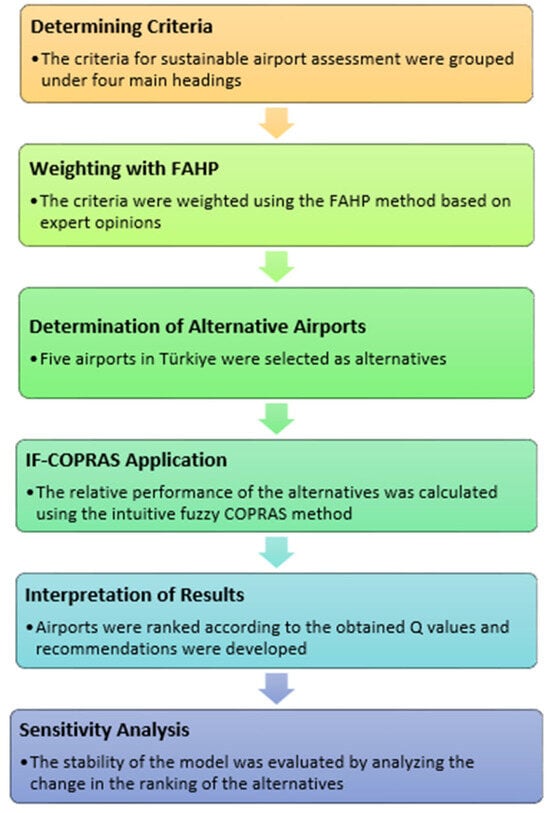
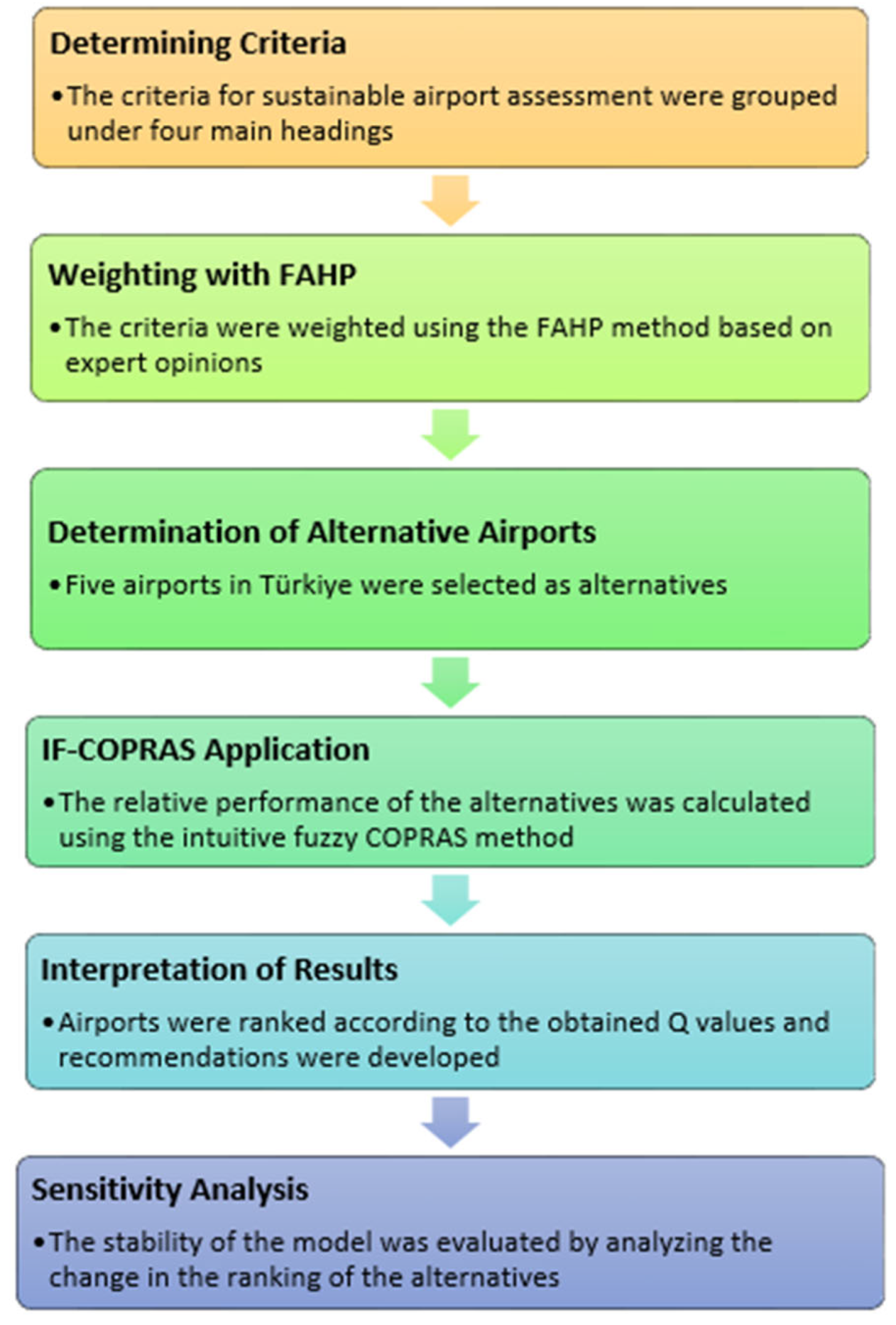
In the final stage, the overall sustainability performance of each airport was analyzed using the IF-COPRAS method to calculate relative performance scores and rankings. Subsequently, a sensitivity analysis was conducted to test the robustness of the model by modifying the FAHP-derived weights under different scenarios, ensuring the reliability and stability of the proposed hybrid framework. Figure 1 presents the overall research methodology of the study.
Figure 1.
Research design.
2.2. Determining Sustainable Airport Criteria
The sustainability criteria used to evaluate airport performance were derived from key studies in the aviation management literature, alongside international reports published by organizations such as IATA, ICAO, and ACI [1,2,3,4,5]. A comprehensive preliminary analysis was conducted to review MCDM-based sustainability indicators previously employed in airport assessment studies. These sources were selected specifically because they represent analytical efforts that translate international policy frameworks (e.g., ICAO’s CORSIA programme, ACI’s ACA system) and established sustainability indicators into robust MCDM-based assessments.
The literature indicates a consensus on the multidimensional nature of airport sustainability. Several studies place primary emphasis on environmental aspects. For instance, Zhou [12] focused on carbon emission reduction (C1), energy efficiency (C2), and renewable energy infrastructure within sustainable airport energy systems. Hydrogen-based energy storage and ecological impacts (C6–C7) were also discussed as major environmental dimensions. Similarly, Mizrak and Şahin [13] prioritized energy efficiency (C2), carbon emissions (C1), and natural resource use (C6), while Güner [11] highlighted operational efficiency alongside energy use (C2) and emissions (C1).
Conversely, other research employs integrated approaches covering multiple dimensions. Lakhouit et al. [15] emphasized economic feasibility (C11), environmental impact (C1–C4), social acceptance (C16), and technological adaptability (C22) in sustainable airport planning. Jia et al. [26] compared sustainability evaluation methodologies, systematically categorizing indicators into environmental (C1–C7), economic (C8–C13), social (C14–C19), and institutional/technical (C20–C24) domains. Furthermore, Mizrak et al. [14] developed a comprehensive sustainability plan covering environmental, economic, and social dimensions, including institutional indicators such as certification (C20) and reporting (C21).
Significant emphasis has also been placed on social and institutional dimensions in recent studies. Eid et al. [9] focused on social aspects such as stakeholder participation (C19), social acceptance (C16), and social responsibility, alongside corporate strategy (C24) and sustainability culture. Merdivenci et al. [10] identified environmental indicators (C1, C2, C4), investment return (C10), and sustainability reporting (C21). Additionally, Durmaz et al. [8] aligned their evaluation with the SDGs by grouping environmental (C1–C7), social (C14–C19), and economic (C8–C13) indicators, while incorporating certification (C20) and policy integration (C24).
Overall, these findings consistently demonstrate that airport sustainability is inherently multidimensional, necessitating an evaluation framework that encompasses environmental, economic, social, and institutional criteria.
Based on a comprehensive literature review, the initial set of 24 sustainability criteria was synthesized from the ICAO Environmental Indicators, the ACI Airport Sustainability Framework, and contemporary MCDM studies focused on aviation. It is important to note that expert consultation was utilized not to generate the criteria pool from scratch, but rather to validate the relevance of these literature-based indicators and refine them where necessary.
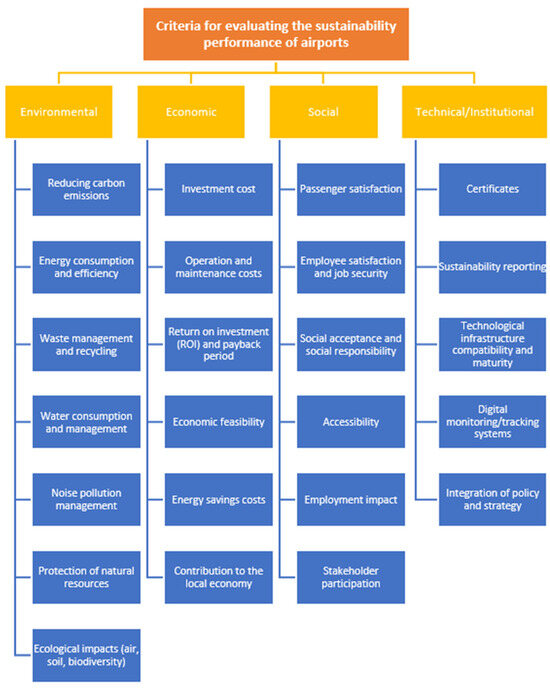
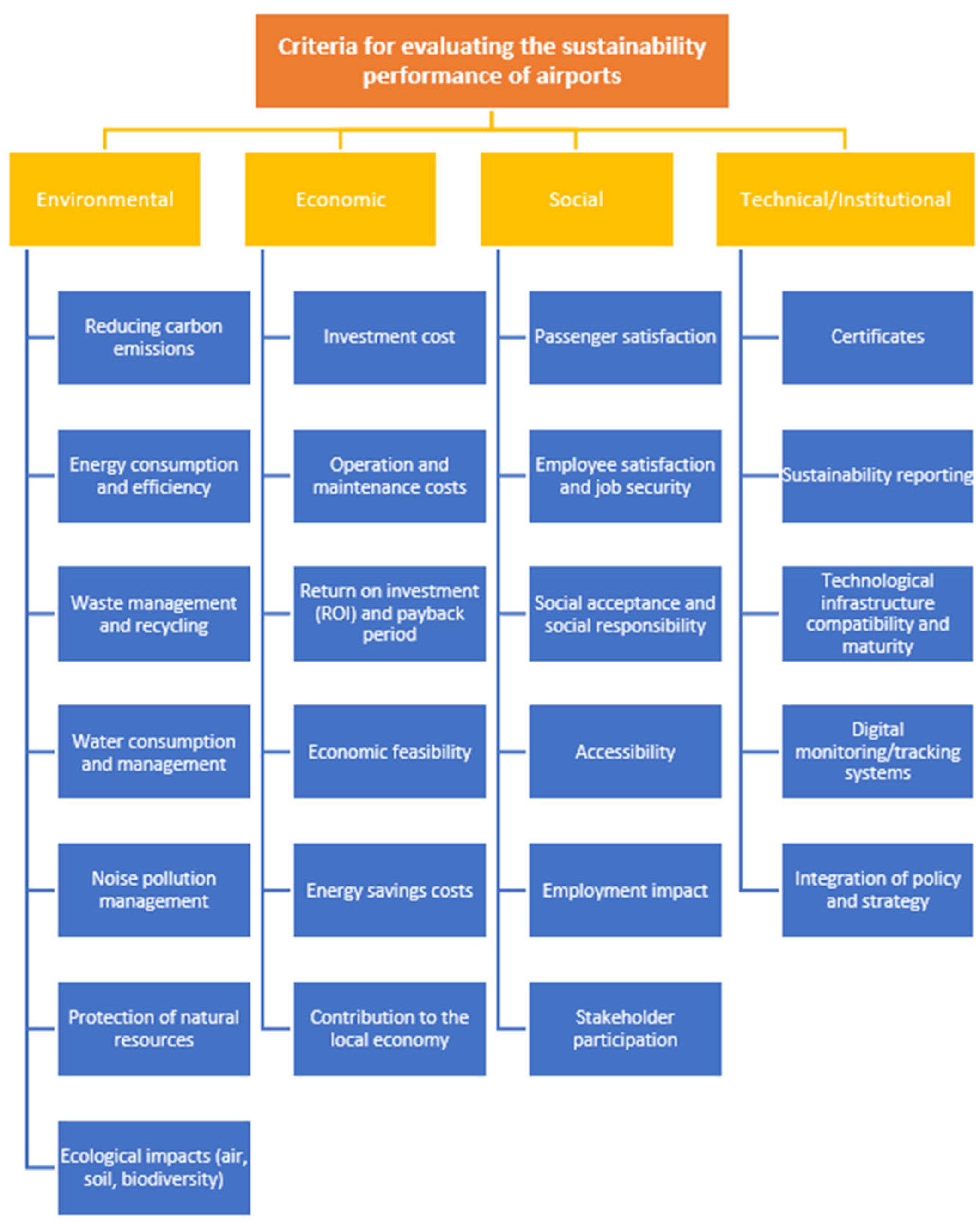
This methodological approach ensures that the final criteria set is grounded in both theoretical robustness and practical applicability. Selected for their recurrence in the literature and alignment with international standards, these 24 indicators provide a comprehensive representation of airport sustainability across four primary dimensions (Table 2). In the subsequent analytical stages, the most critical of these criteria were selected for the final model, ensuring that the multi-dimensional balance of the evaluation was preserved.
Table 2.
Criteria for evaluating the sustainability performance of airports.
2.3. Determination of Alternative Airports
The selection of alternative airports for this evaluation prioritized major hubs in Türkiye characterized by high passenger traffic volumes and established environmental and institutional sustainability frameworks. The objective was to identify a representative and comparable set of alternatives to ensure the robustness of the sustainability performance assessment. The selection process incorporated multiple criteria, including passenger capacity, the existence of strategic sustainability roadmaps, the transparency of environmental reporting, the maturity of digital infrastructure, and potential social impacts.
Furthermore, the selected airports encompass diverse geographic regions and management structures, providing a balanced sample for the MCDM analysis. Crucially, these airports operate at distinct levels within the Airport Carbon Accreditation (ACA) programme, facilitating a meaningful comparative analysis between carbon certification levels and broader sustainability performance.
Data were compiled from authoritative sources, including official aviation statistics, environmental disclosures, operator sustainability reports, and datasets from the General Directorate of State Airports Authority (DHMI). Consequently, the following five airports were selected as alternatives (Table 3): Istanbul Airport (IST), Ankara Esenboğa Airport (ESB), İzmir Adnan Menderes Airport (ADB), Antalya Airport (AYT), and Sabiha Gökçen Airport (SAW). This diversity enhances the study’s generalizability by capturing how varying regional dynamics and operational scales influence sustainability outcomes.
Table 3.
Alternative Airports.
Istanbul Airport (IST): As Türkiye’s largest and busiest airport, IST serves as a primary global transfer hub. It was selected for this study due to its immense passenger-handling capacity, advanced infrastructure, and extensive international connectivity. As one of the largest airport complexes in Europe, IST offers critical insights into the scalability of sustainability practices. Furthermore, it holds the distinction of being the first Turkish airport to achieve ACA Level 4—Transformation, demonstrating advanced capabilities in carbon management [28].
İzmir Adnan Menderes Airport (ADB): Located in the Aegean Region, ADB is a significant regional hub with strong capacity for both domestic and international operations. It plays a pivotal role in supporting regional commerce and tourism. Evaluating ADB is essential for understanding how mid-sized regional hubs integrate green practices into their operations. The airport currently holds ACA Level 3+ (Neutrality) certification.
Ankara Esenboğa Airport (ESB): Serving the capital city, ESB maintains a high domestic market share and acts as a central node connecting Türkiye’s political, administrative, and economic centers. Its strategic location bridges various regions of the country. ESB has achieved ACA Level 4+ (Transition), representing the highest level of carbon management accreditation among Turkish airports. Its inclusion provides a unique case study for examining sustainability integration within a capital city gateway.
Antalya Airport (AYT): Situated in Türkiye’s tourism capital, AYT serves as a major gateway for international visitors, particularly during the high summer season. Its heavy volume of international traffic and significant contribution to the regional economy make it a critical case for assessing sustainability challenges in tourism-driven, seasonal airports. AYT is accredited at ACA Level 3+ (Neutrality), indicating mature carbon reduction and offsetting mechanisms.
Sabiha Gökçen Airport (SAW): Functioning as Istanbul’s key complementary hub, SAW is a prominent center for low-cost carriers (LCCs) and short- to medium-haul routes. Its rapid passenger growth underscores its increasing importance in the national aviation network. Notably, SAW’s terminal building holds a LEED Gold certification, reflecting excellence in sustainable construction and energy efficiency. Although currently outside the ACA scope, its strong performance in environmental building standards and operational efficiency strongly justifies its inclusion in this analysis.
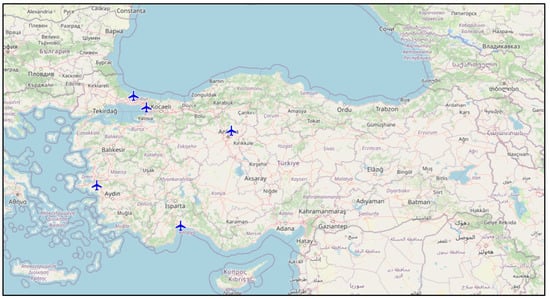
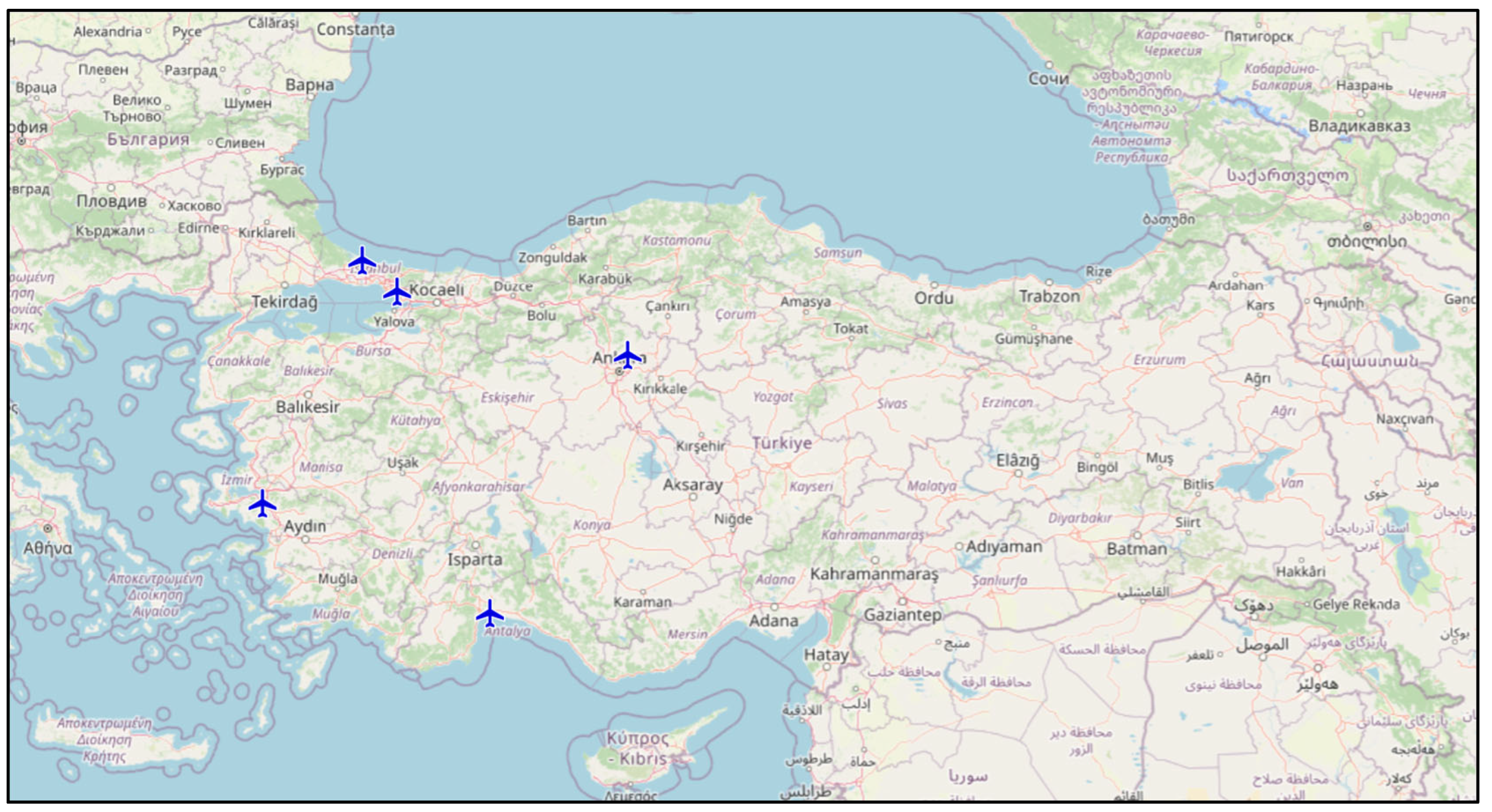
The geographical distribution of these five airports is illustrated in Figure 2. Istanbul Airport (IST) and Sabiha Gökçen Airport (SAW) are located in the northwest, jointly serving the heavy traffic of the Northern Marmara region. Ankara Esenboğa Airport (ESB) is positioned centrally, functioning as the hub for the nation’s administrative capital. Antalya Airport (AYT) lies on the southern coast, catering to tourism-oriented international traffic, while İzmir Adnan Menderes Airport (ADB) serves as the primary air-transport center for the western Aegean Region.
Figure 2.
Geographic distribution of alternative airports in Türkiye.
This geographic diversity is crucial, as it allows the model to capture varying regional dynamics and sustainability challenges, thereby strengthening the representativeness and analytical validity of the MCDM evaluation.
To provide operational context and enhance the comparability of the selected alternatives, detailed traffic data were compiled from DHMI’s 2024 statistics. Table 4 presents key operational characteristics, including annual passenger volumes, cargo tonnage, commercial aircraft movements, and network connectivity. The inclusion of these indicators ensures transparency regarding the structural and scalar disparities among the airports. Crucially, this contextual data is essential to prevent the misinterpretation of sustainability scores as a mere artifact of operational scale rather than actual performance efficiency.
Table 4.
Operational characteristics of the evaluated airports (2024).
The operational history of the selected airports spans diverse eras, with establishment years ranging from 1955 (Esenboğa) to 2018 (Istanbul Airport). As detailed in the table, the respective shares of each airport in Türkiye’s total passenger, cargo, freight, and aircraft traffic are explicitly calculated to validate the sample’s scope. These ratios underscore the high representativeness of the five selected airports in capturing nationwide aviation activity. Collectively, these hubs account for 80.1% of total passenger traffic, 99.3% of cargo volume, 90.7% of freight traffic, and 67.3% of total aircraft movements. Consequently, the selected sample effectively encompasses the vast majority of the country’s operational infrastructure, providing a robust and statistically significant basis for evaluating sustainability performance.
2.4. Fuzzy Sets
The concept of fuzzy logic was pioneered by Zadeh [29] through the theory of fuzzy sets. In contrast to classical set theory, which relies on a binary membership structure (0 or 1), fuzzy sets assign a degree of membership to each element within the interval [0, 1]. This capability facilitates the mathematical modeling of uncertainty, linguistic ambiguity, and human reasoning processes that crisp logic cannot adequately capture.
Membership functions quantify the degree of belongingness of elements within a fuzzy set. Various shapes can be employed for these functions—including triangular, trapezoidal, Gaussian, or sigmoidal—depending on the specific problem context. Among these, the triangular membership function is widely utilized in applied MCDM research due to its computational efficiency and ease of representation.
A Triangular Fuzzy Number (TFN) is defined by a triplet (l, m, u), representing the lower bound, the modal (peak) value, and the upper bound, respectively. The membership value increases linearly from l to m, achieving a value of 1, and subsequently decreases linearly from m to u. The mathematical formulation of the triangular membership function is presented in Equation (1). This specific form is adopted in this study as it provides transparency and interpretability when modeling expert judgments during the decision-making process.
2.5. Fuzzy Analytic Hierarchy Process (FAHP)
The Fuzzy Analytic Hierarchy Process (FAHP) was employed to address the vagueness and subjectivity inherent in expert judgments and to determine the weights of the sustainability criteria. Among the various FAHP variants available in the literature, this study adopts Buckley’s geometric mean approach [30], as it effectively extends the hierarchical logic of AHP into a fuzzy environment. By representing linguistic assessments with Triangular Fuzzy Numbers (TFNs), FAHP enables the derivation of consistent weight vectors that explicitly account for the imprecision in human reasoning.
The primary rationale for selecting Buckley’s approach lies in its geometric mean-based aggregation procedure, which yields a robust and internally consistent weighting structure. Unlike alternative formulations—such as Chang’s Extent Analysis, which has faced criticism regarding rank reversal and zero-weight issues—Buckley’s formulation offers a mathematically sound, transparent, and reproducible framework. Furthermore, the utilization of geometric mean aggregation mitigates the impact of extreme judgments in group decision-making, thereby enhancing the stability of the resulting priority vector. Due to these methodological advantages, Buckley’s FAHP is widely preferred in hybrid MCDM models and demonstrates full compatibility with the IF-COPRAS procedure employed in this study.
The main computational steps of the FAHP method are summarized below:
- Step 1. Define the hierarchical structure.
The decision problem is structured hierarchically, comprising the overall goal (evaluating airport sustainability performance), the main dimensions, and the relevant sub-criteria.
- Step 2. Construct pairwise comparison matrices.
Experts perform pairwise comparisons between criteria using linguistic terms. These qualitative assessments are then converted into Triangular Fuzzy Numbers (TFNs) based on the linguistic scale presented in Table 5. The fuzzy pairwise comparison matrix is denoted as shown in Equation (2).
Table 5.
Linguistic Scale (TFN).
To enhance methodological transparency, the normalized fuzzy pairwise comparison matrix derived from the FAHP is presented in Table 5. The inclusion of this intermediate matrix constitutes a standard practice in FAHP applications, as it facilitates the traceability of computational steps and allows for the verification of the reproducibility of the weighting process.
- Step 3. Aggregation of multiple expert judgments.
To synthesize the individual assessments of the expert panel, the fuzzy pairwise comparison matrices are aggregated using the geometric mean method. This approach, formally expressed in Equation (3), ensures that all expert evaluations contribute equally to the consensus matrix while preserving the reciprocal property of the judgments.
- Step 4. Compute the fuzzy geometric mean.
For each row of the matrix, the fuzzy geometric mean is calculated using Equation (4).
This represents the overall importance of each criterion relative to the others.
At this stage, the obtained fuzzy geometric mean represents the relative importance of each criterion under uncertainty, and in the subsequent step, it is transformed into a comparable form through a normalization process.
- Step 5. Normalize the fuzzy weights.
The fuzzy geometric means are normalized using Equation (5), and then defuzzified (converted into crisp values) via Equation (6).
This provides the crisp priority weights for each criterion.
- Step 6. For the reliability of the method, consistency ratio (CR) is calculated using Equations (7)–(9).where is the random consistency index,
, consistency index,
, the largest local weight of the matrix,
< 0.10, however, is considered consistent in comparisons
- Step 7. Derive global weights.
In the final step, the local weights of the sub-criteria are multiplied by the weights of their respective main dimensions, as expressed in Equation (10). To ensure normalization, the summation of all global weights must equal one (Equation (11)). The resulting global weight vector serves as a critical input for the subsequent evaluation phase. This hierarchical synthesis ensures that each sustainability criterion is weighted systematically, effectively mitigating linguistic ambiguity. Consequently, it provides a reliable and robust foundation for the second-stage IF-COPRAS evaluation.
When this process is repeated for all main criterion groups, the global weights for all criteria to be used in the decision model are obtained. These weights must sum to one:
The FAHP methodology is applied to each sub-criteria cluster to compute local weights. Subsequently, global weights are derived by multiplying these local values by the weight of their respective main dimension. This hierarchical synthesis allows for the calculation of criteria importance within a fuzzy decision-making environment, yielding reliable inputs for the subsequent MCDM stages. Furthermore, to validate the consistency of the expert judgments and ensure the overall reliability of the model, the degree of consensus among the assessments is statistically analyzed using Kendall’s Coefficient of Concordance (W). This step confirms that the derived weights reflect a coherent group decision rather than random or conflicting judgments.
2.6. Intuitionistic Fuzzy Sets (IFS)
The concept of Intuitionistic Fuzzy Sets (IFS), introduced by Atanassov [19], extends traditional fuzzy sets by including both membership (μ) and non-membership (ν) degrees, while also accounting for hesitation (Equation (12)). An IFS on a universal set is defined as:
Here,
μA(x) represents the degree of membership, νA(x) represents the degree of non-membership, and πA(x) = 1 − μA(x) − νA(x) represents the degree of hesitation or uncertainty (Equation (13)). This structure allows decision-makers to express both the degree to which an element belongs and does not belong to a set, with hesitation representing residual uncertainty. IFS is particularly suitable for modeling subjective judgments in MCDM problems [19,30].
2.7. Intuitionistic Fuzzy COPRAS (IF-COPRAS)
To overcome the limitations of traditional (Type-1) fuzzy models, the classical COPRAS method was extended by integrating Intuitionistic Fuzzy Sets (IFS) [20]. Unlike standard fuzzy sets that consider only the degree of membership, IFS incorporates three distinct parameters: membership, non-membership, and hesitancy (indeterminacy) degrees. This tri-component structure allows for a far more realistic modeling of uncertainty, particularly in scenarios where experts may lack complete confidence in their judgments.
Given this enhanced capability to handle ambiguity, IFS-based methods have been widely adopted in recent MCDM literature [23,31]. The IF-COPRAS method preserves the efficient advantage–disadvantage analysis capability of the classical COPRAS approach while leveraging the expressive power of IFS. This combination generates more stable and reliable rankings under uncertain conditions, significantly enhancing the method’s applicability in complex, multidimensional domains such as sustainability assessment.
The aim of multi-criteria decision-making methods is to select the most appropriate option among m alternatives, expressed as , according to n criteria, expressed as . The steps of the method are as follows:
- Step 1. Construction of the Intuitionistic Fuzzy Decision Matrix
Experts evaluate the performance of each alternative with respect to each criterion using linguistic variables. These qualitative assessments are subsequently converted into Intuitionistic Fuzzy Numbers (IFNs) according to the scale presented in Table 6. The resulting decision matrix (D) is expressed as shown in Equation (14).
Table 6.
Linguistic scale (IFS).
The intuitive fuzzy decision matrix given in Equation (14), with i = 1, 2, …, m and j = 1, 2, …, n, is created using the linguistic scale in Table 3.
- Step 2. Aggregation of expert evaluations
If more than one expert provides assessments, their evaluations are aggregated using the Intuitionistic Fuzzy Weighted Average (IFWA) operator, shown in Equation (15).
If all experts are considered equally important, equal weights are assigned to each (. This step ensures that the final decision matrix represents the collective judgment of all experts.
- Step 3. Weighting of criteria
Each element of the intuitionistic fuzzy decision matrix is multiplied by the corresponding FAHP-derived criterion weight. This yields the weighted IF decision matrix, which reflects both expert evaluations and the relative importance of each criterion.
In this step, the intuitionistic fuzzy decision matrix ( is modified to incorporate the relative importance of the criteria. Specifically, each element of the matrix is multiplied by the corresponding global criterion weight () derived from the FAHP analysis. This operation yields the weighted intuitionistic fuzzy decision matrix (, which reflects both the expert evaluations and the priority structure of the sustainability dimensions. The scalar multiplication is performed on the membership and non-membership components of the Intuitionistic Fuzzy Numbers (IFNs) as defined in Equation (16).
is defined as follows. Thus, the relative importance of the criteria is directly reflected in the decision matrix. At this stage, the weights obtained through FAHP are directly integrated into the decision-making process, thereby reflecting the relative importance of each criterion in the evaluation matrix. In this way, subjective expert judgments are combined with objective criterion weights.
- Step 4. Determination of beneficial and cost criteria
The value for all alternatives according to the benefit criterion is calculated as in Equation (17).
- Step 5. Calculation of relative significance
The value is calculated for all alternatives according to the cost criterion with Equation (15). For each alternative, the beneficial criteria values (S+) are calculated using Equation (17), while cost criteria values (S−) are calculated using Equation (18). Beneficial criteria are those where higher values indicate better performance (e.g., energy efficiency), whereas cost criteria represent undesirable aspects (e.g., investment cost).
- Step 6. Determination of overall utility degree and ranking
The smallest of the calculated values is determined. The relative importance values of the alternatives are calculated using Equation (19).
- Step 7. The benefit rating of all alternatives
Alternatives that calculated with Equation (20), are ranked from largest to smallest according to their values; the alternative with the highest benefit degree is determined as the best choice. The IF-COPRAS method utilizes the weights obtained through FAHP to determine the overall utility degrees of the alternatives; thus, the model integrates weighting under fuzzy conditions and intuitionistic evaluation within a unified framework.
The definitions of variables and notations related to fuzzy and intuitionistic fuzzy numbers used in this study are provided in Appendix A Table A1.
3. Results
3.1. Determining Critical Criteria for Airport Sustainability Performance
In the initial phase of this study, the Fuzzy Analytic Hierarchy Process (FAHP) was utilized to determine the relative importance of the sustainability criteria. All computational procedures were executed using Microsoft Excel.
Experts conducted pairwise comparisons between criteria using linguistic terms, which were subsequently transformed into Triangular Fuzzy Numbers (TFNs) based on the linguistic scale presented in Table 4. In this study, the FAHP was not implemented as a broad-participation survey; rather, the pairwise comparison matrices were derived through a structured expert panel comprising three senior professionals with extensive experience in distinct areas of airport operations (Table 1).
Prior to the evaluation, each expert received a comprehensive briefing regarding the criteria hierarchy, the semantic meaning of the linguistic terms, and the study’s objectives. Subsequently, they assessed the criteria independently using a 7-level linguistic scale. To mitigate groupthink or the formation of dominant opinions, all assessments were collected individually. These individual judgments were then aggregated using the geometric mean method—a standard approach in FAHP applications—to construct the fuzzy pairwise comparison matrix shown in Equation (2).
This expert panel approach is frequently advocated in the literature for sustainability assessments requiring specialized domain knowledge. Methodologically, this strategy prioritizes the use of small, highly competent expert groups over large samples with limited expertise, ensuring the depth and reliability of the decision-making process [32,33].
Prior to deriving the criteria weights, the consistency and reliability of the expert evaluations were rigorously verified. Specifically, the degree of consensus among the pairwise comparisons provided by the three experts was analyzed using Kendall’s Coefficient of Concordance (Kendall’s ) [34,35,36,37]. This statistical measure is widely employed to quantify agreement among multiple decision-makers. The coefficient ranges from 0 to 1, where a value closer to 1 denotes a higher level of consensus. In the literature, a value exceeding 0.70 is generally considered indicative of strong consistency. The coefficient is calculated as follows (Equation (21)):
: number of experts,
: number of evaluated criteria,
: the sum of squared deviations from the mean ranking for each criterion.
Table 7 presents the W values obtained for the main and sub-criterion groups.
Table 7.
Kendall’s W results for expert consistency.
The Kendall’s values presented in the table indicate a high level of agreement among the experts (all > 0.70). This result demonstrates that the expert evaluations are consistent and reliable prior to proceeding with the FAHP analysis.
Steps 1–2. The criteria identified through the literature review were evaluated by experts with extensive experience in the aviation industry. Based on these expert judgments, pairwise comparison matrices and corresponding triangular fuzzy number (TFN) matrices were developed. Figure 3 presents the hierarchical structure constructed for assessing airport sustainability.
Figure 3.
Hierarchical structure created for AHP.
Step 3. Using Equation (3), the aggregated comparison matrix was normalized. The collective decision matrix for the main criteria is presented in Table 8.
Table 8.
Normalized main criteria decision matrix.
Step 4–5. The fuzzy priority vectors were computed using Equation (4), normalized via Equation (5), and then defuzzified using Equation (6). Subsequently, the local weights of sub-criteria were multiplied by the weights of their parent criteria to obtain global criterion weights within the fuzzy decision environment (Equation (10)). These weights are shared in Table 9.
Table 9.
Global criterion weights.
Step 6. In this analytical phase, the CR was computed to verify the systematic, logical, and consistent nature of the expert judgments (Equations (7)–(9)). The confirmation that the CR value falls within the acceptable threshold (typically CR < 0.10) empirically supports the reliability of the derived weighting structure.
The quantitative results derived from the FAHP analysis reveal that environmental and economic factors are the most influential dimensions in determining the sustainability performance of airports. Among all criteria, Carbon Emissions (C1, 0.2024) emerged as the paramount factor, highlighting that mitigating greenhouse gases remains the most critical priority in aviation sustainability. This is closely followed by Operating and Maintenance Costs (C8, 0.1958) and Energy Consumption and Efficiency (C2, 0.1096). The dominance of these three indicators underscores that stakeholders prioritize an “eco-efficiency” approach, where environmental performance is inextricably linked to cost reduction.
While environmental and economic factors dominate, the social dimension is anchored by Passenger Satisfaction (C14, 0.1326), followed by Employee Satisfaction and Occupational Safety (C15, 0.0703). Furthermore, the institutional dimension is represented by Certifications and Quality Standards (C20, 0.1120), reflecting the growing importance of standardized management frameworks.
Regarding the criteria selection process, the initial set of 24 indicators was refined based on these calculated global weights. As detailed in the methodology section, a cumulative weight threshold of approximately 70% was applied to identify the most decisive factors. Consequently, the top eight criteria—capturing the majority of the total weight while representing all four sustainability dimensions—were retained for the subsequent analysis. This reduction eliminated indicators with negligible impact, ensuring that the final model focuses on the most strategic drivers of airport sustainability without compromising its multidimensional structure.
The obtained weights indicate which sustainability dimensions are more dominant in the decision-making process. This, in turn, directly informs the weighted evaluation of criteria in the second-stage IF-COPRAS analysis. The criteria and their normalized weights are presented in Table 10.
Table 10.
Criterion weights to be used in the IF-COPRAS method.
Among these, C2, C8 and C9 were defined as cost criteria, while the remaining five were treated as benefit-oriented. The IF-COPRAS method was subsequently employed to construct the intuitionistic fuzzy decision matrix, followed by normalization, weighting, and benefit/cost assessment to determine the final ranking of airport alternatives.
3.2. Evaluation of Airport Sustainability Performance
In this phase, the sustainability performance of the five airport alternatives was evaluated using the IF-COPRAS method, integrating the global criterion weights derived via FAHP with the performance scores across the eight selected indicators. The IF-COPRAS framework was specifically employed due to its analytical robustness in simultaneously processing both benefit- (maximization) and cost-oriented (minimization) criteria. By calculating the relative utility degrees of the alternatives, this approach ensures a comprehensive and comparable assessment of airport sustainability within a fuzzy decision-making environment.
The applied IF-COPRAS steps are as follows:
Steps 1, 2. The decision matrix was established by the same expert panel introduced in Section 2, comprising three senior professionals with 10–20 years of experience in airport operations, jet fuel logistics, and ground services. Employing the same panel for both the FAHP weighting and IF-COPRAS evaluation phases ensures methodological consistency. It is premised that the experts who defined the strategic importance of the criteria possess the requisite competence to accurately assess airport performance across environmental, economic, social, and institutional dimensions.
The evaluations were collected using Intuitionistic Fuzzy Numbers (IFNs) corresponding to the linguistic variables presented in Table 6. Each expert independently assessed the five airports, and these individual judgments were aggregated into a unified intuitionistic fuzzy decision matrix using Equation (15). As is standard in fuzzy MCDM literature, high-level expertise is prioritized over large sample sizes to yield accurate judgments under uncertainty. Furthermore, the Kendall’s W results obtained during the FAHP phase serve to further corroborate the reliability and reproducibility of the panel’s evaluations.
Steps 3, 4, 5, and 6. The weighted IFN matrix was obtained by multiplying the IFN matrix by the criterion weights using Equation (16) (Table 11). Then, the value for all alternatives based on the benefit criterion was calculated using Equation (17), the values for all alternatives based on the cost criterion were calculated using Equation (18), and the relative importance values of the alternatives were calculated using Equation (19).
Table 11.
Weighted IFN matrix.
Step 7. The benefit rating of all alternatives was calculated using Equation (20). The values obtained as a result of the IF-COPRAS analysis and the alternative rankings are presented in Table 12.
Table 12.
IF-COPRAS results.
According to the analytical findings, Istanbul Airport (IST) secured the premier position, exhibiting the highest relative significance value = 0.9468 and achieving a maximum utility degree of 100%. This indicates that IST demonstrates the most balanced and robust performance across the evaluated environmental, economic, social, and institutional criteria.
Following the leader, Izmir Adnan Menderes Airport (ADB) ranked second with a score of = 0.9072 and a utility degree of 96.51%, while Antalya Airport (AYT) placed third = 0.8728$; 93.40%. Conversely, Sabiha Gökçen Airport (SAW) ranked fourth = 0.7718; 82.41%, and Esenboğa Airport (ESB) occupied the fifth position with the lowest relative significance = 0.7638 and a utility degree of 81.22%.
These results reveal a distinct hierarchy among the alternatives. The data suggest that major global hubs equipped with advanced infrastructure and integrated environmental management systems (such as IST) tend to exhibit higher sustainability performance compared to regional or administratively focused airports. The implications of this hierarchy, along with a comparative analysis against existing literature, are discussed in the following section.
3.3. Sensitivity Analysis
A sensitivity analysis was conducted to verify the robustness and reliability of the model outcomes. The objective was to assess how changes in criterion weights might influence the ranking of the airport alternatives. To this end, the FAHP-derived weights were systematically adjusted under three distinct scenarios:
- ✓
- Scenario 1 (Environmental +25%): The weights of environmental criteria (C1, C2, C3) were increased by 25%, while other weights were proportionally reduced.
- ✓
- Scenario 2 (Economic +25%): The weights of economic criteria (C8, C9) were increased by 25%, with proportional decreases in the others.
- ✓
- Scenario 3 (Social +25%): The weight of the social criterion (C14, C15) was increased by 25%, with proportional reductions applied to the remaining criteria.
- ✓
- Scenario 4 (Technical/Institutional +25%): The weight of the social criterion (C20) was increased by 25%, with proportional reductions applied to the remaining criteria.
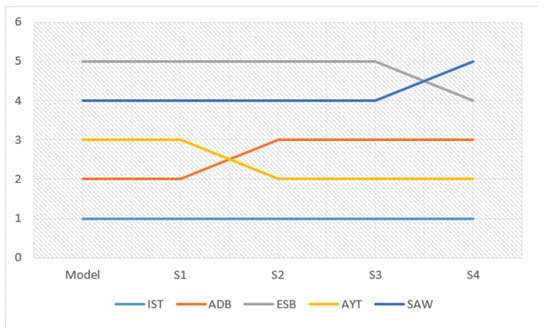
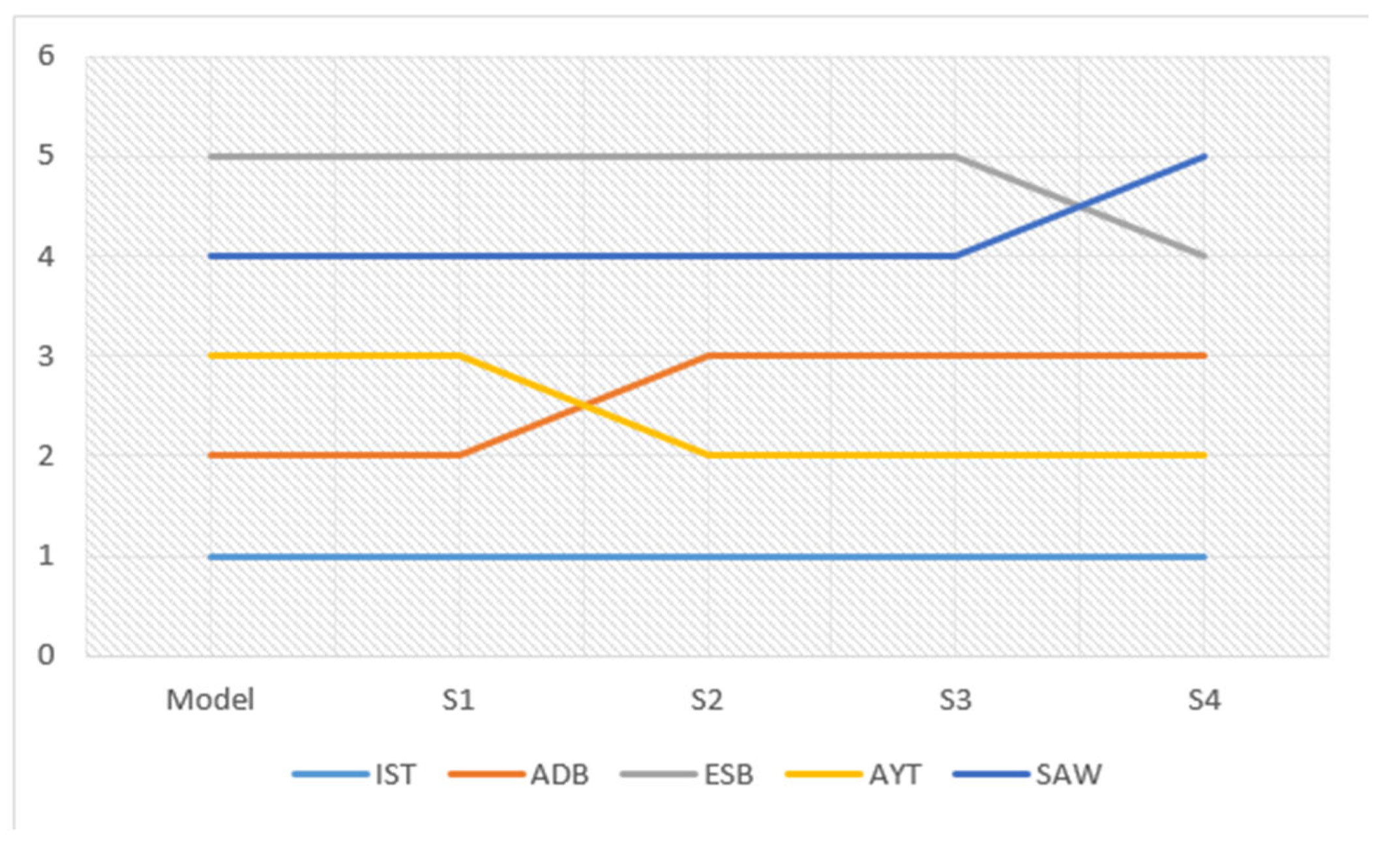
After adjusting the weights, normalization was performed again, and the IF-COPRAS method was rerun for each scenario. Table 13 displays the normalized weights used in both the main model and the three scenarios. Figure 4 presents the ranking variations in the five airports across these scenarios compared with the base model.
Table 13.
Normalized criterion weights for sensitivity analysis.
Figure 4.
Model-driven comparison of scenario achievements.
Overall, the sensitivity analysis confirms the robustness and stability of the hybrid FAHP–IF-COPRAS framework. Despite variations in weighting assumptions, the model produced consistent and interpretable rankings, underscoring its applicability for decision-making in complex and uncertain sustainability evaluations. These scenarios, tested in different models, are clearly shared in Figure 4.
The evaluations conducted under four distinct scenarios demonstrate that Istanbul Airport (IST) consistently maintained the top position in all cases, exhibiting exceptional robustness in its sustainability performance. Conversely, Esenboğa Airport (ESB) predominantly occupied the lowest rank across the scenarios. A notable exception occurred in Scenario 4 (S4), where technical/institutional criteria were prioritized; in this instance, ESB advanced one position, surpassing Sabiha Gökçen Airport (SAW).
Minor rank reversals were observed between Antalya Airport (AYT) and Izmir Adnan Menderes Airport (ADB) depending on the weight distribution. While AYT secured the second rank in the majority of scenarios, ADB outperformed it specifically in the economic-weighted scenario (S2). Meanwhile, Sabiha Gökçen Airport (SAW) displayed a generally stable trajectory, declining by one position only in the S4 scenario.
Overall, these findings indicate that the proposed FAHP–IF-COPRAS model possesses high stability against variations in criterion weights, and the resulting ranking structure maintains strong consistency.
To quantitatively verify this stability, the similarity of rankings across the scenarios was analyzed using the Spearman Rank Correlation Coefficient (ρ) [34]. This coefficient measures the degree of ordinal association between two sets of rankings. While the coefficient theoretically ranges from −1 to +1, values approaching +1 indicate a strong consensus between scenarios. It is calculated using the following formula:
Here, denotes the difference in the ranking of the same alternative across the two scenarios, and n represents the number of alternatives.
Table 14 presents the Spearman rank correlation coefficients () between the baseline model and the four sensitivity scenarios. These coefficients were calculated to assess the degree of similarity in airport rankings under varying criterion weight configurations.
Table 14.
Rank correlation coefficients among scenarios.
As presented in the table, all scenario pairs exhibit strong positive correlations, with coefficients () consistently exceeding 0.80. Notably, the perfect correlation observed between the baseline model and Scenario 1 ( = 1.00) indicates that increasing the weight of environmental criteria does not alter the ranking order, demonstrating the model’s resilience to environmental prioritization. Furthermore, correlation coefficients approximating 0.90 in the remaining scenarios suggest that only marginal ranking shifts occur under different weight distributions. These statistical findings confirm that the proposed FAHP–IF-COPRAS framework maintains high stability and robustness against variations in criteria weights.
4. Discussion
4.1. Interpretation of Weighting Results
The FAHP-derived weights collectively demonstrate that environmental indicators exert the most significant influence on sustainable airport performance. Carbon emission reduction (C1) emerged as the paramount criterion, followed by economic indicators—specifically operation and maintenance costs (C9)—and the key social indicator, passenger satisfaction (C14). Certifications (C20) and energy efficiency (C2) also contribute meaningfully to the outcomes. These findings align with the prevailing literature, where environmental stewardship and operational efficiency are consistently identified as the primary determinants of aviation sustainability [12,13].
While environmental priorities constitute the core of long-term strategies, the prominence of economic criteria (C8, C9, C10) indicates that experts frame sustainability not merely in ecological terms but through the lens of financial feasibility. Similarly, the high weight of passenger satisfaction (C14) underscores that airport sustainability extends beyond “green” operations to encompass service quality and user experience. Consequently, sustainability emerges as an integrated outcome shaped by the synergy of environmental efficiency, financial viability, and user-centered service provision.
It is noteworthy that while technical and institutional indicators generally hold lower cumulative weights, specific criteria such as certification standards (C20) exhibit comparatively high importance. Conversely, reporting (C21) and policy integration (C24) appeared less influential. This pattern echoes the broader literature, which suggests that the aviation sector tends to prioritize tangible operational outcomes over governance structures [8,14]. The concentration of weights around environmental and economic factors is not a methodological limitation but rather a signal of the experts’ collective prioritization of the elements they view as most consequential for the industry’s immediate future.
The decision to reduce the number of criteria from twenty-four to the top eight (representing approximately 70% of the cumulative weight) is grounded in both the Pareto Principle (the ‘vital few’ rule) and the cognitive limitations of human decision-making. Conducting pairwise comparisons for a large set of criteria significantly increases the cognitive load on experts, leading to higher inconsistency ratios and fatigue. By focusing on the high-impact criteria, this study ensures more consistent expert judgments and a robust evaluation structure without compromising the strategic validity of the results.
4.2. Performance Evaluation and Scale Independence
The integrated FAHP–IF-COPRAS analysis reveals performance patterns consistent with the operational maturity of the evaluated airports. Istanbul Airport (IST) ranked first across all scenarios. This dominance is driven by its advanced energy management systems (e.g., LEED-certified terminals, smart building automation), active engagement in global emission-reduction programs, and well-established sustainability governance.
A critical aspect of this evaluation is the independence of the results from operational scale. The analysis confirms that the FAHP–IF-COPRAS framework does not structurally advantage large-scale airports merely due to their size. Most criteria—such as energy efficiency, waste management protocols, digitalization, and corporate policy—are qualitative indicators of maturity, not quantitative measures of volume. Furthermore, the normalization step in the COPRAS method compares all alternatives on a common utility scale. As evidenced by the operational data (Table 4), the ranking order does not correlate with passenger volume or physical size. Sensitivity analyses further validate this, confirming that IST’s leading position reflects its strong alignment with sustainability criteria rather than the magnitude of its operations.
4.3. The Divergence Between ACA and Holistic Sustainability
A particularly significant finding is the lower performance of Ankara Esenboğa Airport (ESB), despite holding ACA Level 4+ (Transition) accreditation—the highest carbon management certification among the evaluated airports. ESB’s ranking reflects relatively weaker performance in social (C14–C15) and institutional (C20–C24) criteria.
This discrepancy highlights a critical structural divergence between carbon-oriented certification schemes and multidimensional sustainability assessments. While ACA evaluates the maturity of carbon management (inventories, reduction strategies, and verification), it intentionally maintains a narrow focus. It does not fully capture broader sustainability components such as water efficiency, circular economy practices, digital transformation, passenger well-being, or social impact.
The present study quantitatively demonstrates that an airport with advanced carbon accreditation may exhibit lower overall performance when evaluated against a holistic set of criteria. This finding supports existing scholarly arguments that “carbon tunnel vision” is insufficient for defining airport sustainability. It underscores the necessity of multidimensional MCDM approaches that account for the social, operational, and governance dimensions often omitted by single-attribute certification systems.
4.4. Validity and Robustness of the Expert-Based Assessment
A critical aspect of this study involves the validation of findings derived from a focused expert panel (n = 3). While the sample size is numerically limited, the robustness of the generated ranking is corroborated by its strong alignment with the operational realities of the Turkish aviation sector. The fact that Istanbul Airport (IST)—the largest and most technologically advanced hub—consistently ranked first across all sensitivity scenarios confirms that the expert inputs were not random but reflected a deep understanding of sectoral dynamics. Furthermore, the high consensus level (Kendall’s W) and the stability of the model against weight changes indicate that the expert panel, despite its small size, successfully captured the “ground truth” of the decision problem. Thus, the depth of expertise and the centralized operational oversight of the panelists compensated for the sample size limitation, yielding results that are both mathematically stable and empirically valid.
To ensure the reliability of the expert evaluation process, a Kendall’s Coefficient of Concordance (W) analysis was conducted. The results confirmed a significant consensus among the panel, validating the robustness of the aggregated data without the need to detail individual raw scores.
4.5. Contributions and Comparison with Existing Literature
Compared with existing studies, the present analysis diverges in terms of scope, methodological depth, and the treatment of uncertainty. For instance, Mizrak and Şahin [13] assessed renewable energy technologies using Spherical Fuzzy SWARA–TOPSIS but focused predominantly on environmental impacts. Similarly, Mizrak et al. [14] conducted an in-depth evaluation of a single airport (IST), whereas the current study provides comparative insights across five major hubs. While Lakhouit et al. [15] and Markatos et al. [16] employed fuzzy logic for airport assessment, previous models often lacked the ability to explicitly represent expert hesitation.
The FAHP–IF-COPRAS model developed in this study fills a significant methodological gap by integrating Intuitionistic Fuzzy Sets (IFS) to mathematically capture hesitancy and indeterminacy. By synthesizing environmental, economic, social, and institutional indicators within a robust hybrid framework, this research advances the analytical tools available for sustainable airport management and offers actionable insights for policymakers beyond carbon-centric metrics.
5. Conclusions
Sustainability has become a strategic priority that requires balancing environmental, economic, social, and institutional dimensions, especially in large-scale transport infrastructures such as airports. As complex systems that involve high energy use, carbon emissions, natural resource consumption, and intensive social interaction, airports necessitate analytical frameworks that can evaluate sustainability performance in a multidimensional and uncertainty-driven context. Positioned among the limited studies that integrate fuzzy logic-based MCDM techniques for airport sustainability assessment, this research provides a hybrid and multidimensional evaluation structure that contributes both methodologically and practically to the existing literature.
Within this scope, the sustainability performance of five major airports in Türkiye was assessed using a comprehensive set of criteria identified through systematic literature analysis and expert consultations. To ensure practical applicability and reduce cognitive complexity, criteria with negligible weight contributions were removed through a threshold-based reduction procedure, and the eight most influential criteria—representing all four sustainability dimensions—were retained. The integrated FAHP–IF-COPRAS framework captured uncertainty in expert judgments while enabling a structured evaluation of airport alternatives based on the most impactful indicators.
The results demonstrate that environmental factors—particularly carbon emission reduction, energy efficiency, and water management—are the dominant determinants of airport sustainability performance. Istanbul Airport (IST) consistently ranked first under all scenarios, while Izmir Adnan Menderes and Antalya Airports followed with relatively similar performance levels. Although the results were broadly aligned with Airport Carbon Accreditation (ACA) classifications, the case of Ankara Esenboğa Airport indicates that carbon-focused accreditation schemes alone cannot fully reflect the broader sustainability landscape. This finding reinforces the added value of multi-criteria approaches in capturing interrelated environmental, economic, social, and institutional factors that influence overall sustainability performance.
The results provide specific actionable insights, particularly for Ankara Esenboğa Airport (ESB), which ranked lowest despite its strong performance in carbon accreditation (ACA). This discrepancy highlights that holding environmental certificates is not sufficient for holistic sustainability leadership if economic and technical efficiencies are lagging. For ESB, the primary recommendation is to prioritize cost efficiency and resource optimization strategies. Management should focus on balancing their environmental investments with improvements in operational costs per passenger to enhance their overall sustainability ranking.
The study offers several managerial implications. The concentration of weights on environmental and economic criteria highlights the need for long-term strategies that integrate resource efficiency with financial feasibility. Although social and institutional dimensions carry comparatively lower numerical weights, they remain essential components that can significantly influence overall performance when underdeveloped. Accordingly, airport managers should adopt an integrated sustainability perspective rather than relying solely on carbon-oriented strategies, and should prioritize investments that simultaneously strengthen environmental performance, operational efficiency, and institutional capacity.
This research provides decision-makers with a structured, evidence-based model that supports strategic planning, resource allocation, infrastructure modernization, and the pursuit of national green-transformation objectives. The integrated framework is compatible with Türkiye’s sustainable aviation policies and offers a practical tool for performance monitoring and long-term policy formulation.
Furthermore, the rigorous sensitivity analyses and the high level of expert consensus observed in this study validate the reliability of the findings, demonstrating that the proposed framework yields statistically robust and stable rankings.
This study also has several limitations. First, the analysis is based on a sample of only five airports, which limits the generalizability of the findings. Second, the criterion weights were derived from expert judgments that reflect a specific group of evaluators; different expert groups may lead to alternative weighting structures. Third, although the hybrid FAHP–IF-COPRAS framework effectively captures uncertainty, the results were not compared with alternative advanced MCDM techniques. Future research should expand the geographical scope, incorporate additional stakeholder perspectives, explore methodological comparisons across different MCDM approaches, and utilize operational data—such as energy consumption, emission inventories, and water-use patterns—to provide deeper insights into the causal drivers of sustainability performance.
Author Contributions
Conceptualization, F.Ş.Y. and P.T.; methodology, F.Ş.Y.; software, P.T.; validation, F.Ş.Y.; formal analysis, F.Ş.Y.; investigation, P.T.; resources, P.T.; data curation, F.Ş.Y.; writing—original draft preparation, F.Ş.Y. and P.T.; writing—review and editing, F.Ş.Y. and P.T.; visualization, F.Ş.Y. All authors have read and agreed to the published version of the manuscript.
Funding
This research received no external funding.
Institutional Review Board Statement
Ethical review and approval were waived for this study as it is a non-interventional, expert-based decision-support analysis that did not involve patients, experimental procedures, surveys, questionnaires, or the collection of personal or sensitive data. All expert inputs were provided anonymously in the participants’ professional capacity, based on institutional knowledge and operational experience. In accordance with national research regulations and institutional policies in Türkiye, studies based solely on expert opinion, professional judgment, and secondary data without personal data collection or intervention are exempt from formal ethics committee approval.
Informed Consent Statement
Informed consent was obtained from all subjects involved in the study.
Data Availability Statement
The original contributions presented in this study are included in the article. Further inquiries can be directed to the corresponding author.
Conflicts of Interest
The authors declare no conflicts of interest.
Appendix A
Table A1.
List of variables.
References
- ICAO. Resolution A41-22: Consolidated Statement of Continuing ICAO Policies and Practices Related to Environmental Protection—Climate Change (CORSIA). Available online: https://www.icao.int/sites/default/files/left-menu-pdfs/Resolution_A41-22_CORSIA.pdf (accessed on 24 August 2025).
- ICAO. Annual Report of the Council 2024. Available online: https://www.icao.int/sites/default/files/annual-report-2024/Annual_Report_2024_EN.pdf (accessed on 4 September 2025).
- ACA. Airport Carbon Accreditation Annual Report 2023–2024. Available online: https://www.airportcarbonaccreditation.org/wp-content/uploads/2025/04/Airport-Carbon-Accreditation-Annual-Report-2023-2024.pdf (accessed on 4 September 2025).
- IATA. Annual Review 2023. Available online: https://www.iata.org/contentassets/c81222d96c9a4e0bb4ff6ced0126f0bb/annual-review-2023.pdf (accessed on 4 September 2025).
- IATA. Annual Review 2024. Available online: https://www.iata.org/contentassets/c81222d96c9a4e0bb4ff6ced0126f0bb/iata-annual-review-2024.pdf (accessed on 4 September 2025).
- DHMİ. 2023 Annual Report. Available online: https://www.dhmi.gov.tr/Lists/AnnualReports/Attachments/21/2023%20Annual%20Report-SEK-eklenen%20sayfal%C4%B1.pdf (accessed on 4 September 2025).
- DHMİ. 2024 Annual Report. Available online: https://www.dhmi.gov.tr/Lists/AnnualReports/Attachments/22/104339_2024annualreportweb.pdf (accessed on 4 September 2025).
- Durmaz, V.; Yazgan, E.; Delice, E.K.; Çelem, B.P. Evaluating airports’ sustainable development goals by using multi-criteria decision making methodologies. Work 2024, 77, 851–864. [Google Scholar] [CrossRef] [Scilit] [PubMed]
- Eid, A.; Salah, M.; Barakat, M.; Obrecht, M. Airport sustainability awareness: A theoretical framework. Sustainability 2021, 14, 11921. [Google Scholar] [CrossRef] [Scilit]
- Merdivenci, F.; Erturgut, R.; Coşkun, A.E. A software development application for sustainable airport performance analysis. LogForum 2021, 17, 131–145. [Google Scholar] [CrossRef] [Scilit]
- Güner, S. Ground-level aircraft operations as a measure of sustainable airport efficiency: A weight-restricted DEA approach. Case Stud. Transp. Policy 2021, 9, 939–949. [Google Scholar] [CrossRef] [Scilit]
- Zhou, Y. Low-carbon transition in smart city with sustainable airport energy ecosystems and hydrogen-based renewable-grid-storage-flexibility. Energy Rev. 2022, 1, 100001. [Google Scholar] [CrossRef] [Scilit]
- Mizrak, F.; Şahin, D.R. Investment strategies for renewable energy technologies and harvesting systems in airport operations using spherical fuzzy MCDM models. Sci. Rep. 2025, 15, 24075. [Google Scholar] [CrossRef] [Scilit]
- Mizrak, F.; Polat, L.; Tasar, S.A. Applying entropy weighting and 2-tuple linguistic T-spherical fuzzy MCDM: A case study of developing a strategic sustainability plan for Istanbul Airport. Sustainability 2024, 16, 11104. [Google Scholar] [CrossRef] [Scilit]
- Lakhouit, A.; Abdalla, G.M.; Elsadig, E.H.O.; Al-Rashed, W.S.; Abdel-Magid, I.; Ben Messaoud, A.; Hayder, G. Sustainable Airport Planning Using a Multi-Criteria Decision-Making Approach with Fuzzy Logic and GIS Integration. Buildings 2025, 15, 1749. [Google Scholar] [CrossRef] [Scilit]
- Markatos, D.N.; Malefaki, S.; Pantelakis, S.G. Sensitivity analysis of a hybrid MCDM model for sustainability assessment—An example from the aviation industry. Aerospace 2023, 10, 385. [Google Scholar] [CrossRef] [Scilit]
- Jiang, J.; Liu, X.; Wang, Z.; Ding, W.; Zhang, S.; Xu, H. Large group decision-making with a rough integrated asymmetric cloud model under multi-granularity linguistic environment. Inf. Sci. 2024, 678, 120994. [Google Scholar] [CrossRef] [Scilit]
- Liu, X.; Zhang, S.; Wang, Z.; Zhang, S. Classification and identification of medical insurance fraud: A case-based reasoning approach. Technol. Econ. Dev. Econ. 2025, 31, 1345–1371. [Google Scholar] [CrossRef] [Scilit]
- Kiraci, K.; Tanriverdi, G.; Akan, E. Analysis of factors affecting the sustainable success of airlines during the COVID-19 pandemic. Transp. Res. Rec. 2023, 2677, 350–379. [Google Scholar]
- Vinogradova-Zinkevič, I.; Podvezko, V.; Zavadskas, E.K. Comparative Assessment of the Stability of AHP and FAHP Methods. Symmetry 2021, 13, 479. [Google Scholar] [CrossRef] [Scilit]
- Boonmee, C.; Thoenburin, P. Temporary safety zone site selection during haze pollution: An integrated approach with FAHP and FTOPSIS. Expert Syst. Appl. 2024, 245, 123002. [Google Scholar] [CrossRef] [Scilit]
- Atanassov, K.T. Intuitionistic fuzzy sets. In Intuitionistic Fuzzy Sets: Theory and Applications; Physica-Verlag: Heidelberg, HD, USA, 1999; pp. 1–137. [Google Scholar]
- Razavi Hajiagha, S.H.; Hashemi, S.S.; Zavadskas, E.K. A complex proportional assessment method for group decision making in an interval-valued intuitionistic fuzzy environment. Technol. Econ. Dev. Econ. 2013, 19, 22–37. [Google Scholar] [CrossRef] [Scilit]
- Nguyen, P.H.; Tsai, J.F.; Dang, T.T.; Lin, M.H.; Pham, H.A.; Nguyen, K.A. A hybrid spherical fuzzy MCDM approach to prioritize governmental intervention strategies against the COVID-19 pandemic: A case study from Vietnam. Mathematics 2021, 9, 2626. [Google Scholar] [CrossRef] [Scilit]
- Kumari, R.; Mishra, A.R. Multi-criteria COPRAS method based on parametric measures for intuitionistic fuzzy sets: Application of green supplier selection. Iran. J. Sci. Technol. Trans. Electr. Eng. 2020, 44, 1645–1662. [Google Scholar] [CrossRef] [Scilit]
- Mishra, A.R.; Pamučar, D.; Hezam, I.M.; Chakrabortty, R.K.; Rani, P.; Božanić, D.; Ćirović, G. Interval-valued pythagorean fuzzy similarity measure-based complex proportional assessment method for waste-to-energy technology selection. Processes 2022, 10, 1015. [Google Scholar] [CrossRef] [Scilit]
- Jia, X.; Macário, R.; Buyle, S. Expanding horizons: A review of sustainability evaluation methodologies in the airport sector and beyond. Sustainability 2023, 15, 11584. [Google Scholar] [CrossRef] [Scilit]
- Sampathkumar, S.; Augustin, F.; Kaabar, M.K.; Yue, X.G. An integrated intuitionistic dense fuzzy Entropy-COPRAS-WASPAS approach for manufacturing robot selection. Adv. Mech. Eng. 2023, 15, 16878132231160265. [Google Scholar] [CrossRef] [Scilit]
- Zadeh, L.A. Fuzzy sets. Inf. Control 1965, 8, 338–353. [Google Scholar] [CrossRef] [Scilit]
- İGA. İGA 2024 Sürdürülebilirlik Raporu [Sürdürülebilirlik Raporu]. İGA Havalimanı İşletmesi. Available online: https://www.igairport.aero/media/zefck5fv/iga-2024-surdurulebilirlik-raporu-final.pdf (accessed on 4 September 2025).
- Buckley, J.J. Fuzzy hierarchical analysis. Fuzzy Sets Syst. 1985, 17, 233–247. [Google Scholar] [CrossRef] [Scilit]
- Xu, Z. Intuitionistic fuzzy aggregation operators. IEEE Trans. Fuzzy Syst. 2007, 15, 1179–1187. [Google Scholar] [CrossRef] [Scilit]
- Kumar, N.; Tyagi, M.; Sachdeva, A. A sustainable framework development and assessment for enhancing the environmental performance of cold supply chain. Manag. Environ. Qual. Int. J. 2023, 34, 1077–1110. [Google Scholar] [CrossRef] [Scilit]
- Do, Q.H. Evaluating lecturer performance in Vietnam: An application of fuzzy AHP and fuzzy TOPSIS methods. Heliyon 2024, 10, e30772. [Google Scholar] [CrossRef] [Scilit] [PubMed]
- Dağıdır, B.D.; Özkan, B. A comprehensive evaluation of a company performance using sustainability balanced scorecard based on picture fuzzy AHP. J. Clean. Prod. 2024, 435, 140519. [Google Scholar] [CrossRef] [Scilit]
- Kendall, M.G.; Smith, B.B. The problem of m rankings. Ann. Math. Stat. 1939, 10, 275–287. [Google Scholar] [CrossRef] [Scilit]
- Spearman, C. The proof and measurement of association between two things. Am. J. Psychol. 1987, 100, 441–471. [Google Scholar] [CrossRef] [Scilit]

Disclaimer/Publisher’s Note: The statements, opinions and data contained in all publications are solely those of the individual author(s) and contributor(s) and not of MDPI and/or the editor(s). MDPI and/or the editor(s) disclaim responsibility for any injury to people or property resulting from any ideas, methods, instructions or products referred to in the content. |
© 2026 by the authors. Licensee MDPI, Basel, Switzerland. This article is an open access article distributed under the terms and conditions of the Creative Commons Attribution (CC BY) license.