Sustainable Preservation of Plant-Based Meat Analogues Using Distinct Conifer Needle Aqueous Extracts

 , , , and
Abstract
1. Introduction
2. Materials and Methods
2.1. Preparation of Spruce Needles
2.2. Preparation of Spruce Needles Water Extract (NWE)
2.3. Identification of Bioactive Components Using the Ultra-Performance Liquid Chromatography—Mass Spectrometry (UPLC–MS)
2.4. Agar Well Diffusion Method
2.5. Model Plant-Based Meat Analogue Matrix Preparation
2.6. Sensory Evaluation Methodology
2.7. Methods of the Microbiological Analysis
2.8. Statistical Analyses
3. Results and Discussion
3.1. UPLC–MS Profile of Bioactive Compounds in Conifer Needle Aqueous Extracts
3.2. Antimicrobial Properties of Blue Spruce Needle Water Extracts
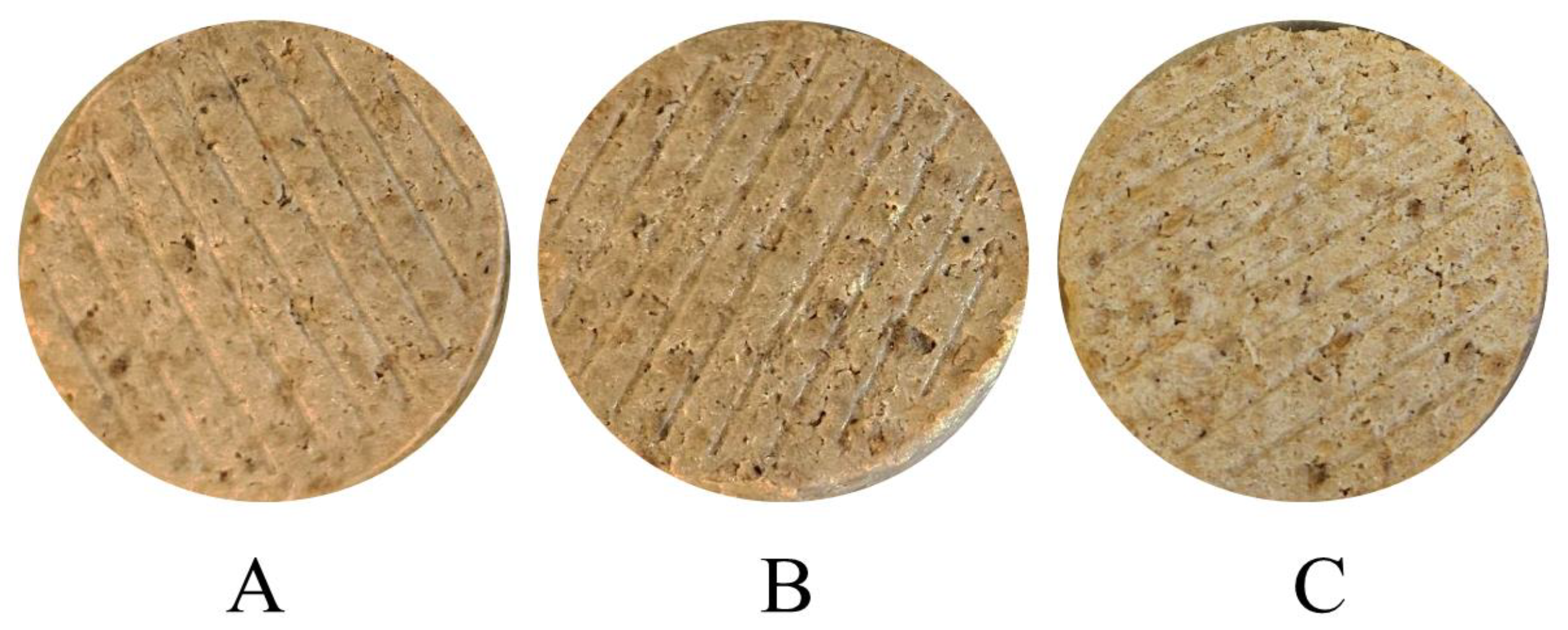
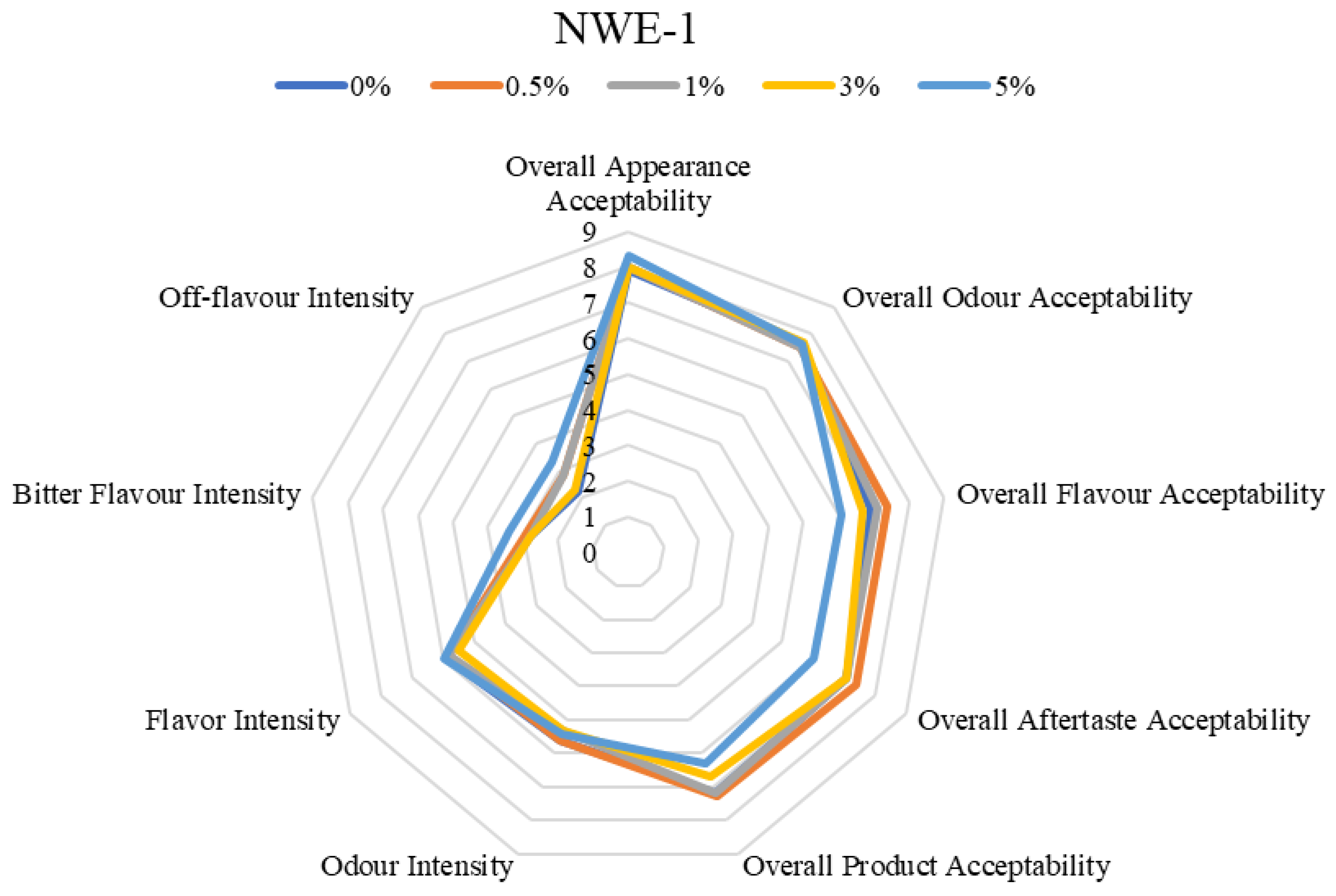
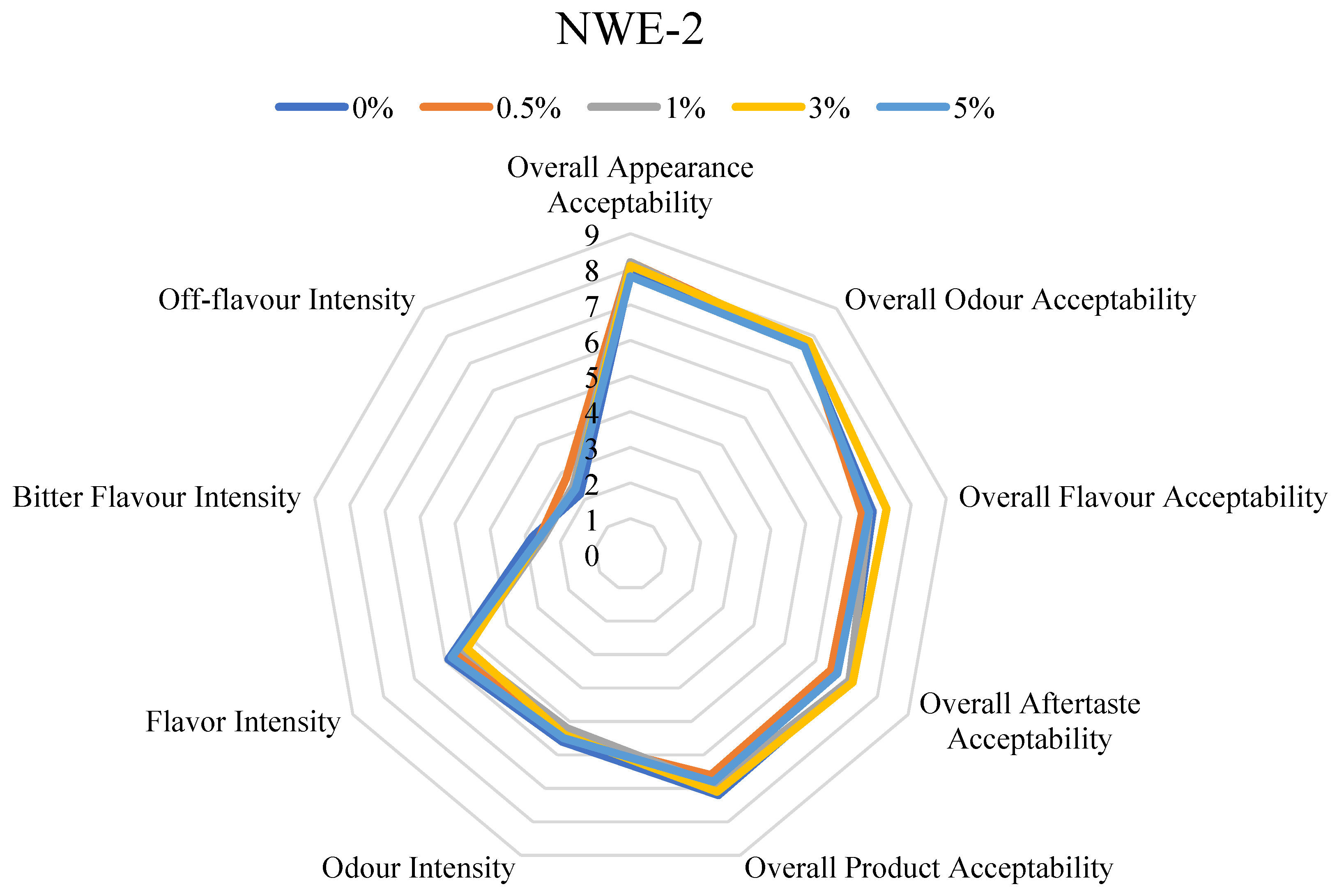
3.3. Impact of Extracts on Sensory Characteristics of a Model Plant-Based Meat Analogue
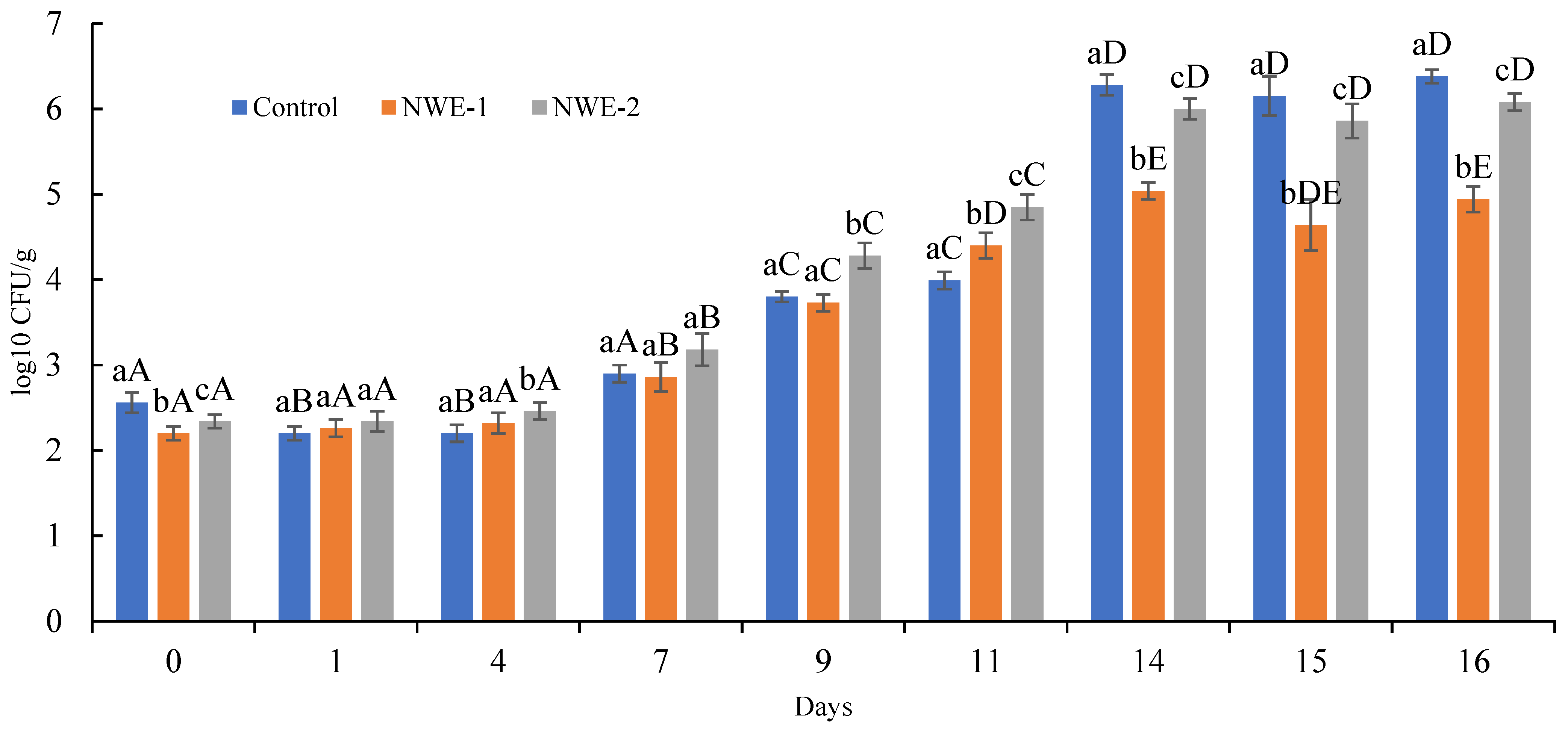
3.4. Model Plant-Based Meat Analogue Microbial Dynamics Assessment Throughout Storage
3.5. Limitations of the Study and Future Research Directions
4. Conclusions
Author Contributions
Funding
Institutional Review Board Statement
Informed Consent Statement
Data Availability Statement
Conflicts of Interest
References
- De Oliveira, P.R.S.; Da Silva, K.C.A.; Amorim, G.A.; Yamaguti, S.T.; Saloni, D.; Pereira, A.K.S.; Júnior, A.F.D. Agro-industrial waste as a potential raw material for multiple products and promotion of a circular economy. In Green Energy and Technology; Springer: Berlin/Heidelberg, Germany, 2025; pp. 1–30. [Google Scholar] [CrossRef]
- Aguilar-Zárate, P.; Chávez-González, M.L.; Abraham, A.R.; Haghi, A.K. The Food-Energy-Water Triangle for Sustainable Development; Apple Academic Press eBooks: New Jersey, NJ, USA, 2024. [Google Scholar] [CrossRef]
- Almonaitytė, K.; Kruopienė, J. Towards Circularity in Agriculture: A Case of Bioactive Compound Recovery from Sea Buckthorn Residual Leaves and Twigs. Processes 2025, 13, 1884. [Google Scholar] [CrossRef]
- Xia, B.; Abidin, M.R.Z.; Wong, J.X.; Dong, H.; Karim, S.A. Are Food Additives Utilized Judiciously? Novel Insights into Health Risks, Benefits, and Ethical Boundaries. Food Rev. Int. 2025, 1–26. [Google Scholar] [CrossRef]
- Parveen, B.; Rajinikanth, V.; Narayanan, M. Natural plant antioxidants for food preservation and emerging trends in nutraceutical applications. Discov. Appl. Sci. 2025, 7, 845. [Google Scholar] [CrossRef]
- Klavins, L.; Almonaitytė, K.; Šalaševičienė, A.; Zommere, A.; Spalvis, K.; Vincevica-Gaile, Z.; Korpinen, R.; Klavins, M. Strategy of Coniferous Needle Biorefinery into Value-Added Products to Implement Circular Bioeconomy Concepts in Forestry Side Stream Utilization. Molecules 2023, 28, 7085. [Google Scholar] [CrossRef] [PubMed]
- Fidelis, M.; Tienaho, J.; Meneguzzo, F.; Pihlava, J.; Rudolfsson, M.; Järvenpää, E.; Imao, H.; Hellström, J.; Liimatainen, J.; Kilpeläinen, P.; et al. Spruce, pine and fir needles as sustainable ingredients for whole wheat bread fortification: Enhancing nutritional and functional properties. LWT 2024, 213, 117055. [Google Scholar] [CrossRef]
- Sandulovici, R.C.; Gălăţanu, M.L.; Cima, L.M.; Panus, E.; Truţă, E.; Mihăilescu, C.M.; Sârbu, I.; Cord, D.; Rîmbu, M.C.; Anghelache, Ş.A.; et al. Phytochemical Characterization, Antioxidant, and Antimicrobial Activity of the Vegetative Buds from Romanian Spruce, Picea abies (L.) H. Karst. Molecules 2024, 29, 2128. [Google Scholar] [CrossRef]
- Gaižauskaitė, Ž; Klavins, L.; Almonaityte, K. Optimised extraction of bioactive compounds from spruce needles for sustainable applications. Waste Manag. 2025, 201, 114784. [Google Scholar] [CrossRef]
- Royer, M.; Houde, R.; Stevanovic, T. Non-wood forest products based on Extractives-A new opportunity for Canadian Forest industry Part 2- Softwood forest species. J. Food Res. 2013, 2, 164. [Google Scholar] [CrossRef]
- Lee, J.; Kang, H.K.; Cheong, H.; Park, Y. A Novel Antimicrobial Peptides From Pine Needles of Pinus densiflora Sieb. et Zucc. Against Foodborne Bacteria. Front. Microbiol. 2021, 12, 662462. [Google Scholar] [CrossRef]
- Boumail, A.; Girard, F.; Tanaka, K.H.; Frøst, M.B.; Turgeon, S.L.; Perreault, V. Sensory characterization of conifer-based extracts for culinary uses. Int. J. Gastron. Food Sci. 2024, 39, 101078. [Google Scholar] [CrossRef]
- Herzyk, F.; Piłakowska-Pietras, D.; Korzeniowska, M. Supercritical Extraction Techniques for Obtaining Biologically Active Substances from a Variety of Plant Byproducts. Foods 2024, 13, 1713. [Google Scholar] [CrossRef]
- Dušková, M.; Dorotíková, K.; Bartáková, K.; Králová, M.; Šedo, O.; Kameník, J. The microbial contaminants of plant-based meat analogues from the retail market. Int. J. Food Microbiol. 2024, 425, 110869. [Google Scholar] [CrossRef] [PubMed]
- Dziedziński, M.; Dziedziński, M.; Kobus-Cisowska, J.; Stuper-Szablewska, K.; Cielecka-Piontek, J.; Wilk, R.; Ludowicz, D. Antioxidant potential, mineral composition and inhibitory effects of conifer needle extract on hyaluronidase-prospects of application in functional food. J. Elem. 2022, 27, 831–845. [Google Scholar] [CrossRef]
- Tienaho, J.; Fidelis, M.; Brännström, H.; Hellström, J.; Rudolfsson, M.; Das, A.K.; Liimatainen, J.; Kumar, A.; Kurkilahti, M.; Kilpeläinen, P. Valorizing assorted logging residues: Response surface methodology in the extraction optimization of a green Norway spruce Needle-Rich fraction to obtain valuable bioactive compounds. ACS Sustain. Resour. Manag. 2024, 1, 237–249. [Google Scholar] [CrossRef] [PubMed]
- Dienaitė, L.; Pukalskas, A.; Pukalskienė, M.; Pereira, C.V.; Matias, A.A.; Venskutonis, P.R. Phytochemical Composition, Antioxidant and Antiproliferative Activities of Defatted Sea Buckthorn (Hippophaë rhamnoides L.) Berry Pomace Fractions Consecutively Recovered by Pressurized Ethanol and Water. Antioxidants 2020, 9, 274. [Google Scholar] [CrossRef]
- Balouiri, M.; Sadiki, M.; Ibnsouda, S.K. Methods for in vitro evaluating antimicrobial activity: A review. J. Pharm. Anal. 2015, 6, 71–79. [Google Scholar] [CrossRef]
- ISO 13299:2016; Sensory Analysis—Methodology—General Guidance for Establishing a Sensory Profile. International Organization for Standardization (ISO): Geneva, Switzerland, 2016.
- ISO 8586:2012; Sensory Analysis—General Guidelines for the Selection, Training and Monitoring of Assessors. International Organization for Standardization (ISO): Geneva, Switzerland, 2012.
- ISO 8589:2007; Sensory Analysis—General Guidance for the Design of Test Rooms. International Organization for Standardization (ISO): Geneva, Switzerland, 2007.
- ISO 4833-1:2013; Microbiology of the Food Chain—Horizontal Method for the Enumeration of Microorganisms—Part 1: Colony-Count at 30 °C. International Organization for Standardization (ISO): Geneva, Switzerland, 2013.
- Ilek, A.; Błońska, E.; Miszewski, K.; Kasztelan, A.; Zborowska, M. Investigating water storage dynamics in the litter layer: The impact of mixing and decay of pine needles and oak leaves. Forests 2024, 15, 350. [Google Scholar] [CrossRef]
- Metsämuuronen, S.; Sirén, H. Bioactive phenolic compounds, metabolism and properties: A review on valuable chemical compounds in Scots pine and Norway spruce. Phytochem. Rev. 2019, 18, 623–664. [Google Scholar] [CrossRef]
- Porth, I.M.; De La Torre, A.R. The Spruce genome. In Compendium of Plant Genomes; Springer: Berlin/Heidelberg, Germany, 2020. [Google Scholar] [CrossRef]
- Mageroy, M.H.; Jancsik, S.; Yuen, M.M.S.; Fischer, M.; Withers, S.G.; Paetz, C.; Schneider, B.; Mackay, J.; Bohlmann, J. A Conifer UDP-Sugar Dependent Glycosyltransferase Contributes to Acetophenone Metabolism and Defense against Insects. Plant Physiol. 2017, 175, 641–651. [Google Scholar] [CrossRef]
- Matar, G.H.; Andac, M. Recent advances in sustainable biopolymer films incorporating vanillin for enhanced food preservation and packaging. Polym. Bull. 2025, 82, 2751–2777. [Google Scholar] [CrossRef]
- Nozari, B.; Kander, R. Supercritical CO2 technology for biomass extraction: Review. Ind. Crops Prod. 2025, 233, 121348. [Google Scholar] [CrossRef]
- Yıldırım, M.; Erşatır, M.; Poyraz, S.; Amangeldinova, M.; Kudrina, N.O.; Terletskaya, N.V. Green Extraction of Plant Materials Using Supercritical CO2: Insights into Methods, Analysis, and Bioactivity. Plants 2024, 13, 2295. [Google Scholar] [CrossRef] [PubMed]
- Traversier, M.; Gaslonde, T.; Lecso, M.; Michel, S.; Delannay, E. Comparison of extraction methods for chemical composition, antibacterial, depigmenting and antioxidant activities of Eryngium maritimum. Int. J. Cosmet. Sci. 2019, 42, 127–135. [Google Scholar] [CrossRef] [PubMed]
- Alwazeer, D.; Elnasanelkasim, M.A.; ÇiÇek, S.; Engin, T.; Çiğdem, A.; Karaoğul, E. Comparative study of phytochemical extraction using hydrogen-rich water and supercritical fluid extraction methods. Process Biochem. 2023, 128, 218–226. [Google Scholar] [CrossRef]
- Pasquina-Lemonche, L.; Burns, J.; Turner, R.D.; Kumar, S.; Tank, R.; Mullin, N.; Wilson, J.S.; Chakrabarti, B.; Bullough, P.A.; Foster, S.J.; et al. The architecture of the Gram-positive bacterial cell wall. Nature 2020, 582, 294–297. [Google Scholar] [CrossRef]
- Stojković, D.S.; Živković, J.; Soković, M.; Glamočlija, J.; Ferreira, I.C.; Janković, T.; Maksimović, Z. Antibacterial activity of Veronica montana L. extract and of protocatechuic acid incorporated in a food system. Food Chem. Toxicol. 2013, 55, 209–213. [Google Scholar] [CrossRef]
- Wu, Y.; Bai, J.; Zhong, K.; Huang, Y.; Qi, H.; Jiang, Y.; Gao, H. Antibacterial Activity and Membrane-Disruptive Mechanism of 3-p-trans-Coumaroyl-2-hydroxyquinic Acid, a Novel Phenolic Compound from Pine Needles of Cedrus deodara, against Staphylococcus aureus. Molecules 2016, 21, 1084. [Google Scholar] [CrossRef]
- Menikheim, C.B.; Mousavi, S.; Bereswill, S.; Heimesaat, M.M. Polyphenolic compounds in the combat of foodborne infections–An update on recent evidence. Eur. J. Microbiol. Immunol. 2024, 14, 116–125. [Google Scholar] [CrossRef]
- Angelini, P. Plant-Derived antimicrobials and their crucial role in combating antimicrobial resistance. Antibiotics 2024, 13, 746. [Google Scholar] [CrossRef]
- Reygaert, W.C. The antimicrobial possibilities of green tea. Front. Microbiol. 2014, 5, 434. [Google Scholar] [CrossRef]
- Kitichalermkiat, A.; Katsuki, M.; Sato, J.; Sonoda, T.; Masuda, Y.; Honjoh, K.; Miyamoto, T. Effect of epigallocatechin gallate on gene expression of Staphylococcus aureus. J. Glob. Antimicrob. Resist. 2020, 22, 854–859. [Google Scholar] [CrossRef] [PubMed]
- Patil, H.S.; Dinore, J.M.; Alrabie, A.; Thulasiram, H.V. Antimicrobial flavonoid: In silico targeting Escherichia coli DNA gyrase adeptly. Nat. Prod. Res. 2024, 39, 1735–1740. [Google Scholar] [CrossRef]
- Iizumi, Y.; Oishi, M.; Taniguchi, T.; Goi, W.; Sowa, Y.; Sakai, T. The flavonoid apigenin downregulates CDK1 by directly targeting ribosomal protein S9. PLoS ONE 2013, 8, e73219. [Google Scholar] [CrossRef]
- Karklina, K.; Ozola, L. Sensory assessment and consumer acceptability of confectionery products made with pine cones. Agron. Res. 2025, 23, 57–72. [Google Scholar] [CrossRef]
- Soares, S.; Brandão, E.; Guerreiro, C.; Soares, S.; Mateus, N.; De Freitas, V. Tannins in Food: Insights into the Molecular Perception of Astringency and Bitter Taste. Molecules 2020, 25, 2590. [Google Scholar] [CrossRef]
- Barmettler, K.; Waser, S.; Stephan, R. Microbiological quality of plant-based meat-alternative products collected at retail level in Switzerland. J. Food Prot. 2024, 88, 100402. [Google Scholar] [CrossRef] [PubMed]
- Nisca, A.; Tanase, C. Approaches to Extracting Bioactive Compounds from Bark of Various Plants: A Brief Review. Plants 2025, 14, 2929. [Google Scholar] [CrossRef] [PubMed]



| No. | Retention Time (Min) | Molecular Mass, m/z [M-H]− | Molecular Formula [M-H]− | Tentative Identification |
|---|---|---|---|---|
| 1. | 0.6 | 133.014 | C4H5O5 | Malic acid c |
| 2. | 0.6 | 173.046 | C7H9O5 | Shikimic acid c |
| 3. | 0.6 | 191.056 | C7H11O6 | Quinic acid c |
| 4. | 0.9 | 191.020 | C6H7O7 | Citric acid c |
| 5. | 1.45 | 315.072 | C13H15O9 | Protocatechuic acid 4-glucoside a,b |
| 6. | 1.5 | 299.077 | C13H15O8 | Salicylic acid glucoside a,b |
| 7. | 2.0 | 153.019 | C7H5O4 | Protocatehuic acida a,b |
| 8. | 2.2 | 341.088 | C15H17O9 | Caffeoyl-glucoside a,b |
| 9. | 2.5 | 577.135 | C30H25O12 | Proanthocyanidin a,b |
| 10. | 2.5 | 313.093 | C14H17O8 | Pungenin a,b |
| 11. | 2.7 | 627.194 | C28H35O16 | Pungenin dimer [M-2H]2− a,b |
| 12. | 3.1 | 151.040 | C8H7O3 | Vanilin a,b |
| 13. | 3.3 | 553.192 | C26H33O13 | Disuccinoyl-caffeoylquinic acid a,b |
| 14. | 3.6 | 495.187 | C24H31O11 | Lignan pentoside a,b |
| 15. | 3.8 | 525.197 | C25H33O12 | Epicatechin-ramnosyl-hexoside a,b |
| 16. | 4.1 | 537.197 | C26H33O12 | Bidenlignaside B a |
| 17. | 4.7 | 593.150 | C27H29O15 | Veronicastroside a,b |
| 18. | 4.9 | 447.093 | C27H29O15 | Cynaroside a,b |
| 19. | 5.0 | 415.197 | C20H31O9 | Ethyl 7-epi-12-hydroxyjasmonate glucoside a |
| No. | Retention Time (Min) | Molecular Mass [M-H]− | Molecular Formula [M-H]− | Tentative Identification |
|---|---|---|---|---|
| 1. | 0.61 | 179.056 | C6H11O6 | Hexose c |
| 2. | 0.62 | 133.014 | C4H5O5 | Malic acid c |
| 3. | 0.7 | 173.046 | C7H9O5 | Shikimic acid a,b |
| 4. | 0.71 | 191.056 | C7H11O6 | Quinic acid c |
| 5. | 0.9 | 191.020 | C6H7O7 | Citric acid c |
| 6. | 1.3 | 165.056 | C9H9O3 | Apocynin a,b |
| 7. | 1.45 | 309.119 | C12H21O9 | Rhamnosyl-rhamnose a,b |
| 8. | 1.9 | 305.066 | C15H13O7 | Epigallocatechin a,b |
| 9. | 2.0 | 153.019 | C7H5O4 | Protocatehuic acid a,b |
| 10. | 2.25 | 341.088 | C15H17O9 | Caffeoyl-glucoside a,b |
| 11. | 2.5 | 577.135 | C30H25O12 | Proanthocyanidin a,b |
| 12. | 2.6 | 137.024 | C7H5O3 | Salicylic acid a,b |
| 13. | 2.7 | 313.093 | C14H17O8 | Pungenin a,b |
| 14. | 2.7 | 337.093 | C16H17O8 | p-coumaroylquinic acid c |
| 15. | 2.8 | 289.072 | C15H13O6 | Catechin c |
| 16. | 3.1 | 151.040 | C8H7O3 | Vanilin a,b |
| 17. | 3.4 | 553.192 | C26H33O13 | Disuccinoyl-caffeoylquinic acid a,b |
| 18. | 4.1 | 537.197 | C26H33O12 | Bidenlignaside B a |
| 19. | 4.6 | 315.124 | C18H19O5 | Lignan a,b |
| 20. | 4.6 | 487.305 | C29H43O6 | Polygalic acid a,b |
| 21. | 4.9 | 569.224 | C27H37O13 | Asperuloide |
| 22. | 5.1 | 477.103 | C22H21O12 | Isorhamnetin-O-hexoside a,b |
| 23. | 5.9 | 461.239 | C22H37O10 | Phenylpropanoid-glycoside a,b |
| Dilution Factor | NWE-1 Inhibition Zone, mm | NWE-2 Inhibition Zone, mm | |
|---|---|---|---|
| S. aureus subsp. aureus ATCC 25923 | 1:0 | 12.3 ± 0.6 aA | 11.0 ± 1.0 aA |
| 1:1 | 10.3 ± 0.6 aB | 9.6 ± 0.6 aB | |
| 1:3 | 9.0 ± 0.0 aC | n.d. bC | |
| S. enterica subsp. enterica serovar Typhimurium ATCC 14028 | 1:0 | 8.3 ± 0.6 aA | n.d. bA |
| 1:1 | n.d. aB | n.d. aA | |
| 1:3 | n.d. aB | n.d. aA | |
| B. cereus ATCC 11778 | 1:0 | 16.7 ± 0.6 aA | 14.7 ± 1.2 aA |
| 1:1 | 13.0 ± 1.0 aB | 11.3 ± 0.6 aB | |
| 1:3 | 11.3 ± 0.6 aC | 10.3 ± 0.6 aB | |
| L. monocytogenes ATCC 13932 | 1:0 | 10.0 ± 0.0 aA | n.d. bA |
| 1:1 | n.d. aB | n.d. aA | |
| 1:3 | n.d. aB | n.d. aA |
Disclaimer/Publisher’s Note: The statements, opinions and data contained in all publications are solely those of the individual author(s) and contributor(s) and not of MDPI and/or the editor(s). MDPI and/or the editor(s) disclaim responsibility for any injury to people or property resulting from any ideas, methods, instructions or products referred to in the content. |
© 2026 by the authors. Licensee MDPI, Basel, Switzerland. This article is an open access article distributed under the terms and conditions of the Creative Commons Attribution (CC BY) license.
Share and Cite
Gaižauskaitė, Ž.; Černauskas, D.; Zabulionė, A.; Trakšelė, L.; Korpinen, R.; Almonaitytė, K. Sustainable Preservation of Plant-Based Meat Analogues Using Distinct Conifer Needle Aqueous Extracts. Sustainability 2026, 18, 1135. https://doi.org/10.3390/su18021135
Gaižauskaitė Ž, Černauskas D, Zabulionė A, Trakšelė L, Korpinen R, Almonaitytė K. Sustainable Preservation of Plant-Based Meat Analogues Using Distinct Conifer Needle Aqueous Extracts. Sustainability. 2026; 18(2):1135. https://doi.org/10.3390/su18021135
Chicago/Turabian StyleGaižauskaitė, Žydrūnė, Darius Černauskas, Aelita Zabulionė, Lina Trakšelė, Risto Korpinen, and Karolina Almonaitytė. 2026. "Sustainable Preservation of Plant-Based Meat Analogues Using Distinct Conifer Needle Aqueous Extracts" Sustainability 18, no. 2: 1135. https://doi.org/10.3390/su18021135
APA StyleGaižauskaitė, Ž., Černauskas, D., Zabulionė, A., Trakšelė, L., Korpinen, R., & Almonaitytė, K. (2026). Sustainable Preservation of Plant-Based Meat Analogues Using Distinct Conifer Needle Aqueous Extracts. Sustainability, 18(2), 1135. https://doi.org/10.3390/su18021135