Article

Bridging or Widening? Configurational Pathways of Digitalization for Income Inequality: A Global Perspective

1
School of Public Affairs, Zhejiang University, Hangzhou 310058, China
2
School of Public Policy and Management, Tsinghua University, Beijing 100084, China
*
Author to whom correspondence should be addressed.
Sustainability 2026, 18(2), 1137; https://doi.org/10.3390/su18021137
Submission received: 27 December 2025 / Revised: 18 January 2026 / Accepted: 19 January 2026 / Published: 22 January 2026
(This article belongs to the Collection Digital Economy and Sustainable Development)

Abstract

Digitalization is widely heralded as a catalyst for growth, yet its role in achieving the United Nations’ Sustainable Development Goal 10 (Reduced Inequalities) remains deeply contested. Moving beyond linear assumptions of “digital dividends,” this study adopts a complex socio-technical systems perspective to unravel the configurational pathways linking digitalization to national income inequality. We analyze a high-quality balanced panel of 56 major economies from 2012 to 2022. Employing Panel Fuzzy-Set Qualitative Comparative Analysis (Panel fsQCA) and Necessary Condition Analysis (NCA), this study proposes an evidence-based typology of digitalization-inequality pathways. We reveal that the impact of digital transformation is asymmetric and contingent on geo-economic contexts. NCA identifies Digital Infrastructure, Innovation, and Governance as necessary “bottlenecks” for social equity. Sufficiency analysis uncovers three distinct sustainable development modes: an “Open Innovation Mode” in affluent small economies, driven by global integration and technological frontiers; a “Governance-Regulated Industry Mode” in major economies, where strong state capacity regulates digital industrial scale; and an “Open Niche Mode” for transition economies, leveraging openness to bypass domestic structural deficits. Conversely, we identify a critical “Hollow Governance Trap” in the Global South, where digital governance efforts fail to reduce inequality in the absence of real industrial and infrastructural foundations. These findings challenge one-size-fits-all policies, suggesting that bridging the global digital divide requires context-specific strategies—ranging from synergistic integration to asymmetric breakthroughs—that align digital investments with institutional capacity.

1. Introduction

The contemporary era presents a profound paradox central to the global sustainable development agenda: while digital technologies hold immense promise for fostering inclusive growth and opportunity, their rapid proliferation has coincided with significant and persistent within-country income inequality across many economies [1]. As a core target of the United Nations’ 2030 Agenda for Sustainable Development, particularly SDG 10 (Reduced Inequalities) [2,3], narrowing national income inequality remains a formidable challenge. It critically impacts socio-political stability, social sustainability, and overall human welfare [4]. Despite concerted policy efforts, effectively harnessing the ongoing digital revolution—characterized by advancements in connectivity, artificial intelligence, and data analytics [5]—to achieve more equitable income distribution remains an urgent and complex “grand challenge” for national governments and international organizations alike [6,7].
A growing body of academic research explores the intricate relationship between the multifaceted process of digitalization and national income inequality, often framed as a tension between “digital dividends” and the “digital divide” [8]. Studies have examined various dimensions, including digital technology (innovation and infrastructure), the digital economy (industry and finance), and digital governance, often analyzing their independent influence on the Gini coefficient. However, the prevailing literature presents a landscape characterized by fragmentation, ambiguity, and often contradictory empirical findings regarding social equity [6,8]. For nearly every dimension of digital transformation, credible arguments and evidence suggest it possesses a dual capacity, potentially acting as a force for either greater social equality or greater disparity. For instance, digital innovation is linked to both inequality-widening skill-biased technological change [9] and inequality-narrowing effects under certain institutional conditions [10,11]. Similarly, digital infrastructure expansion is associated with both bridging the gap to empower marginalized groups [11,12] and potentially amplifying existing inequalities if access remains uneven [13,14]. Digital finance is lauded for enhancing financial inclusion [15,16] yet simultaneously criticized for potential predatory practices and deepening divides [17,18]. This pervasive ambiguity suggests that the relationship is not simple, linear, or unidirectional, but rather contingent on the socio-technical environment [8].
Furthermore, emerging scholarly consensus indicates that the impact of digitalization on sustainable inclusive growth is highly contingent on the broader macro-level context in which it unfolds [6]. Factors such as a nation’s level of economic development, the quality and capacity of its governance institutions [11,19,20], and its degree of openness to global economic flows [11,21,22] appear to critically moderate the digitalization-inequality nexus. The existence of non-linear dynamics, threshold effects, and context-dependent pathways further complicates the picture [14], rendering simplistic “more is better” assumptions inadequate for achieving SDG 10 [23].
This state of the literature points toward a significant limitation in the predominant reliance on conventional analytical methods, such as linear regression models, which primarily focus on isolating average “net effects” of individual variables while holding others constant [6,19]. Such approaches inherently struggle to capture the causal complexity evident in the digitalization-inequality relationship. They often mask how opposing mechanisms might operate simultaneously and fail to account for how conditions combine synergistically. More importantly, while recent studies have begun to apply configurational methods to examine digital inequality, they have predominantly focused on the sub-national regional level [6] or the urban-rural gap within a single country [24]. There is a distinct scarcity of research that adopts a holistic, cross-national perspective to unravel how national-level context interacts with digitalization. This gap is critical because global sustainable development goals require understanding how different country-level “socio-technical” configurations lead to varying social outcomes [25].
Therefore, this study seeks to address the following central research question: How do different configurations of digitalization factors (digital innovation, digital infrastructure, digital industry, digital finance, digital governance), under varying national contextual conditions (economic level, governance capacity, degree of openness), combine to bridge the income gap and foster sustainable social equity?
To tackle this question and move beyond the limitations of prior work, this paper adopts a configurational approach grounded in complexity theory [26] and configurational theory [27]. We employ Panel Fuzzy-Set Qualitative Comparative Analysis (Panel fsQCA) [28] and Necessary Condition Analysis (NCA) [29] on a strictly screened panel of 56 major economies from 2012 to 2022. Although the sample size is constrained by the rigorous data availability standards of the UNU-WIDER World Income Inequality Database (WIID) to ensure cross-national comparability and reliability, these economies represent a diverse range of development stages and account for a significant majority of the global GDP. Panel fsQCA is particularly well-suited for identifying specific “causal recipes”—combinations of conditions that are consistently associated with either high or low levels of national income inequality across a diverse sample of economies over time [28]. It allows for the explicit analysis of conjunctural causation, equifinality (including the logic of substitutability where different recipes work in similar contexts), causal asymmetry, and the conditions under which a logic of completeness might operate. NCA complements this by assessing whether certain individual conditions act as necessary prerequisites (bottlenecks) for achieving reduced inequality [29]. This combined methodological approach enables a more nuanced and holistic understanding capable of integrating the seemingly contradictory findings present in the existing literature [24]. The primary outcome variable is the Gini coefficient, with the Theil index used for robustness checks.
This study makes three distinct contributions to the literature on digitalization and sustainable development. First, methodologically, we extend the application of Panel fsQCA from sub-national regional analysis [6,24] to the cross-national level, providing the first systematic configurational evidence on how national-level institutional arrangements interact with digitalization strategies globally. Second, theoretically, we advance beyond fragmented variable-oriented findings by establishing a coherent typology that reconciles seemingly contradictory effects of digitalization under different geo-economic contexts—specifically, the ‘Synergistic Integration’ logic in the Global North versus the ‘Asymmetric Breakthrough vs. Structural Traps’ binary in the Global South. Third, for policy, we identify the ‘Hollow Governance Trap’ as a critical warning against ‘Digital Formalism’ in developing contexts, challenging the assumption that e-government investments automatically translate into inclusive outcomes. These contributions directly inform context-specific strategies for achieving SDG 10.
The remainder of this paper is structured as follows. Section 2 reviews the relevant literature in detail and develops the analytical framework guiding the study. Section 3 outlines the research design, including the methodology, sample selection, variable operationalization, and data analysis procedures. Section 4 presents the empirical results from the NCA and Panel fsQCA analyses. Finally, Section 5 discusses the findings, concludes with theoretical and policy implications for sustainable development, acknowledges limitations, and suggests directions for future research.

2. Literature Review and Analytical Framework

As highlighted in the introduction, the relationship between digitalization and national income inequality is complex, multifaceted, and characterized by considerable debate within the existing literature [6,8]. This complexity is not merely an academic puzzle but represents a critical hurdle for achieving Sustainable Development Goal 10 (Reduced Inequalities). While early studies often sought linear correlations, recent scholarship suggests that the impact of digital transformation is contingent upon broader socio-technical configurations [30]. This chapter aims to synthesize the current state of knowledge by reviewing studies on the impact mechanisms of various digitalization dimensions and key contextual factors on national income inequality (measured primarily by the Gini coefficient). It underscores the fragmented and often contradictory nature of findings derived from traditional linear approaches, thereby establishing the rationale for adopting a configurational perspective and methodology to unpack the “black box” of digital inequality. Finally, it presents the analytical framework guiding this study.

2.1. The Contradictory Effects of Digital Transformation Dimensions on National Income Inequality

This section systematically reviews the literature concerning the core components of digitalization through a consistent “dual-effect” lens. From the perspective of social sustainability, every technological, economic, and governmental facet of digital transformation can act either as an engine for inclusive growth or as a driver of social polarization. We organize this review along three thematic clusters: digital technology (infrastructure and innovation), digital economy (industry and finance), and digital governance. For each dimension, we first present the inequality-reducing mechanisms, then the inequality-widening mechanisms, before synthesizing the conditional nature of these effects.

2.1.1. Digital Technology

Digital Infrastructure. The expansion of digital infrastructure is framed by competing concepts of the “digital divide” versus “digital empowerment.” The digital divide argument posits that unequal access mirrors and reinforces existing socioeconomic disparities, allowing affluent, urban, and educated populations to disproportionately capture digitalization’s benefits, thereby widening income gaps [12,13]. This creates “digital poverty” that risks structurally excluding low-income households from the modern economy [19,31]. Cross-national studies find correlations between uneven broadband access and higher Gini indices through mechanisms like information asymmetry and differential returns to adoption, undermining the “Leave No One Behind” principle [3,19,32].
Conversely, widespread digital infrastructure can reduce inequality by dramatically lowering information access costs, democratizing access to education, financial services, and markets—particularly benefiting low-income and rural populations [11,12,33]. Increased internet penetration has been linked to poverty reduction by enabling financial inclusion, enhancing human capital, and creating new income opportunities [12,34]. The “Technological Kuznets Curve” (TKC) synthesizes these views, suggesting inequality might initially rise with elite adoption but subsequently decline as access becomes ubiquitous [35].
Digital Innovation. The distributional consequences of digital innovation are deeply contested. The dominant Skill-Biased Technological Change (SBTC) theory posits that technological advancements favor high-skilled labor while substituting for low- and middle-skilled routine labor, increasing the “skill premium” and stretching income distribution [9,11,35]. Digital innovation generates “innovation rents” disproportionately captured by top income groups [36], contributing to labor market polarization and a “hollowing out” of middle-skilled jobs [11,19,37,38].
Countervailing arguments highlight “inclusive innovation” [39]. Schumpeterian “creative destruction” can enhance social mobility by displacing incumbents and creating new pathways to wealth [11,36]. Innovation also drives job creation, with high-tech sector growth producing local “jobs multiplier” effects benefiting low-skilled workers [40,41]. Crucially, innovation’s effect appears conditional—reducing inequality when coupled with sufficient institutional quality [10,11,42].
The ambivalent effects of digital technology suggest that infrastructure and innovation alone cannot determine inequality outcomes; the digital economy’s structure matters equally.

2.1.2. Digital Economy

The digital economy embodies a tension between market concentration potentially driving inequality and platform-enabled opportunity dispersion potentially reducing it—central to SDG 8 debates.
Digital Industry. High scalability, network effects, and low marginal costs drive market concentration, resulting in “winner-take-all” dynamics where dominant platforms capture most market share and profits [37,43,44]. This concentration increases returns to capital over labor and creates wage gaps between superstar firms and others, with wealth accruing to founders, investors, and highly skilled employees [1,36,44,45].
The platform or “gig” economy offers a contrasting narrative. Digital platforms create low-barrier, flexible employment opportunities for the unemployed, underemployed, or those excluded from conventional labor markets [35,46,47,48,49]. However, such work is often precarious—characterized by income volatility, lack of benefits, and weak labor protections [50,51]. Platform classification of workers as independent contractors shifts risks onto individuals, potentially creating new forms of low-wage work [35,51,52]. This creates a schism between compensated “insiders” at superstar firms and precarious “outsiders.”
Digital Finance. Digital financial services are frequently cited as tools for reducing inequality by overcoming traditional barriers to financial access [16,53,54]. This optimism is grounded in a long tradition of scholarship demonstrating the developmental potential of financial inclusion [55,56], though seminal work by Banerjee and Duflo [57] cautions that access to finance is a necessary but not automatically sufficient condition for poverty reduction—its impact is fundamentally contingent on complementary factors such as financial literacy and institutional quality. Empirical work finds associations between digital financial inclusion and lower Gini coefficients [15,16,54,58,59], with landmark M-Pesa studies providing compelling evidence [60].
Significant risks challenge this narrative. Adoption concentrated among the already literate may create a “digital financial divide” [12]. Absent strong consumer protection, digital finance can enable predatory lending and debt traps [17,18]. This risk is not new to the digital age; early research on microfinance by CGAP documented how insufficient regulation combined with predatory lending practices could lead to multiple borrowing, over-indebtedness, and catastrophic consequences for both households and banking sectors [61]. The transition to digital platforms may amplify these risks through greater scalability and reduced human oversight. Evidence suggests a Kuznets-like pattern where inequality might rise during early adoption before potentially falling [62,63].
Having examined technology and economy dimensions, we turn to digital governance—the institutional layer that may ultimately determine whether digitalization bridges or widens inequality.

2.1.3. Digital Governance

E-government presents duality regarding inequality and SDG 16. Digital governance can promote equity by enhancing transparency, combating corruption (which disproportionately harms the poor), and making welfare delivery more efficient [21,64,65]. Evidence suggests e-governance can improve social welfare and reduce inequality when effectively integrated [66,67,68], with digital public services like e-learning and telehealth improving human capital in disadvantaged areas [69].
However, digital exclusion threatens these promises. Populations lacking digital skills or infrastructure—particularly the elderly, rural residents, and those with low digital literacy—risk being cut off from essential support [64,69,70]. Automated decision-making systems can perpetuate “algorithmic bias,” potentially disadvantaging minority or low-income individuals [71,72,73,74].
In sum, nearly every digitalization dimension harbors contradictory mechanisms. This pervasive duality highlights the limitations of single-variable linear analysis and underscores the importance of examining how these factors combine to produce specific inequality outcomes.

2.2. Contextual Heterogeneity: Preconditions Shaping Digitalization’s Sustainable Impact

The contradictory effects outlined above strongly suggest that digitalization’s impact is not intrinsic to the technologies themselves but is instead profoundly shaped by the macro-level context in which they are embedded [6]. From a complex socio-technical systems perspective [26,75], digital technologies do not operate in a vacuum; they interact with existing economic, political, and social structures. This section reviews literature on three critical contextual factors—economic development level, governance capacity, and economic openness—that act as preconditions or moderators, potentially channeling digitalization toward either more equitable outcomes aligned with SDG 10 or deeper social polarization.

2.2.1. Economic Development

A nation’s stage of economic development appears to be a crucial determinant of the distributional consequences of digitalization, defining the “capacity for inclusion”. The relationship is often theorized through analogies to the Kuznets Curve (KC), suggesting a non-linear effect sometimes termed the “Technological Kuznets Curve” (TKC) [14]. According to this framework, in the early stages of a country’s development or technological rollout, digitalization is likely to widen inequality because only a small, wealthy, and educated elite possesses the resources and skills to access and leverage new technologies, creating a gap between them and the rest of the population [14]. This creates a risk where digitalization in the Global South might initially exacerbate social exclusion if not matched by broad-based development strategies [76].
As a country develops further, digital access becomes more widespread and affordable, its benefits begin to diffuse more broadly to lower-income groups, and it is more likely to have an inequality-reducing effect [14]. Empirical evidence largely supports this heterogeneous effect. Several cross-country studies find that digitalization tends to narrow inequality in developed economies but widen it in developing ones [62,77]. Other research indicates that the inequality-reducing impact of ICT might be stronger in middle-income countries compared to high-income ones, perhaps due to greater marginal benefits of connecting previously unconnected populations [78]. This suggests the existence of a “developmental threshold,” a point at which a country has accumulated sufficient economic and human capital (like widespread infrastructure and foundational education) for the benefits of digitalization to become broad-based and inclusive [12]. For the least developed countries, lacking these preconditions, heavy investment in advanced digital technologies without addressing fundamental needs could paradoxically worsen inequality, undermining the goal of poverty reduction (SDG 1) [12].

2.2.2. Governance Capacity

The quality of a country’s governance and its institutional framework is arguably the most critical moderator shaping how the economic gains from digitalization are distributed, serving as the “social immune system” against the adverse effects of rapid technological change. High-quality governance can actively steer digitalization toward more equitable outcomes through several channels. These include establishing robust regulations to protect workers’ rights in the gig economy, enforcing competition policy against digital monopolies, protecting consumers in digital finance markets, making public investments in widespread education and digital skills training, implementing progressive and effective tax policies to redistribute gains from technology-driven growth, and ensuring low levels of corruption to prevent elite capture [79,80].
Strong institutions have been shown empirically to mitigate the otherwise negative, inequality-increasing impact of digital technologies [11,19]. Conversely, where governance is weak, corrupt, or ineffective, the potential of digitalization to reduce inequality is severely undermined [81]. In the absence of regulatory guardrails, phenomena like the gig economy or digital finance can lead to exploitation rather than empowerment, threatening social justice [82]. High levels of corruption can divert public resources intended for inclusive digital infrastructure or social policies, ensuring benefits are captured by a small group [81]. Indeed, some studies find that good governance may not be just a helpful moderator but a necessary condition for digitalization to produce equitable outcomes; without a baseline of effective and accountable institutions, the default result might be market failure and wider inequality [81,83].

2.2.3. Economic Openness

A country’s degree of economic openness to globalization, measured through factors like trade and foreign direct investment (FDI), also plays a complex moderating role in the digitalization-inequality nexus, linking national outcomes to the global economic order. On one hand, openness can be a force for equity by facilitating the cross-border diffusion of digital technologies, services, and knowledge, potentially accelerating adoption and spreading benefits [84]. Globalization, through both trade and FDI, has been found in some studies to enhance the inequality-reducing effect of digitalization [11,84]. FDI, in particular, can create jobs and spur technology transfer, which, combined with digitalization, might help narrow income gaps [78].
On the other hand, openness can intensify the skill-biased and winner-take-all effects of digitalization, potentially compounding inequality [11,85]. Exposure to international competition may increase the relative demand for skilled labor globally, amplifying wage gaps [11,22]. Openness might enable firms to offshore low-skilled tasks or face import competition that depresses wages for less-skilled domestic workers, worsening inequality. The interaction appears complex and potentially conditional on the level of development. One crucial study found that the combination of digitalization and trade openness tended to widen inequality in high-income countries but narrow it in middle-income countries [78]. This suggests openness acts as a double-edged sword, enabling technology adoption but also potentially increasing competitive pressures that exacerbate inequality, with the net effect depending heavily on complementary policies (like labor market protections and education) and institutional capacity to manage integration for a just transition.

2.3. Synthesis, Research Gap, and Analytical Framework

2.3.1. Synthesis and Research Gap

The preceding literature review paints a picture of a research field characterized by fundamental fragmentation, ambiguity, and competing empirical findings regarding the impact of digitalization on national income inequality. For each major dimension of the digital transformation—innovation, infrastructure, industry, finance, and governance—credible theoretical mechanisms and supporting evidence exist for both inequality-widening and inequality-reducing effects. Furthermore, the ultimate distributional outcome appears highly contingent on crucial contextual factors such as the level of economic development, the quality of governance, and the degree of economic openness, often involving non-linear dynamics and critical threshold effects.
This pervasive ambiguity and contingency strongly suggest a critical methodological and dimensional gap in the existing literature. The predominant reliance on regression-based methods, which aim to isolate the average “net effect” of single independent variables while controlling for others, is ill-suited to capture the inherent causal complexity of the digitalization-inequality nexus [6,24]. Such approaches struggle to adequately address conjunctural causation (how conditions combine synergistically), equifinality (the existence of multiple distinct pathways leading to the same outcome), causal asymmetry (the possibility that the causes for high inequality are not simply the mirror opposite of the causes for low inequality), and the non-linearities and threshold effects frequently observed [25].
Crucially, while recent scholarship has begun to apply configurational methods to address this complexity, these efforts have been largely confined to sub-national or micro-level analyses [6,24]. There remains a notable scarcity of research that adopts a holistic, cross-national perspective to investigate how national-level institutional arrangements interact with digitalization strategies globally. This distinction is vital because the mechanisms driving inequality among nations (influenced by sovereign governance and global trade positions) likely differ from those operating between regions or urban-rural areas within a single nation [86]. The lack of cross-national configurational evidence limits our ability to generalize findings to the global sustainable development agenda.
Therefore, a clear research niche exists for an analytical approach capable of systematically investigating how multiple digitalization dimensions and national contextual factors combine in specific configurations to produce national income inequality outcomes globally.

2.3.2. Analytical Framework

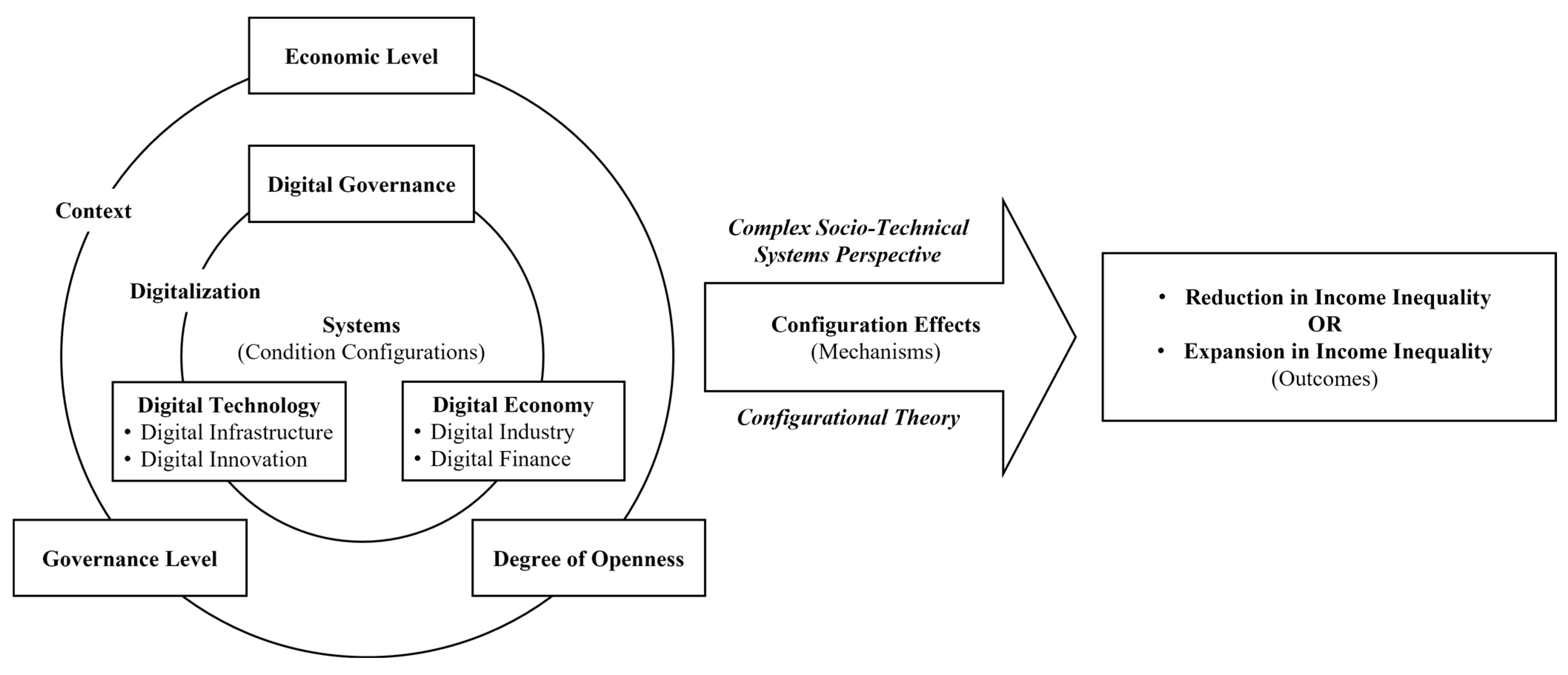
Drawing upon the insights from the complex socio-technical systems perspective [26,75] and configurational theory [25], this study proposes a specific analytical framework to investigate the configurational effects influencing national income inequality. This framework, illustrated conceptually in Figure 1 and adapted from related works [6,24], posits that the observed level of national income inequality (the outcome) emerges not from isolated factors but from the complex, interdependent interplay between a set of relevant digital ecosystem conditions and a set of key context conditions. The core premise is that national income inequality levels are emergent properties of a socio-technical system where multiple digital and macro-level factors interact in specific, often non-linear ways.
The framework first acknowledges that any national process of digital transformation is deeply embedded within a specific macro-level context. Based on the literature review, three crucial contextual dimensions are identified: the overall level of Economic Development, the capacity and quality of Governance, and the Degree of Economic Openness. These contextual conditions act as the backdrop against which digitalization unfolds, providing enabling resources (like capital and skills in developed economies), imposing constraints (like weak infrastructure or institutions), and fundamentally shaping the potential distributional consequences of digital initiatives [6]. For instance, the same digital finance innovation might reduce inequality in a well-regulated, high-literacy context but exacerbate it where regulation is absent and literacy is low.
Second, the framework recognizes the multidimensional nature of digitalization itself. Rather than treating “digitalization” as a monolithic concept, it disaggregates it into distinct, though interrelated, dimensions identified as salient in the literature: Digital Innovation (representing technological advancement), Digital Infrastructure (representing access and infrastructure foundations), Digital Industry (representing the structure of the digital economy), Digital Finance (representing digitally enabled financial services), and Digital Governance (representing the digitalization of public administration). These dimensions are conceptualized as forming a ‘digital system’ within each country, where their levels and interactions define the specific character of digitalization [23]. The framework assumes these dimensions do not operate in isolation but combine in various ways across different countries.
The central hypothesis of the framework, drawn directly from configurational theory, posits the existence of “Configurational Effects” or “Sustainable Pathways”. This means that the impact on national income inequality arises not from the simple additive effects of individual digital or contextual factors, but from the holistic effect of specific combinations—or configurations—of these conditions operating together [25]. Configurational theory emphasizes principles like “equifinality,” suggesting that multiple different combinations of digital and contextual factors might be sufficient to produce a similar outcome. It also highlights ‘causal asymmetry,’ meaning the set of conditions leading to reduced inequality may differ substantially in structure from the conditions leading to increased inequality [25]. This perspective aligns well with the complex systems view, which also stresses non-linear interactions and the idea that the whole system behaves differently from the sum of its parts [26].
By employing Panel fsQCA and NCA within this analytical framework, the study moves beyond asking “What is the average effect of X on inequality?” to asking “Which combinations of digital and contextual conditions are consistently associated with low (or high) national income inequality across different countries and time periods?”. This approach allows for a more nuanced investigation that can potentially reconcile the fragmented findings of previous research by identifying the specific contexts and configurations under which different digitalization dimensions exert their varying effects. It aims to provide a causally complex map of the pathways linking the digital age to national distributional outcomes.

3. Research Design

3.1. Research Methods

In the realm of social science and sustainable development research, distinguishing among different types of relationships between variables—primarily average effect relationships, necessary relationships, and sufficient relationships—is crucial for selecting appropriate methodologies [29]. Traditional regression methods primarily analyze the average “net effect” of changes in an independent variable X on changes in a dependent variable Y. While valuable, these symmetric approaches assume the separability of variable impacts and linear additivity, which are often ill-suited for analyzing the complex socio-technical transitions required for sustainable development [87].
Considering that the existing literature on the impact of digitalization on national income inequality presents fragmented and competing explanations [6,8], and that its impact mechanisms may be multiple, non-linear, and context-dependent [6], traditional linear analysis methods struggle to capture this causal complexity [6,24]. Therefore, this study draws on the complex socio-technical systems perspective [26,75] and configurational theory [25], employing Qualitative Comparative Analysis (QCA). QCA views research subjects not as isolated variables but as “configurations of conditions,” aiding in the analysis of complex causalities like multiple conjunctural causation, causal asymmetry, and equifinality. It is particularly well-suited for examining the complex necessary and sufficient configurational relationships between national context, digitalization paths, and social sustainability outcomes [25,88].
Specifically, this study utilizes Panel Fuzzy-Set Qualitative Comparative Analysis (Panel fsQCA) [28]. While recent studies have successfully applied this method to regional or sub-national inequality issues [6,24], its application to global cross-national analysis remains rare. By integrating panel data, Panel fsQCA introduces temporal and spatial dimensions, allowing observation of how configurations evolve over time and across economies, thus offering a richer, dynamic perspective beyond static cross-sectional analysis [28]. It facilitates the construction of mid-range theories that can empirically test and explain configurational outcomes across different periods.
Furthermore, to supplement and extend the analysis of necessary conditions—identifying critical “bottlenecks” for sustainable development—this study incorporates Necessary Condition Analysis (NCA) [29]. NCA identifies necessary (but not sufficient) conditions for an outcome by examining the effect size and statistical significance, quantifying the degree of necessity [29]. Unlike the traditional necessity analysis within QCA, which only determines if a condition is necessary, NCA provides a more nuanced understanding by quantifying the contribution strength of necessary conditions. This offers a more comprehensive understanding of the role of digitalization in national income inequality [6,24].
By combining Panel fsQCA and NCA, this study aims to identify the key configurations of digitalization and contextual conditions that lead to the reduction (bridging the gap) or exacerbation (widening the gap) of national income inequality. This methodological triangulation provides a robust explanation for how digital transformation affects SDG 10, moving beyond simple correlations to reveal causal pathways [6]. Detailed steps for applying Panel fsQCA and NCA are provided in Appendix B.

3.2. Sample Selection

To conduct a rigorous set-theoretic panel analysis, constructing a balanced panel dataset with high cross-national comparability is essential. A common challenge in global inequality research is the inconsistency of data sources and definitions. To address this and assess the configurational effects of digitalization factors on national income inequality accurately, we constructed a strictly screened balanced panel dataset covering 56 major economies globally over the period from 2012 to 2022 (11 years).
The sample selection process followed a “quality-over-quantity” strategy, adhering to strict criteria for data availability, completeness, quality, and reliability to ensure valid cross-national comparisons. Starting with a frame of all global economies, we prioritized data consistency. As the World Income Inequality Database (WIID) aggregates data from various sources (consumption vs. income, gross vs. net), mixing these indiscriminately leads to biased results [89]. Therefore, we strictly retained only those economies with high-quality data based on disposable household income and full national coverage, excluding observations with inconsistent definitions or substantial missing values. For the few missing values remaining in the retained sample, a combination of logarithmic linear interpolation and group-mean substitution (grouped by economic development level and geographic region) was employed.
Although this rigorous filtering resulted in a sample of 56 economies, this sample is highly representative of the global economic landscape, covering key developed and developing nations across all continents and accounting for a significant majority of global GDP. This approach balances data availability with the strict requirements of valid comparative analysis, facilitating a thorough examination of digitalization’s varied impacts across different settings without the noise of incompatible data. Detailed information on the economies included in the sample, including their codes, regions, and income level groupings, is provided in Appendix A.

3.3. Definition and Operation of Variables

3.3.1. Outcome Variable

The core outcome variable for this study is National Income Inequality, serving as the primary indicator for progress toward SDG 10. To construct a comparable cross-national panel dataset, we utilized the World Income Inequality Database (WIID), specifically the version updated on April 2025 [90]. Recognizing the significant heterogeneity within the WIID due to its compilation from diverse primary sources, a rigorous filtering process was implemented to ensure the maximum feasible consistency across countries and over time for the selected inequality measures. The primary indicator used is the Gini coefficient (GINI), supplemented by the Theil index for robustness checks.
The selection procedure involved several steps to enhance comparability. We focused on the time period 2000–2023 to encompass the study years and allow for interpolation. Only observations with national coverage (both area and population) were retained. Priority was given to inequality measures based on Net (Disposable) Household Income, using Per Capita adjustments for equivalence scaling. Consistency was further ensured by restricting the sharing unit to “Household” and the unit of analysis to “Person” (person-weighted estimates), with the reference period specified as “Year”. Finally, we leveraged pre-harmonized data by primarily including observations flagged for use in the WIID Companion dataset. This multi-step filtering yielded a panel dataset representing national income inequality based on consistent definitions available within WIID. Potential data gaps due to unavailability were noted for appropriate handling in subsequent analyses. For ease of interpretation in the QCA analysis, the Gini coefficient was reverse-calibrated (National Income Equality, ~GINI), where higher scores indicate lower inequality (better social sustainability performance).

3.3.2. Condition Variables

Based on the analytical framework developed in Section 2 and drawing on existing literature, this study selects eight condition variables, categorized into digital paths and macro context, to explore their combined influence on national income inequality. The specific operationalization and data sources are as follows:
Digital Infrastructure. This variable gauges the extent and quality of foundational digital connectivity within an economy, representing the physical basis for digital inclusion. Following established practices [91,92,93], this study measures the level of digital infrastructure using a composite index derived via the entropy weighting method. The index integrates several key indicators reflecting both access and usage capacities: the percentage of individuals using the internet, fixed telephone subscriptions per capita, fixed broadband users per capita, active mobile broadband subscriptions per capita, mobile cellular subscriptions per capita, the percentage of households possessing a computer, and international internet bandwidth usage per capita. These metrics collectively capture the penetration and capacity of core digital infrastructure essential for leveraging digital technologies. Data for these indicators are sourced from the World Bank’s World Development Indicators [94] and the International Telecommunication Union (ITU) [95].
Digital Innovation. This variable aims to capture an economy’s innovation output and capacity in the digital technology sphere. Referencing relevant research [93,96], we used the Entropy Weight Method to integrate three indicators: number of scientific and technical journal articles per capita, high-technology exports as a percentage of manufactured exports, and high-technology manufacturing value added as a percentage of manufacturing value added. These indicators collectively reflect the creation, commercialization, and economic impact of digital innovation across key stages of the innovation chain. Data were sourced from the World Bank’s World Development Indicators [94].
Digital Industry. This variable measures the scale and performance of the digital industry in an economy’s international trade. Drawing from existing studies [53,91,93], we applied the Entropy Weight Method to four indicators: ICT service exports (current USD), ICT service exports as a percentage of service exports, ICT goods exports as a percentage of total goods exports, and ICT goods imports as a percentage of total goods imports. These indicators reflect the digital industry’s scale and market performance in international trade. Data were sourced from the World Bank’s World Development Indicators [94].
Digital Finance. This variable assesses the breadth and depth of digital technology application in financial services, critical for financial inclusion. Following established research [92,97], we utilized the Entropy Weight Method to process four indicators: number of ATMs per 100,000 adults, percentage of adults (age 15+) with an account at a financial institution or with a mobile-money-service provider, percentage of adults (age 15+) making or receiving digital payments in the past year, and percentage of adults (age 15+) borrowing from a financial institution or using a credit card. These indicators collectively capture the accessibility, penetration, activity, and inclusion level of digital finance within economies. Data were sourced from the World Bank’s World Development Indicators [94] and the Global Financial Inclusion database [98].
Digital Governance. This variable measures the extent to which governments utilize digital technologies to deliver public services and promote citizen participation, reflecting institutional digital capacity. Following research practices [93,99], we used data from the United Nations E-Government Development Index (EGDI), specifically calculating the average of the Online Service Index (OSI) and the E-Participation Index (EPI). These indices evaluate the capacity of digital governance services and the outcomes of digital collaborative governance, also measuring digital inclusion in governance by assessing accessibility and participation [100].
Economic Level. This variable represents the overall economic development status of an economy, serving as a proxy for the resources available to support social sustainability. Following common practice [101,102], we use GDP per capita (PPP, current international $) as the proxy variable. Data were sourced from the World Bank’s World Development Indicators [94].
Degree of Openness. This variable reflects the degree of an economy’s integration into the global economy. Drawing on established research [103,104], we used the KOF Globalization Index, specifically the economic globalization index (de facto component). This index covers multiple aspects including trade and financial globalization, offering a broader perspective than single trade indicators. This study focuses on the de facto dimension and uses the average of its sub-indicators.
Governance Level. This variable measures the institutional quality and governance capacity of an economy, acting as the institutional guarantor for equitable distribution. We adopted the World Bank’s Worldwide Governance Indicators (WGI) [93,101]. The WGI covers six key dimensions: Voice and Accountability, Political Stability and Absence of Violence/Terrorism, Government Effectiveness, Regulatory Quality, Rule of Law, and Control of Corruption. This study uses the average score across these six dimensions to represent the overall governance level.

3.4. Data Preprocessing and Analysis Procedure

In constructing the final panel dataset for analysis, data cleaning was first performed, excluding economy samples with excessive missing data. For the few remaining missing values in the retained sample, logarithmic linear interpolation and group-mean substitution (based on economic development level and geographic region) were used to create a balanced panel. Second, considering the potential time lag for digitalization measures to impact socio-economic outcomes and to mitigate potential reverse causality concerns, this study follows common practice in the literature [6,105] by applying a one-period lag to all eight condition variables (Digital Infrastructure, Digital Innovation, Digital Industry, Digital Finance, Digital Governance, Economic Level, Degree of Openness, Governance Level).
In the core QCA step of data calibration, the choice of the 5th–50th–95th percentile anchors follows established conventions in QCA research when theory-driven thresholds are unavailable [6]. This approach ensures that the calibration reflects the empirical distribution of the sample while avoiding arbitrary cutoffs. To ensure robustness, we also tested alternative calibration schemes (1st–50th–99th percentiles and 10th–50th–90th percentiles) in Appendix H.3. The core configurations remained stable across these alternative specifications, confirming that our findings are not artifacts of a particular calibration choice. This methodological triangulation enhances confidence in the identified pathways. Specifically, based on the distribution of each variable across the entire panel dataset (all economies and years), the 95th percentile, 50th percentile (median), and 5th percentile were set as the calibration anchors for full membership (=1), the crossover point (=0.5), and full non-membership (=0), respectively. As previously mentioned, the outcome variable, national income inequality (measured by the Gini coefficient), was reverse-coded (~GINI) before calibration, meaning higher calibrated membership scores represent greater national income equality. The specific calibration anchors for each variable are detailed in Table 1.
Following the necessary condition analysis (using both NCA and QCA necessity tests), we proceeded to the sufficiency analysis using the truth table algorithm implemented in relevant R packages (SetMethods version 5.2.3, QCA version 2019, and NCA Version 4.0.2). Based on standard QCA practices and the specifics of this study, the following analysis parameter thresholds were set (see notes under Table 1): For configurations explaining the reduction of national income inequality (Outcome: ~GINI), a raw Consistency score of at least 0.9 was required. For configurations explaining the expansion of national income inequality (Outcome: GINI), a raw Consistency score of at least 0.8 was required. Concurrently, all configurations needed to meet a PRI Consistency (Proportional Reduction in Inconsistency consistency) score threshold of at least 0.8 for ~GINI and at least 0.7 for GINI. Additionally, to ensure that the identified configurations have sufficient empirical grounding, a case Frequency threshold of 8 was applied, meaning each configuration included in the final analysis must represent at least 8 cases (economy-year observations). Finally, robustness tests were conducted on the main empirical findings.

4. Results Analysis

This chapter presents the empirical findings derived from applying Panel Fuzzy-Set Qualitative Comparative Analysis (Panel fsQCA) and Necessary Condition Analysis (NCA) to the balanced panel dataset of 56 economies from 2012 to 2022. Following the research design outlined in Section 3, the analysis aims to unravel the complex configurations of digitalization dimensions and contextual factors associated with national income inequality, primarily measured by the Gini coefficient (reverse-calibrated, ~GINI, where higher scores mean lower inequality). By rigorously identifying these patterns, we aim to map distinct “sustainable development pathways” that can effectively bridge the digital divide and advance SDG 10.

4.1. Necessity Analysis: Assessing Prerequisites for Inequality Outcomes

Before proceeding to the sufficiency analysis of configurations, we first examine whether any single condition acts as a necessary prerequisite—or what might be termed a “critical bottleneck”—for either the reduction (~GINI) or the persistence/increase (GINI) of national income inequality. This assessment utilizes both the necessity analysis function within Panel fsQCA and the complementary NCA methodology to identify the foundational elements required for social sustainability.

4.1.1. Panel fsQCA Necessity Results

In Panel fsQCA, a condition is typically considered necessary if its pooled consistency score exceeds 0.9 and its pooled coverage is substantial (e.g., >0.5), while exhibiting stability across time and cases [28]. Table 2 presents the necessity analysis results for all eight conditions and their negations. As the table indicates, none of the individual conditions (or their negations) achieve a pooled consistency score above the 0.9 threshold for either outcome (~GINI or GINI). The highest consistency scores for predicting reduced inequality (~GINI) are observed for Digital Infrastructure (0.814), Degree of Openness (0.784), and Governance Level (0.792). While these fall short of the strict necessity benchmark, their relatively high values suggest they function as quasi-necessary foundations for equitable development. Similarly, for the expansion of inequality (GINI), the absence of Economic Level (~Economic Level, 0.842) and the absence of Openness (~Degree of Openness, 0.832) show relatively higher consistency, but still below 0.9. The consistency adjusted distances also show some variability, particularly for conditions like Digital Governance. Overall, the Panel fsQCA necessity analysis suggests that there is no single “silver bullet” for solving inequality; rather, achieving social equity is a systemic challenge requiring a combination of factors.

4.1.2. Necessary Condition Analysis (NCA) Results

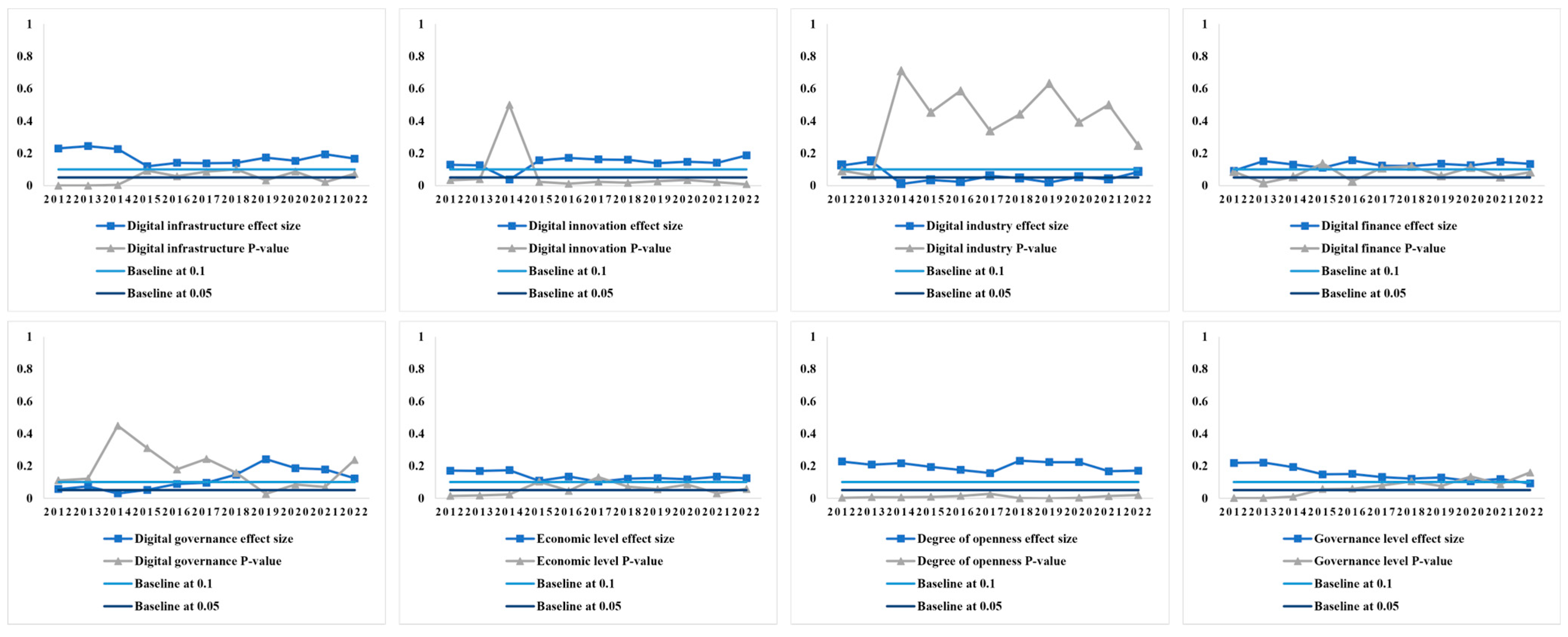
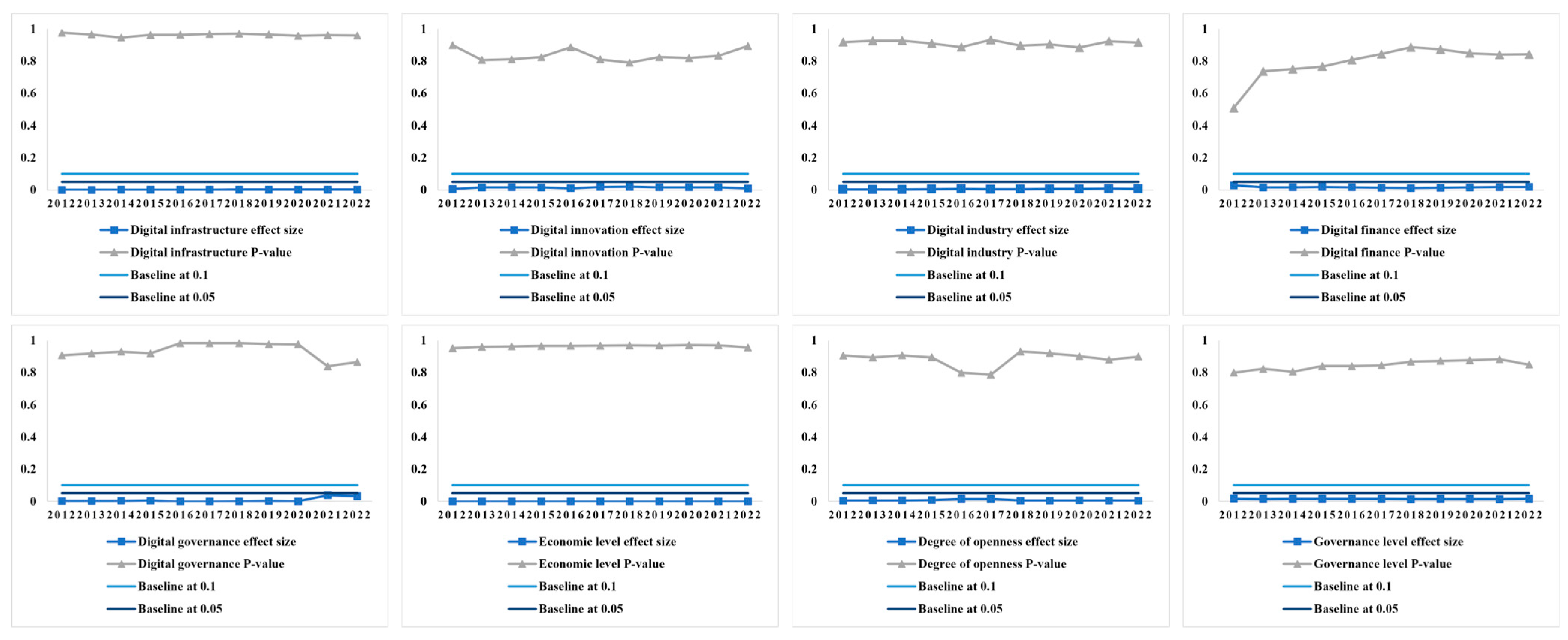
NCA offers a complementary perspective by quantifying the necessity effect size (d) and statistical significance (p-value) of each condition, thereby identifying the “hard thresholds” required for sustainable outcomes [29]. A condition is considered necessary if d > 0.1 and p < 0.05. Table 3 presents the average NCA results across the panel. The results provide critical insights into the “boundary conditions” for inclusive growth. Digital Infrastructure (d = 0.124, p = 0.013) and Digital Innovation (d = 0.155, p = 0.005) emerge as significant necessary conditions. This empirically validates the premise that in the modern era, universal digital access is a fundamental prerequisite for social equity, aligning directly with the targets of SDG 9 [12]. Furthermore, Degree of Openness (d = 0.128, p = 0.013) and Governance Level (d = 0.102, p = 0.039) also meet the criteria (d > 0.1, p < 0.05). This underscores that technology alone is insufficient; it must be embedded in a transparent, well-governed, and open institutional environment to benefit society broadly [22,83]. For the expansion of inequality (GINI), no condition demonstrates a necessary effect size. This asymmetry implies that while achieving equality requires specific structural foundations (Infrastructure, Governance), rising inequality is often the result of diverse and chaotic deficits rather than a single driver.
A note of caution for policy interpretation is warranted. The NCA results identify conditions that are statistically necessary—meaning that in the observed data, a minimum level of these conditions is required to allow for low inequality outcomes. However, statistical necessity should not be conflated with practical policy sufficiency. A condition being necessary implies that without it, achieving low inequality is empirically improbable; it does not imply that merely ensuring this condition will automatically produce the desired outcome. For instance, while Digital Infrastructure emerges as a necessary condition, simply expanding internet access without addressing complementary factors (such as governance capacity or economic development) may not reduce inequality. Policymakers should therefore interpret these results as identifying ‘critical bottlenecks’ that must be addressed, while recognizing that overcoming these bottlenecks is a necessary but not sufficient step toward inclusive growth. The sufficiency analysis in Section 4.2 complements this by revealing which combinations of conditions are jointly sufficient.

4.2. Sufficiency Analysis: Equifinal Pathways to Sustainable Equity

We now turn to the core of the QCA approach: identifying configurations of conditions that are sufficient for the outcome. Using the calibrated data and the parameters specified in Section 3, Boolean minimization yielded distinct configurations associated with both the reduction (~GINI) and expansion (GINI) of national income inequality. Table 4 presents the intermediate solution, distinguishing between core (●/⊗) and peripheral (●/○) conditions. The analysis reveals multiple pathways—demonstrating the principle of equifinality—leading to both lower and higher inequality, underscoring the inadequacy of single-factor explanations. The high overall solution consistency (0.973 for ~GINI; 0.908 for GINI) and overall PRI (0.94 for ~GINI; 0.811 for GINI) confirm the empirical relevance and explanatory power of these configurational models. The overall solution coverage (0.486 for ~GINI; 0.437 for GINI) suggests the configurations explain a substantial proportion of the global landscape.
Interpretation guide: Configurations H1–H3 represent distinct “pathways to equity,” each characterized by different combinations of digital and contextual factors. H1 (Open Innovation Mode) relies on innovation and openness in affluent small economies; H2a/H2b (Governance-Regulated Industry Mode) emphasizes the synergy between digital industrial scale and strong governance in major economies; H3 (Open Niche Mode) demonstrates how transition economies can leverage openness to bypass structural deficits. Conversely, NH1 and NH2 represent “traps” where multidimensional deficits (NH1) or hollow digitalization without substance (NH2) perpetuate inequality.

4.2.1. Affirmative Analysis: Pathways to Bridging the Income Gap

The analysis identified four distinct configurations (H1, H2a, H2b, H3 in Table 4) that are sufficient for achieving lower national income inequality (~GINI). Based on their core logic and contextual characteristics, these can be categorized into three distinct sustainable development modes: the “Open Innovation Mode,” the “Governance-Regulated Industry Mode,” and the “Open Niche Mode”.
Configuration H1 represents the “Open Innovation Mode,” primarily observed in highly developed, small-to-medium-sized economies (e.g., Switzerland, Austria, Sweden). This pathway is characterized by the core presence of Digital Innovation and Degree of Openness, supported by high Digital Infrastructure and Digital Finance as peripheral conditions. The context is one of high Economic Level and high Governance Level (peripheral).
The logic here is one of “Synergistic Expansion.” In these affluent, open economies, reducing inequality is not merely about redistribution but about continuous value creation at the technological frontier. High Degree of Openness allows these nations to access global markets and knowledge flows [11], while robust Digital Innovation capabilities ensure they occupy high-value-added positions in the global value chain. The generated “innovation rents” [106] are then broadly distributed through mature financial systems and infrastructure. This aligns with the “inclusive innovation” perspective [39], suggesting that when an economy is open and innovative enough to lead globally, and supported by strong domestic foundations, the digital dividends can be large enough to permeate society, effectively narrowing the income gap [36].
Configurations H2a and H2b collectively illustrate the “Governance-Regulated Industry Mode.” This pattern is prevalent in major economies and strong welfare states (e.g., Germany, Norway, Canada, Japan). The defining feature of this mode is the dual core presence of Digital Industry and Governance Level.
In Configuration H2a, this core combination is supported by Digital Governance and Infrastructure in a high-openness context. In H2b, it operates with a broader set of peripheral supports but does not rely on Openness as a core condition. The shared mechanism here is “Institutionalized Redistribution.” Unlike the H1 mode which relies on innovation breakthroughs, this mode emphasizes the scale of the Digital Industry as the economic engine, paired with a strong Governance Level as the “social regulator”.
This finding is theoretically significant. It suggests that for large economies or welfare states, the sheer scale of the digital economy can lead to monopolistic “winner-take-all” dynamics that exacerbate inequality [37,45] unless countered by strong state capacity. High-quality governance acts as a critical moderator, ensuring that the wealth generated by digital industries is channeled towards public welfare through taxation, regulation, and social protection [107]. The presence of Digital Governance (in H2a) further enhances this capacity by improving allocative efficiency [66,68]. Thus, this mode validates that “Digital Industry” and “Governance” must exist in symbiosis to achieve SDG 10.
Configuration H3 represents a distinct “Open Niche Mode” (or Asymmetric Openness Mode), typically found in transition economies (e.g., Hungary). This pathway challenges the conventional wisdom of “infrastructure-first” development. It is characterized by the core presence of Degree of Openness and Digital Innovation, remarkably occurring in a context where Economic Level, Governance Level, and even Digital Infrastructure are absent (⊗) or peripherally missing.
This configuration depicts an “Outward-Oriented Leapfrogging” strategy. In the absence of strong domestic consumption power (Economic Level) or robust institutional frameworks (Governance), these nations rely on Degree of Openness to embed themselves into specific high-value segments of the Global Value Chain (GVC) [108]. By fostering specific Digital Innovation capabilities (e.g., specialized software development or R&D centers for multinational corporations), they create localized islands of high productivity and employment that can uplift incomes despite broader structural deficits. This suggests that for resource-constrained nations, full-stack digital development is not the only path; identifying and occupying a specialized “niche” in the global open market can serve as an effective leverage point to mitigate inequality [109].

4.2.2. Negative Analysis: The Traps of Digital Exclusion

Conversely, the analysis identified two configurations (NH1, NH2) consistently associated with higher national income inequality (GINI). These pathways highlight the structural and institutional traps that hinder sustainable development.
Configuration NH1 represents the “Structural Destitution Trap,” widely observed in developing economies in the Global South (e.g., Côte d’Ivoire, Peru). This pathway is defined by the core absence of nearly all drivers: Digital Infrastructure, Digital Innovation, Digital Industry, and Degree of Openness.
This configuration portrays a “Vicious Cycle of Exclusion.” The simultaneous lack of connectivity (Infrastructure), economic engine (Industry/Innovation), and global integration (Openness) creates a closed, stagnant system. In such environments, the benefits of any minor technological adoption are inevitably captured by a tiny elite, while the majority remains disconnected, cementing high inequality [19,81]. This confirms that without breaking the bottleneck of multidimensional poverty, digital equity remains out of reach.
Configuration NH2 reveals a more nuanced and critical phenomenon: the “Hollow Governance Trap.” This configuration is characterized by the core presence of Digital Governance, yet paradoxically coupled with the core absence of Digital Infrastructure and Digital Industry. The Economic Level is also absent.
This finding offers a stark warning against “Digital Formalism” [110]. It describes a scenario where governments invest in the visible layer of Digital Governance (e-government portals, administrative digitization) while the underlying “real economy”—Digital Industry—and the necessary physical access—Digital Infrastructure—remain undeveloped [69].
In such a “hollow” structure, digital governance fails to function as an equalizer. Instead, it may exacerbate the divide. Without a robust digital industry to provide employment and without universal infrastructure to ensure access, e-government services risk becoming exclusive tools for the urban educated class, while the poor are further marginalized by the “digital bureaucracy” [70]. This “Digital Facade” creates an illusion of modernization but lacks the substantive economic foundation to drive inclusive growth, ultimately widening the income gap [73,111]. This underscores that digital governance cannot float in a vacuum; it must be grounded in real industrial and infrastructural development to be sustainable.
As seen in Table 5, regarding the world’s largest economies, our configurational analysis reveals distinct patterns. The United States is consistently affiliated with the Governance-Regulated Industry Mode (H2b) from 2017 onwards, where its massive digital industrial scale is moderated by governance capacity to achieve relatively lower inequality outcomes. Major European Union economies demonstrate heterogeneous pathways: Germany appears in multiple reducing-inequality configurations (H1, H2a, H2b) throughout the study period, reflecting its dual strengths in innovation and industrial governance; France similarly oscillates between H1 and H2b depending on the year. Japan and Korea are firmly positioned within H2b, exemplifying the East Asian model of governance-regulated digital industrialization.
Notably, China is included in our 56-economy sample but does not consistently affiliate with any single configuration across all observed years. This reflects China’s unique developmental trajectory—combining rapid infrastructure expansion, massive industrial scale, strong state intervention, yet with governance quality metrics that differ from Western benchmarks. China’s configurational profile warrants dedicated future research to unpack its sui generis pathway.
Among major emerging economies, Brazil and Mexico predominantly fall into the Hollow Governance Trap (NH2), serving as cautionary examples where digital governance investments have not translated into inclusive outcomes due to insufficient industrial and infrastructural foundations. This finding carries significant policy implications for large middle-income countries pursuing digital modernization strategies.

4.2.3. Context-Specific Pathways: Geo-Economic Asymmetries and Strategic Choices

Beyond the specific configurations, a cross-case analysis reveals a profound geo-economic asymmetry in how digitalization shapes national income inequality. Mapping the affiliated cases (see Appendix E) to their income groups reveals that the pathways to social sustainability differ fundamentally between the Global North (developed economies) and the Global South (developing and emerging economies). This distinction highlights that the “digital divide” is not merely about access to technology, but about the divergent impact mechanisms of digital transformation under different institutional constraints [31].
The configurations leading to reduced inequality (H1, H2a, H2b) are predominantly populated by high-income economies in Europe (e.g., Austria, Germany, Norway), North America (Canada, USA), and East Asia (Japan, Korea). In these contexts, the mechanism for narrowing the income gap is characterized by “Synergistic Integration”.
These economies possess a “triple-high” baseline: high economic prosperity, strong governance capacity, and deep global integration. Under these favorable “boundary conditions,” digitalization reduces inequality not by providing basic access (which is already saturated), but by enhancing systemic efficiency and inclusion. The comparison between H1 and H2a/b reveals a “Strategic Flexibility” unique to the Global North: developed nations can leverage different comparative advantages. They can pursue an “Open Innovation” path (H1, e.g., Switzerland, Sweden) focusing on high-tech value creation, or a “Governance-Regulated Industry” path (H2a/b, e.g., Germany, USA) focusing on industrial scale and regulatory redistribution. This suggests that in the Global North, robust institutions act as a buffer, allowing digital transformation to function as an engine for inclusive growth rather than a driver of polarization [80].
In stark contrast, the landscape for the Global South and transition economies is defined by a binary choice between “Asymmetric Breakthrough” (H3) and “Structural Traps” (NH1, NH2).
Configuration H3 (Open Niche Mode), populated by transition economies like Hungary, points to a narrow “Asymmetric Breakthrough” pathway. Unlike the complex synergies required in the Global North, this model relies heavily on the leverage of Degree of Openness and Digital Innovation, even in the absence of top-tier economic or governance levels. This indicates that for emerging economies, embedding into the Global Value Chain (GVC) is a vital compensatory mechanism. By accessing external markets and technology transfers through openness, these nations can bypass domestic structural deficits (such as weak local demand or infrastructure) to achieve relative equity [112].
However, the risks are pronounced. The configurations leading to widened inequality (NH1, NH2) are almost exclusively concentrated in the Global South (e.g., Côte d’Ivoire, Colombia, Mexico). Configuration NH1 (Structural Destitution) illustrates the “Vicious Cycle” of multi-dimensional deficits. More critically, the “Hollow Governance Trap” (NH2) observed in cases like Mexico or Brazil (specific years) serves as a potent warning against institutional mimicry. It reveals that “leapfrogging” via Digital Governance alone is insufficient and potentially counterproductive if it lacks the material foundation of Digital Industry and Infrastructure. When developing nations adopt the “form” of digital modernization without the “function” of economic substance, digitalization fails to bridge the income gap and may instead reinforce existing elite privileges [110].
In summary, the causal logic of digitalization is highly context-dependent: the Global North thrives on institutional synergy and flexibility, while the Global South navigates a precarious path where openness offers a lifeline (H3), but hollow modernization (NH2) leads to deepened inequality.

4.3. Between Consistency Analysis: Temporal Resilience of Sustainable Pathways

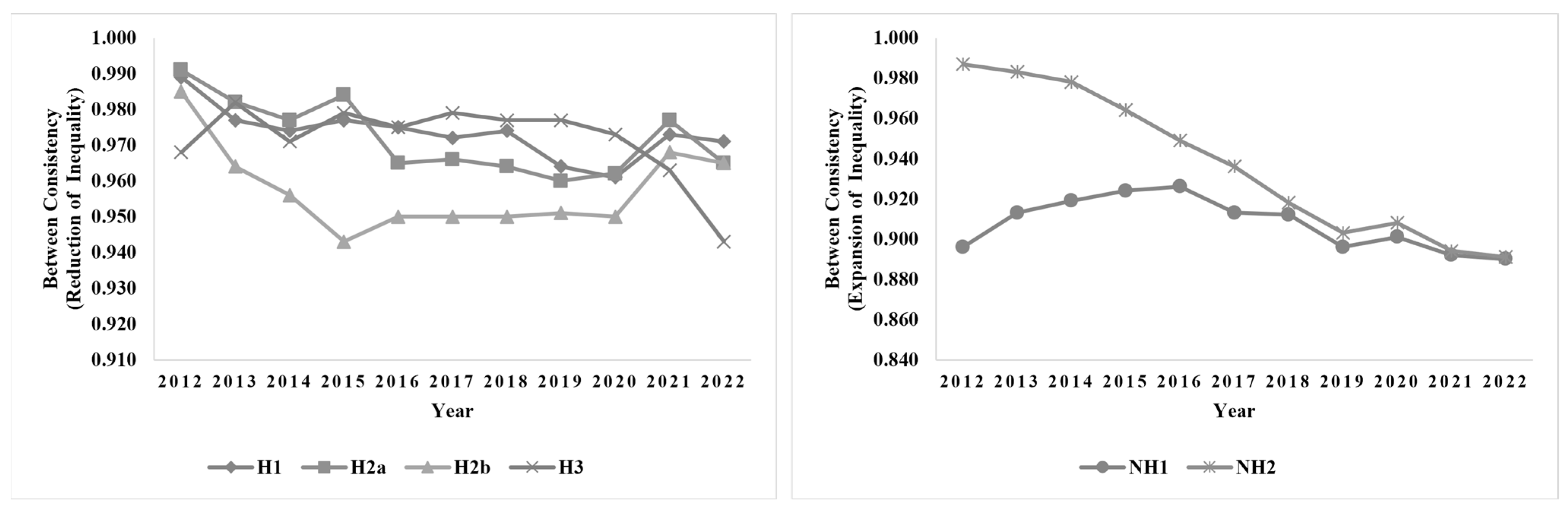
Panel fsQCA allows for the examination of how the explanatory power of each configuration evolves over the study period (2012–2022), offering insights into the temporal resilience of these pathways. Figure 2 plots the between consistency scores for each configuration annually.
Observing Figure 2, the configurations sufficient for reducing inequality (H1, H2a, H2b, H3) generally maintain high consistency scores (predominantly above 0.9) throughout the period, indicating their stable relevance over time. This suggests that these identified “Sustainable Modes”—whether the “Open Innovation Mode” (H1), the “Governance-Regulated Industry Mode” (H2a, H2b), or the “Open Niche Mode” (H3)—were not transient phenomena but remained effective strategies for achieving lower inequality across the decade studied. Notably, the consistency of these paths remains steady even during the global disruptions of 2020–2021 (COVID-19), suggesting that nations with robust digital-institutional configurations were better equipped to mitigate the inequality-widening effects of the pandemic [113].
Similarly, the configurations for expanding inequality (NH1, NH2) also generally show stable and high consistency. This confirms that the “Structural Destitution Trap” (NH1) and the “Hollow Governance Trap” (NH2) persistently drive inequality unless the underlying structural deficits are actively addressed [6]. Any significant dips or peaks observed in specific years might warrant further investigation regarding the impact of external shocks, but the overall trend confirms the temporal robustness of the identified causal patterns.

4.4. Within Consistency Analysis: Cross-National Applicability

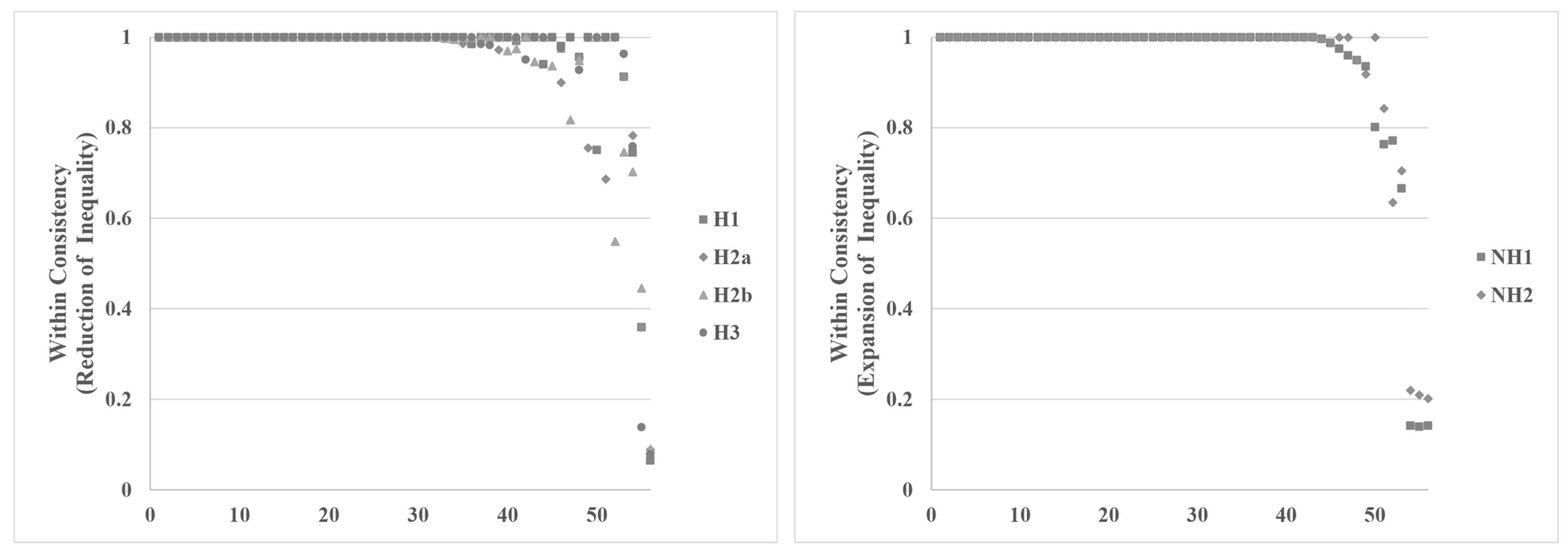
Within consistency analysis explores how well each configuration explains the outcome across different individual cases (economies) within the sample, assessing the geographical applicability of these models. Figure 3 presents scatter plots illustrating the distribution of within consistency scores for the economies affiliated with each configuration.
Figure 3 reveals that for the inequality-reducing configurations (H1, H2a, H2b, H3), the vast majority of affiliated country-year cases exhibit very high within consistency scores (close to 1.0). This indicates that these identified “Inclusive Growth Modes” provide strong explanations for the observed low inequality across diverse geographies—from the “Open Innovation” driven economies in the Global North to the “Open Niche” players in transition regions. The high density of points near the top of the plot signifies a good fit between the model and the data for most cases.
However, a small number of cases might show lower within consistency, representing economies where unique national circumstances play a more significant role beyond the identified configurations [6]. Despite these outliers, the overall high within consistency across most cases validates that while context matters, there are robust configurational mechanisms (such as the synergy between Digital Industry and Governance in H2a/b, or Openness and Innovation in H3) that drive social sustainability across different national systems [28].

4.5. Robustness Tests

To ensure the stability and reliability of the sufficiency analysis findings, several robustness checks were conducted (shown in Appendix H), including varying the consistency and PRI thresholds, adjusting case frequency thresholds, modifying calibration anchor settings, and using the Theil Index as an alternative outcome variable. The results consistently support the core configurations identified in the baseline analysis, confirming that the “paths to equality” and “traps of inequality” identified here are robust empirical regularities, not artifacts of parameter selection.

5. Discussion and Conclusions

Addressing the persistent challenge of national income inequality in an era of rapid digital transformation requires moving beyond simplistic linear assumptions toward a more nuanced understanding of complex causal interactions [6]. As established in the preceding chapters, the existing literature presents a fragmented and often contradictory picture of digitalization’s distributional impacts [8]. This study, employing a complex socio-technical systems perspective and leveraging the configurational methodology of Panel Fuzzy-Set Qualitative Comparative Analysis (Panel fsQCA) alongside Necessary Condition Analysis (NCA), sought to unravel the multifaceted pathways through which combinations of digitalization dimensions and contextual factors influence national income inequality across 56 major economies from 2012 to 2022. This concluding chapter discusses the main findings in relation to the existing literature, outlines the study’s theoretical contributions to the field of sustainable development, acknowledges its limitations, and suggests directions for future research.

5.1. Discussion of Main Findings

The empirical analysis yielded several key insights into the complex interplay between digitalization, national context, and income inequality, offering a more integrated perspective than previous variable-oriented studies. These findings reveal that the path to SDG 10 is not uniform but highly contingent on a nation’s development stage and institutional fabric.
First, the necessity analysis revealed crucial prerequisites—or “sustainable bottlenecks”—for achieving lower national income inequality. While Panel fsQCA did not identify any single condition meeting the strict 0.9 consistency threshold for necessity, the complementary NCA highlighted Digital Infrastructure, Digital Innovation, Degree of Openness, and Governance Level as necessary conditions (on average) for reducing inequality (Table 3). This finding implies that there are “hard thresholds” for social sustainability. The necessity of Digital Infrastructure resonates with literature emphasizing that in the 21st century, basic digital access is a fundamental right and a precondition for economic participation [12,114]. The necessity of Openness and strong Governance underscores the critical role of the macro-environment in enabling inclusive outcomes from digitalization, supporting arguments that global integration and institutional quality are the “guardrails” that channel digital dividends effectively to the marginalized [22,83].
Second, the sufficiency analysis uncovered multiple distinct pathways (equifinality) through which lower national income inequality can be achieved, demonstrating that there is no single “best practice” digital strategy. Instead, we identified three distinct geo-economic modes. The “Open Innovation Mode” (H1) demonstrates that for small, affluent economies, the synergy of high Openness and Digital Innovation creates a “value-creation engine” that supports high welfare. The “Governance-Regulated Industry Mode” (H2a, H2b) reveals that for major economies, the sheer scale of the Digital Industry acts as the economic base, but it effectively reduces inequality only when paired with high Governance Level. This confirms that strong institutions are the essential “converter” of industrial profits into social equity [106]. Crucially, the “Open Niche Mode” (H3) challenges the linear view that developing nations must build comprehensive infrastructure before reaping digital benefits. Instead, it shows that for transition economies lacking domestic resources (low Economy/Infrastructure), leveraging Openness to embed into global innovation chains acts as a “Compensatory Mechanism” [108]. By finding a specialized niche, these nations can achieve an “Asymmetric Breakthrough” in inequality reduction without waiting for full modernization.
Third, the analysis of pathways leading to high inequality (NH1, NH2) strongly points towards the detrimental effects of “developmental traps.” Configuration NH1 (Structural Destitution Trap) confirms that multidimensional deficits in infrastructure and openness cement inequality. More significantly, Configuration NH2 identifies the “Hollow Governance Trap.” It reveals that in the Global South, the presence of Digital Governance without the supporting pillars of Digital Industry and Infrastructure fails to bridge the gap. This suggests that “Digital Formalism”—adopting the administrative forms of a digital state without the economic substance—is an illusion that may mask deeper structural exclusions [69,110].

5.2. Theoretical Contributions

This study makes several contributions to the theoretical understanding of the digitalization-inequality relationship within the broader framework of sustainable development.
Primarily, it advances the literature by establishing a configurational framework, moving beyond the limitations of traditional net-effect analyses. By explicitly modeling causal complexity, the study integrates previous disparate findings into a coherent typology: the “Synergistic Integration” of the Global North (H1, H2) versus the “Asymmetric Breakthrough vs. Structural Traps” of the Global South (H3, NH1, NH2). This framework explains why the same factor (e.g., Openness) acts as a “multiplier” in developed contexts (H1) but as a critical “lifeline” in transition contexts (H3) [6,25].
Second, the study theorizes the “Contingency of Digital Governance,” challenging the uncritical promotion of e-government. By contrasting the “Governance-Regulated Industry Mode” (H2) with the “Hollow Governance Trap” (NH2), we argue that the efficacy of digital governance is fundamentally dependent on the existence of a real digital economy. In the presence of a strong digital industry (H2), governance acts as a redistributive force; in its absence (NH2), governance risks becoming a “suspended” superstructure that creates administrative barriers rather than inclusion [111]. This contributes to the critical literature on digital development by highlighting the dangers of “isomorphic mimicry” in digitalization strategies [110].
Third, the identification of the “Open Niche Mode” (H3) contributes to Sustainability Transitions theory by documenting a “Non-linear Leapfrogging” pathway. It refutes the rigid developmental stage theory which suggests infrastructure must precede global integration. Instead, it provides empirical evidence that “Openness” and “Innovation” can substitute for missing domestic foundations in specific transition phases, offering a new theoretical lens for understanding latecomer advantages in the digital age [112].

5.3. Practical Implications

The findings offer several actionable insights for policymakers, international organizations, and other stakeholders aiming to leverage digitalization for inclusive growth and the reduction of national income inequality.
First, the necessity analysis underscores the importance of foundational investments. Achieving lower inequality appears contingent on minimum levels of Digital Infrastructure and Governance. Policymakers must recognize that while leapfrogging is possible (H3), it has limits; eventually, the “hard thresholds” of infrastructure must be met to sustain progress towards SDG 9.
Second, the principle of equifinality implies that context-specific strategies are crucial [6]. For Major Economies (H2-type), the priority should be “Regulation and Redistribution.” Policies should focus on strengthening the governance of the digital industry—antitrust enforcement, data tax regimes, and algorithmic accountability—to ensure digital rents are shared [107]. For Transition Economies (H3-type), the strategy should be “Openness and Niche Targeting.” Rather than attempting to build a full-stack domestic digital economy from scratch, these nations should leverage openness to attract specific segments of the global value chain (e.g., BPO, specialized R&D) that match their human capital, using global connectivity to compensate for local deficiencies.
Third, the warning from the “Hollow Governance Trap” (NH2) is critical for the Global South. Policymakers must avoid the temptation of “Image-based Digitalization.” Investing heavily in e-government portals while the productive base (Digital Industry) and access layer (Infrastructure) remain hollow is counterproductive. Development aid and national budgets should rebalance towards “Substantive Digitalization”—fostering local digital enterprises and universal connectivity—before expanding complex digital bureaucracies.

5.4. Limitations and Future Research

While this study provides valuable insights, it is subject to several limitations that also open avenues for future research.
First, measurement challenges persist. Operationalizing complex concepts like “digital innovation” or “governance level” with cross-nationally comparable indicators inevitably involves simplification. While standard indices were used, future research could benefit from more granular or nuanced measures as data become available. Data availability also constrained the sample size; expanding the dataset could enhance generalizability.
Second, methodological limitations apply. QCA identifies association patterns consistent with sufficiency or necessity but does not establish causality in the same way as methods designed for causal inference [25]. While lagging variables helps mitigate reverse causality concerns, endogeneity cannot be entirely ruled out. Furthermore, QCA results can be sensitive to calibration choices, although robustness checks mitigate this concern.
Third, the level of analysis is national. This study examines within-country inequality at the national level. Future research using sub-national data or group-disaggregated inequality measures within a configurational framework could provide deeper insights.
Fourth, the scope of conditions included is not exhaustive. Other factors, such as education levels, industrial structure, or social policies, undoubtedly influence national inequality. Future configurational studies could incorporate a wider or different set of conditions to capture broader social sustainability dimensions.
Data-related constraints merit particular attention. Our strict adherence to high-quality income inequality data from the WIID—requiring consistent definitions based on disposable household income with national coverage—necessarily excluded many low-income countries (LICs) where such data are unavailable or unreliable. This exclusion is not methodologically arbitrary but reflects the genuine challenge of measuring inequality consistently across vastly different statistical infrastructures [89]. However, it means that our findings may not generalize to the world’s poorest nations, precisely where the promise and peril of digitalization are most acute. As data quality improves through initiatives such as the World Bank’s Living Standards Measurement Study and expanded household survey coverage, future research should explicitly test whether the identified pathways—particularly the “Hollow Governance Trap”—apply to LICs or whether entirely different configurational dynamics emerge in contexts of extreme resource scarcity.
Specific future research directions emerging from this study include: (1) sub-national extensions: applying Panel fsQCA to regional or urban-rural inequality within large economies (e.g., China, India, Brazil) to examine whether the national-level typology holds at finer geographic scales or whether additional pathways emerge; (2) dynamic configurational analysis: employing temporal QCA or sequence analysis to investigate how countries transition between configurations over time—for instance, whether nations can escape the “Hollow Governance Trap” through specific policy interventions; (3) mechanism-tracing case studies: conducting in-depth qualitative research on countries exemplifying contrasting configurations (e.g., comparing a “Governance-Regulated Industry” case like Germany with a “Hollow Governance” case like Mexico) to identify the micro-level mechanisms and policy choices that produce divergent outcomes; and (4) group-disaggregated inequality: extending the analysis to examine inequality between specific demographic groups (gender, ethnicity, age) to address the intersectionality of digital exclusion with SDG 5 (Gender Equality) and SDG 10 more comprehensively.

Author Contributions

Conceptualization, W.W.; Formal analysis, W.W.; Investigation, Y.J. and W.W.; Methodology, Y.J.; Resources, S.H.; Software, S.H.; Supervision, S.H.; Writing—original draft, W.W.; Writing—review and editing, W.W. All authors have read and agreed to the published version of the manuscript.

Funding

This work was supported by the Zhejiang Federation of Humanities and Social Sciences (Research project: The mechanism and optimization path of digital technology in promoting common prosperity of urban and rural areas; Grant number: 2023N169).

Institutional Review Board Statement

Not applicable.

Informed Consent Statement

Not applicable.

Data Availability Statement

The original contributions presented in this study are included in the article. Further inquiries can be directed to the corresponding author.

Conflicts of Interest

The authors declare no conflicts of interest.

Appendix A. Sample Information

Table A1. Sample Economies Information.
CodeEconomyRegionIncome Group
AUSAustraliaEast Asia & PacificHigh income
AUTAustriaEurope & Central AsiaHigh income
BGRBulgariaEurope & Central AsiaUpper middle income
BRABrazilLatin America & CaribbeanUpper middle income
CANCanadaNorth AmericaHigh income
CHESwitzerlandEurope & Central AsiaHigh income
CHLChileLatin America & CaribbeanHigh income
CHNChinaEast Asia & PacificUpper middle income
CIVCôte d’IvoireSub-Saharan AfricaLower middle income
COLColombiaLatin America & CaribbeanUpper middle income
CYPCyprusEurope & Central AsiaHigh income
DEUGermanyEurope & Central AsiaHigh income
EGYEgypt, Arab Rep.Middle East & North AfricaLower middle income
ESPSpainEurope & Central AsiaHigh income
ESTEstoniaEurope & Central AsiaHigh income
FINFinlandEurope & Central AsiaHigh income
FRAFranceEurope & Central AsiaHigh income
GBRUnited KingdomEurope & Central AsiaHigh income
GEOGeorgiaEurope & Central AsiaLower middle income
GRCGreeceEurope & Central AsiaHigh income
INDIndiaSouth AsiaLower middle income
IRLIrelandEurope & Central AsiaHigh income
ISRIsraelMiddle East & North AfricaHigh income
ITAItalyEurope & Central AsiaHigh income
JORJordanMiddle East & North AfricaLower middle income
JPNJapanEast Asia & PacificHigh income
KORKorea, Rep.East Asia & PacificHigh income
LUXLuxembourgEurope & Central AsiaHigh income
LVALatviaEurope & Central AsiaHigh income
MEXMexicoLatin America & CaribbeanUpper middle income
MLTMaltaMiddle East & North AfricaHigh income
NLDNetherlandsEurope & Central AsiaHigh income
NORNorwayEurope & Central AsiaHigh income
PANPanamaLatin America & CaribbeanUpper middle income
PERPeruLatin America & CaribbeanUpper middle income
POLPolandEurope & Central AsiaHigh income
PRTPortugalEurope & Central AsiaHigh income
PRYParaguayLatin America & CaribbeanUpper middle income
ROURomaniaEurope & Central AsiaUpper middle income
SWESwedenEurope & Central AsiaHigh income
URYUruguayLatin America & CaribbeanHigh income
USAUnited StatesNorth AmericaHigh income
ZAFSouth AfricaSub-Saharan AfricaUpper middle income
BELBelgiumEurope & Central AsiaHigh income
DNKDenmarkEurope & Central AsiaHigh income
LTULithuaniaEurope & Central AsiaHigh income
RUSRussian FederationEurope & Central AsiaUpper middle income
HUNHungaryEurope & Central AsiaHigh income
SRBSerbiaEurope & Central AsiaUpper middle income
IRQIraqMiddle East & North AfricaUpper middle income
ISLIcelandEurope & Central AsiaHigh income
VNMVietnamEast Asia & PacificLower middle income
HRVCroatiaEurope & Central AsiaUpper middle income
CZECzech RepublicEurope & Central AsiaHigh income
SVNSloveniaEurope & Central AsiaHigh income
SVKSlovak RepublicEurope & Central AsiaHigh income

Appendix B. Major Procedures of Panel fsQCA and NCA

This study employs a combination of Panel Fuzzy-Set Qualitative Comparative Analysis (Panel fsQCA) [28] and Necessary Condition Analysis (NCA) [29] to systematically investigate the complex configurations through which digitalization dimensions and contextual factors influence national income inequality. This methodological approach was chosen for its suitability in handling causal complexity—namely conjunctural causation, equifinality, and causal asymmetry—which, as argued in Section 2, characterizes the phenomenon under study and cannot be adequately addressed by traditional linear regression methods [1,2]. The analytical process involved several sequential steps:
1. Data Calibration:
The raw data for the outcome variable (Gini coefficient, reverse-coded) and the eight condition variables (Digital Infrastructure, Digital Innovation, Digital Industry, Digital Finance, Digital Governance, Economic Level, Degree of Openness, Governance Level) were transformed into fuzzy-set membership scores ranging from 0 (full non-membership) to 1 (full membership). Given the absence of strong theoretical or external anchors for defining set thresholds, the direct calibration method was applied using percentile-based anchors derived from the data distribution across the panel (5th percentile for full non-membership, 50th percentile for the crossover point, and 95th percentile for full membership), as detailed in Table 1, Section 3 [25].
2. Necessity Analysis:
Two complementary approaches were used to assess necessary conditions:
Panel fsQCA Necessity Test: The pooled consistency scores for each individual condition (and its negation) were calculated. A condition is typically considered necessary if its consistency score exceeds a high benchmark (commonly 0.9) and its coverage is substantial [25,28]. This provides a set-theoretic assessment of necessity.
Necessary Condition Analysis (NCA): NCA was employed to provide a more nuanced assessment, calculating the necessity effect size (d) and statistical significance (p-value) for each condition using Ceiling Regression (CR) for continuous data [29]. Conditions with d > 0.1 and p < 0.05 were identified as necessary, indicating the minimum level of the condition required to allow for a certain level of the outcome. NCA was conducted both for the pooled panel and year-by-year to examine temporal dynamics.
3. Sufficiency Analysis (Panel fsQCA):
This core step aimed to identify configurations of conditions sufficient for the outcome (both reduced inequality, ~GINI, and expanded inequality, GINI):
Truth Table Construction: A truth table was generated, listing all logically possible combinations (28 = 256 rows) of the eight condition variables and summarizing the empirical evidence (number of cases, outcome consistency) for each configuration present in the dataset.
Setting Thresholds: Consistent with established practices [6], thresholds were set to determine which truth table rows represent sufficient configurations: a minimum raw consistency threshold of 0.8, a minimum Proportional Reduction in Inconsistency (PRI) threshold of 0.75, and a minimum case frequency threshold of 6 observations.
Logical Minimization: The truth table rows meeting these criteria were subjected to Boolean minimization using the Quine-McCluskey algorithm. This process simplifies the complex configurations into a parsimonious set of solution formulas (configurations). Both intermediate and parsimonious solutions were generated, without imposing directional expectations (“easy counterfactuals”) due to the theoretical ambiguity highlighted in the literature review [25].
Identifying Core and Peripheral Conditions: The intermediate solution was used for interpretation. By comparing it with the parsimonious solution, conditions present in both were designated as ‘core’ (robustly linked to the outcome), while those present only in the intermediate solution were considered ‘peripheral’ (contributing contextually) [25].
4. Temporal and Spatial Consistency Analysis:
To assess the stability and scope of the identified sufficient configurations, Panel fsQCA’s specific metrics were examined:
Between Consistency: This metric tracks the consistency score of each configuration on a year-by-year basis throughout the panel period (2012–2022). It reveals how the explanatory power or relevance of a specific pathway might change over time [28].
Within Consistency: This metric assesses how well a configuration explains the outcome across different individual cases (economies) that exhibit the configuration. It helps identify whether a configuration applies broadly or if its explanatory power varies significantly across different national contexts [28].
5. Robustness Checks:
To ensure the findings were not artifacts of specific methodological choices, sensitivity analyses were conducted. This primarily involved repeating the sufficiency analysis using an alternative measure for the outcome variable (Theil index, calibrated similarly) and potentially varying the consistency or frequency thresholds, as detailed in Section 4.5.
By integrating these steps, the study aimed to provide a comprehensive, methodologically rigorous, and nuanced understanding of the configurational pathways linking digitalization and contextual factors to national income inequality

Appendix C. NCA Method Bottleneck Level (%) Analysis Results

Table A2. NCA Method Bottleneck Level (%) Analysis Results.
Reduction in Income InequalityExpansion in Income Inequality
Digital InfrastructureDigital InnovationDigital IndustryDigital FinanceDigital GovernanceEconomic LevelDegree of OpennessGovernance LevelDigital InfrastructureDigital InnovationDigital IndustryDigital FinanceDigital GovernanceEconomic LevelDegree of OpennessGovernance Level
0NNNNNNNNNNNNNNNNNNNNNNNNNNNNNNNN
10NNNNNNNNNNNNNNNNNNNNNNNNNNNNNNNN
20NNNNNNNNNNNNNNNNNNNNNNNNNNNNNNNN
300.3NNNNNNNNNNNNNNNNNNNNNNNNNNNNNN
405.3NNNNNNNNNNNNNNNNNNNNNNNNNNNNNN
5010.36.6NNNNNNNNNN1.9NNNNNNNNNNNNNNNN
6015.316.2NN0.72.3NNNN9.3NNNNNNNNNNNNNNNN
7020.325.80.510.27.39.813.116.7NNNNNNNNNNNNNNNN
8025.335.48.819.712.220.131.924.1NNNN0.2NNNNNNNNNN
9030.34517.229.217.130.450.731.5NN2.51NNNNNNNN7.6
10035.354.625.538.72240.869.538.95.622.91.719.84.14.915.816.3

Appendix D. Necessary Condition Analysis Results for Each Year’s Cross-Section

Figure A1. Necessary Condition Analysis results for narrowing the Income Inequality.
Sustainability 18 01137 g0a1
Figure A2. Necessary Condition Analysis results for widening the Income Inequality.
Sustainability 18 01137 g0a2

Appendix E. Case Membership for Each Configuration

Table A3. Case Membership Affiliated with each Configurational Solution.
Configuration PatternsAffiliated Cases
H1AUT, 2013; AUT, 2014; AUT, 2015; BEL, 2014; BEL, 2015; BEL, 2016; BEL, 2017; BEL, 2018; BEL, 2020; BEL, 2021; BEL, 2022; CHE, 2012; CHE, 2013; CHE, 2014; CHE, 2015; CHE, 2016; CHE, 2017; CHE, 2018; CZE, 2020; AUT, 2016; AUT, 2017; AUT, 2018; AUT, 2019; AUT, 2020; AUT, 2021; AUT, 2022; BEL, 2019; CHE, 2019; CHE, 2020; CHE, 2021; CHE, 2022; ESP, 2020; GBR, 2012; GBR, 2013; GBR, 2014; GBR, 2015; GBR, 2016; GBR, 2017; GBR, 2018; GBR, 2019; GBR, 2020; SVN, 2018; SVN, 2019; SVN, 2020; SVN, 2021; SVN, 2022; CZE, 2021; CZE, 2022; DEU, 2012; DEU, 2014; DEU, 2015; DNK, 2013; DNK, 2014; DNK, 2015; DNK, 2016; IRL, 2014; IRL, 2015; IRL, 2016; IRL, 2017; SWE, 2012; SWE, 2014; SWE, 2015; DEU, 2013; DEU, 2016; DEU, 2017; DEU, 2018; DEU, 2019; DEU, 2020; DEU, 2021; DEU, 2022; DNK, 2017; DNK, 2018; DNK, 2019; DNK, 2020; DNK, 2021; DNK, 2022; FIN, 2016; FIN, 2017; FIN, 2018; FIN, 2019; FIN, 2021; FIN, 2022; FRA, 2016; FRA, 2018; FRA, 2019; FRA, 2020; FRA, 2022; GBR, 2021; GBR, 2022; IRL, 2018; IRL, 2019; IRL, 2020; IRL, 2021; IRL, 2022; NLD, 2013; NLD, 2014; NLD, 2015; NLD, 2016; NLD, 2017; NLD, 2018; NLD, 2019; NLD, 2020; NLD, 2021; NLD, 2022; NOR, 2022; SWE, 2013; SWE, 2016; SWE, 2017; SWE, 2018; SWE, 2019; SWE, 2020; SWE, 2021; SWE, 2022
H2aLUX, 2012; LUX, 2013; LUX, 2014; LUX, 2015; LUX, 2016; LUX, 2017; MLT, 2015; MLT, 2016; NOR, 2012; NOR, 2015; PRT, 2017; EST, 2022; FIN, 2013; FIN, 2014; FIN, 2015; FIN, 2020; LUX, 2018; LUX, 2019; LUX, 2020; LUX, 2021; LUX, 2022; MLT, 2017; MLT, 2018; MLT, 2019; MLT, 2020; MLT, 2021; NOR, 2013; NOR, 2014; NOR, 2016; NOR, 2017; NOR, 2018; NOR, 2019; NOR, 2020; NOR, 2021; PRT, 2018; PRT, 2019; PRT, 2020; PRT, 2022; CZE, 2021; CZE, 2022; DEU, 2012; DEU, 2014; DEU, 2015; DNK, 2013; DNK, 2014; DNK, 2015; DNK, 2016; IRL, 2014; IRL, 2015; IRL, 2016; IRL, 2017; SWE, 2012; SWE, 2014; SWE, 2015; DEU, 2013; DEU, 2016; DEU, 2017; DEU, 2018; DEU, 2019; DEU, 2020; DEU, 2021; DEU, 2022; DNK, 2017; DNK, 2018; DNK, 2019; DNK, 2020; DNK, 2021; DNK, 2022; FIN, 2016; FIN, 2017; FIN, 2018; FIN, 2019; FIN, 2021; FIN, 2022; FRA, 2016; FRA, 2018; FRA, 2019; FRA, 2020; FRA, 2022; GBR, 2021; GBR, 2022; IRL, 2018; IRL, 2019; IRL, 2020; IRL, 2021; IRL, 2022; NLD, 2013; NLD, 2014; NLD, 2015; NLD, 2016; NLD, 2017; NLD, 2018; NLD, 2019; NLD, 2020; NLD, 2021; NLD, 2022; NOR, 2022; SWE, 2013; SWE, 2016; SWE, 2017; SWE, 2018; SWE, 2019; SWE, 2020; SWE, 2021; SWE, 2022
H2bCAN, 2012; CAN, 2013; CAN, 2014; CAN, 2015; CAN, 2016; CAN, 2017; CAN, 2018; CAN, 2019; CAN, 2020; CAN, 2021; CAN, 2022; FRA, 2014; FRA, 2015; FRA, 2017; FRA, 2021; JPN, 2014; JPN, 2015; JPN, 2016; JPN, 2017; JPN, 2018; JPN, 2019; JPN, 2020; JPN, 2021; JPN, 2022; KOR, 2018; KOR, 2019; KOR, 2020; KOR, 2021; KOR, 2022; USA, 2017; USA, 2018; USA, 2019; USA, 2020; USA, 2021; USA, 2022; DEU, 2013; DEU, 2016; DEU, 2017; DEU, 2018; DEU, 2019; DEU, 2020; DEU, 2021; DEU, 2022; DNK, 2017; DNK, 2018; DNK, 2019; DNK, 2020; DNK, 2021; DNK, 2022; FIN, 2016; FIN, 2017; FIN, 2018; FIN, 2019; FIN, 2021; FIN, 2022; FRA, 2016; FRA, 2018; FRA, 2019; FRA, 2020; FRA, 2022; GBR, 2021; GBR, 2022; IRL, 2018; IRL, 2019; IRL, 2020; IRL, 2021; IRL, 2022; NLD, 2013; NLD, 2014; NLD, 2015; NLD, 2016; NLD, 2017; NLD, 2018; NLD, 2019; NLD, 2020; NLD, 2021; NLD, 2022; NOR, 2022; SWE, 2013; SWE, 2016; SWE, 2017; SWE, 2018; SWE, 2019; SWE, 2020; SWE, 2021; SWE, 2022
H3HUN, 2012; HUN, 2013; HUN, 2014; HUN, 2015; HUN, 2016; HUN, 2017; HUN, 2018; HUN, 2019
NH1CIV, 2012; CIV, 2013; CIV, 2014; CIV, 2015; CIV, 2016; CIV, 2017; CIV, 2018; CIV, 2019; CIV, 2020; CIV, 2021; CIV, 2022; COL, 2012; HRV, 2012; IRQ, 2012; IRQ, 2013; IRQ, 2014; IRQ, 2015; IRQ, 2016; IRQ, 2017; IRQ, 2018; IRQ, 2019; IRQ, 2020; IRQ, 2021; IRQ, 2022; PER, 2012; PER, 2013; PER, 2014; PER, 2015; PER, 2016; PER, 2017; PER, 2018; PRY, 2012; PRY, 2013; PRY, 2014; PRY, 2015; PRY, 2016; PRY, 2017; PRY, 2018; PRY, 2019; ROU, 2012; ROU, 2013; RUS, 2012; RUS, 2013; RUS, 2014; SRB, 2012; SRB, 2013; SRB, 2014; SRB, 2015; ZAF, 2012; ZAF, 2013; ZAF, 2014; ZAF, 2015; ZAF, 2016; ZAF, 2017; ZAF, 2018; ZAF, 2022; CHL, 2021; COL, 2013; COL, 2014; COL, 2015; COL, 2016; COL, 2017; COL, 2018; COL, 2019; COL, 2020; COL, 2021; COL, 2022; PER, 2019; ZAF, 2019; ZAF, 2020; ZAF, 2021
NH2CHL, 2021; COL, 2013; COL, 2014; COL, 2015; COL, 2016; COL, 2017; COL, 2018; COL, 2019; COL, 2020; COL, 2021; COL, 2022; PER, 2019; ZAF, 2019; ZAF, 2020; ZAF, 2021; BRA, 2018; BRA, 2019; MEX, 2016; MEX, 2017; MEX, 2018; MEX, 2019; MEX, 2020; MEX, 2021; MEX, 2022

Appendix F. Between Consistency Analysis Results

Table A4. Between-Consistency Analysis Results by year for Each Configurational Solution.
H1H2aH2bH3NH1NH2
20120.9890.9910.9850.9680.8960.987
20130.9770.9820.9640.9820.9130.983
20140.9740.9770.9560.9710.9190.978
20150.9770.9840.9430.9790.9240.964
20160.9750.9650.9500.9750.9260.949
20170.9720.9660.9500.9790.9130.936
20180.9740.9640.9500.9770.9120.918
20190.9640.9600.9510.9770.8960.903
20200.9610.9620.9500.9730.9010.908
20210.9730.9770.9680.9630.8920.894
20220.9710.9650.9650.9430.890.891

Appendix G. Within Consistency Analysis Results

Table A5. Within-Consistency Analysis Results by Economy for Each Configurational Solution.
EconomyCodeH1H2aH2bH3EconomyCodeNH1NH2NH3
AustraliaAUS1111AustraliaAUS111
AustriaAUT1111AustriaAUT111
BelgiumBEL1111BulgariaBGR111
ChinaCHN1111BrazilBRA111
CyprusCYP1111CanadaCAN111
Czech RepublicCZE1111SwitzerlandCHE111
DenmarkDNK1111ChileCHL110.975
Egypt, Arab Rep.EGY1111ChinaCHN110.951
EstoniaEST1111Côte d’IvoireCIV110.913
FinlandFIN1111ColombiaCOL110.934
GeorgiaGEO1111CyprusCYP110.838
GreeceGRC1111GermanyDEU110.854
CroatiaHRV1111Egypt, Arab Rep.EGY110.72
HungaryHUN1111SpainESP110.738
IraqIRQ1111EstoniaEST110.789
IcelandISL1111FinlandFIN110.631
ItalyITA1111FranceFRA110.635
LithuaniaLTU1111United KingdomGBR110.763
LatviaLVA1111GeorgiaGEO110.693
MaltaMLT1111GreeceGRC110.473
NetherlandsNLD1111IndiaIND110.347
NorwayNOR1111IrelandIRL110.466
PeruPER1111IsraelISR110.419
PolandPOL1111ItalyITA110.435
RomaniaROU1111JordanJOR110.465
Russian FederationRUS1111JapanJPN110.478
SerbiaSRB1111Korea, Rep.KOR110.35
Slovak RepublicSVK1111LuxembourgLUX110.297
SloveniaSVN1111LatviaLVA110.45
SwedenSWE1111MexicoMEX110.577
UruguayURY1111MaltaMLT110.476
VietnamVNM1111NetherlandsNLD110.144
MexicoMEX110.9971NorwayNOR110.127
Korea, Rep.KOR110.9951PanamaPAN110.119
IrelandIRL10.98611PeruPER111
SpainESP0.985111PolandPOL111
JordanJOR1110.985PortugalPRT111
BulgariaBGR1110.982ParaguayPRY111
PortugalPRT10.97211RomaniaROU111
JapanJPN110.971SwedenSWE111
GermanyDEU0.9920.9920.9741UruguayURY111
IndiaIND1110.95United StatesUSA111
FranceFRA110.9461South AfricaZAF111
United KingdomGBR0.94111BelgiumBEL0.9960.9961
CanadaCAN110.9371DenmarkDNK0.9870.9871
ChileCHL0.980.90.9760.976LithuaniaLTU0.97411
BrazilBRA110.8171Russian FederationRUS0.9611
ParaguayPRY0.9560.9560.9480.927HungaryHUN0.9490.9491
LuxembourgLUX10.75511SerbiaSRB0.9360.9181
SwitzerlandCHE0.75111IraqIRQ0.80111
PanamaPAN10.68611IcelandISL0.7630.8421
United StatesUSA110.5481VietnamVNM0.7710.6341
IsraelISR0.9120.9120.7460.963CroatiaHRV0.6660.7051
ColombiaCOL0.7450.7830.7020.758Czech RepublicCZE0.1420.221
Côte d’IvoireCIV0.3590.3590.4450.138SloveniaSVN0.1390.2091
South AfricaZAF0.0650.0890.090.078Slovak RepublicSVK0.1420.2011

Appendix H. Robustness Tests

This appendix details the robustness tests conducted to ensure the stability and reliability of the main sufficiency analysis findings presented in Section 4.2. Several adjustments were made to key parameters and variable measurements, including consistency and PRI thresholds, case frequency thresholds, calibration anchor settings, and the outcome variable measurement. The results consistently support the core configurations identified in the baseline analysis.
Table A6. Summary of Robustness Test Strategies and Parameters.
Analysis DirectionOutcomeincl.cutpri.cutn.cutQuantile Basis for Anchor SettingRobustness Test Result
Positive Analysis~GINI0.90.885th, 50th, and 95th percentiles/
Negative AnalysisGINI0.80.785th, 50th, and 95th percentiles/
Positive Analysis~GINI0.920.8285th, 50th, and 95th percentilesVery Consistent
Negative AnalysisGINI0.850.7585th, 50th, and 95th percentilesVery Consistent
Positive Analysis~GINI0.850.7585th, 50th, and 95th percentilesVery Consistent
Negative AnalysisGINI0.750.6585th, 50th, and 95th percentilesVery Consistent
Positive Analysis~GINI0.90.8105th, 50th, and 95th percentilesVery Consistent
Negative AnalysisGINI0.80.7105th, 50th, and 95th percentilesVery Consistent
Positive Analysis~GINI0.90.865th, 50th, and 95th percentilesVery Consistent
Negative AnalysisGINI0.80.765th, 50th, and 95th percentilesVery Consistent
Positive Analysis~GINI0.90.881st, 50th, and 99th percentilesVery Consistent
Negative AnalysisGINI0.80.781st, 50th, and 99th percentilesVery Consistent
Positive Analysis~GINI0.90.8810th, 50th, and 90th percentilesVery Consistent
Negative AnalysisGINI0.80.7810th, 50th, and 90th percentilesVery Consistent
Positive AnalysisTHEILF0.80.585th, 50th, and 95th percentilesRelatively Consistent
Negative AnalysisTHEIL0.830.585th, 50th, and 95th percentilesRelatively Consistent

Appendix H.1. Adjusting Consistency and PRI Thresholds

Table A7. Robustness Test: Sufficiency Analysis Results with Higher Consistency and PRI Thresholds.
Reduction in Income InequalityExpansion in Income Inequality
Digital PathsDigital Infrastructure
Digital Innovation
Digital Industry
Digital Finance
Digital Governance
ContextEconomic Level
Degree of Openness
Governance Level
Consistency0.9730.9710.9720.908
PRI0.940.9340.8690.811
Raw Coverage (covS)0.4860.4460.2040.437
Unique Coverage (covU)0.0980.0580.041
Overall Solution consistency0.973 0.908
Overall PRI0.94 0.811
Overall Solution Coverage0.486 0.437
Note: Thresholds set for this robustness test: Consistency ≥ 0.92 for configurations leading to the reduction of inequality (Outcome: ~GINI) and Consistency ≥ 0.85 for configurations leading to the expansion of inequality (Outcome: GINI); PRI consistency ≥ 0.82 for ~GINI and PRI consistency ≥ 0.75 for GINI; Frequency ≥ 8 cases. ● denotes the presence of a core condition; ⊗ denotes the absence of a core condition; □ denotes the presence of a peripheral condition; ☒ denotes the absence of a peripheral condition. Blank cells indicate “do not care”. The meanings of the symbols in subsequent tables are the same.
Table A8. Robustness Test: Sufficiency Analysis Results with Lower Consistency and PRI Thresholds.
Reduction in Income InequalityExpansion in Income Inequality
Digital PathsDigital Infrastructure
Digital Innovation
Digital Industry
Digital Finance
Digital Governance
ContextEconomic Level
Degree of Openness
Governance Level
Consistency0.9730.9710.9570.9720.9080.932
PRI0.940.9340.8990.8690.8110.826
Raw Coverage (covS)0.4860.4460.4060.2040.4370.312
Unique Coverage (covU)0.0980.0580.0490.0410.160.035
Overall Solution consistency0.973 0.908
Overall PRI0.94 0.811
Overall Solution Coverage0.486 0.437
Note: Thresholds set for this robustness test: Consistency ≥ 0.85 for configurations leading to the reduction of inequality (Outcome: ~GINI) and Consistency ≥ 0.75 for configurations leading to the expansion of inequality (Outcome: GINI); PRI consistency ≥ 0.75 for ~GINI and PRI consistency ≥ 0.65 for GINI; Frequency ≥ 8 cases.

Appendix H.2. Adjusting Case Frequency Threshold

Table A9. Robustness Test: Sufficiency Analysis Results with Higher Case Frequency Threshold.
Reduction in Income InequalityExpansion in Income Inequality
Digital PathsDigital Infrastructure
Digital Innovation
Digital Industry
Digital Finance
Digital Governance
ContextEconomic Level
Degree of Openness
Governance Level
Consistency0.9730.9710.9570.908
PRI0.940.9340.8990.811
Raw Coverage (covS)0.4860.4460.4060.437
Unique Coverage (covU)0.0980.0580.049
Overall Solution consistency0.973 0.908
Overall PRI0.94 0.811
Overall Solution Coverage0.486 0.437
Note: Thresholds set for this robustness test: Consistency ≥ 0.9 for configurations leading to the reduction of inequality (Outcome: ~GINI) and Consistency ≥ 0.8 for configurations leading to the expansion of inequality (Outcome: GINI); PRI consistency ≥ 0.8 for ~GINI and PRI consistency ≥ 0.7 for GINI; Frequency ≥ 10 cases.
Table A10. Robustness Test: Sufficiency Analysis Results with Lower Case Frequency Threshold.
Reduction in Income InequalityExpansion in Income Inequality
Digital PathsDigital Infrastructure
Digital Innovation
Digital Industry
Digital Finance
Digital Governance
ContextEconomic Level
Degree of Openness
Governance Level
Consistency0.9730.9710.9580.9570.9790.9080.932
PRI0.940.9340.8420.8990.9330.8110.826
Raw Coverage (covS)0.4860.4460.2470.4060.2570.4370.312
Unique Coverage (covU)0.040.0580.0530.0490.0030.160.035
Overall Solution consistency0.973 0.908
Overall PRI0.94 0.811
Overall Solution Coverage0.486 0.437
Note: Thresholds set for this robustness test: Consistency ≥ 0.9 for configurations leading to the reduction of inequality (Outcome: ~GINI) and Consistency ≥ 0.8 for configurations leading to the expansion of inequality (Outcome: GINI); PRI consistency ≥ 0.8 for ~GINI and PRI consistency ≥ 0.7 for GINI; Frequency ≥ 6 cases.

Appendix H.3. Adjusting Calibration Anchor Settings

Table A11. Robustness Test: Sufficiency Analysis Results with 1%–50%–99% Quantile Anchors.
Reduction in Income InequalityExpansion in Income Inequality
Digital PathsDigital Infrastructure
Digital Innovation
Digital Industry
Digital Finance
Digital Governance
ContextEconomic Level
Degree of Openness
Governance Level
Consistency0.9880.9840.9820.9840.9910.916
PRI0.9670.9520.940.8080.9330.756
Raw Coverage (covS)0.4920.4640.4320.2510.2470.526
Unique Coverage (covU)0.060.0590.0370.0090.037
Overall Solution consistency0.988 0.916
Overall PRI0.967 0.756
Overall Solution Coverage0.492 0.526
Note: Calibration anchors set at 1st, 50th, and 99th percentiles. Thresholds set for this analysis: Consistency ≥ 0.9 for configurations leading to the reduction of inequality (Outcome: ~GINI) and Consistency ≥ 0.8 for configurations leading to the expansion of inequality (Outcome: GINI); PRI consistency ≥ 0.8 for ~GINI and PRI consistency ≥ 0.7 for GINI; Frequency ≥ 8 cases.
Table A12. Robustness Test: Sufficiency Analysis Results with 10%–50%–90% Quantile Anchors.
Reduction in Income InequalityExpansion in Income Inequality
Digital PathsDigital Infrastructure
Digital Innovation
Digital Industry
Digital Finance
Digital Governance
ContextEconomic Level
Degree of Openness
Governance Level
Consistency0.9670.9690.9720.9110.932
PRI0.9370.9380.8970.8390.854
Raw Coverage (covS)0.4520.4260.1610.3870.259
Unique Coverage (covU)0.0950.070.0380.1680.039
Overall Solution consistency0.967 0.911
Overall PRI0.937 0.839
Overall Solution Coverage0.452 0.387
Note: Calibration anchors set at 10th, 50th, and 90th percentiles. Thresholds set for this analysis: Consistency ≥ 0.9 for configurations leading to the reduction of inequality (Outcome: ~GINI) and Consistency ≥ 0.8 for configurations leading to the expansion of inequality (Outcome: GINI); PRI consistency ≥ 0.8 for ~GINI and PRI consistency ≥ 0.7 for GINI; Frequency ≥ 8 cases.

Appendix H.4. Adjusting Outcome Variable Measurement

Table A13. Robustness Test: Sufficiency Analysis Results Using Theil Index as Outcome Variable.
Reduction in Income InequalityExpansion in Income Inequality
Digital PathsDigital Infrastructure
Digital Innovation
Digital Industry
Digital Finance
Digital Governance
ContextEconomic Level
Degree of Openness
Governance Level
Consistency0.8330.810.8990.8660.8530.80.8280.891
PRI0.7330.6920.7760.5530.540.4270.5290.554
Raw Coverage (covS)0.3780.3380.2560.1840.2110.3490.2550.234
Unique Coverage (covU)0.0590.0310.0570.0220.0920.0820.0210.042
Overall Solution consistency0.833 0.8
Overall PRI0.733 0.427
Overall Solution Coverage0.378 0.349
Note: Outcome variable measured using the population-weighted Theil Index. Thresholds set for this analysis: Consistency ≥ 0.8 for configurations leading to the reduction of inequality (Outcome: THEILF) and Consistency ≥ 0.83 for configurations leading to the expansion of inequality (Outcome: THEIL); PRI consistency ≥ 0.5 for both THEILF and THEIL; Frequency ≥ 8 cases.

References

  1. Qureshi, Z. Technology, Growth, and Inequality. 2021. Available online: https://www.brookings.edu/wp-content/uploads/2021/02/Technology-growth-inequality_final.pdf (accessed on 20 December 2025).
  2. United Nations General Assembly. Transforming Our World: The 2030 Agenda for Sustainable Development; United Nations: New York, NY, USA, 2015. Available online: https://sustainabledevelopment.un.org/post2015/transformingourworld/publication (accessed on 20 December 2025).
  3. Nations, U. Human development report 2021–22. In Human Development Reports; United Nations: New York, NY, USA, 2022. Available online: https://hdr.undp.org/content/human-development-report-2021-22 (accessed on 20 December 2025).
  4. Ballas, D.; Dorling, D.; Henning, B. Analysing the regional geography of poverty, austerity and inequality in Europe: A human cartographic perspective. Reg. Stud. 2017, 51, 174–185. [Google Scholar] [CrossRef]
  5. Autio, E.; Mudambi, R.; Yoo, Y. Digitalization and globalization in a turbulent world: Centrifugal and centripetal forces. Glob. Strategy J. 2021, 11, 3–16. [Google Scholar] [CrossRef]
  6. Hu, S.; Jie, Y.; Zhu, S. Digitalization and configurational effects on regional income inequality: Analysis of panel data from 134 economies. Technol. Econ. Dev. Econ. 2025. Advance online publication. [Google Scholar] [CrossRef]
  7. George, G.; Howard-Grenville, J.; Joshi, A.; Tihanyi, L. Understanding and tackling societal grand challenges through management research. Acad. Manag. J. 2016, 59, 1880–1895. [Google Scholar] [CrossRef]
  8. Gondauri, D. The impact of socio-economic challenges and technological progress on economic inequality: An estimation with the perelman model and ricci flow methods. Socioecon. Chall. 2024, 8, 161–176. [Google Scholar] [CrossRef]
  9. Acemoglu, D. Technical change, inequality, and the labor market. J. Econ. Lit. 2002, 40, 7–72. [Google Scholar] [CrossRef]
  10. Algorithmic Bias in Health Care Exacerbates Social Inequities—How to Prevent It|Harvard T.H. Chan School of Public Health. 12 March 2021. Available online: https://hsph.harvard.edu/exec-ed/news/algorithmic-bias-in-health-care-exacerbates-social-inequities-how-to-prevent-it/ (accessed on 20 December 2025).
  11. Xiao, A.; Xu, Z.; Skare, M.; Qin, Y.; Wang, X. Bridging the digital divide: The impact of technological innovation on income inequality and human interactions. Humanit. Soc. Sci. Commun. 2024, 11, 809. [Google Scholar] [CrossRef]
  12. Zhang, J.; Li, Y.; Fang, Z. Two digital divides and income inequality: A global perspective. J. Appl. Econ. 2025, 28, 2568247. [Google Scholar] [CrossRef]
  13. DiMaggio, P.; Hargittai, E.; Neuman, W.R.; Robinson, J.P. Social implications of the internet. Annu. Rev. Sociol. 2001, 27, 307–336. [Google Scholar] [CrossRef]
  14. Fointuna, J.I.; Susamto, A.A.; Afifah, E.N. The effect of internet diffusion on income inequality: Cross-regional analysis in Indonesia. Inf. Technol. Dev. 2025, 31, 1222–1242. [Google Scholar] [CrossRef]
  15. Demir, A.; Pesqué-Cela, V.; Altunbas, Y.; Murinde, V. Fintech, financial inclusion and income inequality: A quantile regression approach. Eur. J. Financ. 2022, 28, 86–107. [Google Scholar] [CrossRef]
  16. Wang, Z. Assessing the impact of financial technology on income inequality: An empirical analysis using gini coefficient and theil index. Open J. Bus. Manag. 2024, 13, 111–128. [Google Scholar] [CrossRef]
  17. Kliewer, A. The Inequality of Fintech. 4 January 2023. Available online: https://www.theregreview.org/2023/01/04/kliewer-inequality-of-fintech/ (accessed on 20 December 2025).
  18. U.S. Department of the Treasury, Office of Consumer Policy. National Strategy for Financial Inclusion in the United States. Fostering Financial Access, Resilience, and Well-Being for All [National Strategy]; U.S. Department of the Treasury: Washington, DC, USA, 2024. Available online: https://home.treasury.gov/system/files/136/NSFI.pdf (accessed on 20 December 2025).
  19. de Mariz, F. Finance with a Purpose; World Scientific (Europe): London, UK, 2022. [Google Scholar] [CrossRef]
  20. Antonietti, R.; Burlina, C.; Rodríguez-Pose, A. Digital technology and regional income inequality: Are better institutions the solution? Pap. Reg. Sci. 2025, 104, 100079. [Google Scholar] [CrossRef]
  21. Jaumotte, F.; Lall, S.; Papageorgiou, C. Rising income inequality: Technology, or trade and financial globalization? IMF Econ. Rev. 2013, 61, 271–309. [Google Scholar] [CrossRef]
  22. You, J.-S.; Khagram, S. Inequality and Corruption (HKS Faculty Research Working Paper Nos. RWP04-001); John F. Kennedy School of Government, Harvard University: Cambridge, MA, USA, 2004; Available online: https://www.hks.harvard.edu/publications/inequality-and-corruption (accessed on 20 December 2025).
  23. Park, Y.; Fiss, P.C.; El Sawy, O.A. Theorizing the Multiplicity of Digital Phenomena: The Ecology of Configurations, Causal Recipes, and Guidelines for Applying QCA (SSRN Scholarly Paper No. 4158044). MIS Q. 2020, 44, 1493–1520. [Google Scholar] [CrossRef]
  24. Jie, Y.; Hu, S.; Zhu, S.; Weng, L. How digitalization and its context affect the urban–rural income gap: A configurational analysis based on 274 prefecture-level administrative regions in China. Land 2024, 13, 2118. [Google Scholar] [CrossRef]
  25. Ragin, C.C.; Fiss, P. Net effects analysis versus configurational analysis: An empirical demonstration. In Redesigning Social Inquiry: Fuzzy Sets and Beyond; Ragin, C.C., Ed.; University of Chicago Press: Chicago, IL, USA, 2008; pp. 190–212. [Google Scholar]
  26. Arthur, W.B. The Economy as an Evolving Complex System II; CRC Press: Boca Raton, FL, USA, 2018. [Google Scholar]
  27. Fiss, P.C.; Marx, A.; Cambré, B. Chapter 1 Configurational Theory and Methods in Organizational Research: Introduction. In Configurational Theory and Methods in Organizational Research; Fiss, P.C., Cambré, B., Marx, A., Eds.; Emerald Group Publishing Limited: Leeds, UK, 2013; Volume 38, pp. 1–22. [Google Scholar] [CrossRef]
  28. Garcia-Castro, R.; Ariño, M.A. A General Approach to Panel Data Set-Theoretic Research. J. Adv. Manag. Sci. Inf. Syst. 2016, 2, 63–76. [Google Scholar] [CrossRef]
  29. Dul, J. Advances in Necessary Condition Analysis. 2021. Available online: https://bookdown.org/ncabook/advanced_nca2/ (accessed on 20 December 2025).
  30. Qureshi, S. Digital transformation for development: A human capital key or system of oppression? Inf. Technol. Dev. 2023, 29, 423–434. [Google Scholar] [CrossRef]
  31. United Nations Conference on Trade and Development. Digital Economy Report 2021: Cross-Border Data Flows and Development: For Whom the Data Flow; United Nations: New York, NY, USA, 2021.
  32. Qiu, Y.; He, N.; Yan, C.; Rao, Q. Whether the digital divide widens the income gap between China’s regions? PLoS ONE 2023, 18, e0273334. [Google Scholar] [CrossRef]
  33. Houngbonon, G.V.; Liang, J. Broadband internet and income inequality. Rev. Netw. Econ. 2021, 20, 55–99. [Google Scholar] [CrossRef]
  34. Ningsih, C.; Choi, Y.-J. An effect of internet penetration on income inequality in southeast asian countries. Inf. Soc. Media 2019, 20, 121–138. [Google Scholar]
  35. Hoang, L.; Blank, G.; Quan-Haase, A. The winners and the losers of the platform economy: Who participates? Inf. Commun. Soc. 2020, 23, 681–700. [Google Scholar] [CrossRef]
  36. Aghion, P.; Griffith, R. Innovation and inequalities. Oxf. Open Econ. 2024, 3, i1002–i1005. [Google Scholar] [CrossRef]
  37. Autor, D.H.; Dorn, D. The growth of low-skill service jobs and the polarization of the US labor market. Am. Econ. Rev. 2013, 103, 1553–1597. [Google Scholar] [CrossRef]
  38. Ferreira, A. Skill-biased technological change and inequality in the U.S. Notas Económicas 2020, 51, 91–107. [Google Scholar] [CrossRef]
  39. Heeks, R.; Amalia, M.; Kintu, R.; Shah, N. Inclusive Innovation: Definition, Conceptualisation and Future Research Priorities; Development Informatics Working Paper No. 53; University of Manchester: Manchester, UK, 2013. [Google Scholar] [CrossRef]
  40. Gibbs, M.B. How Is New Technology Changing Job Design? IZA World of Labor: Luxembourg, 2022. [Google Scholar] [CrossRef]
  41. Lee, N.; Clarke, S. Do low-skilled workers gain from high-tech employment growth? High-technology multipliers, employment and wages in britain. Res. Policy 2019, 48, 103803. [Google Scholar] [CrossRef]
  42. Aghion, P.; Akcigit, U.; Bergeaud, A.; Blundell, R.; Hémous, D. Innovation and Top Income Inequality; NBER Working Paper No. 21247; National Bureau of Economic Research: Cambridge, MA, USA, 2015; Available online: https://www.nber.org/papers/w21247 (accessed on 20 December 2025).
  43. Saoudi, H. The Impact of New Technologies on Employment and the Workforce: What Are the Implications for Developing Countries, Especially in Africa? Policy Center for the New South: Salé, Morocco, 2021; Available online: https://www.policycenter.ma/sites/default/files/2022-02/Report%20-%20The%20Impact%20of%20New%20Technologies%20on%20Employment%20and%20the%20Workforce.pdf (accessed on 20 December 2025).
  44. United Nations. Winner-Takes-All Dynamics of the Digital Economy Could Widen Income Gap—UN Report. 2017. Available online: https://news.un.org/en/story/2017/10/567612-winner-takes-all-dynamics-digital-economy-could-widen-income-gap-un-report (accessed on 20 December 2025).
  45. Qureshi, Z. Inequality in the Digital Era. Work in the Age of Data–BBVA OpenMind. Brookings Institution/BBVA OpenMind. 2020. Available online: https://www.brookings.edu/wp-content/uploads/2020/02/BBVA-OpenMind-Zia-Qureshi-Inequality-in-the-digital-era.pdf (accessed on 20 December 2025).
  46. Park University. The Gig Economy: Shaping the Future of Work and Business. 31 July 2024. Available online: https://www.park.edu/blog/the-gig-economy-shaping-the-future-of-work-and-business/ (accessed on 20 December 2025).
  47. Sundararajan, A. The Sharing Economy: The End of Employment and the Rise of Crowd-Based Capitalism; MIT Press: Cambridge, MA, USA, 2017. [Google Scholar]
  48. Garin, A.; Jackson, E.; Koustas, D.; Miller, A. The Evolution of Platform Gig Work, 2012–2021; National Bureau of Economic Research: Cambridge, MA, USA, 2023; p. w31273. [Google Scholar] [CrossRef]
  49. Hao, N.; Ji, M. Development of platform economy and urban–rural income gap: Theoretical deductions and empirical analyses. Sustainability 2023, 15, 7684. [Google Scholar] [CrossRef]
  50. Ganapathyraman, S.; Rengaraju, N.; Rengarajan, D.V.; Vembu, D.N.R.; Indhumathi, D.D. Gig economy’s impact on workforce dynamics and economic resilience. Educ. Adm. Theory Pract. 2024, 30, 1627–1634. [Google Scholar] [CrossRef]
  51. Simet, L. The Platform Economy Runs on Inequality—And Sidesteps Labor Rights. 28 May 2025. Available online: https://www.hrw.org/news/2025/05/28/platform-economy-runs-inequality-and-sidesteps-labor-rights (accessed on 20 December 2025).
  52. Berg, J.; Furrer, M.; Harmon, E.; Rani, U.; Silberman, M.S. Digital Labour Platforms and the Future of Work: Towards Decent Work in the Online World; International Labour Office: Geneva, Switzerland, 2018. [Google Scholar]
  53. Sahay, M.R.; Cihak, M.; N’Diaye, M.P.; Barajas, M.A.; Mitra, M.S.; Kyobe, M.A.; Mooi, M.; Yousefi, M.R. Financial Inclusion: Can It Meet Multiple Macroeconomic Goals? International Monetary Fund: Washington, DC, USA, 2015. [Google Scholar]
  54. Soro, K.; Senou, M.M. Digital financial inclusion and income inequality in WAEMU: What causality for what heterogeneity? Cogent Econ. Financ. 2023, 11, 2242662. [Google Scholar] [CrossRef]
  55. Levine, R. Finance and growth: Theory and evidence. In Handbook of Economic Growth; Elsevier: Amsterdam, The Netherlands, 2005; Volume 1, pp. 865–934. Available online: https://EconPapers.repec.org/RePEc:eee:grochp:1-12 (accessed on 20 December 2025).
  56. Demirguc-Kunt, A.; Klapper, L. Measuring financial inclusion: Explaining variation in use of financial services across and within countries. Brook. Pap. Econ. Act. 2013, 44, 279–340. [Google Scholar] [CrossRef]
  57. Banerjee, A.V.; Duflo, E. Poor Economics: A Radical Rethinking of the Way to Fight Global Poverty; PublicAffairs: New York, NY, USA, 2012. [Google Scholar]
  58. Kebede, J.; Naranpanawa, A.; Selvanathan, S. Financial inclusion and income inequality nexus: A case of Africa. Econ. Anal. Policy 2023, 77, 539–557. [Google Scholar] [CrossRef]
  59. Li, Z.; Lunku, H.S.; Yang, S. Financial inclusion in the digital era: A key driver for reducing income inequality. Technol. Econ. Dev. Econ. 2025, 31, 706–731. [Google Scholar] [CrossRef]
  60. Suri, T.; Jack, W. The long-run poverty and gender impacts of mobile money. Science 2016, 354, 1288–1292. [Google Scholar] [CrossRef]
  61. O’Donohoe, N.; De Mariz, F.; Reille, X.; Kneiding, C. All eyes on asset quality: Microfinance global valuation survey 2010. SSRN Electron. J. 2010, 40. [Google Scholar] [CrossRef][Green Version]
  62. Shen, Y.; Han, F.; Li, Y. Digital Financial Inclusion and Income Inequality in China. 2025. Available online: https://www.elibrary.imf.org/view/journals/001/2025/071/article-A001-en.xml (accessed on 20 December 2025).
  63. Siregar, Y.P. Does Digital Financial Inclusion Affect Inequality? Ph.D. Thesis, KDI School, Sejong City, Republic of Korea, 2020. Available online: https://archives.kdischool.ac.kr/handle/11125/40909 (accessed on 20 December 2025).
  64. Алаа, Д.; Миськo, О. The digitalization and its influence on combating corruption. Гoсударственнoе Управление И Гoсударственная Служба 2022, 1, 183–197. [Google Scholar] [CrossRef]
  65. Tian, L.; Xiang, Y. Does the digital economy promote or inhibit income inequality? Heliyon 2024, 10, e33533. [Google Scholar] [CrossRef] [PubMed]
  66. Dossou, P.-E.; Laouénan, G.; Didier, J.-Y. Development of a sustainable industry 4.0 approach for increasing the performance of SMEs. Processes 2022, 10, 1092. [Google Scholar] [CrossRef]
  67. Karinda, K.; Agustang, A.; Usman, A. Digital government for anti corruption: A systematic literature review. Int. J. Sci. Soc. 2023, 5, 199–219. [Google Scholar] [CrossRef]
  68. Mao, Z.; Zhu, Y. Does e-government integration contribute to the quality and equality of local public services? Empirical evidence from China. Humanit. Soc. Sci. Commun. 2025, 12, 242. [Google Scholar] [CrossRef]
  69. Misuraca, G.; van Noordt, C. AI watch—Artificial intelligence in public services: Overview of the use and impact of AI in public services in the EU. JRC Res. Rep. 2020, JRC120399. [Google Scholar]
  70. Robles, J.M.; Torres-Albero, C.; Villarino, G. Inequalities in digital welfare take-up: Lessons from e-government in Spain. Policy Stud. 2022, 43, 1096–1111. [Google Scholar] [CrossRef]
  71. Bouwmeester, M. System failure in the digital welfare state: Exploring parliamentary and judicial control in the dutch childcare benefits scandal. Recht Werkelijkh. 2023, 44, 13–37. [Google Scholar] [CrossRef]
  72. Eubanks, V. Automating Inequality: How High-Tech Tools Profile, Police, and Punish the Poor; Macmillan + ORM: New York, NY, USA, 2025. [Google Scholar]
  73. Alp, G.Ö.; Baycan, T. Digital divide reflections on regional development disparities in türkiye. Inf. Technol. Dev. 2024, 30, 608–625. [Google Scholar] [CrossRef]
  74. O’Neil, C. Weapons of Math Destruction: How Big Data Increases Inequality and Threatens Democracy; Crown: New York, NY, USA, 2017. [Google Scholar]
  75. Geels, F.W. From sectoral systems of innovation to socio-technical systems: Insights about dynamics and change from sociology and institutional theory. Res. Policy 2004, 33, 897–920. [Google Scholar] [CrossRef]
  76. Unwin, T. Reclaiming Information and Communication Technologies for Development; Oxford University Press: Oxford, UK, 2017. [Google Scholar]
  77. Nguyen, V.B. Does digitalization widen income inequality? A comparative assessment for advanced and developing economies. South East Eur. J. Econ. Bus. 2022, 17, 154–171. [Google Scholar] [CrossRef]
  78. Yin, Z.H.; Choi, C.H. Does digitalization contribute to lesser income inequality? Evidence from G20 countries. Inf. Technol. Dev. 2023, 29, 61–82. [Google Scholar] [CrossRef]
  79. Ho, T.L. Digital inclusion or exclusion? Exploring the moderating role of digital skills on the relationship between digitalization and income inequality. Int. J. Inf. Manag. Data Insights 2025, 6, 100216. [Google Scholar] [CrossRef]
  80. Acemoglu, D.; Johnson, S. Power and Progress: Our Thousand-Year Struggle Over Technology and Prosperity|Winners of the 2024 Nobel Prize for Economics; Hachette UK: London, UK, 2024. [Google Scholar]
  81. Dossou, T.A.M.; Kambaye, E.N.; Berhe, M.W.; Asongu, S.A. Moderating effect of ICT on the relationship between governance quality and income inequality in sub-saharan africa. Inf. Dev. 2025, 41, 445–464. [Google Scholar] [CrossRef]
  82. Institute for Fiscal Studies. Firms—Inequality: The IFS Deaton Review. 2025. Available online: https://ifs.org.uk/inequality/themes/firms/ (accessed on 20 December 2025).
  83. Adams, S.; Akobeng, E. ICT, governance and inequality in Africa. Telecommun. Policy 2021, 45, 102198. [Google Scholar] [CrossRef]
  84. Nam, H.-J.; Frijns, B.; Ryu, D. Trade openness and income inequality: The moderating role of institutional quality. Glob. Financ. J. 2024, 60, 100959. [Google Scholar] [CrossRef]
  85. Behar, A. The Endogenous Skill Bias of Technical Change and Inequality in Developing Countries. 2013. Available online: https://www.elibrary.imf.org/view/journals/001/2013/050/article-A001-en.xml (accessed on 20 December 2025).
  86. Milanovic, B. Global Inequality: A New Approach for the Age of Globalization; Harvard University Press: Cambridge, MA, USA, 2016. [Google Scholar] [CrossRef]
  87. Loorbach, D.; Frantzeskaki, N.; Avelino, F. Sustainability transitions research: Transforming science and practice for societal change. Annu. Rev. Environ. Resour. 2017, 42, 599–626. [Google Scholar] [CrossRef]
  88. Schneider, C.Q.; Wagemann, C. Set-Theoretic Methods for the Social Sciences: A Guide to Qualitative Comparative Analysis; Cambridge University Press: Cambridge, UK, 2012. [Google Scholar]
  89. Solt, F. Measuring income inequality across countries and over time: The standardized world income inequality database. Soc. Sci. Q. 2020, 101, 1183–1199. [Google Scholar] [CrossRef]
  90. United Nations University—WIDER. World Income Inequality Database (WIID); Version 29 April 2025; United Nations University—WIDER: Helsinki, Finland, 2025. [Google Scholar] [CrossRef]
  91. Dong, F.; Hu, M.; Gao, Y.; Liu, Y.; Zhu, J.; Pan, Y. How does digital economy affect carbon emissions? Evidence from global 60 countries. Sci. Total Environ. 2022, 852, 158401. [Google Scholar] [CrossRef]
  92. Ozturk, I.; Ullah, S. Does digital financial inclusion matter for economic growth and environmental sustainability in OBRI economies? An empirical analysis. Resour. Conserv. Recycl. 2022, 185, 106489. [Google Scholar] [CrossRef]
  93. Shahbaz, M.; Wang, J.; Dong, K.; Zhao, J. The impact of digital economy on energy transition across the globe: The mediating role of government governance. Renew. Sustain. Energy Rev. 2022, 166, 112620. [Google Scholar] [CrossRef]
  94. Kaufmann, D.; Kraay, A. Worldwide Governance Indicators, 2023 Update; World Bank: Washington, DC, USA, 2023. [Google Scholar]
  95. International Telecommunication Union. ITU DataHub, 2023 Update. 2023. Available online: https://datahub.itu.int/ (accessed on 20 December 2025).
  96. Xiang, Y.; Lu, Q.; Li, Z. Digital economy development empowers common prosperity: Impact effects and mechanisms. Secur. Mark. Her. 2022, 5, 2–13. [Google Scholar]
  97. Tchamyou, V.S.; Erreygers, G.; Cassimon, D. Inequality, ICT and financial access in Africa. Technol. Forecast. Soc. Change 2019, 139, 169–184. [Google Scholar] [CrossRef]
  98. Demirgüç-Kunt, A.; Klapper, L.; Singer, D.; Ansar, S.; Hess, J. The Global Findex Database 2017: Measuring Financial Inclusion and Opportunities to Expand Access to and Use of Financial Services. World Bank Econ. Rev. 2020, 34, S2–S8. [Google Scholar] [CrossRef]
  99. Zou, Q.; Mao, Z.; Yan, R.; Liu, S.; Duan, Z. Vision and reality of e-government for governance improvement: Evidence from global cross-country panel data. Technol. Forecast. Soc. Change 2023, 194, 122667. [Google Scholar] [CrossRef]
  100. United Nations. UN E-Government Knowledgebase. 2024. Available online: https://publicadministration.un.org/egovkb/en-us/ (accessed on 20 December 2025).
  101. Ezcurra, R. Regional disparities and within-country inequality in the European Union. Rev. Econ. Mund. 2019, 51, 51. [Google Scholar] [CrossRef]
  102. Hawash, R.; Lang, G. Does the digital gap matter? Estimating the impact of ICT on productivity in developing countries. Eurasian Econ. Rev. 2020, 10, 189–209. [Google Scholar] [CrossRef]
  103. Dreher, A. Does globalization affect growth? Evidence from a new index of globalization. Appl. Econ. 2006, 38, 1091–1110. [Google Scholar] [CrossRef]
  104. Ezcurra, R.; Rodríguez-Pose, A. Does Economic Globalization affect Regional Inequality? A Cross-country Analysis. World Dev. 2013, 52, 92–103. [Google Scholar] [CrossRef]
  105. Jia, C.; Hua, Y. An Analysis of Digital Government Construction and Urban-Rural Income Gap from the Perspective of Chinese-style Modernization. Fudan J. (Soc. Sci.) 2023, 65, 107–118. [Google Scholar]
  106. Mazzucato, M. The Value of Everything: Making and Taking in the Global Economy; PublicAffairs: New York, NY, USA, 2018. [Google Scholar]
  107. Bradford, A. The Brussels Effect: How the European Union Rules the World; Oxford University Press: Oxford, UK, 2020. [Google Scholar]
  108. Gereffi, G. Global Value Chains and Development: Redefining the Contours of 21st Century Capitalism; Cambridge University Press: Cambridge, UK, 2018. [Google Scholar]
  109. Lee, K.; Wong, C.-Y.; Intarakumnerd, P.; Limapornvanich, C. Is the fourth industrial revolution a window of opportunity for upgrading or reinforcing the middle-income trap? Asian model of development in southeast asia. J. Econ. Policy Reform 2020, 23, 408–425. [Google Scholar] [CrossRef]
  110. Andrews, M.; Pritchett, L.; Woolcock, M. Building State Capability: Evidence, Analysis, Action; Oxford University Press: Oxford, UK, 2019. [Google Scholar]
  111. Heeks, R. Information systems and developing countries: Failure, success, and local improvisations. Inf. Soc. 2002, 18, 101–112. [Google Scholar] [CrossRef]
  112. Rodrik, D. New Technologies, Global Value Chains, and Developing Economies (Working Paper No. 25164); National Bureau of Economic Research: Cambridge, MA, USA, 2018; p. 25164. [Google Scholar] [CrossRef]
  113. Amankwah-Amoah, J.; Khan, Z.; Wood, G.; Knight, G. COVID-19 and digitalization: The great acceleration. J. Bus. Res. 2021, 136, 602–611. [Google Scholar] [CrossRef]
  114. UN Secretary-General’s High-Level Panel on Digital Cooperation. The Age of Digital Interdependence; United Nations: New York, NY, USA, 2019; Available online: https://www.un.org/en/pdfs/DigitalCooperation-report-for%20web.pdf (accessed on 20 December 2025).
Figure 1. Analytical framework of digitalization affecting Income Inequality.
Sustainability 18 01137 g001
Figure 2. Between consistency analysis.
Sustainability 18 01137 g002
Figure 3. Within consistency analysis. Note: The vertical axis represents within consistency, and the horizontal axis represents the samples.
Sustainability 18 01137 g003
Table 1. Variable operation and calibration results.
VariableOperationalization DescriptionFull Non-Membership (5th Perc.)Crossover Point (50th Perc.)Full Membership (95th Perc.)
National Income Equality (~GINI)Reverse-calibrated Gini coefficient from WIID (filtered data)52.4434.3226.56
Digital InfrastructureEntropy weight score (internet use, phone/broadband subscriptions, household computer, bandwidth)0.020.070.09
Digital InnovationEntropy weight score (journal articles, high-tech exports, high-tech manufacturing value-added)0.020.100.20
Digital IndustryEntropy weight score (ICT service/goods exports/imports)0.000.010.08
Digital FinanceEntropy weight score (ATM access, account ownership, digital payments, borrowing/credit cards)0.100.420.67
Digital GovernanceAverage of UN EGDI’s Online Service Index (OSI) and E-Participation Index (EPI)0.300.730.97
Economic LevelGDP per capita (constant international dollars or similar)3287.2018,035.6074,861.87
Degree of OpennessKOF Index of Economic Globalization (de facto component)40.1069.8188.75
Governance LevelAverage score across the six World Bank WGI dimensions−0.720.801.74
Table 2. Necessity analysis of Panel fsQCA.
VariableReduction in Income InequalityExpansion of Income Inequality
Overall
Solution
Consistency
Overall
Solution
Coverage
Between
Consistency Adjusted
Distance
Within
Consistency
Adjusted
Distance
Overall
Solution
Consistency
Overall
Solution
Coverage
Between Consistency Adjusted DistanceWithin
Consistency Adjusted Distance
Digital Infrastructure0.8140.8080.0270.0360.5310.480.0520.066
~Digital Infrastructure0.4760.5270.0670.0740.7880.7940.0430.044
Digital Innovation0.6780.7510.0070.050.5590.5640.0160.064
~Digital Innovation0.6070.6020.0110.0640.7530.680.0080.05
Digital Industry0.6740.7460.0220.0610.5430.5470.030.069
~Digital Industry0.590.5860.0360.0670.7480.6760.0230.046
Digital Finance0.7480.7880.0270.0430.5220.50.0370.069
~Digital Finance0.5260.5470.0510.0680.7790.7380.0280.047
Digital Governance0.6880.6930.0750.0430.6230.5710.0820.051
~Digital Governance0.5740.6260.0890.0580.6650.660.070.05
Economic Level0.7450.8380.0030.0520.4740.4850.0130.08
~Economic Level0.5420.5310.010.0680.8420.7510.0040.04
Degree of Openness0.7840.8360.0070.0420.5020.4870.010.072
~Degree of Openness0.5190.5340.0130.0710.8320.7780.0050.044
Governance Level0.7920.8220.010.0460.5060.4780.0040.074
~Governance Level0.4970.5250.010.0770.8120.780.0050.045
Table 3. Average results of Necessary Condition Analysis.
Reduction in Income InequalityExpansion in Income Inequality
Effect Sizep-ValueEffect Sizep-Value
Digital Infrastructure0.1240.01300.971
Digital Innovation0.1550.0050.0130.676
Digital Industry0.0390.2670.0020.9
Digital Finance0.0790.0770.0070.78
Digital Governance0.0490.2390.0020.944
Economic Level0.080.07600.955
Degree of Openness0.1280.0130.0080.753
Governance Level0.1020.0390.0150.66
Table 4. Configurations of Digitalization Affecting the Income Inequality (Baseline Analysis).
VariableReduction in Income InequalityExpansion in Income Inequality
H1H2aH2bH3NH1NH2
Digital PathsDigital Infrastructure
Digital Innovation
Digital Industry
Digital Finance
Digital Governance
ContextEconomic Level
Degree of Openness
Governance Level
Consistency0.9730.9710.9570.9720.9080.932
PRI0.940.9340.8990.8690.8110.826
Raw Coverage (covS)0.4860.4460.4060.2040.4370.312
Unique Coverage (covU)0.0980.0580.0490.0410.160.035
Adjusted Distance of Between Consistency0.050.060.080.090.100.11
Adjusted Distance of Within Consistency0.350.360.380.400.420.43
Overall Solution consistency0.973 0.908
Overall PRI0.94 0.811
Overall Solution Coverage0.486 0.437
Note: Thresholds set for this analysis: Consistency ≥ 0.9 for configurations leading to the reduction of inequality (Outcome: ~GINI), Consistency ≥ 0.8 for configurations leading to the expansion of inequality (Outcome: GINI); PRI consistency ≥ 0.8 for ~GINI, PRI consistency ≥ 0.7 for GINI; Frequency ≥ 8 cases. ● denotes the presence of a core condition; ⊗ denotes the absence of a core condition; □ denotes the presence of a peripheral condition; ☒ denotes the absence of a peripheral condition. Blank cells indicate “do not care”.
Table 5. Summary of Digitalization-Inequality Typology.
ConfigurationMode NameCore MechanismCore Conditions (●/⊗)Representative Countries
H1Open Innovation ModeSynergistic Expansion: Global integration + innovation leadership → broad-based digital dividendsDigital Innovation (●), Degree of Openness (●)Switzerland, Austria, Sweden, Netherlands, Belgium, Denmark, Ireland, UK, Germany
H2aGovernance-Regulated Industry Mode (Small Open Economies)Institutionalized Redistribution: Digital industrial scale + strong governance + digital government efficiencyDigital Industry (●), Governance Level (●)Luxembourg, Malta, Norway, Portugal, Estonia, Finland
H2bGovernance-Regulated Industry Mode (Major Economies)Institutionalized Redistribution: Large-scale digital industry regulated by strong state capacityDigital Industry (●), Governance Level (●)USA, Canada, Japan, Korea, France, Germany
H3Open Niche ModeOutward-Oriented Leapfrogging: Openness + innovation compensate for domestic structural deficitsDigital Innovation (●), Degree of Openness (●)Hungary
NH1Structural Destitution TrapVicious Cycle of Exclusion: Multidimensional deficits cement elite capture~Digital Infrastructure (⊗), ~Digital Innovation (⊗), ~Digital Industry (⊗), ~Openness (⊗)Côte d’Ivoire, Iraq, Peru, Paraguay, Colombia, South Africa, Russia (early years)
NH2Hollow Governance TrapDigital Formalism: E-governance without industrial/infrastructural substance exacerbates divide~Digital Infrastructure (⊗), ~Digital Industry (⊗), Digital Governance (●)Mexico, Brazil, Colombia, South Africa, Chile, Peru (selected years)
Note: ● denotes the presence of a core condition; ⊗ denotes the absence of a core condition.
Disclaimer/Publisher’s Note: The statements, opinions and data contained in all publications are solely those of the individual author(s) and contributor(s) and not of MDPI and/or the editor(s). MDPI and/or the editor(s) disclaim responsibility for any injury to people or property resulting from any ideas, methods, instructions or products referred to in the content.