


A Dual-Pathway Framework Linking Green Training and Employees’ Pro-Environmental Behavior: Evidence from a Chinese Energy Company




Abstract
1. Introduction
2. Theoretical Framework and Hypotheses Development
2.1. Dual-Pathway Framework Linking Green Training and Employees’ Pro-Environmental Behavior
2.2. The Organizational Pathway Through Perceived Corporate Environmental Responsibility
2.3. The Identity-Based Pathway Through Environmental Self-Identity
2.4. Perceived Corporate Environmental Responsibility and Environmental Self-Identity
3. Method
3.1. Participants and Data Collection
3.2. Measures
3.3. Data Analysis
4. Results
4.1. Descriptive Results and Confirmatory Factor Analysis
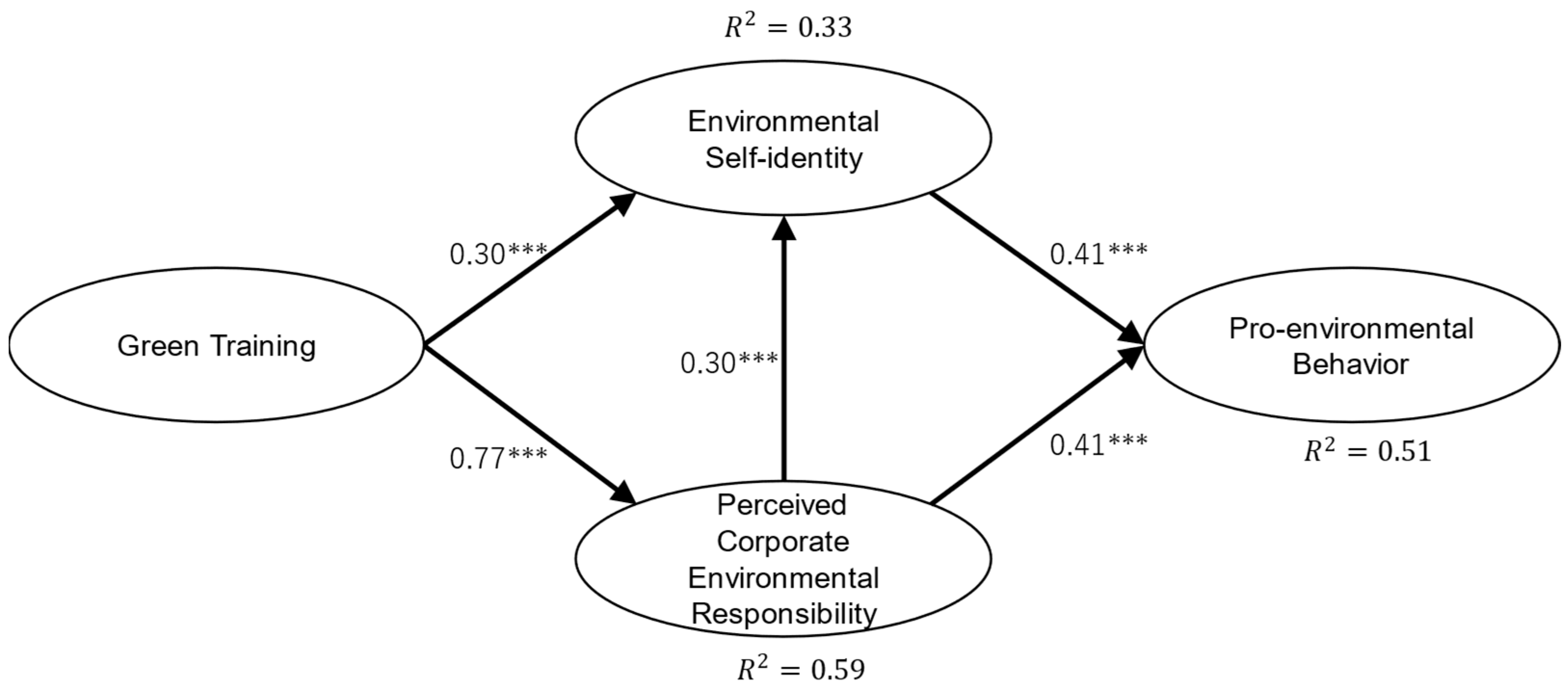
4.2. Structural Model and Hypothesis Testing
4.3. Indirect Effect Analysis
5. Discussion
5.1. The Association Between Green Training and Employees’ Pro-Environmental Behavior
5.2. Unpacking the Dual-Pathway Framework: The Mediating Mechanisms of CER and ESI
5.3. Practical Implications
5.4. Limitations and Future Directions
6. Conclusions
Author Contributions
Funding
Institutional Review Board Statement
Informed Consent Statement
Data Availability Statement
Acknowledgments
Conflicts of Interest
Abbreviations
| GHRM | Green Human Resource Management |
| GT | Green training |
| CER | Corporate environmental responsibility |
| ESI | Environmental self-identity |
| PEB | Pro-environmental behavior |
| SEM | Structural equation modeling |
| CFA | Confirmatory factor analysis |
Appendix A. Questionnaire

| Construct | Questionnaire Items | Reference |
|---|---|---|
| Green training | An adequate amount of environmental training is provided to employees. | (Daily, Bishop, and Massoud 2012, Jabbour 2015) [37,38] |
| Employees can have opportunities to be trained in environmental issues. | ||
| Employees receive environmental training frequently. | ||
| Employees use their environmental training effectively. | ||
| Employees have opportunities to use environmental training. | ||
| An adequate assessment of employee’s green performance after training. | ||
| Pro-environmental behaviors | In an effort to increase my organization’s environmental performance, I make suggestions and bring new ideas about environmentally friendly practices to environmental committees. | (Kaiser, Oerke and Bogner 2007, Robertson and Barling 2013) [39,40] |
| Compared with others at my work, I minimize and recycle waste. | ||
| I perform tasks that are expected of me in environmentally friendly ways. | ||
| I fulfill responsibilities specified in my job description in environmentally friendly ways. | ||
| I adequately complete assigned duties in environmentally friendly ways. | ||
| At work, I recycle (e.g., paper, cans, batteries, and oil). | ||
| I print double-sided whenever possible. | ||
| At work, I turn off lights when I go out of the office. | ||
| At work, I take stairs instead of elevators to save energy. | ||
| At work, I avoid wasting resources such as electricity or water. | ||
| At work, I take part in environmentally friendly programs. | ||
| I share my knowledge about the environment with coworkers. | ||
| I suggest new practices that could improve the environmental performance of my organization. | ||
| At work, I question practices that are likely to hurt the environment. | ||
| In my work, I weigh the consequences of my actions before doing something that could affect the environment. | ||
| At work, I perform environmental tasks that are not required by my organization | ||
| Environmental self-identity | I am the type of person who acts environmentally friendly”. | Van der Werff et al., (2013) [30] |
| Environmentally friendly acting is an important part of who I am. | ||
| see myself as a pro-environmental person”. | ||
| Perceived Corporate environmental responsibility | My organization has the goal of minimizing its impact on the environment. | van der Werf, E., Steg, L., & Ruepert, A. (2021) [16] |
| My organization has implemented policy and procedures to minimize its impact on the environment. | ||
| My organization has stated its mission to implement sustainable (pro environmental) policy | ||
| My organization has environmental goals. | ||
| My organization agrees to strategic environmental direction. | ||
| My organization has implemented environmental strategies. | ||
| My organization has been accomplishing a collective environmental mission. |
References
- Adomako, S.; Tran, M.D. Sustainable Environmental Strategy, Firm Competitiveness, and Financial Performance: Evidence from the Mining Industry. Resour. Policy 2022, 75, 102515. [Google Scholar] [CrossRef] [Scilit]
- Valderrama, C.V.; Santibanez-González, E.; Pimentel, B.; Candia-Véjar, A.; Canales-Bustos, L. Designing an Environmental Supply Chain Network in the Mining Industry to Reduce Carbon Emissions. J. Clean. Prod. 2020, 254, 119688. [Google Scholar] [CrossRef] [Scilit]
- Fu, Q.; Ghardallou, W.; Comite, U.; Siddique, I.; Han, H.; Arjona-Fuentes, J.M.; Ariza-Montes, A. The Role of CSR in Promoting Energy-Specific Pro-Environmental Behavior among Hotel Employees. Sustainability 2022, 14, 6574. [Google Scholar] [CrossRef] [Scilit]
- Daily, B.F.; Huang, S. Achieving Sustainability through Attention to Human Resource Factors in Environmental Management. Int. J. Oper. Prod. Manag. 2001, 21, 1539–1552. [Google Scholar] [CrossRef] [Scilit]
- Renwick, D.W.S.; Redman, T.; Maguire, S. Green Human Resource Management: A Review and Research Agenda. Int. J. Manag. Rev. 2013, 15, 1–14. [Google Scholar] [CrossRef] [Scilit]
- Aghaei, M.; Aghaee, S.; Shahriari, M. The Effect of Green Vision and Green Training on Voluntary Employee Green Behavior: The Mediating Role of Green Mindfulness. Environ. Dev. Sustain. 2024, 28, 18963–18979. [Google Scholar] [CrossRef] [Scilit]
- Amrutha, V.N.; Geetha, S.N. Linking Organizational Green Training and Voluntary Workplace Green Behavior: Mediating Role of Green Supporting Climate and Employees’ Green Satisfaction. J. Clean. Prod. 2021, 290, 125876. [Google Scholar] [CrossRef] [Scilit]
- Pinzone, M.; Guerci, M.; Lettieri, E.; Redman, T. Progressing in the Change Journey towards Sustainability in Healthcare: The Role of ‘Green’ HRM. J. Clean. Prod. 2016, 122, 201–211. [Google Scholar] [CrossRef] [Scilit]
- Rubel, M.R.B.; Kee, D.M.H.; Rimi, N.N. Green Human Resource Management and Supervisor Pro-Environmental Behavior: The Role of Green Work Climate Perceptions. J. Clean. Prod. 2021, 313, 127669. [Google Scholar] [CrossRef] [Scilit]
- Sun, H.; Mulindwa Bahizire, G.; Bernard Pea-Assounga, J.B.; Chen, T. Enhancing Employee Green Performance through Green Training: The Mediating Influence of Organizational Green Culture and Work Ethic in the Mining Sector. J. Clean. Prod. 2024, 449, 141105. [Google Scholar] [CrossRef] [Scilit]
- Kollmuss, A.; Agyeman, J. Mind the Gap: Why Do People Act Environmentally and What Are the Barriers to pro-Environmental Behavior? Environ. Educ. Res. 2002, 8, 239–260. [Google Scholar] [CrossRef] [Scilit]
- Pinzone, M.; Guerci, M.; Lettieri, E.; Huisingh, D. Effects of ‘Green’ Training on pro-Environmental Behaviors and Job Satisfaction: Evidence from the Italian Healthcare Sector. J. Clean. Prod. 2019, 226, 221–232. [Google Scholar] [CrossRef] [Scilit]
- Reed, M.S.; Evely, A.C.; Cundill, G.; Fazey, I.; Glass, J.; Laing, A.; Newig, J.; Parrish, B.; Prell, C.; Raymond, C.; et al. What Is Social Learning? Ecol. Soc. 2010, 15, 1–10. [Google Scholar] [CrossRef] [Scilit]
- Albert, B.; Walters, R.H. Social Learning Theory, 1st ed.; Prentice-hall: Englewood Cliffs, NJ, USA, 1977. [Google Scholar]
- Hu, C.; Huang, J. An Exploration of Motivations for Online Identity Reconstruction from the Perspective of Social Learning Theory. Int. J. Hum. –Comput. Interact. 2024, 40, 4239–4251. [Google Scholar] [CrossRef] [Scilit]
- van der Werff, E.; Steg, L.; Ruepert, A. My Company Is Green, so Am I: The Relationship between Perceived Environmental Responsibility of Organisations and Government, Environmental Self-Identity, and pro-Environmental Behaviours. Energy Effic. 2021, 14, 50. [Google Scholar] [CrossRef] [Scilit]
- Cheema, S.; Afsar, B.; Javed, F. Employees’ Corporate Social Responsibility Perceptions and Organizational Citizenship Behaviors for the Environment: The Mediating Roles of Organizational Identification and Environmental Orientation Fit. Corp. Soc. Responsib. Environ. Manag. 2020, 27, 9–21. [Google Scholar] [CrossRef] [Scilit]
- Jia, J.; Liu, H.; Chin, T.; Hu, D. The Continuous Mediating Effects of GHRM on Employees’ Green Passion via Transformational Leadership and Green Creativity. Sustainability 2018, 10, 3237. [Google Scholar] [CrossRef] [Scilit]
- Zhang, H.; Sun, S. Cognitive Dissonance of Self-Standards: A Negative Interaction of Green Compensation and Green Training on Employee Pro-Environmental Behavior in China. Psychol. Res. Behav. Manag. 2021, 14, 1399–1418. [Google Scholar] [CrossRef] [Scilit] [PubMed]
- Wang, D.; Wang, L.; Sun, C.; Wu, D.; Mao, W.; Hu, Y. The Relationship between Perceived Corporate Environmental Responsibility and Employees’ pro-Environmental Behavior: A Moderated Serial Mediation Model. Corp. Soc. Responsib. Environ. Manag. 2023, 30, 2606–2622. [Google Scholar] [CrossRef] [Scilit]
- Lu, H.; Zou, J.; Chen, H.; Long, R. Promotion or Inhibition? Moral Norms, Anticipated Emotion and Employee’s pro-Environmental Behavior. J. Clean. Prod. 2020, 258, 120858. [Google Scholar] [CrossRef] [Scilit]
- Jacobson, R.P. The Effects of Descriptive and Injunctive Social Norms on Workplace Incivility. J. Appl. Soc. Psychol. 2024, 54, 30–49. [Google Scholar] [CrossRef] [Scilit]
- Whitmarsh, L.; O’Neill, S. Green Identity, Green Living? The Role of pro-Environmental Self-Identity in Determining Consistency across Diverse pro-Environmental Behaviours. J. Environ. Psychol. 2010, 30, 305–314. [Google Scholar] [CrossRef] [Scilit]
- Cheng, Z.; Liu, W.; Zhou, K.; Che, Y.; Han, Y. Promoting Employees’ pro-Environmental Behaviour through Empowering Leadership: The Roles of Psychological Ownership, Empowerment Role Identity, and Environmental Self-Identity. Bus. Ethics Environ. Responsib. 2021, 30, 604–618. [Google Scholar] [CrossRef] [Scilit]
- Jia, F.; Soucie, K.; Alisat, S.; Curtin, D.; Pratt, M. Are Environmental Issues Moral Issues? Moral Identity in Relation to Protecting the Natural World. J. Environ. Psychol. 2017, 52, 104–113. [Google Scholar] [CrossRef] [Scilit]
- Hardy, S.A.; Carlo, G. Moral Identity. In Handbook of Identity Theory and Research; Schwartz, S.J., Luyckx, K., Vignoles, V.L., Eds.; Springer: New York, NY, USA, 2011; pp. 495–513. [Google Scholar]
- Barbarossa, C.; De Pelsmacker, P.; Moons, I. Personal Values, Green Self-Identity and Electric Car Adoption. Ecol. Econ. 2017, 140, 190–200. [Google Scholar] [CrossRef] [Scilit]
- Qasim, H.; Yan, L.; Guo, R.; Saeed, A.; Ashraf, B.N. The Defining Role of Environmental Self-Identity among Consumption Values and Behavioral Intention to Consume Organic Food. Int. J. Environ. Res. Public Health 2019, 16, 1106. [Google Scholar] [CrossRef] [Scilit] [PubMed]
- Marcussen, K. Identities, Self-Esteem, and Psychological Distress: An Application of Identity-Discrepancy Theory. Sociol. Perspect. 2006, 49, 1–24. [Google Scholar] [CrossRef] [Scilit]
- van der Werff, E.; Steg, L.; Keizer, K. It Is a Moral Issue: The Relationship between Environmental Self-Identity, Obligation-Based Intrinsic Motivation and pro-Environmental Behaviour. Glob. Environ. Change 2013, 23, 1258–1265. [Google Scholar] [CrossRef] [Scilit]
- Ferguson, M.J.; Bargh, J.A. Liking Is for Doing: The Effects of Goal Pursuit on Automatic Evaluation. J. Personal. Soc. Psychol. 2004, 87, 557–572. [Google Scholar] [CrossRef] [Scilit] [PubMed]
- Lacasse, K. Don’t Be Satisfied, Identify! Strengthening Positive Spillover by Connecting pro-Environmental Behaviors to an “Environmentalist” Label. J. Environ. Psychol. 2016, 48, 149–158. [Google Scholar] [CrossRef] [Scilit]
- Harmon-Jones, E.; Mills, J. An Introduction to Cognitive Dissonance Theory and an Overview of Current Perspectives on the Theory. In Cognitive Dissonance: Reexamining a Pivotal Theory in Psychology; American Psychological Association: Washington, DC, USA, 2019; pp. 3–24. [Google Scholar]
- Tajfel, H.; Turner, J.C. The Social Identity Theory of Intergroup Behavior. In Political Psychology; Psychology Press: Hove, UK, 2004. [Google Scholar]
- Turner, J.C.; Brown, R.J.; Tajfel, H. Social Comparison and Group Interest in Ingroup Favouritism. Eur. J. Soc. Psychol. 1979, 9, 187–204. [Google Scholar] [CrossRef] [Scilit]
- Brislin, R.W. The Wording and translation of research instruments. In Field Methods in Cross-Cultural Research; Cross-Cultural Research and Methodology Series; Sage Publications: Thousand Oaks, CA, USA, 1986; Volume 8. [Google Scholar]
- Daily, B.F.; Bishop, J.W.; Massoud, J.A. The Role of Training and Empowerment in Environmental Performance: A Study of the Mexican Maquiladora Industry. Int. J. Oper. Prod. Manag. 2012, 35, 631–647. [Google Scholar] [CrossRef] [Scilit]
- Jabbour, C.J.C. Environmental Training and Environmental Management Maturity of Brazilian Companies with ISO14001: Empirical Evidence. J. Clean. Prod. 2015, 96, 331–338. [Google Scholar] [CrossRef] [Scilit]
- Kaiser, F.G.; Oerke, B.; Bogner, F.X. Behavior-Based Environmental Attitude: Development of an Instrument for Adolescents. J. Environ. Psychol. 2007, 27, 242–251. [Google Scholar] [CrossRef] [Scilit]
- Robertson, J.L.; Barling, J. Greening Organizations through Leaders’ Influence on Employees’ pro-Environmental Behaviors. J. Organ. Behav. 2013, 34, 176–194. [Google Scholar] [CrossRef] [Scilit]
- Rosseel, Y. Lavaan: An R Package for Structural Equation Modeling. J. Stat. Softw. 2012, 48, 1–36. [Google Scholar] [CrossRef] [Scilit]
- Anderson, J.C.; Gerbing, D.W. Structural Equation Modeling in Practice: A Review and Recommended Two-Step Approach. Psychol. Bull. 1988, 103, 411–423. [Google Scholar] [CrossRef]
- Clark, L.A.; Watson, D. Constructing Validity: Basic Issues in Objective Scale Development. Psychol. Assess. 1995, 7, 309–319. [Google Scholar] [CrossRef]
- Kline, R.B. Principles and Practice of Structural Equation Modeling, 4th ed.; The Guilford Press: New York, NY, USA, 2016; p. xvii, 534. [Google Scholar]
- Menard, S. Applied Logistic Regression Analysis, 2nd ed.; SAGE Publications: Thousand Oaks, CA, USA, 2002; Volume 1. [Google Scholar]
- Pham, N.T.; Vo-Thanh, T.; Shahbaz, M.; Duc Huynh, T.L.; Usman, M. Managing Environmental Challenges: Training as a Solution to Improve Employee Green Performance. J. Environ. Manag. 2020, 269, 110781. [Google Scholar] [CrossRef] [Scilit] [PubMed]
- Dahiya, R. Does Organisational Sustainability Policies Affect Environmental Attitude of Employees? The Missing Link of Green Work Climate Perceptions. Bus. Strategy Dev. 2020, 3, 395–403. [Google Scholar] [CrossRef] [Scilit]
- Mansoor, M.; Wijaksana, T.I. Predictors of Pro-Environmental Behavior: Moderating Role of Knowledge Sharing and Mediatory Role of Perceived Environmental Responsibility. J. Environ. Plan. Manag. 2023, 66, 1089–1107. [Google Scholar] [CrossRef] [Scilit]
- Nisar, Q.A.; Haider, S.; Ali, F.; Jamshed, S.; Ryu, K.; Gill, S.S. Green Human Resource Management Practices and Environmental Performance in Malaysian Green Hotels: The Role of Green Intellectual Capital and pro-Environmental Behavior. J. Clean. Prod. 2021, 311, 127504. [Google Scholar] [CrossRef] [Scilit]
- Fritsche, I.; Barth, M.; Jugert, P.; Masson, T.; Reese, G. A Social Identity Model of Pro-Environmental Action (SIMPEA). Psychol. Rev. 2018, 125, 245–269. [Google Scholar] [CrossRef] [Scilit] [PubMed]
- Dresner, M.; Handelman, C.; Braun, S.; Rollwagen-Bollens, G. Environmental Identity, pro-Environmental Behaviors, and Civic Engagement of Volunteer Stewards in Portland Area Parks. Environ. Educ. Res. 2015, 21, 991–1010. [Google Scholar] [CrossRef] [Scilit]
- Gatersleben, B.; Murtagh, N.; Abrahamse, W. Values, Identity and pro-Environmental Behaviour. Contemp. Soc. Sci. 2014, 9, 374–392. [Google Scholar] [CrossRef] [Scilit]
- Ajibade, I.; Boateng, G.O. Predicting Why People Engage in Pro-Sustainable Behaviors in Portland Oregon: The Role of Environmental Self-Identity, Personal Norm, and Socio-Demographics. J. Environ. Manag. 2021, 289, 112538. [Google Scholar] [CrossRef] [Scilit] [PubMed]
- Usman, M.; Rofcanin, Y.; Ali, M.; Ogbonnaya, C.; Babalola, M.T. Toward a More Sustainable Environment: Understanding Why and When Green Training Promotes Employees’ Eco-Friendly Behaviors Outside of Work. Hum. Resour. Manag. 2023, 62, 355–371. [Google Scholar] [CrossRef] [Scilit]
- Glasford, D.E.; Pratto, F.; Dovidio, J.F. Intragroup Dissonance: Responses to Ingroup Violation of Personal Values. J. Exp. Soc. Psychol. 2008, 44, 1057–1064. [Google Scholar] [CrossRef] [Scilit]
- Glasford, D.E.; Dovidio, J.F.; Pratto, F. I Continue to Feel So Good About Us: In-Group Identification and the Use of Social Identity—Enhancing Strategies to Reduce Intragroup Dissonance. Pers. Soc. Psychol. Bull. 2009, 35, 415–427. [Google Scholar] [CrossRef] [Scilit] [PubMed]
- Moller, A.C.; Deci, E.L. Intrinsic Motivation. In Encyclopedia of Quality of Life and Well-Being Research; Springer: Cham, Switzerland, 2023; pp. 3654–3657. [Google Scholar]
- Oyserman, D.; Lewis, N.A., Jr.; Yan, V.X.; Fisher, O.; O’Donnell, S.C.; Horowitz, E. An Identity-Based Motivation Framework for Self-Regulation. Psychol. Inq. 2017, 28, 139–147. [Google Scholar] [CrossRef] [Scilit]
- Worthington, R.L.; Whittaker, T.A. Scale Development Research: A Content Analysis and Recommendations for Best Practices. Couns. Psychol. 2006, 34, 806–838. [Google Scholar] [CrossRef] [Scilit]
- Yuan, Y.; Yang, X.; Yuan, J.; Zhang, H. The Impacts of China’s Low-Carbon Power Transition on Employment Structure: A Regional Perspective Combining Skill and Gender. Energy Policy 2026, 218, 115507. [Google Scholar] [CrossRef] [Scilit]
| Variable | Category | n | % |
|---|---|---|---|
| Gender | Male | 809 | 78.69 |
| Female | 200 | 19.45 | |
| Non-binary | 4 | 0.39 | |
| Prefer not to say | 15 | 1.45 | |
| Marital status | Married | 181 | 17.60 |
| Unmarried | 825 | 80.25 | |
| Divorced | 22 | 2.14 | |
| Education | Lower than high school | 230 | 22.37 |
| High school diploma | 463 | 45.03 | |
| Bachelor’s Degree | 286 | 27.82 | |
| Master’s Degree | 43 | 4.18 | |
| Doctoral Degree | 6 | 0.58 | |
| Employment arrangement | Directly employed | 937 | 91.14 |
| Third-party dispatched employee | 91 | 8.85 | |
| Age | M = 38.74 | SD = 8.76 | |
| Tenure | M = 12.63 | SD = 11.95 |
| Variables | M (SD) | 1 | 2 | 3 | 4 |
|---|---|---|---|---|---|
| 1. GT | 4.08 (0.87) | (0.97) | |||
| 2. CER | 4.99 (0.91) | 0.76 *** | (0.97) | ||
| 3. ESI | 5.67 (1.17) | 0.50 *** | 0.52 *** | (0.95) | |
| 4. PEB | 3.99 (0.72) | 0.69 *** | 0.63 *** | 0.63 *** | (0.95) |
| Construct | Loading Range | CR | AVE | VIF | HTMT Ratio | |||
|---|---|---|---|---|---|---|---|---|
| GT | CER | ESI | PEB | |||||
| GT | 0.93~0.90 | 0.97 | 0.85 | 3.48 | - | |||
| CER | 0.93~0.83 | 0.92 | 0.75 | 2.86 | 0.79 | - | ||
| ESI | 0.95~0.88 | 0.95 | 0.86 | 1.92 | 0.52 | 0.54 | - | |
| PEB | 0.88~0.65 | 0.93 | 0.55 | 2.94 | 0.71 | 0.66 | 0.67 | - |
| Path | β (Std.) | Estimate | SE | 95% CI | p |
|---|---|---|---|---|---|
| GT → CER → PEB | 0.068 | 0.106 | 0.065 | [−0.018, 0.239] | 0.104 |
| GT → ESI → PEB | 0.096 | 0.148 | 0.034 | [0.085, 0.219] | <0.001 |
| GT → CER → ESI → PEB | 0.081 | 0.125 | 0.027 | [0.075,0.185] | <0.001 |
| Total indirect effect | 0.246 | 0.380 | 0.066 | [0.253, 0.513] | <0.001 |
| Direct effect (GT → PEB) | 0.452 | 0.697 | 0.088 | [0.529, 0.881] | <0.001 |
| Total effect | 0.698 | 1.077 | 0.077 | [0.937, 1.236] | <0.001 |
Disclaimer/Publisher’s Note: The statements, opinions and data contained in all publications are solely those of the individual author(s) and contributor(s) and not of MDPI and/or the editor(s). MDPI and/or the editor(s) disclaim responsibility for any injury to people or property resulting from any ideas, methods, instructions or products referred to in the content. |
© 2026 by the authors. Licensee MDPI, Basel, Switzerland. This article is an open access article distributed under the terms and conditions of the Creative Commons Attribution (CC BY) license.
Share and Cite
Liu, X.; Li, Z.; Xie, M.; Bonaiuto, M. A Dual-Pathway Framework Linking Green Training and Employees’ Pro-Environmental Behavior: Evidence from a Chinese Energy Company. Sustainability 2026, 18, 8422. https://doi.org/10.3390/su18168422
Liu X, Li Z, Xie M, Bonaiuto M. A Dual-Pathway Framework Linking Green Training and Employees’ Pro-Environmental Behavior: Evidence from a Chinese Energy Company. Sustainability. 2026; 18(16):8422. https://doi.org/10.3390/su18168422
Chicago/Turabian StyleLiu, Xiaotian, Ziying Li, Mei Xie, and Marino Bonaiuto. 2026. "A Dual-Pathway Framework Linking Green Training and Employees’ Pro-Environmental Behavior: Evidence from a Chinese Energy Company" Sustainability 18, no. 16: 8422. https://doi.org/10.3390/su18168422
APA StyleLiu, X., Li, Z., Xie, M., & Bonaiuto, M. (2026). A Dual-Pathway Framework Linking Green Training and Employees’ Pro-Environmental Behavior: Evidence from a Chinese Energy Company. Sustainability, 18(16), 8422. https://doi.org/10.3390/su18168422

