Sustainable Valorization of Agri-Food By-Products Through 3D Printing: A Review of Advances, Multisectoral Applications, and Circular Economy Challenges

 ,
, 
 , ,
, ,  , ,
, ,
Abstract
1. Introduction
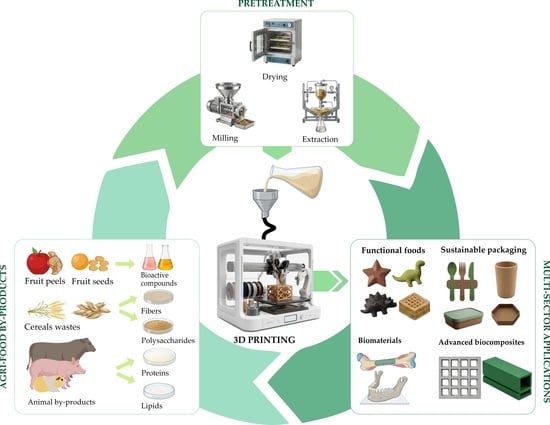
- To analyze the typology, composition, and potential of agri-food by-products for their use in 3D printing.
- To evaluate the main 3D printing technologies and their compatibility with different materials, considering critical parameters and technical limitations.
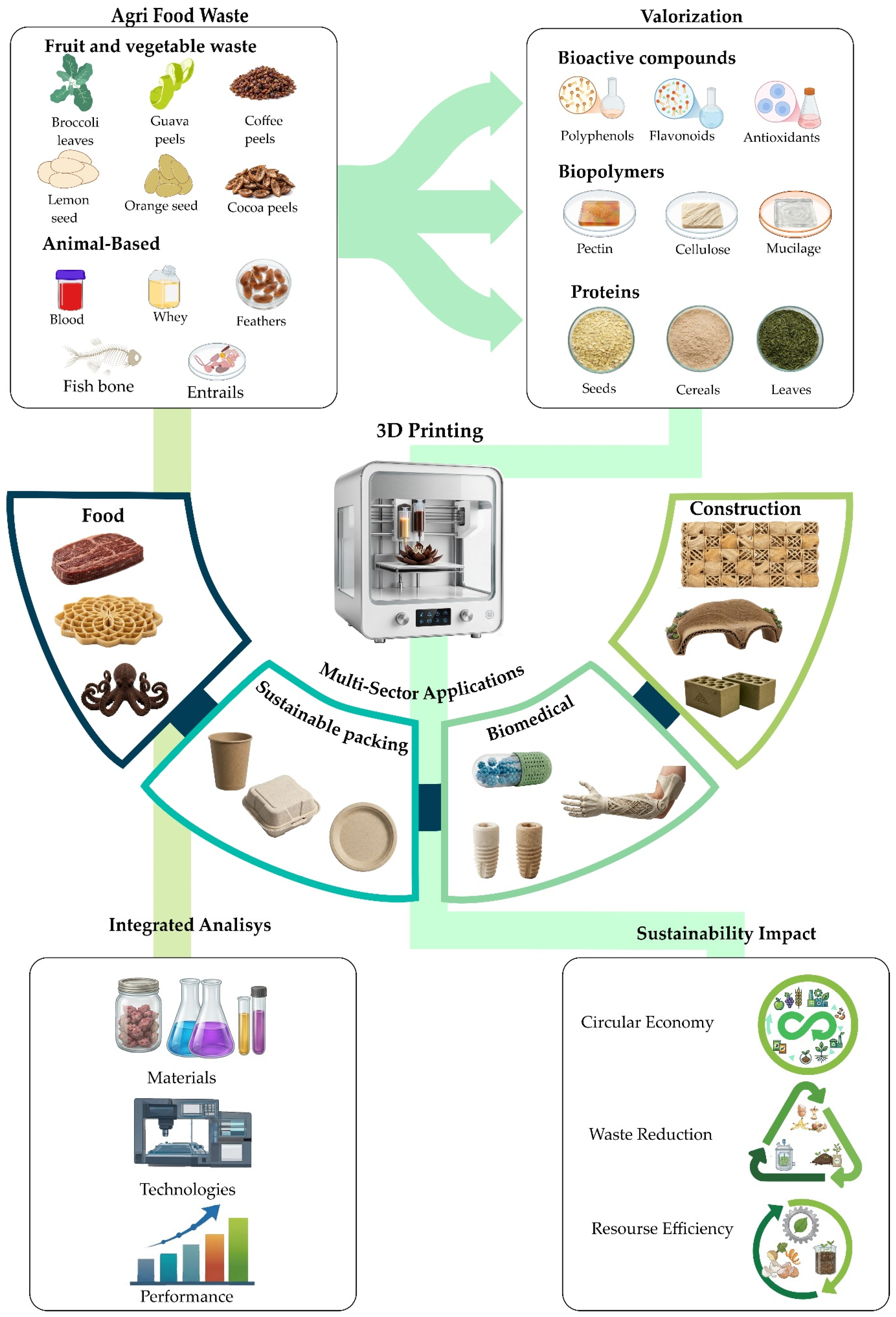
- To examine the multisectoral applications of 3D printing in the valorization of by-products, including food, packaging, biomedicine, and construction.
- To carry out a comparative analysis of the performance of materials, technologies, and applications, incorporating efficiency and sustainability criteria.
- To identify knowledge gaps, challenges, and future opportunities that guide the development of this field.
2. Narrative Review Methodology
3. Agri-Food By-Products and Residues: Classification and Potential
3.1. Typology of Agri-Food By-Products and Residues
3.2. Composition and Properties
3.3. Suitability for 3D Printing
4. 3D Printing Technologies
4.1. Main Technologies
4.2. Material–Technology Compatibility
4.3. Critical Parameters

| Printing Technology | By-Product and Matrix | Key Quantitative Evidence | Critical Interpretation | Application | Sources |
|---|---|---|---|---|---|
| Extrusion-based food printing | Gluten-free dough with 4 wt% beetroot by-product and baker’s yeast or baking powder. | The baking-powder formulation reached G′ = 6057 ± 72 Pa. Baker’s yeast with beetroot by-product provided greater dimensional stability, particularly in oval geometries. | Fiber enrichment and improved shape stability; however, performance depended on leavening agent and geometry, and 5–7 wt% by-product produced inadequate extrusion flow. | Customized gluten-free bakery products. | [41] |
| Extrusion followed by ionic gelation | Alginate formulations containing carrot and fish by-products or Ulva rigida. | Structures were sprayed with 1 mol/L CaCl2. Ca2+ generally increased hardness, reduced adhesiveness, and improved water resistance. The algal formulation showed ΔE = 5.77 after 24 h. | Enables nonthermal stabilization and manual handling; requires an additional spraying step, and storage effects differed among formulations. | Structured sustainable foods. | [42] |
| Direct ink writing | Aqueous ink with 70 wt% lignosulfonate, methyl cellulose, and glycerol. | Printed at room temperature with 0.2, 0.4, and 0.8 mm nozzles. Young’s modulus ranged from 2.4 ± 0.6 to 106.9 ± 17.3 MPa, and elongation from 18% to 26%. Shape stability reached 200 °C. | Solvent-free, mechanically tunable, and recyclable by rehydration; drying, shrinkage, glycerol content, and humidity affected final performance. | Recyclable prototypes and wood-like structures. | [29] |
| Piezoelectric inkjet printing | Betanin from red pitaya peel and anthocyanins from Kyoho grape peel. | Newtonian printable inks showed dynamic viscosities of 1.97–2.32 mPa·s and responded to five spoilage gases, with visible changes during shrimp deterioration. | Precise, low-volume deposition of waste-derived pigments; pigment stability to light and oxygen requires improvement, and the method functionalizes surfaces rather than producing bulk 3D structures. | Intelligent packaging indicators. | [43] |
| Selective laser sintering | Peanut shell powder and polyethersulfone composite. | Optimized conditions: 0.12 mm scan spacing, 1.8 m/s scan speed, 16 W laser power, 78 °C preheating, and 0.2 mm layer thickness. Bending strength reached 14.1 MPa, tensile strength 6.1 MPa, impact strength 2.12 kJ/cm2, and density 1.2 g/cm3. | Optimization improved mechanical performance and dimensional precision; results remained dependent on particle size, biomass content, mixture ratio, and processing conditions. | Wood, roofing, and furniture components. | [44] |
| Fused filament fabrication | Polylactic acid (PLA) reinforced with 0–7 wt% peanut hull powder. | At 7 wt%, tensile strength reached approximately 27 MPa and Young’s modulus 3.9 GPa. Printed parts retained antimicrobial activity and showed increased hardness. | Preserved tensile performance while increasing stiffness and functionality; higher contents caused roughness, porosity, brittleness, reduced flow, and nozzle clogging above 7 wt%. | Antimicrobial biocomposites and packaging. | [45] |
4.4. Technical Limitations
5. Multisectoral Applications
5.1. Food Applications
5.2. Sustainable Packaging
5.3. Biomedical Applications
5.4. Construction and Industry
5.5. Emerging Applications
6. Comparative Assessment of Performance and Sustainability
6.1. Material Assessment
6.2. Material–Technology Interaction
6.3. Multisectoral Comparison
6.4. Sustainability Assessment
6.5. Gaps and Opportunities
7. Cross-Cutting Challenges and Future Perspectives
8. Conclusions
Author Contributions
Funding
Institutional Review Board Statement
Informed Consent Statement
Data Availability Statement
Acknowledgments
Conflicts of Interest
Abbreviations
| 3D | Three-dimensional |
| ABTS | 2,2′-Azino-bis(3-ethylbenzothiazoline-6-sulfonic acid) |
| AgNPs | Silver nanoparticles |
| TA | Total anthocyanins |
| CS | Chitosan |
| DIW | Direct Ink Writing |
| DPPH | 2,2-Diphenyl-1-picrylhydrazyl |
| DSC | Differential Scanning Calorimetry |
| FDM | Fused Deposition Modeling |
| FFF | Fused Filament Fabrication |
| FGF-LFAM | Fused Granulate Fabrication/Large-Format Additive Manufacturing |
| FRAP | Ferric Reducing Antioxidant Power |
| FTIR | Fourier Transform Infrared Spectroscopy |
| GAE | Gallic Acid Equivalents |
| HA | Hydroxyapatite |
| AI | Artificial Intelligence |
| IDDSI | International Dysphagia Diet Standardisation Initiative |
| LCA | Life Cycle Assessment |
| MC3T3-E1 | Murine preosteoblastic cell line |
| MDPI | Multidisciplinary Digital Publishing Institute |
| PCL | Polycaprolactone |
| pH | Potential of Hydrogen |
| PLA | Polylactic Acid |
| PRISMA | Preferred Reporting Items for Systematic Reviews and Meta-Analyses |
| RE | Rutin Equivalents |
| SEM | Scanning Electron Microscopy |
| TE | Trolox Equivalents |
| TGA | Thermogravimetric Analysis |
| TPA | Texture Profile Analysis |
| XRD | X-ray Diffraction |
References
- Boudalia, S.; Symeon, G.K.; Dotas, V.; Gueboudji, Z.; Kouadri, I.; Sehili, B.; Terfa, M.T.; Smeti, S.; Gueroui, Y.; Bousbia, A. The Valorization of Agrifood Byproducts and Waste to Advance the Sustainable Development Goals: Current State and New Perspectives. Sustainability 2026, 18, 2165. [Google Scholar] [CrossRef] [Scilit]
- Carvalho, R.; Lucas, M.R.; Marta-Costa, A. Food Waste Reduction: A Systematic Literature Review on Integrating Policies, Consumer Behavior, and Innovation. Sustainability 2025, 17, 3236. [Google Scholar] [CrossRef] [Scilit]
- Martin-Rios, C.; Hofmann, A.; Mackenzie, N. Sustainability-Oriented Innovations in Food Waste Management Technology. Sustainability 2021, 13, 210. [Google Scholar] [CrossRef] [Scilit]
- Ligarda-Samanez, C.A.; Huamán-Carrión, M.L.; Calsina-Ponce, W.C.; Cruz, G.D.; Calderón Huamaní, D.F.; Cabel-Moscoso, D.J.; Garcia-Espinoza, A.J.; Sucari-León, R.; Aroquipa-Durán, Y.; Muñoz-Saenz, J.C.; et al. Technological Innovations and Circular Economy in the Valorization of Agri-Food By-Products: Advances, Challenges and Perspectives. Foods 2025, 14, 1950. [Google Scholar] [CrossRef] [Scilit] [PubMed]
- Caponio, F.; Piga, A.; Poiana, M. Valorization of Food Processing By-Products. Foods 2022, 11, 3246. [Google Scholar] [CrossRef] [Scilit] [PubMed]
- Bekavac, N.; Krog, K.; Stanić, A.; Šamec, D.; Šalić, A.; Benković, M.; Jurina, T.; Gajdoš Kljusurić, J.; Valinger, D.; Jurinjak Tušek, A. Valorization of Food Waste: Extracting Bioactive Compounds for Sustainable Health and Environmental Solutions. Antioxidants 2025, 14, 714. [Google Scholar] [CrossRef] [Scilit] [PubMed]
- Yadav, S.; Malik, K.; Moore, J.M.; Kamboj, B.R.; Malik, S.; Malik, V.K.; Arya, S.; Singh, K.; Mahanta, S.; Bishnoi, D.K. Valorisation of Agri-Food Waste for Bioactive Compounds: Recent Trends and Future Sustainable Challenges. Molecules 2024, 29, 2055. [Google Scholar] [CrossRef] [Scilit] [PubMed]
- Bareen, M.A.; Antonio, D.; Corradini, M.G.; Rossella, C.; Paolo, D.I.; Marta, S.; Carla, S. Enhancing 3D Printing Performance and Product Quality Through the Valorization of Food By-Products and Waste. Compr. Rev. Food Sci. Food Saf. 2025, 24, e70267. [Google Scholar] [CrossRef] [Scilit] [PubMed]
- Yoha, K.S.; Moses, J.A. 3D Printing Approach to Valorization of Agri-Food Processing Waste Streams. Foods 2023, 12, 212. [Google Scholar] [CrossRef] [Scilit] [PubMed]
- Solomon, N.; Natarajan, T.; Ramaswamy, J.; Lakshmi, A.V.P. Nutraceutical applications of agricultural by-products in 3D food printing: Potential in enhancing neurocognitive health. J. Sci. Food Agric. 2026. Epub ahead of printing. [Google Scholar] [CrossRef] [Scilit] [PubMed]
- Xiao, S.; Yang, J.; Bi, Y.; Li, Y.; Cao, Y.; Zhou, M.; Pang, G.; Dong, X.; Tong, Q. Food 3D Printing Equipment and Innovation: Precision Meets Edibility. Foods 2025, 14, 2066. [Google Scholar] [CrossRef] [Scilit] [PubMed]
- Carranza, T.; Guerrero, P.; Caba, K.d.l.; Etxabide, A. Texture-modified soy protein foods: 3D printing design and red cabbage effect. Food Hydrocoll. 2023, 145, 109141. [Google Scholar] [CrossRef] [Scilit]
- Ritota, M.; Melloni, S.; Cianfrini, G.; Narducci, V.; Ruggeri, S.; Turfani, V. Recent Advances in Inks for 3D Food Printing: A Review. Appl. Sci. 2025, 15, 11891. [Google Scholar] [CrossRef] [Scilit]
- Lee, J. A 3D Food Printing Process for the New Normal Era: A Review. Processes 2021, 9, 1495. [Google Scholar] [CrossRef] [Scilit]
- Saha, D.; Padhiary, M.; Hoque, A.; Prasad, G. 3D printing technology for valorization of food processing wastes and byproducts: A systematic review. Waste Manag. Bull. 2025, 3, 100192. [Google Scholar] [CrossRef] [Scilit]
- Capellà, A.; Umaña, M.; Dalmau, E.; Cárcel, J.A.; Femenia, A. 3D Printing of New Foods Using Cellulose-Based Gels Obtained from Cerotonia siliqua L. Byproducts. Gels 2024, 10, 759. [Google Scholar] [CrossRef] [Scilit] [PubMed]
- Abdallah, Y.K.; Estévez, A.T. Biowelding 3D-Printed Biodigital Brick of Seashell-Based Biocomposite by Pleurotus ostreatus Mycelium. Biomimetics 2023, 8, 504. [Google Scholar] [CrossRef] [Scilit] [PubMed]
- Abdallah, Y.K.; Estévez, A.T. 3D-Printed Biodigital Clay Bricks. Biomimetics 2021, 6, 59. [Google Scholar] [CrossRef] [Scilit] [PubMed]
- Estévez, A.T.; Abdallah, Y.K. The New Standard Is Biodigital: Durable and Elastic 3D-Printed Biodigital Clay Bricks. Biomimetics 2022, 7, 159. [Google Scholar] [CrossRef] [Scilit] [PubMed]
- Tyupova, A.; Harasym, J. Valorization of Fruit and Vegetables Industry By-Streams for 3D Printing—A Review. Foods 2024, 13, 2186. [Google Scholar] [CrossRef] [Scilit] [PubMed]
- Zhu, W.; Iskandar, M.M.; Baeghbali, V.; Kubow, S. Three-Dimensional Printing of Foods: A Critical Review of the Present State in Healthcare Applications, and Potential Risks and Benefits. Foods 2023, 12, 3287. [Google Scholar] [CrossRef] [Scilit] [PubMed]
- Ligarda-Samanez, C.A.; Huamán-Carrión, M.L.; Palomino-Rincón, H.; Taipe-Pardo, F.; Moscoso-Moscoso, E.; Cabel-Moscoso, D.J.; Garcia-Espinoza, A.J.; Calderón Huamaní, D.F.; Romero Plasencia, J.M.; Martinez-Hernandez, J.A.; et al. Sustainable Biopolymers for Environmental Applications: Advances and Future Perspectives Toward a Circular Economy. Polymers 2026, 18, 618. [Google Scholar] [CrossRef] [Scilit] [PubMed]
- Ligarda-Samanez, C.A.; Huamán-Carrión, M.L.; Romero Plasencia, J.M.; Calderón Huamaní, D.F.; Vivanco Garfias, B.; Muñoz-Saenz, J.C.; Bautista Gómez, M.M.; Martinez-Hernandez, J.A.; Calsina-Ponce, W.C. Innovations in the Delivery of Bioactive Compounds for Cancer Prevention and Therapy: Advances, Challenges, and Future Perspectives. Pharmaceuticals 2026, 19, 60. [Google Scholar] [CrossRef] [Scilit] [PubMed]
- Ligarda-Samanez, C.A.; Huamán-Carrión, M.L.; Cabel-Moscoso, D.J.; Marlene Muñoz Sáenz, D.; Antonio Martinez Hernandez, J.; Garcia-Espinoza, A.J.; Fermín Calderón Huamaní, D.; Carrasco-Badajoz, C.; Pino Cordero, D.; Sucari-León, R.; et al. Technological Innovations in Sustainable Civil Engineering: Advanced Materials, Resilient Design, and Digital Tools. Sustainability 2025, 17, 8741. [Google Scholar] [CrossRef] [Scilit]
- Valle, C.; Voss, M.; Calcio Gaudino, E.; Forte, C.; Cravotto, G.; Tabasso, S. Harnessing Agri-Food Waste as a Source of Biopolymers for Agriculture. Appl. Sci. 2024, 14, 4089. [Google Scholar] [CrossRef] [Scilit]
- Jeon, E.Y.; Kim, Y.; Yun, H.J.; Kim, B.K.; Choi, Y.S. 3D Printing of Materials and Printing Parameters with Animal Resources: A Review. Food Sci. Anim. Resour. 2024, 44, 225–238. [Google Scholar] [CrossRef] [Scilit] [PubMed]
- Mittal, S.; Bhuiyan, M.H.; Ngadi, M.O. Challenges and Prospects of Plant-Protein-Based 3D Printing. Foods 2023, 12, 4490. [Google Scholar] [CrossRef] [Scilit] [PubMed]
- Qin, Z.; Yang, Y.; Zhang, Z.; Li, F.; Hou, Z.; Li, Z.; Shi, J.; Shen, T. A Critical Review: Gel-Based Edible Inks for 3D Food Printing: Materials, Rheology–Geometry Mapping, and Control. Gels 2025, 11, 780. [Google Scholar] [CrossRef] [Scilit] [PubMed]
- Balk, M.; Schroeter, M.; da Conceição, E.; Schneider, N.; Heuchel, M.; Pieper, Y.; Schwanz, S.; Khani, N.; Alkhamis, H.; Polak-Kraśna, K.; et al. Room-Temperature, Aqueous-Based 3D Printing of Fully Recyclable Wood-like Inks from Upcycled Lignin. ACS Sustain. Chem. Eng. 2026, 14, 3834–3845. [Google Scholar] [CrossRef] [Scilit]
- Varvara, R.-A.; Szabo, K.; Vodnar, D.C. 3D Food Printing: Principles of Obtaining Digitally-Designed Nourishment. Nutrients 2021, 13, 3617. [Google Scholar] [CrossRef] [Scilit] [PubMed]
- Tejada-Ortigoza, V.; Cuan-Urquizo, E. Towards the Development of 3D-Printed Food: A Rheological and Mechanical Approach. Foods 2022, 11, 1191. [Google Scholar] [CrossRef] [Scilit] [PubMed]
- Teng, X.; Li, C.; Mujumdar, A.S.; Zhang, M. Progress in Extrusion-Based Food Printing Technology for Enhanced Printability and Printing Efficiency of Typical Personalized Foods: A Review. Foods 2022, 11, 4111. [Google Scholar] [CrossRef] [Scilit] [PubMed]
- Kadival, A.; Kour, M.; Meena, D.; Mitra, J. Extrusion-Based 3D Food Printing: Printability Assessment and Improvement Techniques. Food Bioprocess Technol. 2023, 16, 987–1008. [Google Scholar] [CrossRef] [Scilit]
- Zheng, Z.; Zhang, M.; Liu, Z. Investigation on evaluating the printable height and dimensional stability of food extrusion-based 3D printed foods. J. Food Eng. 2021, 306, 110636. [Google Scholar] [CrossRef] [Scilit]
- Phuhongsung, P.; Zhang, M.; Devahastin, S.; Mujumdar, A.S. Defects in 3D/4D food printing and their possible solutions: A comprehensive review. Compr. Rev. Food Sci. Food Saf. 2022, 21, 3455–3479. [Google Scholar] [CrossRef] [Scilit] [PubMed]
- Jonkers, N.; van Dijk, W.J.; Vonk, N.H.; van Dommelen, J.A.W.; Geers, M.G.D. Anisotropic mechanical properties of Selective Laser Sintered starch-based food. J. Food Eng. 2022, 318, 110890. [Google Scholar] [CrossRef] [Scilit]
- Jonkers, N.; van Dommelen, J.A.W.; Geers, M.G.D. Selective Laser Sintered food: A unit cell approach to design mechanical properties. J. Food Eng. 2022, 335, 111183. [Google Scholar] [CrossRef] [Scilit]
- Wei, P.; Cipriani, C.; Hsieh, C.-M.; Kamani, K.; Rogers, S.; Pentzer, E. Go with the flow: Rheological requirements for direct ink write printability. J. Appl. Phys. 2023, 134, 100701. [Google Scholar] [CrossRef] [Scilit]
- van der Sman, R.; Tian, B.; Ghoreishy, S.-A.; Noort, M. Relationships between printability and rheology of inks for personalized nutrition. Curr. Res. Food Sci. 2025, 11, 101220. [Google Scholar] [CrossRef] [Scilit] [PubMed]
- Domżalska, Z.; Jakubczyk, E. Characteristics of Food Printing Inks and Their Impact on Selected Product Properties. Foods 2025, 14, 393. [Google Scholar] [CrossRef] [Scilit] [PubMed]
- Montero, C.M.; Igual, M.; Martínez-Monzó, J.; García-Segovia, P. Application of 3D printing for beetroot by-product valorization in gluten-free bread: Effects of leavening agent and geometry on printability. Appl. Food Res. 2026, 6, 101932. [Google Scholar] [CrossRef] [Scilit]
- Pereira, T.; Pinto, F.R.; Barroso, S.; Oliveira, L.; Pinheiro, A.C.; Vicente, A.A.; Mendes, A.C.; Gil, M.M. Valorisation of food waste through 3D printing: A sustainable approach to food production. LWT 2026, 245, 119279. [Google Scholar] [CrossRef] [Scilit]
- Gong, T.; Luo, X. Inkjet-printed colorimetric indicators from the peels of red pitaya and Kyoho grape for the detection of food spoilage gases. Curr. Res. Food Sci. 2025, 10, 101064. [Google Scholar] [CrossRef] [Scilit] [PubMed]
- Idriss, A.I.B.; Mei Yang, C.; Li, J.; Abdelmagid, A.A.A.; Zhang, H.; Ahmed, E.A.I. Optimizing processing parameters for selective laser sintering of peanut shell powder/polyether sulfone composite. Rapid Prototyp. J. 2025, 31, 2133–2149. [Google Scholar] [CrossRef] [Scilit]
- Palaniyappan, S.; Sivakumar, N.K.; Dalaq, A.S. A peanut-hull-PLA based 3D printing filament with antimicrobial effect. J. Manuf. Process. 2026, 160, 242–253. [Google Scholar] [CrossRef] [Scilit]
- Escalante-Aburto, A.; Trujillo-de Santiago, G.; Álvarez, M.M.; Chuck-Hernández, C. Advances and prospective applications of 3D food printing for health improvement and personalized nutrition. Compr. Rev. Food Sci. Food Saf. 2021, 20, 5722–5741. [Google Scholar] [CrossRef] [Scilit] [PubMed]
- Tomašević, I.; Putnik, P.; Valjak, F.; Pavlić, B.; Šojić, B.; Bebek Markovinović, A.; Bursać Kovačević, D. 3D printing as novel tool for fruit-based functional food production. Curr. Opin. Food Sci. 2021, 41, 138–145. [Google Scholar] [CrossRef] [Scilit]
- Shi, H.; Zhang, M.; Mujumdar, A.S.; Li, C. Potential of 3D printing in development of foods for special medical purpose: A review. Compr. Rev. Food Sci. Food Saf. 2024, 23, e70005. [Google Scholar] [CrossRef] [Scilit] [PubMed]
- Tracey, C.T.; Predeina, A.L.; Krivoshapkina, E.F.; Kumacheva, E. A 3D printing approach to intelligent food packaging. Trends Food Sci. Technol. 2022, 127, 87–98. [Google Scholar] [CrossRef] [Scilit]
- Nida, S.; Moses, J.A.; Anandharamakrishnan, C. 3D printed food package casings from sugarcane bagasse: A waste valorization study. Biomass Convers. Biorefin. 2025, 15, 1835–1845. [Google Scholar] [CrossRef] [Scilit]
- Thakur, D.; Bareen, M.A.; Gupta, A.; Saha, S.; Sahu, J.K. Frontiers in 3D printing for biobased food packaging. Food Sci. Biotechnol. 2025, 34, 2381–2401. [Google Scholar] [CrossRef] [Scilit] [PubMed]
- Sahil Panjabrao, A.; Hamid; Dash, K.K.; Kathuria, D.; Shams, R.; Chavan, P.; Mukarram, S.A.; Kovács, B. Sustainable 3D-Printed food packaging from agricultural waste: A review of materials, properties, and applications. J. Agric. Food Res. 2025, 22, 102061. [Google Scholar] [CrossRef] [Scilit]
- Porwal, S.; Malviya, R.; Sridhar, S.B.; Meenakshi, D.U.; Wadhwa, T.; Shareef, J.; Warsi, M.H. 3D-printed drug delivery system from food waste: A sustainable approach for the development of novel drug delivery systems. Ann. 3D Print. Med. 2025, 19, 100209. [Google Scholar] [CrossRef] [Scilit]
- Dedeloudi, A.; Martinez-Marcos, L.; Quinten, T.; Andersen, S.; Lamprou, D.A. Biopolymeric 3D printed implantable scaffolds as a potential adjuvant treatment for acute post-operative pain management. Expert Opin. Drug Deliv. 2024, 21, 1651–1663. [Google Scholar] [CrossRef] [Scilit] [PubMed]
- Pemas, S.; Gkiliopoulos, D.; Samiotaki, C.; Bikiaris, D.N.; Terzopoulou, Z.; Pechlivani, E.M. Valorization of Tomato Agricultural Waste for 3D-Printed Polymer Composites Based on Poly(lactic acid). Polymers 2024, 16, 1536. [Google Scholar] [CrossRef] [Scilit] [PubMed]
- Andrzejewski, J.; Grad, K.; Wiśniewski, W.; Szulc, J. The Use of Agricultural Waste in the Modification of Poly(lactic acid)-Based Composites Intended for 3D Printing Applications. The Use of Toughened Blend Systems to Improve Mechanical Properties. J. Compos. Sci. 2021, 5, 253. [Google Scholar] [CrossRef] [Scilit]
- Dong, Y.; Sun, L.; Dong, J.; Zou, W.; Rong, W.; Liu, J.; Meng, H.; Cao, Q. 3D-Printed Carbon-Based Electrochemical Energy Storage Devices: Material Design, Structural Engineering, and Application Frontiers. Materials 2025, 18, 5070. [Google Scholar] [CrossRef] [Scilit] [PubMed]
- Yan, Y.; Sun, W.; Wei, Y.; Liu, K.; Ma, J.; Hu, G. Review of Biomass-Derived Carbon Nanomaterials—From 0D to 3D—For Supercapacitor Applications. Nanomaterials 2025, 15, 315. [Google Scholar] [CrossRef] [Scilit] [PubMed]
- Llamas-Unzueta, R.; Menéndez, J.A.; Suárez, M.; Fernández, A.; Montes-Morán, M.A. From whey robocasting to custom 3D porous carbons. Addit. Manuf. 2022, 59, 103083. [Google Scholar] [CrossRef] [Scilit]
- Kaiser, R.; Bridgens, B.; Elsacker, E.; Scott, J. BioKnit: Development of mycelium paste for use with permanent textile formwork. Front. Bioeng. Biotechnol. 2023, 11, 1229693. [Google Scholar] [CrossRef] [Scilit] [PubMed]
- Dey, A.; Rahman, M.M.; Gupta, A.; Yodo, N.; Lee, C.W. A Performance Study on 3D-Printed Bioplastic Pots from Soybean By-Products. Sustainability 2023, 15, 10535. [Google Scholar] [CrossRef] [Scilit]
- Pant, A.; Ni Leam, P.X.; Chua, C.K.; Tan, U.X. Valorisation of vegetable food waste utilising three-dimensional food printing. Virtual Phys. Prototyp. 2023, 18, e2146593. [Google Scholar] [CrossRef] [Scilit]
- Lee, C.P.; Takahashi, M.; Arai, S.; Lee, C.-L.K.; Hashimoto, M. 3D Printing of Okara Ink: The Effect of Particle Size on the Printability. ACS Food Sci. Technol. 2021, 1, 2053–2061. [Google Scholar] [CrossRef] [Scilit]
- Molina-Montero, C.; Vicente-Jurado, D.; Igual, M.; Martínez-Monzó, J.; García-Segovia, P. Fiber Enrichment of 3D Printed Apricot Gel Snacks with Orange By-Products. Gels 2023, 9, 569. [Google Scholar] [CrossRef] [Scilit] [PubMed]
- Tan, J.D.; Lee, C.P.; Foo, S.Y.; Tan, J.C.W.; Tan, S.S.Y.; Ong, E.S.; Leo, C.H.; Hashimoto, M. 3D printability and biochemical analysis of revalorized orange peel waste. Int. J. Bioprint. 2023, 9, 776. [Google Scholar] [CrossRef] [Scilit] [PubMed]
- Carpentieri, S.; Harasym, J.; Ferrari, G. Ultrasonication enhances the performance of apple pomace and lemon albedo blends in 3D printed snacks. Innov. Food Sci. Emerg. Technol. 2025, 102, 104011. [Google Scholar] [CrossRef] [Scilit]
- Anandha Keerthy, M.; Dhanaselvam, K.R.; Santhoshkumar, P.; Ravikrishnan, V.; Moses, J.A. Improving the printability of watermelon rind using pectin: 3D printing optimization for the development of gummies. Food Biomacromol. 2025, 2, 143–156. [Google Scholar] [CrossRef] [Scilit]
- Souza, C.A.C.d.; Benoso, P.; Barreto, L.M.d.C.; Moraes, I.C.F.; de Oliveira, A.L.; Maniglia, B.C.; Martelli-Tosi, M. Enhanced bioactive and rheological properties of 3D xanthan gum matrices using grape by-product-based particles obtained by spray drying. Food Struct. 2025, 45, 100443. [Google Scholar] [CrossRef] [Scilit]
- Chen, X.-h.; Zhang, M.; Teng, X.-x.; Mujumdar, A.S. Internal structure design for improved shape fidelity and crispness of 3D printed pumpkin-based snacks after freeze-drying. Food Res. Int. 2022, 157, 111220. [Google Scholar] [CrossRef] [Scilit] [PubMed]
- Peng, M.; Gao, Z.; Liao, Y.; Guo, J.; Shan, Y. Development of Functional Kiwifruit Jelly with chenpi (FKJ) by 3D Food Printing Technology and Its Anti-Obesity and Antioxidant Potentials. Foods 2022, 11, 1894. [Google Scholar] [CrossRef] [Scilit] [PubMed]
- Ahmadzadeh, S.; Clary, T.; Rosales, A.; Ubeyitogullari, A. Upcycling imperfect broccoli and carrots into healthy snacks using an innovative 3D food printing approach. Food Sci. Nutr. 2024, 12, 84–93. [Google Scholar] [CrossRef] [Scilit] [PubMed]
- Jagadiswaran, B.; Alagarasan, V.; Palanivelu, P.; Theagarajan, R.; Moses, J.A.; Anandharamakrishnan, C. Valorization of food industry waste and by-products using 3D printing: A study on the development of value-added functional cookies. Future Foods 2021, 4, 100036. [Google Scholar] [CrossRef] [Scilit]
- Nida, S.; Moses, J.A.; Anandharamakrishnan, C. Converting fruit waste to 3D printed food package casings: The case of banana peel. Circ. Econ. 2023, 2, 100023. [Google Scholar] [CrossRef] [Scilit]
- Nida, S.; Moses, J.A.; Anandharamakrishnan, C. 3D Extrusion Printability of Sugarcane Bagasse Blended with Banana Peel for Prospective Food Packaging Applications. Sugar Tech 2022, 24, 764–778. [Google Scholar] [CrossRef] [Scilit]
- Fang, J.; Wu, Z.; Fu, H.; Xu, C.; Li, X.; Yu, H.; Wang, X. 3D Printed Porous Okara-Based Sponge with Hemostatic and Antimicrobial Effects for Wound Healing. ACS Sustain. Chem. Eng. 2024, 12, 11231–11243. [Google Scholar] [CrossRef] [Scilit]
- Gezek, M.; Altunbek, M.; Torres Gouveia, M.E.; Camci-Unal, G. 3D Printed Eggshell Microparticle-Laden Thermoplastic Scaffolds for Bone Tissue Engineering. ACS Appl. Mater. Interfaces 2024, 16, 32957–32970. [Google Scholar] [CrossRef] [Scilit] [PubMed]
- Liu, Z.; Shi, J.; Chen, L.; He, X.; Weng, Y.; Zhang, X.; Yang, D.-P.; Yu, H. 3D printing of fish-scale derived hydroxyapatite/chitosan/PCL scaffold for bone tissue engineering. Int. J. Biol. Macromol. 2024, 274, 133172. [Google Scholar] [CrossRef] [Scilit] [PubMed]
- Giani, N.; Maccaferri, E.; Benelli, T.; Bovo, M.; Torreggiani, D.; Campari, E.G.; Tassinari, P.; Giorgini, L.; Mazzocchetti, L. Valorization of Agro-Wastes as Fillers in PLA-Based Biocomposites for Increasing Sustainability in Fused Deposition Modeling Additive Manufacturing. Materials 2024, 17, 1421. [Google Scholar] [CrossRef] [Scilit] [PubMed]
- Scaffaro, R.; Maio, A.; Gulino, E.F.; Alaimo, G.; Morreale, M. Green Composites Based on PLA and Agricultural or Marine Waste Prepared by FDM. Polymers 2021, 13, 1361. [Google Scholar] [CrossRef] [Scilit] [PubMed]
- Paramatti, M.; Romani, A.; Pugliese, G.; Levi, M. PLA Feedstock Filled with Spent Coffee Grounds for New Product Applications with Large-Format Material Extrusion Additive Manufacturing. ACS Omega 2024, 9, 6423–6431. [Google Scholar] [CrossRef] [Scilit] [PubMed]
- Almeida, V.H.; Jesus, R.M.; Santana, G.M.; Khan, S.; Silva, E.F.; Cruz, I.S.; Santos, I.D.; dos Anjos, P.N. The Development of Biocomposite Filaments for 3D Printing by Utilizing a Polylactic Acid (PLA) Polymer Matrix Reinforced with Cocoa Husk Cellulose Fibers. Polymers 2024, 16, 1757. [Google Scholar] [CrossRef] [Scilit] [PubMed]
- In, J.; Jeong, H.; Song, S.; Min, S.C. Determination of Material Requirements for 3D Gel Food Printing Using a Fused Deposition Modeling 3D Printer. Foods 2021, 10, 2272. [Google Scholar] [CrossRef] [Scilit] [PubMed]
- Sharma, R.; Chandra Nath, P.; Kumar Hazarika, T.; Ojha, A.; Kumar Nayak, P.; Sridhar, K. Recent advances in 3D printing properties of natural food gels: Application of innovative food additives. Food Chem. 2024, 432, 137196. [Google Scholar] [CrossRef] [Scilit] [PubMed]
- Daminabo, S.C.; Goel, S.; Grammatikos, S.A.; Nezhad, H.Y.; Thakur, V.K. Fused deposition modeling-based additive manufacturing (3D printing): Techniques for polymer material systems. Mater. Today Chem. 2020, 16, 100248. [Google Scholar] [CrossRef] [Scilit]
- Bhagia, S.; Bornani, K.; Agrawal, R.; Satlewal, A.; Ďurkovič, J.; Lagaňa, R.; Bhagia, M.; Yoo, C.G.; Zhao, X.; Kunc, V.; et al. Critical review of FDM 3D printing of PLA biocomposites filled with biomass resources, characterization, biodegradability, upcycling and opportunities for biorefineries. Appl. Mater. Today 2021, 24, 101078. [Google Scholar] [CrossRef] [Scilit]
- Wang, L.; Yong, L.X.; Loo, S.C.J. Utilizing Food Waste in 3D-Printed PLA Formulations to Achieve Sustainable and Customizable Controlled Delivery Systems. ACS Omega 2024, 9, 34140–34150. [Google Scholar] [CrossRef] [Scilit] [PubMed]
- Soni, A.; Gupta, S.K.; Veeman, D.; Katiyar, J.K. 3D-printed sustainable biocomposites via valorization of biomass: Focus on challenges and their future perspectives. Environ. Sci. Pollut. Res. 2025, 32, 28559–28605. [Google Scholar] [CrossRef] [Scilit] [PubMed]
- Graziosi, S.; Faludi, J.; Stanković, T.; Borgianni, Y.; Meisel, N.; Hallstedt, S.I.; Rosen, D.W. A vision for sustainable additive manufacturing. Nat. Sustain. 2024, 7, 698–705. [Google Scholar] [CrossRef] [Scilit]
- Kokare, S.; Oliveira, J.P.; Godina, R. Life cycle assessment of additive manufacturing processes: A review. J. Manuf. Syst. 2023, 68, 536–559. [Google Scholar] [CrossRef] [Scilit]
- Colorado, H.A.; Velásquez, E.I.G.; Monteiro, S.N. Sustainability of additive manufacturing: The circular economy of materials and environmental perspectives. J. Mater. Res. Technol. 2020, 9, 8221–8234. [Google Scholar] [CrossRef] [Scilit]
- Hettiarachchi, B.D.; Brandenburg, M.; Seuring, S. Connecting additive manufacturing to circular economy implementation strategies: Links, contingencies and causal loops. Int. J. Prod. Econ. 2022, 246, 108414. [Google Scholar] [CrossRef] [Scilit]
- Tavares, T.M.; Ganga, G.M.D.; Godinho Filho, M.; Rodrigues, V.P. The benefits and barriers of additive manufacturing for circular economy: A framework proposal. Sustain. Prod. Consum. 2023, 37, 369–388. [Google Scholar] [CrossRef] [Scilit]
- Su, J.; Ng, W.L.; An, J.; Yeong, W.Y.; Chua, C.K.; Sing, S.L. Achieving sustainability by additive manufacturing: A state-of-the-art review and perspectives. Virtual Phys. Prototyp. 2024, 19, e2438899. [Google Scholar] [CrossRef] [Scilit]
- Yong, L.X.; Lim, X.Y.F.; Loo, S.C.J. Valorization of edible industrial and agricultural food byproducts for rheological properties and 3D printability in food inks. Future Foods 2025, 12, 100682. [Google Scholar] [CrossRef] [Scilit]
- Mazur, J.; Sobczak, P.; Panasiewicz, M.; Łusiak, P.; Krajewska, M.; Findura, P.; Obidziński, S.; Żukiewicz-Sobczak, W. Mechanical properties and biodegradability of samples obtained by 3D printing using FDM technology from PLA filament with by-products. Sci. Rep. 2025, 15, 5847. [Google Scholar] [CrossRef] [Scilit] [PubMed]
- Trimarchi, S.; Curcio, F.; Cassano, R.; Gagliardi, F. Valorization of Agri-Food Waste in Green Composites: Influence of Orange Peel Particulates on Mechanical, Thermal, and Antioxidant PLA Properties. J. Compos. Sci. 2026, 10, 91. [Google Scholar] [CrossRef] [Scilit]
- Li, G.; Hu, L.; Liu, J.; Huang, J.; Yuan, C.; Takaki, K.; Hu, Y. A review on 3D printable food materials: Types and development trends. Int. J. Food Sci. Technol. 2022, 57, 164–172. [Google Scholar] [CrossRef] [Scilit]
- Rodríguez-Herrera, V.V.; Umeda, T.; Kozu, H.; Sasaki, T.; Kobayashi, I. Printability of Nixtamalized Corn Dough during Screw-Based Three-Dimensional Food Printing. Foods 2024, 13, 293. [Google Scholar] [CrossRef] [Scilit] [PubMed]
- Lee, D.; Saleh, M.I.; Lee, Y. Effect of Sucrose on the Rheology and 3D Printability of Pregelatinized Rice Flour Paste. Foods 2025, 14, 1107. [Google Scholar] [CrossRef] [Scilit] [PubMed]
- Ramaux, J.; Ziegler-Devin, I.; Besserer, A.; Nouvel, C. 3D Printing of Wood Composites: State of the Art and Opportunities. Polymers 2024, 16, 2827. [Google Scholar] [CrossRef] [Scilit] [PubMed]
- Tănase, M.; Portoacă, A.I.; Diniță, A.; Brănoiu, G.; Zamfir, F.; Sirbu, E.-E.; Călin, C. Optimizing Mechanical Properties of Recycled 3D-Printed PLA Parts for Sustainable Packaging Solutions Using Experimental Analysis and Machine Learning. Polymers 2024, 16, 3268. [Google Scholar] [CrossRef] [Scilit] [PubMed]
- Bezzina, C.M.; Refalo, P. Fused Filament Fabrication and Injection Moulding of Plastic Packaging: An Environmental and Financial Comparative Assessment. Machines 2023, 11, 634. [Google Scholar] [CrossRef] [Scilit]
- Sola, A.; Rosa, R.; Ferrari, A.M. Environmental Impact of Fused Filament Fabrication: What Is Known from Life Cycle Assessment? Polymers 2024, 16, 1986. [Google Scholar] [CrossRef] [Scilit] [PubMed]
- Al Rashid, A.; Koç, M. Additive manufacturing for sustainability and circular economy: Needs, challenges, and opportunities for 3D printing of recycled polymeric waste. Mater. Today Sustain. 2023, 24, 100529. [Google Scholar] [CrossRef] [Scilit]
- Jayawardane, H.; Davies, I.J.; Gamage, J.R.; John, M.; Biswas, W.K. Additive manufacturing of recycled plastics: A ‘techno-eco-efficiency’ assessment. Int. J. Adv. Manuf. Technol. 2023, 126, 1471–1496. [Google Scholar] [CrossRef] [Scilit]
- Baiano, A. 3D Printed Foods: A Comprehensive Review on Technologies, Nutritional Value, Safety, Consumer Attitude, Regulatory Framework, and Economic and Sustainability Issues. Food Rev. Int. 2022, 38, 986–1016. [Google Scholar] [CrossRef] [Scilit]
- Mudau, M.; Adebo, O.A. Three dimensional (3D)-printed foods: A review of recent advances in their ingredients, printing techniques, food printers, post-processing methods, consumer acceptance and safety. J. Food Process Eng. 2024, 47, e14621. [Google Scholar] [CrossRef] [Scilit]
- Rinshana, P.F.; Murugesan, B.; Kim, Y.H.; Alaguthevar, R.; Rhim, J.W. Advances in 3D food printing technology: Innovation and applications in the food industry. Food Sci. Biotechnol. 2025, 34, 403–421. [Google Scholar] [CrossRef] [Scilit] [PubMed]
- U.S. Food and Drug Administration. Understanding How the FDA Regulates Food Additives and GRAS Ingredients. Available online: https://www.fda.gov/food/food-additives-and-gras-ingredients-information-consumers/understanding-how-fda-regulates-food-additives-and-gras-ingredients (accessed on 1 August 2026).
- U.S. Food and Drug Administration. Understanding How the FDA Regulates Substances that Come into Contact with Food. Available online: https://www.fda.gov/food/food-packaging-other-substances-come-contact-food-information-consumers/understanding-how-fda-regulates-substances-come-contact-food (accessed on 1 August 2026).
- European Food Safety Authority. Novel Food Application Procedure. Available online: https://www.efsa.europa.eu/en/applications/novel-food (accessed on 1 August 2026).
- European Food Safety Authority. Food Contact Materials. Available online: https://www.efsa.europa.eu/en/topics/topic/food-contact-materials (accessed on 1 August 2026).
- Chang, M.-Y.; Hsia, W.-J.; Chen, H.-S. Breaking Conventional Eating Habits: Perception and Acceptance of 3D-Printed Food among Taiwanese University Students. Nutrients 2024, 16, 1162. [Google Scholar] [CrossRef] [Scilit] [PubMed]
- Seol, J.; Kim, J.; Hong, Y.; Cha, M.; Park, S.; Jang, K.-J.; Kim, S.-J.; Son, H.I. Toward intelligent 3D food printing: A review on the perspective of materials, fabrication, monitoring, and control. Crit. Rev. Food Sci. Nutr. 2026, 66, 1012–1043. [Google Scholar] [CrossRef] [Scilit] [PubMed]
- Lee, C.K.W.; Xu, Y.; Yuan, Q.; Chan, Y.H.; Poon, W.Y.; Zhong, H.; Chen, S.; Li, M.G. Advanced 3D Food Printing with Simultaneous Cooking and Generative AI Design. Adv. Mater. 2025, 37, 2408282. [Google Scholar] [CrossRef] [Scilit] [PubMed]


| Sector | Valorized By-Product/Material | 3D Printing Technology | Application | Reported Data or Detail | Main Benefit/Limitation | Sources |
|---|---|---|---|---|---|---|
| Functional foods | Spinach and kale stems as edible vegetable residues. | Extrusion | Printed purée-type foods/food inks for soft diets or dysphagia. | Nine food inks were formulated. Hexagonal structures were printed with a 1.5 mm nozzle; printability, rheology, syneresis, 30 min stability, and IDDSI (International Dysphagia Diet Standardisation Initiative) classification were evaluated. | Valorizes edible spinach and kale stems in visually attractive, texture-modified foods; high moisture and fiber may impair extrusion, stability, and syneresis. | [62] |
| Functional foods | Okara, a soybean by-product generated during soy milk and tofu production. | Direct ink writing (DIW)/ink extrusion | Printed snacks or food matrices with customized texture. | Printable ink: 33% w/w okara powder, particle size < 100 µm, yield stress 200 ± 40 Pa, and storage modulus 23,300 ± 300 Pa; texture was assessed by TPA (texture profile analysis). | Valorizes okara without rheological modifiers; particle size and concentration govern rheology, extrusion, and printability. | [63] |
| Functional foods | Orange by-product incorporated into apricot gels. | Extrusion/FDM (fused deposition modeling) of gels followed by freeze-drying | Fiber-enriched gel snacks. | Gelatin gels contained 30, 50, or 70% apricot pulp; orange by-product was added to reach 3% fiber. Printing used a 1.2 mm nozzle and 100% infill, followed by freeze-drying; rheology, accuracy, color, shear force, and bioactive compounds were evaluated. | Improves printability and produces fiber- and bioactive-enriched snacks; freeze-drying and orange by-product increase final hardness/crispness. | [64] |
| Functional foods | Orange peel waste. | Direct ink writing/pneumatic extrusion | Edible snacks and 3D-printed food structures. | Optimal ink: 20% orange peel powder and 1% xanthan gum; initial viscosity 22.5 kPa·s, yield stress 377 Pa, and storage modulus 44.24 kPa. Printing used a 20 gauge nozzle, 30 mm/s, 0.160 MPa, and 0.40 mm layer height. | Valorizes orange peel while preserving bioflavonoids and antioxidant capacity after printing; palatability, microbiological safety, and snack formulation require further optimization. | [65] |
| Functional foods | Apple pomace and lemon albedo. | Syringe-based extrusion/thick-paste 3D printing | 3D-printed nutraceutical snack stabilized by microwave drying. | Mixtures contained 85–95% apple pomace and 5–15% lemon albedo with ultrasound pretreatment; optimum: 90/10%. Printing used a syringe paste extruder, 4 mm nozzle, 5 layers, 2 mm layer height, and 10 mm/s; microwave drying: 700 W for 3 min. | Valorizes fiber-, pectin-, and phenolic-rich fruit by-products; ultrasound improved printability, extrusion force, smoothness, and phenolic release during digestion. Sensory, digestibility, and scale-up validation remain necessary. | [66] |
| Functional foods | Watermelon rind. | Hot-extrusion 3D printing | 3D-printed vegan gummies. | Watermelon rind purée was formulated with sugar, citric acid, and 0, 5, 10, 15, or 20% pectin. The 10% formulation was printed as a 30 × 30 mm twisted hexagon using a 0.84 mm nozzle, 80 °C, 800 mm/min, 60 rpm, 1.5 bar, and 75% infill. | Valorizes a bioactive-rich fruit residue and yields customized gummies with good sensory acceptance; pectin is required because watermelon rind is not inherently printable. | [67] |
| Functional foods | Grape pomace transformed into bioactive microparticles by pressurized liquid extraction and spray drying with maltodextrin. | Extrusion-based 3D printing of xanthan gum matrices | 3D-printed functional food matrices, with potential for nutraceutical foods, dysphagia diets, and natural pH indicators based on anthocyanins. | Extract: 3.58 µg GAE/mL, 219.3 µg TA/mL, and 6.4 nmol FeSO4/mL. Spray-dried particles: 3.5 mg GAE/g, 514.1 µg TA/g, and 86.5 µmol FeSO4/g. Gels contained 6% xanthan gum, 3–9% particles, and sometimes 0.5% sodium alginate; printing used a 0.8 mm nozzle, 10 mm/s, 30% infill, and star or porous cylindrical designs. | Particles increased consistency index, storage modulus, viscoelasticity, deformation resistance, and fidelity while preserving phenolics and anthocyanins; physicochemical and microbiological stability, texture, and scalability require validation. | [68] |
| Functional foods | Pumpkin powder/purée formulated with gellan gum as a printable food matrix. | Extrusion-based 3D printing followed by freeze-drying | 3D-printed crunchy pumpkin snacks with controlled internal structure. | Pumpkin purée: powder:water 1:2 and 0.75% gellan gum. Cubes (45 × 45 × 6 mm) used honeycomb, rectilinear, grid, or triangular patterns at 25, 50, 75, or 100% infill; printing used a 1.2 mm nozzle, 1.2 mm layer height, and 20 mm/s, followed by freeze-drying. | Internal design controlled crunchiness and fidelity; lower infill increased porosity/crunchiness, while 75% infill produced greater deformation. It does not directly valorize an agri-food residue. | [69] |
| Functional foods | Chenpi, aged citrus peel/pericarp, combined with kiwi juice and citrus pectin. | Extrusion-based 3D printing | 3D-printed functional kiwi jelly with chenpi, aimed at developing functional snacks with antioxidant and anti-obesity potential. | Optimal formulation: 30.26% chenpi decoction, 35% kiwi juice, and 2.88% pectin; predicted/actual sensory scores: 95.20/94.2. Cuboid: 2.5 × 2.5 × 1.25 cm3; 0.84 mm nozzle, 15 mm/s, 90% infill, rectilinear pattern, and 40 °C. Composition/activity: 7.58 ± 0.32 mg GAE/g phenolics, 2.47 ± 0.13 mg RE/g flavonoids, 81.65 ± 2.65 µmol TE/g ABTS, 5.94 ± 0.21 µmol TE/g DPPH, and 15.49 ± 0.21 µmol TE/g FRAP. | Produces a customized, low-fat snack rich in phenolics with antioxidant, anti-inflammatory, and anti-obesity potential; chenpi is a processed citrus derivative rather than a fresh residue, so its inclusion requires explicit justification. | [70] |
| Functional foods | Carob pulp as an agri-food by-product, used to obtain a cellulose-rich fraction, combined with potato peel flour as a gelling base. | Extrusion-based 3D printing of cellulose-rich food gels | New 3D-printed foods enriched with dietary fiber. | Cellulose-rich fraction: 44.5 ± 3.0 g/100 g carob pulp, including 24.4% cellulose; swelling 5.9 mL/g, water holding 4.0 g/g, and fat adsorption 6.5 g/g. Gels had 15% total solids, potato peel flour, and 0–8% cellulose-rich fraction; 2–3% gave highest printability, whereas 6–8% reduced layer definition and stability. | Valorizes carob pulp as a fiber/cellulose source for functional foods; excessive fiber reduces viscosity, layer separation, and printability. | [16] |
| Functional foods | Broccoli and carrot imperfectly shaped and discarded due to commercial appearance standards. | Extrusion-based 3D printing | Healthy 3D-printed cracker-type snacks. | Vegetables were blanched, freeze-dried, milled, and sieved to ≤250 µm. Inks contained 25, 50, or 75% vegetable powder replacing wheat flour, plus salt, olive oil, and water. Foodini printing used a 1.5 mm nozzle, 6 mm-high flower, and 4 layers; baking: 177 °C for approximately 8 min. The 50 and 75% inks printed best; the 75% sample volume was 14.3 cm3 versus 14.6 cm3 for the model. | Valorizes imperfect vegetables in customized snacks with good shape stability and pseudoplastic flow; wheat flour is required as binder, and vegetable type alters viscosity, microstructure, color, and hardness. | [71] |
| Functional foods | Grape pomace and cracked wheat from the food industry. | Extrusion-based 3D printing | 3D-printed functional cookies enriched with fiber and antioxidant compounds. | Doughs used cracked wheat with 4, 6, or 8% grape pomace; powders were sieved to 0.22 mm. Best conditions: 1.28 mm nozzle, 600 rpm motor, and 400 mm/min; baking: 130 °C for 12 min. The 6% formulation had highest sensory acceptance. | Valorizes streams usually used as animal feed, increasing protein, fiber, and antioxidants; higher pomace raises viscosity, lowers printability, and may darken or bitter the product. | [72] |
| Biodegradable packaging | Banana peel transformed into powder and combined with 1% w/w guar gum. | Extrusion-based 3D printing | 3D-printed biodegradable food casings or packaging. | Banana peel was dried at 60 °C for 3 days, milled, and sieved to 0.125 mm. Powder properties: particle size 326.5 nm, surface area 15.792 m2/g, pore size 3.42 nm, and pore volume 0.045 cc/g. With 1% w/w guar gum, printing used a 1.2 mm nozzle, 6 bar, 150 rpm, 500 mm/min, 0.186 ± 0.002 g/min, and 0.8 mm nozzle height. | Banana peel alone was not extrudable; 1% guar gum enabled a printable paste and stable biodegradable packaging. Dependence on hydrocolloid remains the main limitation. | [73] |
| Biodegradable packaging | Sugarcane bagasse mixed with banana peel as lignocellulosic agro-industrial by-products. | Extrusion-based 3D printing | Customized 3D-printed food casings or packaging. | Extrusion used 3.2 bar, a 1.28 mm nozzle, and 240 rpm. Optimal settings: 500 mm/min, 0.304 ± 0.003 g/min, and 0.450 mm nozzle height. Casings underwent soil degradation, showed water sorption >0.07 g water/g solids at relative humidity >50%, and stored cake for 9 days. | Valorizes abundant lignocellulosic residues in biodegradable packaging; water uptake limits use mainly to low-moisture foods. | [74] |
| Biomedical | Okara, a by-product of soy milk and tofu production, used in composite sponges with silver nanoparticles (AgNPs). | 3D printing and freeze-drying | Porous sponges for hemostasis, antimicrobial activity, and wound healing. | Okara–AgNP sponges had interconnected pores and liquid absorption. Results: blood coagulation index 24.5%, antibacterial activity 95.1% against Escherichia coli and 94.4% against Staphylococcus aureus, and 87.8% wound closure on day 9. | Combines okara valorization with absorption, hemostasis, and antimicrobial action; sterility, stability, biocompatibility, and preclinical performance require further validation. | [75] |
| Biomedical | Eggshell microparticles incorporated as a bioceramic reinforcement in a thermoplastic PCL matrix. | Extrusion-based 3D printing | Biocomposite scaffolds for bone tissue engineering. | PCL scaffolds contained 0–50% w/w eggshell microparticles. SEM, FTIR, TGA, DSC, XRD, compression, accelerated degradation, and MC3T3-E1 preosteoblast response were evaluated for 14 days; remaining mass after degradation ranged from 89.4 to 28.3%, depending on formulation. | Uses eggshell as a low-cost bioceramic for customized bone scaffolds; mineral loading must balance printability, strength, degradation, and cellular response. | [76] |
| Biomedical | Hydroxyapatite (HA) derived from fish scales, combined with chitosan (CS) and polycaprolactone. | Hot-extrusion 3D printing | HA/CS/PCL scaffolds for bone tissue engineering. | Fish-scale HA scaffolds with different HA/PCL and HA/CS/PCL ratios were printed at 80–90 °C, 6–8 mm/s, and a 0.3 mm nozzle. The 30% HA + 5% CS + PCL scaffold had 350 µm pores, higher tensile strength than pure PCL, and antimicrobial activity against E. coli and S. aureus. | Valorizes fish scales as biogenic HA with bioactivity, hydrophilicity, antimicrobial action, and bone regeneration potential; preclinical validation, HA reproducibility, and ratio optimization are required. | [77] |
| Construction and industry | Wheat middlings and rice husk as biofillers in PLA. | FDM | PLA–agro-industrial residue biocomposite filaments and printed parts. | PLA filaments contained 10–20% w/w residues and had a 1.75 mm diameter. Printing: 230 °C nozzle, 60 °C bed, 20 mm/s, 100% infill, and 0.5 mm nozzle. Rice husk reduced thermal expansion and may reduce shrinkage/warping. | Reduces virgin PLA and valorizes low-cost residues; particle size, dispersion, and matrix–filler adhesion must be controlled to prevent brittleness and poor interlayer bonding. | [78] |
| Construction and industry | Agricultural and marine residues: Opuntia ficus-indica and Posidonia oceanica as natural fillers in PLA. | FDM | PLA–residue parts and biocomposites for additive manufacturing. | PLA filaments contained 10 or 20% w/w natural filler and had a 1.75 mm diameter. Printing: 220 °C nozzle, 60 °C bed, 80% infill, 0.1 mm layer height, and 45 mm/s. | Replaces up to 20% of PLA without major processability loss; high filler loading reduces strength, elongation, and impact resistance through voids, agglomeration, and weak adhesion. | [79] |
| Construction and industry | Spent coffee grounds incorporated into a PLA matrix through a coffee masterbatch. | Large-format fused granulate fabrication (FGF/LFAM) | PLA–spent coffee ground biocomposites for complex parts and 3D-printed furniture. | PLA contained 5 or 10% w/w coffee masterbatch. Pellet extrusion used a 3 mm nozzle, 190 °C extrusion, 75–80 °C bed, and 10–30 mm/s. The 90PLA10CM formulation printed complex geometries, non-planar structures, and a table prototype. | Valorizes spent coffee grounds in large-format printing while avoiding filament production; variable dispersion and granulometry may affect homogeneity, recyclability, and finish. | [80] |
| Construction and industry | Cellulose fibers obtained from cocoa shell, incorporated as reinforcement in PLA. | FFF/FDM | PLA–cocoa shell cellulose biocomposite filaments for 3D printing. | PLA filaments contained 5% w/w untreated or treated cocoa-shell fibers and measured 1.75 ± 0.05 mm. Printing: 180 °C nozzle, 60 °C bed, 0.40 mm nozzle, 30–70% infill, and 0.10–0.20 mm layers. Maximum strength was 16.05 MPa with treated fibers, 70% infill, and 0.10 mm layers. | Valorizes cocoa-shell cellulose and reduces virgin PLA; treatment increased strength by 18%, but performance remained below pure PLA and requires better dispersion, adhesion, and printing optimization. | [81] |
| Energy/porous materials | Partially dehydrated dairy whey as a porous carbon precursor. | Robocasting/DIW followed by carbonization | 3D porous carbons with potential for energy, adsorption, and catalysis. | Paste with 76% solids was printed through a 20 gauge nozzle at 20 mm/s and 0.6 mm layer height. After curing and carbonization at 850 °C, structures showed 23% shrinkage, approximately 70% porosity, surface area up to 500 m2/g, and compressive strength near 5 MPa. | Converts dairy surplus into high-value porous carbons; curing, carbonization, and washing are needed to lower ash, and device-specific validation remains necessary. | [59] |
| Evaluated Dimension | Comparative Criteria | Suggested Quantitative Indicators | How to Evaluate It | Comparative Interpretation | Sources |
|---|---|---|---|---|---|
| By-product characterization | Cocoa-shell composition, particle size, pretreatment, thermal stability, and initial compatibility with the polymer matrix. | Cocoa shell ≈80% of fruit weight; lignocellulosic material ≈87% of dry weight; cellulose 35.4%, hemicellulose 37%, lignin 14.7%; particle size ≤ 44 µm; 5% fiber in polylactic acid; lower moisture loss after chemical treatment. | Wash, dry, mill, sieve, and apply alkaline treatment and bleaching; assess fiber morphology, chemistry, and thermal behavior before polymer incorporation. | Determines whether conditioned cocoa shell can reinforce 3D-printing filaments. Chemical treatment improves fiber cleanliness, removes impurities, and favors incorporation into the polymer matrix. | [81] |
| Food-ink formulation and printability | Incorporation of edible by-products into a hydrogel matrix to obtain stable, extrudable inks. | By-product type and concentration; particle size; hydration capacity; bulk density; viscosity; yield stress; structural recovery; printing pressure and speed; layer stability; printability score. | Dry, mill, and sieve the by-products; mix with a hydrogel matrix; characterize morphology, hydration, density, and rheology; print model structures and assess flow continuity, clogging, bleeding, deformation, layer stability, and repeatability. | Identifies by-products suitable for printable food inks. Formulations with 20% lettuce and brewer’s spent grain showed better stability; okara hindered extrusion because of high water-holding capacity, whereas sesame cake caused clogging through agglomeration and particle separation. | [94] |
| Mechanical properties and biodegradability of printed material | Effect of plant by-products in polylactic acid on strength, flexibility, and degradation. | By-product contents of 1, 3, and 5%; particle size <0.2 mm; flexural strength; flexibility; breaking stress; extensibility; weight loss after 60 and 120 days in air and soil. | Prepare filaments with polylactic acid, carrot pomace, and ground walnut shell; print standardized specimens; perform flexural and fracture tests; quantify weight loss under different storage conditions. | Assesses whether food-industry by-products improve environmental performance without excessive mechanical loss. A 5% addition increased flexural strength by up to 44.88% and flexibility by up to 38.3%, but reduced breaking stress; it also increased weight loss and favored biodegradability. | [95] |
| Mechanical, thermal, and functional properties of filament | Orange-peel particles in polylactic acid for sustainable filaments with mechanical performance and antioxidant activity. | Orange-peel content 2.5–20%; particle size; filament diameter; tensile strength; Young’s modulus; elongation at break; glass-transition, cold-crystallization, and melting temperatures; antioxidant activity. | Wash, dry, mill, and sieve orange peel; mix with polylactic acid; extrude filaments; evaluate tensile, thermal, chemical, and antioxidant properties using mechanical tests, thermal analysis, infrared spectroscopy, and antioxidant assays. | Defines the concentration that balances performance and functionality. At 2.5%, orange peel maintained good mechanical behavior and improved ductility; 10–20% reduced mechanical properties because of agglomeration and matrix saturation. Antioxidant activity increased with orange-peel content, supporting active-packaging applications. | [96] |
| Printable material performance | Viscosity, strength, moisture, microstructure, and post-printing shape retention. | Viscosity; gel strength; moisture content; extrusion force; stable height or layer number; printing speed; nozzle diameter; infill percentage. | Assess extrusion behavior, flow continuity, layer formation, structural stability, and deformation; examine the effects of proteins, starches, fats, hydrogels, and cellulose-rich ingredients. | Determines whether a formulation can be printed stably. Low viscosity, excess moisture, large particles, or insufficient strength promote deformation, collapse, or clogging, whereas balanced ingredients improve shape, texture, and stability. | [97] |
| Printability and shape stability | Relationship among flour content, extrusion, layer formation, and preservation of the designed geometry. | Nixtamalized corn-flour content (%); water content (%); apparent viscosity; stress required to initiate flow; adhesiveness; hardness; Young’s modulus; printed-piece weight and dimensions; acceptable dimensional deviation of ±10%. | Prepare doughs with different flour/water ratios; print standard figures by screw extrusion; measure weight and dimensions; evaluate viscosity, flow, adhesiveness, hardness, and deformation resistance. | Identifies the optimal formulation range for continuous extrusion and structural stability. Doughs with 30–32.5% flour best preserved shape; lower levels caused flattening, whereas higher levels made extrusion difficult or impossible. | [98] |
| Effect of formulation on printing stability | Influence of sucrose and pregelatinized rice flour on flow, stability, and printing accuracy. | Sucrose 0–4%; pregelatinized rice-flour content; maximum storage modulus; yield stress; printing percentage error; deformation factor. | Prepare pastes with different sucrose levels; measure rheology; print hollow cylinders and cuboids; determine printed area, error relative to the design, and post-printing deformation by image analysis. | Shows how formulation affects dimensional accuracy. Increasing sucrose weakened the starch network, reduced viscoelastic stability, and increased printing error and deformation; more pregelatinized rice flour improved shape retention. | [99] |
| Circularity and material–technology compatibility | Use of wood residues or lignocellulosic derivatives as reinforcement or matrix in printable materials. | Residue content; particle size; polymer matrix or binder; processing temperature; mechanical strength; thermal stability; proportion of recycled or bio-based material. | Classify residues by origin and contamination; characterize composition, particle size, and thermal stability; select material extrusion, binder jetting, powder sintering, or photopolymerization; evaluate printability and final properties. | Compares which lignocellulosic residues can be valorized and with which technology. Clean residues with controlled particle size have greater potential; heterogeneity, contamination, matrix incompatibility, and processing instability remain the main scale-up barriers. | [100] |
| Mechanical properties and circularity of printed material | Recycled polylactic acid, printing parameters, thermal treatment, and performance for sustainable packaging. | Layer thickness 0.10–0.20 mm; infill 50–100%; extrusion temperature 210 °C; build plate 60 °C; thermal treatment 75 °C for 3 h; tensile strength; Young’s modulus; elongation at break; crystallinity; average prediction error ≈6%. | Print specimens using different layer thicknesses and infill levels; apply or omit thermal treatment; perform tensile and crystallinity analyses; compare conditions and use predictive models to identify optimal combinations. | Assesses whether recycled polymer can retain suitable properties. Parameter optimization and thermal treatment improved strength, stiffness, elongation, and crystallinity, supporting sustainable packaging and reduced dependence on virgin material. | [101] |
| Environmental sustainability and techno-economic feasibility | Comparison of fused filament fabrication and injection molding for plastic packaging. | Package mass; energy per unit; production time; environmental impact; unit cost; equipment investment; minimum production volume; visual and functional quality. | Apply life-cycle assessment, cost models, net present value, and packaging-quality tests; compare energy, material use, cost, functionality, and surface finish. | Determines environmental and economic viability relative to injection molding. For mass production, 3D printing showed higher environmental impact and cost and lower quality because of energy use and long printing times; it may be more competitive for small, customized, or low-volume production. | [102] |
| Environmental sustainability of the printing process | Environmental impact of fused filament fabrication according to energy use, material, parameters, and filament origin. | Printing time; energy per part; infill percentage; layer thickness; material use; embodied energy; virgin, recycled, or bio-based filament; electricity source. | Apply life-cycle assessment from material extraction through filament production, printing, transport, use, and end of life; compare infill, layer thickness, materials, and energy sources. | Confirms that 3D printing is not sustainable by default. Impacts depend mainly on energy, printing time, and material; they decrease by avoiding unnecessary infill, shortening printing time, batching parts, using recycled or bio-based feedstocks, and relying on renewable electricity. | [103] |
| Circularity and valorization of polymeric waste | Use of recycled plastic waste as 3D-printing feedstock within a circular-economy model. | Polymer type; recycling-cycle number; recycled content; reinforcements; mechanical-property change; dimensional stability; filament quality; potential for further reuse. | Classify and clean waste; apply mechanical, chemical, or thermal recycling; fabricate recycled filaments and functional parts; evaluate mechanics, dimensional accuracy, thermal stability, and end-of-life recyclability. | Assesses whether 3D printing can close polymer-waste loops. Recycled polymers can yield useful products, but performance depends on sorting, contamination control, filament quality, material degradation, and matching the recovered properties to suitable applications. | [104] |
| Techno-economic feasibility and eco-efficiency | Recycled polylactic acid for functional 3D-printed parts, considering performance, environmental impact, and cost. | Tensile strength; fatigue strength; density; hardness; surface roughness; dimensional tolerance; part functionality; energy consumption; life-cycle cost; total environmental impact. | Manufacture parts with recycled and virgin materials; perform mechanical, dimensional, surface, and functional tests; compare environmental impact and life-cycle costs. | Determines whether recycled material can replace virgin feedstock in functional uses. Although recycled material showed lower strength and more defects, it remained technically viable for the evaluated part and was more eco-efficient because it reduced virgin-material demand and valorized plastic waste. | [105] |
Disclaimer/Publisher’s Note: The statements, opinions and data contained in all publications are solely those of the individual author(s) and contributor(s) and not of MDPI and/or the editor(s). MDPI and/or the editor(s) disclaim responsibility for any injury to people or property resulting from any ideas, methods, instructions or products referred to in the content. |
© 2026 by the authors. Licensee MDPI, Basel, Switzerland. This article is an open access article distributed under the terms and conditions of the Creative Commons Attribution (CC BY) license.
Share and Cite
Ligarda-Samanez, C.A.; Huamán-Carrión, M.L.; Cruz, G.D.l.; Calderón Huamaní, D.F.; Cabel-Moscoso, D.J.; Martinez-Hernandez, J.A.; Garcia-Espinoza, A.J.; Quispe-Quezada, U.R.; Muñoz-Saenz, J.C.; Muñoz-Melgarejo, M.; et al. Sustainable Valorization of Agri-Food By-Products Through 3D Printing: A Review of Advances, Multisectoral Applications, and Circular Economy Challenges. Sustainability 2026, 18, 8407. https://doi.org/10.3390/su18168407
Ligarda-Samanez CA, Huamán-Carrión ML, Cruz GDl, Calderón Huamaní DF, Cabel-Moscoso DJ, Martinez-Hernandez JA, Garcia-Espinoza AJ, Quispe-Quezada UR, Muñoz-Saenz JC, Muñoz-Melgarejo M, et al. Sustainable Valorization of Agri-Food By-Products Through 3D Printing: A Review of Advances, Multisectoral Applications, and Circular Economy Challenges. Sustainability. 2026; 18(16):8407. https://doi.org/10.3390/su18168407
Chicago/Turabian StyleLigarda-Samanez, Carlos A., Mary L. Huamán-Carrión, Germán De la Cruz, Dante Fermín Calderón Huamaní, Domingo J. Cabel-Moscoso, Jaime A. Martinez-Hernandez, Antonina J. Garcia-Espinoza, Uriel R. Quispe-Quezada, Jenny C. Muñoz-Saenz, Mauricio Muñoz-Melgarejo, and et al. 2026. "Sustainable Valorization of Agri-Food By-Products Through 3D Printing: A Review of Advances, Multisectoral Applications, and Circular Economy Challenges" Sustainability 18, no. 16: 8407. https://doi.org/10.3390/su18168407
APA StyleLigarda-Samanez, C. A., Huamán-Carrión, M. L., Cruz, G. D. l., Calderón Huamaní, D. F., Cabel-Moscoso, D. J., Martinez-Hernandez, J. A., Garcia-Espinoza, A. J., Quispe-Quezada, U. R., Muñoz-Saenz, J. C., Muñoz-Melgarejo, M., Calsina-Ponce, W. C., Apaza-Cruz, J., & Cosi-Blancas, A. J. (2026). Sustainable Valorization of Agri-Food By-Products Through 3D Printing: A Review of Advances, Multisectoral Applications, and Circular Economy Challenges. Sustainability, 18(16), 8407. https://doi.org/10.3390/su18168407