
Review

Artificial Intelligence of Things (AIoT) in Smart Farming: A Bibliometric Analysis and Future Research Agenda


1
Department of Management, Faculty of Business, Laval University, Québec City, QC G1V 0A6, Canada
2
Interuniversity Research Center on Enterprise Networks, Logistics and Transportation (CIRRELT), Québec City, QC G1V 0A6, Canada
3
Stephen A. Jarislowsky Chair in International Business, Faculty of Business, Laval University, Québec City, QC G1V 0A6, Canada
*
Author to whom correspondence should be addressed.
Sustainability 2026, 18(16), 8073; https://doi.org/10.3390/su18168073
Submission received: 4 July 2026 / Revised: 29 July 2026 / Accepted: 4 August 2026 / Published: 7 August 2026

Abstract

Artificial Intelligence of Things (AIoT), which refers to the combination of Artificial Intelligence (AI) and the Internet of Things (IoT), has become an important research area in smart farming. Although the literature on AIoT has expanded rapidly, little is known about its overall development, intellectual structure, and emerging research directions. To bridge this research gap, this paper examines the AIoT literature in smart farming using a bibliometric approach based on publications indexed in the Web of Science Core Collection. Bibliometric techniques, including performance analysis, keyword co-occurrence analysis, and bibliographic coupling, were employed to examine publication trends, most relevant journals in the field, top scholars, countries, institutions, and research themes. The findings show a rapid growth of AIoT research, driven mainly by engineering and computer science disciplines. Five major research themes are identified, covering AI applications in agriculture, IoT-enabled smart farming, intelligent sensing systems, agricultural data management, and prediction models. Based on these findings, the study discusses the evolution of AIoT research, identifies current research gaps, and proposes a future research agenda focusing on artificial intelligence, interoperability, cybersecurity, data quality, technology adoption, sustainability, and responsible innovation. This study provides an extensive overview of AIoT research in smart farming and provides useful directions for researchers and practitioners interested in the future development of digital agriculture.

1. Introduction

Moving beyond traditional farming is necessary because climate stress, food demand, labor shortages, land constraints, and environmental impacts are outpacing what conventional methods can reliably handle [1,2,3]. Traditional farming is described as less precise, more labor-intensive, and less able to cope with climate variability and resource scarcity [4,5]. Therefore, smart farming has gained recognition as a useful approach to handle the limitations of traditional farming, based on the adoption of Industry 4.0 technologies such as the Internet of Things (IoT) and Artificial Intelligence (AI). These technologies are used to collect data from farms, analyze those data, and support more precise or automated decisions across crops, livestock, and farm systems [6,7]. It is generally presented as an extension of precision agriculture that uses real-time data and remote or automated control to improve productivity, profitability, and natural-resource management [7,8]. Across this literature, IoT is consistently framed as a core enabler of precision agriculture rather than a single device or platform [6]. IoT for smart farming combines connected sensors, networks, cloud or edge computing to track in real time fields, livestock, equipment, and support more precise decisions across irrigation, nutrient management, pest detection, and crop gathering [4,9].
The core applications of IoT in agriculture are related to its ability to monitor soil moisture, weather, humidity, temperature, soil chemistry, and crop status, then transmit those data for remote monitoring or automated action [10,11,12]. IoT also supports fertilizer management, pest and infection detection, crop assessment, environmental monitoring, and fire detection [13]. Precision farming powered by IoT relies on intelligent and connected sensors, artificial intelligence to enhance decision making, and automated processes to ensure soil moisture management, crop protection and nutrient management [9]. AIoT in agriculture combines IoT sensing and connectivity with AI-based analysis and automation for farm decision-making [8,14]. It extends basic IoT monitoring by using machine learning and deep learning to predict outcomes and trigger responses with less human intervention [8,15]. AIoT links sensors, networks, data acquisition capabilities and AI into one smart farming system. The core goal is instant tracking and the control of agricultural conditions [4].The strongest evidence of AIoT integration is for crop monitoring, irrigation, fertilization, pest and disease detection [16]. Precision irrigation uses sensor data to optimize water delivery and reduce waste [4].
However, the literature agrees that AIoT tends to improve efficiency and resource use, but deployment barriers remain substantial [8]. The most repeated constraints are cost, rural connectivity, interoperability, data quality, privacy, and farmer training, especially for smallholder settings [4,7,8]. The rapid expansion of AIoT technologies has been accompanied by a remarkable increase in scientific publications spanning multiple disciplines, including agriculture, computer science, engineering, environmental sciences and information systems. Consequently, AIoT research in smart farming has evolved into a large and multidisciplinary body of knowledge characterized by diverse technologies, applications and research perspectives. While this rapid growth has accelerated technological innovation, it has also made it increasingly challenging to gain a holistic overview of the field’s scientific foundations, thematic evolution and future research priorities. Although AIoT technologies have been extensively reviewed from technological perspectives, existing reviews primarily focus on specific technologies (e.g., IoT, artificial intelligence, machine learning or remote sensing), particular agricultural applications, or narrative syntheses of smart farming. Accordingly, narrow attention has been dedicated to systematically exploring the intellectual structure of AIoT research as an integrated research field.
In particular, there remains a lack of comprehensive bibliometric studies capable of revealing how the field has evolved, identifying its influential knowledge base, uncovering its major research streams, and synthesizing emerging research directions. To address this gap, the present study provides a comprehensive bibliometric analysis of AIoT research in smart farming. Unlike previous reviews that mainly synthesize technological developments, this study combines performance analysis, science mapping techniques and qualitative thematic synthesis. Specifically, citation examination, co-citation analysis and keyword co-occurrence analysis are combined to explore the key trends related to the most prominent papers, leading authors, thematic developments and the underlying intellectual structure of AIoT research. Building upon these bibliometric findings, the study further synthesizes the major research discussions, identifies emerging themes and proposes a future research agenda to support the continued development of AIoT-enabled smart farming. To guide the analysis, the following research questions (RQs) are formulated:
RQ1: What evolution has AIoT research in smart farming undergone since its emergence?
RQ2: Which countries, universities and authors have played the most prominent role in advancing AIoT research in smart farming?
RQ3: Which publications constitute the intellectual foundations of AIoT research in smart farming?
RQ4: What are the main thematic trends and knowledge structures within the AIoT field?
RQ5: Which research themes are emerging, and what future research opportunities can be identified in AIoT-enabled smart farming?
The rapid convergence of artificial intelligence, IoT, cloud computing, robotics, edge computing, remote sensing and big data has generated an increasingly fragmented and multidisciplinary body of literature. Consequently, understanding the intellectual evolution of AIoT-enabled smart farming has become considerably more challenging. By integrating quantitative analysis with qualitative synthesis, this study provides a holistic understanding of how AIoT research has evolved, where the field currently stands, and which research directions are likely to shape its future development. This review is structured into six sections. Following the introduction, Section 2 reviews previous studies on AIoT and smart farming. Section 3 describes the research methodology adopted in this study. Section 4 presents the results. Section 5 discusses the theoretical and methodological gaps that need to be investigated by future scholars. Finally, Section 6 concludes the paper. Beyond descriptive bibliometric indicators, the study identifies the major knowledge domains shaping AIoT research, synthesizes the dominant research discussions emerging from the most influential thematic clusters, and demonstrates the progressive evolution of smart farming from IoT-enabled monitoring systems toward AI-driven analytics and AIoT-enabled autonomous agriculture. Building upon these findings, the study proposes a conceptual framework describing this technological evolution together with a structured future research agenda highlighting the key scientific challenges and opportunities for the next generation of AIoT-enabled smart farming systems.

2. Literature Review

2.1. Definitions of Concepts and the Boundaries of AIoT Field

The conceptual foundations of AIoT lie in the convergence of two established fields: the Internet of Things (IoT), which connects sensor-enabled devices through communication networks, and artificial intelligence (AI) [17]. AIoT combines artificial intelligence with the Internet of Things to enable connected devices to perceive, learn, make autonomous decisions, and perform intelligent actions, thereby extending the capabilities of traditional IoT systems [18,19]. Rather than originating from a single technological breakthrough, AIoT has emerged through the progressive evolution of IoT, shifting from basic device connectivity and data acquisition to intelligent systems capable of embedded analytics, autonomous decision-making, and automated actions [18,20,21]. Conceptually, IoT refers to a network of sensor-enabled physical objects that communicate and exchange data to support monitoring, control, and decision-making [22,23]. Although the term Internet of Things was coined by Kevin Ashton in 1999 [24], the rapid advances in machine learning, the availability of large-scale datasets, and the increasing computational power of modern AI have enabled intelligent capabilities to be embedded within connected systems. As IoT deployments expanded, centralized cloud processing increasingly became a bottleneck because transmitting massive volumes of heterogeneous data generated latency, privacy, and efficiency challenges [18,19]. AIoT emerged as a response to these limitations by moving intelligence closer to the data source, enabling edge devices and distributed systems to process data locally and support real-time intelligent decision-making [18].

2.2. Boundaries of AIoT Field

AIoT systems are commonly described as being built around three core components: sensing, computing and networking [19]. The sensing layer captures data from the physical environment through devices such as cameras, microphones, industrial IoT sensors [21]. These data are then processed by the computing layer, where AI models perform tasks including classification, anomaly detection, prediction, and decision making [19,21]. Finally, the networking layer enables communication between devices, edge nodes, and cloud platforms by transmitting data within a system [25]. Unlike conventional IoT, AIoT incorporates intelligence directly into its computing layer while progressively enhancing sensing and communication through intelligent capabilities. As shown in Table 1, AIoT applications encompass intelligent agricultural solutions such as crop monitoring, precision irrigation, fertilization management, livestock monitoring, greenhouse management, disease and pest detection, precision agriculture, autonomous farming, and agricultural robotics. Accordingly, AIoT applications developed for other domains, such as healthcare, smart cities, manufacturing, or transportation, fall outside the scope of this study.

2.3. Summary of Previous Literature Reviews of AIoT

Recent years have witnessed a significant growth of review studies examining the application of Artificial Intelligence of Things (AIoT) in agriculture (see Table 2). These reviews demonstrate the increasing interest in AIoT as a key enabler of smart farming while addressing different technological perspectives and application domains. The first dedicated review on AIoT in smart agriculture was conducted by Muhammed et al. [26], who systematically analysed AIoT architectures, enabling technologies, solutions, and the role of Federated Learning in smart agriculture. Subsequently, Luo et al. [28] investigated AIoT from a data management perspective by reviewing technologies supporting agricultural sensing, data collection, data storage, information exchange, and analytical decision support across different architectural layers. Similarly, Bayar et al. [16] reviewed AIoT applications in precision agriculture, with particular emphasis on smart irrigation, nutrient management, and disease management, while Miller et al. [27] focused specifically on AI-integrated smart sensing technologies for croplands and grasslands. Beyond crop production, Huang and Khabusi [29] extended the application of AIoT to the aquaculture sector by synthesizing recent developments in AIoT-based aquaculture systems. Although these reviews provide valuable insights into AIoT applications, they remain largely technology-oriented. Existing studies primarily concentrate on specific architectures, data management frameworks, sensing technologies, or individual agricultural applications, such as irrigation, disease management, smart sensing, or aquaculture. Consequently, they offer detailed technological syntheses but provide only limited understanding of the overall development of the AIoT research field in smart farming. More importantly, none of the existing reviews combines bibliometric techniques with a systematic literature review to examine the intellectual structure, thematic evolution, research hotspots, and emerging themes of AIoT research in smart farming. The evolution of scientific collaboration, as well as knowledge domains, thematic clusters, and future research directions, remain insufficiently explored.
Against this background, this review integrates bibliometric analysis with a systematic literature review to provide a comprehensive overview of AIoT research in smart farming. This convergence enables site-specific monitoring of soil conditions, crop health, weather, and pest dynamics while simultaneously supporting predictive analytics, intelligent control, and automated responses [4,16,27]. Consequently, AIoT extends the capabilities of smart farming beyond data acquisition by enabling precision irrigation, optimized fertilization, early disease and pest detection, and resource-efficient farm management. These distinctive capabilities position AIoT as an emerging technological paradigm that differs conceptually and functionally from studies focusing solely on IoT, artificial intelligence, or smart farming technologies. Accordingly, rather than analyzing these technologies independently, this study investigates AIoT as an integrated research domain by mapping its intellectual structure, identifying its major thematic clusters, and emerging research themes, analyzing its research trends, and proposing a future research agenda to advance the development of AIoT-enabled autonomous agriculture.

3. Methodology

Bibliometric methods have become a well-established and robust approach for examining extensive collections of scientific publications [30]. Previous studies report that bibliometric studies are widely used to map trends, identify influential papers and authors, and evaluate research activity across fields [31,32]. They are especially appropriate for mapping a field’s evolution, emerging themes, collaboration networks, and intellectual structure through citations, keywords, co-authorship, co-citation, and bibliographic coupling [30,33]. Previous literature reviews have primarily relied on the subjective interpretations of domain experts, with limited integration of modern bibliometric techniques to mitigate potential biases [34]. Bibliometric methods offer a valuable complement to traditional review approaches by providing objective, transparent, and reproducible evidence based on scientific publication patterns [34].
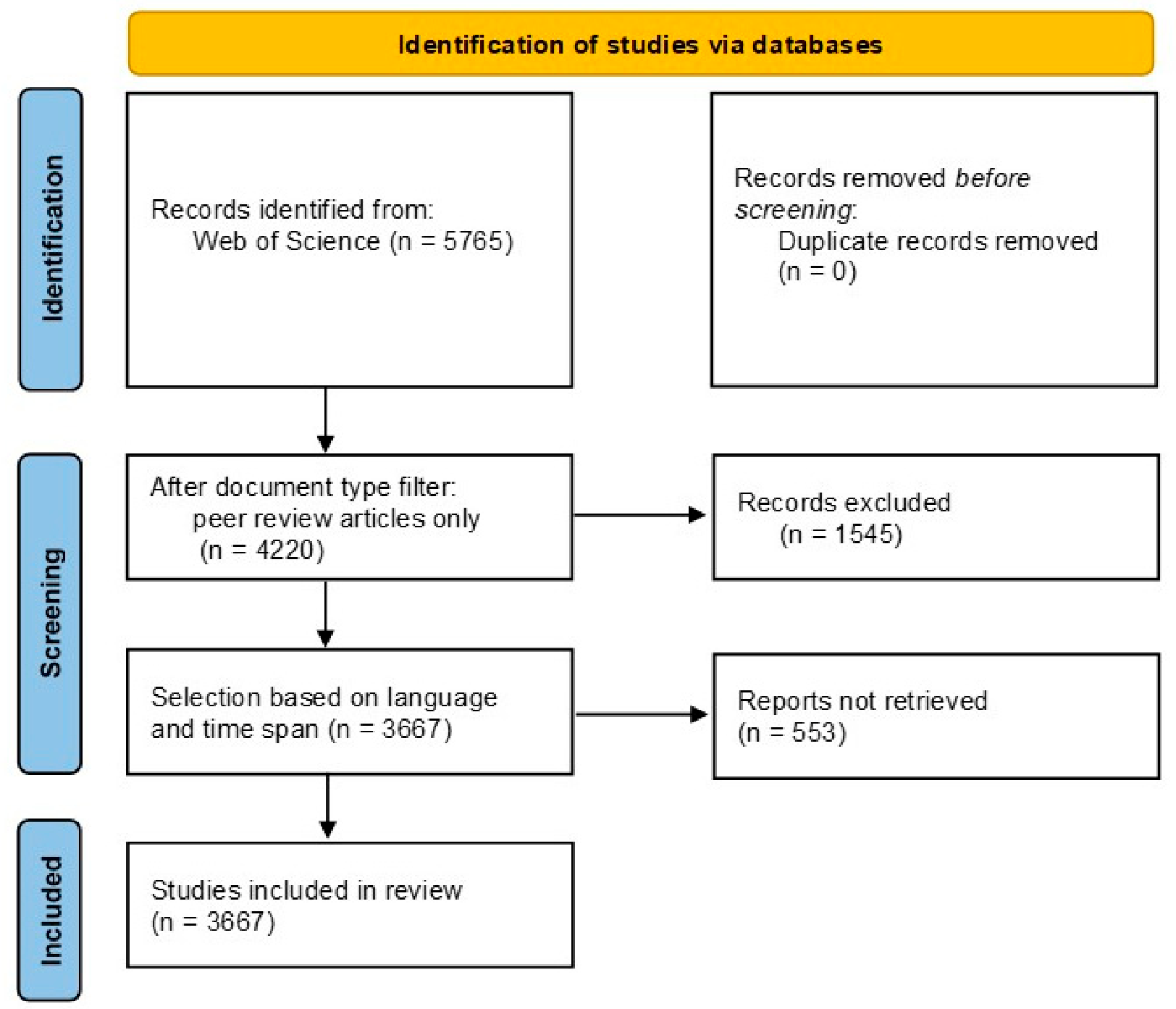
Techniques such as bibliographic coupling and path examination enable researchers to uncover the intellectual structure of a field while reducing, although not entirely eliminating, the influence of subjective judgement [34]. Following the bibliometric guidelines proposed by Donthu et al. (2021), this study adopted a four-step bibliometric procedure to ensure a systematic, transparent, and reproducible analysis [30]. As summarized in Table 3, the methodology comprised defining the research scope, selecting the appropriate bibliometric techniques, collecting and preprocessing the bibliographic data, and conducting the bibliometric analysis and interpretation. The literature search was conducted in the Web of Science Core Collection using the search strategy presented in Figure 1. The database was selected due to its comprehensive coverage of peer-reviewed scientific literature. The search strategy was applied to the title, abstract, and author keywords, yielding an initial dataset of 5765 records. To ensure the scientific quality and consistency of the dataset, the analysis was restricted to peer-reviewed articles published in English. After applying these selection criteria, the final dataset comprised 3667 publications, which served as the basis for the subsequent bibliometric analysis. For the timespan, all published articles were included without any time restriction, resulting in a time span from 1 January 2003 to 1 March 2026. Figure 1 illustrates the search and study selection process.
The literature search was conducted in the Web of Science Core Collection, which was selected because of its comprehensive coverage of high-quality peer-reviewed scientific publications. The search was performed on 1 March 2026 using the Topic Search (TS) field, which searches the title, abstract, and author keywords. The following search query was applied: (“smart farm” OR “smart agriculture” OR “digital agriculture” OR “precision agriculture” OR “precision farming” OR “agriculture 4.0” OR “farming 4.0”) AND (“Internet of Things” OR IoT OR AIoT OR “artificial intelligence”). The search initially retrieved 5765 records. To ensure the quality and consistency of the bibliometric dataset, only peer-reviewed journal articles published in English were retained. Conference papers, review articles, book chapters, editorials, meeting abstracts, proceedings papers, early access publications, and other non-article document types were excluded. No restriction was imposed on the publication period during the search; consequently, the retrieved literature covered the period from 1 January 2003 to 1 March 2026. After applying the document type, time span, and language filters, the final dataset consisted of 3667 publications, which constituted the basis for the subsequent bibliometric analyses. The complete study selection process is illustrated in Figure 1.

3.1. Research Method

Compared with qualitative text analysis methods, bibliometric analysis provides a more systematic and scalable approach for examining large bodies of scientific literature [32]. Moreover, it reveals relationships among publications, citations and keywords [35], thereby providing a visual representation of emerging research themes and relationships among them [32].

3.1.1. Quantitative Analysis

The temporal development of AIoT research in smart farming was first examined by analyzing the annual distribution of the collected publications. Subsequently, the scientific impact of the field was assessed using bibliometric indicators, such as publications per author, citation per paper, and the geographical distribution of publications, following the approach of Fahimnia et al. and Rejeb et al. [32,36]. To facilitate data processing and bibliometric analysis, this study employed the Bibliometrix package in R through the Biblioshiny interface, together with VOSviewer for science mapping and network visualization. VOSviewer was used to construct and visualize bibliometric networks based on the authors, keywords, and documents. Highly cited publications, authors, institutions, countries, and journals were identified through performance analysis to determine the main contributors to AIoT research in smart farming. This analysis enabled the identification of the most frequently investigated topics, their relationships, and the evolution of research interests over time. In addition, citation analysis was performed to identify the most influential publications, as citation counts are widely recognized as an indicator of a publication’s scientific impact and its contribution to the development of a research field [37]. Both local and global citation indicators were used to evaluate the scientific influence of the selected publications. Local citations refer to the number of citations a publication receives from other documents included in the final dataset [32], reflecting its impact within the AIoT smart farming research community. In contrast, global citations correspond to the total number of citations indexed by the Web of Science Core Collection, indicating the publication’s broader scientific influence beyond the boundaries of the field. The comparison of these two indicators helps distinguish studies that are influential within the domain from those with wider interdisciplinary impact.

3.1.2. Cluster Analysis

Following the descriptive results, bibliometric network analysis was performed using VOSviewer to identify the underlying intellectual structure of AIoT research in smart farming. Relationships between two papers can be examined through keyword co-occurrence or co-citation analyses [38]. Introduced by Henry Small, co-citation measures the relatedness of publications based on the frequency with which they are cited together [39]. A higher co-citation frequency indicates a stronger intellectual relationship between them [34]. By contrast, bibliographic coupling links two publications that share one or more common references [32]. Emerging research clusters were identified through co-citation analysis based on the reference lists of the selected publications [32,34]. The bibliographic dataset was imported into VOSviewer to construct the co-citation and keyword co-occurrence networks as suggested by Kirby [40]. Prior to the analysis, the dataset was cleaned and appropriate occurrence thresholds were defined to improve the accuracy of the bibliometric maps following the methodology of [32]. Threshold values were selected to retain the most representative publications and keywords while avoiding excessively dense or fragmented networks. In the generated visualizations, each node represents a publication or keyword, whereas the links between nodes indicate their co-citation or co-occurrence relationships. VOSviewer automatically groups strongly connected nodes into clusters based on their association strength [40], allowing the identification of the main intellectual foundations and thematic research areas within AIoT-enabled smart farming. To gain a deeper understanding of AIoT research in the smart farming domain, a keyword co-occurrence network was constructed. Keyword co-occurrence analysis enables the identification of dominant research topics and the evolution of scientific trends in the field [41]. The strength of the relationship between two keywords depends on how frequently they co-occur in the same publications [32,34]. The overall research procedure follows [32] and it is presented in Figure 2.

4. Results

4.1. RQ1: What Evolution Has AIoT Research in Smart Farming Undergone Since Its Emergence?

4.1.1. Main Information

The final dataset comprised 3667 publications produced by 13,256 authors and indexed in 918 sources between 2003 and 2026 (see Table 4). The scientific production in this field has experienced substantial growth, with an annual growth rate of 20.51%, reflecting the increasing scholarly interest in smart farming technologies and the transition from IoT to AIoT-enabled agricultural systems. Of the 3667 publications, only 138 (3.76%) were single-authored, while the remaining publications involved collaborative research efforts. This finding highlights the highly collaborative nature of the field. The average number of co-authors per document was 4.72, and 35.37% of the publications involved international collaborations, indicating a strong level of global scientific cooperation.
The dataset contains 8427 authors’ keywords and 3245 Keywords Plus. Author keywords represent the concepts and themes explicitly selected by researchers to describe their studies, whereas Keywords Plus are algorithmically generated terms derived from the titles of cited references. The large number of keywords suggests considerable thematic diversity and a rapidly evolving knowledge base within the digital agriculture domain. The publications accumulated a total of 169,998 cited references, illustrating the extensive intellectual foundation supporting this research area. Furthermore, the average number of citations per document was 30.69, indicating that studies in this field have achieved considerable academic impact and visibility. The dataset spans 24 years, from 2003 to 2026, with an average document age of 3.03 years. This relatively low average age suggests that the literature is highly recent and reflects an emerging and fast-developing research domain. The predominance of recent publications further confirms the growing importance of advanced digital agriculture technologies, particularly the convergence of IoT, artificial intelligence, machine learning, big data analytics, robotics, and AIoT in smart farming systems. Regarding document types, the dataset consists primarily of 2925 research articles and 742 review papers, demonstrating both the maturity of the field and the increasing efforts to synthesize and consolidate existing knowledge.

4.1.2. Annual Scientific Production

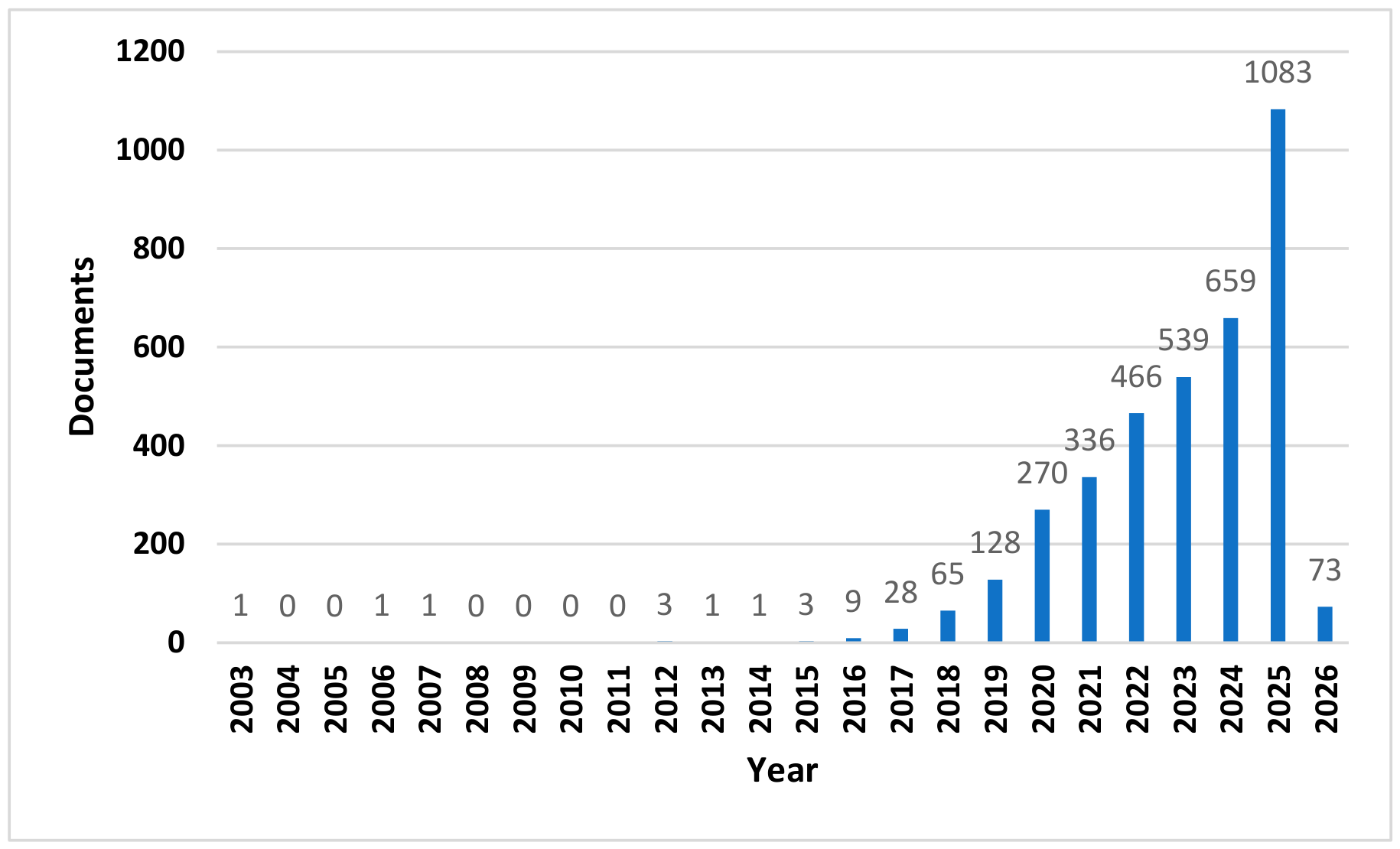
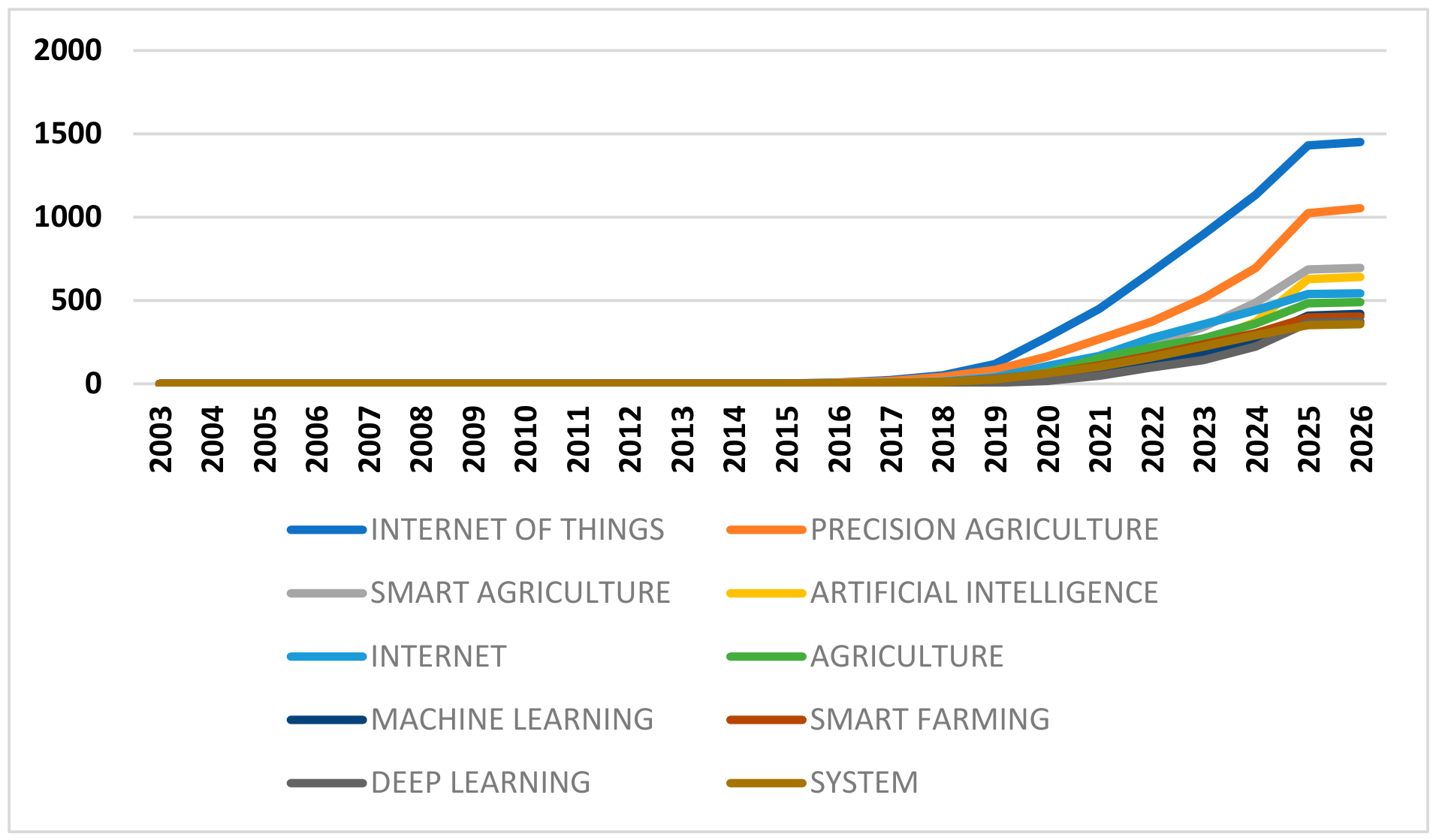
Figure 2 illustrates the annual scientific production related to IoT and AIoT technologies in smart farming between 2003 and 2026. The evolution of the field reveals four distinct development phases, reflecting the progressive maturation of digital agriculture research. The first phase, spanning from 2003 to 2015, can be characterized as the nascent stage of the field. During this period, scientific production remained extremely limited, with only a few publications appearing sporadically each year.
The number of annual publications never exceeded three articles, indicating that research on IoT-enabled smart farming was still in its infancy and had not yet attracted significant scholarly attention. The second phase, extending from 2016 to 2018, represents the emergence stage. During this period, the number of publications increased from 9 articles in 2016 to 65 articles in 2018. This growth coincided with the increasing adoption of IoT technologies, wireless sensor networks, and precision agriculture practices, which stimulated greater academic interest in digital farming solutions. The third phase, covering the years 2019 to 2021, can be described as the expansion stage. Scientific production accelerated considerably, increasing from 128 publications in 2019 to 336 publications in 2021. This rapid growth reflects the broader diffusion of digital technologies in agriculture and the increasing integration of big data analytics, cloud computing, artificial intelligence, and machine learning into farming systems. The fourth phase, from 2022 to 2025, corresponds to the accelerated growth and consolidation stage of the field. During this period, publication output increased dramatically from 466 articles in 2022 to 1083 articles in 2025, representing the highest level of scientific productivity observed throughout the study period. The decrease observed in 2026 does not indicate a decline in research activity. Since the data collection was conducted on 1 March 2026, the 2026 records represent only the publications indexed during the early months of the year. Additional publications indexed later in 2026 were not captured, resulting in a lower publication count. The remarkable increase in publications suggests that research has progressively evolved beyond traditional IoT applications toward more intelligent and autonomous agricultural systems enabled by AIoT, edge computing, agricultural robotics, digital twins, and advanced data analytics.
The transition from isolated IoT-based monitoring systems to intelligent AIoT-enabled farming ecosystems has become a major research priority, highlighting the strategic role of smart farming technologies in improving agricultural productivity, resource efficiency, sustainability, and decision-making capabilities.

4.1.3. Most Relevant Journals

Table 5 presents the 20 most productive journals in the field of IoT and AIoT applications in smart farming. The results reveal that research output is concentrated in a relatively small group of journals spanning agriculture, engineering, computer science, sensing technologies, and sustainability.
Among all sources, Sensors emerged as the most productive journal with 887 publications, followed by IEEE Access (610 publications) and Computers and Electronics in Agriculture (601 publications) between 2003 and 2026 as illustrated in Table 6. An examination of publishers reveals the dominant role of MDPI, which accounts for eight of the twenty most productive journals, including Sensors, Agriculture, Sustainability, Agronomy, Applied Sciences, AgriEngineering, Electronics, and Remote Sensing. Elsevier also plays a significant role through journals such as Computers and Electronics in Agriculture, Smart Agricultural Technology, and Internet of Things, while IEEE maintains a strong presence through its technology-oriented publications.
However, the journal landscape reveals a paradoxical evolution of smart farming research. While publication output has grown exponentially, the field remains heavily dominated by engineering and sensing-oriented outlets. This suggests that the transition from IoT-based connectivity toward AIoT-enabled intelligence may still be incomplete. Although AIoT research in smart farming is increasingly recognized as a multidisciplinary field, scientific production remains largely concentrated in engineering and computer science-oriented journals. In contrast, relatively few publications appear in management, policy, or socio-economic journals. This distribution suggests that the field has primarily evolved through technological innovation, whereas organizational, governance, business model, and policy dimensions remain comparatively underexplored despite their growing importance for the large-scale adoption of AIoT in agriculture.

4.2. RQ2: Which Countries, Universities and Authors Have Played the Most Prominent Role in Advancing AIoT Research in Smart Farming?

4.2.1. Most Influential Academic Institutions and Countries

Table 7 presents the most influential countries in the field of IoT and AIoT research in smart farming based on total citations and average citations per article.
India ranks first in terms of total citations (16,120), followed by China (14,904) and the United States (9601). These findings indicate that Asia has become a major contributor to the development of digital agriculture research, particularly through the growing scientific output of India and China. However, a different pattern emerges when considering average citations per article. Although India and China lead in total citations, their average citation impact remains relatively moderate, with 25.9 and 28.7 citations per article, respectively. In contrast, several countries with lower publication volumes demonstrate substantially higher research impact. The Netherlands records the highest average citation rate (159.3 citations per article), followed by Greece (70.4), Australia (50.1), France (46.3), and Canada (39.6).
These results suggest that while emerging economies are driving the quantitative expansion of the field, the most influential and highly cited contributions continue to originate from a relatively small group of countries characterized by strong research ecosystems and high international visibility (see Table 8 and Table 9). The exceptional performance of the Netherlands and Greece indicates that research impact is not necessarily associated with publication volume but rather with the ability to produce highly influential studies that shape the intellectual development of the field.
While India and China dominate knowledge production (see Table 8 and Table 9), countries such as the Netherlands, Greece, Australia, and France exert a disproportionately high intellectual impact, highlighting the unequal distribution of influence within the global smart farming research landscape.

4.2.2. Science Mapping: Three Field Plot

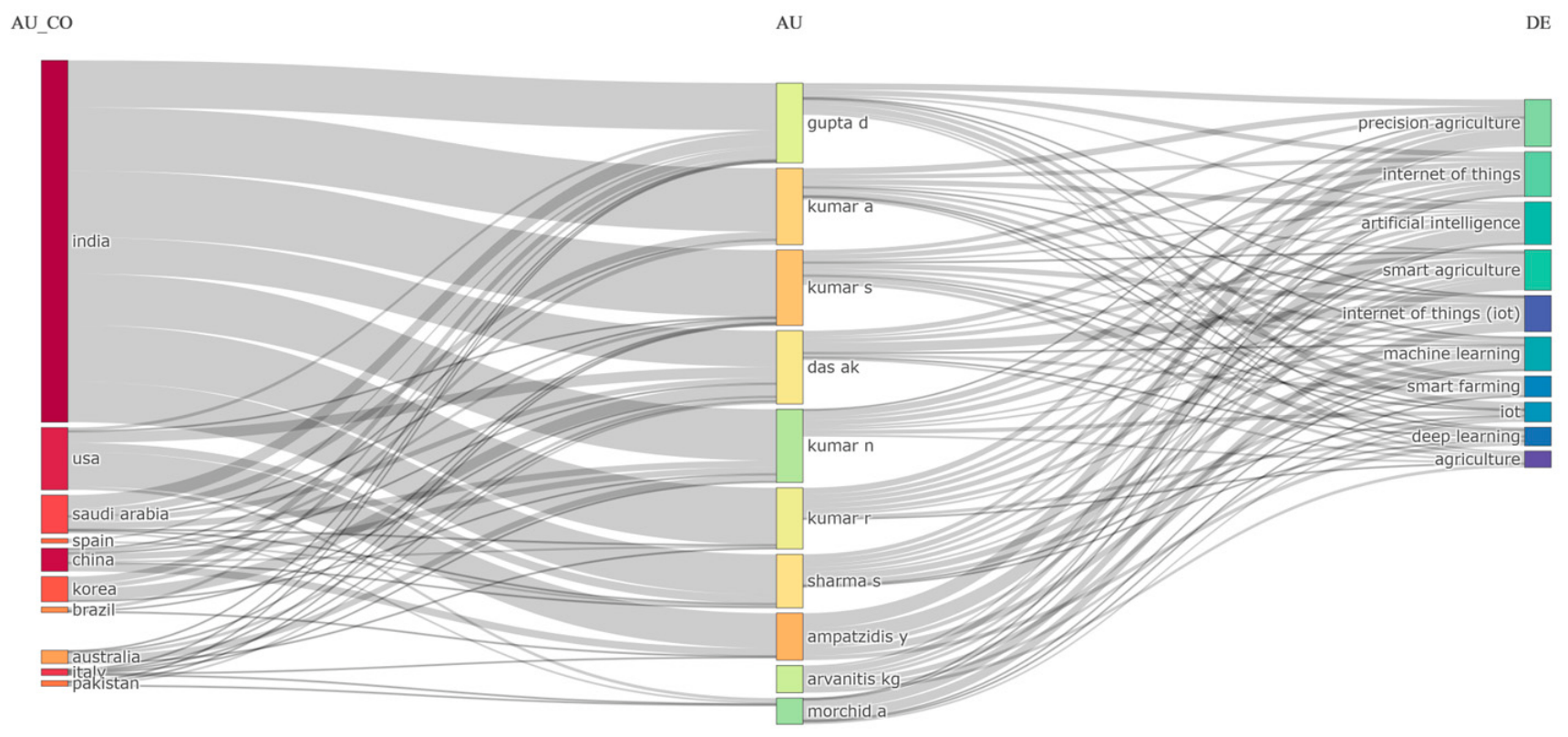
Figure 3 presents a three-field plot linking authors’ countries (AU_CO), authors (AU), and authors’ keywords (DE), providing insights into the geographical distribution of research activities and their thematic orientations within the smart farming domain. The results reveal a strong geographical concentration of research output, with India emerging as the dominant contributor.
Most of the highly productive authors, including Kumar A, Gupta D, Kumar S, and Das AK, are affiliated with Indian institutions and are strongly connected to core research themes such as smart agriculture, Internet of Things (IoT), precision agriculture, and artificial intelligence.
China, the United Kingdom, Saudi Arabia, and several European countries also contribute to the field, although with substantially lower publication intensity. The keyword distribution indicates that the intellectual structure of the field remains centered on smart agriculture, IoT, and precision agriculture, which constitute the main research pillars. While artificial intelligence, machine learning, and deep learning are increasingly visible, their connections are less dominant than those associated with traditional IoT-related themes.

4.3. RQ3: Which Publications Constitute the Intellectual Foundations of AIoT Research in Smart Farming?

Top Cited Papers

Table 10 highlights the intellectual foundations of AIoT-enabled smart farming research. The most cited publications reveal a clear evolution from connectivity-oriented agricultural systems towards intelligent, autonomous, and sustainability-driven farming ecosystems. The earliest influential studies, particularly those of Wolfert et al. and Elijah et al. [14,42], established the technological foundations of smart farming by emphasising the role of IoT, sensor networks, cloud computing, and data analytics in enabling real-time monitoring and data-driven agricultural management. These studies primarily focused on the collection, transmission, and processing of agricultural data, laying the groundwork for connected farming systems. Subsequent contributions shifted attention towards artificial intelligence and machine learning applications [43,44,45]. Their work demonstrated how data generated by IoT infrastructures could be transformed into actionable knowledge through predictive analytics, computer vision, disease detection, yield forecasting, intelligent irrigation, and autonomous decision-support systems. This transition reflects the emergence of AI as a critical intelligence layer within smart farming systems. Another stream of highly cited studies further expanded the technological scope of smart farming through the integration of UAVs, remote sensing technologies, satellite imagery, GIS, and advanced imaging systems [46,47].
These studies highlight the increasing importance of spatial intelligence and real-time field monitoring for precision agriculture applications. More recent influential contributions broadened the discussion beyond technological adoption [48,49]. While Lezoche et al. demonstrated the integration of Industry 4.0 technologies such as AI, IoT, robotics, blockchain, and big data analytics to improve environmental sustainability, Klerkx et al. emphasised that digital agriculture is not merely a technological transformation but also a socio-technical one involving governance, ethics, institutions, business models, and knowledge systems.
Taken together, the most cited papers indicate that smart farming research has evolved through three interconnected stages: (i) the development of IoT-based sensing and connectivity infrastructures, (ii) the integration of artificial intelligence and machine learning for intelligent decision-making, and (iii) the emergence of AIoT-enabled agricultural ecosystems that combine technological innovation with sustainability and governance considerations. This progression suggests that contemporary smart farming is increasingly characterized not only by connectivity and automation but also by intelligence, autonomy, and sustainable agricultural transformation.

4.4. RQ4: What Are the Main Thematic Trends and Knowledge Structures Within the AIoT Field?

4.4.1. Keywords Analysis

Table 11 presents the most frequently occurring author keywords in the field of IoT and AIoT-enabled smart farming. The keyword distribution provides valuable insights into the technological foundations, dominant research themes, and emerging directions shaping the evolution of digital agriculture. Among all keywords, Internet of Things (2040 occurrences) is by far the most dominant concept, followed by Precision Agriculture (1054 occurrences) and Smart Agriculture (697 occurrences). The prominence of these terms confirms that IoT technologies constitute the core technological infrastructure of modern smart farming systems, enabling real-time data collection, connectivity, and monitoring across agricultural environments. A second cluster of highly ranked keywords is associated with artificial intelligence and advanced analytics. Terms such as Artificial Intelligence (642 occurrences), Machine Learning (420 occurrences), Deep Learning (374 occurrences), and Big Data (238 occurrences) demonstrate the growing integration of intelligent analytical capabilities into agricultural systems. The strong presence of these keywords suggests that the field is progressively evolving beyond simple sensing and monitoring functions toward predictive analytics, intelligent decision support, and autonomous agricultural operations.
The appearance of Sensors (241 occurrences) and Wireless Sensor Networks (196 occurrences) further highlights the importance of sensing infrastructures as the primary source of agricultural data. driven applications are developed. Interestingly, several keywords such as System (359 occurrences), Management (267 occurrences), and Classification (214 occurrences) indicate that researchers are increasingly focusing on the development of integrated management systems and data-driven analytical models rather than isolated technological solutions. This shift reflects the growing maturity of the field, where the emphasis is moving from technology deployment toward intelligent agricultural management and optimization. Overall, the keyword structure reveals a clear technological trajectory.
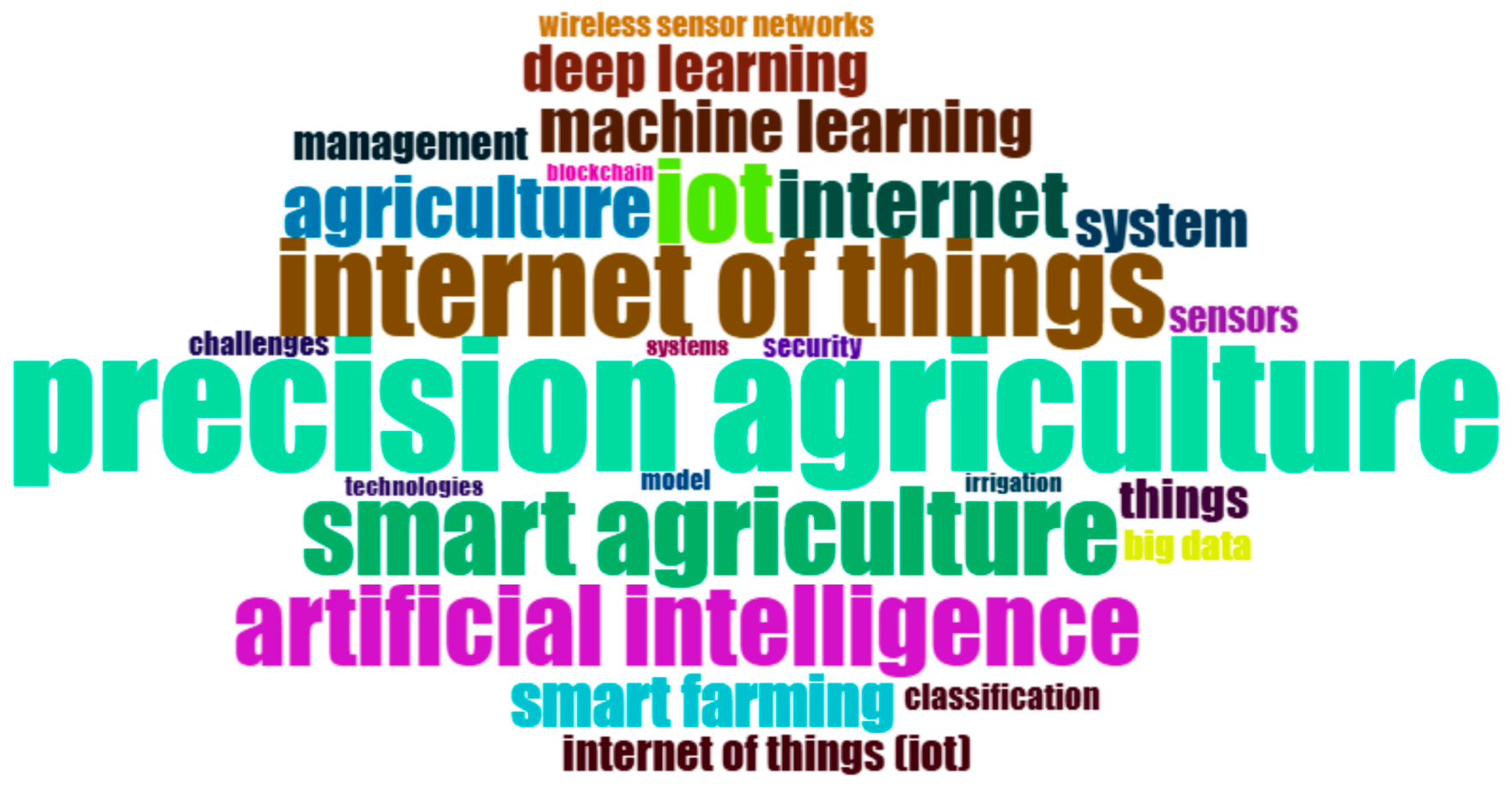
These technologies represent the foundational layer upon which more advanced AI- Early research was primarily centered on IoT connectivity, sensor networks, and precision agriculture, whereas more recent studies increasingly incorporate artificial intelligence, machine learning, deep learning, and big data analytics. This pattern supports the notion that smart farming is undergoing a gradual transition from IoT-based monitoring systems toward AIoT-enabled intelligent and autonomous agricultural ecosystems. Figure 4 and Figure 5 presents the word cloud of the most frequently occurring keywords in the smart farming literature. The size of each term reflects its frequency of occurrence within the dataset and provides an overview of the dominant concepts shaping the field. The visualization reveals that Precision Agriculture is the most prominent concept, followed by Internet of Things (IoT), Smart Agriculture, and Artificial Intelligence. This finding confirms that the field is primarily structured around the convergence of agricultural management practices and digital technologies. The central position of IoT-related terms highlights the role of connectivity, sensing, and real-time data acquisition as the technological backbone of smart farming systems. A second group of highly visible terms includes Machine Learning, Deep Learning, Big Data, Classification, and Sensors.
The prominence of these concepts reflects the increasing importance of advanced analytics and intelligent algorithms for transforming agricultural data into actionable insights. This suggests that research has progressively evolved from data collection and monitoring toward prediction, optimization, and decision support. The presence of terms such as Wireless Sensor Networks, Remote Sensing, Computer Vision, Blockchain, and Cloud Computing further illustrates the multidisciplinary nature of the field and highlights the integration of multiple digital technologies within modern agricultural ecosystems. Interestingly, the word cloud reveals the coexistence of both traditional IoT-related concepts and emerging AI-oriented technologies.
While IoT remains the dominant research theme, the growing visibility of artificial intelligence, machine learning, and deep learning indicates a gradual shift toward more intelligent and autonomous farming systems. This pattern supports the broader transition from connected agriculture to AIoT-enabled smart farming. The core smart farming technologies evolution over time are presented in Table 12. An important finding is that while Internet of Things remains the dominant keyword throughout the study period, as shown in Figure 5, Artificial Intelligence, Machine Learning, and Deep Learning exhibit the fastest growth rates. This pattern suggests that the field is evolving from connectivity-oriented systems toward intelligence-driven applications. Rather than replacing IoT, AI technologies are increasingly being integrated into existing IoT infrastructures, reflecting the emergence of AIoT-enabled smart farming ecosystems.

4.4.2. Trend Topics

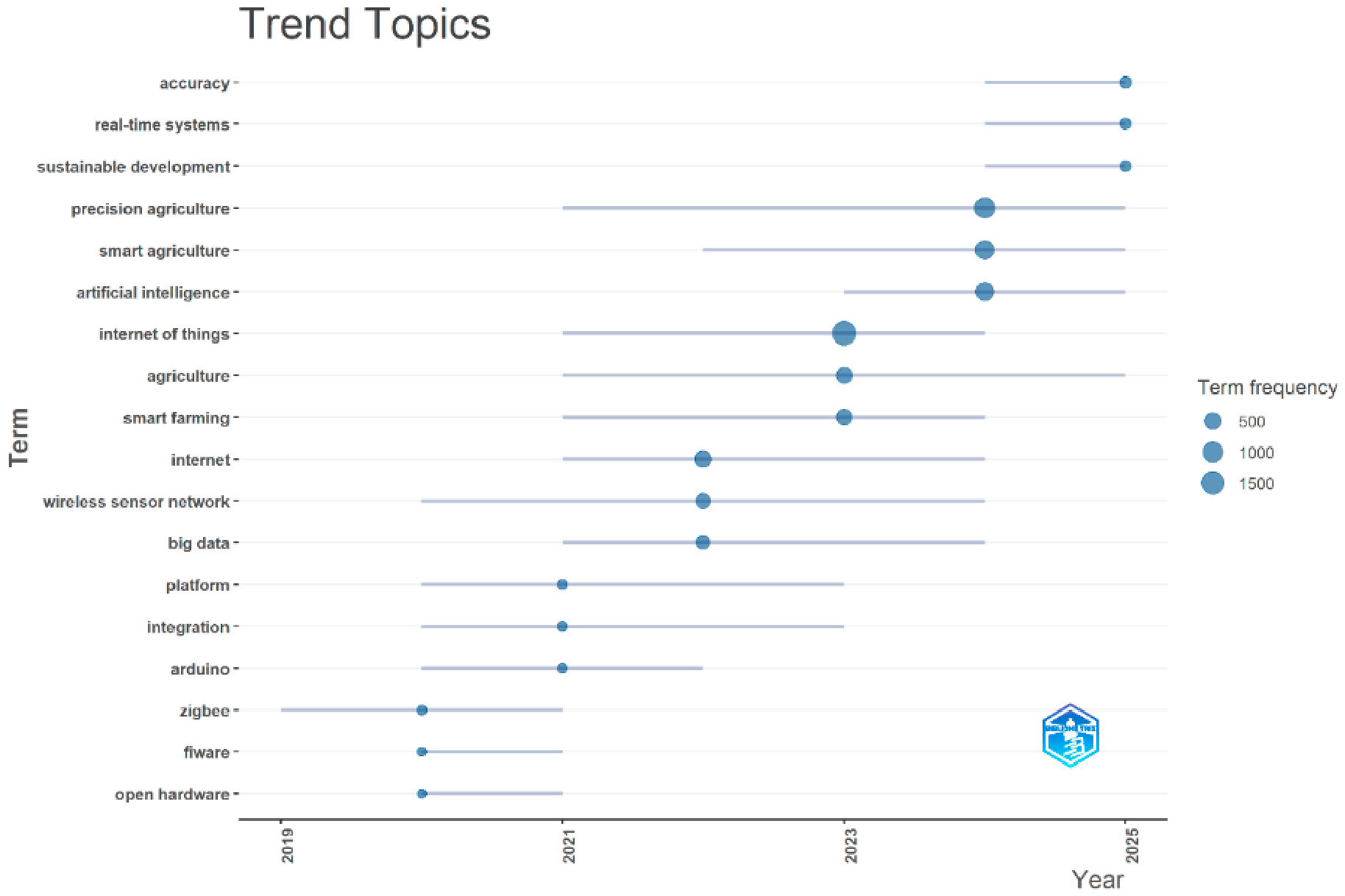
Figure 6 presents the temporal evolution of the most prominent research topics in smart farming from 2019 to 2026.
The results reveal a clear transition from infrastructure-oriented technologies toward intelligent and sustainability-driven agricultural systems. Early research focused on enabling technologies such as ZigBee, FIWARE, Open Hardware, Arduino, Platform, and Integration, reflecting efforts to establish the connectivity and communication infrastructure required for digital agriculture. Between 2021 and 2024, attention shifted toward data-centric technologies, with Internet of Things (1758 occurrences), Wireless Sensor Networks (295 occurrences), Big Data (266 occurrences), and Smart Farming (405 occurrences) becoming dominant themes. This period corresponds to the rapid diffusion of connected agricultural systems based on sensing, monitoring, and real-time data collection. More recently, the emergence of Artificial Intelligence (642 occurrences), together with Precision Agriculture (1054 occurrences), Smart Agriculture (776 occurrences), Real-Time Systems, Accuracy, and Sustainable Development, indicates a growing emphasis on intelligent decision-making, predictive analytics, operational optimization, and sustainability outcomes (see Figure 5 and Figure 6).
Interestingly, while AI-related topics have gained considerable momentum since 2023, Internet of Things remains the most influential theme, suggesting that AI is developing as a second layer of intelligence built upon previously established IoT infrastructures rather than replacing them. Furthermore, the declining prominence of technology-specific terms such as ZigBee, Arduino, and FIWARE indicates that research attention has progressively moved away from hardware and communication concerns toward higher-value applications focused on intelligence, performance, and sustainability. Overall, the trend topic analysis highlights a clear technological trajectory from connectivity and data acquisition technologies to intelligent and outcome-oriented agricultural systems, providing strong evidence that the field is evolving from IoT-enabled smart farming toward more advanced AIoT-driven agricultural ecosystems.

4.4.3. Cluster Analysis Results

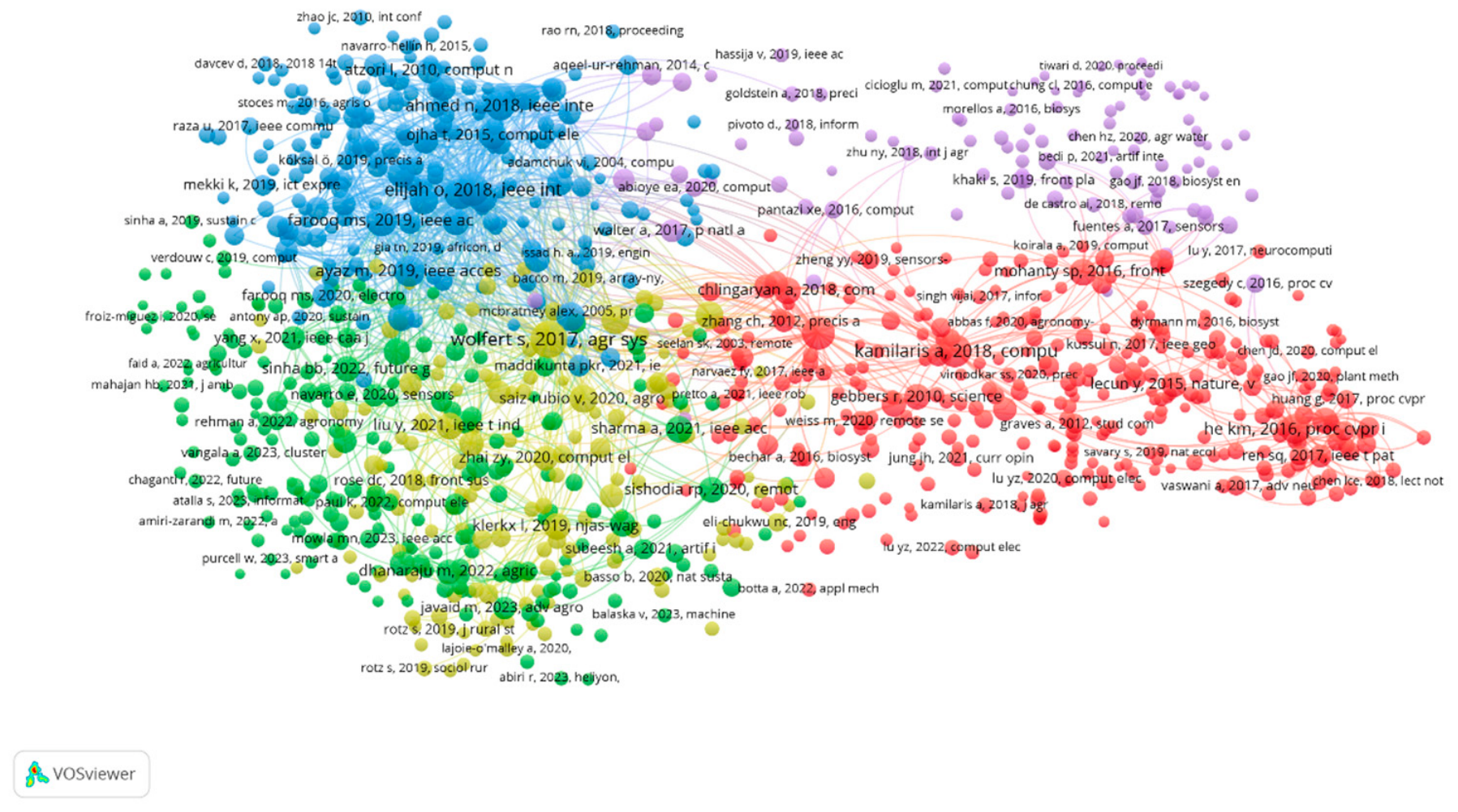
Following the example of previous studies [32,36], we chose a threshold of 2 for co-citation frequency. The generated bibliographic coupling network contains 3048 papers. In network analysis, nodes are grouped into clusters (or communities) in which the density of links is higher within the same cluster than between different clusters [50]. Five clusters were identified (see Figure 7).
Each cluster therefore represents a group of closely connected publications that share stronger relationships with one another than with publications belonging to other clusters. Such clustering facilitates the analysis of the network topology and helps reveal the main research themes and their interconnections. To identify these communities, the VOSviewer clustering technique was applied to group citation clusters based on citation relations rather than explicitly relying on the built-in Louvain clustering algorithm in the desktop software [51]. Following the clustering procedure, the resulting clusters were examined to identify their main research focus. Because each cluster contained a large number of publications, only the ten most representative articles within each cluster were selected for further qualitative analysis. The leading papers were identified according to their PageRank scores within the network (see Table 13). Based on the content of these highly influential publications, each cluster was assigned a thematic label representing its dominant research focus. The resulting clusters were subsequently interpreted through a qualitative analysis. These publications were carefully reviewed to identify their main research focus, key findings, and thematic relationships. Based on this manual synthesis, each cluster was assigned a descriptive label reflecting its dominant research theme, which served as the basis for the subsequent discussion and future research agenda.

4.4.4. Thematic Findings

AIoT Integrated Ecosystems for Smart Farming
Early studies focused on applying machine learning, deep learning and computer vision to specific agricultural tasks, including crop yield prediction, nitrogen management, disease detection, crop classification, weed identification, livestock monitoring and image-based phenotyping [43,52,59,72,81]. These studies transformed precision agriculture from a sensing-oriented approach into a predictive and knowledge-driven management system built upon intelligent data interpretation [64].
However, these early applications were generally developed for specific agricultural tasks and operated as isolated AI solutions rather than as integrated farming ecosystems, limiting their interoperability and large-scale deployment. Subsequent research shows that artificial intelligence is no longer implemented as a standalone technology but increasingly operates within integrated digital ecosystems combining IoT, cloud computing, remote sensing, UAVs, robotics, wireless sensor networks and Big Data to support real-time monitoring, predictive analytics and automated decision-making throughout the agricultural production cycle [6,8,46,53,55,60].
Nevertheless, the literature does not converge on what constitutes a fully integrated AIoT ecosystem. While some studies primarily describe technological integration through interconnected digital infrastructures, others emphasize intelligent decision-making and autonomous system capabilities as the defining features of AIoT-enabled farming. Similarly, the evolution from traditional wireless sensor networks to IoT-enabled agricultural ecosystems has enabled the integration of heterogeneous data sources through cloud platforms, RFID, middleware, communication technologies and artificial intelligence, supporting precision farming, farm management and decision-support systems [42,56,70,86]. This technological convergence is further reinforced by the emergence of data-driven agriculture, where Big Data, IoT, artificial intelligence and advanced analytics collectively transform agricultural data into actionable knowledge for predictive modelling, real-time decision-making and autonomous farm management [14,57,66,75].
The literature indicates that the evolution of smart farming is characterized by the progressive integration of complementary digital technologies into AIoT ecosystems capable of supporting connected, intelligent and increasingly autonomous agricultural systems.
From Data Collection to Intelligent Decision-Making
The literature reveals a clear transition from data collection towards intelligent decision-making in smart farming. Early precision agriculture primarily focused on collecting spatial and temporal information through sensing technologies, information systems and automated machinery to support site-specific management [64]. Although these technologies enabled continuous monitoring of agricultural variability, their ability to transform large volumes of data into actionable knowledge remained limited. The adoption of artificial intelligence significantly changed this paradigm by enabling predictive analytics and intelligent interpretation of agricultural data. Machine learning and deep learning algorithms improved crop yield prediction, nitrogen status estimation, disease diagnosis, crop classification and livestock monitoring, transforming agricultural management from descriptive monitoring into predictive and data-driven decision support [52,53,59]. However, existing studies primarily evaluate the predictive performance of AI models, whereas comparatively less attention has been devoted to the reliability, explainability, and practical integration of AI-generated recommendations into farmers’ day-to-day decision-making processes.
Similarly, remote sensing technologies combined with machine learning further enhanced decision-making by supporting site-specific management, variable-rate irrigation and fertilizer application, biomass estimation, yield prediction and early disease detection [46]. As smart farming evolved, IoT technologies further strengthened decision-making by enabling continuous real-time data acquisition and communication through interconnected sensors, cloud computing and farm management platforms. These systems support precision irrigation, greenhouse management, livestock monitoring, crop management and product traceability while providing real-time decision support throughout the agricultural production cycle [42,55,60,70]. More recent studies position Big Data as the core of intelligent agricultural management. By integrating IoT, artificial intelligence, cloud computing, and advanced analytics, these systems transform heterogeneous agricultural data into actionable knowledge for predictive modelling, risk management, resource allocation, and strategic farm management [14,57,66]. Nevertheless, effectively converting these heterogeneous datasets into reliable decision support remains a significant challenge. Differences in data quality, data integration, and data governance mechanisms across sensors continue to limit the practical implementation of AIoT in farming environments. This transition has been largely enabled by recent advances in deep learning and computer vision, which significantly improved crop yield prediction, soil property estimation and automated disease diagnosis through large-scale heterogeneous agricultural datasets [54,63,67,84].
Towards Autonomous and Precision Farming
The literature demonstrates a progressive evolution from conventional precision agriculture towards increasingly autonomous farming systems. Early precision agriculture primarily relied on site-specific management supported by sensing technologies and spatial variability analysis [64]. Recent studies further demonstrate that deep neural networks, convolutional neural networks and advanced sensing techniques substantially improve prediction accuracy while enabling automated crop monitoring and intelligent field management [54,63,67]. However, improvements in prediction accuracy do not necessarily translate into fully autonomous agricultural systems. While several studies focus on enhancing AI model performance, comparatively fewer investigate how these models can be reliably integrated into autonomous farm operations under dynamic real-world conditions. As artificial intelligence matured, agricultural applications expanded considerably, enabling automated crop yield prediction, nitrogen management, disease diagnosis, crop classification, weed identification, phenotyping, livestock monitoring and computer vision-based crop inspection [43,52,59,72,81]. The integration of artificial intelligence with IoT, remote sensing, UAVs, robotics and cloud computing further accelerated this transition by supporting the entire agricultural production cycle. Intelligent systems are now applied to soil analysis, irrigation scheduling, crop monitoring, pest and weed management, greenhouse management, harvesting, livestock management and crop yield prediction through continuous monitoring and predictive analytics [8,46,53]. Remote sensing and machine learning additionally enable site-specific management, variable-rate irrigation and fertilizer application, biomass estimation and early disease detection, contributing to more precise and efficient agricultural practices [46]. The reviewed studies further indicate that smart farming is progressively evolving towards autonomous agricultural management.
IoT-enabled platforms, wireless sensor networks, automated irrigation systems, greenhouse monitoring frameworks and AI-assisted disease detection increasingly reduce manual intervention while supporting real-time monitoring and automated control across agricultural operations [10,61,65,70]. More recently, Agriculture 4.0 and Agriculture 5.0 have reinforced this evolution by integrating robotics, artificial intelligence, IoT and farm management systems into intelligent environments capable of continuous monitoring, variable-rate applications and automated decision-making [75,91]. Therefore, smart farming is progressively shifting from precision management towards increasingly autonomous agricultural systems capable of optimizing productivity, resource utilization and operational efficiency.
AIoT as an Enabler for Sustainable Agriculture
The literature demonstrates that AIoT is increasingly recognized as a key enabler of sustainable and resource-efficient agriculture. While early precision agriculture focused primarily on monitoring spatial variability and supporting site-specific management, recent studies show that the integration of artificial intelligence, IoT, remote sensing, cloud computing, robotics and Big Data enables more efficient use of agricultural resources throughout the production cycle [46,53,64]. The reviewed studies consistently show that AI-enabled technologies improve agricultural productivity while simultaneously reducing resource consumption.
Machine learning, remote sensing and IoT support precision irrigation, variable-rate fertilizer application, crop monitoring, disease detection, yield prediction, greenhouse management and livestock monitoring, allowing farmers to optimize agricultural inputs through continuous monitoring and predictive analytics [46,55,60,70,92]. Despite these findings, the literature still lacks a comprehensive understanding of what constitutes a high-performing autonomous farming system. More research is needed regarding the functional components, technological capabilities, and system architectures required to achieve an effective autonomous farming environment. Similarly, the convergence of Industry 4.0 technologies including AI, IoT, robotics, drones, blockchain, wireless sensor networks and automation enables intelligent farming systems that improve productivity while reducing water consumption, fertilizer use, labor requirements and environmental impacts [6,8]. However, little attention has been devoted to systematically evaluating the advantages, limitations, and trade-offs associated with autonomous agricultural systems under different farming contexts. The literature further indicates that data-driven agriculture has become essential for improving resource efficiency and supporting sustainable farm management. By integrating Big Data, IoT, cloud computing, sensors and artificial intelligence, smart farming systems transform agricultural data into actionable knowledge for predictive modelling, real-time operational decision-making, benchmarking and resource optimization across the agricultural value chain [14,57,66]. Automation technologies also contribute to more efficient irrigation management, pesticide application, weed control, environmental monitoring and storage management, further supporting sustainable agricultural production [75].
Barriers to Efficient AIoT Systems Integration
Despite the rapid advancement of AIoT-enabled smart farming, the literature identifies several barriers that continue to hinder its large-scale implementation (see Table 14). The most frequently reported challenge concerns interoperability, which is consistently recognized as a major obstacle to the deployment of integrated smart farming systems. The coexistence of heterogeneous sensors, communication protocols, cloud platforms and agricultural information systems limits seamless data integration and information exchange across digital technologies [56,60,70,87,92]. To address these limitations, the literature emphasizes the need for greater standardization, interoperable system architectures and integrated digital infrastructures capable of supporting scalable AIoT ecosystems [89,92].
Beyond interoperability, cybersecurity has emerged as a critical concern as agricultural systems become increasingly connected through IoT devices, cloud platforms and AI-driven decision-support systems. The reviewed studies highlight growing concerns regarding data confidentiality, data integrity, privacy, data ownership and cyberattacks, indicating that security has become a prerequisite for ensuring reliable and trustworthy digital agriculture rather than an optional technical feature [73,77,82]. The literature also identifies data governance challenges associated with the increasing use of Big Data in agriculture. Issues related to data ownership, data sharing, privacy and stakeholder relationships across agricultural value chains are recognized as important barriers that must be addressed to enable effective and trustworthy AIoT-enabled smart farming systems [14].
Beyond technological challenges, the large-scale implementation of AIoT-enabled smart farming also depends on socio-technical factors, including stakeholder collaboration, effective governance, transparent AI-driven decision-making, ethical practices, and farmers’ trust in intelligent systems [93].
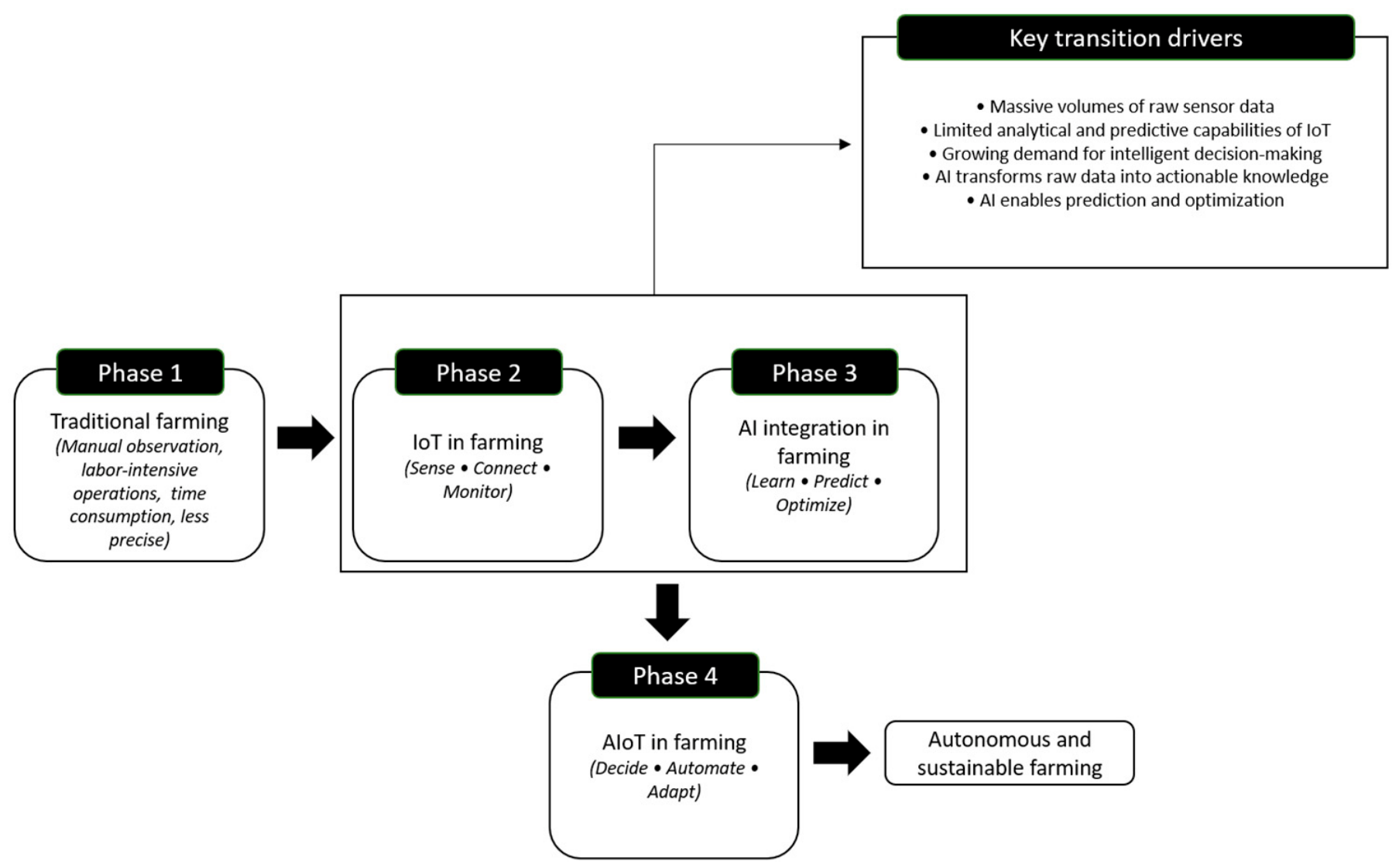
Figure 8 presents the conceptual evolution of smart farming towards AIoT-enabled autonomous agriculture. It illustrates the transition from traditional farming to IoT-enabled monitoring, AI-based prediction, and AIoT-enabled autonomous decision-making. The framework also highlights the main technological drivers supporting this evolution, namely the limitations of IoT-based monitoring, the increasing volume of agricultural data, and the growing need for intelligent data analysis, prediction, and automation.

5. Discussion and Future Research Agenda

RQ5: Which research themes are emerging, and what future research opportunities can be identified in AIoT-enabled smart farming?
The evolution from IoT-enabled farming to AIoT-enabled farming reflects more than the adoption of a new technology; it represents a fundamental shift in the role of digital technologies within agricultural systems. Early IoT applications were primarily designed to collect and transmit real-time information from sensors deployed in the field [94,95]. Although these technologies significantly improved monitoring capabilities, they remained largely dependent on human interpretation and decision making.
Therefore, the central shift is from data acquisition alone to intelligent decision support; farmers aimed to collect high resolution data from IoT and convert the data to real-time recommendations and actions [96,97,98]. This explains why recent research has progressively shifted its attention towards the combination of IoT and AI. This technological evolution is also consistent with broader digital transformation trends beyond agriculture. Recent studies on the transition from Industry 4.0 to Industry 5.0 argue that while IoT enables real time monitoring, the integration of AI enhances these systems by enabling intelligent, adaptive and sustainable transformation [99]. Therefore, the joint capabilities of both technologies create an autonomous farming environment. Rather than replacing IoT, AI extends its capabilities by enabling prediction and learning [4,100]. The evidence consistently describes IoT as the sensing layer and AI as the layer that turns those streams into predictions [4,26,100,101]. Beyond interoperability, cybersecurity has emerged as a critical concern as agricultural systems become increasingly connected through IoT devices, cloud platforms and AI-driven decision-support systems.
Building on the bibliometric findings and the qualitative analysis of the major research themes, this section synthesizes the main research gaps and future directions identified across the literature. Rather than relying on a single study, the proposed research agenda emerges from the recurring limitations, unresolved issues, and recommendations highlighted by the most influential publications within each thematic cluster. As summarized in Table 15, these research priorities provide a structured overview of the key areas that require further investigation to support the continued development of AIoT-enabled smart farming.

5.1. Research Priority 1: AIoT Infrastructure and Data Governance

The reviewed studies consistently identify AIoT infrastructure and data governance as fundamental prerequisites for the large-scale deployment of AIoT-enabled smart farming. As agricultural systems become increasingly interconnected, concerns regarding data confidentiality, data integrity, privacy, data ownership, and cyberattacks have intensified, indicating that security is no longer an optional technical feature but a prerequisite for reliable and trustworthy digital agriculture [73,77,82]. In parallel, the increasing use of Big Data has introduced significant governance challenges. The literature emphasizes that clear regulations on data ownership, interoperability standards, privacy, and data sharing are essential because AIoT-enabled smart farming relies on the continuous exchange of information among farms, digital platforms, and agricultural systems [102,103,104,105]. Issues related to data ownership, stakeholder relationships, and trusted data sharing across agricultural value chains therefore remain important barriers to the effective implementation of AIoT technologies [14].
Beyond governance, future research should prioritize the development of interoperable and scalable AIoT infrastructures capable of supporting large-scale agricultural deployment. The reviewed studies consistently recommend strengthening interoperability through common standards, modular hardware and software architectures, semantic interoperability, and universal IoT platforms that enable seamless communication among heterogeneous sensors, cloud platforms, and agricultural information systems [55,56,65,87,89]. Further efforts are required to enhance communication infrastructure by advancing wireless sensor networks, cloud-based decision-support systems, edge computing, low-power wide-area networks (LPWA), IoT, and 5G technologies to support reliable real-time communication across diverse agricultural environments [8,10,42,70]. Future studies should also focus on improving energy-efficient communication protocols, optimizing resource allocation, ensuring compatibility with legacy agricultural infrastructures, developing durable sensing devices suitable for harsh field conditions, and designing scalable AIoT platforms capable of supporting the entire agricultural production cycle [60,70,89]. In addition, strengthening interoperability frameworks that facilitate integrated information flows among farmers, suppliers, processors, and public agencies remains an important research priority [64].
As AIoT ecosystems continue to expand, cybersecurity and trustworthy data management will become increasingly critical research priorities. Existing studies consistently recommend strengthening mechanisms for protecting data confidentiality, integrity, authentication, access control, privacy, and trusted information sharing throughout AIoT ecosystems [55,60,77]. Future research should investigate blockchain-enabled architectures, cryptographic techniques, homomorphic encryption, secure multiparty computation, anomaly detection systems, intrusion detection algorithms, and AI-driven cybersecurity mechanisms capable of protecting increasingly connected agricultural infrastructures [60,77,92,106]. Finally, future research should move beyond technical security solutions by developing comprehensive data governance frameworks that integrate data ownership, transparency, privacy, secure data sharing, interoperability, and stakeholder trust. Such frameworks are essential for ensuring that AIoT-enabled smart farming remains reliable, secure, trustworthy, and widely accepted across agricultural value chains [77,87].

5.2. Research Priority 2: Barriers and Drivers of AIoT Adoption

Despite rapid technological progress, achieving the widespread adoption of AIoT-enabled smart farming remains a major research challenge. Addressing this challenge requires reducing implementation and operational costs through affordable sensing technologies, open-source solutions, lower-cost communication infrastructure, and scalable AIoT architectures suitable for both smallholder and commercial farming systems [42,53,60,70]. In parallel, greater emphasis should be placed on farmer education, user-centered system design, technology awareness, and supportive policy frameworks, together with large-scale pilot deployments across different agricultural systems and regions to validate AIoT technologies under real operating conditions [10,42,60,89]. Additional research is also needed to develop mature IoT ecosystems that extend beyond laboratory prototypes by ensuring long-term scalability, robustness, affordability, and operational reliability under practical farming conditions [56,89]. Continued efforts should expand AIoT applications that simultaneously improve agricultural productivity and environmental sustainability. In particular, future work should strengthen intelligent systems supporting precision irrigation, groundwater management, weather forecasting, crop protection, greenhouse automation, vertical farming, hydroponics, renewable energy integration, smart grids, and energy-efficient farming systems [8,53].
Beyond technological challenges, future research should also address the economic, institutional, organizational, ethical, and societal factors that continue to constrain AIoT adoption. Economic feasibility represents one of the most significant barriers to large-scale AIoT adoption. Although previous studies report positive economic benefits associated with digital technologies in agriculture, their adoption remains limited because implementation costs and expected returns vary considerably across farming contexts [107,108]. The initial investment required for sensors, intelligent machinery, software, communication infrastructure, and connectivity is frequently identified as a major obstacle, particularly for smallholder farms and regions with a significant digital divide [6,109,110]. In addition, successful implementation often requires further investments in system integration, technical support, training, and digital skills development, increasing the overall cost of adoption [111,112]. Therefore, uncertainty regarding the long-term economic benefits of AIoT technologies increases farmers’ perceived investment risk, slowing their adoption despite their demonstrated potential to improve productivity and resource efficiency. Future research should empirically investigate the economic conditions under which AIoT technologies succeed or fail across different agricultural contexts. In particular, future studies should identify the conditions under which AIoT adoption generates positive economic benefits and those under which it faces economic challenges or fails to deliver the expected returns. From an institutional perspective, weak regulatory frameworks and unclear policies create uncertainty for farmers and technology providers, limiting investment in digital technologies in agriculture. Successful adoption of digital technologies also requires effective collaboration among governments, extension services, cooperatives, firms and farmer organizations [113,114]. Finally, future research should develop and empirically evaluate responsible innovation frameworks that actively involve farmers, advisers, policy-makers, and other stakeholders throughout technology development and implementation [79]. Future work should anticipate the broader social consequences of Agriculture 4.0, examine issues related to inclusion and exclusion, reduce the digital divide through investment, training and rural telecommunication infrastructure, and promote innovation pathways that ensure AIoT technologies contribute to socially inclusive, ethical and sustainable agricultural transitions [83,87].

5.3. Research Priority 3: Advancing AIoT Through Emerging Technologies

Researchers should further integrate artificial intelligence, IoT, cloud computing, automation, robotics and advanced analytics into unified decision-support platforms capable of improving resource efficiency while addressing long-term food security and sustainable agricultural development [8]. Beyond improving existing AI algorithms, future research should also investigate the integration of next-generation AI techniques into AIoT-enabled smart farming. Recent advances in adaptive and interpretable AI suggest that future agricultural decision-support systems could benefit from large-scale pre-trained foundation models capable of continuously adapting to dynamic agricultural environments while improving computational efficiency, and robustness [115]. First, the future of smart agriculture is highly promising, driven by continuous advancements in artificial intelligence (AI), machine learning, and sensor technologies [4]. Therefore, greater priority should be given to integrating emerging AI technologies into AIoT-enabled smart farming systems. Second, federated learning frameworks should be explored to enable collaborative model training while preserving data privacy, allowing multiple farms to benefit from shared intelligence. In particular, hybrid federated learning architectures that combine centralized and decentralized learning should be investigated to improve model performance while preserving data privacy in agricultural environments [116]. Third, the role of Edge AI needs to be empirically examined under different contexts. This requires the development of lightweight edge AI models capable of performing real-time analytics directly on agricultural devices, thereby reducing communication latency, bandwidth requirements, and dependence on cloud computing. Fourth, digital twin technology remains a promising yet underexplored research area. Greater attention should be devoted to integrating digital twin technologies with lightweight edge AI algorithms, multimodal data fusion, and interpretable AI models to improve real-time simulation, intelligent decision-making, and the efficiency of AIoT-enabled smart farming systems. More empirical studies are needed to validate AI-driven sensing systems in complex farming environments, such as agroforestry and intercropping systems, particularly in tropical and subtropical regions In addition, further efforts are required to optimize digital twin architectures for different agricultural applications and production environments [117]. Additional studies should examine the integration of AIoT with autonomous agricultural robots capable of performing real-time monitoring, precision spraying, harvesting, and other farming operations with minimal human intervention. Continued efforts are also needed to advance the development of highly autonomous and cost-effective agricultural robots capable of performing multiple farming operations across diverse agricultural environments [118]. Priority should be given to exploring the integration of artificial intelligence and multi-objective optimization algorithms to improve robotic navigation, energy efficiency, and real-time crop monitoring, including pest and disease management [119]. Continued efforts should enhance deep learning techniques, particularly reinforcement and transfer learning, while improving edge computing capabilities and integrating emerging data sources, such as UAV systems and networked environmental sensors, to support more accurate and real-time decision-making in precision agriculture [120]. The reviewed studies also highlight the need to improve the quality and diversity of agricultural datasets used for AI development. Priority should be given to constructing larger and more representative datasets covering different crops, diseases, climatic conditions, and geographical regions, while validating algorithms under realistic field environments rather than controlled laboratory conditions [72,81]. Further efforts are needed to improve the quality, completeness, and management of heterogeneous agricultural datasets, integrate spatial and temporal information, combine multiple sensing modalities, and develop continuous learning systems capable of updating predictive models as new data become available [55,59]. Such developments are expected to improve model robustness, generalizability, and practical applicability across diverse agricultural contexts.

5.4. Research Priority 4: Trustworthy AI and Multimodal Data Fusion

Despite the growing use of AI for sensing, prediction, and decision-making in smart farming, the relationship between trustworthy AI and AIoT adoption remains largely underexplored. Farmers are more likely to trust and adopt AI-based recommendations when intelligent systems are transparent, reliable, and explainable [27,121,122]. Therefore, explainable AI should be investigated as an enabling technology to improve the transparency and interpretability of AIoT-enabled decision-support systems, allowing farmers to better understand AI recommendations. Furthermore, the extensive collection and processing of sensitive agricultural data raise important concerns regarding privacy, security, fairness, and accountability. Accordingly, greater attention should be devoted to developing trustworthy AI frameworks that promote responsible AIoT deployment while strengthening farmers’ confidence in intelligent agricultural systems. Finally, one of the most frequently reported barriers to AIoT adoption in smart farming is the management of heterogeneous data generated by multiple sensors and digital devices. Although AIoT systems continuously collect data from various sources, limited attention has been devoted to developing efficient multimodal data fusion approaches capable of integrating these heterogeneous data into reliable and actionable insights. Addressing this gap requires investigating multimodal sensing and data fusion techniques that integrate information from IoT sensors, drones, satellite imagery, weather stations, and agricultural machinery to improve prediction accuracy and support more comprehensive decision-making.

6. Conclusions

This study provides a comprehensive bibliometric and qualitative synthesis of Artificial Intelligence of Things (AIoT) research in smart farming. By combining performance analysis, science mapping techniques, and qualitative thematic analysis, the study offers a holistic understanding of the intellectual evolution, knowledge structure, and emerging research directions of AIoT-enabled smart farming. Unlike previous reviews that mainly focused on specific technologies or agricultural applications, this study examined AIoT as an integrated research domain, identified its leading contributors, intellectual foundations, dominant research themes, and collaboration patterns, and proposed a structured future research agenda to support the next generation of intelligent agricultural systems. The findings demonstrate that AIoT research has experienced remarkable growth over the last two decades, reflecting the increasing convergence of artificial intelligence, the Internet of Things, cloud computing, robotics, remote sensing, edge computing, and advanced data analytics within agricultural systems. The bibliometric and thematic analyses reveal a clear technological evolution from IoT-enabled monitoring towards AIoT-enabled autonomous agriculture. While early smart farming research primarily emphasized sensing, connectivity, and real-time data acquisition, recent studies increasingly focus on predictive analytics, intelligent decision-support, autonomous control, and sustainable resource management. This transition confirms that artificial intelligence complements rather than replaces IoT by transforming continuously generated agricultural data into actionable intelligence capable of supporting adaptive and autonomous farming systems. Beyond describing the evolution of the field, this study contributes by proposing a conceptual framework that explains the progression from traditional farming to AIoT-enabled autonomous agriculture and by identifying the major scientific priorities that are likely to shape future research. The proposed research agenda highlights several critical challenges, including explainable and trustworthy AI, interoperable and scalable AIoT infrastructures, cybersecurity and data governance, high-quality multimodal agricultural datasets, digital twins, Edge AI, autonomous agricultural robotics, responsible innovation, and the socio-economic conditions required for the successful large-scale adoption of AIoT technologies. The findings also demonstrate that the future of AIoT-enabled smart farming depends not only on continued technological innovation but also on stronger interdisciplinary collaboration among researchers, engineers, policy-makers, agricultural organizations, and farmers. Addressing interoperability, affordability, governance, and ethical challenges will be essential to translating technological advances into practical and scalable agricultural solutions. As agriculture continues to face increasing pressures related to climate change, resource scarcity, food security, and sustainability, AIoT-enabled intelligent farming systems are expected to play an increasingly important role in supporting more resilient, efficient, and sustainable agricultural production.

Author Contributions

Conceptualization, I.B. and Z.S.; methodology, I.B.; software, I.B.; validation, I.B.; formal analysis, I.B.; investigation, I.B.; resources, I.B.; data curation, I.B.; writing—original draft preparation, I.B.; writing—review and editing, I.B.; visualization, I.B.; supervision, Z.S.; project administration, Z.S. All authors have read and agreed to the published version of the manuscript.

Funding

This research received no external funding.

Institutional Review Board Statement

Not applicable.

Informed Consent Statement

Not applicable.

Data Availability Statement

No new data were created or analyzed in this study. Data sharing is not applicable to this article.

Conflicts of Interest

The authors declare no conflicts of interest.

References

  1. ElBeheiry, N.; Balog, R.S. Technologies Driving the Shift to Smart Farming: A Review. IEEE Sens. J. 2023, 23, 1752–1769. [Google Scholar] [CrossRef] [Scilit]
  2. Rejeb, A.; Rejeb, K.; Abdollahi, A.; Al-Turjman, F.; Treiblmaier, H. The Interplay between the Internet of Things and agriculture: A bibliometric analysis and research agenda. Internet Things 2022, 19, 26. [Google Scholar] [CrossRef] [Scilit]
  3. Rejeb, A.; Rejeb, K.; Abdollahi, A.; Hassoun, A. Precision agriculture: A bibliometric analysis and research agenda. Smart Agric. Technol. 2024, 9, 100684. [Google Scholar] [CrossRef] [Scilit]
  4. Mansoor, S.; Iqbal, S.; Popescu, S.M.; Kim, S.L.; Chung, Y.S.; Baek, J.-H. Integration of smart sensors and IOT in precision agriculture: Trends, challenges and future prospectives. Front. Plant Sci. 2025, 16, 1587869. [Google Scholar] [CrossRef] [Scilit] [PubMed]
  5. Durai, S.K.S.; Shamili, M.D. Smart farming using Machine Learning and Deep Learning techniques. Decis. Anal. J. 2022, 3, 100041. [Google Scholar] [CrossRef] [Scilit]
  6. Karunathilake, E.; Le, A.T.; Heo, S.; Chung, Y.S.; Mansoor, S. The Path to Smart Farming: Innovations and Opportunities in Precision Agriculture. Agriculture 2023, 13, 1593. [Google Scholar] [CrossRef] [Scilit]
  7. Zhang, J.; Trautman, D.; Liu, Y.; Bi, C.; Chen, W.; Ou, L.; Goebel, R. Achieving the Rewards of Smart Agriculture. Agronomy 2024, 14, 452. [Google Scholar] [CrossRef] [Scilit]
  8. Dhanaraju, M.; Chenniappan, P.; Ramalingam, K.; Pazhanivelan, S.; Kaliaperumal, R. Smart Farming: Internet of Things (IoT)-Based Sustainable Agriculture. Agriculture 2022, 12, 1745. [Google Scholar] [CrossRef] [Scilit]
  9. Anusha, M.; Soni, A.; Mohapatra, R.; Kumar, V.; Bhanusree, M.R.; Giri, D.; Gupta, S. Exploring the Role of IoT in Transforming Agriculture: Current Applications and Future Prospects. Arch. Curr. Res. Int. 2025, 25, 85–105. [Google Scholar] [CrossRef] [Scilit]
  10. Shafi, U.; Mumtaz, R.; García-Nieto, J.; Hassan, S.A.; Zaidi, S.A.R.; Iqbal, N. Precision Agriculture Techniques and Practices: From Considerations to Applications. Sensors 2019, 19, 3796. [Google Scholar] [CrossRef] [Scilit] [PubMed]
  11. Rajak, P.; Ganguly, A.; Adhikary, S.; Bhattacharya, S. Internet of Things and smart sensors in agriculture: Scopes and challenges. J. Agric. Food Res. 2023, 14, 13. [Google Scholar] [CrossRef] [Scilit]
  12. Rehman, A.; Saba, T.; Kashif, M.; Fati, S.M.; Bahaj, S.A.; Chaudhry, H. A Revisit of Internet of Things Technologies for Monitoring and Control Strategies in Smart Agriculture. Agronomy 2022, 12, 127. [Google Scholar] [CrossRef] [Scilit]
  13. Morchid, A.; El Alami, R.; Raezah, A.A.; Sabbar, Y. Applications of internet of things (IoT) and sensors technology to increase food security and agricultural Sustainability: Benefits and challenges. Ain Shams Eng. J. 2024, 15, 102509. [Google Scholar] [CrossRef] [Scilit]
  14. Wolfert, S.; Ge, L.; Verdouw, C.; Bogaardt, M.-J. Big Data in Smart Farming—A review. Agric. Syst. 2017, 153, 69–80. [Google Scholar] [CrossRef] [Scilit]
  15. Navarro, E.; Costa, N.; Pereira, A. A Systematic Review of IoT Solutions for Smart Farming. Sensors 2020, 20, 4231. [Google Scholar] [CrossRef] [Scilit] [PubMed]
  16. Bayar, J.; Ali, N.; Cao, Z.; Ren, Y.; Dong, Y. Artificial intelligence of things (AIoT) for precision agriculture: Applications in smart irrigation, nutrient and disease management. Smart Agric. Technol. 2025, 12, 101629. [Google Scholar] [CrossRef] [Scilit]
  17. Bhardwaj, H.; Tomar, P.; Sakalle, A.; Sharma, U. Chapter 20—Principles and Foundations of Artificial Intelligence and Internet of Things Technology. In Artificial Intelligence to Solve Pervasive Internet of Things Issues; Kaur, G., Tomar, P., Tanque, M., Eds.; Academic Press: Cambridge, MA, USA, 2021; pp. 377–392. [Google Scholar]
  18. Dazzi, P. The Internet of AI Agents (IAIA): A New Frontier in Networked and Distributed Intelligence. Int. J. Networked Distrib. Comput. 2025, 13, 16. [Google Scholar] [CrossRef] [Scilit]
  19. Zhang, J.; Tao, D. Empowering Things With Intelligence: A Survey of the Progress, Challenges, and Opportunities in Artificial Intelligence of Things. IEEE Internet Things J. 2021, 8, 7789–7817. [Google Scholar] [CrossRef] [Scilit]
  20. Zhang, L.Y.; Innab, N.; Shuhidan, S.M.; Pan, Y.T.; Zhang, Y.; Som, H.M.; Alasbali, N. Artificial intelligence-driven internet of things-based green supply chain for carbon reduction in sustainable manufacturing. J. Environ. Manag. 2025, 389, 126170. [Google Scholar] [CrossRef] [Scilit] [PubMed]
  21. Siam, S.I.; Ahn, H.; Liu, L.; Alam, S.; Shen, H.; Cao, Z.; Shroff, N.; Krishnamachari, B.; Srivastava, M.; Zhang, M. Artificial Intelligence of Things: A Survey. ACM Trans. Sens. Netw. 2025, 21, 9. [Google Scholar] [CrossRef] [Scilit]
  22. Menon, U.K.; Kumaravelu, V.B.; Chandru, V.K.; Arunachalam, R.; Chinnadurai, S.; Venkatesan, R.; Hai, H.; Selvaprabhu, P. AI-Powered IoT: A Survey on Integrating Artificial Intelligence with IoT for Enhanced Security, Efficiency, and Smart Applications. IEEE Access 2025, 13, 50296–50339. [Google Scholar] [CrossRef] [Scilit]
  23. Banaeian Far, S.; Imani Rad, A. Internet of Artificial Intelligence (IoAI): The emergence of an autonomous, generative, and fully human-disconnected community. Discov. Appl. Sci. 2024, 6, 91. [Google Scholar] [CrossRef] [Scilit]
  24. Kramp, T.; van Kranenburg, R.; Lange, S. Introduction to the Internet of Things. In Enabling Things to Talk: Designing IoT solutions with the IoT Architectural Reference Model; Bassi, A., Bauer, M., Fiedler, M., Kramp, T., van Kranenburg, R., Lange, S., Meissner, S., Eds.; Springer: Berlin/Heidelberg, Germany, 2013; pp. 1–10. [Google Scholar]
  25. Bitam, T.; Yahiaoui, A.; Boubiche, D.E.; Martinez-Pelaez, R.; Toral-Cruz, H.; Velarde-Alvarado, P. Artificial Intelligence of Things for Next-Generation Predictive Maintenance. Sensors 2025, 25, 7636. [Google Scholar] [CrossRef] [Scilit] [PubMed]
  26. Muhammed, D.; Ahvar, E.; Ahvar, S.; Trocan, M.; Montpetit, M.-J.; Ehsani, R. Artificial Intelligence of Things (AIoT) for smart agriculture: A review of architectures, technologies and solutions. J. Netw. Comput. Appl. 2024, 228, 103905. [Google Scholar] [CrossRef] [Scilit]
  27. Miller, T.; Mikiciuk, G.; Durlik, I.; Mikiciuk, M.; Lobodzinska, A.; Snieg, M. The IoT and AI in Agriculture: The Time Is Now-A Systematic Review of Smart Sensing Technologies. Sensors 2025, 25, 3583. [Google Scholar] [CrossRef] [Scilit] [PubMed]
  28. Luo, X.; Xiong, S.; Jia, X.; Zeng, Y.; Chen, X. AIoT-Enabled Data Management for Smart Agriculture: A Comprehensive Review on Emerging Technologies. IEEE Access 2025, 13, 102964–102993. [Google Scholar] [CrossRef] [Scilit]
  29. Huang, Y.-P.; Khabusi, S.P. Artificial Intelligence of Things (AIoT) Advances in Aquaculture: A Review. Processes 2025, 13, 73. [Google Scholar] [CrossRef] [Scilit]
  30. Donthu, N.; Kumar, S.; Mukherjee, D.; Pandey, N.; Lim, W.M. How to conduct a bibliometric analysis: An overview and guidelines. J. Bus. Res. 2021, 133, 285–296. [Google Scholar] [CrossRef] [Scilit]
  31. Ellegaard, O.; Wallin, J.A. The bibliometric analysis of scholarly production: How great is the impact? Scientometrics 2015, 105, 1809–1831. [Google Scholar] [CrossRef] [Scilit] [PubMed]
  32. Rejeb, A.; Rejeb, K.; Simske, S.; Treiblmaier, H. Blockchain Technologies in Logistics and Supply Chain Management: A Bibliometric Review. Logistics 2021, 5, 72. [Google Scholar] [CrossRef] [Scilit]
  33. Gutiérrez-Salcedo, M.; Martínez, M.Á.; Moral-Munoz, J.A.; Herrera-Viedma, E.; Cobo, M.J. Some bibliometric procedures for analyzing and evaluating research fields. Appl. Intell. 2018, 48, 1275–1287. [Google Scholar] [CrossRef] [Scilit]
  34. Wang, N.; Liang, H.; Jia, Y.; Ge, S.; Xue, Y.; Wang, Z. Cloud computing research in the IS discipline: A citation/co-citation analysis. Decis. Support Syst. 2016, 86, 35–47. [Google Scholar] [CrossRef] [Scilit]
  35. Paul, J.; Criado, A.R. The art of writing literature review: What do we know and what do we need to know? Int. Bus. Rev. 2020, 29, 101717. [Google Scholar] [CrossRef] [Scilit]
  36. Fahimnia, B.; Sarkis, J.; Davarzani, H. Green supply chain management: A review and bibliometric analysis. Int. J. Prod. Econ. 2015, 162, 101–114. [Google Scholar] [CrossRef] [Scilit]
  37. Velho, L. The “meaning” of citation in the context of a scientifically peripheral country. Scientometrics 1986, 9, 71–89. [Google Scholar] [CrossRef] [Scilit]
  38. Zupic, I.; Čater, T. Bibliometric Methods in Management and Organization: A Review. SSRN Electron. J. 2013, 2013, 13426. [Google Scholar] [CrossRef] [Scilit]
  39. Small, H. Co-citation in the scientific literature: A new measure of the relationship between two documents. J. Am. Soc. Inf. Sci. 2007, 24, 265–269. [Google Scholar] [CrossRef] [Scilit]
  40. Kirby, A. Exploratory Bibliometrics: Using VOSviewer as a Preliminary Research Tool. Publications 2023, 11, 10. [Google Scholar] [CrossRef] [Scilit]
  41. Lee, P.-C.; Su, H.-N. Investigating the structure of regional innovation system research through keyword co-occurrence and social network analysis. Innovation 2014, 12, 26–40. [Google Scholar] [CrossRef] [Scilit]
  42. Elijah, O.; Rahman, T.A.; Orikumhi, I.; Leow, C.Y.; Hindia, M.H.D.N. An Overview of Internet of Things (IoT) and Data Analytics in Agriculture: Benefits and Challenges. IEEE Internet Things J. 2018, 5, 3758–3773. [Google Scholar] [CrossRef] [Scilit]
  43. Patrício, D.I.; Rieder, R. Computer vision and artificial intelligence in precision agriculture for grain crops: A systematic review. Comput. Electron. Agric. 2018, 153, 69–81. [Google Scholar] [CrossRef] [Scilit]
  44. Sharma, A.; Jain, A.; Gupta, P.; Chowdary, V. Machine Learning Applications for Precision Agriculture: A Comprehensive Review. IEEE Access 2021, 9, 4843–4873. [Google Scholar] [CrossRef] [Scilit]
  45. Liakos, K.G.; Busato, P.; Moshou, D.; Pearson, S.; Bochtis, D. Machine Learning in Agriculture: A Review. Sensors 2018, 18, 2674. [Google Scholar] [CrossRef] [Scilit] [PubMed]
  46. Sishodia, R.P.; Ray, R.L.; Singh, S.K. Applications of Remote Sensing in Precision Agriculture: A Review. Remote Sens. 2020, 12, 3136. [Google Scholar] [CrossRef] [Scilit]
  47. Radoglou-Grammatikis, P.; Sarigiannidis, P.; Lagkas, T.; Moscholios, I. A compilation of UAV applications for precision agriculture. Comput. Netw. 2020, 172, 107148. [Google Scholar] [CrossRef] [Scilit]
  48. Klerkx, L.; Jakku, E.; Labarthe, P. A review of social science on digital agriculture, smart farming and agriculture 4.0: New contributions and a future research agenda. NJAS Wagening. J. Life Sci. 2022, 90–91, 100315. [Google Scholar] [CrossRef] [Scilit]
  49. Lezoche, M.; Hernandez, J.E.; Alemany Díaz, M.d.M.E.; Panetto, H.; Kacprzyk, J. Agri-food 4.0: A survey of the supply chains and technologies for the future agriculture. Comput. Ind. 2020, 117, 103187. [Google Scholar] [CrossRef] [Scilit]
  50. Clauset, A.; Newman, M.E.J.; Moore, C. Finding community structure in very large networks. Phys. Rev. E 2004, 70, 066111. [Google Scholar] [CrossRef] [Scilit] [PubMed]
  51. van Eck, N.J.; Waltman, L. Citation-based clustering of publications using CitNetExplorer and VOSviewer. Scientometrics 2017, 111, 1053–1070. [Google Scholar] [CrossRef] [Scilit] [PubMed]
  52. Kamilaris, A.; Prenafeta-Boldú, F.X. Deep learning in agriculture: A survey. Comput. Electron. Agric. 2018, 147, 70–90. [Google Scholar] [CrossRef] [Scilit]
  53. Ayoub Shaikh, T.; Rasool, T.; Rasheed Lone, F. Towards leveraging the role of machine learning and artificial intelligence in precision agriculture and smart farming. Comput. Electron. Agric. 2022, 198, 107119. [Google Scholar] [CrossRef] [Scilit]
  54. Khaki, S.; Wang, L. Crop Yield Prediction Using Deep Neural Networks. Front. Plant Sci. 2019, 10, 621. [Google Scholar] [CrossRef] [Scilit] [PubMed]
  55. Sinha, B.B.; Dhanalakshmi, R. Recent advancements and challenges of Internet of Things in smart agriculture: A survey. Futur. Gener. Comp. Syst. 2022, 126, 169–184. [Google Scholar] [CrossRef] [Scilit]
  56. Khanna, A.; Kaur, S. Evolution of Internet of Things (IoT) and its significant impact in the field of Precision Agriculture. Comput. Electron. Agric. 2019, 157, 218–231. [Google Scholar] [CrossRef] [Scilit]
  57. Saiz-Rubio, V.; Rovira-Más, F. From Smart Farming towards Agriculture 5.0: A Review on Crop Data Management. Agronomy 2020, 10, 207. [Google Scholar] [CrossRef] [Scilit]
  58. Ramcharan, A.; Baranowski, K.; McCloskey, P.; Ahmed, B.; Legg, J.; Hughes, D.P. Deep Learning for Image-Based Cassava Disease Detection. Front. Plant Sci. 2017, 8, 1852. [Google Scholar] [CrossRef] [Scilit] [PubMed]
  59. Chlingaryan, A.; Sukkarieh, S.; Whelan, B. Machine learning approaches for crop yield prediction and nitrogen status estimation in precision agriculture: A review. Comput. Electron. Agric. 2018, 151, 61–69. [Google Scholar] [CrossRef] [Scilit]
  60. Quy, V.K.; Hau, N.V.; Anh, D.V.; Quy, N.M.; Ban, N.T.; Lanza, S.; Randazzo, G.; Muzirafuti, A. IoT-Enabled Smart Agriculture: Architecture, Applications, and Challenges. Appl. Sci. 2022, 12, 3396. [Google Scholar] [CrossRef] [Scilit]
  61. Murugamani, C.; Shitharth, S.; Hemalatha, S.; Kshirsagar, P.R.; Riyazuddin, K.; Naveed, Q.N.; Islam, S.; Ali, S.P.M.; Batu, A. Machine Learning Technique for Precision Agriculture Applications in 5G-Based Internet of Things. Wirel. Commun. Mob. Comput. 2022, 2022, 6534238. [Google Scholar] [CrossRef] [Scilit]
  62. Liu, Z.Y.; Bashir, R.N.; Iqbal, S.; Shahid, M.M.A.; Tausif, M.; Umer, Q. Internet of Things (IoT) and Machine Learning Model of Plant Disease Prediction-Blister Blight for Tea Plant. IEEE Access 2022, 10, 44934–44944. [Google Scholar] [CrossRef] [Scilit]
  63. Sladojevic, S.; Arsenovic, M.; Anderla, A.; Culibrk, D.; Stefanovic, D. Deep Neural Networks Based Recognition of Plant Diseases by Leaf Image Classification. Comput. Intell. Neurosci. 2016, 2016, 3289801. [Google Scholar] [CrossRef] [Scilit] [PubMed]
  64. Gebbers, R.; Adamchuk, V.I. Precision agriculture and food security. Science 2010, 327, 828–831. [Google Scholar] [CrossRef] [Scilit] [PubMed]
  65. Farooq, M.S.; Sohail, O.O.; Abid, A.; Rasheed, S. A Survey on the Role of IoT in Agriculture for the Implementation of Smart Livestock Environment. IEEE Access 2022, 10, 9483–9505. [Google Scholar] [CrossRef] [Scilit]
  66. Zhai, Z.; Martínez, J.F.; Beltran, V.; Martínez, N.L. Decision support systems for agriculture 4.0: Survey and challenges. Comput. Electron. Agric. 2020, 170, 105256. [Google Scholar] [CrossRef] [Scilit]
  67. Pantazi, X.E.; Moshou, D.; Alexandridis, T.; Whetton, R.L.; Mouazen, A.M. Wheat yield prediction using machine learning and advanced sensing techniques. Comput. Electron. Agric. 2016, 121, 57–65. [Google Scholar] [CrossRef] [Scilit]
  68. LeCun, Y.; Bengio, Y.; Hinton, G. Deep learning. Nature 2015, 521, 436–444. [Google Scholar] [CrossRef] [Scilit] [PubMed]
  69. Dilip, R.; Nishchitha, M.H.; Talikoti, M.; Kalpavi, C.Y.; Balaraj, H.V.D.; Tejashwini, N. Smart Farming Technologies. In Sustainable Agriculture Production Using Blockchain Technology; Scrivener Publishing LLC: Beverly, MA, USA, 2026; pp. 155–165. [Google Scholar]
  70. Ayaz, M.; Ammad-Uddin, M.; Sharif, Z.; Mansour, A.; Aggoune, E.M. Internet-of-Things (IoT)-Based Smart Agriculture: Toward Making the Fields Talk. IEEE Access 2019, 7, 129551–129583. [Google Scholar] [CrossRef] [Scilit]
  71. Sun, J.; Di, L.; Sun, Z.; Shen, Y.; Lai, Z. County-Level Soybean Yield Prediction Using Deep CNN-LSTM Model. Sensors 2019, 19, 4363. [Google Scholar] [CrossRef] [Scilit] [PubMed]
  72. Mohanty, S.P.; Hughes, D.P.; Salathe, M. Using Deep Learning for Image-Based Plant Disease Detection. Front. Plant Sci. 2016, 7, 1419. [Google Scholar] [CrossRef] [Scilit] [PubMed]
  73. Gupta, M.; Abdelsalam, M.; Khorsandroo, S.; Mittal, S. Security and Privacy in Smart Farming: Challenges and Opportunities. IEEE Access 2020, 8, 34564–34584. [Google Scholar] [CrossRef] [Scilit]
  74. Ahmed, N.; De, D.; Hussain, M.I. Internet of Things (IoT) for Smart Precision Agriculture and Farming in Rural Areas. IEEE Internet Things J. 2018, 5, 4890–4899. [Google Scholar] [CrossRef] [Scilit]
  75. Jha, K.; Doshi, A.; Patel, P.; Shah, M. A comprehensive review on automation in agriculture using artificial intelligence. Artif. Intell. Agric. 2019, 2, 1–12. [Google Scholar] [CrossRef] [Scilit]
  76. Yu, J.; Sharpe, S.M.; Schumann, A.W.; Boyd, N.S. Deep learning for image-based weed detection in turfgrass. Eur. J. Agron. 2019, 104, 78–84. [Google Scholar] [CrossRef] [Scilit]
  77. Demestichas, K.; Peppes, N.; Alexakis, T. Survey on Security Threats in Agricultural IoT and Smart Farming. Sensors 2020, 20, 6458. [Google Scholar] [CrossRef] [Scilit] [PubMed]
  78. Boursianis, A.D.; Papadopoulou, M.S.; Diamantoulakis, P.; Liopa-Tsakalidi, A.; Barouchas, P.; Salahas, G.; Karagiannidis, G.; Wan, S.H.; Goudos, S.K. Internet of Things (IoT) and Agricultural Unmanned Aerial Vehicles (UAVs) in smart farming: A comprehensive review. Internet Things 2022, 18, 17. [Google Scholar] [CrossRef] [Scilit]
  79. Rose, D.C.; Chilvers, J. Agriculture 4.0: Broadening Responsible Innovation in an Era of Smart Farming. Front. Sustain. Food Syst. 2018, 2, 7. [Google Scholar] [CrossRef] [Scilit]
  80. Zhu, N.; Liu, X.; Liu, Z.; Hu, K.; Wang, Y.; Tan, J.; Huang, M.; Zhu, Q.; Ji, X.; Jiang, Y.; et al. Deep learning for smart agriculture: Concepts, tools, applications, and opportunities. Int. J. Agric. Biol. Eng. 2018, 11, 21–28. [Google Scholar] [CrossRef]
  81. Ferentinos, K.P. Deep learning models for plant disease detection and diagnosis. Comput. Electron. Agric. 2018, 145, 311–318. [Google Scholar] [CrossRef] [Scilit]
  82. Rettore de Araujo Zanella, A.; da Silva, E.; Pessoa Albini, L.C. Security challenges to smart agriculture: Current state, key issues, and future directions. Array 2020, 8, 100048. [Google Scholar] [CrossRef] [Scilit]
  83. Klerkx, L.; Rose, D. Dealing with the game-changing technologies of Agriculture 4.0: How do we manage diversity and responsibility in food system transition pathways? Glob. Food Secur.-Agric. Policy 2020, 24, 7. [Google Scholar] [CrossRef] [Scilit]
  84. Morellos, A.; Pantazi, X.-E.; Moshou, D.; Alexandridis, T.; Whetton, R.; Tziotzios, G.; Wiebensohn, J.; Bill, R.; Mouazen, A.M. Machine learning based prediction of soil total nitrogen, organic carbon and moisture content by using VIS-NIR spectroscopy. Biosyst. Eng. 2016, 152, 104–116. [Google Scholar] [CrossRef] [Scilit]
  85. Ren, S.; He, K.; Girshick, R.; Sun, J. Faster R-CNN: Towards Real-Time Object Detection with Region Proposal Networks. IEEE Trans. Pattern Anal. Mach. Intell. 2017, 39, 1137–1149. [Google Scholar] [CrossRef] [Scilit] [PubMed]
  86. Ojha, T.; Misra, S.; Raghuwanshi, N.S. Wireless sensor networks for agriculture: The state-of-the-art in practice and future challenges. Comput. Electron. Agric. 2015, 118, 66–84. [Google Scholar] [CrossRef] [Scilit]
  87. Bacco, M.; Barsocchi, P.; Ferro, E.; Gotta, A.; Ruggeri, M. The Digitisation of Agriculture: A Survey of Research Activities on Smart Farming. Array 2019, 3–4, 100009. [Google Scholar] [CrossRef] [Scilit]
  88. Cicioglu, M.; Çalhan, A. Smart agriculture with internet of things in cornfields. Comput. Electr. Eng. 2021, 90, 11. [Google Scholar] [CrossRef] [Scilit]
  89. Talavera, J.M.; Tobón, L.E.; Gómez, J.A.; Culman, M.A.; Aranda, J.M.; Parra, D.T.; Quiroz, L.A.; Hoyos, A.; Garreta, L.E. Review of IoT applications in agro-industrial and environmental fields. Comput. Electron. Agric. 2017, 142, 283–297. [Google Scholar] [CrossRef] [Scilit]
  90. Abdullah, N.; Durani, N.A.B.; Shari, M.F.B.; Siong, K.S.; Hau, V.K.W.; Siong, W.N.; Ahmad, I.K.A. Towards Smart Agriculture Monitoring Using Fuzzy Systems. IEEE Access 2021, 9, 4097–4111. [Google Scholar] [CrossRef] [Scilit]
  91. Saiz-Rubio, V.; Rovira-Más, F.; Cuenca-Cuenca, A.; Alves, F. Robotics-based vineyard water potential monitoring at high resolution. Comput. Electron. Agric. 2021, 187, 12. [Google Scholar] [CrossRef] [Scilit]
  92. Farooq, M.S.; Javid, R.; Riaz, S.; Atal, Z. IoT Based Smart Greenhouse Framework and Control Strategies for Sustainable Agriculture. IEEE Access 2022, 10, 99394–99420. [Google Scholar] [CrossRef] [Scilit]
  93. Selgas-Cors, M. Sociotechnical Transformation: A Systematic Review on the Impact of Artificial Intelligence on Society and Organizations. FinTech Sustain. Innov. 2025, 1–16. [Google Scholar] [CrossRef] [Scilit]
  94. Ibarra-Esquer, J.E.; Gonzalez-Navarro, F.F.; Flores-Rios, B.L.; Burtseva, L.; Astorga-Vargas, M.A. Tracking the Evolution of the Internet of Things Concept Across Different Application Domains. Sensors 2017, 17, 1379. [Google Scholar] [CrossRef] [Scilit] [PubMed]
  95. Yalli, J.S.; Hasan, M.H.; Badawi, A.A. Internet of Things (IoT): Origins, Embedded Technologies, Smart Applications, and Its Growth in the Last Decade. IEEE Access 2024, 12, 91357–91382. [Google Scholar] [CrossRef] [Scilit]
  96. Pham, X.; Stack, M. How data analytics is transforming agriculture. Bus. Horiz. 2018, 61, 125–133. [Google Scholar] [CrossRef] [Scilit]
  97. Gebresenbet, G.; Bosona, T.; Patterson, D.; Persson, H.; Fischer, B.; Mandaluniz, N.; Chirici, G.; Zacepins, A.; Komasilovs, V.; Pitulac, T.; et al. A concept for application of integrated digital technologies to enhance future smart agricultural systems. Smart Agric. Technol. 2023, 5, 12. [Google Scholar] [CrossRef] [Scilit]
  98. Weersink, A.; Fraser, E.; Pannell, D.; Duncan, E.; Rotz, S. Opportunities and Challenges for Big Data in Agricultural and Environmental Analysis. Annu. Rev. Resour. Econ. 2018, 10, 19–37. [Google Scholar] [CrossRef] [Scilit]
  99. Waqas, M.; Naseem, A. Artificial Intelligence in Sustainable Industrial Transformation: A Comparative Study of Industry 4.0 and Industry 5.0. FinTech Sustain. Innov. 2025, 1, A2. [Google Scholar] [CrossRef] [Scilit]
  100. Qazi, S.; Khawaja, B.A.; Farooq, Q.U. IoT-Equipped and AI-Enabled Next Generation Smart Agriculture: A Critical Review, Current Challenges and Future Trends. IEEE Access 2022, 10, 21219–21235. [Google Scholar] [CrossRef] [Scilit]
  101. Kumari, K.; Mirzakhani Nafchi, A.; Mirzaee, S.; Abdalla, A. AI-Driven Future Farming: Achieving Climate-Smart and Sustainable Agriculture. Agriengineering 2025, 7, 89. [Google Scholar] [CrossRef] [Scilit]
  102. Eastwood, C.; Turner, J.A.; Romera, A.; Selbie, D.; Henwood, R.; Espig, M.; Wever, M. A review of multi-scale barriers to transitioning from digital agriculture to a digital bioeconomy. CABI Rev. 2023. [Google Scholar] [CrossRef] [Scilit]
  103. Rotz, S.; Duncan, E.; Small, M.; Botschner, J.; Dara, R.; Mosby, I.; Reed, M.; Fraser, E.D.G. The Politics of Digital Agricultural Technologies: A Preliminary Review. Sociol. Rural. 2019, 59, 203–229. [Google Scholar] [CrossRef] [Scilit]
  104. Sun, Y.; Miao, Y.; Xie, Z.; Wu, R. Drivers and barriers to digital transformation in agriculture: An evolutionary game analysis based on the experience of China. Agric. Syst. 2024, 221, 104136. [Google Scholar] [CrossRef] [Scilit]
  105. Smidt, H.J.; Jokonya, O. Factors affecting digital technology adoption by small-scale farmers in agriculture value chains (AVCs) in South Africa. Inf. Technol. Dev. 2021, 28, 558–584. [Google Scholar] [CrossRef] [Scilit]
  106. Demestichas, K.; Daskalakis, E. Data Lifecycle Management in Precision Agriculture Supported by Information and Communication Technology. Agronomy 2020, 10, 1648. [Google Scholar] [CrossRef] [Scilit]
  107. Geng, W.; Liu, L.; Zhao, J.; Kang, X.; Wang, W. Digital Technologies Adoption and Economic Benefits in Agriculture: A Mixed-Methods Approach. Sustainability 2024, 16, 4431. [Google Scholar] [CrossRef] [Scilit]
  108. Lan, J.; Ban, Q. The Farm-Level Economic and Environmental Benefits of Precision Agriculture Technology Adoption: A Meta-Analysis of Global Evidence. Sustainability 2025, 17, 11223. [Google Scholar] [CrossRef] [Scilit]
  109. Balyan, S.; Jangir, H.; Tripathi, S.N.; Tripathi, A.; Jhang, T.; Pandey, P. Seeding a Sustainable Future: Navigating the Digital Horizon of Smart Agriculture. Sustainability 2024, 16, 475. [Google Scholar] [CrossRef] [Scilit]
  110. Bolfe, É.L.; Jorge, L.A.d.C.; Sanches, I.D.A.; Luchiari Júnior, A.; da Costa, C.C.; Victoria, D.d.C.; Inamasu, R.Y.; Grego, C.R.; Ferreira, V.R.; Ramirez, A.R. Precision and Digital Agriculture: Adoption of Technologies and Perception of Brazilian Farmers. Agriculture 2020, 10, 653. [Google Scholar] [CrossRef] [Scilit]
  111. Hundal, G.S.; Laux, C.M.; Buckmaster, D.; Sutton, M.J.; Langemeier, M. Exploring Barriers to the Adoption of Internet of Things-Based Precision Agriculture Practices. Agriculture 2023, 13, 163. [Google Scholar] [CrossRef] [Scilit]
  112. Finco, A.; Bucci, G.; Belletti, M.; Bentivoglio, D. The Economic Results of Investing in Precision Agriculture in Durum Wheat Production: A Case Study in Central Italy. Agronomy 2021, 11, 1520. [Google Scholar] [CrossRef] [Scilit]
  113. Mhlanga, D.; Ndhlovu, E. Digital Technology Adoption in the Agriculture Sector: Challenges and Complexities in Africa. Hum. Behav. Emerg. Tech. 2023, 2023, 6951879. [Google Scholar] [CrossRef] [Scilit]
  114. MacPherson, J.; Voglhuber-Slavinsky, A.; Olbrisch, M.; Schöbel, P.; Dönitz, E.; Mouratiadou, I.; Helming, K. Future agricultural systems and the role of digitalization for achieving sustainability goals. A review. Agron. Sustain. Dev. 2022, 42, 70. [Google Scholar] [CrossRef] [Scilit] [PubMed]
  115. Wang, J.; Wang, Y.; Luo, Z. A Review on Bridging Brain-Inspired Mechanisms and Large-Scale Pre-trained Models: Toward Adaptive, Efficient, and Interpretable AI. FinTech Sustain. Innov. 2025, 1, A15. [Google Scholar] [CrossRef] [Scilit]
  116. Puppala, S.; Sinha, K. Towards Secure and Efficient Farming Using Self-Regulating Heterogeneous Federated Learning in Dynamic Network Conditions. Agriculture 2025, 15, 934. [Google Scholar] [CrossRef] [Scilit]
  117. Yu, P.; Teng, F.; Zhu, W.; Shen, C.; Chen, Z.; Song, J. Cloud–edge–device collaborative computing in smart agriculture: Architectures, applications, and future perspectives. Front. Plant Sci. 2025, 16, 1668545. [Google Scholar] [CrossRef] [Scilit] [PubMed]
  118. Anastasiou, E.; Ntakos, G.; Kanakari, E.; Bitsika, S.; Gemtou, M.; Katsaragakis, M.; Soudris, D.; Volioti, C.; Arvanitou, E.-M.; Folina, M.-T.; et al. Applications of robotics and extended reality in agriculture: A review. Smart Agric. Technol. 2025, 12, 101521. [Google Scholar] [CrossRef] [Scilit]
  119. Yépez-Ponce, D.F.; Salcedo, J.V.; Rosero-Montalvo, P.D.; Sanchis, J. Mobile robotics in smart farming: Current trends and applications. Front. Artif. Intell. 2023, 6, 1213330. [Google Scholar] [CrossRef] [Scilit] [PubMed]
  120. Łągiewska, M.; Panek-Chwastyk, E. Integrating Remote Sensing and Autonomous Robotics in Precision Agriculture: Current Applications and Workflow Challenges. Agronomy 2025, 15, 2314. [Google Scholar] [CrossRef] [Scilit]
  121. Gardezi, M.; Joshi, B.; Rizzo, D.M.; Ryan, M.; Prutzer, E.; Brugler, S.; Dadkhah, A. Artificial intelligence in farming: Challenges and opportunities for building trust. Agron. J. 2024, 116, 1217–1228. [Google Scholar] [CrossRef] [Scilit]
  122. Elbasi, E.; Mostafa, N.; AlArnaout, Z.; Zreikat, A.I.; Cina, E.; Varghese, G.; Shdefat, A.; Topcu, A.E.; Abdelbaki, W.; Mathew, S.; et al. Artificial Intelligence Technology in the Agricultural Sector: A Systematic Literature Review. IEEE Access 2023, 11, 171–202. [Google Scholar] [CrossRef] [Scilit]
Figure 1. PRISMA flow diagram with the inclusion and exclusion criteria.
Sustainability 18 08073 g001
Figure 2. Annual scientific production in AIoT-enabled smart farming.
Sustainability 18 08073 g002
Figure 3. Three field plot (Authors, countries, keywords).
Sustainability 18 08073 g003
Figure 4. Most used keywords by the authors.
Sustainability 18 08073 g004
Figure 5. Keywords evolution over time.
Sustainability 18 08073 g005
Figure 6. Trends mapping over time based on the keywords.
Sustainability 18 08073 g006
Figure 7. Co-citation network analysis based on keywords.
Sustainability 18 08073 g007
Figure 8. Conceptual framework of the study.
Sustainability 18 08073 g008
Table 1. AIoT Boundaries.
ReferenceMethodReferences
Origin Gradual fusion of AI with IoT[16,17,26]
FoundationSensing, computing, networking[19,21]
ApplicationsCrop monitoring, irrigation, fertilization, disease
detection, precision agriculture.
[16,26,27]
ArchitectureIoT sensors, AI algorithms, machine learning
Edge AI
[26]
Table 2. Previous literature reviews.
ReferenceScopeMethodMain Contribution
[26]AIoT in smart agricultureSLR 1Comprehensively review the existing literature on Artificial Intelligence of Things (AIoT) for smart agriculture by analysing AIoT solutions, architectures, and technologies.
[29]AIoT in aquacultureSLRSynthesized the existing literature on AIoT applications in aquaculture.
[28]AIoT in smart agricultureSLRA comprehensive literature review is conducted from a data management perspective, systematically analysing AIoT technologies for smart agriculture.
[16]AIoT in precision agricultureLRThe review provides an integrated synthesis of AIoT applications irrigation, nutrient management, and disease management, combining recent technological advances, real-world case studies, and emerging technologies.
[27]AIoT in smart sensing technologiesSLRSystematic synthesis dedicated to AI-integrated digital sensing tools for arable crops and grasslands, analysing sensor technologies, AI models, implementation barriers, and emerging solutions such as Edge AI, blockchain, and autonomous agricultural platforms.
1 SLR: Systematic Literature Review.
Table 3. Bibliometric methodology adopted in this study.
StepsDescriptionImplementation in This Study
Step 1Define the research scopeMapping the scientific foundations, thematic evolution, and future research opportunities in the AIoT-enabled smart farming field.
Step 2Select bibliometric techniquesPerformance analysis (publication trends, countries, authors, journals, citations) and science mapping techniques (keyword co-occurrence, co-citation analysis, thematic evolution, trend topics, and thematic synthesis) were employed to address the research questions.
Step 3Data collection Data were collected from the Web of Science Core Collection. Duplicate records and non-relevant documents were removed following predefined screening criteria, and the final dataset was prepared for bibliometric analysis.
Step 4Bibliometric analysis The cleaned dataset was analyzed using Bibliometrix (R) version 4.5.1 and VOSviewer version 1.6.20 to generate bibliometric indicators and science maps. The findings were then interpreted through qualitative thematic analysis to identify the intellectual foundations, emerging themes, and future research agenda of AIoT-enabled smart farming.
Table 4. Data overview.
DescriptionResults
Timespan2003:2026
Sources918
Documents3667
Annual growth rate %20.51%
Average citation per document30.69
References169,998
Keywords plus3245
Authors keywords8427
Authors13,256
Single-authored docs138
Co-authors per doc4.72
International co-authorship %35.37%
Articles2925
Reviews742
Table 5. Top 20 relevant journals for AIoT and smart farming.
RankJournalPublisher
1SensorsMDPI
2IEEE AccessIEEE
3Computers and Electronics in AgricultureElsevier B.V.
4Smart Agricultural TechnologyElsevier B.V.
5Agriculture-BaselMDPI
6SustainabilityMDPI
7IEEE Internet of Things JournalIEEE
8Agronomy-BaselMDPI
9Applied Sciences-BaselMDPI
10Scientific ReportsNature
11Internet of ThingsElsevier B.V.
12AgriengineeringMDPI
13ElectronicsMDPI
14International Journal of Advanced Computer
Science and Applications
Science and Information Organization
15Remote SensingMDPI
16IEEE Sensors JournalIEEE
17Frontiers in Plant ScienceFrontiers
18Wireless Personal CommunicationsSpringer
19Computers & Electrical EngineeringElsevier B.V.
20Plant Science TodayHorizon e-Publishing Group
Table 6. Top source production over time.
JournalNumber of Publications (2003–2026)
Sensors887
IEEE Access610
Computers and Electronics in Agriculture601
Smart Agricultural Technology212
Agriculture-Basel291
Table 7. Most cited countries.
CountryTotal CitationAverage Article Citation
India 16,12025.9
China14,90428.7
USA960137.9
Greece710670.4
Italy494828.1
Spain473235.6
Netherlands4619159.3
Australia421250.1
Korea413929.4
Canada324439.6
Malaysia315534.7
Brazil308628.1
Pakistan286738.7
Saudi Arabia265027.9
France222346.3
Table 8. Academic institutions with over 51 publications in the field.
JournalLocationCount%
Egyptian Knowledge BankEgypt13118.45%
State University System of FloridaUSA9012.68%
Chinese Academy of SciencesChina7110.00%
University of FloridaUSA689.58%
Tamil Nadu Agricultural UniversityIndia679.44%
Indian Institute of Technology System India638.87%
National Institute of Technology India618.59%
Indian Council of Agricultural Research India557.75%
China Agricultural UniversityChina537.46%
Vellore Institute of Technology India517.18%
Table 9. Most productive scholars.
AuthorInstitutionTopicCount
AMPATZIDIS YUniversity of Florida, USPrecision agriculture, AI20
KUMAR SJawaharlal Nehru University, IndiaPrecision agriculture, IoT20
KUMAR ALondon Metropolitan University, GBSustainable supply chain management19
SHARMA SPennsylvania State University, USForest Management and Policy19
DAS AKInternational Institute of Information Technology, Hyderabad, IndiaSecurity, IoT18
KUMAR RJaypee University of Information Technology, IndiaSmart agriculture, AI, IoT16
GUPTA DGuru Gobind Singh Indraprastha
University, India
Precision agriculture, IoT15
ARVANITIS KGAgricultural University of Athens, GreeceDigital agriculture, ML, IoT14
KUMAR NIndian Institute of Technology
Roorkee, India
IoT, security, smart agriculture14
MORCHID ASidi Mohamed Ben Abdellah
University, Maroc
Smart agriculture, IoT14
SHU LNanjing Agricultural University, ChinaSmart agriculture, IoT14
SINGH AGuru Nanak Dev University, IndiaSmart agriculture, AI14
Table 10. Seminal papers.
ReferenceCore TechnologiesSmart FarmingAIoT in Smart Farming
[14] IoT, BDA, CC, Sensors, AI.Data-driven and cyber-physical farming systems supported by real-time sensing, analytics, and decision-making.Serves as a foundational paper that bridges traditional IoT-enabled farming and the later emergence of AIoT.
[31]ML, AI, ANN, Sensors.Real-time AI-enabled farming systems that transform sensor data into decision support for farmers.Represents the transition from IoT-based sensing to AI-driven intelligence.
[46]Remote Sensing, UAVs, Satellite Imagery, IoT, BDA, AI, ML.Data-driven precision agriculture supported by real-time monitoring, spatial variability mapping, and site-specific management decisions.Highlights how remote sensing, UAVs, IoT, CC, and ML can be integrated to support intelligent agricultural decision-making, laying the foundation for AIoT ecosystems.
[48]IoT, BDA, AI Robotics, Sensors, DT, BCT.Smart farming is not only a technological transformation but also a socio-technical transformation involving governance, institutions, business models, and ethics.Introduces the social and governance dimensions that become increasingly important as farming systems evolve from connected technologies.
[42]IoT, BDA, WSN, RFID, CC, LPWA (NB-IoT, LoRa, Sigfox), AI, ML.Data-driven, sensor-enabled, real-time, scalable agriculture with improved efficiency and productivity across crops.IoT data combined with AI/ML for crop growth modeling, and disease management.
[47]IoT, Wireless Sensor Networks, GPS, Remote Sensing, multispectral/hyperspectral/thermal imaging.Data-driven, UAV-enabled precision agriculture for monitoring, spraying, resource optimization, sustainability, and climate-resilient food production.Integration of IoT sensor networks, UAV-generated data, machine learning, image processing, and big data analytics.
[43]Computer Vision, AI, ML, Deep Belief Network, DNN.Automated and non-destructive crop monitoring, grain classification, disease detection, phenotyping, and cultivar identificationNo strong IoT component discussed.
[49]IoT, BDA, BCT, AI, Robotics, Sensors, Drones, GPS, Machine Vision, Wireless Technologies.AIoT integration and other Industry 4.0 technologies, help in water saving, soil conservation, and carbon emission reduction.IoT is used in smart farming for data collection, monitoring, sensing and connectivity, while AI is used for prediction, classification, decision making and irrigation control.
[44]ML, DL, IoT, Computer Vision, UAVs, Robots, Smart Sensors, Wireless Sensor Networks, CC, Satellite Images.Knowledge-based, AI-driven, IoT-enabled agriculture with intelligent automation, real-time monitoring, autonomous decision-making, and sustainable resource utilization.Machine learning together with IoT-enabled farm machinery are key components of the next agricultural revolution.
CC: Cloud Computing, ML: Machine Learning, ANN: Artificial Neural Network, UAV: Unmanned Aerial Vehicle, DT: Digital Twins, BCT: Blockchain, WSN: Wireless Sensor Network, RFID: Radio Frequency Identification, DNN: Deep Neural Network, DL: Deep Learning.
Table 11. Top keywords used by researcher in AIoT and smart farming field.
RankWordsOccurrences
1Internet of things2040
2Precision agriculture 1054
3Smart agriculture697
4Artificial Intelligence642
5Internet544
6Agriculture491
7Machine Learning420
8Smart farming406
9Deep Learning374
10System359
11Management267
12Sensors241
13Big Data238
14Classification214
15Wireless Sensor Network196
Table 12. The evolution of core smart farming technologies over time.
Keyword20202026
IoT2801451
AI50642
ML34420
DL18374
Table 13. Most influential papers from each cluster.
Cluster 1: RedCluster 2: GreenCluster 3: BlueCluster 4: YellowCluster 5: Purple
AI for intelligent precision agricultureConvergence of AI, IoT and Industry 4.0 for smart farmingIoT ecosystems and connected agricultural infrastructuresData-Driven smart farmingDeep Learning for crop monitoring and yield prediction
Kamilaris et al. [52] Ayoub Shaikh et al. [53]Olakunle et al. [42]Sjaak Wolfert et al. [14]Khaki & Wang [54]
Liakos et al. [45]B. B. Sinha & R. Dhanalakshmi [55]Khanna & Kaur [56]Saiz-Rubio & Rovira-Más [57]Ramcharan et al. [58]
Chlingaryan et al. [59]V. K. Quy et al. [60]Murugamani et al. [61]Liu et al. [62]Sladojevic et al. [63]
Gebbers & Adamchuk [64]M. Dhanaraju et al. [8]Farooq, Sohail, et al. [65]Zhai et al. [66]Pantazi et al. [67]
LeCun et al. [68]Dilip et al. [69]Ayaz et al. [70]Klerkx et al. [48]Sun et al. [71]
Mohanty et al. [72]Gupta et al. [73]Ahmed et al. [74]Jha et al. [75]Yu et al. [76]
Patrício & Rieder [43]Demestichas et al. [77]Boursianis et al. [78]Rose & Chilvers [79] Zhu et al. [80]
Ferentinos [81]Rettore et al. [82]Shafi et al. [10]Klerkx & Rose [83]Morellos et al. [84]
Ren et al. [85]E. Karunathilake et al. [6]Ojha et al. [86]Bacco et al. [87]Cicioglu & Çalhan [88]
R. P. Sishodia et al. [46]Talavera et al. [89] Abdullah et al. [90]
Table 14. Barriers of AIoT adoption in smart farming.
BarrierReference(s) in the Text
High investment costs/High implementation costs[6,8,55,60,87]
Limited digital literacy/Insufficient digital skills[6,8,42,55,56,60,65,70,87]
Inadequate rural infrastructure[6,8,55,60]
Data integrity concerns[73,77]
Scalability issues[42,56,70,92]
Energy consumption[42,56,65,70]
Device reliability[42,56,65,70]
Poor internet connectivity[6,8,55,60]
Unreliable communication infrastructure[87]
Communication reliability issues[42,56,70,92]
Interoperability issues[6,8,42,55,56,60,70,87,92]
Heterogeneous data management[6,8,55,60]
Insufficient standardization[6,8,55,56,60,70,92]
Privacy concerns[14,42,56,65,70,87]
Security/Cybersecurity concerns[42,56,70,73,77,82,92]
Data ownership concerns[14,42,56,65,70,92]
Data governance concerns[14]
Uncertainty regarding economic returns
(especially for small-scale farms)
[87]
Table 15. Future directions of research in AIoT field in smart farming.
ThemeKey GapResearch Opportunities
AI for agricultural
intelligence
Limited adaptability of AI modelsDevelop explainable, robust and adaptive AI models for real-time decision-making.
AIoT infrastructurePoor interoperability and scalabilityDesign interoperable, scalable and energy-efficient AIoT architectures
Cybersecurity and data governanceSecurity, privacy and data ownership remain unresolvedDevelop trustworthy, secure and transparent data governance frameworks
Agricultural dataLimited quality and diversity of
datasets
Build large-scale, multi-source and continuously updated agricultural datasets
Technology adoptionHigh costs and low farmer adoptionDevelop affordable AIoT solutions and validate them under real farming conditions
Responsible AIoTSocial and ethical issues remain overlookedPromote inclusive, ethical and responsible AIoT Innovation
Economic and institutional issuesEconomic feasibility and regulatory uncertaintyIdentify conditions under which AIoT creates economic value and evaluate policy mechanisms
Emerging AI technologiesLimited integration of next-generation AIIntegrate Edge AI, Federated Learning, Digital Twins and Foundation Models
Trustworthy AILimited understanding of trust and AI adoption in
agriculture environments
Investigate trustworthy AI and human-AI interaction in agriculture
Multimodal sensingDifficulty integrating heterogeneous sensor dataDevelop multimodal sensing and fusion architectures
Disclaimer/Publisher’s Note: The statements, opinions and data contained in all publications are solely those of the individual author(s) and contributor(s) and not of MDPI and/or the editor(s). MDPI and/or the editor(s) disclaim responsibility for any injury to people or property resulting from any ideas, methods, instructions or products referred to in the content.