1. Introduction
In recent years, Sustainability Performance (SP) has emerged as a critical strategic objective across global industries, driven by climate change, shifting stakeholder expectations, and rising environmental standards [
1]. In Saudi Arabia, this focus has intensified under Vision 2030, which aims to transform the Kingdom’s economy toward sustainability, innovation, and diversification [
2]. As part of this vision, Saudi SMEs are expected to play a major role in supporting national sustainability goals. One key mechanism through which SMEs can contribute is green innovation (GI), which involves developing environmentally friendly technologies, processes and business models [
3]. However, despite national support for green initiatives, many Saudi SMEs struggle to achieve significant improvements in sustainability outcomes, suggesting that innovation alone may be insufficient [
3,
4].
A potential explanation for this gap lies in the firm’s internal capabilities, especially organizational learning (OL), which enables firms to acquire, absorb, and apply knowledge effectively, allowing them to align green innovations with sustainability goals. Without structured learning processes, even well-intentioned innovations may remain underutilized or misaligned with the organizational strategy [
5]. While prior findings have acknowledged the individual roles of GI and OL in driving sustainability, very few have explored organizational learning as a mediating mechanism that explains how green innovation translates into improved sustainability performance [
6]. This represents a theoretical gap, particularly in the SME context of emerging economies such as Saudi Arabia, where internal capabilities are often less formalized and innovation success depends heavily on a firm’s capacity to learn and adapt.
In addition to internal factors, external forces, especially regulatory pressure (RP), shape the effect of innovation on performance. The Saudi government has introduced new environmental standards, reporting requirements, and environmental, social, and governance (ESG) frameworks in line with Vision 2030 These regulatory developments can either strengthen or weaken the effect of green innovation, depending on how firms perceive and respond. However, existing research often treats regulation as a direct driver rather than a moderating force that influences the relationship between GI and SP. This is a critical theoretical omission, especially given that SMEs may lack the clarity, capability, or motivation to comply with new regulations, resulting in inconsistent sustainability results across sectors and regions.
Saudi Arabia represents a particularly important context for examining sustainability performance because of its ongoing economic transformation from an oil-dependent economy to a more diversified and sustainability-oriented development model. Unlike many developed economies, where sustainability systems and environmental regulations are relatively mature, Saudi SMEs operate within a rapidly evolving institutional environment characterized by emerging sustainability regulations, increasing ESG expectations, and growing pressure to align with national economic diversification objectives. Simultaneously, many Saudi SMEs continue to face structural challenges such as limited technological capabilities, resource constraints, weak formal learning systems, and varying levels of sustainability readiness. These contextual characteristics make Saudi Arabia theoretically important for understanding how internal organizational capabilities and external institutional pressures jointly influence sustainability performance in SMEs in emerging markets. Consequently, the Saudi context provides an opportunity to examine sustainability transformation under conditions of institutional transition, regulatory evolution, and economic diversification rather than within already mature sustainability environments.
Although existing evidence has examined the individual relationships among green innovation, organizational learning, regulatory pressure, and sustainability performance, the existing literature remains fragmented and theoretically underdeveloped. Prior research has predominantly focused on direct relationships, particularly the direct effect of green innovation on sustainability performance, often assuming that innovation results in positive sustainability outcomes. However, empirical findings remain inconsistent across organizational and institutional contexts, especially among SMEs operating under resource and capability constraints. Some studies report strong positive sustainability effects associated with green innovation and organizational learning, whereas others suggest that innovation alone may not generate meaningful sustainability improvements without supportive organizational capabilities and favorable institutional conditions. Moreover, while organizational learning has been acknowledged as an important strategic capability, few studies have systematically examined its mediating role in explaining how firms transform green innovation initiatives into sustainable performance. Similarly, regulatory pressure has frequently been examined as a direct antecedent of sustainability outcomes rather than as a contextual factor that may strengthen or weaken the effectiveness of green innovation. These theoretical and empirical limitations indicate the need for a more integrated framework that simultaneously considers internal learning capabilities and external institutional pressures to explain sustainability performance in emerging market SMEs.
Despite the growing academic interest in green innovation and sustainability, empirical studies integrating GI, OL, and RP in Saudi SMEs are extremely limited. There is also a practical gap, as policymakers and managers lack evidence-based insights into how internal learning and external regulation work together to improve sustainability outcomes [
7]. To address these issues, this study investigates the impact of green innovation on sustainability performance in Saudi SMEs, focusing on the mediating role of organizational learning and the moderating role of compliance. Grounded in the Resource-Based View (RBV) and Dynamic Capabilities Theory, this research contributes to a more nuanced understanding of sustainable development in resource-constrained environments and offers strategic guidance for SMEs navigating Saudi Arabia’s evolving sustainability landscape.
Although prior studies have separately examined green innovation, organizational learning, regulatory pressure, and sustainability performance, several important theoretical and empirical gaps remain in the literature. First, previous research has largely investigated green innovation as a direct predictor of sustainability performance, while limited attention has been paid to the internal organizational mechanisms through which green innovation translates into sustainability outcomes, particularly in organizational learning. Second, existing findings regarding the role of regulatory pressure remain inconsistent, with some studies reporting positive sustainability effects and others suggesting that excessive regulatory demands may constrain SME innovation and adaptability. Third, most existing studies have been conducted in developed economies or large organizations, whereas empirical evidence from SMEs in emerging markets is limited. In Saudi Arabia, despite the increasing importance of SMEs under Vision 2030, few studies have examined how internal learning capabilities and external institutional pressures jointly shape sustainability performance. Therefore, this study addresses these gaps by developing and testing an integrated framework that links green innovation, organizational learning, regulatory pressure, and sustainability performance in Saudi SMEs.
2. Research Objectives
Building on the theoretical and empirical gaps identified in the sustainability literature, this study aims to examine the mechanisms through which green innovation contributes to sustainability performance within Saudi SMEs. Specifically, this study investigates the direct effect of green innovation on sustainability performance and explores whether organizational learning functions as an internal organizational capability that facilitates the translation of green innovation into sustainability results. This study also examines the influence of regulatory pressure as an external institutional factor that may strengthen or weaken the effectiveness of green innovation in improving sustainability.
Furthermore, this study seeks to provide a more integrated understanding of sustainability performance by combining internal organizational capabilities and external institutional pressures into a single, comprehensive conceptual framework. This study extends the existing research by examining the mediating role of organizational learning and the moderating role of regulatory pressure in the relationship between green innovation and sustainability performance. This study also contributes to the limited empirical literature on sustainability practices among SMEs operating in emerging market contexts, particularly in Saudi Arabia, under the strategic transformation agenda of Vision 2030.
3. Research Questions
In light of the theoretical and empirical gaps identified in the existing literature, this study seeks to address the following research questions.
RQ1: What is the effect of green innovation on the sustainability performance of Saudi SMEs in this study?
RQ2: What is the effect of green innovation on organizational learning in Saudi SMEs?
RQ3: Does organizational learning mediate the relationship between green innovation and sustainability?
RQ4: Does regulatory pressure moderate the relationship between green innovation and sustainability performance?
RQ5: How do internal organizational capabilities and external institutional pressures jointly influence sustainability performance in Saudi SMEs?
4. Literature Review
The literature reviewed in this study was selected based on its relevance to sustainability performance, green innovation, organizational learning, regulatory pressure, and sustainability research. Particular emphasis was placed on studies grounded in the Resource-Based View (RBV), Dynamic Capabilities Theory (DCT), and Institutional Theory, as well as empirical studies examining sustainability-related organizational capabilities within emerging market contexts. This review prioritizes influential and recent peer-reviewed studies that contribute to understanding the interaction between internal organizational capabilities and external institutional pressures in shaping sustainability.
4.1. Sustainability Performance
Sustainability performance (SP) has become a central strategic objective for organizations seeking long-term competitiveness and resilience in increasingly environmentally and socially conscious markets. Unlike traditional performance measures that focus primarily on short-term financial outcomes, sustainable performance reflects a firm’s ability to simultaneously achieve economic viability, environmental responsibility, and social well-being [
8]. This broader perspective aligns with the principles of sustainable development, where firms are expected to generate profits, minimize environmental harm, promote ethical practices, and contribute positively to society [
9]. This perspective is closely aligned with the Triple Bottom Line framework proposed by [
10], which emphasizes the simultaneous achievement of economic, environmental, and social performance dimensions, as well as the Natural-Resource-Based View introduced by [
11], which highlights the strategic importance of environmental capabilities for long-term competitive advantage.
Prior research consistently suggests that firms with strong sustainability performance are generally more capable of mitigating environmental risks through reduced emissions, waste generation, and improved energy efficiency. Additionally, such firms often invest in human capital development and ethical governance practices, contributing to organizational resilience, stakeholder trust, and long-term sustainable competitiveness [
12,
13]. Recent studies have also emphasized that Environmental, Social and Governance (ESG) disclosure and sustainability transparency strengthen corporate sustainability performance by improving organizational legitimacy, stakeholder confidence, and long-term strategic resilience [
14]. Organizations that successfully integrate sustainability into their strategic and operational processes are often better positioned to manage environmental risks, strengthen supply chain resilience, and improve corporate reputation [
15]. However, despite broad agreement on the importance of sustainability performance, the mechanisms through which firms achieve these outcomes remain insufficiently understood, particularly among SMEs in emerging economies. Existing studies frequently emphasize sustainability outcomes while paying limited attention to the internal organizational capabilities that enable firms to achieve and sustain such performance over time.
Green innovation has been widely identified as a primary driver of sustainability performance because it enables firms to reduce their environmental impact, improve resource efficiency, and strengthen competitive positioning through eco-friendly products, technologies, and operational processes [
16,
17]. Nevertheless, existing evidence on the effectiveness of green innovation remains inconsistent across organizational and institutional contexts. While some studies report that green innovation directly enhances sustainability performance, others argue that innovation alone may not produce meaningful sustainability outcomes, especially in SMEs constrained by limited financial, technological, and managerial resources [
4]. This inconsistency suggests that the relationship between green innovation and sustainability performance may depend on additional organizational mechanisms that facilitate the effective implementation and utilization of innovative initiatives in the organization.
One such mechanism is organizational learning, which enables firms to acquire, interpret, and apply sustainability-related knowledge to strengthen their adaptive capabilities and strategic alignment [
18]. Firms with strong learning cultures are generally more capable of transforming green innovation into measurable sustainability outcomes through continuous knowledge sharing, experimentation, and process improvement. In addition, external institutional conditions, such as regulatory pressure, may further influence how effectively firms translate innovation into sustainable performance. Regulatory frameworks can encourage firms to intensify their sustainability efforts by promoting compliance, accountability, and environmental responsiveness [
19]. However, prior studies provide mixed evidence regarding whether regulatory pressure strengthens or constrains sustainability performance, particularly in emerging market SMEs, where compliance capabilities may vary significantly [
20,
21]. Therefore, understanding sustainable performance requires an integrated perspective that considers the combined influence of green innovation, organizational learning, and regulatory pressure [
22]. This gap is particularly relevant in Saudi Arabia, where SMEs are increasingly expected to contribute to the Vision 2030 sustainability objectives despite operating under evolving institutional and competitive conditions [
3].
Despite the growing consensus on the importance of green innovation and organizational learning for sustainability performance, existing findings are fragmented across organizational and institutional contexts. Much of the existing literature has focused primarily on large organizations operating in developed economies, where firms often possess stronger technological infrastructure, financial resources, and formalized sustainability systems. Consequently, the applicability of these findings to SMEs in emerging economies remains uncertain. In resource-constrained environments, sustainability initiatives may be hindered by limited managerial expertise, weak learning capabilities, and inconsistent regulatory enforcement. These contextual differences suggest that sustainability performance cannot be explained solely through direct innovation effects; rather, it requires a broader understanding of how organizational capabilities and institutional pressures interact to shape sustainability outcomes.
Collectively, the existing literature suggests that sustainability performance in SMEs cannot be adequately explained by isolated organizational factors alone. Although green innovation has frequently been presented as a direct driver of sustainability outcomes, prior findings indicate that innovation effectiveness varies considerably across organizational and institutional contexts. These inconsistencies imply that sustainability performance may depend less on innovation adoption and more on firms’ ability to integrate innovation into broader learning processes and adapt their organizational capabilities. Furthermore, the mixed findings regarding regulatory pressure suggest that external institutional forces may either facilitate or constrain sustainability-oriented transformation, depending on firms’ internal readiness and resource availability. Therefore, this study proposes a more integrated perspective in which sustainability performance emerges through the interaction between green innovation, organizational learning, and regulatory pressure rather than through isolated direct relationships.
4.2. Organizational Learning
Organizational learning (OL) has been increasingly recognized as a strategic capability that enables firms to acquire, integrate, and apply knowledge in ways that enhance adaptability, innovation, and long-term organizational performance [
23]. The concept of organizational learning is rooted in the foundational work of [
24], who emphasized the importance of adaptive and generative learning processes in organizational improvement, as well as [
25] ‘sabsorptive capacity perspective, which highlights firms’ ability to recognize, assimilate, and apply external knowledge for strategic advantage. Rather than functioning merely as an internal knowledge process, organizational learning represents a dynamic capability that allows firms to respond continuously to changing environmental, technological, and market conditions. In sustainability research, organizational learning is considered particularly important because sustainability challenges often require firms to modify existing routines, develop new competencies, and integrate environmental and social considerations into strategic decision-making [
26]. Consequently, firms with stronger learning capabilities are generally better positioned to adapt to sustainability requirements and maintain long-term competitiveness.
Collectively, prior findings consistently suggest that organizational learning contributes positively to sustainability performance by promoting knowledge sharing, continuous improvement, and strategic flexibility [
27]. Learning-oriented firms are more capable of identifying sustainability-related opportunities, responding to stakeholder expectations, and improving operational efficiency through innovation and process optimization. Organizational learning also strengthens firms’ ability to implement green innovation initiatives effectively by facilitating experimentation, collaboration, and cross-functional integration [
28]. Through continuous learning and capability development, organizations become more agile in addressing environmental challenges, reducing resource consumption, and aligning their operations with sustainability objectives. These capabilities are particularly critical in rapidly changing regulatory and competitive environments, where sustainability performance increasingly depends on organizational adaptability [
29].
However, despite the generally positive relationship between organizational learning and sustainability outcomes, existing findings are somewhat inconsistent across contexts. Some studies argue that organizational learning directly enhances sustainability performance through improved innovation capability and strategic responsiveness, whereas others suggest that learning alone may not produce meaningful sustainability outcomes unless firms possess sufficient financial, technological, and managerial resources to apply the acquired knowledge effectively [
30]. However, this inconsistency is particularly evident among SMEs, where learning systems are often informal, fragmented, and highly dependent on experiential knowledge rather than structured organizational processes. In resource-constrained environments, firms may prioritize short-term operational survival over long-term sustainability learning, thereby weakening the contribution of organizational learning to sustainable performance. These inconsistencies suggest that the effectiveness of organizational learning may depend on the broader organizational and institutional environment in which firms operate [
31].
Furthermore, prior studies have not sufficiently explained the mechanisms through which organizational learning contributes to sustainability performance under various institutional conditions. Existing research often assumes that learning capabilities automatically generate positive sustainability outcomes while paying limited attention to how external pressures, organizational structure, and resource availability may influence the effectiveness of learning processes [
32]. This limitation is particularly important in SMEs, where learning systems are frequently informal and dependent on managerial interpretation and experiential knowledge rather than formalized knowledge management structures.
The mediating role of organizational learning may be particularly important in SMEs because of their structural and operational characteristics. Unlike large organizations that often possess formalized sustainability systems, specialized departments, and greater financial and technological resources, SMEs frequently rely on informal knowledge-sharing processes, managerial interpretation, and adaptive learning practices to implement sustainability initiatives effectively [
33]. In resource-constrained environments, green innovation alone may not be sufficient to improve sustainability performance unless firms possess the capability to absorb, interpret, and apply sustainability-related knowledge across their organizational activities. Therefore, organizational learning enables SMEs to translate green innovation initiatives into practical operational improvements, strategic adaptation, and long-term sustainability outcomes. This suggests that organizational learning functions as a critical internal mechanism through which green innovation contributes to sustainability performance in emerging-market SMEs [
34].
Despite broad agreement on the strategic importance of organizational learning, prior studies remain divided on the conditions under which learning capabilities translate into measurable sustainability results. Existing research often assumes that organizational learning automatically enhances sustainability performance while paying limited attention to contextual differences, such as resource scarcity, institutional instability, and weak absorptive capacity within SMEs. Consequently, the current literature provides insufficient explanations of how organizational learning interacts with innovation activities and external institutional conditions to shape sustainable performance. This limitation highlights the need for a more integrated framework capable of explaining how internal learning processes and external pressures jointly influence sustainability outcomes in SMEs in emerging markets.
4.3. Green Innovation
Green innovation (GI) has emerged as a critical strategic capability that enables organizations to achieve sustainability objectives while maintaining their long-term competitiveness. Broadly, green innovation refers to the development and implementation of environmentally friendly products, processes, technologies, and managerial practices that reduce ecological harm and improve resource efficiency [
35,
36]. Unlike conventional innovation, green innovation simultaneously addresses economic and environmental objectives by helping firms minimize waste, reduce emissions, conserve energy, and improve operational sustainability [
16]. As environmental concerns and stakeholder expectations continue to intensify globally, organizations increasingly view green innovation not merely as an environmental initiative but as a strategic mechanism for achieving sustainable growth and competitive differentiation [
37]. This argument is consistent with the Porter Hypothesis [
38], which suggests that environmental innovation can improve both ecological performance and competitive advantage by stimulating efficiency and strategic innovation.
Existing evidence consistently indicates that green innovation positively contributes to sustainability performance through multiple operational and strategic mechanisms. Firms adopting green technologies and eco-friendly operational practices often achieve improved resource efficiency, reduced production costs, enhanced process optimization, and stronger market reputation [
39,
40]. Green innovation also enables organizations to strengthen their relationships with environmentally conscious customers, improve stakeholder trust, and access sustainability-oriented investment opportunities. In this regard, green innovation has increasingly been recognized as a key driver of environmental and economic sustainability, particularly in industries facing increasing environmental scrutiny and competitive pressure [
41,
42]. Consequently, many organizations have integrated green innovation into their broader sustainability strategies to enhance operational resilience and long-term market positioning.
However, despite the broad support for the positive role of green innovation, prior empirical findings are inconsistent across organizational and institutional contexts. While several studies report that green innovation directly improves sustainability performance, other studies suggest that innovation alone may not guarantee sustainability success, especially in SMEs operating under financial, technological, and managerial constraints [
4]. In resource-constrained firms, the implementation of green innovation may be hindered by limited expertise, weak organizational capabilities, and insufficient learning systems, reducing its effectiveness in generating measurable sustainability outcomes. Moreover, some studies indicate that green innovation may initially increase operational complexity and implementation costs, creating short-term pressures that discourage firms from committing fully to sustainability. These inconsistencies imply that the effectiveness of green innovation may depend on complementary organizational capabilities and supportive institutional conditions.
Prior studies have reported inconsistent findings on the relationship between green innovation and sustainability performance. Several studies have found that green innovation significantly improves environmental efficiency, competitive advantage, and long-term sustainability outcomes by enhancing resource utilization and reducing environmental impact [
29,
31]. In contrast, other studies have reported weaker or context-dependent effects, particularly among SMEs operating under financial, technological, or institutional constraints, where green innovation initiatives may fail to generate substantial sustainability improvements without supportive organizational capabilities and regulatory conditions [
43,
44,
45]. These inconsistent findings suggest that green innovation alone may not lead to superior sustainable performance. Rather, its effectiveness may depend on internal learning capabilities and external institutional pressures that influence how innovation initiatives are implemented and translated into sustainable results.
These mixed findings indicate that the sustainability value of green innovation may depend less on the existence of innovation itself and more on an organization’s ability to strategically integrate innovation into broader learning and sustainability systems. Nevertheless, existing evidence rarely examines how internal organizational capabilities and external institutional pressures jointly influence the effectiveness of green innovation in improving sustainability performance. Consequently, the mechanisms through which green innovation generates sustainability outcomes remain insufficiently understood, particularly within SMEs operating in emerging market contexts. Nevertheless, the ability to translate green innovation into sustainability performance often depends on their capacity to integrate innovation into organizational learning processes and respond effectively to changing regulatory environments [
31]. Therefore, green innovation should not be viewed solely as a technological or operational change but rather as a strategic transformation process requiring adaptive learning, managerial commitment, and institutional support. Despite increasing scholarly attention, few studies have examined how green innovation interacts with organizational learning and regulatory pressure to influence sustainability performance within Saudi SMEs. This study addresses this gap by examining green innovation as a strategic capability whose sustainability impact depends on both internal learning mechanisms and external regulatory conditions.
4.4. Regulatory Pressure
Regulatory pressure (RP) refers to the extent to which governmental regulations, environmental policies, and institutional requirements influence organizational strategic and operational behavior, particularly in sustainability and green innovation practices [
19]. Drawing primarily from Institutional Theory, regulatory pressure represents coercive external forces that encourage firms to comply with environmental standards, sustainability reporting requirements, and socially responsible business practices. In recent years, regulatory pressure has become an increasingly important driver of organizational sustainability as governments and regulatory agencies intensify their efforts to address climate change, environmental degradation and corporate accountability [
39]. Consequently, firms can no longer treat sustainability initiatives as optional ethical considerations but as strategic imperatives necessary to maintain their legitimacy and competitiveness.
Prior studies suggest that regulatory pressure positively influences green innovation and sustainability performance by motivating firms to adopt cleaner technologies, redesign operational processes, and improve environmental management systems [
45,
46]. Well-designed regulatory frameworks can reduce uncertainty, establish industry-wide standards, and encourage firms to invest in environmentally sustainable innovations to ensure compliance and gain market legitimacy. In many cases, regulatory pressure stimulates organizational learning by forcing firms to acquire new environmental knowledge, adapt their internal processes, and develop sustainability-oriented capabilities. Consequently, firms that proactively respond to regulatory expectations often achieve operational efficiency, stronger stakeholder relationships, and improved environmental and social performance [
39]. These findings indicate that regulatory pressure may function not only as a compliance mechanism but also as a catalyst for strategic sustainability transformation.
However, despite substantial evidence supporting the positive role of regulatory pressure, prior findings are inconsistent across organizational and institutional contexts. Some studies argue that strong regulatory environments enhance sustainability performance by encouraging innovation, accountability, and long-term strategic adaptation, whereas others suggest that excessive or unclear regulations may create operational burdens that discourage innovation, particularly among SMEs with limited resources and capabilities [
47]. In resource-constrained firms, regulatory demands may increase compliance costs, create implementation complexity, and shift managerial focus toward short-term survival rather than long-term sustainability investment. Moreover, in contexts where enforcement mechanisms are weak or regulations are inconsistently applied, firms may engage in symbolic compliance rather than substantive sustainability transformation [
48]. These inconsistencies suggest that the effectiveness of regulatory pressure depends not only on the existence of regulations but also on how firms perceive, internalize, and strategically respond to external institutional demands.
Accordingly, this study conceptualizes regulatory pressure as a moderating factor rather than solely a direct antecedent of sustainability performance. This perspective is grounded in Institutional Theory, which suggests that external institutional forces influence not only organizational behavior directly but also the effectiveness of internal strategic capabilities. In the context of Saudi SMEs, regulatory pressure is expected to shape how effectively firms translate green innovation into sustainability outcomes by influencing managerial priorities, compliance motivation, resource allocation, and sustainability-related strategic adaptation [
45]. Therefore, regulatory pressure is viewed as a contextual condition that may strengthen or weaken the sustainability impact of green innovation, rather than functioning as an independent predictor.
The inconsistent findings of prior studies suggest that regulatory pressure may function differently across institutional and organizational contexts. In some environments, regulations encourage proactive sustainability transformation and innovation; in others, they may generate compliance-oriented behavior without substantial organizational change [
44]. This indicates that the effectiveness of regulatory pressure depends not only on regulatory intensity but also on firms’ internal capabilities, learning orientation, and strategic responsiveness. However, despite the rapidly evolving sustainability agenda under Vision 2030, limited empirical research has examined these interactive effects within Saudi SMEs [
31,
49].
Saudi SMEs are increasingly expected to align their operations with national sustainability objectives while adapting to evolving regulatory and competitive environments. Nevertheless, empirical evidence examining how regulatory pressure influences the relationship between green innovation and sustainability performance in Saudi SMEs is limited [
31]. Existing research often treats regulatory pressure as a direct predictor of sustainability outcomes, with limited attention given to its moderating role in shaping the effectiveness of internal organizational capabilities such as green innovation and organizational learning [
43]. Therefore, this study addresses an important gap by examining regulatory pressure as a contextual factor that may strengthen or weaken the impact of green innovation on sustainability performance in Saudi SMEs.
Collectively, the existing literature reveals several unresolved theoretical tensions regarding how SMEs achieve sustainability performance. While the Resource-Based View (RBV) perspective emphasizes the importance of internal organizational capabilities, such as green innovation and organizational learning, Institutional Theory highlights the role of external regulatory and legitimacy pressures in shaping organizational sustainability behavior. These perspectives may lead to different expectations regarding whether sustainability performance is driven primarily by proactive internal capabilities or by externally imposed institutional demands. Moreover, prior empirical findings remain inconsistent regarding whether green innovation independently generates sustainability outcomes or whether its effectiveness depends on supportive learning capabilities and favorable regulatory environments. Such inconsistencies suggest that sustainability performance may not emerge from isolated organizational or institutional factors alone, but rather from the interaction between internal adaptive capabilities and external regulatory pressures. Therefore, a more integrated theoretical framework is necessary to explain how green innovation, organizational learning, and regulatory pressure jointly influence sustainability performance in Saudi SMEs.
Accordingly, the proposed framework does not simply combine previously examined variables but responds to several unresolved theoretical limitations in the sustainability literature. Specifically, prior studies have rarely examined how green innovation, organizational learning, and regulatory pressure interact simultaneously within resource-constrained SME environments characterized by evolving institutional conditions. By integrating internal organizational capabilities with external institutional pressures, the present framework seeks to provide a more contextually embedded explanation of sustainability performance within Saudi SMEs operating under Vision 2030 transformation initiatives.
Overall, the literature suggests that sustainability performance within SMEs emerges through a complex interaction between internal adaptive capabilities and external institutional conditions rather than through isolated organizational practices alone. Accordingly, this study adopts a more integrated and contextually grounded perspective to explain sustainability-oriented behavior among Saudi SMEs operating in evolving institutional environments.
5. Theory
The theoretical foundation of this study is grounded primarily in the Resource-Based View (RBV) [
50], Dynamic Capabilities Theory (DCT) [
51], and Institutional Theory [
52]. These complementary theoretical perspectives explain how internal organizational capabilities and external institutional pressures jointly influence sustainability performance in SMEs. In this study, the Resource-Based View (RBV) and Dynamic Capabilities Theory (DCT) are integrated to analyze the joint effect of internal organizational capabilities and external environmental factors on the sustainability performance of Saudi SMEs. These theoretical perspectives collectively provide a comprehensive explanation of how organizations develop, deploy, and adapt their strategic capabilities to achieve sustainable performance outcomes.
According to the Resource-Based View (RBV), firms can achieve sustainable competitive advantages by possessing valuable, rare, inimitable, and non-substitutable resources and capabilities [
50]. In this study, green innovation and organizational learning were conceptualized as strategic organizational capabilities that support sustainability performance within Saudi SMEs. Green innovation enables firms to adopt environmentally responsible technologies, products, and operational processes that improve resource efficiency, reduce waste, minimize environmental impact, and strengthen long-term competitiveness. Similarly, organizational learning functions as a dynamic organizational capability that enables firms to effectively acquire, integrate, interpret, and apply sustainability-related knowledge in response to changing environmental, technological, and competitive conditions. Through continuous learning, knowledge sharing, and adaptive problem-solving, firms become more capable of aligning their innovation activities with sustainability objectives and improving their organizational responsiveness to evolving stakeholder and regulatory requirements.
Although RBV explains the strategic value of organizational resources and capabilities, it provides a limited explanation of how firms continuously adapt to these capabilities in dynamic environmental conditions. Dynamic Capabilities Theory (DCT) complements the RBV by emphasizing an organization’s ability to integrate, reconfigure, and renew internal capabilities in response to environmental change [
51]. In this study, organizational learning is a dynamic capability that allows firms to convert green innovation into effective sustainability outcomes. Through continual learning, knowledge sharing, and adaptive problem solving, SMEs can become more capable of adjusting their sustainability strategies and responding to changing environmental demands. Thus, DCT explains how green innovation is translated into sustainability performance through learning and capability reconfiguration.
The combined RBV and DCT frameworks also explain the moderating role of the regulatory pressure. While RBV emphasizes the importance of internal strategic resources, DCT highlights the importance of adaptive capabilities. Regulatory pressure is an external institutional factor that influences a firm’s ability to leverage and deploy its capabilities. When regulatory pressure is high, firms are more likely to increase green innovation activities and improve organizational learning processes to gain legitimacy and a competitive advantage. Therefore, regulatory pressure amplifies the effect of green innovation on sustainability performance by forcing firms to adapt and reconfigure their sustainability capabilities. RBV and DCT interactions provide a comprehensive theoretical perspective for understanding the combined effects of internal resources, dynamic learning capabilities, and external pressures on the sustainability performance of Saudi SMEs.
6. Framework
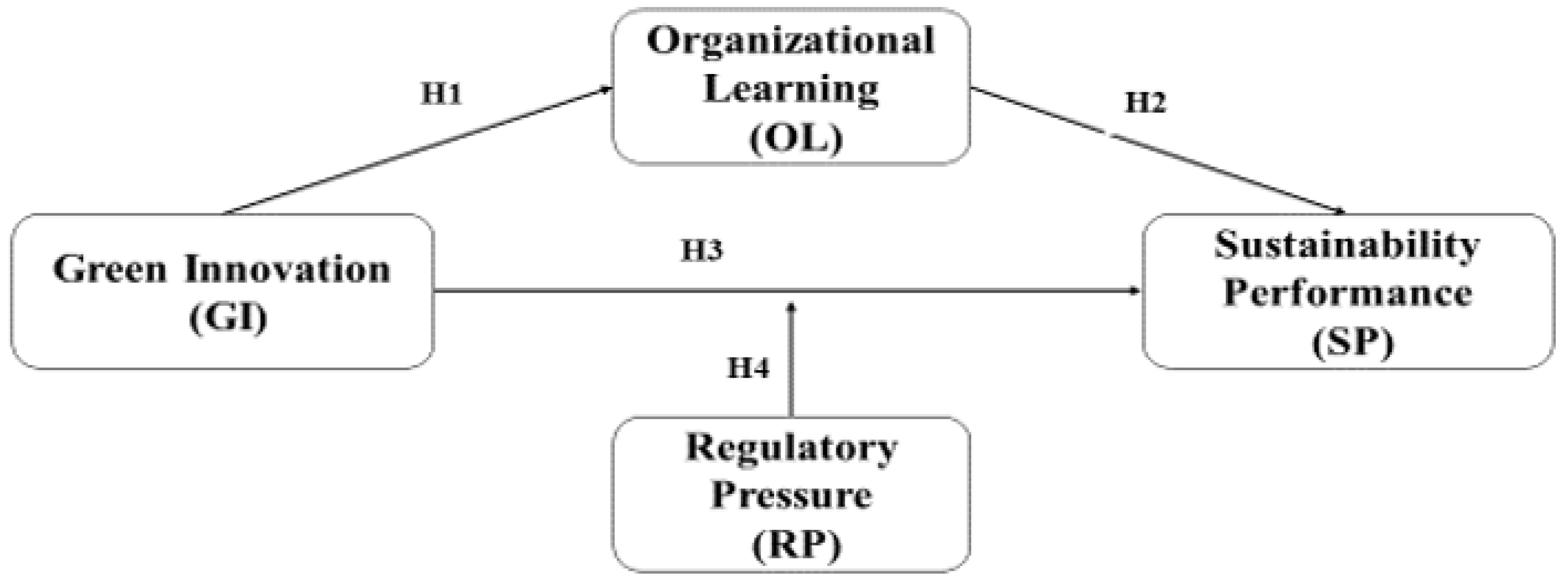
The conceptual framework presented in
Figure 1 illustrates the proposed relationships among Green Innovation (GI), Organizational Learning (OL), Regulatory Pressure (RP), and Sustainability Performance (SP). The framework is grounded in the Resource-Based View (RBV), Dynamic Capabilities Theory (DCT), and Institutional Theory, which collectively explain how internal organizational capabilities and external institutional pressures influence sustainability outcomes. Specifically, the model proposes that green innovation positively influences organizational learning and sustainability performance, and that organizational learning further enhances sustainability performance. Additionally, regulatory pressure is expected to moderate the relationship between green innovation and sustainability performance by strengthening the effectiveness of sustainability-oriented innovation. This integrated framework provides a comprehensive perspective for understanding how Saudi SMEs can achieve sustainable performance under the evolving sustainability objectives of Vision 2030 and beyond.
The proposed conceptual framework suggests that sustainability performance in SMEs is shaped by the interaction between internal organizational capabilities and external institutional pressures. Specifically, green innovation is a strategic organizational capability that enables firms to develop environmentally sustainable products, processes, and operations. However, the effectiveness of green innovation in improving sustainability performance depends not only on innovation activities but also on an organization’s ability to acquire, interpret, and apply sustainability-related knowledge through organizational learning processes. Accordingly, organizational learning functions as an internal adaptive mechanism that facilitates the transformation of green innovation initiatives into measurable and sustainable outcomes. Simultaneously, regulatory pressure represents an external institutional force that may strengthen or constrain these relationships by influencing firms’ strategic priorities, compliance behavior, and sustainability-oriented resource allocation. Grounded in the Resource-Based View, Dynamic Capabilities Theory, and Institutional Theory, the framework proposes that sustainability performance emerges from the combined influence of internal learning capabilities, innovation-oriented strategic behavior, and external regulatory conditions operating within dynamic SME environments.
7. Hypotheses Development
Drawing on the Resource-Based View (RBV), Dynamic Capabilities Theory (DCT), and Institutional Theory, this study proposes that sustainability performance within SMEs is shaped by the interaction between internal organizational capabilities and external institutional conditions. RBV suggests that firms possessing valuable and sustainability-oriented resources, such as green innovation and organizational learning capabilities, are more likely to achieve sustainable competitive advantage and superior organizational performance. Complementing this perspective, DCT emphasizes the importance of adaptive learning processes that enable firms to integrate, reconfigure, and apply organizational knowledge in response to changing environmental and competitive conditions. In this regard, organizational learning represents a dynamic capability through which firms can transform green innovation into effective sustainability results. Furthermore, Institutional Theory explains how external pressures, particularly regulatory pressure, influence organizational behavior by encouraging firms to adopt environmentally responsible practices and align their operations with sustainability expectations and regulatory requirements.
Green innovation has been increasingly recognized as a strategic capability that enables firms to improve sustainability performance through environmentally friendly technologies, cleaner production processes and resource-efficient operational practices. Firms engaged in green innovation are generally better positioned to reduce their environmental impact, improve their operational efficiency, and strengthen their long-term competitiveness. However, the successful implementation of green innovation often depends on an organization’s ability to acquire, integrate, and apply sustainability-related knowledge. Therefore, organizational learning functions as a critical internal mechanism that enhances the effectiveness of green innovation by facilitating knowledge sharing, experimentation and continuous improvement. Through these learning processes, firms become more capable of translating sustainability-oriented innovations into measurable outcomes.
Additionally, regulatory pressure may influence the effectiveness of green innovation by shaping the organizational incentives and sustainability priorities. Strong regulatory environments often encourage firms to intensify sustainability initiatives, strengthen environmental compliance, and improve innovation efforts to maintain legitimacy and competitive position. However, the impact of regulatory pressure may vary depending on how firms perceive and strategically respond to institutional demands. In emerging economies such as Saudi Arabia, where sustainability regulations and Environmental, Social, and Governance (ESG) frameworks are evolving rapidly under Vision 2030, regulatory pressure is expected to strengthen the relationship between green innovation and sustainability performance by encouraging firms to utilize sustainability-oriented capabilities effectively.
Based on these theoretical arguments and prior empirical findings, the following hypotheses are proposed:
H1: Green innovation positively affects organizational learning.
H2: Green innovation positively affects sustainability performance.
H3: Organizational learning mediates the relationship between green innovation and sustainability performance.
H4: Regulatory pressure moderates the relationship between green innovation and sustainability performance.
8. Methodology
This study adopted a quantitative, cross-sectional research design to examine the relationships among green innovation (GI), organizational learning (OL), regulatory pressure (RP), and sustainability performance (SP) within Saudi Arabian small and medium-sized enterprises (SMEs). A structured questionnaire was used to collect primary data from employees working across multiple SME sectors, including manufacturing, retail, logistics, technology, hospitality, food production, professional services, and other service-related industries in the Philippines. The quantitative survey approach was considered appropriate because it enabled a systematic investigation of the proposed relationships among the study variables and provided sufficient data for statistical testing and model evaluation.
A quantitative cross-sectional design was considered appropriate because this study aimed to examine statistically measurable relationships among multiple organizational constructs across a relatively large SME sample. This design enabled the simultaneous assessment of the direct, mediating, and moderating relationships among green innovation, organizational learning, regulatory pressure, and sustainability performance, using established multivariate statistical techniques. Furthermore, cross-sectional survey designs are widely employed in organizational and sustainability research to examine perception-based organizational capabilities and institutional influences within the resource-constrained SME context.
The sampling frame comprised managerial and operational employees working in registered SMEs across multiple sectors in Saudi Arabia, given the strategic importance of SMEs in supporting the sustainability and economic diversification objectives of Saudi Vision 2030. Employees occupying managerial, administrative, and operational positions were invited to participate because of their familiarity with organizational sustainability practices, innovation activities, and learning processes. Participants possessed sufficient organizational knowledge to evaluate sustainability-related practices in their firms. To improve sample representativeness and reduce sampling bias, this study employed stratified random sampling. Initially, SMEs were classified into different industry-based strata according to their operational sectors. Subsequently, firms were randomly selected from each stratum, proportionate to sector representation within the SME population.
Data collection will be conducted over a three-month period between January 2025 and March 2025. The questionnaires were distributed electronically through email invitations, online survey platforms, and direct organizational contacts to improve accessibility and participation. Respondents were informed of the academic purpose of the study and assured that all responses would remain confidential and anonymous. A total of 500 questionnaires were distributed to employees working in Saudi SMEs across various sectors. Of these, 402 questionnaires were returned, resulting in an initial response rate of 80.4. After data screening and elimination of incomplete or unusable responses, 386 valid questionnaires were retained for the final analysis, representing a usable response rate of 77.2%. The final sample size exceeded the recommended minimum threshold for multivariate statistical analysis and structural modelling.
Table 1 presents the respondents’ demographic profiles and the organizational characteristics of the participating SMEs. Demographic information was included to assess the representativeness of the sample and provide contextual understanding of managerial experience, organizational characteristics, and sectoral distribution across Saudi SMEs. Non-response bias was assessed by comparing early and late respondents using independent sample
t-tests, following the assumption that late respondents were more likely to resemble non-respondents. The comparison revealed no statistically significant differences between the early and late responses across the primary study variables (
p > 0.05). These findings suggest that non-response bias is unlikely to significantly influence the study results, thereby supporting the representativeness and reliability of the collected data.
The questionnaire consisted of five sections: The first section collected demographic and organizational information, including the respondents’ positions, industry sectors, and organizational backgrounds. The remaining sections measured green innovation, organizational learning, regulatory pressure, and sustainability performance using previously validated multi-item scales adapted from prior studies. Green innovation items were adapted from [
53], organizational learning items from [
54], regulatory pressure items from [
38], and sustainability performance items from [
55,
56,
57,
58,
59]. All measurement items were assessed using a five-point Likert scale ranging from 1 (“strongly disagree”) to 5 (“strongly agree”). Reliability and validity assessments were conducted using Cronbach’s alpha, exploratory factor analysis (EFA), confirmatory factor analysis (CFA), composite reliability (CR), and average variance extracted (AVE). All constructs exceeded the recommended reliability threshold of 0.70, and the factor loadings demonstrated acceptable convergent validity, with minimal cross-loadings.
Because the study relied on self-reported cross-sectional survey data collected from a single source, potential common method bias (CMB) was addressed using procedural and statistical remedies. Procedurally, respondents were assured of anonymity and confidentiality to minimize social desirability bias and evaluation apprehension. The questionnaire items were carefully adapted from validated scales and arranged to reduce ambiguity and response-pattern bias. Harman’s single-factor test was conducted to assess the extent of common method variance. The results revealed that the first unrotated factor accounted for less than 50% of the total variance, indicating that common method bias was not a serious concern in this study.
SPSS (Version 27.0) was used for descriptive statistics, reliability analysis, correlation analysis, and regression analysis. PROCESS Macro (Version 4.2) was employed for mediation and moderation testing, while CFA procedures were conducted using AMOS-based SEM to provide a more robust test of the proposed indirect and conditional effects. Specifically, the mediating role of organizational learning in the relationship between green innovation and sustainability performance was examined using PROCESS Model 4, and the moderating effect of regulatory pressure on the relationship between green innovation and sustainability performance was tested using PROCESS Model 1. Bootstrapping procedures with 5000 resamples and 95% confidence intervals were employed to assess the significance of the mediation and moderation effects. This analytical approach enhanced the rigor and reliability of the findings by providing a more accurate estimation of the indirect and interaction effects.
Ethical guidelines were strictly followed throughout this study. Participation was entirely voluntary, informed consent was obtained from all respondents, and the confidentiality and anonymity of the responses were fully assured. Respondents were informed that the study was conducted solely for academic purposes and that they could withdraw from the study at any time without consequence. Since the study involved anonymous survey responses from adult participants and did not include sensitive personal data, medical information, or vulnerable populations, formal ethical approval was not required under the institutional research ethics guidelines of the authors’ affiliated university.
9. Data Analysis and Result
Table 1’s demographic profile demonstrates that the sample included respondents from diverse managerial positions, industrial sectors, firm-size categories, and geographical regions across Saudi Arabia. Most respondents were middle and senior managers with more than five years of professional experience, indicating that they possessed sufficient organizational knowledge to evaluate sustainability-related practices within their firms. The sample also reflects representation from the manufacturing, service, retail, and technology sectors, thereby improving the generalizability of the findings within the Saudi SME context. Furthermore, the inclusion of firms from multiple regions of Saudi Arabia enhances the study’s contextual relevance and reduces the likelihood of regional bias.
Table 2 presents the descriptive statistics of the study variables. The results indicate that all constructs reported mean values above 3.80, reflecting generally positive perceptions among respondents regarding green innovation, organizational learning, regulatory pressure, and sustainability performance in Saudi SMEs. Organizational learning recorded the highest mean value (M = 4.23), suggesting that learning capabilities and knowledge-sharing practices were relatively well-developed among the participating firms. Green innovation also demonstrated a relatively high mean (M = 4.09), indicating that many SMEs have adopted sustainability-oriented innovative practices. Regulatory pressure reported the lowest mean value (M = 3.84) and the highest standard deviation, implying that firms experience varying levels of environmental and institutional pressure depending on their operational and regulatory contexts. Overall, the descriptive statistics indicated adequate variability across the study variables without evidence of extreme response patterns.
The normality assessment in
Table 3 was conducted using skewness and kurtosis statistics to evaluate whether the data satisfied the assumptions required for parametric analyses. As presented in
Table 3, all skewness and kurtosis values fell within the acceptable threshold range of ±2.0, indicating that the study variables were approximately normally distributed. These findings confirm that the normality assumption was satisfied and support the appropriateness of conducting regression, mediation, and moderation analyses using parametric techniques.
As shown in
Table 4, the results of Harman’s single-factor test reveal that the first factor accounts for 31.27% of the total variance, which is below the recommended threshold of 50%. Therefore, common method bias was not a serious concern in this study.
The results presented in
Table 5 indicate that the dataset is suitable for factor analysis. The Kaiser–Meyer–Olkin (KMO) measure of sampling adequacy was 0.912, which exceeded the recommended threshold of 0.70, indicating excellent sampling adequacy and strong correlations among the measurement items. This suggests that the data were appropriate for identifying underlying factor structures. Additionally, Bartlett’s Test of Sphericity was statistically significant (χ
2 = 4367.524, df = 496,
p < 0.001), indicating that the correlation matrix was not an identity matrix and that sufficient relationships existed among the variables to justify factor analysis. Overall, these findings confirm the appropriateness of conducting exploratory factor analysis (EFA) for the study constructs and support the adequacy of the measurement model for subsequent validity and reliability assessments.
The exploratory factor analysis (EFA) results presented in
Table 6 demonstrate that all measurement items loaded acceptably onto their intended constructs, with minimal cross-loadings. The green innovation items consistently loaded onto the first factor, indicating satisfactory construct validity and internal consistency. Similarly, the sustainability performance items demonstrated strong loadings on the second factor, supporting the clarity and stability of the construct structure. Organizational learning items also loaded appropriately on the third factor, with negligible cross-loadings, confirming satisfactory factor alignment and measurement consistency. In addition, all regulatory pressure items loaded strongly onto the fourth factor, indicating adequate construct validity and a reliable factor structure. Although several indicators reported loadings below the preferred threshold of 0.70, they exceeded the minimum acceptable level of 0.50 and were retained because of their theoretical relevance and acceptable contributions to construct reliability and validity.
The results presented in
Table 7 indicate satisfactory reliability and convergent validity for all the study constructs. The standardized factor loadings ranged from 0.644 to 0.887, exceeding the minimum acceptable threshold of 0.60, suggesting that the measurement items adequately represented their respective constructs. Although a few loadings were slightly below the preferred 0.70 level, they were retained because they remained theoretically meaningful and did not adversely affect construct reliability. Furthermore, the Cronbach’s alpha (CA) values ranged from 0.856 to 0.917, while the Composite Reliability (CR) values ranged from 0.871 to 0.926, both exceeding the recommended threshold of 0.70 and confirming strong internal consistency reliability. In addition, the Average Variance Extracted (AVE) values ranged from 0.591 to 0.682, surpassing the minimum recommended value of 0.50, which supports the convergent validity of the constructs. Overall, these findings demonstrate that the measurement model possesses adequate reliability and validity for subsequent structural and hypothesis testing analyses.
The results presented in
Table 8 confirm the satisfactory discriminant validity of the study constructs using the Fornell–Larcker criterion. The square root of the Average Variance Extracted (AVE) for each construct, shown along the diagonal, was greater than the corresponding inter-construct correlations. Specifically, the square roots of AVE for Green Innovation (0.796), Organizational Learning (0.826), Regulatory Pressure (0.769), and Sustainability Performance (0.822) exceeded their correlations with the other constructs. These findings indicate that each construct shares more variance with its measurement items than with other constructs in the model, confirming that the constructs are conceptually distinct and free from significant overlap. Therefore, the results support the discriminant validity of the measurement model and demonstrate that the study variables capture distinct, theoretical dimensions.
The confirmatory factor analysis (CFA) results presented in
Table 9 indicate that the measurement model demonstrated a good overall fit with the observed data. The chi-square to degrees of freedom ratio (χ
2/df) was 2.184, which was below the recommended threshold of 3.0, indicating an acceptable model fit. Additionally, the Comparative Fit Index (CFI = 0.945) and Tucker–Lewis Index (TLI = 0.937) exceeded the recommended minimum value of 0.90, suggesting a strong incremental fit of the model. Furthermore, the Root Mean Square Error of Approximation (RMSEA = 0.055) and the Standardized Root Mean Square Residual (SRMR = 0.047) were both below the acceptable threshold of 0.08, indicating low approximation and residual errors. Overall, these findings confirm that the measurement model achieved a satisfactory goodness-of-fit and adequately represented the relationships between the observed indicators and their underlying constructs.
The satisfactory results of the reliability, convergent validity, discriminant validity, and CFA analyses confirmed the adequacy of the measurement model and supported proceeding to structural and hypothesis testing analyses.
Table 10 presents the Pearson correlation coefficients of the study variables. The findings indicate that all relationships were positive and statistically significant (
p < 0.001). Green innovation demonstrated a moderate positive association with organizational learning (r = 0.446), suggesting that firms engaging in sustainability-oriented innovation activities tend to strengthen their internal learning capabilities. In addition, green innovation is positively associated with sustainability performance (r = 0.257), indicating that environmentally innovative firms are more likely to achieve stronger sustainable outcomes. Regulatory pressure also showed a positive relationship with organizational learning and sustainability performance, implying that external institutional demands may encourage firms to improve sustainability-related practices and adaptive learning processes. Although these correlations provide preliminary support for the proposed relationships, the cross-sectional nature of the study limits causal interpretation. Although several bivariate correlations were moderate in magnitude, multivariate analyses may reveal stronger conditional and indirect relationships because of the simultaneous interaction between organizational capabilities and institutional factors.
In
Table 11, multicollinearity diagnostics were conducted using the Variance Inflation Factor (VIF) and tolerance values prior to the regression and PROCESS analyses. The results indicated that all VIF values were below the recommended threshold of 5.0, while the tolerance values exceeded 0.20, suggesting that multicollinearity was not a serious concern in this study model. These findings confirm that the independent variables were sufficiently distinct for reliable regression and mediation/moderation analyses.
Homoscedasticity was assessed using a residual scatterplot analysis to examine the consistency of the error variance across the predicted values. The residual distribution demonstrated no clear systematic pattern or funnel-shaped dispersion, indicating that the variance of the residuals remained relatively constant across the regression models. These findings suggest that the assumption of homoscedasticity was satisfied, thereby supporting the appropriateness and reliability of the regression-based mediation and moderation analyses conducted in this study.
Table 12 presents the regression model summary for sustainability performance (SP). The results indicate a multiple correlation coefficient (R = 0.668), demonstrating a strong positive relationship between the independent variables and sustainability performance. The coefficient of determination (R
2 = 0.446) indicates that approximately 44.6% of the variance in sustainability performance is explained by green innovation, organizational learning, and regulatory pressure. The adjusted R
2 value further confirmed the explanatory strength and stability of this regression model. Overall, these findings suggest that the proposed predictors collectively provide substantial explanatory power for understanding sustainability performance in Saudi SMEs.
The ANOVA results presented in
Table 13 indicate that the overall regression model was statistically significant (F = 202.854,
p < 0.001). This finding confirms that green innovation, organizational learning, and regulatory pressure collectively explain significant variations in sustainability performance among Saudi SMEs. The significant model fit supports the inclusion of these predictors in the proposed framework. Furthermore, the explained variance attributable to the regression model exceeded the unexplained residual variance, indicating that the model possessed satisfactory explanatory capability.
The regression coefficients presented in
Table 14 demonstrate that all independent variables exert significant positive effects on sustainability performance. Green innovation reported the strongest standardized effect (β = 0.354,
p < 0.001), indicating that firms adopting environmentally sustainable innovation practices are more likely to achieve higher sustainability performance than others. Organizational learning also exhibited a significant positive influence (β = 0.286,
p < 0.001), suggesting that firms with stronger learning capabilities are better positioned to support sustainability initiatives and adapt to organizational changes. In addition, regulatory pressure positively influenced sustainability performance (β = 0.205,
p < 0.001), implying that external institutional demands encourage firms to strengthen sustainability practices. Collectively, these findings highlight the complementary roles of internal organizational capabilities and external institutional pressures in enhancing sustainability performance within Saudi SMEs.
The moderation analysis presented in
Table 15 was conducted using PROCESS Macro Model 1 to examine whether regulatory pressure moderates the relationship between green innovation and sustainable performance. The interaction effect between green innovation and regulatory pressure was positive and statistically significant (β = 0.119,
p < 0.001), indicating that regulatory pressure strengthens the positive effect of green innovation on sustainability performance. These findings suggest that firms operating in stronger regulatory environments can translate their green innovation initiatives into improved sustainability outcomes. Accordingly, regulatory pressure functions as an important contextual mechanism that enhances the effectiveness of sustainability-oriented innovation.
The conditional effects analysis presented in
Table 16 further confirms the moderating role of regulatory pressure in the relationship between green innovation and sustainability performance. The results indicate that the positive effect of green innovation on sustainability performance becomes progressively stronger as the pressure increases. Specifically, the effect size increased from β = 0.181 under low regulatory pressure to β = 0.392 under high regulatory pressure. In all cases, the confidence intervals excluded zero, confirming the statistical significance of the conditional effects. These findings suggest that supportive and well-enforced regulatory environments encourage firms to utilize green innovation more effectively to achieve sustainability goals.
As shown in
Table 17, the conditional effects analysis indicates that regulatory pressure significantly strengthens the positive relationship between green innovation (GI) and sustainability performance (SP). The results show that green innovation positively influences sustainability performance at all levels of regulatory pressure; however, the effect strengthens as the regulatory pressure increases. Specifically, the effect of green innovation on sustainability performance rises from β = 0.181 under low regulatory pressure to β = 0.278 at the mean level and further increases to β = 0.392 under high regulatory pressure. All confidence intervals excluded zero, confirming the statistical significance of these effects. These findings suggest that stronger regulatory environments encourage firms to utilize green innovation more effectively to achieve sustainability objectives. Therefore, regulatory pressure is an important contextual factor that enhances firms’ ability to translate green innovation initiatives into improved sustainability performance, particularly in the context of Saudi SMEs operating under evolving sustainability regulations and Vision 2030 initiatives.
10. Discussion
The findings of this study provide strong empirical support for the proposed relationships among green innovation, organizational learning, regulatory pressure, and sustainability performance in Saudi SMEs. Specifically, the results indicate that green innovation significantly enhances both organizational learning and sustainability performance, whereas organizational learning functions as a critical mediating mechanism through which sustainability-oriented innovation is translated into organizational sustainability outcomes [
6,
52]. In addition, regulatory pressure significantly strengthens the relationship between green innovation and sustainability performance, suggesting that external institutional conditions influence the effectiveness of internal sustainability capabilities [
60].
Moreover, green innovation encourages engagement with external stakeholders such as regulators, suppliers, and environmentally conscious customers, further enriching organizational knowledge and promoting adaptive capabilities [
60]. Thus, green innovation functions as an environmental initiative and a driver of capability development. This is particularly relevant for SMEs in developing economies, where formal R&D may be limited and learning often occurs through practice [
61]. Overall, green innovation fosters a learning-oriented environment that strengthens organizational agility, innovation and long-term sustainability [
62].
Moreover, Green innovation significantly enhances sustainable performance by aligning environmental efforts and responsibilities with economic and social outcomes. Through eco-friendly practices and clean technologies, firms can reduce their environmental impact, improve efficiency, lower costs, and meet stakeholder expectations [
63]. Green innovation also helps organizations anticipate regulations, gain a competitive edge, and build their reputation. In emerging economies and SMEs, such as those in Saudi Arabia, green innovation is a vital strategy for long-term sustainability and alignment with national goals, such as Vision 2030 [
64]. However, while green innovation is often seen as a catalyst for organizational learning, some scholars argue that it can strain existing learning capacities, especially in resource-constrained or low-capability firms [
65]. Instead of enhancing learning, the adoption of eco-innovations may overwhelm organizational systems, leading to fragmented knowledge transfer, ineffective implementation, and resistance to change.
The positive relationship between green innovation and sustainability performance may be particularly important in the Saudi SME context because many firms continue to operate under rapidly evolving institutional and economic conditions associated with Vision 2030 transformation initiatives. Unlike organizations operating in mature sustainability-oriented economies, many Saudi SMEs remain in the transitional stages of sustainability integration, where environmental innovation is still developing strategically and operationally. Consequently, green innovation within Saudi SMEs may function not only as a sustainability mechanism but also as an adaptive response to increasing governmental expectations, market modernization pressures, and national economic diversification.
The findings also strengthen the theoretical dialogue between RBV, dynamic capabilities theory, and institutional theory by suggesting that sustainability performance within SMEs cannot be explained solely through isolated organizational resources or external regulatory conditions [
12,
18,
22]. Rather, sustainability outcomes appear to emerge through the interaction between firms’ internal adaptive capabilities and evolving institutional pressures [
41,
60]. This suggests that SMEs achieve stronger sustainability performance not simply because they adopt green innovation practices but because they possess the organizational learning capacity necessary to continuously integrate, reconfigure, and apply sustainability-related knowledge under changing regulatory and competitive conditions [
22,
52]. Consequently, this study extends the prior sustainability literature by emphasizing that sustainability transformation within emerging market SMEs is a dynamic and context-dependent capability development process [
18,
41].
The positive relationships identified in this study may be particularly relevant within the Saudi SME context because firms operate under rapidly evolving institutional, economic, and sustainability expectations associated with the National Transformation Agenda (NTA) [
66]. Unlike firms in more mature sustainability-oriented economies, many Saudi SMEs remain in the transitional stages of sustainability integration, where environmental innovation and sustainability practices are still being developed organizationally and institutionally [
65]. Consequently, green innovation within Saudi SMEs may function not only as a competitive strategy but also as a mechanism for adapting to changing governmental expectations, market reforms, and sustainability-oriented economic diversification initiatives [
66,
67]. Furthermore, Vision 2030 policies appear to be reshaping SME innovation ecosystems by encouraging digital transformation, sustainability, and environmentally responsible business practices [
65,
68]. This institutional transformation may explain why sustainability-oriented innovation and organizational learning capabilities emerged as significant predictors of sustainability performance in this study’s findings.
Furthermore, organizational learning strengthens sustainable performance by equipping firms with the internal capabilities to adapt, innovate, and improve across environmental, economic, and social dimensions [
27]. Through knowledge sharing and problem solving, organizational learning embeds sustainability into decision-making and business processes. This helps firms turn environmental challenges into innovative opportunities and competitive advantages. This is especially crucial for SMEs in emerging economies, where organizational learning supports effective strategy implementation, regulatory compliance, and long-term resilience [
66].
The mediating role of organizational learning should also be interpreted cautiously in SME environments characterized by resource scarcity and operational uncertainty [
66]. Although organizational learning facilitates the translation of green innovation into sustainability performance, learning processes may simultaneously create managerial and operational pressures for SMEs with limited absorptive capacity [
25,
68]. In highly resource-constrained firms, sustainability-oriented learning may require additional investments in training, coordination, information processing, and organizational adaptation, which some SMEs may struggle to maintain over time [
66]. Consequently, organizational learning may function both as an enabling capability and as a potential organizational burden when firms lack sufficient structural and financial support [
66]. This perspective extends existing sustainability research by highlighting the dual and context-dependent nature of organizational learning in SMEs in emerging market SMEs [
65,
68].
However, some scholars have argued that in small and medium-sized enterprises (SMEs), especially in developing economies, learning systems are often fragmented, informal, and reactive, limiting their ability to support strategic sustainability integration [
66]. Additionally, when firms face acute resource constraints, sustainability goals can be deprioritized in favor of short-term survival. In these cases, learning tends to focus on operational efficiency or cost-cutting rather than long-term sustainability or innovation [
30].
In addition, regulatory pressure moderates the effects of green innovation and organizational learning on sustainable performance by shaping how internal capabilities lead to sustainability outcomes [
35]. While green innovation and organizational learning drive internal change, regulatory pressure adds external accountability, which can enhance or limit its impact. In contexts with strong and well-enforced environmental regulations, regulatory pressure strengthens the influence of green innovation and organizational learning by encouraging structured learning, compliance-driven innovation, and resource allocation for sustainability, thereby amplifying their contribution to sustainable performance [
67].
Although regulatory pressure influences sustainable performance, its impact is moderate compared to that of green innovation and learning. This is because firms with strong internal capabilities often go beyond compliance, driven by proactive strategies [
68]. In contrast, unclear or burdensome regulations may limit learning and lead to minimal innovation. Thus, the effectiveness of regulatory pressure as a moderating factor depends on the clarity of regulations, industry context, and organizational strategy, making it a conditional rather than a primary driver of sustainability outcomes [
19].
Although regulatory pressure positively strengthens the relationship between green innovation and sustainability performance, these findings should be interpreted critically. In some SME environments, regulatory pressure may encourage symbolic compliance rather than substantive sustainability transformation, particularly when firms lack sufficient financial, technological, or managerial resources to implement sustainability initiatives effectively [
66,
68]. Under such conditions, sustainability practices may become reactive responses intended primarily to satisfy external expectations rather than internally embedded strategic commitments [
67]. This possibility may be especially relevant for resource-constrained SMEs that experience sustainability requirements as operational burdens rather than as long-term strategic opportunities [
65,
66]. Therefore, the effectiveness of regulatory pressure may depend not only on the existence of regulations but also on firms’ internal readiness, strategic orientation, and capability development processes [
25,
68].
Beyond confirming the positive effects of green innovation and organizational learning on sustainability performance, the findings contribute theoretically by suggesting that sustainability transformation within SMEs is not driven solely by innovation adoption or regulatory compliance [
50,
52]. Rather, sustainability outcomes appear to emerge from the interaction between internal adaptive capabilities and external institutional pressures operating within dynamic and resource-constrained environments [
51,
68]. This perspective challenges the overly linear assumptions commonly found in sustainability research that treat green innovation as automatically leading to positive sustainability outcomes [
38]. Instead, the present findings indicate that the effectiveness of sustainability-oriented innovation depends heavily on organizational learning capacity, institutional context, and strategic responsiveness [
25,
66]. Accordingly, this study extends the Resource-Based View, Dynamic Capabilities Theory, and Institutional Theory by demonstrating that sustainability performance within SMEs reflects a contextually embedded capability-development process rather than a purely technological or compliance-oriented outcome [
50,
51,
52].
Overall, the findings suggest that sustainability performance in Saudi SMEs may not emerge solely from isolated innovative activities or regulatory compliance requirements. Rather, sustainability transformation appears to reflect a more complex interaction between internal adaptive capabilities, institutional pressures, organizational learning processes, and evolving national sustainability priorities associated with Vision 2030. This perspective provides a more contextually embedded understanding of sustainability-oriented organizational behavior within SMEs in emerging market SMEs operating under conditions of institutional transition and economic diversification. In addition, the findings suggest that sustainability performance within Saudi SMEs is shaped not only by sustainability-oriented innovation but also by the organization’s ability to learn, adapt, and strategically respond to evolving institutional expectations within a rapidly transforming economic environment.
11. Conclusions
The analysis revealed that green innovation, organizational learning, and regulatory pressure are significantly interconnected and drive sustainability performance. Green innovation emerged as the most influential factor, with firms adopting eco-friendly technologies and practices to achieve stronger sustainability outcomes. Organizational learning acts as a key mediator, enabling firms to absorb and apply green innovations effectively through knowledge acquisition and adaptive capabilities. Although moderately impactful, regulatory pressure reinforces sustainable practices by encouraging compliance and external accountability. Collectively, the findings underscore that sustainability performance is optimized when green innovation is supported by continuous learning and shaped by a strong regulatory framework.
12. Theoretical Contribution
This study makes several important theoretical contributions to sustainability and organizational management literature. First, this study advances the Resource-Based View (RBV) by demonstrating that green innovation alone may not be sufficient to achieve sustainability performance unless firms possess complementary internal capabilities such as organizational learning. While prior RBV-based studies primarily conceptualize green innovation as a valuable strategic resource, the present findings suggest that the effectiveness of this resource depends on an organization’s ability to absorb, integrate, and apply sustainability-related knowledge. This extends the RBV beyond static resource ownership toward a more capability-oriented understanding of sustainable performance.
Second, this study strengthens Dynamic Capabilities Theory (DCT) by empirically demonstrating the mediating role of organizational learning in translating green innovation into sustainability outcomes. The findings suggest that organizational learning functions as an adaptive capability that enables firms to continuously reconfigure internal processes, interpret sustainability-related knowledge, and respond effectively to environmental and market changes. This contributes to the growing literature emphasizing that sustainability performance emerges not only from innovation adoption but also from an organization’s ability to learn and adapt over time.
Third, this study contributes to Institutional Theory by highlighting the moderating role of regulatory pressure. The findings indicate that external institutional environments significantly shape firms’ utilization of their internal sustainability capabilities. Specifically, stronger regulatory pressure enhances the effectiveness of green innovation in improving sustainability performance, suggesting that sustainability outcomes are jointly influenced by internal organizational capabilities and external institutional forces. This integrated theoretical perspective provides a more comprehensive explanation of sustainability performance in SMEs in emerging economies.
Although prior studies have examined the relationships among green innovation, organizational learning, regulatory pressure, and sustainability performance in various contexts, the present study does not claim that these relationships are novel. Rather, the contribution of this research lies in providing a more integrated and context-sensitive explanation of how internal organizational capabilities and external institutional pressures jointly influence sustainability performance within Saudi SMEs operating under conditions of institutional transition and sustainability-oriented economic transformation in Saudi Arabia. In particular, this study extends the existing sustainability and innovation literature by examining the combined mediating role of organizational learning and the moderating role of regulatory pressure within the context of emerging market SME, which remains underrepresented in prior empirical research. Accordingly, the novelty of this study derives primarily from its contextual integration, theoretical synthesis, and empirical application within the evolving sustainability environment associated with the Saudi Vision 2030.
Finally, this study contributes contextually by extending sustainability research to Saudi Arabia’s SME sector, which remains relatively unexplored in the literature. Most prior studies examining green innovation and sustainability performance have focused on large firms in developed nations. By examining Saudi SMEs operating under Vision 2030 reforms, this study provides new evidence of how sustainability-oriented capabilities function within resource-constrained firms facing rapidly evolving institutional and environmental expectations.
13. Practical Contribution
The findings of this study have several practical implications for SME managers, organizational leaders and policymakers in Saudi Arabia. First, the results suggest that SMEs should treat green innovation as a long-term strategic capability rather than as an environmental compliance activity. SME managers can operationalize green innovation by investing in resource-efficient technologies, adopting environmentally sustainable production processes, and integrating sustainability objectives into their operational planning and performance evaluation systems. Given the financial limitations often faced by SMEs, firms may begin with incremental green practices, such as waste reduction initiatives, energy efficiency programs, digitalization of operational processes, and environmentally responsible supply chain practices, before expanding to larger sustainability transformations.
Second, the significant mediating role of organizational learning highlights the importance of developing internal learning systems that support sustainability-oriented knowledge sharing and capability development in organizations. SMEs can operationalize organizational learning by establishing cross-functional sustainability teams, conducting regular sustainability training, encouraging employee participation in environmental problem-solving, and implementing internal knowledge-sharing platforms. Managers should also create an organizational culture that rewards experimentation, innovation, and continuous improvement in sustainability practices. In resource-constrained SME environments, informal learning mechanisms such as peer collaboration, mentoring, and experiential learning may be particularly effective in strengthening sustainability capability.
Third, the moderating role of regulatory pressure suggests that policymakers play a critical role in strengthening sustainability performance among SMEs in Saudi Arabia. Policymakers can operationalize these findings by developing clearer environmental, social, and governance (ESG) regulations, strengthening environmental reporting requirements, and providing sector-specific sustainability guidelines tailored to SME capabilities. In addition to regulatory enforcement, government agencies should provide supportive mechanisms, such as green financing programs, tax incentives, sustainability certification support, subsidized training initiatives, and innovation grants to reduce the financial burden associated with green transformation. Such initiatives would encourage SMEs to adopt sustainability-oriented innovation practices while improving their ability to comply with evolving environmental standards.
Finally, the findings are particularly relevant in the context of Saudi Vision 2030, in which sustainability and economic diversification are central national priorities. The study suggests that achieving sustainable performance in Saudi SMEs requires an integrated approach that combines internal organizational capabilities and supportive institutional environments. Therefore, collaboration between government agencies, SME support institutions, universities, and industry associations may help create sustainable ecosystems that facilitate innovation diffusion, organizational learning, and long-term sustainable competitiveness among SMEs in Saudi Arabia.
14. Originality/Value
This study contributes to the sustainability and innovation literature by examining the combined roles of green innovation, organizational learning, and regulatory pressure in shaping the sustainability performance of SMEs in Saudi Arabia. Drawing on the Resource-Based View (RBV) and Dynamic Capabilities Theory (DCT), this study provides a contextually grounded perspective on how internal capabilities and external institutional conditions interact within an emerging market environment. The findings offer additional empirical evidence from the Saudi SME sector and provide practical insights relevant to sustainability transformation initiatives associated with the Saudi Vision 2030.
15. Research Limitations and Implications
Despite the important theoretical and practical contributions of this study, it has some limitations. First, the study adopted a cross-sectional research design, which limits the ability to establish causal relationships between green innovation, organizational learning, regulatory pressure and sustainability performance. Since the data were collected at a single point in time, the findings should be interpreted as associations rather than definitive causal effects. Future studies should employ longitudinal designs to better capture the dynamic evolution of sustainability capabilities and organizational adaptation over time.
Second, the study relied on self-reported questionnaire data collected from a single source, which may increase the possibility of common method bias and respondent subjectivity, despite the procedural and statistical remedies employed in this study. Although Harman’s single-factor test indicated that common method bias was not a serious concern, future research may benefit from collecting multi-source data or combining subjective and objective sustainability performance indicators to improve measurement robustness.
Third, the study focused exclusively on small and medium-sized enterprises (SMEs) operating in Saudi Arabia. Although this context is highly relevant to Vision 2030, the findings may not be fully generalizable to large corporations or firms operating in different institutional and cultural environments. Future studies should conduct comparative analyses across industries, countries, and organizational sizes to examine the contextual differences in sustainability-oriented innovation and learning capabilities.
Fourth, this study examined organizational learning as the primary mediating mechanism and regulatory pressure as the primary moderating factor. However, sustainability performance may also be influenced by additional organizational and institutional variables that were not included in the present framework, such as leadership style, organizational culture, digital transformation, ESG strategy, environmental orientation, and knowledge management capabilities. Future research may extend this model by incorporating these variables to provide a more comprehensive understanding of sustainability-performance drivers.
Finally, this study primarily employed quantitative methods and statistical analyses to examine the proposed relationship. Although this approach provides empirical generalizability, it may not fully capture the deeper organizational processes through which SMEs implement green innovation and sustainability. Therefore, future research should utilize qualitative or mixed-method approaches to provide richer contextual insights into sustainability transformation processes within SMEs in emerging markets.