Review

Digital Games in Education for Sustainable Development

Department of Biology and Chemistry Education, University of Bayreuth, 95447 Bayreuth, Germany
Sustainability 2026, 18(12), 5930; https://doi.org/10.3390/su18125930 (registering DOI)
Submission received: 23 April 2026 / Revised: 2 June 2026 / Accepted: 5 June 2026 / Published: 10 June 2026

Abstract

Digital games are becoming increasingly important as promising tools to foster Education for Sustainable Development (ESD), aiming to combine engagement, systems thinking, and transformative learning. This narrative review synthesizes evidence from 40 studies on serious games, game-based learning, and gamification to assess both the potential and limitations of digital games in ESD contexts. This review thus contributes to the field by integrating theoretical frameworks, empirical evidence, and design principles to provide a coherent understanding of how digital games support ESD learning processes. The findings reveal positive effects on cognitive and motivational outcomes, particularly regarding knowledge acquisition, systems understanding, and learner engagement. In addition, digital games can foster social learning processes such as collaboration, participation, and perspective-taking. These effects are grounded in established theoretical frameworks, including self-determination theory, flow theory, and experiential learning, and are supported by design features such as adaptive feedback, meaningful narratives, social interaction, and authentic decision-making. Across the reviewed studies, cognitive outcomes are most consistently documented, while evidence for long-term behavioral change and real-world transfer remains limited. This reflects both structural challenges of ESD and methodological constraints, including difficulties in measuring behavior, short-term study designs, and heterogeneous implementations. Overall, digital games can support key ESD competencies by enabling learners to engage with complex socio-ecological systems and multi-perspectivity. Their effectiveness and educational value depend less on gameplay itself than on four overarching design principles: encouraging the exploration of systems, linking experience and reflection, balancing between autonomy and guidance, and embedding within broader social and pedagogical processes.

1. Introduction

1.1. Education for Sustainable Development in a Changing World

Global environmental change is widely recognized as one of the most pressing challenges of the twenty-first century. Climate change, biodiversity loss, and resource depletion are fundamentally transforming socio-ecological systems and increasingly threaten the stability of planetary life-support systems [1,2,3,4]. Addressing these interconnected challenges requires not only technological innovation and policy interventions (e.g., the definition of the 17 Sustainable Development Goals (SDGs) of the United Nations), but also profound transformations in education systems that enable individuals to understand, navigate, and actively contribute to and shape complex sustainability processes [5].
In this context, Education for Sustainable Development (ESD) has emerged as a central framework for integrating sustainability into education. ESD aims to equip learners with the knowledge, skills, values, and dispositions necessary to contribute to sustainable futures and responsible decision-making [6,7]. Crucially, ESD goes beyond the transmission of factual knowledge by emphasizing the development of competencies that enable learners to engage with complex societal challenges and participate in sustainability transformations [8,9].
Several frameworks have been developed to operationalize these competencies. Prominent among them are, e.g., the sustainability competence framework proposed by Wiek et al. [9], which includes systems thinking, anticipatory competence, normative competence, collaboration, and strategic action, or the European “GreenComp” framework [10]. Subsequent work further refines those competencies and highlights their relevance for addressing complex sustainability challenges in educational contexts [11,12]. These competencies are essential for understanding the interconnected nature of sustainability problems and for enabling informed and responsible action [13].
However, implementing ESD effectively remains challenging. Sustainability issues are characterized by complexity, uncertainty, and long-term dynamics, which are difficult to communicate through traditional instructional approaches [5]. Conventional teaching methods often rely on linear explanations and static knowledge transmission, which may not adequately capture the systemic and dynamic nature of sustainability challenges. Furthermore, sustainability competencies are difficult to access [14], which complicates identifying corresponding learning processes. The goals of ESD are often on an abstract level, and the link between behavior and its consequences is far afield and therefore barely experienceable. Knowledge alone does not principally generate corresponding behavior, which is influenced by various aspects such as self-efficacy or outcome expectancy [15,16,17]. As a result, a persistent “knowledge–action gap” or “attitude-behavior gap” can be observed, where increased knowledge and awareness do not necessarily lead to behavioral change [18,19,20].
To address these limitations, researchers increasingly advocate for experiential, participatory, action-oriented, and interdisciplinary learning approaches that focus on action and experience and that allow learners to actively explore sustainability challenges and engage with them from multiple perspectives [7,21,22,23]. Within this broader transformation of education, digital technologies—and particularly digital games—are gaining attention as promising tools for enabling such learning processes. However, the extent to which digital games can effectively foster ESD competencies and support sustainability-related learning outcomes remains insufficiently synthesized.

1.2. Digital Games as Emerging Tools for Education

Digital games have become an increasingly important area of research in educational contexts, reflecting their potential to create interactive, immersive, and learner-centered environments. Over the past two decades, research on game-based learning, serious games, and gamification has expanded significantly, highlighting the educational potential of digital game environments across disciplines [24,25,26] and revealing a consistent overall pattern: digital games can positively influence learning processes, although their effects are moderate, heterogeneous, and highly dependent on design, context, and implementation.
A key characteristic of digital games is their ability to provide environments in which learners can actively engage with problems, test strategies, and observe the consequences of their actions [27,28]. This interactive nature distinguishes digital games from traditional instructional formats. At the same time, digital game environments encompass a wide range of formats, including simulation games, role-playing games, and immersive virtual environments [28,29,30]. Studies on digital game-based learning show improvements in knowledge acquisition, learning achievement, and conceptual understanding across subject areas, including STEM, although effect sizes vary depending on context and design [31,32,33,34]. Similarly, research on gamification demonstrates that integrating game elements in learning environments, such as feedback, challenges, and progress indicators, can increase learner engagement, participation, and persistence [35,36,37,38].
However, the literature consistently emphasizes that these effects are not uniform. A defining characteristic of the field is its high variability, with implementations differing widely in terms of game elements, duration, and pedagogical integration, leading to mixed or inconsistent findings. Research identifies several moderating factors, including learner characteristics, contextual conditions, and design features such as feedback, narrative, and interactivity [39,40]. Importantly, digital games are not inherently superior to traditional instructional methods. Their effectiveness depends on their alignment with learning objectives and their integration into pedagogically meaningful contexts [41,42].
Hence, in the context of Education for Sustainable Development (ESD), digital games are particularly promising because their interactive and simulation-based environments enable learners to engage with complex socio-ecological systems and actively explore cause–effect relationships. This may support the development of key sustainability competencies (cf. 1.1) such as systems thinking, anticipatory thinking, and strategic action, while making abstract challenges more tangible and experienceable. In doing so, digital games can foster the action-oriented learning processes needed to help bridge the persistent gap between knowledge and behavior.

1.3. Goals and Research Questions of This Study

Despite the growing body of research on digital games and sustainability education, the current literature remains fragmented and unevenly developed. Empirical studies differ widely in methodological approaches, learning contexts, and evaluation criteria, making it difficult to draw general conclusions about the effectiveness of digital games, especially for ESD (see above). Thereby, many studies focus primarily on short-term outcomes, while evidence regarding long-term behavioral change remains limited [35,43]. Moreover, while research on game-based learning has expanded significantly, relatively few studies explicitly address the intersection of digital games and ESD in a systematic and integrative manner. Recent reviews highlight both the growing importance of this field and the need for more comprehensive analyses that link theoretical frameworks, empirical evidence, and design principles [44,45]. A key research gap concerns the lack of an integrated synthesis that connects ESD competencies, documented learning outcomes, underlying mechanisms, and design conditions. To address this gap, the present review combines theoretical foundations, empirical evidence, and design principles to provide a more comprehensive understanding of how digital games support ESD learning processes.
Against this background, the present article adopts a narrative literature review approach to synthesize current research on digital games in ESD. The aim is to develop an integrated perspective on the roles, effects, mechanisms, and design principles of digital games in sustainability education, while also identifying key limitations and research gaps. In doing so, the review seeks to clarify not only what digital games can contribute to ESD, but also under which design and implementation conditions these contributions become educationally meaningful. Based on this aim and the synthesis developed in subsequent sections, the review addresses the following research questions:
  • What key competencies and cognitive, motivational, social, and behavioral outcomes do digital games support in ESD-related learning contexts?
  • What game elements and design features maximize the potential of digital games for learning in ESD?
By addressing these questions, the article contributes to current debates on how education systems can adapt to global environmental change and how digital learning environments can support transformative learning processes for sustainable development.

2. Theoretical Foundations of Digital Games in ESD

2.1. Conceptual Clarifications: Games, Gamification, and Game-Based Learning

To understand the role of digital games in Education for Sustainable Development (ESD), it is necessary to clarify the conceptual distinctions between games, serious games, game-based learning, and gamification. While these terms are often used interchangeably, they refer to related but distinct approaches.
A “game” can be defined as a structured form of play characterized by rules, goals, and challenges, typically designed for entertainment [46,47]. In contrast, “serious games” specify this concept by incorporating educational or training purposes beyond entertainment [25,48]. Closely related is “game-based learning” (GBL), which refers to the use of games to support teaching and learning and therefore to achieve specific learning outcomes [28,30]. Here, a game is utilized to initiate, to incorporate, or to support learning processes. The reverse approach is realized by gamification, where game elements are integrated into a learning setting. “Gamification” does not necessarily involve full games but refers to the use of game elements in non-game contexts, such as education, to enhance motivation, engagement, and learning [49]. Typical elements include points, badges, leaderboards, avatars, quests, social graphs, certificates, narratives, and feedback systems [50]. While gamification, serious games, and GBL differ in their implementation, they share the underlying goal of leveraging gameful experiences for educational purposes.
For the purpose of this review, the term “digital games” is used as an umbrella concept encompassing digital serious games, game-based learning environments, and gamified systems, as all three approaches contribute to learning processes relevant for ESD.

2.2. Learning Outcomes

A central insight from the literature is that digital games influence learning across multiple dimensions. Research consistently distinguishes between cognitive, motivational/affective, and behavioral outcomes, which together form the basis for understanding their educational impact.
“Cognitive outcomes” refer to knowledge acquisition, conceptual understanding, and higher-order thinking skills such as critical and creative thinking. Studies show that digital games can support these processes by providing interactive problem-solving environments and enabling learners to explore complex systems [30].
“Motivational and affective outcomes” include engagement, enjoyment, interest, and intrinsic motivation. Digital games are often considered inherently motivating, as they provide clear goals, immediate feedback, and a sense of progression. However, empirical findings are not always consistent, and the effects of gamification on intrinsic motivation remain contested [35,38].
“Behavioral outcomes” involve observable actions such as participation, collaboration, and performance improvements. Digital games can influence behavior by reinforcing desired actions, promoting engagement, and supporting the development of habits and related competencies [36].
Importantly, these dimensions are interrelated. Motivational processes often mediate cognitive learning outcomes, and behavioral changes depend on both cognitive understanding and affective engagement. This multidimensional perspective is particularly relevant for ESD, where learning aims to influence not only knowledge but also attitudes and real-world actions.

2.3. Theoretical Foundations of Learning Through Gameful Experiences

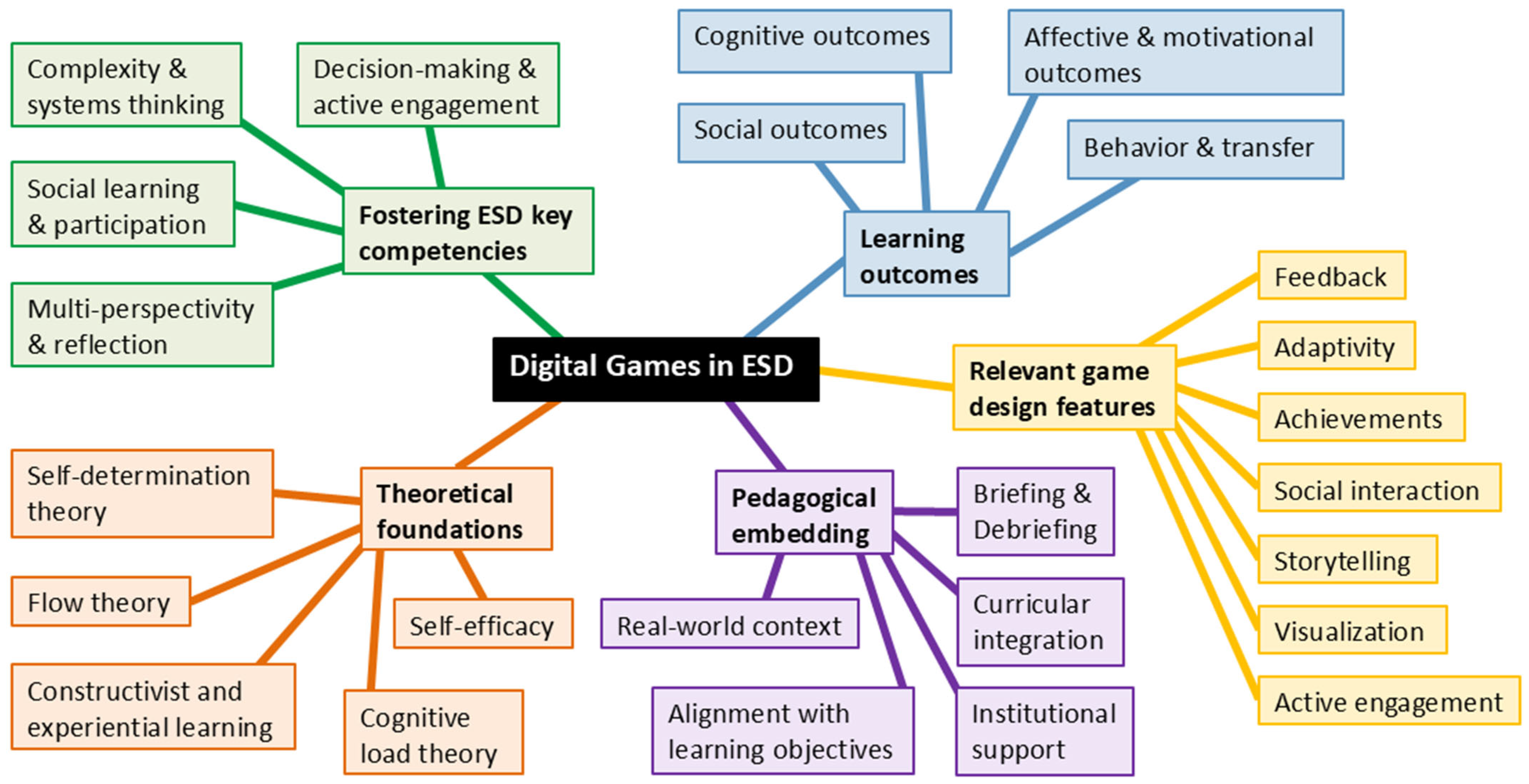
The effectiveness of digital games in education can be explained through a range of theoretical frameworks drawn from psychology, education, and human–computer interaction (Figure 1, orange). A key contribution of the study by Krath et al. [51] is the identification of 118 different theoretical foundations used in research on gamification, serious games, and game-based learning, highlighting the diversity and fragmentation of the field.
Among the most influential theories is the self-determination theory (SDT), which emphasizes the importance of satisfying the basic psychological needs for autonomy, competence, and relatedness in fostering intrinsic motivation [52,53]. Digital games can support these needs through elements such as meaningful choices (autonomy), feedback and progression (competence), and social interaction (relatedness). Closely related is the flow theory, which describes a state of deep engagement and immersion that occurs when challenges are well matched to a learner’s skills [54,55]. Digital games are particularly well suited to creating such conditions through adaptive difficulty and continuous feedback.
From a learning perspective, constructivist and experiential learning theories provide a strong foundation for understanding game-based learning. These theories emphasize that knowledge is actively constructed through experience, interaction, and reflection [22,51,56]. Digital games support these processes by enabling learners to experiment, make decisions, and observe consequences within simulated environments. In addition, situated learning theory highlights the importance of authentic contexts, suggesting that learning is most effective when it is embedded in realistic and meaningful situations [57,58]. This is particularly relevant for sustainability education, where real-world complexity and context are essential. Other relevant frameworks include social cognitive theory, which emphasizes learning through observation and social interaction and highlights self-efficacy—learners’ beliefs in their ability to successfully perform tasks—as a key determinant of motivation and learning outcomes [59,60]. This is especially relevant in contexts such as sustainability education, where translating knowledge into action depends strongly on perceived agency. Finally, cognitive load theory addresses the limits of human information processing and underscores the importance of well-structured learning environments [61].
Taken together, these theories explain why digital games can be effective learning environments since they can combine cognitive, motivational, and social mechanisms in integrated ways.

2.4. Digital Games and Sustainability Learning

The theoretical foundations outlined above are particularly relevant for ESD, as they align closely with the demands of sustainability learning. ESD focuses on developing competencies such as systems thinking, anticipatory thinking, collaboration, and responsible action, all of which require engagement with complex, dynamic, and uncertain situations.
Digital games are well suited to support these processes. Simulation-based environments can represent complex systems with feedback loops and time delays, enabling learners to explore cause–effect relationships and better understand systemic dynamics. By placing learners in decision-making roles and allowing them to experience the consequences of their actions, games make abstract sustainability challenges more tangible and support deeper understanding. In addition, the experiential and interactive nature of digital games can foster reflective and potentially transformative learning processes, encouraging learners to question assumptions and develop new perspectives on sustainability issues. However, these potentials are not automatically realized. The effectiveness of digital games depends on how theoretical principles are translated into concrete design features and pedagogical practices.
In summary, while the theoretical foundations of digital games in education are diverse, they converge on core principles: the integration of motivation, cognition, and social interaction within interactive, experiential environments. These characteristics closely align with the goals of ESD.

3. Methodology: Narrative Synthesis of 40 Studies

3.1. Review Approach

This article adopts a narrative literature review approach to synthesize current research on the role of digital games in Education for Sustainable Development (ESD). Narrative reviews aim to integrate findings from diverse strands of research, identify conceptual relationships, and develop a coherent understanding of a research field. In contrast to systematic reviews or meta-analyses, which follow highly standardized protocols and focus primarily on quantitative aggregation, narrative reviews allow for a broader and more interpretative synthesis of heterogeneous evidence, including empirical studies, theoretical contributions, and design-oriented research.
Given the interdisciplinary nature of research on digital games in ESD—spanning educational sciences, environmental education, human–computer interaction, learning psychology, and multiple perspectives of sustainability—this approach is particularly suitable. The reviewed literature includes a wide range of study types, contexts, and outcome measures, making a purely quantitative synthesis inappropriate. Instead, this review aims to provide an integrative perspective that connects empirical evidence with theoretical frameworks and design considerations.

3.2. Literature Search Strategy

The literature search aimed to identify peer-reviewed publications addressing digital games in educational contexts relevant to sustainability, environmental education, and complex systems learning. Relevant studies were identified through searches in major academic databases, including Web of Science, Scopus, ScienceDirect, and Google Scholar. The search strategy followed a structured and transparent narrative synthesis approach rather than a fully systematic PRISMA-based review. This approach was considered particularly suitable given the interdisciplinary and methodologically heterogeneous nature of research on digital games in ESD. Instead of statistically aggregating effect sizes, the review aimed to identify recurring patterns, explanatory mechanisms, contextual differences, and pedagogical implications across studies.
Search queries combined keywords related to digital games and learning (e.g., “serious games”, “game-based learning”, “gamification”, “digital educational games”, “simulation games”) with terms related to sustainability and education (e.g., “sustainability education”, “environmental education”, “education for sustainable development”, “ESD”). Additional related terms, such as “sustainability games” and “environmental simulation games”, were used to broaden the search. Search strings were iteratively adapted to the specific syntax and requirements of the respective databases. The search process was conducted between 15 February and 15 March 2026. Example Boolean search strings included:
-
(“serious games” OR “game-based learning” OR “gamification” OR “digital educational games”) AND (“education for sustainable development” OR “sustainability education” OR “environmental education” OR “ESD”);
-
(“serious games” OR “simulations” OR “simulation games”) AND (“sustainability” OR “climate change” OR “socio-ecological systems”) AND (“education” OR “learning” OR “pedagogy”);
-
(“game-based learning” OR “gamification”) AND (“sustainability” OR “environmental”) AND (“motivation” OR “systems thinking” OR “behavior” OR “engagement”).
To complement the database search, the reference lists of relevant review articles and key empirical studies were examined (snowball sampling), enabling the identification of additional relevant publications. The search focused primarily on literature published between 2015 and 2026, reflecting the period in which research on digital game-based learning and sustainability education has expanded significantly.

3.3. Selection of Studies and Corpus Composition

The selection of studies followed a structured two-stage screening process. First, titles and abstracts were screened to identify publications addressing digital games in educational contexts. In a second step, full texts were examined to assess their relevance for the objectives of this review.
Studies were included if they met the following criteria: (1) publication in peer-reviewed journals, (2) written in English, (3) focus on digital games, game-based learning, or gamification in educational contexts, (4) examination of learning outcomes, motivational processes, design features, or implementation aspects, and (5) relevance to sustainability-related learning or transferable insights for ESD. Studies were further evaluated based on methodological rigor, relevance to ESD, and clarity of reported outcomes to ensure consistency in selection. Studies focusing exclusively on entertainment games without educational relevance or on non-digital games were excluded. The management and screening of the literature were conducted using the software Zotero (version 9.0.3) and Rayyan (web-based version, February 2026).
Following this process, a corpus of 40 studies was identified as particularly relevant for the synthesis (Table 1). The final dataset includes empirical studies, systematic reviews, meta-analyses, and conceptual contributions, providing a comprehensive overview of the current research landscape.
To structure the analysis, the selected studies were grouped into two complementary clusters. (1) ESD core studies (25 studies): These studies explicitly address sustainability, environmental education, or ESD contexts, including domains such as climate change, energy systems, resource management, sustainability transitions, and environmental policy. (2) Game-based learning (GBL) and gamification studies (15 studies): These studies focus on general mechanisms of digital game-based learning, including motivational processes, learning outcomes, and design features, which provide transferable insights for ESD contexts.
This clustering enables a combined perspective that integrates ESD-specific applications with broader theoretical and empirical insights from game-based learning research.

3.4. Analytical Framework and Synthesis Procedure

The analysis followed a qualitative thematic synthesis approach, in which key information from the selected studies was extracted and organized into a structured literature matrix. The extracted variables included publication year, study type (empirical, review, meta-analysis, conceptual), educational domain, type of digital game (e.g., serious game, simulation game, gamified environment), and key findings.
To guide the synthesis, the analysis focused on three central dimensions. (1) Learning outcomes: cognitive, motivational/affective, social, and behavioral effects of digital games. (2) Game design features and mechanisms: feedback systems, narrative elements, decision-making structures, social interaction, and adaptive design. (3) Implementation and pedagogical embedding: instructional integration, facilitation, reflection processes, and real-world transfer.
Through iterative comparison and synthesis across studies, recurring themes, converging evidence, and critical divergences were identified. Particular attention was paid to contextual differences and to conditions under which digital games appeared more or less effective, including aspects such as pedagogical embedding, feedback structures, adaptivity, and social interaction. The main thematic areas addressed by the 40 corpus studies are summarized and illustrated in Figure 1, considering the relevance of digital games in ESD (software used: Microsoft PowerPoint, version 2604). The synthesis followed a conceptual and argument-driven logic, moving from general findings on digital games (Section 1.2) to theoretical foundations (Section 2.3), ESD-specific contributions and learning outcomes (Section 4), design mechanisms (Section 5), and implementation conditions (Section 6), followed by limitations (Section 7) and design implications (Section 8.3). The focus of this review is therefore not on statistical aggregation, but on developing a coherent narrative that explains how and under which conditions digital games can support ESD-related learning processes.

3.5. Transparency and Limitations of the Review

Several limitations of this review should be acknowledged. Firstly, although multiple databases were searched, relevant publications outside indexed journals or in languages other than English may not have been included. Secondly, the interdisciplinary nature of the field results in heterogeneous methodologies and outcome measures, which limits direct comparability and quantitative analysis across studies. Thus, Table 2 uses frequency categories rather than exact numbers. Thirdly, the narrative review approach involves interpretative synthesis, which may introduce subjectivity in the selection and interpretation of findings. However, transparency in the selection criteria, clustering logic, and analytical framework was maintained to enhance traceability and reproducibility. Finally, relatively few studies explicitly focus on ESD, requiring the inclusion of insights from related fields such as environmental education and STEM learning. While this broadens the perspective, it also introduces challenges in aligning findings across contexts.
Despite these limitations, the chosen approach allows for a comprehensive and integrative synthesis of current research, highlighting both the potential and the limitations of digital games in ESD and providing a foundation for future research and practice.

4. Contributions and Learning Outcomes of Digital Games in ESD

Digital games are supposed to address specific competencies of sustainability learning by enabling learners to engage with complex systems, experiential decision-making, social interaction, and reflective processes (Figure 1, green). The reviewed studies on digital games in ESD reveal a heterogeneous but differentiated pattern of corresponding learning outcomes (Figure 1, blue). While the evidence is generally strongest for cognitive and motivational effects, social learning outcomes are increasingly recognized, and behavioral outcomes remain comparatively limited and less consistently documented (Table 2). This section synthesizes these outcome dimensions and accordingly addresses the first research question: What key competencies and cognitive, motivational, social, and behavioral outcomes do digital games support in ESD-related learning contexts?

4.1. Cognitive Outcomes

Sustainability challenges are complex, interdependent, and dynamic, which makes them difficult to convey through traditional linear teaching approaches. Digital games—particularly simulations—are consistently identified as effective tools for making such complexity accessible. Accordingly, cognitive outcomes represent the most thoroughly documented effects of digital games in ESD (Table 2). Most empirical studies and reviews report positive effects on knowledge acquisition, conceptual understanding, problem-solving, system-thinking, and critical reflection [32,41,62,68,76,79,82,83,85]. These outcomes are particularly relevant for ESD because sustainability challenges require learners to understand complexity, underlying interdependencies, delayed results, and conflicting priorities of ecological, social, and economic dimensions.
Across the corpus (Table 1), simulation-based and systems-oriented games are repeatedly described as environments that allow learners to explore dynamic sustainability systems through active experimentation and decision-making by interacting with feedback loops, trade-offs, and long-term consequences [66,75,79,85]. Sector-specific studies confirm this pattern. Circular economy games can support holistic thinking about resource cycles [85], and games in the built environment, agriculture, and environmental management help learners to explore interactions between ecological, social, economic, and policy-related factors through system-based scenarios [44,45,76,79]. Thus, digital games appear particularly effective because they provide opportunities to explore systems rather than merely transmitting factual information [62,66,75]. Such exploration is further strengthened when simulations are combined with visualization, scaffolding, and reflection [70,79,81]. This aligns with constructivist and experiential learning theories (Section 2.3), as learners actively build understanding through decision-making and consequence-based interaction. However, poorly aligned instruction or excessive cognitive load can reduce learning effects [69], while well-designed game structures and adaptive feedback can strengthen conceptual understanding [70].
These cognitive outcomes are closely linked to key ESD competencies such as systems thinking, anticipatory competence, critical thinking, and problem-solving competence [9,10]. The promotion of these competencies appears contingent on game complexity and scaffolding, suggesting that design structure, rather than gameplay alone, drives these effects. By enabling learners to explore alternative pathways, consequences, and interdependencies, digital games can support forms of understanding that are difficult to achieve through linear and static instructional approaches alone. While multiple studies confirm the role of digital games in fostering systems thinking and other cognitive outcomes (Table 1), variations in design, pedagogical support, and implementation suggest that these effects are context-dependent and cannot be generalized uniformly across all forms of digital games [32,41,83].

4.2. Affective and Motivational Outcomes

Affective and motivational effects constitute another major strength of digital games in ESD (Table 2). The majority of studies report increased engagement, enjoyment, immersion, emotional involvement, empathy, intrinsic motivation, or positive changes in attitudes towards learning [24,37,38,42,68,70,72,74,80,87,88]. These outcomes are particularly important because sustainability issues are often perceived as abstract, distant, or overwhelming, which may reduce learners’ willingness to engage with them over longer periods [71,86]. Instead, digital games can strengthen learners’ emotional connection to sustainability challenges by making consequences and decision-making processes more tangible and experienceable [68,71,79,86]. Sustainability-related simulations are often described as tools that foster curiosity and continuing attention by allowing learners to directly experience interactive tasks and scenarios [72,79,86].
Nevertheless, motivational effects do not occur automatically. Gamification can produce positive, negligible, or even negative effects depending on design quality, learner characteristics, and context [37,38,40]. In particular, superficial reward systems appear less robust than meaningful game designs that connect challenge, feedback, narrative, and relevance [39,51]. Competition or point-based systems may only support short-term engagement but do not necessarily foster deeper or sustained forms of learning [63,73,74]. Thus, motivational outcomes should be understood as design-dependent rather than inherent properties of digital games. These affective and motivational effects can be interpreted through self-determination theory and flow theory (Section 2.3). Digital games may support autonomy through meaningful choices, competence through adequate feedback and progression, and relatedness through social interaction.
Overall, the reviewed studies suggest that affective and motivational outcomes are strongly connected to key ESD competencies such as self-competence [9,10]. By fostering emotional engagement and personal involvement, digital games may encourage learners to relate sustainability challenges more directly to their own values, decisions, and future actions [68,71,79,86]. Such processes are especially relevant because sustainability transformations require not only cognitive understanding but also sustained engagement under conditions of complexity and uncertainty.

4.3. Social Outcomes

Social learning outcomes are increasingly recognized as an important dimension of digital games in ESD, but are less consistently assessed than cognitive and motivational outcomes (Table 2). Digital games can foster collaborative teamwork, communication, participation, co-learning, joint decision-making, stakeholder interaction, and perspective-taking [64,65,71,72,78,80,84]. These outcomes are highly relevant because sustainability challenges typically require collective problem-solving, negotiation between conflicting interests, and engagement with multiple perspectives and value systems, for instance, by using ecological, social, or economic lenses to structure and interlink the 17 SDGs (wedding cake model [89]).
Many ESD games are explicitly designed around collaborative or role-based interaction. Studies on environmental management, sustainability transitions, agriculture, and climate education describe how learners engage with different stakeholder positions, negotiate trade-offs, decide in dilemma situations, and jointly develop possible courses of action [44,65,72,76,78]. Collaborative gameplay can foster discussion, mutual reflection, and perspective-taking by confronting learners with alternative viewpoints and shared decision-making processes [64,78,84,90]. Such interactions can support competencies related to collaboration, participation, empathy, and normative reflection [9,10]. This also encourages learners to critically examine their assumptions and consider the broader implications of their actions. Accordingly, games appear capable of making socio-political complexity and conflicting priorities more visible and discussable within educational contexts [65,66,78]. Thereby, games can support different teaching traditions, including factual, normative, and pluralistic approaches, depending on how they are designed and facilitated [84].
At the same time, the reviewed studies indicate considerable variation regarding the depth and durability of such social learning effects. While many studies document increased interaction and participation during gameplay, fewer provide strong evidence regarding longer-term social learning processes or broader participatory engagement beyond the learning environment [65,71,78].

4.4. Behavioral Outcomes and Transfer

In contrast to cognitive and motivational outcomes, behavioral outcomes represent the most challenging and least consistently demonstrated effects of digital games in ESD (Table 2). Some studies report positive effects on behavioral intentions, self-efficacy, environmental attitudes, and awareness as behavioral prerequisites, or short-term sustainable actions [43,71,73,79]. In this sense, digital games may contribute to ESD competencies such as responsibility, agency, strategic and action competence [9,10]. However, strong evidence for durable behavioral change does not exist (Table 1). Several studies explicitly identify the persistence of the knowledge–action gap as a central challenge in sustainability education [15,20,71,79]. While learners often report an increased willingness to adopt sustainable behaviors or may develop increased awareness, stronger intentions, or a better understanding of sustainability implications, these changes do not necessarily translate into long-term real-world behavior, let alone measurable actions [71].
Methodologically, behavioral outcomes are assessed through highly heterogeneous approaches. Most studies that address behavior rely on self-report questionnaires, attitude scales, reflection tasks, interviews, or perception-based survey instruments [43,71,73,79]. Some studies additionally employ mixed-methods approaches combining qualitative and quantitative data, including longitudinal follow-up measures and observation-based analyses [71,78]. Only very few studies include direct observation of real-world behavior or longer-term follow-up designs beyond the immediate learning context [62,73]. Consequently, the literature primarily documents short-term changes in attitudes, intentions, awareness, or self-reported action readiness rather than stable long-term behavioral transformation. One important limiting factor therefore is the remaining lack of longitudinal studies. Instead, studies focus on short-term interventions and self-reports and do not assess whether behavioral changes persist over time.
Overall, the reviewed literature suggests that digital games contribute more consistently to behavioral precursors than to demonstrable long-term behavioral change. Increased awareness, self-efficacy, systems understanding, and reflection on consequences appear more strongly supported than direct evidence for sustained transformation.

5. Mechanisms and Game Design Features

The effectiveness of digital games in ESD cannot be explained by the medium itself, but rather by the underlying learning mechanisms and specific design features that structure the learning experience. Across the reviewed studies, a consistent set of mechanisms emerges that explain how and why digital games can support ESD-related learning processes (Figure 1, yellow). Rather than producing learning effects automatically, digital games appear most effective when they combine specific mechanisms within coherent pedagogical environments. Hence, this chapter addresses the second research question: What game elements and design features maximize the potential of digital games for learning in ESD?
(1)
Feedback: A central mechanism identified across many studies is the role of feedback, particularly immediate and dynamic feedback. Digital games allow learners to observe the consequences of their actions in real time, which is especially important in sustainability contexts where cause–effect relationships are often indirect or delayed [79]. Such feedback mechanisms can make otherwise invisible sustainability dynamics more tangible and experienceable, thereby supporting systems thinking and self-efficacy [66,79,86]. Experimental research further shows that providing structured learning instructions and explanatory feedback can significantly influence learning outcomes, although excessive guidance may increase cognitive load and reduce transfer performance [69]. These findings correspond with self-determination theory and cognitive load theory (Section 2.3), suggesting that effective feedback must be carefully balanced and should provide competence and orientation without overwhelming learners.
(2)
Adaptivity: Closely related to feedback is the importance of adaptivity and personalization. Adaptive digital games can tailor content, pacing, and difficulty to learners’ individual needs, thereby enhancing both knowledge acquisition and engagement. Empirical evidence shows that adaptive game elements can improve conceptual understanding, learning attitudes, and participation, particularly for learners with lower prior knowledge [70,81]. However, some studies report no significant benefits of adaptive elements compared to non-adaptive designs, depending on the quality of the adaptive mechanisms [83]. The findings therefore indicate that adequate personalization can be a powerful tool for addressing the diverse needs of learners in ESD. This aligns closely with flow theory, according to which learning environments are most effective when challenges correspond to learners’ competencies and progression levels (Section 2.3). Adaptive gamification is also a growing field of research in other areas, improving upon traditional “one-size-fits-all” solutions or unfocused gamification approaches by incorporating and adapting game elements based on user characteristics and the thematic context [91,92].
(3)
Achievements: Another key mechanism is the use of goals, challenges, and progression structures, which are central to maintaining engagement and orientation during gameplay. Gamification research highlights that elements such as points, badges, trophies, levels, and leaderboards can provide clear goals and reinforce progress, thereby increasing motivation and participation [37]. Moreover, reward-based game mechanics can significantly increase sustainability knowledge and learner persistence [40,93]. However, their effectiveness depends on how they are integrated into the learning process. Reviews emphasize that superficial use of such elements that rely primarily on external rewards may fail to produce meaningful learning outcomes, whereas well-designed goal structures can enhance both motivation and performance [37,39,74]. Thus, progression systems appear most beneficial when they are connected to meaningful challenges, problem-solving processes, and authentic sustainability-related tasks rather than functioning as isolated motivational devices.
(4)
Social interaction: The role of competition and cooperation has also been examined in detail. Meta-analytic evidence shows that competition in digital game-based learning can enhance motivation and engagement, but its effects on learning outcomes are mixed and context-dependent [63]. For instance, not all learners appreciate competition with classmates [94]. In contrast, cooperative and collaborative elements are often more closely aligned with ESD goals, as they support social learning and collective problem-solving. Peer interaction and joint decision-making therefore seem especially valuable when games address controversial or multi-perspective sustainability issues [64,84]. Studies comparing different approaches indicate that combining game-based learning with social interaction can lead to improved outcomes compared to purely individual learning [64]. These findings are consistent with social constructivist perspectives and with ESD competencies related to collaboration, participation, and pluralistic thinking [9,10,51].
(5)
Storytelling and contextualization: A further important design feature is the use of meaningful narratives and authentic contexts. Digital games often embed learning content within story-driven scenarios or simulated decision-making environments, thereby making abstract sustainability issues more tangible and relatable [41,86]. Narrative structures can increase emotional involvement and support immersion by situating learners within realistic socio-ecological dilemmas, trade-offs, and concrete scenarios [71,86]. In sustainability education, narratives are particularly relevant because they can connect cognitive understanding with emotional and ethical reflection. Storytelling and contextualized scenarios further support transfer by linking gameplay experiences to real-world sustainability challenges and decision-making situations [72,79,85].
(6)
Visualization and simulation: In addition, digital games are particularly effective in providing visualizations of complex processes and dynamic systems. Sustainability issues often involve indirect consequences and invisible or long-term processes, such as climate change or resource depletion. By visualizing these processes, games enable learners to understand relationships that are otherwise difficult to grasp [79]. Across the corpus, visualization repeatedly emerges as one of the most important mechanisms for fostering systems thinking and conceptual understanding [43,62,66,79,82]. By linking actions to visible consequences, games can support learners in recognizing interdependencies between ecological, social, and economic dimensions and in understanding delayed or unintended effects of decisions.
(7)
Active engagement and experiential learning: Another recurring mechanism is the emphasis on active learning and interaction. Digital games require learners to engage actively with content, make decisions, solve problems, and explore different strategies rather than passively receiving information. Especially in games that rely on simulations and modelling, learners explore sustainability systems through experimentation and iterative decision-making [72,76,95,96,97,98,99]. Such forms of experiential, inquiry-based, and problem-based learning are repeatedly identified as key mechanisms explaining why digital games can enhance both understanding and retention and thus support deeper sustainability learning [42,87,88]. These findings strongly align with constructivist and experiential learning theories (Section 2.3), according to which understanding develops through active exploration, reflection, and interaction with authentic problems.
Overall, the literature highlights that many game-based interventions still suffer from design limitations, including weak theoretical grounding, fragmented implementation, and insufficient alignment with learning objectives [24,51,77]. Consequently, the effectiveness of digital games in ESD appears to depend less on isolated game elements but is determined by a combination of feedback mechanisms, adaptive design, goal structures, social interaction, narrative elements, visualization of complex systems, and the possibility for active engagement. However, their impact also depends on how they are integrated into pedagogically meaningful and coherent designs, highlighting the importance of theory-informed and context-sensitive game development.

6. Pedagogical Embedding and Implementation

The effectiveness of digital games in ESD depends fundamentally on their pedagogical embedding (Figure 1, purple). Across the literature, a clear consensus emerges: digital games do not produce meaningful learning outcomes in isolation but require integration into structured instructional contexts that connect gameplay with reflection, real-world relevance, and broader learning processes. Accordingly, digital games should be understood less as self-sufficient teaching tools than as components of broader experiential and reflective learning environments [77,84,88].
A central requirement is the connection between in-game experiences and real-world contexts [100]. This process is often described as reality transfer and involves linking simulated experiences to learners’ everyday lives and decision-making contexts. Without such connections, learning risks remaining abstract and detached from actual sustainability practices. These links can be implemented through appropriate instructional sequencing. Digital games are most effective when embedded in broader learning designs that include preparation, theoretical input, and follow-up activities [72,80]. Structured briefing and debriefing phases are essential to support reflection and transfer [67], consistent with findings that embedding gameplay in reflective learning cycles enhances outcomes [65,76]. Facilitation and guided reflection further enhance learning by helping learners critically evaluate trade-offs, consequences, and multiple perspectives, interpret complex situations, and connect gameplay to broader contexts [77,84,85]. While guidance improves outcomes, excessive support may reduce autonomy and engagement [69]. This highlights the need for a careful balance between guidance and exploratory learning, which is particularly relevant in ESD contexts where learners must navigate ambiguity and complexity.
Another key condition is the alignment of game design with learning objectives and target groups. Educational effectiveness depends on how well game mechanics, narratives, and tasks correspond to intended outcomes and learner characteristics [77]. In ESD, this is particularly important given the diversity of learners in terms of prior knowledge, values, and socio-cultural backgrounds. Thereby, digital games can support multiple learning functions, including informing, motivating, and enabling learners. For instance, they can increase awareness and influence attitudes, or they can enhance engagement and interest [43,71]. Recent studies additionally emphasize that meaningful sustainability learning requires emotionally engaging and context-sensitive scenarios that allow learners to experience sustainability challenges as relevant to their own lives and decisions [71,86,89]. In particular, social and cooperative learning activities must be tailored to the target groups. Digital games can facilitate interaction, negotiation, and shared problem-solving, thereby enhancing learning outcomes and supporting collective understanding [64,78].
At the institutional level, the literature points to challenges related to the integration of digital games into formal education systems. Many game-based interventions are implemented as isolated activities, which limits their long-term impact, while stronger curricular integration supports more sustainable learning processes [24]. Considering accessibility and dissemination, game-based approaches must reach diverse audiences and be accessible across different contexts. Research highlights the importance of aligning implementation strategies with the communication practices and technological access of target groups [74]. This includes considering not only technological infrastructure but also cultural relevance, user experience, and opportunities for participation and co-learning.
Moreover, the implementation of digital games in ESD requires interdisciplinary collaboration as well as long-term planning. The development of effective game-based learning environments involves expertise from education, game design, and sustainability science, with collaborative and iterative design processes shown to enhance both educational effectiveness and user engagement [77,78,89]. At the same time, digital games require continuous maintenance, updates, and adaptation to remain relevant, which distinguishes them from traditional educational materials and has implications for resource allocation and institutional support. Accordingly, sustainable implementation depends on long-term planning, scalability considerations, and ongoing evaluation [42].
Overall, digital games can contribute to ESD only when embedded in comprehensive, context-sensitive, and pedagogically grounded learning environments. Key conditions include reality transfer, structured sequencing, guided reflection, alignment with learning objectives, integration of social learning, and institutional support.

7. Challenges, Limitations, and Research Gaps

Despite the considerable potential of digital games in ESD, the reviewed literature reveals several persistent challenges and limitations that constrain their effectiveness and broader applicability. These limitations do not appear as isolated weaknesses of individual studies but as recurring structural issues in both research and practice of game-based sustainability education.
A major challenge concerns the methodological heterogeneity of existing studies. Research varies widely in terms of design, sample size, duration, and measurement approaches, making it difficult to compare findings and draw generalizable conclusions [24,39]. Many studies rely on short-term interventions and small samples, with varying degrees of controlled conditions, while longitudinal studies that provide evidence for long-term effects remain scarce [37,40,80]. In addition, the frequent use of self-reported measures for motivation, engagement, or behavioral intentions raises concerns about the validity of findings, particularly when assessing deeper learning or real-world impact [37,40]. From a methodological perspective, the numerous positive findings should be interpreted with caution, as the reported results appear to depend heavily on contextual, pedagogical, and methodological factors rather than solely on game-based learning [39,74,77].
Another challenge concerns the diversity and comparability of different types of game-based approaches. While serious games, game-based learning, and gamification share certain characteristics, they differ in their underlying design principles and intended outcomes (Section 2.1). These conceptual overlaps complicate comparisons across studies and contribute to inconsistent findings and the observed variability in effectiveness. At the same time, many interventions remain insufficiently grounded in theory or pedagogy and instead rely on ad hoc combinations of game elements that are not systematically aligned with learning objectives [24,51]. Several studies further note that sustainability-related games often simplify complex socio-ecological problems and only partially represent social, economic, and cultural dimensions of sustainability [45,62]. Although digital games can represent dynamic systems, they inevitably reduce complexity, such as primarily focusing on ecological aspects.
The literature also reveals important practical, ethical, and contextual limitations. Many interventions remain isolated activities rather than being embedded in curricula or long-term programs [80]. Institutional constraints, such as limited resources and insufficient teacher training, further hinder implementation. Furthermore, issues of accessibility and equity remain critical. Variations in technological infrastructure, digital literacy, and access to devices affect participation in game-based learning [74]. Most reviewed studies originate from Western or technologically advanced educational contexts, while perspectives from developing regions and Global South contexts remain comparatively underrepresented. In global ESD contexts, such disparities risk reinforcing existing inequalities. Moreover, issues related to privacy, data protection, potentially manipulative gamification strategies, and the risk of excessive engagement or problematic game use remain insufficiently addressed within the current literature.
In summary, while digital games offer significant potential for ESD, their effectiveness is constrained by methodological limitations, insufficient evidence for long-term impact, design challenges, and structural barriers to implementation. Addressing these issues requires more rigorous and longitudinal research, cross-cultural perspectives, ethical implications, theory-informed design approaches, and stronger integration into educational systems.

8. Discussion

This review aimed to synthesize the potential and the underlying design of digital games in ESD based on 40 studies. The findings reveal a consistent but nuanced pattern: digital games are highly effective in supporting cognitive, motivational, and social learning processes relevant to ESD, yet their contribution to behavioral change and systemic transformation remains limited. However, their contribution depends strongly on design quality, pedagogical embedding, and contextual implementation rather than on gameplay alone.

8.1. Digital Games as Enablers of ESD Competencies

The findings of this review suggest that the primary educational value of digital games in ESD lies less in specific isolated learning outcomes than in their capacity to support the development of key sustainability competencies (Section 1.1; Figure 1, green). Across the reviewed studies, a remarkably consistent pattern emerges: digital games appear particularly effective in fostering competencies associated with exploration, systems understanding, reflection, and collaboration, whereas evidence for direct behavioral change is comparatively limited [62,66,71,75,79,80].
This pattern can be interpreted through the theoretical foundations of game-based learning and gamification. Reviews of the broader gamification literature indicate that successful game-based environments typically combine autonomy, feedback, competence development, social interaction, and experiential learning [51]. Rather than functioning primarily as tools for information delivery, digital games create interactive learning environments in which learners actively explore systems, test decisions, observe consequences, and negotiate alternative perspectives. Such processes correspond closely to key ESD competencies, particularly systems thinking, critical thinking, strategic competence, collaboration, and self-awareness [5,9,10].
The prominence of systems thinking across the reviewed studies is especially noteworthy [62,66,75,81,85]. Sustainability challenges are characterized by complexity, uncertainty, and interconnected ecological, social, and economic dimensions. Digital games appear particularly well suited to addressing these characteristics because they allow learners to interact with dynamic systems that would otherwise remain abstract or difficult to experience directly [75,79,86]. From this perspective, the educational value of digital games lies less in increasing knowledge acquisition alone and more in making systemic relationships visible and actionable.
A similar argument applies to affective and social competencies. The recurring findings regarding engagement, empathy, perspective-taking in role-plays, and collaboration [64,71,78,80,84,86,90,101] suggest that digital games may create conditions under which learners become emotionally and socially involved in sustainability issues. Consistent with self-determination theory [52,53], social learning theory [60], and experiential learning theory [51], such involvement appears to arise when learners experience meaningful agency, social interaction, and authentic decision-making situations rather than when they merely receive information.
In summary, the reviewed evidence suggests that digital games are most appropriately understood as competency-oriented learning environments. Their primary contribution to ESD does not lie in transmitting sustainability knowledge per se, but in supporting the cognitive, motivational, and social processes through which learners engage with the complex challenges of sustainability.

8.2. The Knowledge–Action Gap: A Structural Limitation

The limited behavioral impact of digital games reflects a broader structural challenge in sustainability education. Behavioral change depends not only on knowledge and motivation but also on social, contextual, and psychological factors [15,16,17,102,103]. Accordingly, digital games primarily support individual learning processes and should be understood as preparatory tools to contribute to conditions that support sustainable action rather than direct drivers of behavioral change.
A key explanation for the knowledge–action gap lies in the limited explanatory power of knowledge itself. Research shows that environmental knowledge is necessary but insufficient to induce pro-environmental behavior [104,105]. In many cases, knowledge remains abstract and not action-oriented, and individuals often misjudge the impact of specific behaviors [106,107]. This discrepancy limits the translation of knowledge into effective action [108]. Moreover, knowledge is shaped by cognitive, affective, and cultural biases rather than being processed objectively. For instance, individuals interpret climate information through pre-existing beliefs, values, and worldviews, which influence both risk perception and behavioral responses [109,110]. Emotional responses further complicate this relationship: while concern can motivate action, it may also trigger defensive reactions such as denial or avoidance when perceived self-efficacy is low [111,112].
A second limitation concerns the intention–behavior gap. Rational and normative models, such as the Theory of Planned Behavior [15,16] or the Value-Belief-Norm theory [103,113], assume that intentions are important predictors of behavior. However, empirical evidence shows that intentions account for only a limited share of actual behavior, typically around 30% [114,115]. Consequently, positive effects on awareness, attitudes, or behavioral intentions, which are frequently reported in studies on digital games [71,79,80], can of course not be interpreted as evidence of actual behavioral change. This also indicates that additional mechanisms are required to explain behavioral implementation. More recent models emphasize the role of automatic processes and situational constraints. The Comprehensive Action Determination Model highlights that behavior is shaped by the interaction of intentions, habits, and perceived behavioral control [116]. In particular, habitual routines can override deliberate decision-making, limiting behavioral change even when motivation is present [117,118]. These perspectives suggest that sustainable behavior depends on a complex interplay of individual, social, and contextual influences that extend far beyond educational interventions alone.
Finally, self-regulation and self-efficacy have emerged as critical factors in bridging the gap between knowledge and action. The ability to align intentions with behavior, to suppress automatic responses, and to anticipate long-term consequences is strongly associated with pro-environmental action [119]. Without such capacities, individuals may fail to act in accordance with their knowledge and values. The reviewed studies nevertheless indicate that digital games may positively influence some of these antecedents of behavior. By allowing learners to explore complex sustainability challenges, experiment with decisions, and experience the consequences of their actions in simulated environments, digital games can strengthen perceived self-efficacy, personal agency, and behavioral intentions [71,79].
Taken together, the knowledge–action gap is not simply a deficit of information, but a complex phenomenon shaped by cognitive biases, social and emotional responses, habitual behavior, and self-regulatory capacities. The limited evidence for behavioral change should therefore not be interpreted as a failure of digital games, but as a reflection of the broader challenges inherent in sustainability education. However, behavioral outcomes remain the most difficult and least consistently evidenced effects of digital games in ESD.

8.3. Design Principles for Digital Games in ESD

Building on the synthesis of empirical findings across the reviewed studies, four overarching design principles can be identified that characterize effective digital games in ESD (Table 3). These principles represent evidence-informed guidelines that reflect recurring patterns across successful implementations. Effective design requires systematic, theory-informed, and iterative development processes that align mechanics with learning goals and pedagogical embedding as well as include continuous evaluation [77]. Thereby, the methodology of “design-based research” is particularly well suited for the development, optimization, and integration of educationally effective digital games [120,121].
Firstly, digital games should support systems exploration rather than information transmission. Sustainability challenges are characterized by complexity, uncertainty, and long-term consequences. Effective games therefore enable learners to explore interdependencies, manipulate system variables, and observe emerging outcomes over time [66,85]. Simulation, interactive models, feedback loops, visualization, and authentic decision-making help learners understand the complex dynamics while avoiding overly simplified representations of sustainability problems [45,62]. This principle particularly addresses systems thinking as one of the ESD key competencies (Figure 1, green).
Secondly, experience should be combined with structured reflection. Games are most educationally meaningful when learners can connect in-game experiences with real-world contexts of sustainability challenges. Experiential engagement through realistic scenarios supports learning [22,68,72], but deeper understanding and transfer depend on opportunities for briefing, reflection, discussion, and debriefing [67,76,79]. Rather than treating gameplay as self-sufficient, effective ESD game design links action, reflection, and real-world application.
Thirdly, effective games balance between autonomy and guidance. Consistent with self-determination theory and flow theory (Section 2.3), learners benefit from meaningful choices, agency, active engagement, and progression of challenge, while still requiring appropriate support when dealing with complex situations [51,69,70,81]. Both excessive instruction and insufficient scaffolding may reduce learning effectiveness, suggesting that successful game design requires a careful balance between learner autonomy and pedagogical guidance. This principle also accounts for learner diversity through adaptivity and inclusive design.
Fourthly, digital games should be embedded within broader social and educational processes. Sustainability challenges require collaboration, participation, and the consideration of multiple perspectives. Accordingly, successful games facilitate communication, negotiation, and shared problem-solving [64,78]. Their effectiveness further depends on integration into wider learning environments that connect gameplay with curricular goals and institutional support [44,77,80]. Digital games should therefore be understood not as isolated learning tools but as components of larger pedagogical ecosystems.
Taken together, the effectiveness of digital games in ESD depends less on individual game mechanics than on how these mechanics contribute to the four overarching principles outlined above. This interpretation is consistent with recent calls for stronger theoretical integration in game-based learning research [51] and helps explain why similar game elements can produce different outcomes across educational contexts [24,39,40]. Future design efforts should therefore focus on how combinations of game elements support systems exploration, reflection, learner agency, and social learning in sustainability education.
In addition, future research should develop more comprehensive pedagogical and learning-theoretical frameworks that enable the systematic evaluation and comparison of digital games across different game types, learning environments, and sustainability outcomes, while also providing a stronger basis for understanding how digital game experiences may translate into sustained real-world behavioral change. The four design principles derived in this review may provide a useful starting point. Moreover, the evidence base should be expanded beyond predominantly Western contexts to include a broader range of cultural settings and developing educational systems. While some recent studies have begun to address this gap in Arab contexts [122,123], cross-cultural evidence remains limited. Such efforts are essential for developing globally relevant approaches to sustainability learning and transformation.

9. Conclusions

This review synthesized evidence from 40 studies to examine the role of digital games in Education for Sustainable Development (ESD) within the broader discourse on sustainability-oriented transformation. By integrating findings on learning outcomes, theoretical foundations, underlying mechanisms, and design principles, the review provides a comprehensive perspective on how and under which conditions digital games contribute to sustainability learning. The findings indicate that digital games offer substantial—yet clearly conditional—potential for sustainability learning. Their primary strength lies in enabling learners to engage with complex dynamic systems, uncertainty, and trade-offs through interactive and experiential environments, thereby fostering key ESD competencies such as systems thinking, decision-making, participation, and critical reflection. Strong and consistent evidence exists for cognitive and motivational outcomes, with growing support for social and collaborative learning processes.
At the same time, a central limitation persists: the gap between learning and action. While digital games effectively increase awareness, understanding, and engagement, their impact on long-term behavioral change remains limited. This not only reflects broader structural challenges of ESD (knowledge–action gap) but also the inherent difficulty of measuring behavior and behavioral change, which contributes to a lack of robust empirical evidence in this area. Consequently, behavioral outcomes are under-researched, methodologically challenging, and highly context-dependent.
Crucially, the effectiveness of digital games is not inherent to the medium itself. It depends on design quality, alignment with learning objectives, theoretical grounding, and pedagogical embedding. Across the reviewed studies, recurring mechanisms emerged as key factors explaining educational effectiveness: meaningful decision-making, adaptive feedback, social interaction, and structured reflection are essential to enable deeper learning and real-world transfer. Without such alignment, games risk remaining engaging but educationally superficial.
Overall, digital games should not be understood as standalone solutions, but as complementary components within broader educational strategies and transformative approaches. Their value lies in creating immersive learning environments that make sustainability challenges tangible and support understanding, reflection, and participation. Realizing this potential requires theory-informed design, integration into curricula, and long-term implementation strategies for transformative learning. Future research should place greater emphasis on longitudinal designs, behavioral outcomes beyond self-reports, contextual factors influencing effectiveness, and stronger integration of theory-driven and design-based research approaches.

Funding

This research received no external funding.

Institutional Review Board Statement

Not applicable.

Informed Consent Statement

Not applicable.

Data Availability Statement

No new data were created or analyzed in this study.

Conflicts of Interest

The author declares no conflicts of interest.

Abbreviations

The following abbreviations are used in this manuscript:
ESDEducation for Sustainable Development
GBLGame-based learning

References

  1. Intergovernmental Panel on Climate Change (IPCC). Climate Change 2023: Synthesis Report; IPCC: Geneva, Switzerland, 2023. [Google Scholar] [CrossRef]
  2. Richardson, K.; Steffen, W.; Lucht, W.; Bendtsen, J.; Cornell, S.E.; Donges, J.F.; Drüke, M.; Fetzer, I.; Bala, G.; von Bloh, W.; et al. Earth beyond six of nine planetary boundaries. Sci. Adv. 2023, 9, eadh2458. [Google Scholar] [CrossRef] [PubMed]
  3. Rockström, J.; Steffen, W.; Noone, K.; Persson, Å.; Chapin, F.S., III; Lambin, E.; Lenton, T.; Scheffer, M.; Folke, C.; Schellnhuber, H.; et al. A safe operating space for humanity. Nature 2009, 461, 472–475. [Google Scholar] [CrossRef]
  4. Steffen, W.; Richardson, K.; Rockström, J.; Cornell, S.; Fetzer, I.; Bennett, E.; Biggs, R.; Carpenter, S.; de Vries, W.; de Wit, C.; et al. Planetary boundaries: Guiding human development on a changing planet. Science 2015, 347, 1259855. [Google Scholar] [CrossRef]
  5. Meadows, D.H. Thinking in Systems: A Primer; Chelsea Green Publishing: Hartford, VT, USA, 2008; Available online: https://radicalteacher.com/uploads/MeadowsIntroOne.pdf (accessed on 25 February 2026).
  6. UNESCO. Education for Sustainable Development Goals: Learning Objectives; UNESCO: Paris, France, 2017; Available online: https://unesdoc.unesco.org/ark:/48223/pf0000247444 (accessed on 25 February 2026).
  7. Wals, A.E.J. Beyond Unreasonable Doubt: Education and Learning for Socio-Ecological Sustainability in the Anthropocene; Wageningen University: Wageningen, The Netherlands, 2015; Available online: https://www.semanticscholar.org/paper/Beyond-unreasonable-doubt.-Education-and-learning-Wals/976fa6796b3744a7046c34b82a9ba88182d7c472 (accessed on 25 February 2026).
  8. Rieckmann, M. Future-oriented higher education: Which key competencies should be fostered through university teaching and learning? Futures 2012, 44, 127–135. [Google Scholar] [CrossRef]
  9. Wiek, A.; Withycombe, L.; Redman, C.L. Key competencies in sustainability: A reference framework for academic program development. Sustain. Sci. 2011, 6, 203–218. [Google Scholar] [CrossRef]
  10. Bianchi, G.; Pisiotis, U.; Cabrera Giraldez, M. GreenComp: The European Sustainability Competence Framework; Publications Office of the European Union: Luxembourg, 2022; Volume 30955, pp. 1–40. [CrossRef]
  11. Brundiers, K.; Wiek, A.; Redman, C.L. Real-world learning opportunities in sustainability: From classroom into the real world. Int. J. Sustain. High. Educ. 2010, 11, 308–324. [Google Scholar] [CrossRef]
  12. Lozano, R.; Merrill, M.Y.; Sammalisto, K.; Ceulemans, K.; Lozano, F.J. Connecting competences and pedagogical approaches for sustainable development in higher education: A literature review and framework proposal. Sustainability 2017, 9, 1889. [Google Scholar] [CrossRef]
  13. Cebrián, G.; Junyent, M.; Mulà, I. Current practices and future pathways towards competencies in education for sustainable development. Sustainability 2021, 13, 8733. [Google Scholar] [CrossRef]
  14. Scharenberg, K.; Waltner, E.M.; Mischo, C.; Rieß, W. Development of students’ sustainability competencies: Do teachers make a difference? Sustainability 2021, 13, 12594. [Google Scholar] [CrossRef]
  15. Ajzen, I. Perceived behavioral control, self-efficacy, locus of control, and the theory of planned behavior. J. Appl. Soc. Psychol. 2002, 32, 665–683. [Google Scholar] [CrossRef]
  16. Ajzen, I. The theory of planned behavior. In Handbook of Theories of Social Psychology; Lange, P.A.M., Kruglanski, A.W., Higgins, E.T., Eds.; Sage Publications Ltd.: Thousand Oaks, CA, USA, 2012; Volume 1, pp. 438–459. Available online: https://psikologi.unmuha.ac.id/wp-content/uploads/2020/02/SAGE-Social-Psychology-Program-Paul-A.-M.-Van-Lange-Arie-W.-Kruglanski-E-Tory-Higgins-Handbook-of-Theories-of-Social-Psychology_-Volume-One-SAGE-Publications-Ltd-2011.pdf#page=22 (accessed on 25 February 2026).
  17. Collado, S.; Evans, G.W. Outcome expectancy: A key factor to understanding childhood exposure to nature and children’s pro-environmental behavior. J. Environ. Psychol. 2019, 61, 30–36. [Google Scholar] [CrossRef]
  18. Barth, M.; Fischer, D.; Michelsen, G.; Nemnich, C.; Rode, H. Tackling the knowledge-action gap in sustainable consumption: Insights from a participatory school programme. J. Educ. Sustain. Dev. 2012, 6, 301–312. [Google Scholar] [CrossRef]
  19. Otto, S.; Evans, G.W.; Moon, M.J.; Kaiser, F.G. The development of children’s environmental attitude and behavior. Glob. Environ. Change 2019, 58, 101947. [Google Scholar] [CrossRef]
  20. Portus, R.; Aarnio-Linnanvuori, E.; Dillon, B.; Fahy, F.; Gopinath, D.; Mansikka-Aho, A.; Williams, S.-J.; Reilly, K.; McEwen, L. Exploring the environmental value action gap in education research: A semi-systematic literature review. Environ. Educ. Res. 2024, 30, 833–863. [Google Scholar] [CrossRef]
  21. Caniglia, G.; Luederitz, C.; von Wirth, T.; Fazey, I.; Martín-López, B.; Hondrila, K.; König, A.; von Wehrden, H.; Schäpke, N.A.; Laubichler, M.D.; et al. A pluralistic and integrated approach to action-oriented knowledge for sustainability. Nat. Sustain. 2021, 4, 93–100. [Google Scholar] [CrossRef]
  22. Kolb, D.A. Experiential Learning: Experience as the Source of Learning and Development; Pearson Education: London, UK, 2014; Available online: https://carleton-wp-production.s3.amazonaws.com/uploads/sites/313/2022/12/Experiential_Learning_Experience_As_The_Source_Of_-1.pdf (accessed on 25 February 2026).
  23. Tejedor, G.; Segalàs, J.; Barrón, Á.; Fernández-Morilla, M.; Fuertes, M.T.; Ruiz-Morales, J.; Gutiérrez, I.; García-González, E.; Aramburuzabala, P.; Hernández, À. Didactic strategies to promote competencies in sustainability. Sustainability 2019, 11, 2086. [Google Scholar] [CrossRef]
  24. Cavus, N.; Ibrahim, I.; Okonkwo, M.O.; Ayansina, N.B.; Modupeola, T. The effects of gamification in education: A systematic literature review. Broad Res. Artif. Intell. Neurosci. 2023, 14, 211–241. [Google Scholar] [CrossRef]
  25. Connolly, T.M.; Boyle, E.A.; MacArthur, E.; Hainey, T.; Boyle, J.M. A systematic literature review of empirical evidence on computer games and serious games. Comput. Educ. 2012, 59, 661–686. [Google Scholar] [CrossRef]
  26. Ekin, C.C.; Polat, E.; Hopcan, S. Drawing the big picture of games in education: A topic modeling-based review of past 55 years. Comput. Educ. 2023, 194, 104700. [Google Scholar] [CrossRef]
  27. Gee, J.P. What Video Games Have to Teach us About Learning and Literacy; Palgrave Macmillan: London, UK, 2003. [Google Scholar] [CrossRef]
  28. Plass, J.L.; Homer, B.D.; Kinzer, C.K. Foundations of game-based learning. Educ. Psychol. 2015, 50, 258–283. [Google Scholar] [CrossRef]
  29. Boyle, E.A.; Hainey, T.; Connolly, T.M.; Gray, G.; Earp, J.; Ott, M.; Lim, T.; Ribeiro, C.; Pereira, J. An update to the systematic literature review of empirical evidence of the impacts and outcomes of computer games and serious games. Comput. Educ. 2016, 94, 178–192. [Google Scholar] [CrossRef]
  30. Qian, M.; Clark, K.R. Game-based learning and 21st century skills: A review of recent research. Comput. Hum. Behav. 2016, 63, 50–58. [Google Scholar] [CrossRef]
  31. Clark, D.B.; Tanner-Smith, E.E.; Killingsworth, S.S. Digital games, design, and learning: A systematic review and meta-analysis. Rev. Educ. Res. 2016, 86, 79–122. [Google Scholar] [CrossRef]
  32. Gui, Y.; Cai, Z.; Yang, Y.; Kong, L.; Fan, X.; Tai, R.H. Effectiveness of digital educational game and game design in STEM learning: A meta-analytic review. Int. J. STEM Educ. 2023, 10, 36. [Google Scholar] [CrossRef]
  33. Wang, L.-H.; Chen, B.; Hwang, G.-J.; Guan, J.-Q.; Wang, Y.-Q. Effects of digital game-based STEM education on students’ learning achievement: A meta-analysis. Int. J. STEM Educ. 2022, 9, 26. [Google Scholar] [CrossRef]
  34. Wouters, P.; van Nimwegen, C.; van Oostendorp, H.; van der Spek, E.D. A meta-analysis of the cognitive and motivational effects of serious games. J. Educ. Psychol. 2013, 105, 249–265. [Google Scholar] [CrossRef]
  35. Hamari, J.; Koivisto, J.; Sarsa, H. Does gamification work?—A literature review of empirical studies on gamification. In Proceedings of the 47th Hawaii International Conference on System Sciences, Waikoloa, HI, USA, 6–9 January 2014; pp. 3025–3034. [Google Scholar] [CrossRef]
  36. Koivisto, J.; Hamari, J. The rise of motivational information systems: A review of gamification research. Int. J. Inf. Manag. 2019, 45, 191–210. [Google Scholar] [CrossRef]
  37. Manzano-León, A.; Camacho-Lazarraga, P.; Guerrero, M.A.; Guerrero-Puerta, L.; Aguilar-Parra, J.M.; Trigueros, R.; Alias, A. Between level up and game over: A systematic literature review of gamification in education. Sustainability 2021, 13, 2247. [Google Scholar] [CrossRef]
  38. Sailer, M.; Homner, L. The gamification of learning: A meta-analysis. Educ. Psychol. Rev. 2020, 32, 77–112. [Google Scholar] [CrossRef]
  39. Luo, Z. Gamification for educational purposes: What are the factors contributing to varied effectiveness? Educ. Inf. Technol. 2022, 27, 891–915. [Google Scholar] [CrossRef]
  40. Li, M.; Ma, S.; Shi, Y. Examining the effectiveness of gamification as a tool promoting teaching and learning in educational settings: A meta-analysis. Front. Psychol. 2023, 14, 1253549. [Google Scholar] [CrossRef] [PubMed]
  41. de Freitas, S. Are games effective learning tools? A review of educational games. Educ. Technol. Soc. 2018, 21, 74–84. Available online: https://www.jstor.org/stable/10.2307/26388380 (accessed on 25 February 2026).
  42. Hartt, M.; Hosseini, H.; Mostafapour, M. Game on: Exploring the effectiveness of game-based learning. Plan. Pract. Res. 2020, 35, 589–604. [Google Scholar] [CrossRef]
  43. Tan, C.K.W.; Nurul-Asna, H. Serious games for environmental education. Integr. Conserv. 2023, 2, 19–42. [Google Scholar] [CrossRef]
  44. Dernat, S.; Grillot, M.; Andreotti, F.; Martel, G. A sustainable game changer? Systematic review of serious games used for agriculture and research agenda. Agric. Syst. 2025, 222, 104178. [Google Scholar] [CrossRef]
  45. Olgen, B.; Hazbei, M.; Rahimi, N.; Rasoulian, H.; Cucuzzella, C. Sustainability in the built environment reflected in serious games: A systematic narrative literature review. Sustainability 2025, 17, 11148. [Google Scholar] [CrossRef]
  46. Cheng, M.-T.; Chen, J.-H.; Chu, S.-J.; Chen, S.-Y. The use of serious games in science education: A review of selected empirical research from 2002 to 2013. J. Comput. Educ. 2015, 2, 353–375. [Google Scholar] [CrossRef]
  47. Tekinbas, K.S.; Zimmerman, E. Rules of Play: Game Design Fundamentals; MIT Press: Cambridge, MA, USA, 2003. [Google Scholar]
  48. Zyda, M. From visual simulation to virtual reality to games. Computer 2005, 38, 25–32. Available online: https://ieeexplore.ieee.org/stamp/stamp.jsp?arnumber=1510565 (accessed on 25 February 2026). [CrossRef]
  49. Deterding, S.; Dixon, D.; Khaled, R.; Nacke, L. From game design elements to gamefulness: Defining “gamification”. In Proceedings of the 15th International Academic MindTrek Conference, Tampere, Finland, 28–30 September 2011; pp. 9–15. [Google Scholar] [CrossRef]
  50. Zainuddin, Z.; Chu, S.K.W.; Shujahat, M.; Perera, C.J. The impact of gamification on learning and instruction: A systematic review of empirical evidence. Educ. Res. Rev. 2020, 30, 100326. [Google Scholar] [CrossRef]
  51. Krath, J.; Schürmann, L.; von Korflesch, H.F.O. Revealing the theoretical basis of gamification: A systematic review and analysis of theory in research on gamification, serious games and game-based learning. Comput. Hum. Behav. 2021, 125, 106963. [Google Scholar] [CrossRef]
  52. Ryan, R.M.; Deci, E.L. Intrinsic and extrinsic motivations: Classic definitions and new directions. Contemp. Educ. Psychol. 2000, 25, 54–67. [Google Scholar] [CrossRef]
  53. Ryan, R.M.; Deci, E.L. Intrinsic and extrinsic motivation from a self-determination theory perspective: Definitions, theory, practices, and future directions. Contemp. Educ. Psychol. 2020, 61, 101860. [Google Scholar] [CrossRef]
  54. Csikszentmihalyi, M. Flow: The Psychology of Optimal Experience; Harper & Row: New York, NY, USA, 1990. [Google Scholar]
  55. Nakamura, J.; Csikszentmihalyi, M. The concept of flow. In Flow and the Foundations of Positive Psychology: The Collected Works of Mihaly Csikszentmihalyi; Springer: Dordrecht, The Netherlands, 2014; pp. 239–263. [Google Scholar]
  56. Piaget, J. The development of thought: Equilibration of cognitive structures. Educ. Res. 1977, 7, 18. [Google Scholar] [CrossRef]
  57. Brown, J.S.; Collins, A.; Duguid, P. Situated cognition and the culture of learning. Educ. Res. 1989, 18, 32–42. [Google Scholar] [CrossRef]
  58. Lave, J.; Wenger, E. Situated Learning: Legitimate Peripheral Participation; Cambridge University Press: Singapore, 1991. [Google Scholar]
  59. Bandura, A. Self-Efficacy: The Exercise of Control; W.H. Freeman and Company: New York, NY, USA, 1997. [Google Scholar] [CrossRef]
  60. Bandura, A. Social cognitive theory: An agentic perspective. Annu. Rev. Psychol. 1999, 2, 21–41. [Google Scholar] [CrossRef]
  61. Sweller, J. Cognitive load theory: Recent theoretical advances. In Cognitive Load Theory; Plass, J.L., Moreno, R., Brünken, R., Eds.; Cambridge University Press: Singapore, 2010; pp. 29–47. [Google Scholar] [CrossRef]
  62. Ahmadov, T.; Karimov, A.; Durst, S.; Saarela, M.; Gerstlberger, W.; Wahl, M.F.; Kärkkäinen, T. A two-phase systematic literature review on the use of serious games for sustainable environmental education. Interact. Learn. Environ. 2025, 33, 1945–1966. [Google Scholar] [CrossRef]
  63. Chen, C.-H.; Shih, C.-C.; Law, V. The effects of competition in digital game-based learning (DGBL): A meta-analysis. Educ. Technol. Res. Dev. 2020, 68, 1855–1873. [Google Scholar] [CrossRef]
  64. de-Marcos, L.; Garcia-Lopez, E.; Garcia-Cabot, A. On the effectiveness of game-like and social approaches in learning: Comparing educational gaming, gamification & social networking. Comput. Educ. 2016, 95, 99–113. [Google Scholar] [CrossRef]
  65. den Haan, R.-J.; van der Voort, M.C. On evaluating social learning outcomes of serious games to collaboratively address sustainability problems: A literature review. Sustainability 2018, 10, 4529. [Google Scholar] [CrossRef]
  66. Foppe, S.; von Wehrden, H. A leverage point perspective on serious games for sustainability transformation: A systematic literature review. Sustain. Sci. 2025, 20, 269–286. [Google Scholar] [CrossRef]
  67. Freese, M.; Lukosch, H.K. Structured briefing: Towards meaningful learning experiences with simulation games. Comput. Educ. 2026, 240, 105461. [Google Scholar] [CrossRef]
  68. Gatti, L.; Ulrich, M.; Seele, P. Education for sustainable development through business simulation games: An exploratory study of sustainability gamification and its effects on students’ learning outcomes. J. Clean. Prod. 2019, 207, 667–678. [Google Scholar] [CrossRef]
  69. Hawlitschek, A.; Joeckel, S. Increasing the effectiveness of digital educational games: The effects of a learning instruction on students’ learning, motivation and cognitive load. Comput. Hum. Behav. 2017, 72, 79–86. [Google Scholar] [CrossRef]
  70. Hooshyar, D.; Malva, L.; Yang, Y.; Pedaste, M.; Wang, M.; Lim, H. An adaptive educational computer game: Effects on students’ knowledge and learning attitude in computational thinking. Comput. Hum. Behav. 2021, 114, 106575. [Google Scholar] [CrossRef]
  71. Janakiraman, S.; Watson, S.L.; Watson, W.R.; Newby, T. Effectiveness of digital games in producing environmentally friendly attitudes and behaviors: A mixed methods study. Comput. Educ. 2021, 160, 104043. [Google Scholar] [CrossRef]
  72. Jääskä, E.; Aaltonen, K.; Kujala, J. Game-based learning in project sustainability management education. Sustainability 2021, 13, 8204. [Google Scholar] [CrossRef]
  73. Johnson, D.; Horton, E.; Mulcahy, R.; Foth, M. Gamification and serious games within the domain of domestic energy consumption: A systematic review. Renew. Sustain. Energy Rev. 2017, 73, 249–264. [Google Scholar] [CrossRef]
  74. Kalogiannakis, M.; Papadakis, S.; Zourmpakis, A.-I. Gamification in science education: A systematic review of the literature. Educ. Sci. 2021, 11, 22. [Google Scholar] [CrossRef]
  75. Katsaliaki, K.; Mustafee, N. Edutainment for sustainable development: A survey of games in the field. Simul. Gaming 2015, 46, 647–672. [Google Scholar] [CrossRef]
  76. Madani, K.; Pierce, T.W.; Mirchi, A. Serious games on environmental management. Sustain. Cities Soc. 2017, 29, 1–11. [Google Scholar] [CrossRef]
  77. Merino-Cajaraville, A.; Reyes-de-Cózar, S.; Navazo-Ostúa, P. SCHEMA: A process for the creation and evaluation of serious games—A systematic review towards sustainability. Sustainability 2023, 15, 12351. [Google Scholar] [CrossRef]
  78. Motlagh, M.; Horcea-Milcu, A.I.; König, B. Discovering the potential of serious games for transformative sustainability research. Discov. Sustain. 2025, 6, 30. [Google Scholar] [CrossRef]
  79. Muenz, T.S.; Schaal, S.; Groß, J.; Paul, J. How a digital educational game can promote learning about sustainability. Sci. Educ. Int. 2023, 34, 293–302. [Google Scholar] [CrossRef]
  80. Pineda-Martínez, M.; Llanos-Ruiz, D.; Puente-Torre, P.; García-Delgado, M.Á. Impact of video games, gamification, and game-based learning on sustainability education in higher education. Sustainability 2023, 15, 13032. [Google Scholar] [CrossRef]
  81. Shin, E.; Rowe, J. Game-based learning for sustainable development: Impacts on students’ perceptions by prior knowledge level. Simul. Gaming 2026, 57, 138–162. [Google Scholar] [CrossRef]
  82. Stanitsas, M.; Kirytopoulos, K.; Vareilles, E. Facilitating sustainability transition through serious games: A systematic literature review. J. Clean. Prod. 2019, 208, 924–936. [Google Scholar] [CrossRef]
  83. Vanbecelaere, S.; Van den Berghe, K.; Cornillie, F.; Sasanguie, D.; Reynvoet, B.; Depaepe, F. The effectiveness of adaptive versus non-adaptive learning with digital educational games. J. Comput. Assist. Learn. 2020, 36, 502–513. [Google Scholar] [CrossRef]
  84. Wahlström, T. Using games in environmental and sustainability education: Identifying teaching traditions in a game about carbon dioxide emissions. Environ. Educ. Res. 2025, 31, 1–17. [Google Scholar] [CrossRef]
  85. Whalen, K.A.; Berlin, C.; Ekberg, J.; Barletta, I.; Hammersberg, P. ‘All they do is win’: Lessons learned from use of a serious game for Circular Economy education. Resour. Conserv. Recycl. 2018, 135, 335–345. [Google Scholar] [CrossRef]
  86. Wu, J.S.; Lee, J.J. Climate change games as tools for education and engagement. Nat. Clim. Change 2015, 5, 413–418. [Google Scholar] [CrossRef]
  87. Zeng, J.; Parks, S.; Shang, J. To learn scientifically, effectively, and enjoyably: A review of educational games. Hum. Behav. Emerg. Technol. 2020, 2, 186–195. [Google Scholar] [CrossRef]
  88. Zhonggen, Y. A meta-analysis of use of serious games in education over a decade. Int. J. Comput. Games Technol. 2019, 2019, 4797032. [Google Scholar] [CrossRef]
  89. Rockström, J.; Sukhdev, P. How Food Connects all the SDGs. Opening Key Note Speech at the 2016 EAT Forum. 2016. Available online: https://www.stockholmresilience.org/research/research-videos/2018-08-22-how-food-connects-all-the-sdgs.html (accessed on 25 February 2026).
  90. Schmidt, T.; Gerstner, S.; Paul, J. Prospective Science Teachers Conceptions of Sustainable Nutrition. Sci. Educ. Int. 2026, 37, 68–78. [Google Scholar] [CrossRef]
  91. Bennani, S.; Maalel, A.; Ben Ghezala, H. Adaptive gamification in E-learning: A literature review and future challenges. Comput. Appl. Eng. Educ. 2022, 30, 628–642. [Google Scholar] [CrossRef]
  92. Zourmpakis, A.I.; Kalogiannakis, M.; Papadakis, S. A review of the literature for designing and developing a framework for adaptive gamification in physics education. Int. Handb. Phys. Educ. Res. Teach. Phys. 2023, 12, 143. [Google Scholar] [CrossRef]
  93. Whittaker, L.; Russell-Bennett, R.; Mulcahy, R. Reward-based or meaningful gaming? A field study on game mechanics and serious games for sustainability. Psychol. Mark. 2021, 38, 981–1000. [Google Scholar] [CrossRef]
  94. Sánchez-Martín, J.; Cañada-Cañada, F.; Dávila-Acedo, M.A. Just a game? Gamifying a general science class at university: Collaborative and competitive work implications. Think. Ski. Creat. 2017, 26, 51–59. [Google Scholar] [CrossRef]
  95. Claußnitzer, J.; Paul, J. Understanding Functional Materials at School. Adv. Funct. Mater. 2025, 35, e09924. [Google Scholar] [CrossRef]
  96. Gervich, C.D.; Briere, C.; Lopez, N.; Eudene, J.; Evans, C.; Fonzone, J.; Barbencena, R.O.; Whitney, A.; Hastings, E.; Fernandez, A. Toxic release! The role of educational games in teaching and learning about hazardous pollution. J. Environ. Stud. Sci. 2016, 6, 589–596. [Google Scholar] [CrossRef]
  97. Nafidiah, F.Z.; Parno, P.; Fitriyah, I.J.; Fardhani, I.; Nida, S.; Suprihatin, R. Development of digital game-based learning based PBL-STEM to stimulate scientific literacy of junior high school students in climate change analyzing activities. AIP Conf. Proc. 2023, 2569, 060002. [Google Scholar] [CrossRef]
  98. Pisithpunth, C.; Petridis, P.; Lameras, P.; Dunwell, I. THE GROWTH: An environmental game focusing on overpopulation issues. In Virtual, Augmented and Mixed Reality. Applications of Virtual and Augmented Reality; Shumaker, R., Lackey, S., Eds.; Springer International Publishing: Cham, Switzerland, 2014; pp. 210–221. [Google Scholar] [CrossRef]
  99. Saitua-Iribar, A.; Corral-Lage, J.; Peña-Miguel, N. Improving knowledge about the sustainable development goals through a collaborative learning methodology and serious game. Sustainability 2020, 12, 6169. [Google Scholar] [CrossRef]
  100. Gölz, S.; Bär, C.; Diller, A.; Johnsen, L.; Goshen, G.; Görgün, M.; Johnsen, L.; Liebe, M.; Park, H.; Stonner, T. Serious Gaming—Potenziale für Wissensvermittlung und Bewusstseinswandel für mehr Nachhaltigkeit; Abschlussbericht BNE-Studie; Umwelt Bundesamt: Dessau-Roßlau, Germany, 2025. [CrossRef]
  101. Flood, S.; Cradock-Henry, N.; Blackett, P.; Edwards, P. Adaptive and interactive climate futures: Systematic review of serious games for environmental decision-making. Environ. Res. Lett. 2018, 13, 063005. [Google Scholar] [CrossRef]
  102. Colombo, S.L.; Chiarella, S.G.; Lefrançois, C.; Fradin, J.; Raffone, A.; Simione, L. Why knowing about climate change is not enough to change: A perspective paper on the factors explaining the environmental knowledge-action gap. Sustainability 2023, 15, 14859. [Google Scholar] [CrossRef]
  103. Stern, P.C. New Environmental Theories: Toward a Coherent Theory of Environmentally Significant Behavior. J. Soc. Issues 2000, 56, 407–424. [Google Scholar] [CrossRef]
  104. Kollmuss, A.; Agyeman, J. Mind the Gap: Why Do People Act Environmentally and What Are the Barriers to pro-Environmental Behavior? Environ. Educ. Res. 2002, 8, 239–260. [Google Scholar] [CrossRef]
  105. Kaiser, F.G.; Fuhrer, U. Ecological Behavior’s Dependency on Different Forms of Knowledge. Appl. Psychol. 2003, 52, 598–613. [Google Scholar] [CrossRef]
  106. Attari, S.Z.; DeKay, M.L.; Davidson, C.I.; Bruine de Bruin, W. Public Perceptions of Energy Consumption and Savings. Proc. Natl. Acad. Sci. USA 2010, 107, 16054–16059. [Google Scholar] [CrossRef]
  107. Wynes, S.; Zhao, J.; Donner, S.D. How Well Do People Understand the Climate Impact of Individual Actions? Clim. Change 2020, 162, 1521–1534. [Google Scholar] [CrossRef]
  108. Grinstein, A.; Kodra, E.; Chen, S.; Sheldon, S.; Zik, O. Carbon Innumeracy. PLoS ONE 2018, 13, e0196282. [Google Scholar] [CrossRef]
  109. Slovic, P. The Feeling of Risk; Routledge: Abingdon, UK, 2013; ISBN 9781136530470. [Google Scholar]
  110. Zaval, L.; Cornwell, J.F.M. Cognitive Biases, Non-Rational Judgments, and Public Perceptions of Climate Change. In Oxford Research Encyclopedia of Climate Science; Oxford University Press: Oxford, UK, 2016. [Google Scholar] [CrossRef]
  111. Reser, J.; Bradley, G.; Ellul, M. Coping with Climate Change: Bringing Psychological Adaptation in from the Cold. In Handbook of the Psychology of Coping: Psychology of Emotions, Motivations and Actions; Molinelli, V., Grimaldo, V., Eds.; Nova Science Publishers: Hauppauge, NY, USA, 2012; pp. 1–34. [Google Scholar]
  112. Clayton, S.; Karazsia, B.T. Development and Validation of a Measure of Climate Change Anxiety. J. Environ. Psychol. 2020, 69, 101434. [Google Scholar] [CrossRef]
  113. Stern, P.C.; Kalof, L.; Dietz, T.; Guagnano, G.A. Values, Beliefs, and Proenvironmental Action: Attitude Formation Toward Emergent Attitude Objects. J. Appl. Soc. Psychol. 1995, 25, 1611–1636. [Google Scholar] [CrossRef]
  114. Armitage, C.J.; Conner, M. Efficacy of the Theory of Planned Behaviour: A Meta-Analytic Review. Br. J. Soc. Psychol. 2001, 40, 471–499. [Google Scholar] [CrossRef]
  115. Bamberg, S.; Möser, G. Twenty Years after Hines, Hungerford, and Tomera: A New Meta-Analysis of Psycho-Social Determinants of pro-Environmental Behaviour. J. Environ. Psychol. 2007, 27, 14–25. [Google Scholar] [CrossRef]
  116. Klöckner, C.A.; Blöbaum, A. A Comprehensive Action Determination Model: Toward a Broader Understanding of Ecological Behaviour Using the Example of Travel Mode Choice. J. Environ. Psychol. 2010, 30, 574–586. [Google Scholar] [CrossRef]
  117. Verplanken, B.; Orbell, S. Habit and Behavior Change. In Social Psychology in Action; Springer International Publishing: Cham, Switzerland, 2019; pp. 65–78. [Google Scholar]
  118. Wood, W.; Rünger, D. Psychology of Habit. Annu. Rev. Psychol. 2016, 67, 289–314. [Google Scholar] [CrossRef] [PubMed]
  119. Baumeister, R.F.; Heatherton, T.F. Self-Regulation Failure: An Overview. Psychol. Inq. 1996, 7, 1–15. [Google Scholar] [CrossRef]
  120. McKenney, S.; Reeves, T.C. Conducting Educational Design Research; Routledge: London, UK, 2018; Available online: https://research.ou.nl/ws/files/944004/McKenneyReeves2012-FrontMatter.pdf (accessed on 25 February 2026).
  121. Scott, E.E.; Wenderoth, M.P.; Doherty, J.H. Design-based research: A methodology to extend and enrich biology education research. CBE Life Sci. Educ. 2020, 19, es11. [Google Scholar] [CrossRef]
  122. Elsawah, W. Exploring the effectiveness of gamification in adult education: A learner-centric qualitative case study in a dubai training context. Int. J. Educ. Res. Open 2025, 9, 100465. [Google Scholar] [CrossRef]
  123. Ingham, D.; Terry, S.J.; Khader, L.A. The Motivational Impact of Gamification at a University in Oman: English Students’ Perspectives. Int. J. Game-Based Learn. 2025, 15, 1–73. Available online: https://www.igi-global.com/gateway/article/full-text-html/377612&riu=true (accessed on 25 February 2026). [CrossRef]
Figure 1. Fields of interest considering the relevance of digital games in Education for Sustainable Development (ESD).
Sustainability 18 05930 g001
Table 1. Corpus of 40 studies.
#Ref.Author, YearTitleKey Message
1[62]Ahmadov et al., 2025A two-phase systematic literature review on the use of serious games for sustainable environmental education.The review shows that serious games increasingly support sustainability education by enhancing engagement, systems thinking, and behavior change. Yet, their effectiveness is constrained by limited theoretical grounding, inconsistent evaluation, and gaps in empirical evidence, indicating a need for more rigorous, integrated research and design.
2[24]Cavus et al., 2023The effects of gamification in education: A systematic literature review.The review finds that gamification significantly enhances student engagement, motivation, creativity, and academic performance, while also supporting teaching through improved feedback and evaluation. However, its effectiveness is limited by technical, design, and implementation challenges, requiring careful integration and further research.
3[63]Chen et al., 2020The effects of competition in digital game-based learning (DGBL): A meta-analysis.The meta-analysis shows that competition in digital game-based learning has a moderate positive effect on learning outcomes. Its impact varies by subject, game type, and age, working best in structured domains like math. While broadly beneficial, effectiveness depends on thoughtful design and context.
4[41]de Freitas, 2018Are games effective learning tools? A review of educational games.The review concludes that educational games are generally effective learning tools, improving engagement, motivation, and learning outcomes compared to traditional methods. However, their success depends on sound design, integration, and interdisciplinary research, as well as overcoming methodological and implementation challenges.
5[64]de-Marcos et al., 2016On the effectiveness of game-like and social approaches in learning: Comparing educational gaming, gamification & social networking.The study finds that game-based, gamified, and social approaches all improve learning performance, especially for practical skills. Social gamification is most effective overall, combining competition and collaboration. However, traditional methods remain superior for conceptual knowledge, highlighting the need to integrate approaches.
6[65]den Haan & van der Voort, 2018On evaluating social learning outcomes of serious games to collaboratively address sustainability problems: A literature review.The review shows that collaborative serious games are effective tools for fostering social learning in sustainability contexts, mainly enhancing knowledge and system understanding. However, evaluations focus primarily on cognitive outcomes, while normative and relational learning remain less explored despite their importance.
7[44]Dernat et al., 2025A sustainable game changer? Systematic review of serious games used for agriculture and research agenda.The review shows that serious games in agriculture effectively support learning, collaboration, and decision-making for sustainability transitions. While their use is increasing and shifting toward participatory co-design, evidence of real-world impact remains limited, highlighting the need for better evaluation.
8[66]Foppe & von Wehrden, 2025A leverage point perspective on serious games for sustainability transformation: A systematic literature review.The review shows that serious games can model complex sustainability systems, making ecological dynamics and socio-economic structures more understandable. They foster systems thinking, collaboration, and critical reflection, but their real-world impact and validity remain uncertain, requiring further empirical evaluation.
9[67]Freese & Lukosch, 2026Structured briefing: Towards meaningful learning experiences with simulation games.The article shows that briefing is a crucial yet underexplored phase in simulation gaming. It structures learning, aligns expectations, and supports engagement. A structured, multi-phase briefing framework—strongly shaped by facilitator guidance—enhances learning outcomes and bridges gameplay with real-world application.
10[68]Gatti et al., 2019Education for sustainable development through business simulation games: An exploratory study of sustainability gamification and its effects on students’ learning outcomes.The study finds that business simulation games effectively support education for sustainable development by enhancing both cognitive (knowledge, understanding) and affective (attitudes, intentions) learning outcomes. Their impact is strongest when students are highly motivated, fostering critical thinking and a holistic view of sustainable business practices.
11[32]Gui et al., 2023Effectiveness of digital educational game and game design in STEM learning: A meta-analytic review.Digital game-based learning significantly improves STEM outcomes compared to traditional instruction, with medium-to-large effects on knowledge and especially cognitive skills. Added design elements further enhance learning, particularly when targeting content. Effectiveness varies by subject, game type, and learning outcomes.
12[42]Hartt et al., 2020Game on: Exploring the effectiveness of game-based learning.Game-based learning enhances engagement, motivation, and collaboration, with students generally preferring gamified over traditional lectures. It is particularly effective for conceptual and interactive skills, though less suited for technical content. Its success depends on aligning design with learning goals.
13[69]Hawlitschek & Joeckel, 2017Increasing the effectiveness of digital educational games: The effects of a learning instruction on students’ learning, motivation and cognitive load. The study shows that adding explicit learning instructions to digital educational games can reduce learning effectiveness. Such prompts increase extraneous cognitive load and lower transfer performance, while not improving motivation or effort. Playing for enjoyment proves more beneficial for meaningful learning.
14[70]Hooshyar et al., 2021An adaptive educational computer game: Effects on students’ knowledge and learning attitude in computational thinking.The study finds that an adaptive educational game (AutoThinking) significantly improves students’ computational thinking skills, conceptual knowledge, and learning attitudes compared to traditional instruction. Personalized feedback and adaptive gameplay enhance learning outcomes, especially for students with lower prior knowledge.
15[71]Janakiraman et al., 2021Effectiveness of digital games in producing environmentally friendly attitudes and behaviors: A mixed methods study. The study shows that digital game-based learning can effectively foster environmentally friendly attitudes and behaviors. By combining cognitive, emotional, and interactive elements, games enhance engagement and learning transfer. Effects are strongest short term, while social learning shows longer retention.
16[72]Jääskä et al., 2021Game-based learning in project sustainability management education. The study finds that game-based learning effectively integrates sustainability into project management education by enabling experiential, decision-based learning in simulated environments. It enhances engagement, motivation, and practical skills, supporting learning goals, though careful design and facilitation are essential.
17[73]Johnson et al., 2017Gamification and serious games within the domain of domestic energy consumption: A systematic review. The review shows that gamification and serious games can positively influence domestic energy consumption by improving engagement, awareness, and short-term behavior change. However, evidence is limited and methodologically weak, and long-term effects remain unclear, requiring more rigorous research.
18[74]Kalogiannakis et al., 2021Gamification in science education: A systematic review of the literature. The review shows that gamification in science education generally enhances students’ motivation, engagement, and short-term learning outcomes. However, results remain inconsistent, often due to weak theoretical grounding and design issues. More rigorous, theory-driven research is needed to confirm long-term educational benefits.
19[75]Katsaliaki & Mustafee, 2015Edutainment for sustainable development: A survey of games in the field.The study reviews 49 serious games for sustainable development and finds that they effectively raise awareness and improve understanding of sustainability issues and decision-making. However, design quality, validation, and evaluation vary widely, indicating the need for more rigorous, theory-based development and assessment.
20[51]Krath et al., 2021Revealing the theoretical basis of gamification: A systematic review and analysis of theory in research on gamification, serious games and game-based learning. The study reveals that gamification research is highly fragmented, drawing on 118 different theories. It derives core principles explaining how gamification works, such as goal-setting, feedback, and adaptive challenges. Overall, it highlights the need for stronger theoretical integration to improve design and effectiveness.
21[40]Li et al., 2023Examining the effectiveness of gamification as a tool promoting teaching and learning in educational settings: A meta-analysis. The meta-analysis shows that gamification has a strong positive effect on learning outcomes (g ≈ 0.82), though results vary by context. Its effectiveness depends on factors like user type, subject, design, duration, and environment. Overall, well-designed, long-term gamification enhances motivation and academic performance.
22[39]Luo, 2022Gamification for educational purposes: What are the factors contributing to varied effectiveness? The study shows that gamification in education yields inconsistent results, ranging from positive to negligible or negative effects. Its success depends on design quality, learner characteristics, and context. Effective implementations align game elements with psychological mechanisms (e.g., feedback, challenge), enhancing engagement and learning.
23[76]Madani et al., 2017Serious games on environmental management. Serious games can enhance environmental learning by enabling experiential understanding and fostering skills like critical thinking and collaboration. However, their effectiveness varies with design and context, while limited evaluation methods and accessibility hinder broader adoption.
24[37]Manzano-León et al., 2021Between level up and game over: A systematic literature review of gamification in education. Gamification in education generally improves motivation, engagement, and academic performance across levels. However, its effectiveness depends on thoughtful design: diverse elements and intrinsic motivation are key, while simplistic reward systems (e.g., badges alone) may reduce long-term motivation.
25[77]Merino-Cajaraville et al., 2023SCHEMA: A process for the creation and evaluation of serious games—A systematic review towards sustainability.The study reviews methodologies for designing serious games and finds fragmented, inconsistent approaches lacking standardization and evaluation. It proposes the SCHEMA model, integrating design, development, and assessment with iterative processes and teacher involvement, aiming to balance pedagogy and playfulness and improve effectiveness and sustainability.
26[78]Motlagh et al., 2025Discovering the potential of serious games for transformative sustainability research.The paper shows that serious games can effectively support transformative sustainability research by fostering co-learning, stakeholder engagement, and experimentation. It introduces a framework linking game complexity, collaboration, and research stages to guide their selection and integration, while highlighting gaps in evaluation, scalability, and ethics.
27[79]Muenz et al., 2023How a digital educational game can promote learning about sustainability. The study finds that digital simulation games can enhance sustainability learning by making complex interrelations visible and linking actions to immediate feedback. This fosters conceptual change and self-efficacy, but requires guided reflection to ensure deeper understanding and real-world transfer.
28[45]Olgen et al., 2025Sustainability in the built environment reflected in serious games: A systematic narrative literature review.Serious games support sustainability learning in the built environment by enhancing engagement, systems thinking, and decision-making. However, their impact is limited by fragmented integration, weak SDG alignment, and insufficient inclusivity, highlighting the need for more holistic, practice-oriented design.
29[80]Pineda-Martínez et al., 2023Impact of video games, gamification, and game-based learning on sustainability education in higher education.Game-based and gamified approaches in higher education enhance sustainability learning by increasing motivation, engagement, and social skills while improving understanding of SDGs. However, evidence remains limited, highlighting gaps in empirical validation, integration, and scalability of these methods in practice.
30[38]Sailer & Homner, 2020The gamification of learning: A meta-analysis.This meta-analysis shows that gamification yields small but significant improvements in cognitive, motivational, and behavioral learning outcomes. Effects vary by design factors (e.g., social interaction), remain partly unstable, and highlight the need for more rigorous, theory-driven research to optimize impact.
31[81]Shin & Rowe, 2026Game-based learning for sustainable development: Impacts on students’ perceptions by prior knowledge level. The study shows that the serious game “future worlds” significantly broadens students’ understanding of sustainable development, shifting views beyond environmental issues toward integrated social and economic dimensions. Effects vary by prior knowledge, highlighting the need for adaptive, feedback-driven game design.
32[82]Stanitsas et al., 2019Facilitating sustainability transition through serious games: A systematic literature review. The review shows that serious games are increasingly used as effective tools for sustainability education, enhancing engagement and understanding of complex issues. However, most games address only parts of sustainability’s economic, social, and environmental dimensions, highlighting gaps in holistic learning and the need for improved design and evaluation.
33[43]Tan & Nurul-Asna, 2023Serious games for environmental education.The review finds that serious games are effective tools for environmental education, enhancing knowledge, attitudes, and behavior through immersive, interactive learning. However, they often address sustainability only partially and lack robust evaluation data. Future development should focus on holistic design and better assessment of long-term impacts.
34[83]Vanbecelaere et al., 2020The effectiveness of adaptive versus non-adaptive learning with digital educational games. The study shows that both adaptive and non-adaptive digital reading games significantly improve young children’s early literacy skills, but adaptive features do not yield superior outcomes. Cognitive gains, motivation, and self-concept were similar across all conditions, suggesting limited added value of adaptivity.
35[84]Wahlström, 2025Using games in environmental and sustainability education: Identifying teaching traditions in a game about carbon dioxide emissions.The study shows that the card game “Climate Call” integrates fact-based, normative, and pluralistic teaching traditions, with a stronger emphasis on factual knowledge and critical discussion. Its educational value lies in flexibility, but effective learning depends on teachers’ guidance and contextualization.
36[33]Wang et al., 2022Effects of digital game-based STEM education on students’ learning achievement: A meta-analysis.The meta-analysis shows that digital game-based STEM education significantly improves students’ learning outcomes with a moderate positive effect. Its effectiveness is robust across contexts, though influenced by factors like game type and duration. Overall, digital games are a promising, but context-dependent, instructional tool.
37[85]Whalen et al., 2018‘All they do is win’: Lessons learned from use of a serious game for Circular Economy education.The study finds that the serious game “In the Loop” effectively promotes systems thinking and awareness of material criticality in engineering students. It fosters reflection on Circular Economy strategies, though learning depends on context and debriefing. Overall, it is a valuable, experiential tool for CE education.
38[86]Wu & Lee, 2015Climate change games as tools for education and engagement.The paper argues that climate change games are powerful tools for education and engagement, as they enable experiential learning, systems thinking, and emotional involvement. While diverse formats offer flexibility, their impact on long-term behavior remains uncertain, requiring further research.
39[87]Zeng et al., 2020To learn scientifically, effectively, and enjoyably: A review of educational games.The review shows that educational games enhance motivation, engagement, and learning outcomes by enabling “learning by doing” in immersive environments. They foster higher-order skills and meaningful learning, but require careful design to balance gameplay and cognition and to ensure effective knowledge construction.
40[88]Zhonggen, 2019A meta-analysis of use of serious games in education over a decade.The meta-analysis shows that serious games generally enhance learning outcomes, motivation, and engagement across disciplines. Their effectiveness depends on design factors like feedback, interaction, and realism, while excessive cognitive load can hinder learning. Overall, they are promising but require careful, theory-based design.
Table 2. Frequencies of learning outcomes addressed, sorted by outcome category in descending order (frequency categories: most, majority, many, some, few). Exemplary studies are listed in square brackets.
Outcome CategoryFrequency Among
Empirical Studies
Frequency Among
Reviews and Meta-Studies
Typical Outcomes Addressed
Cognitive outcomesMost studies,
[68,83,85]
Most studies,
[66,75,82]
knowledge acquisition, conceptual
understanding, systems thinking,
problem-solving, critical thinking
Affective and
motivational outcomes
Majority of studies,
[69,70,72]
Majority of studies,
[38,40,74]
engagement, motivation,
enjoyment, immersion, self-efficacy,
learning attitudes
Social outcomesMany studies,
[64,71,84]
Some studies,
[65,78,80]
collaboration, participation,
co-learning, communication, stakeholder interaction, perspective-taking
Behavioral outcomes
and transfer
Some studies,
[79,81,88]
Few studies,
[62,73,86]
behavioral intentions, transfer,
real-world application, sustainable
behavior, long-term change
Table 3. Four design principles for effective digital games in ESD.
NumberEffective Digital Games in ESD Should…
1support systems exploration and decision-making,
2combine experience with structured reflection,
3balance autonomy and guidance,
4be embedded within broader social and educational processes.
Disclaimer/Publisher’s Note: The statements, opinions and data contained in all publications are solely those of the individual author(s) and contributor(s) and not of MDPI and/or the editor(s). MDPI and/or the editor(s) disclaim responsibility for any injury to people or property resulting from any ideas, methods, instructions or products referred to in the content.