


Abstract
Adopting a parent-firm perspective, this study investigates how digital transformation and its synergy with the specific advantages of emerging market multinational enterprises affect the performance of overseas subsidiaries. Using panel data from 448 Chinese listed manufacturing multinationals and their 1179 overseas subsidiaries over the period 2011–2021, regression analyses reveal that parent-firm digital transformation significantly enhances overseas subsidiary performance. Moreover, this positive effect is more pronounced when the parent firm exhibits a stronger Institutional void coping capability. The moderating analysis further indicates that the firm’s internal business group network strengthens this relationship, whereas parent-firm host-country experience does not show a significant moderating role. By examining how market multinational enterprises integrate home-country-specific advantages with digital capabilities, and by analyzing the contingent roles of organizational capabilities and host-country experience, this research extends the theoretical framework of multinational enterprises’ competitive advantage in the digital era. The findings provide a theoretical foundation for emerging market firms to enhance overseas operational efficiency and strengthen sustainable global competitiveness through digital transformation.
1. Introduction
The increasing maturity of digital technologies has facilitated their widespread integration into corporate digital transformation initiatives [1,2]. Such transformation promotes the flattening and modularization of organizational structures, enhances collaboration efficiency among geographically dispersed teams, and optimizes management models between parent companies and their subsidiaries [3,4]. Against this backdrop of rapid technological advancement, some emerging market multinational enterprises (EMNEs) have evolved into globally influential corporations. For instance, Alibaba Group, a leading Chinese cross-border e-commerce platform, leveraged digital technologies to transform its traditional retail business model, thereby strengthening its competitiveness in international trade [5]. As digitalization deepens, EMNEs are increasingly shifting from a cost-driven approach to an innovation-driven strategy, utilizing digital tools to build differentiated competitive advantages and enhance subsidiary performance and market competitiveness [6].
Although digitalization is widely recognized as a critical factor influencing the performance of overseas subsidiaries, scholarly consensus remains elusive. Some researchers argue that digital transformation enables multinational corporations to acquire, integrate, and allocate resources more rapidly and extensively [7,8], thereby accelerating organizational learning and improving corporate performance [9]. Conversely, others caution that digital transformation may introduce risks such as digital interdependence, cybersecurity vulnerabilities, and regulatory complexity [10,11], which can adversely affect subsidiary performance and competitiveness [12].
Moreover, the extent to which digital transformation enhances the performance of EMNE subsidiaries is closely tied to firm-specific advantages [13]. The literature on EMNEs highlights two key advantages in the internationalization process: institutional void-filling capabilities and business group networks [14,15]. Institutional voids refer to underdeveloped formal institutions, such as weak property rights, bureaucratic corruption, and inefficient capital and labor markets [16,17,18]. Much of the international business (IB) research views these voids as impediments to firm growth [19,20], often leading to abandoned M&A deals [21], resource misallocation [22], and increased transaction costs [23].
However, some studies suggest that such institutional challenges may also help EMNEs develop “adversity advantages” in navigating complex institutional environments [24]. For example, EMNE headquarters’ experience in addressing domestic institutional voids can enhance their competitiveness in foreign markets with similar conditions [25]. Nevertheless, the mechanisms through which such void-filling capabilities are transferred and leveraged across multinational operations remain underexplored.
Another critical firm-specific advantage in emerging economies is business group networks. These networks establish knowledge-sharing channels between parent companies and subsidiaries through interorganizational embeddedness—such as cross-shareholding, interlocking directorates, and other structural ties—facilitating the transfer of tacit knowledge and managerial expertise, all of which influence subsidiary performance [26]. Such networks not only promote the sharing of international experience but also create resource linkages that support overseas expansion [27]. While prior studies have examined how business group networks affect internationalization processes [28], strategic expansion [29], and subsidiary performance [30,31], they have largely overlooked the interplay between these networks and digitalization in the context of increasingly mature digital technologies. By focusing on EMNE-specific advantages—such as institutional void-filling capabilities and business group networks—and analyzing how they moderate the relationship between digitalization and subsidiary performance, this study investigates how digital transformation influences overseas subsidiary performance under varying environmental constraints.
Furthermore, the literature on EMNE-specific advantages suggests that when headquarters accumulate relevant host country experience, they are better positioned to leverage digital technologies to improve subsidiary performance [32]. Thus, the effect of EMNE digital transformation on subsidiaries may depend on parental host country experience [33]. When headquarters lack sufficient understanding of a subsidiary’s host country—including its market environment, regulations, or cultural context—they may misjudge subsidiary performance based on home-country frameworks [34]. This can lead to undue interference in subsidiary operations, stifle local innovation, and ultimately impair performance. Existing research on host country experience has predominantly focused on multinationals from developed markets, leaving a gap regarding EMNEs [35,36]. Therefore, this study examines how the interaction between EMNE parent firms’ host country experience and digital transformation affects subsidiary performance.
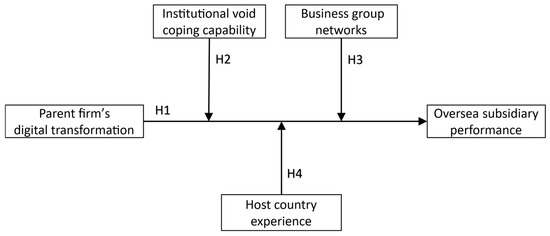
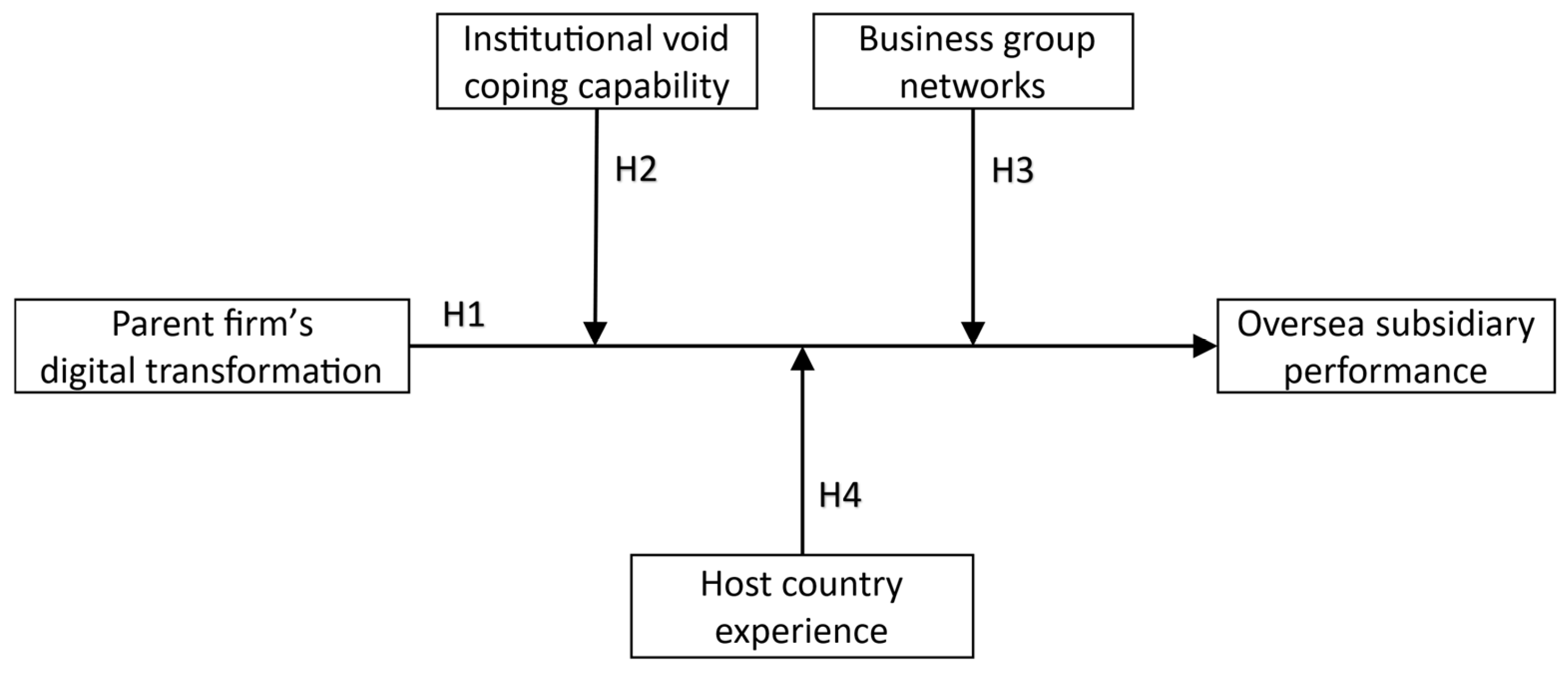
Drawing on theories of multinational digitalization, EMNE-specific advantages, and host country experience, this study addresses these research gaps by developing a conceptual framework. The framework examines how EMNEs’ digital transformation affects subsidiary performance, and how this relationship is moderated by the headquarters’ institutional void-filling capabilities, business group networks, and host country experience (see Figure 1).
Figure 1.
Conceptual framework.
While the existing literature has extensively examined corporate digital transformation and its impact on the internationalization decisions of multinational enterprises, several critical gaps remain in this stream of research. First, regarding the research focus, extant analyses have primarily concentrated on how digital transformation reshapes MNEs’ cross-border investment decisions [37,38]. However, systematic theoretical explanations and robust empirical evidence are still lacking regarding how the digital capabilities of parent firms continuously influence the operations and performance of overseas subsidiaries after the investment is made. Second, in terms of theoretical development, the dominant theoretical frameworks in international business are largely derived from observations of developed-market MNEs (DMNEs) [39,40] and often fail to adequately incorporate the context-specific peculiarities of EMNEs when applied to the latter. Specifically, current theories struggle to fully elucidate how EMNEs’ unique homegrown advantages—such as the ability to navigate institutional complexity and leverage internal network resources—are activated and translated into overseas subsidiary performance in the digital context. Nor do they clearly reveal the contingent role played by these organizational-level dynamic capabilities and host-country experience therein. This study seeks to address these gaps by shifting the analytical focus from investment decisions to post-entry operational outcomes and by systematically examining the moderating mechanisms of EMNE-specific advantages, thereby contributing to a deeper understanding of how competitive advantages are generated in multinational enterprises in the digital era.
2. Conceptual Background and Hypotheses
2.1. The Digital Transformation of Parent Companies and Subsidiary Performance
Firstly, digital transformation enables EMNEs to leverage massive datasets and advanced algorithms to build an “intelligent core”, which reduces information asymmetry between headquarters and subsidiaries, thereby enhancing the efficiency with which EMNE parents provide guidance and resource support to their overseas subsidiaries [41]. For instance, subsidiaries can utilize algorithmic models from the parent company to analyze consumer data in host markets and swiftly adjust product features and design. Such data-driven precision innovation can improve product penetration in local markets and increase subsidiary sales revenue [42]. Moreover, by using big data technologies to collect, integrate, and analyze vast amounts of information, the decision-making process of EMNEs shifts from reliance on historical data and experiential estimation toward data-driven, evidence-based scientific judgment. This shift facilitates rapid strategic adjustments and continuous optimization of multinational operations [43,44]. The widespread adoption of digital tools can also significantly reduce information transmission costs within corporate groups. Empowered by digital technologies, internal monitoring and communication mechanisms become more agile, further reducing the need for direct control by the parent company over overseas subsidiaries and enabling subsidiaries to develop localization strategies better aligned with host-market demands [45]. Thus, digital transformation can break down cross-departmental operational barriers, alleviate data fragmentation, reduce communication costs and waiting time, cut redundant expenses and resource waste, and achieve equal or higher output with lower asset investment, thereby improving subsidiary performance [46].
Secondly, EMNEs can further utilize digital technologies to construct global innovation network platforms, employing digital interfaces to enable more efficient knowledge, technology, and experience sharing among subsidiaries, thereby enhancing their technological innovation capabilities across host countries [47]. Since the global knowledge carried by such corporate networks is typically characterized by diversity [48] and cannot be obtained solely from local partners within a single regional cluster, the inflow of global knowledge helps subsidiaries build innovation advantages through “global learning and innovation” [48]. Research by Verhoef et al. [47] indicates that in the context of digital transformation, parent companies with technological innovation advantages can transfer resource dividends to overseas subsidiaries. The transfer of technological resources from parent to subsidiaries reduces duplicate R&D investments while improving technology conversion efficiency, thereby promoting subsidiary performance. Furthermore, digital transformation equips EMNEs with advanced digital marketing tools, allowing parent companies to extend digital marketing strategies to subsidiary-level operations. This supports subsidiaries in leveraging e-commerce platforms and other digital channels for product promotion and customer engagement [49]. Studies by Dmitry et al. [50] show that through precision marketing via cross-border e-commerce platforms, multinational corporations can lower customer acquisition costs, improve inventory turnover rates, and ultimately enhance subsidiary performance.
Conversely, overseas subsidiaries must respond in real time to shifts in local market demand during their operations. Insufficient digital transformation can lead to significant information transmission delays between the parent company and its subsidiaries [51,52]. In addition, a lack of digital transformation significantly constrains the technological innovation capacity of overseas subsidiaries. Firms without adequate digital support show lower efficiency in converting R&D investments into patents compared to their digitalized counterparts—a gap that is even more pronounced in overseas subsidiaries [53]. Thus, insufficient digital transformation exacerbates information lag and undermines innovation efficiency, thereby inhibiting the performance of overseas subsidiaries.
Based on this reasoning, we propose the following hypothesis:
Hypothesis 1 (H1).
A parent company’s digital transformation has a positive effect on the performance of its overseas subsidiaries.
2.2. The Moderating Effect of Institutional Void Coping Capability
Existing research indicates that, compared to developed markets, emerging markets often lack the institutional infrastructure required to support a modern market economy, such as professional regulatory bodies and standardized industry frameworks [54]. These institutional voids encompass multiple impediments, including the absence of normative regulatory systems, market mechanism failures, inefficient administrative units, and insufficient protection of property rights [55]. EMNEs can mitigate institutional deficiencies in host countries by developing the capability to cope with such voids. This unique ability enables firms to flexibly adjust their strategies to overcome operational challenges stemming from underdeveloped legal systems, high policy uncertainty, immature factor markets, and inefficient judicial systems [56]. When EMNEs possess strong institutional void coping capabilities, they are better able to achieve a dynamic balance between interest coordination and legitimacy in international operations [57], thereby reducing the risk of resource misallocation during digital transformation and minimizing intangible costs.
Furthermore, EMNEs may collaborate with external stakeholders to promote the establishment of new rules or the optimization of existing institutions. Alternatively, they may compensate for missing market functions by building self-contained ecosystems or establishing internal governance mechanisms [58,59]. Such organizational agility allows them to transcend traditional process constraints, enabling rapid iteration of digital solutions and accelerating the positive effects of digitalization. Therefore, a strong capability to cope with institutional voids can enhance EMNEs’ institutional adaptation and value conversion during digital transformation by constructing alternative governance frameworks, optimizing dynamic resource allocation, and strengthening agile organizational responses.
Conversely, when EMNEs have a weak capability to cope with institutional voids, they may struggle to accurately identify ambiguous policy areas and compliance risks in the process of digital transformation. They may also lack the cognitive capacity to navigate highly uncertain institutional environments, leading to misguided actions [56]. This can result in a loss of strategic direction in digital transformation, causing digital investments to diverge from business objectives and undermining the enabling role of digital initiatives. Consequently, multinational enterprises lacking institutional void management capabilities are prone to policy misjudgments and strategic misalignment, which may distort digital initiatives and weaken the value-realization efficiency of digital transformation, thereby negatively affecting subsidiary performance. On this basis, we propose
Hypothesis 2 (H2).
Institutional void coping capability positively moderates the relationship between parent firm digital transformation and overseas subsidiary performance.
2.3. The Moderating Effect of Business Group Networks
Business groups are alliances formed through complex economic transactions and social networks that connect multiple legally independent firms [60]. This organizational form is particularly prominent in emerging economies. As such, business groups can serve as strategic network platforms for member firms to access critical resources [61], including market intelligence, specialized knowledge, production factors, and innovative technologies. Beyond broadening global perspectives, such networks also act as vital bridges facilitating the international operations of member firms [27].
Moreover, resources within these networks are often inaccessible to non-member firms. Thus, firms embedded in strong business group networks can more readily acquire external resources such as digital technologies, knowledge, and talent [61]. For example, the reuse of technological capabilities can lower the upfront R&D costs of digital technologies, thereby better supporting digital transformation initiatives and enhancing subsidiary performance. Research by Arroyabe et al. [62] indicates that the data and network security challenges faced during digital transformation are complex and diverse. Companies affiliated with a business group can achieve lower data security investments compared to independent firms by sharing a common cybersecurity protection system.
Secondly, these networks not only provide internationalization knowledge but also foster business globalization by establishing inter-firm linkages [27]. As a key component of digital transformation, overseas subsidiaries can use digital platforms to connect with other subsidiaries within the group, branch offices, external suppliers, and logistics providers, forming a tightly coordinated supply chain network. This enhances supply chain responsiveness and flexibility, reduces operational costs, and improves overall efficiency. Thus, firms embedded in business group networks can enhance the efficacy of their digital transformation and amplify the performance improvement effect for overseas subsidiaries by gaining access to hard-to-obtain resources such as digital technologies and innovative knowledge, and by leveraging multi-node real-time coordination mechanisms via digital platforms.
In contrast, independent firms may struggle to acquire critical elements such as digital technologies and high-end talent due to the absence of internal sharing mechanisms, potentially weakening their technological iteration and innovation capabilities [63]. Furthermore, firms outside such networks miss out on global collaboration and digital connectivity opportunities provided by business groups, hindering their learning processes and competitiveness in uncertain environments [64]. Therefore, the lack of business group support can lead to fragmented resource flows and deprive firms of valuable global learning opportunities. Such constraints limit the speed, depth, and sustainability of a firm’s digital transformation, thereby weakening its positive impact on subsidiary performance. Accordingly, we hypothesize:
Hypothesis 3 (H3).
Business group networks positively moderate the effect of multinational parent companies’ digital transformation on overseas subsidiaries’ performance.
2.4. The Moderating Effect of Host Country Experience
Substantial host-country experience significantly enhances the ability of EMNE headquarters to identify and interpret unique digital economy opportunities in the host market [32]. Such contextualized knowledge enables headquarters to more accurately evaluate digital innovation proposals from subsidiaries, effectively distinguishing viable market opportunities from initiatives detached from local realities [65]. Building on this, headquarters are more inclined to grant strategic autonomy to proven and reliable subsidiaries [66]. Empowered with decision-making authority, subsidiaries can leverage their local embeddedness to swiftly translate market insights into concrete digital products and services—such as developing fintech applications tailored to local payment habits or constructing social commerce models aligned with regional preferences—thereby directly strengthening their market competitiveness.
Concurrently, host-country experience serves as a critical foundation for effective “resource orchestration” by EMNE headquarters. It facilitates a deeper understanding of the host country’s resource endowments—such as digital talent pools, data center infrastructure, and data regulatory environments—enabling headquarters to more purposefully allocate and integrate digital technologies, financial capital, and managerial resources for their subsidiaries [67]. For instance, experienced headquarters are more adept at combining their own digital platform technologies with the host country’s low-cost manufacturing resources and dynamic online consumer markets to build agile supply chains [68]. Moreover, accumulated experience reduces information asymmetry, allowing headquarters to establish governance mechanisms based on trust and performance rather than relying on rigid administrative control. This fosters deeper integration between headquarters’ digital resources and subsidiaries’ local resources, thereby amplifying the positive impact of digital transformation on subsidiary performance.
Furthermore, EMNEs with rich host-country experience typically possess more mature organizational learning mechanisms. They can not only apply market and technical knowledge acquired in the host country to guide local operations but also reverse-absorb such contextualized knowledge into headquarters through institutionalized channels, such as cross-border R&D collaboration networks [6]. This process enhances the overall dynamic capabilities of the headquarters [69], endowing it with greater insight and adaptability in future digital expansions across other global markets. Research by Hong [70] also highlights that such bidirectional learning is particularly crucial for EMNEs to acquire strategic digital assets through cross-border mergers and acquisitions and achieve technological upgrading.
Conversely, insufficient host-country experience often leads to resource misallocation [34]—for example, over-investing in network-dependent technologies in regions with weak digital infrastructure, or applying lenient data strategies in markets with strict data regulations, thereby incurring compliance risks and undermining the intended effects of digital transformation. Additionally, less experienced firms tend to over-rely on a limited number of “boundary spanners” to sustain cross-border knowledge networks, which can result in information overload and knowledge distortion [71]. Consequently, valuable local insights may fail to reach headquarters’ decision-making levels effectively, creating barriers to organizational learning. This not only constrains the evolution of the entire group’s digital capabilities but also adversely affects subsidiary performance. On this basis, we propose:
Hypothesis 4 (H4).
Host-country experience positively moderates the effect of parent-firm digital transformation on overseas subsidiary performance.
3. Materials and Methods
3.1. Sample Selection and Data Sources
To test the proposed hypotheses, this study selects Chinese listed manufacturing firms and their overseas subsidiaries as the research sample. The focus on Chinese firms is motivated by two key considerations.
First, China represents a major contributor to the global investment landscape. According to existing statistics, China has consistently ranked among the top three source economies in terms of outward foreign direct investment (OFDI) flows since 2013, alongside the United States and Europe. China’s OFDI spans all industrial categories of the national economy, with 46,563 overseas enterprises established across 190 countries and regions, covering 81.5% of global jurisdictions. The breadth, depth, and continuity of these data provide a suitable empirical context for examining the determinants of overseas subsidiary performance.
Second, China possesses a robust digital infrastructure. Its total computing power has grown at an average annual rate of nearly 30% over the past five years, while the scale of its digital economy has outpaced GDP growth for 11 consecutive years. From a global perspective, China’s innovations in mobile payments and its participation in international standard-setting play pivotal roles worldwide. The comprehensiveness and distinctiveness of Chinese corporate data make it an ideal setting for analyzing how digital transformation influences subsidiary performance.
To enhance the validity and reliability of the findings, the following data screening procedures were applied: (1) exclusion of ST and *ST firms (those with abnormal financial status due to consecutive annual losses); (2) removal of multinational corporations registered in tax havens, including the Hong Kong SAR, the Cayman Islands, and the British Virgin Islands; (3) elimination of enterprises with incomplete parent or subsidiary data; (4) Winsorization of all continuous variables at the 1st and 99th percentiles to mitigate the influence of outliers.
After this screening process, the final dataset consists of 2468 unbalanced panel observations from Chinese manufacturing multinationals and their overseas subsidiaries located in 43 developing and 29 developed countries (see Table 1). Data were collected from authoritative sources, including the China Stock Market & Accounting Research (CSMAR) database, World Bank indicators, and the Worldwide Governance Indicators (WGI). Detailed variable sources are provided in Table 2.
Table 1.
List of host countries used in the study.
Table 2.
Variable description, measurement, and sources.
3.2. Variable Measurement
3.2.1. Dependent Variable
Following Contractor et al. [76], this study uses the return on assets (ROA) of overseas subsidiaries to measure subsidiary performance. ROA is calculated as the subsidiary’s net profit divided by its total assets, reflecting the efficiency with which a firm utilizes its assets to generate profit. This metric is widely adopted in international business research.
3.2.2. Independent Variables
Drawing on the method of Bhandari [77], this study constructs a measure of corporate digital transformation using the thematic dataset Statistics on Digital Transformation Keywords of Listed Companies from the CSMAR database. Digital transformation typically begins with technology-driven production system upgrades, the realization of which depends on a firm’s strategic deployment and development of core technologies [78]. Accordingly, keywords in the technological foundation dimension are closely tied to the essential “underlying technological architecture” of digital transformation. At deeper stages of digital transformation, the focus shifts toward effective innovation outputs and real-world applications, which align with the keywords captured in the application scenario dimension. Moreover, the CSMAR database has been widely adopted in corporate finance and accounting research, with its reliability and validity empirically validated across multiple studies [78,79,80,81].
Preliminary analysis of the keyword frequencies reveals a distinct right-skewed distribution, indicating that the majority of firms remain at an early stage of digital transformation (with relatively low keyword counts), while only a small subset exhibits more advanced digital engagement (with high keyword counts). To mitigate potential estimation bias arising from non-normality, we process the raw keyword frequencies by taking the natural logarithm of one plus the total count of digital-related keywords identified in annual reports. This logarithmic transformation is commonly employed in empirical studies on corporate governance and technological innovation, as it accommodates skewed count data and enhances the robustness of model estimation. To ensure consistency across all observations—including those with zero keyword frequency—the transformation ln(1 + keyword frequency) is uniformly applied. The keywords related to digital transformation are classified into five categories across two dimensions, comprising 76 keywords in total (See Appendix A Table A1).
Technology foundation: Including “artificial intelligence technology”, “big data technology”, “cloud computing technology”, and “blockchain technology”.
Application context: Covering terms related to “digital technology application”. Keyword frequencies are aggregated within each category to construct the final measure.
3.2.3. Moderating Variables
Institutional void coping capability is measured as earnings before interest, taxes, depreciation, and amortization (EBITDA) divided by total assets [13]. This indicator reflects a firm’s ability to operate effectively amid institutional gaps. EBITDA mitigates the influence of cross-country differences in tax policies and financing costs, making it particularly suitable for assessing the performance of emerging market firms in imperfect institutional environments [13,82]. Firms that develop under domestic institutional uncertainty often cultivate unique adaptive capacities, which can translate into international competitive advantages [83,84].
Business group networks are measured as the ratio of the overseas sales revenue of the parent business group (excluding the focal firm) to the group’s total sales revenue [63]. This metric captures the extent of international market integration and resource coordination within the business group, reflecting the firm’s embeddedness in a multifactor collaborative network that facilitates information, knowledge, and technological sharing.
Host country experience is operationalized as the sum of the differences between the current year and the establishment year of all subsidiaries previously established by the parent firm in a given host country [67]. This measure objectively reflects the parent firm’s accumulated familiarity with and adaptation to the host country’s market, consumer behavior, and institutional context.
3.2.4. Control Variables
This study selects control variables at three levels: parent company, subsidiary, and host country. Parent company-level control variables include parent company age and the absolute value of the difference between the statistical year and the company’s listing year [85]. Parent company size is measured by the natural logarithm of total assets (plus one) [58]. Parent company ownership is a dummy variable that is assigned a value of 1 if the enterprise is state-owned and 0 if it is non-state-owned [72]. The R&D expense ratio is measured by dividing R&D expenses by operating revenue [65,67]. Current ratio is measured as the ratio of current assets to current liabilities [86]. The subsidiary-level control variables include subsidiary size, which is measured by the natural logarithm of the total assets of the overseas subsidiary (plus one) [58]. Entry mode is a dummy variable where 0 represents M&A entry and where 1 represents greenfield entry [73].
The host country-level control variables include the following. The host country’s digital infrastructure is measured by the number of broadband subscriptions per 100 people [87]. The host country’s business environment is measured by the Economic Freedom Index [88]. Market development potential is measured by the annual GDP growth rate of the host country [89]. The natural resource endowment of the host country is measured by the proportion of ore and metal exports to total merchandise exports [90]. Cultural distance is calculated based on Hofstede’s theory [74] and assumes equal weights for each dimension in calculating the comprehensive cultural distance through standardized processing [66].
3.3. Empirical Model
To determine the appropriate panel data model, we conducted a Hausman test. The results reject the null hypothesis that the random effects model is efficient (p < 0.01). Consequently, this study employs a fixed effects model for estimation.
All moderating variables were mean-centered before constructing interaction terms to mitigate multicollinearity and enhance interpretability. To examine the effect of parent firm digital transformation on overseas subsidiary performance and the moderating roles of institutional void coping capability, business group networks, and host country experience, the following econometric models were specified:
where i denotes the enterprise, t represents the year, Profitit is the dependent variable, measuring overseas subsidiary performance, Digitalit is the core explanatory variable, representing the parent firm’s level of digital transformation, IVCCit, BGNit and HCEit denote institutional void coping capability, business group network, and host country experience, respectively, Controlsit refers to the set of control variables at the parent firm, subsidiary, and host country levels. α0 is the constant term, α1–α4 are the coefficients of interest, and εit is the idiosyncratic error term.
Profitit = α0 + ∑Controlsit + ∑Year + εit
Profitit = α0 + α1Digitalit + ∑Controlsit + ∑Year + εit
Profitit = α0 + α1Digitalit + α2Digitalit × IVCCit + ∑Controlsit +∑Year + εit
Profitit = α0 + α1Digitalit + α2Digitalit × BGNit+ ∑Controlsit + ∑Year + εit
Profitit = α0 + α1Digitalit + α2Digitalit × HCEit + ∑Controlsit +∑Year + εit
Profitit = α0 + α1Digitalit + α2Digitalit × IVCCit+ α3 Digitalit × BGNit + α4 Digitalit × HCEit + ∑Controlsit + ∑Year + εit
Model (2) examines the direct effect of digital transformation on subsidiary performance. Model (3) introduces the interaction term Digitalit × IVCCit to assess the moderating role of institutional void coping capability. Model (4) includes Digitalit × BGNit to evaluate the moderating effect of business group networks. Model (5) incorporates Digitalit × HCEit to investigate the moderating influence of host country experience. Model (6) includes all interaction terms simultaneously to test the full set of moderating effects in a consolidated specification.
4. Results
4.1. Hypothesis Testing Results
This study utilized STATA 17 for statistical analysis. Table 3 presents the Pearson correlation coefficients among the variables. In accordance with the discriminant criteria established by Churchill [91], all correlation coefficients remained below the threshold of 0.5, indicating no severe multicollinearity in the model. Further analysis of the relationships between control variables and independent variables showed that most control variables exhibited low correlation coefficients, and the independent variables were not statistically significant (p > 0.05). This confirms that the inclusion of control variables does not introduce significant collinearity interference with the independent variables. These findings support the rationality of the model specification and provide a reliable basis for subsequent regression analysis.
Table 3.
Descriptive statistics and correlations.
Table 4 reports the results of the hierarchical regression models. Model 1 serves as the baseline, including only control variables, while Model 2 introduces the independent variable—parent firm digital transformation—to test the direct effect. The results indicate that parent firm digital transformation has a positive and significant effect on overseas subsidiary performance (β = 0.040, p < 0.01), thus supporting H1.
Table 4.
Results of the linear regression.
This study finds a significant negative relationship between parent firm size and the performance of overseas subsidiaries. This finding does not imply that firm size per se inhibits international operations, but rather reveals that as firms expand in scale, they may face organizational and managerial challenges such as the dispersion of resources, increased organizational complexity, and institutional misalignment between home and host countries [92]. These factors may undermine the advantages derived from economies of scale, thereby adversely affecting the operational efficiency and market adaptability of overseas subsidiaries.
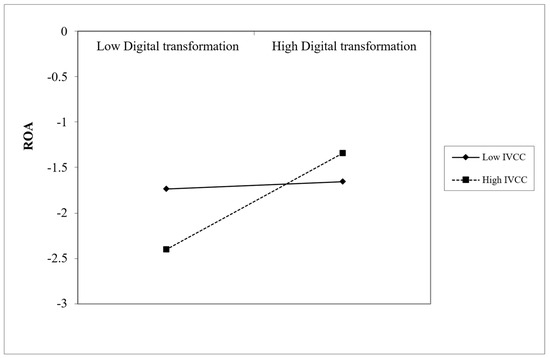
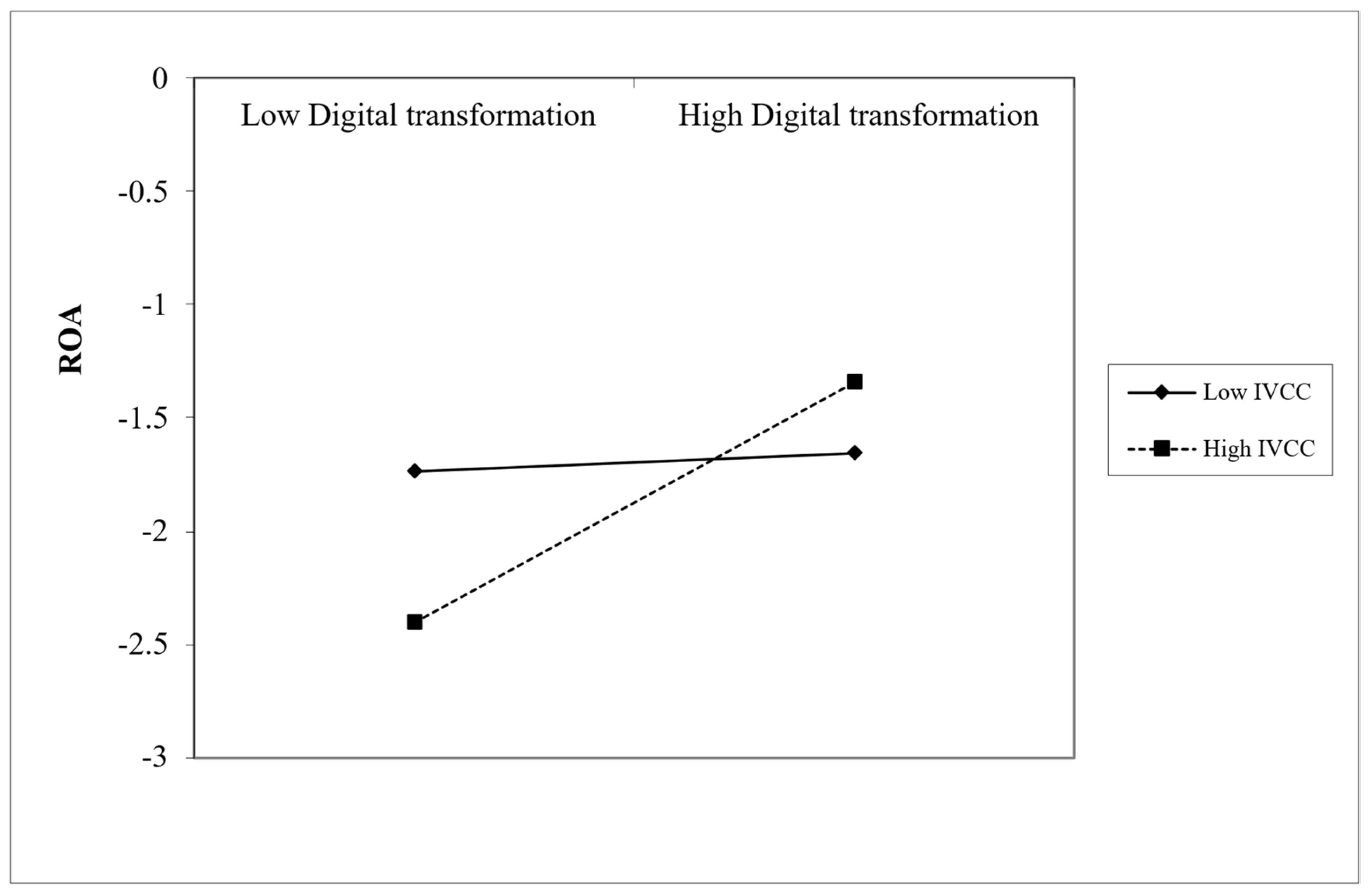
H2 posits that institutional void coping capability (IVCC) positively moderates the relationship between parent firm digital transformation and subsidiary performance. In Model 3, the interaction term DT × IVCC is significantly positive (β = 0.491, p < 0.01). This result remains robust in Model 6 after including all interaction terms. Figure 2 further illustrates the significant positive moderating effect of IVCC, providing additional support for H2.
Figure 2.
Moderating effect of institutional void coping capability on the relationship between parent company digital transformation and subsidiary performance.
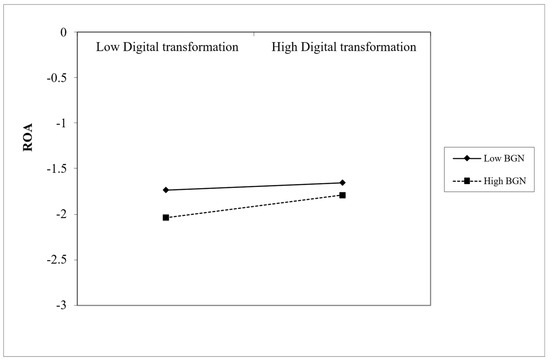
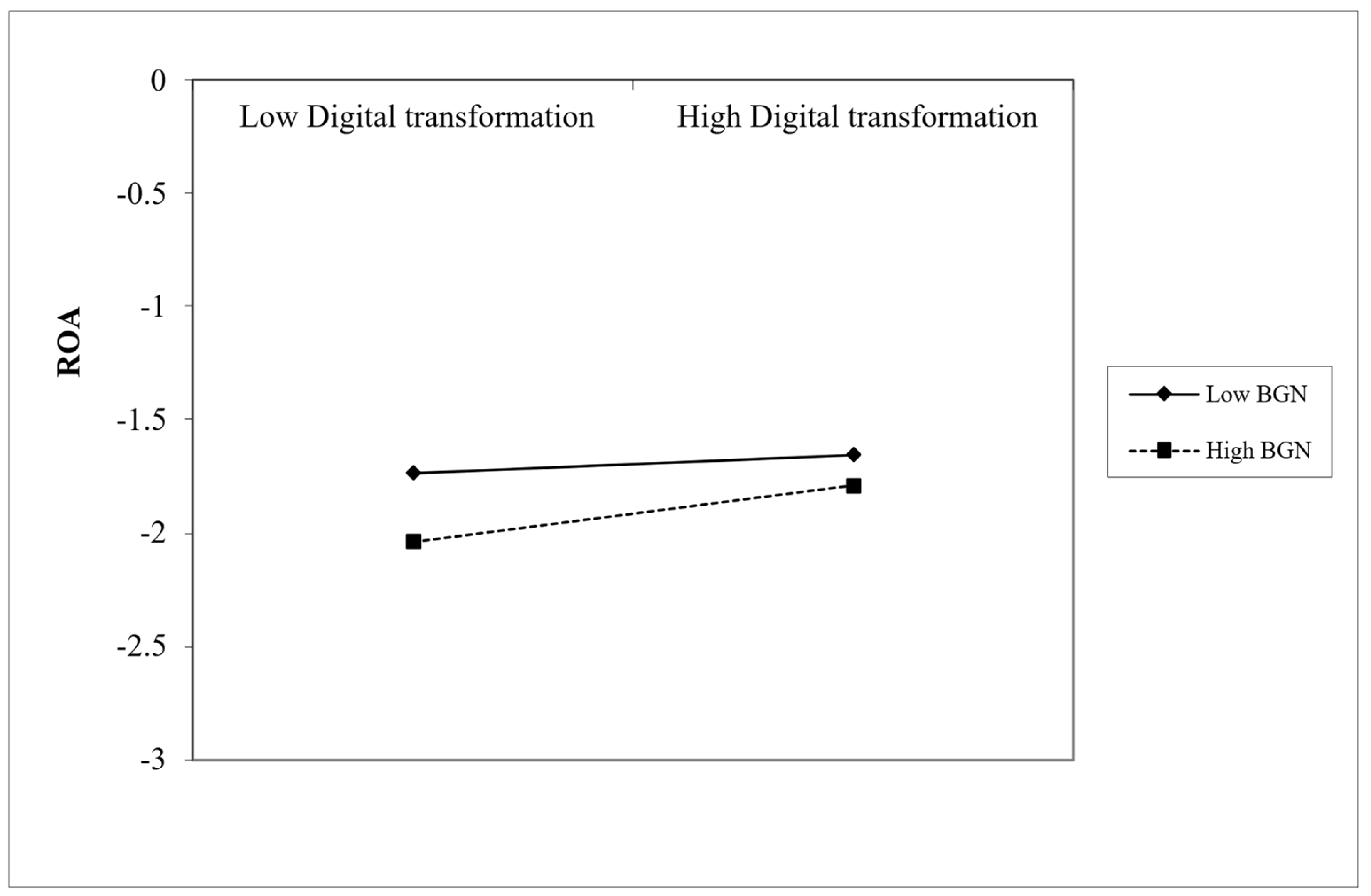
H3 proposes that business group networks (BGN) positively moderate the effect of parent firm digital transformation on subsidiary performance. In Model 4, the coefficient of DT × BGN is significantly positive (β = 0.103, p < 0.05). Model 6 continues to support H3 after all interaction terms are included. Figure 3 depicts the significant positive moderating effect of BGN, further validating H3.
Figure 3.
Moderating effect of business group networks on the relationship between parent company digital transformation and subsidiary performance.
H4 suggests that host country experience (HCE) strengthens the positive effect of digital transformation on subsidiary performance. However, in Model 5, the coefficient of DT × HCE is not statistically significant (β = −0.001, p > 0.1). This result remains unchanged in Model 6 after incorporating all interaction terms.
4.2. Endogeneity Test
Although this study controls for a comprehensive set of firm-level characteristics and includes year fixed effects, omitted variables and potential simultaneity between overseas subsidiary performance and parent-firm digital transformation may still bias the estimates. To mitigate these concerns, we adopt an instrumental variable (IV) approach following Acemoglu et al. [93].
The first instrumental variable (IV1) is constructed as the average digital transformation level of other firms within the same province, excluding the focal firm. This variable captures the regional digital environment—such as shared digital infrastructure and spillovers—that influences firms’ digitalization decisions, thereby satisfying the relevance condition. After controlling for firm characteristics, province fixed effects, and year fixed effects, it is unlikely that provincial peer firms’ digitalization directly affects overseas subsidiary performance through channels other than the parent firm’s own digital transformation.
The second instrumental variable leverages historical and geographical variation in digital infrastructure development. Specifically, China’s “Eight Vertical and Eight Horizontal” optical backbone network, which was planned in the 1990s, led to persistent spatial disparities in basic internet access across different regions. In light of this institutional context, we construct a spatiotemporal instrument by interacting the shortest distance (Dis) from a firm’s province to the nearest backbone node city with the provincial internet penetration rate (IOP) for a given year (Dis × IOP). This interaction captures the effect of regional variation in digital infrastructure availability, which is largely driven by long-term infrastructure planning and policy, rather than firm-specific factors. Geographic distance is historically predetermined and remains time-invariant, while provincial internet penetration reflects the evolving diffusion of digital infrastructure, shaped by regional policies and technological advancements. As such, the interaction term effectively accounts for regional disparities in digital infrastructure diffusion and is unlikely to have a direct effect on the contemporary performance of overseas subsidiaries, thus satisfying the exclusion restriction [94]. Following the approaches of Forman [95] and Tu [96], we use this interaction term to mitigate potential collinearity with fixed effects, ensuring the validity of the instrument.
Table 5 reports the results of the two-stage least squares (2SLS) estimation using both instruments jointly. In the first stage, IV1 and Dis × IOP significantly predict firm-level digital transformation (p < 0.01). The Durbin–Wu–Hausman test (p = 0.08) indicates the presence of endogeneity at the 10% level. Standard diagnostic tests support the adequacy of the instruments: the Kleibergen–Paap rk LM test rejects underidentification, the Kleibergen–Paap rk Wald F statistic substantially exceeds the Stock–Yogo critical value, and the Hansen J test does not reject the null hypothesis of joint instrument exogeneity. In the second stage, the estimated coefficient on digital transformation remains significantly positive.
Table 5.
Instrumental variable regression results.
To examine potential reverse causality, Panel A of Table 6 re-estimates both the baseline and moderation models using digital transformation lagged by one period. The results remain consistent with the baseline findings, suggesting that overseas subsidiary performance is unlikely to drive parent firms’ prior digital transformation decisions. Panel B of Table 6 further reports 2SLS estimates for the post-2015 subsample (2015–2021), a period during which digital transformation was explicitly promoted as a national development strategy in China. The estimated effect of digital transformation remains positive and statistically significant. Additional robustness checks based on alternative 2SLS specifications—including models with province-by-year fixed effects and alternative measures of overseas subsidiary performance—are reported in Appendix A Table A3. The results are consistent with the main findings.
Table 6.
Robustness Checks for Endogeneity.
As a supplementary analysis, we also apply the Gaussian copula approach proposed by Park and Gupta [97]. A Shapiro–Wilk test rejects the null hypothesis that digital transformation follows a normal distribution, satisfying the prerequisite for the copula method. The copula-based estimates in Table 7 are consistent with the baseline results. Following recent methodological discussions, we treat the Gaussian copula approach as supplementary evidence rather than a primary identification strategy, as the non-significance of the copula term does not necessarily rule out all sources of endogeneity.
Table 7.
Gaussian regression results.
4.3. Robustness Check
To test the robustness of our findings, this study conducts additional analyses using alternative measures of the dependent variable. Specifically, we replace subsidiary return on assets (ROA) with subsidiary operating revenue for re-estimation. As shown in Table 8, after adjusting for robust standard errors, the main conclusions remain consistent. Considering the profound impact of the COVID-19 pandemic as a global structural shock on economic patterns, we further exclude data from 2020 onward to mitigate potential distortions caused by short-term disruptions (e.g., supply chain interruptions, forced adoption of remote work) on the core mechanisms. The results reported in Table 9 indicate that the coefficients and significance levels of digital technology (Dt), the interaction term between digital technology and institutional void-filling capability (Dt × Ivcc), the interaction between digital technology and business group network (Dt × Bgn), and the interaction between digital technology and human capital endowment (Dt × Hce) remain largely unchanged. Thus, the hypothesized relationships continue to be supported.
Table 8.
Robustness test for replacing dependent variable.
Table 9.
Robustness test of replacement samples.
To address the potential non-linear effect of host-country experience, we further included its squared term (Hce2) and the corresponding interaction term (Dt × Hce2). As reported in Appendix A Table A2, both the linear (Dt × Hce) and non-linear (Dt × Hce2) interaction effects remain statistically insignificant, while the positive impact of digital transformation on subsidiary performance is unchanged. These results confirm that our conclusions are robust and not driven by an omitted non-linear specification.
5. Discussion
As digital transformation continues to reshape global supply chain (SC) governance, a growing body of research has explored whether digital technologies (DTs) complement or substitute traditional governance mechanisms. This study contributes to this emerging discourse by uncovering the distinct roles of physical and network DTs in mitigating different forms of supplier opportunism in global SCs, as well as their contrasting complementary effects with conventional governance approaches. Based on dyadic data from 217 Chinese suppliers and buyers across 66 countries, we find that physical DTs reduce strong-form supplier opportunism (SSO), whereas network DTs weaken weak-form supplier opportunism (WSO). Moreover, our results indicate that detailed contracts complement physical DTs in curbing SSO, while relational governance complements network DTs in deterring WSO. These findings carry significant theoretical and managerial implications.
5.1. Theoretical Implications
Firstly, this study enriches the literature on the relationship between emerging market multinational enterprises (EMNEs)’ digital transformation and subsidiary performance by elucidating how parent-company digitalization influences subsidiary outcomes. While prior research has highlighted the positive role of digital transformation in multinational investment decisions—such as the degree of internationalization [37] and scope [8]—other scholars contend that emerging markets often lack the resources and institutional foundations for innovation, with digital technology development lagging behind [98]. In this context, it has been questioned whether digitalization can truly serve as a source of competitive advantage for EMNEs. Our findings demonstrate that EMNEs can indeed leverage digital technologies to effectively coordinate, share, and mobilize global resources, thereby enhancing the performance of overseas subsidiaries. Thus, our results support the view that digital adoption enables EMNEs to strengthen their competitiveness in global markets [99].
Secondly, we clarify the moderating role of institutional void management capability in the relationship between EMNE digital transformation and overseas subsidiary performance. Our analysis reveals that this capability positively strengthens the relationship. Unlike previous studies that have centered on managerial capabilities in developed markets [100], we identify EMNEs’ ability to navigate institutional voids as a key enabler of digital transformation outcomes. These findings provide empirical evidence on how emerging economies can leverage their unique advantages to amplify the positive effects of digitalization on subsidiary performance, addressing a critical gap in understanding EMNEs’ distinctive capabilities in digital environments.
Thirdly, this study advances understanding of how the interaction between EMNE digitalization and business group networks influences subsidiary performance. Existing research on EMNE business group networks has primarily focused on their direct effects on internationalization and subsidiary outcomes [29,30,31], overlooking the interplay between digitalization and business networks in the digital context. Our findings indicate that business group networks strengthen the positive impact of EMNE digitalization on subsidiary performance, suggesting that EMNEs embedded in such networks are better positioned to use digital technologies to integrate internal information, knowledge, and resources, thereby improving overseas subsidiary outcomes. These results extend prior EMNE business group research [60,61] by clarifying the synergistic effect of digitalization and business networks on subsidiary performance.
Our study further contributes by clarifying how digital transformation reshapes the role of host-country experience in influencing subsidiary performance. While prior research emphasizes host-country experience as a key source of contextual knowledge, our findings suggest that digital transformation introduces both substituting and enabling mechanisms that alter how such experience is utilized. Digital technologies may partially substitute for experience-based market sensing and intuitive judgment, while host-country experience can still facilitate organizational learning and resource orchestration by contextualizing digital initiatives. The coexistence of these mechanisms may lead to offsetting effects, helping explain the empirically non-significant moderating role of host-country experience. Overall, this contribution moves beyond a linear “more experience–better performance” logic and highlights the embedded and evolving nature of experiential knowledge in the digital era.
5.2. Managerial Implications
Our study identifies corporate digital transformation as a critical factor influencing the operational performance of EMNEs in overseas markets. With the continued advancement of emerging technologies such as the Internet of Things, big data, and cloud computing [101], we recommend that multinational executives pay closer attention to the positive spillover effects between headquarters-level digital transformation and overseas subsidiaries. Managers should fully leverage digital initiatives to enhance efficiency across multiple business functions—for instance, by automating processes to reduce labor costs, establishing centralized digital platforms for multi-source information sharing, and strengthening organizational responsiveness.
Furthermore, our findings suggest that EMNE managers should carefully assess their firms’ institutional void management capabilities and business group networks when implementing digital strategies. Pursuing digitalization without considering local market conditions may lead to misalignment. For EMNEs with weaker institutional void mitigation capabilities and underdeveloped corporate networks, we recommend adopting a hybrid approach that combines standardized processes at the headquarters level with localized adaptation at the subsidiary level. This includes creating dynamic two-way communication platforms that maintain procedural consistency while allowing flexibility for local adjustments. For EMNEs with strong institutional void management capabilities and well-developed corporate networks, digitalization can be strategically deployed to guide subsidiaries’ local market expansion, thereby amplifying its positive performance impact.
For managers of EMNEs, the non-significant moderating effect of host-country experience does not imply that such experience lacks value. Instead, it highlights the need to reconsider how experiential knowledge is integrated into digitally enabled decision systems. Managers should avoid over-reliance on rigid, standardized digital processes that marginalize context-specific insights, and instead design hybrid mechanisms that allow tacit experience to inform data-driven decisions. Embedding host-country experience within digital capabilities can help firms better leverage both localized knowledge and digital intelligence.
5.3. Limitations and Future Research
While this study constructs a digital transformation index primarily based on the textual analysis of corporate annual reports—effectively capturing strategic-level public disclosures—it has certain limitations. Firstly, textual emphasis may not fully align with a firm’s actual technological adoption, resource allocation, and organizational restructuring. Secondly, the fixed keyword dictionary approach may exhibit a time lag in capturing rapidly evolving frontier digital technology concepts. Future research could incorporate multi-source information such as patent data, R&D investment, and case surveys for cross-validation, or develop dynamic composite indicators that integrate multi-dimensional information to enhance measurement validity and timeliness.
To mitigate potential endogeneity concerns, this study employs an instrumental variable approach and conducts a series of robustness tests, including alternative instrument constructions, the inclusion of multi-dimensional fixed effects, and the use of lagged digital transformation measures. The consistency of the results across these specifications supports the robustness of the main conclusions. Nevertheless, as with most empirical studies based on observational data, the exclusion restriction underlying instrumental variable estimation cannot be fully verified from a theoretical perspective. Despite our efforts to justify the validity of the instruments through both institutional background and empirical design, this limitation remains inherent to the research setting. Future research could further strengthen causal identification by exploiting more exogenous sources of variation, such as region-specific digital infrastructure policies or quasi-natural experimental designs, which would provide more compelling evidence on the causal effects of digital transformation.
This paper reveals the positive impact of parent company digital transformation on subsidiary performance and identifies partial mediating pathways. However, the specific micro-level mechanisms—such as organizational restructuring processes, knowledge transfer patterns, and concrete forms of resource synergy—are not yet fully explored. Future studies could employ longitudinal case research, process tracing, or structural equation modeling based on micro-level survey data to uncover the operational logic inside the “black box” more finely.
Limited by data availability, this study mainly relies on financial indicators such as ROA to measure subsidiary performance. To comprehensively assess the composite value created by digital transformation, future research should systematically incorporate non-financial dimensions—such as innovation performance (patents, new products), organizational resilience, local legitimacy, and employee development—and construct a multidimensional performance indicator system. This would enable a deeper understanding of digitalization’s role in fostering long-term competitiveness and sustainable development.
The sample of this study focuses on manufacturing firms in China. Although China is a major emerging economy, it differs from other emerging markets in aspects such as investment scale and institutional environment. Future research could extend the sample to multinational enterprises operating in multiple emerging markets (e.g., India, Vietnam) for cross-country comparisons or conduct in-depth analyses within specific industries. Such efforts would enhance the contextual generalizability and theoretical richness of the findings.
Author Contributions
Conceptualization, G.X.; methodology, G.X.; software, G.X.; validation, L.W. and J.L.; formal analysis, G.X. and D.R.; investigation, G.X. and D.R.; resources, L.W.; data curation, G.X.; writing—original draft preparation, G.X.; writing—review and editing, G.X. and L.W.; visualization, G.X. and D.R.; supervision, L.W. and J.L.; project administration, L.W.; funding acquisition, L.W. All authors have read and agreed to the published version of the manuscript.
Funding
National Natural Science Foundation of China: No. 42271269; The Fundamental Research Funds for the Central Universities of Sun Yat-sen University: C24wkjc14.
Institutional Review Board Statement
Not applicable.
Informed Consent Statement
Not applicable.
Data Availability Statement
The authors declare that the data on financial characteristics and governance structure are taken from the China Stock Market and Accounting Research databases: https://data.csmar.com/ (accessed on 3 March 2025). The data between countries is sourced from the World Bank Open Database: https://data.worldbank.org/ (accessed on 9 March 2025).
Conflicts of Interest
The authors declare no conflicts of interest.
Appendix A
Table A1.
Digital transformation keywords.
Table A2.
Non-linear moderating effect test of host-country experience.
Table A3.
Instrumental Variable Estimation Results Using 2SLS: Fixed Effects and Alternative Measures.
References
- Hanelt, A.; Bohnsack, R.; Marz, D.; Marante, C.A. A systematic review of the literature on digital transformation: Insights and implications for strategy and organizational change. J. Manag. Stud. 2021, 58, 1159–1197. [Google Scholar] [CrossRef] [Scilit]
- Lui, A.K.H.; Lee, M.C.M.; Ngai, E.W.T. Impact of artificial intelligence investment on firm value. Ann. Oper. Res. 2021, 308, 373–388. [Google Scholar] [CrossRef] [Scilit]
- Matt, C.; Hess, T.; Benlian, A. Digital transformation strategies. Bus. Inf. Syst. Eng. 2015, 57, 339–343. [Google Scholar] [CrossRef] [Scilit]
- Ojala, A.; Evers, N.; Rialp, A. Extending the international new venture phenomenon to digital platform providers: A longitudinal case study. J. World Bus. 2018, 53, 725–739. [Google Scholar] [CrossRef] [Scilit]
- Hänninen, M.; Smedlund, A.; Mitronen, L. Digitalization in retailing: Multi-sided platforms as drivers of industry transformation. Balt. J. Manag. 2018, 13, 152–168. [Google Scholar] [CrossRef] [Scilit]
- Fleury, A.; Fleury, M.T.L.; Oliveira, L.; Leao, P. Going digital EMNEs: The role of digital maturity capability. Int. Bus. Rev. 2024, 33, 102271. [Google Scholar] [CrossRef] [Scilit]
- Elia, S.; Giuffrida, M.; Mariani, M.M.; Bresciani, S. Resources and digital export: An RBV perspective on the role of digital technologies and capabilities in cross-border e-commerce. J. Bus. Res. 2021, 132, 158–169. [Google Scholar] [CrossRef] [Scilit]
- Schwens, C.; Zapkau, F.B.; Bierwerth, M.; Isidor, R.; Knight, G.; Kabst, R. International entrepreneurship: A meta-analysis on the internationalization and performance relationship. Entrep. Theory Pract. 2018, 42, 734–768. [Google Scholar] [CrossRef] [Scilit]
- Zhao, F.; Meng, T.; Wang, W.; Alam, F.; Zhang, B. Digital Transformation and Firm Performance: Benefit From Letting Users Participate. J. Glob. Inf. Manag. 2023, 31, 1–23. [Google Scholar] [CrossRef] [Scilit]
- Holzinger, A.; Weippl, E.; Tjoa, A.M.; Kieseberg, P. Digital transformation for sustainable development goals (SDGs)—A security, safety and privacy perspective on AI. In Machine Learning and Knowledge Extraction; Holzinger, A., Kieseberg, P., Tjoa, A.M., Weippl, E., Eds.; Lecture Notes in Computer Science; Springer: Cham, Switzerland, 2021; Volume 12844, pp. 1–20. [Google Scholar]
- Luo, Y. A general framework of digitization risks in international business. J. Int. Bus. Stud. 2022, 53, 344–361. [Google Scholar] [CrossRef] [Scilit] [PubMed]
- Kohtamäki, M.; Parida, V.; Patel, P.C.; Gebauer, H. The relationship between digitalization and servitization: The role of servitization in capturing the financial potential of digitalization. Technol. Forecast. Soc. Change 2020, 151, 119804. [Google Scholar] [CrossRef] [Scilit]
- James, B.E.; Sawant, R.J.; Bendickson, J.S. Emerging market multinationals’ firm-specific advantages, institutional distance, and foreign acquisition location choice. Int. Bus. Rev. 2020, 29, 101702. [Google Scholar] [CrossRef] [Scilit]
- Buckley, P.J.; Casson, M.C. Analyzing foreign market entry strategies: Extending the internalization approach. J. Int. Bus. Stud. 1998, 29, 539–561. [Google Scholar] [CrossRef] [Scilit]
- Cui, L.; Meyer, K.E.; Hu, H.W. What drives firms’ intent to seek strategic assets by foreign direct investment? A study of emerging economy firms. J. World Bus. 2014, 49, 488–501. [Google Scholar] [CrossRef] [Scilit]
- Chacar, A.S.; Newburry, W.; Vissa, B. Bringing institutions into performance persistence research: Exploring the impact of product, financial, and labor market institutions. J. Int. Bus. Stud. 2010, 41, 1119–1140. [Google Scholar] [CrossRef] [Scilit]
- Doh, J.; Rodrigues, S.; Saka-Helmhout, A.; Makhija, M. International business responses to institutional voids. J. Int. Bus. Stud. 2017, 48, 293–307. [Google Scholar] [CrossRef] [Scilit]
- Khanna, T.; Palepu, K.G. Winning in Emerging Markets: A Road Map for Strategy and Execution; Harvard Business Press: Boston, MA, USA, 2010. [Google Scholar]
- Garrone, P.; Piscitello, L.; D’Amelio, M. Multinational enterprises and the provision of collective goods in developing countries under formal and informal institutional voids: The case of electricity in Sub-Saharan Africa. J. Int. Manag. 2019, 25, 100650. [Google Scholar] [CrossRef] [Scilit]
- Liedong, T.A.; Peprah, A.A.; Amartey, A.O.; Rajwani, T. Institutional voids and firms’ resource commitment in emerging markets: A review and future research agenda. J. Int. Manag. 2020, 26, 100756. [Google Scholar] [CrossRef] [Scilit]
- Kim, S.-I.; Lee, Y.-H. A study on the status and improvement of the records management system of abolished institutions. J. Arch. Stud. 2017, 51, 5–44. [Google Scholar] [CrossRef]
- Cuervo-Cazurra, A.; Genc, M. Transforming disadvantages into advantages: Developing-country MNEs in the least developed countries. J. Int. Bus. Stud. 2008, 39, 957–979. [Google Scholar] [CrossRef] [Scilit]
- Saeed, K.A. Determinants of institutional quality and per capita growth in natural resource-dependent countries. Cogent Econ. Financ. 2022, 10, 2122189. [Google Scholar] [CrossRef] [Scilit]
- Cuervo-Cazurra, A.; Ramamurti, R. Home country underdevelopment and internationalization. Compet. Rev. 2017, 27, 217–230. [Google Scholar] [CrossRef] [Scilit]
- Holburn, G.L.F.; Zelner, B.A. Political capabilities, policy risk, and international investment strategy: Evidence from the global electric power generation industry. Strateg. Manag. J. 2010, 31, 1290–1315. [Google Scholar] [CrossRef] [Scilit]
- Hendriks, G.; Slangen, A.H.L.; Heugens, P.P.M.A.R. How cross-cultural experience shapes emerging-market multinationals’ domestic performance after a cross-border acquisition. Long Range Plan. 2023, 56, 102342. [Google Scholar] [CrossRef] [Scilit]
- Welch, D.E.; Welch, L.S.; Young, L.C.; Wilkinson, I.F. The importance of networks in export promotion: Policy issues. J. Int. Mark. 1998, 6, 66–82. [Google Scholar] [CrossRef] [Scilit]
- Lamin, A. Business groups as information resource: An investigation of business group affiliation in the Indian software services industry. Acad. Manag. J. 2013, 56, 1487–1509. [Google Scholar] [CrossRef] [Scilit]
- Singh, D.; Delios, A. Corporate governance, board networks and growth in domestic and international markets: Evidence from India. J. World Bus. 2017, 52, 615–627. [Google Scholar] [CrossRef] [Scilit]
- Chung, H.-M.; Dahms, S. Ownership strategy and foreign affiliate performance in multinational family business groups: A double-edged sword. J. Int. Manag. 2018, 24, 303–316. [Google Scholar] [CrossRef] [Scilit]
- Garg, M.; Delios, A. Survival of the foreign subsidiaries of TMNCs: The influence of business group affiliation. J. Int. Manag. 2007, 13, 278–295. [Google Scholar] [CrossRef] [Scilit]
- Ciabuschi, F.; Forsgren, M.; Martín, O.M. Value creation at the subsidiary level: Testing the MNC headquarters parenting advantage logic. Long Range Plan. 2017, 50, 48–62. [Google Scholar] [CrossRef] [Scilit]
- Nell, P.C.; Ambos, B. Parenting advantage in the MNC: An embeddedness perspective on the value added by headquarters. Strateg. Manag. J. 2013, 34, 1086–1103. [Google Scholar] [CrossRef] [Scilit]
- Nell, P.C.; Andersson, U.; Ambos, B. Redundancies in external relationships of multinational corporations—A firm-level conceptual model. In The Changing Geography of International Business; Cook, G., Johns, J., Eds.; Palgrave Macmillan: London, UK, 2013; pp. 181–199. [Google Scholar]
- Mata, J.; Alves, C. The survival of firms founded by immigrants: Institutional distance between home and host country, and experience in the host country. Strateg. Manag. J. 2018, 39, 2965–2991. [Google Scholar] [CrossRef] [Scilit]
- Shirodkar, V.; Konara, P. Institutional distance and foreign subsidiary performance in emerging markets: Moderating effects of ownership strategy and host-country experience. Manag. Int. Rev. 2017, 57, 179–207. [Google Scholar] [CrossRef] [Scilit]
- Adomako, S.; Amankwah-Amoah, J.; Tarba, S.Y.; Khan, Z. Perceived corruption, business process digitization, and SMEs’ degree of internationalization in sub-Saharan Africa. J. Bus. Res. 2021, 123, 196–207. [Google Scholar] [CrossRef] [Scilit]
- He, Z.; Liu, Z.; Zhao, Y.; Zhao, Y. Is more digital always better? A nonlinear perspective on corporate digital transformation and OFDI. Int. Rev. Financ. Anal. 2024, 96, 103649. [Google Scholar] [CrossRef] [Scilit]
- Bruno, R.L.; Crescenzi, R.; Estrin, S.; Petralia, S. Multinationals, innovation, and institutional context: IPR protection and distance effects. J. Int. Bus. Stud. 2021, 53, 1945–1970. [Google Scholar] [CrossRef] [Scilit]
- Schmiele, A. Intellectual property infringements due to R&D abroad? A comparative analysis between firms with international and domestic innovation activities. Res. Policy 2013, 42, 1482–1495. [Google Scholar] [CrossRef] [Scilit]
- Ambos, B.; Asakawa, K.; Ambos, T.C. A dynamic perspective on subsidiary autonomy. Glob. Strateg. J. 2011, 1, 301–316. [Google Scholar] [CrossRef] [Scilit]
- Jankowska, B.; Götz, M.; Tarka, P. Foreign subsidiaries as vehicles of Industry 4.0: The case of foreign subsidiaries in a post-transition economy. Int. Bus. Rev. 2021, 30, 101886. [Google Scholar] [CrossRef] [Scilit]
- Cheng, S.; Fan, Q.; Huang, M. Strategic orientation, dynamic capabilities, and digital transformation of commercial banks: A fuzzy-set QCA approach. Sustainability 2023, 15, 1915. [Google Scholar] [CrossRef] [Scilit]
- Lipsmeier, A.; Kühn, A.; Joppen, R.; Dumitrescu, R. Process for the development of a digital strategy. Procedia CIRP 2020, 88, 173–178. [Google Scholar] [CrossRef] [Scilit]
- Banalieva, E.R.; Dhanaraj, C. Internalization theory for the digital economy. J. Int. Bus. Stud. 2019, 50, 1372–1387. [Google Scholar] [CrossRef] [Scilit]
- Wang, S.L.; Luo, Y.; Lu, X.; Sun, J.; Maksimov, V. Autonomy delegation to foreign subsidiaries: An enabling mechanism for emerging-market multinationals. J. Int. Bus. Stud. 2014, 45, 111–130. [Google Scholar] [CrossRef] [Scilit]
- Verhoef, P.C.; Broekhuizen, T.; Bart, Y.; Bhattacharya, A.; Dong, J.Q.; Fabian, N.; Haenlein, M. Digital transformation: A multidisciplinary reflection and research agenda. J. Bus. Res. 2021, 122, 889–901. [Google Scholar] [CrossRef] [Scilit]
- Un, C.A.; Rodríguez, A. Local and global knowledge complementarity: R&D collaborations and innovation of foreign and domestic firms. J. Int. Manag. 2018, 24, 137–152. [Google Scholar] [CrossRef] [Scilit]
- Nambisan, S.; Wright, M.; Feldman, M. The digital transformation of innovation and entrepreneurship: Progress, challenges and key themes. Res. Policy 2019, 48, 103773. [Google Scholar] [CrossRef] [Scilit]
- Richard, P.J.; Devinney, T.M. Modular strategies: B2B technology and architectural knowledge. Calif. Manag. Rev. 2005, 47, 86–113. [Google Scholar] [CrossRef] [Scilit]
- Pagani, M.; Pardo, C. The impact of digital technology on relationships in a business network. Ind. Mark. Manag. 2017, 67, 185–192. [Google Scholar] [CrossRef] [Scilit]
- Plekhanov, D.; Franke, H.; Netland, T.H. Digital transformation: A review and research agenda. Eur. Manag. J. 2023, 41, 821–844. [Google Scholar] [CrossRef] [Scilit]
- Zhuo, C.F.; Chen, J. Can digital transformation overcome the enterprise innovation dilemma: Effect, mechanism and effective boundary. Technol. Forecast. Soc. Chang. 2023, 190, 122378. [Google Scholar] [CrossRef] [Scilit]
- Khanna, T.; Palepu, K. Why focused strategies may be wrong for emerging markets. Harv. Bus. Rev. 1997, 75, 41–51. [Google Scholar]
- Khanna, T.; Palepu, K.G.; Sinha, J. Strategies that fit emerging markets. Harv. Bus. Rev. 2005, 83, 63–76. [Google Scholar] [PubMed]
- Weick, K.E.; Sutcliffe, K.M.; Obstfeld, D. Organizing and the process of sensemaking. Organ. Sci. 2005, 16, 409–421. [Google Scholar] [CrossRef] [Scilit]
- Young, L. Companies Are Seeking Real-World Supply-Chain Gains in New AI Tools; The Wall Street Journal: New York, NY, USA, 2024. [Google Scholar]
- Doh, J.P. Offshore outsourcing: Implications for international business and strategic management theory and practice. J. Manag. Stud. 2005, 42, 695–704. [Google Scholar] [CrossRef] [Scilit]
- Turker, D.; Vural, C.A. Embedding social innovation process into the institutional context: Voids or supports. Technol. Forecast. Soc. Chang. 2017, 119, 98–113. [Google Scholar] [CrossRef] [Scilit]
- Khanna, T.; Rivkin, J.W. Estimating the performance effects of business groups in emerging markets. Strateg. Manag. J. 2001, 22, 45–74. [Google Scholar] [CrossRef]
- Gulati, R.; Nohria, N.; Zaheer, A. Strategic networks. Strateg. Manag. J. 2000, 21, 203–215. [Google Scholar] [CrossRef] [Scilit]
- Arroyabe, M.F.; Arranz, C.F.A.; de Arroyabe, I.F.; de Arroyabe, J.C.F. The effect of IT security issues on the implementation of industry 4.0 in SMEs: Barriers and challenges. Technol. Forecast. Soc. Chang. 2024, 199, 123051. [Google Scholar] [CrossRef] [Scilit]
- Elango, B.; Pattnaik, C. Building capabilities for international operations through networks: A study of Indian firms. J. Int. Bus. Stud. 2007, 38, 541–555. [Google Scholar] [CrossRef] [Scilit]
- North, K.; Aramburu, N.; Lorenzo, O.J. Promoting digitally enabled growth in SMEs: A framework proposal. J. Enterp. Inf. Manag. 2019, 33, 238–262. [Google Scholar] [CrossRef] [Scilit]
- Iriyama, A.; Madhavan, R. Post-formation inter-partner equity transfers in international joint ventures: The role of experience. Glob. Strateg. J. 2014, 4, 331–348. [Google Scholar] [CrossRef] [Scilit]
- Ambos, T.C.; Ambos, B.; Schlegelmilch, B.B. Learning from foreign subsidiaries: An empirical investigation of headquarters’ benefits from reverse knowledge transfers. Int. Bus. Rev. 2006, 15, 294–312. [Google Scholar] [CrossRef] [Scilit]
- Delios, A.; Beamish, P.W. Survival and profitability: The roles of experience and intangible assets in foreign subsidiary performance. Acad. Manag. J. 2001, 44, 1028–1038. [Google Scholar] [CrossRef] [Scilit]
- Viktora-Jones, M.; Parente, R.; Drori, N.; Zhao, Y. Firm performance drivers within a dynamic emerging market ecosystem. J. Int. Manag. 2024, 30, 101119. [Google Scholar] [CrossRef] [Scilit]
- Xu, Z.; Abdullah, N.L. A multi-dimensional framework of dynamic capabilities in emerging economies’ multinationals: A systematic review of the literature. Int. J. Emerg. Mark. 2025, 20, 4643–4665. [Google Scholar] [CrossRef] [Scilit]
- Hong, E.; Shin, J.-K.; Zou, H. Cross-border mergers and acquisitions from emerging economy firms: A new channel for technology augmentation. Int. J. Dev. Issues 2023, 23, 282–303. [Google Scholar] [CrossRef] [Scilit]
- Martin, X.; Salomon, R. Tacitness, learning, and international expansion: A study of foreign direct investment in a knowledge-intensive industry. Organ. Sci. 2003, 14, 297–311. [Google Scholar] [CrossRef] [Scilit]
- Cui, A.S.; O’Connor, G. Alliance portfolio resource diversity and firm innovation. J. Mark. 2012, 76, 24–43. [Google Scholar] [CrossRef] [Scilit]
- Elia, S.; Kafouros, M.; Buckley, P.J. The role of internationalization in enhancing the innovation performance of Chinese EMNEs: A geographic relational approach. J. Int. Manag. 2020, 26, 100801. [Google Scholar] [CrossRef] [Scilit]
- Kogut, B.; Singh, H. The effect of national culture on the choice of entry mode. J. Int. Bus. Stud. 1988, 19, 411–432. [Google Scholar] [CrossRef] [Scilit]
- Jensen, R.; Szulanski, G. Stickiness and the adaptation of organizational practices in cross-border knowledge transfers. J. Int. Bus. Stud. 2004, 35, 508–523. [Google Scholar] [CrossRef] [Scilit]
- Contractor, F.J.; Kundu, S.K.; Hsu, C.-C. A three-stage theory of international expansion: The link between multinationality and performance in the service sector. J. Int. Bus. Stud. 2002, 34, 5–18. [Google Scholar] [CrossRef] [Scilit]
- Bhandari, K.R.; Zámborský, P.; Ranta, M.; Salo, J. Digitalization, internationalization, and firm performance: A resource-orchestration perspective on new OLI advantages. Int. Bus. Rev. 2023, 32, 102135. [Google Scholar] [CrossRef] [Scilit]
- Jiang, K.; Du, X.; Chen, Z. Firms’ digitalization and stock price crash risk. Int. Rev. Financ. Anal. 2022, 82, 102196. [Google Scholar] [CrossRef] [Scilit]
- Chen, W. Can low-carbon development force enterprises to make digital transformation? Bus. Strategy Environ. 2023, 32, 1292–1307. [Google Scholar] [CrossRef] [Scilit]
- Zhong, X.; Ren, G. Independent and joint effects of CSR and CSI on the effectiveness of digital transformation for transition economy firms. J. Bus. Res. 2023, 156, 113478. [Google Scholar] [CrossRef] [Scilit]
- Wu, K.; Fu, Y.; Kong, D. Does the digital transformation of enterprises affect stock price crash risk? Financ. Res. Lett. 2022, 48, 102888. [Google Scholar] [CrossRef] [Scilit]
- Barton, J.; Hansen, T.B.; Pownall, G. Which performance measures do investors around the world value the most—And why? Account. Rev. 2010, 85, 753–789. [Google Scholar] [CrossRef] [Scilit]
- Cuervo-Cazurra, A.; Ciravegna, L.; Melgarejo, M.; Lopez, L. Home country uncertainty and the internationalization-performance relationship: Building an uncertainty management capability. J. World Bus. 2018, 53, 209–221. [Google Scholar] [CrossRef] [Scilit]
- Hsu, C.; Pereira, A. Internationalization and performance: The moderating effects of organizational learning. Omega 2008, 36, 188–205. [Google Scholar] [CrossRef] [Scilit]
- Konara, P.; Shirodkar, V. Regulatory institutional distance and MNCs’ subsidiary performance: Climbing up vs. climbing down the institutional ladder. J. Int. Manag. 2018, 24, 333–347. [Google Scholar] [CrossRef] [Scilit]
- Purkayastha, S.; Manolova, T.S.; Edelman, L.F. Business group effects on the R&D intensity-internationalization relationship: Empirical evidence from India. J. World Bus. 2018, 53, 104–117. [Google Scholar] [CrossRef] [Scilit]
- Pick, J.B.; Nishida, T. Digital divides in the world and its regions: A spatial and multivariate analysis of technological utilization. Technol. Forecast. Soc. Chang. 2015, 91, 1–17. [Google Scholar] [CrossRef] [Scilit]
- Commander, S.; Svejnar, J. Business environment, exports, ownership, and firm performance. Rev. Econ. Stat. 2011, 93, 309–337. [Google Scholar] [CrossRef] [Scilit]
- Yoo, D.; Reimann, F. Internationalization of developing country firms into developed countries: The role of host country knowledge-based assets and IPR protection in FDI location choice. J. Int. Manag. 2017, 23, 242–254. [Google Scholar] [CrossRef] [Scilit]
- Kang, Y. Regulatory institutions, natural resource endowment and location choice of emerging-market FDI: A dynamic panel data analysis. J. Multinatl. Financ. Manag. 2018, 45, 1–14. [Google Scholar] [CrossRef] [Scilit]
- Churchill, G.A., Jr. Marketing Research: Methodological Foundations; Dryden Press: New York, NY, USA, 1983. [Google Scholar]
- Nguyen, Q. The determinants of MNE foreign subsidiaries’ performance: A systematic literature review and future research agenda. Int. Mark. Rev. 2024, 41, 1414–1486. [Google Scholar] [CrossRef] [Scilit]
- Acemoglu, D.; He, A.; Maire, D.L. Eclipse of Rent-Sharing: The Effects of Managers’ Business Education on Wages and the Labor Share in the US and Denmark; NBER Working Paper No. 29874; National Bureau of Economic Research: Cambridge, MA, USA, 2022. [Google Scholar]
- Han, F.; Huang, M.; Jiang, Z. Enterprise digitalization, network status and pollution reduction. J. World Econ. 2024, 47, 204–232. [Google Scholar] [CrossRef]
- Forman, C.; Goldfarb, A.; Greenstein, S. The Internet and local wages: A puzzle. Am. Econ. Rev. 2012, 102, 556–575. [Google Scholar] [CrossRef] [Scilit]
- Tu, J.; Wei, X.; Razik, M.A.B. The impact of digital technology on total factor productivity in manufacturing enterprises. Sci. Rep. 2025, 15, 23543. [Google Scholar] [CrossRef] [Scilit] [PubMed]
- Park, S.; Gupta, S. Handling endogenous regressors by joint estimation using copulas. Mark. Sci. 2012, 31, 567–586. [Google Scholar] [CrossRef] [Scilit]
- Chen, Y.; Wang, L. Commentary: Marketing and the sharing economy: Digital economy and emerging market challenges. J. Mark. 2019, 83, 28–31. [Google Scholar] [CrossRef] [Scilit]
- Buckley, P.; Cavusgil, S.T.; Elia, S.; Munjal, S. The evolution of emerging economy multinationals. J. Bus. Res. 2023, 160, 113746. [Google Scholar] [CrossRef] [Scilit]
- Li, H.; Wu, Y.; Cao, D.; Wang, Y. Organizational mindfulness towards digital transformation as a prerequisite of information processing capability to achieve market agility. J. Bus. Res. 2021, 122, 700–712. [Google Scholar] [CrossRef] [Scilit]
- Lies, J. Marketing intelligence and big data: Digital marketing techniques on their way to becoming social engineering techniques in marketing. Int. J. Interact. Multimed. Artif. Intell. 2019, 5, 134–144. [Google Scholar] [CrossRef] [Scilit]

Disclaimer/Publisher’s Note: The statements, opinions and data contained in all publications are solely those of the individual author(s) and contributor(s) and not of MDPI and/or the editor(s). MDPI and/or the editor(s) disclaim responsibility for any injury to people or property resulting from any ideas, methods, instructions or products referred to in the content. |
© 2026 by the authors. Licensee MDPI, Basel, Switzerland. This article is an open access article distributed under the terms and conditions of the Creative Commons Attribution (CC BY) license.