Review

Rethinking Urban Heat Islands in Polycentric Metropolitan Systems: A Bibliometric and Systematic Review of Networked Heat Dynamics


1
Natural Resources and Environmental Management Program, Postgraduate School, IPB University, Bogor 16680, Indonesia
2
Regional Development Planning Division, Department of Soil Science and Land Resources, Faculty of Agriculture, IPB University, Bogor 16680, Indonesia
3
Center for Regional, Systems, Analysis, Planning and Development (CRESTPENT/P4W), IPB University, Bogor 16144, Indonesia
4
Research Center for Behavioral and Circular Economics—BRIN, Jakarta 12710, Indonesia
*
Author to whom correspondence should be addressed.
Sustainability 2026, 18(11), 5707; https://doi.org/10.3390/su18115707
Submission received: 18 April 2026 / Revised: 17 May 2026 / Accepted: 25 May 2026 / Published: 4 June 2026

Abstract

Rapid urban expansion is reshaping large metropolitan regions into polycentric systems in which multiple centers interact through transport, infrastructure, land-use, economic and ecological networks. Urban heat island (UHI) research has traditionally relied on single-city or core–periphery models; these remain useful for explaining heat contrasts within individual cities, but are insufficient for explaining how thermal loads form, propagate and accumulate across interconnected metropolitan regions. This study combines bibliometric analysis and a PRISMA-guided systematic review to synthesize research on UHI processes in polycentric cities, mega-urban regions and metropolitan systems. The bibliometric corpus comprises 468 Scopus-indexed records published in 2020–2025, while 35 full-text studies were retained for qualitative synthesis. The results show strong publication growth from 54 records in 2020 to 124 in 2025, an annual growth rate of 18.09%, and an interdisciplinary evidence base led by environmental science, social science, Earth-system science and engineering. Three spatial patterns recur across the core studies: multi-core hotspots, corridor-based heat propagation and peripheral thermal expansion. The review contributes a network-based interpretation of UHI as a nested metropolitan process in which node morphology, functional hierarchy, transport connectivity, blue–green infrastructure (BGI) and governance coordination jointly shape heat intensity, footprint and exposure. Rather than displacing single-city or core–periphery interpretations, the proposed framework extends them by positioning local heat analysis as one layer within a larger multiscale heat-governance architecture.

1. Introduction

Urban systems are increasingly organized as polycentric metropolitan regions rather than as isolated compact cities. Multiple urban centers, secondary cities and peri-urban growth poles now operate through functional linkages of commuting, logistics, services, infrastructure and land development [1,2]. This transformation is particularly visible in mega-urban regions such as Jakarta–Bandung and in large Asian metropolitan corridors, where urban expansion, conurbation and regional land conversion have altered the spatial basis of both economic growth and environmental risk [3,4,5,6,7]. It is also consistent with broader research on metropolitan resilience and urban transformation [8,9,10].
Within this broader discussion, urban thermal dynamics become a critical dimension because they reveal how spatial transformation, land cover change, and urban development patterns contribute to heat accumulation in metropolitan environments. Urban heat island (UHI) is used as the broader concept referring to urban areas being warmer than their non-urban surroundings, whereas surface urban heat island (SUHI) refers specifically to satellite-derived contrasts in land surface temperature [11,12,13]. The UHI effect remains one of the most visible climatic consequences of urbanization. It emerges through the combined influence of impervious surfaces, low-albedo materials, limited vegetation, anthropogenic heat, building density and restricted ventilation [11,14,15]. This study strengthens the conceptual distinction between conventional UHI analysis and the polycentric perspective. Single-city or core–periphery UHI models are not obsolete; they remain essential for explaining heat gradients within individual urban centers, canyon-level exposure and neighborhood-scale mitigation [12,16,17]. The problem is that they do not fully capture the inter-node and corridor dynamics that occur when several centers develop in one continuous metropolitan system.
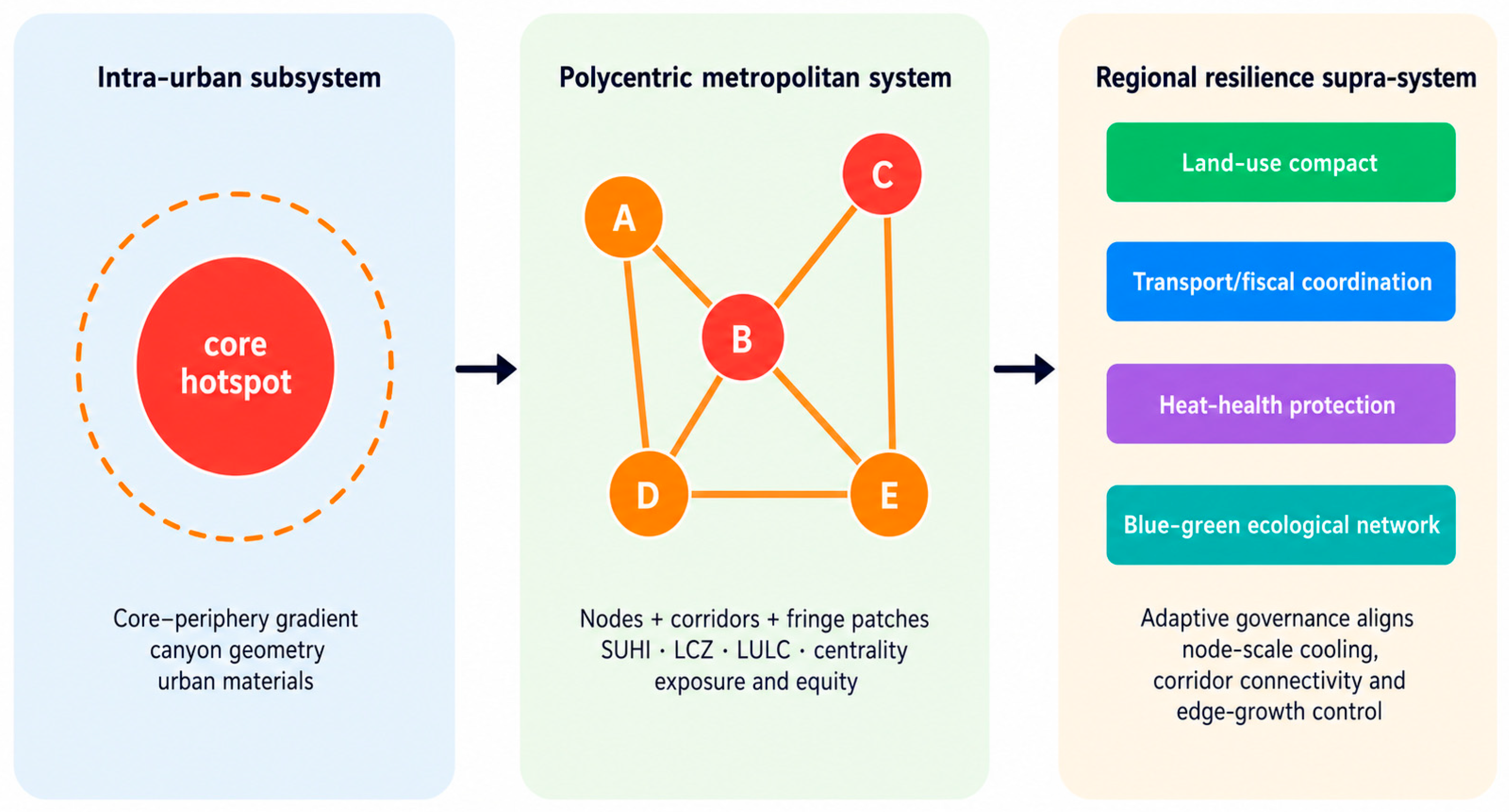
This article therefore defines a network-based perspective as an analytical view that represents metropolitan heat as the outcome of interactions among nodes, links and spatial buffers. Nodes are urban centers, industrial parks, logistics hubs, dense residential clusters or activity centers. Links are transport corridors, commuting flows, industrial chains, infrastructure alignments and ecological corridors. Buffers are peri-urban and edge zones where land conversion can either intensify heat or preserve cooling capacity. This definition makes the term operational: network indicators include node density, centrality, functional hierarchy, corridor connectivity, inter-node distance, landscape fragmentation, SUHI intensity, SUHI footprint, Local Climate Zone (LCZ) composition and population exposure [18]. Figure 1 provides the conceptual framework for the article and helps clarify, both here and in the Discussion, that the network lens is nested within a multiscale systems approach.
The novelty of this review lies in treating polycentric UHI as a problem of institutional and spatial fit. Existing reviews have synthesized UHI impacts, mitigation technologies, heat-wave interactions, green infrastructure and adaptation strategies [19,20,21]. Other recent reviews map interdisciplinary UHI trends and the cooling effects of green or blue infrastructure [22,23]. However, the literature still lacks a focused synthesis of how heat forms and diffuses across interconnected metropolitan nodes, how spatial patterns differ from monocentric gradients, and how cross-jurisdictional governance should respond.
The review is guided by three research questions. First, how has the literature on UHI in polycentric and metropolitan systems developed since 2020? Second, which spatial patterns and mechanisms recur across full-text studies of polycentric UHI? Third, which analytical and governance frameworks can connect surface heat, air-temperature exposure, blue–green infrastructure, social vulnerability and metropolitan coordination? These questions sharpen the initial contribution by moving from a broad claim of novelty to a measurable framework of indicators, analytical dimensions and theoretical implications.
The theoretical contribution is threefold. Conceptually, the article reframes UHI as a nested metropolitan process rather than an either–or choice between local and regional models. Methodologically, it specifies a node–corridor–fringe vocabulary that can be operationalized through remote sensing, LCZ classification, spatial statistics, network analysis and sensor fusion [24,25]. Practically, it links heat mitigation to fiscal, zoning, transport, health and blue–green infrastructure instruments that must be coordinated across jurisdictions [26].

2. Methods

2.1. Research Design

This study uses bibliometric analysis and a systematic review to examine how UHI research in polycentric and mega-urban regions has developed over time. It shows how knowledge in this field has grown and how key ideas have taken shape. The bibliometric component maps research trends, key journals, authors, institutions, and main themes. It shows how the field is structured and where the main focus lies. The systematic review goes further by examining study design, observed heat behavior, methods, and core ideas, providing a closer look at how heat is studied and understood. By bringing these approaches together, this study links broad research patterns with detailed evidence. It helps make sense of findings that are often scattered across different studies on UHI in polycentric regions.

2.2. Data Sources and Search Strategy

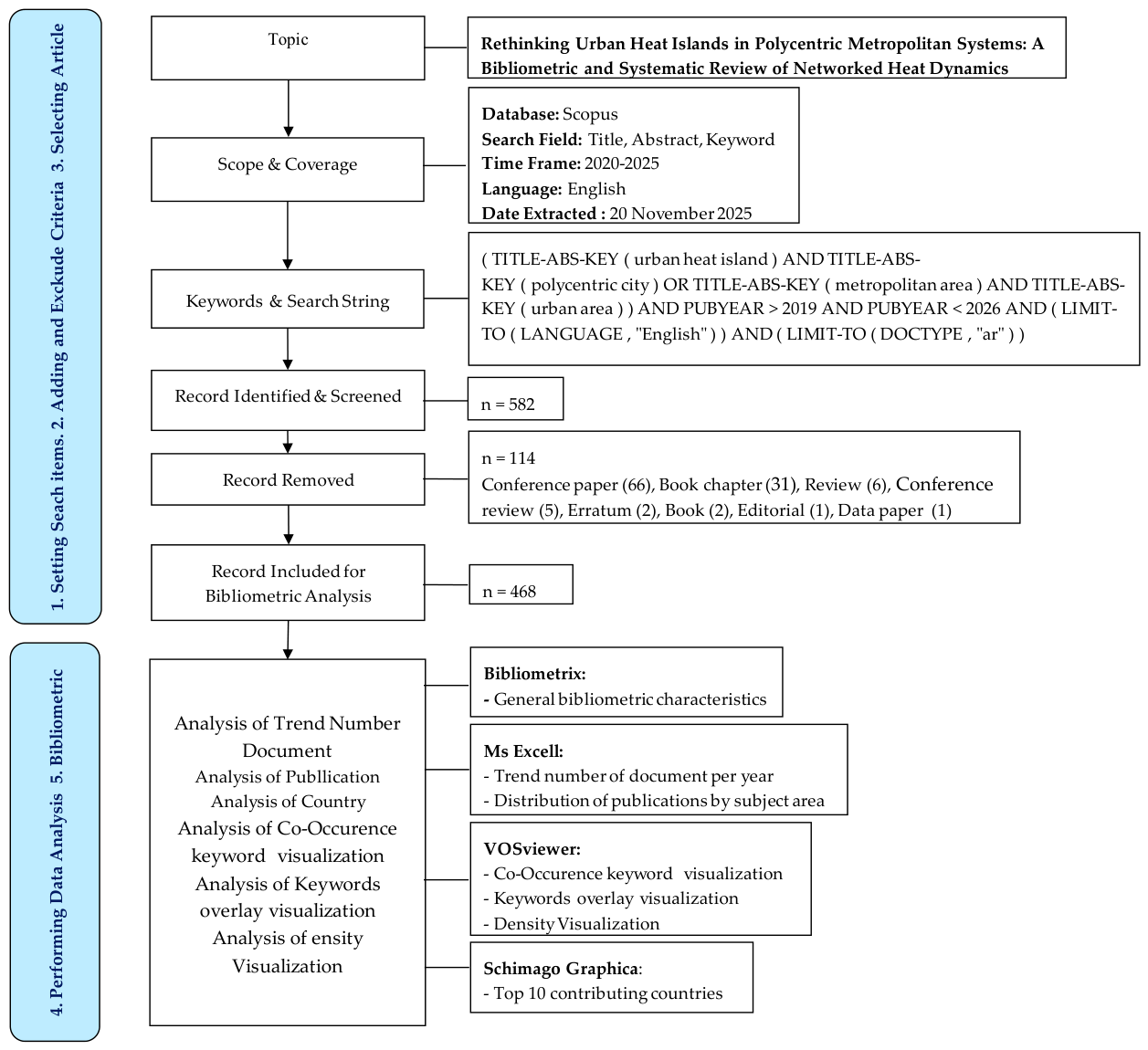
Scopus was the main data source. It covers many peer-reviewed studies in the fields of urban, climate, and spatial research. Its records are consistent and support large-scale review analysis. We designed a search to find studies on Urban Heat Islands (UHI). The focus was on polycentric cities and large urban regions. A targeted search strategy identified studies on Urban Heat Islands (UHI) in polycentric cities, metropolitan regions, and mega-urban systems. Keywords covered urban heat (e.g., “urban heat island”, “UHI”, “surface urban heat island”), spatial structure (e.g., “polycentric”, “metropolitan”, “mega-urban region”), and urban form and governance. Boolean operators and truncation refined the search and improved the accuracy of the results. The search included all available years up to the most recent full year. Figure 2 presents the search scope, keyword structure, time range, and record selection process.

2.3. Bibliometric Analysis

A detailed bibliometric analysis examines the structure and development of this field. It includes coverage of publication trends, citation patterns, subject areas, countries and institutions involved, and keyword co-occurrence networks. These elements help trace the development of research and highlight dominant themes, emerging topics, and shifts in scholarly attention related to Urban Heat Islands in polycentric urban systems. We then used established bibliometric software to map and visualize the data, generating network views that show relationships among keywords and thematic clusters. These visualizations help reveal core research streams and make it easier to identify gaps within the existing literature.

2.4. Systematic Literature Review (SLR) Protocol

This review follows a transparent process based on the PRISMA framework. Clear inclusion and exclusion criteria were defined at the outset to ensure consistent selection. Studies addressing Urban Heat Islands in polycentric cities, large metropolitan areas, or multi-center urban regions were selected. These studies also included empirical analysis, modeling, or conceptual work on heat dynamics across space. Works limited to monocentric settings, with no reference to polycentric structures, was excluded.
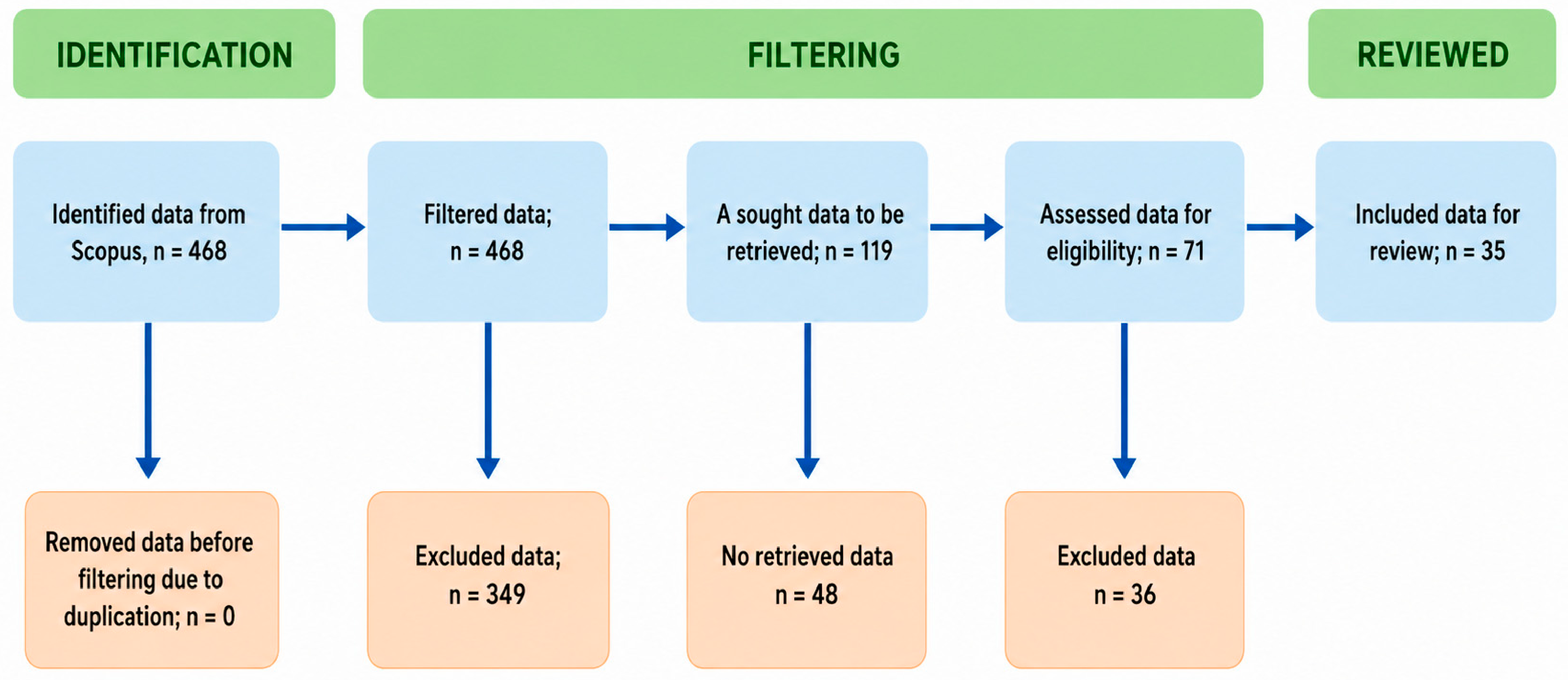
Screening proceeded in stages, beginning with titles and abstracts, followed by full-text assessment to judge relevance. At each stage, records were retained only when they met the predefined criteria: English-language Scopus-indexed articles within the review window that explicitly addressed UHI or SUHI processes in polycentric, metropolitan, or mega-urban settings. Monocentric-only studies, off-topic records, non-article publication types, duplicates, and non-retrieved reports were excluded. Pre-2020 literature was included selectively to provide foundational conceptual, theoretical, and methodological context, but it was not treated as part of the primary screened literature corpus. A final group of studies was retained for qualitative synthesis. The stages of identification, screening, eligibility, and inclusion are outlined in Figure 3. We recorded key details for each study, including location, spatial scale, data sources, methods, and main findings on UHI patterns, processes, and spatial interactions across metropolitan regions.
We recorded key details for each study, including location, spatial scale, data sources, methods, and main findings on UHI patterns, processes, and spatial interactions across metropolitan regions. Bibliometric mapping and network visualization were conducted using VOSviewer, version 1.6.20 (Centre for Science and Technology Studies, Leiden University, Leiden, The Netherlands). Data visualization and graphical refinement were supported using SCImago Graphica, version 1.0.51. Data checking, tabulation, and descriptive summary preparation were performed using Microsoft Excel 2021 (Microsoft Corporation, Redmond, WA, USA).

3. Results

3.1. Knowledge Landscape and Research Trends

The bibliometric analysis is based on 468 publications indexed in Scopus between 2020 and 2025. Key characteristics of the dataset are summarized in Table 1. These publications have accumulated 9535 citations, with an average of 20.37 citations per document and an annual growth rate of 18.09%, indicating a fast-growing, increasingly influential body of work on Urban Heat Islands (UHI) in polycentric cities and mega-urban regions.
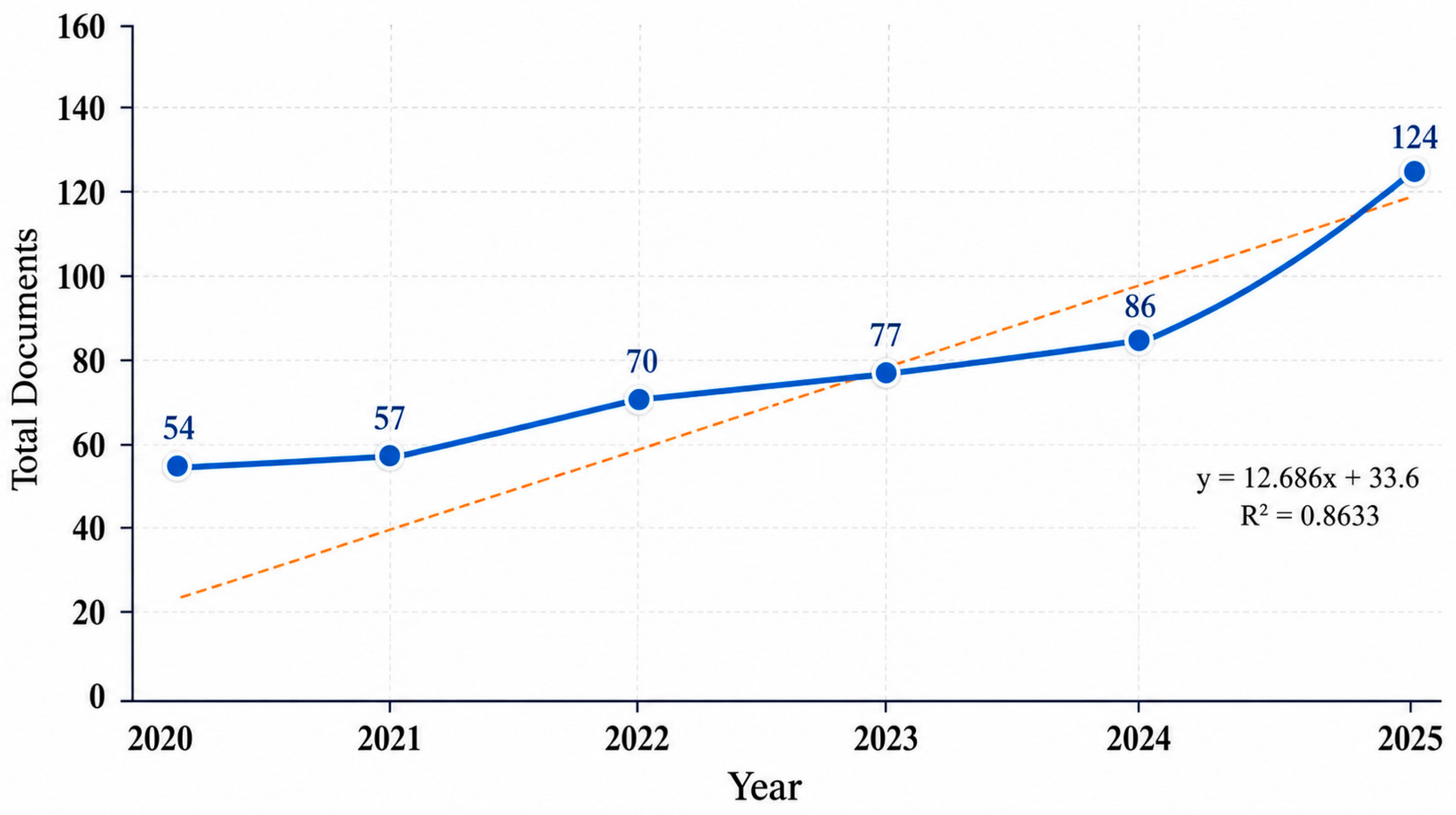
Research on urban heat in polycentric and metropolitan systems increased steadily over the review period. Figure 4 illustrates that the count of publications increased from 54 in 2020 to 124 in 2025. The increased focus on these topics in complex city systems shows a growing interest in the area. The consistent upward trend is the main feature of the growth of research engagement over time.
The distribution among subject areas indicates that this field is interdisciplinary. Environmental Science has the largest share, followed by Social Sciences and Earth and Planetary Sciences (Table 2). Engineering and Energy also contribute, along with smaller but steady input from Computer Science, Medicine, Physics, and Astronomy. Together, these fields show how physical, spatial, technological, and social factors shape research on urban heat.
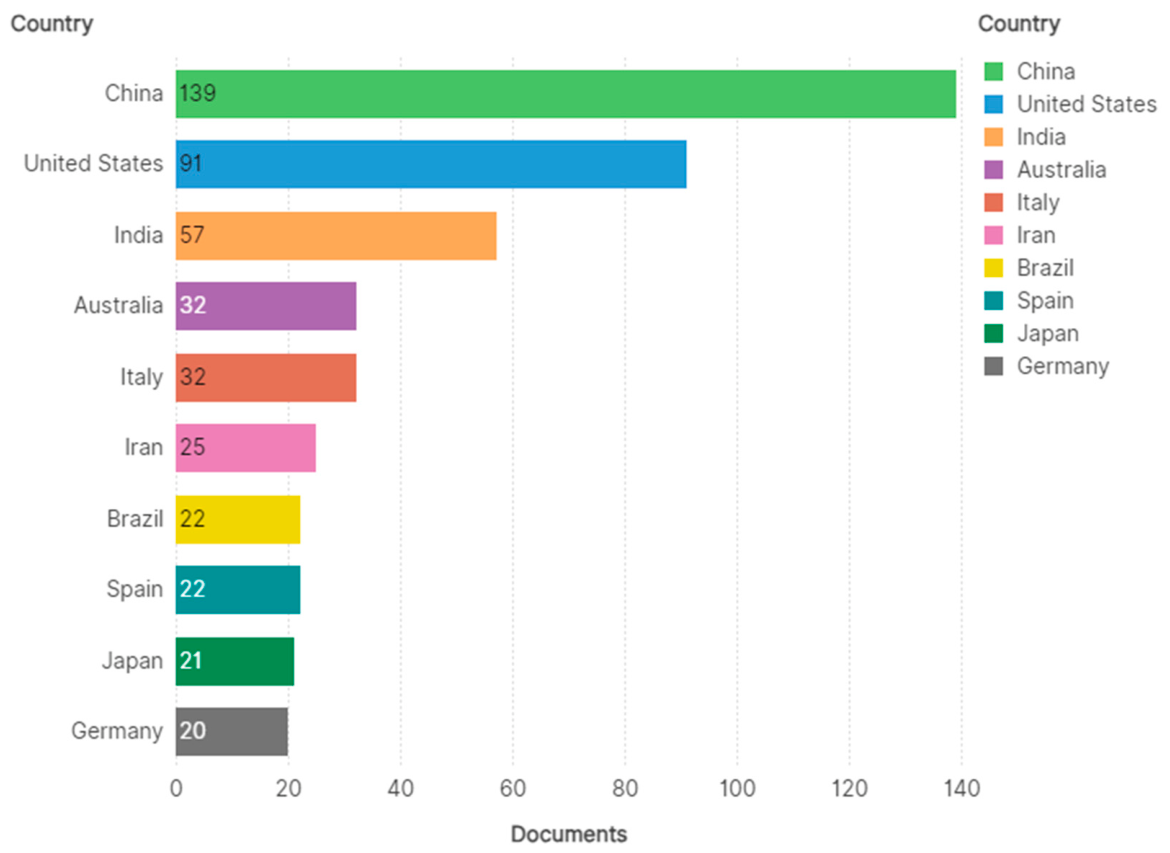
Geographically, research output remains unevenly distributed across countries. Figure 5 shows that China is the leading contributor to the literature, followed by the United States and India, with additional contributions from Australia, Italy, Iran, Brazil, Spain, Japan, and Germany. Studies from China often examine how polycentric or dispersed urban forms can reduce SUHII [28]. In this review, UHI is used as a general term, whereas SUHI denotes satellite-derived land surface temperature indicators.

3.2. Thematic Structure of Polycentric UHI Research

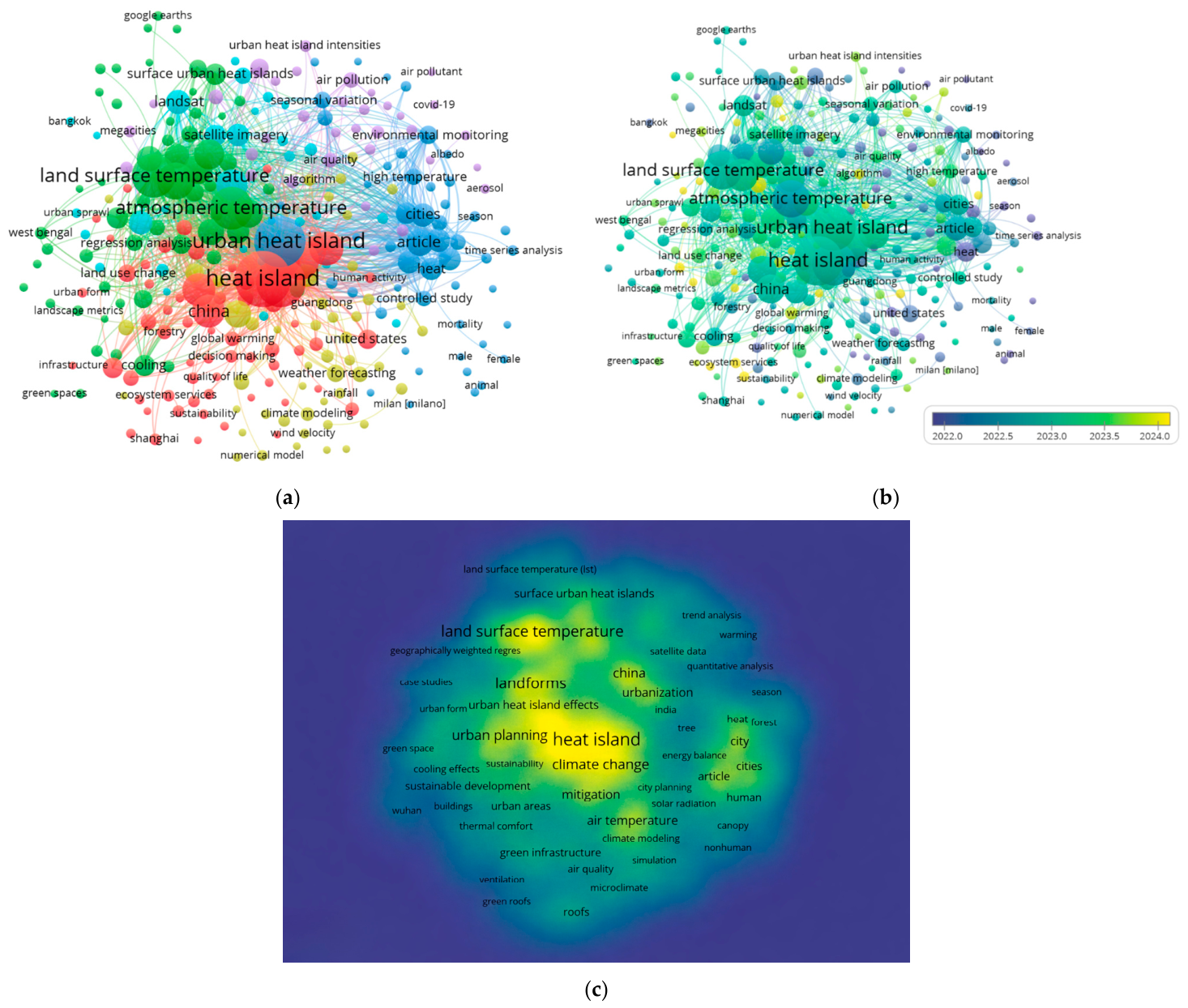
Our analysis uses keyword co-occurrences to develop a unique and transformative knowledge framework deeply rooted in polycentric UHI research. Such a method breaks down the intricate conceptual interdependencies that, while simultaneously defining the field’s current complexity, also signal an effective shift toward new thematic frontiers. The examination provides a profound understanding of the intricate relationships among ideas and themes, highlighting the field’s inherent complexity and its evolution over time. This changing landscape is visually expressed in the network clusters in Figure 6a–c, which describe central themes that point to significant research opportunities and nascent questions through the 2025 horizon.
By mapping mean publication years onto an overlay visualization, the temporal overlay in Figure 6b captures what we describe as the field’s evolutionary momentum. Earlier research mainly focused on land surface temperature retrieval, regression analysis, and evaluations of individual cities. Recent literature decisively highlights critical topics such as polycentricity, metropolitan areas, spatial connections, environmental observation, and climate adaptation. This change suggests a gradual broadening of analytical scope from localized thermal characterization toward more integrative, multi-nodal, and network-oriented perspectives.
What the heat-map clusters in Figure 6c effectively capture—through their density visualization of keyword occurrences—is the current ‘gravitational center’ of the UHI discourse. While it is hardly surprising to see high-density clusters anchored by perennial topics such as land surface temperature and broader urban climatic shifts, the visualization confirms their continued prominence, almost saturating. However, the real story lies in the periphery. We clearly identify moderate-density zones that are directly connected to governance and decision-making. These areas represent emerging research fronts that are gaining momentum and significance. This indicates that, although the field has historically focused on thermal characterization, it is unequivocally shifting towards the socio-political aspects of sustainability. Taken as a whole, the visual evidence in Figure 6a–c reveals a field in transition. Polycentric UHI research is fundamentally anchored in rigorous thermal and spatial analysis, and it is clearly evolving into a broader and more ambitious arena. This transformation transcends mere temperature evaluation; it decisively integrates urban-scale dynamics and governance-related frameworks. This evolution suggests that the field is no longer just about ‘heat,’ but is becoming, at its current frontier, a sustainability-oriented discipline.

3.3. Spatial Patterns of Urban Heat Islands in Polycentric Cities

Single-core or center–periphery models cannot explain thermal dynamics in polycentric metropolitan regions. These frameworks fail to capture how heat emerges from the interactions among urban nodes, transport systems, and continuous spatial growth.
Across 35 studies, three consistent spatial patterns define the structure of urban heat: multi-core hotspots, corridor-based propagation, and peripheral expansion. Together, these patterns show that urban heat operates as a connected system of nodes and corridors rather than isolated zones. The multi-core hotspot pattern replaces the single-center model. Heat spreads across multiple sub-centers shaped by dense built-up land and uneven growth. Heat levels depend on land cover and building density. Spatial scale can merge or split thermal clusters.
Corridor-based propagation follows transport and industrial networks. Heat spreads along major urban routes and links sub-centers. It forms continuous heat paths across the city. This process grows where roads and industry replace vegetation. Cooling space shrinks as green areas decline.
Peripheral expansion occurs in fast-growing urban edges. Land conversion and vegetation loss create new heat zones in peri-urban areas that often merge with existing hotspots and corridor systems. This forms larger and more continuous heat fields. These patterns interact across space and time. Urban heat changes with day–night cycles and seasonal shifts. Scale choice also affects how the heat structure is seen and measured.
A key gap remains in linking spatial patterns to causal processes. Table 3 links each pattern to the corresponding thermal diffusion process. Table 4 shows gaps in scale, time handling, and spatial definition. Another gap is the weak link between the polycentric form and heat equity.

4. Discussion

4.1. Polycentric UHI Is as an Extension of Single-City or Core–Periphery Models

The bibliometric results indicate that research on urban heat in polycentric and metropolitan systems is no longer a marginal extension of conventional UHI studies, but an emerging field with its own analytical trajectory. As shown in Table 1 and Figure 4, the corpus expanded from 54 publications in 2020 to 124 in 2025, with an annual growth rate of 18.09%, suggesting a rapid consolidation of scholarly attention around the metropolitan scale of heat analysis. This growth is accompanied by an increasingly interdisciplinary evidence base (Table 2), led by Environmental Science, Social Sciences, and Earth and Planetary Sciences, with further contributions from Engineering, Energy, Computer Science, and Medicine. Together, these patterns indicate that polycentric UHI is no longer treated only as a thermal or remote-sensing problem, but increasingly as a spatial, infrastructural, and governance issue.
The thematic structure of the literature shown in Figure 6a–c reinforces this interpretation. Earlier work was more strongly oriented toward land surface temperature retrieval, regression-based analysis, and single-city evaluation, whereas more recent research is increasingly associated with polycentricity, metropolitan systems, spatial connectivity, climate adaptation, and governance. This thematic transition supports the core argument of this discussion: UHI in polycentric metropolitan systems must be understood not only through local heat intensity, but also through inter-node relations, corridor effects, and cross-jurisdictional adaptation challenges.
In this discussion, the argument built is that polycentric UHI analysis is not “better” than single-core UHI analysis. The two operate at different levels of system organization. Single-city or core–periphery models explain localized heat gradients, urban canyons, surface materials and neighborhood interventions; polycentric models explain the emergence of several interacting heat nodes; supra-system approaches explain cross-jurisdictional and multi-scalar climate governance and regional resilience. This nested interpretation is the core contribution illustrated in Figure 1 and helps avoid a Type III framing error—that is, applying an otherwise sound analysis to the wrong spatial question because a metropolitan heat problem is reduced to a single-city frame.
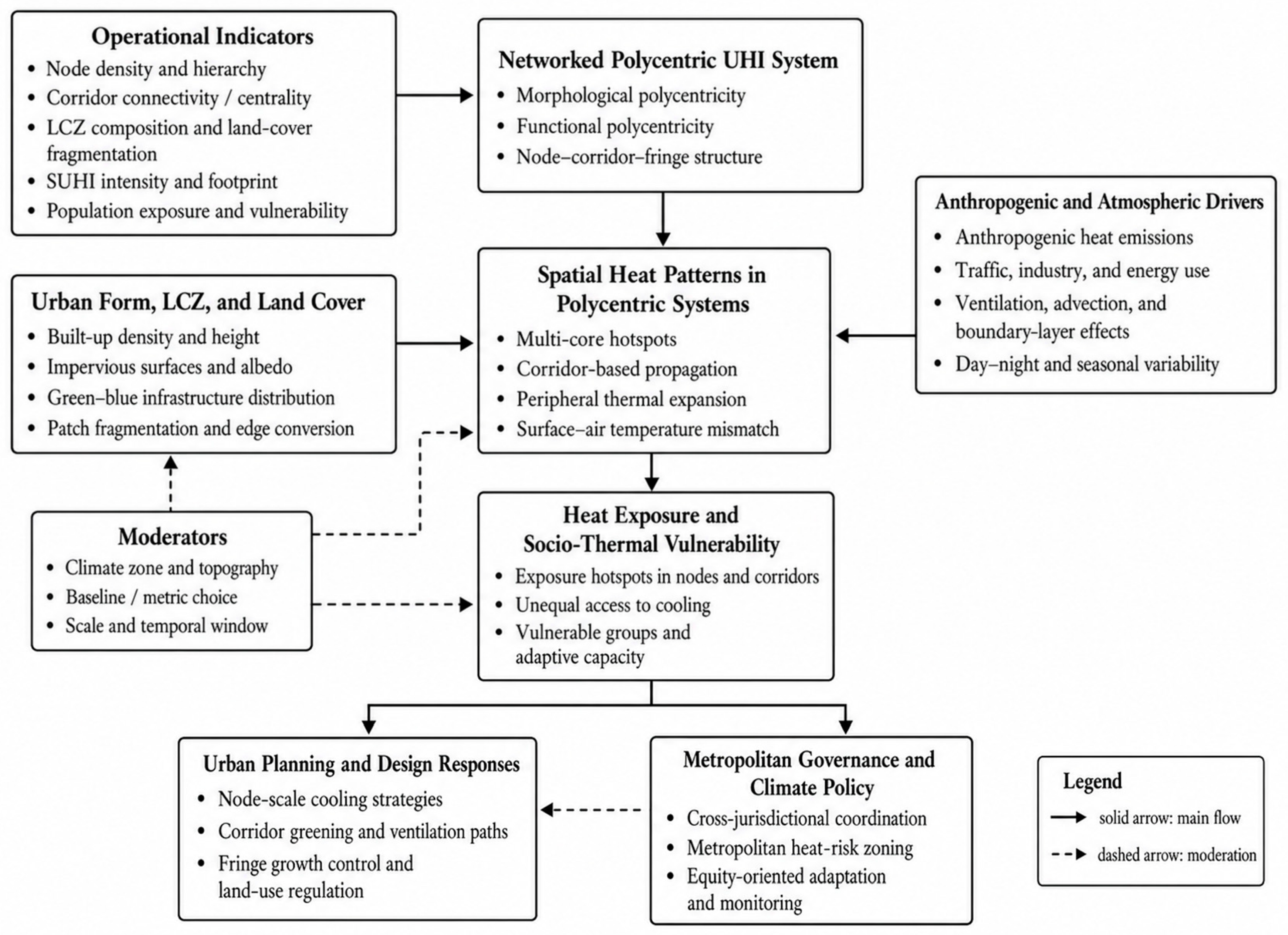
As Figure 7 makes explicit, the network lens adds mechanisms that are invisible to a purely monocentric model: inter-node spillovers, corridor propagation, peripheral expansion, functional heat relocation, and the mismatch between administrative boundaries and thermal pathways. It also improves the connection between urban climate science and resilience theory, where questions of resilience “for whom, what, when, where and why” are essential [58,59].

4.2. Functional Hierarchy Matters: Not Every Sub-Center Produces Heat in the Same Way

This study gives greater emphasis to functional hierarchy. Industrial-heavy cores, logistics hubs, service-oriented centers and residential nodes do not generate the same thermal load. Industrial and logistics corridors tend to combine impervious surfaces, large roofs, waste heat and freight traffic; service centers may concentrate daytime exposure and energy demand; residential nodes may generate nighttime vulnerability when housing quality and cooling access are poor. Evidence from functional polycentricity studies, industrial decentralization and transport-related heat supports this distinction [43,47,60].
This finding has policy importance. A city/region cannot mitigate heat simply by planting trees in the historic core if new heat loads are being exported to industrial peripheries. Conversely, compact polycentric growth may reduce some forms of sprawl but can still intensify exposure if secondary centers lack ventilation, blue–green infrastructure and social protection. The result is a need for differentiated interventions across nodes, corridors and fringes rather than a uniform citywide mitigation package.

4.3. From Local Cooling to Metropolitan Heat Governance

The evidence synthesized in Section 3.3 suggests that local cooling measures must be reconsidered at the metropolitan scale, particularly where heat propagates along corridors and expands through peri-urban conversion. The mitigation literature shows that vegetation, water bodies, cool roofs, reflective surfaces, green roofs and green walls can reduce urban heat under specific conditions [61]. Recent empirical work further shows that tree canopy effects vary with time of day, weather and local imperviousness, while spatial causal inference can estimate the likely effects of vegetation and albedo interventions [62,63,64,65]. These findings are crucial but must be scaled carefully in polycentric regions.
For polycentric metropolitan systems, cooling infrastructure must be planned as a network. Blue–green corridors can interrupt heat propagation along transport and industrial axes, water-sensitive infrastructure can reinforce evaporative cooling, and distributed canopy expansion can reduce exposure in vulnerable nodes [23]. However, green infrastructure is not automatically equitable or effective; its placement must consider social vulnerability, land value, maintenance capacity and access [66].
The policy implication is that UHI governance requires fiscal, regulatory, and multi-scalar coordination across municipal, metropolitan, and regional levels. Useful instruments include metropolitan heat-risk zoning, cross-municipal green-infrastructure funds, corridor greening requirements, cool-roof standards for industrial estates, health-alert interoperability, thermal performance requirements in development permits, and monitoring dashboards that integrate LST, air temperature and exposure. Climate adaptation capacity studies show that governance, institutions and cross-sector planning are central for urban climate management [19,26]. IPCC assessment reports also reinforce the need for adaptation planning that links exposure, vulnerability and risk reduction across scales [67].

4.4. Equity, Geography and Transferability

The review confirms that heat is not only a physical phenomenon but also a distributional problem. Urban heat exposure is shaped by income, race/ethnicity, housing quality, employment location, green-space access and the ability to pay for cooling [68]. Evidence from lower-income neighborhoods and historically disadvantaged urban areas shows why average temperature reductions are insufficient as an evaluation metric [69]. Polycentric regions can reproduce these inequities when peripheral nodes or industrial corridors concentrate vulnerable populations without corresponding cooling infrastructure.
Transferability remains limited by geographical imbalance. China, the United States and India dominate the evidence base, while many tropical, African, Latin American and archipelagic metropolitan regions remain under-studied. This matters because climate zone, coastal proximity, topography, urban materials and governance capacity alter the relationship between urban form and UHI [36,48]. The gap does not invalidate existing evidence, but it narrows the confidence with which it can be generalized.

4.5. Methodological Agenda: Harmonization, Causality and Open Pipelines

The methodological agenda proposed here follows directly from the evidence deficits identified in Table 4, especially those related to temporal inconsistency, scale mismatch, and incomplete integration of exposure metrics. The strongest methodological need is harmonization. Studies vary in urban–rural baselines, temporal windows, satellite sensors, LCZ mapping, spatial units and exposure overlays. Consequently, two studies may describe different heat footprints not because their cities differ, but because their measurement rules differ. Future work should report both intensity and extent, daytime and nighttime metrics, sensor metadata, baseline definitions and uncertainty. It should also integrate satellite data with in situ air-temperature campaigns where possible [63,70].
Causal evidence is still limited. Regression and machine learning identify patterns, but they do not automatically establish whether polycentricity reduces heat, whether greening causes cooling in a specific node, or whether corridor interventions reduce exposure. Spatial quasi-experiments, panel models, counterfactual matching, and natural experiments associated with zoning or infrastructure change should therefore become priorities.

4.6. Planning and Governance Implications for Polycentric Heat Adaptation

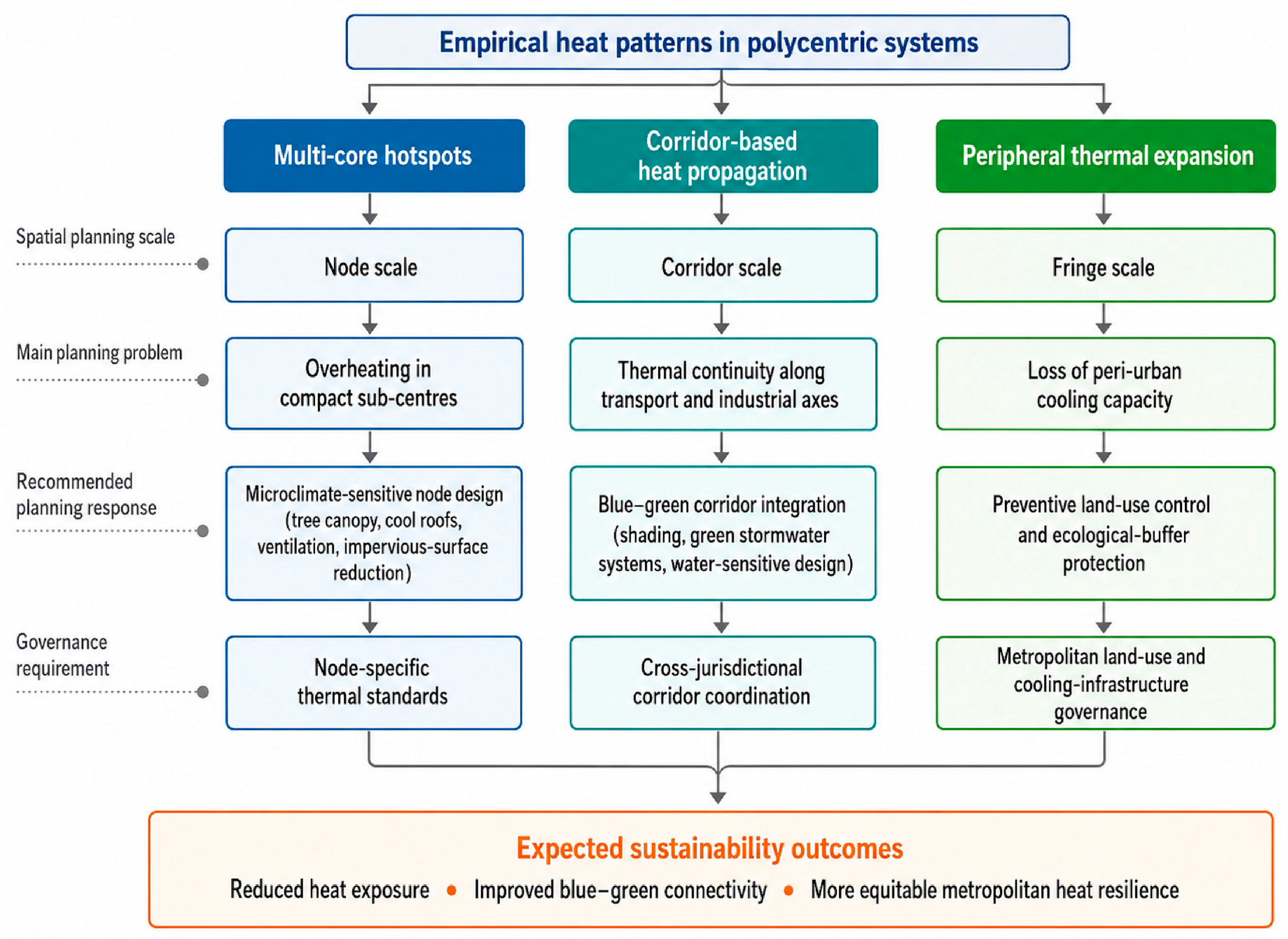
The planning implications become clearer when the three spatial signatures reported in Section 3.3 are translated into a node–corridor–fringe framework for metropolitan heat adaptation (Figure 8). The synthesis developed in this review has direct implications for urban planning and metropolitan governance. If UHI in polycentric metropolitan regions is understood as a networked process rather than as a single thermal anomaly around one dominant urban core, then mitigation cannot be limited to isolated interventions in historic central districts. The evidence reviewed in this article shows that heat is produced, accumulated and redistributed through several spatial mechanisms: dense sub-centers generate multi-core hotspots, transport and industrial axes facilitate corridor-based heat propagation, and peri-urban conversion produces peripheral thermal expansion. These patterns require a planning logic that is spatially differentiated across nodes, corridors and fringes rather than uniformly applied across the metropolitan surface [29,32,60,71]. These relationships are summarized in Table 5, which links the three recurring spatial heat patterns to their main planning challenges, recommended interventions, and governance implications.
At the node scale, compact sub-centers and high-intensity activity clusters require microclimate-sensitive design. Local interventions such as tree-canopy expansion, cool roofs, reflective surfaces, ventilation corridors and reduction of impervious surfaces remain important, but their location should be guided by the functional and morphological role of each node. Industrial-heavy and logistics-oriented centers, for example, may require heat-performance standards for large roofs, freight corridors and paved storage areas, whereas residential nodes require stronger attention to night-time exposure, housing quality and access to cooling infrastructure. This distinction is important because functional polycentricity does not generate heat in the same way across all sub-centers; the thermal outcome depends on land-use intensity, transport activity, building form, vegetation structure and social exposure [43,45,47].
At the corridor scale, the findings suggest that transport, industrial and logistics corridors should be treated as strategic thermal infrastructures. In many polycentric regions, roads, railways and industrial belts do not merely connect economic activities; they also connect impervious surfaces, anthropogenic heat sources and fragmented blue–green spaces. Consequently, corridor planning should incorporate thermal-performance criteria alongside mobility and economic-efficiency criteria. Continuous blue–green infrastructure, shaded pedestrian networks, green stormwater systems and strategically positioned water bodies can help interrupt thermal continuity and reduce the propagation of heat between nodes. This implication is consistent with evidence that the cooling effect of vegetation and water depends not only on their total area, but also on their spatial configuration, connectivity and accessibility [23,72,73,74].
At the fringe scale, peripheral expansion requires proactive land-use control before new heat burdens become structurally embedded. The review shows that peri-urban conversion can weaken edge cooling capacity, transform agricultural or vegetated land into new heat patches, and eventually merge formerly separated hotspots into a wider metropolitan heat network. This means that urban growth boundaries, zoning instruments, ecological-buffer protection, and protection of peri-urban environmental-service functions—including cooling, hydrological buffering, agricultural support, and green-space continuity—should be considered part of UHI mitigation, not merely land-management tools. In rapidly transforming metropolitan regions, heat adaptation should therefore move upstream: from correcting already-formed hotspots to preventing the spatial conditions that produce them [34,38,40].
These planning implications also expose a governance problem. Thermal processes do not follow administrative boundaries, whereas planning authority, budgets, infrastructure provision and public-health responsibilities are often fragmented among municipalities. This spatial–institutional mismatch reduces the effectiveness of local mitigation because one jurisdiction may cool a selected area while adjacent jurisdictions continue to generate heat through unmanaged expansion, industrial concentration or corridor hardening. In polycentric metropolitan systems, UHI governance therefore requires institutions capable of coordinating land-use policy, transport planning, blue–green infrastructure investment, heat-health preparedness and monitoring across jurisdictions and across governance scales [26,59,66].
A network-based adaptation strategy should consequently combine three forms of coordination. First, data coordination is needed to integrate satellite-derived LST, in situ air-temperature observations, LCZ mapping, social vulnerability indicators and infrastructure data into a shared metropolitan heat dashboard. Second, investment coordination is required so that cooling infrastructure is not concentrated only in administratively powerful or high-value districts, but also directed to vulnerable nodes and heat-exposed corridors. Third, regulatory coordination is needed through common standards for corridor greening, industrial-estate heat performance, cool-roof adoption, tree-canopy targets and climate-sensitive development permits. Taken together, these forms of coordination should operate in a multi-scalar manner, linking neighborhood, municipal, metropolitan, and regional action. Without such coordination, polycentric heat mitigation risks reproducing spatial inequality, particularly where peripheral or lower-income communities experience higher exposure but possess weaker adaptive capacity [69,75]. As shown in Table 5, each spatial pattern requires a distinct governance response: node-specific standards for multi-core hotspots, cross-jurisdictional corridor planning for corridor propagation, and metropolitan land-use coordination for peripheral expansion.
Thus, the main policy message of this review is not simply that polycentric regions are hotter or cooler than monocentric regions. Rather, polycentricity changes the spatial logic through which heat is produced and governed. Table 5 reinforces this argument by showing that mitigation priorities differ systematically across nodes, corridors, and fringes. Effective adaptation must therefore recognize where heat is generated, how it travels, who is exposed, and which institutions have the authority to intervene.

5. Future Research Agenda

Future research should move beyond static thermal maps toward linked, multi-scale systems that track how heat is formed, transferred, and experienced across nodes, corridors, and vulnerable populations in polycentric metropolitan regions (see Table 6).

6. Limitations

This review has four limitations. First, the bibliometric corpus is Scopus-based. This improves metadata consistency but may omit important studies indexed only in Web of Science, Dimensions, Google Scholar, local databases or non-English sources. Second, the 2020–2025 period is appropriate for identifying recent work but cannot reconstruct the full intellectual history of UHI theory. Foundational references were therefore retained as contextual literature rather than counted in the screened corpus. Third, the 35-study qualitative synthesis is heterogeneous in methods, sensors, metrics and geographies; meta-analysis would be misleading without standardized baselines. Fourth, the evidence base is geographically uneven, and findings from China, Europe and North America should not be transferred uncritically to tropical, African, Latin American or archipelagic metropolitan regions.
These limitations do not invalidate the synthesis. They indicate that the network-based perspective should be treated as a research framework and planning heuristic that requires further empirical testing. The PRISMA flow chart in Figure 3 and the methodological agenda in Table 6 are intended to make these constraints transparent.

7. Conclusions

This review synthesizes 468 Scopus-indexed records and 35 full-text studies to examine UHI processes in polycentric metropolitan systems. The field is expanding rapidly, with publications increasing from 54 in 2020 to 124 in 2025 and an annual growth rate of 18.09%. The literature is interdisciplinary but geographically concentrated, and the qualitative evidence indicates three recurring spatial patterns: multi-core hotspots, corridor-based heat propagation and peripheral thermal expansion.
The article’s central contribution is not the claim that polycentric UHI models replace single-core UHI models. Rather, it argues that UHI must be interpreted through nested levels of analysis. Single-city or core–periphery models remain essential for explaining heat gradients within individual urban centers; polycentric models explain interactions among nodes and corridors; regional resilience frameworks explain governance, infrastructure and equity across jurisdictions.
For planning practice, the implication is clear: metropolitan heat resilience requires node-scale cooling, corridor-scale connectivity and regional-scale land-use control. Local interventions such as canopy expansion, cool roofs and green stormwater infrastructure remain important, but they must be connected through cross-jurisdictional governance, fiscal coordination, data integration and equity-sensitive monitoring. Urban heat in polycentric regions is therefore not a random by-product of growth; it is a networked outcome of spatial form, functional hierarchy, ecological infrastructure and governance capacity.

Author Contributions

Conceptualization, R., E.R., A.E.P. and D.O.P.; methodology, E.R., A.E.P. and D.O.P.; data curation, R.; writing—original draft preparation, R.; writing—review and editing, R., E.R., A.E.P. and D.O.P.; visualization, R.; supervision, E.R., A.E.P. and D.O.P. All authors have read and agreed to the published version of the manuscript.

Funding

This research received no external funding.

Institutional Review Board Statement

Not applicable.

Informed Consent Statement

Not applicable.

Data Availability Statement

The original contributions presented in this study are included in the article. Further inquiries can be directed to the corresponding author.

Acknowledgments

The authors would like to thank the Last Chapter Corner group for their support and helpful discussions during the preparation of this manuscript.

Conflicts of Interest

The authors declare no conflicts of interest.

Abbreviations

The following abbreviations are used in this manuscript:
UHIUrban Heat Island
SUHISurface Urban Heat Island
SUHIISurface Urban Heat Island Intensity
LSTLand Surface Temperature
LCZLocal Climate Zone
LULCLand Use and Land Cover
NDVINormalized Difference Vegetation Index
NDBINormalized Difference Built-up Index
NDMINormalized Difference Moisture Index
PRISMAPreferred Reporting Items for Systematic Reviews and Meta-Analyses
SLRSystematic Literature Review

References

  1. Winther, L. Editorial–Transformation of Cities. Geogr. Tidsskr.-Dan. J. Geogr. 2015, 115, 67–72. [Google Scholar] [CrossRef]
  2. Yue, W.; Wang, T.; Liu, Y.; Zhang, Q.; Ye, X. Mismatch of Morphological and Functional Polycentricity in Chinese Cities: An Evidence from Land Development and Functional Linkage. Land Use Policy 2019, 88, 104176. [Google Scholar] [CrossRef]
  3. Jatayu, A.; Saizen, I.; Rustiadi, E.; Pribadi, D.O.; Juanda, B. Urban Form Dynamics and Modelling towards Sustainable Hinterland Development in North Cianjur, Jakarta–Bandung Mega-Urban Region. Sustainability 2022, 14, 907. [Google Scholar] [CrossRef]
  4. Pravitasari, A.E.; Indraprahasta, G.S.; Rustiadi, E.; Rosandi, V.B.; Stanny, Y.A.; Wulandari, S.; Priatama, R.A.; Murtadho, A. Dynamics and Predictions of Urban Expansion in Java, Indonesia: Continuity and Change in Mega-Urbanization. ISPRS Int. J. Geo-Inf. 2024, 13, 102. [Google Scholar] [CrossRef]
  5. Wardana, A.P.; Pravitasari, A.E.; Panuju, D.R. Land Use Dynamics and Rural-Urban Transformation of Kedungsepur Metropolitan Area in Central Java Province, Indonesia. J. Pengelolaan Sumberdaya. Alam Dan Lingkung. 2026, 16, 76–89. [Google Scholar] [CrossRef]
  6. Wardana, A.P.; Pravitasari, A.E.; Panuju, D.R. Dynamics of Land Cover, Development Level, and Regional Typology of Central Java Province Based on Sustainable Development Index. IOP Conf. Ser. Earth Environ. Sci. 2023, 1266, 012035. [Google Scholar] [CrossRef]
  7. Rizqullah, M.F.; Rustiadi, E.; Rosandi, V.B.; Pravitasari, A.E. Spatiotemporal Dynamics of Land Cover Changes and Local Sustainability Index of Cianjur Regency, West Java. J. Pengelolaan Sumberdaya. Alam Dan Lingkung. 2025, 15, 844–863. [Google Scholar] [CrossRef]
  8. Saptono, Y.; Rustiadi, E.; Barus, B.; Pravitasari, A.E. Systematic Literature Review: Research Development of Urban Resilience in Metropolitan Areas. Sustainability 2025, 17, 7380. [Google Scholar] [CrossRef]
  9. Pribadi, D.O.; Saifullah, K.; Putra, A.S.; Nurdin, M.; Iman, L.O.S.; Rustiadi, E. Spatial Analysis of COVID-19 Outbreak to Assess the Effectiveness of Social Restriction Policy in Dealing with the Pandemic in Jakarta. Spat. Spatiotemporal. Epidemiol. 2021, 39, 100454. [Google Scholar] [CrossRef] [PubMed]
  10. Rustiadi, E.; Pravitasari, A.E.; Setiawan, Y.; Mulya, S.P.; Pribadi, D.O.; Tsutsumida, N. Impact of Continuous Jakarta Megacity Urban Expansion on the Formation of the Jakarta-Bandung Conurbation over the Rice Farm Regions. Cities 2021, 111, 103000. [Google Scholar] [CrossRef]
  11. Oke, T.R. The Energetic Basis of the Urban Heat Island. Q. J. R. Meteorol. Soc. 1982, 108, 1–24. [Google Scholar] [CrossRef]
  12. Stewart, I.D.; Oke, T.R. Local Climate Zones for Urban Temperature Studies. Bull. Am. Meteorol. Soc. 2012, 93, 1879–1900. [Google Scholar] [CrossRef]
  13. Voogt, J.A.; Oke, T.R. Thermal Remote Sensing of Urban Climates. Remote Sens. Environ. 2003, 86, 370–384. [Google Scholar] [CrossRef]
  14. Jung, S.J.; Yoon, S. Effects of Creating Street Greenery in Urban Pedestrian Roads on Microclimates and Particulate Matter Concentrations. Sustainability 2022, 14, 7887. [Google Scholar] [CrossRef]
  15. Ma, Y.; Li, J.; Wang, J.; Hu, L.; Zhao, M.; Li, J.; Wang, J.; Hu, L. Cooling Effect of Different Land Cover Types: A Case Study in Xi’an and Xianyang, China. Sustainability 2021, 13, 1099. [Google Scholar] [CrossRef]
  16. Oke, T.R.; Mills, G.; Christen, A.; Voogt, J.A. (Eds.) Air Pollution. In Urban Climates; Cambridge University Press: Cambridge, CA, USA, 2017; pp. 294–331. [Google Scholar] [CrossRef][Green Version]
  17. Arnfield, A.J. Two Decades of Urban Climate Research: A Review of Turbulence, Exchanges of Energy and Water, and the Urban Heat Island. Int. J. Climatol. A J. R. Meteorol. Soc. 2003, 23, 1–26. [Google Scholar] [CrossRef]
  18. Newman, M.E.J. The Structure and Function of Complex Networks. SIAM Rev. 2003, 45, 167–256. [Google Scholar] [CrossRef]
  19. Filho, W.L.; Balogun, A.-L.; Ayal, D.Y.; Bethurem, E.M.; Murambadoro, M.; Mambo, J.; Taddese, H.; Tefera, G.W.; Nagy, G.J.; Fudjumdjum, H.; et al. Strengthening Climate Change Adaptation Capacity in Africa- Case Studies from Six Major African Cities and Policy Implications. Environ. Sci. Policy 2018, 86, 29–37. [Google Scholar] [CrossRef]
  20. Almashhour, R.; Kolo, J.; Beheiry, S. Critical Reflections on Strategies for Mitigating and Adapting to Urban Heat Islands. Int. J. Urban Sustain. Dev. 2024, 16, 144–162. [Google Scholar] [CrossRef]
  21. An, S.; Dedekorkut-Howes, A. A Review of Adaptation Strategies to Increased Urban Temperatures and Heat Island Effect. Discov. Cities 2025, 2, 32. [Google Scholar] [CrossRef]
  22. Lian, F.; Yi, W.; Ji, G.; Xia, J.; Wang, H. The Impact of Green Infrastructure on Mitigating Urban Heat Island Effect: Current Status, Trends, and Challenges. Forests 2025, 16, 1450. [Google Scholar] [CrossRef]
  23. Soltanifard, H.; Amani-beni, M. The Cooling Effect of Urban Green Spaces as Nature-Based Solutions for Mitigating Urban Heat: Insights from a Decade-Long Systematic Review. Clim. Risk Manag. 2025, 49, 100731. [Google Scholar] [CrossRef]
  24. Calhoun, Z.D.; Willard, F.; Ge, C.; Rodriguez, C.; Bergin, M.; Carlson, D. Estimating the Effects of Vegetation and Increased Albedo on the Urban Heat Island Effect with Spatial Causal Inference. Sci. Rep. 2024, 14, 540. [Google Scholar] [CrossRef] [PubMed]
  25. Clinton, N.; Gong, P. MODIS Detected Surface Urban Heat Islands and Sinks: Global Locations and Controls. Remote Sens. Environ. 2013, 134, 294–304. [Google Scholar] [CrossRef]
  26. Bulkeley, H. Cities and the Governing of Climate Change. Annu. Rev. Environ. Resour. 2010, 35, 229–253. [Google Scholar] [CrossRef]
  27. Bahara, R.; Nur Aidi, M.; Syamsu, K.; Sunarti, E.; Jayanegara, A.; Tieman, M. Global Research Trends on Halal Food SMEs: A Bibliometric Analysis. J. Islam. Mark. 2025, 16, 2641–2678. [Google Scholar] [CrossRef]
  28. Yue, W.; Liu, X.; Zhou, Y.; Liu, Y. Impacts of Urban Configuration on Urban Heat Island: An Empirical Study in China Mega-Cities. Sci. Total Environ. 2019, 671, 1036–1046. [Google Scholar] [CrossRef]
  29. Li, W.; Schmidt, S.J. Can Spatial Patterns Mitigate the Urban Heat Island Effect? Evidence from German Metropolitan Regions. Environ. Plan. B Urban Anal. City Sci. 2024, 51, 1948–1964. [Google Scholar] [CrossRef]
  30. Du, Y.; Xie, J.; Xie, Z.; Wang, N.; Zhang, L. Spatiotemporal Footprints of Surface Urban Heat Islands in the Urban Agglomeration of Yangtze River Delta During 2000–2022. Remote Sens. 2025, 17, 892. [Google Scholar] [CrossRef]
  31. Wang, H.; Yi, T.; Lu, Y.; Wang, Y.; Wu, J. Patterns of Nighttime Surface Urban Heat Island Patch in Mega Urban Agglomerations: A Case Study in the Pearl River Delta, China. Sustain. Cities Soc. 2025, 128, 106465. [Google Scholar] [CrossRef]
  32. Han, S.; Li, W.; Kwan, M.P.; Miao, C.; Sun, B. Do Polycentric Structures Reduce Surface Urban Heat Island Intensity? Appl. Geogr. 2022, 146, 102766. [Google Scholar] [CrossRef]
  33. Wang, C.; Chen, J.; Wang, Q.; Li, D.; Zhu, M.; Gan, Z.; Qin, M.; Zhang, Y. The Polycentricity of Urban Population Will Lead to Improvements in Urban Heat Island Effect: Evidence from the Yangtze River Delta in China. Sustain. Futur. 2025, 9, 100510. [Google Scholar] [CrossRef]
  34. Varnakovida, P.; Ko, H.Y.K. Urban Expansion and Urban Heat Island Effects on Bangkok Metropolitan Area in the Context of Eastern Economic Corridor. Urban Clim. 2023, 52, 101712. [Google Scholar] [CrossRef]
  35. Wang, R.; Murayama, Y.; Liu, F.; Zhang, X.; Hou, H.; Morimoto, T.; Derdouri, A. Impact of Urban Morphology on Land Surface Temperature: A Case Study of the Central Tokyo, Japan. City Environ. Interact. 2025, 28, 100227. [Google Scholar] [CrossRef]
  36. Gyile, D.N.; Asare, A.; Osei-Gyabaah, A.P.; Anaafo, D. Assessment of Land Use and Land Cover Changes and Their Impact on Land Surface Temperature in Greater Accra, Ghana. Sci. Afr. 2025, 29, e02826. [Google Scholar] [CrossRef]
  37. Kuru, A.; Okay, B.B. Investigating the Relationship between Urban Growth Pattern and Urban Heat Islands: The Case of Istanbul, Turkey. Environ. Earth Sci. 2025, 84, 43. [Google Scholar] [CrossRef]
  38. Han, W.; Tao, Z.; Li, Z.; Cheng, M.; Fan, H.; Cribb, M.; Wang, Q. Effect of Urban Built-Up Area Expansion on the Urban Heat Islands in Different Seasons in 34 Metropolitan Regions across China. Remote Sens. 2023, 15, 284. [Google Scholar] [CrossRef]
  39. Parida, B.R.; Prasad, K.; Swain, S.K.; Dwivedi, C.S.; Pandey, A.C.; Swain, K.C. Evaluating Urban Bioclimatic Comfort in a Metropolitan City Kolkata with Urban Dynamics and Heat Islands. Adv. Space Res. 2025, 76, 3372–3388. [Google Scholar] [CrossRef]
  40. Arshad, S.; Ahmad, S.R.; Abbas, S.; Asharf, A.; Siddiqui, N.A.; ul Islam, Z. Quantifying the Contribution of Diminishing Green Spaces and Urban Sprawl to Urban Heat Island Effect in a Rapidly Urbanizing Metropolitan City of Pakistan. Land Use Policy 2022, 113, 105874. [Google Scholar] [CrossRef]
  41. Tang, L.; Zhan, Q.; Fan, Y.; Liu, H.; Fan, Z. Exploring the Impacts of Greenspace Spatial Patterns on Land Surface Temperature across Different Urban Functional Zones: A Case Study in Wuhan Metropolitan Area, China. Ecol. Indic. 2023, 146, 109787. [Google Scholar] [CrossRef]
  42. Fan, R.; Wu, Y.; Chen, Q.; Wang, Y.; Li, L.; Shi, D.; Xu, R.; Xia, Y.; Cheng, Y. Characterizing Urban Heat Islands in Karst Areas-the Case of Kunming and Guiyang in Southwest China. Front. Built Environ. 2024, 10, 1457295. [Google Scholar] [CrossRef]
  43. Zhang, M.; Huang, L.; Jiang, W.; Fan, M.; Dai, W.; Han, W.; Xu, Q.; Dong, Y. Urban Core Greening and Industrial Decentralization Lead to Contrasting Trends in Surface Urban Heat Islands in a Metropolitan Area in China. J. Environ. Manag. 2025, 374, 124045. [Google Scholar] [CrossRef]
  44. Rajagopal, P.; Shanthi Priya, R.; Sudha, G. Spatial Characteristics of Urban Heat Islands: Land Use-Based Assessment Using Chennai’s Second Master Plan. Environ. Sustain. Indic. 2025, 28, 100900. [Google Scholar] [CrossRef]
  45. Wai, C.Y.; Tariq, M.A.U.R.; Muttil, N.; Chau, H.-W. Assessing Socio-Economic Vulnerabilities to Urban Heat: Correlations with Land Use and Urban Morphology in Melbourne, Australia. Land 2025, 14, 958. [Google Scholar] [CrossRef]
  46. Zhang, H.; Wang, C.; Yang, H.; Ma, Z. How Do Morphology Factors Affect Urban Heat Island Intensity? An Approach of Local Climate Zones in a Fast-Growing Small City, Yangling, China. Ecol. Indic. 2024, 161, 111972. [Google Scholar] [CrossRef]
  47. Su, H.; Han, G.; Li, L.; Qin, H. The Impact of Macro-Scale Urban Form on Land Surface Temperature: An Empirical Study Based on Climate Zone, Urban Size and Industrial Structure in China. Sustain. Cities Soc. 2021, 74, 103217. [Google Scholar] [CrossRef]
  48. Terfa, B.K.; Chen, N.; Zhang, X.; Niyogi, D. Spatial Configuration and Extent Explains the Urban Heat Mitigation Potential Due to Green Spaces: Analysis over Addis Ababa, Ethiopia. Remote Sens. 2020, 12, 2876. [Google Scholar] [CrossRef]
  49. Nath, B.; Ni-Meister, W.; Özdoğan, M. Fine-Scale Urban Heat Patterns in New York City Measured by ASTER Satellite—The Role of Complex Spatial Structures. Remote Sens. 2021, 13, 3797. [Google Scholar] [CrossRef]
  50. Lu, L.; Fu, P.; Dewan, A.; Li, Q. Contrasting Determinants of Land Surface Temperature in Three Megacities: Implications to Cool Tropical Metropolitan Regions. Sustain. Cities Soc. 2023, 92, 104505. [Google Scholar] [CrossRef]
  51. El Kenawy, A.M.; Hereher, M.; Robaa, S.M.; McCabe, M.F.; Lopez-Moreno, J.I.; Domínguez-Castro, F.; Gaber, I.M.; Al-Awadhi, T.; Al-Buloshi, A.; Al Nasiri, N.; et al. Nocturnal Surface Urban Heat Island over Greater Cairo: Spatial Morphology, Temporal Trends and Links to Land-Atmosphere Influences. Remote Sens. 2020, 12, 3889. [Google Scholar] [CrossRef]
  52. Rahimi, D.; Kii, M.; Shimadera, H.; Causone, F. Exploring Seasonal and Diurnal Variations of the Thermal Environment in Metropolitan Scale Analysis Based on Remote Sensing Data. Remote Sens. 2025, 17, 1210. [Google Scholar] [CrossRef]
  53. Renc, A.; Łupikasza, E.B. Permanent and Seasonally Specific Surface Heat Island Structure in Urban and Non-Urban Areas in Mid-Latitude Polycentric Agglomeration Based on Landsat Images. Ecol. Indic. 2024, 169, 112871. [Google Scholar] [CrossRef]
  54. Renc, A.; Łupikasza, E.B. Changes in the Surface Urban Heat Island between 1986 and 2021 in the Polycentric Górnośląsko-Zagłębiowska Metropolis, Southern Poland. Build. Environ. 2024, 247, 110997. [Google Scholar] [CrossRef]
  55. Liu, H.; Huang, B.; Zhan, Q.; Gao, S.; Li, R.; Fan, Z. The Influence of Urban Form on Surface Urban Heat Island and Its Planning Implications: Evidence from 1288 Urban Clusters in China. Sustain. Cities Soc. 2021, 71, 102987. [Google Scholar] [CrossRef]
  56. Liu, T.; Li, Y. Green Development of China’s Pan-Pearl River Delta Mega-Urban Agglomeration. Sci. Rep. 2021, 11, 15717. [Google Scholar] [CrossRef]
  57. Li, Z.; Wang, X.; Zhao, H.; Xu, X. Spatiotemporal Patterns of the Evolution of the Urban Heat Island Effect and Population Heat Exposure Risks in Xi’an, One of China’s Megacities, from 2003 to 2023. Land 2025, 14, 2021. [Google Scholar] [CrossRef]
  58. Folke, C. Resilience: The Emergence of a Perspective for Social–Ecological Systems Analyses. Glob. Environ. Change 2006, 16, 253–267. [Google Scholar] [CrossRef]
  59. Meerow, S.; Newell, J.P.; Stults, M. Defining Urban Resilience: A Review. Landsc. Urban Plan. 2016, 147, 38–49. [Google Scholar] [CrossRef]
  60. Wu, H.; Ming, Y.; Liu, Y. Investigating the Influence of Morphologic and Functional Polycentric Structures on Urban Heat Island: A Case of Chongqing, China. Sustain. Cities Soc. 2024, 114, 105790. [Google Scholar] [CrossRef]
  61. Santamouris, M. Analyzing the Heat Island Magnitude and Characteristics in One Hundred Asian and Australian Cities and Regions. Sci. Total Environ. 2015, 512–513, 582–598. [Google Scholar] [CrossRef] [PubMed]
  62. Locke, D.H.; Baker, M.; Alonzo, M.; Yang, Y.; Ziter, D.; Murphy-Dunning, C.; Neil-dunne, J.P.M.O.; Ziter, C.D.; Murphy-Dunning, C.; O’Neil-Dunne, J.P.M. Variation the in Relationship between Urban Tree Canopy and Air Temperature Reduction under a Range of Daily Weather Conditions. Heliyon 2024, 10, e25041. [Google Scholar] [CrossRef]
  63. Su, Y.; Makowski, D.; Zhang, X.; Liu, S.; Yu, K.; Xu, Y.; Chen, H.; Deng, S.; Shi, T.; Zhou, C.; et al. A Remote Sensing-Based Assessment of the Cooling Effects of Urban Trees in European Cities. npj Urban Sustain. 2026, 1–26. [Google Scholar] [CrossRef]
  64. Ziter, C.D.; Pedersen, E.J.; Kucharik, C.J.; Turner, M.G. Scale-Dependent Interactions between Tree Canopy Cover and Impervious Surfaces Reduce Daytime Urban Heat during Summer. Proc. Natl. Acad. Sci. USA 2019, 116, 7575–7580. [Google Scholar] [CrossRef] [PubMed]
  65. Schinko, T.; Karabaczek, V.; Menk, L.; Kienberger, S. Identifying Constraints and Limits to Climate Change Adaptation in Austria under Deep Uncertainty. Front. Clim. 2024, 6, 1303767. [Google Scholar] [CrossRef]
  66. Meerow, S.; Newell, J.P. Spatial Planning for Multifunctional Green Infrastructure: Growing Resilience in Detroit. Landsc. Urban Plan. 2017, 159, 62–75. [Google Scholar] [CrossRef]
  67. IPCC Climate Change 2022: Impacts, Adaptation and Vulnerability; Cambridge University Press: Cambridge, UK; New York, NY, USA, 2022. [CrossRef]
  68. Hsu, A.; Sheriff, G.; Chakraborty, T.; Manya, D. Disproportionate Exposure to Urban Heat Island Intensity across Major US Cities. Nat. Commun. 2021, 12, 2721. [Google Scholar] [CrossRef] [PubMed]
  69. Chakraborty, T.; Hsu, A.; Manya, D.; Sheriff, G. Disproportionately Higher Exposure to Urban Heat in Lower-Income Neighborhoods: A Multi-City Perspective. Environ. Res. Lett. 2019, 14, 105003. [Google Scholar] [CrossRef]
  70. Puche, M.; Vavassori, A.; Brovelli, M.A. Insights into the Effect of Urban Morphology and Land Cover on Land Surface and Air Temperatures in the Metropolitan City of Milan (Italy) Using Satellite Imagery and In Situ Measurements. Remote Sens. 2023, 15, 733. [Google Scholar] [CrossRef]
  71. Tang, L.; Kasimu, A.; Ma, H.; Eziz, M. Monitoring Multi-Scale Ecological Change and Its Potential Drivers in the Economic Zone of the Tianshan Mountains’ Northern Slopes, Xinjiang, China. J. Environ. Res. Public Health 2023, 20, 2844. [Google Scholar] [CrossRef]
  72. Gunawardena, K.R.; Wells, M.J.; Kershaw, T. Utilising Green and Bluespace to Mitigate Urban Heat Island Intensity. Sci. Total Environ. 2017, 584–585, 1040–1055. [Google Scholar] [CrossRef]
  73. Norton, B.A.; Coutts, A.M.; Livesley, S.J.; Harris, R.J.; Hunter, A.M.; Williams, N.S.G. Planning for Cooler Cities: A Framework to Prioritise Green Infrastructure to Mitigate High Temperatures in Urban Landscapes. Landsc. Urban Plan. 2015, 134, 127–138. [Google Scholar] [CrossRef]
  74. Xu, H.; Sheng, K.; Gao, J. Mitigation of Heat Island Effect by Green Stormwater Infrastructure: A Comparative Study between Two Diverse Green Spaces in Nanjing. Front. Ecol. Evol. 2023, 11, 1307756. [Google Scholar] [CrossRef]
  75. Hoffman, J.S.; Shandas, V.; Pendleton, N. The Effects of Historical Housing Policies on Resident Urban Exposure to Intra-Urban Heat: A Study of 108 US Urban Areas. Climate 2020, 8, 12. [Google Scholar] [CrossRef]
  76. Danzig, T.B.; Pal, S.; Medley, Z.; Dhaliwal, H.; Hamel, M.; Sorensen, M.; Das, D.; Menon, K.V.; Lee, T.R.; Conder, M. Impact of Advection on the Urban Heat of a Small-Sized City: The Urban Heat Island Experiment Around Lubbock, Texas (U-HEAT). Urban Clim. 2025, 64, 102714. [Google Scholar] [CrossRef]
  77. Joshi, K.; Khan, A.; Anand, P.; Sen, J. Understanding the Synergy between Heat Waves and the Built Environment: A Three-Decade Systematic Review Informing Policies for Mitigating Urban Heat Island in Cities. Sustain. Earth Rev. 2024, 7, 25. [Google Scholar] [CrossRef]
  78. Aria, M.; Cuccurullo, C. Bibliometrix: An R-Tool for Comprehensive Science Mapping Analysis. J. Informetr. 2017, 11, 959–975. [Google Scholar] [CrossRef]
  79. Page, M.J.; McKenzie, J.E.; Bossuyt, P.M.; Boutron, I.; Hoffmann, T.C.; Mulrow, C.D.; Shamseer, L.; Tetzlaff, J.M.; Akl, E.A.; Brennan, S.E. The PRISMA 2020 Statement: An Updated Guideline for Reporting Systematic Reviews. BMJ 2021, 372, n71. [Google Scholar] [CrossRef] [PubMed]
  80. Donthu, N.; Kumar, S.; Mukherjee, D.; Pandey, N.; Lim, W.-W. How to Conduct a Bibliometric Analysis: An Overview and Guidelines. J. Bus. Res. 2021, 133, 285–296. [Google Scholar] [CrossRef]
Figure 1. Network-based perspective for polycentric UHI analysis. The framework positions urban heat in polycentric regions as a network process across metropolitan areas and extends rather than replaces conventional single-city or core–periphery UHI models.
Sustainability 18 05707 g001
Figure 2. Overview of the bibliometric data collection and search strategy. The figure shows the study scope, the use of the Scopus database, the search fields (title, abstract, and keywords), and the time range. It also shows the number of records found, excluded documents, and the final dataset used for analysis. Source: adapted from Bahara [27].
Sustainability 18 05707 g002
Figure 3. PRISMA-based flow diagram of the systematic literature review process. The diagram illustrates the sequential phases of identification, screening, eligibility assessment, and inclusion, specifying the number of records that underwent screening, were excluded, were not retrieved, and were included in the final selection of studies for the qualitative synthesis. This process ensures a transparent and replicable selection of studies on Urban Heat Islands in polycentric cities and mega-urban regions. Off-topic studies or those not meeting the predefined publication-type criteria were excluded. After carefully reviewing and assessing the eligibility of the full texts, we found that 35 studies not only met our inclusion criteria but also significantly contributed to the overall findings of the Systematic Literature Review.
Sustainability 18 05707 g003
Figure 4. Annual growth of publications on Urban Heat Island research in polycentric cities and mega-urban regions (2020–2025).
Sustainability 18 05707 g004
Figure 5. Top 10 contributing countries in Urban Heat Island research on polycentric cities and mega-urban regions.
Sustainability 18 05707 g005
Figure 6. Thematic structure of Urban Heat Island research in polycentric cities based on keyword co-occurrence analysis: (a) network visualization of keyword co-occurrence clusters, illustrating the main thematic groupings in the literature; (b) overlay visualization showing the temporal evolution of research themes based on average publication year; (c) density visualization highlighting the most intensively studied topics and high-frequency keywords during the period 2020–2025.
Sustainability 18 05707 g006
Figure 7. Extended conceptual framework for networked polycentric UHI systems. The figure synthesizes how operational indicators, urban form, anthropogenic and atmospheric drivers, moderators, spatial heat patterns, exposure, planning responses, and metropolitan climate governance interact across a node–corridor–fringe structure.
Sustainability 18 05707 g007
Figure 8. Node–corridor–fringe planning framework for polycentric heat adaptation. The framework translates the three recurring spatial signatures identified in this review—multi-core hotspots, corridor-based heat propagation, and peripheral thermal expansion—into planning and governance responses. At the node scale, compact sub-centers require microclimate-sensitive design and thermal-performance standards. At the corridor scale, transport and industrial axes require continuous blue–green infrastructure and cross-jurisdictional, multi-scalar coordination. At the fringe scale, peri-urban expansion requires preventive land-use control, ecological-buffer protection, and protection of peri-urban environmental-service functions. The framework shows that heat mitigation in polycentric metropolitan regions should operate as an integrated governance system rather than as isolated cooling interventions.
Sustainability 18 05707 g008
Table 1. General bibliometric characteristics of the reviewed publications (2020–2025).
IndicatorValue
Time span2020–2025
Total publications468
Total citations9535
Average citations per document20.37
Annual growth rate18.09%
Number of journals/sources190
Number of authors2026
Countries involved67
Table 2. Distribution of publications by subject area in Urban Heat Island research.
Subject AreaPercentage (%)Number of Documents
Environmental Science27.30128
Social Sciences19.7092
Earth and Planetary Sciences18.6087
Engineering9.5044
Energy6.0028
Agricultural and Biological Sciences5.4025
Computer Science2.6012
Medicine1.407
Multidisciplinary1.407
Physics and Astronomy1.206
Other6.9032
Total100.00468
Table 3. Synthesis of emergence and diffusion processes of Urban Heat Islands in polycentric cities.
Process in a Polycentric ContextEmergence
(Spatial Signatures)
Diffusion PathwaysKey Moderators
Formation of multiple thermal cores, often forming a multi-core configuration.Hotspots emerge as multi-core or mosaic patch fields aligned with multiple sub-centers and compact urban fabrics [29,30,31].New hotspots co-emerge around growing sub-centers, increasing patch density, and reinforcing polycentric hotspot fields [31,32,33].Analytical scale, degree of functional concentration, and landscape fragmentation [29,32,33].
Sub-center-driven growth modes (edge, infill, enclave, sprawl)Hotspot patches form in new developments, peri-urban edges, and infill zones with increasing impervious surfaces and reduced vegetation [34,35].Heat footprints expand through edge-/infill-type patch expansion, with occasional enclave/leapfrog development, and increasing connectivity of impervious surfaces [31,36,37].Urban expansion rate, land conversion intensity, and policy control over sprawl [34,38,39,40].
Function-specific heat loading (industrial decentralization, zoning, transport)Hotspots concentrate in industrial parks/development zones and functionally specialized areas within or near sub-centers [41,42,43]. Industrial decentralization-driven suburbanization shifts SUHI burdens from the urban core toward urban expansion/peripheral areas, increasing the connectivity of impervious surfaces [39,43,44].Industrial structure, planning regulation, and distribution and accessibility of blue–green infrastructure [34,45].
Within-subcenter morphology and land-cover compositionCompact LCZs, high building volume, and high imperviousness generate persistent micro-hotspots, while trees and water bodies form localized cool islands [35,46,47,48]. Without structural change, hotspots remain spatially persistent; mitigation is commonly discussed via greening/blue–green infrastructure, high-albedo/cool-roof measures, and ventilation/shading strategies [35,47,49] Three-dimensional urban form, local climate, and greenspace configuration thresholds [35,48,50].
Temporal modulation (diurnal and seasonal cycles)Nighttime SUHI patterns are often more coherent, while seasonal peaks, typically in summer, amplify hotspot contrast [38,51,52].Long-term trends may show declining intensity but expanding spatial extent, with seasonal footprints shifting according to atmospheric and vegetation dynamics [30,51,53] Climate zone, sensor acquisition timing, and vegetation phenology [38,52,53].
Measurement and baseline definition effectsUrban–rural dichotomies and inconsistent thresholds modify perceived SUHI extent and the apparent number of heat cores [30,54].Apparent expansion or fragmentation may partially reflect methodological artifacts rather than physical heat redistribution [30].Definition of “urban,” rural reference selection, and multi-sensor harmonization [30,54].
Table 4. Empirical gaps in the literature on Urban Heat Islands in polycentric urban systems and recommended research agendas.
Empirical Gap (Evidence Deficit)What Is Currently Known from the 35 Reviewed StudiesImplications for Interpreting Polycentric UHIRecommended Empirical Research Agenda
Uneven representativeness across climate zones and polycentric typologiesUrban form–LST/SUHI relationships vary across climate zones and industrial contexts, indicating that “polycentric effects” are conditional rather than universal [47,55]. Evidence of UHI reduction associated with explicitly measured polycentricity exists but is not consistent across cases [32,33].Policy conclusions derived from limited climatic or structural contexts risk being non-portable across regions with different climates and economic bases [32,47]. Conduct cross-climate comparative studies using harmonized definitions of polycentricity (population, function, and morphology-based) while controlling for industrial structure and urbanization stage [32,33,55].
Inconsistent treatment of diurnal–seasonal dynamics and intensity–footprint decouplingHeat patterns differ substantially between daytime and nighttime and across seasons, altering the apparent configuration of hotspots [38,52]. In some regions, UHI intensity decreases while spatial extent expands, indicating decoupled dynamics [51,54].Analyses based on a single temporal regime may misinterpret multi-core or corridor-based patterns due to sensor timing or vegetation phenology [38,52].Develop multi-season and day–night panel analyses reporting dual outcomes (intensity and footprint) to test the temporal stability of multi-core structures [38,51,54].
Limited evidence on dynamic polycentricity and structural transitionsSome studies explicitly measure polycentricity and report reduced UHI and spillover effects [32,33], but many studies operate in polycentric contexts without tracking changes in polycentricity over time [31,55].Without longitudinal evidence, it is difficult to distinguish whether multi-hotspot patterns result from functional polycentric maturation or from morphologically multi-centered dispersed sprawl [31,34].Build longitudinal panels tracking sub-center evolution (population and function) and linking these trajectories to changes in hotspot fields using consistent baselines [30,32,33].
Persistent scale mismatch between evidence and mechanismsMany analyses rely on metropolitan averages, while hotspot formation and thermal mechanisms operate at patch or neighborhood scales [31,47]. LST variation is strongly influenced by 2D/3D morphology, ventilation, and land-cover configuration [49].Aggregated metrics may obscure dominant heat-driving nodes, leading to policy evaluations that fail to identify the sub-center responsible for disproportionate heat exposure [45,49]. Apply multi-scale frameworks that link macro-level polycentricity indices with node delineation (LCZs, sub-center) and patch-level thermal metrics to test causal pathways across scales [31,56].
Partial integration of human exposure, vulnerability, and blue–green infrastructure accessHeat vulnerability correlates with NDVI, moisture availability, and unequal access to green space, producing uneven thermal risk within metropolitan regions [45]. Population exposure may increase with long-term UHI intensification even when average intensity stabilizes [45,57].Policy success cannot be evaluated solely through average intensity reduction, as spatial equity across nodes and social groups may deteriorate [45,51].Integrate UHI metrics (intensity and footprint) with population exposure and blue–green infrastructure accessibility across sub-centers to assess trade-offs among intensity, spatial extent, and equity [41,45,57].
Table 5. Spatial heat patterns, planning challenges, and governance responses in polycentric metropolitan systems. The table presents the relationship between urban heat spatial patterns, key planning issues, mitigation strategies, and governance implications for climate-responsive urban development.
Spatial PatternMain Planning IssueRecommended InterventionGovernance Implication
Multi-core hotspotsOverheating in dense sub-centersTree-canopy expansion, cool roofs, ventilation corridors, and impervious-surface reductionNode-specific thermal-performance standards
Corridor propagationHeat propagation along transport and industrial corridorsCorridor greening, shaded mobility, blue–green continuityCross-jurisdiction and multi-scalar corridor planning
Peripheral expansionLoss of peri-urban cooling capacityGrowth control, ecological buffers, protection of peri-urban environmental-service functionsMetropolitan land-use and multi-scalar coordination
Table 6. Structured future research agenda for network-based UHI studies in polycentric metropolitan systems.
PriorityResearch Agenda Rationale Recommended
Designs
Minimum
Reporting
References
P1Standardize polycentricity as a multidimensional construct.Definitions of polycentricity vary across morphology, population and function.Multidimensional indices, sensitivity tests, explicit node delineation.Node boundaries, activity data, LULC, LCZ, polycentricity metrics.[29,32,47,60]
P2Report both UHI intensity and footprint.Intensity and spatial extent do not always evolve together.Multi-season and day–night panels; baseline sensitivity tests.LST/SUHI, urban/rural baseline, thresholds, acquisition time.[30,38,51,54]
P3Connect macro polycentric structure to micro-scale exposure.Metropolitan averages obscure hotspot nodes and vulnerable neighborhoods.Hierarchical models, LCZ mapping, population exposure overlays.LCZ, 3D morphology, census/exposure data, green access.[45,46,57]
P4Model corridor heat propagation and advection.Transport and industrial corridors can connect hotspots across nodes.Network buffers, wind-aware models, corridor before–after analysis.Transport centrality, industrial zones, wind data, corridor LST/air temperature.[41,43,76]
P5Evaluate blue–green infrastructure as a connected thermal network.Cooling depends on configuration, connectivity and maintenance capacity.Quasi-experimental matching, landscape connectivity, access analysis.NDVI/NDMI, canopy, water bodies, patch connectivity, maintenance context.[23,64,72,74]
P6Triangulate surface heat with air temperature and thermal comfort.LST does not directly equal human heat stress.Mobile sensors, fixed stations, UTCI/HI modeling, satellite integration.Sensor placement, temporal window, air temperature, comfort indices.[13,62,70,77]
P7Expand evidence in tropical and Global South metropolitan regions.Evidence is geographically concentrated and climate-dependent.Paired climate-zone cases; multi-city comparative studies.Climate classification, topography, coastality, governance context.[19,36,48,50]
P8Assess equity and policy outcomes, not only thermal averages.Heat reduction can bypass vulnerable populations.Spatial equity metrics, vulnerability overlays, policy evaluation.Population exposure, income/race proxies where appropriate, green-access metrics.[45,68,69,75]
P9Use causal inference and transparent machine learning.Associations do not prove mitigation effects or transferability.Spatial causal inference, interpretable ML, out-of-sample validation.Training/testing split, uncertainty, spatial autocorrelation, counterfactual assumptions.[63,78]
P10Build reproducible open pipelines for polycentric UHI studies.Inconsistent preprocessing and baselines limit synthesis.Open code, documented thresholds, harmonized reporting checklist.Sensor metadata, scripts, data provenance, baseline choices.[79,80]
Disclaimer/Publisher’s Note: The statements, opinions and data contained in all publications are solely those of the individual author(s) and contributor(s) and not of MDPI and/or the editor(s). MDPI and/or the editor(s) disclaim responsibility for any injury to people or property resulting from any ideas, methods, instructions or products referred to in the content.