1. Introduction
The circular economy is defined as a regenerative model aimed at overcoming the linear logic of “take–make–dispose” through the design of systems capable of keeping products, components, and materials in use, thereby preserving their value over time [
1]. Operationally, this model is structured through a set of strategies, summarised in the nine “R-strategies” (Refuse, Reduce, Reuse, Repair, Refurbish, Remanufacture, Repurpose, Recycle, Recover), which define different levels of intervention across the life cycle of artefacts [
2,
3]. The literature converges on several recurrent constitutive features of the circular economy that distinguish it from the linear paradigm, including the closing of loops, reduced dependence on raw materials, the redesign of product-service systems, the overcoming of the linear notion of “end of life”, and the ambition to decouple economic growth from environmental impacts [
4,
5,
6].
Despite growing scientific and institutional attention, levels of circularity remain limited and do not increase proportionally to the overall consumption of resources. The Circularity Gap Report 2025 [
7] highlights a reduction in the share of materials reintroduced into production systems as secondary raw materials (from 7.2% in 2018 to 6.9% in 2021), against a continuous increase in material use, which is growing faster than the use of secondary resources. This misalignment reveals a structural criticality: the increase in material flows exceeds the effects of circular practices, reducing their systemic reach and indicating the need to translate the circular paradigm into operational configurations capable of having a more decisive impact on use, quality of material flows, and continuity of practices.
In this scenario, the transition towards circular models requires not only technological innovation and regulatory instruments but also an appropriate reconfiguration of practices of use and behaviours. More broadly, this requirement belongs to the challenges of ecological transition, since the ways in which users and organisations use resources, services, and infrastructures also indirectly affect the possibility of supporting more effective urban climate-mitigation strategies. From this perspective, behaviour change appears more robust when design does not simply inform or incentivise but builds conditions of proximity, active participation, and responsibility within use ecosystems in which sustainable practice becomes socially recognisable and territorially situated [
8]. The literature indeed highlights a persistent gap between declared intentions and actual practices: willingness to adopt sustainable behaviours does not automatically translate into systematic and continuous actions [
9,
10]. The durability of practices depends on the possibility of organising recurrent sequences of decisions and gestures according to understandable rules, practicable operational conditions, and credible feedback on the outcomes of action.
From this perspective, circularity can be interpreted as a socio-technical issue, in which the correctness and continuity of practices depend on the design conditions that make their implementation possible. Design—in its different articulations (industrial design, service design, interaction design, UX/HCI, and transition design)—therefore assumes a central role as a discipline capable of configuring interfaces, touchpoints (points of action), services, and use infrastructures that make circular actions understandable, practicable, and desirable. On this level, reuse and repair services, which can directly affect the reduction in demand for new production, show that the effectiveness of circularity also depends on how design positions touchpoints and structures the relational infrastructures that connect users, goods, and service networks, making action more accessible, intelligible, and practicable [
11]. Similarly, in recycling, the quality of disposal and the reduction in contamination are necessary conditions for increasing the actual usability of secondary raw material and, therefore, its real reintroduction into subsequent production cycles [
7,
12].
The smart circular economy is located within this framework, understood as an enabling infrastructure based on digital platforms, operational workflows, and traceability systems, integrated—where necessary—with physical environments and electronic devices. Within this reading, ecological and digital transition does not coincide with the mere introduction of enabling technologies, but with the construction of open systems of relations, competences, and exchanges, in which design coordinates actors, flows, and innovation processes [
13]. In the same direction, the sustainability of intelligent systems may be interpreted as the combined outcome of physical, digital, and use-related components, since the quality of interaction and the behaviours associated with everyday use directly affect the overall evaluation of the system [
14]. These infrastructures make it possible to coordinate actors and processes, render critical steps observable, and transform isolated practices into structured, traceable, and measurable sequences of action [
15,
16,
17].
However, digitalisation does not in itself guarantee the adoption and continuity of circular practices: when it introduces operational complexity, requires specific competences, or makes the relationship between action and outcome opaque, it may become a barrier [
15,
18]. Smartness is effective when it is configured as a decision-making and feedback infrastructure capable of making action definable, executable, and verifiable at the point at which it is performed, by clarifying the task, the criteria of correctness, and the relevant feedback, reducing uncertainties, and supporting the continuity of practices.
In parallel, the literature on gamification shows that initial activation may be supported by motivational devices, while the quality and continuity of action depend on the alignment between incentive mechanisms and outcomes that are relevant to circularity. In the absence of explicit criteria of quality and verifiability, incentives may produce distortions, favouring “opportunistic” behaviours, moral licensing phenomena, and misalignments between what the system rewards and what is actually relevant for circularity [
19,
20,
21].
In light of these premises, the contribution proposes a design-led reading that interprets the smart circular economy and gamification as complementary components of socio-technical configurations oriented towards supporting circular practices. Their integration is analysed in relation to three interdependent outcomes—behaviour activation, action quality, and continuity over time—and is translated into a comparable interpretative device. The aim is to clarify under what conditions touchpoints, workflows, and feedback mechanisms make circular practices more plausibly initiated, qualitatively robust, continuous, and transparent in terms of accountability, without postulating statistical generalisations or directly measuring the environmental impacts of the solutions considered. More precisely, the value of this integration lies in its capacity to explain configurations in which digitalisation alone may make the action executable without necessarily making it qualitatively reliable, while gamification alone may activate participation without ensuring correctness, continuity, or accountability. The combined framework therefore becomes theoretically necessary when the design problem simultaneously concerns task definition, barrier reduction, situated learning, gesture quality, and the legibility of outcomes.
The paper is guided by three research questions: (Q1) How can smartness and gamification be integrated to support circular practices that are not only initiated, but also correctly executed and sustained over time? (Q2) Which design dimensions most strongly influence the effectiveness and legitimacy of such systems? (Q3) Which comparative profiles and conditions of validity emerge from the application of the framework in heterogeneous contexts? In line with these questions, the paper develops an argumentative and methodological pathway that moves from a critical review of the literature and the definition of the theoretical-conceptual framework to the construction of the analytical framework and its comparative application to heterogeneous case studies. On this basis, the discussion focuses on recurring profiles, trade-offs, and conditions of validity, clarifying the circumstances in which the combination of smartness and gamification can support circular practices that are not only activatable, but also be correctly executed, sustained over time, and accountable. Methodologically, the paper proposes a new theoretical framework with an integrated architecture, while using it as an exploratory analytical tool to compare existing cases and reconstruct interpretative profiles, rather than as a model already validated on a broad sample or as a fully stabilised evaluation protocol (This clarification delineates the scope of the scientific contribution of the paper and clarifies its constructive and explanatory nature).
The expected impact of the contribution is twofold. At the theoretical level, it offers the design research community a preliminary, comparable interpretative device for relating design configurations, behavioural outcomes, and accountability. At the operational level, it provides an evidence-bounded analytical–comparative framework that can support further analyses of existing cases and inform the development of future verification protocols. Since the study does not directly measure environmental impacts, its claims are limited to the analytical conditions under which the integration of smartness and gamification can be examined as a socio-technical infrastructure for circular practice. This is particularly relevant where the visibility of actions, the readability of flows, and user involvement contribute to broader ecological transition and climate-mitigation strategies. The applicability of the framework depends on the robustness of the available evidence, the observability of action quality, the explicitness of accountability conditions, and the socio-technical specificity of each case.
2. State of the Art and Research Gap
In the circular economy literature, the progressive shift from an emphasis on waste management to a socio-technical reconfiguration of product-service systems has made more central the conditions that render reuse, repair, re-entry into circular circuits, and continuity of use practicable over time [
5,
6,
22]. For design, this entails reading circularity as the outcome of practices made possible by design conditions capable of influencing adoption, action quality, and behavioural continuity [
23,
24,
25].
The literature may be critically organised into three main trajectories: (i) design for product durability, care, and permanence in use, understood as the continuity of practices over time; (ii) the smart circular economy as a digital infrastructure for coordination, traceability, and measurement; and (iii) gamification as a device for activation, learning, and behavioural stabilisation. This articulation makes it possible to highlight the difficulty of explicitly linking socio-technical configurations and interaction design choices to behavioural outcomes that are relevant to circularity, distinguishing participation from action quality and interpreting informational, logistical, and trust-related barriers as design variables [
12,
16,
19]. These three trajectories often appear in convergent forms, but they are not yet sufficiently integrated into a unified and operationally explicit comparative framework.
The first trajectory, developed mainly within design-led and human-centred design approaches, shifts attention from “end of life” to the continuity of product use [
5,
6,
23]. Indeed, the transition from a logic of “making to unmake” to one of “making to remake” clarifies that circularity is not exhausted by disassemblability oriented towards final recovery, but requires design configurations capable of supporting reuse, repair, remanufacturing, and extended duration as ordinary conditions of use [
26]. From this perspective, circularity should be understood as the capacity to keep products and components in conditions that make maintenance, reuse, and repair practicable. The literature shows that such continuity depends not only on repairability in the strict sense, but also on a more articulated balance between material reliability, the accessibility of care and maintenance practices, the availability of competences and services, economic conditions, and the meanings attributed by users to the prolonged use of a product [
6,
23,
27].
The literature on emotional durability shows that premature disposal also depends on the loss of desirability and the breakdown of the relationship with the object. “Design for durability” therefore requires intervention both in the quality of the experience and in the devices that support care, maintenance, and continuity of use [
5,
22,
28]. A first design implication follows: durability cannot be treated as an intrinsic property of the product, but requires the design of the operational and symbolic conditions of care, including access to services, clarity of information, availability of spare parts, trust in outcomes, and recognition of the value of prolonged use. In the absence of these conditions, it tends to remain a normative principle rather than a practice effectively adopted [
9,
24]. Likewise, with regard to Directive (EU) 2024/1799, the “right to repair” [
29], regulation can reduce structural barriers only if translated into accessible operational infrastructures and touchpoints [
5,
6].
The second trajectory concerns digitalisation as a lever for enabling the smart circular economy. In this field, digital platforms, operational workflows, and traceability systems are interpreted as infrastructures capable of coordinating actors and processes, integrating physical and digital touchpoints, and rendering relevant operational phases observable [
15,
16,
17]. Digitalisation makes it possible, on the one hand, to reduce operational uncertainty by making information, instructions, and feedback available at the moment of action; on the other, to improve the measurability of outcomes through the recording of actions and the structuring of indicator systems. In particular, the literature distinguishes between direct indicators, based on recorded data relating to actions actually carried out, and indirect indicators (proxies), which estimate environmental outcomes on the basis of explicit calculation assumptions, highlighting the need to maintain an explicit link between observed data and estimated results [
12]. The credibility of measurement therefore depends on the clarity of the analytical perimeter and the conditions of validity, not on the mere availability of data.
At the same time, the literature highlights a structural limitation: digitalisation guarantees neither the adoption nor the continuity of circular practices. This critical issue also concerns the temporal quality of interaction: when digital ecosystems intensify acceleration, pressure for continuous accessibility, or cognitive overload, design risks compromising precisely those conditions of intelligibility, trust, and continuity that it should instead support [
30]. When digitalisation introduces operational complexity, requires competences that are not widely distributed, makes rules opaque, generates critical issues in data management, or does not make the relationship between action and outcome understandable, it may become a barrier, amplifying the distance between intention and behaviour [
15,
18]. Under such conditions, smartness does not operate as an enabling infrastructure, but as a superstructure that obstructs the practicability of action and weakens users’ trust. The discriminating factor is therefore not the mere presence of technologies, but the quality of their design: digitalisation is effective when it makes action clearly defined, executable, and verifiable within the operational context, providing coherent, reliable, and understandable feedback; it is fragile when it merely adds layers of informational mediation without effective usefulness in use [
31,
32]. More generally, this suggests that the robustness of a configuration does not depend on the intensity of the technologies adopted, but on the appropriateness of technical mediation in relation to times of use, available resources, the required operational load, and the overall sustainability of the system [
33]. Digital enablement must therefore be assessed in relation to its capacity to reduce informational, logistical, and trust-related barriers and to organise a credible governance of feedback and traceability.
The third trajectory concerns gamification applied to behaviours in favour of environmental sustainability and, more specifically, to practices consistent with the circular economy [
34,
35]. The literature documents a significant increase in studies and applications, with particular attention to game-design levers such as feedback, progression, status attribution, personalisation, challenge, and narrative, used to support learning and motivation [
19,
36,
37,
38,
39,
40,
41,
42]. The distinction between gamification and gamefulness is theoretically useful: the former denotes the use of game-design elements in non-game contexts, while the latter denotes the experiential quality produced by such configurations when they are pertinent to the task, the context, and the value of the action [
43,
44].
At the critical level, however, a decisive distinction emerges: increasing engagement is not equivalent to ensuring the quality, continuity, and effectiveness of practices in terms of results on material flows. Many studies assess the effectiveness of gamification through engagement metrics or short-term indicators; however, recent contributions highlight several limitations, including the novelty effect, the saturation of gameful devices, which tend to lose effectiveness through habituation and repetition, and the opportunistic use of incentive and reward mechanisms, which may lead users to orient themselves towards behaviours that are easier to reward but do not coincide with those that are materially most relevant [
20,
44]. Added to these are moral licensing phenomena and rebound effects, with compensations, improper simplifications, or shifts towards actions that are less incisive than the circular objectives pursued [
21]. This criticality is particularly relevant in the context of circularity, since here the quality of behaviour often matters more than its mere frequency: repeated but incorrectly performed disposal, or the incentivised return of goods or materials into the circular circuit without explicit criteria for qualifying the flow and its final destination, may produce weak or even counterproductive outcomes [
19,
45,
46].
Gamification is therefore effective when it supports learning within the operational context in which the action is performed, through immediate feedback, error reduction, progressive and understandable feedback, and coherence between incentives and criteria of action quality; it is fragile, instead, when it operates as a promotional device not anchored to the verifiability of behaviour or to the credibility of the feedback provided [
10,
20,
47,
48]. Gamefulness therefore becomes relevant when it consolidates correct routines, not when it merely produces episodic activation.
The main critical issue emerging from the joint analysis of the three trajectories therefore concerns the absence of an integrated framework capable of formalising, with sufficient explicitness, how different design configurations affect behavioural outcomes relevant to circularity and the credibility of their reporting. The literature rarely clarifies how choices in interaction design, service design, and information design influence behaviour activation, action quality, and continuity over time, or how such outcomes can be made comparable across heterogeneous configurations. This gap is particularly evident in the accountability of outcomes.
The literature on reuse platforms shows that the credibility of estimates depends on explicit boundary conditions and transparent assumptions, because environmental benefit is not an intrinsic attribute of reuse, but a relationship that depends on the avoided purchase of a new product, the extension of useful life, the quality of the good, and delivery and transport modalities, as well as on the analytical boundaries adopted in the calculation [
12,
49,
50]. The definition of what is measured and how it is communicated directly affects design, orienting the data collected, verification procedures, and the construction of trust; similarly, when gamification activates participation without providing tools to qualify the action performed, the risk of misalignment between participation and results increases, especially in contexts in which quality is determinant [
10,
20,
51].
The failure to integrate these research strands opens up the risk of “performative circularity”, in which narrative, engagement, and the visibility of the system increase while material results remain weak or poorly arguable in relation to the reduction in demand for raw materials and the quality of secondary material flows [
12,
16,
19]. The integration of design for circular durability, the smart circular economy, and gamification responds to three controversies that the literature still tends to address separately: whether digitalisation effectively improves the practicability of circular practices or introduces new frictions; whether gameful devices consolidate learning and continuity or incentivise superficial participation; and whether user participation can be connected to material-flow improvement only when observable correctness criteria and explicit indicator chains are in place. The proposed framework is designed to make these controversies comparable within the same interpretative architecture.
In light of this evidence, a design-led framework is still lacking that can clarify, in comparable and operationally explicit terms, the conditions under which the combination of digitalisation and gamification can reduce informational, logistical, and trust-related barriers and translate into circular actions that are high-quality, continuous over time, and accountable. The literature offers solid elements from which to construct such a framework but still tends to treat them separately. For the design research community, the decisive issue therefore consists of integrating these elements into an operational model that more rigorously connects design choices, behavioural outcomes, and conditions of accountability, clarifying which combinations of smartness and gameful design are more plausible in relation to specific target actions and which barriers, risks, and trade-offs should be assumed as structural conditions of design validity [
15,
19,
20,
24,
52]. The problem is therefore not the absence of studies on durability, digitalisation, or gamification as such, but the lack of an interpretative device capable of placing them in relation within the same logic of design, behavioural outcome, and accountability. On this basis, the following section proposes a theoretical-conceptual framework that organises these relationships into a comparable analytical framework, so as to clarify its structure, implications, and limits.
3. Theoretical Framework: Smartness, Gamefulness, and Circular Practices
This theoretical-conceptual framework recomposes and integrates the three trajectories that emerged from the state of the art—design for durability, the smart circular economy, and gamification—into a unified interpretative model oriented towards three distinct but interdependent behavioural outcomes: behaviour activation, action quality, and continuity over time. Its purpose is to clarify how specific design configurations can make circular practices operationally determined, executable, verifiable, and stable over time. The framework therefore addresses three recurrent limitations in the literature: the separation between the technological component and the motivational component; the tendency to confuse engagement with the adequacy of action in relation to the criteria and objectives of circularity; and the absence of an explicit link between design configurations and accountable circular outcomes. The framework thus operates as an analytical–comparative device, since it organises relationships that are already present, although distributed across the literature, and compares them within a single interpretative architecture.
At the conceptual level, the framework formalises smartness and gamefulness as two convergent functions within a coherent socio-technical configuration: the former is oriented towards making action practicable, assessable according to explicit criteria of correctness, and verifiable; the latter is aimed at supporting motivation, learning, and the stabilisation of practice over time [
15,
16,
43,
44].
For comparative purposes, the three outcomes are operationally defined as follows: “behaviour activation” concerns the transition from intention to the first observable gesture; “action quality” concerns the correctness of the gesture in relation to contextually relevant criteria; and “continuity” concerns repetition over time or the tendency towards stabilisation of the practice. The observable forms of these outcomes are not identical in the three cases: in recycling, they may emerge as errors or contamination; in the logistics platform, as destination traceability or flow qualification; and in the app, as support for correct disposal and continuity of use. The comparison therefore does not assume metric equivalence between indicators, but functional equivalence between the analytical questions.
In the present study, accountability is articulated across four distinct but connected levels: “behavioural accountability” (the system makes behaviour observable); “data accountability” (the recording is traceable and methodologically legible); “material-flow accountability” (there is evidence to qualify the destination or quality of the flow); and “impact accountability” (an environmental benefit can be argued through explicit assumptions). The three cases do not reach these levels in the same way, and this asymmetry itself constitutes an analytical outcome of the framework. Each level supports different and progressively more demanding claims: the behavioural level allows activation and continuity to be discussed; the data level allows traceability and reliability of recording to be considered; the material-flow level allows destination and flow quality to be preliminarily qualified; the impact level requires specific protocols, explicit assumptions, and dedicated methods, such as LCA or MFA, which remain outside the scope of the present study.
Within this framework, smartness may also be understood as a function of design mediation between intelligent agents, services, infrastructures, and practices of use; in other words, as design’s capacity to orchestrate operational and decision-making relationships without reducing interaction to a form of automation that is technically efficient but opaque in design terms [
53]. More precisely, smartness refers to the capacity of the configuration to make circular action practicable in the context in which it is performed, assessable according to explicit criteria of correctness, and verifiable in its relevant steps. In design terms, this requires the integration of rules, operational information, workflows, and feedback capable of reducing task ambiguity, guiding users in execution, and making the correctness of the action at least partly observable [
10,
15,
17,
18].
Gamefulness refers to the experiential quality produced by gamification choices that are pertinent to the task and to the context of action. Within this framework, it supports motivation, learning, and continuity of practice; however, its effectiveness depends on the alignment between the task required, the relevance and reliability of the available feedback, and the behaviours that the system incentivises as relevant to circularity [
19,
20,
21,
37,
43,
44].
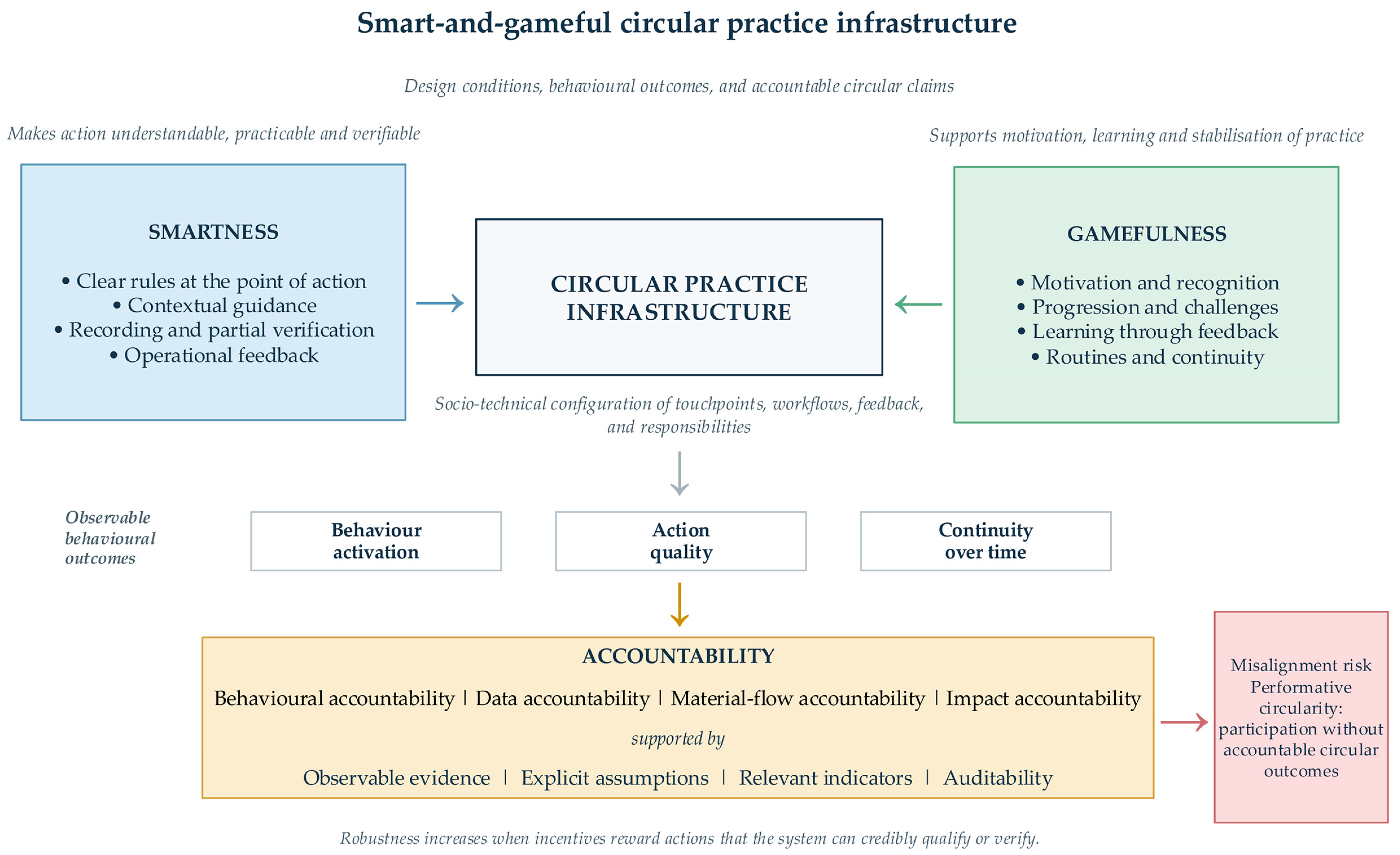
Figure 1 makes explicit the logic of integration between the two functions. At a first level, smartness configures the conditions of action: clear rules at the point of action, contextual guidance, reduction in informational, logistical, and trust-related barriers, the possibility of recording behaviour and assessing its correctness, and operational feedback. At a second level, gamefulness operates as a stabilising dynamic: it translates feedback and traceability into intelligible motivational signals, supports task learning, organises sequences of progression and routines of use, and increases the likelihood of behavioural continuity. The interaction between these two levels generates three observable outcomes: behaviour activation, understood as the transition from intention to the first gesture; action quality, understood as the correctness with which the required behaviour is performed; and continuity, understood as repetition over time and the consolidation of routine. The effectiveness of the model therefore depends on the system’s capacity to support correct and continuous practices over time, relevant to reducing demand for new production and improving the usability of secondary raw material [
12,
15,
19].
In the context of this study, “performative circularity” differs from greenwashing and symbolic sustainability: it primarily concerns a socio-technical configuration that increases visibility, adoption, or use without making behaviour or material flow equally qualifiable. It may coexist with moral licensing and rebound effects, but differs from them because it identifies a specific condition of misalignment between what the system makes measurable and what would be relevant to circularity.
The model thus identifies a principle of analytical robustness: the more coherent the alignment between motivational mechanisms, observable correctness of the action, and the possibility of verification, the more plausibly the configuration can support circular practices that are credible in terms of behavioural outcomes. In design terms, this alignment requires at least four convergent conditions: explicit definition of the target action and of the criteria of correctness; the presence of a verifiability mechanism appropriate to the context, even minimal but reliable; intelligible feedback at the point of action; and coherence between incentive mechanisms and the criteria that can actually be measured. When the system incentivises behaviours that it cannot adequately verify—for example, quantity, frequency, or time of use in the absence of observable quality criteria—reward-maximising behaviours, moral licensing effects, and misalignments between participation and the circular objectives that are actually relevant become more likely [
10,
20,
21].
Within this framework, the model makes it possible to formalise the risk of “performative circularity”, understood as the growth of engagement or participation metrics—points, check-ins, completed missions, frequency of platform use, declarations of commitment—that does not correspond to a verifiable improvement in the quality of practice, behavioural continuity, or material flows [
12,
15,
20].
Accountability therefore constitutes an essential level of the model. Behavioural outcomes do not automatically coincide either with environmental outcomes or with direct effects on material flows; rather, they constitute an intermediate threshold that makes it possible to construct a plausible and verifiable chain of indicators. When these outcomes are robust and measured, they can feed process indicators and, through explicit assumptions, indicators relating to reduced demand for raw materials or to improved quality and usability of secondary raw materials. This chain of indicators is particularly relevant in cases involving the reuse and repair of goods, where environmental benefit depends on the explicit definition of the analytical boundaries and the conditions adopted to interpret the observed effects [
12,
24]. If
Figure 1 summarises the model that guides the subsequent methodological development, the following section translates it into a case-agnostic analytical grid, useful for comparatively exploring the relationship between design configurations, behavioural outcomes, and conditions of accountability [
15,
19,
20].
4. Materials and Methods
Consistently with the theoretical-conceptual framework outlined above, the study is configured as a theory-driven contribution based on the construction and application of an analytical framework, tested through the qualitative comparison of case studies. The aim is to make heterogeneous socio-technical configurations comparable, clarifying how specific design choices relate to behavioural outcomes that are relevant to the circular economy and to the associated conditions of accountability. Both statistical generalisation and the direct measurement of the environmental impacts of the analysed solutions remain outside the scope of the research. In this sense, the methodology assumes the role of a design device for critical comparison, oriented towards making interpretative criteria explicit, distinguishing types of evidence, and controlling the comparison between different cases with greater rigour [
12,
15,
19].
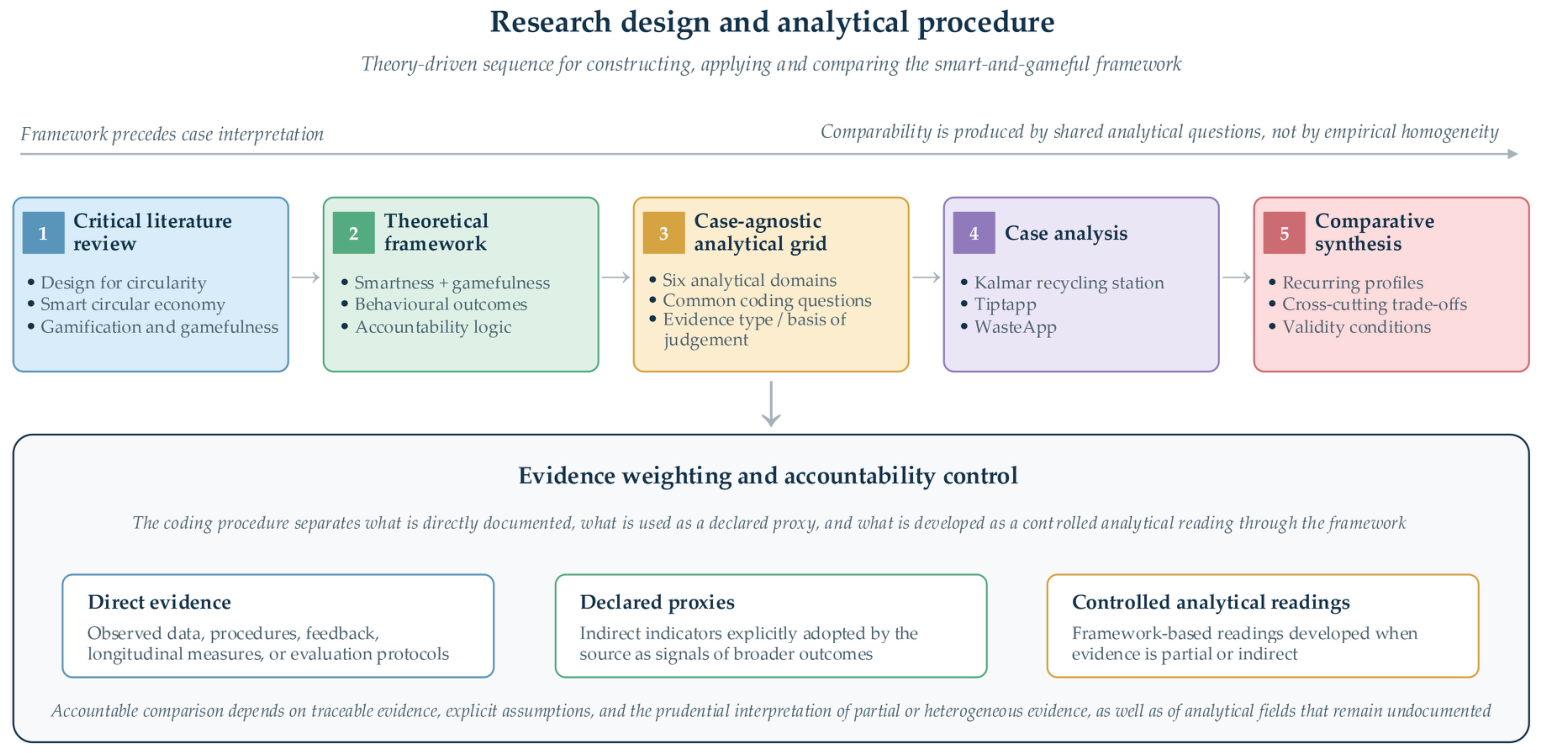
The study is articulated in three mutually coherent phases. The first consists of the construction of the case-agnostic analytical grid, developed from the critical analysis of the literature on design for circularity, the smart circular economy, and gamification. The second concerns the selection and analysis of three paper-based case studies, which constitute the empirical corpus of the comparison. The third concerns the comparative synthesis of the profiles that emerged from the application of the grid. The overall research design and analytical procedure are summarised in
Figure 2. This sequence has methodological relevance because the framework is defined before the cases, guides their interpretation, and makes it possible to verify whether the observed differences can in fact be traced back to the analytical dimensions adopted, rather than to insufficiently controlled descriptive impressions.
In summary, the correspondence between research questions, analytical steps, and types of evidence is as follows: Q1 is addressed through the definition of the framework and the integrated reading of the three cases; Q2 through the construction and application of the analytical grid; and Q3 through the comparative synthesis of the emerging profiles, trade-offs, and validity conditions. In evidential terms, the paper distinguishes between direct evidence, declared proxies, and controlled analytical readings, in order to make the transition from source material to comparative judgement more transparent.
The comparative sufficiency of the three cases derives from their coverage of three different nodes of the design problem: one case is strong in relation to action qualification at the point of disposal; one case is strong in reducing logistical and organisational barriers; and one case makes the synergy between smart support and gameful levers explicit, while remaining weaker in terms of the verifiability of the material outcome. This differentiation allows the framework to show profiles, limits, and trade-offs under non-homogeneous conditions. The review was configured as a theoretically oriented and iterative search, with an exploratory and non-exhaustive function, aimed at building a comparable corpus of documented cases. For this reason, the process should be understood as transparent but non-exhaustive: the search strings and lexical clusters served a heuristic function of expansion and control, while the final selection depended on relevance to the framework and on the availability of legible evidence at the point of action. Cases that were thematically close but did not offer a sufficient description of the touchpoint, did not make the relationship between configuration and behavioural outcomes legible, or were redundant in relation to typologies already represented in the corpus were also excluded. The final selection therefore builds a minimum set of differentiated cases, useful for testing the comparative consistency of the framework under non-homogeneous conditions.
The first phase translates the conceptual categories that emerged in the previous sections into analytical domains and criteria of comparability. The qualitative case-agnostic grid derives from recurrent problems and consolidated conceptual categories in the literature, precedes the selection of cases, and guides their comparative analysis. In this way, the cases are prevented from retrospectively determining the categories of interpretation, and the construction of the framework remains distinct from its subsequent application [
9,
16,
19,
20]. For each case, judgements are formulated by distinguishing between direct evidence, declared proxies, and controlled analytical readings, made explicit when the transition from data to argument is not immediately observable: this gradation serves to control the robustness of the conclusions.
The second phase concerns the selection and analysis of the case studies. The empirical basis of the study consists of three paper-based cases, selected through theoretical and information-rich sampling, rather than for statistical representativeness. The reconnaissance of case studies was carried out through systematic searches on SciSpace (using deep search, basic search, and full-text search), Google Scholar, ArXiv, and PubMed. The search was guided by thematic nuclei and lexical clusters referable to “circular economy”, “smart circular economy”, “digitalisation”, “gamification”, “digital design”, “service design”, “interaction design”, “UX/HCI”, “transition design”, “behaviour change”, “digital circular platforms”, “phygital ecosystems”, “physical and digital touchpoints”, “reuse”, “repair”, “recycling”, “product-service systems”, “empirical case studies”, “measurable impacts”, and “assessment frameworks”.
The selection privileged: the presence of an artefact or system actually implemented; a sufficiently clear description of the touchpoint or product-service system; the availability of evidence relating to at least one of the three behavioural outcomes assumed by the framework; and the presence of data or observations capable of supporting a comparison that was not purely impressionistic. The resulting search, case-selection and evidence-weighting protocol is summarised in
Table 1. Conversely, overly generic contributions, frameworks without empirical validation, cases lacking a description of the point of action, and studies that claimed benefits without offering minimal elements of observability were excluded.
With regard to the research-protocol methodology, the review privileged publications and cases from 2015 to 2026, with updates during the manuscript revision phase, and used the declared databases and lexical clusters as tools for expanding and controlling the corpus. Since the study is not configured as a systematic review, it does not present a PRISMA flow diagram or an exhaustive count of initial records, duplicates, and excluded records; this choice delimits the value of the review as a theoretically oriented basis for constructing the framework, rather than as an exhaustive synthesis of the literature. To make the process more transparent, the manuscript makes explicit the databases, lexical nuclei, inclusion criteria, exclusion criteria, and the function of comparative sampling.
The sampling logic is therefore one of theoretical relevance and minimum availability of evidence useful for comparison. The three selected cases cover different target actions and non-homogeneous socio-technical configurations, in order to test the comparative robustness of the framework under different conditions: disposal and quality of secondary raw material; logistical enablement of reuse and correct disposal; and activation and support of recycling practices through a smart and gamified configuration. The cases are: (i) a gamified recycling station with a longitudinal study in Kalmar City, Sweden [
54,
55,
56]; (ii) Tiptapp, a digital marketplace for urban logistics and recovery/reuse [
57,
58,
59,
60]; and (iii) WasteApp, a smart, gamified mobile application for promoting correct waste-recycling behaviours [
10,
61,
62,
63,
64]. The unit of analysis coincides with the socio-technical configuration at its point of action, that is, the operational context in which the user is required to perform or continue a circular practice. This choice keeps the focus on the design of conditions of use and prevents the comparison from being absorbed by variables that are too broad or scarcely comparable, such as the overall performance of the company, the maturity of the market, or the sole diffusion of the service.
The case analysis was conducted through the systematic application of the analytical grid, used as a common matrix for reading and comparison. Each case was examined in relation to the domains and items defined by the grid, so as to reconstruct in a coherent way its elements of robustness, vulnerability, and conditions of validity. Since the cases differ in source type, descriptive depth, setting, and available metrics, they do not carry the same argumentative weight throughout. Longitudinal or experimental evidence therefore has a different value from project descriptions, pilot tests, or exploratory qualitative studies: the comparison operates through the equivalence of analytical questions, not through the homogeneity of evidential robustness. For this reason, the study adopts a principle of qualitative weighting of evidence: sources with longitudinal observations, behavioural measurements, or explicit evaluation procedures are considered methodologically more robust than those that are mainly descriptive or prototypal; these differences do not exclude the cases from comparison, but delimit the strength of the conclusions that can be drawn from them.
The third phase consists of the comparative synthesis of the profiles that emerged from the application of the grid. The synthesis is reported in the Results section as an interpretative profile matrix, qualitatively recomposing the cases in relation to smart-and-gameful configuration, behavioural outcomes, plausible material implications, and conditions of validity. On this basis, the narrative comparison reconstructs recurring profiles, trade-offs, and conditions of robustness in the integrated model between smartness and gamefulness. In this phase, the research questions guide the comparative reading of the cases: (Q1) in relation to the ways in which smartness and gamification are integrated in supporting behaviour activation, action quality, and continuity of practice; (Q2) in relation to the design dimensions that affect the effectiveness and legitimacy of the analysed configurations; and (Q3) in relation to the emerging comparative profiles and their associated conditions of validity.
The comparative profile matrix therefore performs an interpretative, rather than classificatory, function: it makes visible convergences, fragilities, and trade-offs between different configurations, for example between systems that are robust in activation but more fragile in the verifiability of quality, or between configurations capable of reducing logistical barriers but less equipped in terms of the accountability of outcomes [
15,
18,
19]. Overall, the methodology defines a comparative framework oriented towards analytical-procedural replicability: it makes explicit the criteria, steps, and interpretative conditions of comparison, without configuring itself as a standardised experimental replication. The robustness of the approach therefore depends on the traceability of the comparative reasoning, not on the empirical symmetry of the cases.
5. Case Studies: A Design-Led Comparative Reading of “Use Infrastructures”
The case-agnostic qualitative grid, presented in
Table 2, constitutes the operational device through which the theoretical framework is translated into domains and criteria of comparability. Its function is to make explicit the analytical conditions according to which different socio-technical configurations can be examined coherently in relation to their capacity to support circular practices that are activatable, correctly executed, sustained over time, and accountable. In this sense, the grid connects the theoretical framework with empirical comparison, transforming theoretical concepts into analytical questions applicable to heterogeneous cases [
12,
15,
19,
65,
66].
The structure of the grid derives directly from the theoretical-conceptual framework set out in
Section 3 and is organised into six domains: (A) target action and perimeter of the circular process; (B) smartness as an architecture of decision-making and feedback; (C) gameful configuration and alignment with action quality; (D) barriers and conditions of access; (E) behavioural outcomes; and (F) accountability and indicators. This articulation makes it possible to read within the same scheme the definition of the task, the quality of interaction, the reduction in barriers, the observability of outcomes, and the credibility of claims made in relation to circularity. The grid should be understood as an exploratory analytical tool derived from the literature and constructed to make the comparison traceable, rather than as a definitively validated scheme; the relationships between domains are therefore interpretative and not formally hierarchical.
The items are deliberately formulated in a case-agnostic manner, that is, independently of a specific sector, a particular technology, or a single type of touchpoint. Comparability therefore does not derive from the homogeneity of the cases, but from the possibility of subjecting them to the same analytical questions: is the target action clearly defined? Are there observable criteria of correctness? Does the system provide relevant feedback at the point of action? Are informational, logistical, and trust-related barriers reduced or merely displaced? Are the outcomes observable and supported by relevant evidence? Comparability thus takes the form of equivalence at the level of analytical questions, rather than a presumed substantive equivalence between cases.
The coding procedure keeps the recording of evidence distinct from its interpretation. For each item, four elements are considered: the assessment criterion, the level of available documentation, the type of available evidence, and a critical note concerning limitations, trade-offs, or conditions of validity. The level of documentation has a heuristic rather than metric function: it distinguishes between elements that are not documented, partially documented, or clearly documented in the source analysed. Operationally, each case was read several times and coded item by item through the extraction of relevant evidence, the attribution of the level of documentation, the qualification of the type of evidence, and the recording of a final critical note. The comparative synthesis in
Table 2 derives from the subsequent cross-reading of the profiles thus obtained. This procedure does not produce a synthetic measure of the overall quality of the case but stabilises the comparative reading and makes the transition from source to judgement more controlled.
Depending on the case, the evidence considered includes descriptions of workflows, interfaces, service protocols, feedback logics, results from longitudinal or experimental studies, user assessments, adoption or continuity data and, where present, information relating to action quality or material flow. In the absence of sufficient documentation, the item is kept at a prudential level, avoiding the filling of gaps through undocumented assumptions. Lack of documentation therefore also assumes analytical relevance, especially when it limits the accountability of the case or the solidity of the argumentative passages it makes possible.
A central step in the procedure concerns the distinction between direct evidence, explicitly adopted proxy indicators, and controlled analytical readings developed in the present study. Direct evidence refers to data or descriptions that observably document an aspect of the case, such as the presence of contextual feedback, verification procedures, longitudinal data on continuity of use, or measures relating to action quality. Declared proxies refer to indicators used by the authors of the cases as indirect signals of a broader outcome, for example engagement data assumed as signs of continuity, or sorting-quality indicators assumed as prerequisites for the quality of secondary raw material. Analytical passages in the present study refer, finally, to formulations derived from the application of the framework but not directly measured by the sources. This distinction avoids attributing improper demonstrative robustness to partial or indirect data and makes explicit the argumentative chain on which each comparative judgement is based. It also makes it possible to grade the evidential strength of the conclusions: the more a judgement rests on direct evidence and explicit observation procedures, the more assertively it can be supported; the more it depends on proxies or analytical reconstructions, the more it must be formulated in prudential and conditional terms.
The coding does not assume that all domains are documented with the same level of detail in each case. On the contrary, the presence of weakly documented items, partially observable elements, or items lacking direct support constitutes a relevant analytical result. The grid makes these asymmetries comparable without concealing them. Similarly, the profiles do not derive automatically from the coding but emerge in the subsequent comparative phase through the joint reading of the level of documented presence, the type of evidence, the critical notes, and the conditions of validity. Informational asymmetries therefore fully enter the comparison, because they contribute to defining the different argumentative weight of the available evidence.
Since many cases do not provide direct measures of environmental impact or of effects on material flows, the grid treats accountability as a specific domain and not as an implicit effect of participation alone or of service adoption. Engagement, platform use, or continuity of interaction are therefore not considered, in themselves, sufficient to support robust arguments about circularity. For this reason, domain “F” records not only the presence of indicators, but also their logical link with the declared outcomes, the explicitness of the conditions adopted to interpret them, and their intelligibility for users and stakeholders [
12]. In this way, the coding procedure keeps the level of interaction distinct from that of material implications and allows their relationship to be assessed more rigorously.
For each item, alongside the level of available documentation and the type of evidence, the grid also includes a critical note aimed at making explicit failure modes, trade-offs, conditions of fragility, or limits of validity. This procedure avoids a cumulative and exclusively positive reading of the cases and makes visible the vulnerabilities and possible side effects of the configurations analysed.
Table 2 defines the qualitative coding grid, while the second-level comparative synthesis in
Table 3 provides a controlled interpretative profile of the cases in relation to behavioural outcomes, plausible material implications, and conditions of validity. The methodological function of the two devices is precisely this: while
Table 2 makes the reading protocol traceable, the comparative synthesis verifies whether that protocol is actually capable of distinguishing different profiles of robustness, fragility, and accountability among non-homogeneous cases. To make the analytical function of the framework more legible,
Table 3 also makes explicit, for each case, the evidence level and the basis of judgement, distinguishing between direct data, declared proxies, and controlled analytical readings.
Overall, the coding procedure is designed to produce an analytically legible, argued, and replicable comparative basis, without claiming mechanical replicability. Its value lies in making visible, within a single scheme, the relationships between design configuration, the quality of the available evidence, behavioural outcomes, and the credibility of accountability.
Table 2, therefore, does not provide a direct measure of the sustainability of the solutions analysed, but makes the discussion of their design and evaluative robustness more transparent [
15,
18,
19]. On this basis, the methodological contribution of the paper consists of defining a transferable comparative protocol, useful for future research seeking to examine smart-and-gameful configurations in other domains or at different scales.
6. Case Studies
The three paper-based case studies selected for comparison take as their unit of observation the socio-technical configuration at its point of action, that is, the physical, digital, or hybrid device through which the user is required to perform a practice relevant to circularity. The cases are read in relation to the design conditions that support or hinder action, without automatically attributing circular outcomes to digitalisation or to any gameful component. The analysis does not aim to reconstruct exhaustively the history or overall performance of the solutions considered, but to read them as comparable configurations through the same interpretative grid, centred on three outcomes—behaviour activation, action quality, and continuity over time—and on the conditions that make these outcomes observable and accountable. The comparison does not presuppose the equivalence of evidence across cases: each is read in relation to the quality of the available documentation, the type of target action, and the degree of observability of the outcomes considered. The comparison between the three cases does not assume metric equivalence of empirical indicators, but functional equivalence of the analytical questions posed by the framework. The cases are therefore compared in terms of how they make the action activatable, its quality observable, continuity of practice supportable, and accountability arguable, despite different documentary bases and contexts of use.
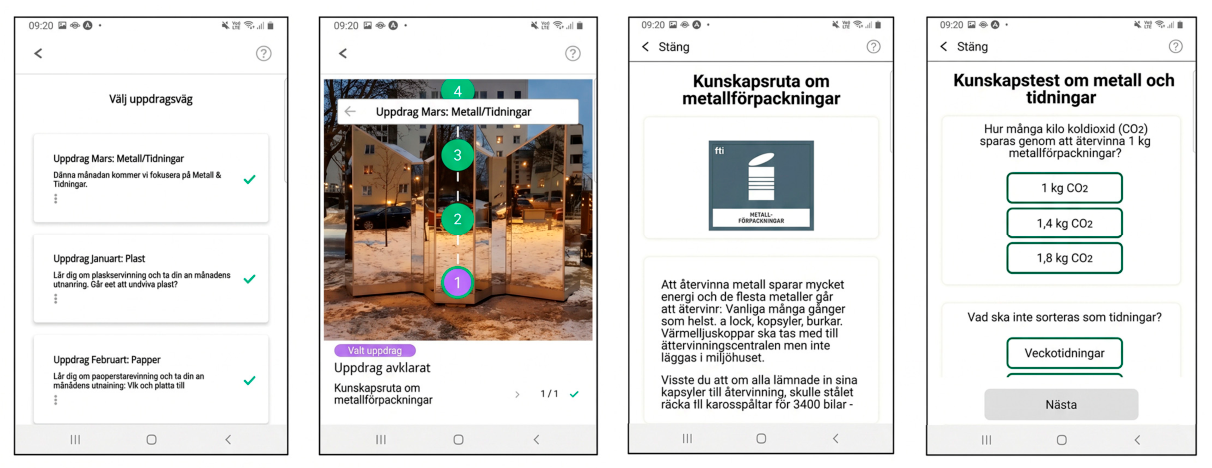
The first case, the “Gamified Recycling Station” (
Figure 3 and
Figure 4) in Kalmar (Sweden), is a pilot experimental intervention, developed and tested under real conditions of use, rather than a solution already stably adopted at full scale [
54,
55,
56]. The physical–digital system is analysed through a six-month longitudinal study involving 15 households in a residential context. The design of the recycling station and the gamified app was developed through a participatory process involving the research group—mainly affiliated with Linnaeus University, the University of Gothenburg, and Mälardalen University—together with collaborators and stakeholders. The target action is circumscribed, repeatable, and clearly contextualised: the correct disposal of specific fractions in an equipped station, with recording of the action and feedback returned to the user. In relation to the framework adopted, the case is methodologically relevant because it makes the relationship between smartness, action quality, and continuity of practice particularly legible. The point of action is strongly structured: the user interacts with an infrastructure that defines the task, reduces operational ambiguities, records behaviour, and provides feedback, placing the action within a recognisable and controllable sequence. In terms of smartness, the case is robust in three respects: guidance is located at the point at which the gesture is performed; the recording of the action enables at least partial verifiability; and feedback does not merely signal participation but is connected to the correctness of disposal. In this way, action quality does not remain entirely implicit but becomes at least partly observable within the system.
In the Kalmar case, direct and longitudinal evidence on disposal behaviours prevails, while material implications remain formulated in prudential terms on the basis of indirect indicators related to flow quality. At the gameful level, the touchpoint integrates mechanisms of recognition, reward, and progression, aimed at supporting the repetition of behaviour over time. Their relevance depends on the fact that they are anchored in an architecture that does not only incentivise participation, but is also connected, at least in part, to action quality. The available evidence, including longitudinal measures and indications relating to errors or contamination, places this case among the most robust in the corpus with respect to the behavioural outcomes considered [
67]. In particular, the reduction in disposal errors represents an indicator indirectly relevant to the quality of secondary raw material, since lower contamination is a prerequisite for its valorisation. This does not coincide with a direct measure of material impact, but it makes the link between observed behaviour and circular implication more credible than in other cases. The main limitation concerns dependence on the infrastructure: continuity of practice remains conditioned by the operational stability of the station, the reliability of detection, the management of operational criticalities, and the coherence of the feedback provided. When these conditions fail, operational and trust-related barriers may re-emerge, weakening even motivational mechanisms that would otherwise be effective. The Swedish case therefore constitutes one of the most robust references in the corpus in terms of action quality, while remaining circumscribed to a highly structured configuration and to a relatively defined target action.
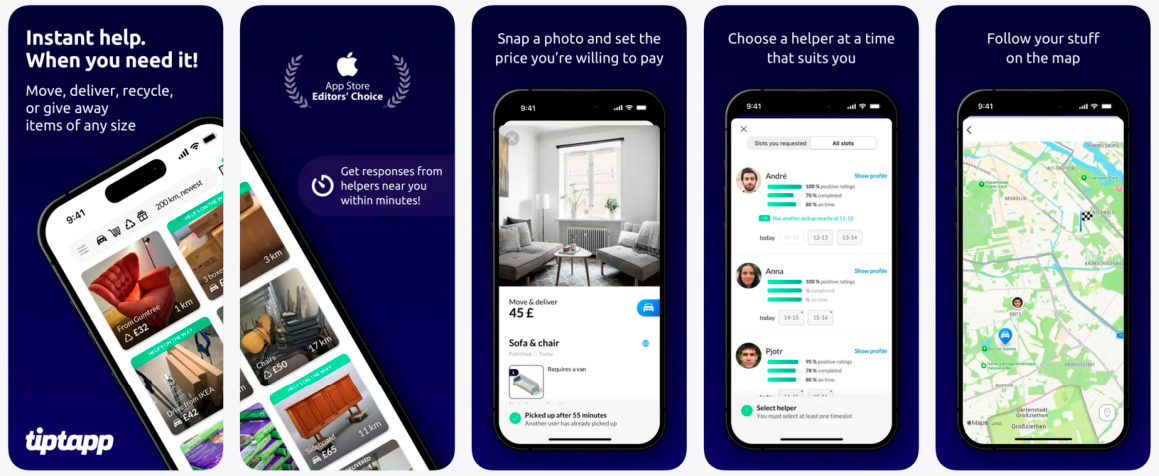
The second case, Tiptapp (
Figure 5)—digital marketplace for urban logistics—addresses a different but equally relevant issue: the role of urban logistics as a necessary condition for reuse, correct disposal, or the removal of bulky objects [
57,
58,
59,
60]. Tiptapp (version 4.91.0) is a digital platform already operating at scale, founded in Stockholm in 2015 and launched in 2016, and devised by Tim Bjelkstam, David Höök, Fredric Rylander, and Anders Lövbrand. The configuration analysed is that of an already active digital marketplace, documented in the corpus above all through qualitative evidence relating to use, logistics, service perception, and its sustainability potential. The system connects users who need to move an object or waste item with people available for transport, organising the matching between demand and supply, the definition of remuneration, geolocation, temporal coordination, and payment. The case is interesting because it clearly shows that, in many circular practices, the main bottleneck is logistical and organisational in nature. In this context, smartness operates above all as an infrastructure of coordination and reduction in operational barriers. The system makes the action more practicable: it reduces the organisational burden on the individual user, transfers part of the complexity to a network of helpers, and integrates essential components of the workflow, such as the visibility of the request, task definition, and payment. In this case too, the gameful component is not explicit in a strict sense but can be recognised in reputational dynamics, incentives, and feedback that support reliability and continuity of participation. The configuration therefore appears solid above all in terms of reducing logistical barriers and making action practicable.
In the Tiptapp case, qualitative and descriptive evidence on the functioning of the platform and its logistical potential prevails, while the qualification of the material outcome depends largely on controlled analytical readings and on traceability conditions that are not always documented; reputation, incentives, and feedback are therefore read as implicit and weak motivational dynamics, rather than as gamification in a strict sense.
The most delicate issue, however, concerns the quality of the outcome and the final destination of the object. Facilitating removal or transport does not automatically guarantee a high-quality circular result. If the system does not make the destination of the object, the correctness of the flow, or the actual share of reuse compared with other options transparent or verifiable, the relationship between the logistical service and its circular implications remains only partially clarified [
68,
69,
70]. The available evidence, predominantly qualitative, helps to understand frequency of use, contexts of use, service perception, and the potential of the platform as an infrastructure for circularity, but it is not sufficient to sustain robust arguments about material effects in terms of circularity. The case is therefore particularly useful for discussing the logistical dimension of smartness, while remaining weaker in terms of the qualification of the final outcome.
The third case, WasteApp, is a smart, gamified mobile application for waste recycling, presenting a configuration in which smartness and gamification are both explicit. The case represents a development and experimentation pathway initiated in 2016 [
10,
61,
62,
63,
64]. A first phase was developed in Turin (Italy), at the Istituto Superiore Mario Boella, as a design and experimental prototype constructed through the analysis of existing apps, co-design sessions, and a preliminary small-scale usability study, within the ALMANAC Smart City project. A second phase was situated within the European URBAN-WASTE H2020 project, promoted by a consortium of 11 European cities and initially tested in four pilot cities: Santander, Puerto de la Cruz, Ponta Delgada, and Nice. WasteApp is therefore a case developed and tested within a European design context, not a solution consolidated at scale.
The target action is defined and repeatable: identifying the correct disposal point, separating waste appropriately, and recording the interaction through the app. In relation to the framework adopted, the case is relevant because it shows a configuration in which smartness operates as an informational and operational infrastructure, while gamification acts as a lever for activation and behavioural reinforcement. In terms of smartness, WasteApp integrates geolocation, a map of collection points, information on rules and disposal times, QR codes on containers, data collection and, in some versions, barcode scanning, a calendar, and notifications. In this way, the system reduces informational and logistical barriers and makes action more understandable and executable at the point of use.
At the gameful level, the case presents an explicit structure: users obtain points by scanning QR codes, can accumulate rewards, access prizes offered in the pilot cities, and receive eco-tips and other stimuli oriented towards continuity of action. Gamification is therefore limited but structural. The available evidence shows that perceived usefulness affects user satisfaction and that this, in turn, supports recycling behaviour; at the same time, expectations regarding rewards may be weak or counterproductive if they are not perceived as coherent with the behaviour being promoted.
From the perspective of behavioural outcomes, WasteApp appears strong in terms of activation and reasonably solid in terms of continuity, at least according to the evidence from the tests, because it attempts to transform an episodic gesture into a repeated practice. It is weaker, however, in relation to action quality and the final material outcome, since the recording of the interaction does not in itself guarantee either the actual correctness of disposal or a robust verification of circular impact. The app makes behaviour more observable, but the link with flow quality remains only partially verifiable [
71,
72].
Overall, WasteApp constitutes a useful case for the comparative corpus because it makes the synergy between smartness and gamification explicit and has a stronger documentary basis than purely design-based cases. Its strength lies in its capacity to make recycling more accessible, legible, and motivating; its main limitation concerns the weak verifiability of the final outcome.
Taken together, the three cases present different levels of available documentation, observability of outcomes, and argumentative solidity. This asymmetry is methodologically relevant because the framework makes it explicit and analysable, showing differences in the quality of documentation, the degree of verifiability of action, and the stability of the conclusions that can be sustained. Some cases are more robust in terms of the qualification and verifiability of action; others appear stronger in the reduction in logistical barriers and in the practicability of the service; still others make the synergy between smartness and gamification particularly legible, while remaining weaker in the qualification of the final material outcome. On this basis, the following section reconstructs the emerging comparative profiles.
7. Comparative Results: Recurring Profiles and Trade-Offs
The following comparison is based on the application of the analytical grid (
Table 2) to the three cases discussed in the previous section.
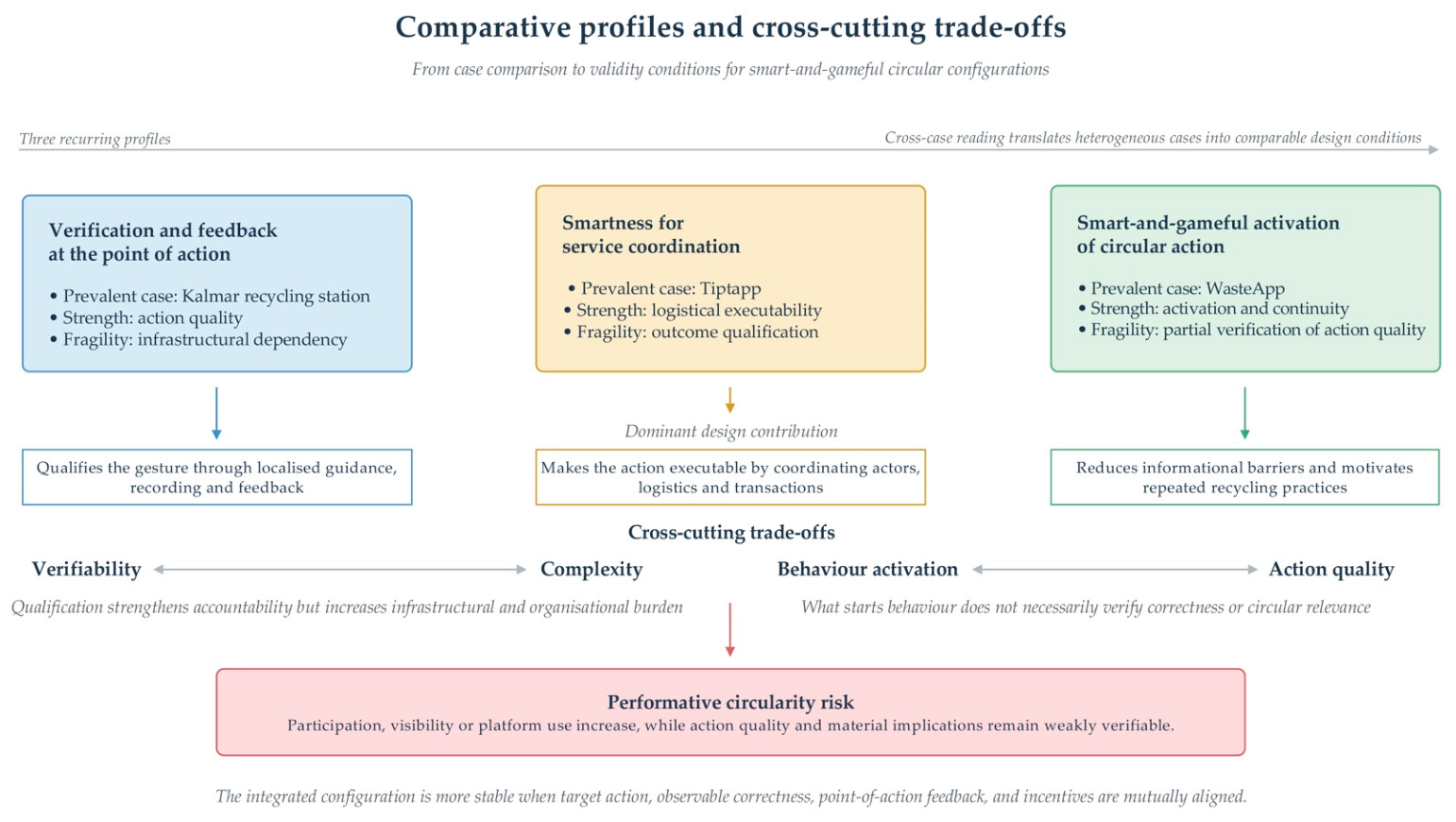
Table 3 summarises their comparative profiles, recomposing the outcomes of the qualitative coding in relation to the smart configuration and gameful component, behavioural outcomes, plausible material implications, and conditions of validity. Differences between the cases depend on the way in which smart-and-gameful components are articulated in task definition, action verifiability, barrier reduction, and the credibility of accountability. Three main profiles emerge.
The first recurring profile can be defined as “verification and feedback at the point of action”. It emerges most clearly in the case of the gamified recycling station and, to a lesser extent, in configurations in which the system provides guidance, recording, and feedback at the very moment in which the action is performed [
54,
55,
56]. In such cases, smartness constructs the action environment in which the task is more clearly defined, action quality becomes at least partly observable, and feedback acquires an operational value, rather than a merely motivational one. Especially in practices such as correct disposal, action quality requires contextual, legible, and task-consistent feedback. When this condition is met, gameful levers also become more robust, because they incentivise behaviours that are closer to what the system observes and qualifies. This profile also highlights, however, a design and infrastructural cost: systems of this kind depend on technical continuity, detection reliability, maintenance, and the management of anomalous situations. When this stability fails, the benefits of verification may be undermined by new operational or trust-related barriers.
The second recurring profile can be described as a form of “smartness oriented towards service coordination”. It emerges particularly clearly in the Tiptapp case and, more generally, in configurations in which the decisive issue is to make the action concretely executable. In these situations, the bottleneck of circular practice mainly coincides with logistical, organisational, and relational barriers: access to skills, availability of service networks, time, costs, transport, and the reliability of the actors involved [
57,
58,
59,
60]. Here, smartness operates as a coordination infrastructure that connects subjects, resources, and operational sequences, reducing the gap between intention and practice. This profile shows that, in many high-value circular practices, effectiveness depends first of all on the capacity to make them accessible and organisationally sustainable. The gameful component, when present, appears secondary or implicit: it can support reputation, reliability, continuity, or recognition, but remains subordinated to the existence of a functioning service network. The limitation of this profile concerns the qualification of the outcome. Making a repair or transport operation practicable does not automatically imply the quality of the intervention, the correct final destination of the object, or an actual reduction in demand for new products. These configurations are therefore robust in terms of executability, but more fragile in the qualification of the result and of the related material implications.
The third recurring profile can be defined as smart-and-gameful activation of circular action. It emerges most clearly in the WasteApp case and, more generally, in configurations that combine informational support, geolocation, interaction recording, and incentive mechanisms to orient users towards correct circular behaviour [
10,
61,
62,
63,
64]. The design advantage of this configuration is evident: the system accompanies the user at the point of action, reduces informational and logistical barriers, and transforms the act of disposal into a more legible, accessible, and motivating sequence. This profile appears promising, especially in terms of activation and continuity. It is, however, also more methodologically exposed. Its stability depends on particularly demanding conditions: the quality and updating of data, the intelligibility of instructions and feedback, coherence between rewards and the behaviour being promoted, and the possibility of connecting the recorded interaction to the actual quality of the action. In cases of this kind, developed and tested within design contexts, the distance between design promise and consolidated evidence may remain significant. The profile therefore indicates a relevant development direction for urban circular systems, currently stronger in terms of configurative innovation than in terms of empirically consolidated robustness. At the analytical level, this profile confirms that the different levels of accountability require different evidential bases and that the three cases cover them unevenly.
The comparison of the three cases also reveals two cross-cutting trade-offs.
The first trade-off concerns the “relationship between verifiability and complexity”. The cases suggest that the more a system attempts to qualify the action, record it, and provide coherent feedback at the point of action, the more it requires a stable infrastructure and careful management of workflows, maintenance, actor integration, and exception handling. Verifiability thus tends to strengthen the quality of the practice and the credibility of accountability, but it also entails organisational costs and points of fragility. The second trade-off concerns the relationship between behaviour activation and action quality. Configurations more oriented towards digital guidance show a good capacity to reduce initial barriers, facilitate onboarding, and support continuity of interaction. The risk of misalignment increases, however, when the system mainly rewards what is easy to track—clicks, app use, adherence, or completion of micro-tasks—and lacks clear criteria for qualifying the physical gesture or material result. A tension is thus created between ease of activation and robustness of quality: what is effective in initiating behaviour does not necessarily coincide with what makes it possible to assess its correctness or circular relevance. This tension emerges particularly clearly in cases where digital action precedes or accompanies a physical action that is only partially observable.
The comparison makes visible a greater stability of the synergy between smartness and gamefulness when four conditions recur: the action is defined with sufficient precision; at least partially observable criteria of correctness exist; feedback is located at the point of action and is understandable; and motivational levers reward behaviours that the system can actually qualify or at least verify credibly. The weakening of one or more of these conditions directs the configuration towards profiles of partial effectiveness: strong behaviour activation but low observable quality, good logistical executability but reduced accountability, or high design potential but still insufficient evidence. The comparison makes the conditions of greater stability and the recurring vulnerabilities of different smart-and-gameful configurations more legible, without converging on a single optimal model.
Figure 6 synthesises these comparative profiles, the two cross-cutting trade-offs, and the associated risk of performative circularity.
8. Discussion: Findings, Validity Conditions and Limitations
The comparative analysis makes it possible to formulate several theoretically and methodologically relevant findings. The first concerns the possibility of distinguishing more precisely between participation, action quality, and continuity over time. The framework shows that solutions characterised by even high levels of engagement or platform use can produce different outcomes in terms of correctness of action, stabilisation of behaviour, and accountability. In this sense, the main contribution of the model lies in making different socio-technical configurations comparable in relation to three distinct behavioural outcomes, clarifying why cases apparently united by the presence of smart or gameful components diverge in terms of action verifiability, outcome quality, and the credibility of accountability.
A second finding concerns the principle of robustness made legible by the comparison. The most convincing configurations are those in which task definition, action observability, feedback quality, and the coherence of motivational incentives are explicit. On this basis, the present study brings into sharper focus the risk of “performative circularity”, already introduced in the theoretical-conceptual framework. The cases analysed show that the growth of indicators of participation, continuity of use, or involvement may coexist with limited observability of action quality, or with a weak connection between behaviour and material implications. Engagement and adoption remain useful indicators, but their analytical value depends on their relationship with action quality, the stability of the outcome, and the credibility of the benefits communicated. The notion of “performative circularity” designates precisely this gap. Starting from these findings, the present study formulates three analytical propositions to be subjected to empirical verification, understood as exploratory analytical propositions derived from the comparison and the theoretical framework, to be subjected to dedicated empirical verification before any generalisation.
P1—Alignment between incentives and action quality. When action quality cannot be qualified or verified by the system, competitive or volume-based incentives increase the likelihood of instrumental behaviours aimed at maximising reward and of quality deterioration. Empirical verification may be based on variations in error rates or contamination rates in the collected fraction, the proportion of correct disposals, and process rejects [
19,
20].
P2—Continuity of feedback and continuity of practice. When feedback is discontinuous or unreliable at the point of action, continuity of practice tends to decrease even in the presence of intense or highly visible gameful mechanics. Empirical verification may be based on retention, frequency of use over time, and abandonment rates [
15,
17]. In terms of environmental impact, the paper therefore supports only plausible and conditional relationships between design configuration, observable behaviour, and possible implications for material flows, without attributing certain environmental benefits to the cases in the absence of LCA, MFA, or complete operational data.
P3—Clarity of accountability, trust, and maintenance of practice. When environmental benefits are communicated through indirect indicators without an explicit perimeter and declared assumptions, the credibility of the system weakens, trust-related barriers increase, and users’ willingness to maintain the behaviour over time is reduced. Empirical verification may be based on trust metrics, abandonment, continuity of practice, and variations in adoption [
12].
The value of these propositions is primarily heuristic: within a design-led comparative structure, they connect design configuration, behavioural outcomes, and conditions of accountability, indicating relationships that future research may verify with greater empirical control. In this sense, the paper does not propose propositions derived from statistical generalisation, but from a controlled analytical generalisation grounded in the convergence between the theoretical framework, the coding procedure, and case comparison.
Alongside these propositions, two conditions of validity emerge that delimit the scope within which the model can be considered plausible. The first concerns the evaluability of the action: the profiles identified are applicable only when observable criteria for correct execution exist and at least one recording or verification mechanism is adequate to the context. In the absence of this minimum threshold, the intervention tends to be reduced to a predominantly symbolic or promotional level. The second concerns the socio-technical stability of the configuration: the transferability of a profile requires coherence between interaction design, logistical infrastructures, workflow quality, data management, and organisational responsibilities. At a broader scale, this implies reading circular transition also as the construction of territorial and relational micro-networks, in which design coordinates local resources, actors, competences, and exchanges within systemic arrangements that make practices not only possible, but also more stable and contextually pertinent [
73]. The weakening of any of these elements reduces the overall robustness of the system and the interpretative stability of the comparative profiles. The transferability of the analytical device should be understood prudentially, since it provides criteria for future ex ante and ex post verification but still requires further applications, primary data, and multi-case validations before any generalised use can be claimed. At the level of discussion, these findings suggest a reformulation of the relationship between policy, infrastructure, and design. Many circular economy and digital transition strategies tend to consider regulatory instruments, platforms, or services as sufficient levers for producing behavioural change. The present study shows, instead, that these levers become credible only when they are translated into recognisable conditions for action within everyday touchpoints. This shifts attention from generic metrics of adoption or recycling towards practice quality, clarity of indicators, verifiability of the arguments formulated, and service stability. From this perspective, digitalisation and gameful design become relevant as instruments for reducing structural barriers and making the practices that affect demand for primary raw materials and the quality of secondary raw material more legible, verifiable, and comparable. The scientific contribution of the paper therefore also consists of proposing, for the design research community and for circular economy studies, a more precise analytical vocabulary for discussing not only whether a solution activates behaviours, but under what conditions those behaviours are qualifiable, sustainable over time, and communicable in a methodologically responsible way. In this direction, the proposed framework recalls a conception of design as a responsible practice of transition, aimed not only at configuring interfaces or services but also at critically affecting the relationships between supply chains, use behaviours, value criteria, and the sustainability of systems [
74].
The comparison also makes it possible to identify several design dimensions that are particularly relevant to the effectiveness and legitimacy of the configurations analysed: (i) unambiguous definition of the target action; (ii) presence of at least partially observable criteria of correctness; (iii) location of feedback at the point of action; (iv) alignment between incentive mechanisms and action quality; (v) infrastructural stability of workflows; and (vi) intelligibility of indicators and accountability conditions. Although it does not propose statistical generalisations, the framework and the dimensions identified are to be used prudentially as interpretative and design-oriented criteria, provided that the analytical perimeter, the quality of the available evidence, and the socio-technical conditions of application are explicitly stated, provided that their perimeter, target action, and observability requirements are made explicit. Transferability appears more immediate in contexts where the target action can be circumscribed, the quality of the gesture is at least partially observable, and the workflow can be made explicit; it is, instead, more problematic in systems where outcome quality depends on long supply chains, multiple actors, and poorly traceable passages. This caution is consistent with studies that interpret circular transition as a problem of design and platform complexity, in which materials, assembly modes, production processes, disassembly, and the actors involved introduce interdependencies that design must make governable without reducing them to overly simplified schemes [
75].
At the same time, this study maintains an explicit limitation with respect to the scope of the material implications that can be sustained. Accountability is treated here as an argumentative chain connecting observable behavioural outcomes, process or material outcomes, indicators, and declared assumptions. This passage requires verification protocols more structured than those currently available in most of the cases analysed, capable of relating the criteria for action correctness, material-flow quality, additional duration of use, and the conditions of substitution for the purchase of new goods. This study therefore adopts a cautious position: some configurations make the connection between behaviour and material implication more credible and arguable, while others leave it substantially opaque.
The limitations do not affect the framework and the empirical corpus to the same extent: while the framework is proposed as an analytical device applicable in a prudential and controlled manner, the latter allows only exploratory and comparative validation, not generalisable confirmation. Precisely for this reason, the study makes explicit its domain of validity. The framework achieves greater analytical consistency under the following conditions: the target action is sufficiently circumscribed, the quality of the gesture is at least partly observable, feedback can be located at the point of action, and the chain between behaviour and the argument concerning circularity can be made transparent; it is, instead, prudentially applicable in contexts where outcome quality depends on long supply chains, multiple actors, and poorly traceable passages.
A first limitation concerns the heterogeneity of the cases analysed, which differ in duration, setting, scale, type of evidence, and quality of available documentation. In several cases, longitudinal measures or sufficiently robust criteria are not available to assess action quality and continuity of practice with the same evidential strength. This heterogeneity requires the comparison to be read as a controlled analytical construction, rather than as a symmetrical verification between equivalent cases. A second limitation concerns possible publication bias: the literature tends to document favourable outcomes, satisfactory levels of adoption, or configurations perceived as successful more readily, while failed implementations, side effects, or behavioural distortions remain less visible. A third limitation concerns the nature of the propositions formulated, which, although coherent with the framework and plausibly supported by the comparison, require dedicated empirical verification, preferably longitudinal or quasi-experimental, capable of better isolating the relationship between feedback, incentives, action quality, trust, and continuity.
A further limitation concerns the quantitative traceability of the bibliographic review: the process recorded platforms, lexical clusters, and inclusion/exclusion criteria, but does not produce exhaustive counts of the records examined. This delimitation reinforces the need to read the corpus as a documentary basis for exploratory comparison, rather than as a systematic literature review.
Overall, the findings support a critical but operational position. The smart-and-gameful configuration appears more convincing when it is designed as a verifiable behavioural infrastructure, in which incentives, guidance, workflows, and feedback converge to support observable and qualitatively relevant practices. The weakening of these conditions increases the likelihood that the system will produce superficial outcomes: participation without quality, continuity of use without accountability, or activation without plausibly accountable circular effects. The comparison thus clarifies which dimensions of the configuration affect the stability of circular practices and which require further verification before more robust conclusions can be drawn about material effects. This clarification increases the scientific impact of the contribution, because it provides the research community with an interpretative device that can be used preliminarily to analyse existing cases and to set up future design experiments and comparative protocols to be empirically validated.
9. Conclusions and Future Developments
The main contribution of this study lies in showing that the relevance of the relationship between smartness and gamification for the circular economy does not depend on their mere co-presence but on the possibility of configuring them as a socio-technical infrastructure of practice. The advancement of knowledge lies in the shift from a generic assessment of adoption, engagement, or digital innovation to a comparative reading of the conditions that make a circular practice activatable, correct, continuous, and accountable. In this sense, the framework does not merely introduce a classification of cases but an analytical criterion for distinguishing between configurations that prompt behaviour without qualifying it, configurations that make action observable without sustaining its continuity, and configurations in which interaction design, action verifiability, and the credibility of accountability tend to converge. The originality of the contribution therefore consists of clarifying the design, operational, and evaluative conditions under which this relationship can be argued in a more rigorous, comparable, and scientifically controlled manner. The contribution should be understood consistently as an exploratory and controlled analytical–comparative device: it does not statistically demonstrate a general model but clarifies the design and evidential conditions under which smartness and gamefulness can be read jointly in relation to activation, action quality, continuity, and accountability. The integration between smartness and gamefulness achieves greater consistency when task definition, situated feedback, observable correctness criteria, and motivational levers are coherent; under these conditions, the framework makes three comparative profiles, two cross-cutting trade-offs, and the related validity conditions legible.
From this perspective, the study represents a relevant advancement for the disciplinary field of design, because it proposes a reading of circularity not as the automatic outcome of technologies, regulations, or incentives but as a problem concerning the design of conditions of use, access, feedback, and trust. Design thus emerges as a discipline capable of organising the conditions within which a practice can become understandable, executable, observable, and maintainable over time. This approach increases the potential scientific impact of the study because it provides the research community with a useful interpretative device for critically reading existing cases and orienting future experiments, evaluation protocols, and decision-making processes under explicitly declared evidence conditions in which physical, digital, and organisational components interact in the construction of circular practice. From this perspective, the framework also clarifies under what specific conditions design configurations can contribute, directly or indirectly, to some of the United Nations 2030 Agenda Sustainable Development Goals [
76] most relevant to the topic addressed. The main reference is SDG 12; this is connected to SDG 9 and SDG 11 insofar as the stability of practices depends on the quality of service infrastructures, touchpoints, and workflows; SDG 13 is, instead, invoked in a mediated form, since improving the quality, continuity, and accountability of circular practices makes the relationship between design, resource use, and environmental benefits more plausible.
Alongside these implications, the study highlights three structural compromises relevant to design. The first concerns the relationship between verifiability and complexity: the more a system seeks to qualify action and make it observable, the greater its dependence on stable infrastructures, actor integration, maintenance, and exception management. The second concerns the relationship between behaviour activation and action quality: what facilitates the initiation of a practice does not necessarily coincide with what guarantees its correctness and effective relevance for circularity. The third concerns the relationship between design potential and accountability: the most innovative design configurations may not yet be accompanied by sufficiently robust empirical evidence, while the most observable systems may require infrastructural arrangements that are difficult to extend at scale. The interest of the contribution also lies in having made these tensions explicit and comparable, avoiding both a technocratic and overly optimistic reading of digitalisation and a reduction in gamification to a purely promotional device.
On this basis, future research may develop along three priority and mutually integrated directions. The first concerns empirical verification of the framework in real contexts through longitudinal, quasi-experimental, and multi-case studies capable of observing more precisely the relationship between behaviour activation, action quality, continuity of practice, and feedback reliability. The second concerns the construction of preliminary operational protocols for ex ante and ex post evaluation, to be validated through dedicated empirical applications based on transparent chains of indicators, explicit analytical boundaries, and declared assumptions, so as to make claims concerning material effects in cases of reuse, repair, recycling, and circular logistics more credible and comparable. The third concerns extending the framework to more complex organisational and territorial contexts—reverse logistics, digital public services, multi-actor platforms, living labs, and proximity ecosystems—in which data governance, quality standards, distribution of responsibilities, and inclusiveness of access directly affect workflow stability and the robustness of accountability. In this way, the contribution can evolve into a basis for shared tools for design, comparison, and strategic orientation only after further multi-case validations and primary data collection. From this perspective, future developments should above all strengthen three aspects: primary data collection, multi-case applications with more formalised coding protocols, and separate verification of the different levels of accountability, in order to avoid participation or use indicators being improperly assumed as sufficient evidence of action quality or environmental impact.