2. Theoretical Background
As indicated by [
12], tourism eco-efficiency means generating more economic returns with less resource investment and minimal environmental damage [
13,
14], and is an important indicator of the organic harmony between economic development and the environment [
15]. Academic research in this strand of literature (e.g., tourism’s eco-efficiency) widely adopts a non-parametric programming technique, the T-DEA framework, to operationalize inputs and outputs for measuring tourism’s relevant (e.g., relative to peers) efficiency and performance levels, given a specific set of Decision-Making Units (DMUs) and a reference time period. In this way, based on the study’s purpose, model specification, and DEA orientation, researchers can identify input excesses (e.g., labor), desirable output shortfalls (e.g., revenues generated), and, when appropriate, undesirable output excesses (e.g., proxies for environmental degradation). This is the core issue when applying the Slack-Based Measure (SBM) under a T-DEA framework. The SBM model directly incorporates input and output slacks into the efficiency measure. Therefore, inefficiencies arising from excess inputs, shortages in desirable outputs, and excess undesirable outputs can be explicitly identified. This adopted approach is motivated by the objective of assessing how efficiently Eurozone countries transform economic and environmental resources into desirable economic outcomes while limiting undesirable environmental impacts. Under the adopted model, differences in country size and economic structure are accommodated, making efficiency comparisons more realistic across heterogeneous economies within the Eurozone. Furthermore, the SBM model further allows the decomposition of inefficiency into specific slack components, thereby providing additional insights into the sources of inefficiency for the Eurozone countries. Therefore, the SBM T-DEA framework provides an appropriate methodological approach for measuring the sustainable performance of tourism-dependent economies. Then, a second-stage analysis follows: the efficiency and productivity scores are regressed on renewable energy to identify relevant impacts and causal relationships, and to determine the direction of linkages and whether renewables contribute to efficiency and productivity improvements.
Tourism eco-efficiency refers to the ability of the tourism sector to generate economic benefits (e.g., increased tourism spending, revenues, employment), while minimizing environmental impacts, including energy consumption, air pollution, and air emissions (e.g., greenhouse emissions). In turn, the SBM DEA facilitates the evaluation of tourism eco-efficiency by jointly incorporating economic, environmental, and resource-related dimensions into an analytical framework. By accounting for non-proportional excesses and shortfalls in inputs and outputs, this approach provides a more comprehensive assessment of sustainability performance and identifies the main sources of inefficiencies in the tourism sector. A major focus of this effort, which constantly requires research, is how the tourism sector and air quality interrelate, for instance, in terms of greenhouse gas emissions. Interestingly, from 2009 to 2013, the tourism industry accounted for 8% of global greenhouse gas emissions [
16].
Hence, as an emerging field, tourism eco-efficiency is becoming a fundamental research topic for sustainable tourism development [
17].
Building upon these concerns, the present study contributes to the literature by addressing a clear research gap: existing tourism efficiency studies rarely examine tourism spending through a disaggregated market-segmentation perspective that simultaneously distinguishes between business and leisure tourism as well as domestic and international visitors. Responding to the call for greater attention to unnoticed, impactful market segments in economic analysis [
18,
19], this study elaborates on different spending behaviors and strategic implications across visitor categories. This differentiation is important because market segmentation allows the identification of systematic heterogeneity in tourism behavior [
20], offering insight into how destinations can allocate resources more efficiently, stimulate tourism demand, and strengthen tourism revenues and competitiveness [
21,
22]. Such an approach requires an efficiency analysis using DEA, which in turn provides benchmarking information to eliminate inefficiency [
23,
24]. Most DEA-based tourism studies focus either on firm-level or hotel-oriented indicators, such as occupancy, rates, labor, reservations, and related operational proxies [
25,
26,
27,
28,
29,
30,
31]. Moreover, limited attention has been given to macro-level tourism spending variables that capture the broader economic value generated by heterogeneous tourism dynamics. Additionally, the study extends beyond traditional applications by examining the relationship between tourism eco-efficiency and the dynamics of the energy transition. While sustainable tourism development increasingly depends on cleaner energy sources, limited attention has been paid to how the adoption of renewable energy shapes tourism production frontiers and technical efficiency. Accordingly, the study contributes to a better understanding of how environmentally responsible development pathways can maintain tourism competitiveness and economic performance, thereby supporting sustainable visitor satisfaction [
32], which in turn increases visitors’ willingness to pay.
Second, the input-tested set of variables concerns capital investment spending directly associated with the travel and tourism sector and the direct contribution of tourism employment. From this perspective, this research effort avoids aggregate proxies such as labor and general employment rates, or aggregate measures such as foreign direct investment, thereby leaving untested the exploratory power of specific-sector efficiency dynamics.
Third, this research effort concerns the member states of the Eurozone, a highly integrated economic space central to both global tourism and renewable energy transition policies, yet unexplored or unobserved in the T-DEA strand of the literature. Such an approach can provide deeper insights into the mechanisms linking the renewable transition, efficiency dynamics, productivity performance, and tourism-specific environmental outcomes.
Increased renewable energy adoption reduces harmful air emissions (e.g., carbon and greenhouse gases) and pollution generated by tourism-related activities, accommodation, and recreation services, thereby improving ecological efficiency. Moreover, renewable energy technologies enhance energy efficiency and reduce dependence on fossil fuels, allowing tourism destinations to achieve higher economic output with lower environmental costs (e.g., resource utilization efficiency). On the same wavelength, destinations investing in renewable energy infrastructure may attract environmentally conscious visitors and strengthen their sustainable tourism image, which can positively affect productivity (e.g., enhancement of destination competitiveness and green attractiveness). Moreover, renewable energy transition contributes to climate resilience and environmental preservation, which are essential for maintaining tourism resources and sustaining tourism growth over time (e.g., achieve long-term sustainable performance patterns).
3. Materials and Methods
This study implements a slack-based tourism-induced DEA in both DEA orientations, namely, input- and output-oriented variable returns-to-scale (VRS) analyses, considering the member states of the Eurozone as DMUs. Moreover, the patterns of change in total factor productivity are measured. To test impacts and causal relationships, a panel data analysis was conducted. Technical efficiencies and total factor productivity were regressed on renewable energy (% of total final energy consumption). This research uses data from the World Travel and Tourism Council (WTTC), Eurostat, and the World Bank.
3.1. T-DEA
This research uses two input variables, two desirable (good) output variables, and two undesirable (bad) output variables.
Specifically, the input variables include (i) the direct contribution of tourism to employment (dce), representing the labor resources directly utilized in the tourism sector, (ii) capital investment spending by industries directly involved in the travel and tourism sector (invest), reflecting the level of financial and physical capital devoted to tourism development. From an economic perspective, these variables capture the fundamental production factors required to generate tourism-related economic activities. The desirable output variables consist of (i) visitor spending by international visitors (visitexp), which reflects the sector’s ability to attract external demand and foreign exchange earnings, (ii) domestic tourism spending (dts), which captures the contribution of resident tourism consumption as internal demand dynamics. These variables are treated as desirable outputs because they represent the positive economic outcomes generated by tourism production. The undesirable output variables are greenhouse gas emissions (greenh) and final energy consumption (energyf). These variables represent the environmental pressures and ecological dimension associated with tourism activities. Their inclusion is consistent with eco-efficiency patterns in the tourism sector, which emphasize that tourism performance should be evaluated not solely on economic gains but also on environmental impacts. In this context, undesirable outputs differ from desirable outputs: lower values indicate better environmental performance, whereas higher values of desirable outputs indicate stronger economic performance. Furthermore, incorporating environmental variables into the DEA framework allows the analysis to capture trade-offs between tourism growth and environmental sustainability. This approach provides a more comprehensive assessment of tourism eco-efficiency by evaluating whether Eurozone countries can generate higher tourism economic output (e.g., increase tourism spending) while minimizing environmental burdens. Finally, for calculation and interpretation purposes, a monotonic decreasing transformation was applied to undesirable outputs.
The adopted SBM DEA framework is preferable to conventional radial DEA approaches because it directly accounts for input and output slacks, thereby providing more accurate eco-efficiency estimates in the presence of undesirable outputs and non-proportional adjustments. This is particularly relevant in tourism eco-efficiency analysis, where reductions in environmental pressures and improvements in tourism spending may not occur proportionally. Significantly, the simultaneous consideration of input and output orientations is necessary because destinations (e.g., Eurozone countries) pursue dual policy objectives: (i) minimize resource use and environmental burdens (input-orientation), and (ii) maximize tourism-generated economic values and competitiveness (output-orientation). Since sustainable tourism development requires balancing resource efficiency with economic performance, relying exclusively on a single orientation may offer only a partial representation of a destination’s eco-efficiency dynamics. For calculation and interpretation reasons, a monotonic decreasing transformation was applied for undesirable output variables to convert environmental burdens into desirable outputs prior to estimation. The formula used was based on the type , where denotes the original undesirable output for a Decision-Making Unit (DMU) (i) in period (t). presents the transformed undesirable output obtained through the reciprocal monotonic decreasing transformation. Under this transformation, larger undesirable-output values correspond to smaller transformed values, while smaller undesirable-output values correspond to larger transformed values. Since all undesirable output variables are strictly positive, the transformed values remain well-defined and strictly positive.
To enhance interpretability, undesirable output slacks are normalized relative to the transformed variable values used in the DEA estimation procedure, such that Normalized slack = (slack movement)/(transformed variable value) × 100, whereas input and desirable outputs are normalized using the original variable values, such that Normalized slack = (slack movement)/(original variable value) × 100. Absolute values are reported where appropriate to clearly represent required reductions. To perform the Slack-based DEA, the MaxDEA X 12.1 software was used.
Table 1 presents the descriptive statistics of the variables in the adopted SBM T-DEA.
The study justifies using the SBM T-DEA under variable returns to scale (VRS) because the Eurozone tourism sector differs substantially in scale, infrastructure intensity, environmental pressures, and market structure, making the constant returns-to-scale assumption restrictive. Both input-and output-oriented technical efficiency specifications were estimated to assess the robustness of the efficiency results to alternative orientation assumptions. Regarding dimensionality, the adopted DEA specification includes two inputs, two desirable outputs, and two undesirable outputs. Given the panel structure covering the Eurozone member states over the 1996–2019 period, the number of observations is sufficiently large relative to the total number of the DEA variables. This fact reduces the risk of dimensionality-induced discrimination loss. In addition, because DEA-based productivity indices may be sensitive to frontier shifts and extreme observations, possible total factor productivity change (tfpc) outliers were retained in the empirical estimations to preserve potential meaningful structural dynamics. Since the DEA Malmquist index values reflect genuine frontier reconfigurations, crisis induced tourism adjustments, or technological transitions. Consequently, removing potential outliers could artificially compress productivity dispersion and distort the estimated evolution of tourism efficiency and frontier performance across Eurozone economies. Moreover, because radial and non-radial models rely on fundamentally different mechanisms for measuring efficiency, differences in efficiency magnitudes are expected and do not necessarily indicate inconsistency in empirical results. While radial models evaluate proportional adjustments to inputs or outputs, the SBM non-radial specification directly incorporates input excesses and output shortfalls through slack adjustments, thereby providing a stricter and more comprehensive representation of tourism eco-efficiency performance.
The resulting efficiency scores and productivity values summarize the relative performance of each Eurozone country with respect to the estimated best-practice frontier and therefore provide a suitable dependent variable for examining the determinants of tourism eco-efficiency over time. Hence, the subsequent panel regression analysis is a second-stage analytical framework designed to investigate how dynamics of the renewable energy transition influence changes in tourism eco-efficiency across countries and over time. In this context, DEA provides the efficiency benchmark, while the panel estimations explain the structural, environmental, and energy-related factors associated with efficiency differentials and productivity evolution. In practice, this second stage of panel analysis serves as an inferential tool to identify long-run associations between renewables and tourism eco-efficiency performance. Finally, this two-stage DEA approach is widely adopted in relevant studies to link frontier-based performance measurement to macroeconomic and sustainability determinants.
3.2. Panel Analysis
Given that efficiency scores derived from the slack-based DEA measure are bounded in the interval (0, 1], a logit transformation is applied to obtain an unbounded dependent variable suitable for interpretation within the adopted model specifications. Total factor productivity values are based on original (raw) scores. To capture potential structural breaks over time, step (level) break dummies are included for identified structural shifts in the regression variables. Interaction terms between renewables and break dummies are included to test whether the impact of renewable energy on eco-efficiencies and productivity change differs across sub-periods. This framework enables the identification of structural regime changes in the nexus between renewables, eco-efficiencies, and productivity while controlling for unobserved country-specific heterogeneity.
where
,
,
denote country-specific fixed effects, and
stands for the idiosyncratic error.
denotes the logit-transformed input-oriented technical efficiency and
is the logit-transformed output-oriented technical efficiency.
is the total-factor productivity change in observed (actual) values. Technically, structural breaks are modeled using step (level) dummy variables defined as
, where
represents the time period at which a break year (regime shift) occurs. Mathematical entities in parentheses introduce the interaction terms. Essentially, the interaction terms are constructed as the product between renewable energy and the corresponding structural break dummies, allowing for regime-dependent slope coefficients.
coefficients are regression parameters. Specifically,
are baseline slope coefficients,
are coefficennts related to break dummies (level shifts), and
are coefficients for interaction terms (slope shifts).
notations are coefficients that measure marginal effects in the baseline regime. Finally, a panel Granger causality analysis was conducted within a panel vector autoregressive (pVAR) framework. The pVAR system was estimated using Wald
statistics to test for joint significance of lagged variables. This test examines the null hypothesis that the coefficients on all lagged values of a given variable in another variable’s equation are jointly equal to zero. The Wald statistic is asymptotically
-distributed under the null hypothesis of no Granger causality. Rejection of the null hypothesis implies that the past values of the explanatory variable contain predictive information for the dependent variable. All panel estimations were performed using STATA 16.
4. Results
4.1. Results of T-DEA
Results for technical efficiency scores are presented in
Table 2 for input-oriented, output-oriented T-DEA, and the Malmquist productivity index which captures changes in total factor productivity over the sample period.
The results reveal a clear asymmetry between input- and output-oriented performance. For the input-oriented technical efficiency, the arithmetic mean is 0.64, whereas the corresponding output-oriented mean reaches 0.77. This suggests that, on average, the Eurozone tourism systems are closer to the best-practice frontier when evaluated from the output perspective than from the input perspective.
In practical terms, countries appear more constrained in optimizing input utilization than in expanding outputs given existing resources. Furthermore, substantial cross-country heterogeneity is observed. Germany (0.91 input; 0.92 output), Finland (0.86 input; 0.91 output), and Italy (0.85 input; 0.87 output) emerge as consistent high performers across both orientations. In contrast, Estonia (0.34 input), Slovakia (0.30 input), Greece (0.37 input), and Cyprus (0.49 input) display pronounced input-side inefficiencies, despite comparatively stronger output-oriented scores. This pattern indicates that several countries generate relatively satisfactory tourism outputs but rely on inefficient input allocation, implying scope for resource rationalization. The standard deviation further confirms greater dispersion in input-oriented efficiency (0.20) than in output-oriented efficiency (0.09), indicating that inefficiency is more unevenly distributed on the input side across countries.
The geometric mean of the Malmquist productivity index (MI) equals 0.77. Since MI values below 1 indicate productivity decline, this average value suggests that over the sample period, total factor productivity change in the Eurozone experienced a net contraction rather than improvement. Notably, countries with high efficiency scores (e.g., Germany, Luxembourg, Finland) also exhibit MI values close to their output efficiency levels, indicating that stronger positioning is associated with more stable productivity dynamics. Conversely, countries with low input efficiency (e.g., Slovakia, Estonia, Greece) also show relatively weak productivity performance, reinforcing the link between structural inefficiency and slower productivity progress.
The combined evidence suggests that while many Eurozone tourism economies perform reasonably well in transforming inputs into outputs (output-orientation), significant inefficiencies persist in resource allocation (input-orientation). Moreover, the MI score points to structural productivity challenges during the study period. These findings underscore the importance of improving input management and upgrading technology to enhance long-term ecoefficiency and productivity growth in the Eurozone tourism sector.
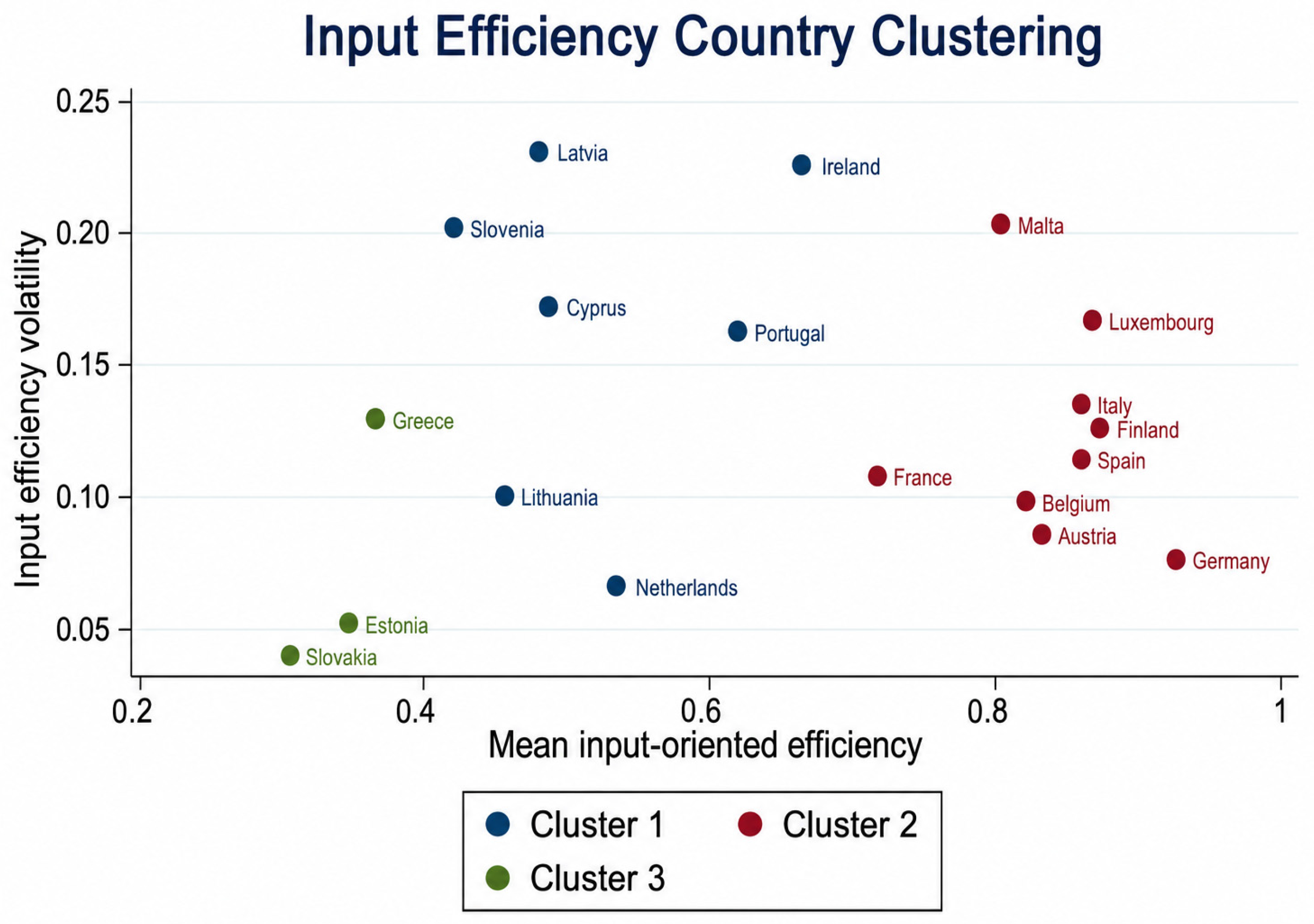
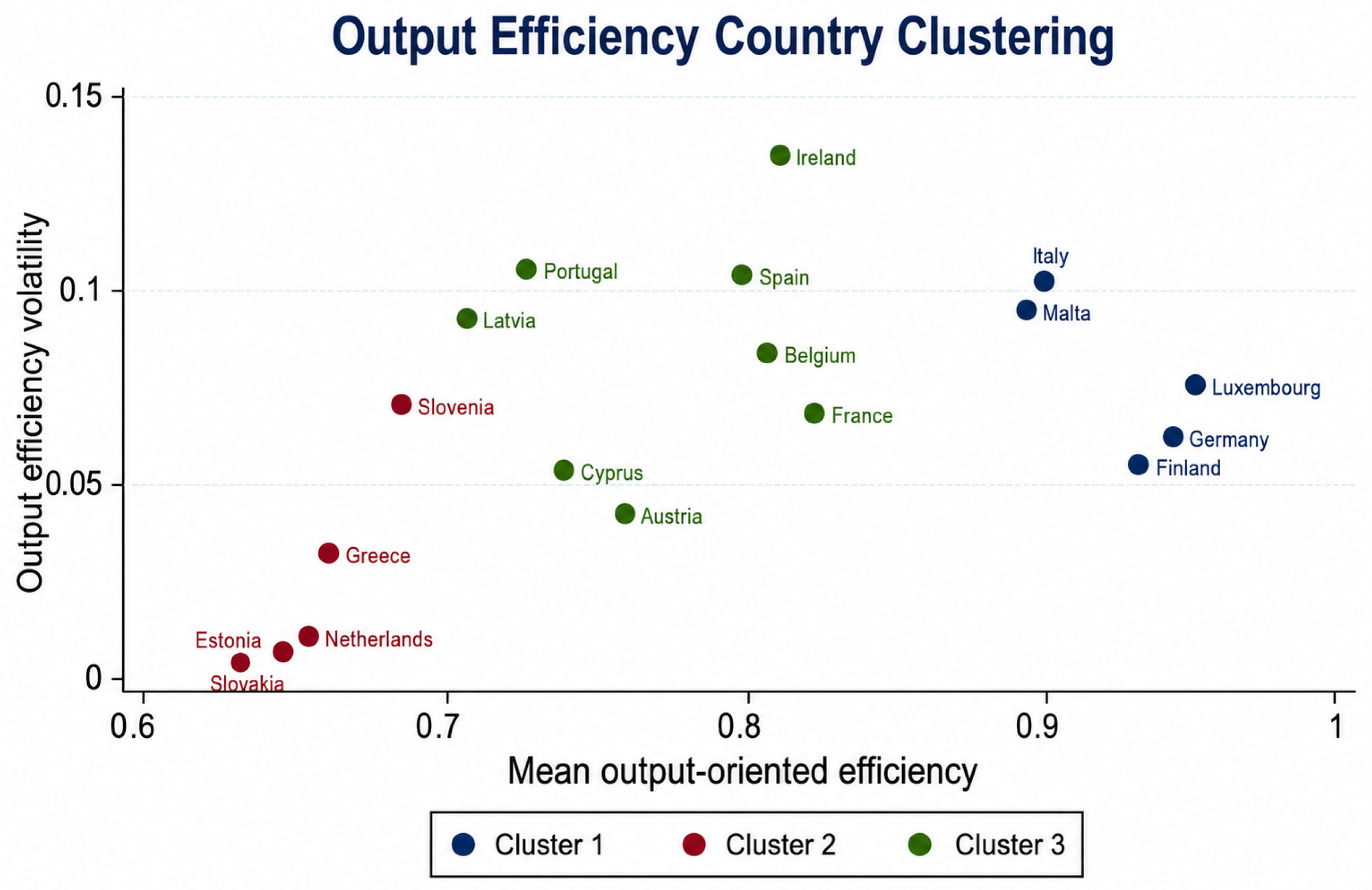
Figure 1 and
Figure 2 provide country-specific clustering. The X-axis shows the mean values of input- and output-oriented efficiency scores, with values further to the right indicating higher average tourism efficiency. The Y-axis shows the standard deviation of efficiency scores over time, with higher values demonstrating more unstable efficiency performance and lower values indicating more stable efficiency dynamics. Furthermore,
Figure 1 and
Figure 2, efficiency volatility is proxied by the standard deviations of country-specific efficiency scores on the Y-axis over the sample period. Higher values on the vertical axis, therefore, indicate greater temporal instability in tourism efficiency performance. These figures show structural heterogeneity and the evolution of efficiency for this study’s sample.
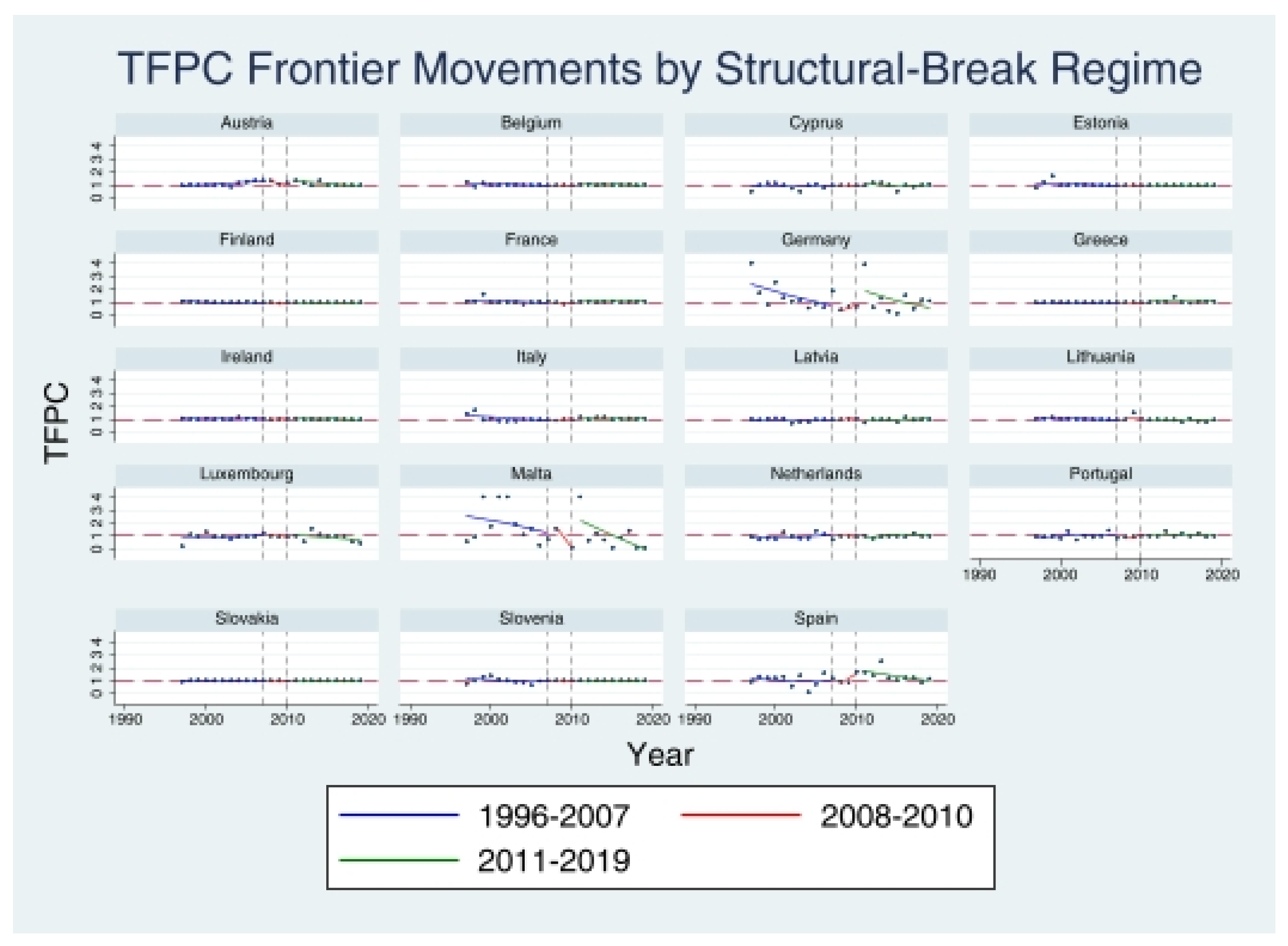
Figure 3 shows frontier movement across structural-break regimes. This figure visualizes country-specific productivity trajectories, fitted productivity regime trends, and frontier dynamics (frontier shifts) before and after identified structural breaks (2007 and 2010).
As outlined above, the analysis employs a Slack-Based Measure (SBM) under both input-and output-oriented specifications. To facilitate interpretation, slack magnitudes are rescaled as percentage adjustments relative to their observed values. Expressing inefficiency in proportional terms enhances comparability across countries and ensures consistency among variables measured in different units.
Under the input-oriented SBM specification, inefficiency is primarily associated with excessive input utilization, while any output shortfalls and environmental surpluses are corrected through slack adjustments. Conversely, in the output-oriented SBM framework, inefficiency mainly reflects output shortfalls, although input excesses and undesirable output surpluses also require adjustments through non-radial slack corrections.
In this framework,
Table 3 reports the mean and dispersion of normalized slack values under the input-oriented SBM specification. Slacks are expressed as proportional deviations from observed levels. The results suggest substantial input overutilization across Eurozone countries. On average, employment (dce) exhibits a normalized slack of −0.28, indicating this dimension could be reduced by approximately 28% without compromising output levels. Similarly, investments (invest) show an even larger mean slack of −0.37, implying that capital tourism spending exceeds the efficient frontier benchmark by roughly 37%. These findings point to considerable misallocation of resources in employment and capital within the Eurozone’s tourism sector.
In contrast, tourism demand-side variables display relatively small adjustment needs. International tourism spending (visitexp) and domestic tourism spending (dts) exhibit modest average slacks (0.044 and 0.045, respectively), suggesting comparatively limited output shortfalls under the input-oriented framework.
Regarding the environmental-related variables, final energy consumption (energyf) shows an average slack of 0.062, while greenhouse gas emissions (greenh) show an average slack of 0.071. These values imply that energy use and emissions could be reduced by approximately 6–7% to reach the efficiency frontier, suggesting moderate environmental inefficiencies.
The standard deviations reveal moderate variability in employment and capital inefficiencies (0.26 and 0.23, respectively) compared to environmental variables (0.13 and 0.12, respectively), highlighting heterogeneous adjustment needs across countries, particularly in traditional production factors.
Overall, the evidence indicates that inefficiency in the Eurozone tourism sector is primarily driven by excessive input utilization, while environmental inefficiencies, though present, appear comparatively smaller in magnitude.
The following
Table 4 reports the mean and dispersion of normalized slack values under the output-oriented SBM specification. In the output-oriented framework, negative slacks for inputs indicate input excess, whereas positive slacks for outputs reflect shortfalls relative to the efficiency frontier.
The results show that input inefficiencies are relatively limited. Employment and investments exhibit small average slacks of −0.022 and −0.024, respectively. These values suggest that, on average, employment and investment inputs need to be reduced by only about 2–3% to achieve full efficiency. This indicates that when focusing on output expansion, excessive input usage is not the primary source of inefficiency.
By contrast, substantial output shortfalls are observed. International and domestic tourism spending both show mean normalized slack values of 0.23. This implies that tourism revenues would need to increase by approximately 23% to reach the best-practice frontier, holding inputs constant. The relatively high standard deviations (0.46 and 0.53) further suggest considerable heterogeneity across countries from a demand-side perspective.
Environmental variables also exhibit notable adjustment needs. Final energy consumption (energyf) and greenhouse gas emissions (greenh) have mean slack values of 0.11 and 0.12, respectively. These figures indicate that environmental performance needs to improve by roughly 11–12% to attain frontier efficiency, reflecting moderate eco-efficiencies across the sample.
Overall, the output-oriented results suggest that inefficiency in the Eurozone tourism sector is driven more by insufficient output generation and environmental underperformance than by excessive use of employment and capital investment spending. While input adjustments appear relatively small, considerable scope exists to expand tourism revenues and improve environmental efficiency, thereby reaching the production frontier.
4.2. Results of Panel Analysis
This study acknowledges the substantial heterogeneity characterizing the Eurozone tourism economies and emphasizes that tourism eco-efficiency is shaped by important cross-country structural differences rather than by homogeneous patterns. Considerable variations exist across member states in terms of tourism intensity, dependence on international tourism demand, renewable energy integration, environmental regulatory stringency, and the composition of national energy systems, all of which influence tourism efficiency and productivity dynamics. The clustering and frontier-movement analyses further indicate distinct regimes: some countries exhibit relatively high and stable eco-efficiency performance (e.g., Germany, Finland), while others display weaker productivity and adjustment capacity (e.g., Greece, Slovakia). These differences suggest that eco-efficiency and productivity patterns are conditioned by country-specific institutional, economic, and environmental characteristics. Consequently, the findings support the view that a uniform strategy is unlikely to be effective across the Eurozone, thereby reinforcing the need for differentiated and country-specific sustainable tourism policy frameworks.
Appendix A refers to interaction terms and regime specific effects.
4.2.1. Results of Cross-Sectional Dependence Tests
Results of cross-sectional dependence tests based on [
33] procedure indicate that all panel variables are dependent (
p–values < 0.01) (
Table 5). CD is a common issue arising during panel testing. Its main root causes are the abolition of artificial borders across sample countries, the mobility of capital (human and financial), and similar reactions to external shocks (e.g., energy price shocks). Also, this issue may be due to common policies (e.g., climate policy agreements), strategies (e.g., technological changes), and structural changes in the economic systems of the Eurozone’s member states (e.g., global financial crisis).
4.2.2. Results of Unit Root Tests
As indicated in
Table 6, unit root tests based on [
34] procedure revealed two structural breaks in the panel series. Particularly, the break in 2006 is due to the accelerated rollout of the EU renewable energy policy, and the break in 2019 is due to the EU’s clean energy transition (e.g., the Green Deal). Significantly, the break in 1998 coincides with convergence policies prior to the official launch of the euro and with increased tourism integration within the European Union. The break in 2015 might be due to the full recovery of tourism demand after the debt crisis, increased digitalization and the platform economy, and shifts toward higher tourism revenue growth. The break in 2005 is due to the acceleration of environmental agreements and the pre-financial crisis expansion of tourism investments. The break in 2016 might be due to post-sovereign-debt-crisis recovery and improved capital discipline after the austerity years. The break in 2007 is due to the onset of the global financial crisis, credit tightening, and an investment slowdown, whereas the break in 2010 might be due to structural reforms, austerity policies, and a contraction in public spending.
4.2.3. Results of Regression Tests
Regression tests were based on the methodology developed by [
35] and discussed by [
36]. The baseline interaction models of
Table 7,
Table 8,
Table 9,
Table 10,
Table 11,
Table 12,
Table 13,
Table 14,
Table 15,
Table 16,
Table 17,
Table 18,
Table 19,
Table 20,
Table 21,
Table 22,
Table 23 and
Table 24 estimate whether the effect of the key variable (e.g., renewables) changes across structural regimes by including break dummies and interaction terms. The regime-specific results, in contrast, calculate the total marginal effect within each period by combining the Vaseline coefficients with the relevant interaction terms, thereby showing the actual effect in each regime. Furthermore, structural break effects reflect discrete level shifts in the dependent variable after the break point, whereas interaction terms capture changes in the marginal effect (slope coefficient) of the explanatory variable over time. Slope changes indicate whether the explanatory variable’s effect varies across regimes.
To facilitate interpretation, linput is the logit-transformed input-oriented technical eco-efficiency, loutput is the logit-transformed output-oriented technical eco-efficiency, renew is the % percentage of final energy consumption, d_* variables denote structural break dummies taking the value 1 from the indicative year onward, and r_* variables denote interaction terms between renewables and the respective break dummies, capturing regime-specific slope changes.
The baseline interaction model in
Table 7 indicates that renewable energy adoption (measured in % percentage of final energy consumption) positively affects input-oriented eco-efficiency, though the effect is marginally significant (
p-value = 0.095). These regression findings correspond to Equation (1) model specification outlined in the Methodology section. Since the input-oriented dependent variables are logit transformed, a one-unit increase (a one percentage point increase) in renewable energy share increases the log-odds of being closer to the eco-efficiency frontier by 0.095 units. Alternatively, a one percentage-point increase in renewables increases the odds of higher eco-efficiency by approximately 5.4% (renew coeff. = 0.054). The presence of significant structural break dummies confirms that input eco-efficiency experienced notable regime shifts over time, particularly after 2016 and 2019. Moreover, the negative and statistically significant interaction terms in later regimes suggest that the marginal impact of renewables on input-ecoefficiency weakens over time. Interestingly, in the case of interaction terms r_in_2006
from Equation (1), which measure how the slope of renewables changes after 2016, the post-2016 effect equals 0.05438 + (– 0.05185) = 0.00253. This means that the beneficial effect of renewables on input-oriented technical eco-efficiency weakened significantly after 2016 (the positive marginal effect declined).
The regime-specific marginal effects provide further insights. Renewable energy significantly enhances input eco-efficiency during the 2006–2015 period, with a positive, statistically significant marginal effect (coef. = 0.05438 + (−0.0043) + 0.00718 = 0.06113,
p-value = 0.037). This corresponds to approximately a 6,3% increase in the odds of higher eco-efficiency
. This suggests that during the phase of intensified renewable energy expansion and environmental policy implementation, improvements in energy structure translated into measurable gains and input efficiency. The marginal effects of renew on linput based on regime breaks in 2005, 2006, 2016, 2019 are provided by
Table 8,
Table 9,
Table 10,
Table 11 and
Table 12.
In contrast to the input-oriented specification, the baseline model for output-oriented eco-efficiency (
Table 13) does not reveal a statistically significant direct effect of renewables on tourism output eco-efficiency (
p-value = 0.161). These regression findings correspond to Equation (2) model specification outlined in the Methodology section. Although several structural break dummies are significant—indicating substantial shifts in output eco-efficiency across time—the slope coefficients on renewable energy and its interactions suggest that renewable adoption does not systematically translate into improved output generation efficiency.
The marginal effects of renew on loutput based on regime breaks in 1998, 2006, 2015, 2019 are provided in
Table 14,
Table 15,
Table 16,
Table 17 and
Table 18. The regime-specific marginal effects confirm this pattern. Across all identified regimes- pre-1998, 1998–2005, 2006–2014, 2015–2018, post-2019—the marginal impact of renewable energy on output-oriented eco-efficiency remains statistically insignificant. Although the magnitude of the effect varies across periods, none of the regime-specific estimates indicate a robust relationship. Output eco-efficiency appears to be driven more strongly by broader macroeconomic conditions, tourism demand dynamics, and structural competitiveness factors than by the energy mix alone.
In the case of total factor productivity change, the fixed-effects regression with Driscoll-Kraay standard errors indicates that renewable energy has a statistically significant negative association (
Table 19). These regression findings correspond to Equation (3) model specification outlined in the Methodology section. The regression coefficient (coeff. = −0.029) indicates that, prior to structural shifts, higher renewable energy shares were associated with lower productivity growth in the tourism sector. Importantly, several structural break dummies are statistically significant, indicating substantial regime shifts in productivity dynamics over time. In particular, the 2007 break (d_outpc_2007) shows a strong positive shift, whereas the 2006 renewable break (d_ren_2006) is associated with a negative structural shift. Moreover, the significant interaction terms (notably r_outpc_2007 and r_ren_2006) indicate that the slope effect of renewables on productivity changes across regimes, confirming the presence of structural heterogeneity in the renewables-productivity relationship.
The regime-specific effects suggest that, in the pre-2006 period, renewable energy exerts a statistically significant negative effect on productivity (coeff. = −0.029, p-value = 0.007), confirming the baseline results. However, this negative effect disappears in subsequent regimes. During 2006–2007, the marginal effect became statistically insignificant. Similarly, during the 2007–2009 crisis period, the estimated effect remains negative but becomes statistically insignificant. In the 2010–2018 post-sovereign crisis period, the coefficient remains small and insignificant. Finally, in the post-2019 regime, the effect remains insignificant.
4.2.4. Results of Granger Tests
In the case of input-oriented eco-efficiency, panel pVAR Granger tests indicate no evidence of a dynamic relationship with renewables in the Eurozone tourism sector (
Table 25). The absence of dynamic causality suggests that improvement in input eco-efficiency and renewable energy adoption requires coordinated and structural policy interventions, as neither variable appears to individually (autonomously) drive (Ganger cause) the other over time.
Similarly, in the case of output-oriented eco-efficiency, panel pVAR Granger tests provide no evidence of a dynamic relationship with renewable energy in the Eurozone tourism sector (
Table 26). These findings imply that renewable energy policies alone might not enhance output-oriented tourism eco-efficiency, highlighting the need for integrated strategies that combine energy transition with sector-specific productivity and environmental management reforms.
In the case of total factor productivity, the panel pVAR Granger tests do not provide evidence of dynamic linkages with renewable energy adoption (
Table 27). The null hypothesis that renewable energy does not Granger-cause total factor productivity cannot be rejected (χ
2 = 4.086,
p-value = 0.130), nor can the reverse hypothesis that productivity Granger-causes renewable energy (χ
2 = 0.022,
p-value = 0.989). These results confirm the neutrality hypothesis. In essence, tourism productivity and renewables evolve independently, driven by structural, long-term policy and technological progress, implying that productivity gains in the tourism sector do not automatically arise from renewable adoption without complementary efficiency and innovation policies.
5. Discussion
Interestingly, ref. [
37] found that tourism development increases the ecological footprint, highlighting the need to identify sustainable development patterns and trajectories. Many research efforts attempt to determine whether tourism drives economic activity or economic activity leads to tourism growth [
38,
39,
40]. Hence, it is critical to decode the dynamics that affect efficiency status at destinations, as research [
41] can provide insights into decision-making processes to further expand the tourism sector while considering environmental constraints.
More specifically, countries such as Germany, Austria, Belgium, and Finland exhibit relatively high average input- and output-oriented efficiency scores combined with comparatively lower volatility, indicating more mature and resilient tourism production systems. For these countries, policy priorities should focus on sustaining eco-efficient tourism growth through continued investments in renewable energy infrastructure, smart tourism digitalization, and the integration of low-carbon tourism activities. By contrast, countries such as Malta, Luxembourg, Ireland, and Portugal exhibit relatively high efficiency but elevated volatility, suggesting greater exposure to external shocks and fluctuations in tourism demand. For these economies, tourism governance should prioritize resilience-enhancing policies, including tourism demand diversification, seasonality management, crisis-response mechanisms, and stronger integration between tourism planning and macroeconomic stabilization frameworks. The analysis also identified a group of countries characterized by persistently lower efficiency performance, including Greece, Slovakia, Estonia, and Lithuania, particularly under the input-oriented specification. For these countries, research findings suggest improving the efficiency of tourism investment, upgrading tourism-related infrastructure, enhancing labor productivity in tourism services, and strengthening institutional coordination among tourism, energy, and environmental sectors. The central role in achieving greater eco-efficiency is attributed to the renewable energy transition. Eurozone tourism governance should accelerate the transition to renewable-energy-intensive tourism systems by prioritizing energy-efficient accommodation, sustainable mobility infrastructure, and low-carbon investment schemes. In particular, countries exhibiting lower eco-efficiency should strengthen environmental policies to increase renewables in the energy mix used in the tourism system and adopt a sustainable competitiveness character, improving long-term tourism resilience.
The slack analysis suggests that inefficiencies across Eurozone tourism economies are primarily associated with structural weaknesses in output generation and environmental performance rather than excessive use of employment and investment capital inputs. Countries exhibiting larger tourism spending shortfalls may be constrained by limited tourism competitiveness, seasonal dependence, limited diversification of tourism services, or insufficient integration of digital and sustainable tourism strategies. At the same time, the observed environmental slacks indicate that several countries continue to rely on energy-intensive tourism models characterized by inadequate transport systems, high energy consumption in accommodation, and slow adoption of green technologies. These findings imply that policy interventions should focus less on reducing employment or capital investment and more on improving the productivity and sustainability of tourism-related activities through innovation, integration of renewable energy, sustainable infrastructure, and higher-value-added tourism services. Therefore, achieving higher tourism eco-efficiency in the Eurozone countries requires structural reforms that simultaneously increase tourism demand, improve environmental management, and accelerate the transition toward greener tourism production models.
Arguably, ref. [
26] state that, in processes to improve the tourism industry, the core determinants of tourism performance should be of high interest to key stakeholders. In this study, the magnitude of the slack adjustments suggests that tourism policy makers should prioritize reallocating employment and restructuring capital spending in the tourism sector. The employment-relevant issues might include efforts to reskill, upskill, and improve competencies. These dimensions can lead to more productive tourism market segments in the Eurozone rather than to expanded resource use. The significant output expansion potential calls for strengthening destination competitiveness through quality and innovation. At the same time, the measurable reduction potential in energy use and greenhouse gas emissions underscores the importance of accelerating energy-efficiency standards and low-carbon technologies within the tourism sector. Targeted financial incentives and performance-based environmental regulations could help align productivity improvements with sustainability objectives within the Eurozone’s tourism sector.
The regression results have important implications for tourism and energy policy in the Eurozone economic space. First, the findings that renewable energy expansion has significantly improved input-oriented eco-efficiency during 2006–2015 suggest that early investments in renewables enabled the tourism sector to use employment and capital more efficiently while reducing environmental pressures. This implies that renewables can support tourism competitiveness by lowering the environmental cost per unit of tourism output. In practice, this means that renewables likely reduced emissions and energy intensity in tourism services such as accommodation, transport, and hospitality without requiring proportional increases in employment or investment.
Second, the weakening of this relationship after 2016 indicates that the marginal efficiency gains from renewable energy employment diminish. This suggests that renewable energy adoption is insufficient to sustain long-term improvements in eco-efficiency in the tourism sector. In market terms, economic efficiency can be defined as relative productivity over time, space, or both [
42]. Moreover, ref. [
43] claim that in any industry, economic efficiency concerns a relative assessment of this industry’s effectiveness rates when processing inputs into outputs compared to the most efficient industry in the sample (e.g., best practice). Without complementary investments (e.g., tourism infrastructure and low-energy tourism services), renewable deployment might not yield sustained efficiency gains. One particular issue is the concept of green finance, which mitigates the negative environmental externalities of tourism development [
44].
Third, the absence of a statistically significant relationship between output-oriented eco-efficiency and renewables indicates that renewable energy does not automatically increase tourism revenue and spending. Renewable energy appears to improve environmental and input efficiency, rather than directly expanding tourism demand. This highlights that renewables primarily enhance the sustainability dimension of tourism production rather than acting as a direct driver of tourism output growth. Fourth, the structural breaks observed around major policy periods suggest that the effectiveness of renewable policy depends on broader institutional and technological conditions. Energy transition phases, especially in later periods, call for a deeper technological integration, improved management, and energy-efficient solutions in business practices across the Eurozone’s tourism sector. Fifth, these findings indicate that decarbonization practices should move beyond simply expanding renewable capacity. Low-carbon models (e.g., smart technology, energy-efficient buildings) should be advanced to yield stronger eco-efficiency gains than renewable energy expansion alone.
In the regime-specific results, prior to 2006, renewable energy expansion was associated with a statistically significant decline in total factor productivity change, suggesting the presence of short-term adjustments or restructuring costs in the tourism sector. Notwithstanding, this negative effect diminishes and becomes statistically insignificant in subsequent periods, implying gradual adaptation and improved integration of renewables in the Eurozone’s tourism production systems. The reduction in adverse impact over time suggests learning effects, policy coordination, and the use of advanced technology. These results indicate that while renewable transitions may initially exert productivity pressures, complementary innovation policies and sector-specific efficiency measures can mitigate these effects and stabilize productivity performance in the long run.
The panel Granger causality results consistently indicate the absence of dynamic, bidirectional relationships among eco-efficiency, productivity, and renewable energy. This suggests that renewable energy expansion and improvements in tourism performance evolve largely through structural and policy-driven mechanisms rather than through short-run feedback dynamics. Practically, increases in renewable energy shares do not automatically translate into immediate gains in tourism eco-efficiency or productivity, nor do improvements in eco-efficiency and productivity stimulate renewable adoption. From a policy perspective, this underscores the importance of holistic, well-designed, and complementary strategies: renewable energy investments must be accompanied by sector-specific innovation, technological upgrading, managerial efficiency reforms, and targeted environmental regulations within the tourism industry to generate measurable productivity and eco-efficiency gains. In the absence of such integrated frameworks, energy transitions alone may not be sufficient to enhance the Eurozone’s tourism sector. Not to mention that countries should first identify which factors and/or aspects sustain competitiveness in our changing reality [
45]. Interestingly, tourism’s crucial stakeholders should consider that digital financial services enhance the capacity of both development goals and social sustainability [
46]. Enhancing the interaction of the digital economy, tourism development, and eco-efficiency is crucial for achieving sustainability goals [
47].
The panel pVAR causality tests support the neutrality hypothesis, indicating the absence of short-run bidirectional causal linkages between renewables and eco-efficiency in the Eurozone countries. Causality tests suggest that renewable energy transition and tourism productivity may evolve independently rather than through immediate dynamic feedback effects. One possible explanation is that the benefits of renewable energy investments materialize gradually through long-term structural adjustments, technological modernization, and improvements in environmental quality rather than through short-run productivity gains. Similarly, improvements in tourism eco-efficiency may depend more strongly on sector-specific management practices, infrastructure quality, innovation, and environmental regulation than on renewable energy adoption alone. These results imply that renewable energy policies, although important for sustainable objectives, may not automatically enhance tourism productivity without complementary green investments and efficiency-oriented reforms. Therefore, holistic and integrated approaches linking the renewable energy transition with sustainable tourism planning and technological innovation appear necessary to generate stronger synergies between environmental sustainability and tourism eco-efficiency.
Interestingly, decoupling effects aim to separate economic growth from environmental degradation, meaning that while growth continues, environmental degradation (pressure) declines. Also, degrowth questions the primacy of growth and advocates scaling down resource-intensive activities where ecological limits are binding (e.g., reducing intense economic activity). Although decoupling and degrowth represent distinct policy paradigms, both aim to reconcile tourism economic activity with ecological constraints. For instance, the neutral links between renewables and tourism efficiency suggest that renewable expansion. These results imply that efficiency-driven decoupling strategies may need to be complemented by structural adjustments or selective contraction in resource-intensive segments of the tourism market. Additionally, slack values show resource overuse and environmental excess, implying structural inefficiencies. In this sense, both approaches converge toward the shared objective of long-run tourism economic sustainability. Practically, where efficiency gains and clean technologies can reduce environmental intensity, a decoupling strategy should be applied. Where structural overcapacity or excessive resource use persists, a targeted, selective degrowth or restructuring in inefficient segments is required.
From a policy perspective, achieving sustainable tourism development may require a relevant degrowth approach in resource-incentive segments, combined with structural decoupling strategies that reinforce low-carbon technologies, efficiency upgrading, and demand-side management rather than relying solely on renewable energy expansion.
In this regard, research findings provide important policy insights for the European Green Deal and the Fit-for-55 package, which aim to drastically reduce emissions by 2030 while preserving economic competitiveness. Empirical research provides evidence on whether the decoupling effect is feasible and attainable. For instance, this study confirms that renewable energy deployment significantly improved tourism eco-efficiency growth patterns in the early transition phases of the sample period, suggesting that renewable expansion has contributed to decoupling tourism growth from environmental degradation in Eurozone countries. This supports the European Union’s strategies to accelerate renewable energy adoption as a core mechanism to achieve a neutral, carbon-free economy without losing business pursuits and goals within the tourism economy. However, the weakening marginal efficiency gains in later periods imply that renewables alone are insufficient to sustain long-term efficiency improvements across Eurozone member states.


_Li.png)