Rethinking Urban Heat Islands in Polycentric Metropolitan Systems: A Bibliometric and Systematic Review of Networked Heat Dynamics



Abstract
1. Introduction
2. Methods
2.1. Research Design
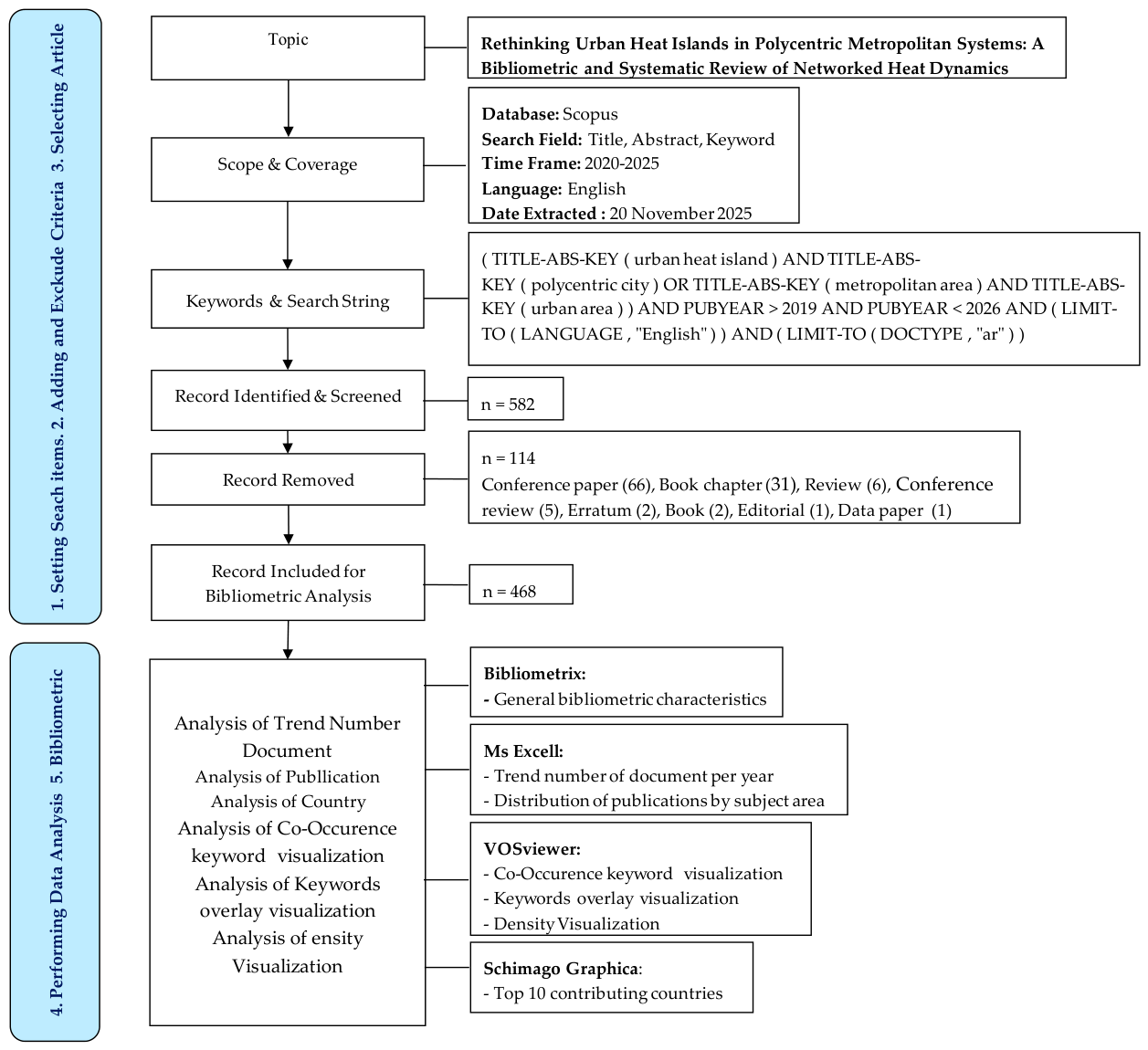
2.2. Data Sources and Search Strategy
2.3. Bibliometric Analysis
2.4. Systematic Literature Review (SLR) Protocol
3. Results
3.1. Knowledge Landscape and Research Trends
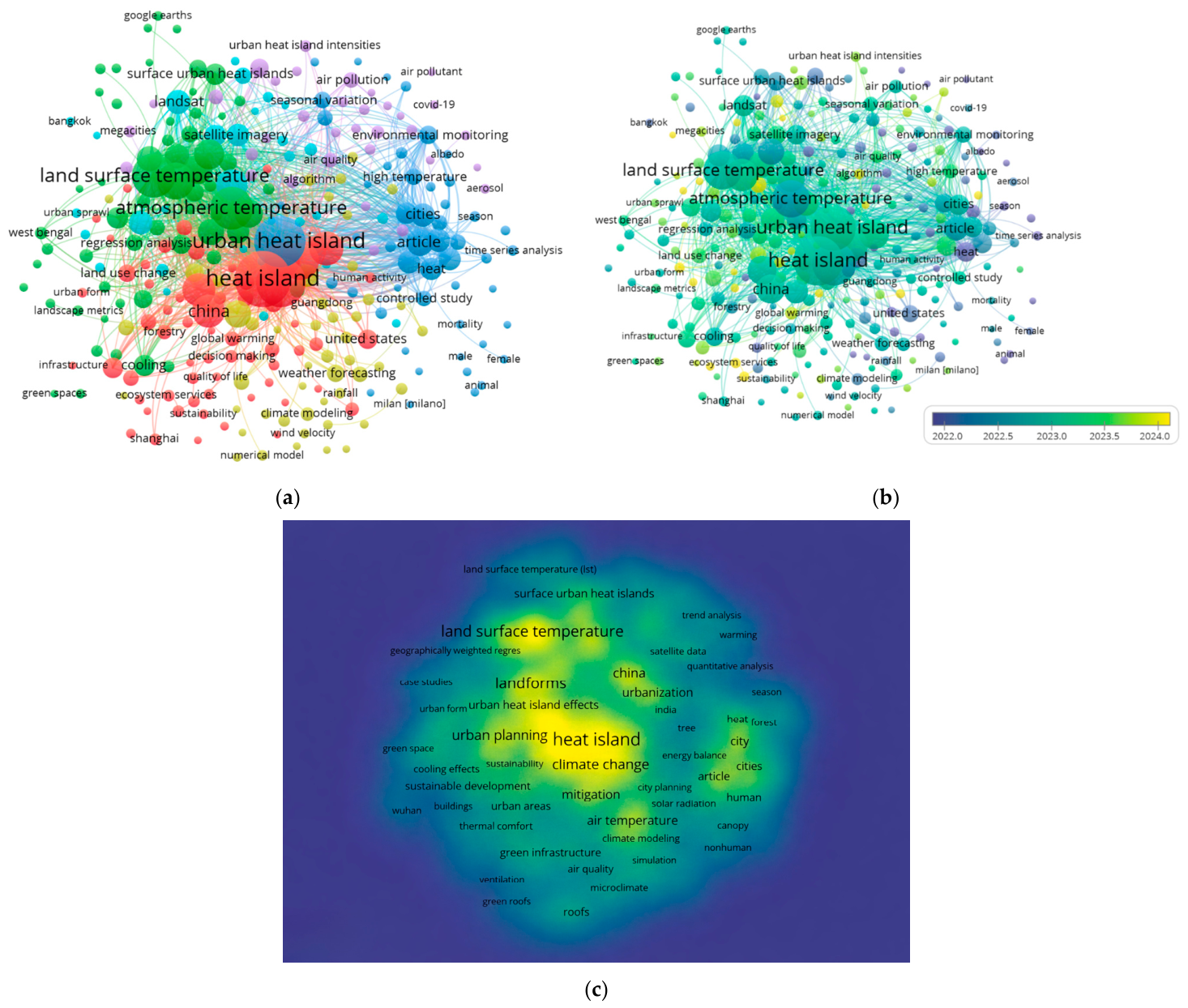
3.2. Thematic Structure of Polycentric UHI Research
3.3. Spatial Patterns of Urban Heat Islands in Polycentric Cities
4. Discussion
4.1. Polycentric UHI Is as an Extension of Single-City or Core–Periphery Models
4.2. Functional Hierarchy Matters: Not Every Sub-Center Produces Heat in the Same Way
4.3. From Local Cooling to Metropolitan Heat Governance
4.4. Equity, Geography and Transferability
4.5. Methodological Agenda: Harmonization, Causality and Open Pipelines
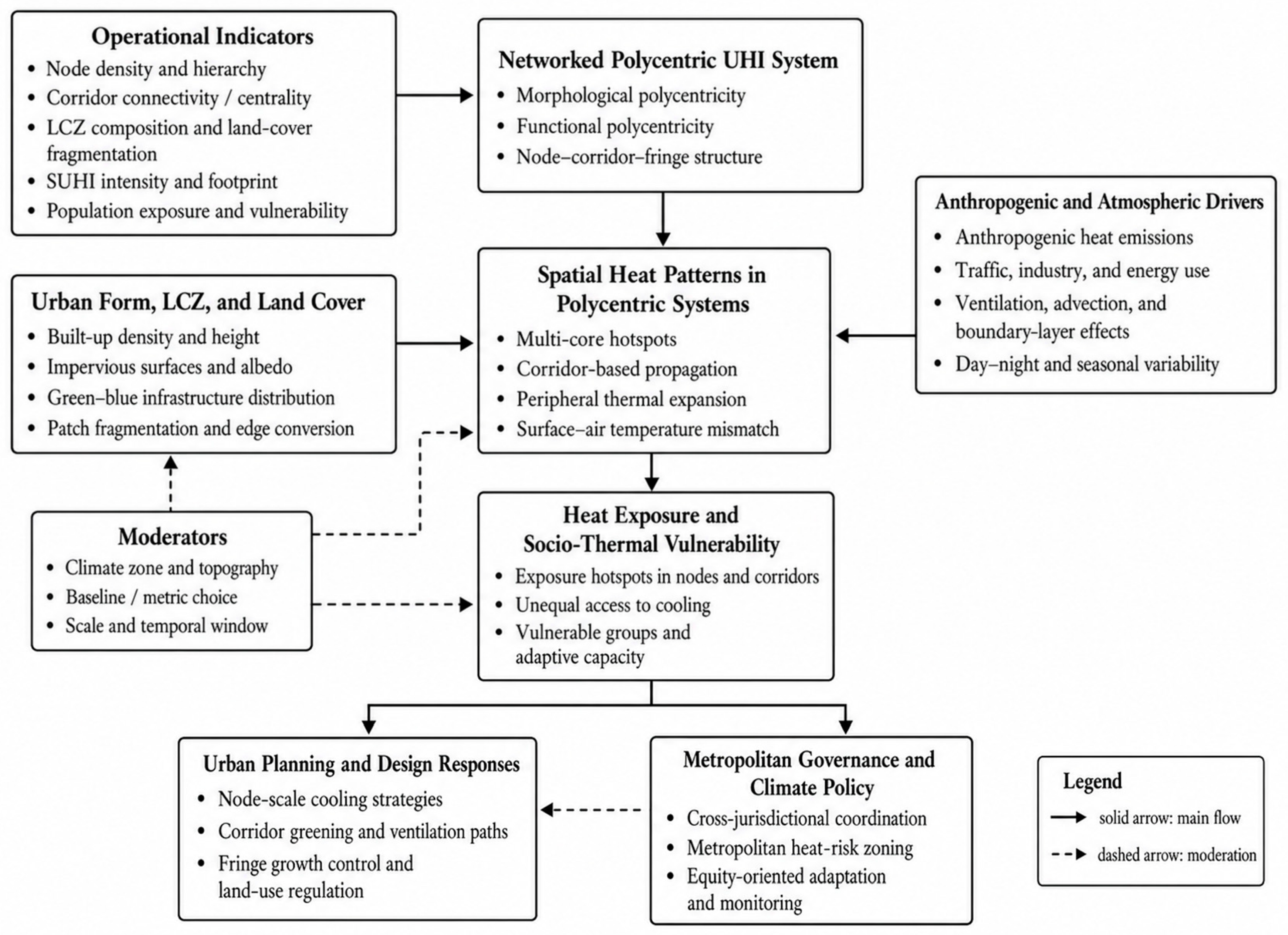
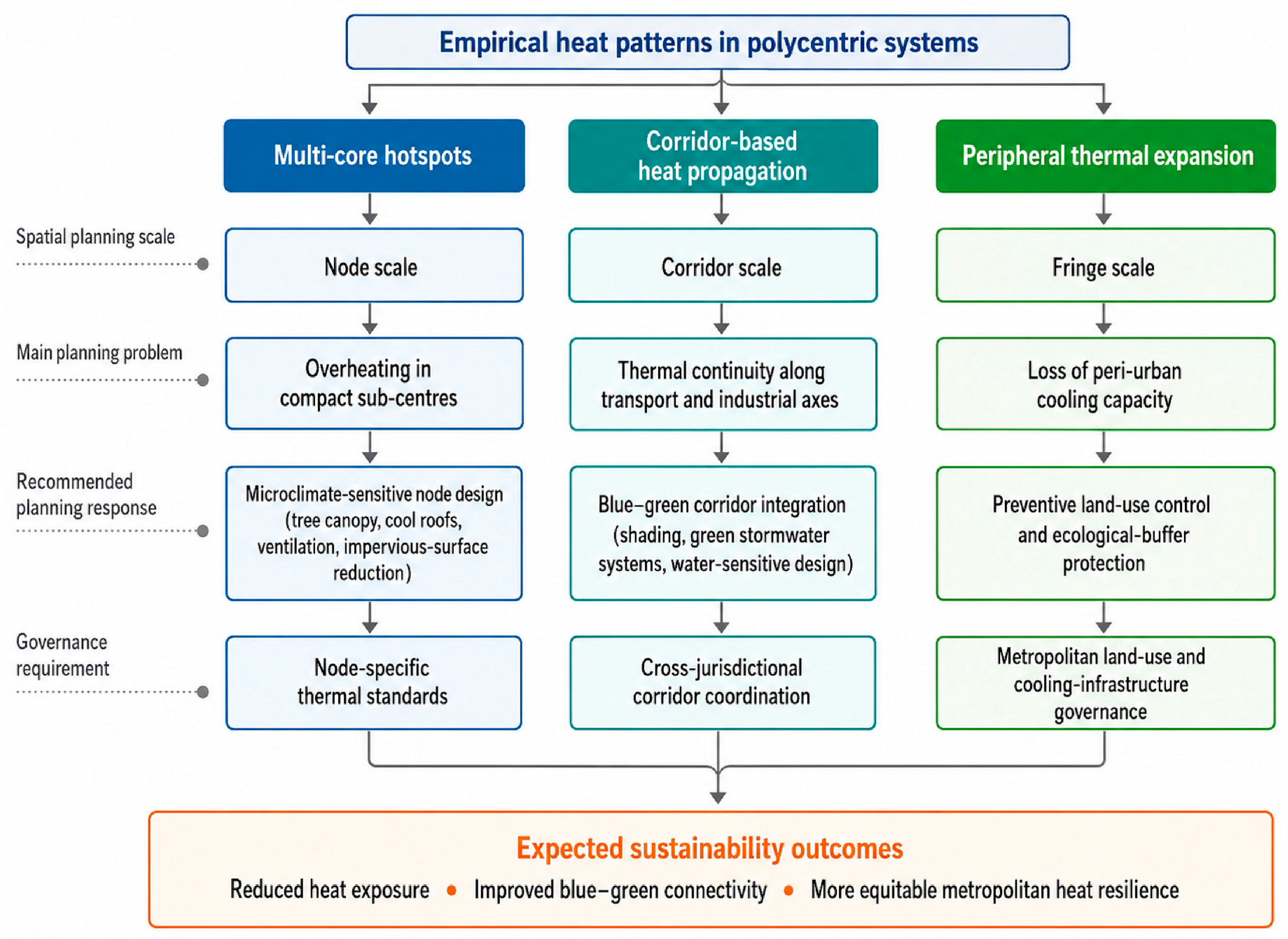
4.6. Planning and Governance Implications for Polycentric Heat Adaptation
5. Future Research Agenda
6. Limitations
7. Conclusions
Author Contributions
Funding
Institutional Review Board Statement
Informed Consent Statement
Data Availability Statement
Acknowledgments
Conflicts of Interest
Abbreviations
| UHI | Urban Heat Island |
| SUHI | Surface Urban Heat Island |
| SUHII | Surface Urban Heat Island Intensity |
| LST | Land Surface Temperature |
| LCZ | Local Climate Zone |
| LULC | Land Use and Land Cover |
| NDVI | Normalized Difference Vegetation Index |
| NDBI | Normalized Difference Built-up Index |
| NDMI | Normalized Difference Moisture Index |
| PRISMA | Preferred Reporting Items for Systematic Reviews and Meta-Analyses |
| SLR | Systematic Literature Review |
References
- Winther, L. Editorial–Transformation of Cities. Geogr. Tidsskr.-Dan. J. Geogr. 2015, 115, 67–72. [Google Scholar] [CrossRef]
- Yue, W.; Wang, T.; Liu, Y.; Zhang, Q.; Ye, X. Mismatch of Morphological and Functional Polycentricity in Chinese Cities: An Evidence from Land Development and Functional Linkage. Land Use Policy 2019, 88, 104176. [Google Scholar] [CrossRef]
- Jatayu, A.; Saizen, I.; Rustiadi, E.; Pribadi, D.O.; Juanda, B. Urban Form Dynamics and Modelling towards Sustainable Hinterland Development in North Cianjur, Jakarta–Bandung Mega-Urban Region. Sustainability 2022, 14, 907. [Google Scholar] [CrossRef]
- Pravitasari, A.E.; Indraprahasta, G.S.; Rustiadi, E.; Rosandi, V.B.; Stanny, Y.A.; Wulandari, S.; Priatama, R.A.; Murtadho, A. Dynamics and Predictions of Urban Expansion in Java, Indonesia: Continuity and Change in Mega-Urbanization. ISPRS Int. J. Geo-Inf. 2024, 13, 102. [Google Scholar] [CrossRef]
- Wardana, A.P.; Pravitasari, A.E.; Panuju, D.R. Land Use Dynamics and Rural-Urban Transformation of Kedungsepur Metropolitan Area in Central Java Province, Indonesia. J. Pengelolaan Sumberdaya. Alam Dan Lingkung. 2026, 16, 76–89. [Google Scholar] [CrossRef]
- Wardana, A.P.; Pravitasari, A.E.; Panuju, D.R. Dynamics of Land Cover, Development Level, and Regional Typology of Central Java Province Based on Sustainable Development Index. IOP Conf. Ser. Earth Environ. Sci. 2023, 1266, 012035. [Google Scholar] [CrossRef]
- Rizqullah, M.F.; Rustiadi, E.; Rosandi, V.B.; Pravitasari, A.E. Spatiotemporal Dynamics of Land Cover Changes and Local Sustainability Index of Cianjur Regency, West Java. J. Pengelolaan Sumberdaya. Alam Dan Lingkung. 2025, 15, 844–863. [Google Scholar] [CrossRef]
- Saptono, Y.; Rustiadi, E.; Barus, B.; Pravitasari, A.E. Systematic Literature Review: Research Development of Urban Resilience in Metropolitan Areas. Sustainability 2025, 17, 7380. [Google Scholar] [CrossRef]
- Pribadi, D.O.; Saifullah, K.; Putra, A.S.; Nurdin, M.; Iman, L.O.S.; Rustiadi, E. Spatial Analysis of COVID-19 Outbreak to Assess the Effectiveness of Social Restriction Policy in Dealing with the Pandemic in Jakarta. Spat. Spatiotemporal. Epidemiol. 2021, 39, 100454. [Google Scholar] [CrossRef] [PubMed]
- Rustiadi, E.; Pravitasari, A.E.; Setiawan, Y.; Mulya, S.P.; Pribadi, D.O.; Tsutsumida, N. Impact of Continuous Jakarta Megacity Urban Expansion on the Formation of the Jakarta-Bandung Conurbation over the Rice Farm Regions. Cities 2021, 111, 103000. [Google Scholar] [CrossRef]
- Oke, T.R. The Energetic Basis of the Urban Heat Island. Q. J. R. Meteorol. Soc. 1982, 108, 1–24. [Google Scholar] [CrossRef]
- Stewart, I.D.; Oke, T.R. Local Climate Zones for Urban Temperature Studies. Bull. Am. Meteorol. Soc. 2012, 93, 1879–1900. [Google Scholar] [CrossRef]
- Voogt, J.A.; Oke, T.R. Thermal Remote Sensing of Urban Climates. Remote Sens. Environ. 2003, 86, 370–384. [Google Scholar] [CrossRef]
- Jung, S.J.; Yoon, S. Effects of Creating Street Greenery in Urban Pedestrian Roads on Microclimates and Particulate Matter Concentrations. Sustainability 2022, 14, 7887. [Google Scholar] [CrossRef]
- Ma, Y.; Li, J.; Wang, J.; Hu, L.; Zhao, M.; Li, J.; Wang, J.; Hu, L. Cooling Effect of Different Land Cover Types: A Case Study in Xi’an and Xianyang, China. Sustainability 2021, 13, 1099. [Google Scholar] [CrossRef]
- Oke, T.R.; Mills, G.; Christen, A.; Voogt, J.A. (Eds.) Air Pollution. In Urban Climates; Cambridge University Press: Cambridge, CA, USA, 2017; pp. 294–331. [Google Scholar] [CrossRef][Green Version]
- Arnfield, A.J. Two Decades of Urban Climate Research: A Review of Turbulence, Exchanges of Energy and Water, and the Urban Heat Island. Int. J. Climatol. A J. R. Meteorol. Soc. 2003, 23, 1–26. [Google Scholar] [CrossRef]
- Newman, M.E.J. The Structure and Function of Complex Networks. SIAM Rev. 2003, 45, 167–256. [Google Scholar] [CrossRef]
- Filho, W.L.; Balogun, A.-L.; Ayal, D.Y.; Bethurem, E.M.; Murambadoro, M.; Mambo, J.; Taddese, H.; Tefera, G.W.; Nagy, G.J.; Fudjumdjum, H.; et al. Strengthening Climate Change Adaptation Capacity in Africa- Case Studies from Six Major African Cities and Policy Implications. Environ. Sci. Policy 2018, 86, 29–37. [Google Scholar] [CrossRef]
- Almashhour, R.; Kolo, J.; Beheiry, S. Critical Reflections on Strategies for Mitigating and Adapting to Urban Heat Islands. Int. J. Urban Sustain. Dev. 2024, 16, 144–162. [Google Scholar] [CrossRef]
- An, S.; Dedekorkut-Howes, A. A Review of Adaptation Strategies to Increased Urban Temperatures and Heat Island Effect. Discov. Cities 2025, 2, 32. [Google Scholar] [CrossRef]
- Lian, F.; Yi, W.; Ji, G.; Xia, J.; Wang, H. The Impact of Green Infrastructure on Mitigating Urban Heat Island Effect: Current Status, Trends, and Challenges. Forests 2025, 16, 1450. [Google Scholar] [CrossRef]
- Soltanifard, H.; Amani-beni, M. The Cooling Effect of Urban Green Spaces as Nature-Based Solutions for Mitigating Urban Heat: Insights from a Decade-Long Systematic Review. Clim. Risk Manag. 2025, 49, 100731. [Google Scholar] [CrossRef]
- Calhoun, Z.D.; Willard, F.; Ge, C.; Rodriguez, C.; Bergin, M.; Carlson, D. Estimating the Effects of Vegetation and Increased Albedo on the Urban Heat Island Effect with Spatial Causal Inference. Sci. Rep. 2024, 14, 540. [Google Scholar] [CrossRef] [PubMed]
- Clinton, N.; Gong, P. MODIS Detected Surface Urban Heat Islands and Sinks: Global Locations and Controls. Remote Sens. Environ. 2013, 134, 294–304. [Google Scholar] [CrossRef]
- Bulkeley, H. Cities and the Governing of Climate Change. Annu. Rev. Environ. Resour. 2010, 35, 229–253. [Google Scholar] [CrossRef]
- Bahara, R.; Nur Aidi, M.; Syamsu, K.; Sunarti, E.; Jayanegara, A.; Tieman, M. Global Research Trends on Halal Food SMEs: A Bibliometric Analysis. J. Islam. Mark. 2025, 16, 2641–2678. [Google Scholar] [CrossRef]
- Yue, W.; Liu, X.; Zhou, Y.; Liu, Y. Impacts of Urban Configuration on Urban Heat Island: An Empirical Study in China Mega-Cities. Sci. Total Environ. 2019, 671, 1036–1046. [Google Scholar] [CrossRef]
- Li, W.; Schmidt, S.J. Can Spatial Patterns Mitigate the Urban Heat Island Effect? Evidence from German Metropolitan Regions. Environ. Plan. B Urban Anal. City Sci. 2024, 51, 1948–1964. [Google Scholar] [CrossRef]
- Du, Y.; Xie, J.; Xie, Z.; Wang, N.; Zhang, L. Spatiotemporal Footprints of Surface Urban Heat Islands in the Urban Agglomeration of Yangtze River Delta During 2000–2022. Remote Sens. 2025, 17, 892. [Google Scholar] [CrossRef]
- Wang, H.; Yi, T.; Lu, Y.; Wang, Y.; Wu, J. Patterns of Nighttime Surface Urban Heat Island Patch in Mega Urban Agglomerations: A Case Study in the Pearl River Delta, China. Sustain. Cities Soc. 2025, 128, 106465. [Google Scholar] [CrossRef]
- Han, S.; Li, W.; Kwan, M.P.; Miao, C.; Sun, B. Do Polycentric Structures Reduce Surface Urban Heat Island Intensity? Appl. Geogr. 2022, 146, 102766. [Google Scholar] [CrossRef]
- Wang, C.; Chen, J.; Wang, Q.; Li, D.; Zhu, M.; Gan, Z.; Qin, M.; Zhang, Y. The Polycentricity of Urban Population Will Lead to Improvements in Urban Heat Island Effect: Evidence from the Yangtze River Delta in China. Sustain. Futur. 2025, 9, 100510. [Google Scholar] [CrossRef]
- Varnakovida, P.; Ko, H.Y.K. Urban Expansion and Urban Heat Island Effects on Bangkok Metropolitan Area in the Context of Eastern Economic Corridor. Urban Clim. 2023, 52, 101712. [Google Scholar] [CrossRef]
- Wang, R.; Murayama, Y.; Liu, F.; Zhang, X.; Hou, H.; Morimoto, T.; Derdouri, A. Impact of Urban Morphology on Land Surface Temperature: A Case Study of the Central Tokyo, Japan. City Environ. Interact. 2025, 28, 100227. [Google Scholar] [CrossRef]
- Gyile, D.N.; Asare, A.; Osei-Gyabaah, A.P.; Anaafo, D. Assessment of Land Use and Land Cover Changes and Their Impact on Land Surface Temperature in Greater Accra, Ghana. Sci. Afr. 2025, 29, e02826. [Google Scholar] [CrossRef]
- Kuru, A.; Okay, B.B. Investigating the Relationship between Urban Growth Pattern and Urban Heat Islands: The Case of Istanbul, Turkey. Environ. Earth Sci. 2025, 84, 43. [Google Scholar] [CrossRef]
- Han, W.; Tao, Z.; Li, Z.; Cheng, M.; Fan, H.; Cribb, M.; Wang, Q. Effect of Urban Built-Up Area Expansion on the Urban Heat Islands in Different Seasons in 34 Metropolitan Regions across China. Remote Sens. 2023, 15, 284. [Google Scholar] [CrossRef]
- Parida, B.R.; Prasad, K.; Swain, S.K.; Dwivedi, C.S.; Pandey, A.C.; Swain, K.C. Evaluating Urban Bioclimatic Comfort in a Metropolitan City Kolkata with Urban Dynamics and Heat Islands. Adv. Space Res. 2025, 76, 3372–3388. [Google Scholar] [CrossRef]
- Arshad, S.; Ahmad, S.R.; Abbas, S.; Asharf, A.; Siddiqui, N.A.; ul Islam, Z. Quantifying the Contribution of Diminishing Green Spaces and Urban Sprawl to Urban Heat Island Effect in a Rapidly Urbanizing Metropolitan City of Pakistan. Land Use Policy 2022, 113, 105874. [Google Scholar] [CrossRef]
- Tang, L.; Zhan, Q.; Fan, Y.; Liu, H.; Fan, Z. Exploring the Impacts of Greenspace Spatial Patterns on Land Surface Temperature across Different Urban Functional Zones: A Case Study in Wuhan Metropolitan Area, China. Ecol. Indic. 2023, 146, 109787. [Google Scholar] [CrossRef]
- Fan, R.; Wu, Y.; Chen, Q.; Wang, Y.; Li, L.; Shi, D.; Xu, R.; Xia, Y.; Cheng, Y. Characterizing Urban Heat Islands in Karst Areas-the Case of Kunming and Guiyang in Southwest China. Front. Built Environ. 2024, 10, 1457295. [Google Scholar] [CrossRef]
- Zhang, M.; Huang, L.; Jiang, W.; Fan, M.; Dai, W.; Han, W.; Xu, Q.; Dong, Y. Urban Core Greening and Industrial Decentralization Lead to Contrasting Trends in Surface Urban Heat Islands in a Metropolitan Area in China. J. Environ. Manag. 2025, 374, 124045. [Google Scholar] [CrossRef]
- Rajagopal, P.; Shanthi Priya, R.; Sudha, G. Spatial Characteristics of Urban Heat Islands: Land Use-Based Assessment Using Chennai’s Second Master Plan. Environ. Sustain. Indic. 2025, 28, 100900. [Google Scholar] [CrossRef]
- Wai, C.Y.; Tariq, M.A.U.R.; Muttil, N.; Chau, H.-W. Assessing Socio-Economic Vulnerabilities to Urban Heat: Correlations with Land Use and Urban Morphology in Melbourne, Australia. Land 2025, 14, 958. [Google Scholar] [CrossRef]
- Zhang, H.; Wang, C.; Yang, H.; Ma, Z. How Do Morphology Factors Affect Urban Heat Island Intensity? An Approach of Local Climate Zones in a Fast-Growing Small City, Yangling, China. Ecol. Indic. 2024, 161, 111972. [Google Scholar] [CrossRef]
- Su, H.; Han, G.; Li, L.; Qin, H. The Impact of Macro-Scale Urban Form on Land Surface Temperature: An Empirical Study Based on Climate Zone, Urban Size and Industrial Structure in China. Sustain. Cities Soc. 2021, 74, 103217. [Google Scholar] [CrossRef]
- Terfa, B.K.; Chen, N.; Zhang, X.; Niyogi, D. Spatial Configuration and Extent Explains the Urban Heat Mitigation Potential Due to Green Spaces: Analysis over Addis Ababa, Ethiopia. Remote Sens. 2020, 12, 2876. [Google Scholar] [CrossRef]
- Nath, B.; Ni-Meister, W.; Özdoğan, M. Fine-Scale Urban Heat Patterns in New York City Measured by ASTER Satellite—The Role of Complex Spatial Structures. Remote Sens. 2021, 13, 3797. [Google Scholar] [CrossRef]
- Lu, L.; Fu, P.; Dewan, A.; Li, Q. Contrasting Determinants of Land Surface Temperature in Three Megacities: Implications to Cool Tropical Metropolitan Regions. Sustain. Cities Soc. 2023, 92, 104505. [Google Scholar] [CrossRef]
- El Kenawy, A.M.; Hereher, M.; Robaa, S.M.; McCabe, M.F.; Lopez-Moreno, J.I.; Domínguez-Castro, F.; Gaber, I.M.; Al-Awadhi, T.; Al-Buloshi, A.; Al Nasiri, N.; et al. Nocturnal Surface Urban Heat Island over Greater Cairo: Spatial Morphology, Temporal Trends and Links to Land-Atmosphere Influences. Remote Sens. 2020, 12, 3889. [Google Scholar] [CrossRef]
- Rahimi, D.; Kii, M.; Shimadera, H.; Causone, F. Exploring Seasonal and Diurnal Variations of the Thermal Environment in Metropolitan Scale Analysis Based on Remote Sensing Data. Remote Sens. 2025, 17, 1210. [Google Scholar] [CrossRef]
- Renc, A.; Łupikasza, E.B. Permanent and Seasonally Specific Surface Heat Island Structure in Urban and Non-Urban Areas in Mid-Latitude Polycentric Agglomeration Based on Landsat Images. Ecol. Indic. 2024, 169, 112871. [Google Scholar] [CrossRef]
- Renc, A.; Łupikasza, E.B. Changes in the Surface Urban Heat Island between 1986 and 2021 in the Polycentric Górnośląsko-Zagłębiowska Metropolis, Southern Poland. Build. Environ. 2024, 247, 110997. [Google Scholar] [CrossRef]
- Liu, H.; Huang, B.; Zhan, Q.; Gao, S.; Li, R.; Fan, Z. The Influence of Urban Form on Surface Urban Heat Island and Its Planning Implications: Evidence from 1288 Urban Clusters in China. Sustain. Cities Soc. 2021, 71, 102987. [Google Scholar] [CrossRef]
- Liu, T.; Li, Y. Green Development of China’s Pan-Pearl River Delta Mega-Urban Agglomeration. Sci. Rep. 2021, 11, 15717. [Google Scholar] [CrossRef]
- Li, Z.; Wang, X.; Zhao, H.; Xu, X. Spatiotemporal Patterns of the Evolution of the Urban Heat Island Effect and Population Heat Exposure Risks in Xi’an, One of China’s Megacities, from 2003 to 2023. Land 2025, 14, 2021. [Google Scholar] [CrossRef]
- Folke, C. Resilience: The Emergence of a Perspective for Social–Ecological Systems Analyses. Glob. Environ. Change 2006, 16, 253–267. [Google Scholar] [CrossRef]
- Meerow, S.; Newell, J.P.; Stults, M. Defining Urban Resilience: A Review. Landsc. Urban Plan. 2016, 147, 38–49. [Google Scholar] [CrossRef]
- Wu, H.; Ming, Y.; Liu, Y. Investigating the Influence of Morphologic and Functional Polycentric Structures on Urban Heat Island: A Case of Chongqing, China. Sustain. Cities Soc. 2024, 114, 105790. [Google Scholar] [CrossRef]
- Santamouris, M. Analyzing the Heat Island Magnitude and Characteristics in One Hundred Asian and Australian Cities and Regions. Sci. Total Environ. 2015, 512–513, 582–598. [Google Scholar] [CrossRef] [PubMed]
- Locke, D.H.; Baker, M.; Alonzo, M.; Yang, Y.; Ziter, D.; Murphy-Dunning, C.; Neil-dunne, J.P.M.O.; Ziter, C.D.; Murphy-Dunning, C.; O’Neil-Dunne, J.P.M. Variation the in Relationship between Urban Tree Canopy and Air Temperature Reduction under a Range of Daily Weather Conditions. Heliyon 2024, 10, e25041. [Google Scholar] [CrossRef]
- Su, Y.; Makowski, D.; Zhang, X.; Liu, S.; Yu, K.; Xu, Y.; Chen, H.; Deng, S.; Shi, T.; Zhou, C.; et al. A Remote Sensing-Based Assessment of the Cooling Effects of Urban Trees in European Cities. npj Urban Sustain. 2026, 1–26. [Google Scholar] [CrossRef]
- Ziter, C.D.; Pedersen, E.J.; Kucharik, C.J.; Turner, M.G. Scale-Dependent Interactions between Tree Canopy Cover and Impervious Surfaces Reduce Daytime Urban Heat during Summer. Proc. Natl. Acad. Sci. USA 2019, 116, 7575–7580. [Google Scholar] [CrossRef] [PubMed]
- Schinko, T.; Karabaczek, V.; Menk, L.; Kienberger, S. Identifying Constraints and Limits to Climate Change Adaptation in Austria under Deep Uncertainty. Front. Clim. 2024, 6, 1303767. [Google Scholar] [CrossRef]
- Meerow, S.; Newell, J.P. Spatial Planning for Multifunctional Green Infrastructure: Growing Resilience in Detroit. Landsc. Urban Plan. 2017, 159, 62–75. [Google Scholar] [CrossRef]
- IPCC Climate Change 2022: Impacts, Adaptation and Vulnerability; Cambridge University Press: Cambridge, UK; New York, NY, USA, 2022. [CrossRef]
- Hsu, A.; Sheriff, G.; Chakraborty, T.; Manya, D. Disproportionate Exposure to Urban Heat Island Intensity across Major US Cities. Nat. Commun. 2021, 12, 2721. [Google Scholar] [CrossRef] [PubMed]
- Chakraborty, T.; Hsu, A.; Manya, D.; Sheriff, G. Disproportionately Higher Exposure to Urban Heat in Lower-Income Neighborhoods: A Multi-City Perspective. Environ. Res. Lett. 2019, 14, 105003. [Google Scholar] [CrossRef]
- Puche, M.; Vavassori, A.; Brovelli, M.A. Insights into the Effect of Urban Morphology and Land Cover on Land Surface and Air Temperatures in the Metropolitan City of Milan (Italy) Using Satellite Imagery and In Situ Measurements. Remote Sens. 2023, 15, 733. [Google Scholar] [CrossRef]
- Tang, L.; Kasimu, A.; Ma, H.; Eziz, M. Monitoring Multi-Scale Ecological Change and Its Potential Drivers in the Economic Zone of the Tianshan Mountains’ Northern Slopes, Xinjiang, China. J. Environ. Res. Public Health 2023, 20, 2844. [Google Scholar] [CrossRef]
- Gunawardena, K.R.; Wells, M.J.; Kershaw, T. Utilising Green and Bluespace to Mitigate Urban Heat Island Intensity. Sci. Total Environ. 2017, 584–585, 1040–1055. [Google Scholar] [CrossRef]
- Norton, B.A.; Coutts, A.M.; Livesley, S.J.; Harris, R.J.; Hunter, A.M.; Williams, N.S.G. Planning for Cooler Cities: A Framework to Prioritise Green Infrastructure to Mitigate High Temperatures in Urban Landscapes. Landsc. Urban Plan. 2015, 134, 127–138. [Google Scholar] [CrossRef]
- Xu, H.; Sheng, K.; Gao, J. Mitigation of Heat Island Effect by Green Stormwater Infrastructure: A Comparative Study between Two Diverse Green Spaces in Nanjing. Front. Ecol. Evol. 2023, 11, 1307756. [Google Scholar] [CrossRef]
- Hoffman, J.S.; Shandas, V.; Pendleton, N. The Effects of Historical Housing Policies on Resident Urban Exposure to Intra-Urban Heat: A Study of 108 US Urban Areas. Climate 2020, 8, 12. [Google Scholar] [CrossRef]
- Danzig, T.B.; Pal, S.; Medley, Z.; Dhaliwal, H.; Hamel, M.; Sorensen, M.; Das, D.; Menon, K.V.; Lee, T.R.; Conder, M. Impact of Advection on the Urban Heat of a Small-Sized City: The Urban Heat Island Experiment Around Lubbock, Texas (U-HEAT). Urban Clim. 2025, 64, 102714. [Google Scholar] [CrossRef]
- Joshi, K.; Khan, A.; Anand, P.; Sen, J. Understanding the Synergy between Heat Waves and the Built Environment: A Three-Decade Systematic Review Informing Policies for Mitigating Urban Heat Island in Cities. Sustain. Earth Rev. 2024, 7, 25. [Google Scholar] [CrossRef]
- Aria, M.; Cuccurullo, C. Bibliometrix: An R-Tool for Comprehensive Science Mapping Analysis. J. Informetr. 2017, 11, 959–975. [Google Scholar] [CrossRef]
- Page, M.J.; McKenzie, J.E.; Bossuyt, P.M.; Boutron, I.; Hoffmann, T.C.; Mulrow, C.D.; Shamseer, L.; Tetzlaff, J.M.; Akl, E.A.; Brennan, S.E. The PRISMA 2020 Statement: An Updated Guideline for Reporting Systematic Reviews. BMJ 2021, 372, n71. [Google Scholar] [CrossRef] [PubMed]
- Donthu, N.; Kumar, S.; Mukherjee, D.; Pandey, N.; Lim, W.-W. How to Conduct a Bibliometric Analysis: An Overview and Guidelines. J. Bus. Res. 2021, 133, 285–296. [Google Scholar] [CrossRef]




| Indicator | Value |
|---|---|
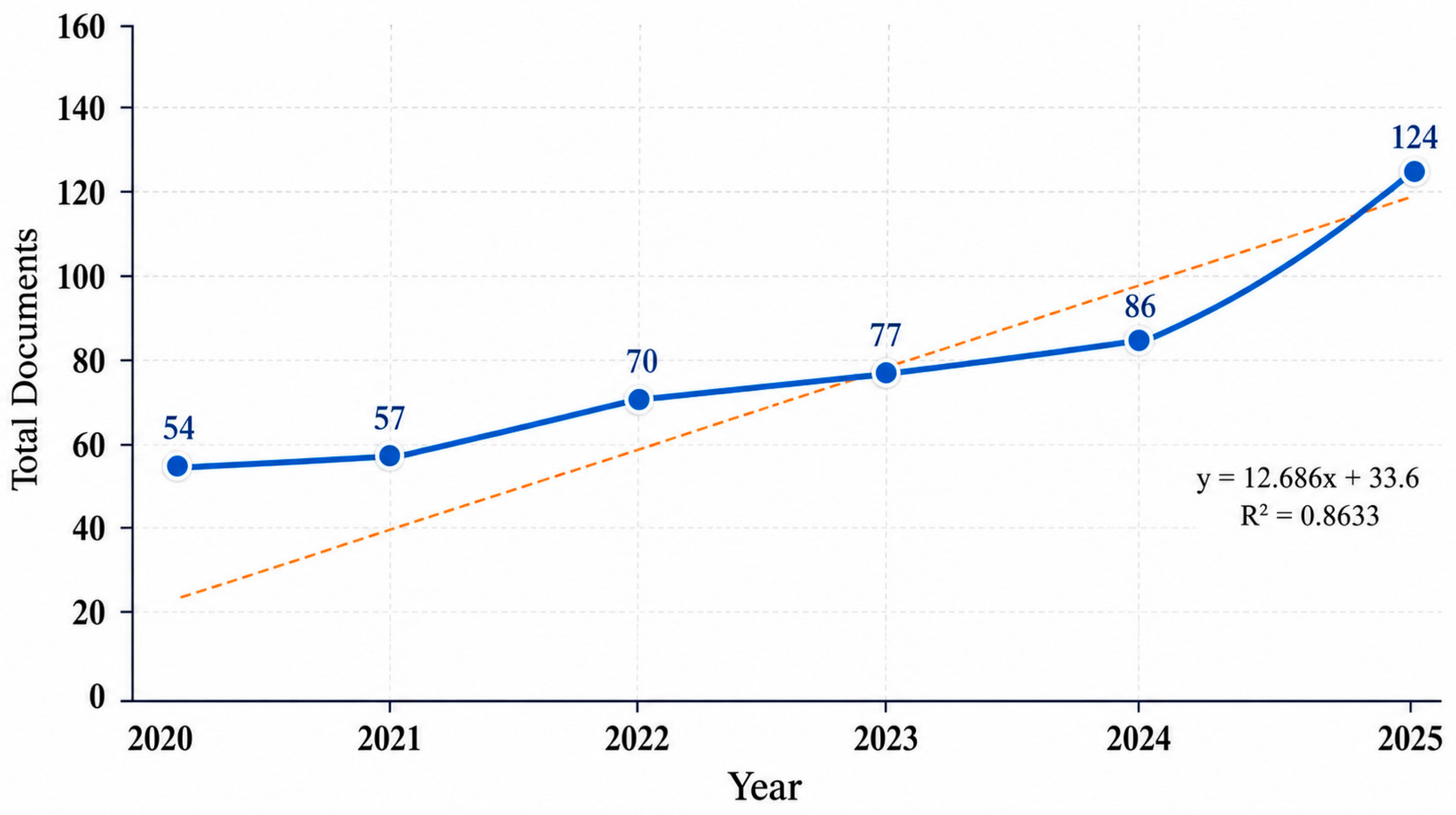
| Time span | 2020–2025 |
| Total publications | 468 |
| Total citations | 9535 |
| Average citations per document | 20.37 |
| Annual growth rate | 18.09% |
| Number of journals/sources | 190 |
| Number of authors | 2026 |
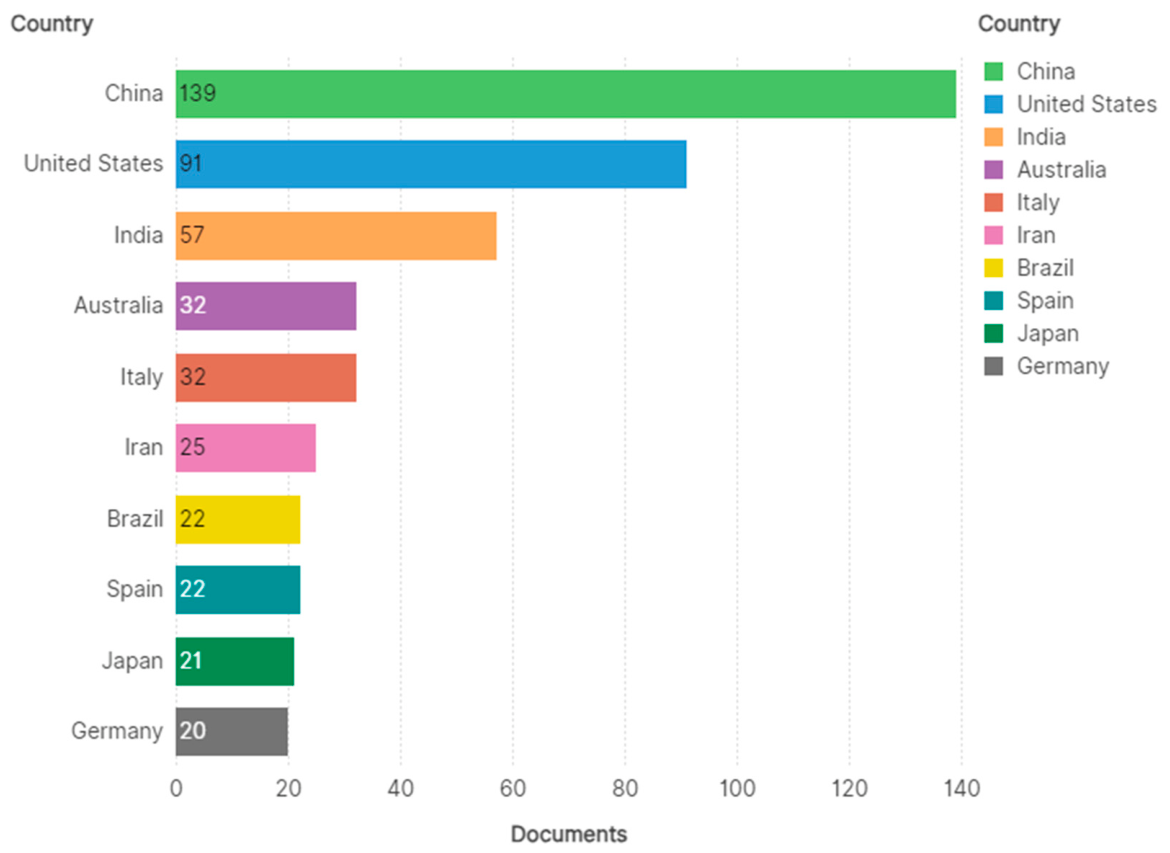
| Countries involved | 67 |
| Subject Area | Percentage (%) | Number of Documents |
|---|---|---|
| Environmental Science | 27.30 | 128 |
| Social Sciences | 19.70 | 92 |
| Earth and Planetary Sciences | 18.60 | 87 |
| Engineering | 9.50 | 44 |
| Energy | 6.00 | 28 |
| Agricultural and Biological Sciences | 5.40 | 25 |
| Computer Science | 2.60 | 12 |
| Medicine | 1.40 | 7 |
| Multidisciplinary | 1.40 | 7 |
| Physics and Astronomy | 1.20 | 6 |
| Other | 6.90 | 32 |
| Total | 100.00 | 468 |
| Process in a Polycentric Context | Emergence (Spatial Signatures) | Diffusion Pathways | Key Moderators |
|---|---|---|---|
| Formation of multiple thermal cores, often forming a multi-core configuration. | Hotspots emerge as multi-core or mosaic patch fields aligned with multiple sub-centers and compact urban fabrics [29,30,31]. | New hotspots co-emerge around growing sub-centers, increasing patch density, and reinforcing polycentric hotspot fields [31,32,33]. | Analytical scale, degree of functional concentration, and landscape fragmentation [29,32,33]. |
| Sub-center-driven growth modes (edge, infill, enclave, sprawl) | Hotspot patches form in new developments, peri-urban edges, and infill zones with increasing impervious surfaces and reduced vegetation [34,35]. | Heat footprints expand through edge-/infill-type patch expansion, with occasional enclave/leapfrog development, and increasing connectivity of impervious surfaces [31,36,37]. | Urban expansion rate, land conversion intensity, and policy control over sprawl [34,38,39,40]. |
| Function-specific heat loading (industrial decentralization, zoning, transport) | Hotspots concentrate in industrial parks/development zones and functionally specialized areas within or near sub-centers [41,42,43]. | Industrial decentralization-driven suburbanization shifts SUHI burdens from the urban core toward urban expansion/peripheral areas, increasing the connectivity of impervious surfaces [39,43,44]. | Industrial structure, planning regulation, and distribution and accessibility of blue–green infrastructure [34,45]. |
| Within-subcenter morphology and land-cover composition | Compact LCZs, high building volume, and high imperviousness generate persistent micro-hotspots, while trees and water bodies form localized cool islands [35,46,47,48]. | Without structural change, hotspots remain spatially persistent; mitigation is commonly discussed via greening/blue–green infrastructure, high-albedo/cool-roof measures, and ventilation/shading strategies [35,47,49] | Three-dimensional urban form, local climate, and greenspace configuration thresholds [35,48,50]. |
| Temporal modulation (diurnal and seasonal cycles) | Nighttime SUHI patterns are often more coherent, while seasonal peaks, typically in summer, amplify hotspot contrast [38,51,52]. | Long-term trends may show declining intensity but expanding spatial extent, with seasonal footprints shifting according to atmospheric and vegetation dynamics [30,51,53] | Climate zone, sensor acquisition timing, and vegetation phenology [38,52,53]. |
| Measurement and baseline definition effects | Urban–rural dichotomies and inconsistent thresholds modify perceived SUHI extent and the apparent number of heat cores [30,54]. | Apparent expansion or fragmentation may partially reflect methodological artifacts rather than physical heat redistribution [30]. | Definition of “urban,” rural reference selection, and multi-sensor harmonization [30,54]. |
| Empirical Gap (Evidence Deficit) | What Is Currently Known from the 35 Reviewed Studies | Implications for Interpreting Polycentric UHI | Recommended Empirical Research Agenda |
|---|---|---|---|
| Uneven representativeness across climate zones and polycentric typologies | Urban form–LST/SUHI relationships vary across climate zones and industrial contexts, indicating that “polycentric effects” are conditional rather than universal [47,55]. Evidence of UHI reduction associated with explicitly measured polycentricity exists but is not consistent across cases [32,33]. | Policy conclusions derived from limited climatic or structural contexts risk being non-portable across regions with different climates and economic bases [32,47]. | Conduct cross-climate comparative studies using harmonized definitions of polycentricity (population, function, and morphology-based) while controlling for industrial structure and urbanization stage [32,33,55]. |
| Inconsistent treatment of diurnal–seasonal dynamics and intensity–footprint decoupling | Heat patterns differ substantially between daytime and nighttime and across seasons, altering the apparent configuration of hotspots [38,52]. In some regions, UHI intensity decreases while spatial extent expands, indicating decoupled dynamics [51,54]. | Analyses based on a single temporal regime may misinterpret multi-core or corridor-based patterns due to sensor timing or vegetation phenology [38,52]. | Develop multi-season and day–night panel analyses reporting dual outcomes (intensity and footprint) to test the temporal stability of multi-core structures [38,51,54]. |
| Limited evidence on dynamic polycentricity and structural transitions | Some studies explicitly measure polycentricity and report reduced UHI and spillover effects [32,33], but many studies operate in polycentric contexts without tracking changes in polycentricity over time [31,55]. | Without longitudinal evidence, it is difficult to distinguish whether multi-hotspot patterns result from functional polycentric maturation or from morphologically multi-centered dispersed sprawl [31,34]. | Build longitudinal panels tracking sub-center evolution (population and function) and linking these trajectories to changes in hotspot fields using consistent baselines [30,32,33]. |
| Persistent scale mismatch between evidence and mechanisms | Many analyses rely on metropolitan averages, while hotspot formation and thermal mechanisms operate at patch or neighborhood scales [31,47]. LST variation is strongly influenced by 2D/3D morphology, ventilation, and land-cover configuration [49]. | Aggregated metrics may obscure dominant heat-driving nodes, leading to policy evaluations that fail to identify the sub-center responsible for disproportionate heat exposure [45,49]. | Apply multi-scale frameworks that link macro-level polycentricity indices with node delineation (LCZs, sub-center) and patch-level thermal metrics to test causal pathways across scales [31,56]. |
| Partial integration of human exposure, vulnerability, and blue–green infrastructure access | Heat vulnerability correlates with NDVI, moisture availability, and unequal access to green space, producing uneven thermal risk within metropolitan regions [45]. Population exposure may increase with long-term UHI intensification even when average intensity stabilizes [45,57]. | Policy success cannot be evaluated solely through average intensity reduction, as spatial equity across nodes and social groups may deteriorate [45,51]. | Integrate UHI metrics (intensity and footprint) with population exposure and blue–green infrastructure accessibility across sub-centers to assess trade-offs among intensity, spatial extent, and equity [41,45,57]. |
| Spatial Pattern | Main Planning Issue | Recommended Intervention | Governance Implication |
|---|---|---|---|
| Multi-core hotspots | Overheating in dense sub-centers | Tree-canopy expansion, cool roofs, ventilation corridors, and impervious-surface reduction | Node-specific thermal-performance standards |
| Corridor propagation | Heat propagation along transport and industrial corridors | Corridor greening, shaded mobility, blue–green continuity | Cross-jurisdiction and multi-scalar corridor planning |
| Peripheral expansion | Loss of peri-urban cooling capacity | Growth control, ecological buffers, protection of peri-urban environmental-service functions | Metropolitan land-use and multi-scalar coordination |
| Priority | Research Agenda | Rationale | Recommended Designs | Minimum Reporting | References |
|---|---|---|---|---|---|
| P1 | Standardize polycentricity as a multidimensional construct. | Definitions of polycentricity vary across morphology, population and function. | Multidimensional indices, sensitivity tests, explicit node delineation. | Node boundaries, activity data, LULC, LCZ, polycentricity metrics. | [29,32,47,60] |
| P2 | Report both UHI intensity and footprint. | Intensity and spatial extent do not always evolve together. | Multi-season and day–night panels; baseline sensitivity tests. | LST/SUHI, urban/rural baseline, thresholds, acquisition time. | [30,38,51,54] |
| P3 | Connect macro polycentric structure to micro-scale exposure. | Metropolitan averages obscure hotspot nodes and vulnerable neighborhoods. | Hierarchical models, LCZ mapping, population exposure overlays. | LCZ, 3D morphology, census/exposure data, green access. | [45,46,57] |
| P4 | Model corridor heat propagation and advection. | Transport and industrial corridors can connect hotspots across nodes. | Network buffers, wind-aware models, corridor before–after analysis. | Transport centrality, industrial zones, wind data, corridor LST/air temperature. | [41,43,76] |
| P5 | Evaluate blue–green infrastructure as a connected thermal network. | Cooling depends on configuration, connectivity and maintenance capacity. | Quasi-experimental matching, landscape connectivity, access analysis. | NDVI/NDMI, canopy, water bodies, patch connectivity, maintenance context. | [23,64,72,74] |
| P6 | Triangulate surface heat with air temperature and thermal comfort. | LST does not directly equal human heat stress. | Mobile sensors, fixed stations, UTCI/HI modeling, satellite integration. | Sensor placement, temporal window, air temperature, comfort indices. | [13,62,70,77] |
| P7 | Expand evidence in tropical and Global South metropolitan regions. | Evidence is geographically concentrated and climate-dependent. | Paired climate-zone cases; multi-city comparative studies. | Climate classification, topography, coastality, governance context. | [19,36,48,50] |
| P8 | Assess equity and policy outcomes, not only thermal averages. | Heat reduction can bypass vulnerable populations. | Spatial equity metrics, vulnerability overlays, policy evaluation. | Population exposure, income/race proxies where appropriate, green-access metrics. | [45,68,69,75] |
| P9 | Use causal inference and transparent machine learning. | Associations do not prove mitigation effects or transferability. | Spatial causal inference, interpretable ML, out-of-sample validation. | Training/testing split, uncertainty, spatial autocorrelation, counterfactual assumptions. | [63,78] |
| P10 | Build reproducible open pipelines for polycentric UHI studies. | Inconsistent preprocessing and baselines limit synthesis. | Open code, documented thresholds, harmonized reporting checklist. | Sensor metadata, scripts, data provenance, baseline choices. | [79,80] |
Disclaimer/Publisher’s Note: The statements, opinions and data contained in all publications are solely those of the individual author(s) and contributor(s) and not of MDPI and/or the editor(s). MDPI and/or the editor(s) disclaim responsibility for any injury to people or property resulting from any ideas, methods, instructions or products referred to in the content. |
© 2026 by the authors. Licensee MDPI, Basel, Switzerland. This article is an open access article distributed under the terms and conditions of the Creative Commons Attribution (CC BY) license.
Share and Cite
Rosnila; Rustiadi, E.; Pravitasari, A.E.; Pribadi, D.O. Rethinking Urban Heat Islands in Polycentric Metropolitan Systems: A Bibliometric and Systematic Review of Networked Heat Dynamics. Sustainability 2026, 18, 5707. https://doi.org/10.3390/su18115707
Rosnila, Rustiadi E, Pravitasari AE, Pribadi DO. Rethinking Urban Heat Islands in Polycentric Metropolitan Systems: A Bibliometric and Systematic Review of Networked Heat Dynamics. Sustainability. 2026; 18(11):5707. https://doi.org/10.3390/su18115707
Chicago/Turabian StyleRosnila, Ernan Rustiadi, Andrea Emma Pravitasari, and Didit Okta Pribadi. 2026. "Rethinking Urban Heat Islands in Polycentric Metropolitan Systems: A Bibliometric and Systematic Review of Networked Heat Dynamics" Sustainability 18, no. 11: 5707. https://doi.org/10.3390/su18115707
APA StyleRosnila, Rustiadi, E., Pravitasari, A. E., & Pribadi, D. O. (2026). Rethinking Urban Heat Islands in Polycentric Metropolitan Systems: A Bibliometric and Systematic Review of Networked Heat Dynamics. Sustainability, 18(11), 5707. https://doi.org/10.3390/su18115707