Systematic Review

Sustainable Urban Planning Strategies: A Systematic Review and Applications for the United Arab Emirates


by
Abdelrahman Azzuni
,
Ibrahim Mohammed Alblooshi
and
Moetaz ElSergany
*
School of Sustainability and Green Economy, Hamdan Bin Mohammed Smart University, Dubai P.O. Box 71499, United Arab Emirates
*
Author to whom correspondence should be addressed.
Sustainability 2026, 18(11), 5553; https://doi.org/10.3390/su18115553
Submission received: 28 March 2026 / Revised: 19 May 2026 / Accepted: 22 May 2026 / Published: 1 June 2026

Abstract

This systematic review examines the global sustainable urban planning strategies used worldwide and whether they are applicable to the United Arab Emirates. This study reviewed 150 peer-reviewed articles and identified 14 of the most significant sustainable urban planning strategies in use today, including green infrastructure, smart city technologies, compact urban development, transit-oriented development, circular economy principles, mitigation of urban heat island effects, renewable energy integration, sustainable drainage systems, biophilic design, fifteen-minute city concepts, mixed-use development, vertical farming, participatory planning, and urban resilience frameworks. The methodologies applied by the authors to identify the sustainable urban planning strategies employed in the research were thematic analysis and the classification of the strategies into five main categories: environmental sustainability, technological innovation, social equity, economic viability, and cross-cutting. Case studies from Singapore, Copenhagen, Melbourne, and Amsterdam, and examples of current sustainable urban planning initiatives underway in Dubai and Abu Dhabi show how the models can be successfully implemented. The results indicate that multi-strategy approaches produce better results than the application of single strategies. Based on the results of the research, green infrastructure, smart city technologies, and the mitigation of urban heat island effects have been identified as strategies whose characteristics are closely aligned with the UAE’s arid climate conditions, while emphasizing that all fourteen strategies contribute to comprehensive sustainability outcomes and that their relative importance depends on local relevance. The researchers also concluded that for sustainable urban planning to be successful in the UAE, it will require the best practices from around the world be adapted to the unique environmental conditions, cultural contexts, and economic structures of each country. The findings of this study will contribute to the growing body of knowledge related to sustainable urbanism and provide practitioners with useful information and practical guidance when implementing sustainable urban planning practices in the UAE and other arid regions.

1. Introduction

Urbanization is occurring at an unprecedented rate around the globe and is creating a major challenge to efforts toward sustainable development. A total of 68% of the world’s population is expected to be living in urban settlements by 2050 [1]. This necessitates innovative urban design models that integrate economic growth and social equity while protecting the environment. Sustainable urban design has evolved into a model for managing and balancing multiple dimensions of sustainability, including environmental health, economic viability, and social equity [2].
The global framework for sustainable urban development is anchored in the United Nations 2030 Agenda for Sustainable Development and its 17 Sustainable Development Goals (SDGs). SDG 11 (Sustainable Cities and Communities) directly addresses the need to make cities inclusive, safe, resilient, and sustainable [3]. Several other SDGs are closely interconnected with urban planning, including SDG 6 (Clean Water and Sanitation), SDG 7 (Affordable and Clean Energy), SDG 9 (Industry, Innovation, and Infrastructure), and SDG 13 (Climate Action). The strategies examined in this review contribute to the achievement of multiple SDG targets following the 2030 Agenda.
Despite the growing body of literature on sustainable urban planning strategies, implementation remains uneven across regions and climatic contexts. While cities in Northern Europe and East Asia have established advanced frameworks for sustainability integration, there remains a gap in research addressing arid and rapidly urbanizing regions. The United Arab Emirates occupies a particularly significant position in this landscape. As a country that has transformed into one of the world’s most urbanized nations in less than five decades, the UAE offers a unique testing ground for sustainable urban planning under extreme environmental conditions. The country’s post-oil economic diversification strategy, articulated through Vision 2031 and the UAE Centennial Plan 2071, positions sustainability as central to long-term national development. Furthermore, the UAE’s hosting of COP28 in 2023 signaled a deepened commitment to climate action and sustainable development, creating institutional momentum that reinforces the relevance of this review.
The United Arab Emirates (UAE) represents a unique case study of rapid urbanization. The UAE was, less than five decades ago, a largely nomadic society and is today considered one of the world’s most urbanized countries. Approximately 86% of the UAE’s population resides in urban areas [4]. This brings unique challenges because of its arid climate, high levels of energy consumption, limited availability of water resources, and fast population growth. The UAE’s commitment to sustainability is shown through many initiatives; as example; green building regulations in Dubai. This review will address the significant gap between global strategies for sustainable urban design and their implementation in the UAE. Although there is abundant literature on sustainable urban design strategies applied to temperate climates, there is little research on adapting these strategies to extreme climate conditions. This research attempts to explore various opportunities to close this gap by analyzing global best practices and applying them to the UAE’s unique sustainable urban design needs and challenges. The primary objectives of this research are to (1) systematically review and categorize sustainable urban planning strategies implemented globally; (2) analyze the effectiveness and applicability of these strategies through international case studies; and (3) develop specific recommendations and guiding practicalities for implementing sustainable urban planning strategies in the UAE, considering environmental, economic, and cultural factors.

2. Literature Review

2.1. Theoretical Foundations of Sustainable Urban Planning

Sustainable urban planning has been developed as a multidisciplinary approach, covering aspects such as environmental science, urban design theory, and sustainable development principles. Jabareen [2] identified seven key design elements: compactness, sustainable transport, density, mixed land uses, diversity, passive solar design, and greening. These concepts provide the theoretical foundation for current sustainable urban planning practices, which combine both man-made and natural systems. A significant debate exists regarding the relationship between urban compactness and sustainability. Daneshpour and Shakibamanesh (2015) [5] questioned whether the compact city model characterizes an essential context for achieving urban sustainability. They took the position that compactness alone cannot ensure sustainable results without the implementation of complementary strategies. The same strategies that would address social equity, environmental quality, and economic viability. Their critique emphasized the importance of integrated approaches to achieve sustainable urbanization, as opposed to relying on singular strategy.
The evolution of sustainable urban planning theory has been inspired by multiple perspectives. Ecological urbanism, as articulated by Newman & Jennings [6], emphasizes the role of natural systems in urban design and advocates for cities that function as living ecosystems. Social sustainability theory, developed by researchers such as Roseland [7], highlights the importance of community engagement, cultural preservation, and social equity in sustainable urban development. Economic sustainability frameworks focus on creating urban environments that support long-term economic viability while minimizing resource consumption and waste generation [8].

2.2. Global Trends in Sustainable Urban Planning

Green infrastructure, designed to promote environmental, social, and economic sustainability within an urban environment is one of the strategies for sustainable urban planning. Urban green infrastructure provides ecosystem services. Liu and Jensen [9] identified five functions for green infrastructure (stormwater management, urban heat island reduction, air quality improvements, biodiversity protection, and community wellness).
Smart technologies represent another significant trend, leveraging information and communication technologies to optimize urban systems. Rehmani et al. [10] demonstrated how smart grids facilitate renewable energy integration, and advanced transportation systems decrease congestion and emissions. The merging of green infrastructure and smart technologies creates opportunities for innovative urban sustainability designs.
Transit-oriented development (TOD) has gained prominence for creating sustainable, compact urban designs. Carlton [11] traced the historical development of the TOD from early 20th-century planning to its classification by Peter Calthorpe in the late 1980s. Hasibuan and Mulyani [12] demonstrated how TOD reduces automobile dependence, promotes mixed-use development, and creates walkable communities. However, successful TOD implementation requires careful consideration of local contexts.
Alongside TOD, the concept of Mobility as a Service (MaaS) has emerged as an important paradigm for sustainable urban mobility. MaaS enables users to plan, book, and pay for multiple transport services through a single digital platform, integrating public transport, shared mobility, and other modes into a seamless experience. Meloni et al. [13] investigated MaaS adoption through pilot studies across different Italian metropolitan settings and found that small-scale experimentation can inform large-scale implementation. MaaS complements TOD and 15 min city approaches by providing the digital infrastructure needed to facilitate multimodal travel and reduce private car dependence.

2.3. Regional Applications and Climate Considerations

The application of sustainable urban planning strategies varies significantly across different climatic and cultural contexts. Research in arid regions has revealed unique challenges and opportunities for sustainable urban development. Alshuwaikhat and Nkwenti [14] identified key considerations for sustainable cities in arid regions, including water scarcity management, extreme temperature mitigation, and dust storm protection. These environmental constraints impose the implementation of different strategies and approaches. Jenks and Burgess [15] examined sustainable urban designs in developing countries and found that compact city principles must be carefully adapted to local economic conditions, construction capacity, infrastructure limitations, and cultural preferences.
Middle Eastern cities have pioneered innovative approaches to sustainable urban development in arid climates. Masdar City in Abu Dhabi is an example of an entire city that produces no greenhouse gas emissions. It does this through the use of green energy (solar) and other forms of renewable energy by making the way people move around the city very efficient (for example, by making walking and cycling safe) and buildings designed to keep cool using passive design techniques (which use natural cooling and shading) [16]. Dubai’s sustainable city initiatives demonstrate the potential for retrofitting existing urban areas with sustainable technologies and practices [17]. Rapidly developing cities offer specific TOD lessons. Yap, Chua, and Skitmore [18] investigated barriers to sustainable mobility and TOD in Greater Kuala Lumpur, providing insights relevant to car-centric, rapidly growing cities, such as those in the UAE.

3. Methodology

3.1. Research Design

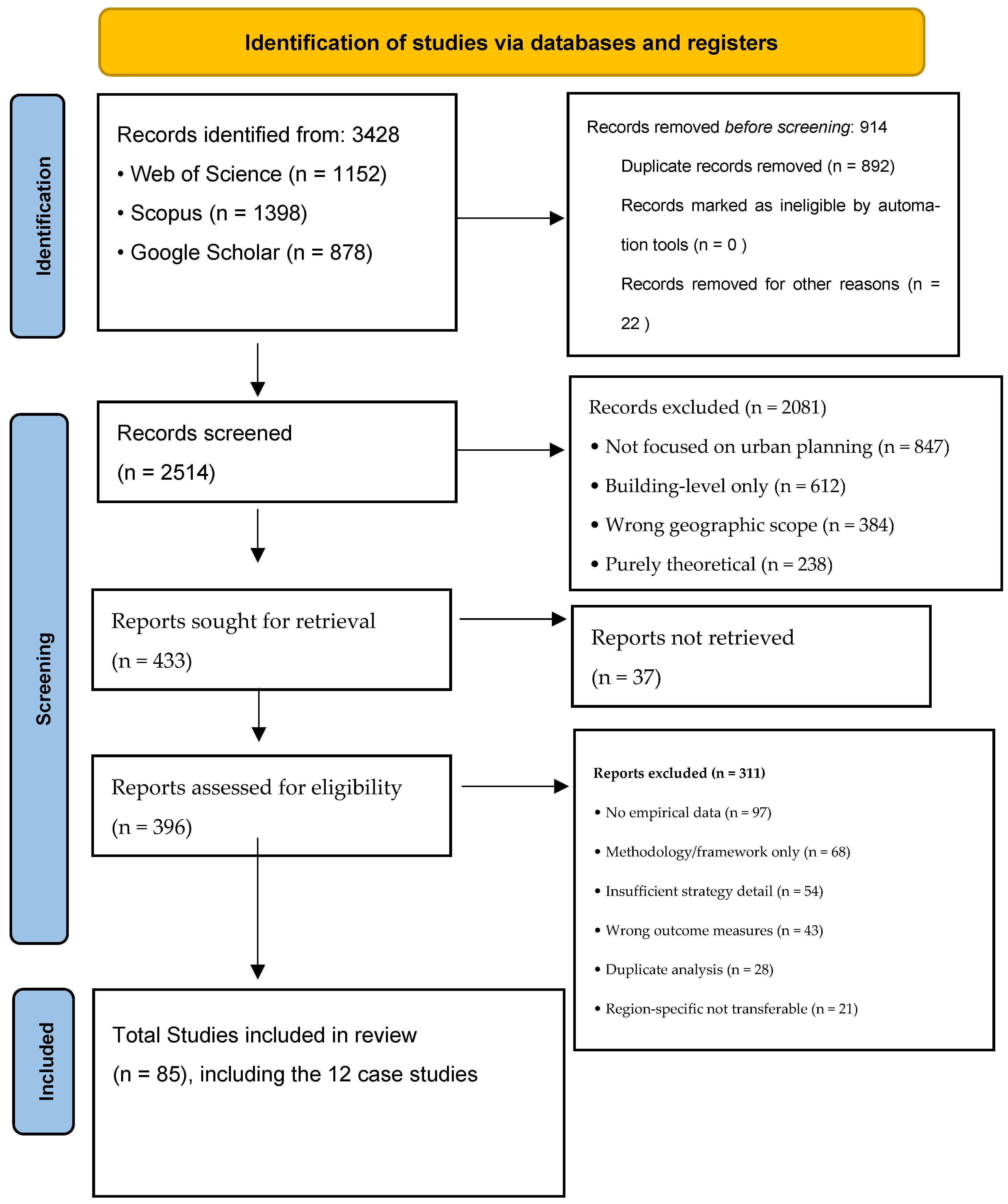
This systematic review was conducted and reported in accordance with the Preferred Reporting Items for Systematic Reviews and Meta-Analyses (PRISMA) 2020 guidelines [19]. A completed PRISMA checklist is provided as Supplementary Material. This study employed a systematic literature review methodology combined with thematic analysis to examine sustainable urban planning strategies and their applications in the UAE context. As shown in Figure 1, the research followed the Preferred Reporting Items for Systematic Reviews and Meta-Analyses guidelines to ensure methodological rigor and transparency. This systematic approach enables the comprehensive identification and analysis of relevant literature while minimizing selection bias.

3.2. Literature Search Strategy

This systematic review was conducted and reported in accordance with the Preferred Reporting Items for Systematic Reviews and Meta-Analyses (PRISMA) guidelines [19]. The search was carried out on 15 December 2024, with no language restrictions applied beyond the English-language inclusion criterion detailed below.
The search strategy involved a comprehensive review of the literature published from the year 2000 onwards. Restricting the search to this period is justified, as it captures the emergence and consolidation of modern sustainable urban planning theory and practice, coinciding with significant advances in green infrastructure, smart city technologies, and climate-responsive design frameworks.
The search was conducted across three primary databases to ensure broad yet rigorous coverage of the relevant literature: Web of Science Core Collection, selected for its high-quality peer-reviewed journals and cross-publisher reach; Scopus, chosen to capture additional sources including regional publications not indexed in Web of Science; and Google Scholar, used to identify grey literature, policy documents, and practitioner-oriented sources. The search employed Boolean logic combining three topic clusters:
Cluster 1 (Urban Sustainability): “sustainable urban*” OR “urban sustainability” OR “sustainable cit*” OR “eco-cit*” OR “green cit*”.
Cluster 2 (Planning/Strategies): “planning” OR “strateg*” OR “development” OR “design” OR “policy” OR “governance”.
Cluster 3 (Specific Strategies): “green infrastructure” OR “smart cit*” OR “transit-oriented development” OR “circular economy” OR “urban heat island” OR “renewable energy” OR “15-min cit*” OR “compact cit*” OR “vertical farm*” OR “urban resilience” OR “biophilic design” OR “Mobility as a Service” [additional terms included].
Both keyword and citation-based approaches were employed, using terms such as “sustainable urban planning,” “UAE urban development,” and “arid climate planning.” Full details of the PRISMA flow diagram are provided in Figure 1 and Table S1.

3.2.1. Inclusion Criteria

This review included peer-reviewed articles that: (1) focused on strategies and concepts of sustainable urban planning; (2) presented empirical data or theoretical frameworks with practical applications; (3) were published in peer-reviewed journals between 2000 and 2024; and (4) were written in English. Studies were excluded if they addressed building-level sustainability without an urban planning context, presented purely theoretical frameworks without practical applicability, or were conducted in regions with significantly different climatic conditions and without broader transferability.
Quality assurance in the screening process relied on three complementary mechanisms. First, all records were screened independently by at least two reviewers, with disagreements resolved through discussion or referral to a third reviewer, thereby reducing individual bias. Second, the inclusion of peer-reviewed publications served as a baseline quality threshold, ensuring that only studies subjected to external scholarly evaluation were retained. Third, the exclusion of purely theoretical work without practical applications ensured that the included literature provided empirically grounded or practice-oriented insights. A formal risk-of-bias assessment tool (such as ROBIS) was not applied, as this review employs thematic synthesis rather than meta-analysis; this is consistent with established practice for systematic reviews of this type [19]. Each included study is classified by methodology (empirical, theoretical, case study, or mixed methods) in Appendix A.

3.2.2. Selection Process

The retrieved records were screened through a rigorous, multistage process conducted by at least two independent reviewers. Screening proceeded at three successive levels, title, abstract, and full text, with records assessed at each stage against the eligibility criteria. Any disagreement between reviewers was resolved through discussion or referral to a third reviewer (Figure 1).

3.3. Data Analysis

Thematic analysis was implemented to categorize sustainable urban planning strategies from the selected literature. The analysis process followed Braun and Clarke’s [20] six-phase approach: familiarization with the data, generating initial codes, searching for themes, reviewing themes, defining and naming themes, and producing the final analysis. This systematic approach enabled the identification of 14 primary sustainable urban planning strategies and their classification into five overarching domains the summary of the included 85 studies is shown in Appendix A.
Case studies were conducted to examine the successful implementation of sustainable urban planning strategies in various global contexts. Cases were selected based on their relevance to the UAE, innovation in approach, documented outcomes, and availability of detailed implementation data. The analysis focuses on strategy effectiveness, implementation challenges, and transferability to different urban contexts.

4. Thematic Analysis of Sustainable Urban Planning Strategies

The 14 sustainable urban planning strategies identified through the thematic analysis have been organized into five domains based on each strategy’s primary area of contribution: environmental sustainability, technological innovation, social equity, economic viability, and cross-cutting. This classification serves as an organizing heuristic to structure the analysis and is not intended to imply mutual exclusivity. Most strategies produce benefits that span multiple domains. For example, vertical farming is classified under economic viability because its primary contribution relates to resource efficiency and local food economics, but it also involves environmental sustainability (reduced water consumption and eliminated pesticide use) and technological innovation (controlled-environment agriculture and IoT integration). Similarly, green infrastructure is classified under environmental sustainability but generates significant social and economic co-benefits. Table 1 presents a cross-reference matrix showing each strategy’s primary and secondary domain contributions, making these multi-dimensional attributes transparent.
The results of the thematic analysis of sustainable urban planning strategies are presented in Table 2. It summarizes the 4 main domains of sustainable urban planning and the key benefits of each strategy.

4.1. Environmental Sustainability Domain

4.1.1. Green Infrastructure

Green infrastructure is the most comprehensively documented sustainable urban planning strategy, encompassing interconnected networks of natural and semi-natural systems that provide multiple ecosystem services. Ahern [21] defines green infrastructure as the “spatial dimension” of urban sustainability, emphasizing its role in organizing urban environments to support both human and ecological health. The re-naturing of cities creates multiple ecosystem services. Scott et al. [22] discussed nature-based solutions for the contemporary city, arguing for a paradigm shift towards ‘re-naturing’ urban landscapes to enhance ecosystem services and climate resilience. Contemporary green infrastructure approaches integrate multiple scales, from building-level green roofs to regional ecological corridors.
Singapore’s green infrastructure strategy demonstrates comprehensive integration across urban scales. The “City in a Garden” vision is a successful example of how to link together all aspects of the urban form to create green ecological systems through park connectors, green corridors, and vertical green walls. Studies have shown many physical and environmental advantages of this approach. For example, studies on green spaces in Singapore have shown that they are 2–3 °C cooler than surrounding non-green spaces [23]. Additionally, green spaces can help reduce stormwater runoff by up to 30%. Furthermore, studies on air quality in the City of Singapore demonstrate that green spaces do improve the quality of the air. Russo et al. [24] explored biophilia as a driver for nature-based solutions, arguing that integrating natural elements into the built environment provides essential psychological and physiological benefits for urban residents. The success of the Singapore model stems from integrated planning, regulatory frameworks, and long-term financial commitment.
Melbourne’s green infrastructure implementation focuses on climate adaptation and urban resilience. The Green Our City (GOC) Strategic Action Plan incorporates green infrastructure into Melbourne’s urban planning processes; GOC has established a goal of 40% canopy cover throughout the city and comprehensive green storm water infrastructure. Performance metrics demonstrate that there is a 25% reduction in urban heat island intensity and a 50% improvement in stormwater quality compared with prior years [25]; as such, the Melbourne approach places an emphasis on community involvement and adaptive management.

4.1.2. Urban Heat Island Mitigation

Urban heat island (UHI) mitigation is an important sustainability challenge, especially for arid regions such as the United Arab Emirates (UAE). The risks associated with UHIs have been reviewed in detail by Nuruzzaman [26]. He synthesized research on effective UHI mitigation strategies specifically suited to the extreme heat conditions in the UAE. Aleksandrowicz et al. [27] identified three main categories of UHI mitigation strategies, including surface modification, atmospheric modification, and building design integration. Multiple strategy approaches have been shown to be more effective than single strategy approaches for UHI mitigation.
The use of cool roof and pavement technologies can significantly reduce UHI effects in hot climates. Li et al. [28] showed 2–8 °C surface temperature reductions using cool surfaces. In particular, they found that arid climates had cooler surface temperatures when using cool surfaces. In addition, Toronto’s Comprehensive UHI Mitigation Strategy includes the use of cool surfaces, green infrastructure, and urban forestry and has resulted in 1–2 °C city-wide cooling. However, the effectiveness of strategies to reduce UHI varies depending on the context. O’Malley et al. [29] have conducted a comparative analysis of strategies to mitigate UHI and determined that the optimal choice among green roofs, cool materials and vegetation is highly dependent upon local climate context and urban morphology.
Urban forestry represents another effective UHI mitigation strategy; however, its implementation in arid climates requires careful species selection and water management. Aflaki et al. [30] analyzed UHI mitigation strategies in Kuala Lumpur, Singapore, and Hong Kong, finding that integrated approaches combining green infrastructure, cool surfaces, and urban forestry achieve optimal results. Recent research confirms the need for multi-faceted approaches. Irfeey et al. [31] reviewed sustainable mitigation strategies for UHI effects, identifying a combination of cool surfaces, urban greening, and water features as the most effective mitigation strategy in dense urban areas.

4.1.3. Sustainable Urban Drainage Systems (SUDSs)

Sustainable Urban Drainage Systems (SUDSs) provide integrated approaches to urban water management, addressing both water quality and quantity challenges. Ellis and Lundy [32] emphasized SUDS’ role in climate adaptation, flood management, and ecosystem service provision. Contemporary SUDS approaches integrate multiple technologies and scales, from micro-scale rain gardens to district-level constructed wetlands. Effective management of drainage systems is crucial. Scholz [33] presented a case study on best management practices for SUDS, emphasizing that long-term maintenance and monitoring are as critical as design for ensuring system performance.
In addition to designing an effective system, he noted that long-term maintenance and monitoring are important; a significant example of a large-scale application of SUDS in flood-prone urban areas exists in the Netherlands. A blue-green infrastructure strategy implemented in Amsterdam utilizes SUDSs to combine recreational/amenity use with functional water management. It has resulted in a 40% decrease in stormwater flow into the sewer network and improved water quality. Furthermore, the emphasis of this strategy is on using a multifunctional design approach. This allows SUDS to be combined with other uses, such as recreation or parks [34].
In arid climates, SUDS are primarily focused on conserving water and improving water quality. However, they are less focused on managing floodwaters. Examples of SUDS adapted for low-rainfall regions include studies conducted in Australia and California. These studies demonstrated the effective use of SUDS in water-scarce environments to increase groundwater recharge, harvest rainwater, and treat water. Such SUDS applications are likely to be most beneficial in the United Arab Emirates (UAE) [35]. Sagala et al. [36] investigated SUDSs as nature-based solutions in high-density settlements, demonstrating their potential for flood risk management even in space-constrained urban areas.

4.1.4. Compact Urban Development

Compact urban development represents a fundamental strategy for reducing urban sprawl, improving resource efficiency, and enhancing environmental sustainability. Burton [37] demonstrated that higher-density urban forms can deliver significant reductions in per capita energy consumption and transportation emissions. Furthermore, the compact city model advances efficient land use while concentrating development in mixed-use, walkable neighborhoods [15].
Dieleman and Wegener [38] analyzed the relationship between urban compactness and sustainable mobility. Their findings showed that there is a significant reduction in automobile dependence associated with compact urban design, together with higher public transport ridership. Their research identified critical density thresholds above which transit systems become financially viable. Williams, Burton, and Jenks [39] synthesize international evidence on sustainable urban design, concluding that in order to deliver sustainability benefits, compact development must integrate diverse uses, high-quality public spaces, and efficient infrastructure systems.
In the UAE context, compact urban design offers advantages, given the energy costs associated with car-dependent sprawl under extreme climatic conditions. Abu Dhabi’s Urban Planning Council has incorporated compact city principles into Plan Abu Dhabi 2030, promoting higher-density mixed-use nodes connected by public transportation corridors.

4.1.5. Biophilic Design

Biophilic design integrates natural elements and patterns into the built environment, therefore, enhancing human well-being and urban sustainability. Kellert, Heerwagen, and Mador [40] established the theoretical framework for biophilic design, identifying 70 design attributes, organized into three categories: nature in the space, natural analogues, and nature of the space. Their research demonstrated that biophilic environments reduce stress, improve cognitive performance, and support physiological restoration. Beatley [41] extended this framework to the urban scale, arguing for biophilic cities that systematically embed nature into urban form, infrastructure, and governance.
Browning, Ryan, and Clancy [42] documented evidence-based biophilic design patterns, demonstrating measurable benefits, including 8% productivity gains, 13% improvement in well-being, and 15% enhancement in creativity in biophilically designed environments. Applications in urban planning range from green roofs and living walls at the building scale, to urban forests, habitat corridors, and nature-based infrastructure at the city scale. Singapore’s “City in a Garden” vision represents a comprehensive application of biophilic urban design, integrating ecological networks throughout the urban fabric and demonstrating that high-density cities can achieve significant biodiversity outcomes alongside economic development goals.
In arid contexts (e.g., the UAE), biophilic design requires adaptation to local climatic conditions through the collection of drought-tolerant native species, passive cooling strategies, and water-efficient design. The integration of biophilic elements in desert environments can enhance thermal comfort by 3–5 °C through strategic shading, evaporative cooling, and wind modification [40].

4.2. Technological Innovation Domain

4.2.1. Smart City Technologies

Smart city technologies encompass integrated information and communication technology systems that optimize urban services and infrastructure performance. Khan et al. [43] identified four key smart city domains: governance, environment, mobility, and economy. Successful smart city implementation has demonstrated measurable improvements in resource efficiency, service delivery, and quality of life indicators. The impact of smart technologies extends to broad developmental goals. Khaleel et al. [44] analyzed the impact of smart grid technologies on sustainable urban development and found significant co-benefits, including reduced emissions, enhanced energy security, and economic development opportunities.
Barcelona’s smart city initiative represents comprehensive integration across multiple urban systems. The city’s sensor network monitors air quality, noise levels, traffic patterns, and energy consumption, thereby enabling the real-time optimization of urban services. Quantitative assessments have demonstrated a 25% reduction in water consumption, 30% improvement in traffic flow efficiency, and 42.5% increase in citizen satisfaction with public services [45].
Singapore’s Smart Nation initiative demonstrates the advanced integration of digital technologies with urban planning processes. The initiative combines Internet of Things (IoT) sensors, data analytics, and artificial intelligence to optimize transportation, energy, and water systems. Performance monitoring shows a 15% reduction in energy consumption, a 20% improvement in traffic efficiency, and significant enhancements in urban planning decision-making processes [46].

4.2.2. Renewable Energy Integration

Renewable energy integration is a fundamental component of sustainable urban planning, requiring coordination between energy systems, built environment design, and transportation planning. Lund et al. [47] identified fourth-generation district heating systems as key enablers of renewable energy integration, facilitating the connection between building energy demand and renewable energy supply. Technical architecture is key to integration. Worighi et al. [48] propose architectures for integrating renewable energy into smart grid systems, emphasizing virtualization and analysis to manage the complexity of distributed energy resources.
Copenhagen’s district heating system demonstrates large-scale renewable energy integration in urban contexts. The system integrates solar thermal, geothermal, and biomass sources with sophisticated distribution networks, achieving an 80% renewable energy share in heating supply. This approach emphasizes system integration, energy storage, and demand response technologies [49]. Smart grid technologies enable this transition. Karduri and Ananth [50] examined the integration of smart grids into smart cities and demonstrated how advanced grid management facilitates higher shares of variable renewable energy sources and improves system stability.
In urban contexts, SI requires careful consideration of building design, urban form, and grid infrastructure. Perera et al. [51] analyze the relationship between urban form and renewable energy integration potential, finding that medium-density mixed-use developments optimize both energy efficiency and renewable energy generation capacity. This research has particular relevance to the UAE, where the solar energy potential is exceptionally high.

4.3. Social Equity Domain

4.3.1. Participatory Planning

Participatory planning methods allow communities to become involved in urban planning projects, which is essential for social justice and for communities to take ownership of development results. Participatory planning uses many different tools. Haklay et al. [52] have completed an extensive overview of current methods of citizen participation in urban planning, emphasizing the importance of identifying the most suitable tools for a community’s unique context and level of capacity. Geekiyanage [53] identified the four major principles of successful community involvement in urban planning: inclusive representation, meaningful participation, transparent decision-making, and responsive implementation. To successfully implement participatory planning, institutions need to have the capacity and long-term commitment to support community involvement in the planning process, and the community needs to be ready to participate.
It is important to note that participatory planning mechanisms must be adapted to contexts where formal civic participation rights differ across population groups. In cities with large expatriate or transient populations, such as those in the UAE and other Gulf states, traditional participatory models premised on citizen–voter engagement may not fully capture the needs and preferences of most urban residents. Digital participatory platforms, multilingual engagement tools, and need-based consultation mechanisms offer potential pathways for broadening inclusion in such contexts [54,55].
The participatory budgeting program in Medellín, Colombia, is a large-scale example of community engagement in urban planning decisions. This program allocates 10% of the municipal budget through community-led decision-making processes, resulting in improved infrastructure, enhanced social cohesion, and reduced inequality. A performance evaluation showed a 60% improvement in community satisfaction and a 40% increase in civic participation [56].
Digital participatory platforms expand opportunities for community engagement in urban planning. Delitheou et al. [54] have analyzed smart engagement technologies that facilitate broader participation in the planning process. Emerging digital technologies are also providing new engagement pathways. Foth et al. [55] have explored the use of NeoGeography tools and virtual environments for urban planning, demonstrating how these digital platforms can facilitate broader and more inclusive community participation. These platforms have potential in diverse urban contexts, such as the UAE, where traditional participation mechanisms may not fully engage multicultural populations.

4.3.2. 15-min City Concepts

The 15 min city concept promotes neighborhood-scale accessibility, enabling residents to access essential services within a 15 min walk or bike ride [57]. The 15 min city represents a paradigm shift. Khavarian-Garmsir et al. [58] provide a comprehensive analysis of the 15 min city concept, identifying underlying principles such as proximity and diversity, while noting implementation challenges regarding social equity and existing urban form. Abdelfattah et al. [57] emphasized the concept’s potential for reducing transportation demand, improving quality of life, and enhancing urban resilience. Implementation requires integrated land use planning, transportation infrastructure, and service distribution strategies.
Paris’s 15 min city implementation demonstrates comprehensive neighborhood-scale planning. The initiative combines zoning reform, transportation infrastructure improvements, and service distribution optimization to enhance local accessibility. Early assessments have shown a 20% reduction in motorized travel, improved air quality, and enhanced neighborhood vitality [59].
Walkability infrastructure is a critical component of 15 min city implementation. Bartzokas-Tsiompras and Bakogiannis [60] developed comprehensive walkability assessment methodologies that integrate pedestrian infrastructure, safety, connectivity, and accessibility indicators. This study provides practical tools for 15 min city planning and evaluation.

4.3.3. Transit-Oriented Development

Transit-oriented development (TOD) integrates land-use planning with public transportation infrastructure to create walkable, mixed-use communities centered on transit nodes. Calthorpe [61] established the foundational principles of TOD, emphasizing the integration of diverse land uses within a quarter-mile walking radius of transit stations to reduce automobile dependence and support vibrant, sustainable communities. This approach addresses social equity goals by improving mobility access across income groups while simultaneously supporting environmental objectives through reduced vehicle emissions and land consumption.
Cervero and Kockelman [62] provided empirical evidence for the “3Ds” of TOD, namely, density, diversity, and design, demonstrating that neighborhoods combining these attributes achieve 15–40% reductions in vehicle miles traveled compared to conventional suburban development. Their research identified critical thresholds for transit ridership generation, showing that mixed-use and pedestrian-friendly environments around transit nodes can double or triple ridership levels. Vale [63] advanced node-place analysis as a framework for evaluating TOD performance by combining transportation node function with place quality to assess walkability, land use mix, and pedestrian accessibility.
The UAE presents both significant opportunities and challenges for TOD implementation. Dubai Metro stations have generated substantial TOD activity, with notable commercial and residential intensification around key station areas. The Roads and Transport Authority’s TOD strategy aims to develop mixed-use, pedestrian-friendly environments within 800 m of metro stations; however, the prevailing car-centric urban form requires a comprehensive redesign of street networks and land-use patterns. Cultural preferences, land ownership structures, and the dominance of automobile infrastructure represent key implementation barriers that require sustained policy innovation [61].

4.4. Economic Viability Domain

4.4.1. Mixed-Use Development

Mixed-use development strategies integrate residential, commercial, and office functions within walkable neighborhoods, thereby reducing transportation demand and supporting local economic activity. Lehmann [64] identified mixed-use development as essential for sustainable urban density, enabling efficient land use while maintaining quality of life. Successful implementation requires careful consideration of compatibility, design quality, and transportation integration.
Vancouver’s mixed-use development policies demonstrate the effective integration of density and livability. The city’s zoning reforms enable residential-commercial integration while maintaining neighborhood character through design guidelines and community amenities. Performance assessments show a 30% reduction in vehicle trips, increased local business activity, and maintained housing affordability [65]. Compact urban forms in rapidly urbanizing contexts require particular attention to density-livability trade-offs. Chen, Jia, and Lau [66] analyzed sustainable urban form challenges for Chinese compact cities, finding that high-density development must be carefully balanced with adequate green space, infrastructure capacity, and social amenities to avoid negative environmental and social impacts.
Seoul’s mixed-use redevelopment projects demonstrate large-scale urban regeneration through integrated land use planning. These projects combine residential, commercial, and cultural functions with green infrastructure and transportation connectivity. Quantitative assessments show improved economic performance, enhanced environmental quality, and increased social integration [67]. However, density does not automatically equal sustainability. Holden and Norland [68] identified challenges for the compact city form and found that without supportive lifestyle changes, density alone does not guarantee reduced household energy and transport consumption.

4.4.2. Circular Economy Integration

Circular economy principles promote resource efficiency and waste reduction through closed-loop urban systems. Remøy et al. [69] identified key circular economy strategies in urban planning: material reuse, energy recovery, water recycling, and urban agriculture integration. Implementation requires coordination across multiple urban systems and stakeholder groups. Circular economy success depends on public participation. Izdebska and Knieling [70] examined citizen involvement in waste management and identified education, convenient infrastructure, and participatory decision-making as key elements for successful circular economy implementation.
Amsterdam’s circular economy transition demonstrates a comprehensive system-level implementation. The city’s Circular Economy Monitor tracks material flows, waste reduction, and resource efficiency across multiple sectors. Performance data showed a 25% reduction in primary material consumption, a 40% increase in recycling rates, and significant economic benefits through resource efficiency [71]. Transitioning to circularity requires systemic changes. Ribić et al. [72] examined the implementation of circular economy approaches in municipal waste management, highlighting the importance of separate collection streams and public education.
Urban agriculture represents an important component of the circular economy, providing local food production while utilizing urban waste streams. Kalantari et al. [73] analyzed the potential of vertical farming in urban contexts and found significant opportunities for resource efficiency and local food security. Besthorn [74] emphasized the role of vertical farming in addressing global food crises through sustainable urban agriculture and highlighted its potential for communities struggling with food insecurity and land scarcity. In arid regions such as the UAE, controlled environment vertical farming can overcome climate limitations while minimizing water consumption and transportation emissions.
Technology enhances agricultural resilience. Oh and Lu [75] analyzed vertical farming as a form of smart urban agriculture and demonstrated how controlled environments reduce climate vulnerability and enhance food security resilience in resource-constrained cities. Buildings can serve as productive landscapes. Specht et al. [76] provided an overview of sustainability aspects of building-integrated agriculture, noting its potential to reduce food miles and utilize building waste heat and water streams. However, scalability remains a challenge for urban agriculture. Petrovics and Giezen [77] analyzed the upscaling potential of vertical farming, identifying planning barriers and suggesting that successful integration requires supportive zoning and infrastructure policies.

4.4.3. Vertical Farming

Vertical farming represents an innovative approach to urban food production by integrating controlled-environment agriculture within multistory urban facilities to enhance food security, reduce supply chain emissions, and optimize resource use. Despommier [78] articulated the conceptual framework for vertical farming as a component of sustainable urban systems, demonstrating the potential to produce crop yields using 70–95% less water and eliminating the need for pesticides and herbicides compared to conventional agriculture. Benke and Tomkins [79] evaluated the technical and economic viability of vertical farming systems and identified energy consumption as the primary challenge, along with substantial advantages in water efficiency, land productivity, and supply chain resilience.
Avgoustaki and Xydis [80] provided a comprehensive multiscale review of indoor plant factories, examining energy optimization strategies, including LED lighting efficiency, HVAC system design, and renewable energy integration. Their analysis demonstrated that vertical farming systems powered by renewable energy sources can achieve carbon-neutral food production while maintaining year-round productivity independent of external climatic conditions, a characteristic particularly significant for arid regions, where conventional agriculture faces severe resource constraints. These findings align with broader evaluations of urban vertical hydroponic systems, confirming the net environmental benefits of systems optimized for energy efficiency and supplied with low-carbon electricity [79].
In the UAE, vertical farming offers a compelling alignment with national food security objectives, particularly given the country’s heavy reliance on food imports (approximately 90% of the food supply) and extreme climate conditions that limit conventional agriculture. Dubai’s initiatives in controlled-environment agriculture, including partnerships with international vertical farming operators, demonstrate the growing policy recognition of this strategy. Successful implementation requires addressing high energy costs through solar energy integration, developing supportive zoning frameworks for agricultural land use within urban areas, and establishing commercially viable economic models [78].

4.5. Cross-Cutting Domain: Urban Resilience Frameworks

Urban resilience frameworks represent an integrative approach to sustainable urban planning that transcends individual strategy domains, providing conceptual and operational tools for building cities capable of withstanding, adapting, and transforming in response to chronic stresses and acute shocks. Meerow, Newell, and Stults [81] provided a comprehensive review of urban resilience definitions and frameworks, synthesizing five core properties of resilient urban systems: robustness, redundancy, resourcefulness, response, and recovery. Their analysis revealed that effective resilience frameworks must address physical infrastructure dimensions alongside social, institutional, and economic capacities.
Folke [82] established the theoretical foundations of social-ecological resilience, distinguishing between engineering resilience (return to equilibrium after disturbance) and ecological resilience (capacity to absorb disturbance while retaining essential function). This distinction has profound implications for urban planning, suggesting that resilient cities require adaptive capacity and transformability rather than merely returning to pre-disturbance states. Wardekker et al. [83] operationalized resilience planning for urban environments by identifying six resilience principles—homeostasis, omnivory, high flux, flatness, buffering, and redundancy—and demonstrating their translation into concrete urban planning strategies. Holling’s [84] foundational work on resilience in ecological systems provides the theoretical basis for understanding adaptive cycles in urban contexts, with implications for planning processes that must anticipate nonlinear change and transformation thresholds.
Urban resilience extends beyond chronic stresses to encompass preparedness for acute emergency events. In the context of urban planning, the capacity to manage evacuation, emergency response, and disaster recovery is an essential component of resilience. Russo and Rindone [24] demonstrated that planned training and exercises for evacuation can substantially reduce disaster risk and increase the preparedness of managers and residents. Their research emphasized the importance of anticipation and prevention as risk-informed approaches to achieving the SDGs. Because some UAE areas face flooding risks from episodic rainfall events, and some others face extreme heat emergencies, the integration of emergency preparedness into urban planning frameworks is particularly critical. Effective disaster risk reduction requires that evacuation planning, community training programs, and emergency transport system design be embedded within broader urban resilience strategies.
Mehmood [85] explored planning for urban resilience, emphasizing flexible approaches that build transformative capacity rather than preserving static systems. For the UAE, urban resilience frameworks are particularly critical given the country’s exposure to climate risks, including extreme heat intensification, flash flooding from episodic rainfall events, and long-term water scarcity. Dubai’s Urban Master Plan 2040 incorporates resilience principles through climate adaptation strategies, infrastructure redundancy provisions, and integrated risk management approaches. Successful implementation requires institutional coordination across emergency management, urban planning, infrastructure, and social services agencies supported by data-driven risk assessment and scenario planning tools [81].

5. Case Study Analysis

A case study analysis of Singapore and Copenhagen and their relevance to the UAE is summarized in Table 3.

5.1. Singapore: Comprehensive Integration Model

Singapore represents the most comprehensive example of integrated sustainable urban planning in a city state. The nation’s “City in a Garden” vision combines green infrastructure, smart technologies, water management, and sustainable transportation in a coordinated framework. Key performance indicators demonstrated exceptional results: 47% green coverage, 30% reduction in per capita water consumption, and 80% public transportation modal share.
Singapore’s success can be attributed to several factors: strong government leadership, long-term planning horizons, integrated policy frameworks, and substantial financial investments. The city-state’s NEWater program demonstrates innovative water recycling, achieving 40% of its water supply from recycled sources. The comprehensive park connector network creates 300 km of green corridors that integrate recreation, transportation, and ecological functions.
Technology integration in Singapore emphasizes practical applications rather than technological novelty. The Smart Nation initiative focuses on measurable improvements in urban services through sensor networks, data analytics, and citizen engagement platforms. This pragmatic approach achieves demonstrable benefits while maintaining public support and participation.

5.2. Copenhagen: Climate Leadership Model

The decision to make Copenhagen carbon neutral by 2025 is an example of this city’s strong commitment to its role as a leader in sustainability through its efforts in sustainable urban development. Copenhagen has created a complete structure for sustainable urban development by combining renewable energy systems, sustainable transportation systems, green spaces and infrastructure, and a circular economy. Copenhagen has made great strides toward reducing carbon emissions since 2005. Since 2005 Copenhagen has reduced carbon emissions by 42%. Copenhagen has also seen large improvements in air quality and livability.
The connection of virtually all of Copenhagen’s buildings (98%) to renewable energy sources through a district heating system is the most innovative feature of Copenhagen’s strategy. Through sophisticated distribution networks, this system connects the buildings in Copenhagen to solar thermal, geothermal, waste heat recovery, and biomass systems. In addition, the district heating system uses thermal storage and demand response technologies. These technologies allow for a very high percentage of renewable energy to be used, while still providing a stable service to consumers.
Copenhagen’s bicycle infrastructure is an excellent example of how sustainable transportation can be implemented on a global scale. The comprehensive bicycle infrastructure of Copenhagen includes over 390 km of bike lanes that are exclusively for bicycles. The city of Copenhagen also utilizes traffic management techniques and other types of facilities to support its bicycle infrastructure. Data collected on the use of Copenhagen’s bicycle infrastructure show that 41% of commuters use bicycles as their primary mode of transportation. Using bicycles as a mode of transportation has numerous health benefits and reduces greenhouse gas emissions from vehicles.

5.3. UAE Context: Dubai and Abu Dhabi Initiatives

UAE cities face unique challenges in their transition to sustainability. De Jong, Hoppe, and Noori [86] studied how Qatar, Abu Dhabi, and Dubai utilized city branding to present themselves as sustainable leaders in a post-oil era and tried to identify the gaps between branding rhetoric and on-the-ground implementation. Dubai and Abu Dhabi have demonstrated a growing commitment to sustainable urban planning through flagship projects and policy initiatives. Dubai’s Green Building Regulations mandate sustainability standards for new constructions, while the Dubai Clean Energy Strategy targets 75% renewable energy by 2050. Abu Dhabi’s Masdar City project represents comprehensive sustainable city development, although with mixed implementation results.
Dubai’s sustainable transportation initiatives include metro expansion, electric bus deployment, and autonomous vehicle trials. The Dubai Metro system demonstrates successful transit-oriented development, with significant ridership growth and urban development around stations. However, car dependency remains high, indicating the need for more comprehensive sustainable mobility strategies.
Water management represents a critical sustainability challenge for UAE cities. Dubai’s water strategy combines improvements in desalination efficiency, expansion of wastewater recycling, and demand management programs. Abu Dhabi’s water security initiatives focus on groundwater protection, agricultural water efficiency, and industrial water recycling. These efforts show progress but require continued expansion to meet growing demand.

5.4. Lessons from Implementation Challenges

While the case studies presented above illustrate successful sustainable urban planning implementation, a balanced assessment requires examination of projects that have encountered significant challenges, delays, or outcomes that diverged from original objectives. Such cases provide essential practical lessons for the UAE and other rapidly developing contexts.
Masdar City in Abu Dhabi, while representing one of the most ambitious sustainable urban development projects globally, has experienced substantial implementation challenges since its inception in 2006. The project’s original vision of a fully zero-carbon, zero-waste city has been considerably scaled back. Construction timelines have been extended repeatedly, with the projected completion pushed from 2016 to beyond 2030. Occupancy has remained well below planned capacity, and certain signature technologies, including the personal rapid transit system, were curtailed after initial deployment. These outcomes highlight the risks associated with overly ambitious sustainability projects and underscore the importance of phased, market-responsive development strategies [16,86].
Songdo International Business District in South Korea offers another instructive case. Despite investment exceeding US$40 billion and world-class smart city infrastructure including automated waste collection, integrated sensor networks, and LEED-certified buildings, Songdo has struggled with low commercial occupancy and a perceived lack of community vitality. The project’s difficulties have been attributed to insufficient initial market analysis, over-reliance on technology-driven design without adequate attention to the social dimensions of urban life, and challenges in the public–private partnership governance structure [87].
More broadly, transit-oriented development initiatives in car-centric cities have frequently encountered implementation barriers. In rapidly growing cities across the Middle East and Southeast Asia, TOD projects around new transit stations have often failed to achieve target ridership levels or the expected shift away from private car use. Contributing factors include deeply embedded automobile-dependent lifestyles, inadequate pedestrian infrastructure connecting stations to surrounding development, and land-use regulations that do not support the mixed-use densification required for effective TOD [18,61].
For the UAE, these experiences suggest that sustainable urban planning initiatives must be accompanied by complementary policy measures, including parking management, congestion pricing, and comprehensive pedestrian infrastructure investment, to overcome structural dependence on private vehicles.

6. Discussion

6.1. Strategy Effectiveness and Integration

The results of this study show that better results can be achieved when a combination of different strategies for sustainable development is implemented, rather than through single-strategy implementation. Cities with remarkable sustainability performance (Singapore and Copenhagen) have implemented systemwide frameworks. These systems simultaneously address multiple sustainability dimensions. This finding emphasizes the importance of system-level thinking in sustainable urban planning. Structured planning processes improve outcomes. Wefering et al. [88] established foundational guidelines for developing sustainable urban mobility plans, emphasizing participatory processes and integrated transportation modes.
One of the most practically significant results of this review is the finding about multi-strategy integration to produce superior outcomes. Across all case studies examined, cities that adopted integrated frameworks addressing environmental, technological, social, and economic dimensions simultaneously achieved measurably better sustainability performance than those pursuing individual strategies in isolation. This emphasizes that sustainable urban planning should be approached as a systemic challenge, in which the interactions and synergies between strategies matter as much as the individual interventions separately. For practitioners and policymakers, this finding suggests that investment in coordination mechanisms and integrated planning frameworks may be as important as investment in any single technology or infrastructure project.
Green infrastructure provides multiple co-benefits across the environmental, social, and economic domains. Successful green infrastructure implementation requires integration with urban planning processes, regulatory frameworks, and long-term maintenance programs. This strategy is particularly effective in addressing multiple sustainability challenges simultaneously, including climate adaptation, air quality improvement, and community well-being.
While there is substantial evidence that smart cities can improve the performance of urban systems, it has been shown that this depends on how well they are integrated with both human and physical systems. Cities that achieve measurable benefits from smart city initiatives identify practical applications of the technology for solving urban challenges, as opposed to deploying the technology itself. Therefore, these findings suggest that problem-focused smart city solutions, as opposed to those driven by technology, should be pursued.
The strategies identified in this review align closely with the targets of the United Nations 2030 Agenda. Green infrastructure and biophilic design contribute directly to SDG 11 (target 11.7: universal access to green and public spaces) and SDG 15 (Life on Land). Smart city technologies and renewable energy integration advance SDG 7 (Affordable and Clean Energy) and SDG 9 (Industry, Innovation, and Infrastructure). Sustainable drainage systems and water management strategies support SDG 6 (Clean Water and Sanitation), while urban resilience frameworks and emergency preparedness contribute to SDG 11 (target 11.5: reduce deaths from disasters) and SDG 13 (Climate Action). Transit-oriented development, 15 min city concepts, and MaaS support SDG 11 (target 11.2: sustainable transport systems). This alignment underscores that sustainable urban planning is not an isolated technical exercise but a central mechanism for advancing the broader global sustainability agenda [3].

6.2. Climate Adaptation Considerations

Urban planners must develop and implement appropriate strategies to meet the demands of arid climatic conditions. Common obstacles can also limit the capacity of urban climate adaptation planning. Hughes [89] conducted a meta-analysis to address urban climate adaptation planning, revealing that both an official dedicated plan and cross-departmental coordination are essential prerequisites for building urban resilience. High solar irradiance provides exceptional renewable energy potential, whereas water scarcity necessitates innovative water management approaches. Extreme temperatures create the need for urban heat island mitigation strategies that utilize a combination of intervention types. However, siloed approaches (i.e., one strategy at a time) are less effective. Hurlimann, Moosavi, and Browne [68] argue that urban planning policy should address both climate change adaptation and mitigation in the same manner as other city-wide issues.
Vegetation-based strategies require careful adaptation to arid conditions through the proper selection of drought-tolerant species, adoption of efficient irrigation systems, and integrated water management approaches. Research from Australian and Middle Eastern cities has demonstrated the possibility of successfully implementing green infrastructure in water-scarce environments. This can be achieved by relying on native plant communities, adopting greywater recycling, and creating microclimates in which resilience necessitates the adoption of adaptive planning rather than conventional planning methods. Mehmood [85] explored planning for urban resilience, emphasizing the need for flexible approaches that anticipate uncertainty and build the capacity for transformation rather than preserving static systems.
Cooling strategies in arid climates benefit from passive design approaches that integrate building orientation, shading systems, and thermal mass optimization. Traditional Middle Eastern architecture provides valuable lessons for contemporary sustainable design, emphasizing courtyard layouts, wind tower ventilation, and thermal mass utilization. Planning must evolve from simple adaptation to broader resilience. Woodruff et al. [90] identified alternative pathways for moving from adaptation to resilience planning, suggesting that cities need to address underlying social vulnerabilities alongside physical risks. Understanding urban vulnerability is essential for effective climate adaptation planning. Bulkeley and Tuts [91] provided a comprehensive framework for understanding urban vulnerability, adaptation, and resilience, emphasizing the need for integrated approaches that address both physical infrastructure and social systems.

6.3. Implementation Challenges and Barriers

Financial limitations remain one of the most frequently reported obstacles to implementing sustainable urban planning. The high initial costs associated with green infrastructure and smart city technologies can make adoption difficult, especially in rapidly expanding cities where investment demands are already intense. Even so, life-cycle cost assessments repeatedly show that these investments can generate strong long-term returns by lowering operating costs and reducing the environmental damage that would otherwise impose future economic burdens.
Institutional capacity is another major factor shaping implementation success. Sustainable urban planning depends on effective coordination among government agencies, private sector stakeholders, and community groups. Cities that have made meaningful progress in this area have typically invested not only in technical capacity, but also in stronger institutions, inclusive stakeholder engagement, and long-term planning systems that support continuity and accountability.
Cultural adaptation also plays a crucial role when transferring planning strategies from one context to another. Approaches that work well in Western cities cannot always be applied directly in Middle Eastern settings without adjustment. Differences in cultural norms, social organization, and religious values need to be taken into account if policies are to be both effective and publicly accepted. Participatory planning can help address this challenge by bringing local communities into the process and ensuring that local knowledge informs decision-making.

6.4. UAE-Specific Applications

The UAE’s distinctive context presents both important opportunities and real challenges for sustainable urban planning. On one hand, rapid economic growth has created the financial capacity needed to support ambitious sustainability initiatives. On the other hand, the country’s extreme climate demands solutions that are innovative, flexible, and adapted to local conditions. Strong government leadership offers a clear advantage in driving policy implementation, while the country’s cultural diversity makes inclusive and responsive planning especially important.
In the UAE, green infrastructure should be designed around drought-resistant native species, water-efficient irrigation, and multifunctional spaces that combine environmental benefits with recreational and mobility functions. Experiences from other arid regions show that it is possible to develop extensive green networks without placing excessive pressure on water resources, provided that careful design and appropriate technologies are used.
Smart city technologies also offer considerable potential in the UAE, particularly given the country’s high level of digital readiness and its ability to invest in advanced systems. The greatest value is likely to come from applications that improve energy management, enhance transport efficiency, and support water conservation, as these areas speak directly to the region’s most pressing sustainability concerns.
Transit-oriented development is another major opportunity for shaping a more sustainable urban form in UAE cities. Existing low-density suburban growth patterns create clear potential for targeted densification around transit hubs, which can reduce dependence on private cars and encourage more sustainable modes of mobility. To succeed, however, this approach must be supported by integrated land-use and transport planning, along with policies and incentives that make compact, connected development more achievable.
In the context of urban mobility, the Mobility as a Service (MaaS) paradigm also holds potential for the UAE, where high smartphone penetration and digital infrastructure readiness create favorable conditions for platform-based mobility integration. MaaS can complement TOD by providing seamless multimodal connectivity and reducing the attractiveness of private car use. Pilot studies in Italian cities have demonstrated that MaaS adoption is influenced by local transport ecosystem characteristics and that successful implementation requires attention to governance, interoperability, and user acceptance [13].

7. Recommendations for UAE Implementation

7.1. Strategy–Context Alignment for the UAE

Each of the fourteen strategies identified in this review addresses one or more sustainability challenges relevant to the UAE context. Table 4 aligns those strategies against the specific UAE challenges they address and suggests the corresponding various implementation approaches. These strategies differ substantially in scope, implementation mechanisms, and outcome measures; accordingly, this review does not attempt to rank them in order of effectiveness or priority. Instead, the selection and sequencing of strategies must be determined by local authorities based on site-specific conditions, institutional capacity, and the relevant sustainability challenges most pressing in each emirate or municipality. The following three strategies: green infrastructure, smart city technologies, and urban heat island mitigation are closely aligned with the UAE’s dominant environmental constraints of extreme heat, water scarcity, and high energy consumption. However, strategies addressing social equity, economic viability, and urban resilience are equally important for achieving comprehensive sustainability outcomes and should be pursued in parallel.
Green infrastructure should be planned around native plant species, effective water use, and designs that serve more than one purpose. This can be achieved by creating connected green corridors that link existing parks and natural spaces, introducing green roofs and walls in new buildings, and supporting community gardens and urban agriculture projects that make use of treated wastewater. Tree-planting initiatives should also focus on drought-resistant species and use efficient irrigation methods to reduce water demand.
In smart cities, technology should be introduced where it can deliver clear and measurable gains in resource efficiency, rather than simply being used as a showcase. Priority should be given to integrated energy management systems that combine renewable energy with demand response, intelligent transport systems that ease traffic congestion and lower emissions, water management systems that improve distribution and reduce waste, and waste management systems that promote circular economy practices.
Mobility planning requires a transformative approach. Hartl, Harms, and Egermann [92] argue that sustainable urban mobility plans (SUMPs) must incorporate transition management principles to achieve systemic transformation rather than merely incremental infrastructure improvements. Mobility planning guidelines require regular updates. Torrisi et al. [93] conduct a critical revision of SUMP guidelines, suggesting that planning frameworks need to better integrate emerging mobility services and digital technologies.

7.2. Practical Guidance for Local Authorities

For local authorities in the UAE, several practical steps can be outlined to operationalize strategies identified in this review. First, municipal governments should establish dedicated sustainability coordination offices responsible for integrating green infrastructure, smart city, and UHI mitigation across departmental silos. These offices should be empowered to coordinate between urban planning, transport, environment, and infrastructure departments, ensuring that sustainability considerations are embedded in all major planning decisions.
Second, local authorities should adopt a phased implementation approach. In the short term (1–2 years), priority actions include conducting baseline assessments of UHI intensity and green space coverage, piloting cool surface materials on selected road segments and public buildings and deploying sensor networks for real-time environmental monitoring. In the medium term (3–5 years), municipalities should develop connected green corridor networks linking existing parks, mandate green roofs and walls for new public buildings, and integrate smart water management systems with existing infrastructure. In the longer term (5–10 years), comprehensive transit-oriented development around existing and planned metro stations, district-level renewable energy systems, and city-wide circular economy frameworks should be pursued.
Third, pilot projects should be used as learning tools. Each municipality should invest in two to three pilot areas for integrated strategy implementation, collecting performance data on temperature reduction, water savings, energy efficiency, and community satisfaction. These pilots can inform the scaling of successful interventions across the city. Although, Abu Dhabi’s experience with Masdar City and Dubai’s Sustainable City project offer local precedents, future pilots should focus on a combination of retrofitting existing urban areas and developing new sustainable areas.
Fourth, inter-agency coordination protocols should be formalized. This includes establishing joint committees between the Roads and Transport Authority, municipal planning departments, environmental agencies, and emergency management bodies. Regular inter-agency reviews of sustainability targets, shared data platforms, and coordinated public engagement programs can strengthen institutional coherence. Emergency preparedness planning, including evacuation training exercises and disaster risk assessments as recommended by Russo and Rindone [24], should be integrated into these coordination structures.

7.3. Implementation Framework

To make sustainable urban planning work in the UAE, it is essential to adopt a comprehensive framework that brings together policy development, institutional capacity, financing mechanisms, and performance monitoring. Rather than treating these elements separately, the framework should connect them in a way that supports coordination across different areas of sustainability. At the same time, it should remain flexible enough to allow local authorities and stakeholders to adapt solutions to their specific contexts and pursue innovation where it adds the greatest value.
Policy development should establish clear sustainability targets, regulatory frameworks, and incentive structures supporting sustainable urban development. National frameworks enable local action. May et al. [94] examined policy frameworks for sustainable urban mobility plans, identifying funding mechanisms and capacity building as essential national-level support for successful local implementation. Specific recommendations include mandatory green building standards for all new construction, transit-oriented development zoning requirements, renewable energy targets for districts and neighborhoods, and waste reduction requirements supporting circular economy principles. Green building standards should consider local adaptation. Cole and Valdebenito [95] examined the international importation of certification systems, such as BREEAM and LEED, and found that successful implementation requires adaptation to local climate conditions and regulatory frameworks rather than direct transplantation. Certification choice impacts outcomes. Hamedani and Huber [96] compare DGNB, LEED, and BREEAM systems, finding significant variations in emphasis and assessment criteria, suggesting that UAE cities should carefully evaluate which framework best aligns with regional arid-climate priorities. Global standards continue to evolve. Saleh et al. [97] analyzed global sustainability standards including LEED and BREEAM, highlighting recent trends in certification criteria that emphasize carbon footprint reduction and climate resilience.
Institutional capacity building should center on strengthening coordination among government agencies, encouraging meaningful private sector involvement, and creating clear pathways for community participation. Practical steps include setting up sustainability coordination offices within municipal governments, developing public–private partnership models to support infrastructure projects, launching community engagement initiatives as part of the planning process, and introducing systems for performance monitoring and evaluation. For these efforts to succeed, they must be supported by an enabling institutional framework. Danjaji and Ariffin [98] emphasized that green infrastructure policies must focus on strategic coordination, including monitoring and connecting existing green assets, to ensure long-term sustainable urban development. Mobility plans function as policy instruments. Wołek [99] analyzed SUMPs as instruments of urban transport policy, arguing that their success depends on their legal status and integration with broader municipal budgets.

7.4. Financing and Investment Strategies

Implementing sustainable urban planning calls for innovative financing models that bring together public investment, private sector participation, and international collaboration. Given the UAE’s strong financial capacity, there is significant potential to invest boldly in sustainability initiatives while also delivering long-term economic value through greater efficiency and lower operating costs.
Green finance instruments, such as green bonds, sustainability-linked loans, and targeted environmental investments, can play a major role in supporting large-scale sustainable infrastructure. Public–private partnerships can further strengthen these efforts by combining private sector expertise and capital with public oversight and equitable distribution of benefits. In parallel, international cooperation through technology transfer and knowledge-sharing programs can help speed up implementation while reducing both costs and risks.

7.5. Performance Monitoring and Evaluation

Comprehensive performance monitoring systems should track environmental, social, and economic outcomes from sustainable urban planning implementation. Monitoring systems should emphasize measurable indicators, regular reporting, and adaptive management approaches to enable continuous improvement and strategy refinement. Measuring progress requires robust frameworks. Huang, Wu, and Yan [100] provided an extensive review of indicators for measuring urban sustainability, emphasizing the need for integrated assessment tools that capture environmental, social, and economic system interactions.
Key performance indicators should include greenhouse gas emission reductions, air and water quality improvements, energy and water consumption efficiency, changes in the transportation modal share, green space coverage and accessibility, economic development indicators, and community satisfaction measures. Impact assessments guide decision-making. Tanzil and Beloff [101] provided an overview of sustainability indicators and metrics, emphasizing the need to move beyond simple output measures to assess actual environmental and social impacts. Energy systems require specialized monitoring. Klemm and Wiese [102] developed indicators for optimizing sustainable urban energy systems, providing a framework for tracking progress toward renewable energy targets and technical efficiency. Practical assessment approaches are vital. Li et al. [103] demonstrated an evaluation approach for urban sustainable development in Jining City, providing practical lessons for operationalizing sustainability indicators in rapidly developing urban contexts. Contextualized assessment frameworks are essential. Jorge-Ortiz et al. [104] propose comprehensive metrics and scoring systems for urban sustainability, demonstrating the importance of adapting assessment tools to regional data availability and development challenges. Regular monitoring and evaluation should inform strategy adjustments and enable the sharing of lessons learned with other cities facing similar challenges.

8. Conclusions

This review identifies fourteen major sustainable urban planning strategies that have proven effective across a wide range of international contexts. The findings show that cities achieve better results when these strategies are implemented in combination rather than in isolation, highlighting the value of systems thinking in sustainable urban development. In practice, the strongest-performing cities tend to adopt integrated frameworks that address environmental, technological, social, and economic dimensions at the same time.
Within the UAE, the strategies most closely aligned with the region’s dominant environmental constraints (“extreme heat, water scarcity, and high energy consumption”) include green infrastructure, smart city technologies, and urban heat island mitigation. These strategies are well suited to the region’s climatic realities, build on existing national strengths, and respond directly to some of the country’s most pressing sustainability challenges. However, this review does not rank strategies in order of effectiveness, as the heterogeneity of approaches, implementation contexts, and outcome measures makes objective comparative evaluation infeasible. The remaining strategies, including transit-oriented development, renewable energy integration, circular economy principles, participatory planning, MaaS, and urban resilience frameworks are equally essential components of any comprehensive sustainability agenda.
Their success depends not on simply importing global models, but on adapting proven approaches to local environmental conditions, cultural expectations, and institutional arrangements. In this respect, the UAE is well positioned to move forward, supported by strong government leadership, substantial financial capacity, and a high rate of technology adoption.
This study adds to the growing body of knowledge on sustainable urban planning in arid environments and offers practical insights for both policymakers and urban planners. Its findings underline three recurring themes: the need for integrated planning, the importance of tailoring strategies to local conditions, and the value of sustained long-term commitment. The strategies identified in this review contribute to the achievement of multiple United Nations Sustainable Development Goals, particularly SDG 11 (Sustainable Cities and Communities), SDG 6 (Clean Water and Sanitation), SDG 7 (Affordable and Clean Energy), and SDG 13 (Climate Action), reinforcing the position of sustainable urban planning as a central mechanism for advancing the global sustainability agenda. Moving forward, future research should pay greater attention to implementation outcomes, use local experience to refine planning strategies, and explore new responses to emerging sustainability pressures.
Climate change adaptation must also be recognized as a central element of sustainable urban planning, especially in arid regions where rising temperatures and water scarcity are becoming increasingly severe. Urban resilience, including preparedness for emergency events and disaster risk reduction through training and evacuation planning [104], must be integral to the planning process. The strategies highlighted in this review provide a useful basis for strengthening urban resilience while also supporting economic development and social equity. Yet meaningful progress will require coordinated action among multiple stakeholders, significant financial investment, and lasting political will.
The UAE’s broader commitment to sustainability, reflected in initiatives such as the Dubai Clean Energy Strategy and Abu Dhabi’s Masdar City project, already provides a strong platform for advancing a more comprehensive urban planning agenda. If these efforts are expanded through a more integrated and strategic approach, the UAE has the potential to establish itself as a global leader in sustainable urban development in arid regions. In doing so, it could offer a valuable model for other rapidly growing cities facing similar environmental and developmental pressures.

Supplementary Materials

The following supporting information can be downloaded at: https://www.mdpi.com/article/10.3390/su18115553/s1, Table S1: Prisma Checklist.

Author Contributions

Conceptualization, A.A.; methodology, A.A. and I.M.A.; validation, M.E. and A.A.; formal analysis, A.A. and M.E.; investigation, A.A. and I.M.A.; data curation, A.A. and I.M.A.; writing original draft preparation, I.M.A.; writing review and editing, A.A. and M.E. All authors have read and agreed to the published version of the manuscript.

Funding

The APC was funded by HBMSU.

Institutional Review Board Statement

Not applicable.

Informed Consent Statement

Not applicable.

Data Availability Statement

The raw data supporting the conclusions of this article will be made available by the authors on request.

Acknowledgments

During the preparation of this manuscript, the authors used Claude.ai, Sonnet 3.5 for language enhancement and to improve paragraph structure. The authors have reviewed and edited the output and take full responsibility for the content of this publication. Authors recognize the financial support provided by HBMSU for the payment of the APC.

Conflicts of Interest

The authors declare no conflicts of interest.

Appendix A. Summary of the Included Studies (n = 85) in the Systematic Review

SNRef #TitleStudy (Author, Year)Strategy/ThemeContext/LocationMethodologyKey Findings
1[1]World Urbanization Prospects: The 2018 RevisionUN DESA (2019)Urbanization TrendsGlobalStatistical Report/Data CompilationDocuments accelerating global urbanization; projects that 68% of the world’s population will live in urban areas by 2050; highlights pressures on infrastructure, services, and sustainability
2[2]Sustainable Urban Forms: Their Typologies, Models, and ConceptsJabareen (2006)Sustainable Urban Form/TypologiesGlobalConceptual/Typological AnalysisDevelops a typology of sustainable urban forms including compact city, neo-traditional development, urban containment, and eco-city; argues that form is foundational to urban sustainability outcomes
3[4]Dubai, the Sustainable, Smart CityAl-Riadh (2022)Smart City/Sustainable Urban DevelopmentDubai, UAECase Study/ReviewExamines Dubai’s transition toward a sustainable smart city; assesses renewable energy integration, smart infrastructure, and sustainability governance; identifies achievements and remaining challenges
4[5]Compact City; Does It Create an Obligatory Context for Urban Sustainability?Daneshpour & Shakibamanesh (2011)Compact City/Urban Sprawl/SustainabilityGlobal/Iran (Tehran)Critical/Analytical ReviewCritically evaluates compact city model; argues it does not guarantee sustainability; advocates for diverse urban forms (TOD, New Urbanism, Smart Growth) adapted to local conditions
5[6]Cities as Sustainable Ecosystems: Principles and PracticesNewman and Jennings (2008)Cities as Sustainable Ecosystems (CASE)/Melbourne PrinciplesGlobal (with specific case studies from cities like Perth, Melbourne, etc.)Theoretical Framework and Case Study ReviewThe study proposes a holistic framework for urban sustainability based on the ten “Melbourne Principles.” It argues that cities should be modeled on natural ecosystems, incorporating strategies such as nutrient cycling, solar energy, and feedback loops, to transition from resource-intensive “linear” systems to regenerative, bioregional “circular” systems
6[7]Sustainable Community Development: Integrating Environmental, Economic, and Social ObjectivesRoseland (2000)Sustainable Community DevelopmentGlobalReview/Conceptual FrameworkReviews sustainable community development literature; argues for integrated triple-bottom-line approach combining environmental, economic, and social objectives; identifies key principles and implementation strategies
7[8]Planning for Metropolitan SustainabilityWheeler (2000)Metropolitan Sustainability/Urban PlanningGlobal/USAReview/Conceptual FrameworkProposes a framework for metropolitan sustainability planning; addresses land use, transportation, green infrastructure, and social equity; argues current planning institutions inadequate for sustainability transitions
8[9]A Nationwide Survey Evaluating the Environmental Literacy of Undergraduate Students in TaiwanLiang et al. (2018)Environmental Literacy/EducationTaiwanSurvey/QuantitativeAssesses environmental literacy among 3000+ undergraduates; finds moderate levels of environmental knowledge but weak action-taking; identifies gaps informing sustainability education curriculum design
9[10]Integrating Renewable Energy Resources into the Smart Grid: Recent Developments in Information and Communication Technologies.Rehmani et al. (2018)Smart Grid/Renewable Energy Integration/ICTGlobalReview/SurveyReviews ICT developments for renewable energy integration into smart grids; argues smart grid evolution should target 100% renewable generation; examines communication architectures for coordinating distributed energy resources.
10[11]Histories of Transit-Oriented Development: Perspectives on the Development of the TOD ConceptCarlton (2009)Transit-Oriented Development (TOD)Global/USAHistorical/Conceptual Review (PhD Thesis)Traces intellectual and practical history of TOD concept; identifies key figures and case studies; contextualizes TOD within broader urban planning debates on land use-transport integration
11[12]Transit-Oriented Development: Towards Achieving Sustainable Transport and Urban Development in JakartaCarlton & Mulyani (2022)TOD/Sustainable TransportJakarta, IndonesiaCase Study/Mixed MethodsEvaluates TOD implementation in Jakarta Metropolitan area; finds that it has the potential to reduce car dependency and improve connectivity; identifies governance fragmentation and land value capture as critical barriers
12[14]Developing Sustainable Cities in Arid RegionsAlshuwaikhat & Nkwenti (2002)Sustainable Cities/Arid EnvironmentsGlobal/Saudi ArabiaConceptual Framework/Case StudyExamines challenges of sustainable city development in arid regions; proposes principles addressing water scarcity, energy, transport, and community; highlights need for climate-responsive planning
13[15]Compact Cities: Sustainable Urban Forms for Developing CountriesJenks & Burgess (Eds.) (2000)Compact City/Developing CountriesGlobal/Developing CountriesEdited Book/ReviewExamines applicability of compact city model in developing-country contexts; concludes that sustainability outcomes vary significantly by local conditions; rejects one-size-fits-all urban form prescriptions
14[16]Towards Sustainable Urban Development in Arid Regions: Masdar City as a Case StudyEl-Aby (2017)Sustainable Urban Development/Arid CitiesAbu Dhabi, UAE (Masdar City)Analytical/Case StudyAnalyses Masdar City as a sustainable urban experiment; evaluates renewable energy, zero-carbon design, and smart mobility systems; identifies transferable lessons for desert city planning
15[17]Optimizing Sustainability at an Urban Level: A Case Study of Dubai Sustainable CityEl-Bana et al. (2015)Sustainable City/Urban Sustainability OptimizationDubai, UAE (Sustainable City)Case StudyEvaluates sustainability performance of Dubai Sustainable City; assesses energy, water, waste, and mobility indicators; finds the development to be a positive model despite scalability limitations
16[18]Towards Sustainable Mobility with TOD: Understanding Greater Kuala LumpurYap et al. (2021)TOD/Sustainable MobilityGreater Kuala Lumpur, MalaysiaMixed Methods/Planning AnalysisAnalyses TOD potential in Greater KL; finds station-area land use mismatch and pedestrian infrastructure deficits; recommends integrated land use-transport planning to realize sustainability benefits
17[21]Green Infrastructure for Cities: The Spatial DimensionAhern (2007)Green Infrastructure/Urban SustainabilityGlobalTheoretical Framework/Book ChapterArticulates spatial dimensions of green infrastructure as a planning framework; emphasizes multifunctionality, connectivity, and integration with urban form; proposes GI as foundational to sustainable cities
18[22]Nature-Based Solutions for the Contemporary City/Re-Naturing the CityScott et al. (2016)Nature-Based Solutions/Green Infrastructure/Biophilic PlanningGlobal/IrelandReview (Multiple Perspectives)Synthesizes NbS, ecosystem services, urban greening, and biophilic city planning; argues that multifunctional green infrastructure should be central to urban planning strategy; draws on cases from Fingal and Ireland
19[23]Urban Green Infrastructure: Bridging Biodiversity Conservation and Sustainable Urban DevelopmentWang et al. (2024)Urban Green Infrastructure (UGI)/Biodiversity/Adaptive ManagementGlobalConceptual Framework/Systematic ReviewDevelops framework integrating ecological principles, urban planning, and adaptive management for UGI; demonstrates UGI enhances biodiversity, ecosystem services, and urban resilience; identifies funding and equity gaps
20[24]Biophilia: Nature-Based Solutions for Sustainable CitiesRusso et al. (2017)Biophilia/Nature-Based SolutionsGlobalTheoretical Review/Book ChapterReviews biophilic design principles applied to sustainable cities; argues for integrating nature into urban environments, as this improves human health, wellbeing, and ecological connectivity; provides design recommendations
21[25]Can Green Infrastructure Promote Urban Sustainability?Mell (2009)Green Infrastructure/Urban SustainabilityGlobal/UKReview/Conceptual AnalysisEvaluates green infrastructure’s capacity to deliver urban sustainability; finds strong potential for multifunctional benefits but highlights implementation gaps in planning policy and funding mechanisms
22[26]Urban Heat Island: Causes, Effects and Mitigation Measures: A ReviewNuruzzaman (2015)Urban Heat Island (UHI) MitigationGlobalReviewReviews UHI causes, effects, and mitigation strategies; identifies green vegetation as the most effective measure; discusses high-albedo materials, permeable pavements, shade trees, and water bodies as complementary strategies
23[27]Current Trends in Urban Heat Island Mitigation ResearchAleksandrowicz et al. (2017)UHI Mitigation/Research TrendsGlobal (East Asia, North America, Mediterranean)Systematic Repository Review (411 papers, 2009–2013)Identifies 11 UHI mitigation measures; shade trees, cool envelopes, ground vegetation, and green roofs dominate research; geographic concentration in subtropical and large developed urban regions
24[28]The Effectiveness of Cool and Green Roofs as Urban Heat Island Mitigation StrategiesLi et al. (2014)UHI Mitigation/Cool & Green RoofsGlobal/USANumerical Simulation/ModellingCompares cool and green roof effectiveness; cool roofs superior in dry climates, green roofs in humid climates; hybrid strategies recommended; both significantly reduce urban air temperatures
25[29]Urban Heat Island (UHI) Mitigating Strategies: A Case-Based Comparative AnalysisO’Malley et al. (2015)UHI Mitigation/Urban SustainabilityUK (London–West Kensington)ENVI-met Simulation + Urban Futures Assessment Method (UFAM)Tests TSG (trees/shrubs/grass), high-albedo materials, and urban water bodies; finds similar resilience levels across strategies; recommends proactive future-proofing measures for sustained UHI mitigation
26[30]Urban Heat Island Mitigation Strategies: A State-of-the-Art Review on Kuala Lumpur, Singapore and Hong KongAflaki et al. (2017)UHI Mitigation/Urban Vegetation/East AsiaKuala Lumpur, Singapore, Hong KongReview/Comparative AnalysisReviews UHI mitigation through urban greening in East Asia; urban vegetation reduces air temperature up to 4 °C and MRT up to 4.5 °C; Kuala Lumpur lacks sufficient attention compared to Singapore and Hong Kong
27[31]Sustainable Mitigation Strategies for Urban Heat Island Effects in Urban AreasIrfeey et al. (2023)UHI Mitigation/Sustainable StrategiesGlobalReviewReviews sustainable UHI mitigation strategies; synthesizes evidence on green roofs, cool pavements, urban forestry, and water features; provides recommendations for policy integration and combined strategy approaches
28[32]Implementing Sustainable Drainage Systems for Urban Surface Water Management within the Regulatory Framework in England and WalesEllis & Lundy (2016)SUDS/Flood Risk/Urban Water ManagementUK (England and Wales)Policy Analysis/Regulatory Framework ReviewExamines SUDS implementation under UK Flood and Water Management Act 2010; finds overlapping organizational duties and non-mandatory requirements that impede implementation; calls for cross-sectoral coordination
29[33]Best Management Practice: A Sustainable Urban Drainage System Management Case StudyScholz (2006)SUDS/Best Management PracticeUK (Edinburgh)Case StudyEvaluates SUDS implementation as best management practice; demonstrates effectiveness of constructed wetlands and detention basins for water quality improvement and flood attenuation in urban settings
30[34]System Interactions of Stormwater Management Using SUDS and Green InfrastructureHoang & Fenner (2016)SUDS/Green Infrastructure/Stormwater ManagementGlobal/UKSystems Analysis/ReviewAnalyzes system-level interactions between SUDS and GI; finds synergistic benefits in water quality, biodiversity, and urban cooling; identifies design integration as essential for maximizing co-benefits
31[35]Sustainable Urban Drainage Systems (SUDS): What It Is and Where Do We Stand Today?Srishantha & Rathnayake (2017)SUDS/Stormwater ManagementGlobal/Sri LankaReviewReviews SUDS concepts, components, and global practice; highlights shift from engineered to nature-based stormwater management addressing quantity, quality, and biodiversity; identifies implementation challenges in developing countries
32[36]Sustainable Urban Drainage System (SUDS) as Nature-Based Solutions for Flood Risk Management in High-Density Urban SettlementSagala et al. (2022)SUDS/NbS/Flood Risk/High-Density UrbanIndonesiaCase Study/Conference PaperApplies SUDS as NbS in dense Indonesian urban settlements; demonstrates feasibility of bioretention and permeable surfaces; highlights community acceptance and incremental implementation as key success factors
33[37]The Compact City: Just or Just Compact? A Preliminary AnalysisBurton (2000)Compact City/Social Equity/Urban FormUKEmpirical/Quantitative AnalysisExamines social equity dimensions of compact city policies; finds that compaction can exacerbate inequalities in access to green space, housing quality, and services; argues that equity must be central to compact city discourse
34[38]Compact City and Urban SprawlDieleman & Wegener (2004)Compact City/Urban SprawlEurope/North America (Portland, Randstad)Analytical/Comparative Case StudyCompares compact city and smart growth policies; Portland (Oregon) and Randstad (Netherlands) demonstrate potential to curb sprawl and car dependency; identifies barriers to policy implementation
35[39]Achieving Sustainable Urban FormBurton et al. (2013)Sustainable Urban Form/PolicyGlobal/UKEdited Book/ReviewSynthesizes evidence on achieving sustainable urban form; addresses density, mixed use, transport, and design; argues for evidence-based policy combining multiple strategies rather than prescriptive models
36[40]Biophilic Design: The Theory, Science, and Practice of Bringing Buildings to LifeKellert et al. (Eds.) (2008)Biophilic Design/Built EnvironmentGlobal/USAEdited Book/Theoretical & EmpiricalEstablishes theoretical and practical basis for biophilic design; integrates psychology, ecology, and architecture; demonstrates positive impacts of nature-integrated buildings on human health and wellbeing
37[41]Biophilic Cities: Integrating Nature into Urban Design and PlanningBeatley (Ed.) (2011)Biophilic Cities/Urban DesignGlobal/USAEdited Book/Case StudiesArticulates biophilic city concept through international case studies (Singapore, Wellington, Oslo); argues that cities must embed nature systematically across scales from building to metropolitan region
38[42]Fourteen Patterns of Biophilic Design: Improving Health and Well-Being in the Built EnvironmentBrowning et al. (2014)Biophilic Design/Health/Well-BeingGlobalDesign Framework/Practitioner GuidePresents 14 evidence-based patterns of biophilic design; provides implementable framework linking nature, built environment, and human health; used as reference standard in green building and design practice
39[43]Challenges for Sustainable Smart City Development: A Conceptual FrameworkKhan et al. (2020)Smart City/Sustainable DevelopmentGlobalConceptual FrameworkIdentifies key challenges for sustainable smart city development across technological, governance, social, and environmental dimensions; proposes integrated framework linking smartness with sustainability goals
40[44]Impact of Smart Grid Technologies on Sustainable Urban DevelopmentKhaleel et al. (2024)Smart Grid/Sustainable Urban EnergyGlobal (case studies)Review + Case Study AnalysisExplores synergy between smart cities and smart grids; presents case studies of successful smart grid implementation; identifies technological, regulatory, and financial barriers; proposes strategic policy approaches
41[45]Knowledge-Based, Smart and Sustainable Cities: A Provocation for a Conceptual FrameworkChang et al. (2018)Smart City/Knowledge Economy/SustainabilityGlobalConceptual Framework/ReviewProposes integrated conceptual framework linking knowledge-based economy, smart city technology, and urban sustainability; identifies gaps in current smart city models and calls for holistic governance approaches
42[46]Urban Sustainability Assessment Tools: Toward Integrating Smart City IndicatorsSharifi et al. (2020)Urban Sustainability Assessment/Smart CityGlobal/JapanConceptual Framework/Book ChapterReviews urban sustainability assessment tools; proposes integration of smart city indicators into sustainability frameworks; highlights the fragmentation of existing tools and the need for unified assessment approaches
43[47]4th Generation District Heating (4GDH): Integrating Smart Thermal Grids into Future Sustainable Energy SystemsLund et al. (2014)District Heating/Smart Thermal Grids/Sustainable EnergyGlobal/Europe (Denmark)Conceptual Framework/Technical ReviewDefines the 4GDH concept for 100% renewable energy systems; argues district heating must transition to low-temperature networks integrated with smart electricity and gas grids; identifies future development priorities
44[48]Integrating Renewable Energy in Smart Grid System: Architecture, Virtualization and AnalysisWorighi et al. (2019)Smart Grid/Renewable Energy IntegrationGlobal (Belgium, Morocco)Conceptual Framework + Simulation/VirtualizationProposes smart grid architecture with embedded micro-grids; demonstrates that solar PV and battery storage integration improves grid stability; Micro-grid Key Elements Model (MKEM) validated through virtualization
45[49]Spatial Dimensions of Sustainable Energy Systems: New Visions for Integrated Spatial and Energy PlanningStoeglehner et al. (2011)Spatial Planning/Sustainable EnergyGlobal/AustriaConceptual Framework/ReviewArgues for integrated spatial and energy planning; demonstrates that spatial form determines renewable energy potential; proposes co-planning approach linking land use, density, and decentralized energy systems
46[50]Sustainable Urban Energy: Integrating Smart Grids into Smart CitiesKarduri & Ananth (2023)Smart Grid/Smart City/Urban EnergyGlobalReview/Conceptual AnalysisReviews integration of smart grids within smart city frameworks; addresses demand response, distributed generation, and energy storage; proposes architecture linking urban energy systems to sustainability goals
47[51]The Influence of Urban Form on the Grid Integration of Renewable Energy Technologies and Distributed Energy SystemsPerera et al. (2019)Urban Form/Renewable Energy/Distributed EnergyGlobalQuantitative Modelling/SimulationModels relationship between urban form (density, morphology) and renewable energy integration capacity; finds dense mixed-use forms better support distributed energy systems; provides urban energy planning guidance
48[52]Selected Modern Methods and Tools for Public Participation in Urban Planning: A ReviewHaklay et al. (2018)Public Participation/Urban Planning/Digital ToolsGlobalReviewReviews modern participatory planning methods including GIS, crowdsourcing, and digital platforms; evaluates effectiveness and inclusivity; identifies digital divide as major barrier to equitable participation
49[53]Assessing the State of the Art in Community Engagement for Participatory Decision-Making in Disaster Risk-Sensitive Urban DevelopmentGeekiyanage et al. (2020)Community Engagement/Disaster Risk/Participatory PlanningGlobalSystematic ReviewReviews community engagement methods in disaster risk-sensitive urban development; identifies co-design and capacity-building as most effective approaches; highlights power imbalances limiting genuine participation
50[54]Urban Planning: Integrating Smart Applications to Promote Community EngagementDelitheou et al. (2019)Smart Applications/Community Engagement/Urban PlanningGlobal/GreeceReview/Case StudyReviews smart application integration in urban planning for community engagement; identifies mobile apps, digital maps, and social media as key tools; highlights need for institutional frameworks to embed participation
51[55]The Second Life of Urban Planning? Using NeoGeography Tools for Community EngagementFoth et al. (2009)NeoGeography/Community Engagement/Digital PlanningGlobal/AustraliaExploratory/Case StudyExplores NeoGeography tools (Google Maps, OpenStreetMap) for community planning engagement; finds potential for place-based participation but highlights data quality and representativeness limitations
52[56]Smart Engagement and Smart Urbanism: Integrating ‘the Smart’ into Participatory Planning and Community EngagementJung & Kang (2023)Smart Urbanism/Participatory Planning/Digital EngagementGlobal/South KoreaReview/Conceptual FrameworkExamines integration of smart technologies into community engagement for urban planning; argues smart tools enhance participation but risk excluding non-digital populations; calls for hybrid engagement models
53[57]The 15-min City: Interpreting the Model to Bring out Urban ResilienciesAbdelfattah et al. (2022)15-min City/Urban Resilience/SustainabilityGlobalConceptual/Planning AnalysisInterprets 15 min city model through resilience lens; argues that proximity-based planning strengthens urban resilience against shocks; identifies walkability, mixed use, and local services as core resilience enablers
54[58]The 15-min City: Urban Planning and Design Efforts toward Creating Sustainable NeighborhoodsKhavarian-Garmsir et al. (2023)15-min City/Sustainable NeighborhoodsGlobalReviewReviews 15 min city literature; identifies walkability, mixed use, density, and digital connectivity as key dimensions; finds the concept gaining policy traction in Paris, Melbourne, and other cities globally
55[59]Exploring the 15-min Neighborhoods: An Evaluation Based on the Walkability Performance to Public FacilitiesCaselli et al. (2022)15-min City/Walkability/Public FacilitiesItaly (Parma)GIS-Based Spatial AnalysisEvaluates 15 min neighborhood walkability to public facilities in Parma; finds significant spatial inequities in access; recommends targeted infrastructure investment and mixed-use densification in underserved areas
56[60]Quantifying and Visualizing the 15-min Walkable City Concept across Europe: A Multicriteria ApproachBartzokas-Tsiompras & Bakogiannis (2023)15-min City/Walkability/European CitiesEurope (Multi-city)Quantitative/GIS Multicriteria AnalysisQuantifies and maps 15 min walkability across European cities using multicriteria GIS; identifies significant inter- and intra-city disparities; provides comparative benchmarking framework for walkable city planning
57[62]Travel Demand and the 3Ds: Density, Diversity, and DesignCervero & Kockelman (1997)TOD/Travel Demand/3Ds FrameworkUSA (San Francisco Bay Area)Quantitative/Regression AnalysisEstablishes the ‘3Ds’ framework (Density, Diversity, and Design) for travel demand reduction; empirically demonstrates that all three reduce auto use; foundational reference for TOD and sustainable transport planning
58[63]Transit-Oriented Development, Integration of Land Use and Transport, and Pedestrian AccessibilityVale (2015)TOD/Land Use-Transport Integration/Pedestrian AccessibilityPortugal (Lisbon)Quantitative/Node-Place Model + Pedestrian Shed AnalysisCombines node-place model with pedestrian shed analysis for TOD evaluation in Lisbon; identifies mismatches between transit accessibility and land use intensity; recommends planning tools for TOD optimization
59[64]Sustainable Urbanism: Towards a Framework for Quality and Optimal Density?Lehmann (2016)Sustainable Urbanism/Density/Urban QualityGlobalConceptual Framework/ReviewProposes framework for sustainable urbanism linking optimal density with quality of urban life; addresses compactness, green space, mixed use, and transport; argues that density alone is insufficient without quality design
60[65]Mixed-Use Urban Planning and DevelopmentKusumastuti & Nicholson (2017)Mixed-Use Development/Urban PlanningNew Zealand (Christchurch)Literature Review + Empirical (Stated Preference/Choice Modelling)Identifies characteristics, opportunities, and barriers of mixed-use development; functional integration and user convenience are key success factors; empirical study in Christchurch reveals economic and regulatory barriers
61[66]Sustainable Urban Form for Chinese Compact Cities: Challenges of a Rapid Urbanized EconomyChen et al. (2008)Compact City/Sustainable Urban Form/ChinaChina (45 core cities)Quantitative/Multi-city Empirical AnalysisEvaluates compactness-sustainability relationship in 45 Chinese cities; finds that compaction benefits infrastructure efficiency and public transport but raises concerns about green space loss and living quality in high-density contexts
62[67]Strategic Planning Indicators for Urban Regeneration: A Case Study on Mixed-Use Development in SeoulLee et al. (2013)Mixed-Use Development/Urban Regeneration/Strategic PlanningSouth Korea (Seoul)Case Study (5 MXD Projects)Investigates strategic planning indicators for mixed-use development in Seoul; user convenience, functional integration, and visual perception universally applied; divergence in regional identity and design unification strategies
63[68]Three Challenges for the Compact City as a Sustainable Urban FormHolden & Norland (2005)Compact City/Energy/Transport/Household ConsumptionNorway (Greater Oslo Region)Quantitative/Household Survey (8 Residential Areas)Examines energy and transport consumption in 8 Oslo residential areas; finds that inner-city residents use less transport energy but more domestic energy; challenges simplistic compact city sustainability claims
64[69]Facilitating Circular Economy in Urban PlanningRemøy et al. (2019)Circular Economy/Urban PlanningGlobalConceptual/EditorialIntroduces circular economy framing for urban planning; argues that planners must embed resource efficiency, reuse, and regenerative design; calls for regulatory and governance innovation to enable circular urban transitions
65[70]Citizen Involvement in Waste Management and Circular Economy in CitiesIzdebska & Knieling (2020)Circular Economy/Waste Management/Citizen ParticipationEuropeReview/Conceptual AnalysisReviews citizen involvement mechanisms in urban circular economy and waste management; finds participation essential but often tokenistic; recommends co-design, education, and institutional commitment to genuine engagement
66[71]Urban Regions Shifting to Circular Economy: Understanding Challenges for New Ways of GovernanceObersteg et al. (2019)Circular Economy/Urban GovernanceEurope (Multiple Cities)Comparative/Case StudyExamines governance challenges for circular economy transitions in European urban regions; identifies institutional inertia and silo working as main barriers; recommends cross-sectoral experimentation and learning platforms
67[72]Concept of Sustainable Waste Management in the City of Zagreb: Toward a Circular EconomyRibić et al. (2017)Circular Economy/Waste ManagementCroatia (Zagreb)Case Study/Systems AnalysisAnalyses Zagreb’s waste management system toward circular economy principles; identifies gaps in recycling infrastructure and governance; proposes phased implementation plan for sustainable waste reduction and resource recovery
68[73]Opportunities and Challenges in Sustainability of Vertical Farming: A ReviewKalantari et al. (2018)Vertical Farming/Urban Food SustainabilityGlobal/MalaysiaCritical Review (60 documents)Reviews sustainability opportunities and challenges of vertical farming; identifies benefits for food security, land use efficiency, and environmental control; highlights high energy costs and economic viability as critical barriers
69[74]Vertical Farming: Social Work and Sustainable Urban Agriculture in an Age of Global Food CrisesBesthorn (2013)Vertical Farming/Urban Agriculture/Food SecurityGlobalTheoretical/ReviewExamines vertical farming from social work and food justice perspective; argues that urban agriculture addresses food insecurity and community resilience; calls for interdisciplinary approaches linking social and technical dimensions
70[75]Vertical Farming: Smart Urban Agriculture for Enhancing Resilience and Sustainability in Food SecurityOh & Lu (2023)Vertical Farming/Smart Agriculture/Food SecurityGlobal/South KoreaReviewReviews vertical farming as smart urban agriculture; emphasizes IoT, automation, and AI integration; demonstrates potential to enhance food security and urban resilience under climate change pressures
71[76]Urban Agriculture of the Future: An Overview of Sustainability Aspects of Food Production in and on BuildingsSpecht et al. (2014)Urban Agriculture/Building-Integrated Food ProductionGlobal/GermanyReviewProvides comprehensive overview of building-integrated urban agriculture sustainability; addresses environmental, economic, and social dimensions; identifies rooftop farming and vertical growing systems as high-potential approaches
72[77]Planning for Sustainable Urban Food Systems: An Analysis of the Upscaling Potential of Vertical FarmingPetrovics & Giezen (2022)Vertical Farming/Urban Food Systems PlanningGlobal (Amsterdam, Netherlands)Qualitative/Planning AnalysisAnalyzes upscaling potential of vertical farming in urban food system planning; finds that regulatory, economic, and governance barriers remain significant; context-specific policy and integration with spatial planning required
73[78]The Vertical Farm: Feeding the World in the 21st CenturyDespommier (2010)Vertical Farming/Urban Food/SustainabilityGlobalBook/Conceptual FrameworkProposes vertical farming as transformative solution to global food insecurity and agricultural land pressure; presents ecological and economic rationale; envisages skyscraper farms as standard urban food infrastructure by 2100
74[79]Future Food-Production Systems: Vertical Farming and Controlled-Environment AgricultureBenke & Tomkins (2017)Vertical Farming/Controlled-Environment AgricultureGlobal/AustraliaReviewReviews future food production through vertical farming and controlled-environment agriculture; finds significant water and pesticide savings; identifies energy demand as primary sustainability challenge requiring renewable solutions
75[80]Indoor Plant Factories in the Framework of Urban Farming: A Multi-Scale ReviewAvgoustaki & Xydis (2020)Indoor Plant Factories/Urban FarmingGlobalMulti-Scale ReviewReviews indoor plant factory systems across scales from building to city; assesses energy, water, and economic performance; identifies LED lighting advances and renewable energy integration as pathways to viability
76[81]Defining Urban Resilience: A ReviewMeerow et al. (2016)Urban Resilience/Climate AdaptationGlobalBibliometric Analysis + Literature ReviewIdentifies six conceptual tensions in urban resilience definitions; proposes new inclusive definition addressing resilience for whom, what, when, where, and why; calls for greater conceptual clarity across disciplines
77[82]Resilience: The Emergence of a Perspective for Social–Ecological Systems AnalysesFolke (2006)Resilience/Social–Ecological SystemsGlobalTheoretical/Conceptual ReviewTraces development of resilience perspective from ecology to social-ecological systems; emphasizes non-linear dynamics, adaptive capacity, social learning, and institutional flexibility as pillars of resilient governance
78[83]Operationalizing a Resilience Approach to Adapting an Urban Delta to Uncertain Climate ChangesWardekker et al. (2010)Urban Climate Resilience/Flood AdaptationNetherlands (Rotterdam)Mixed Methods (Interviews, Workshop, Literature Review)Operationalizes resilience for Rotterdam flood-prone delta using nine resilience principles; finds resilience approach more flexible and locally adaptive than rigid top-down engineering; requires proactive community mentality
79[85]Of Resilient Places: Planning for Urban ResilienceMehmood (2016)Urban Resilience/Spatial PlanningEuropeReview/Conceptual AnalysisExamines resilience as a spatial planning concept; argues that place-based approaches better capture local resilience dimensions; critiques generic resilience frameworks for neglecting power, politics, and spatial justice
80[86]City Branding, Sustainable Urban Development and the Rentier State: Qatar, Abu Dhabi, and DubaiDe Jong et al. (2019)City Branding/Sustainable Urban Development/Gulf StatesQatar, Abu Dhabi, DubaiComparative/Mixed MethodsExamines sustainable urbanization branding versus implementation in Gulf states; finds branding substantially outpaces actual ecological performance; Dubai is the most advanced in diversification but ecological footprint remains high
81[88]Guidelines: Developing and Implementing a Sustainable Urban Mobility PlanWefering et al. (2013)Sustainable Urban Mobility/Transport PlanningEurope/GlobalPolicy Guideline/Practitioner ManualProvides framework for developing and implementing SUMPs integrating transport, land use, and sustainability; promotes participatory planning, multi-modal mobility, and evidence-based monitoring for sustainable urban movement
82[89]A Meta-Analysis of Urban Climate Change Adaptation Planning in the USHughes (2015)Urban Climate Change Adaptation PlanningUSAMeta-Analysis (54 sources)Evaluates institutional support structures in US urban adaptation planning; finds equity often neglected; building adaptation capacity requires focus on horizontal and vertical governance networks beyond individual city governments
83[90]Adaptation to Resilience Planning: Alternative Pathways to Prepare for Climate ChangeWoodruff et al. (2022)Climate Adaptation/Resilience PlanningGlobal/USAReview/Conceptual AnalysisExamines pathways from climate adaptation to resilience planning; identifies four alternative approaches; argues that planners must move beyond incremental adaptation toward transformative resilience building
84[91]Understanding Urban Vulnerability, Adaptation and Resilience in the Context of Climate ChangeBulkeley & Tuts (2013)Urban Vulnerability/Climate Adaptation/ResilienceGlobalReview/Conceptual FrameworkReviews urban vulnerability, adaptation, and resilience in climate change contexts; finds significant inequities in adaptive capacity; argues local governance and community engagement are critical for equitable resilience
85[98]Green Infrastructure Policy for Sustainable Urban DevelopmentDanjaji & Ariffin (2017)Green Infrastructure Policy/MalaysiaMalaysia (Peninsular)Qualitative Content Analysis (Planning Policies)Analyzes GI attributes in Malaysian planning policies; finds emphasis on natural area protection and conservation but absence of urban trail/green corridor provisions; recommends policy updates to strengthen GI integration

References

  1. United Nations. World Urbanization Prospects: The 2018 Revision; UN Department of Economic and Social Affairs: New York, NY, USA, 2019. [Google Scholar]
  2. Jabareen, Y.R. Sustainable Urban Forms: Their Typologies, Models, and Concepts. J. Plan. Educ. Res. 2006, 26, 38–52. [Google Scholar] [CrossRef]
  3. United Nations. General Assembly Transforming Our World: The 2030 Agenda for Sustainable Development; United Nations: New York City, NY, USA, 2015. [Google Scholar]
  4. Al-Riadh, A.L.D. Dubai, the Sustainable, Smart City. Renew. Energy Environ. Sustain. 2022, 7, 3. [Google Scholar] [CrossRef]
  5. Daneshpour, A.; Shakibamanesh, A. Compact City: Dose It Create an Obligatory Context for Urban Sustainability. Int. J. Archit. Eng. Urban Plan. 2011, 21, 110–118. [Google Scholar]
  6. Newman, P.; Jennings, I. (Eds.) Cities as Sustainable Ecosystems: Principles and Practices; Island Press: Washington, DC, USA, 2008; ISBN 978-1-59726-187-6. [Google Scholar]
  7. Roseland, M. Sustainable Community Development: Integrating Environmental, Economic, and Social Objectives. Prog. Plan. 2000, 54, 73–132. [Google Scholar] [CrossRef]
  8. Wheeler, S.M. Planning for Metropolitan Sustainability. J. Plan. Educ. Res. 2000, 20, 133–145. [Google Scholar] [CrossRef]
  9. Liang, S.-W.; Fang, W.-T.; Yeh, S.-C.; Liu, S.-Y.; Tsai, H.-M.; Chou, J.-Y.; Ng, E. A Nationwide Survey Evaluating the Environmental Literacy of Undergraduate Students in Taiwan. Sustainability 2018, 10, 1730. [Google Scholar] [CrossRef]
  10. Rehmani, M.H.; Reisslein, M.; Rachedi, A.; Erol-Kantarci, M.; Radenkovic, M. Integrating Renewable Energy Resources into the Smart Grid: Recent Developments in Information and Communication Technologies. IEEE Trans. Ind. Inform. 2018, 14, 2814–2825. [Google Scholar] [CrossRef]
  11. Carlton, I. Histories of Transit-Oriented Development: Perspectives on the Development of the TOD Concept. Ph.D. Thesis, University of California, Berkeley, CA, USA, 2009. [Google Scholar]
  12. Hasibuan, H.S.; Mulyani, M. Transit-Oriented Development: Towards Achieving Sustainable Transport and Urban Development in Jakarta Metropolitan, Indonesia. Sustainability 2022, 14, 5244. [Google Scholar] [CrossRef]
  13. Meloni, I.; Musolino, G.; Piras, F.; Rindone, C.; Russo, F.; Sottile, E.; Vitetta, A. Mobility as a Service: Insights from Pilot Studies across Different Italian Settings. Transp. Eng. 2024, 18, 100294. [Google Scholar] [CrossRef]
  14. Alshuwaikhat, H.M.; Nkwenti, D.I. Developing Sustainable Cities in Arid Regions. Cities 2002, 19, 85–94. [Google Scholar] [CrossRef]
  15. Jenks, M.; Burgess, R. Compact Cities: Sustainable Urban Forms for Developing Countries; Spon Press: London, UK, 2000. [Google Scholar]
  16. El-Aby, M.F. Towards Sustainable Urban Development in Arid Regions: Masdar City as a Case Study. J. Al-Azhar Univ. Eng. Sect. 2017, 12, 49–64. [Google Scholar] [CrossRef][Green Version]
  17. El-Bana, N.; Selim, S.E.; Taleb, H. Optimising Sustainability at an Urban Level: A Case Study of Dubai Sustainable City. WIT Trans. Ecol. Environ. 2015, 193, 1001–1012. [Google Scholar]
  18. Yap, J.B.H.; Chua, C.Y.; Skitmore, M. Towards Sustainable Mobility with Transit-Oriented Development (TOD): Understanding Greater Kuala Lumpur. Plan. Pract. Res. 2021, 36, 151–171. [Google Scholar] [CrossRef]
  19. Page, M.J.; McKenzie, J.E.; Bossuyt, P.M.; Boutron, I.; Hoffmann, T.C.; Mulrow, C.D.; Shamseer, L.; Tetzlaff, J.M.; Akl, E.A.; Brennan, S.E.; et al. The PRISMA 2020 Statement: An Updated Guideline for Reporting Systematic Reviews. BMJ 2021, 372, n71. [Google Scholar] [CrossRef] [PubMed]
  20. Braun, V.; Clarke, V. Using Thematic Analysis in Psychology. Qual. Res. Psychol. 2006, 3, 77–101. [Google Scholar] [CrossRef]
  21. Ahern, J. Green Infrastructure for Cities: The Spatial Dimension. In Cities of the Future Towards Integrated Sustainable Water and Landscape Management; Novotny, V., Brown, P., Eds.; IWA Publishing: London, UK, 2007; pp. 267–283. [Google Scholar]
  22. Scott, M.; Lennon, M.; Haase, D.; Kazmierczak, A.; Clabby, G.; Beatley, T. Nature-Based Solutions for the Contemporary City/Re-Naturing the City/Reflections on Urban Landscapes, Ecosystems Services and Nature-Based Solutions in Cities. Plan. Theory Pract. 2016, 17, 267–300. [Google Scholar] [CrossRef]
  23. Wang, D.; Xu, P.Y.; An, B.W.; Guo, Q.P. Urban Green Infrastructure: Bridging Biodiversity Conservation and Sustainable Urban Development through Adaptive Management Approach. Front. Ecol. Evol. 2024, 12, 1440477. [Google Scholar] [CrossRef]
  24. Russo, A.; Ignatieva, M.; Cirella, G.T.; Hazel, I. Biophilia: Nature-Based Solutions for Sustainable Cities. In Sustainable Human Settlements; Springer: Berlin/Heidelberg, Germany, 2017; pp. 343–364. [Google Scholar]
  25. Mell, I.C. Can Green Infrastructure Promote Urban Sustainability? Proc. Inst. Civ. Eng.-Eng. Sustain. 2009, 162, 23–34. [Google Scholar] [CrossRef]
  26. Nuruzzaman, M. Urban Heat Island: Causes, Effects and Mitigation Measures: A Review. Int. J. Environ. Monit. Prot. 2015, 2, 67–73. [Google Scholar] [CrossRef]
  27. Aleksandrowicz, O.; Vuckovic, M.; Kiesel, K.; Mahdavi, A. Current Trends in Urban Heat Island Mitigation Research: Observations Based on a Comprehensive Research Repository. Urban Clim. 2017, 21, 1–26. [Google Scholar] [CrossRef]
  28. Li, D.; Bou-Zeid, E.; Oppenheimer, M. The Effectiveness of Cool and Green Roofs as Urban Heat Island Mitigation Strategies. Environ. Res. Lett. 2014, 9, 055002. [Google Scholar] [CrossRef]
  29. O’Malley, C.; Piroozfar, P.; Farr, E.R.P.; Pomponi, F. Urban Heat Island (UHI) Mitigating Strategies: A Case-Based Comparative Analysis. Sustain. Cities Soc. 2015, 19, 222–235. [Google Scholar] [CrossRef]
  30. Aflaki, A.; Mirnezhad, M.; Ghaffarianhoseini, A.; Ghaffarianhoseini, A.; Omrany, H.; Wang, Z.H.; Akbari, H. Urban Heat Island Mitigation Strategies: A State-of-the-Art Review on Kuala Lumpur, Singapore and Hong Kong. Cities 2017, 62, 131–145. [Google Scholar] [CrossRef]
  31. Irfeey, A.M.M.; Chau, H.W.; Sumaiya, M.M.F.; Wai, C.Y.; Muttil, N.; Ayoub, L.F. Sustainable Mitigation Strategies for Urban Heat Island Effects in Urban Areas. Sustainability 2023, 15, 10767. [Google Scholar] [CrossRef]
  32. Ellis, J.B.; Lundy, L. Implementing Sustainable Drainage Systems for Urban Surface Water Management within the Regulatory Framework in England and Wales. J. Environ. Manag. 2016, 183, 630–636. [Google Scholar] [CrossRef] [PubMed]
  33. Scholz, M. Best Management Practice: A Sustainable Urban Drainage System Management Case Study. Water Int. 2006, 31, 233–240. [Google Scholar] [CrossRef]
  34. Hoang, L.; Fenner, R.A. System Interactions of Stormwater Management Using Sustainable Urban Drainage Systems and Green Infrastructure. Urban Water J. 2016, 13, 739–758. [Google Scholar] [CrossRef]
  35. Rathnayke, U.S. Sustainable Urban Drainage Systems (SUDS):What It Is and Where Do We Stand Today? Eng. Appl. Sci. Res. 2017, 44, 235–241. [Google Scholar]
  36. Sagala, S.; Murwindarti, A.; Avila, B.E.; Wimbardani, R.; Pratama, A.A. Sustainable Urban Drainage System (SUDS) as Nature Based Solutions Approach for Flood Risk Management in High-Density Urban Settlement. IOP Conf. Ser. Earth Environ. Sci. 2022, 986, 012055. [Google Scholar] [CrossRef]
  37. Burton, E. The Compact City: Just or Just Compact? A Preliminary Analysis. Urban Stud. 2000, 37, 1969–2006. [Google Scholar] [CrossRef]
  38. Dieleman, F.; Wegener, M. Compact City and Urban Sprawl. Built Environ. 2004, 30, 308–323. [Google Scholar] [CrossRef]
  39. Burton, E.; Jenks, M.; Williams, K. Achieving Sustainable Urban Form, 1st ed.; Routledge: London, UK, 2013; ISBN 978-0-203-82792-5. [Google Scholar]
  40. Kellert, S.R.; Heerwagen, J.H.; Mador, M.L. (Eds.) Biophilic Design: The Theory, Science, and Practice of Bringing Buildings to Life; Wiley: Hoboken, NJ, USA, 2008; ISBN 978-0-470-16334-4. [Google Scholar]
  41. Beatley, T. (Ed.) Biophilic Cities: Integrating Nature into Urban Design and Planning; Island Press: Washington, DC, USA, 2011; ISBN 978-1-59726-714-4. [Google Scholar]
  42. Browning, W.D.; Ryan, C.O.; Clancy, J.O. Fourteen Patterns of Biophilic Design: Improving Health and Well-Being in the Built Environment; Terrapin Bright Green: New York, NY, USA, 2014. [Google Scholar]
  43. Khan, H.H.; Malik, M.N.; Zafar, R.; Goni, F.A.; Chofreh, A.G.; Klemeš, J.J.; Alotaibi, Y. Challenges for Sustainable Smart City Development: A Conceptual Framework. Sustain. Dev. 2020, 28, 1507–1518. [Google Scholar] [CrossRef]
  44. Khaleel, M.; Yusupov, Z.; Alfalh, B.; Guneser, M.T.; Hussein, A.H. Impact of Smart Grid Technologies on Sustainable Urban Development. Int. J. Electr. Eng. Sustain. 2024, 2, 45–62. [Google Scholar] [CrossRef]
  45. Chang, D.L.; Sabatini-Marques, J.; Da Costa, E.M.; Selig, P.M.; Yigitcanlar, T. Knowledge-Based, Smart and Sustainable Cities: A Provocation for a Conceptual Framework. J. Open Innov. Technol. Mark. Complex. 2018, 4, 5. [Google Scholar] [CrossRef]
  46. Sharifi, A.; Kawakubo, S.; Milovidova, A. Urban Sustainability Assessment Tools: Toward Integrating Smart City Indicators. In Urban Systems Design; Elsevier: Amsterdam, The Netherlands, 2020; pp. 345–372. [Google Scholar]
  47. Lund, H.; Werner, S.; Wiltshire, R.; Svendsen, S.; Thorsen, J.E.; Hvelplund, F.; Mathiesen, B.V. 4th Generation District Heating (4GDH): Integrating Smart Thermal Grids into Future Sustainable Energy Systems. Energy 2014, 68, 1–11. [Google Scholar] [CrossRef]
  48. Worighi, I.; Maach, A.; Hafid, A.; Hegazy, O.; Van Mierlo, J. Integrating Renewable Energy in Smart Grid System: Architecture, Virtualization and Analysis. Sustain. Energy Grids Netw. 2019, 18, 100226. [Google Scholar] [CrossRef]
  49. Stoeglehner, G.; Niemetz, N.; Kettl, K.H. Spatial Dimensions of Sustainable Energy Systems: New Visions for Integrated Spatial and Energy Planning. Energy Sustain. Soc. 2011, 1, 2. [Google Scholar] [CrossRef]
  50. Karduri, R.K.R.; Ananth, C. Sustainable Urban Energy: Integrating Smart Grids into Smart Cities. Int. J. Electr. Eng. Sustain. 2023, 1, 15–28. [Google Scholar] [CrossRef]
  51. Perera, A.T.D.; Coccolo, S.; Scartezzini, J.L. The Influence of Urban Form on the Grid Integration of Renewable Energy Technologies and Distributed Energy Systems. Sci. Rep. 2019, 9, 17756. [Google Scholar] [CrossRef]
  52. Haklay, M.; Jankowski, P.; Zwoliński, Z. Selected Modern Methods and Tools for Public Participation in Urban Planning: A Review. Quaest. Geogr. 2018, 37, 127–149. [Google Scholar] [CrossRef]
  53. Geekiyanage, D.; Fernando, T.; Keraminiyage, K. Assessing the State of the Art in Community Engagement for Participatory Decision-Making in Disaster Risk-Sensitive Urban Development. Int. J. Disaster Risk Reduct. 2020, 51, 101767. [Google Scholar] [CrossRef]
  54. Delitheou, V.; Bakogiannis, E.; Kyriakidis, C. Urban Planning: Integrating Smart Applications to Promote Community Engagement. Heliyon 2019, 5, e01391. [Google Scholar] [CrossRef]
  55. Foth, M.; Bajracharya, B.; Brown, R.; Hearn, G. The Second Life of Urban Planning? Using NeoGeography Tools for Community Engagement. J. Locat. Based Serv. 2009, 3, 97–117. [Google Scholar] [CrossRef]
  56. Jung, J.K.; Kang, J.E. Smart Engagement and Smart Urbanism: Integrating “the Smart” into Participatory Planning and Community Engagement. Urban Plan. 2023, 8, 243–256. [Google Scholar] [CrossRef]
  57. Abdelfattah, L.; Deponte, D.; Fossa, G. The 15-min City: Interpreting the Model to Bring out Urban Resiliencies. Transp. Res. Procedia 2022, 60, 330–337. [Google Scholar] [CrossRef]
  58. Khavarian-Garmsir, A.R.; Sharifi, A.; Sadeghi, A. The 15-min City: Urban Planning and Design Efforts toward Creating Sustainable Neighborhoods. Cities 2023, 132, 104101. [Google Scholar] [CrossRef]
  59. Caselli, B.; Carra, M.; Rossetti, S.; Zazzi, M. Exploring the 15-min Neighbourhoods. An Evaluation Based on the Walkability Performance to Public Facilities. Transp. Res. Procedia 2022, 60, 346–353. [Google Scholar] [CrossRef]
  60. Bartzokas-Tsiompras, A.; Bakogiannis, E. Quantifying and Visualizing the 15-min Walkable City Concept across Europe: A Multicriteria Approach. J. Maps 2023, 19, 2141143. [Google Scholar] [CrossRef]
  61. Calthorpe, P. The Next American Metropolis: Ecology, Community, and the American Dream; Princeton Architectural Press: New York, NY, USA, 1993; ISBN 978-1-878271-68-6. [Google Scholar]
  62. Cervero, R.; Kockelman, K. Travel Demand and the 3Ds: Density, Diversity, and Design. Transp. Res. Part D Transp. Environ. 1997, 2, 199–219. [Google Scholar] [CrossRef]
  63. Vale, D.S. Transit-oriented development, integration of land use and transport, and pedestrian accessibility: Combining node-place model with pedestrian shed ratio to evaluate and classify station areas in Lisbon. J. Transp. Geogr. 2015, 45, 70–80. [Google Scholar] [CrossRef]
  64. Lehmann, S. Sustainable Urbanism: Towards a Framework for Quality and Optimal Density? Future Cities Environ. 2016, 2, 8. [Google Scholar] [CrossRef]
  65. Kusumastuti, D.; Nicholson, A. Mixed-Use Urban Planning and Development. Ph.D. Thesis, University of Canterbury, Christchurch, New Zealand, 2017. [Google Scholar]
  66. Chen, H.; Jia, B.; Lau, S.S.Y. Sustainable Urban Form for Chinese Compact Cities: Challenges of a Rapid Urbanized Economy. Habitat Int. 2008, 32, 28–40. [Google Scholar] [CrossRef]
  67. Lee, J.H.; Mak, M.Y.; Sher, W. Strategic Planning Indicators for Urban Regeneration: A Case Study on Mixed-Use Development in Seoul. In Proceedings of the 19th International CIB World Building Congress, Brisbane, Australia, 5–9 May 2013; pp. 1–12. [Google Scholar]
  68. Holden, E.; Norland, I.T. Three Challenges for the Compact City as a Sustainable Urban Form: Household Consumption of Energy and Transport in Eight Residential Areas in the Greater Oslo Region. Urban Stud. 2005, 42, 2145–2166. [Google Scholar] [CrossRef]
  69. Remøy, H.; Wandl, A.; Ceric, D.; van Timmeren, A. Facilitating Circular Economy in Urban Planning. Urban Plan. 2019, 4, 1–4. [Google Scholar] [CrossRef]
  70. Izdebska, O.; Knieling, J. Citizen Involvement in Waste Management and Circular Economy in Cities: Key Elements for Planning and Implementation. Eur. Spat. Res. Policy 2020, 27, 149–170. [Google Scholar] [CrossRef]
  71. Obersteg, A.; Arlati, A.; Acke, A.; Berruti, G.; Czapiewski, K.; Dąbrowski, M.; Heurkens, E.; Mezei, C.; Palestino, M.F.; Varjú, V.; et al. Urban Regions Shifting to Circular Economy: Understanding Challenges for New Ways of Governance. Urban Plan. 2019, 4, 19–31. [Google Scholar] [CrossRef]
  72. Ribić, B.; Voća, N.; Ilakovac, B. Concept of Sustainable Waste Management in the City of Zagreb: Towards the Implementation of Circular Economy Approach. J. Air Waste Manag. Assoc. 2017, 67, 241–259. [Google Scholar] [CrossRef]
  73. Kalantari, F.; Tahir, O.M.; Joni, R.A.; Fatemi, E. Opportunities and Challenges in Sustainability of Vertical Farming: A Review. J. Landsc. Ecol. 2018, 11, 35–49. [Google Scholar] [CrossRef]
  74. Besthorn, F.H. Vertical Farming: Social Work and Sustainable Urban Agriculture in an Age of Global Food Crises. Aust. Soc. Work 2013, 66, 187–203. [Google Scholar] [CrossRef]
  75. Oh, S.; Lu, C. Vertical Farming: Smart Urban Agriculture for Enhancing Resilience and Sustainability in Food Security. J. Hortic. Sci. Biotechnol. 2023, 98, 133–140. [Google Scholar] [CrossRef]
  76. Specht, K.; Siebert, R.; Hartmann, I.; Freisinger, U.B.; Sawicka, M.; Werner, A.; Thomaier, S.; Henckel, D.; Walk, H.; Dierich, A. Urban Agriculture of the Future: An Overview of Sustainability Aspects of Food Production in and on Buildings. Agric. Hum. Values 2014, 31, 33–51. [Google Scholar] [CrossRef]
  77. Petrovics, D.; Giezen, M. Planning for Sustainable Urban Food Systems: An Analysis of the up-Scaling Potential of Vertical Farming. J. Environ. Plan. Manag. 2022, 65, 785–808. [Google Scholar] [CrossRef]
  78. Despommier, D. The Vertical Farm: Feeding the World in the 21st Century; Thomas Dunne Books: New York, NY, USA, 2010; ISBN 978-0-312-64193-1. [Google Scholar]
  79. Benke, K.; Tomkins, B. Future Food-Production Systems: Vertical Farming and Controlled-Environment Agriculture. Sustain. Sci. Pract. Policy 2017, 13, 13–26. [Google Scholar] [CrossRef]
  80. Avgoustaki, D.D.; Xydis, G. Indoor Plant Factories in the Framework of Urban Farming: A Multi-Scale Review. Sustainability 2020, 12, 10251. [Google Scholar] [CrossRef]
  81. Meerow, S.; Newell, J.P.; Stults, M. Defining Urban Resilience: A Review. Landsc. Urban Plan. 2016, 147, 38–49. [Google Scholar] [CrossRef]
  82. Folke, C. Resilience: The Emergence of a Perspective for Social–Ecological Systems Analyses. Glob. Environ. Change 2006, 16, 253–267. [Google Scholar] [CrossRef]
  83. Wardekker, J.A.; de Jong, A.; Knoop, J.M.; van der Sluijs, J.P. Operationalising a Resilience Approach to Adapting an Urban Delta to Uncertain Climate Changes. Technol. Forecast. Soc. Change 2010, 77, 987–998. [Google Scholar] [CrossRef]
  84. Holling, C.S. Resilience and Stability of Ecological Systems. Annu. Rev. Ecol. Syst. 1973, 4, 1–23. [Google Scholar] [CrossRef]
  85. Mehmood, A. Of Resilient Places: Planning for Urban Resilience. Eur. Plan. Stud. 2016, 24, 407–419. [Google Scholar] [CrossRef]
  86. De Jong, M.; Hoppe, T.; Noori, N. City Branding, Sustainable Urban Development and the Rentier State. How Do Qatar, Abu Dhabi and Dubai Present Themselves in the Age of Post Oil and Global Warming? Energies 2019, 12, 1657. [Google Scholar] [CrossRef]
  87. Landis, J.D. (Ed.) A Case of Hubris: Songdo International Business District. In Megaprojects for Megacities: A Comparative Casebook; Edward Elgar Publishing: Cheltenham, UK, 2022; pp. 429–453. ISBN 978-1-80392-062-7. [Google Scholar]
  88. Wefering, F.; Rupprecht, S.; Bührmann, S.; Böhler-Baedeker, S. Guidelines. Developing and Implementing a Sustainable Urban Mobility Plan; European Platform on Sustainable Urban Mobility Plans; European Commission: Brussels, Belgium, 2013. [Google Scholar]
  89. Hughes, S. A Meta-Analysis of Urban Climate Change Adaptation Planning in the US. Urban Clim. 2015, 14, 17–29. [Google Scholar] [CrossRef]
  90. Woodruff, S.C.; Meerow, S.; Stults, M.; Wilkins, C. Adaptation to Resilience Planning: Alternative Pathways to Prepare for Climate Change. J. Plan. Educ. Res. 2022, 42, 64–75. [Google Scholar] [CrossRef]
  91. Bulkeley, H.; Tuts, R. Understanding Urban Vulnerability, Adaptation and Resilience in the Context of Climate Change. Local Environ. 2013, 18, 646–662. [Google Scholar] [CrossRef]
  92. Hartl, R.; Harms, P.; Egermann, M. Towards Transformation-Oriented Planning: What Can Sustainable Urban Mobility Planning (SUMP) Learn from Transition Management (TM)? Transp. Rev. 2024, 44, 167–190. [Google Scholar] [CrossRef]
  93. Torrisi, V.; Garau, C.; Ignaccolo, M.; Inturri, G. “Sustainable Urban Mobility Plans”: Key Concepts and a Critical Revision on SUMPs Guidelines. In Proceedings of the International Conference on Computational Science and Its Applications; Springer: Berlin/Heidelberg, Germany, 2020; pp. 613–628. [Google Scholar]
  94. May, A.; Boehler-Baedeker, S.; Delgado, L.; Durlin, T.; Enache, M.; van der Pas, J.W. Appropriate National Policy Frameworks for Sustainable Urban Mobility Plans. Eur. Transp. Res. Rev. 2017, 9, 7. [Google Scholar] [CrossRef]
  95. Cole, R.J.; Jose Valdebenito, M. The Importation of Building Environmental Certification Systems: International Usages of BREEAM and LEED. Build. Res. Inf. 2013, 41, 662–676. [Google Scholar] [CrossRef]
  96. Hamedani, A.Z.; Huber, F. A Comparative Study of DGNB, LEED and BREEAM Certificate Systems in Urban Sustainability. WIT Trans. Ecol. Environ. 2012, 155, 121–132. [Google Scholar]
  97. Saleh, N.M.; Saleh, A.M.; Hasan, R.A.; Yaseen, Z.M. Analyzing and Comparing Global Sustainability Standards: LEED, BREEAM, and PBRS in Green Building. Babylon. J. Internet Things 2024, 2024, 30–45. [Google Scholar] [CrossRef]
  98. Danjaji, A.S.; Ariffin, M. Green Infrastructure Policy for Sustainable Urban Development. Int. J. Environ. Sustain. Dev. 2017, 16, 172–190. [Google Scholar] [CrossRef]
  99. Wołek, M. Sustainable Urban Mobility Plan as an Instrument of Urban Transport Policy. Logistyka 2014, 6, 8158–8167. [Google Scholar]
  100. Huang, L.; Wu, J.; Yan, L. Defining and Measuring Urban Sustainability: A Review of Indicators. Landsc. Ecol. 2015, 30, 1175–1193. [Google Scholar] [CrossRef]
  101. Tanzil, D.; Beloff, B.R. Assessing Impacts: Overview on Sustainability Indicators and Metrics. Environ. Qual. Manag. 2006, 15, 41–56. [Google Scholar] [CrossRef]
  102. Klemm, C.; Wiese, F. Indicators for the Optimization of Sustainable Urban Energy Systems Based on Energy System Modeling. Energy Sustain. Soc. 2022, 12, 3. [Google Scholar] [CrossRef]
  103. Li, F.; Liu, X.; Hu, D.; Wang, R.; Yang, W.; Li, D.; Zhao, D. Measurement Indicators and an Evaluation Approach for Assessing Urban Sustainable Development: A Case Study for China’s Jining City. Landsc. Urban Plan. 2009, 90, 134–142. [Google Scholar] [CrossRef]
  104. Jorge-Ortiz, A.; Braulio-Gonzalo, M.; Bovea, M.D. Assessing Urban Sustainability: A Proposal for Indicators, Metrics and Scoring: A Case Study in Colombia. Environ. Dev. Sustain. 2023, 25, 3247–3285. [Google Scholar] [CrossRef]
Figure 1. PRISMA 2020 flow diagram for the systematic literature review adapted from Page et al., 2021 [19].
Sustainability 18 05553 g001
Table 1. Cross-reference matrix of strategy domain contributions.
StrategyEnvironmental SustainabilityTechnological InnovationSocial EquityEconomic ViabilityCross-Cutting
Green InfrastructurePSSSS
Urban Heat Island MitigationPS--S
Sustainable Drainage SystemsP--S-
Compact Urban DevelopmentP-SS-
Biophilic DesignP-S--
Smart City TechnologiesSPSSS
Renewable Energy IntegrationSP-SS
Participatory Planning-SP-S
15-min City ConceptsS-PS-
Transit-Oriented DevelopmentS-PS-
Mixed-Use DevelopmentS-SP-
Circular Economy IntegrationSS-P-
Vertical FarmingSS-P-
Urban Resilience FrameworksSSSSP
P = Primary domain classification; S = Secondary contribution; - = Minimal or no direct contribution.
Table 2. Summary of the 14 sustainable urban planning strategies identified through the thematic analysis.
DomainStrategyKey Benefits
Environmental SustainabilityGreen InfrastructureTemperature reduction, stormwater management, air quality improvement
Urban Heat Island MitigationSurface temperature reduction, improved thermal comfort
Sustainable Drainage SystemsFlood management, water quality improvement
Compact Urban DevelopmentReduced urban sprawl, energy efficiency, land preservation
Biophilic DesignPsychological wellbeing, biodiversity support, thermal comfort enhancement
Technological InnovationSmart City TechnologiesResource efficiency, service optimization
Renewable Energy IntegrationCarbon emission reduction, energy security
Social EquityParticipatory PlanningCommunity engagement, social cohesion
15-min City ConceptsReduced transportation demand, accessibility
Transit-Oriented DevelopmentReduced car dependency, improved mobility equity, transit ridership growth
Economic ViabilityMixed-Use DevelopmentEfficient land use, local economic activity
Circular Economy IntegrationResource efficiency, waste reduction
Vertical FarmingFood security, resource efficiency, reduced supply chain emissions
Cross-CuttingUrban Resilience FrameworksClimate adaptation, disaster risk reduction, long-term urban sustainability
Table 3. Presents a comparative analysis of sustainable urban planning implementation in the case study cities.
CityKey StrategiesPerformance OutcomesUAE Relevance
SingaporeGreen infrastructure, Smart Nation, Water recycling47% green coverage, 30% water reductionHigh—arid climate adaptation
CopenhagenDistrict heating, Cycling infrastructure80% renewable heating, 41% bike tripsMedium—different climate
Dubai/Abu DhabiGreen buildings, Masdar CityMixed results, ongoing developmentDirect application
Table 4. Sustainable urban planning strategies mapped to UAE-specific challenges and implementation approaches.
StrategyUAE Challenge AddressedImplementation Approach
Green Infrastructure (Arid-Adapted)Extreme heat, water scarcity, biodiversity lossNative species, efficient irrigation, multifunctional design
Smart City TechnologiesResource inefficiency, high energy/water consumptionResource efficiency focus, energy management systems
Urban Heat Island MitigationExtreme urban temperatures, thermal discomfortCool surfaces, shading, passive design
Transit-Oriented DevelopmentCar dependency, urban sprawl, transport emissionsStrategic densification around transit nodes
Renewable Energy IntegrationCarbon emissions, energy securitySolar focus, district-level systems
Circular Economy IntegrationWaste generation, resource depletionWaste-to-energy, water recycling
Participatory PlanningLimited community engagement, multicultural populationDigital engagement platforms, multicultural approaches
Disclaimer/Publisher’s Note: The statements, opinions and data contained in all publications are solely those of the individual author(s) and contributor(s) and not of MDPI and/or the editor(s). MDPI and/or the editor(s) disclaim responsibility for any injury to people or property resulting from any ideas, methods, instructions or products referred to in the content.