Article

Sustainable Consumption for a Better Life: Exploring the Path from Environmental Awareness to Life Satisfaction


1
Department of Business, Economic and Administrative Faculty, Van Yüzüncü Yıl University, Van 36000, Türkiye
2
Department of Medical Services and Techniques Solhan Vocational School of Health Services, Bingol University, Bingol 36000, Türkiye
3
Department of Marketing and Advertising, Social Sciences Vocational School, Kafkas University, Kars 36000, Türkiye
4
Department of Finance, Accounting and Economics, National University of Science and Technology Politehnica Bucharest, 060042 Bucharest, Romania
5
UNEC Research Methods Application Center, Azerbaijan State University of Economics (UNEC), Istiqlaliyyat Str. 6, Baku 1001, Azerbaijan
6
ARUCAD Research Centre, Arkin University of Creative Arts and Design, Northern Cyprus, Mersin, 10, Kyrenia 99300, Türkiye
7
Department of Economics, College of Business, Islamic University of Madinah, Madinah 42351, Saudi Arabia
*
Author to whom correspondence should be addressed.
Sustainability 2026, 18(11), 5524; https://doi.org/10.3390/su18115524
Submission received: 2 May 2026 / Revised: 25 May 2026 / Accepted: 26 May 2026 / Published: 1 June 2026

Abstract

Sustainable consumption has important implications not only for environmental protection but also for individual well-being. This study examines the direct and indirect relationships among environmental awareness (EA), environmental concern (EC), sustainable consumption behavior (SCB), and life satisfaction (LS). Data were collected from 746 participants using convenience sampling and analyzed through structural equation modeling (SEM). Results indicate that EA is positively associated with EC and SCB, while SCB is positively related to LS. Direct effects from EC to SCB, from EC to LS, and from EA to LS were not statistically significant. Importantly, SCB mediates the relationship between EA and LS, highlighting sustainable consumption behavior as a key mechanism linking environmental awareness to life satisfaction. Theoretically, these findings advance the literature by emphasizing the central role of responsible consumption in translating environmental awareness into personal well-being. Practically, the results suggest that policymakers, educational institutions, and businesses in Türkiye can promote sustainable behaviors by combining environmental knowledge with accessible actions and value-based motivation, ultimately supporting both societal sustainability and individual life satisfaction.

1. Introduction

Sustainable consumption is defined as fulfilling individual consumption needs in line with the principles of economic, social, and environmental sustainability principles, without jeopardizing the living conditions of future generations [1]. Despite increasing awareness of sustainable consumption in contemporary society, various structural and behavioral challenges persist. Global threats such as escalating environmental problems, rapid depletion of natural resources, climate change, and pollution have prompted consumers to place greater emphasis on sustainability in their purchasing decisions [2]. Accordingly, the concept of sustainable consumption has become a central concern for international organizations, both in global policy agendas and in the transformation of economic systems.
Within the framework of the “United Nations’ Sustainable Development Goals (SDGs), SDG 12”: Responsible Production and Consumption emphasizes the importance of sustainable consumption through objectives such as enhancing resource efficiency, reducing waste, promoting green public spaces, guiding businesses toward sustainable reporting practices, and strengthening consumer awareness [3]. Similarly, the European Union has prioritized sustainable patterns of production and consumption processes through initiatives such as the “European Green Deal and the Circular Economy Action Plan [4]” In the context of food systems, the Sustainable Food Systems (SFS) program led by the “Food and Agriculture Organization (FAO)” represents a significant global initiative in this domain [5].
At the economic level, the Green Growth Strategy developed by the Organization for “Economic Cooperation and Development (OECD)” promotes sustainable development by emphasizing environmental responsibility in production and consumption processes [6]. Likewise, the “Green Economy Transition Program” implemented by the “European Bank for Reconstruction and Development (EBRD” develops financial instruments and investment mechanisms that support sustainable production and consumption [7].
Sustainable consumption involves a wide range of stakeholders, including consumers, producers, public institutions, civil society organizations, international organizations, and other actors. Although it has been argued that consumers should not be held solely responsible for sustainability and environmental responsibility [8], consumers remain central actors in sustainable consumption. In this context, factors influencing consumers’ sustainable consumption behaviors are widely examined in the behavioral literature [9]. Previous studies indicate that individuals’ levels of awareness regarding environmental issues play a significant role in shaping sustainable consumption behavior [10,11]. Similarly, environmental concern reflects individuals’ perceptions of environmental threats and their sensitivity to these threats [12]. In this study, the factors influencing sustainable consumption behavior are examined through the lenses of environmental concern (EC) and environmental awareness (EA). While environmental awareness is considered a comprehensive indicator of environmental knowledge, consciousness, and sensitivity toward environmental issues [13,14], environmental concern represents individuals’ anxieties regarding environmental degradation. The literature indicates that these two variables are typically examined separately in relation to sustainable consumption behavior [10,11,15,16], but studies addressing their structural relationships and combined effects are limited.
The PERMA Theory [17] is based on a comprehensive conceptual framework grounded in psychological functioning, which encompasses elements such as individual well-being and quality of life. Although the theory consists of many components, the study approaches it as a holistic assessment of an individual’s life and does not empirically test its individual dimensions. Instead, it is based on the general assumption that behaviors contributing to more conscious, responsible, and values-consistent lifestyles can enhance individuals’ overall well-being. In this context, it is expected that sustainable consumption behavior will influence individuals’ overall evaluations of their lives and, consequently, affect life satisfaction, which is considered a general indicator of subjective well-being [18]. Therefore, the PERMA model is used as an overarching theoretical framework to examine the relationship between sustainable consumption behavior and life satisfaction.
In recent years, the relationships between individual life satisfaction, environmental attitudes, and consumption behaviors have attracted increasing scholarly attention [19,20,21,22,23]. Existing studies suggest that sustainable lifestyles can produce dual benefits: reducing environmental harm while also enhancing individuals’ subjective well-being and perceived life satisfaction [24,25]. Nevertheless, some studies indicate that negative emotions such as environmental concern can reduce life satisfaction [21].
Although prior studies have examined environmental awareness, environmental concern, sustainable consumption behavior, and life satisfaction separately, limited attention has been paid to the mediating role of sustainable consumption behavior in linking environmental awareness and concern to life satisfaction. In response to this underexplored area, the present study develops an integrated model to explain how environmental awareness and environmental concern relate to sustainable consumption behavior and life satisfaction.

2. Conceptual Framework and Hypotheses Development

2.1. Environmental Awareness and Environmental Concern

Although environmental awareness and environmental concern are closely related constructs, they are not treated as interchangeable in this study. Environmental awareness refers to a cognitive and attitudinal orientation toward environmental issues, including individuals’ attention to environmental information, willingness to learn about environmental problems, and recognition of ecological consequences. In contrast, environmental concern refers to an affective and evaluative orientation, reflecting individuals’ worry, sensitivity, and perceived seriousness regarding environmental degradation. In other words, environmental awareness captures the cognitive recognition of environmental issues, whereas environmental concern captures the emotional and evaluative response to those issues. This distinction is important because individuals may be aware of environmental problems without necessarily experiencing a strong level of concern, while concern may become stronger when awareness makes environmental consequences more salient. Environmental awareness can be understood as a cognitive and motivational orientation through which individuals recognize the consequences of human activities on environmental quality and become more inclined to support or participate in environmentally responsible actions [26]. According to Dunlap et al. [13], environmental concern refers to individuals’ affective and evaluative sensitivity toward environmental problems, including worry about ecological degradation and perceived responsibility for environmental protection. Environmental concern represents individuals’ sensitivity to ecological degradation and their perceived responsibility toward environmental protection [27]. As environmental awareness increases, individuals are more likely to recognize the consequences of environmental problems and develop stronger concern for ecological sustainability [28]. According to Ilaslan and Orak [29], women who are aware of climate change are more concerned about it. In this respect, environmental awareness may serve as a cognitive basis for environmental concern by enabling individuals to better recognize the consequences of ecological problems [30,31]. Therefore, environmental awareness is positioned as a cognitive antecedent of environmental concern in the proposed model. Grounded in the preceding theoretical discussions, the following hypothesis is put forward.
H1. 
Environmental awareness (EA) is positively associated with environmental concern (EC).

2.2. Sustainable Consumption Behavior and Environmental Awareness

Environmental awareness can be understood as individuals’ cognitive recognition of environmental problems and their concern for the state of ecosystems. When this awareness increases, individuals are more likely to adopt responsible environmental behaviors, as they become better able to evaluate the ecological consequences of their choices [32]. Environmental awareness is the first step towards exhibiting sensitive behavior [33]. People may buy eco-labeled goods, eat organic food, and take part in recycling programs as a result of their increased knowledge of environmental concerns [28]. A focus on sustainability can result from being conscious of an environmental issue and desiring to address it. This raises the possibility that people will see and take advantage of possibilities related to sustainability [2]. Polonsky et al. [34] indicate that increased environmental information may strengthen consumers’ preference for eco-friendly products by enabling them to better assess the ecological implications of their purchasing decisions. People who are aware of the environment are more motivated to act in ways that are ecologically friendly. Therefore, it has been suggested that environmental awareness positively affects tourists’ environmentally friendly behavior [35]. Grounded in the preceding theoretical discussions, the following hypothesis is put forward.
H2. 
Environmental awareness (EA) is positively associated with sustainable consumption behavior (SCB).

2.3. Sustainable Consumption Behavior and Environmental Concern

According to Bamberg [36], environmental concern is a significant component that influences people’s cognitive assessments of certain situations, hence indirectly influencing environmental actions. In this regard, Stern et al. [37] show that environmental concern can translate into practical eco-friendly behaviors, such as recycling and energy conservation. Environmental activists have been found to have much more environmental worries than non-activists [38]. Supporting this perspective, Pagiaslis and Krontalis [39] argue that heightened environmental concern may increase consumers’ readiness to pay premium prices for products perceived as environmentally responsible. Urban and Ščasný [40] indicate that environmentally concerned individuals are more inclined to adopt energy-saving practices and consider efficiency-oriented choices in their investments. In Bamberg’s [36] study, it was concluded that students with high environmental concerns were not only more interested in learning about green electrical products, but were also more likely to use the brochures provided during the evaluation process. According to research, people’s intense concern for environmental issues and how to address them influences their actions [32,41]. Therefore, environmental concern may be positively associated with individuals’ sustainable consumption behavior. Grounded in the preceding theoretical discussions, the following hypothesis is put forward.
H3. 
Environmental concern (EC) is positively associated with sustainable consumption behavior (SCB).

2.4. Environmental Awareness and Life Satisfaction

Awareness plays an important role in helping individuals adopt more sustainable and materialistic lifestyles and thus increase their life satisfaction [42]. Happiness, reduced despair, and a rise in pleasant emotions are just a few of the indications of psychological well-being that people with high mindfulness levels display [43]. Furthermore, knowledge of environmental values may positively contribute to life satisfaction by influencing how individuals evaluate their well-being and their connection with the environment. Among students, environmental knowledge and environmental values may contribute to life satisfaction by shaping how individuals evaluate their personal well-being and relationship with the environment [44]. Similarly, another study observed that pro-environmental cognition—especially the CCCI (Connectedness to Nature, Concern for Nature, Commitment to Environmental Action) components—was significantly and positively associated with subjective well-being [45]. Therefore, we consider that environmental awareness may be associated with life satisfaction. Grounded in the preceding theoretical discussions, the following hypothesis is put forward.
H4. 
Environmental awareness (EA) is positively associated with life satisfaction (LS).

2.5. Environmental Concern and Life Satisfaction

Emotions are closely related to individuals’ life satisfaction [46]. Individuals who have no concern or positive attitude towards environmental problems are far from a sustainable lifestyle [47]. Ferrer-i-Carbonell and Gowdy [48] revealed in their study that concern about the destruction of the ozone layer has a negative impact on individuals’ subjective well-being, that is, their life satisfaction. Perceived low environmental quality generally creates anxiety in individuals, and findings that this perception can negatively affect life satisfaction support theories that environmental anxiety can have a similar effect [49]. Contrary to this line of reasoning, Wang and Kang [21] indicate that the relationship may follow the opposite direction. Research shows that those who are more satisfied with their lives are more likely to be sensitive to environmental concerns and, consequently, to be concerned about the environment. Therefore, we consider that environmental concern may negatively affect life satisfaction, drawing support from previous studies. Grounded in the preceding theoretical discussions, the following hypothesis is put forward.
H5. 
Environmental concern (EC) is negatively associated with life satisfaction (LS).

2.6. Sustainable Consumption Behavior and Life Satisfaction

Sustainable consumption means not endangering the needs of future generations while using products that meet basic needs and at the same time increase life satisfaction and quality [50]. This term is deeply and wide-ranging, with several connotations for various societal groups. Sustainable consumption includes multiple dimensions, ranging from the activities of producers and consumers to environmental protection, efficient resource use, and the well-being of both present and future generations. Comparative international findings also show that people in wealthier countries tend to be more concerned about global environmental conditions than individuals in poorer countries [51]. Life satisfaction is commonly treated as a central dimension of subjective well-being because it captures individuals’ overall appraisal of their life quality, including health, living standards, and general welfare [52]. According to Young [24], environmental and social actions offer an intrinsic sense of fulfillment that improves wellbeing. Theoretically, life satisfaction represents a global evaluation of one’s life, formed through the comparison of current living conditions with personal expectations and standards [53]. Consumers whose pro-environmental purchase intentions are reflected in actual buying behavior tend to demonstrate higher life satisfaction than consumers who do not engage in such behavior [24,54,55]. Therefore, sustainable consumption behavior may be associated with individuals’ life satisfaction. Grounded in the preceding theoretical discussions, the following hypothesis is put forward.
H6. 
Sustainable consumption behavior (SCB) is positively associated with life satisfaction (LS).

2.7. Mediating Roles

The relations between environmental conditions on individuals’ life satisfaction can occur both directly and indirectly. By lowering environmental worries, environmentally friendly behaviors can improve a person’s quality of life. As a result of these actions, individuals may feel more content and purposeful since they believe they are lessening their adverse environmental effects [56]. Individuals with high environmental awareness tend to turn to sustainable behaviors by making conscious choices in their consumption habits. This approach may lead to an increase in the individual’s feelings of internal happiness and their sense of contribution to the environment [57]. Consistent with this argument, Varela-Candamio et al. [58] indicated that environmental knowledge may influence pro-environmental behavior indirectly, particularly through mediating factors such as attitudes, concern, or perceived responsibility. It has been shown that the link between awareness and satisfaction with life is considerably mediated by variables including materialism, green purchasing intention, and socially aware shopping [42]. According to Brown and Kasser [59], people who are very concerned about the environment report greater positive emotional experiences and psychological well-being when they adopt sustainable living habits. Similarly, it was shown by Xiao and Li [25] that people’s life happiness is positively impacted when they include environmental concern into sustainable consumption practices. Dhandra [42] suggested that individuals’ sustainable behaviors are related to their level of awareness and that such behaviors serve a function of increasing life satisfaction. In the literature, it is emphasized that environmental concern can directly affect sustainable consumption behavior, and this effect can also occur indirectly through environmental awareness [60]. Grounded in the preceding theoretical discussions, the following hypothesis is put forward.
H7. 
Environmental awareness (EA) is positively associated with life satisfaction (LS) through the mediating role of sustainable consumption behavior (SCB).
H8. 
Environmental concern (EC) is positively associated with life satisfaction (LS) through the mediating role of sustainable consumption behavior (SCB).
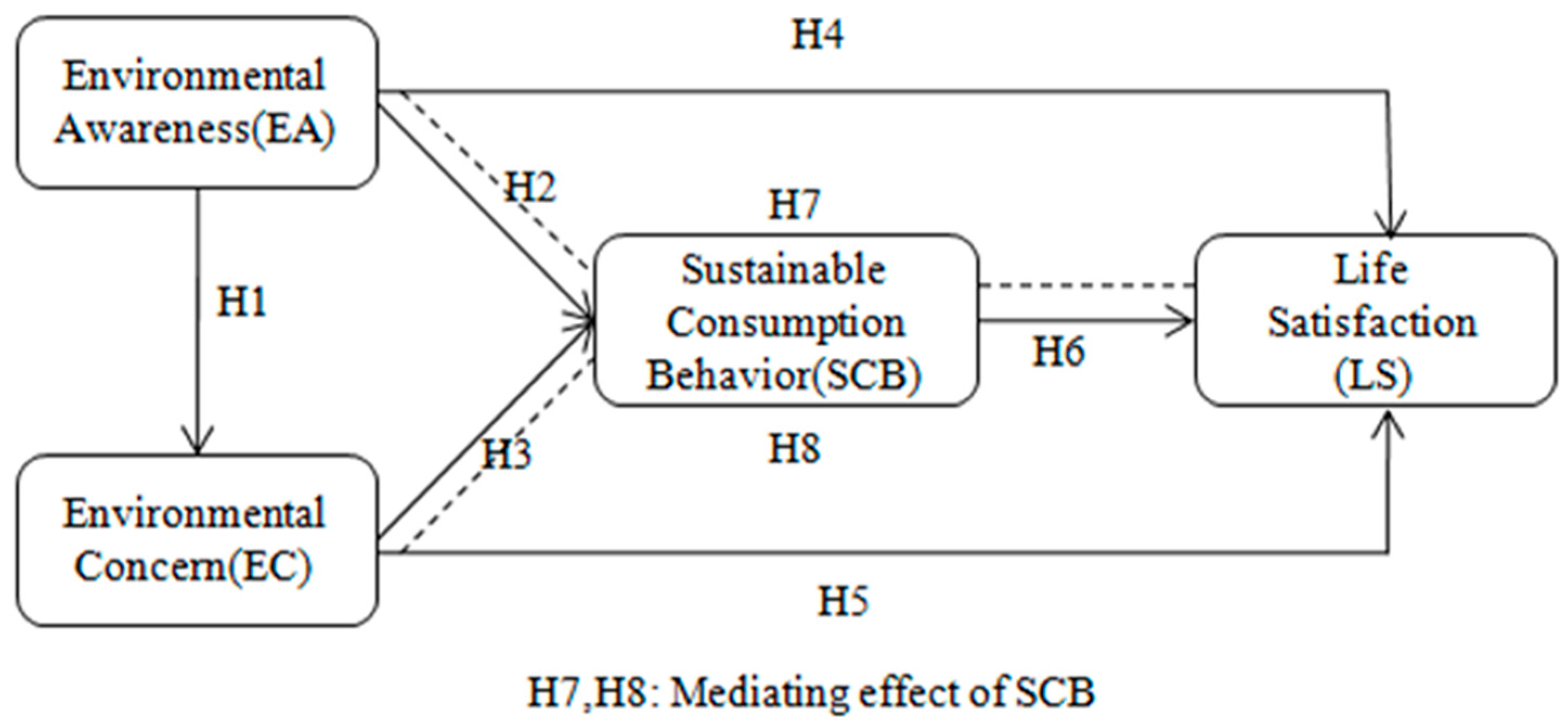
The research model, which includes all the research hypotheses, is presented in Figure 1.

3. Methods

3.1. Data Collection Procedure and Sample Profile

The target population of the study consisted of individuals residing in Bingöl Province, Türkiye. Since a complete sampling frame of all residents was not available, the study employed a non-probability convenience sampling approach rather than random sampling. Therefore, a sampling proportion could not be calculated, and the sample should not be interpreted as statistically representative of the entire population of Bingöl or Türkiye. Participants were reached through both online and face-to-face data collection to increase demographic diversity; however, this procedure does not eliminate the possibility of sampling bias. Accordingly, the findings should be interpreted within the limits of a single-province, convenience-based sample. The sampling process was designed to include participants with diverse demographic characteristics, including age, gender, education level, and income group. This suggests that young adults are heavily represented in the study. 68.3% of the participants stated that they had previously had knowledge about the concept of sustainability.
As shown in Table 1, the sample consisted of 746 participants. In terms of age, more than half of the respondents were between 18 and 24 years old (51.2%), followed by those aged 25–34 (26.4%) and 35–44 (16.4%). The gender distribution was relatively balanced, with 53.2% male and 46.8% female participants. Regarding education, the largest group held an associate degree (30.6%), followed by bachelor’s degree holders (29.1%) and graduate degree holders (19.2%). In terms of income, the largest group reported a monthly income of 0–14,999 TL (46.8%).
Respondents participated in the study voluntarily and were informed that all data would be treated confidentially and used only for research purposes. The data collection tool used in the research is a structured questionnaire form including sustainable consumption, life satisfaction, environmental awareness and environmental concern scales(see Appendix A for the full questionnaire). Surveys were administered both online (via Google Forms) and face-to-face. In this way, different socio-demographic profiles were reached. The data collecting tool’s validity and reliability were examined using confirmatory factor analysis (CFA) in this study, even though they were based on prior studies. With 746 participants, the study’s sample size was enough for empirical modeling, and the data collected was adequate for structural equation modeling (SEM) analysis [61]. The sample size meets the minimum conditions determined depending on the complexity of the model.

3.2. Measures

All study variables, including environmental awareness, environmental concern, sustainable consumption behavior, and life satisfaction, were assessed using a five-point Likert scale. Environmental awareness was initially measured using a five-item scale developed by Atabek-Yigit and Balkan Kiyici [62]. Following item-content assessment, two behavior-oriented items were removed, and the final environmental awareness construct was measured with three cognitive/attitudinal items. Kim and Choi [63] designed a 5-item scale to evaluate environmental concern. The distinction between EA and EC was also reflected in the measurement items. The final EA items focused on information-seeking and attention to environmental issues, whereas the EC items captured worry, perceived ecological harm, environmental fragility, and the need for harmony between humans and nature. Sustainable consumption behavior was measured using a four-item scale adapted from Minton et al. [64], whereas life satisfaction was assessed with five items adapted from Daglı and Baysal [65]. In this study, environmental awareness and sustainable consumption behavior are treated as theoretically related but conceptually distinct constructs. Environmental awareness refers to individuals’ cognitive and attitudinal orientation toward environmental issues, including their awareness of environmental problems, attention to environmental information, and willingness to learn about environmental protection. Therefore, environmental awareness is not conceptualized as an actual behavior, but rather as a cognitive and attitudinal antecedent of behavior. Sustainable consumption behavior, by contrast, refers to concrete consumption-related actions and behavioral tendencies, such as choosing recyclable packaging, avoiding products from environmentally harmful companies, using reusable shopping bags, and paying more for environmentally friendly products. This distinction is important because awareness may guide behavior, but it should not be treated as equivalent to behavior.

4. Data Analysis

4.1. Reliability and Validity Analysis of the Measurement Model

Table 2 reports the descriptive statistics, reliability coefficients, and bivariate correlations among the constructs included in the study. Internal consistency reliability was assessed through Cronbach’s alpha coefficients, and the results confirmed that all constructs met the acceptable reliability criterion of α > 0.70 [66,67]. According to the correlation matrix’s findings, life satisfaction, sustainable consumption behavior, and environmental concern are all favorably connected with environmental awareness.
Prior to hypothesis testing, the measurement model was assessed through confirmatory factor analysis using AMOS v24. The results showed that all factor loadings exceeded 0.70, while the AVE values were above the recommended 0.50 threshold and the CR coefficients were higher than 0.70. These findings support the reliability and convergent validity of the constructs. The discriminant validity of the constructs was examined using the criteria proposed by Fornell and Larcker [68]. These criteria require AVE to be higher than MSV and ASV, while the square root of AVE should exceed the inter-construct correlations.
Table 3 presents the factor loadings and the convergent and discriminant validity results. The environmental awareness items were re-examined at the content level to ensure that the construct reflected cognitive and attitudinal awareness rather than behavioral preferences. Two behavior-oriented items were removed because they reflected behavioral or quasi-behavioral preferences rather than cognitive environmental awareness. The revised environmental awareness construct therefore retained three items focusing on information-seeking and attention to environmental issues. The revised model demonstrated satisfactory reliability and convergent validity, with standardized factor loadings ranging from 0.790 to 0.828, CR = 0.854, and AVE = 0.661. Model refinement was not based on purely data-driven modification indices. The main refinement concerned the removal of behavior-oriented environmental awareness items based on item-content assessment, and no error covariance was added solely on the basis of modification indices.
Since all variables were measured using a single self-reported questionnaire, common method bias was assessed through a single-factor CFA approach. The results showed that the single-factor model had poor fit to the data, χ2/df = 24.224, CFI = 0.635, TLI = 0.589, and RMSEA = 0.177. These results indicate that a single common factor did not adequately explain the covariance among the observed variables. Therefore, common method bias was unlikely to fully account for the observed relationships. Nevertheless, given the self-reported and cross-sectional nature of the data, the possibility of common method bias cannot be completely ruled out.
As shown in Table 4, all HTMT values were below the recommended threshold of 0.90. The HTMT value between environmental awareness and sustainable consumption behavior was 0.857, indicating that the two constructs were empirically distinguishable after removing the behavior-oriented environmental awareness items.
As shown in the Table 5, the alternative CFA results indicate that the revised four-factor model fits the data better than the competing models. The poorer fit of the EA–SCB combined model suggests that environmental awareness and sustainable consumption behavior should be treated as distinct constructs rather than as a single underlying factor. Therefore, the revised measurement model provides additional evidence for discriminant validity.
The cross-loading results are presented in Supplementary Table S1. All indicators loaded more strongly on their intended constructs than on competing constructs, providing further support for discriminant validity.

4.2. Structural Equation Modeling Analysis

The revised structural model demonstrated acceptable fit to the data (χ2/df = 3.98, CFI = 0.96, TLI = 0.95, IFI = 0.96, RMSEA = 0.063, SRMR = 0.050). Although χ2/df and RMSEA indicate acceptable rather than excellent fit, the overall pattern of fit indices supports the adequacy of the revised model [69].
The results presented in Table 6 showed that environmental awareness was positively associated with environmental concern (β = 0.618, p < 0.001) and sustainable consumption behavior (β = 0.836, p < 0.001). Sustainable consumption behavior was also positively associated with life satisfaction (β = 0.775, p < 0.001). However, the direct path from environmental concern to sustainable consumption behavior was not statistically significant (β = 0.036, p = 0.349), nor was the direct path from environmental concern to life satisfaction (β = −0.074, p = 0.106). Similarly, the direct path from environmental awareness to life satisfaction was not statistically significant (β = −0.111, p = 0.264).
Mediation paths were tested using 5000 bootstrap resamples and 95% bias-corrected bootstrap confidence intervals. Direct, indirect, and total effects were examined to determine the type of mediation. Mediation was considered significant when the bootstrapped confidence interval for the indirect effect did not include zero.
Mediation paths were examined after re-estimating the revised structural model with the three-item environmental awareness construct. The results of the analysis are shown in the Table 7. The results indicated that sustainable consumption behavior significantly mediated the association between environmental awareness and life satisfaction, as the indirect association was positive and its 95% bias-corrected bootstrap confidence interval did not include zero (β = 0.648, 95% CI [0.429, 0.762]). Since the direct path from environmental awareness to life satisfaction was not statistically significant (β = −0.111, 95% CI [−0.352, 0.092]), this finding supports an indirect-only mediation pattern. However, sustainable consumption behavior did not significantly mediate the association between environmental concern and life satisfaction, as the confidence interval for the indirect association included zero (β = 0.028, 95% CI [−0.030, 0.085]). Therefore, the mediation hypothesis regarding environmental concern was not supported in the revised model.

5. Discussion and Conclusions

This study examined the direct and indirect relationships among environmental awareness, environmental concern, sustainable consumption behavior, and life satisfaction. After refining the environmental awareness construct by removing two behavior-oriented items, the revised structural model provided a more conservative and methodologically robust interpretation of the proposed relationships. The results showed that environmental awareness was positively associated with both environmental concern and sustainable consumption behavior. However, environmental awareness was not directly associated with life satisfaction. Sustainable consumption behavior, in contrast, showed a positive association with life satisfaction. The results further indicated that environmental concern was not significantly associated with either sustainable consumption behavior or life satisfaction in the revised model. The positive association between environmental awareness and environmental concern suggests that individuals who pay attention to environmental information and are willing to learn about environmental issues are more likely to report concern about environmental problems. This finding is consistent with previous studies indicating that environmental awareness can provide a cognitive basis for environmental concern by helping individuals recognize the consequences of ecological degradation [28,29,30,31]. In this respect, awareness appears to be an important cognitive condition for the formation of environmental sensitivity.
The findings also showed that environmental awareness was positively associated with sustainable consumption behavior. This result indicates that individuals with higher levels of environmental awareness may be more inclined to engage in responsible consumption practices because they are better able to evaluate the environmental consequences of their choices. This interpretation is in line with previous research suggesting that environmental information, knowledge, and awareness are closely related to environmentally responsible behavior and sustainable consumption patterns [2,32,34,35]. However, this relationship should be interpreted carefully. Since the revised model treated environmental awareness as a cognitive/attitudinal construct rather than a behavioral one, the finding provides a cleaner explanation of the link between awareness and sustainable consumption behavior.
Contrary to the initial expectation, environmental concern was not significantly associated with sustainable consumption behavior in the revised model. This result suggests that concern alone may not be sufficient to explain sustainable consumption behavior when environmental awareness is included in the same model. Although prior studies have reported that environmentally concerned individuals may be more likely to engage in eco-friendly behavior [31,37,39,40,41], the present findings indicate that concern may not always translate into sustainable consumption practices. One possible explanation is that emotional concern about environmental problems may need to be supported by knowledge, perceived behavioral control, access to sustainable alternatives, and concrete behavioral opportunities before it is reflected in consumption behavior.
The direct association between environmental awareness and life satisfaction was not statistically significant. This finding suggests that awareness alone may not be sufficient to explain individuals’ overall life satisfaction. Although environmentally aware individuals may better recognize the consequences of their consumption choices, such awareness may contribute to life satisfaction only when it is translated into meaningful and responsible consumption behavior. This interpretation is supported by the mediation results, which showed that sustainable consumption behavior significantly mediated the relationship between environmental awareness and life satisfaction.
Environmental concern was also not significantly associated with life satisfaction in the revised model. This finding differs from studies suggesting that environmental concern may be linked to lower life satisfaction through worry, anxiety, or psychological burden [48,49,70]. However, it is consistent with the view that the relationship between environmental concern and life satisfaction may depend on contextual factors, emotional coping mechanisms, perceived efficacy, or opportunities for constructive action. Therefore, environmental concern should not be interpreted as a direct determinant of life satisfaction in the present study.
Sustainable consumption behavior showed a positive association with life satisfaction. This finding suggests that individuals who engage in environmentally responsible consumption practices may report higher levels of life satisfaction. Sustainable consumption may provide individuals with a sense of responsibility, meaning, contribution, and personal consistency between values and behavior. This result supports previous research showing that pro-environmental behaviors, conscious consumption, and sustainable lifestyles may be linked to subjective well-being and life satisfaction [2,25,53,54,55].
The mediation results provided a more nuanced explanation of the proposed model. Sustainable consumption behavior significantly mediated the relationship between environmental awareness and life satisfaction. In other words, environmental awareness was not directly associated with life satisfaction, but it was indirectly associated with life satisfaction through sustainable consumption behavior. This finding indicates that awareness becomes more relevant to life satisfaction when it is expressed through concrete sustainable consumption practices. Therefore, environmental awareness should not be interpreted as directly improving life satisfaction; rather, its positive association with life satisfaction appears to operate through behavioral engagement in sustainable consumption.
By contrast, sustainable consumption behavior did not significantly mediate the relationship between environmental concern and life satisfaction in the revised model. This result indicates that the indirect path from environmental concern to life satisfaction through sustainable consumption behavior was not supported. Therefore, the findings do not provide evidence for a competitive mediation pattern involving environmental concern. Instead, the results suggest that environmental concern may remain a relatively affective orientation unless it is accompanied by stronger cognitive awareness, perceived efficacy, and behavioral capability. This study contributes to the literature on sustainable consumer behavior and environmental psychology by distinguishing environmental awareness from sustainable consumption behavior and by testing their direct and indirect associations with life satisfaction. The refinement of the environmental awareness construct strengthened the conceptual distinction between cognitive/attitudinal awareness and actual consumption-related behavior. In this respect, the study provides a more cautious and empirically grounded explanation of how environmental awareness is related to sustainable consumption behavior and life satisfaction.
The findings also contribute to the literature by showing that sustainable consumption behavior is not only an environmentally responsible practice but also a behavior associated with individual well-being. While environmental awareness was not directly related to life satisfaction, its indirect association through sustainable consumption behavior suggests that awareness may become psychologically meaningful when it is translated into responsible action. Therefore, sustainable consumption behavior appears to function as a key behavioral mechanism linking environmental awareness to life satisfaction. From a practical perspective, the findings suggest that awareness-raising activities should not remain limited to providing environmental information. Educational institutions, local governments, and businesses should design interventions that help individuals transform environmental awareness into concrete sustainable consumption practices. Programs that combine environmental knowledge with accessible behavioral options, perceived efficacy, and value-based motivation may be more effective in promoting sustainable consumption. Businesses may also emphasize not only the environmental benefits of sustainable products and services but also their potential connection with personal meaning, responsibility, and well-being.
Overall, the revised findings indicate that environmental awareness is positively associated with environmental concern and sustainable consumption behavior, while sustainable consumption behavior is positively associated with life satisfaction. Environmental awareness does not show a significant direct association with life satisfaction; however, it is indirectly associated with life satisfaction through sustainable consumption behavior. In contrast, environmental concern does not show significant direct or indirect associations with life satisfaction in the revised model. These results highlight sustainable consumption behavior as the central mechanism through which environmental awareness is linked to life satisfaction.
The findings also provide valuable insights into the Turkish context. In a global environment where consumer typologies vary, it is clear that environmental awareness is essential for encouraging sustainable consumption in the region. In this regard, it is of critical importance for policymakers to develop strategies to raise environmental awareness and foster sustainable consumption behaviors. Given the positive impact of sustainable consumption on life satisfaction, designing and implementing strategies related to environmental awareness has become a priority area for policymakers in Türkiye. These strategies can be made more concrete by local governments when evaluated at the national level. Local governments can organize awareness programmers focusing on energy and water conservation, recycling, and similar topics. Courses on environmental awareness could be added to curricula at educational institutions at all levels. These institutions could also carry out social responsibility projects and events with an environmental theme. Additionally, businesses can be encouraged to implement sustainability-focused strategies. Efforts can be made to ensure that businesses provide sustainability-based training to their employees and support policymakers. In conclusion, to enhance environmental awareness, strengthen sustainable consumption behaviors and contribute to life satisfaction, it is necessary to develop implementable, context-sensitive and concrete policies and strategies in Türkiye.

Limitations and Future Research

This study has several limitations that should be acknowledged. First, all variables were measured using a single self-reported questionnaire. Therefore, the findings may be subject to respondents’ subjective evaluations, social desirability tendencies, and potential common method bias. Although the poor fit of the single-factor CFA model suggested that common method bias was unlikely to fully explain the observed relationships, this risk cannot be completely ruled out. Future studies should consider using multi-source data, objective behavioral indicators, or time-lagged research designs to reduce this potential bias.
Second, the study employed a cross-sectional design, and all data were collected at one point in time from the same respondents. As a result, causal interpretations should be made with caution. The research design does not allow strong causal claims. Future research may employ longitudinal or experimental designs to better examine how environmental awareness, environmental concern, sustainable consumption behavior, and life satisfaction influence one another over time.
Third, the sample was limited to residents of Bingöl, a single province in Türkiye. This geographical limitation restricts the generalizability of the findings to other regions, countries, or cultural contexts. Sustainable consumption behavior and life satisfaction may be shaped by local socio-economic conditions, cultural norms, environmental infrastructure, and regional development levels. Therefore, future studies should test the proposed model in different provinces, larger national samples, and cross-cultural settings.
Another important limitation concerns the sampling strategy. The study relied on convenience sampling and was limited to residents of Bingöl Province. Because no probability-based sampling procedure was used and no complete sampling frame was available, the representativeness of the sample cannot be demonstrated. In addition, the high proportion of young participants, particularly those aged 18–24, may have shaped the observed relationships. Therefore, the findings should not be generalized to the broader Turkish population or to different cultural and regional contexts. Future studies should employ probability-based, stratified, or quota sampling methods across multiple provinces and age groups to improve representativeness and reduce sampling bias.
Future studies may extend the present model by examining more complex multiple or serial mediation mechanisms. For example, subsequent research could test whether environmental awareness is indirectly associated with life satisfaction through a sequential pathway involving environmental concern and sustainable consumption behavior.
Furthermore, the study did not assess how factors such as age, income, and educational background, as well as prior knowledge regarding sustainable consumption, influence sustainable consumption behavior. This constitutes a significant limitation of the study. Incorporating these factors in future research could make a significant contribution to the literature.

Supplementary Materials

The following supporting information can be downloaded at: https://www.mdpi.com/article/10.3390/su18115524/s1, Table S1: Cross-loading Results.

Author Contributions

Conceptualization: B.D. and C.S.; data curation: M.E.Y.; formal analysis: B.D. and M.E.Y.; investigation: B.D. and M.E.Y.; methodology: B.D. and M.E.Y.; resources: B.D., M.E.Y. and C.S.; software: B.D. and M.E.Y.; supervision: B.D.; validation: B.D. and M.E.Y.; visualization: B.D.; writing—original draft: B.D., M.E.Y. and C.S.; writing—editing and review: B.D., M.E.Y., C.S., M.R. and M.D.H. All authors have read and agreed to the published version of the manuscript.

Funding

This research received no external funding.

Institutional Review Board Statement

The necessary permissions were obtained from the Bingöl University Social and Human Sciences Research and Publication Ethics Committee, Türkiye (Issue: E-79879538-050.03-2500037320, Date: 1 August 2025). In addition, the study was conducted in accordance with the Helsinki Declaration.

Informed Consent Statement

All processes related to the study were conducted within ethical rules. All participants who participated in this study were informed about the purpose of the study and their consent for participation was obtained.

Data Availability Statement

Data are available from the corresponding author upon reasonable request, subject to privacy and ethical restrictions.

Acknowledgments

The authors acknowledge the use of DeepL 26.4.1 and ChatGPT v5.5 for language editing and readability support. The authors take full responsibility for the content of the manuscript.

Conflicts of Interest

The authors declare no conflicts of interest.

Abbreviations

The following abbreviations are used in this manuscript:
ECEnvironmental Concern
EAEnvironmental Awareness
SCBSustainable Consumption Behavior
LSLife Satisfaction

Appendix A

Table A1. Questionnaire.
Environmental Concern (EC)
1. I feel deeply worried about current environmental conditions.
2. Human activities are causing serious harm to the natural environment.
3. Human intervention in nature can lead to serious ecological consequences.
4. The natural balance is fragile and can be easily disrupted.
5. Human survival depends on maintaining a harmonious relationship with nature.
Environmental Awareness (EA)
1. I watch television programs that provide information about recycling to prevent environmental problems caused by waste.
2. I would like to gain information about environmental issues.
3. I pay attention to environment-related topics while reading the newspaper.
Sustainable Consumption Behavior
1. I am willing to pay more for environmentally friendly products.
2. I would avoid purchasing my preferred brand if I learned that the company harms the environment through its production activities.
3. I generally choose products packaged with recyclable materials.
4. I am willing to use my own shopping bags to help reduce the consumption of non-recyclable bags.
Life Satisfaction
1. My life is generally close to the way I ideally want it to be.
2. I consider my current living conditions to be very good.
3. Overall, I feel satisfied with my life.
4. Up to now, I have achieved the important things I wanted in life.
5. If I had the chance to live my life again, there would be very little I would change.

References

  1. Azmat, F.; Lim, W.M.; Moyeen, A.; Voola, R.; Gupta, G. Convergence of business, innovation, and sustainability at the tipping point of the sustainable development goals. J. Bus. Res. 2023, 167, 114170. [Google Scholar] [CrossRef]
  2. Kuckertz, A.; Wagner, M. The influence of sustainability orientation on entrepreneurial intentions—Investigating the role of business experience. J. Bus. Ventur. 2010, 25, 524–539. [Google Scholar] [CrossRef]
  3. United Nations. SDGS Goals; United Nations: New York, NY, USA, 2015. [Google Scholar]
  4. European Commission. The European Green Deal Striving to Be the First Climate-Neutral Continen; European Commission: Brussels, Belgium, 2019. [Google Scholar]
  5. FAO. 10YFP: Sustainable Food Systems; Incentives for Ecosystem Services; FAO: Rome, Italy, 2015. [Google Scholar]
  6. FAO. OECD Green Growth Strategy FAO/OECD Expert Meeting on Greening the Economy with Agriculture; OECD Better Policies for Better Lives; FAO: Rome, Italy, 2011. [Google Scholar]
  7. EBRD. Environmental and Social Sustainability; European Bank: Frankfurt, Germany, 2008. [Google Scholar]
  8. Anantharaman, M. Critical sustainable consumption: A research agenda. J. Environ. Stud. Sci. 2018, 8, 553–561. [Google Scholar] [CrossRef]
  9. Haider, M.; Randall, S.; George, P.M. Sustainable consumption research and the role of marketing: A review of the literature (1976–2021). Sustainability 2022, 14, 3999. [Google Scholar] [CrossRef]
  10. Dönmez, R.Ö.; Yardımcı, E. Environmental awareness and sustainable consumption behaviours of Turkish nursing students. PeerJ 2024, 12, e17366. [Google Scholar] [CrossRef]
  11. Liang, H.; Wu, Z.; Du, S. Study on the impact of environmental awareness, health consciousness, and individual basic conditions on the consumption intention of green furniture. Sustain. Futur. 2024, 8, 100245. [Google Scholar] [CrossRef]
  12. Rizkalla, N. Determinants of Sustainable Consumption Behavior—An Examination of Consumption Values—PCE Environmental Concern and Environmental Knowledge. Int. J. Soc. Sci. Humanit. 2018, 8, 48–54. [Google Scholar] [CrossRef]
  13. Dunlap, R.E.; Van Liere, K.D.; Mertig, A.G.; Jones, R.E. New Trends in Measuring Environmental Attitudes: Measuring Endorsement of the New Ecological Paradigm: A Revised NEP Scale. J. Soc. Issues 2000, 56, 425–442. [Google Scholar] [CrossRef]
  14. Carmi, N.; Arnon, S.; Orion, N. Transforming Environmental Knowledge Into Behavior: The Mediating Role of Environmental Emotions. J. Environ. Educ. 2015, 46, 183–201. [Google Scholar] [CrossRef]
  15. Wardhana, Y.D. Environmental Awareness, Sustainable Consumption and Green Behavior Amongst University Students. Rev. Integr. Bus. Econ. Res. 2021, 11, 242–252. [Google Scholar]
  16. Zeng, Z.; Zhong, W.; Naz, S. Can Environmental Knowledge and Risk Perception Make a Difference? The Role of Environmental Concern and Pro-Environmental Behavior in Fostering Sustainable Consumption Behavior. Sustainability 2023, 15, 4791. [Google Scholar] [CrossRef]
  17. Seligman, M. Flourish: A Visionary New Understanding of Happiness and Well-Being; Free Press/Macmillan: New York, NY, USA, 2011. [Google Scholar]
  18. Hollebeek, L.D.; Belk, R. Consumers’ technology-facilitated brand engagement and wellbeing: Positivist TAM/PERMA- vs. Consumer Culture Theory perspectives. Int. J. Res. Mark. 2021, 38, 387–401. [Google Scholar] [CrossRef]
  19. Rajani, N.B.; Skianis, V.; Filippidis, F.T. Association of environmental and sociodemographic factors with life satisfaction in 27 European countries. BMC Public Health 2019, 19, 534. [Google Scholar] [CrossRef]
  20. Schmitt, M.T.; Aknin, L.B.; Axsen, J.; Shwom, R.L. Unpacking the Relationships Between Pro-environmental Behavior, Life Satisfaction, and Perceived Ecological Threat. Ecol. Econ. 2018, 143, 130–140. [Google Scholar] [CrossRef]
  21. Wang, E.; Kang, N. Does life satisfaction matter for pro-environmental behavior? Empirical evidence from China General Social Survey. Qual. Quant. 2019, 53, 449–469. [Google Scholar] [CrossRef]
  22. Welsch, H.; Kühling, J. Pro-environmental behavior and rational consumer choice: Evidence from surveys of life satisfaction. J. Econ. Psychol. 2010, 31, 405–420. [Google Scholar] [CrossRef]
  23. Yakut, E. A VBN theory view on pro-environmental behavior and life satisfaction: Turkey’s recent legislation on plastic carry bags. Curr. Psychol. 2021, 40, 1567–1579. [Google Scholar] [CrossRef]
  24. De Young, R. Expanding and evaluating motives for environmentally responsible behavior. J. Soc. Issues 2000, 56, 509–526. [Google Scholar] [CrossRef]
  25. Xiao, J.J.; Li, H. Sustainable Consumption and Life Satisfaction. Soc. Indic. Res. 2011, 104, 323–329. [Google Scholar] [CrossRef]
  26. Geng, M.-M.; He, L.-Y. Environmental Regulation, Environmental Awareness and Environmental Governance Satisfaction. Sustainability 2021, 13, 3960. [Google Scholar] [CrossRef]
  27. Wang, B.; Li, Y. Consumers’ Intention to Bring a Reusable Bag for Shopping in China: Extending the Theory of Planned Behavior. Int. J. Environ. Res. Public Health 2022, 19, 3638. [Google Scholar] [CrossRef] [PubMed]
  28. Chan, E.S.W.; Hon, A.H.Y.; Chan, W.; Okumus, F. What drives employees’ intentions to implement green practices in hotels? The role of knowledge, awareness, concern and ecological behaviour. Int. J. Hosp. Manag. 2014, 40, 20–28. [Google Scholar] [CrossRef]
  29. İlaslan, N.; Şahin Orak, N. Relationship between nursing students’ global climate change awareness, climate change anxiety and sustainability attitudes in nursing: A descriptive and cross-sectional study. BMC Nurs. 2024, 23, 573. [Google Scholar] [CrossRef]
  30. Wurzinger, S.; Johansson, M. Environmental Concern and Knowledge of Ecotourism among Three Groups of Swedish Tourists. J. Travel Res. 2006, 45, 217–226. [Google Scholar] [CrossRef]
  31. Aman, S.; Hassan, N.; Khattak, M.; Moustafa, M.; Fakhri, M.; Ahmad, Z. Impact of Tourist’s Environmental Awareness on Pro-Environmental Behavior with the Mediating Effect of Tourist’s Environmental Concern and Moderating Effect of Tourist’s Environmental Attachment. Sustainability 2021, 13, 12998. [Google Scholar] [CrossRef]
  32. Gabarda-Mallorquí, A.; Fraguell, R.; Ribas, A. Exploring Environmental Awareness and Behavior among Guests at Hotels That Apply Water-Saving Measures. Sustainability 2018, 10, 1305. [Google Scholar] [CrossRef]
  33. Sengupta, M. Environmental Awareness and Environment Related Behaviour of Twelfth Grade Students in Kolkata: Effects of Stream and Gender. Anwesa 2010, 5, 1–8. [Google Scholar]
  34. Polonsky, M.J.; Vocino, A.; Grau, S.L.; Garma, R.; Ferdous, A.S. The impact of general and carbon-related environmental knowledge on attitudes and behaviour of US consumers. J. Mark. Manag. 2012, 28, 238–263. [Google Scholar] [CrossRef]
  35. Sekhokoane, L.; Qie, N.; Rau, P.-L.P. Do Consumption Values and Environmental Awareness Impact on Green Consumption in China? In Cross-Cultural Design; Springer: Berlin, Germany, 2017; pp. 713–723. [Google Scholar] [CrossRef]
  36. Bamberg, S. How does environmental concern influence specific environmentally related behaviors? A new answer to an old question. J. Environ. Psychol. 2003, 23, 21–32. [Google Scholar] [CrossRef]
  37. Stern, P.C.; Dietz, T.; Guagnano, G.A. The New Ecological Paradigm in Social-Psychological Context. Environ. Behav. 1995, 27, 723–743. [Google Scholar] [CrossRef]
  38. McKenzie-Mohr, D.; Nemiroff, L.S.; Beers, L.; Desmarais, S. Determinants of Responsible Environmental Behavior. J. Soc. Issues 1995, 51, 139–156. [Google Scholar] [CrossRef]
  39. Pagiaslis, A.; Krontalis, A.K. Green Consumption Behavior Antecedents: Environmental Concern, Knowledge, and Beliefs. Psychol. Mark. 2014, 31, 335–348. [Google Scholar] [CrossRef]
  40. Urban, J.; Ščasný, M. Exploring domestic energy-saving: The role of environmental concern and background variables. Energy Policy 2012, 47, 69–80. [Google Scholar] [CrossRef]
  41. Schultz, P.W.; Gouveia, V.V.; Cameron, L.D.; Tankha, G.; Schmuck, P.; Franěk, M. Values and their Relationship to Environmental Concern and Conservation Behavior. J. Cross Cult. Psychol. 2005, 36, 457–475. [Google Scholar] [CrossRef]
  42. Dhandra, T.K. Achieving triple dividend through mindfulness: More sustainable consumption, less unsustainable consumption and more life satisfaction. Ecol. Econ. 2019, 161, 83–90. [Google Scholar] [CrossRef]
  43. Brown, K.W.; Ryan, R.M. The benefits of being present: Mindfulness and its role in psychological well-being. J. Pers. Soc. Psychol. 2003, 84, 822–848. [Google Scholar] [CrossRef] [PubMed]
  44. Jităreanu, A.F.; Mihăilă, M.; Alecu, C.-I.; Robu, A.-D.; Ignat, G.; Costuleanu, C.L. The Relationship between Environmental Factors, Satisfaction with Life, and Ecological Education: An Impact Analysis from a Sustainability Pillars Perspective. Sustainability 2022, 14, 10679. [Google Scholar] [CrossRef]
  45. Vaznonis, B.; Staugaitis, A.J.; Vaznonienė, G. The Interrelationship between Pro-Environmental Attitudes and Subjective Well-Being: The Case of Central and Eastern European Countries. Sustainability 2024, 16, 3434. [Google Scholar] [CrossRef]
  46. Andrews, F.M.; Withey, S.B. Social Indicators of Well-Being; Springer: Boston, MA, USA, 1976. [Google Scholar] [CrossRef]
  47. Türk, B. Mediator Effect of Environmental Attitudes Between Lifestyle and Sustainable Consumption. In Proceedings of the 5th International Scientific Research Congress (IBAD-2020), İstanbul, Turkey, 1–2 September 2020; IBAD: İstanbul, Turkey, 2020. [Google Scholar]
  48. Ferrer-i-Carbonell, A.; Gowdy, J.M. Environmental degradation and happiness. Ecol. Econ. 2007, 60, 509–516. [Google Scholar] [CrossRef]
  49. Silva, J.; De Keulenaer, F.; Johnstone, N. Environmental Quality and Life Satisfaction: Evidence Based on Micro-Data. OECD Environ. Work. Pap. 2012, 1–39. Available online: https://www.oecd.org/content/dam/oecd/en/publications/reports/2012/03/environmental-quality-and-life-satisfaction_g17a2101/5k9cw678dlr0-en.pdf (accessed on 1 April 2026).
  50. Jones, P.; Hillier, D.; Comfort, D. Shopping for tomorrow: Promoting sustainable consumption within food stores. Br. Food J. 2011, 113, 935–948. [Google Scholar] [CrossRef]
  51. Franzen, A. Environmental Attitudes in International Comparison: An Analysis of the ISSP Surveys 1993 and 2000. Soc. Sci. Q. 2003, 84, 297–308. [Google Scholar] [CrossRef]
  52. George, L.K. Life Satisfaction. In Principles and Practice of Geriatric Psychiatry; Wiley: Hoboken, NJ, USA, 2002; pp. 75–77. [Google Scholar] [CrossRef]
  53. Pavot, W.; Diener, E. Review of the Satisfaction with Life Scale. In Assessing Well-Being; Springer Nature: London, UK, 2009; pp. 101–117. [Google Scholar] [CrossRef]
  54. Leelakulthanıt, O. The Impact of Eco-Friendly Behaviors on Life Satisfaction. J. Environ. Manag. Tour. 2019, 10, 220–230. [Google Scholar] [CrossRef] [PubMed]
  55. Yildiz, T.; Ercis, A. Investigation of green consumers ’subjective well being within the scope of purchase behavior, attitudes and personality traits. Trends Bus. Econ. 2022, 36, 29–42. [Google Scholar] [CrossRef]
  56. Venhoeven, L.; Bolderdijk, J.; Steg, L. Explaining the Paradox: How Pro-Environmental Behaviour can both Thwart and Foster Well-Being. Sustainability 2013, 5, 1372–1386. [Google Scholar] [CrossRef]
  57. Thøgersen, J.; Ölander, F. Human values and the emergence of a sustainable consumption pattern: A panel study. J. Econ. Psychol. 2002, 23, 605–630. [Google Scholar] [CrossRef]
  58. Varela-Candamio, L.; Novo-Corti, I.; García-Álvarez, M.T. The importance of environmental education in the determinants of green behavior: A meta-analysis approach. J. Clean. Prod. 2018, 170, 1565–1578. [Google Scholar] [CrossRef]
  59. Brown, K.W.; Kasser, T. Are Psychological and Ecological Well-being Compatible? The Role of Values, Mindfulness, and Lifestyle. Soc. Indic. Res. 2005, 74, 349–368. [Google Scholar] [CrossRef]
  60. Mohd Suki, N. Consumer environmental concern and green product purchase in Malaysia: Structural effects of consumption values. J. Clean. Prod. 2016, 132, 204–214. [Google Scholar] [CrossRef]
  61. Kline, R.B. Principles and Practice of Structural Equation Modeling, 4th ed.; The Guilford Press: New York, NY, USA, 2016. [Google Scholar]
  62. Atabek-Yigit, E.; Balkan Kiyici, F. The Environmental Awareness in the Context of Sustainable Development: A Scale Development and Reliability Study. Sak. Univ. J. Educ. 2022, 12, 646–665. [Google Scholar] [CrossRef]
  63. Kim, Y.; Choi, S.M. Antecedents of Green Purchase Behavior: An Examination of Collectivism, Environmental Concern, and Perceived Consumer Effectiveness. Adv. Consum. Res. 2005, 32, 592–599. [Google Scholar]
  64. Minton, E.A.; Tan, S.J.; Tambyah, S.K.; Liu, R.L. Drivers of Sustainability and Consumer Well-Being: An Ethically-Based Examination of Religious and Cultural Values. J. Bus. Ethics 2022, 175, 167–190. [Google Scholar] [CrossRef]
  65. Daglı, A.; Baysal, N. Yasam doyumu olceginin Türkçe’ye uyarlanması: Gecerlilik ve güvenilirlik calısması. Elektron. Sos. Bilim. Derg. 2016, 15, 1250–1262. [Google Scholar] [CrossRef]
  66. Werts, C.E.; Linn, R.L.; Jöreskog, K.G. Intraclass Reliability Estimates: Testing Structural Assumptions. Educ. Psychol. Meas. 1974, 34, 25–33. [Google Scholar] [CrossRef]
  67. Samsa, C. A Different Approach to the Automotive Brand Experience: Brand Respect, Brand Love, Brand Fidelity. Corp. Reput. Rev. 2025. Epub ahaed of printing. [Google Scholar] [CrossRef]
  68. Fornell, C.; Larcker, D.F. Evaluating Structural Equation Models with Unobservable Variables and Measurement Error. J. Mark. Res. 1981, 18, 39–50. [Google Scholar] [CrossRef]
  69. Schermelleh-Engel, K.; Moosbrugger, H.; Müller, H. Evaluating the fit of structural equation models: Tests of significance and descriptive goodness-of-fit measures. MPR-Online 2003, 8, 23–74. [Google Scholar]
  70. Hogg, T.L.; Stanley, S.K.; O’Brien, L.V.; Wilson, M.S.; Watsford, C.R. The Hogg Eco-Anxiety Scale: Development and validation of a multidimensional scale. Glob. Environ. Change 2021, 71, 102391. [Google Scholar] [CrossRef]
Figure 1. Theoretical Framework. Source(s): Authors’ own work.
Sustainability 18 05524 g001
Table 1. Demographic Profile of Participants.
VariableCategoryFrequencyPercentage (%)
Age18–2438251.2
25–3419726.4
35–4412216.4
45–54334.4
55 and above121.6
GenderFemale34946.8
Male39753.2
EducationPrimary school192.5
High school13918.6
Associate degree22830.6
Bachelor’s degree21729.1
Graduate degree14319.2
Income0–14,999 TL34946.8
15,000–24,999 TL608.0
25,000–39,999 TL8411.3
40,000–59,999 TL12416.6
60,000 TL and above12917.3
Table 2. Means, Standard Deviations, Reliability, and Correlations.
ConstructsMeanS.Dα1234
1. EA3.480.980.8531
2. EC3.780.990.8920.55 **1
3. SCB3.410.940.8640.74 **0.50 **1
4. LS3.080.960.8890.45 **0.26 **0.57 **1
Note: α = Cronbach’s alpha; EA = Environmental Awareness; EC = Environmental Concern; SCB = Sustainable Consumption Behavior; LS = Life Satisfaction ** Correlation is significant at the 0.001 level. Source(s): Authors’ own work.
Table 3. Confirmatory Factor Analysis and Validity.
VariablesItemsFactor LoadingConvergent ValidityDivergent Validity
CRAVEMSVASV
Environmental AwarenessEA10.790.850.660.620.38
EA20.83
EA30.82
Environmental ConcernEC10.750.920.690.290.20
EC20.88
EC30.87
EC40.84
EC50.83
Sustainable
Consumption
Behavior
SCB10.760.860.620.610.39
SCB20.81
SCB30.84
SCB40.74
Life SatisfactionLS10.770.890.620.320.21
LS20.85
LS30.82
LS40.81
LS50.70
Model fit valuesχ2 = 511.550; p = 0.000; χ2/df = 3.98; GFI = 0.93; AGFI = 0.91; NFI = 0.95; TLI = 0.95; IFI = 0.96; CFI = 0.96; RMSEA = 0.063; SRMR = 0.050.
Source(s): Authors’ own work.
Table 4. HTMT Results for Discriminant Validity.
ConstructECEASCBLS
EC
EA0.621
SCB0.5620.857
LS0.2890.5150.648
Note: HTMT values below 0.90 indicate acceptable discriminant validity. EA = Environmental Awareness; SCB = Sustainable Consumption Behavior; EC = Environmental Concern; LS = Life Satisfaction.
Table 5. Alternative CFA Model Comparisons.
Modelχ2/dfCFITLIRMSEAInterpretation
Revised four-factor model3.9870.9600.9520.063Best-fitting model
EA + SCB combined model5.3370.9410.9310.076Weaker fit
Single-factor model24.2240.6350.5890.177Poor fit
Table 6. SEM Results for Direct Paths.
PathsβS.E.C.R.pSupport
EA → EC0.6180.04114.256***Yes
EA → SCB0.8360.04715.696***Yes
EC → SCB0.0360.0360.9360.349No
SCB → LS0.7750.1027.849***Yes
EA → LS−0.1110.091−1.1180.264No
EC → LS−0.0740.045−1.6190.106No
Model fit valuesχ2 = 450.572; p = 0.000; χ2/df = 3.98; GFI = 0.95; AGFI = 0.94; NFI = 0.95; TLI = 0.95; IFI = 0.96; CFI = 0.96; RMSEA = 0.063; SRMR = 0.050.
Note: *** < 0.001, Source(s): Authors’ own work.
Table 7. SEM Results for Mediating Roles.
RelationshipDirect
Effect
95% CIIndirect Effect95% CITotal Effect95% CIMediation Type
EA → SCB → LS−0.111[−0.352, 0.092]0.648[0.429, 0.762]0.537[0.424, 0.584]Indirect-only mediation
EC → SCB → LS−0.074[−0.178, 0.029]0.028[−0.030, 0.085]−0.046[−0.158, 0.067]No mediation
Source(s): Authors’ own work.
Disclaimer/Publisher’s Note: The statements, opinions and data contained in all publications are solely those of the individual author(s) and contributor(s) and not of MDPI and/or the editor(s). MDPI and/or the editor(s) disclaim responsibility for any injury to people or property resulting from any ideas, methods, instructions or products referred to in the content.