A Multiscale Diagnostic Framework for Sustainable Port Performance: Evidence from a Systematic Review

 ,
,  and
and 
Abstract
1. Introduction
2. Literature Review
3. Materials and Methods
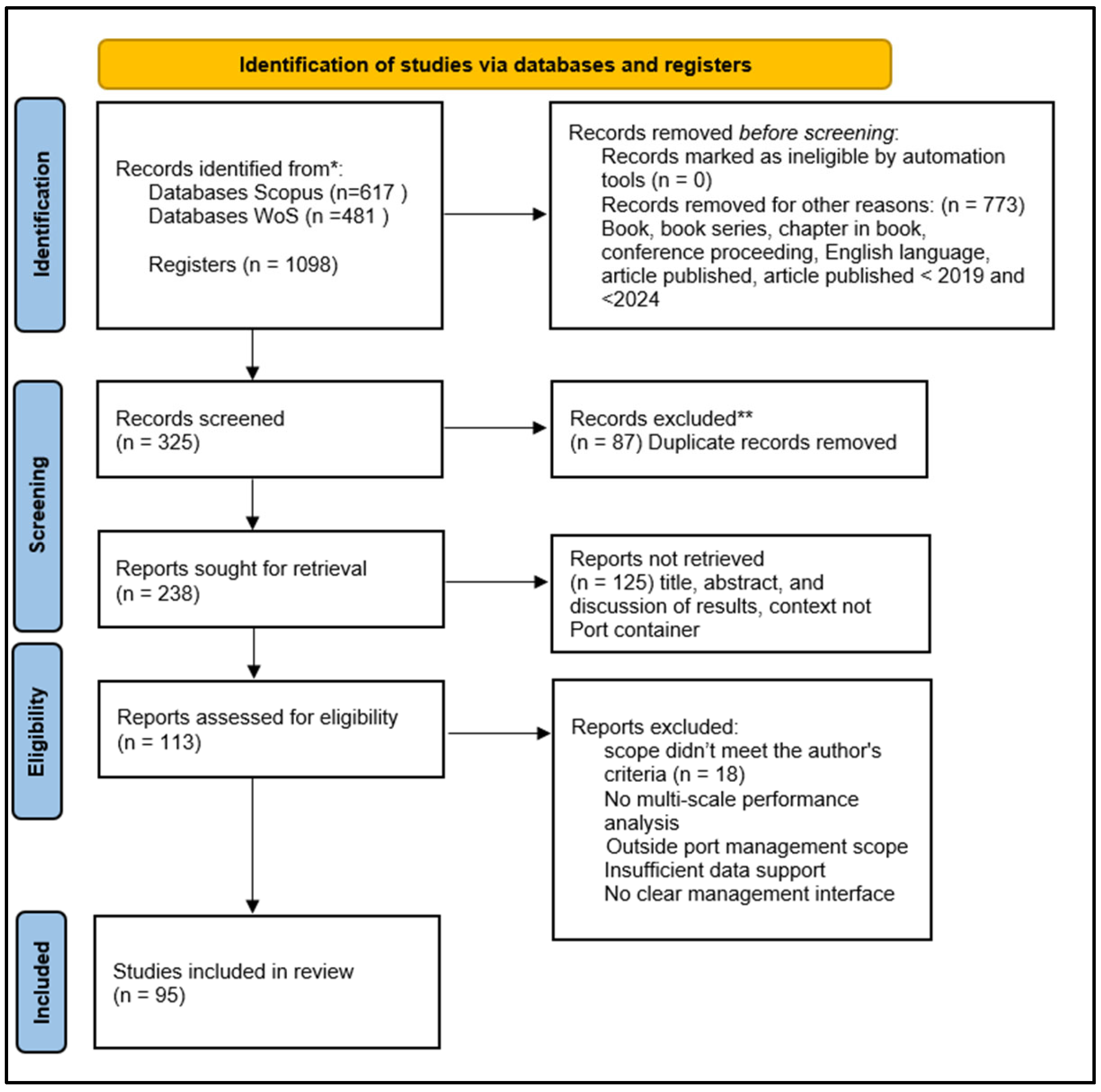
3.1. Study Selection
3.2. Results Main Characteristics of the Studies Included in the Systematic Review
4. Results
4.1. Comparative Positioning of Existing Review Studies
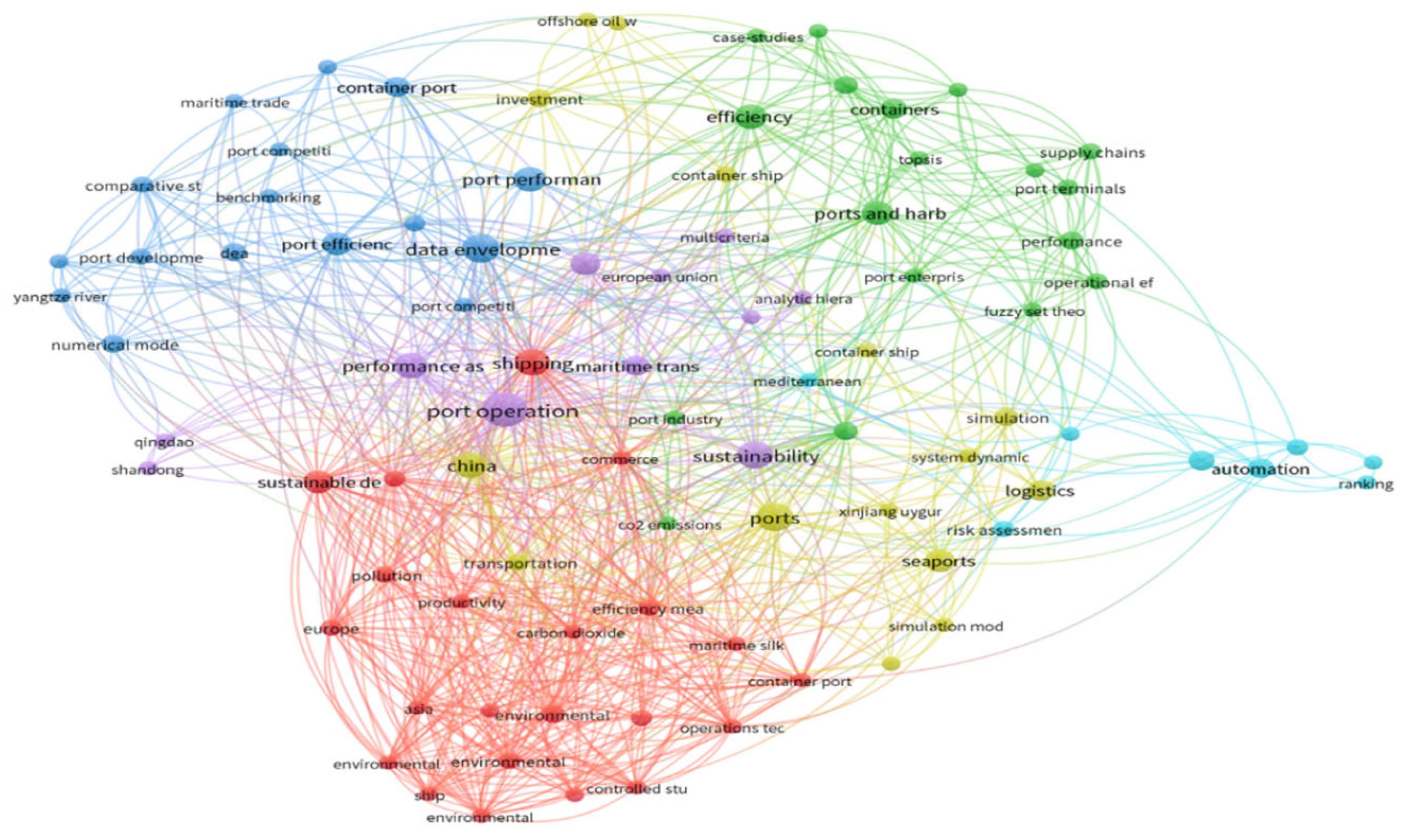
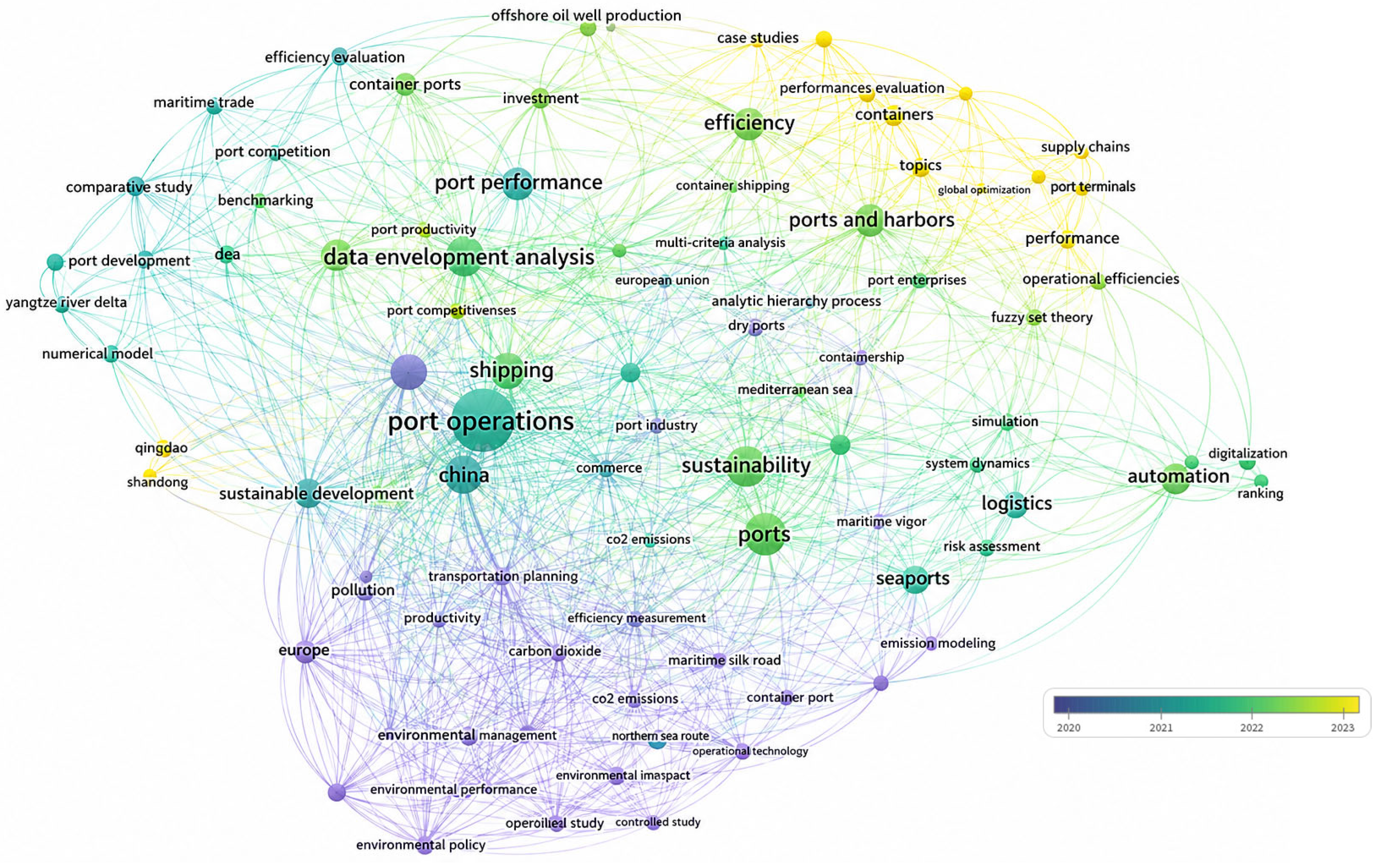
4.2. Bibliometric Analysis
4.3. Framework Development
4.3.1. Port Performance Evaluation Approaches
4.3.2. Port Performance Spatial Scope Evaluation
4.3.3. Multiscale Framework
5. Discussion and Conclusions
Supplementary Materials
Author Contributions
Funding
Institutional Review Board Statement
Data Availability Statement
Acknowledgments
Conflicts of Interest
Abbreviations
| ANP | Analytic Network Process |
| CPPI | Container Port Performance Index |
| DEA | Data Envelopment Analysis |
| DEMATEL | Decision Making Trial and Evaluation Laboratory |
| GHG | Greenhouse Gases |
| IMO | International Maritime Organization |
| IPS | Instituto Politécnico de Setúbal—Setubal Polytechnic Institute |
| LSCI | Liner Shipping Connectivity Index |
| SFA | Stochastic Frontier Analysis |
| PRISMA | Preferred Reporting Items for Systematic Reviews and Meta-Analyses |
References
- Unctad. Review of Maritime Transport 2022. 2022. Available online: https://shop.un.org/ (accessed on 22 October 2024).
- Mthembu, S.E.; Chasomeris, M. An evaluation of the governance structure of marine services in South Africa’s ports system. J. Shipp. Trade 2023, 8, 17. [Google Scholar] [CrossRef] [Scilit]
- Nong, T.N.-M. Performance efficiency assessment of Vietnamese ports: An application of Delphi with Kamet principles and DEA model. Asian J. Shipp. Logist. 2023, 39, 1–12. [Google Scholar] [CrossRef] [Scilit]
- Daniş, M.; Acar, A.Z. Evaluation of Containerized Trade and Competitiveness among Container Ports in Black Sea Basin. Pomorstvo 2024, 38, 126–140. [Google Scholar] [CrossRef] [Scilit]
- Al-Fatlawi, H.A.; Motlak, H.J. Smart ports: Towards a high performance, increased productivity, and a better environment. Int. J. Electr. Comput. Eng. (IJECE) 2023, 13, 1472–1482. [Google Scholar] [CrossRef] [Scilit]
- Bulak, M.E. A Frontier Approach to Eco-Efficiency Assessment in the World’s Busiest Sea Ports. Sustainability 2024, 16, 1142. [Google Scholar] [CrossRef] [Scilit]
- Bielenia, M.; Marušić, E.; Dumanska, I. Rethinking the Green Strategies and Environmental Performance of Ports for the Global Energy Transition. Energies 2024, 17, 6322. [Google Scholar] [CrossRef] [Scilit]
- Jiang, Z.; Yang, B.; Lv, B. Evaluation of environmental and economic performance of terminal equipment considering alternative fuels. Transp. Res. Part D Transp. Environ. 2024, 135, 104385. [Google Scholar] [CrossRef] [Scilit]
- Liu, S.; Park, S.-H.; Choi, Y.-S.; Yeo, G.-T. Efficiency evaluation of major container terminals in the top three cities of the Pearl River Delta using SBM-DEA and undesirable DEA. Asian J. Shipp. Logist. 2022, 38, 99–106. [Google Scholar] [CrossRef] [Scilit]
- Surucu-Balci, E.; Iris, Ç.; Balci, G. Digital information in maritime supply chains with blockchain and cloud platforms: Supply chain capabilities, barriers, and research opportunities. Technol. Forecast. Soc. Change 2024, 198, 122978. [Google Scholar] [CrossRef] [Scilit]
- Lim, S.; Pettit, S.; Abouarghoub, W.; Beresford, A. Port sustainability and performance: A systematic literature review. Transp. Res. D Transp. Environ. 2019, 72, 47–64. [Google Scholar] [CrossRef] [Scilit]
- Puig, M.; Raptis, S.; Wooldridge, C.; Darbra, R.M. Performance trends of environmental management in European ports. Mar. Pollut. Bull. 2020, 160, 111686. [Google Scholar] [CrossRef] [Scilit]
- Iris, Ç.; Lam, J.S.L. A review of energy efficiency in ports: Operational strategies, technologies and energy management systems. Renew. Sustain. Energy Rev. 2019, 112, 170–182. [Google Scholar] [CrossRef] [Scilit]
- Carvalho, J.; Silva, D.A.; Rolim Ensslin, S. Performance Evaluation in the Port Sector: A Systematic Literature Review. In Proceedings of the MT’24 10th International Conference on Maritime Transport, Barcelona, Spain, 5–7 June 2024. [Google Scholar]
- Kishore, L.; Pai, Y.P.; Ghosh, B.K.; Pakkan, S. Maritime Shipping Ports Performance: A Systematic Literature Review; Springer Nature: Berlin/Heidelberg, Germany, 2024. [Google Scholar] [CrossRef] [Scilit]
- Bucak, U.; Başaran, İ.M.; Esmer, S. Dimensions of the Port Performance: A Review of Literature. J. ETA Marit. Sci. 2020, 8, 214–240. [Google Scholar] [CrossRef] [Scilit]
- Martínez-Moya, J.; Mestre-Alcover, A.; Sala-Garrido, R.; Furió-Pruñonosa, S. Are transhipment ports more efficient in the Mediterranean Sea? Analysing the role of time at ports using DEA metafrontier approach. J. Transp. Geogr. 2024, 116, 103866. [Google Scholar] [CrossRef] [Scilit]
- Jamain, R.E.; Zakaria, R.H.; Satar, N.H.M. Asian Port Performance Dimensions and Analyses: A systematic Literature Review. Int. J. Prof. Bus. Rev. 2022, 8, e01165. [Google Scholar] [CrossRef] [Scilit]
- O’Connor, E.; Evers, N.; Vega, A. Port performance from a policy perspective—A systematic review of the literature. J. Ocean Coast. Econ. 2019, 6, 3. [Google Scholar] [CrossRef] [Scilit]
- Vaggelas, G.K. Measurement of port performance from users’ perspective. Marit. Bus. Rev. 2019, 4, 130–150. [Google Scholar] [CrossRef] [Scilit]
- Rezaei, J.; van Wulfften Palthe, L.; Tavasszy, L.; Wiegmans, B.; van der Laan, F. Port performance measurement in the context of port choice: An MCDA approach. Manag. Decis. 2019, 57, 396–417. [Google Scholar] [CrossRef] [Scilit]
- Nath Chakrabartty, S.; Sinha, D. Multi-Dimensional Assessment of Port Performance—A Composite Measure. 2024. Available online: https://www.jmr.unican.es/jmr/en/article/view/879?utm_source=chatgpt.com (accessed on 14 July 2025).
- Fahim, P.B.M.; Rezaei, J.; Montreuil, B.; Tavasszy, L. Port performance evaluation and selection in the Physical Internet. Transp. Policy 2022, 124, 83–94. [Google Scholar] [CrossRef] [Scilit]
- UNCTAD. Port Performance Indicators; UNCTAD: New York, NY, USA, 1976. [Google Scholar]
- Tongzon, J. Efficiency Measurement of Selected Australian and Other International Ports Using Data Envelopment Analysis q. 1999. Available online: http://www.elsevier.com/locate/tra (accessed on 30 May 2025).
- Neely, A.; Gregory, M.; Platts, K. Performance measurement system design: A literature review and research agenda. Int. J. Oper. Prod. Manag. 1995, 15, 80–116. [Google Scholar] [CrossRef] [Scilit]
- Bichou, K. Chapter 24 Review of Port Performance Approaches and a Supply Chain Framework to Port Performance Benchmarking. Res. Transp. Econ. 2006, 17, 567–598. [Google Scholar] [CrossRef] [Scilit]
- Chen, Q.; Wu, T.; Yin, Y. Evaluation and Analysis of Sustainable Development Efficiency of Port Cities in China Using the Super-Efficiency SBM-DEA Model. Pol. J. Environ. Stud. 2024, 33, 5037–5050. [Google Scholar] [CrossRef] [Scilit]
- Li, Z.; Wang, X.; Zheng, R.; Na, S.; Liu, C. Evaluation Analysis of the Operational Efficiency and Total Factor Productivity of Container Terminals in China. Sustainability 2022, 14, 13007. [Google Scholar] [CrossRef] [Scilit]
- Laxe, F.G.; Bermúdez, F.M.; Palmero, F.M. Good Practices in Strategic Port Performance. Trans. Marit. Sci. 2022, 11, 207–218. [Google Scholar] [CrossRef] [Scilit]
- Ramadian, A.; Selasdini, V. Environmental, Social and Governance implementation in Indonesian ports. A qualitative approach and its impact on global sustainability. Vis. Sustain. 2023, 2023, 395–419. [Google Scholar] [CrossRef]
- Liu, G.; Chang, D.; Wen, F. Research on the Beibu Gulf Port Container Terminal Operation System Construction Performance Evaluation Based on the AISM-ANP. J. Mar. Sci. Eng. 2022, 10, 1574. [Google Scholar] [CrossRef] [Scilit]
- de Oliveira, H.C.; You, J.; Coelho, A.P. Governing coalitions and key performance indicators of port governance. Marit. Transp. Res. 2021, 2, 100023. [Google Scholar] [CrossRef] [Scilit]
- Monios, J.; Wilmsmeier, G.; Tello, G.A.M.; Pomaska, L. A new conception of port governance under climate change. J. Transp. Geogr. 2024, 120, 103988. [Google Scholar] [CrossRef] [Scilit]
- Sun, J.; Zhao, R. Analysis of environmental performance and interactivity of ports and regions. Ocean Coast. Manag. 2023, 239, 106602. [Google Scholar] [CrossRef] [Scilit]
- Puig, M.; Wooldridge, C.; Darbra, R.M. Identification and selection of Environmental Performance Indicators for sustainable port development. Mar. Pollut. Bull. 2014, 81, 124–130. [Google Scholar] [CrossRef] [Scilit]
- Ha, M.H.; Yang, Z.; Notteboom, T.; Ng, A.K.Y.; Heo, M.W. Revisiting port performance measurement: A hybrid multi-stakeholder framework for the modelling of port performance indicators. Transp. Res. E Logist. Transp. Rev. 2017, 103, 1–16. [Google Scholar] [CrossRef] [Scilit]
- Page, M.J.; McKenzie, J.E.; Bossuyt, P.M.; Boutron, I.; Hoffmann, T.C.; Mulrow, C.D.; Shamseer, L.; Tetzlaff, J.M.; Akl, E.A.; Brennan, S.E.; et al. The PRISMA 2020 Statement: An Updated Guideline for Reporting Systematic Reviews. BMJ 2021, 372, n71. [Google Scholar] [CrossRef] [Scilit]
- Moschovou, T.P.; Kapetanakis, D. A Study of the Efficiency of Mediterranean Container Ports: A Data Envelopment Analysis Approach. CivilEng 2023, 4, 726–739. [Google Scholar] [CrossRef] [Scilit]
- Wang, C.-N.; Nguyen, P.-H.; Nguyen, T.-L.; Nguyen, T.-G.; Nguyen, D.-T.; Tran, T.-H.; Le, H.-C.; Phung, H.-T. A Two-Stage DEA Approach to Measure Operational Efficiency in Vietnam’s Port Industry. Mathematics 2022, 10, 1385. [Google Scholar] [CrossRef] [Scilit]
- Rozar, N.M.; Sidik, M.H.; Razik, M.A.; Kamaruddin, S.A.; Rozar, M.K.A.M.; Usman, I.; Alown, B.E. A hierarchical cluster analysis of port performance in Malaysia. Marit. Bus. Rev. 2022, 8, 194–208. [Google Scholar] [CrossRef] [Scilit]
- Nguyen, T.L.H.; Park, S.-H.; Kim, Y.; Yeo, G.-T. An efficiency analysis of container terminals in Southern Vietnam using DEA dynamic efficiency evaluation. Asian J. Shipp. Logist. 2021, 37, 329–336. [Google Scholar] [CrossRef] [Scilit]
- Pabón-Noguera, A.; Carrasco-García, M.G.; Ruiz-Aguilar, J.J.; Rodríguez-García, M.I.; Cerbán-Jimenez, M.; Turias-Domínguez, I.J.T. Multicriteria Decision Model for Port Evaluation and Ranking: An Analysis of Container Terminals in Latin America and the Caribbean Using PCA-TOPSIS Methodologies. Appl. Sci. 2024, 14, 6174. [Google Scholar] [CrossRef] [Scilit]
- Wang, M.; Ji, M.; Wu, X.; Deng, K.; Jing, X. Analysis on Evaluation and Spatial-Temporal Evolution of Port Cluster Eco-Efficiency: Case Study from the Yangtze River Delta in China. Sustainability 2023, 15, 8268. [Google Scholar] [CrossRef] [Scilit]
- Karagkouni, K.; Boile, M. Classification of Green Practices Implemented in Ports: The Application of Green Technologies, Tools, and Strategies. J. Mar. Sci. Eng. 2024, 12, 571. [Google Scholar] [CrossRef] [Scilit]
- Yu, Y.; Ma, D.-P.; Gan, G.-Y. Context-dependent Data-envelopment-analysis-based Efficiency Evaluation of Coastal Ports in China Based on Social Network Analysis. J. Mar. Sci. Technol. 2023, 31, 94–106. [Google Scholar] [CrossRef] [Scilit]
- Danladi, C.; Tuck, S.; Tziogkidis, P.; Tang, L.; Okorie, C. Efficiency analysis and benchmarking of container ports operating in lower-middle-income countries: A DEA approach. J. Shipp. Trade 2024, 9, 7. [Google Scholar] [CrossRef] [Scilit]
- Chang, V.; de la Fé, B.T. Efficiency drivers for the South Pacific West coast port terminals: A two-stage non-convex metafrontier dea approach. Oper. Res. 2022, 22, 2667–2701. [Google Scholar] [CrossRef] [Scilit]
- Bartosiewicz, A.; Kucharski, A.; Miszczy, P. Efficiency of maritime container terminals in the Baltic Sea region using data envelopment analysis slack-based model. Res. Transp. Bus. Manag. 2024, 56, 101166. [Google Scholar] [CrossRef] [Scilit]
- Dong, G.; Zhu, J.; Li, J.; Wang, H.; Gajpal, Y. Evaluating the environmental performance and operational efficiency of container ports: An application to the maritime silk road. Int. J. Environ. Res. Public Health 2019, 16, 2226. [Google Scholar] [CrossRef] [Scilit]
- Kuo, K.-C.; Lu, W.-M.; Le, M.-H. Exploring the performance and competitiveness of Vietnam port industry using DEA. Asian J. Shipp. Logist. 2020, 36, 136–144. [Google Scholar] [CrossRef] [Scilit]
- Yen, B.T.H.; Huang, M.-J.; Lai, H.-J.; Cho, H.-H.; Huang, Y.-L. How smart port design influences port efficiency—A DEA-Tobit approach. Res. Transp. Bus. Manag. 2023, 46, 100862. [Google Scholar] [CrossRef] [Scilit]
- Nikolaou, P.; Dimitriou, L. Lessons to be Learned from Top-50 Global Container Port Terminals Efficiencies: A Multi-Period DEA-Tobit Approach. Marit. Transp. Res. 2021, 2, 100032. [Google Scholar] [CrossRef] [Scilit]
- Aronietis, R.; van Hassel, E.; Vanelslander, T. Maritime Data Collection Framework for Container Port Benchmarking. J. Mar. Sci. Eng. 2023, 11, 1557. [Google Scholar] [CrossRef] [Scilit]
- Li, L.-L.; Seo, Y.-J.; Ha, M.-H. The efficiency of major container terminals in China: Super-efficiency data envelopment analysis approach. Marit. Bus. Rev. 2021, 6, 173–187. [Google Scholar] [CrossRef] [Scilit]
- Fancello, G.; Serra, P.; Vitiello, D.M. A Port Accessibility Index for Mediterranean container terminals. Eur. Transp.—Trasp. Eur. 2023, 1–11. [Google Scholar] [CrossRef] [Scilit]
- Song, Z.-Y.; Lin, C.-W.; Feng, X.; Lee, P.T.-W. An empirical study of the performance of the sixth generation ports model with smart ports with reference to major container ports in mainland China. Transp. Res. Part E Logist. Transp. Rev. 2024, 184, 103460. [Google Scholar] [CrossRef] [Scilit]
- Makkawan, K.; Muangpan, T. Developing Smart Port with Crucial Domains and Indicators in the Thai Port Case: A Confirmatory Factor Analysis. Trans. Marit. Sci. 2023, 12, 1–10. [Google Scholar] [CrossRef] [Scilit]
- Wang, K.; Xu, H.; Wang, H.; Qiu, R.; Hu, Q.; Liu, X. Digital twin-driven safety management and decision support approach for port operations and logistics. Front. Mar. Sci. 2024, 11, 1455522. [Google Scholar] [CrossRef] [Scilit]
- Othman, A.; El Gazzar, S.; Knez, M. Investigating the Influences of Smart Port Practices and Technology Employment on Port Sustainable Performance: The Egypt Case. Sustainability 2022, 14, 4014. [Google Scholar] [CrossRef] [Scilit]
- Park, N.K.; Lee, J.H. Poc (Proof of concept) for performance monitoring platform of container terminals. J. Mar. Sci. Eng. 2020, 8, 971. [Google Scholar] [CrossRef] [Scilit]
- Caldeirinha, V.; Felício, J.A.; Salvador, A.S.; Nabais, J.; Pinho, T. The impact of port community systems (PCS) characteristics on performance. Res. Transp. Econ. 2020, 80, 100818. [Google Scholar] [CrossRef] [Scilit]
- Kurniawan, F.; Musa, S.N.; Nurfauzi, B.; Ferdian, R.; Khair, F. Container Terminal Performance: System Dynamic Approach with Port Capacity Constraints and ESG Integration. Jordan J. Mech. Ind. Eng. 2024, 18, 59–73. [Google Scholar] [CrossRef] [Scilit]
- Duru, O.; Galvao, C.B.; Mileski, J.; Robles, L.T.; Gharehgozli, A. Developing a comprehensive approach to port performance assessment. Asian J. Shipp. Logist. 2020, 36, 169–180. [Google Scholar] [CrossRef] [Scilit]
- Karakas, S.; Acar, A.Z.; Kirmizi, M. Development of a multidimensional performance evaluation model for container terminals at Marmara Sea. Res. Transp. Bus. Manag. 2020, 37, 100498. [Google Scholar] [CrossRef] [Scilit]
- Castelein, R.B.; Geerlings, H.; van Duin, J.H.R. Divergent effects of container port choice incentives on users’ behavior. Transp. Policy 2019, 84, 82–93. [Google Scholar] [CrossRef] [Scilit]
- Longaray, A.A.; Simões Gomes, C.F.S.; Elacoste, T.; Machado, C.M.D. Efficiency indicators to evaluate services in port services: A proposal using fuzzy-ahp approach. Pesqui. Oper. 2019, 39, 437–456. [Google Scholar] [CrossRef] [Scilit]
- Sahraoui, A.; Tran, N.K.; Tliche, Y.; Kacem, A.; Taghipour, A. Examining ICT Innovation for Sustainable Terminal Operations in Developing Countries: A Case Study of the Port of Radès in Tunisia. Sustainability 2023, 15, 9123. [Google Scholar] [CrossRef] [Scilit]
- Nanyam, V.P.S.N.; Kumar Jha, N. Modeling challenges affecting the performance of major ports of India. Asian J. Shipp. Logist. 2023, 39, 26–38. [Google Scholar] [CrossRef] [Scilit]
- Sunitiyoso, Y.; Nuraeni, S.; Pambudi, N.F.; Inayati, T.; Nurdayat, I.F.; Hadiansyah, F.; Tiara, A.R. Port performance factors and their interactions: A systems thinking approach. Asian J. Shipp. Logist. 2022, 38, 107–123. [Google Scholar] [CrossRef] [Scilit]
- Ha, M.H.; Yang, Z.; Lam, J.S.L. Port performance in container transport logistics: A multi-stakeholder perspective. Transp. Policy 2019, 73, 25–40. [Google Scholar] [CrossRef] [Scilit]
- Ben Haj Ahmed, R.; Bouzir, A.; Benhadj Mbarek, M.H.; Benammou, S. The impact of logistics performance index on port infrastructure quality: Comparative study Tunisia Morocco. Arch. Transp. 2023, 67, 71–89. [Google Scholar] [CrossRef] [Scilit]
- Pourmohammad-Zia, N.; Schulte, F.; Gonzalez-Ramirez, R.G.; Voß, S.; Negenborn, R.R. A robust optimization approach for platooning of automated ground vehicles in port hinterland corridors. Comput. Ind. Eng. 2023, 177, 109046. [Google Scholar] [CrossRef] [Scilit]
- Svanberg, M.; Holm, H.; Cullinane, K. Assessing the Impact of Disruptive Events on Port Performance and Choice: The Case of Gothenburg. J. Mar. Sci. Eng. 2021, 9, 145. [Google Scholar] [CrossRef] [Scilit]
- Zagloel, T.Y. Effect of strategic alliance based on port characteristic and integrated global supply chain for enhancing industrial port performance. Cogent Bus. Manag. 2019, 6, 1567893. [Google Scholar] [CrossRef] [Scilit]
- Li, Z.; Huang, Y.; Yang, F.; Li, Y.; Fang, Y.; Fu, R. Evaluation of Port–Hinterland Synergy Level Considering Fixed Asset Allocation and Social Commodity Circulation under the ‘Dual Circulation’ Development Pattern. J. Mar. Sci. Eng. 2022, 10, 1476. [Google Scholar] [CrossRef] [Scilit]
- Wan, Z.; Zhang, T.; Sha, M.; Guo, W.; Jin, Y.; Guo, J.; Liu, Y. Evaluation of emission reduction strategies for berthing containerships: A case study of the Shekou Container Terminal. J. Clean. Prod. 2021, 299, 126820. [Google Scholar] [CrossRef] [Scilit]
- Abu-Aisha, T.; Audy, J.-F.; Ouhimmou, M. Preliminary investigation of the sea-rail intermodal system’s efficiency using a simulation approach: Case of the Port of Trois-Rivieres. J. Shipp. Trade 2024, 9, 17. [Google Scholar] [CrossRef] [Scilit]
- Li, H.; Jiang, L.; Liu, J.; Su, D. Research on the Evaluation of Logistics Efficiency in Chinese Coastal Ports Based on the Four-Stage DEA Model. J. Mar. Sci. Eng. 2022, 10, 1147. [Google Scholar] [CrossRef] [Scilit]
- Eilken, A. A decomposition-based approach to the scheduling of identical automated yard cranes at container terminals. J. Sched. 2019, 22, 517–541. [Google Scholar] [CrossRef] [Scilit]
- Mazibuko, D.F.; Mutombo, K.; Kuroshi, L. An evaluation of the relationship between ship turnaround time and key port performance indicators: A case study of a Southern African port. WMU J. Marit. Aff. 2024, 23, 1–12. [Google Scholar] [CrossRef] [Scilit]
- Nikghadam, S.; Vanga, R.; Rezaei, J.; Tavasszy, L. Cooperation between vessel service providers in ports: An impact analysis using simulation for the Port of Rotterdam. Marit. Transp. Res. 2023, 4, 100083. [Google Scholar] [CrossRef] [Scilit]
- O’Connor, E.; Hynes, S.; Vega, A.; Evers, N. Examining performance change and its drivers in Irish ports 2000–2016. Marit. Bus. Rev. 2019, 4, 340–364. [Google Scholar] [CrossRef] [Scilit]
- Ricardianto, P.; Fonataba, Y.; Veronica, V.; Marzuki, S.; Priyohadi, N.D.; Wijonarko, G.; Haryani, E.B.S.; Kamsariaty, K.; Sitorus, P.P.; Endri, E. Determinants of logistics effectiveness on port operational performance: Empirical evidence from Indonesia. Uncertain Supply Chain Manag. 2023, 11, 799–810. [Google Scholar] [CrossRef] [Scilit]
- Stojakovic, M.; Twrdy, E. Efficiency Evaluation of a Small Container Terminal with Perpendicular Yard Layout Using Shuttle Carriers. J. Mar. Sci. Eng. 2023, 11, 449. [Google Scholar] [CrossRef] [Scilit]
- Mazloumi, M.; van Hassel, E. Improvement of Container Terminal Productivity with Knowledge about Future Transport Modes: A Theoretical Agent-Based Modelling Approach. Sustainability 2021, 13, 9702. [Google Scholar] [CrossRef] [Scilit]
- Li, L.; Liu, J.; Yang, J.; Ma, X.; Yuan, H. Investigating the efficiency of container terminals through a network DEA cross efficiency approach. Res. Transp. Bus. Manag. 2024, 53, 101107. [Google Scholar] [CrossRef] [Scilit]
- Jo, J.-H.; Kim, S. Key Performance Indicator Development for Ship-to-Shore Crane Performance Assessment in Container Terminal Operations. J. Mar. Sci. Eng. 2020, 8, 6. [Google Scholar] [CrossRef] [Scilit]
- Mathias, T.N.; Inutsuka, H.; Shinoda, T.; Sugimura, Y. Operational performance evaluation of a container terminal using data mining and simulation. Asian Transp. Stud. 2024, 10, 100127. [Google Scholar] [CrossRef] [Scilit]
- Nanyam, V.P.S.N.; Jha, K.N. Operational performance model for Indian container terminals using qualitative comparative analysis. Asian J. Shipp. Logist. 2022, 38, 197–206. [Google Scholar] [CrossRef] [Scilit]
- Notteboom, T.; Satta, G.; Persico, L.; Vottero, B.; Rossi, A. Operational productivity and financial performance of pure transhipment hubs versus gateway terminals: An empirical investigation on Italian container ports. Res. Transp. Bus. Manag. 2023, 47, 100967. [Google Scholar] [CrossRef] [Scilit]
- Talley, W.K.; Ng, M.W. Port congestion probability: Port performance evaluation using cargo port choice equilibrium. Transp. Res. E Logist. Transp. Rev. 2024, 185, 103488. [Google Scholar] [CrossRef] [Scilit]
- Kim, B.; Kim, G.; Kang, M. Study on Comparing the Performance of Fully Automated Container Terminals during the COVID-19 Pandemic. Sustainability 2022, 14, 9415. [Google Scholar] [CrossRef] [Scilit]
- Vrakas, G.; Chan, C.; Thai, V.V. The effects of evolving port technology and process optimisation on operational performance: The case study of an Australian container terminal operator. Asian J. Shipp. Logist. 2021, 37, 281–290. [Google Scholar] [CrossRef] [Scilit]
- Feng, M.; Shaw, S.-L.; Peng, G.; Fang, Z. Time efficiency assessment of ship movements in maritime ports: A case study of two ports based on AIS data. J. Transp. Geogr. 2020, 86, 102741. [Google Scholar] [CrossRef] [Scilit]
- Zerbino, P.; Aloini, D.; Dulmin, R.; Mininno, V. Towards analytics-enabled efficiency improvements in maritime transportation: A case study in a mediterranean port. Sustainability 2019, 11, 4473. [Google Scholar] [CrossRef] [Scilit]
- Chen, Y.; Yang, D.; Lian, P.; Wan, Z.; Yang, Y. Will structure-environment-fit result in better port performance?—An empirical test on the validity of Matching Framework Theory. Transp. Policy 2020, 86, 23–33. [Google Scholar] [CrossRef] [Scilit]
- Iyer, K.C.; Nanyam, V.P.S.N. A Grounded Theory Approach in the Identification of Enabling and Inhibiting Factors Affecting the Performance of Container Terminals. Transp. Dev. Econ. 2021, 7, 24. [Google Scholar] [CrossRef] [Scilit]
- Sheikh, W.; Chowdhury, M.M.H.; Mahmud, K.K. A comprehensive performance measurement model for maritime Logistics: Sustainability and policy approach. Case Stud. Transp. Policy 2023, 14, 101097. [Google Scholar] [CrossRef] [Scilit]
- Siroka, M.; Pilicic, S.; Milosevic, T.; Lacalle, I.; Traven, L. A novel approach for assessing the ports’ environmental impacts in real time—The IoT based port environmental index. Ecol. Indic. 2021, 120, 106949. [Google Scholar] [CrossRef] [Scilit]
- Li, Y.; Li, J.; Gong, Y.; Wei, F.; Huang, Q. CO2 emission performance evaluation of Chinese port enterprises: A modified meta-frontier non-radial directional distance function approach. Transp. Res. Part D Transp. Environ. 2020, 89, 102605. [Google Scholar] [CrossRef] [Scilit]
- Teerawattana, R.; Yang, Y.-C. Environmental Performance Indicators for Green Port Policy Evaluation: Case Study of Laem Chabang Port. Asian J. Shipp. Logist. 2019, 35, 63–69. [Google Scholar] [CrossRef] [Scilit]
- Jo, A.-H.; Chang, Y.-T. Environmental efficiency of seaports correcting estimation biases: Weak disposability and bootstrapping method. Transp. Res. Part D Transp. Environ. 2023, 122, 103884. [Google Scholar] [CrossRef] [Scilit]
- Wang, L.; Zhou, Z.; Yang, Y.; Wu, J. Green efficiency evaluation and improvement of Chinese ports: A cross-efficiency model. Transp. Res. D Transp. Environ. 2020, 88, 102590. [Google Scholar] [CrossRef] [Scilit]
- Zhao, D.; Bao, T.; Cullinane, K.; Wang, Y. Green port performance evaluation under uncertainty: A multiple attribute group decision analysis. Int. J. Shipp. Transp. Logist. 2021, 13, 130–155. [Google Scholar] [CrossRef] [Scilit]
- Özispa, N. How Ports Can Improve Their Sustainability Performance: Triple Bottom Line Approach. J. ETA Marit. Sci. 2021, 9, 41–50. [Google Scholar] [CrossRef] [Scilit]
- Lin, Y.; Yan, L.; Wang, Y.-M. Performance Evaluation and Investment Analysis for Container Port Sustainable Development in China: An Inverse DEA Approach. Sustainability 2019, 11, 4617. [Google Scholar] [CrossRef] [Scilit]
- Poo, M.C.-P.; Zhang, W.; Kamalian, L.; Wang, T.; Lau, Y.-Y.; Xu, T.Z. Resilience of Chinese Ports to Tropical Cyclones: Operational Efficiency and Strategic Importance. Climate 2024, 12, 214. [Google Scholar] [CrossRef] [Scilit]
- Ülker, D.; Goksu, S.; Yalcin, E.; Canbulat, Ö. Ship-Generated Waste Management in İstanbul Ports: An Analytical Methodology to Evaluate Waste Reception Performance (WRP). J. ETA Marit. Sci. 2023, 11, 259–269. [Google Scholar] [CrossRef] [Scilit]
- Milošević, T.; Piličić, S.; Široka, M.; Úbeda, I.L.; Pellicer, A.B.; Garcia, R.V.; Salvador, C.E.P.; Garnier, C.; Tserga, E.; Traven, L. The Port Environmental Index: A Quantitative IoT-Based Tool for Assessing the Environmental Performance of Ports. J. Mar. Sci. Eng. 2023, 11, 1969. [Google Scholar] [CrossRef] [Scilit]
- Batalha, E.; Chen, S.-L.; Pateman, H.; Zhang, W. The meaning of corporate social performance in seaports: The managers’ perspective. WMU J. Marit. Aff. 2020, 19, 183–203. [Google Scholar] [CrossRef] [Scilit]
- Esmer, S.; Alnipak, S.; Duru, O. Port Productivity Assessement for Major Container Terminals of Turkey. Int. J. Transp. Econ. 2019, 46, 45–65. [Google Scholar] [CrossRef]
- Bielenia, M.; Podolska, A. Carbon footprint generated by individual port websites. The missing idea in the concept of green ports. Front. Environ. Sci. 2023, 11, 1211454. [Google Scholar] [CrossRef] [Scilit]



| Study | Country | Associated Keywords | Approach | Spatial Scale |
|---|---|---|---|---|
| Nong (2023) [3] | Vietnam | DEA; Delphi; KAMET; Performance efficiency; Port | Benchmarking and Frontier Efficiency (DEA/SFA) | Intraport |
| Danis and Acar (2024) [4] | Turkey | Port competition; Concentration; Container ports; Black sea basin Maritime | Benchmarking and Frontier Efficiency (DEA/SFA) | Intraport, Foreland (seaside connectivity) |
| Liu et al. (2022) [9] | Republic of Korea | Container terminal; Pearl river delta; SBM-DEA model; Undesirable DEA; Efficiency evaluation | Benchmarking and Frontier Efficiency (DEA/SFA) | Intraport, Hinterland |
| Bucak et al. (2020) [16] | Turkey | Port performance; Performance dimensions; Performance measurement; Operational performance; Sustainable performance | Benchmarking and Frontier Efficiency (DEA/SFA) | Intraport |
| Martínez-Moya et al. (2024) [17] | Spain | Port efficiency; Berth time; Time efficiency; Port competitiveness; Port productivity; Mediterranean ports; Metafrontier; Transshipment ports; | Benchmarking and Frontier Efficiency (DEA/SFA) | Intraport |
| Chen et al. (2024) [28] | China | Sustainable development; port city; super-efficiency SBM model; Malmquist Index Model | Benchmarking and Frontier Efficiency (DEA/SFA) | Intraport |
| Li et al. (2022) [29] | China | Container terminal; Operational efficiency; Super-efficiency DEA–SBM model; Malmquist total factor productivity index | Benchmarking and Frontier Efficiency (DEA/SFA) | Intraport, Hinterland |
| Moschovou and Kapetanakis (2023) [39] | Greece | Container port terminals; Data envelopment analysis; Terminal efficiency; Mediterranean | Benchmarking and Frontier Efficiency (DEA/SFA) | Intraport |
| Wang et al. (2022) [40] | Taiwan | Efficiency; Forecasting; Seaport terminal; DEA; Malmquist; Resampling; Vietnam | Benchmarking and Frontier Efficiency (DEA/SFA) | Intraport |
| Mohd Rozar et al. (2022) [41] | Malaysia | Port performance; Port competitiveness; Scheduling algorithms; Hierarchical cluster | Benchmarking and Frontier Efficiency (DEA/SFA) | Intraport |
| Nguyen et al. (2021) [42] | Republic of Korea | Container terminal; Southern Vietnam; DEA slack-based measure; DEA Malmquist; DEA undesirable output; Efficiency evaluation | Benchmarking and Frontier Efficiency (DEA/SFA) | Intraport |
| Pabón-Noguera et al. (2024) [43] | Spain | Container terminal; Multi-criteria decision model; PCA; TOPSIS; Ranking of ports | Benchmarking and Frontier Efficiency (DEA/SFA) | Intraport |
| Wang et al. (2023) [44] | China | Eco-efficiency; the Yangtze River Delta port cluster; Super-EBM; the GML index; spatial; Eco-Efficiency: Case Study from the; temporal evolution; Yangtze River Delta in China | Benchmarking and Frontier Efficiency (DEA/SFA) | Intraport, Hinterland |
| Karagkouni and Boile (2024) [45] | Greece | green seaports; green port practices; port performance; green port strategy; green practices classification | Benchmarking and Frontier Efficiency (DEA/SFA) | Intraport |
| Yu et al. (2023) [46] | China | Data envelopment analysis; Social network analysis; Port efficiency; Context dependence | Benchmarking and Frontier Efficiency (DEA/SFA) | Intraport |
| Danladi et al. (2024) [47] | EUA | Container ports; Benchmarking; Port efficiency; Data envelopment analysis; Lower-middle-income countries; Port performance; Port productivity | Benchmarking and Frontier Efficiency (DEA/SFA) | Intraport |
| Chang and Tovar (2022) [48] | Peru | Two-stage DEA non-convex metafrontier; Fractional regression models; Bootstrap truncated regression; Port terminals; Technological gap ratio; Efficiency drivers | Benchmarking and Frontier Efficiency (DEA/SFA) | Intraport, Foreland (seaside connectivity), Hinterland |
| Bartosiewicz et al. (2024) [49] | Poland | Maritime container terminal; Efficiency; Baltic Sea region; Data envelopment analysis | Benchmarking and Frontier Efficiency (DEA/SFA) | Intraport, Foreland (seaside connectivity), Hinterland |
| Dong et al. (2019) [50] | China | Container port; Environmental performance; Operational efficiency; SBM-DEA; Maritime Silk Road | Benchmarking and Frontier Efficiency (DEA/SFA) | Intraport, Foreland (seaside connectivity) |
| Kuo et al. (2020) [51] | Taiwan | Data envelopment analysis; Forecasting; Port industry; Attractiveness; Progress; Vietnam | Benchmarking and Frontier Efficiency (DEA/SFA) | Intraport |
| Yen et al. (2023) [52] | Taiwan | Smart port; DEA-Tobit; Data envelopment analysis; Tobit regression; Analytic hierarchy process; Operating efficiency | Benchmarking and Frontier Efficiency (DEA/SFA) | Intraport, Foreland (seaside connectivity) |
| Nikolaou and Dimitriou (2021) [53] | Cyprus | Container Port Terminals; Data Envelopment Analysis; Benchmark Analysis; Tobit Regression Model | Benchmarking and Frontier Efficiency (DEA/SFA) | Intraport, Foreland (seaside connectivity), Hinterland |
| Aronietis et al. (2023) [54] | Belgium | Port and maritime data; port benchmarking; connectivity; cost; efficiency; environment; regulation | Benchmarking and Frontier Efficiency (DEA/SFA) | Intraport, Foreland (seaside connectivity), Hinterland |
| Li et al. (2021) [55] | Republic of Korea | China; Data envelopment analysis; Container terminal; Port efficiency; Super-efficiency DEA | Benchmarking and Frontier Efficiency (DEA/SFA) | Intraport |
| Al-Fatlawi and Motlak (2023) [5] | Indonésia | Automated guided vehicles; Internet of things; Smart container; Smart port; Smart ship | Digitalisation, Automation, and Intelligent Systems | Intraport, Foreland (seaside connectivity), Hinterland |
| Fahim et al. (2022) [23] | UK | Port performance evaluation; Port selection; Physical Internet; Intelligent agents; multi-criteria decision-analysis; Best-worst method | Digitalisation, Automation, and Intelligent Systems | Intraport, Foreland (seaside connectivity), Hinterland |
| Fancello et al. (2023) [56] | Italy | Mediterranean container terminals; port accessibility; Port performance indicators; container terminal competitiveness. | Digitalisation, Automation, and Intelligent Systems | Intraport, Foreland (seaside connectivity) |
| Song et al. (2024) [57] | China | Sixth generation ports (6GP); Port performance; TOPSIS; VIKOR; Consistent fuzzy preference relations (CFPR); Chinese container port | Digitalisation, Automation, and Intelligent Systems | Intraport, Foreland (seaside connectivity), Hinterland |
| Makkawan and Muangpan (2023) [58] | Thailand | Maritime transport, Smart port performance, Smart port indicators, Smart port environment, Smart port safety, Smart port operation | Digitalisation, Automation, and Intelligent Systems | Intraport |
| Wang et al. (2024) [59] | China | Digital twin; Safety management; Decision support; Port operations; Port logistics | Digitalisation, Automation, and Intelligent Systems | Intraport |
| Othman et al. (2022) [60] | Egypt | Smart port practices; Sustainable performance; Technology; Egyptian ports | Digitalisation, Automation, and Intelligent Systems | Intraport, Foreland (seaside connectivity), Hinterland |
| Park and Lee (2020) [61] | Republic of Korea | Container terminal operation; Port performance indicator; Port monitoring platform | Digitalisation, Automation, and Intelligent Systems | Intraport |
| Caldeirinha et al. (2020) [62] | Portugal | Port community system; Port performance; Effectiveness; Efficiency | Digitalisation, Automation, and Intelligent Systems | Intraport, Foreland (seaside connectivity), Hinterland |
| Mthembu and Chasomeris (2023) [2] | South Africa | Marine services; Privatisation; Port governance; Port pricing; Port productivity; Investment | Governance and Multidimensional Integration | Intraport |
| OConnor et al. (2019) [19] | Ireland | Seaport; Performance measurement; Policy; Stakeholder; Systematic review | Governance and Multidimensional Integration | Intraport, Foreland (seaside connectivity), Hinterland |
| Vaggelas (2019) [20] | Greece | Port performance, User’s perspectives, European ports | Governance and Multidimensional Integration | Intraport, Foreland (seaside connectivity), Hinterland |
| Rezaei et al. (2019) [21] | The Netherlands | MCDA, Best-Worst Method, BWM, Multi-criteria decision analysis, Port performance measurement | Governance and Multidimensional Integration | Intraport, Foreland (seaside connectivity), Hinterland |
| Laxe et al. (2022) [30] | Spain | Port-city relationships; Key performance indicator; Good practices; Port strategy | Governance and Multidimensional Integration | Intraport, Foreland (seaside connectivity), Hinterland |
| de Oliveira et al. (2021) [33] | Brazil/EUA | Port; Port governance; Shipping; Transportation; Policy process; Advocacy Coalition Framework | Governance and Multidimensional Integration | Intraport, Foreland (seaside connectivity), Hinterland |
| Kurniawan et al. (2024) [63] | Jordan | Container terminal; System dynamics; Berthing time; Performance; Emission; Social; Governance. | Governance and Multidimensional Integration | Intraport |
| Duru et al. (2020) [64] | Sigapore | Port performance; Port stakeholders; Quality function deployment; | Governance and Multidimensional Integration | Intraport, Foreland (seaside connectivity), Hinterland |
| Karakas et al. (2020) [65] | Turkey | Container terminal; Supply chain; Logistics; Sustainability; ANP; Performance measurement | Governance and Multidimensional Integration | Intraport |
| Castelein et al. (2019) [66] | The Netherlands | Container ports; Port competition; Port choice; Port competitiveness; | Governance and Multidimensional Integration | Intraport |
| Longaray et al. (2019) [67] | Brazil | Maritime ports; efficiency; fuzzy Analytical Hierarchy Process. | Governance and Multidimensional Integration | Intraport |
| Sahraoui et al. (2023) [68] | France | Information and communication technology; innovation; port operations; terminal operations management; port performance | Governance and Multidimensional Integration | Intraport |
| Nanyam and Jha (2023) [69] | India | Major ports of India; Challenges; Performance; Malmquist productivity index; Interpretive structural modelling; MICMAC; Hierarchy model | Governance and Multidimensional Integration | Intraport, Foreland (seaside connectivity) |
| Sunitiyoso et al. (2022) [70] | Indonesia | Maritime logistics; Motorways of the sea programme; Systems thinking approach; Causal loopdiagram; Stock and flow diagram | Governance and Multidimensional Integration | Intraport, Foreland (seaside connectivity), Hinterland |
| Ha et al. (2019) [71] | Republic of Korea | Port performance; Container transport; Stakeholder management; Terminal operating companies; Importance-performance analysis, Maritime transport | Governance and Multidimensional Integration | Intraport, Foreland (seaside connectivity), Hinterland |
| Ben Haj Ahmed et al. (2023) [72] | Tunisia | Port infrastructure, logistics performance, economic growth, PLS regression | Governance and Multidimensional Integration | Intraport, Foreland (seaside connectivity), Hinterland |
| Liu et al. (2022) [32] | China | Smart port; container terminal operation system; quantitative evaluation model; adversarial interpretive structural modelling; directed topology; ANP | Logistics Performance, Terminals and Supply Chains | Intraport |
| Pourmohammad-Zia et al. (2023) [73] | The Netherlands | Platooning; Automated ground vehicles; Port hinterland corridors; Bi-objective optimisation; Robust optimisation; Emission reduction | Logistics Performance, Terminals and Supply Chains | Intraport, Hinterland |
| Svanberg et al. (2021) [74] | Sweden | Supply chain disruption; Port conflict; Port performance; Port choice; container port; AIS; Gothenburg | Logistics Performance, Terminals and Supply Chains | Intraport, Foreland (seaside connectivity) |
| Zagloel (2019) [75] | Indonesia | Strategic alliance; port strategy; port alliance; port performance | Logistics Performance, Terminals and Supply Chains | Intraport, Foreland (seaside connectivity), Hinterland |
| Li et al. (2022) [76] | China | Coastal port; hinterland; coupling synergetic model; dual circulation; development pattern; fixed asset allocation; Social commerce circulation | Logistics Performance, Terminals and Supply Chains | Intraport, Hinterland |
| Wan et al. (2021) [77] | China | Containership; Emission reduction; Shore power; Low-sulfur marine fuel; Economic benefit | Logistics Performance, Terminals and Supply Chains | Intraport, Foreland (seaside connectivity) |
| Abu-Aisha et al. (2024) [78] | Canada | Sea-rail intermodal, Simulation, Port capacity, General cargo port | Logistics Performance, Terminals and Supply Chains | Intraport, Hinterland |
| Li et al. (2022) [79] | China | Coastal ports; logistics efficiency; DEA; Tobit model | Logistics Performance, Terminals and Supply Chains | Intraport, Hinterland |
| Jamain et al. (2023) [18] | Malaysia | Systematic review; Asia; Port; Port efficiency; Data envelopment analysis; Determinants | Port Operations and Productivity | Intraport |
| Eilken (2019) [80] | Germany | Maritime industry; Container terminal; real-time scheduling; Crane scheduling; Non-crossing constraints | Port Operations and Productivity | Intraport |
| Mazibuko et al. (2024) [81] | Southern Africa | Container terminal; productivity; Key performance measures; multiple regression analysis; regression analysis | Port Operations and Productivity | Intraport, Foreland (seaside connectivity), Hinterland |
| Nikghadam et al. (2023) [82] | The Netherlands | Port performance; Vessel services; cooperation; Information sharing; simulation | Port Operations and Productivity | Intraport |
| O’Connor et al. (2019) [83] | Ireland | Mixed methods; Total factor productivity; Case study; Seaports | Port Operations and Productivity | Intraport |
| Ricardianto et al. (2023) [84] | Indonesia | Accessibility; Cargo transport regulations; Logistics effectiveness; Operational performance; port | Port Operations and Productivity | Intraport, Hinterland |
| Stojakovic and Twrdy (2023) [85] | Slovenia | Container terminal operations; Berth productivity; Yard utilisation; Shuttle carriers; Perpendicular layout | Port Operations and Productivity | Intraport |
| Mazloumi and Van Hassel (2021) [86] | Belgium | Container transportation; Container stacking strategy; Agent-based model; Overall equipment effectiveness | Port Operations and Productivity | Intraport, Hinterland |
| Li et al. (2024) [87] | China | Efficiency evaluation; Container terminal; Data envelopment analysis; Tobit regression | Port Operations and Productivity | Intraport |
| Jo and Kim (2020) [88] | Korea | Container terminal; ship-to-shore crane; Performance assessment; Key performance indicator; Mean move between failure; Mean time to repair; Man-hour | Port Operations and Productivity | Intraport |
| Mathias et al. (2024) [89] | Japan | Container terminal; Big data; Cargo-handling analysis; Logistics shipping Simulation | Port Operations and Productivity | Intraport |
| Nanyam and Jha (2022) [90] | India | Indian container terminals; Qualitative comparative analysis; Operational performance; Conceptual model | Port Operations and Productivity | Intraport |
| Notteboom et al. (2023) [91] | Italy | Transhipment; Container shipping; Financial performance; Operational performance | Port Operations and Productivity | Intraport, Foreland (seaside connectivity) |
| Talley and Ng (2024) [92] | EUA | Port choice; maritime; maritime economics; Equilibrium; Port congestion | Port Operations and Productivity | Intraport, Foreland (seaside connectivity), Hinterland |
| Kim et al. (2022) [93] | Korea | COVID-19 pandemic; supply chain; automated container terminal; port performance; AIS data analysis | Port Operations and Productivity | Intraport |
| Vrakas et al. (2021) [94] | Australia | Port technology; AutoStrad; Process optimisation; Operational performance; Patrick Terminals; Container ports | Port Operations and Productivity | Intraport |
| Feng et al. (2020) [95] | China | Automatic identification system; Space-time trajectory; Time efficiency; Port performance | Port Operations and Productivity | Intraport |
| Zerbino et al. (2019) [96] | China | Automatic identification system; Space-time trajectory; Time efficiency; Port performance | Port Operations and Productivity | Intraport |
| Chen et al. (2020) [97] | China | Matching framework theory; Port performance; Event study; Ownership structure | Port Operations and Productivity | Intraport, Hinterland |
| Bulak (2024) [6] | Turkey | Eco-efficiency; maritime economy; sustainable development goals; frontier approach; maritime transportation | Sustainability and Resilience | Intraport |
| Bielenia et al. (2024) [7] | Poland | Seaports; Energy efficiency; Green strategy; Environmental performance; Green investments; Energy consumption; Renewable energy sources; CO2 emissions; Economic growth | Sustainability and Resilience | Intraport, Foreland (seaside connectivity), Hinterland |
| Jiang et al. (2024) [8] | China | Container-terminal equipment; Different alternative fuel; pathways; Well-to-wheels Quantitative evaluation framework Policy analysis | Sustainability and Resilience | Intraport |
| Lim et al. (2019) [11] | UK | Port sustainability; Performance evaluation; Pontainer port; Seaport; Sustainability; Sustainable development; Green; Performance; assessment; Performance measurement; Environmental; Social; Economic; Performance assessment | Sustainability and Resilience | Intraport, Foreland (seaside connectivity), Hinterland |
| Puig et al. (2020) [12] | Spain | Environmental performance; Environmental management; Sustainable development; Port management | Sustainability and Resilience | Intraport, Foreland (seaside connectivity), Hinterland |
| Lyer and Nanyam (2021) [98] | India | Container terminals; Grounded theory approach; Enabling factors Inhibiting factors; Operational performance | Sustainability and Resilience | Intraport, Foreland (seaside connectivity), Hinterland |
| Sheikh et al. (2023) [99] | Bangladesh | Maritime Logistics; Logistics Performance; Sustainability; Exploratory Factor Analysis (EFA) | Sustainability and Resilience | Intraport, Foreland (seaside connectivity), Hinterland |
| Siroka et al. (2021) [100] | Croatia | Port activities; Environmental impacts; Environmental aspects; Port Environmental Index (PEI); environmental Key Performance Indicators; (KPIs); IoT | Sustainability and Resilience | Intraport, Foreland (seaside connectivity) |
| Li et al. (2020) [101] | China | CO2 emission performance; Non-radial directional distance function; Meta-frontier; Data envelopment analysis; Port enterprises | Sustainability and Resilience | Intraport |
| Teerawattana and Yang (2019) [102] | Taiwan | Green Port; Entropy; Port Performance; Laem Chabang Port; Environmental Performance Indicator (EPI) | Sustainability and Resilience | Intraport |
| Jo and Chang (2023) [103] | Korea | SBM–DEA; Environmental efficiency; Weak disposability; Bootstrap; Sub-sampling | Sustainability and Resilience | Intraport |
| Wang et al. (2020) [104] | China | Ports; Green efficiency; Cross-efficiency model; Competition and cooperation; Tobit analysis; Green development strategy; | Sustainability and Resilience | Intraport, Foreland (seaside connectivity), Hinterland |
| Zhao et al. (2021) [105] | China | MAGDM; green port; supply chain management; performance evaluation; intuitionistic fuzzy set; IFS; evidence theory. | Sustainability and Resilience | Intraport, Foreland (seaside connectivity), Hinterland |
| Özispa (2021) [106] | Turkey | Port sustainability; Sustainability performance measurement, Multicriteria decision making | Sustainability and Resilience | Intraport |
| Lin et al. (2019) [107] | China | Inverse DEA; container ports; Efficiency evaluation; Investment analysis; Undesirable output | Sustainability and Resilience | Intraport |
| Poo et al. (2024) [108] | China | Climate change; port resilience; Chinese ports; Supply chain disruption; Adaptation strategies | Sustainability and Resilience | Intraport, Foreland (seaside connectivity), Hinterland |
| Ülker et al. (2023) [109] | Turkey | Marine pollution; Port reception facilities; Ship-generated pollution; Waste management; MARPOL | Sustainability and Resilience | Intraport |
| Milošević et al. (2023) [110] | Greece | Port environmental performance; Key environmental performance indicators (eKPIs); Ports; Pollution; environmental aspects; Port Environmental Index | Sustainability and Resilience | Intraport, Foreland (seaside connectivity), Hinterland |
| Batalha et al. (2020) [111] | Australia | Corporate social performance; Seaports; Qualitative analysis; Port performance | Sustainability and Resilience | Intraport, Foreland (seaside connectivity), Hinterland |
| Study | Main Focus | Scope of Analysis | Methodological Approach | Key Limitation | Contribution of This Study |
|---|---|---|---|---|---|
| Lim et al. (2019) [11] | Port sustainability and performance | Environmental and operational dimensions | Systematic literature review | Limited integration of spatial dimensions | Introduces multiscale integration: Intraport– Foreland (seaside connectivity)–Hinterland |
| Puig et al. (2014) [36] | Environmental performance indicators | Environmental dimension | Indicator-based analysis | Focus restricted to environmental metrics | Expands to ESG and systemic performance |
| Iris and Lam (2019) [13] | Energy efficiency in ports | Energy and operations | Review of technologies and strategies | Narrow focus on energy systems | Integrates energy within a broader performance framework |
| Ha et al. (2017) [37] | Port performance measurement | Multi-stakeholder perspective | Conceptual framework | Limited spatial differentiation | Introduces spatial multiscalarity |
| Carvalho et al. (2024) [14] | Port performance evaluation | Multiple dimensions | Systematic review | Limited integration across scales | Provides structured mapping across spatial dimensions |
| Kishore et al. (2024) [15] | Port performance literature review | Broad performance dimensions | Systematic review | Lack of a unified analytical framework | Develop an integrative diagnostic matrix |
| Approach Category | Associated Keywords (Network) | Domain Focus |
|---|---|---|
| Port Operations and Productivity | port operations, shipping, maritime transportation, performance assessment, port industry | Technical efficiency, operational reliability, capacity and times |
| Benchmarking and Frontier Efficiency (DEA/SFA) | DEA, benchmarking, efficiency evaluation, comparative study, stochastic frontier, port efficiency, port competition, port productivity | Comparative efficiency, best practice frontiers, ranking and productivity benchmarking |
| Governance and Multidimensional Integration | multicriteria analysis, governance, decision-making, institutional frameworks, risk assessment | Prioritisation of trade-offs, stakeholder coordination, policy design |
| Sustainability and Resilience | sustainability, environmental management, environmental performance, carbon dioxide, pollution, sustainable development | ESG, mitigation and adaptation, social and environmental performance |
| Logistics Performance, Terminals and Supply Chains | efficiency, performance evaluation, containers, port terminals, ports and harbours, supply chains, operational efficiencies | Systemic competitiveness, service level, hinterland-foreland integration |
| Digitalization, Automation and Smart Ports | digitalization, automation, smart port, logistics, ranking, system dynamics, simulation | Digital transformation, interoperability, analytics, and process orchestration |
| Approach | References |
|---|---|
| Benchmarking and Frontier Efficiency (DEA/SFA) | [3,4,9,16,17,28,29,39,40,41,42,43,44,45,46,47,48,49,50,51,52,53,54,55] |
| Digitalisation, Automation, and Intelligent Systems | [5,23,56,57,58,59,60,61,62] |
| Governance and Multidimensional Integration | [2,19,20,21,30,33,63,64,65,66,67,68,69,70,71] |
| Logistics Performance, Terminals and Supply Chains | [32,73,74,75,76,77,78,79] |
| Port Operations and Productivity | [18,80,81,82,83,84,85,86,87,88,89,90,91,92,93,94,95,96,97] |
| Sustainability and Resilience | [6,7,8,11,12,98,99,100,101,102,103,104,105,106,107,108,109,110,111] |
| Multiscale | ||||
|---|---|---|---|---|
| Approaches | References | Intraport | Foreland (Seaside Connectivity) | Hinterland |
| Benchmarking and Frontier Efficiency (DEA/SFA) | [39] | ✓ | ||
| [40] | ✓ | |||
| [41] | ✓ | |||
| [42] | ✓ | |||
| [43] | ✓ | |||
| [44] | ✓ | ✓ | ||
| [17] | ✓ | |||
| [45] | ✓ | |||
| [46] | ✓ | |||
| [16] | ✓ | |||
| [47] | ✓ | |||
| [48] | ✓ | ✓ | ✓ | |
| [9] | ✓ | ✓ | ||
| [49] | ✓ | ✓ | ✓ | |
| [50] | ✓ | ✓ | ||
| [29] | ✓ | ✓ | ||
| [28] | ✓ | |||
| [4] | ✓ | ✓ | ||
| [51] | ✓ | |||
| [52] | ✓ | ✓ | ||
| [53] | ✓ | ✓ | ✓ | |
| [54] | ✓ | ✓ | ✓ | |
| [3] | ✓ | |||
| [55] | ✓ | |||
| Digitalisation, Automation, and Intelligent Systems | [56] | ✓ | ✓ | |
| [57] | ✓ | ✓ | ✓ | |
| [58] | ✓ | |||
| [59] | ✓ | |||
| [60] | ✓ | ✓ | ✓ | |
| [61] | ✓ | |||
| [23] | ✓ | ✓ | ✓ | |
| [5] | ✓ | ✓ | ✓ | |
| [62] | ✓ | ✓ | ✓ | |
| Governance and Multidimensional Integration | [2] | ✓ | ||
| [63] | ✓ | |||
| [64] | ✓ | ✓ | ✓ | |
| [65] | ✓ | |||
| [66] | ✓ | |||
| [67] | ✓ | |||
| [68] | ✓ | |||
| [30] | ✓ | ✓ | ✓ | |
| [33] | ✓ | ✓ | ✓ | |
| [20] | ✓ | ✓ | ✓ | |
| [69] | ✓ | ✓ | ||
| [19] | ✓ | ✓ | ✓ | |
| [70] | ✓ | ✓ | ✓ | |
| [71] | ✓ | ✓ | ✓ | |
| [21] | ✓ | ✓ | ✓ | |
| [112] | ✓ | ✓ | ✓ | |
| Logistics Performance, Terminals and Supply Chains | [73] | ✓ | ✓ | |
| [74] | ✓ | ✓ | ||
| [75] | ✓ | ✓ | ✓ | |
| [76] | ✓ | ✓ | ||
| [77] | ✓ | ✓ | ||
| [78] | ✓ | ✓ | ||
| [32] | ✓ | |||
| [79] | ✓ | ✓ | ||
| Port Operations and Productivity | [80] | ✓ | ||
| [18] | ✓ | |||
| [81] | ✓ | ✓ | ✓ | |
| [82] | ✓ | |||
| [83] | ✓ | |||
| [84] | ✓ | ✓ | ||
| [85] | ✓ | |||
| [86] | ✓ | ✓ | ||
| [87] | ✓ | |||
| [88] | ✓ | |||
| [89] | ✓ | |||
| [90] | ✓ | |||
| [91] | ✓ | ✓ | ||
| [92] | ✓ | ✓ | ✓ | |
| [93] | ✓ | |||
| [94] | ✓ | |||
| [95] | ✓ | |||
| [96] | ✓ | |||
| [97] | ✓ | ✓ | ||
| Sustainability and Resilience | [6] | ✓ | ||
| [98] | ✓ | ✓ | ✓ | |
| [99] | ✓ | ✓ | ✓ | |
| [100] | ✓ | ✓ | ||
| [101] | ✓ | |||
| [102] | ✓ | |||
| [103] | ✓ | |||
| [8] | ✓ | |||
| [104] | ✓ | ✓ | ✓ | |
| [105] | ✓ | ✓ | ✓ | |
| [106] | ✓ | |||
| [107] | ✓ | |||
| [12] | ✓ | ✓ | ✓ | |
| [11] | ✓ | ✓ | ✓ | |
| [108] | ✓ | ✓ | ✓ | |
| [7] | ✓ | ✓ | ✓ | |
| [109] | ✓ | |||
| [110] | ✓ | ✓ | ✓ | |
| [111] | ✓ | ✓ | ✓ | |
| Approach | Total Studies | Intraport % | Foreland (Seaside Connectivity) % | Hinterland % |
|---|---|---|---|---|
| Operational/Productivity | 19 | 100.0 | 31.6 | 36.8 |
| Benchmarking | 24 | 100.0 | 37.5 | 25.0 |
| Sustainability/Resilience | 19 | 100.0 | 63.2 | 47.4 |
| Governance and Multidimensional Integration | 16 | 100.0 | 62.5 | 68.8 |
| Digitalisation, Automation, and Intelligent Systems | 9 | 100.0 | 55.6 | 44.4 |
| Logistics Performance, Terminals and Supply Chains | 8 | 100.0 | 62.5 | 100.0 |
| TOTAL/% GERAL | 95 | 100 | 49.5 | 47.4 |
| Approach | Intraport | Foreland (Seaside Connectivity) | Hinterland |
|---|---|---|---|
| Port Operations and Productivity | Predominant focus on internal metrics (berth time, equipment productivity, cargo throughput). | Rarely considered; some links to vessel turnaround times. | Limited; occasional mentions of inland congestion or modal choice. |
| Benchmarking and Frontier Efficiency | Core focus; DEA/SFA models benchmarking internal terminal efficiency. | Considered in comparative analyses of shipping–port interfaces. | Marginal; hinterland is often excluded from efficiency models. |
| Governance and Multidimensional Integration | Strongly emphasises stakeholder coordination and institutional frameworks within port operations. | Increasing attention to maritime connectivity, ship calls, and network effects. | Substantial focus on hinterland integration, regional corridors, and governance structures. |
| Sustainability and Resilience | Focus on energy use, emissions, and ESG indicators inside ports. | Strong attention to shipping emissions, IMO GHG targets, and environmental performance. | Moderate but growing inclusion of hinterland (land transport emissions, modal shift, resilience of logistics chains). |
| Logistics Performance and Supply Chains | Treats port as part of an integrated node in the logistics chain. | Considers vessel frequency and maritime connectivity in supply chains. | Strongest scope coverage of hinterland, highlighting corridors, intermodally, and systemic logistics integration. |
| Digitalisation, Automation, and Intelligent Systems | High concentration on terminal automation, PCS, and digital twins. | Expanding focus on berthing management, maritime scheduling, and vessel–port integration. | Emerging focus on hinterland ICT integration (rail/truck coordination, smart corridors). |
Disclaimer/Publisher’s Note: The statements, opinions and data contained in all publications are solely those of the individual author(s) and contributor(s) and not of MDPI and/or the editor(s). MDPI and/or the editor(s) disclaim responsibility for any injury to people or property resulting from any ideas, methods, instructions or products referred to in the content. |
© 2026 by the authors. Licensee MDPI, Basel, Switzerland. This article is an open access article distributed under the terms and conditions of the Creative Commons Attribution (CC BY) license.
Share and Cite
Fontainha, B.d.P.; Santos, A.; Mendes, A.d.J.; Castro, M.; Pinho, T. A Multiscale Diagnostic Framework for Sustainable Port Performance: Evidence from a Systematic Review. Sustainability 2026, 18, 9016. https://doi.org/10.3390/su18179016
Fontainha BdP, Santos A, Mendes AdJ, Castro M, Pinho T. A Multiscale Diagnostic Framework for Sustainable Port Performance: Evidence from a Systematic Review. Sustainability. 2026; 18(17):9016. https://doi.org/10.3390/su18179016
Chicago/Turabian StyleFontainha, Bárbara de Paula, António Santos, Ana de Jesus Mendes, Marcela Castro, and Tiago Pinho. 2026. "A Multiscale Diagnostic Framework for Sustainable Port Performance: Evidence from a Systematic Review" Sustainability 18, no. 17: 9016. https://doi.org/10.3390/su18179016
APA StyleFontainha, B. d. P., Santos, A., Mendes, A. d. J., Castro, M., & Pinho, T. (2026). A Multiscale Diagnostic Framework for Sustainable Port Performance: Evidence from a Systematic Review. Sustainability, 18(17), 9016. https://doi.org/10.3390/su18179016