1. Introduction
The uneven distribution of economic and social burdens within the framework of the European Green Deal requires the creation of special mechanisms to support regions, economic sectors, and employees most affected by the decarbonisation process. This includes areas with developed fossil fuel extraction sectors (coal, lignite, peat, oil shale, etc.), related electricity generation, and greenhouse gas-intensive manufacturing industry. In the process of phasing out carbon-intensive industries, state authorities and local governments face a complex set of tasks related to industrial restructuring, economic diversification, support for displaced workers, and promotion of social cohesion in local communities.
From a sustainable development perspective, these challenges are closely linked to the implementation of the United Nations Sustainable Development Goals (SDGs), particularly SDG 11 (Sustainable Cities and Communities) and SDG 13 (Climate Action). The transition toward climate neutrality requires not only emission reductions but also the restructuring of territorial economic systems in a way that ensures social inclusion, spatial cohesion, and long-term resilience. Therefore, decarbonisation policies must be embedded within broader sustainability governance frameworks.
The transition to a low-carbon economy is a key EU priority, requiring large-scale investments in infrastructure modernisation, technological upgrading, and structural transformation. Within sustainability transition theory, such processes are understood as systemic shifts involving technological, institutional, and socio-economic change [
1,
2]. These transformations highlight the importance of public investment management and capital mobilisation mechanisms in enabling territorially differentiated development pathways.
However, the costs and benefits of decarbonisation are distributed unevenly across regions, depending on their economic structure, energy profile, and reliance on carbon-intensive industries [
3,
4]. Regions heavily dependent on fossil-fuel industries often face structural vulnerabilities that constrain their resilience and investment attractiveness, thereby requiring differentiated policy instruments.
To address these challenges, the EU has introduced the Just Transition Mechanism (JTM) in the 2021–2027 programme period as part of the Sustainable Europe Investment Plan. The JTM is a comprehensive policy instrument designed to support territories most affected by climate change by combining grant funding (the Just Transition Fund), market-oriented financial instruments (the Just Transition Scheme under InvestEU), and blended finance instruments for public authorities (the Public Sector Loan Facility) [
5]. The practice of technical assistance to The Just Transition Fund (JTF) regions also demonstrates that the effectiveness of the transition depends significantly on the quality of planning, institutional capacity, and the ability to form investment portfolios [
6,
7].
In this regard, the JTM can be interpreted not only as a climate policy tool but also as a sustainability-oriented public investment system aimed at enabling territorially balanced transformation. By integrating grant-based redistribution with investment mobilisation instruments, the Mechanism seeks to operationalise sustainability principles through financial architecture and governance coordination.
Scientific and applied research increasingly emphasises the role of multi-level governance in climate and energy policy: coordination between the supranational, national, and subnational levels, institutional design, and stakeholder participation influence the speed and quality of policy implementation, as well as the outcomes for territories [
8,
9].
Recent studies emphasise that the decarbonisation of carbon-intensive regions may generate significant socio-economic challenges, including employment vulnerability, structural economic dependence on declining industries, and labour market disruptions associated with industrial restructuring processes [
10,
11,
12]. These challenges are frequently accompanied by demographic decline, out-migration of younger workers, and significant reskilling needs in former coal regions, highlighting the importance of place-based transition policies and coordinated institutional support mechanisms [
13].
Another area of debate concerns the fiscal and institutional constraints on public investment. Analytical studies on the updated EU fiscal rules highlight the risks to the investment component of the green transition and the potential reproduction of investment gaps between territories [
14,
15]. The energy transition requires large-scale mobilisation of public and private investments and effective financial support mechanisms. Existing literature highlights the growing importance of financial systems and public finance instruments in supporting energy transition policies [
14,
15,
16,
17,
18]. Meanwhile, transformation policies still face a methodological problem of measuring effectiveness: short-term indicators of budget execution and contracting do not always reflect real socio-economic changes, which occur with a time lag [
19].
While the JTM has been widely discussed as an innovative element of EU cohesion and climate policy, empirical analyses have primarily focused on its distributive logic or policy design. Less attention has been devoted to understanding the Mechanism as a multi-level public investment management system that translates sustainability objectives into territorially differentiated investment practices. In particular, insufficient analysis has been conducted on how differences in public investment management capacity across Member States influence the uptake of financial instruments, the functioning of the cascade financing model, and the pace of sustainable regional transformation.
Against this background, this article conceptualises the JTM as a multi-level public investment management system designed to support sustainable regional transformation. By integrating public investment theory, sustainability transition perspectives, and territorial resilience considerations, the study examines how financial architecture and differentiated investment management capacities shape territorial disparities in implementation patterns.
The research aims to:
conceptualise the JTM as a cascade financing model within a multi-level public investment management framework;
assess inter-state and territorial disparities in the coverage and use of instruments;
analyse how differences in public investment management capacity influence asymmetries between grant and non-grant components and the time lags between financial commitments and socio-economic outcomes.
Based on these research aims, the study formulates the following analytical hypotheses:
H1. The JTM is based on a multi-level public investment management framework and is specifically designed to take into account the socio-economic peculiarities of transition territories. Its narrow thematic focus results in significant disparities in coverage across Member States and may affect the forms and pace of implementation.
H2. The cascade financing model within the JTM expands opportunities for economic diversification; however, its effective operationalisation depends on the maturity of multi-level public investment management systems, resulting in asymmetrical uptake of grant, debt, and private instruments across Member States.
H3. The multi-level public investment management architecture of the JTM and its focus on long-term structural transformation lead to delays in socio-economic results and limit the possibilities for their operational monitoring, which complicates the assessment of policy effectiveness in the short and medium term.
Because the JTM is still in the early stages of implementation, the analysis focuses on emerging implementation patterns rather than definitive assessments of long-term policy effectiveness or structural transformation outcomes.
This study analyses the implementation of the JTM across EU Member States using a comparative analytical framework. The empirical analysis focuses on NUTS3 regions designated as transition territories in Territorial Just Transition Plans and relies on secondary data from European Commission reports, official statistics, and other empirical datasets covering the early implementation phase of the mechanism (2021–2025). In addition, programme documentation and regulatory materials related to the 2021–2027 programming period are used to analyse the institutional architecture and financial design of the mechanism. Methodologically, the study applies a structured comparative analytical design combining documentary analysis, structural–statistical comparison, and cross-country pattern identification. The analysis examines territorial coverage, financial architecture, and implementation dynamics across the three pillars of the mechanism.
This study makes three main contributions to the literature.
First, it offers a conceptual reframing of the JTM by interpreting it not merely as a policy instrument but as a multi-level public investment management system, thereby linking sustainability transition and public investment governance perspectives.
Second, it provides empirical comparative evidence on early implementation patterns across EU Member States, identifying territorial disparities in coverage, instrument uptake, and the balance between grant-based and market-based components.
Third, it advances the operationalization of institutional and investment capacity by examining how differences in public investment management shape implementation dynamics, including financial asymmetries and time lags between commitments, payments, and socio-economic outcomes.
2. Conceptual Framework
The conceptual framework of this study is based on three interrelated strands of literature that explain the institutional and territorial dimensions of the Just Transition Mechanism. First, the literature on public investment highlights the role of investment policies in supporting structural economic transformation and mobilising financial resources for large-scale policy transitions. Second, studies on multi-level public investment management emphasise the importance of governance arrangements and institutional capacity in implementing complex investment programmes across different territorial levels. Third, research on just transition focuses on the territorial and social dimensions of decarbonisation policies, particularly the vulnerabilities of carbon-intensive regions and the need for place-based policy responses.
These three strands of literature form the analytical basis of this study and structure the conceptual framework presented in the following subsections.
2.1. Public Investment as a Mechanism for Structural Transformation and Capital Mobilisation
Within the framework of public investment theory and in contemporary European discourse, public investment is viewed as a means of accelerating structural change and launching new development trajectories in the context of the green transition. The dual effect is important: (1) the direct financing of infrastructure/modernisation and (2) the mobilisation of private investment through risk reduction, guarantees, and blended finance [
20,
21,
22].
Meanwhile, the investment capacity of states and territories depends on fiscal trajectories and budgetary constraints. Critical assessments of the new EU fiscal framework emphasise the potential risks to green investments and the possibility of deepening investment asymmetries [
15,
23,
24].
JTM is integrated into the EU’s investment policy system as part of the European Green Deal Investment Plan, as well as into cohesion policy, in the context of the transition to climate neutrality under Pillar 1. Investment for Jobs and Growth and Pillar 3. Social and Territorial Cohesion [
5]. JTM’s financial architecture is based on three interrelated pillars. The Just Transition Fund aims to support economies in regions with a high share of carbon-intensive industries and is implemented subject to clear vertical coordination between levels of government and extensive stakeholder participation [
25]. The Just Transition Scheme under InvestEU [
26] aims to stimulate economically efficient private sector investment in regions undergoing transformation and in sectors critical to their development. The Public Sector Loan Facility (PSLF) combines grant funding and concessional loans from the European Investment Bank and is designed to support non-self-sustaining projects that cannot be financed on market terms [
26].
The cascade/blended financing framework, in which grant resources coexist with guarantees, credit instruments, and de-risking mechanisms for the private sector, is also important for the study. This is precisely the approach described in the context of JTM instruments and broader just transition financing practices (in particular with regard to combining grant components and loan resources) [
3]. This JTM model is intended, on the one hand, to support socially and environmentally significant but financially unprofitable projects in the public sector and, on the other hand, to stimulate the mobilisation of private investment in regions undergoing a just transition [
27].
Therefore, public investment in JTM should be interpreted as an institutionalised mechanism for restructuring, which operates through a combination of (a) grant funding, (b) debt instruments, and (c) mobilisation of private capital. However, the availability and “absorption capacity” of these instruments varies significantly between territories [
25]. Accordingly, it is not only the formal structure that is key, but also the actual patterns for using the tools in different territories.
In this study, the JTM is interpreted not only as a financing facility but as a multi-level public investment management system that mobilises and coordinates multiple sources of capital for structural transformation. This perspective shifts the focus from funding volumes to institutional arrangements shaping investment planning and implementation.
2.2. Multi-Level Public Investment Management as a Determinant of Implementation Capacity and Sustainability Outcomes
Recent studies increasingly interpret coordination across governance levels in the EU not only as a political arrangement but also as a functional investment management structure, particularly in the fields of climate, energy, and cohesion policy [
9,
19]. The alignment of strategic objectives, financial instruments, and territorial needs depends on the capacity of public authorities to manage investment cycles coherently across supranational, national, and subnational levels. In the context of EU climate and energy policy, multilevel climate and energy dialogues and institutionalised participation of subnational actors illustrate how investment planning and implementation processes are structured across administrative layers [
8].
Applied research further demonstrates that the maturity of such multi-level arrangements varies significantly across countries and sectors [
28,
29]. Differences in institutional capacity, administrative coordination, and financial management practices influence the ability of public systems to operate effectively under conditions of urgency and political tension [
9]. When interpreted through a public investment management lens, these differences reflect varying levels of investment management maturity, including planning capacity, project appraisal systems, portfolio management, and financial execution mechanisms.
This perspective is particularly relevant for the Just Transition Mechanism. Although the JTM is designed at the supranational level—through the definition of regulatory frameworks, eligibility criteria, and financial conditions—its implementation relies on national and regional just transition plans developed by Member States for 2030 and, in some cases, 2050 [
30,
31]. These plans function not only as policy documents but also as strategic investment programming instruments that determine project pipelines, funding allocation, and sequencing of interventions. Effective implementation therefore depends on the ability of public authorities to manage investment processes across multiple levels, ensuring coherence between strategic planning, budgetary commitments, and project execution.
Political and analytical assessments of just transition policies further indicate that differences in management models—whether more centralised or decentralized—and the quality of stakeholder engagement can significantly influence the capacity of regions to generate viable investment portfolios and access complex financial instruments [
30]. In public investment management terms, such variation affects project preparation quality, absorption capacity, and the ability to mobilise complementary funding sources.
Accordingly, multi-level public investment management within the JTM should be understood not merely as a coordination mechanism but as a determinant of implementation capacity and sustainability outcomes. It shapes how investment priorities are defined, how quickly project pipelines are formed, how efficiently financial instruments are deployed, and how effectively territories move from contracting to actual implementation and structural transformation. Differences in institutional arrangements of multi-level public investment management may lead to substantial variations in the way transition funding is mobilised and implemented across territories.
2.3. Just Transition: Territorial Justice, Vulnerabilities, and Political Design of Assistance
The just transition approach focuses on the distributional consequences of the energy transition and on territorial vulnerabilities. Risk assessments for EU regions show that “at-risk” areas often have weaker initial socio-economic conditions, which justifies the need for targeted policy mechanisms [
4].
An important part of studies addresses the identification of risk areas and the measurement of the socio-economic vulnerability of regions in the process of low-carbon transition [
10,
11]. For example, empirical risk assessments for EU regions emphasise that structural characteristics (labour market, specialisation, dependence on energy-intensive sectors) determine significantly different “transition costs”.
The just transition also requires institutional anchoring: legal frameworks, procedural justice, and participatory mechanisms capable of ensuring the legitimacy and inclusiveness of the transformation [
32]. In addition, case studies of The Just Transition Fund planning processes show that issues with coordination and ensuring various dimensions of justice can arise even when the state has significant capacity [
29].
Monitoring and evaluation are a separate dimension. Research tracking the green transition within cohesion policy points to methodological limitations in the “operational” measurement of structural effects, which increases the risk of substituting performance with financial implementation indicators [
19,
33,
34,
35].
Therefore, the just transition in the JTM framework should be interpreted as a territorially oriented investment policy, where justice is manifested through spatial selectivity, prioritisation of employment/social infrastructure, and alignment of energy and climate plans with investment instruments.
Overall, the JTM architecture indicates a comprehensive and institutionally mature approach to organising public investment in the context of the just transition and supporting “at-risk” territories throughout this process. The combination of grant resources, debt instruments, and mechanisms for attracting private capital indicates the use of a cascade financing model. This model aims, on the one hand, to ensure support for socially and environmentally significant but financially unprofitable projects in the public sector and, on the other hand, to stimulate the mobilisation of private investment in regions undergoing the just transition. The Just Transition Scheme under InvestEU is particularly valuable as it specifically aims to stimulate private capital by reducing investment risks for companies [
27], which is critical for the long-term economic transformation of such territories.
Despite its institutional integrity and financial complexity, the JTM faces a number of challenges. They are mainly caused by its territorial imbalance and the lack of effective tools to monitor the impact of public investment within the Mechanism on the socio-economic transformation of regions.
The concept of just transition in this study is interpreted as a territorially differentiated policy framework that seeks to mitigate socio-economic vulnerabilities associated with structural decarbonisation. Because transition challenges are spatially uneven, the effectiveness of the mechanism depends not only on financial allocations but also on the institutional capacity of territories to mobilise and manage transition investments. This perspective allows the study to analyse the observed territorial disparities in implementation as the outcome of both policy design and institutional conditions.
Taken together, these conceptual perspectives frame the JTM as a territorially differentiated public investment system operating across multiple governance levels. Based on this framework, the empirical analysis focuses on three analytical dimensions of implementation: territorial coverage of the mechanism, uptake of financial instruments across its pillars, and implementation dynamics reflected in financial execution patterns. These dimensions are further interpreted through institutional constructs such as public investment management capacity, institutional maturity, and absorption capacity.
Despite the rapidly expanding policy and academic debate on the JTM, several important analytical gaps remain. First, limited attention has been paid to the territorial differentiation of JTM implementation across Member States and transition regions. Second, existing studies focus primarily on The Just Transition Fund, while the interaction between the three financial pillars of the mechanism and the functioning of its cascade financing architecture remain insufficiently analysed. Third, because the mechanism has only recently entered its implementation phase, empirical evidence on early financial execution dynamics and implementation patterns remains limited.
3. Methods
3.1. Data and Sample
The empirical analysis is based on secondary data obtained from official European Commission and other EU sources, including programme documentation, official statistics, and analytical reports on the functioning of the JTM. It focuses on the early implementation phase of the mechanism and examines NUTS3 regions designated as transition territories in Territorial Just Transition Plans as the unit of analysis. The analysis refers to the 2021–2027 programming period of the JTM; however, it relies on implementation data available for the early phase of the programme (2021–2025), representing the most recent period for which comparable data on financial execution and instrument uptake are available.
The empirical basis of the study is formed by the following groups of sources:
- -
EU regulatory and policy documents defining the institutional architecture of the JTM, in particular regulations on the Just Transition Fund, the Just Transition Scheme under InvestEU, and the Public Sector Loan Facility (PSLF), as well as policy documents regulating Territorial Just Transition Plans [
3,
25,
26,
30].
- -
official statistical and analytical materials from the European Commission, including data on The Just Transition Fund funding volumes across Member States, financial implementation indicators, information on the number and territorial scope of just transition plans, data on the achievement of JTM performance indicators, and reports on the implementation of InvestEU and PSLF instruments [
5,
6,
27,
32].
- -
analytical reports and studies by EU institutions and research centres examining the implementation of JTM instruments and the alignment of just transition policies with Member States’ energy and climate strategies [
7,
13,
31,
34,
35].
3.2. Variables and Analytical Approach
Given the early implementation stage of the JTM and the use of aggregated secondary data, the study does not aim at formal causal testing through regression analysis or qualitative comparative analysis (QCA). Instead, it applies a structured comparative analytical design combining documentary analysis, structural–statistical comparison, and cross-country pattern identification. This approach identifies recurrent implementation patterns and territorial differences across Member States.
To operationalize the institutional constructs used in the analysis, the study employs proxy indicators derived from programme implementation data. Because direct measurement of institutional capacity is not available in existing datasets, observable implementation indicators are used as analytical proxies.
Table 1 summarises the interpretation of each construct and the empirical indicators used in the analysis.
These indicators do not provide direct measurement of institutional capacity but serve as observable proxies that allow the identification of implementation patterns across Member States.
The analytical procedure of the study consists of several sequential steps. First, programme documentation and official statistics were systematically reviewed in order to identify the territorial coverage and financial architecture of the JTM across Member States. Given the early implementation stage of the JTM, the empirical analysis is designed to identify observable implementation patterns rather than to establish causal relationships between institutional factors and long-term socio-economic outcomes. Second, structural–statistical comparisons were conducted to examine differences in financial allocations, instrument uptake, and implementation dynamics. Third, cross-country implementation patterns were analysed through structured comparison of commitments, payments, and instrument utilisation across the three pillars of the mechanism. This procedure allows the identification of recurring implementation patterns across transition territories.
All data used in the analysis were derived from publicly available programme documentation, European Commission monitoring reports, and official statistical datasets. Data were harmonised across countries to ensure comparability of indicators related to financial allocations, commitments, payments, and instrument utilisation. Aggregated indicators were used to analyse implementation patterns at the national and regional levels.
Table 2 summarises the methods of analysis and the logic of hypothesis verification.
The hypotheses are assessed through comparative interpretation of observable implementation patterns rather than through formal statistical testing, given the exploratory nature of the study and the early implementation stage of the mechanism.
The limitations are related to the use of predominantly aggregated official data (which reduces sensitivity to intra-territorial differences), the relatively short time frame for JTM implementation (which makes it difficult to assess long-term effects), and the incomplete unification of indicator systems for comparing country performance. Given the early implementation stage of the JTM, the empirical analysis is designed to identify observable implementation patterns rather than to establish causal relationships between institutional factors and long-term socio-economic outcomes.
The analysis of cascade financing dynamics is subject to several limitations. Because the JTM is still in the early implementation phase, available data primarily reflect financial commitments and initial investment mobilisation rather than the full investment lifecycle. As a result, the analysis can only assess the relative use of different financial instruments across the three pillars of the mechanism rather than the long-term effectiveness of cascade financing in mobilising additional private and public capital.
4. Results
Based on the structured comparative framework described above, the empirical analysis reveals pronounced cross-country differences in both the territorial coverage and the financial implementation of the JTM. These differences concern the number and spatial distribution of designated transition regions, the structure of financial instruments used, and the pace of budget execution across Member States. Rather than exhibiting a uniform pattern, the JTM displays territorially differentiated configurations that reflect distinct national programming approaches and institutional arrangements.
In particular, the results show that the grant-based component remains the dominant pillar of the JTM in most Member States, while the uptake of non-grant instruments—such as InvestEU and the Public Sector Loan Facility—remains limited and uneven. At the same time, substantial variation is observed in the relationship between financial commitments, actual payments, and reported outcome indicators, suggesting the presence of time lags typical of structural transition policies. These patterns provide an empirical basis for examining territorial asymmetries, the functioning of the cascade financing model, and the temporal dynamics of implementation.
4.1. Territorial Coverage and Public Investment Management Patterns
The empirical analysis related to Hypothesis 1 examines the territorial coverage of the JTM across Member States.
The Mechanism operates through three financial pillars. The Just Transition Fund (€27 billion) aims to support the economies of regions with a significant presence of carbon-intensive industries, as identified in just transition plans. Implementation of measures supported by the Fund is based on clear vertical coordination (supranational—national—regional—local levels) and requires broad stakeholder involvement [
25]. The special Just Transition Scheme under InvestEU (€10–15 billion) provides support for cost-effective investments, mainly by private entities, in regions undergoing the just transition or in economic sectors or areas that are vital for the development of such territories and are consistent with just transition plans. The Public Sector Loan Facility (PSLF) is formed by combining grant funding (€1.4 billion) and loans (€6–8 billion provided by the European Investment Bank) and focuses on supporting the public sector through providing preferential lending terms for projects that are not self-sustaining and therefore unattractive for raising other sources of financing [
26].
Together, these pillars form a differentiated investment management architecture in which instruments require varying levels of project preparation quality, financial structuring capacity, and portfolio management maturity.
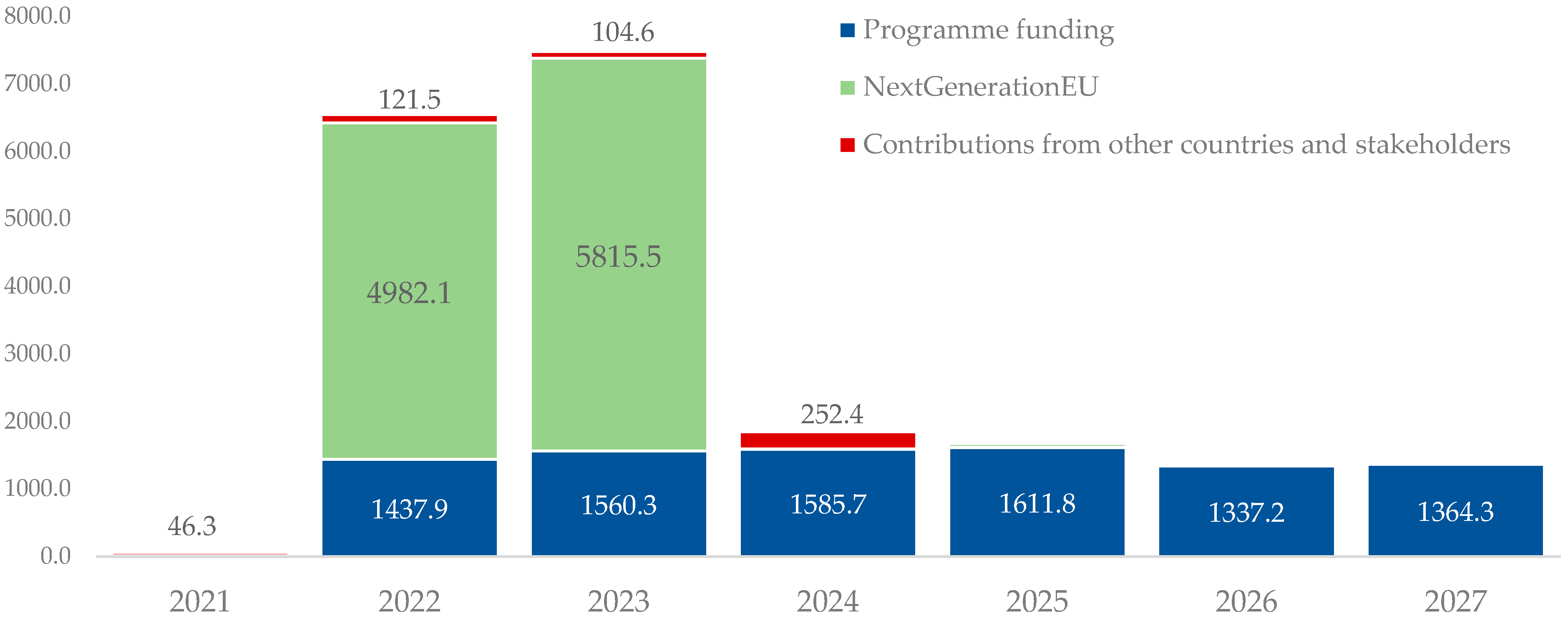
For the planned budget period 2021–2027, €20,294.3 million has been allocated to finance the just transition in EU countries (
Figure 1). The specific nature of project financing through a combination of programme funding from the EU budget, the EU’s post-crisis recovery instrument NextGenerationEU, and contributions from Member States and other stakeholders, as well as the uneven distribution of funding across the years, suggests a combination of post-crisis economic recovery goals (2021–2023) and long-term climate neutrality and territorial cohesion goals (2021–2027).
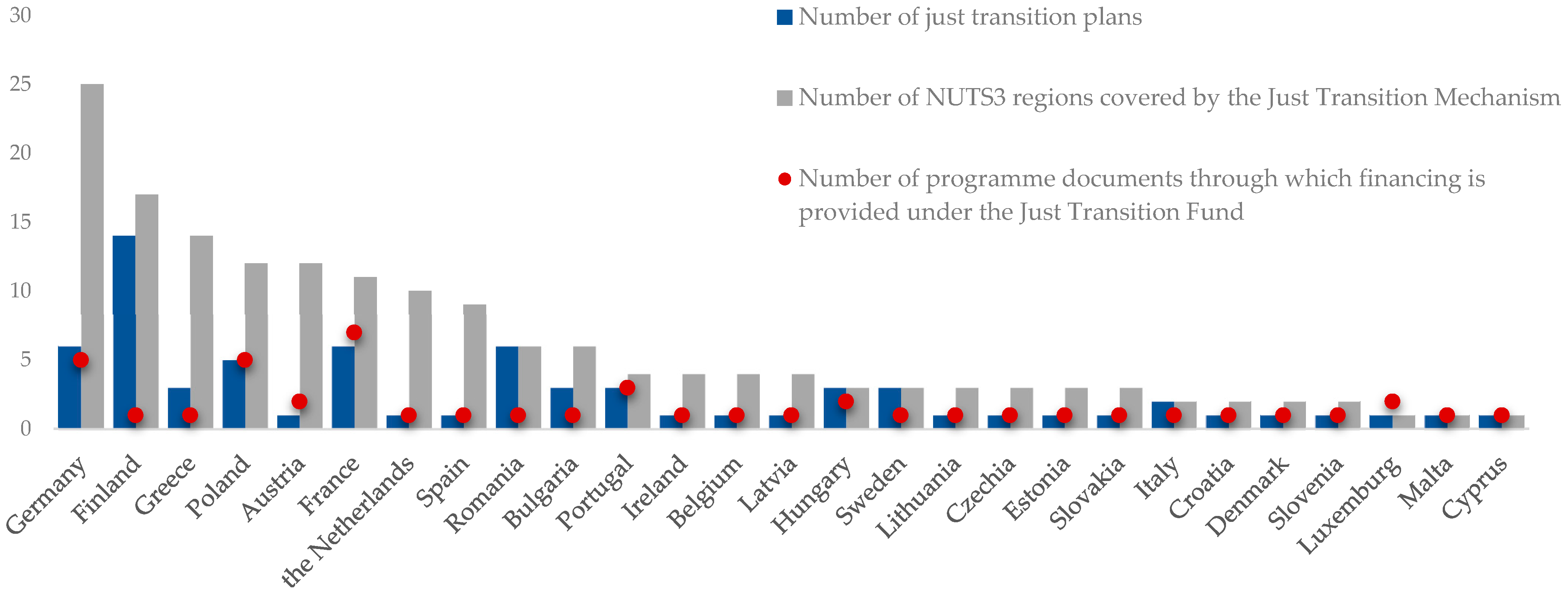
The implementation of the just transition policy based on multi-level governance results in different approaches to managing the process at Member State level, particularly in terms of its organisation (
Figure 2). In most countries, it is implemented at the national level within the framework of one or more funding programmes and one or more just transition plans (the Netherlands, Spain,
Belgium, etc.). In other countries, systems are more decentralised: programmes may be developed at a regional level and follow a clearly defined just transition plan designed for a transition territory (which may cover one NUTS3 region, several such regions, or even some areas) [
34].
The variety of models for managing the implementation of the Mechanism in Member States—from centralised to decentralised—reflects the national characteristics of public administration and territorial structure, which is a positive aspect, given the internal structure of the EU as a union of states. Some of the financial and management risks are mitigated by the specific nature of the financing process: since supranational level (EU structural funds) and national budgets are the main source of funding, the conditions for involving stakeholders in all countries are determined by the authorities following common principles. This approach ensures a high level of formalisation, subordination, and accountability in policy implementation.
However, the absence of a unified management model complicates the comparative assessment of the institutional capacity of governing bodies at different levels, since the Mechanism is implemented using different organisational approaches. In these circumstances, there may be issues of limited institutional capacity, but they are difficult to identify.
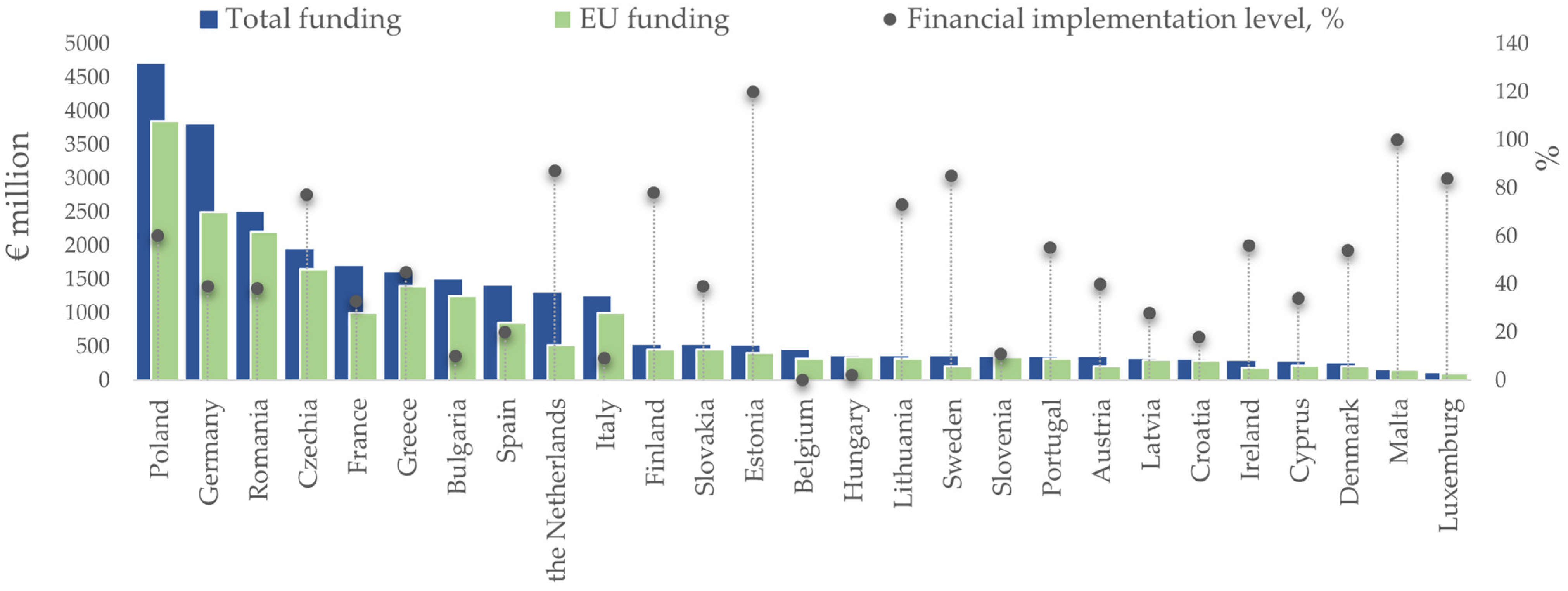
For instance, the varying levels of implementation of national funding under the Just Transition Fund may serve as evidence of differences in the institutional capacity of public administration entities in Member States to absorb financial resources (
Figure 3). This indicator reflects the share of legally formalised solutions (contracts, agreements) for project implementation in the total amount of a Member State’s planned funding under the Fund. As of 30 June 2025, the average level of implementation of the Fund’s resources in EU countries was 46.7%, with values varying significantly between countries—from a few percent in Belgium and Hungary to over 100% in Estonia. Interestingly, there is no correlation between how much of the Fund’s money is used in a country, the number of regions involved in the transition, the county’s total funding, and the specifics of how the process is managed.
The results show significant disparities in the territorial coverage of the mechanism across Member States. Regarding the first reason, it is worth emphasising the novelty of the mechanism (introduced only in 2021) and the specific approach to identifying “at-risk” territories and determining how to support them through the adoption of just transition plans (also a new instrument). This has significantly complicated the process of raising funds for authorities with little experience of interacting with EU structural funds [
35].
However, for some countries, the Just Transition Fund is not the key source of funding for regional development compared to other cohesion policy instruments or EU investment mechanisms, which influences the intensity of its use and the pace at which relevant measures are implemented. An analysis of official European Commission documents [
35] and thematic analytical reports [
36] shows that the principles of the just transition are not always systematically integrated into national planning documents, in particular the National Energy and Climate Plan, which is one of the prerequisites for the effective implementation of the Just Transition Mechanism. While some countries have integrated just transition requirements into their national energy and climate plans at a systemic level, others have considered this mechanism as a supplementary tool among other policy priorities. “Most of the plans analysed fail to respond to key EU just transition requirements—thereby undermining their potential to serve as strategic roadmaps for a fair, inclusive transition, while risking the exacerbation of social inequalities” [
35,
36].
The observed implementation levels differ considerably across countries. Several countries, in particular, Poland, Germany, and Romania (which together account for 40.7% of the Fund’s budget), are the main beneficiaries of allocations from the Fund (
Figure 3). In contrast, a significant number of Member States receive smaller amounts of funding, primarily because they have fewer transition territories and are less dependent on carbon-intensive industries, which significantly reduces interest at the national level in attracting this source of funding.
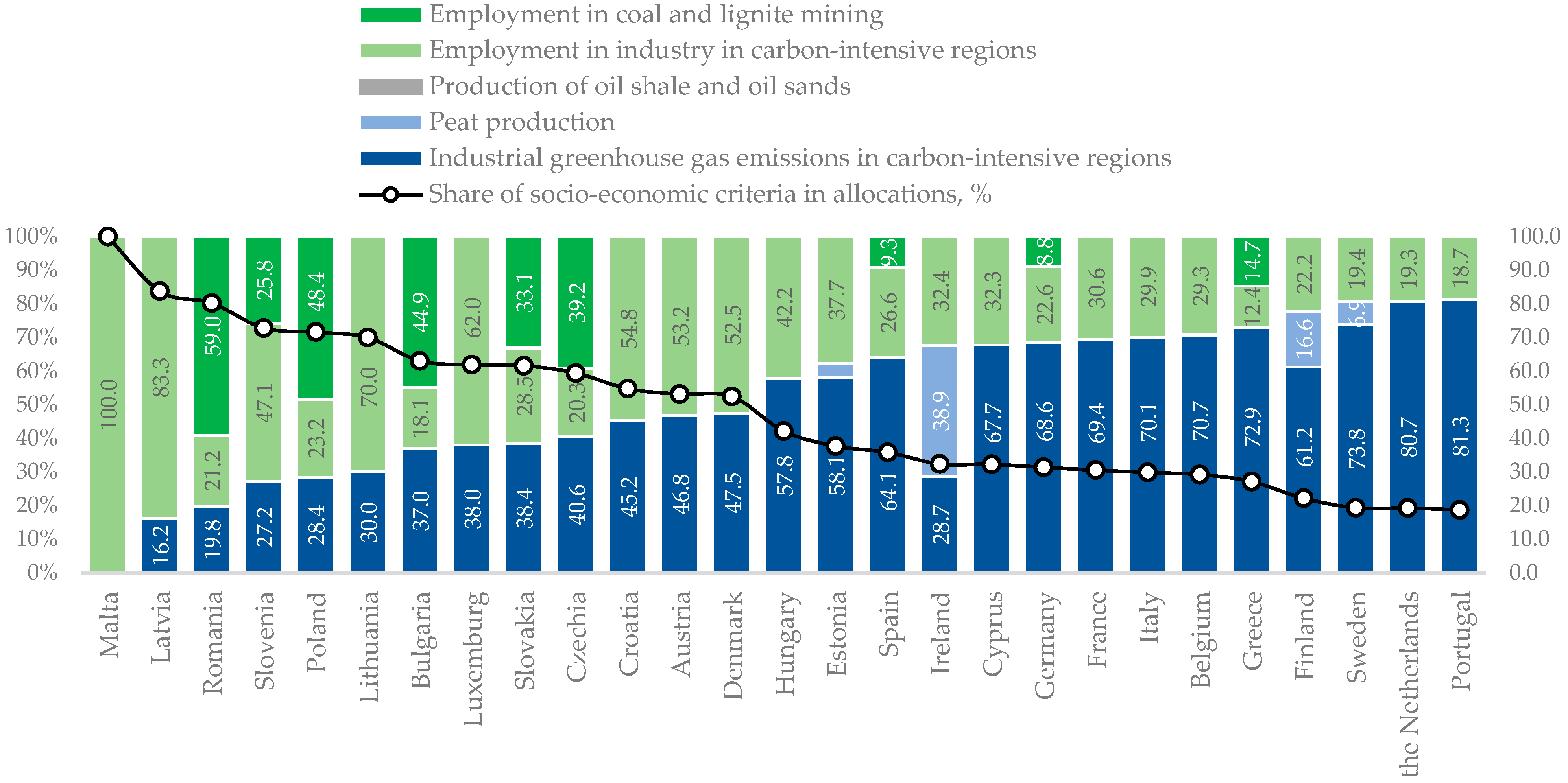
The narrowly defined objective of the Just Transition Fund determines its allocation procedure. The allocation method is based on the application of five socio-economic criteria with different weighting coefficients and their different roles in securing funding (
Table 3,
Figure 4).
It is interesting to analyse the structure of the contribution of economic and social criteria to the overall calculation formula for allocations under the Just Transition Fund. The data indicate significant variation in the implementation patterns of the mechanism across Member States, where there is significant differentiation in the initial conditions.
Countries such as Malta, Latvia, Romania, Slovenia are characterised by a high share of social criteria, which indicates the significant role of employment and social risks in the transition process. The main challenges in the context of just transition here are: employment and the risk of job losses, limited economic diversification, and excessive dependence of local communities on specific industries. Meanwhile, economic and environmental indicators dominate in Germany, France, Italy, Spain and the Netherlands, driven by the scale of industrial emissions and structural transformation in energy-intensive sectors. The main issues that are being focused on in the transition process include significant industrial emissions and the scale of energy-intensive industries. The “dispersion” of the social effects of transition across many sectors is a characteristic feature of the economy in coal-intensive regions.
This differentiated allocation logic reinforces the interpretation of the JTM as a territorially targeted public investment management system, where funding intensity and implementation dynamics are conditioned by structural profiles and investment capacity.
The empirical evidence is broadly consistent with H1 but does not allow definitive causal verification. The EU’s JTM is based on multi-level public investment management frameworks and focuses on the socio-economic specifics of transition territories; it is characterised by distinct territorial disparities in coverage across Member States. The disparities are a consequence of the Mechanism’s narrow focus and clear concentration on territories highly dependent on carbon-intensive industries, which determines the varying intensity of countries’ involvement. The detected differentiation is accompanied by differences in the forms and pace of implementation, which do not demonstrate a direct dependence on the volume of funding, the number of transition territories, or the type of management organisation, but rather reflect a combination of institutional characteristics and national policy priorities.
4.2. Financial Architecture and Uptake of Instruments
The empirical analysis related to Hypothesis 2 examines the financial structure of the JTM and the relative uptake of the three pillars (Just Transition Fund, InvestEU Just Transition Scheme, and the Public Sector Loan Facility) across Member States.
The second pillar of the JTM refers to the Just Transition Scheme under InvestEU, which aims to mobilise private investment in transition regions, while the third pillar—the Public Sector Loan Facility—provides concessional loans for public investment projects supporting regional transition.
The introduction of the second and third pillars of the JTM expands both the territorial coverage (for example, support for the Just Transition Scheme under InvestEU may apply not only to entities in the transition region, but also to those located outside its boundaries but having a key influence on its development) and the number of potential recipients and areas of financial assistance, and, accordingly, beneficiaries. The implementation of the second pillar of the Mechanism (within InvestEU) aims to stimulate private investment in the just transition process by providing concessional loans and other financial instruments, while the third one (Public Sector Loan Facility) is designed to encourage local and regional authorities to invest in large projects by providing grants from the EU budget and preferential loans from the European Investment Bank.
Financial allocations under the Just Transition Scheme within InvestEU are not pre-assigned to national budgets but depend on project proposals and financial feasibility. This implies that access to these instruments is conditional upon the existence of a mature investment pipeline, robust project appraisal mechanisms, and the ability to structure financially viable projects. Consequently, uptake at Member State and regional levels depends on the quality of investment programming within just transition plans and the degree of strategic alignment between sustainability objectives and bankable projects [
34]. This aspect is crucial, as quality, strategic approach, and its scope in just transition plans are among the main constraints to mobilising resources from this source.
The analysis of the European Commission’s data [
6] suggests that investment support for a just transition under InvestEU is of much slower pace than the overall InvestEU portfolio. As of early 2024, investments aimed at achieving the just transition amounted to about € 2270 million. Although no clear quantitative targets or milestones have been set for the Just Transition Scheme under InvestEU (which the European Commission attributes to the market nature of the Programme) [
1,
28], a comparison of the pace of investment mobilisation within the InvestEU mechanism as a whole shows a significantly slower implementation rate. While 58.8% of the planned investments under this mechanism were mobilised in 2023, only 15.2% were related to the just transition (
Table 4). This gap suggests not merely a difference in demand but structural constraints in the capacity to operationalise complex financial instruments within transition territories.
By late 2023, the Scheme plans to launch six investment projects, including developing and rolling out a broadband network internet coverage in Ireland, construction of solar photovoltaic power plants in Greece, construction of care centres for the elderly, apartments for the elderly, and neurorehabilitation hospitals in Spain, construction of a large factory for electric vehicle batteries in France [
34].
In our opinion, the slower pace of resource utilisation within the Scheme is caused by the fact that it is based on the “overlaying” of mechanisms: InvestEU with its inherent conditions and the JTM with its specific features. This approach is justified by the expansion of the range of instruments and the coverage of a narrow stratum of economic entities. However, the narrow focus in terms of both the specific nature of the entities and the territory covered by the instrument (transition regions) is a limiting factor. The financial instruments used under the Scheme (guarantees, debt instruments) are more complex to use compared to grants and direct payments. They require an investment project portfolio, a sufficient level of capacity among financial intermediaries to work with partially risky products, and mature markets and banking structures to attract private capital. Given that regions undergoing just transition are characterised by greater socio-economic vulnerability and limited capacity to adapt to changing market conditions in the green transition process [
4], these prerequisites are often absent or weaker here: the economy is less developed, financial markets are small, and institutional capacity is lower. Accordingly, demand for financing under the Scheme is lower due to insufficient institutional capacity.
In public investment management terms, this reflects limited investment cycle maturity, including insufficient project preparation capacity, weaker financial management systems, and lower ability to crowd in private capital.
The objectives of the Public Sector Loan Facility, as the third pillar of the Just Transition Mechanism, are in line with the guidelines of the Just Transition Fund. However, it is a mixed instrument combining loans and grant funding (the grant component of project financing is 15–25% of the loan provided) [
38].
Despite the demand-oriented nature of the Public Sector Loan Facility, for the period until the end of 2025, budget allocation for this facility was based on the distribution of allocations from the Just Transition Fund. In the period 2026–2027, unused national allocations are envisaged to be blended.
This approach demonstrates the functional interdependence of both instruments of the Just Transition Mechanism. As expected, countries that have been approved for the largest shares of funding under the Just Transition Fund will be the most interested in using additional, albeit more complex, blended instruments, in particular the Loan Facility. Moreover, access to debt financing within the framework of the just transition was considered not so much from the perspective of willingness to take out loans, but rather as a result of the institutional and strategic maturity of countries and regions [
34].
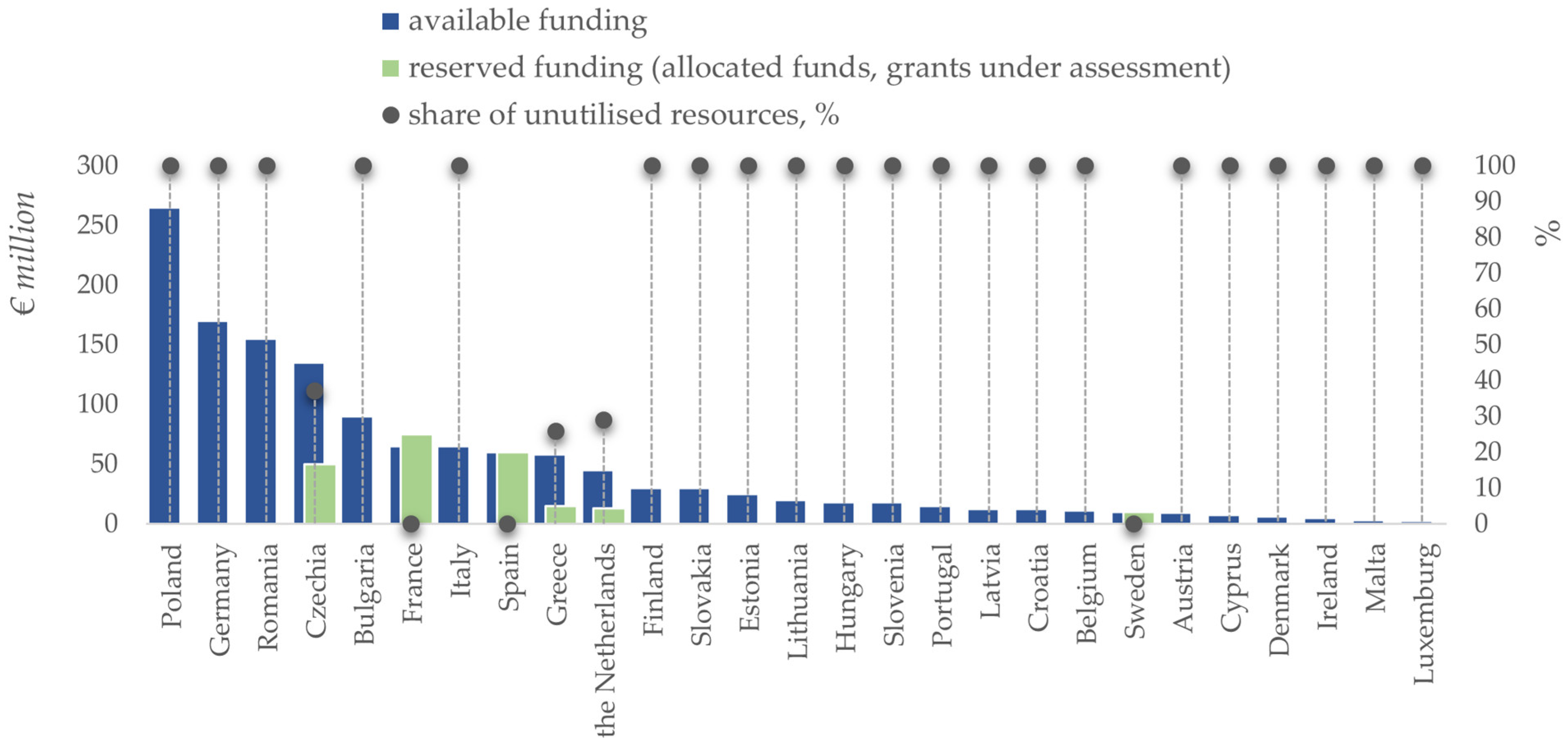
However, over three years, the level of resource implementation amounts to 17% of the total budget (
Figure 5) [
38], which is significantly lower than that of the Just Transition Fund.
As of the end of the first half of 2025, only six Member States had taken advantage of the opportunity to access the mechanism’s loan resources to varying degrees (France, Spain, Sweden—resources fully utilised; Czechia, Greece, the Netherlands—partially utilised). The causes of the instrument’s lack of popularity among Member States identified by European Commission include, first and foremost, the match between the proportions of national allocations under the first and third pillars of the Just Transition Mechanism, with the countries receiving the largest amount of funding from the Just Transition Fund also receiving the largest amounts of allocated loans. This step resulted in a focus on mobilising the Fund’s resources, as it offers more favourable terms. Another important reason is access to financial resources from other EU structural funds with better terms or to funding from national sources (as in the case of Germany) [
38].
However, beyond relative attractiveness of financial terms, the evidence suggests that access to debt-based instruments correlates with institutional and strategic maturity in investment management, including long-term capital planning and borrowing frameworks. Thus, while the cascade model combining grants, loans, and private mobilisation theoretically enhances diversification potential, its empirical implementation remains uneven. The observed asymmetry indicates that cascade financing operates selectively, amplifying advantages of territories with more developed public investment management systems, rather than functioning as a universally accessible mechanism for all transition regions.
The findings provide preliminary support for H2, although the available data do not allow for definitive causal conclusions. A cascading financing model combining grant, debt, and private instruments does indeed expand the potential for economic diversification in just transition regions, particularly through the second and third pillars of the Mechanism. However, empirical data indicate that it has not been fully implemented: the pace of investment uptake through the Just Transition Scheme under InvestEU and the Public Sector Loan Facility is slower than through the Just Transition Fund. The identified asymmetry is caused by a combination of institutional barriers, including the complexity of financial instruments, the lack of a mature investment portfolio, the limited capacity of financial intermediaries, and the higher socio-economic vulnerability of transition regions. Therefore, the cascade model within the JTM operates more as a tool for strengthening already institutionally mature territories than as a universal mechanism in scaling up investments in all regions undergoing just transition.
4.3. Temporal Dynamics of Financial Implementation (Commitments and Payments)
The empirical analysis related to Hypothesis 3 focuses on the temporal dynamics of JTM implementation, particularly the relationship between financial commitments, payments, and the initial socio-economic performance indicators.
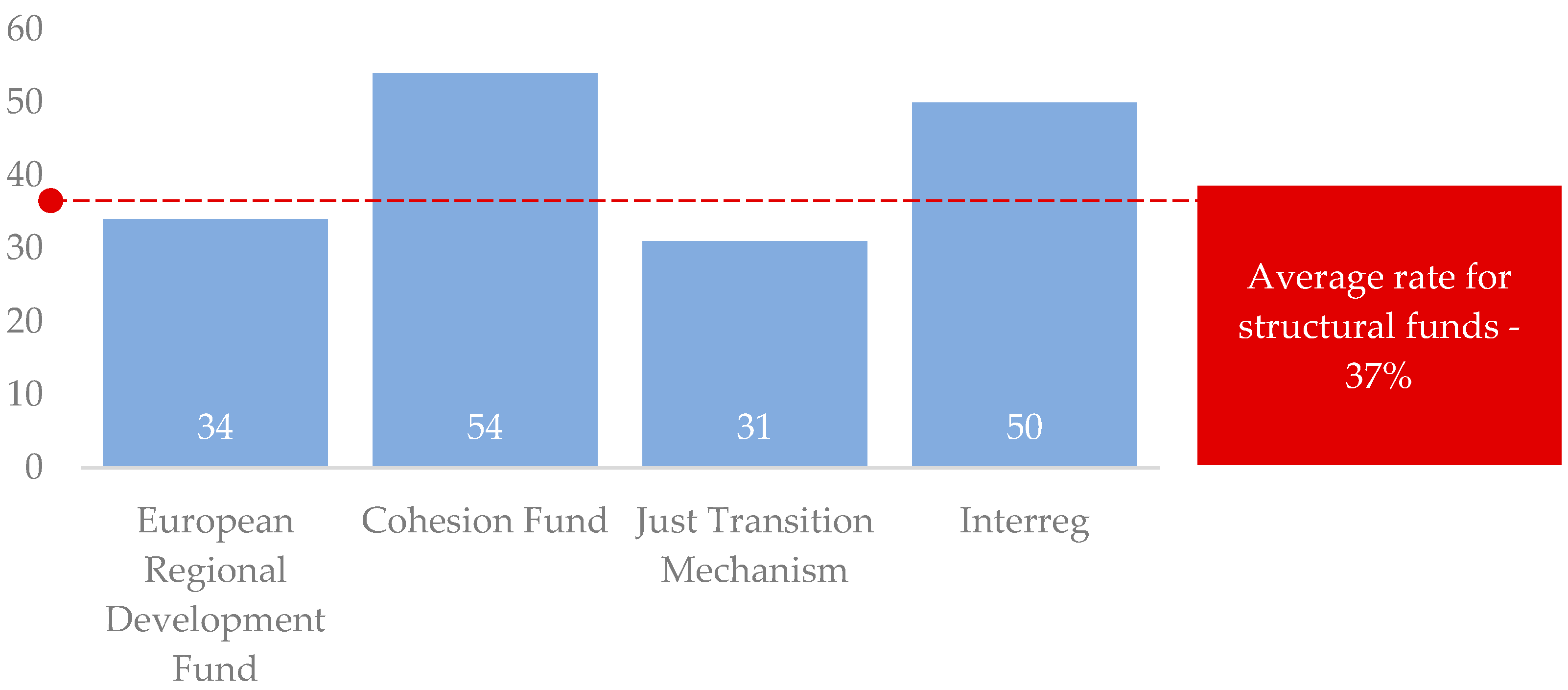
As of late 2025, the JTM is in a phase of active institutional and investment “roll-out”. According to the results of its implementation in 2021–2024, cumulative budget execution across all pillars amounts to 78.5% of the total budget in terms of awarded contracts and 31.4% of payments made (
Figure 6) [
5]. It lags somewhat behind other structural funds and the EU average (37%) by these indicators, which is a result of insufficient use of the second and third pillars.
The high level of commitments (78.5%) as of late 2024 indicates an active phase of project contracting, while actual payments (31.4%) are deferred and based on implementation schedules and the achievement of interim results. This budget implementation structure reflects the multi-annual programme financing model typical of EU investment instruments. In this model, legal obligations precede the physical and financial implementation of projects; this approach ensures strategic consistency in the implementation of long-term transitional measures. However, it complicates the interpretation of current budget performance indicators, since the discrepancy between commitments and actual payments clearly does not reflect the level of achievement of socio-economic results in the short and even medium term.
As of late 2024, most of the target indicators (
Table 5) show low actual results and, at the same time, some progress in terms of contracted projects. An analysis of the achievement of target indicators shows a significant discrepancy between the level of project contracting and the actual results of their implementation. Low actual performance indicators do not necessarily reflect a lack of policy progress but rather mark the initial phase of implementation, when process and financial results (project selection, contracting, development of investment portfolio) prevail, while socio-economic effects are delayed.
Within the logic of sustainable public investment management, this pattern reflects the early stage of the investment cycle, where planning, contracting, and portfolio formation dominate over outcome materialisation. Structural transformation projects—particularly those linked to industrial restructuring, infrastructure development, and labour market adaptation—produce observable effects only after extended implementation periods.
Therefore, the absence of significant socio-economic results at the current stage of the JTM implementation cannot be considered as evidence of its ineffectiveness [
39]. Although the Mechanism’s monitoring system allows for tracking financial and process performance indicators (funding volumes and the number of submitted applications, selected projects, contracted projects, and entities involved), it is not sufficiently suitable for recording intermediate socio-economic results, which develop gradually and manifest themselves with a significant time lag. Given that most just transition plans are valid until 2030 (some until 2050), the assessment of the Mechanism’s actual impact on the economic structure, employment, and social resilience of transition territories is an important indicator of its effectiveness.
This reveals a methodological tension within multi-level public investment management systems: financial execution metrics are available in real time, whereas sustainability outcomes materialise with a significant temporal lag.
Consequently, a gap arises between programming, financial implementation, and observable socio-economic transformation.
The empirical results are consistent with H3, although the observed patterns should be interpreted as indicative rather than causal. The limited observable socio-economic results in the early phase of the JTM reflect the structural time dynamics of multi-level public investment management systems rather than ineffectiveness of the policy itself. The temporal gap between commitments, payments, and outcomes is inherent to long-term sustainable regional transformation processes, where capital formation, institutional adjustment, and structural change unfold sequentially over extended time horizons.
5. Discussion
The results indicate that the spatial and financial patterns of the JTM are shaped not only by the volume of allocated resources but also by the structural characteristics of implementation systems across Member States. Interpreted through the lens of multi-level public investment management, these patterns reflect differentiated investment cycle capacities rather than purely governance arrangements. This supports the interpretation of the JTM as a sustainability-oriented public investment management system in which financial architecture interacts with territorially embedded investment capacities.
These findings are broadly consistent with previous research emphasising that the effectiveness of large-scale sustainability transition policies depends not only on funding volumes but also on institutional coordination and investment governance capacity [
13,
17,
18]. However, the results also suggest a refinement of this perspective. While previous literature emphasises multi-level coordination as a key explanatory factor, the present findings indicate that differences in investment management maturity may play a more decisive role than formal governance arrangements alone.
The analysis of territorial coverage demonstrates that national programming and investment management models significantly affect the spatial configuration of support. Differences in transition territories, planning approaches, and organisational arrangements reflect variations in public investment management systems, including planning, appraisal, portfolio management, and financial execution capacity.
These results complement previous research on regional vulnerability during decarbonisation, which emphasises that territories with weaker institutional capacity and lower economic diversification tend to experience greater adjustment challenges during the transition process [
10,
28]. The present findings suggest that, beyond economic structure alone, the configuration of public investment management systems also plays a significant role in shaping territorial implementation patterns.
While previous literature on climate governance emphasises the role of multi-level coordination in shaping policy outcomes, the present findings suggest that implementation disparities are better explained by variations in investment management maturity across administrative levels. This finding challenges the dominant assumption that multi-level governance coordination is the primary driver of implementation effectiveness. Instead, differences in investment management maturity better explain territorial disparities.
The financial structure of the JTM reveals a fundamental tension between its conceptual design and practical implementation. Although the mechanism is intended to shift from grant-based support toward broader investment mobilisation, empirical evidence shows a persistent dominance of grants. This reveals a paradox: instead of fostering convergence, the cascade model may reproduce existing asymmetries in investment capacity [
16,
17].
This confirms that the JTM operates as an investment system sensitive to initial conditions. Access to complex financial instruments depends not solely on economic need but on the ability of territories to generate viable project pipelines and attract complementary funding. This introduces a theoretical tension between the normative objectives of just transition and the operational logic of investment systems. While the JTM is designed to reduce territorial inequalities, its dependence on pre-existing investment capacity may unintentionally reinforce them.
The temporal dynamics of JTM implementation further illustrate structural characteristics of sustainability-oriented capital programming. The observed gap between commitments, payments, and measurable performance indicators is consistent with the sequential nature of the investment cycle. Short-term financial indicators cannot serve as direct proxies for socio-economic transformation outcomes. This observation is consistent with earlier studies emphasising the time lags between investment commitments and measurable regional transformation effects in transition policies [
13].
From a theoretical perspective, these findings suggest a need to reconsider how sustainability transition policies are analysed, moving beyond a narrow focus on financial design or governance coordination toward the integration of public investment management and territorial capacity frameworks. The effectiveness of sustainability-oriented instruments cannot be reduced to their financial design; it depends on the maturity, coherence, and adaptability of investment management systems across governance levels. Thus, the just transition should be conceptualised not only as a social correction mechanism within climate policy but as a territorially differentiated sustainability investment management model.
In practical terms, the JTM emerges as a hybrid investment architecture where financial, institutional, and sustainability logics interact and occasionally conflict. The expectation that private capital mobilisation will automatically follow the introduction of financial instruments underestimates the managerial prerequisites required for their deployment.
The limited uptake of non-grant instruments demonstrates that sustainability-oriented investment tools are not universally transferable but contingent upon institutional investment capacity. Strengthening project preparation facilities, improving technical assistance mechanisms, and developing institutional capacities for financial structuring may therefore represent important policy priorities for improving the effectiveness of transition investment frameworks.
Overall, the implementation of the JTM can be interpreted as a process of adapting supranational sustainability objectives to differentiated national and regional public investment management systems. This adaptation, rather than formal governance design, ultimately determines whether financial architecture is transformed into effective, territorially embedded investment trajectories for sustainable regional transformation.
Taken together, these findings indicate that sustainability-oriented investment mechanisms operate under conditions of structural tension between policy design, institutional capacity, and territorial development trajectories. These interactions may generate both enabling and constraining effects, rather than uniformly supporting transition objectives.
Implementation disparities may also reflect broader political economy factors, including national policy priorities, industrial structures, and levels of commitment to decarbonisation. These factors interact with institutional capacity and represent an important direction for future research.
6. Conclusions
This study aimed to reconceptualize the EU’s JTM as a multi-level public investment management system and to examine how institutional and financial factors shape territorial disparities in its implementation across transition regions. The results demonstrates that the EU’s JTM should be understood not merely as a financial support instrument, but as a territorially embedded multi-level public investment management system designed to enable sustainable regional transformation. Its functioning is determined by the interaction between financial architecture, differentiated investment management capacity, and the structural characteristics of transition territories. Accordingly, JTM implementation reflects the adaptability and maturity of public investment management systems rather than the automatic effect of a supranational funding design.
The empirical analysis reveals three key patterns of JTM implementation. First, territorial coverage varies significantly across Member States depending on national programming models and institutional investment management structures. Second, the financial architecture of the mechanism demonstrates a structural dominance of grant-based instruments, while the uptake of debt and guarantee-based instruments remains limited. Third, the temporal dynamics of implementation indicate significant time lags between financial commitments, payments, and observable socio-economic outcomes.
This perspective allows for a reconceptualisation of the just transition not only as a social correction mechanism within climate policy, but as a sustainability-oriented investment management model in which financial instruments operate within territorially differentiated institutional systems.
From a practical standpoint, the findings suggest that the design of sustainability-oriented financial instruments must account for variations in public investment management maturity across regions. Expectations regarding private capital mobilisation and blended finance should be aligned with realistic assessments of project preparation capacity, financial management systems, and long-term capital planning frameworks.
Strengthening project preparation facilities, enhancing technical assistance, and improving investment appraisal mechanisms are therefore critical preconditions for effective cascade financing. Without such measures, the introduction of complex financial instruments may reinforce rather than reduce territorial disparities in access to transformation resources.
The study also highlights methodological implications for performance evaluation. Monitoring systems in multi-level public investment management frameworks should distinguish between financial execution metrics and structural transformation outcomes. Given the long-term nature of sustainable regional transformation, performance assessment requires indicators capable of capturing gradual structural change rather than relying solely on short-term budget execution data.
The limitations of the study relate primarily to the use of aggregated official data and the relatively short implementation period of the JTM, which constrains the ability to assess long-term socio-economic impacts and structural transformation effects.
Future research should therefore focus on micro-level regional case studies, comparative analyses of national public investment management models, and the interaction between JTM instruments and broader EU climate and sustainable development policies. The findings should therefore be interpreted as exploratory insights into the early implementation phase of the JTM rather than as conclusive evidence of its long-term effectiveness in achieving structural transformation outcomes.
Overall, the findings highlight the importance of aligning financial instruments with territorially differentiated institutional capacities and long-term investment planning frameworks. This underscores the need to move beyond a purely financial perspective of just transition policy towards a more integrated approach that combines investment governance, institutional development, and territorial resilience in shaping sustainable regional transformation within the European Union.



 ,
,