Systematic Review

Governance and Digital Technologies for Carbon Data Quality: A Systematic Review of Procurement-Driven Decarbonization in Construction Supply Chains

1
Faculty of Society and Design, Bond University, Robina, QLD 4226, Australia
2
School of Architecture and Built Environment, College of Engineering, Science and Environment, University of Newcastle, Callaghan, NSW 2308, Australia
3
School of Civil Engineering and Architecture, Hainan University, Haikou 570228, China
4
School of Engineering Audit, Nanjing Audit University, Nanjing 211815, China
5
School of Science and Technology, Hong Kong Metropolitan University, 11/F, 81 Chung Hau St, Ho Man Tin, Hong Kong SAR, China
*
Author to whom correspondence should be addressed.
Sustainability 2026, 18(10), 4921; https://doi.org/10.3390/su18104921
Submission received: 3 April 2026 / Revised: 23 April 2026 / Accepted: 28 April 2026 / Published: 14 May 2026

Abstract

Scope-3 emissions from construction supply chains (CSCs) account for the majority of the construction sector’s greenhouse gas (GHG) footprint. However, procurement-driven decarbonization (PDD) remains constrained by persistent data quality (DQ) deficits, including boundary divergence, limited verification, incomplete information, and fragmented interoperability. This PRISMA-guided systematic literature review (SLR) synthesizes 68 studies to examine how governance mechanisms (GMs) and digital technologies (DTs) can be co-designed within procurement workflows to improve the reliability of carbon data. By integrating quantitative matrix-based analysis, qualitative thematic coding, and a governance–technology pairing logic, the review identifies a division of labor across DQ dimensions. Standard-based governance and boundary rules strengthen completeness, consistency, and interpretability. At the same time, DTs enhance accessibility and timeliness and provide targeted improvements in accuracy and logical coherence when embedded within structured schemas. Assurance emerges as the most reliable mechanism for accuracy, information-management standards for timeliness, and early stakeholder involvement for accessibility. These insights translate into procurement-oriented measures, including European Standard (EN)-aligned scope definitions; ISO 14083-aligned logistics accounting; Industry Foundation Classes (IFC)/Level of Information Need (LOIN)-based information requirements; selective assurance; uncertainty-aware disclosure; and integrated digital measurement, reporting, and verification (MRV) systems combining Environmental Product Declaration (EPD) platforms, Artificial Intelligence (AI) validation, and blockchain. Collectively, these measures enable comparable, verifiable data and support scalable decarbonization.

1. Introduction

The construction sector is a major contributor to global emissions, accounting for approximately 21% of total greenhouse gas emissions and, in 2022, 34% of global energy demand and 37% of energy- and process-related carbon dioxide (CO2) emissions [1]. In Australia, embodied carbon emissions are projected to increase by approximately 65% by 2050 [2]. For building owners, a substantial proportion of emissions originates from Scope-3 sources associated with CSCs [3,4]. Scope 3 encompasses the entire CSC—from upstream activities (e.g., cement and steel production, transportation) to downstream processes (e.g., tenant energy use, maintenance, and end-of-life (EoL) demolition)—with upstream activities alone often contributing 70–90% of total carbon footprints [5]. While operational emissions have been widely studied, the dominance of embodied carbon within CSCs highlights the need for strategies that extend beyond on-site interventions toward whole-life-cycle (WLC) decarbonization [6,7].
Policy developments are accelerating the demand for robust carbon data across CSCs. Governments and clients are increasingly embedding sustainability requirements into procurement processes, mandating embodied carbon reporting and prioritizing low-carbon materials. Examples include Australia’s Environmentally Sustainable Procurement Policy [8] and New South Wales’s Upfront Carbon Requirements [9], the European Union’s Green Public Procurement under the revised Construction Products Regulation [10], and the United States Buy Clean programs piloting interim requirements for low-embodied-carbon materials in General Services Administration projects funded by the Inflation Reduction Act [11]. Collectively, these initiatives indicate a global shift toward PDD, in which accurate, comparable, and verifiable emissions data are essential for both regulatory compliance and competitive tendering.
These policy developments converge with evolving standards and digital tools aimed at standardizing and operationalizing carbon information. BS EN 15804+A2:2019 [12] harmonizes EPD rules for construction products, enabling consistent product-level data for life-cycle assessment (LCA) and procurement decision-making. PAS 2080:2023 [13] extends carbon management across the built environment and explicitly positions procurement as a key lever for decarbonization. ISO 14083:2023 [14] standardizes greenhouse gas quantification for transport-chain operations, improving consistency in logistics-related Scope-3 reporting. Despite these advances, persistent DQ deficiencies—including inaccuracy, incompleteness, limited traceability, inconsistent formats, and weak verification—continue to constrain effective PDD implementation [15,16,17].
Emerging solutions to these challenges span both technological and governance domains. On the technology side, Building Information Modeling (BIM)–LCA integration [18,19,20,21], interoperable EPD platforms [22], AI-assisted validation [23,24], blockchain-based provenance systems [25,26], and Internet of Things (IoT) and telematics for logistics monitoring and data security [27,28] offer pathways to enhance data accuracy, comparability, and timeliness. On the governance side, sustainable procurement and responsibility standards (e.g., ISO 20400:2017 [29]; ISO 26000:2010 [30]), contractual mechanisms [31], assurance frameworks [32,33,34,35], and supplier prequalification systems [36,37] embed expectations, facilitate verification, and strengthen procurement leverage. Together, these approaches enable the integration of sustainability requirements into supply contracts, enhance verification processes, and position procurement as a central mechanism for decarbonization.
However, adoption remains uneven, and implementation practices are fragmented across CSCs and jurisdictions [38,39], resulting in inconsistent PDD outcomes. In this study, PDD is defined as the reduction in CSC greenhouse gas emissions—particularly those originating from supply chains—through the integration of sustainability requirements into procurement activities, including supplier selection, contracting, and compliance monitoring [4]. A critical evidence gap persists: the construction sector lacks consolidated guidance on which GMs and DTs most effectively improve DQ in supply-chain emissions reporting, and how these can be systematically integrated into procurement processes to achieve measurable decarbonization outcomes.
To address this gap, an SLR is first undertaken to consolidate and critically evaluate knowledge on DQ improvement in CSC emissions reporting and its integration into PDD. While an SLR alone cannot fully resolve this gap, it provides a rigorous foundation for identifying the range of GMs and DTs discussed in prior research, along with their limitations and the underexplored intersections between them. Building on this foundation, the review enables a structured comparative analysis that highlights where current approaches are insufficient and where integration opportunities remain under-theorized, thereby informing the development of the study’s analytical framework. Accordingly, the research is guided by two research questions:
RQ1: Which GMs for decarbonization and emerging DTs are identified in the literature as approaches to address DQ challenges in CSC emissions reporting?
RQ2: What limitations and opportunities for integrating GMs and DTs into PDD are identified in research?
In addressing these questions, technical DQ approaches are bridged with governance-led procurement to develop an integrated framework for accelerating carbon reduction in CSCs. Following PRISMA 2020 guidelines [40], the review synthesizes the literature from Web of Science (WoS) and Scopus. Prior studies have examined embodied carbon [41], Industry 4.0 frameworks [42], automated data sharing [43], and Scope-3 emissions [4]; however, none explicitly link DQ dimensions to governance or procurement mechanisms. More recent systematic reviews have advanced understanding of PDD and sustainable supply chains, with a predominant focus on technological enablers, lifecycle-based strategies, and net-zero procurement drivers, barriers, and policy instruments (e.g., [44,45,46].) Nevertheless, DQ is largely treated as an implicit assumption rather than a governing concern. This review extends existing frameworks by explicitly linking DQ dimensions to GMs and DTs embedded in PDDs, synthesizing how these mechanisms actively shape, constrain, and enhance DQ. While research on BIM–LCA integration and blockchain highlights the importance of traceability, it provides limited evidence of large-scale implementation. In contrast, this review systematically consolidates GMs and DTs to address DQ challenges, mapping their limitations and identifying opportunities for integration within PDD. The findings offer actionable insights for policymakers, practitioners, and researchers seeking to integrate data governance and digital innovation into procurement processes.
This review advances literature in three substantive ways. First, it explicitly links established DQ dimensions to both GMs and emerging DTs, offering a unified analytical lens that remains largely absent in construction decarbonization research. Second, it empirically maps these relationships through a mixed-methods synthesis combining GM × DQ and DT × DQ heatmaps with qualitative coding, thereby revealing a clearer division of roles across DQ attributes than previously identified. Third, it develops procurement-oriented pairing logic that specifies how GMs and DTs can be combined to strengthen DQ within PDD—addressing a critical integration gap not captured in the embodied carbon or Scope-3 literature.

2. Theoretical Foundation

2.1. DQ Dimensions in CSC Emissions Reporting

DQ theory provides a robust foundation for diagnosing deficiencies in CSC emissions reporting and for linking them to targeted corrective actions. The multidimensional framework proposed by Wang and Strong [47]—encompassing accuracy, completeness, consistency, interpretability, and accessibility—aligns closely with the principles of relevance, completeness, consistency, accuracy, and transparency articulated in ISO 14064-1:2018 and ISO 14083:2023. Extending this perspective, Pipino et al. [48] argue that DQ should be evaluated based on its “fitness for use,” distinguishing among objective, subjective, and contextual dimensions.
Applying these dimensions as an organizing framework clarifies the sources of persistent data deficiencies in CSC emissions reporting. Completeness gaps frequently arise from ambiguities in system boundaries and supplier coverage, while consistency issues can be mitigated by harmonizing calculation rules aligned with ISO standards. Beyond these established dimensions, timeliness and logical coherence are increasingly critical for high-quality carbon data. Timeliness deficiencies—such as outdated activity data—reduce relevance and limit comparability across projects and reporting periods [19]. Logical coherence, distinct from consistency, refers to the internal correctness of datasets, including the alignment between system boundaries, assumptions, and reported values [49]. Coherence deficiencies can propagate errors across engineering documentation and decision-making processes [50]. Strengthening these DQ dimensions enhances both the reliability and decision-usefulness of CSC emissions data, as reflected in Table 1 through their integration with established GHG-accounting standards.

2.2. GMs and DTs in PDD

PDD depends fundamentally on the availability of reliable, comparable, and verifiable carbon data. Policy drivers and widely adopted standards (e.g., ISO 14064-1:2018 [51], BS EN 15804+A2:2019 [12], PAS 2080:2023 [13]) are accelerating the adoption of digital carbon accounting and its integration into tender evaluation processes. In practice, GMs—including standardized rules, contractual provisions, and assurance frameworks—need to operate in conjunction with DTs, such as BIM–LCA integration, interoperable EPD platforms, traceability systems, telematics, and AI-enabled validation. Together, these elements elevate DQ and enable carbon performance to be specified, evaluated, and enforced throughout tendering and contract administration.

2.2.1. Institutional and Socio-Technical Systems (STS) Foundations

GMs are conceptualized through the combined lenses of institutional theory and STS. Institutional theory explains the convergence toward standardized carbon-data practices through coercive pressures (e.g., regulation and procurement mandates), normative influences (e.g., professional standards), and mimetic processes (e.g., imitation of leading organizations), resulting in isomorphic patterns across the market [52]. STS and structuration perspectives further emphasize that reliable data emerges when organizational roles, incentives, and routines are aligned with technical infrastructures, including standards, platforms, and data integrations [53,54,55].
Extending these perspectives to the digital era, Faraj and Leonardi [56] advance a relational view of technology in which data, algorithms, and platforms are constitutively intertwined with organizational processes, reshaping firm boundaries, innovation dynamics, and knowledge practices. Within this context, effective governance requires orchestrating cross-boundary socio-technical relationships rather than merely specifying tools or procedures in isolation. Collectively, these theoretical perspectives motivate the identification of six interrelated GMs that address persistent DQ deficiencies and leverage procurement.
First, adopting standardized carbon-data rules and reporting requirements—such as harmonized system boundaries and ISO-aligned GHG-accounting frameworks—enhances consistency across suppliers and enables like-for-like bid comparisons while maintaining continuity throughout contract delivery [57]. Second, embedding digital submission and verification requirements within procurement processes—including digitized EPDs, BIM-linked carbon assessments, and structured data templates with automated validation—strengthens both accuracy and auditability [15]. Third, clearly defined requirements for supplier coverage and system boundaries address completeness by ensuring that upstream emissions—such as those associated with material production, transportation, and fabrication—are systematically captured rather than excluded [58].
Fourth, mechanisms that promote early supplier involvement and shared digital environments—such as collaborative platforms, scenario modeling tools, and digital twins—improve alignment during design and pre-contract phases, thereby reducing inconsistencies and enhancing data coherence [41,59]. Fifth, establishing formal assurance processes—including data stewardship roles, independent verification, and quality control checkpoints—strengthens data integrity and addresses breakdowns in information flows across project stages [60]. Finally, procurement strategies incorporating incentives and penalties—such as weighted bid criteria rewarding credible low-carbon solutions and high-quality data, alongside sanctions for unverifiable or non-compliant submissions—encourage suppliers to prioritize both emissions performance and robust reporting practices [61,62].
Taken together, these GMs create an enabling environment in which DTs can effectively enhance DQ. When procurement frameworks clearly specify expectations and are supported by aligned organizational and technical systems, carbon performance becomes a measurable, contractible, and enforceable component of project delivery rather than an aspirational objective.

2.2.2. DTs for Carbon DQ Improvement

Emerging DTs function as operational enablers of the GMs outlined above. BIM–LCA integration reduces manual data handling and aligns geometric, quantity, and environmental impact data, thereby improving accuracy and internal coherence during the design phase [18,19,20,21]. Interoperable EPD platforms provide standardized, digitized, and queryable product data, enhancing comparability across suppliers and supporting verification processes during tender evaluation [22].
Blockchain-based systems strengthen traceability of material provenance and logistics emissions, improving both completeness and timeliness in transport-related reporting [25,26,27,28]. IoT, telematics, and digital twins enable real-time data capture and visualization, further enhancing timeliness and completeness in supply chain emissions monitoring [63,64]. AI-assisted validation tools detect anomalies, inconsistencies, and missing data at early stages, reducing downstream rework and mitigating claims risk [23,24].
The effectiveness of these technologies depends on clear institutional requirements—such as standardized data formats and defined responsibilities—and on socio-technical alignment, which ensures that people, processes, and platforms evolve cohesively across project delivery and portfolio management contexts.

2.3. Integrative Theoretical and Analytical Framework

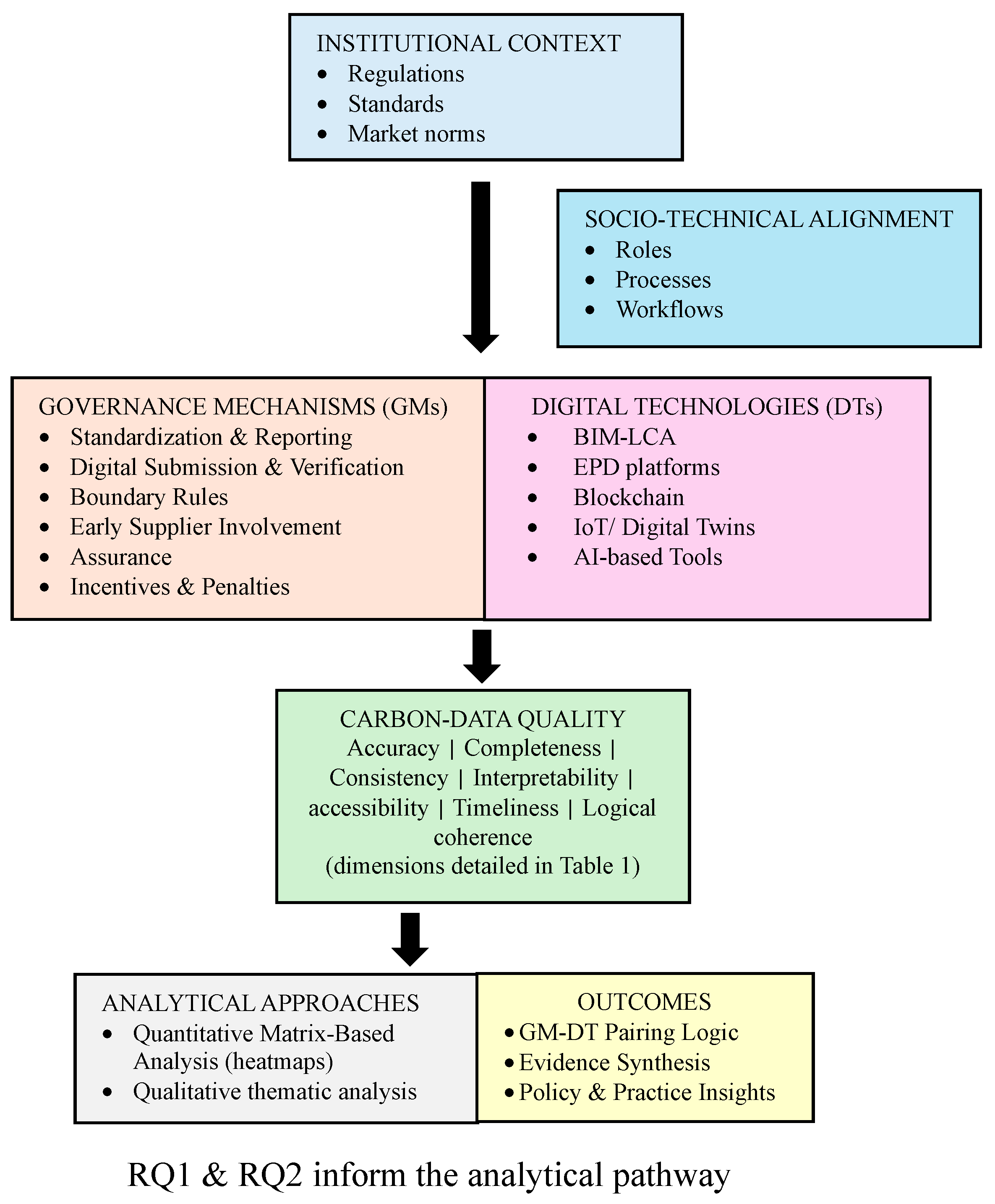
Figure 1 presents the integrative theoretical and analytical framework through which the research questions are addressed. Grounded in an institutional socio-technical perspective, the framework explains how carbon data quality is shaped, governed, and operationalized within procurement-driven decarbonization in construction supply chains.
At the top level, the institutional context—including regulations, standards, and market norms—creates external pressures that shape procurement expectations and carbon-information requirements. These pressures give rise to a set of GMs that define what constitutes credible, comparable, and decision-relevant carbon data. As illustrated in Figure 1, these include standardization and reporting rules and boundary definitions (e.g., EN 15804+A2 [12], ISO 14064-1 [51]/14083 [14]), requirements for digital submission and verification, early supplier involvement, assurance processes, and incentive and penalty structures.
In parallel, effective implementation depends on socio-technical alignment, encompassing the coordination of roles, processes, and workflows across project and supply-chain actors. Within this aligned environment, DTs—including BIM–LCA workflows, interoperable EPD platforms, blockchain-based MRV systems, IoT-enabled logistics monitoring and digital twins, and AI-based validation tools—support the execution and automation of governance requirements through integrated data infrastructures.
At the core of the framework, GMs and DTs jointly influence carbon DQ across multiple dimensions, namely accuracy, completeness, consistency, interpretability, accessibility, timeliness, and logical coherence (dimensions detailed in Table 1). To address the research questions, each GM and DT is systematically evaluated according to their capacity to improve specific DQ dimensions identified in the literature.
The analytical pathway shown in Figure 1 integrates two complementary approaches: a quantitative matrix-based assessment, visualized through heatmaps, and a qualitative thematic analysis of the reviewed studies. This combined approach enables a structured identification of limitations and opportunities associated with integrating GMs and DTs within PDD.
Finally, the framework leads to clearly defined outcomes, including the development of governance–technology (GM–DT) pairing logic, an evidence-based synthesis of impacts on carbon data quality, and actionable insights for procurement practice and policy design. The study’s conclusions are derived directly from this integrated analytical process.

3. Research Methodology

An SLR approach is adopted, guided by the PRISMA 2020 framework to ensure transparency, reproducibility, and methodological rigor [40]. To strengthen methodological robustness beyond PRISMA, the review design is further informed by established guidance on evidence synthesis in construction and management research, which emphasizes protocol development, explicit search strategies, structured screening procedures, and replicable synthesis methods [65,66].
In accordance with these principles, a review protocol was developed a priori to define the objectives, eligibility criteria, search strategy, screening procedures, data extraction processes, and synthesis methods. This structured, multi-source methodological foundation reduces reliance on any single framework and ensures alignment with recognized best practices for conducting rigorous, auditable literature reviews.

3.1. Database Selection and Search Strategy

Two major academic databases—WoS Core Collection (Clarivate) and Scopus (Elsevier)—were selected due to their extensive coverage and robust citation indexing across construction, sustainability, engineering, and management disciplines. The search was limited to publications from the past ten years (2017 to 6 January 2026) to capture recent advances in carbon accounting, governance practices, and DTs relevant to PDD.
The search string was designed to identify studies addressing Scope-3 emissions and embodied carbon within the construction sector, while explicitly incorporating concepts related to DQ, GMs, and DTs. It integrates multiple concept clusters using Boolean logic to ensure comprehensive coverage of literature focused on improving emissions reporting and management through enhanced data practices and technological innovation.
Initial searches using narrower, general terms yielded a limited number of relevant studies. Accordingly, the search strings were iteratively refined and expanded to capture a broader and more representative body of literature, including variations in terminology across disciplines. Examples of the final search queries applied in Scopus and WoS are presented as follows:
“(“Scope-3” OR “value chain emission*” OR “indirect emission*” OR “embodied carbon” OR “embodied GHG” OR “life cycle emission*” OR “carbon footprint”) AND (construction OR infrastructure OR “built environment” OR building* OR “civil engineering” OR “infrastructure asset*”) AND (“data quality” OR accuracy OR completeness OR consistency OR timeliness OR accessibility OR interpretability OR “logical coherence” OR reporting OR disclosure OR assurance OR transparency OR reliability OR validity) AND (governance OR policy OR regulation OR compliance OR standard* OR verification OR audit* OR procurement OR tender* OR contract* OR “environmental product declaration*” OR EPD*) AND (“artificial intelligence” OR “machine learning” OR “deep learning” OR “building information modeling” OR “life cycle assessment” OR blockchain OR “internet of things” OR “digital twin” OR “big data” OR “data analytics” OR “smart construction” OR digitalization)”
Filters applied included document type (papers), English language, and publication years 2017–2026 (January only).

3.2. Eligibility Criteria

Studies were included if they met one or more of the following criteria: (i) examined construction or infrastructure supply chains; (ii) addressed emissions reporting or embodied carbon with explicit consideration of DQ challenges; or (iii) identified GMs or emerging DTs (e.g., BIM–LCA, AI/ML, IoT, blockchain) relevant to improving DQ.
Exclusion criteria were applied to opinion-based articles lacking actionable mechanisms, the literature and critical reviews, studies not directly related to CSCs, and articles published in journals not classified as SJR Q1. These criteria ensured that the review focused on high-quality, empirical, and practice-relevant contributions.

3.3. Screening and Reliability

The screening process comprised deduplication followed by two sequential stages: (i) title and abstract screening and (ii) full-text review. Title and abstract screening were conducted using Covidence, a web-based platform designed to support systematic reviews and evidence synthesis.
To ensure reliability and reduce selection bias, two reviewers independently screened a subset of the records (≥20%) during both the title/abstract and full-text stages. Discrepancies were resolved through discussion and consensus, thereby strengthening the consistency and transparency of the selection process. Inter-rater agreement for inclusion/exclusion decisions was assessed using Cohen’s Kappa statistic, yielding substantial agreement at the title/abstract screening stage (κ = 0.78) and near-perfect agreement at the full-text screening stage (κ = 0.84).
Beyond study selection, reliability checks were also applied to the data extraction and analytical coding phases, which underpin the quantitative heatmaps and pairing logic. A randomly selected subset of the included studies (25%) was independently coded by both reviewers for GMs, DTs, and associated DQ dimensions. Inter-rater reliability for categorical coding of GMs and DTs achieved substantial agreement (κ = 0.76), while agreement for assignment of primary DQ dimensions reached κ = 0.81.
For the heatmap scoring process, which involved ordinal assessments of the strength of alignment between GMs, DTs, and DQ dimensions, inter-rater reliability was evaluated using weighted Cohen’s Kappa to account for partial disagreement across adjacent score bands. The resulting coefficient (κw = 0.73) indicates substantial agreement, supporting the robustness and reproducibility of the quantitative synthesis. All divergent cases were subsequently reviewed jointly and reconciled through consensus before final aggregation.
Taken together, these reliability checks demonstrate that both the screening and analytical phases of the review achieved substantial to near-perfect inter-rater agreement, lending confidence to the reproducibility of the heatmap patterns, pairing logic, and resulting conclusions.

3.4. Data Extraction and Coding

Data from all included studies were extracted using a structured template designed to ensure consistency and analytical depth. The template captured bibliographic information and contextual characteristics (e.g., study type, geographic focus, and construction segment), identified GMs and DTs, specified the specific DQ dimensions addressed by each GM and DT, and reported limitations and opportunities for integrating these elements into PDD. A visual representation of this framework is provided in Supplementary File S1.

3.5. Synthesis Approach

The synthesis adopted a mixed-methods design that integrates quantitative association mapping with qualitative thematic analysis and is reported in accordance with PRISMA 2020 guidelines. Guided by the Integrative Analytical Framework (Figure 1), the GMs, DTs, DQ dimensions, limitations, and integration opportunities are systematically identified. These elements were coded within a master dataset (Supplementary File S1).
To address RQ1, each GM and DT was mapped against the seven DQ dimensions using a three-point ordinal scale (2 = addressed; 1 = partially addressed; 0 = not addressed). The resulting scores were aggregated into two heatmaps (GMs × DQ and DTs × DQ), which illustrate the extent to which each GM and DT addresses specific DQ challenges.
To address RQ2, two complementary analytical approaches were used. First, a quantitative matrix-based analysis of the heatmaps and categorical classifications was conducted to evaluate the relative strengths and weaknesses of GMs and DTs across the seven DQ dimensions. This analysis identifies key limitations (e.g., strong standardization with limited data accuracy) and opportunities (e.g., high-frequency digital data with insufficient assurance), as well as systemic mismatches that inform evidence-based pairing strategies.
Second, a qualitative thematic synthesis of the included studies was undertaken to identify additional limitations and opportunities associated with integrating GMs and DTs into PDD. Insights derived from the reviewed literature further strengthen the analysis and support a comprehensive response to RQ2.

4. Analysis and Discussion

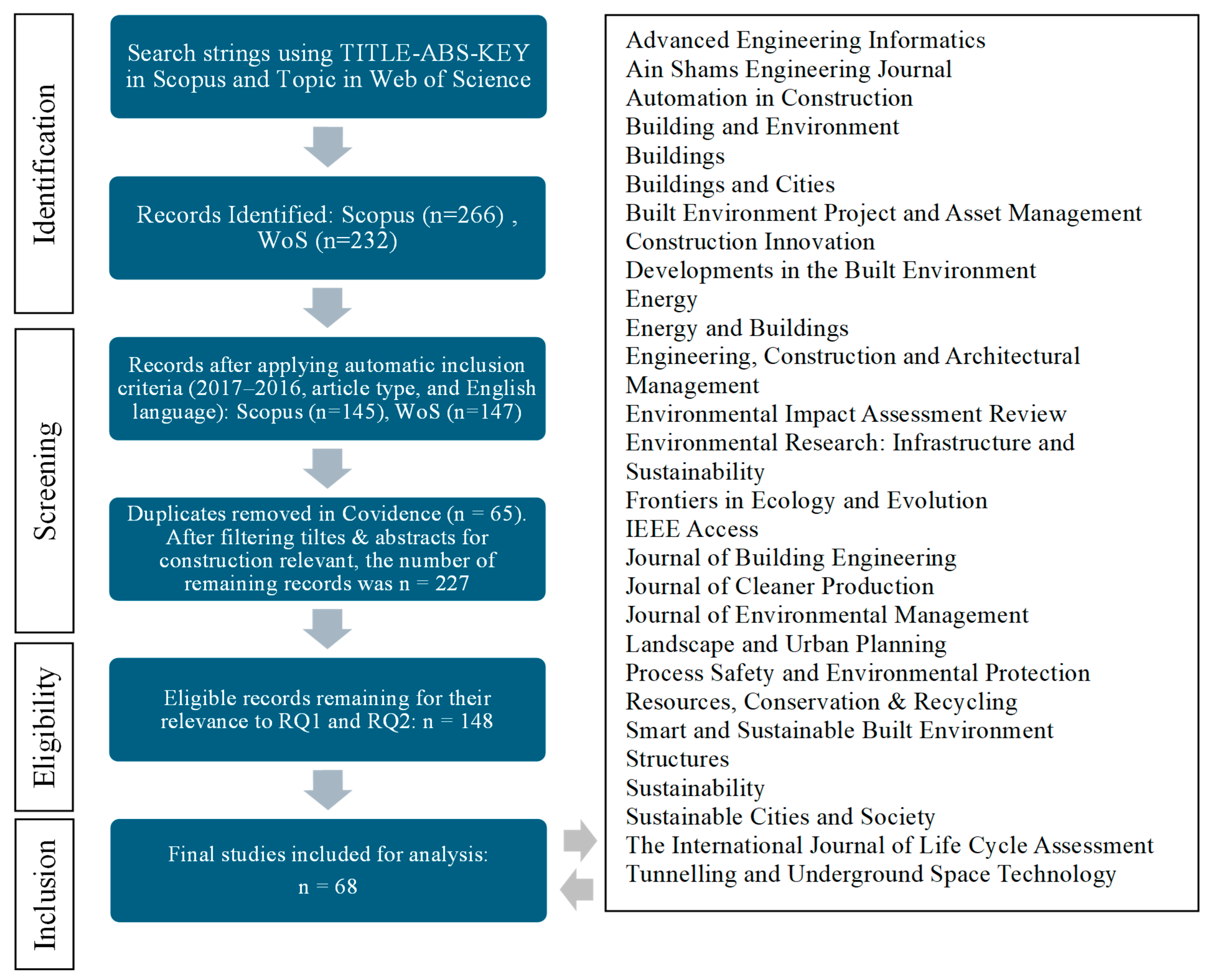
Figure 2 presents the PRISMA flow diagram applied. The initial search identified 266 records from Scopus and 232 from WoS. Following the application of database filters—Scopus restricted to English-language journal papers (2017–2026) and WoS to English-language and review papers (2017–2026)—the records were reduced to 145 and 147, respectively. These records were imported into Covidence for screening, during which 65 duplicates were removed, leaving 227 unique publications for title and abstract review.
Titles and abstracts were systematically screened, and articles not classified as SJR Q1, not directly related to the construction industry, cross-sector studies, or those consisting solely of secondary evidence (e.g., SLRs, critical reviews of EPDs, or policy analyses) were excluded. This process resulted in 148 papers initially deemed eligible. Final inclusion was restricted to studies with strong relevance to RQ1 and/or RQ2—specifically, those directly addressing DQ challenges in CSC emissions reporting, examining GMs or DTs aimed at improving such reporting, or exploring their integration into PDD. Following this refinement, 68 papers satisfied all eligibility criteria and were included in the final synthesis.
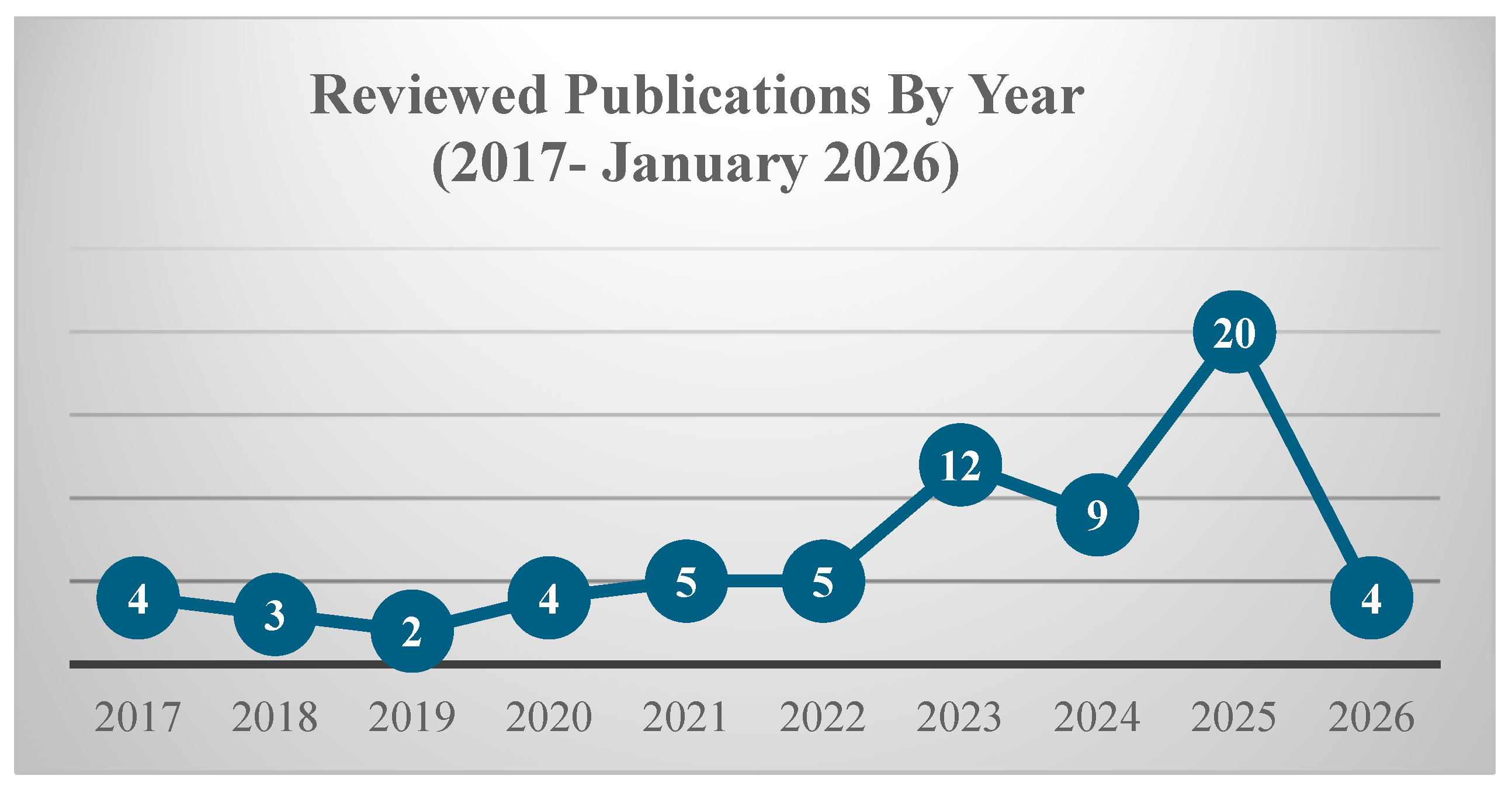
Figure 3 indicates a steady increase in the number of relevant publications over time, with relatively modest output between 2017 and 2020, followed by accelerated growth from 2021 onward. The marked peak in 2025 suggests a rapid expansion of research activity, reflecting the increasing importance of carbon data, digitalization, and procurement-based decarbonization in the construction sector. This trend indicates a transition from an emerging research niche to a more established and rapidly developing field.
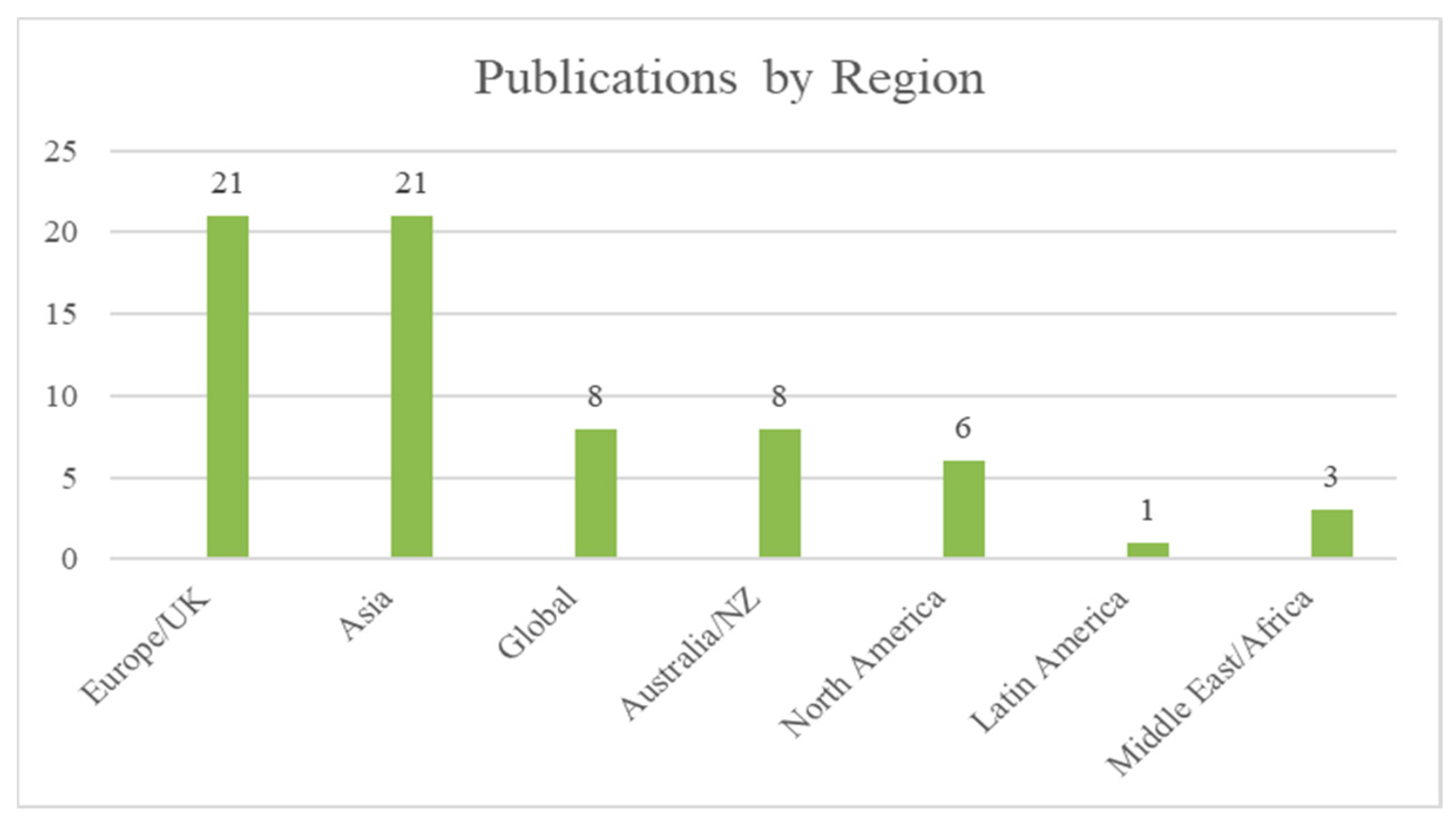
Figure 4 demonstrates that the reviewed studies are geographically diverse. Europe/UK and Asia contribute the largest share, followed by a substantial number of global or multi-regional analyses, and consistent representation from Australia/New Zealand and North America. Contributions from the Middle East/Africa and Latin America, while smaller, remain significant, indicating a globally distributed and increasingly interconnected research landscape.

4.1. GMs and DTs to Address DQ Challenges in CSC Emissions Reporting

The data extracted from the SLR were compiled in Supplementary File S1, which forms the empirical basis for identifying the GMs and DTs most strongly associated with improvements in DQ across CSC emissions reporting. Supplementary File S1 contains systematically coded entries covering GMs, DTs, DQ dimensions, limitations, and opportunities for integration into PDD.
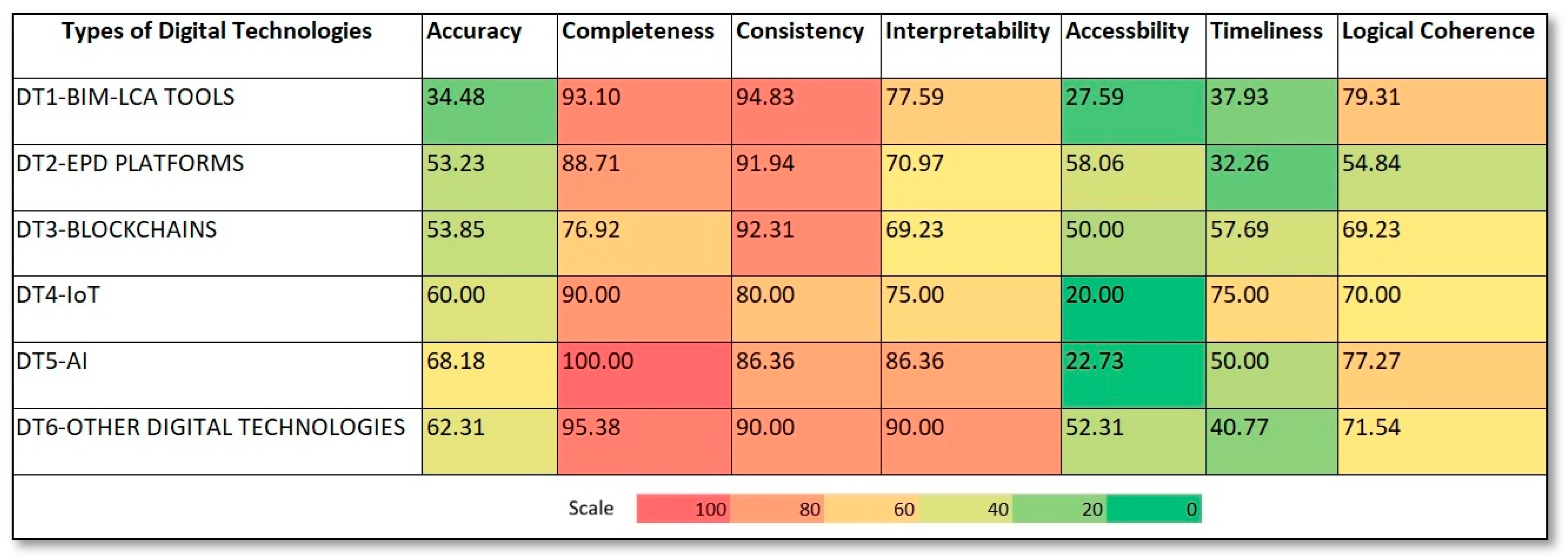
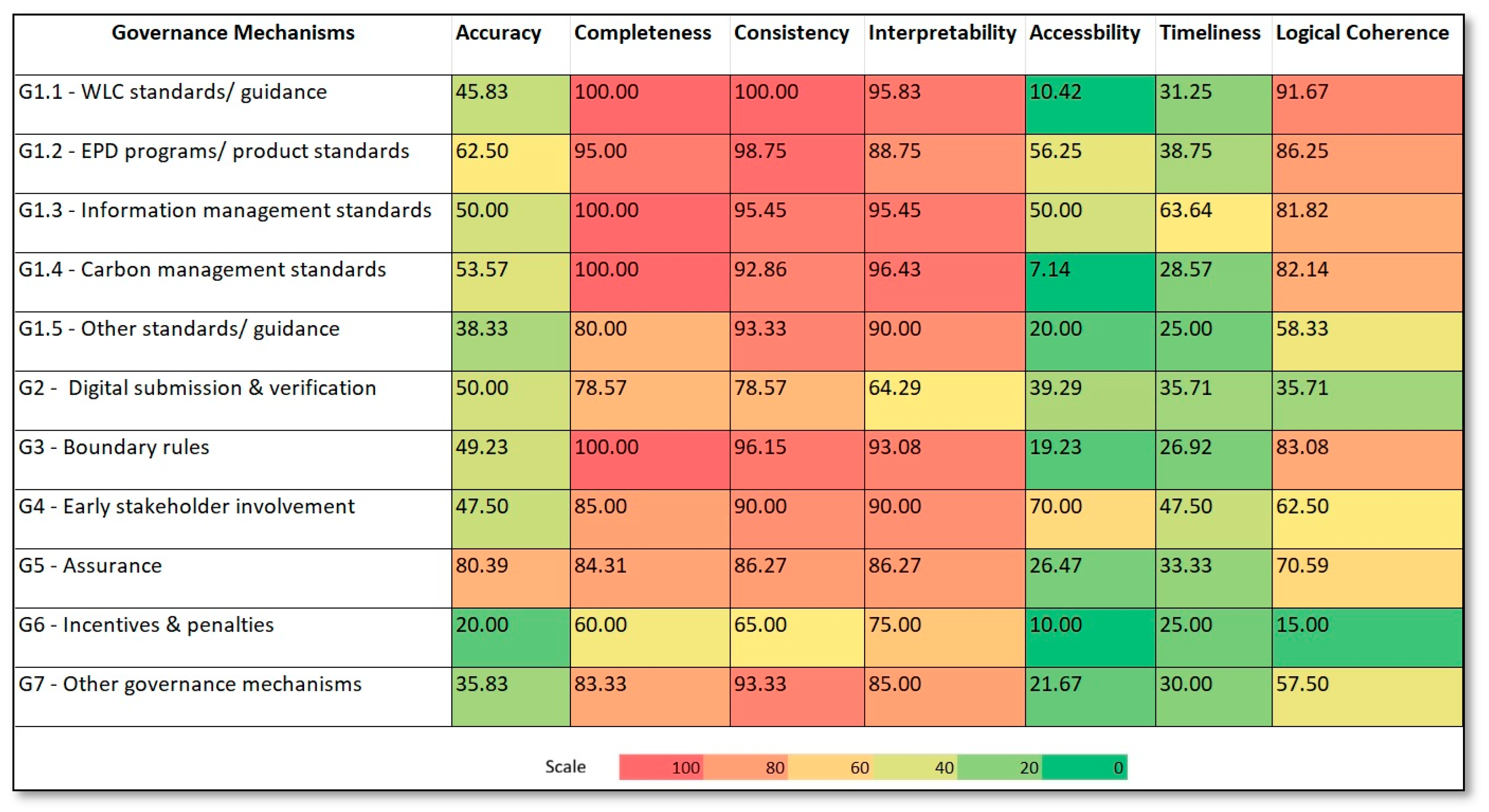
Figure 5 presents the heatmap illustrating the relationships between GMs and DQ dimensions, while Figure 6 presents the corresponding DT–DQ relationships. Drawing on the coded evidence in Supplementary File S1 and the quantitative patterns in Figure 5 and Figure 6, the results reveal a clear functional division across DQ dimensions. Standards-based governance (G1) and explicit boundary rules (G3) provide the greatest improvements in completeness, consistency, interpretability, and logical coherence, whereas assurance mechanisms (G5) deliver the highest gains in accuracy. In summary, standards and boundary rules define the methodological structure, assurance secures data credibility, and DTs enable efficient data generation and flow.

4.1.1. Standards and Boundary Rules: The Methodological Backbone

Standards and boundary rules demonstrate the strongest performance across methodological DQ dimensions. WLC standards and guidance (G1.1) achieve maximum scores for completeness (100) and consistency (100), with high interpretability (95.83) and logical coherence (91.67). Evidence in Supplementary File S1 provides detailed examples supporting these values.
Most WLC standards align with EN 15978 [67] and EN 15804 [12], as consistently documented across multiple studies [17,63,68,69,70,71,72,73,74]. Many studies also incorporate complementary frameworks, including the RICS Whole Life Carbon Standard, national guidance, and the Level(s) framework [68,69,72,74]. Collectively, these approaches ensure consistent declaration of life-cycle modules—typically A1–A5 as a minimum, with B and C stages clearly defined and D included where applicable—thereby improving boundary clarity and interpretability.
However, limitations remain. Coding results in Supplementary File S1 frequently indicate low accessibility, alongside continued reliance on default datasets where supplier-specific EPDs or EoL data are unavailable [20,69,75]. These challenges are particularly evident in early-stage assessments and underground assets, where analysis is often restricted to A1–A5 modules, and in cases involving unresolved biogenic carbon or EoL harmonization issues [17,72].
Information-management standards (G1.3) similarly achieve high completeness (100) and consistency (95.45), with interpretability at 95.45, while carbon-management standards (G1.4) deliver completeness (100), consistency (92.86), and interpretability (96.43). Boundary rules (G3) are also important, with completeness (100) and consistency (96.15).
Despite these strengths, these mechanisms perform poorly in terms of accessibility and timeliness. For example, G1.1 records accessibility at 10.42 and timeliness at 31.25, while G1.4 shows accessibility at 7.14 and timeliness at 28.57. These results indicate that harmonized methodologies and clearly defined boundaries alone are insufficient to ensure timely and accessible data. Overall, standards and boundary rules constitute the methodological backbone of reliable CSC emissions reporting but require complementary mechanisms to enhance data flow.

4.1.2. G1 in Focus: The Critical Contribution of EPD Programs and Information-Management Standards to Data Flow

Within the standardization category (G1), EPD programs and product standards (G1.2) have a distinctive and practice-oriented performance profile. These mechanisms achieve high completeness (95), consistency (98.75), interpretability (88.75), and logical coherence (86.25), while also demonstrating relatively stronger accessibility (56.25) and timeliness (38.75) compared to other standards. Accuracy is also robust at 62.50.
Supplementary File S1 highlights the role of third-party verification, program operator checks, and national EPD platforms (e.g., INIES, ÖKOBAUDAT, EC3) in supporting these outcomes. These programmatic structures enhance accessibility and timeliness; however, limitations persist, including incomplete EoL coverage and regional data asymmetries that constrain cross-context comparability.
Information-management standards (G1.3) achieve the highest timeliness within G1 (63.64) and strong accessibility (50), driven by structured data schemas. The literature emphasizes the use of IFC models, ISO 19650 [76] frameworks, EIR/LOIN specifications, and structured data formats (e.g., CSV, JSON) to enable coherent data exchange and automation across BIM–LCA and MRV workflows, including blockchain-enabled architectures [20,75].
Carbon-management standards (G1.4) provide the highest interpretability (96.43) but remain limited in accessibility (7.14) and timeliness (28.57). While frameworks such as the GHG Protocol, IPCC/GB/T factors, and ISO 14064 [51,77,78] series standardize emissions factors and reporting logic, their practical effectiveness depends on integration with digital platforms and data exchange mechanisms [20,64,69,79,80,81,82,83,84,85,86,87].
Overall, EPD programs and information-management standards emerge as the most effective mechanisms for improving standardized data flow in practice. In contemporary construction tenders, EPD programs are increasingly embedded as mandatory submission requirements for carbon-intensive materials such as concrete, steel, and façade systems, supported by EN 15804 [12] and ISO 14025 [88]-aligned product standards and verified EPD registries (e.g., [81,89,90]). Project teams increasingly rely on digital EPD registries (e.g., Ökobaudat, INIES, EPD Danmark, Sidac) to screen suppliers and filter non-compliant bids during procurement, improving comparability and transparency [91,92]. These practices illustrate how governance requirements for data completeness and consistency are operationalized through structured, digitally mediated procurement workflows.

4.1.3. Beyond Standards: What Enhances Accuracy in CSC Emissions Reporting

Of GMs, assurance (G5) achieves the highest accuracy (80.39), alongside strong consistency (86.27) and interpretability (86.27). However, lower accessibility (26.47) and timeliness (33.33) reflect the retrospective and resource-intensive nature of audits and third-party verification processes.
Evidence in Supplementary File S1 reinforces this pattern. Mechanisms such as program operator verification, QR-enabled declarations, and cross-platform validation enhance trust and comparability but increase administrative burden and cycle time. Consequently, several studies recommend applying assurance selectively to high-materiality items rather than universally [17,69,79,83,84].
Digital submission and verification mechanisms (G2) provide moderate improvements (completeness = 78.57; consistency = 78.57) but show weaker performance in interpretability (64.29) and logical coherence (35.71), indicating that submission systems require alignment with clear methodological templates. Early stakeholder involvement (G4) performs strongly in accessibility (70) and interpretability (90) but remains limited in accuracy (47.5), suggesting that early engagement improves data availability but not necessarily data reliability. Incentives and penalties (G6) demonstrate relatively weak performance across most dimensions (e.g., accuracy = 20; logical coherence = 15), indicating that behavioral mechanisms alone are insufficient to improve DQ without methodological and verification support.
Several procurement frameworks now apply selective assurance (G5) to high-materiality elements rather than requiring verification across entire supply chains. For example, third-party verification is often prioritized for structurally critical and emissions-intensive materials—such as concrete and steel—while lower-impact components rely on standardized assumptions or unverified datasets, thereby reducing verification burden without materially compromising accuracy [81,90]. Empirical studies of EPD programs and WLC assessments similarly emphasize that assurance delivers the most consistent improvements in data accuracy but introduces delays and access constraints when applied indiscriminately [69,91]. This selective application of assurance aligns with the heatmap results, which show strong accuracy gains associated with assurance mechanisms alongside persistent limitations in accessibility and timeliness.

4.1.4. DTs: Enhancing Data Flow and Strengthening Methodological Quality

Figure 6 demonstrates that DTs primarily address GM limitations by improving data flow quality and operational efficiency in structured data environments. IoT and digital twins achieve the highest timeliness (75) through real-time data capture. EPD platforms are strong in accessibility (58.06) by enabling access to standardized public datasets. AI-based tools achieve the highest accuracy (68.18) and completeness (100), while BIM–LCA systems are strong in consistency (94.83) and logical coherence (79.31) through schema-driven integration.
Blockchain-based systems provide balanced performance, with strong consistency (92.31) and demonstrated advantages in immutability and auditability, although practical challenges remain regarding privacy and system integration. Other DTs have a strong overall profile (e.g., completeness = 95.38; interpretability = 90.00), consistent with cloud-based and case-study evidence highlighting improvements in data coherence, although timeliness (40.77) and accessibility (52.31) remain moderate.
Despite these advances, accessibility remains a persistent constraint. For example, BIM–LCA tools achieve only 27.59 for accessibility, and AI tools 22.73. These findings highlight the need for open interfaces, standardized submission templates, and clearly defined data hierarchies to realize the benefits of DTs in CSC emissions reporting fully.
BIM–LCA integration is commonly applied during early design and pre-contract stages to evaluate alternative materials and assemblies under standardized system-boundary rules, improving logical coherence and consistency between quantities, modeling assumptions, and declared impacts [69,75,93]. During construction, IoT-enabled logistics tracking and digital-twin applications are increasingly piloted to estimate transport-related Scope-3 emissions in near real time, addressing the timeliness limitations associated with governance-only approaches [27,79,94]. In parallel, AI-assisted validation tools support procurement teams by detecting anomalous EPD values, inconsistencies, or mismatches between model-based quantities and declared emissions prior to contract award [23,79,95].

4.1.5. Beyond the Matrix: Additional DQ Dimensions in the Literature

Supplementary File S1 identifies several additional DQ dimensions—beyond the seven included in the matrices—that significantly influence the reliability of CSC emissions reporting. Uncertainty and variability management are recurring concerns, with studies emphasizing the use of Monte Carlo simulation, sensitivity analysis, and conservative parameter ranges to address uncertainty [96,97,98].
Data traceability and auditability are also frequently highlighted, particularly through verifiable source referencing, version control, and the use of cryptographic or distributed ledger technologies to ensure transparent and tamper-resistant data provenance [79,84,99].
Challenges related to representativeness and comparability are also prominent, including regional variability, dataset inconsistencies, and difficulties in harmonizing biogenic carbon and EoL assumptions [17,100,101]. Finally, privacy and data security concerns are consistently identified, reflecting the tension between the need for detailed emissions data and the protection of commercially sensitive supplier information [94,102,103].
Collectively, these dimensions highlight the broader socio-technical context of CSC emissions reporting and indicate critical areas for further methodological and technological development.

4.1.6. Implications for Procurement: Toward a Hybrid Governance–Technology Configuration

The combined quantitative and qualitative evidence supports a hybrid governance–technology configuration for improving DQ in CSC emissions reporting. This configuration begins with a strong methodological foundation based on standards-aligned WLC guidance, EPD programs, information-management standards, and carbon-management frameworks, supported by clearly defined boundary rules.
Building on this foundation, organizations can deploy integrated digital pipelines—including BIM–LCA systems; EPD platforms; IoT-enabled monitoring; digital twins; AI-based validation tools; and, where appropriate, blockchain systems—to enhance accessibility, timeliness, and structured data capture.
To ensure data credibility, assurance mechanisms need to be applied selectively to high-materiality components, supported by explicit uncertainty ranges and robust data provenance requirements. This hybrid configuration aligns with the patterns observed in Figure 5 and Figure 6 and the thematic insights in Supplementary File S1.
Overall, integrating methodological rigor, digital enablement, and targeted assurance enables credible like-for-like comparisons, reduces verification burden, and strengthens the effectiveness of PDD strategies.

4.2. Limitations and Opportunities for Integrating GMs and DTs into PDD

This section presents the findings using two complementary analytical approaches. First, a quantitative matrix-based assessment evaluates the relative strengths and weaknesses of GMs and DTs (see Table 2 and Table 3). Second, a qualitative thematic analysis synthesizes insights from the 68 reviewed studies to identify key limitations and corresponding opportunities for integrating each GM and DT into PDD (see Supplementary File S2).

4.2.1. Quantitative Matrix-Based Analysis

To address this research question, the values presented in Figure 5 and Figure 6 were translated into categorical strength levels: scores of ≳85 were classified as strong, 50–85 as moderate, and ≲50 as weak (Table 2). Given that heatmaps do not follow universally standardized thresholds and rely on researcher-defined classification schemes, a Red–Amber–Green (RAG) approach—commonly used in performance scorecards and diagnostic analyses—was adopted to distinguish these categories [104].
This classification enables a systematic comparison of GMs and DTs across the seven DQ dimensions, identifying where each performs strongly or weakly. By clarifying these patterns, the analysis reveals both current limitations and priority areas for integration within PDD. Moreover, categorical translation supports the identification of complementary relationships, illustrating how DTs can compensate for GM weaknesses and how robust governance can mitigate technological limitations. This pairing logic provides a structured basis for identifying integration opportunities, as summarized in Table 3.
GM Limitations and the Compensatory Roles of DTs
Across the dataset, several GMs have consistently weak performance in specific DQ dimensions, indicating a strong reliance on DT support. Accessibility emerges as the most pervasive limitation, with particularly low scores observed for WLC standards/guidance (G1.1), carbon-management standards (G1.4), other standards/guidance (G1.5), boundary rules (G3), assurance mechanisms (G5), incentives and penalties (G6), and other GMs (G7).
These findings indicate the absence of sufficiently developed processes for publishing, cataloging, and granting access to decarbonization-relevant datasets. In response, DTs such as EPD platforms (DT2), blockchain systems (DT3), and other DTs (DT6) play a critical role in enhancing data accessibility by enabling dataset visibility, embedding structured metadata, and facilitating permissioned access through Application Programming Interfaces (APIs) and role-based controls.
Timeliness and the Operational Bottleneck
Timeliness is also consistently weak across many GMs, including carbon-management standards (G1.4), boundary rules (G3), other standards/guidance (G1.5), incentives and penalties (G6), WLC standards/guidance (G1.1), digital submission and verification (G2), and assurance mechanisms (G5).
This weakness reflects the absence of clearly defined update cycles, submission triggers, and automated workflows, which creates operational bottlenecks in procurement processes—particularly when emissions-related data are required within tight decision timeframes. DTs, such as IoT systems and digital twins (DT4), offer opportunities for real-time data capture and continuous monitoring. At the same time, blockchain (DT3) and AI-based tools (DT5) enable event-driven workflows, automated validation, and timestamp-based verification. Together, these technologies reduce latency and improve the responsiveness of data systems within PDD.
Accuracy: Localized but Material Weaknesses
Accuracy-related weaknesses are more localized but remain significant, particularly for incentives and penalties (G6), with additional moderate deficiencies observed in other standards/guidance (G1.5) and other GMs (G7). These patterns indicate ongoing challenges in verifying the reliability of emissions data and decarbonization claims.
DTs offer several mechanisms to address these issues. AI-based validation tools (DT5) and other digital solutions (DT6)—including time-series databases, telemetry dashboards, and cloud-based analytics pipelines—support automated anomaly detection, continuous monitoring, and cross-validation of datasets (e.g., InfluxDB time-series with Python dashboards in Spudys et al. [63]; GPS/accelerometer data integrated with MySQL and web dashboards in Li et al. [105]; cloud APIs and Python/Jupyter workflows in Präger et al. [74]). In combination with higher-fidelity data capture from IoT systems and digital twins (DT4), these tools offer practical pathways to improve data accuracy in procurement contexts.
Logical Coherence and Interpretability: Contributions of Models and Explanatory Frameworks
Logical coherence is particularly weak in incentives and penalties (G6) and digital submission and verification (G2), limiting comparability across suppliers and projects. Model-based DTs, such as BIM–LCA systems (DT1), and AI-based reasoning tools (DT5) can address these limitations by enforcing consistent system boundaries and enabling automated consistency checks.
Although interpretability is not uniformly weak, relatively low scores for digital submission and verification (G2) indicate challenges in presenting digital outputs in a transparent, accessible manner to non-technical stakeholders. AI-based explainability tools (DT5) and dashboard-oriented technologies (DT6) can improve the clarity and usability of carbon data during procurement evaluation processes.
Importantly, standards-oriented GMs (G1.1–G1.4) are consistently strong in completeness, consistency, and interpretability. Their primary limitations lie in accessibility and timeliness—dimensions that are more effectively addressed through platform-based, automated, and real-time digital solutions.
GM Strengths and Their Reinforcing Effects on DTs
Several GMs demonstrate consistently strong performance and therefore provide a foundation for reinforcing DTs’ weaker aspects. WLC standards/guidance (G1.1), EPD programs/product standards (G1.2), information-management standards (G1.3), carbon-management standards (G1.4), and boundary rules (G3) have strong performance in completeness and consistency. These mechanisms establish structured schemas, defined data fields, and consistent boundary conditions that support DTs in managing data integration and version control.
Interpretability is also strong across multiple GMs, including carbon-management standards (G1.4), WLC standards/guidance (G1.1), information-management standards (G1.3), boundary rules (G3), other standards/guidance (G1.5), and early stakeholder involvement (G4). These mechanisms provide standardized vocabularies, units, and modeling conventions that enhance the usability of DT outputs.
Additionally, assurance mechanisms (G5) emerge as the strongest contributor to accuracy, early stakeholder involvement (G4) to accessibility, and information-management standards (G1.3) to timeliness. These targeted strengths offer governance-based pathways to reinforce DTs that have weaknesses in their respective DQ dimensions.
Technology-Specific Gaps and the Appropriate Governance Countermeasures
At the level of individual DTs, several gaps can be addressed through targeted governance interventions. Accessibility limitations are evident in BIM–LCA systems (DT1), IoT and digital twins (DT4), and AI-based tools (DT5). These limitations can be mitigated through early stakeholder involvement (G4) and the implementation of platform-oriented metadata and access requirements embedded within EPD programs/product standards (G1.2) and information-management standards (G1.3).
Timeliness challenges in BIM–LCA (DT1), EPD platforms (DT2), and other DTs (DT6) can be addressed through governance frameworks that define update cycles, service-level agreements (SLAs), and structured submission schedules. Such approaches are supported by ISO 19650-aligned information-management practices [106,107] and classification-based data structuring frameworks [108]. When implemented in accordance with information-management standards (G1.3) and boundary rules (G3), and enabled by digital submission and verification mechanisms (G2), these approaches improve the timeliness and reliability of data flows.
Accuracy limitations in BIM–LCA (DT1), as well as moderate performance in EPD platforms (DT2) and blockchain systems (DT3), can be strengthened through assurance mechanisms (G5), including independent verification, auditing procedures, and sampling protocols [74,90]. Similarly, interpretability gaps in EPD platforms (DT2) and blockchain systems (DT3) can be addressed through governance frameworks provided by WLC standards/guidance (G1.1), information-management standards (G1.3), and carbon-management standards (G1.4), which establish consistent terminology and data structures.
Logical coherence limitations observed in EPD platforms (DT2) can be mitigated through WLC standards/guidance (G1.1) and boundary rules (G3), which align modeling assumptions and system boundaries, thereby ensuring comparability across procurement submissions.
Taken together, the matrix-based analysis reveals a complementary division of roles. GMs provide the standardization, rule-setting, and assurance required to ensure completeness, consistency, and interpretability. At the same time, DTs deliver the operational capabilities needed to enhance accessibility, timeliness, accuracy, and logical coherence within PDD.

4.2.2. Qualitative Thematic Analysis

This subsection synthesizes qualitative evidence from Supplementary File S1 to identify the most frequently reported limitations and corresponding opportunities for integrating GMs and DTs into PDD (Supplementary File S2). While the quantitative matrices reveal structural strengths and weaknesses across DQ dimensions, the thematic analysis provides contextual insight into why these patterns arise in practice and how procurement frameworks can operationalize the most effective interventions.
GMs
Across WLC standards and guidance (G1.1), a dominant limitation is persistent inconsistency in system boundaries—particularly regarding transport assumptions, waste rates, service-life modeling, and divergent treatment of biogenic carbon and EoL stages. These inconsistencies introduce variability in results and often lead to reliance on default datasets where supplier-specific information is unavailable. Opportunities lie in codifying EN 15978-aligned, stage-explicit reporting (≥A1–A5), requiring structured assumption logs, prioritizing EPD-backed data, and embedding IFC-based workflows to improve interoperability and Scope-3 readiness [73,100].
For EPD programs and product standards (G1.2), recurring limitations include incomplete coverage of life-cycle stages, outdated inventories, inconsistent product category rules (PCRs), and continued reliance on default values when product-specific data are lacking. Regional data gaps and truncation errors further constrain comparability. These challenges can be addressed through procurement requirements mandating ISO 14025/EN 15804-compliant EPDs with transparent data sources and vintages, the specification of recognized repositories (e.g., INIES, EC3), and the use of third-party verification and probabilistic WLC assessment (wbLCA) to improve robustness and comparability [17,71,72].
Information-management standards (G1.3) consistently reveal interoperability challenges, incomplete or non-standard BIM/IM workflows, and limited contractual enforcement of verification requirements. Manual data handling, inconsistent EIR/LOD specifications, and non-standardized data structures contribute to variability. Opportunities include mandating vendor-neutral data exchanges (e.g., IFC4, gbXML), formalizing EIR/LOIN deliverables, aligning QTO parameters with work breakdown structures (WBS), and incorporating immutable data ledgers to support automated verification and Scope-3-ready reporting [75,106].
Carbon-management standards (G1.4) face similar challenges, including truncated system boundaries (often limited to A1–A3), inconsistent modeling of biogenic carbon and EoL stages, variable emission factor sets, and dependence on uneven EPD availability. Procurement can enhance consistency by requiring life-cycle-aligned, scope-tagged reporting under ISO 14044/PAS 2050; standardizing factor hierarchies; and embedding assurance requirements within contractual frameworks [81,83].
Digital submission and verification mechanisms (G2) remain constrained by interoperability limitations, incomplete verification workflows, and inconsistent DQ across EPD and LCA inputs—even within advanced systems such as blockchain pilots. These limitations create verification friction and increase supplier burden. Procurement can address these issues by requiring verified Type III EPDs, BIM-linked submissions with stage-based validation checks, and role-based submission protocols supported by immutable logs and standardized evidence packages [74,109].
Boundary rules (G3) remain weakened by inconsistent scope definitions, frequent exclusion of A4/B/C/D stages, uncertain service-life assumptions, divergent PCRs, and optimistic EoL scenarios. These issues can be mitigated by mandating EN-aligned, stage-explicit reporting with clearly defined functional units (FUs), harmonized PCRs, standardized boundary templates (including declared exclusions and uncertainty ranges), and consistent A1–A3 reporting where full WLC assessment is not feasible [92,110].
Early stakeholder involvement (G4) demonstrates significant potential but is constrained by fragmented data environments, confidentiality concerns, varying levels of digital capability, and limited scalability of pilot approaches. To realize its benefits, procurement can require early adoption of common data environments; structured BIM data extraction processes; role-based or blockchain-enabled submissions; and contractual models such as early contractor involvement, design–build, or integrated project delivery that facilitate upstream data sharing and life-cycle planning [101,102].
Assurance mechanisms (G5) reveal challenges including inconsistent verification practices, limited transparency in EPD inputs and vintages, database mixing, and insufficient monitoring of EoL stages. These issues reduce confidence in reported data and increase the risk of greenwashing. Procurement can strengthen assurance through requirements for third-party verified EN 15804+A2-compliant EPDs, structured assumption logs, transparent dataset and, vintage disclosure, plausibility checks, harmonized treatment of GWP and biogenic carbon, and the use of digital assurance tools such as blockchain-based audit trails and monitoring dashboards [99,111].
Incentives and penalties (G6) remain limited by weak policy design, misaligned weighting in procurement criteria, verification burdens, and limited enforcement mechanisms. Opportunities include linking incentives to EN-aligned, EPD-backed disclosures; embedding reward-and-penalty clauses into contracts; and integrating benchmarking systems, bid incentives, or green financing criteria to reward verifiable low-carbon performance [68,74].
Overall, the thematic evidence indicates that GMs need to prioritize boundary stabilization, standardized data flows, formalized digital submission protocols, and aligned incentive structures to enable DTs and assurance systems to function effectively across project life cycles.
DTs
BIM–LCA tools (DT1) are constrained by interoperability limitations, variable model quality, proprietary ecosystems, high setup requirements, and data extraction errors (e.g., missing elements, incomplete parameters, inconsistent units). Together, these issues increase implementation costs and limit scalability beyond pilot projects, particularly where project teams and supply-chain actors lack sufficient digital capability or standardized modeling practices (e.g., [68,96]). In such contexts, inconsistencies in BIM data structures and interoperability gaps can distort QTOs and propagate inaccuracies throughout embodied-carbon assessments [80,93]. Opportunities include mandating IFC4-compliant deliverables, WBS-linked parameterization, standardized export specifications, automated IFC-to-CSV workflows, mapping templates, and cross-method validation. Additionally, parametric design approaches and methods, such as modular integrated construction and design for manufacture and assembly, can support low-carbon optimization [97,107,112].
EPD platforms (DT2) face challenges related to fragmented databases, inconsistent PCRs, regional and EoL data gaps, and outdated data vintages. These issues increase administrative burden and undermine organizational readiness, as procurement teams must reconcile mixed data sources and manage differences in supplier digital capability (e.g., [68,92]). Such fragmentation constrains scalability and raises transaction costs as EPD requirements expand across portfolios, particularly in the absence of sector-level data coordination [81,113]. Procurement can mitigate these issues by specifying approved repositories, requiring ILCD+EPD/EN 15804+A2-compliant data packages, mandating explicit EPD identifiers and declared modules, and enforcing provenance requirements and standardized APIs for data exchange [17,110].
Blockchain systems (DT3) remain at an early stage of adoption, with limitations in scalability, performance, usability, and reliance on off-chain data sources (oracles). While pilot studies demonstrate strong potential for traceability and assurance, implementation costs, data-model standardization challenges, and the complexity of permissioning continue to constrain organizational uptake and large-scale deployment [79,84,85]. These barriers are particularly significant for small and medium-sized suppliers with limited digital infrastructure and governance capacity, reinforcing adoption asymmetries across construction supply chains [68]. Procurement can support their adoption by specifying role-based access controls, on-chain audit trails, smart contract-based evidence packages, decentralized identifiers, middleware standards, and secure data storage solutions such as IPFS. These approaches can support pilot applications, including digital product passports and EPD-linked declarations [79,94].
IoT systems and digital twins (DT4) face persistent implementation challenges, including incomplete sensor coverage, integration barriers, calibration demands, and privacy concerns, which impose both direct costs and organizational readiness requirements [84,105]. Consequently, adoption remains concentrated in pilot or asset-specific contexts rather than scaled portfolio-level deployment [79,85]. Procurement can address these limitations by specifying sensor deployment strategies, standardized telemetry schemas, reporting intervals, metered energy summaries, Radio-Frequency Identification-based tracking systems, and integration protocols for digital twins. These measures enable real-time monitoring, predictive analytics, and optimized logistics [64,84].
AI-based tools (DT5) are highly dependent on input data quality and face challenges related to limited generalizability, model bias, and potential misinterpretation of outputs, particularly when applied beyond trained contexts [95,114]. These risks are intensified where training data are sparse or proprietary and where procurement teams lack analytical capacity, constraining institutional readiness for decision-critical use [82,115]. Procurement can support their effective use by defining clear application areas (e.g., EPD validation, hotspot analysis, early design screening, logistics forecasting) and requiring transparency in training datasets, retrieval-augmented generation approaches, cross-method validation, noise reduction techniques, and parametric optimization for supplier selection [79,100].
Other DTs (DT6) are constrained by heterogeneous databases, region-specific factors, inconsistent methodologies, missing datasets (particularly for EoL and mechanical, electrical, and plumbing systems), outdated data, and confidentiality restrictions. These challenges increase integration costs and limit automation and cross-project scalability. Opportunities include mandating standardized databases (e.g., Ecoinvent, ÖKOBAUDAT); fixed software versions; transparent disclosure of emission factors and transport assumptions; structured evidence formats (e.g., Comma-Separated Values templates, uncertainty ranges, Data Quality Indicator scoring); and platforms supporting hybrid validation approaches, Geographic Information System-based logistics modeling, probabilistic analysis, and secure data exchange via Application Programming Interfaces or encrypted channels [110,113].
Overall, the thematic findings reinforce the quantitative results: while DTs significantly enhance accessibility, timeliness, and operational efficiency, their effective deployment is contingent on cost-sensitive implementation strategies, scalability beyond pilot applications, and organizational readiness across procurement teams and supply-chain actors. These constraints underscore the need for governance frameworks that stage digital adoption, stabilize data requirements, and build institutional capacity, thereby enabling digital outputs to be integrated into auditable procurement decision-making at scale.

5. Conclusions, Implications, Limitations and Future Research Directions

This review demonstrates that credible PDD in CSCs depends on the coordinated design and implementation of GMs and DTs within procurement workflows. By triangulating the quantitative matrices (Figure 5 and Figure 6) with the qualitative thematic analysis (Section 4.2.2) and operationalizing the results through the pairing logic (Table 2 and Table 3), the findings reveal a clear and robust division of labor across DQ dimensions. Standards-based governance and boundary rules (G1.1–G1.5, G3) form the methodological backbone, strengthening completeness; consistency; interpretability; and, when complemented by assurance (G5), accuracy [116,117,118]. In parallel, DTs (DT1–DT6) primarily enhance accessibility and timeliness, while also contributing selectively to accuracy and logical coherence when embedded within structured schemas and governed interfaces [119,120,121]. Of governance levers, assurance (G5) provides the most reliable pathway to factual accuracy, information-management standards (G1.3) offer the strongest influence on timeliness, and early stakeholder involvement (G4) is the only mechanism consistently improving accessibility. However, all three require alignment with standards and platform-based rules to sustain comparable and verifiable data flows across procurement stages.
Across GMs, PDD remains constrained by boundary inconsistencies, uneven DQ coverage, and underdeveloped assurance and interoperability regimes. These constraints manifest in truncated system scopes, divergent treatment of biogenic carbon and EoL stages, fragmented databases, and reliance on default values [122,123,124,125]. At the same time, digital submission workflows frequently lack standardized formats, verification protocols, and integration with registries, limiting transparency and comparability of embodied-carbon information [126]. Incentive structures also remain weak or misaligned. These limitations, however, point directly to actionable levers. Procurement can mandate EN-aligned, stage-explicit WLC reporting with harmonized PCRs and RICS/ISO-based assumption logs; require ISO 14025/EN 15804-compliant, third-party-verified EPDs with transparent sources, vintages, uncertainty treatment, and modeling assumptions [126,127,128]; formalize vendor-neutral information exchanges (e.g., IFC4/gbXML), EIR/LOIN deliverables, WBS-aligned QTOs, and role-based or blockchain-enabled assurance mechanisms; and link auditable carbon criteria to bid evaluation, incentives, and penalties [129].
In parallel, DTs can operate these governance requirements when explicitly specified in procurement. This includes standardized BIM–LCA deliverables with automated mappings [130,131]; designated EPD repositories and interoperable APIs [132]; blockchain-enabled audit trails for tamper-evident verification [133]; IoT and digital-twin telemetry for real-time, evidence-based monitoring [134,135]; and AI tools for screening, factor matching, and logistics optimization under robust quality-assurance protocols [136,137]. These capabilities are most effective when embedded within integrated digital ecosystems anchored to standardized databases, fixed software environments, structured evidence templates, and strict controls against cross-database inconsistencies [131,135,137]. Collectively, policy-aligned boundary definitions and standardized digital pipelines enable like-for-like comparisons; reduce verification burdens; and support credible, scalable reductions in embodied and whole-life carbon (see Supplementary File S2).
Opportunities for integrating GMs and DTs into PDD (Table 2 and Table 3) include codifying harmonized system boundaries and reporting requirements within procurement documentation—such as EN-aligned WLC scopes, explicitly defined A/B/C/D modules, and standardized allocation and biogenic-carbon conventions—to stabilize methodological comparability across suppliers and tools [116,122,123]. Verification requirements aligned with ISO-based assurance systems (e.g., program-operator verification and sampling protocols) need to be embedded and selectively applied to high-materiality elements to balance rigor with efficiency [126,128]. Procurement frameworks can further require ISO 14083-aligned logistics accounting and promote telemetry-based data capture to improve the timeliness and accuracy of A4–A5 emissions reporting [125,127]. BIM–LCA workflows need to be formalized through IFC/LOIN naming conventions and information-management rules to ensure that automation enhances completeness, consistency, and logical coherence without introducing reconciliation risks [119,130,131].
In addition, digital MRV infrastructures—such as interoperable EPD platforms; AI-assisted validation systems; and, where appropriate, permissioned blockchain architectures—need to be piloted and scaled to translate governance requirements into low-friction, auditable evidence across procurement stages, including prequalification, submission, and contract administration [129,132,137]. Finally, procurement could mandate uncertainty-aware disclosure practices to prevent misleading precision where differences in emissions performance fall within statistical error margins [126,127]. Together, these measures operationalize the pairing logic presented in Table 3 and directly address the weaknesses identified in Table 2 and Figure 5 and Figure 6, particularly governance-related limitations in accessibility and timeliness and technology-related gaps in interpretability, accuracy, and logical coherence.
Theoretical implications extend both DQ and socio-technical perspectives. The findings demonstrate that methodological DQ dimensions (completeness, consistency, interpretability, and logical coherence) are most effectively governed by institutional mechanisms. In contrast, flow-related dimensions (accessibility and timeliness) are primarily enabled by DTs. Accuracy emerges as a hybrid outcome, requiring both ex ante structuring through standardized schemas and ex post validation through assurance processes. This explains why neither governance nor technology alone is sufficient: governance without digital enablement results in slow, inaccessible reporting, whereas technology without governance produces outputs that are difficult to compare or verify. The results, therefore, support a combined institutional and socio-technical framework in which procurement defines expectations (standards, formats, roles, and update cycles) and digital platforms operationalize them (through templates, APIs, automation, and auditability), transforming procurement into an active decarbonization mechanism rather than a passive administrative function.
Further consideration relates to the nature of the evidence base. The literature demonstrates a clear publication bias toward positive or prototype-level outcomes for DTs, with relatively few studies reporting implementation failures or negative results. Geographic representation is also uneven, with limited evidence from the Global South, where differences in digital maturity, regulatory frameworks, and supply chain structures may significantly influence applicability. Moreover, longitudinal evidence on the performance of digital MRV systems and integrated governance–technology configurations across multiple project cycles remains scarce. Future research should therefore focus on long-term evaluation, scalability, and robust verification across diverse procurement contexts.
Several limitations qualify the interpretation and generalizability of these findings and warrant explicit discussion. First, this review was restricted to English-language publications indexed in Scopus and WoS. While this criterion ensured methodological transparency and comparability across sources, it may have excluded relevant empirical and policy-oriented research published in other languages, particularly from regions where construction supply chains, procurement regimes, and digital maturity differ substantially from Anglophone contexts. As a result, practices and constraints specific to non-English-speaking jurisdictions—especially in parts of the Global South or East Asia—may be underrepresented, potentially biasing the synthesis toward regulatory, institutional, and technological conditions prevalent in Europe, North America, and Australia.
Second, review articles were intentionally excluded to avoid double-counting evidence and to ensure that the synthesis was grounded in primary empirical and conceptual contributions. While this strengthens analytical specificity, it also limits direct engagement with alternative conceptual framings and aggregation logics developed in prior reviews. Consequently, some broader perspectives on PDD or sustainable supply chains are incorporated indirectly rather than explicitly debated. This trade-off prioritizes depth and traceability of governance–technology–data relationships but may reduce the visibility of higher-level consensus or divergence already established in adjacent review studies.
Third, the restriction to SJR Q1 journals was applied to ensure methodological rigor, peer-review quality, and reproducibility. However, this criterion introduces an additional selection bias by excluding practitioner-oriented journals, conference proceedings, industry reports, and policy evaluations where digital MRV systems, procurement pilots, and governance innovations are often first documented. As a result, early-stage implementations, informal GMs, and context-specific solutions—particularly those emerging from practice-led or policy-experimental settings—may be underrepresented. The evidence base, therefore, likely favors mature, formalized, and institutionally aligned solutions over exploration or bottom-up approaches.
In combination, these three criteria shape the scope of inference of this review. The findings are most robustly generalizable to formal procurement contexts in digitally mature, regulation-intensive construction supply chains, where EN-, ISO-, and platform-based governance regimes are already influential. Caution is warranted when extrapolating the results to jurisdictions with fragmented regulatory frameworks, limited digital infrastructure, or procurement models that rely more heavily on informal coordination and discretionary judgment.
Finally, although the synthesis triangulates quantitative heatmap analysis, structured narrative integration, and pairing logic across GMs and DTs, contextual heterogeneity—in jurisdiction, life-cycle boundary definitions (A1–A5/B/C/D), material systems, database vintages, and levels of technological maturity—precluded formal meta-analysis. The conclusions, therefore, reflect patterns of association and mechanism alignment rather than statistically pooled effect sizes. Moreover, given the rapid evolution of the policy and technology landscape (e.g., Construction Products Regulation-linked digital product passports, emerging assurance regimes, and AI-assisted validation), the findings represent the state of knowledge up to January 2026 and should be revisited as more longitudinal and cross-jurisdictional evidence becomes available.
To clarify the practical implications of this review, several priority actions emerge for policymakers, industry practitioners, and researchers. For policymakers, the findings highlight the importance of mandating EN-aligned, stage-explicit WLC reporting (≥A1–A5 with relevant B/C/D modules), supported by harmonized PCRs, biogenic-carbon rules, and standardized boundary templates embedded within procurement requirements. Policymakers should also require EPD-backed, ISO-compliant evidence (e.g., EN 15804+A2; ISO 14025; ISO 14083) and formalize verification requirements, applying assurance selectively to high-materiality elements. In addition, public-sector leadership is critical in supporting interoperable digital MRV infrastructure, including EPD registries, APIs, digital twins, and blockchain-based audit systems.
For industry practitioners, the findings emphasize the need to embed structured information-management practices—such as IFC4, LOIN specifications, WBS-aligned QTOs, standardized templates, and defined data sources—into procurement and project delivery processes to ensure consistent, auditable data flows. DTs—including BIM–LCA tools, EPD platforms, IoT systems, and AI-based validation tools—should be deployed within governed frameworks rather than as standalone solutions. Furthermore, procurement processes should integrate early supplier involvement, low-carbon design optimization, and uncertainty-aware reporting to enhance both performance and credibility.
For researchers, future work should prioritize empirical evaluation of hybrid governance–technology configurations through longitudinal case studies and cross-jurisdictional comparisons. There is also a need to develop robust methods for uncertainty-aware procurement evaluation and like-for-like benchmarking across digital platforms. Finally, advancing socio-technical models of carbon data governance that incorporate organizational behavior, supply chain dynamics, and evolving digital MRV ecosystems will be important for supporting scalable decarbonization in CSCs.

Supplementary Materials

The following supporting information can be downloaded at: https://www.mdpi.com/article/10.3390/su18104921/s1, Supplementary File S1: Summary of Data Extracted from the Systematic Literature Review, Supplementary File S2: Technical Limitations and Opportunities Tables, Table S1. GMs: Technical Limitations and Opportunities for Integration into PDD, Table S2. DTs: Technical Limitations and Opportunities for Integration into PDD. PRISMA_2020_checklist.

Author Contributions

Conceptualization, C.-Y.L., D.M., M.J., H.-Y.C., S.R. and M.S.; Methodology, Y.X., H.-Y.C. and W.C.T.; Validation, H.-Y.C., Y.X. and C.-Y.L.; Formal Analysis, C.-Y.L., H.-Y.C. and Y.X.; Investigation, C.-Y.L. and Y.X.; Data Curation, C.-Y.L., H.-Y.C. and Y.X.; Writing—Original Draft Preparation, C.-Y.L., D.M., M.J., Y.X., H.-Y.C., W.C.T., S.R. and M.S.; Writing—Review and Editing, D.M., M.J., Y.X., H.-Y.C., W.C.T., S.R. and M.S.; Visualization, M.J. and W.C.T.; Project Administration, C.-Y.L. and D.M.; Funding Acquisition, C.-Y.L., D.M., S.R. and M.S. All authors have read and agreed to the published version of the manuscript.

Funding

This work was funded by a 2026 Internal Research Project Grant awarded by the Faculty of Society and Design, Bond University, Australia.

Institutional Review Board Statement

Not applicable.

Informed Consent Statement

Not applicable.

Data Availability Statement

The data are available upon reasonable requests from the authors.

Conflicts of Interest

The authors declare no conflicts of interest.

References

  1. United Nations Environment Programme (UNEP). Beyond Foundations: Mainstreaming Sustainable Solutions to Cut Emissions from the Buildings Sector; United Nations Environment Programme (UNEP): Nairobi, Kenya, 2024. [Google Scholar]
  2. KPMG. Tackling Embodied Carbon Within Australia’s Construction and Infrastructure Sector; KPMG: Sydney, Australia, 2023. [Google Scholar]
  3. Giesekam, J.; Barrett, J.R.; Taylor, P. Construction sector views on low carbon building materials. Build. Res. Inf. 2015, 44, 423–444. [Google Scholar]
  4. Borchardt, M.; Pereira, G.; Milan, G.; Pereira, E.; Lima, L.; Bianchi, R.; Scavarda do Carmo, A. Are Sustainable Supply Chains Managing Scope 3 Emissions? A Systematic Literature Review. Sustainability 2025, 17, 6066. [Google Scholar]
  5. Stenzel, A.; Waichman, I. Supply-chain data sharing for scope 3 emissions. npj Clim. Action 2023, 2, 7. [Google Scholar] [CrossRef]
  6. Shell; Deloitte. Decarbonising Construction: Building a Low-Carbon Future; Deloitte: London, UK, 2023. [Google Scholar]
  7. World Economic Forum. Reducing Embodied Carbon in Cities: Nine Solutions for Greener Buildings and Communities; World Economic Forum: Geneva, Switzerland, 2024. [Google Scholar]
  8. Department of Climate Change, Energy, the Environment and Water. Environmentally Sustainable Procurement Policy (ESPP); DCCEEW: Canberra, Australia, 2025. [Google Scholar]
  9. NSW Government. Decarbonising Infrastructure Delivery Policy: Reducing Upfront Carbon in Infrastructure; NSW Government: Sydney, Australia, 2024. [Google Scholar]
  10. Directory Service. Construction Products Regulation; European Union: Brussels, Belgium, 2024. [Google Scholar]
  11. U.S. General Services Administration. GSA Pilots IRA Requirements for Low Embodied Carbon Construction Materials; U.S. General Services Administration: Washington, DC, USA, 2023. [Google Scholar]
  12. EN 15804+A2: 2019; Sustainability of Construction Works—Environmental Product Declarations—Core Rules for the Product Category of Construction Products. Dansk Standard: Copenhagen, Denmark, 2019.
  13. PAS 2080:2023; Carbon Management in Buildings and Infrastructure (Overview). British Standards Institution: London, UK, 2023.
  14. ISO 14083:2023; Greenhouse Gases—Quantification and Reporting of Greenhouse Gas Emissions Arising from Transport Chain Operations. International Organization for Standardization: Geneva, Switzerland, 2023.
  15. Cardoso, V.E.M.; Sanhudo, L.; Silvestre, J.D.; Almeida, M.; Costa, A.A. Challenges in the harmonisation and digitalisation of Environmental Product Declarations for construction products in the European context. Int. J. Life Cycle Assess. 2024, 29, 759–788. [Google Scholar] [CrossRef]
  16. Konradsen, F.; Hansen, K.S.H.; Ghose, A.; Pizzol, M. Same product, different score: How methodological differences affect EPD results. Int. J. Life Cycle Assess. 2023, 29, 291–307. [Google Scholar]
  17. Otero, M.S.; Garnica, T.; Montilla, S.; Conde, M.; Tenorio, J.A. Analysis of Sectoral Environmental Product Declarations as a Data Source for Life Cycle Assessment. Buildings 2023, 13, 3032. [Google Scholar]
  18. Albanese, P.M.; Baglivo, C.; Congedo, P.M. Integrating LCA with BIM-Based Technologies in the Building Construction Context: A Review. Buildings 2025, 16, 168. [Google Scholar]
  19. Bolognesi, C.; Bassorizzi, D.; Balin, S.; Manfredi, V. An Overview on LCA Integration in BIM: Tools, Applications, and Future Trends. Digital 2025, 5, 31. [Google Scholar] [CrossRef]
  20. Xu, J.; Teng, Y.; Pan, W.; Zhang, Y. BIM-integrated LCA to automate embodied carbon assessment of prefabricated buildings. J. Clean. Prod. 2022, 374, 133894. [Google Scholar] [CrossRef]
  21. Tam, V.W.Y.; Zhou, Y.; Shen, L.; Le, K.N. Optimal BIM and LCA integration approach for embodied environmental impact assessment. J. Clean. Prod. 2023, 385, 135605. [Google Scholar] [CrossRef]
  22. Aragón, A.; Spudys, P.; Pupeikis, D.; Nieto, Ó.; Alberti, M.G. Bridging Interoperability Gaps Between LCA and BIM: Analysis of Limitations for the Integration of EPD Data in IFC. Buildings 2025, 15, 2760. [Google Scholar] [CrossRef]
  23. Koyamparambath, A.; Adibi, N.; Szablewski, C.; Adibi, S.A.; Sonnemann, G. Implementing Artificial Intelligence Techniques to Predict Environmental Impacts: Case of Construction Products. Sustainability 2022, 14, 3699. [Google Scholar] [CrossRef]
  24. Salla, J.V.E.; de Almeida, T.A.; Silva, D.A.L. Integrating machine learning with life cycle assessment: A comprehensive review and guide for predicting environmental impacts. Int. J. Life Cycle Assess. 2025, 30, 2423–2445. [Google Scholar] [CrossRef]
  25. Wilson, S.; Adu-Duodu, K.; Li, Y.; Sham, R.; Almubarak, M.; Wang, Y.; Solaiman, E.; Perera, C.; Ranjan, R.; Rana, O. Blockchain-Enabled Provenance Tracking for Sustainable Material Reuse in Construction Supply Chains. Futur. Internet 2024, 16, 135. [Google Scholar]
  26. Jalbani, A.; Weerawarna, R.; Al-Zubaidi, K. Enhancing data provenance in AI with blockchain technology: A comprehensive quality model. CSI Trans. ICT 2025, 13, 213–224. [Google Scholar] [CrossRef]
  27. Agavanakis, K.; Quitard, R.; Kousias, N.; Mellios, G.; Elkaim, E. Driving sustainability in logistics value chains: A telematics data hub implementation for accurate carbon footprint assessment. AIP Conf. Proc. 2023, 3018, 020058. [Google Scholar] [CrossRef]
  28. Khan, B.U.I.; Goh, K.W.; Khan, A.R.; Zuhairi, M.F.; Chaimanee, M. Integrating AI and Blockchain for Enhanced Data Security in IoT-Driven Smart Cities. Processes 2024, 12, 1825. [Google Scholar] [CrossRef]
  29. ISO 20400:2017; Sustainable Procurement—Guidance. International Organization for Standardization: Geneva, Switzerland, 2017.
  30. ISO 26000:2010; Social Responsibility. International Organization for Standardization: Geneva, Switzerland, 2010.
  31. Uysal, E. Sustainability Clauses in ‘Public’ Contracts. Eur. Rev. Contract Law 2024, 20, 105–127. [Google Scholar]
  32. Johnsen, F.M.; Tellnes, L.G.F. Verification of Environmental Product Declarations (EPDs)—How strict should it be? E3S Web Conf. 2022, 349, 08002. [Google Scholar] [CrossRef]
  33. ISO 14065:2020; General Principles and Requirements for Bodies Validating and Verifying Environmental Information. International Organization for Standardization: Geneva, Switzerland, 2020.
  34. ISO/IEC 17029:2019; Conformity Assessment—General Principles and Requirements for Validation and Verification Bodies. International Organization for Standardization: Geneva, Switzerland, 2019.
  35. AA1000AS: 2022; Assurance Standard. AccountAbility: New York, NY, USA, 2022.
  36. Govindan, K.; Rajendran, S.; Sarkis, J.; Murugesan, P. Multi criteria decision making approaches for green supplier evaluation and selection: A literature review. J. Clean. Prod. 2015, 98, 66–83. [Google Scholar] [CrossRef]
  37. Build UK Group Limited. Common Assessment Standard (CAS); Build UK Group Limited: London, UK, 2025. [Google Scholar]
  38. Alghamdi, A. Sustainable Practices in Construction Management and Environmental Engineering: A Review. Sustainability 2025, 17, 10027. [Google Scholar] [CrossRef]
  39. Onyia, U.; Ani, I.S.; Nwankwo, U.F. Addressing the challenges towards the adoption of digital technologies in construction supply chain management. Discov. Civ. Eng. 2024, 1, 118. [Google Scholar] [CrossRef]
  40. Page, M.J.; McKenzie, J.E.; Bossuyt, P.M.; Boutron, I.; Hoffmann, T.C.; Mulrow, C.D.; Shamseer, L.; Tetzlaff, J.M.; Akl, E.A.; Brennan, S.E.; et al. The PRISMA 2020 statement: An updated guideline for reporting systematic reviews. BMJ 2021, 372, n71. [Google Scholar] [CrossRef]
  41. Zhang, Y.; Sattar, S.; Cook, D.T.; Katherine, J.J.; Fung, J.F. Systematic Review of Embodied Carbon Assessment and Reduction in Building Life Cycles; NIST Special Publication; U.S. Department of Commerce: Gaithersburg, MD, USA, 2024. [Google Scholar]
  42. Flores Lara, J.C.; El-Fadel, M.; Rauf, A.; Khalfan, M.M.A. Pathways toward Net-zero emissions in the construction industry: A framework integrating circular economy and industry 4.0 innovations. Build. Environ. 2025, 285, 113652. [Google Scholar] [CrossRef]
  43. Ströher, T.; Körner, M.-F.; Paetzold, F.; Strüker, J. Bridging carbon data’s organizational boundaries: Toward automated data sharing in sustainable supply chains. Electron. Mark. 2025, 35, 33. [Google Scholar] [CrossRef]
  44. Kumar, D.; Singh, R.K.; Mishra, R.; Vlachos, I. Big data analytics in supply chain decarbonisation: A systematic literature review and future research directions. Int. J. Prod. Res. 2023, 62, 1489–1509. [Google Scholar] [CrossRef]
  45. Reddy Durgam, H.K.; Ramani, P.V. Green construction supply chain: Reviewingadvancements, obstacles, and possibilities. Clean. Logist. Supply Chain 2025, 17, 100259. [Google Scholar] [CrossRef]
  46. Osei-Kyei, R.; Narbaev, T.; Xiaohua, J.; Komac, U.; Akomea-Frimpong, I.; Castelblanco, G. Critical review of the drivers and barriers for adopting net zero carbon procurement for construction projects. Sustain. Futur. 2024, 8, 100284. [Google Scholar] [CrossRef]
  47. Wang, R.Y.; Strong, D.M. Beyond Accuracy: What Data Quality Means to Data Consumers. J. Manag. Inf. Syst. 2015, 12, 5–33. [Google Scholar]
  48. Pipino, L.L.; Lee, Y.W.; Wang, R.Y. Data quality assessment. Commun. ACM 2002, 45, 211–218. [Google Scholar] [CrossRef]
  49. Weidema, B.P. Consistency check for life cycle assessments. Int. J. Life Cycle Assess. 2018, 24, 926–934. [Google Scholar] [CrossRef]
  50. Westin, S.; Sein, M.K. Improving Data Quality in Construction Engineering Projects: An Action Design Research Approach. J. Manag. Eng. 2014, 30, 05014003. [Google Scholar] [CrossRef]
  51. ISO 14064-1:2018; Greenhouse Gases. Part 1: Specification with Guidance at the Organization Level for Quantification and Reporting of Greenhouse Gas Emissions and Removals. International Organization for Standardization: Geneva, Switzerland, 2018.
  52. DiMaggio, P.J.; Powell, W.W. The Iron Cage Revisited: Institutional Isomorphism and Collective Rationality in Organizational Fields. Am. Sociol. Rev. 1983, 48, 147–160. [Google Scholar] [CrossRef]
  53. Trist, E.; Emery, F. Sociotechnical systems theory. In Organizational Behavior 2; Routledge: London, UK, 2015; pp. 169–194. [Google Scholar]
  54. Pinch, T.J.; Bijker, W.E. The Social Construction of Facts and Artefacts: Or How the Sociology of Science and the Sociology of Technology might Benefit Each Other. Soc. Stud. Sci. 1984, 14, 399–441. [Google Scholar] [CrossRef]
  55. Orlikowski, W.J. The Duality of Technology: Rethinking the Concept of Technology in Organizations. Organ. Sci. 1992, 3, 398–427. [Google Scholar] [CrossRef]
  56. Faraj, S.; Leonardi, P.M. Strategic organization in the digital age: Rethinking the concept of technology. Strateg. Organ. 2022, 20, 771–785. [Google Scholar] [CrossRef]
  57. Liang, Z.; Deng, H.; Xie, H.; Chen, B.; Sun, M.; Wang, Y. Rethinking the paper product carbon footprint accounting standard from a life-cycle perspective. J. Clean. Prod. 2023, 393, 136352. [Google Scholar] [CrossRef]
  58. Tsai, S.-Y.; Wang, M.-C.; Yao, S.-P.; Tsay, G.J.; Lin, C.-P. Greenhouse Gas Emissions and Mitigation Strategies in Universities Under ISO 14064-1: Lessons for Global Higher Education Sustainability. Sustainability 2025, 17, 9462. [Google Scholar] [CrossRef]
  59. Ishtiaque, T.A.; Wondimu, P.A.; Memic, N.; Andersen, B.S.; Lædre, O.; Klakegg, O.J. Ranking the benefits of early contractor involvement: A client’s perspective. Int. J. Constr. Manag. 2024, 25, 728–739. [Google Scholar] [CrossRef]
  60. Alotaibi, E.M.; Khallaf, A.; Abdallah, A.A.-N.; Zoubi, T.; Alnesafi, A. Blockchain-Driven Carbon Accountability in Supply Chains. Sustainability 2024, 16, 10872. [Google Scholar] [CrossRef]
  61. Jiang, K.; Leng, M.; Jiang, Y.; Xu, L. From penalties to profits: How government regulation and cost-revenue trade-offs shape green production and marketing. Environ. Dev. Sustain. 2025. [Google Scholar] [CrossRef]
  62. Kozuch, A.; Langen, M.; von Deimling, C.; Eßig, M. Does green procurement pay off? Assessing the practice–performance link employing meta-analysis. J. Clean. Prod. 2024, 434, 140184. [Google Scholar] [CrossRef]
  63. Spudys, P.; Jurelionis, A.; Fokaides, P. Digitizing buildings sustainability assessment: Integrating energy audits, operational energy assessments, and life cycle assessments for enhanced building assessment. Energy 2025, 316, 134429. [Google Scholar] [CrossRef]
  64. Yang, X.Z.; Lei, G.W.; Wang, X.Y. Can the development of digital construction reduce enterprise carbon emission intensity? New evidence from Chinese construction enterprises. Front. Ecol. Evol. 2023, 11, 1250593. [Google Scholar] [CrossRef]
  65. Denyer, D.; Tranfield, D. Producing a systematic review. In The Sage Handbook of Organizational Research Methods; Buchanan, D.A., Bryman, A., Eds.; Sage Publication Ltd.: London, UK, 2009; pp. 671–689. [Google Scholar]
  66. Okoli, C. A guide to conducting a standalone systematic literature review. Commun. Assoc. Inf. Syst. 2015, 37. [Google Scholar] [CrossRef]
  67. EN 15978:2026; Sustainability of Construction Works—Assessment of Environmental Performance of Buildings—Requirements and Guidance. Comité Européen de Normalisation (CEN): Brussels, Belgium, 2026.
  68. Arslan, V.; Ulubeyli, S. Aligning green building rating systems with whole life carbon: A comparative assessment for new buildings. Energy Build. 2026, 352, 116842. [Google Scholar] [CrossRef]
  69. Blay-Armah, A.; Bahadori-Jahromi, A.; Mylona, A.; Barthorpe, M.; Ferri, M. An Evaluation of the Impact of Databases on End-of-Life Embodied Carbon Estimation. Sustainability 2022, 14, 2307. [Google Scholar] [CrossRef]
  70. Gobinath, P.; Crawford, R. A comparative study of CIBSE TM65 and alternative methods for quantifying embodied greenhouse gas emissions of HVAC equipment. Energy Build. 2026, 352, 116862. [Google Scholar]
  71. Joensuu, T.; Leino, R.; Heinonen, J.; Saari, A. Developing Buildings’ Life Cycle Assessment in Circular Economy-Comparing methods for assessing carbon footprint of reusable components. Sustain. Cities Soc. 2022, 77, 103499. [Google Scholar] [CrossRef]
  72. Joensuu, T.; Tuominen, E.; Vinha, J.; Saari, A. Methodological aspects in assessing the whole-life global warming potential of wood-based building materials: Comparing exterior wall structures insulated with wood shavings. Environ. Res. Infrastruct. Sustain. 2023, 3, 045002. [Google Scholar] [CrossRef]
  73. Pomponi, F.; Moncaster, A.; De Wolf, C. Furthering embodied carbon assessment in practice: Results of an industry-academia collaborative research project. Energy Build. 2018, 167, 177–186. [Google Scholar] [CrossRef]
  74. Präger, L.; Woytowicz, J.; Reitberger, R.; Lang, W. LCA-based calculation of GHG Protocol Scope 3: A bottom-up approach to determine GHG emissions of the construction activity of municipalities. Build. Environ. 2025, 285, 113502. [Google Scholar]
  75. Huang, M.Q.; Chen, X.; Ninić, J.; Bai, Y.; Zhang, Q. A framework for integrating embodied carbon assessment and construction feasibility in prefabricated stations. Tunn. Undergr. Space Technol. 2023, 132, 104920. [Google Scholar] [CrossRef]
  76. ISO 19650-1:2018; Organization and Digitization of Information About Buildings and Civil Engineering Works, Including Building Information Modelling (BIM)—Information Management Using BIM—Part 1: Concepts and Principles. International Organization for Standardization (ISO): Geneva, Switzerland, 2018.
  77. ISO 14064-2:2019; Greenhouse Gases—Part 2: Specification with Guidance at the Project Level for Quantification, Monitoring and Reporting of Greenhouse Gas Emission Reductions or Removal Enhancements. International Organization for Standardization (ISO): Geneva, Switzerland, 2019.
  78. ISO 14064-3:2019; Greenhouse Gases—Part 3: Specification with Guidance for the Verification and Validation of Greenhouse Gas Statements. International Organization for Standardization (ISO): Geneva, Switzerland, 2019.
  79. Aurangzeb, I.; Yoon, J.H. Artificial intelligence- and blockchain-enabled carbon emissions ledger system (AB-CELS) for sustainable construction processes. Autom. Constr. 2025, 176, 106286. [Google Scholar] [CrossRef]
  80. Gan, J.; Li, K.; Li, X.; Mok, E.; Ho, P.; Law, J.; Lau, J.; Kwok, R.; Yau, R. Parametric BIM-Based Lifecycle Performance Prediction and Optimisation for Residential Buildings Using Alternative Materials and Designs. Buildings 2023, 13, 904. [Google Scholar] [CrossRef]
  81. AzariJafari, H.; Guest, G.; Kirchain, R.; Gregory, J.; Amor, B. Towards comparable environmental product declarations of construction materials: Insights from a probabilistic comparative LCA approach. Build. Environ. 2021, 190, 107542. [Google Scholar] [CrossRef]
  82. Chen, L.; Huang, L.; Li, X.; Chen, Z.; Woon, K.S.; Yap, P.-S.; Hua, J.; Dong, L.; Wang, J.; Chen, J. Sustainability assessment on green construction using a novel analytical framework integrating machine learning and emergy analysis. Dev. Built Environ. 2025, 24, 100797. [Google Scholar] [CrossRef]
  83. Helmers, E. Do’s and Don’ts in Climate Impact Assessment of University Campuses: Towards Responsible, Transparent and Comprehensive Reporting. Sustainability 2024, 16, 9320. [Google Scholar]
  84. Hummieda, A.; Moawad, K.; Salah, K.; Omar, M.; Mayyas, A. Blockchain-based certification of sustainable cement production. Smart Sustain. Built Environ. 2025, 1–33. [Google Scholar] [CrossRef]
  85. Kim, H.; Kim, S.; Lee, J.; Jeong, K.; Hong, T.; An, J. Development of a blockchain-based platform for real-time carbon emission assessment of building material supply chain. Build. Environ. 2026, 287, 113907. [Google Scholar]
  86. Yuan, H.; Huang, B.; Wang, M.; Tang, Y.; Mao, J.; Xiong, L. BIM-enabled lifecycle carbon emission management integrating multi-physical field steady-state methods during operation. Autom. Constr. 2026, 181, 106683. [Google Scholar]
  87. Zhang, H.T.; Tang, Z.; Hu, Y.; Wang, Y.; Liu, Y. A multilevel carbon accounting framework integrating boundary truncation and stakeholder engagement for road construction: A highway case in China. Process Saf. Environ. Prot. 2025, 194, 324–336. [Google Scholar] [CrossRef]
  88. ISO 14025:2006; Environmental Labels and Declarations—Type III Environmental Declarations—Principles and Procedures. International Organization for Standardization (ISO): Geneva, Switzerland, 2006.
  89. Andersen, C.E.; Kanafani, K.; Zimmermann, R.K.; Rasmussen, F.N.; Birgisdóttir, H. Comparison of GHG emissions from circular and conventional building components. Build. Cities 2020, 1, 379–392. [Google Scholar] [CrossRef]
  90. Capucha, F.; Bacatelo, M.; Ferrão, P.; Margarido, F. Implications of New Environmental Product Declarations Standards in Ordinary Portland Cement Life Cycle Assessment Procedures and Results. Sustainability 2025, 17, 10346. [Google Scholar] [CrossRef]
  91. Belizario-Silva, F.; Oliveira, L.S.; Reis, D.C.; Pato, G.T.G.; Marinho, A.C.; Degani, C.M.; Caldas, L.R.; Punhagui, K.R.G.; Pacca, S.A.; John, V.M. The Sidac system: Streamlining the assessment of the embodied energy and CO2 of Brazilian construction products. J. Clean. Prod. 2023, 421, 138461. [Google Scholar] [CrossRef]
  92. De Wolf, C.; Pomponi, F.; Moncaster, A. Measuring embodied carbon dioxide equivalent of buildings: A review and critique of current industry practice. Energy Build. 2017, 140, 68–80. [Google Scholar] [CrossRef]
  93. Cai, L.; Kang, Z.; Wang, S.; Chang, S.; Yang, K.; Xia, X. Efficiency improvement in automated carbon emissions assessment: An empirical study of a BIM-LCA multi-module integrated system. J. Build. Eng. 2025, 114, 114339. [Google Scholar] [CrossRef]
  94. Luo, Y.; Shen, J.; Liang, H.; Sun, L.; Dong, L. Supporting building life cycle carbon monitoring, reporting and verification: A traceable and immutable blockchain-empowered information management system and application in Hong Kong. Resour. Conserv. Recycl. 2024, 208, 107736. [Google Scholar] [CrossRef]
  95. Gu, X.R.; Chen, C.; Fang, Y.; Mahabir, R.; Fan, L. CECA: An intelligent large-language-model-enabled method for accounting embodied carbon in buildings. Build. Environ. 2025, 272, 112694. [Google Scholar]
  96. Abu-Ghaida, H.; Ritzen, M.; Hollberg, A.; Theissen, S.; Attia, S.; Lizin, S. Accounting for product recovery potential in building life cycle assessments: A disassembly network-based approach. Int. J. Life Cycle Assess. 2024, 29, 1151–1176. [Google Scholar] [CrossRef]
  97. de Toldi, T.; Pestre, T. The relevance of cut-stone to strategies for low-carbon buildings. Build. Cities 2023, 4, 229–257. [Google Scholar]
  98. Jain, M.; Rawal, R. Emissions from a net-zero building in India: Life cycle assessment. Build. Cities 2022, 3, 398–416. [Google Scholar] [CrossRef]
  99. Rodrigo, M.N.N.; Perera, S.; Senaratne, S.; Jin, X. Potential Application of Blockchain Technology for Embodied Carbon Estimating in Construction Supply Chains. Buildings 2020, 10, 140. [Google Scholar] [CrossRef]
  100. Kanyilmaz, A.; Hoi Dang, V.; Kondratenko, A. How does conceptual design impact the cost and carbon footprint of structures? Structures 2023, 58, 105102. [Google Scholar] [CrossRef]
  101. Khan, A.M.; Alaloul, W.S.; Musarat, M.A.; Fayyaz, A.M. Optimizing sustainable alternatives in value engineering Decision-Making through BIM-Integrated plugin automation for buildings. Ain Shams Eng. J. 2025, 16, 103373. [Google Scholar] [CrossRef]
  102. Xu, Y.; Tao, X.; Das, M.; Kwok, H.H.; Liu, H.; Kuan, K.K.; Lau, A.K.; Cheng, J.C. A blockchain-based framework for carbon management towards construction material and product certification. Adv. Eng. Inform. 2024, 61, 102242. [Google Scholar]
  103. Nwetlawung, Z.E.; Lin, Y.H. Development of an Optimization Algorithm for Designing Low-Carbon Concrete Materials Standardization with Blockchain Technology and Ensemble Machine Learning Methods. Buildings 2025, 15, 2809. [Google Scholar] [CrossRef]
  104. Vacanti, N.M. The fundamentals of constructing and interpreting heat maps. In Metabolic Signaling: Methods and Protocols; Humana Press: New York, NY, USA, 2018; pp. 279–291. [Google Scholar]
  105. Li, X.J.; Jiang, M.; Lin, C.; Chen, R.; Weng, M.; Jim, C. Integrated BIM-IoT platform for carbon emission assessment and tracking in prefabricated building materialization. Resour. Conserv. Recycl. 2025, 215, 108122. [Google Scholar]
  106. Sanhudo, L.; Martins, J.P.; Ramos, N.M.; Almeida, R.M.; Rocha, A.; Pinto, D.; Barreira, E.; Simões, M.L. BIM framework for the specification of information requirements in energy-related projects. Eng. Constr. Archit. Manag. 2021, 28, 3123–3143. [Google Scholar]
  107. Lima, M.S.S.; Duarte, S.; Exenberger, H.; Fröch, G.; Flora, M. Integrating BIM-LCA to Enhance Sustainability Assessments of Constructions. Sustainability 2024, 16, 1172. [Google Scholar] [CrossRef]
  108. Marrero, M.; Wojtasiewicz, M.; Martínez-Rocamora, A.; Solís-Guzmán, J.; Alba-Rodríguez, M.D. BIM-LCA Integration for the Environmental Impact Assessment of the Urbanization Process. Sustainability 2020, 12, 4196. [Google Scholar] [CrossRef]
  109. Rodrigo, M.N.N.; Perera, S.; Senaratne, S.; Jin, X. Systematic development of a data model for the blockchain-based embodied carbon (BEC) Estimator for construction. Eng. Constr. Archit. Manag. 2022, 29, 3311–3330. [Google Scholar]
  110. Moncaster, A.M.; Pomponi, F.; Symons, K.; Guthrie, P. Why method matters: Temporal, spatial and physical variations in LCA and their impact on choice of structural system. Energy Build. 2018, 173, 389–398. [Google Scholar] [CrossRef]
  111. Rodrigo, N.; Perera, S.; Senaratne, S.; Jin, X. Development of a blockchain-based embodied carbon estimator. Built Environ. Proj. Asset Manag. 2024, 14, 914–936. [Google Scholar] [CrossRef]
  112. Duan, Z.; Omrany, H.; Zuo, J. Exploring embodied greenhouse gas (GHG) emissions of mass timber construction: A comparative study of life cycle assessment databases. Resour. Conserv. Recycl. 2025, 223, 108491. [Google Scholar] [CrossRef]
  113. Jordan, N.D. How coordinated sectoral responses to environmental policy increase the availability of product life cycle data. Int. J. Life Cycle Assess. 2021, 26, 692–706. [Google Scholar] [CrossRef]
  114. Tajadod, O.E.; Ravanshadnia, M.; Ghanbari, M. Integrating circular economy and life cycle assessment strategies in climate-resilient buildings: An artificial intelligence approach to enhance thermal comfort and minimize CO2 emissions in Iran. Energy 2025, 320, 135064. [Google Scholar] [CrossRef]
  115. Kumar, D.; Zhang, C.Y. Carbon emission reduction in construction industry: Qualitative insights on procurement, policies and artificial intelligence. Built Environ. Proj. Asset Manag. 2025, 15, 399–414. [Google Scholar] [CrossRef]
  116. Dixit, M.K. Life cycle embodied energy analysis of residential buildings: A review of literature. Int. J. Sustain. Built Environ. 2017, 6, 1–19. [Google Scholar]
  117. Gao, Y.; Guo, M.; Zheng, R.; Zhao, J. Data-quality challenges and governance mechanisms for embodied carbon accounting in buildings. J. Clean. Prod. 2024, 420, 139880. [Google Scholar]
  118. Li, X.; Li, H.; Zhang, Y.; Wang, X. Standardized carbon accounting and verification for prefabricated buildings under whole-life-cycle assessment. Build. Environ. 2024, 248, 110049. [Google Scholar]
  119. Newberry, P.; Harper, P.; Norman, J. Carbon assessment of building shell options for eco self-build community housing. J. Build. Eng. 2023, 70, 106356. [Google Scholar] [CrossRef]
  120. Nguyen, T.H.; Tran, N.H.; Le, P.T. Artificial intelligence-enabled carbon accounting for construction materials: Opportunities and governance challenges. Resour. Conserv. Recycl. 2025, 199, 107139. [Google Scholar]
  121. Pálenský, P.; Lupíšek, A. Simplified life-cycle assessment for early-stage building design decision-making. Energy Build. 2019, 202, 109350. [Google Scholar]
  122. de Bortoli, A.; Agez, M. Environmentally extended input–output analyses efficiently sketch large-scale environmental transition plans: Illustration by Canada’s road industry. J. Clean. Prod. 2023, 388, 136039. [Google Scholar]
  123. Resch, E.; Andresen, I. Investigating embodied energy and carbon of buildings: Boundary definitions and data uncertainty. Energy Procedia 2018, 132, 89–94. [Google Scholar]
  124. Teh, S.H.; Wiedmann, T.; Moore, S.; Acquaye, A. Review of hybrid life-cycle assessment methods for energy and carbon accounting. J. Ind. Ecol. 2017, 21, 327–340. [Google Scholar]
  125. Teng, Y.; Wang, T.; Chen, Z.; Li, X. Harmonizing embodied-carbon databases for building life-cycle assessment. Build. Environ. 2023, 233, 110096. [Google Scholar]
  126. Waldman, B.; Huang, M.; Simonen, K. Embodied carbon in building materials: Quality, variability, and uncertainty of EPD data. Build. Environ. 2020, 169, 106552. [Google Scholar]
  127. Torres, M.; Srubar, W.V., III. Managing uncertainty in embodied-carbon disclosure using probabilistic life-cycle assessment. Build. Environ. 2025, 247, 110018. [Google Scholar]
  128. Buttitta, G.; Ribera-Montes, D.; Pitisci, A.; Arpino, F. Durability-informed life-cycle carbon assessment of building materials under EN 15804. Sustainability 2023, 15, 11244. [Google Scholar]
  129. Rathnayake, S.; Perera, S.; Senaratne, S.; Jin, X. Blockchain-enabled carbon measurement, reporting and verification in construction supply chains. Autom. Constr. 2025, 160, 105320. [Google Scholar]
  130. Xu, X.; Ding, L.; Luo, H.; Ma, L. BIM-based life-cycle carbon assessment through automated quantity take-off and data integration. Adv. Eng. Inform. 2022, 51, 101501. [Google Scholar]
  131. Zhang, X.; Wang, F. A framework for data-quality improvement in BIM-based life-cycle assessment. J. Clean. Prod. 2017, 165, 1281–1295. [Google Scholar]
  132. Wu, A.N.; Biljecki, F. Roofpedia: Automatic mapping of green and solar roofs for an open dataset and global insights. Landsc. Urban Plan. 2021, 214, 104167. [Google Scholar]
  133. Yang, J.; Liu, Z.; Sun, C.; Zhang, Y. Blockchain-based carbon data governance for construction supply chains. J. Clean. Prod. 2025, 412, 138532. [Google Scholar]
  134. Collao, J.; Lozano-Galant, J.A.; Turmo, J. Digital twins and sensor-based monitoring for life-cycle assessment of infrastructure assets. Sensors 2021, 21, 3980. [Google Scholar]
  135. Zhang, Y.; Li, H.; Cao, D.; Skitmore, M. Stochastic life-cycle carbon assessment integrated with BIM for construction projects. Build. Environ. 2019, 155, 1–12. [Google Scholar]
  136. Xie, Q.; Jiang, Q.; Kurnitski, J.; Yang, J.; Lin, Z.; Ye, S. Quantitative carbon emission prediction model to limit embodied carbon from major building materials in the design stage. Sustainability 2024, 16, 5575. [Google Scholar]
  137. Zou, Y.; Zheng, R.; Xia, J. Enhancing embodied carbon calculation in buildings: A retrieval-augmented generation approach with large language models. Buildings 2025, 15, 3449. [Google Scholar] [CrossRef]
Figure 1. Integrative theoretical and analytical framework.
Sustainability 18 04921 g001
Figure 2. PRISMA workflow diagram.
Sustainability 18 04921 g002
Figure 3. Reviewed publications from 2017 to January 2026.
Sustainability 18 04921 g003
Figure 4. Distribution of reviewed publications across regions.
Sustainability 18 04921 g004
Figure 5. Governance mechanisms (GMs) vs. data quality (DQ) challenges.
Sustainability 18 04921 g005
Figure 6. Digital technologies (DTs) vs. data quality (DQ) challenges.
Sustainability 18 04921 g006
Table 1. Alignment between data quality (DQ) dimensions and greenhouse gas (GHG) accounting standards.
DQ DimensionsDescription in
Literature
Corresponding ISO 14064-1:2018/ISO 14083:2023 PrincipleExamples of How They Align in CSCs
AccuracyCorrectness of data relative to realityAccuracyEmission factors, activity data, and EPD results must reflect real conditions and validated measurements.
CompletenessNo missing values or coverage gapsCompletenessFull supply-chain coverage, cradle-to-gate or gate-to-gate data, all modes and segments in transport-chain reporting.
ConsistencyUniform methods, formats, definitions across datasetsConsistencySame Global Warming Potential (GWP) factors, calculation rules, system boundaries, and reporting periods across all suppliers and contractors.
InterpretabilityClarity, semantic structure, metadata qualityTransparencyClear metadata, unit definitions, system-boundary descriptions, background reports, and documentation.
AccessibilityEase of retrieval, system availabilityRelevance/TransparencyData must be available when decisions are made (procurement, design iterations).
TimelinessData are up-to-date and available when neededRelevanceInventory years, EPD validity periods, and BIM–LCA data must reflect current or recent production.
Logical CoherenceInternal correctness; no contradictions within a datasetAccuracy/TransparencyReported values must align with system boundaries, quantities, metadata, and engineering logic.
Table 2. Categorical classification of governance mechanisms (GMs) and digital technologies (DTs) across seven data quality (DQ) dimensions.
GMsAccuracyCompletenessConsistencyInterpretabilityAccessibilityTimelinessLogical Coherence
G1.1—WLC standards/guidanceWeakStrongStrongStrongWeakWeakStrong
G1.2—EPD programs/product standardsModerateStrongStrongStrongModerateWeakStrong
G1.3—Information-management standardsWeakStrongStrongStrongWeakModerateModerate
G1.4—Carbon-management standardsModerateStrongStrongStrongWeakWeakModerate
G1.5—Other standards/guidanceWeakModerateStrongStrongWeakWeakModerate
G2—Digital submission and verificationWeakModerateModerateModerateWeakWeakWeak
G3—Boundary rulesWeakStrongStrongStrongWeakWeakModerate
G4—Early stakeholder involvementWeakStrongStrongStrongModerateWeakModerate
G5—AssuranceModerateModerateStrongStrongWeakWeakModerate
G6—Incentives and penaltiesWeakModerateModerateModerateWeakWeakWeak
G7—Other GMsWeakModerateStrongStrongWeakWeakModerate
DT1—BIM–LCA toolsWeakStrongStrongModerateWeakWeakModerate
DT2—EPD platformsModerateStrongStrongModerateModerateWeakModerate
DT3—BlockchainsModerateModerateStrongModerateWeakModerateModerate
DT4—IoT and digital twinsModerateStrongModerateModerateWeakModerateModerate
DT5—AIModerateStrongStrongStrongWeakWeakModerate
DT6—Other DTsModerateStrongStrongStrongModerateWeakModerate
Table 3. Pairing logic between governance mechanisms (GMs) and digital technologies (DTs) for improving data quality (DQ) in procurement-driven decarbonization (PDD).
DQ DimensionIf GM Is Weak, Use These DTsIf DT Is Weak, Use These GMs
AccuracyDT5 AI, DT6 Other DTs, DT4 IoT and digital twinsG5 Assurance; G1.2 (EPD programs/product standards)
Completeness(Governance already strong)G1.1 (WLC Standards/guidance) G1.2 (EPD programs/product standards)/G1.3 (Information-management standards)/G1.4 (Carbon-management standards), G3 (Boundary rules)
Consistency(Governance already strong)G1.1 (WLC Standards/guidance) G1.2 (EPD programs/product standards)/G1.3 (Information-management standards)/G1.4 (Carbon-management standards), G3 (Boundary rules)
InterpretabilityDT5 AI, DT6 Other DTsG1.1 (WLC Standards/guidance)/G1.3 (Information-management standards)/G1.4 (Carbon-management standards), G4 (Early stakeholder involvement)
AccessibilityDT2 EPD, DT6 Other DTs, DT3 BlockchainsG4 (Early stakeholder involvement), G1.2 (EPD programs/product standards)/G1.3 (Information-management standards)
TimelinessDT4 IoT and digital twins, DT3 Blockchains, DT5 AIG1.3 (Information-management standards), G3 (Boundary rules), G2 (Digital submission and verification)
Logical coherenceDT1 BIM–LCA, DT5 AIG1.1 (WLC standards/guidance), G3 (Boundary rules), G5 (Assurance)
Disclaimer/Publisher’s Note: The statements, opinions and data contained in all publications are solely those of the individual author(s) and contributor(s) and not of MDPI and/or the editor(s). MDPI and/or the editor(s) disclaim responsibility for any injury to people or property resulting from any ideas, methods, instructions or products referred to in the content.