Article

A Comprehensive Multi-Criteria Evaluation System for Deicer Assessment: Framework Development and Validation


1
Key Laboratory of Urban Stormwater System and Water Environment, Ministry of Education, Beijing University of Civil Engineering and Architecture, Beijing 102616, China
2
Highway Traffic Environment Research Center, Research Institute of Highway, Ministry of Transport, Beijing 100088, China
*
Author to whom correspondence should be addressed.
Sustainability 2026, 18(10), 4917; https://doi.org/10.3390/su18104917
Submission received: 4 April 2026 / Revised: 4 May 2026 / Accepted: 11 May 2026 / Published: 14 May 2026
(This article belongs to the Section Sustainable Transportation)

Abstract

The pursuit of sustainable winter road maintenance has intensified the need for deicers that balance functional effectiveness, economic viability, and minimal environmental impact. However, the absence of a systematic, multi-dimensional evaluation framework has hindered informed product selection and green procurement. This study develops and validates the Comprehensive Deicer Multi-criteria Evaluation System (CDMES)—a structured assessment framework that integrates economic, functional, environmental, and infrastructural sustainability dimensions. The evaluation index system was constructed for deicers, consisting of 18 indicators including preparation cost, engineering maintenance cost, operability of agent preparation, application difficulty, asphalt binder adhesion loss, minimum application concentration, proportion of active ingredients, effective time, ambient temperature, freezing point, solid dissolution rate, relative snow/ice-melting capacity, seed damage rate, chlorophyll attenuation, soil pH, aqueous solution pH, steel–carbon corrosion rate, and pavement friction attenuation rate. Subsequently, the analytic hierarchy process (AHP) was employed to determine the weight of each indicator, and evaluation criteria were established in accordance with relevant standards and literature. Finally, this weight determination method, combined with the simple additive weighting (SAW) method for index aggregation, forms a quantitative evaluation model. These elements together constitute a comprehensive deicer evaluation system, designated as the Comprehensive Deicer Multi-criteria Evaluation System (CDMES). Validation using three representative deicers—sodium chloride, a composite chloride-based formulation, and an organic acetate-based product—demonstrated that the CDMES can effectively discriminate product performance across multiple sustainability dimensions and identify critical weaknesses that may be obscured by purely compensatory scoring. The framework offers a transparent and reproducible decision-support tool for winter maintenance managers seeking to align deicer selection with sustainability objectives.

1. Introduction

Deicer is widely used in cold regions to ensure winter road safety due to its low cost, simple application, and minimal traffic disruption [1]. According to statistics, the annual usage of deicer in the United States has reached 22 million tons in recent years [2,3]. In China, the average annual usage of deicer has been 6 to 7 million tons over the past 30 years. Globally, the total usage now exceeds 30 million tons per year and continues to rise [4]. The extensive use of these agents relies on their ability to depress the freezing point of water. This process initiates when deicers dissolve upon contact with ice, forming a solution with a lower vapor pressure than that of solid ice. The resulting vapor pressure difference disrupts the solid–liquid equilibrium, thereby driving a net migration of water molecules into the liquid phase and melting the ice [5]. Deicers are broadly categorized into chloride-based, non-chloride-based, and blended types. Chloride-based deicers (e.g., NaCl, CaCl2, MgCl2) are cost-effective and efficient but exhibit high corrosivity and environmental toxicity. In contrast, non-chloride deicers such as acetates (e.g., sodium acetate, potassium acetate) and alcohols are less corrosive, often biodegradable, and some can even promote plant growth. However, their complex synthesis results in considerably higher costs. To balance performance, cost, and environmental impact, blended deicers combining chloride and non-chloride salts have been increasingly developed.
Chloride-based deicers currently account for over 90% of the market share, owing to their low cost and high deicing efficiency [6]. However, their widespread application leads to the accumulation of chloride ions in soils and surface waters, adversely affecting local ecosystems [7]. In addition, chloride ingress accelerates the corrosion of steel reinforcement in concrete and degrades the road performance of asphalt pavements, thereby shortening the service life of transportation infrastructure [8]. In response, many countries have established standards and regulations to mitigate these impacts. Nevertheless, a fundamental challenge remains as it is difficult to simultaneously optimize cost, deicing performance, and environmental safety. Low-cost chloride-based agents typically exhibit high corrosivity and ecological toxicity. By contrast, more environmentally friendly alternatives such as acetates (e.g., CH3COOK, CaMg(CH3COO)6) are often limited by high production costs or reduced effectiveness at very low temperatures. Moreover, some low-corrosion formulations may still pose risks to vegetation or aquatic systems [9]. To address the challenge of balancing cost, performance, and environmental impact, researchers are developing deicers with varied formulations [10,11,12]. However, the absence of a comprehensive and reliable evaluation method leads to significant inconsistencies in performance assessment. Given the complexity and multi-objective requirements of modern urban snow removal, it is imperative to establish a scientific and systematic rating system for deicers. Such a system is crucial for standardizing industry practices, guiding product selection, and advancing green winter road maintenance technologies. Current evaluation approaches include MCDA, life cycle assessment (LCA), and cost–benefit analysis (CBA). Among these, MCDA allows for integrated qualitative and quantitative analysis. By employing an AHP model, it enables a multidimensional evaluation of deicers, highlighting their strengths and weaknesses across different criteria.
For example, Wu et al. employed the AHP within a multi-criteria decision analysis framework to identify the optimal deicer, balancing cost, performance, and environmental impact [13]. Jungwirth et al. employed the AHP within an MCDA framework to integrate laboratory performance data of liquid deicer, developing a decision-support model that effectively balances ice-melting capacity with environmental and infrastructural impacts for optimal product selection [14]. Ke et al. adopted the AHP method within a multi-factor framework integrating ice-melting capacity, concrete corrosion, and plant impact. Through laboratory tests on nine deicing salts, the study assigned criterion weights under different priorities, identifying ethylene glycol and calcium magnesium acetate as optimal alternatives, thus demonstrating the effectiveness of AHP in balancing performance and environmental sustainability [15]. Chen et al. evaluated the impact of a specific deicer on highway infrastructure and the surrounding environment. In their methodology, they first utilized the AHP, with weights determined through expert scoring, to establish the importance of various evaluation criteria. Subsequently, a fuzzy comprehensive evaluation method was applied to integrate these weighted results, enabling a definitive conclusion regarding the agent’s compliance with environmental and safety standards [16]. Despite the established suitability of MCDA for deicer evaluation, extant research is constrained by three predominant shortcomings: (1) an incomplete criteria system that fails to encompass key environmental and long-term infrastructural impacts; (2) the absence of a structured indicator screening methodology that ensures only non-redundant, practically relevant, and statistically discriminative indicators are retained; and (3) purely compensatory aggregation that lacks non-compensatory safeguards for safety-critical criteria.
In order to comprehensively and objectively evaluate the applicability of deicers, an evaluation system for deicers was established. The research objectives are: (i) to screen and refine the initial set of indicators based on rationality, necessity, independence, and collectability, thereby establishing an optimized evaluation system; (ii) to develop a quantitative evaluation model by determining indicator weights using the AHP and formulating evaluation criteria through a grading methodology; (iii) to validate the proposed system by assessing representative deicer.

2. Establishment of a Comprehensive Evaluation System

The development of a comprehensive evaluation system for deicers comprises two fundamental components: an evaluation indicator system and a quantitative assessment model. The construction of the indicator system entails the collection and screening of relevant parameters, while the development of the quantitative model involves determining indicator weights, establishing evaluation criteria, and implementing an appropriate method for index aggregation.

2.1. Indicator Collection

Indicator collection is the foundation and primary link in the establishment of an evaluation system, determining the rationality and scientificity of the evaluation system. Due to the particularity of snow-melting agents in application, the selection of their evaluation indicators should be more comprehensive. It is necessary to consider not only technical effectiveness but also economic benefits and potential hazards to the surrounding environment. Hoffmann et al. highlighted at the XVI World Winter Service and Road Resilience Congress (2022) that highway operators typically consider three core criteria: functional performance (e.g., deicing capacity, application rate), economic factors (cost), and risk impacts (e.g., corrosion, environmental effects) [17]. Building upon industry standards and the literature, this study consolidates these dimensions into four primary evaluation criteria: economy, effectiveness, corrosiveness and environmental impact (Table 1).
The preparation cost of deicer, as a critical reflection of their economy, should be included as an indicator in the evaluation system. Additionally, the operational cost in engineering applications constitutes another essential aspect of their economic performance. This operational cost is primarily influenced by factors such as production difficulty, application complexity, and dosage requirements. Therefore, these factors are consolidated into a comprehensive metric termed “engineering and operational manageability” for inclusion in the system as an evaluation index. It should be noted that both the preparation cost and engineering maintenance cost can be normalized to a per effective lane-kilometer basis (e.g., $/lane-km) to account for variations in road width, application rate, and service coverage. In this study, the absolute costs are adopted for the three tested deicers under fixed application conditions.
The deicing effectiveness of a deicer is governed by three fundamental mechanisms—direct ice-melting, concentrated penetration at ice layer weak points, and ice–pavement bond disruption through interfacial melting [18]. These mechanisms collectively enable rapid ice clearance and traffic safety maintenance, with their efficiency quantified by three corresponding performance indicators: ice-melting rate, penetration capacity, and cutting capacity. The freezing point of deicers governs their operational temperature range, where lower values enable broader applicability. For solid formulations, the content of water-insoluble substances represents a key quality parameter regulated by national standards worldwide. Furthermore, the dissolution rate of solid agents determines the kinetics of ion release after application. Insufficient dissolution rates may delay effectiveness and necessitate re-application to prevent ice formation.
Corrosivity of deicers is evaluated through their impact on urban infrastructure durability [19,20,21]. Key metrics include corrosion rates of metals and steel–carbon composites, attenuation of pavement friction, deterioration of concrete properties (e.g., freeze–thaw splitting strength ratio, flexural tensile strength, porosity), and changes in asphalt performance (e.g., asphalt binder adhesion loss, penetration index, softening point, ductility, skid resistance). Elevated corrosion rates and accelerated friction loss reflect stronger corrosive effects, threatening infrastructure integrity and urban safety. The steel–carbon corrosion rate directly governs the rate of reinforcement cross-section loss in concrete structures and is a key input parameter for service-life prediction models of chloride-exposed infrastructure (e.g., Fick’s second law-based diffusion models). The pavement friction attenuation rate reflects the progressive loss of surface skid resistance, which is a primary indicator of pavement functional durability under deicer exposure.
Deicers primarily affect plants and soil in the environment. Their impact on vegetation can be assessed through seed germination rates and chlorophyll degradation [22]. Meanwhile, chloride infiltration alters soil physicochemical properties, potentially leading to salinization [23]. Therefore, soil pH and electrical conductivity serve as key indicators for evaluating the extent of soil salinization caused by these agents.
Based on the above analysis, 25 indicators are selected as alternative performance indicators from the four aspects of the economy, effectiveness, corrosivity, and environmental impact of deicers. These indicators include: preparation cost of deicer, difficulty of engineering operation, ice-melting rate, penetration capacity, undercutting capacity, freezing point, water-insoluble substances, dissolution rate, relative snow and ice-melting capacity (the ratio of the mass of ice melted by the test deicer to that melted by an equal mass of NaCl under identical conditions, expressed as a percentage.), relative damage rate of seeds, plant chlorophyll content, plant surface characteristics, soil pH value, soil electrical conductivity, metal corrosion rate, steel–carbon corrosion rate, pavement friction attenuation rate, concrete corrosion rate, freeze–thaw splitting strength ratio, flexural tensile strength, porosity, as well as asphalt’s penetration index, asphalt binder adhesion loss, ductility, and anti-skid performance.

2.2. Indicator Screening

Since the collected indicators may be redundant, it is necessary to screen them. The principle of indicator screening is aimed at “ultimately reflecting the potential of comprehensive application benefits of deicers”, taking into account the characteristics of the evaluation indicators for the applicability of deicers and the properties that ideal criteria should possess, and using rationality, necessity, independence, and collectability as attributes in the indicator selection process. “Rationality” aims to reflect whether the measurement indicators are suitable for evaluating the comprehensive performance of deicers. “Necessity” is to measure the dependence of the comprehensive performance of deicers on various indicators. “Independence” is to measure the degree to which indicators are affected by others. “Collectability” reflects the convenience and computability of measuring indicator value acquisition. Applying the four principles in combination with the entropy weight method (EWM) to conduct a preliminary screening of 25 indicators.
In the EWM, the weight of an indicator is negatively correlated with its entropy value, where entropy is a measure of the uncertainty of information [24]. The higher the uncertainty of an indicator, the greater its entropy value.
First, establish a data matrix of deicer indicators (Table S1), perform standardization on the data, eliminate dimensional influences, and classify the indicators into benefit-type (the larger the better) and cost-type (the smaller the better):
r i j = x i j m i n x j m a x x j min x j m a x x j x i j m a x x j m i n x j
The matrix after standardization R = ( r i j ) m × n , 0 r i j 1 .
Using the matrix R to calculate the proportion   p i j , convert the standardized values into proportions, which reflect the proportion of the i-th object in the j-th indicator (calculations were performed using Microsoft Excel, Microsoft 365, Version 2406):
p i j = r i j i = 1 m r i j
Then calculate the information entropy   e j . Calculate the information entropy of the j-th indicator:
e j = 1 ln m i = 1 m p i j ln   ( p i j )
Calculate the coefficient of variation d j :
The greater the information entropy ej, the lower the discrimination of the indicator, and the smaller its weight should be:
d j = 1 e j
Normalize the coefficient of variation to obtain the final weight:
w j = d j k = 1 n d k
Due to the difficulty of data collection, the application of the entropy weight method (EWM) is subject to obvious limitations. Nevertheless, the indicators adopted for EWM calculation are the most commonly used deicer evaluation indices in existing studies. The weight results derived from the available data are shown in Table 2. From the results presented in the table, it can be seen that there are significant differences in the weights of each indicator. The indicators related to corrosion rate have the highest weights, followed by price, while indicators related to environmental impact have the lowest weights. In this study, the weight of the freezing point—one of the most critical performance indicators for deicers—was set as the threshold for the preliminary screening of indicators.
Based on the results of the preliminary screening, all 11 indicators mentioned above were retained; however, further optimization and adjustment are still required. In practical applications of deicers, the key considerations include their deicing effectiveness, economic efficiency, and environmental impacts. Through a review of the relevant literature and based on these fundamental attributes, we further screened the performance indicators. The resulting evaluation system incorporates critical dimensions including economic viability, operational feasibility, comprehensive performance, application technology, ice-melting capability, environmental impacts, and infrastructure effects.
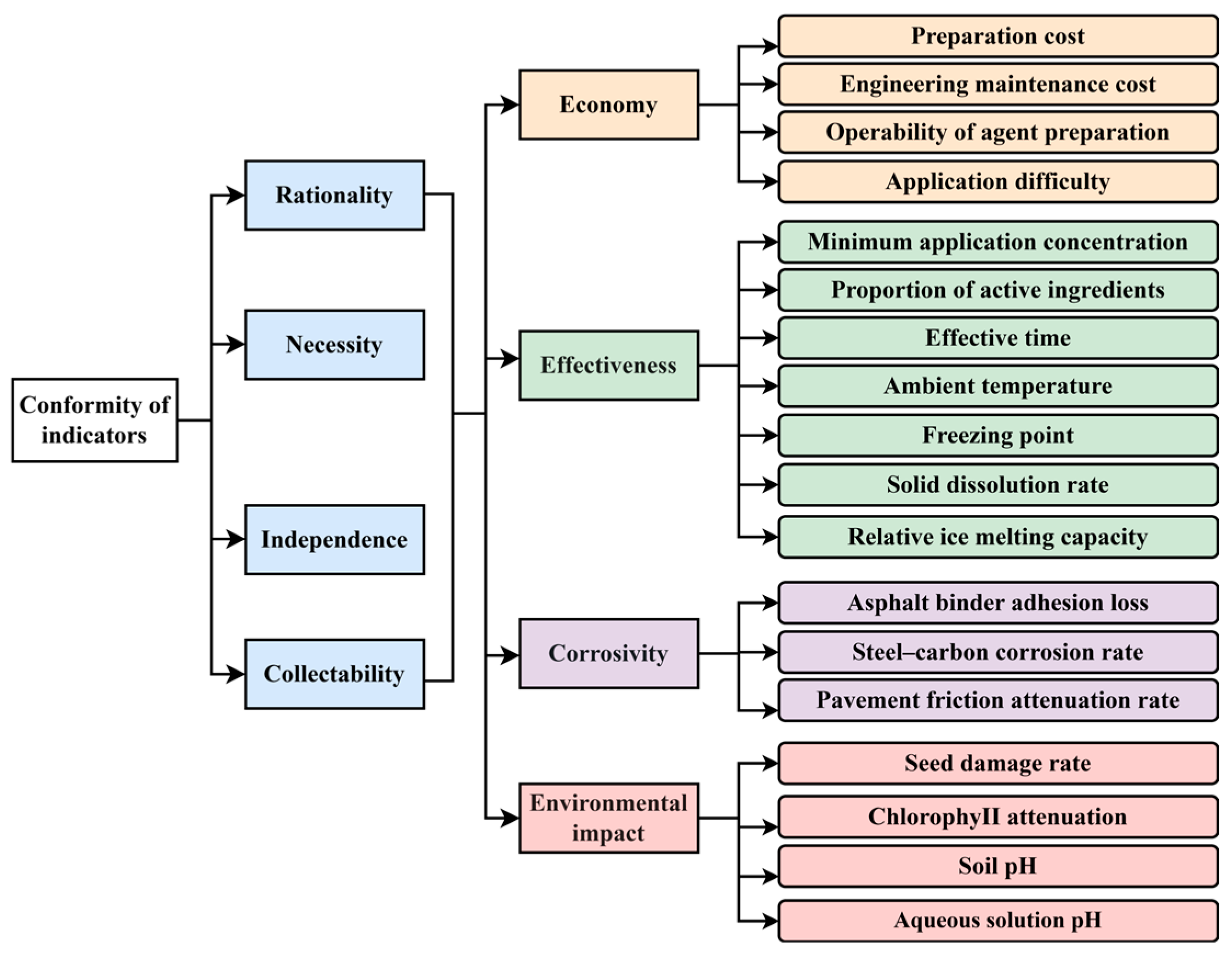
Finally, based on the performance indicators that need to be tested and inspected for deicer in practical applications as specified in industry norms, standards and related papers, the indicator compliance of the already screened performance indicators is further verified, and 18 final performance indicators of deicers are selected: preparation cost, engineering maintenance cost, operability of agent preparation, application difficulty, asphalt binder adhesion loss, minimum application concentration, proportion of active ingredients, effective time, ambient temperature, freezing point, solid dissolution rate, relative snow/ice-melting capacity, seed damage rate, chlorophyll attenuation, soil pH, aqueous solution pH, steel–carbon corrosion rate, and pavement friction attenuation rate. A hierarchical analysis structure model was established (Figure 1).

2.3. Determination of Indicator Weight

Given the disparate importance of different indicators to the practical application benefits of deicer, appropriate weighting of evaluation indicators becomes essential. This study employs the AHP as the subjective weighting method, chosen for its capability to fairly assess performance rather than merely emphasize result rankings. The weighting procedure follows three systematic steps: establishing a hierarchical structure, constructing judgment matrices, and calculating indicator weights, with reference to relevant standards and the literature. Finally, consistency testing of the judgment matrices ensures the rationality of the weight calculation outcomes.
Based on the performance system framework developed through the aforementioned indicator collection and screening processes, we established the hierarchical structure for evaluating deicer performance as presented in Table 3.
The relative importance between each pair of performance indicators was assessed using a 1–9 scaling method to construct judgment matrices [25]. The judgment matrices were constructed by a panel of five experts: two professors in transportation environmental engineering, two senior engineers from a provincial highway maintenance authority, and one winter maintenance operations manager, each with over ten years of professional experience in deicer application or environmental impact assessment. Individual pairwise comparisons were collected independently via structured questionnaires. Where disagreement among experts exceeded one scale point, a moderated discussion was held to reach consensus. The aggregated judgment matrices were used for weight calculation. The consistency ratio (CR) for all seven judgment matrices (one for the overall goal, six for the sub-criteria) ranged from 0.008 to 0.072, all below the 0.1 threshold (Tables S2–S8 in the Supplementary Materials).
Following the calculation of individual indicator weights at each level, the comprehensive weight reflecting each performance indicator’s overall impact on urban infrastructure and environment was determined by multiplying its respective weight with that of its parent criterion. The resulting weights are presented in Table 4. As shown in the table, C14 (soil pH change) and C15 (solution pH) exhibit a moderate positive correlation with a correlation coefficient of approximately 0.62, which is consistent with the findings of previous studies. The two indicators reflect environmental impacts at different temporal scales: solution pH characterizes the immediate chemical aggressiveness of deicers toward infrastructure and biota upon direct contact, while soil pH change represents the long-term cumulative alteration effect on the soil environment. C12 (seed damage rate) and C13 (chlorophyll attenuation rate) are moderately correlated (r ≈ 0.55) but represent different physiological endpoints (germination inhibition vs. photosynthetic impairment), and both are commonly required in phytotoxicity assessments. C16 (steel–carbon corrosion rate) and C17 (pavement friction attenuation rate) show a weak correlation (r < 0.3), indicating that they characterize mutually independent damage mechanisms of infrastructure.
Compared with the results in Table 2, it is found that the corrosion-related indicators obtained by both AHP and EWM present relatively high weights, including the carbon steel corrosion rate and pavement friction attenuation rate. Meanwhile, the environmental impact indicators of deicers assigned by the expert panel also obtain high weights. This reflects the experts’ emphasis on economic feasibility and ecological safety, and further verifies the superiority of the AHP method.

2.4. Preparation of Evaluation Criteria

The formulation of evaluation criteria is essential for establishing a comprehensive assessment system. To enable quantitative evaluation of various deicer performance indicators, we developed standardized criteria with reference to relevant standards and the literature (Table 5) [26,27,28,29]. Given the diverse nature of performance indicators, we classified them into positive and negative categories based on their inherent characteristics. It is worth noting that the deicer cost adopts the normalized cost, which is calculated based on a standard application rate of 40 g/m2 and a reference lane width of 3.75 m. Prior to data aggregation, all indicators undergo a normalization process using a grading method with scores bounded within the [0, 1] interval. This approach ensures comparative and unified scoring criteria while incorporating both the weight analysis results and practical application requirements of deicers. Furthermore, while the current stepwise scoring criteria were adopted for their simplicity and direct traceability to existing standards, the adoption of continuous normalization methods in future iterations of the CDMES could further refine differentiation among closely performing products and reduce boundary-related discontinuities.

2.5. Indicator Aggregation

The deicers subjected to experimental testing were scored through comparative and individual scoring methods according to the aforementioned evaluation criteria, yielding specific evaluation values for different performance indicators. To obtain comprehensive evaluation scores for various deicers, aggregation of the evaluation results from all performance indicators is required. Among numerous indicator aggregation methods, the SAW method stands out as it assigns weights based on data importance, thereby enhancing the representativeness of aggregation results [30]. This method offers two key advantages: high flexibility through dynamic weight adjustment according to data importance to accommodate diverse requirements, and strong anti-interference capability by minimizing the impact of outliers on evaluation outcomes. Since the weight proportions of all indicators have been determined through the abovementioned calculations, the SAW method was adopted for aggregating the performance indicators of deicers and computed using the following formula:
H = i = 1 m w i × q i
In the equation, H represents the comprehensive evaluation value of the performance of a certain deicer based on the constructed indicator evaluation system; m represents the number of indicators; wi represents the weight of the deicer indicator xi; and qi represents the evaluation value of a certain deicer indicator xi based on the constructed evaluation criteria.
The comprehensive evaluation values are graded, and the specific evaluation values and their corresponding results are shown in Table 6.
Acknowledging that the SAW method permits compensatory trade offs that may obscure critical individual deficiencies, a threshold-based disqualification rule is imposed prior to the weighted aggregation. The following indicators are designated as non-compensatory: ambient temperature (C8), steel–carbon corrosion rate (C16), and relative seed damage rate (C12). If any of these indicators receives a score of zero under the criteria in Table 5, the deicer is automatically classified as ‘Fail’ regardless of its overall weighted score. This override ensures that products posing acute risks—such as highly alkaline runoff, severe metal corrosion, or intolerable phytotoxicity—are excluded from consideration irrespective of their economic or operational merits.
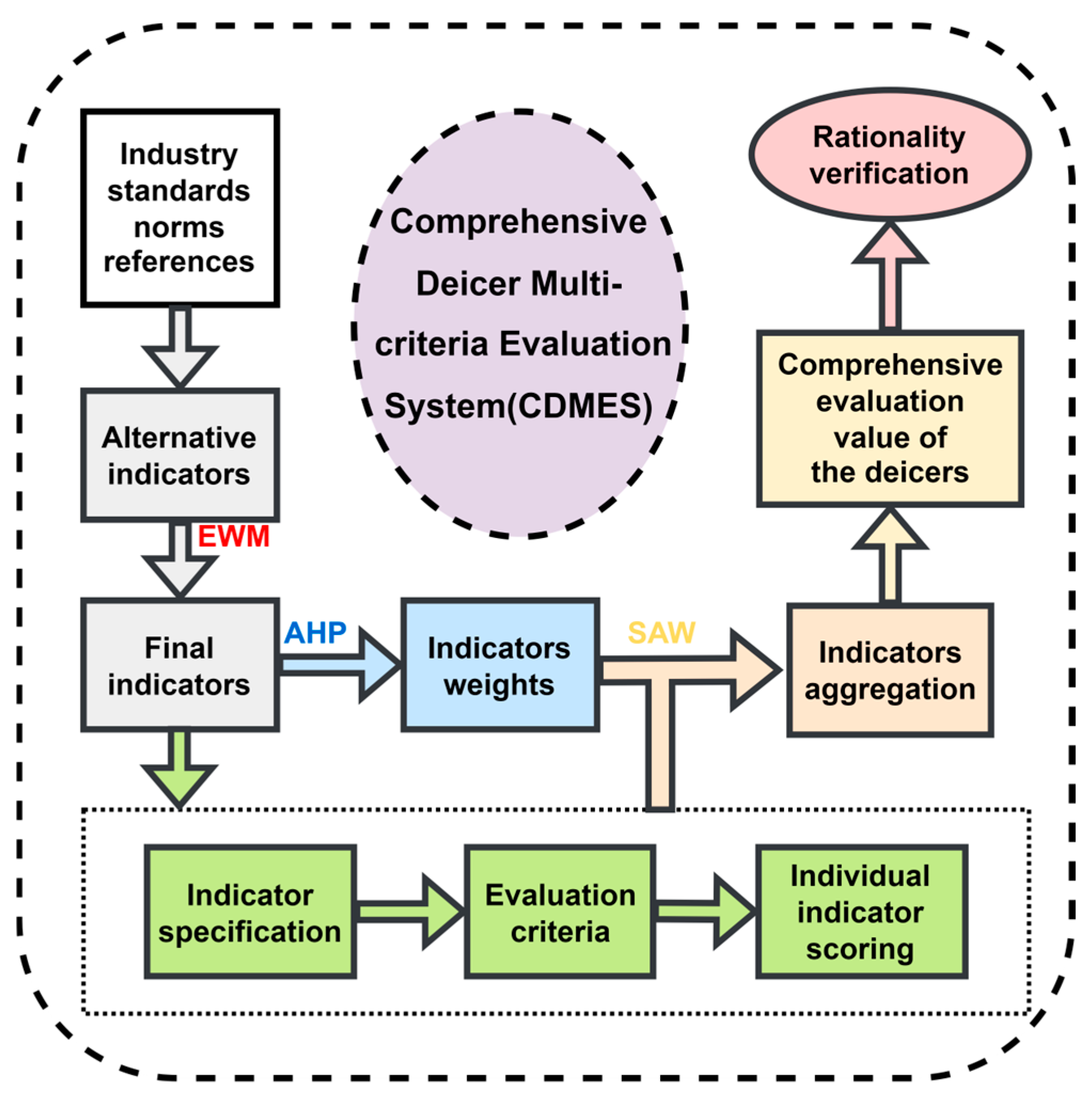
In conclusion, a multivariate coupled-clustering quantitative evaluation model was established based on the MCDA method. The modeling process proceeds as follows. Firstly, redundant indicators are screened through the four principles and the EWM. Subsequently, the AHP is reapplied to determine indicator weights, and evaluation criteria are established with reference to relevant specifications and the literature. Finally, the SAW method is employed to aggregate the scores of all indicators. Based on this modeling process, the new evaluation system has been defined as the “Comprehensive Deicer Multi-criteria Evaluation System (CDMES)”. Figure 2 presents the flowchart of the comprehensive deicer evaluation system.

3. Verification of the CDMES

To verify the rationality of the established comprehensive evaluation system for deicers, three typical agents were selected for validation: NaCl, a composite deicer (main components: NaCl, CaCl2, CH4N2O, et al.), and an organic agent (main components: CH3COOK:CH3COONa = 1:1). Under identical experimental conditions, the performance indicators of deicers were determined, with additional parameters obtained from the relevant literature. Using the CDMES, all 18 indicators of deicers were scored according to the established criteria, and comprehensive evaluation values were calculated to derive final performance rankings. Physical images of the three deicers are shown in Figure S1 (physical appearance is not a scored indicator).

3.1. Evaluation and Verification

3.1.1. Method for Obtaining Indicator Parameters of Deicers

The measurement methods for indicators, including freezing point, solid dissolution rate, relative ice-melting capacity, relative seed damage rate, carbon steel corrosion rate, and pavement friction attenuation rate, refer to the Chinese national standard “Snow-melting agent GB/T 23851-2017” [29]. The pH value of the deicer solution, the amount of chlorophyll attenuation, and the change in soil pH value are determined based on the experimental results in the references and standard methods.

3.1.2. Evaluation Results

The determination results of the index parameters of the three deicers are shown in Table 7 (within the test environmental context (−10 °C), all three deicers are within their operational temperature range).
Based on the established quantitative evaluation model, the three tested deicers were assessed using the calculated weights, revealing distinct performance characteristics. The organic deicer achieved the highest comprehensive score, 0.69, closely followed by sodium chloride, 0.68, both attaining medium grade ratings, while the composite deicer scored 0.64, meeting the passing threshold. Analysis indicates that the composite deicer’s elevated preparation and maintenance costs were the primary factors limiting its overall performance, despite demonstrating comparable technical effectiveness to the other agents. Both the organic agent and sodium chloride showed acceptable overall performance while exhibiting particular limitations in specific aspects. These findings suggest that cost optimization should be prioritized for composite deicer, whereas the other two agents would benefit from targeted improvements in their respective technical shortcomings.
In conclusion, the evaluation system enables the identification of strengths and weaknesses across different deicers through their performance scores. It quantitatively reflects their practical application benefits while facilitating the proposal of systematic improvement strategies. This approach allows for targeted enhancements in agent performance and reduction in environmental and infrastructural impacts, thereby offering theoretical support for optimization methodologies.

4. Conclusions

This study successfully establishes the CDMES, a novel framework based on MCDA for the holistic assessment of deicers. The system integrates a comprehensive set of 18 performance indicators spanning the critical dimensions of economy, effectiveness, environmental impact, and corrosivity. Initial indicator screening is conducted through EWM combined with four principles to establish an evaluation indicator system. Subsequently, AHP is used to determine indicator weights, and finally, a quantitative evaluation model is constructed, with the simple additive weighting (SAW) method applied to aggregate indicator scores.
Validation of the CDMES using three typical deicers—sodium chloride, a composite deicer, and an organic formulation—demonstrated its practical applicability and effectiveness. The results quantitatively differentiated the comprehensive performance of each deicer and identified the specific strengths and weaknesses of each. The organic agent achieved the highest score of 0.69, followed closely by sodium chloride at 0.68, both rated as “medium,” while the composite deicer scored lower at 0.64, meeting the “pass” threshold primarily due to its higher economic costs.
The primary contribution of this research is the development of a standardized, rational, and systematic evaluation tool that enables winter maintenance managers to make informed, evidence-based decisions regarding deicer selection and application strategy. We note that the CDMES integrates existing individual MCDA methods to address domain-specific challenges, rather than proposing a new algorithm. The value of the CDMES lies not in algorithmic novelty, but in its structured integration that fills critical gaps in indicator coverage, screening logic, and decision robustness for deicer assessment.
Several limitations should be noted. Validation was limited to three deicers under laboratory conditions. The AHP method involves expert subjectivity. The environmental assessment is indicative rather than definitive, and certain durability metrics are not yet included. Future work will expand validation datasets, integrate long-term ecological data, and conduct field trials.

Supplementary Materials

The following supporting information can be downloaded at https://www.mdpi.com/article/10.3390/su18104917/s1. The Supplementary Materials include the AHP judgment matrices and consistency ratios for the overall goal and sub-criteria (Tables S1–S8), and photographs showing the physical appearance of the three tested deicers (Figure S1). Figure S1: Physical images of deicers: (a) NaCl; (b) composite deicer (main components: NaCl, CaCl2, CH4N2O, et al.); (c) organic deicer (main components: CH3COOK:CH3COONa = 1:1); Table S1: Deicer indicator data matrix; Table S2: Judgment matrix of the first-level A; Table S3: Judgment matrix of the second-level B1; Table S4: Judgment matrix of the second-level B2; Table S5: Judgment matrix of the second-level B3; Table S6: Judgment matrix of the second-level B4; Table S7: Judgment matrix of the second-level B5; Table S8: Judgment matrix of the second-level B6.

Author Contributions

A.L.: Writing—review and editing, Writing—original draft, Methodology, Investigation, Data curation, Formal analysis. T.M.: Writing—review and editing, Writing—original draft, Data curation, Investigation. S.S.: Writing—review and editing, Supervision, Methodology. J.Z.: Writing—review and editing, Supervision. X.Z.: Writing—review and editing, Methodology, Conceptualization, Funding acquisition, Formal analysis. All authors have read and agreed to the published version of the manuscript.

Funding

This research was funded by [the Construction of High-Level Teaching Teams in Universities of Beijing—the Youth Top-Notch Talent Cultivation Program] grant number [CIT&TCD201804051] and [the BUCEA Post Graduate Innovation Project] grant number [PG2025082].

Institutional Review Board Statement

Ethical review and approval were waived for this study by Institution Committee as per the “Measures for Ethical Review of Life Sciences and Medical Research Involving Human Subjects” issued by the National Health Commission of China (2023); research involving anonymous professional expert consultation without collection of personal privacy or sensitive data is not considered “research involving human subjects” that requires formal ethical committee review. Based on this provision, our institution does not require IRB approval or an exemption letter for this category of non-interventional expert consultation.

Informed Consent Statement

Informed consent for participation was obtained from all subjects involved in the study.

Data Availability Statement

The original contributions presented in this study are included in the article/Supplementary Materials. Further inquiries can be directed to the corresponding author.

Conflicts of Interest

The authors declare no conflict of interest.

References

  1. Zhou, J.Z.; Han, L.Q.; Liu, A.H.; Tu, D.H.; Chen, Y.H.; Xu, X.P. The research and summary of road deicing methods. Adv. Mater. Res. 2014, 955–959, 1835–1839. [Google Scholar] [CrossRef]
  2. Godwin, K.S.; Hafner, S.D.; Buff, M.F. Long-term trends in sodium and chloride in the Mohawk River, New York: The effect of fifty years of road-salt application. Environ. Pollut. 2003, 124, 273–281. [Google Scholar] [CrossRef]
  3. Van Meter, K.J.; Ceisel, E. Road salt legacies: Quantifying fluxes of chloride to groundwater and surface water across the Chicago Metropolitan Statistical Area. Water Resour. Res. 2024, 60, e2023WR035964. [Google Scholar] [CrossRef]
  4. Rekuviene, R.; Saeidiharzand, S.; Mažeika, L.; Samaitis, V.; Jankauskas, A.; Sadaghiani, A.K.; Gharib, G.; Muganlı, Z.; Koşar, A. A review on passive and active anti-icing and de-icing technologies. Appl. Therm. Eng. 2024, 250, 123474. [Google Scholar] [CrossRef]
  5. Wåhlin, J.; Klein-Paste, A. Chemical melting of ice: Effect of solution freezing point on the melting rate. Transp. Res. Rec. 2016, 2551, 111–117. [Google Scholar] [CrossRef]
  6. Gruber, M.R.; Hofko, B.; Hoffmann, M.; Stinglmayr, D.; Seifried, T.M.; Grothe, H. Deicing performance of common deicing agents for winter maintenance with and without corrosion-inhibiting substances. Cold Reg. Sci. Technol. 2023, 208, 103795. [Google Scholar] [CrossRef]
  7. Kolesar, K.R.; Mattson, C.N.; Peterson, P.K.; May, N.W.; Prendergast, R.K.; Pratt, K.A. Increases in wintertime PM2.5 sodium and chloride linked to snowfall and road salt application. Atmos. Environ. 2018, 177, 195–202. [Google Scholar] [CrossRef]
  8. Mihandoust, M.; Ghabchi, R. Multiscale evaluation of asphalt binder-aggregate interface exposed to sodium chloride deicer. Int. J. Pavement Eng. 2024, 25, 2151262. [Google Scholar] [CrossRef]
  9. Fee, A.; Martin, T.; Cicchetti, L.; Manoel, P.S.; Arnott, S.E. Eco-friendly road deicers may not be so friendly: Assessing the toxicity of beet-juice brine and potassium chloride to Daphnia pulicaria. Environ. Toxicol. Chem. 2025, 44, 2089–2097. [Google Scholar] [CrossRef]
  10. Ullah Sajid, H.; Naik, D.L.; Kiran, R. Improving the ice-melting capacity of traditional deicers. Constr. Build. Mater. 2021, 271, 121527. [Google Scholar] [CrossRef]
  11. Wang, D.; Zhu, Q.; Su, Y.; Li, J.; Wang, A.; Xing, Z. Preparation of MgAlFe-LDHs as a deicer corrosion inhibitor to reduce corrosion of chloride ions in deicing salts. Ecotoxicol. Environ. Saf. 2019, 174, 164–174. [Google Scholar] [CrossRef]
  12. Wang, J.; Song, S.; Guo, M.; Shao, J. Study on the preparation and performance evaluation of a new high efficiency and environmental protection economic snow melting agent. In Proceedings of the 3rd IEEE International Conference on Intelligent Transportation Engineering (ICITE), Singapore, 3–5 September 2018; pp. 245–249. [Google Scholar]
  13. Wu, W.; Yin, Z.; Zhang, A.; Li, X. A study of the optimizing choice of deicing salt based on AHP. Ecol. Econ. 2013, 8, 161–164. [Google Scholar]
  14. Jungwirth, S.; Shi, X. Laboratory investigation of naturally sourced liquid deicers and subsequent decision support. J. Cold Reg. Eng. 2017, 31, 04017001. [Google Scholar] [CrossRef]
  15. Ke, G.; Zhang, J.; Tian, B. Evaluation and selection of de-icing salt based on multi-factor. Materials 2019, 12, 912. [Google Scholar] [CrossRef] [PubMed]
  16. Chen, X.; Zhang, Y.; Dan, Y. Comprehensive evaluation method for the impacts of chloride-based snow-melting agents on highway traffic infrastructure and the environment. Highway 2016, 61, 260–262. [Google Scholar]
  17. Hoffmann, M.; Gruber, M.; Hofko, B.; Stinglmayr, D.; Seifried, T.; Grothe, H.; Schoen, A. Winterlife: Effective, sustainable and non-corrosive deicing agents in winter maintenance. In Proceedings of the XVI World Winter Service and Road Resilience Congress, PIARC, Calgary, AB, Canada, 7–11 February 2022. [Google Scholar]
  18. Zhang, W.; Hu, J.; Wang, Z.; Liu, W.; Wei, W.; Li, P. Research, development and performance evaluation on efficient chlorinated snow-melting agent. J. Highw. Transp. Res. Dev. 2025, 42, 87–96. [Google Scholar] [CrossRef]
  19. Guo, M.J.; Kovalskiy, V.P.; Nian, T.F.; Li, P. Influence of deicer on water stability of asphalt mixture under freeze-thaw cycle. Sustainability 2023, 15, 13707. [Google Scholar] [CrossRef]
  20. Haselbach, L.; Almeida, N.; Ross, M. Pervious concrete chemical degradation by calcium chloride deicer. J. Cold Reg. Eng. 2021, 35, 04020030. [Google Scholar] [CrossRef]
  21. Mihandoust, M.; Ghabchi, R. Magnesium chloride deicer and asphalt: A multiscale approach to adhesion and damage characterisation. Road Mater. Pavement Des. 2025, 26, 2563–2587. [Google Scholar] [CrossRef]
  22. Soundararajan, P.; Manivannan, A.; Ko, C.H.; Park, J.E.; Jeong, B.R. Evaluation of relative toxicity caused by deicing agents on photosynthesis, redox homeostasis, and the osmoregulatory system in creeper-type plants. Hortic. Environ. Biotechnol. 2019, 60, 175–186. [Google Scholar] [CrossRef]
  23. Janssen, E.; Johnson, S.A.; Glass, N.; Dickerson, P.; Whelan, C.J.; Molano-Flores, B. Impacts of road salt on seed germination of Thuja occidentalis found in natural communities adjacent to the Illinois Tollway in northeastern IL, USA. Botany 2024, 102, 340–348. [Google Scholar] [CrossRef]
  24. Odu, G. Weighting methods for multi-criteria decision-making technique. J. Appl. Sci. Environ. Manag. 2019, 23, 1449–1457. [Google Scholar] [CrossRef]
  25. Saaty, T.L. A scaling method for priorities in hierarchical structures. J. Math. Psychol. 1977, 15, 234–281. [Google Scholar] [CrossRef]
  26. Caplan, J.S.; Salisbury, A.B.; McKenzie, E.R.; Behbahani, A.; Eisenman, S.W. Spatial, temporal, and biological factors influencing plant responses to deicing salt in roadside bioinfiltration basins. J. Environ. Manag. 2024, 359, 120761. [Google Scholar] [CrossRef]
  27. Liu, J.; Shi, X.; Fay, L. Snow and Ice Treatment Products Evaluation: Performance, Corrosion, and Environmental Impacts; Technical Report; Transportation Research Record 2021; SAGE: Thousand Oaks, CA, USA, 2021. [Google Scholar]
  28. Skelton, E.H.; Terry, L.; Amirkhanian, A. Novel SHRP method showed alternative deicers outperform NaCl brine for certain winter roadway maintenance applications. J. Environ. Manag. 2022, 320, 115879. [Google Scholar] [CrossRef]
  29. GB/T 23851-2017; Snow-melting agent. General Administration of Quality Supervision, Inspection and Quarantine of the People’s Republic of China, Standardization Administration of the People’s Republic of China: Beijing, China, 2017.
  30. Demircioğlu, M.E.; Ulukan, H.Z.; Kahraman, C. A novel hybrid approach based on intuitionistic fuzzy multi-criteria group decision-making for environmental pollution problem. J. Intell. Fuzzy Syst. 2020, 38, 1013–1025. [Google Scholar] [CrossRef]
Figure 1. Hierarchy analysis structure model diagram.
Sustainability 18 04917 g001
Figure 2. Establishment of the Comprehensive Deicer Multi-criteria Evaluation System (CDMES).
Sustainability 18 04917 g002
Table 1. Evaluation indicator elements corresponding to each category.
CategoryMain Elements
EconomyMainly examines the material cost, preparation cost, operational cost, etc., of deicer
EffectivenessMainly examines the ice-melting chemical properties of the deicer itself
CorrosivenessMainly examines the corrosion intensity of deicer on infrastructure such as roads and metals
Environmental impactMainly examines the harm of the use of deicer to plants, soil, the water environment and microorganisms around roads.
Table 2. EWM-based indicator weight calculation results.
NumberIndicatorFinal Weight (W)
1Price0.1148
2Freezing point0.0501
3Relative snow/ice-melting capacity0.0992
4Solid dissolution rate0.0682
5Ice-melting rate0.1156
6Carbon steel corrosion rate0.0186
7Corrosion rate0.1362
8Concrete mass loss rate0.1230
9Wet road surface friction attenuation rate0.1811
10Solution pH0.0567
11Relative plant species damage rate0.0566
Table 3. Hierarchical structure of the deicer indicator system.
Level 1deicers (A)
Level 2economy (B1)operability
(B2)
comprehensive performance application technology (B3)snow- and ice-melting performance (B4)impact on the environment (B5)impact on urban infrastructure (B6)
Level 3preparation cost (C1)preparation operability (C3)deicer concentration (C5)freezing point (C9)relative seed damage rate (C12)steel–carbon corrosion rate (C16)
engineering maintenance cost (C2)difficulty of application operation (C4)proportion of components (C6)solid dissolution rate (C10)chlorophyll attenuation rate (C13)pavement friction attenuation rate (C17)
application time (C7)relative capacity (C11)soil pH value (C14)asphalt binder adhesion loss(C18)
ambient temperature (C8) aqueous solution pH value (C15)
Table 4. Final weights of performance indicators.
NumberIndicatorFinal Weight (W)
C1Cost of deicer preparation0.0968
C2Engineering maintenance cost0.0321
C3Operability of deicer preparation0.0322
C4Difficulty of deicer application operation0.0107
C5Concentration of deicer0.0128
C6Proportion of components0.0309
C7Application time0.0124
C8Ambient temperature0.0520
C9Freezing point0.0453
C10Solid dissolution rate0.0136
C11Relative snow- and ice-melting capacity0.0249
C12Relative seed damage rate0.1069
C13Chlorophyll attenuation rate0.0636
C14Change in soil pH value0.0366
C15Solution pH value0.0217
C16Steel–carbon corrosion rate0.2805
C17Pavement friction attenuation rate0.0931
C18Asphalt binder adhesion loss0.0528
Table 5. Evaluation criteria for deicers indicators.
NumberIndicatorScoring Criteria
C1Cost of deicer preparation<12 $/lane-km, 1 point; 12–53 $/lane-km, 0.5 points; >53 $/lane-km, 0 points
C2Engineering maintenance cost<420 $/ton, 1 point; 420–840 $/ton, 0.5 points; >840 $/ton, 0 points
C3Operability of deicer preparationEasy, 1 point; generally 0.5 points; trouble, 0 points
C4Difficulty of deicer application operationEasy, 1 point; generally 0.5 points; trouble, 0 points
C5Concentration of deicerConsistent with practical requirements, 1 point; inconsistent with practical requirements, 0 points
C6Proportion of componentsMaximization of deicer performance, 1 point; the performance of the deicer is not maximized, 0 points
C7Application time≤30 min, 1 point; 30 min–60 min, 0.5 points; ≥60 min, 0 points
C8Ambient temperatureApplicable, 1 point; non-applicable, 0 points
C9Freezing pointConsistent with practical requirements, 1 point; inconsistent with practical requirements, 0 points
C10Solid dissolution rate≥6.0, 1 point; 3.0–6.0, 0.5 points; ≤3.0, 0 points
C11Relative snow- and ice-melting capacity≥90% 1 point; 50–90%, 0.5 points; ≤50%, 0 points
C12Relative seed damage rate≤50%, 1 point; ≥50%, 0 points
C13Chlorophyll attenuation rate≤10%, 1 point; 10–40%, 0.5 points; ≥40%, 0 points
C14Change in soil pH value6.5–8.5, 1 point; 5.5–6.5, 8.5–9.5, 0.5 points; ≥9.5 ≤ 5.5, 0 points
C15Solution pH value6.0–10, 1 point; <6.0 or >10.0, 0 points
C16Steel–carbon corrosion rate≤0.11, 1 point; 0.11–0.25, 0.5 points; ≥0.25, 0 points
C17Pavement friction attenuation rate≤10%, 1 point; 10–30%, 0.5 points; ≥30%, 0 points
C18Asphalt binder adhesion loss≤5%, 1 point; 5–15%, 0.5 points; ≥15%, 0 points
Table 6. Comparison table of comprehensive evaluation values and results of deicers.
NumberComprehensive Evaluation ValueAssessment Result
1H ≥ 0.85excellent
20.75 ≤ H < 0.85good
30.65 ≤ H < 0.75medium
40.60 ≤ H < 0.65pass
Table 7. Determination results of index parameters.
NumberIndicatorNaClComposite DeicerOrganic Deicer
1Cost of deicer preparation11 $/lane-km66 $/lane-km49 $/lane-km
2Engineering maintenance cost280 $/ton900 $/ton800 $/ton
3Operability of deicer preparationEasyGenerallyEasy
4Difficulty of deicer application operationEasyEasyEasy
5Concentration of deicer18%18%18%
6Proportion of components100%NaClNaCl, CaCl2, CH4N2O et al.50% Sodium acetate, 50% Potassium acetate
7Application time30 min30 min30 min
8Ambient temperatureApplicableApplicableApplicable
9Freezing point−19.09 °C−20.22 °C−7.37 °C
10Solid dissolution rate3.798.3926.37
11Relative snow- and ice-melting capacity100%98.92%146.82%
12Relative seed damage rate47.74%11.97%28.07%
13Chlorophyll attenuation rate37.57%8.29%8.84%
14Change in soil pH value8.2348.4788.904
15Solution pH value6.70510.59510.015
16Steel–carbon corrosion rate0.23 mm/a0.22 mm/a0.16 mm/a
17Pavement friction attenuation rate31%20%15%
18Asphalt binder adhesion loss21%10%3%
Disclaimer/Publisher’s Note: The statements, opinions and data contained in all publications are solely those of the individual author(s) and contributor(s) and not of MDPI and/or the editor(s). MDPI and/or the editor(s) disclaim responsibility for any injury to people or property resulting from any ideas, methods, instructions or products referred to in the content.