Article

Assessment of a Microalgae-Based Biostimulant as a Sustainable Strategy to Overcome Cumin (Cuminum cyminum L.) Seed Dormancy and Enhance Germination

Laboratory of Water Sciences, Microbial Biotechnologies, and Sustainability of Natural Resources, Department of Biology, Faculty of Sciences Semlalia, Cadi Ayyad University UCA, Av. Prince Moulay Abdellah, Marrakesh 40000, Morocco
*
Author to whom correspondence should be addressed.
Sustainability 2026, 18(10), 4923; https://doi.org/10.3390/su18104923
Submission received: 12 April 2026 / Revised: 10 May 2026 / Accepted: 12 May 2026 / Published: 14 May 2026

Abstract

Microalgae-based biostimulants are gaining increasing interest worldwide for promoting sustainable agriculture. The environmental risks associated with synthetic agrochemicals can be mitigated by using microalgae to enhance crop yield and quality. Cumin (Cuminum cyminum L.) is an herbaceous plant and ranks among the most popular seed spices worldwide. It is characterized by a low germination rate and poor seedling establishment, which negatively impact overall crop yield. To address these challenges, the present study investigates the potential of Chlorococcum sp. aqueous extract as a sustainable and cost-effective solution to overcome cumin seed dormancy and enhance germination. Results showed that Chlorococcum sp. exhibits a notably rapid growth rate (0.45 day−1) and high biomass productivity (1.51 g/L/day). Additionally, the biochemical composition of the extract revealed a high concentration of bioactive compounds, including polyphenols (63.46%), flavonoids (29.36%), and Indole-3-acetic acid (5.38%), which make it an eco-friendly biostimulant for agricultural applications. Regarding germination, a single seed treatment with doses of 0.5 g/L and 1 g/L was efficient in achieving final germination percentages of 100% and 96.66%, respectively, and significantly increased the seedling vigor index and photosynthetic pigment content. Furthermore, these concentrations stimulated the synthesis and accumulation of key primary metabolites, including proteins and polysaccharides, while increasing phenolic and flavonoid levels compared to the control, suggesting enhanced growth and improved antioxidant defenses against environmental stressors. Overall, these findings highlight that Chlorococcum sp. aqueous extract serves as an innovative biological approach to overcoming cumin seed dormancy and enhancing germination, offering an alternative and sustainable solution to conventional synthetic fertilizers.

1. Introduction

Cumin (Cuminum cyminum L.) is an herbaceous plant from the Apiaceae family and a valuable spice crop widely cultivated in diverse environments, particularly in arid and semi-arid regions [1]. It is the second most popular seed spice with significant industrial value, known for its characteristic aroma, nutritional composition, and organic acid content [2,3,4].
Recently, increasing attention has been paid to cumin growth and crop yield [5]. However, successful crop establishment fundamentally depends on key germination parameters, including the germination percentage, emergence rate, and seedling vigor. These factors are crucial for enhancing overall seed quality and plant performance [6], particularly in the Apiaceae family, where seeds possess underdeveloped (small but differentiated) embryos [7]. This characteristic frequently results in morphological or morphophysiological dormancy within this plant family [2,7,8]. Moreover, low seed vigor represents a major challenge for cumin production, leading to high sensitivity to environmental stresses [9].
The germination stage is a critical biological phase of seeds and a precondition for successful crop production [10]. Therefore, advancing our understanding of cumin germination and its enhancement is essential. Various methods have been investigated to break seed dormancy and improve seed vigor in cumin, including chemical [7], physical [5], and magnetic [11] treatments. Despite their effectiveness, these methods have major drawbacks, such as environmental pollution due to chemical residues, operational costs, and time-consuming procedures [5]. Consequently, increasing attention has shifted toward sustainable alternatives. In this context, biostimulants have emerged as a promising solution, and microalgal extracts are recognized as one of the most powerful sources. These natural extracts contain complex bioactive compounds that promote plant growth, support development, and improve resistance to abiotic stress [12].
Microalgae comprise multiple photosynthetic organisms that use sunlight and CO2 to synthesize a broad range of metabolites. As a major component of phytoplankton, these microorganisms occupy surface waters and remain suspended in the water column, where they contribute significantly to the preservation of ecosystem equilibrium [13]. Their role extends beyond ecosystem functions. Indeed, numerous studies have explored their applications in aquaculture, biofuels, animal feed, and waste bioremediation, as well as the pharmaceutical and cosmeceutical industries [14]. In agriculture, microalgae have been investigated to enhance soil fertility, plant growth, and improve crop protection, thereby providing an alternative to lower dependency on chemical inputs [15]. Despite this growing recognition in the agricultural field, most studies have focused more on marine and freshwater microalgae species, while less attention has been given to terrestrial microalgae [12]. Aqueous extracts of microalgae have shown significant potential as biostimulants, enhancing seed germination, seedling vigor, and overall plant performance. This efficacy is largely attributed to their rich biochemical content, including phytohormones, amino acids, vitamins, and bioactive metabolites, which can elicit pronounced physiological responses in plants, even at low concentrations [16]. In this study, Chlorococcum sp. was selected as a promising candidate based on several favorable criteria documented in the literature, including robust growth [17], strong environmental adaptability [18,19], and a biochemical profile characterized by the presence of a diverse array of bioactive compounds [20]. Despite these advantages, to the best of our knowledge, the potential of Chlorococcum sp. aqueous extract as a biostimulant for cumin seeds remains unexplored. Therefore, the present research aims to investigate the impacts of multiple concentrations of Chlorococcum sp. aqueous extract as a sustainable strategy to overcome cumin seed dormancy and enhance germination.

2. Materials and Methods

2.1. Chlorococcum sp. Cultivation and Growth Monitoring

The microalgal strain Chlorococcum sp., identified under the code MACC-GA00064, was provided by the Marrakesh Algal Culture Collection (MACC), Faculty of Sciences Semlalia, Cadi Ayyad University, Marrakesh, Morocco. Cultivation was performed in liquid Z8 mineral medium [21] using Erlenmeyer flasks of 500 mL under laboratory conditions (maintained at 25 ± 2 °C, light intensity of 62 μmol photons m−2 s−1, a light/dark cycle of 15 h/9 h, and continuous aeration).
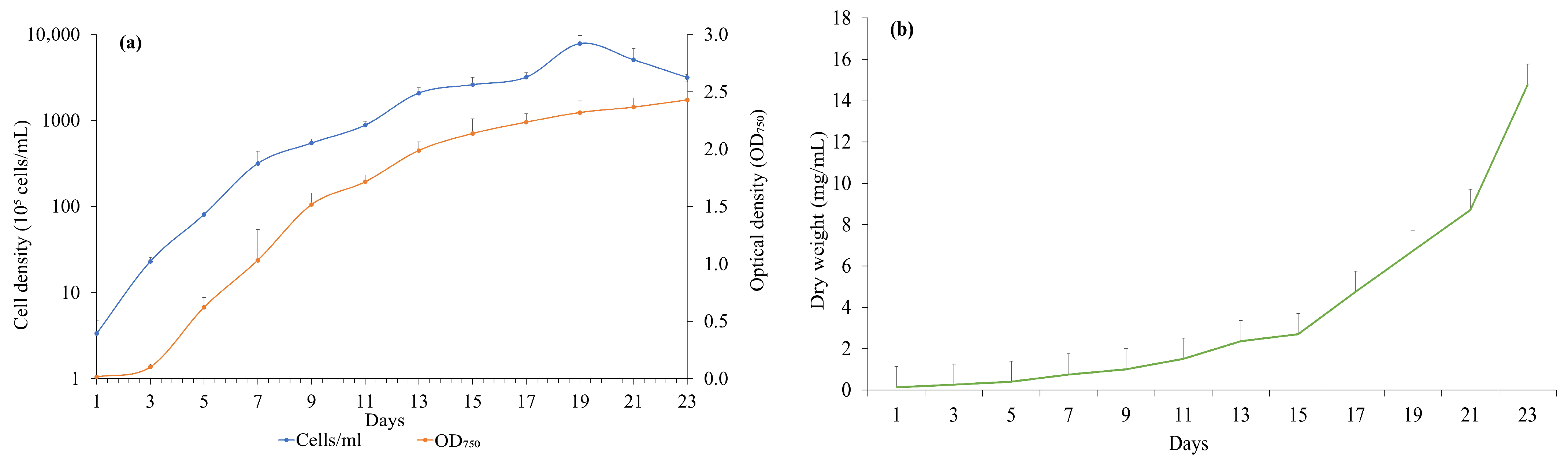
To determine the growth kinetics of the strain, monitoring was carried out at 48-h intervals over a 23-day period. Optical density (OD) was determined at 750 nm to measure the absorbance corresponding to the turbidity caused by microalgal cells in suspension using a UV–Visible spectrophotometer (Varian, Cary, 50 Scan, Palo Alto, CA, USA). Cell density was further assessed via direct cell counting under a light microscope at 400× magnification (Motic BA210, Xiamen, China).
The specific growth rate (µ) was determined using the following formula [22]:
μ d a y 1 = ln N 2 / N 1 t 2 t 1
where N1 and N2 denote the cell density at time t1 and t2, respectively.
The doubling time was determined through the equation below [23]:
G T d a y s = ln 2 μ
Biomass productivity was assessed through gravimetric analysis of dry weight (DW) every two days, with each measurement performed in three replicates. For this purpose, algal samples of 10 mL were centrifuged for 10 min at 5000 rpm, followed by a 24-h drying phase at 75 °C until a stable mass was reached [24]:
Biomass productivity PBiomass was determined using the formula below:
P B i o m a s s ( g / L / d a y ) = X 2 X 1 t 2 t 1
where X1 represents the weight measured at the beginning of the culture, which occurs at time t1, and X2 is the weight at the end of the cultivation phase, which is recorded at time t2.

2.2. Biomass Production of the Isolate

To generate an adequate quantity, a batch culture was performed under laboratory conditions outlined above. Once the exponential growth phase had been reached, the culture was centrifuged (Eppendorf Centrifuge 5804R, Hamburg, Germany) at 5000 rpm for 15 min at 4 °C. The recovered pellet was rinsed with sterile distilled water, and finally lyophilized for 24 h (Martin Christ®, Alpha 1–4 LSbasic, Osterode am Harz, Germany) [25].

2.3. Extract Preparation

The extraction was carried out based on a previously described protocol [25], with minor adjustments. In brief, lyophilized microalgal biomass (1 g) was resuspended in 100 mL of sterile distilled water, then maintained on ice and sonicated for 10 min at a frequency of 20 kHz with a Sonifier B-1 (Branson Sonic Power Co., Danbury, CT, USA), followed by vortexing for 2 min. The cycle of sonication-vortexing was performed three times, with each cycle lasting 15 min. The suspension was subsequently centrifuged at 5000 rpm for 10 min at 4 °C. The obtained supernatant was collected, and the crude aqueous extract was stored at −20 °C.

2.4. Quantitative Analysis of the Biochemical Composition of Aqueous Microalgal Extract

Total protein content was quantified by applying the Bradford method [26]. Briefly, 3 mL of Bradford reagent was combined with 100 μL of the extract and left to incubate at 30 °C for 30 min. Absorbance was then read at 595 nm, using bovine serum albumin (BSA) as a reference standard. To assess total polysaccharide content, the phenol-sulfuric acid method outlined by [27] was applied. In short, 0.2 mL of the extract was combined with 1 mL of distilled water, 1 mL of 97% sulfuric acid, and 0.2 mL of 5% phenol. After allowing the mixture to incubate for 20 min at 30 °C, absorbance was read at 485 nm. Total phenolic content was measured using the Folin–Ciocalteu approach [28]. In practice, 2 mL of a 2% sodium carbonate solution was first added to 100 μL of microalgal extract, after which 100 μL of 50% Folin–Ciocalteu phenol reagent was introduced. The mixture was then left for 30 min in the dark at room temperature. Absorbance was subsequently recorded at 710 nm, and results were expressed as milligrams of gallic acid equivalent per gram (mg GAE/g). For total flavonoid quantification, the procedure described by [29] was adopted. Equal volumes (500 μL) of the extract and distilled water were combined with 150 μL of sodium nitrite solution (5%) and aluminum chloride solution (10%). The mixture was incubated for 11 min at room temperature, and 500 μL of sodium hydroxide solution (10 M) was subsequently introduced. Absorbance was finally measured at 510 nm. The concentration of indole-3-acetic acid (IAA) in the microalgal extract was determined using a colorimetric method. Specifically, 2 mL of Salkowski reagent was added to 3 mL of the extract, followed by incubation for 30 min in the darkness. The optical density was measured at 530 nm [30].

2.5. Germination Test

Cumin seeds of a local variety were obtained from a local farmer-supplier. Prior to treatment, seeds were disinfected by soaking in a 1.5% sodium hypochlorite (NaOCl) solution for 1 min, then rinsing three times. In total, 20 homogeneous seeds were placed in each Petri dish lined with two layers of wet germination paper. Four treatment groups were established using different doses of microalgal extract (0.1, 0.5, 1, and 2 g/L), each obtained through the dilution of the crude extract using sterile distilled water. Additionally, a control was performed for comparison using sterile distilled water. Each treatment was performed in triplicate, consisting of three Petri dishes per concentration. All samples were kept in darkness at a constant temperature of 25 ± 1 °C for a period of 14 days. Moisture was maintained throughout the study by adding sterile distilled water regularly. Germination data were recorded daily, and a seed was considered successfully germinated when its radicle reached a minimum length of 2 mm.

2.5.1. Germination Parameters and Biometric Traits

At the end of the experiment (14 days), several germination indices were assessed and calculated according to the equations shown in Table 1.
On the 14th day, seedling biometric data (shoot and root lengths) were determined using a graduated ruler. Fresh biomass was recorded immediately at the end of the germination period, while dry biomass was recorded after drying the seedlings until a constant weight was achieved.

2.5.2. Determination of Photosynthetic Pigment Content

The photosynthetic pigment concentrations were determined according to the method of [34]. Briefly, 5 mL of 95.5% acetone was mixed with 50 mg of leaf tissue from each sample in a glass vial, then kept for 48 h at 4 °C. The optical density was measured at wavelengths of 662, 644, and 470 nm. The contents of chlorophyll a (Chl a), chlorophyll b (Chl b), total chlorophyll (Chl ab), and carotenoids (Cx + c) were derived according to the equations below:
Chl a = 9.784A662 − 0.99A644
Chl b = 21.42A644 − 4.65A662
Chl ab = Chl a + Chl b
Cx + c = (100 × A470 − 1.99Chl a − 63.14Chl b)/214

2.5.3. Biochemical Analysis of Seedlings

For biochemical analysis, 250 mg of seedlings were ground in 5 mL of 80% ethanol, then subjected to centrifugation at 5000 rpm for 10 min at 4 °C. The resulting supernatant was collected to determine polysaccharide content by the phenol-sulfuric acid method [27], protein content via the Bradford method [26], total flavonoid content using the aluminum chloride colorimetric method [29], and total polyphenol content through the Folin–Ciocalteu procedure [28].

2.6. Statistical Analysis

Differences among treatment groups were statistically assessed using one-way analysis of variance (ANOVA), with pairwise comparisons conducted through Tukey’s HSD post hoc test at a significance threshold of p < 0.05. To determine correlations among treatments and parameters, a multivariate analysis was performed based on Principal Component Analysis (PCA). Additionally, Pearson’s coefficient was used to evaluate the relationships among measured variables. To assess the distribution of positive and negative correlations across the applied concentrations, we utilized a heatmap visualization. Germination indices expressed as percentages were arcsine-transformed prior to variance analysis. All statistical analyses were carried out using IBM SPSS Statistics version 27.0.1. Results are expressed as mean ± standard deviation of three replicates, and graphical representations including error bars were created using Microsoft Excel 2021.

3. Results

3.1. Evaluation of Microalgal Growth Kinetics

Chlorococcum sp. growth curves over 23 days, illustrated in Figure 1, are expressed as cell number and optical density. Under suboptimal laboratory conditions, the strain demonstrated efficient performance, achieving a growth rate of 0.45 day−1, a final cell density of 7.84 × 10⁸ cells/mL, and a doubling time of 1.54 days (Table 2). The exponential growth phase occurred between day 3 and day 13. After 18 days of cultivation, the cells began to enter the stationary phase. Furthermore, these findings were complemented by dry weight measurements over 23 days, which indicated a biomass productivity reaching 1.51 g/L/day.

3.2. Biochemical Analysis of Microalgal Aqueous Extract

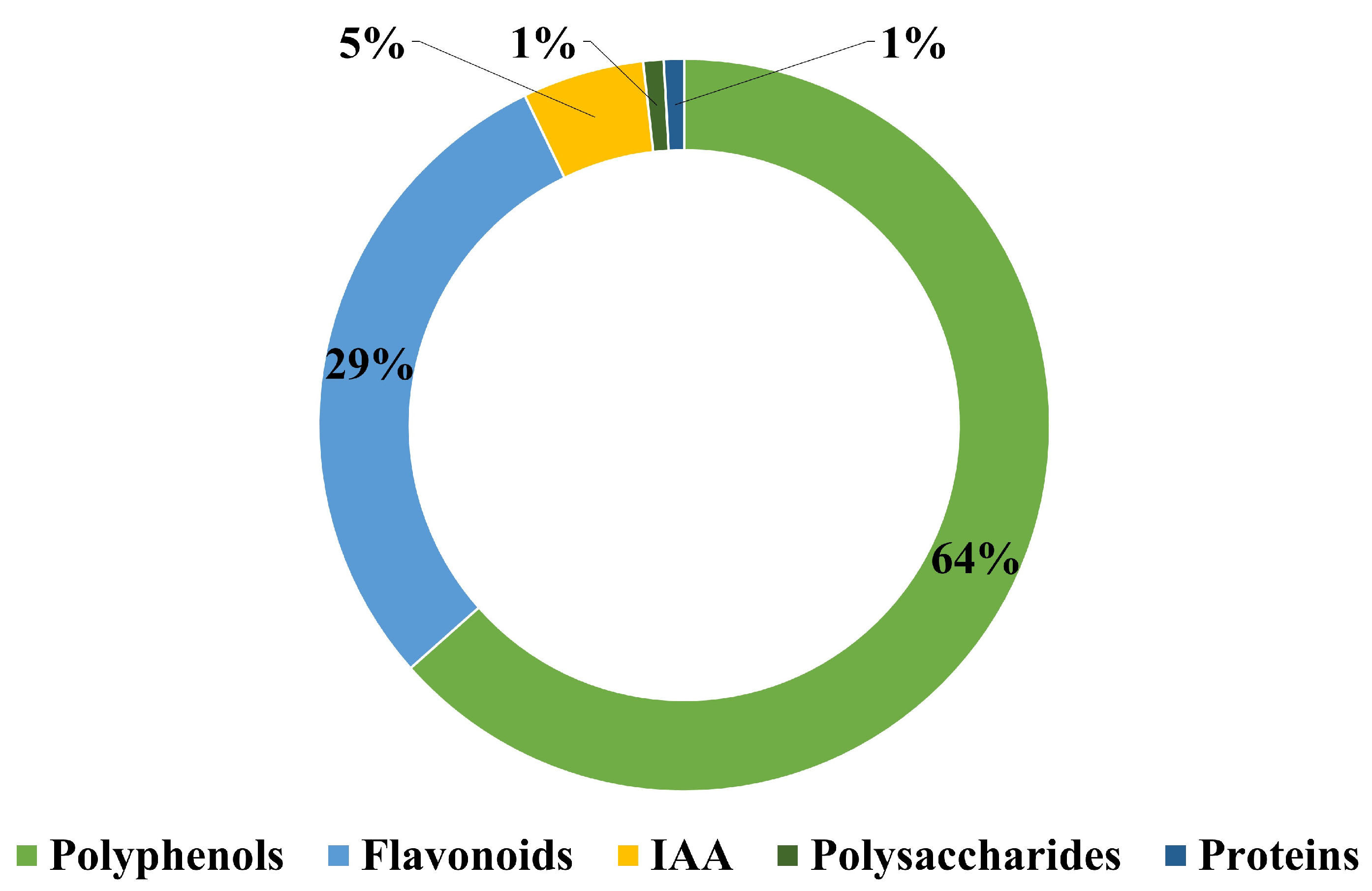
Characterization of Chlorococcum sp. extract revealed a variety of bioactive compounds with potential biostimulant effects, with polyphenols predominating (35.01 ± 2.50 mg/mL), accounting for approximately 63.45% of the total compound composition (Figure 2). Flavonoids comprised 29.36% of the extract. In contrast, IAA was detected in lower amounts (2.97 ± 0.32 mg/mL), representing 5.38% of the extract composition. Polysaccharides (0.49 ± 0.59 mg/mL) and proteins (0.49 ± 0.21 mg/mL) were present only in minor quantities, representing 0.90% and 0.89% of the extract, respectively.

3.3. Evaluation of the Effect of Microalgal Extract on Cumin Germination

The application of microalgal extract generally enhanced cumin seed germination and seedling vigor compared with the control, particularly at moderate concentrations (0.5–1 g/L). The highest final germination percentage (100%) was recorded at 0.5 g/L, followed by (96.66%) at 1 g/L, while the untreated seeds achieved only 83.33% (Table 3).
The other doses (0.1 g/L and 2 g/L) also yielded positive results compared to the control. Similarly, the germination index followed a similar trend, with higher values observed in all treatments compared to the control. Additionally, a remarkable reduction in the mean germination time was recorded at doses of 0.1 g/L and 0.5 g/L, with decreases of 8.52% and 7.78%, respectively, indicating that the extract effectively accelerates the germination process.
Regarding the morphological development of cumin seedlings, the application of Chlorococcum sp. aqueous extract significantly enhanced seedling growth and vigor. The 0.5 g/L concentration emerged as optimal for early development, achieving the highest seedling vigor index (820.00) and the greatest root and shoot lengths (4.36 cm and 3.83 cm, respectively). Dry weight peaked at the higher concentrations of 1 g/L and 2 g/L, while fresh biomass showed a significant increase across all treated seeds. These morphological improvements suggest that the microalgal extract at 0.5 g/L and 1 g/L concentrations was effective in promoting germination performance.

3.4. Evaluation of the Effect of Microalgal Extract on Photosynthetic Pigment Content in Cumin

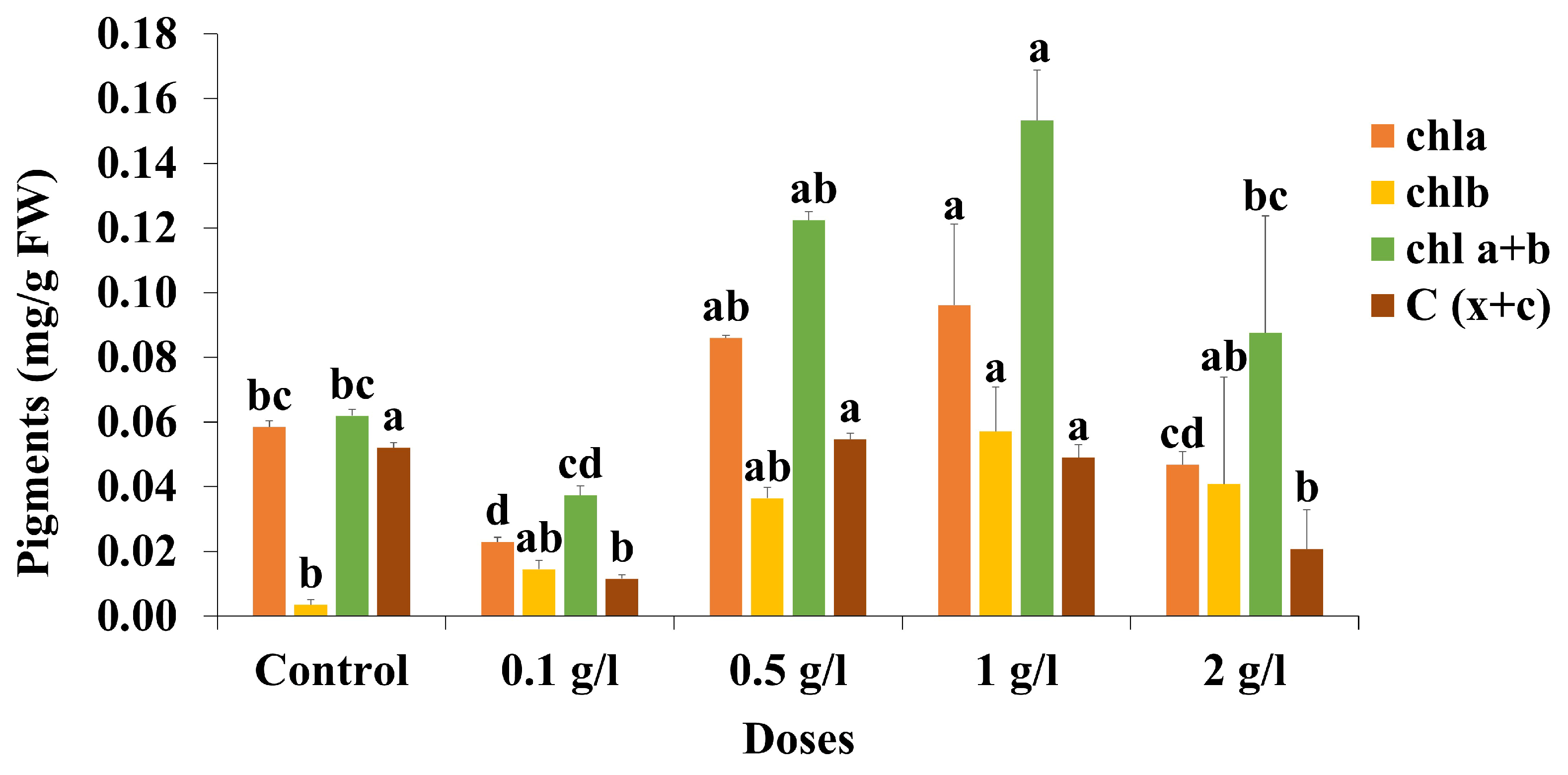
The application of Chlorococcum sp. aqueous extract significantly affected the photosynthetic pigment content in cumin seedlings (Figure 3). The concentration of chlorophyll a (chl a), chlorophyll b (chl b), and total chlorophyll (chl a + b) reached their highest levels at the 1 g/L dose, measuring (0.0961 ± 0.0250 mg/g FW), (0.0571 ± 0.0137 mg/g FW), and (0.1532 ± 0.0155 mg/g FW), respectively, followed by the 0.5 g/L treatment, which reached 0.0860 ± 0.0008 mg/g FW for chl a, 0.0364 ± 0.0034 mg/g FW for chl b, and 0.1224 ± 0.0026 mg/g FW for total chlorophyll content. In contrast, seeds treated with the dose of 0.1 g/L showed the lowest total pigment content (0.0374 ± 0.0029 mg/g FW). Furthermore, a significant reduction in all chlorophyll fractions was recorded at the highest dose of 2 g/L compared to the 1 g/L dose. Overall, these findings indicate that 1 g/L is identified as the optimal dose for enhancing photosynthetic pigment content in cumin seedlings.

3.5. Evaluation of the Effect of Microalgal Extract on the Primary and Secondary Metabolites of Cumin Seedlings

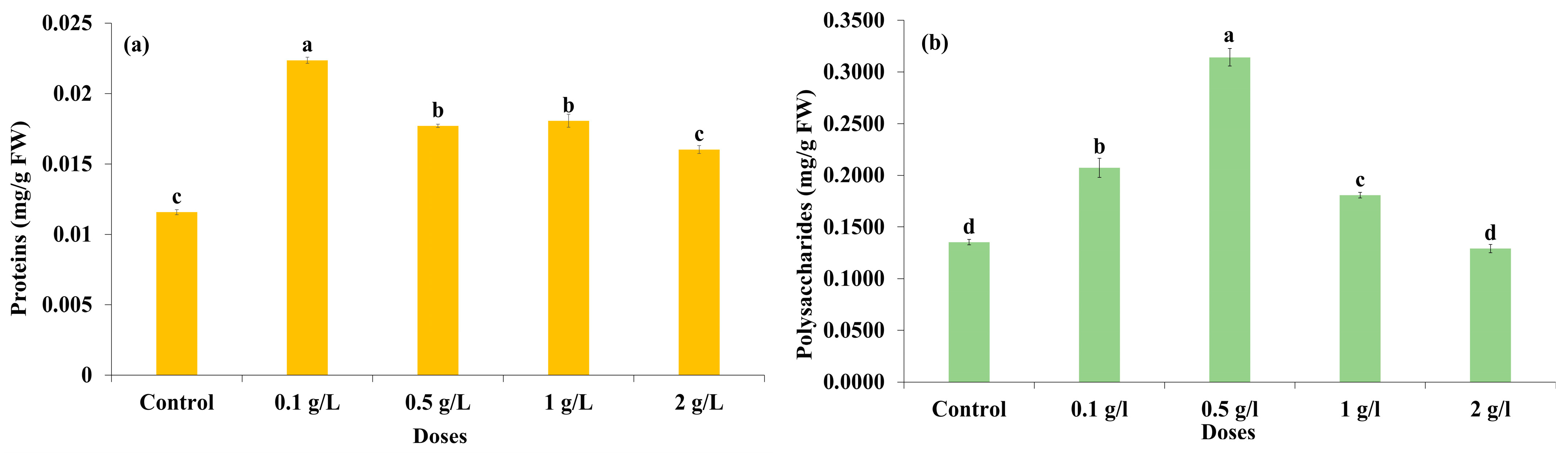
Primary metabolite analysis revealed a clear dose-dependent response for both protein and polysaccharide levels (Figure 4). The protein content in the cumin seedlings reached the highest level at the lowest dose (0.1 g/L), showing a significant increase of 93.18% compared to the control. As the dose increased, the protein levels remained higher than in the control. Conversely, the highest level of polysaccharide accumulation was at the 0.5 g/L dose, reaching 0.3142 ± 0.0086 mg/g FW, which represents a significant increase of 132.28% compared to untreated seeds.
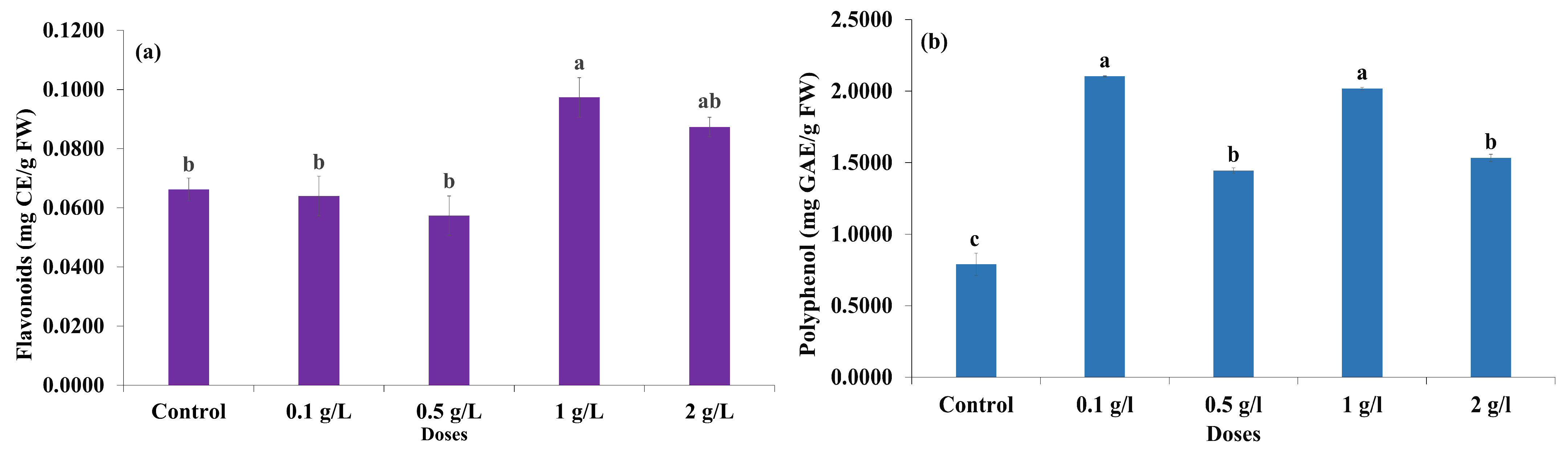
Regarding secondary metabolites, the application of Chlorococcum sp. extract acted as an elicitor, significantly enhancing the production of flavonoids and polyphenols in cumin seedlings (p < 0.05) (Figure 5). The highest flavonoid accumulation was observed in seedlings treated with 1 g/L, representing a 43% increase relative to the control. In contrast, polyphenol content was significantly stimulated across all treated seedlings compared to the control. This suggests that microalgal extract effectively activates the seedlings’ secondary defense and antioxidant pathways.

3.6. Principal Component Analysis (PCA)

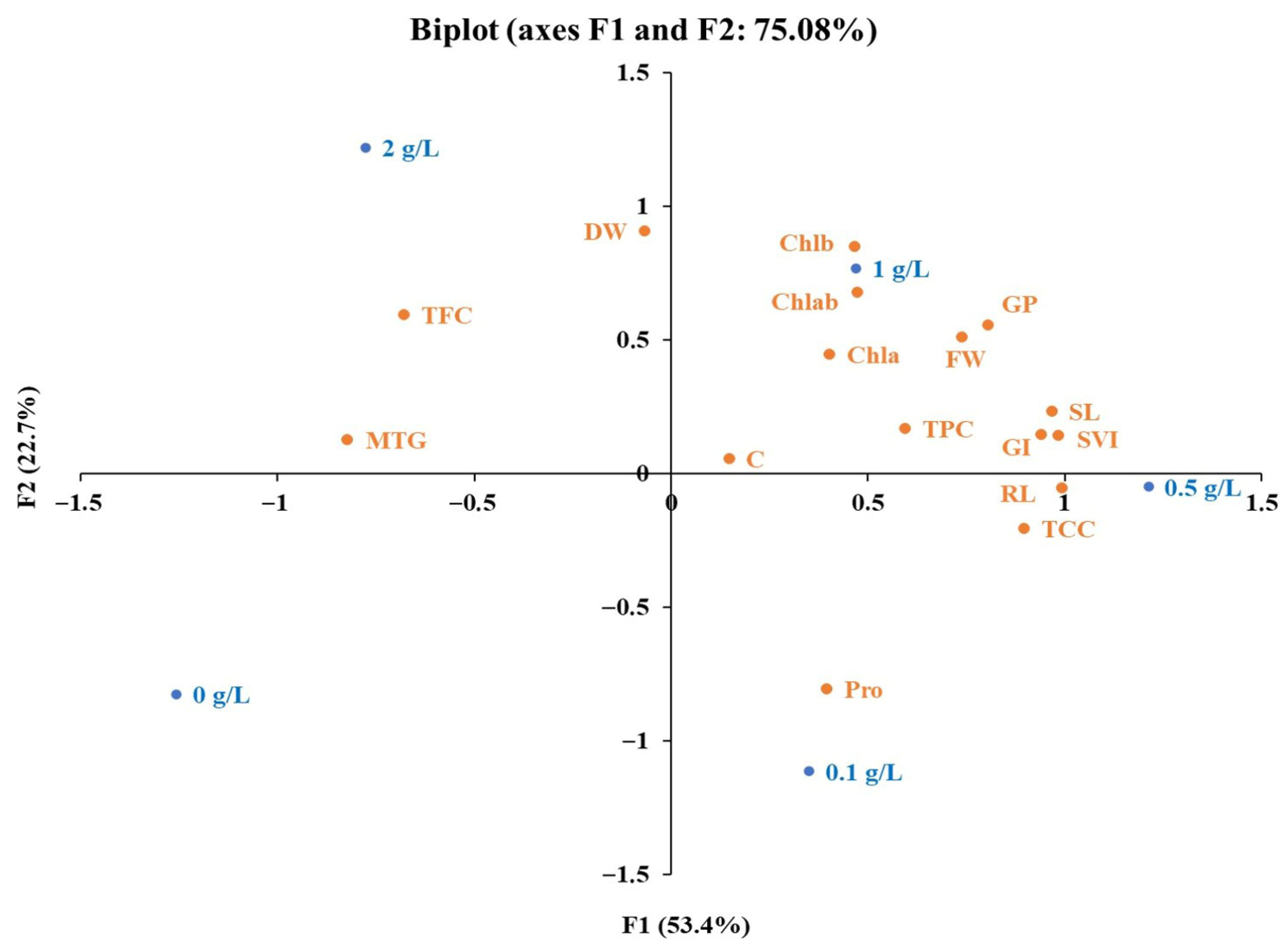
To evaluate the associations among germination parameters, biometric traits, photosynthetic content, and biochemical profiles of cumin treated with different doses of Chlorococcum sp. extract, a Principal Component Analysis was conducted (Figure 6). Together, the first two components accounted for 75.08% of the overall variance. The axis F1 (53.4%) showed strong positive correlations with germination parameters, biometric traits, and most chlorophyll pigments, while it was negatively correlated with the mean germination time and total flavonoid content. The second axis (F2), explaining 22.7%, was primarily related to dry weight.
In terms of microalgal extract doses, the analysis showed that treatments at 0.5 g/L and 1 g/L were strongly associated with high final germination indices. In contrast, both the control and the 2 g/L treatment were distributed on the negative side of the first principal component, F1 axis. This indicates slower germination and higher flavonoid content. Ultimately, the PCA highlights 0.5 g/L as the most effective dose for enhancing cumin seed germination.
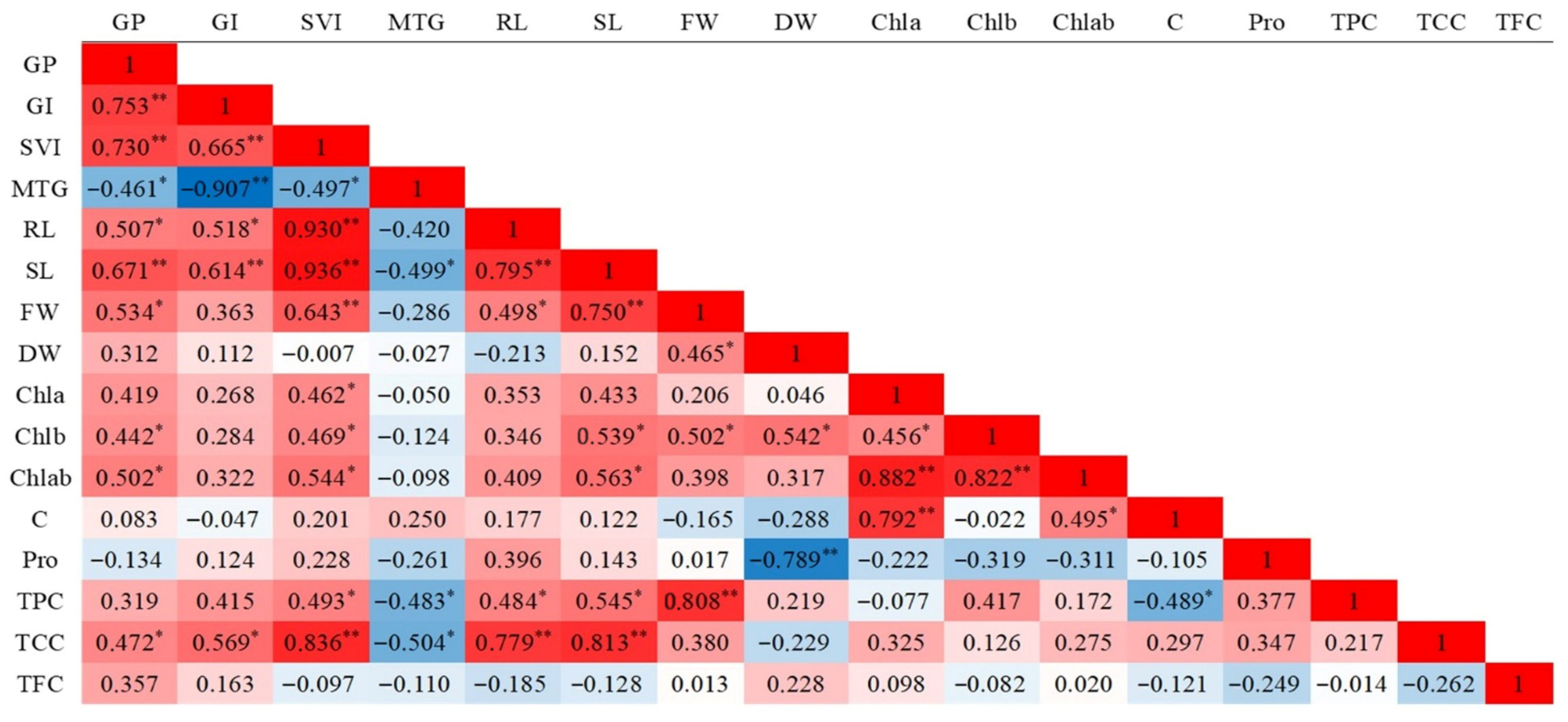
A triangular correlation matrix based on Pearson correlation coefficients was generated to illustrate the relationships among the different variables (Figure 7). The matrix predominantly showed positive correlations between germination indices, biometric parameters, photosynthetic pigments, and biochemical content. This indicates that improvements in certain parameters, such as shoot length, are closely linked to enhancements in others, for example, seedling vigor. This suggests a synchronized physiological response among the evaluated parameters under the applied treatments. In contrast, negative correlations were limited.
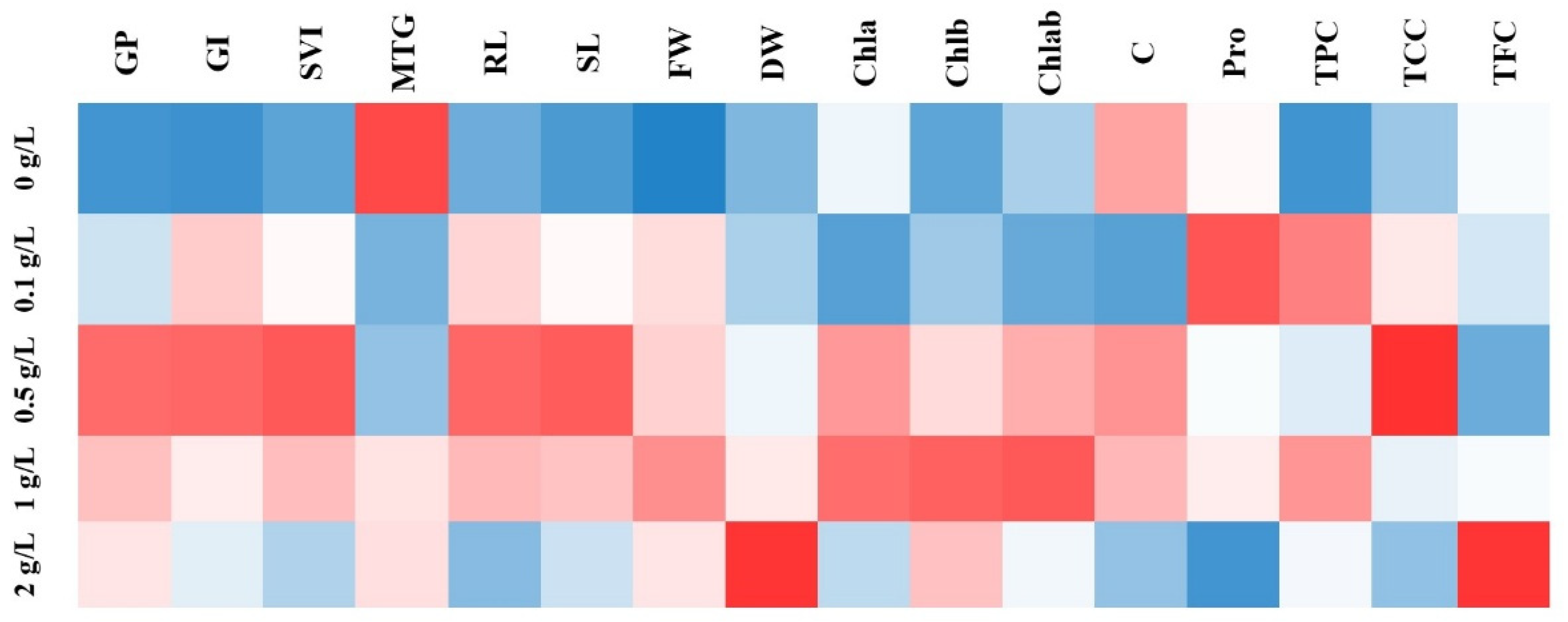
The heatmap was derived from Pearson’s correlation analysis (Figure 8). Based on the color gradient, the dose of 0.5 g/L elicited the strongest positive response across the majority of variables, including germination indices, growth traits, and biochemical compounds. Comparably, the dose of 1 g/L showed moderate to high response in many parameters. In contrast, the control predominantly displayed blue zones, demonstrating lower values for the majority of variables. These results indicate that the extract of Chlorococcum sp. enhances cumin seed germination relative to the control.

4. Discussion

Cumin (Cuminum cyminum L.) from the Apiaceae family often has a slow seedling emergence, ranging from 14 to 50 days, which negatively impacts crop yield [7].
Numerous studies have revealed the benefits of seed treatments in improving germination and enhancing tolerance to stress conditions [35,36]. For instance, a study conducted by [5] examined the effect of cold plasma as a physical treatment at different exposure times and found that this method increased germination by 43.24%. Another study investigated the influence of gibberellic acid (GA3) on the germination of three cumin landraces, and the results showed that seeds soaked in GA3 exhibited significantly higher germination percentages and rates compared to untreated seeds [37]. Among this wide range of available techniques, the application of microalgal biostimulants has also proven effective in improving germination performance and providing a sustainable, cost-effective solution [38]. In this context, the current study aims to evaluate the effect of Chlorococcum sp. extract on various parameters during cumin germination, including germination parameters, biometric indices, pigment content, and biochemical constituents.
One of the most important criteria for selecting microalgae for agricultural applications is their ability to exhibit rapid, homogeneous growth, high productivity, and a simple cultivation process, ensuring sufficient biomass production. Therefore, strains with high cell growth rates are generally recommended [12]. In our study, the chosen strain (Chlorococcum sp.) demonstrated a robust growth rate of 0.45 day−1 and a relatively short doubling time of 1.54 days, indicating that the culture nearly doubles every 24 h. However, this growth rate is highly influenced by the cultivation conditions, including temperature, light, pH, salinity, nutrient quantity and quality, and aeration [39]. For instance, a study conducted by [40] reported a high growth rate of Chlorococcum sp. in a saline water medium. Another study demonstrated that urea as a nitrogen source in the media positively influences the growth rate of Chlorococcum sp. [41]. Additionally, [42] observed that biomass concentration reached 1.93 g/L at an aeration rate of 0.1 L/min, whereas increasing the rate to 0.8 L/min led to a reduction in biomass to 1.35 g/L. In terms of biomass productivity, the strain in this study demonstrated a capacity of 1.51 g/L/day. However, Morsi et al. [22] reported a productivity of 77 mg/L/day under different cultivation conditions, further confirming that these growth parameters are strongly dependent on culture conditions.
Moreover, the effectiveness of the strain as a biostimulant is fundamentally attributed to its biochemical composition. Several studies have shown that microalgal extracts contain a variety of bioactive compounds, including phytohormones (gibberellins and auxins), amino acids, protein hydrolysates, polysaccharides, antioxidants, and humic substances, which collectively contribute to their biostimulant potential [13]. Specifically, Chlorococcum sp. is characterized by high concentrations of gibberellins (GA20 and GA29) and cytokinins (iP, iPA, and iPAMP), which enhance germination rates [20]. Biochemical analysis revealed that our microalgal aqueous extract contained a high concentration of secondary metabolites, specifically polyphenols (63.46%) and flavonoids (29.36%), which likely contributed to the observed biostimulant activity. Polyphenols act as natural antagonists to abscisic acid (ABA) [43], a key hormone that maintains seed dormancy [44]. A study conducted by [43] found that polyphenols, such as coumaric acid, act as non-canonical ligands that compete with ABA for binding to the PYR/PYL/RCAR receptors. Additionally, flavonoids, such as quercetin, enhance the activity of phytohormones, including gibberellins and auxins, which are crucial for seed germination [45]. Although the use of water as a solvent in this study likely limited the recovery of non-polar or membrane-bound phenolic fractions, leading to an underestimation of the total phenolic content within the biomass, it efficiently solubilizes glycosylated flavonoids, which are the hydrophilic forms of these compounds. Indeed, Goiris et al. [46] has shown that in H. pluvialis, these glycosylated flavonoids are significantly abundant compared to their respective aglycones. Consequently, the high flavonoid content detected in our aqueous extract can be attributed to these water-soluble derivatives, which are effectively released when water is used as the solvent, coupled with ultrasonic cell disruption. Indeed, Kaczorová et al. [47] demonstrated that the efficiency of phenolic compound extraction depends on solvent polarity, and reported that polar solvents can extract greater phenolic compound content in comparison with non-polar solvents. Additionally, Chlorococcum sp. microalgal aqueous extract used in this study contained 5.38% indole-3-acetic acid (IAA). Microalgal extracts are known to be rich in auxins, particularly indole-3-acetic acid, as well as other forms such as indole-3-butyric acid, indole-3-acetamides, and indole-3-propionic acid [48], which contribute to higher seed vigor in the germination process.
Many studies have reported the biostimulant properties of microalgal polysaccharides. However, in the present study, the polysaccharide fraction represented only 0.9% of the extract composition. Polysaccharide recovery is highly dependent on the extraction technique used [49]. Referring to the principle of similar compatibility, as polar macromolecules, microalgal polysaccharides typically necessitate the use of solvents with high polarity, such as alcohol and water, for efficient extraction [50]. Similarly, the protein fraction of the extract was less abundant compared to other components, accounting for only 0.9% of its composition. In terms of physiological effects, protein hydrolysates are known for their biostimulatory effects on plants [51]. Nevertheless, our extract contained only a limited amount of protein content, which may be attributed to the extraction method [52].
The extraction method used in this study remains relevant and effective in recovering a wide range of bioactive compounds. A comparative study investigated the effects of four extraction methods (microwave-assisted aqueous extraction, aqueous extraction, organic solvent extraction, and acid hydrolysis) on the bioactive composition of Chlorella vulgaris [25]. Their findings confirmed the efficiency of aqueous extraction, which yielded the highest IAA content (14%) and protein concentration (37%) among all tested methods, while also achieving notable recovery rates for polyphenols (27%) and flavonoids (17%). Notably, comparing these techniques, aqueous extraction was found to be comparable to acid hydrolysis and organic solvent extraction, conventionally used chemical methods, thereby validating its feasibility as a reliable and competitive alternative. Beyond its extraction performance, the aqueous approach aligns with green chemistry principles by eliminating the use of toxic or flammable solvents, reducing energy costs, and minimizing environmental footprint, making it not only an effective but also a responsible choice for the recovery of bioactive compounds from microalgal biomass.
Regarding germination, the findings indicate that the four different concentrations of the aqueous extract improve cumin germination indices relative to the control. The dose of 0.5 g/L resulted in the highest final germination percentage (100%), whereas the control achieved 83.33%. Germination percentage in untreated seeds can vary depending on the genetic background of the ecotype or cultivar. For instance, Salarizadeh et al. [53] reported that, under control conditions (distilled water), the Isfahan ecotype achieved a germination percentage of 93.10%, while the Khorasan ecotype reached 98.66%. In contrast, Hansaliya et al. [54] evaluated four Indian varieties (Gujarat Cumin-1, GC-2, GC-3, and GC-4), which exhibited germination rates of 66.50%, 67.78%, 69.98%, and 70.63%, respectively. In this context, the 83.33% germination observed in the control treatment of our study aligns with these documented variations in cumin seed performance. Additionally, at this concentration, the mean germination time decreased by 7.79%, and the seedling vigor index increased significantly, confirming that this dose is optimal for improving germination parameters. The concentration of microalgal extracts plays a crucial role in their biostimulant efficacy. Lower concentrations generally yield better results, as observed in tomato seeds treated with Chlorophyta extracts, where the lowest concentration led to the highest number of germinated seeds [38]. Comparable effects were observed in sesame seeds, where germination performance and biometric indices were enhanced by low concentrations (0.5 g/L and 1 g/L) [55]. Similarly, Chabili et al. [56] reported that wheat seeds treated with ten different eco-extracts exhibited better germination, vigor, and growth parameters at lower concentrations (0.1 g/L), highlighting a dose-dependent response. Our results showed a significant reduction in germination parameters at the highest dose (2 g/L) compared to the 1 g/L concentration. This suggests that elevated concentrations induce phytotoxicity or inhibitory effects. These findings align with those of [25], which found that higher doses (2 g/L) of C. vulgaris extracts negatively affected germination performance. Phenolic compounds, such as flavonoids, have been reported to exert a positive effect on germination. However, high concentrations of these compounds negatively affect germination and the timing of seed emergence [57]. Furthermore, research testing various polyphenols on the germination of six weed species confirmed that while lower doses may have stimulatory effects, higher concentrations severely inhibit germination [58]. This inhibitory effect is clearly illustrated in the Principal Component Analysis (PCA) of this study. The control and the 2 g/L treatment groups were positioned on the negative side of the first principal component (F1) axis. This distribution correlates with slower germination rates and higher flavonoid content, further indicating the phytoinhibitory effects and physiological stress induced by high-dose applications.
In general, Chlorococcum sp. has been reported as an effective biostimulant across different plants. For instance, Rupawalla et al. [20] evaluated the effect of microalgae strains from different genera (Chlorococcum, Chlorella, Scenedesmus, and Micractinium) on spinach seeds and reported an enhancement in seed germination performance and seedling biomass. These positive effects are likely attributed to the high concentrations of gibberellins and cytokinins in Chlorococcum sp., as these hormones are the primary ones responsible for initiating germination and promoting cell elongation of the radicle [20]. Chlorococcum sp. aqueous extract showed a positive effect on seedling growth. This positive effect is likely linked to different bioactive compounds synthesized by microalgae, including phytohormones such as cytokinins, gibberellins, auxins, and abscisic acid. In particular, GA3 has been shown to play a fundamental role in stem elongation, enzyme activation, and overall plant growth. For instance, Heidari et al. [37] investigated the effect of GA3 priming at concentrations of 0, 100, 200, and 400 ppm on cumin seeds cultivated under different temperatures. Their findings demonstrated that GA3 increased radicle and coleoptile lengths. In addition, photosynthetic pigments were increased in treated seeds compared to the control. This suggests that microalgae extract may stimulate chlorophyll production, an essential process for photosynthesis and thus, for plant productivity [59].
To evaluate the metabolic response of the seedlings, their biochemical composition was analyzed, focusing on primary metabolites (polysaccharides and proteins) and secondary metabolites (flavonoids and polyphenols). The results revealed a significant increase in protein content, likely a physiological adaptation to the increased growth in treated seeds. Similarly, Fan et al. [60] reported that after the application of a commercial algae-based extract on spinach, the protein content increased, which was combined with an increase in the transcription level of regulatory enzymes involved in nitrogen metabolism. Furthermore, Puglisi et al. [61] found that the total protein content in the shoots of treated lettuce seedlings increased significantly by 38% compared to untreated plants. Polysaccharide content also showed an increase in treated seeds compared to the control. This confirms further the fact that biostimulants increase the nutrient uptake in plants and thus stimulate their primary metabolism [62]. Regarding secondary metabolites, phenolic compounds (including polyphenols and flavonoids) are typically synthesized by plants in response to stress conditions as part of their defense mechanisms. In the present study, treated seedlings showed higher phenolic compound content compared to the control, suggesting that the microalgal extract may have induced a mild stress response, thereby stimulating the accumulation of these compounds. Similarly, Amooaghaie et al. [63] found that microalgal extracts can significantly increase total phenolic content in different plant tissues. In their study, using the Sabzevar ecotype, C. vulgaris, A. platensis, and D. salina extracts raised total phenolic compounds in flowers by 20%, 21%, and 12.5%, and in shoots by 35.62%, 37.5%, and 33.75%. These phenolic compounds exhibit significant antioxidant properties, contributing to the protection of cumin plants against external stressors [64,65] and enhancing their potential health benefits [63].

5. Conclusions

The present study reveals the promising potential of Chlorococcum sp. as a biostimulant to improve cumin (Cuminum cyminum L.) seed germination. The microalgal strain was found to be suitable for such applications, as it exhibits positive growth properties, including high productivity and a relatively short generation time, along with a rich bioactive compound profile. Importantly, seeds were subjected to a single treatment with Chlorococcum sp. aqueous extract, and this one-time application was sufficient to trigger active germination and induce significant changes in the biochemical composition of the cumin seedlings. The biochemical composition of Chlorococcum sp. extract contributed to the enhancement found in germination parameters, biometric traits, pigment content, and the accumulation of primary and secondary metabolites, with a dose-dependent effect compared with the control. Generally, 0.5 and 1 g/L concentration effects elicited favorable responses in terms of germination percentage and seedling vigor. High concentrations (1 and 2 g/L) promoted the accumulation of secondary metabolites, suggesting enhanced antioxidant capacity. The improved antioxidant properties observed in cumin seedlings in this study could have significant potential beyond the agricultural sector, offering promising opportunities in the nutraceutical and pharmaceutical industries.
Although these findings demonstrate promising biostimulant activity, they were obtained under controlled conditions. Further validation in field conditions is necessary to confirm their effectiveness under natural environmental constraints, including drought stress. In addition, the specific bioactive molecules driving the observed effects have not yet been fully identified, and further studies are required to elucidate the underlying mechanisms of action.
Ultimately, using microalgal aqueous extracts as biostimulants offers a promising solution due to their economic and environmental advantages and warrants further investigation.

Author Contributions

Conceptualization, M.M., M.L., N.M., and M.D.; methodology, M.M., K.A., A.C., M.L., N.M., and M.D.; software, M.M., A.C., N.M., and M.D.; validation, A.C., M.L., N.M., and M.D.; formal analysis, M.M., K.A., A.C., N.M., and M.D.; investigation, M.M., K.A., A.C., N.M., and M.D.; resources, N.M. and M.D.; data curation, M.M., N.M., and M.D.; writing—original draft preparation, M.M., N.M., and M.D.; writing—review and editing, M.M., A.C., M.L., N.M., and M.D.; visualization, M.L., N.M., and M.D.; supervision, N.M. and M.D.; project administration, N.M. All authors have read and agreed to the published version of the manuscript.

Funding

This research received no external funding.

Institutional Review Board Statement

Not applicable.

Informed Consent Statement

Not applicable.

Data Availability Statement

Data are available on request to the corresponding author.

Acknowledgments

We would like to thank the National Centre for Scientific and Technical Research (CNRST) (Grant number: 62 UCA2024) as part of the PhD-Associate Scholarship Programme (PASS). We also sincerely thank the anonymous reviewers for their insightful feedback and contributions toward the refinement of this manuscript.

Conflicts of Interest

The authors declare no conflicts of interest.

Abbreviations

The following abbreviations are used in this manuscript:
CCarotenoids total
ChlaChlorophyll a
ChlabTotal chlorophyll
ChlbChlorophyll b
CLColeoptile length
DWDry weight
FWFresh weight
GA3Gibberellic acid
GIGermination index
GPGermination percentage
IAAIndole-3-acetic acid
MGTMean germination time
ProProteins content total
RLRadicle length
SVISeed vigor index
TCCPolysaccharides content
TFCTotal flavonoids
TPCPolyphenols content total

References

  1. Kumar, M.; Sahoo, P.K.; Kushwaha, D.K.; Saxena, S.N.; Mani, I.; Singh, G.; Pradhan, N.C. Cumin Cultivation: Present Status and Future Prospects. Pharma Innov. J. 2021, 10, 1121–1123. [Google Scholar]
  2. Al-Snafi, A.E. The Pharmacological Activities of Cuminum cyminum—A Review. IOSR J. Pharm. 2016, 6, 46–65. [Google Scholar]
  3. Archangi, A.; Heidari, B.; Mohammadi-Nejad, G. Association between Seed Yield-Related Traits and cDNA-AFLP Markers in Cumin (Cuminum cyminum) under Drought and Irrigation Regimes. Ind. Crops Prod. 2019, 133, 276–283. [Google Scholar] [CrossRef]
  4. Sowbhagya, H.B. Chemistry, Technology, and Nutraceutical Functions of Cumin (Cuminum cyminum L.): An Overview. Crit. Rev. Food Sci. Nutr. 2013, 53, 1–10. [Google Scholar] [CrossRef]
  5. Paatre Shashikanthalu, S.; Ramireddy, L.; Radhakrishnan, M. Stimulation of the Germination and Seedling Growth of Cuminum cyminum L. Seeds by Cold Plasma. J. Appl. Res. Med. Aromat. Plants 2020, 18, 100259. [Google Scholar] [CrossRef]
  6. Mondo, V.H.V.; Cicero, S.M.; Dourado-Neto, D.; Pupim, T.L.; Dias, M.A.N. Effect of Seed Vigor on Intraspecific Competition and Grain Yield in Maize. Agron. J. 2013, 105, 222–228. [Google Scholar] [CrossRef]
  7. Soltani, E.; Mortazavian, S.M.M.; Faghihi, S.; Akbari, G.A. Non-Deep Simple Morphophysiological Dormancy in Seeds of Cuminum cyminum L. J. Appl. Res. Med. Aromat. Plants 2019, 15, 100222. [Google Scholar] [CrossRef]
  8. Rahimi, H.; Rezanejad, F.; Ayatollahi, S.A.; Sharifi-Sirchi, G.R.; Rahimi, H. Embryo Growth and Seed Germination Requirements in Underdeveloped Embryos of Elwendia caroides and E. wolfii (Apiaceae). Mediterr. Bot. 2024, 45, e91058. [Google Scholar] [CrossRef]
  9. Piri, R.; Moradi, A.; Balouchi, H.; Salehi, A. Improvement of Cumin (Cuminum cyminum) Seed Performance under Drought Stress by Seed Coating and Biopriming. Sci. Hortic. 2019, 257, 108667. [Google Scholar] [CrossRef]
  10. Ghiyasi, M.; Siavash Moghaddam, S.; Amirnia, R.; Damalas, C.A. Chemical Priming with Salt and Urea Improves Germination and Seedling Growth of Black Cumin (Nigella sativa L.) under Osmotic Stress. J. Plant Growth Regul. 2019, 38, 1170–1178. [Google Scholar] [CrossRef]
  11. Samani, M.A.; Pourakbar, L.; Azimi, N. Magnetic Field Effects on Seed Germination and Activities of Some Enzymes in Cumin. Life Sci. J. 2013, 10, 323–328. [Google Scholar]
  12. Chabili, A.; Minaoui, F.; Hakkoum, Z.; Douma, M.; Meddich, A.; Loudiki, M. A Comprehensive Review of Microalgae and Cyanobacteria-Based Biostimulants for Agriculture Uses. Plants 2024, 13, 159. [Google Scholar] [CrossRef]
  13. Kapoore, R.V.; Wood, E.E.; Llewellyn, C.A. Algae Biostimulants: A Critical Look at Microalgal Biostimulants for Sustainable Agricultural Practices. Biotechnol. Adv. 2021, 49, 107754. [Google Scholar] [CrossRef]
  14. Papapolymerou, G. Current and Potential Applications of Microalgae: A Mini Review. Oceanogr. Fish. Open Access J. 2019, 11, 35–39. [Google Scholar] [CrossRef]
  15. Gonçalves, J.; Freitas, J.; Fernandes, I.; Silva, P. Microalgae as Biofertilizers: A Sustainable Way to Improve Soil Fertility and Plant Growth. Sustainability 2023, 15, 12413. [Google Scholar] [CrossRef]
  16. Sabnam, S.; Mondal, A.; Paul, S. Advancing Seed Priming with Algal Extracts: A Review of Mechanistic Roles in Seed Germination and Plant Growth. Explor. Environ. Resour. 2025, 2, 025120025. [Google Scholar] [CrossRef]
  17. Hashmi, Z.; Zaini, J.; Bakar, M.S.A.; Bilad, M.R. Integrated Red Tilapia Aquaculture with Chlorococcum sp. Cultivation: Bioremediation of Aquaculture Wastewater and Biomass Production. Clean. Circ. Bioeconomy 2025, 11, 100153. [Google Scholar] [CrossRef]
  18. Hashmi, Z.; Zaini, J.; Abdullah, R.; Abu Bakar, M.S.; Bilad, M.R. Effects of Light Color on Growth, Nutrient Uptake, and Harvesting of the Indigenous Strain of Chlorococcum sp. Bioresour. Technol. Rep. 2024, 28, 101966. [Google Scholar] [CrossRef]
  19. Hashmi, Z.; Idriss, I.M.; Taha, H.; Zaini, J.; Bakar, M.S.A.; Abdullah, R.; Nandianto, A.B.D.; Bilad, M.R. Cultivation of Indigenous Chlorococcum sp. in Aquaculture Wastewater under Various Light Color and Biomass Harvesting Using Membrane Filtration: A Simultaneous Wastewater Treatment and Biomass Production. Clean. Waste Syst. 2025, 10, 100209. [Google Scholar] [CrossRef]
  20. Rupawalla, Z.; Shaw, L.; Ross, I.L.; Schmidt, S.; Hankamer, B.; Wolf, J. Germination Screen for Microalgae-Generated Plant Growth Biostimulants. Algal Res. 2022, 66, 102784. [Google Scholar] [CrossRef]
  21. Kotai, J. Instructions for Preparation of Modified Nutrient Solution Z8 for Algae; Norwegian Institute for Water Research: Oslo, Norway, 1972; Volume 11, p. 5. [Google Scholar]
  22. Morsi, H.H.; El-Sheekh, M.M.; Eladel, H.; Al-Tuwaijri, M.M.; El-Sabbagh, S.M.; Maher, A.; Saber, A.A. Screening the Pollution-Tolerant Chlorococcum sp. (Chlorophyceae) Grown in Municipal Wastewater for Simultaneous Nutrient Removal and Biodiesel Production. Water 2023, 15, 1723. [Google Scholar] [CrossRef]
  23. Ribeiro, D.M.; Zanetti, G.T.; Julião, M.H.M.; Masetto, T.E.; Gelinski, J.; Fonseca, G.G. Effect of Different Culture Media on Growth of Chlorella sorokiniana and the Influence of Microalgal Effluents on the Germination of Lettuce Seeds. J. Appl. Biol. Biotechnol. 2019, 7, 6–10. [Google Scholar] [CrossRef]
  24. Hempel, N.; Petrick, I.; Behrendt, F. Biomass Productivity and Productivity of Fatty Acids and Amino Acids of Microalgae Strains as Key Characteristics of Suitability for Biodiesel Production. J. Appl. Phycol. 2012, 24, 1407–1418. [Google Scholar] [CrossRef]
  25. Chabili, A.; Minaoui, F.; Hakkoum, Z.; Douma, M.; Meddich, A.; Loudiki, M. Effects of Extraction Methods on the Plant Biostimulant Activity of the Soil Microalga Chlorella vulgaris. J. Appl. Phycol. 2024, 36, 3301–3314. [Google Scholar] [CrossRef]
  26. Bradford, M.M. A Rapid and Sensitive Method for the Quantitation of Microgram Quantities of Protein Utilizing the Principle of Protein-Dye Binding. Anal. Biochem. 1976, 72, 248–254. [Google Scholar] [CrossRef]
  27. DuBois, M.; Gilles, K.A.; Hamilton, J.K.; Rebers, P.A.; Smith, F. Colorimetric Method for Determination of Sugars and Related Substances. Anal. Chem. 1956, 28, 350–356. [Google Scholar] [CrossRef]
  28. Cox, S.; Abu-Ghannam, N.; Gupta, S. An Assessment of the Antioxidant and Antimicrobial Activity of Six Species of Edible Irish Seaweeds. Int. Food Res. J. 2010, 17, 205–220. [Google Scholar]
  29. Bahorun, T.; Trotin, F.; Pommery, J.; Vasseur, J.; Pinkas, M. Antioxidant Activities of Crataegus monogyna Extracts. Planta Medica 1994, 60, 323–328. [Google Scholar] [CrossRef]
  30. Shi, Y.; Lou, K.; Li, C. Promotion of Plant Growth by Phytohormone-Producing Endophytic Microbes of Sugar Beet. Biol. Fertil. Soils 2009, 45, 645–653. [Google Scholar] [CrossRef]
  31. Speed of Germination-Aid in Selection and Evaluation for Seedling Emergence and Vigor. Available online: https://www.cabidigitallibrary.org/doi/full/10.5555/19621604893 (accessed on 6 May 2026).
  32. Ellis, R. The Quantification of Agent and Survival in Orthodox Seeds. Seed Sci. Technol. 1981, 9, 373–409. [Google Scholar]
  33. Mohammed, S.; El-Sheekh, M.M.; Aly, S.H.; Al-Harbi, M.; Elkelish, A.; Nagah, A. Inductive role of the brown alga Sargassum polycystum on growth and biosynthesis of imperative metabolites and antioxidants of two crop plants. Front. Plant Sci. 2023, 14, 1136325. [Google Scholar] [CrossRef]
  34. Lichtenthaler, H.K. [34] Chlorophylls and Carotenoids: Pigments of Photosynthetic Biomembranes. Methods Enzymol. 1987, 148, 350–382. [Google Scholar]
  35. Priatama, R.A.; Pervitasari, A.N.; Park, S.; Park, S.J.; Lee, Y.K. Current Advancements in the Molecular Mechanism of Plasma Treatment for Seed Germination and Plant Growth. Int. J. Mol. Sci. 2022, 23, 4609. [Google Scholar] [CrossRef] [PubMed]
  36. Shelar, A.; Singh, A.V.; Chaure, N.; Jagtap, P.; Chaudhari, P.; Shinde, M.; Nile, S.H.; Chaskar, M.; Patil, R. Nanoprimers in Sustainable Seed Treatment: Molecular Insights into Abiotic-Biotic Stress Tolerance Mechanisms for Enhancing Germination and Improved Crop Productivity. Sci. Total Environ. 2024, 951, 175118. [Google Scholar] [CrossRef] [PubMed]
  37. Heidari, M.; Sadeghi, H. Germination and Emergence of Primed Cumin (Cuminum cyminum L.) Seeds with GA3 under Different Temperature Regimes. Int. J. Biosci. 2014, 5, 266–272. [Google Scholar]
  38. Supraja, K.V.; Behera, B.; Balasubramanian, P. Efficacy of Microalgal Extracts as Biostimulants through Seed Treatment and Foliar Spray for Tomato Cultivation. Ind. Crops Prod. 2020, 151, 112453. [Google Scholar] [CrossRef]
  39. Kirrolia, A.; Bishnoi, N.R.; Singh, R. Effect of Shaking, Incubation Temperature, Salinity and Media Composition on Growth Traits of Green Microalgae Chlorococcum sp. J. Algal Biomass Util. 2012, 3, 46–53. [Google Scholar]
  40. Putri, D.S.; Sari, D.A.; Marianah; Astuti, S.P.; Wangiyana, I.G.A.S. Effect of Medium Type, Light Intensity, and Photoperiod on the Growth Rate of Microalgae Chlorococcum sp. Local Isolate. IOP Conf. Ser. Earth Environ. Sci. 2021, 913, 012071. [Google Scholar] [CrossRef]
  41. Fatini, M.A.; Basri, E.M.; Maznah, W.O.W. Effect of Different Nitrogen Sources on Cell Growth and Biochemical Compositions of Chlorococcum sp. Cultivated under Laboratory Conditions. IOP Conf. Ser. Earth Environ. Sci. 2021, 711, 012010. [Google Scholar] [CrossRef]
  42. Maltseva, I.; Yakoviichuk, A.; Maltseva, S.; Cherkashina, S.; Kulikovskiy, M.; Maltsev, Y. Biochemical and Antioxidant Characteristics of Chlorococcum oleofaciens (Chlorophyceae, Chlorophyta) under Various Cultivation Conditions. Plants 2024, 13, 2413. [Google Scholar] [CrossRef]
  43. Merino, J.; Rivera-Moreno, M.; Bono, M.; Núñez-Villanueva, D.; González-Vega, A.; Mayordomo, C.; Infantes, L.; Chikhale, R.; Rodríguez, P.L.; Albert, A. Natural Modulators of Abscisic Acid Signaling: Insights into Polyphenol-Based Antagonists and Their Role in ABA Receptor Regulation. Plant Physiol. Biochem. 2025, 227, 110155. [Google Scholar] [CrossRef]
  44. Rodríguez-Gacio, M.D.C.; Matilla-Vázquez, M.A.; Matilla, A.J. Seed Dormancy and ABA Signaling: The Breakthrough Goes on. Plant Signal. Behav. 2009, 4, 1035–1048. [Google Scholar] [CrossRef] [PubMed]
  45. Zhang, Y.; Xia, Y. Quercetin Enhances Tomato Seed Germination via Phenylpropanoid-Dependent Regulation of ROS, Hormone Signaling, and Starch Hydrolysis. Plant Physiol. Biochem. 2026, 230, 110590. [Google Scholar] [CrossRef]
  46. Goiris, K.; Muylaert, K.; Voorspoels, S.; Noten, B.; De Paepe, D.; Baart, G.J.E.; De Cooman, L. Detection of Flavonoids in Microalgae from Different Evolutionary Lineages. J. Phycol. 2014, 50, 483–492. [Google Scholar] [CrossRef]
  47. Kaczorová, D.; Karalija, E.; Dahija, S.; Bešta-Gajević, R.; Parić, A.; Ćavar Zeljković, S. Influence of Extraction Solvent on the Phenolic Profile and Bioactivity of Two Achillea Species. Molecules 2021, 26, 1601. [Google Scholar] [CrossRef]
  48. Romanenko, E.A.; Kosakovskaya, I.V.; Romanenko, P.O. Phytohormones of Microalgae: Biological Role and Involvement in the Regulation of Physiological Processes. Pt I. Auxins, Abscisic Acid, Ethylene. Int. J. Algae 2015, 17, 275–289. [Google Scholar] [CrossRef]
  49. Lesco, K.C.; Williams, S.K.R.; Laurens, L.M. Marine Algae Polysaccharides: An Overview of Characterization Techniques for Structural and Molecular Elucidation. Mar. Drugs 2025, 23, 105. [Google Scholar] [CrossRef]
  50. Liu, F.; Chen, H.; Qin, L.; Al-Haimi, A.A.N.M.; Xu, J.; Zhou, W.; Zhu, S.; Wang, Z. Effect and Characterization of Polysaccharides Extracted from Chlorella sp. by Hot-Water and Alkali Extraction Methods. Algal Res. 2023, 70, 102970. [Google Scholar] [CrossRef]
  51. Malécange, M.; Sergheraert, R.; Teulat, B.; Mounier, E.; Lothier, J.; Sakr, S. Biostimulant Properties of Protein Hydrolysates: Recent Advances and Future Challenges. Int. J. Mol. Sci. 2023, 24, 9714. [Google Scholar] [CrossRef]
  52. López, C.V.G.; García, M.d.C.C.; Fernández, F.G.A.; Bustos, C.S.; Chisti, Y.; Sevilla, J.M.F. Protein Measurements of Microalgal and Cyanobacterial Biomass. Bioresour. Technol. 2010, 101, 7587–7591. [Google Scholar] [CrossRef] [PubMed]
  53. Salarizadeh, S.; Kavousi, H.R.; Pourseyadi, S. Effect of Cadmium on Germination Characters and Biochemical Parameters of Two Iranian Ecotypes of Cumin (Cuminum cyminum L.). J. Med. Plants By-Prod. 2016, 5, 15–22. [Google Scholar]
  54. Hansaliya, D.; Parmar, L.; Viradiya, Y.; Bhuva, J.; Thummar, M. Effect of Seed Priming Treatment on Cumin [Cuminum cyminum (L.)] Seed Germination and Growth. J. Arts Humanit. 2023, 24, 330–332. [Google Scholar] [CrossRef]
  55. Abid, K.; Minhaj, M.; Chabili, A.; Ateri, I.E.; Loudiki, M.; Manaut, N.; Douma, M. Assessment of an Aqueous Microalgal Extract of Chlorococcum sp. as an Eco-Friendly Biostimulant to Improve Germination and Seedling Performance of Sesamum indicum L. Phycology 2026, 6, 6. [Google Scholar] [CrossRef]
  56. Chabili, A.; Hakkoum, Z.; Minaoui, F.; Douma, M.; Meddich, A.; Loudiki, M. Germination Screen of Eco-Extracts from Soil Cyanobacteria and Microalgae for Their Biostimulant Effects on Wheat Seeds Emergence and Vigor. Algal Res. 2025, 89, 104087. [Google Scholar] [CrossRef]
  57. Nandakumar, L.; Rangaswamy, N.S. Effect of Some Flavonoids and Phenolic Acids on Seed Germination and Rooting. J. Exp. Bot. 1985, 36, 1313–1319. [Google Scholar] [CrossRef]
  58. Reigosa, M.J.; Souto, X.C.; Gonz’lez, L. Effect of Phenolic Compounds on the Germination of Six Weeds Species. Plant Growth Regul. 1999, 28, 83–88. [Google Scholar] [CrossRef]
  59. Díaz, L.E.; Gonzalez, J.D.; Morales-Gonzalez, M.P.; Garzón-Castro, C.L. Harnessing the Power of Microalgae Consortia for Sustainable Crop Production: Case Study on Lettuce (Lactuca sativa L.). J. Appl. Phycol. 2024, 36, 3273–3286. [Google Scholar] [CrossRef]
  60. Fan, D.; Hodges, D.M.; Critchley, A.T.; Prithiviraj, B. A Commercial Extract of Brown Macroalga (Ascophyllum nodosum) Affects Yield and the Nutritional Quality of Spinach In Vitro. Commun. Soil Sci. Plant Anal. 2013, 44, 1873–1884. [Google Scholar] [CrossRef]
  61. Puglisi, I.; Bella, E.L.; Rovetto, E.I.; Piero, A.R.L.; Baglieri, A. Biostimulant Effect and Biochemical Response in Lettuce Seedlings Treated with a Scenedesmus quadricauda Extract. Plants 2020, 9, 123. [Google Scholar] [CrossRef]
  62. Prisa, D.; Spagnuolo, D. Plant Production with Microalgal Biostimulants. Horticulturae 2023, 9, 829. [Google Scholar] [CrossRef]
  63. Amooaghaie, R.; Jamal, A.; Banisharif, A. The Biostimulatory Effect of Microalgae Extracts Upgrades Salt Tolerance and Antioxidant Capacity in Flowers and Shoots of Cuminum cyminum L. Sci. Rep. 2026, 16, 6990. [Google Scholar] [CrossRef]
  64. Kumar, K.; Debnath, P.; Singh, S.; Kumar, N. An Overview of Plant Phenolics and Their Involvement in Abiotic Stress Tolerance. Stresses 2023, 3, 570–585. [Google Scholar] [CrossRef]
  65. Mahajan, M.; Kuiry, R.; Pal, P.K. Understanding the Consequence of Environmental Stress for Accumulation of Secondary Metabolites in Medicinal and Aromatic Plants. J. Appl. Res. Med. Aromat. Plants 2020, 18, 100255. [Google Scholar] [CrossRef]
Figure 1. Growth kinetics of Chlorococcum sp. cultivated in Z8 medium, represented as optical density (at 750 nm), cell density (cells × 105/mL) (a), and dry weight (mg/mL) (b) (mean ± SD, n = 3).
Sustainability 18 04923 g001
Figure 2. Relative proportions of bioactive compounds in the aqueous extract. IAA: Indole-3-acetic acid.
Sustainability 18 04923 g002
Figure 3. Impact of varying microalgal extract doses on photosynthetic pigment content: Chlorophyll a (Chla), chlorophyll b (Chlb), total chlorophyll (Chl a + b), and carotenoids (Cx + c) (mean ± SD, n = 3). a, b, d, ab, bc, cd: Different letters above the bars indicate statistically significant differences between treatments, while same letters indicate no significant difference (Tukey’s HSD, p < 0.05).
Sustainability 18 04923 g003
Figure 4. Quantitative analysis of primary metabolites in cumin seedlings treated with different doses of microalgal extract: (a) protein content (mg/g FW) and (b) polysaccharide content (mg/g FW) (mean ± SD, n = 3). a, b, c, d: Different letters above the bars indicate statistically significant differences between treatments, while same letters indicate no significant difference (Tukey’s HSD, p < 0.05).
Sustainability 18 04923 g004
Figure 5. Quantitative analysis of secondary metabolites in cumin seedlings treated with different doses of microalgal extract: (a) flavonoid content (mg CE/g FW) and (b) polyphenol content (mg GAE/g FW) (mean ± SD, n = 3). a, b, c, ab: Different letters above the bars indicate statistically significant differences between treatments, while same letters indicate no significant difference (Tukey’s HSD, p < 0.05).
Sustainability 18 04923 g005
Figure 6. Biplots representation of the principal component analysis (PCA) illustrating the relationships among germination parameters, biometric traits, pigment content, and biochemical constituents of cumin seeds across various Chlorococcum sp. extract concentrations. Evaluated variables included final germination percentage (GP), germination index (GI), seed vigor index (SVI), mean germination time (MGT), radicle length (RL), coleoptile length (CL), fresh weight (FW), dry weight (DW), chlorophyll a (Chla), chlorophyll b (Chlb), total chlorophyll (Chlab), carotenoids (C), protein content (Pro), total polyphenol content (TPC), total polysaccharide content (TCC), and total flavonoid content (TFC).
Sustainability 18 04923 g006
Figure 7. Pearson correlation matrix illustrating the relationships among germination parameters, biometric traits, pigment content, and biochemical composition of cumin seeds treated with microalgal extract at different doses. Evaluated variables included final germination percentage (GP), germination index (GI), seedling vigor index (SVI), mean germination time (MGT), radicle length (RL), coleoptile length (CL), fresh weight (FW), dry weight (DW), chlorophyll a (Chla), chlorophyll b (Chlb), total chlorophyll (Chlab), carotenoids (C), protein content (Pro), total polyphenol content (TPC), total polysaccharide content (TCC), and total flavonoid content (TFC). Statistical significance is denoted at the 0.01 (**) and 0.05 (*) levels. The color spectrum represents the correlation strength, ranging from blue (inverse correlation) to red (positive correlation), with white neutral values.
Sustainability 18 04923 g007
Figure 8. Heatmap visualization illustrating the correlations between germination parameters, biometric traits, pigment content, and biochemical composition of cumin seeds treated with microalgal extract at different doses. Evaluated variables included final germination percentage (GP), germination index (GI), seed vigor index (SVI), mean germination time (MGT), radicle length (RL), coleoptile length (CL), fresh weight (FW), dry weight (DW), chlorophyll a (Chla), chlorophyll b (Chlb), total chlorophyll (Chlab), carotenoids (C), protein content (Pro), total polyphenol content (TPC), total polysaccharide content (TCC), and total flavonoid content (TFC). The color spectrum in the heatmap represents the correlation strength, ranging from blue (inverse correlation) to red (positive correlation), with white indicating neutral values and a gradient indicating the transition between these extremes.
Sustainability 18 04923 g008
Table 1. Formulas used to calculate germination parameters.
Germination IndicesEquationReferences
Final germination percentage (GP) G P = N u m b e r   o f   g e r m i n a t e d   s e e d s T o t a l   n u m b e r   o f   s e e d s   s e t   f o r   b i o a s s a y × 100 (4)
Germination index (GI) G I = N u m b e r   o f   g e r m i n a t e d   s e e d s D a y   o f   c o u n t [31](5)
Mean germination time (MGT) M G T = ( T i × N i ) N i [32](6)
Seedling vigor index (SVI) S V I = F i n a l   g e r m i n a t i o n   p e r c e n t a g e × s e e d l i n g   l e n g t h [33](7)
Table 2. Summary of growth kinetic parameters of Chlorococcum sp. (mean ± SD, n = 3).
IndicesValue
Growth rate (day−1) 0.45 ± 0.03
Generation time (day) 1.54 ± 0.09
Productivity (g/L/day)1.51 ± 0.867
Table 3. Impact of microalgal extract on germination parameters of cumin, including germination percentage (GP), germination index (GI), seed vigor index (SVI), mean germination time (MGT), radicle length (RL), coleoptile length (CL), fresh weight (FW), and dry weight (DW) (mean ± SD, n = 3).
GP
(%)
GI
(Seed/Day)
SVI
(Seed × cm)
MGT
(Day)
RL
(cm)
CL
(cm)
FW
(mg)
DW
(mg)
Control83.33 ± 2.88 a1.54 ± 0.07 a231.83 ± 95.34 c12.09 ± 0.17 a1.16 ± 0.57 c1.6 ± 0.85 b5.90 ± 3.43 b0.52 ± 0.44 d
0.1 g/L90.00 ± 13.22 a2.18 ± 0.48 a533.66 ± 76.48 b11.06 ± 0.33 a2.6 ± 0.17 b3.33 ± 0.28 ab8.54 ± 2.76 a0.56 ± 0.31 cd
0.5 g/L100.00 ± 00.00 a2.44 ± 0.53 a820.00 ± 121.24 a11.15 ± 0.72 a3.83 ± 0.28 a4.36 ± 1.20 a9.60 ± 3.91 a0.63 ± 0.44 bc
1 g/L96.66 ± 5.77 a2.09 ± 0.46 a639.66 ± 10.01 ab11.59 ± 0.69 a3.03 ± 0.05 ab3.6 ± 0.36 ab10.96 ± 0.50 a0.98 ± 0.49 b
2 g/L93.33 ± 11.54 a1.97 ± 0.37 a381.3 ± 136.62 bc11.60 ± 0.27 a2.16 ± 0.35 b1.83 ± 0.76 b6.49 ± 3.70 a0.92 ± 0.93 a
a, b, c, d, ab, bc, cd: Different letters within the same column indicate statistically significant differences between treatments, while same letters indicate no significant difference (Tukey’s HSD, p < 0.05).
Disclaimer/Publisher’s Note: The statements, opinions and data contained in all publications are solely those of the individual author(s) and contributor(s) and not of MDPI and/or the editor(s). MDPI and/or the editor(s) disclaim responsibility for any injury to people or property resulting from any ideas, methods, instructions or products referred to in the content.