2.1. TQM Dimensional Structure
Total Quality Management (TQM) is often viewed as a broad collection of various organisational concepts [
3]. The diversity in scholarly traditions, whether emphasising it as a philosophy, organisational improvement, or a collection of practices and tools, reflects a range of methodological implications [
21,
22,
23]. Studies that operationalise TQM as a single composite construct or decompose it into a multidimensional framework may measure the same phenomenon. However, the measurement outcomes can differ substantially. This is not a methodological weakness but a sign of the construct’s true multidimensionality. For instance, Saraph et al. [
24] proposed a multi-item scale for TQM success factors. Flynn et al. [
4] later developed a seven-dimensional instrument to assess TQM essentials. Anderson et al. [
25] and Powell [
26] created refined measurement tools for these dimensions. In addition, business excellence frameworks have defined quality management concepts with operationalisation approaches that are similar yet distinct, influencing a large proportion of empirical studies on TQM practices.
A distinction in the academic literature also exists between “soft” and “hard” TQM concepts. Soft dimensions are mostly related to innovative outcomes, employees, customer-related performance, and their relationships, while hard dimensions are mostly linked to operational efficiency improvements and to mechanistic, tool-based practices such as process management and quality data systems [
3,
4]. Variation in the application of soft and hard concepts may produce similar dispersion while measuring performance metrics. This distinction is particularly relevant in the context of sustainability-related outcomes. Khalil & Muneenam [
18] found that specific TQM dimensions vary considerably in their contribution to corporate green performance, with people management emerging as the dominant driver. Similarly, Akanmu et al. [
13] demonstrated that not all TQM dimensions contribute equally to sustainability outcomes, with process-oriented practices showing stronger effects than leadership-related ones. These findings suggest that the soft–hard distinction has implications beyond traditional performance outcomes, and that the importance of TQM dimensions may also vary across organisational sustainability contexts. This variety of operationalisation measures across the literature is a major source of variation between studies that this research aims to explore.
2.2. The TQM–Performance Relationship (RQ1)
Two theoretical frameworks underpin the expectation of a positive relationship between TQM and performance. First, the resource-based view (RBV) treats TQM as an organisational capability that is difficult to imitate, embedded in routines, shared values, and cross-functional practices, rather than in a single tool or technique [
27,
28]. From this perspective, TQM generates a sustained performance advantage, because competitors cannot easily replicate the tacit knowledge and organisational commitment it requires. Second, contingency theory complements the RBV by predicting that the strength of the TQM–performance effect is not uniform, but depends on the alignment between quality practices and the organisation’s structural, sectoral, and cultural context [
28,
29]. These two frameworks imply that TQM should have a positive effect on organisational performance. However, the effect might vary across industries, firm sizes, and geographies. Therefore, the fundamental question addressed in this study is whether TQM has a positive effect on organisational performance, while assessing its consistency across different research contexts.
This positive relationship is evident in previous studies across manufacturing and service sectors [
27,
30,
31,
32]. This study is based on similar assumptions, including various contextual variables in the study design. For example, Jiménez-Jiménez et al. [
33] found a strong positive impact of TQM on organisational performance within the multinational context of European manufacturing firms. Valmohammadi & Roshanzamir [
34] verified this relationship among pharmaceutical companies in Iran. Also, Ahmad et al. [
35] showed similar findings to those in the Malaysian automotive sector, and Homaid et al. [
36] repeated these findings in the Yemeni microfinance sector. More recently, this positive relationship has been confirmed across sustainability dimensions. Abbas [
10] found that TQM has a significant positive impact on corporate sustainability across environmental, social, and economic dimensions in Pakistani manufacturing and service organisations. Hassis et al. [
37] highlighted this finding in Palestinian manufacturing, reporting that customer focus and human resource management were the most effective TQM practices in driving corporate sustainability, with corporate social responsibility serving as a partial mediator. Hudnurkar et al. [
38] confirmed a direct relationship between TQM and corporate sustainability across all three sustainability dimensions in Indian SME manufacturing, noting that innovation capability mediates this link at the dimensional level but not at the aggregate level. Also, Nazarian et al. [
17] found that TQM positively influences sustainable development in the Iranian sports goods industry. Jermsittiparsert et al. [
39] showed that TQM positively affects sustainable performance in Thai electronics manufacturing. Khan & Naeem [
9] demonstrated that strategic quality orientation drives sustainable business growth both directly and through innovation capabilities in Pakistani service industries. Similar positive effects were confirmed by other authors, who linked TQM to sustainable outcomes [
18,
20,
40].
Although the relationship is generally positive, results may vary across different contextual factors. Specifically, Yücel [
40] found that the TQM effect on sustainability performance is significantly stronger in medium-sized firms than in small or large firms. In contrast, Saeidi et al. [
11] found that organisational age does not mediate the TQM—green performance relationship, while organisational size affects TQM. Khalil & Muneenam [
18] found that TQM practices significantly enhance corporate green performance, with organisational culture serving as a mediator. Loedphacharakamon & Worakittikul [
20] showed that TQM strongly cultivates a green organisational culture, which in turn mediates its impact on green performance, whereas the direct path did not reach significance.
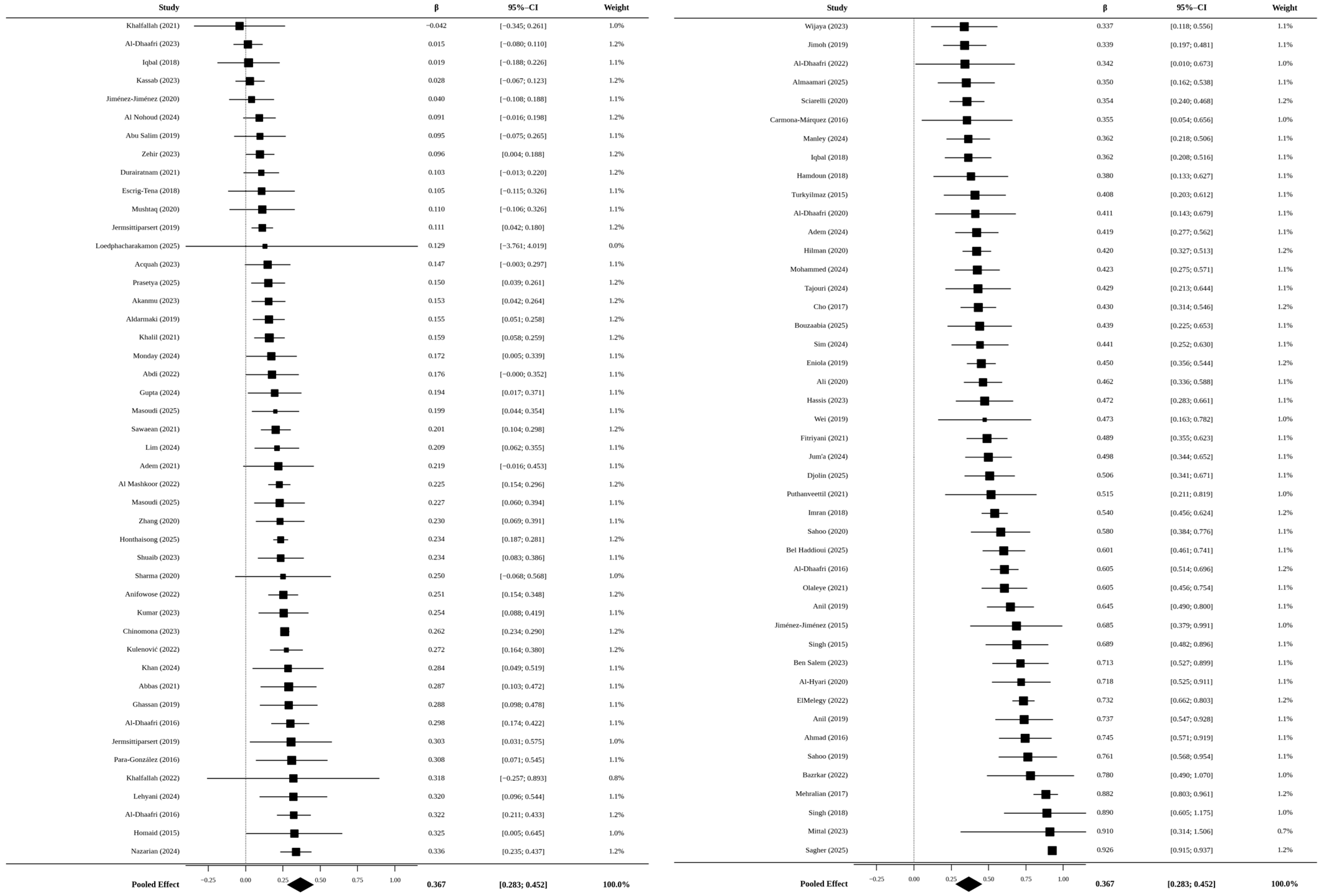
Since the results of these relationships might differ significantly across studies, it can be argued that this variation may not be merely random noise. Results from Nair [
1], Xu et al. [
2], Prashar [
3], Ahmad et al. [
35], and Ahmad et al. [
41] suggest that heterogeneity across studies warrants further evaluation. Reviewing 28 studies published between 1995 and 2015, Xu et al. [
2] found that most individual QM practices were positively correlated with organisational performance. However, even within specific TQM practices, results varied. Analysing 135 studies from 31 countries, Prashar [
3] observed significant residual heterogeneity that was rarely explained by performance and national culture dimensions. It should be noted that the mentioned studies mostly rely on correlations as a measure of effect size.
Beyond the corpus of correlation-based results, Magno et al. [
16] documented the increasing dominance of Structural Equation Modelling (SEM) as a key methodology in TQM studies since 2015. Therefore, a substantial amount of empirical evidence based on standardised path coefficients remains to be incorporated into the TQM literature. Additionally, scholars have concluded that disparities in results are not solely due to methodological differences. Such differences may also arise from geographical characteristics, industry-specific factors, and other contextual variables, highlighting that contextual factors may drive between-study variance, an issue that previous studies have poorly addressed. For example, Ahmad et al. [
35] and Ahmad et al. [
41] discovered that the region of origin influences the average TQM–performance relationship. Ahmad et al. [
35] emphasised that studies from Asia tend to report higher estimates than those from Europe or America. Also, manufacturing industries are among the most studied sectors, in contrast to other research contexts [
15]. These study characteristics may not be random limitations. They might be a source of variation that should be included in the study design and modelled alongside the pooled effect sizes.
Three prior meta-analyses are particularly relevant for comparison. Nair [
1] synthesised correlational evidence across 23 studies establishing a positive TQM–performance relationship, but did not examine path coefficients or test contextual factors. Xu et al. [
2] extended this work across 28 studies, yet likewise relied on correlations between individual QM practices and performance outcomes, without addressing SEM-derived estimates. Prashar [
3] is the most recent, analysing 135 studies, within the context of national culture, but again on a correlational basis. The present study differs from these three. It restricts its effect-size metric to standardised path coefficients from SEM models, which are not interchangeable with correlations. Furthermore, it focuses exclusively on studies published since 2015, when SEM became the dominant methodology in TQM research [
16], emphasising operationalisation type, performance dimensionality, geographic and firm-size characteristics as simultaneous key variables within a single meta-analytic framework.
2.3. Performance Dimensionality (RQ2)
Although TQM consistently shows positive effects on organisational performance across studies, the organisational performance measures used in measurement frameworks vary widely across outcome variables.
Table 1 presents the synthesis of performance outcomes used in TQM studies, along with moderating/mediating variables.
The synthesis shown in
Table 1 reveals considerable variability across performance outcomes. Although positive effects of TQM on performance lead to heterogeneity in relationship pathways, studies measuring aggregate and sustainability performance show the highest proportions of TQM-positive effects, suggesting that TQM’s impact is most consistently observed when performance is assessed broadly [
6,
42] or in sustainability terms [
10,
39,
43].
Studies examining operational, quality, and customer-related outcomes follow a similar pattern, with a notably higher proportion of mixed results; however, with fewer contested paths than in financial performance, suggesting that TQM effects vary considerably across studies and that contextual factors may temper TQM effects [
44,
45,
46,
47,
48,
49].
Financial performance is the most contested outcome. Nearly half of all TQM—performance paths are either non-significant or negative, consistent with prior meta-analytic evidence that financial returns from TQM investment might be delayed and sensitive to measurement design [
3,
8,
50,
51,
52].
Studies on innovation performance are also a heterogeneous category, highlighting the relevance of organisational learning, innovation capability, and knowledge transfer as mediating factors in the TQM–innovation link [
53,
54]. Similarly, heterogeneity in TQM’s effects on employee-related outcomes suggests that its impact on employee-level outcomes may depend more on intermediate organisational mechanisms [
52].
The diversity of mediating and moderating mechanisms identified across categories further underscores that the TQM–performance relationship is not a single, uniform effect, but a context-dependent concept that may vary depending on the outcome being measured.
2.4. TQM Construct Operationalisation: Composite Versus Dimensional (RQ3)
Choosing to operationalise TQM as a composite or as separate dimensions has implications for measurement. The composite approach to operationalisation captures the combined effects among TQM dimensions. In contrast, dimensional operationalisation treats individual practices as separate levers with distinct performance effects [
4,
24]. Comparing the application of composite measures with individual ones reveals a significant pattern. Composite measures produce significantly greater impact on organisational performance. Measuring TQM as a whole allows the path coefficient to reflect the combined influence of all practices, including their interdependencies. In contrast, modelling each dimension separately yields a path coefficient that captures only the marginal contribution of each. Whether this pattern remains statistically significant when path coefficients are used as the effect-size measure is one of the specific questions this study aims to explore.
This distinction is also reflected in the temporal evolution of measurement practices across the study corpus. Earlier studies, particularly those published between 2015 and 2016, more frequently operationalised TQM through individual dimensions, consistent with the tradition established by Flynn et al. [
4] and Saraph et al. [
24], who developed multi-item instruments to capture distinct TQM practices separately. Over time, the composite approach has become increasingly prevalent. Recent sustainability-oriented studies illustrate this shift clearly. Abbas [
10] operationalised TQM as a composite of six derived practices, applying a single latent construct in the path model. Similarly, Jermsittiparsert et al. [
39], Bouzaabia & Ben Salem [
43] and Saeidi et al. [
11] treated TQM as a single composite factor when examining its effect on sustainable and green performance outcomes. This progression from dimensional to composite operationalisation reflects a broader tendency in the literature to capture the synergistic rather than the additive effects of TQM practices.
2.5. Contextual Moderators: Industry, Geography, and Firm Size (RQ4)
According to contingency theory, organisational performance and management practices should be aligned with specific situational and organisational factors [
15,
28]. However, such contextual factors may lead to variations in effect sizes, and findings may differ accordingly. For instance, Sila [
29] found that contextual factors, such as industry type, firm size, and organisational learning, do not provide support for the argument that TQM and TQM–performance relationships are context-dependent. However, Sila [
32] confirmed that country and sector might serve as key moderators of the TQM–performance relationship. He concluded that such control variables should be an integral part of every study design. Alateyyat et al. [
15] also reached a similar conclusion, noting that manufacturing organisations are most represented in the literature, while the service and public sectors fall behind.
Geographical context might be an important moderator [
3,
35,
41]. For example, Prashar [
3] identified that national culture dimensions, such as uncertainty avoidance and institutional collectivism, are important moderators of the TQM—performance relationship. This study includes papers from South and Southeast Asia and the MENA region, with India, Pakistan, Thailand, Iran, and the UAE being the most frequently studied countries. Consequently, it is essential to investigate whether geographic moderators produce larger effects and whether differences in cultural or broader contextual factors are significant.
Firm size is a third contingency moderator. TQM implementations often rely on dedicated organisational functions, such as quality, training infrastructure, and supplier development programmes. Small and medium-sized organisations may lack the resources needed to support these organisational functions. Abbas [
10] found a fairly robust positive effect of TQM on corporate sustainability across environmental, social, and economic dimensions. Yücel [
40] highlighted differences in the effect of TQM on sustainability performance between medium-sized firms and small or large firms. Similar conclusions are drawn by Saeidi et al. [
11]. They found that organisational age does not mediate the relationship between TQM and green performance, whereas organisational size affects TQM. Consequently, contextual factors, along with firm-size categories, may moderate path coefficients that differ significantly between individual studies.