Conceptualising Higher-Education Teacher Excellence for More Inclusive and Sustainable Evaluation: An Exploratory Sequential Mixed-Methods Study



Abstract
1. Introduction
1.1. Conceptualising Higher-Education Teacher Excellence as a Role-Based, Multidimensional Construct
1.2. Limitations of Prevailing Evaluation Practices
1.3. The Present Study
2. Materials and Methods
2.1. Study Context
2.2. Study 1: Conceptualisation and Operationalisation of Higher-Education Teacher Excellence
2.2.1. Participants and Procedure
2.2.2. Data Analysis
2.3. Study 2: Dimensionality of Higher-Education Teacher Excellence
2.3.1. Participants
2.3.2. Instrument
2.3.3. Procedure
2.3.4. Data Analysis
3. Results
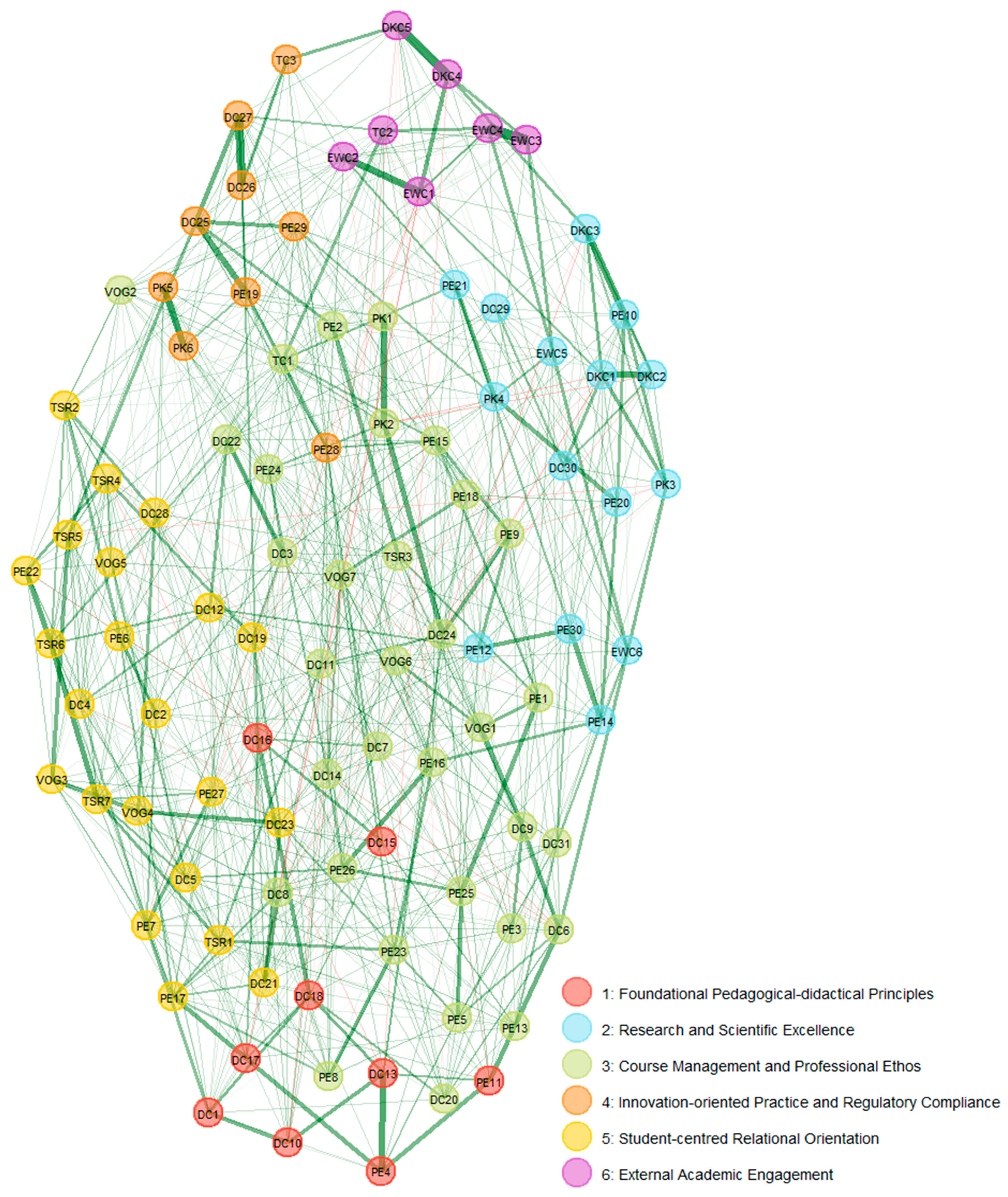
3.1. Conceptualisation of Higher-Education Teacher Excellence (Study 1)
3.2. Dimensionality of Higher-Education Teacher Excellence
3.2.1. Dimension 1: Foundational Pedagogical–Didactical Principles
3.2.2. Dimension 2: Research and Scientific Excellence
3.2.3. Dimension 3: Course Management and Professional Ethos
3.2.4. Dimension 4: Innovation-Oriented Practice and Regulatory Compliance
3.2.5. Dimension 5: Student-Centred Relational Orientation
3.2.6. Dimension 6: External Academic Engagement
3.3. Item Stability
4. Discussion
5. Conclusions
Author Contributions
Funding
Institutional Review Board Statement
Informed Consent Statement
Data Availability Statement
Acknowledgments
Conflicts of Interest
Appendix A

| Short Name | Item Label | Item Stability * | Network Loadings | |||||
|---|---|---|---|---|---|---|---|---|
| 1 | 2 | 3 | 4 | 5 | 6 | |||
| DC13 | Providing clear and understandable explanations of course content | 1 (75%) | 0.50 | |||||
| DC18 | Encouraging students to ask questions | 1 (68%) | 0.48 | |||||
| PE4 | Treating students fairly and professionally | 1 (75%) | 0.45 | |||||
| DC16 | Encouraging students to co-create the learning process | 1 (44%) | 0.32 | 0.11 | ||||
| DC10 | Establishing conditions for high-quality learning | 1 (71%) | 0.31 | |||||
| DC17 | Enabling students to express their views | 1 (57%) | 0.27 | 0.21 | ||||
| DC1 | Encouraging students to reach their full potential | 1 (67%) | 0.27 | 0.14 | ||||
| PE11 | Coming to lectures, seminars, and practical sessions well-prepared | 1 (63%) | 0.19 | 0.24 | ||||
| DC15 | Encouraging active student participation in the learning process | 1 (30%) | 0.16 | 0.13 | ||||
| DKC1 | Contributing to the development of the scientific field | 2 (90%) | 0.51 | |||||
| PE10 | Demonstrating commitment to the scientific field through one’s work | 2 (90%) | 0.48 | |||||
| PE20 | Demonstrating openness to recent advances in one’s scientific field | 2 (59%) | 0.45 | |||||
| DKC2 | Creating new knowledge within the scientific field | 2 (90%) | 0.44 | |||||
| PE30 | Engaging in continuous professional development | 2 (45%) | 0.44 | |||||
| PK3 | Demonstrating expert-level mastery of one’s scientific field | 2 (91%) | 0.41 | |||||
| DKC3 | Demonstrating a high level of competence in research | 2 (90%) | 0.41 | 0.11 | ||||
| PK4 | Integrating scientific disciplines | 2 (33%) | 0.35 | |||||
| DC30 | Integrating one’s own research with teaching | 2 (86%) | 0.31 | |||||
| EWC6 | Appropriately presenting and explaining scientific content to experts in one’s field | 2 (43%) | 0.30 | 0.22 | ||||
| PE14 | Demonstrating a desire for professional development and advancement | 2 (44%) | 0.28 | 0.17 | ||||
| DC29 | Incorporating the latest discoveries into course content | 2 (77%) | 0.24 | |||||
| PE21 | Demonstrating openness to interdisciplinary work | 2 (27%) | 0.18 | 0.13 | 0.11 | |||
| PE12 | Demonstrating openness to continuous learning | 2 (13%) | 0.17 | 0.19 | 0.12 | |||
| EWC5 | Appropriately presenting and explaining scientific content to the general public | 2 (24%) | 0.15 | 0.12 | 0.16 | |||
| DC9 | Clearly communicating expectations (including rules and criteria) regarding students’ course requirements | 3 (80%) | 0.51 | |||||
| PE25 | Reflecting on one’s own conduct | 3 (68%) | 0.45 | |||||
| VOG1 | Setting clear boundaries for acceptable student behaviour in the course | 3 (83%) | 0.44 | |||||
| PE15 | Accepting feedback on one’s work from colleagues | 3 (66%) | 0.41 | |||||
| PK2 | Possessing foundational pedagogical knowledge | 3 (55%) | 0.41 | |||||
| PE1 | Demonstrating personal integrity | 3 (83%) | 0.41 | |||||
| DC24 | Demonstrating knowledge of how to teach | 3 (70%) | 0.11 | 0.40 | ||||
| PE5 | Treating students respectfully | 3 (49%) | 0.10 | 0.39 | ||||
| VOG7 | Using appropriate strategies to address inappropriate behaviour and conflicts | 3 (61%) | 0.37 | 0.10 | ||||
| TSR3 | Being respected by students | 3 (81%) | 0.35 | |||||
| PE26 | Engaging in emotional self-reflection in interactions with students | 3 (58%) | 0.34 | 0.14 | ||||
| PE9 | Showing passion for teaching | 3 (72%) | 0.34 | |||||
| PE23 | Critically evaluating teaching practice | 3 (43%) | 0.33 | |||||
| DC6 | Demonstrating objectivity in assessment/grading | 3 (58%) | 0.12 | 0.11 | 0.31 | |||
| PE16 | Demonstrating openness to colleagues’ differing opinions | 3 (59%) | 0.31 | |||||
| DC14 | Communicating articulately | 3 (69%) | 0.30 | |||||
| DC3 | Sparking students’ interest in the professional field | 3 (37%) | 0.30 | 0.11 | ||||
| PK1 | Demonstrating knowledge of higher-education didactics | 3 (54%) | 0.30 | 0.10 | ||||
| PE24 | Identifying the most suitable teaching approach | 3 (67%) | 0.30 | |||||
| PE3 | Demonstrating consistency | 3 (66%) | 0.28 | |||||
| DC11 | Creating an environment in which learning is possible | 3 (57%) | 0.27 | 0.14 | ||||
| PE2 | Demonstrating decisiveness | 3 (65%) | 0.27 | |||||
| DC7 | Using feedback to guide students’ learning | 3 (44%) | 0.26 | 0.12 | ||||
| DC31 | Providing high-quality mentoring to students | 3 (38%) | 0.16 | 0.26 | ||||
| PE18 | Treating other higher-education teachers respectfully | 3 (60%) | 0.23 | |||||
| DC20 | Encouraging students’ thinking | 3 (40%) | 0.13 | 0.23 | ||||
| TC1 | Working effectively in a team | 3 (44%) | 0.22 | 0.16 | ||||
| PE8 | Treating students as responsible individuals | 3 (29%) | 0.22 | 0.17 | ||||
| VOG6 | Expecting moral behaviour from students | 3 (75%) | 0.21 | |||||
| DC22 | Encouraging students’ professional identity development | 3 (33%) | 0.19 | 0.17 | ||||
| DC8 | Providing substantive feedback and justifying grades after assessment | 3 (25%) | 0.18 | 0.24 | ||||
| PE13 | Acknowledging one’s own knowledge limitations | 3 (29%) | 0.14 | |||||
| VOG2 | Emphasising ethical dimension when addressing course content | 3 (29%) | 0.11 | 0.10 | ||||
| DC27 | Keeping up with developments in ICT and integrating innovations into teaching | 4 (84%) | 0.51 | |||||
| DC25 | Using innovative teaching methods | 4 (84%) | 0.50 | |||||
| PE19 | Demonstrating openness to new teaching approaches and methods | 4 (83%) | 0.13 | 0.49 | ||||
| DC26 | Integrating ICT into teaching in a meaningful way | 4 (83%) | 0.39 | |||||
| PK6 | Consistently adhering to formal rules (laws, regulations) in professional practice | 4 (59%) | 0.11 | 0.34 | ||||
| PK5 | Being thoroughly familiar with legal and other formal rules that affect teaching | 4 (58%) | 0.15 | 0.27 | 0.12 | |||
| PE29 | Continuously introducing innovations into the teaching–learning process | 4 (66%) | 0.18 | 0.26 | ||||
| PE28 | Demonstrating willingness to change teaching practice | 4 (58%) | 0.13 | 0.13 | 0.22 | |||
| TC3 | Demonstrating competence in performing administrative tasks | 4 (71%) | 0.21 | 0.13 | ||||
| TSR7 | Demonstrating insight into students’ needs | 5 (97%) | 0.60 | |||||
| TSR6 | Demonstrating insight into students’ characteristics | 5 (100%) | 0.11 | 0.53 | ||||
| TSR4 | Encouraging the formation of a student community | 5 (99%) | 0.49 | |||||
| VOG3 | Encouraging students to respect diversity | 5 (96%) | 0.42 | |||||
| DC4 | Recognising students’ potential and strengths | 5 (99%) | 0.39 | |||||
| VOG4 | Developing students’ awareness of current events in the wider social context | 5 (85%) | 0.38 | |||||
| TSR5 | Encouraging students to help one another | 5 (99%) | 0.11 | 0.37 | ||||
| PE7 | Expressing confidence in students’ abilities | 5 (85%) | 0.11 | 0.16 | 0.37 | |||
| DC28 | Connecting course content with current events and everyday life | 5 (96%) | 0.35 | |||||
| TSR2 | Establishing rapport with students | 5 (95%) | 0.34 | |||||
| PE22 | Being attentive to students’ personal concerns | 5 (100%) | 0.33 | |||||
| PE27 | Adapting to changes (e.g., different generations of students, new approaches) | 5 (79%) | 0.16 | 0.33 | ||||
| DC23 | Encouraging students to think about current developments in the professional field | 5 (60%) | 0.15 | 0.29 | ||||
| PE17 | Demonstrating openness to students’ differing opinions | 5 (75%) | 0.16 | 0.17 | 0.29 | |||
| DC19 | Encouraging students to explore and discover new things | 5 (63%) | 0.11 | 0.28 | ||||
| DC5 | Adapting teaching to students (based on observed changes in students) | 5 (85%) | 0.19 | 0.28 | ||||
| TSR1 | Creating a safe environment in which students feel accepted | 5 (67%) | 0.21 | 0.27 | ||||
| DC21 | Systematically developing students’ ability to think critically and to justify their viewpoints | 5 (62%) | 0.19 | 0.25 | ||||
| DC2 | Motivating students to engage in their learning | 5 (84%) | 0.13 | 0.25 | ||||
| PE6 | Being available to students for conversation | 5 (84%) | 0.25 | |||||
| DC12 | Creating an environment that supports students’ professional and personal development | 5 (74%) | 0.16 | 0.23 | ||||
| VOG5 | Encouraging students to engage in activities beyond the formal curriculum | 5 (89%) | 0.22 | |||||
| EWC4 | Promoting interest in science among the wider public | 6 (76%) | 0.11 | 0.51 | ||||
| DKC4 | Leading research projects | 6 (78%) | 0.11 | 0.50 | ||||
| EWC1 | Collaborating with researchers abroad | 6 (78%) | 0.10 | 0.49 | ||||
| EWC3 | Contributing to the dissemination of scientific findings to the general public | 6 (76%) | 0.14 | 0.45 | ||||
| DKC5 | Securing funding for research projects | 6 (78%) | 0.13 | 0.32 | ||||
| EWC2 | Engaging in external professional networking and collaboration (e.g., professional organisations, associations) | 6 (64%) | 0.13 | 0.27 | ||||
| TC2 | Balancing teaching and research responsibilities | 6 (46%) | 0.19 | 0.21 | ||||
| Short Name | Item Replicability | ||||||||||
|---|---|---|---|---|---|---|---|---|---|---|---|
| 1 | 2 | 3 | 4 | 5 | 6 | 7 | 8 | 9 | 10 | 11 | |
| DC13 | 75% | 0% | 8% | 0% | 2% | 3% | 8% | 2% | 1% | 0% | 0% |
| DC18 | 68% | 0% | 6% | 0% | 8% | 2% | 9% | 2% | 3% | 1% | 0% |
| PE4 | 75% | 0% | 8% | 0% | 2% | 3% | 8% | 2% | 1% | 0% | 0% |
| DC16 | 44% | 0% | 9% | 2% | 22% | 2% | 9% | 6% | 4% | 1% | 0% |
| DC10 | 71% | 0% | 8% | 0% | 5% | 2% | 8% | 2% | 3% | 0% | 0% |
| DC17 | 57% | 0% | 4% | 0% | 24% | 2% | 7% | 3% | 2% | 1% | 0% |
| DC1 | 67% | 0% | 6% | 0% | 10% | 2% | 8% | 2% | 3% | 1% | 0% |
| PE11 | 63% | 0% | 18% | 0% | 3% | 3% | 9% | 3% | 2% | 0% | 0% |
| DC15 | 30% | 0% | 12% | 0% | 30% | 2% | 11% | 7% | 6% | 1% | 0% |
| DKC1 | 0% | 90% | 0% | 0% | 0% | 1% | 8% | 0% | 0% | 0% | 0% |
| PE10 | 0% | 90% | 0% | 0% | 0% | 1% | 8% | 0% | 0% | 0% | 0% |
| PE20 | 0% | 59% | 9% | 0% | 0% | 4% | 23% | 4% | 1% | 0% | 0% |
| DKC2 | 0% | 90% | 0% | 0% | 0% | 1% | 8% | 0% | 0% | 0% | 0% |
| PE30 | 0% | 45% | 15% | 0% | 0% | 4% | 28% | 6% | 1% | 0% | 0% |
| PK3 | 0% | 91% | 0% | 0% | 0% | 1% | 8% | 0% | 0% | 0% | 0% |
| DKC3 | 0% | 90% | 0% | 0% | 0% | 1% | 8% | 0% | 0% | 0% | 0% |
| PK4 | 0% | 33% | 15% | 3% | 0% | 10% | 27% | 8% | 1% | 1% | 0% |
| DC30 | 0% | 86% | 2% | 0% | 0% | 2% | 9% | 1% | 0% | 0% | 0% |
| EWC6 | 1% | 43% | 17% | 0% | 0% | 4% | 24% | 8% | 1% | 0% | 0% |
| PE14 | 0% | 44% | 16% | 1% | 0% | 4% | 28% | 6% | 1% | 0% | 0% |
| DC29 | 0% | 77% | 5% | 0% | 0% | 3% | 12% | 2% | 0% | 0% | 0% |
| PE21 | 0% | 27% | 16% | 9% | 0% | 12% | 26% | 7% | 1% | 1% | 0% |
| PE12 | 1% | 13% | 42% | 0% | 5% | 3% | 23% | 10% | 2% | 1% | 0% |
| EWC5 | 0% | 24% | 6% | 5% | 0% | 43% | 15% | 5% | 1% | 1% | 0% |
| DC9 | 2% | 0% | 80% | 0% | 1% | 1% | 10% | 5% | 1% | 0% | 0% |
| PE25 | 3% | 0% | 68% | 0% | 4% | 3% | 13% | 6% | 2% | 0% | 0% |
| VOG1 | 0% | 0% | 83% | 1% | 0% | 1% | 9% | 4% | 1% | 0% | 0% |
| PE15 | 0% | 0% | 66% | 6% | 0% | 2% | 15% | 7% | 2% | 0% | 0% |
| PK2 | 0% | 0% | 55% | 20% | 0% | 3% | 12% | 7% | 2% | 0% | 0% |
| PE1 | 0% | 0% | 83% | 0% | 0% | 2% | 8% | 5% | 1% | 0% | 0% |
| DC24 | 3% | 0% | 70% | 3% | 0% | 3% | 11% | 7% | 2% | 0% | 0% |
| PE5 | 13% | 0% | 49% | 0% | 7% | 3% | 17% | 9% | 3% | 0% | 0% |
| VOG7 | 0% | 0% | 61% | 6% | 6% | 3% | 13% | 8% | 2% | 1% | 0% |
| TSR3 | 1% | 0% | 81% | 0% | 2% | 1% | 9% | 4% | 1% | 0% | 0% |
| PE26 | 0% | 0% | 58% | 1% | 15% | 2% | 12% | 9% | 3% | 0% | 0% |
| PE9 | 0% | 0% | 72% | 1% | 0% | 2% | 14% | 8% | 1% | 0% | 0% |
| PE23 | 3% | 0% | 43% | 1% | 19% | 3% | 16% | 11% | 3% | 1% | 0% |
| DC6 | 11% | 0% | 58% | 0% | 3% | 3% | 15% | 9% | 2% | 0% | 0% |
| PE16 | 0% | 1% | 59% | 4% | 4% | 3% | 16% | 9% | 3% | 1% | 0% |
| DC14 | 3% | 0% | 69% | 0% | 3% | 2% | 12% | 7% | 2% | 0% | 0% |
| DC3 | 1% | 2% | 37% | 0% | 32% | 2% | 12% | 10% | 3% | 1% | 0% |
| PK1 | 0% | 0% | 54% | 21% | 0% | 3% | 12% | 7% | 2% | 0% | 0% |
| PE24 | 1% | 0% | 67% | 1% | 7% | 2% | 11% | 8% | 2% | 1% | 0% |
| PE3 | 6% | 0% | 66% | 0% | 2% | 2% | 14% | 8% | 1% | 0% | 0% |
| DC11 | 0% | 0% | 57% | 1% | 14% | 2% | 15% | 9% | 2% | 0% | 0% |
| PE2 | 0% | 0% | 65% | 12% | 2% | 2% | 11% | 6% | 2% | 0% | 0% |
| DC7 | 2% | 0% | 44% | 0% | 25% | 2% | 15% | 9% | 4% | 1% | 0% |
| DC31 | 7% | 4% | 38% | 0% | 11% | 3% | 21% | 12% | 4% | 1% | 0% |
| PE18 | 1% | 0% | 60% | 10% | 1% | 3% | 14% | 8% | 2% | 1% | 0% |
| DC20 | 19% | 0% | 40% | 0% | 8% | 3% | 17% | 9% | 4% | 1% | 0% |
| TC1 | 0% | 0% | 44% | 10% | 18% | 3% | 14% | 9% | 2% | 1% | 0% |
| PE8 | 4% | 0% | 29% | 0% | 37% | 3% | 14% | 9% | 3% | 1% | 0% |
| VOG6 | 1% | 0% | 75% | 1% | 7% | 2% | 9% | 5% | 2% | 0% | 0% |
| DC22 | 0% | 1% | 33% | 1% | 36% | 2% | 13% | 9% | 3% | 1% | 0% |
| DC8 | 3% | 0% | 25% | 0% | 49% | 1% | 10% | 7% | 3% | 1% | 0% |
| PE13 | 10% | 1% | 29% | 0% | 25% | 3% | 17% | 10% | 4% | 1% | 0% |
| VOG2 | 0% | 0% | 29% | 15% | 34% | 3% | 10% | 7% | 2% | 1% | 0% |
| DC27 | 0% | 0% | 6% | 84% | 0% | 6% | 3% | 1% | 0% | 0% | 0% |
| DC25 | 0% | 0% | 8% | 84% | 0% | 2% | 4% | 2% | 0% | 0% | 0% |
| PE19 | 0% | 0% | 8% | 83% | 0% | 2% | 4% | 2% | 0% | 0% | 0% |
| DC26 | 0% | 0% | 6% | 83% | 0% | 7% | 3% | 1% | 0% | 0% | 0% |
| PK6 | 0% | 0% | 18% | 59% | 4% | 3% | 9% | 4% | 2% | 1% | 1% |
| PK5 | 0% | 0% | 19% | 58% | 4% | 3% | 9% | 4% | 2% | 1% | 1% |
| PE29 | 0% | 0% | 18% | 66% | 0% | 3% | 7% | 5% | 1% | 0% | 0% |
| PE28 | 1% | 0% | 22% | 58% | 1% | 3% | 9% | 5% | 1% | 0% | 1% |
| TC3 | 0% | 1% | 5% | 71% | 0% | 18% | 3% | 1% | 0% | 0% | 0% |
| TSR7 | 0% | 0% | 0% | 0% | 97% | 0% | 1% | 0% | 1% | 0% | 0% |
| TSR6 | 0% | 0% | 0% | 0% | 100% | 0% | 0% | 0% | 0% | 0% | 0% |
| TSR4 | 0% | 0% | 0% | 0% | 99% | 0% | 0% | 0% | 0% | 0% | 0% |
| VOG3 | 1% | 0% | 1% | 0% | 96% | 0% | 1% | 1% | 0% | 0% | 0% |
| DC4 | 0% | 0% | 0% | 0% | 99% | 0% | 0% | 0% | 0% | 0% | 0% |
| VOG4 | 5% | 0% | 2% | 0% | 85% | 1% | 4% | 2% | 1% | 1% | 0% |
| TSR5 | 0% | 0% | 0% | 0% | 99% | 0% | 0% | 0% | 0% | 0% | 0% |
| PE7 | 2% | 0% | 3% | 0% | 85% | 1% | 4% | 4% | 1% | 0% | 0% |
| DC28 | 0% | 0% | 0% | 0% | 96% | 0% | 1% | 1% | 1% | 1% | 0% |
| TSR2 | 0% | 0% | 1% | 0% | 95% | 0% | 1% | 1% | 1% | 0% | 0% |
| PE22 | 0% | 0% | 0% | 0% | 100% | 0% | 0% | 0% | 0% | 0% | 0% |
| PE27 | 1% | 0% | 6% | 0% | 79% | 1% | 5% | 4% | 3% | 1% | 0% |
| DC23 | 7% | 0% | 10% | 0% | 60% | 2% | 8% | 8% | 4% | 1% | 0% |
| PE17 | 3% | 0% | 5% | 0% | 75% | 1% | 6% | 6% | 3% | 1% | 0% |
| DC19 | 4% | 0% | 9% | 0% | 63% | 1% | 9% | 9% | 3% | 1% | 0% |
| DC5 | 1% | 0% | 3% | 0% | 85% | 1% | 4% | 4% | 2% | 0% | 0% |
| TSR1 | 2% | 0% | 12% | 0% | 67% | 2% | 7% | 6% | 3% | 1% | 0% |
| DC21 | 7% | 0% | 8% | 0% | 62% | 2% | 8% | 8% | 4% | 1% | 0% |
| DC2 | 1% | 0% | 6% | 0% | 84% | 1% | 3% | 3% | 2% | 0% | 0% |
| PE6 | 1% | 0% | 6% | 0% | 84% | 0% | 3% | 3% | 2% | 0% | 0% |
| DC12 | 0% | 0% | 13% | 0% | 74% | 1% | 6% | 3% | 2% | 1% | 0% |
| VOG5 | 0% | 0% | 4% | 1% | 89% | 0% | 2% | 3% | 1% | 0% | 0% |
| EWC4 | 0% | 15% | 0% | 6% | 0% | 76% | 1% | 1% | 0% | 1% | 0% |
| DKC4 | 0% | 15% | 0% | 7% | 0% | 78% | 0% | 0% | 0% | 0% | 0% |
| EWC1 | 0% | 15% | 0% | 7% | 0% | 78% | 0% | 0% | 0% | 0% | 0% |
| EWC3 | 0% | 15% | 0% | 6% | 0% | 76% | 1% | 1% | 0% | 1% | 0% |
| DKC5 | 0% | 15% | 0% | 7% | 0% | 78% | 0% | 0% | 0% | 0% | 0% |
| EWC2 | 0% | 11% | 1% | 19% | 0% | 64% | 3% | 1% | 0% | 0% | 0% |
| TC2 | 0% | 12% | 8% | 17% | 0% | 46% | 11% | 4% | 1% | 0% | 0% |
References
- Brusoni, M.; Damian, R.; Sauri, J.; Jackson, S.; Kömürcügil, H.; Malmedy, M.; Matveeva, O.; Motova, G.; Pisarz, S.; Patricia, P.; et al. The Concept of Excellence in Higher Education; ENQA: Brussels, Belgium, 2014. [Google Scholar]
- Gunn, V.; Fisk, A. Considering Teaching Excellence in Higher Education: 2007–2013: A Literature Review since the CHERI Report 2007; Higher Education Academy: York, UK, 2014. [Google Scholar]
- Little, B.; Locke, W. Conceptions of Excellence in Teaching and Learning and Implications for Future Policy and Practice. In Questioning Excellence in Higher Education: Policies, Experiences and Challenges in National and Comparative Perspective; Rostan, M., Vaira, M., Eds.; SensePublishers: Rotterdam, The Netherlands, 2011; pp. 119–137. [Google Scholar][Green Version]
- Miller-Young, J.; Sinclair, M.; Forgie, S. Teaching Excellence and How It Is Awarded: A Canadian Case Study. Can. J. High. Educ. 2020, 50, 40–52. [Google Scholar] [CrossRef]
- UNESCO. Education for Sustainable Development: A Roadmap; UNESCO: Paris, France, 2020. [Google Scholar]
- UNESCO. Transforming Education Towards SDG4: Report of a Global Survey on Country Actions to Transform Education; UNESCO: Paris, France, 2024. [Google Scholar]
- Veidemane, A. Education for Sustainable Development in Higher Education Rankings: Challenges and Opportunities for Developing Internationally Comparable Indicators. Sustainability 2022, 14, 5102. [Google Scholar] [CrossRef]
- Valantinaite, I.; Navickiene, V. The Phenomenon of Lecturer Competences as a Prerequisite for the Advancement of Sustainable Development Ideas in the Context of Student-Centred Studies. Sustainability 2024, 16, 1472. [Google Scholar] [CrossRef]
- Ball, S.J. The Teacher’s Soul and the Terrors of Performativity. J. Educ. Policy 2003, 18, 215–228. [Google Scholar] [CrossRef]
- Hillebrandt, M.; Huber, M. Editorial: Quantifying Higher Education: Governing Universities and Academics by Numbers. Polit. Gov. 2020, 8, 1–5. [Google Scholar] [CrossRef]
- Skelton, A. Understanding Teaching Excellence in Higher Education: Towards a Critical Approach; Routledge: London, UK, 2005. [Google Scholar]
- Mattos, L.K.; Flach, L.; Costa, A.M.; Moré, R.P. Effectiveness and Sustainability Indicators in Higher Education Management. Sustainability 2023, 15, 298. [Google Scholar] [CrossRef]
- Biesta, G. Good Education in an Age of Measurement: On the Need to Reconnect with the Question of Purpose in Education. Educ. Assess. Eval. Account. 2009, 21, 33–46. [Google Scholar] [CrossRef]
- Fenstermacher, G.; Richardson, V. On Making Determinations of Quality in Teaching. Teach. Coll. Rec. 2005, 107, 186–213. [Google Scholar] [CrossRef]
- Harvey, L.; Green, D. Defining Quality. Assess. Eval. High. Educ. 1993, 18, 9–34. [Google Scholar] [CrossRef]
- Readings, B. The University in Ruins; Harvard University Press: Cambridge, MA, USA, 1996. [Google Scholar]
- Hazelkorn, E. Rankings and the Reshaping of Higher Education. The Battle for World-Class Excellence; Palgrave Macmillan: New York, NY, USA, 2015. [Google Scholar]
- Morley, L. Quality and Power in Higher Education; Open University Press: Maidenhead, UK, 2003. [Google Scholar]
- Naidoo, R. Repositioning Higher Education as a Global Commodity: Opportunities and Challenges for Future Sociology of Education Work. Br. J. Sociol. Educ. 2003, 24, 249–259. [Google Scholar] [CrossRef]
- Marsh, H.; Roche, L. Making Students’ Evaluations of Teaching Effectiveness Effective: The Critical Issues of Validity, Bias, and Utility. Am. Psychol. 1997, 52, 1187–1197. [Google Scholar] [CrossRef]
- Shulman, L.S. Those Who Understand: Knowledge Growth in Teaching. Educ. Res. 1986, 15, 4–14. [Google Scholar] [CrossRef]
- Biggs, J.; Tang, C. Teaching for Quality Learning at University, 4th ed.; Society for Research into Higher Education; Open University Press: Berkshire, UK; New York, NY, USA, 2011. [Google Scholar]
- Prince, M. Does Active Learning Work? A Review of the Research. J. Eng. Educ. 2004, 93, 223–231. [Google Scholar] [CrossRef]
- Ramsden, P. Learning to Teach in Higher Education, 2nd ed.; Routledge Falmer: London, UK; New York, NY, USA, 2003. [Google Scholar]
- Kahu, E.R. Framing Student Engagement in Higher Education. Stud. High. Educ. 2013, 38, 758–773. [Google Scholar] [CrossRef]
- Li, J.; Xue, E. Dynamic Interaction between Student Learning Behaviour and Learning Environment: Meta-Analysis of Student Engagement and Its Influencing Factors. Behav. Sci. 2023, 13, 59. [Google Scholar] [CrossRef]
- Strayhorn, T.L. College Students’ Sense of Belonging: A Key to Educational Success for All Students, 2nd ed.; Routledge: London, UK, 2018. [Google Scholar]
- Hockings, C. Inclusive Learning and Teaching in Higher Education: A Synthesis of Research; Higher Education Academy: York, UK, 2010. [Google Scholar]
- O’Neill, G.; McMahon, T. Student-Centred Learning: What Does It Mean for Students and Lecturers? In Emerging Issues in the Practice of University Learning and Teaching; O’Neill, G., Moore, S., McMullin, B., Eds.; AISHE: Dublin, Ireland, 2005; pp. 30–39. [Google Scholar]
- Campbell, E. The Ethics of Teaching as a Moral Profession. Curric. Inq. 2008, 38, 357–385. [Google Scholar] [CrossRef]
- Dewey, J. How We Think: A Restatement of the Relation of Reflective Thinking to the Educative Process; D.C. Heath & Co.: Lexington, MA, USA, 1933. [Google Scholar]
- Schön, D.A. Educating the Reflective Practitioner: Toward a New Design for Teaching and Learning in the Professions; Jossey-Bass: San Francisco, CA, USA, 1987. [Google Scholar]
- Kember, D.; Leung, D.; Jones, A.; Loke, A.Y.; Mckay, J.; Sinclair, K.; Tse, H.; Webb, C.; Wong, F.; Wong, M.; et al. Development of a Questionnaire to Measure the Level of Reflective Thinking. Assess. Eval. High. Educ. 2000, 25, 381–395. [Google Scholar] [CrossRef]
- Morris, E.J. Integrating Academic Integrity: An Educational Approach. In Second Handbook of Academic Integrity; Eaton, S.E., Ed.; Springer: Cham, Switzerland, 2024; pp. 305–324. [Google Scholar]
- Henderson, M.; Selwyn, N.; Aston, R. What Works and Why? Student Perceptions of ‘Useful’ Digital Technology in University Teaching and Learning. Stud. High. Educ. 2017, 42, 1567–1579. [Google Scholar] [CrossRef]
- Kirkwood, A.; Price, L. Technology-Enhanced Learning and Teaching in Higher Education: What Is ‘Enhanced’ and How Do We Know? A Critical Literature Review. Learn. Media Technol. 2014, 39, 6–36. [Google Scholar] [CrossRef]
- Vaclavik, M.; Tomasek, M.; Cervenkova, I.; Baarova, B. Analysis of Quality Teaching and Learning from Perspective of University Students. Educ. Sci. 2022, 12, 820. [Google Scholar] [CrossRef]
- Brew, A. Research and Teaching: Beyond the Divide; Palgrave Macmillan: New York, NY, USA, 2006. [Google Scholar]
- Laredo, P. Revisiting the Third Mission of Universities: Toward a Renewed Categorization of University Activities? High. Educ. Policy 2007, 20, 441–456. [Google Scholar] [CrossRef]
- Perkmann, M.; Tartari, V.; McKelvey, M.; Autio, E.; Broström, A.; D’Este, P.; Fini, R.; Geuna, A.; Grimaldi, R.; Hughes, A.; et al. Academic Engagement and Commercialisation: A Review of the Literature on University–Industry Relations. Res. Policy 2013, 42, 423–442. [Google Scholar] [CrossRef]
- Peters, H.P. Scientists as Public Experts: Expectations and Responsibilities. In Routledge Handbook of Public Communication of Science and Technology; Bucchi, M., Trench, B., Eds.; Routledge: London, UK, 2021; pp. 114–128. [Google Scholar]
- Trench, B.; Bucchi, M. Global Spread of Science Communication. In Routledge Handbook of Public Communication of Science and Technology; Bucchi, M., Trench, B., Eds.; Routledge: London, UK, 2021; pp. 97–113. [Google Scholar]
- Healey, M. Linking Research and Teaching: Exploring Disciplinary Spaces and the Role of Inquiry-Based Learning. In Reshaping The University: New Relationships Between Research, Scholarship And Teaching; Barnett, R., Ed.; Society for Research into Higher Education; Open University Press: Berkshire, UK, 2005; pp. 67–78. [Google Scholar]
- Calice, M.N.; Beets, B.; Bao, L.; Scheufele, D.A.; Freiling, I.; Brossard, D.; Feinstein, N.W.; Heisler, L.; Tangen, T.; Handelsman, J. Public Engagement: Faculty Lived Experiences and Perspectives Underscore Barriers and a Changing Culture in Academia. PLoS ONE 2022, 17, e0269949. [Google Scholar] [CrossRef]
- Marsh, H. Students’ Evaluations of University Teaching: Dimensionality, Reliability, Validity, Potential Biases and Usefulness. In The Scholarship of Teaching and Learning in Higher Education: An Evidence-Based Perspective; Springer: Dordrecht, The Netherlands, 2007; pp. 319–383. [Google Scholar]
- Spooren, P.; Brockx, B.; Mortelmans, D. On the Validity of Student Evaluation of Teaching: The State of the Art. Rev. Educ. Res. 2013, 83, 598–642. [Google Scholar] [CrossRef]
- Boring, A. Gender Biases in Student Evaluations of Teaching. J. Public Econ. 2017, 145, 27–41. [Google Scholar] [CrossRef]
- Hornstein, H. Student Evaluations of Teaching Are an Inadequate Assessment Tool for Evaluating Faculty Performance. Cogent Educ. 2017, 4, 1304016. [Google Scholar] [CrossRef]
- MacNell, L.; Driscoll, A.; Hunt, A. What’s in a Name: Exposing Gender Bias in Student Ratings of Teaching. Innov. High. Educ. 2014, 40, 291–303. [Google Scholar] [CrossRef]
- Uttl, B.; White, C.; Gonzalez, D. Meta-Analysis of Faculty’s Teaching Effectiveness: Student Evaluation of Teaching Ratings and Student Learning Are Not Related. Stud. Educ. Eval. 2016, 54, 22–42. [Google Scholar] [CrossRef]
- Makki, A.A.; Alqahtani, A.Y.; Abdulaal, R.M.S.; Madbouly, A.I. A Novel Strategic Approach to Evaluating Higher Education Quality Standards in University Colleges Using Multi-Criteria Decision-Making. Educ. Sci. 2023, 13, 577. [Google Scholar] [CrossRef]
- Penny, A. Changing the Agenda for Research into Students’ Views about University Teaching: Four Shortcomings of SRT Research. Teach. High. Educ. 2003, 8, 399–411. [Google Scholar] [CrossRef]
- Creswell, J.W.; Plano Clark, V.L. Designing and Conducting Mixed Methods Research, 3rd ed.; SAGE Publications: Thousand Oaks, CA, USA, 2018. [Google Scholar]
- Javed, Y.; Alenezi, M. A Case Study on Sustainable Quality Assurance in Higher Education. Sustainability 2023, 15, 8136. [Google Scholar] [CrossRef]
- Miles, M.B.; Huberman, A.M.; Saldaña, J. Qualitative Data Analysis: A Methods Sourcebook, 4th ed.; SAGE Publications: Thousand Oaks, CA, USA, 2020. [Google Scholar]
- Makovec, D. The Dimensions of Teacher’s Professional Development. Sodob. Pedagog. 2018, 69, 106–125. [Google Scholar]
- Centre for Social Informatics. 1KA, Version 25.03.21; Faculty of Social Sciences, University of Ljubljana: Ljubljana, Slovenia, 2025.
- Stekhoven, D.J. missForest: Nonparametric Missing Value Imputation Using Random Forest, Version 1.6.1; R Core Team: Vienna, Austria, 2025.
- Epskamp, S. Exploratory Graph Analysis: A New Approach for Estimating the Number of Dimensions in Psychological Research. PLoS ONE 2017, 12, e0174035. [Google Scholar] [CrossRef]
- Epskamp, S.; Fried, E.I. A Tutorial on Regularized Partial Correlation Networks. Psychol. Methods 2018, 23, 617–634. [Google Scholar] [CrossRef]
- Louvet, G.; Raymaekers, J.; Van Bever, G.; Wilms, I. The Influence Function of Graphical Lasso Estimators. Econom. Stat. 2023; in press. [CrossRef]
- Friedman, J.; Hastie, T.; Tibshirani, R. Sparse Inverse Covariance Estimation with the Graphical Lasso. Biostatistics 2008, 9, 432–441. [Google Scholar] [CrossRef] [PubMed]
- Chen, J.; Chen, Z. Extended Bayesian Information Criteria for Model Selection with Large Model Spaces. Biometrika 2008, 95, 759–771. [Google Scholar] [CrossRef]
- Brusco, M.; Steinley, D.; Watts, A.L. A Comparison of Spectral Clustering and the Walktrap Algorithm for Community Detection in Network Psychometrics. Psychol. Methods 2024, 29, 704–772. [Google Scholar] [CrossRef]
- Pons, P.; Latapy, M. Computing Communities in Large Networks Using Random Walks. In Proceedings of the Computer and Information Sciences-ISCIS 2005; Yolum, P., Güngör, T., Gürgen, F., Özturan, C., Eds.; Springer: Berlin/Heidelberg, Germany, 2005; pp. 284–293. [Google Scholar]
- Christensen, A.P.; Golino, H. Estimating the Stability of Psychological Dimensions via Bootstrap Exploratory Graph Analysis: A Monte Carlo Simulation and Tutorial. Psych 2021, 3, 479–500. [Google Scholar] [CrossRef]
- Golino, H.; Christensen, A. EGAnet: Exploratory Graph Analysis—A Framework for Estimating the Number of Dimensions in Multivariate Data Using Network Psychometrics, Version 2.4.0; R Core Team: Vienna, Austria, 2025.
- Christensen, A.P.; Golino, H. On the Equivalency of Factor and Network Loadings. Behav. Res. Methods 2021, 53, 1563–1580. [Google Scholar] [CrossRef] [PubMed]
- R Core Team. R: A Language and Environment for Statistical Computing, Version 4.5.2; R Core Team: Vienna, Austria, 2025.
- López-Hernández, C.; Martínez-Orozco, E.; Soto-Pérez, M. Typology of Teaching Profiles: A Model for Improving the Quality of University Education in the Context of Sustainable Development Goal 4. Sustainability 2025, 17, 11066. [Google Scholar] [CrossRef]
- Ciuchi, O.M.; Șerbănescu, L.E.; Dobre, C.M.; Georgescu, B.G.; Țigănoaia, B.D.; Țucă, P.L. The Impact of Student Evaluation of Teaching Staff on Enhancing the Quality of Teaching in Higher Education in Romania. Sustainability 2024, 16, 10196. [Google Scholar] [CrossRef]
- Huang, Y.; Jiang, L.; Zhai, R. Reconciling Teaching and Research Tensions: A Sustainability Framework for Expert Teacher Development in Research Intensive Universities. Sustainability 2025, 17, 7113. [Google Scholar] [CrossRef]
- Robinson, J.M.; Seymour, R.; Jin, S.; Whiteman, R.S. Sense of Belonging, DFW Reduction, and Student Success: Centering Student Experience in Groups with Ethnographic Methods. Educ. Sci. 2025, 15, 523. [Google Scholar] [CrossRef]
- Zdonek, I.; Zdonek, D.; Król, K.; Halva, J. Sustainability-Oriented Higher Education Activities: Insights from Institutional Isomorphism Perspective. Sustainability 2025, 17, 11034. [Google Scholar] [CrossRef]
- Ghorbani, A.; Blankesteijn, M.L. Beyond the Ivory Tower: How Dutch Universities Convert Missions into ESG Performance. Sustainability 2026, 18, 624. [Google Scholar] [CrossRef]
- Wang, F.; Jo, N. Staying Without Sustainability: How Everyday Governance Reshapes Teachers’ Work in Private Higher Education in China. Sustainability 2026, 18, 1587. [Google Scholar] [CrossRef]
- Levy-Feldman, I. The Role of Assessment in Improving Education and Promoting Educational Equity. Educ. Sci. 2025, 15, 224. [Google Scholar] [CrossRef]
- Chen, X.; Wu, L.; Jia, L.; AlGerafi, M.A.M. Flow Experience and Innovative Behavior of University Teachers: Model Development and Empirical Testing. Behav. Sci. 2025, 15, 363. [Google Scholar] [CrossRef] [PubMed]
- Zhang, Y.; Sun, S.; Ji, Y.; Li, Y. The Consensus of Global Teaching Evaluation Systems under a Sustainable Development Perspective. Sustainability 2023, 15, 818. [Google Scholar] [CrossRef]
- Curtis, H.L.; Gabriel, L.C.; Sahakian, M.; Cattacin, S. Practice-Based Program Evaluation in Higher Education for Sustainability: A Student Participatory Approach. Sustainability 2021, 13, 10816. [Google Scholar] [CrossRef]
- Wongvorachan, T.; Bulut, O.; Gorgun, G.; Daniels, L. Evaluating the Validity of the Student Perspectives of Teaching Survey: A Network Psychometrics Approach. Trends High. Educ. 2025, 4, 74. [Google Scholar] [CrossRef]
- Zipser, N.; Kurochkin, D.; Yu, K.W.; Mincieli, L.A. Exploring Relationships Between Qualitative Student Evaluation Comments and Quantitative Instructor Ratings: A Structural Topic Modeling Framework. Educ. Sci. 2025, 15, 1011. [Google Scholar] [CrossRef]
- Papadogiannis, I.; Vassilakis, C.; Wallace, M.; Katsis, A. On the Quality and Validity of Course Evaluation Questionnaires Used in Tertiary Education in Greece. Trends High. Educ. 2024, 3, 221–234. [Google Scholar] [CrossRef]
- Bart, W.M.; Abulela, M.A.A.; Khalaf, M.A. Investigating Course Level Effects on Student Evaluations of Teaching in Higher Education. Educ. Sci. 2026, 16, 94. [Google Scholar] [CrossRef]
- Blake, J. Aligning Teaching Philosophy Statements with Practice: An Evidence-Based Approach Using Retrospective Think-Aloud Protocols. Educ. Sci. 2024, 14, 795. [Google Scholar] [CrossRef]
- Beckett, R.D.; Sheehan, A.H.; Isaacs, A.N.; Ramsey, D.; Sprunger, T. Development and Assessment of a Rubric for Evaluating Teaching Portfolios Developed by Teaching and Learning Curriculum (TLC) Program Participants. Am. J. Pharm. Educ. 2024, 88, 101262. [Google Scholar] [CrossRef] [PubMed]
- Sánchez-Santamaría, J.; Boroel-Cervantes, B.I.; López-Garrido, F.-M.; Hortigüela-Alcalá, D. Motivation and Evaluation in Education from the Sustainability Perspective: A Review of the Scientific Literature. Sustainability 2021, 13, 4047. [Google Scholar] [CrossRef]
- Lim, S.H.; Lim, L.; Lye, C.Y.; Lim, W.Y. Personalised Professional Development in Teaching and Learning in Higher Education. Trends High. Educ. 2025, 4, 16. [Google Scholar] [CrossRef]

| Categories (Second Order) | Subcategories (First Order) |
|---|---|
| professional ethos | personal engagement, pedagogical eros, commitment to teaching, personal integrity, attitude toward students, aptitude for working with students, desire for teaching, commitment to the discipline and profession, coming to sessions well-prepared, responsibility and accountability in the teaching role, openness to learning, intellectual humility, curiosity and desire to discover new things, openness to others’ perspectives, openness to diverse didactical approaches, openness to disciplinary, scientific developments, interdisciplinary orientation, empathy, reflection on teaching practice, behavioural self-reflection, emotional self-reflection, adaptability/flexibility, willingness to modify teaching practice, commitment to professional development |
| teacher–student relationality | creating a safe learning environment, teacher–student relatedness, peer-relatedness facilitation, student insight and understanding |
| didactical competencies | motivational support, student-centred teaching, fostering students’ enthusiasm for course content, fostering students’ enthusiasm for the profession, recognising students’ potential and strengths, adapting to students’ needs, providing relevant feedback, establishing conditions for high-quality learning, instructional explanation, active participation facilitation, fostering general education, theory–practice integration, instructional competencies, method selection and application, ICT-supported instruction, integration of research and teaching, mentorship |
| values-oriented guidance | setting boundaries for acceptable student behaviour |
| professional knowledge | higher-education didactics knowledge, foundational pedagogical knowledge, subject-matter expertise, general knowledge, interdisciplinary engagement, regulatory and institutional framework knowledge |
| discipline development and knowledge creation | development of the scientific field/discipline; project leadership and management |
| engagement with the wider community | embeddedness in the wider community, promotion of science |
| transversal competencies | teamwork competencies, communication skills, organisational skills, self-management, balancing teaching and research responsibilities, administrative skills |
| Number of Dimensions | 4 | 5 | 6 | 7 | 8 | 9 | 10 | 11 |
|---|---|---|---|---|---|---|---|---|
| Frequency (%) | 7.4 | 19.4 | 23.8 | 23.6 | 15.2 | 7.6 | 2.0 | 1.0 |
| Dimension | 1st | 2nd | 3rd | 4th | 5th | 6th |
|---|---|---|---|---|---|---|
| Dimension stability | 0.206 | 0.028 | 0.002 | 0.356 | 0.282 | 0.386 |
| Category | D1 | D2 | D3 | D4 | D5 | D6 | Total | Main Pattern Across Phases |
|---|---|---|---|---|---|---|---|---|
| Professional ethos | 2 | 6 | 14 | 3 | 5 | 0 | 30 | Redistributed across several dimensions, but concentrated in D3 |
| Teacher–student relationality | 0 | 0 | 1 | 0 | 6 | 0 | 7 | Largely retained in D5, with minor spillover to D3 |
| Didactical competencies | 7 | 2 | 11 | 3 | 8 | 0 | 31 | Split across D1, D3, and D5, with smaller contributions to D2 and D4 |
| Values-oriented guidance | 0 | 0 | 4 | 0 | 3 | 0 | 7 | Divided mainly between D3 and D5 |
| Professional knowledge | 0 | 2 | 2 | 2 | 0 | 0 | 6 | Redistributed across D2, D3, and D4 |
| Discipline development and knowledge creation | 0 | 3 | 0 | 0 | 0 | 2 | 5 | Split between D2 and D6 |
| Engagement with the wider community | 0 | 2 | 0 | 0 | 0 | 4 | 6 | Largely retained in D6, with some overlap with D2 |
| Transversal competencies | 0 | 0 | 1 | 1 | 0 | 1 | 3 | Dispersed; no distinct dimension recovered |
| Total | 9 | 15 | 33 | 9 | 22 | 7 | 95 |
Disclaimer/Publisher’s Note: The statements, opinions and data contained in all publications are solely those of the individual author(s) and contributor(s) and not of MDPI and/or the editor(s). MDPI and/or the editor(s) disclaim responsibility for any injury to people or property resulting from any ideas, methods, instructions or products referred to in the content. |
© 2026 by the authors. Licensee MDPI, Basel, Switzerland. This article is an open access article distributed under the terms and conditions of the Creative Commons Attribution (CC BY) license.
Share and Cite
Kristl, N.; Sočan, G.; Makovec Radovan, D. Conceptualising Higher-Education Teacher Excellence for More Inclusive and Sustainable Evaluation: An Exploratory Sequential Mixed-Methods Study. Sustainability 2026, 18, 4858. https://doi.org/10.3390/su18104858
Kristl N, Sočan G, Makovec Radovan D. Conceptualising Higher-Education Teacher Excellence for More Inclusive and Sustainable Evaluation: An Exploratory Sequential Mixed-Methods Study. Sustainability. 2026; 18(10):4858. https://doi.org/10.3390/su18104858
Chicago/Turabian StyleKristl, Nina, Gregor Sočan, and Danijela Makovec Radovan. 2026. "Conceptualising Higher-Education Teacher Excellence for More Inclusive and Sustainable Evaluation: An Exploratory Sequential Mixed-Methods Study" Sustainability 18, no. 10: 4858. https://doi.org/10.3390/su18104858
APA StyleKristl, N., Sočan, G., & Makovec Radovan, D. (2026). Conceptualising Higher-Education Teacher Excellence for More Inclusive and Sustainable Evaluation: An Exploratory Sequential Mixed-Methods Study. Sustainability, 18(10), 4858. https://doi.org/10.3390/su18104858