Coupling Coordination Between Ecological Environment and Tourism Economy in Xinjiang


Abstract
1. Introduction
2. Materials and Methods
2.1. Study Area
2.2. Indicator Framework Development and Data Acquisition
2.3. Method Selection and Model Construction
2.3.1. Rationale for Methodological Selection
- Method Selection Based on Research Questions
- 2.
- Methodological Adaptability Analysis Based on Data Characteristics
- 3.
- Comparative Analysis Based on Alternative Methods
2.3.2. Core Research Methods and Model Construction
- Entropy Weighting and Composite Index Calculation
- 2.
- Coupling Coordination Degree Model
- 3.
- Relative Development Degree Model
- 4.
- Grey Relational Analysis
3. Results
3.1. Temporal Dynamics of Ecological and Tourism Economic Systems in Xinjiang
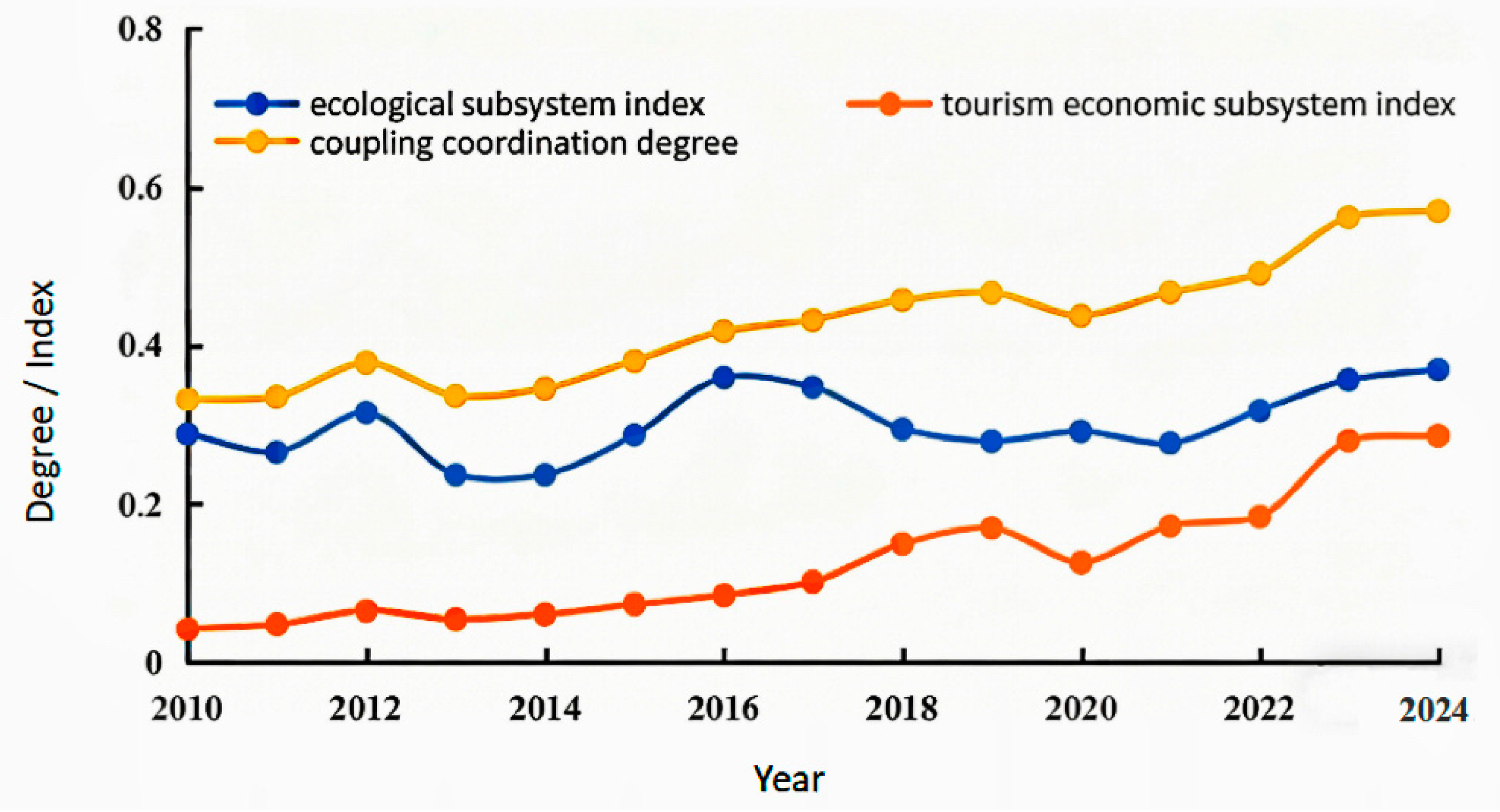
3.1.1. Development Trajectory of the Ecological Subsystem
3.1.2. Development Trajectory of the Tourism Economic Subsystem
3.2. Coupling Coordination and Relative Development Characteristics
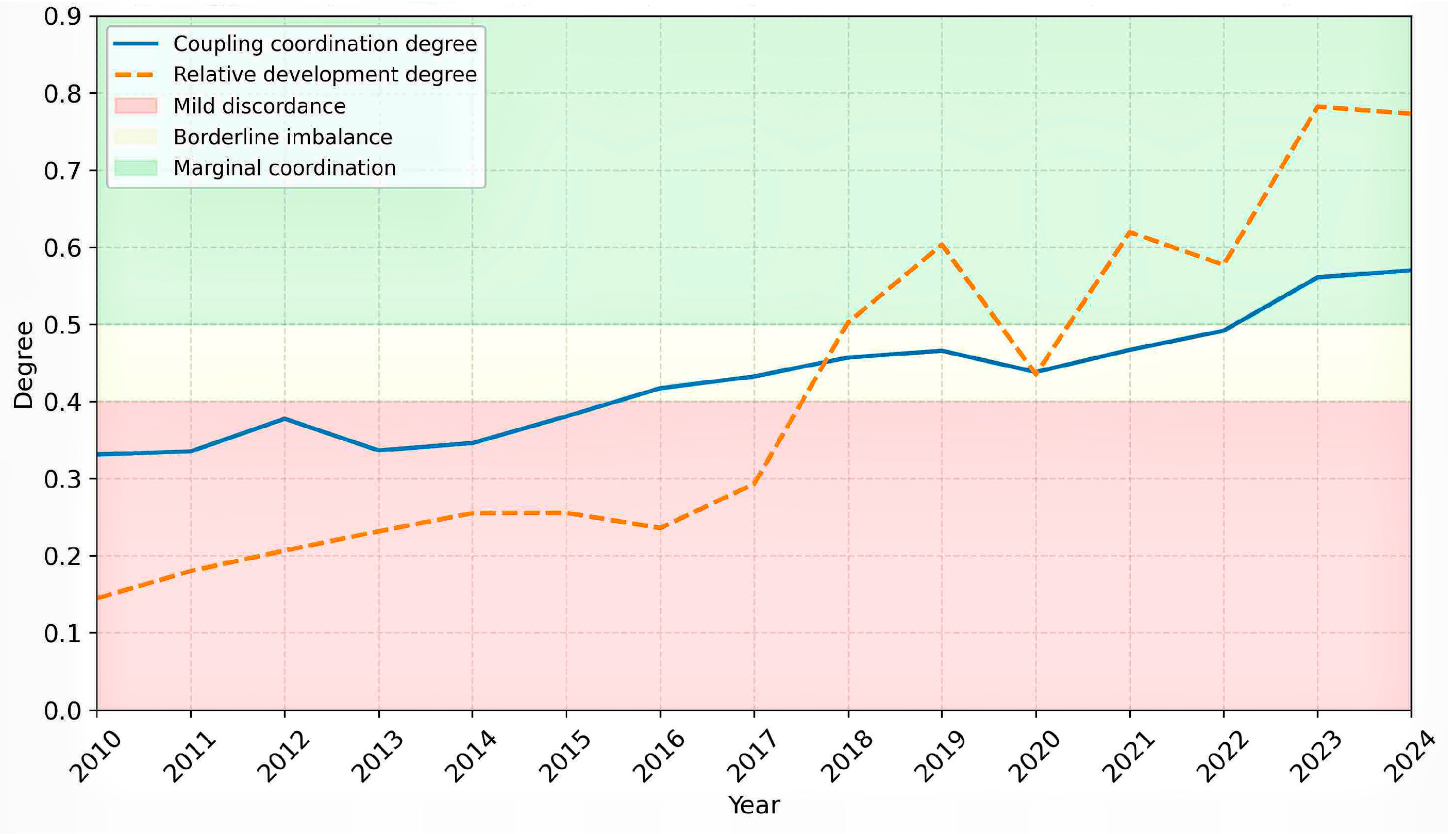
3.2.1. Temporal Evolution of Coupling Coordination Degree
3.2.2. Temporal Evolution of Relative Development Degree and the “Tourism-Lag” Bottleneck
3.3. Analysis of Factors Influencing Coupling Coordination
3.3.1. Comprehensive Dimensional-Level Influence Effects
3.3.2. Indicator-Level Analysis of Critical Driving Factors
4. Discussion
4.1. System Resilience, External Shocks, and Digital Strategic Response
4.2. Infrastructure-First Strategy and Refined Ecological Governance: The Dual Drivers of the “Fast Access, Slow Experience” Paradigm
4.3. The “Tourism-Lag” Window Period and Culture–Ecology Integration Pathways: The “Xinjiang Paradigm” for High-Quality Development
4.4. Empirical Validation and Methodological Reflection
4.5. Limitations and Future Research Directions
5. Conclusions
Author Contributions
Funding
Institutional Review Board Statement
Informed Consent Statement
Data Availability Statement
Acknowledgments
Conflicts of Interest
Abbreviations
| COVID-19 | Coronavirus Disease 2019 |
| CCD | Coupling Coordination Degree |
| PSR | Pressure–State–Response |
| SO2 | Sulfur Dioxide |
| PCA | Principal Component Analysis |
| SEM | Structural Equation Modeling |
| MLR | Multiple Linear Regression |
| RDM | Relative Development Model |
| GRA | Grey Relational Analysis |
| RDD | Relative Development Degree |
| GDP | Gross Domestic Product |
| VR | Virtual Reality |
| AR | Augmented Reality |
| SDGs | Sustainable Development Goals |
References
- Yang, F.; Liu, L.M.; Zhang, Z.X.; He, N. Study on Coupling Coordination and Influencing Factors of Ecological Environment and Tourism Economy in Inner Mongolia. Areal Res. Dev. 2025, 6, 124–129. [Google Scholar]
- Akadiri, S.S.; Ozkan, O. Tourism, energy use, and urban growth: Implications for load capacity and sustainable development. Lett. Spat. Resour. Sci. 2026, 19, 13–30. [Google Scholar] [CrossRef]
- Yabuuchi, S. Tourism, the environment, and welfare in a dual economy. Asia-Pac. J. Account. Econ. 2013, 20, 172–182. [Google Scholar] [CrossRef]
- Huybers, T.; Bennett, J. Impact of the Environment on Holiday Destination Choices of Prospective UK Tourists: Implications for Tropical North Queensland. Tour. Econ. 2000, 6, 21–46. [Google Scholar] [CrossRef]
- World Tourism Organization. Study of Tourism’s Contribution to Protecting the Environment. J. Travel Res. 1984, 23, 42–43. [Google Scholar] [CrossRef]
- Doğan, M. Ecological ideals, sustainable tourism and the heritage concept of an eco-village: The case of Arcosanti, USA. J. Herit. Tour. 2019, 14, 371–381. [Google Scholar] [CrossRef]
- Giannoni, S.; Maupertuis, M. Environmental Quality and Optimal Investment in Tourism Infrastructures: A Small Island Perspective. Tour. Econ. 2007, 13, 499–513. [Google Scholar] [CrossRef]
- Wang, S.; Cheablam, O. Sustainable tourism and its environmental and economic impacts: Fresh evidence from major tourism hubs. Sustainability 2025, 17, 5058. [Google Scholar] [CrossRef]
- Deb, S.K.; Das, M.K.; Voumik, L.C.; Nafi, S.M.; Rashid, M.; Esquivias, M.A. The environmental effects of tourism: Analyzing the impact of tourism, global trade, consumption expenditure, electricity, and population on environment in leading global tourist destinations. Geoj. Tour. Geosites 2023, 51, 1703–1716. [Google Scholar] [CrossRef]
- Zhou, Z.D. Tourism is Not a “Smokeless Industry”: Re-recognition of the Relationship Between Tourism and Environment. Res. Financ. Econ. Issues 2001, 10, 50–53. [Google Scholar]
- Qiu, R.; Wen, B.; Qiu, Y. The Coupling and Coordination Relationship between Leisure Tourism and Ecological Environment: The Case of Ili Region in Xinjiang Province. Sustainability 2023, 15, 12533. [Google Scholar] [CrossRef]
- Huang, Z.X.; Shi, D.; Ma, S.H. Study on Coordination Effects and Obstacle Factors of Tourism Economy and Ecosystem Services in China. Tour. Trib. 2024, 39, 93–108. [Google Scholar]
- Zhao, J.; Guo, P.Y.; Wang, H. Coupling Coordination of Cultural Industry, Tourism Industry and Ecological Environment in the Yellow River Basin. Hum. Geogr. 2024, 39, 184–192. [Google Scholar]
- Li, J.; Wen, B.; Qiu, R. Research on the Non-coordinated Coupling Relationship between Leisure Tourism and the Ecological Environment: A Case Study of the Ili Region in Xinjiang. Sustainability 2024, 16, 8302. [Google Scholar] [CrossRef]
- Yang, S.S.; Pang, Y.F. Study on Interactive Coupling Between Urban Agglomeration Tourism Economic Scale and Ecological Environment Pressure. Stat. Decis. 2023, 39, 95–100. [Google Scholar]
- Pan, H.; Yang, Y.; Zhang, W.; Xu, M. Research on Coupling Coordination of China’s urban Resilience and Tourism Economy—Taking Yangtze River Delta City Cluster as an Example. Sustainability 2024, 16, 1247. [Google Scholar] [CrossRef]
- Chen, H.Y.; Wang, Y.; Xu, X.; Huang, Y.M.; Chen, H.L. Research on County-Level Ecological-Economic Coupling Coordinated Development in Fujian Province. Areal Res. Dev. 2023, 42, 26–32. [Google Scholar]
- Lin, Z.L.; Cheng, Z. Coupling Relationship Between Tourism Element Spatial Structure and Tourism Environment in Huangshan City. Areal Res. Dev. 2020, 39, 94–98. [Google Scholar]
- Li, M.C.; Wang, C.X.; Xue, M.Y.; Liu, Y. Evaluation of Coupling Coordination and Influencing Factors Between Island Tourism Development and Ecological Environment in China. World Reg. Stud. 2021, 30, 1048–1060. [Google Scholar]
- Tian, L.; Sun, F.Z.; Zhang, Z.B.; Wang, C.G. Empirical Study on Coordinated Development of Tourism Industry and Resources and Environment in the Yellow River Basin. J. Arid. Land Resour. Environ. 2021, 35, 196–202. [Google Scholar]
- Wang, Z.F.; Li, J.Y. Spatiotemporal Evolution of Coupling Coordination Between Tourism Development and Ecological Environment in the Yellow River Basin and Verification of Interactive Stress Relationship. Resour. Environ. Yangtze Basin 2022, 31, 447–460. [Google Scholar]
- Zhao, A.Z.; Wang, D.L.; Wang, J.J.; Hu, X.F. Diagnosis of Coupling Coordination Degree and Obstacle Factors Among Urbanization, Tourism Industry and Ecological Environment in Beijing-Tianjin-Hebei Urban Agglomeration. Res. Soil Water Conserv. 2021, 28, 333–341. [Google Scholar]
- Shu, X.L.; Zhang, Q.X.; Min, Z.S.; Guo, X.Y.; Shan, S.X. Study on Spatiotemporal Evolution and Influencing Factors of Coupling Coordination Among Tourism Industry, Health Industry and Ecological Environment. Ecol. Econ. 2025, 41, 127–138. [Google Scholar]
- Wang, F.L.; Yu, Z. Study on Coupling Coordination Relationship Between Tourism Economy and Ecological Environment in Tibet. Tibet. Stud. 2023, 4, 10–19. [Google Scholar]
- Wang, J. Research on Coupling Coordination Between Rural Tourism Economy and Ecological Environment Based on Grey Relational Degree. J. Southwest Univ. (Nat. Sci. Ed.) 2024, 46, 146–154. [Google Scholar]
- Han, J.Y.; Wang, S.; Zhao, X.D.; Shi, G.; Zhang, Z.J. Analysis of Coupling Relationship and Coordinated Development Between Tourism Industry and Ecological Environment in Inner Mongolia Section of the Yellow River Basin. J. Inn. Mong. Univ. Financ. Econ. 2023, 21, 134–138. [Google Scholar]
- Peng, J.; Wu, J.S.; Pan, Y.J.; Han, Y.N. Conceptual Framework of Regional Ecological Sustainability Assessment Based on PSR Model. Prog. Geogr. 2012, 31, 933–940. [Google Scholar]
- Jia, J.C.; Kong, W.; Ren, L. Study on Coordinated Development of Tourism Economy and Ecological Environment in Northwest Hebei Under the Background of Coordinated Development of Beijing-Tianjin-Hebei Region. Chin. J. Agric. Resour. Reg. Plan. 2019, 40, 167–173. [Google Scholar]
- He, S.C.; Lü, J.; Liu, L.M.; Li, Y.J. Measurement of Coupling Coordinated Development Between Sports Industry and Tourism Industry in Inner Mongolia and Analysis of Influencing Factors. J. Arid. Land Resour. Environ. 2024, 38, 192–200. [Google Scholar]
- Shu, X.; Min, Z.; Guo, X.; He, Y.; Zhang, Q. Coupling coordination and driving factors of provincial digital economy and high-quality tourism development. Econ. Geogr. 2024, 44, 197–208. [Google Scholar]
- Liu, L.K.; Liang, L.T.; Gao, P.; Fan, C.S.; Wang, H.H.; Wang, H. Coupling Relationship and Interactive Response Between Ecological Protection and High-quality Development in the Yellow River Basin. J. Nat. Resour. 2021, 36, 176–195. [Google Scholar] [CrossRef]
- Arbulú, I.; Razumova, M.; Rey-Maquieira, J.; Sastre, F. Measuring risks and vulnerability of tourism to the COVID-19 crisis in the context of extreme uncertainty: The case of the Balearic Islands. Tour. Manag. Perspect. 2021, 39, 100857. [Google Scholar] [CrossRef]
- Zhang, J. Spatial effects of tourism development on economic resilience: An empirical study of Wenchuan earthquake based on dynamic spatial Durbin model. Nat. Hazards 2022, 115, 309–329. [Google Scholar] [CrossRef]
- Rogerson, C.M.; Rogerson, J.M. COVID-19 Tourism Impacts in South Africa: Government and Industry Responses. Geoj. Tour. Geosites 2020, 31, 1083–1091. [Google Scholar] [CrossRef]
- Cerdá-Mansilla, E.; Tussyadiah, I.; Campo, S.; Rubio, N. Smart destinations: A holistic view from researchers and managers to tourists and locals. Tour. Manag. Perspect. 2024, 51, 101223. [Google Scholar] [CrossRef]
- Li, C.; Zheng, W.; Zhuang, X.; Chen, F. Intelligent transport design with a dual focus: Tourist experience and operating cost. Ann. Tour. Res. 2023, 101, 103597. [Google Scholar] [CrossRef]
- Clausen, L.P.W.; Nielsen, M.B.; Oturai, N.B.; Syberg, K.; Hansen, S.F. How environmental regulation can drive innovation: Lessons learned from a systematic review. Environ. Policy Gov. 2022, 33, 364–373. [Google Scholar] [CrossRef]
- Zeng, X.; Yu, Y.; Yang, S.; Lv, Y.; Sarker, M.N.I. Urban Resilience for Urban Sustainability: Concepts, Dimensions, and Perspectives. Sustainability 2022, 14, 2481. [Google Scholar] [CrossRef]
- Bao, H.; Wang, C.; Han, L.; Wu, S.; Lou, L.; Xu, B.; Liu, Y. Resources and Environmental Pressure, Carrying Capacity, And Governance: A Case Study of Yangtze River Economic Belt. Sustainability 2020, 12, 1576. [Google Scholar] [CrossRef]
- Mathew, P.V.; Nimmi, P.M. Sustainable tourism development: Discerning the impact of responsible tourism on community well-being. J. Hosp. Tour. Insights 2022, 5, 987–1001. [Google Scholar]


| Dimensional Layer | Subdimensions | Specific Indictors | Direction | Weight |
|---|---|---|---|---|
| Ecological environment | A. Ecological environment pressure | A1 Industrial SO2 emissions (104 t) | Negative (−) | 0.0654 |
| A2 Industrial particulate matter emissions (104 t) | Negative (−) | 0.0582 | ||
| A3 Industrial wastewater discharge (104 t) | Negative (−) | 0.0521 | ||
| A4 Industrial solid waste generation (104 t) | Negative (−) | 0.0498 | ||
| A5 Municipal wastewater discharge (104 t) | Negative (−) | 0.0412 | ||
| A6 Forest pest and disease affected area (104 hm2) | Negative (−) | 0.0387 | ||
| A7 Forest fire affected area (hm2) | Negative (−) | 0.0215 | ||
| A8 Direct economic loss from natural disasters (108 RMB) | Negative (−) | 0.0346 | ||
| B. Ecological environment state | B1 Forest Coverage (%) | Positive (+) | 0.0612 | |
| B2 Air quality excellence rate in major cities (%) | Positive (+) | 0.0443 | ||
| B3 Nature reserve area (104 hm2) | Positive (+) | 0.0425 | ||
| B4 National nature reserves (number) | Positive (+) | 0.0398 | ||
| B5 Per capita water resources (m3 capita−1) | Positive (+) | 0.0287 | ||
| B6 Urban per capita green space (m2) | Positive (+) | 0.0556 | ||
| B7 Green coverage ratio in built-up areas (%) | Positive (+) | 0.0689 | ||
| C. Ecological environment response | C1 Annual afforestation area (104 hm2) | Positive (+) | 0.0543 | |
| C2 Forest pest and disease control rate (%) | Positive (+) | 0.0578 | ||
| C3 Environmental governance investment as share of regional GDP (%) | Positive (+) | 0.0321 | ||
| C4 Total environmental governance investment (108 RMB) | Positive (+) | 0.0416 | ||
| C5 Urban sewage treatment investment (104 RMB) | Positive (+) | 0.0604 | ||
| C6 Harmless disposal rate of municipal solid waste (%) | Positive (+) | 0.0287 | ||
| C7 Greening and ecological protection investment (104 RMB) | Positive (+) | 0.0226 |
| Dimensional Layer | Subdimensions | Specific Indictors | Direction | Weight |
|---|---|---|---|---|
| tourist economy | D. Tourism scale and benefit | D1 Domestic tourism receipts (108 RMB) | Positive (+) | 0.1498 |
| D2 International tourist arrivals (persons) | Positive (+) | 0.1459 | ||
| D3 Domestic tourist arrivals (104 persons) | Positive (+) | 0.1027 | ||
| D4 International tourism receipts (104 USD) | Positive (+) | 0.1200 | ||
| E. Tourism facilities and services | E1 Number of travel agencies (number) | Positive (+) | 0.0916 | |
| E2 Number of star-rated hotels (number) | Positive (+) | 0.0835 | ||
| E3 Railway network density (km/104 km2) | Positive (+) | 0.0762 | ||
| E4 Road network density (km/104 km2) | Positive (+) | 0.0788 | ||
| F. Tourism resources and social support | F1 Number of A-level and above scenic spots (number) | Positive (+) | 0.0819 | |
| F2 Xinjiang’s regional GDP (108 RMB) | Positive (+) | 0.0694 |
| Coupling Coordination Degree | Rank of Harmony Degree | State of Development Description |
|---|---|---|
| [0, 0.1) | Extreme imbalance | The two subsystems exhibited elementary coupling dynamics, verging on mutually antagonistic interactions |
| [0.1, 0.2) | Severe imbalance | Severe constraints preclude effective inter-systemic interaction |
| [0.2, 0.3) | Moderate imbalance | Marked internal structural disorder accompanied by pronounced inhibitory effects |
| [0.3, 0.4) | Mild imbalance | Interactive dynamics are present yet remain at elementary levels |
| [0.4, 0.5) | Borderline imbalance | Situated at the critical threshold between coordination and imbalance, highly susceptible to regression upon minimal perturbation |
| [0.5, 0.6) | Marginal coordination | Having crossed the coordination threshold, yet exhibiting negligible synergistic effects, indicative of an incipient developmental stage |
| [0.6, 0.7) | Primary coordination | Emergent synergistic interactions between subsystems, albeit superficial in nature |
| [0.7, 0.8) | Intermediate coordination | Intermediate coordination with preliminary establishment of virtuous feedback mechanisms |
| [0.8, 0.9) | Sound coordination | Marked mutualistic enhancement between subsystems, indicative of high-order developmental trajectories |
| [0.9, 1.0] | Superior coordination | Achieving profound systemic integration with mutually reinforcing resonance |
| Particular Year | A | B | C | Comprehensively Ecological U1 | D | E | F | Tourism Economy Comprehensive U2 |
|---|---|---|---|---|---|---|---|---|
| 2010 | 0.1197 | 0.1132 | 0.0553 | 0.2882 | 0.0088 | 0.0329 | 0.0001 | 0.0417 |
| 2011 | 0.0768 | 0.0946 | 0.0942 | 0.2655 | 0.0141 | 0.0286 | 0.0052 | 0.0478 |
| 2012 | 0.0699 | 0.1055 | 0.1386 | 0.3140 | 0.0190 | 0.0383 | 0.0077 | 0.0649 |
| 2013 | 0.0481 | 0.0893 | 0.0996 | 0.2370 | 0.0214 | 0.0231 | 0.0104 | 0.0549 |
| 2014 | 0.0346 | 0.0784 | 0.1242 | 0.2372 | 0.0193 | 0.0283 | 0.0129 | 0.0605 |
| 2015 | 0.0486 | 0.1016 | 0.1367 | 0.2866 | 0.0277 | 0.0317 | 0.0138 | 0.0733 |
| 2016 | 0.1101 | 0.1345 | 0.1140 | 0.3586 | 0.0405 | 0.0296 | 0.0145 | 0.0846 |
| 2017 | 0.0910 | 0.1396 | 0.1159 | 0.3465 | 0.0533 | 0.0278 | 0.0205 | 0.1016 |
| 2018 | 0.1115 | 0.0895 | 0.0939 | 0.2949 | 0.0588 | 0.0633 | 0.0262 | 0.1482 |
| 2019 | 0.1031 | 0.1018 | 0.0745 | 0.2794 | 0.0848 | 0.0519 | 0.0318 | 0.1686 |
| 2020 | 0.1126 | 0.0984 | 0.0797 | 0.2906 | 0.0308 | 0.0628 | 0.0329 | 0.1265 |
| 2021 | 0.1129 | 0.1015 | 0.0626 | 0.2770 | 0.0532 | 0.0731 | 0.0453 | 0.1716 |
| 2022 | 0.1004 | 0.1314 | 0.0865 | 0.3183 | 0.0470 | 0.0852 | 0.0515 | 0.1837 |
| 2023 | 0.1292 | 0.1293 | 0.0973 | 0.3558 | 0.1058 | 0.1163 | 0.0562 | 0.2783 |
| 2024 | 0.1249 | 0.1471 | 0.0974 | 0.3694 | 0.0921 | 0.1378 | 0.0559 | 0.2857 |
| Particular Year | Coupling Coordination Degree | Coupling Coordination Grade | Relative Development Degree | Relative Development Type |
|---|---|---|---|---|
| 2010 | 0.3312 | Mild discordance | 0.1447 | Tourism-lagging type |
| 2011 | 0.3354 | Mild discordance | 0.1802 | Tourism-lagging type |
| 2012 | 0.3776 | Mild discordance | 0.2067 | Tourism-lagging type |
| 2013 | 0.3366 | Mild discordance | 0.2317 | Tourism-lagging type |
| 2014 | 0.3462 | Mild discordance | 0.2552 | Tourism-lagging type |
| 2015 | 0.3807 | Mild discordance | 0.2556 | Tourism-lagging type |
| 2016 | 0.4172 | Borderline imbalance | 0.2360 | Tourism-lagging type |
| 2017 | 0.4325 | Borderline imbalance | 0.2932 | Tourism-lagging type |
| 2018 | 0.4570 | Borderline imbalance | 0.5025 | Tourism-lagging type |
| 2019 | 0.4658 | Borderline imbalance | 0.6034 | Tourism-lagging type |
| 2020 | 0.4382 | Borderline imbalance | 0.4351 | Tourism-lagging type |
| 2021 | 0.4669 | Borderline imbalance | 0.6196 | Tourism-lagging type |
| 2022 | 0.4918 | Borderline imbalance | 0.5772 | Tourism-lagging type |
| 2023 | 0.5610 | Marginal coordination | 0.7823 | Tourism-lagging type |
| 2024 | 0.5700 | Marginal coordination | 0.7734 | Tourism-lagging type |
| Driver Determinant | Indicator Metric | Dimension-Wise Mean Relational Grade | Grey Relational Grade | Ranking Hierarchy |
|---|---|---|---|---|
| Economic and industrial foundations | Xinjiang’s regional GDP (108 RMB) | 0.7160 | 0.8675 | 2 |
| Number of star-rated hotels (number) | 0.5325 | 30 | ||
| Number of travel agencies (number) | 0.7480 | 9 | ||
| Tourism resource endowment and attractiveness | Domestic tourism receipts (108 RMB) | 0.7855 | 0.7968 | 8 |
| Domestic tourist arrivals (104 persons) | 0.8586 | 4 | ||
| Number of A-level and above scenic spots (number) | 0.8489 | 6 | ||
| International tourist arrivals (persons) | 0.7254 | 14 | ||
| International tourism receipts (104 USD) | 0.6980 | 18 | ||
| Environmental pressure and Quality conditions | Industrial wastewater discharge (104 t) | 0.6502 | 0.7466 | 10 |
| Industrial SO2 emissions (104 t) | 0.7341 | 11 | ||
| Industrial particulate matter emissions (104 t) | 0.6760 | 19 | ||
| Municipal wastewater discharge (104 t) | 0.5603 | 28 | ||
| Industrial solid waste generation (104 t) | 0.6221 | 24 | ||
| Forest pest and disease affected area (104 hm2) | 0.6660 | 20 | ||
| Forest fire affected area (hm2) | 0.6400 | 23 | ||
| Direct economic loss from natural disasters (108 RMB) | 0.5562 | 29 | ||
| Ecological governance investment | Urban sewage treatment investment (104 RMB) | 0.6183 | 0.6580 | 21 |
| Greening and ecological protection investment (104 RMB) | 0.6536 | 22 | ||
| Total environmental governance investment (108 RMB) | 0.5863 | 25 | ||
| Annual afforestation area (104 hm2) | 0.5833 | 26 | ||
| Forest pest and disease control rate (%) | 0.7099 | 16 | ||
| Environmental governance investment as share of regional GDP (%) | 0.5187 | 31 | ||
| Infrastructure and reception capacity | Road network density (km/104 km2) | 0.8287 | 0.8612 | 3 |
| Railway network density (km/104 km2) | 0.8560 | 5 | ||
| Urban per capita green space (m2) | 0.9062 | 1 | ||
| Green coverage ratio in built-up areas (%) | 0.7970 | 7 | ||
| Harmless disposal rate of municipal solid waste (%) | 0.7233 | 15 | ||
| Ecological resource endowment | Per capita water resources (m3 capita−1) | 0.6357 | 0.5754 | 27 |
| Air quality excellence rate in major cities (%) | 0.7254 | 13 | ||
| Forest Coverage (%) | 0.7262 | 12 | ||
| National nature reserves (number) | 0.7064 | 17 | ||
| Nature reserve area (104 hm2) | 0.4449 | 32 |
Disclaimer/Publisher’s Note: The statements, opinions and data contained in all publications are solely those of the individual author(s) and contributor(s) and not of MDPI and/or the editor(s). MDPI and/or the editor(s) disclaim responsibility for any injury to people or property resulting from any ideas, methods, instructions or products referred to in the content. |
© 2026 by the authors. Licensee MDPI, Basel, Switzerland. This article is an open access article distributed under the terms and conditions of the Creative Commons Attribution (CC BY) license.
Share and Cite
Guo, S.; Zhao, P.; Abulimiti, A.; Ye, M.; Wang, Y. Coupling Coordination Between Ecological Environment and Tourism Economy in Xinjiang. Sustainability 2026, 18, 4856. https://doi.org/10.3390/su18104856
Guo S, Zhao P, Abulimiti A, Ye M, Wang Y. Coupling Coordination Between Ecological Environment and Tourism Economy in Xinjiang. Sustainability. 2026; 18(10):4856. https://doi.org/10.3390/su18104856
Chicago/Turabian StyleGuo, Shanshan, Pengcheng Zhao, Aerzuna Abulimiti, Mao Ye, and Yonghui Wang. 2026. "Coupling Coordination Between Ecological Environment and Tourism Economy in Xinjiang" Sustainability 18, no. 10: 4856. https://doi.org/10.3390/su18104856
APA StyleGuo, S., Zhao, P., Abulimiti, A., Ye, M., & Wang, Y. (2026). Coupling Coordination Between Ecological Environment and Tourism Economy in Xinjiang. Sustainability, 18(10), 4856. https://doi.org/10.3390/su18104856