2. Materials and Methods
The NONA project goal was to develop and implement a new multi-level governance model that facilitates green investment, enhances the capacity of cities and regions, and fosters a green and just economy. The proposed methodology of the project employs a bottom-up, participatory approach to develop a robust and scalable model for green investment, tested across diverse spatial scales and socio-economic contexts in 10 pilot areas within the Danube region, including urban-rural functional areas in the Stuttgart Region (Germany), Cluj-Napoca Metropolitan area (Romania), Chisinau Municipality (Moldova), Odessa (Ukraine), mid-sized cities of Gabrovo (Bulgaria-BG), Veszprem (Hungary-HU), Cazin (Bosnia and Herzegovina-BIH), Šabac (Serbia-SRB), and border micro-municipalities of Ravne na Koroškem (Slovenia) and Virovitica (Croatia). The presented research is based on evidence collected during NONA’s pilot action testing in four mid-sized cities (Gabrovo, Veszprém, Cazin, and Šabac) and on structured cross-case consolidation. All collected data and materials are part of the NONA project, and for this paper, only data collected and processed by the project partner IAUS from Serbia were used.
The approach follows a consistent logic: standardized input capture, comparative analysis across pilots, and synthesis into transferable recommendations and thematic packages. The evidence base includes pilot documentation and territorial inputs, comparative pilot snapshot tables, feedback collected during testing and peer exchange, survey responses from partner cities, and internal NONA methodological documentation.
In addition to pilot documentation and testing feedback, the evidence base was complemented by a structured questionnaire distributed to the partner cities. The sampling strategy was limited to four pilot locations, i.e., comparing responses from four responsible partners (representatives of local self-government) from medium-sized cities participating in the project. The response rate is 100%, i.e., all four partners provided data and answers to all tailored questions.
The survey collected comparable information on pilot site selection, planning frameworks, stakeholder engagement practices, thematic priorities, and potential funding sources for urban regeneration efforts in pilot sites. The responses provide an additional empirical perspective from local project teams and help validate cross-case observations emerging from the pilot testing process. The survey results supported the interpretation of governance patterns and investment conditions characteristic of medium-sized city contexts.
The NONA project’s programmatic framework uses a case study approach, which involves working on a specific “pilot site” where the model is tested and then compared with other pre-defined, similar sites to provide a recommended roadmap for achieving the projected goal of establishing investment packages (IP) for site improvement. Pilot sites share key characteristics with the planned urban regeneration themes and tasks of the project and allow for tailored, efficient testing and data collection, i.e., they are suitable for “small-scale testing” of the entire process and evaluation of results.
Pilot site work is a classic application of the case study method, where the selected test sites represent a miniature, functional version of a larger, planned, or complex study. In this case, the goal was to test the approach and methodology, compare similarities and differences in models and capabilities, and, based on the conclusions, define the necessary IP for implementation. Working on comparable pilot sites in different environments provides a bigger picture for understanding complex phenomena, processes, and relationships by using multiple data sources.
This type of method is, above all, systematic and reasonably objective. It provides descriptive accounts of the situation, explanations of causes and relationships, research on phenomena, and conclusions related to recommendations for further development of the green investment model. The key characteristics of the method are a focus on the contextual and constructive significance of the case; use of various tools and research strategies during the analysis, and, in this case, the most suitable were interviews, observation, document analysis, and surveys; in-depth, multidisciplinary, detailed, comprehensive, and qualitative analysis; and relative flexibility during the research.
Several preliminary and preparatory actions can facilitate practical analysis in the field (in situ). Primarily, it is important to clearly define the research objectives and the questions and needs arising from them, what specifically to test and study, and to focus on, with awareness of the limitations in the transferability and comparability of findings with other pilot sites. Then, we defined the area of the pilot site, the limitations of the project duration, and the perceptions of all relevant stakeholders. This demanded the application of necessary instruments for this type of analysis: questionnaires, interview guides, and observation checklists. It was important to consider possible ethical aspects relevant to the type of site or participants, such as the necessity of obtaining permissions and consents, establishing data confidentiality, and considering risks when handling data.
And finally, taking measures to minimize harm and conflicts of interest, plan for unforeseen situations, and document all steps for later analysis of results and conclusions.
The following methods were used to collect, select, and prepare for further use data on NONA pilot sites:
- -
Analysis of available documents, plans, reports, photographs, maps, historical and archival sources, literature, newspaper articles, etc., as well as examples of good practice that can be inspiring for new ideas,
- -
Conducting structured and in-depth interviews and surveys with stakeholders and focus groups to form a statistical database with mandatory visualization of responses, choices, and suggestions.
- -
Geospatial data on-site analysis, organization of a “walk” through the space with experts and users, observation of all characteristics of the space, quality, and shortcomings, with the formation of a documentation base (checklists, photo documentation, and sketches from the field).
Data analysis as a basis for further work and decision-making can be structured as:
- -
Qualitative, organized, e.g., by themes, in a more narrative and descriptive form.
- -
Quantitative, which can include comparative indicators, norms and standards, and statistical data.
Two important components of the location were identified: spatial and user, i.e., elements related to spatial characteristics and experience among direct users. The information collected indicates potential, limitations, and needs, which provide a basis for developing an implementation model (through management, financial, and other recommendations).
The method may also have its limitations, especially in terms of general applicability and transferability to all pilot sites, as they may be physically and thematically diverse and different, making it difficult to achieve comparability of results. However, four comparative studies were conducted during the same time span and under approximately similar conditions regarding the relationship between the purpose and context of the pilot sites, allowing for the comparison of results. There is a recognized risk of researcher bias and subjective interpretations regarding characteristics, needs, and solutions during the research. To minimize errors, the research used triangulation of data from different sources (project documentation, questionnaires, surveys, and observations). Validation of data reliability was carried out through additional verification of the views of stakeholders and team members, especially if they have different professional knowledge and experience, as well as with other experts from thematic areas related to the specific space and project task (technical requirements of reconstruction and equipment; urban management; financing and budgeting, including alternative sources of financing; branding and establishing the image of the space, etc.). Starting from the initial hypotheses from the project task, and investigating the specific situation at the location, then checking all available data, including archival material and planning documents, and especially relying on information from immediate users, stakeholders, and Local Action Group (LAG), a multiple check of data was performed and an opinion was formed about the real situation, needs and potential for further work. Part of the verification and validation of data includes in situ meetings of partners at locations, held during the 2.5-year duration of the project, including various events, workshops, and bootcamps, or Regional Investment Forums (RIF), all previously conducted research published in the internal handbook available to all partners, and jointly reached conclusions.
The strength of the comparative case study method lies in the fact that it allows adaptation of procedures to the main research assumption. Experience in spatial and urban planning contributes through the use of an integrated and comprehensive approach to sustainable development planning, including a balance between planned development and the protection of existing values. This ensures the harmonization and overlap of different development interests, protection conditions, technical requirements, resolution of potential conflicts within the planning process, and active public participation. Comparative case analysis involves comparing four different cases to better understand the factors that influence the approach and outcome within those cases, as a simulation for potential use in a larger number of cities from the same category. First, the goal of the research is defined, what exactly we want to discover and understand through the comparison of cases. The selection of relevant cases has already been explained and depends primarily on the cities of students in the NONA project, classified according to basic common characteristics. As an analytical framework, questions were used that helped to organize and direct the data, which in turn were inspired by the methodological concept of NEB. For each case, information is collected in accordance with the set goal of the research. Cases are compared to each other through the lenses of an analytical framework, looking for patterns or differences that explain specific outcomes or phenomena. Based on the comparison, a deeper understanding of factors and reasons for differences or similarities is achieved through the prism of different examples.
The final result from the pilot site should contain findings on the current state and ideas and suggestions for improvement, conclusions, practical recommendations, and a plan of prioritized and relevant actions. Additional protocols can be used to check and possibly correct the model before implementation through feedback to stakeholders and the local community and repeated discussion on what is expected, what is realistic, and what are the next steps, tasks, and responsibilities for implementing the proposal.
During the preparation of this paper, the authors used free online AI software, such as ChatGPT (OpenAI, GPT-5-based model), Grammarly (v.1.2.91.1461), Gemini (v.3), and Justdone (v.4.0), to translate, proofread, structure, and clarify the text since the authors are not native speakers and to organize the primary collected data. The authors have reviewed and edited the output and take full responsibility for the content of this publication.
3. Results
The pilot testing phase provided an opportunity to examine how the NEB principles and project NONA governance approach operate in real urban regeneration contexts of mid-sized cities. By applying the methodology to four pilot areas in Gabrovo, Veszprém, Cazin, and Šabac, the project generated empirical insights into how governance arrangements, stakeholder engagement, and early feasibility considerations influence the transition from spatial planning concepts towards the preparation of investment initiatives in DAs.
Across the pilots, the testing revealed several recurring challenges typical of mid-sized urban environments. These include fragmented institutional responsibilities, limited administrative capacity for complex project structuring, and the absence of clearly defined decision and approval pathways during early project preparation. In several cases, spatial regeneration concepts for pilot areas already existed; however, the mechanisms required to translate them into structured and investment-oriented project proposals were not yet sufficiently developed.
The testing phase also highlighted the importance of structured stakeholder engagement and early dialogue between municipal departments, local institutions, and community actors. Participatory activities, such as surveys, co-creation workshops, and stakeholder consultations, helped clarify local priorities, identify potential implementation constraints, and strengthen the legitimacy of regeneration initiatives. In addition to identifying governance bottlenecks, the testing process generated observable improvements in the preparation of pilot initiatives. In several cities, roles and responsibilities became clearer, coordination mechanisms were strengthened, and early feasibility considerations were integrated into project discussions. These changes illustrate how relatively small adjustments in governance routines and coordination structures can improve the conditions for structuring regeneration initiatives as credible investment opportunities [
14].
The following sections summarize these lessons in three complementary ways: a concise snapshot of the four pilot contexts, establishing a shared reference for interpreting the testing results; comparison of similarities and differences across the pilots in governance, stakeholder engagement, and investment-related dimensions, highlighting common patterns that inform the application of NEB principles in urban regeneration in mid-sized cities; and finally, the results of the tailored questionnaire.
Bearing in mind that most of the results are summarized in the form of tables and graphs, so the presentation of everything within the text would add burden and make it longer, the authors decided that one part should be presented in the
Supplementary Materials (S1 and S2). For this reason, the numbering of the tables is continuous, according to the order of mention and interpretation in the text, regardless of whether the tables are integrated into the text or placed in an additional appendix, with the location indicated.
3.1. Pilot Snapshot Comparison
Mid-sized cities often develop regeneration initiatives under diverse spatial and institutional conditions. The four NONA pilot sites represent different types of degraded urban areas and regeneration approaches, providing a comparative basis for understanding how governance arrangements, stakeholder involvement, and project preparation evolve in practice. Examining these pilot contexts helps clarify the structural conditions that influence the transition from spatial concepts to investment-oriented regeneration initiatives.
Table 1 presents a concise pilot snapshot across the four mid-sized cities. Each row captures the DA typology/site, project type, ownership/mandate, main objective, readiness stage, and the main stakeholder categories involved. The purpose is to standardize the baseline characteristics of each pilot and to provide a shared reference for interpreting later sections on “what changed” through testing and on the resulting recommendation packages.
3.2. Similarities and Differences Across Pilots
Although the four pilot cities differ in spatial characteristics, institutional arrangements, and project focus, their regeneration initiatives reveal several comparable governance and investment conditions typical of mid-sized urban environments. The biggest difference is certainly in the EU membership, which opens numerous possibilities and types of financial assistance up to the level of local self-government projects. Examining the cases together helps highlight both shared structural challenges and context-specific approaches that influence the preparation of regeneration projects.
Table S1 provides a comparative overview of these patterns across the four pilots. For each theme, the table summarizes key observations for individual cases and synthesizes the common trends emerging from the comparison. Rather than evaluating or ranking the pilots, the aim is to identify recurring bottlenecks and enabling conditions that shape urban regeneration processes in line with NEB values in mid-sized cities.
The comparison across the four pilots indicates that mid-sized cities share several structural characteristics shaping regeneration processes. While initiatives are typically coordinated at the municipal level, their implementation often depends on cross-sector coordination and access to external funding opportunities. Across all cases, regeneration efforts combine spatial planning objectives with broader social and environmental priorities, particularly in relation to public space improvement and green transition goals [
1,
2]. These shared conditions help explain why translating spatial visions aligned with NEB principles into structured and investment-ready project proposals remains one of the central challenges addressed by the NONA methodology [
3].
In all four pilot projects, governance bottlenecks were primarily related to: unclear division of responsibilities between municipal departments, limited administrative capacity for project preparation, and the absence of formalized coordination mechanisms during the early project phases. These limitations were most pronounced in Cazin and Šabac, while Veszprém and Gabrovo demonstrated relatively stronger institutional capacity but slightly weaker mobilisation readiness from the side of specific stakeholder groups. Regarding the financing conditions, all pilot projects relied predominantly on public funding, with Gabrovo and Veszprem also having additional sources related to national and EU projects, while Šabac sporadically but persistently applies for a location through international projects. The structural dependence typical of medium-sized cities is confirmed. A certain difference in diversification was observed: Veszprem showed the highest level of private sector participation, Gabrovo a stronger alignment with culture-based funding and sponsorships, Šabac and Cazin remained largely dependent on municipal and external program funding. These differences suggest that local economic structure and institutional maturity directly affect the feasibility of blended finance models, which is a key consideration for scaling NEB-based approaches. Finally, the comparative analysis shows that investment readiness is determined less by project type and more by governance quality and methodological completeness, reinforcing the central argument of this paper.
Table 2 summarizes the main improvements observed across the pilots during the testing phase. Each case compares the initial situation with the changes that occurred during the NONA process, focusing on concrete governance and coordination improvements rather than on general challenges.
To substantiate the observed improvements, a “before and after” comparison was conducted through a set of qualitative indicators derived from pilot documentation and survey data. In four cases, the following measurable changes were identified: stakeholder involvement and increasing the number and diversity of actors involved (non-governmental organizations, educational institutions and citizens), governance clarity: formal or informal establishment of coordination structures (e.g., formation of a LAG in Šabac), project structuring: moving from general spatial concepts to phased project definitions in at least 3 out of 4 cases, and feasibility alignment: explicit consideration of funding sources and implementation constraints introduced in all pilot projects during the testing phase. Although the indicators are by definition more qualitative and descriptive than quantitative, which is also related to the nature of the research, they provide clearer validation of the improvements summarized in
Table 2 and show that the methodological intervention resulted in noticeable, and comparable changes at the process level in all cases.
Table S3, in the Supplementary Material [S1], summarizes the main governance characteristics across the four pilot cities, highlighting both enabling conditions and typical institutional bottlenecks relevant to green investment preparation in degraded areas.
Table S4 shows key socio-economic, market, and observed funding conditions and highlights differences in investor interest, administrative capacities, context-specific risks, and potential funding structures.
Table S5 classifies the principal results into the four analytical categories: Governance, Process, Capacity, and Investment readiness. The transferability note indicates under which conditions a particular result may be relevant for other mid-sized city contexts.
3.3. Results Obtained from the Questionnaire for Medium-Sized Cities in the NONA Project
In addition to all other information about the events at the pilot locations, which all partners submitted and recorded by the Urbasofia team from Romania, the task-responsible partner from Serbia, IAUS, prepared a special short survey for medium-sized cities and their applied methodology for urban regeneration in line with NEB principles. The questionnaire contained a total of 15 mandatory questions from general to specific, with a range/choice of answers offered and the possibility to supplement the answers if necessary. The most illustrative results are singled out in the paper, and the entire questionnaire with an overview, a graphic illustration of the given answers, and comments can be found in the
Supplementary Material [S2].
When asked if the partners had previous experience with NEB and a chance to implement NEB projects other than NONA, according to the provided answers, Gabrovo and Cazin had previous experience, while Veszprém and Šabac did not. Cazin additionally stated that NEB principles add value to planning documents by making projects in Cazin, Bosnia and Herzegovina, more sustainable, inclusive, and better adapted to the needs of citizens. Gabrovo noted that it has helped us develop a strong methodology for project realization for our projects. It certainly has turned the attention of different project managers to addressing issues of participation of stakeholders, sustainability, and aesthetics, which in the haste of project realization may otherwise be skipped.
To the question of how the pilot site was selected, the following answers were offered: decision/recommendation of the local self-government; based on previous research and actions (previous projects, priorities in development strategies, etc.); experiential, based on the topic of the project and perceived needs; or other (to be added). Šabac and Gabrovo decided on the selection of the location based on all three criteria, based on the recommendations of the local government regarding the project topic and previous actions. Veszprém was guided solely by the decision of the city administration, while Cazin chose the location in accordance with the theme of the NONA project. All four pilot sites have the status of public land use, and all four pilot locations are “covered” by the General Urban Plan, while Gabrovo also has a more detailed urban planning document. All four pilot locations had organized public insight in the planning document adoption phase. Šabac, Veszprém, and Gabrovo also had early public insight in the conceptual phase of the plan, while only Gabrovo conducted broader citizen engagement for the regeneration project proposal.
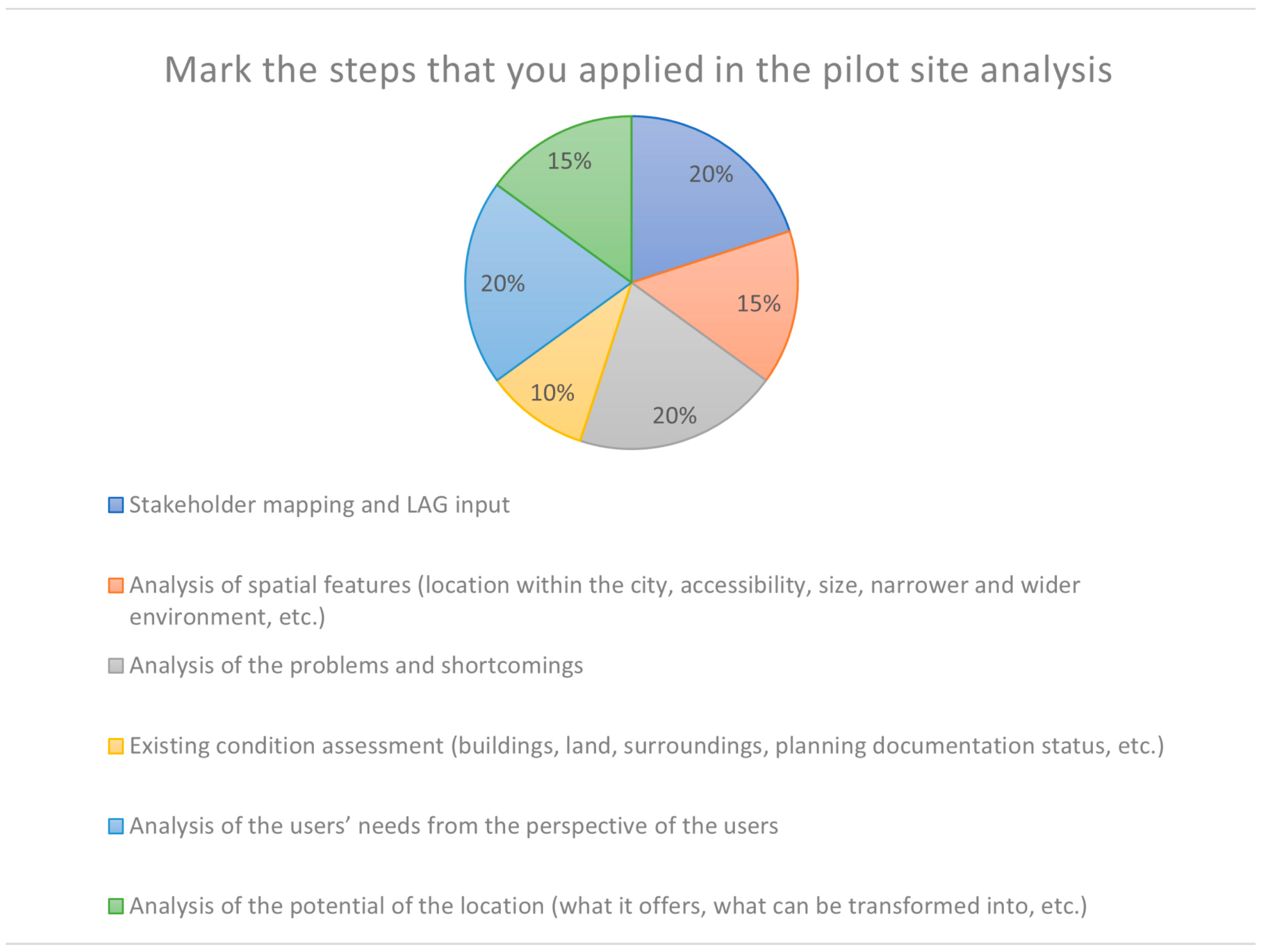
When asked to mark the steps that were applied in the pilot site analysis, with suggested answers: stakeholder mapping and LAG input; analysis of spatial features (location within the city, accessibility, size, narrower and wider environment, etc.); analysis of the problems and shortcomings; existing condition assessment (buildings, land, surroundings, planning documentation status, etc.); analysis of the users’ needs from the perspective of the users; analysis of the potential of the location (what it offers, what can be transformed into, etc.), and other (to be added), Gabrovo and Šabac [
14] applied all six methodological steps suggested by the question in organizing the site study; Veszprém opted for the identification of stakeholders, problems, and needs, while Cazin emphasized almost everything except the analysis of the environment and planning conditions.
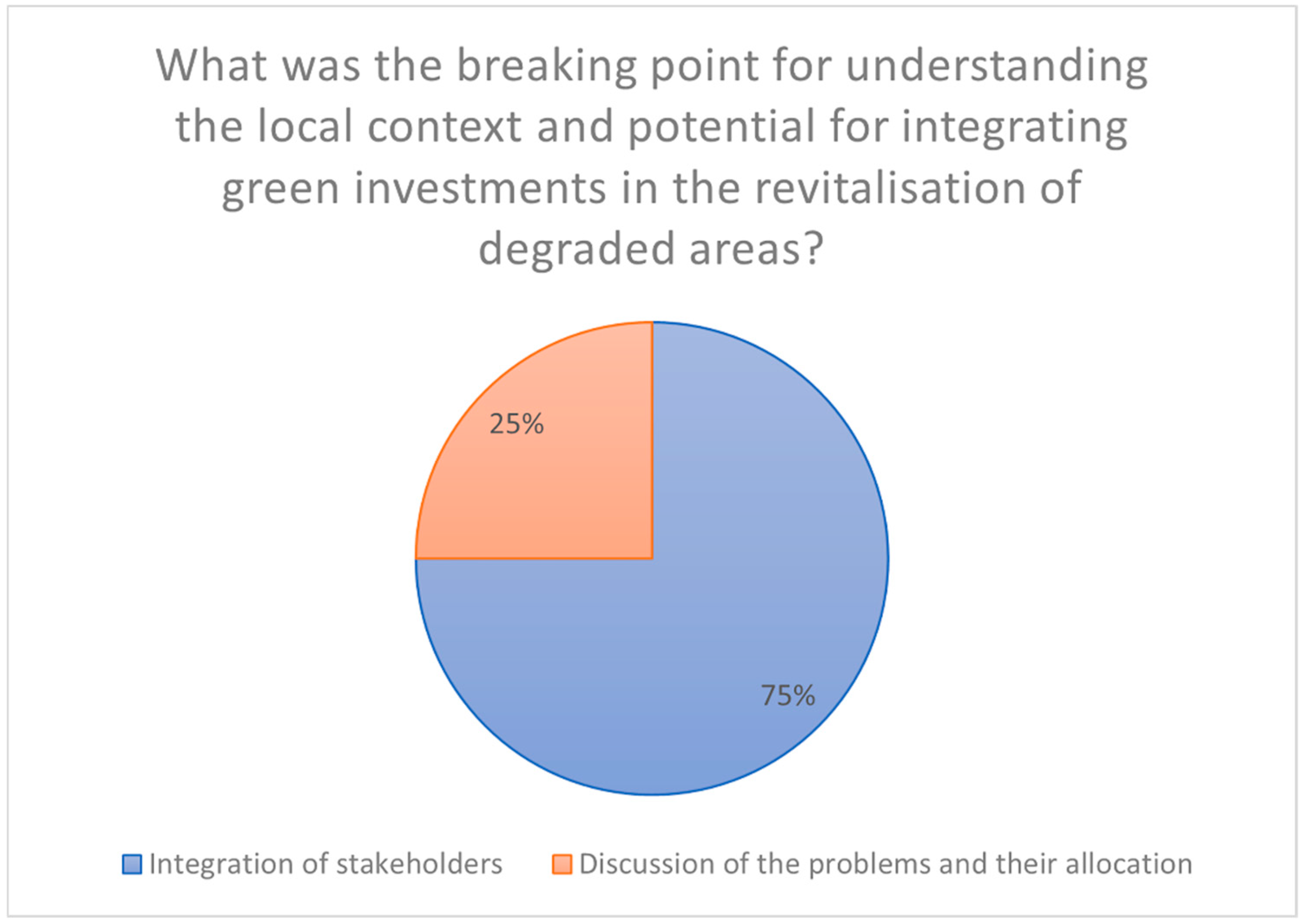
As the most important breaking point for understanding the local context and potential for integrating green investments in the revitalization of degraded areas in line with NEB principles, with a provided set of answers: integration of stakeholders; discussion of the problems and their allocation; meeting with investors and pitch session; festival day as a creativity and image booster; and others (to be added), stakeholder integration was assessed as the most important turning point for further work on the project task, and discussion of the problems and their allocation was in second place.
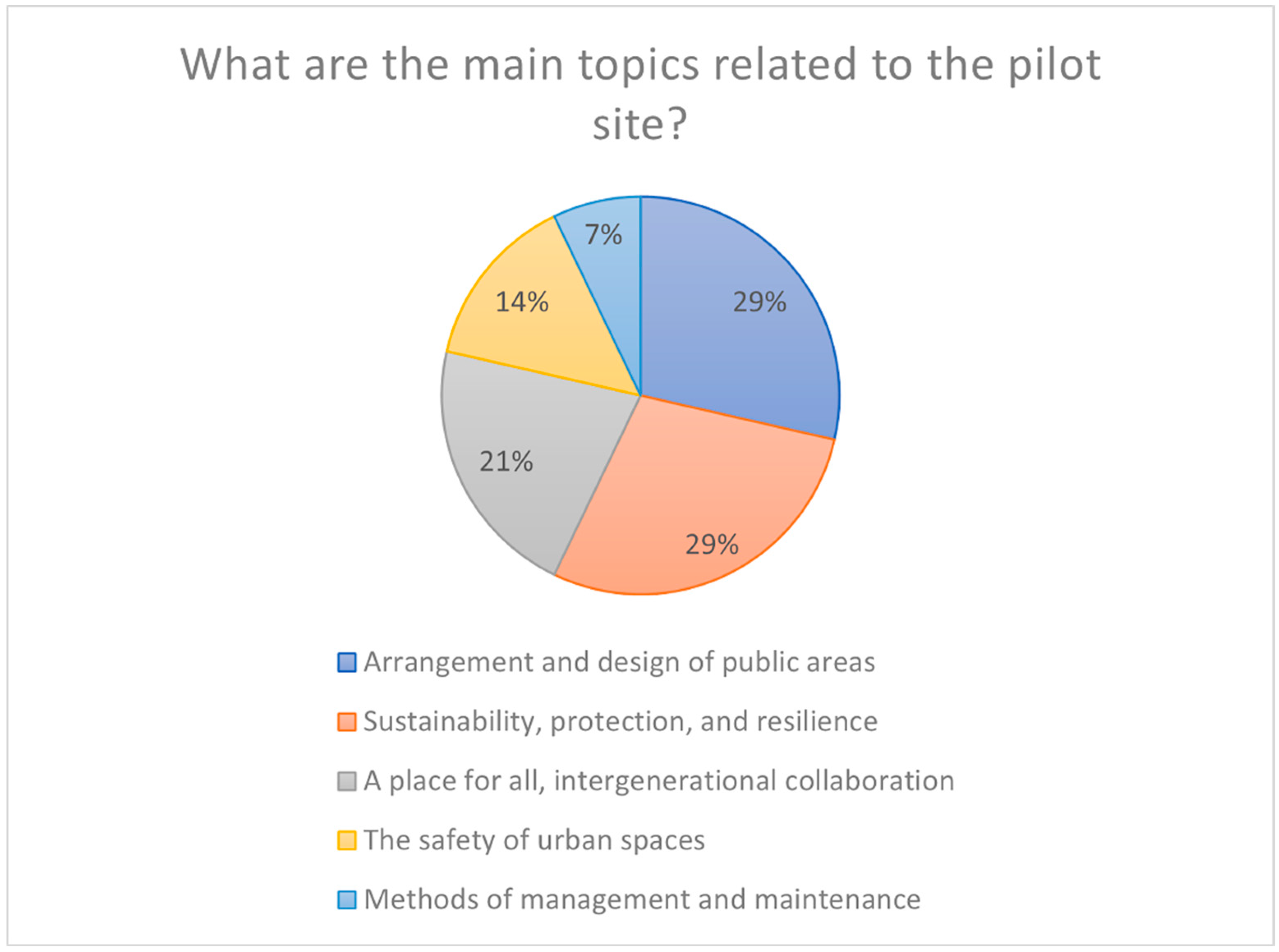
The question “What are the main topics related to the pilot site?” with suggested answers: reconstruction and infrastructure equipment, arrangement and design of public areas, sustainability, protection, and resilience; a place for all, intergenerational collaboration, the safety of urban spaces, methods of management and maintenance, and other (to be added) showed that arrangement and design of public areas, as well as sustainability, protection, and resilience, were major topics related to the pilot site. In addition, the opportunity to create a place for all through intergenerational collaboration was also an important factor for most pilot locations.
The most commonly used method for conducting the research and defining green investment priorities in the location for all four cities was practical fieldwork and collecting important information through observations and recording (documenting the situation). Also, methods such as surveys, meetings, and discussions with relevant stakeholders, and the collection of examples of good practice as inspiring and reputable, are widely used in Šabac and Veszprém, partially in Cazin and Gabrovo.
For mapping users’ needs to direct green investment packages—a required outcome of the NONA project for each pilot, partners mostly used methods of directly informing local stakeholders and users of the location about the NONA project’s aim and organizing an expert walk-through of the space for better observation. Other popular methods in Šabac, Veszprém, and Gabrovo were surveys; conversations with stakeholders and other users (meetings and storytelling); and organization of workshops, active participation, and co-creation practices in close collaboration with research and academic institutions. It seems that the festival day for citizens has been recognized as the most desirable method for broader animation and, at the same time, presenting the project’s goals. The regional investment forums were recognized as significant events for reevaluation of project ideas that would feed into the investment packages. Apart from this application, other methods have also been partially used, such as different participations engaging stakeholders and citizens.
Since the pilot sites are publicly owned, it is logical that their development is financed mostly from budget funds. However, the key information is that EU funds (international projects: Interreg, IPA Adrion, Horizon, Erasmus, cross-border cooperation…) were predominantly used for the development of pilot locations, which indicates the importance of various projects and programs for activation at the local level, both in EU member states and in candidate countries. All other offered sources of financing were used equally, and only in Veszprém was financing from the private sector applied, while special fundraising campaigns have not been launched anywhere.
Finally, Gabrovo, Veszprem, and Šabac believe that the best recommendation is the further development of pilot locations and a greater commitment to the provision of alternative ways of financing. Cazin opted for stronger social cohesion about development goals and better support and greater involvement of local self-government. Šabac has already taken steps to form additional groups, departments, organs, etc., to monitor the implementation of all projects in the city aligned with the local sustainable urban development strategy, and considers this approach advisable for monitoring all actions and investments. In conclusion, regarding how the NONA methodology for integrating green investments into the revitalization of degraded areas differs from statutory planning processes, Šabac, Veszprem, and Gabrovo believe that it provides space, time, and resources for more inclusive participatory action than usual planning processes. Also, Cazin, Šabac, and Gabrovo concluded that the NONA project framework provides a clear outline of the priorities of green financing with a clear spatial dimension, while traditional plans do not contain any information on implementation beyond the technical description (norms and standards for development). Šabac recognized that the NONA project framework allows early consideration of different interests in the degraded area revitalization, while planning processes usually involve diverse actors at later stages, when decisions have already been made, and allows the formation of soft documents that can serve as complementary to statutory planning [
8,
10,
11,
12,
14].
3.4. Cross-Case Synthesis
Stakeholder mapping and the formation of Local Action Groups (LAGs), systematically implemented in Gabrovo and Šabac and partially in other pilot projects, directly contributed to improved role clarity and transparency of decision-making. This confirms that participatory governance at an early stage is not only a normative principle of NEB, but also a functional prerequisite for reducing coordination uncertainty. The integration of qualitative and spatial analysis tools (fieldwork, expert visits, and user needs assessment) enabled the transition from abstract spatial concepts to contextually sensitive project definitions. In cases where these steps were less developed (e.g., partial implementation in Veszprém and Cazin), project proposals initially remained less linked to feasibility considerations. The early introduction of feasibility-oriented thinking, including phasing, financing alignment, and administrative requirements, proved to be a critical moment in all pilots. This methodological step is directly reflected in the “after” conditions summarized in
Table 2, where projects moved from conceptual planning to a structured investment logic.
Despite the small testing sample (n = 4), the consistency of response patterns across independent pilot teams provides supporting evidence for the governance-investment link identified in the study. The four pilot cities differ significantly in their socio-economic, institutional, and spatial contexts, which directly influenced both the implementation process and the results of the methodology. Gabrovo and Veszprém, as EU member cities, operate in more stable institutional frameworks and have greater access to diversified funding instruments, including culture- and innovation-led funding. This has enabled a more advanced integration of project structuring and stakeholder engagement into formal planning processes. In contrast, Cazin and Šabac, which are located in non-EU or candidate countries, face more limited administrative capacity and greater dependence on external project-based funding. These conditions have contributed to a slower transition from planning concepts to investment-ready proposals and a greater reliance on externally mediated coordination mechanisms, such as the NONA framework. Spatially, the pilot sites also differ in terms of themes, which has influenced the composition of stakeholders and project priorities. However, despite these differences, the analysis shows that context primarily influences the speed and depth of implementation, rather than the relevance of the methodology itself.
A simple comparative interpretation of the distribution of responses reveals several consistent tendencies. For example, 75% of respondents identified stakeholder integration as a key milestone in understanding the potential of the project (
Figure 1). Even within the small sample, this strong convergence suggests a non-random pattern and reinforces the central role of participatory governance identified in the pilot analysis. Similarly, the distribution of responses in
Figure 2 shows that stakeholder mapping, user needs analysis and problem identification account for approximately 20% of methodological importance, indicating a balanced but clearly people-centered analytical approach in all cases. In contrast, steps related to formal planning requirements and environmental analysis were less consistently highlighted, particularly in Cazin, indicating a potential gap between participatory processes and technical integration of planning. From a financing perspective, the survey confirms that 100% of the pilot cases rely on public funding and EU programs, while only one case (Veszprém) reported private sector participation. As further illustrated in
Figure 3, the thematic priorities across the pilots converged around public-space improvement, sustainability, resilience, and inclusive community-oriented development, indicating a shared value framework aligned with NEB principles.
4. Discussion
Based on the conducted survey and observations, the analyses gave recommendations for the transition from the test results to the urban regeneration and investment-acquisition process in medium-sized cities participating in the NONA project. These action-oriented steps specify action, the responsible organization/body/unit, and expected output and reflect the main gaps: decision clarity, coordination, feasibility screening, stakeholder engagement, and planning-to-investment translation. Some methodological recommendations for urban regeneration aligned with NEB principles and more closely linked to the investment component than traditional planning include the following [
18,
22,
23]:
- -
The economic factor and the estimate of the costs of construction, equipment, development, and maintenance must be an integral part of the document proposing actions on a specific location, whether it is a formal urban plan or study, strategy, etc. The good practice of forming an overview of all necessary resources at the initial planning stage should be restored, especially when it comes to public land financed from the budget of local governments.
- -
If there are multiple micro-locations within the pilot site or different themes and ideas, it is recommended to create catalog sheets for each proposed intervention, in which proposals would be located and described in detail, with an estimate of the price/cost and with a proposed financing model in accordance with the legal framework. For example, for an intervention within a public purpose/land/interest, financing options could be provided from local/national budget funds, private-public partnerships, sponsorships, national and international programs and projects, etc. Such a “catalog of offers” would enable the manager and decision-maker to quickly and easily plan and form the necessary budget, or if an opportunity arises for some other type of financing and investment, to have a conceptual idea ready to offer and a formalized cost overview.
- -
Also, if the pilot site or case/topic is considered at a strategic level and requires certain systemic solutions, the increasingly popular form of a guide/roadmap can be used, which contains the sequence and explanation of all steps to achieve the goal, including those steps that are thematically and hierarchically much broader, i.e., their solution is outside the site itself, i.e., at a “higher” city or national level (legal framework, organizational and managerial changes, etc.).
- -
Not all benefits of NEB principles are easily measurable in financial terms, nor immediately visible and tangible, but “investment” can also be a pledge for the future, more visible through social changes, such as the association and empowerment of the community and stakeholders; a new image and brand of the space; and higher quality and attendance thanks to varying degrees of interventions, from repurposing to small design solutions.
- -
Using GIS (Geographic Information System) as well as other digital tools with clear spatial dimensions can significantly improve, support, and organize data collection, as it can store it as a database; manage it; analyze, edit, display, and visualize spatial data.
- -
Formation of a LAG (Local Action Group) as an interest group of direct stakeholders/beneficiaries and representatives of local government/decision makers, and a CWG (Coordination Working Group) as a coordination body/council/working group for monitoring implementation of priority projects at the location and harmonizing and coordinating various programs and projects, as well as funding sources. These two bodies can be separate, but in close cooperation, with the proviso that the LAG is specifically and only related to the pilot location, while the CWG can monitor multiple locations and actions/projects on the territory of the local government/city.
- -
Community early and continuous participation through various actions: surveys to collect views/opinions and create a list of potential shortcomings/problems and common solutions, workshops with documented results similar to surveys, interviews, etc.
The evidence from the pilot cases analyzed within the NONA project indicates that, in practice, many NEB-related initiatives [
19,
20,
21] currently remain between the project planning and implementation phases. This represents a limitation for developing a more complete empirical model of the lifecycle, but also highlights the need to sustain stakeholder commitment and strengthen governance capacities in mid-sized cities through scalable capacity building to support the green investments from planning to long-term monitoring and evaluation beyond the project duration.
These findings are consistent with previous studies on NEB implementation, which emphasize the importance of integrating financial feasibility and governance structures in the early planning stages, while extending this work by operationalizing these principles into concrete, action-oriented steps tailored to medium-sized cities. Unlike previous research that is largely conceptual, this study provides empirically based insights from pilot cases, thus contributing to bridging the gap between NEB principles and their practical application in urban regeneration (
Table 3).
The findings should be interpreted in light of certain limitations, in particular the small number of pilot cases (
n = 4) and their concentration within the Danube Region (both within and outside the EU, 2:2), which may limit the broader generalizability of the results. While the cases provide valuable contextual insights [
8,
10], institutional, economic and governance differences across cities and countries suggest that caution is needed when extrapolating these conclusions to other geographical or administrative settings. The proposed framework is most applicable in contexts where local governments possess a certain level of institutional capacity, access to diverse funding mechanisms, and a willingness to engage stakeholders in participatory processes [
14]. Conversely, its findings and findings can also be inspiring in environments characterized by weaker governance structures, insufficient financial resources, or insufficient or deficient legal frameworks, where adaptation or simplification of the approach would be necessary. Viewed in this way, with a given initial base and with upgrades and expansions, the study can be placed and applied in a broader context.
Thematic packages of recommendations tailored to typical mid-sized city needs: coordination across departments, maintaining momentum over longer cycles, and converting plans into investable propositions. By linking identified urban needs with structured IPs, projects can move from conceptual ideas toward implementable actions, ensuring that improvements generate broader social, economic, and environmental benefits. This approach explains how investments in urban public spaces and built surroundings can influence urban vitality and outlines a system of financial packages that help prioritize interventions, organize funding sources, and support continuous monitoring and adaptive urban development [
16,
21,
24,
25,
26]. From the perspective of planning, financial packages should be tied to specific characteristics and conditions of the space, i.e., to the expressed and prioritized needs for more rational or better use of locations.
The recommended prioritization through the creation of roadmaps and catalog sheets for each idea/proposal spatially related to the location, with an overview of costs and possible sources of financing, leads to generalization in the sense of forming groups of financial packages, from those that are basic and necessary, through those that represent an addition and improvement, to finally those that are the superstructure of everything, a higher degree of functionality, efficiency, and rationality in the development [
17,
27].
The pilot findings served as an insight into the applied methodological frameworks, but also for the formation of proposals for possible investment packages adapted to the conditions and needs of the locations. Based on the statements received from the partners and insight into the specifics of the locations and the legal, economic, and management framework, the research formed six types of packages. For a more detailed presentation within the work, package D and the accompanying instructions were chosen as key and related to the topic of Sustainable economic development. The authors decided to classify the packages by type and thematic area they cover, and then by the level of importance and priority, dominant character for implementation (technical, organizational, economic, social, ecological), with a proposal of possible and available sources of financing. This classification was made originally for the needs of this research and the NONA project, in a manner adapted to the topic and the case.
Package types are formatted in line with proposed relevant thematic areas and focus on specific subjects, including governance, local development, economic development, financing and de-risking, resilience, data management, smart digital solutions, and mobility and availability as crucial parts of the following packages. Every package consists of multiple recommendations that better focus on a specific field of intervention that is beneficial for degraded areas in mid-sized cities (
Table 4).
For this paper’s purpose, only the so-called package D is extracted separately and in more detail. It concerns the application of NEB and risk minimization to increase resilience and adaptability in extreme cases, especially in recommendations D2 and D3. It is necessary to consider all possible scenarios in advance [
28] and be ready for various conditions of uncertainty, from climate change and natural disasters to external and internal crises and disruptions (pandemic conditions, war, energy shortages, and business and market conditions), and everything that can slow down funding, postpone it, and direct it to other, more urgent and crisis tasks (
Table 5).
5. Conclusions
The transition from conceptual spatial planning to practical, investment-ready urban regeneration projects remains a structural challenge for medium-sized cities. Empirical findings from the NONA pilot testing in Gabrovo, Veszprém, Cazin, and Šabac show that municipalities often face systemic obstacles, including fragmented administrative coordination, limited institutional capacity, and ambiguous decision-making processes. Consequently, traditional legislative planning processes often fail to bridge the gap between vision and financial feasibility. The results are presented in relation to the defined research questions, particularly focusing on governance factors and contextual differences across pilot sites. To address these limitations, recommendations are needed that focus on an NEB framework designed to simplify and facilitate the path to green investments in degraded urban areas. The key point of this article is that investment readiness is not solely a product of design or ideas but is fundamentally conditioned by the organizational and governance conditions under which these initiatives are prepared. Data from pilot sites highlight several key success factors for urban regeneration. First, effective urban regeneration requires strong municipal leadership, coupled with cross-sectoral and multi-level coordination, to replace project ideas with a framework for evidence-based shared decision-making.
Second, continuous stakeholder engagement, initiated through mechanisms such as Local Action Groups (LAGs), has proven essential for building consensus, acquiring local knowledge, and mitigating long-term project risks. The integration of participatory methodologies ensures that spatial interventions and plans are aligned with the social needs of different groups of citizens while fostering municipal transparency.
The paper emphasizes the necessity of early feasibility assessments and the formulation of structured investment proposals. The transformation of brownfield or DAs sites requires a data set that synthesizes spatial, financial, and management metrics, thus facilitating a transparent decision-making process. With the right phasing and intervention strategy, medium-sized cities can adjust the implementation steps to align with available funding cycles and often strict administrative procedures.
Finally, the findings confirm that the most transferable elements across urban contexts are not specific physical (design or planning) solutions, but rather governance routines, participatory practices, and coordination. By adopting a package of recommendations outlined in the NONA model, from internal alignment to data monitoring and stakeholder management, the risks of regeneration initiatives can be systematically reduced. The NEB approach ensures that green investments not only restore the physical qualities of degraded areas but also improve the intangible aspects of specific sites and the broader governance mechanism, creating more sustainable socio-economic and environmental benefits for the local community.
Several limitations of this study should be acknowledged to ensure a transparent interpretation of the findings. The empirical base is limited to four pilot cases, which limits the statistical generalizability of the results. Although the comparative case study approach allows for detailed contextual analysis and identification of recurring patterns, the findings should be understood as analytical generalizations rather than universal conclusions. All cases are located in the Danube region, including EU Member States and candidate countries. While this provides a certain degree of diversity in institutional and economic conditions, it does not fully capture the wider variability of urban contexts across Europe or globally. Therefore, caution is needed when extrapolating the results to regions with significantly different governance systems, market conditions or planning traditions. The survey component is based on a small sample size (n = 4), reflecting the number of pilot cities available. While the responses provide valuable complementary insights and are consistent with the qualitative findings, they do not allow for more detailed or larger statistical conclusions. The survey results should therefore be interpreted as indicative, not representative. The research primarily focuses on the project preparation and management phases of urban regeneration, with limited observation of long-term implementation and post-investment outcomes. This limits the ability to assess the performance of the proposed framework over its entire life cycle, particularly in terms of long-term socio-economic and environmental impacts. Finally, there is an inherent risk of researcher and participant bias, as the data partly originate from project partners who are directly involved in the implementation of the pilot project. Although triangulation methods were applied, a certain degree of subjectivity in the assessment of outcomes cannot be completely excluded.
This paper contributes to the literature by linking the themes of participatory governance, urban regeneration, and investment readiness through case-based empirical analysis. By examining how they interact in practice, the paper provides evidence-based insights into how integrated methodological approaches can support the transition from planning concepts to implemented urban regeneration projects.
These findings should be interpreted as context-specific insights derived from comparable mid-sized cities, rather than as universally generalizable outcomes. Although they indicate that the proposed framework has strong potential for transferability, it is suggested that it be used within clearly defined contextual boundaries. Its applicability is strongest in medium-sized and post-socialist cities in Eastern and Central Europe, with comparable institutional capacities, access to external funding mechanisms, and willingness to engage in participatory governance processes. In contexts that deviate significantly from these conditions—such as highly centralized governance systems, municipalities with limited resources or non-European planning environments—adaptation of the framework would be necessary. Rather than offering a universally applicable model, the study contributes a contextually sensitive methodological approach that can be adapted to different urban settings. Future research should test and refine the framework across a wider range of city sizes, geographic regions, and institutional settings to further validate its scalability and adaptability.




 ,
,