


Understanding User Behaviour in Active and Light Mobility: A Structured Analysis of Key Factors and Methods



Abstract
1. Introduction
- Which behavioural, perceptual and infrastructural factors most influence users’ choices regarding active and light mobility?
- What methods are currently used to investigate these factors across different contexts?
- How can these heterogeneous findings be translated into an operational framework supporting planning, evaluation and attractiveness assessment?
2. Materials and Methods
2.1. Review Plan and Objectives
2.2. Research Questions
- -
- RQ1–RQ3 identify the scope and the behavioural and infrastructural factors (supporting Introduction RQ1);
- -
- RQ4 clarifies the methodological guidelines relevant to future data collection (supporting Introduction RQ2);
- -
- RQ5 assesses the transferability of the findings to the development of user attractiveness indexes and planning tools (supporting Introduction RQ3).
2.3. Research Strategy and Databases
2.4. Quality Assessment
- -
- Academic rigor, clarity and relevance (Q1–Q5);
- -
- Methodological robustness and behavioural relevance (Q6–Q10): sample size, replicability, behavioural focus and thematic alignment.
2.5. Inclusion and Exclusion Criteria
2.6. Final Selection and Classification
3. Findings and Thematic Synthesis from the Literature Review
3.1. Identification of Analytical Macro-Categories
- Macro-attributes or factors (environment, infrastructure, comfort, safety, etc.)
- Means of transport involved (bike, e-bike and e-scooter)
- Users’ typology (gender, age and expertise)
- Typology of experiment and analysis method (with simulator or in situ, interviews, registration of psychophysical and dynamic data, GPS data analysis, etc.)
- Investigated characteristics and attributes of network affecting users’ choice (paving, degree of separation from motorized traffic, etc.).
3.2. Thematic Analysis of the Literature
3.2.1. Macro-Attributes or Factors Considered (Surrounding Environment, Infrastructure, Comfort, Safety, etc.)
3.2.2. Means of Transport Involved (Bike, E-Bike and E-Scooter)
3.2.3. Users’ Typology (Gender, Age, Experts and Non-Experts)
3.2.4. Typology of Experiment and Analysis Method (With Simulator or In Situ, Interviews, Registration of Psychophysical and Dynamic Data, Analysis of GPS Data, etc.)
3.2.5. Investigated Characteristics and Attributes of Network Affecting Users’ Choice (Paving, Separation Degree from Motorized Traffic, etc.)
3.3. Finding Operational Synthesis and Relations to RQs
3.3.1. Cross-Sectional Synthesis
3.3.2. Contribution to Research Sub-Questions (RQ1–RQ5)
- -
- RQ1 (which modes of light and active mobility have been most studied?) is addressed in Section 3.2.2 and highlights a strong predominance of studies focusing on conventional bicycles, while e-bikes and electric scooters remain underrepresented. Although recent contributions increasingly address electric micromobility, the evidence base remains fragmented.
- -
- RQ2 (what user characteristics are analysed?) is addressed in Section 3.2.3, which shows that age, gender, experience level and frequency of use are the most commonly investigated user attributes, while perceptions of safety, comfort and infrastructure quality vary across user groups, particularly between younger and older users and between expert and non-expert cyclists.
- -
- RQ3 (what common influencing factors are reported across modes?) is addressed in Section 3.2.1 and Section 3.2.5. Across all modes, perceived safety, comfort, infrastructure continuity, separation from motorized traffic and surface quality emerge as recurring determinants of route choice and attractiveness.
- -
- RQ4 (what research methods and experimental setups are used?) is addressed in Section 3.2.4 and reveals methodological heterogeneity, including surveys, qualitative interviews, in situ experiments, GPS tracking, physiological sensing and VR simulations. This diversity reflects the complexity of studying, comparing and replicating active mobility systems across studies.
- -
- RQ5 (are there validated, transferable factors suitable across contexts?) is addressed in Section 3.2.1 and Section 3.2.5. While factors such as safety, comfort, connectivity and infrastructure quality are consistently identified, their relative importance varies across contexts, transport modes and user groups. This aspect is further discussed in Section 5.
4. Results

| Macro-Criteria of Classification | Description | Method of Analysis | Objectives | Factors/Data | References |
|---|---|---|---|---|---|
| Macro— attributes or factors considered | Analyse the external factors that influence users’ choice, e.g., environment, infrastructure, comfort and safety. | Quantitative (in situ investigations and tests), qualitative (survey) | Examine the influence of external factors on user choices. |
| [3,4,5,12,13,14,15,16,17,18,19,20,21,22] |
| Means of transport involved | Classify the users based on the means of transport used. | In situ tests, interviews, tracking data analysis | Study the preferences between different means of transport and the aspects that influence their choice. |
| [23,24,25,26,27,28] |
| Users’ typology | Analyse how users’ demographic and behavioural traits influence their choices. | Survey, interviews | Analyse the differences in user behaviour based on their typology. |
| [19,29,30,31,32,33,34,35,36,37,38,39,40,41] |
| Typology of experiment and analysis method | Differentiate the methodological approaches used to study user choice. | Simulations, in situ tests, psychophysical data recording | Evaluate physical and psychological responses in relation to different scenarios. |
| [5,7,8,13,26,31,36,37,41,42,43,46,47,48] |
| By the investigated characteristics and attributes of network affecting users’ choice | Examines how the features of infrastructure influence user choice. | GIS analysis, in situ testing | Examine how the infrastructure structure affects the choice. |
| [6,52,53,54,55,56,57,58,59,60,61,62,63,64,65] |
| Factor | Description/Unit of Measure | Method of Analysis | Level of Application | References |
|---|---|---|---|---|
| Geometry and connectivity of the street | Type of cycle infrastructure (separated cycle path, boulevard cycle path…) and length (meters) | Surveys, Interviews, GIS Analysis, In situ Test, Simulations | Segment-based | [3,5,6,14,15,16,17,18,19,21,22,23,29,30,31,33,35,36,37,38,42,43,46,47,48,53,54,55,56,57,58,59,60,61,63,64,65] |
| Smoothness of surface | Material of cycle paths | [3,5,12,19,26,27,33,42,43,60,64,65] | ||
| Traffic | Traffic volume (vehicles/days) and motorized vehicle speed (km/h) | In situ test, GIS analysis, Surface Analysis | Route-based | [5,14,18,19,22,29,30,38,43,48,52,54,55,59,60,62,65] |
| Topography | Ascents/descents and presence of slope and/or stairs | GPS Analysis, In situ Test, Traffic Analysis, | [18,43,52,54,56,57,59,63,64] | |
| Intersection | Signalized intersection with or without dedicated cycling traffic lights, distance between contiguous | Simulations, In situ Test, GPS Analysis, Simulations, Traffic Analysis | Intersection-based | [3,6,14,18,29,30,33,38,42,47,48,54,55,60] |
| Proximity to community facilities | Type of facilities and distance from cycle path (meters or time) | GIS Analysis, Surveys | Neighbourhood-based | [51,52,57,63] |
| Landscape | Presence of green/aquatic areas | Interviews, GIS Analysis | [3,4,6,12,28,29,43,48,53,54,56,59,61,62,64] | |
| Cycling facilities | Type and density | Surveys, In situ Test, GIS Analysis | [4,6,14,22,29,31,32,37,53,54,58,62,63,64] | |
| Bike parking spaces | Presence and distance from bike paths (meters or time) | GIS Analysis, Interviews | [3,5,6,15,19,22,29,54,55,57] |
- Guide planners and engineers in selecting the relevant factors and metrics for their specific context;
- Suggest the most suitable methodologies for data collection and analysis according to the factor and study scale;
- Help decision-makers define interventions while also considering user typologies and modes of transport.
5. Discussion and Limitations
5.1. Literature Limitations
- -
- Methodological heterogeneity: Studies range from surveys and interviews to in situ tests, GPS tracking, VR simulations and psychophysiological assessments. While this variety enriches, it also hinders direct comparisons, synthesis and the development of transferable indexes. Mixed approaches appear more effective for linking subjective perceptions with objective infrastructure attributes.
- -
- Lack of standardization: Differences in user types, evaluation criteria and data collection scales make direct synthesis difficult.
- -
- Imbalance between transportation modes: Conventional bicycles dominate the literature, while studies on e-bikes and electric scooters remain scarce.
- -
- Contextual specificity: Most studies focus on specific urban environments, limiting the transferability of findings across regions or mobility systems.
5.2. Limitations of the Study
- -
- The study was limited to full-text publications in English, potentially excluding relevant studies or the grey literature.
- -
- Terminological inconsistencies across studies complicated classification and synthesis. Heterogeneous definitions, data collection protocols and evaluation metrics limited comparability and synthesis across studies.
- -
- Limited focus on emerging modes: e-bikes and e-scooters are underrepresented, limiting our ability to generalize the findings to all light mobility modes.
- -
- Context-specific factors: Many studies are region-specific, making the transferability of the findings to other urban contexts uncertain.
- -
- Incomplete coverage of psychosocial factors: Health, stress and social influences are often understudied, yet they influence perceived comfort, safety and modal choice.
- -
- Empirical validation of the proposed framework is still needed to confirm its applicability in real-world settings.
5.3. Future Research Directions
- Empirical validation of the framework with different user types (beginner vs. expert cyclists, e-bike and e-scooter users) to assess its robustness and transferability.
- Behavioural and perceptual studies on comfort and safety perceptions, using mixed methods (interviews, field tests and simulators) to connect subjective experiences with objective infrastructure characteristics.
- Spatial analysis and network connectivity assessed using GIS and tracking data.
- Development of replicable attractiveness indexes and decision support tools, using GIS, tracking data and psychophysical measurements to guide urban planning interventions.
- Context-specific case studies, including the planned Italian study, to determine which factors most significantly influence route choice, perceptions of safety and modal preference.
6. Conclusions
6.1. Addressing the Three Research Questions
- Which behavioural, perceptual and infrastructural factors most influence users’ choices regarding active and light mobility?
- 2.
- What methods are currently used to investigate these factors across different contexts?
- 3.
- How can these heterogeneous findings be translated into an operational framework supporting planning, evaluation and attractiveness assessment?
- -
- Table 4 introduces a set of macro-classification criteria based on user type, transport mode, analytical method and infrastructure characteristics, linking them to relevant literature studies, supporting replication and further research replication;
- -
- Table 5 aligns key influencing factors with appropriate analysis and methodologies and literature references;
- -
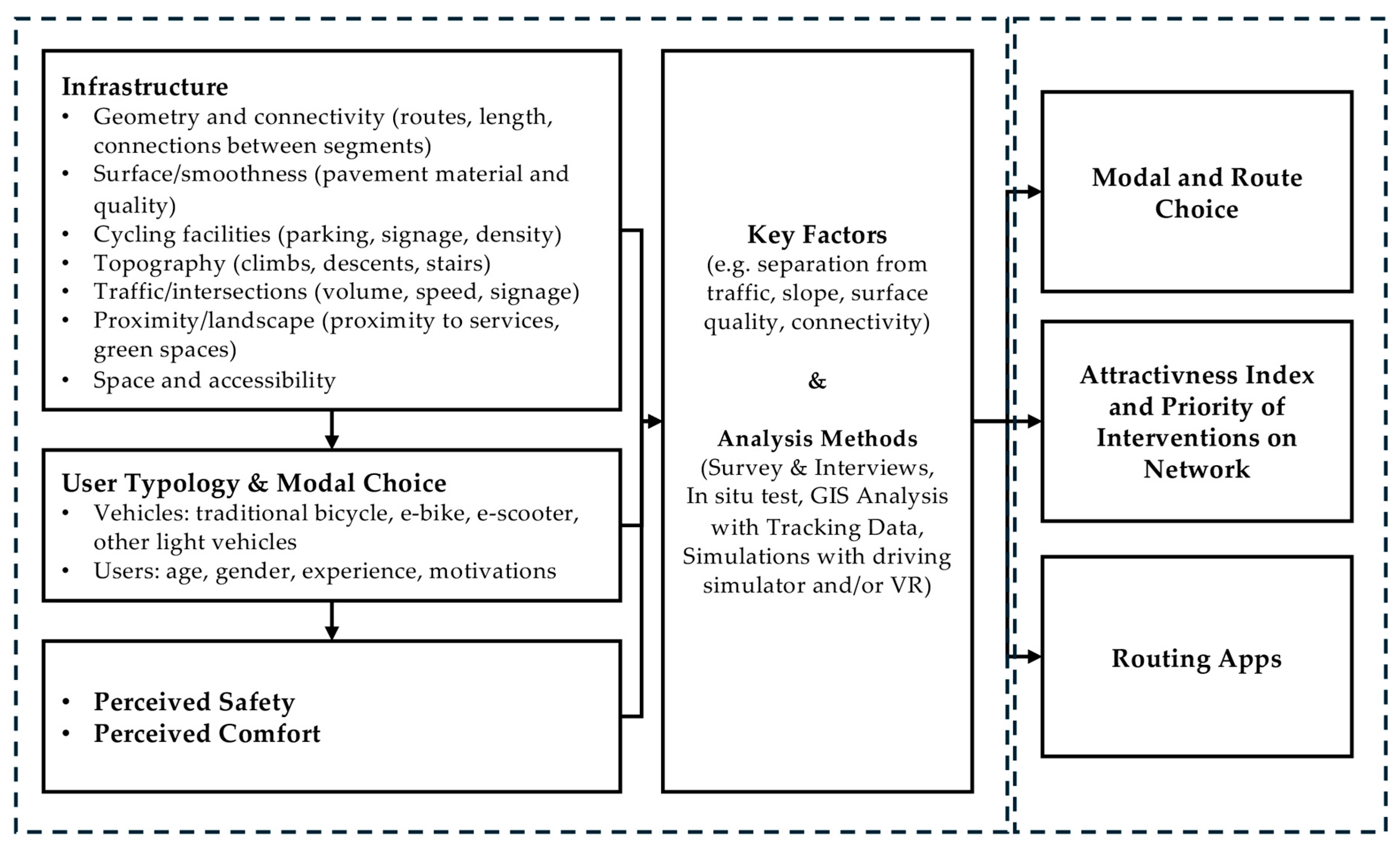
- Figure 3 conceptually summarizes these findings, illustrating how infrastructure characteristics and user types influence perceived comfort and safety, which in turn shape user behaviour and ultimately contribute to modal choice.
6.2. Bridging the Gap and Future Applications
- -
- Offers transferable criteria for assessing infrastructure and modal attractiveness.
- -
- Supports user-centred planning, ensuring that projects meet the needs of diverse cycling and micromobility populations.
- -
- Provides a basis for empirical validation and context-specific studies, including the planned Italian case study.
- -
- Testing the framework across different user types and urban contexts.
- -
- Developing replicable attractiveness indexes for policy and planning interventions.
- -
- Integrating emerging factors such as intermodal connectivity, intelligent transport systems (ITS) and accident risk into decision-making tools.
Author Contributions
Funding
Institutional Review Board Statement
Informed Consent Statement
Data Availability Statement
Acknowledgments
Conflicts of Interest
Abbreviations
| UN | United Nations |
| SUMPs | National Sustainable Urban Mobility Plans |
| RQ(s) | Research Question(s) |
| PRISMA | Preferred Reporting Items for Systematic Reviews and Meta-Analyses |
| DCC | Dynamic Cycling Comfort |
| QoS | Quality of Service |
| GPS | Global Positioning System |
| VR | Virtual Reality |
| PLOS | Perceived Level of Safety |
| WTB | Willingness to Bike |
| PMD | Personal Mobility Device |
| CCI | Cycling Comfort Index |
| IBP | Instrumented Probe Bicycle |
| XGBoost | Extreme Gradient Boosting |
| GIS | Geographical Information System |
| OSM | OpenStreetMap |
| CRANC | Cyclist Routing Algorithm for Network Connectivity |
| BCI | Bike Composite Index |
| LOS | Level of Service |
| MTB | Mountain Bike |
References
- United Nations. Transforming Our World: The 2030 Agenda for Sustainable Development. Available online: https://sdgs.un.org/2030agenda (accessed on 5 September 2025).
- Moreno, C.; Allam, Z.; Chabaud, D.; Gall, C.; Pratlong, F. Introducing the “15-Minute City”: Sustainability, Resilience and Place Identity in Future Post-Pandemic Cities. Smart Cities 2021, 4, 93–111. [Google Scholar] [CrossRef] [Scilit]
- Hull, A.; O’Holleran, C. Bicycle Infrastructure: Can Good Design Encourage Cycling? Urban Plan. Transp. Res. 2014, 2, 369–406. [Google Scholar] [CrossRef] [Scilit]
- Blitz, A. How Does the Individual Perception of Local Conditions Affect Cycling? An Analysis of the Impact of Built and Non-Built Environment Factors on Cycling Behaviour and Attitudes in an Urban Setting. Travel Behav. Soc. 2021, 25, 27–40. [Google Scholar] [CrossRef] [Scilit]
- Berghoefer, F.L.; Vollrath, M. Cyclists’ Perception of Cycling Infrastructure—A Repertory Grid Approach. Transp. Res. Part F Traffic Psychol. Behav. 2022, 87, 249–263. [Google Scholar] [CrossRef] [Scilit]
- Snizek, B.; Sick Nielsen, T.A.; Skov-Petersen, H. Mapping Bicyclists’ Experiences in Copenhagen. J. Transp. Geogr. 2013, 30, 227–233. [Google Scholar] [CrossRef] [Scilit]
- Liu, G.; Krishnamurthy, S.; van Wesemael, P. Conceptualizing Cycling Experience in Urban Design Research: A Systematic Literature Review. Appl. Mobilities 2018, 6, 92–108. [Google Scholar] [CrossRef] [Scilit]
- Maltese, I.; Gatta, V.; Marcucci, E. Active Travel in Sustainable Urban Mobility Plans. An Italian Overview. Res. Transp. Bus. Manag. 2021, 40, 100621. [Google Scholar] [CrossRef] [Scilit]
- Scorrano, M.; Danielis, R. Active Mobility in an Italian City: Mode Choice Determinants and Attitudes before and during the Covid-19 Emergency. Res. Transp. Econ. 2021, 86, 101031. [Google Scholar] [CrossRef] [Scilit]
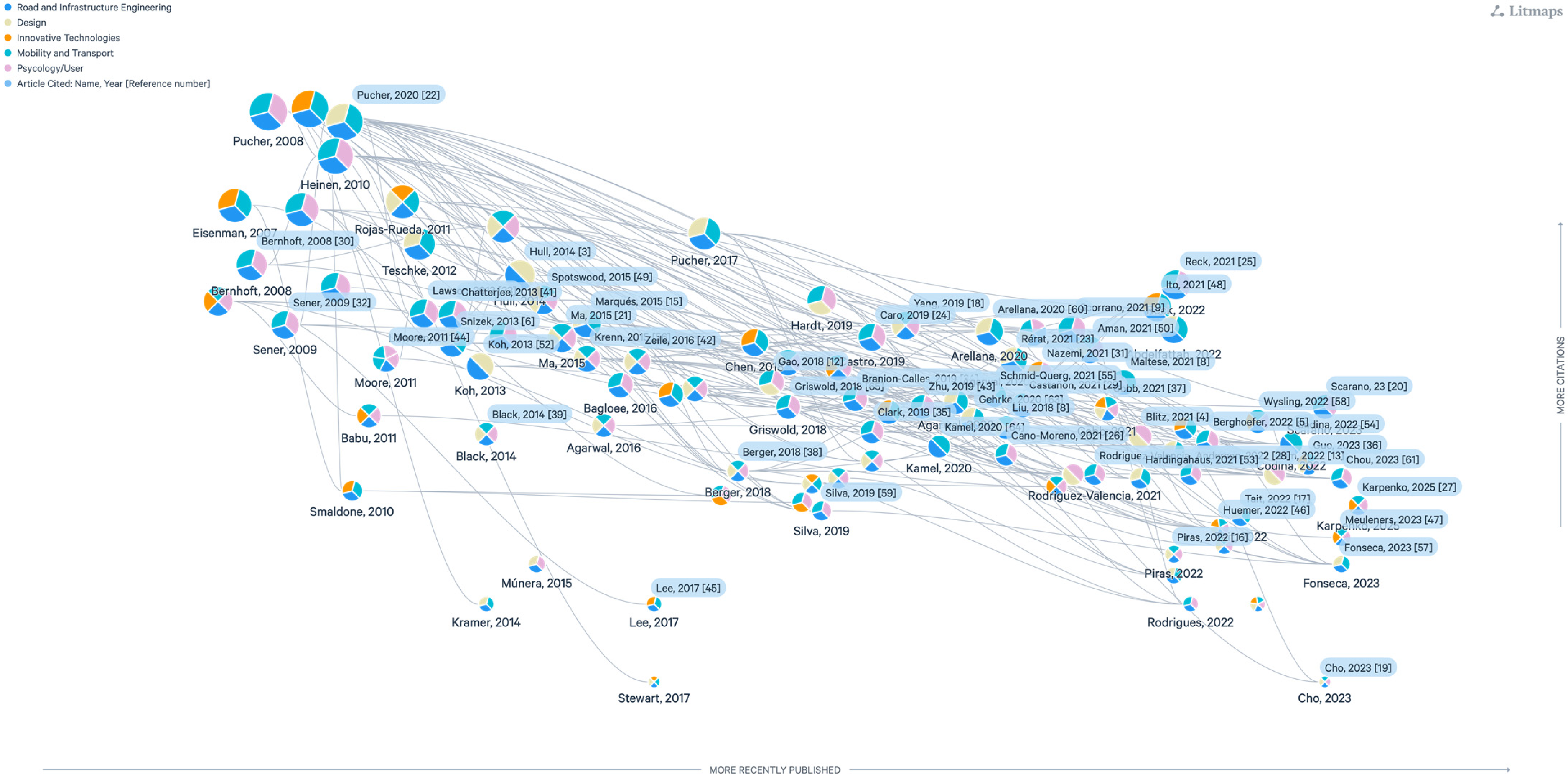
- Litmaps. Available online: http://app.litmaps.com (accessed on 5 September 2025).
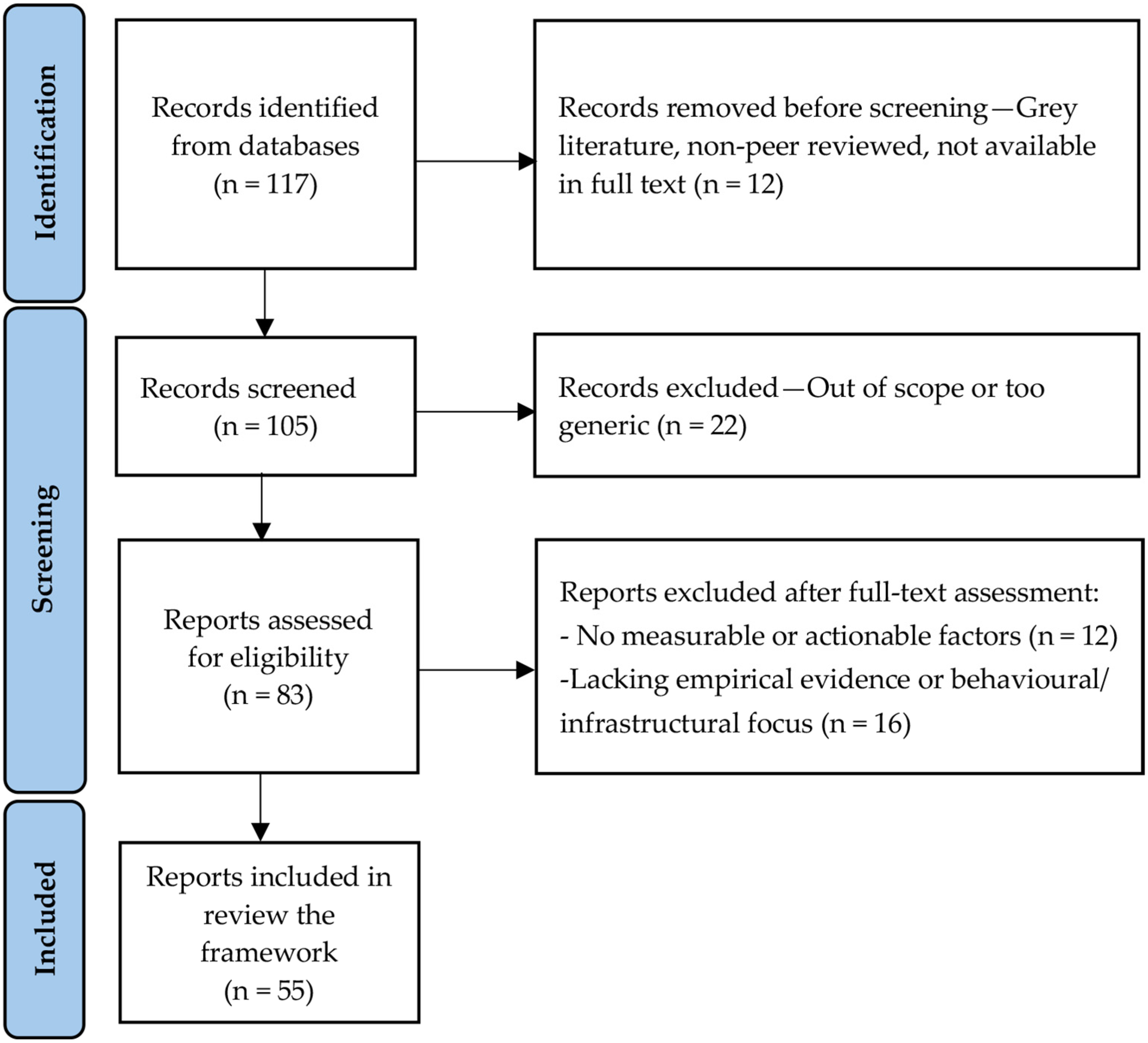
- Moher, D.; Liberati, A.; Tetzlaff, J.; Altman, D.G.; The PRISMA Group. Preferred Reporting Items for Systematic Reviews and Meta-Analyses: The PRISMA Statement. PLoS Med. 2009, 6, e1000097. [Google Scholar] [CrossRef] [Scilit] [PubMed]
- Gao, J.; Sha, A.; Huang, Y.; Hu, L.; Tong, Z.; Jiang, W. Evaluating the Cycling Comfort on Urban Roads Based on Cyclists’ Perception of Vibration. J. Clean. Prod. 2018, 192, 531–541. [Google Scholar] [CrossRef] [Scilit]
- Lim, T.; Kalra, A.; Thompson, J.; Caldwell Odgers, J.; Beck, B. Physiological Measures of Bicyclists’ Subjective Experiences: A Scoping Review. Transp. Res. Part F Traffic Psychol. Behav. 2022, 90, 365–381. [Google Scholar] [CrossRef] [Scilit]
- Rodriguez-Valencia, A.; Vallejo-Borda, J.A.; Barrero, G.A.; Ortiz-Ramirez, H.A. Towards an Enriched Framework of Service Evaluation for Pedestrian and Bicyclist Infrastructure: Acknowledging the Power of Users’ Perceptions. Transportation 2022, 49, 791–814. [Google Scholar] [CrossRef] [Scilit]
- Marqués, R.; Hernández-Herrador, V.; Calvo-Salazar, M.; García-Cebrián, J.A. How Infrastructure Can Promote Cycling in Cities: Lessons from Seville. Res. Transp. Econ. 2015, 53, 31–44. [Google Scholar] [CrossRef] [Scilit]
- Piras, F.; Scappini, B.; Meloni, I. The Transformation of Urban Spaces as a Cycling Motivator: The Case of Cagliari, Italy. Transp. Res. Procedia 2022, 60, 60–67. [Google Scholar] [CrossRef] [Scilit]
- Tait, C.; Beecham, R.; Lovelace, R.; Barber, S. Is Cycling Infrastructure in London Safe and Equitable? Evidence from the Cycling Infrastructure Database. J. Transp. Health 2022, 26, 101369. [Google Scholar] [CrossRef] [Scilit]
- Yang, Y.; Wu, X.; Zhou, P.; Gou, Z.; Lu, Y. Towards a Cycling-Friendly City: An Updated Review of the Associations between Built Environment and Cycling Behaviors (2007–2017). J. Transp. Health 2019, 14, 100613. [Google Scholar] [CrossRef] [Scilit]
- Cho, M.K.; Kang, M.G.; Kwon, Y. Differences in Perception of Safety in Driving Environment According to Shared PMD User Experience through Multi-Criteria Analysis. Heliyon 2023, 9, e13615. [Google Scholar] [CrossRef] [Scilit]
- Scarano, A.; Aria, M.; Mauriello, F.; Rella Riccardi, M.; Montella, A. Systematic Literature Review of 10 Years of Cyclist Safety Research. Accid. Anal. Prev. 2023, 184, 106996. [Google Scholar] [CrossRef] [Scilit]
- Ma, L.; Dill, J. Associations between the Objective and Perceived Built Environment and Bicycling for Transportation. J. Transp. Health 2015, 2, 248–255. [Google Scholar] [CrossRef] [Scilit]
- Pucher, J.; Dill, J.; Handy, S. Infrastructure, Programs, and Policies to Increase Bicycling: An International Review. Prev. Med. 2010, 50, S106–S125. [Google Scholar] [CrossRef] [Scilit]
- Rérat, P. The Rise of the E-Bike: Towards an Extension of the Practice of Cycling? Mobilities 2021, 16, 423–439. [Google Scholar] [CrossRef] [Scilit]
- Castro, A.; Gaupp-Berghausen, M.; Dons, E.; Standaert, A.; Laeremans, M.; Clark, A.; Anaya-Boig, E.; Cole-Hunter, T.; Avila-Palencia, I.; Rojas-Rueda, D.; et al. Physical Activity of Electric Bicycle Users Compared to Conventional Bicycle Users and Non-Cyclists: Insights Based on Health and Transport Data from an Online Survey in Seven European Cities. Transp. Res. Interdiscip. Perspect. 2019, 1, 100017. [Google Scholar] [CrossRef] [Scilit]
- Reck, D.J.; Martin, H.; Axhausen, K.W. Mode Choice, Substitution Patterns and Environmental Impacts of Shared and Personal Micro-Mobility. Transp. Res. D Transp. Environ. 2021, 102, 103134. [Google Scholar] [CrossRef] [Scilit]
- Cano-Moreno, J.D.; Islán, M.E.; Blaya, F.; D’Amato, R.; Juanes, J.A.; Soriano, E. E-Scooter Vibration Impact on Driver Comfort and Health. J. Vib. Eng. Technol. 2021, 9, 1023–1037. [Google Scholar] [CrossRef] [Scilit]
- Karpenko, M.; Prentkovskis, O.; Skačkauskas, P. Analysing the impact of electric kick-scooters on drivers: Vibration and frequency transmission during the ride on different types of urban pavements. Eksploat. Niezawodn.–Maint. Reliab. 2025, 27, 199893. [Google Scholar] [CrossRef] [Scilit]
- Anderson, C.C.; Clarkson, D.E.; Howie, V.A.; Withyman, C.J.; Vandelanotte, C. Health and Well-Being Benefits of E-Bike Commuting for Inactive, Overweight People Living in Regional Australia. Health Promot. J. Aust. 2022, 33, 349–357. [Google Scholar] [CrossRef] [Scilit] [PubMed]
- Castañon, U.N.; Ribeiro, P.J.G. Bikeability and Emerging Phenomena in Cycling: Exploratory Analysis and Review. Sustainability 2021, 13, 2394. [Google Scholar] [CrossRef] [Scilit]
- Bernhoft, I.M.; Carstensen, G. Preferences and Behaviour of Pedestrians and Cyclists by Age and Gender. Transp. Res. Part F Traffic Psychol. Behav. 2008, 11, 83–95. [Google Scholar] [CrossRef] [Scilit]
- Nazemi, M.; van Eggermond, M.A.B.; Erath, A.; Schaffner, D.; Joos, M.; Axhausen, K.W. Studying bicyclists’ perceived level of safety using a bicycle simulator combined with immersive virtual reality. Accid. Anal. Prev. 2021, 151, 105943. [Google Scholar] [CrossRef] [Scilit]
- Sener, I.; Eluru, N.; Bhat, C. Who are bicyclists? Why and how much are they bicycling? Transp. Res. Rec. J. Transp. Res. Board 2009, 2134, 63–72. [Google Scholar] [CrossRef] [Scilit]
- Lawson, A.R.; Pakrashi, V.; Ghosh, B.; Szeto, W.Y. Perception of safety of cyclists in Dublin City. Accid. Anal. Prev. 2013, 50, 499–511. [Google Scholar] [CrossRef] [Scilit]
- Branion-Calles, M.; Nelson, T.; Fuller, D.; Gauvin, L.; Winters, M. Associations between individual characteristics, availability of bicycle infrastructure, and city-wide safety perceptions of bicycling: A cross-sectional survey of bicyclists in 6 Canadian and U.S. cities. Transp. Res. Part A Policy Pract. 2019, 123, 229–239. [Google Scholar] [CrossRef] [Scilit]
- Clark, C.; Mokhtarian, P.; Circella, G.; Watkins, K. User preferences for bicycle infrastructure in communities with emerging cycling cultures. Transp. Res. Rec. J. Transp. Res. Board 2019, 2673, 89–102. [Google Scholar] [CrossRef] [Scilit]
- Guo, X.; Tavakoli, A.; Angulo, A.; Robartes, E.; Chen, T.D.; Heydarian, A. Psycho-physiological measures on a bicycle simulator in immersive virtual environments: How protected/curbside bike lanes may improve perceived safety. Transp. Res. Part F Traffic Psychol. Behav. 2023, 92, 317–336. [Google Scholar] [CrossRef] [Scilit]
- Cobb, D.; Douglas, P.; Jashami, H.; Hurwitz, D.S. Bicyclists’ Behavioral and Physiological Responses to Varying Roadway Conditions and Bicycle Infrastructure. Transp. Res. Part F Traffic Psychol. Behav. 2021, 80, 172–188. [Google Scholar] [CrossRef] [Scilit]
- Berger, M.; Dörrzapf, L. Sensing comfort in bicycling in addition to travel data. Transp. Res. Procedia 2018, 32, 524–534. [Google Scholar] [CrossRef] [Scilit]
- Black, P.; Street, E. The Power of Perceptions: Exploring the Role of Urban Design in Cycling Behaviours and Healthy Ageing. Transp. Res. Procedia 2014, 4, 68–79. [Google Scholar] [CrossRef] [Scilit]
- Marincek, D. Comparing E-Bike Users’ Perceptions of Safety: The Case of Lausanne, Switzerland. Act. Travel Stud. 2023, 3, 1–22. [Google Scholar] [CrossRef] [Scilit]
- Chatterjee, K.; Sherwin, H.; Jain, J. Triggers for changes in cycling: The role of life events and modifications to the external environment. J. Transp. Geogr. 2013, 30, 183–193. [Google Scholar] [CrossRef] [Scilit]
- Zeile, P.; Resch, B.; Loidl, M.; Petutschnig, A.; Dörrzapf, L. Urban Emotions and Cycling Experience—Enriching traffic planning for cyclists with human sensor data. J. Geogr. Inf. Sci. 2016, 4, 204–216. [Google Scholar] [CrossRef] [Scilit]
- Zhu, S.; Zhu, F. Cycling comfort evaluation with instrumented probe bicycle. Transp. Res. Part A Policy Pract. 2019, 129, 217–231. [Google Scholar] [CrossRef] [Scilit]
- Moore, J.K.; Kooijman, J.D.G.; Schwab, A.L.; Hubbard, M. Rider motion identification during normal bicycling by means of principal component analysis. Multibody Syst. Dyn. 2011, 25, 225–244. [Google Scholar] [CrossRef] [Scilit]
- Lee, O.; Dialynas, G.; de Winter, J.; Happee, R.; Schwab, A. Description of a model based bicycle simulator. In Proceedings of the 6th Annual International Cycling Safety Conference—ICSC 2017, Davis, CA, USA, 21–22 September 2017; University of California: Berkeley, CA, USA, 2017; p. 58. [Google Scholar]
- Huemer, A.K.; Rosenboom, L.M.; Naujoks, M.; Banach, E. Testing cycling infrastructure layout in virtual environments: An examination from a bicycle rider’s perspective in simulation and online. Transp. Res. Interdiscip. Perspect. 2022, 14, 100586. [Google Scholar] [CrossRef] [Scilit]
- Meuleners, L.; Fraser, M.; Roberts, P. Improving cycling safety through infrastructure design: A bicycle simulator study. Transp. Res. Interdiscip. Perspect. 2023, 18, 100768. [Google Scholar] [CrossRef] [Scilit]
- Ito, K.; Biljecki, F. Assessing bikeability with street view imagery and computer vision. Transp. Res. Part C Emerg. Technol. 2021, 132, 103371. [Google Scholar] [CrossRef] [Scilit]
- Spotswood, F.; Chatterton, T.; Tapp, A.; Williams, D. Analysing cycling as a social practice: An empirical grounding for behaviour change. Transp. Res. Part F Traffic Psychol. Behav. 2015, 29, 22–33. [Google Scholar] [CrossRef] [Scilit]
- Aman, J.J.C.; Smith-Colin, J.; Zhang, W. Listen to E-scooter riders: Mining rider satisfaction factors from app store reviews. Transp. Res. D Transp. Environ. 2021, 95, 102856. [Google Scholar] [CrossRef] [Scilit]
- Daniele, F.; Segu, M.; Bounie, D.; Camara, Y. Bike-friendly cities: An opportunity for local businesses? Evidence from the city of Paris. In THEMA Working Papers 2022-09; THEMA (THéorie Economique, Modélisation et Applications); Université de Cergy-Pontoise: Cergy-Pontoise, France, 2022. [Google Scholar]
- Koh, P.P.; Wong, Y.D. Influence of infrastructural compatibility factors on walking and cycling route choices. J. Environ. Psychol. 2013, 36, 202–213. [Google Scholar] [CrossRef] [Scilit]
- Hardinghaus, M.; Nieland, S.; Lehne, M.; Weschke, J. More than Bike Lanes—A Multifactorial Index of Urban Bikeability. Sustainability 2021, 13, 11584. [Google Scholar] [CrossRef] [Scilit]
- Codina, O.; Maciejewska, M.; Nadal, J.; Marquet, O. Built environment bikeability as a predictor of cycling frequency: Lessons from Barcelona. Transp. Res. Interdiscip. Perspect. 2022, 16, 100725. [Google Scholar] [CrossRef] [Scilit]
- Schmid-Querg, J.; Keler, A.; Grigoropoulos, G. The Munich Bikeability Index: A Practical Approach for Measuring Urban Bikeability. Sustainability 2021, 13, 428. [Google Scholar] [CrossRef] [Scilit]
- Krenn, P.J.; Oja, P.; Titze, S. Development of a Bikeability Index to Assess the Bicycle-Friendliness of Urban Environments. Open J. Civ. Eng. 2015, 5, 451–459. [Google Scholar] [CrossRef]
- Fonseca, F.; Ribeiro, P.; Neiva, C. A Planning Practice Method to Assess the Potential for Cycling and to Design a Bicycle Network in a Starter Cycling City in Portugal. Sustainability 2023, 15, 4534. [Google Scholar] [CrossRef] [Scilit]
- Wysling, L.; Purves, R.S. Where to improve cycling infrastructure? Assessing bicycle suitability and bikeability with open data in the city of Paris. Transp. Res. Interdiscip. Perspect. 2022, 15, 100648. [Google Scholar] [CrossRef] [Scilit]
- Silva, C.; Teixeira, J.; Proença, A. Revealing the Cycling Potential of Starter Cycling Cities. Transp. Res. Procedia 2019, 41, 637–654. [Google Scholar] [CrossRef] [Scilit]
- Arellana, J.; Saltarín, M.; Larrañaga, A.M.; González, V.I.; Henao, C.A. Developing an urban bikeability index for different types of cyclists as a tool to prioritise bicycle infrastructure investments. Transp. Res. Part A Policy Pract. 2020, 139, 310–334. [Google Scholar] [CrossRef] [Scilit]
- Chou, K.; Paulsen, M.; Nielsen, O.A.; Jensen, A.F. Analysis of cycling accessibility using detour ratios—A large-scale study based on crowdsourced GPS data. Sustain. Cities Soc. 2023, 93, 104500. [Google Scholar] [CrossRef] [Scilit]
- Agarwal, A.; Ziemke, D.; Nagel, K. Bicycle superhighway: An environmentally sustainable policy for urban transport. Transp. Res. Part A Policy Pract. 2020, 137, 519–540. [Google Scholar] [CrossRef] [Scilit]
- Gehrke, S.R.; Akhavan, A.; Furth, P.G.; Wang, Q.; Reardon, T.G. A cycling-focused accessibility tool to support regional bike network connectivity. Transp. Res. D Transp. Environ. 2020, 85, 102388. [Google Scholar] [CrossRef] [Scilit]
- Kamel, M.B.; Sayed, T.; Bigazzi, A. A composite zonal index for biking attractiveness and safety. Accid. Anal. Prev. 2020, 137, 105439. [Google Scholar] [CrossRef] [Scilit]
- Griswold, J.B.; Yu, M.; Filingeri, V.; Grembek, O.; Walker, J.L. A behavioral modeling approach to bicycle level of service. Transp. Res. Part A Policy Pract. 2018, 116, 166–177. [Google Scholar] [CrossRef] [Scilit]
| RQ | Research Question | Relevance |
|---|---|---|
| RQ1 | Which modes of light and active mobility have been most studied? | Defines scope of vehicle types (bike, e-bike and e-scooter) |
| RQ2 | What user characteristics (e.g., gender, age and experience) are analysed? | Enables inclusive planning |
| RQ3 | What common influencing factors are reported across modes? | Identifies shared determinants |
| RQ4 | What research methods and experimental setups are used? | Maps methodological framework for future data collection |
| RQ5 | Are there validated, transferable factors suitable across contexts? | Supports development of planning tools |
| ID | Screening Question |
|---|---|
| Q1 | Is the study peer-reviewed or published by a recognized research institution? |
| Q2 | Does the study include empirical data or a structured methodology? |
| Q3 | Are the results clearly presented and linked to mobility behaviour or evaluation criteria? |
| Q4 | Does the study specify the type of infrastructure or transport modes involved? |
| Q5 | Are the outcome variables and influencing factors explicitly defined? |
| Q6 | Is the methodology described in detail to ensure replicability? |
| Q7 | Are the results supported by empirical data and linked to the factors? |
| Q8 | Is the sample size adequate and justified? |
| Q9 | Does the study explicitly address micromobility user behaviour/preferences? |
| Q10 | Is the article relevant to at least one of the five core research domains? |
| Inclusion Criteria | Exclusion Criteria |
|---|---|
| Peer-reviewed articles, institutional research reports and conference articles | Grey literature and non-peer-reviewed studies |
| Studies focused on the bike, e-bike and e-scooter | Studies focusing only on motorized or heavy transport modes |
| Publications in English | Non-English texts (due to language limitations) |
| Studies presenting empirical or theoretical data | Pure opinion articles or editorials |
| Explicit investigation of user behaviour, preferences or interaction with infrastructure | Articles not available in full text |
Disclaimer/Publisher’s Note: The statements, opinions and data contained in all publications are solely those of the individual author(s) and contributor(s) and not of MDPI and/or the editor(s). MDPI and/or the editor(s) disclaim responsibility for any injury to people or property resulting from any ideas, methods, instructions or products referred to in the content. |
© 2026 by the authors. Licensee MDPI, Basel, Switzerland. This article is an open access article distributed under the terms and conditions of the Creative Commons Attribution (CC BY) license.
Share and Cite
Bianchini, B.; Ponti, M.; Studer, L. Understanding User Behaviour in Active and Light Mobility: A Structured Analysis of Key Factors and Methods. Sustainability 2026, 18, 532. https://doi.org/10.3390/su18010532
Bianchini B, Ponti M, Studer L. Understanding User Behaviour in Active and Light Mobility: A Structured Analysis of Key Factors and Methods. Sustainability. 2026; 18(1):532. https://doi.org/10.3390/su18010532
Chicago/Turabian StyleBianchini, Beatrice, Marco Ponti, and Luca Studer. 2026. "Understanding User Behaviour in Active and Light Mobility: A Structured Analysis of Key Factors and Methods" Sustainability 18, no. 1: 532. https://doi.org/10.3390/su18010532
APA StyleBianchini, B., Ponti, M., & Studer, L. (2026). Understanding User Behaviour in Active and Light Mobility: A Structured Analysis of Key Factors and Methods. Sustainability, 18(1), 532. https://doi.org/10.3390/su18010532

