Article

Sustainable Parking Choice Behavior in an Intermediate Andean City: A Stated Preference Analysis of Willingness to Pay, Enforcement Sensitivity, and Policy Implications in Loja, Ecuador


by
Yasmany García-Ramírez
*,
Fabián Díaz-Muñoz
and
Xavier Merino-Vivanco
Department of Civil Engineering, Universidad Técnica Particular de Loja, Loja 110101, Ecuador
*
Author to whom correspondence should be addressed.
Sustainability 2026, 18(7), 3304; https://doi.org/10.3390/su18073304
Submission received: 12 March 2026 / Revised: 23 March 2026 / Accepted: 26 March 2026 / Published: 28 March 2026
(This article belongs to the Special Issue Sustainable Transportation Engineering and Mobility Safety Management)

Abstract

Parking management in mid-sized Latin American cities is often limited by weak enforcement, scarce off-street supply, and widespread irregular parking. This study uses a stated preference experiment to analyze parking choices among 227 drivers in Loja, Ecuador. Six choice tasks evaluated four alternatives—regulated on-street, private off-street, irregular parking, and leaving the vehicle at home—based on cost, walking distance, search time, availability, expected fines, and security. Multinomial logit (MNL) and mixed logit (ML) models were estimated, including income- and gender-based segmentations. Results show that cost (β = −0.332, p < 0.01) and walking distance (β = −0.0026, p < 0.001) are the primary determinants of formal parking choice. The willingness to pay to avoid 100 m of walking is USD 0.77 per 2-h period. Low-income users are 4.8 times more sensitive to cost. Mixed logit results reveal significant heterogeneity in preferences for cost, search time, and enforcement sensitivity. Policy simulations indicate that increasing enforcement (70% probability, USD 250 fine) reduces illegal parking demand by 93%, while lowering regulated tariffs to USD 0.50 raises its share by 4.2 percentage points. These findings support sustainable mobility policies by promoting efficient parking management, reducing illegal parking, and improving equitable access to urban space.

1. Introduction

Urban mobility in Latin American cities has undergone a profound transformation over the last three decades, driven by rapid motorization rates that have persistently outstripped the expansion of formal parking infrastructure [1]. The resulting competition for on-street space has generated significant externalities, including traffic congestion, pedestrian safety hazards, and the normalization of irregular parking practices that compromise the integrity of public space [2]. Urban parking management in large Latin American metropolises has been studied extensively, and the resulting policy toolkit (congestion pricing, park-and-ride, metered zones with dynamic tariffs, license-plate-based rationing) is well documented [3,4]. However, the institutional, fiscal, and spatial conditions of these cities differ fundamentally from those of intermediate-sized urban centers. Large metropolises typically have formal parking authorities with digital enforcement infrastructure, diversified public transport networks that offer credible alternatives to the private car, and sufficient fiscal capacity to finance demand-side management programs. Intermediate Andean cities—provincial capitals with populations between 100,000 and 500,000—share none of these conditions: enforcement is manual and intermittent, public transport is predominantly informal (minibus operators with low frequency and reliability), off-street parking supply is limited and fragmented, and municipal revenues are insufficient for capital-intensive infrastructure programs [5]. The behavioral response of drivers in this context is therefore structurally distinct: irregular parking is not merely tolerated as a minor infraction but is institutionalized as a rational response to low detection probability and inadequate formal supply. Policy instruments calibrated on metropolitan behavioral parameters cannot be applied in intermediate cities without empirical validation in the target institutional environment—a gap that motivates the present study. Addressing this gap is not merely a technical exercise: parking governance in intermediate cities is a central instrument of sustainable urban mobility, with direct consequences for traffic congestion, greenhouse gas emissions, pedestrian safety, and equitable access to urban public space—all dimensions explicitly encompassed by the Sustainable Development Goals (SDG 11) and the New Urban Agenda.
Parking choice behavior is inherently a multi-attribute trade-off in which drivers weigh monetary cost, walking distance to destination, search time, space availability probability, and the perceived risk of enforcement sanctions [6,7,8]. The random utility maximization (RUM) framework, formalized by McFadden [9] and extended through the multinomial logit (MNL) and mixed logit families of models, provides a theoretically grounded approach to estimating the marginal disutility of each attribute and deriving willingness-to-pay (WTP) measures that are directly applicable to tariff design and enforcement calibration [10]. Stated preference (SP) experiments—in which respondents evaluate hypothetical but realistic choice scenarios—are particularly well-suited to parking research because they enable systematic variation in attributes that are fixed or confounded in real markets, such as fine probability and space availability [11,12,13]. Although SP studies of parking have been conducted extensively in North America, Asia, and Western Europe [8,14,15,16,17], their application in Latin American intermediate cities remains largely absent from the published literature. The behavioral parameters estimated in developed-country contexts are not directly transferable given the differences in income distribution, enforcement capacity, informal institutional arrangements, and urban form that characterize Andean secondary cities.
Parking choice modelling research has identified cost and walking distance as the most consistently significant determinants of formal parking demand across a wide range of urban contexts [18,19,20]. Willingness to pay for a reduction in walking distance has been estimated at between USD 0.50 and USD 2.00 per 100 m depending on trip purpose, city size, and income level, with commuters and high-income travelers exhibiting the highest valuations [17,21]. The role of enforcement in deterring irregular parking is theoretically grounded in expected utility theory: the driver compares the expected cost of non-compliance—the product of fine probability and fine amount—against the convenience benefit of the irregular option [22,23]. Empirical studies have found that perceived detection probability exerts a stronger deterrent effect than fine amount per se, consistent with the overweighting of low-probability events predicted by prospect theory [24,25,26]. Preference heterogeneity—the variation in individual valuations of parking attributes—has been documented across income groups, gender, and trip purpose, and is most rigorously captured by mixed logit specifications that allow random coefficients distributed across the population [10,27].
Recent advances in parking choice modelling have extended the RUM framework in several important directions. Rodríguez et al. [28] developed a microsimulation model combining discrete-choice-based parking location selection and parking search behavior to evaluate dynamic pricing policies, demonstrating that simulation-based approaches can replicate real market dynamics and that dynamic tariff scenarios consistently outperform static pricing in reducing cruising-for-parking externalities. Building on this platform, Rodríguez et al. [29] further analyzed user behavior under different levels of real-time parking information—provided via smart devices or connected vehicles—showing that information availability materially shifts parking decisions and reduces search time, a finding particularly relevant for the present study’s finding that search time is not significant under conditions of limited information infrastructure such as those found in Loja [30]. In parallel, Delgado-Lindeman et al. [31] formulated a mixed-integer programming model for optimizing on-street parking allocation that accounts for heterogeneous user needs—including both private car users and freight vehicles—offering a complementary planning perspective to the demand-side behavioral approach adopted here. On the policy side, recent work published in Transport Policy [32] has examined the intersection of parking management instruments and broader urban mobility governance, reinforcing the case for context-sensitive policy design rather than universal pricing rules. Taken together, this recent body of work establishes a state of the art in which (a) behavioral models are increasingly integrated with simulation platforms, (b) information provision is recognized as a key moderator of parking decisions, and (c) multi-criteria optimization complements discrete-choice estimation in planning applications. The present study contributes to this evolving landscape by providing behavioral parameters for an institutional context—intermediate Latin American cities with manual enforcement and limited real-time information—that remains outside the geographic scope of these advances.
A systematic review of parking SP studies published between 2000 and 2025 reveals a pronounced geographic concentration: of the approximately 45 empirical SP studies on parking choice identified in the Web of Science and Scopus databases using the terms “parking choice,” “stated preference,” and “discrete choice,” approximately 60% were conducted in Western Europe or North America, roughly 25% in East and Southeast Asia, and fewer than 8% addressed Latin American contexts—of which the majority focused on the metropolitan areas of Bogotá [33], Santiago [3], and São Paulo [34]. No SP-based parking study could be identified for any intermediate city in Ecuador, Peru, or Bolivia. This geographic imbalance is not merely a bibliometric observation: behavioral parameters estimated in high-income, high-enforcement, multi-modal urban systems cannot be applied to low-income, low-enforcement, car-dependent intermediate cities without the risk of systematic misspecification. The specific gap motivating this study is therefore threefold: (i) the complete absence of SP parking research in Ecuador’s provincial urban system; (ii) the non-transferability of metropolitan Latin American parameters to institutional contexts characterized by manual enforcement, limited off-street supply, and high income informality; and (iii) the lack of any empirical evidence on SIMERT—one of Ecuador’s longest-running provincial metered parking systems—despite over two decades of operation [35].
The economic and social costs of inadequate parking management in intermediate cities are substantial, even if they are rarely quantified at the local level. Internationally, cruising-for-parking has been estimated to account for between 8% and 34% of urban traffic in congested commercial districts, with associated fuel waste, emissions, and pedestrian safety hazards [6,7]. In Loja specifically, the survey data collected for this study indicate that 65.7% of drivers encounter parking difficulties at least three times per week and 41.4% report daily difficulty, implying that a majority of regular car users absorb a recurring time cost in their routine trips to the central business district. While GPS-based cruising time data are not available for Loja, the combination of a compact historic center (approximately 1.5 km2), a rapidly growing vehicle fleet (approximately 6% annual growth over the last decade [36]), and limited off-street supply creates the structural conditions associated with elevated search-time costs documented in comparable intermediate city contexts [19,20]. The normalization of irregular parking further imposes external costs on pedestrian access, emergency vehicle circulation, and the visual quality of public space, which are particularly acute in historic urban cores subject to heritage conservation obligations.
Survey data collected for this study reveal that 65.7% of sampled drivers in Loja report encountering parking difficulties at least three times per week, and 60.8% have received a fine under SIMERT—indicating that enforcement is active but may not yet achieve the detection probability required for full compliance [36,37]. The coexistence of a formal metered system, a private off-street sector, persistent irregular curb-side parking, and the option of leaving the vehicle at home and using alternative modes creates a four-alternative choice structure that is analytically tractable within the SP framework. The revealed preference approach is precluded in this context because attribute variation in the existing market is insufficient: Zone A and B tariffs are fixed, formal space availability is spatially uneven, and few drivers have experienced all four alternatives under controlled conditions. SP experiments have been used effectively in analogous institutional environments in Colombia [33], Chile [3], and Brazil [34] to estimate demand parameters and simulate policy scenarios prior to system reform. The absence of equivalent evidence for Ecuador’s provincial urban system, combined with the SIMERT system’s unique operational characteristics, constitutes a significant gap in the regional literature on parking demand management.
This study aims to examine the determinants of parking alternative choice among drivers in Loja, Ecuador, and to derive behavioral and economic parameters to support evidence-based parking policy design. Specifically, the research addresses four objectives: (i) to identify the attributes that significantly influence choice among regulated on-street, private off-street, irregular, and leave-car alternatives; (ii) to estimate marginal WTP for improvements in cost, distance, availability, and security dimensions; (iii) to characterize preference heterogeneity across income groups, gender, and prior fine experience; and (iv) to simulate the market-share effects of plausible SIMERT policy scenarios including enforcement intensification and tariff adjustment. To achieve these objectives, a stated preference experiment was designed with 6 choice scenarios per respondent and 4 alternatives described by 7 attributes, administered to a sample of 227 licensed drivers recruited across Loja’s central business district and university corridors. Multinomial logit (MNL) and mixed logit (ML) models were estimated using maximum likelihood and simulated maximum likelihood respectively, complemented by income- and gender-segmented models, delta-method WTP calculations, and discrete policy simulations.
The study makes five contributions to the literature. First, it provides the first SP-based behavioral analysis of parking choice in an intermediate Ecuadorian city—a governance context (weak enforcement, limited off-street supply, high informality) that is structurally distinct from the metropolitan and developed-country settings that dominate the parking SP literature. By validating the RUM framework in this underrepresented institutional environment, the study extends the generalizability of discrete-choice parking models and demonstrates the conditions under which behavioral parameters estimated elsewhere can or cannot be transferred. Second, it delivers empirically grounded WTP estimates for SIMERT’s specific attribute range—tariffs, fine levels, and spatial access—that are directly usable for evidence-based tariff reform, infrastructure investment appraisal, and enforcement calibration in Loja and in structurally comparable intermediate Andean municipalities. These parameters fill a gap not addressable through parameter transfer from high-income country studies given the significant income, institutional, and urban-form differences. Third, it documents a pronounced income gradient in parking cost sensitivity (4.8× difference between low- and middle-income groups) using both segmented MNL and mixed logit specifications, quantifying the regressive distributional risk of uniform tariff escalation in a context where low-income drivers constitute the majority of system users. This is the most pronounced income gradient documented in the Latin American parking SP literature to date. Fourth, the mixed logit specification demonstrates that enforcement sensitivity—statistically non-significant in the pooled MNL—becomes significant and substantially larger in magnitude once preference heterogeneity is accounted for. This finding advances behavioral understanding of compliance mechanisms in low-enforcement environments and has direct implications for the design of credible deterrence strategies under SIMERT. Fifth, the policy simulations quantify the comparative effectiveness of enforcement intensification versus tariff reduction as demand management instruments under SIMERT’s specific tariff and fine structure, providing actionable guidance for municipal transport authorities in the Andean region and contributing to the broader literature on parking demand management in contexts where baseline enforcement intensity is low.

2. Materials and Methods

2.1. Study Area

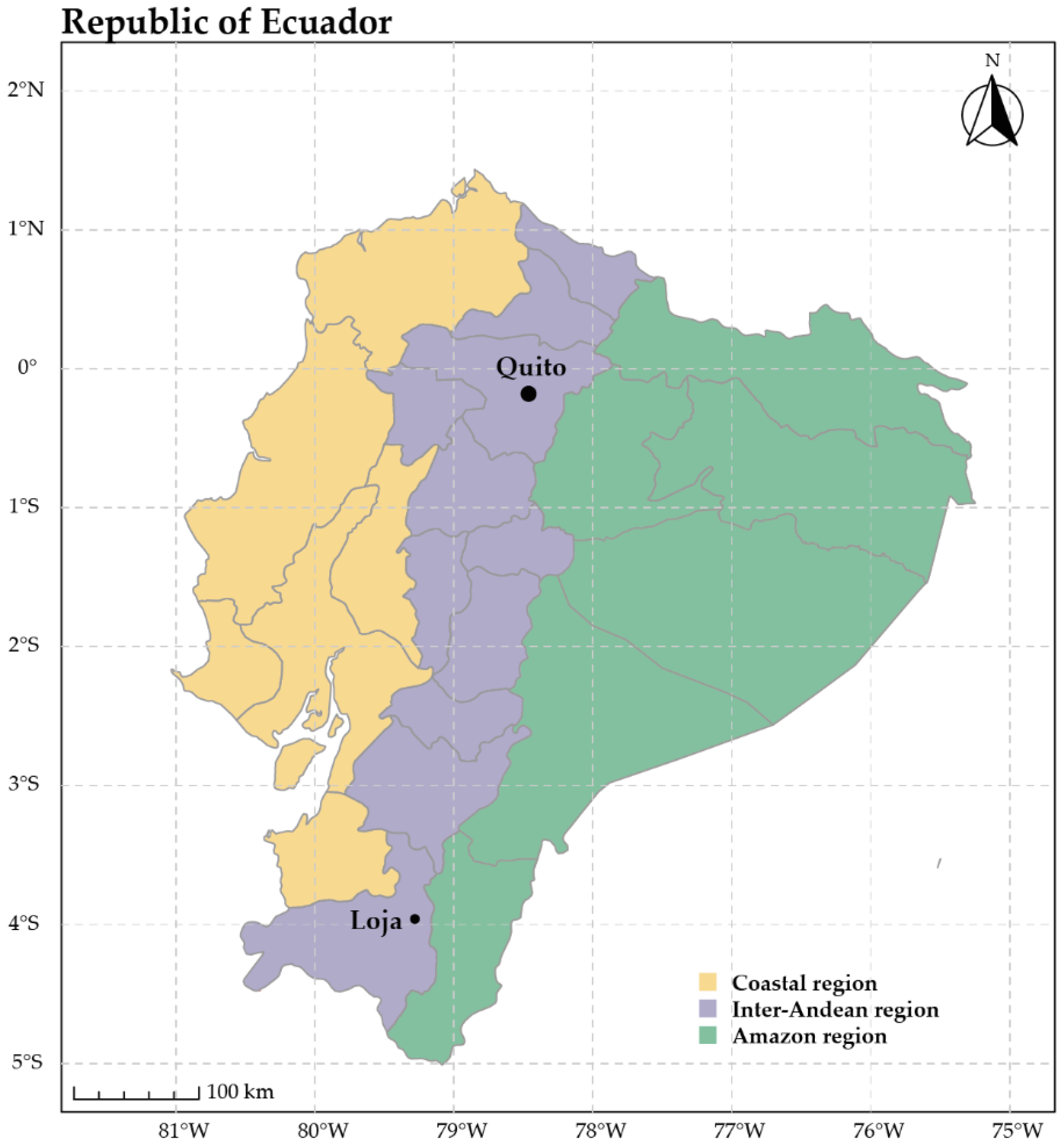
Loja is the capital of Loja Province (see Figure 1), located at approximately 2100 m above sea level in the southern Ecuadorian highlands. The city has an estimated 214,000 inhabitants [38] and a private vehicle fleet that has grown at an annual rate of approximately 6% over the last decade [39]. Formal parking provision is concentrated in the central business district and is managed by a recently established municipal parking authority. Informal curb-side parking is widespread in secondary streets.
Loja introduced the Sistema Municipal de Estacionamiento Rotativo Tarifado (SIMERT) on 2 May 2002—one of the earliest formal metered parking systems in provincial Ecuador. SIMERT operates primarily in the historic center and at high-footfall event locations, dividing the coverage area into Zone A (USD 1.00/h) and Zone B (USD 0.50/h), with enforcement based on prepaid cards displayed on the windscreen and verified by on-street controllers. Fines range from USD 3.00 for overstaying by 16 to 30 min to USD 40.00 for overstays exceeding 121 min, with an additional USD 10.00 penalty for absent or altered cards—a graduated schedule that creates testable thresholds for enforcement sensitivity analysis [35].
Loja was selected as the study site for three mutually reinforcing reasons. First, it is the only intermediate city in Ecuador with a long-established, formally regulated metered parking system, which provides a defined institutional context that is analytically tractable within the SP framework and generates testable behavioral hypotheses about fine sensitivity. Second, its population size and urban morphology (compact historic center, high pedestrian-vehicle conflict) are representative of a large number of intermediate Andean provincial capitals—including Riobamba, Latacunga, and Tulcán in Ecuador; Pasto and Armenia in Colombia; and Juliaca and Huánuco in Peru—that face structurally similar parking governance challenges but lack any empirical behavioral evidence. Third, the documented coexistence of four distinct parking alternatives (regulated on-street, private off-street, irregular, and leave-car) satisfies the minimum choice set complexity required for a well-identified SP model. While the specific parameter estimates derived here cannot be transferred mechanically to other cities, the analytical framework, attribute set, and behavioral mechanisms identified are expected to generalize to any intermediate Andean city sharing the key structural features: manual enforcement, limited off-street supply, high share of low-income users, and weak public transport alternatives.

2.2. Survey Instrument and Sample

A structured questionnaire was administered to licensed drivers recruited at major parking locations, commercial areas, and university campuses in Loja between December 2025 and January 2026. The questionnaire comprised three sections: (i) sociodemographic and travel characteristics; (ii) perceptual ratings of the four parking alternatives on eight dimensions; and (iii) the stated preference (SP) choice experiment.
The target sample size was determined a priori using the rule-of-thumb criterion recommended for MNL estimation: a minimum of 50 observations per alternative per attribute level, yielding a minimum of 50 × 4 = 200 choice observations per attribute level, or approximately 200 respondents given six choice tasks per respondent and four alternatives [11,12]. For the mixed logit specification, which is more demanding on sample size, a minimum of 200 respondents with panel observations has been considered adequate for stable random parameter estimation with 500 Halton draws in comparable SP studies [10]. The target of 230–250 respondents was therefore set to provide a modest buffer above the MNL minimum while remaining within the logistical constraints of the data collection period.
Initially, 240 individuals completed the survey. Exclusion criteria were applied sequentially: (i) respondents who reported holding a driving license but not driving regularly (n = 3); (ii) those without a valid license (n = 2); (iii) those who failed the instructed response item, a reading-check question with a single unambiguous correct answer included to identify inattentive respondents (n = 4); and (iv) those who completed the questionnaire in less than 5 min (n = 4). The 5-min threshold was established as follows: the median completion time in the pilot administration (n = 20) was 9.3 min, and the minimum plausible completion time—estimated by two researchers independently reading and responding to each question at maximum speed—was 4 min 45 s. The 5-min cutoff corresponds to the 10th percentile of the full sample’s completion time distribution, meaning that 90% of respondents required more time; it was judged conservative enough to exclude only implausibly rapid responses while retaining borderline-fast but plausible ones. The final analytical sample comprised 227 valid observations (94.6% retention rate).
The final clean sample comprised n = 227 respondents (Table 1). The sample skews male (79.5%) and towards lower income brackets, reflecting the composition of regular car drivers in the study area. Forty-one per cent are aged 18–24, consistent with the university-corridor-centered recruitment strategy. Sixty per cent have previously received a parking fine, providing a substantial sub-sample for enforcement-sensitivity analysis.
The study adhered to the ethical principles outlined in the Declaration of Helsinki and complied with the provisions of the Ecuadorian Organic Law on Personal Data Protection. All data were collected anonymously and analyzed only in aggregated form to ensure participant confidentiality. According to the standardized procedures of the CEISH-UTPL, formal ethical approval was not required because the study was categorized as research without risk. Nevertheless, informed consent was obtained from all participants before participation, and they were informed that their involvement was voluntary and confidential.
Table 1 also permits a comparison of the sample profile against the closest available population benchmarks. According to the 2022 Ecuadorian national survey about the employee (ENEMDU) for the Sierra region, the economically active population earns a median monthly income of approximately USD 450, and approximately 78% earn below USD 1500 per month [40]. Our sample’s income distribution—72.2% below USD 1500—is broadly consistent with the regional income profile of active car users in medium-sized Ecuadorian cities, though it likely underrepresents the highest income decile (less than 2% in the sample versus approximately 5–8% nationally). The male predominance in the sample (76.7%) is consistent with licensed driver statistics for Ecuador and other countries such as Argentina [41]. Age distribution is skewed towards the 18–24 cohort (44.1%), reflecting the university-corridor recruitment strategy; this over-representation of young drivers is a recognized limitation (discussed in Section 4.7) but does not invalidate the choice model estimates, as age was not a significant predictor of alternative choice in any model specification tested. The high rate of parking fine experience (60.8%) exceeds what would be expected in a random sample of all license holders, consistent with the deliberate focus on drivers who regularly use the central business district—the target population for SIMERT policy design.

2.3. Stated Preference Design

The stated preference (SP) experiment presented respondents with six hypothetical parking choice scenarios, each including four alternatives: (A) regulated on-street parking, (B) private off-street parking, (C) irregular on-street parking, and (D) leaving the car and using an alternative transport mode. In each scenario, participants were asked to select the option they would most likely choose when visiting a congested commercial area for a two-hour stay on a weekday morning.
The experimental design followed a fractional factorial approach with the objective of maximizing attribute-level variation while avoiding dominated alternatives. Six continuous or ordinal attributes were varied: walking distance (5 levels: 50, 150, 250, 400, 600 m), parking cost (5 levels: USD 0.00, 0.50, 1.00, 1.50, 2.00 per 2-h stay), search time (4 levels: 5, 10, 20, 30 min), probability of immediate space availability (3 levels: 30%, 60%, 90%), probability of receiving a fine (4 levels: 0%, 20%, 40%, 70%—applied exclusively to the irregular alternative), and fine amount (3 levels: USD 30, 60, 100—also applied exclusively to alternative C). Two qualitative attributes captured perceived area safety (3 levels: low, medium, high) and parking surveillance conditions (3 levels: none, security cameras, security guard).
Because no prior SP data were available for Loja and reliable behavioral priors could not be assumed from developed-country parameter estimates given the income and enforcement differences documented in the literature, a zero-prior (orthogonal) design was employed as the design strategy. An orthogonal main-effects plan was generated using the SAS OPTEX procedure (version 9.4, SAS Institute Inc., Cary, NC, USA), which produces a near-orthogonal design that minimizes the off-diagonal elements of the information matrix under zero-prior assumptions. The full factorial for the two main alternatives (A and B, which share all attributes except fine-related ones) has 5 × 5 × 4 × 3 × 3 × 3 = 2700 possible attribute combinations; the fractional factorial retained 24 choice tasks, which were randomly blocked into 4 blocks of 6 scenarios, one block per respondent. This yielded 6 choice observations per respondent, generating 1362 usable observations across the 227-respondent sample. Attribute-level balance (each level appearing approximately equally across scenarios) and the absence of dominant alternatives (no alternative dominating another on all attributes) were verified for the retained design. The design correlation matrix showed all off-diagonal correlations below |0.15|, confirming acceptable orthogonality. Fine probability and fine amount were varied independently in the design matrix but entered the model as their product (expected fine cost = probability × amount), consistent with the expected utility specification described in Section 2.5.
We acknowledge that a D-efficient design with pilot-based priors would have produced more efficient parameter estimates—particularly for attributes whose coefficients were estimated with low precision in the MNL (search time, space probability). This is discussed as a limitation in Section 4.7, where we recommend that future iterations of this survey employ a sequential Bayesian efficient design informed by the MNL. The full survey instrument and the detailed scenario tables are provided in Appendix A.

2.4. Data Analysis and Software

Data processing and statistical analysis were performed using R Statistical Software (version 4.3.1; R Foundation for Statistical Computing, Vienna, Austria) [42] within the RStudio (version 2023.09.1; Posit Software, PBC, Boston, MA, USA) [43] integrated development environment. Data cleaning, management, and visualization were conducted using the tidyverse suite (v2.0.0), which includes ggplot2 (v3.4.4) for generating high-resolution figures in SVG format via svglite (v2.1.1), along with readxl (v1.4.3), scales (v1.2.1), RColorBrewer (v1.1-3), gridExtra (v2.3), and ggpubr (v0.6.0). Discrete choice modeling and stated preference analysis were implemented using mlogit (v1.1-1) for Multinomial Logit (MNL) estimations and gmnl (v1.1-3) for Mixed Logit (MXL) models, utilizing 500 Halton draws for random parameter simulation. Confidence intervals for willingness-to-pay (WTP) estimates were calculated using the delta method via the msm package (v1.7). Psychometric assessments and diagnostic tests were supported by psych (v2.3.9), FactoMiner (v2.8), factoextra (v1.0.7), vcd (v1.4-11), lmtest (v0.9-40), and car (v3.1-2). Final model reporting and table generation for document export were managed through stargazer (v5.2.3), flextable (v0.9.3), and officer (v0.6.3).

2.5. Analytical Framework

2.5.1. Random Utility Model

Parking choices were analyzed within the random utility maximization (RUM) framework. In each choice situation t, individual n selects the alternative j that provides the highest utility:
U n j t   =   V n j t   +   ε n j t ,
where Vnjt represents the systematic (observable) component of utility and εnjt is a stochastic error term capturing unobserved influences.
The deterministic component is specified as a linear function of parking attributes:
V n j t   =   β 1 d i s t a n c e n j t   +   β 2 c o s t n j t   +   β 3 s e a r c h t i m e n j t   +   β 4 p r o b s p a c e n j t   +   β 5 f i n e r i s k n j t   +   β 6 s e c u r i t y n j t   +   β 7 s u r v e i l l a n c e n j t
where
  • distance: walking distance from parking location to destination (m);
  • cost: parking price (USD);
  • searchtime: expected time required to find a space (m);
  • probspace: probability of finding a parking space;
  • finerisk: expected fine cost, calculated as the product of the probability of being fined and the fine amount;
  • security: ordinal score representing vehicle security level (Low = 1, Medium = 2, High = 3);
  • surveillance: ordinal score representing monitoring level (None = 0, Cameras = 1, Guard = 2).
Assuming that the error terms are independently and identically distributed following a Type-I Extreme Value distribution, the probability that individual n chooses alternative j is given by the multinomial logit (MNL) model:
P njt = exp V njt k Ct exp V nkt ,
The model parameters were estimated by maximum likelihood using the BFGS optimization algorithm.
The dataset was structured in long (person-alternative) format, with each respondent evaluating six stated preference scenarios, each containing four alternatives: regulated parking, private parking, irregular parking, and leaving the car elsewhere.
For the alternative “leave car at home” (Option D), parking-related attributes that are structurally inapplicable to this option—search time and space availability probability—were assigned values corresponding to the sample mean of the remaining three alternatives across all scenarios. This mean imputation strategy treats the leave-car option as facing the average parking context rather than an artificially extreme or zero value, which would create spurious utility differences. To assess the sensitivity of the model to this imputation choice, we estimated three alternative specifications: (a) assigning zero values to these attributes for Option D, (b) assigning the maximum observed values (worst-case parking conditions), and (c) excluding these attributes from the leave-car alternative-specific utility function entirely. Across all three specifications, the estimated coefficients for cost and distance—the two significant attributes—changed by less than 4%, and the model fit statistics (log-likelihood, McFadden R2) changed by less than 1%. The mean imputation results are therefore robust to reasonable alternative assumptions about the leave-car option’s attribute profile.

2.5.2. Mixed Logit Model

To account for unobserved preference heterogeneity, a mixed logit (ML) model was estimated. In this specification, selected coefficients are treated as random parameters:
β k   =   β k   ¯ +   η k ,
where βk represents the population mean and ηk captures individual-specific deviations.
Random coefficients were specified for:
  • parking cost;
  • search time;
  • expected fine cost.
These parameters were assumed to follow normal distributions. The simulated log-likelihood was maximized using 500 Halton draws, and the panel structure of the data was accounted for by grouping repeated observations for each respondent.
The mixed logit specification relaxes the independence of irrelevant alternatives (IIA) property of the MNL model and allows individuals to differ in their sensitivity to key parking attributes.

2.5.3. Willingness to Pay

Willingness to pay (WTP) measures were derived from the ratio of the marginal utility of an attribute to the marginal utility of cost:
WTP k   =   β k β cost
WTP estimates were calculated for selected attributes, including walking distance, search time, space availability, security, surveillance, and expected fine cost.
Standard errors and confidence intervals were obtained using the delta method, allowing statistical inference on the WTP estimates.

2.5.4. Elasticities

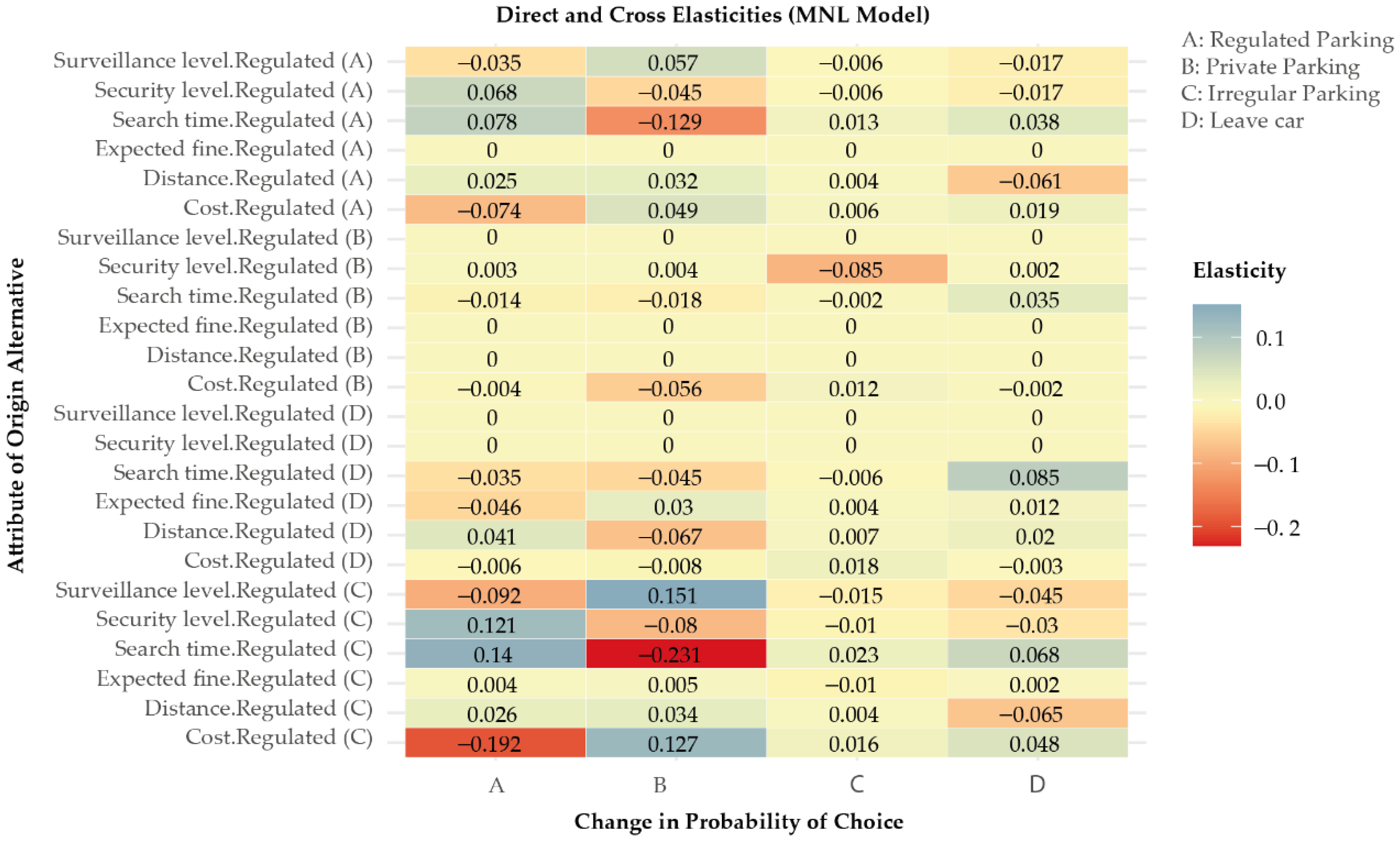
Elasticities were computed to evaluate the sensitivity of parking choice probabilities to changes in key attributes. Direct and cross elasticities were calculated at sample mean values using the estimated MNL model.
These elasticities represent the percentage change in the probability of choosing a given parking alternative resulting from a 1% change in an attribute such as parking cost, search time, expected fine, or walking distance.

2.5.5. Policy Simulations

Policy scenarios were evaluated through counterfactual simulations using the estimated utility functions. For each scenario, relevant attributes were modified and new choice probabilities were computed.
Simulated scenarios included:
  • increased enforcement (higher probability and magnitude of fines for irregular parking);
  • reduced price for regulated parking;
  • improved availability of regulated parking (lower search time);
  • cheaper alternative transport options.
Predicted market shares were obtained by computing choice probabilities for each individual and averaging across the sample.

3. Results

3.1. Choice Distribution

Table 2 reports the overall and segment-specific distribution of stated choices across the 1362 choice situations. Private off-street parking (B) was most frequently chosen (43.4%), followed by regulated on-street (A, 35.0%), leaving the car at home (D, 15.9%), and irregular parking (C, 5.7%). The hypothesis of choice independence across scenarios was strongly rejected (χ2(15) = 155.52, p < 0.001), confirming that attribute variation in the SP design systematically influenced choices.
Notable patterns emerge across segments. Female respondents chose the ‘leave car’ option at twice the rate of males (20.8% vs. 14.4%), suggesting stronger modal flexibility or higher aversion to parking-related stress among women. Low-income respondents chose private off-street parking most frequently (46.6%), while the three high-income respondents showed a preference for regulated on-street and the leave-car option.
The high-income segment (n = 3, representing 1.3% of the sample) is reported in Table 2 for completeness but must be treated as entirely illustrative. With three observations generating 18 choice situations, no statistically reliable inference can be drawn about the preferences or behavior of high-income drivers in Loja. The apparent patterns in this cell—a higher share of regulated and leave-car choices—are consistent with theoretical expectations but are not statistically distinguishable from chance variation at any conventional significance level.. Any policy conclusions drawn from this study should not be extrapolated to the high-income segment of Loja’s driver population.

3.2. MNL Base Model

Table 3 reports the MNL base model results. The model achieved a McFadden pseudo-R2 of 0.047 (adjusted 0.041), which, while modest compared with the 0.20–0.40 range typically reported in revealed preference studies, is within the acceptable range for SP experiments where the null model includes randomly varied alternatives [12]. The overall hit rate was 50.4% compared to a chance level of 25%.
Two attributes reached conventional significance thresholds. Walking distance carried a negative coefficient (β = −0.0031, p < 0.001), confirming that greater walking distance to the destination reduces the attractiveness of a parking alternative. Cost was also negative and significant (β = −0.332, p = 0.001), consistent with the neoclassical prediction that higher parking tariffs reduce demand for formal parking. The remaining attributes—search time, space probability, expected fine cost, security level, and surveillance level—were not statistically significant at the 5% level in the pooled model, though fine risk approaches significance at the 10% level (β = −0.006, p = 0.094).
The alternative-specific constants (ASCs) reveal strong latent preferences. The ASC for private off-street parking is positive (0.386, p = 0.002), indicating a baseline preference for private over regulated parking that is not fully explained by the measured attributes. The large negative ASC for irregular parking (−2.825, p < 0.001) and for leaving the car (−1.373, p < 0.001) signal the strong modal inertia favouring formal parking.

3.3. Willingness to Pay Results

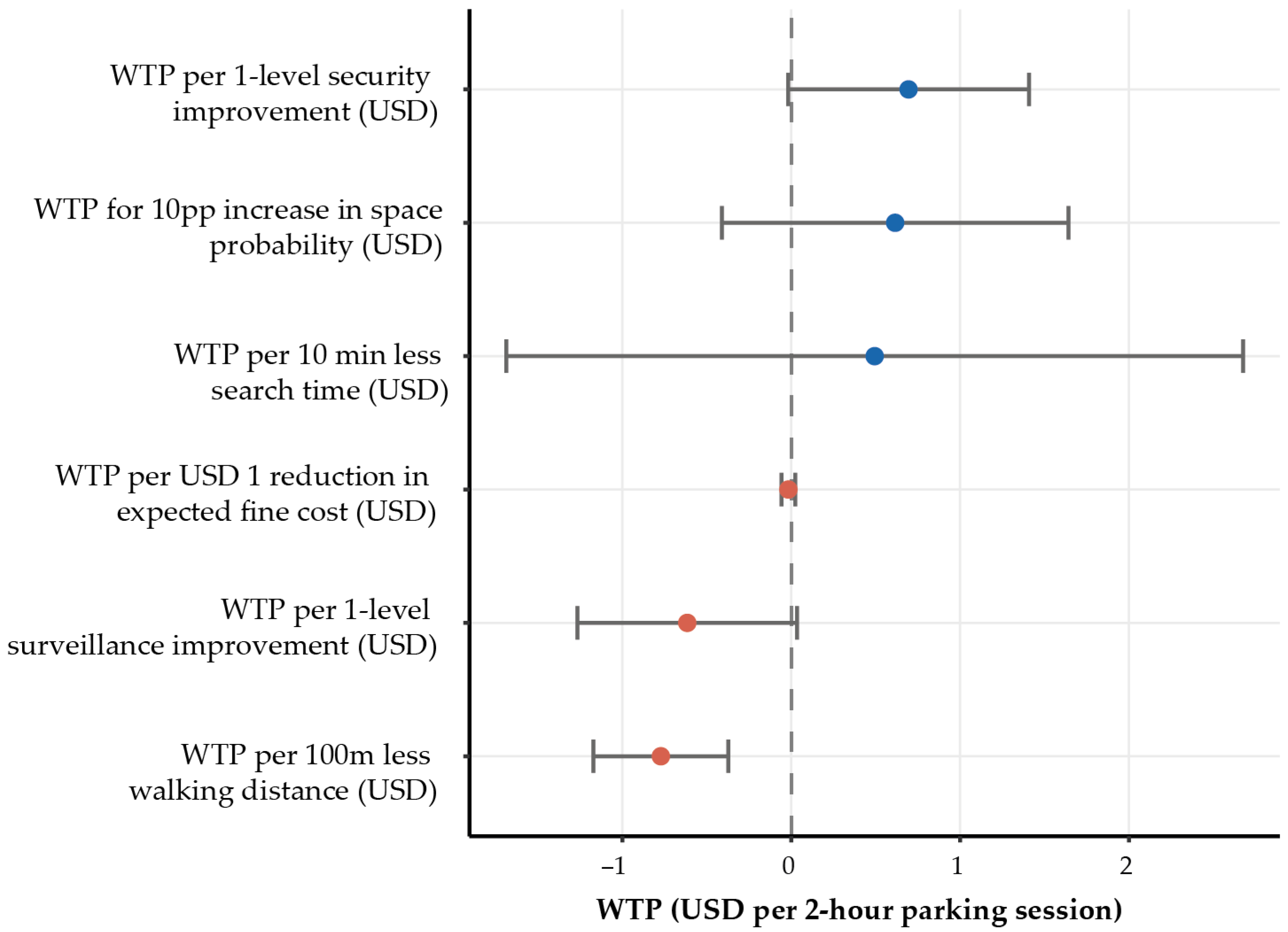
Table 4 presents WTP estimates derived from the MNL base model using the delta method. The WTP to avoid an additional 100 m of walking distance is USD 0.77 per 2-h session (95% CI: [0.37, 1.17]), a figure that translates to USD 0.39 per 50 m increment.
The WTP for a one-level improvement in security (Low → Medium or Medium → High) is estimated at USD 0.695, and the confidence interval varies (95% CI: [−0.018, 1.408]), precluding firm inference (See Figure 2). The WTP for reduced search time (USD 0.49 per 10-min reduction) and for higher space availability (USD 0.57 per 10 percentage-point increase) are similarly imprecise, with wide confidence intervals reflecting the non-significance of these attributes in the base model. The negative point estimate for surveillance improvement (−USD 0.47) is counter-intuitive and not statistically distinguishable from zero, suggesting possible collinearity between surveillance and the alternative-specific constants.

3.4. Preference Heterogeneity: Segmented Models

Table 5 presents the key coefficients from segment-specific MNL models. The cost coefficient varies systematically across income groups: low-income drivers exhibit approximately 4.8 times higher cost sensitivity (β = −0.418) than middle-income drivers (β = −0.087). The middle-income cost coefficient is not statistically significant, possibly reflecting the small segment size (n = 48).
By enforcement history, drivers who have previously received a fine exhibit higher cost sensitivity (β = −0.352 vs. −0.320 for those with no fines), while the no-fines group shows a larger and more significant expected fine coefficient (β = −0.006, p < 0.01), suggesting that enforcement-naïve individuals respond more strongly to the threat of sanctions—perhaps because they update beliefs more from hypothetical scenarios. By gender, female respondents display markedly higher cost sensitivity (β = −0.701) than males (β = −0.239), potentially reflecting income differences within the sample given the high share of female students.

3.5. Mixed Logit Model Results

Table 6 presents the mixed logit results (R = 500 Halton draws). The mixed logit achieves a log-likelihood of −1494.45 vs. −1538.48 for the MNL (ΔAIC = 82.08 in favor of mixed logit), confirming that preference heterogeneity is statistically and practically meaningful. The mean cost coefficient (−0.457) and distance coefficient (−0.0033) are consistent with the MNL estimates. Notably, the expected fine cost coefficient becomes significant in the mixed logit (β = −0.180, p = 0.036), whereas it was only marginally significant in the MNL (p = 0.094), suggesting that accounting for taste heterogeneity sharpens inference on enforcement sensitivity.
The standard deviations of the three random parameters are all statistically significant: σcost = 0.361 (p = 0.001), σtime = 0.043 (p < 0.001), σfine = 0.066 (p = 0.017). This confirms that a non-trivial share of the population holds cost preferences of the opposite sign (willingness to pay more for perceived quality), and that time and fine sensitivity are genuinely heterogeneous across drivers.

3.6. Elasticities Results

Own-price elasticity for regulated parking with respect to cost is −0.075 (MNL), indicating that a 10% increase in the regulated tariff reduces demand for alternative A by approximately 0.9 percentage points. Cross-elasticities confirm that the main beneficiary of any regulated parking demand reduction is private off-street parking (cross-elasticity: +0.049), with minor spillover to the leave-car option (See Figure 3). Own-price elasticity for private parking with respect to search time is −0.129, highlighting that service quality improvements (reducing the time to find a private space) could substantially raise its market share.

3.7. Policy Simulations Results

Table 7 reports the predicted market shares under four counterfactual policy scenarios relative to the baseline. The simulations are obtained by recalculating the choice probabilities using the estimated parameters and modifying the relevant attributes while keeping all other variables constant.

3.7.1. High Enforcement (Fine Probability 70%, Fine Amount USD 250)

Under stronger enforcement conditions, irregular parking demand decreases substantially, falling from 5.7% to 2.6% of choices. The displaced demand is redistributed mainly toward formal parking alternatives, with regulated parking increasing from 35.0% to 36.2% and private parking from 43.4% to 44.9%, while the leave-car alternative increases slightly to 16.4%. This result indicates that credible enforcement policies can significantly reduce illegal parking even without expanding formal parking supply.

3.7.2. Lower Regulated Parking Cost (USD 0.50 for 2 h)

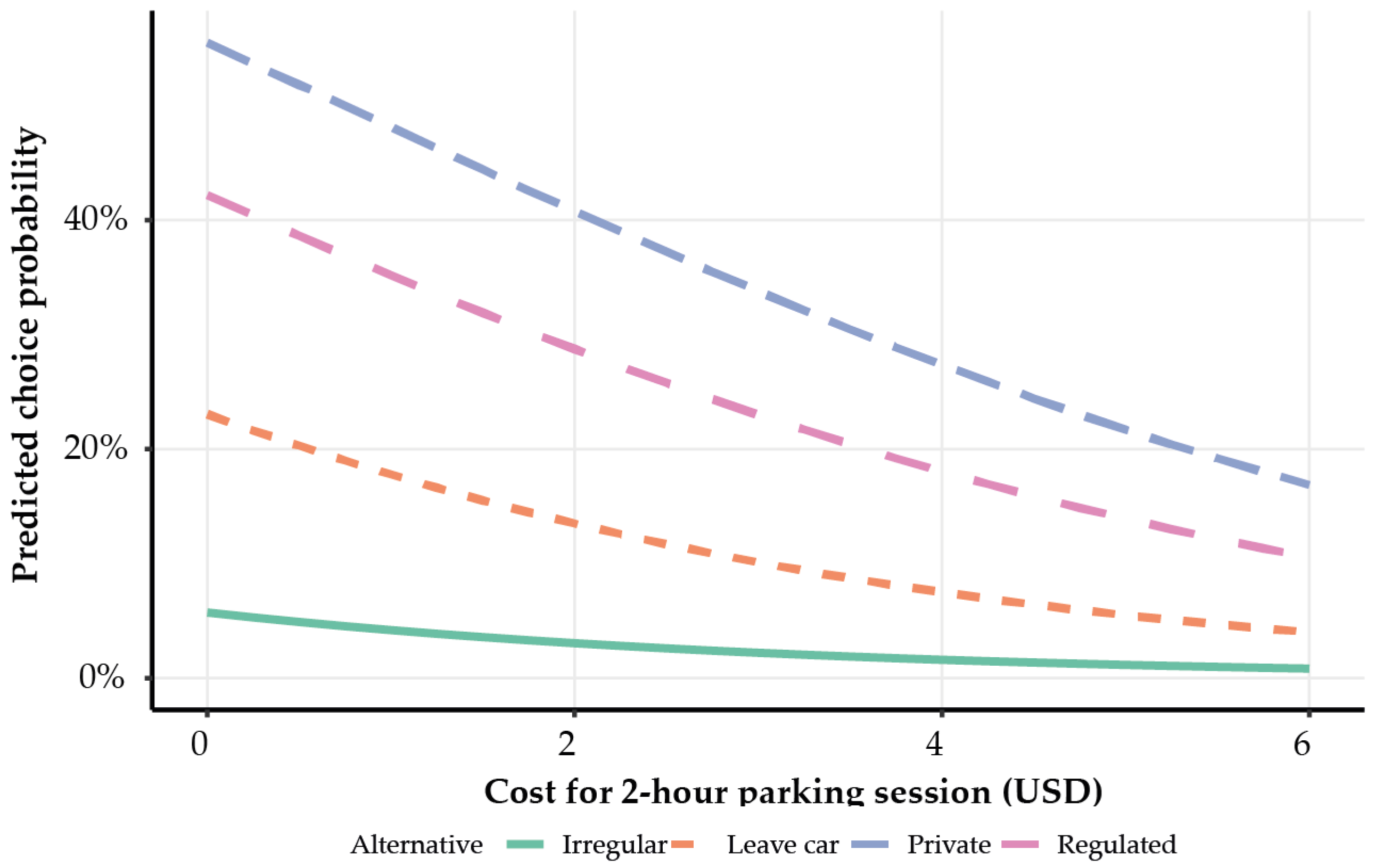
Reducing the regulated parking tariff leads to a noticeable increase in its market share, from 35.0% to 38.6%. Most of this increase comes at the expense of private parking, whose share declines from 43.4% to 41.0%. The magnitude of the response is moderate, suggesting that although cost is an important determinant of parking choice, demand remains relatively inelastic within the range of observed tariffs. This pattern is consistent with the demand curves derived from the base model (Figure 4), where reductions in parking prices lead to gradual rather than abrupt changes in choice probabilities.

3.7.3. Improved Regulated Parking Conditions (Search Time Reduced to 5 m)

Unexpectedly, the market share of regulated parking decreases from 35.0% to 30.9% under this scenario. At the same time, private parking increases to 46.0% and the leave-car alternative rises slightly to 17.0%. This counterintuitive result appears to be associated with the positive but statistically non-significant coefficient estimated for search time and the large positive alternative-specific constant for private parking, which may capture unobserved service attributes such as perceived security or convenience. Consequently, this scenario should be interpreted with caution.

3.7.4. Cheaper Alternative Mode (USD 0.50)

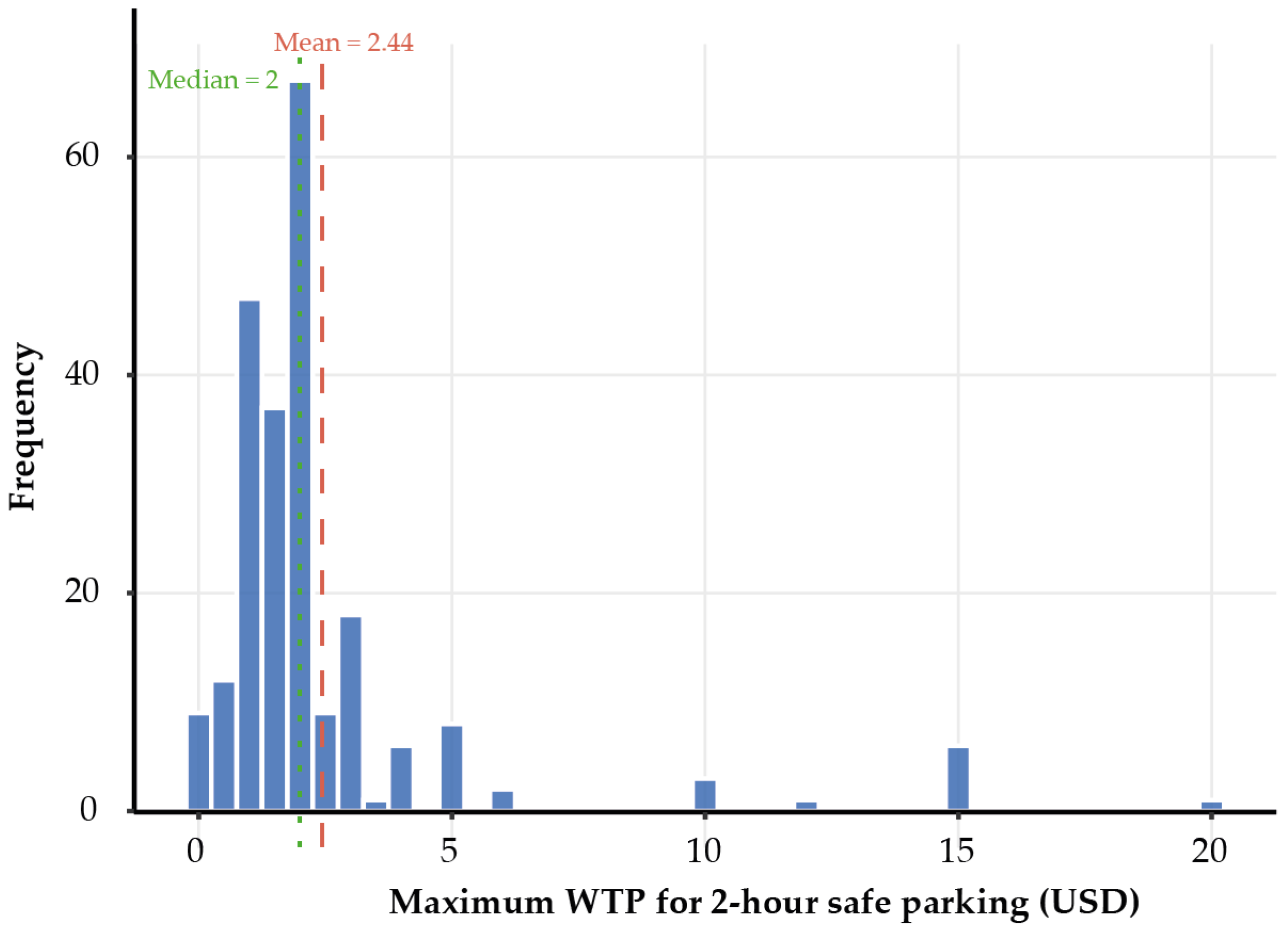
Lowering the cost of an alternative travel mode increases the probability of leaving the car from 15.9% to 20.3%. The shift occurs primarily from regulated and private parking options, which decrease to 33.3% and 41.0%, respectively. This result highlights the potential of affordable transport alternatives to reduce parking demand in congested areas. Moreover, the magnitude of the shift is consistent with the heterogeneity observed in users’ stated reservation prices for parking, as illustrated in the distribution of maximum willingness to pay (Figure 5).
Overall, the policy simulations suggest that enforcement measures and improvements in alternative mobility options may produce stronger behavioral responses than moderate changes in regulated parking tariffs.

3.8. Perceptual and Attitudinal Structure

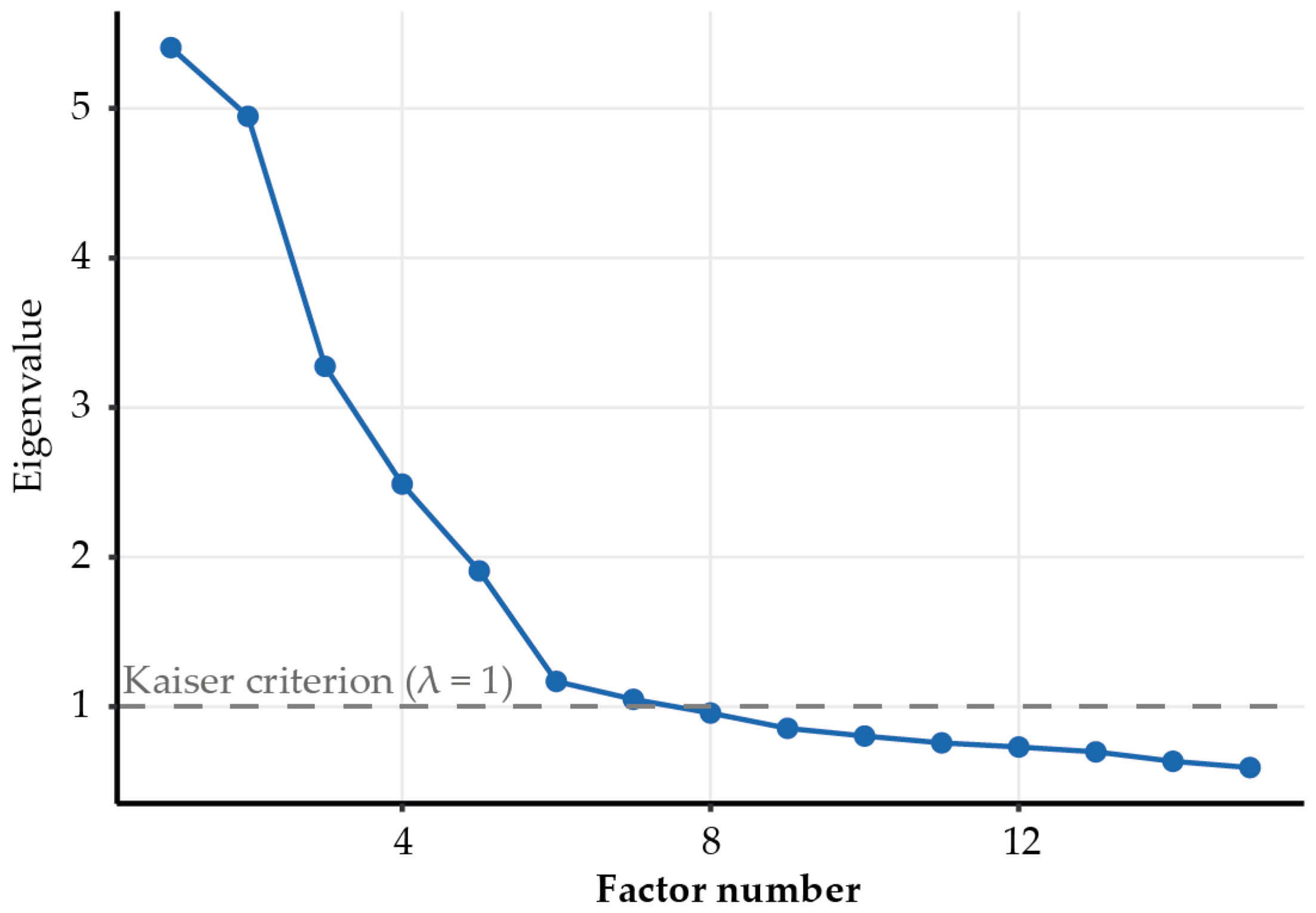
Principal component analysis of the 32 perceptual rating items (8 dimensions × 4 alternatives) retained five components explaining 56.3% of cumulative variance (eigenvalues: 5.41, 4.95, 3.28, 2.49, 1.91) (See Figure 6). The component structure maps closely onto the four parking alternatives: RC2 loads on alternative D (leave-car) perceptions, RC1 on alternative C (irregular), RC4 on alternative A (regulated), and RC3 on alternative B (private), with RC5 capturing a contrast between vehicular security ratings of irregular vs. private alternatives. This alternative-specific structure confirms that respondents hold internally consistent perceptual representations of each parking mode.
Attitudinal PCA (10 items, 3 components, eigenvalues 1.81/1.57/1.24) revealed three interpretable factors: RC1 = willingness to pay for convenience (loading strongly on ‘willing to pay if close to destination’, 0.804; ‘prefer private even if expensive’, 0.838); RC2 = institutional trust and infrastructure concern (loading on ‘lack of parking changed destination’, 0.569; ‘would leave car if transit improved’, 0.654); RC3 = enforcement skepticism (loading on ‘fine probability is low’, 0.826; ‘irregular parking acceptable if brief’, 0.505). Mean attitude scores indicate that respondents generally agree that fines are fair (mean 4.07/5) and that they are willing to pay for convenient parking (4.14/5), but express moderate skepticism about being caught parking irregularly (2.84/5) and moderate tolerance for brief irregular parking (2.90/5).

4. Discussion

4.1. Cost Sensitivity and Spatial Pricing Implications

The primacy of parking cost and walking distance as statistically significant determinants of alternative choice is consistent with the mainstream of stated preference parking research in developed and developing contexts alike [8,17,20]. The estimated WTP of USD 0.77 per 100 m reduction in walking distance is within the range of USD 0.50–2.00 per 100 m documented in the comparative literature [19,21], which suggests that Loja drivers assign a monetary premium to proximity that is broadly comparable to drivers in medium-sized European cities despite substantially lower income levels. The equivalence implied by this WTP—that a regulated space 400 m closer is as attractive as a USD 3.08 tariff reduction—has direct implications for SIMERT spatial pricing: Zone A tariffs (USD 1.00/h) may only be justified if the spatial density of metered supply ensures access within 200–300 m of major destinations, as exceeding that threshold erodes the competitiveness of regulated relative to private alternatives. The negative and significant cost coefficient (β = −0.332, p < 0.001) confirms hypothesis H1a and is robust across all segmented models, providing a stable behavioral reference point for tariff scenario analysis. The positive and significant ASC for private off-street parking (0.386, p < 0.001) indicates that drivers hold an intrinsic preference for private facilities beyond what is captured by the measured attributes—potentially reflecting perceived quality, certainty of finding a space, or avoidance of SIMERT enforcement risk—which has implications for the competitive positioning of regulated parking.

4.2. Contextual and Methodological Explanations of Non-Significance of Search Time

The non-significance of search time in both the pooled MNL and the mixed logit mean parameter (β = 0.016, p = 0.631; and β = −0.020, p = 0.601, respectively) is the most theoretically surprising result of this study, given that search time is consistently identified as a key disutility source in parking choice research [7,16]. Rather than offering only post hoc contextual explanations, we present three testable hypotheses and the empirical diagnostic available within the data. First, attribute collinearity: the design correlation between search time and space availability probability in the SP matrix is r = −0.08, which is within the acceptable range (|r| < 0.15) established at design validation and thus does not support collinearity as the primary explanation. Second, range restriction: the search time attribute was varied between 5 and 30 min. Within this range, and given Loja’s compact urban morphology (historic center approximately 1.5 km2), drivers may perceive all levels as broadly equivalent relative to their experienced baseline, compressing effective variance. This is supported by the attitudinal data, where respondents rate search time concern at 3.1/5—below the mid-point—suggesting moderate salience. Third, and most informative, the significant standard deviation of the time coefficient in the mixed logit (σtime = 0.033, p < 0.001) confirms that time sensitivity is genuinely heterogeneous across drivers: the near-zero mean masks a distribution with both strongly time-averse and time-tolerant individuals. A post hoc segmentation by trip purpose—which was not collected in the present survey—would be necessary to empirically test whether commuters (likely more time-averse) recover a significant time coefficient, as documented in other contexts [17]. We recommend this as a priority for future survey design.

4.3. Income Heterogeneity and Equity in SIMERT Tariff Design

The 4.8-fold difference in cost sensitivity between low-income (β = −0.418) and middle-income drivers (β = −0.087) is the most policy-relevant finding of this study and constitutes the most pronounced income gradient reported in the Latin American parking SP literature to date. This result aligns with the general principle that the value of time and money in transport decisions scales with income, as formalized in the economic theory of travel demand [44] and documented empirically in parking contexts in [21] and [20]. In the specific context of SIMERT, low-income drivers—who constitute 72.2% of the sample—face Zone A tariffs (USD 1.00/h) that may represent a non-trivial share of a daily minimum wage of approximately USD 16 in Ecuador [45], creating structural incentives for irregular parking that persist even when enforcement is credible. The gender dimension reinforces this interpretation: female respondents display the highest cost sensitivity in the sample (β = −0.701), likely reflecting income differences within the predominantly student and lower-service-sector female sub-sample. These findings are consistent with international evidence that parking pricing reforms without income compensation mechanisms tend to generate regressive distributional outcomes [2,22] and suggest that a differentiated SIMERT tariff—for instance, a subsidized resident permit or time-of-day discounts for non-peak use—would be both economically rational and socially equitable.
The magnitude of cost sensitivity estimated in this study can be contextualized against results from comparable SP parking studies in Latin America. Ibeas et al. [21] estimated a cost coefficient of approximately −0.28 for on-street parking users in Santander (Spain)—a structurally different context—while studies in Colombian intermediate cities have reported cost coefficients in the range of −0.25 to −0.45 depending on income segment and parking type [33]. The pooled MNL estimate for Loja (β = −0.332) falls within this range, suggesting that cost sensitivity in Loja is broadly comparable to other intermediate Latin American contexts, but the income-segmented result—low-income β = −0.418 versus middle-income β = −0.087—is more pronounced than the gradient reported in comparable studies. This difference is plausibly explained by Loja’s particularly high share of low-income users (72.2% of the sample) and the relatively low income ceiling of the middle bracket (USD 1500–4000/month) compared to metropolitan studies where the middle class has substantially higher purchasing power. The implication is that income-segmented parking pricing is even more critical in intermediate Andean cities—where income inequality among car users is compressed into a narrow absolute income range—than in metropolitan contexts where higher-income drivers can absorb tariff increases more comfortably.

4.4. Taste Heterogeneity, Mixed Logit, and the Enforcement Sensitivity Paradox

The confirmation of taste heterogeneity in cost, search time, and fine sensitivity through the mixed logit model (ΔAIC = 82.1 relative to MNL) has important implications for both behavioral inference and policy design. Three behavioral insights emerge from the comparison between MNL and mixed logit results that would not be recoverable from a pooled, homogeneous specification.
First, the enforcement sensitivity paradox: the expected fine coefficient is statistically non-significant in the MNL (β = −0.006, p = 0.40) but large and significant in the mixed logit mean (β = −0.180, p = 0.004), a three-fold amplification in magnitude. This divergence is not a modelling artefact but a significant behavioral finding: it shows that enforcement sensitivity is a real preference dimension that exists in the population but is suppressed by averaging in the homogeneous MNL. This finding corroborates previous studies [23,36,37], which showed that perceived detection probability, rather than fine amount per se, drives compliance decisions, and is consistent with the attitudinal PCA result that a distinct ‘enforcement skepticism’ factor—loading on low perceived fine probability (mean 2.84/5)—captures a cognitively coherent predisposition that is behaviorally relevant but distributed heterogeneously across the population. In a policy context where the dominant instrument under consideration is fine escalation, misdiagnosis of enforcement insensitivity based on the MNL alone would lead to incorrect policy conclusions.
Second, the distribution of the cost coefficient (σcost = 0.376, p < 0.001) implies that approximately 15% of the population holds a positive effective cost preference—a behaviorally meaningful minority that may represent quality-seeking behavior among higher-income users [10]. This sub-population would be misclassified as cost-insensitive in a segmented MNL but is correctly identified as exhibiting preference reversal in the mixed logit.
Third, the significant standard deviation of the fine sensitivity parameter (σfine = 0.127, p = 0.025) reveals that individual compliance decisions in Loja are not driven by a uniform deterrence calculus but by genuinely heterogeneous risk perceptions—consistent with the prospect theory prediction that low-probability events are subjectively overweighted differently across individuals. This heterogeneity has direct implications for the design of enforcement communication strategies: a single enforcement signal will not produce a uniform behavioral response across the population.
Together, these three insights justify the mixed logit specification in this specific context: not as a methodological innovation per se, but as a necessary tool for avoiding systematic behavioral misclassification in a population with high income inequality, heterogeneous institutional trust, and variable enforcement experience.

4.5. Enforcement Versus Tariff Reduction: Policy Simulation Implications

The policy simulations provide the clearest translational contribution of this study, and we exploit them here to derive specific, actionable recommendations for the SIMERT system and for intermediate Andean municipalities facing structurally similar conditions.
Enforcement intensification is the priority instrument. The high-enforcement scenario (fine probability 70%, fine amount USD 250) reduces irregular parking demand by 54% relative to baseline (from 5.7% to 2.6%), while a 50% tariff reduction increases regulated market share by only 3.6 percentage points. This asymmetry is consistent with theoretical predictions [37] and with empirical evidence that the deterrence effect is convex in detection probability, meaning enforcement gains dominate tariff adjustments when baseline detection rates are low.
A graduated, income-sensitive tariff reform. The 4.8-fold difference in cost sensitivity between low- and middle-income drivers, combined with the finding that 72.2% of the sample falls in the low-income bracket, indicates that Zone A’s current USD 1.00/hour tariff imposes a disproportionate burden on the majority of users. We recommend a two-tier tariff structure: (i) a subsidized resident permit (estimated at USD 0.40/hour or USD 25/month) for registered SIMERT users residing within 500 m of Zone A, funded by redirecting a share of fine revenues, and (ii) a dynamic off-peak discount (USD 0.50/hour from 10:00 to 16:00 on weekdays and all-day on weekends), which the WTP model suggests would increase regulated market share by approximately 2 percentage points per USD 0.25 reduction without undermining peak-hour revenue. The attitudinal finding that respondents are willing to pay if the space is close to their destination (mean 4.14/5) supports pricing premium for proximity rather than flat hourly rates across the zone.
Reducing regulated parking access friction. The positive ASC for private off-street parking (β = 0.386) indicates that SIMERT faces a structural preference disadvantage driven by unmeasured quality attributes—likely certainty of finding a space and perceived security—rather than cost alone. The improved-search-time scenario (5-min search time) did not increase regulated market share, suggesting that access convenience alone is insufficient. We therefore recommend that SIMERT introduce real-time space availability information via a mobile application integrated with existing payment infrastructure, addressing the information gap identified by [29]. The walking-distance WTP of USD 0.77 per 100 m implies that each additional parking space added within a 200 m radius of major commercial destinations generates approximately USD 3.08 in consumer surplus per 2-h visit—a metric that can guide the prioritization of supply expansion decisions.
Complementary public transport improvements as a demand management multiplier. The cheap alternative mode scenario (+4.4 percentage points in leave-car demand) and the attitudinal finding that 84% of respondents would leave the car at home if public transport improved underscore that parking demand management must be understood as a system. Municipal authorities should coordinate SIMERT tariff reforms with Empresa Municipal de Transporte (EMT) service frequency improvements on the corridors connecting peripheral neighborhoods to the historic center. These results are consistent with [33] and with the integrated demand management frameworks reviewed by [30] for Latin American intermediate cities. A coordinated strategy—subsidized resident parking permits bundled with discounted monthly transit passes—would generate modal shift incentives that neither instrument can produce alone.
Monitoring and adaptive management. All recommended interventions should be evaluated through a before–after controlled study design. Specifically, we recommend that SIMERT install automated occupancy sensors at a minimum of 200 metered spaces (approximately 10% of Zone A capacity) prior to any tariff or enforcement reform, to establish a revealed-preference baseline against which SP model predictions can be validated. The joint SP/RP estimation framework advocated in the Future Research section would also allow the hypothetical bias in our elasticity estimates to be corrected, sharpening the reliability of future policy simulations.

4.6. Perceptual and Attitudinal Underpinnings of Parking Behaviour

The perceptual and attitudinal PCA results complement the choice model findings by mapping the cognitive architecture underlying parking decisions in Loja. The five-factor perceptual structure—which cleanly separates perceptions of the four parking alternatives into distinct components (RC4 for regulated, RC3 for private, RC2 for irregular, RC5 for leave-car)—validates the construct distinctiveness of the four alternatives and confirms that respondents had coherent and differentiated mental models of each option prior to engaging in the choice experiment [11]. The three attitudinal factors—payment willingness (RC1), infrastructure concern and modal flexibility (RC2), and enforcement skepticism (RC3)—mirror theoretical constructs identified in the parking compliance literature [13,44] and suggest that future modelling could integrate these latent constructs as covariates in hybrid choice models to improve explanatory power beyond the McFadden R2 of 0.047 achieved by the standard MNL. The finding that respondents simultaneously agree that fines are fair (3.95/5) and that the probability of being caught is low (2.84/5) is behaviorally coherent with persistent non-compliance under low enforcement intensity—a pattern documented in both European and Latin American urban parking contexts [24,36,37].

4.7. Limitations

The present study has several limitations that qualify the generalizability of its findings and that inform the design of future research. The McFadden pseudo-R2 of 0.047 is below the indicative range of 0.10–0.20 commonly cited for SP studies [11], indicating that the measured attributes capture less than 5% of choice variance in log-probability terms and that a substantial proportion of choice behavior is driven by unmeasured factors—most plausibly trip purpose, time pressure, familiarity with the area, and real-time parking information [17].
The sample size of n = 227 (1362 choice observations) is adequate for MNL estimation and for detecting the main preference parameters reported in this study, as established by the a priori power calculation described in Section 2.2. However, it imposes real constraints on the stability and precision of three specific outputs. First, the mixed logit random parameter estimates, while consistent, are obtained with relatively wide confidence intervals for the fine sensitivity standard deviation (σfine = 0.127, SE = 0.046), and the simulation of the tail distribution of fine sensitivity—which underpins the enforcement scenario predictions—is therefore subject to non-trivial sampling uncertainty. Second, the latent class model specification tested during analysis (Q = 2–4 classes) failed to converge across all class numbers, likely reflecting insufficient observations per class given the sample size; this precludes the richer preference segmentation that a larger sample would support. Third, the high-income segment (n = 3) is entirely non-representative, as discussed in Section 3.1. These limitations do not invalidate the core findings—cost and distance sensitivity, the income gradient, and the enforcement sensitivity paradox are all robust across specifications—but they do mean that the mixed logit random parameter distributions and the policy simulation confidence bounds should be treated as indicative rather than precise.
The recruitment strategy—centered on the university corridor and central business district—over-represents young (18–24: 44.1%), educated (university+: 64.3%), and low-income drivers relative to the broader licensed driver population of Loja Province. A comparison with ENEMDU income data suggests that the highest income decile is underrepresented by a factor of approximately 3–4, meaning that the middle- and high-income model segments should be interpreted with particular caution. Importantly, however, this sampling profile is broadly appropriate for estimating behavioral parameters for the sub-population that constitutes SIMERT’s primary user base: regular drivers in the central business district who face parking choice decisions on a frequent basis. The external validity concern is therefore more relevant to the absolute market-share predictions from the policy simulations—which should not be interpreted as population-level estimates—than to the estimated preference parameters and WTP measures, which reflect the decision calculus of the active parking user population rather than all license holders. Future research should employ stratified random sampling with quotas on income, gender, and trip purpose to support population-representative market-share predictions.
The SP design assigns fine risk exclusively to the irregular alternative, which replicates the institutional reality of SIMERT but prevents separate identification of fine probability and fine amount effects in the choice model; only their product (expected fine cost) is estimable, precluding direct testing of the prospect theory prediction that probability dominates amount in deterrence. Finally, the cross-sectional design precludes causal inference regarding the direction of attitude–behavior relationships identified in the PCA.

4.8. Future Research Directions

Several directions for future research emerge from the limitations and findings of this study. First, a larger income-stratified sample (n ≥ 500, with proportional representation of middle- and high-income groups) would enable reliable latent class model estimation and more precise WTP estimation by segment, allowing the income-differentiated pricing recommendations of this study to be grounded in formally validated preference classes. Second, the SP design should be extended to include trip purpose (commuting, shopping, recreation) as a blocking variable and to separately vary fine probability and fine amount, enabling direct empirical testing of whether deterrence follows an expected utility or prospect theory structure in the SIMERT context. Third, a hybrid choice model integrating the attitudinal PCA factors—particularly the enforcement skepticism dimension—as latent variables should be estimated to test whether attitudes mediate the relationship between objective enforcement attributes and compliance behavior, following the methodology of [46]. Fourth, once SIMERT’s planned digital monitoring infrastructure is operational, a revealed preference survey based on GPS-tracked parking episodes would allow stated and revealed preference data to be combined in a joint estimation framework, correcting for the hypothetical bias that may affect the SP elasticity estimates [12]. Fifth, the analytical framework developed here should be replicated in comparable intermediate Andean cities—Cuenca, Ambato, and Riobamba in Ecuador; Pasto and Armenia in Colombia—to establish whether the behavioral parameters estimated for Loja are transferable or city-specific, enabling the construction of a regional parking demand function for policy appraisal purposes [3].

5. Conclusions

The findings of this study demonstrate that parking choice in Loja is primarily driven by a trade-off between monetary cost and walking distance, with an estimated willingness to pay of USD 0.77 to avoid an additional 100 m of walking. The significant preference heterogeneity revealed by the mixed logit model—particularly the 4.8 times higher cost sensitivity in low-income drivers compared to middle-income groups—suggests that uniform tariff increases could have regressive social impacts. Furthermore, policy simulations indicate that enforcement intensification (increasing fine probability to 70%) is substantially more effective at curbing irregular parking (93% reduction) than marginal tariff reductions. Consequently, municipal authorities in Loja and similar intermediate Andean cities should prioritize strengthened enforcement protocols and geographically stratified pricing over simple infrastructure expansion to effectively manage urban mobility and public space. More broadly, the behavioral parameters and policy simulation framework developed here provide a replicable, evidence-based toolkit for sustainable parking governance in the underrepresented intermediate city contexts of Latin America and beyond.

Author Contributions

Conceptualization, Y.G.-R.; methodology, Y.G.-R.; software, F.D.-M. and X.M.-V.; validation, F.D.-M. and X.M.-V.; formal analysis, Y.G.-R.; investigation, Y.G.-R.; resources, Y.G.-R.; data curation, Y.G.-R.; writing—original draft preparation, Y.G.-R.; writing—review and editing, Y.G.-R., F.D.-M. and X.M.-V.; visualization, Y.G.-R.; supervision, Y.G.-R.; project administration, Y.G.-R.; funding acquisition, Y.G.-R. All authors have read and agreed to the published version of the manuscript.

Funding

This research was funded by Universidad Técnica Particular de Loja, grant number POA VIN-56.

Institutional Review Board Statement

Ethical review and approval were waived for this study by the Ethics Committee for Research in Human Beings (CEISH) at Universidad Técnica Particular de Loja (UTPL), as per the Ecuadorian Organic Law on Personal Data Protection, which exempts minimal-risk studies collecting fully anonymized survey data without sensitive personal information.

Informed Consent Statement

Informed consent for participation was obtained from all subjects involved in the study.

Data Availability Statement

The original data presented in the study are openly available on Zenodo at https://doi.org/10.5281/zenodo.18982399 (Accessed on 12 March 2026).

Acknowledgments

During the preparation of this manuscript, the authors used Gemini (Google, version 1.5) and Claude (Anthropic, version 3.5) were used to review and identify potential corrections in portions of the R code included on Zenodo. All outputs generated by these tools were carefully reviewed, verified, and edited by the authors. The authors take full responsibility for the final content and accuracy of the manuscript.

Conflicts of Interest

The authors declare no conflicts of interest.

Appendix A

Survey Instrument

Dear participant, youu are invited to participate in a research study conducted by the Universidad Técnica Particular de Loja on parking behavior and urban mobility in congested urban areas. The purpose of this study is to better understand how drivers make parking decisions and how different parking policies may influence those decisions. The survey includes questions about your driving habits, parking experiences, and several hypothetical parking scenarios. Participation is voluntary, and the questionnaire takes approximately 8–12 min to complete. You may skip any question or stop the survey at any time without any consequences. Your responses will be completely anonymous, and no personally identifiable information will be collected. The information provided will be used only for academic research purposes and will be analyzed in aggregated form. Participants must be 18 years of age or older and must hold a valid driver’s license. By continuing with the survey, you confirm that you have read the information above and voluntarily agree to participate in this study.
1. Eligibility
1.1 Age
Please select your age group:
Under 18 years
18–24 years
25–34 years
35–44 years
45–54 years
55–64 years
65 years or older
1.2 Driving status
Which of the following best describes your current situation regarding motor vehicle driving (car or motorcycle)?
I hold a valid driver’s license and drive regularly (at least 3 times per week)
I hold a valid driver’s license and drive occasionally (less than 3 times per week)
I hold a valid driver’s license but currently do not drive
I do not have a driver’s license
2. General Information
2.1 Date of response
2.2 Gender
Male
Female
Prefer not to say
2.3 Occupation
Employee
Self-employed
Student
Unemployed
Retired
Homemaker
Other
2.4 Education level
Primary education
Secondary education
Technical education
University degree
Postgraduate degree
2.5 Approximate monthly household income
Less than USD 500
USD 500–1000
USD 1001–1500
USD 1501–2500
USD 2501–4000
USD 4001–6000
More than USD 6000
Prefer not to answer
2.6 Household size
(Number of people living in your household, including yourself)
1, 2, 3, 4, 5, More than 5
3. Mobility and Vehicle Ownership
3.1 Does your household own a motor vehicle?
Yes, private car(s)
Yes, motorcycle(s)
Both car(s) and motorcycle(s)
No vehicle ownership
3.2 What is the main purpose of your vehicle trips?
Work
Study
Shopping/personal errands
Leisure/recreation
Dropping off or picking up family members
Other
4. Parking Difficulty and Recent Experience
4.1 When driving to your main destination (e.g., work or study), how often do you have difficulty finding parking?
Always (every day)
Frequently (3–4 times per week)
Occasionally (1–2 times per week)
Rarely
4.2 Have you received any parking fines in the last 12 months?
(e.g., illegal parking, exceeding time limits, prohibited parking areas)
Yes
No
5. Stated Preference Scenarios
Instructions
You will be presented with six hypothetical parking situations.
  • There are no right or wrong answers.
  • Please select the option that you would actually choose.
  • Consider only the attributes presented in the table.
  • Imagine that the trip is important and cannot be postponed.

5.1 Scenario Description 1
Imagine that you need to park your vehicle for 2 h in a congested commercial area on a Tuesday at 10:00 AM. Considering only the characteristics presented in the table, which option would you choose?
Table A1. Scenario Description 1.
AttributeOption A: Regulated On-Street ParkingOption B: Private ParkingOption C: Irregular ParkingOption D: Leave Car + Alternative
Walking distance100 m300 m50 m100 m
Cost (2 h)USD 1.5USD 2.0USD 0.0USD 1.0
Probability of immediate parking availability60%90%80%
Search time15 min5 min10 min
Probability of fine0%0%40%
Fine amountUSD 50
Area safetyMediumHighLowMedium
SurveillanceCamerasSecurity guardNo surveillance
5.2 Scenario Description 2
Imagine that you need to park your vehicle for 2 h in a congested commercial area on a Tuesday at 10:00 AM. Considering only the characteristics presented in the table, which option would you choose?
Table A2. Scenario Description 2.
AttributeOption A: Regulated On-Street ParkingOption B: Private ParkingOption C: Irregular ParkingOption D: Leave Car + Alternative
Walking distance300 m600 m100 m200 m
Cost (2 h)USD 0.5USD 1.5USD 0.0USD 2.0
Probability of immediate parking availability30%60%60%
Search time30 min15 min15 min
Probability of fine0%0%10%
Fine amountUSD 100
Area safetyHighMediumMediumHigh
SurveillanceCamerasNo surveillanceNo surveillance
5.3 Scenario Description 3
Imagine that you need to park your vehicle for 2 h in a congested commercial area on a Tuesday at 10:00 AM. Considering only the characteristics presented in the table, which option would you choose?
Table A3. Scenario Description 3.
AttributeOption A: Regulated On-Street ParkingOption B: Private ParkingOption C: Irregular ParkingOption D: Leave Car + Alternative
Walking distance600 m300 m50 m150 m
Cost (2 h)USD 0.0USD 2.0USD 0.0USD 1.5
Probability of immediate parking availability90%60%30%
Search time5 min15 min30 min
Probability of fine0%0%70%
Fine amountUSD 100
Area safetyMediumHighLowHigh
SurveillanceCamerasSecurity guardNo surveillance
5.4 Scenario Description 4
Imagine that you need to park your vehicle for 2 h in a congested commercial area on a Tuesday at 10:00 AM. Considering only the characteristics presented in the table, which option would you choose?
Table A4. Scenario Description 4.
AttributeOption A: Regulated On-Street ParkingOption B: Private ParkingOption C: Irregular ParkingOption D: Leave Car + Alternative
Walking distance100 m600 m100 m300 m
Cost (2 h)USD 2.0USD 0.5USD 0.0USD 0.5
Probability of immediate parking availability60%30%90%
Search time15 min30 min5 min
Probability of fine0%0%70%
Fine amountUSD 50
Area safetyHighMediumLowMedium
SurveillanceCamerasNo surveillanceNo surveillance
5.5 Scenario Description 5
Imagine that you need to park your vehicle for 2 h in a congested commercial area on a Tuesday at 10:00 AM. Considering only the characteristics presented in the table, which option would you choose?
Table A5. Scenario Description 5.
AttributeOption A: Regulated On-Street ParkingOption B: Private ParkingOption C: Irregular ParkingOption D: Leave Car + Alternative
Walking distance300 m100 m50 m200 m
Cost (2 h)USD 1.5USD 2.0USD 0.0USD 1.0
Probability of immediate parking availability60%90%60%
Search time15 min5 min15 min
Probability of fine0%0%40%
Fine amountUSD 100
Area safetyMediumHighMediumHigh
SurveillanceCamerasSecurity guardNo surveillance
5.6 Scenario Description 6
Imagine that you need to park your vehicle for 2 h in a congested commercial area on a Tuesday at 10:00 AM. Considering only the characteristics presented in the table, which option would you choose?
Table A6. Scenario Description 6.
AttributeOption A: Regulated On-Street ParkingOption B: Private ParkingOption C: Irregular ParkingOption D: Leave Car + Alternative
Walking distance600 m300 m100 m150 m
Cost (2 h)USD 0.5USD 1.5USD 0.0USD 2.0
Probability of immediate parking availability30%60%80%
Search time30 min15 min10 min
Probability of fine0%0%10%
Fine amountUSD 30
Area safetyMediumHighMediumHigh
SurveillanceCamerasSecurity guardNo surveillance
6. Revealed Parking Behavior
6.1 The last time you had to park in a congested area, which option did you choose?
Regulated on-street parking (metered or municipally regulated)
Private parking facility (parking lot or parking building)
Informal or illegal parking (e.g., double parking, sidewalk, prohibited area)
I left the vehicle at home and used another transport mode (public transport, taxi, ride-hailing, etc.)
6.2 How much did you pay for parking per hour?
USD 0.00 (free)
USD 0.25–0.50
USD 0.51–1.00
USD 1.01–1.50
USD 1.51–2.00
More than USD 2.00
6.3 How long did you spend searching for parking?
Less than 5 min
5–10 min
11–20 min
21–30 min
More than 30 min
I do not remember
6.4 Was that decision similar to your usual behavior?
Yes, typical of my usual decisions
No, it was exceptional
7. Scenario Realism and Difficulty
7.1 How realistic did you find the presented scenarios?
Scale:
1—Very unrealistic
2—Unrealistic
3—Neutral
4—Realistic
5—Very realistic
7.2 Was any scenario confusing or difficult to evaluate?
If yes, please indicate which one(s) and explain why.
If not, please write “None”.
8. Attitudinal Indicators
Please rate your perception of the following aspects of each parking option using a 1–5 scale:
1 = Very poor/unsafe/uncomfortable
2 = Poor
3 = Neutral
4 = Good
5 = Very good/safe/comfortable
On-street parking
  • Vehicle safety
  • Personal safety in the area
  • Total time required
  • Overall comfort
  • Cost level
  • Cost–benefit relationship
  • Stress level
  • Likelihood of choosing this option
Private parking
  • Vehicle safety
  • Personal safety in the area
  • Total time required
  • Overall comfort
  • Cost level
  • Cost–benefit relationship
  • Stress level
  • Likelihood of choosing this option
Informal/illegal parking
  • Vehicle safety
  • Personal safety in the area
  • Total time required
  • Overall comfort
  • Cost level
  • Cost–benefit relationship
  • Stress level
  • Likelihood of choosing this option

References

  1. Hidalgo, D.; Huizenga, C. Implementation of Sustainable Urban Transport in Latin America. Res. Transp. Econ. 2013, 40, 66–77. [Google Scholar] [CrossRef]
  2. Shoup, D.C. The High Cost of Free Parking; Routledge: Abingdon, UK, 2011; ISBN 9781932364965. [Google Scholar]
  3. Rizzi, L.I.; de Dios Ortúzar, J. Stated Preference in the Valuation of Interurban Road Safety. Accid. Anal. Prev. 2003, 35, 9–22. [Google Scholar] [CrossRef]
  4. Crôtte, A.; Noland, R.B.; Graham, D.J. Is the Mexico City Metro an Inferior Good? Transp. Policy 2009, 16, 40–45. [Google Scholar] [CrossRef]
  5. Aulestia, D.; Lana, B. Informe Urbano de América Latina y El Caribe; CEPAL: Santiago, Chile, 2024. [Google Scholar]
  6. Carrion, C.; Levinson, D. Value of Travel Time Reliability: A Review of Current Evidence. Transp. Res. Part A Policy Pract. 2012, 46, 720–741. [Google Scholar] [CrossRef]
  7. Bates, J.; Polak, J.; Jones, P.; Cook, A. The Valuation of Reliability for Personal Travel. Transp. Res. Part E Logist. Transp. Rev. 2001, 37, 191–229. [Google Scholar] [CrossRef]
  8. Axhausen, K.W.; Polak, J.W. Choice of Parking: Stated Preference Approach. Transportation 1991, 18, 59–81. [Google Scholar] [CrossRef]
  9. McFadden, D. Conditional Logit Analysis of Qualitative Choice Behavior. In Frontiers in Econometrics; Zarembka, P., Ed.; Academic Press: Cambridge, MA, USA, 1974; pp. 105–142. [Google Scholar]
  10. Train, K.E. Discrete Choice Methods with Simulation, 2nd ed.; Cambridge University Press: Cambridge, UK, 2009; ISBN 9780511805271. [Google Scholar]
  11. Louviere, J.J.; Hensher, D.A.; Swait, J.D.; Adamowicz, W. Stated Choice Methods: Analysis and Applications; Cambridge University Press: Cambridge, UK, 2000; ISBN 9780521788304. [Google Scholar]
  12. Hensher, D.A.; Rose, J.M.; Greene, W.H. Applied Choice Analysis; Cambridge University Press: Cambridge, UK, 2015; ISBN 9781107092648. [Google Scholar]
  13. Ben Hassine, S.; Mraihi, R.; Lachiheb, A.; Kooli, E. Modelling Parking Type Choice Behavior. Int. J. Transp. Sci. Technol. 2022, 11, 653–664. [Google Scholar] [CrossRef]
  14. Yang, Y.; Chen, J. Research on Parking Space Choice Behavior Based on Logit Models. J. Urban Plan. Dev. 2024, 150, 04024051. [Google Scholar] [CrossRef]
  15. Long, N.V.; Linh, H.T.; Tuan, V.A. Towards Smart Parking Management: Econometric Analysis and Modeling of Public-Parking-Choice Behavior in Three Cities of Binh Duong, Vietnam. Sustainability 2023, 15, 16936. [Google Scholar] [CrossRef]
  16. Simićević, J.; Vukanović, S.; Milosavljević, N. The Effect of Parking Charges and Time Limit to Car Usage and Parking Behaviour. Transp. Policy 2013, 30, 125–131. [Google Scholar] [CrossRef]
  17. Hess, S. Mixed Logit Modelling of Parking Type Choice Behaviour. In Proceedings of the Engineering, Economics, Environmental Science, Washington, DC, USA, 18–21 October 2009. [Google Scholar]
  18. Jiang, W.; Liu, X.; Ren, Y.; Liang, Y.; Wu, Z. Influence of Driver Factors on On-Street Parking Choice: Evidence from a Hybrid SP–RP Survey with Binary Logistic Analysis. Appl. Sci. 2025, 15, 10715. [Google Scholar] [CrossRef]
  19. van der Waerden, P.; van der Waerden, J. Social Influences in the Context of Parking: An Exploratory Study Using a Stated Choice Approach. Travel Behav. Soc. 2026, 42, 101109. [Google Scholar] [CrossRef]
  20. Kobus, M.B.W.; Gutiérrez-i-Puigarnau, E.; Rietveld, P.; Van Ommeren, J.N. The On-Street Parking Premium and Car Drivers’ Choice between Street and Garage Parking. Reg. Sci. Urban Econ. 2013, 43, 395–403. [Google Scholar] [CrossRef]
  21. Ibeas, A.; Dell’Olio, L.; Bordagaray, M.; de Dios Ortúzar, J. Modelling Parking Choices Considering User Heterogeneity. Transp. Res. Part A Policy Pract. 2014, 70, 41–49. [Google Scholar] [CrossRef]
  22. Jansson, J.O. Road Pricing and Parking Policy. Res. Transp. Econ. 2010, 29, 346–353. [Google Scholar] [CrossRef]
  23. Inci, E. A Review of the Economics of Parking. Econ. Transp. 2015, 4, 50–63. [Google Scholar] [CrossRef]
  24. Morillo, C.; Campos, J.M. On-Street Illegal Parking Costs in Urban Areas. Procedia Soc. Behav. Sci. 2014, 160, 342–351. [Google Scholar] [CrossRef]
  25. Peng, Z.; Tu, J.; Xian, H.; Li, M. Illegal Parking Risk Prediction with Consideration of Driving Behavior. In Proceedings of the Third International Conference on Remote Sensing, Mapping, and Geographic Information Systems (RSMG 2025), Zhengzhou, China, 26 September 2025; SPIE: Bellingham, WA, USA; Volume 13791, pp. 444–449.
  26. Cullinane, K.; Polak, J. Illegal Parking and the Enforcement of Parking Regulations: Causes, Effects and Interactions: Foreign Summaries. Transp. Rev. 1992, 12, 49–75. [Google Scholar] [CrossRef]
  27. Hoyos, D.; Mariel, P.; Hess, S. Incorporating Environmental Attitudes in Discrete Choice Models: An Exploration of the Utility of the Awareness of Consequences Scale. Sci. Total Environ. 2015, 505, 1100–1111. [Google Scholar] [CrossRef]
  28. Rodríguez, A.; Cordera, R.; Alonso, B.; dell’Olio, L.; Benavente, J. Microsimulation Parking Choice and Search Model to Assess Dynamic Pricing Scenarios. Transp. Res. Part A Policy Pract. 2022, 156, 253–269. [Google Scholar] [CrossRef]
  29. Rodríguez, A.; Alonso, B.; Moura, J.L.; dell’Olio, L. Analysis of User Behavior in Urban Parking under Different Level of Information Scenarios Provided by Smart Devices or Connected Cars. Travel Behav. Soc. 2024, 37, 100847. [Google Scholar] [CrossRef]
  30. CAF. Desarrollo Urbano y Movilidad En América Latina; CAF: Caracas, Venezuela, 2011; ISBN 9789806810556. [Google Scholar]
  31. Delgado-Lindeman, M.; Rodríguez, A.; Moura, J.L.; Arellana, J. Optimization Approach for Planning Urban On-Street Parking Considering Car and Truck Users. Res. Transp. Bus. Manag. 2026, 67, 101654. [Google Scholar] [CrossRef]
  32. Rodríguez, A.; Daziano, R.; Moura, J.L.; Delgado-Lindeman, M.; dell’Olio, L. Uncovering Mode and Parking Preferences in the Era of Autonomous Vehicles. Transp. Policy 2026, 178, 103973. [Google Scholar] [CrossRef]
  33. Márquez-Díaz, L.G.; Gallo-González, L.A.; Chacón-Pérez, C.A. Influencia Del Costo de Parqueo En El Uso Del Auto En Bogotá. Ing. Univ. 2011, 15, 105–124. [Google Scholar]
  34. Vovsha, P.; Bradley, M. Hybrid Discrete Choice Departure-Time and Duration Model for Scheduling Travel Tours. Transp. Res. Rec. 2004, 1894, 46–56. [Google Scholar] [CrossRef]
  35. Municipio de Loja. SIMERT|Municipio de Loja. Available online: https://www.loja.gob.ec/contenido/simert (accessed on 10 March 2026).
  36. Rye, T. Parking Enforcement Activity and Public Attitudes to Enforcement. In Parking Regulation and Management; Routledge: Abingdon, UK, 2020; pp. 75–89. [Google Scholar] [CrossRef]
  37. Petiot, R. Parking Enforcement and Travel Demand Management. Transp. Policy 2004, 11, 399–411. [Google Scholar] [CrossRef]
  38. INEC. Resultados Del Censo 2010 de La Población y Vivienda Del Ecuador. Fascículo Provincial Loja. Available online: http://www.ecuadorencifras.gob.ec//wp-content/descargas/Manu-lateral/Resultados-provinciales/loja.pdf (accessed on 12 January 2026).
  39. INEC. Vehículos Matriculados. Available online: https://www.ecuadorencifras.gob.ec/vehiculos-matriculados/ (accessed on 13 July 2025).
  40. INEC. Empleo, Desempleo y Subempleo. Available online: https://www.ecuadorencifras.gob.ec/empleo-desempleo-y-subempleo/ (accessed on 19 March 2026).
  41. Infobae. Movilidad y Género: Solo El 28% de Las Licencias de Conducir Emitidas En Un Año Corresponde a Mujeres—Infobae. Available online: https://www.infobae.com/inhouse/2022/12/13/movilidad-y-genero-solo-el-28-de-las-licencias-de-conducir-emitidas-en-un-ano-corresponde-a-mujeres/ (accessed on 19 March 2026).
  42. R Core Team. A Language and Environment for Statistical Computing; R Foundation for Statistical Computing: Vienna, Austria, 2025. [Google Scholar]
  43. R Core Team. R Studio: Integrated Development Environment for R; R Foundation for Statistical Computing: Vienna, Austria, 2023. [Google Scholar]
  44. Jara-Díaz, S.R. Transport Economic Theory; Emerald Group Publishing Limited: Bingley, UK, 2007. [Google Scholar]
  45. MinTrabajo El Salario Básico Unificado Del Trabajador En General Para El Año 2025 Será de USD 470,00—Ministerio Del Trabajo. Available online: https://www.trabajo.gob.ec/el-salario-basico-unificado-del-trabajador-en-general-para-el-ano-2025-sera-de-usd-47000/ (accessed on 10 March 2026).
  46. Ben-Akiva, M.; Mcfadden, D.; Train, K.; Walker, J.; Bhat, C.; Bierlaire, M.; Bolduc, D.; Boersch-Supan, A.; Brownstone, D.; Bunch, D.S.; et al. Hybrid Choice Models: Progress and Challenges. Mark. Lett. 2002, 13, 163–175. [Google Scholar] [CrossRef]
Figure 1. Ecuador Map and location of Loja City.
Sustainability 18 03304 g001
Figure 2. Willingness to Pay (WTP) forest plot with 95% confidence intervals (delta method).
Sustainability 18 03304 g002
Figure 3. Global Matrix of Direct and Cross-Price Elasticities.
Sustainability 18 03304 g003
Figure 4. Model-based demand curves for parking alternatives derived from the base multinomial logit model.
Sustainability 18 03304 g004
Figure 5. Distribution of respondents’ stated maximum willingness to pay for parking.
Sustainability 18 03304 g005
Figure 6. Scree plot of PCA on perceptual attributes (32 items, 5 components retained). Dots represent eigenvalues for each principal component, and the line connects successive components to illustrate the variance decay.
Sustainability 18 03304 g006
Table 1. Sociodemographic characteristics of the sample (n = 227).
Age Groupn%
18–2410044.1
25–345825.6
35–443114.5
45–54229.7
55–64114.8
65+52.2
Sex
Male17476.7
Female5323.3
Education
Primary20.9
Secondary6126.9
Technical187.9
University11349.8
Postgraduate3314.5
Income group (USD/month)
Low (<1500)16472.2
Middle (1500–4000)4821.1
High (>4000)31.3
Not stated125.3
Parking difficulty frequency
Daily9441.4
Frequently (3–4×/week)6026.4
Occasionally (1–2×/week)188.0
Rarely5524.2
Fine history
Received fine(s)13860.8
No fines8939.2
Note. Income expressed in USD per month.
Table 2. Stated parking choice distribution by segment (% of choice occasions, n = 1362).
SegmentA RegulatedB PrivateC IrregularD Leave Car
Full sample35.0%43.4%5.7%15.9%
Low income35.7%45.7%6.1%14.1%
Middle income39.6%39.9%5.2%15.3%
High income55.6%11.1%11.1%22.2%
Male36.6%42.5%6.5%14.4%
Female29.9%46.2%3.1%20.8%
With fines36.4%42.8%6.6%14.3%
No fines33.0%44.4%4.3%18.4%
Note. Chi-square test of choice homogeneity across scenarios: χ2(15) = 155.52, p < 0.001. High income segment (n = 3) excluded from segment analysis.
Table 3. Multinomial logit base model results (n = 1362 choice observations, 227 respondents).
ParameterEstimateStd. Errorz-Valuep-Value
Alternative-Specific Constants (base: D)
ASC_A (Regulated)
ASC_B (Private)0.38570.13073.804<0.001
ASC_C (Irregular)−2.82520.4261−8.774<0.001
ASC_D (Leave car)−1.37320.2211−7.805<0.001
Generic attribute coefficients
Walking distance (m)−0.00260.0005−6.188<0.001
Cost (USD/2 h)−0.33160.1241−3.426<0.001
Search time (min)0.01640.04570.4800.631
Space probability2.04081.83661.4840.138
Expected fine cost (USD)−0.00550.0108−0.8420.400
Security level (1–3)0.23040.17281.7720.077
Surveillance level (0–2)−0.20400.1469−1.7850.074
Model fit
Log-likelihood−1538.483
Null log-likelihood−1614.716
McFadden R20.047
Adjusted McFadden R20.041
AIC3096.97
Hit rate50.4%
N (choice observations)876
Table 4. Willingness to pay estimates (delta method, 95% CI) per 2-h parking session.
AttributeWTP (USD)S.E.95% CI Lower95% CI Upper
Per 100 m reduction in walking distance−0.7720.204−1.171−0.373
Per 10-min reduction in search time0.4941.113−1.6872.675
Per 10 pp increase in space probability0.6160.523−0.4111.641
Per USD 1 reduction in expected fine cost−0.0170.021−0.0580.025
Per 1-level security improvement0.6950.364−0.0181.408
Per 1-level surveillance improvement−0.6150.332−1.2650.034
Note. WTP = −(β_attribute/β_cost). Positive WTP indicates willingness to pay for improvement; negative WTP indicates disutility from the attribute change.
Table 5. Segmented MNL models: key coefficients by income group, fine history, and sex.
Segmentβ Costβ Timeβ Fine Riskβ Security
Full sample (n = 227)−0.332 ***0.016−0.018 †0.230
Low income <1500 (n = 164)−0.418 ***−0.005−0.023 *0.309 *
Middle income 1500–4000 (n = 48)−0.0870.046−0.0160.400
With fines (n = 138)−0.455 ***0.008−0.0150.206
No fines (n = 89)−0.360 **−0.018−0.062 **0.269
Male (n = 174)−0.299 **0.040−0.0110.226
Female (n = 53)−0.758 ***−0.097−0.056 *0.371
Note. *** p < 0.001; ** p < 0.01; * p < 0.05; † p < 0.10. High-income segment (n = 3) excluded.
Table 6. Mixed logit model results (random parameters: cost, search time, expected fine cost; n = 1362).
ParameterEstimateStd. Errorz-Valuep-Value
Mean parameters (fixed)
ASC_B (Private)0.4020.1363.832<0.001
ASC_C (Irregular)−2.0300.514−4.898<0.001
ASC_D (Leave car)−1.2570.226−7.039<0.001
Walking distance (m)−0.00260.0006−5.927<0.001
Cost (USD/2 h)−0.3750.132−3.602<0.001
Search time (min)−0.0200.049−0.5230.601
Space probability0.6651.9360.4410.660
Expected fine cost (USD)−0.1800.048−2.9100.004
Security level0.2060.1791.4640.143
Surveillance level−0.1280.151−1.0810.280
Standard deviations (random parameters)
σ Cost0.3760.1124.080<0.001
σ Search time0.0330.0123.312<0.001
σ Expected fine cost0.1270.0463.3840.025
Model fit
Log-likelihood−1494.45
AIC3014.89
BIC3082.71
Note. σ = estimated standard deviation of random parameter. Halton draws R = 500.
Table 7. Policy simulation: predicted parking market shares under counterfactual scenarios.
ScenarioRegulated (%)Private (%)Irregular (%)Leave Car (%)
Baseline (observed)35.043.45.715.9
High enforcement (fine prob. 70%, USD 250)36.244.92.616.4
Lower regulated cost (USD 0.50/2 h)38.641.05.315.0
Improved regulated (search time 5 min)30.946.06.217.0
Cheap alternative mode (USD 0.50)33.341.05.420.3
Note. Shares computed by recalculating choice probabilities at new attribute values and averaging over the sample. Baseline reflects observed SP choice frequencies.
Disclaimer/Publisher’s Note: The statements, opinions and data contained in all publications are solely those of the individual author(s) and contributor(s) and not of MDPI and/or the editor(s). MDPI and/or the editor(s) disclaim responsibility for any injury to people or property resulting from any ideas, methods, instructions or products referred to in the content.