1. Introduction
The construction industry has undergone a complete transformation over the past 20 years, owing to the high rates of urbanization worldwide and constant improvement of infrastructure [
1]. Residential, commercial, and transport facilities have increased the consumption of raw construction materials and contributed to the depletion of natural aggregates and other non-renewable resources [
1,
2,
3]. Simultaneously, massive demolition and rebuilding projects have generated high amounts of construction and demolition (C&D) waste, which has become a significant threat to the environment and waste management issues globally [
4,
5]. The construction industry has been particularly interested in environmentally friendly practices and the creation of eco-friendly materials. The reuse of recycled materials and incorporation of high-tech green technologies into contemporary concrete production are promising ways to become greener and minimize the ecological footprint of the industry [
4,
6,
7]. Recent studies have discussed the prospects of new materials, such as geopolymer mortar, concrete, and bricks, manufactured with recycled concrete and brick powder [
8]. These materials not only decrease the reliance on landfills but also improve the performance and longevity of concrete composites in the long run. These innovations play a vital role in ensuring that the construction industry transitions into a circular economy and that natural resources are used sustainably to serve the needs of future generations [
5,
9].
Recycled aggregate concrete (RAC), which is processed waste concrete, has proven to be a viable method for reducing construction and demolition waste and, at the same time, minimizes the dependence on natural aggregates [
10]. Self-compacting concrete (SCC) has become very popular in contemporary construction because of its high flowability, filling capacity, and segregation resistance, which have made it especially applicable to complex or heavily reinforced structural parts [
11]. The workability of SCC is also inherent, which leads to a reduction in energy use, noise pollution, and workplace safety, providing environmental and social advantages. The combination of RCA with SCC to create RA-SCC solves the pros and cons of both RAC and SCC and provides a sustainable, high-performance material that conserves raw materials and minimizes the impact of construction waste [
2,
10]. RA-SCC has gained considerable research attention over the last few years, and many studies have examined the possibility of using RCA to replace natural aggregates (NAs) in SCC. In addition, partial cement replacement by incorporating of supplementary cementitious materials (SCMs) like fly ash, silica fume, and ground granulated blast-furnace slag (GGBFS), has been widely investigated to improve the performance and sustainability of RA-SCC. These SCMs not only enhance the pore structure and decrease the absorption capacity of water of the RCA, but also enhance the mechanical strength, durability, and general compatibility of the resulting concrete. Taken together, these developments result in buildings with better environmental responsibility and lower resource consumption [
12,
13,
14].
Compressive strength is a basic and well-known mechanical property of concrete that can be used as a critical measure of the structural performance and quality of concrete. The traditional method of measuring this property is through laboratory testing on hardened specimens, which may be both labor intensive and time consuming. Determining the compressive strength of RA-SCC is difficult, owing to the complicated relationships among its components [
15,
16]. The addition of supplemental cementitious materials (SCMs), such as fly ash, silica fume, and slag results in other chemical and microstructural effects that change in response to various curing and mixing conditions. These materials have complex interactions with cement, water, and recycled aggregates, and result in various hydration mechanisms and strength performances that cannot be easily generalized [
17,
18]. Also, the inconsistency in the quality and processing of recycled aggregates, in most cases, results in uncertainty in the mixed performance, which makes the precise determination of the strength difficult. The compressive strength of concrete is also dependent on many parameters, including curing age, water-to-binder ratio, binder composition, and the properties of the aggregates, all of which interact in complex and nonlinear ways. In the case of RA-SCC, complexity is increased by the addition of recycled aggregates with a variable rate of absorption, remaining mortar content, and physical characteristics that cause a significant change in the mixing behavior. This implies that simple linear formulations are insufficient to describe the linkage between compressive strength and key influencing factors; hence, more complex predictive methods are required to deal with these nonlinear and multivariate relationships [
7,
8,
10,
19].
With continued research into the compressive strength of RA-SCC, it has been found that the existing empirical or analytical models developed for ordinary concrete cannot be easily applied to a complex material. The heterogeneous nature of RA-SCC, owing to the incorporation of recycled aggregates and the use of other cementitious materials (SCMs), introduces additional variability in the heterogeneous nature of such a product, which cannot be easily captured by conventional prediction techniques. To overcome these difficulties, several studies have considered regression-based modeling methods based on experimental data and theoretical formulations [
20,
21,
22,
23]. For instance, Ma et al. [
24] employed statistical analysis software to develop a linear regression model that assessed the influence of recycled concrete aggregate (RCA), fly ash, slag content, and curing age on the compressive strength of RA-SCC. Similarly, Guo et al. [
25] investigated the effects of different replacement ratios of RCA and recycled fine aggregates (RFAs) on the mechanical performance of recycled aggregate concrete (RAC) and proposed a regression equation to estimate its compressive strength. Although these models offer important insights in the context of the datasets they address, they are quite limited in their applications due to their small and simplifying assumptions and the number of variables affecting the results that they consider. Thus, developing a generalized and predictable predictive model for the compressive strength of RA-SCC using conventional regression models alone remains a major challenge, especially because the interactions between the RCA characteristics and the SCM content, as well as the mix makeup are nonlinear [
9,
15,
19,
25].
Over the last several years, machine learning (ML) methods have become potent solutions to complex problems in the fields of civil and materials engineering due to their capability to process huge amounts of data, identify nonlinear relationships, and optimize predictive accuracy. Such empirical/data-based methods have huge benefits compared to traditional empirical or regression-based models, especially in handling materials that are heterogeneous and multivariate in nature. Following the development of the original framework of artificial neural networks (ANNs) for estimating the compressive strength [
26], machine learning (ML) methods have been increasingly applied to determine the various load-bearing and degradation-resistance properties of cementitious composites. Hodhod et al. [
27] employed a hybrid modeling approach that integrated genetic programming with an ANN to formulate explicit predictive equations for concrete creep behavior, achieving improved accuracy through residual corrections. Tran et al. [
28] created and evaluated various ML algorithms, such as k-nearest neighbor (KNN), random forest (RF), gradient boosting (GB), and extreme gradient boosting (XGBoost), to predict the autogenous shrinkage of cementitious composites along with the addition of supplementary cementitious materials (SCMs) and superabsorbent polymers (SAPs). Similarly, Rao et al. [
29] utilized an ML feature importance analysis to identify crucial parameters that can affect the failure pattern of columns and shear walls. Their random forest model achieved prediction accuracies of 84% and 86% for columns and walls, respectively, which proves the strength of ML in processing structural information with a complex dependency system. Taken together, these experiments indicate the better performance of ML algorithms in learning nonlinear correlations and enhancing the generalization of the model where traditional algorithms fail. Numerous investigations have since confirmed the effectiveness of various ML models, such as ANNs [
30,
31,
32,
33], support vector regression (SVR) [
34,
35], XGBoost [
36,
37], random forest [
21,
38,
39,
40], adaptive neuro-fuzzy inference systems (ANFISs) [
26,
35], and M5P model trees [
36,
37], in predicting the compressive strength of concrete with high precision. Recently, researchers have explored the integration of hybrid frameworks to further enhance the predictive reliability and convergence stability of standalone ML models.
Although most machine learning (ML) algorithms demonstrate outstanding predictive power, most of them are non-transparent systems that are complex to understand and can be termed as black boxes. Such absence of transparency complicates the interpretation of the impact of individual input variables on the model’s prediction, thus, constraining the use and trust of ML methods in engineering. To solve this problem, the SHapley Additive exPlanations (SHAP) framework has become a useful interpretability tool that measures the contribution of both features to the model’s output [
41,
42]. The SHAP framework provides a mathematically consistent method for considering the predictions of a model in terms the additive attributions of features, thus providing the intuitive information about the relative significance and directional influence of every input variable [
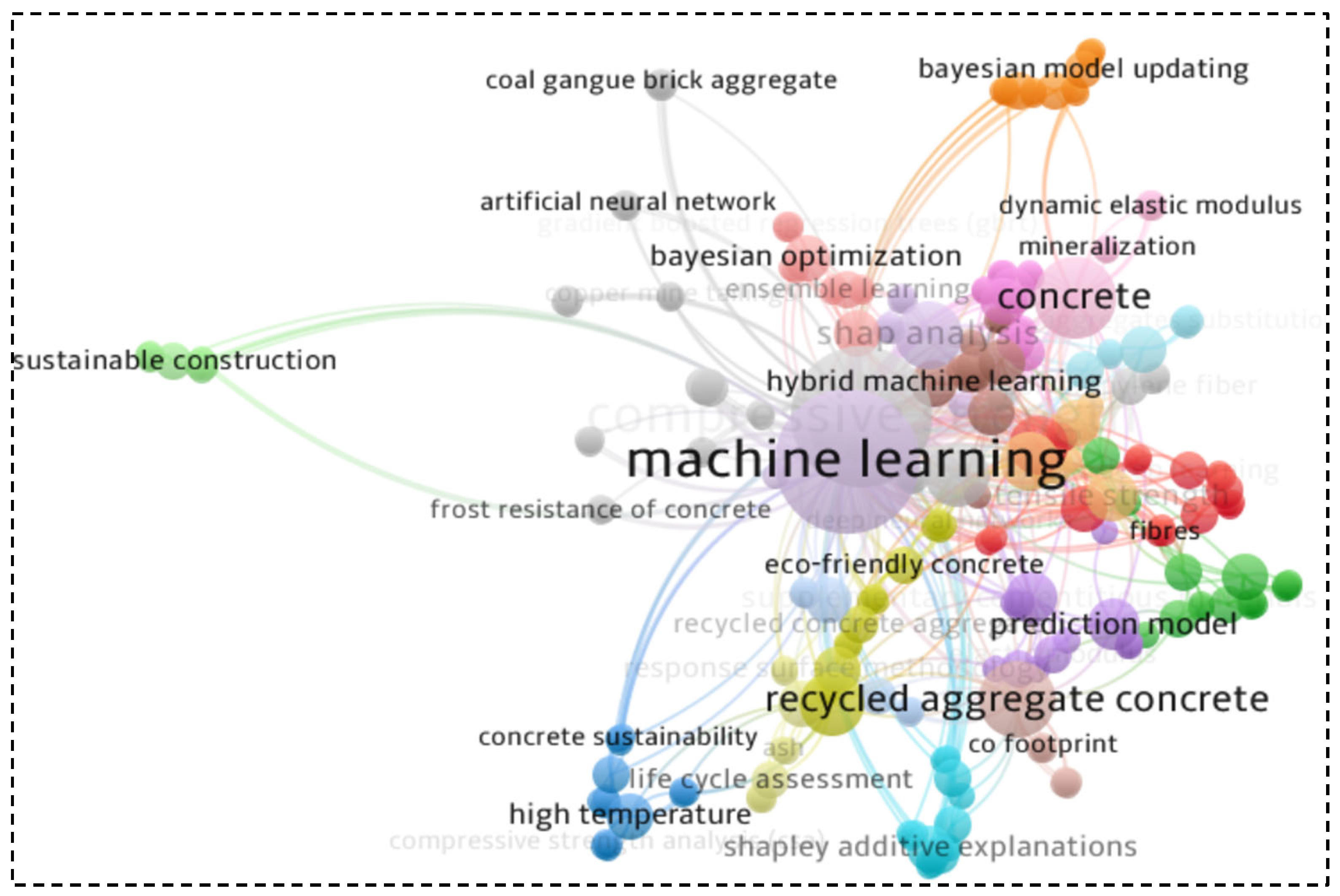
43]. Due to its strength and transparency, the SHAP framework has found significant applications in recent studies to improve the explainability of ML models in various fields, such as materials science and structural engineering. A keyword co-occurrence network was created to address the current research trends in the use of machine learning applications in sustainable concrete with reference to recent investigations devoted to the use of recycled aggregate concrete.
Figure 1 highlights key clusters such as “recycled aggregate concrete,” “self-compacting concrete,” “compressive strength prediction,” “machine learning,” “SHAP,” and “sustainability”. The network notes a rising overlap between artificial intelligence and green concrete technologies and the growing interest in explainable ML models to optimize the performance of eco-efficient concretes with recycled materials [
1,
2,
3,
4,
5,
6,
7,
8,
9,
10,
11,
12,
13,
14,
15,
16,
17,
18,
19,
20,
21,
22,
23,
24,
25,
26,
27,
28,
29,
30,
31,
32,
33,
34,
35,
36,
37,
38,
39,
40,
41].
Although the other literature studies have investigated the compressive strength of recycled aggregate concrete, the existing models are mostly based on small datasets and linear regression, as well as non-explicable machine learning algorithms that fail to effectively represent the nonlinear relationship between recycled aggregates, binder chemistry, and additional cementitious components. Existing RA-SCC studies commonly involve limited variables and lack consistency in mixed design parameters. Moreover, only a few studies have attempted to combine recycled aggregates with SCM-based SCC by applying explainable ML methods. As a result, it becomes a necessity to have a strong, interpretable, and generalizable predictive model for RA-SCC based on a sufficient dataset.
This study presents an innovative and comprehensive methodology for predicting the compressive strength of recycled aggregate self-compacting concrete (RA-SCC) by integrating explainable machine learning (ML) with materials science principles. Unlike earlier studies, where the use of traditional regression and a few model comparisons was predominant, the present study used widely adopted and well-established machine learning algorithms, including support vector regression (SVR), random forest (RF), Multilayer Perceptron (MLP), and extreme gradient boosting (XGBoost), to build a predictive framework that is not only accurate but also generalizable, as the study involved a dataset comprising 400 experimental samples. The major innovation in the current study is to incorporate SHAP (SHapley Additive Explanations) with these predictive models in order to provide a clear explanation of the features affecting performance where one can clearly see how the variables, including superplasticizer, cement strength, water content, and recycled aggregate, interact to produce a mechanical performance. The two-pronged approach to prediction and model understandability boosts sustainable mix design optimization, which breaks the discontinuity between experimental experimentation and smart computational modeling for future eco-efficient concrete development.
2. Methods
2.1. Datasets Collection
To develop a reliable and generalizable framework for predicting the compressive strength (CS) of RA-SCC, it is imperative to identify and assess the primary input parameters that influence the mechanical performance of the material. This study compiled a curated experimental dataset comprising 400 samples sourced from previously published experimental investigations and verified laboratory studies focusing on concrete incorporating recycled aggregates and supplementary cementitious materials (SCMs) [
2,
5,
6,
11,
15]. The dataset inclusion criteria were strictly outlined to produce consistency and reliability: (i) the use of recycled coarse aggregates as a partial or full replacement of natural aggregates, (ii) the use of SCMs (fly ash (FA) and blast furnace slag (BFS)), (iii) defined mix design parameters were used, including cement, water, and superplasticizer (SP) content, (iv) values of compressive strength were obtained under controlled curing conditions at particular ages, and (v) thorough reporting of the mix proportions and physical properties of the material constituents. The last dataset contained eight independent variables, namely age, cement strength (Cs), cement (C), fly ash (FA), blast furnace slag (BFS), water weight (W), recycled aggregate (RA), and superplasticizer (SP), and one dependent variable, compressive strength (CS). These parameters were chosen because they are the key factors that encompass the key parameters that influence the hydration kinetics, microstructural growth, and overall performance of RA-SCC. The data have a distribution of equal proportions among a wide variety of mixing proportions and curing ages, which provides a strong basis for training and validating machine learning (ML) models. To ensure the reliability of the dataset, values lying beyond three standard deviations from the mean were flagged for inspection rather than removed automatically. Each of these points was cross-checked against the original source to determine whether the extreme value reflected experimental inconsistency (e.g., incomplete mix information, suspected reporting error, or a physically unrealistic strength value) or a legitimate RA-SCC mixture. Only entries confirmed as erroneous were excluded, whereas valid extreme values were retained to preserve the natural variability of the dataset. The input values were made to fall within the [0, 1] range to reduce the dimensional bias of different variables whose scale was not the same without reducing the interpretability of the model’s output. The purged dataset was randomly split into 70% (280 samples) for training and 30% (120 samples) for testing to guarantee an unbiased per-performance assessment and reduce overfitting [
20,
37].
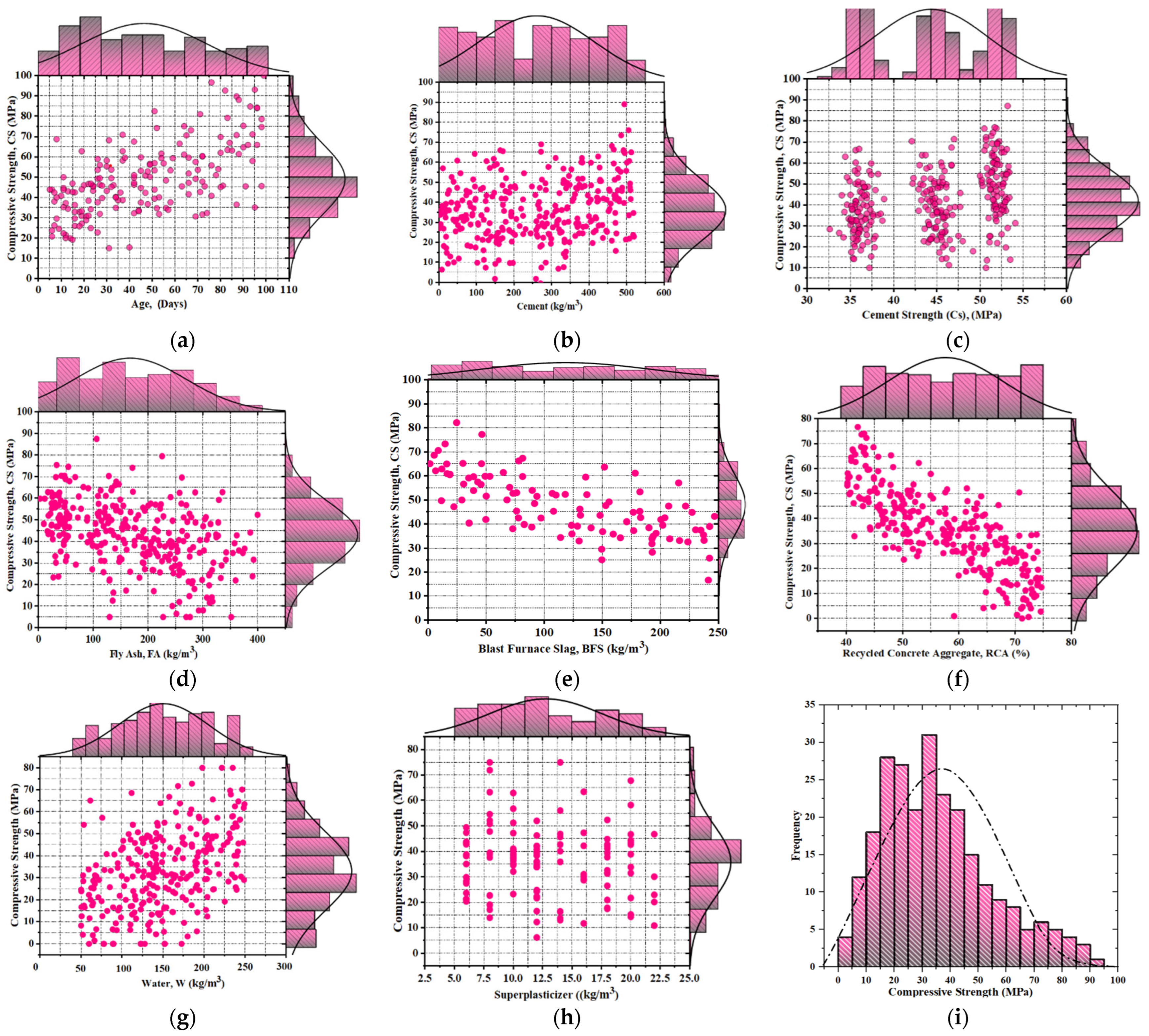
A complete statistical analysis was performed to evaluate the variability of the dataset’s features and the variability of the features and the mean, the minimum, maximum, standard deviation, variance, skewness, and kurtosis, as summarized in
Table 1. The stability of the feature distributions and the significance of all the correlations between the mixture design parameters and compressive strength were verified by the exploratory data visualization presented in
Figure 2a–i. These steps improved the validity of the dataset, and a strong and interpretable ML model was created to predict the compressive strength of RA-SCC.
2.2. Correlation Modeling
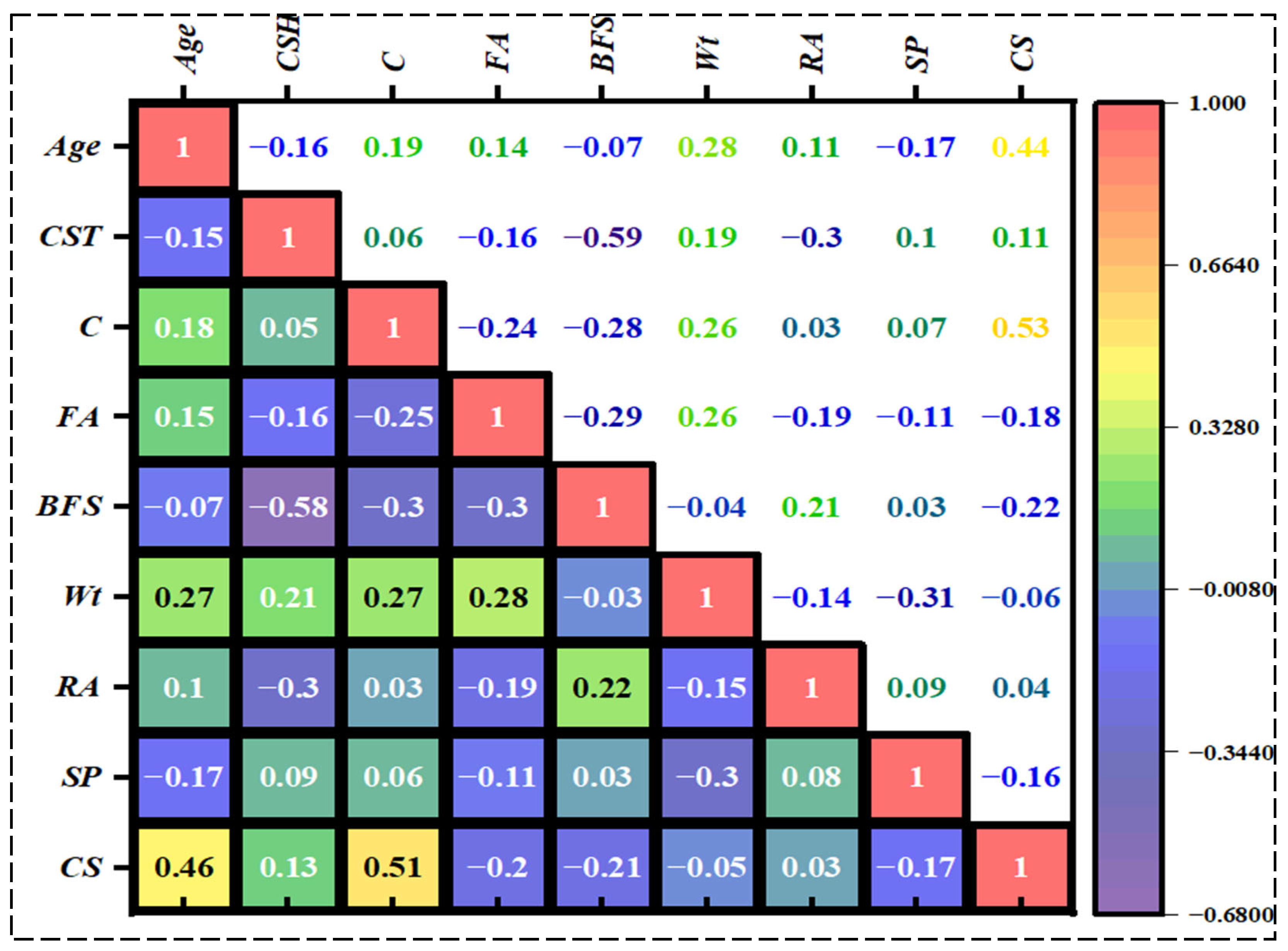
Figure 3 shows the Pearson correlation analysis, which is a detailed quantitative analysis of the linear relationships between the key mix design parameters and their effect on the compressive strength (CS) of the recycled aggregate self-compacting concrete (RA-SCC). The resulting correlation coefficient, ‘s’, indicates a different interaction pattern, which reflects the microstructural and hydration mechanisms underlying concrete performance [
35]. One of the variables analyzed was cement content (C), and its correlation with compressive strength was moderate (s = +0.53), which indicates that while cement content contributes meaningfully to strength development, its influence is not dominant when compared with other parameters in the dataset, and cement content will help in forming calcium–silicate–hydrate (C-S-H) gels that will increase the packing density of the matrix. This has a direct effect on the increased load-bearing capacity and reduced porosity. Another positive correlation was found between the curing age (age), which means that the longer the hydration time, the more the pozzolanic reactions there are, which refine pore structures and strengthen the interfacial transition zone (ITZ), which results in a gradual increase in the compressive strength. The main effect was on cement strength (Cs), which was also loosely but positively correlated with CS (s = +0.13), indicating that the intrinsic fineness and reactivation of the clinker in the cement marginally affected the strength development. However, both fly ash (FA) and blast furnace slag (BFS) had moderate negative correlations (s = −0.18 and s = −0.22, respectively). Based on
Figure 3, these observations indicate that although the addition of supplementary cementitious materials (SCMs) has positive effects on long-term durability and sustainability, they are more likely to retard the rapid gain of early age strength due to their low hydration rate and slow pozzolanic activity.
The compressive strength has a slightly negative correlation with the water content (s = −0.06), which is in line with the known fact that excessive water in the mixture increases the number of capillary voids and decreases the cohesion between the matrices. Similarly, the superplasticizer (SP) had a slight negative correlation (s = −0.16), possibly due to the sensitivity of the admixture dosage to the mix fluidity, setting properties, and hydration dynamics. The correlation between the recycled aggregate (RA) and CS was weakly positive (s = +0.04), which means that medium-to-high degrees of replacement by RA can be used to sustain good performance in terms of strength, perhaps through internal curing effects that occur due to an increase in water uptake in recycled aggregates. The cross-correlations of RA and BFS (s = +0.22) and of water and FA (s = +0.28) suggest that there are mixed effects in the mix design, that is, the water demand and binder reactivity co-determine the rheology and compressive strength. Such interactions are indicative of the fine tolerance between the workability, hydration, and porosity control of RA-SCC systems. In general, as the correlation matrix illustrates, the cement content (C), curing age (age), and cement strength (Cs) are the most significant parameters that influence compressive strength, and the SCMs, which have secondary, time-dependent effects, are FA and BFS. These findings affirm that binder chemistry, hydration kinetics, and change in the ITZ predominate in determining the mechanical performance of RA-SCC and not just the aggregate composition. These correlation coefficients (s values between −0.6 and +0.5) form a statistical basis for further machine learning (ML) modeling to ensure that the chosen input features are highly effective in including the direct and interactive effects on strength development.
2.3. Machine Learning Models
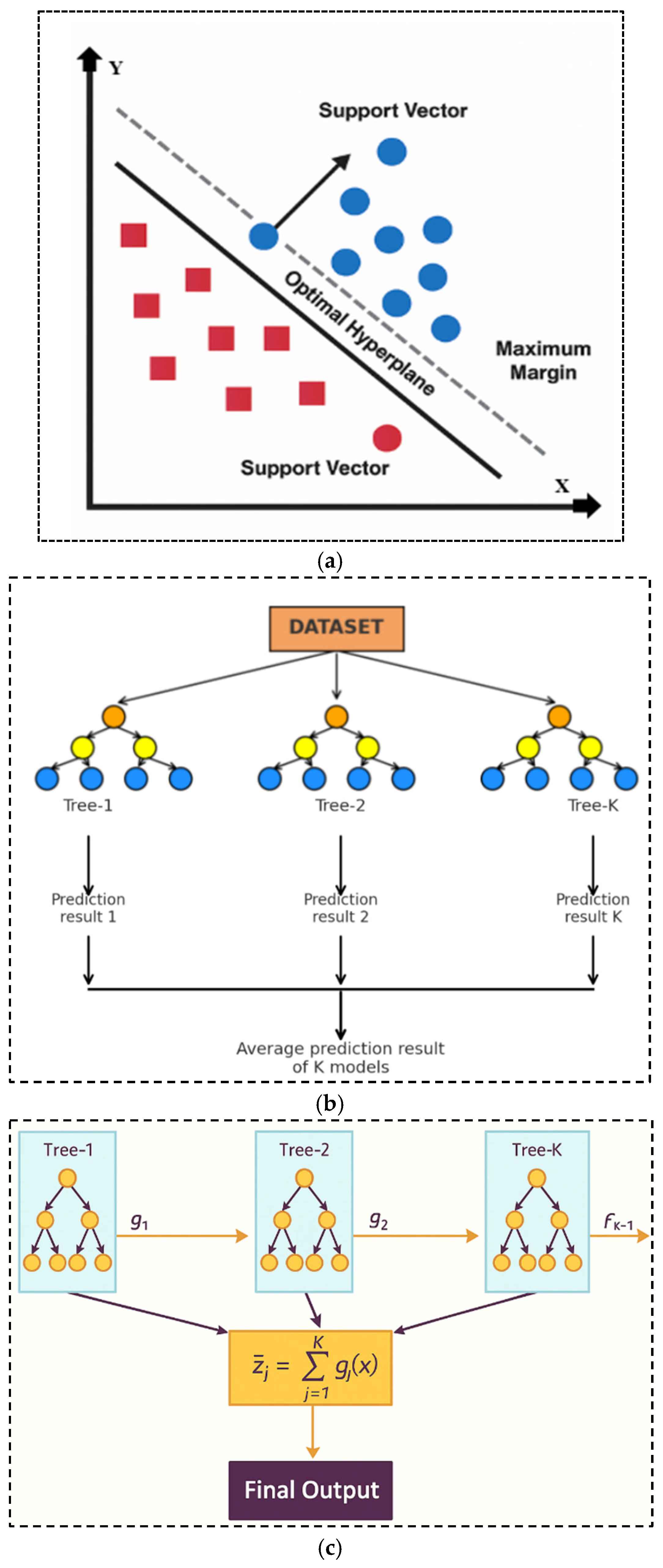
In this study, four supervised machine learning (ML) algorithms, namely support vector regression (SVR), random forest (RF), Multilayer Perceptron (MLP), and extreme gradient boosting (XGBoost), were used to predict the compressive strength (CS) of recycled aggregate self-compacting concrete (RA-SCC) using eight input parameters based on tested experimental data. All models were written in Python with the Scikit-learn and XG Boost libraries (version 3.10). The dataset was split into two parts, 70% for training and 30% for testing, to guarantee equal representation of the target variable. As shown in
Figure 4a–d, data preprocessing and normalization, model training, and hyperparameter optimization were part of the workflow with Bayesian Optimization (BO) to identify the best setup for each algorithm. The 10-fold cross-validation was another cross-validation method that was used to test the robustness of the model and guarantee that there was good performance without a lot of overfitting in all the models [
21,
44,
45].
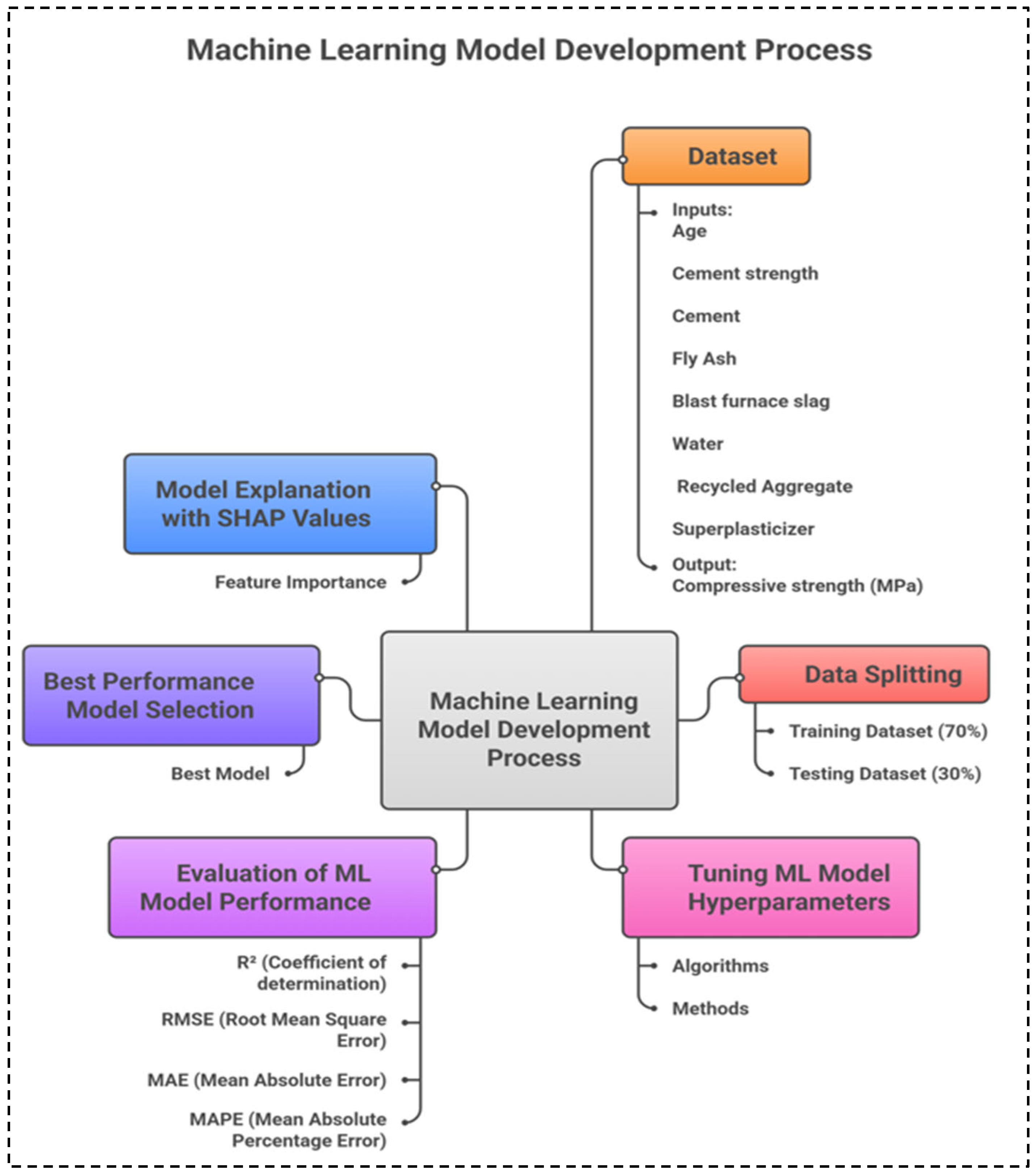
Figure 5 illustrates the modeling framework used to establish machine learning algorithms for predicting the compressive strength of RA-SCC.
2.3.1. Support Vector Regression (SVM)
Support vector regression (SVR) is a form of supervised learning based on support vector machines (SVMs) that is used to deal with continuous output prediction. The main objective is to determine a regression function that best fits the data at a specified tolerance (ε) and maximum flatness to encourage effective generalization. SVR reduces an e-insensitive loss, where only large errors are penalized, and this increases its noise and outlier resilience. With the help of kernel functions, which include the radial basis function (RBF), polynomial, or sigmoid functions, SVR can project the input features into a space with greater dimensionality, and thus, linear regression can be performed on nonlinear data, as depicted in
Figure 4a [
34]. Mathematically, the regression model is expressed as Equation (1).
where
φ(x) denotes the nonlinear mapping of the input vector
x,
w is the weight vector, and
b is the bias term. The function is determined by the supporting vectors, which are data points that lie on or are beyond the ε-margin. These vectors define the optimal regression surface to accurately estimate the compressive strength of RA-SCC.
2.3.2. Random Forest (RF)
Random forest (RF) regression is a supervised learning technology that is an ensemble-based technology developed to help improve predictive accuracy when many independent decision trees are combined. Trees are trained on randomly bootstrapped databases, and random features of each node split are also considered. This introduces a stochastic variation that enhances generalization and reduces overfitting. Therefore, RF is especially applicable in the analysis of nonlinear and multidimensional data, that is, in the concrete mix design case where there are complex interactions between the constituent materials. The RF framework uses averaging across trees to minimize prediction variance and stabilize model performance, as shown in
Figure 4b [
21]. Mathematically, the training data can be represented as expressed in Equation (2).
where
χi∈Ra denotes the input feature vector of the
ith sample (e.g., mix design parameters),
ψi∈R is the actual output (e.g., compressive strength), ‘
N’ is the total number of samples, and ‘
a’ denotes the number of input features. By averaging predictions from multiple decorrelated trees, RF achieves high accuracy, strong resistance to noise, and reliable generalization, making it a robust model for estimating the compressive strength of RA-SCC.
2.3.3. Extreme Gradient Boosting Regression (XGBoost)
Extreme gradient boosting (XGBoost) is a scalable and efficient ensemble learning algorithm that enhances predictive performance using an additive tree-based approach. It sequentially constructs multiple weak regression trees, with each subsequent tree addressing the residuals of the preceding trees, thereby progressively improving the model’s accuracy [
46]. This technique, as depicted in
Figure 4c, is particularly effective for modeling nonlinear and multivariate relationships, such as those governing the compressive strength of RA-SCC.
The general prediction function is given by Equation (3).
where ŷ
k is the predicted compressive strength for the k
th sample, ζ
k is the input feature vector, T represents the total number of boosting iterations, g
t denotes the t
th regression tree, and
is the functional space of all possible trees.
The regularized objective function is expressed as shown in Equation (4).
where ℓ(y
k, ŷ
k) is a differentiable convex loss function (e.g., squared error) and Ω(g
t) = αL
t + (β/2)‖ω
t‖
2 represents the regularization term; L
t is the number of leaf nodes in the t
th tree, ω
t is the vector of leaf weights, and α and β are the regularization coefficients controlling the model’s complexity. XGBoost effectively combines gradient optimization with regularization to achieve high accuracy, stability, and generalization. This makes it particularly well suited for determining the CS of RA-SCC mixtures, which involve complex nonlinear interactions among the material and mix design parameters.
2.3.4. Multilayer Perceptron (MLP)
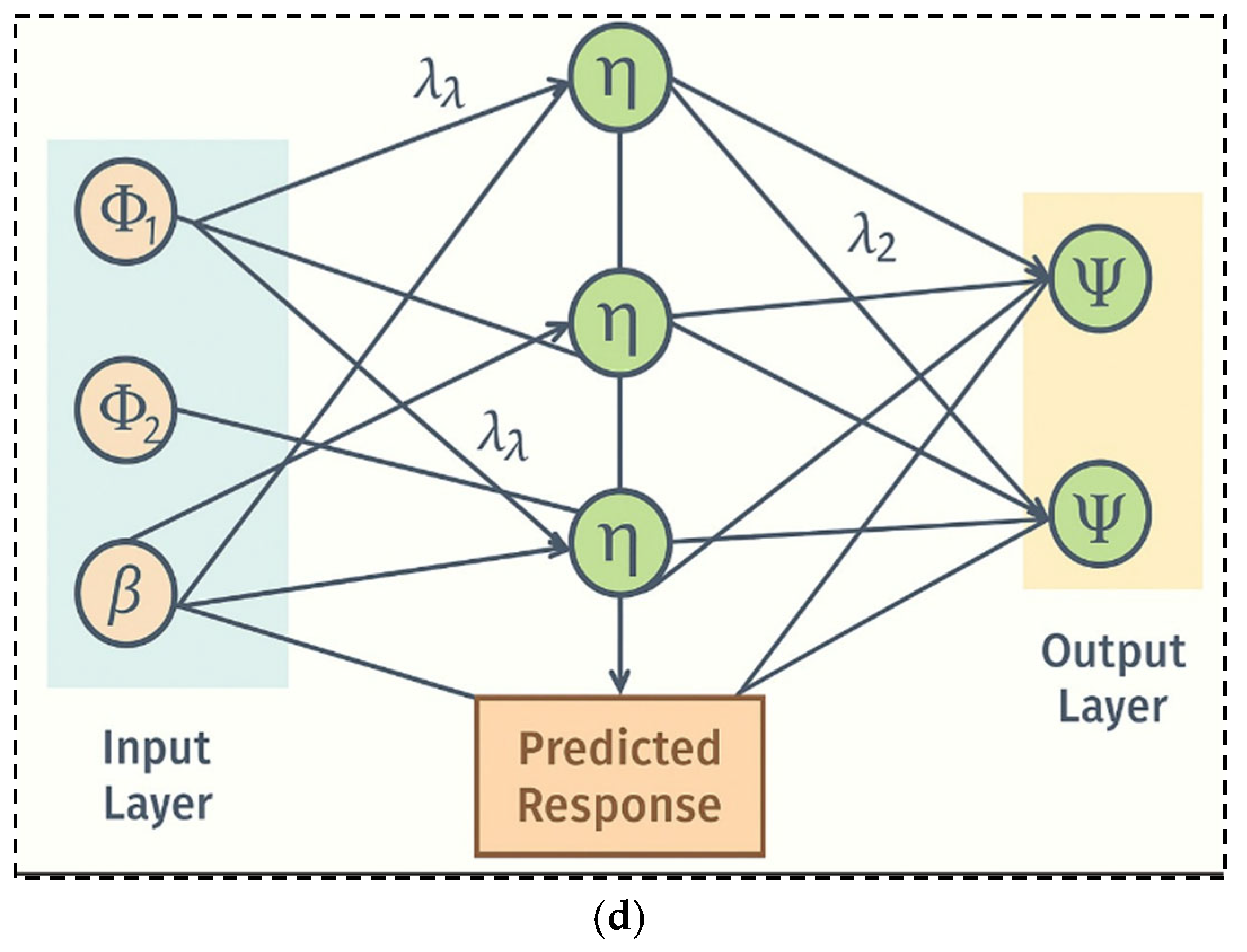
Multilayer Perceptron (MLP) is a feed-forward neural network comprising an input layer, one or more hidden layers, and an output layer, where information moves sequentially without feedback connections. In this study, the Multilayer Perceptron (MLP) consisted of a three-layer feedforward structure with two hidden layers containing 16 and 8 neurons, respectively. The ReLU activation function was adopted for the hidden layers to introduce nonlinearity, while linear activation was used in the output layer for regression. The neuron output is expressed in Equation (5) and is shown in
Figure 4d.
where x
i denotes the input feature, w
ij the connection weight, b
j the bias, and f is the activation function (e.g., ReLU, tanh, or sigmoid). Through forward and back propagation, the MLP adjusts the weights using gradient descent to minimize the prediction error, enabling it to effectively learn nonlinear patterns and accurately predict the CS of RA-SCC.
2.4. Performance Analysis
Using four major statistical indicators, including the Coefficient of Determination (R2), Root Mean Square Error (RMSE), Mean Absolute Error (MAE), and Mean Absolute Percentage Error (MAPE), the model’s estimations accuracy and its generalization strength of the constructed machine learning models were quantitated as SVR, RF, MLP, and XG Boost. A combination of these indicators provides a thorough picture of the performance of the model in predicting the compressive strength (CS) of RA-SCC. R2 is a value that shows the extent to which the variance in the experimental results is explained by the model; the higher the value, the greater the correlation between the predicted and observed results. The RMSE is the standard deviation of the prediction residuals, which is indicative of the accuracy of the model, and the MAE is a measure of the mean value of the absolute differences between the value of the outcome and the predicted value. MAPE is expressed as a percentage and is used to compare prediction errors between different datasets or mix proportions in a relatively easy manner. To ensure robustness and prevent overfitting, all models were validated using 10-fold cross-validation,
Furthermore, the dataset was randomly divided into ten subsets, nine of which were used for training and one for testing in each iteration [
11,
17,
19]. The mean of all folds was then calculated to provide a constant and unbiased estimate of predictive reliability. These four evaluation measures have mathematical models summarized in
Table 2, and they are used as the main basis for the comparative analysis of the tested algorithms [
21]. To further verify the stability of the XGBoost model, a repeated 3 × 10-fold cross-validation procedure was performed in addition to the standard 10-fold CV. In this approach, the full cross-validation cycle was executed three times using different random partitions, allowing for the variability caused by a single data split to be minimized.
In this study, the R2, RMSE, MAE, and MAPE were selected based on their completion statistical characteristics and the related regression analysis in the prediction of concrete strength. R2 is a measure of the amount of variance in the compressive strength and is therefore a variance-based measure of reliability. The RMSE is sensitive to large deviations and is a measure of the spread of the data points away from the regression line; hence, it can be used to measure variability in the experimental datasets. MAE is a robust and scale-dependent measure of central tendency error and is less influenced by outliers than RMSE. MAPE assesses proportional error and is useful for understanding the model’s accuracy relative to the magnitude of the strength values.
To further assess the statistical variability and uncertainty, the residual distribution patterns were assessed using probability density curves and violin plots. In addition, confidence intervals (CIs) and prediction intervals (PIs) were developed to describe the uncertainty in both mean predictions and individual observations. These metrics all together can offer a complete statistical framework for assessing the model’s performance in terms of variance, central tendency, proportionate error, and uncertainty.
2.5. Hyperparameter Optimization
The efficacy of machine learning models is significantly influenced by the selection of hyperparameters, which dictate their learning dynamics and generalization capabilities. To determine the optimal parameter configurations, this study utilized a combination of Bayesian Optimization (BO) and k-fold cross-validation (CV). Compared to traditional grid or random search techniques, BO offers a more efficient and precise search strategy within high-dimensional parameter spaces by incorporating prior information within a probabilistic framework. This integrated BO-CV framework enhances optimization efficiency while ensuring improved robustness and generalization across unseen datasets through effective overfitting mitigation. Consequently, the selected hyperparameters maximized the predictive accuracy while maintaining a balanced trade-off between complexity and reliability [
27,
28,
47].
3. Results and Discussions
3.1. Prediction Performance
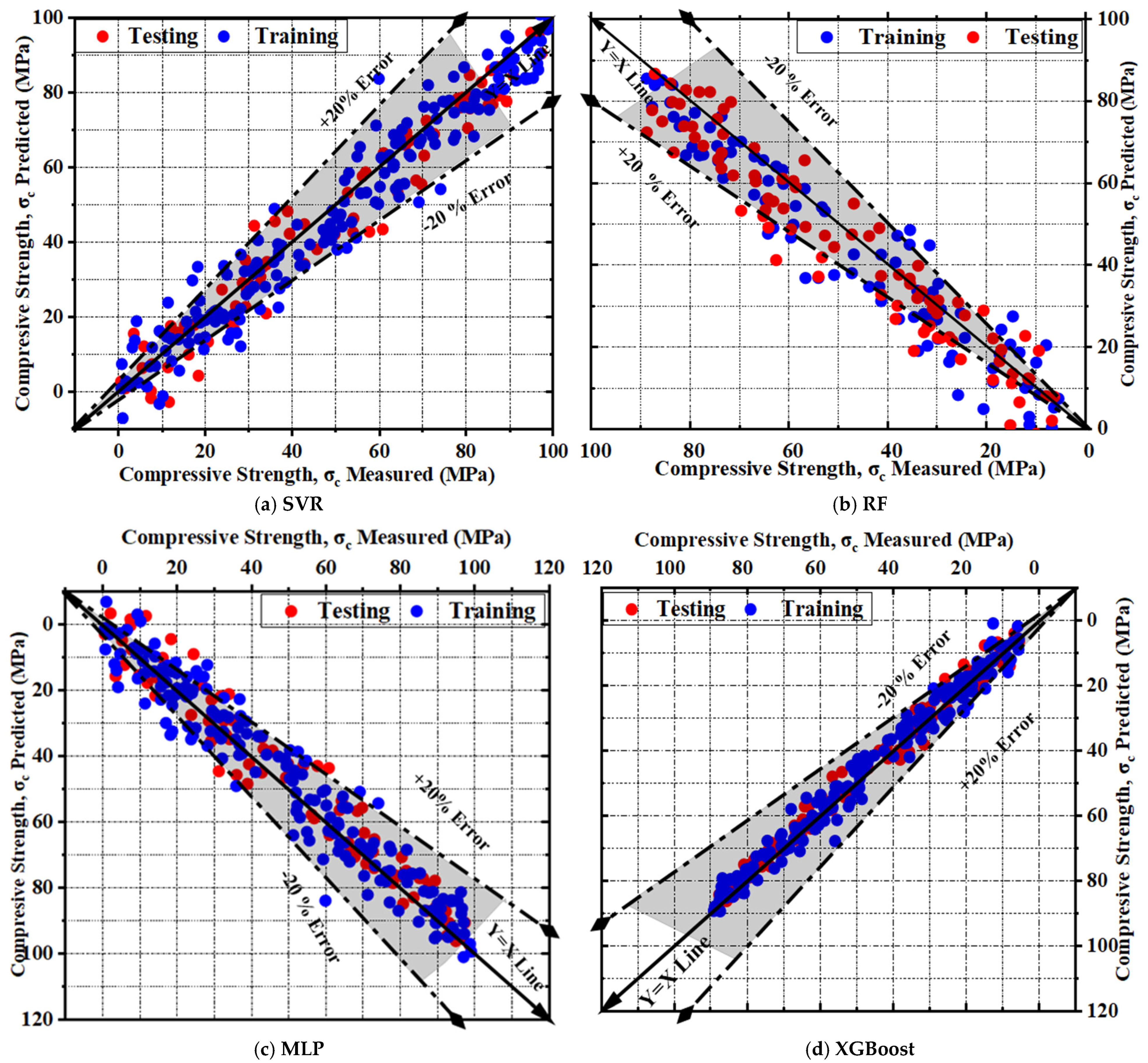
A comparative evaluation of machine learning (ML) models offers valuable insights into their predictive effectiveness for estimating the compressive strength (CS) of recycled aggregate self-compacting concrete (RA-SCC). As presented in
Figure 6a–d and summarized in
Table 3, the results of four regression models, including support vector regression (SVR), random forest (RF), Multilayer Perceptron (MLP), and extreme gradient boosting (XGBoost), showed four different behaviors on the training and testing data. The results of the training phase showed that the ensemble-based models, including RF and XGBoost, had a heavy concentration of the predicted data points around the 45
0 parity line, and this denotes that there was an outstanding agreement between the measured and predicted compressive strengths. Conversely, the SVR model had a marginally broader spread of points around the parity line, indicating a moderate bias in the nonlinear areas of the data. The MLP model also showed competitive performance, a high fit, but slight overfitting, which is reflected by small deviations towards larger values of the strength. During the testing process, the performance of the ensemble models was more evident. RF and XGBoost both demonstrated high predictive consistency, with the majority of the data points falling within the ±20% error range, demonstrating a robust generalization to unseen samples; MLP had the capacity to captures nonlinearities, its performance is also constrained by data volume, hyperparameter sensitivity, and gradient instability, explaining its lower accuracy compared to XGBoost and RF. On the other hand, SVR displayed a wider error range and a few points above the threshold limits, indicating that it has a lower capacity to model the multivariate nonlinearities of the recycled aggregate content, additional cementitious materials, and water–binder interactions. The MLP model had moderate generalization but its RMSE was slightly higher than XGBoost.
Based on the results of the analysis of four machine learning models, namely support vector regression (SVR), random forest (RF), Multilayer Perceptron (MLP), and extreme gradient boost, different levels of predictive accuracy were used to estimating the compressive strength (CS) of recycled aggregate self-compacting concrete (RA-SCC). Notably, the SVR model, shown in
Figure 6a, exhibited the least consistent performance, with R
2 = 0.93 and RMSE = 4.95 MPa during training, and R
2 = 0.90 and RMSE = 5.40 MPa during testing, accompanied by MAE = 3.85/4.20 MPa, MAPE = 7.80/8.40%, and VAF ≈ 95.1/92.8%. The broad confidence (CI = ±2.10 MPa) and prediction intervals (PI = ±5.90 MPa) suggest moderate dispersion and limited adaptability to nonlinearities. The performance limitations of SVR are attributed to its reliance on the radial basis function (RBF) kernel, which effectively captures localized linear relationships but encounters challenges with complex multivariate dependencies introduced by recycled aggregate variability, supplementary cementitious materials (SCMs), and superplasticizer effects. In contrast, the RF model demonstrated significantly enhanced predictive capability, achieving R
2 = 0.95/0.92, RMSE = 4.20/4.75 MPa, MAE = 3.42/3.70 MPa, MAPE = 6.50/7.00%, VAF = 95.1/93.5%, and a relatively narrower CI (±1.95/2.0 MPa) and PI (±5.15/5.50 MPa) for the training and testing phases, respectively. The strong congruency of the forecasted values along the 45
0 parity line in
Figure 6b confirms that the bagging-based ensemble framework of RF was proximate to capturing complex nonlinear trends in the generalization with minimal variance. The small difference between the training and testing values (ΔRMSE = 0.55 MPa) indicates the strength of the model in dealing with noise, owing to heterogeneous material characteristics and recycled aggregate water absorption.
The MLP model, as illustrated in
Figure 6c, exhibited a performance closely comparable to the ensemble algorithms, achieving R
2 values of 0.96/0.93, RMSE values of 3.85/4.30 MPa, MAE values of 3.10/3.40 MPa, MAPE values of (5.95/6.10)%, and VAF values of (96/94.2)%, with narrow uncertainty ranges (CI = ±1.75 MPa, PI = ±4.65 MPa). The feedforward neural architecture of the MLP effectively models the nonlinear input–output relationships among key variables, such as the cement–water ratio, age, and SCM interactions. However, minor prediction discrepancies were observed at higher strength levels, likely because of the limited representation of the boundary mix conditions and that activation functions such as ReLU may generate sparse gradients, owing to input features that are below zero or are clustered around small ranges, which is typical under concrete mixture data, where the variance is low and the inter-feature interactions are high. In contrast, the XGBoost model demonstrated the highest predictive performance among all algorithms, with R
2 values of 0.98 and 0.96, RMSE values of 2.95 and 3.25 MPa, MAE values of 2.45 and 2.65 MPa, MAPE values of 4.35 and 4.85%, VAF values of 98.3 and 96.8%, and exceptionally tight CI (±1.40 MPa) and PI (±3.75 MPa) values for training and testing, respectively.
The extremely close train–test metrics (ΔR
2 = 0.02; ΔRMSE = 0.30 MPa) suggest excellent generalization and a low level of overfitting in the model. This high-quality performance can be explained by the fact that XGBoost uses gradient-boosting optimization, which sequentially adjusts residual errors using tree ensembles of additive trees with L1/L2 regularization to provide complexity control.
Figure 6d shows that the predicted data points are tightly clustered along the parity line, as shown in the ±20% error range, and it shows the accuracy and consistency of the model. The combination of the XGBoost algorithm capturing intricate threshold behavior, that is, the nonlinearity between age, cement strength, recycled aggregate replacement, and SCM dosage, coupled with hyperparameters that are optimized using a Bayesian method and cross-validation via 10-fold cross-validation, allows XGBoost to deliver maximum predictive fidelity and interpretability. Therefore, it is the most effective, precise, and robust model for predicting the compressive strength of RA-SCC.
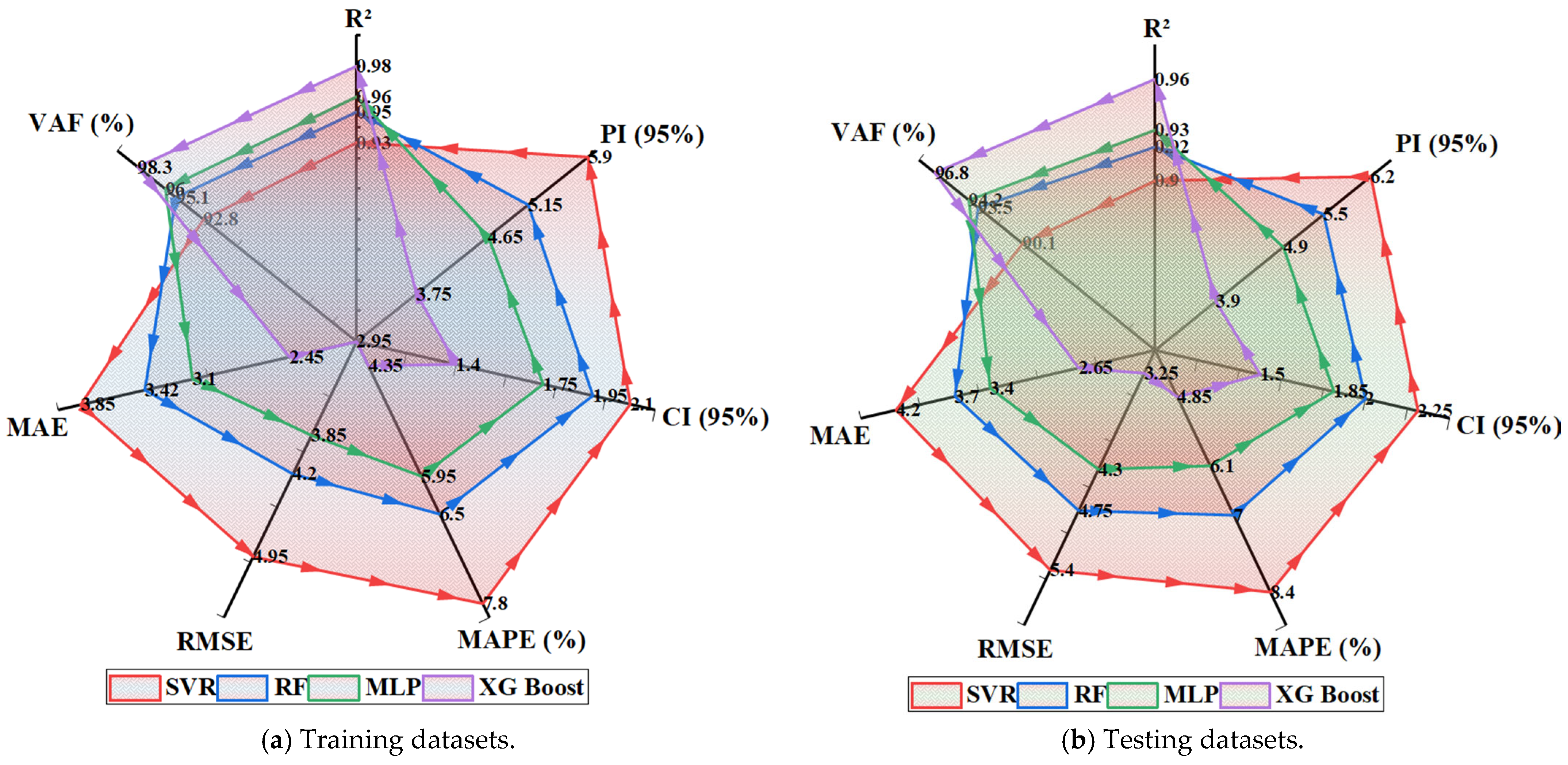
The results of the model’s performance, as shown in
Figure 7a,b for the training and testing datasets, respectively, show the accuracies of the four machine learning models, SVR, RF, MLP, and XGBoost, on different statistical indices. The performance metrics represented by the axes of the radar plots are the R
2, RMSE, MAE, MAPE, VAF, CI, and PI. During the training stage, as indicated in
Figure 7a, XGBoost generated a polygon on the outermost side, indicating a higher predictive accuracy. The model had the best R
2 (0.98) and VAF (98.3%) values and the lowest RMSE (2.95 MPa), MAE (2.45 MPa), and MAPE (4.35) values. This narrow confidence interval (CI = ±1.4 MPa) and prediction interval (PI = ±3.75 MPa) also confirm its accuracy, since it is a balanced polygon, which indicates that the trade-off between bias and variance was high and that it can be used to maintain stability, not only with the training dataset, but also with the testing dataset, as shown in
Figure 7b. In its wake comes random forest, which has strong variance control and regular generalization due to its averaging to an ensemble mechanism. Conversely, MLP and SVR yield relatively high and small polygons, respectively, suggesting that they are more sensitive to data variations and resistant to nonlinear interactions among features [
48].
The fact that the shape overlap between the training and testing radar plots occurs consistently also validates that the highest level of model robustness and interpretability is reached by the ensemble learners, especially XGBoost. In general, it can be noted that the radar-based comparison points to the fact that tree-based ensemble frameworks are intrinsically adapted to the complex interdependence of recycled aggregates, auxiliary cementitious materials, and mix design variables that govern the compressive strength behavior of RA-SCC.
3.2. Hyperparameter Optimization and Training
To achieve methodological rigor and avoid single machine learning models, systematic hyperparameter optimization procedures were adopted in all four algorithms, including SVR, RF, MLP, and XGBoost, with a combination of Bayesian Optimization (BO) with 10-fold cross-validation (CV). This balanced tuning approach is a good solution in terms of computational efficiency and accuracy in the identification of optimal parameter configurations [
49].
Table 4 summarizes the search space of each algorithm and their tuned final hyperparameters, model complexities, and validation performance. BO uses data from prior performance to smartly search the hyperparameter space instead of a grid or random search using probabilistic inference.
In each iteration, the Gaussian process surrogate model was used to forecast the performance score when using different combinations of parameters; however, CV used each configuration on numerous data partitions to guarantee a strong generalization. The optimized performance was confirmed by the high performance of the XGBoost model, which can be explained by the well-regularized structure of the model that was ensured by depth control, learning rate control, and subsampling parameters, which reduced the possible overfitting but increased the stability of prediction. Similarly, the RF model had the advantage of the ensemble averaging many decorrelated trees, which guaranteed low variance and high reproducibility. MLP worked with balanced convergence with adaptive learning and nonlinear activation functions, and SVR was able to run with tuning using kernel scaling and regularization constants, producing smooth but less expressive surfaces. This clear and reproducible hyperparameter optimization framework confirms that the high predictive performance achieved with each of the models is due to the purposeful choice of the parameters and tested generalization, and not due to random correlations or model memorization. Additionally, the repeated 3 × 10-fold cross validation proved the robustness of the XGBoost model, with the performance metrics being stable for all 30 re-sampled folds. The mean values, that is, R2 = 0.95 ± 0.01, RMSE = 3.57 ± 0.05 MPa, MAE = 2.71 ± 0.03 MPa, and MAPE = 9.03 ± 0.07%, presented minimal variation, meaning that the model’s accuracy is not affected by certain train–test partitions. The small deviations in the plot prove that XGBoost is able to capture the nonlinear behavior of RA-SCC mixtures consistently without overfitting, thus confirming its strong generalization capability with respect to multiple re-sampling repetitions.
3.3. Error Analysis
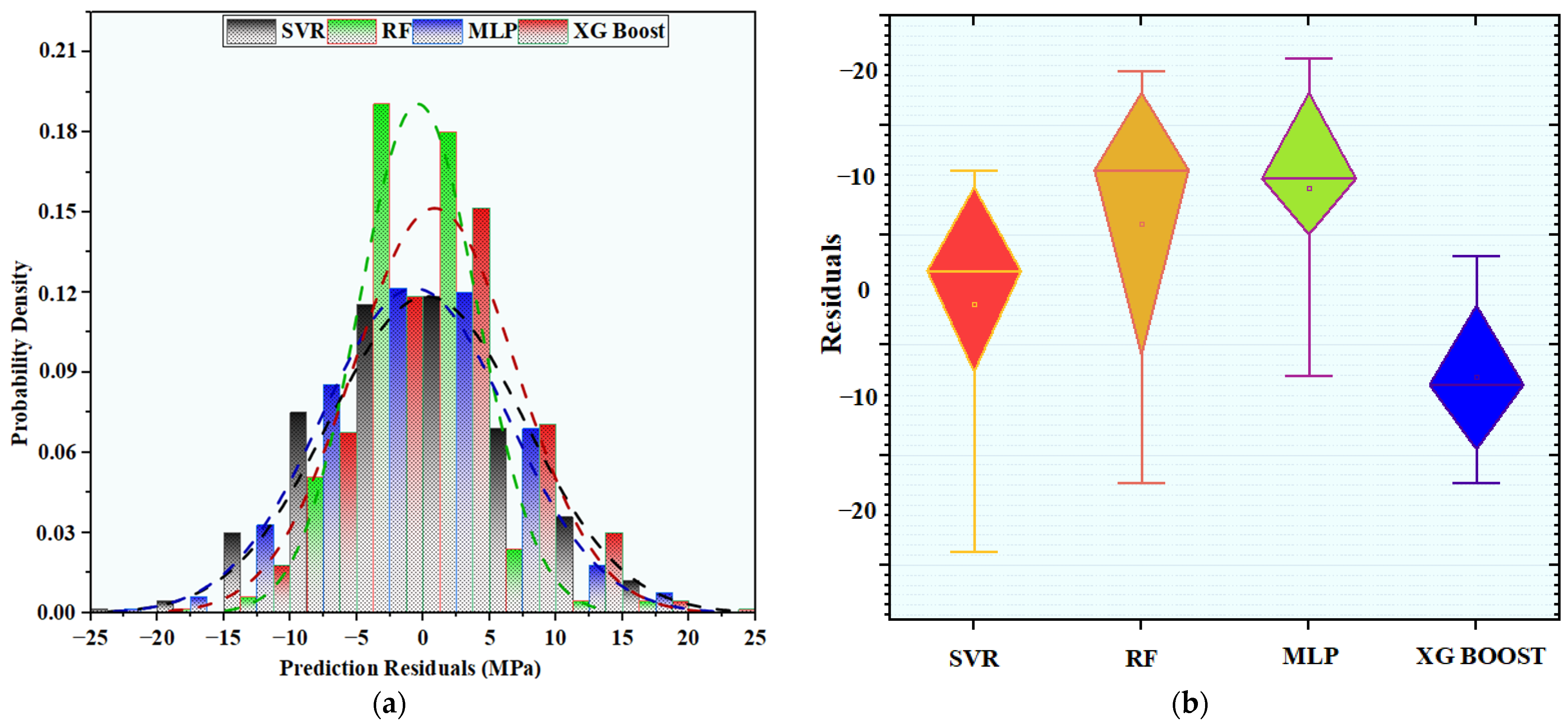
The residual error distribution and boxplots depicted in
Figure 8a,b provide both quantitative and graphical validation of the predictive stability and accuracy of the four machine learning models, that is, XGBoost, MLP, RF, and SVR, which were developed to forecast the compressive strength of the RA-SCC mixtures. The histogram in
Figure 8a indicates that all models produce approximately symmetric distributions centered near zero, suggesting the absence of a significant systematic bias in the predictions. However, the shape, width, and kurtosis of each distribution varied notably, reflecting the differences in the models’ generalization and residual spread. The XGBoost model had the best error distribution behavior; that is, its near-Gaussian curve was very sharp and concentrated around zero. This satisfying range of spread justifies the better fitting ability of the model and low bias, validating the capability of the model to reflect the complex nonlinear interaction of the recycled aggregates, binder chemistry, and admixture properties. The XGBoost mechanism, which reduces residuals by minimizing gradients in a serial fashion, is successful in eliminating both random noise and high bias, which trades off a balanced bias variance trade-off. The small residual range in
Figure 8b further indicates that it can be well generalized to the unseen data, which is why it is the best-performing model among the tested models. The Multilayer Perceptron (MLP) model had a slightly broader yet symmetrical distribution of the residues, suggesting a moderate increment in the variance compared to XGBoost. It does so because of its nonlinear activation mapping and weight-optimization procedure with the ability to slightly overfit the complex local tendencies in smaller datasets. However, its residuals were still mostly between ±10 MPa, which exhibited high learning efficacies and stability in approximating nonlinear functional relationships. The broader, flatter residual curve, which was observed in the random forest (RF) model, was presented to the heavier tails on either side around the zero point. Although this implies that RF performs well in capturing general trends, it also means that its ensemble-averaging mechanism is moderate. This is confirmed by the boxplot, which indicates a greater interquartile range of and is in line with the intermittent over- and under-predictions, owing to the more relaxed residual correction than boosting.
Nevertheless, RF is reliable and resilient to noise, as expected from its well-known ensemble stability. The support vector regression (SVR) model, conversely, has the highest dispersion in its residuals, which have a more flattened distribution but with extended tails. This implies an increased uncertainty in the prediction, which is probably due to the sensitivity of the kernel and the lower flexibility to model the multi-dimensional interaction between the features in RA-SCC. The respective boxplot shows that it is more widely spread and varied, suggesting that it is less adaptable to heterogeneous data. Overall, XGBoost showed the closest residual distribution and the least range of deviation, proving its high accuracy and generalization. The MLP and RF were rather average in terms of performance, but SVR was relatively weak in terms of strength. These findings are in line with the quantitative metrics (R2, RMSE, MAE, and VAF), as they confirm that the optimized boosting architecture of XGBoost is the best model for predicting the nonlinear and complex behavior of recycled aggregate self-compacting concrete.
3.4. Shapley Additive Explanations (SHAP)
To increase the interpretability and understand the internal logic of the developed XGBoost model, SHapley Additive exPlanations (SHAP) analysis was performed to measure the role of each input parameter in predicting the CS of RA-SCC. The SHAP model assigns an importance value to every feature, depending on whether it contributes to the model output marginally or not, providing a clear understanding of the prediction process.
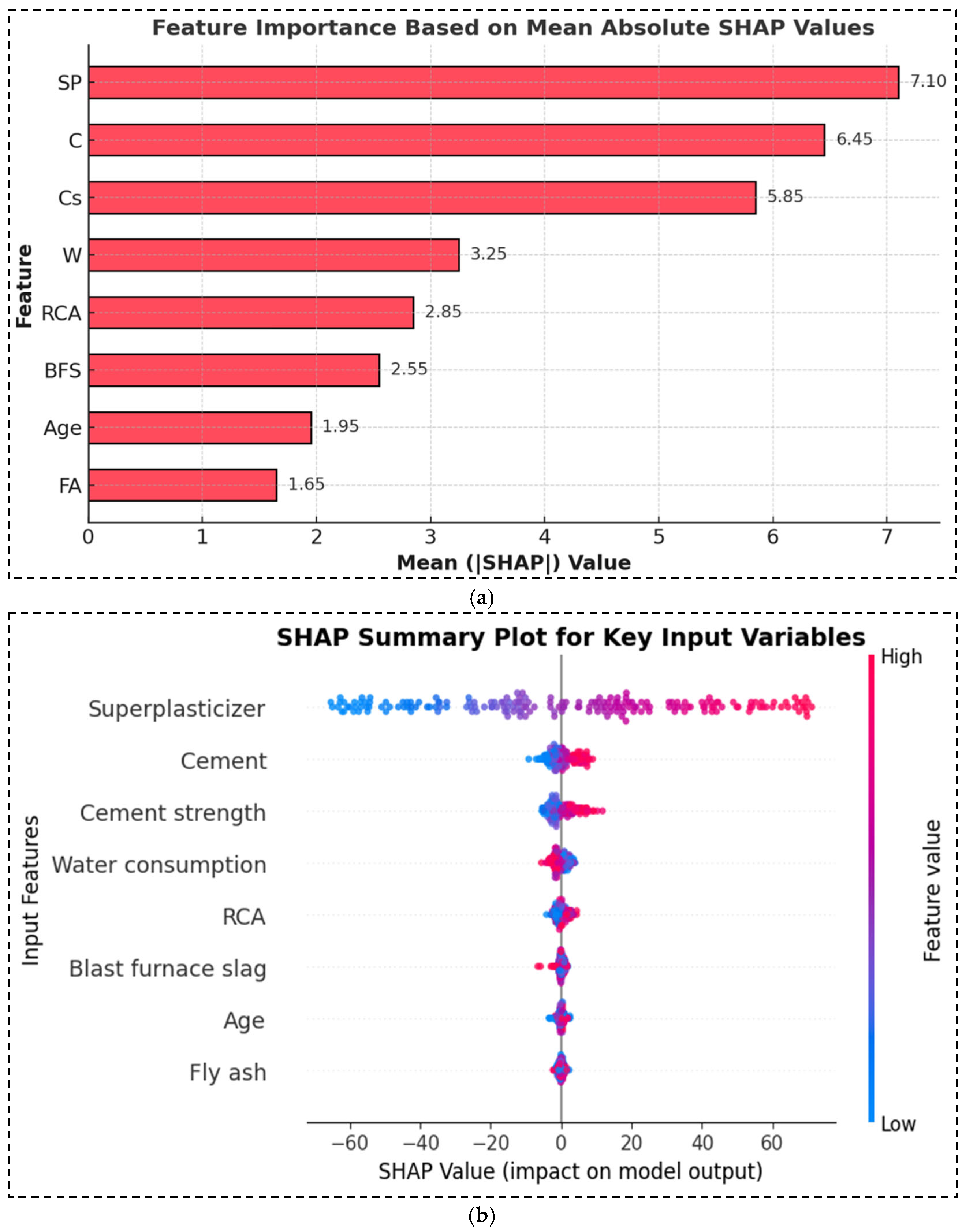
Figure 9a,b present the results of the SHAP analysis.
Figure 9a shows the mean absolute SHAP values, which indicate the relative contribution of each input feature to the model output. Superplasticizer (SP) recorded the largest mean of the parameters of superplasticizer (7.10), cement (C) (6.45), and cement strength (Cs) (5.85). The combination of these three features dominated the prediction space and validated their significant physical and chemical impact on the development of the strength of RA-SCC.
Although the correlation matrix shows that compressive strength does not have a direct linear relationship with superplasticizer (SP) (the correlation is weakly positive), its impact in the SHAP analysis seems to be significantly larger. This disparity is likely because Pearson correlation only quantifies the individual linear effects, whereas SHAP quantifies the contribution of a feature in the entire nonlinear and multivariate framework of the model. There was no linear trend in the SP of the RA-SCC mixtures because it affected the strength of the mixtures by interacting with other parameters, specifically, its contribution to the enhanced dispersion of the particles, altered mix rheology, and water demand balance. Thus, the model gives more significance to SP in the SHAP analysis because such interaction-based effects are reflected within the learning algorithm but not in the simple linear associations.
The high SHAP value of SP indicates that the most appropriate dosage level is essential to boost workability and attain a homogeneous dispersion of cementitious particles to produce denser microstructural packing and enhance compressive strength. However, excessive SP can cause segregation or delayed setting, as in the broader SHAP dispersion, which is a nonlinear interaction effect. The cement content also displayed a good positive contribution to CS, wherein the greater the cement content, the greater the formation of the binder phase and hydrating products (C-S-H gel), which had a direct positive effect on the load-bearing capacity. Likewise, cement strength (Cs) plays an important role in model prediction, as it exhibits the intrinsic quality and grade of the binder, with high-grade cement having a positive effect on the hydration kinetics and low porosity. Moderate SHAP importance was observed for water content (W = 3.25) and recycled coarse aggregate (RCA = 2.85). The negative skewness of the W-related SHAP values indicates that a higher water content reduces the compressive strength, owing to increased porosity and reduced matrix cohesion, which is a typical trend observed in self-compacting concrete. Conversely, moderate RCA values produced both positive and negative SHAP shifts, suggesting that controlled RCA replacement maintains structural integrity through improved interfacial transition zones, whereas excessive RCA content leads to strength loss, owing to higher water absorption and weaker old mortar interfaces.
Blast furnace slag (BFS = 2.55) and age (1.95) demonstrated relatively lower but consistent SHAP values. BFS contributes through latent hydraulic activity, enhancing the pore structure at later stages, whereas age confirms the positive correlation between extended curing and strength development, as indicated by the right-shifted SHAP values. Fly ash (FA = 1.65), although the least influential, offers supplementary pozzolanic reactivity that supports long-term strength gain; however, its impact is diminished at early stages due to its slower reaction rate.
The SHAP summary plot in
Figure 9b offers an additional explanation of the directional effects of the features. The large values of SP and cement (red points) are largely outweighed on the positive side with the SHAP values for these values, which implies that they amplify the compressive strength by increasing dispersion and hydration kinetics. In contrast, water and RCA (red points on the left), which had positive SHAP values, showed negative SHAP values, which hindered strength, owing to the increased level of voids and weaker interfacial bonding. The intermediate role of BFS and FA indicates that they have more supplementary effects, which is mainly observed in the hydration and matrix refinement of late-age concrete. In general, the SHAP-based interpretability supported that chemical admixtures (SP) and binder-related factors (C and Cs) are the most predictive factors that control the evolution of strength, but the variability is controlled by aggregate quality and water control. The presented analysis not only confirms the predictive information of the XGBoost model but also offers a mechanistic response consistent with solid matter science and creates a direct relationship between data-based feature importance and the physicochemical processes of hydration, packing density, and microstructural evolution. The concept of SHAP analysis with model performance evaluation creates a logical link between predictive accuracy and material behavior. XGBoost is the only model that attained the highest level of prediction accuracy, as well as the most interpretable feature relationships, which shows that the major factors affecting the growth of the CS of RA-SCC are the superplasticizer (SP), cement (C), and cement strength (Cs). The constant patterns of SHAP also confirm the ability of the model to represent the nonlinear interactions between the hydration kinetics, admixture dosage, and the recycled aggregate properties [
46]. These points confirm that the XGBoost model is a combination of the most acceptable accuracy, generalization, and interpretability, making it the best predictive tool in sustainable concrete design using recycled material.
5. Conclusions
In this study, advanced machine learning (ML) models with support vector regression (SVR), random forest (RF), Multilayer Perceptron (MLP), and extreme gradient boosting (XGBoost) were developed and evaluated to predict the compressive strength (CS) of recycled aggregate self-compacting concrete (RA-SCC) incorporating supplementary materials such as blast furnace slag (BFS). A comparative analysis across multiple performance indices, namely R2, RMSE, MAE, MAPE, VAF, CI, and PI, provided comprehensive insights into the predictive behavior and generalization capacity of each model. Among all models, XGBoost demonstrated superior performance, achieving the highest predictive accuracy with R2 = 0.98 and the lowest RMSE (≈2.95 MPa) on the training dataset, while maintaining consistent generalization during testing with R2 = 0.96 and RMSE (≈3.25 MPa). These results confirm that XGBoost effectively captured the nonlinear dependencies between the mix constituents and mechanical strength, outperforming SVR, RF, and MLP. The integration of SHAP (SHapley Additive exPlanations) enhanced model interpretability, enabling a transparent evaluation of the influence of the input on compressive strength. The SHAP analysis identified superplasticizer (SP), cement (C), and cement strength (Cs) as the three most influential variables, with mean |SHAP| values of 7.10, 6.45, and 5.85, respectively, followed by water (W) and recycled coarse aggregate (RCA). These findings highlight that both binder composition and water content primarily govern the compressive strength of RA-SCC, which is consistent with the established hydration and particle-packing mechanisms. The visualization in the SHAP summary plots demonstrated that higher cement and SP contents positively shifted the model predictions, validating their beneficial role in strength enhancement, whereas elevated water content led to negative SHAP values, confirming its detrimental effect due to increased porosity. Thus, the combination of performance and interpretability establishes XGBoost as an accurate and physically consistent predictor. Moreover, open data sharing and reproducible ML frameworks are essential for advancing sustainable, data-driven materials engineering.