Quantifying and Explaining Land-Use Carbon Emissions in the Chengdu–Chongqing Urban Agglomeration: Spatiotemporal Analysis and Geodetector Insights

 and
and 
Abstract
1. Introduction
2. Materials and Methods
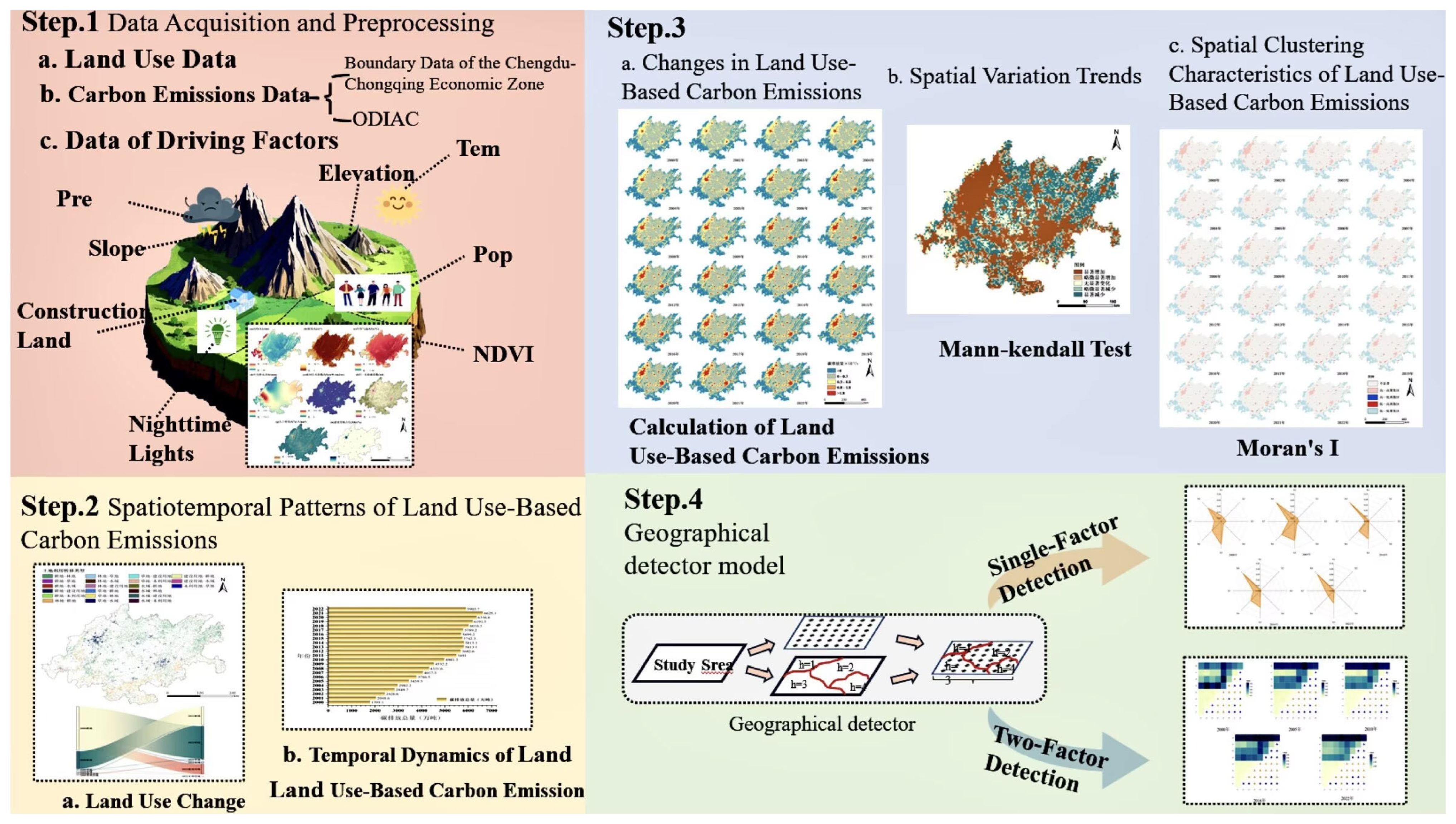
2.1. Technical Roadmap
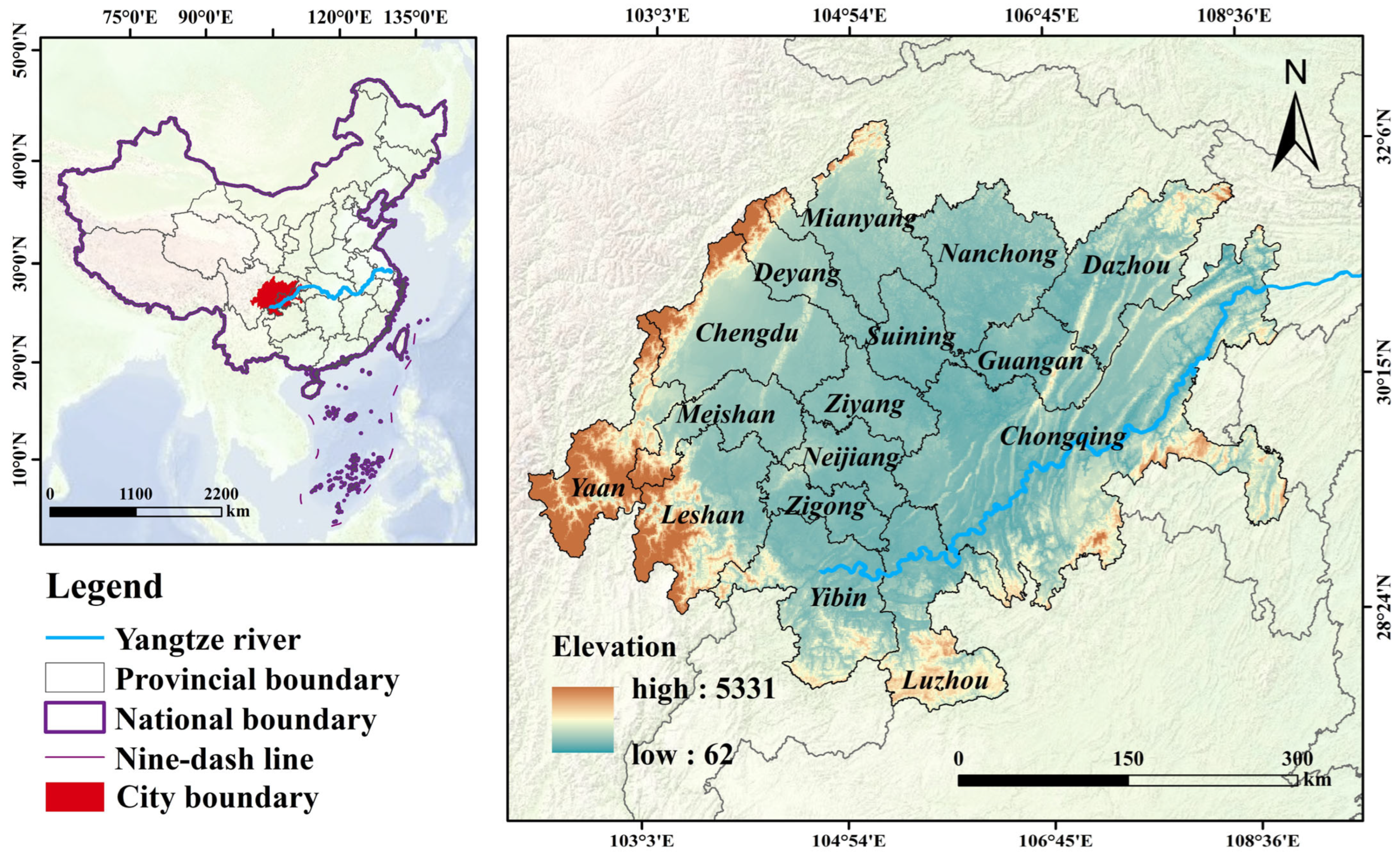
2.2. Study Area
2.3. Research Methods
2.3.1. LUCEs Calculation

2.3.2. MK Test
2.3.3. Evaluation of Spatial Autocorrelation
2.3.4. GD Model
- (1)
- Single-Factor Detection
- (2)
- Dual-Factor Interaction Detection
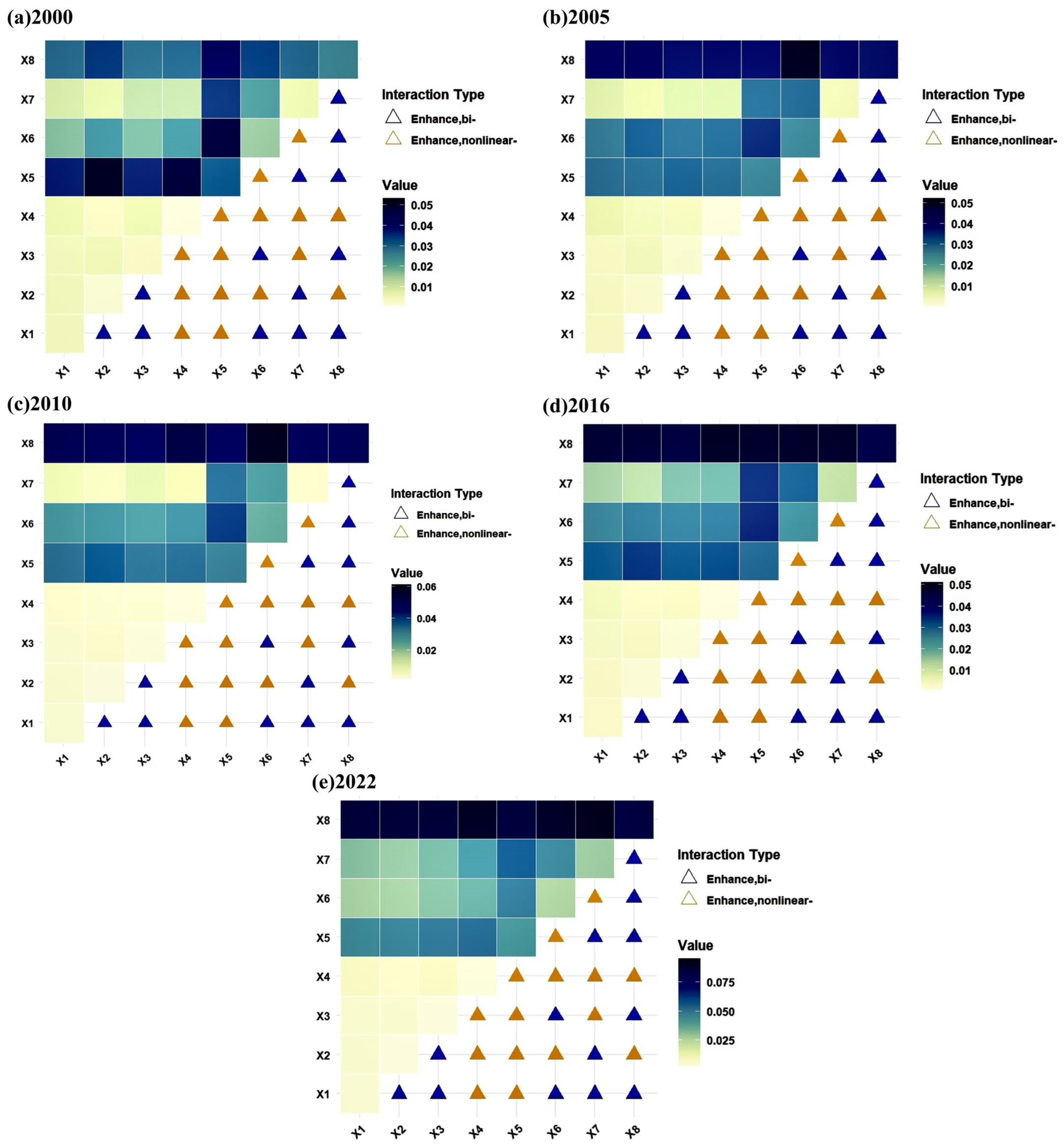
- Nonlinear Enhancement: If q(X1∩X2) > q(X1) + q(X2), the interaction of the two factors significantly amplifies their combined explanatory power beyond the sum of their individual contributions. For example, the synergistic effect of urban expansion and economic agglomeration markedly intensifies carbon emissions.
- Synergistic Enhancement: If q(X1∩X2) > max(q(X1), q(X2)), the two factors exhibit complementary driving effects.
- Independent or Linear Superposition: In other cases, the factors show no significant interaction or only linear additive effects.
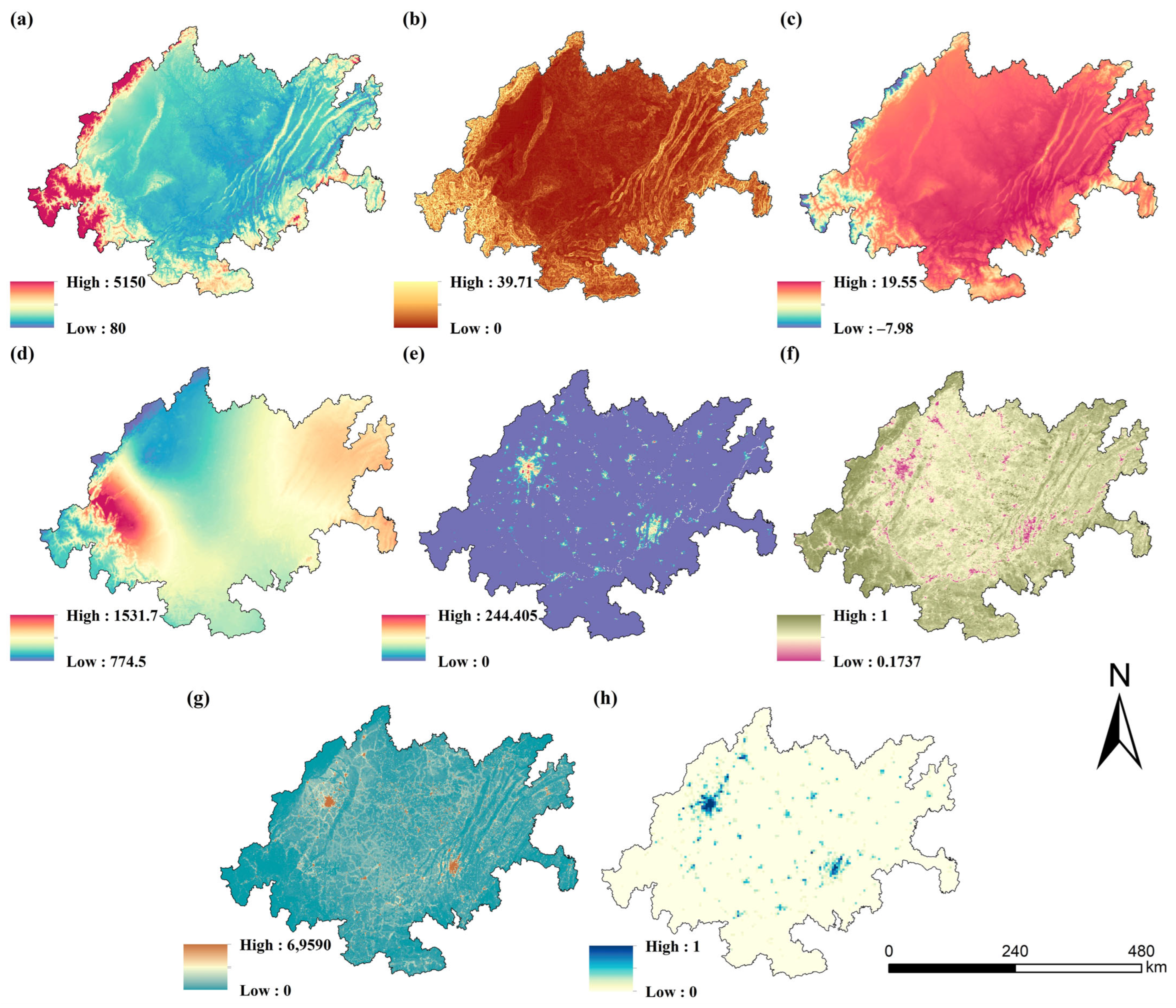
2.4. Information Origins and Handling
3. Results
3.1. Spatiotemporal Characteristics of LUCEs
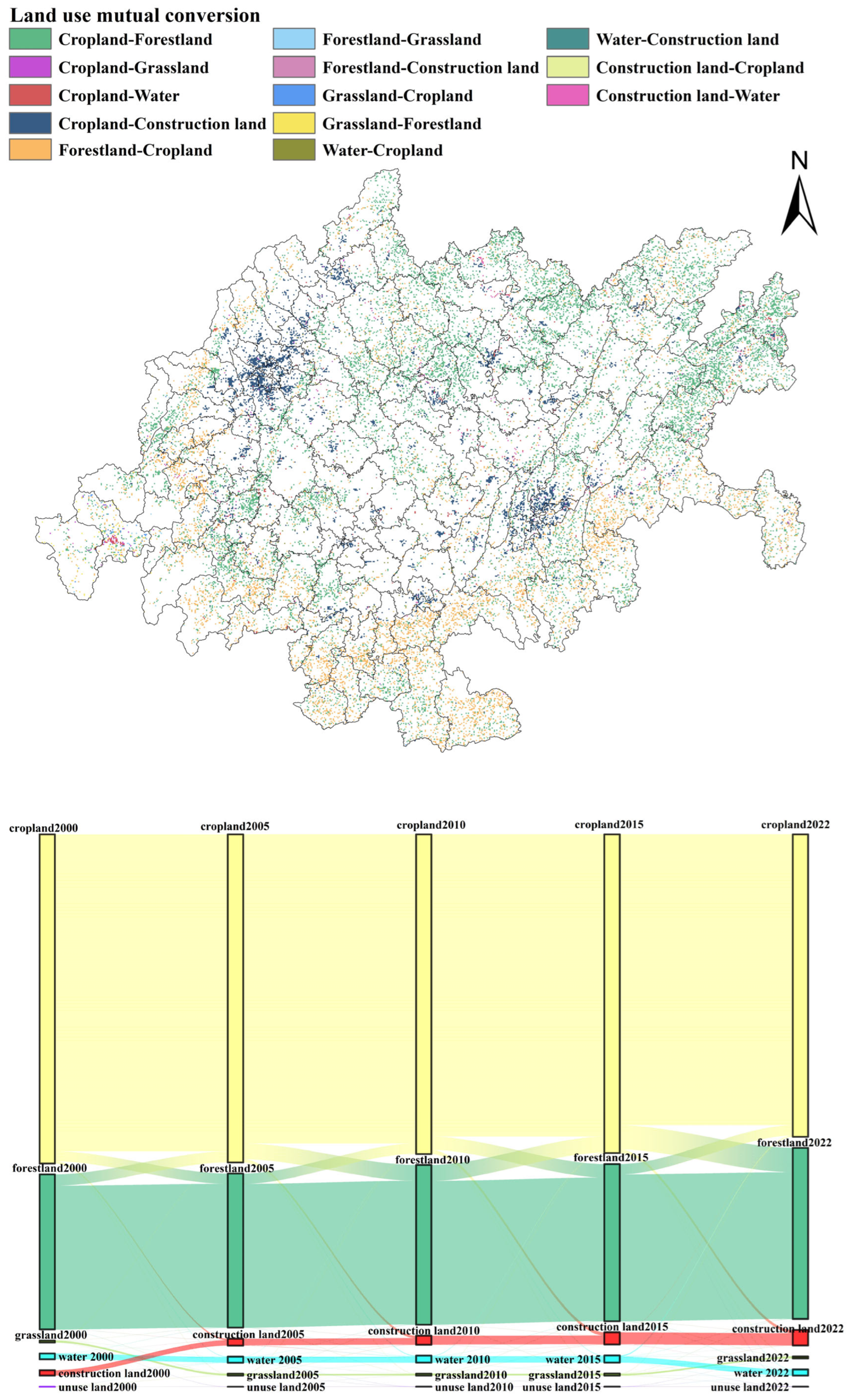
3.1.1. Land Use Change
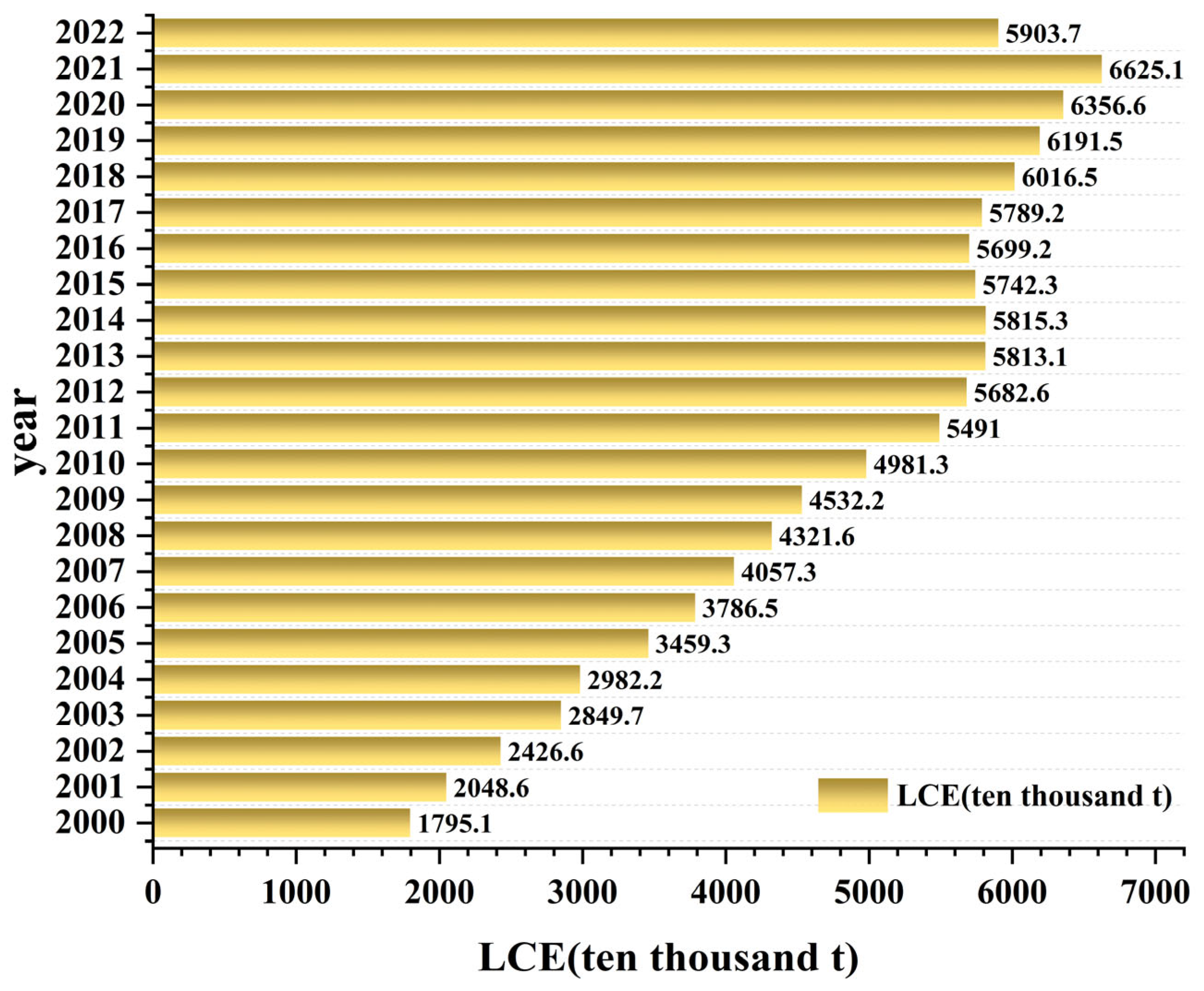
3.1.2. Temporal Trends in LUCEs
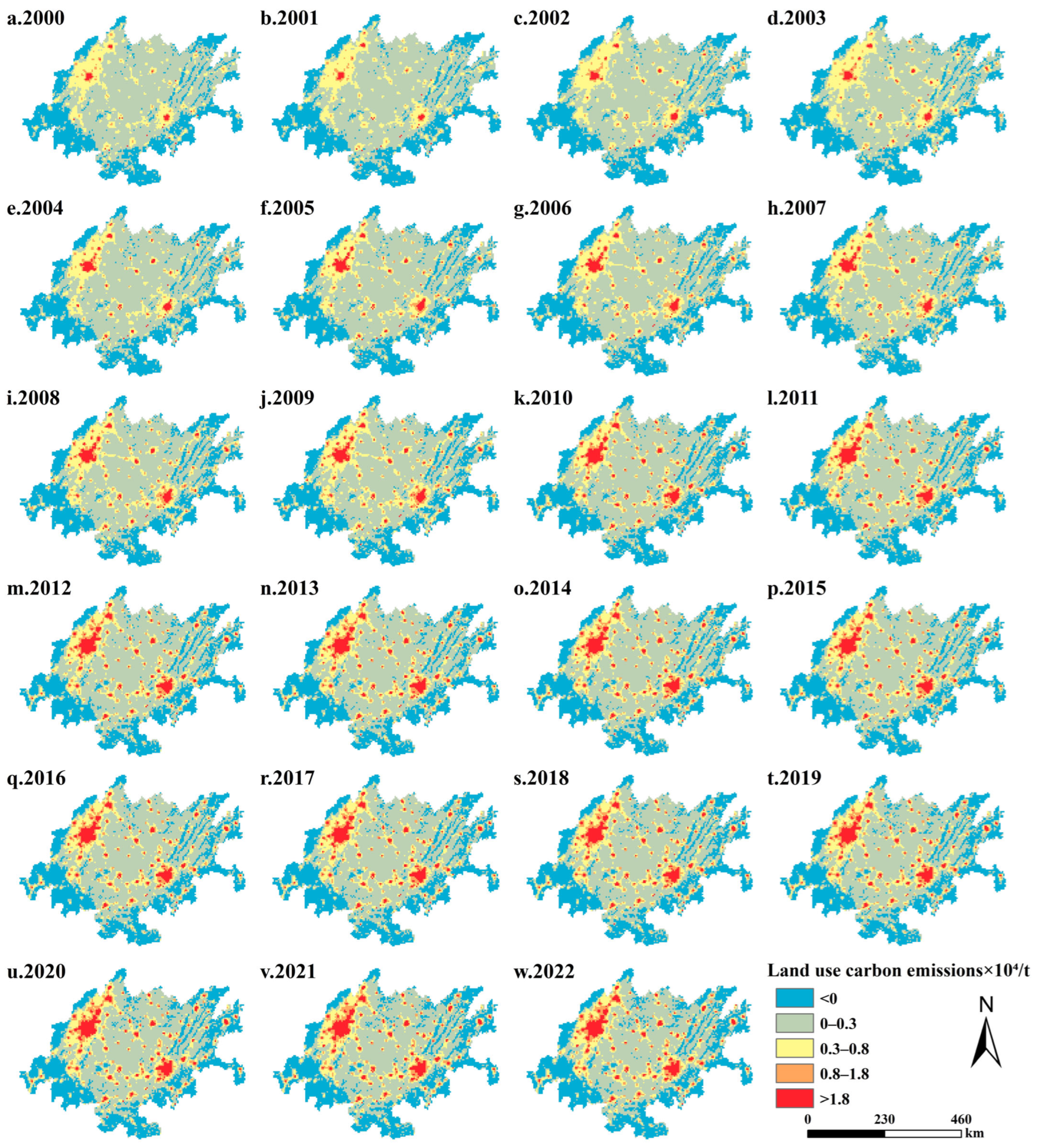
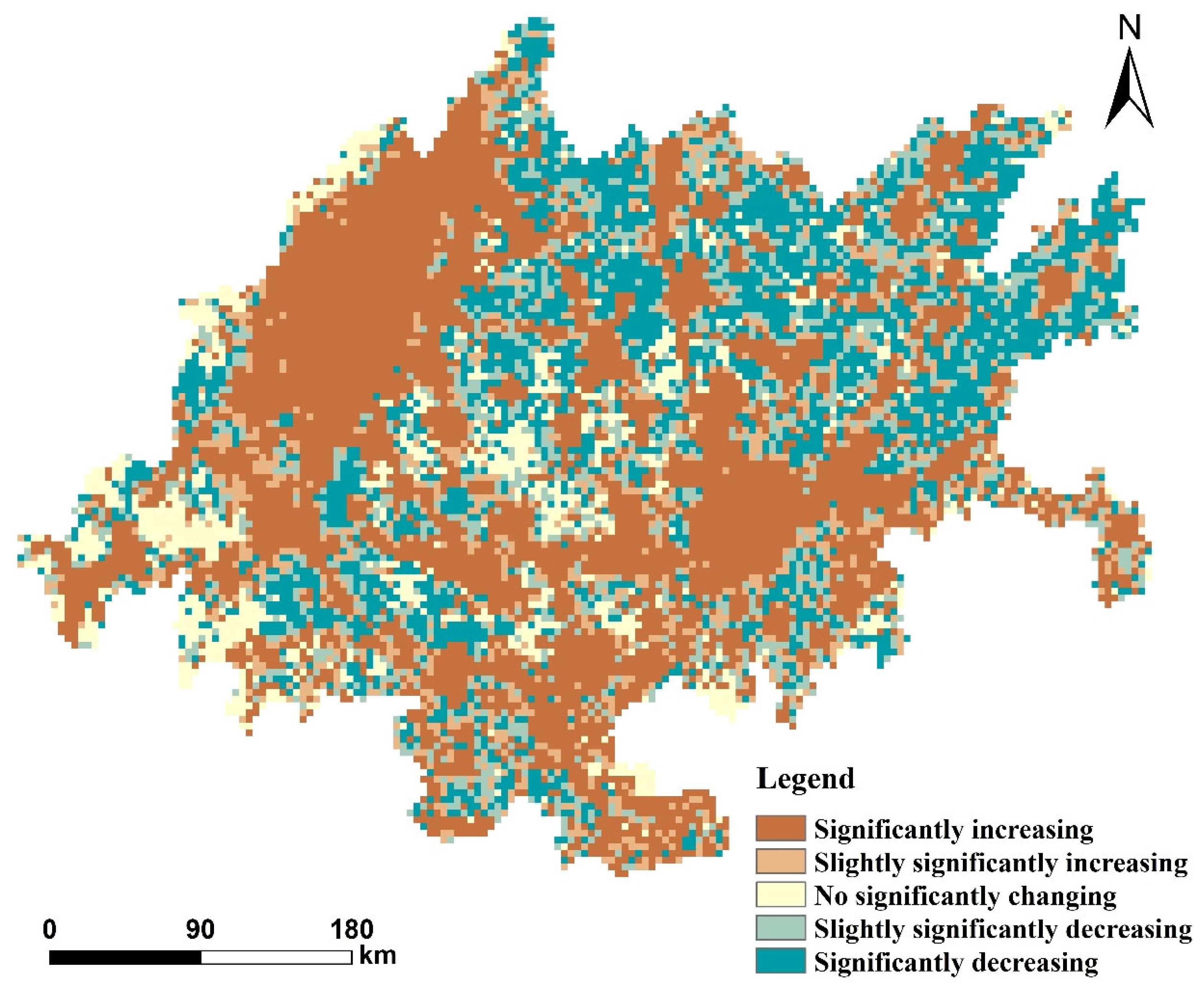
3.1.3. Spatial Patterns of LUCEs
3.2. Spatial Correlation Analysis
3.2.1. Global Spatial Autocorrelation Analysis
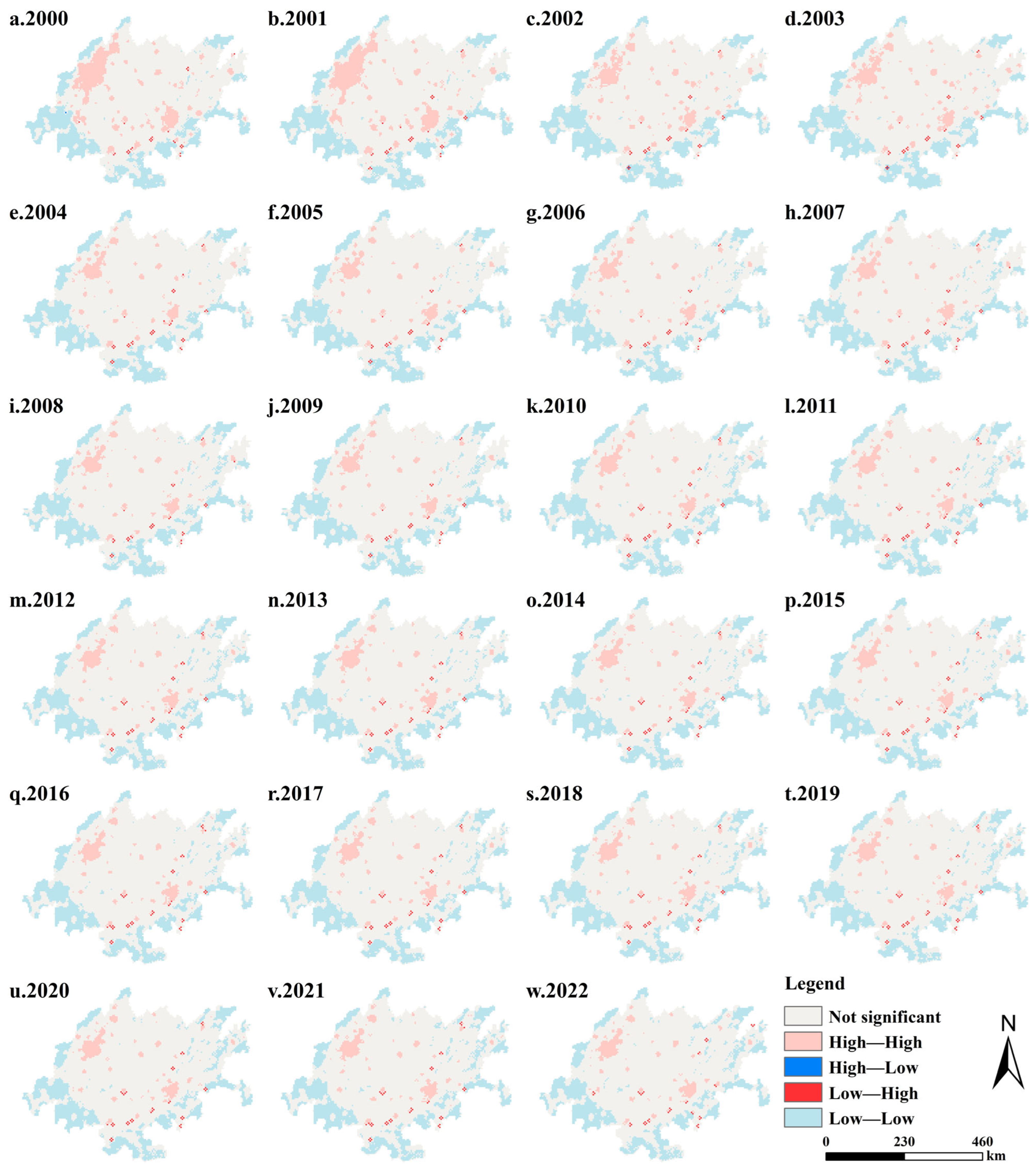
3.2.2. Local Spatial Autocorrelation Analysis
3.3. Analysis of Influencing Factors
3.3.1. Single-Factor Detection Analysis
3.3.2. Dual-Factor Interaction Detection
4. Discussion
4.1. Spatiotemporal Evolution of Carbon Emissions
4.2. Influencing Factors and Innovative Application of the GD Model
4.3. Research Limitations and Future Directions
5. Conclusions
Author Contributions
Funding
Institutional Review Board Statement
Informed Consent Statement
Data Availability Statement
Conflicts of Interest
Abbreviations
| CCUA | Chengdu–Chongqing Urban Agglomeration |
| LUCEs | Land use carbon emissions |
| YREB | Yangtze River Economic Belt, |
| GTWR | Geographically and Temporally Weighted Regression |
| ODIAC | Open-Data Inventory for Anthropogenic Carbon Dioxide |
| LMDI | Logarithmic Mean Divisia Index |
| GENAI | generative artificial intelligence |
| MK | Mann–Kendall |
| GD | Geodetector |
References
- Houghton, R.A.; Castanho, A. Annual Emissions of Carbon from Land Use, Land-Use Change, and Forestry from 1850 to 2020. Earth Syst. Sci. Data 2023, 15, 2025–2054. [Google Scholar] [CrossRef]
- Feng, X.; Wang, S.; Li, Y.; Yang, J.; Lei, K.; Yuan, W. Spatial Heterogeneity and Driving Mechanisms of Carbon Emissions in Urban Expansion Areas: A Research Framework Coupled with Patterns and Functions. Land Use Policy 2024, 143, 107209. [Google Scholar] [CrossRef]
- Xiong, Y.; Sun, Y.; Yang, Y. Impact of Urban Green Space Patterns on Carbon Emissions: A Gray BP Neural Network and Geo-Detector Analysis. Sustainability 2025, 17, 7245. [Google Scholar] [CrossRef]
- Tan, D.; Cheng, J.; Yu, J.; Wang, Q.; Chen, X. Spatiotemporal Evolution and Influencing Factors of Carbon Emission Efficiency of Apple Production in China from 2003 to 2022. Agriculture 2025, 15, 1680. [Google Scholar] [CrossRef]
- Zhao, R.Q.; Huang, X.J. Carbon emissions and carbon footprints of land use based on energy consumption in Jiangsu Province, China. Geogr. Res. 2010, 29, 1639–1649. [Google Scholar]
- Yi, D.; Ou, M.H.; Guo, J.; Han, Y.; Yi, J.L.; Ding, G.Q.; Wu, W.J. Research progress and prospects of land use carbon emissions and low-carbon optimization. Resour. Sci. 2022, 44, 1545–1559. [Google Scholar] [CrossRef]
- Lai, L.; Huang, X.; Yang, H.; Chuai, X.; Zhang, M.; Zhong, T.; Chen, Z.; Chen, Y.; Wang, X.; Thompson, J.R. Carbon Emissions from Land-Use Change and Management in China between 1990 and 2010. Sci. Adv. 2016, 2, e1601063. [Google Scholar] [CrossRef] [PubMed]
- Houghton, R.A.; House, J.I.; Pongratz, J.; van der Werf, G.R.; DeFries, R.S.; Hansen, M.C.; Le Quéré, C.; Ramankutty, N. Carbon Emissions from Land Use and Land-Cover Change. Biogeosciences 2012, 9, 5125–5142. [Google Scholar] [CrossRef]
- Pu, X.; Cheng, Q.; Chen, H. Spatial–Temporal Dynamics of Land Use Carbon Emissions and Drivers in 20 Urban Agglomerations in China from 1990 to 2019. Environ. Sci. Pollut. Res. 2023, 30, 107854–107877. [Google Scholar] [CrossRef]
- Pan, L.; Yu, J.; Lin, L. The Temporal and Spatial Pattern Evolution of Land-Use Carbon Emissions in China Coastal Regions and Its Response to Green Economic Development. Front. Environ. Sci. 2022, 10, 1018372. [Google Scholar] [CrossRef]
- Yuan, S.F.; Tang, Y.Y. Spatial differentiation of land-use carbon emissions in the Yangtze River Economic Belt from a low-carbon perspective. Econ. Geogr. 2019, 39, 190–198. [Google Scholar] [CrossRef]
- Sun, H.; Liang, H.M.; Chang, X.L.; Cui, Q.C.; Tao, Y. Land use carbon emissions and their spatial correlation in China. Econ. Geogr. 2015, 35, 154–162. [Google Scholar] [CrossRef]
- Chen, L.; Hang, Y.; Li, Q. Spatial-Temporal Characteristics and Influencing Factors of Carbon Emissions from Land Use and Land Cover in Black Soil Region of Northeast China Based on LMDI Simulation. Sustainability 2023, 15, 9334. [Google Scholar] [CrossRef]
- He, J.; Yang, J. Spatial–Temporal Characteristics and Influencing Factors of Land-Use Carbon Emissions: An Empirical Analysis Based on the GTWR Model. Land 2023, 12, 1506. [Google Scholar] [CrossRef]
- Ji, X.Q.; Zhang, Y.S. Spatial correlation network structure and motivation of carbon emission efficiency in planting industry in the Yangtze River Economic Belt. J. Nat. Resour. 2023, 38, 675–693. [Google Scholar] [CrossRef]
- Ma, Y.; Liu, Z.Z. Spatiotemporal evolution and influencing factors of land use carbon emissions in the Yellow River Basin. Ecol. Econ. 2021, 37, 35–43. [Google Scholar]
- Yuan, D.; Zhang, L.; Fan, Y.; Yang, R. Investigating Spatio-Temporal Variations and Contributing Factors of Land Use-Related Carbon Emissions in the Beijing-Tianjin-Hebei Region, China. Sci. Rep. 2024, 14, 18976. [Google Scholar] [CrossRef] [PubMed]
- Ji, X.Q.; Liu, H.M.; Zhang, Y.S. Evolution and driving factors of spatial correlation network structure of inter-provincial land use carbon emissions in China. Econ. Geogr. 2023, 43, 190–200. [Google Scholar] [CrossRef]
- Li, J.; Mao, D.H.; Jiang, Z.L.; Li, K. Factor decomposition and decoupling effect of land use carbon emissions in Changsha-Zhuzhou-Xiangtan urban agglomeration. Ecol. Econ. 2019, 35, 28–34,66. [Google Scholar]
- Chuai, X.; Huang, X.; Lu, Q.; Zhang, M.; Zhao, R.; Lu, J. Spatiotemporal Changes of Built-Up Land Expansion and Carbon Emissions Caused by the Chinese Construction Industry. Environ. Sci. Technol. 2015, 49, 13021–13030. [Google Scholar] [CrossRef] [PubMed]
- Wang, J.; Li, X.; Christakos, G.; Liao, Y.; Zhang, T.; Gu, X.; Zheng, X. Geographical Detectors-Based Health Risk Assessment and Its Application in the Neural Tube Defects Study of the Heshun Region, China. Int. J. Geogr. Inf. Sci. 2010, 24, 107–127. [Google Scholar] [CrossRef]
- Wang, J.; Xu, C. Geodetector: Principle and Prospective. Acta Geogr. Sin. 2017, 72, 116–134. [Google Scholar] [CrossRef]
- Zeng, C.; He, J.; He, Q.; Mao, Y.; Yu, B. Assessment of Land Use Pattern and Landscape Ecological Risk in the Chengdu-Chongqing Economic Circle, Southwestern China. Land 2022, 11, 659. [Google Scholar] [CrossRef]
- Wang, C.; Li, T.; Guo, X.; Xia, L.; Lu, C.; Wang, C. Plus-InVEST Study of the Chengdu-Chongqing Urban Agglomeration’s Land-Use Change and Carbon Storage. Land 2022, 11, 1617. [Google Scholar] [CrossRef]
- Li, Y.; Zhang, Y.; Li, X. Insight into Carbon Emissions in Economically Developed Regions Based on Land Use Transitions: A Case Study of the Yangtze River Delta, China. Land 2024, 13, 1968. [Google Scholar] [CrossRef]
- Yang, Y.; Li, H. Monitoring Spatiotemporal Characteristics of Land-Use Carbon Emissions and Their Driving Mechanisms in the Yellow River Delta: A Grid-Scale Analysis. Environ. Res. 2022, 214, 114151. [Google Scholar] [CrossRef]
- Boton, X.; Nitschelm, L.; Juillard, M.; van der Werf, H.M.G. Modelling Greenhouse Gas Emissions of Land Use and Land-Use Change Using Spatially Explicit Land Conversion Data for French Crops. Int. J. Life Cycle Assess. 2025, 30, 285–300. [Google Scholar] [CrossRef]
- Yang, S.; Wang, X.; Ge, Z.; Dong, G.; Ma, M.; Han, X. Global Per Capita CO2 Emission Trends. Atmosphere 2023, 14, 1797. [Google Scholar] [CrossRef]
- Wang, Y.; Wang, M.; Teng, F.; Ji, Y. Remote Sensing Monitoring and Analysis of Spatiotemporal Changes in China’s Anthropogenic Carbon Emissions Based on XCO2 Data. Remote Sens. 2023, 15, 3207. [Google Scholar] [CrossRef]
- Wei, Z.Y.; Tu, J.J.; Xiao, L.; Yang, Y.; Li, Y. Fine accounting and driving factor monitoring of territorial space carbon budget in Chengdu-Chongqing urban agglomeration. J. Nat. Resour. 2025, 40, 1294–1311. [Google Scholar] [CrossRef]
- Zhang, J.; Lu, H.; Peng, W.; Zhang, L. Analyzing Carbon Emissions and Influencing Factors in Chengdu-Chongqing Urban Agglomeration Counties. J. Environ. Sci. 2025, 151, 640–651. [Google Scholar] [CrossRef]
- Deng, Y.; Chen, H.; Hai, Y.; Zhou, J.; Jizeding, D.; Luo, J.; Li, L. Spatial pattern and carbon balance zoning of land use carbon emissions in Chengdu-Chongqing Economic Circle. Soil Water Conserv. Bull. 2024, 44, 337–346. [Google Scholar] [CrossRef]
- Qiu, A.-Y.; Yue, H.; You, Z.; An, H. Forecasting of Factors Influencing Carbon Emission from Land-Use in Liaoning Province, China, under the “Double Carbon” Target. Ecol. Model. 2025, 509, 111255. [Google Scholar] [CrossRef]
- Wu, R.; Lan, H.; Cao, Y.; Li, P. Optimization of Low-Carbon Land Use in Chengdu Based on Multi-Objective Linear Programming and the Future Land Use Simulation Model. Front. Environ. Sci. 2022, 10, 989747. [Google Scholar] [CrossRef]
- Xie, X.J.; Huang, A. Spatiotemporal relationship between carbon emissions and ecosystem service value based on LUCC in Sichuan Province. Resour. Environ. Yangtze Basin 2025, 34, 2352. [Google Scholar]
- Zhao, L.; Yang, C.; Zhao, Y.; Wang, Q.; Zhang, Q. Spatial Correlations of Land Use Carbon Emissions in Shandong Peninsula Urban Agglomeration: A Perspective from City Level Using Remote Sensing Data. Remote Sens. 2023, 15, 1488. [Google Scholar] [CrossRef]
- Huang, H.Y.; Tang, Y.Q.; Gong, Z.W.; Chen, X.J. Dynamic evolution and influencing factors of land-use carbon emissions in Chongqing based on STIRPAT-GWR model. J. Environ. Eng. Technol. 2024, 14, 1195–1205. [Google Scholar] [CrossRef]
- Zheng, Y.; Su, L.; Zeng, Q.; Zhou, S.; Li, S.; Hong, H.; Deng, H.; Li, W. Spatiotemporal Assessment of Land Use Carbon Emission in the Guangdong-Hong Kong-Macao Greater Bay Area:A Hybrid Static-Dynamic Model Integrated with PLUS. Urban Clim. 2025, 63, 102574. [Google Scholar] [CrossRef]
- Yang, L.; Wang, C.; Liu, Y.; Wang, T.; Tian, Z.; Ding, L.; Liu, Z.; Feng, T.; Niu, Q.; Mao, X.; et al. The Change Pattern and Spatiotemporal Transition of Land Use Carbon Emissions in China’s Three-North Shelterbelt Program Region. Ecol. Eng. 2025, 219, 107680. [Google Scholar] [CrossRef]
- Saha, P.; Amitab, K.; Nath, A. Assessing CO2 Emission Trend and Its Impact on Agricultural Crop Health Using Machine Learning Technique. Procedia Comput. Sci. 2025, 258, 1506–1516. [Google Scholar] [CrossRef]
- Kliengchuay, W.; Mingkhwan, R.; Kiangkoo, N.; Suwanmanee, S.; Sahanavin, N.; Kongpran, J.; Aung, H.W.; Tantrakar-napa, K. Analyzing Temperature, Humidity, and Precipitation Trends in Six Regions of Thailand Using Innovative Trend Analysis. Sci Rep 2024, 14, 7800. [Google Scholar] [CrossRef] [PubMed]
- Ge, K.; Wang, Y.; Liu, X.; Hu, L.; Ke, S.; Jiang, X.; Zhang, W. Spatial Effects and Influence Mechanisms of Urban Land Use Green Transition on Urban Carbon Emissions. Ecol. Indic. 2025, 172, 113261. [Google Scholar] [CrossRef]
- Niu, J.; Xin, B.; Xin, B.; Zhang, Y.; Wang, M. Research on the Coordinated Development of Provincial Urbanization and Carbon Emission Efficiency of Construction Industry in China. Carbon Balance Manag. 2024, 19, 12. [Google Scholar] [CrossRef]
- Huang, W.; Deng, Y.; Chen, H.; Hai, Y.; Ma, A.; Duan, M.; Ming, L. Spatiotemporal Changes in Land Use and Identification of Driving Factor Contributions in the Chengdu-Chongqing Economic Circle Based on the Random Forest Model. Environ. Sci. Pollut. Res. 2025, 32, 18975–18994. [Google Scholar] [CrossRef]
- Dang, H.; Deng, Y.; Hai, Y.; Chen, H.; Wang, W.; Zhang, M.; Liu, X.; Yang, C.; Peng, M.; Jize, D.; et al. Integrating Geodetector and GTWR to Unveil Spatiotemporal Heterogeneity in China’s Agricultural Carbon Emissions Under the Dual Carbon Goals. Agriculture 2025, 15, 1302. [Google Scholar] [CrossRef]
- Wang, Z.; Ou, L.; Chen, M. Evolution Characteristics, Drivers and Trends of Rural Residential Land in Mountainous Economic Circle: A Case Study of Chengdu-Chongqing Area, China. Ecol. Indic. 2023, 154, 110585. [Google Scholar] [CrossRef]
- Wang, M.; Wang, L. Study on Land Use Change and Driving Force in Chengdu-Chongqing Urban Agglomeration. ITM Web Conf. 2022, 47, 03037. [Google Scholar] [CrossRef]
- Chen, L.; Li, X.; Kang, X.; Liu, W.; Wang, M. Analysis of the Cooperative Development of Multiple Systems for Urban Economy-Energy-Carbon: A Case Study of Chengdu-Chongqing Economic Circle. Sustain. Cities Soc. 2024, 108, 105395. [Google Scholar] [CrossRef]
- Liu, Y.; Zhu, J.; He, T.; Liu, H. Quantifying the Impacts of Grain Plantation Decline on Domestic Grain Supply in China During the Past Two Decades. Land 2025, 14, 1283. [Google Scholar] [CrossRef]
- Li, L.; Zhang, X.; Yu, L.; Xiao, H. Spatial-Temporal Evolution of Land Use Carbon Emissions and Influencing Factors in Zibo, China. Front. Environ. Sci. 2024, 12, 1472558. [Google Scholar] [CrossRef]
- Liu, L.; Qu, J.; Gao, F.; Maraseni, T.N.; Wang, S.; Aryal, S.; Zhang, Z.; Wu, R. Land Use Carbon Emissions or Sink: Research Characteristics, Hotspots and Future Perspectives. Land 2024, 13, 279. [Google Scholar] [CrossRef]
- Peng, M.; Yang, Y.; Deng, Y.; Jize, D.; Chen, H.; Hai, Y.; Liu, G.; Wang, H.; Xie, T.; Li, H.; et al. The Impact of the Grain-for-Green Programme on Carbon Storage in the Upper Yangtze River Basin Based on the PLUS-InVEST Model. Carbon Balance Manag. 2025, 20, 24. [Google Scholar] [CrossRef]
- Hu, Y.; Zhang, S.; Shi, Y.; Guo, L. Quantifying the Impact of the Grain-for-Green Program on Ecosystem Service Scarcity Value in Qinghai, China. Sci. Rep. 2023, 13, 2927. [Google Scholar] [CrossRef] [PubMed]
- Duan, P.; Wu, K. Afforestation Through Sand Control: Farmer Participation Under China’s New Round of Grain-for-Green Compensation Policy. Agriculture 2025, 15, 671. [Google Scholar] [CrossRef]
- Wu, Q.; Zhou, P.; Dai, Y. When Farmers Walk Away: A Mixed-Methods Investigation of Farmland Abandonment through Land-Use Change and Farmer Interviews in the Chengdu-Chongqing Economic Circle, Southwestern China. Front. Environ. Sci. 2025, 13, 1650689. [Google Scholar] [CrossRef]
- Zhong, Q.; Li, Z.; He, Y. Coupling Evaluation and Spatial–Temporal Evolution of Land Ecosystem Services and Economic–Social Development in a City Group: The Case Study of the Chengdu–Chongqing City Group. Int. J. Environ. Res. Public Health 2023, 20, 5095. [Google Scholar] [CrossRef] [PubMed]
- Hu, L.; Wang, G.; Huang, Q.; Xie, J. Policy-Driven Land Use Optimization for Carbon Neutrality: A PLUS-InVEST Model Coupling Approach in the Chengdu–Chongqing Economic Circle. Sustainability 2025, 17, 5831. [Google Scholar] [CrossRef]
- Ma, D.; Hu, C.; Yan, Y.; Zhang, F.; Zhang, J.; Deng, P.; Chang, R. A Comprehensive Analysis of the Spatiotemporal Dynamics and Determinants of Carbon Emission Efficiency in China’s Manufacturing Sector. J. Environ. Manag. 2025, 381, 125269. [Google Scholar] [CrossRef]
- Gui, D.; He, H.; Liu, C.; Han, S. Spatio-Temporal Dynamic Evolution of Carbon Emissions from Land Use Change in Guangdong Province, China, 2000–2020. Ecol. Indic. 2023, 156, 111131. [Google Scholar] [CrossRef]
- Che, L.; Guo, S.; Li, Y.; Zhu, Y. Exploring the Dynamics and Trends of Carbon Emission Spatiotemporal Patterns in the Chengdu–Chongqing Economic Zone, China, from 2000 to 2020. Sci. Rep. 2024, 14, 16341. [Google Scholar] [CrossRef]
- Liu, C.; Xu, R.; Xu, K.; Lin, Y.; Cao, Y. Carbon Emission Effects of Land Use in Chaobai River Region of Beijing–Tianjin–Hebei, China. Land 2023, 12, 1168. [Google Scholar] [CrossRef]
- Rong, T.; Zhang, P.; Zhu, H.; Jiang, L.; Li, Y.; Liu, Z. Spatial Correlation Evolution and Prediction Scenario of Land Use Carbon Emissions in China. Ecol. Inform. 2022, 71, 101802. [Google Scholar] [CrossRef]
- Huang, H.; Yang, X. Spatiotemporal Evolution Mechanism and Dynamic Simulation of the Urban Resilience System in the Chengdu–Chongqing Economic Circle. Sustainability 2025, 17, 3448. [Google Scholar] [CrossRef]
- Liu, J.; Shi, T.; Hou, Z.; Huang, L.; Pu, L. Analysis of Spatiotemporal Patterns and Determinants of Energy-Related Carbon Emissions in the Yellow River Basin Using Remote Sensing Data. Front. Energy Res. 2023, 11, 1231322. [Google Scholar] [CrossRef]
- Cai, Y.; Li, K. Spatiotemporal Dynamic Evolution and Influencing Factors of Land Use Carbon Emissions: Evidence from Jiangsu Province, China. Front. Environ. Sci. 2024, 12, 1368205. [Google Scholar] [CrossRef]
- Meng, Q.; Zheng, Y.; Liu, Q.; Li, B.; Wei, H. Analysis of Spatiotemporal Variation and Influencing Factors of Land-Use Carbon Emissions in Nine Provinces of the Yellow River Basin Based on the LMDI Model. Land 2023, 12, 437. [Google Scholar] [CrossRef]
- Yang, X.; Liu, X. Path Analysis and Mediating Effects of Influencing Factors of Land Use Carbon Emissions in Chang-Zhu-Tan Urban Agglomeration. Technol. Forecast. Soc. Chang. 2023, 188, 122268. [Google Scholar] [CrossRef]
- Tian, C.; Cheng, L.; Yin, T. Spatial Heterogeneity of Driving Forces in Response to Carbon Emissions from Land Use at County-Level in Beijing-Tianjin-Hebei Region. Pol. J. Environ. Stud. 2023, 32, 267–279. [Google Scholar] [CrossRef]
- Li, J.; Hu, J.; Kang, J.; Shu, W. Spatio-temporal variation and prediction of land use and carbon storage based on PLUS-InVEST model in Shanxi Province, China. Landsc. Ecol. Eng. 2024. [Google Scholar] [CrossRef]
- Lyu, K.; Li, Z. Scenario based assessment of carbon storage and habitat quality under land use change in Shandong Province China. Sci. Rep. 2025, 15, 38098. [Google Scholar] [CrossRef]
- Huang, C.; Zhuang, Q.; Meng, X.; Zhu, P.; Han, J.; Huang, L. A fine spatial resolution modeling of urban carbon emissions: A case study of Shanghai, China. Sci. Rep. 2022, 12, 9345. [Google Scholar] [CrossRef] [PubMed]
- Cai, S.; Xu, J.; Guan, Y.; Liu, M.; Tan, C.; Bi, J.; Shan, Y. City-Level Process-Related CO2 Emissions in China 2000–2021. Sci. Data 2025, 12, 1435. [Google Scholar] [CrossRef] [PubMed]
- Chen, D.; Li, S. Exploring the Pathway to Carbon Neutrality in China Based on a Dynamic Spatial Durbin Quantile Regression Model. Sci. Rep. 2025, 15, 17442. [Google Scholar] [CrossRef] [PubMed]
- Liu, Z.; Han, L.; Liu, M. High-Resolution Carbon Emission Mapping and Spatial-Temporal Analysis Based on Multi-Source Geographic Data: A Case Study in Xi’an City, China. Environ. Pollut. 2024, 361, 124879. [Google Scholar] [CrossRef]
- Liu, C.; Zhang, Y. China’s Carbon Emission Prediction from the Perspective of Shared Socioeconomic Pathways and Machine Learning. Energy Strategy Rev. 2025, 60, 101778. [Google Scholar] [CrossRef]


| Type | Name | Description | Source |
|---|---|---|---|
| Land Use Data | Land Use Data | Data from 2000 to 2022, with a spatial resolution of 30 m × 30 m; reclassified into cropland, forestland, grassland, water, construction land, and unused land. | CLCD produced by Wuhan University (https://zenodo.org/records/12779975) (accessed on 15 January 2025) |
| Basic Geographic Information Data | Boundary Data | Boundary data for the CCUA and administrative boundaries of related regions. | Outline of the CCUA Development Plan and the 1:1,000,000 National Basic Geographic Information Database from the National Catalogue Service for Geographic Information (http://www.webmap.cn) (accessed on 21 January 2025) |
| Carbon Emission Data | ODIAC | Carbon emission data from 2000 to 2022, with a spatial resolution of 1 km × 1 km. | ODIAC from the National Institute for Environmental Studies, Japan (https://db.cger.nies.go.jp/dataset/ODIAC/) (accessed on 27 January 2025) |
| Influencing Factor Data | Elevation | Elevation data with a spatial resolution of 30 m. | SRTM DEM data jointly acquired by NASA and the National Imagery and Mapping Agency (https://portal.opentopography.org) (accessed on 3 February 2025) |
| Slope | Derived from elevation data. | Calculated from elevation data | |
| Annual Mean Temperature | Annual mean temperature data for 2000, 2005, 2010, 2016, and 2022, with a spatial resolution of 1 km. | National Earth System Science Data Center (https://www.geodata.cn) (accessed on 3 March 2025) | |
| Annual Precipitation | Annual precipitation data for 2000, 2005, 2010, 2016, and 2022, with a spatial resolution of 1 km. | ||
| Nighttime Light | Nighttime light data for 2000, 2005, 2010, 2016, and 2022, with a spatial resolution of 500 m. | NPP/VIIRS data from the Earth Observation Group (EOG) (https://eogdata.mines.edu/products/vnl/) (accessed on 11 March 2025) | |
| NDVI | NDVI data for 2000, 2005, 2010, 2016, and 2022, with a spatial resolution of 1 km. | MOD13A3 (https://ladsweb.modaps.eosdis.nasa.gov/search/order/1/MOD13A3--6) (accessed on 15 February 2025) | |
| Population Density | Population density data for 2000, 2005, 2010, 2016, and 2022, with a spatial resolution of 1 km. | LandScan global population density raster data (https://landscan.ornl.gov/) (accessed on 25 February 2025) |
| Year | 2000 | 2001 | 2002 | 2003 | 2004 | 2005 | 2006 | 2007 | 2008 | 2009 | 2010 |
|---|---|---|---|---|---|---|---|---|---|---|---|
| Moran’s I | 0.0518 | 0.0283 | 0.0333 | 0.0329 | 0.041 | 0.0465 | 0.0465 | 0.0465 | 0.0458 | 0.0464 | 0.0475 |
| p-value | <0.01 | <0.01 | <0.01 | <0.01 | <0.01 | <0.01 | <0.01 | <0.01 | <0.01 | <0.01 | <0.01 |
| 2011 | 2012 | 2013 | 2014 | 2015 | 2016 | 2017 | 2018 | 2019 | 2020 | 2021 | 2022 |
| 0.048 | 0.0481 | 0.0481 | 0.0483 | 0.048 | 0.0484 | 0.0477 | 0.048 | 0.0479 | 0.0482 | 0.0482 | 0.0901 |
| <0.01 | <0.01 | <0.01 | <0.01 | <0.01 | <0.01 | <0.01 | <0.01 | <0.01 | <0.01 | <0.01 | <0.01 |
Disclaimer/Publisher’s Note: The statements, opinions and data contained in all publications are solely those of the individual author(s) and contributor(s) and not of MDPI and/or the editor(s). MDPI and/or the editor(s) disclaim responsibility for any injury to people or property resulting from any ideas, methods, instructions or products referred to in the content. |
© 2025 by the authors. Licensee MDPI, Basel, Switzerland. This article is an open access article distributed under the terms and conditions of the Creative Commons Attribution (CC BY) license (https://creativecommons.org/licenses/by/4.0/).
Share and Cite
Jize, D.; Zhang, M.; Ma, A.; Wang, W.; Luo, J.; Wang, P.; Zhang, M.; Huang, P.; Peng, M.; Meng, X.; et al. Quantifying and Explaining Land-Use Carbon Emissions in the Chengdu–Chongqing Urban Agglomeration: Spatiotemporal Analysis and Geodetector Insights. Sustainability 2025, 17, 11328. https://doi.org/10.3390/su172411328
Jize D, Zhang M, Ma A, Wang W, Luo J, Wang P, Zhang M, Huang P, Peng M, Meng X, et al. Quantifying and Explaining Land-Use Carbon Emissions in the Chengdu–Chongqing Urban Agglomeration: Spatiotemporal Analysis and Geodetector Insights. Sustainability. 2025; 17(24):11328. https://doi.org/10.3390/su172411328
Chicago/Turabian StyleJize, Dingdi, Miao Zhang, Aiting Ma, Wenjing Wang, Ji Luo, Pengyan Wang, Mei Zhang, Ping Huang, Minghong Peng, Xiantao Meng, and et al. 2025. "Quantifying and Explaining Land-Use Carbon Emissions in the Chengdu–Chongqing Urban Agglomeration: Spatiotemporal Analysis and Geodetector Insights" Sustainability 17, no. 24: 11328. https://doi.org/10.3390/su172411328
APA StyleJize, D., Zhang, M., Ma, A., Wang, W., Luo, J., Wang, P., Zhang, M., Huang, P., Peng, M., Meng, X., Gong, Z., & Deng, Y. (2025). Quantifying and Explaining Land-Use Carbon Emissions in the Chengdu–Chongqing Urban Agglomeration: Spatiotemporal Analysis and Geodetector Insights. Sustainability, 17(24), 11328. https://doi.org/10.3390/su172411328