Spatiotemporal Evolution Characteristics and Influencing Factors of China’s Ordinary Colleges and Universities




Abstract
1. Introduction
2. Data and Methods
2.1. Data Sources and Processing
2.2. Research Methodology
2.2.1. Nearest Neighbor Index
2.2.2. Kernel Density Analysis
2.2.3. Center of Gravity Shift and Standard Deviation Ellipse
2.2.4. Geographic Detector
2.2.5. Multi-Scale Geographically Weighted Regression (MGWR)
2.3. Determination of the Study Period
3. Results
3.1. Evolutionary Characteristics of General Colleges and Universities’ Spatial Distribution
3.1.1. Spatial Distribution Toward Clusters
3.1.2. Evolution of Spatial Distribution Density with a Spreading Trend
3.2. General Colleges and Universities’ Influencing Factors in Spatial Distribution
3.2.1. Influential Factors’ Selection and Description
3.2.2. Influence Factor Analysis Based on Geodetector
3.2.3. Influencing Factors’ Spatial Differentiation Based on MGWR
- (1)
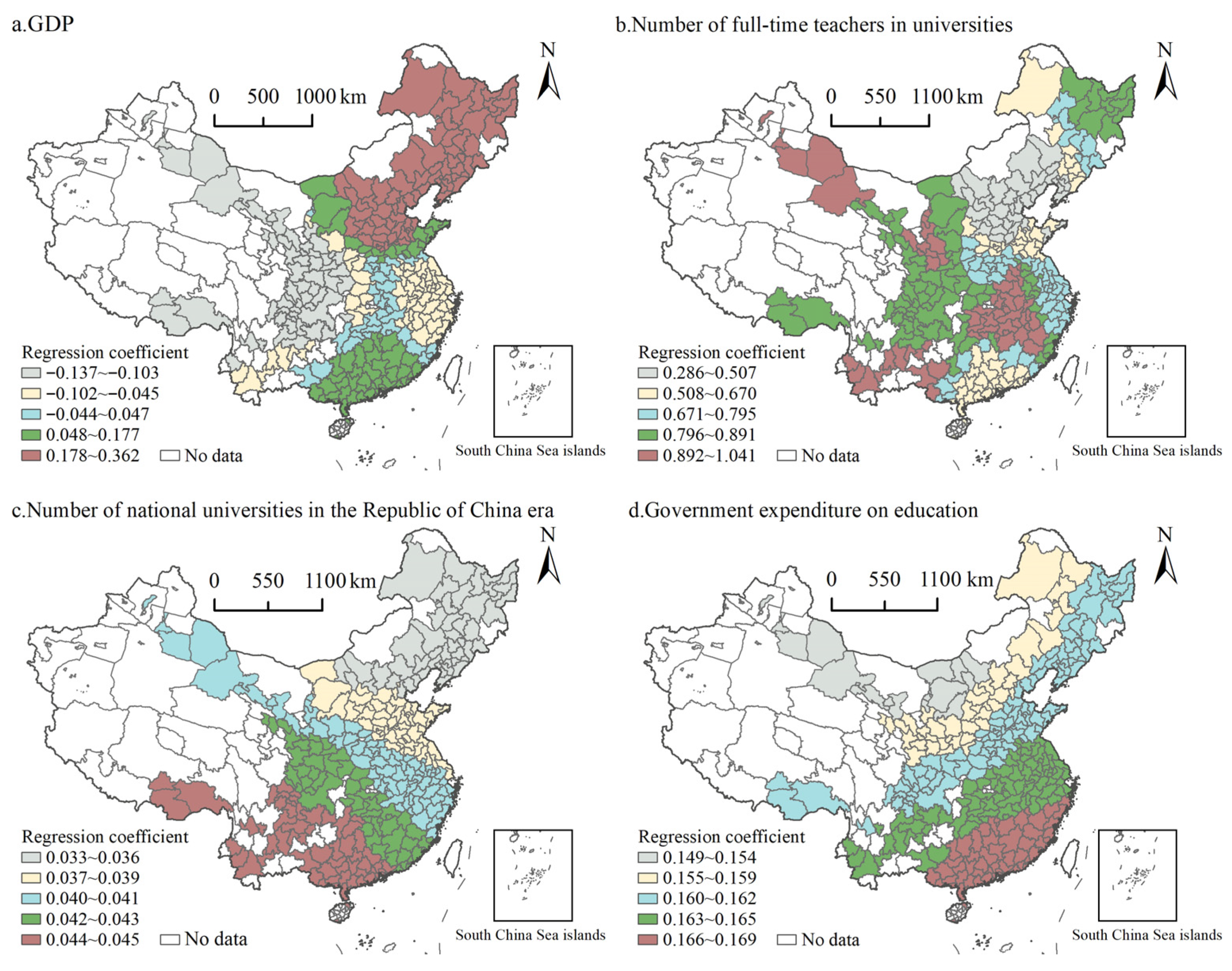
- The GDP regression coefficient is −0.137–0.362, in which 51.20% of the analyzed units positively correlated with HEIs’ distribution, and the difference between the maximum and minimum regression coefficients is 0.499, indicating a big difference in support for construction of general HEIs among various regional governments. As Figure 2a illustrates, regression coefficients are largest in the northeast, the mid-east, and the southeast, and they tend to decrease from the border of Henan and Shaanxi to the west. Economically developed regions are usually able to attract more resources and become regions of general HEI concentration, while more economically backward regions have limited resources, resulting in a smaller number of local general HEIs or a relatively low level of development.
- (2)
- The regression coefficient of the number of full-time instructors in HEIs is 0.286–1.041, which is positively associated with the spatial distribution of general HEIs. As Figure 2b illustrates, the regression coefficient of the number of full-time instructors has significant spatial differentiation and prominent imbalance. In the northwestern Gansu and Xinjiang bordering areas, central Yunnan, Jiangxi, and its regional surrounding parts are characterized by distribution of the number of instructors at more general HEIs. In the Beijing-Tianjin-Hebei and Pearl River Delta area, the remaining regression coefficients are less concentrated. Overall, construction of general HEIs in the central and western regions depends more on the number of full-time instructors.
- (3)
- Regression coefficients for the number of R.O.C. national universities range from 0.033 to 0.045, and the effects on general HEIs’ distribution are all positive in all units of analysis (3c). Overall, regression coefficients decrease in a gradient from southwest to northeast. Their fluctuation is small compared with other variables; the difference between maximum and minimum values is only 0.012, so the difference in spatial effect is weak. This indicates that the degree of reliance on historical schools in the construction of general HEIs in each region does not differ considerably. In fact, other factors exert a greater influence on the differences in general HEIs’ spatial distribution.
- (4)
- Educational expenditures’ regression coefficients are 0.149–0.169, with significant positive influence effects. The difference between their maximum and minimum values is 0.020, indicating little difference in spatial influence effects of educational expenditures on general HEIs’ distribution (3d). Overall, most regions are characterized by high educational expenditures and general HEIs’ wide distribution. Educational expenditures determine local government’s scale of investment in higher education, in turn directly impacting general HEIs’ conditions, infrastructure construction, and research funding.
4. Discussion
5. Conclusions
- (1)
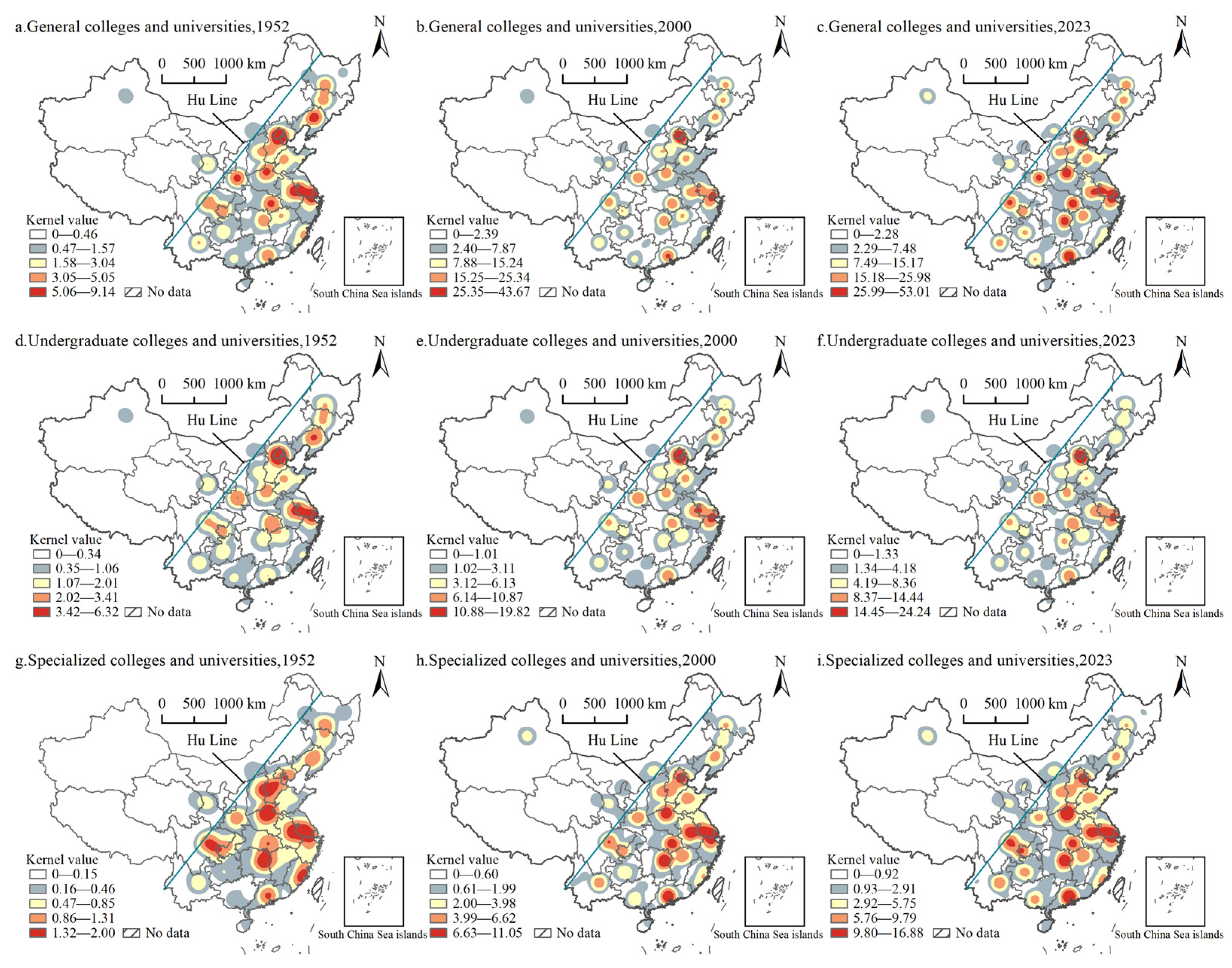
- From 1952 to 2023, the number of higher education institutions in China has shown a continuous upward trend. Their spatial clustering distribution pattern has become increasingly pronounced, with the primary aggregation centers located east of the Beijing Ring Line. The spatial distribution exhibits a northeast–southwest orientation, mirroring the distribution direction. This evolutionary trend reflects the gradual formation of a spatially sustainable layout that balances agglomeration efficiency and diffusion equity, laying the foundation for long-term stable development of higher education.
- (2)
- Results of geographic exploration reveal significant differences in influencing factors’ degrees of explanation of spatial differentiation. Among the factors are the number of full-time instructors, GDP, the number of R.O.C. national universities, and educational expenditures. Year-end highway mileage is a secondary influencing factor. Thus, HEIs’ spatial distribution results from the combined influence of multiple factors. The synergy of these factors is crucial for building a sustainable higher education ecosystem, where economic input provides the foundation, faculty strength guarantees quality, historical heritage offers continuity, and policy guidance optimizes equity.
- (3)
- The results of the MGWR model show that HEIs are concentrated in areas with high GDP levels, and their influence decreases from east to west in a circle. In the northwest and southwest regions, HEI construction relies on faculty strength more strongly than in other regions. The influence of historical background decreases stepwise from the core of the four southwestern provinces (districts) of Yungui–Guizhou–Sichuan–Guangxi to the northeast. Education expenditures significantly and positively impact HEIs’ distribution, especially in the southeast coastal region. These spatial heterogeneities imply that sustainable higher education development requires differentiated strategies, adapting to local conditions to avoid a “one-size-fits-all” approach and ensuring that resource allocation is both efficient and equitable.
- (4)
- Based on the above conclusions, the study formulated the following actionable recommendations aimed at promoting equitable access to resources: Establish a dynamic adjustment mechanism for higher education aligned with regional development: Implement differentiated policies across regions based on the spatial heterogeneity of influencing factors revealed by the MGWR model. In economically developed eastern regions, prioritize supporting universities in achieving breakthroughs in high-end, cutting-edge fields to strengthen the synergistic innovation effect between GDP and higher education. In central and western regions, prioritize faculty development through initiatives like “talent recruitment programs” and “teacher training projects” to enhance both the quantity and quality of full-time instructors. Simultaneously, leverage historical educational resources such as the sites of national universities from the Republican era to preserve institutional heritage. For central and western areas experiencing mismatches between GDP and higher education development, guide universities to establish programs aligned with local industrial needs (e.g., rural revitalization, specialty agriculture, regional cultural tourism), achieving precise alignment between higher education distribution and regional socioeconomic development (Cohen E).
Author Contributions
Funding
Institutional Review Board Statement
Informed Consent Statement
Data Availability Statement
Conflicts of Interest
Abbreviations
| HEI | Higher education institutions |
| MGWR | Multi-scale Geographically Weighted Regression |
| NNI | Nearest Neighbor Index |
References
- Gu, H.; Shen, T. Spatial evolution characteristics and driving forces of Chinese highly educated talents. Acta Geogr. Sin. 2021, 76, 326–340. [Google Scholar]
- Chen, W.Y.; Cai, Q.F.; Chen, Z.J. University agglomeration, knowledge spillover and the cultivation of specialized, fined, peculiar and innovative “little giant” enterprises. Educ. Res. 2022, 43, 47–65. [Google Scholar]
- Zhang, X.C.; Yu, Z.Y.; Li, S.H. Spatio-temporal characteristics and knowledge spillover effects of basic research output in Chinese colleges and universities. Econ. Geogr. 2024, 44, 118–126. [Google Scholar]
- Li, S.; Liu, Z.T.; Chen, S.J. China’s road to the construction of a powerful country in higher education. J. High. Educ. Manag. 2024, 18, 1–23. [Google Scholar]
- Gun, P.J. Comprehensive reform of higher education: Key points, difficulties and methods. China High. Educ. Res. 2024, 5, 1–12. [Google Scholar]
- Li, L.G.; Li, J.; Xu, L. High-quality development of higher education in the context of invigorating China through education (journal articles)-understanding the principles of the national education conference. J. Northwest. Polytech. Univ. (Soc. Sci.) 2024, 4, 1–14. [Google Scholar]
- Samuelson, P.A. The pure theory of public expenditure. Rev. Econ. Stat. 1954, 36, 387. [Google Scholar] [CrossRef]
- Su, X. Endogenous determination of public budget allocation across education stages. J. Dev. Econ. 2006, 81, 438–456. [Google Scholar] [CrossRef]
- Bowles, S. The efficient allocation of resources in education. Q. J. Econ. 1967, 81, 189. [Google Scholar] [CrossRef]
- Sallee, J.M.; Resch, A.M.; Courant, P.N. On the optimal allocation of students and resources in a system of higher education. BE J. Econom. Anal. Policy 2008, 8, 11. [Google Scholar] [CrossRef]
- Izadi, H.; Johnes, G.; Oskrochi, R.; Crouchley, R. Stochastic frontier estimation of a CES cost function: The case of higher education in Britain. Econ. Educ. Rev. 2002, 21, 890–899. [Google Scholar] [CrossRef]
- Ribeiro, A.; Antuens, A.P. A GIS-based decision support tool for public facility planning. Environ. Plan. B Plan. Des. 2002, 29, 553–569. [Google Scholar] [CrossRef]
- Tijs, N.; Tim, S.; Frank, W. Evaluating the temporal organization of public service provision using space-time accessibility analysis. Urban Geogr. 2010, 31, 1039–1064. [Google Scholar] [CrossRef]
- Li, H. The spatial distribution characteristics of China higher education institutions and their influential factors. J. High. Educ. 2021, 42, 40–47. [Google Scholar]
- Jiang, W.; Gao, W.D.; Zhang, M. Spatial distribution of higher education in China: Recent changes and influencing factors. Mod. Univ. Educ. 2013, 1, 43–50. [Google Scholar]
- Tian, H.R.; Li, L.G. The layout of higher education agglomeration and its effect on regional innovation—An empirical study based on Chinese and American data. Educ. Res. 2024, 7, 92–107. [Google Scholar]
- Gao, S.C.; Wu, L.J.; Li, P. Spatial pattern of regional imbalance of higher education and its causes in China. Areal Res. Dev. 2020, 39, 12–17. [Google Scholar]
- Zhang, X.D.; Han, H.Y.; Liu, S.; Tang, Y.J. Spatial distribution characteristics and influencing factors of educational facilities in China. Areal Res. Dev. 2022, 41, 19–25. [Google Scholar]
- Wang, X.W.; Li, X.J. Characteristics and influencing factors of the key villages of rural tourism in China. Acta Geogr. Sin. 2022, 77, 900–917. [Google Scholar]
- Shu, R.; Xiao, J.; Yang, Y.; Kong, X. The evolution of spatiotemporal patterns and influencing factors of high-level tourist attractions in the Yellow River Basin. Front. Earth Sci. 2020, 40, 70–80. [Google Scholar] [CrossRef]
- Kim, J.; Park, S. The evolution of university spatial agglomeration in South Korea: Evidence from kernel density and gravity center analysis. Asia Pac. Educ. Rev. 2024, 25, 187–201. [Google Scholar]
- Wang, G.X.; Li, M. The spatial interaction between inter-provincial migration and manufacturing industry transfer. Sci. Geogr. Sin. 2019, 39, 183–194. [Google Scholar]
- Ning, Z.D.; Wang, T.; Yang, X.C. Spatio-temporal evolution of tourist attractions and formation of their clusters in China since 2001. Geogr. Res. 2020, 39, 1654–1666. [Google Scholar]
- Wang, J.F.; Xu, C.D. Geodetector: Principle and prospective. Acta Geogr. Sin. 2017, 72, 116–134. [Google Scholar]
- Fotheringham, A.S.; Yang, W.; Kang, W. Multiscale geographically weighted regression (MGWR). Ann. Assoc. Am. Geogr. 2017, 107, 1247–1265. [Google Scholar] [CrossRef]
- Huang, F.J.; Tang, J.Q.; Lin, H.L. Built environment effects on the spatio-temporal distribution of shared bikes based on multi-scale geographic weighted regression. Geogr. Res. 2023, 42, 2405–2418. [Google Scholar]
- Wang, Y.C. The evolution of the spatial distribution pattern of higher education institutions in China and its influencing factors. Jiangsu High. Educ. 2022, 12, 39–47. [Google Scholar]
- Liu, G.R. The evolution characteristics of China higher education spatial distribution and its development trends. J. High. Educ. 2019, 40, 1–9. [Google Scholar]
- Zhou, G.L.; Zhao, Z.C.; Geng, M.R. Spatial layout of higher education resources and its impact on regional technological innovation capabilities—An empirical study based on China’s five major urban agglomerations. Mod. Univ. Educ. 2023, 39, 66–75+112. [Google Scholar]



| Time | 1952 | 1978 | 2000 | 2014 | 2023 |
|---|---|---|---|---|---|
| Rc | 0.347 | 0.330 | 0.296 | 0.270 | 0.273 |
| Rs | 0.380 | 0.287 | 0.240 | 0.270 | 0.258 |
| Rh | 0.290 | 0.194 | 0.173 | 0.166 | 0.169 |
| Influencing Factors | Factor (Unit) | q-Value | p-Value | Order of Explanatory Power |
|---|---|---|---|---|
| Population size | Registered population (persons) | 0.264 | 0.00 | 5 |
| Society and economy | GDP (100 million yuan) | 0.495 | 0.00 | 2 |
| GDP per capita (yuan) | 0.126 | 0.00 | 8 | |
| Government expenditure on education (ten thousand yuan) | 0.419 | 0.00 | 4 | |
| Number of full-time teachers in HEIs (persons) | 0.683 | 0.00 | 1 | |
| Proportion of nonagricultural industries (%) | 0.147 | 0.00 | 7 | |
| Year-end road mileage (km) | 0.073 | 0.40 | 10 | |
| Urbanization rate (%) | 0.197 | 0.00 | 6 | |
| Policy support | Number of references to “colleges and universities” in the Government’s annual work report (times) | 0.079 | 0.01 | 9 |
| Historical background | Number of national universities in the Republic of China era | 0.433 | 0.00 | 3 |
| Variable | Bandwidth | Mean | Standard Deviation | Minimum | Median | Maximum |
|---|---|---|---|---|---|---|
| GDP | 110 | 0.050 | 0.161 | −0.137 | 0.002 | 0.362 |
| Number of full-time teachers in universities | 45 | 0.743 | 0.173 | 0.286 | 0.780 | 1.041 |
| Number of national universities in the Republic of China era | 290 | 0.040 | 0.003 | 0.033 | 0.040 | 0.045 |
| Government expenditure on education | 290 | 0.162 | 0.004 | 0.149 | 0.163 | 0.169 |
Disclaimer/Publisher’s Note: The statements, opinions and data contained in all publications are solely those of the individual author(s) and contributor(s) and not of MDPI and/or the editor(s). MDPI and/or the editor(s) disclaim responsibility for any injury to people or property resulting from any ideas, methods, instructions or products referred to in the content. |
© 2025 by the authors. Licensee MDPI, Basel, Switzerland. This article is an open access article distributed under the terms and conditions of the Creative Commons Attribution (CC BY) license (https://creativecommons.org/licenses/by/4.0/).
Share and Cite
Sun, J.; Zhang, J.; Chen, M.; Yang, F.; Cui, J.; Luo, J. Spatiotemporal Evolution Characteristics and Influencing Factors of China’s Ordinary Colleges and Universities. Sustainability 2025, 17, 11310. https://doi.org/10.3390/su172411310
Sun J, Zhang J, Chen M, Yang F, Cui J, Luo J. Spatiotemporal Evolution Characteristics and Influencing Factors of China’s Ordinary Colleges and Universities. Sustainability. 2025; 17(24):11310. https://doi.org/10.3390/su172411310
Chicago/Turabian StyleSun, Jianwei, Jixin Zhang, Mengchan Chen, Fangqin Yang, Jiaxing Cui, and Jing Luo. 2025. "Spatiotemporal Evolution Characteristics and Influencing Factors of China’s Ordinary Colleges and Universities" Sustainability 17, no. 24: 11310. https://doi.org/10.3390/su172411310
APA StyleSun, J., Zhang, J., Chen, M., Yang, F., Cui, J., & Luo, J. (2025). Spatiotemporal Evolution Characteristics and Influencing Factors of China’s Ordinary Colleges and Universities. Sustainability, 17(24), 11310. https://doi.org/10.3390/su172411310