Article

Concept of the Development and Rehabilitation of Green Infrastructure for Territorial Communities of Ukraine


by
Mykola Malashevskyi
1,* and
Olena Malashevska
2
1
Land Management Institute, National Academy of Agrarian Sciences of Ukraine, 03022 Kyiv, Ukraine
2
Geodesy and Cartography Department, National University of Life and Environmental Sciences of Ukraine, 03041 Kyiv, Ukraine
*
Author to whom correspondence should be addressed.
Sustainability 2025, 17(24), 11106; https://doi.org/10.3390/su172411106
Submission received: 31 October 2025 / Revised: 29 November 2025 / Accepted: 8 December 2025 / Published: 11 December 2025

Abstract

For the development of a green future, managerial decision making at the local level plays an important role. The study is dedicated to the analysis of the current state of green areas, and development and rehabilitation of green areas in the territorial communities of Ukraine. The goal of the study is the development of a set of measures to create a sustainable green infrastructure at the local level in Ukraine. The main trends of green land policies by territorial communities were substantiated: keeping the natural afforestation of agricultural land; the development and rehabilitation of water conservation zones, windbreak belts, anti-erosion forests, green belts of inhabited areas, and nature conservation or recreation areas; and promoting gardening. A land reallotment methodology, which allows for the expansion of a spatial environment for the development and rehabilitation of green areas was suggested. The methods and approaches presented were tested in the Petrivska Territorial Community of Kyiv Region. The presented measures allow for an increase the green area of a territorial community by 1,084,352 m2. The approach allows for the minimization of the condemnation of land from landowners, creates a more comfortable environment for the population, facilitates the effectiveness of agriculture due to containing the erosion, and conservation of natural landscapes. The research findings approved that the main challenges for the implementation of green policies are the acquisition of land for green areas in the environment of the historically established land use, and controlling the sustainable use of green areas and their surroundings responsibly to prevent their violation.

1. Introduction

Improving management for a greener future is a global issue. The goals of the Bonn challenge on forest landscape restoration [1], the Paris Agreement [2], the convention on biological diversity [3], the EU’s biodiversity strategy for 2030 [4], and the sustainable development goals (goals 11, 13, and 15) [5] uphold it. A forest and landscape restoration model is suggested within the framework of the UN Decade on Ecosystem Restoration [6]. Threats to the ecosystems are logging, peat and marsh reclamation, shoreline erosion, and agricultural land overuse [7]. Recent studies substantiate expanding the Bonn challenge to non-forest ecosystems [8].
For a greener future, the development and conservation of the environment, combining green and blue urban zones [9,10], agricultural lands, and natural areas [11], is a major challenge.
Also, some recent studies have been dedicated to the development of green and blue spaces [12] (green and blue spaces [13]), urban green spaces [14], and green stormwater infrastructure [15,16], as well as ecosystem services [17,18,19].
The development of green infrastructure and green zones is aimed at goals like adaptation to the climate change [20,21], improving the social and economic situation in urban areas [13,22], biodiversity conservation [23,24,25,26], natural disaster prevention [27], the development of a favorable living environment [28], and improving landscapes [29]. Cook et al. [30] singles out 15 green infrastructure objectives, to include the management of raw materials and soil remediation.
Most of the studies uphold the idea that green infrastructure is applicable to both the city and the village [10]; therefore, it should be incorporated into the existing structure of the urban and rural landscape [31].
One of the most challenging issues is the practical implementation of green infrastructure measures, i.e., the development of those green infrastructure elements for which land allocation is necessary. Spatial planning is considered from this perspective [20]. Considerable attention is paid to the issue of green infrastructure placement [32] and its accessibility [33]. A study on the determination of the placement of green infrastructure by the value of the land is practical [34]. However, the allocation of land for green infrastructure within the established land use system, especially private land, was out of the focus of the existing studies.
These issues are challenging in Ukraine. On the one hand, there is an urgent need for the development, restoration, and conservation of bodies, which can be constituents of green infrastructure in Ukraine. The reasons are insufficient forest cover, urbanization [35], lack of effective inventory and outdated data on the green areas in cities [36], uncontrolled logging, fires, and warfare, etc. [37]. The development and conservation of bodies, which can be considered as green infrastructure, is generally predefined by the legislation of Ukraine [38,39,40]. The Paris Agreement and a number of conventions were ratified to include the Convention on Biological Diversity [41], European Landscape Convention [42], Framework Convention on the Protection and Sustainable Development of the Carpathians [43], Convention for the Protection of the Architectural Heritage [44], and Convention on the Conservation of European Wildlife and Natural Habitats [45], etc. However, in reality, green infrastructure is being developed, restored, conserved, and registered in a non-systemic way. The current condition of green infrastructure is poor in terms of both quality and quantity. The challenges of warfare are not being considered. At the current stage, there is no concept which could align the existing city planning, land management, and environmental rules and regulations of Ukraine, as well as the investment policies and advanced green infrastructure development practice.
The need for the interlinking decision making on green infrastructure as a constituent of green policies at the local level, i.e., the level of territorial communities, is pointed out in the presented study. At the current stage, there is evidence that the government leadership can play a key role in implementing green infrastructure for stormwater management [46]. The evaluation of a landscape’s effectiveness proves its efficiency at the local level, and there are prospects for using such data in a broader area [47].
The goal of the study is the development of a set of measures to create green infrastructure at the local level in Ukraine.

2. Materials and Methods

2.1. Theoretical Background

The development, restoration, and conservation of green infrastructure at the local level have a number of challenges in Ukraine. The following issues should be considered. In 2014, decentralization was launched in Ukraine, i.e., the process of transferring authority and fiscal power from central and local bodies of executive power to regional and local self-governing authorities. Territorial communities manage communal property, adopt social and economic development programs and control them, approve budgets and control them, and impose taxes and levies directly or through bodies of local self-governing authorities, created by them.
Decentralization envisaged the alteration of administrative divisions of the country. Actually, it was the enlargement of settlements. As of 2014, there were 29,742 settlements [48], and after the alteration of administrative divisions in 2020—1439 territorial communities with the total area of 570,697 km2 were created. The newly created territorial communities obtained more areas and more power, for example, they obtained 15,000 km2 of agricultural land, which was previously governed by the regional authorities [49].
This reform caused the alteration of land use and conservation. The government bodies, previously responsible for land use and conservation were dissolved and their authorities were transferred to the territorial communities. In reality, territorial communities faced the problem of exercising their power. Legislation on land use and land conservation adopted over the course of decentralization fails to provide unified mechanisms and practical recommendations on land conservation at the local level.
Most newly established territorial communities do not have a full land inventory and have no information on the condition of the land. They also have no effective control mechanisms. Territorial communities are faced with the issues of green infrastructure inventory, development and restoration of green infrastructure, conservation and monitoring the green infrastructure, and control of the use of green infrastructure in the course of economic, managerial, and other activities, introducing economic incentives for the development and conservation of green infrastructure; public control of use; and conservation of green infrastructure. This introduces increased liability for the violation of the use and conservation of green infrastructure.
In this study, the term green infrastructure used in the acceptation is provided by the European Commission [9] to be “a strategically planned network of natural and semi-natural areas with other environmental features designed and managed to deliver a wide range of ecosystem services. It incorporates green spaces (or blue if aquatic ecosystems are concerned) and other physical features in terrestrial (including coastal) and marine areas”.
Green land policies of A territorial community are the green policies implemented by local self-governing authorities with the participation of local citizens of the territorial community on the development, conservation, restoration, and cultivation of green infrastructure for the sustainable development of the territorial community. Green land policies are harmonized with the EU Green Infrastructure Strategy [9].
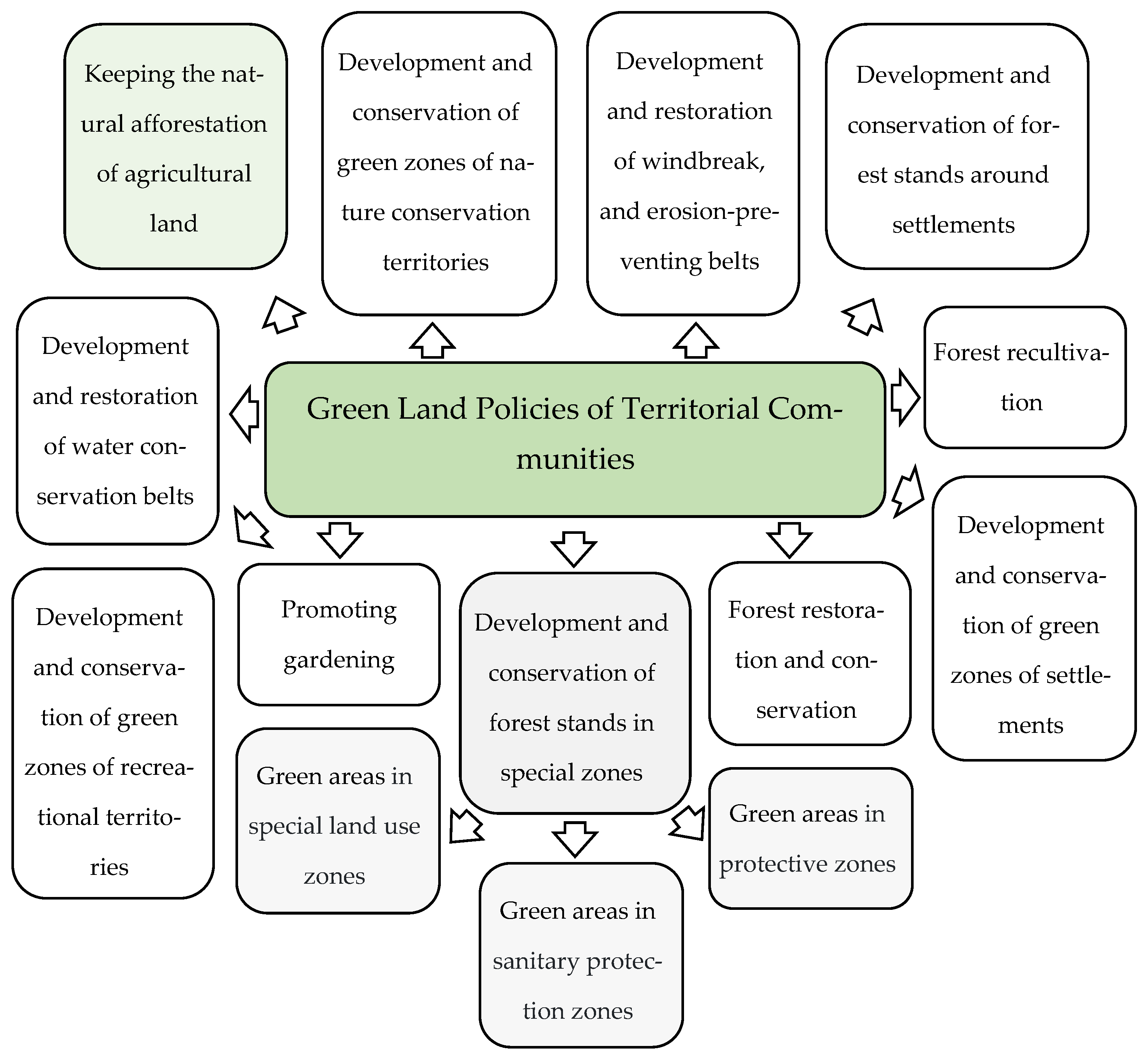
The main areas of green land policies of territorial communities are as follows: keeping the natural afforestation of agricultural land, the development and restoration of water conservation, windbreak, and erosion-preventing belts, green zones of inhabited areas, forest stands around settlements, green zones of nature conservation, and recreational territories, as well as promoting gardening (Figure 1).
The forest cover of Ukraine is about 16% [50], whereas 20% is considered to be optimum [51]. The area of land, subject to natural afforestation, is estimated at 5000 km2 in Ukraine [52].
There are urgent problems of chaotic and uncontrolled logging and residential development on forest land and windbreaks in Ukraine.
It causes climate change and negative natural phenomena. About 57 % of the territory of Ukraine is affected by water and wind erosion, and more than 12 % of the territory of Ukraine is subject to flooding [53].
Windbreaks and erosion-control forest belts, i.e., linear forest ranges 3 to 21 m wide depending on the purpose, are important for territorial communities. On flat land, the windbreak network helps decrease the speed of wind, facilitates the distribution of snow on the surface, retains humidity, and decreases air aridity and soil congelation. Windbreaks facilitate the absorption of runoff and help prevent soil erosion on the slopes. Windbreaks are placed on flat land and slopes of more than 2°, and along ravines and gullies. The placement of forested riparian buffers is necessary [54].
In addition to windbreaks, special forest stands in sanitary protection zones, protective zones, and exclusive land use zones should be developed. Sanitary protection zones are designed around potentially dangerous enterprises and cemeteries, etc., for protection against negative impacts like air contamination, noise, and vibration, etc. Protective zones are created around natural monuments and objects of cultural heritage in order to protect them from anthropogenic impacts [55]. Exclusive land use zones are developed around dangerous facilities [55] to ensure the safe use of these facilities, and to protect civilians, infrastructure, and the environment from emergency situations, natural disasters, and fires that can occur on these facilities.
The greening of settlements should be in line with the rules and regulations in effect [56], and allow for the formation of public green zones, i.e., green zones in residential areas, and restricted-use green zones, i.e., those on the territory of public buildings and residential houses, educational establishments, and hospitals, etc., as well as the special green zones, for example, transport routes and streets [39]. Green belts around cities should be developed or conserved [57].
Only 6.8% of the territory of Ukraine is a nature reserve fund [58]. The legislation of Ukraine suggests increasing this index to 15% by 2030 [53]. One of the most challenging issues is the lack of demarcated boundaries of nature reserve fund, which causes the violation of reservation conditions [53], and reservation of areas for the development of protected areas in the future.
The development of green infrastructure is even more challenging due to warfare in Ukraine [59]. The existing green infrastructure is demolished, and the possibilities for the development of new objects are limited. Green infrastructure is exposed to explosions, fires, contamination, land mines, flooding due to the destruction of the Kakhovka Damand the dam on the Irpin’ river, and extensive logging [60], etc. It is worth mentioning that woods and forests are usually demined last of all.

2.2. Algorithm of the Green Infrastructure Development by Territorial Communities

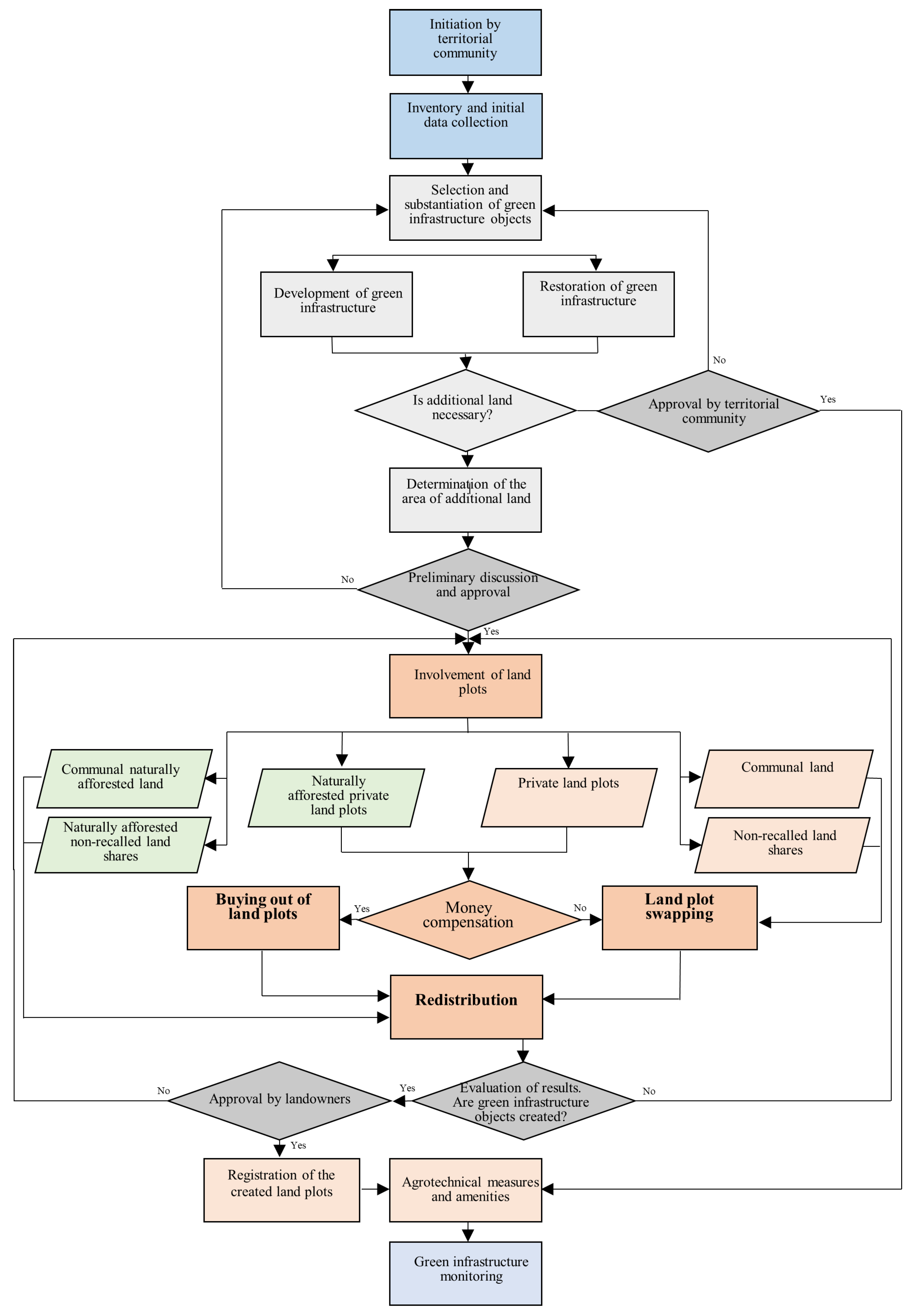
The following steps are suggested for the effective implementation of green policies in territorial communities (Figure 2):
  • The territorial community opens the procedure of development and restoration of green infrastructure.
  • Examination of the territory for the evaluation of the current condition of land and green infrastructure. The preconditions for the development and restoration of green areas by the territorial communities of Ukraine should be singled out. Full inventory of lands and green areas should be carried out in accordance with the legislation of Ukraine.
  • Based on the analysis, according to the main green land policies (Figure 1), the development or restoration of green infrastructure is substantiated. The following green infrastructure objects are selected:
    • Objects, for the development of which some land should be allocated, for example, windbreaks on agricultural land, new parks in cities, and nature conservation territories, etc.
    • Objects, for the development of which the allocation of additional land is not necessary, for example, green roofs, façade, and wall greening, etc.
    • Objects, for the restoration of which some land should be allocated, for example, expanding the windbreak for better wind protection and increasing the width of a street for greening, etc.
    • Objects, for the restoration of which the allocation of additional land is not necessary, i.e., existing objects, the greening of which should be improve by: planting the new and clearing the old trees and bushes, restoring the lawns, and soil rehabilitation, etc.
  • The project’s review and approval is predefined by the need for land allocation. In the case that there is no need for additional land, the project is reviewed and approved by the local self-governing authorities like the city or village council. When the project is approved, the next stage is agrotechnical measures and improvements like tree and bush planting; development of lawns; weed control; plant protection from pests and diseases; preparation of soil for planting, soil maintenance, irrigation, nutrient application, covering, tree and bush pruning, crown shaping, and treatment of hollows; clearing of rivers and other water bodies from aggradations, deposits, and obstructions; clearing and bed degradation of canals and ponds; and the restoration of amelioration systems [39], etc.;
In the event that there is a need for additional land for the development or restoration of green infrastructure, the matter is discussed with all of the parties involved in the process. The discussion is attended by members of the territorial community, owners of land plots in the community, representatives of city and regional state administrations (authorities), public organizations, and certified specialists in land management, geodesy, urban planning, assessment, and ecology.
5.
The area Sgi, necessary for the development or restoration of green infrastructure of the territorial community, is calculated. The area is determined based on the rules and regulations in effect (Table 1).
6.
It is suggested to place the green infrastructure on the reallotted land. One of the most challenging stages is providing land plots for reallotment. These are land plots for sale, land plots owned by the territorial community, escheated inheritance, and non-recalled land shares [61,68]. The “land reserve” SR—the basis of reallotment—is formed with these lands. Also, naturally afforested agricultural land plots of private and communal ownership, as well as non-recalled land shares, are involved in the process of reallotment with the subsequent transferring these lands to forest land. Private naturally afforested land plots are the area Sgi.
7.
Calculation, if the reserve area is sufficient for the placement of green infrastructure:
S g i S R
In case that condition (1) is not fulfilled, it is necessary to select additional land plots, which can be involved in the reallotment with the owners’ consent.
8.
The multitude N of options, by which the reallotment can be carried out, is [64]
N = S S M
sup S S N = S 0
inf S S N = 2 S a f P + S a f C + S N
where M—is the multitude of reallotment options, which is characterized by the area of land plots S, involved into the reallotment; S0—is the area of project territory; SafP—is the total area of the private afforested land plots; SafC—is the total area of the communal afforested land plots; and SafN—the total area of the afforested non-recalled land shares and escheated inheritance.
According to formulae (2)–(4), the lowest area, which enables the project to launch, is limited to the least and largest possible area of land plots involved into the project, is the basis for the calculation of land reallotment options [69], selection of the best options, development of optimization models, exclusion of separate land plots, and consideration the constraints of reallotment, for example, buildings and structures or amelioration facilities [70].
9.
Private land plots involved in the project are bought out or swapped. There are three reallotment options for the owners of afforested land plots:
  • Buying out of such land plots by the market price;
  • Swapping for the equal non-afforested land plots;
  • Swapping for the land plots for gardening.
For the reallotment, the value of a basic land plot VB of each designated use is determined. It is the market value of a typical land plot, which is selected as the basic. The value is determined in accordance with the legislation [71].
The exchange with the non-afforested land plots is calculated by the following formula:
S p = V B A × K k a × K r a × K p l a × K f a × K h a × K s a × S a V r V B A × K k p × K r p × K p l p × K f p × K h p × K s p ,
where SP is the area of an arable land plot, which is swapped for the afforested land plot; VBA—is the value of 1 m2 of a basic arable land plot; Kka—is the correction coefficient of the configuration of an afforested land plot (it is 0.85 to 1.15, and is determined according to method [72]); Kra—is the correction coefficient of the relief of an afforested land plot (it is 0.85 to 1.15, and is determined according to method [73]); Kpla—is the correction coefficient of the placement of an afforested land plot, which is defined in the same way as the correction factor for land plots within the nature conservation territory, recreation zone, sanitary protection zone, or water conservation zone [74]; Kfa—is the correction coefficient of the fertility of an afforested land plot (it is determined by the bonitet ball of basic and projected land plots [70]; it is 0.50 to 1.50); Kha—is the correction coefficient of the hydrological and geological conditions of an afforested land plot (it is determined in the same way as the correction factors for land plots in the zone of groundwater occurrences of less than 3 m, in floodable or swamp zones [74]); Ksa—is the correction coefficient of the area of an afforested land plot (it is determined based on the market analysis and difference in the value of 1 m2 of land plots of various areas. The factor is used for the correction in the value of 1 m2 of land plots, smaller than 2500 m2 for agricultural land plots); Sa is the area of the afforested land plot; Vr—is the cost of clearing the land plot from the natural afforestation, the factor is determined based on the market statistical data from the open sources; Kkp—is the correction coefficient of the configuration of an arable land plot (it is 0.85 to 1.15, and is determined according to method [72]); Krp—is the correction coefficient of the relief of an arable land plot (it is 0.85 to 1.15, and is determined according to method [73]); Kplp—is the correction coefficient of the placement of an arable land plot, which is defined in the same way as the correction factor for land plots within the nature conservation territory, recreation zone, sanitary protection zone, or water conservation zone [74]; Kfp—is the correction coefficient of the fertility of an arable land plot (it is determined by the bonitet ball of basic and projected land plots [70]; it is 0.50 to 1.50); Khp—is the correction coefficient of the hydrological and geological conditions of an arable land plot (it is determined in the same way as the correction factors for land plots in the zone of groundwater occurrences of less than 3 m, in floodable or swamp zones [74]); and Ksp—is the correction coefficient of the area of an arable land plot (it is determined based on the market analysis and difference in the value of 1 m2 of land plots of various areas. The factor is used for the correction of the value of 1 m2 of land plots, smaller than 2500 m2 for agricultural land plots).
  • Swapping for the land plots for gardening:
S g = V B A × K k a × K r a × K p l a × K f a × K h a × S a V r V B G × K k g × K r g × K p lg × K f g × K h g ,
where Sg is the area of a land plot for gardening, which is swapped for the afforested land plot; VBA—is the value of 1 m2 of a basic arable land plot; Kka—is the correction coefficient of the configuration of an afforested land plot (it is 0.85 to 1.15, and is determined according to the method in [72]); Kra—is the correction coefficient of the relief of an afforested land plot (it is 0.85 to 1.15, and is determined according to the method in [73]); Kpla—is the correction coefficient of the placement of an afforested land plot, which is defined in the same way as the correction factor for land plots within the nature conservation territory, recreation zone, sanitary protection zone, or water conservation zone [74]; Kfa—is the correction coefficient of the fertility of an afforested land plot (it is determined by the bonitet ball of basic and projected land plots [70]; it is 0.50 to 1.50); Kha—is the correction coefficient of the hydrological and geological conditions of an afforested land plot (it is determined in the same way as the correction factors for land plots in the zone of groundwater occurrences of less than 3 m, in floodable or swamp zones [74]); Ksa—is the correction coefficient of the area of an afforested land plot (it is determined based on the market analysis and difference in the value of 1 m2 of land plots of various areas. The factor is used for the correction in the value of 1 m2 of land plots, smaller than 2500 m2 for agricultural land plots); Sa is the area of the afforested land plot; Vr—is the cost of clearing the land plot from natural afforestation, the factor is determined based on the market statistical data from open sources; VBG—is the value of 1 m2 of a basic land plot for gardening; Kkg—is the correction coefficient of the configuration of a land plot for gardening (it is 0.85 to 1.15, and is determined according to the method in [72]); Krg—is the correction coefficient of the relief of a land plot for gardening (it is 0.85 to 1.15, and is determined according to method [73]); Kplg—is the correction coefficient of the placement of a land plot for gardening, which is defined in the same way as the correction factor for land plots within the nature conservation territory, recreation zone, sanitary protection zone, or water conservation zone [74]; Kfg—is the correction coefficient of the fertility of a land plot for gardening (it is determined by the bonitet ball of basic and projected land plots [70]; it is 0.50 to 1.50); Khg—is the correction coefficient of the hydrological and geological conditions of a land plot for gardening (it is determined in the same way as the correction factors for land plots in the zone of groundwater occurrences of less than 3 m, in floodable or swamp zones [74]); and Ksg—is the correction coefficient of the area of a land plot for gardening (it is determined based on market analysis and differences by a value of 1 m2 in the land plots of various areas. The factor is used for the correction in the value of 1 m2 of land plots, smaller than 400 m2 of those for gardening).
10.
Reallotment is carried out on the basis of sale and purchase or exchange agreements according to the legislation of Ukraine. Peer land plot exchange is envisaged [69].
The main condition is that the value of a private land plot after the reallotment should be equal or higher than the value of the land plot before reallotment.
The distinctive feature of the method is that the green infrastructure is developed in the environment of naturally afforested agricultural lands, which is widespread in Ukraine [61]. Buying out naturally afforested land plots is not the only option, swapping for peer land plots is possible, to include those used for gardening.
11.
The developed land reallotment plan is approved, the effectiveness of the project is evaluated. At the final stage, the reallotted land plots are registered in the State Land Cadastre of Ukraine.
12.
Development of measures on green infrastructure monitoring and their implementation.
The research is based on the data from the State Land Cadastre of Ukraine, National Geospatial Data Infrastructure, Topographical Database Geoportal, and the Territorial Community Integrated Development Concept. To provide data at the stage of analysis of existing land use, land inventory data (technical documentation) are used, including land management projects for establishing the boundaries of the territories of territorial communities, land management projects for organizing and establishing the boundaries of the territories of the nature reserve fund, recreational, forestry purposes, water fund lands, water protection zones, and restrictions on land use.
At the stage of substantiating the location of green infrastructure objects and determining their area, reports on strategic environmental assessments, land management, and urban planning documentation are analyzed: land management schemes and feasibility studies for the use and protection of lands of territorial communities, a comprehensive plan for the spatial development of the territory of the territorial community, master plans of settlements, and detailed plans of the territory and zoning plans. Satellite images and field measurements are used as necessary.

3. Results

3.1. Green Land Policies of Territorial Communities

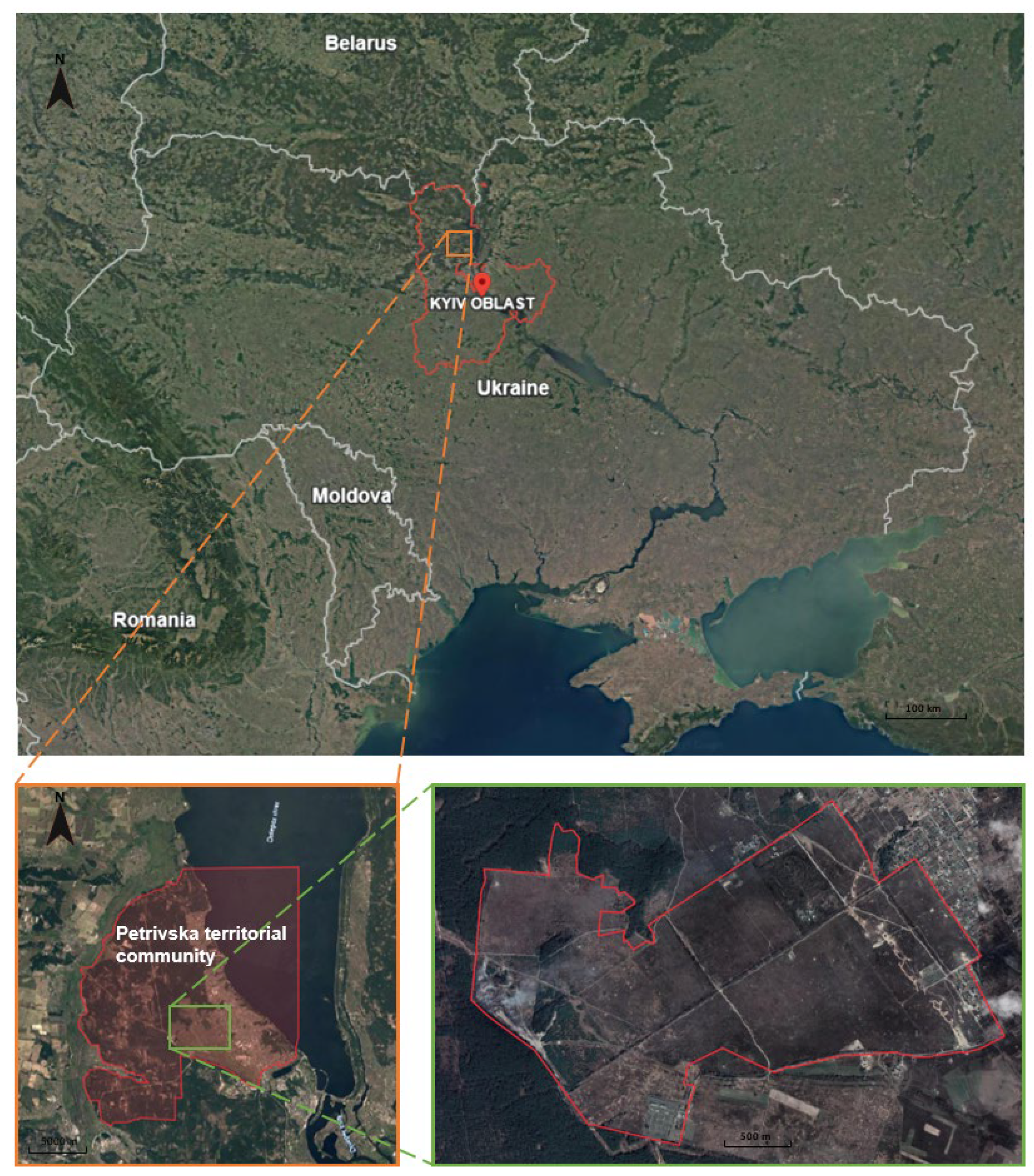
A typical territorial community with high financial capabilities [75] and the potential for the development of green infrastructure is Petrivska Village Territorial Community. The territorial community is situated in the Vyshhorodsky District of the Kyiv Region (Figure 3). The distance from the center of the territorial community to the capital of Ukraine—Kyiv—is 24 km.
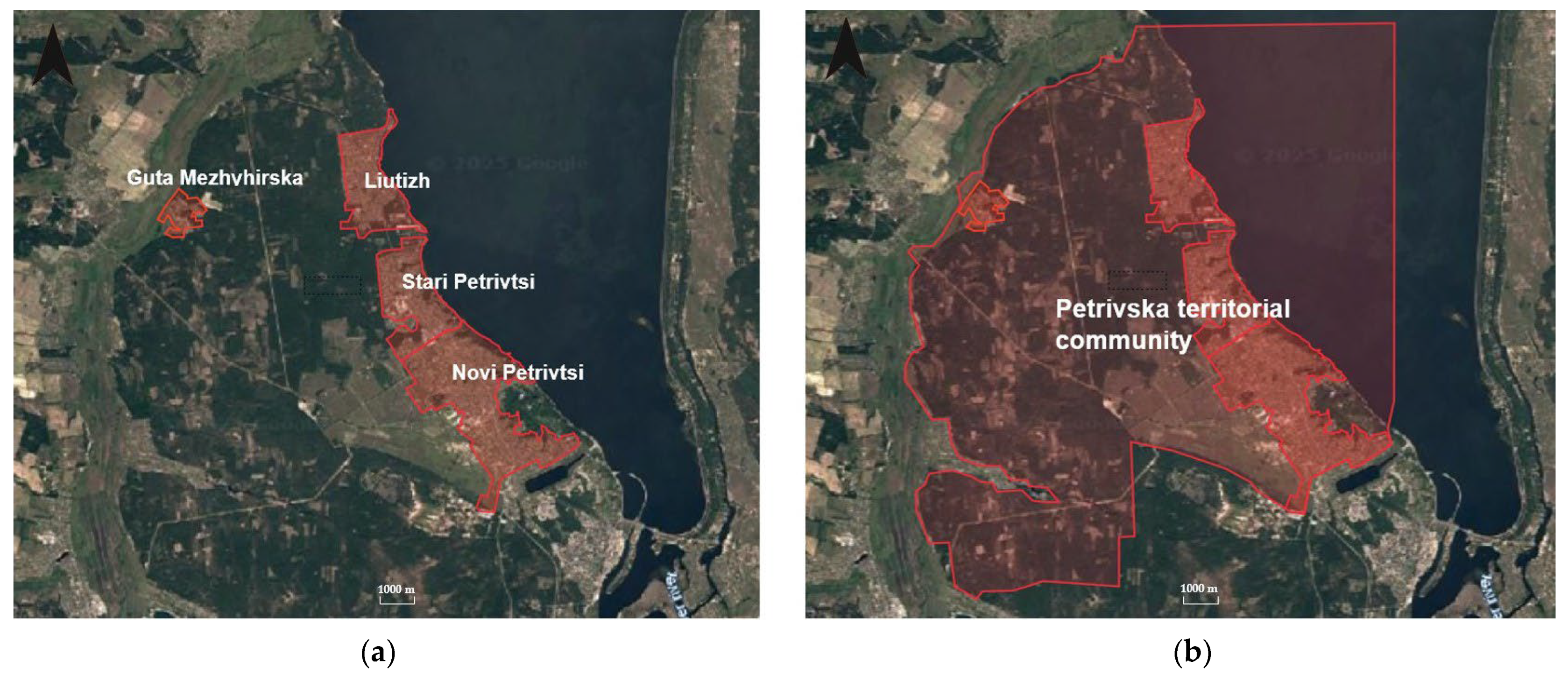
Petrivska Village Territorial Community, with a total area of 192.6 km2, was established in 2020 by the amalgamation of four settlements: Guta Mezhyhirska village (area 5.7 km2), Liutizh village (area 12.2 km2), Novi Petrivtsi village (area 21.1 km2), and Stari Petrivtsi village (area 9.6 km2) (Figure 4).
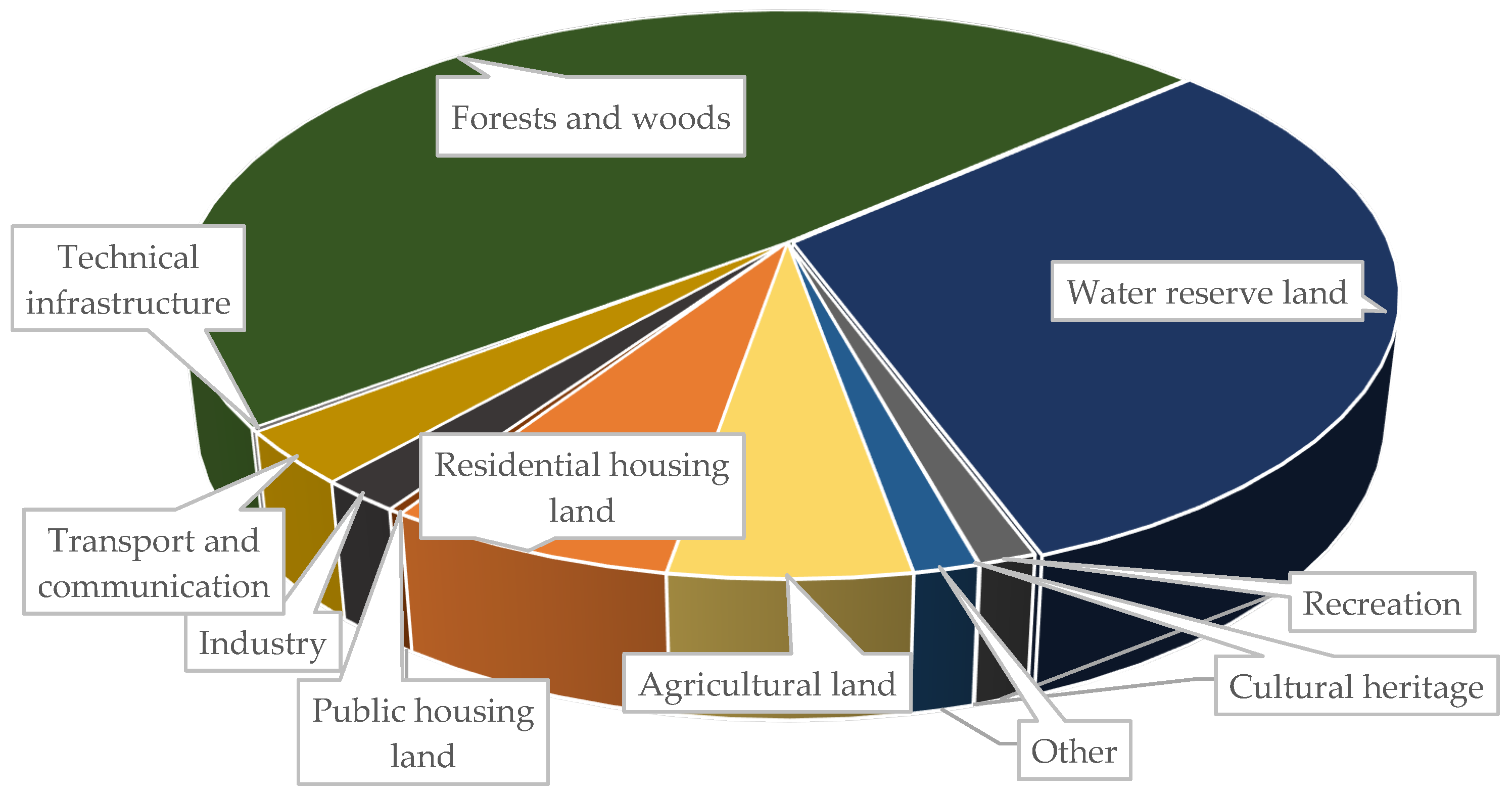
Most of the territory of the Petrivska Territorial Community is covered with forest: 48.1%; the coastal and water area of the Kyiv Reservoir is 26.6% of the territory. The community borders on the Irpin’ river. After amalgamation, 144.8 km2 of land, previously placed out of the settlements, was included into the territorial community. Now, this land is 18.6% agricultural land, 98,8% water reserve land, 87.8% forest, 59.9% technical infrastructure land, and 12.5% recreation land for the community [76] (Figure 5). That is, the former village communities, which constituted the Petrivska Territorial Community in 2020, do not own or manage this land.
The land of Petrivska Territorial Community is highly productive [76]. The prevailing soils are as follows: loess and loess-like clay loam, sand, sand clay, limestone, clay, and adobe. There is 1.4 km2 of drained land, 2.9 km2 of irrigated land, amelioration facilities, and seven natural reserve fund objects in the territorial community [76]:
  • Volodymyra Duby local botanical natural monument, which is three oak trees. The total area is 0.03 ha.
  • Dzvinkova Krynytsya local hydrological natural monument. The total area is 2.5 ha. It is a unique, historically significant spring, situated in Dzvinky ravine in Novy Petrivtsi village.
  • Grabovyi Lis local landscape reserve with the area of 0.8 km2 is a natural territory, where animal and vegetal species that are rare and under the threat of extinction are conserved. Dzvinkova Krynytsya local hydrological natural monument and Volodymyra Duby local botanical natural monument are situated in the territory of the Grabovyi Lis local landscape reserve.
  • Novopetrivskiy Geologichniy Rozriz local geological natural monument has an area of 20,000 m2. It is the exposed layers of Paleogene and Neogene rocks at the bank of the Kyiv Reservoir.
  • Lisova Kazka Ravine reserve.
  • Botanichna local botanical natural monument.
  • Mezhyhiriya national park and garden art monument with the area of 1.4 km2.
Some facilities of the Emerald Network (UA0000094 and UA0000342), i.e., Kyiv Reservoir and the Irpin river valley [77], are situated in Petrivska Village Territorial Community.
According to the Updated Regional Ecological Network of Kyiv Region [78], the Irpin’ Natural Corridor, which is situated in the center of Kyiv Polissya and includes the Irpin river valley and its adjacent forests, is situated in the territorial community. The Ecological Corridor is a part of the bypass corridor system of the Dniprovskiy Ecological Corridor around Kyiv.
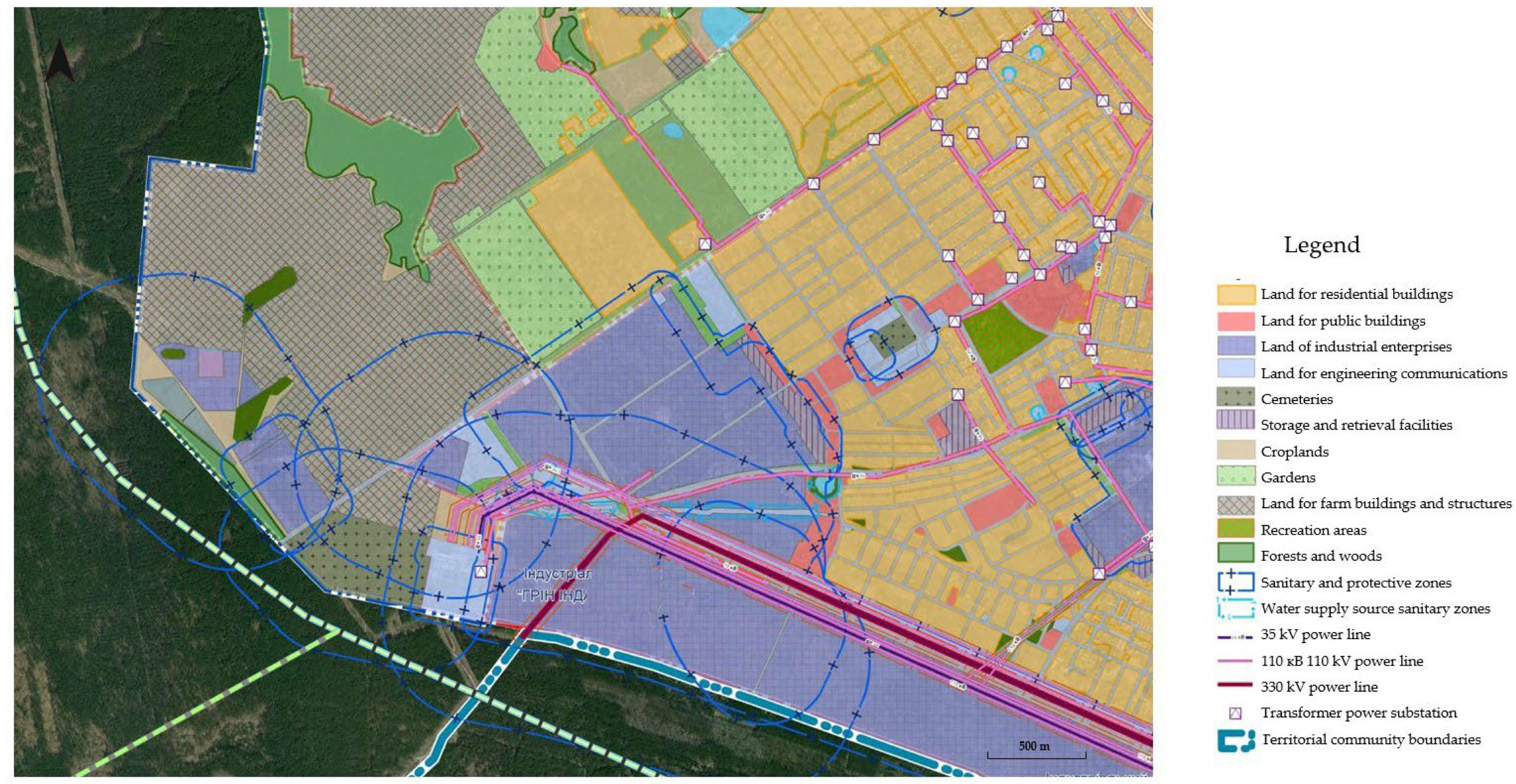
Land management is a challenge for the Petrivska Territorial Community. According to the Petrivska Territorial Community Development Strategy to 2035, strengthening economic stability and encouragement of investment is envisaged [76]. Let us go over the planned land use alteration of the project’s territory in order to achieve the goals. It is planned to alter the designated use of 3.9 km2 of agricultural land to industrial areas, farm buildings and structures, and farmsteads. The designated use of land plots for gardening is to be left unchanged. Retaining forest cover on areas like windbreaks and naturally afforested land plots is not envisaged (Figure 6).
These alterations of designated use will likely cause increased anthropogenic pressure on the environment [76] and not resolve the issues of the green infrastructure.
One of the major problems is the lack of regular environmental monitoring, including the monitoring of land resources. Recommendations on the evaluation of the condition of land resources, and their restoration and rational use are necessary [76].
The public spaces and built-up areas of the territorial community require greening [76]. In the territorial community, 33000 m2 of forest were lost due to warfare [79]. The forests that were transferred to the community should be evaluated in terms of their rational use and recreation potential [76].
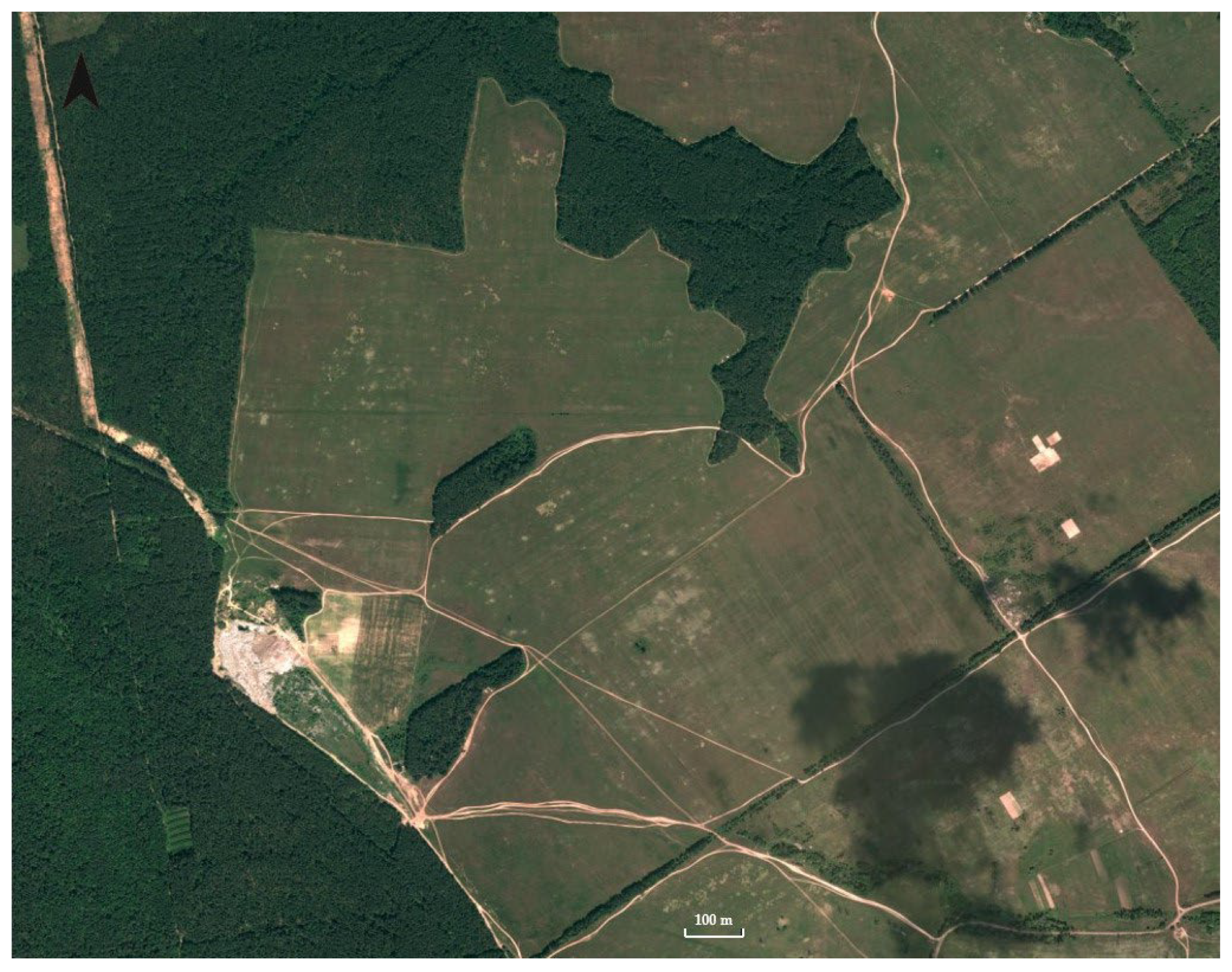
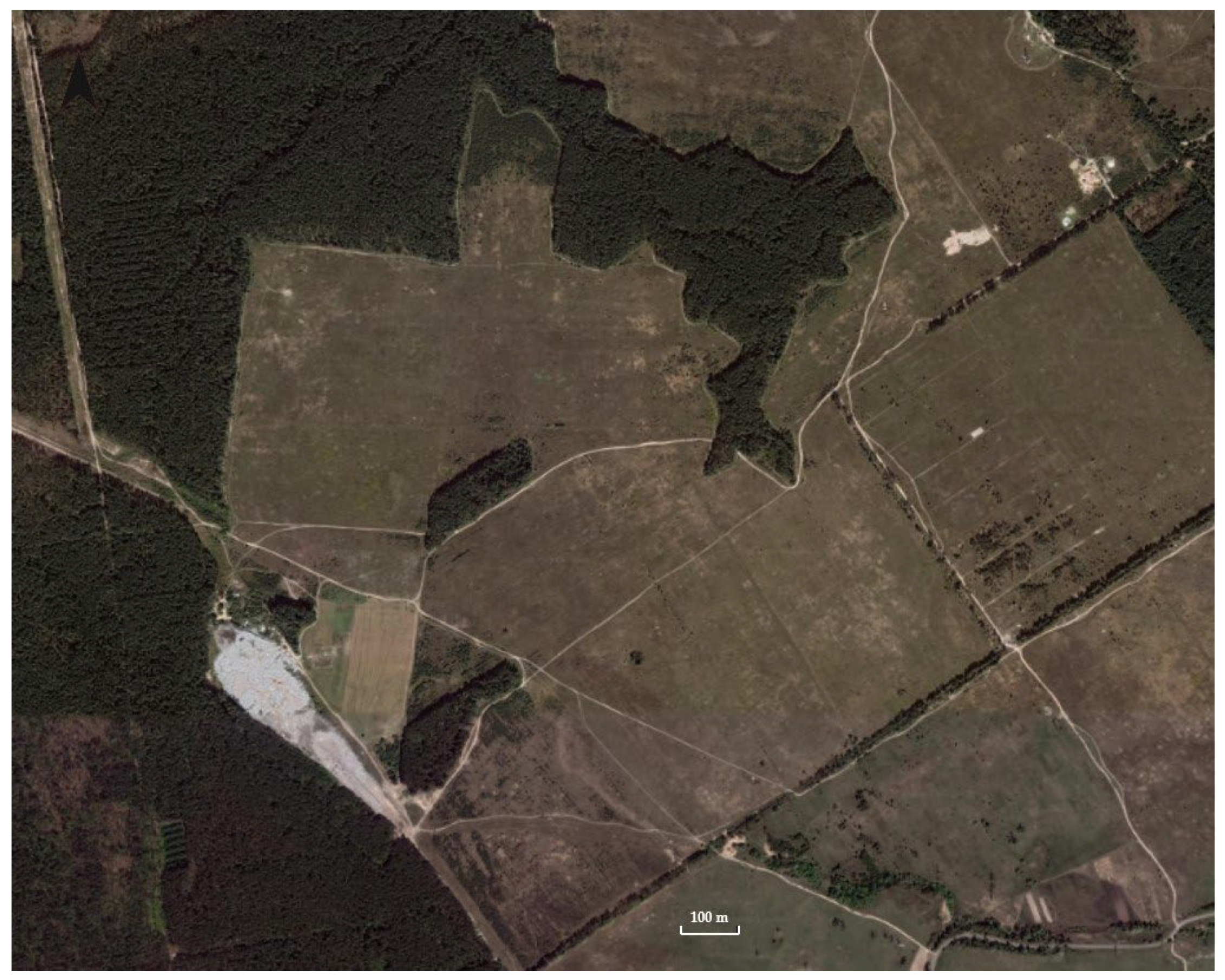
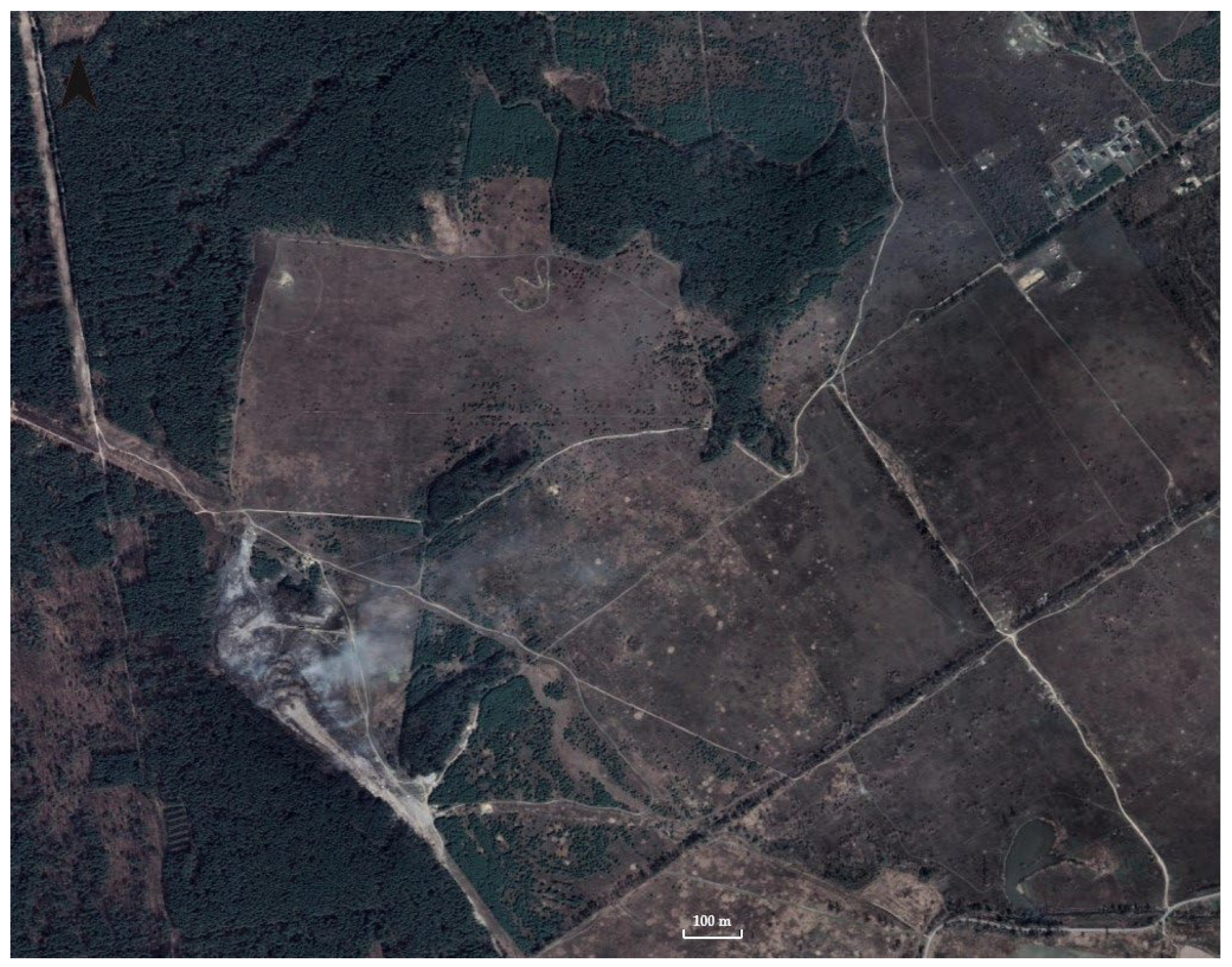
There is the issue of agricultural land natural afforestation in the Petrivska Territorial Community. The land relations reforming process included transferring of land from collective agricultural enterprises to private farms and agricultural holdings 30 years ago. In some cases, agricultural land was not cultivated for a protracted period of time in the course of altering the form of ownership, which caused partial afforestation. In most cases, this process developed on agricultural land, adjacent to woods and forests. Also, agricultural land adjacent to windbreaks was naturally afforested [61]. At the current stage, the naturally afforested agricultural land of the territorial community cannot be used for agriculture without clearing from the young forest (Figure 7, Figure 8 and Figure 9).
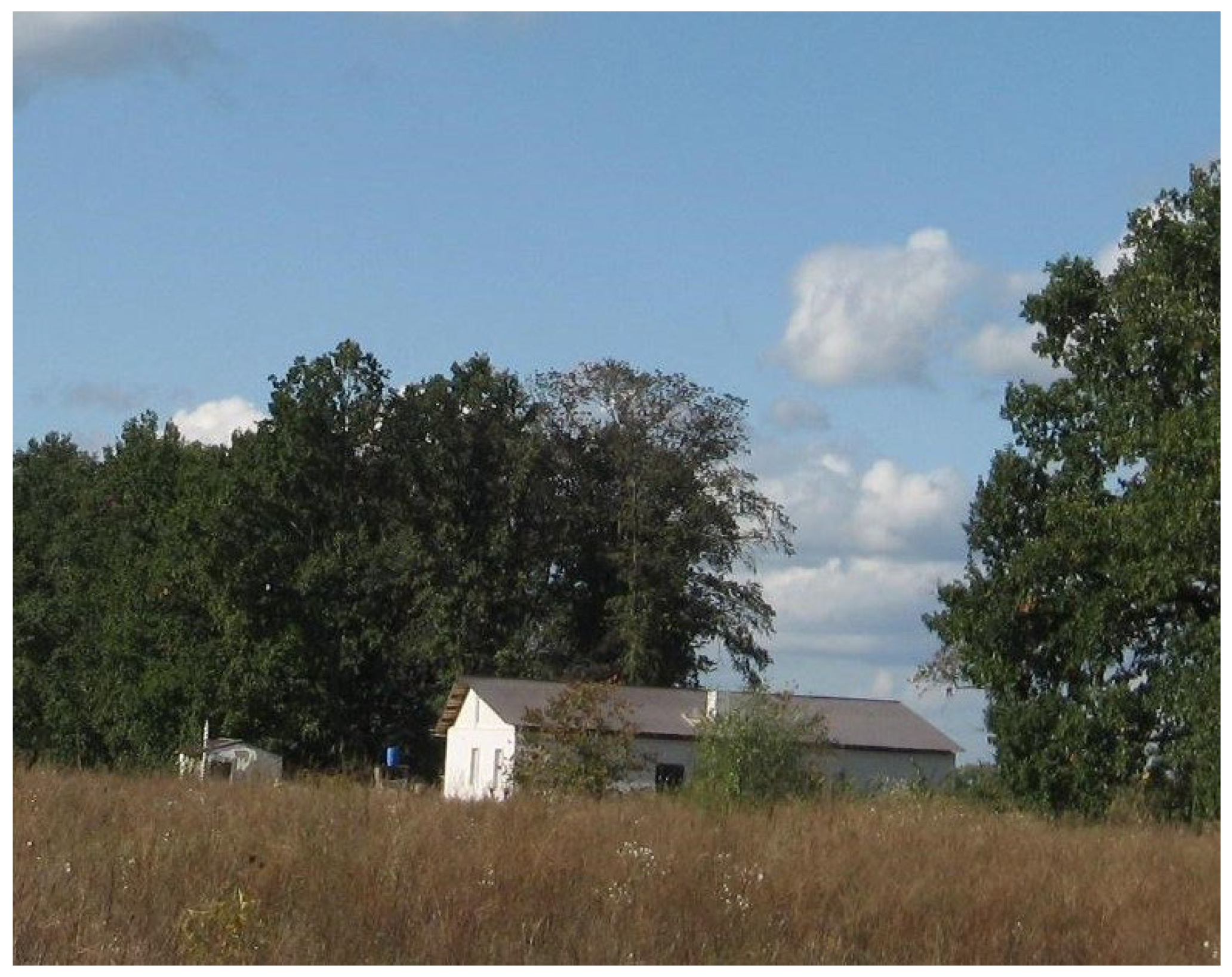
Windbreak maintenance is a challenge for most territorial communities in Ukraine. The owner of most of the windbreaks was not defined for a protracted period of time. It is also due to land relations reforming on a par with natural afforestation. Most windbreaks in Ukraine were planted more than 70 years ago and need maintenance and restoration, for example, the need for thinning is proven [80]; “porosity 40–50% between the trunks and 0–10% in crowns”. In the case that the designated use of agricultural land is altered to build up an area, windbreaks are considered to lose their purpose and are usually cleared. Windbreaks are usually 5 to 15 m wide, depending on relief and other factors. The main windbreaks are placed every 250 to 600 m, depending on the soil and climate zone; auxiliary windbreaks are placed perpendicular to the main windbreaks every 1500 to 2000 m. Windbreaks occupy a significant share of agricultural land masses: about 2–5%. This land is often subject to development (Figure 10).
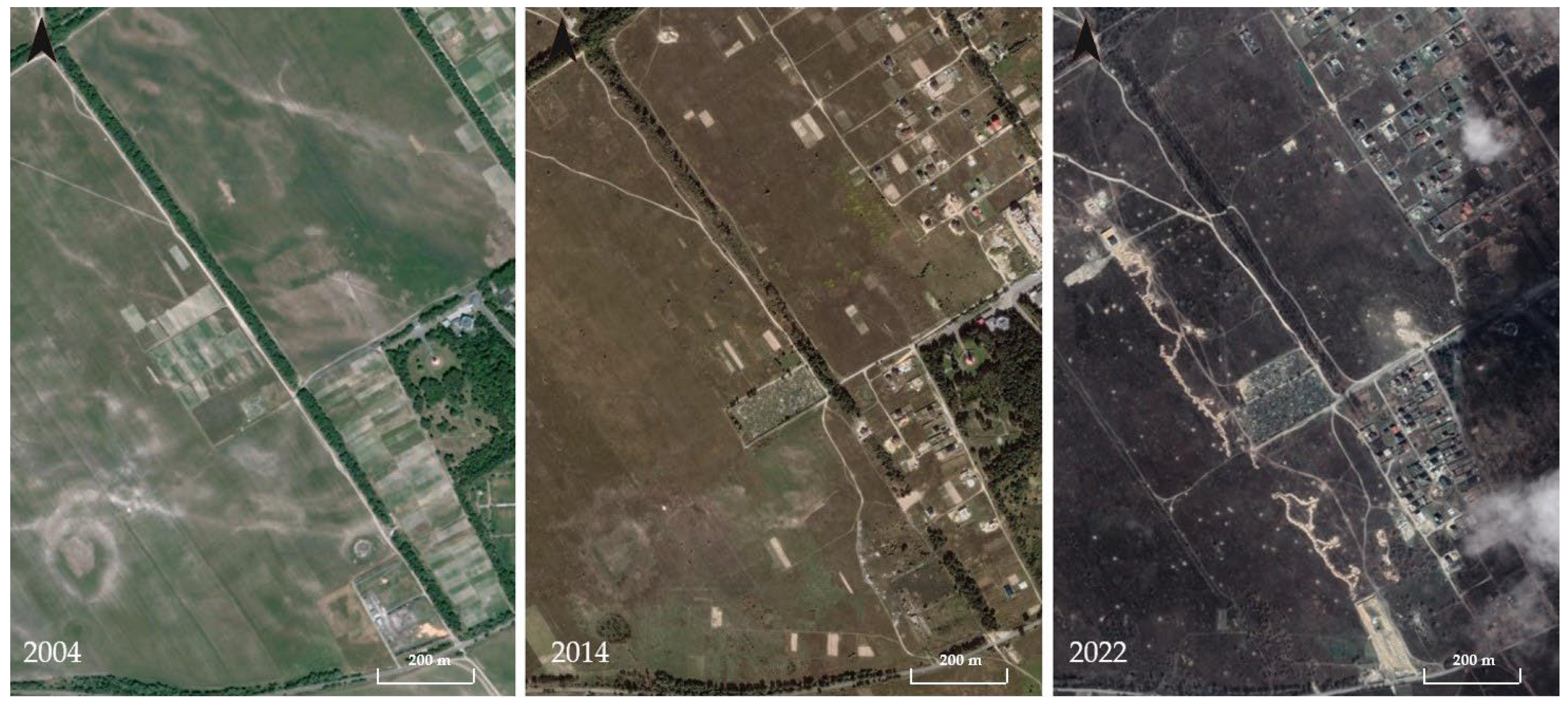
The windbreak within the project’s territory was gradually cleared during the last two decades (Figure 11). It is practically destroyed now. The restoration of the windbreak in the future is not envisaged by the planning documentation. Some trees still exist at the moment. However, one of the main impediments is that the land where the windbreak is placed was transferred to private housing development.
A traditional cemetery is situated next to the windbreak. According to the rules and regulations of Ukraine in effect, a green sanitary protection zone should be developed around the cemetery. The distance to houses and public buildings, recreational zones, collective gardens, and plots should at least 300 m [81], the lowest width of the green belt should be 20 m, and the percentage of greening at least 40%. Therefore, the restoration of the windbreak is reasonable as well as the development of a green sanitary protection zone around the cemetery.
In the Petrivska Territorial Community, the designated use of some agricultural land masses is altered to housing development [82]. The field roads on the agricultural land masses are usually 5 m wide. With designated use, altered from agriculture to development, a network of streets should be formed according to the rules and regulations for the developed areas: the width of the street should be at least 15 m and it should have the respective greening [82]. In this case, the land area should be provided for the development of a street network.
The analysis of the territory shows that the allocation of land is needed for the development or restoration of infrastructure. With the established private land ownership, it is suggested to resolve this issue with the help of land reallotment.

3.2. Land Reallotment Method for the Development and Restoration of Green Areas

A land reallotment method is presented, which can allow for the retention of the natural afforestation of agricultural land, the development and restoration windbreaks, and can help to promote gardening. The method was approved in the Petrivska Territorial Community on a territory of 6.3 km2 in the south of the Territorial Community. The project territory includes the following types of land use: a private land mass for gardening with the area of 0.6 km2, private agricultural land masses for commercial farming with the total area of 3.5 km2, land masses for personal farming with the area of 0.2 km2, land masses for personal subsidiary farming with the area of 0.3 km2, and state energy sector land with an area of 0.6 km2.
There are the following stages of reallotment:
  • Investigation of the territory and evaluation of prospects for the placement of green infrastructure. It was revealed that it is reasonable to keep the natural afforestation of agricultural land on the area of 1,064,617 m2, adjacent to forest land, and transfer it to forest land. There is a need for the development of a windbreak with the width of 15 m, development of a green sanitary protection zone around the cemetery, and development of a street network with green zones for the built-up areas.
The total area of land for green infrastructure Sgi is
S g i = S a + S b + S S
where Sa—is the total area of naturally afforested land plots; Sb—is the area of land for the developed windbreak; and SS—area of sanitary protection zone around the cemetery.
The area of land for the developed windbreak Sb is calculated according to the width of the windbreak l, and width of the land mass, lm, in the direction perpendicular to the prevailing winds:
S a = l × l m
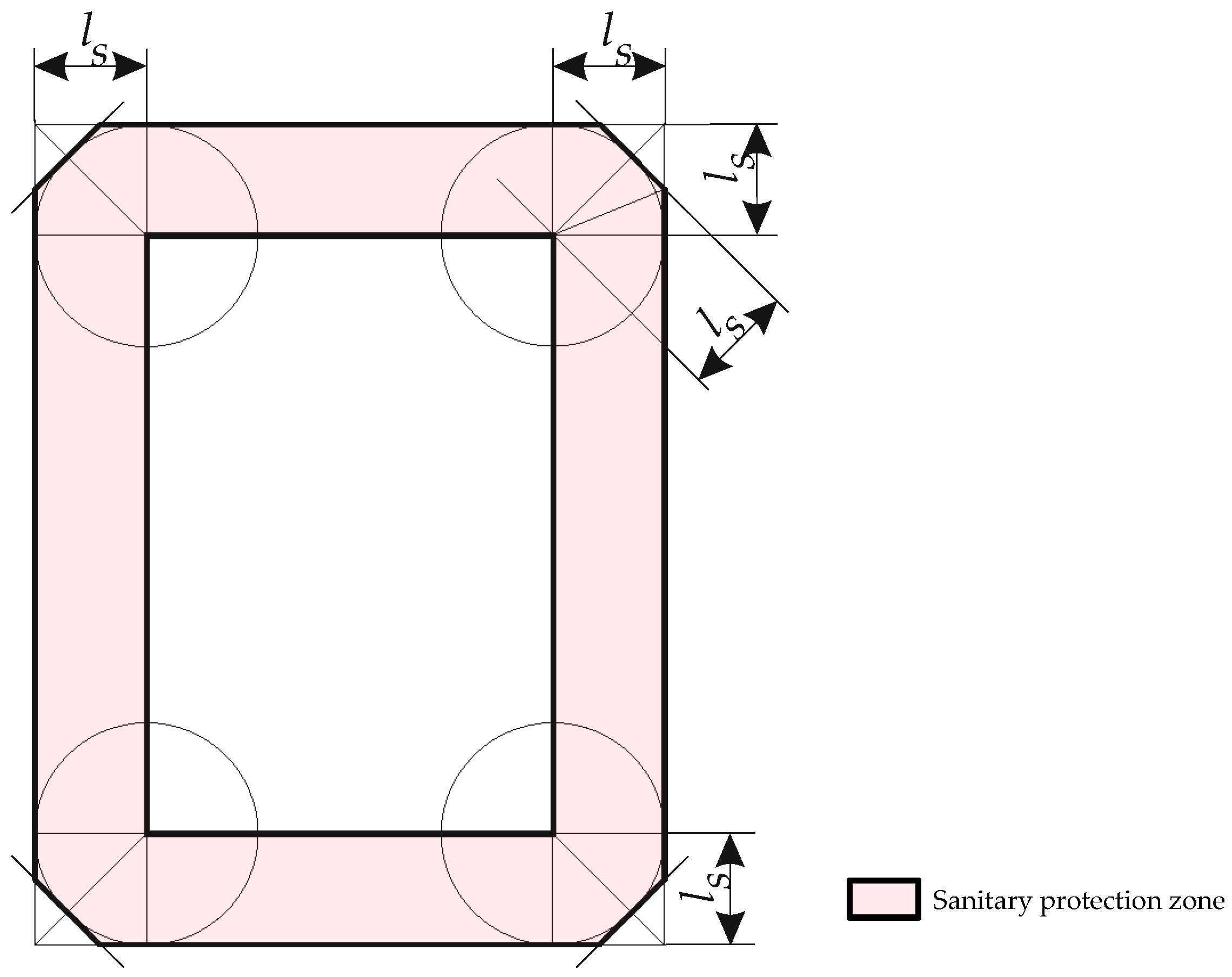
The area of the sanitary protection zone around the cemetery SS is calculated according to the perimeter of the cemetery p and the width of the sanitary protection zone ls (Figure 12):
S s = p × l s + 8 l s 2 × t g 22.5
2.
Land plots for sale are involved into the reallotment. These are agricultural land plots are for commercial farming, private farming, gardening, and afforested land plots. These land plots are bought out at the market price.
3.
The lands, owned by the Territorial Community, for example, roads and windbreaks, etc., are also involved in the reallotment.
4.
Non-recalled land shares and escheated inheritance are also involved in the reallotment [68,82]. It includes agricultural lands and those for gardening.
5.
The “land reserve” SR is formed:
S R = S P + S G + S C + S N ,
where SP—is the total area of bought out private arable lands; SG—is the total area of bought out private land plots for gardening; SC—is the total area of the communal land plots, involved into the reallotment; SN—is the total area of non-recalled land shares and escheated inheritance, involved into the reallotment.
6.
The reallotment of land plots of the project territory with the formation of compact agricultural land plots and forest land plots is carried out.
During the reallotment, afforested land plots were exchanged according to Formulas (5) and (6) for non-afforested agricultural arable land plots (Table 2) and for land plots for gardening (Table 3).
7.
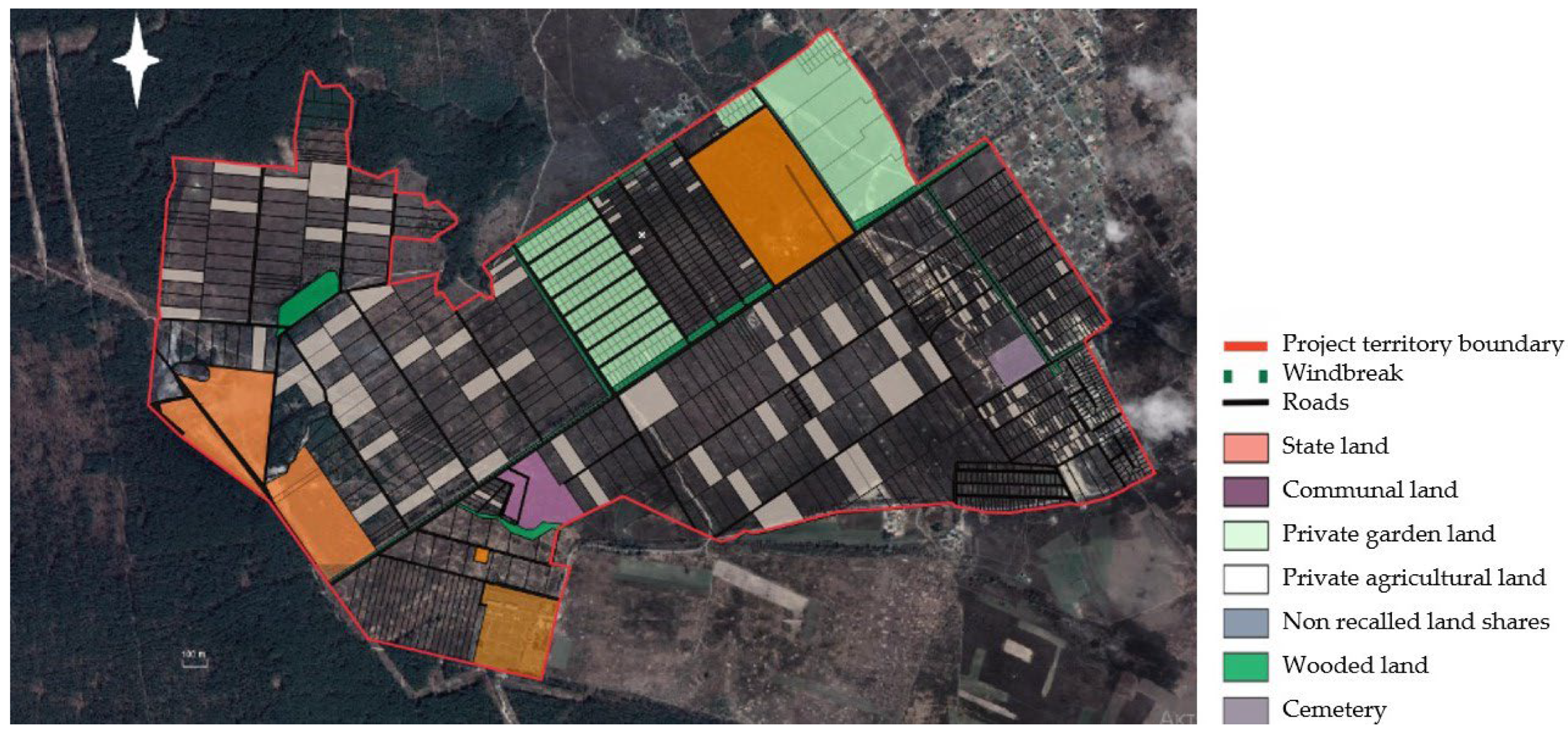
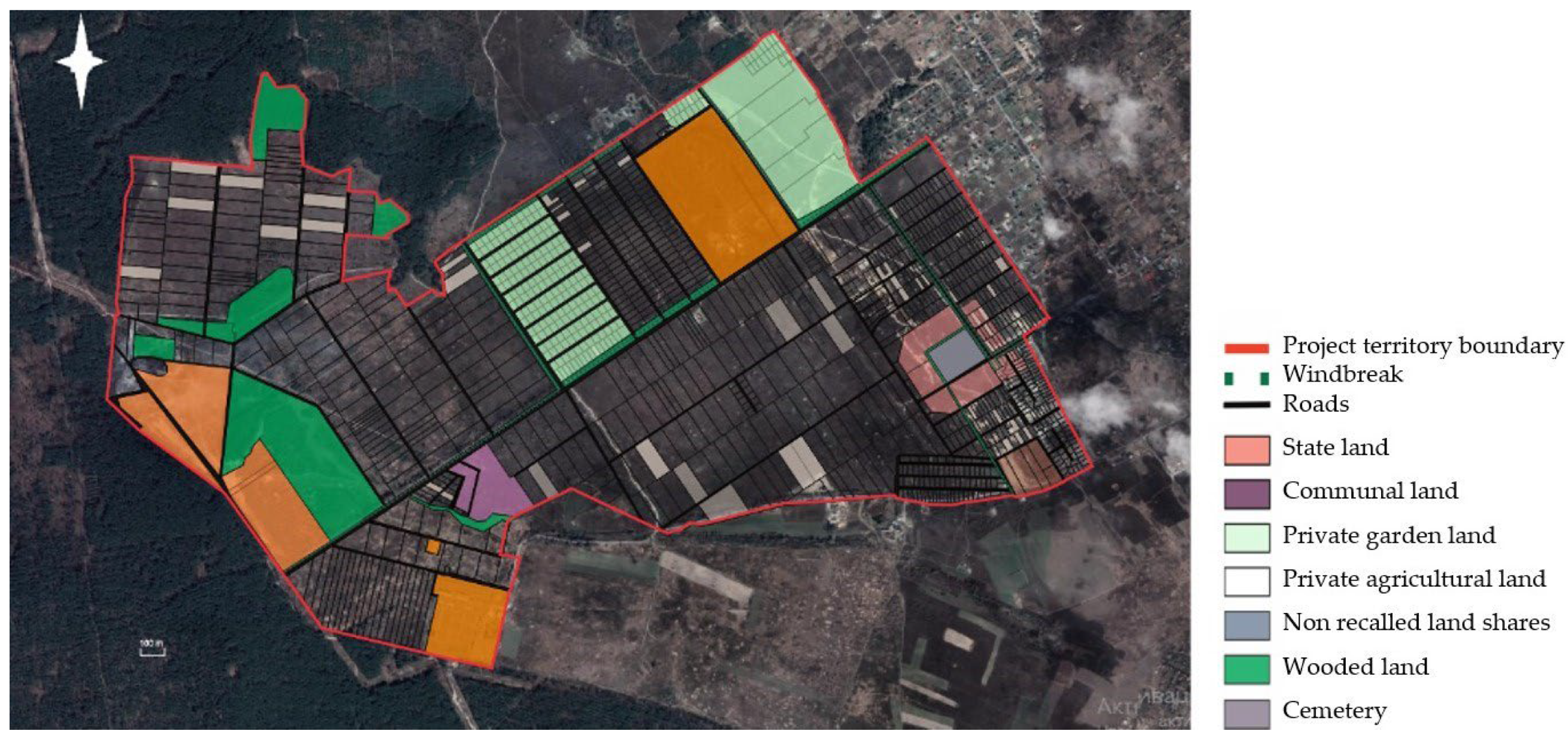
According to the presented method, increasing the green area of the Territorial Community by 1,084,352 m2 is suggested (Figure 13 and Figure 14).
The presented approaches help to minimize the alienation of land plots from their owners, develop a more comfortable environment for the inhabitants, increase the effectiveness of agricultural activities due to erosion control, and conserve natural landscapes.

4. Discussion

The research findings corroborate that the presented measures allow for the development the green infrastructure while retaining the balance of the economic, social and cultural, as well as environmental development at the local level in Ukraine. The study adds to the main concepts of the development of green infrastructure [14,83]. The research outlines some of the ways of incorporating the development of green infrastructure into the territorial community’s land management policies. The study focuses on the allocation and spatial optimization of land for green infrastructure. The mere institutional provision of green infrastructure development is not enough.
The main barrier to the implementation of the green policies is the acquisition of land for the green areas within the established private land tenure. The study focuses on the technical aspect of management for a greener future [84]. The presented method of developing the green infrastructure based on the land reallotment allows for the retention of the established natural sites and incorporates them into the joint green infrastructure system.
The approach to the integration of seral forests into the green infrastructure of urban areas [85] is corroborated in this study. A method of keeping natural afforestation in the rural territorial communities was presented. A solution to this issue in the environment of the established private land was substantiated in the study. The reasons for keeping the natural forests are that such forests are more resilient compared to cultivated ones, and they will be an established ecosystem by the time the green infrastructure project is developed.
The presented approaches align with approaches of land reallotment, which have a positive experience of allocating land for nature conservation [86]. Environmental criteria are considered at reallotment [87]. The presented land reallotment method completes the institutionalization of land consolidation policies in terms of resolving the issue of land abandonment and greener futures [88].
The methodology suggests an evaluation of basic land plots as the basis for reallotment and the swapping land plots of different designated uses. Evaluating the market price of land plots is the gist of the methodology. The market price may be evaluated by various patterns with various correction factors. Land reallotment is carried out with the help of regular transactions like swapping or buying out. The method presented is based on the voluntary participation of landowners. The advantage of this method is that the adoption of additional legislation is not necessary. The alienation of land for community needs is predefined by the legislation of Ukraine [89]; however, there have been virtually no cases of successful land alienation since 2009, i.e., the year of the adoption of the law. Usually, such procedures are lengthy and are often disputed by landowners.
Now, the green infrastructure of urban areas is the focus of most studies. However, the analysis of the territorial communities of Ukraine evidences that it is the green infrastructure of suburban areas which present the most scientific interest. A multifaceted approach to green policies, by considering the demands of village and suburban territorial communities, was suggested in the study. The research findings corroborate that suburban areas are under the anthropogenic impacts of the city and cause its alteration [90]. The development of cities and suburban areas at the expense of green areas is a widespread issue [91,92]. The suburban territorial community under examination is an example of the destruction of agricultural green infrastructure, whereas urban-type green infrastructure is not being developed. The reason for that is the increased demand and value of the built-up land. To create a green area, a significant land area is necessary.
The study has the following limitations. The effectiveness of land reallotment for the green infrastructure depends on the possibility of the involvement of reserve land or a land bank, a developed land market, and sufficient supply of land plots. The insufficient supply of land plots, which can be involved in reallotment, can limit the development of green infrastructure and implementation of the presented approaches by territorial communities.
The presented approach should be substantially adjusted for the territorial communities of big urban centers. The adjustment of the approach to the territorial communities of big urban centers is connected to the challenges of restrained urban conditions, scarce reserve areas [93], and a number of other factors limiting reallotment, compared to rural areas.
In Ukraine, such territorial communities are as follows: Kyiv (area 847.0 km2, population 2,962,200, the capital of Ukraine; economic, political, and cultural center), Kharkiv (area 349.8 km2, population 1,433,886), Odessa (area 161.2 km2, population 1,015,826) Dnipro (area 406.0 km2, population: 983,515), and Zaporizhzhia (area 311.7 km2, population 722,713) [49]. However, the presented methodology is not limited to rural territorial communities. There are 411 urban territorial communities in Ukraine. They still seem to have some preconditions for the development of green infrastructure, and the method of swapping built-up land plots may be used [72]. In addition to that, most urban territorial communities include the adjacent villages, of 411 communities, only 21 consist of 1 urban settlement. For example, the territorial community of one of the largest cities of Ukraine—Lviv—incorporates 20 settlements, of which 15 are villages.
Now, there are examples of the development and restoration of green infrastructure in various territorial communities [61,68,94] which can be incorporated into the presented concept. To apply the methodology to other territories, the characteristics of the green infrastructure object should be determined, and the possibility of developing the land reserve should be present.
Afforestation due to warfare was out of focus of the study. This issue is a separate research line, which should be sufficiently substantiated, and is relevant to some territorial communities only. This research line is a topic for future research.

5. Conclusions

The study allowed us to single out the issues of the development, restoration, and conservation of green infrastructure. According to the analysis, the development of green infrastructure in suburban territories is the most challenging issue due to urbanization at the expense of green areas, destruction of agricultural infrastructure, and lack of urban-type green infrastructure.
It is reasonable to implement green land policies into territorial communities in the following lines: retaining the natural agricultural land afforestation, developing and restoring water conservation, windbreak, and erosion-preventing belts, green zones of inhabited areas, forest stands around settlements, and green zones of nature conservation and recreational territories, as well as promoting gardening.
A land reallotment methodology which allows for the expansion of the spatial environment for the development and rehabilitation of green areas was suggested.
The presented approaches and methods were corroborated by appraisal in the Petrivska Territorial Community of the Kyiv Region. The implementation of measures on green infrastructure allowed for an increase in the green area of the territorial community by 1,084,352 m2, minimized the alienation of land plots, ensured the development of a more comfortable living environment, facilitated agricultural activities by erosion control, and conserved natural landscapes.

Author Contributions

Conceptualization, M.M. and O.M.; methodology, M.M. and O.M.; software, M.M. and O.M.; validation, M.M. and O.M.; formal analysis, M.M. and O.M.; investigation, M.M. and O.M.; resources, M.M. and O.M.; data curation, M.M. and O.M.; writing—original draft preparation, O.M.; writing—review and editing, M.M.; visualization, M.M. and O.M.; supervision, M.M. and O.M.; project administration, M.M. and O.M. All authors have read and agreed to the published version of the manuscript.

Funding

This research received no external funding.

Institutional Review Board Statement

Not applicable.

Informed Consent Statement

Not applicable.

Data Availability Statement

The original contributions presented in the study are included in the article, further inquiries can be directed to the corresponding author.

Acknowledgments

The authors thank Anatoly Bugaienko for language editing.

Conflicts of Interest

The authors declare no conflicts of interest.

References

  1. About The Challenge. Available online: https://www.bonnchallenge.org/about (accessed on 13 May 2025).
  2. The Paris Agreement. Available online: https://unfccc.int/process-and-meetings/the-paris-agreement (accessed on 13 August 2025).
  3. The Convention on Biological Diversity. Available online: https://www.cbd.int/convention (accessed on 18 October 2025).
  4. Biodiversity strategy for 2030. Available online: https://environment.ec.europa.eu/strategy/biodiversity-strategy-2030_en (accessed on 12 August 2025).
  5. The 17 Goals. Available online: https://sdgs.un.org/ru/goals (accessed on 11 October 2025).
  6. Forest and Landscape Restoration. Available online: https://www.fao.org/sustainable-forest-management/toolbox/modules/forest-and-landscape-restoration/basic-knowledge/en/ (accessed on 14 September 2025).
  7. Ecosystem Restoration Playbook. Available online: https://www.decadeonrestoration.org/ecosystem-restoration-playbook (accessed on 29 September 2025).
  8. Temperton, V.; Buchmann, N.; Buisson, E.; Durigan, G.; Kazmierczak, L.; Perring, M.; Dechoum, M.; Veldman, J.; Overbeck, G. Step back from the forest and step up to the Bonn Challenge: How a broad ecological perspective can promote successful landscape restoration. Res. Ecol. 2019, 27, 705–719. [Google Scholar] [CrossRef]
  9. European Commission. Green Infrastructure (GI)—Enhancing Europe’s Natural Capital; Publications Office of the European Union: Luxembourg, 2013. [Google Scholar]
  10. European Commission. Building a Green Infrastructure for Europe; Publications Office of the European Union: Luxembourg, 2013; ISBN 9789279334283. [Google Scholar]
  11. Senes, G.; Lussana, G.; Ferrario, P.S.; Rovelli, R.; Pedrazzoli, A.; Corsini, D.; Fumagalli, N. How Land-Take Impacts the Provision of Ecosystem Services—The Case of the Province of Monza and Brianza (Italy). Land 2025, 14, 1700. [Google Scholar] [CrossRef]
  12. Kimic, K.; Ostrysz, K. Assessment of Blue and Green Infrastructure Solutions in Shaping Urban Public Spaces—Spatial and Functional, Environmental, and Social Aspects. Sustainability 2021, 13, 11041. [Google Scholar] [CrossRef]
  13. Monteiro, R.; Ferreira, J.C.; Antunes, P. Green Infrastructure Planning Principles: An Integrated Literature Review. Land 2020, 9, 525. [Google Scholar] [CrossRef]
  14. Bakolo, C.; Kayitete, L.; de Dieu Tuyizere, J.; Tomlinson, J.; Fawcett, J.; Figueroa Alfaro, R. Identification of optimal locations for green space initiatives through GIS-based multi-criteria analysis and the analytical hierarchy process. Environ. Syst. Res. 2024, 13, 46. [Google Scholar] [CrossRef]
  15. Muleta, T.N.; Knolmar, M. Green Stormwater Infrastructure (GSI) Performance Assessment for Climate Change Resilience in Storm Sewer Network. Water 2025, 17, 2510. [Google Scholar] [CrossRef]
  16. Li, L.; Van Eetvelde, V.; Cheng, X.; Uyttenhove, P. Assessing stormwater runoff reduction capacity of existing green infrastructure in the city of Ghent. Int. J. Sustain. Dev. World Ecol. 2020, 27, 749–761. [Google Scholar] [CrossRef]
  17. Liu, T.; Yang, Y.; Zhang, Y. Informal green spaces providing ecosystem services to solve the green space paradox. Urban Ecosyst. 2025, 28, 157. [Google Scholar] [CrossRef]
  18. Wang, X.; Hu, Q.; Zhang, R.; Sun, C.; Wang, M. Ecosystem Services in Urban Blue-Green Infrastructure: A Bibliometric Review. Water 2025, 17, 2273. [Google Scholar] [CrossRef]
  19. Ersoy Mirici, M. The Ecosystem Services and Green Infrastructure: A Systematic Review and the Gap of Economic Valuation. Sustainability 2022, 14, 517. [Google Scholar] [CrossRef]
  20. Matthews, T.; Lo, A.Y.; Byrne, J.A. Reconceptualizing Green Infrastructure for Climate Change Adaptation: Barriers to Adoption and Drivers for Uptake by Spatial Planners. Landsc. Urban Plan. 2015, 138, 155–163. [Google Scholar] [CrossRef]
  21. Király, É.; Illés, G.; Borovics, A. Green Infrastructure for Climate Change Mitigation: Assessment of Carbon Sequestration and Storage in the Urban Forests of Budapest, Hungary. Urban Sci. 2025, 9, 137. [Google Scholar] [CrossRef]
  22. Kim, G.; Coseo, P. Urban Park Systems to Support Sustainability: The Role of Urban Park Systems in Hot Arid Urban Climates. Forests 2018, 9, 439. [Google Scholar] [CrossRef]
  23. Murkin, K.; Shiode, N.; Shiode, S.; Kidd, D. Biodiversity and the Recreational Value of Green Infrastructure in England. Sustainability 2023, 15, 2915. [Google Scholar] [CrossRef]
  24. Hansen, R.; Mattes, A.; Meier, M.; Kurths, A. Reorienting urban green infrastructure planning towards biodiversity—Perspectives and ongoing debates from Germany. Urban For. Urban Green. 2023, 90, 128155. [Google Scholar] [CrossRef]
  25. Molné, F.; Donati, G.; Bolliger, J.; Fischer, M.; Maurer, M.; Bach, P. Supporting the planning of urban blue-green infrastructure for biodiversity: A multi-scale prioritisation framework. J. Environ. Manag. 2023, 342, 118069. [Google Scholar] [CrossRef]
  26. Salomaa, A.; Paloniemi, R.; Kotiaho, J.S.; Kettunen, M.; Apostolopoulou, E.; Cent, J. Can green infrastructure help to conserve biodiversity? Environ. Plan. C Politics Space 2016, 35, 265–288. [Google Scholar] [CrossRef]
  27. Sohn, W.; Bae, J.; Newman, G. Green infrastructure for coastal flood protection: The longitudinal impacts of green infrastructure patterns on flood damage. Appl. Geogr. 2021, 135, 102565. [Google Scholar] [CrossRef]
  28. leBrasseur, R. Citizen Sensing within Urban Greenspaces: Exploring Human Wellbeing Interactions in Deprived Communities of Glasgow. Land 2023, 12, 1391. [Google Scholar] [CrossRef]
  29. Skokanova, H.; Netopil, P.; Havlíček, M.; Šarapatka, B. The role of traditional agricultural landscape structures in changes to green infrastructure connectivity. Agric. Ecosyst. Environ. 2020, 302, 107071. [Google Scholar] [CrossRef]
  30. Cook, L.M.; Good, K.D.; Moretti, M.; Kremer, P.; Wadzuk, B.; Traver, R.; Smith, V. Towards the intentional multifunctionality of urban green infrastructure: A paradox of choice? npj Urban Sustain. 2024, 4, 12. [Google Scholar] [CrossRef]
  31. Mertens, E.; Stiles, R.; Karadeniz, N. Green May Be Nice, but Infrastructure Is Necessary. Land 2022, 11, 89. [Google Scholar] [CrossRef]
  32. Kazak, J.K.; Chruściński, J.; Szewrański, S. The Development of a Novel Decision Support System for the Location of Green Infrastructure for Stormwater Management. Sustainability 2018, 10, 4388. [Google Scholar] [CrossRef]
  33. Ruiz-Apilánez, B.; Pilla, F. The CUGA Method: A Reliable Framework for Identifying Public Urban Green Spaces in Metropolitan Regions. Land 2025, 14, 1751. [Google Scholar] [CrossRef]
  34. Honeck, E.; Moilanen, A.; Guinaudeau, B.; Wyler, N.; Schlaepfer, M.A.; Martin, P.; Sanguet, A.; Urbina, L.; von Arx, B.; Massy, J.; et al. Implementing Green Infrastructure for the Spatial Planning of Peri-Urban Areas in Geneva, Switzerland. Sustainability 2020, 12, 1387. [Google Scholar] [CrossRef]
  35. Kwilinski, A.; Lyulyov, O.; Pimonenko, T. The Effects of Urbanisation on Green Growth within Sustainable Development Goals. Land 2023, 12, 511. [Google Scholar] [CrossRef]
  36. Khalaim, O.; Zabarna, O.; Kazantsev, T.; Panas, I.; Polishchuk, O. Urban Green Infrastructure Inventory as a Key Prerequisite to Sustainable Cities in Ukraine under Extreme Heat Events. Sustainability 2021, 13, 2470. [Google Scholar] [CrossRef]
  37. Semenenko, O.; Ovanesian, R.; Dobrovolskyi, U.; Cherep, V.; Tsarynnyk, V. Degradation and restoration of forest ecosystems in the context of war: Environmental and economic challenges to Ukrainian national security. Ukr. J. For. Wood Sci. 2025, 16, 167–191. [Google Scholar] [CrossRef]
  38. Verkhovna Rada of Ukraine. On Environmental Protection; The Official Bulletin of the Verkhovna Rada: 1991; Volume 41.
  39. Ministry of Construction, Architecture, Housing and Communal Services of Ukraine. On approval of the Rules for the Maintenance of Green Spaces in Populated Areas of Ukraine; Official newsletter of Ukraine: 2006; Volume 31.
  40. Verkhovna Rada of Ukraine. On Settlement Improvement; The Official Bulletin of the Verkhovna Rada: 2005; Volume 49.
  41. Verkhovna Rada of Ukraine. On the Ratification of the Convention on Biological Diversity; The Official Bulletin of the Verkhovna Rada: 1994; Volume 49.
  42. Verkhovna Rada of Ukraine. On the Ratification of the European Landscape Convention; The Official Bulletin of the Verkhovna Rada: 2005; Volume 51.
  43. Verkhovna Rada of Ukraine. On the Ratification of the Framework Convention on the Protection and Sustainable Development of the Carpathians; The Official Bulletin of the Verkhovna Rada: 2004; Volume 32.
  44. On the Ratification of the Convention for the Protection of the Architectural Heritage of Europe. Available online: https://zakon.rada.gov.ua/laws/show/165-16#Text (accessed on 21 September 2025).
  45. Convention on the Conservation of European Wild Flora and Fauna and Natural Habitats. Available online: https://zakon.rada.gov.ua/laws/show/995_032#Text (accessed on 28 August 2025).
  46. Harrington, E.; Hsu, D. Roles for government and other sectors in the governance of green infrastructure in the U.S. Environ. Sci. Policy 2018, 88, 104–115. [Google Scholar] [CrossRef]
  47. Thiagarajan, M.; Newman, G.; Zandt, S.V. The Projected Impact of a Neighborhood-Scaled Green-Infrastructure Retrofit. Sustainability 2018, 10, 3665. [Google Scholar] [CrossRef]
  48. State Statistics Service of Ukraine. Available online: http://www.ukrcensus.gov.ua/eng/ (accessed on 28 November 2025).
  49. Decentralization. Available online: https://decentralization.ua/library?library_category=&library_source=&library_theme=&library_type=12&year=&library_name= (accessed on 29 October 2025).
  50. State Forest Resources Agency of Ukraine. Available online: https://forest.gov.ua/ (accessed on 26 September 2025).
  51. Information on Forestry in Ukraine. Available online: https://komekolog.rada.gov.ua/uploads/documents/36973.pdf (accessed on 24 August 2025).
  52. Ministry of Environmental Protection and Natural Resources of Ukraine. Available online: https://mepr.gov.ua/news/37489.html (accessed on 2 September 2024).
  53. Verkhovna Rada of Ukraine. On the Key Principles (Strategy) of the State Environmental Policy of Ukraine for the Period till 2030; The Official Bulletin of the Verkhovna Rada: 2019; Volume 16.
  54. Burdon, F.J.; Ramberg, E.; Sargac, J.; Forio, M.A.E.; de Saeyer, N.; Mutinova, P.T.; Moe, T.F.; Pavelescu, M.O.; Dinu, V.; Cazacu, C.; et al. Assessing the Benefits of Forested Riparian Zones: A Qualitative Index of Riparian Integrity Is Positively Associated with Ecological Status in European Streams. Water 2020, 12, 1178. [Google Scholar] [CrossRef]
  55. Verkhovna Rada of Ukraine. The Land Code of Ukraine; The Official Bulletin of the Verkhovna Rada: 2002; pp. 3–4.
  56. Ministry of Health of Ukraine. On approval of Amendments to the State Sanitary Rules for Planning and Development of Settlements; Official newsletter of Ukraine 2019; Volume 19.
  57. Zhang, L.; Liu, J.; Li, J.; Zuo, Y. The Functional Transformation of Green Belts: Research on Spatial Spillover of Recreational Services in Shanghai’s Ecological Park Belt. Buildings 2025, 15, 3076. [Google Scholar] [CrossRef]
  58. Nature Reserves. Available online: https://listwr.com/o3izox (accessed on 6 October 2025).
  59. Cazzolla Gatti, R.; Lobos, R.; Torresani, M.; Rocchini, D. An Early Warning System based on Machine Learning detects huge forest loss in Ukraine during the war. Glob. Ecol. Conserv. 2025, 58, e03427. [Google Scholar] [CrossRef]
  60. Prins, K. War in Ukraine, and extensive forest damage in central Europe: Supplementary challenges for forests and timber or the beginning of a new era? For. Policy Econ. 2022, 140, 102736. [Google Scholar] [CrossRef]
  61. Malashevskyi, M.; Kishchak, O.; Malashevska, O.; Kishchak, Y. Land Consolidation and Its Effects on Afforested Agricultural Land: A Case Study of Ukraine. Sustainability 2025, 17, 1517. [Google Scholar] [CrossRef]
  62. Cabinet of Ministers of Ukraine. On Amendments to the Procedure for Determining the Size and Boundaries of Water Protection Zones and the Regime of Economic Activity in Them; The Official Bulletin of the Verkhovna Rada: 1921; Volume 36.
  63. Verkhovna Rada of Ukraine. The Water Code of Ukraine; The Official Bulletin of the Verkhovna Rada: 1995; Volume 24.
  64. Cabinet of Ministers of Ukraine. Resolution on Approval of the Rules for the Maintenance and Preservation of Field Shelterbelts Located on Agricultural Lands; Official newsletter of Ukraine: 2020; Volume 62.
  65. Ministry of Regional Development, Construction, Housing and Communal Services of Ukraine. State Building Codes B.2.2-12:2019 Planning and Development of Territories; Information Bulletin: 2019; Volume 6.
  66. Ministry of Regional Development, Construction, Housing and Communal Services of Ukraine. Order on Approval of the Model Rules for the Improvement of the Territory of a Settlement; Official Newsletter of Ukraine: 2018, Volume 11.
  67. Verkhovna Rada of Ukraine. Law on the Nature Reserve Fund of Ukraine. The Official Bulletin of the Verkhovna Rada: 1992; Volume 34.
  68. Malashevskyi, M.; Malashevska, O. Land Consolidation Considering Natural Afforestation. Geomat. Environ. Eng. 2022, 16, 5–19. [Google Scholar] [CrossRef]
  69. Malashevskyi, M.; Malashevska, O. The Theory of Combinations for Land Plot Exchange Modelling in the Course of Land Consolidation. Geod. Cartogr. 2022, 48, 11–19. [Google Scholar] [CrossRef]
  70. Malashevskyi, M.; Malashevska, O. The swapping approach in the course of land consolidation: Case study of Ukraine. Geod. Cartogr. 2021, 47, 200–211. [Google Scholar] [CrossRef]
  71. State Committee of Ukraine for Land Resources. On Approval of the Procedure for Conducting Expert Monetary Valuation of Land Plots; Official Newsletter of Ukraine: 2003; Volume 22.
  72. Malashevskyi, M.; Bugaienko, O. The substantiation of urban habitats peer land exchange in Ukraine. Geod. Cartogr. 2016, 42, 53–57. [Google Scholar] [CrossRef][Green Version]
  73. Malashevskyi, M.; Malashevska, O. Advanced Method for Determining Land Plot’s Physical Surface. Geomat. Environ. Eng. 2024, 18, 73–96. [Google Scholar] [CrossRef]
  74. Ministry of Agrarian Policy and Food of Ukraine. On Approval of the Procedure for the Normative Monetary Valuation of Lands of Settlements; Official Newsletter of Ukraine: 2016, Volume 100.
  75. Development Strategy of Kyiv Region for 2021–2027. Available online: https://koda.gov.ua/wp-content/uploads/2025/03/strategiya-ko-2021-2027-nova-redakcziya-1.pdf (accessed on 14 September 2025).
  76. Community Development Strategy for 2025–2035. Available online: https://petrivtsi-rada.gov.ua/dokumenti_strategichnogo_planuvannya/strategiya_rozvitku_gromadi_na_2025_2035_roki (accessed on 26 September 2025).
  77. Emerald Network—General Viewer. Available online: https://emerald.eea.europa.eu/ (accessed on 15 September 2025).
  78. Regional Ecological Network Scheme in the Kyiv Region. Available online: https://pryroda.in.ua/kyiv-region/rehionalna-shema-ekolohichnoyi-merezhi-kyyivskoyi-oblasti/ (accessed on 26 August 2025).
  79. Composition of the Community. Available online: https://decentralization.ua/en/newgromada/4074/composition (accessed on 12 September 2025).
  80. Yukhnovskiy, V.; Polishchuk, O.; Lobchenko, G.; Khryk, V.; Levandovska, S. Aerodynamic properties of windbreaks of various designs formed by thinning in central Ukraine. Agrofor. Syst. 2021, 95, 855–865. [Google Scholar] [CrossRef]
  81. Ministry of Development of Communities and Territories of Ukraine. BN01:9814-0977-1467-7208. State Sanitary Rules and Regulations “Hygienic Requirements for the Arrangement and Maintenance of Cemeteries in Settlements of Ukraine” DSanPiN 2.2.2.028-99. Available online: https://e-construction.gov.ua/laws_detail/3019807326774232357?doc_type=2#:~:text=6.5%20 (accessed on 12 September 2025).
  82. Malashevskyi, M.; Kovalchuk, I.; Malashevska, O. Land Reallotment over the Course of the Development of a Rural Settlement in Ukraine. Geomat. Environ. Eng. 2021, 5, 115–127. [Google Scholar] [CrossRef]
  83. Matsler, M.; Meerow, S.; Mell, I.; Pavao-Zuckerman, M. A ‘green’ chameleon: Exploring the many disciplinary definitions, goals, and forms of “green infrastructure”. Landsc. Urban Plan. 2021, 214, 104145. [Google Scholar] [CrossRef]
  84. Sustainable Forest Management. Available online: https://www.fao.org/forestry/sfm/overview/ (accessed on 26 September 2025).
  85. Kowarik, I.; Hiller, A.; Planchuelo, G.; Seitz, B.; von der Lippe, M.; Buchholz, S. Emerging Urban Forests: Opportunities for Promoting the Wild Side of the Urban Green Infrastructure. Sustainability 2019, 11, 6318. [Google Scholar] [CrossRef]
  86. Wiryawan, I. Land Consolidation Process Based on Environmental Conservation and Urban Spatial Law. IOP Conf. Ser. Earth Environ. Sci. 2023, 1275, 012024. Available online: https://iopscience.iop.org/article/10.1088/1755-1315/1275/1/012024/pdf (accessed on 15 October 2025). [CrossRef]
  87. Demetriou, D.; Stillwell, J.; See, L. Land consolidation in Cyprus: Why is an integrated planning and decision support system required? Land Use Policy 2012, 29, 131–142. [Google Scholar] [CrossRef]
  88. Zhang, X.; Ye, Y. Advances in Land Consolidation and Land Ecology. Land 2024, 13, 1897. [Google Scholar] [CrossRef]
  89. Verkhovna Rada of Ukraine. On Alienation of Land Plots and Other Objects of Immovable Property Located on Them in Private Ownership for the Social Needs and on the Grounds of Social Necessity; The Official Bulletin of the Verkhovna Rada, 2010, Volume 1.
  90. Cegielska, K.; Kudas, D.; Różycka-Czas, R.; Salata, T.; Szylar, M. The analysis of Land cover macrostructure in the suburban area of Krakow. Geomat. Land Manag. Landsc. 2017, 2, 47–60. Available online: https://gll.urk.edu.pl/The-analysis-of-Land-cover-macrostructure-in-the-suburban-area-of-Krakow,196784,0,2.html (accessed on 12 October 2025).
  91. Halbac-Cotoara-Zamfir, C.; Halbac-Cotoara-Zamfir, R.; Kalantari, Z.; Ferreira, C.S. Evolution of Green Areas in Europe—A Comparison Between Three Urban Areas. Proceedings 2019, 30, 15. [Google Scholar] [CrossRef]
  92. Colsaet, A.; Laurans, Y.; Levrel, H. What drives land take and urban land expansion? A systematic review. Land Use Policy 2018, 79, 339–349. [Google Scholar] [CrossRef]
  93. Malashevskyi, M.; Kuzin, N.; Bugaenko, E.; Palamar, A.; Malanchuk, M.; Bugaienko, O. Algorithm for calculating the normative area of an industrial enterprise land plot. Geod. Cartogr. 2018, 44, 63–70. [Google Scholar] [CrossRef][Green Version]
  94. Openko, I.; Tykhenko, R.; Kuzmych, L.; Tykhenko, O.; Tsvyakh, O.; Rokochynskyi, A.; Volk, P.; Halecki, W. Economic Modeling of Shelterbelt Land Use on Agricultural Production in Ukraine. Land 2025, 14, 2236. [Google Scholar] [CrossRef]
Figure 1. Main prospective areas of green land policies of territorial communities in Ukraine.
Sustainability 17 11106 g001
Figure 2. Algorithm of the green infrastructure development by territorial communities.
Sustainability 17 11106 g002
Figure 3. Study area map. Source: created using Google Earth Pro 7.3.4 software.
Sustainability 17 11106 g003
Figure 4. Petrivska Village Territorial Community: (a) before amalgamation; (b) after amalgamation. Source: created using Google Earth Pro 7.3.4 software.
Sustainability 17 11106 g004
Figure 5. Petrivska Territorial Community land composition. Prepared by the authors, based on [76].
Sustainability 17 11106 g005
Figure 6. Project territory land use according to Petrivska Territorial Community Development Strategy 2035. Reprinted from ref. [76].
Sustainability 17 11106 g006
Figure 7. Naturally afforested project territory, 2010. Source: created using Google Earth Pro 7.3.4 software (GoogleMaxar Technologies).
Sustainability 17 11106 g007
Figure 8. Naturally afforested project territory, 2015. Source: created using Google Earth Pro 7.3.4 software (GoogleMaxar Technologies).
Sustainability 17 11106 g008
Figure 9. Naturally afforested project territory, 2022. Source: created using Google Earth Pro 7.3.4 software (GoogleMaxar Technologies).
Sustainability 17 11106 g009
Figure 10. Windbreak clearing and subsequent development. Example within the project’s territory.
Sustainability 17 11106 g010
Figure 11. Windbreak 2004 to 2022. Source: created using Google Earth Pro 7.3.4 software (GoogleMaxar Technologies/GoogleCNES/Airbus).
Sustainability 17 11106 g011
Figure 12. Development of the sanitary protection zone around cemetery.
Sustainability 17 11106 g012
Figure 13. Project territory before project implementation.
Sustainability 17 11106 g013
Figure 14. Project territory after project implementation.
Sustainability 17 11106 g014
Table 1. Characteristics, by which the area of a green infrastructure object is defined.
Green Infrastructure ObjectCharacteristicsRegulations, Which Predefine the Characteristics
Naturally afforested land plotsarea, boundariesAccording to the actual afforestation according to the methodology [61]. Satellite images and aerial photography results are used (currently there are restrictions in Ukraine).
Green areas of protective and sanitary protection zonesarea, widthOrder on Approval of the State Sanitary Rules for Planning and Development of Settlements [56].
Order On Approval of the Rules for Maintaining Green Spaces in Settlements of Ukraine [39].
Water conservation beltsarea, widthOrder on Approval of the State Sanitary Rules for Planning and Development of Settlements [56].
Resolution on Approval of the Procedure for Determining the Size and Boundaries of Water Protection Zones and the Regime of Economic Activity in Them [62].
The Water Code of Ukraine [63].
Windbreaks and erosion-preventing beltsarea, widthResolution On Approval of the Rules for the Maintenance and Preservation of Field Shelterbelts Located on Agricultural Lands [64].
Green zones of settlementsarea, boundariesState Building Codes B.2.2-12:2019 Planning and Development of Territories [65].
Order on Approval of the Model Rules for the Improvement of the Territory of a Settlement [66].
Order on Approval of the State Sanitary Rules for Planning and Development of Settlements [56].
Recreational territories
Nature conservation territories
area, boundariesThe Land Code of Ukraine [55]
State Building Codes B.2.2-12:2019 Planning and Development of Territories [65].
Law on the Nature Reserve Fund of Ukraine [67]
Table 2. Calculation of exchange for non-afforested arable land plots.
SP, m2VBA, UAH/1000 m2KkaKraKplaKfaKhaKsaSa, m2Vr, UAHKkpKrpKplpKfpKhpKsp
87839872.560.9510.951.081195291192.001110.9211
92549872.56110.951.08119771304.00111111
28879872.560.910.951.0811.13354760.00110.950.920.951.1
80719872.560.910.950.921110,881880.0011110.951
87399872.561111.08119772480.001110.9211
Table 3. Calculation of exchange for non-afforested land plots for gardening.
SP, m2VBA, UAH/1000 m2KkaKraKplaKfaKhaKsaSa, m2Vr, UAHVBG, UAH/1000 m2KkgKrgKplgKfgKhgKsg
56399872.56110.950.881110,5891224.0015,917.431110.9611
29059872.560.95111.08114886656.0015,917.431110.9611.1
Disclaimer/Publisher’s Note: The statements, opinions and data contained in all publications are solely those of the individual author(s) and contributor(s) and not of MDPI and/or the editor(s). MDPI and/or the editor(s) disclaim responsibility for any injury to people or property resulting from any ideas, methods, instructions or products referred to in the content.