


Abstract
Based on panel data from Chinese A-share listed companies during 2014–2023 and employing text analysis to measure Sustainable Business Model Innovation (SBMI), this study investigates how corporate ESG performance promotes SBMI. The results reveal that firms with superior ESG ratings tend to exhibit stronger SBMI capabilities. Furthermore, patient capital and corporate reputation serve as partial mediators in this relationship, indicating that ESG indirectly promotes SBMI by attracting long-term-oriented capital and enhancing a firm’s reputation. Based on these observations, it is advised that the participation of green investors, the advancement of digital transformation, and the implementation of government innovation subsidies all significantly strengthen the positive impact of ESG on SBMI. Based on these findings, this paper recommends that (1) governments enhance innovation subsidy policies, (2) enterprises deepen the integration of ESG practices with digital transformation and actively attract green investors, and (3) green investors use financial tools to support the development of SBMI. These combined efforts can thereby jointly promote the sustainable transformation of enterprises.
1. Introduction
As an extension and deepening of responsible investment, the Environmental, Social, and Governance (ESG) concept has garnered widespread global attention in recent years. Increasing ESG awareness among firms has led to a shift in how they design sustainable business strategies to enhance their awareness of sustainable development and, under the dual pressures of market competition and policy guidance, to explore sustainable business models. In addition to these dual pressures, the concept of fiduciary duty is increasingly relevant. Recent scholarship emphasizes that fiduciary responsibilities of directors and managers extend beyond short-term financial performance to encompass sustainability considerations, thereby reinforcing the strategic importance of ESG practices in business model transformation [1]. From a regulatory perspective, the European Union’s far-reaching sustainability policies, such as the Corporate Sustainability Reporting Directive (CSRD), have exerted global influence, setting higher benchmarks for ESG disclosure and accountability. Meanwhile, China has also made significant advancements by developing its own sustainability disclosure standards and elevating ESG to a strategic priority within corporate governance norms. These regulatory pushes together strengthen firms’ incentives to pursue Sustainable Business Model Innovation (SBMI). In this study, we focus on SBMI, which we define as the process by which firms redesign their value propositions, creation, delivery, and capture mechanisms to simultaneously achieve economic, environmental, and social objectives. SBMI emphasizes innovation that minimizes negative externalities and fosters positive sustainability outcomes, thereby representing a fundamental transformation beyond traditional business model innovation.
For firms, ESG presents both a challenge and a critical driving force for Sustainable Business Model Innovation (SBMI), particularly in areas such as low-carbon transition, efficient resource utilization, and meeting social responsibilities. The ability to react swiftly to external shifts and embrace new business models is critical for companies. This capability is instrumental to strengthening sustainable advantages and elevating organizational sustainability performance [2]. From a market economy perspective, although external policy incentives and regulatory guidance play an important role in advancing corporate sustainability, they are often insufficient for achieving the comprehensive transformation required for long-term social and environmental sustainability [3]. Therefore, firms must proactively cultivate sustainability from within, positioning SBMI as a vital pathway for internal transformation and upgrading.
As sustainability issues become more pressing and corporate leaders increasingly acknowledge their strategic significance, companies are proactively seeking approaches to integrate environmental and social responsibilities into business model innovation [4]. This form of SBMI, which combines social responsibility with commercial objectives, emphasizes that while pursuing economic sustainability, enterprises should also incorporate ecological and social mechanisms into their strategic design to maximize the creation of ESG value [5]. In contrast to conventional business model innovation, SBMI calls for a fundamental transformation in how firms conceptualize, deliver, and retain value, ensuring alignment with sustainability objectives. Prominent global corporations, such as Apple, IKEA, LEGO, and Google, have taken the lead in implementing SBMI by deeply integrating environmental and social responsibilities into their core operations and reinforcing sustainable development goals. For Chinese enterprises, the rising emphasis on ESG not only influences corporate sustainability strategies but may also serve as a catalyst for SBMI in response to the growing demands of a green and low-carbon transition.
Overall, existing studies on SBMI can be synthesized into three main research streams. The first stream focuses on conceptual foundations and definitions, clarifying how SBMI differs from conventional business model innovation and emphasizing its integration of economic, social, and environmental value creation [6]. The second stream emphasizes drivers and barriers, such as regulatory pressures, stakeholder expectations, technological capabilities, and resource constraints, which jointly shape firms’ ability to implement SBMI [2,7]. The third stream explores measurement approaches, ranging from qualitative case studies and survey-based tools to more recent applications of text mining and big data analysis [8]. Existing research on SBMI has primarily focused on the practices of individual firms or specific industries [9,10]. While these studies offer valuable case analyses and experiential insights, their findings often lack generalizability and are difficult to extend across sectors. Moreover, the driving forces behind SBMI—particularly how external sustainability pressures influence firms’ innovation patterns—have not been systematically explored. This limitation hinders a deeper understanding of how enterprises can effectively advance SBMI. In the Chinese context especially, the mechanisms through which ESG influences SBMI remain theoretically underdeveloped, and there is a lack of integrative perspectives examining how ESG shapes the trajectory of business model transformation toward sustainability. Against this backdrop, this study seeks to systematically analyze how ESG performance affects SBMI among Chinese listed companies and to explore its implications for long-term competitive advantage and overall corporate sustainability. This study empirically investigates the factors influencing SBMI, aiming to fill existing research gaps while uncovering the role of ESG as an external governance force that facilitates the implementation of sustainable business models.
Given the limited existing research, this paper examines how and through what mechanisms ESG performance contributes to advancing SBMI in firms. To highlight the novelty of this paper, we explicitly distinguish the contributions into three aspects:
- Theoretical contribution: Theoretically, this paper constructs a preliminary framework of the influence mechanism, with a focus on introducing “patient capital” and “corporate reputation” as mediating variables, attempting to reveal how ESG shapes the driving force for business model innovation of enterprises through capital structure and organizational identity. This perspective differs from the existing research’s focus on technical capabilities or external institutional pressures, and responds to the academic community’s practical concerns about the mechanism of action of ESG. In addition, this paper also examines key background factors such as green investors, digital transformation, and government innovation subsidies; analyzes the situational differences in the impact of ESG on SBMI; and highlights the interaction between the external environment and internal capabilities of enterprises. This not only enriches the boundaries of research on the economic consequences of ESG but also echoes the exploratory discussions in recent years on “how ESG can produce practical effects.”
- Methodological contribution: In terms of research methods, this paper employs text mining techniques to process the sustainable development reports disclosed by listed companies, constructs a keyword dictionary suitable for SBMI measurement, and, on this basis, realizes large-scale quantitative scoring. Compared with traditional measurement methods based on surveys or cases, this approach is more objective, scalable and replicable. This methodological innovation offers new possibilities for the systematic assessment of SBMI and lays the foundation for future research in larger sample sizes and cross-industry scenarios.
- Practical contribution: Taking Chinese A-share listed companies from 2014 to 2023 as samples, this paper reveals the mechanism path by which ESG affects SBMI through empirical methods, providing the first batch of systematic evidence for quantitative research on this topic in the Chinese context, and also offering data and a methodological basis for subsequent related research. The research results are of practical significance to both managers and decision-makers. For managers, the research findings highlight the value of integrating ESG practices into corporate strategies to promote sustainable business model innovation and enhance long-term competitiveness. For policymakers, the evidence provided by this study indicates that promoting ESG practices can facilitate the sustainable transformation of enterprises, which is in line with the country’s sustainable development goals.
This paper proceeds as follows: Section 2 clarifies the concept of SBMI and reviews related ESG literature. Section 3 formulates the theoretical framework. Section 4 describes the data and methods. Section 5 reports empirical findings and robustness tests. Section 6 summarizes the conclusions and discusses the managerial implications.
2. Institutional Background and Literature Review
2.1. Institutional Background
The continuous improvement of China’s policy and regulatory framework has driven the development of ESG information disclosure and related practices among listed companies. This evolution has not only shaped corporate ESG behavioral norms but also has become a key external driver of SBMI.
In the early stage (2002–2014), policies focused on establishing baseline requirements for environmental information disclosure and pollution control. For instance, the Code of Corporate Governance for Listed Companies (2002) first mentioned corporate social responsibility, and the Measures for the Disclosure of Environmental Information (Trial) (2007) called for a combination of voluntary and mandatory environmental disclosure. Under these regulations, firms often responded passively, prioritizing end-of-pipe treatment measures with limited contributions to SBMI. In the middle stage (2015–2020), policies gradually formed an institutionalized ESG framework, refining environmental and social responsibility disclosure at the industry level. Meanwhile, green finance policies lowered the threshold for applying sustainable technologies, embedding ESG requirements into procurement, production, and product design along the value chain. This integration promoted partial business model optimization. Since 2021, ESG has been elevated to a core element of corporate competitiveness and strategy. The Action Plan for Carbon Peaking Before 2030 (2021), issued by the State Council, mandated quantified carbon targets and a “one enterprise, one policy” approach. In the same year, the Ministry of Ecology and Environment released the Measures for the Administration of Legal Disclosure of Enterprise Environmental Information, further specifying disclosure requirements. In 2022, the China Securities Regulatory Commission (CSRC) issued the Guidelines on Investor Relations Management, incorporating ESG into statutory disclosure for the first time. In 2024, the Ministry of Finance and other departments jointly released the Corporate Sustainability Disclosure Standards, requiring the disclosure of innovative practices and strategic transformation outcomes. These policies have directly catalyzed the systemic restructuring of value propositions, partner networks, and revenue models in Chinese enterprises (see Table 1).
Table 1.
Evolution of ESG-related policies in China and their impacts on SBMI.
China’s policy and regulatory framework employs a diverse set of instruments to shape corporate ESG practices and drive the implementation of SBMI. In terms of mandatory disclosure and standardization, the Measures for the Administration of Legal Disclosure of Enterprise Environmental Information (2021) and the Corporate Sustainability Disclosure Standards (2024) have enhanced the visibility and comparability of ESG performance, enabling firms to more easily identify innovation opportunities along their value chains and optimize inefficient components of their business models. Regarding economic incentives and financing support, the Guiding Opinions on Supporting the Development of Green Bonds issued by the People’s Bank of China in 2017 has reduced financing costs, alleviating the challenges of high upfront investment and long payback periods in the SBMI process. In the area of governance constraints and responsibility enhancement, the 2018 revision of the Code of Corporate Governance for Listed Companies by the China Securities Regulatory Commission required boards of directors to strengthen oversight of ESG risks, while the Guiding Opinions on High-Standard Fulfillment of Social Responsibility by Central SOEs in the New Era released by the State-owned Assets Supervision and Administration Commission in 2024 integrated ESG into corporate development strategies. In terms of evaluation mechanisms and reputation drivers, the information disclosure evaluation systems of the Shanghai and Shenzhen stock exchanges link ESG disclosure quality with regulatory ratings and market image, incentivizing companies to go beyond compliance baselines and proactively pursue innovative initiatives such as green product design, circular economy practices, and low-carbon technology adoption.
Overall, the evolution of China’s ESG policy system reflects a shift from passive risk control to proactive value creation. Early policies emphasized compliance through pollution control and environmental disclosure, the middle stage lowered the cost and entry barriers for SBMI through institutional integration and financial support, and recent policies have leveraged standardization, incentives, and evaluation mechanisms to establish ESG as a core source of corporate competitive advantage. This framework not only clarifies the boundaries between regulation and incentives but also fosters a favorable market and capital environment, transforming ESG from a compliance cost into an innovation engine.
While compliance-driven ESG policies have played an important role in standardizing disclosure and raising baseline accountability, their effectiveness has been mixed. On the positive side, the introduction of mandatory reporting requirements and stricter regulatory oversight has improved the visibility of corporate ESG practices, leading to reductions in certain forms of pollution and greater transparency in carbon emission data [11]. However, evidence also shows that compliance alone has often resulted in superficial or symbolic responses, with many firms focusing narrowly on meeting minimum requirements rather than pursuing substantive transformation [12]. This limited effectiveness of compliance-driven approaches helps explain why the policy narrative has increasingly shifted toward positioning ESG as an innovation and value-creation engine. In the Chinese context, this transition reflects both domestic and international pressures: achieving “dual carbon” targets (carbon peaking and carbon neutrality) requires breakthroughs that go beyond compliance, while global markets increasingly reward firms that integrate ESG into innovation and competitive strategy [13]. Therefore, the insufficient success of compliance-centered policies in delivering deep sustainability outcomes has driven the current emphasis on innovation and economic returns as a more powerful pathway to accelerate the low-carbon transition [14].
In this process, SBMI has transitioned from being a voluntary choice of individual enterprises to a strategic transformation driven jointly by policy guidance, market demand, and capital support.
2.2. Literature Review
2.2.1. Definition and Measurement of SBMI
As an emerging research topic in the field of business models, SBMI has attracted increasing scholarly attention in recent years, although a universally accepted definition has yet to be established.
SBMI is generally understood as the process through which firms modify their business models to overcome internal and external challenges, thereby facilitating the market introduction of sustainable products, services, or processes [15]. It can also be seen as a series of changes aimed at simultaneously creating economic value while substantially reducing negative environmental and social impacts [3]. This transformation involves reconfiguring value propositions, value creation, delivery, and capture to enable a sustainable transition [16]. Central to SBMI is the design and execution of business models that minimize harmful externalities and promote positive social and environmental outcomes, ultimately resulting in competitive and sustainable solutions [17]. Furthermore, SBMI includes the identification and conversion of previously unrecognized forms of value to enhance the implementation of sustainable business models [18].
Different scholars have offered varying perspectives on SBMI. From a corporate social responsibility standpoint, SBMI is conceptualized as integrating social responsibility within business models to achieve both economic and social gains [19]. Some research highlights the importance of circular economy principles in SBMI, emphasizing the reduction of energy use and the enhancement of resource reuse [20]. Additionally, other studies focus on maximizing stakeholder value across economic, social, and environmental dimensions, providing innovative pathways for SBMI [21]. A broader interpretation views SBMI as encompassing diverse approaches that collectively represent sustainable business model transformations [22]. This type of innovation aims to enhance resource efficiency, reduce environmental impacts, and generate social value [23].
Consequently, this study defines corporate SBMI as the development of new business models that pursue integrated environmental, social, and economic objectives.
Given its multidimensional nature, the measurement of SBMI remains a developing area. Current approaches include interviews [16,24,25] and survey-based methods [26,27]. While these approaches provide valuable insights, they often suffer from limitations such as small sample sizes, subjectivity, and lack of longitudinal coverage [28]. For the purpose of this study, which requires a large-scale and replicable measure spanning nearly a decade of panel data, such traditional approaches are insufficient. With advances in machine learning, an increasing number of studies have adopted text analysis to extract relevant information from publicly disclosed corporate reports [29], offering a novel perspective for SBMI measurement. In the context of Chinese firms, text analysis has become an especially viable and important method for assessing the degree of SBMI, given its feasibility in assessing large-scale disclosure data. Therefore, we adopt a text-mining method based on sustainability reports of Chinese A-share listed companies to construct an objective and scalable measure of SBMI.
2.2.2. The Relationship Between ESG and SBMI
As a fundamental framework for assessing corporate performance across ESG aspects, this approach has attracted growing interest for its ability to drive SBMI. From the perspective of strategic corporate responsibility, firms are encouraged to embed social responsibility deeply into their core strategies [30]. By aligning social goals with economic value creation, companies can achieve sustainable development. This theory advocates that firms should look beyond short-term financial gains and give due consideration to long-term factors such as customer needs, supply chain fairness, and labor rights protection, thereby enhancing their competitiveness.
McAlister et al. (2002) [31] similarly argue that firms should embed social responsibility into strategic execution, including areas such as investment in new technologies, product innovation, and brand development. In this context, the business model is viewed as a crucial vehicle for realizing strategic objectives. Therefore, embedding social responsibility within business model innovation allows firms to establish competitive advantages in the sustainability era.
Within China, government policies have a crucial influence on the relationship between ESG and SBMI. Initiatives such as the “dual carbon” goals, green finance policies, and sustainable supply chain regulations have provided institutional support for corporate SBMI. However, this also suggests that Chinese enterprises operate within a regulatory environment that differs substantially from that of Western economies. Moreover, ESG investment awareness in the Chinese market is still evolving. These contextual differences may influence the mechanisms through which ESG affects SBMI.
Therefore, this study further explores how national policies in China interact with ESG practices to jointly drive SBMI among enterprises.
3. Theoretical Framework and Research Hypotheses
3.1. The Impact of ESG on SBMI in Chinese Listed Companies
In recent years, global attention to ESG issues has been steadily increasing, and companies have gradually begun integrating sustainability concepts into their day-to-day operations [32]. In particular, under the pressure of China’s “dual carbon” goals, firms across various industries are facing unprecedented transformation challenges [33]. This study argues that ESG practice is a crucial pathway for firms to realize SBMI, and it draws upon three theoretical perspectives—sustainable development, triple bottom line, and business ecosystem—to build the research hypotheses. The implementation of ESG strategies not only helps enterprises respond effectively to external environmental changes but also enhances their long-term competitiveness. SBMI has emerged as a key pathway through which such strategic goals can be realized.
First, from the perspective of sustainable development theory, ESG provides the normative foundation for SBMI. Sustainable development theory provides a broad viewpoint focusing on fairness, continuity, and shared benefits. Its goal is to tackle resource scarcity and environmental issues. ESG, as a practical embodiment of this theory, guides corporate behavior in environmental, social, and governance dimensions [34]. Thus, sustainable development theory not only provides the theoretical foundation for ESG but also clarifies that enterprises must balance environmental and social responsibilities alongside economic goals, thereby setting a clear direction for SBMI.
Second, based on the triple bottom line, ESG offers measurable dimensions through which SBMI can be operationalized [35]. This concept emphasizes that organizations must simultaneously achieve economic success, fulfill social duties, and maintain environmental stewardship. According to this theory, corporate success should not be measured solely by financial returns but also by the firm’s contributions to society and its environmental impact. The ESG framework operationalizes this theory by providing quantifiable metrics to assess a firm’s environmental and social performance, encouraging businesses to consider non-financial factors in business model innovation. Implementing ESG strategies can not only enhance corporate reputation and stakeholder trust but also promote resource efficiency and green technological innovation—key enablers of SBMI.
Third, business ecosystem theory highlights ESG as a systemic driver of SBMI. This perspective positions the firm within a broader network of stakeholders and integrates the concepts of shared value and the circular economy. It encourages firms to adopt systemic thinking in addressing social and environmental challenges to achieve a win–win balance between economic and societal value. Within this framework, ESG serves as a strategic tool for enhancing the sustainability of the business ecosystem. By adopting ESG strategies, firms can improve resource efficiency, reduce environmental pollution, and build green supply chains, providing a strong impetus for SBMI [36].
In summary, ESG is not only a key tool for promoting corporate sustainability but also a central driving force behind SBMI. By integrating resources, fostering technological innovation, and optimizing governance structures, ESG opens up new business opportunities and market value for enterprises. Based on the above theoretical foundations, this study proposes the following hypothesis:
H1.
ESG performance is positively related to SBMI firms’ SBMI.
3.2. The Mediating Mechanisms in the ESG–SBMI Relationship Among Chinese Listed Companies
3.2.1. The Mediating Role of Patient Capital
Patient capital refers to a form of investment that prioritizes long-term value creation, characterized by a high tolerance for risk and a low demand for liquidity. Unlike traditional short-term investors, patient capital holders are more focused on a firm’s strategic outlook, managerial quality, and commitment to social responsibility. Their goal is to achieve both financial returns and positive environmental and social outcomes over an extended time horizon [37]. This type of capital typically exhibits longer holding periods, deeper strategic engagement, and greater tolerance for short-term financial fluctuations, thereby offering crucial support for high-risk, long-term innovation activities.
Corporate performance in ESG serves as a crucial signal for attracting patient capital. Investor trust is fragile, and both investors and financial intermediaries are highly concerned about the risk of “greenwashing.” Poorly designed or symbolic ESG initiatives can erode the credibility of firms and weaken the confidence of patient capital, thereby undermining long-term sustainability efforts [38,39]. Strong ESG outcomes indicate effective management in ESG areas, boosting investor trust in the company’s sustainable development potential. Additionally, ESG reporting helps bridge the information gap between firms and investors, enabling external financiers to gain clearer insights into the company’s long-term strategies, non-financial results, and risk control abilities [40]. As a result, patient capital investors are more inclined to allocate resources to companies that demonstrate robust, stable, and improving ESG performance, aiming to achieve both long-term capital appreciation and sustainable impact. ESG performance enhances both corporate reputation and strategic transparency [41], which in turn increases the likelihood and magnitude of patient capital inflows.
Due to SBMI’s nature involving extended innovation periods, significant expenses, and modest immediate gains, conventional short-term investors tend to avoid backing these initiatives and can even hinder their progress. This aversion is empirically demonstrated in contexts with stringent environmental regulations, where studies confirm reductions in both foreign-invested enterprises and FDI utilization efficiency following sustainability-focused policies [42]. Conversely, patient capital prioritizes sustained financial health and alignment with long-term strategies. It provides a consistent source of funding that is less sensitive to short-term volatility, offering firms the financial resilience needed to experiment, iterate, and adjust their sustainable business models. Additionally, patient capital may exert a positive influence through corporate governance by supporting long-term strategic goals, prioritizing sustainability issues, and reducing pressure for short-term performance [43], thereby strengthening a firm’s motivation and strategic coherence in pursuing SBMI.
Overall, companies enhancing their ESG performance tend to draw patient capital that matches their long-term strategic goals. As a reliable and supportive external resource, patient capital can ease financial limitations and overcome strategic barriers during the SBMI process [44]. Therefore, the following hypothesis is formulated:
H2.
Patient capital mediates the relationship between ESG performance and SBMI, such that ESG facilitates SBMI by attracting patient capital.
3.2.2. The Mediating Role of Corporate Reputation
Corporate reputation serves as a crucial bridge between ESG performance and SBMI. It reflects external stakeholders’ overall evaluation of a firm, and a strong reputation not only enhances market recognition but also facilitates resource acquisition, investor attraction, and long-term sustainable development [45]. Thus, the mediating role of corporate reputation can be understood through two key pathways: ESG’s influence on reputation and, in turn, reputation’s contribution to SBMI.
First, ESG performance significantly shapes corporate reputation. Firms excelling in ESG dimensions are more likely to gain trust from customers, investors, regulators, and other stakeholders, while poor ESG outcomes can damage their reputation [46]. In the environmental dimension, actions such as improving energy efficiency, reducing emissions, and adopting circular economy principles help build a sustainable brand image and enhance brand equity [47]. In terms of social responsibility, companies that prioritize employee welfare, supply chain management, and community engagement are more likely to gain public approval [48,49]. From a governance perspective, increased transparency and better disclosure practices reduce trust costs for external investors and further strengthen corporate reputation [50]. Therefore, improvements in ESG performance are often first reflected in an enhanced reputation.
Second, corporate reputation acts as a driver of SBMI. A strong reputation signals trustworthiness, which generates multiple advantages. Reputable firms are more likely to attract long-term investors, reliable partners, and loyal customers, thus gaining resources and competitive advantages essential for business model innovation [51]. They also enjoy easier access to bank credit, government subsidies, and social capital, while exercising greater influence over suppliers, contractors, and partners [52,53], thereby supporting green technological innovation and upgrading business models. Moreover, reputation positively interacts with employee relations: reputable firms attract and retain skilled employees, boost loyalty, and encourage participation in innovation, which fosters deeper SBMI development [54]. Finally, enhanced corporate reputation reduces the risks associated with policy uncertainty and public scrutiny [55,56], providing firms with more flexibility and capacity in implementing SBMI.
In summary, ESG performance fosters SBMI indirectly by first enhancing corporate reputation, which then facilitates innovation and transformation.
H3.
Corporate reputation mediates the relationship between ESG performance and SBMI, such that ESG promotes SBMI by enhancing corporate reputation.
3.3. Moderating Effects in the ESG–SBMI Relationship Among Chinese Listed Companies
3.3.1. ESG, Green Investors, and SBMI
Green investors represent a distinct group in capital markets who, due to their strong emphasis on ESG performance, play a critical moderating role in the ESG–SBMI relationship. Unlike traditional investors who primarily pursue short-term financial returns, green investors tend to favor companies with superior ESG performance. This unique investment preference not only provides firms with more stable and long-term capital support but also sends strong market signals that guide companies to increase their commitment to SBMI—thereby accelerating the sustainable transformation of business practices [57,58]. Their influence operates through two major mechanisms: capital market pressure and green capital support.
First is the capital market pressure mechanism. Green investors exert pressure through capital markets, encouraging firms to continuously improve their ESG performance in order to enhance their market competitiveness [59]. This form of pressure incentivizes firms to prioritize ESG performance, thereby laying a solid foundation for sustainable business model innovation.
Second is the green capital support mechanism. Green investors not only reward firms with capital inflows but also provide direct financial resources for green innovation projects. This financial backing ensures firms have the necessary funding for R&D, lowers the risks of innovation, and accelerates the commercialization of sustainable technologies [60,61].
Finally, the signaling effect of green investors amplifies their moderating role. The attention and endorsement from green investors send strong signals to the market, demonstrating that superior ESG performance enhances corporate reputation, attracts stakeholder resources, and opens up collaboration opportunities [62]. This accumulation of trust and resources forms a virtuous cycle of sustainability, motivating firms to further engage in SBMI.
In summary, green investors not only provide direct financial support but also shape market expectations, thereby strengthening the positive relationship between ESG performance and SBMI.
H4.
Green investors positively moderate the relationship between ESG performance and SBMI.
3.3.2. ESG, Digital Transformation, and SBMI
Digital transformation plays a pivotal role in shaping how ESG practices contribute to SBMI. It refers to the process by which firms leverage next-generation digital technologies to optimize resource allocation, enhance operational efficiency, and foster innovation capabilities [63]. By modernizing traditional production models, strengthening information transparency, and promoting resource integration, digital transformation provides critical support for SBMI [64,65].
From an environmental perspective, digital technologies allow accurate tracking and immediate response, thereby enhancing resource utilization and reducing both energy loss and pollutant discharge. These capabilities offer strong support for achieving green manufacturing goals [66]. From social and governance perspectives, digital transformation increases transparency in external communication, boosts stakeholder engagement and trust, and improves internal management processes and governance efficiency. In this way, digital technologies amplify the effectiveness of ESG initiatives and open broader opportunities for SBMI [67,68].
Therefore, the degree of a firm’s digital transformation directly influences the extent to which ESG practices promote SBMI. On the one hand, advanced digital transformation enables firms to maximize the benefits of ESG by responding more effectively to regulatory requirements, shifting consumer preferences, and dynamic market conditions [69]. On the other hand, firms with limited digital capabilities often face constraints such as insufficient resources or outdated technologies, thereby diminishing the impact of ESG on SBMI [70]. Consequently, digital transformation is expected to significantly moderate the relationship between ESG and SBMI.
H5.
Digital transformation positively moderates the relationship between ESG performance and SBMI.
3.3.3. ESG, Government Innovation Subsidies, and SBMI
Firms with strong ESG performance are often able to accumulate both environmental technologies and social trust capital, thereby laying a foundation for sustainable business model innovation [71]. However, despite these advantages, external uncertainty and internal resource gaps may still hinder their ability to advance sustainable transformation. [72]. On the one hand, sustainable transitions require technological innovations that inherently carry the risk of failure. Moreover, upstream suppliers and downstream customers may respond slowly, weakening firms’ incentives to proactively engage in SBMI. On the other hand, innovation demands continuous and substantial R&D investment, which may exceed the firm’s typical resource allocation capacity.
To address these challenges, government innovation subsidies can play a crucial moderating role by strengthening the impact of ESG on SBMI [73]. First, such subsidies help bridge the funding gap in corporate innovation efforts [74]. By easing cash flow constraints and sharing innovation costs, subsidies reduce the risks associated with sustainable transformation, making firms more willing to pursue green innovation and enabling lower-cost transitions aligned with sustainability objectives. Second, from the perspective of signaling theory, government subsidies send strong policy signals to the market, which attract external investors’ attention and mitigate corporate financing constraints [75]. Based on the above reasoning, this study proposes the following hypothesis:
H6.
Government innovation subsidies positively moderate the relationship between ESG performance and SBMI, such that the impact of ESG on innovation is stronger when subsidy intensity is higher.
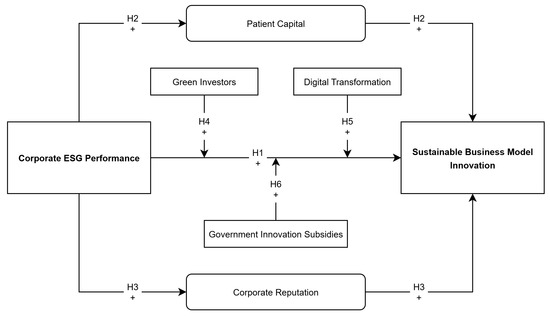
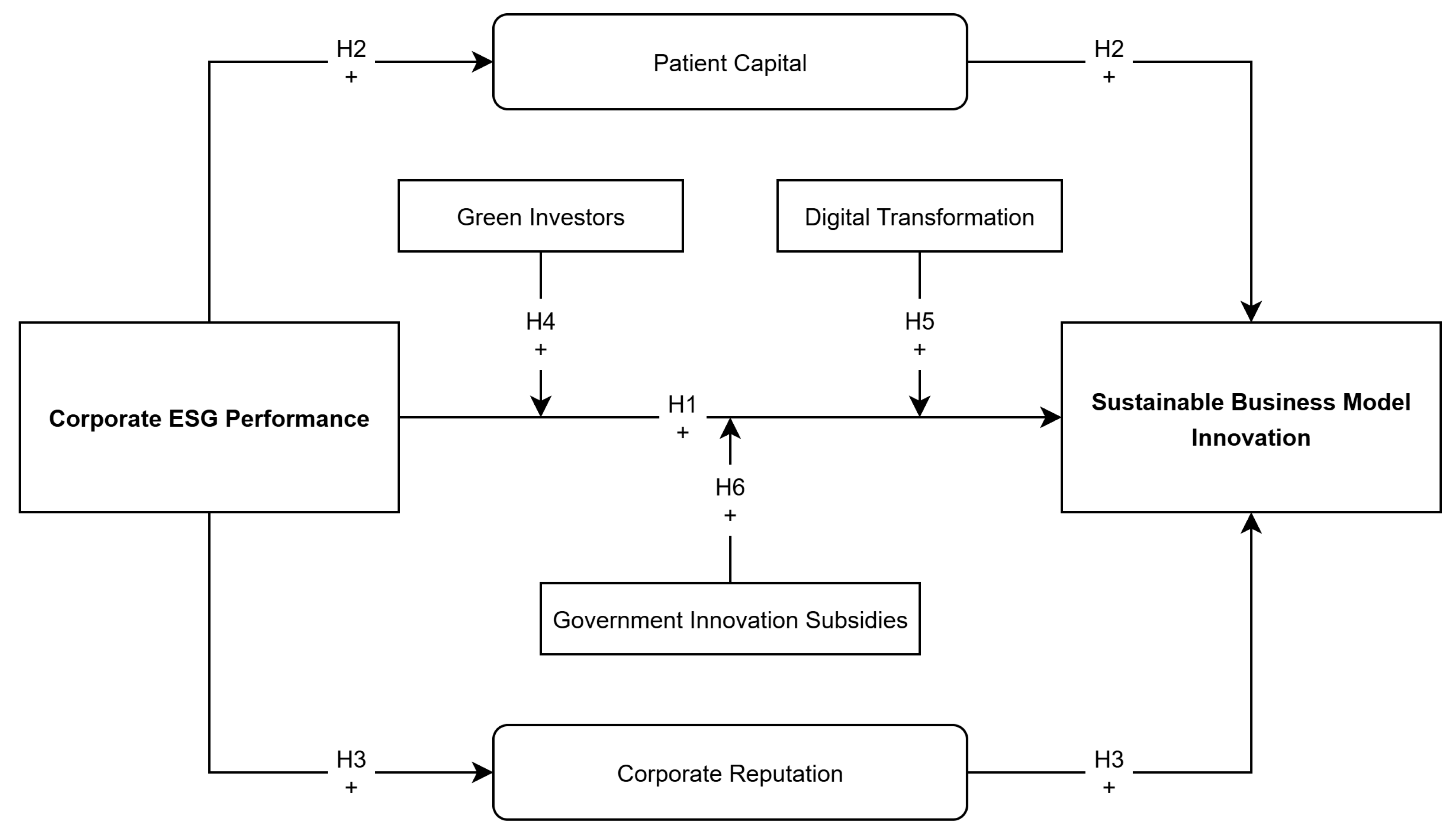
The proposed conceptual framework is graphically represented in Figure 1.
Figure 1.
Theoretical framework diagram.
4. Research Design
4.1. Sample Selection and Data Sources
The sample comprises A-share firms spanning 2014–2023, with ESG scores obtained from Bloomberg. The following screening procedures were applied:
- Firms with ST*, ST, or PT status, as well as those in the financial and insurance industries, are excluded;
- Firms with negative values for total assets, largest shareholder ownership, or net assets are removed;
- Samples with missing values for any key variables are excluded;
- All continuous variables are winsorized at the 1st and 99th percentiles to mitigate the influence of outliers.
After the above processing, the final sample consisted of 8947 firm-year observations. ESG score data were sourced from Bloomberg’s ESG rating database, while the remaining financial and corporate information was obtained from the CSMAR database, CNRDS database, RESSET Financial Database, the official websites of the Shanghai and Shenzhen Stock Exchanges, and CNINFO.
Data processing was conducted using Excel, Stata 17.0, and Python 3.13. As some firms have missing data in certain years, the final dataset constitutes an unbalanced panel.
4.2. Variable Design
4.2.1. Dependent Variable
This study adopted the SBMI measurement framework proposed by Bashir et al. (2002), which decomposes SBMI into three core dimensions [76]. Each dimension is further broken down into three to four specific issues to ensure a comprehensive and nuanced assessment.
Building on this, the study incorporated the classification scheme developed by Bocken et al. (2014), which categorizes SBMI into eight archetypes, each with its own set of descriptive keywords [3]. Based on these frameworks and following the methodological approach of Zhou et al. (2023) [28], this study applied text analysis techniques to quantitatively measure SBMI. The complete SBMI keyword dictionary and its mapping to Bocken et al. (2014) ’s [3] archetypes are provided in Appendix A. For example, a report that explicitly emphasizes “low-carbon manufacturing,” “circular economy,” and “stakeholder engagement in governance” would be assigned a high SBMI score, as it covers multiple archetypes in our dictionary.
The next step involved the careful selection of SBMI-related keywords. Drawing on the above literature, a systematic process was conducted to identify and screen potential representative terms for SBMI. During this process, terms that were inconsistent with the core meaning of SBMI or semantically ambiguous were removed. The refined set of keywords was then independently reviewed and validated by three domain experts in SBMI, resulting in the final seed word set.
With the SBMI keyword set finalized, a custom SBMI dictionary was developed. Using Python programming, word frequency statistics were computed based on sustainability reports disclosed by listed firms. This yielded the final quantitative score for SBMI.
4.2.2. Independent Variable
In empirical studies, institutional ESG ratings are commonly used as a standard measure of corporate ESG performance [77,78]. One major advantage of using institutional ratings lies in their objectivity and authority. As third-party evaluation tools, they ensure transparency and consistency of data while reducing the bias inherent in self-reported disclosures. Moreover, institutional ESG scores integrate multiple data sources, including public disclosures, third-party information, and assessments of social and environmental risks, thus providing a comprehensive ESG evaluation framework that supports inter-industry and cross-regional comparisons.
In this study, we employed Bloomberg ESG ratings as the primary measurement of ESG performance. Bloomberg’s ESG ratings consider multiple dimensions, including environmental impact, social responsibility, and governance structure. By combining firm-disclosed data with third-party resources, these ratings offer a holistic assessment of a company’s ESG performance and provide deep insights into its sustainability-related risks and opportunities.
4.2.3. Moderating and Mediating Variables
- Patient capital: Considering the particular institutional context of China, we used institutional ownership stability to represent patient capital. Stable institutional shareholding reflects a long-term investment horizon and monitoring style, which are central to the concept of patient capital, and this measure has been widely applied in prior research [79]. Compared with survey-based measures or qualitative assessments, this proxy is observable, consistent across firms, and suitable for large-sample empirical analysis. Therefore, it provides a reliable way to capture the extent to which firms benefit from patient, long-term-oriented investors.
- Drawing on the approach used in prior studies [80], the stability of institutional ownership was calculated as the ratio of institutional shareholding in firm i during year t to the standard deviation of its institutional ownership over the preceding three years.
- Corporate reputation: Drawing on existing reputation rankings and the works of Cravens et al. (2003) [81] and Chun (2005) [82], this study selected representative indicators of corporate reputation. This approach was commonly adopted in prior empirical research because financial strength, profitability, and risk profiles are the most visible and comparable dimensions through which external stakeholders form perceptions of firm reputation. Alternative measures such as survey-based rankings or media-based indicators are not consistently available for our full sample. Thus, factor analysis of financial metrics offers both data availability and comparability across firms, making it a feasible and valid proxy in this context.
- Green investors: Referring to Tang et al. (2024) [58], this study identified green investors by matching the “Fund Entity Information Table” and “Equity Investment Details Table” from the CSMAR database for the period 2014–2023. A fund is classified as a green investor if its investment goals or scope include sustainability-related keywords. In addition to “environmental protection,” “ecology,” “green,” and “new energy development,” our keyword set also covers broader terms such as “clean energy,” “renewable,” “low-carbon,” and similar descriptors to ensure comprehensive identification. If any such fund holds a listed firm, it is considered to have green investors.
- Digital transformation: Based on the study by Gong et al. (2021) [83], this variable was measured by counting the frequency of 139 digitalization-related keywords across three dimensions: technology classification, organizational empowerment, and digital application.
- Government innovation subsidies: Following Lyu et al. (2024) [84], government innovation subsidy data were obtained from firms’ disclosed financial statement notes. Based on the subsidy classification framework in Zuo et al. (2022) [85], we calculated the indicator as the sum of all government innovation-related financial support disclosed by listed companies.
4.2.4. Control Variables
To address potential firm-level differences in scale, financial performance, and governance characteristics, a range of control variables was incorporated into the model. Additionally, year, industry, and firm fixed effects were included to account for time-varying shocks, sector-specific traits, and unobserved heterogeneity. Full definitions of all variables are provided in Table 2.
Table 2.
Variable definitions.
4.3. Model Specification
To test Hypothesis 1, which proposes that ESG performance positively correlated SBMI among Chinese firms, the baseline Model 1 was constructed as follows:
To test Hypothesis 2, which concerns the mediating effect of patient capital, we built Model 2 based on Model 1:
To test Hypothesis 3, which examines the mediating role of corporate reputation, we built Model 3 as follows:
To examine the moderating effect of green investors on the relationship between ESG performance and SBMI (Hypothesis 4), we constructed Model 4:
To avoid multicollinearity, the digital transformation variable (ln(DCG)) is mean-centered before interacting with ESG. Based on this, Model 5 was constructed to test the moderating effect of digital transformation (Hypothesis 5):
To examine Hypothesis 6, which considers whether government innovation subsidies moderate the relationship between ESG and SBMI, we developed Model 6 as follows:
5. Empirical Results
5.1. Descriptive Statistics
Table 3 summarizes the descriptive statistics of the main variables. The dependent variable SBMI has a mean of 0.119 and a standard deviation of 0.678, showing wide differences in sustainable business model innovation among firms. ESG scores range from 2.672 to 4.121, with a mean of 3.458 and relatively low dispersion, indicating moderate variability in ESG performance.
Table 3.
Descriptive statistics.
Among control variables, firm size (mean = 23.384) and ROA display noticeable variation, suggesting diversity in operational scale and profitability. The average leverage ratio is 0.480, reflecting generally stable capital structures. Governance-related indicators such as Top1 (mean = 0.366) and Indep (mean = 0.375) show firm-level differences in ownership and board composition. The mean growth rate is 0.313, but the high standard deviation indicates performance divergence. Meanwhile, the proportion of state-owned enterprises is nearly balanced (SOE mean = 0.517).
Overall, the sample reflects substantial heterogeneity across ESG, SBMI, and firm fundamentals, providing a robust basis for regression analysis.
5.2. Correlation Analysis
Table 4 presents the Pearson correlation coefficients for key variables. A significant positive correlation is observed between ESG and SBMI (r = 0.541, p < 0.01), providing initial evidence that better ESG performance is associated with greater progress in sustainable business model innovation. This result supports the subsequent regression design.
Table 4.
Correlation analysis results.
Among control variables, firm size shows a strong positive correlation with SBMI (r = 0.471, p < 0.01), suggesting that larger firms may have more capacity to innovate sustainably. Leverage also correlates positively with SBMI (r = 0.275, p < 0.01), implying a potential link between financial structure and innovation efforts. In contrast, CEO duality exhibits no significant correlation with SBMI, indicating that managerial control structure may not play a major role. The correlation between Top1 and SBMI is negative, indicating that firms with highly concentrated ownership tend to be more conservative in sustainable business model innovation.
5.3. Regression Analysis
5.3.1. Regression Results of ESG and SBMI
Table 5 presents regression results on the ESG–SBMI relationship. Across all models (Columns 1–4), ESG has a consistently positive and significant effect on SBMI at the 1% level. In the baseline model, the ESG coefficient is 1.322 (R2 = 0.292). Adding fixed effects (Column 2) lowers the coefficient to 1.036 while improving model fit (R2 = 0.385). Further inclusion of control variables (Column 3) yields a coefficient of 1.004 (R2 = 0.408). In the fully specified model (Column 4), ESG remains significant, with a coefficient of 0.579 and R2 of 0.513.
Table 5.
Regression results of ESG and SBMI in Chinese firms.
In summary, although the ESG coefficient decreases after introducing control variables and fixed effects, its positive influence on SBMI remains robust, and the overall model fit improves significantly. The above results validate the core hypothesis that ESG performance significantly promotes sustainable business model innovation in enterprises. Thus, this suggests that corporate investment in ESG not only improves environmental and social performance but also effectively facilitates the sustainable transformation of their business models.
5.3.2. Regression Results of the Mediation Effect
Table 6 displays the regression results for the mediation analysis between ESG and SBMI. A two-step regression approach is adopted to explore possible mediating pathways. In Column 2, ESG performance is found to positively influence patient capital, indicating it may act as a mediating channel. Column 3 reveals a significant positive link between ESG and corporate reputation, supporting its role as another potential mediator.
Table 6.
Regression results for mediation effects.
In summary, patient capital and corporate reputation serve as important bridges between ESG and SBMI, offering new pathways for firms to achieve sustainable business model innovation.
5.3.3. Regression Results of the Moderation Effects
Table 7 reports the moderation analysis examining how green investors, digital transformation, and government innovation subsidies influence the ESG–SBMI relationship.
Table 7.
Moderating effect regression results.
- Column 1: The interaction term ESG × GI has a positive and significant coefficient (0.120, p < 0.01), indicating that the presence of green investors amplifies ESG’s effect on SBMI.
- Column 2: The interaction ESG × ln(DCG) is also positive and significant (0.067, p < 0.01), suggesting that digital transformation enhances the effectiveness of ESG in promoting SBMI, likely due to improved ESG implementation capabilities.
- Column 3: The interaction ESG × Gov yields a significant coefficient (2.051, p < 0.05), showing that government innovation subsidies further strengthen the ESG–SBMI linkage.
Interestingly, the direct coefficients of green investors (GI), digital transformation (ln(DCG)), and government innovation subsidies (Gov) on SBMI are negative. This suggests that these factors, when considered alone, may place additional resource burdens, compliance costs, or adjustment pressures on firms, thereby hindering immediate SBMI progress. However, their interaction terms with ESG are positive and significant, indicating that when combined with strong ESG performance, they act as important contextual enablers that amplify the positive impact of ESG on SBMI.
In conclusion, all three moderators significantly reinforce ESG’s impact on SBMI, affirming the robustness of the main findings across different contextual factors.
5.4. Robustness Tests
5.4.1. Replacing the Independent Variable
To reduce potential measurement errors arising from different data sources, this study replaced the core explanatory variable ESG score with an alternative metric. Specifically, the ESG rating from the Huazheng (CNI) database was used to substitute the original Bloomberg ESG score. The ratings range from “AAA” to “C” and were numerically converted from 9 to 1. The annual average rating was then calculated. The regression result is shown in Column 1 of Table 8. The result indicates that the main hypothesis still holds under this alternative ESG measure, further confirming the robustness of the findings.
Table 8.
Robustness test regression results.
5.4.2. Changing the Sample Window
To examine whether the conclusions are sensitive to the selection of the time window, this study adjusted the research period to 2019–2023. This time frame encompasses the outbreak and continuation of the COVID-19 pandemic globally, during which corporate data performance differs significantly from non-pandemic periods, with increased volatility. By selecting the 2019–2023 window, the study ruled out potential data heterogeneity caused by drastic external environmental changes before and during the pandemic, thereby ensuring the robustness and credibility of the conclusions under this unique and critical period. The regression result is shown in Column 2 of Table 8 and remains robust.
5.4.3. Instrumental Variable Approach
To mitigate potential endogeneity concerns, this study applied a two-stage least squares regression using lagged ESG values (t − 1 and t − 2) as instrumental variables. As shown in Columns 3 to 6 of Table 8, the first-stage regression indicates a strong correlation between the instruments and ESG. The second-stage results remain significantly positive, confirming that the positive effect of ESG on SBMI is not affected by endogeneity.
6. Conclusion, Implications, and Future Research
6.1. Conclusions and Recommendations
This study focuses on Chinese listed companies and investigates the impact mechanism of ESG on SBMI. It also explores the mediating roles of patient capital and corporate reputation, and reveals the moderating effects of green investors, digital transformation, and government innovation subsidies in this process.
The findings indicate that ESG practices significantly promote the development of SBMI among Chinese listed firms, demonstrating that strong performance in environmental, social, and governance dimensions is a key driver of sustainable business model innovation. The involvement of green investors, the advancement of digital transformation, and the provision of government innovation subsidies all significantly enhance the positive effect of ESG on SBMI, highlighting the crucial role of market forces and policy environments. Additionally, patient capital and corporate reputation partially mediate the link connecting ESG and SBMI. A series of robustness checks further validates the consistency and reliability of these results.
Based on the above research findings, we propose the following targeted recommendations:
- First, the government should strengthen the ESG-related policy framework. This includes standardizing ESG disclosure and rating criteria, as well as implementing diverse incentives, such as tax incentives and green credits, to encourage more investment in SBMI. Furthermore, the government should improve innovation subsidy policies to ensure accurate targeting and effective implementation, thereby offering clear policy support and institutional guarantees for enterprises.
- Second, enterprises should integrate ESG principles into their strategic development and actively embrace technologies like big data and artificial intelligence in the digital transformation process. These efforts can help optimize resource allocation and stimulate green innovation. Firms are also encouraged to attract green investors and increase the share of patient capital to enhance ESG performance, market competitiveness, and internal sustainability. At the same time, attention should be paid to reputation management, as sustained improvement in ESG performance can enhance trust among external stakeholders, creating a more favorable external environment for SBMI.
- Finally, investors should pay close attention to ESG construction in enterprises and actively transition into green investors. This shift can encourage firms to continuously improve and achieve a balance between economic returns and social responsibility. Green investors should continue to play a leading role by using financial instruments to provide strong financial support, helping transform SBMI from concept to practice.
6.2. Limitations and Future Research
While this study provides novel insights into how ESG practices promote SBMI, several avenues remain for refinement and future exploration.
First, the proxies for the mediating variables—patient capital and corporate reputation—though widely applied in prior studies, may not fully capture the conceptual richness of these constructs. For instance, the stability of institutional ownership primarily reflects behavioral outcomes such as low turnover, and factor analysis-based measures of corporate reputation may partially overlap with financial characteristics. Future research could further enrich measurement by developing alternative or more direct indicators, thereby complementing the current approach.
Second, although this study employed instrumental variables and multiple robustness tests, endogeneity concerns may still remain to some extent. Reverse causality between ESG and SBMI, or the influence of omitted variables, cannot be fully ruled out. Future work could strengthen causal inference by adopting natural experiments or longitudinal designs, which would provide further support to the findings presented here.
Third, this paper treats ESG performance as a composite construct. While this holistic approach highlights the overall effect of ESG, it may also mask differences among the environmental, social, and governance pillars. Disaggregating ESG in future studies could provide a more nuanced understanding of which dimension plays a greater role in driving SBMI.
Finally, the analysis is based on Chinese listed firms. This unique institutional setting offers valuable insights, yet cultural and contextual differences may limit generalizability. Future research could extend this framework through cross-country comparisons or in-depth case studies to enrich theoretical understanding of how ESG, patient capital, and corporate reputation interact to shape SBMI. With the global sustainable development agenda advancing rapidly, exploring how emerging technologies and new practices integrate into this process will be a promising direction for further research.
Author Contributions
C.Z.: data curation, project administration, supervision, methodology, funding acquisition; J.T.: data curation, formal analysis, visualization, writing—original draft, funding acquisition; S.Z.: data curation, conceptualization, writing—review and editing; B.H.: supervision, project administration. All authors have read and agreed to the published version of the manuscript.
Funding
This work was supported by the National Natural Science Foundation of China (grant number: 71273129) and the Jiangsu Postgraduate Research and Practice Innovation Program (grant number: KYCX25_1696).
Institutional Review Board Statement
Not applicable.
Informed Consent Statement
Not applicable.
Data Availability Statement
The data presented in this study are available on request from the corresponding author due to legal restrictions from the funding partner.
Acknowledgments
The authors are grateful to the editors, as well as the anonymous reviewers for the valuable suggestions and comments that helped us improve our paper significantly.
Conflicts of Interest
The authors declare no conflicts of interest.
Appendix A
Table A1.
Mapping of Bocken’s SBMI archetypes to keywords used in this study.
References
- de Mariz, F.; Aristizábal, L.; Andrade Álvarez, D. Fiduciary duty for directors and managers in the light of anti-ESG sentiment: An analysis of Delaware Law. Appl. Econ. 2024, 57, 4309–4320. [Google Scholar] [CrossRef] [Scilit]
- Neligan, A.; Baumgartner, R.J.; Geissdoerfer, M.; Schöggl, J.P. Circular Disruption: Digitalisation as a Driver of Circular Economy Business Models. Bus. Strat. Environ. 2023, 32, 1175–1188. [Google Scholar] [CrossRef] [Scilit]
- Bocken, N.M.P.; Short, S.W.; Rana, P.; Evans, S. A Literature and Practice Review to Develop Sustainable Business Model Archetypes. J. Clean. Prod. 2014, 65, 42–56. [Google Scholar] [CrossRef] [Scilit]
- Stubbs, W.; Cocklin, C. Conceptualizing a “Sustainability Business Model”. Organ. Environ. 2008, 21, 103–127. [Google Scholar] [CrossRef] [Scilit]
- Aloini, D.; Bessant, J.; Martini, A.; Von Stamm, B. Search Practices for Discontinuous Innovation: Scale Development and Construct Validation. Technol. Anal. Strateg. Manag. 2013, 25, 1139–1160. [Google Scholar] [CrossRef] [Scilit]
- Minatogawa, V.; Franco, M.; Rampasso, I.S.; Holgado, M.; Garrido, D.; Pinto, H.; Quadros, R. Towards Systematic Sustainable Business Model Innovation: What Can We Learn from Business Model Innovation. Sustainability 2022, 14, 2939. [Google Scholar] [CrossRef] [Scilit]
- Pan, L.; Xu, Z.; Skare, M. Sustainable Business Model Innovation Literature: A Bibliometrics Analysis. Rev. Manag. Sci. 2023, 17, 757–785. [Google Scholar] [CrossRef] [Scilit]
- Ding, G.; Sun, T.; Li, J. The Role of CEO Power Intensity and Patient Capital Investment Strategies in Enhancing Corporate Green Innovation Performance—An Empirical Test and Policy Implications Based on Heterogeneity Analysis. Financ. Res. Lett. 2025, 85, 108014. [Google Scholar] [CrossRef] [Scilit]
- Barth, H.; Ulvenblad, P.O.; Ulvenblad, P. Towards a Conceptual Framework of Sustainable Business Model Innovation in the Agri-Food Sector: A Systematic Literature Review. Sustainability 2017, 9, 1620. [Google Scholar] [CrossRef] [Scilit]
- Björklund, J.C. Barriers to Sustainable Business Model Innovation in Swedish Agriculture. J. Entrep. Manag. Innov. 2018, 14, 65–90. [Google Scholar] [CrossRef] [Scilit]
- Yu, E.P.Y.; Guo, C.Q.; Luu, B.V. Environmental, Social and Governance Transparency and Firm Value. Bus. Strat. Environ. 2018, 27, 987–1004. [Google Scholar] [CrossRef] [Scilit]
- Zhang, Z.; Zheng, X.; Lv, Q.; Meng, X. How Institutional Pressures Influence Corporate Greenwashing Strategies: Moderating Effects of Campaign-Style Environmental Enforcement. J. Environ. Manag. 2025, 373, 123914. [Google Scholar] [CrossRef] [Scilit] [PubMed]
- Liu, D.; Fill, H.D. An Empirical Analysis of the Impact of ESG Management Strategies on the Long-Term Financial Performance of Listed Companies in the Context of China Capital Market. Sustainability 2025, 17, 5778. [Google Scholar] [CrossRef] [Scilit]
- Al-Najjar, B.; Salama, A.; Abed, A. From Compliance to Commitment: Examining the Influence of Corporate Governance and Social Performance on Firms’ Circular Economy Initiatives. J. Bus. Ethics. 2025. [Google Scholar] [CrossRef] [Scilit]
- Boons, F.; Lüdeke-Freund, F. Business Models for Sustainable Innovation: State-of-the-Art and Steps towards a Research Agenda. J. Clean. Prod. 2013, 45, 9–19. [Google Scholar] [CrossRef] [Scilit]
- Geissdoerfer, M.; Bocken, N.M.P.; Hultink, E.J. Design Thinking to Enhance the Sustainable Business Modelling Process—A Workshop Based on a Value Mapping Process. J. Clean. Prod. 2016, 135, 1218–1232. [Google Scholar] [CrossRef] [Scilit]
- Schaltegger, S.; Hansen, E.G.; Lüdeke-Freund, F. Business Models for Sustainability: Origins, Present Research, and Future Avenues. Organ. Environ. 2016, 29, 3–10. [Google Scholar] [CrossRef] [Scilit]
- Yang, M.; Evans, S.; Vladimirova, D.; Rana, P. Value Uncaptured Perspective for Sustainable Business Model Innovation. J. Clean. Prod. 2016, 140, 1794–1804. [Google Scholar] [CrossRef] [Scilit]
- Porter, M.E.; Kramer, M.R. Creating Shared Value. Harv. Bus. Rev. 2011, 89, 62–77. [Google Scholar]
- Shakeel, J.; Mardani, A.; Chofreh, A.G.; Goni, F.A.; Klemeš, J.J. Anatomy of Sustainable Business Model Innovation. J. Clean. Prod. 2020, 261, 121201. [Google Scholar] [CrossRef] [Scilit]
- Khan, I.S.; Ahmad, M.O.; Majava, J. Industry 4.0 and Sustainable Development: A Systematic Mapping of Triple Bottom Line, Circular Economy and Sustainable Business Models Perspectives. J. Clean. Prod. 2021, 297, 126655. [Google Scholar] [CrossRef] [Scilit]
- Sinkovics, N.; Gunaratne, D.; Sinkovics, R.R.; Molina-Castillo, F.-J. Sustainable Business Model Innovation: An Umbrella Review. Sustainability 2021, 13, 7266. [Google Scholar] [CrossRef] [Scilit]
- de Pádua Pieroni, M.; Pigosso, D.C.A.; McAloone, T.C. Sustainable Qualifying Criteria for Designing Circular Business Models. Procedia CIRP 2018, 69, 799–804. [Google Scholar] [CrossRef] [Scilit]
- Todeschini, B.V.; Cortimiglia, M.N.; Callegaro-de-Menezes, D.; Ghezzi, A. Innovative and Sustainable Business Models in the Fashion Industry: Entrepreneurial Drivers, Opportunities, and Challenges. Bus. Horiz. 2017, 60, 759–770. [Google Scholar] [CrossRef] [Scilit]
- Yip, A.W.H.; Bocken, N.M.P. Sustainable Business Model Archetypes for the Banking Industry. J. Clean. Prod. 2018, 174, 150–169. [Google Scholar] [CrossRef] [Scilit]
- Cheah, S.; Ho, Y.-P. Coworking and Sustainable Business Model Innovation in Young Firms. Sustainability 2019, 11, 2959. [Google Scholar] [CrossRef] [Scilit]
- Peralta, A.; Carrillo-Hermosilla, J.; Crecente, F. Sustainable Business Model Innovation and Acceptance of Its Practices among Spanish Entrepreneurs. Corp. Soc. Responsib. Environ. Manag. 2019, 26, 1119–1134. [Google Scholar] [CrossRef] [Scilit]
- Zhou, N.; Pan, L.; Tian, Y.; Zhu, N.; Cai, X.; Gao, J. How Sustainable Business Model Innovation and Green Technology Innovation Interact to Affect Sustainable Corporate Performance. Front. Environ. Sci. 2023, 11, 1049295. [Google Scholar] [CrossRef] [Scilit]
- Wang, K.M.; Wang, H.J.; Li, D.D.; Zhang, Y.L. Complexity of Annual Report and Management Self-Interest: Empirical Evidence from Chinese Listed Firms. Manag. World. 2018, 34, 120–132. [Google Scholar]
- Porter, M.E.; Kramer, M.R. Strategy and Society: The Link Between Competitive Advantage and Corporate Social Responsibility. Harv. Bus. Rev. 2006, 84, 78–92. [Google Scholar]
- Thorne McAlister, D.; Ferrell, L. The Role of Strategic Philanthropy in Marketing Strategy. Eur. J. Mark. 2002, 36, 689–705. [Google Scholar] [CrossRef] [Scilit]
- Qian, S. The Effect of ESG on Enterprise Value under the Dual Carbon Goals: From the Perspectives of Financing Constraints and Green Innovation. Int. Rev. Econ. Financ. 2024, 93, 318–331. [Google Scholar] [CrossRef] [Scilit]
- Ho, C.K. Corporate Governance and Corporate Competitiveness: An International Analysis. Corp. Gov. Int. Rev. 2005, 13, 211–253. [Google Scholar] [CrossRef] [Scilit]
- Li, X.; Saat, M.M.; Khatib, S.F.A.; Liu, Y. Sustainable Development and Firm Value: How ESG Performance Shapes Corporate Success—A Systematic Literature Review. Bus. Strategy Dev. 2024, 7, e70026. [Google Scholar] [CrossRef] [Scilit]
- Joyce, A.; Paquin, R.L. The Triple Layered Business Model Canvas: A Tool to Design More Sustainable Business Models. J. Clean. Prod. 2016, 135, 1474–1486. [Google Scholar] [CrossRef] [Scilit]
- Joo, J.; Shin, M.M. Business Ecosystem Management and Editorial on the Special Issue. Sustainability 2022, 14, 1449. [Google Scholar] [CrossRef] [Scilit]
- Deeg, R.; Hardie, I. What Is Patient Capital and Who Supplies It? Socio-Econ. Rev. 2016, 14, 627–645. [Google Scholar] [CrossRef] [Scilit]
- Pfaff, N.; Utermarck, S.; Altun, O.; Egorov, S. Market Integrity and Greenwashing Risks in Sustainable Finance; The International Capital Market Association: Zurich, Switzerland, 2023. [Google Scholar]
- Li, T.; Shu, X.; Liao, G. Does Corporate Greenwashing Affect Investors’ Decisions? Financ. Res. Lett. 2024, 67, 105877. [Google Scholar] [CrossRef] [Scilit]
- Edmans, A. The End of ESG. Financ. Manag. 2023, 52, 3–17. [Google Scholar] [CrossRef] [Scilit]
- Schoenmaker, D.; Schramade, W. Investing for Long-term Value Creation. J. Sustain. Financ. Invest. 2019, 9, 356–377. [Google Scholar] [CrossRef] [Scilit]
- Wang, Z.; He, B.; Fujita, T. Does Environmental Regulation Affect Inward Foreign Direct Investment? Evidence from China. Appl. Econ. Lett. 2024, 1–7. [Google Scholar] [CrossRef] [Scilit]
- Fichtner, J.; Heemskerk, E.M. The New Permanent Universal Owners: Index Funds, Patient Capital, and the Distinction between Feeble and Forceful Stewardship. Econ. Soc. 2020, 49, 493–515. [Google Scholar] [CrossRef] [Scilit]
- Fang, F.; Chen, D. Can Executive Equity Incentives Enhance Corporate Debt-Paying Ability?—An Analysis Based on the Moderating Mechanism of Patient Capital. Int. Rev. Econ. Financ. 2025, 102, 104347. [Google Scholar] [CrossRef] [Scilit]
- Kwon, H.B.; Lee, J.; Choi, L. Dynamic Interplay of Environmental Sustainability and Corporate Reputation: A Combined Parametric and Nonparametric Approach. Ann. Oper. Res. 2023, 324, 687–719. [Google Scholar] [CrossRef] [Scilit]
- Murè, P.; Spallone, M.; Mango, F.; Marzioni, S.; Bittucci, L. ESG and Reputation: The Case of Sanctioned Italian Banks. Corp. Soc. Responsib. Environ. Manag. 2021, 28, 265–277. [Google Scholar] [CrossRef] [Scilit]
- First, I.; Khetriwal, D.S. Exploring the Relationship between Environmental Orientation and Brand Value: Is There Fire or Only Smoke? Bus. Strateg. Environ. 2010, 19, 90–103. [Google Scholar] [CrossRef] [Scilit]
- Hsu, K.T. The Advertising Effects of Corporate Social Responsibility on Corporate Reputation and Brand Equity: Evidence from the Life Insurance Industry in Taiwan. J. Bus. Ethics. 2012, 109, 189–201. [Google Scholar] [CrossRef] [Scilit]
- Sánchez-Torné, I.; Morán-Álvarez, J.C.; Pérez-López, J.A. The Importance of Corporate Social Responsibility in Achieving High Corporate Reputation. Corp. Soc. Responsib. Environ. Manag. 2020, 27, 2692–2700. [Google Scholar] [CrossRef] [Scilit]
- Soleimani, A.; Schneper, W.D.; Newburry, W. The Impact of Stakeholder Power on Corporate Reputation: A Cross-Country Corporate Governance Perspective. Organ. Sci. 2014, 25, 991–1008. [Google Scholar] [CrossRef] [Scilit]
- Szwajca, D. Corporate Reputation and Customer Loyalty as the Measures of Competitive Enterprise Position—Empirical Analyses on the Example of Polish Banking Sector. Oeconomia Copernicana. 2016, 7, 91–106. [Google Scholar] [CrossRef] [Scilit]
- Rose, C.; Thomsen, S. The Impact of Corporate Reputation on Performance: Some Danish Evidence. Eur. Manag. J. 2004, 22, 201–210. [Google Scholar] [CrossRef] [Scilit]
- Raithel, S.; Schwaiger, M. The Effects of Corporate Reputation Perceptions of the General Public on Shareholder Value. Strat. Manag. J. 2015, 36, 945–956. [Google Scholar] [CrossRef] [Scilit]
- Helm, S. Employees’ Awareness of Their Impact on Corporate Reputation. J. Bus. Res. 2011, 64, 657–663. [Google Scholar] [CrossRef] [Scilit]
- Delgado-García, J.B.; de Quevedo-Puente, E.; Díez-Esteban, J.M. The Impact of Corporate Reputation on Firm Risk: A Panel Data Analysis of Spanish Quoted Firms. Br. J. Manag. 2013, 24, 1–20. [Google Scholar] [CrossRef] [Scilit]
- Pérez-Cornejo, C.; de Quevedo-Puente, E.; Delgado-García, J.B. How to Manage Corporate Reputation? The Effect of Enterprise Risk Management Systems and Audit Committees on Corporate Reputation. Eur. Manag. J. 2019, 37, 505–515. [Google Scholar] [CrossRef] [Scilit]
- Feng, J.; Yuan, Y. Green Investors and Corporate ESG Performance: Evidence from China. Financ. Res. Lett. 2024, 60, 104892. [Google Scholar] [CrossRef] [Scilit]
- Tang, H.; Tong, M.; Chen, Y. Green Investor Behavior and Corporate Green Innovation: Evidence from Chinese Listed Companies. J. Environ. Manag. 2024, 366, 121691. [Google Scholar] [CrossRef] [Scilit]
- He, F.; Ding, C.; Yue, W.; Liu, G. ESG Performance and Corporate Risk-Taking: Evidence from China. Int. Rev. Financ. Anal. 2023, 87, 102550. [Google Scholar] [CrossRef] [Scilit]
- Chi, Y.; Hu, N.; Lu, D.; Yang, Y. Green Investment Funds and Corporate Green Innovation: From the Logic of Social Value. Energy Econ. 2023, 119, 106532. [Google Scholar] [CrossRef] [Scilit]
- Zhang, X.; Song, Y.; Zhang, M. Exploring the Relationship of Green Investment and Green Innovation: Evidence from Chinese Corporate Performance. J. Clean. Prod. 2023, 412, 137444. [Google Scholar] [CrossRef] [Scilit]
- Heinkel, R.; Kraus, A.; Zechner, J. The Effect of Green Investment on Corporate Behavior. J. Financ. Quant. Anal. 2001, 36, 431–449. [Google Scholar] [CrossRef] [Scilit]
- Zhang, S.; Chen, Z. Experts on the Board: How Do IT-Savvy Directors Promote Corporate Digital Innovation? Econ. Anal. Policy 2025, 85, 791–817. [Google Scholar] [CrossRef] [Scilit]
- Ardolino, M.; Rapaccini, M.; Saccani, N.; Gaiardelli, P.; Crespi, G.; Ruggeri, C. The Role of Digital Technologies for the Service Transformation of Industrial Companies. Int. J. Prod. Res. 2018, 56, 2116–2132. [Google Scholar] [CrossRef] [Scilit]
- Liu, Q.; Liu, J.; Gong, C. Digital Transformation and Corporate Innovation: A Factor Input Perspective. Manag. Decis. Econ. 2023, 44, 2159–2174. [Google Scholar] [CrossRef] [Scilit]
- Li, Y.; Dai, J.; Cui, L. The Impact of Digital Technologies on Economic and Environmental Performance in the Context of Industry 4.0: A Moderated Mediation Model. Int. J. Prod. Econ. 2020, 229, 107777. [Google Scholar] [CrossRef] [Scilit]
- Li, Z.; Miao, S.; Xu, L. Digital Transformation and Environmental, Social, and Governance Greenwashing: Evidence from China. J. Environ. Manag. 2024, 365, 121460. [Google Scholar] [CrossRef] [Scilit]
- Xiao, S.; Xu, J.; Li, R. Are Digital Trends Driving Corporate Environmental, Social, and Governance Practices? Evidence from China. Bus. Strat. Environ. 2024, 33, 5366–5385. [Google Scholar] [CrossRef] [Scilit]
- Li, H.; Wu, Y.; Cao, D.; Wang, Y. Organizational Mindfulness towards Digital Transformation as a Prerequisite of Information Processing Capability to Achieve Market Agility. J. Bus. Res. 2021, 122, 700–712. [Google Scholar] [CrossRef] [Scilit]
- Jones, M.D.; Hutcheson, S.; Camba, J.D. Past, Present, and Future Barriers to Digital Transformation in Manufacturing: A Review. J. Manuf. Syst. 2021, 60, 936–948. [Google Scholar] [CrossRef] [Scilit]
- Kluza, K.; Ziolo, M.; Spoz, A. Innovation and Environmental, Social, and Governance Factors Influencing Sustainable Business Models—Meta-Analysis. J. Clean. Prod. 2021, 303, 127015. [Google Scholar] [CrossRef] [Scilit]
- Li, C.; Sampene, A.K.; Khan, A.; Wiredu, J. Environmental Orientations to Innovation Ecosystem: The Role of Green Transition, Perceived Environmental Uncertainty and Green Transformational Leadership. Oper. Manag. Res. 2025, 18, 48–71. [Google Scholar] [CrossRef] [Scilit]
- de Vasconcelos Gomes, L.A.; da Silva Barros, L.S. The Role of Governments in Uncertainty Orchestration in Market Formation for Sustainability Transitions. Environ. Innov. Soc. Transit. 2022, 43, 127–145. [Google Scholar] [CrossRef] [Scilit]
- Yi, J.; Murphree, M.; Meng, S.; Li, S. The More the Merrier? Chinese Government R&D Subsidies, Dependence, and Firm Innovation Performance. J. Prod. Innov. Manag. 2021, 38, 289–310. [Google Scholar] [CrossRef] [Scilit]
- Sun, W.; Wang, Z.; Huang, Y.; Li, Y. Unlocking SME Growth: Analyzing the Government Subsidies’ Impact on Financing in China. PLoS ONE 2024, 19, e0304589. [Google Scholar] [CrossRef] [Scilit] [PubMed]
- Bashir, M.; Alfalih, A.; Pradhan, S. Sustainable Business Model Innovation: Scale Development, Validation and Proof of Performance. J. Innov. Knowl. 2022, 7, 100243. [Google Scholar] [CrossRef] [Scilit]
- Del Bosco, B.; Misani, N. The Effect of Cross-Listing on the Environmental, Social, and Governance Performance of Firms. J. World Bus. 2016, 51, 977–990. [Google Scholar] [CrossRef] [Scilit]
- Yu, P.Y.; Luu, B.V. International Variations in ESG Disclosure–Do Cross-Listed Companies Care More? Int. Rev. Financ. Anal. 2021, 75, 101731. [Google Scholar] [CrossRef] [Scilit]
- Asaba, S. Patient Investment of Family Firms in the Japanese Electric Machinery Industry. Asia Pac. J. Manag. 2013, 30, 697–715. [Google Scholar] [CrossRef] [Scilit]
- Harford, J.; Kecskés, A.; Mansi, S. Do Long-term Investors Improve Corporate Decision Making? J. Corp. Financ. 2018, 50, 424–452. [Google Scholar] [CrossRef] [Scilit]
- Cravens, K.; Oliver, E.G.; Ramamoorti, S. The Reputation Index: Measuring and Managing Corporate Reputation. Eur. Manag. J. 2003, 21, 201–212. [Google Scholar] [CrossRef] [Scilit]
- Chun, R. Corporate Reputation: Meaning and Measurement. Int. J. Manag. Rev. 2005, 7, 91–109. [Google Scholar] [CrossRef] [Scilit]
- Gong, C.; Ribiere, V. Developing a Unified Definition of Digital Transformation. Technovation 2021, 102, 102217. [Google Scholar] [CrossRef] [Scilit]
- Lyu, H.; Ma, C.; Arash, F. Government Innovation Subsidies, Green Technology Innovation and Carbon Intensity of Industrial Firms. J. Environ. Manag. 2024, 369, 122274. [Google Scholar] [CrossRef] [Scilit]
- Zuo, Z.; Lin, Z. Government R&D Subsidies and Firm Innovation Performance: The Moderating Role of Accounting Information Quality. J. Innov. Knowl. 2022, 7, 100176. [Google Scholar] [CrossRef] [Scilit]

Disclaimer/Publisher’s Note: The statements, opinions and data contained in all publications are solely those of the individual author(s) and contributor(s) and not of MDPI and/or the editor(s). MDPI and/or the editor(s) disclaim responsibility for any injury to people or property resulting from any ideas, methods, instructions or products referred to in the content. |
© 2025 by the authors. Licensee MDPI, Basel, Switzerland. This article is an open access article distributed under the terms and conditions of the Creative Commons Attribution (CC BY) license (https://creativecommons.org/licenses/by/4.0/).